DAVID HOCKNEY (B.1937)
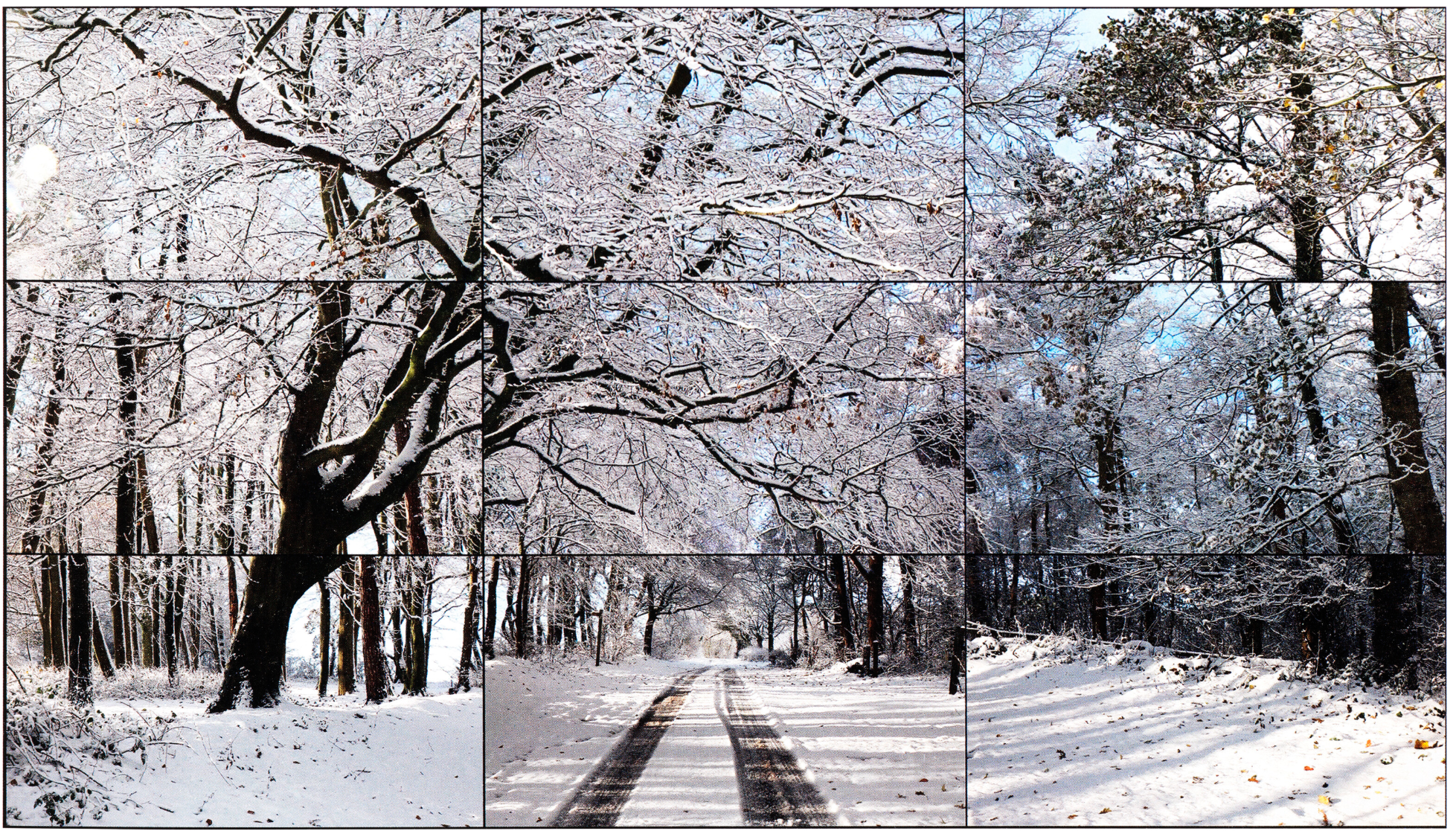
Woldgate Woods, Winter, 2010
Nine synchronised digital videos
Overall: 81 x 142 1/2 inches (206×362 cm)
This work is number seven from an edition of ten plus two artist’s proofs
Provenance
Annely Juda Fine Art, London
Private Collection (acquired from the above in 2017)
Anon. sale, Sotheby’s London, 2 March 2022, lot 14
Acquired at the above sale by the present owner
Auction History
Christie’s London: 5 March 2025
Estimated: GBP 800,000 – 1,200,000
GBP 819,000 / USD 1,048,320
DAVID HOCKNEY (B.1937), Woldgate Woods, Winter, 2010 | Christie’s
REPEAT SALE
Sotheby’s London: 2 March 2022
Estimated: GBP 800,000 – 1,200,000
GBP 922,500 / USD 1,233,100
Woldgate Woods, Winter, 2010 | The Now Evening Auction | 2022 | Sotheby’s
David Hockney’s Woldgate Woods, Winter, 2010 is a dazzling continuation of the artist’s career-consuming project to better see the world around him. Filmed as part of a yearlong immersion in the landscape of the Yorkshire Wolds, this exquisite, sunbathed snowscape takes the viewer on a cinematic pilgrimage of sight. Against a clear blue sky a thick blanket of snow carpets the ground and encrusts the canopied branches of the trees. In places sun floods the frame, hanging low and out of sight, and casting long, dramatic shadows across the woodland floor as tones of cool, pale blue give way to shimmering bright whites. Part of a seasonal quartet documenting the effects of light and time on place, the film combines archetypal themes of Hockney’s practice with his insatiable pursuit of new technologies.
Woldgate Woods, Winter, 2010 has been exhibited in numerous surveys of the artist’s work, including the major travelling retrospective David Hockney: A Bigger Picture, which opened at the Royal Academy, London in 2012; David Hockney: A Bigger Exhibition at the de Young Museum, San Francisco, in 2014; and Hockney’s Eye: The Art and Technology of Depiction at the Fitzwilliam Museum, Cambridge, in 2022. Others from the edition of the present work are held in the permanent collections of the Toldedo Museum of Art, the Smithsonian American Art Museum, Washington, D.C. and The David Hockney Foundation.
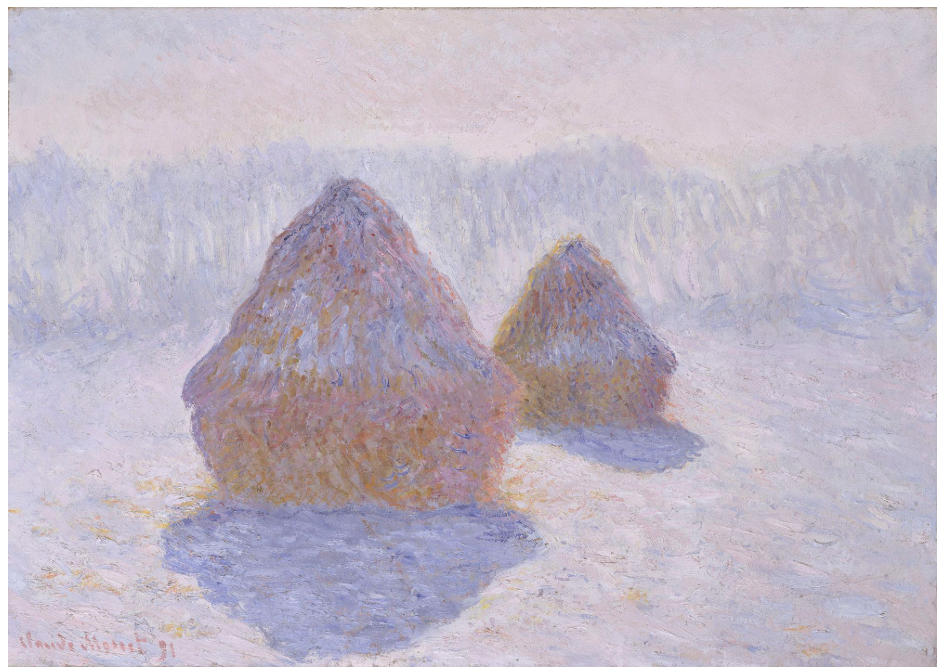
Claude Monet, Haystacks (Effects of Snow and Sun), 1891. Metropolitan Museum of Art, New York.
Digital image: © 2025 The Metropolitan Museum of Art/Art Resource/Scala, Florence.
If Hockney’s early career is defined by the sun-kissed pools and vast canyons of the American West, his later years are typified by bucolic views of Yorkshire’s shifting light and gently rolling fields. Born in Bradford, Hockney’s Odyssean return to Yorkshire in the late 1990s was precipitated by the illnesses and later deaths of his mother and his close friend Jonathan Silver. Staying near to his mother, then in Bridlington, Hockney moved back from Los Angeles for what would be the first extended period he had spent in Yorkshire in two decades. He drove frequently across the moors, valleys and hills of East Yorkshire to visit Silver in Wetherby, and identified an untapped and fertile subject in the landscape of his youth. He recalled summers as a boy spent working on farmlands near Bridlington, and thought about the ways in which agriculture had shaped and reshaped the contours of his native soil. ‘I was painting the land, land that I myself had worked’ explained Hockney. ‘I had dwelt in those fields, so that out there, seeing, for me, necessarily came steeped in memory’ (D. Hockney quoted in L. Weschler, ‘Sometime Take the Time’ in David Hockney: Hand Eye Heart, exh. cat. L.A. Louver Gallery, Venice, CA 2005, p. 51). Pulsating with a quiet grandeur, Woldgate Woods, Winter, 2010 evokes an anticipatory nostalgia for the present.
The idea of the camera as a drawing tool is not novel within Hockney’s practice, recalling an important precursor to the present work. In the 1980s Hockney had produced a series of composite photographs and photo-collages which he referred to as ‘joiners’, exhibiting the series under the title Drawing with a Camera (Andre Emmerich Gallery, New York, 1982). Initially made with Polaroid photographs, and later 35mm prints from a Pentax 110, these post-Cubist collages were an attempt to replicate true sight. This early adoption of the photographic medium would exert enormous influence on Hockney’s wider oeuvre, demonstrably in the vast, 60-canvas composite painting A Bigger Grand Canyon (1998, National Gallery of Australia, Canberra). ‘The joiners were much closer to the way we actually look at things,’ Hockney explains, ‘closer to the truth of the experience’ (D. Hockney, artist’s website).
“The camera is a medium is what I suddenly realised. It’s neither an art, a technique, a craft, nor a hobby—it’s a tool. It’s an extraordinary drawing tool”
In his career as a landscape artist, Hockney has turned his finely-tuned gaze—which from the 1960s has so remarkably captured the essence of his portrait sitters—to the world around him, invariably perceptive to traces of agriculture and progress, as well as the slightest modulations in hue, light and shadow, on the ever-shifting contours of the land. Begun in earnest in 2004, his drawings, paintings, photographs, and iPad pictures of East Yorkshire comprise a poignant, radiant tribute to the landscape which produced one of the past century’s most significant and beloved artists. Woldgate Woods, Winter, 2010, in its mastery of modern media, is one of Hockney’s remarkable contributions to the history of visual and artistic innovation.
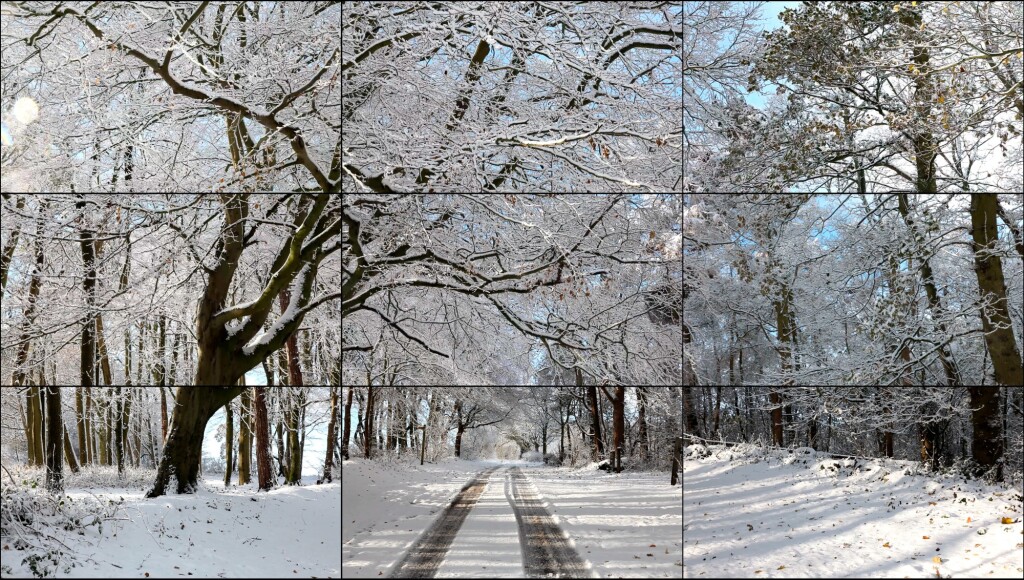
A remarkably vast panorama of spatial depth, Woldgate Woods, Winter 2010 is part of Hockney’s continued exploration of time, landscape, perception and memory in a site that has proved a profoundly important subject for the artist throughout his much-acclaimed career. In a pivotal creative re-invention, Hockney’s first multi-camera video carefully recorded the effects of sunlight, shadow and other ephemeral effects of weather as they impacted on the expansive snowy landscape of a forest in East Yorkshire, transforming the bucolic North of England into something visionary. The significance of this key work has been repeatedly recognized through its inclusion in several of Hockney’s recent major exhibitions, including the comprehensive survey of his landscapes, David Hockney: A Bigger Picture, at the Royal Academy in London in 2012 (which later travelled to the Guggenheim Museum in Bilbao and the Museum Ludwig in Cologne) and the landmark career retrospective, David Hockney, at Tate Britain in London in 2017 (which later travelled to the Centre Georges Pompidou in Paris and The Metropolitan Museum of Art in New York).
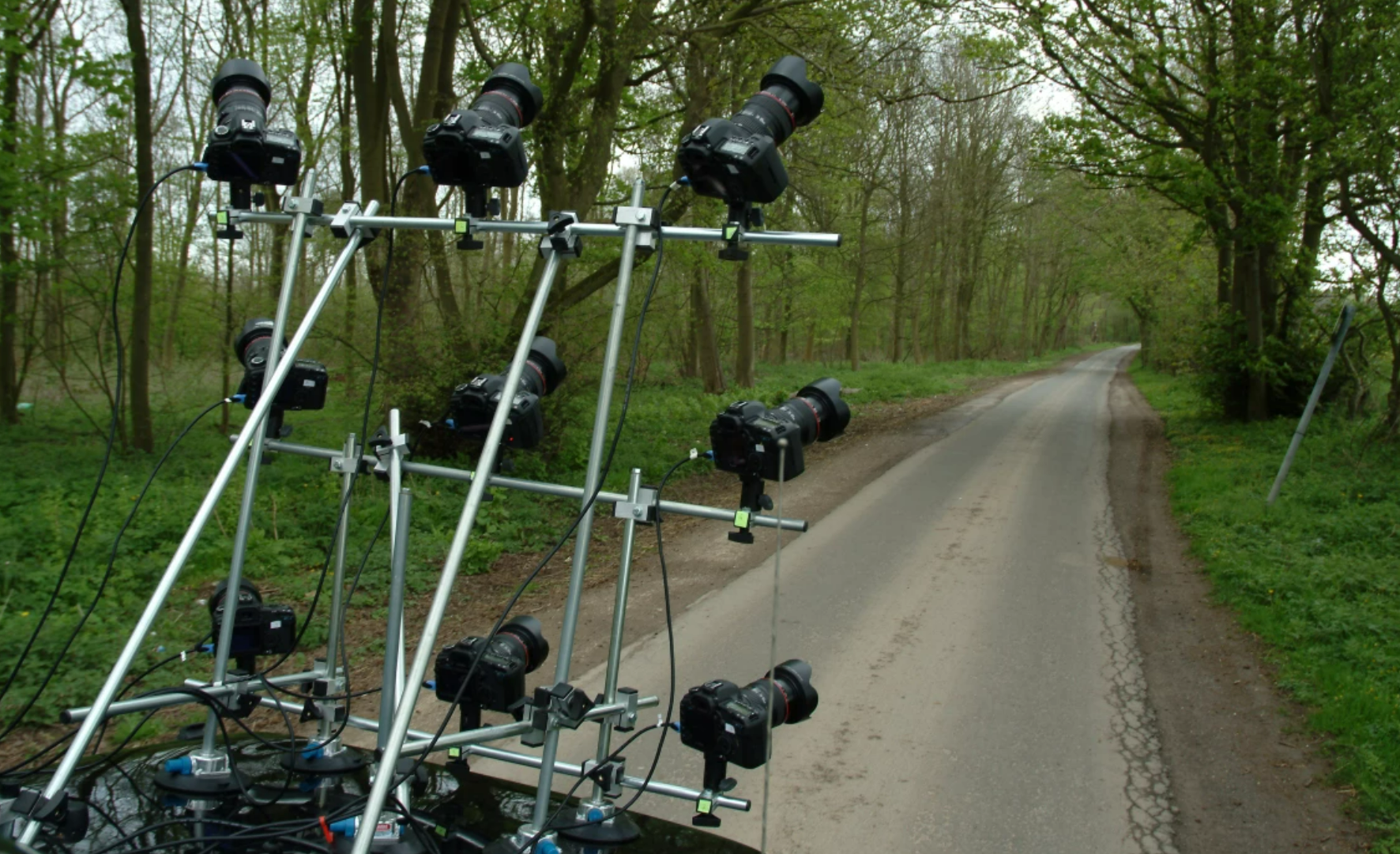
In keeping with Hockney’s progressive use of technology, a common theme throughout his oeuvre, Woldgate Woods, Winter 2010 belongs to a pioneering series of video works created by Hockney in the countryside near his childhood home in East Yorkshire. The series comprises four separate video works, each depicting a different season and made up of nine screens arranged in three rows of three displaying footage captured using nine separate cameras fixed on top of a gradually moving vehicle. Allowing viewers to see the changing viewpoints simultaneously in one visual space and in real time, the present work focuses on the expansive snowy landscape situated on either side of the narrow Roman road which runs through Woldgate Woods from Bessingby Hill to the village of Kilham.
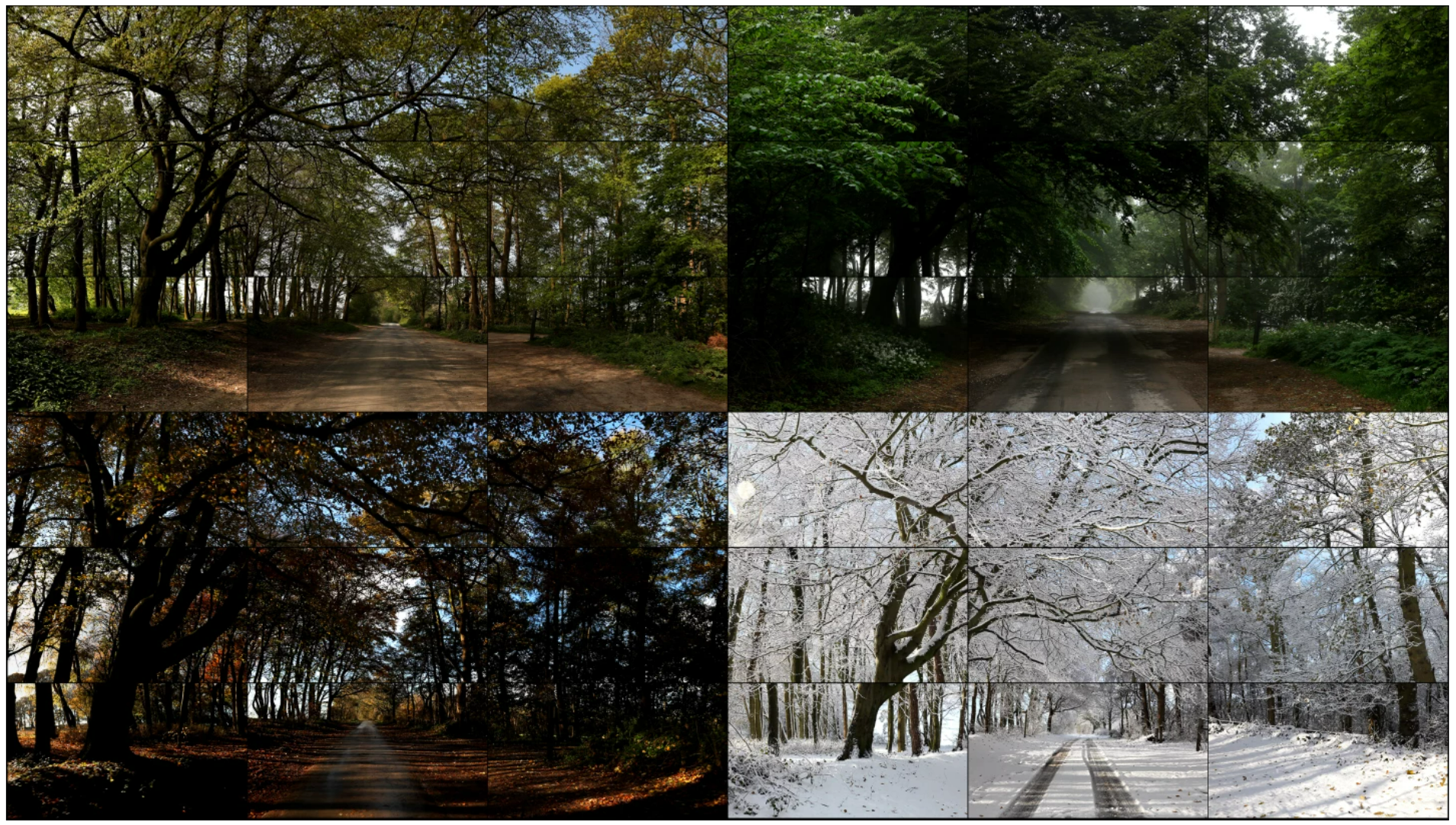
By recording the same track with nine separate cameras filming at the same time, Hockney managed to create what he refers to as a ‘Cubist movie’ in which multiple viewpoints literally capture changing time and space, an effect the artist also has sought to represent in many of his painted landscapes. The cameras filming the track all point in slightly different directions, yet the nine separate views in the final work bring together these varied viewpoints via a two-dimensional viewing surface.