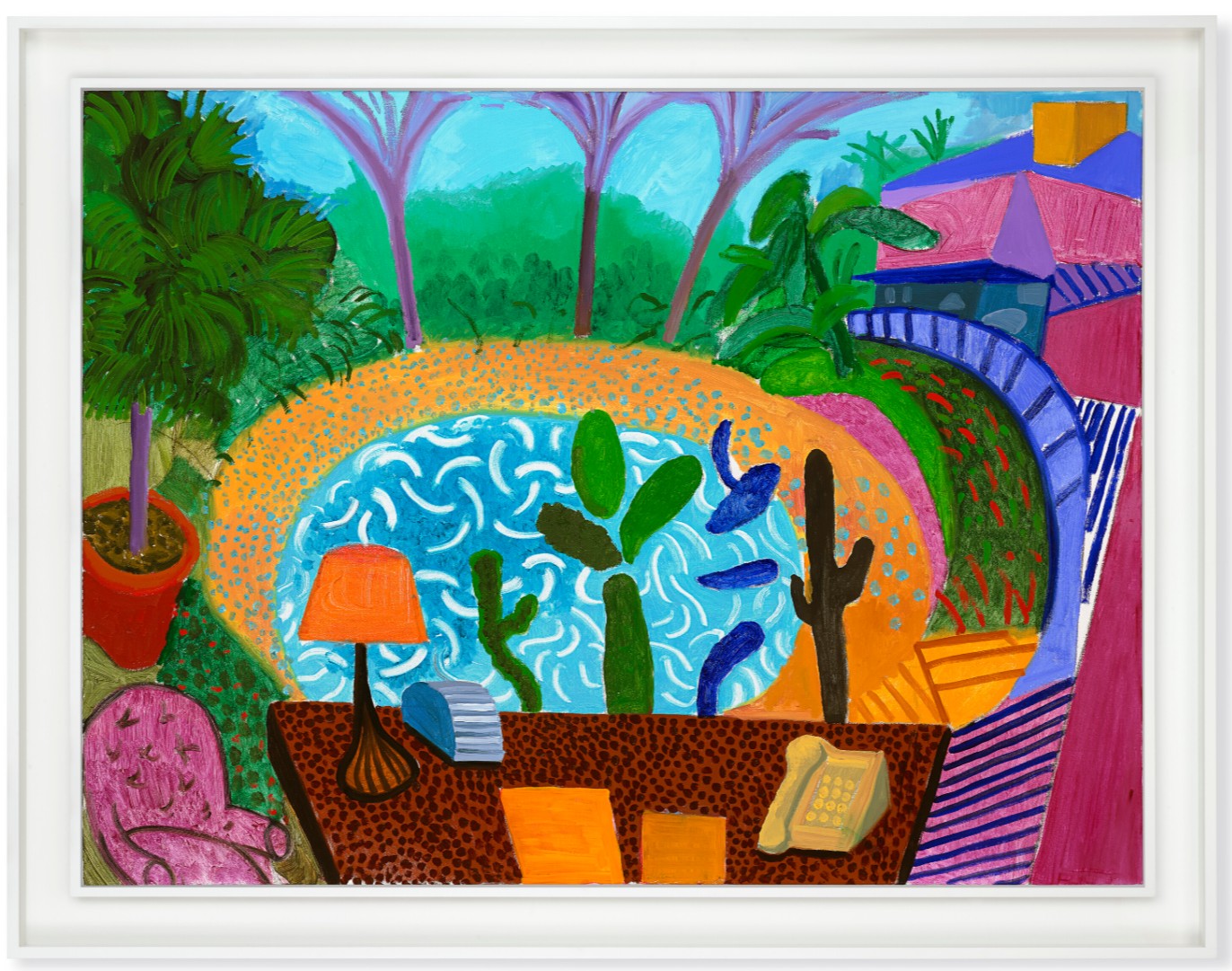
DAVID HOCKNEY (B. 1937)
My Garden in Los Angeles, London, July 2000
Oil on canvas
36×48 inches (91.4 x 121.9 cm)
Signed and dated ‘David Hockney ’00’ (on the reverse)
Provenance
Galerie Lelong, Paris
Private collection
Annely Juda Fine Art, London
Acquired from the above by the present owner, 2015
Auction History
Property from an Important Private Collection
Christie’s New-York: 17 November 2025
Estimated: USD 7,500,000 – 10,000,000
USD 9,469,000
DAVID HOCKNEY (B. 1937), My Garden in Los Angeles, London, July 2000 | Christie’s
Luscious strokes of vibrant, Fauvist colors coalesce in David Hockney’s My Garden in Los Angeles, London, July 2000 in a virtuoso demonstration of mature mastery. The painting mediates on two of Hockney’s most pressing concerns—that of memory and that of space—resolving a decades-long dilemma around the uses of perspective in his paintings. The present work is a culmination of this exploratory process, synthesizing the lessons which Hockney learnt across his painted landscapes of Yorkshire, his abstract paintings, and his theatre productions. Here, the artist establishes a dynamic, expansive, and vivid point of view reflecting his own treasured memory of the distinctive pool, terrace, and garden at his Hollywood Hills home. Painted in London, The work is a deeply personal reflection on his memory of this intimate space as well as on his famous pool motif. Finally escaping the restrictions of conventional Albertian one-point linear perspective, Hockney opens up a new and expansive universe, depicting in paint the third and fourth dimensions in order to express an exciting sense of space, movement, and emotion on the flat surface of his canvas. The advances in perspective and style made with My Garden in Los Angeles laid the foundation for his much-celebrated post-millennium output—a period so prolific and transformative as to become the focus of Hockney’s recent tour-de-force retrospective at Fondation Louis Vuitton, David Hockney 25. It has been a period of immense creativity for or this extraordinary painter, a period which began with My Garden in Los Angeles.
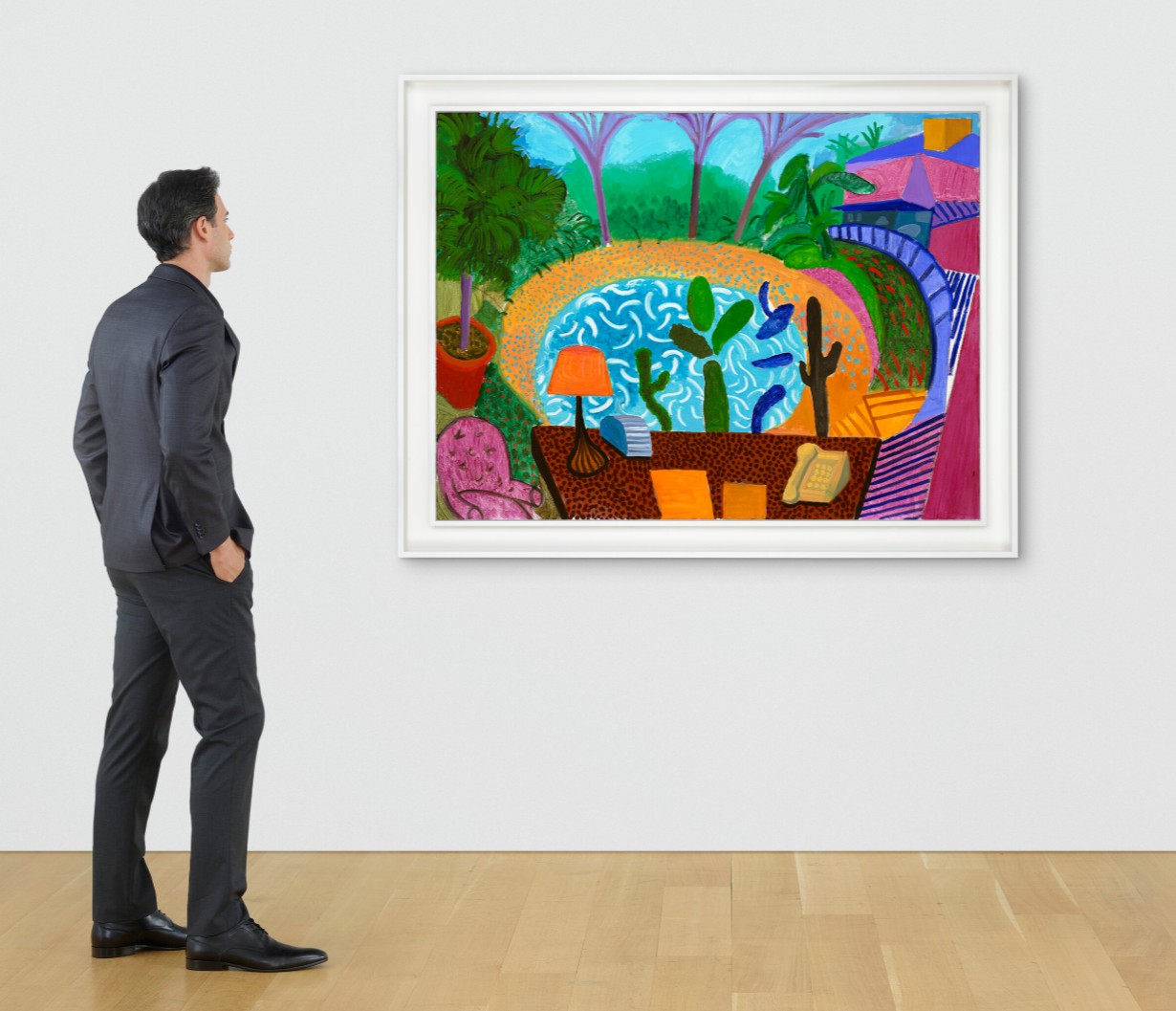
The composition is foregrounded with Hockney’s own desk, depicted in a reversed perspective, angling outward as it recedes into the distance. By placing this work station, appointed with a telephone, rolodex, lamp, and two piles of paper, Hockney dissolves the division between interior and exterior. His fascinating use of perspective, recalling Vincent van Gogh’s interiors, immediately alerts the viewer that this is not an ordinary landscape painting. By foregrounding the desk at the precipice of his composition, Hockney appears to be placing the viewer in the position he himself adopts. Painted in London, the composition is entirely from memory; thus, Hockney’s decision to insert his viewer at his desk works to simultaneously place the viewer in the privileged place of his own thought. Hockney centers the composition with his circular pool, lovingly depicted with the iconic white lines which he himself painted.
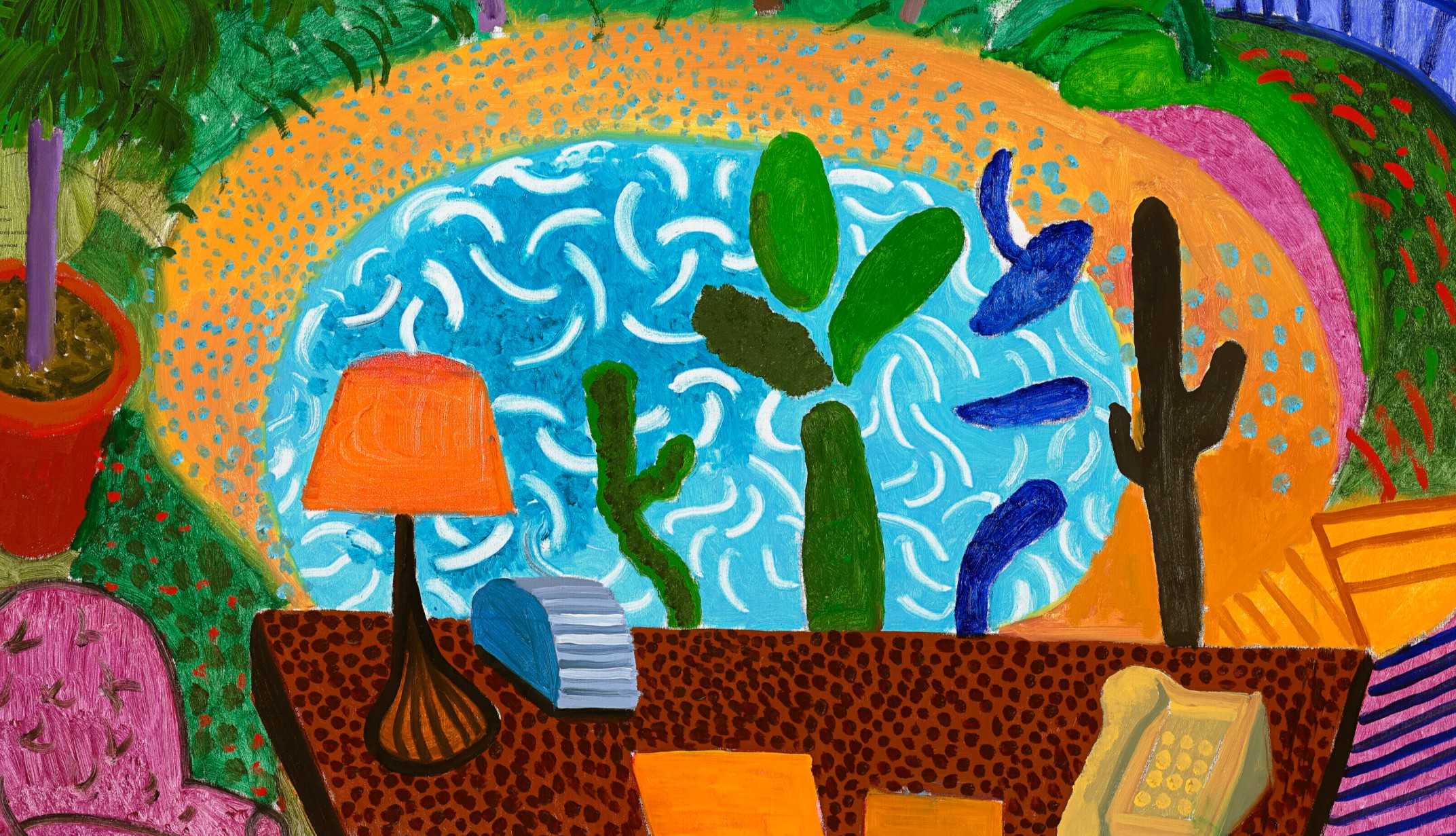
The pool radiates out spherically in a series of expanding rings—first the blue-dotted yellow ring around the pool itself, then the layer of carefully manicured vegetation, and finally the distorted convex curve of his vibrantly painted blue and purple house. These expanding rings establish a sense of the spectator being enveloped within a theatrical space unmoored from pictorial convention, expressing with false perspective his very real experience of this cherished space.
“The viewer roams around in these pictures and once the eye begins to look and see, it is forced to go on a journey and it can come back by a different route, or start somewhere else and make another one. I realized the forms were coming from my surrounding, my feelings… it all seemed to connect.”
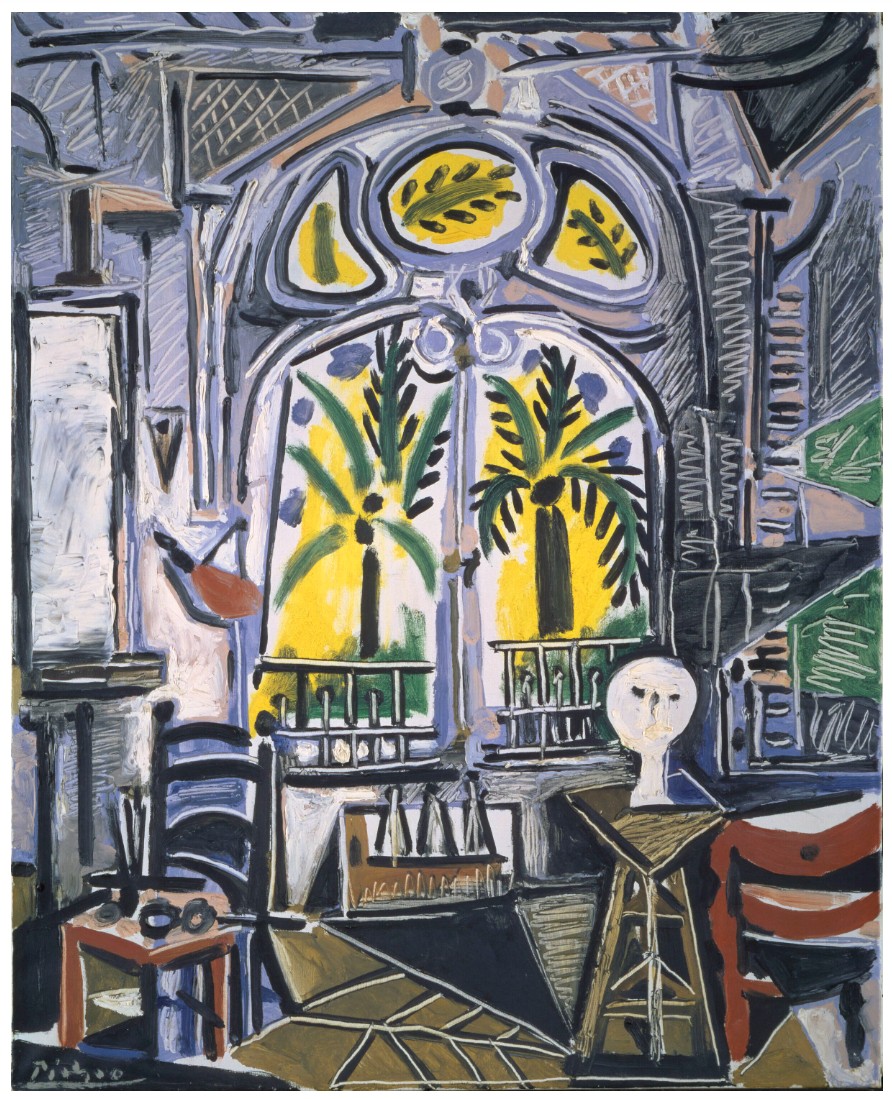
Pablo Picasso, The Studio (L’Atelier), 1955. Tate Gallery, London. © 2025 Estate of Pablo Picasso / Artists Rights Society (ARS), New York.
Photo: © Tate, London / Art Resource, New York.
Hockney had moved to Hollywood Hills permanently in 1979, acquiring the house depicted in the present painting in 1982 after renting the residence for some time. The unique geography of the hills had an immediate impact on his work.
“The roads aren’t straight… the moment you live up here, you get a different view of Los Angeles. First of all, these wiggly lines seem to enter your life, and they entered the paintings… I actually felt those wiggly lines.”
The De Stijl and the Fauvists who inspired Hockney’s house colors similarly influenced Hockney’s radiant palette in My Garden in Los Angeles. This painting emerges from a series of paintings Hockney made in London on his Hollywood Hills house and garden. Painted entirely from memory, the series parallels the famous painterly explorations of Claude Monet’s garden at Giverny or Joan Mitchell’s musings in La Tour. At the time, Hockney was spending more and more time in his native England, attending to the declining health of his mother as well as with his involvement with the National Gallery’s Encounters: New Art from Old exhibition in 2000. His mother had passed the prior year, and his trips driving into the countryside reconnected him to the landscapes of his youth.
“The first thing I did to the house I now owned was to start painting it. I had it painted red and blue, the colors of my designs for the Ravel L’Enfant de les Sortileges—and the green was the green of nature outside the house… I had the outside of the house painted in very bright colors. I was inspired to do this partly from having seen the De Stijl exhibition at the Walker Art Center and partly by the memory of the yellow Monet used on the outside of his Giverny house.”
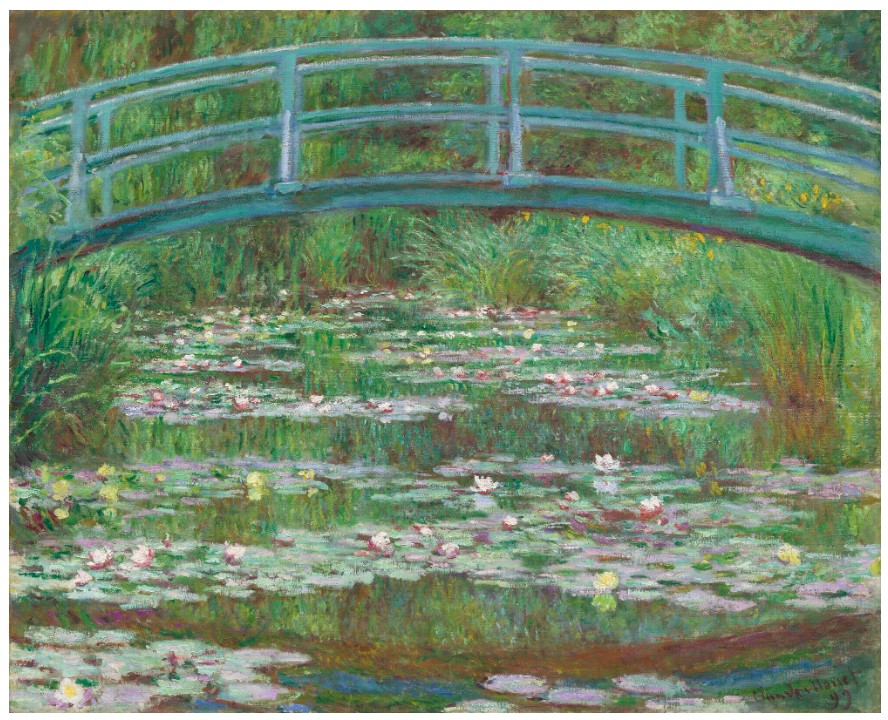
Claude Monet, The Japanese Footbridge, 1899. National Gallery of Art, Washington, D.C.
For the National Gallery exhibition, Hockney was exploring the use of optical aids—after observing the refined level of detail in the work of Ingres, he resolved to make the series Twelve Portraits after Ingres in a Uniform Style, depicting the portraits of twelve National Gallery security guards using a camera lucida. His immersion with the French master would have introduced him to Ingres’ singular landscape painting of the Medici gardens in Rome, whose circular canvas and composition parallels the present work. Hockney’s portrait series grew out of a much broader and more important intellectual venture which Hockney was embarking upon. Over the course of his career, he had become more and more dissatisfied with the perspectival effects of his earlier paintings, made with one-point perspective.
“You are deeply conscious of the edges. I began to be obsessed with them and also by the realization that you might be able to break them.”
His quest to break the edges of the picture plane lead him on an art historical quest to investigate the how the painters of the last four centuries might have used optical instruments. One of the few paintings made around this time, My Garden in Los Angeles can be seen as a visual corollary to Hockney’s art historical investigation, pushing the boundaries of spatial perspective while he was challenging art historical orthodoxy. His 2001 publication Secret Knowledge: Rediscovering the Lost Techniques of the Old Masters argues that artists from the past utilized the camera obscura and camera lucida much earlier than previously supposed, and that the studied naturalism of their styles came out from their reliance on these optical tools. With this revelation, Hockney undertook to revolutionize landscape painting, imposing his own memories and sense of space within the picture plane.
“We see with memory. This memory is the accretion of things seen, felt and remembered, a multi-layered phenomenon constituted by personal associations with particular places.”
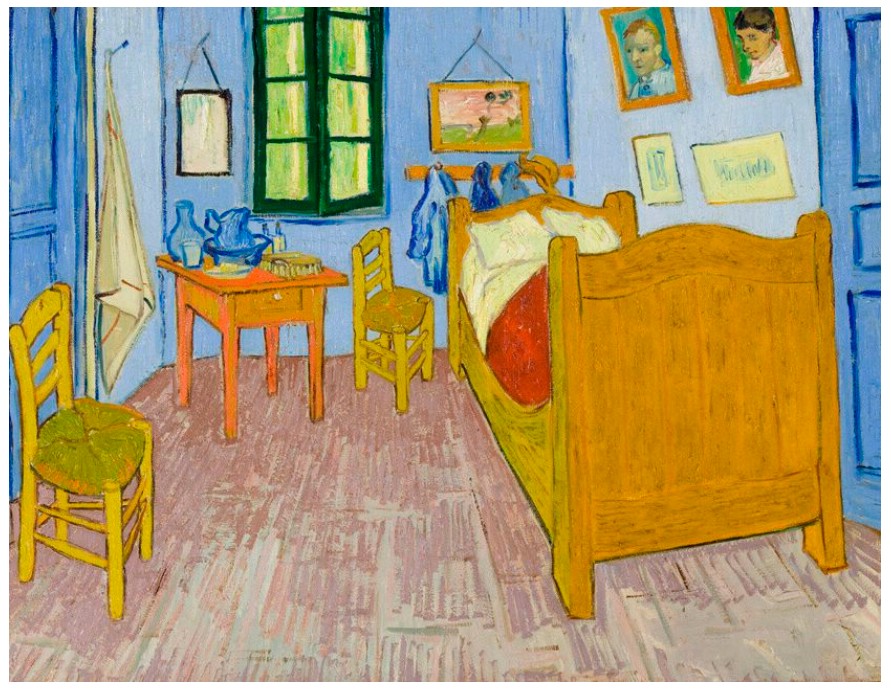
Vincent van Gogh, La Chambre de Van Gogh à Arles, 1889. Musée d’Orsay, Paris.
The present work compelling adopts this novel approach to memory. Painting from recollection his beloved garden from far away London, Hockey offers a new and compelling vision. Equally important to the artist was his approach to space. My Garden in Los Angeles rejects the illusions and artifice of pictorial convention.
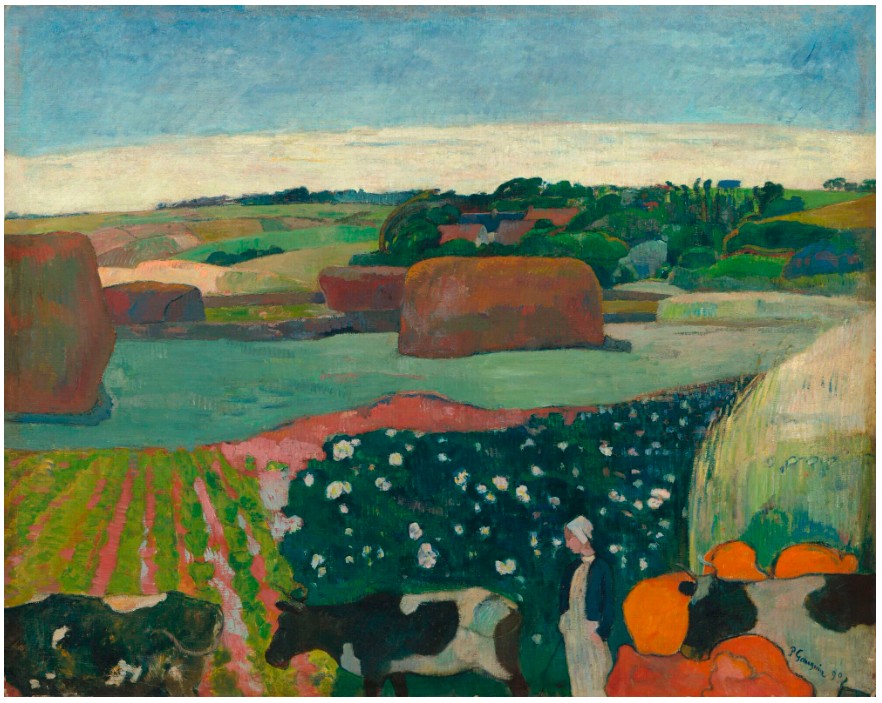
Paul Gauguin, Le Champ de pommes de terre, 1890. National Gallery of Art, Washington, D.C.
Hockney had first visited Andrea Palladio’s masterpiece structure Teatro Olimpico in 1979, and had marveled at the Renaissance architect’s mastery over space and illusion.
“It Is a beautiful theatre and you’re very conscious of this depiction of space in real space, an illusion of space in real space, which is of course different from the illusion of space on a flat surface.”
In the intervening decades, the artist became deeply involved with several operatic productions, working at La Scalia in Milan and the Metropolitan Opera in New York, among others. This experience led to his desire to depict in two dimensions what he could achieve in a three-dimensional stage production. Paralleling the painterly practices of the Venetian painters Veronese and Tintoretto, who were also profoundly impacted by the real and theoretical implications of the stage. In the present work, Hockney finally resolves the disjunction between the flat plane of the canvas and the recessive space of the stage, exploring with a multitudinous recessive perspective the depths of his imagined garden.
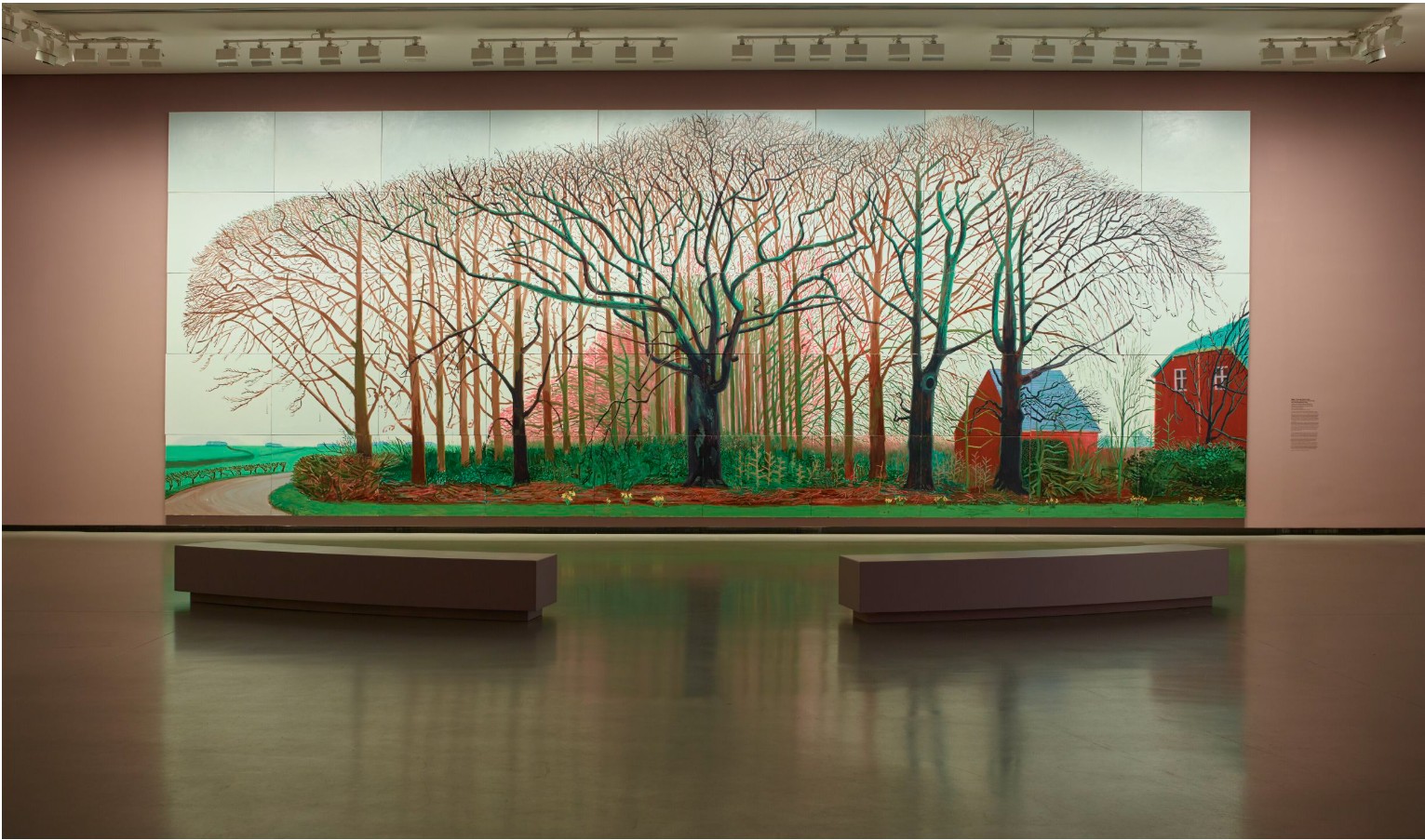
Installation view, David Hockney, Bigger Trees Near Warter in David Hockney 25, April 9 – September 1, 2025, Fondation Louis Vuitton, Paris. Photo: Marc Domage / © Fondation Louis Vuitton. Artwork: © David Hockney.
My Garden in Los Angeles is the pinnacle of decades of artistic discernment and intellectual discovery. Serving as a palimpsest resolving a decade of experimentation, My Garden in Los Angeles provides a stunning insight into the major painterly and conceptual concerns Hockney held at the turn of the century, concerns which his following work has continued to build upon.