Stretcher Frame with Cross Bars III, 1968
Stretcher Frame with Cross Bars III, 1968
Works from the Collection of Dorothy and Roy Lichtenstein
Sotheby’s New-York: 15 May 2025
Estimated: USD 2,500,000 – 3,500,000
USD 4,930,000
Stretcher Frame with Cross Bars III | The Now and Contemporary Evening Auction | 2025 | Sotheby’s
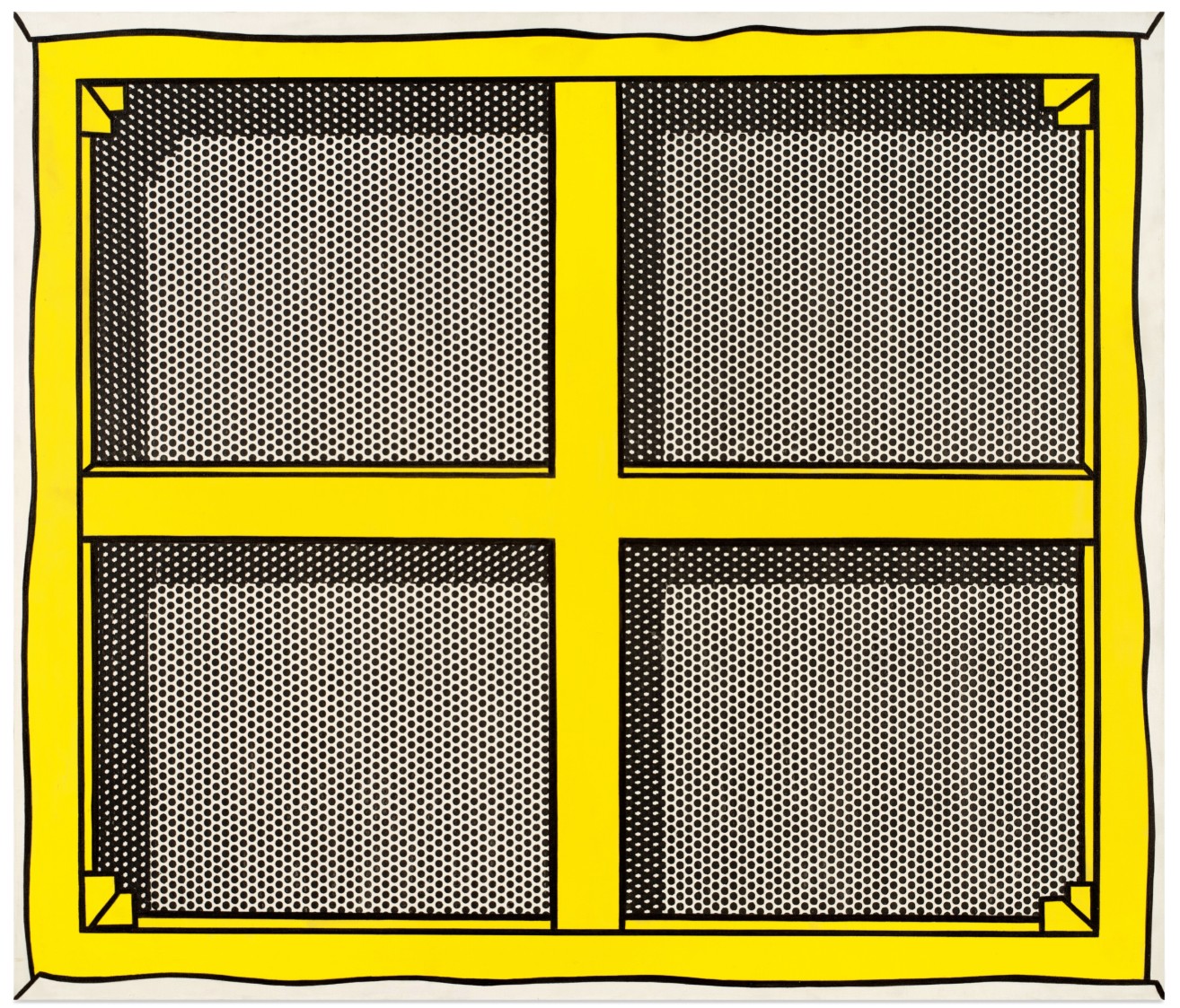
ROY LICHTENSTEIN (1923 – 1997)
Stretcher Frame with Cross Bars III, 1968
Acrylic, oil and graphite on canvas
48 x 56 1/4 inches (121.9 x 142.9 cm)
Signed and dated ’68 (on the reverse)
Stretcher Frame with Cross Bars III is a consummate encapsulation of Roy Lichtenstein’s governing artistic inquiry: the investigation of art itself. Engaging with the art historical tradition of trompe l’oeil and challenging the contemporary artistic developments unfolding around him, in Stretcher Frame with Cross Bars III Lichtenstein masterfully challenges the definition of art making and the role of the viewer’s perception in the process. Employing his signature Pop idiom, Lichtenstein renders the surface of his painting to represent its reverse, confronting in a new way the hegemony of Abstract Expressionism and the criterion for artistic subject matter. The present work belongs to a rare and limited suite of eleven Stretcher Frame paintings created between 1967-68.
“I’m interested in this kind of image in the same way as one would develop a classical form… Well, the same thing has been developed in cartoons. It’s not called classical, it’s called a cliché. Well, I’m interested in my work’s redeveloping these classical ways, except that it’s not classical, it’s like a cartoon.”
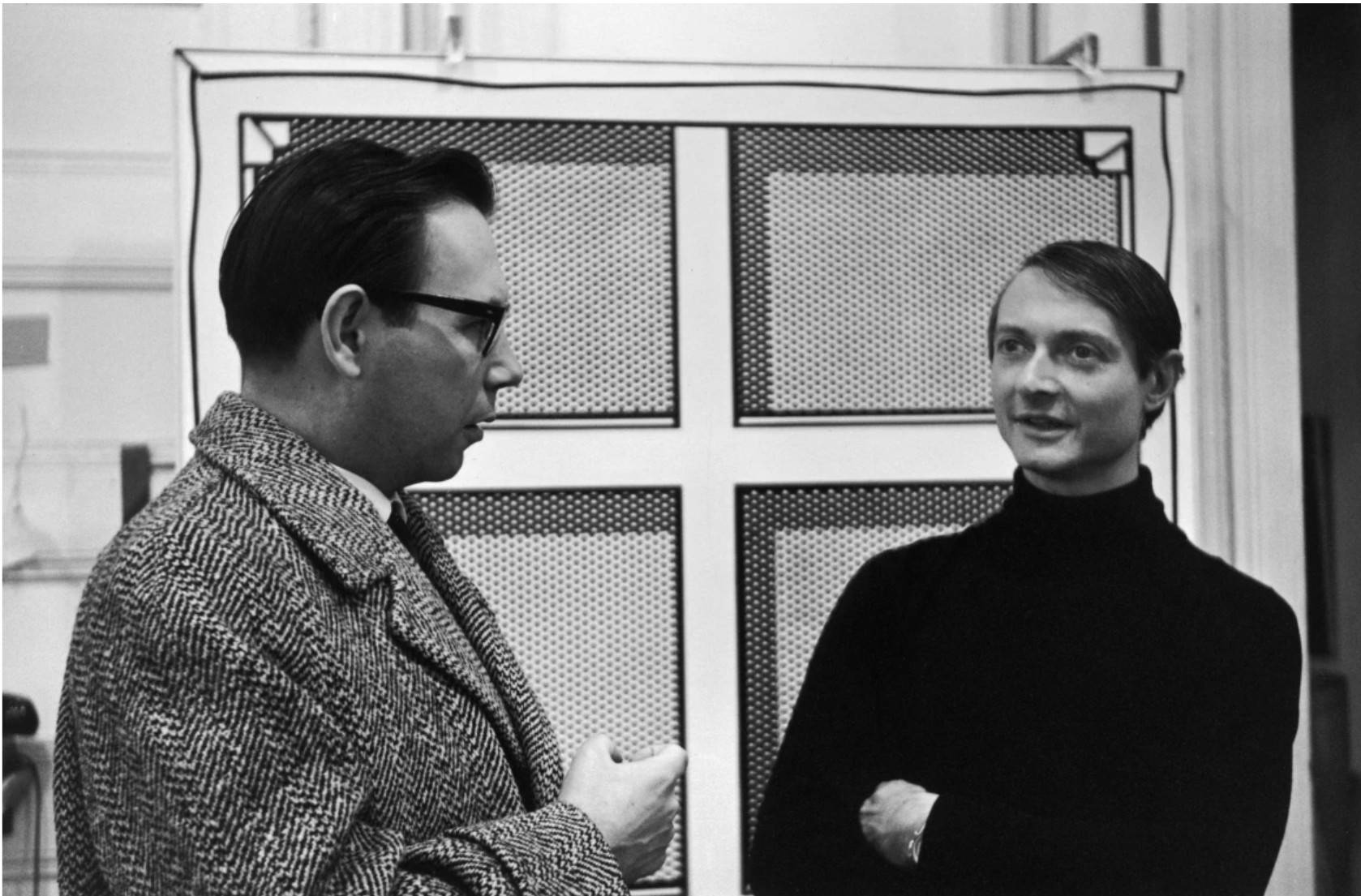
Roy Lichtenstein and Willi Bongard in front of Stretcher Frame with Cross Bars V, 1967.
Photo © bpk Bildagentur / Art Resource, NY. Art © Estate of Roy Lichtenstein
Immediately following the iconic Brushstroke paintings of 1965-66, the Stretcher Frame works operate as the counterpart to the Brushstrokes, advancing Lichtenstein’s exploration of “art about art” to a new apogee, playfully articulating a transgressive, Duchampian inquiry of art’s boundaries. Held in the Collection of Dorothy and Roy Lichtenstein for nearly six decades, Stretcher Frame with Cross Bars III bears exceptional provenance, as one of the treasured works that Roy and Dorothy maintained for themselves.
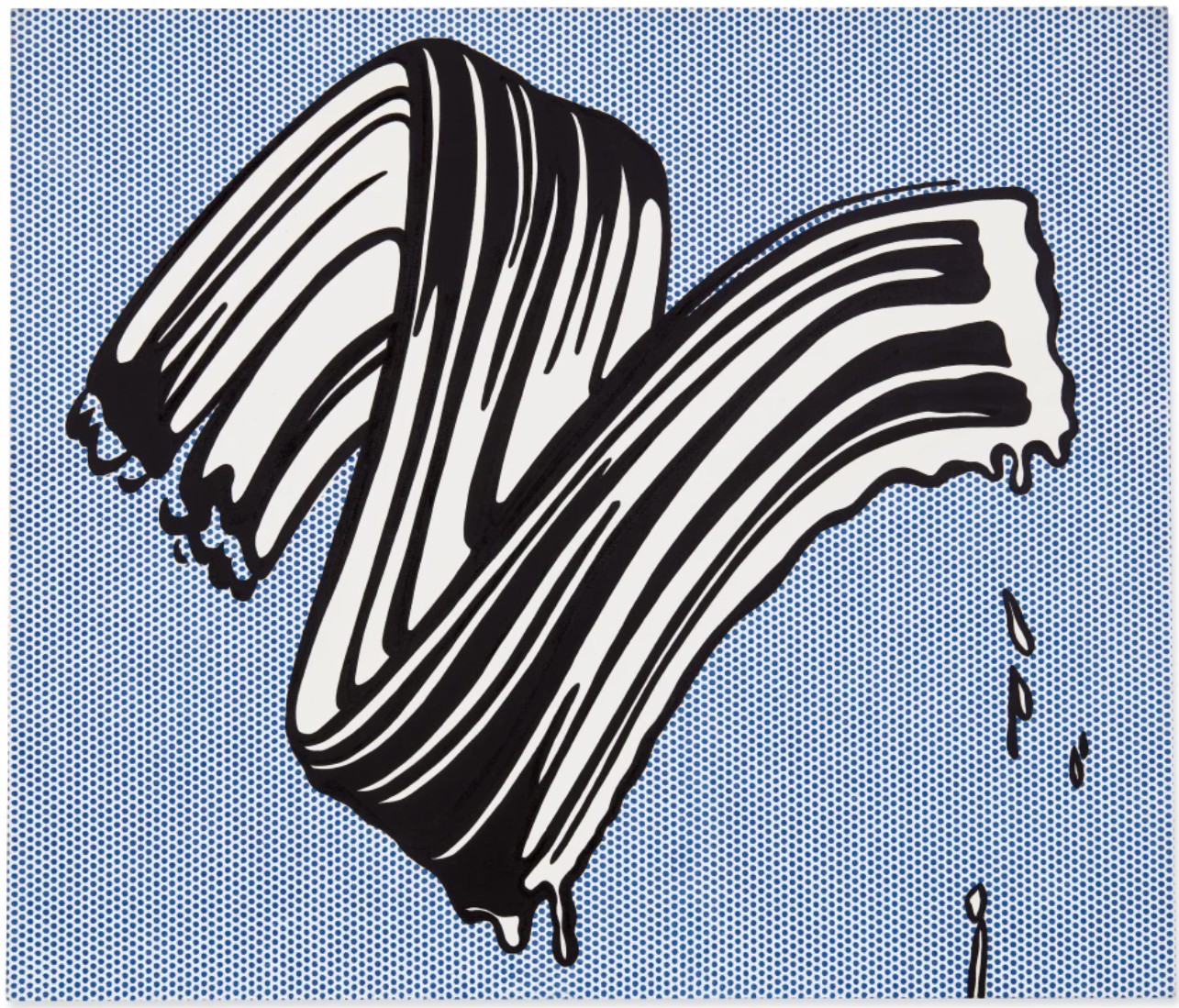
Roy Lichtenstein, White Brushstroke I, 1965. Private Collection.
Sold at Sotheby’s New York in June 2020 for $25.4 million. Art © Estate of Roy Lichtenstein
From the earliest years of Lichtenstein’s practice, he was guided by an investigation of “art about art,” reflecting upon its means of production, its purpose in modern culture, and how its history informs its future. Exploring the visual signs and symbols associated with mass production and comic books, such as flat planes of color, repeated dots to indicate shading, and bold contour lines, Lichtenstein redefined the language of representation in fine art and deconstructed the arbitrary boundaries between “high” and “low.” In the early 1960s, beginning with his comic book-inspired paintings and single-object paintings like Portable Radio or Black Flowers, Lichtenstein developed his signature visual vernacular, instantly recognizable for its Ben-Day dots and bold articulation. Even in these early years, Lichtenstein was keenly attuned to foundational, conceptual concerns of his ostensibly playful and direct compositions. As declared in the eponymous text painting, Art from 1962, his investigation extended beyond a formal aesthetic. In the early 60s following Art, Lichtenstein would engage with the art historical canon, responding to the work of Piet Mondrian and Pablo Picasso as well as Classical architecture. And in 1965-66, the artist would propel his probe of the canon a step further, confronting the weighty legacy of Abstract Expressionism and the very act of painting itself with emphatic and explosive renderings of brushstrokes against precise fields of Ben-Day dots. Immediately following the Brushstrokes, Lichtenstein’s distinct group of eleven Stretcher Frame works tests the parameters of art making and subject matter altogether, representing the conventional “reverse” of a painting and concealing the assumed “front” from view.
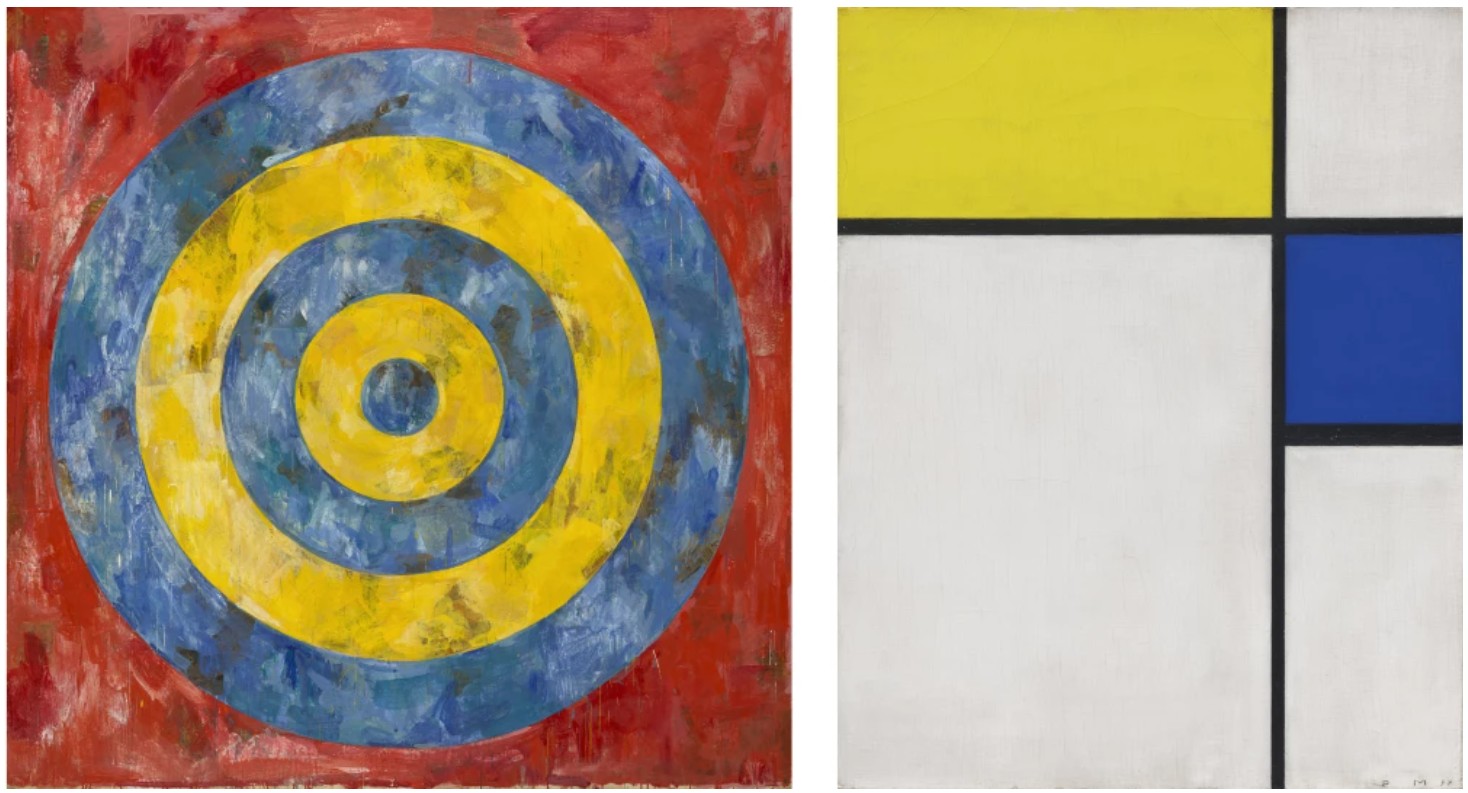
Left: Jasper Johns, Target, 1961. The Art Institute of Chicago. Image © The Art Institute of Chicago / Art Resource, NY. Art © 2025 Jasper Johns / Licensed by VAGA at Artists Rights Society (ARS), NY. Right: Piet Mondrian, Composition with Blue and Yellow, 1932. Philadelphia Museum of Art. Image © The Philadelphia Museum of Art / Art Resource, NY
Masterfully witty and cleverly provocative, in the Stretcher Frame paintings, Lichtenstein not only inverts the viewer’s expectations of reality and representation, but also our conception of a painted canvas. In Stretcher Frame with Cross Bars III, Lichtenstein renders the reverse of a stretched canvas in a trompe l’oeil technique, revealing the undulating overlap of the canvas, four-member wooden stretcher and even the keys used for tightening the canvas at all four corners. The Stretcher Frame paintings are among few series in which the artist deviated from deliberate assertion of two-dimensionality in his compositions and used light and shadow to convey three-dimensionality. Here, Lichtenstein employs his signature black and yellow Ben-Day dots and flat planes of color to delineate the physical depth of the painting’s support. Lichtenstein asserts the tactile objecthood of the painting instead of its traditional purpose as a vehicle for visual language. The viewer’s ability to engage with the “front” of the canvas is denied by the fact that the “correct” side is facing away from the viewer. Instead, the viewer is situated backstage, privy to the mechanics of the machine as an insider in the making of the painting. Unlike much of the artist’s oeuvre in which flatness is asserted unequivocally, here, when contending with decidedly ordinary subject matter, Lichtenstein veers towards greater verisimilitude in his painting. At every juncture, Lichtenstein challenges the viewer’s preconceived expectations of representation, creating a body of work which feels at once familiar and completely extraordinary.
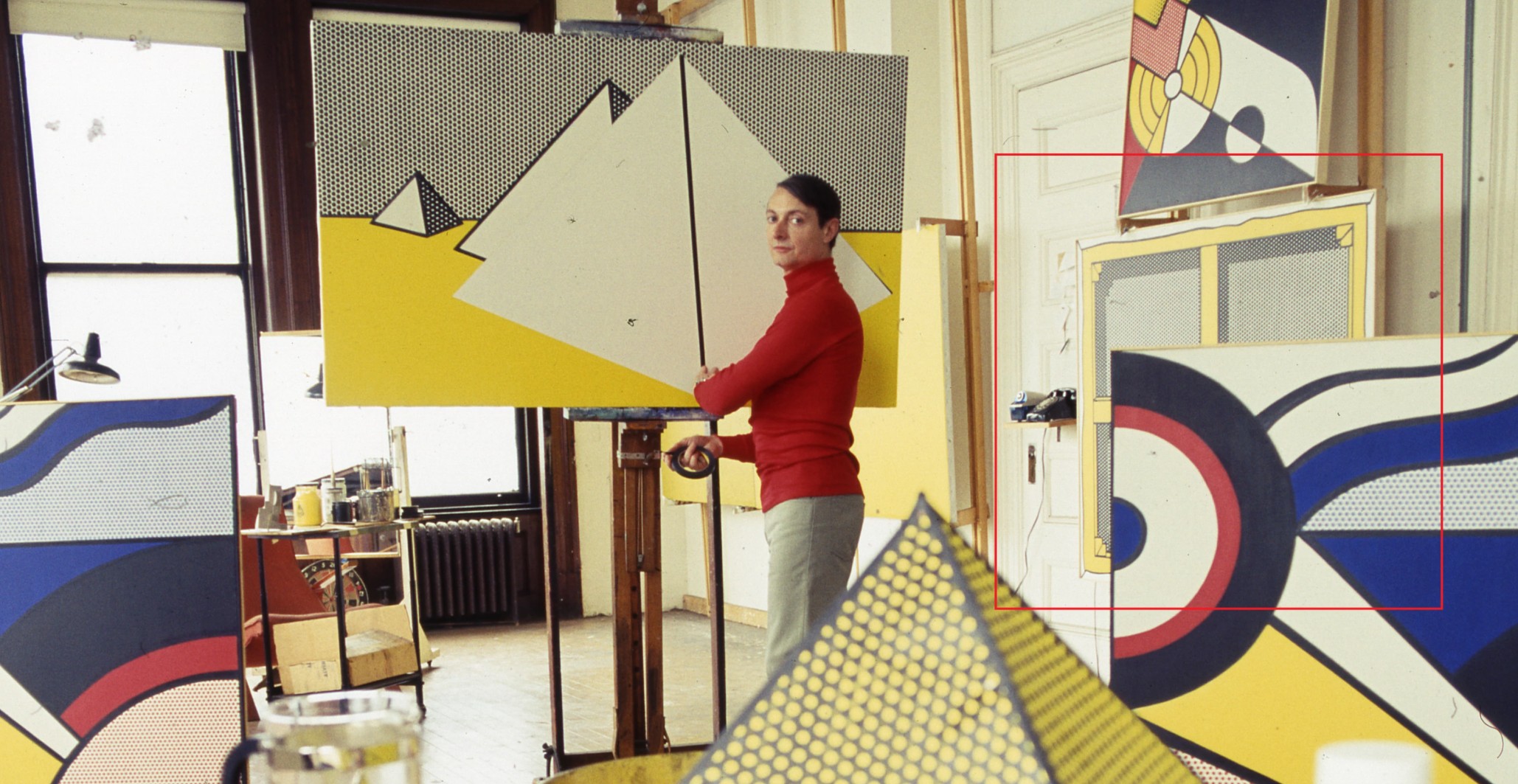
Roy Lichtenstein at work. Photo © Photograph by Snowdon / Trunk Archive. Art © Estate of Roy Lichtenstein
In Stretcher Frame with Cross Bars III, Lichtenstein engages in a captivating dialogue with Surrealism and Dada, in both of which the question of the uncanny relationship between reality and representation is at the center of the movements. Following his investigation of the act of painting through the Brushstrokes, in the Stretcher Frame paintings Lichtenstein contends with art making more broadly repurposing the canonized artistic device of trompe l’oeil through a Pop sensibility. The illusion of Stretcher Frame with Cross Bars III invokes the work of René Magritte, such as his epochal The Treachery of Images from 1929, which deconstructs the illusion of painting and the role of the viewer’s perception in the process. Furthermore, the assertion of the inherent artifice of the picture plane calls to mind the artistic challenges purported in the work of Jasper Johns. In his Target With Four Faces from 1955, Johns introduced the pictorial device at the heart of his own investigations, the target, which begs the viewer to enter a semiotic investigation of reality versus its symbol. Through Stretcher Frame with Cross Bars III, Lichtenstein, too, blurs the lines of reality and representation and the identity of art in the ever-expanding visual culture of post-war contemporary culture.
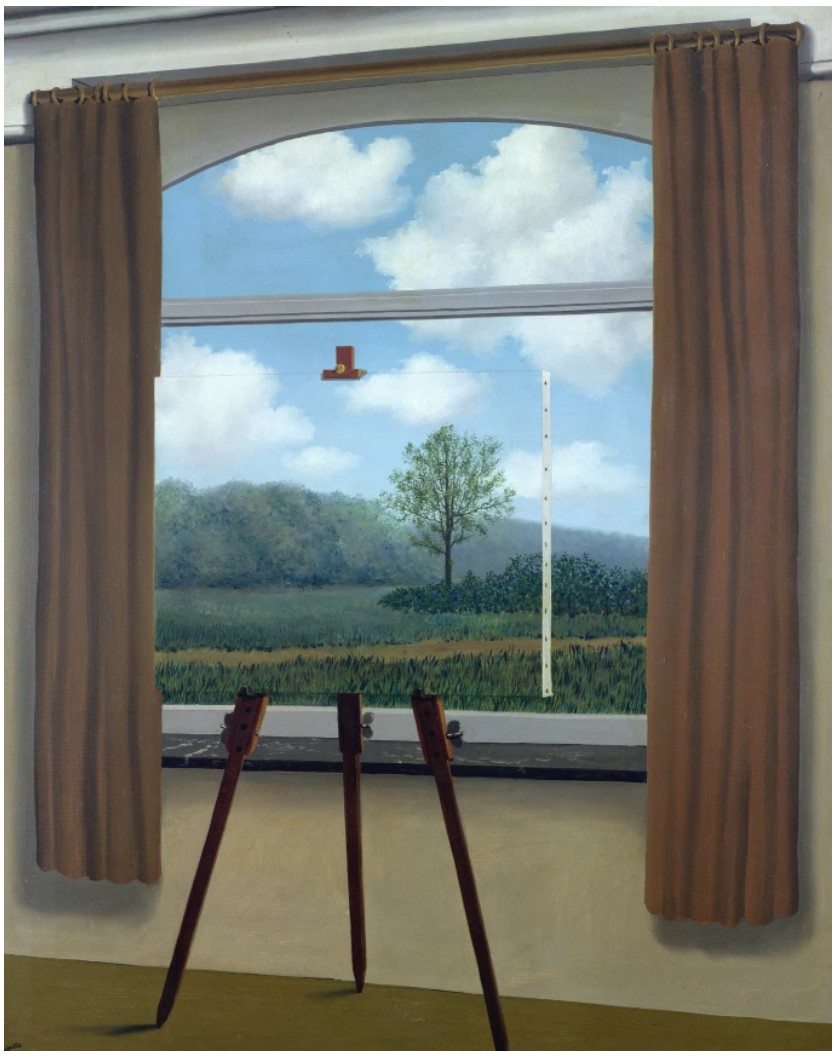
René Magritte, The Human Condition, 1933. National Gallery of Art, Washington D.C.
Image © Bridgeman Images. Art © 2025 C. Herscovici, Brussels / Artists Rights Society (ARS), New York
A paragon of the central artistic inquiries of Lichtenstein’s oeuvre, Stretcher Frame with Cross Bars III bears exceptional conceptual gravitas and the signature graphic punch of Lichtenstein’s best work. Testament to its importance in Lichtenstein’s body of work, the painting has been featured in the artist’s most significant solo exhibitions, including the artist’s early survey (1969-70) organized by the Solomon R. Guggenheim Museum, New York, the artist’s seminal traveling lifetime retrospective (1993-96), and the most recent traveling retrospective of Lichtenstein’s work (2012-13) organized by the Art Institute of Chicago.
Stretcher Frame with Vertical Bars, 1968
Stretcher Frame with Vertical Bars, 1968
Sotheby’s New-York: 13 November 2013
Estimated: USD 4,000,000 – 6,000,000
USD 4,309,000
REPEAT SALE
Sotheby’s New-York: 12 May 2004
Estimated: USD 1,500,000 – 2,000,000
USD 1,352,000
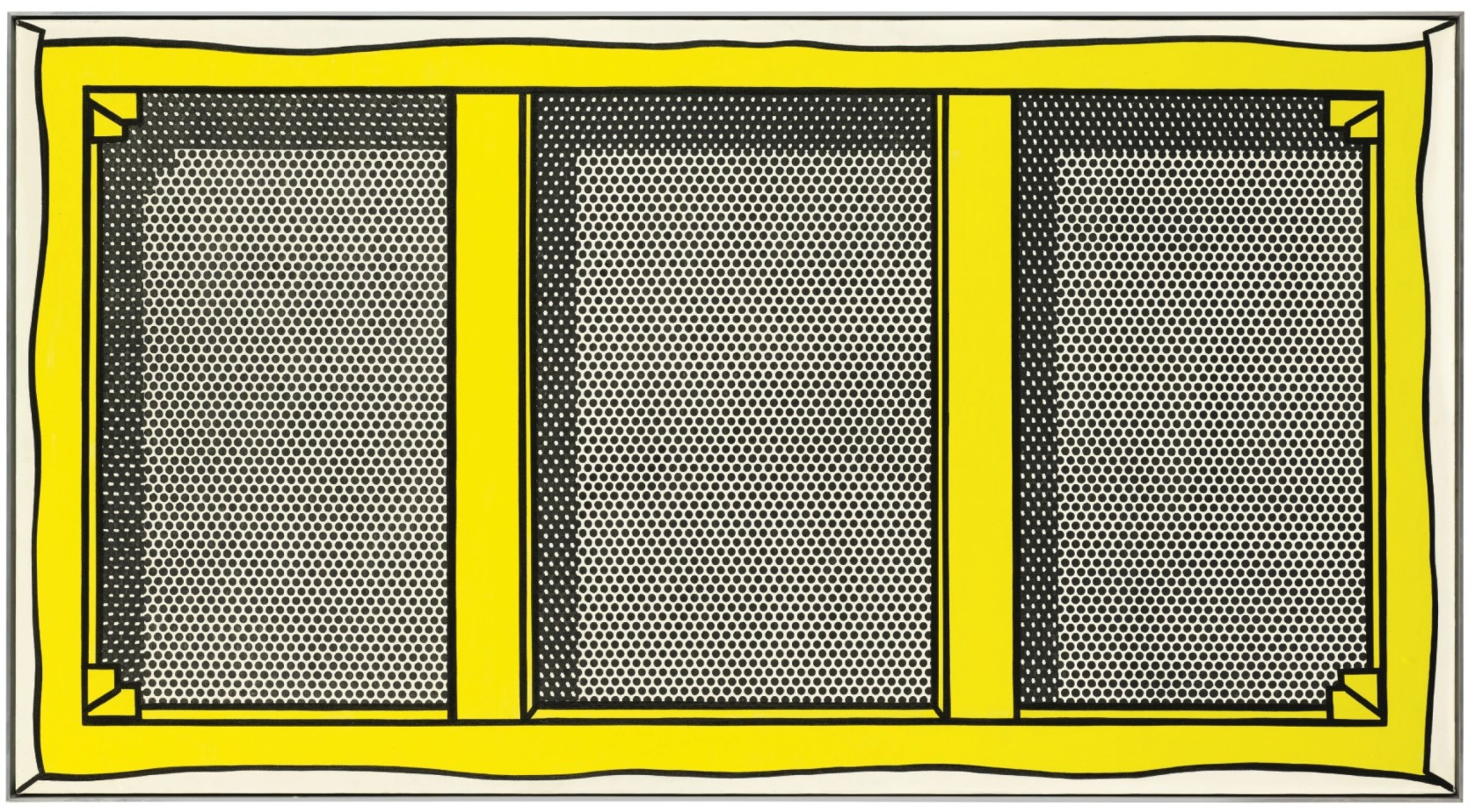
ROY LICHTENSTEIN
Stretcher Frame with Vertical Bars, 1968
Oil and magna on canvas
36×68 inches (91.4 x 172.7 cm)
Signed and dated 68 on the reverse
Provenance
Leo Castelli Gallery, New York (LC #495)
Irving Blum Gallery, Los Angeles
Elizabeth Louise and Alison Virginia Terbell, Los Angeles
Private Collection, West Coast (acquired from the above)
Christie’s, New York, May 14, 2003, Lot 14
Private Collection, New York
Sotheby’s, New York, May 12, 2004, Lot 43
Private Collection
Mnuchin Gallery, New York
Acquired by the present owner from the above
Lichtenstein’s Stretcher Frame with Vertical Bars is a quintessential Sixties painting, a perfect amalgam of Pop sensibility and insightful engagement with prevailing art trends of the day. Executed by Lichtenstein at the height of his powers as a fully established and influential member of the New York cultural milieu, the work demonstrates an important developmental leap in his practice; that of his preparedness to challenge the parameters of his own working modes within the context of other competing developments in visual culture contemporaneously unfolding around him. Stretcher Frame With Vertical Bars is a work that also engages with the dual art historical traditions of ‘art about art’ and trompe l’oeil. Of course, Lichtenstein had previously explored the notion of making paintings about art itself, with the eponymous text painting, Art, of 1962, being one of the first declarations of this aspect of his corpus, but as his vision matured the complexity of this exploration was exponentially refined as evidenced in the present painting.
Beginning with his early Pop Art paintings of mass-produced images from advertisements and comic strips, Lichtenstein had always maintained the integrity of the two-dimensional canvas surface. The monochrome background, un-modulated bright color and Benday dot pattern flattened and dematerialized his chosen subject so that figure and ground were integrated on the surface of the painting. Stretcher Frame with Vertical Bars is an interesting development and departure from the codified syntax of this formula. Lichtenstein had already stopped incorporating text in his work by 1966, ensuring that his art was increasingly less literal in its exploration of the dichotomy between the `high’ and `low’ imagery of visual culture. His ability to elevate `low’ art media into a `high’ art context through its appropriation was well established by this time, but he now leveraged his visual lexicon to more specifically investigate and challenge accepted normative components of `high’ art painting. His subject matter began to engage with a wider dialectic, and in the process deviated from the comic book machinations of heroes and heroines. The lineage of this process can be traced through Lichtenstein’s ‘versions’ of masterpieces by Paul Cézanne, Piet Mondrian and Pablo Picasso, through the Brushstroke Paintings, the Stretcher Frame works (including the present work), and continuing through the related explorations of mirrors and architectonic entablatures, for example.
In Stretcher Frame with Vertical Bars, the painting surface depicts the back of a stretched canvas, asserting the discrete tactile objecthood of a picture rather than its traditionally intended purpose to convey a visual message. Any possibility of engaging with the expected painted surface is patently denied by the fact that the ‘correct’ side is faced away from the viewer, barring any observance of the hand of an artist and thus reinforcing the detachment from any creative act. At first glance, then, this would appear to be a representational image at its most straightforward and literal. “These paintings are flat and frontal, deceptive and undeceptive simultaneously. The illusion depends on the identity of format and subject in the stretcher frames, but the unyielding contours and emphatic black and yellow dots draw attention to the objectness of the work itself.” (Lawrence Alloway, Roy Lichtenstein, New York, 1983, pp. 63-64) However, the Stretcher Frame paintings are one of the few series in which Lichtenstein used light and shadow modeling to convey a three-dimensional object. He employs both black dots on white ground, and vice versa, in varying size combinations, to convey the physical depth of the painting support and challenge the viewer’s perception of spatial dimensions. In this sense, the series can be related to the tradition of trompe l’oeil, whereby an artist utilizes bravura technique to convey not only a faux three dimensionality, but in so doing asserts a mastery of the medium. Through this simple gesture, Lichtenstein proved himself an incredibly adroit observer and consumer of one of art history’s more nuanced elements, in the process aligning himself with those artists whose greatness included an arch knowingness about painting and its attendant possibilities. One thinks of works such as Rene Magritte’s ‘see-through’ easel mounted canvases, a visual device of tremendous mental acuity that Lichtenstein had surely absorbed.
As his work had indubitably proven, Lichtenstein was a voracious consumer of all kinds of imagery. Traditionally, a simplistic reading of his contribution focuses on his ability to incorporate the images of popular culture within the rarefied field of oil painting. However, this reading ignores the manifold subtleties of his practice and his acute understanding of the investigations of his peers and rivals. When one considers Stretcher Frame With Vertical Bars within the context of its time, it is therefore impossible to overlook the increasingly dominant Minimalist artists. Diane Waldman has interpreted the Stretcher Frame paintings as Lichtenstein’s parody of the obsession for the picture support by Minimalist and Color Field painters of the 1960s. However, Stretcher Frame With Vertical Bars does more to engage with these modes of abstraction than simply ape the painting-object itself. As one moves closer to the canvas surface, the figuration begins to break down and the constituent geometric arrangements of the composition begin to prevail. The yellow stretcher bars are arrayed in a symmetrical and tripartite grid. If it is a coincidence that this device mirrors almost exactly the classical notions of space as espoused by Palladio, this playful reference to the grid, the central tenet of the Minimalist creed, is surely inescapable. At a certain focal length the dots also themselves assume primacy over the shapes they are supposed to convey, their regimented order instead imparting an optical hum.
This deconstruction of the image in front of one’s eyes and the apparent proximity between figuration and structured abstraction lies at the heart of all Lichtenstein’s monumentally influential corpus. The compositional structure of his paintings can thus be seen to confront notions of abstraction and representation as begun in the challenge laid down to painting by artists like Jasper Johns. In his Target With Four Faces of 1955 Johns first introduced the seminal pictorial device at the heart of his own investigations – the target – an image that is, for all practical purposes, utterly interchangeable with the real thing. Lichtenstein, with his depiction of a painting-object (but not the front surface image) also focuses attention on the theme of viewing an object that exists for the sole purpose of being looked at, and like the Johnsian target, is simultaneously representational and abstract. Bold in its conception and striking in the simplicity of its graphic punch, Stretcher Frame with Vertical Bars is an exemplar of insouciant ‘cool’ that confronts the overt intellectualization of painting taking place during the time of its making. A didactic essay of disarming confidence and rapier wit about the very identity and continued relevance of the art object, the work perfectly embodies Lichtenstein’s unerring ability to process and distill the ever-proliferating pictorial panorama of contemporary culture in 1960s America.
Stretcher Frame Revealed Beneath Painting of a Stretcher Frame, 1973
Stretcher Frame Revealed Beneath Painting of a Stretcher Frame, 1973
Christie’s New-York: 17 May 2017
Estimated: USD 2,000,000 – 3,000,000
USD 2,887,500
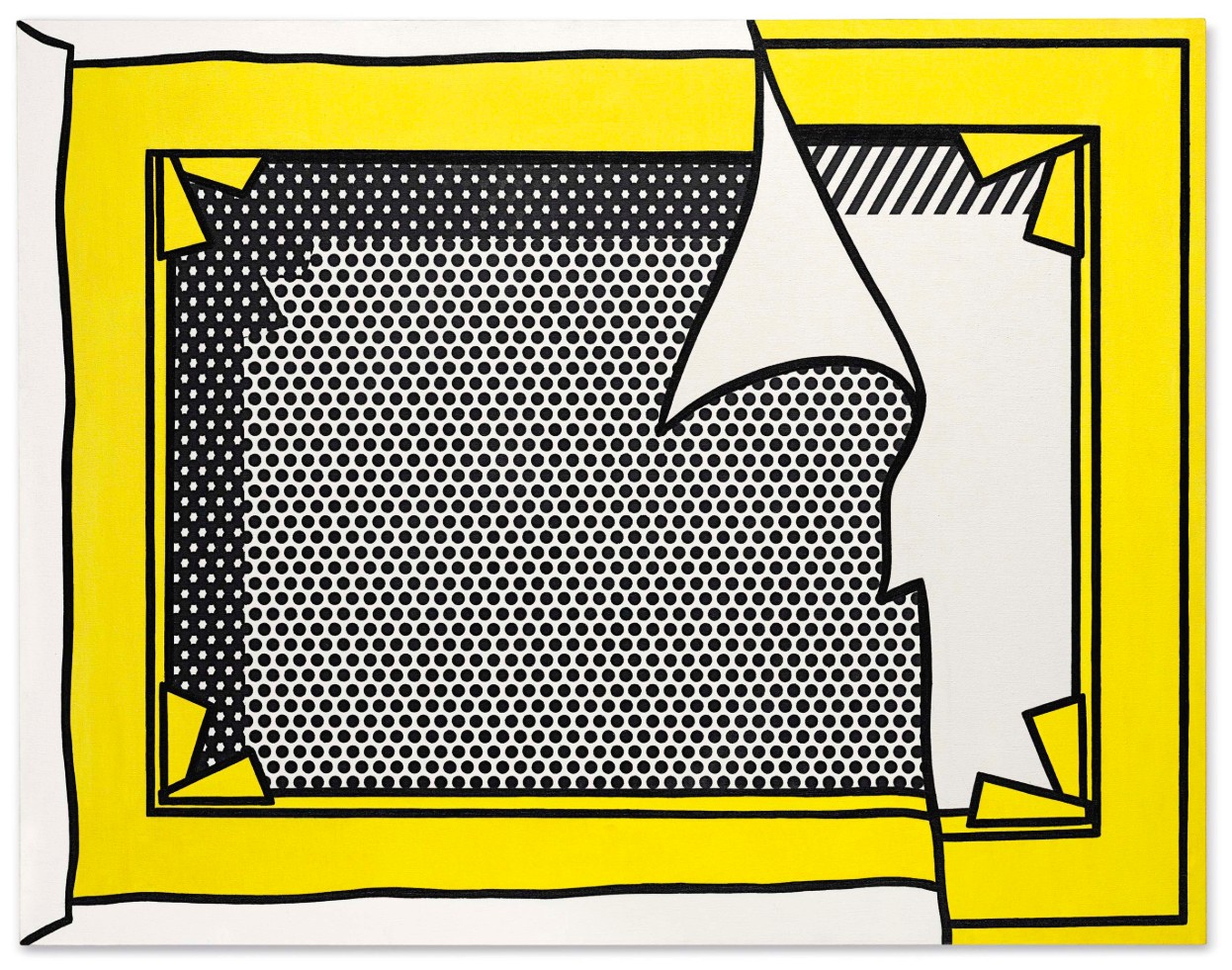
ROY LICHTENSTEIN (1923-1997)
Stretcher Frame Revealed Beneath Painting of a Stretcher Frame, 1973
Oil and Magna on canvas
36 x 46 1/8 inches (91.4 x 117.2 cm)
Signed and dated ‘rf Lichtenstein ’73’ (on the reverse)
Provenance
Leo Castelli Gallery, New York
Galerie Beyeler, Basel
James Goodman Gallery, New York
Acquired from the above by the present owner, 1979
Mastering an ambitious array of subjects, from portraits to landscapes, and still lifes, in his signature style through various mediums, Roy Lichtenstein’s work is indebted to our perception of art—both high and low. As was central to Pop Art’s mandate, Lichtenstein cultivated images from mass media, yet he maintained a fascination with the history of art as a subject for which to advance Pop ideas in an historical context. Not dissimilar to Cézanne, Picasso, and Mondrian—all whose imagery Lichtenstein appropriated and transformed into his own—Lichtenstein grew a vast interest in how we see and organize our perceptions.
An important example from a small early series of twelve paintings, Stretcher Frame Revealed Beneath Painting of a Stretcher Frame, from 1973 is a rare example of a torn canvas from Lichtenstein’s Stretcher series. Direct and forceful, the image is arresting with its elegance and simplicity. Like his Brushstrokes and Mirrors the stretcher frames examine illusion and reduction. “These paintings are flat and frontal, deceptive and undeceptive simultaneously,” described critic Lawrence Alloway. “The illusion depends on the identity of format and subject in the stretcher frames, but the unyielding contours and emphatic black and yellow dots draw attention to the objectness of the work itself” (L. Alloway, Roy Lichtenstein, New York, 1983, p. 64).
Masterfully balancing along the line between being serious or witty, Lichtenstein engages the viewer with his modern rendering of trompe l’oeil. Here, the painted surface, presents a double allusion of the back of the canvas—the first, a wrapped stretcher being torn away to reveal the bare wooden structure underneath. In Stretcher Frame Revealed beneath Painting of a Stretcher Frame, the front of the painting is a portrayal of the layers obstructed by the canvas. In Lichtenstein’s updated and “Popified” variation on the classic technique of fooling the eye, we are not fooled at all. Instead, the artist has gone further in his investigation of the object, resulting in a stretcher that has become slightly abstracted. Lichtenstein’s signature use of Benday dots and tri-color format blurs the line between abstraction and reality. By varying the size and color of the dots, Lichtenstein simulates the play of light pictorially within the borders of the picture.
The viewer is, in essence, tricked into believing that what they are looking at is the actual object in question. This method, which dates from antiquity, highly influenced movements such as Dadaism, Cubism and Pop, which constantly question the relationship between reality and representation. The image provokes the Surrealist notion of polar, co-existing realities: this painting is not a painting but its back. René Magritte, a master of “fooling the eye,” played with this idea in his famous painting La Trahison des images—the viewer is clearly aware that they are looking at a painting of a pipe, but the artist insists on painting the words “this is not a pipe” directly on the canvas. Lichtenstein uses his own signature style of painting to engage the viewer in this push-pull relationship of reality and illusion. He was highly influenced by artists such as Magritte and Marcel Duchamp, the champion of the “ready-made,” who both cleverly played with the viewer’s ideas of what made art—art.
John Coplans comments that, “The banality of the objects themselves and their very anonymity is married to a rigorous sense of abstraction—a new architecture of boldness and clarity defined by the starkness and simplicity of the parts” (J. Coplans, Roy Lichtenstein, New York, 1972, p. 21). Stretcher Frame Revealed Beneath Painting of a Stretcher Frame sees the artist drawing upon techniques founded early in his career, but includes a playful sensibility that comes with years of experience. Its “mechanical” Benday-dot rendering and cool calculation subvert the brooding emotional signature painting of the preceding generation of Abstract Expressionists. In the spirit of Pop Art’s penchant for found objects, Stretcher Frame Revealed Beneath Painting of a Stretcher Frame is—with a wink—true to size. Its self-deprecating humor is derived from Pop Art’s fresh view of high versus low art, and its criteria for a legitimate subject. Stretcher Frame Revealed Beneath Painting of a Stretcher Frame has a keen sense of composure and a distilled strength and beauty that reflects the artist’s intellect, wit, and intuition for finding balance between and composition and concept.
Cover Image for Art About Art Book (Study), 1978
Cover Image for Art About Art Book (Study), 1978
Works from the Collection of Dorothy and Roy Lichtenstein
Sotheby’s New-York: 16 May 2025
Estimated: USD 300,000 – 400,000
USD 635,000
Cover Image for Art About Art Book (Study) | Contemporary Day Auction | 2025 | Sotheby’s
ROY LICHTENSTEIN (1923 – 1997)
Cover Image for Art About Art Book (Study), 1978
Sut painted paper, cut printed paper, tape, marker, colored pencil and graphite on board
22 5/8 x 17 1/8 inches (57.5 x 43.5 cm)
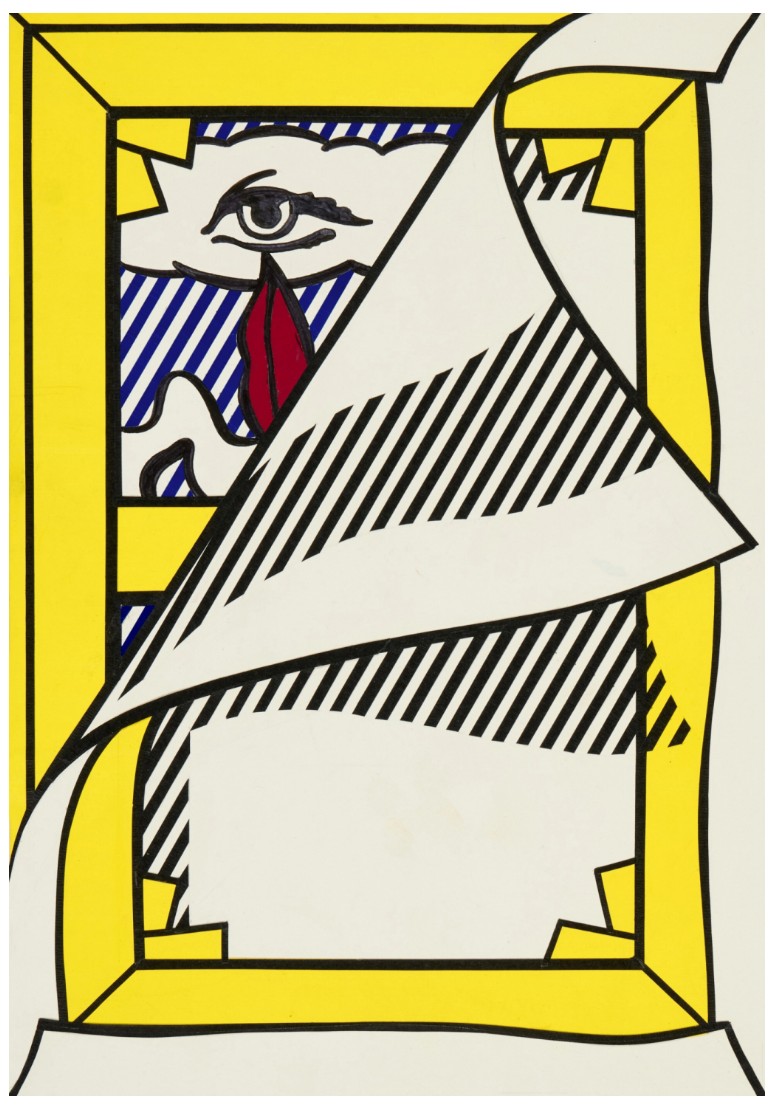
Offering a glimpse into the meticulous preparatory process that began nearly all of his artwork, Roy Lichtenstein’s Cover Image for Art About Art Book (Study) is a masterful representation of the artist’s near constant exploration of the painted surface through the lens of art history, whether it be his own art or that of other modern masters.
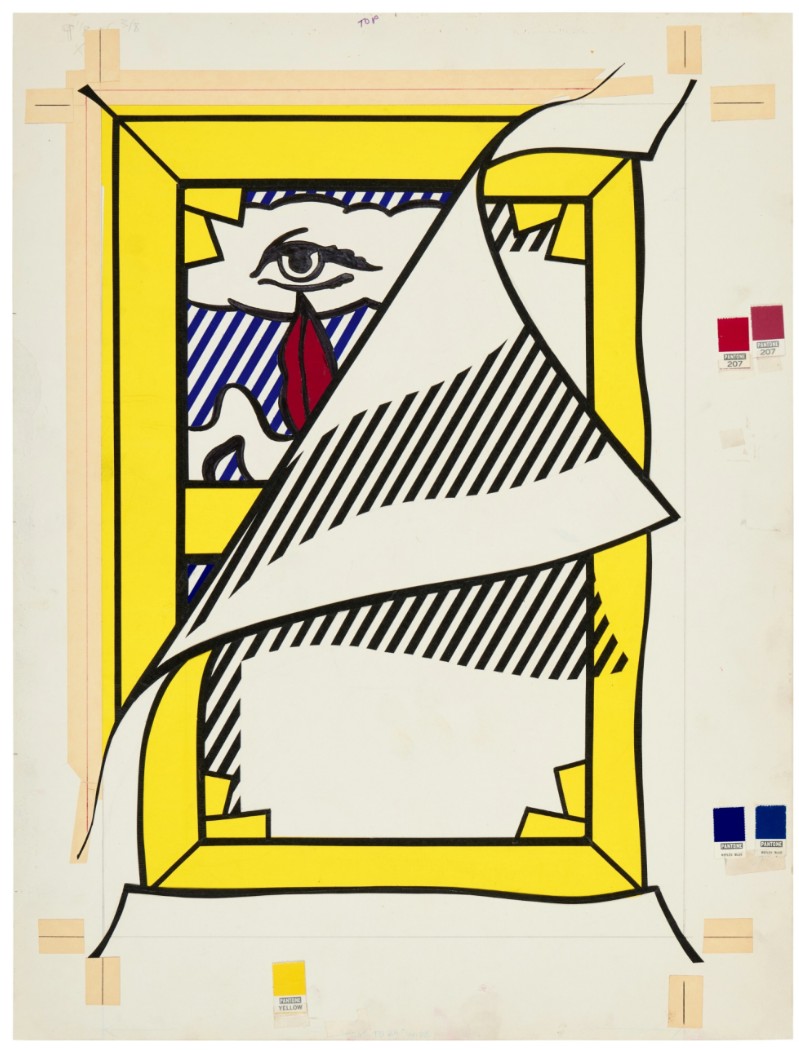
A study for the cover of the publication and a limited run of posters that accompanied the 1978 exhibition Art About Art at the Whitney Museum of American Art, the present work was commissioned to serve as the representative image of an exhibition that looked at the work of contemporary American artists who take as their subject other art.
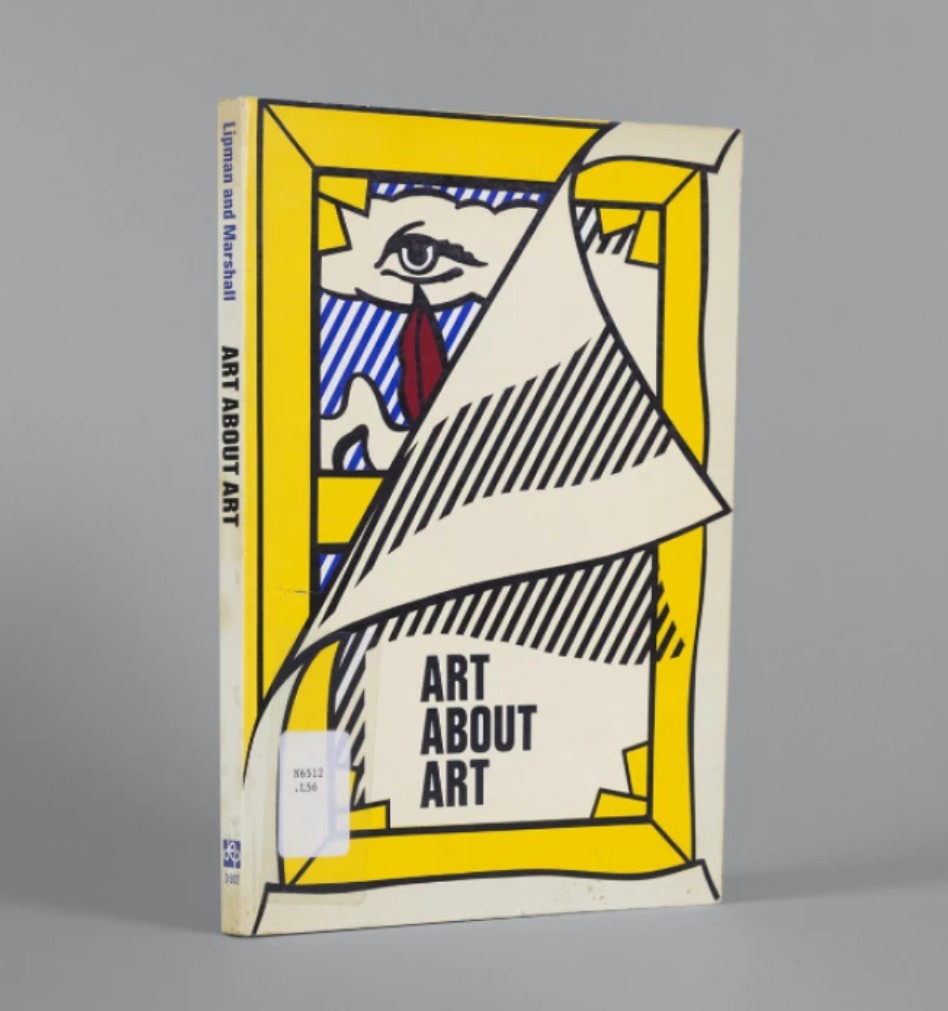
Roy Lichtenstein, Cover Image for Art About Art Book, 1978. Art © Estate of Roy Lichtenstein
True to the premise of the exhibition, Lichtenstein’s cover is doubly referential in that is tied not only to a period of art history – Surrealism, a subject of which Lichtenstein devoted an entire series of paintings to during the same period – and his own art, alluding to his body of Stretcher Frame paintings that engage with the tradition of trompe l’oeil and the nature of painting itself by depicting the back of stretched canvases and their bars, emphasizing their tactile objecthood rather than their traditional purpose of conveying a visual message. In the present rendition, the frame is being peeled away to reveal a Surrealist landscape beneath, wherein a biomorphic cloud evokes the form of an eye and a floating pair of red lips appear transformed as a teardrop, yet another reference to Lichtenstein’s own oeuvre and his Crying Girl paintings of the early 1960s.
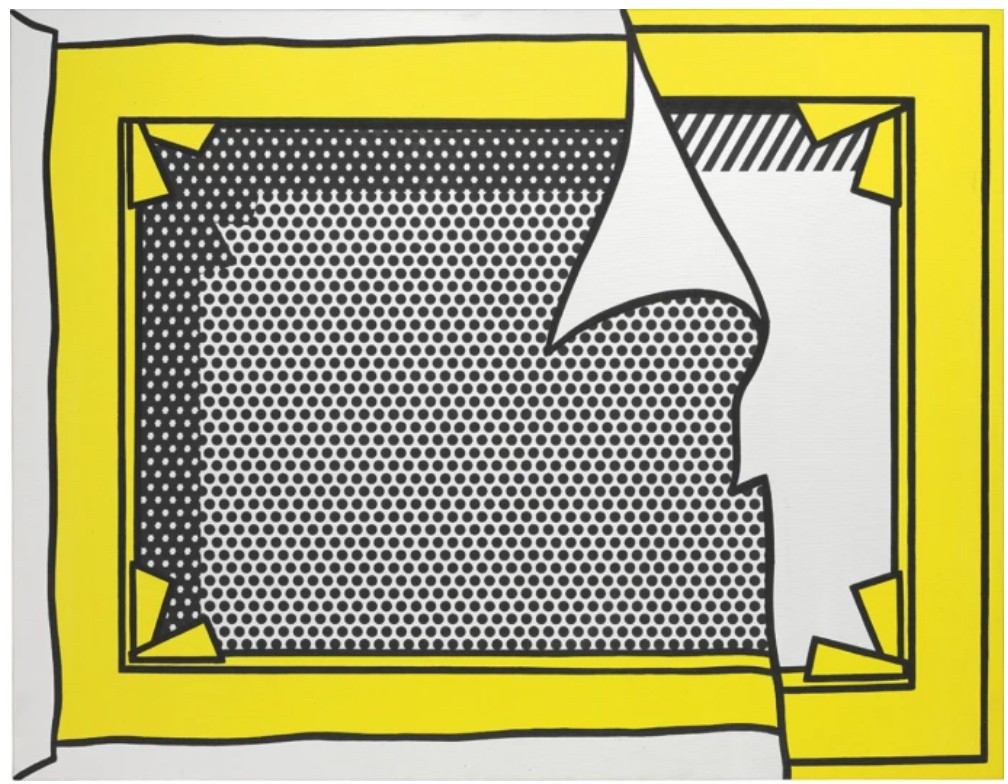
Roy Lichtenstein, Stretcher Frame Revealed Beneath Painting of a Stretcher Frame, 1973.
Private Collection. Art © Estate of Roy Lichtenstein
Emphasizing Lichtenstein’s fastidious commitment to process, the work features many of the elements that the artist would have used in his preparation for the final image to consider questions of layout, color and visual effect. Situated among meticulously placed taped sections and Pantone color swatches, the image reveals itself as an enduring reminder of Lichtenstein’s unparalleled ability to render surfaces densely layered with his interest in querying the art historical canon and constant exploration of the ways of seeing.