JEAN-MICHEL BASQUIAT (1960-1988)
Untitled, 1981
Oilstick on wood
20×20 inches (50.9 x 50.9 cm)
Provenance
Peter Brams, New York (acquired directly from the artist)
Private Collection, USA
Anon. sale, Christie’s New York, 23 September 2005, lot 99
Private Collection, California
Richard Gray Gallery, Chicago/New York
Acquired from the above by the present owner in 2012
Auction History
Christie’s London: 6 March 2025
Estimated: GBP 250,000 – 350,000
GBP 453,600 / USD 580,608
JEAN-MICHEL BASQUIAT (1960-1988), Untitled | Christie’s
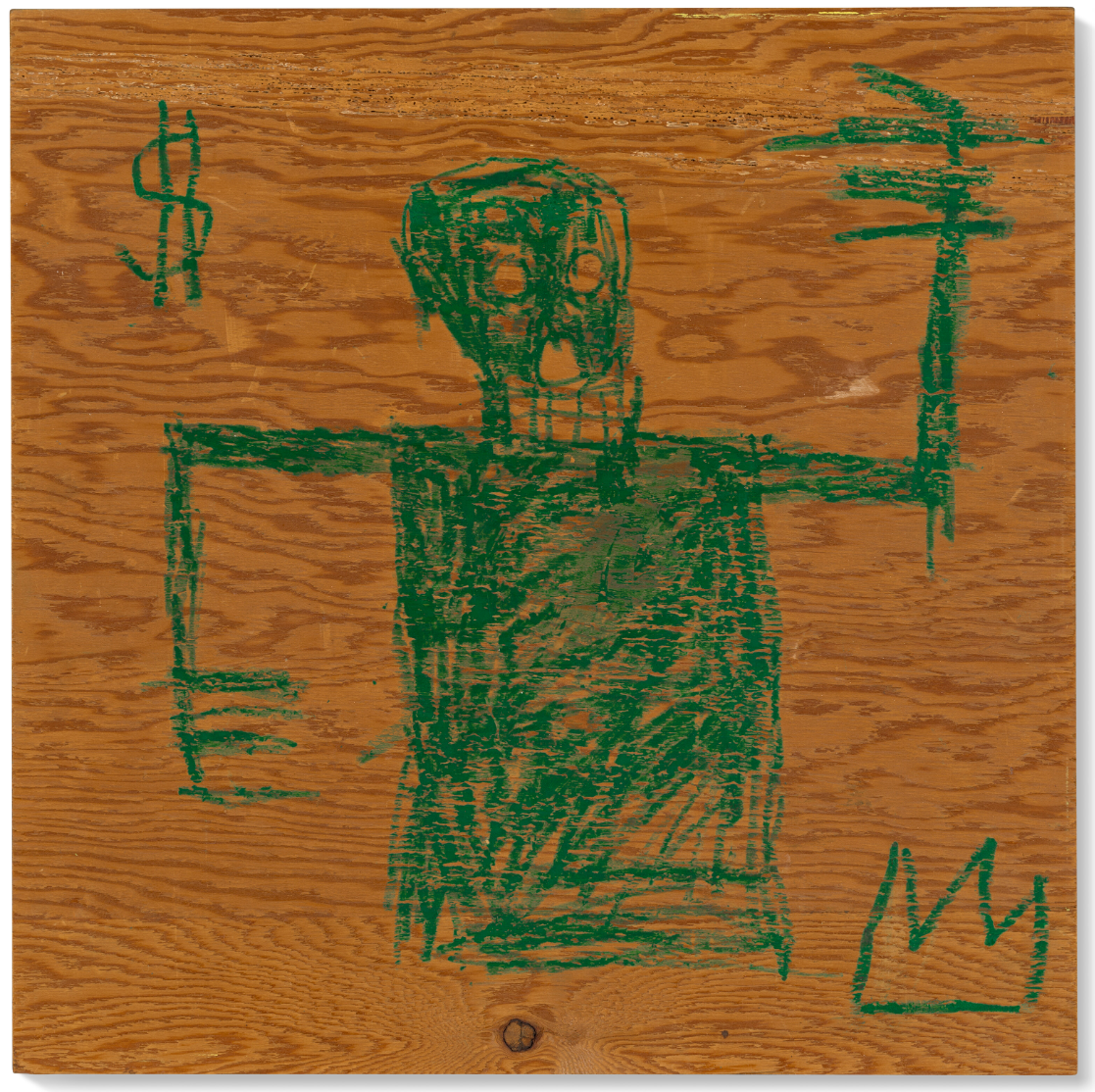
Created in 1981, the year of the artist’s celebrated first exhibition in New York/New Wave at MoMA PS1, Untitled marks a decisive moment in Jean-Michel Basquiat’s career as he leapt from pseudonymous street artist to international celebrity. At the beginning of this year he was still signing his work with the tag SAMO: by the following summer, at just twenty-one years old, Basquiat would be exhibiting alongside such artists such as Keith Haring, Anselm Kiefer, and Andy Warhol. In the present work Basquiat has drawn a vivid green figure, bold and assertive, atop a piece of found wood. Its grinning, skull-like face would become an enduring image within his oeuvre. Recalling a king on a playing-card, the character is flanked by a dollar sign and crown, two of the artist’s most iconic motifs. Shown together, they suggest Basquiat’s artistic supremacy.
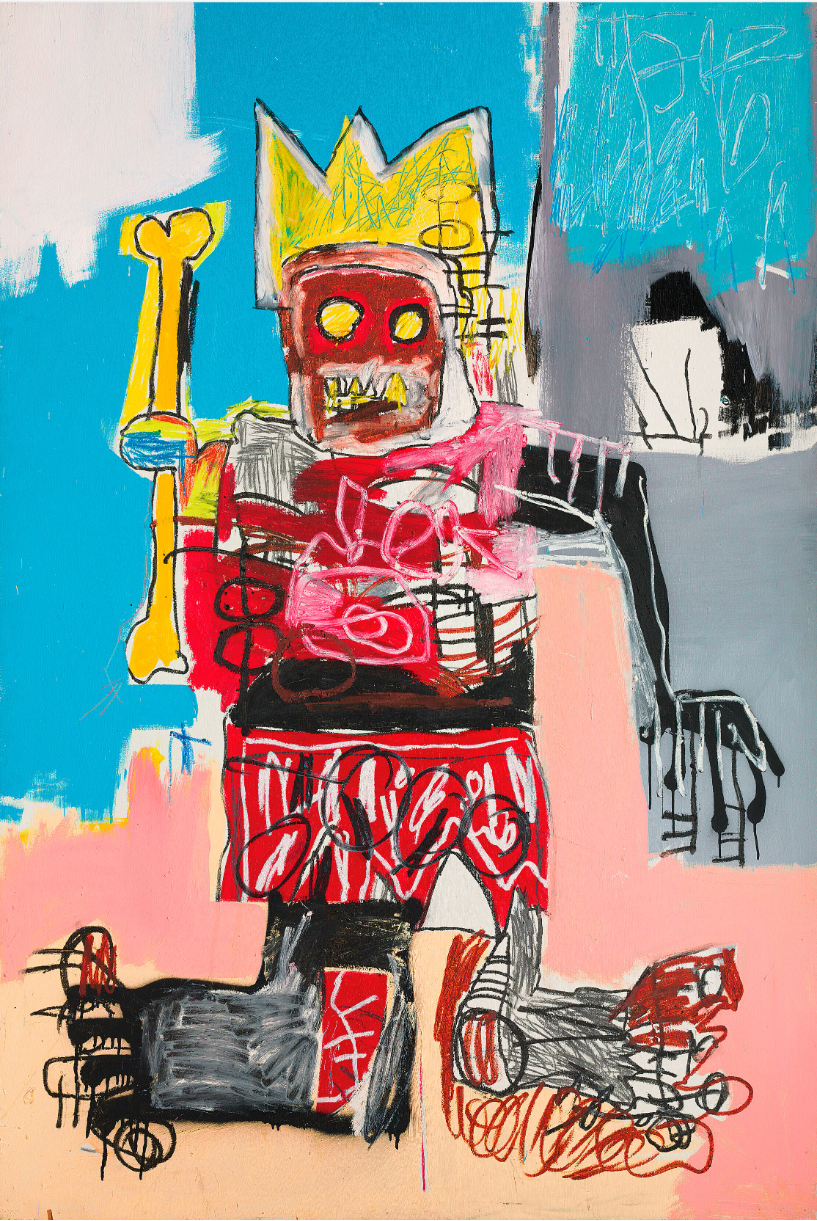
Jean-Michel Basquiat, Untitled, 1982. Private collection. Artwork: © Estate of Jean-Michel Basquiat. Licensed by Artestar, New York.
Although he became known amongst New York City’s graffiti artists for his streetwise and poetic wordplay, by this juncture, Basquiat’s art had begun to embrace the human figure. His fascination with the body—its sinews, bones, and musculature—dated from childhood: as a young boy, he was given a copy of the medical textbook Gray’s Anatomy to entertain himself with while he recuperated from surgery. The tome became a lasting source of inspiration and Basquiat would later fill his canvases with scientific annotations and diagrams that recalled its illustrations. This influence can be seen in the sharp intensity of the skull in the present work, whose graphic force captures the vigor of Basquiat’s meteoric rise.
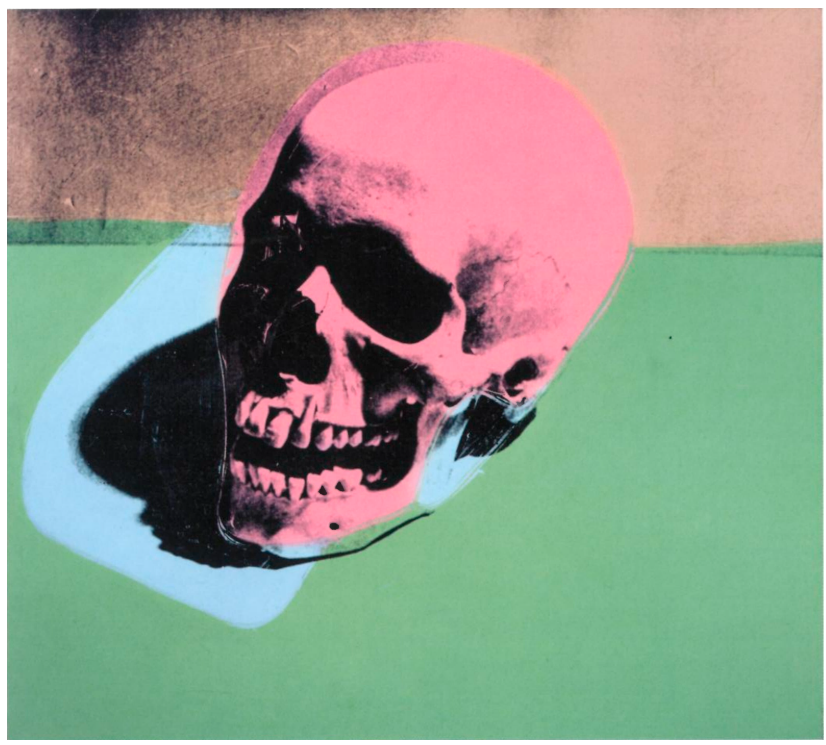
Andy Warhol, Skull, 1976. Andy Warhol Museum, Pittsburgh.
Artwork: © 2025 The Andy Warhol Foundation for the Visual Arts, Inc. / Licensed by DACS, London.
To create the fierce protagonist of the present work, Basquiat used oilstick, his medium of choice for many of his figurative paintings. Oilstick enabled the artist to quickly lay down his visions: alchemical combinations of image, text and symbol, blazing and visceral. While Basquiat would go on to riff on a variety of themes, including contemporary politics, art history, and music, he remained deeply informed by New York City’s streets. The works dating from 1981 refract aspects of the various neighborhoods he had lived in, expressing visually the sensations and rhythms in which the artist was immersed. The present work seems to have emerged directly from the city, a connection underscored by the use of found wood. Basquiat’s reign over New York was brief but tremendous. Intimate in scale yet monumental in feeling, the work speaks to this early moment in Basquiat’s career and captures the artist’s already prodigious talent. The world did not know what was coming.