
JEAN-MICHEL BASQUIAT (1960-1988)
Untitled, 1981
Grease pencil and acrylic on wood
60 x 11 1/4 inches (152.4 x 28.6 cm)
Provenance
Tim Wright, New York, acquired directly from the artist
Acquired from the above by the present owner, 1983
Christie’s New-York: 10 November 2023
Estimated: USD 2,500,000 – 3,500,000
USD 3,075,000
JEAN-MICHEL BASQUIAT (1960-1988) (christies.com)
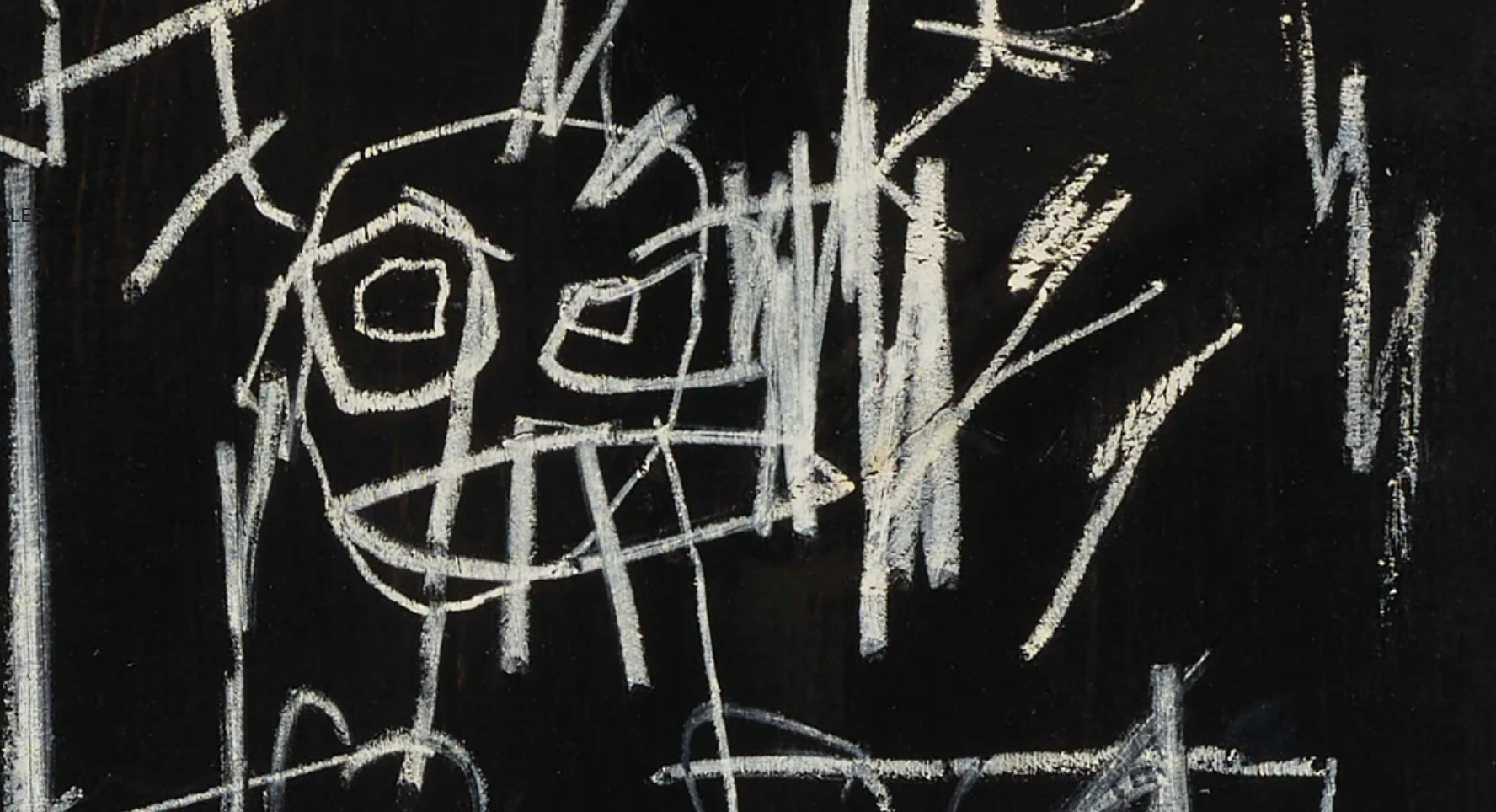
The poetic genius of a young rising star blazes brightly in this 1981 work by Jean-Michel Basquiat. Executed at the dawn of his ascension to fame, the untitled work encapsulates the artist’s gift for wordplay and infallible instinct in creating works that are buzzing with electricity, multi-layered, and deeply personal. It is a cryptic cipher and examination into the artist’s views on the dichotomies he experienced as a black artist in the New York art world: utility and luxury, ignorance and respect, alienation and acceptance. The work is life-sized, with a skeletal, disjointed yet heroic figure standing resolutely in the center. Encircled in a halo and standing above one of his iconic crowns, no viewer can deny these authoritative symbols—Basquiat has made his figure royal and divine. The composition makes clear Basquiat’s artistic instinct, the secret ingredient that makes his work so powerful for viewers across generations. It was made spontaneously as a gift to his friend Tim Wright, after which it passed to the present owner in the early 1980s, where it has been since. Basquiat was just nineteen in this period of budding fame, but the works he created have proven to be some of the most sought after.

Painted in a bold white on a black wood board, the work is pulsing with Basquiat’s constant need to create. The jagged lines tell the story of Basquiat’s vision coming to life, momentary decisions revealing themselves all over the surface and energizing the surrounding space. At the figure’s feet, there is a three-pointed crown inside a box along with “TAR.” Wordplay is a central feature in Basquiat’s oeuvre, and the word TAR—as well as it’s anagrams, ART and RAT—appears frequently. Tar, aside from being a dark, viscous substance, is at times used as a derogatory term for black people. In the present work, the word has been crowned in an act of reclamation and empowerment. Basquiat wanted to correct the imbalance he saw in the predominantly white art world which he was just starting to make a name for himself in. On a trip to the MoMA in 1982, Basquiat said, “There are no black men in museums. Try counting…” (G. O’Brien, “Every Line Means Something,” Artforum, Vol. 53, No. 8, April 2015, p. 126). They did not find any. In most of Basquiat’s work, he made the protagonist a black man—heroic, crowned, and sanctified.
Well educated and knowledgeable in the humanities, Basquiat drew upon art history for inspiration. While he painted, he would often have art books scattered around him, referencing other artists just as he witnessed contemporary rappers sampling other musicians. Basquiat knew that in art history, crowns are symbols, rife with a history of privilege, power, and racism. Painted portraits of men sitting on gilded thrones, draped in ermine and silk, are steadfast throughout Western civilization. The halo present in this 1981 work is also a recurring symbol for Basquiat. The oblong circle bisected by short lines can also double as a crown of thorns, bestowing upon the figure the honor and burden of sainthood. The life-sized portrait on wood panel is evocative of paintings of saints, found in altarpieces beneath vaulted ceilings and illuminated by flickering candlelight. The halo along with the crown serve to make Basquiat’s figure transcendent, captured gloriously in a spontaneous moment of creation.
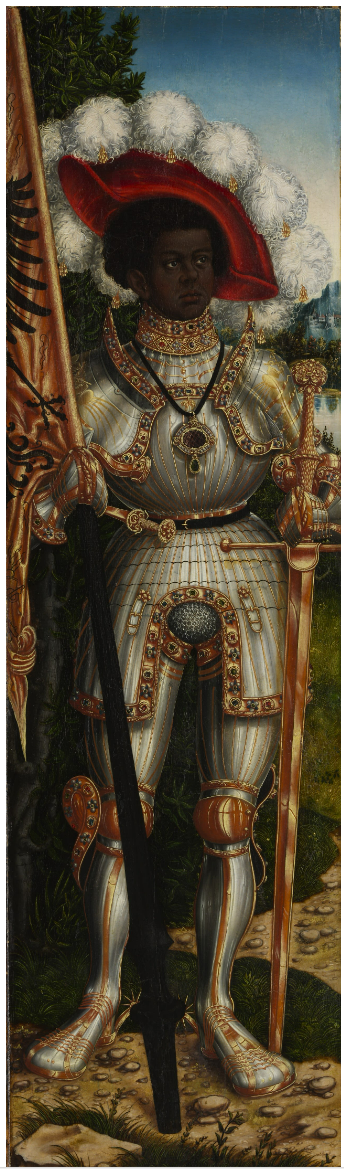
Lucas Cranach the Elder, Saint Maurice, circa 1522-1525. Metropolitan Museum of Art, New York. Photo: © The Metropolitan Museum of Art / Art Resource, NY.
“LEAD” and “GOLD” written above and below the figure bring to mind first the dichotomy between the two metals. Lead is utilitarian, gray, and was banned from use in housepaint just a few years before the execution of this painting. It is not deemed “precious” like its counterpart gold, but ultimately, they are both metal from the earth. The names of chemical elements and materials emerge frequently in Basquiat’s work, inspiring reflection on their history, uses, and prescribed values. In this work, it is interesting to note that gold, symbolic for wealth and luxury, has been placed at the bottom of the composition. At the top is lead, deemed less valuable, but perhaps more practical and useful than gold.
In 1981, Basquiat was gaining a lot of public attention very quickly, and soon he would become very wealthy. Perhaps at the time he executed this painting he was thinking about the ways in which his work, and by extension his persona, was being weighed and evaluated by other people. The work is an intimate look into his inner world, not made to be shown in a gallery but impromptu for his friend. Tim Wright was the bassist in the No Wave band, DNA, and he and Basquiat both performed in the indie film Downtown 81 the same year this work was executed. In the film, Basquiat plays the leading role—an artist who embarks on a journey around New York City to sell one of his paintings and encounters other artists and musicians, including DNA.