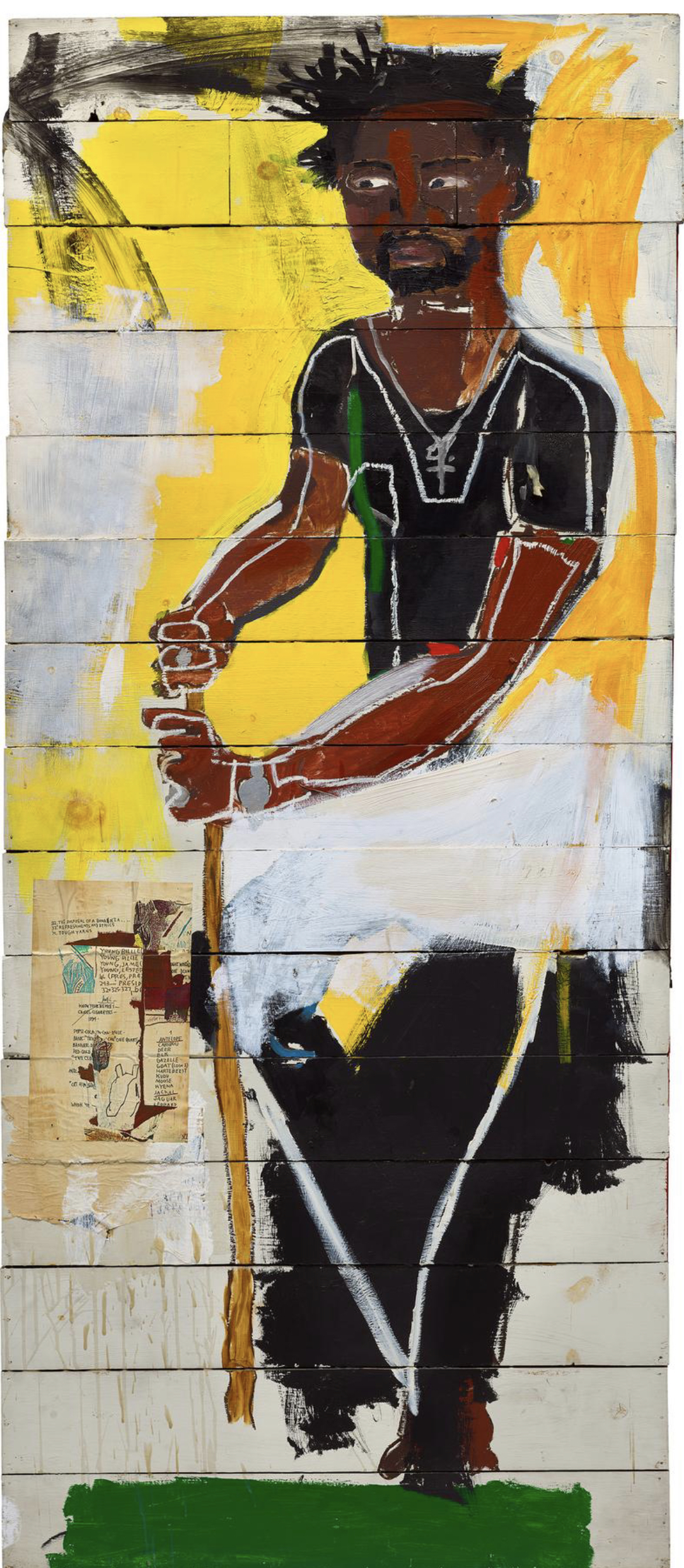
JEAN-MICHEL BASQUIAT
To Repel Ghosts, 1985
Acrylic, oil, oilstick and Xerox collage on wood
83 3/4 x 35 3/4 x 12 1/2 inches (212.7 x 90.8 x 31.8 cm)
Signed, titled and dated “TO REPEL GHOSTS Jean MB 85” on the reverse
Provenance
Bruno Bischofberger Gallery, Zurich and Mary Boone Gallery, New York
Hans Sonnenberg, Rotterdam (acquired by 1986)
Vrej Baghoomian, Inc., New York
Annina Nosei Gallery, New York (acquired from the above)
Acquired from the above by the present owner in 1992
Auction History
Phillips New-York: 15 November 2022
Estimated: USD 7,000,000 – 10,000,000
USD 7,862,500
Jean-Michel Basquiat – 20th Century… Lot 24 November 2022 | Phillips
Brimming with the tactility and vigor that is characteristic of Jean-Michel Basquiat’s best work, To Repel Ghosts, 1985, exemplifies the central themes that preoccupied the artist at the apex of his career. The monumental work, measuring seven feet tall, is a nearly double-life-sized portrait of Basquiat’s friend and fellow artist, Jack Walls. Well known in 1980s downtown circles as Robert Mapplethorpe’s muse and romantic partner, Walls is rendered in Basquiat’s distinctive visual idiom—unmistakable by the gestural swathes of black, white, and yellow pigment—against a surface of affixed wooden boards.
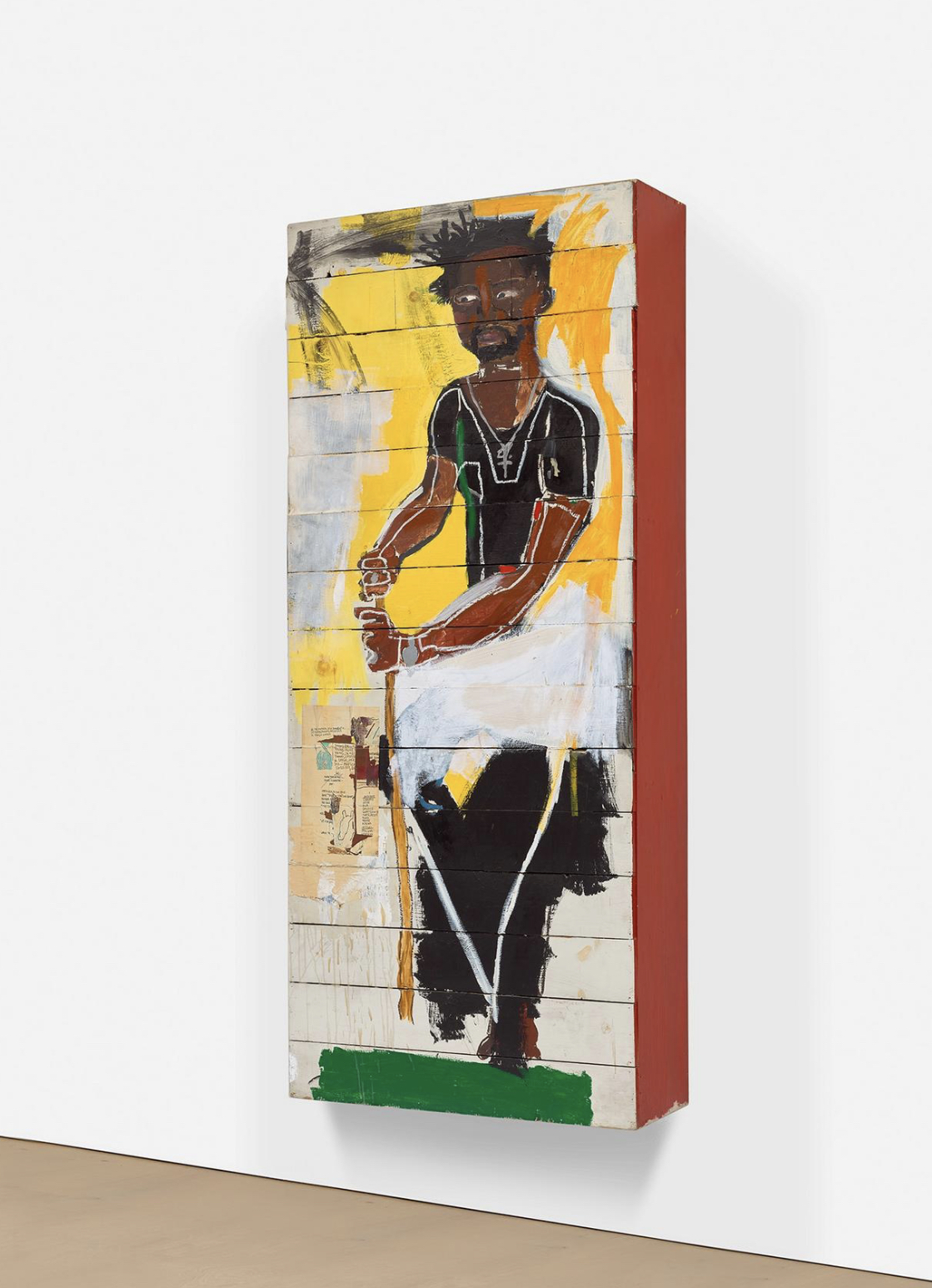
Basquiat’s penchant for incorporating doors and other found media into his practice first led him to experiment with timber slats for his 1984 masterwork Flexible, which employed the fencing that surrounded his Los Angeles studio. Exceedingly pleased with the resulting aesthetic effect, Basquiat soon returned to the idiosyncratic material, which he purchased from a Soho lumber yard to comprise the support of more than 17 paintings in the mid 1980s. Epitomizing his guiding principle to—quite literally—bring the urban environment into his studio, this major work from 1985 nods to Basquiat’s past as a street artist while anticipating the hallmarks of his mature style.
To Repel Ghosts was executed at the height of Basquiat’s fame: firmly established as downtown New York’s resident superstar, his friendly rapport with Andy Warhol—already regarded as the indisputable icon of American post-war art—had evolved into a deeply collaborative professional relationship. Basquiat’s status as a fully-fledged art world celebrity was cemented by a cover story in The New York Times Magazine published soon after the execution of the present work. Detailing his meteoric rise to international recognition, the article painted a portrait of him as a young but prodigiously talented maverick. Standing triumphantly in a sharp suit and fedora, he meets the camera’s gaze while flanked by two paintings in his studio that showcase his singular practice—one of which was the then-unfinished To Repel Ghosts.

Its title a gesture to colonialist understandings of voodoo practices, To Repel Ghosts reflects Basquiat’s engagement with his Afro-Caribbean heritage in the wake of his overnight success within a predominantly white art world. The artist began incorporating the expression into a handful of his works after his dealer Bruno Bischofberger introduced him to a Swiss ambassador who had lived across Africa for many years, Claudio Caratsch. Bischofberger recalled that one night when the two were at Caratsch’s house, the diplomat told Basquiat, “You know, in Africa art is made in a different way. Here it is art for art’s sake, and in Africa art is only made in order to do something with it, ‘to repel ghosts,” for instance.” Already familiar with West African belief systems, Basquiat was “amused that the ambassador, a studied ethnographer, was telling him about things he already knew.” The conversation led Basquiat to identify an affinity between his position within the diaspora and occult readings of African sculpture, manifested by visual tropes which would resurface throughout the rest of his oeuvre.