JEAN-MICHEL BASQUIAT
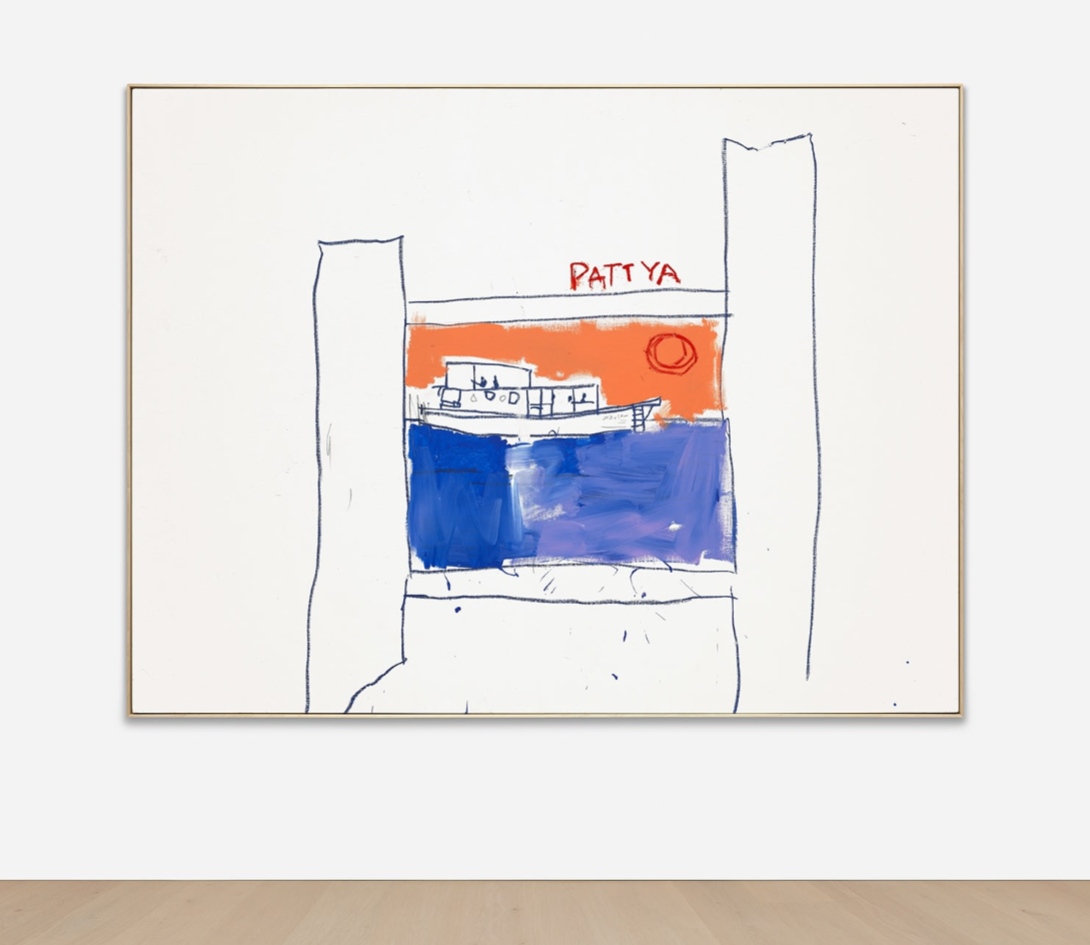
Pattya, 1984
Acrylic and oilstick on canvas
80 3/8 x 106 5/8 inches (204.2 x 270.8 cm)
Provenance
Collection of Andy Warhol, New York
Galerie Bruno Bischofberger, Zurich
Acquired from the above by the present owner
Auction History
Phillips London: 6 March 2025
Estimated: GBP 2,000,000 – 3,000,000
GBP 1,681,500 / USD 2,152,320
Jean-Michel Basquiat – Modern & Contem… Lot 18 March 2025 | Phillips
Painted in 1984, at the creative height of ‘radiant child’ Jean-Michel Basquiat’s meteoric rise to fame, Pattya opens a window onto another world, serenely still and seemingly far removed from the raw energy and frenetic activity of New York’s downtown art and club scenes with which the artist is so closely associated. A deeply personal reflection on the globe-trotting tour taken through Japan, Thailand, and Switzerland taken by Basquiat and the interdisciplinary artist, poet, and photographer Lee Jaffe the previous year, Pattya is a rich record of this once-in-a-lifetime adventure, and of the intellectual range and depth of Basquiat’s thinking. Coming to auction for the first time, having previously been held in the personal collection of Basquiat’s friend and collaborator Andy Warhol, Pattya was included in the significant 2013 exhibition Jean-Michel Basquiat mounted by Gagosian Gallery in Hong Kong, representing the first solo presentation of paintings by the artist in the region. Basquiat and Jaffe first met in July 1983 at the Los Angeles County Museum of Art at the opening of an exhibition of work by mutual friend and sculptor Italo Scanga. An accomplished poet and photographer, Jaffe had also been a member of Bob Marley’s band in the mid-70s, and had produced Peter Tosh’s legendary 1976 album Legalize It – a record that young painter had played so often he had worn out the grooves on the vinyl. Striking up an immediate rapport and bonding over their shared passion for reggae music, Basquiat spontaneously invited Jaffe to join him on a flight to Japan the following day, kick-starting an extended tour through Japan and Thailand before culminating in the glamorous Swiss ski resort of San Moritz. Unguarded, playful, and brimming with warmth, tender affection, and a sense of excited wonder at the world they were discovering for the first time, Jaffe’s photographs stand as a remarkable visual record of this mind-expanding and inspirational trip, offering us a candidly intimate portrait of the young and sensitively attuned artist at this pivotal moment in his career.
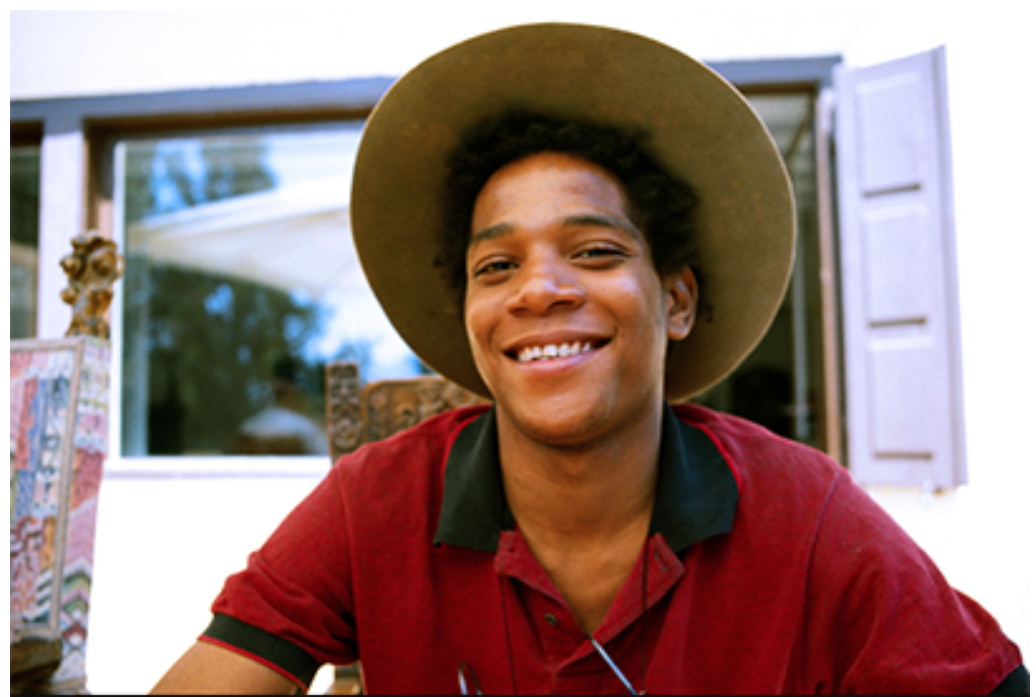
Jean-Michel Basquiat photographed by Lee Jaffe, 1983. Image: © Lee Jaffe
After taking the bullet train from Tokyo to Kyoto where the conversation roamed from Jaffe’s time spent in Jamacia with some of Basquiat’s musical heroes, to art history and its more complex relationship to concepts of race and colonialism, the two travelled on to Thailand. Arriving in a hot and humid Bangkok, a quest to source locally grown cannabis unraveled into a descent into the city’s darker criminal underbelly. As Jaffe vividly describes: ‘The driver knocked on the door and a thuggish scowling bouncer walked us into a club. It was one of the most indelible and depressing scenes– etched like a grim sordid nightmare in my memory. The club was dimly lit. There was a stage– like a bandstand– but there was no band. About 20 girls with signs hanging around their necks with bold numbers printed on them were spotlighted […] Shocked and disgusted, we turned round and exited, furious at the drive(r). The next day we wanted to get out of Bangkok as quickly as possible—anxious to put the experience behind us. When we asked the guy at the front desk where we could find a beach, he replied ‘Go to Pattaya.’
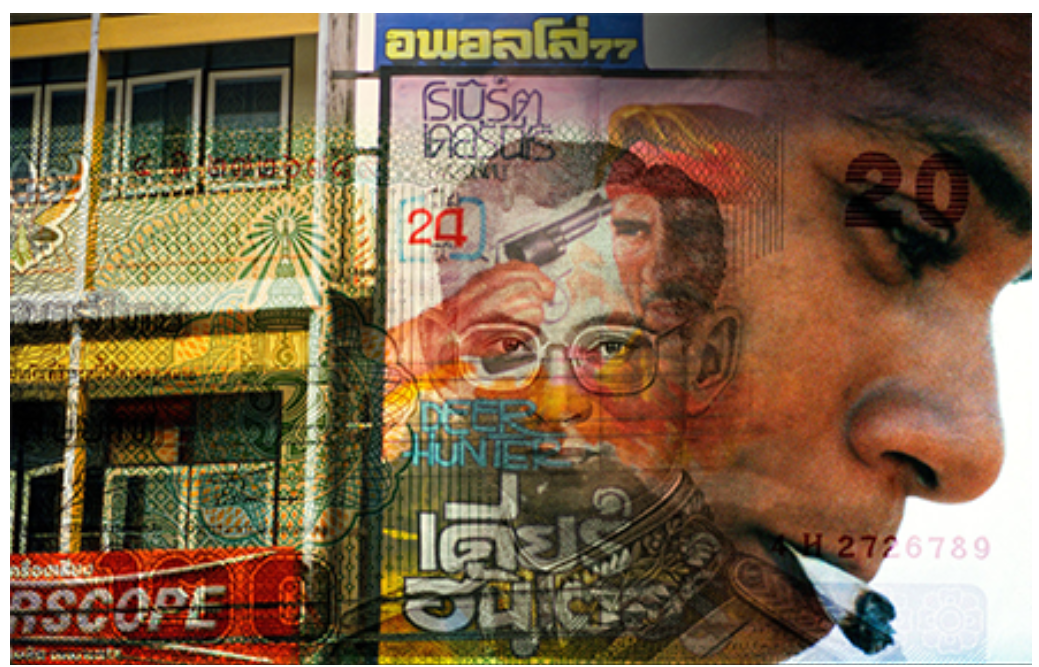
Jean-Michel Basquiat, Bangkok, photographed by Lee Jaffe, 1983. Image: © Lee Jaffe
Even in this idyllic oasis, the long shadow of globalization and American Imperialism that they had first observed in Tokyo made its presence felt, Jaffe recalling the looming presence of a US Navy destroyer anchored just offshore. Their arrival coinciding with a national holiday, a throng of tourists and soldiers mingled on the crowded beach ‘like a scene from Apocalypse Now’. Respite finally came when they learned that there was a small island accessible by boat just an hour from the mainland with a small fishing village and, most importantly, no tourists. Seen as if glimpsed beyond the small, shuttered windows of a beach cabin, one such small fishing vessel passes in front of the horizon in Pattya, referenced too in a small suite of photographs captured by Jaffe while the pair were out on the water on a boat of their own. Rendered in a confidently reduced palette of cobalt blues and bright, burnt orange, the deceptively simple composition reinforces our understanding of Basquiat’s remarkably expressive skill as a colorist and draughtsman. With these formal elements of line and color concentrated powerfully in the center of the composition, Pattya especially recalls Marc Mayer’s evocative description of the artist’s practice and his tendency to work with ‘direct and theatrically ham-fisted brushwork’, using ‘unmixed color structurally, like a seasoned abstractionist, but in the service of a figurative and narrative agenda. Basquiat deployed his color architecturally, at times like so much tinted mortar to bind a composition, at other times like opaque plaster to embody it. Color holds his pictures together, and through it they command a room.’
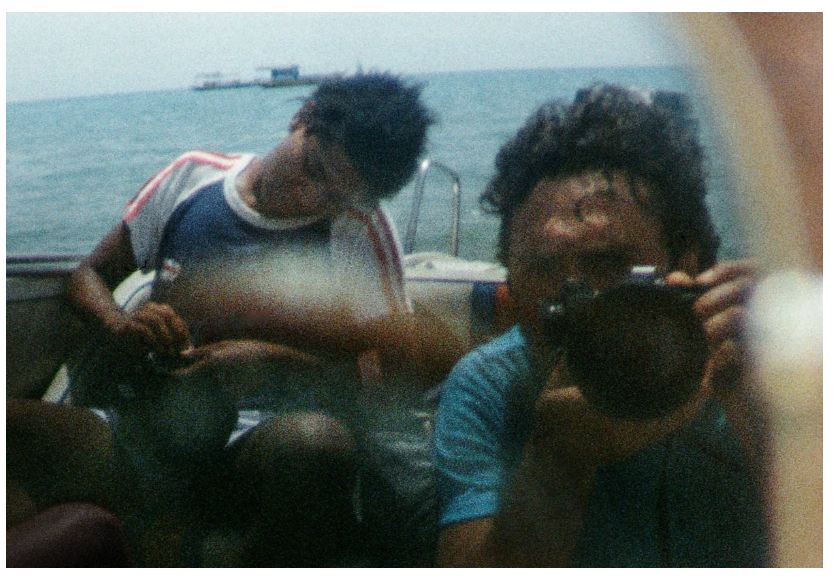
Lee Jaffe and Jean-Michel Basquiat, Pattaya, 1983. Image: © Lee Jaffe
With the single scrawled inscription ‘Pattya’, Basquiat transforms the expanse of white surrounding the central motif into a zone of possibility. Evoking the processes of memory and semiotic theory, the canvas and bare wall it stands in for are both reimagined here as surfaces for tracing signs upon, especially resonant given Basquiat’s early and collaborative activities tagging the walls of downtown Manhattan under the cipher SAMO©. As established in the field of semiotics, the separation of sign into its two constitutive elements of signifier and signified allows us to distinguish between its denotive and connotative qualities – that is, both what that sign describes in a literal sense, and its more associative meanings. Here ‘Pattya’ of course records a literal place, and the time passed there by Jaffe and Basquiat; but it also signifies the far more nebulous and complex series of mental associations that represent the very idea of Pattaya for the artist. Although Basquiat and Jaffe reached their remote paradise, the trip also exposed the effects of rapid, mass globalization in the last decades of the 20th century, revealing a much longer and more troubled history of colonial and cultural imperialism and the exploitation of peoples under capitalism to the sensitive, intellectually searching, and socio-politically engaged pair. As Jaffe noted, as well as sharing a keen engagement with cultural politics and a history of ideas, one significant point of convergence for the two artists was on the appropriation and ‘integration of words within our visual practice.’ It is on this point that Basquiat’s practice is most frequently discussed in relation to the calligraphic mark-making of Cy Twombly, who similarly differentiated between the more literal depiction or imitation of experience, and painting’s ability to become records of the emotion or sensation generated by these experiences. For Twombly – as for Basquiat here – each mark is ‘the actual experience with its own innate history. It does not illustrate – it is the sensation of its own realization. The imagery is one of the private or separate indulgences rather than an abstract totality of visual perception’
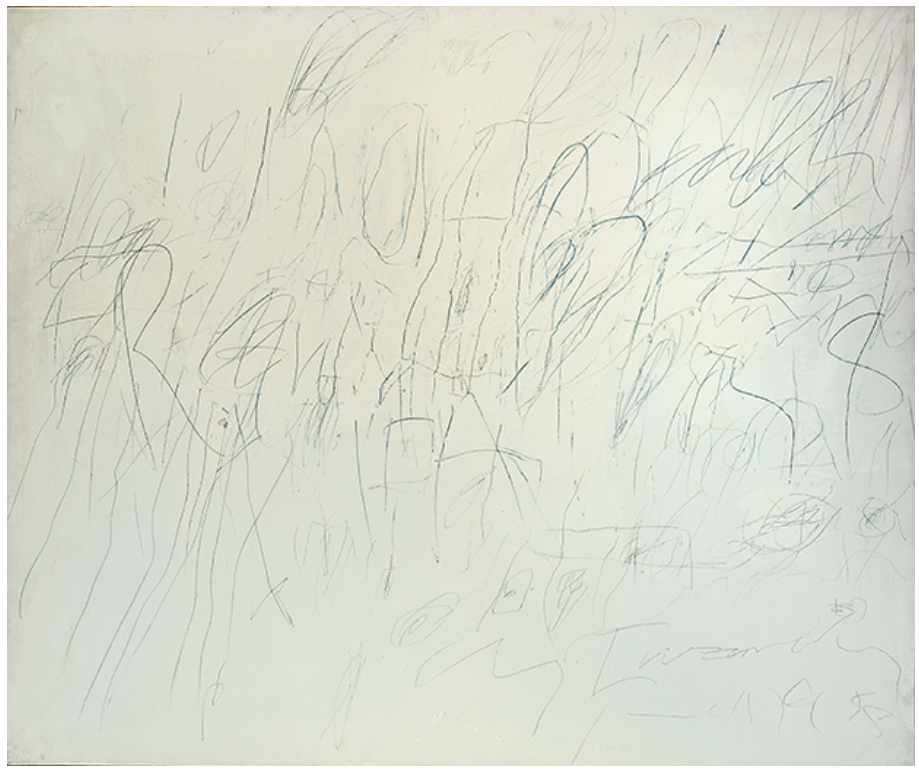
Cy Twombly, Untitled, 1958, Private Collection. Image: © Christie’s Images / Bridgeman Images, Artwork: © Cy Twombly Foundation
Just as Basquiat’s experiences travelling through Asia, Africa, and Europe would find themselves inscribed into his work, travel and the notion of place was of fundamental importance to Twombly. His later works especially bear direct references to the city of Rome which the artist first visited in a pivotal 1952 trip with Robert Rauschenberg and would go on to make his home in 1957. Extending his own gestural, calligraphic sense of line with reference to the ancient graffito carved into the walls of the Eternal City, Twombly’s canvases frequently bear the ghostly trace of words or textual fragments. Often referring to mythological figures and themes, Twombly was also more direct in his use of text, the scattered letters R O M E, especially prominent in a work like the 1958 Untitled (Rome) where, even more compellingly, the vague outline of an open window is discernible towards the centre of the composition. Painted in 1984, after the conclusion of this international tour, the window and scene beyond recorded in Pattya serves the dual purpose of anchoring the work in a very specific place and time, and of activating this more complex, internal network of associations that exist beyond the simple fact of its existence.