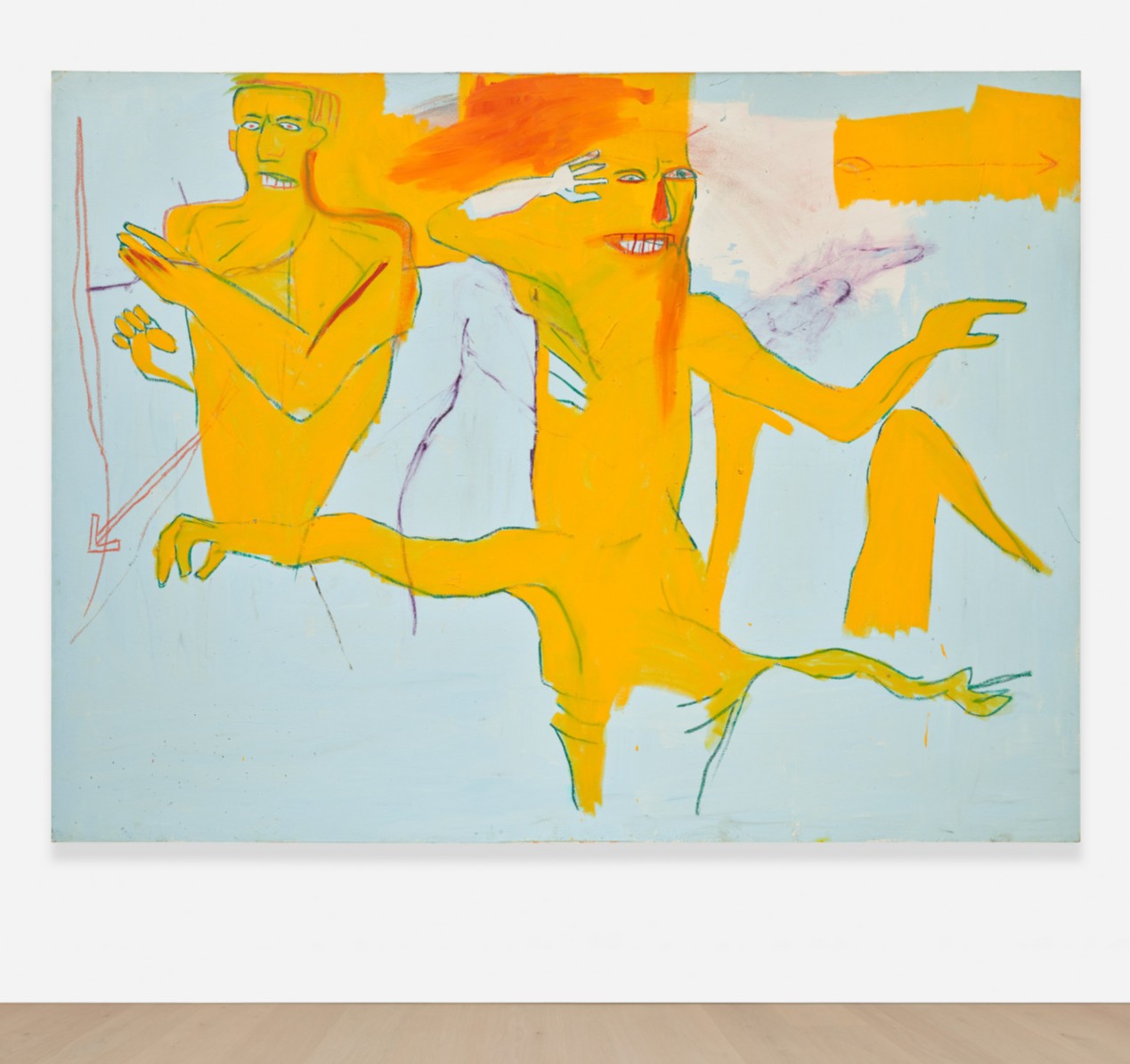
JEAN-MICHEL BASQUIAT
Exercise, 1984
Acrylic and crayon on canvas
72 1/8 x 96 1/8 inches (183.2 x 244.2 cm)
Signed, titled, inscribed and dated “Jean-Michel Basquiat “EXERCISE” 1984 KIPAHULU.” on the reverse
Provenance
Larry Gagosian Gallery, Los Angeles
Frederick R. Weisman Art Foundation, Los Angeles (acquired from the above on October 16, 1984)
Christie’s, New York, November 10, 1988, lot 355
Private Collection, New York (acquired at the above sale)
Thence by descent to the present owner
Auction History
Phillips New-York: 19 November 2025
Estimated: USD 3,000,000 – 5,o00,000
USD 3,852,000
Jean-Michel Basquiat Modern & Contemporary Art Evening Sale featuring Cera the Triceratops
Painted in 1984, Exercise captures Jean-Michel Basquiat at a moment of both creative intensity and personal retreat. The work opens a window onto another world—one that feels serene and distant from the raw energy of New York’s downtown art and club scenes that had defined his rise to fame. Marking the first of several extended stays in Hawaii between 1984 and 1988, the painting embodies a period of introspection and escape from the mounting pressures of his rapid ascent. Dated and inscribed “1984 KIPAHULU” on the reverse, it stands as a visual record of Basquiat’s first sojourn on Maui, where he rented a ranch in the remote town of Kīpahulu and worked with art supplies sent from Los Angeles.
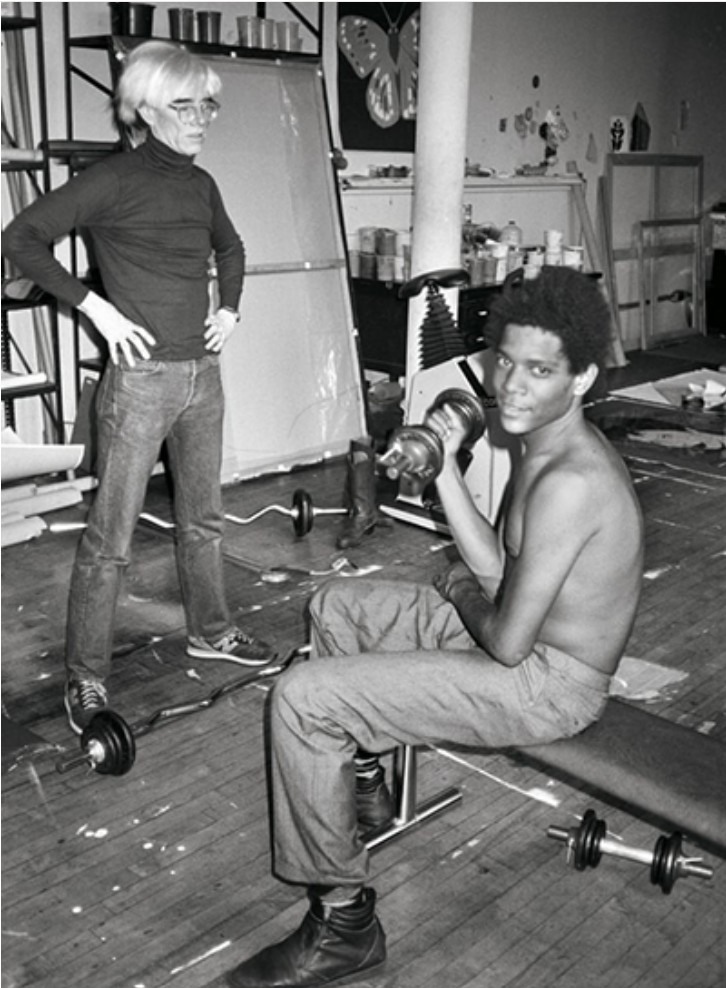
Jean-Michel Basquiat and Andy Warhol, August 15, 1983.
Image: © 2025 The Andy Warhol Foundation for the Visual Arts, Inc. / Licensed by Artists Rights Society (ARS), New York
Exercise was acquired the year it was made by prominent collector Frederick R. Weisman and included in several major exhibitions from the Weisman Foundation, including an international tour through Tokyo, Seoul, and Hong Kong in 1986–1987. Last presented at auction in 1988, its reemergence nearly four decades later invites a rare glimpse into Basquiat’s practice at a pivotal moment, when artistic maturity converged with a longing for solitude and renewal.
By 1984, Basquiat had become a global phenomenon. His collaboration with Andy Warhol, described by Ronnie Cutrone as “some crazy art-world marriage,” gave Warhol “a rebellious image again,” while establishing Basquiat as a central voice of his generation. That spring, he joined New York dealer Mary Boone’s roster—home to artists such as Julian Schnabel and Eric Fischl—and mounted his first solo museum exhibition at the Fruitmarket Gallery in Edinburgh. His inaugural show with Boone in May drew critical acclaim. In Maui, Basquiat found respite from the pressures of sudden fame and the increasingly dangerous drug habit that accompanied it. During this stay, Basquiat produced at least three paintings—Rusting Red Car in Kuau, Cash Crop, and Exercise—each revealing a different facet of his thinking. Rusting Red Car in Kuau revisits the automobile motif often linked to his childhood car accident and Warhol’s car-crash series of the 1960s. Cash Crop critiques colonial exploitation through a black box labeled “sugar,” connecting the histories of Haiti and Hawaii. In contrast, Exercise offers an inward turn, locating struggle and renewal within the body itself. Here, the term “exercise” may refer not only to physical exertion but also to painting as a form of rehearsal and experiment. The elongated figures, caught mid-motion, stretch, twist, and reach across the canvas like sketches in movement studies.
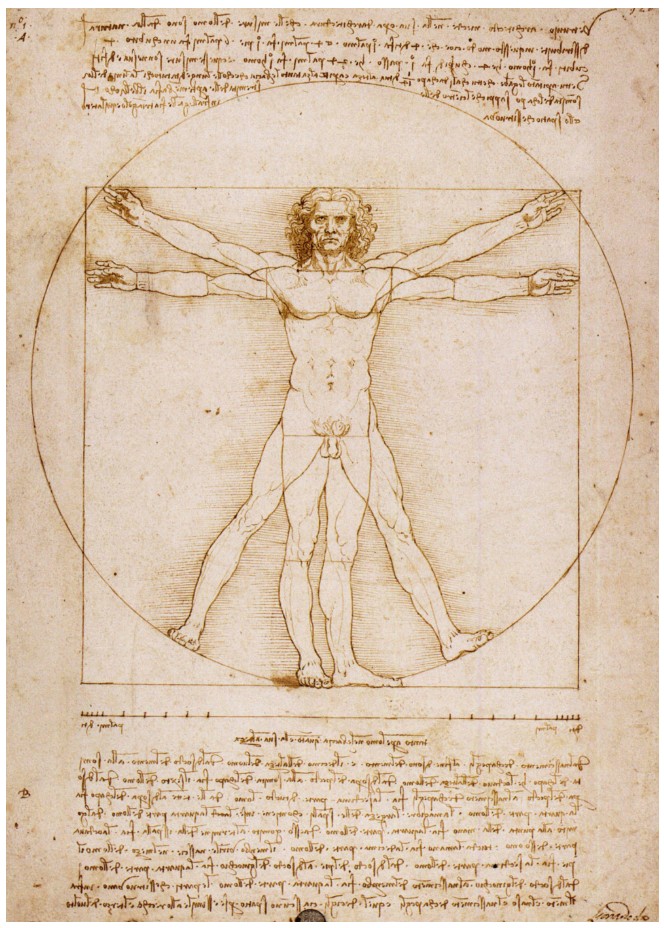
Leonardo da Vinci, The Proportions of the Human Figure (after Vitruvius), c.1492.
Galleria dell’Accademia, Venice. Image: History & Art Collection / Alamy Stock Photo
Basquiat’s lifelong fascination with anatomy—rooted in the Gray’s Anatomy book given to him as a child while recovering from a car accident—finds renewed expression here. The figures’ skeletal limbs, jagged contours, and taut musculature suggest a study of internal structure rather than outward appearance. This recalls both Leonardo da Vinci’s anatomical drawings and medical diagrams, yet Basquiat’s treatment is instinctive and expressive, privileging vitality over precision.
“I start a picture and I finish it. I don’t think about art while I work.
I try to think about life.”
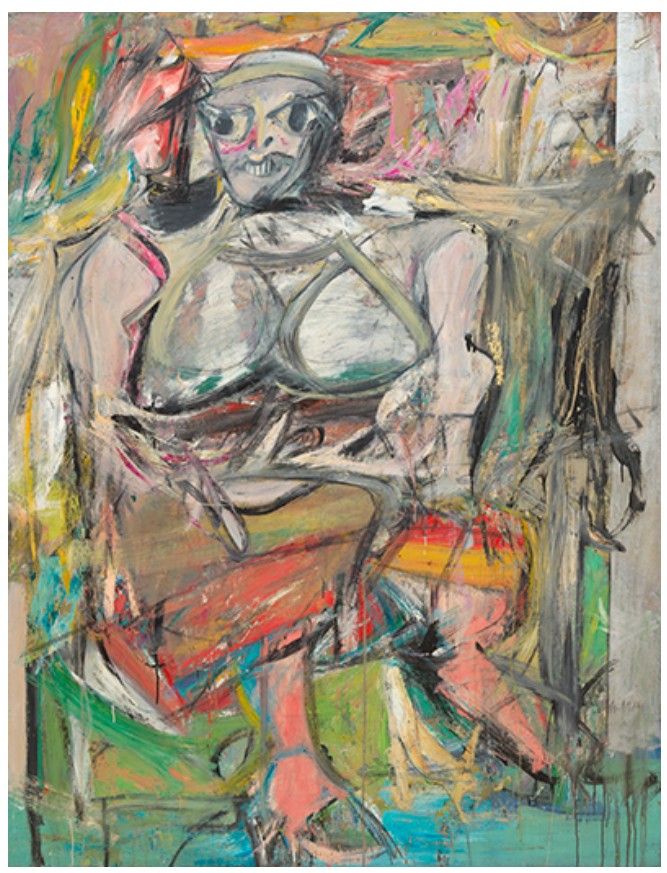
Willem de Kooning, Woman I, 1950-1952. Museum of Modern Art, New York. Image: © The Museum of Modern Art/Licensed by SCALA / Art Resource, NY, Artwork: © 2025 The Willem de Kooning Foundation/Artists Rights Society (ARS), New York
Executed in blazing cadmium yellow against a pale, sun-bleached blue, the composition distills Basquiat’s painterly intelligence into essential form and color. The raw brushwork, uneven fillings, and visible revisions make the process itself part of the image. In Exercise, the stark interplay between figure and ground gives the painting a blazing immediacy—simultaneously skeletal and monumental. The painting’s imagery bridges Basquiat’s fascination with both African and European iconography. The left-hand figure, seemingly wielding a bow and arrow, recalls his recurrent depictions of warriors—symbols of resistance and empowerment that channel both physical and cultural resilience. The central figure, arms outstretched in a cruciform “T” pose, evokes the duality of martyr and hero that runs throughout Basquiat’s practice. The resulting image fuses references to African rock art, Christian iconography, and modernist abstraction—connecting cave painting, graffiti, and expressionism into a single lineage.
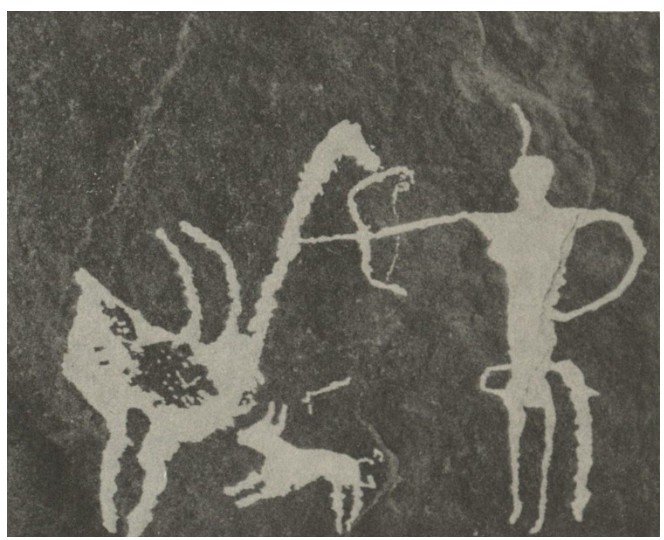
Rock art at Wadi Abu Wasil, Eastern Desert of Egypt, prior to 3000 BC.
The influence of Burchard Brentjes’ 1969 text African Rock Art, a volume Basquiat kept in his studio, is palpable in the totemic composition and simplified anatomy. At the same time, the exposed teeth and mask-like eyes echo the faces of African sculptures and the primal vigor of Jean Dubuffet’s Art Brut. As Basquiat saw it, the eyes were “a passageway from exterior physical presence into the hidden realities of man’s psychological and mental realms.” In Exercise, their stark whiteness cuts through the saturated yellow, charging the scene with psychological tension.
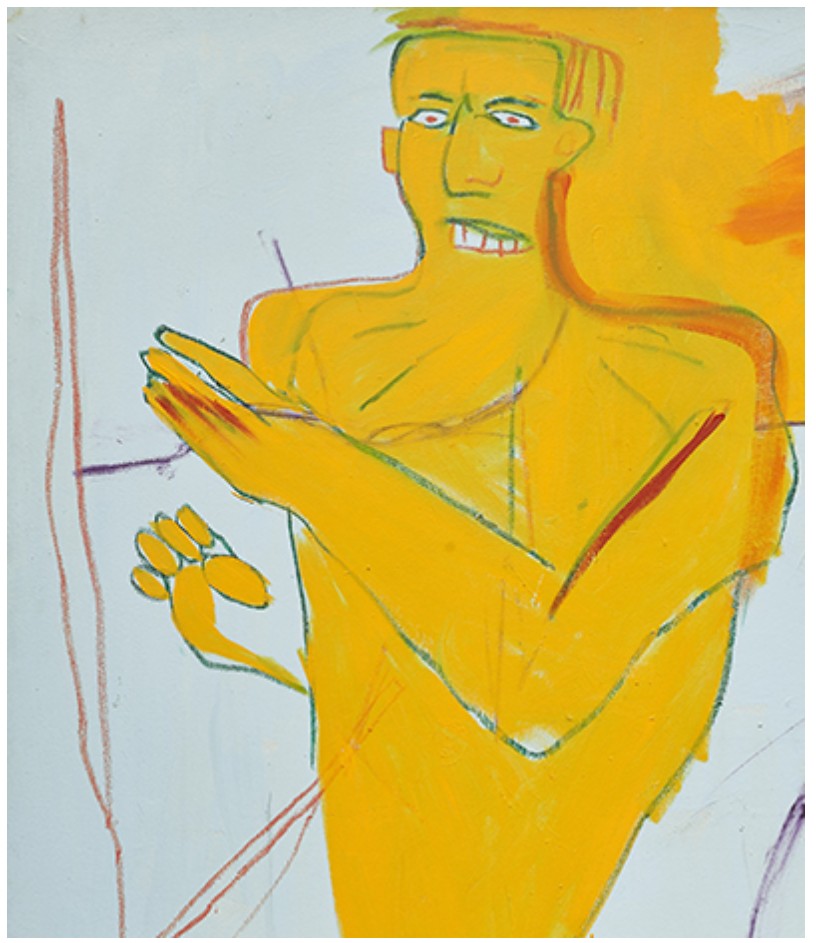
By 1984, fame had rendered Basquiat both idolized and isolated. This painting may thus be read as an allegory of the artist himself—warrior and victim, saint and trickster, creator and creation. That same year, he produced Deaf, now in the collection of The Broad, Los Angeles, depicting a blind harpist inspired by an Egyptian tomb relief; together, the two works meditate on communication, perception, and the cost of genius. In Exercise, these ideas find their most direct expression, as gestures of covering the ear or playing unheard music become metaphors for inner dissonance, a creative voice struggling to be heard yet seeking refuge in silence.