JEAN-MICHEL BASQUIAT (1960 – 1988)
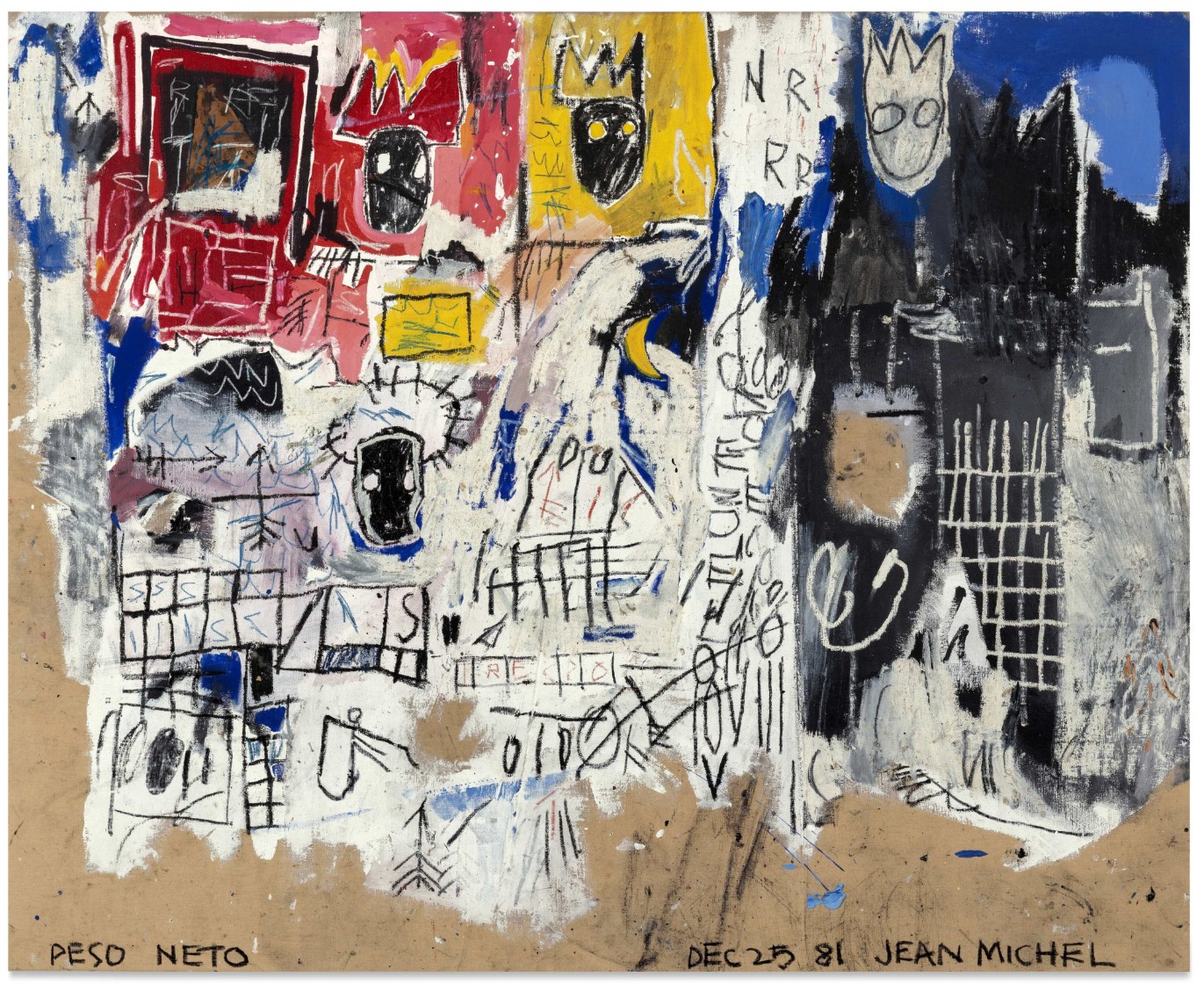
Crowns (Peso Neto), 1981
Acrylic, oilstick and paper collage on canvas
76 1/4 x 94 1/4 inches (193.6 x 239.4 cm)
Signed, titled and dated DEC 25 81 (lower edge)
Provenance
Annina Nosei Gallery, New York
Private Collection (acquired from the above in April 1982)
Jeffrey Deitch, New York
Mr. and Mrs. Thomas E. Worrell Jr., Virginia (acquired from the above by 1992)
Jeffrey Deitch, New York
Private Collection (acquired from the above in December 2005)
Acquired from the above in October 2016 by the present owner
Auction History
Basquiat Crowned | Property from a Distinguished European Collection
Sotheby’s New-York: 18 November 2025
Estimated: USD 35,o00,000 – 45,000,000
USD 48,335,000
Crowns (Peso Neto) | The Now & Contemporary Evening Auction | 2025 | Sotheby’s
An intricate tapestry of spiritual, secular and symbolic allegory, Crowns (Peso Neto) is a defining masterwork that encapsulates Jean-Michel Basquiat’s unrivaled capacity for creative genius and introspection. Executed on Christmas Day in 1981, just three days after his 21st birthday, Crowns (Peso Neto) marks the culmination of an ascendant year in Basquiat’s brief yet meteoric career—one that would bring hitherto unprecedented public visibility, critical acclaim and commercial success to the artist, as he metamorphosed from vanguard street artist-provocateur to prodigy of New York’s cultural avant-garde. Rendered at a monumental scale in a medium that evokes the artist’s transition from street to studio, the present work interweaves secular and spiritual imagery to create a profoundly intimate portrait of Basquiat on the cusp of explosive stardom and reflects a poignant meditation on the sacrifices inherent to that success. Boasting an illustrious exhibition history, which includes the artist’s very first solo exhibition in America and, after his untimely passing, his first retrospective, the work has been a hallmark of the most critical showcases of Basquiat’s work. A triumph of artistic mythmaking, Crowns (Peso Neto) is an unrivaled manifesto of Basquiat as painter, celebrity and product; heir, rebel and prophet.
1981 was pivotal in Basquiat’s rising star, as a series of exhibitions and connections launched him toward undeniable stardom. The first of these was the February exhibition New York/New Wave, a survey of downtown New York’s intertwined art and music scenes. Basquiat’s prominent visibility within the exhibition attracted the attention of gallerists Emilio Mazzoli, who shortly thereafter offered Basquiat his first international solo presentation, and the legendary Annina Nosei. By September, Nosei became Basquiat’s primary dealer, providing him with his first dedicated studio space in the basement of her gallery at 100 Prince Street in New York’s SoHo neighborhood. In December, Artforum published the first extensive article on Basquiat and his work: “The Radiant Child,” an essay by Rene Ricard that surveyed emerging New York “graffiti” artists. This article and others that followed already sought to trace Basquiat’s artistic genealogy, drawing comparisons between the artist, his calligraphic graffiti style and art brut sensibilities to forebearers such as Cy Twombly and Jean Dubuffet.
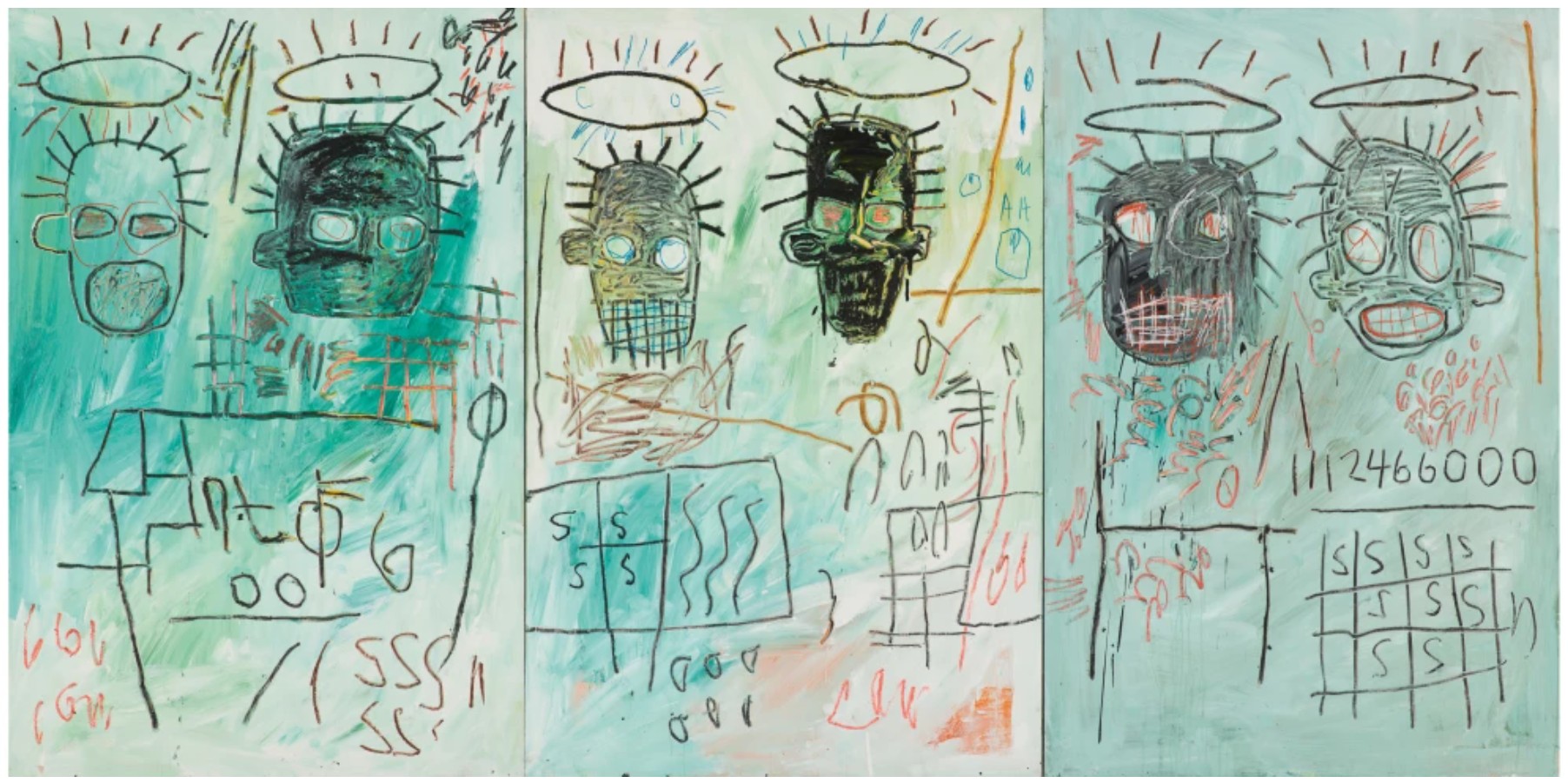
Jean-Michel Basquiat, Six Crimee, 1982. The Museum of Contemporary Art, Los Angeles.
Art © 2025 Estate of Jean-Michel Basquiat. Licensed by Artestar, New York
Emerging from the twilight of this transformative period, Crowns (Peso Neto) reads like an encyclopedia of the artist’s enigmatic yet indelible symbolic vernacular, developed during his days spray-painting the street and now crystallized on canvas. Here, Basquiat’s signature motif arrives at full force: four skeletal heads—hollow-eyed yet piercing—each crowned with the emblem that would come to define his art and legacy, an enduring icon of late-twentieth-century art. The artist had included the crown in his prior work as SAMO©—the pseudonym under which he had graffitied walls and found objects around New York’s SoHo and TriBeCa neighborhoods. Among the earliest debuts of the crown in his paintings, Crowns (Peso Neto) accordingly stands as one of Basquiat’s most important early masterworks, exemplifying a refinement in both medium and iconography of the artist’s practice. Dispersed throughout the work and especially concentrated in the left half within a dominant white plane are other hallmarks of Basquiat’s visual lexicon, such as letters, tally marks, feathered arrows, crescent moons and tic-tac-toe grids. Surrounding these more scrutable hieroglyphs are further slews of furious oil stick scrawls, many of which resemble the iconography that Basquiat appropriated from Henry Dreyfuss’ Symbol Sourcebook and transformed into personal hieroglyphs.
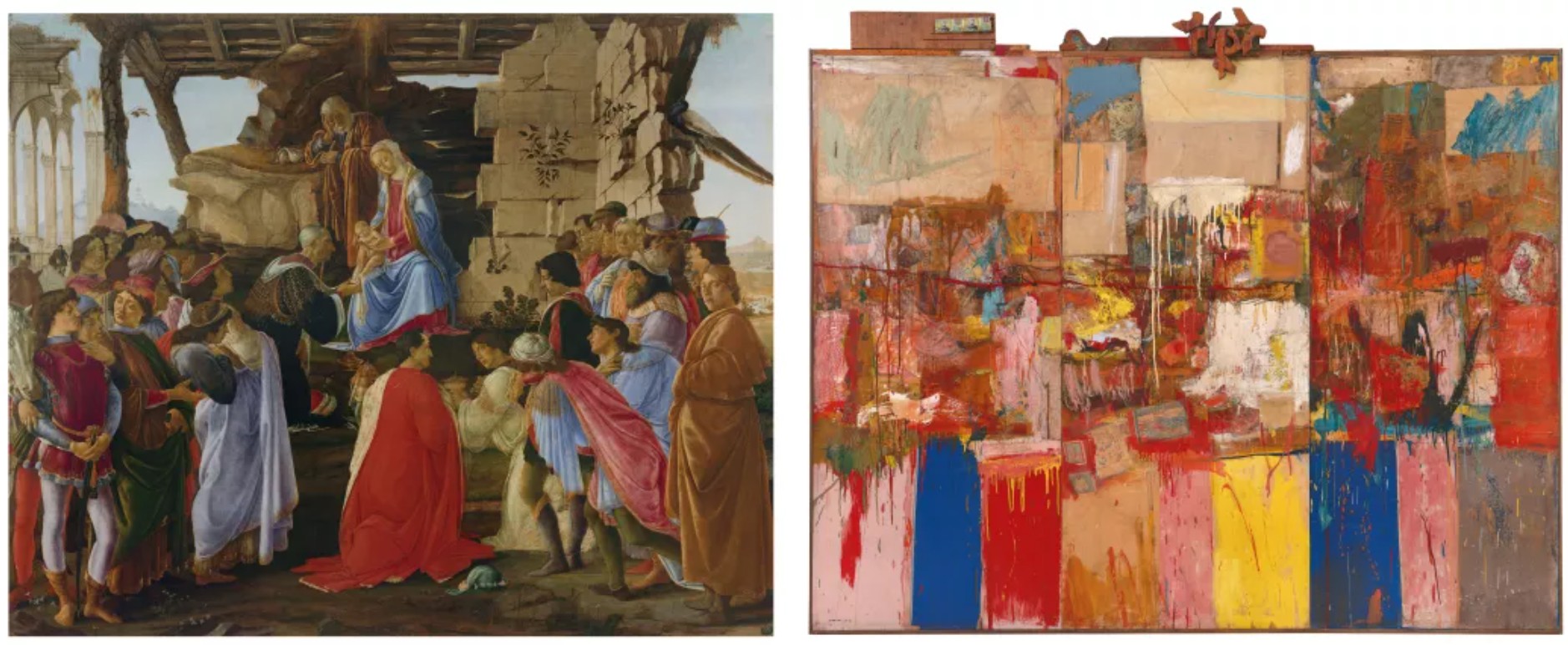
Left: Sandro Botticelli, Adoration of the Magi, c. 1475. Gallerie degli Uffizi, Florence. Image © Bridgeman Images. Right: Robert Rauschenberg, Collection, 1954-55. San Francisco Museum of Modern Art. Art © 2018 Robert Rauschenberg Foundation / Licensed by VAGA at Artists Rights Society
The refinement of Basquiat’s artistic practice palpable in the symbolism of Crowns (Peso Neto) equally characterizes the work’s medium. Curator and dealer Jeffrey Deitch described 1981 as “the year of transition between the street and the studio,” one that saw the artist evolve from graffitiing city walls, to painting objects discarded on the street and drawing on typing paper, to painting on canvas in his first studio. (Jeffrey Deitch, Jean-Michel Basquiat, 1981: The Studio of the Street, New York, 2006, p. 10) Crowns (Peso Neto), brilliantly captures the late stages of this transition: the canvas base and luminous, variegated fields of red, yellow and blue reflect Basquiat’s newfound access to premium artistic materials, but his incorporation of paper collage into the composition hearkens back to the Xeroxes he would hawk on the New York streets during his bygone days as SAMO©. Along the left and bottom edges of the work, the strokes of acrylic and oil stick fall away, revealing the dark tan of the raw canvas underneath—giving the work a cartographic quality, reinforcing its autobiographical valence as the expression of an artist whose practice was still in transition and evoking ancient art worn with the passage of millennia such as the ancient painted Roman or Egyptian frescoes Basquiat had first beheld during childhood visits to museums such as The Metropolitan Museum of Art, The Museum of Modern Art and the nearby Brooklyn Museum. This constructed erosion of painterly elements, coupled with the work’s aggregation of paper collage and street symbols, gives Crowns (Peso Neto) an almost mural-like appearance, transforming it into a palimpsest of the New York street. (Fretz, Jean-Michel Basquiat: A Biography, Greenwood, 2010, p. 89) Across the work’s bottom edge are written the words “PESO NETO” on the left and “DEC 25 81 JEAN MICHEL”—an unambiguous declaration of authorship, capping a critical year in Basquiat’s revision of his artistic self-identity, during which he began producing art under his own name instead of the SAMO© pseudonym under which he had first achieved notoriety.
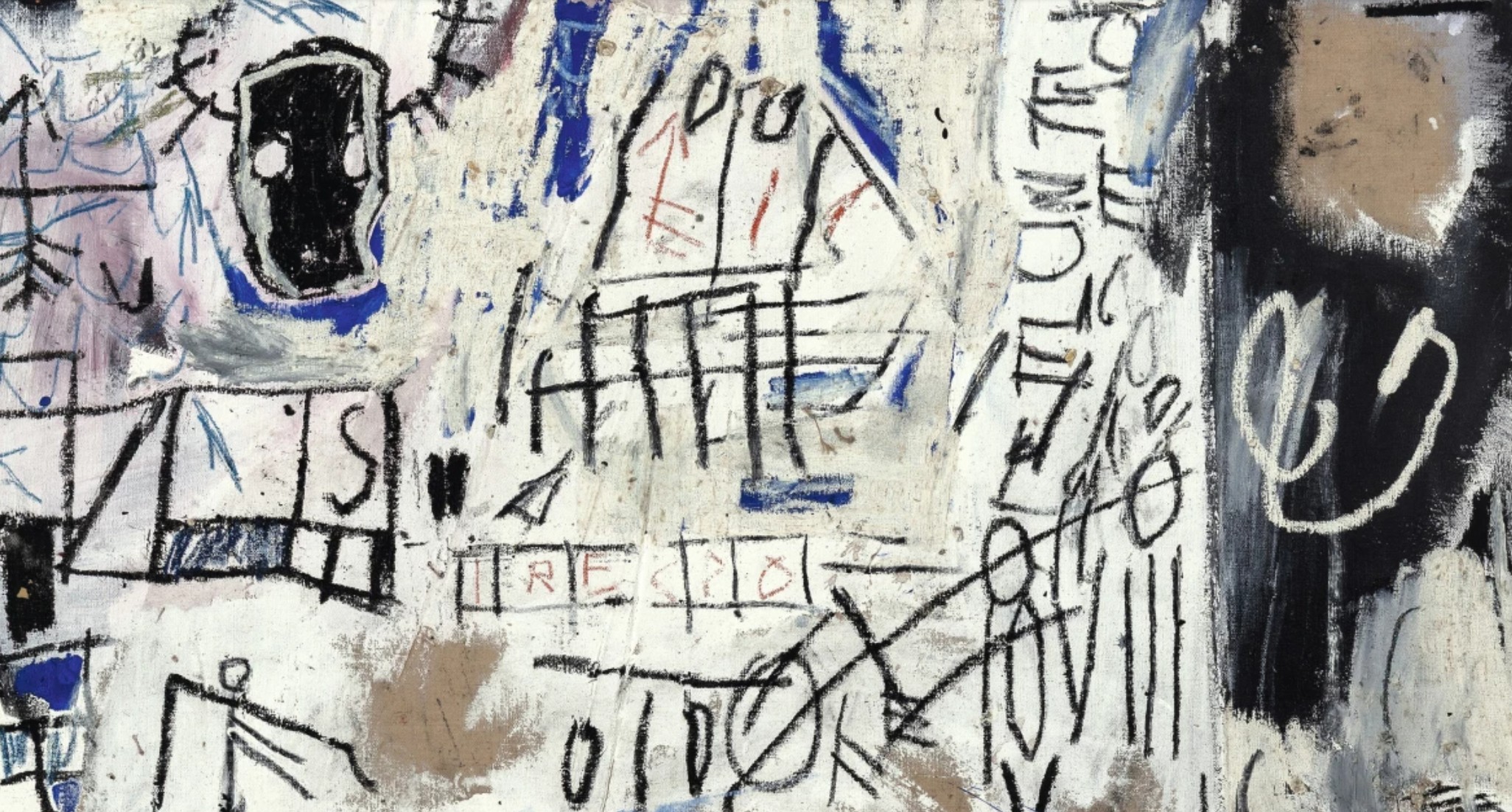
Rendered bare against the raw canvas backdrop, the words ‘PESO NETO’—the Spanish translation of ‘NET WEIGHT’—come into heightened focus as a cipher conveying Basquiat’s autobiographical multilingualism and Nuyorican identity. Since birth, Spanish language and culture had shaped Basquiat and intertwined with his artistry: the language was native to Basquiat, inherited from his Puerto Rican mother. Throughout his entire life, Basquiat would have encountered the phrases ‘PESO NETO’ and ‘NET WEIGHT’ constantly throughout the bombardment of commercial product advertisements and other street signage found in his native neighborhood of Brooklyn, his stomping grounds of the East Village and the Lower East Side as well as his newfound artistic home in SoHo. By December 1981, the artist was enjoying more commercial success than he had ever before—his art was now decidedly commercial. And in Crowns (Peso Neto), stamped with words describing attributes such as net weight, creator and date of creation, art becomes product; painting becomes commerce. This ongoing act of sacrifice—Basquiat’s exchange of personal freedom for fame and fortune—assumes heightened resonance on Christmas, the day marking both the birth of Christ and the creation of Crowns (Peso Neto). Several elements of the masterwork point to themes of Christianity, most notably the three crowned heads presiding over a fourth head, adorned with a crown of thorns, and the unambiguously articulated date of the work’s creation. Here, Basquiat reimagines the Adoration of the Magi, the traditional depiction of three wise men offering gifts to the newborn Jesus, as a darker, more foreboding scene. Archetypal renderings of the scene emphasize the three wise men’s adoration of the Child; Basquiat, however, depicts his three crowned figures as hollow-eyed, disembodied and menacing. Their supposed gifts—one perhaps a bar of gold, represented by a yellow rectangle—mask an undercurrent of entrapment and violence: the composition’s lone white figure, its crown seamlessly fused to its head, emanates a shadowy expanse that takes the rough shape of a body; contained within the left leg of this advancing shadow is a wall topped with barbed wire—an embodiment of the intense paranoia Basquiat often expressed in his interactions with members of the (mostly white) art world. And by aligning his name with the date of Christ’s birth at the bottom of the canvas, Basquiat confirms himself as the fourth figure: Christ, already crowned with thorns, toward whom this malevolence is directed.
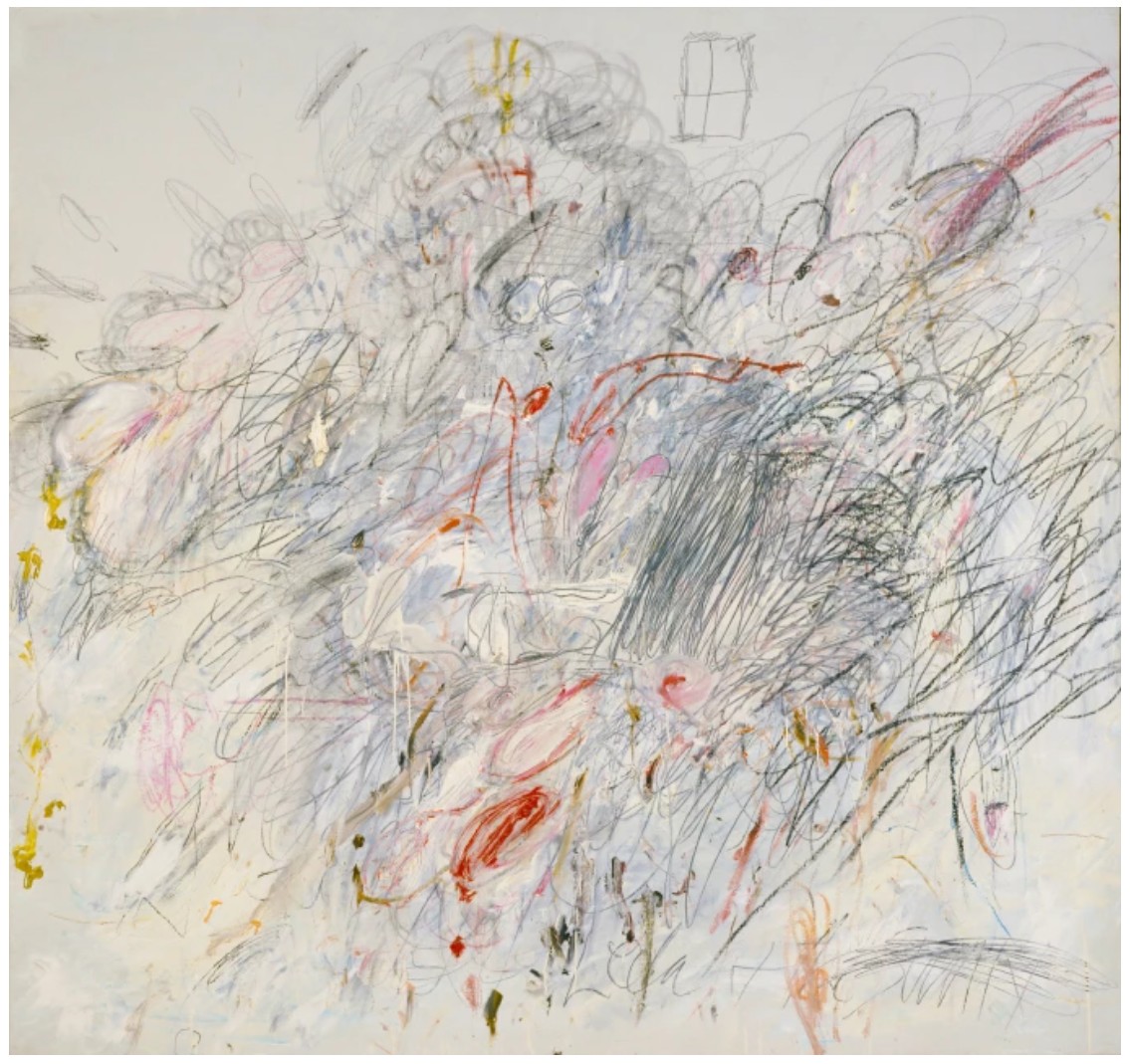
Cy Twombly, Leda and the Swan, 1962. The Museum of Modern Art, New York.
Image © The Museum of Modern Art / Licensed by SCALA / Art Resource, NY. Art © Cy Twombly Foundation
A testament to the work’s pivotal importance within Basquiat’s oeuvre, Crowns (Peso Neto) has been included in a number of monumental exhibitions: following its unveiling to the public in at Annina Nosei Gallery in 1982, Crowns (Peso Neto) was distinguished as one of just five paintings by the artist displayed at documenta 7 in Kassel, West Germany—where Basquiat became one of the youngest artists ever to be shown in the quinquennial exhibition. A decade later, following Basquiat’s untimely passing, Crowns (Peso Neto) featured in the artist’s landmark first retrospective at the Whitney Museum of American Art in New York, which subsequently traveled to The Menil Collection in Houston, Texas, Iowa’s Des Moines Art Center and Alabama’s Montgomery Museum of Fine Arts. In the decades that followed, the work would feature in additional landmark retrospectives: over the course of these exhibitions, Crowns (Peso Neto) has hung alongside dozens more of Basquiat’s most celebrated masterpieces, many of which now reside in the world’s foremost museum collections.
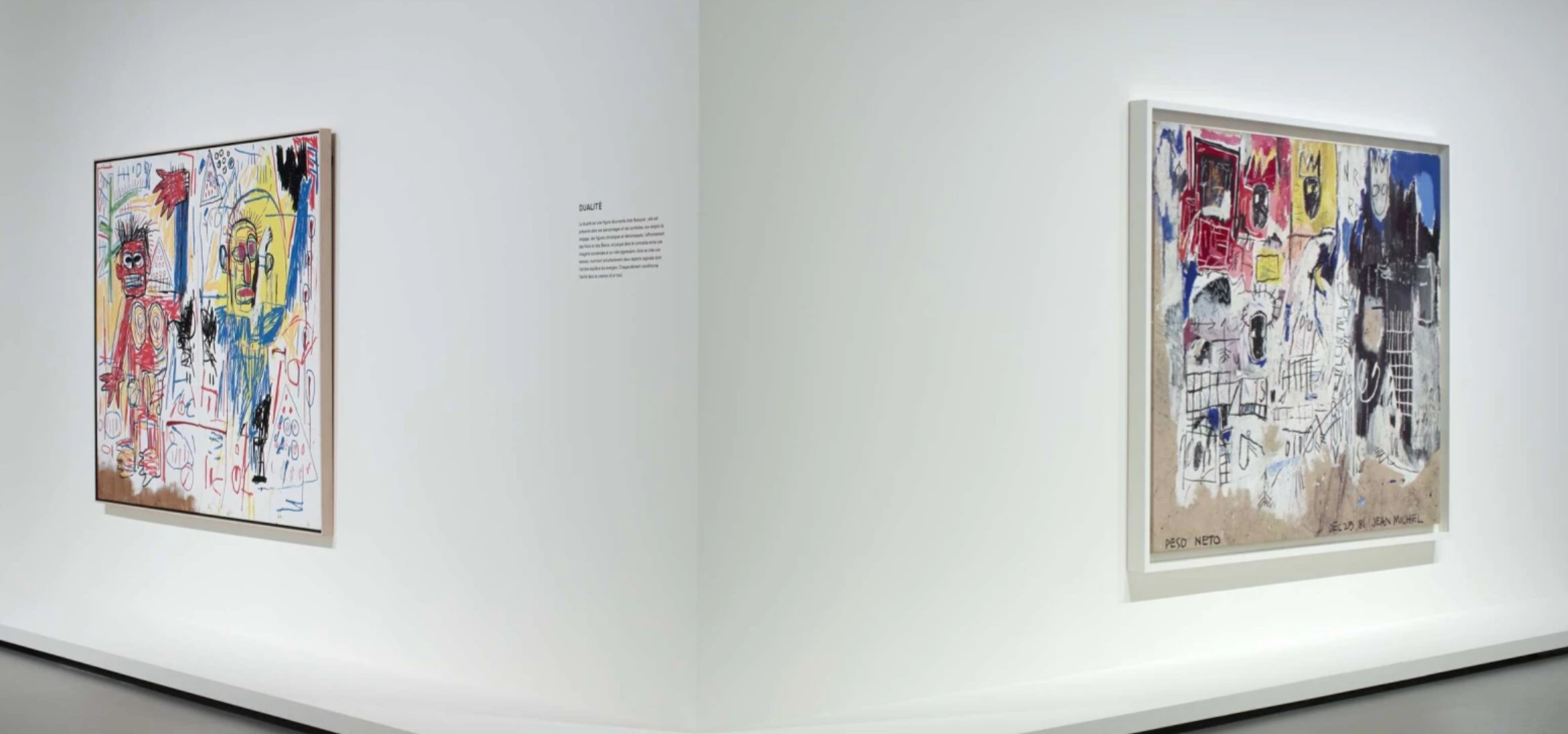
The present work installed in Jean-Michel Basquiat at the Fondation Louis Vuitton, Paris, October 2018 – January 2019. Image courtesy Fondation Louis Vuitton, Paris. Art © 2025 Estate of Jean-Michel Basquiat. Licensed by Artestar, New York
With all the power, urgency and unnerving foresight of an artist on the precipice of his own apotheosis, Crowns (Peso Neto) reads as both self-portrait and prophecy; an emblem of Jean-Michel Basquiat’s vaunting ambition and a cipher for the personal and artistic sacrifices it would demand. With the full potency of his now-iconic symbology, the artist positions himself as cultural bricoleur, weaving together his Puerto Rican heritage, immersion in New York’s chaotic advertising landscape, growing entanglement with the contemporary art world and self-aware dread that his desired heights of success would also be his undoing, “[inscribing] himself in a long line of dead kings like Jesus and John the Baptist (patron saint of derelicts) who have worn the crown of thorns in life, only to be fully appreciated after death.” (Frances Negrón-Muntaner, “The Writing on the Wall: The Life and Passion of Jean-Michel Basquiat,” in Boricua Pop: Puerto Ricans and the Latinization of American Culture, NYU Press, 2004, p. 143) More than just an early masterwork, Crowns (Peso Neto) is a magnum opus that fully showcases Basquiat’s fearless vision, marking his own self-coronation while offering an introspective meditation on the toll of sovereignty. On Christmas Day of 1981, Basquiat painted himself not merely as a rising star, but as a martyr of modernity; an artist ensconced in the pantheon of art history, yet already bearing the weight of the crown that would come to define, and ultimately outlive, him. And in the resultant work—Crowns (Peso Neto)—using the dehumanized language of commercial weight and measurement, Basquiat confronts himself with a brutally poetic calculation: what is the ultimate cost of being crowned king in a world that commodifies artistic genius as readily as it exalts it? When all its advantages and disadvantages are stacked, measured and netted—just how much does a crown really weigh?