ANDY WARHOL
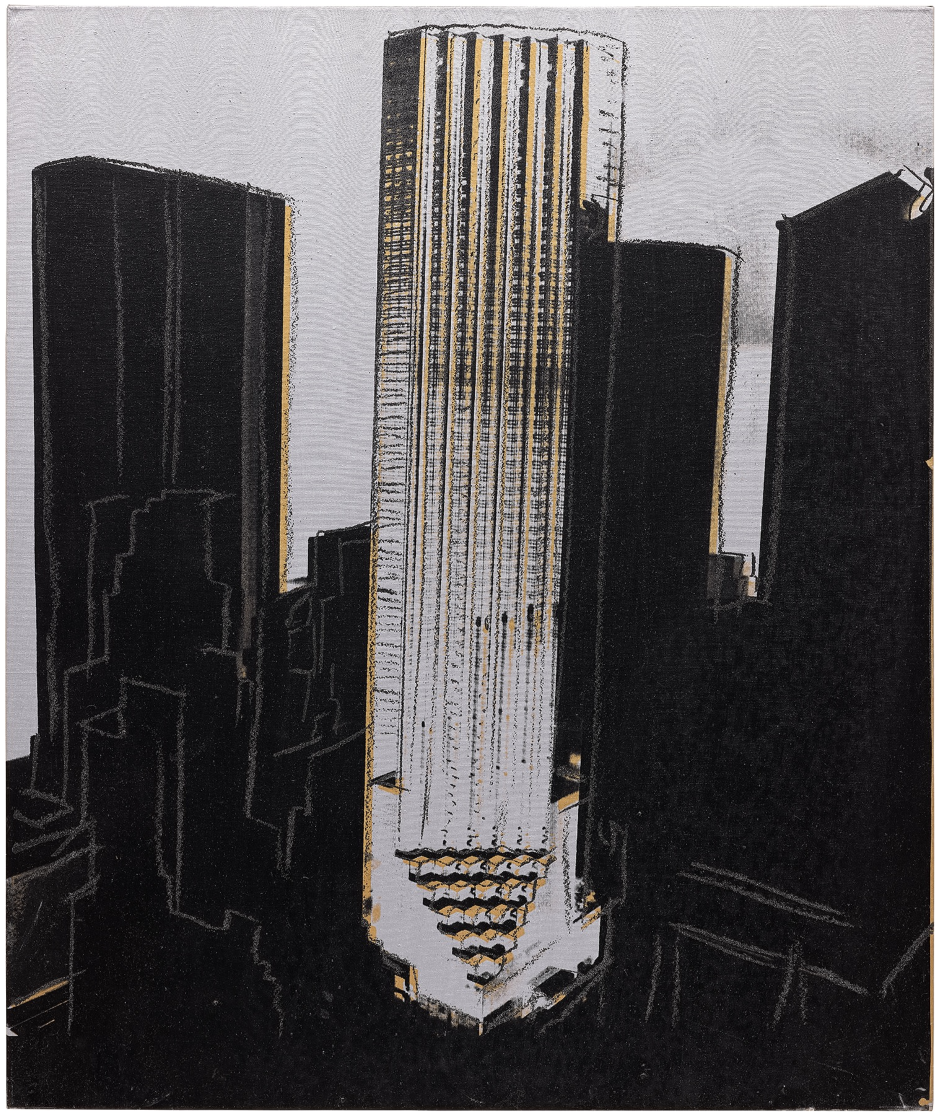
New York Skyscrapers, 1981
Synthetic polymer paint, diamond dust and silkscreen ink on canvas
50 1/4 x 42 1/8 inches (127.6 x 107 cm)
Stamped by the Andy Warhol Art Authentication Board, Inc. and the Estate of Andy Warhol
Numbered and inscribed “PA 67.007” on the overlap
Auction History
Phillips New-York: 19 November 2024
Estimated: USD 500,000 – 700,000
USD 952,500
Andy Warhol – Modern & Contemporary… Lot 33 November 2024 | Phillips
In the Spring of 1981, Andy Warhol embarked on a limited series of paintings commissioned by Donald Trump to celebrate the ongoing construction of Trump Tower, his first ground-up architectural footprint altering the face of the Manhattan skyline. New York Skyscrapers stands as a testament to Warhol’s ability to encapsulate the spirit of an era characterized by excess, and it remains a powerful commentary on the pursuit of the American Dream as seen through the lens of one of the 20th century’s most iconic artists. Previously in the collection of Warhol’s Swiss-based gallerist and close friend, Bruno Bischofberger, this significant work was prominently showcased in the 2001 exhibition of Warhol’s Gems & Skyscrapers at Bischofberger’s Zurich gallery. Today, two paintings from the series reside in the founding collection of The Andy Warhol Museum in Pittsburgh. This represents the first time a portrait from this important grouping is being offered at auction.
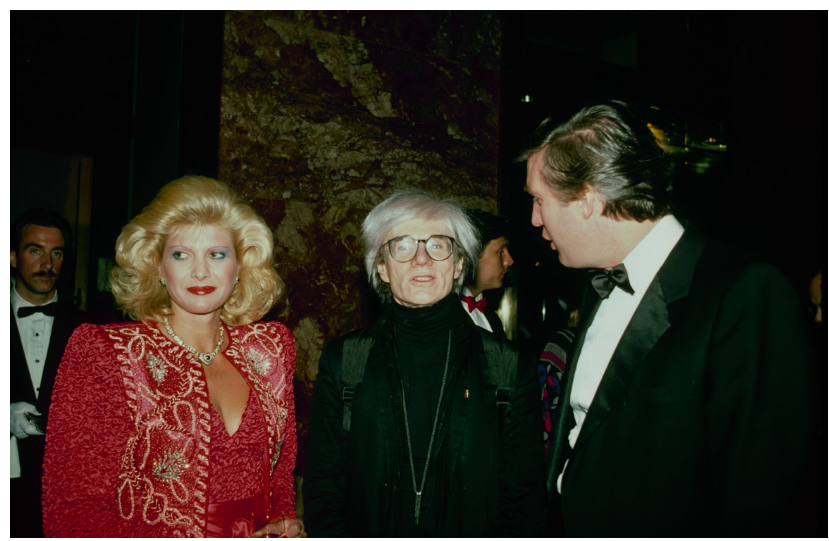
Ivana Trump, Andy Warhol, and Donald Trump circa 1980. Image: DMI/The LIFE Picture Collection/Shutterstock
The commission came about through a meeting arranged by Marc Balet, the art director of Interview magazine. Warhol documented this in his diary on April 24, 1981, saying of the encounter that “It was so strange, these people are so rich. They talked about buying a building yesterday for $500 million or something. They raved about the Balducci’s lunch, but they just picked at it… [Trump]’s a butch guy.” A few weeks later, Warhol returned to Trump’s office at 40 Wall Street to photograph the architectural model of what would become Trump Tower, a 58-story skyscraper located on Fifth Avenue in New York City, completed in 1983. From these images, Warhol created multiple canvases, capturing the building’s ostentatious luxury with black, silver, and gold hues, and coating the surface in “diamond dust,” ground glass sprinkled on the wet paint immediately after printing. However, when Trump and his wife Ivana visited Warhol’s Factory, they were disappointed by the lack of color coordination. Warhol noted in his diary on August 5, 1981:
“The Trumps came down. […] I showed them the paintings of the Trump Tower that I’d done. I don’t know why I did so many, I did eight. In black and grey and silver which I thought would be so chic for the lobby. But it was a mistake to do so many, I think it confused them. Mr. Trump was very upset that it wasn’t color-coordinated. They have Angelo Donghia doing the decorating so they’re going to come down with swatches of material so I can do the paintings to match the pinks and oranges. I think Trump’s sort of cheap, though, I get that feeling.”
Designed by Modernist architect Der Scutt of Swanke, Hayden, Connell & Partners—renowned for creating vast skyscrapers of mirrored glass—Trump Tower quickly became a symbol of luxury and opulence. At the time of Warhol’s series, the building was still under construction, but it already promised to redefine the Manhattan skyline and epitomize the grandeur associated with the Trump brand. In a February 1981 statement about the tower rising on Fifth Avenue, Scutt revealed his insights into where skyscraper design was going, outlining the new priorities of the era as being in line with words like “excitement,” “image” and “people-pleasing.” Warhol, always attuned to the pulse of contemporary culture, saw in Trump Tower a rich subject for his art. The building’s sleek, reflective surfaces and its association with wealth and celebrity aligned perfectly with Warhol’s fascination with glamour and fame. Moreover, Warhol and Trump shared a mutual interest in the blurring lines between art, commerce, and media. Beyond the socio-economic commentary, it was surely a point of interest for Warhol that, to make room for the tower’s construction, a location of great significance for the artist had to be torn down: the Bonwit Teller Department Store. Warhol did many of the store’s huge window displays from the 1950s up to 1968.
Warhol’s approach to the Trump Tower series was both typical of his style and innovative in its execution. He utilized his signature silkscreen technique, layering images and adjusting their opacity to create a dynamic interplay of form and texture. The series captures the tower from multiple angles and perspectives, emphasizing its monumental scale and its reflective, almost gilded quality. Metallic accents of gold and silver juxtapose rich swathes of black that dominate the canvas, offset by bright, glittering trails of “diamond dust,” a medium that he utilized in other series from the early 1980s, that add a sense of modernity and affluence. To similar effect, the vertical composition of the painting serves to pull the viewer’s eye ever upwards, mirroring the towering presence of the skyscraper itself. The fact that Warhol produced these paintings based on images taken by his photo assistant, Christopher Makos, of the building’s architectural model adds a layer of artifice—Warhol’s paintings are reproductions of a mock-up rather than the actual building, further extending his exploration of imitation and replication in art. Warhol’s Trump Tower series can be interpreted on multiple levels. On the surface, the paintings celebrate the architectural marvel of the tower, capturing its grandeur and sophistication. However, a deeper analysis reveals a more complex commentary on the nature of wealth, power, and celebrity in contemporary society. Warhol’s work has always been closely tied to themes of consumerism and capitalism. Trump Tower, as a symbol of luxury real estate, fits seamlessly into this narrative. The building is not just a physical structure but a commodity, marketed and sold as a lifestyle. Warhol’s depiction of the tower highlights its role as an icon of consumer culture. New York Skyscrapers indicates a significant moment in Warhol’s later practice, marking a return to architectural imagery and the themes of banality and urban life that he explored earlier in his career. This is particularly evident in groundbreaking experimental films such as Empire, 1965, where the artist employed the Empire State Building as both an icon (or “celebrity”) of New York and the “star” of his documentary. In his 1981 paintings of Trump Tower, Warhol returns to this confluence of documentary, celebrity, and figurehead, highlighting the Manhattan skyline as a central figure in the narrative of New York’s cultural and economic empire.