Andy Warhol’s obsession with iconic images and brand-name celebrities led him to appropriate famous paintings by other artists as a means of exploring the constructs of fame and legacy themselves. Over the years, Warhol chose subjects that allowed him to explore the duality of public perception and self-projection and his most enduring images resonate with these ideas of identity. Warhol’s depictions of other artists’ works, including Woman in Blue (After Matisse), offer an intriguing play upon this familiar theme and an opportunity to interpret, transform and even commodify the art of his predecessors.
In the early 1980s Warhol produced a number of works based upon the works of Leonardo da Vinci, Pablo Picasso, Edvard Munch and Henri Matisse, among others. These paintings were often faithful reproductions albeit flattened by the silkscreen process and candy colors. Deceptively simple, Warhol’s interpretations of these masterpieces acknowledge their status as commodities -both the works and their creators. Warhol’s version of da Vinci’s Mona Lisa, for example, presents her as a Pop culture phenomenon and cash cow on par with Elizabeth Taylor and Jacqueline Kennedy. Warhol’s paintings of paintings, and their source material, are instantly recognizable; they are high art, and high value, versions of the museum posters owned by millions of people around the world.
From the earliest days of his career, Andy Warhol had a strong appreciation for—and encyclopedic knowledge of—art history. Beginning in 1963 with his reproduction of Leonardo Da Vinci’s Mona Lisa in a series of several paintings, the Pop artist would often return to the annals of visual art for source material.
The genius behind Warhol’s art historical references lies not in his ability to accurately duplicate his predecessors (he left that to the precision of his screening), but to start a conversation about iconic works of art and their place within the cultural consciousness. Like advertising images, logos, or celebrity headshots, famous works of art transcend the museum space and the dusty art historical tome. They take up residence in the present, stripped of many previous allusions and instead existing as icons to be revered, copied, referenced, and put on dorm room posters. They are separated from their referents by so many steps that the aura of the original metamorphoses into something greater than the singular image itself. Warhol understood this transferal of meaning, and through his paintings sought to level the playing field.
“If you want to know all about Andy Warhol, Just look at the surface: of my paintings and films and me, and there I am. There’s nothing behind it.”
Throughout his career, Warhol consistently equated himself to his work and vice versa. His predilection for mass-media tropes and mechanical processes may seem at odds with the highly emotive oeuvre of Edvard Munch, but the two artists had a shared appreciation for tumultuous love and their own mortality. Hidden behind the iconic, oft-reproduced surfaces of their works is a deeply somber inquiry into humanity itself.
Eva Mudocci (After Munch)
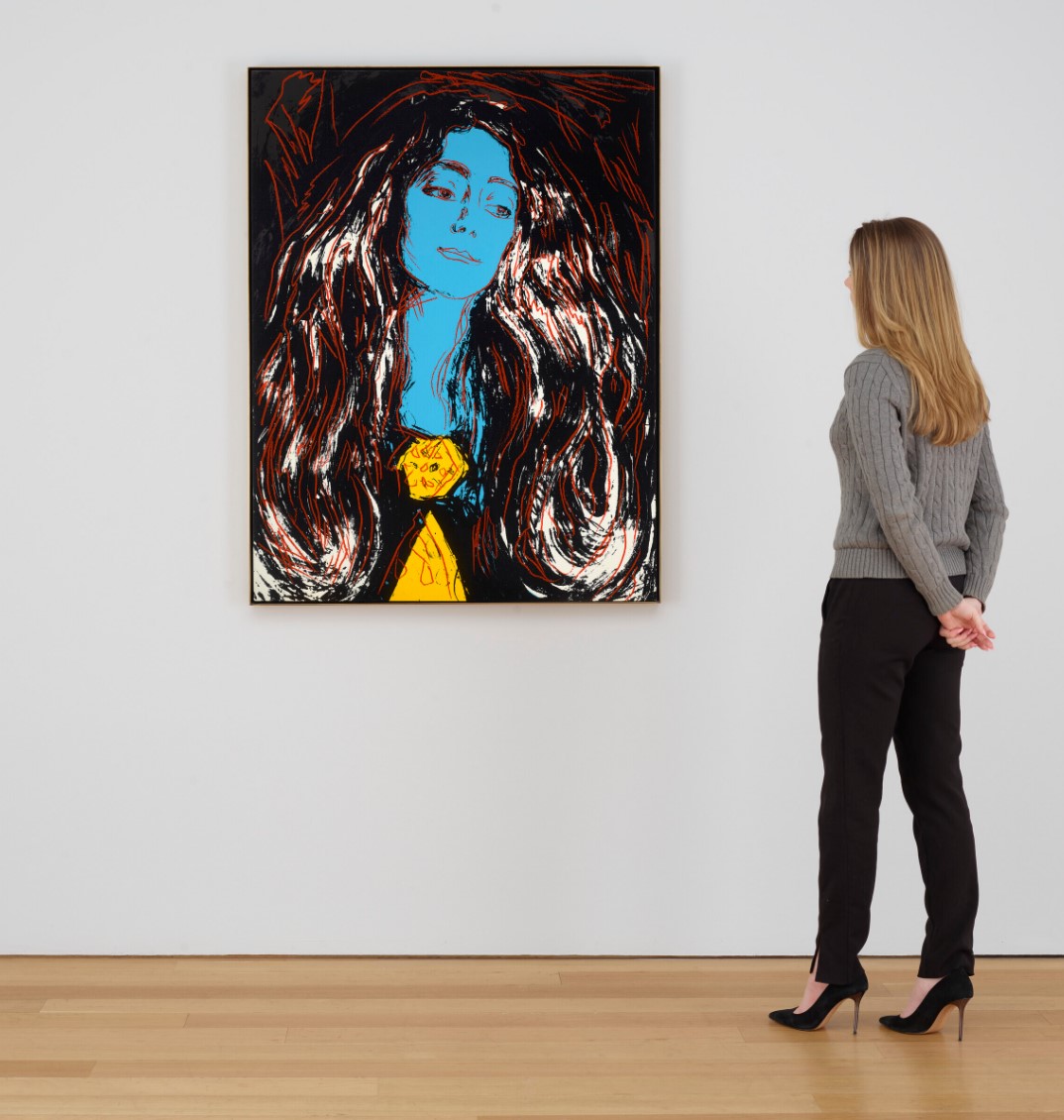
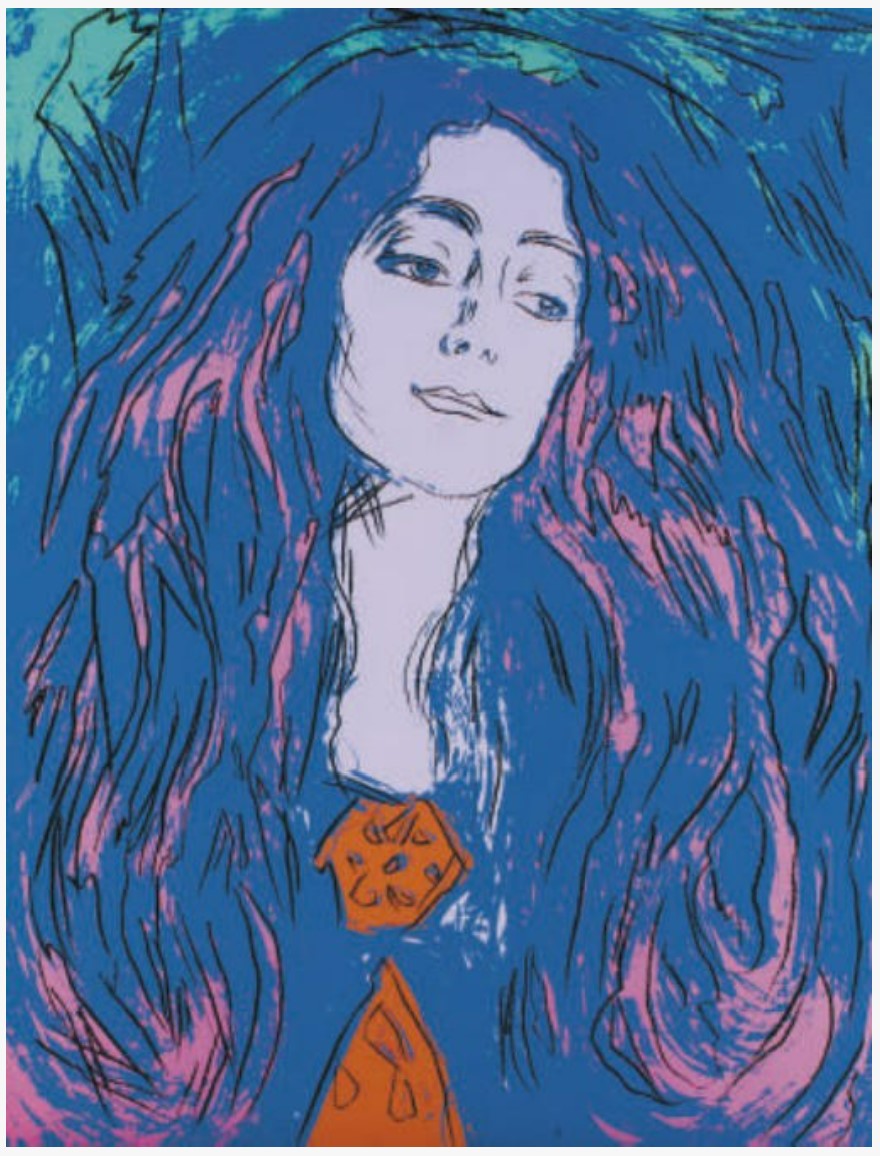
The highly emotive Eva Mudocci (After Munch) is a prime example of Warhol’s interest in translating and digesting works by other artists through his own unique processes. He found himself drawn to the Norwegian painter Edvard Munch on more than one occasion, and the present work is a testament to Warhol’s ability to coax a radical mix of emotive vibrancy and machine-like precision from the famous original.
“The reason I’m painting this way is that I want to be a machine, and I feel that whatever I do and do machine-like is what I want to do.”
Actively railing against the dramatic tendencies of the Abstract Expressionists, Warhol sought to separate himself from the drippy, splashy emotions of his forebears by embracing mass production and reproductive techniques like silkscreening. He operated in a more democratic mode, making ‘high’ art into something more accessible to a population already familiar with works like Botticelli’s Venus, Leonardo’s Last Supper, or Munch’s The Scream while also elevating Hollywood celebrities and Campbell’s soup labels to the level of art historical canon. Warhol often eschewed machismo and ego-driven connections in his art in favor of works that appealed to and resonated with a broad audience.
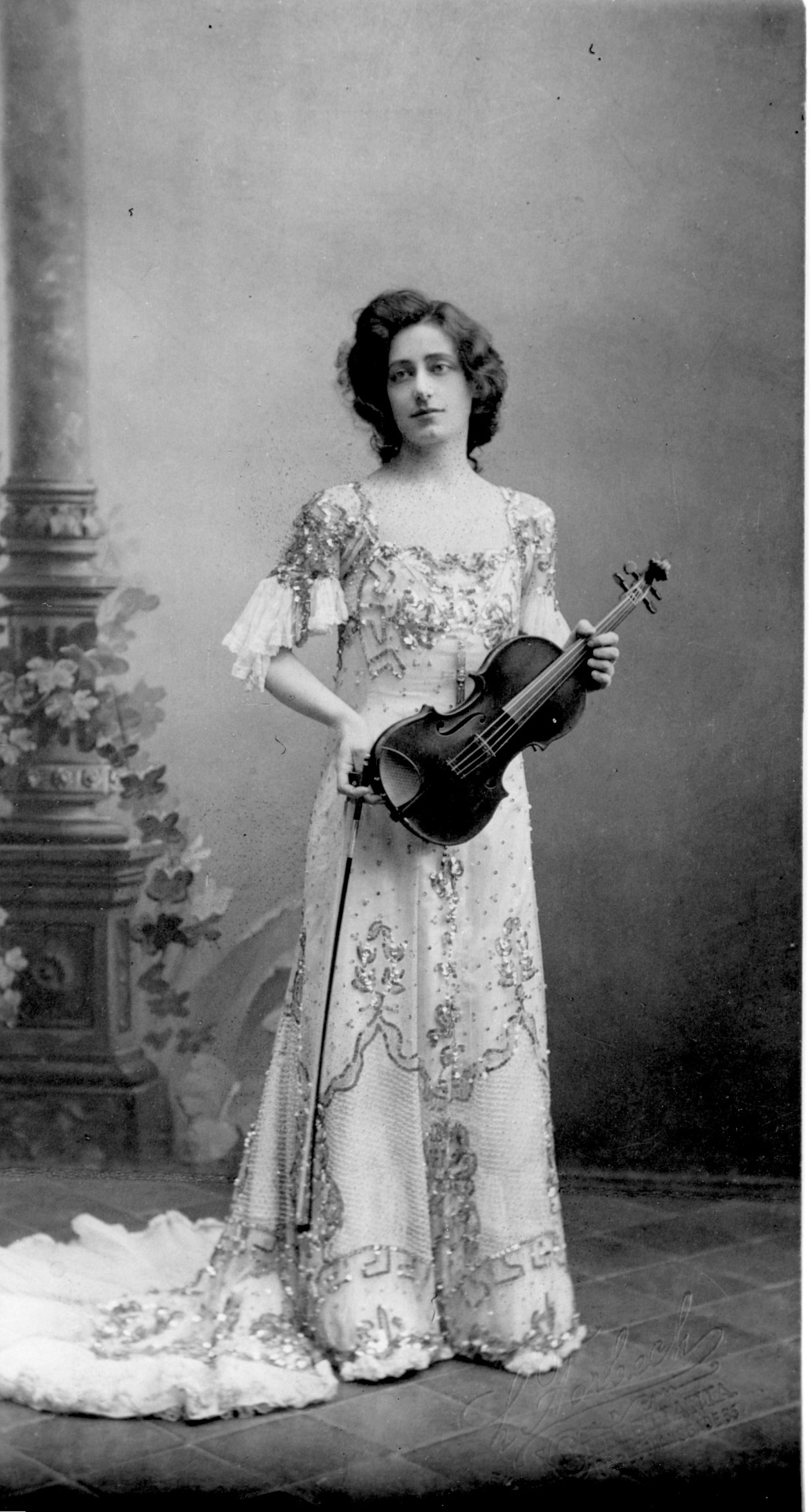
A dynamic composition, the present example depicts a bust-length portrait of the English violinist Evangeline Hope Muddock (who went by the Italianate stage name of Eva Mudocci) adrift in a sea of energetic lines and pools of black. Munch’s original composition is nearly identical and also shows the sitter wearing a large brooch in a ghostly, ethereal style that bolsters the woman’s angelic appearance. Mudocci once recalled: “It was [Munch’s] ambition to make the most perfect portrait of me, but whenever he began a canvas for oils, he destroyed it because he was dissatisfied with it…” (E. Mudocci, quoted in P. Berman and P. Stave, Munch/Warhol and the Multiple Image, New York, 2013, p. 22). Mudocci was also featured in a number of other works by Munch and was a close friend and muse of the painter. In Warhol’s translation, the entire canvas is given over to a prominence of black as the background merges with the swirling lines of the figure’s hair. He highlights Mudocci’s face and slender neck in a bright cerulean blue while the brooch she wears counters the azure tint with a deep yellow. Overlaying the black markings is a lively, frenetic collection of red lines that causes the entire work to vibrate and squirm in an optical realm that is pure Warholian energy.
Warhol’s homage electrifies and invigorates the dark, moody source material by thrusting the quiet portrait into new territory. Munch’s Eva Mudocci (The Brooch) is clearly reproduced through Warhol’s expert silkscreening process, but the end result is decidedly Pop. In 1982, Warhol happened into Galleri Bellman on New York’s 57th Street and was taken by a Munch retrospective made up of over 100 prints and paintings. After several repeat visits and a discussion with the gallery directors, he started work on a series of paintings subtitled After Munch. The four works he chose as his source material included Munch’s instantly recognizable The Scream, as well as the portrait of Eva Mudocci, a self-portrait of the Norwegian artist, and the ethereal Madonna. This was not the first time the Pop icon had been enamored with Munch, however. A visit to the National Gallery and Munch Museet in Oslo in 1971 had piqued his interest, and Warhol had been collecting examples of the artist’s work ever since.
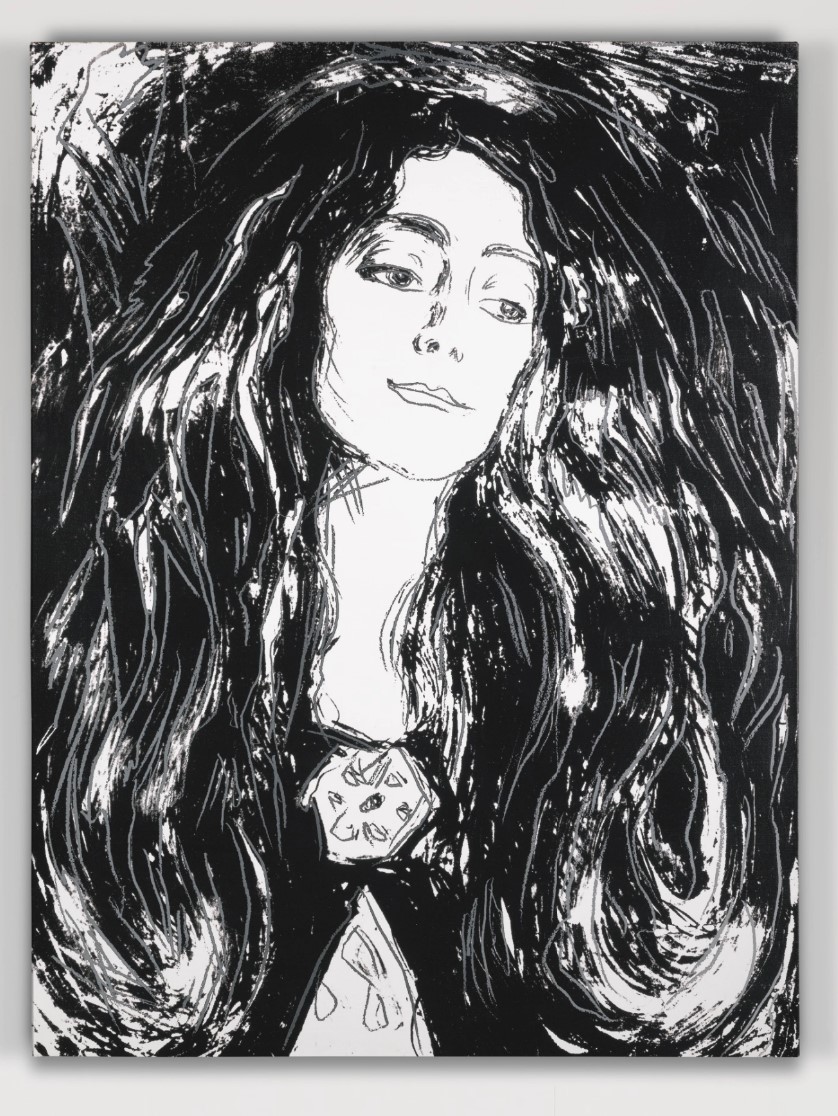
Utilizing as a source one of Edvard Munch’s most iconic prints, The Brooch (Eva Mudocci), Andy Warhol imbues the original image with his trademark Pop sensibility. Maintaining the monochromatic palette of Munch’s famous print, Warhol re-animates the original image. Forming part of a series of paintings inspired by four of Munch’s most well-known works, Warhol’s Eva Mudocci retains the enigmatic facial expression, wildly liberated cascades of hair and distinctive brooch that characterizes Munch’s original. In Warhol’s contemporary re-imagining however, Mudocci takes her place amongst the pantheon of the artist’s iconic female portraits: an early twentieth-century pinup is here elevated to the status of Warhol’s celebrated images of Marilyn Monroe, Jackie Kennedy or Elizabeth Taylor.
Where Warhol’s After Munch series can arguably be seen as a homage from the late Twentieth Century’s master of the serial image to the leading print maker of the late Nineteenth and early Twentieth Centuries, Warhol’s own iteration of Eva Mudocci emphasizes and downplays certain elements of Munch’s original. The effect is almost ethereal: Mudocci appears to float within the confines of the image border, seeming to lack any definitive anchor to her surroundings. Indeed, Mudocci’s historical eminence is transported into the realm of Warholian Pop culture – her whitened face appearing as though bleached by the flash bulb of Warhol’s famous Big Shot Polaroid camera.
Eva Mudocci (After Munch), 1984
Christie’s New-York: 11 May 2022
Estimated: USD 4,000,000 – 6,000,000
USD 4,740,000
ANDY WARHOL (1928-1987) (christies.com)
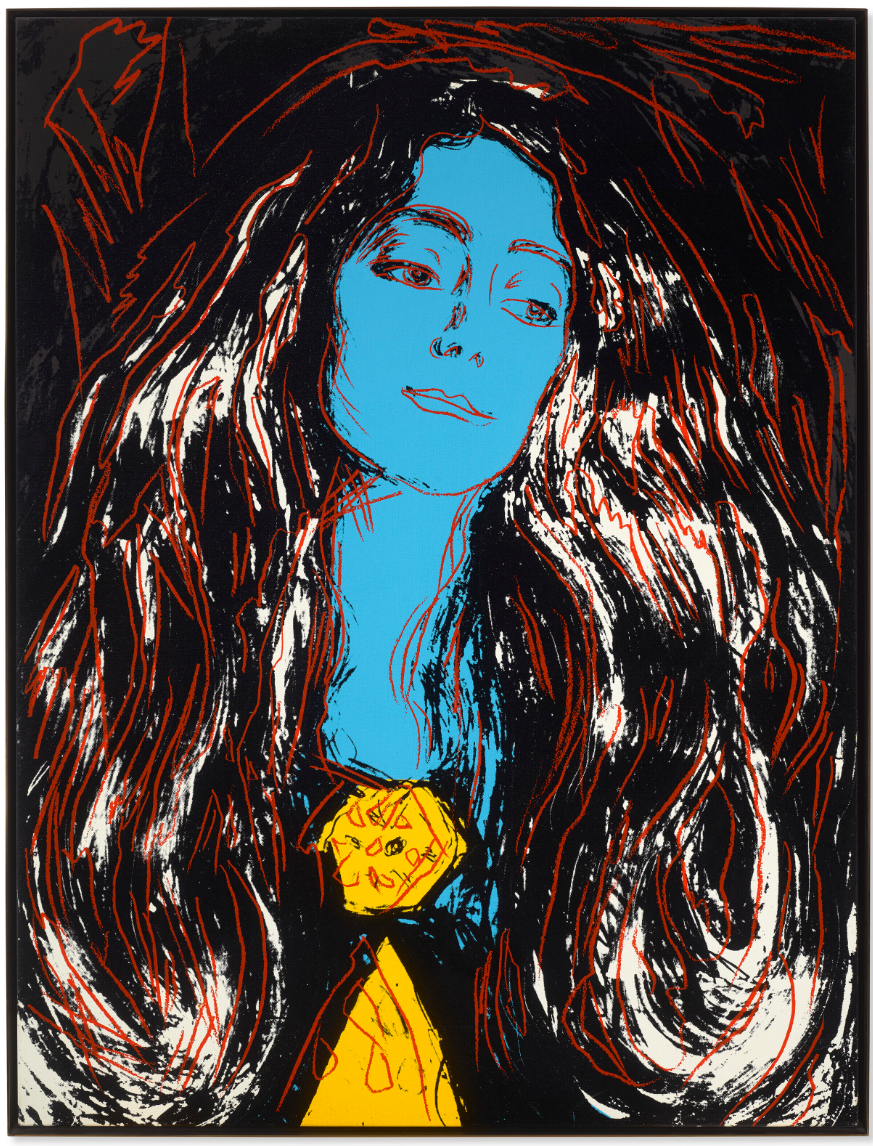
ANDY WARHOL
Eva Mudocci (After Munch), 1984
Acrylic and silkscreen ink on canvas
50×38 inches (127 x 96.5 cm)
Signed, stamped with the Andy Warhol Art Authentication Board, Inc. stamp
Numbered and dated ‘Andy Warhol 84 A121.0610’ (on the overlap)
From the earliest days of his career, Andy Warhol had a strong appreciation for—and encyclopedic knowledge of—art history. Beginning in 1963 with his reproduction of Leonardo Da Vinci’s Mona Lisa in a series of several paintings, the Pop artist would often return to the annals of visual art for source material. The highly-emotive Eva Mudocci (After Munch) is a prime example of Warhol’s interest in translating and digesting works by other artists through his own unique processes. He found himself drawn to the Norwegian painter Edvard Munch on more than one occasion, and the present work is a testament to Warhol’s ability to coax a radical mix of emotive vibrancy and machine-like precision from the famous original.
Eva Mudocci (After Munch), 1984
Sotheby’s London: 12 February 2014
Estimated: GBP 1,000,000 – 1,500,000
GBP 2,322,500
ANDY WARHOL
Eva Mudocci (After Munch), 1984
Acrylic and silkscreen ink on canvas
50.1 x 38 inches (127.3 x 96.6 cm)
Utilizing as a source one of Edvard Munch’s most iconic prints, The Brooch (Eva Mudocci), Andy Warhol imbues the original image with his trademark Pop sensibility. Maintaining the monochromatic palette of Munch’s famous print, Warhol re-animates the original image. Forming part of a series of paintings inspired by four of Munch’s most well-known works, Warhol’s Eva Mudocci retains the enigmatic facial expression, wildly liberated cascades of hair and distinctive brooch that characterizes Munch’s original. In Warhol’s contemporary re-imagining however, Mudocci takes her place amongst the pantheon of the artist’s iconic female portraits: an early twentieth-century pinup is here elevated to the status of Warhol’s celebrated images of Marilyn Monroe, Jackie Kennedy or Elizabeth Taylor.
Eva Mudocci, 1984
Christie’s London: 14 October 2007
Estimated: GBP 500,000 – 750,000
GBP 748,500
Andy Warhol (1928-1987) , Eva Mudocci | Christie’s
ANDY WARHOL
Eva Mudocci, 1984
Synthetic polymer paint and silkscreen inks on canvas
50×38 inches (127 x 96.5 cm)
The Scream (after Munch)
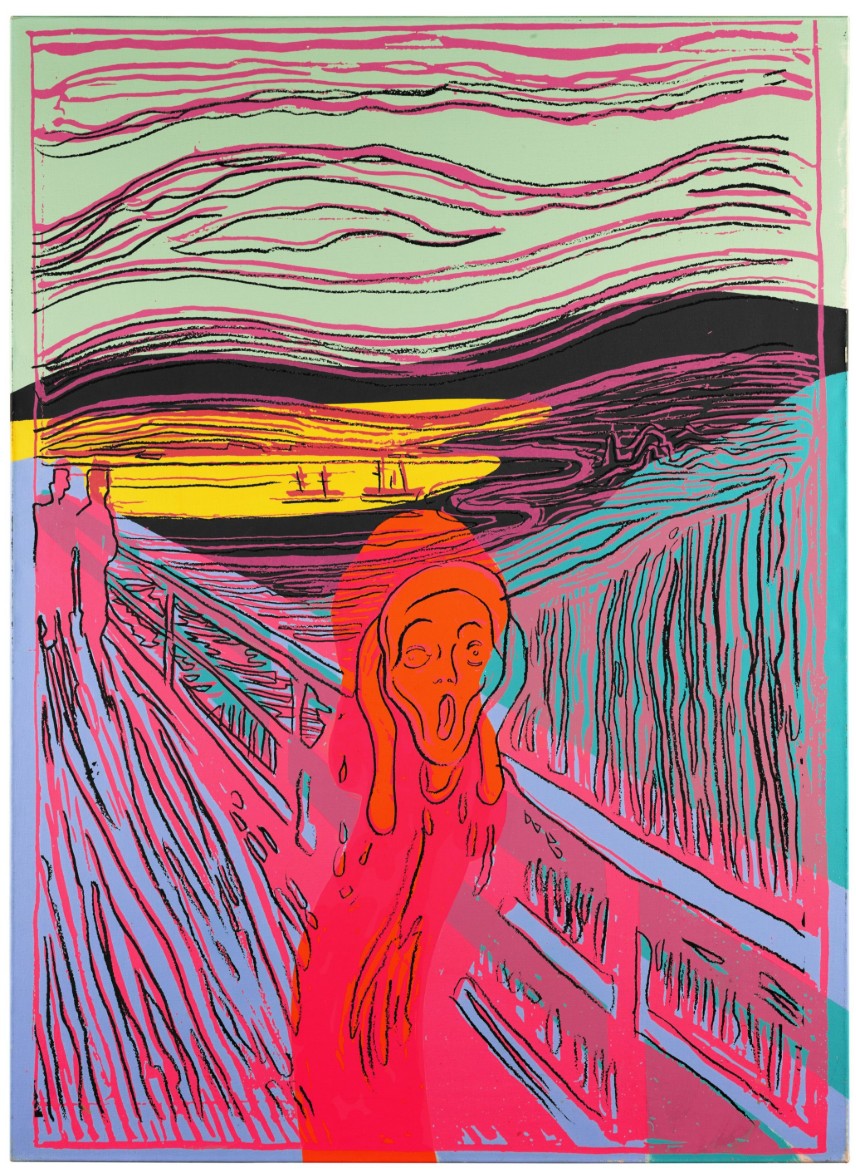
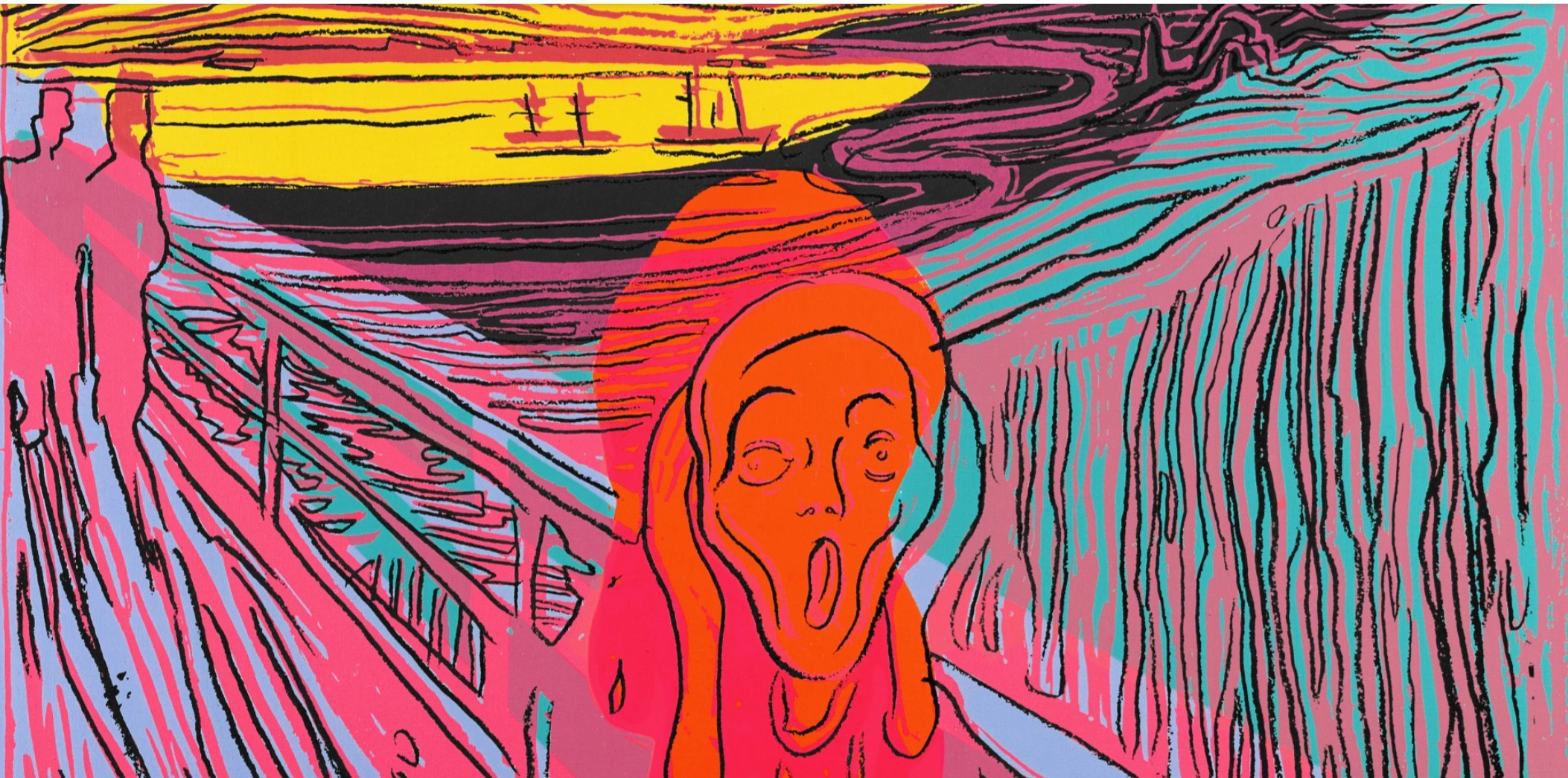
Andy Warhol was the master of appropriation and nowhere is his genius in this field more clearly seen than in the series Art from Art and in The Scream in particular. Just as he had turned Marilyn Monroe, Jackie Kennedy, Electric Chairs and a whole galaxy of 1970s and 1980s celebrities into products of the Warhol machine, so he took the stars of world art and made them his own creations. Through the simple methods of exchanging Munch`s muted, melancholy tones for waves of bright psychedelic intensity and the use of his trademark silkscreen, Warhol transformed the most famous expressionist painting into a signature Warhol. It is a piece of postmodernist brilliance. Warhol in this work converts a painting whose raison d’etre lay in its subjectivity and profundity into an object freed from the subjective, turning the viewer’s attention from the soul of the work to its surface.
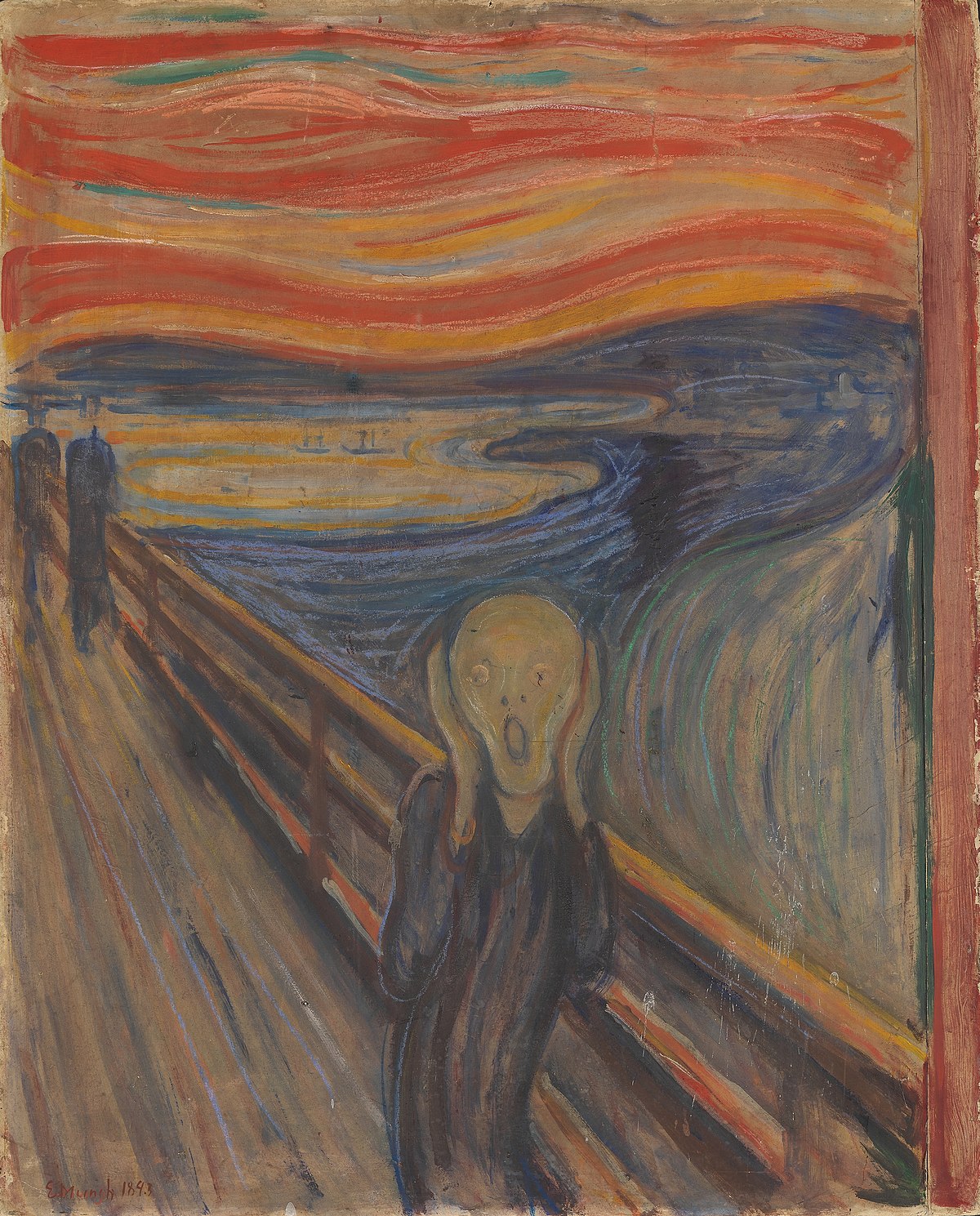
Edvard Munch painted four versions of The Scream (Shrik in his native Norwegian) in 1893. Forming part of his Frieze of Life series, Munch hoped and envisaged that his work would become a secular altarpiece. “One should no longer paint interiors with men reading and women knitting. They must be living individuals who feel, suffer, love, and breathe. I will paint a series of such pictures. People should understand the sacred nature thereof and take off their hats before them as though they were in church.” (Munch in a diary entry, cited in: Christian Gehrer Echoes of the Scream, exhibition catalogue, ARKEN Museum of Modern Art, Munch Museum, 2001, p. 14) An expression of the “great, ceaseless scream passing through nature” (ibid., p. 15), The Scream is an existential cry, an expression of the loneliness of man and of the new human condition in the twentieth century.
Warhol purposefully ignores this emotional content in the work – just as he had in his Race Riots, Electric Chairs, and Death and Disasters series – and concentrates instead on the work as an icon of popular culture. Warhol´s concern lies not with the painting itself but with the contemporary experience of it. Just as Duchamp and Warhol himself had done with Mona Lisa, he desacralizes the painting, both recognizing the way The Scream was in a sense as commercial an object as Mickey Mouse and encouraging that process. We may presume that Warhol would have enjoyed the fact that The Scream now appears not just on tee shirts and coffee mugs but is also available in inflatable doll form and has even starred more than once in The Simpsons. By reproducing The Scream, Warhol both underlines the iconic status of the work and shows how it can also be a mass-produced consumer product – a process unwittingly begun by Munch when he created a lithograph of the work in 1895.
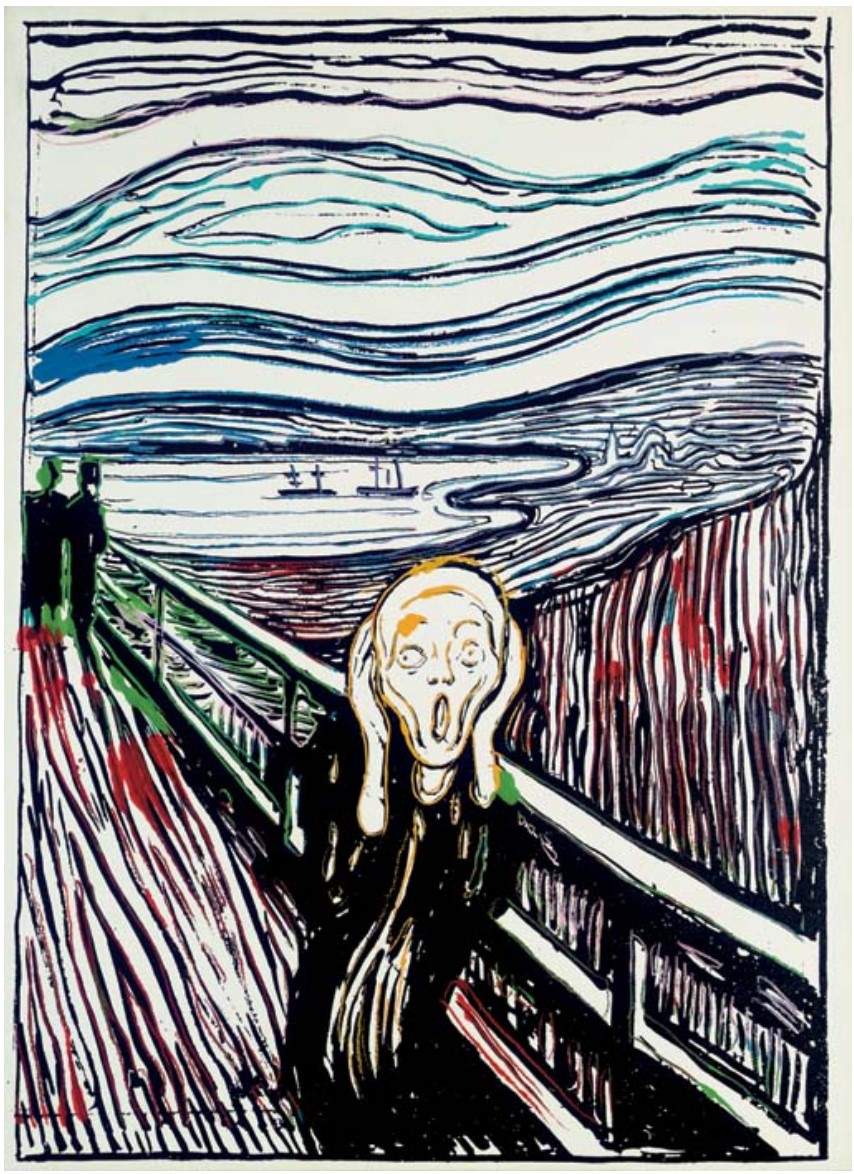
Warhol produced only five canvas versions of The Scream (an unusually small number for him) as part of a series of silkscreen prints which included a number of other Munch works including Eva Mudocci, Self-portrait with Skeleton Arm and Madonna. Warhol had started to use the work of other artists as subjects at the end of the 1970s and in the 1980s after a relatively barren period in his artistic life. In 1979 he began his Reversals and Retrospective series in which he re-examined the more famous aspects of his own body of work. This series featured the re-appearance of Warhol´s reproduction of Leonardo’s Mona Lisa which in turn led to Warhol’s studies of the works of other masters in the Art from Art series. Just as Picasso spent much of his later years analyzing the work of predecessors he admired, so Warhol explored the work of Leonardo, Cranach, Uccello, Raphael, de Chirico and Munch. By simply reproducing their work without comment, Warhol not only made a wonderful postmodern gesture, he could also pay subtle tribute to the works of other masters without compromising his famous ambition – to be a machine.
In the present work, the economy of line married to the strong, vibrant colors creates a powerful image. The striking orange in particular hits the retina with force. At the same time, it is also a somewhat humorous image. Painted flesh-pink the central character appears to be not so much a man in the throes of an existential crisis as someone camping it up. Together they create a signature Warhol, another amazing product of the Warhol factory given up to the Pantheon of mass culture images. Thus, just as with a Warhol Marilyn, one recognizes that it is an “Andy Warhol” at least as much as one recognizes Marilyn Monroe herself, so with this extremely rare work one sees the trademark style of Warhol as much as one spot the original masterpiece.
The Scream (After Munch), 1984
Sotheby’s London: 17 September 2025
Estimated: GBP 2,000,000 – 3,000,000
GBP 6,828,000 / USD 9,049,490
ANDY WARHOL (1928 – 1987)
The Scream (After Munch), 1984
Acrylic and silkscreen ink on canvas
52 x 38 1/4 inches (132.4 x 97 cm)
Signed and dated 84 (on the overlap)
Few works are as instantly recognizable, powerful, and emotionally charged as The Scream. Since its creation in the 1890s, Edvard Munch’s haunting depiction of existential dread has become a cultural touchstone, echoing far beyond the canvas into film, fashion, and advertising. Nearly a century after it was painted, Andy Warhol would revisit this modernist masterpiece, bringing his distinctive voice to Munch’s anguished vision to give rise to a new iconic rendition of The Scream.
Warhol’s connection to Munch was deep and long standing, with the artist famously citing the Norwegian painter as “his absolute favourite artist, alongside Matisse” (Tone Lyngstad Nyaas, ed., Munch by Others, Oslo 2012, p. 12). In 1973, Warhol visited the Munch Museum and the National Museum in Oslo at the invitation of Per Hovdenakk, then director of the Munch Museum. The visit left a profound impression on the artist; Warhol, known for his fascination with celebrity and mass-produced imagery, found in Munch’s work a deeply personal form of expression that transcended time and geography. He began collecting Munch’s prints shortly after, even buying a few prints whilst still in Norway. The invitation to visit the Museum came, however, on the back of an earlier meeting between Hovdenakk and Warhol back in 1963, when the Norwegian curator visited Warhol’s studio, known as The Factory, in New York. It was already then that Warhol expressed how fascinating and inspiring he found Munch’s œuvre, notably his experimental printmaking.
Just a year before Warhol’s visit to Norway, in 1972, a Norwegian art dealer, Tor Uppstrom started his Galleri Bellman in Oslo. Uppstrom showed primarily nineteenth century fine art, including of course, works by Munch. In the early 1980s he met a New York advertising executive Bernie Hodes, partnering with him to open a second Galleri Bellman on 57th Street in New York, which Uppstrom led as president and executive director. The gallery’s debut show in November 1982 featured naturally a very comprehensive exhibition of 126 prints and paintings by Munch, including a rare lithograph of The Scream on loan from the Munch Museum in Oslo.
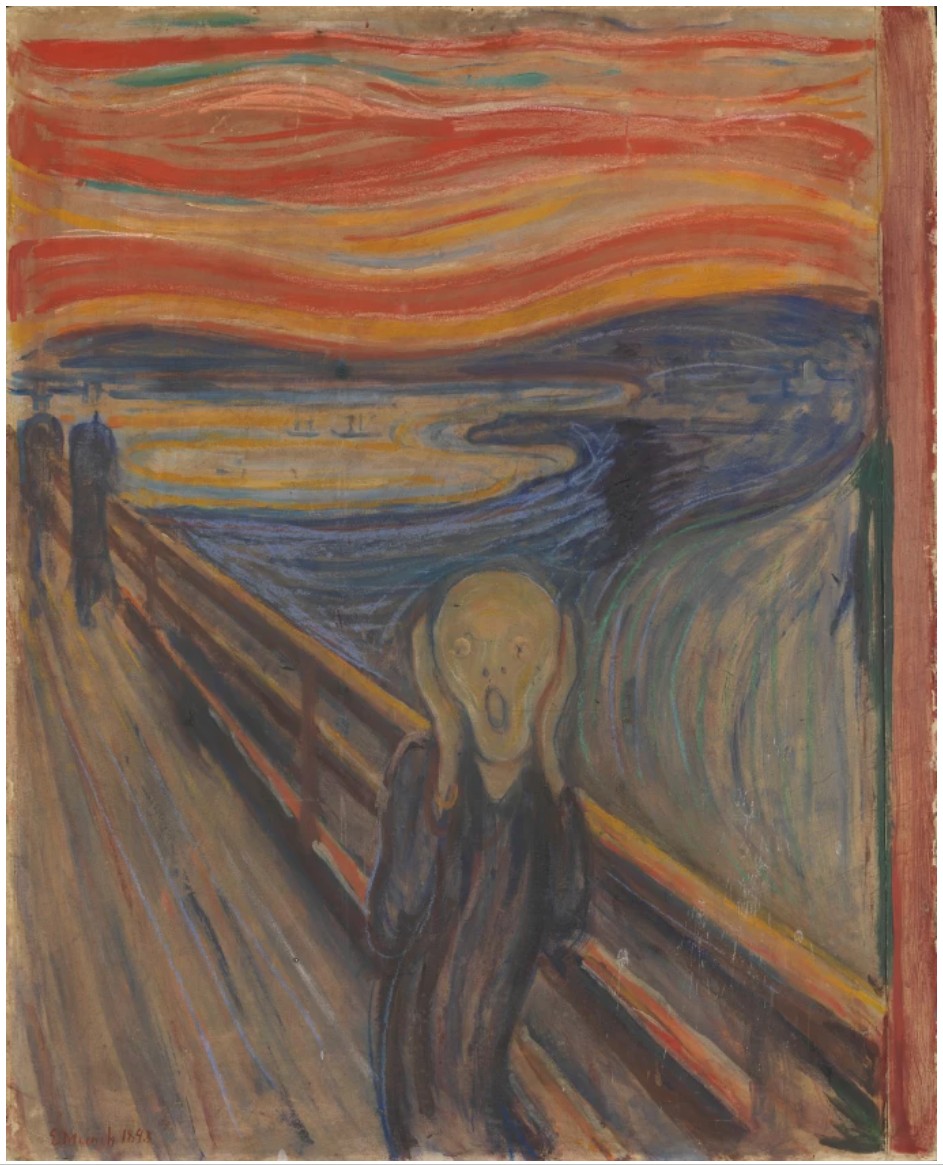
Edvard Munch, The Scream, 1893, oil, tempera, pastel and crayon on cardboard, National Gallery, Oslo © Photo Scala, Florence
Warhol visited the exhibition at Galleri Bellman with Fred Hughes, his business manager, re-encountering Munch’s imagery in a fresh context. This rediscovery, combined with his earlier admiration for the Norwegian master, set the stage for an ambitious project. At the time of the exhibition, the imagery of Munch was fairly untouched. The Scream was of course one of the most recognisable works in the world, nearly as famous as the Mona Lisa, but it had not yet entered into the cultural mainstream. When a few months after the exhibition, Uppstrom visited Warhol’s studio, the two agreed on a commission: Warhol would create fifteen paintings inspired by four of Munch’s most iconic lithographs, five each of three on different subjects that had been presented in the exhibition. Warhol chose Madonna and Self-Portrait with Skeleton Arm, The Brooch (Eva Mudocci), and of course, The Scream. Although the works were signed and dated by Warhol in 1984, it is likely that he completed the series between late 1983 and early 1984, blending his signature silkscreen technique with drawn elements that closely followed Munch’s original lines. Indeed, for each of the works, Warhol made transparencies of the images, drawing all four of them by hand, in a slightly larger size than the original prints. The drawings would then be used as the finishing screen on the even larger sized paintings.
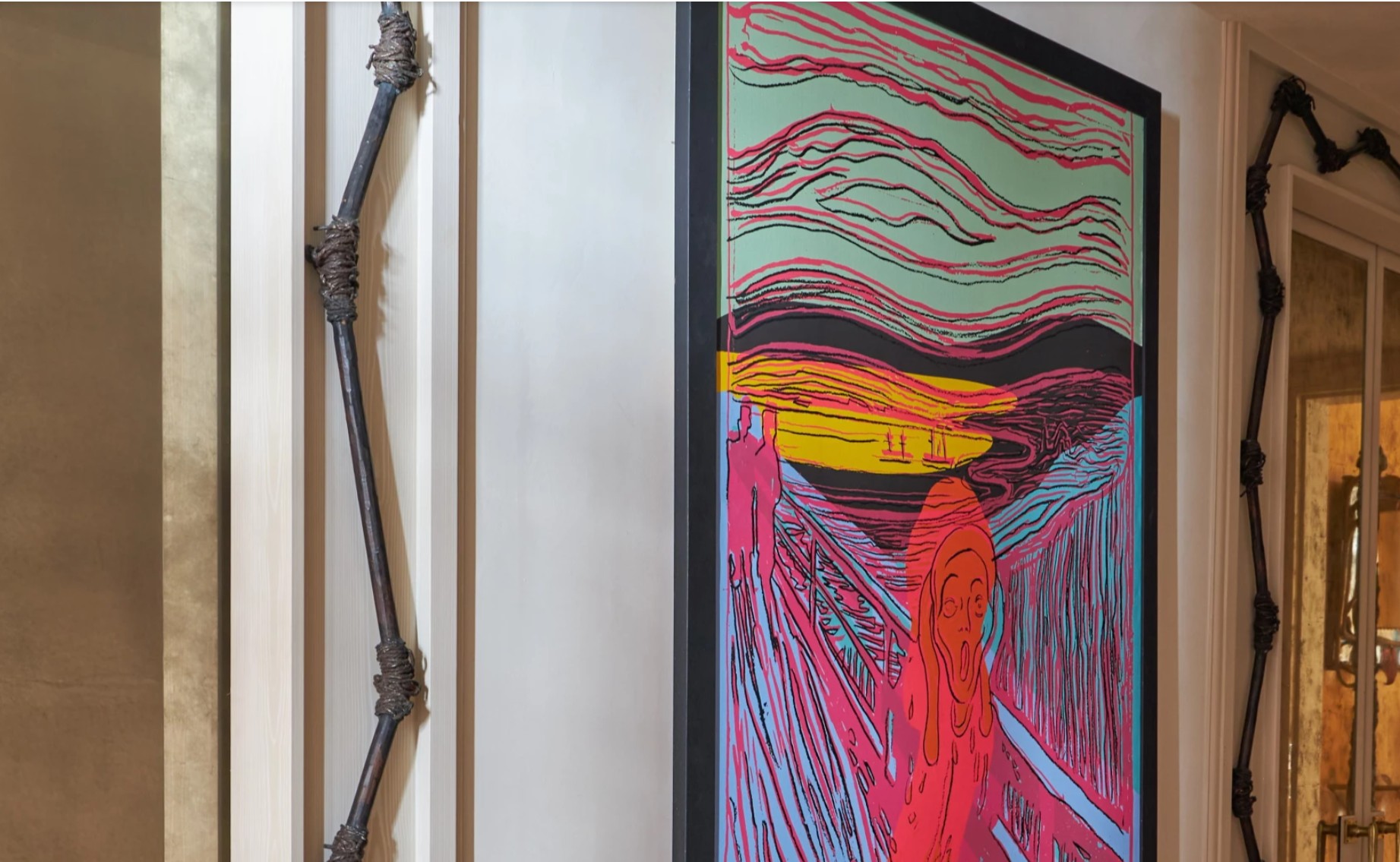
The present work shown in the London home of Pauline Karpidas
In Warhol’s hands, The Scream became not just a reproduction but a reinterpretation. He used five different screens to build the rich, pulsating background, deliberately positioning the image of the screaming figure slightly out of alignment to create a disjointed, unsettling effect. This visual unease mirrored the emotional turbulence at the heart of both artists’ work. For Munch, The Scream captured what he described in his journal as “the great scream in nature”—a panic attack crystallized in paint. For Warhol, it resonated with his own preoccupation with fear, death, and the fragility of fame and identity—themes central to his output after the 1960s. Upon completion, the paintings were delivered to Galleri Bellman in early 1984 but were never shown publicly in New York. Instead, twelve of the fifteen works were sent to the Galleri Bellman location in Stockholm, where they were put up for sale. The remaining three (one of each) were left in New York with Uppstrom’s business partner, Bernie Hodes. This is the first time since 2010 that one of the works appears at auction.
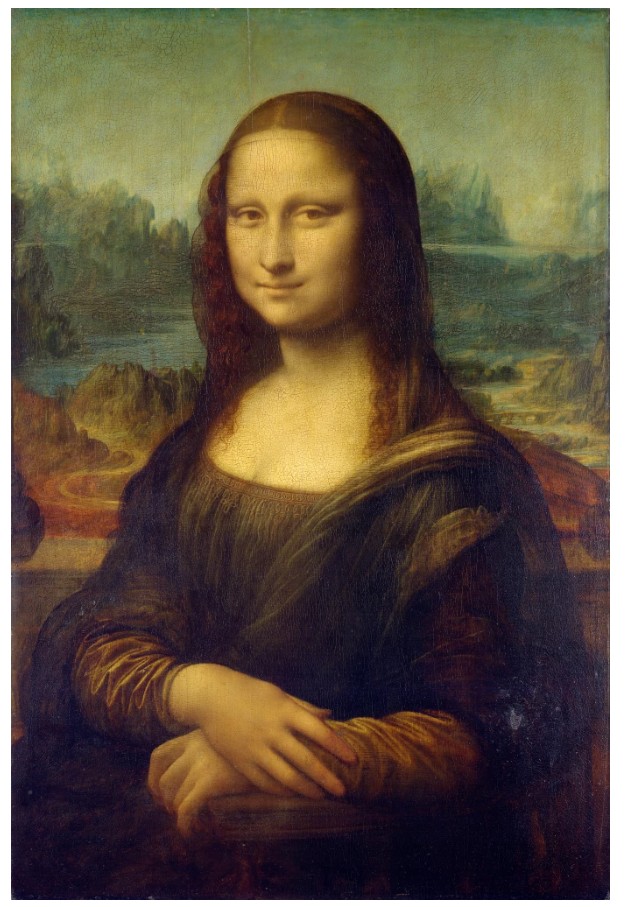
Leonardo da Vinci, Mona Lisa, circa 1503-19, oil on poplar panel, Louvre Museum, Paris
Warhol’s The Scream is a convergence of two artistic minds grappling with the same enduring human condition—anxiety in the face of modern life. In both content and technique, the series bridged two centuries of innovation: Munch’s experimental printmaking and Warhol’s commercial silkscreen revolution. By reproducing The Scream, Warhol both underlined the iconic status of the work to create a signature Warhol, another amazing product in Warhol’s output given up to the Pantheon of mass culture images—a process unwittingly begun by Munch when he created a lithograph of the painting in 1895.
The Scream (After Edvard Munch), 1984
Christie’s London: 7 February 2007
Estimated: GBP 800,000 – 1,200,000
GBP 1,084,000
Andy Warhol (1928-1987) , The Scream (After Edvard Munch) | Christie’s
ANDY WARHOL
The Scream (After Edvard Munch), 1984
Synthetic polymer paint and silkscreen inks on canvas
51.7 x 38 inches (131.4 x 96.5 cm)
Sotheby’s London: 20 June 2006
GBP 1,460,338
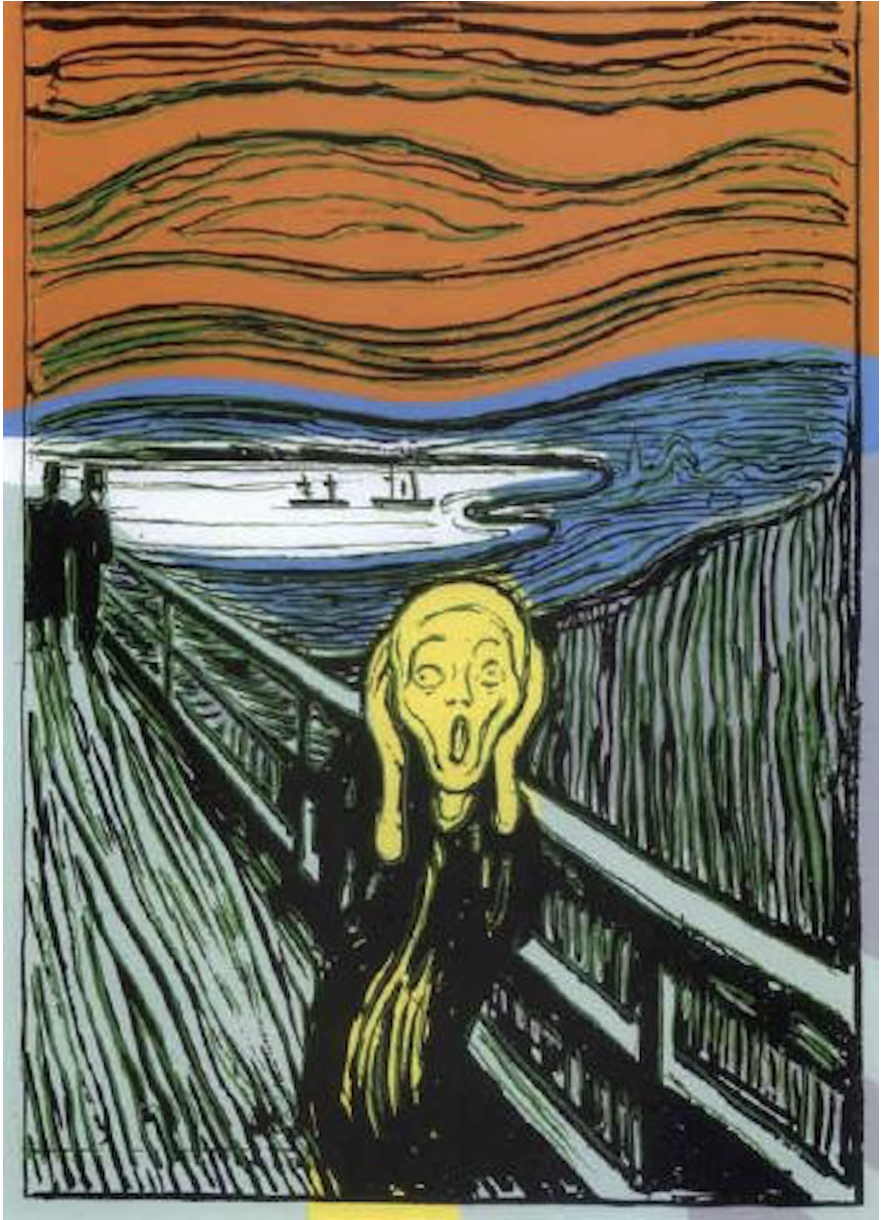
ANDY WARHOL
The Scream (after Edvard Munch), 1984
Acrylic and silkscreen ink on canvas
52.2 x 38 inches (132.5 x 96.5 cm)
Madonna and Self-Portrait
Madonna and Self-Portrait with Skeleton’s Arm (After Munch), 1984
Sotheby’s London: 17 September 2025
Estimated: GBP 1,500,000 – 2,000,000
GBP 2,846,000 / USD 3,885,765
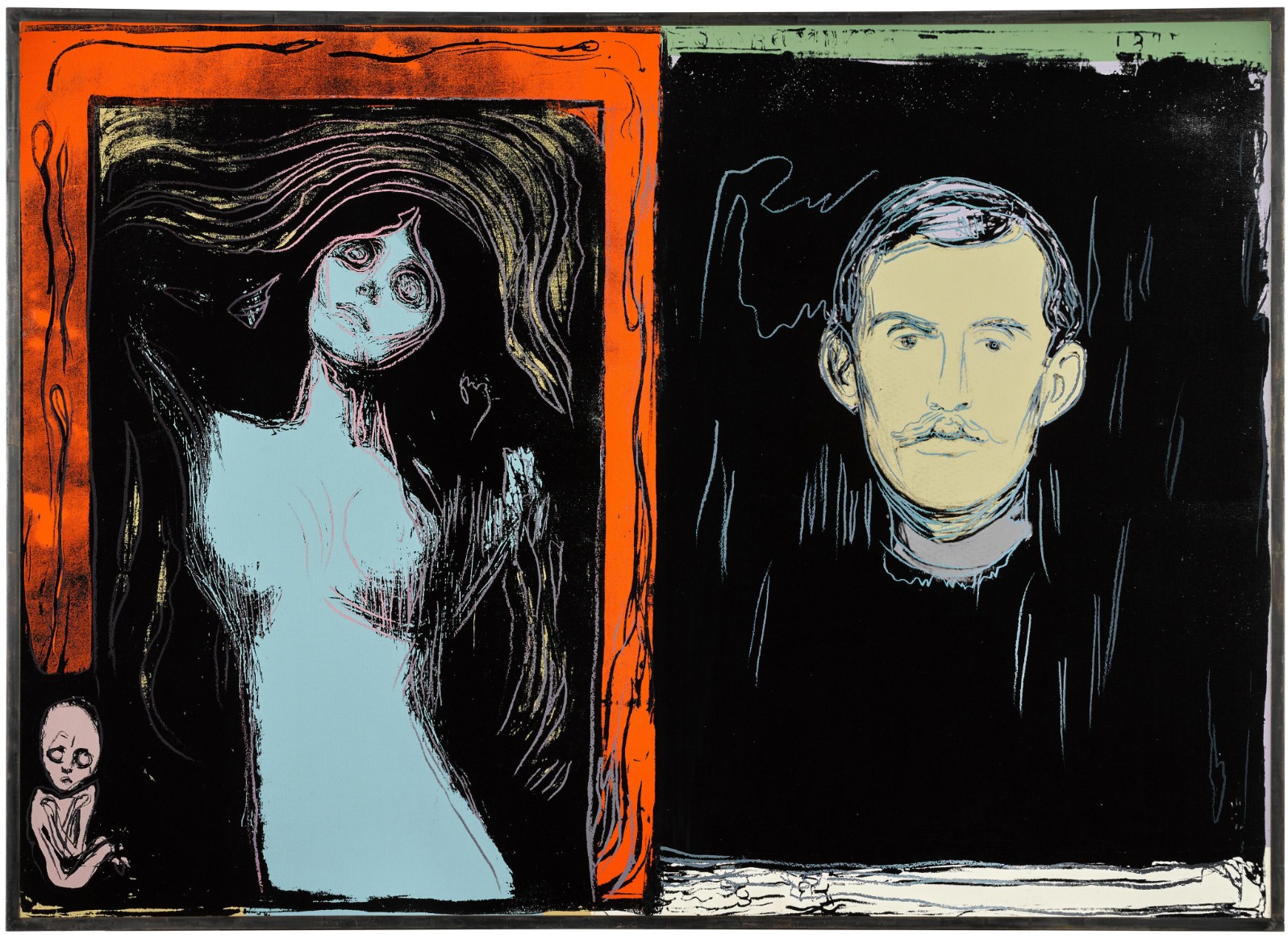
ANDY WARHOL (1928 – 1987)
Madonna and Self-Portrait with Skeleton’s Arm (After Munch), 1984
Acrylic and silkscreen ink on canvas
51 1/8 x 71 inches (129.7 by 180.4 cm)
Signed and dated 84 (on the overlap)
An unequivocal masterwork, Madonna and Self-Portrait (After Munch) stands as one of Andy Warhol’s most virtuosic works. Executed at the apex of his late career and commissioned by Galleri Bellman for his celebrated Art from Art series, this rare and commanding work is one of only five known examples in which Warhol juxtaposes two of Edvard Munch’s most psychologically-charged images: the haunting Madonna and the introspective Self-Portrait with Skeleton Arm. With signature flair and technical precision, Warhol breathes new life into these Expressionist icons, transforming them into Pop elegies. Distinguished by its extraordinary provenance, Pauline Karpidas acquired the present work from the Estate sale of Warhol’s master print maker, Rupert Jansen Smith, who is notably credited with fashioning some of the complex techniques surrounding his Reversal works of the late 1970s.
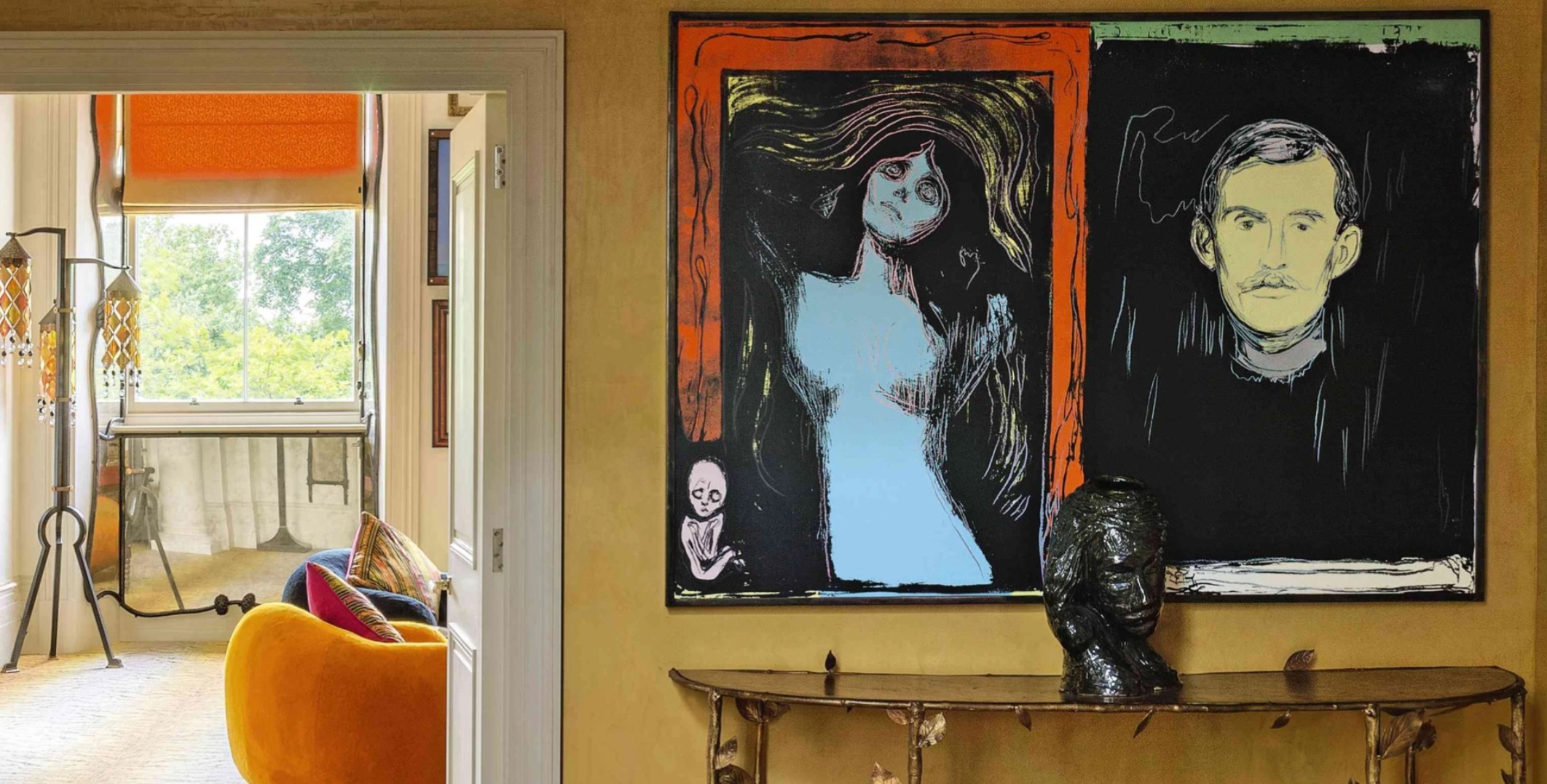
The present work shown in the London home of Pauline Karpidas
Warhol visited an exhibition of Edvard Munch’s paintings and prints in New York at the Galleri Bellman several times in 1982. Captivated by the striking and instantly recognizable motifs of Munch’s work, the idea was born to use this in the continuation of his Art from Art series. The gallery owners Tor Uppstrom and Bernier Hodes commissioned Warhol to produce a series of paintings and prints after learning of Warhol’s fascination with the artist. Warhol admitted Munch was his favorite artist alongside Matisse, born of his 1973 trip to the National Gallery and Munch Museum in Oslo. He owned a number of prints by Munch, even acquiring an example from the exhibition. Roland Augustine, Galleri Bellman’s director at the time, described the process behind the commission, “the motifs were not dictated by the owners of the gallery or me. Andy selected the images. It was decided that there would be three images and five examples of each — fifteen paintings in total. There was a contractual arrangement. The three images were: The Scream, Self-Portrait juxtaposed with the Madonna, and Eva Mudocci.” (Augustine quoted in “Interview with Roland Augustine,” in Munch / Warhol and the Multiple Image, New York 2013, p. 91). With the help of Rupert Jansen Smith, Warhol produced five examples of this painting and a number of trial print proofs. One example is held in the collection of the Astrup Fearnley Samlingen in Oslo.
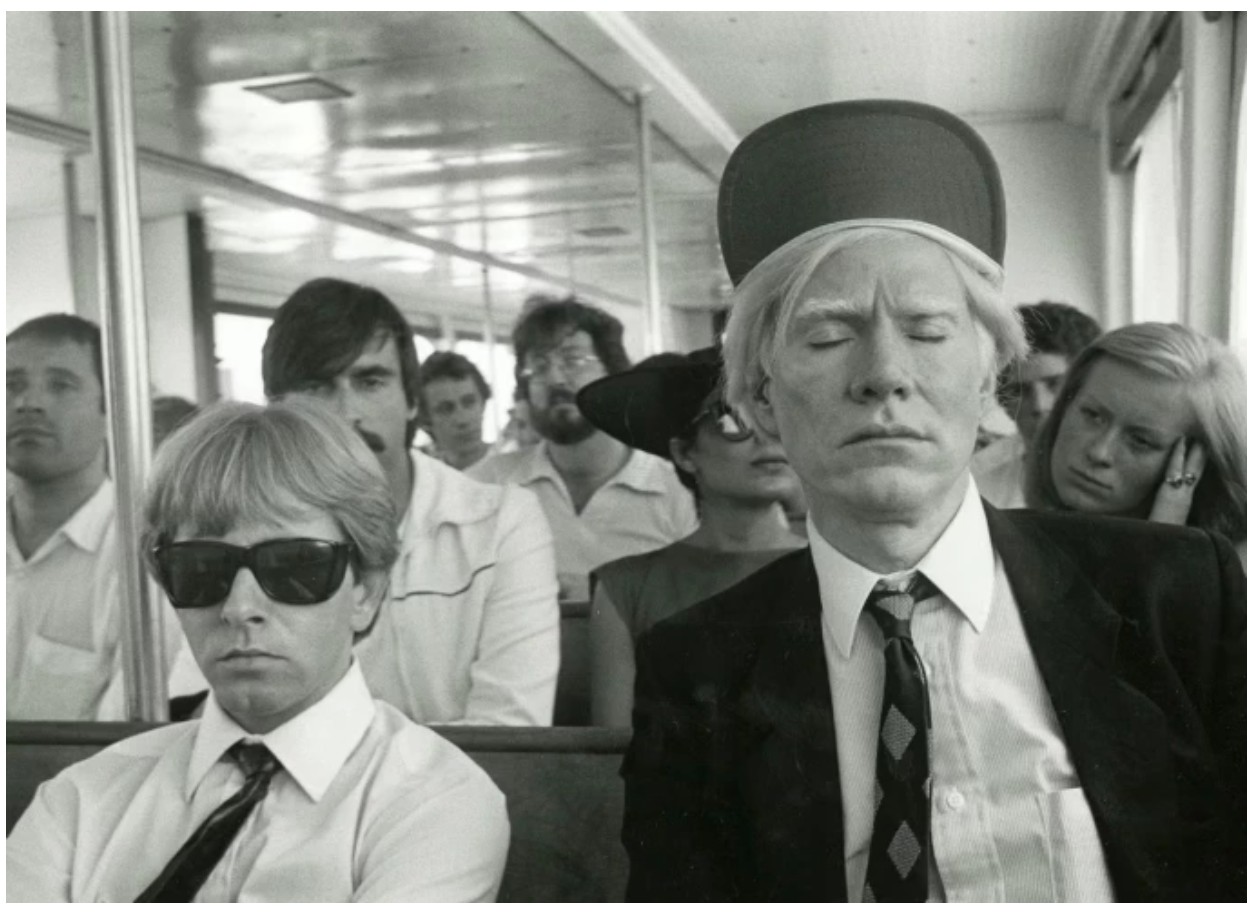
Rupert Jasen Smith and Andy Warhol photographed in New York in 1979 © Bob Colacello / Courtesy the artist and Vito Schnabel Gallery
The present work is a remarkably singular work within his Art from Art series as it is not a direct appropriation of Munch’s imagery. Warhol has reinterpreted this through the juxtaposition of one of the most haunting images of the Madonna and one of the most introspective self-portraits in art history, Munch’s Self-Portrait with Skeleton Arm. The Madonna reinforces Warhol’s preoccupation with powerful female icons. With her head tilted back, and sensually portrayed in the nude, the Madonna is eroticized and separated from the child, eliciting this compelling dialogue between eroticism and religion. Religious iconography seeped into Warhol’s work in the Art from Art series as he reinterpreted many of art history’s most renowned paintings, from Botticelli’s Birth of Venus to Leonardo’s The Last Supper. The choice of Self-Portrait with Skeleton Arm reflects Warhol’s preoccupation with death and the associated self-reflection in his later years. Here, the musing self-portrait—underscored by the skeleton arm acting as a memento mori—is perhaps a portal for Warhol’s own exploration of mortality, religion and his identity. Death had always been a recurrent theme in his work ever since the pioneering 1960s Death and Disaster and Electric Chair series, which was later revived in his series of poignantly contemplative self-portraits just before his untimely death in 1987. After his death, it came to light that the artist had been surreptitiously religious—especially since his near-fatal shooting in 1968. Madonna and Self-Portrait (After Munch) marks Warhol’s growing fascination with his own mortality and religion in a period of greater self-reflection in his later years.
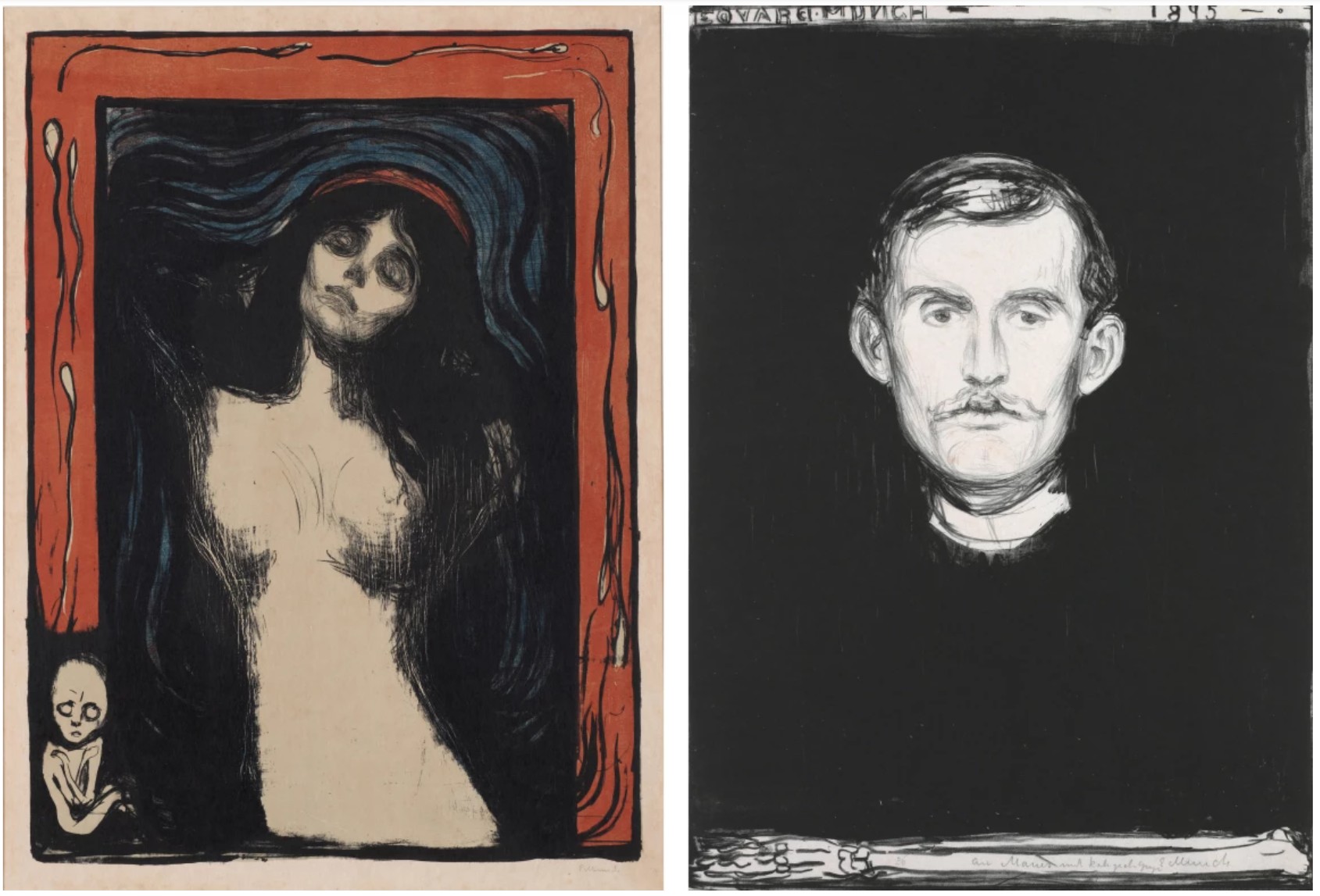 Left: Edvard Munch, Madonna, lithograph on paper, 1895-1902, Ohara Museum of Art, Kurashiki
Right: Edvard Munch, Self-Portrait with Skeleton Arm, lithograph on paper, 1895, National Gallery, Prague
Munch’s most celebrated series, The Frieze of Life, explored the inner psyche of the modern man, with notable examples such as the Madonna, Self-Portrait with Skeleton Arm, The Scream and Anxiety. Munch confronted themes of love, loss, despair and death in this series, and he even repeated many of his most important subjects across the series of paintings and lithographs. Munch’s repetition of his own imagery not only fascinated Warhol, but they were also excellent motifs for his Art from Art series. Where Duchamp took quotidian objects like urinals or bicycle wheels and reframed them into ‘ready-mades’ by giving them an often absurd meaning, Warhol claimed some of art history’s most recognizable images for himself, recasting them in an altered context through his signature Pop aesthetic, as he made them unmistakably his own. In his reinterpretations of Munch’s Madonna and Self-Portrait with Skeleton Arm, Warhol employs bold, flat fields of color reminiscent of advertising—fiery orange, calamite green, and cyan—eliciting a striking hard-edged graphic effect that differs fundamentally from Munch’s emotionally charged, sensually-rendered and complementary hues. While Munch used color to evoke psychological tension, Warhol’s vivid palette serves to stylize and amplify, making the image as instantly recognizable as his Marilyns. Here, Warhol’s trademark style supersedes the art historical source, so the work becomes as much an Andy Warhol painting as a reimagining of Munch. Much like advertising logos or celebrity portraits, these images become detached from their origins, evolving into universal symbols. Warhol understood this, and through his appropriations, he invites viewers to reconsider the meaning and relevance of the iconic in the modern world.
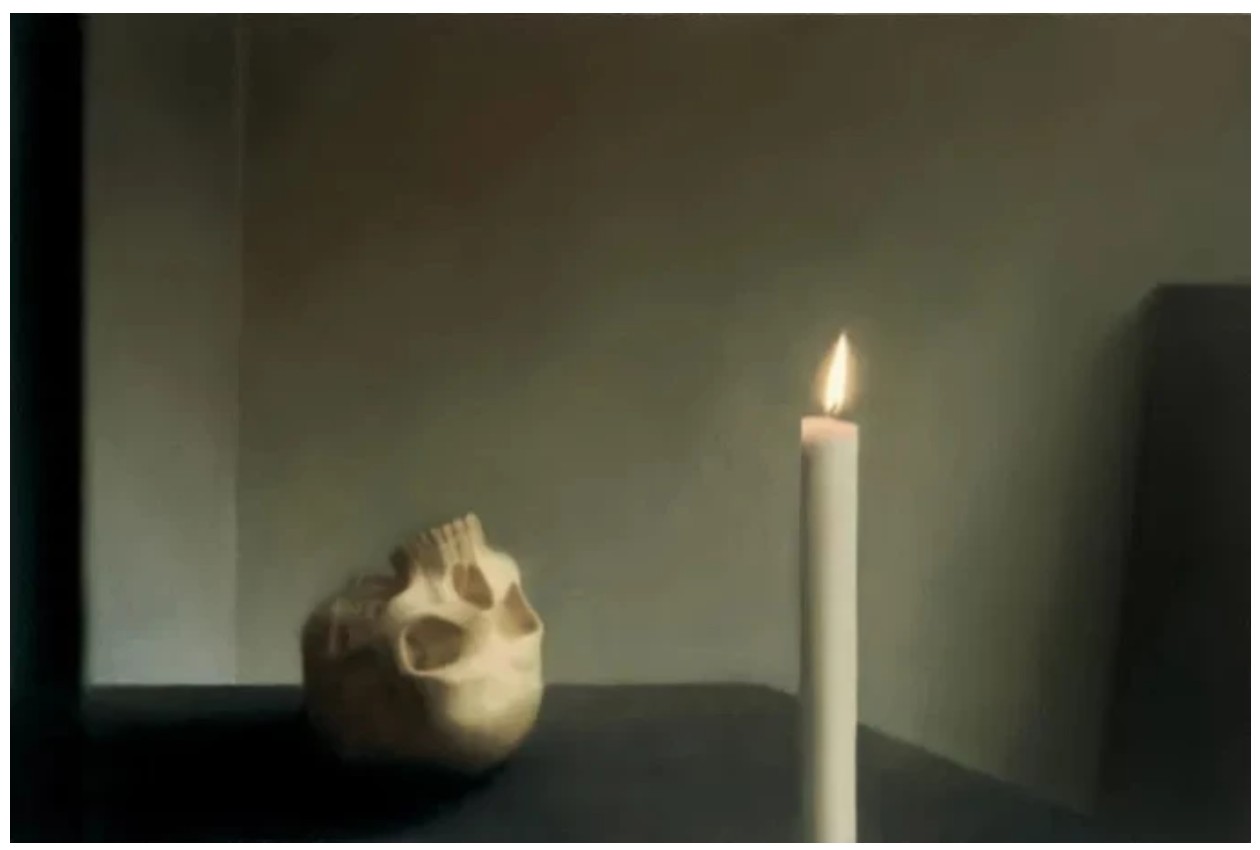
Gerhard Richter, Skull with Candle, 1983, oil on canvas © 2025 Gerhard Richter
Further to this, Warhol’s engagement with Munch’s imagery exemplifies a striking synthesis of line and color. For Munch, color was inseparable from emotion, a vehicle expressing the ineffable and the existential. In contrast, Warhol harnessed chromatic tones to evoke the bold, graphic language and flat surface of advertising, stylizing his subjects with the cool detachment and silkscreen aesthetic of Pop Art.
“If you want to know all about Andy Warhol, just look at the surface of my paintings and films and me, and there I am.”
In 1983, Warhol collaborated on a number of works with Jean-Michel Basquiat and Francesco Clemente whereby he developed tracing as a new technique as he would start the works by tracing a recognizable Pop Art symbol onto a canvas using an overhead projector. For the present work, Warhol photographed two lithographs and then redrew them by hand, as he expertly merges his tracing technique with the established silkscreen practice. Warhol’s intervention is transformative—his lines reinterpret Munch’s into their own stylized and graphic iteration. This is evident in the altered expression of the Madonna: where Munch’s figure’s eyes are languidly shut, Warhol’s Madonna stares wide-eyed into the abyss. The synthesis here generates a new mediation on Munch’s work—one where the emotional power is reduced—as this distinctly Warholian appropriation recontextualizes the Expressionist master’s work for the advertising era.
“A good picture never disappears. A great idea never dies.”
Warhol’s appropriations are by no means replicas; they are reinventions that flatten the distinction between high art and mass culture. Warhol’s After Munch series thus doesn’t merely reproduce: it operates on the level of cultural memory, asking what is left of original meaning when an image is endlessly shared and commodified. Through this lens, Munch’s tormented figures are pulled into the Pop vernacular, stripped of angst and recalibrated for the billboard, and so Warhol claims them not just as subjects, but as Warholian icons.
Christie’s London: 27 June 2011
GBP 937,250
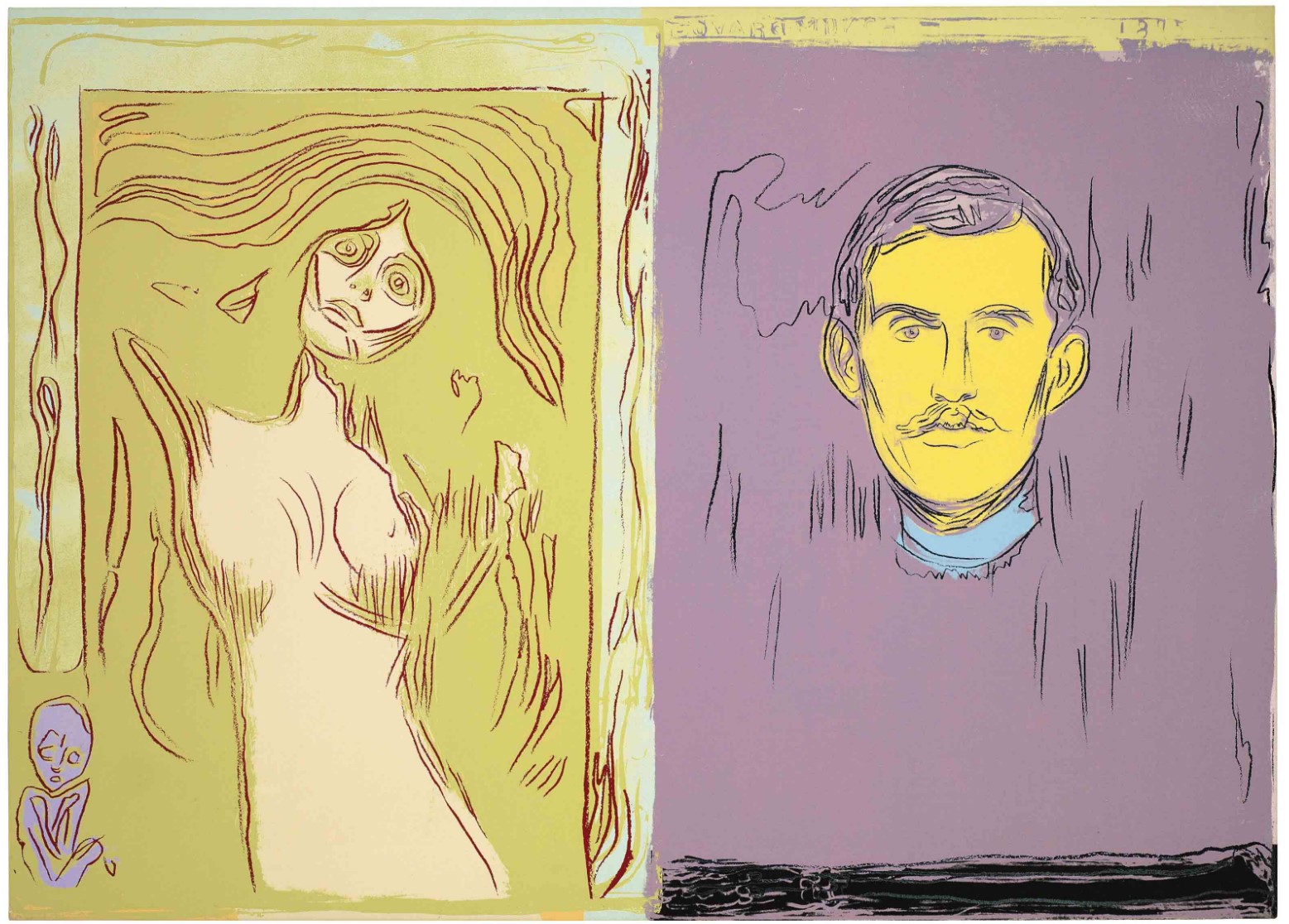
ANDY WARHOL
Madonna and Self-Portrait with Skeleton’s Arm (After Munch), 1984
Acrylic and silkscreen ink on canvas
51×71 inches (129.5 x 180.3 cm)
Andy Warhol’s striking portrait of Edvard Munch and his celebrated painting of the Madonna are among the most enigmatic of Warhol’s works. Executed in 1984, this large canvas adheres to key the Warholian themes of the appropriation of images from popular culture together with his distinctive Pop treatment of line and color. Commanding the left side of the canvas and embellished by the lavish use of the gold-like intensity of an arylide-like yellow, the long flowing hair of the Madonna is transformed by Warhol from the haunting figure in Munch’s original into an icon-like depiction of powerful femininity. Mirroring this is the illuminated face of Munch himself, which boldly stares out from a shroud of purple, skillfully subverting the introspective nature of the original.
Madonna and Self-Portrait with Skeleton’s Arm (After Munch) continues Warhol’s astute examination of the proliferation of visual imagery in post-war American culture. Working in the same vein as his portraits of Hollywood stars such as Liz Taylor, Marilyn Monroe and Elvis Presley, Warhol pursues the Duchampian notion of the readymade by taking as his conceptual starting, two existing paintings by one of the most famous modern artists of the twentieth century. Indeed, Munch himself had executed the Madonna motif in a series of paintings as well as a lithograph, from which Warhol takes his version. The parallels with Warhol continue as like the Pop master’s own representations of himself, Munch’s self-portraits are often haunting psychic studies that confront the viewer frontally, almost photographically.
Warhol’s After Munch series is clearly an extension of his overall examination of the nature of iconicity. Throughout his career he took images of contemporary cultural icons and, through his unique brand of artistic endeavor, turned them from cultural icons into artistic ones. But, as is demonstrated in the present lot, Warhol also turned to art history for inspiration. In addition to Munch, he also appropriated images by Botticelli and Leonardo da Vinci in his constant quest for new material and sources of inspiration. With the proliferation of media, tourism and the globalization of popular culture these images of ‘high art’ had become part of the cultural ‘flotsam and jetsam’ that appeared in advertisements and was reproduced on souvenir postcards and mugs worldwide. By appropriating these images Warhol was celebrating their ‘low-art’ pervasiveness, just like he did with Coca-Cola and Campbell’s soup, but at the same time attempting to re-establish their ‘high-art’ credentials.
The visible vigour in the lines of Madonna and Self-Portrait with Skeleton’s Arm (After Munch) perhaps appears as an unexpected work within his oeuvre, the artist re-introducing some of the expressionism against which he had struggled so long. Yet the fact that the lines are printed, rather than painted with the expressive energy of the original, removes some of that angst, and again highlights the realm of the artificial, the mass-produced and the industrial within which Warhol thrives and which is so suited to our commercial age. And yet the anxieties that lay at the heart of Munch are not so distant from those that were increasingly occupying Warhol at the time of the creation of Madonna and Self-Portrait with Skeleton’s Arm (After Munch). Many of his friends had died within recent years and so Warhol, who had long been fascinated by death, was having serious thoughts about mortality. It is thus not only as an icon that Warhol chose these images as a source, but as the slightest hint of a reference to his own inner turmoil. Just as his self-portraits were coming to take on a more sombre and fatalistic tone, so too in his works after Munch Warhol managed to vent and explore and even coyly expose some of his own personal anxieties.
As the foremost proponent of Pop Art, Warhol had long taken images and objects from popular culture and smuggled them into the realms of high Art. During the late 1970s and early 1980s, though, he began to reverse the process in two ways. On the one hand, he began to turn to his own former subjects, revisiting them and in a sense pointing to the fact that old Warhols had themselves entered popular culture. And on the other hand, he turned to ‘high’ subjects and rendered them in his signature silkscreen style. Da Vinci, Botticelli and here Munch all had their art transformed featuring vivid colour and giving them a contemporary spin whilst retaining a sense of dignity. This was a rebellion against time-honoured and force-fed lessons in the history of art and doubles as a tribute to the artists who, like Warhol, had managed to become cult figures.