WORK IN PROGRESS
Introduction
In 1972, Lichtenstein began a series of large scale Still Life paintings. Over the next four years he would combine this traditional form of composition with his own distinctive style to explore the deceptive simplicity and subtle complexities of pictorial form. Lichtenstein continued to explore the genre by incorporating an increasing number of art historical styles, including abstraction and cubism, into his work – testing the boundaries of his art with an increasingly rich variety of visual techniques. These Still Life‘s form the central part of the artist’s career in his immediate post-Pop years and are contained in major museum collections around the world, including the Untitled (Still Life with Lemon and Glass) in the Metropolitan Museum of Art, Cubist Still Life in the National Gallery of Art and Still Life with Crystal Bowl at the Whitney Museum of American Art.
Between 1972 and 1976, Lichtenstein composed a series of still life paintings in a plethora of art historical styles, ranging from nineteenth-century American still life, to Abstraction, Purism and Cubism. Here, the rigorous tradition of nature morte is transformed through Lichtenstein’s immaculate Pop aesthetic, and indeed, the traditional accoutrements of Dutch seventeenth century still life, fruit and table, are imbued with a brilliantly modern sensibility. Lichtenstein first broached still life as a subject matter for his 1961-62 paintings of solitary objects, such as Tire (1962), Ice Cream Soda (1962) and Cherry Pie (1962). Placed against flat monochromatic backgrounds and rendered in restrained palettes, these paintings exemplify Lichtenstein’s early foray into the stark, graphic style common to print advertisements. Returning to the still life genre in 1971, Lichtenstein’s later canvases depict more complex compositions, yet retain the highly graphic quality of his earlier works. The bold, confident composition of Grapes, executed in 1974, therefore reveals an instinctive assurance arising from these earlier experiments. Indeed, examples from this important period are held in prestigious museum collections, such as Still Life with Green Vase at The Broad in Los Angeles (1972), and Still Life with Crystal Bowl (1972) at the Whitney Museum of American Art, New York.
Still life’s evolution is among art history’s most enduring and fascinating stories. How people relate with the objects around them has always mattered, and paintings’ philosophical associations generally reflect their own time. Still Life with Palette embodies two fundamental tenets underpinning Lichtenstein’s oeuvre: He intuitively grasped both visual communication’s essential nature and previous modern art movements’ abiding legitimacy. Lichtenstein portrays a traditional still-life subject while referencing early Picasso and Braque and remaining sensitive to Matisse.
Still life’s centuries-old tradition afforded Lichtenstein the opportunity to indulge his fascination with composition’s formal qualities. He selected supple draped fabric, hard and reflective surfaces of bottles and jars and soft plant leaves, giving him a rich combination of textures to explore. Traditionally, still lifes also had an added sexual dimension, with bountiful displays of exotic and ripe produce representing the family’s fecundity and their land’s fertility. However, Lichtenstein did not concern himself with such elements; he instead riveted his attention to the formal balancing acts he began to undertake in 1972.
“I’m interested in the kind of image in the same way that one would develop a classical form, an ideal head for instance. Some people don’t really believe in this any more, but that was the idea, in a way, of classical work: ideal figures of people and godlike people. Well, the same thing has been developed in cartoons. It’s not called classical, it’s called a cliché. Well, I’m interested in my work’s redeveloping these classical ways, except that it’s not classical, it’s like a cartoon”
Lichtenstein flattened the composition and its individual elements, using perspective reductively. Nonetheless, the canvas remains remarkably rich with visual possibilities. Even though he adapts traditional shading techniques with his signature Benday dots and reduces the color palette to a few strong tones, the image remains intense. Inviting the viewer to wallow in the canvas’s sheer intensity, hard and soft lines and strong shadows all fight for our attention. 17th Century European still lifes tested the artist’s skill at rendering a rich variety of textures. Proving his own painterly skill, Lichtenstein achieves the same effect but through completely opposite artistic means. Like his predecessors, Lichtenstein represents his own age’s values: the era of American mass production and promotional advertising subordinates religious and “moral” values to commercial, superficial ones.
Auction Results (Paintings)
#1. Still Life with Stretcher, Mirror, Bowl of Fruit, 1972
Christie’s London: 20 June 2007
Estimated: GBP 2,500,000 – 3,500,000
GBP 4,052,000 / USD 8,077,905
Roy Lichtenstein (1923-1997) , Still Life with Stretcher, Mirror, Bowl of Fruit | Christie’s
REPEAT SALE
Phillips New-York: 12 May 2011
Estimated: USD 6,000,000 – 8,000,000
USD 6,578,500
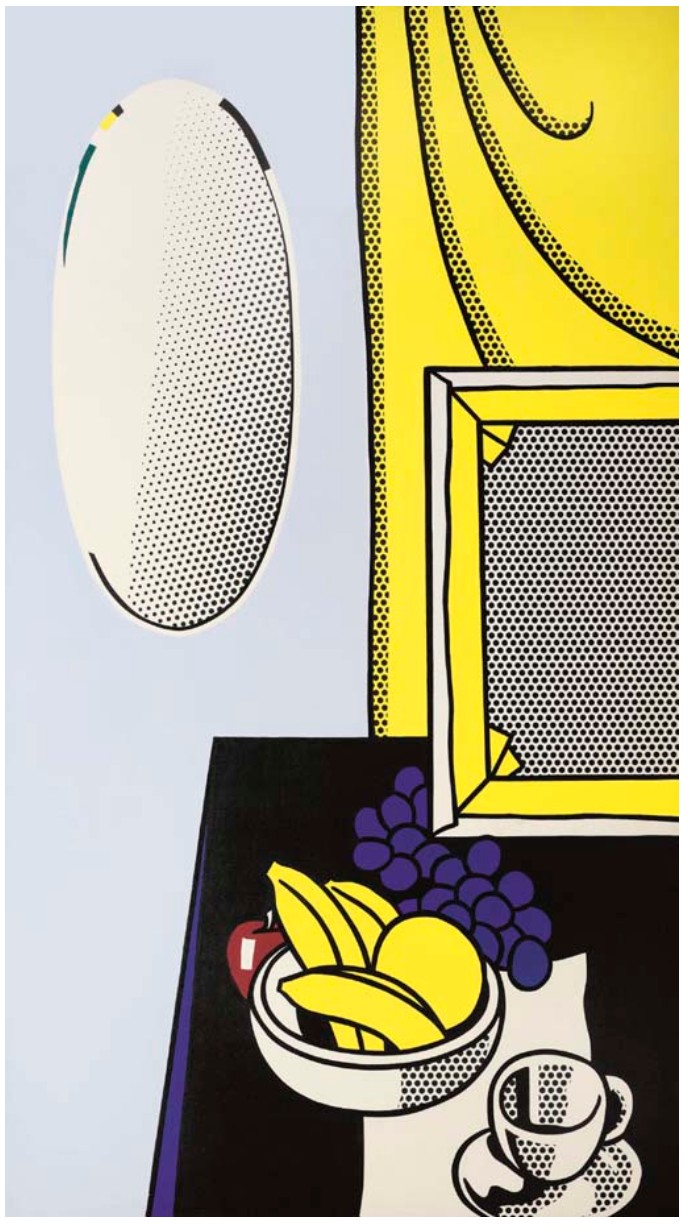
ROY LICHTENSTEIN (1923-1997)
Still Life with Stretcher, Mirror, Bowl of Fruit, 1972
Oil on canvas
96×54 inches (245×137 cm)
Signed and dated ‘R. Lichtenstein ’72’ (on the reverse)
#2. Still Life with Palette, 1972
Christie’s New-York: 10 November 2010
Estimated: USD 5,500,000 – 7,500,000
USD 6,802,500
Roy Lichtenstein (1923-1997) , Still Life with Palette | Christie’s
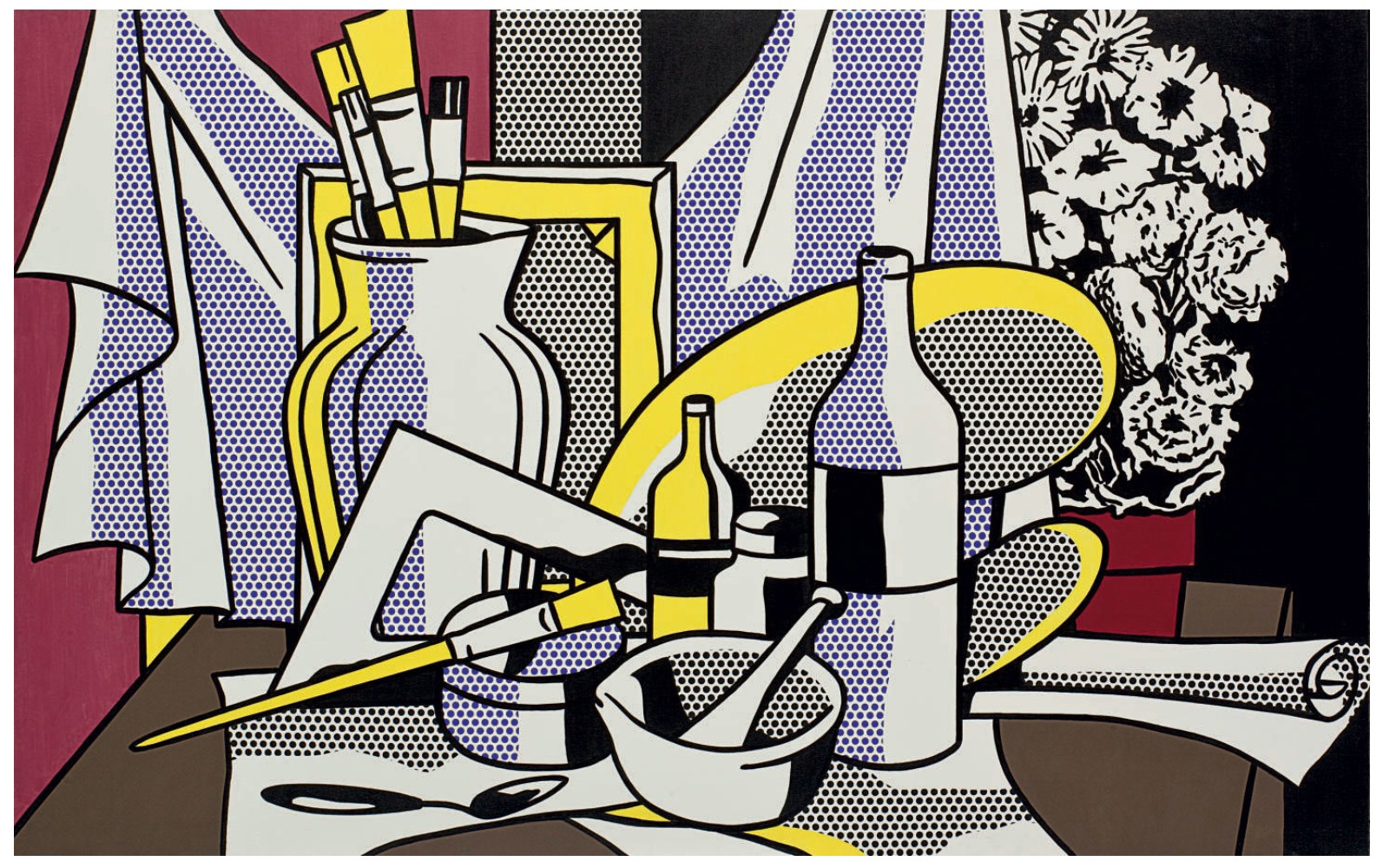
ROY LICHTENSTEIN (1923-1997)
Still Life with Palette, 1972
Oil and magna on canvas
60 x 95 5/8 inches (152.4 x 242.9 cm)
Signed and dated ‘rf Lichtenstein ’72’ (on the reverse)
#3. Still Life with Lobster, 1972
Sotheby’s New-York: 9 November 2010
Estimated: USD 5,000,000 – 7,000,000
USD 5,962,500
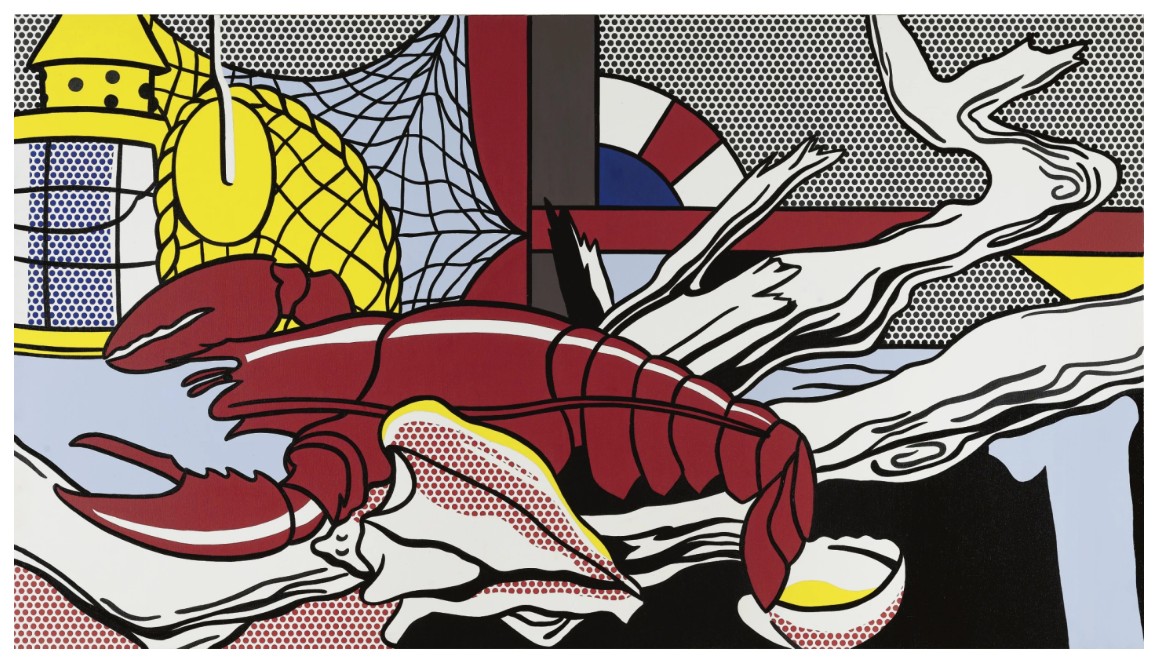
ROY LICHTENSTEIN
Still Life with Lobster, 1972
Oil and Magna on canvas
54×96 inches (137.2 x 243.8 cm)
Signed and dated ’72 on the reverse
#4. Still Life with Oysters, Fish in a Bowl and Book, 1973
Sotheby’s London: 7 February 2007
Estimated: GBP 2,000,000 – 3,000,000
GBP 2,708,000 / USD 5,333,935
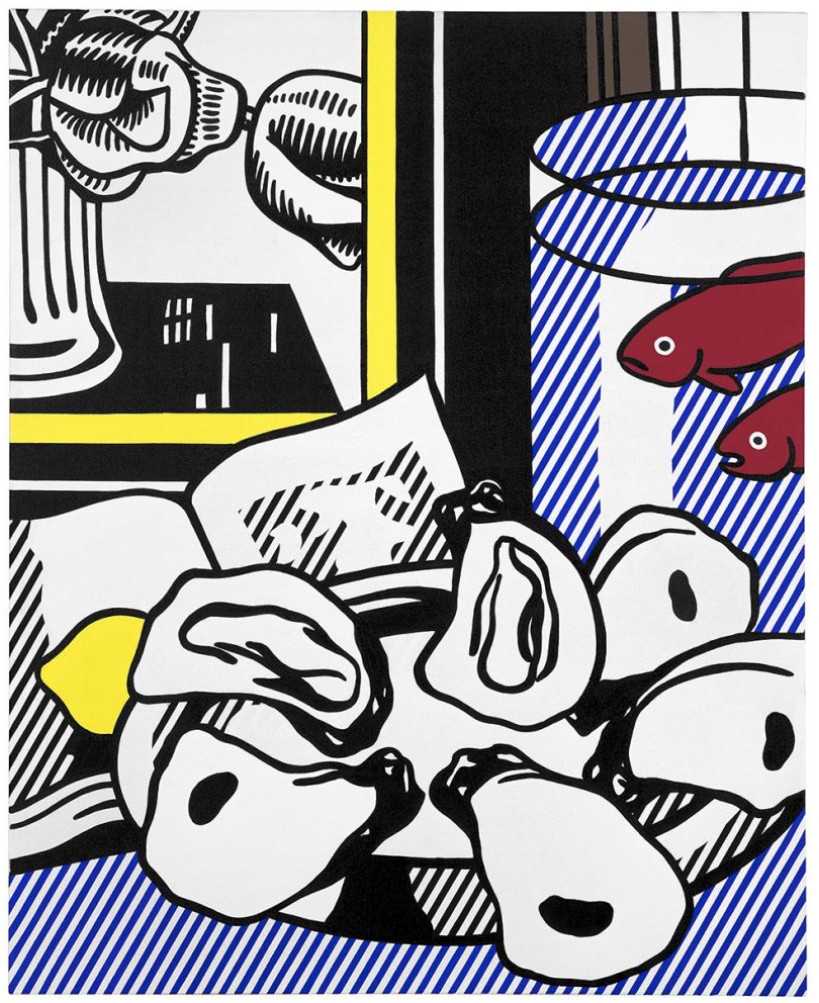
ROY LICHTENSTEIN
Still Life with Oysters, Fish in a Bowl and Book, 1973
Oil and magna on canvas
51 1/2 x 42 1/2 inches (130.8 x 108 cm)
Signed and dated 73 on the reverse
#5. Still Life with Sculpture, 1974
Christie’s New-York: 16 May 2007
Estimated: USD 3,500,000 – 4,500,000
USD 4,520,000
Roy Lichtenstein (1923-1997) , Still Life with Sculpture | Christie’s
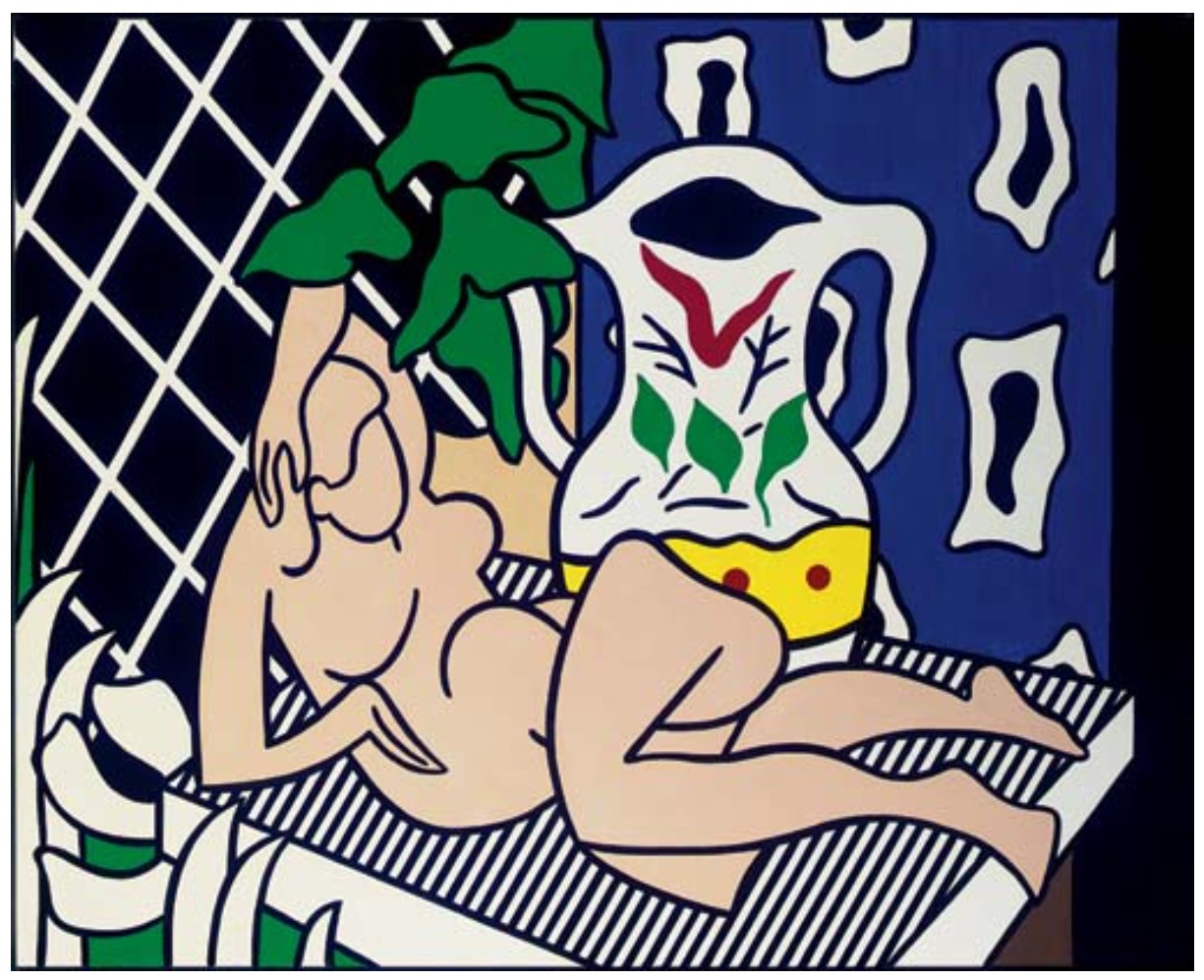
ROY LICHTENSTEIN (1923-1997)
Still Life with Sculpture, 1974
Oil and magna on canvas
42×52 inches (106.7 x 132.1 cm)
Signed and dated ‘rf Lichtenstein ’74’ (on the reverse)
#6. Still Life with Green Vase, 1972
Sotheby’s New-York: 15 May 2007
Estimated: USD 3,000,000 – 4,000,000
USD 4,296,000
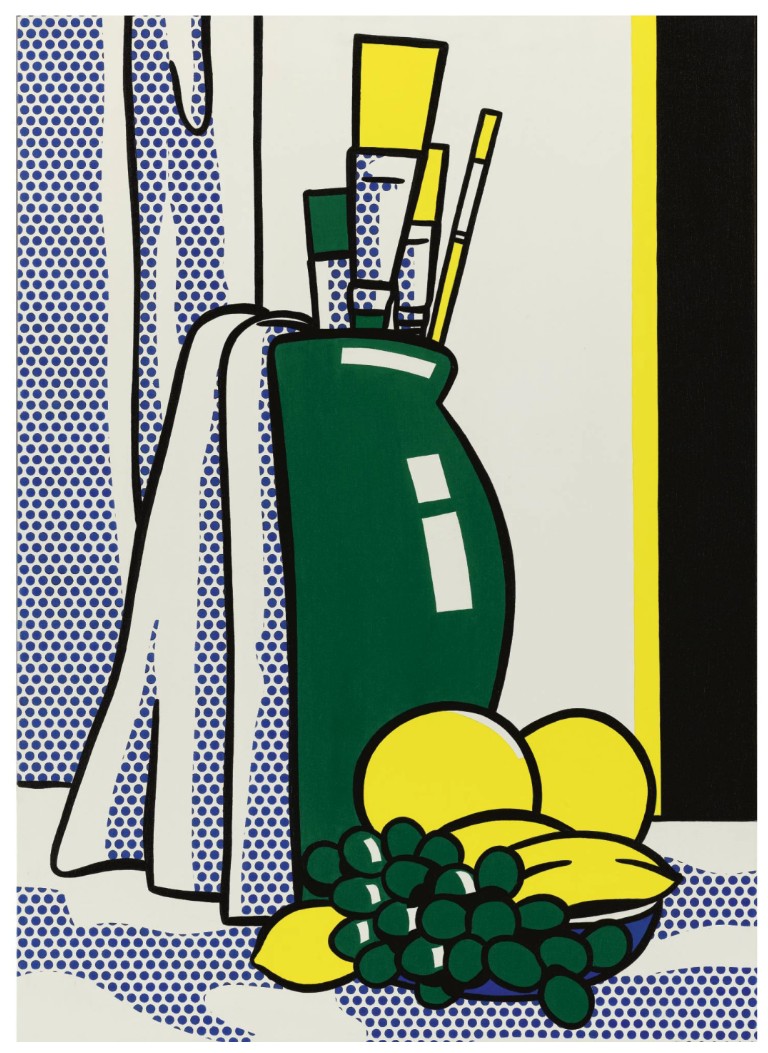
ROY LICHTENSTEIN
Still Life with Green Vase, 1972
Oil and magna on canvas
56 x 40 3/4 inches (143×102 cm)
Signed and dated ’72 on the reverse
#7. Still Life, 1972
Phillips New-York: 16 May 2013
Estimated: USD 4,000,000 – 6,000,000
USD 4,085,000
Roy Lichtenstein Contemporary Art Evening Sale
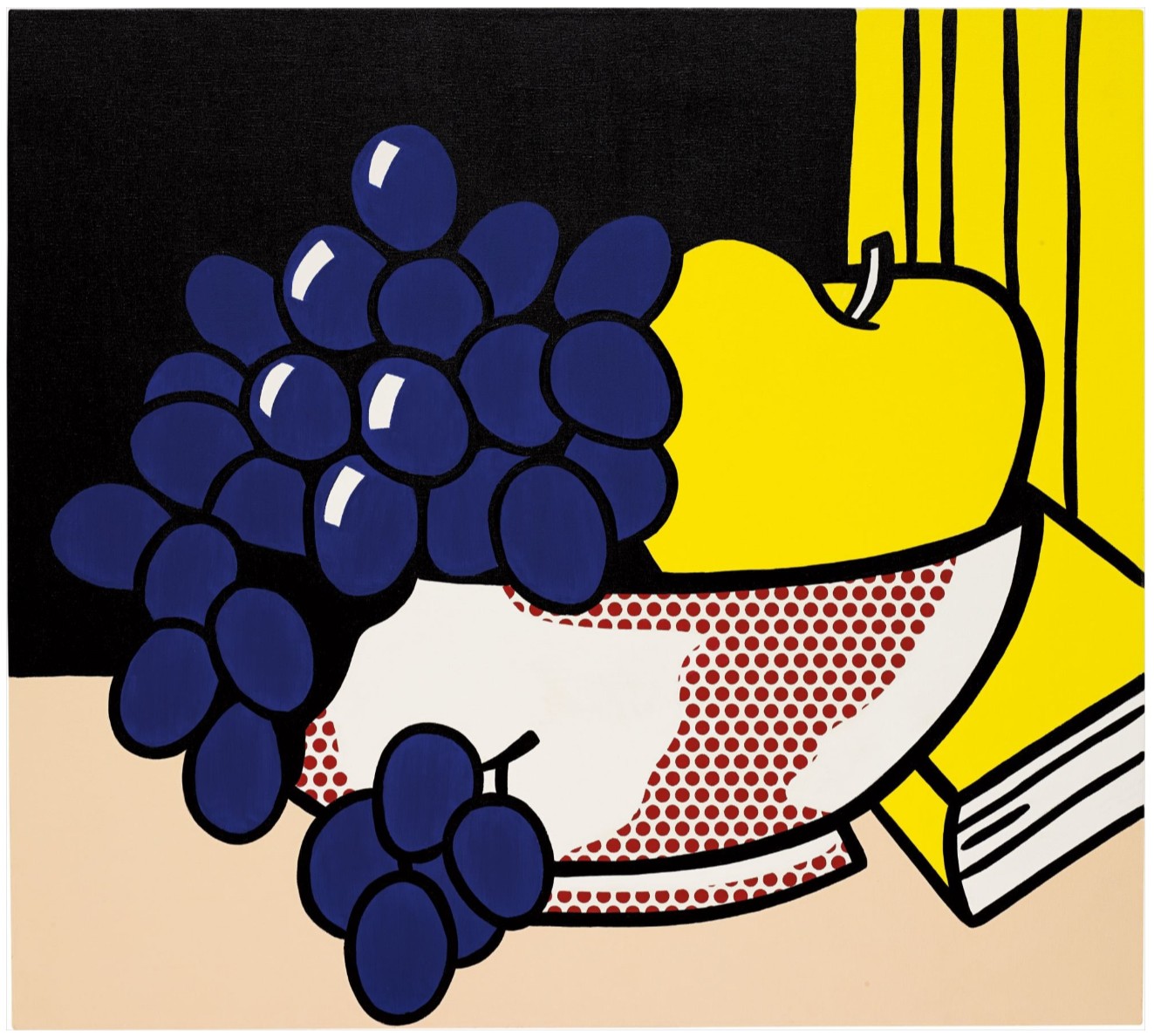
ROY LICHTENSTEIN
Still Life, 1972
Oil and Magna on canvas
36×40 inches (91.4 x 101.6 cm)
Signed and dated “rf Lichtenstein 72” on the reverse
#8. Still Life with Candy Jar, 1972
Sotheby’s London: 9 February 2006
Estimated: GBP 1,000,000 – 1,500,000
GBP 2,136,000 / USD 3,718,255
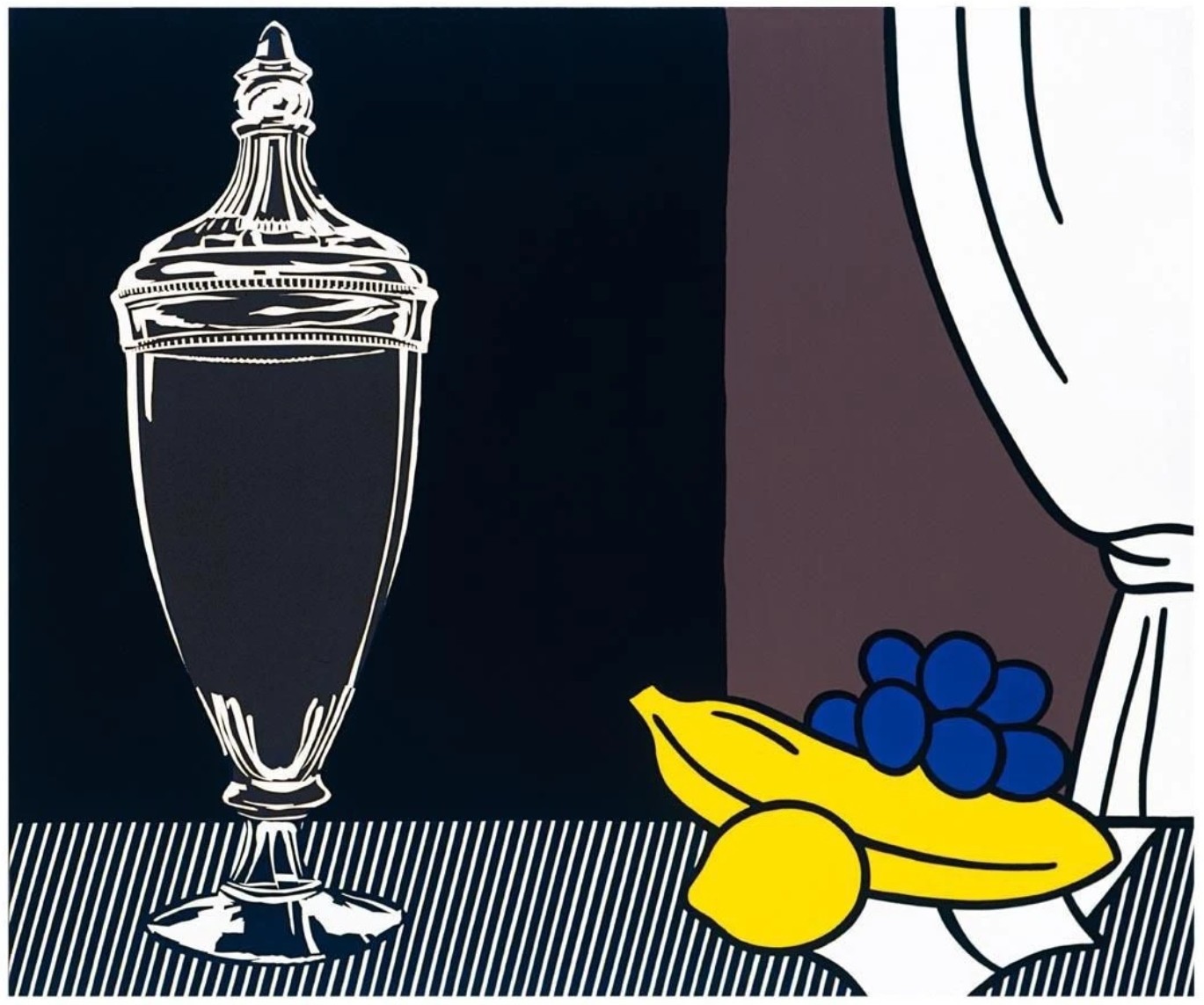
ROY LICHTENSTEIN
Still Life with Candy Jar, 1972
Acrylic, oil, graphite pencil on canvas
50×60 inches (127 x 152.5 cm)
Signed and dated “rf Lichtenstein 72” on the reverse
#9. Still Life with Lamp, 1972
Sotheby’s New-York: 14 November 2006
Estimated: USD 2,500,000 – 3,500,000
USD 2,040,000
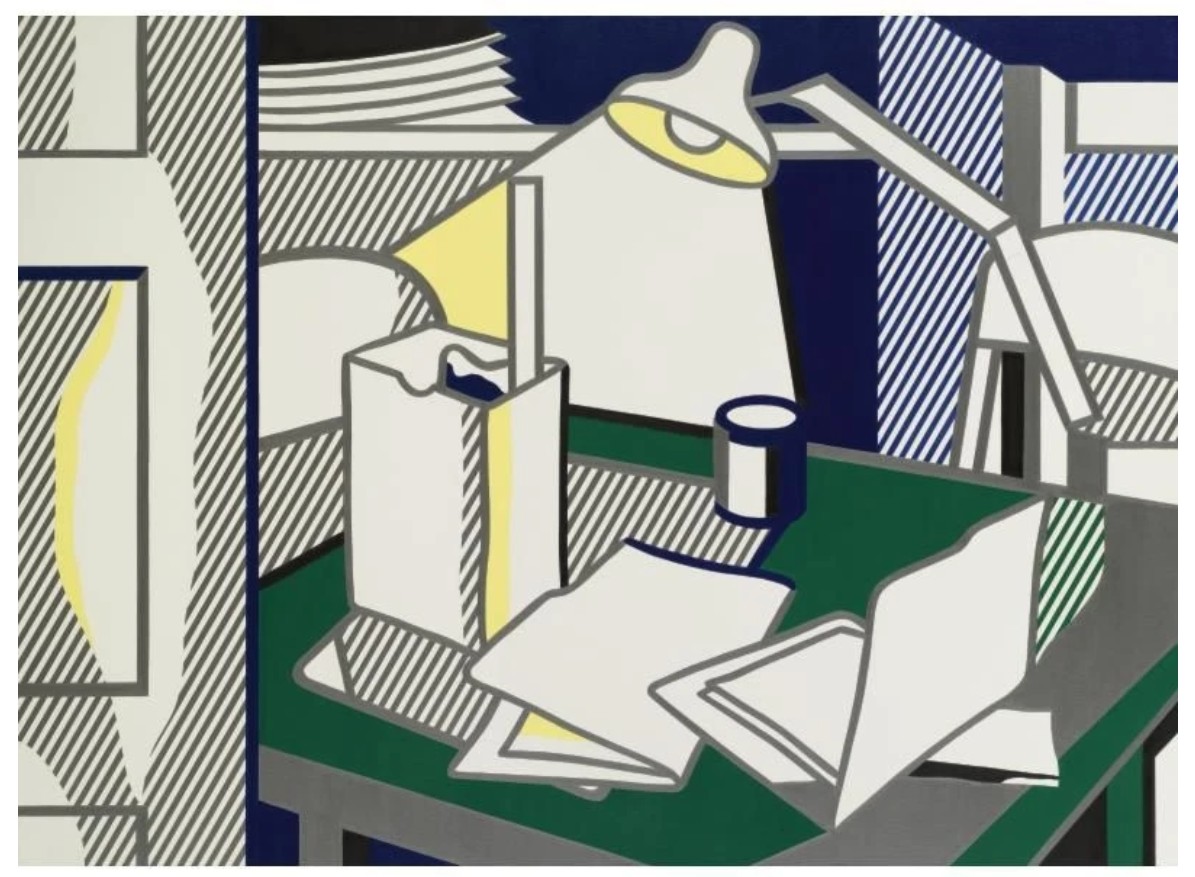
ROY LICHTENSTEIN
Still Life with Lamp, 1972
Oil and magna on canvas
54×74 inches (137×188 cm)
Signed and dated ’72 on the reverse
#10. Cubist Still Life with Vase and Flowers, 1973
A Legacy Reimagined: Works from the Collection of Dorothy and Roy Lichtenstein
Sotheby’s New-York: 18 November 2025
Estimated: USD 4,o00,000 – 6,000,000
USD 3,025,000
Cubist Still Life with Vase and Flowers | The Now & Contemporary Evening Auction | 2025 | Sotheby’s
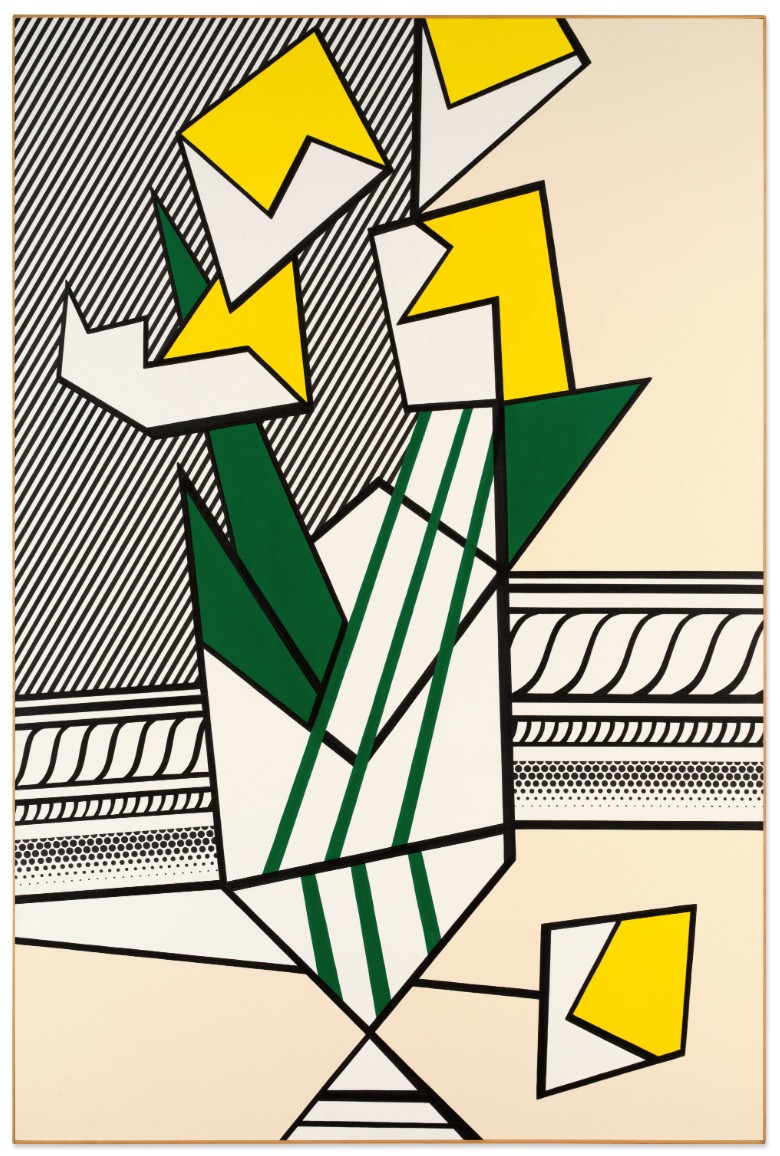
ROY LICHTENSTEIN (1923 – 1997)
Cubist Still Life with Vase and Flowers, 1973
Acrylic, oil and graphite on canvas
90 1/4 x 60 inches (229.2 x 152.4 cm)
Signed and dated ‘73 (on the reverse)
#11. Cubist Still Life, 1974
Sotheby’s London: 26 June 2018
Estimated: GBP 1,800,000 – 2,500,000
GBP 2,110,000 / USD 2,794,510
(#20) ROY LICHTENSTEIN | Cubist Still Life
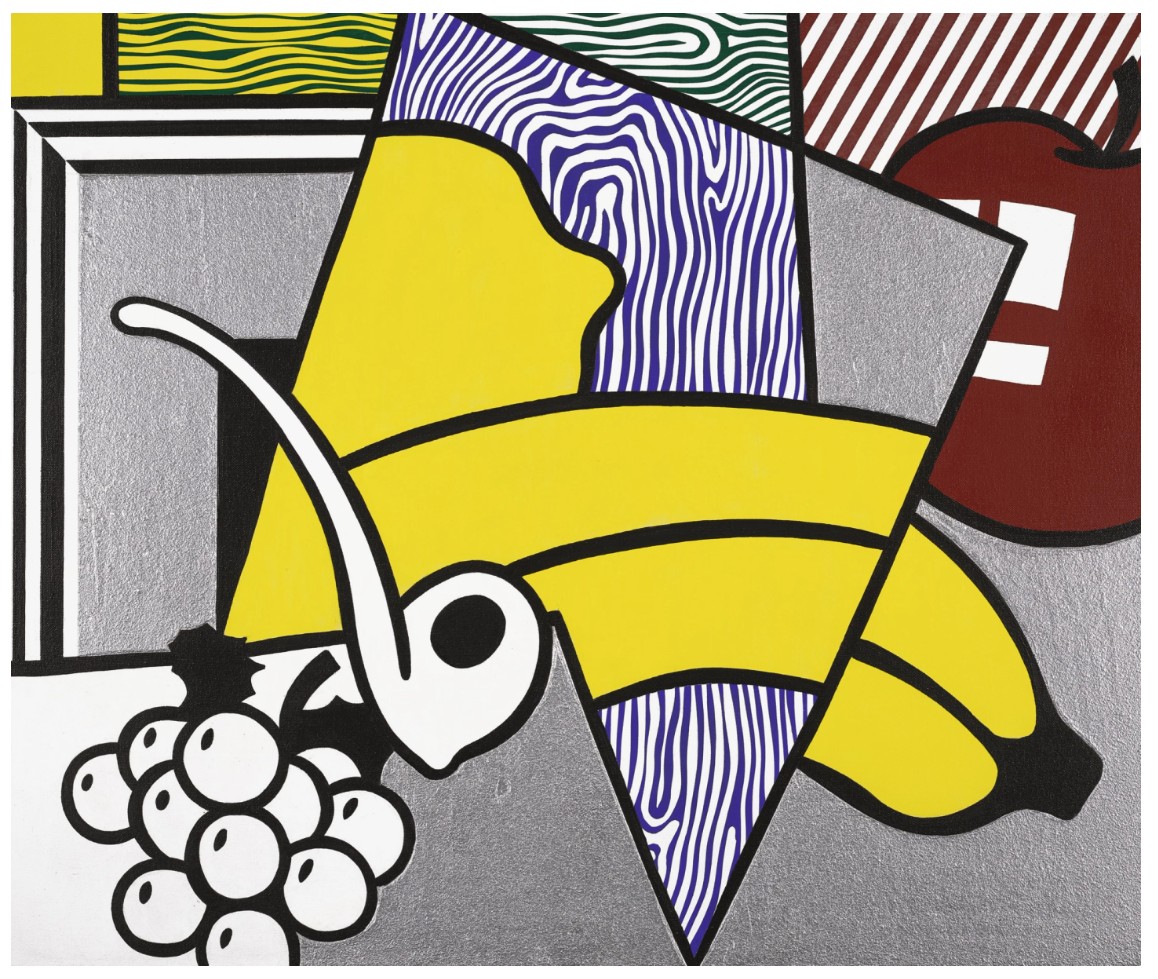
ROY LICHTENSTEIN
Cubist Still Life, 1974
Oil, Magna and sand on canvas
30 1/8 x 36 1/8 inches (76.5 x 91.8 cm)
Signed and dated 74 on the reverse
#12. Cubist Still Life, 1974
Christie’s New-York: 16 November 2022
Estimated: USD 3,000,000 – 5,000,000
USD 2,700,000
ROY LICHTENSTEIN (1923-1997) (christies.com)
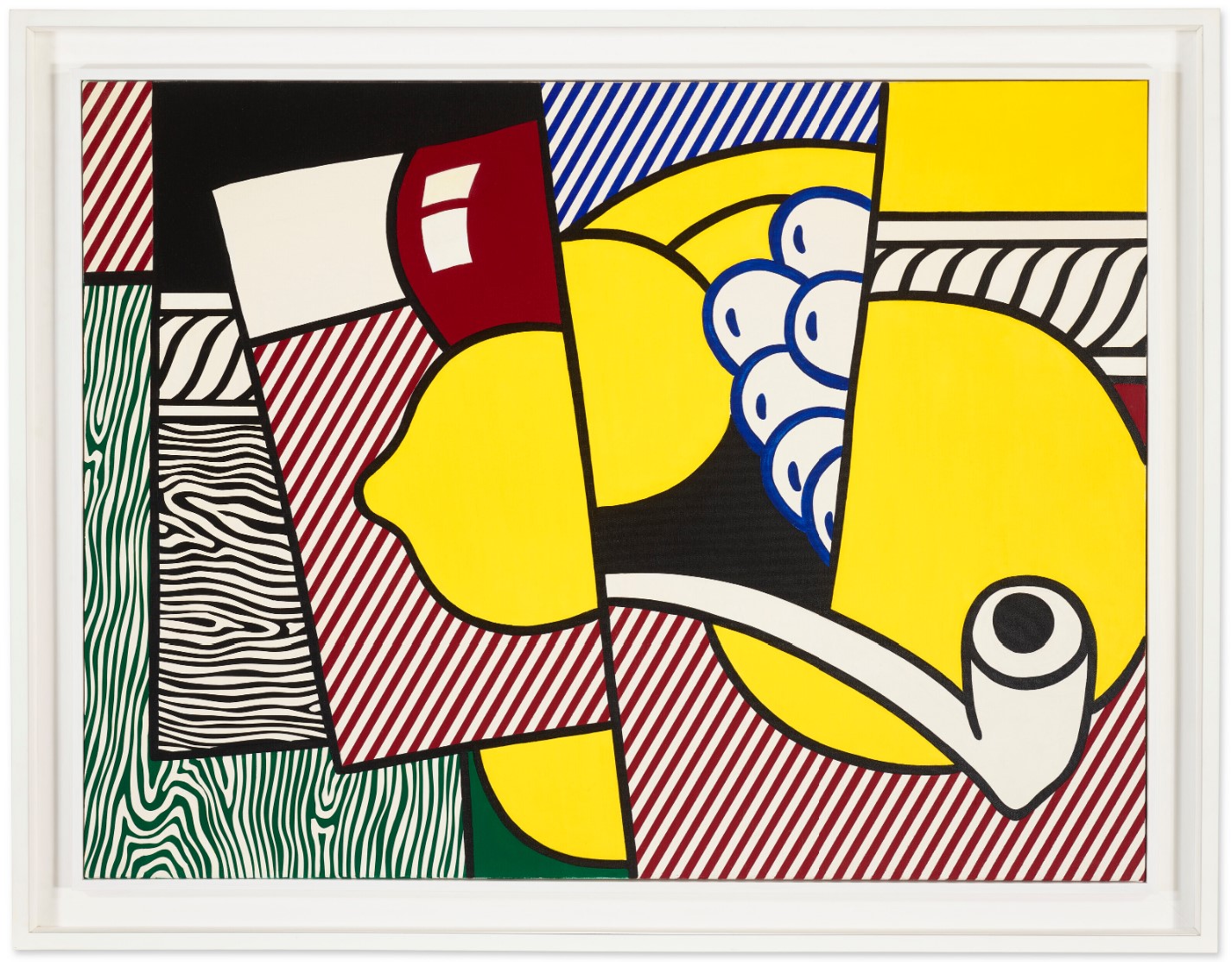
ROY LICHTENSTEIN (1923-1997)
Cubist Still Life, 1974
Oil and Magna on canvas
36×48 inches (91.5 x 121.9 cm)
Signed and dated ‘rf Lichtenstein ’74’ (on the reverse)
#13. Grapes, 1974
Sotheby’s London: 11 February 2020
Estimated: GBP 1,500,000 – 2,000,000
GBP 1,815,000 / USD 2,348,940
(#18) ROY LICHTENSTEIN | Grapes
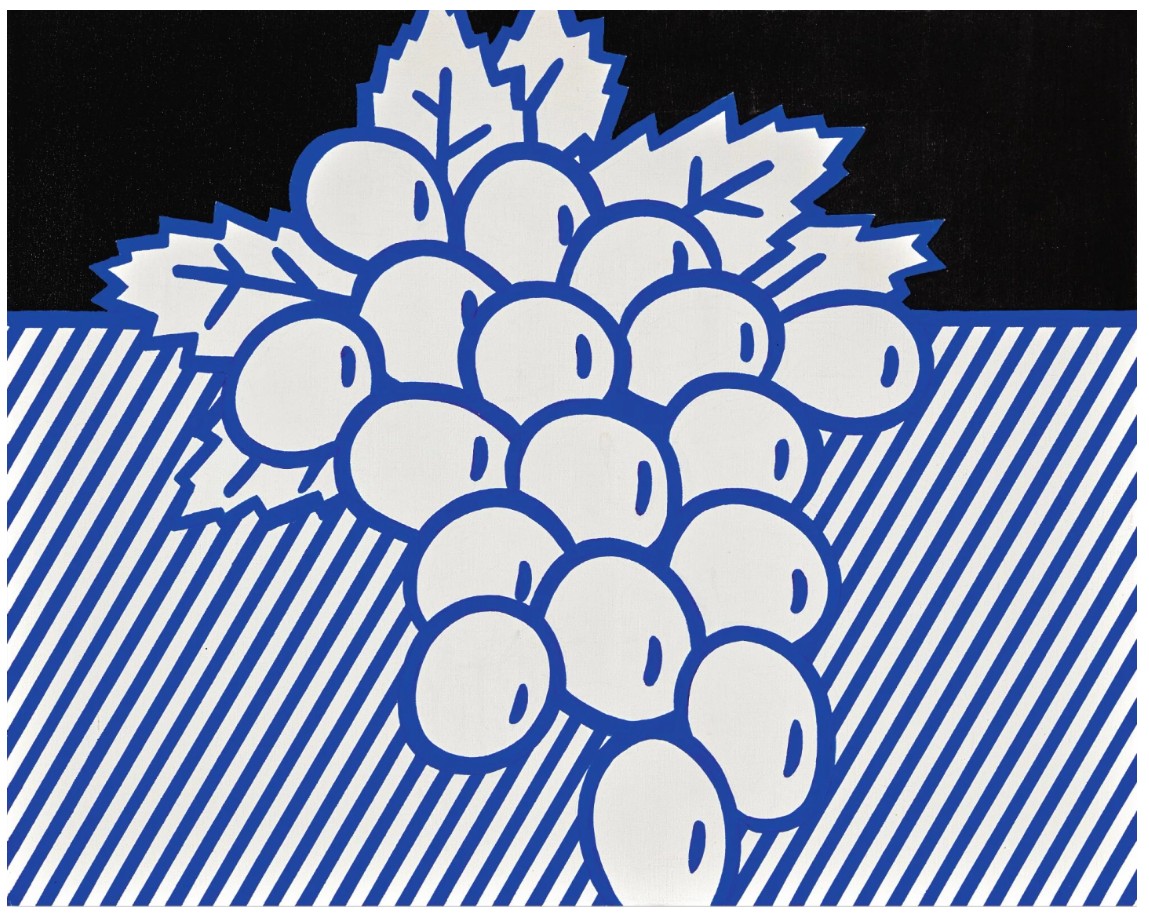
ROY LICHTENSTEIN
Grapes, 1974
Oil and Magna on canvas
24 x 30 1/8 inches (61 x 76.5 cm)
Signed and dated ’74 on the reverse
#14. Apple, Grapes, Grapefruit, 1974
Christie’s Hong-Kong: 28 May 2024
Estimated: HKD 15,800,000 – 25,800,000
HKD 17,557,000 / USD 2,247,728
Apple, Grapes, Grapefruit (christies.com)

ROY LICHTENSTEIN (1923-1997)
Apple, Grapes, Grapefruit, 1974
Acrylic, oil, and graphite on canvas
40 1/8 x 54 inches (101.9 x 137.2 cm)
Signed and dated ‘rf Lichtenstein ‘74’ (on the reverse)
#15. Two Apples, 1972
Christie’s New-York: 12 May 2010
Estimated: USD 400,000 – 600,000
USD 2,210,500
Roy Lichtenstein (1923-1997) , Two Apples | Christie’s
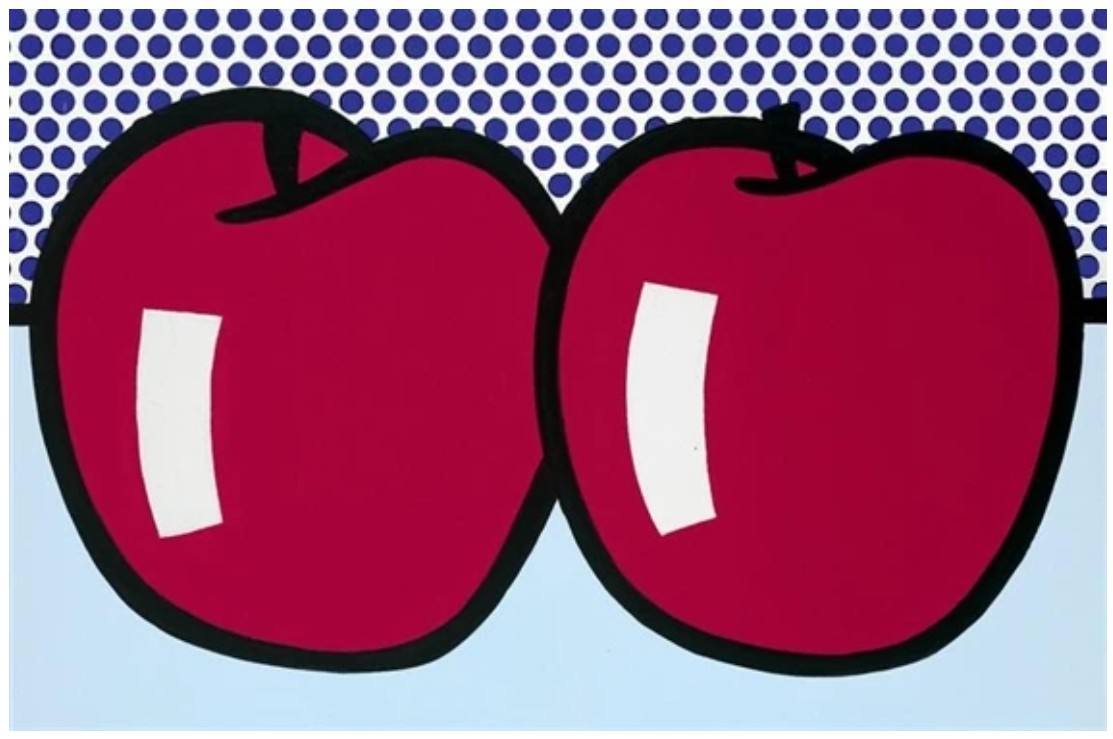
ROY LICHTENSTEIN (1923-1997)
Two Apples, 1972
Oil and magna on canvas
20 1/4 x 24 inches (51.4 x 60.9 cm)
Signed and dated ‘rf Lichtenstein ’72’ (on the reverse)
#16. Cubist Still Life, 1974
Sotheby’s New-York: 14 May 2024
Estimated: USD 700,000 – 1,000,000
USD 1,996,000
Cubist Still Life | Contemporary Day Auction | 2024 | Sotheby’s (sothebys.com)

ROY LICHTENSTEIN (1923 – 1997)
Cubist Still Life, 1974
Acrylic, oil, sand and graphite on canvas
20×24 inches (51 x 61.1 cm)
Signed and dated ’74 (on the reverse)
#17. Still Life with Cash Box, 1976
Christie’s New-York: 13 May 2009
Estimated: USD 2,000,000 – 3,000,000
USD 1,986,500
Roy Lichtenstein (1923-1997) , Still Life with Cash Box | Christie’s
REPEAT SALE
Phillips New-York: 10 May 2012
Estimated: USD 3,000,000 – 5,000,000
USD 3,442,500
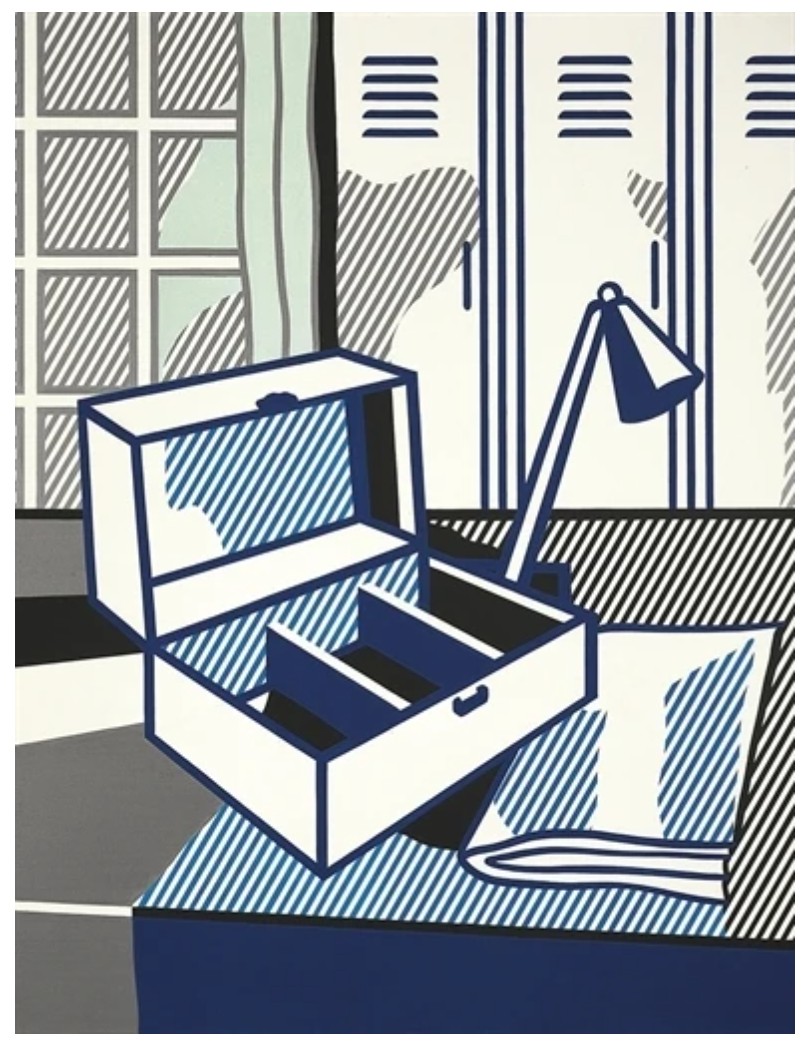
ROY LICHTENSTEIN (1923-1997)
Still Life with Cash Box, 1976
Oil and magna on canvas
70 1/8 x 54 1/8 inches (178.1 x 137.5 cm)
Signed and dated ‘rf Lichtenstein ’76’ (on the reverse)
#18. Still Life: Apple and Grapes, 1972
Sotheby’s London: 12 February 2013
Estimated: GBP 1,000,000 – 1,500,000
GBP 1,105,250 / USD 1,730,180
Results for “roy lichtenstein apple and grapes”
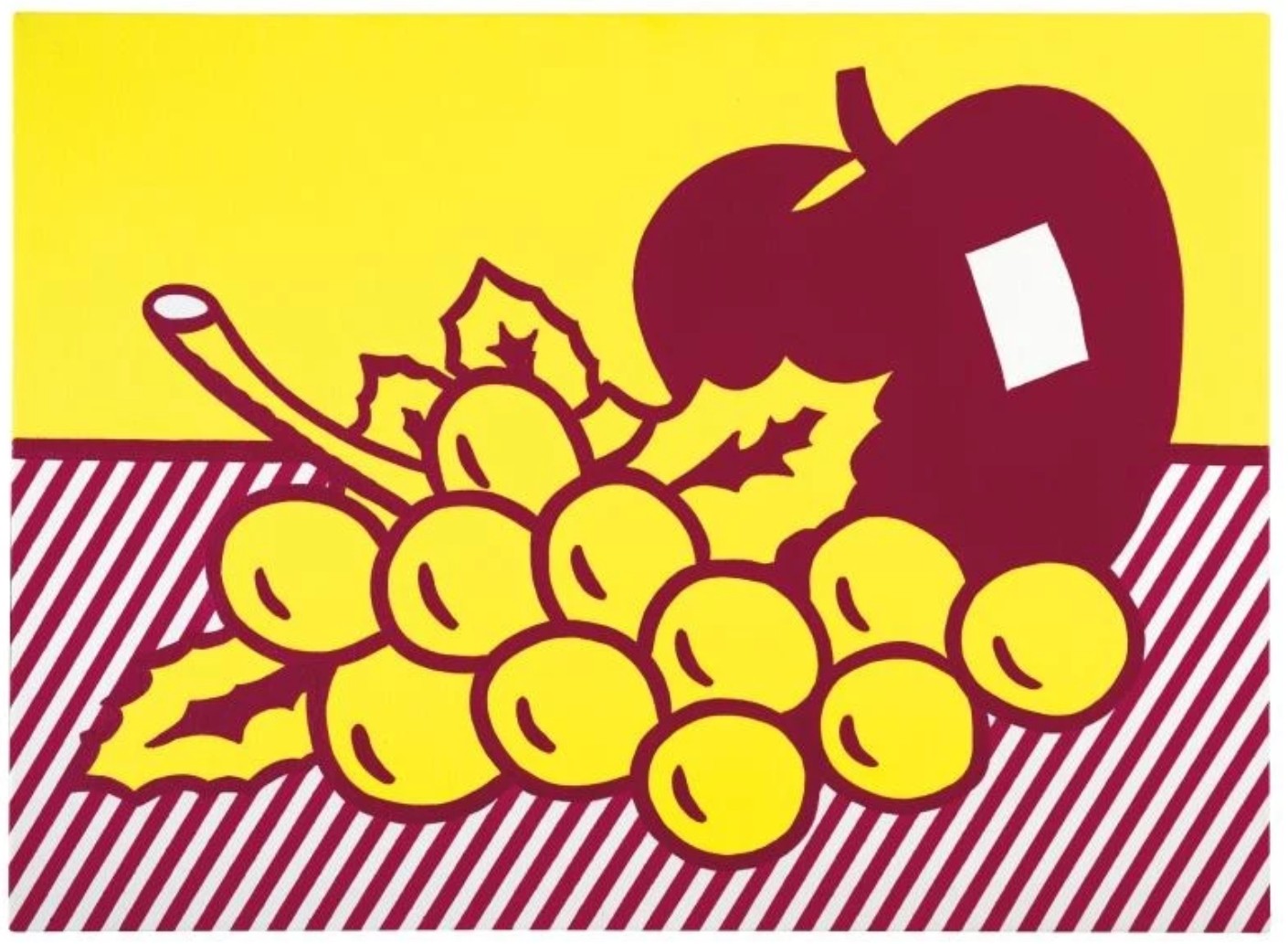
ROY LICHTENSTEIN
Still Life: Apple and Grapes, 1972
Oil and Magna on canvas
22×30 inches (55.9 x 76.2 cm)
Signed and dated ’72 on the reverse
#19. Two Red and Yellow Apples, 1981
Christie’s New-York: 15 November 2018
Estimated: USD 600,000 – 800,000
USD 1,692,500
Roy Lichtenstein (1923-1997), Two Red and Yellow Apples | Christie’s
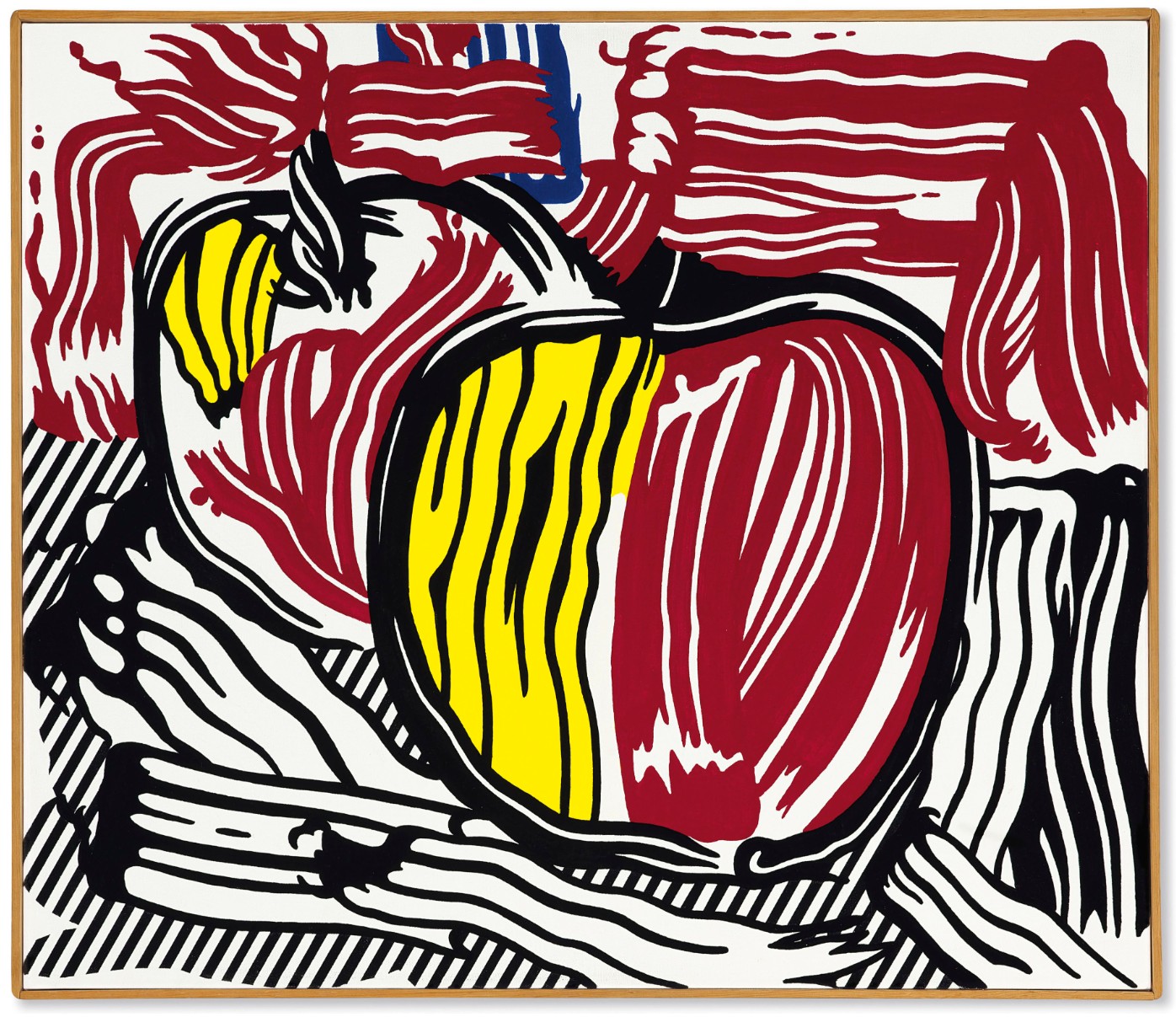
ROY LICHTENSTEIN (1923-1997)
Two Red and Yellow Apples, 1981
Oil and Magna on canvas
24×28 inches (60.9 x 71.1 cm)
Signed and dated ‘© rf Lichtenstein ’81’ (on the reverse)
#20. Still Life with Two Grapefruits, 1994
A Legacy Reimagined: Works from the Collection of Dorothy and Roy Lichtenstein
Sotheby’s New-York: 19 November 2025
Estimated: USD 800,000 – 1,200,000
USD 1,270,000
Still Life with Two Grapefruits | Contemporary Day Auction | 2025 | Sotheby’s
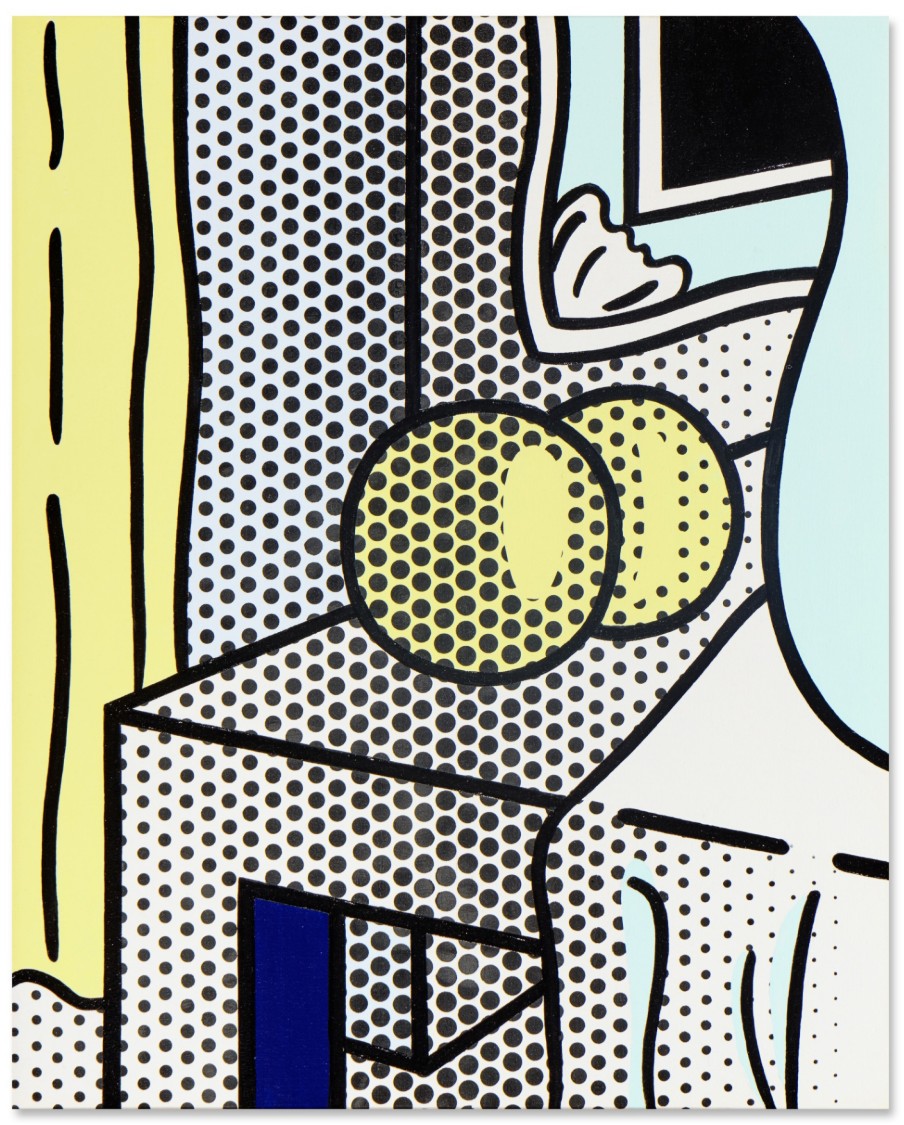
ROY LICHTENSTEIN (1923 – 1997)
Still Life with Two Grapefruits, 1994
Acrylic, oil and graphite on canvas
30 1/8 x 24 1/8 inches (76.5 x 61.2 cm)
Signed and dated ’94 (on the reverse)
Flowers, 1981
Christie’s New-York: 22 November 2024
Estimated: USD 1,000,000 – 1,500,000
USD 1,134,000
ROY LICHTENSTEIN (1923-1997), Flowers | Christie’s
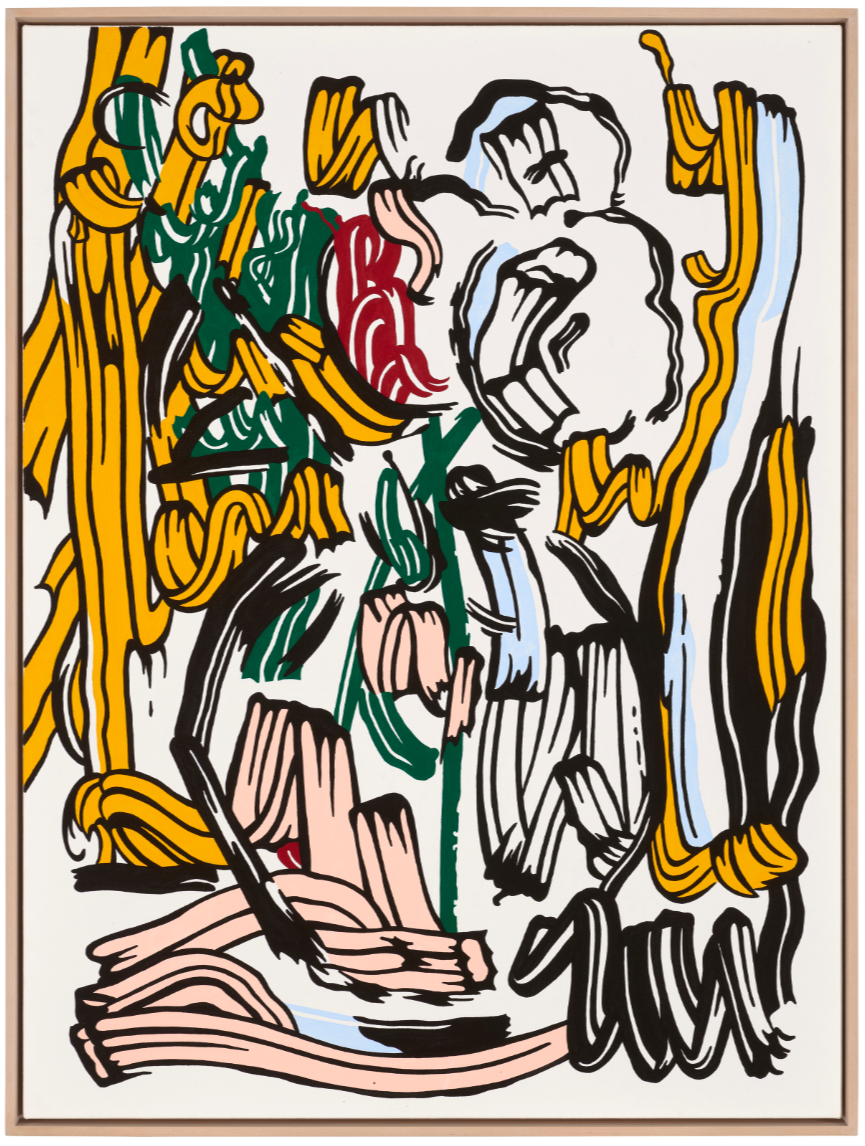
ROY LICHTENSTEIN (1923-1997)
Flowers, 1981
Acrylic and graphite on canvas
48 1/8 x 36 inches (122.3 x 91.4 cm)
Signed and dated ‘rf Lichtenstein ’81’ (on the reverse)
Red Apple, 1981
Christie’s New-York: 16 November 2006
Estimated: USD 400,000 – 600,000
USD 912,000
Roy Lichtenstein (1923-1997) , Red Apple | Christie’s
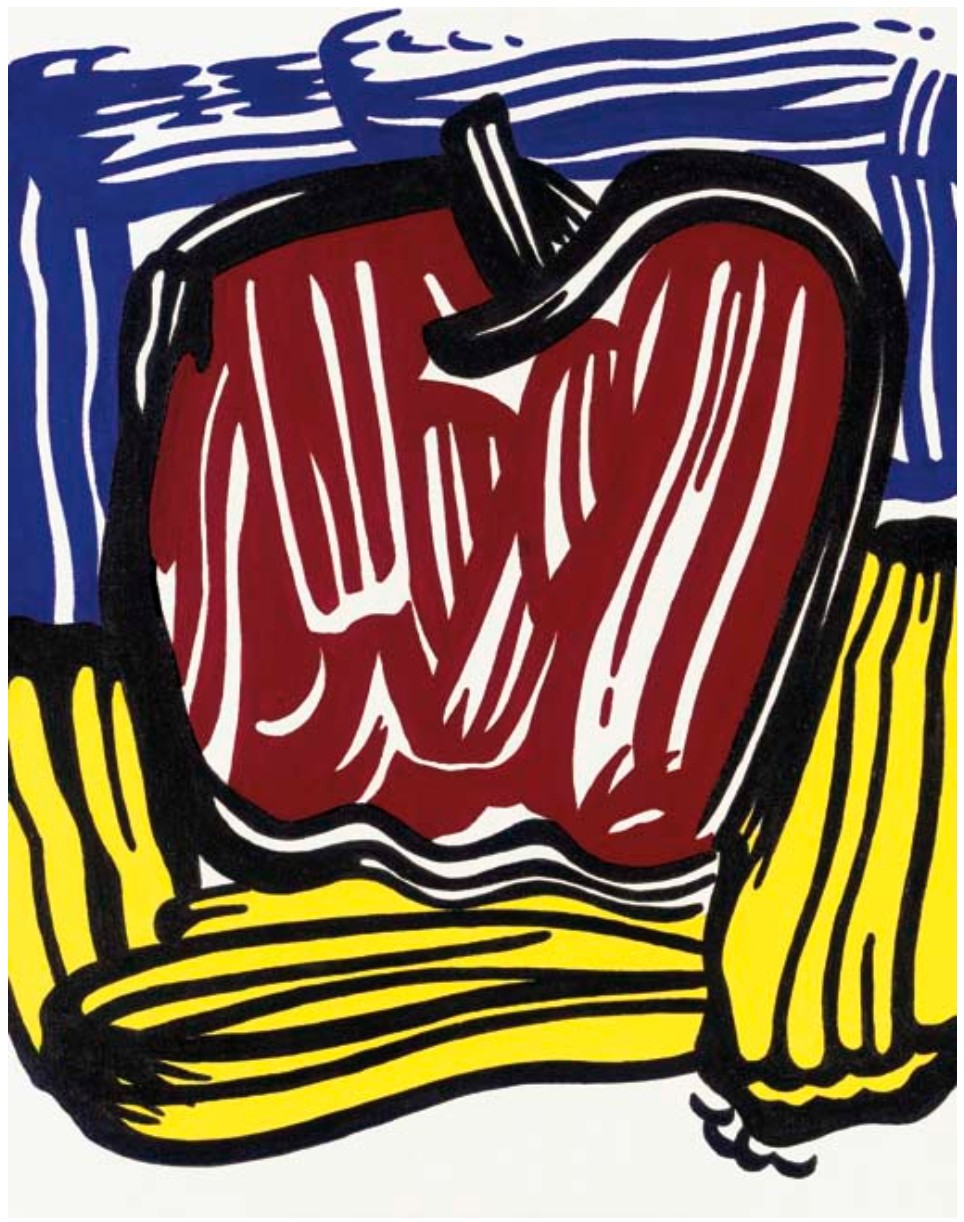
ROY LICHTENSTEIN (1923-1997)
Red Apple, 1981
Oil and magna on canvas
20×16 inches (50.8 x 40.6 cm)
Signed and dated ‘rf Lichtenstein 80’ (on the reverse)
Two Apples, 1981
Sotheby’s New-York: 19 May 2017
Estimated: USD 700,000 – 1,000,000
USD 852,500
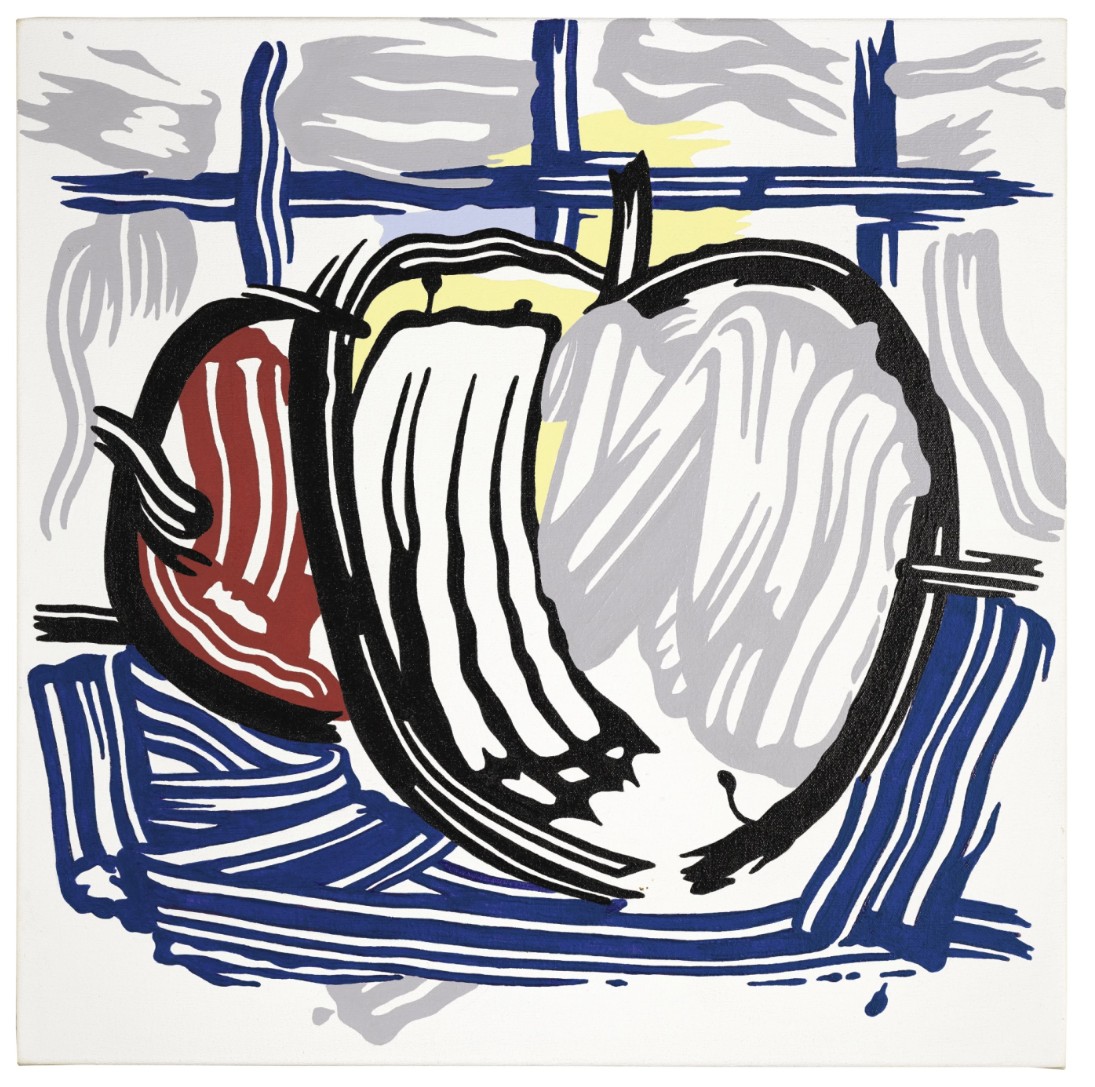
ROY LICHTENSTEIN
Two Apples, 1981
Magna on canvas
24×24 inches (61×61 cm)
Signed and dated ’81 on the reverse
Still Life: Red Apples, 1993
Christie’s New-York: 22 November 2024
Estimated: USD 500,000 – 700,000
USD 793,800
ROY LICHTENSTEIN (1923-1997), Still Life – Red Apples | Christie’s
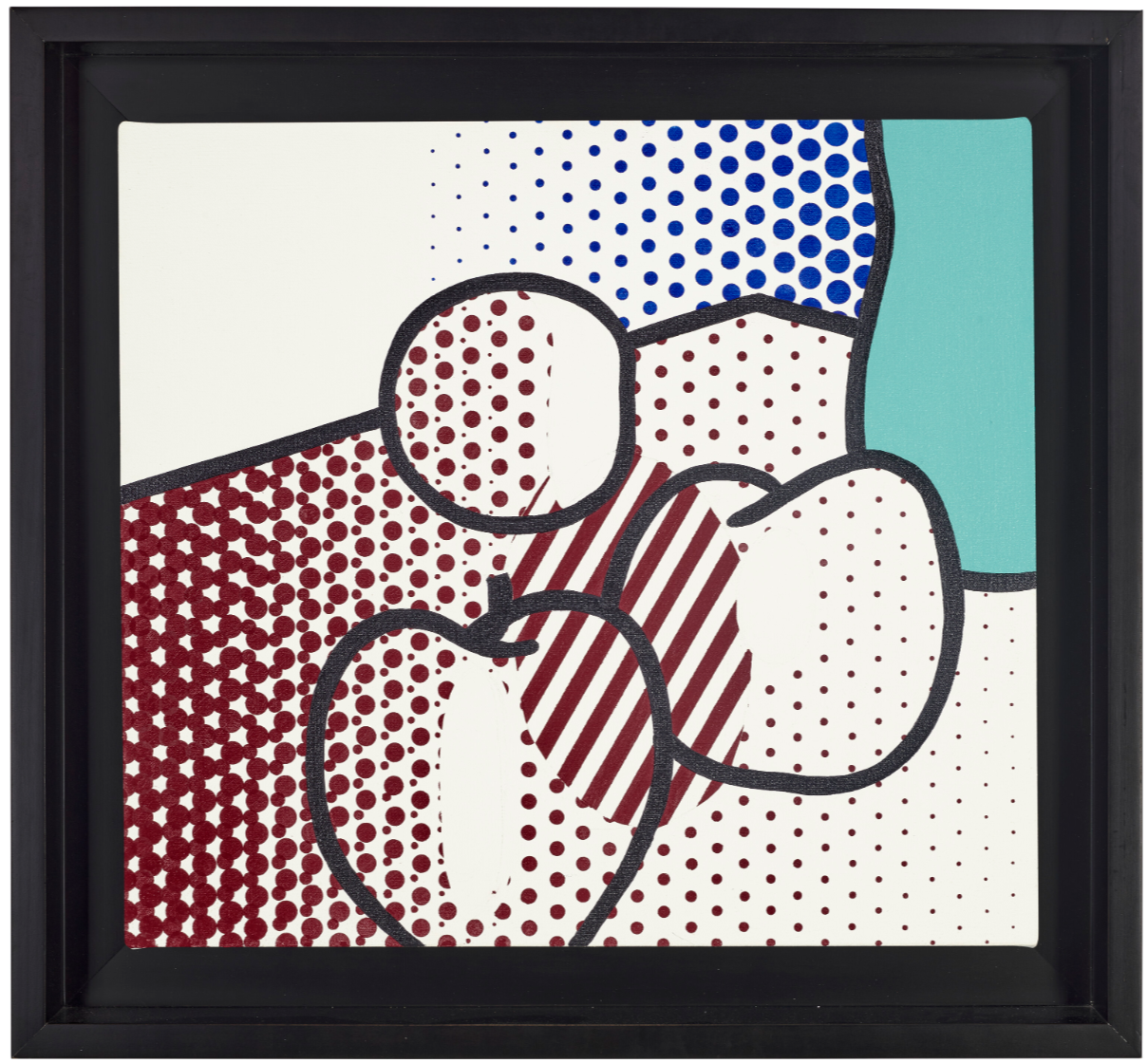
ROY LICHTENSTEIN (1923-1997)
Still Life: Red Apples, 1993
Acrylic, oil and graphite on canvas
18×20 inches (45.7 x 50.8 cm)
Signed and dated ‘rf Lichtenstein ’93’ (on the reverse)
Apple and Grapefruit, 1980
Sotheby’s New-York: 16 May 2007
Estimated: USD 500,000 – 700,000
USD 628,000
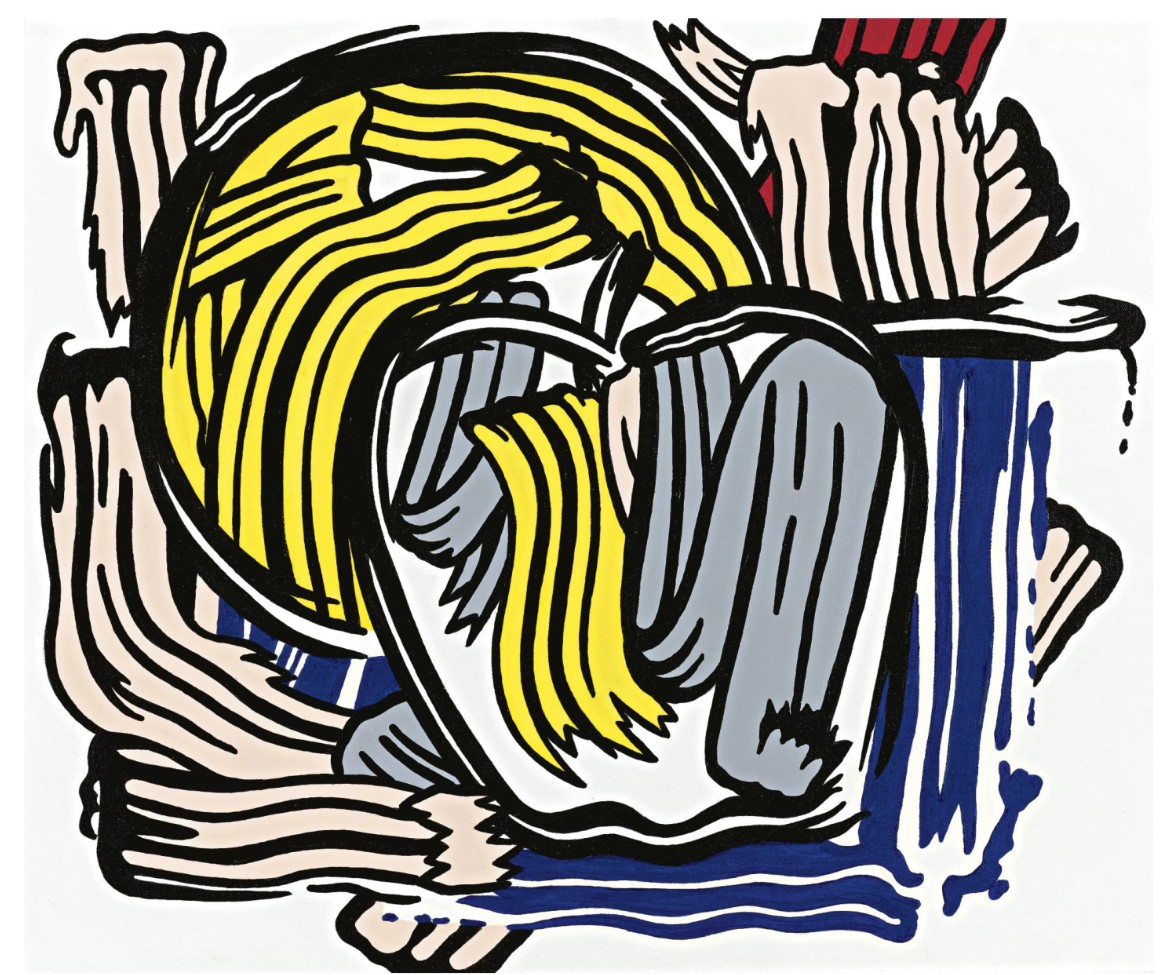
ROY LICHTENSTEIN
Apple and Grapefruit, 1980
Oil and magna on canvas
20×24 inches (51×61 cm)
Signed and dated ’80 on the reverse
Yellow Apple, 1981
Christie’s New-York: 9 November 2011
Estimated: USD 400,000 – 600,000
USD 626,500
ROY LICHTENSTEIN (1923-1997) , Yellow Apple | Christie’s
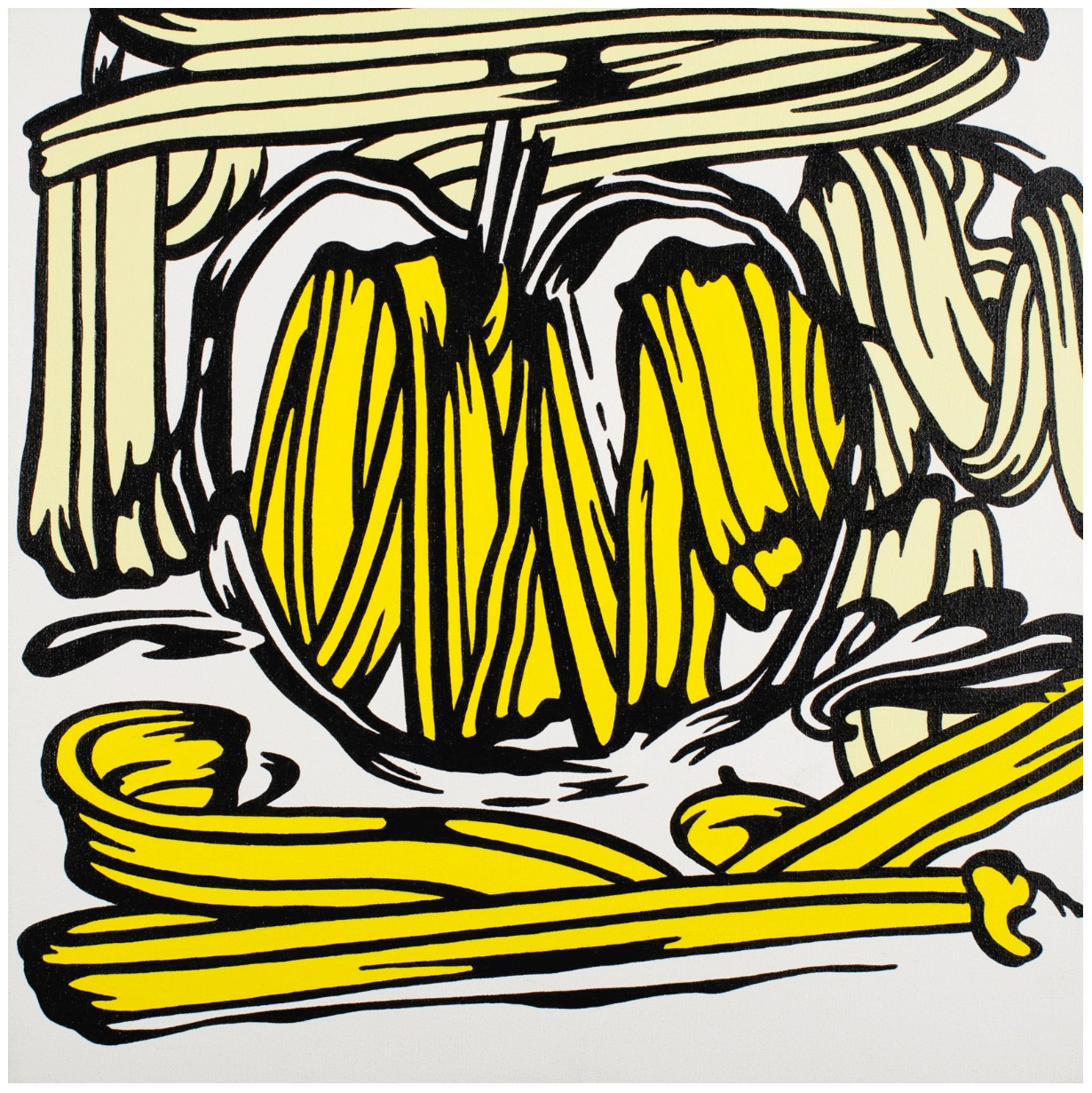
ROY LICHTENSTEIN (1923-1997)
Yellow Apple, 1981
Magna on canvas
24 1/4 x 24 1/4 inches (61.5 x 61.5 cm)
Signed and dated ‘rf Lichtenstein ’81’ (on the reverse)
Auction Results (Studies)
Still Life Tapestry (Study), 1973
Works from the Collection of Dorothy and Roy Lichtenstein
Sotheby’s New-York: 15 May 2025
Estimated: USD 1,000,000 – 1,500,000
USD 2,063,000
Still Life Tapestry (Study) | The Now and Contemporary Evening Auction | 2025 | Sotheby’s
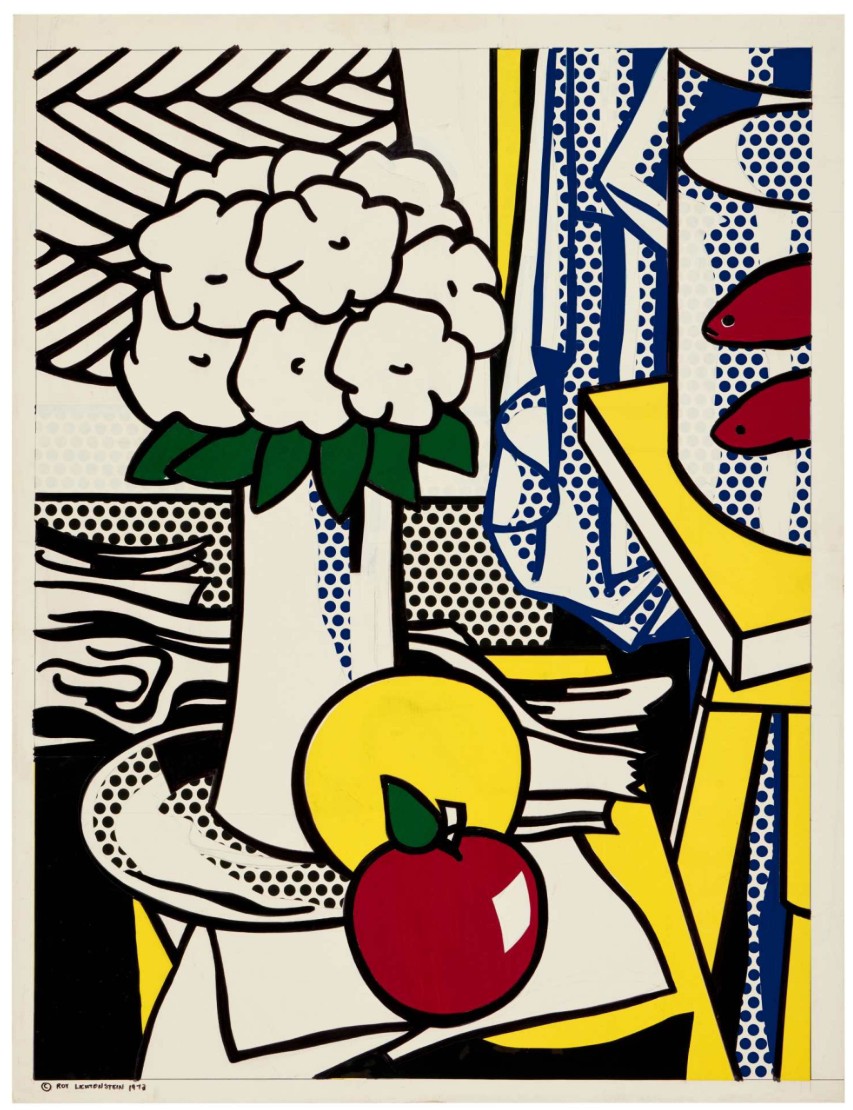
ROY LICHTENSTEIN (1923 – 1997)
Still Life Tapestry (Study), 1973
Cut painted paper, cut printed paper, marker on cut paper, cut paper, marker and graphite on board
Image: 32 5/8 x 24 1/2 inches (82.9 x 62.2 cm)
Board: 34 3/8 x 26 1/4 inches (87.3 x 66.7 cm)
Signed and dated 1973 (lower left)
Cover Image for Guggenheim Magazine (Study), 1993
A Legacy Reimagined: Works from the Collection of Dorothy and Roy Lichtenstein
Sotheby’s New-York: 19 November 2025
Estimated: USD 800,000 – 1,200,000
USD 1,255,000
Cover Image for Guggenheim Magazine (Study) | Contemporary Day Auction | 2025 | Sotheby’s
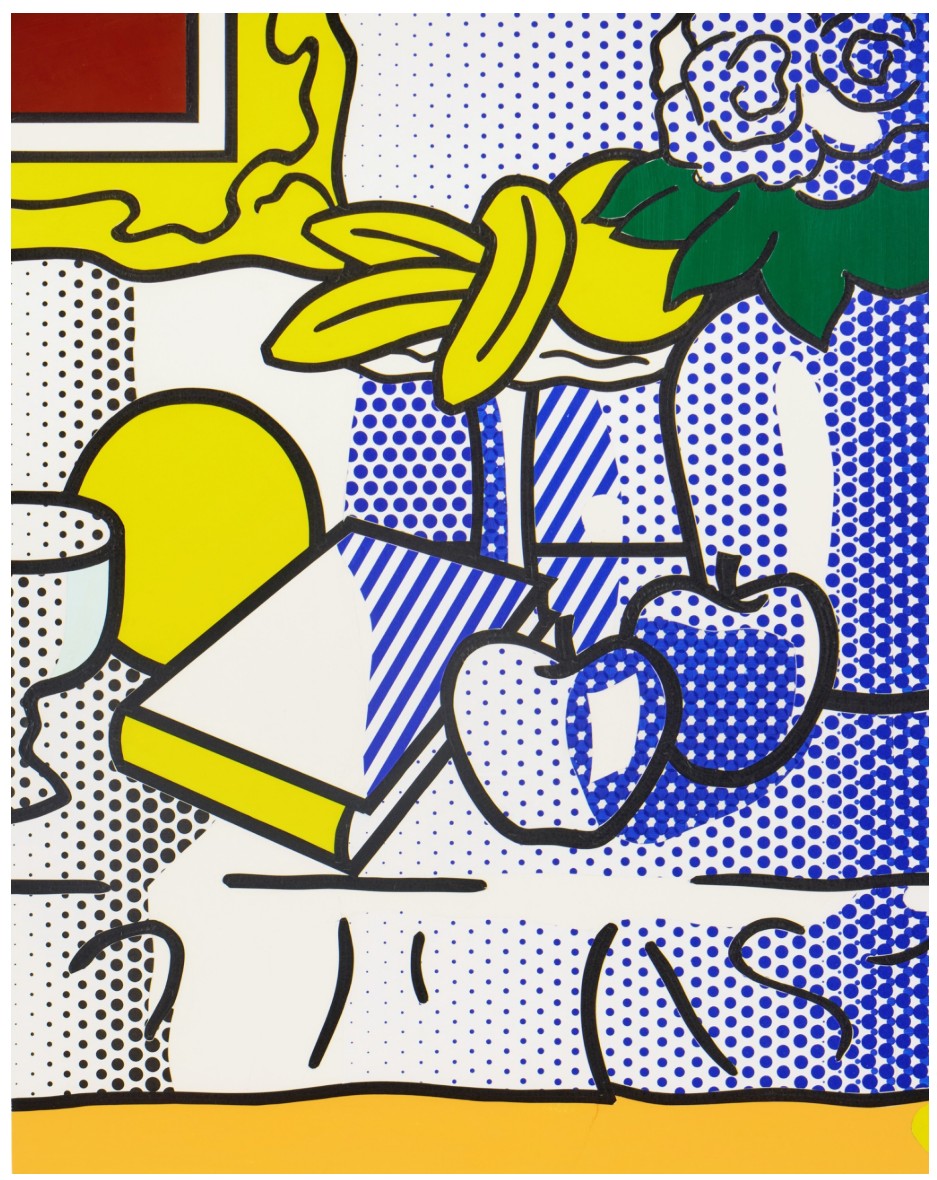
ROY LICHTENSTEIN (1923 – 1997)
Cover Image for Guggenheim Magazine (Study), 1993
Graphite, tape, cut painted and printed paper on board
Image: 40 1/2 x 31 7/8 inches (102.9 x 81 cm)
Board: 48 5/8 x 40 inches (123.5 x 101.6 cm)
Signed and dated ’93 (on the verso)
Still Life with Portrait (Study), 1973
Property from the Estate of Joan and Kenneth Goldglit
Christie’s New-York: 20 November 2025
Estimated: USD 1,000,000 – 1,500,000
USD 1,016,000
ROY LICHTENSTEIN (1923-1997), Still Life with Portrait (Study) | Christie’s
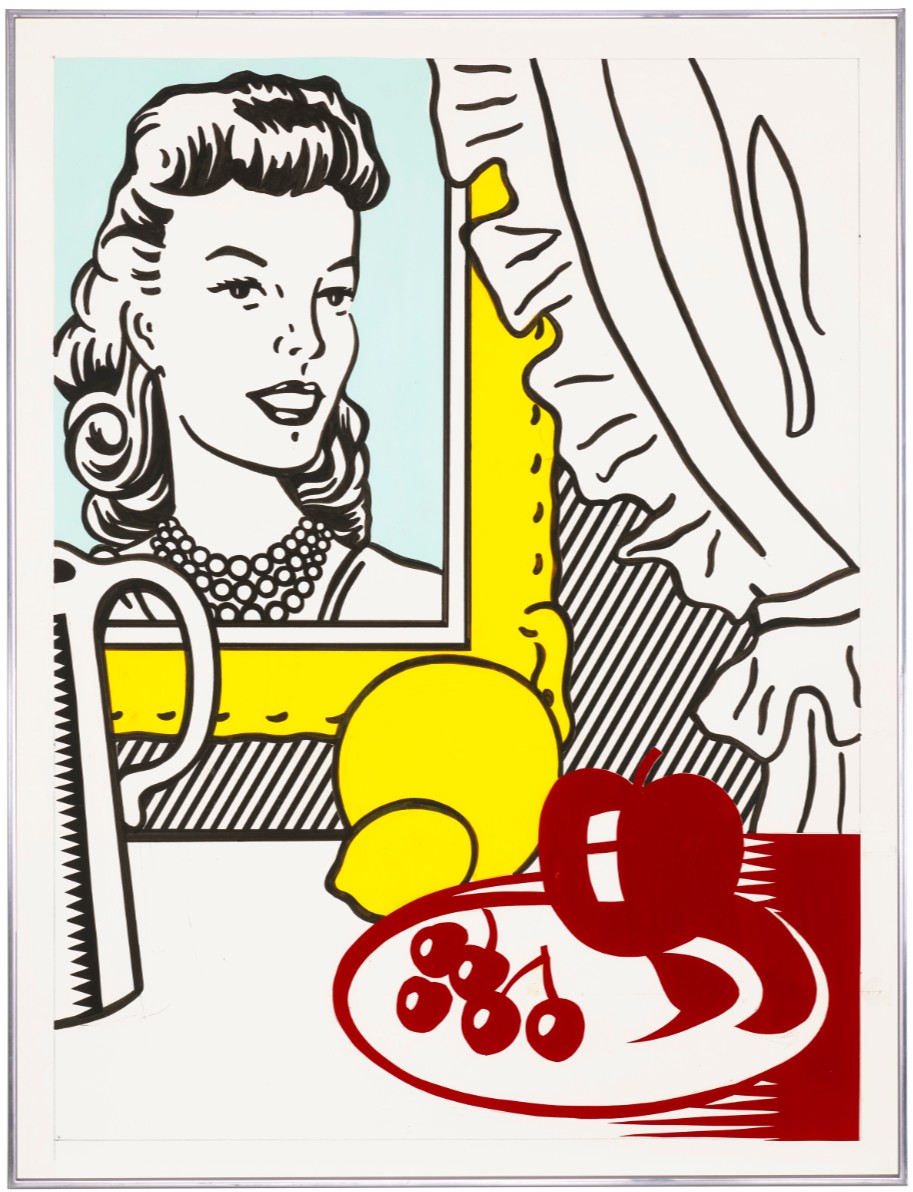
ROY LICHTENSTEIN (1923-1997)
Still Life with Portrait (Study), 1973
Printed paper collage, acrylic, felt-tip pen and graphite on paperboard
42×32 inches (106.7 x 81.3 cm)
Signed and dated ‘rf Lichtenstein ’73’ (on the reverse)
Yellow Still Life (Study), 1973
Works from the Collection of Dorothy and Roy Lichtenstein
Sotheby’s New-York: 16 May 2025
Estimated: USD 300,000 – 400,000
USD 533,400
Yellow Still Life (Study) | Contemporary Day Auction | 2025 | Sotheby’s
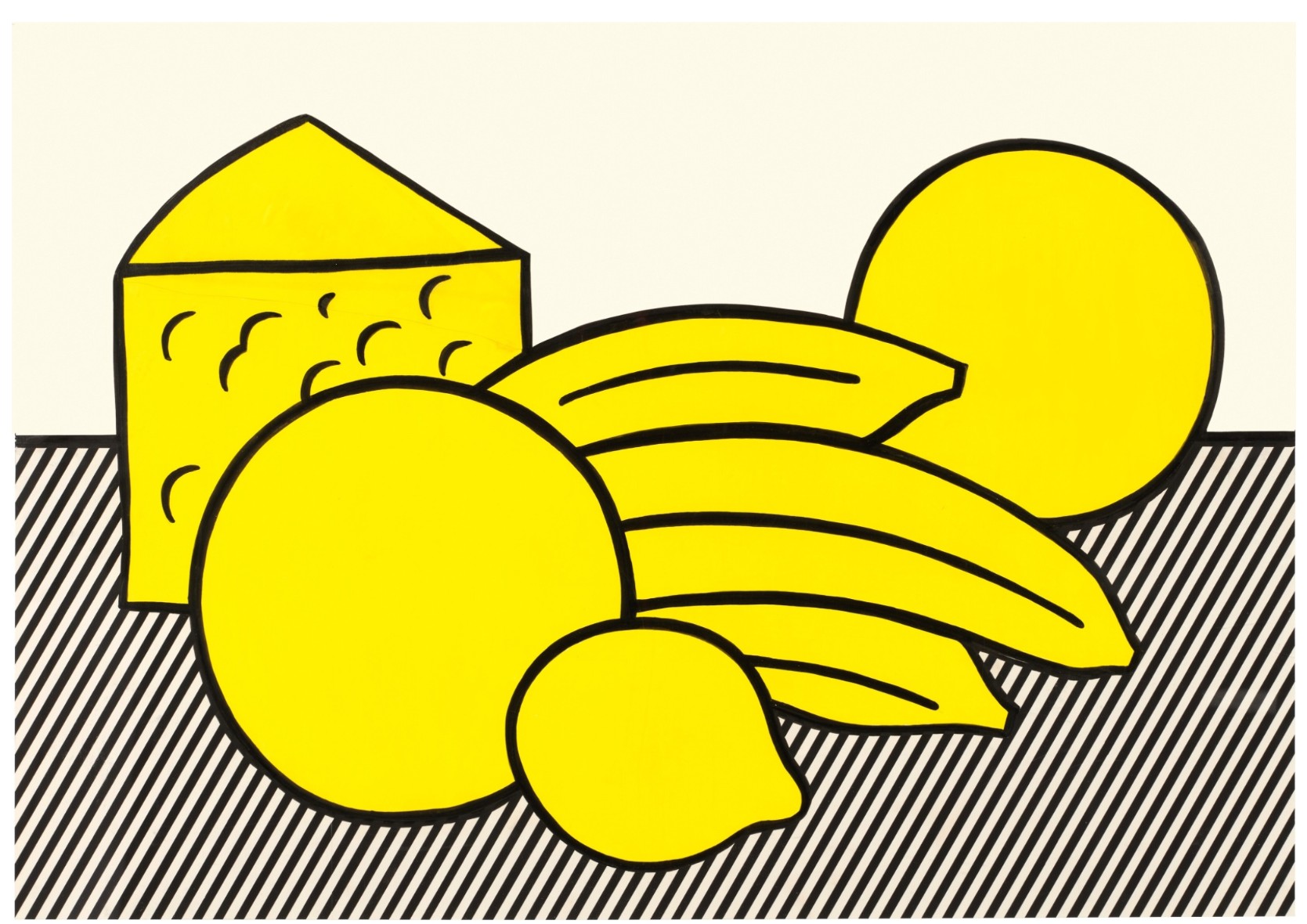
ROY LICHTENSTEIN (1923 – 1997)
Yellow Still Life (Study), 1973
Cut painted paper, acrylic, brush and ink, marker and graphite on board
Image: 25 1/4 x 36 1/2 inches (64.1 x 92.9 cm)
Sheet: 28 1/2 x 39 3/4 inches (72.4 x 101 cm)
Signed and dated ’73 (on the reverse)
Still Life Tapestry (Study), 1973
Works from the Collection of Dorothy and Roy Lichtenstein
Sotheby’s New-York: 16 May 2025
Estimated: USD 100,000 – 150,000
USD 406,400
Still Life Tapestry (Study) | Contemporary Day Auction | 2025 | Sotheby’s
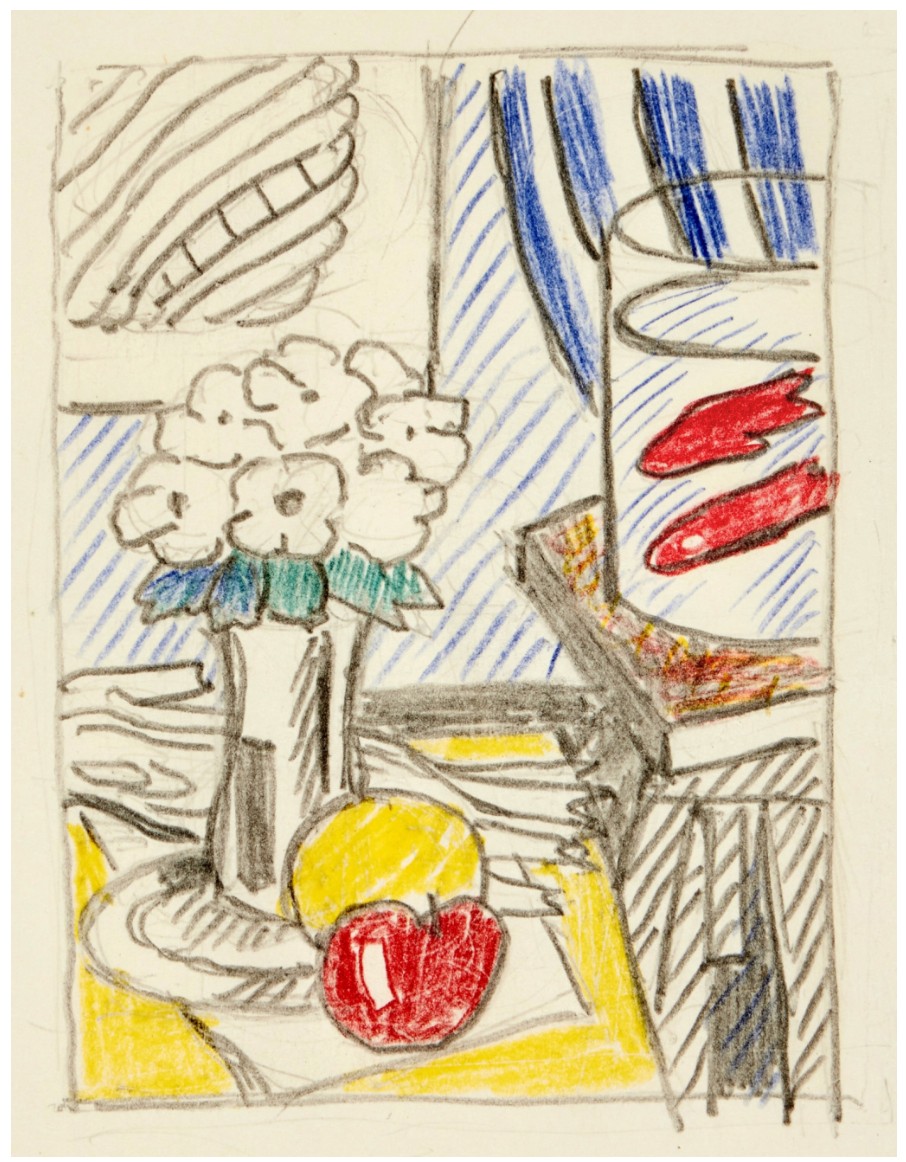
ROY LICHTENSTEIN (1923 – 1997)
Still Life Tapestry (Study), 1973
Colored pencil and graphite on paper
Image: 4 1/4 x 3 1/8 inches (10.8 x 7.9 cm)
Sheet: 8 1/4 x 5 inches (21 x 12.7 cm)
Signed and dated ’73 (on the verso)
STILL LIFE SERIES
Still Life with Palette, 1972
Still Life with Palette, 1972
Christie’s New-York: 10 November 2010
Estimated: USD 5,500,000 – 7,500,000
USD 6,802,500
Roy Lichtenstein (1923-1997) , Still Life with Palette | Christie’s
ROY LICHTENSTEIN (1923-1997)
Still Life with Palette, 1972
Oil and magna on canvas
60 x 95 5/8 inches (152.4 x 242.9 cm)
Signed and dated ‘rf Lichtenstein ’72’ (on the reverse)
Roy Lichtenstein’s monumental 1972 Still Life with Palette glows with the exquisite simplicity of its harmonious shape, form and color. Lichtenstein composed it calculatingly, as he did with each work in his acclaimed early 1970s Still Life series and it builds upon his earliest still lifes of the 1960s, where he focused on simple, consumerist objects like balls of twine and bowls of fruit. Lichtenstein further explores this format, turning his idiosyncratic style back on itself by including motifs from earlier series, such as the reversed canvases, in order to tackle a more complex arrangement of traditional objects, and, with it, notions of artistic authorship and composition.
Still life’s evolution is among art history’s most enduring and fascinating stories. How people relate with the objects around them has always mattered, and paintings’ philosophical associations generally reflect their own time. Still Life with Palette embodies two fundamental tenets underpinning Lichtenstein’s oeuvre: He intuitively grasped both visual communication’s essential nature and previous modern art movements’ abiding legitimacy. Lichtenstein portrays a traditional still-life subject while referencing early Picasso and Braque and remaining sensitive to Matisse. He makes Still Life with Palette converse with other artworks, thereby staking his own claim to a place in modern art history.
Lichtenstein moves away from Matisse’s painterly, transparent facture with his tight finish, while renewing Cubist style with bold color. He also recombines certain elements of the composition, including a reference to Raphaelle Peale’s 1823 painting After the Bat, creating a new setting as a backdrop to an array of vessels and larger-than-life tools, all rendered with linear economy and flattened space. Using incredible draftsmanship and skill, he strategically manipulates, reorganizes and reframes his subjects, and engages in a complex dialogue with his forefathers, allowing the painting to become more than the sum of its parts. It is no short order to reinvent one of painting’s oldest genres, the still life. Lichtenstein utilized his trademark pictorial vocabulary to redefine what on the surface appears naïve, but is actually highly sophisticated and compellingly reexamines the nature of representation.
Still Life with Lobster, 1972
Still Life with Lobster, 1972
Sotheby’s New-York: 9 November 2010
Estimated: USD 5,000,000 – 7,000,000
USD 5,962,500
ROY LICHTENSTEIN
Still Life with Lobster, 1972
Oil and Magna on canvas
54×96 inches (137.2 x 243.8 cm)
Signed and dated ’72 on the reverse
In retrospect, Still Life with Lobster, painted in 1972, exists as an image from the midpoint of Roy Lichtenstein’s career, reflective of the painterly concerns that informed the beginning of Lichtenstein’s great oeuvre as well as key shifts in style and content that expanded the scope of his investigations into the nature of painting. Within the Still-life series of the 1970s, it is also an image at a pivotal point as it retains the artist’s typically graphic style and centralizing composition, while it also showcases his developing interest in perspective and planar geometry.
Lichtenstein – who along with Andy Warhol, Claes Oldenburg and Tom Wesselmann is considered a giant of Pop art and a key figure in the continuing story of avant-garde art in 20th century America – worked in an instantly identifiable style regardless of subject matter and regardless of subtly evolving adaptations of this style. He gained initial critical attention for his apocryphal paintings sourced from comic-books and advertisements, but in hindsight this use of existing imagery is seen as the opening salvo in a long career that turned to art history and its many traditions and genres for inspiration. Essentially Lichtenstein was engaged with any form of image-making and how it translates as a sign or aesthetic object to the viewer. As Lichtenstein’s focus turned to Fine Art rather than commercial art, he used canonical works from previous movements as his source imagery. The Still-lifes of the 1970s and 1980s, like the earlier ones from the 1960s, feature food and domestic items common for their time. But whereas previously the composition was centralized around a single image – an ice cream soda, a ball of twine, a golf ball – these more mature works stray a bit from the conventions of Pop Art, away from an aesthetic sympathetic to ad-like single images portrayed frontally atop blank monochromatic or Benday dot backgrounds.
The present work, executed during the same period in which Lichtenstein was experimenting in other art historical appropriations (German Expressionism, Cubism), remains devoted to a central, iconic image without renouncing complex perspective and a layered background. A quotation from a 1966 interview with David Sylvester helps to explain Pop art’s insistence upon compositional focus of a centralized object. “In America,” says Lichtenstein, “the biggest is always the best” (Originally recorded in January 1966 by David Sylvester in New York City for broadcast by BBC Third Programme. The interview was re-edited for publication in 1997 for David Sylvester’s Some Kind of Reality, London, 1997).
With nods to both Salvador Dali’s Aphrodisiac Telephone and his own cut-outs of conch and carrier shells that he pasted into his iconic black-and-white Composition books, Still Life with Lobster is rendered, in part, with Lichtenstein’s characteristic Benday dots. The anachronistic allusions, paired with the telltale style, create a canvas all but predestined for reverence. Though in other works from the period, the colors don’t realistically correspond to the subjects they represent, the present work portrays a scene of lifelike hues merely exaggerated to cartoonish saturation.
Compositionally, Still Life with Lobster takes most of its cues from 17th century Dutch and 18th Century American tabletop still-lifes, like those of the Peale family and Simon Luttichuys. But a lushness of depth is replaced with a lushness of surface. Gone are the brittle roses with their infinitely layered petals. Gone are the glistening citrus segments encased in bright white pith. Gone are the gleaming folds of silk drapery. In their stead, are some burls of drift wood streaked in geometric grain, and the props of summer living: a lantern, a lifesaver, a conch shell. The bold outlines, curvilinear design and bold color of Still Life with Lobster delight the eye with clarity and power. Yet in this complex design, the lobster takes center stage: jointed with its primeval armor and astonishingly red – an image redolent of luxury and the good lifestyle populated by rare acquisitions whether in a decadent painting of the 17th century or an American still-life or a Jeff Koons.
However, unlike many of his contemporaries, Lichtenstein was always more interested in the formal qualities of his imagery than in their semiotics, more interested in the way things look than what they mean. We can only assume that when Lichtenstein confessed to always being able to “find new things to paint about” he was referring to the pre-existing styles, which he appropriated with his specific brand of ironic detachment and earnest love of art history.
Still Life with Oysters, Fish in a Bowl and Book, 1973
Still Life with Oysters, Fish in a Bowl and Book, 1973
Sotheby’s London: 7 February 2007
Estimated: GBP 2,000,000 – 3,000,000
GBP 2,708,000 / USD 5,333,935
ROY LICHTENSTEIN
Still Life with Oysters, Fish in a Bowl and Book, 1973
Oil and magna on canvas
51 1/2 x 42 1/2 inches (130.8 x 108 cm)
Signed and dated 73 on the reverse
The most ambitious and compositionally complex work in a suite of three fishbowl still life paintings which broadly quote the Matissian source, Still Life with Oysters, Fish in a Bowl and Book is one of Lichtenstein’s most iconic images from a series of still lifes executed in the early 1970s, the artist’s most consistent exploration of a single theme since the cartoon Pop paintings from the 1960s. On temporary loan to the Museum of Modern Art, San Francisco since 2003, this stunning work embodies the two fundamental tenets that underpin Lichtenstein’s oeuvre: his intuitive grasp of the nature of visual communication and the abiding legitimacy of previous modern art movements. Furthermore, by self-consciously referencing Matisse, Lichtenstein establishes in Still Life with Oysters, Fish in a Bowl and Book an art-as-art dialogue that questions the notion of authorship and originality in art.
Lichtenstein had already treated the still life genre in two subtly different series from the early 1960s. On the one hand, he presented a new kind of still life by rendering those specific single objects that had become central parts of our consumer mentality, such as Tire, 1962. This radical format established great flexibility for further exploration and indicated a context for the more complex still life paintings of the 1970s. In a second series, Lichtenstein explored a more scenographic approach, in which the elements are placed into a setting instead of floating in negative space. Black Flowers, 1961, (fig. 1) the most successful of this group, is importantly depicted in the background to the present work, establishing a self-referential link between the two series and staking Lichtenstein’s own claim to his position alongside Matisse within the canon of modern art history.
The two elements in the foreground of the composition – the plate of oysters and the goldfish bowl – are indirectly expropriated from Matisse and signal Lichtenstein’s intention to continue the modernist tradition of still life while substantially changing its representational and symbolic values. Lichtenstein would have known Matisse’s Poissons Rouges et Sculpture, 1912, (fig. 6) housed in the Museum of Modern Art in New York, a masterpiece that has affected many subsequent artists. He would also have been familiar with the later work Still Life with Oysters, 1940, (fig. 4) in the collection of the Kunstmuseum, Basel. Lichtenstein appropriates these familiar Matissian motifs, recombining them into a new setting, presented on a larger than life scale and rendered with the economy of line and visual clout which was the common currency of mass communication. As with his earlier comic derived iconography, however, Lichtenstein never copies directly and his form of appropriation is not mere rote duplication; instead, Lichtenstein manipulates, reorganises and reframes in a strategic way, investigating in his idiosyncratic fashion the same formal problems that concerned his greatest ancestors. By combining different sources in this way, the painting becomes more than the sum of its parts.
The choice of Matisse is not incidental, and brings with it important stylistic and connotative implications. In general terms, Lichtenstein admired both the transcendent apolitical, artistic and historical role of the elder statesman of modern art, as well as his formal goals and techniques. In his still lifes, Matisse’s compositional and aesthetic sense is consistent with Lichtenstein’s pursuits, however it is in Lichtenstein’s tight finish that he moves away from Matisse’s painterly, transparent facture. Matisse is remarkable for his sensitivity to colour and his fluid, brilliant line, both of which are ironically subverted by Lichtenstein’s dispassionate pictorial vocabulary embedded in modes of mechanical reproduction. In the Matissian prototype, the essence of the goldfish is enshrined in a single, darting vermillion brushstroke, an almost childlike, calligraphic gesture which contains an indexical link to the hand of the artist. Just as Lichtenstein’s comic-derived imagery of the 1960s jettisoned the semiotic importance of the artist’s touch which was so central to the ideologies of Abstract Expressionism, so here the rigorous stylistic order cools the sensuousness and emotion of Matisse’s masterpiece. Matisse claimed of his still lifes: “My purpose is to render my emotion. This state of soul is created by the objects which surround me,” (the artist cited in Robert Hughes, The Shock of the New: Art and the Century of Change, London 1991, p. 141); he portrayed objects clearly loaded with private, even sentimental value. Lichtenstein, by contrast, uses objects that have been standardised, schematised, creating generic systems of reference. As a result they assume a kind of intellectual validity by flash association rather than photographic illusion. Paradoxically, Lichtenstein’s diagrammatic rendering nonetheless belies the same exquisite draughtsmanship and a formal concern for colour that is the cornerstone of Matisse’s practice.
Unlike the earlier cartoon series, the subject is now ‘real’ in origin; however, in Lichtenstein’s facsimile, the natural phenomena are reduced to an insistently flat amalgam of black lines and blocks of primary colour that do not appear in nature. The motifs that fill the canvas – oysters, fish, lemon, water and reflections – are all mainstays of the traditional still life genre, objects that in the seventeenth-century Flemish tradition served to illustrate the virtuosity of the artist in realistically capturing varying textures, trompe l’oeil effects and receding perspective. In Lichtenstein, by contrast, these organic forms are translated into geometric ones, in a composition which reads up and down without any sense of depth, thereby reinforcing the ineluctable flatness of the picture plane which has become the hallmark of high modernism. The inclusion of his own Black Flowers in the background serves to reinforce this flatness. On the one hand, the tulips depicted are, like the oysters, traditional topoi of the still life tradition, synonymous with wealth and luxury in seventeenth-century Flemish iconography. In a formal sense, however, the framed canvas acts like a window onto another world, a favourite device of Matisse in such paintings as Open Window, Collioure, 1905. In this instance, however, the ‘opening’ is in fact another intrinsically flat surface, a heavily schematised two-dimensional rendition of a three-dimensional view. Rather like Matisse’s The Red Studio, 1911, reproductions of the artist’s own work line the walls. As Diane Waldman comments: “As he had in the past, Lichtenstein was able to subvert the representational subject matter by belying its reality and conforming instead to the reality of a reproduction and, ultimately, the even more fundamental reality of the canvas.” (Exhibition Catalogue, New York, Solomon R. Guggenheim, p. 131).
The notion of reproduction is important here, because Lichtenstein’s source is not the painted original, but rather its many reproductions in the deluge of illustrated art books in which the impact of a work of art is inevitably and dramatically altered by a change in scale and the four-colour plate printing process. His real subject is not just art history but the culture of reproductions, so essential to the wider dissemination of an artist’s work, including his own. This is ingeniously embedded in the very fabric of Still Life with Oysters, Fish in a Bowl and Book, in the motif of the illustrated book which rests open in the centre of the composition revealing what appears to be a Matissian cut-out. It is through these mass-produced books that many people come to experience art, and monographs on artists perform a vital role in reinforcing notions of authorship. Ironically, however, it is this very authorship that Lichtenstein’s mode of appropriation throws into question. By lifting Matissian motifs from the realm of high-art, re-packaging them in his low-art derived iconography and representing them in the high-art context, Lichtenstein challenges traditional notions of authenticity and originality in art. Years before Warhol began his Art from Art series, Lichtenstein’s quintessentially post-modern investigation into authorship shows him grappling with the same art-historical concerns. A complex game of authorship is at play here: Lichtenstein claims Matisse as his own in an act which is at once reverential and confrontational. Furthermore, by including his own Black Flowers in Still Life with Oysters, Fish in a Bowl and Book, he appropriates his own image thereby subjecting his own work to the same process of critical reinterpretation.
In Still Life with Oysters, Fish in a Bowl and Book, Lichtenstein paints an amalgam of images culled from the grand manner of high art to look like a reproduction. Through using ephemeral material as his source, Lichtenstein solicited from it by means of simplification and enlargement a style of monumental presence. Unlike conventional still life painting which requires from the viewer a momentary willing suspension of belief, asking them to accept the painted image – at least for a moment – as the scene itself, Lichtenstein instead stresses the artificiality of his representation in a painting which engages in a complex dialogue with his forefathers.
Still Life with Sculpture, 1974
Still Life with Sculpture, 1974
Christie’s New-York: 16 May 2007
Estimated: USD 3,500,000 – 4,500,000
USD 4,520,000
Roy Lichtenstein (1923-1997) , Still Life with Sculpture | Christie’s
ROY LICHTENSTEIN (1923-1997)
Still Life with Sculpture, 1974
Oil and magna on canvas
42×52 inches (106.7 x 132.1 cm)
Signed and dated ‘rf Lichtenstein ’74’ (on the reverse)
Provenance
Leo Castelli Gallery, New York
Mayor Gallery, London
Private collection, London
Leo Castelli Gallery, New York
Private collection, New York
Anon. sale; Sotheby’s, New York, 17 November 1999, lot 47
Painted in 1974, Still Life with Sculpture is a wry Pop assault on Roy Lichtenstein’s venerated artistic predecessors. The painter has wittily mimicked the visual language of the world of print and mass media in order to recreate the impression of a picture that is unmistakably Matissean. Yet the world of sensuality, of painterly indulgence, of rich and opulent aesthetics has been deflated by the deliberately and even perversely flat, faux-print forms of Lichtenstein’s Pop idiom. The sacrosanct gesture of a celebrated painter has been brought tumbling to Earth in this more contemporary and ironic reprisal of Modernism.
There is a gentle surrealism and irony to the fact that this intimate domestic corner is from the world of the wrong artist. While the content is clearly that of an almost idealised or generic Matisse still life, the style is unmistakably that of Lichtenstein. Just as Marshall McLuhan stated that, “The medium is the message,” so the clinical precision of Lichtenstein’s idiosyncratic style manages to trump Matisse’s unmistakable content (M. McLuhan, Understanding Media, New York, 1964, chapter 1). Still Life with Sculpture is not based on any single painting by Matisse. As in his other works based on earlier artists and movements, Lichtenstein has instead distilled the essence of Matisse, has taken some of the trademark elements– sculpture, vase, plants, ornamentation– and presented them through his own visual idiom and technique. He has presented us with something that lays claim to instant recognition, that is “classic,” and that is therefore a part of popular culture, however much a Matisse may also lay claim to the status of high art.
With his use of dark colors and rich ornamentation, Lichtenstein has successfully managed to instil in the viewer some of the sensuality of Matisse’s paintings. The various patterned surfaces and hatching add a visual texture that heightens this effect, appearing to show a genuine fondness for the decorative world of the older artist. Matisse, especially during his time in the South of France, surrounded himself with beauty and with beautiful objects, with greenery, textiles and art, and these came to fill his works. Lichtenstein successfully evokes that atmosphere, depicting what appears to be an intimate corner of Matisse’s world. Lichtenstein pays his respect to this by even using green in order to depict the plant, a color that he usually shunned (“I don’t use it too much because it is an intermediate color” (R. Lichtenstein quoted in John Coplans, “Talking with Roy Lichtenstein,” S.H. Madoff, ed., Pop Art: A Critical History, Berkeley & London, 1997, p.199). However, this corner is crucially and incontrovertibly a corner of the older artist’s world, not of Lichtenstein’s. This is an image that is at several removes from the present painting, who remains inscrutable behind the sheen and gloss of his precisely-rendered painting.
In the foreground of this picture lies a sculpture of a reclining woman, itself a direct quotation from Matisse’s work. It is an invitation into the old French master’s world of pleasure, sensuality and art for art’s sake. The presence of the sculpture by Matisse himself, which featured in so many of his own works, introduces the concept of art within art, of a work, itself a former reproduction of some facet of the artist’s reality, acquiring an ambiguous dual value as it comes to mimic that upon which it was originally based. In short, the sculpture comes to resemble a nude, albeit a nude dwarfed by the plant and vase behind it. This effect is made all the more explicit in Lichtenstein’s painting by the large scale of the canvas, with the small sculpture acquiring dimensions normally associated with the human figure, not with a tiny corner of an artist’s home. Matisse himself had played with concepts of representation, with the strange and shifting relationships between perceived and pictorial realities. Those games of mimesis gain an entire new dimension in Still Life with Sculpture through Lichtenstein’s appropriation of Matisse’s signature themes. The illusion of the sculpture-as-woman in Matisse’s original paintings is subjected to an extra twist because Lichtenstein’s painting itself is an illusion, pretending to represent something that it patently is not, deliberately undermining its own claim to show a Matisse.
High art had long provided Lichtenstein with subject matter, as was seen in his diagram version of Cézanne’s portrait of his wife of 1962. Over the following years, the haystacks and cathedrals of Monet, the still life paintings of the Cubists and the Purists, Surrealism, Expressionism– all these figures and movements would fall prey to Lichtenstein’s gaze. The terms in which he described his subversive reprisals of Monet’s painting serve equally well as an explanation of the visual mechanisms that make Still Life with Sculpture so potent: “It’s an industrial way of making Impressionism– or something like it– by a machinelike technique. But it probably takes me ten times as long to do one of the Cathedral or Haystack paintings as it took Monet to do his” (R. Lichtenstein quoted in L. Alloway, Lichtenstein, New York, 1999, p. 53). In a sense, then, Lichtenstein was deliberately tainting the canon works by older artists, tarnishing them with techniques associated with manufacture and the masses. All these works drag what was revered as so-called “high art” into the realms of vulgarity, of the tabloid, the billboard and the magazine. When asked how to define Pop Art, Lichtenstein replied:
“I don’t know– the use of commercial art as subject matter in painting, I suppose. It was hard to get a painting that was despicable enough so that no one would hang it– everybody was hanging everything. It was almost acceptable to hang a dripping paint rag, everybody was accustomed to this. The one thing everyone hated was commercial art; apparently they didn’t hate that enough either” (R. Lichtenstein in 1963, quoted in G.R. Swenson, “Roy Lichtenstein: An Interview,” Roy Lichtenstein, exh.cat., London, 1968, p. 7).
Lichtenstein had in fact begun by using the components of this formula in complete reverse order. Some of his earliest Pop pictures showed popular cartoon characters, for instance those from Disney, who had been rendered in gestural brushstrokes that deliberately aped the Action Painters, still the giants of the art scene onto which Lichtenstein was emerging. Lichtenstein was ironising the celebrated machismo of the Abstract Expressionists by using it not only to create something that was clearly figurative, but that was also clearly popular and even childish. In Still Life with Sculpture, this appears to have been reversed– the work of Matisse has been reduced to a generic and childlike simplicity that itself is intrinsically absurd. In this, Lichtenstein has again succeeded in lampooning what he perceived as pretensions relating to the artistic gesture itself.
It is important to remember, though, that Lichtenstein’s works are more homage than parody. Lichtenstein is dragging Matisse into the contemporary world, making him current, giving him a new visual relevance. Still Life with Sculpture marks the reincarnation of Matisse in a guise more suited to the late Twentieth Century, to the world of Pop and advertising. Just as the picture bursts with color and a strange, admittedly displaced and disrupted, sensuality, so too it brims with optimism, with an enthusiastic look around at the vibrancy of the modern world.
Still Life with Green Vase, 1972
Still Life with Green Vase, 1972
Sotheby’s New-York: 15 May 2007
Estimated: USD 3,000,000 – 4,000,000
USD 4,296,000
ROY LICHTENSTEIN
Still Life with Green Vase, 1972
Oil and magna on canvas
56 x 40 3/4 inches (143×102 cm)
Signed and dated ’72 on the reverse
Provenance
Leo Castelli Gallery, New York (LC# 628)
Private Collection, Italy (acquired from the above in September 1972)
James Mayor Gallery, London (1984)
Malmberg Fine Art, Malmo (acquired from the above in 1985)
Thomas Segal Gallery, Boston
Acquired by the present owner from the above in 1986
Still Life with Green Vase, 1972, renders an idealized still life in the highly stylized manner that defined Roy Lichtenstein’s artistic career; a career marked by an unprecedented ability to unlock the beauty from the pictorial conventions of ubiquitous, everyday images. Standing at the intersection of popular culture and high art, Still Life with Green Vase aptly demonstrates the facility with which Lichtenstein negotiated between the tenets of Fine Art and the imagery of common currency.
Lichtenstein first attempted the still life as subject matter briefly in his 1961-62 paintings of single objects, such as Tire, 1962. Placed against a flat monochromatic background and rendered in black and white, Tire is a bold example of Lichtenstein’s early forays into the stark, graphic style common to print advertisements. Returning to the still life in 1971, Lichtenstein’s later canvases depict more complex compositions yet retain the highly graphic quality of his earlier works.
The crisp, yet simplistically rendered objects of Still Life with Green Vase exist in a hyper-flattened plane. There is no real sense of depth, only slight overlapping to distinguish the sequence of objects in the still life – vase in front of curtain, fruit in front of vase. This lack of depth, the heavy black contour lines of the major forms and the uniform color all heighten the graphic qualities of the painting. The simplicity of Lichtenstein’s technique lends his work a fresh vitality and vibrancy while the planar surface remains constant. Primary colors of yellow and blue and the titular green prevail on the surface, pushed forward, yet simultaneously broken down through Lichtenstein’s employment of Benday dots. “I use color in the same way as line. I want it oversimplified – anything that could be vaguely red becomes red. It is mock insensitivity. Actual color adjustment is achieved through manipulation of size, shape and juxtaposition.” (Roy Lichtenstein interviewed by G.R. Swenson cited in Exh. Cat., London, Tate Gallery, Roy Lichtenstein, 1968, p. 9)
At the onset of this artistic practice, Lichtenstein magnified and transferred his images by hand in a painstaking process that at once removed all the expressionistic detail of brushwork, further divesting the image of naturalistic representation by heightening the heavy stylization. The extensive use of the regularized Benday dot throughout the expanse of the picture plane simulates a specific type of widely used printing technology.
The Benday dots act as a veil of color over the surface, a coded reference to dimension and shadow. This device is of course highly abstracted by the artist. Working in concert, the structurally strong lines and graduated succession of Benday dots draw together the individual objects, textures and colors into a single entity. This reminds the viewer that, in the final analysis, what we look at is only a painting made up only of dots and lines. The fruit, drapery, paintbrushes and vase all become one object – simply the painted canvas.
Diagrammatic to the extreme, the composition of Still Life with Green Vase is articulated by the use of bold, highly legible black outlines which dramatically define and separate the various objects and picture planes. The artist used the white ground to evoke volume, as in the reflections on the curvilinear form of the green vase and the billowing drapery. Indeed, Lichtenstein had made works in the early 1960s, which were interpretations of works by Pablo Picasso, and simplified planes of monotone color blocks, outlined with a heavy black line can be seen in Picasso’s La Casserole Émaillée, 1945. Just as in Still Life with Green Vase, the back edge of the table top, though at first glance a level line, is in fact a good deal higher on the left than on the right, a common trompe de l’oeil employed by Picasso.
Here, though not an interpretation of any specific work, Still Life with Green Vase seems a conflagration of a Picasso still life. Lichtenstein incorporated several visual techniques employed by Picasso and embarked on the classic notion of the still life, making art about art. Commenting on his use of everyday objects, Picasso stated: “I want to tell something by means of the most common object: for example, a casserole, any old casserole, the one everybody knows. For me it is a vessel in the metaphorical sense, just like Christ’s use of parables. He had an idea: he formulated it in parables so that it would be acceptable to the greatest number. That’s the way I use objects…” (Gertje R. Utley, Picasso: the Communist Years, New Haven, 2000, p. 71) Lichtenstein’s idea of making art about art was thus not new, but in this painting, his technique and concept become more programmatic and dedicated. In a sense, Lichtenstein’s oeuvre can be seen as a mirror held up against society: an analogue for the way we live and the objects with which we surround ourselves.
Still Life, 1972
Still Life, 1972
Phillips New-York: 16 May 2013
Estimated: USD 4,000,000 – 6,000,000
USD 4,085,000
Roy Lichtenstein Contemporary Art Evening Sale
ROY LICHTENSTEIN
Still Life, 1972
Oil and Magna on canvas
36×40 inches (91.4 x 101.6 cm)
Signed and dated “rf Lichtenstein 72” on the reverse
“Art relates to perception, not nature. All abstract artists try to tell you that what they do comes from nature, and I’m always trying to tell you that what I do is completely abstract.”
Though we most commonly associate Roy Lichtenstein’s work with the subjects of his time. the cartoon strip, the post-modern brushstroke, the printer’s “Ben-Day” dot, we must not forget that Lichtenstein was both an ardent student of art history and a fiercely passionate teacher. While hailed as one of the two progenitors of Pop Art, Lichtenstein was far more nuanced than any label would suggest, and he took a great deal of time to explore his relationship to the great artists that had come before him. The result of Lichtenstein’s looking backwards was a series of ingenious pictures that prove him both an agent of change as well as a stalwart for tradition, as formal as he was exploratory.
The present lot, Still Life, 1971, is among his very first works in the series–it is Lichtenstein’s tribute to an eternal trope in art history. After exploding onto the contemporary art scene in 1961, Lichtenstein had grown used to working in a variety of forms under the advisement of Leo Castelli. Simultaneously, he was perfecting his own brand of abstraction: the printer’s Ben-Day dot, the Fauvist blocks of colors, and various other visual. Yet, after Lichtenstein’s completion of his comic strip paintings (to which he would return only rarely in his later career), he found himself at an impasse. Pop art in its original form was becoming a subject of the past, for the massive national attention that it garnered during the first half of the 1960s was exhausting the American public through its overexposure. “Lichtenstein saw this and began adjusting his work accordingly. He couldn’t do much to its basic form; the defining elements–dots, lines, color–were by now unalterable. What he could change was content.”(H. Cotter, “Roy Lichtenstein— Retospective: at the National Gallery of Art”, The New York Times, October 18, 2012) His next move, as opposed to creating paintings that portrayed Pop/consumerist iconography, was to investigate the art of subjectivity itself; the late 1960s and early 1970s brought several introspective series that explored the painter’s many component pieces, from the Brushstrokes, to the Reversed Canvasses, to the series of the present lot, the Still Lifes.
Lichtenstein had recently paid homage to the impressionist and Post-impressionist masters with his interiors series, but now he chose to take up the historical still life in his own hand and with his own series of visual tropes and signature motifs. Still Life, 1971 is no less a realistic portrayal of a common kitchen scene than one of Cezanne’s own, yet Lichtenstein’s method of abstraction competes with its subjects for attention. Lichtenstein limits his work to only a handful of colors, namely bright yellow, dark purple, cadmium red and white. But somehow the visual impact of the piece is greater than the sum of its hues, for Lichtenstein combines his colors with the subtle art of his motifs.
the composition is dominated by the lushness of the heaping grapes—decidedly concord in favor. Sitting atop one another in a comical equality of size, the grapes bear
Lichtenstein’s signature reflective strip—he artist’s economical method of portraying a light source in his pictures. Five grapes have detached and fall gracefully to the table,
seducing the viewer to indulge in the ripe, sensuous fruit. Grapes are a common symbol in Lichtenstein’s vocabulary of images, usually assuming an adjective role—contrasting bananas and a yellow scrim, as in Still Life with Mirror, 1972; supporting a red apple as in Still Life: Apple and Grapes, 1972; accenting an object, as in Still life with Silver Pitcher, 1972. Here however the wine-rich fruits assume a grand position, frontally cascading through the scene, overwhelming the bowl and enticing the viewer.
In Lichtenstein’s array, the vibrant yellow apple makes a bold competition to the grapes. in Greek mythology, the golden apple was thrown by eris, the goddess of discord, at a wedding ceremony she was not invited to.
The apple was inscribed καλλίστ or, “to the fairest.” A competition ensued between three goddesses: Hera, Athena, and Aphrodite. Paris of Troy was enlisted by Zeus as the judge. Each goddess presented a bribe to win the golden apple: Hera offered to make him the king of Europe and Asia, Athena offered him wisdom and skill in battle, and Aphrodite offered him the most beautiful woman in the world as his wife, Helen of Sparta. Aphrodite won the challenge, and thus Helen, leaving her husband Menelaus, stole away with Paris to Troy–which sparked the Trojan War. Here, Lichtenstein’s golden apple antagonizes the mighty grapes, though it is Dionysus, god of
fertility and wine who triumphs in this battle of mythological fruits.
Elsewhere, the thick, black outline of the bowl contains an unexpected dichromate: the obvious white of the bowl is spotted with cadmium red Ben-Day dots, the signifier
of shadow in Lichtenstein’s world of print magnification. This particular pattern gives the present lot the illusion of being cut directly from a newspaper, the clipping blown
up so that we see its many anatomical parts. On the right-hand side of Lichtenstein’s picture, a single yellow hue is sufficient to color three separate objects: the framing
curtain, the golden apple, and the book. Lichtenstein’s expert use of the line has the observer never guessing twice about the delineation of objects: their obvious
separation and common coloring seems natural and even proper.
Lichtenstein’s technique during his Still Life series was not to paint his subjects directly, but rather to find a secondary source, such as a magazine photo or even another painting, and transform the objects within into his own hand: “Larger, slightly later paintings introduce vessels–cups and saucers, wine glasses, pitchers–and invoke
traditional still-life setups with drapery and mirrors…Lichtenstein was looking not only at 17th-century Dutch still lifes but also at early-19th-century American “deception”
paintings by William Michael Harnett and others…For the most part Lichtenstein wasn’t setting up his own still lifes; he was painting from other paintings that happened to be still lifes.”(K. Rosenberg, “Art Review–At Gagosian: Lichtenstein After the Funny Papers”, The New York Times, June 10, 2007) The “deception paintings” in particular have a special resonance when placed alongside Lichtenstein’s Still Life: organized to achieve a perfect semblance of balance at the cost (at the cost of some of the finer points of reality, bringing about the label “deception”. In the present lot, Lichtenstein has pursued a similar principle–the table’s surface displays no shadow or perspective, allowing Lichtenstein’s fatness to highlight use of visual tropes.
Similar to the set-ups of the Impressionists, Lichtenstein’s Still Life would be an improbable organic positioning indeed–the book wedged between the bowl and curtain
seems utterly curious. But, also similar to the works of the Dutch Golden Age Artists, Picasso, and Cezanne, Lichtenstein’s objects are placed in a configuration that best evokes textural and chromatic contrast. Though he accomplishes both through a remarkably economical use of color, Lichtenstein was still commenting on the nature of the still life, namely that it identifies the painter’s hand perhaps more clearly than any other form. Lichtenstein proved that the still lifes were now “paraphrases of Picasso, Mondrian, and others, which attempt to confirm these artworks as things that are no longer experienced in time and space but as existing categories–as a ‘Picasso’, ‘a Mondrian’, ‘A Monet’. Second hand experience.”(P. Tojner, “I Know How You Must Feel…”, Roy Lichtenstein: All About Art, Denmark, 2003, p. 30) It was only appropriate that Lichtenstein place his own mark on this immortal tradition. Lichtenstein was eventually to move on from his Still Life series, pursuing the avenues of new visual motifs, such as the Brushstroke and the surrealist paintings of the late 1970s and early 80s. Yet the present lot represents a pivotal change for Lichtenstein: no longer chained to the Pop iconography that had defined his work during the 1960s, he was free to explore himself as a working artist, and to engage in his craft with both a knowing historical consciousness and a curiosity that precipitated his images of the 1970s and beyond. His beautiful portrayal of a scene of utter simplicity is a radical turnabout from thechaos of his cartoon strips, and in it we can see Lichtenstein painting with a sense of calm and confidence unprecedented in his career.
The present lot is not only a sign of Lichtenstein’s bold experimentation in 1971, it is also a portrayal of his love for his work. Still Life shows us a fulfilled artist: conscious
of the past, while painting for the present. The resulting vibrancy of scene, in luscious tones, transports the beholder to a specific moment in Lichtenstein’s career, one that
defined his subsequent production. In its ripe immediacy, Still Life, 1971 fuses the originality of pop with the subjectivity of centuries of painting, an enduring tribute to the power of Lichtenstein’s thesis.
Grapes, 1974
Grapes, 1974
Sotheby’s London: 11 February 2020
Estimated: GBP 1,500,000 – 2,000,000
GBP 1,815,000 / USD 2,348,940
(#18) ROY LICHTENSTEIN | Grapes
ROY LICHTENSTEIN
Grapes, 1974
Oil and Magna on canvas
24 x 30 1/8 inches (61 x 76.5 cm)
Signed and dated ’74 on the reverse
Executed in monochromatic shades of black, white and Egyptian blue, Grapes is an outstanding example of Roy Lichtenstein’s exploration into the genre of still life, as well as the artist’s command of line, color, concept, and form. Lichtenstein’s celebrated use of bold, primary colors is evident on the surface of the present work, where only three colors form the chromatic structure of subject, foreground, and background.
“I use color in the same way as line. I want it oversimplified… It is mock insensitivity. Actual color adjustment is achieved through manipulation of size, shape and juxtaposition.”
Here Lichtenstein intelligently toys with our preconceived notions of perspective so that there is no real sense of depth, flattening the table surface against the wall to such an extent that the grapes appear to hover at the center of the configuration; similarly, no shadow mars the background of the composition, further accentuating the flat, two-dimensionality of Lichtenstein’s still life. Though Grapes is highly idealised, the fruit still appears remarkably tactile and appealing in its vitality, inviting Bacchanalian associations. The result is an immensely attractive work bursting with sheer exuberance which aptly conveys the artist’s fascination with his subject.
Along with Andy Warhol, Claes Oldenburg and Tom Wesselmann, Lichtenstein is considered a giant of Pop art and a key figure in the continuing story of avant-garde art in twentieth-century America; he worked in an instantly identifiable style, developing his own unique artistic language that looked beyond the commercial realm and towards that of art history, using canonical works from previous movements as his source imagery. The still lifes of the 1970s, like their predecessors from the 1960s, feature food and domestic items common for their time, positioned at the center of the canvas. Grapes provides a brilliant illustration of this concept: the grapes themselves appear uncommonly large, reinforcing the idea of America as the ‘land of plenty.’ Visually arresting and innately joyful, Grapes delivers an outstanding reinvigoration of the traditional still life genre, while offering a succinct commentary on consumerism in America.
Apple, Grapes, Grapefruit, 1974
Apple, Grapes, Grapefruit, 1974
Christie’s Hong-Kong: 28 May 2024
Estimated: HKD 15,800,000 – 25,800,000
HKD 17,557,000 / USD 2,247,728
Apple, Grapes, Grapefruit (christies.com)

ROY LICHTENSTEIN (1923-1997)
Apple, Grapes, Grapefruit, 1974
Acrylic, oil, and graphite on canvas
40 1/8 x 54 inches (101.9 x 137.2 cm)
Signed and dated ‘rf Lichtenstein ‘74’ (on the reverse)
A superlative example from Roy Lichtenstein’s definitive Still Life series, Apple, Grapes, Grapefruit highlights the bold perceptual and art-historical play that characterizes the artist’s lauded career. Painted in 1974, the present work depicts a scene familiar to the rigorous tradition of nature morte—fruits pointedly arranged and presented atop a table. Lichtenstein’s innovative refashioning of this venerated historical genre is revealed in his use of vivid, high-keyed colors and commercial painting style. Epitomized in Apple, Grapes, Grapefruit, Lichtenstein’s transformation of mundane household items into larger-than-life icons of contemporary culture imbues his images with a dazzling sense of whimsy and irony.
In the 1960s, Lichtenstein’s pictorial fascination was deeply influenced by America’s post-war pulp culture. The consumer boom born out of this climate inspired the artist to seek source material from his immediate environment—mass media messaging. Along with his contemporaries such as Andy Warhol, Lichtenstein was acutely aware of the power of such images to arrest our attention. In the following decade, Lichtenstein extended this focus on commercial image production to encompass the great ‘isms’ of art history; he shifts away from commenting on the very nature of painting to instead different styles of painting. During the definitive period of the 1970s, he delves into the time-honoured European artform of still life painting. Although originating in 16th century Europe, this style of painting has continued to fascinate and provoke artists throughout history to reimagine the possibilities of depicting slivers of mundane life. From Realism as with Courbet, to Expressionism with Soutine, then Cubism with Picasso, up until today with ultra-contemporary artists such as Hilary Pecis. Reconstructed with the polished precision of commercial image production, Lichtenstein’s Apple, Grapes, Grapefruit proclaims the artist’s position at the forefront of the Pop Art movement. His convergence of high art—the historically important subject of the still life—with low art—mass culture imagery—imbues the present work’s nondescript fruits with unprecedented prominence.

Piet Mondrian, Composition No. III, with Red, Blue, Yellow, and Black, 1929 ©2024 Mondrian/Holtzman Trust
In the present work, Lichtenstein’s musings on the tradition of the nature morte play out on a larger-than-life scale; each piece of fruit stands out as an individual entity as it rests inconspicuously atop a nondescript table devoid of any representational perspective or depth. According to the artist’s signature Pop Art style, everything is simplified, flattened, and foreshortened. The present work captures the virtuosic flourishing of Lichtenstein’s technique during this exploratory period. The charged spaces between each element are filled with palpable tension, creating a sense of heightened drama within the composition. Lichtenstein’s deliberate choice to eliminate any semblance of traditional perspective reinforces the artificiality of the image, underscoring the influence of mass-produced imagery on our perception of reality. The present work’s still life objects are no longer fragile ephemeral objects but bold contemporary icons. Reduced to a set of basic circular geometries, the components of Apple, Grapes, Grapefruit are signified purely through shape and colour, stripped of all textural idiosyncrasies and spatial contours. His evocation of canonical neo-plastic vocabulary à la Piet Mondrian is evident in the image’s radically reduced formal qualities—each element is rendered with perfect contours and uniform planes of primary colour. Apple, Grapes, Grapefruit is a strong testament to Lichtenstein’s intuitive understanding of the hieroglyphic simplifications of advertising art.

Paul Cézanne, Nature morte de pêches et poires, 1885-1887
Here, with the intimate and condensed crop, it is hard to make out the image’s focal point: Lichtenstein reduces the composition to a handful of defined elements, distributing the viewer’s attention almost equally to each square inch of the surface. The artist arranges the objects in a painterly manner that echoes the dynamic distortion of Cézanne’s still life. His interpolation of postimpressionist spatial shift techniques disrupts the rigid parameters of traditional figuration. The unnatural depiction of space pushes the entirety of the composition forward into the picture plane, confronting the viewer head-on and thus inspiring a more immediate experience of the canvas.

#15. Two Apples, 1972
Christie’s New-York: 12 May 2010
Estimated: USD 400,000 – 600,000
USD 2,210,500
Roy Lichtenstein (1923-1997) , Two Apples | Christie’s
ROY LICHTENSTEIN (1923-1997)
Two Apples, 1972
Oil and magna on canvas
20 1/4 x 24 inches (51.4 x 60.9 cm)
Signed and dated ‘rf Lichtenstein ’72’ (on the reverse)
CUBIST STILL LIFES
Cubist Still Life with Vase and Flowers, 1973
Cubist Still Life with Vase and Flowers, 1973
A Legacy Reimagined: Works from the Collection of Dorothy and Roy Lichtenstein
Sotheby’s New-York: 18 November 2025
Estimated: USD 4,o00,000 – 6,000,000
USD 3,025,000
Cubist Still Life with Vase and Flowers | The Now & Contemporary Evening Auction | 2025 | Sotheby’s
ROY LICHTENSTEIN (1923 – 1997)
Cubist Still Life with Vase and Flowers, 1973
Acrylic, oil and graphite on canvas
90 1/4 x 60 inches (229.2 x 152.4 cm)
Signed and dated ‘73 (on the reverse)
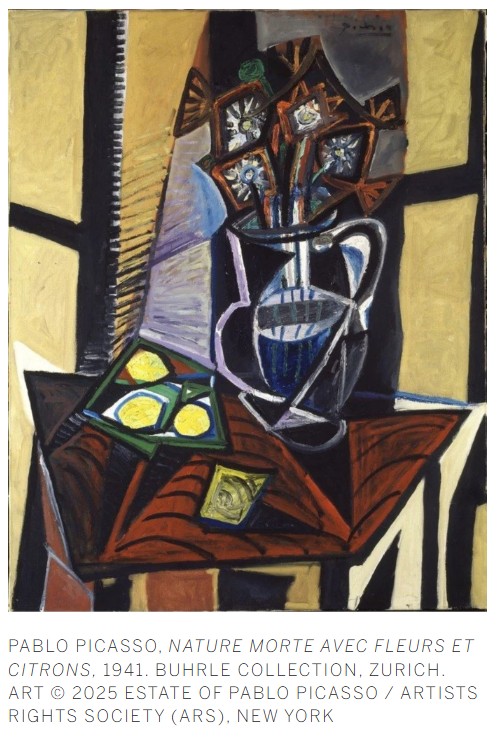
Cubist Still Life with Vase and Flowers epitomizes Roy Lichtenstein’s legendary Pop idiom and intellectual prowess, expanding his ongoing dialogue with the art historical canon. As one of a discrete series of eleven Cubist Still Life paintings Lichtenstein completed between 1973-75, of which four are held in prominent museum collections, and the only to feature a vase of flowers, the present work is a rare and important example within the artist’s iconic oeuvre. Cubist Still Life with Vase and Flowers pays homage to the legacy of Pablo Picasso, the father of Cubism and one of Lichenstein’s greatest influences, by directly invoking and subverting Picasso’s Cubist Still Life Flowers from 1939-43. Here, Lichtenstein has further abstracted Picasso’s fragmented picture plane, distilling the flowers and translucent vase to geometric planes of canary yellow, emerald green and soft peach. Further testament to the caliber of this painting, Cubist Still Life with Vase and Flowers has been widely exhibited at major international exhibitions, including his 1981 mid-career retrospective which included a leg at the Whitney Museum of American Art’s Breuer building on Madison Avenue.
Responding to one of the most iconic and enduring subjects in all of art history, the still life, Lichtenstein dismantles and refines his image in an investigation that is at once cerebral, satirical and utterly beautiful. Lichtenstein renders the translucent vase with a series of geometric shapes. His flowers are jagged geometric planes of yellow and white; his leaves are sharp triangles; his stems float above the vase, detached from their blossoms.
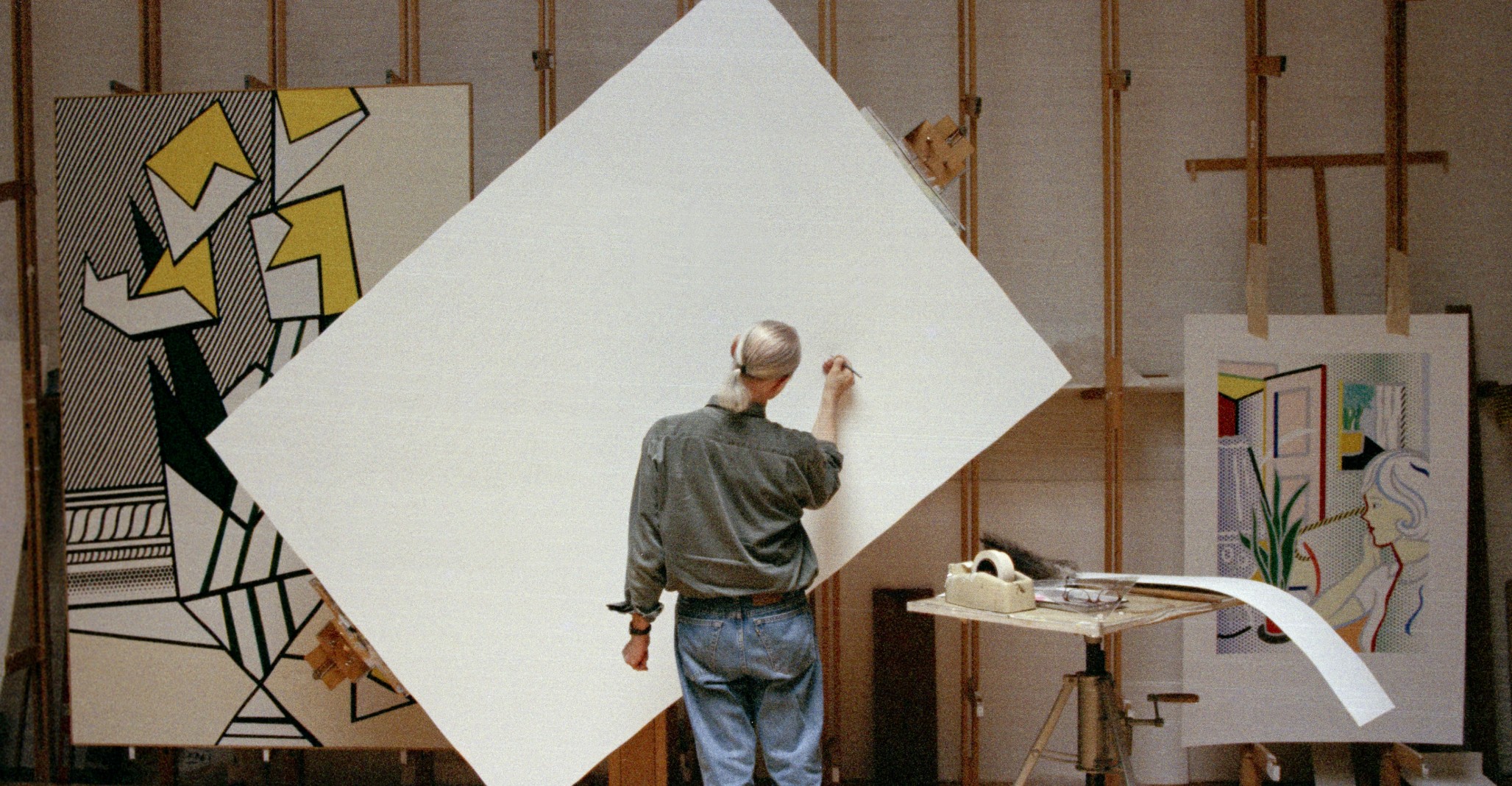
The present work with Roy Lichtenstein in his studio. Image © Bob Adelman Estate. Art © Estate of Roy Lichtenstein
Recalibrating Picasso’s 1939-43 work, Lichtenstein alters and augments his predecessor’s composition, omitting all but the vase from his composition. Lichtenstein’s fifth flower, an addition to the four featured in Picasso’s painting, rests outside of the vase—possibly fallen, removed or yet to be incorporated into the arrangement. This sole flower conveys a colossal presence: a symbol of ephemeral beauty, a gesture of affection, and here a signifier of the inherent artificiality of the composition. The fifth flower floats behind the translucent vase, but the viewer cannot see its stem through the glass. Lichtenstein has deconstructed the picture plane with bold geometric lines and flat planes of color, reimagining a very tangible subject into figments of a graphic, comic world. Behind the solitary vase, Lichtenstein has fractured the background, dividing the space into hash lines, fading Ben-Day dots, and even abstracted versions of his own Entablatures. In the present work, Lichtenstein’s play with Analytical Cubism is on full display, as the artist synthesizes multiple perspectival planes in a singular composition. The present work is a quintessential evocation of Lichtenstein’s fascination with art historical subjects which have become ubiquitous in popular imagery, such as the domestic still life.
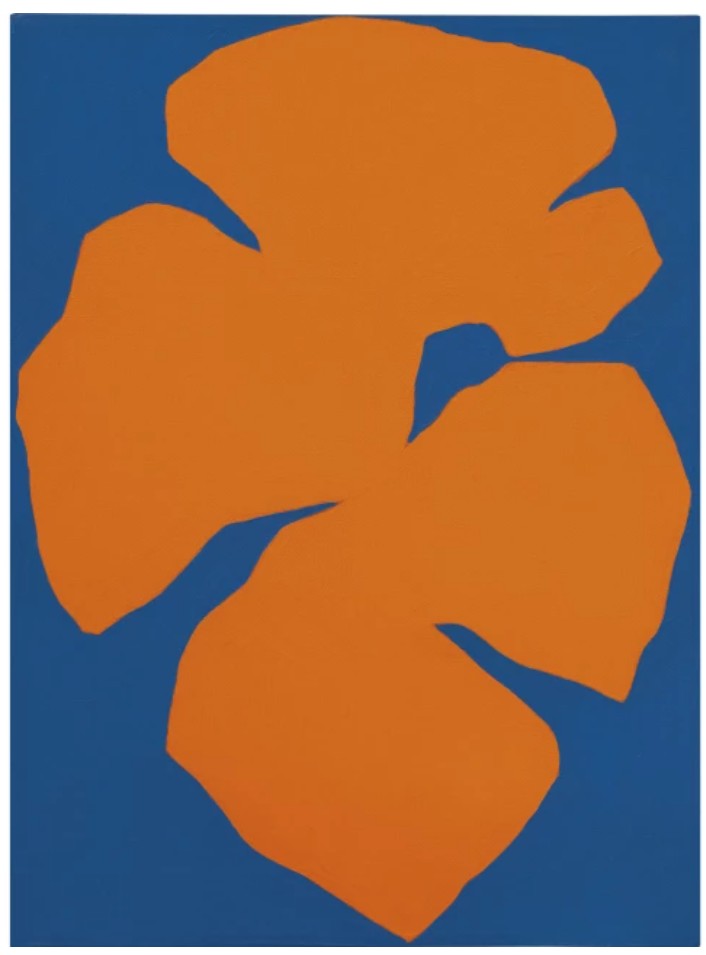
Ellsworth Kelly, Orange Blue, 1957. Private Collection. Art © Ellsworth Kelly Foundation.
For Lichtenstein, the 1970s marked a transition from the comic-book-inspired Pop paintings the defined his work of the 1960s to a witty interrogation of the art historical canon—from Classical architecture to Futurism, German Expressionism, Surrealism, Cubism and Art Deco. A pivotal year amid his explorations of the decade, 1973 marked Lichtenstein’s concerted inquiry into perhaps the most revolutionary movement of the Twentieth Century: Cubism. Even before this year, though, Picasso’s influence is evident in Lichtenstein’s oeuvre: Lichtenstein’s first overt response to Picasso appears in 1962 with the seminal painting Femme au chapeau. Lichtenstein’s interplay between form and fragmentation transforms the space in which the flowers and vase reside. Cubist Still Life with Vase and Flowers is an exceptional eulogy to the work of Picasso, with its subject matter recalling Picasso’s Cubist Still Life Flowers, and its rendition a manifestation of Lichtenstein’s refashioning of Cubist theory. Lichtenstein employs bold contour lines and flat geometric planes of color to both define and flatten space. Lichtenstein thereby takes Picasso’s Analytical Cubism a step further, using an economy of line and color to simultaneously evoke his processor and invent a wholly new style.
“What I am painting is a kind of Picasso done the way a cartoonist does it, or the way it might be described to you, so it loses the subtleties of Picasso, but it takes on other characteristics: the Picasso is converted to my pseudo-cartoon style and takes on a character of its own.” 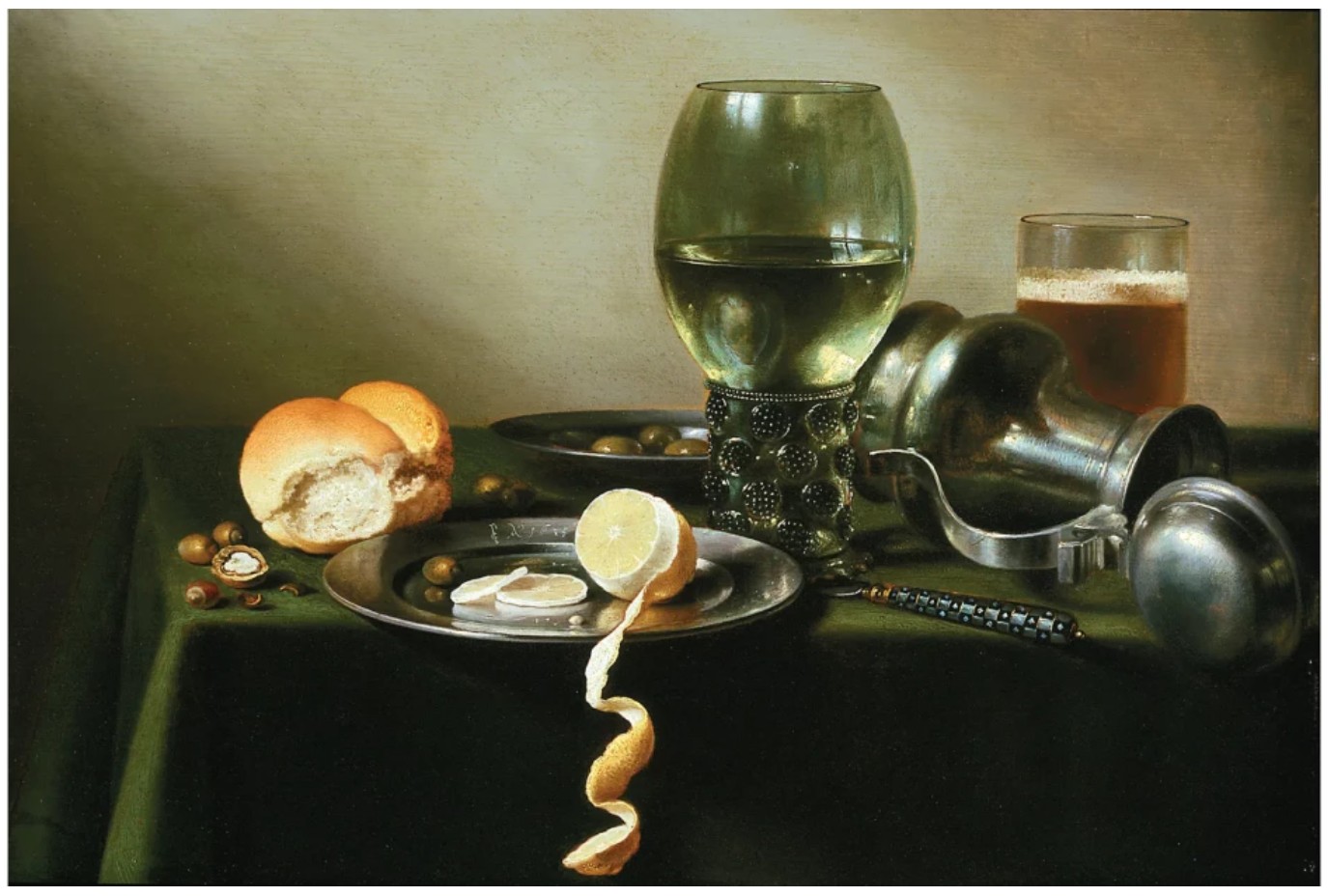
Pieter Claesz, Still Life with Overturned Jug, Glass of Beer, and Food, 1635. Private Collection. Image © 2025 Encyclopaedia Britannica
Not only a direct referent to Picasso, Lichtenstein’s work also harkens back to the history of still life painting. First gaining prominence in the Seventeenth Century as Vanitas paintings, the genre of still lives have become an essential part of a collector’s corpus. Conveyors of material identity, traditional still life paintings often reflected the wealth, status, and stylistic tastes of their owner. In European still life paintings, flower arrangements evoked a sense of aesthetic intuition and demonstrated a metric of class and decorative appeal. In turn, Cubism illustrates these objects against walls, deceptive patterns, and decorative interiors to collapse the distance between the painting and the two-dimensional surface. In a world of commodities, commercial advertising, and mass consumption, Lichtenstein reinterprets these historical subjects within popular culture.
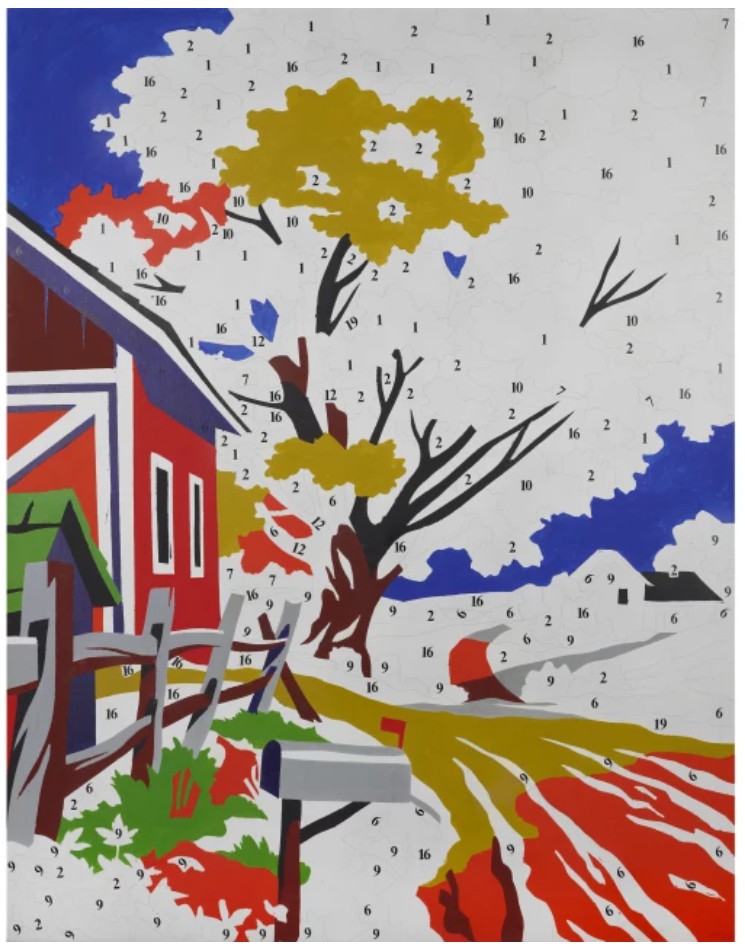
Andy Warhol, Do It Yourself (Landscape), 1962. Museum Ludwig, Cologne.
Image © bpk Bildagentur / Museum Ludwig / Rheinisches Bildarchiv Cologne / Britta Schlier / Art Resource, NY.
Art © 2025 Andy Warhol Foundation for the Visual Arts / Artists Rights Society (ARS), New York
Cubist Still Life with Vase and Flowers is a masterful exemplar of Lichtenstein’s unparalleled ability to synthesize the art historical canon with the visual lexicon of Pop. Monumental in scale, replete with canonical referents—from the subject of the still life to Picasso’s Analytical Cubism—Cubist Still Life with Vase and Flowers is a pure embodiment of Lichtenstein’s distinctive Pop vernacular and ability to reflect on and reinvent the icons of art history.
Cubist Still Life, 1974
Cubist Still Life, 1974
Sotheby’s New-York: 14 May 2024
Estimated: USD 700,000 – 1,000,000
USD 1,996,000
Cubist Still Life | Contemporary Day Auction | 2024 | Sotheby’s (sothebys.com)
ROY LICHTENSTEIN (1923 – 1997)
Cubist Still Life, 1974
Acrylic, oil, sand and graphite on canvas
20×24 inches (51 x 61.1 cm)
Signed and dated ’74 (on the reverse)
A striking kaleidoscope of intersecting colors, forms and patterns, Cubist Still Life from 1974 showcases Roy Lichtenstein’s mastery in engaging with and subverting the tenets and tropes of the twentieth century to synthesize his unique brand of Pop Art. The present work addresses the Cubist movement of the early 1900s head on, taking its distinct planes and abstracted forms and reconfiguring them into a radically innovative still life. The characteristic depiction of a table laden with plateware and fruit is made new and deftly rearticulated through Lichtenstein’s signature pictorial devices. Lichtenstein executed eleven paintings titled Cubist Still Life from 1973 to 1975, of which this is the third; at least four are in preeminent museum collections, underscoring the rarity and significance of the present work.

ROY LICHTENSTEIN, Cubist Still Life, 1974, National Gallery of Art
Cubist Still Life (nga.gov)
Initially focused on the consumer culture of postwar America in the early 1960s – its commercialism, abundance, and entertainment – Lichtenstein morphed this source material into his pioneering Pop iconography. The late 1960s and 1970s marked an undaunted departure from this subject; he turned his attention to Art History itself. Beginning with the Art Deco movement in 1966, Lichtenstein created the Modern Paintings and Sculptures series. In 1968, he moved to Impressionism with numerous iterations of haystacks and cathedrals that recall Claude Monet’s own. In 1973, he confronted Cubism with the Cubist Still Life series within which the present work belongs. Though he continues to apply art history throughout his illustrious career, Lichtenstein eventually concluded this investigation into the twentieth-century’s great movements with his Purist series in 1975.

PABLO PICASSO, STILL LIFE WITH COMPOTE AND GLASS, 1914-1915
COLUMBUS MUSEUM OF ART © 2024 ESTATE OF PABLO PICASSO / ARTISTS RIGHTS SOCIETY (ARS), NEW YORK
In the Cubist series, Lichtenstein once again reinterprets an iconic movement through his unique lens of Pop. By emulating Cubism, Lichtenstein delves into the rich still-life traditions of the past, exploring the ways the genre confronts the societal and artistic concerns of its time. The genre first gained prominence in the Netherlands during the early 1600s with Vanitas or memento mori paintings, which depicted food, objects and treasures as symbols for the transience of life and the vanity of earthly pursuits. Cubism in turn illustrated these objects alongside found materials, such as wallpaper and newspapers to collapse the distance between the painting and the two-dimensional surface. Lichtenstein employs his unique pictorial vocabulary of Ben-Day dots which are derived from modern day-printing techniques, to imitate this subject and create “copies,” which highlight the omnipresence of reproduction in contemporary society. Applying his hallmark limited palette, bold outlines, flat planes, and Ben-Day dots to the Cubist techniques of shallow relief like space and geometric layering, Lichtenstein succeeds in conveying the “idea” of Cubism in a contemporary language.

The vivid surface of red, yellow, black, blue, and green in Cubist Still Life may not mimic the tonality of Cubism, but the cropped perspective, juxtaposed textures and lush fruits certainly embody and pay homage to the movement and its authors – George Braque, Juan Gris, and Pablo Picasso in particular. Lichtenstein acknowledges the profound influence of Picasso on his own artistic development.
“Picasso always had an influence on me, together with Matisse, he is the enormous influence on twentieth-century art. When you think about Cubism, you think about Picasso…”
This influence is evident in Lichtenstein’s oeuvre as early as 1963 with Woman with Flowered Hat and 1964 with Still Life After Picasso, but it is further exhibited in Lichtenstein’s mélange of high and low art. As Picasso and his fellow Cubist artists integrated mass-produced media into their fine artworks to create Synthetic Cubism, Lichtenstein borrowed techniques from “lowbrow” comics to create his own style of Pop Art. Both Synthetic Cubism and Pop elevate the low and relegate the high, effectively blurring the traditional boundary between the two. By emulating comics, which present narratives and dialogue from various perspectives, Lichtenstein reveals yet another parallel to Cubism, a movement founded on synthesizing multiple viewpoints within a single composition. By fragmenting a single perspective and collapsing it across a composition, the resulting artwork emphasizes the two-dimensional flatness of the canvas support. This two dimensionality is enhanced by the Cubists’ illusionistic rendering of textures and collage. Lichtenstein captures the Cubist’s fondness for faux bois by meticulously replicating the pattern in thick, crips lines. These illusionistic techniques create a trompe l’oeil effect, drawing attention to the inherent visual deception and flatness of the picture plane.

ROY LICHTENSTEIN, STILL LIFE AFTER PICASSO, 1964
ART © 2024 ESTATE OF ROY LICHTENSTEIN, ALL RIGHTS RESERVED
The tension between representation and the inherent two-dimensional nature of art is a fundamental principle of twentieth-century Modernism, one that Lichtenstein engages with in his Cubist series. However, as Lichtenstein himself explains, “I am nominally copying, but I am really restating the copied thing in other terms. In doing that, the original acquires a totally different texture,” (Roy Lichtenstein quoted in Lawrence Alloway, Roy Lichtenstein, New York 1983, p. 106). In an era where images are paraphrased, condensed, and reproduced for widespread consumption, Lichtenstein understands and applies this process to Cubism, thus “Popifying” still life and ushering it into the new age.
Cubist Still Life, 1974
Cubist Still Life, 1974
Christie’s New-York: 16 November 2022
Estimated: USD 3,000,000 – 5,000,000
USD 2,700,000
ROY LICHTENSTEIN (1923-1997) (christies.com)
ROY LICHTENSTEIN (1923-1997)
Cubist Still Life, 1974
Oil and Magna on canvas
36×48 inches (91.5 x 121.9 cm)
Signed and dated ‘rf Lichtenstein ’74’ (on the reverse)
Painted in 1974, Roy Lichtenstein’s Cubist Still Life is a dazzling and perceptive homage to the Cubist paintings of Pablo Picasso and Juan Gris. Fragments of the objects that populate traditional still lifes, including grapes, lemons, a pipe and an apple, are placed atop a slanting tabletop, and rendered in vivid, high-keyed colors. In the present work, Lichtenstein engages in a dialogue with Cubist painting, which he then filters and reinterprets through his own Pop Art lens. Exceedingly rare, Cubist Still Life is one of only eleven paintings that Lichtenstein titled Cubist Still Life and painted between 1973 and 1975. Of these, at least three are located in major international and national museum collections, including Cubist Still Life (1974; National Gallery of Art, Washington, D.C.), Cubist Still Life with Pipe (1974; The Broad, Los Angeles), and Cubist Still Life with Lemons (1975; Ludwig Museum for International Art, Beijing/Ludwig Forum für Internationale Kunst, Aachen, Germany).
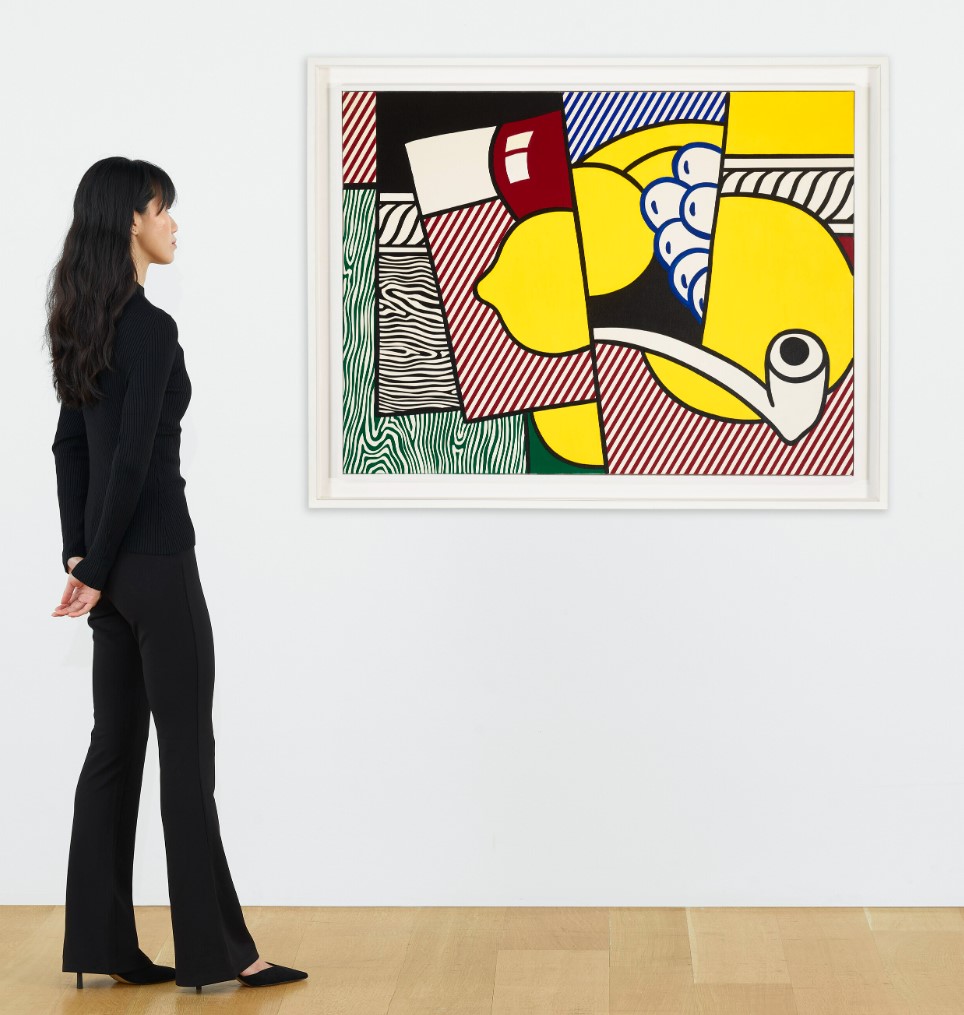
In this particular configuration, Lichtenstein has arranged several different vantage points within the same composition. Beginning along the right edge, he depicts a pipe and a yellow plate, which are placed upon a tabletop whose surface is dramatically foreshortened and rendered in raking diagonal lines. Proceeding toward the left, a cluster of grapes is caught in a glimpse, and this is followed by a shiny red apple and a pert yellow lemon. Everything is simplified, flattened and foreshortened, painted in primary colors and rendered with crisp, black outlines. 1974 is the year in which Lichtenstein invented the use of raking diagonal lines in his paintings, and in Cubist Still Life we find these in abundance. He also delights in the Cubist’s penchant for faux bois, which they combined with printed paper collage and painted in trompe l’oeil detail. This calls to mind the inherent flatness of the picture plane and the pictorial deceptions at play. Lichtenstein does all of this and more, conflating these Cubist techniques with his signature Pop Art style. The result is a witty reinvention that’s part pastiche, part homage, but also an ingenious way for a contemporary painter to engage with the past whilst finding ways to continue painting well into the future.
Cubist Still Life, 1974
Cubist Still Life, 1974
Sotheby’s London: 26 June 2018
Estimated: GBP 1,800,000 – 2,500,000
GBP 2,110,000 / USD 2,794,510
(#20) ROY LICHTENSTEIN | Cubist Still Life
ROY LICHTENSTEIN
Cubist Still Life, 1974
Oil, Magna and sand on canvas
30 1/8 x 36 1/8 inches (76.5 x 91.8 cm)
Signed and dated 74 on the reverse
Fusing a playful bright palette and a rigorous intellectual project, Cubist Still Life is a stunning articulation of Roy Lichtenstein’s brilliant command of line, colour and concept. Between 1972 and 1976, Lichtenstein composed a series of Still Life paintings in a plethora of art historical styles, ranging from nineteenth-century American still life, to Abstraction, Purism and Cubism. Extraordinarily rare, the present work is one of eleven Cubist Still Life paintings made between 1973 and 1975, and is one of only two from this group in which Lichtenstein used silver paint mixed with sand taken from the beach near his studio in Southampton, Long Island (the other such work – Cubist Still Life with Pipe (1974) – is held at The Broad in Los Angeles). Paying homage to the groundbreaking Cubist legacy of Pablo Picasso and in particular Juan Gris, the central pipe in the foreground of the present work, as well as the picture frame just behind, are pointedly redolent of Gris’ Synthetic Cubist works Water Bottle, Bottle and Fruit Dish (1915) and Guitar and Pipe (1913). Chosen by the present owner during a visit to the artist’s studio in 1974, Cubist Still Life was sought out by curator Jack Cowart – now Head of the Roy Lichtenstein Foundation – for inclusion in the landmark exhibition Roy Lichtenstein 1970-1980 which travelled from The Saint Louis Art Museum to the Seattle Art Museum, the Whitney Museum of American Art in New York and Fort Worth Art Museum. In a letter imploring the present owner to include the work in this show, Jack Cowart wrote: “the artist and I have been actively working for the last twelve months on the selection of those 50 paintings, 40 drawings, and 10 sculptures which will comprise the American tour. We are in agreement that your painting, Cubist Still Life, 1974, is the very best of its kind and is a work which we clearly need and fervently desire to represent Roy’s work of the period” (Jack Cowart, letter to the present owner, 23rd June 1980). Also included in Tate Liverpool’s Roy Lichtenstein exhibition in 1992 and Roy Lichtenstein: Meditations on Art at the Museo Triennale, Milan in 2010, this work is undoubtedly a standout example of the artist’s acclaimed Pop art take on the canon of Modernist art. In an ingenious pre-emption of the work of Sherrie Levine, Louise Lawler and Laurie Simmons within the Pictures Generation, Lichtenstein began to sample and refigure art historical paradigms from as early as 1962 through his work Femme au Chapeau after Picasso. Almost two decades before these artists launched their projects of appropriation and recontextualisation, Lichtenstein made pioneering headway in these postmodern practices. In Cubist Still Life, the artist makes use of sand and imitation wood grain to incarnate the papier collé and collage of Synthetic Cubism: an aesthetic spearheaded by Juan Gris and Pablo Picasso and characterised by the conglomeration of multiple materials and textures in the same work. Rather than deconstructing the object in accordance with Analytical Cubism – producing a fragmented image capturing all possible ways of perceiving it – Gris specifically depicted colourful, recognisable objects through tactile and three-dimensional surfaces that bordered on sculpture. Extending these gestures, Picasso created a number of works that literalised the suggestions of Synthetic Cubist painting within wooden sculpture. Thus, Cubist Still Life is principally an exceptional eulogy to the works of Gris and Picasso: its incorporation of sand recalling Gris’ Violin and Engraving (1913), and its imitation wood grain a reference to Picasso’s sculptural works such as Still Life (1914) and Violin and Bottle on a Table (1915).
There is also, however, a sustained conceptuality to the present work. The disjointed banana at the centre appears partly magnified by a glass lens and recalls the Mirrors of the early 1970s. Realised with invariant humour, the Mirrors announced a newfound interest in the mediations of contemporaneity; their reflections of Ben Day dots serving as a metaphor for the homogenising filter of postmodern retrospection. Lichtenstein was interested in how historic visual languages are recycled in contemporary life, and he embarked on the Still Lifes not to represent Cubist or Purist painting, but rather to represent their representations in decoration, marketing, film and pastiche. Moreover, Cubist Still Life is a beautiful thing in its own right. Indeed, Lichtenstein wanted his Still Lifes to be stunning additions to an interior space: the very kind of thing – ironically – that we might want to capture within a Still Life painting.
Hence, Lichtenstein’s Cubist Still Life works are, paradoxically, not Cubist at all; rather they are “cubistic and elegant. He intends them to be like a decorator’s cubism, with plays of pattern and color, Harlequin designs, and prismatic dislocations” (Jack Cowart cited in: Exh. Cat., St. Louis, The St. Louis Art Museum, Roy Lichtenstein: 1970 – 1980, 1981, p. 78). Given Lichtenstein’s eye for recognisability and wall-power, it stands to reason that Gris’ still life works – whose objects “[gave] the impression of having… an exact equivalent in the material world” – appealed to Lichtenstein more than any other (John Golding, Cubism: A History and An Analysis: 1907 – 1914, London 1959, p. 135). Cowart corroborates this view, suggesting that “if there are sources for this evolution, they are in the works of Léger and more especially Juan Gris…Gris’s inventive unpredictable subjects and highly finished decisive-looking renderings interest Lichtenstein” (Jack Cowart, op. cit., p. 82).
There is a palpable eroticism to the objects in Cubist Still Life. Exuding a luscious sheen not unlike the cherry in Claes Oldenburg and Coosje van Bruggen’s sculpture Spoonbridge and Cherry (1985-88), the apple on the far right is pierced by the sharp edge of the central plane, and a pert, nipple-like lemon rests atop the patently phallic mirror imagery of the banana and pipe. In the present work Lichtenstein builds upon enduring art historical traditions that extend back to the Byzantine and Roman eras: the eroticism of fruit as borne out in Baroque and seventeenth-century Dutch schools, and the tradition of Vanitas and Nature morte which remind the viewer of life’s morbidity and ephemerality. By contrast, Lichtenstein’s glossy figures locate sex within a context of levity, modernity and commerciality. Richard Hamilton’s rhetorical question – ‘Just what is it that makes today’s homes so different, so appealing?’ – appears answered within the image-fetish and felt sexuality of Cubist Still Life.
Tom Wesselmann – Lichtenstein’s astute Pop art peer – blurred the dichotomy between the authentic and the copy in his Still Life works; installing uncanny versions of nineteenth-century century portraiture and de Stijl paintings onto the walls of his interior spaces. Likewise, Lichtenstein’s motif of the imitation woodgrain is a way of playing on the concept of authenticity with which woodgrain is associated. The symbol is a kind of paradox: the stamp of an authentic Pop art work that rejects, implicitly, the notion of authenticity. Indeed the imitation woodgrain was so significant an image that it was sometimes designated as the principal subject; for example in Painting with Blue and Yellow Wood Grain (1983). Serving as a perfect example of Lichtenstein’s project as well as boasting some of the rarest qualities possessed by any member of his oeuvre, Cubist Still Life performs both a tribute to and transformation of some of the most important landmarks in early twentieth-century art history.
Two Apples, 1972
Two Apples, 1972
Christie’s New-York: 12 May 2010
Estimated: USD 400,000 – 600,000
USD 2,210,500
Roy Lichtenstein (1923-1997) , Two Apples | Christie’s
ROY LICHTENSTEIN (1923-1997)
Two Apples, 1972
Oil and magna on canvas
20 1/4 x 24 inches (51.4 x 60.9 cm)
Signed and dated ‘rf Lichtenstein ’72’ (on the reverse)
In 1972, Roy Lichtenstein began his Still Life series of paintings, turning his Pop focus on this ancient genre of art. Painted that year, Two Apples perfectly encapsulates the dramatic and dynamic tension that comes from this confrontation between the old and the new, between so-called “High Art” and the highly-evolved short-hand used in advertising. Here, the common association of the still life with the memento mori has been banished, replaced by a crisp vitality that speaks only of life, and of the apples’ delicious taste.
In a sense, Two Apples is a contemporary update of the legend of Zeuxis, the ancient Greek painter whose images of fruit were so lifelike that birds flew down to try to eat them. So too, Lichtenstein has created this picture by tapping into a modern visual language which results in a depiction of apples that is so crisp and perfect that, to our ad-savvy eye, it becomes desirable. And yet these apples have been presented in a manner that is so explicitly, overtly and knowingly artificial – with black outlines for the shape of the fruit, white voids for the reflection in their perfect, shiny skin and dots and monochrome to represent the colored wall and table respectively – that while “reading” the picture, we certainly know that we cannot reach out and touch them.
It was this phenomenological gap that Lichtenstein explores in his paintings, taking the visual appearance of industrial print industry and rendering it through traditional media, with paint, brush and canvas. He has boiled the image of these luscious apples, the fruit so often associated with the temptations of knowledge and its pitfalls, down to an absurdly minimal group of forms: dots, lines and blocks of color. Lichtenstein was fascinated by the gradual development of a visual iconography in comics and advertising and saw it as a modern parallel to the development of “classical form.” These apples represent an almost Platonic ideal, the perfect invocation of apple-ness for our consumer age. But as he explained, today, “It’s not called classical, it’s called a cliché. Well, I’m interested in my work’s redeveloping these classical ways, except that it’s not classical, it’s like a cartoon” (Lichtenstein, quoted in D. Sylvester, Interviews with American Artists, London, 2002, pp. 226-27). By invoking this cartoon classicism, Lichtenstein has ripped away the suspension of disbelief, that reflex interpretation that these apples cannot help but conjure up in the viewer. As he explained, “My use of evenly repeated dots and diagonal lines and uninflected color areas suggest that my work is right where it is, right on the canvas, definitely not a window into the world” (Lichtenstein, quoted in J. Coward ed., Roy Lichtenstein: Beginning to End, exh. cat., Madrid, 2007, p. 52).
APPLES
Two Red and Yellow Apples, 1981
Two Red and Yellow Apples, 1981
Christie’s New-York: 15 November 2018
Estimated: USD 600,000 – 800,000
USD 1,692,500
Roy Lichtenstein (1923-1997), Two Red and Yellow Apples | Christie’s
ROY LICHTENSTEIN (1923-1997)
Two Red and Yellow Apples, 1981
Oil and Magna on canvas
24×28 inches (60.9 x 71.1 cm)
Signed and dated ‘© rf Lichtenstein ’81’ (on the reverse)
Provenance
Leo Castelli Gallery, New York
Galerie Beyeler, Basel
Anon. sale; Sotheby’s, New York, 9 May 1984, lot 8
Acquired at the above sale by the present owner
After his iconic paintings of comic-strip heroines, still lifes were probably the most important and extensive subject matter that occupied Roy Lichtenstein throughout his career. From some of his earliest paintings such as Black Flowers, 1961, to his Brushstroke Still Life series from 1997, Lichtenstein sought to re-invent one of the noblest of artistic genres for the Pop age. Two Red and Yellow Apples takes as its subject one of those most familiar tropes immortalized by countless artists including Caravaggio, Cranach the Elder, Cézanne, Gaugin, Courbet, Magritte, rendering it in a dramatically new and energetic way. The Pop artist’s rendering of bold, graphic gestures and fluid brushstrokes defines what lies at the heart of his work—a thorough and systematic examination of how we look at objects, and how we then represent them in a visual medium.
Rendered in a series of dramatic signs, Lichtenstein’s fruit appears out of a flurry of stylized brushstrokes. Solid black lines denote the outline of the fruit, while colorful passages of red and yellow make up their shiny surface. Large and imposing, these apples dominate the composition, pushing out the additional elements that, historically speaking at least, were often included in still life paintings. This this lack of extraneous material thereby focusing attention on the purely formal aspects of the fruit. Concentrating attention on optical nature of light and shadow, Lichtenstein’s dramatic style encourages us to decipher what we are seeing for ourselves, rather than presenting us with a straightforward, realistic depiction of the appearance of the fruit. The apples are placed against a flat plane made up of red, yellow and blue sweeps of color, disrupting the conventional notion of perspective that normally accompanies a painting such as this. Finally, an area of black cross-hatching that occupies the lower left quadrant—and most of the lower edge—continues Lichtenstein’s interest in the nature of printing and the mechanical representation that he explored in the comic book paintings that launched his career.
Despite the apparent simplicity of his Pop aesthetic, Lichtenstein was deeply interested in the physical optics of how we look at objects. As part of his studies at Ohio State University he was taught to examine the visual properties of his chosen subject matter as much as their outward physical appearance. In his influential book Drawing by Seeing, Hoyt L. Sherman, one of Lichtenstein’s professors, encouraged people to develop a new way of drawing. “Students must develop an ability to see familiar objects in terms of visual qualities,” he said, “and they must develop this ability to the degree that old associations with such objects will have only a secondary or a submerged role during the seeing-and-drawing act” (H. L. Sherman, quoted by B. Rose, The Drawings of Roy Lichtenstein, exh. cat., Museum of Modern Art, New York, 1987, p. 29). For Lichtenstein, these “familiar objects” initially became the cheap comic books that were sold by their millions in grocery stores and newsstands across the country. Their mass-produced aesthetic reduced the world to bold, flat and often black-and-white or primary colored renditions; gone were the delicate subtleties of traditional chiaroscuro, replaced instead by bold hatching and Ben-day dots.
In addition to his interest in the way we learn to look at objects, Lichtenstein also had a detailed interest in—and understanding of—art history, and after comic book heroines, he went on to explore the aesthetic language of German Expressionism, Cubism and Surrealism. In Two Red and Yellow Apples, he utilizes the vocabulary of Abstract Expressionism in his rendering of the gestural brushstrokes and drips that make up the image—all qualities celebrated in the work of the Masters of the genre such as Willem de Kooning and Jackson Pollock. Brushwork was also important in the work of Paul Cézanne and his loosely applied blocks of color assembled to produce atmospheric landscapes and still lifes. “For an Impressionist, to paint from nature is not to paint the subject, but to realize sensation,” the French artist is reported to have said; Lichtenstein, like Cézanne, was not merely interested in reproducing the appearance of an object verbatim, rather he was interested in a deeper, more meaningful connection. In addition to Post-Impressionists who often painted still lifes featuring apples, the fruit has a much longer association with artists thanks to its central role in the biblical story of Adam by Eve. Representing the act of original sin, in additional to more ancient symbolism of being an allegory for knowledge and youth, the apple has been a longstanding object of fascination for generations of artists as an object echoing with both spiritual and temporal meaning.
But in rendering the apples in a series of gestural brushstrokes as he does here, Lichtenstein celebrates the idea of the artist and the artistic process as much as he does the subject matter. Using incredible draftsmanship and skill, he strategically manipulates, reorganizes and reframes his subjects, and engages in a complex dialogue with his forefathers, allowing the painting to become more than the sum of its parts. It is no short order to re-invent one of the oldest genres of painting, the still life. Lichtenstein manages to utilize his trademark pictorial vocabulary to redefine what on the surface seems apparently naïve, but is actually highly sophisticated and results in a compelling reexamination of the nature of representation.
Flowers, 1981
Flowers, 1981
Christie’s New-York: 22 November 2024
Estimated: USD 1,000,000 – 1,500,000
USD 1,134,000
ROY LICHTENSTEIN (1923-1997), Flowers | Christie’s
ROY LICHTENSTEIN (1923-1997)
Flowers, 1981
Acrylic and graphite on canvas
48 1/8 x 36 inches (122.3 x 91.4 cm)
Signed and dated ‘rf Lichtenstein ’81’ (on the reverse)
Roy Lichtenstein’s Flowers from 1981 astutely demonstrates the Pop artist’s interest in, and reverence for, art history. Along with Andy Warhol, Lichtenstein championed one of the twentieth century’s most distinctive art movements, yet he also spent much of his career pursuing a serious examination of how people view and comprehend images. In the present work, he takes two of art history’s most important genres—the still life and abstraction—and combines them into one dynamic painting. Lichtenstein represents the bold, gestural brushstrokes of the Abstract Expressionist painters in his characteristic Pop Art style. Colorful and bold brushstrokes traverse the canvas, mapping out the image of a vase of flowers. Here, Lichtenstein is at his most insightful, producing an amalgam of two seemingly diametrically opposed postwar American art movements. Flowers demonstrates both his intellectual as well as aesthetic interest in art, and stands as a testament to the unbridled creative impulse and sharp intellect behind the works of one of the most important figures in the American postwar canon.
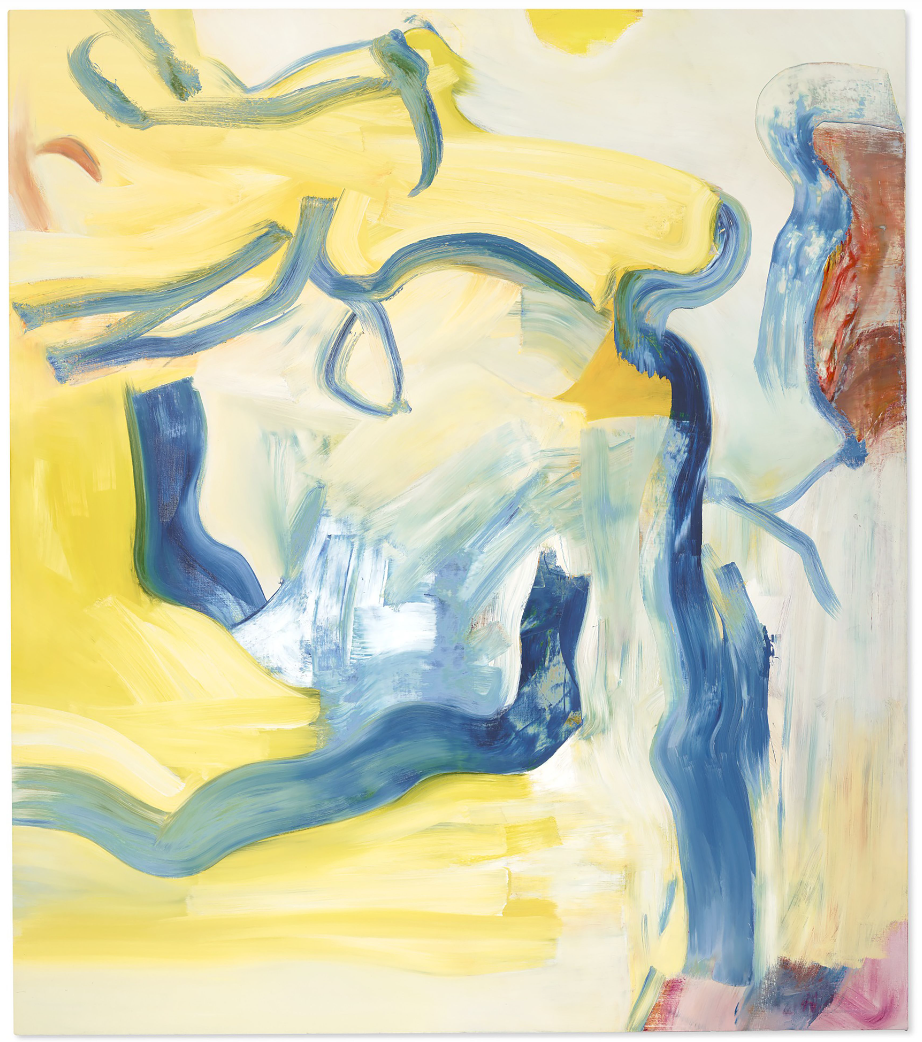
Willem de Kooning, Untitled VII, 1981. © 2024 The Willem de Kooning Foundation / Artists Rights Society (ARS), New York
The strongly gestural brushstrokes depicted in Flowers move around the painting’s canvas with a determined sense of purpose, a boldly passionate testament to the expressive will of an action painter in the vein of Willem de Kooning and Franz Kline. Long, fluid lines frame the edges of the painting, while shorter bursts of color provide detail and a sense of frenetic movement. The color of each brushstroke is clearly delineated, fully and flatly embodying a single shade of color, as if it were in fact a commercial illustration or reproduction of a brushstroke. The tonal palette in the present work is both bold and fauve-like, with the dominant yellow hue, interspersed with touches of green, red, and black, creating a vibrant yet controlled energy. Lichtenstein’s decision to avoid shading and gradients highlights the flatness of the composition, a technique reminiscent of his comic-strip influences, where areas of color do not aim to mimic reality but instead create a simplified, graphic effect. Flowers does not aim to depict a series of brushstrokes per se; instead, Lichtenstein aims to depict the representation of brushstrokes. At first, the viewer might perceive Flowers as a totally abstract work, where Lichtenstein’s only subject is abstract painting itself. However, after a closer look, a composition begins to rise out of the gestural abstraction – a clearly portrayed vase containing the titular flowers arises at the center of the painting, delineated by a few simple brushstrokes. The deliberate, almost mechanical execution of these bold lines contrasts with the domestic subject matter, resulting in a sense of artificiality that reflects Lichtenstein’s Pop Art sensibilities. The primary subject of Flowers is not abstract painting writ large – Flowers is a uniquely postmodern still-life painting, one that combines Pop Art, Abstract Expressionism, and still-life art all at once.
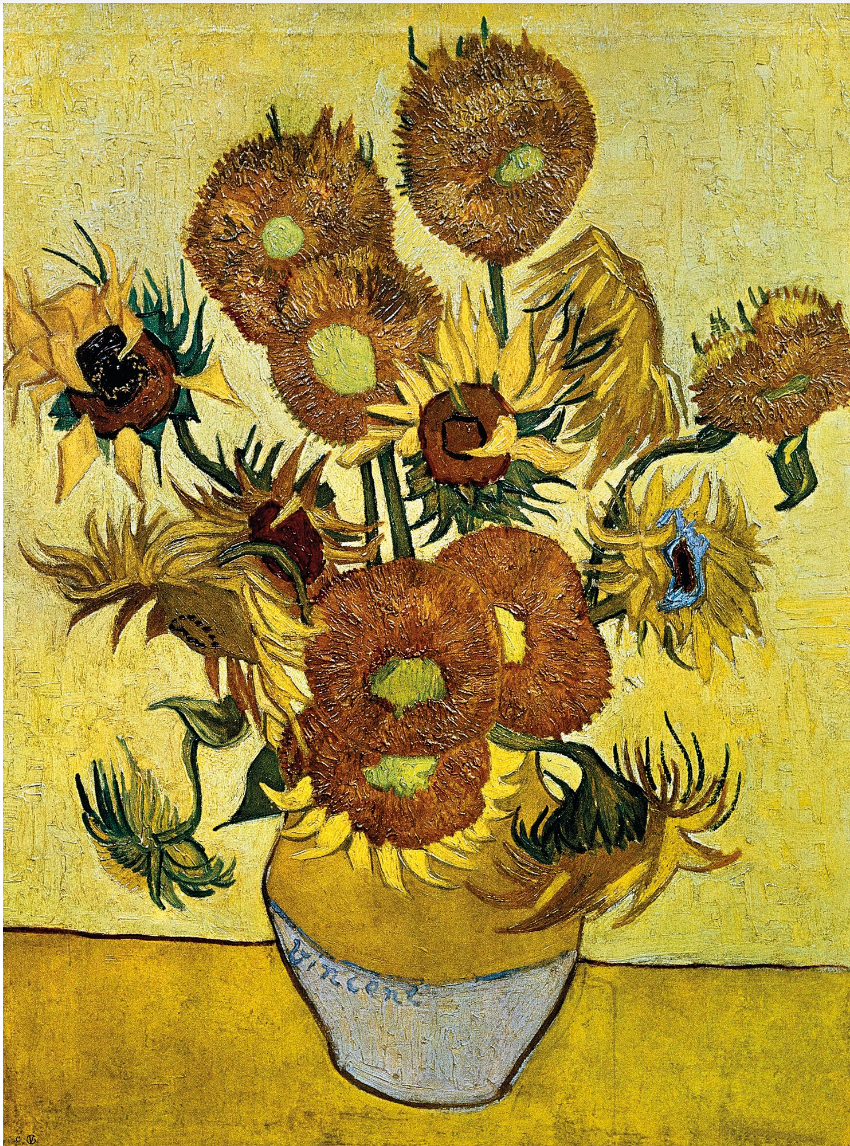
Vincent van Gogh, Sunflowers, 1889. Van Gogh Museum, Amsterdam. Photo: Album / Art Resource, New York.
Roy Lichtenstein spent much of his career examining the tropes of art history; from Cubism to Expressionism and from Surrealism to Abstraction he deconstructed the different techniques of painting only to regenerate them in new and different ways. Starting in the early 1960s, he arrived at the signature style that would bring him international fame and renown. Lichtenstein began painting works that appropriated mass-produced images from popular comic books and supermarket romance novels. Lichtenstein’s most iconic paintings, including Look Mickey (1961), Drowning Girl (1963), and Whaam! (1963) feature cartoon text bubbles, the Ben Day dots of comic-book printing, and figures from comic books. While Flowers is executed in a style akin to that of those early 1960s paintings, its subject matter is rather different. It is part of Lichtenstein’s celebrated Brushstrokes series, where the artist changes his subject to art history itself. The Brushstrokes paintings depict the gestural expressions of the brushstroke itself, some simply portraying a single, bold, totemic brushstroke. By sifting the signature technique of the New York School through a filter of Ben Day dots and an exaggeratedly cartoonish style, Lichtenstein’s Brushstrokes examined composition and design over the heightened action and emotion of American abstract painters. In Flowers, Roy Lichtenstein demonstrates the continued evolution of his practice, applying his signature Pop Art technique to a different series of subjects – the bold gestures of the Abstract Expressionist art and a universal still life. While earlier works like Look Mickey and Whaam! focused on comic-book characters and narratives, Flowers and his Brushstroke series tackle the process of painting itself, reducing expressionist gestures to graphic, mechanical forms. By distilling the intensity of the Abstract Expressionist brushstroke into cold, calculated marks, Lichtenstein parodies the emotional spontaneity associated with postwar American painting, replacing it with a playful yet deliberate reflection on the construction of art and the painter’s tools.
Two Apples, 1981
Two Apples, 1981
Sotheby’s New-York: 19 May 2017
Estimated: USD 700,000 – 1,000,000
USD 852,500
ROY LICHTENSTEIN
Two Apples, 1981
Magna on canvas
24×24 inches (61×61 cm)
Signed and dated ’81 on the reverse
Provenance
Estate of the artist
Mitchell-Innes & Nash, New York
Acquired from the above by the present owner in November 2001
With its bold palette and stark composition, Two Apples from 1981 is a consummate example of Roy Lichtenstein’s ever-evolving and inquisitive exploration of art-making, perfectly encapsulating the artist’s ingenious ability to create art that addresses itself. Lichtenstein’s artistic practice, partly reacting against and emerging from the shadow of Abstract Expressionism, came to define the core basis of Pop Art. The present work, created at the peak of Lichtenstein’s revolutionary and imaginative career, encapsulates Pop Art at its most refined and self-aware.
Lichtenstein maintained that he was interested largely in the abstract qualities of his art, and in Two Apples, that penchant for achieving abstraction within a figurative composition is clear. The entirety of the canvas is covered in strategically placed and sparingly used, brazen comic book brushstrokes that swish across the picture plane to convey color and light. A viewer knows the composition well. It is a familiar still life—the yellow apple in the foreground rests perfectly in front of the lazily reclining red apple behind it. The scene is set in an indiscriminate room with one, lonely window and both fruits cast a dark shadow. Here Lichtenstein draws an obvious parallel to the modern still life—particularly the apple-filled still lifes of Paul Cézanne. The artist reimagines the still life in his arresting style; Lichtenstein’s scintillating use of negative space coupled with the dynamic motion of the swooshing strokes together creates a composition that looks out into the world and embraces “Pop’s assertion that is was an art addressing itself to the world it embodied” (ibid., p. 39).
Not only does the present work ‘address the world it embodies’ but it also is cleverly self-referential alluding in many ways to Lichtenstein’s own artistic career. Two Apples relates to the artist’s Brushstroke paintings from 1965-1966, his 1970s series of Pop reimagined paintings by masters such as Cézanne and Picasso, as well as his cliché still lifes of the decade. Here, Lichtenstein brilliantly incorporates his corpus by sharpening and elevating his critique of not only Abstract Expressionism but also still life genre painting by modern masters. In Two Apples, Lichtenstein transcends Pop with a decidedly Postmodern display. Through a cursory look at Lichtenstein’s artistic career it appears that the link throughout is not thematic but stylistic. However, through deeper contemplation it becomes apparent that the underpinning of his practice and what unites his early canvases with those executed during the apex of his career, is a resolute dedication to creating impactful work that subtly questions and critiques the history of art-making. Engaging in its stark and impressive composition, Two Apples proudly displays the terms of its own making and exhibits Lichtenstein’s most fascinating focus of attention—art itself.
LATE STILL LIFES
Still Life with Two Grapefruits, 1994
Still Life with Two Grapefruits, 1994
A Legacy Reimagined: Works from the Collection of Dorothy and Roy Lichtenstein
Sotheby’s New-York: 19 November 2025
Estimated: USD 800,000 – 1,200,000
USD 1,270,000
Still Life with Two Grapefruits | Contemporary Day Auction | 2025 | Sotheby’s
ROY LICHTENSTEIN (1923 – 1997)
Still Life with Two Grapefruits, 1994
Acrylic, oil and graphite on canvas
30 1/8 x 24 1/8 inches (76.5 x 61.2 cm)
Signed and dated ’94 (on the reverse)
Radiant in color and crystalline in form, Still Life with Two Grapefruits (1994) exemplifies the assured refinement of Roy Lichtenstein’s late style. At once playful and rigorous, the work belongs to the artist’s celebrated body of still lifes that spanned more than two decades and came to define his dialogue with the grand traditions of painting. Here, two glowing spheres of yellow fruit are presented with schematic clarity, anchored on a sharply tilting tabletop. The familiar subject is transformed through the precision of Pop, becoming not an evocation of touch or taste but a distilled image of form, color, and sign.
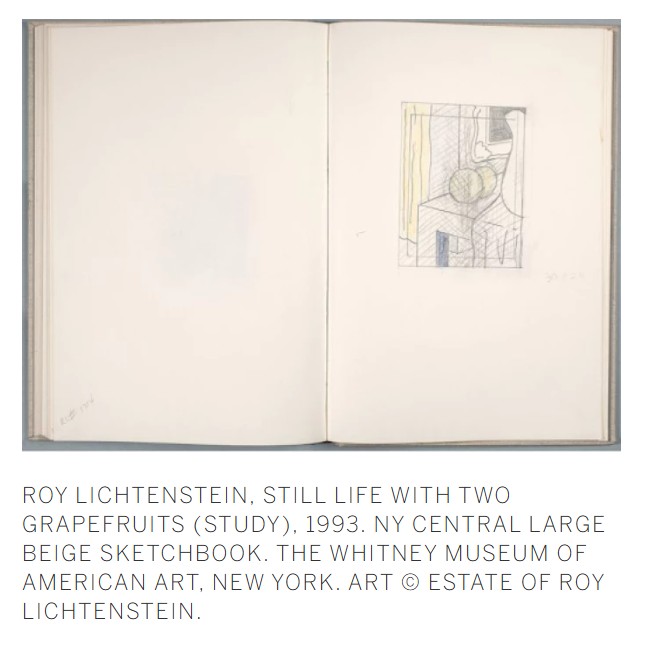
Lichtenstein’s fascination with still life first surfaced in the late 1970s, when he turned from the comic strip heroines and explosive dramas of his early Pop years to the quieter genres of art history. The still life offered him a laboratory in which to measure the language of modernism against his own graphic idiom. Grapes, bowls, and fruit recur across these canvases, but never as objects of sensual realism. Instead, they are reconstituted through black contour lines, flat fields of primary color, and the disciplined geometry of Ben-Day dots. In Still Life with Two Grapefruits, this language reaches a point of crystalline focus: the fruit appear almost as emblems, pared down to pure shape, hovering between depiction and abstraction.
The composition demonstrates Lichtenstein’s consummate control of balance and rhythm. The tabletop slices diagonally across the field, creating a taut counterpoint to the round perfection of the grapefruits. Shadow and light are handled with absolute economy—arcs of black and gray carve space with schematic force, while the expanse of white surrounding the objects lends them an almost iconic presence. Every element feels exact, deliberate, and resonant. The result is a composition that radiates calm authority, at once playful in subject and monumental in clarity.
“When we think of still lifes, we think of paintings that have a certain atmosphere or ambience. My still life paintings have none of those qualities, they just have pictures of certain things that are in a still life, like lemons and grapefruits and so forth. It’s not meant to have the usual still life meaning.”
In doing so, the painting situates itself in the lineage of still life as a stage for artistic invention. The grapefruits, like Cézanne’s apples or Matisse’s fruit bowls, are less about the objects themselves than about the possibilities of form and perception. But whereas the modernists built volume, depth, or coloristic complexity, Lichtenstein pursues flatness and graphic precision, filtering the inherited conventions of painting through the lens of Pop. His grapefruits are at once homage and reinvention: ordinary fruit reimagined as signs, the everyday elevated into the timeless register of art. Painted the year after the Guggenheim retrospective that toured internationally, Still Life with Two Grapefruits belongs to a moment when Lichtenstein revisited his signature motifs with renewed clarity and ambition. The 1990s marked a period of summation in his career, when his vocabulary—already iconic—was honed to its essentials. In this context, the still life becomes not a departure but a culmination, affirming the centrality of representation itself to his lifelong practice. What once had been the heroic brushstroke or the comic heroine is here distilled into two pieces of fruit, presented with equal seriousness and wit.
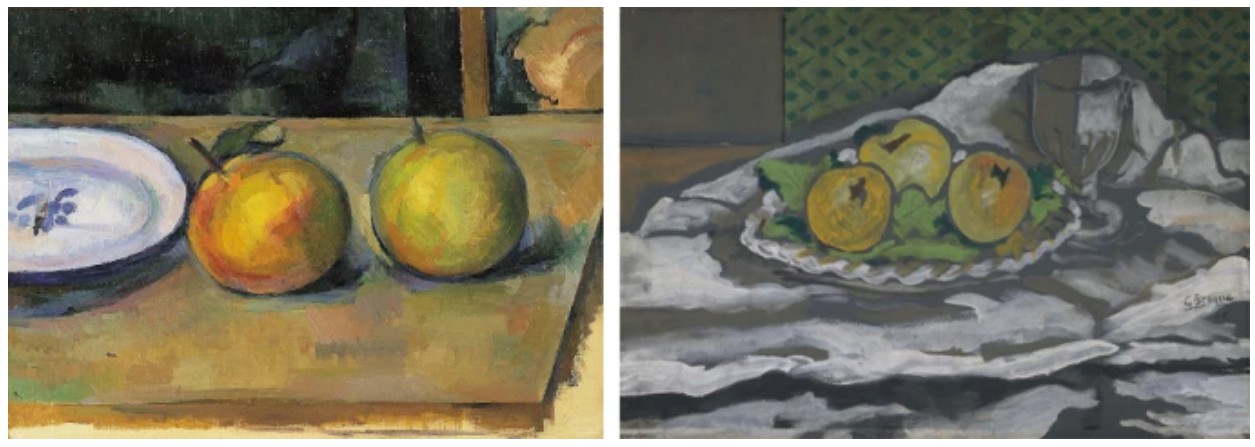
Left: Paul Cézanne, Deux pommes sur une table, c. 1895-1900. Speed Art Museum, Louisville, Kentucky.
Right: Georges Braque, Glass and Plate of Apples, 1925. Tate London.
The wit lies precisely in the denial of illusion. The grapefruits carry no texture, no translucence, no softness of touch. They are instantly recognizable yet entirely artificial, their presence defined not by realism but by line and color alone. Lichtenstein turns banality into emblem, the everyday into sign. This paradox—between immediacy and mediation, familiarity and estrangement—animates the painting, as it does much of his oeuvre. In its restraint, Still Life with Two Grapefruits achieves a remarkable clarity. It is at once a quiet canvas and a bold statement, a painting that collapses centuries of art history into the flat surface of Pop. With its luminous color, graphic force, and conceptual precision, the work stands as one of the most elegant distillations of Lichtenstein’s late production: the humble still life, recast as image, as icon, as pure painting.
Still Life: Red Apples, 1993
Still Life: Red Apples, 1993
Christie’s New-York: 22 November 2024
Estimated: USD 500,000 – 700,000
USD 793,800
ROY LICHTENSTEIN (1923-1997), Still Life – Red Apples | Christie’s
ROY LICHTENSTEIN (1923-1997)
Still Life: Red Apples, 1993
Acrylic, oil and graphite on canvas
18×20 inches (45.7 x 50.8 cm)
Signed and dated ‘rf Lichtenstein ’93’ (on the reverse)
STUDIES
Cover Image for Guggenheim Magazine (Study), 1993
Cover Image for Guggenheim Magazine (Study), 1993
A Legacy Reimagined: Works from the Collection of Dorothy and Roy Lichtenstein
Sotheby’s New-York: 19 November 2025
Estimated: USD 800,000 – 1,200,000
USD 1,255,000
Cover Image for Guggenheim Magazine (Study) | Contemporary Day Auction | 2025 | Sotheby’s
ROY LICHTENSTEIN (1923 – 1997)
Cover Image for Guggenheim Magazine (Study), 1993
Graphite, tape, cut painted and printed paper on board
Image: 40 1/2 x 31 7/8 inches (102.9 x 81 cm)
Board: 48 5/8 x 40 inches (123.5 x 101.6 cm)
Signed and dated ’93 (on the verso)
Executed in 1993 at the culmination of a career already canonized in the history of twentieth-century art, Cover Image for Guggenheim Magazine (Study) represents a moment of consummate visibility for Roy Lichtenstein: an artist whose vocabulary of Ben-Day dots, bold outlines, and chromatic clarity had come to define Pop itself. Created specifically for use on the cover of Guggenheim Magazine in conjunction with the artist’s landmark retrospective at the Solomon R. Guggenheim Museum (October 8, 1993 – January 16, 1994), the present work embodies both the intimacy of preparatory study and the grand cultural stage on which Lichtenstein now stood. At once collage, design, and image of enduring resonance, it distills the essential characteristics of Lichtenstein’s practice into a compact and striking still life.
“I am nominally copying, but I am really restating the copied thing in other terms. In doing that, the original acquires a totally different texture. It isn’t thick or thin brushstrokes, it’s dots and flat colors and unyielding lines.”
The 1993 retrospective, which subsequently traveled to major international institutions including the Museum of Contemporary Art, Los Angeles; the Musée des Beaux-Arts, Montréal; Munich’s Haus der Kunst; Hamburg’s Deichtorhallen; Brussels’s Palais des Beaux-Arts; and the Wexner Center for the Arts in Columbus, was the most ambitious survey of Lichtenstein’s work to date. The decision to place an original Lichtenstein collage on the cover of the Guggenheim’s official magazine signaled not only the centrality of his practice to postwar American art but also his recognition as an artist whose imagery had long since entered the collective imagination. The magazine cover was more than an ephemera of museum publicity: it was a testament to the mutual embrace between institution and artist, between Pop art’s language of mass communication and the sanctity of the museum space.
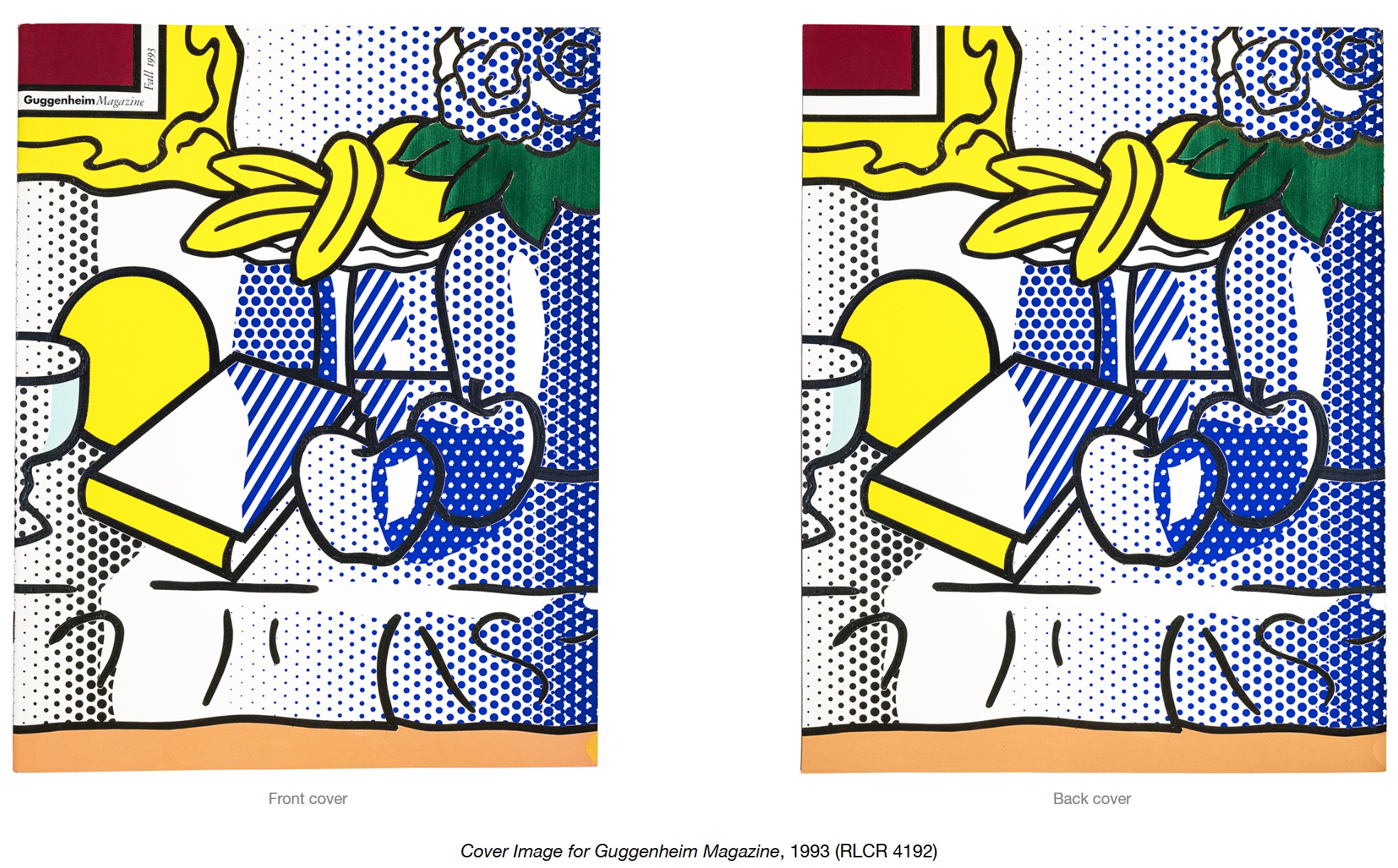
Formally, Cover Image for Guggenheim Magazine (Study) is both playful and rigorous. The composition belongs to Lichtenstein’s long engagement with the still life genre, a dialogue that had preoccupied him since the late 1970s. Here, fruit, vase, framed painting, and tabletop are reduced to their essential graphic contours and presented in a shallow, compressed space. Bananas, apples, flowers, and a book are articulated through his signature Ben-Day dots and blocks of primary color: yellow, blue, red, and green assert themselves with clarity, while black contour lines lock forms into place. The still life, one of painting’s oldest genres, is thus reimagined in the idiom of Pop—flattened, graphic, at once familiar and estranged. The choice of subject is telling. At the very moment when his career was being surveyed across continents, Lichtenstein offers the still life: the genre historically associated with painting’s capacity for reflection, arrangement, and mastery. But here the reflection is doubled. Just as his Reflections series had fractured and refracted images of comic heroines or abstract brushstrokes, this still life is not about abundance or domesticity but about mediation. A book lies open, its pages reduced to flat zones of white and blue striping; a vase tilts toward the viewer, almost schematic in its simplicity; fruit is rendered not with sensual modeling but with crisp edges and patterned dots. Each element speaks less to its materiality than to its image—an image whose function is to signify “book,” “fruit,” “table” in the most economical terms possible.
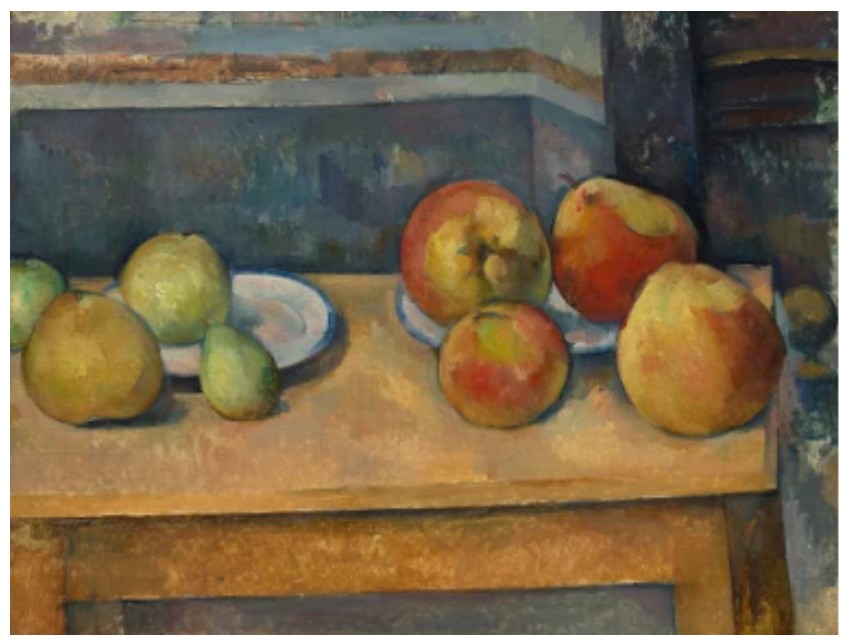
Paul Cézanne, Still Life with Apples and Pears, c. 1891-1892. The Metropolitan Museum of Art, New York.
As such, Cover Image for Guggenheim Magazine (Study) operates in the quintessential Lichtenstein mode: the transformation of familiar motifs into sign systems, where meaning is both immediately apparent and perpetually deferred. The everyday object becomes a reflection of painting’s language itself. It is a still life not of things, but of signs for things. And it is this semiotic precision that made the image such an apt emblem for the Guggenheim retrospective, where Lichtenstein’s entire oeuvre could be seen as a sustained interrogation of how art makes meaning through form.
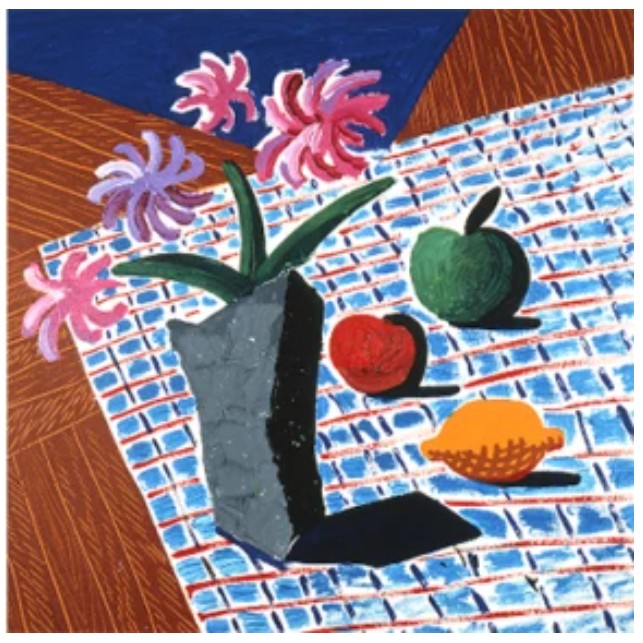
David Hockney, Still Life with Flowers, 1987. The Museum of Modern Art, New York.
The collage medium reinforces this play between immediacy and mediation. Unlike his large-scale paintings or polished screenprints, the study retains a tactile quality: paper elements cut and assembled into the crisp configuration. This sense of direct making, of image built from fragments, resonates with the work’s destiny as a magazine cover—an image disseminated in thousands of copies, printed front and back, carrying Lichtenstein’s Pop idiom into the hands of museum visitors worldwide. It is both intimate object and mass-produced emblem, collapsing the distinction between unique artwork and reproducible image that lay at the heart of Pop art’s provocations.
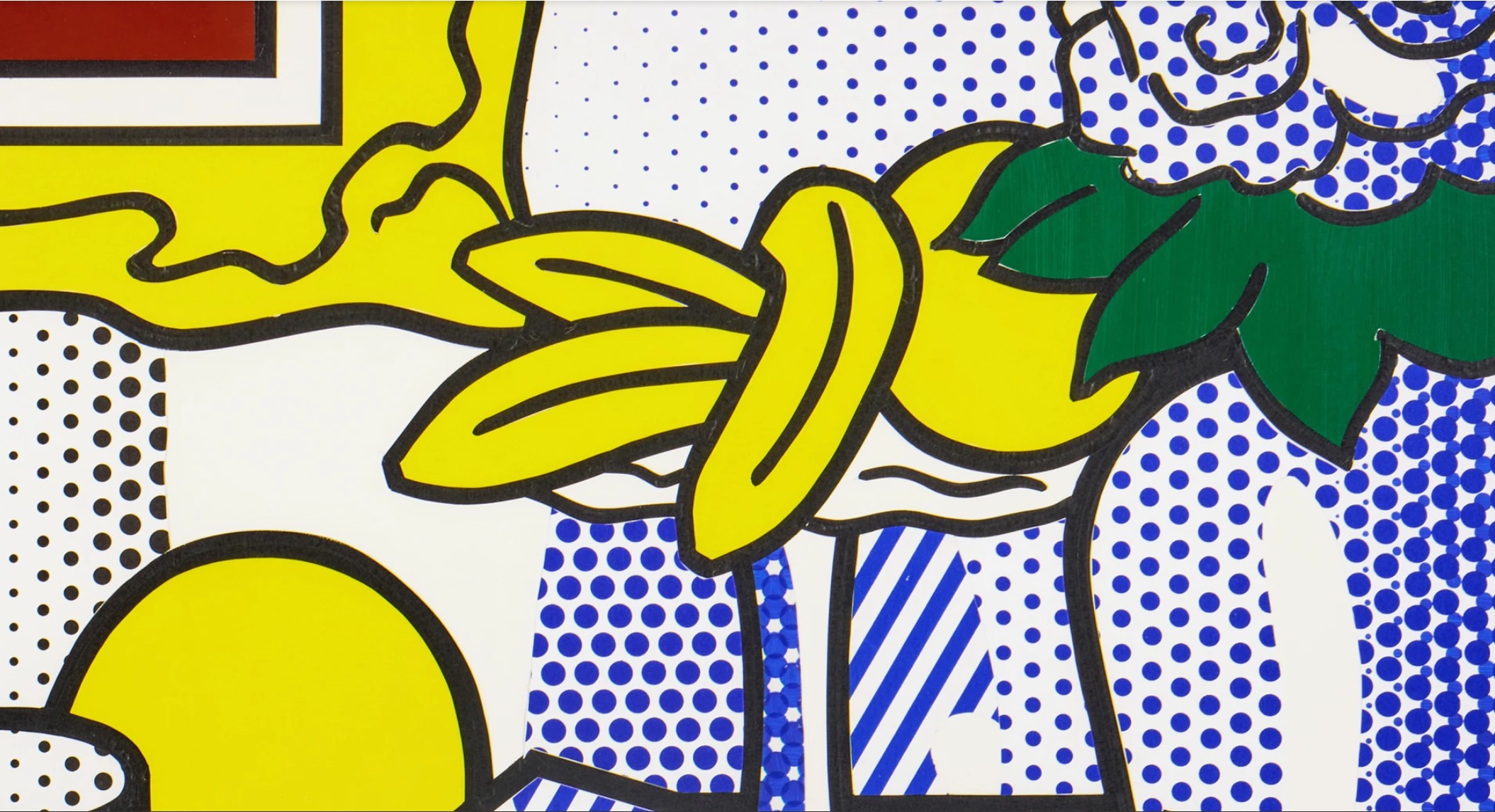
In the broader arc of Lichtenstein’s career, Cover Image for Guggenheim Magazine (Study) crystallizes several themes. It returns to the still life, aligning his practice with the lineage of Cézanne, Matisse, and Picasso, whom he frequently reinterpreted in Pop idiom. It underscores his fascination with the intersection of fine art and mass media, collapsing the hierarchy between cover design and canonical painting. And it situates his work firmly within the institutional framework of the 1990s, where Pop’s once-provocative language had become not only accepted but celebrated as central to the story of modern art. In its graphic clarity, chromatic force, and conceptual precision, Cover Image for Guggenheim Magazine (Study) is emblematic of late Lichtenstein: a moment where the artist reflects upon the very language he had spent decades constructing, and where the institutions of art history reflected it back. That the work served as the cover for the Guggenheim’s retrospective catalogue is fitting: it is at once a study, a still life, and a cover image—an emblem of how Pop art forever transformed not only what we see, but how images circulate, how they signify, and how they endure.
Still Life with Portrait (Study), 1973
Still Life with Portrait (Study), 1973
Property from the Estate of Joan and Kenneth Goldglit
Christie’s New-York: 20 November 2025
Estimated: USD 1,000,000 – 1,500,000
USD 1,016,000
ROY LICHTENSTEIN (1923-1997), Still Life with Portrait (Study) | Christie’s
ROY LICHTENSTEIN (1923-1997)
Still Life with Portrait (Study), 1973
Printed paper collage, acrylic, felt-tip pen and graphite on paperboard
42×32 inches (106.7 x 81.3 cm)
Signed and dated ‘rf Lichtenstein ’73’ (on the reverse)
Fusing a playful palette and a rigorous intellectual project, Still Life with Portrait (Study) is a stunning articulation of Roy Lichtenstein’s brilliant command of line, color and concept. Engaging in and contributing to a timeless dialogue with his art historical forebears, Roy Lichtenstein subverts the tenets and tropes of twentieth century modernism, weaving these archetypes with his own distinctive pioneering style and signature Pop aesthetic. Still Life with Portrait (Study) features two of Lichtenstein’s instantly recognizable subjects: a strikingly rendered interior space and the glamorous figure of a woman plucked straight out of a book, and offers a unique window into the artist’s process as he converts a comic strip into high-art through thoughtful sketching, painting, and collage, capturing the hand of the artist at the pinnacle of his career. Executed in 1973, the year after Lichtenstein started experimenting with the sill life motif that he will reinterpret throughout his career, Still Life with Portrait (Study) uniquely spotlights the artist’s technical inventiveness as a draftsman alongside his exquisite command of an art-historical lexicon.
“I do a lot of [collaging] in the paintings. I start something and keep adding to it—putting pieces of paper down temporarily and looking at the image.
It’s just much easier to try it out first in collage to get everything I want.”
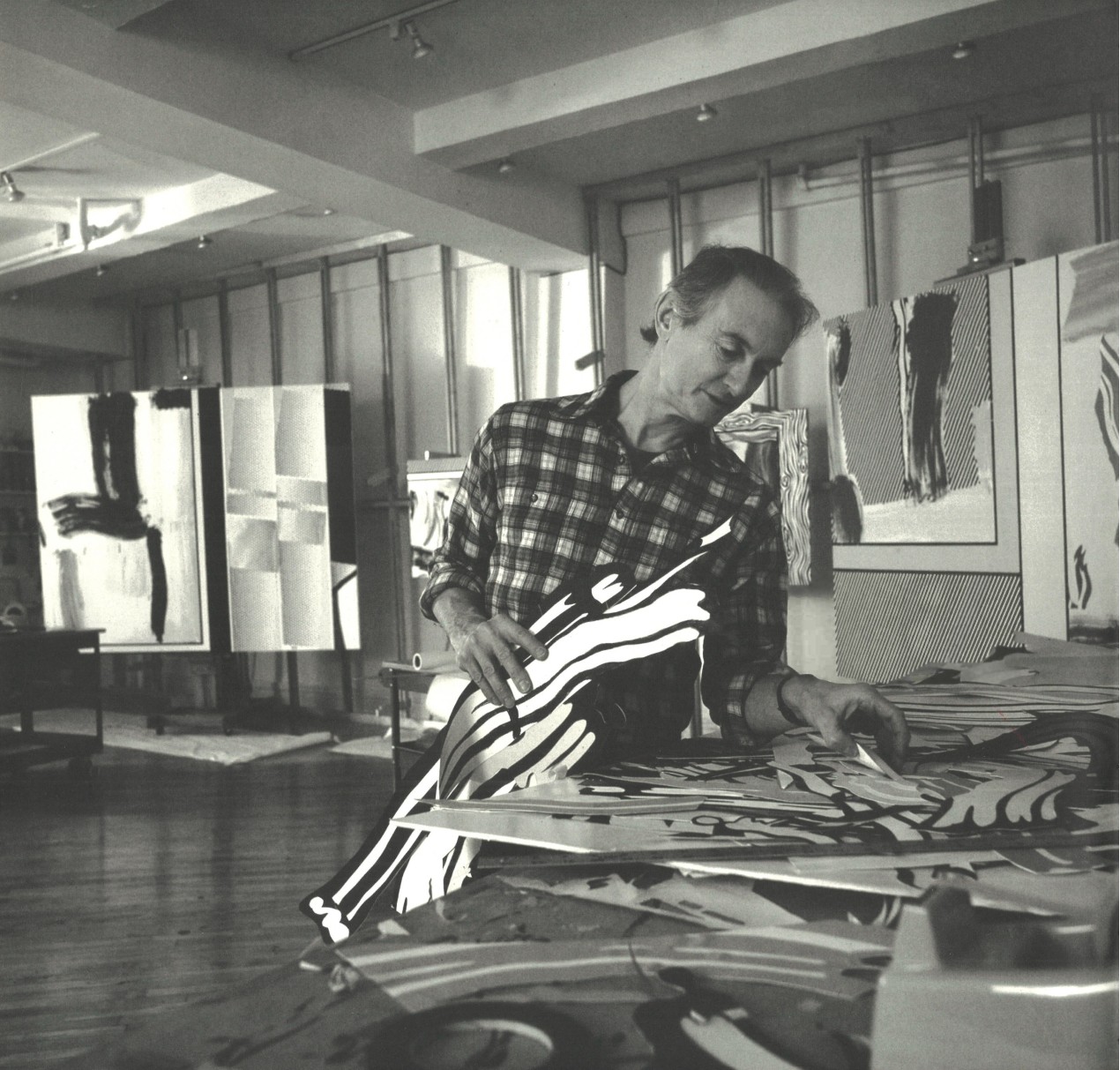
Roy Lichtenstein in his studio, New York, 1991. Photo: Hans Namuth.
Courtesy Center for Creative Photography, University of Arizona © 1991 Hans Namuth Estate. Artwork: © Estate of Roy Lichtenstein.
With flat colors and layered planes, Lichtenstein evokes the mechanical precision of mass reproduction while embedding nuanced references to art history. A female portrait within a yellow frame, reminiscent of 1940s glamour, sits alongside lemons, cherries, and a gleaming pitcher—elements that form a carefully controlled arrangement of curves, diagonals, and shadows. The study format reveals Lichtenstein’s careful planning process meticulously thought out as a foundation for a larger multiple. He frequently emphasized how essential collage was to his practice, allowing for flexible experimentation before committing to more laborious techniques such as Ben-Day dots and hard-edge painting.
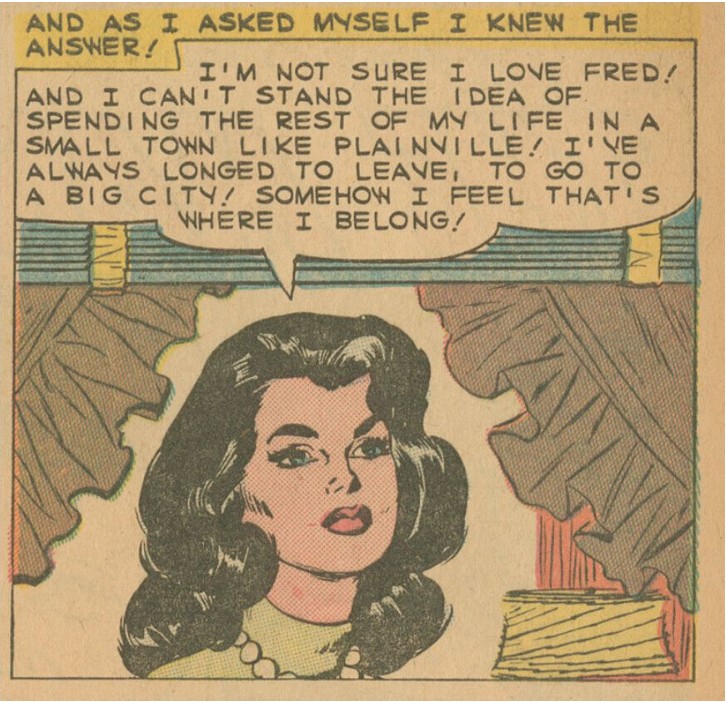
Panel from Sweethearts #49, July, 1954, Charlton Comics Group (source image for the present lot). Photo: © Estate of Roy Lichtenstein.
The protagonist for the woman figure portrayed in Still Life with Portrait (Study) was found in comic strip by the famous artist Vince Colletta. Colleta’s romantic illustrations in the fifties served as inspiration for Lichtenstein who transformed the melodramatic pulp imagery into symbols of mass-produced desire. Lichtenstein began incorporating these unforgettable stills into his paintings in 1961, weeks before Andy Warhol completed his own comic book paintings. Drawing inspiration from artists such as Allan Kaprow, George Segal, and Claes Oldenburg, whose works incorporated everyday objects and elements of mass culture, Lichtenstein began to explore a new visual lexicon drawn from advertising and comic book imagery. Lichtenstein’s use of comic strips made his paintings infamous during the sixties, boldly daring audiences to consider what constitutes fine art in an epoch defined by the soaring philosophies of Abstract Expressionism.
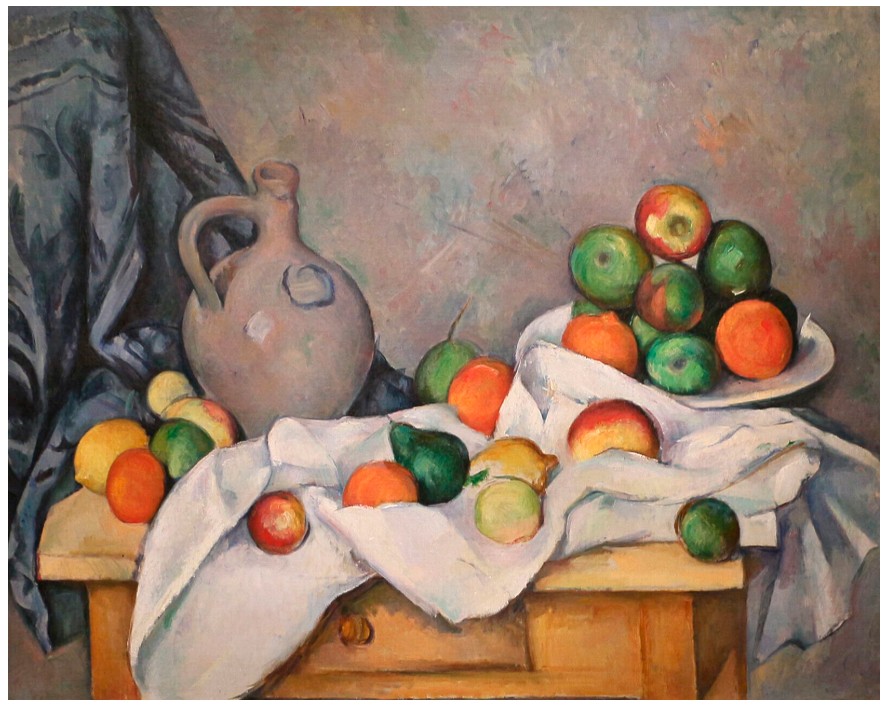
Paul Cézanne, Curtain, Jug and Dish of Fruit, 1894-94. National Gallery, London.
While Lichtenstein initially explored the still life theme in the early 1960s with stark renderings of mundane objects like tires or kitchen items, his approach evolved significantly in the 1970s. Works like Still Life with Portrait (Study) signal a shift toward more complex arrangements that retain his characteristic graphic punch while engaging more deeply with modernist themes. The late 1960s and 1970s marked a decisive shift in Roy Lichtenstein’s artistic trajectory, as he moved away from earlier subjects to engage directly with the lineage of art history itself. Still life’s centuries-old tradition afforded Lichtenstein the opportunity to indulge his fascination with composition’s formal qualities. He selected supple draped fabric, hard and reflective surfaces of frames and jugs, and organic surfaces such as fruit giving him a rich combination of textures to explore. These elements allowed him to revisit and recontextualize a centuries-old visual vocabulary using the stylized, mechanical aesthetic for which he is known. The evolution of the still life remains one of art history’s most enduring narratives, reflecting shifting philosophical attitudes toward material culture and human-object relations. Still Life with Portrait (Study) encapsulates two core principles that define Lichtenstein’s oeuvre: an acute understanding of the mechanics of visual communication, and a sustained engagement with the formal innovations of early modernism. The work’s juxtaposition of the portrait within a still life setting can be seen as a response to the collage strategies of Robert Rauschenberg, who fused disparate iconographic elements into unified yet disjunctive compositions that engage intellectually with image culture.
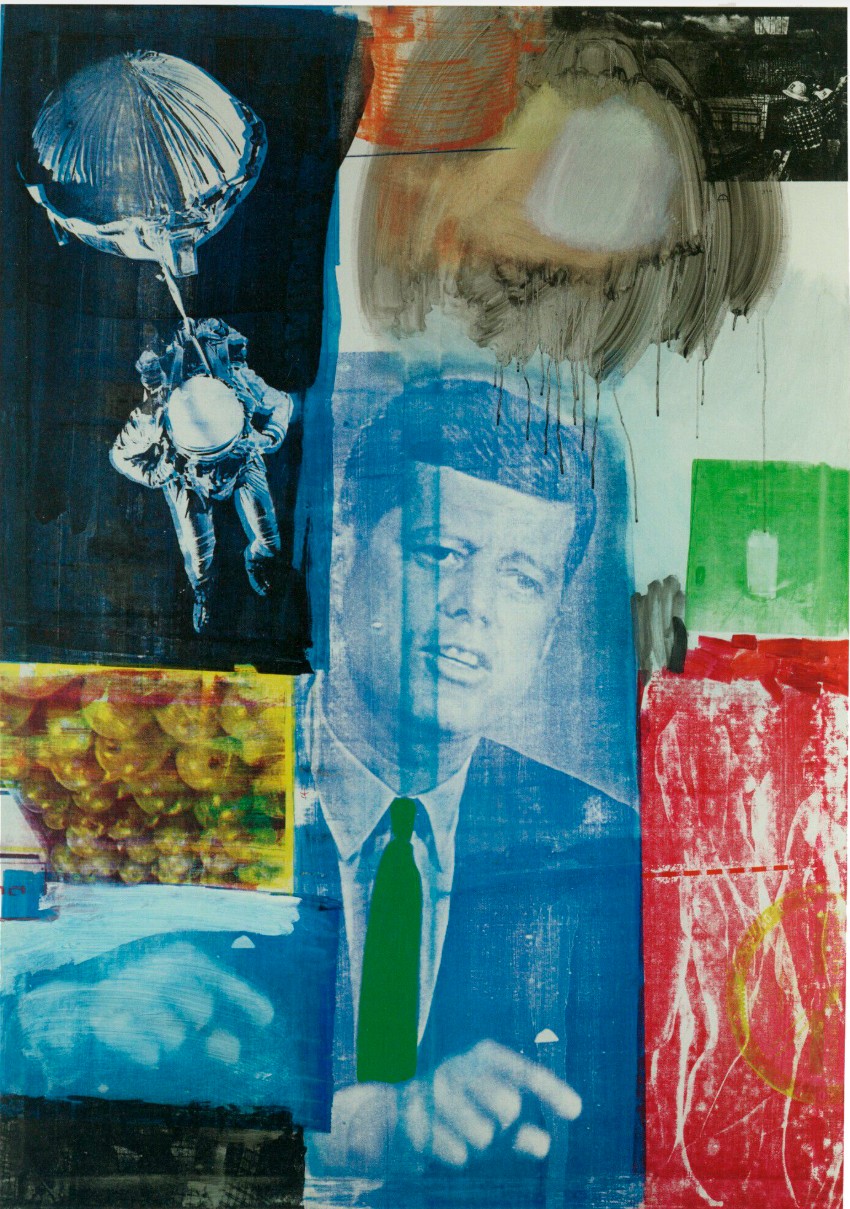
Robert Rauschenberg, Retroactive I, 1964. Wadsworth Atheneum, Hartford.
© 2025 Robert Rauschenberg Foundation / Licensed by VAGA at Artists Rights Society (ARS), New York.
By referencing the work of Picasso and Braque, while also maintaining affinities with Matisse, Lichtenstein positions the still life as a site of dialogue with modern art’s foundational figures, asserting his own place within modern art history. Gifted by the artist to his friends Joan and Kenneth Goldglit, Still Life with Portrait (Study) (1973), stands alongside major works held in prominent museum collections—such as Untitled (Still Life with Lemon and Glass) (1974) at The Metropolitan Museum of Art, Cubist Still Life (1974) at the National Gallery of Art, and Still Life with Crystal Bowl (1972) at the Whitney Museum. These paintings, alongside Still Life with Portrait (Study), showcase how Lichtenstein masterfully melded conceptual inquiry with the formal traditions of still life, transforming the genre into a self-reflexive platform for interrogating artistic identity, authorship, and the legacy of modernism.
Still Life Tapestry (Study), 1973
Still Life Tapestry (Study), 1973
Works from the Collection of Dorothy and Roy Lichtenstein
Sotheby’s New-York: 15 May 2025
Estimated: USD 1,000,000 – 1,500,000
USD 2,063,000
Still Life Tapestry (Study) | The Now and Contemporary Evening Auction | 2025 | Sotheby’s
ROY LICHTENSTEIN (1923 – 1997)
Still Life Tapestry (Study), 1973
Cut painted paper, cut printed paper, marker on cut paper, cut paper, marker and graphite on board
Image: 32 5/8 x 24 1/2 inches (82.9 x 62.2 cm)
Board: 34 3/8 x 26 1/4 inches (87.3 x 66.7 cm)
Signed and dated 1973 (lower left)
Still Life Tapestry (Study) is a meticulously crafted example of Roy Lichtenstein’s pioneering Pop style, teeming with references to the art historical canon. The present work embodies Lichtenstein’s enduring engagement with one of the most significant art historical icons of the twentieth century, Henri Matisse; taking inspiration from the Modernist master’s Goldfish from 1912, Lichtenstein furthers the art historical tradition of the still life with his iconic compositional arrangement and visual lexicon. In true Pop fashion, Still Life Tapestry (Study) subverts the depth and tonality typically ascribed to a quotidian still life through bold primary colors and Ben-Day dots, blurring the supposed boundaries between ‘commercial’ and ‘fine’ art. An exceptionally profound work from one of the twentieth century’s most celebrated artists, Still Life Tapestry (Study) simultaneously pays homage to the history of artistic precedent while also challenging the very foundations upon which it rests.
A bouquet of white flowers in a vase, a red apple with a glossy sheen, blue curtains draped into manifold pleats, and tables rendered in a vibrant yellow take center stage in Still Life Tapestry (Study). Emerging from the right hand corner is a cylindrical fish tank with two red fish, a clear reference to Matisse’s Goldfish. Confidently recontextualizing the tradition of still life painting with his signature visual lexicon, Lichtenstein balances between a harmonious dialogue with the tenets of modernism and a distinctly contemporary sensibility, inserting the artificiality and reproducibility of the modern-day image into the “high culture” of fine art. Thus, the present work destabilizes the very depth, form, and figuration that viewers come to expect from an orthodox still life work.
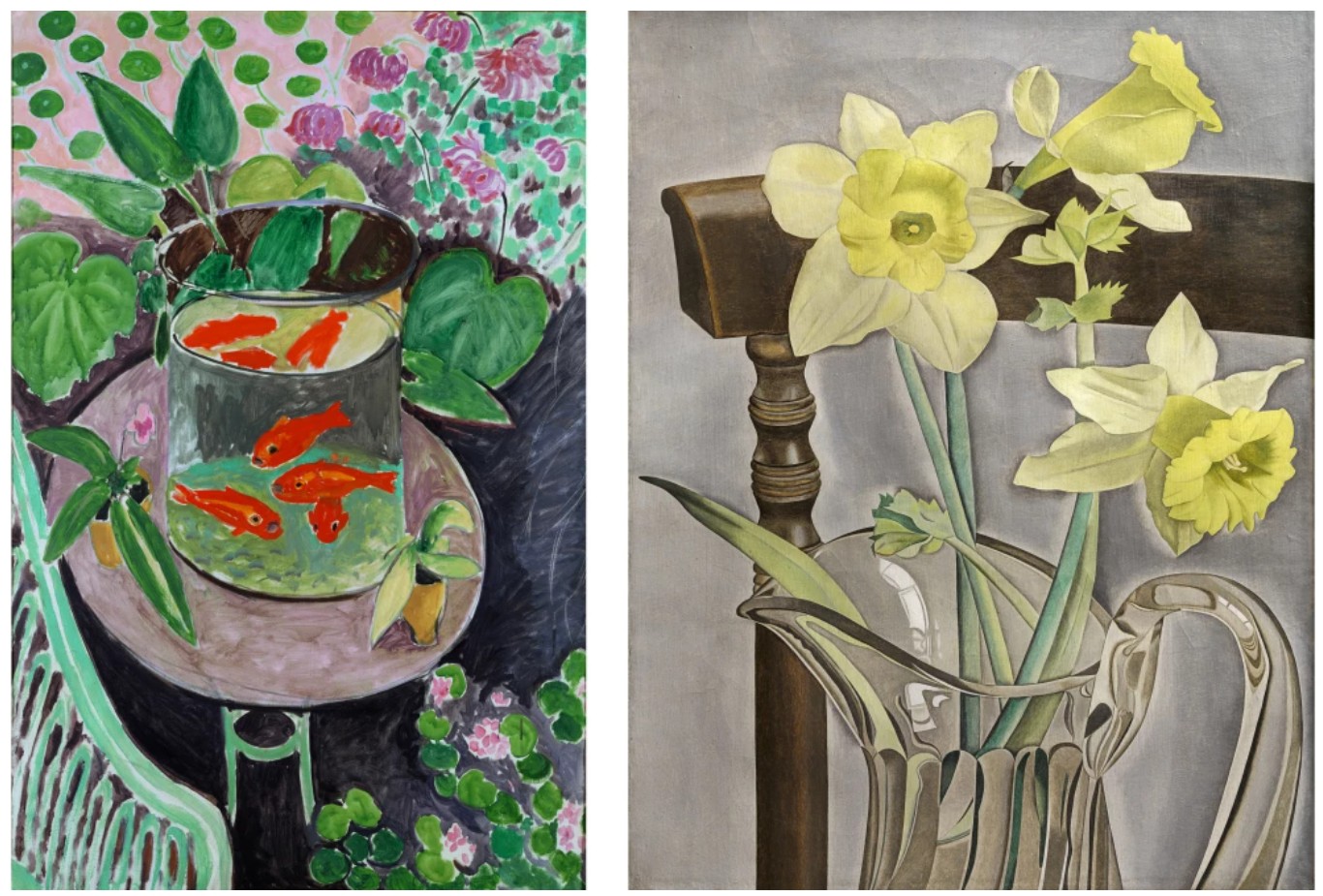
Left: Henri Matisse, The Goldfish, 1912. Pushkin Museum, Moscow. Image © Succession H. Matisse / Bridgeman Images. Art © 2025 Succession H. Matisse / Artists Rights Society (ARS), New York. Right: Lucian Freud, Daffodils and Celery, 1947-8. Private Collection. Image © The Lucian Freud Archive. All Rights Reserved 2025 / Bridgeman Images
Whether it be Dutch still lifes of resounding symbolic profundity, Cubist still lifes that wrestle with the limits of representation, or contemporary still lifes by contemporaries like David Hockney and Lucian Freud, the present work engages within a sincere conversation that interrogates the capacities and limits of the genre. Undeniably a metonym for the scaffolding principles of art history, the still life takes on a new role in Lichtenstein’s work and becomes a physical embodiment of the reflection on art history that defines the artist’s mature practice.
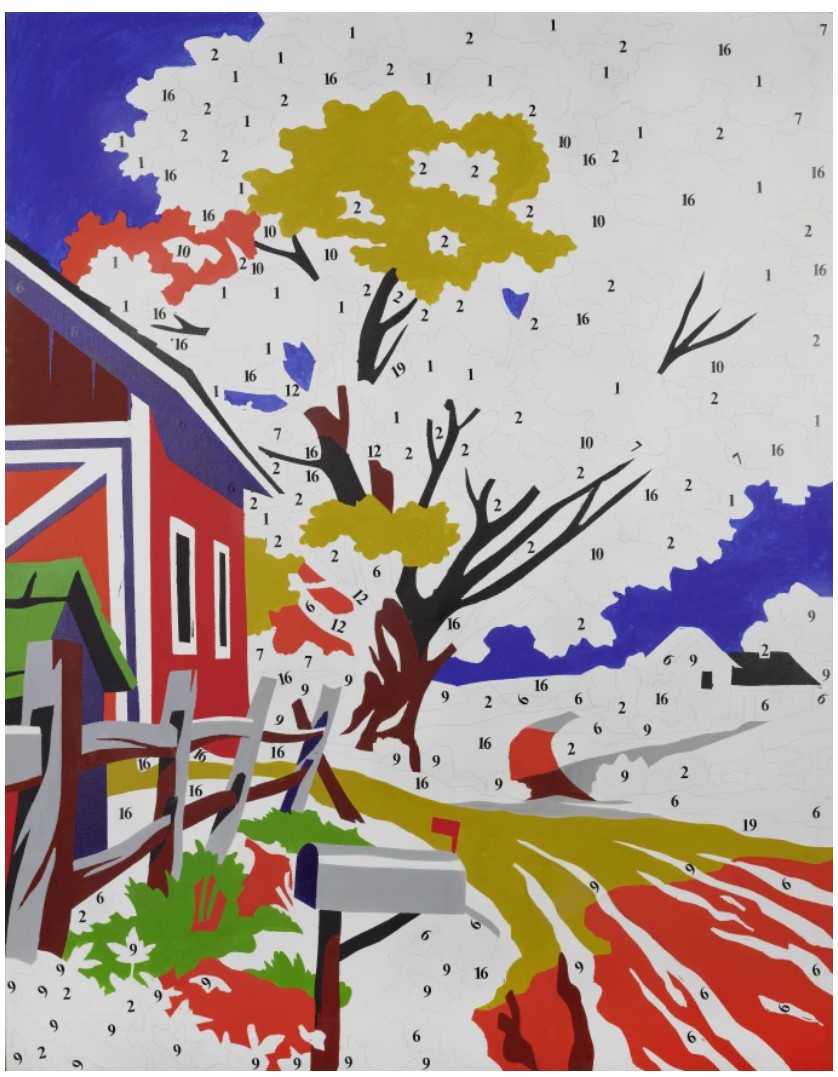
Andy Warhol, Do It Yourself (Landscape), 1962. Museum Ludwig, Cologne. Image © bpk Bildagentur / Museum Ludwig / Britta Schlier / Art Resource, NY. Art © 2025 Andy Warhol Foundation for the Visual Arts / Artists Rights Society (ARS), New York
Famously fascinated with commercialized aesthetics and images, Lichtenstein brings his exacting and alluring composition to Still Life Tapestry (Study) by transforming the flowers, fruit, and fish, vividly swathed in vibrant colors into referential symbols of their real-life counterparts. From the popping glint of the apple’s shine to the boldly outlined flower petals, the effect of the work on the viewer becomes one of arresting significance, mediated through such resoundingly digestible symbols. The present work is designed for tapestries manufactured in an edition of 8; for almost every monumental painting or multiple, Lichtenstein would first create a preparatory collage like the present work. Using a variety of materials such as cut painted paper, printed paper, marker, and pencil, Lichtenstein developed the original composition which he would enlarge into his desired proportions.
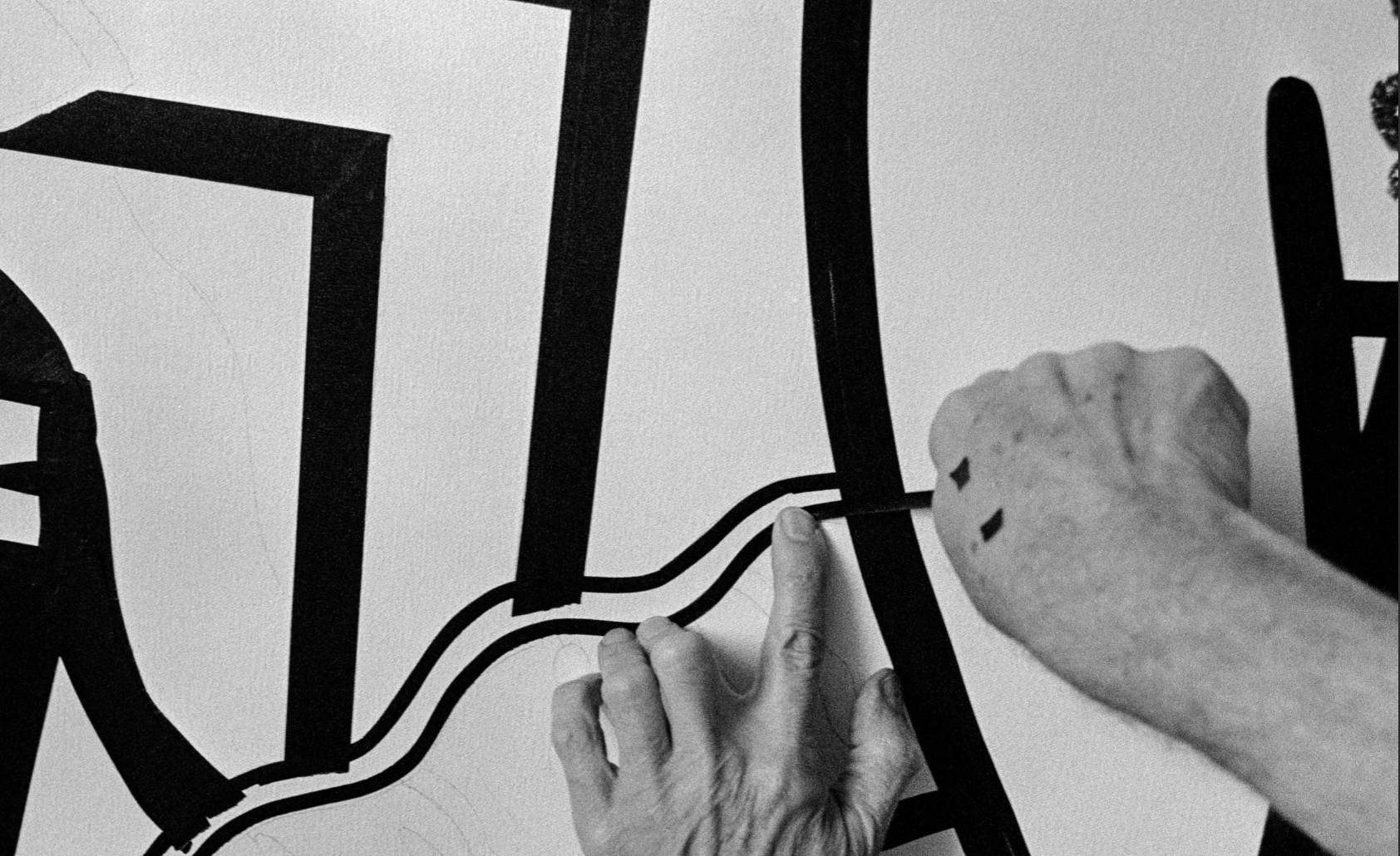
Roy Lichtenstein creating a collage. Photo © Bob Adelman. Art © Estate of Roy Lichtenstein
The artist has previously emphasized how important these collages are to his creative process.
“I do a lot of [collaging] in the paintings. I start something and keep adding to it—putting pieces of paper down temporarily and looking at the image. Because to do all those graduated dots and dotted areas and diagonal areas and then take them off and redo the painting is punishing work… it’s just much easier to try it out first in collage to get everything I want.”
Still Life Tapestry (Study) opens a portal for the viewer to parse through not only centuries of the Western art historical canon, but Lichtenstein’s meticulous, exacting, and expressive creative process that underlies his iconic praxis.
Image © The Metropolitan Museum of Art. Image source: Art Resource, NY. Art © 2025 David Hockney
Offered for the first time on the public market, Still Life Tapestry (Study) is an exemplary work from Lichtenstein’s formidable oeuvre. Belying the meticulously crafted nature of Lichtenstein’s layered creative process, this study is a rare look into the creative process of an incredible artist. Poignant and powerful, this collage speaks to Lichtenstein’s intuitive understanding of the phenomenal potential of popular imagery and his capacity to, more than any artist of his generation, realign the cipher of that imagery to unveil verities behind popular culture.
Still Life Tapestry (Study), 1973
Still Life Tapestry (Study), 1973
Works from the Collection of Dorothy and Roy Lichtenstein
Sotheby’s New-York: 16 May 2025
Estimated: USD 100,000 – 150,000
USD 406,400
Still Life Tapestry (Study) | Contemporary Day Auction | 2025 | Sotheby’s
ROY LICHTENSTEIN (1923 – 1997)
Still Life Tapestry (Study), 1973
Colored pencil and graphite on paper
Image: 4 1/4 x 3 1/8 inches (10.8 x 7.9 cm)
Sheet: 8 1/4 x 5 inches (21 x 12.7 cm)
Signed and dated ’73 (on the verso)
“When we think of still lifes, we think of paintings that have a certain atmosphere or ambience. My still life paintings have none of those qualities, they just have pictures of certain things that are in a still life, like lemons and grapefruits and so forth. It’s not meant to have the usual still life meaning.”
Henri Fantin-Latour, Still Life with Flowers and Fruit, 1866, The Metropolitan Museum of Art, New York
Yellow Still Life (Study), 1973
Yellow Still Life (Study), 1973
Works from the Collection of Dorothy and Roy Lichtenstein
Sotheby’s New-York: 16 May 2025
Estimated: USD 300,000 – 400,000
USD 533,400
Yellow Still Life (Study) | Contemporary Day Auction | 2025 | Sotheby’s
ROY LICHTENSTEIN (1923 – 1997)
Yellow Still Life (Study), 1973
Cut painted paper, acrylic, brush and ink, marker and graphite on board
Image: 25 1/4 x 36 1/2 inches (64.1 x 92.9 cm)
Sheet: 28 1/2 x 39 3/4 inches (72.4 x 101 cm)
Signed and dated ’73 (on the reverse)
“Lichtenstein remains an artist of absorbing contradictions. His inventiveness is rooted in imitation; he transformed the very idea of borrowing into a profoundly generative, conceptual position, one that alters the trajectory of Modernism, and beyond.”
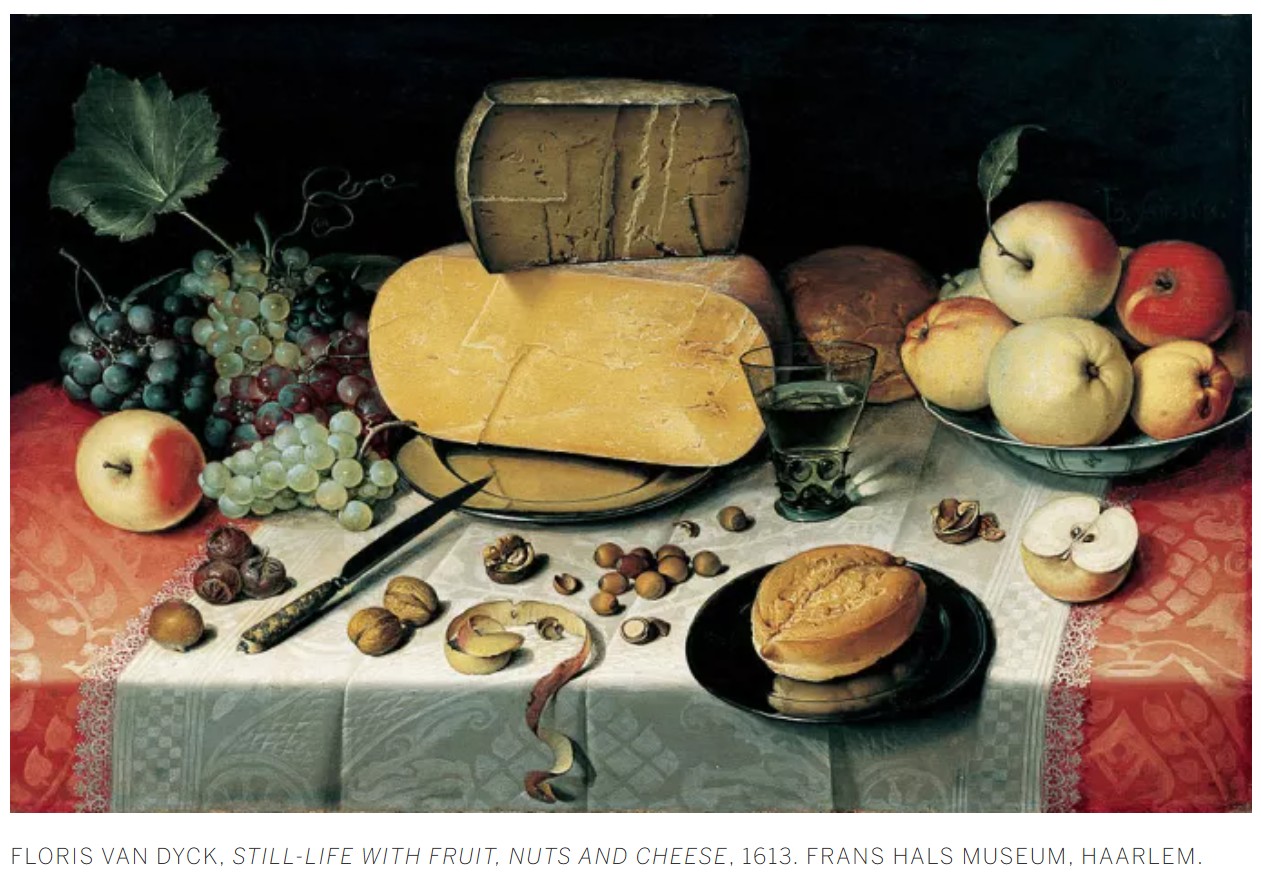
PRINTS
Brushstroke Still Life with Lamp, 1997
Brushstroke Still Life with Lamp, 1997
Christie’s New-York: 22 November 2024
Estimated: USD 250,000 – 350,000
USD 453,600
ROY LICHTENSTEIN (1923-1997), Brushstroke Still Life with Lamp | Christie’s
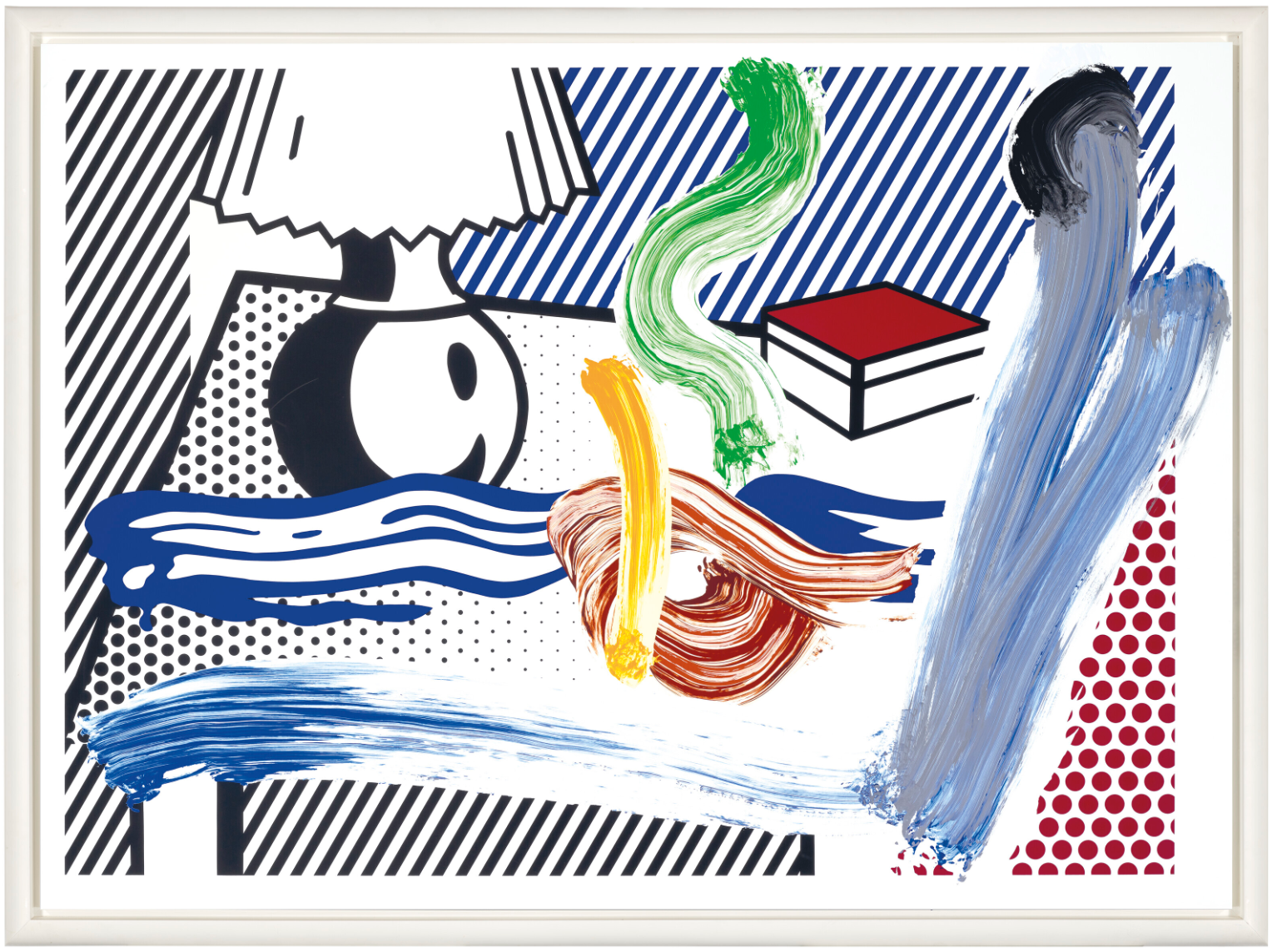
ROY LICHTENSTEIN (1923-1997)
Brushstroke Still Life with Lamp, 1997
Screenprint with hand-painted Magna on honeycomb-core aluminum panel, in artist’s frame
Aluminum panel: 49 1/2 x 68 inches (124.7 x 172.7 cm)
Overall: 54 x 72 1/2 inches (137.2 x 184.2 cm)
Signed, numbered and dated ’23⁄24 rf Lichtenstein ’97’ (on the right edge)
This work is number twenty-three from an edition of twenty-four plus eight artist’s proofs
Roy Lichtenstein’s elegantly refined Still Life – Red Apples presents a dynamic interplay between depth and flatness, placing an iconic art historical genre in conversation with a Pop Art juxtaposition of high and low culture. While the tilting angular recession of the table and the apples’ recession of scale hint at perspectival depth, Lichtenstein’s use of his signature Ben Day dots flattens the image, nodding to his comic book inspirations while parodying the chiaroscuro effect of Old Master painting through his application of variegated dots of local color. This work emerges from his exploration of still lifes which began in the 1970s, when he moved beyond the cartoon imagery that first brought him fame to investigate art historical styles like Surrealism and Cubism.
Lichtenstein articulates the outline of three apples placed atop a table with unmodulated black lines. He crops the first apple across the bottom edge of the canvas, conveying a jarringly foreshortened perspective in which the viewer is placed amid the assembled fruits. The apples cast a singular shadow across the table which converges in the center of the composition—this unnatural lighting is conveyed by the oblong form of hatched red lines, which provides a lovely contrast with the Ben Day dots. A teal jug placed to the top of the table is mostly beyond the composition’s edges, but expresses a reassuring solidity amid the somewhat weightless apples. Appointed with a consistent application of paint, the jug is the sole item to be fully colored, allowing it to anchor the ephemeral apples in place on the picture pane. Lichtenstein distinguishes the deep red hue of the table and apples with a bold blue dotted background, unifying the ground into a singularly ebullient composition.
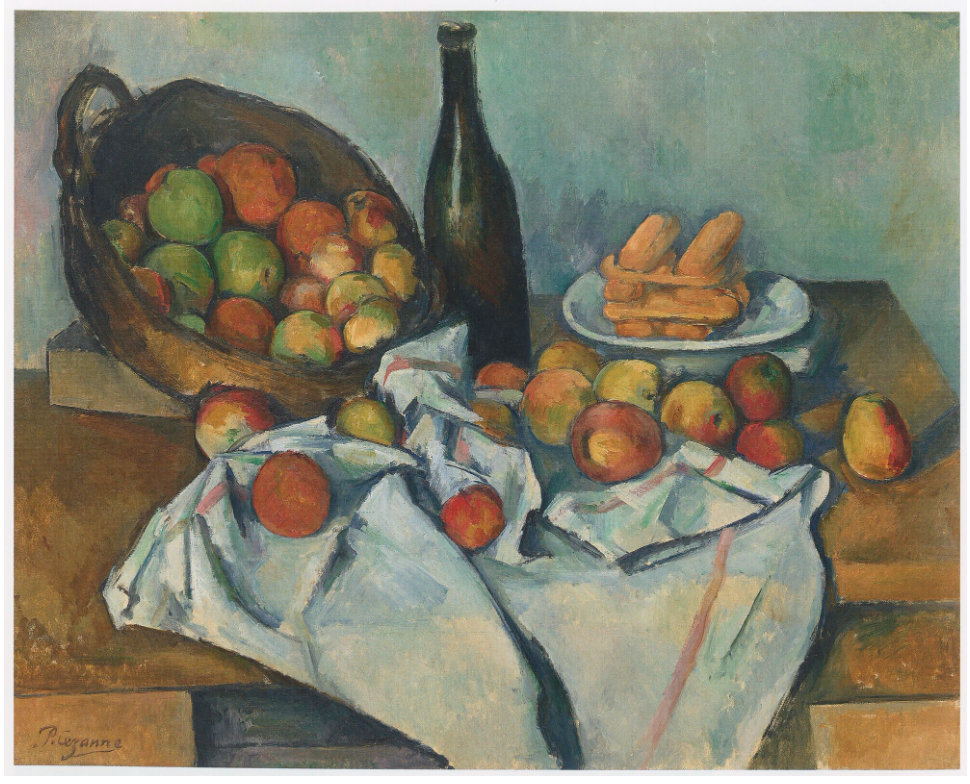
Paul Cezanne, Basket of Apples, circa 1893. Art Institute of Chicago. Photo: The Art Institute of Chicago / Art Resource, NY.
Lichtenstein’s engagement with art history is evident in his fusion of traditional still-life arrangements and Pop Art’s emphasis on mass media procedures and images. The jarring proximity with which the artist places his apples, held discordantly aloft from the sloping table, evocatively exaggerates the perspectival effects mastered by Paul Cézanne in his many still lifes of apples. By incorporating Ben Day dots—a pulp magazine printing technique—into a still life, he disrupts high art with the vocabulary of the magazine. This work is a balance of wit and formality, transforming a storied art historical trope into geometric shapes that resonate with both humor and artistic rigor.
Still Life – Red Apples is an exceptional example of Lichtenstein’s intervention into the still life genre, applying his idiosyncratic techniques to a time-honored form to produce intriguing painterly effects. Operating amid the Pop Art milieu in which fellow artists including Jasper Johns, Wayne Thiebaud, and Andy Warhol similarly explored the possibilities of the still life, Lichtenstein demonstrates here how his revolutionary approach to painting continues to revive and reframe the art historical canon in the era of mass media.