Introduction
Roy Lichtenstein’s Brushstroke sculptures sit at one of the most intelligent fault lines in postwar American art: the point where gesture, the sacred currency of Abstract Expressionism, gets translated into an image, then into an object, and finally into a kind of public monument. They are not simply “Pop in 3D”, they are a sustained argument about what painting means once it has become style, and what sculpture becomes once it starts behaving like a diagram of painting.
The story begins in the mid-1960s, when Lichtenstein isolated the brushstroke itself as subject matter in his celebrated Brushstrokes paintings. The irony is precise: the brushstroke, which for the action painters stood for authenticity and immediacy, becomes in Lichtenstein’s hands a coded sign: outlined, standardized, and made to look as if it were already printed. The image originates in a story titled “The Painting,” printed in Strange Suspense Stories in October 1964, in which a tortured artist, Jake Taylor, battles a painting which appears to assume a life of its own…
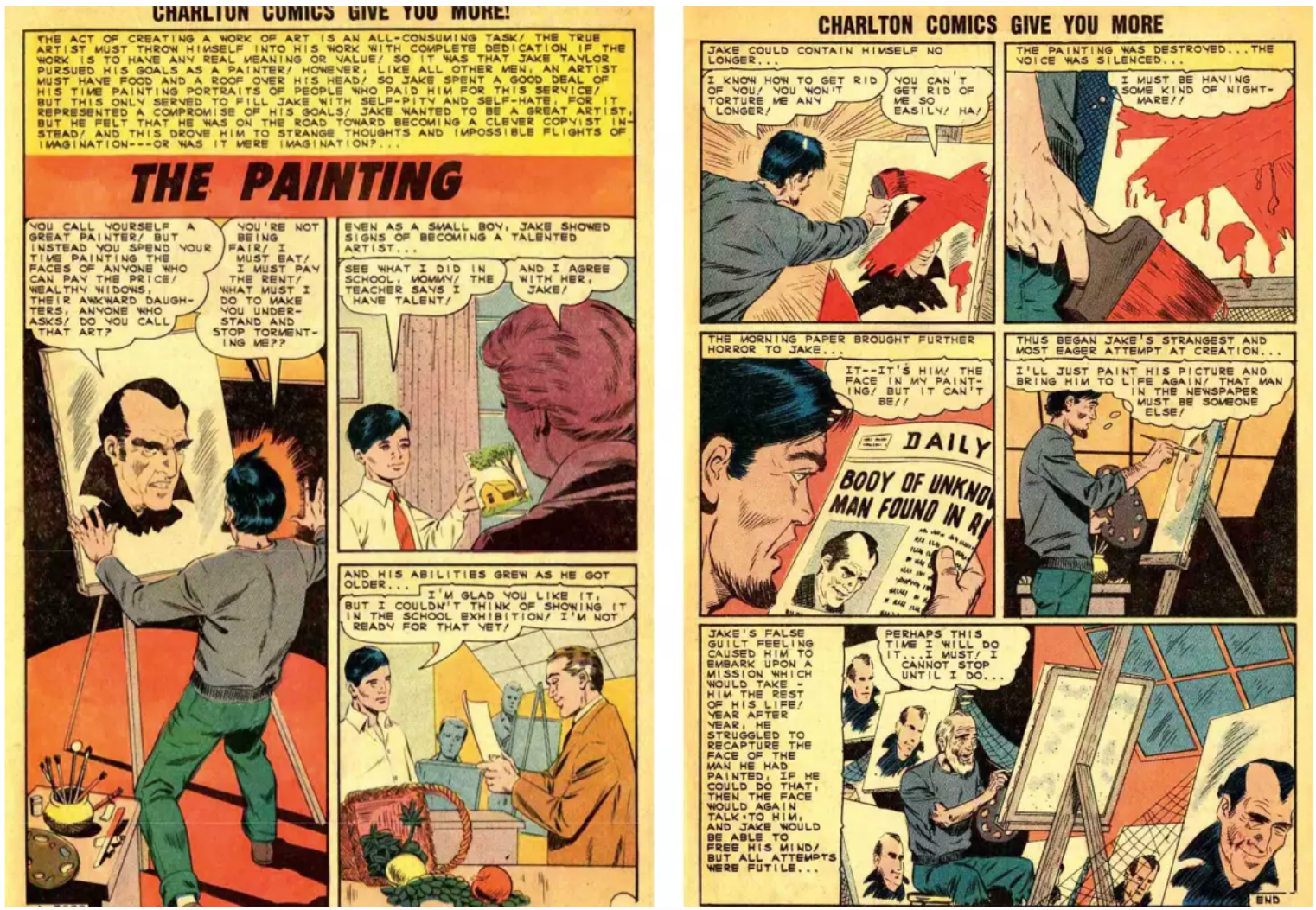
SOURCE IMAGERY FOR THE BRUSHSTROKES, EXCERPTED FROM “THE PAINTING” BY DICK GIORDANO, PUBLISHED IN STRANGE SUSPENSE STORIES, NO. 72, OCTOBER 1964, CHARLTON COMICS
Following the first Brushstroke painting, which directly duplicates a comic panel showing brushstrokes and a sliver of the artist’s hand and paintbrush, Lichtenstein refined his images to focus solely on the brushstrokes themselves. Together, the fifteen Brushstroke paintings represent one of the most significant series of Lichtenstein’s long and prolific career. Although the initial group was produced over a span of only a few months, the motif would become a recurring theme in Lichtenstein’s work, appearing in drawings, sculptures, and prints throughout the following three decades.
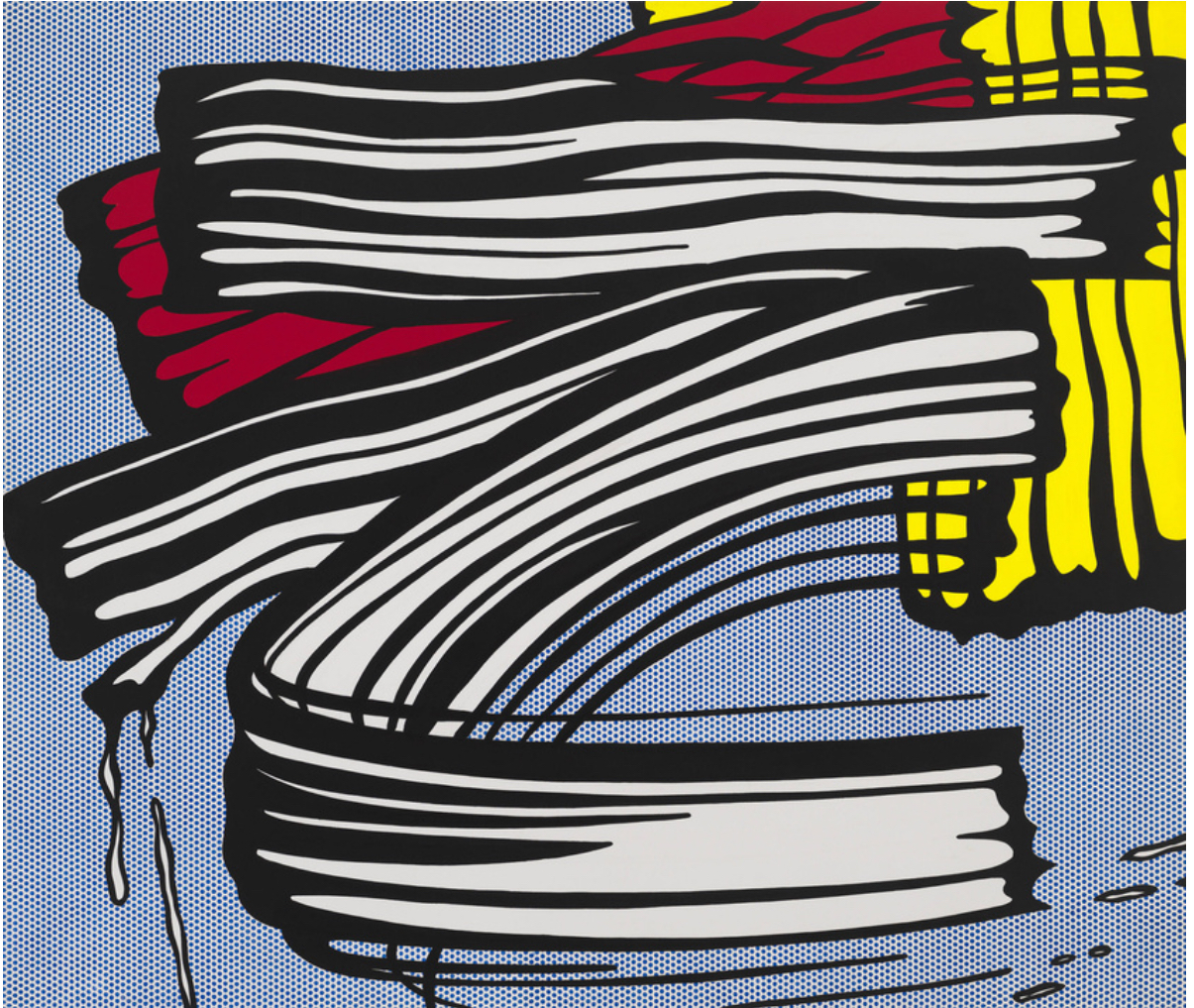
ROY LICHTENSTEIN, Little Big Painting, 1965, Whitney Museum of American Art, New-York
“Visible brushstrokes in a painting convey a sense of grand gesture. But, in my hands, the brushstroke becomes a depiction of the grand gesture. So the contradiction between what I’m portraying and how I’m portraying it is sharp. The brushstroke became very important for my work.”
Once that conceptual reversal is established, sculpture becomes the next logical escalation. Beginning in the early 1980s, Lichtenstein re-engineers the brushstroke into freestanding forms—bronze, aluminum, or wall-mounted wooden reliefs—so that the “mark” appears to leave the picture plane and enter real space. The result is an inversion with real bite: an element associated with speed, touch, and ephemerality is rendered in durable materials and industrial finishes, often with the crispness of signage. The brushstroke becomes not a trace of action, but a depiction of action.
That shift matters because it changes the spectator’s role. In painting, the brushstroke is read at a distance, as surface. In sculpture, the viewer must physically navigate the object, and the brushstroke becomes architectural: it projects, interrupts sightlines, and claims a volume. Lichtenstein’s late sculptures often sustain a productive contradiction—flat graphic language staged as three-dimensional fact—so that the work can be experienced “in the round” while still insisting on its origins in the logic of the picture.
Brushstroke I–VI, 1986
In 1986, Roy Lichtenstein produced a series of six wall-mounted sculptural multiples titled Brushstroke I, II, III, IV, V, and VI. Executed in painted cherry wood and issued in editions of ten, the works extend one of Lichtenstein’s most persistent motifs, the brushstroke, into three-dimensional space. Each work in the series proposes a distinct configuration. Vertical compositions alternate with more lateral arrangements; some forms appear compact and stacked, while others unfold horizontally or incorporate detached elements. Despite these variations, the visual language remains consistent across the group. Bold contours, flat zones of color, and simplified shapes maintain a clear link to Lichtenstein’s painted vocabulary.
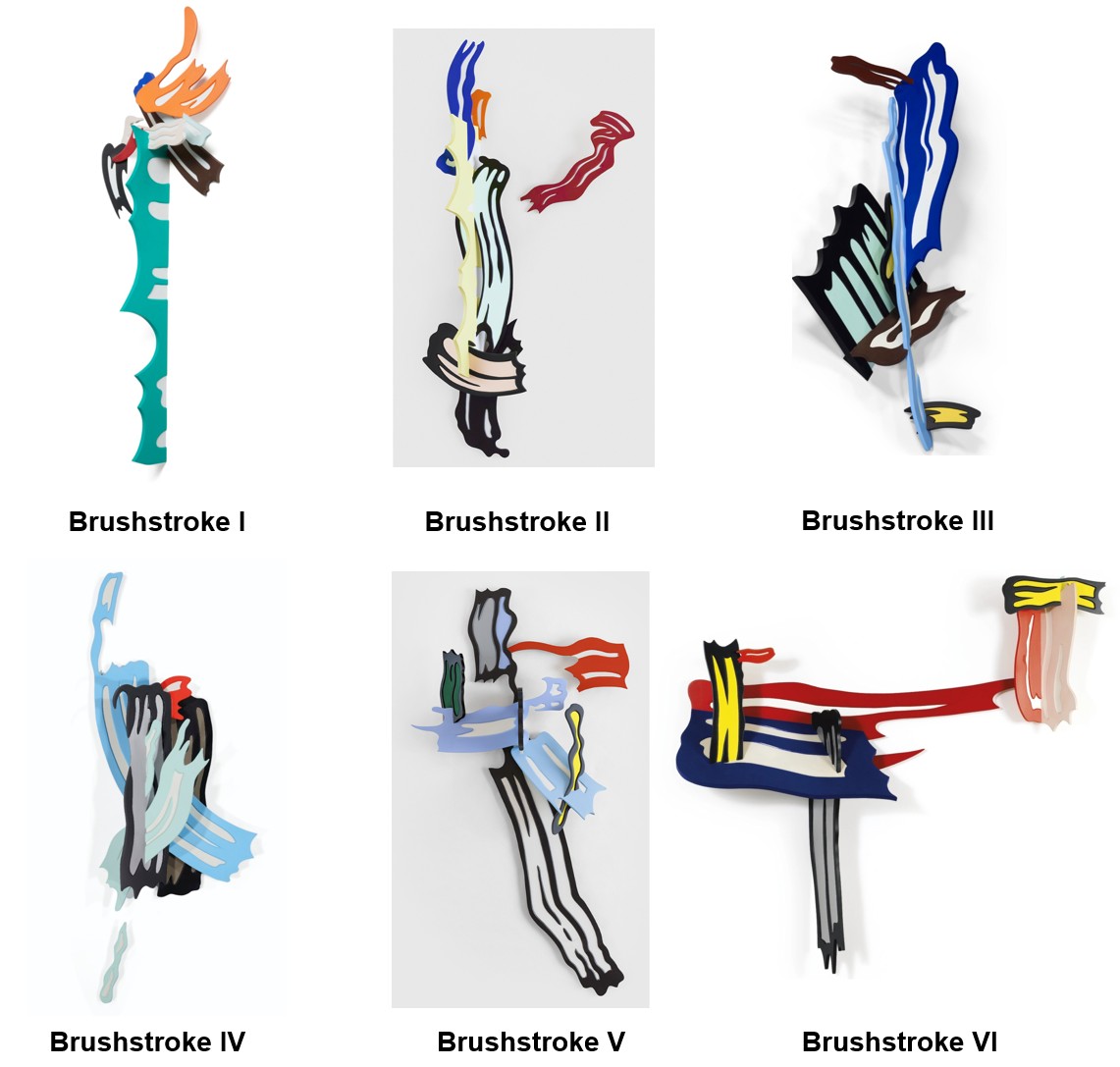
Painted cherry wood, wall-mounted multiples
Edition of 10 each
The use of cherry wood introduces a material traditionally associated with craft, yet the finish suppresses any evidence of manual handling. Surfaces are smooth, edges are sharply defined, and colors are applied in uniform planes. The result reinforces the distance between appearance and process: the forms suggest spontaneity while remaining entirely predetermined. Mounted directly on the wall, the works occupy an intermediate position between painting and sculpture. They project into space and cast shadows, but remain anchored to the wall plane. This spatial ambiguity echoes Lichtenstein’s long-standing interest in questioning medium boundaries and the conventions attached to them.
Brushstroke Head I–IV, 1987
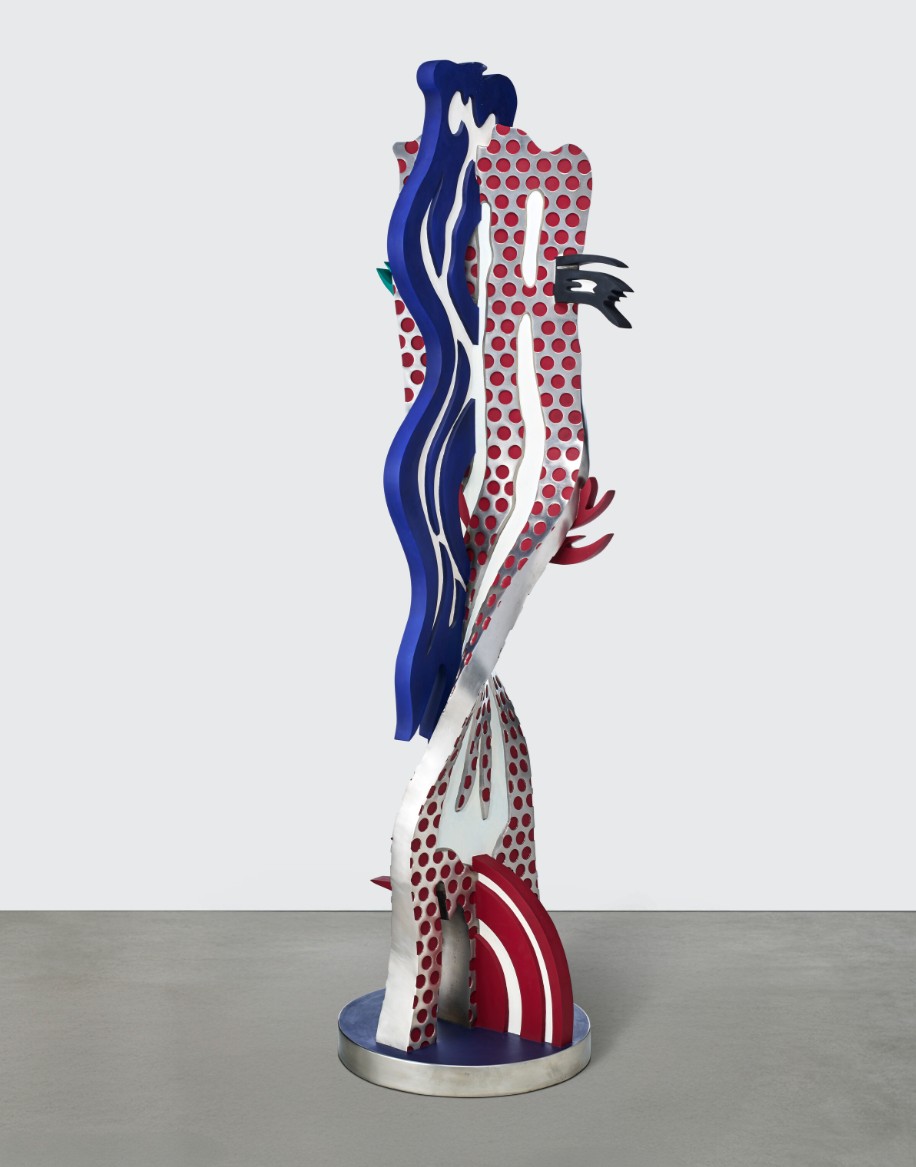
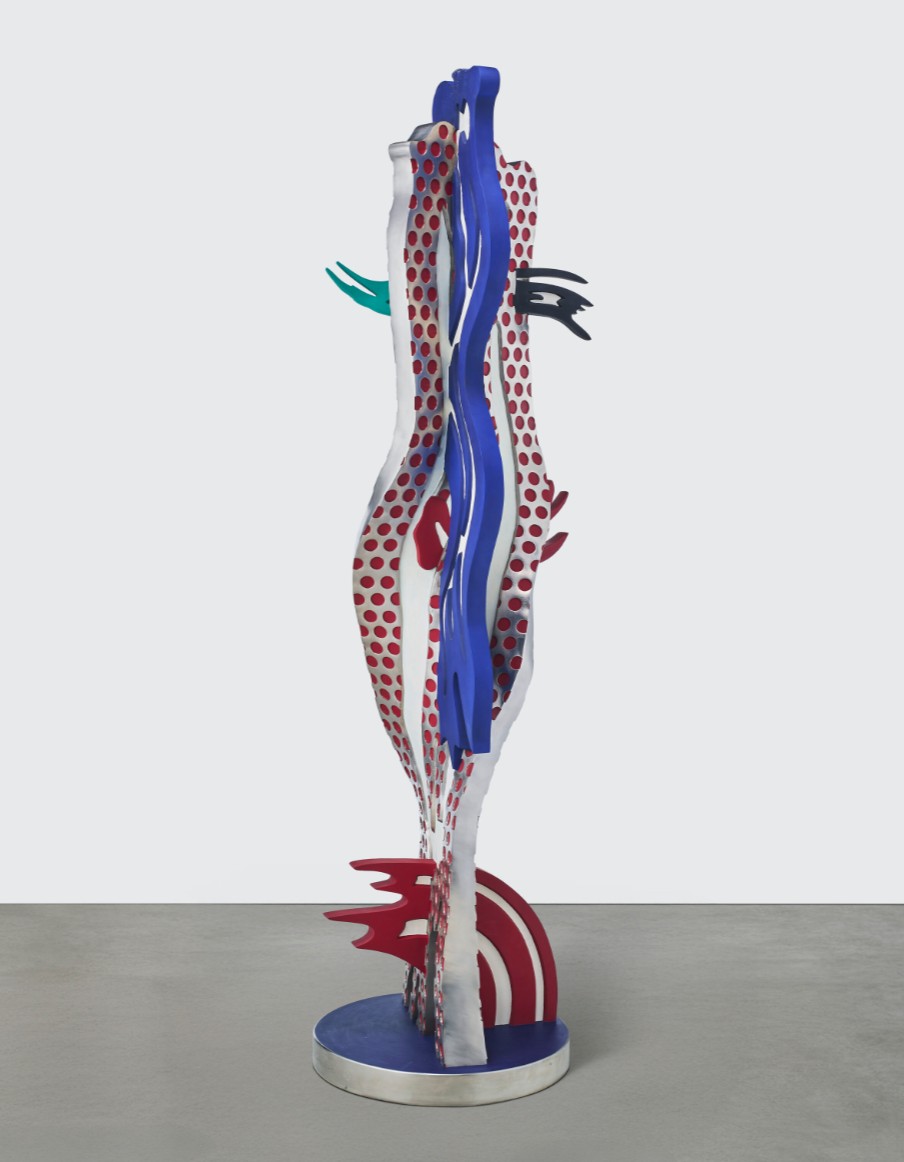
In 1987, Roy Lichtenstein produced a related group of sculptural multiples titled Brushstroke Head I, II, III, and IV. Cast in bronze, painted, and mounted on circular bases, the works extend Lichtenstein’s long-standing Brushstroke motif into the domain of figuration, merging the language of the graphic stroke with the outline of a head in profile. Unlike the wall-mounted Brushstroke multiples of the previous year, the Brushstroke Head series is fully autonomous in space. The forms rise vertically from their bases and are meant to be read in the round, even though their silhouettes retain a strong frontal orientation. The head is not modeled in a traditional sculptural manner; it is assembled from layered, cut-out elements that echo the flatness of Lichtenstein’s paintings while occupying real volume.
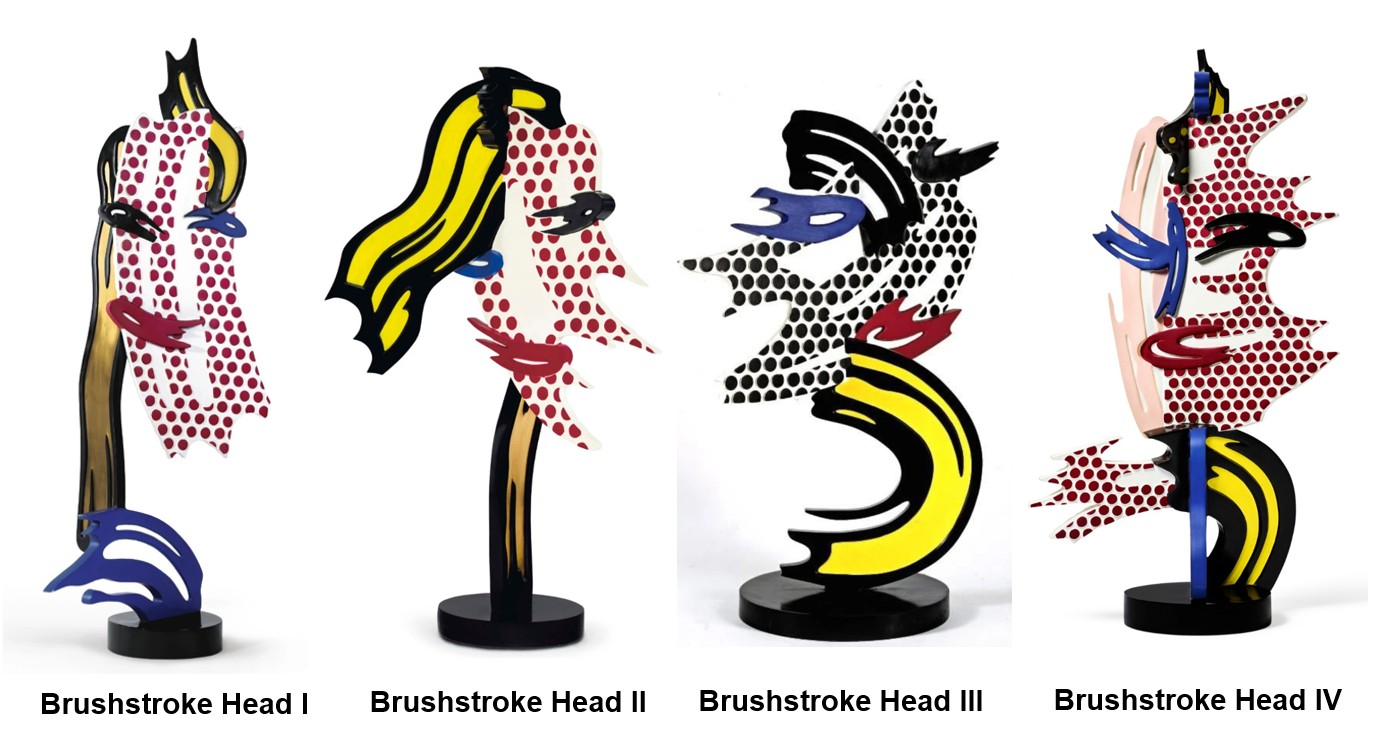
Painted bronze, free-standing sculptural multiples
Edition of 6 each
Each sculpture combines several of the artist’s established visual devices. Curved brushstroke shapes define hair, facial contours, and structural supports, while areas of Benday dots articulate surfaces associated with skin or mass. Strong black outlines organize the compositions, separating zones of red, yellow, blue, white, and black. As in Lichtenstein’s two-dimensional work, these elements function as signs rather than descriptive details.
At the other end of the spectrum are the outdoor and monumental works, where the brushstroke becomes a public event. The Roy Lichtenstein Catalogue Raisonné documents Brushstrokes in Flight as a monumental painted aluminum work (fabricated 1984) conceived on an architectural scale, and public discussion of the airport installation underscores how such works function as landmarks—Pop vocabulary transposed into civic space. In these contexts, the brushstroke no longer merely mocks heroic gesture; it competes with the city and the sky.
The late 1990s bring a final, retrospective turn: Lichtenstein begins to treat his own motifs as a personal archive. For example, Brushstrokes (conceived 1996, cast 2001) form part of this late synthesis, where earlier inventions are remade at extreme scale and with renewed technical ambition. Here the brushstroke reads less like a one-liner about Abstract Expressionism and more like a statement about legacy: the mark becomes an emblem that can be reiterated, enlarged, and installed as if it were a signature in space.
Even works that are not “brushstrokes” in the literal sense—such as Coup de Chapeau II (1996)—belong to the same late-career logic of taking a graphic event and forcing it into three-dimensional narrative. Sotheby’s catalogue situates it as a sculptural extension of a self-portrait motif, isolating the airborne hat and its motion-trace so that the viewer confronts action without its cause. It is the same structural idea as the brushstroke sculptures: motion represented as a manufactured object, and gesture rendered as a clean, legible sign.
Read as a whole, the brushstroke sculptures are best taught not as a decorative subset of Pop, but as a long-form meditation on how images inherit authority. Lichtenstein takes what was once treated as the most private and authentic component of painting—the stroke—and shows how easily it can become public language, reproducible style, and eventually monument. The joke is there, but it is never only a joke: the sculptures keep returning to the question of what “making” means once making is already part of art history’s theater.
Auction Results
#1. Brushstroke Group, 1987
PROPERTY FROM A NEW YORK STATE COLLECTION
Christie’s New-York: 10 November 2004
Estimated: USD 2,500,000 – 3,500,000
USD 3,367,500
Roy Lichtenstein (1923-1997) , Brushstroke Group | Christie’s
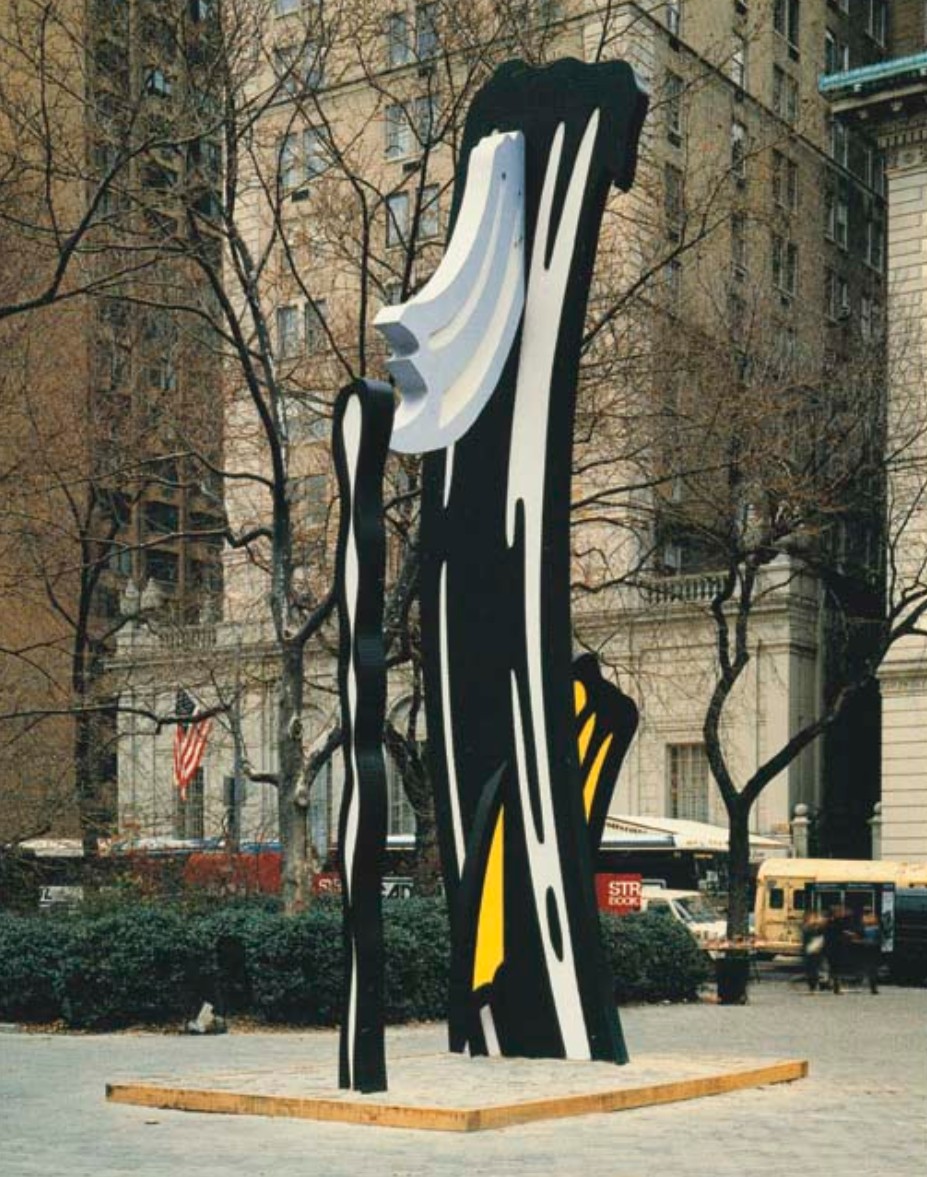
ROY LICHTENSTEIN (1923-1997)
Brushstroke Group, 1987
Painted aluminum
32 1/2 x 17 x 7 3/4 feet (9.15 x 5.19 x 2.49 m)
Signed and dated ‘rf Lichtenstein 1987’ (at the base)
This work is number one from an edition of one
Brushstrokes, 1996-2001
A Legacy Reimagined: Works from the Collection of Dorothy and Roy Lichtenstein
Sotheby’s New-York: 18 November 2025
Estimated: USD 4,o00,000 – 6,000,000
USD 3,100,000
Brushstrokes | The Now & Contemporary Evening Auction | 2025 | Sotheby’s
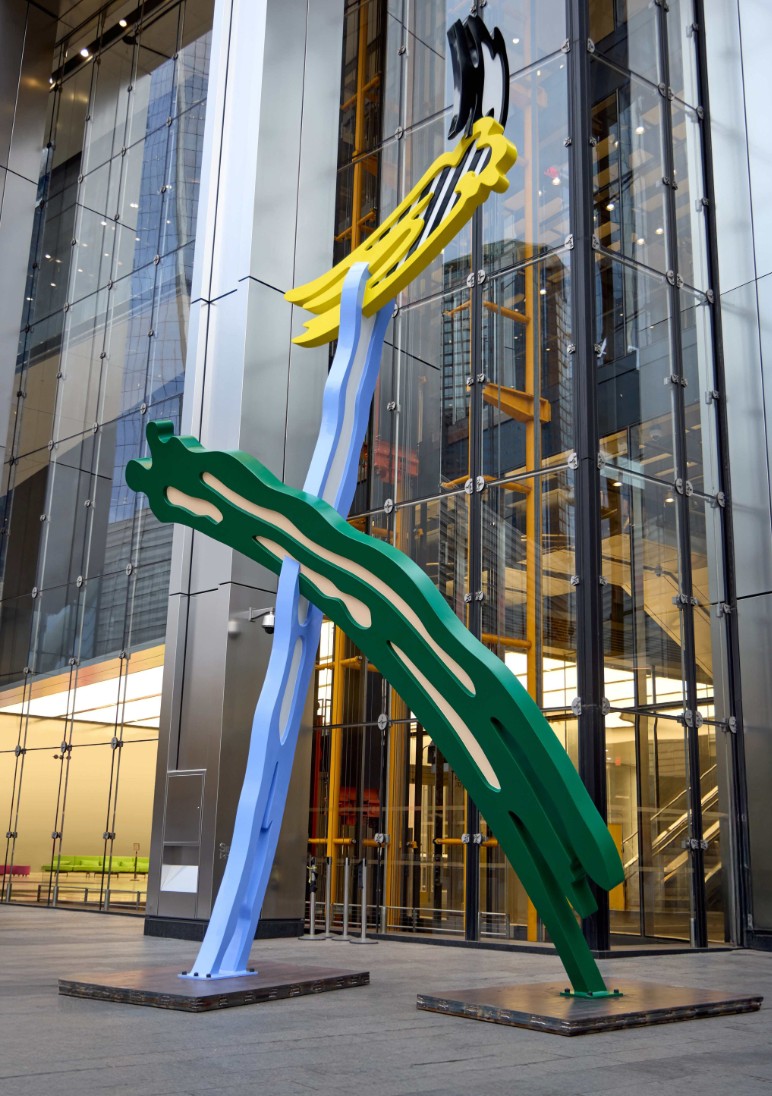
ROY LICHTENSTEIN (1923 – 1997)
Brushstrokes, 1996-2001
Painted aluminum
353 1/4 x 162 x 90 inches (897.3 x 411.5 x 228.6 cm)
Incised with the artist’s signature, dated ‘96 and numbered AP (lower edge)
Incised © Estate of Roy Lichtenstein and dated 2001 (lower edge)
Conceived in 1996 and cast in 2001, this work is the artist’s proof from an edition of 1 plus 1 artist’s proof
Coup de Chapeau II, 1996
A Legacy Reimagined: Works from the Collection of Dorothy and Roy Lichtenstein
Sotheby’s New-York: 18 November 2025
Estimated: USD 1,500,000 – 2,000,000
USD 3,832,000
Coup de Chapeau II | The Now & Contemporary Evening Auction | 2025 | Sotheby’s
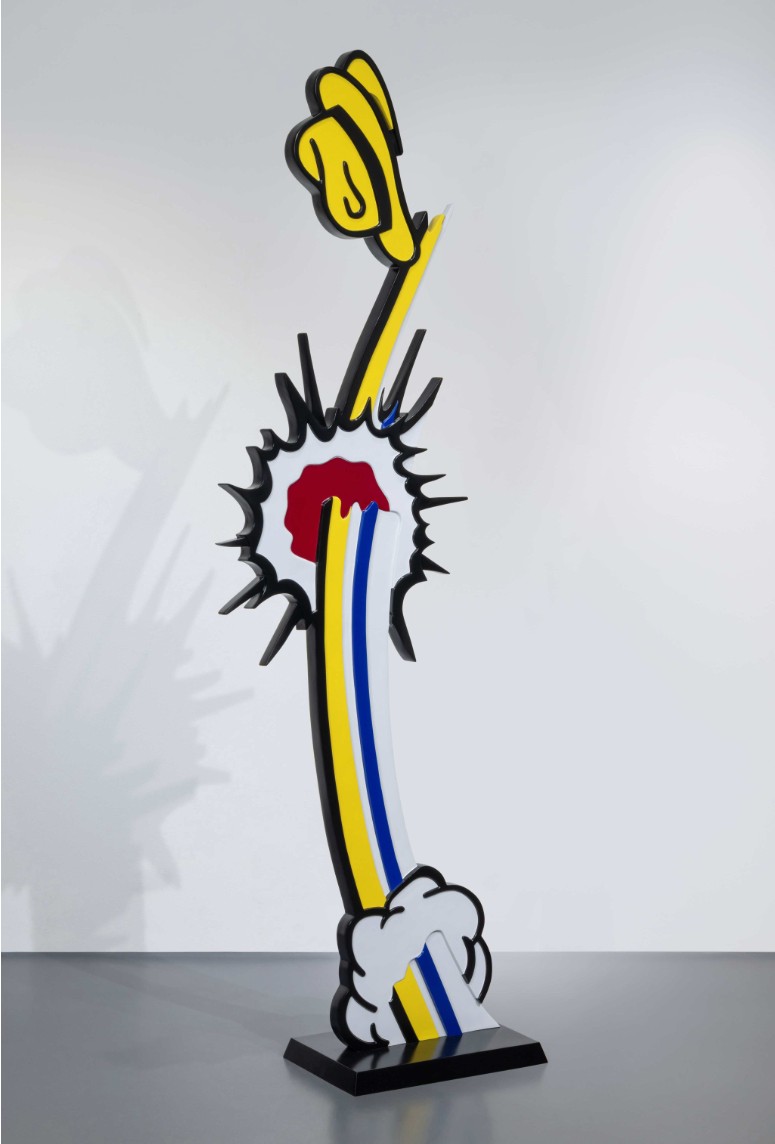
ROY LICHTENSTEIN (1923 – 1997)
Coup de Chapeau II, 1996
Painted bronze
89 x 32 x 13 1/8 inches (226.1 x 81.3 x 33.3 cm)
Incised with the artist’s signature, numbered 0/6 and dated ‘96 (lower edge)
This work is the artist’s cast from an edition of 6 plus 1 artist’s cast
Brushstroke Head I, 1987
Bonhams New-York: 16 May 2017
Estimated: USD 700,000 – 900,000
USD 1,147,500
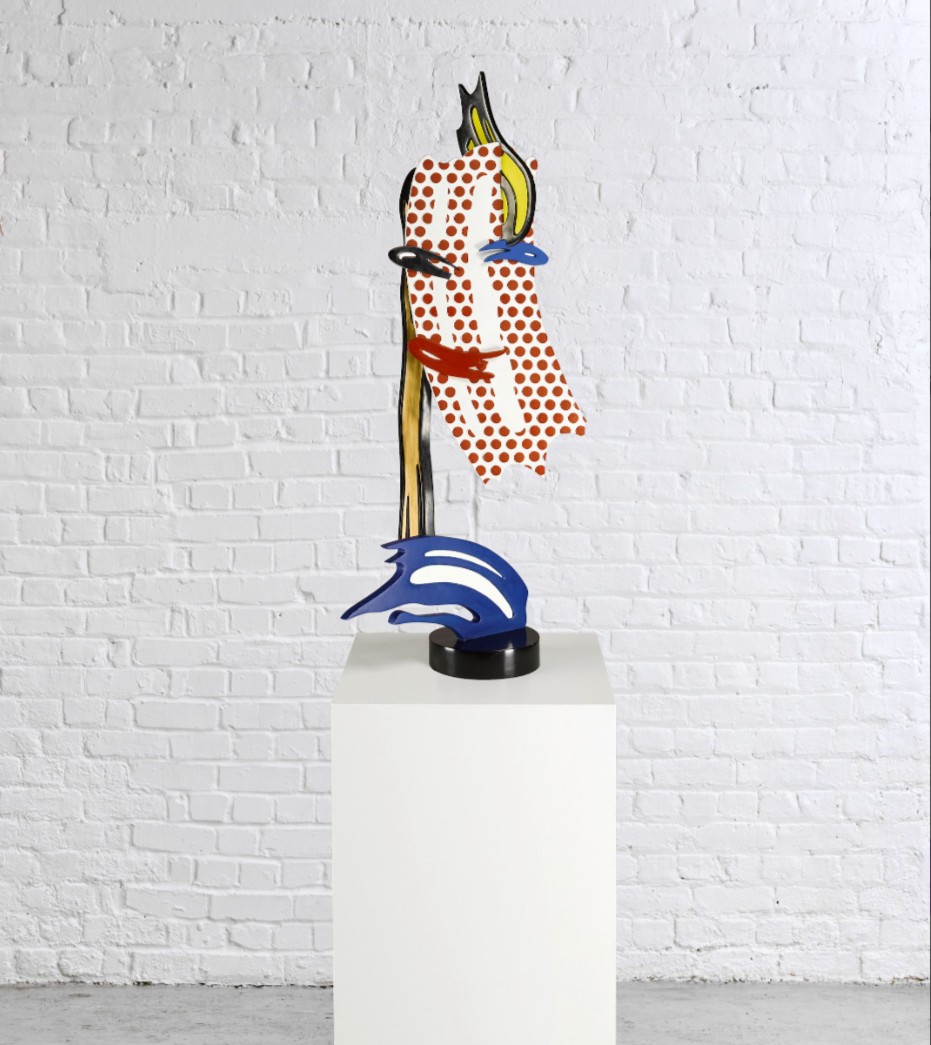
ROY LICHTENSTEIN (1923-1997)
Brushstroke Head I, 1987
Painted and patinated bronze
39 3/4 x 16 1/2 x 8 1/2 inches (101 x 41.9 x 21.6 cm)
Incised ‘© rf Lichtenstein 87 5/6’ and with the Tallix, Inc. foundry mark (on the base)
This work is number five from an edition of six, plus one artist’s proof
Brushstrokes in Flight, 1983
Christie’s New-York: 15 May 2025
Estimated: USD 700,000 – 1,000,000
USD 882,000
ROY LICHTENSTEIN (1923-1997), Brushstrokes in Flight | Christie’s
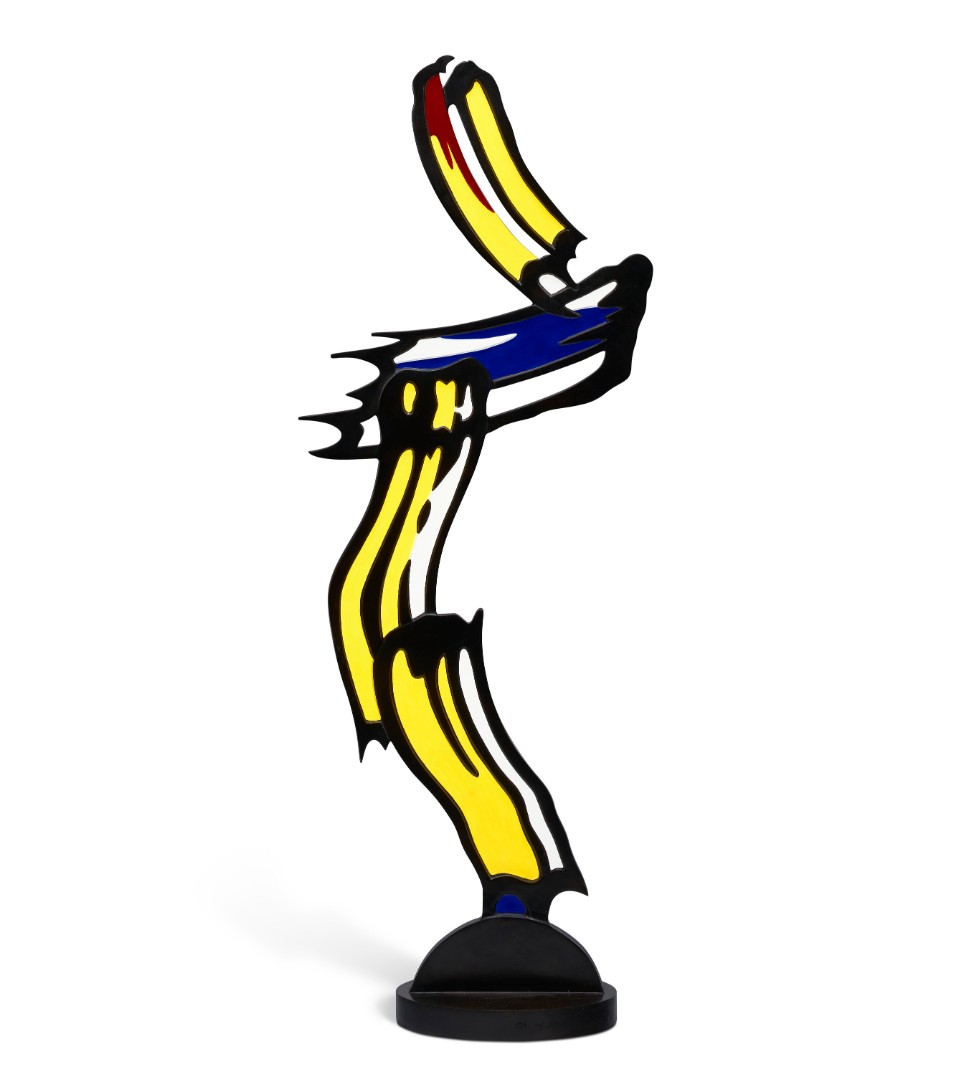
ROY LICHTENSTEIN (1923-1997)
Brushstrokes in Flight, 1983
Painted and patinated bronze
55 1/4 x 21 x 10 inches (140.3 x 53.3 x 25.4 cm)
Incised with the artist’s signature, number and date ‘5⁄6 rf Lichtenstein ’83’ (on the base)
This work is number five from an edition of six plus one posthumous cast
Brushstroke Head II, 1987
Christie’s New-York: 18 May 2017
Estimated: USD 700,000 – 900,000
USD 847,500
Roy Lichtenstein (1923-1997), Brushstroke Head II | Christie’s
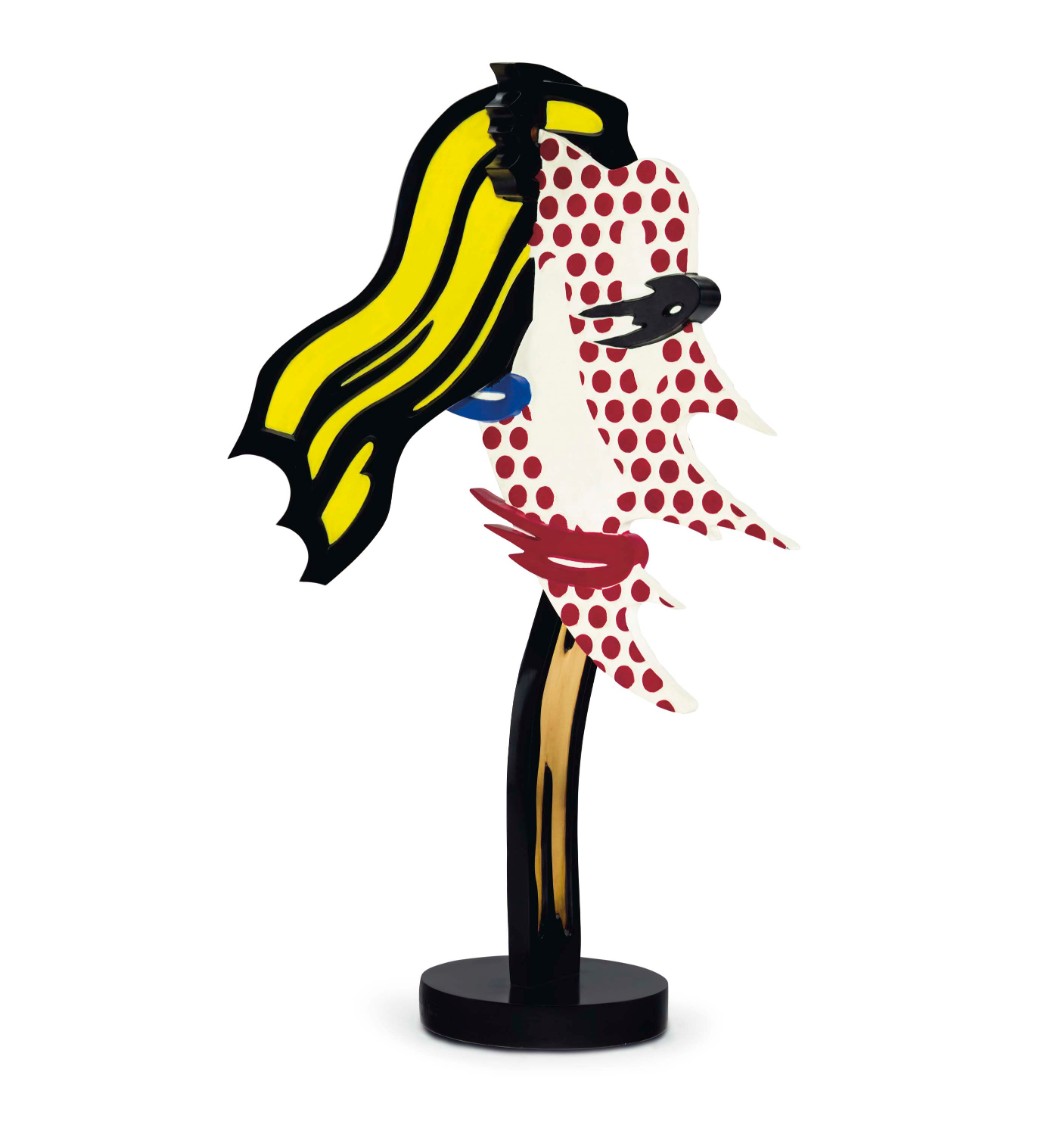
ROY LICHTENSTEIN (1923-1997)
Brushstroke Head II, 1987
Painted and patinated bronze
28 7/8 x 13 1/4 x 17 1/4 inches (78.3 x 33.7 x 43.8 cm)
Signed, numbered and dated ‘3/6 rf Lichtenstein ’87’ (on the base)
This work number three from an edition of six
Brushstroke Head IV (Barcelona Head), 1987
Property from the Miles and Shirley Fiterman Collection
Phillips New-York: 13 November 2019
Estimated: USD 600,000 – 800,000
USD 800,000
Roy Lichtenstein 20th C. & Contemporary Art Day Sale, Morning Session
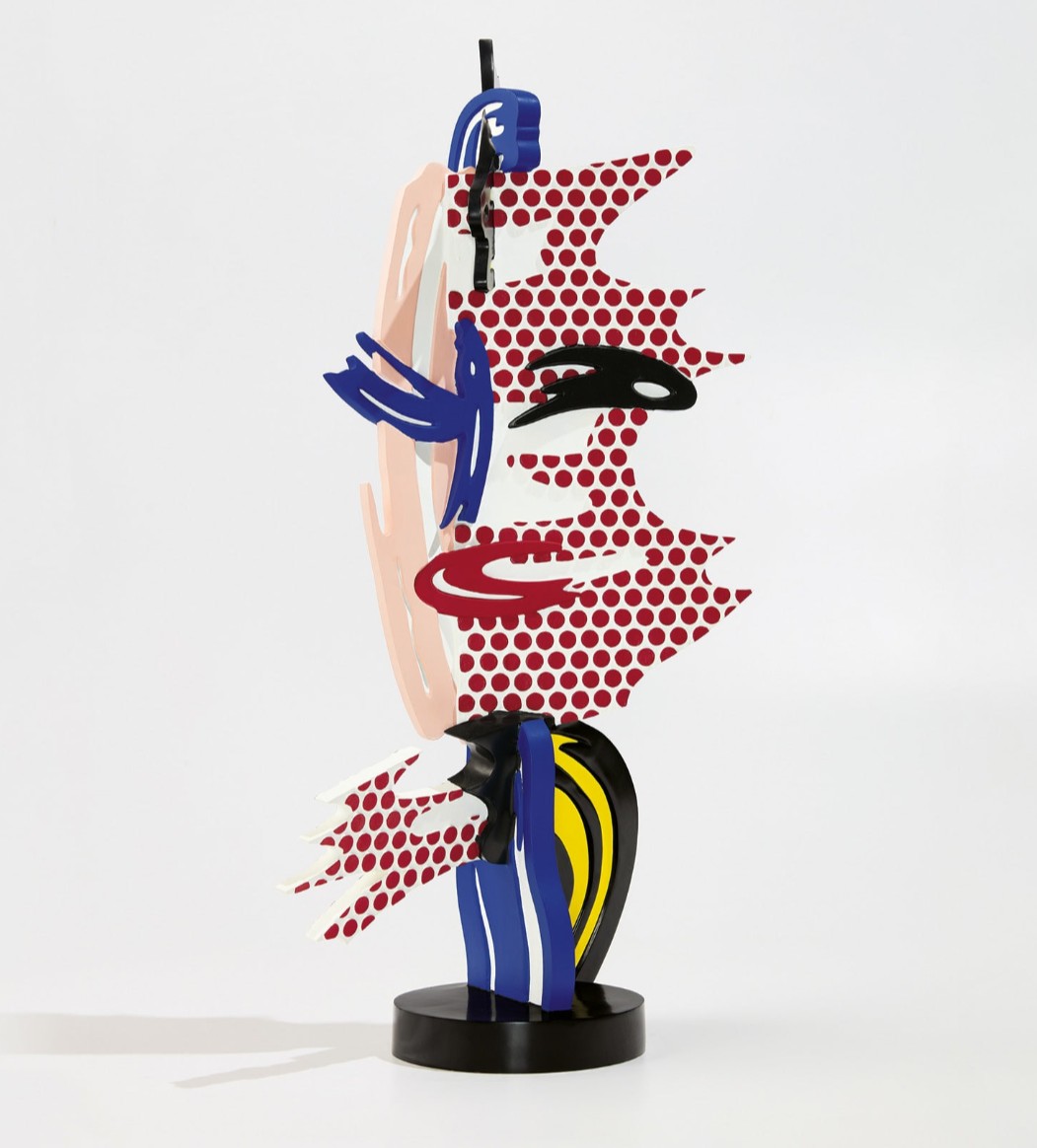
ROY LICHTENSTEIN
Brushstroke Head IV (Barcelona Head), 1987
Painted and patinated bronze
44x20x10 inches (111.8 x 50.8 x 25.4 cm)
Incised with the artist’s signature, number and date “© 3/6 rf Lichtenstein ’87”
Stamped with the Tallix foundry mark on the base
This work is number 3 from an edition of 6
Brushstroke Head IV, 1987-1988
Christie’s New-York: 15 May 2025
Estimated: USD 600,000 – 800,000
USD 756,000
ROY LICHTENSTEIN (1923-1997), Brushstroke Head IV | Christie’s
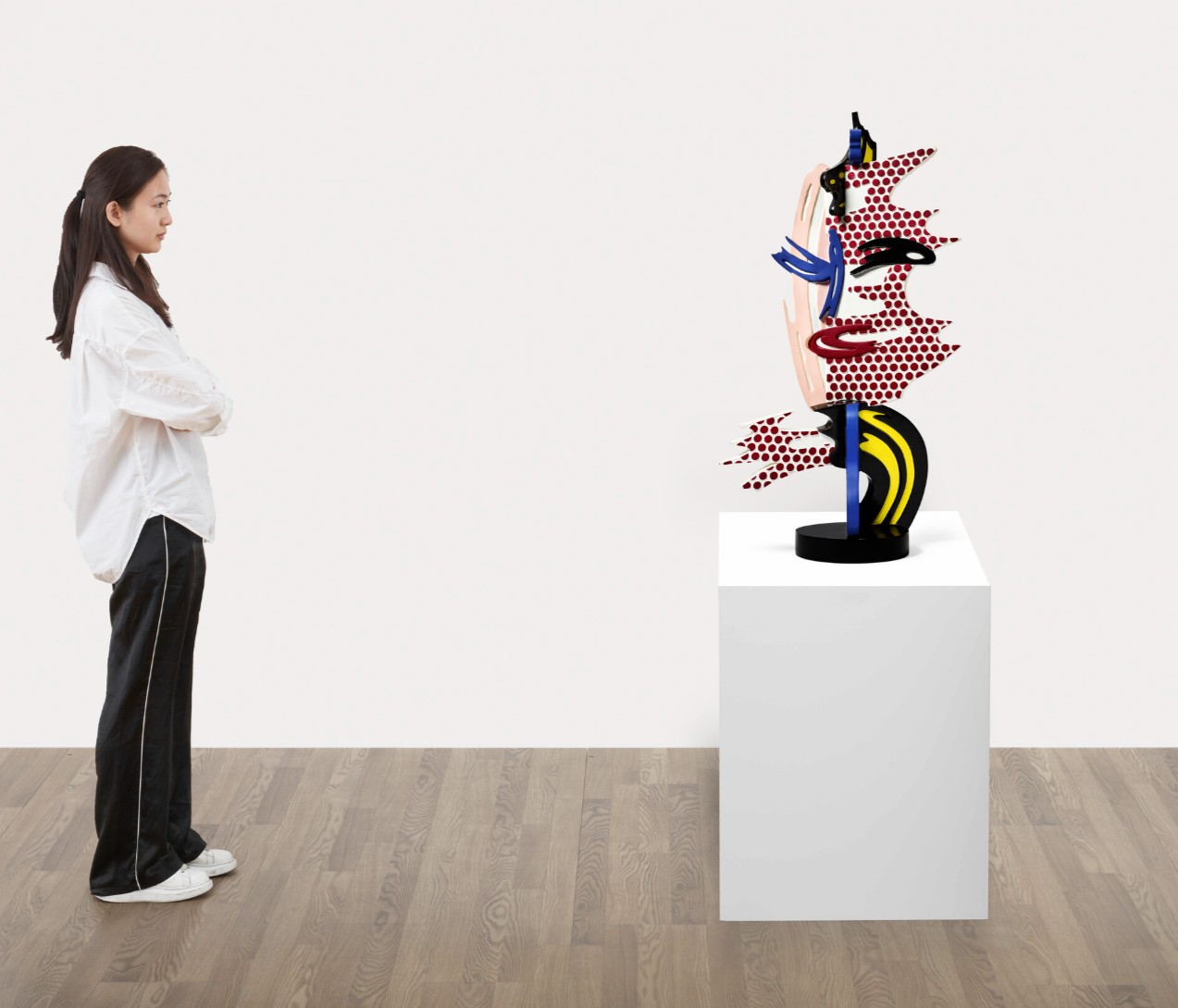
ROY LICHTENSTEIN (1923-1997)
Brushstroke Head IV, 1987-1988
Painted and patinated bronze
43 1/4 x 23 5/8 x 11 3/4 inches (110 x 60 x 29.9 cm)
Incised with the artist’s signature, number, date and foundry mark ‘1⁄6 rf Lichtenstein 87’ (on the base)
Conceived in 1987 and cast in 1988, this work is number one from an edition of six plus one artist’s proof
Metallic Brushstroke Head, 1993
A Legacy Reimagined: Works from the Collection of Dorothy and Roy Lichtenstein
Sotheby’s New-York: 19 November 2025
Estimated: USD 700,000 – 1,000,000
USD 635,000
Metallic Brushstroke Head | Contemporary Day Auction | 2025 | Sotheby’s
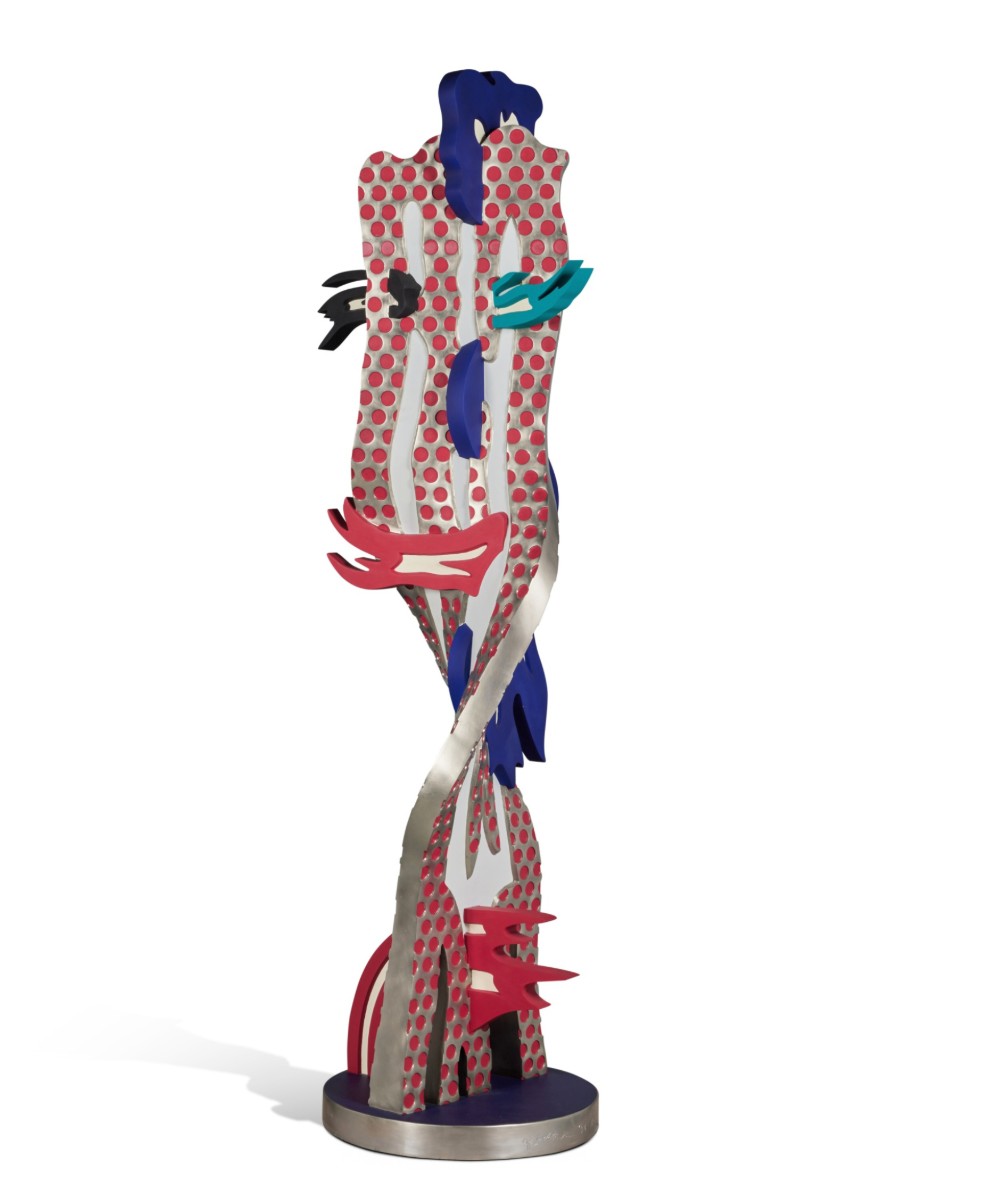
ROY LICHTENSTEIN (1923-1997)
Metallic Brushstroke Head, 1993
Painted nickel-plated bronze
83 x 24 1/2 x 24 1/2 inches (210.8 x 62.2 x 62.2 cm)
Incised with the artist’s signature, date ‘94 and number AP 2/2 (on the base)
This work is artist’s proof 2 of 2 from an edition of 6 plus 2 artist’s proofs
Metallic Brushstroke Head, 1994
Christie’s New-York: 20 November 2025
Estimated: USD 800,000 – 1,200,000
USD 508,000
ROY LICHTENSTEIN (1923-1997), Metallic Brushstroke Head | Christie’s
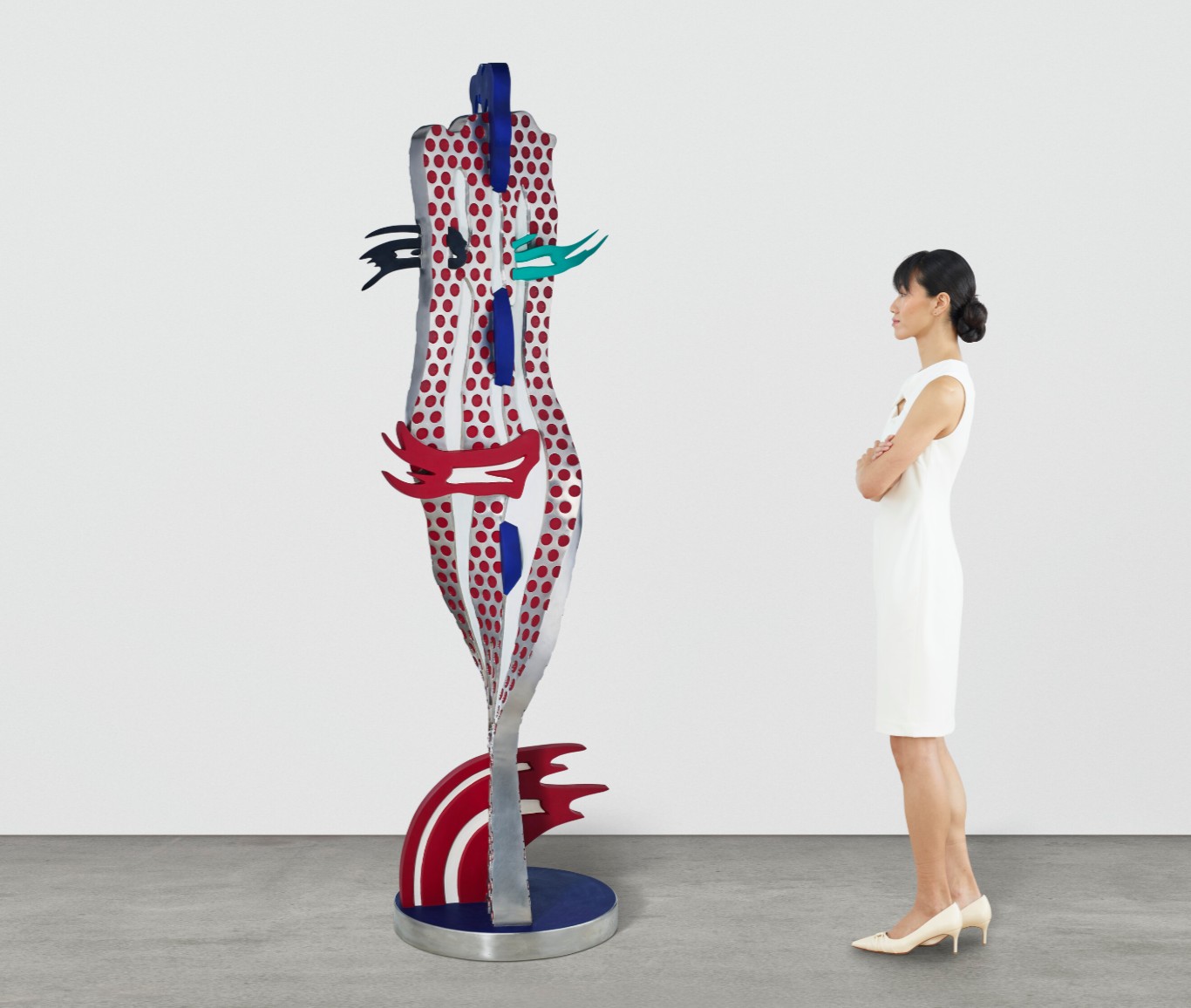
ROY LICHTENSTEIN (1923-1997)
Metallic Brushstroke Head, 1994
Painted nickel-plated bronze
82 3/4 x 24 1/2 x 24 1/2 inches (210.2 x 61 x 61 cm)
Incised with the artist’s signature, number, date and stamped with the foundry mark ‘rf Lichtenstein ’94 AP 1⁄2’
(on the base)
This work is the first artist’s proof from an edition of six plus two artist’s proofs
MONUMENTAL SCULPTURES
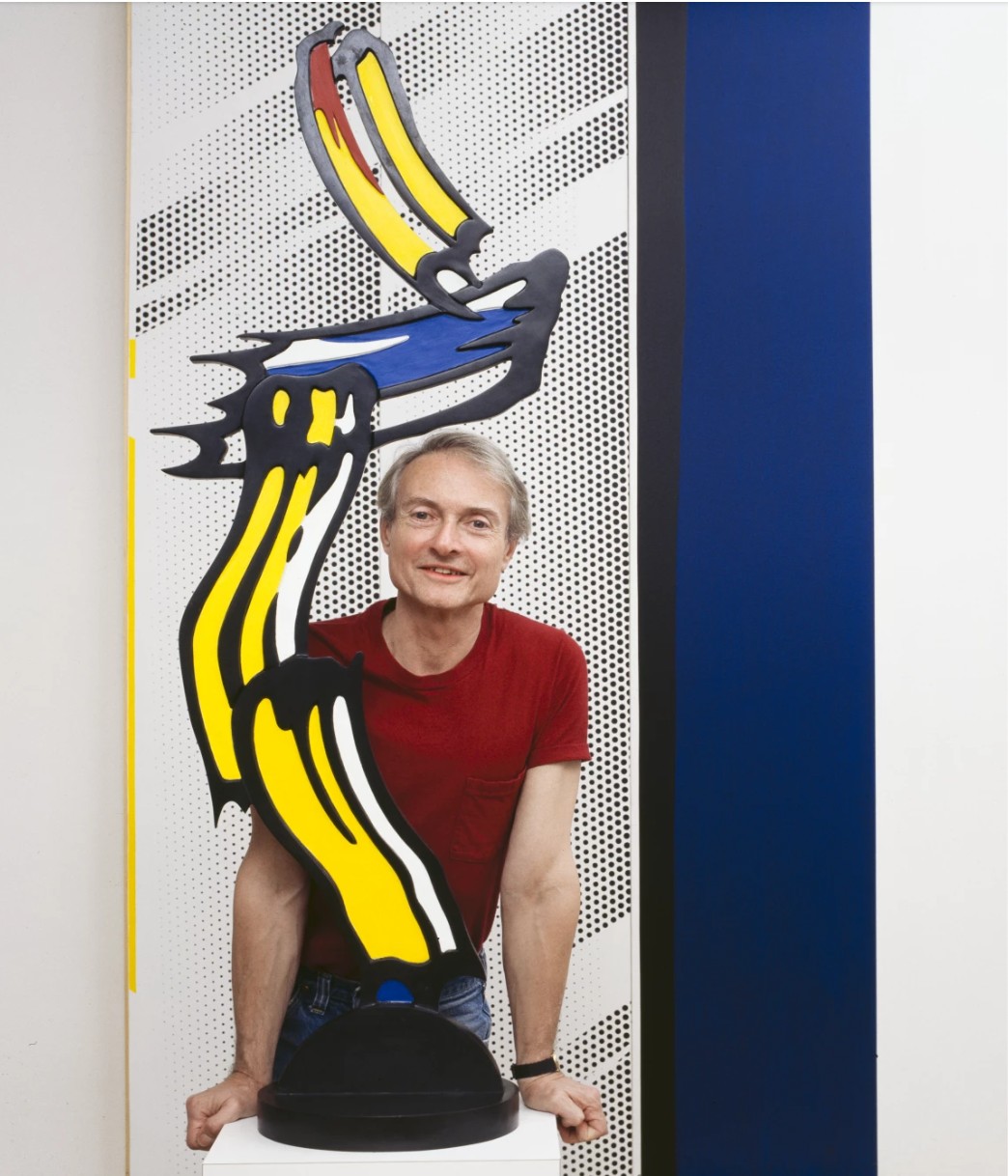
Brushstroke Group, 1987
Brushstroke Group, 1987
PROPERTY FROM A NEW YORK STATE COLLECTION
Christie’s New-York: 10 November 2004
Estimated: USD 2,500,000 – 3,500,000
USD 3,367,500
Roy Lichtenstein (1923-1997) , Brushstroke Group | Christie’s
ROY LICHTENSTEIN (1923-1997)
Brushstroke Group, 1987
Painted aluminum
32 1/2 x 17 x 7 3/4 feet (9.15 x 5.19 x 2.49 m)
Signed and dated ‘rf Lichtenstein 1987’ (at the base)
This work is number one from an edition of one
Brushstroke Group is a New York landmark. Executed in 1987 for the Monte-Carlo Sculpture 87 exhibition, it has subsequently become of a fixture of New York’s landscape. First installed at the entrance to Central Park in the Doris C. Freedman Plaza, the work has also been installed outside the Guggenheim Museum and most recently at City Hall where it was the centerpiece of a Lichtenstein sculpture exhibition. Soaring into the air and realized in bold colors, Brushstroke Group is arguably one of the grandest sculptures ever completed by Roy Lichtenstein bringing one of his defining themes to life in a monumental scale.
The evolution of Pop Art has long been acknowledged to be, at least in part, a reaction to Abstract Expressionism. Using cartoons and consumer goods as subjects, Pop Art was a direct challenge to the prevailing New York School aesthetic. Each of the Pop Artists confronted abstraction in their own way, but none were as direct as Lichtenstein. Employing the same comic book aesthetic that propelled him to fame, Lichtenstein began a series of paintings in1965 in which he took the Abstract Expressionists’ brushstroke as his subject. The Brushstroke quickly became one of Lichtenstein’s signature subjects. At once emulating and cartooning the heroic gesture, Brushstroke Group lampoons the gravitas of gestural painting while paying homage to that fundamental aspect of the artistic process- the brushstroke.
It is Lichtenstein’s marginalization of the author that makes Brushstroke Group particularly resonant. Portraying the ultimate symbol of self-expression, the brushstroke, as a sleek fabricated caricature creates a visual and logical crisis. Lichtenstein informs the viewer that he is seeing a “Brushstroke” by using a lexicon of symbols developed from cartooning, a fundamental paradox. Yet the dynamism and dexterity with which Lichtenstein imbues Brushstroke Group is awe inspiring. Fundamentally different from the brushstrokes of an artist like Willem de Kooning, Brushstroke Group conveys as much raw physicality. David Hickey writes, “Far from offering putative comic relief from painterly heroism, Lichtenstein’s brushstrokes clearly aspired to replace them, and, in the friendliest manner imaginable, they did just that, not by offering up a new historical style to supplant painterly abstraction, but by offering an alternative model of artistic practice that repositioned abstract painting in a broad field of equally weighted endeavors. In simple terms, Lichtenstein sought to retain the rhetoric of doubt, difficulty and latent abstraction that invigorates modernist practice while dispensing with its directional historical thrust” (D. Hickey, Roy Lichtenstein Brushstrokes: Four Decades, New York, 2001, p. 11).
Brushstroke Group ranks among the best examples of Post-War sculpture. Flying brushstrokes move across the “picture plane” as well as recede into it, creating a magical illusion of pictorial space that floats in thin air. Its forms suggest continuous movement and floods seismic energy through the space it occupies. Like Richard Serra’s Torqued Ellipses or Donald Judd’s Floor Boxes, Brushstroke Group‘s impact is as driven by its interaction with its environment as it is about its chosen subject. For all this bravura, Brushstroke Group never loses its sense of humor. It draws strong affinities with Claes Oldenburg’s deflating sculptures of hamburgers, drums and light switches- it is no surprise that Lichtenstein and Oldenburg are the premiere sculptors of the Pop movement.
While gently poking fun at the righteousness of Abstract Expressionism, Brushstroke Group also brings to life, in Technicolor glory, the awesome power of the brushstroke. In harmonious counter-balance, its heroic scale and substantial weight are the very elements, which with expressive exuberance, lift the sculpture from its anchoring base. Lichtenstein has transformed the painter’s gesture into a new form that is to be celebrated in its own right. Hickey writes, “Like Andy Warhol’s Soup Cans, Lichtenstein’s brushstrokes were, clearly and at first glance, generational icons. They proposed a critique of the immediate past, clearly intending to supersede it without destroying it- to propose something new that would renew the past” (Ibid, p. 10).
Brushstrokes, 1996-2001
Brushstrokes, 1996-2001
A Legacy Reimagined: Works from the Collection of Dorothy and Roy Lichtenstein
Sotheby’s New-York: 18 November 2025
Estimated: USD 4,o00,000 – 6,000,000
USD 3,100,000
Brushstrokes | The Now & Contemporary Evening Auction | 2025 | Sotheby’s
ROY LICHTENSTEIN (1923 – 1997)
Brushstrokes, 1996-2001
Painted aluminum
353 1/4 x 162 x 90 inches (897.3 x 411.5 x 228.6 cm)
Incised with the artist’s signature, dated ‘96 and numbered AP (lower edge)
Incised © Estate of Roy Lichtenstein and dated 2001 (lower edge)
Conceived in 1996 and cast in 2001, this work is the artist’s proof from an edition of 1 plus 1 artist’s proof
A superb example of Roy Lichtenstein’s celebrated monumental sculptures, Brushstrokes represents one of the artist’s most iconic motifs, heightening its semiotic meaning by transposing the form of the brushstroke into the sculptural medium. Harkening back to his legendary Brushstroke paintings of the 1960s, which themselves offer a witty commentary on the supremacy of Abstract Expressionism, Lichtenstein here returns to an investigation of the act of painting itself. Conceived in 1996 in the penultimate year of his life, Brushstrokes metamorphosizes the vigorous stroke of pigment from a painter’s brush into a three-dimensional embodiment of technique associated with two-dimensionality. Full of kinetic potential, Lichtenstein’s strokes of pigment appear to leap off the ground, soaring into the sky—each one more energetic and vigorous than the next. Despite their fundamental immobility, Lichtenstein’s splashes of blue, green, yellow and white suggest a perpetual motion, as if they have broken free from the confines of the two-dimensional picture plane. In the 1980s and 90s, Lichtenstein revisited the subject of the Brushstroke, this time in the form of monumental sculpture.
Examples of Lichtenstein’s monumental Brushstroke sculptures are held in many prominent institutional collections including Museo de Arte de Ponce, Puerto Rico; The J. Paul Getty Museum, Los Angeles; Museo Nacional Centro de Arte Reina Sofía; Hirshhorn Museum and Sculpture Garden, Washington, D.C, among others. The present work is one of two works from the edition, the other of which is on display in the permanent collection of the Portland Art Museum.
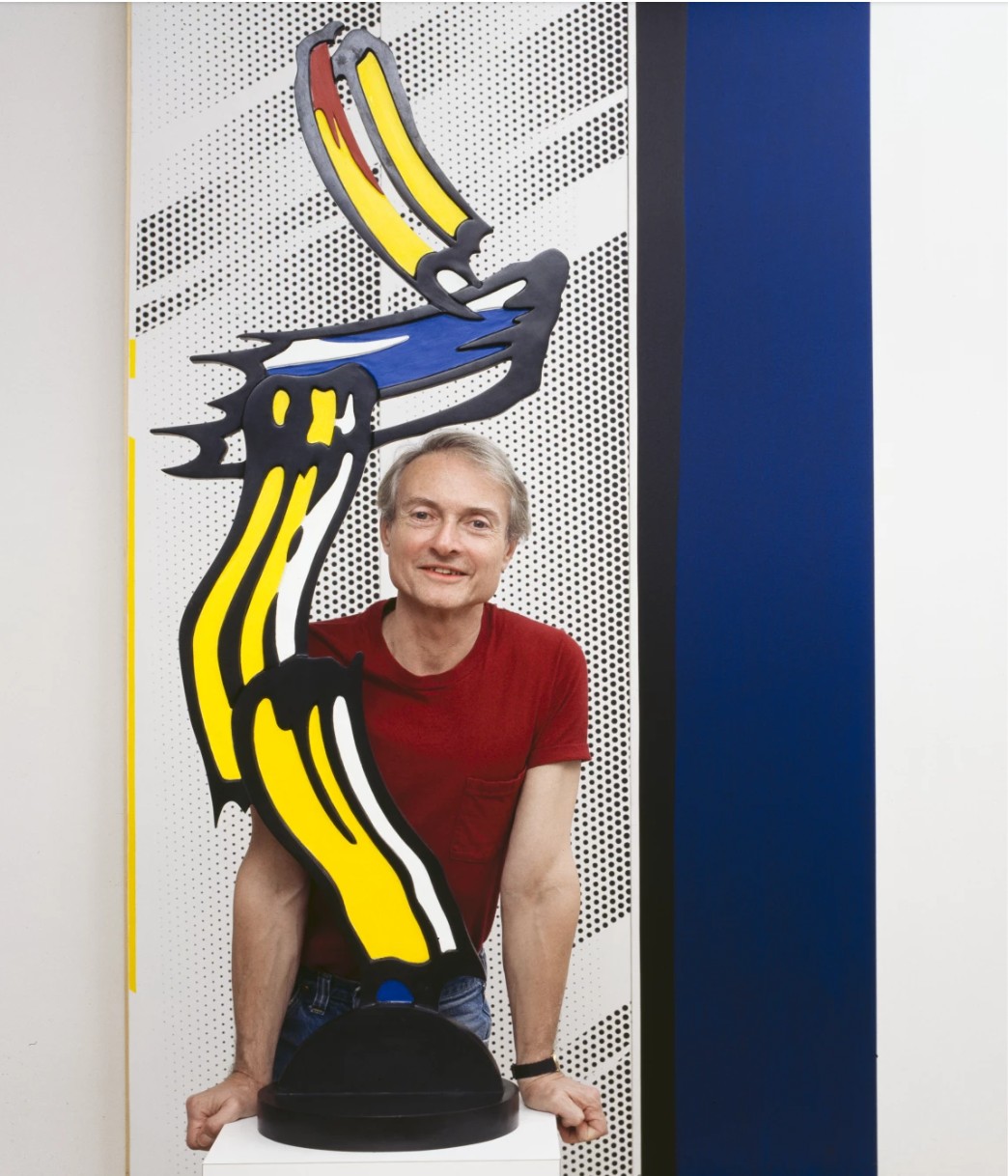
Roy Lichtenstein with one of his Brushstrokes sculptures. Image © Bob Adelman. Art © Estate of Roy Lichtenstein
Lichtenstein began experimenting with the brushstroke motif in the mid-1960s, creating a series of paintings from 1965-66 that remain some of his best-known and most celebrated works. Taking inspiration from comic book representations of painting and the gestural, vigorous compositions of the Abstract Expressionists, Lichtenstein creates a caricature of the brushstroke. Lichtenstein transformed the brushstroke from mere building block of a composition into the subject in and of itself. The resulting works are both trademarks of his clever ability to imitate and transform as well as instantly recognizable icons of his legendary Pop vernacular. As Lichtenstein’s career progressed, he began to look back not only on the art historical canon for inspiration, but also his own earlier works, incorporating his iconography into new compositions. The present work, among a series of monumental Brushstroke sculptures the artist created during the 1980s-90s, is adapted from these celebrated 1960s paintings. The Brushstroke sculptures can be viewed as the ideological pinnacle of the central motif of Lichtenstein’s career: an inquiry of the act of creation implicit in all of art history.
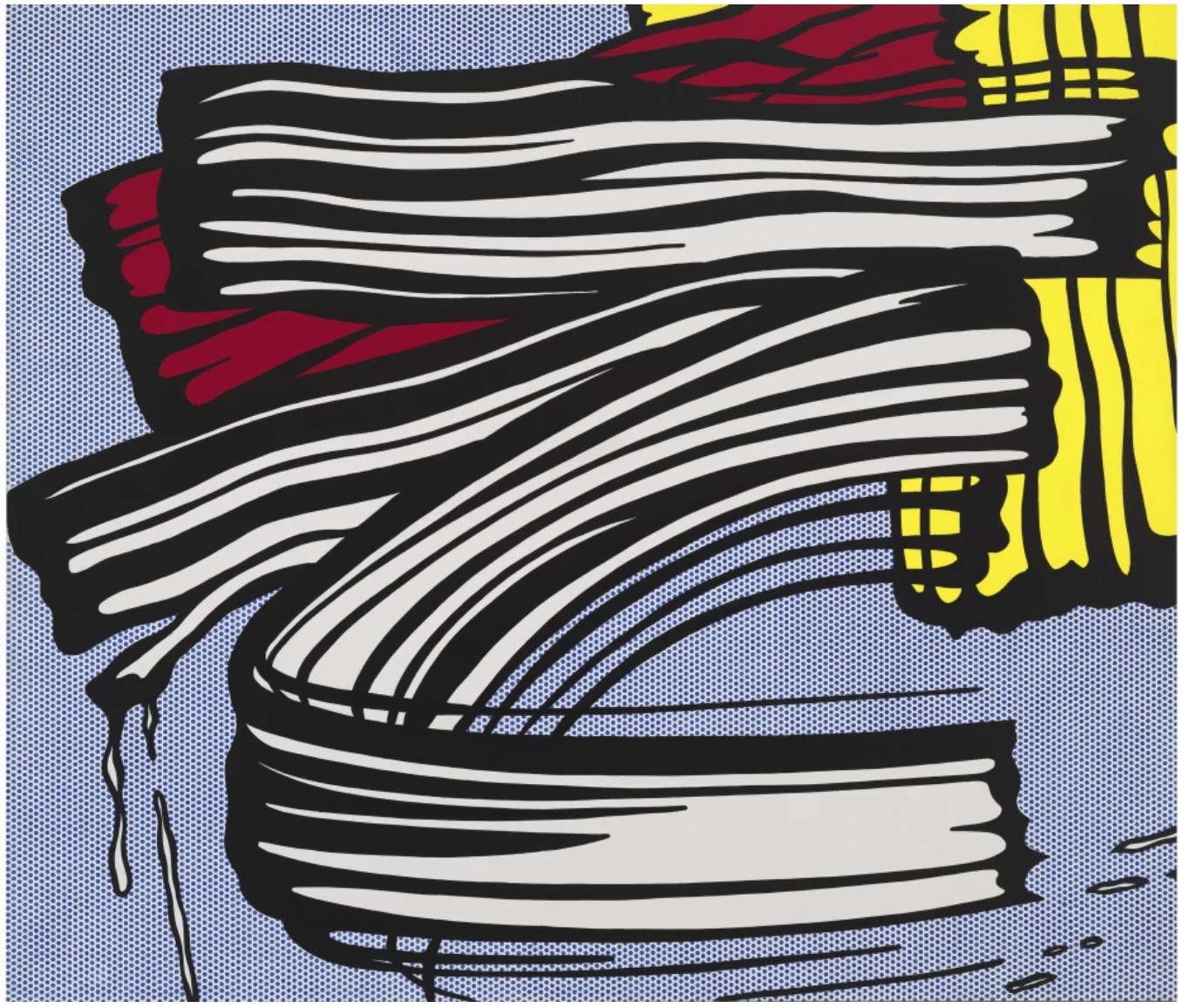
Roy Lichtenstein, Little Big Painting, 1965. Whitney Museum of American Art, New York.
Image © Whitney Museum of American Art / Licensed by Scala / Art Resource, NY. Art © Estate of Roy Lichtenstein
Energetic and fluid, Lichtenstein’s Brushstrokes conveys the action and expression of painting in a sculptural form. A powder blue stroke reaches into the air, intersected by an arcing splash of emerald green; a wispy yellow swipe of pigment is adorned with Lichtenstein’s iconic diagonal hash lines; and at the very peak, a white dash of paint reaches highest into the sky. Lichtenstein captures not only the vigorous motion of the painter’s brush, but also the viscosity of oil paint through the white and beige streaks within his colorful aluminum elements.
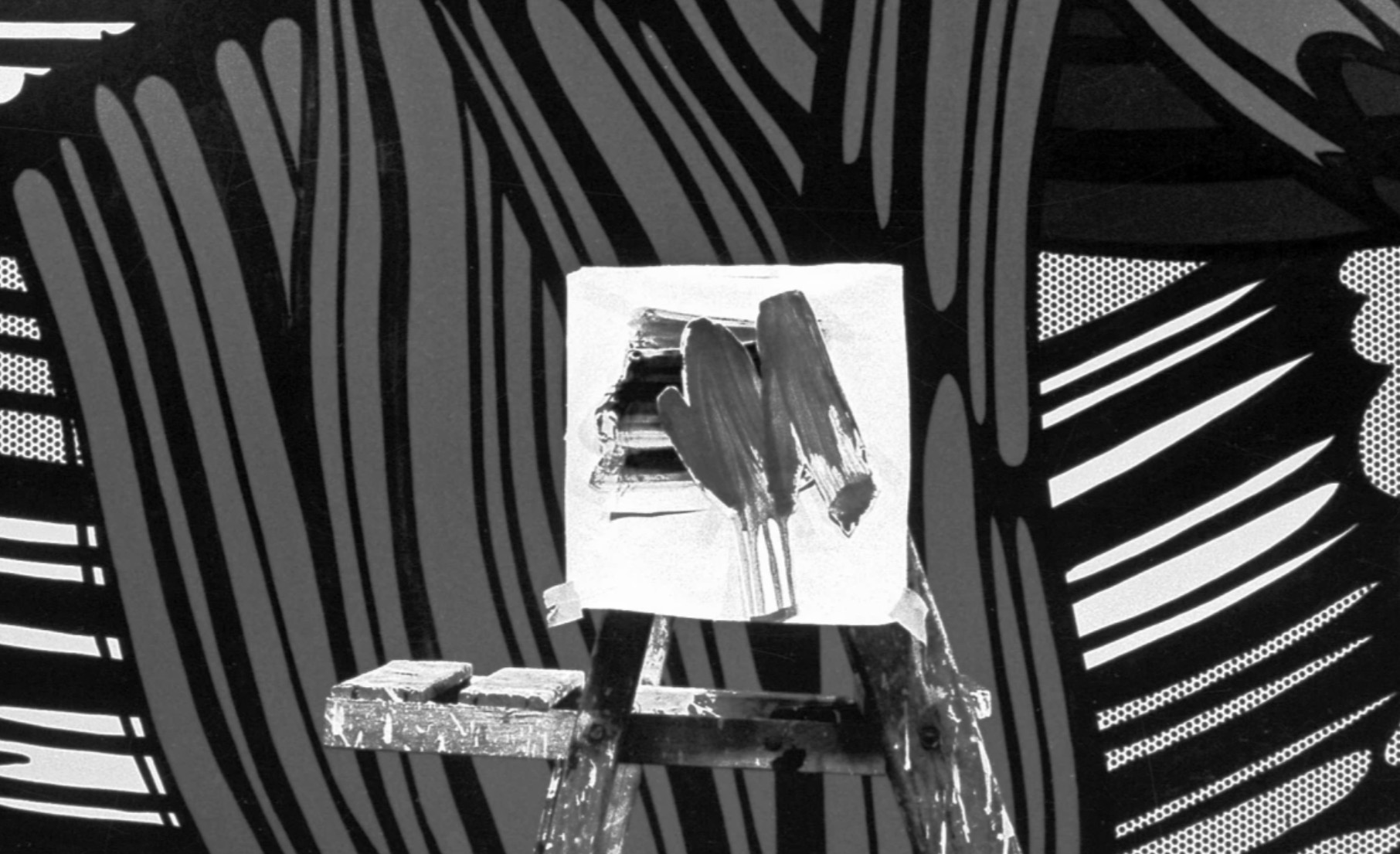
Roy Lichtenstein’s studio, 1965. Photo Ugo Mulas © Ugo Mulas Heirs. All Rights Reserved. Art © Estate of Roy Lichtenstein
Metamorphosizing the subject of the brushstroke into a monumental three-dimensional form, Lichtenstein creates the ultimate playful parody of artmaking. His work is a monument to the act of painting, to the ostensible spontaneity of gesture that defined the work of the inimitable Action Painters that commanded the Post-War period. Lichtenstein’s Brushstrokes is at once cerebral and undeniably humorous: the result of a career-long inquiry into the hegemony and solemnity of Ab Ex and an exaggeration of scale so extreme and playful, it must elicit joy.
Monumental Brushstrokes in Museum Collections
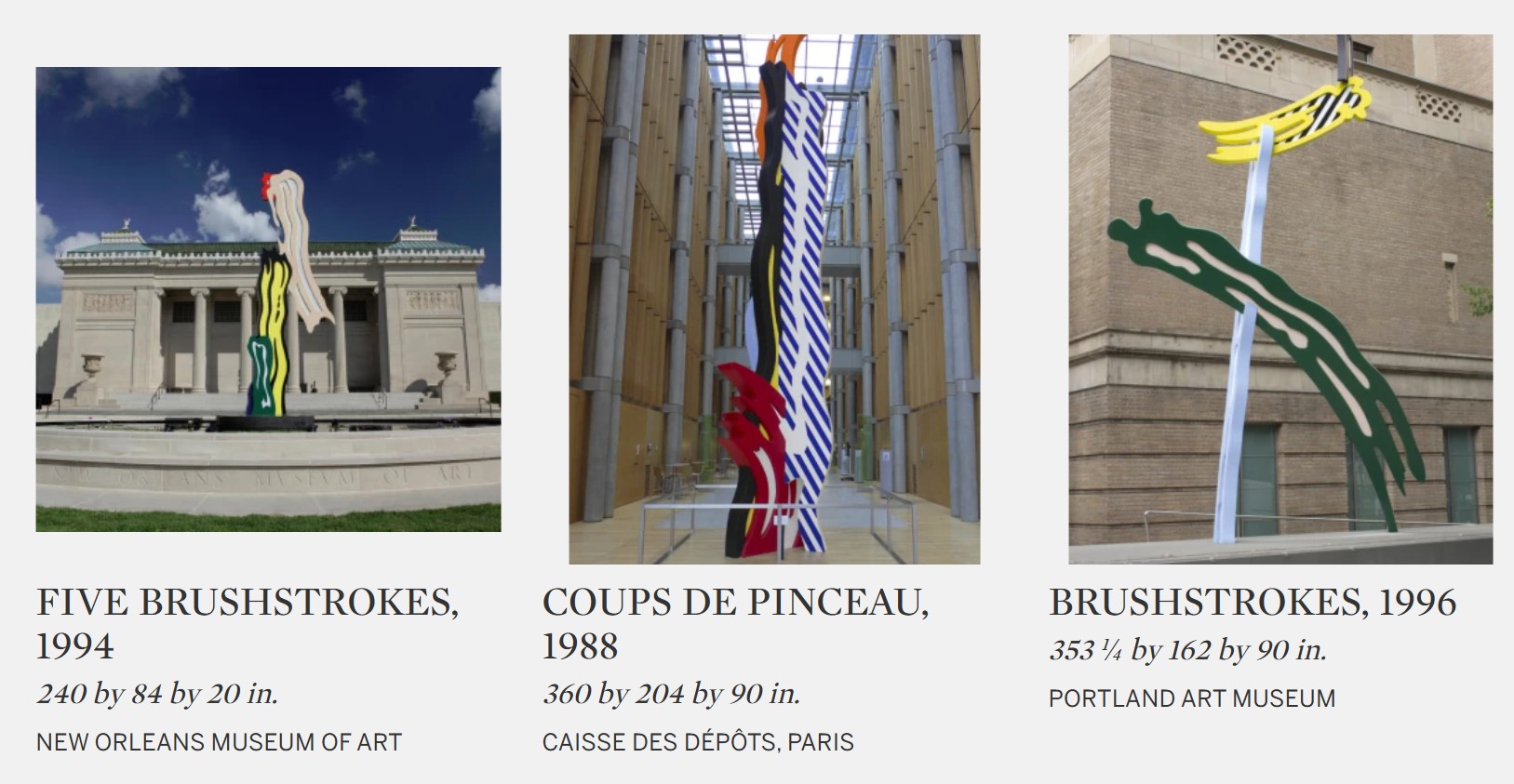
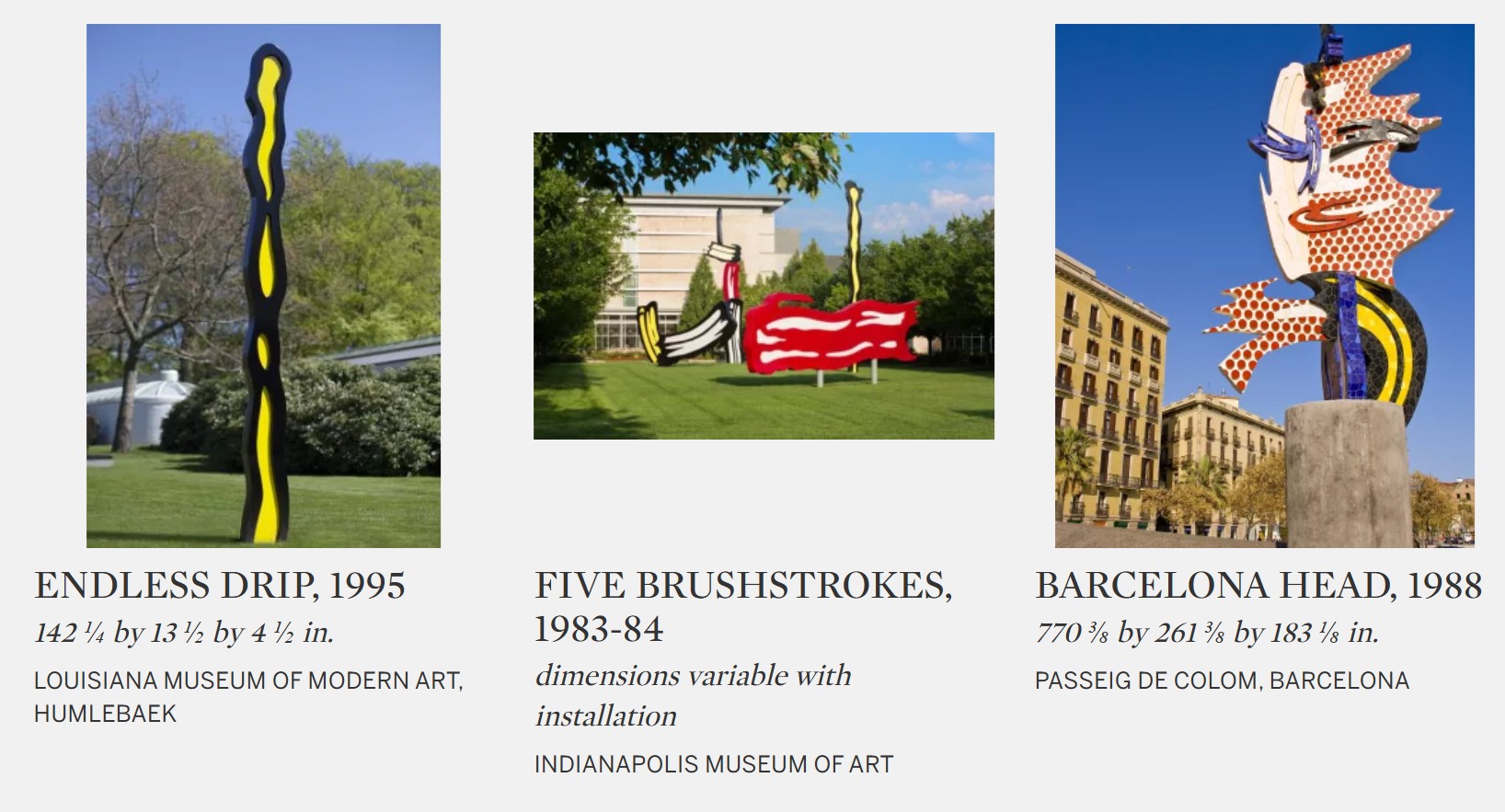
While Brushstrokes represents a two-dimensional form in three-dimensions, he does so while eschewing the three-dimensionality of sculpture. It exists both as a sculpture which can be experienced in-the-round and as a collection of two-dimensional elements. In this way, Lichtenstein has, in almost absurd fashion, both reduced the sculptural medium to two-dimensions while transforming a brushstroke into a three-dimensional object.
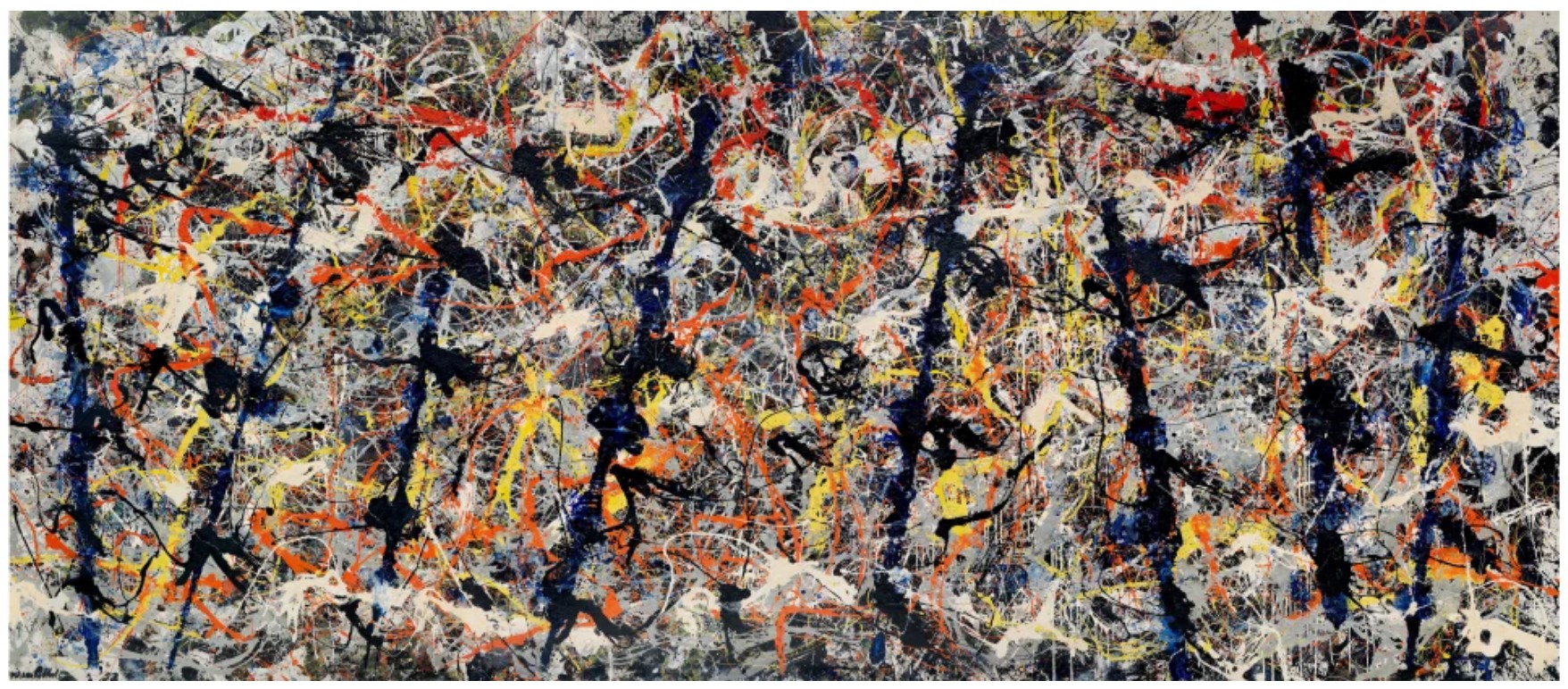
Jackson Pollock, Blue Poles, 1952. Image © National Gallery of Australia, Canberra / Purchased 1973 / Bridgeman Images.
Art © 2025 Pollock-Krasner Foundation / Artists Rights Society (ARS), New York
When viewed from afar, the environment around Brushstrokes serves as the background for Lichtenstein’s comic-like sculpture. Lichtenstein is painting on the sky, the grass, the facades of buildings, and even interior walls. Lichtenstein’s distinctive influence is undeniable and everywhere— in essence, he makes the whole world his canvas.
Coup de Chapeau II, 1996
Coup de Chapeau II, 1996
A Legacy Reimagined: Works from the Collection of Dorothy and Roy Lichtenstein
Sotheby’s New-York: 18 November 2025
Estimated: USD 1,500,000 – 2,000,000
USD 3,832,000
Coup de Chapeau II | The Now & Contemporary Evening Auction | 2025 | Sotheby’s
ROY LICHTENSTEIN (1923 – 1997)
Coup de Chapeau II, 1996
Painted bronze
89 x 32 x 13 1/8 inches (226.1 x 81.3 x 33.3 cm)
Incised with the artist’s signature, numbered 0/6 and dated ‘96 (lower edge)
This work is the artist’s cast from an edition of 6 plus 1 artist’s cast
Bursting into three-dimensional space, Coup de Chapeau II encapsulates the iconic graphic power of Roy Lichtenstein’s instantly recognizable Pop idiom. Here, Lichtenstein harkens back to the explosive force and comic-book characters of his earliest Pop paintings of the 1960s. The cartoon-like hat, resembling those worn by Lichtenstein’s early comic book heroes, soars into the air, creating a swelling cloud in its wake and leaving the hat wearer in its dust. Coup de Chapeau II and its smaller sister sculpture, Coup de Chapeau I, operate as three-dimensional extensions of the artist’s final self-portrait, Coup de Chapeau (Self-Portrait), and its study Coup de Chapeau (Self-Portrait) (Study) from 1995-6. In his earlier two-dimensional works, the artist represents himself stunned by a flying hat soaring into the air—a symbol for the whiplash of the oncoming new millennium. In Coup de Chapeau II, Lichtenstein has isolated the airborne yellow hat and the trace of its motion, causing the viewer to ponder who wore the hat and the source of its inexplicable flight. Coup de Chapeau II is among the most celebrated of Lichtenstein’s sculptures, having been included in numerous exhibitions, including most recently the Albertina in Vienna for Roy Lichtenstein: A Centennial Exhibition.
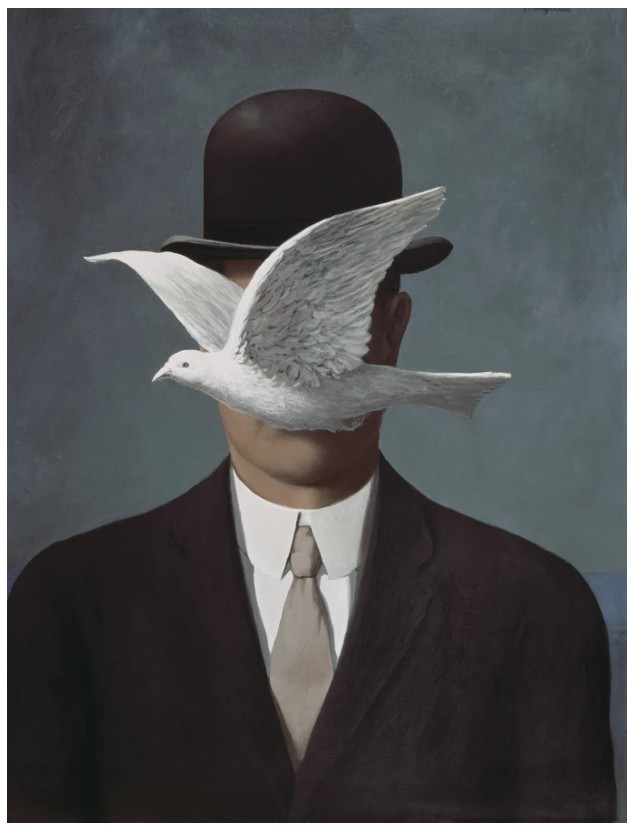
Rene Magritte, Man in a Bowler Hat, 1964. Private Collection. Image © Superstock / Bridgeman Images.
Art © 2025 C. Herscovici, Brussels / Artists Rights Society (ARS), New York
Reaching nearly 90 inches, Lichtenstein’s Coup de Chapeau II epitomizes Lichtenstein’s transformation of his two-dimensional Pop idiom into sculpture. Here, Lichtenstein propels his signature graphic vernacular, including bold primary colors and strong lines, into three-dimensional space. Beams of yellow, blue, white and black emerge from a billowing cloud in a cartoon arc. Evoking the artist’s famed wall sculptures and explosion paintings of the early 60s, a crimson explosion bursts at the apex of the sculpture’s arc as if erupting with energy. Then thrust into the air, Lichtenstein’s yellow cap is launched above the explosion, tilted on its brim in mid-rotation. Lichtenstein accentuates this spinning effect by doubling the brim of the hat, creating the illusion that the hat is still in motion. Here, the French phrase “Coup de Chapeau” takes on multiple meanings: “The term coup de chapeau is defined as a salute, but coup alone is a blow, stroke, or hit, with chapeau being hat. To give un coup de chapeau means to bow. While Lichtenstein thought of his phrase as ‘a tip of the hat.’” (Exh. Cat., Washington, D.C., The Corcoran Gallery of Art (and traveling), Roy Lichtenstein: Sculpture and Drawings, 1998-2000, p. 21)
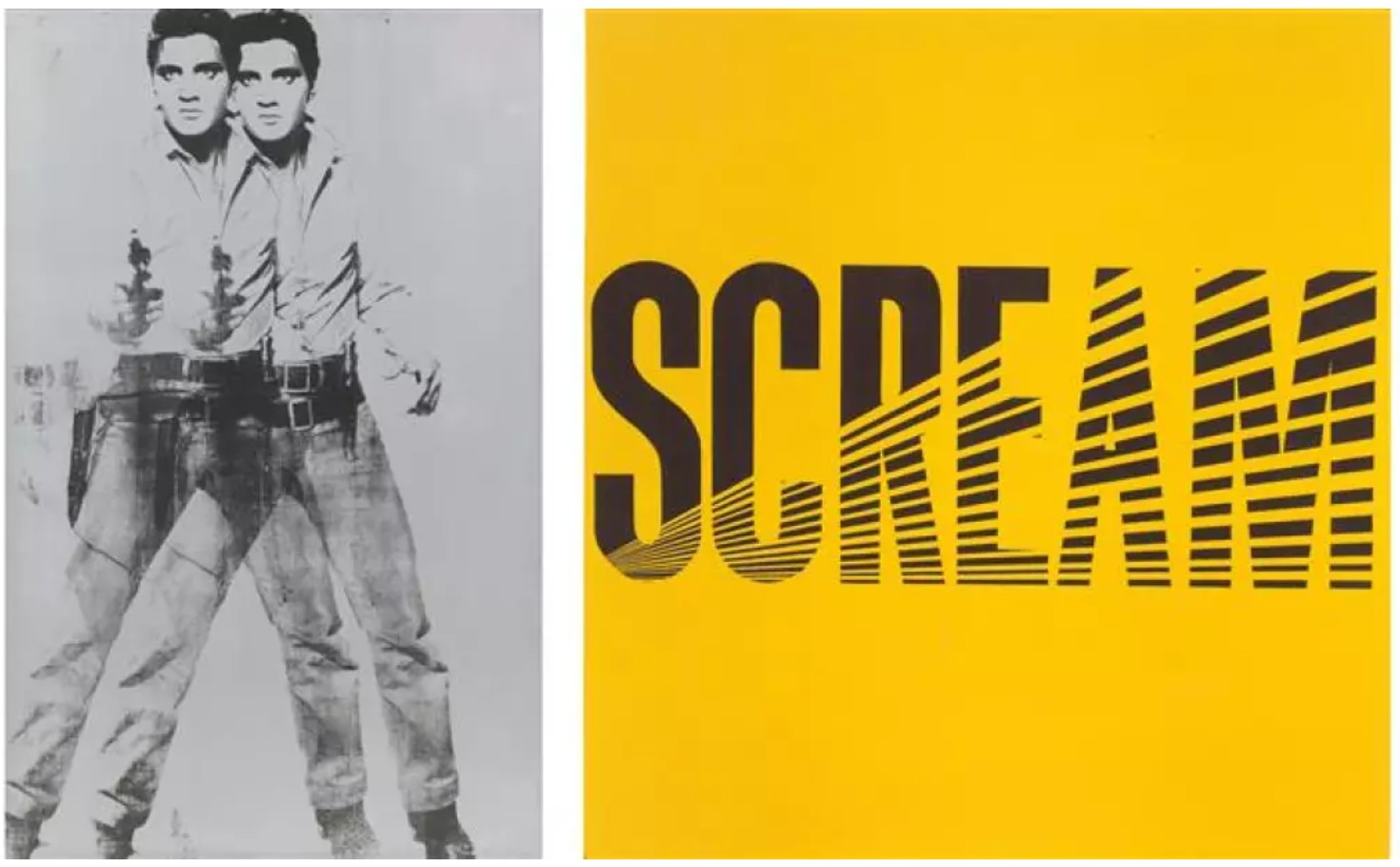
Left: Andy Warhol, Double Elvis, 1963. The Museum of Modern Art, New York. Image © The Museum of Modern Art / Licensed by SCALA / Art Resource, NY. Art © 2025 Andy Warhol Foundation for the Visual Arts / Artists Rights Society (ARS), New York.
Right: Ed Ruscha, Scream, 1964. Art © 2025 Ed Ruscha
Coup de Chapeau II operates as an important counterpart to Lichtenstein’s final and exceedingly rare self-portraits. The work reveals a highly personal revelation for the artist of his own grappling with the forces of change in a rapidly evolving society. The present sculpture was preceded by Coup de Chapeau (Self-Portrait) and its study Coup de Chapeau (Self-Portrait) (Study)—two rare works in which the artist depicts himself, stunned, by an airborne yellow cap. In the work on paper, Lichtenstein inscribes next to his image: “Self Portrait (Man hit by the 21st Century).” The hat illustrated in the aforementioned works and Coup de Chapeau II evokes the cap worn by Dagwood Bumstead in the popular comic “Blondie.” Methodical and iterative, Lichtenstein’s practice is one of sustained engagement across media. In many cases, the artist pursues a subject through a selection of different media such as drawing, collage, painting, sculpture and printmaking. Considering Coup de Chapeau II in dialogue with the related work on paper and painting illuminates the role of the artist in its narrative. Here, despite the omission of any human figure, Lichtenstein realizes a form of self-portraiture, exploring his own response to the advent of the new century. Harkening back to his earliest comic-book paintings, Lichtenstein’s Coup de Chapeau II is both a pure fulfillment of Pop and a reflection on the arc of his career. Like much of Lichtenstein’s oeuvre, these works are referential to his own practice and art history. Executed in 1996 in the last year of Lichtenstein’s career, Coup de Chapeau II is a masterful example of the artist’s continued reinvestigation of art history and his own practice. From the early 1960s, Lichtenstein was guided by an investigation of “art about art,” deconstructing the arbitrary boundaries between “high” and “low” through a system of signs and symbols associated with mass production and comic books.
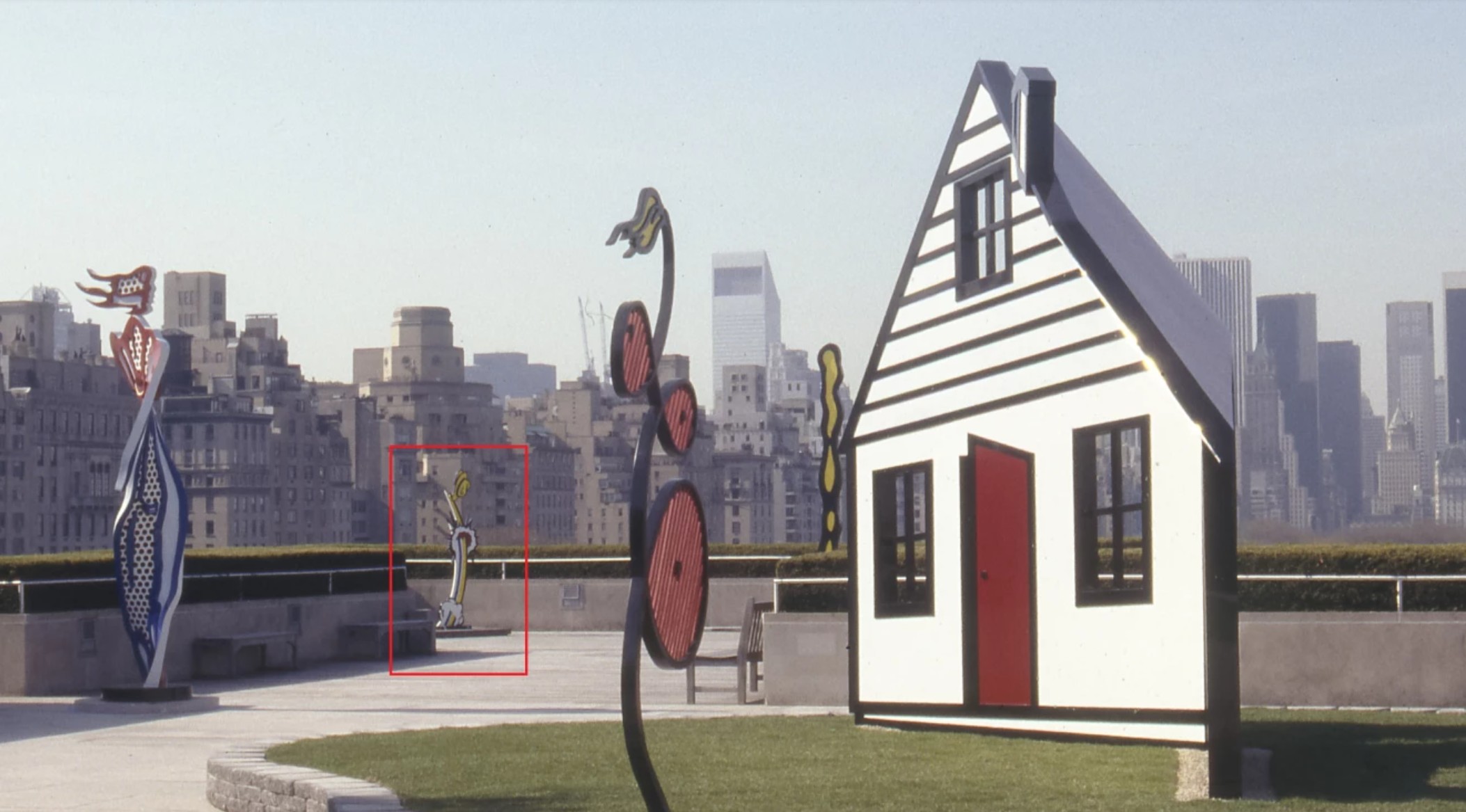
Another edition of the present work installed in Roy Lichtenstein on the Roof, The Metropolitan Museum of Art, New York, May – November 2003. Image © The Metropolitan Museum of Art / Art Resource, NY. Art © Estate of Roy Lichtenstein
Lichtenstein developed his signature visual vernacular, creating paintings inspired by comic-book caricatures and some of the most salient iconography from the art historical canon. As Lichtenstein’s career progressed, he eventually turned to his own work as a source of inspiration. In the present work, Lichtenstein quotes from the iconography that characterized his earliest Pop paintings, bringing it into three-dimensional space. The soaring hat resembles those in the compositions of some of his most celebrated early paintings, such as Mr. Bellamy (1961) and Kiss with Cloud (1964), while the explosion in its wake harkens back to the artist’s iconic explosion sculptures and war paintings of the 1960s, like Whaam! (1963) and Varoom! (1963).
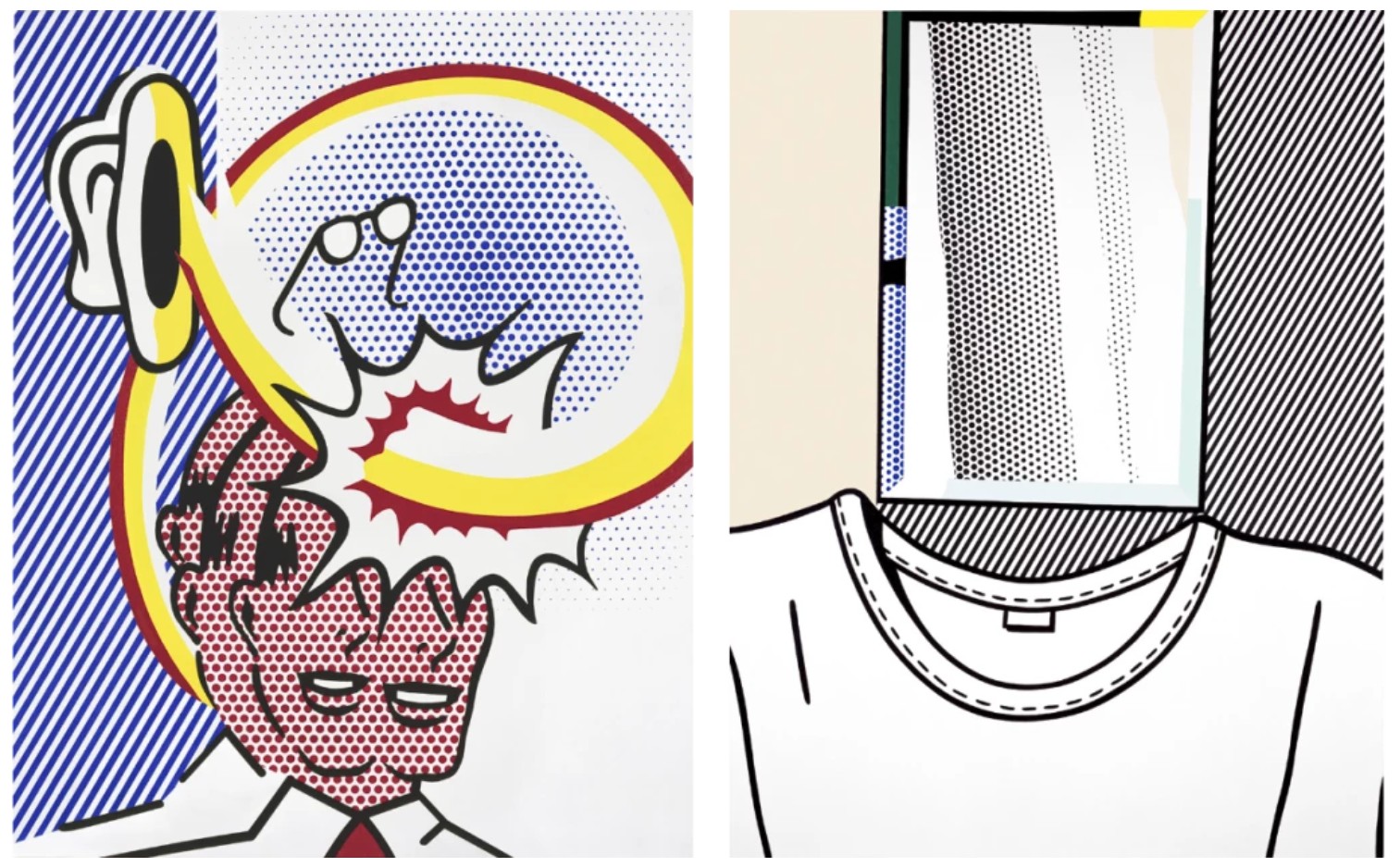
Left: Roy Lichtenstein, Coup De Chapeau (Self-Portrait), 1996. Private Collection, New York. Art © Estate of Roy Lichtenstein.
Right: Roy Lichtenstein, Self-Portrait, 1978. Private Collection. Art © Estate of Roy Lichtenstein
From Lichtenstein’s earliest explorations with three-dimensionality in the mid-1940s through the end of his life in 1997, sculpture occupied a central place in the artist’s practice. Across media and form, Lichtenstein operates to blur the boundaries and arbitrary parameters of their qualities. He probes the semiotics of space and perspective, volume and mass through his distinctive visual lexicon of color and line. Nowhere is Lichtenstein’s playful investigation of form and representation more apparent than in his sculptures like Coup de Chapeau II.
Coup de chapeau II, 1996
Christie’s New-York: 15 May 2013
Estimated: USD 2,000,000 – 3,000,000
USD 1,915,750
Roy Lichtenstein (1923-1997) , Coup de Chapeau II | Christie’s
REPEAT SALE
Christie’s New-York: 13 November 2007
Estimated: USD 1,800,000 – 2,200,000
USD 2,841,000
Roy Lichtenstein (1923-1997) , Coup de chapeau II | Christie’s
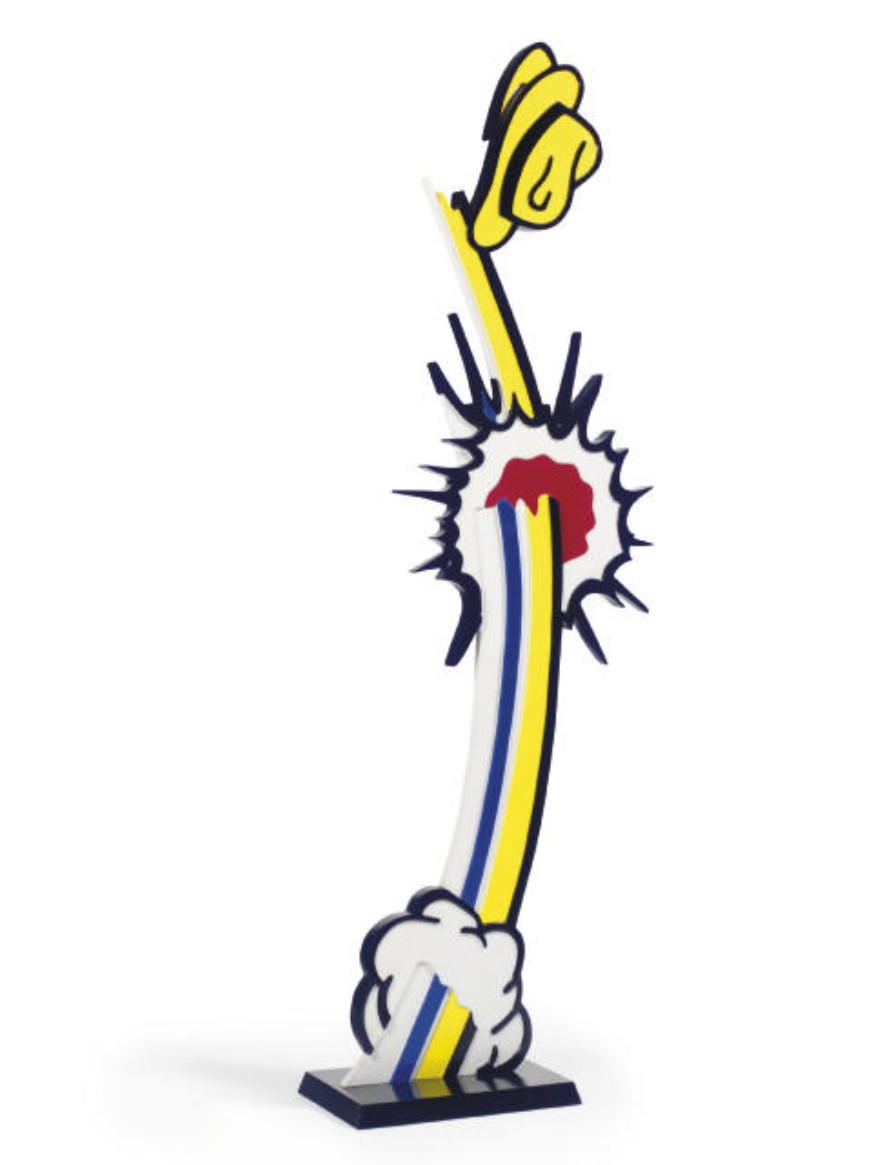
ROY LICHTENSTEIN (1923-1997)
Coup de chapeau II, 1996
Painted and patinated bronze
91 x 30 x 13 1/4 inches (231.1 x 76.2 x 33.7 cm)
Signed, numbered and dated ‘6/6 rf Lichtenstein ’96’ (on the base)
This work is number six from an edition of six
A tip of the hat turns into an explosive gesture in Lichtenstein’s highly engaging sculpture, Coup de Chapeau II. The artist translates into three dimensions the signature visual language that he had developed in his seminal Pop oeuvre of the 1960s, with its hallmarks of cartoon-derived imagery, a pared down color scheme and boldly graphic distillation of form. The hat that had once blown off of the head of a comic strip character now bursts through a cloud, leaving an explosion in its wake. This action is a witty visual manifestation of the French expression coup de chapeau, a tip of the hat that signifies the showing of respect. Created in the last years of Lichtenstein’s life, the work stands as both an irreverent and poignant monument to the artist’s accomplished career.
Coup de Chapeau II expresses a special connection with the artist, as it relates to a self-portrait made in the same year, the painting titled Coup de Chapeau (Self Portrait), which was to be the very last self-portrait he created. Through his instantly recognizable visual syntax of Benday dots and bracing primary colors, Lichtenstein humorously depicts himself as a square-jawed gentleman whose hat has been violently propelled into the air by an unseen force, knocking off his glasses and setting off an explosion that conceals his eyes. The title plays upon the word coup, which by itself signifies a blow or strike — but what is the artist struck by here? The explosion that conceals his eyes suggests a moment of being dumb-struck, and since the motif of a burst of light had appeared in his work as a kind of shorthand for inspiration, or the shock of the new, we might infer that the artist is depicting himself in a moment of creative awe, which sets the trajectory of the tip of the hat in motion. Indeed a preliminary sketch for the painted self-portrait was inscribed by the artist “Self Portrait (Man hit by the 21st Century),” presenting himself as being blasted with anticipation of what the next millennium will hold. While the figure has disappeared in Coup de Chapeau II, its dynamic composition nevertheless reverberates with the sense of exhilaration conveyed in the self-portrait.
The uncanny character of Lichtenstein’s floating hat summons to mind Magritte’s famed bowler hats, which appeared throughout the surrealist master’s oeuvre and became an emblem of his transformation of the everyday into the enigmatic. Magritte’s The Great War obscures the face of a staid bourgeois gentleman with an apple that hovers in front of it, while his bowler hat floats unperturbed upon his head. Lichtenstein maintains a sense of the absurd, while upturning Magritte’s omnipresent black hat with the force of a Pop explosion.
There are especially rich connections between Coup de Chapeau II and numerous significant works in Lichtenstein’s career. The motif of the comic book derived explosion had recurred with frequency in his seminal Pop works such as Whaam! (Tate Modern) of 1963. Indeed, the creative force of the new movement of Pop was perhaps best summed up in the artist’s 1966 “Pop,” which embeds the word punctuated with an exclamation point into a blast of color, playing on the name of the movement and the sound abstractly represented through visual form. In the 1960’s, Lichtenstein’s potent creations managed to “jolt us out of complacency with something we had never seen before, a visual outrage that seemed once threatening and tonic,” eminent art historian Robert Rosenblum reminisced.
Sculpture had been a vital part of Lichtenstein’s oeuvre since the mid-1940s, a forum to play with translations of space into two dimensions and back into three, much like the cubists’ concern with sculpture. In a 1967 interview, Lichtenstein declared, “I was interested in putting two-dimensional symbols on a three-dimensional object” (J. Coplans, Roy Lichtenstein, 1967, p. 16). Among his sculptural creations of the 1960s was a series that explored the theme of explosions in a variety of free-standing and wall-mounted sculptures, which would find a later reincarnation in the center of Coup de Chapeau II. The 1990s witnessed a particular flourishing of the artist’s sculptural work. Lichtenstein typically conceived his sculptures by sketching them out on paper, as exemplified in a 1995 sketch for Coup de Chapeau II. This drawing reveals how the artist developed the composition, choosing to turn the hat upwards and adding a double brim that dramatizes the action of tipping through the device of simultaneous narration familiar from cartoons.
Lichtenstein had used sculpture to pay his respects before, most explicitly in his Salute to Painting that was installed at the Walker Art Center in 1986, part of his celebrated brushstrokes series. Coup de Chapeau II shares with this monument the same insistent verticality that harks back to one the most elemental forms of ancient monuments, now reincarnated by Lichtenstein as an off-kilter Pop obelisk.
Coup de Chapeau II, 1996
Christie’s New-York: 12 November 2008
Estimated: USD 2,000,000 – 3,000,000
USD 1,986,500
Roy Lichtenstein (1923-1997) , Coup de Chapeau II | Christie’s
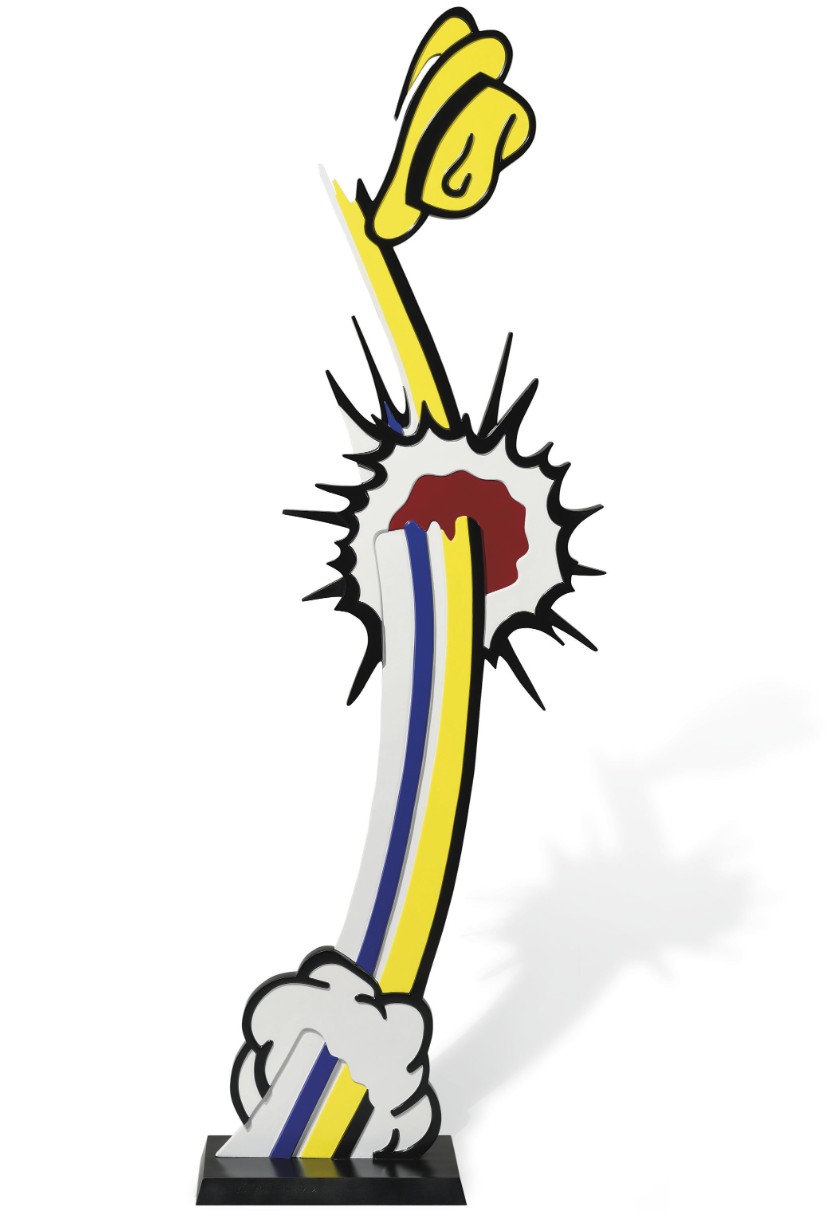
ROY LICHTENSTEIN (1923-1997)
Coup de Chapeau II, 1996
Painted and patinated bronze
91 x 30 x 13 1/4 inches (231.1 x 76.2 x 33.7 cm)
Signed, numbered and dated ‘5/6 rf Lichtenstein ’96’ (on the base)
This work is number five from an edition of six
Metallic Brushstroke Head, 1993
Metallic Brushstroke Head, 1993
A Legacy Reimagined: Works from the Collection of Dorothy and Roy Lichtenstein
Sotheby’s New-York: 19 November 2025
Estimated: USD 700,000 – 1,000,000
USD 635,000
Metallic Brushstroke Head | Contemporary Day Auction | 2025 | Sotheby’s
ROY LICHTENSTEIN (1923-1997)
Metallic Brushstroke Head, 1993
Painted nickel-plated bronze
83 x 24 1/2 x 24 1/2 inches (210.8 x 62.2 x 62.2 cm)
Incised with the artist’s signature, date ‘94 and number AP 2/2 (on the base)
This work is artist’s proof 2 of 2 from an edition of 6 plus 2 artist’s proofs
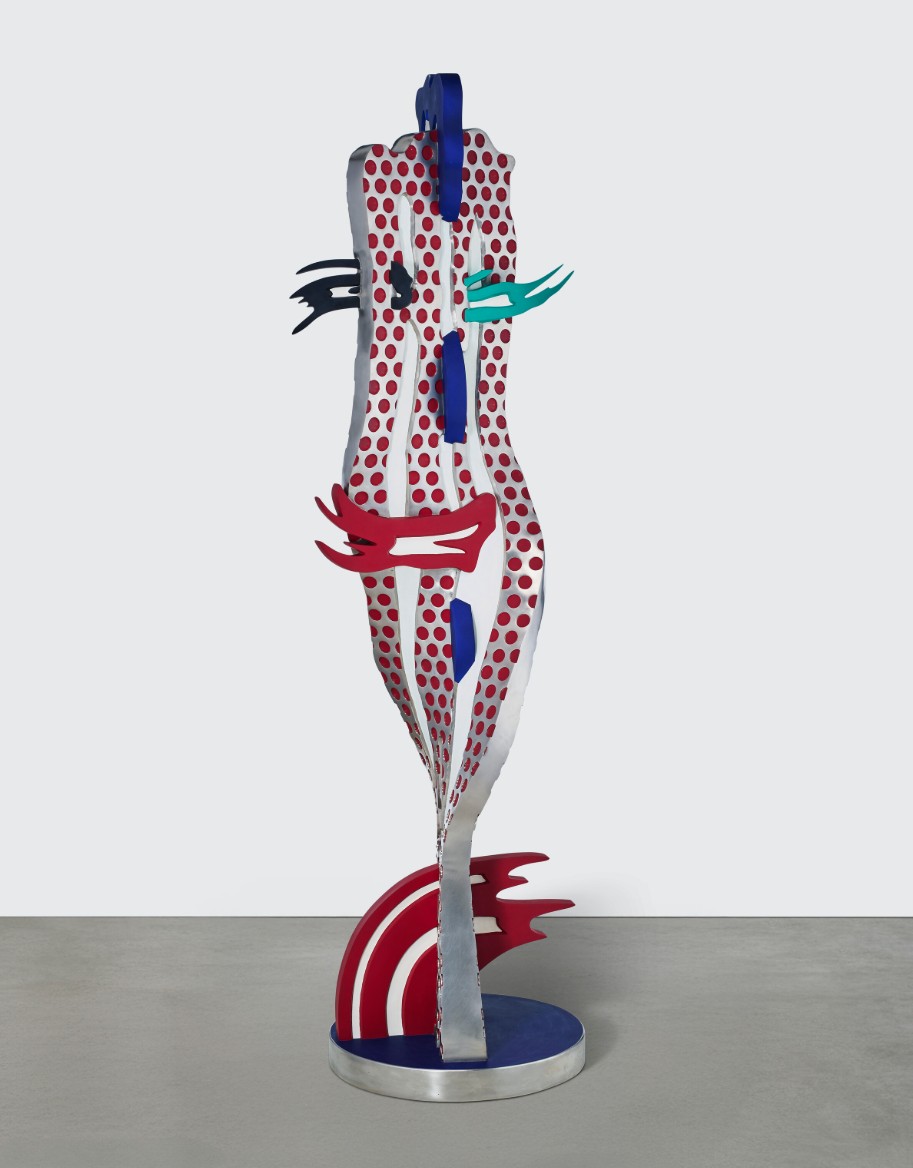
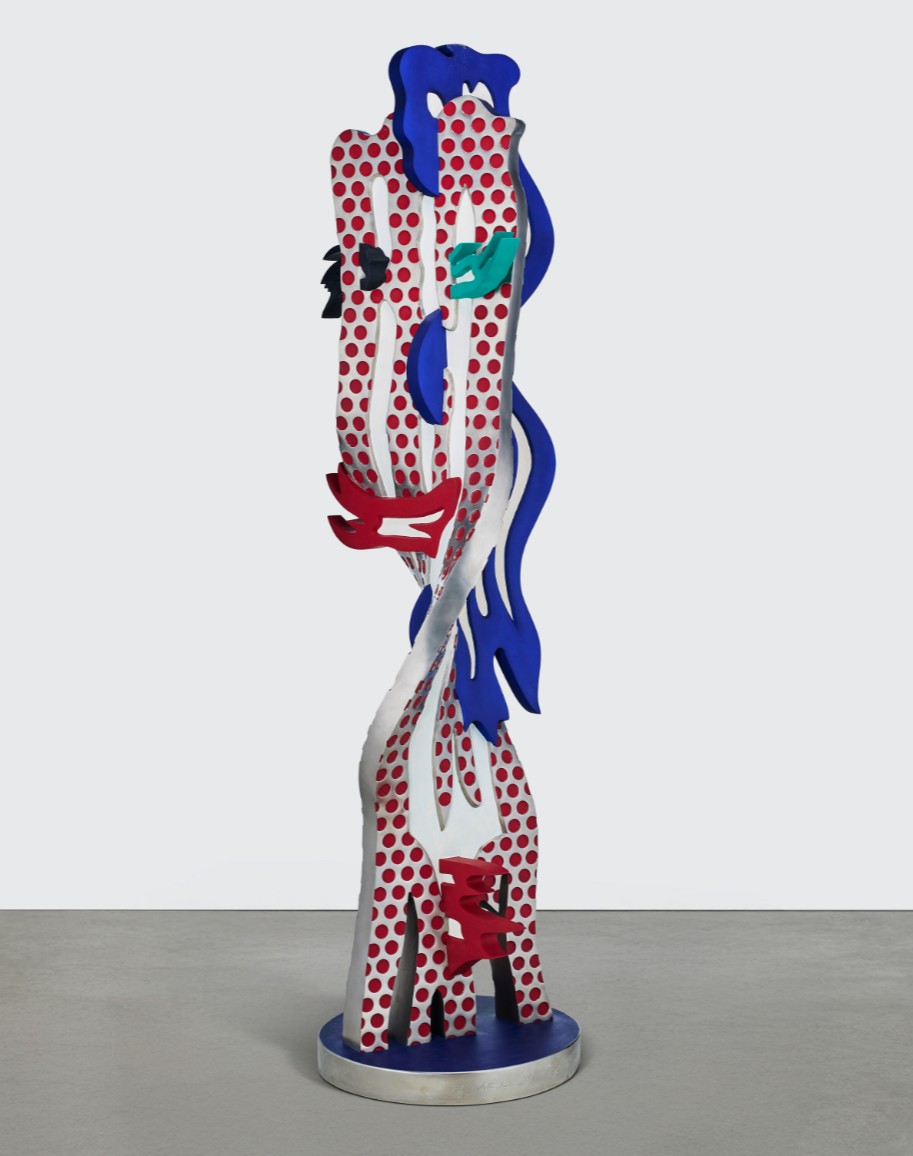
Towering over seven feet in height, Metallic Brushstroke Head (1993) is one of Roy Lichtenstein’s most ambitious sculptural achievements and a defining work of his late career. Executed in bronze and finished in a lustrous metallic patina, the sculpture transforms the fluid, gestural spontaneity of the brushstroke into monumental form, presenting a human head conjured entirely from stylized strokes of paint. Both playful and imposing, the work embodies Lichtenstein’s capacity to translate the language of painting into three dimensions, fusing Pop wit with sculptural grandeur.
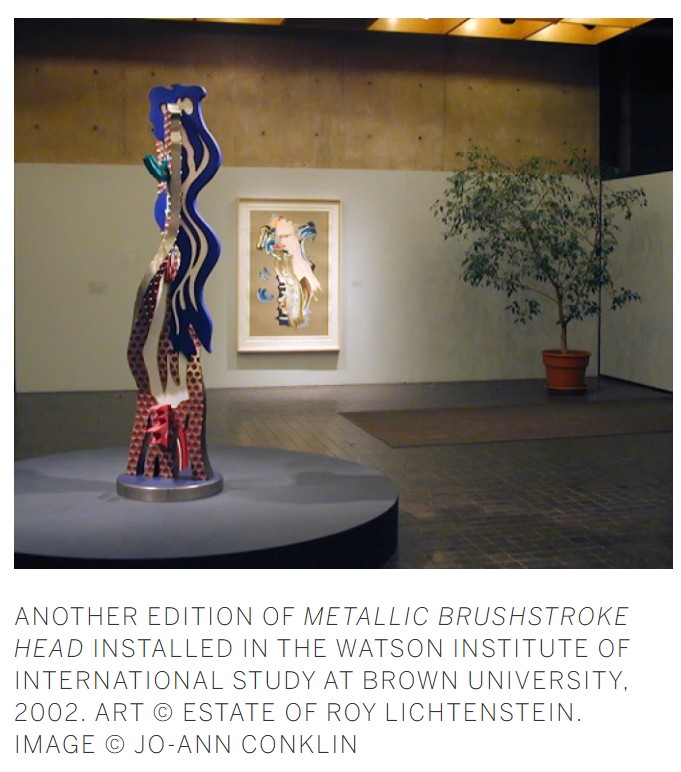
The Brushstroke Heads belong to a lineage that stretches back to Lichtenstein’s earliest explorations of the brushstroke motif in the mid-1960s. In his paintings of that period, the brushstroke served as a sly parody of Abstract Expressionism’s gestural bravura—reduced to a comic emblem, flattened, and frozen in Ben-Day dots. By the 1980s and 1990s, however, the motif re-emerged in his sculpture, where it took on renewed vigor and scale. In Metallic Brushstroke Head, the artist pushes this dialogue further, using the stylized stroke not only as a sign of painting, but as the very substance from which a human head is constructed. What had once been parody becomes a sculptural language in its own right: the brushstroke as anatomy, as structure, as form.
The sculpture’s verticality and commanding dimensions are critical to its effect. At more than two meters tall, the head looms as both figure and monument, asserting presence with architectural force. The overlapping bronze strokes sweep upward and outward, evoking locks of hair, a brow, a jawline—all conjured through the repetition of gestural signs. Despite the heavy medium, the work conveys remarkable lightness: the strokes appear to curl, bend, and twist as though freshly painted, their metallic sheen shimmering in ambient light. Lichtenstein achieves a paradoxical effect, fusing the permanence of bronze with the ephemerality of paint.
In this sense, Metallic Brushstroke Head extends Lichtenstein’s lifelong fascination with mediation and transformation. Just as his comic panels translated the immediacy of pulp into the permanence of high art, here the fleeting mark of the painter’s brush is monumentalized in bronze. The gestural, once ephemeral, is cast as enduring; the fluid becomes fixed; the private act of painting becomes public sculpture. By constructing a head from brushstrokes, Lichtenstein reflects not only on the history of portraiture but also on the identity of the artist, the face of painting itself. The metallic finish intensifies this play of meaning. Unlike his brightly painted brushstroke sculptures, Metallic Brushstroke Head emphasizes sheen, reflection, and surface. Its polished planes echo the gleam of industrial fabrication, aligning the work with the Pop embrace of mass production, while also nodding toward the long sculptural tradition of bronze statuary. The result is an object that is at once Pop and classical, playful and monumental.
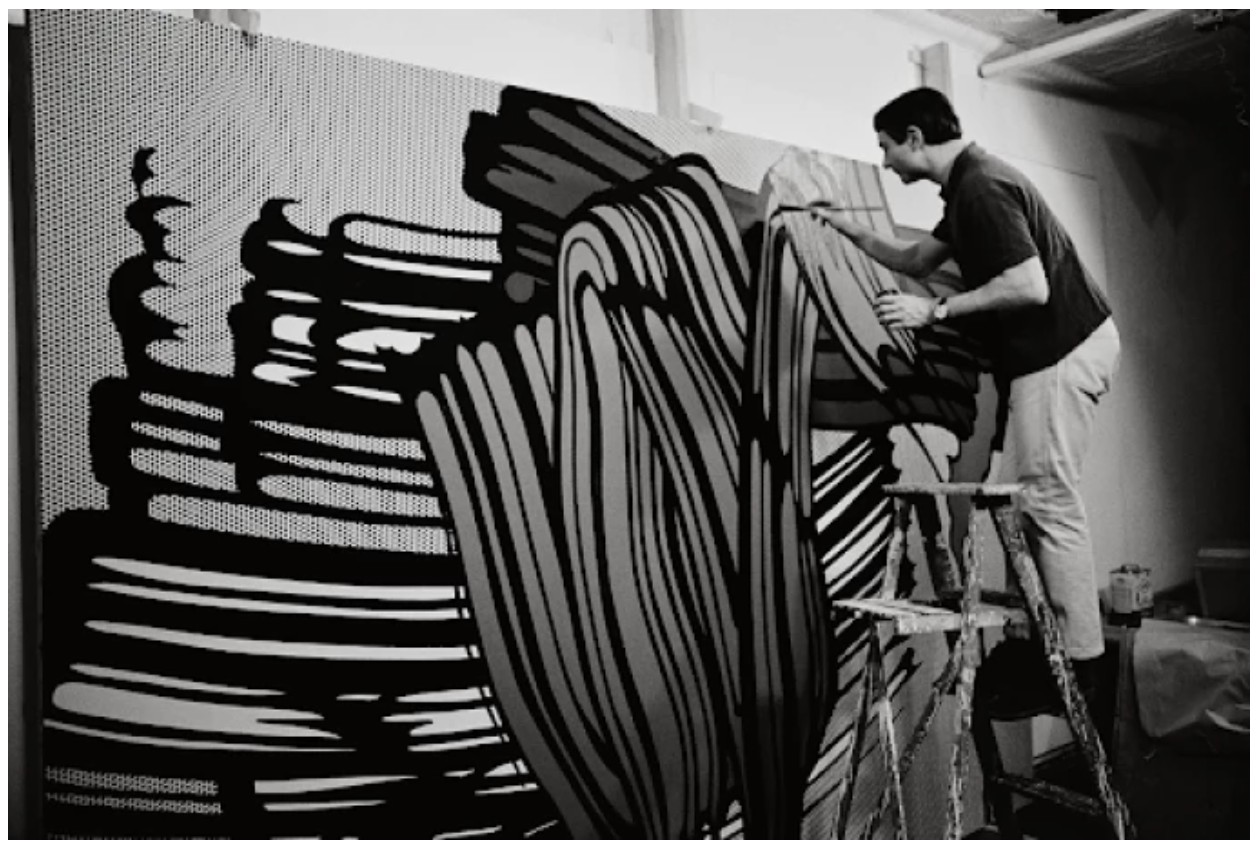
Lichtenstein painting a Brushstroke work, 1964. Art © Estate of Roy Lichtenstein. Image © Ugo Mulas
This capacity to merge Pop idioms with the gravitas of art history marked Lichtenstein’s late career with particular force. In the 1990s he revisited many of his signature motifs—the brushstroke, the comic heroine, the still life—recasting them with new formal ambition. Metallic Brushstroke Head belongs squarely to this period of summation and reinvention, when the artist, already canonized through retrospectives at the Guggenheim and worldwide, turned his motifs into monuments.
“Visible brushstrokes in a painting convey a sense of grand gesture. But, in my hands, the brushstroke becomes a depiction of the grand gesture. So the contradiction between what I’m portraying and how I’m portraying it is sharp. The brushstroke became very important for my work.”
The sculpture also resonates with contemporaneous currents in art. Its gleaming surfaces and exaggerated scale parallel the monumental ambitions of Jeff Koons and Claes Oldenburg, while its reflexive play with sign and structure aligns it with postmodern interrogations of image and identity. Yet Lichtenstein’s approach remains singular: he does not simply inflate an object but transforms a mark into a body, a sign into a portrait.
Metallic Brushstroke Head thus stands as both culmination and reflection. It condenses decades of inquiry into the nature of gesture, image, and artifice, and re-presents them in sculptural form. It is not simply a parody of painterly bravura, nor merely a Pop object, but a meditation on the endurance of art itself: the fleeting gesture made permanent, the head of painting cast in bronze. In its monumental scale, sculptural refinement, and conceptual resonance, Metallic Brushstroke Head exemplifies the boldness of Lichtenstein’s late production. It transforms the most ephemeral mark of painting into a towering figure, a lasting monument to the wit, rigor, and ambition that defined one of the twentieth century’s most influential artists.
Metallic Brushstroke Head, 1994
Christie’s New-York: 20 November 2025
Estimated: USD 800,000 – 1,200,000
USD 508,000
ROY LICHTENSTEIN (1923-1997), Metallic Brushstroke Head | Christie’s
ROY LICHTENSTEIN (1923-1997)
Metallic Brushstroke Head, 1994
Painted nickel-plated bronze
82 3/4 x 24 1/2 x 24 1/2 inches (210.2 x 61 x 61 cm)
Incised with the artist’s signature, number, date and stamped with the foundry mark ‘rf Lichtenstein ’94 AP 1⁄2’
(on the base)
This work is the first artist’s proof from an edition of six plus two artist’s proofs
BRONZE SCULPTURES
Coup de Chapeau I, 1996
Coup de Chapeau I, 1996
Phillips New-York: 7 December 2020
Estimated: USD 500,000 – 700,000
USD 937,500
Roy Lichtenstein 20th c. & Contemporary Art Evening Sale
ROY LICHTENSTEIN
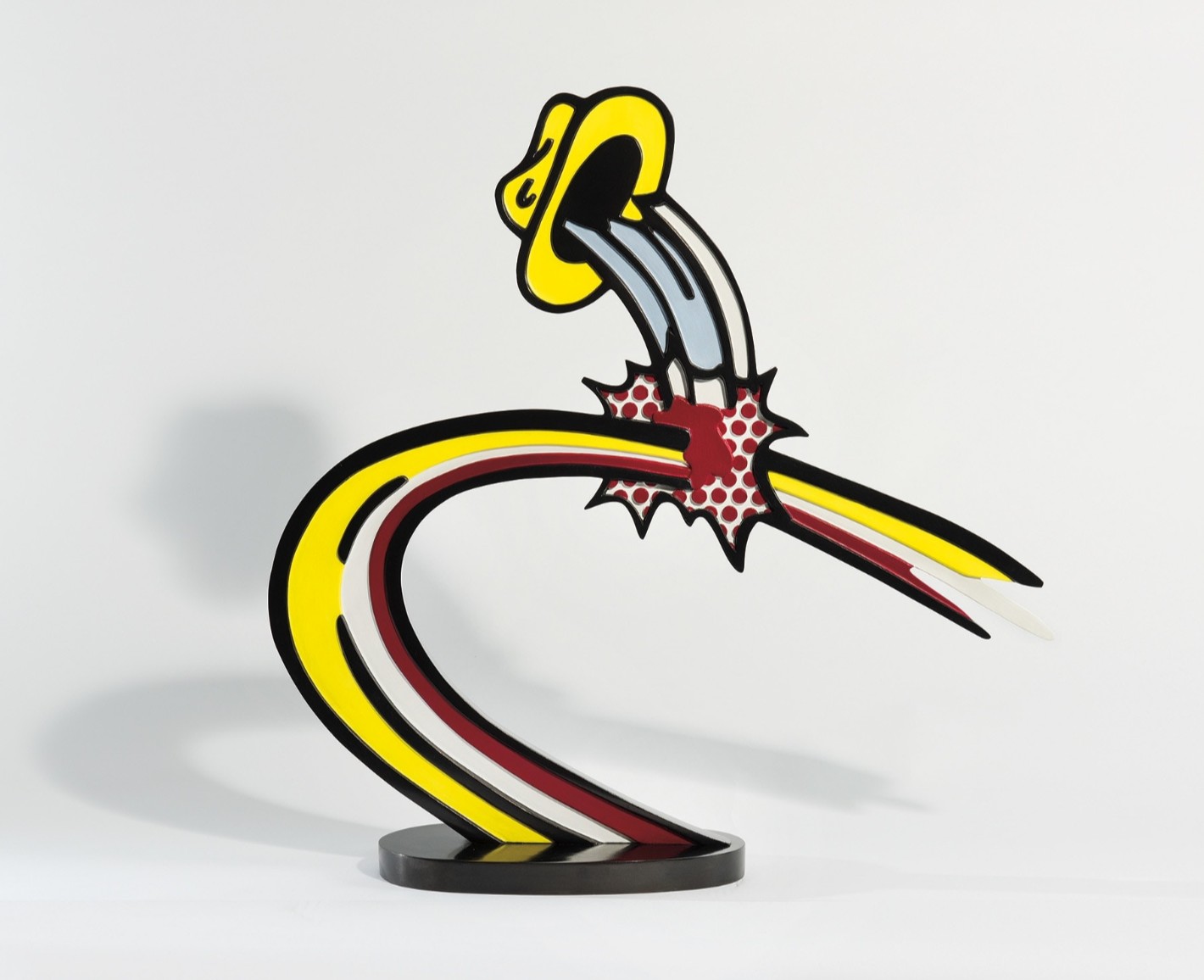
Coup de Chapeau I, 1996
Painted and patinated bronze
26 1/2 x 26 1/2 x 7 1/8 inches (67.3 x 67.3 x 18.1 cm)
Incised with the artist’s signature
Number and date “6/6 rf Lichtenstein ’96”
Stamped with the Tallix foundry mark on the base
This work is number 6 from an edition of 6
The culmination of a half-century interrogation into the genre of self-portraiture, Coup de Chapeau I, 1996 epitomizes Roy Lichtenstein’s idiosyncratic visual language and unconventional treatment of the traditional theme. Bursting with dynamism, the self-portrait Coup de Chapeau I animates a vibrant, Dick Tracy-esque yellow fedora atop two counterpoised arcs of primary colors that diverge from a Ben-Day dotted collision. Interpreted in French colloquially as “hats off”—the idiomatic expression “coup de chapeau” implies a double entendre that Lichtenstein manipulates: “coup” directly translates to “blow” or “hit,” which he hyperbolizes into an American comics-derived climax where the protagonist is struck by the upcoming 21st century. Coming to auction for the first time, Coup de Chapeau I embraces the parodic quintessence of its famed predecessor Coup de Chapeau (Self-Portrait), 1996 and anticipates the three-dimensional vitality of its successor, Coup de Chapeau II, 1996, of which one from the edition is held by the Broad Museum, Los Angeles.
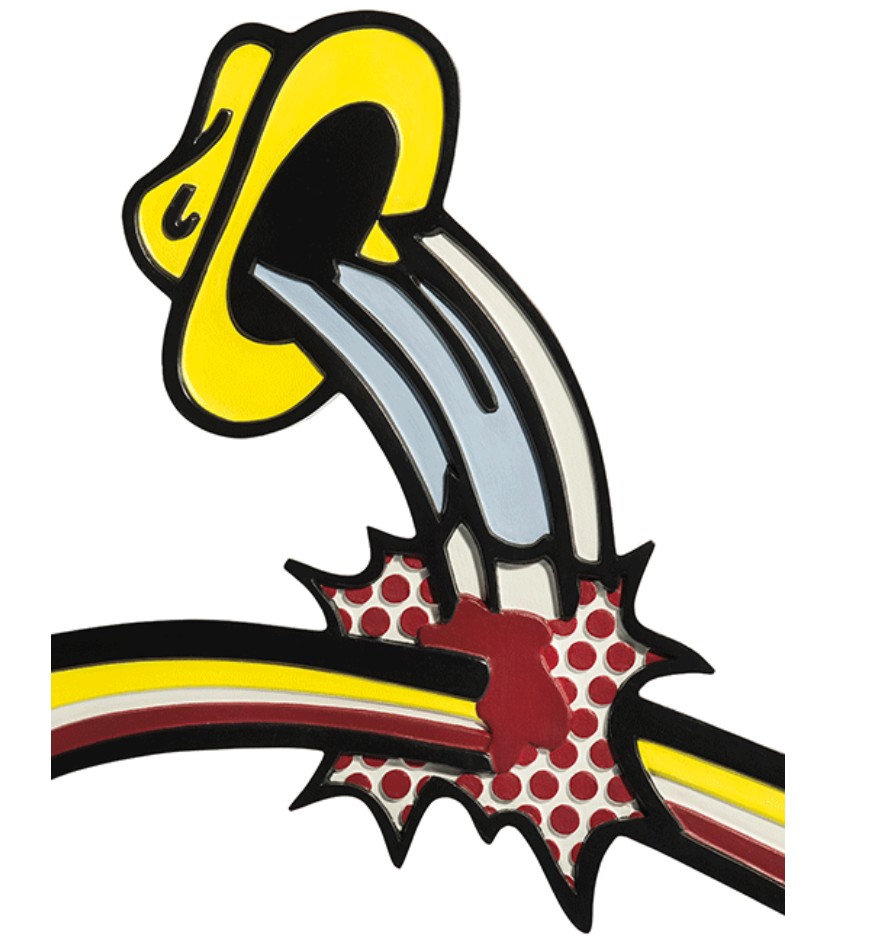
Arguably Lichtenstein’s first self-portrait in sculpture, Coup de Chapeau I is ironically void of any somatic reference to the artist. In fact, within his career-long investigation of portraiture, Lichtenstein progressively began to utilize his corporeal absence in works to paradoxically hint at his underlying artistic presence. This tendency to conceal himself ostensibly began with his Cubist self-portraits in the 1970s, such as Self-Portrait II, 1976, The Eli and Edythe L. Broad Collection, in which his visage is rendered abstract to the point of indistinguishability. Lichtenstein subsequently painted Self-Portrait, 1978, which is composed of a vacant, beveled mirror adorned with Ben-Day dots floating above a blank white t-shirt, further abstracting his physical likeness from supposed portrayals of himself.
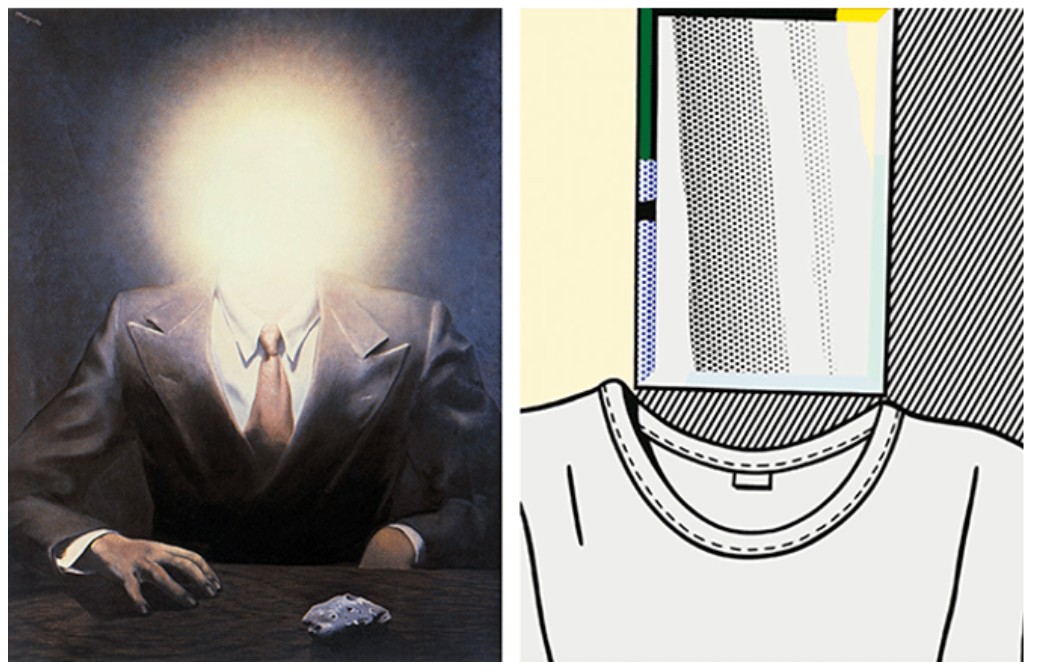
[left] René Magritte, Le Principe de Plaisir, 1937. Private Collection, Digital Banque d’Images, ADAGP / Art Resource, NY © Artists Rights Society (ARS), New York
[right] Roy Lichtenstein, Self-Portrait, 1978. Artwork © Estate of Roy Lichtenstein
His predilection for this ironic, bodily absence in his own self-portraiture paralleled his resolve to eliminate any suggestion of spontaneous or artistic gesture in his oeuvre. In this way, Lichtenstein’s nuanced outlook on authorship became a hallmark of his visual style. His experimentation with omission even goes beyond self-portraiture and is discernible in his most iconic images, such as Girl with Ball, 1961, Museum of Modern Art, New York, whose subject is more suggestive of a weightless, decorative adornment than a physical inhabitant. This progression towards Lichtenstein’s absence paradoxically signaling his aesthetic presence becomes increasingly palpable in the Coup de Chapeau series, which consists of just one painting and two sculpture variations, along with their respective preliminary sketches and maquettes. First explored in paint, Coup de Chapeau (Self-Portrait) depicts a man constructed of Ben-Day dots struck by his own hat with such force that his glasses have been knocked off; Lichtenstein addressed the enigmatic blow in a study for the work which he labelled “man hit by the 21st century.” Another sketch for the painting portrays a mirrored image of the first, but with nearly all of the man’s visage obfuscated by the explosion, evocative of the concealed face in René Magritte’s The Great War, 1964. His experiment with omission intensified with Coup de Chapeau I, his first self-portrait with unequivocally no corporeal reference to himself: Lichtenstein’s anticipation of the new millennium is captured exclusively by his airborne hat along with its hyperbolic arc and collision. The pinnacle of his inquiry into invisibility, Coup de Chapeau I is seemingly anonymous yet replete with manifest authorship and identity, encapsulating a formal lexicon and satire that is Lichtenstein’s alone.
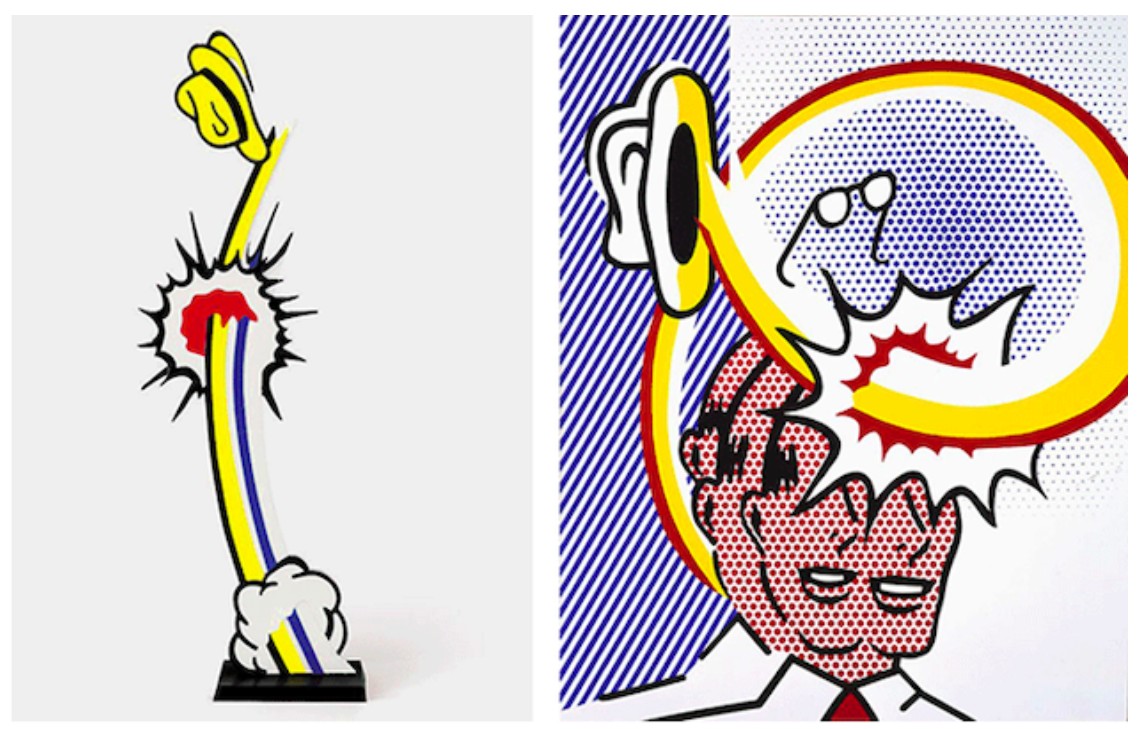
[left] Roy Lichtenstein, Coup de Chapeau II, 1996. Artwork © Estate of Roy Lichtenstein
[right] Roy Lichtenstein, Coup de Chapeau (Self-Portrait), 1996. Artwork © Estate of Roy Lichtenstein
Coup de Chapeau I strikes a dynamic tension between two- and three-dimensionality, propelled by the sculpture’s forceful launch into space despite its striking lack of structural depth, which causes the image to virtually disappear when viewed in the round. The planar flatness of Coup de Chapeau I echoes the uncompromising two-dimensionality of his most celebrated paintings from the 1960s, such as Drowning Girl, 1963, Museum of Modern Art, New York and Look Mickey, 1961, National Gallery of Art, Washington, D.C. Accordingly, Coup de Chapeau I blurs conventional distinctions between painting and sculpture and typifies the artist’s signature fixation with hyper-flatness in all media.
Dynamic yet static, Coup de Chapeau I exemplifies Lichtenstein’s ability to freeze dramatic, kinetic scenes into seemingly fixed moments. The fiery explosion of speckled Ben-Day dots recalls more so humorous, fictional depictions of crashes in comic book pages than factual and kinetic collisions. These suspended instants pepper Lichtenstein’s oeuvre: the subject of Coup de Chapeau I is reminiscent of the stationary combustion depicted in works created decades earlier, such as Whaam!, 1963, Tate Modern and Explosion I, 1965, Museum Ludwig, Cologne. Interpreted as a satirical response to Abstract Expressionism—and more specifically, Harold Rosenberg’s 1950s idiom “action painting”—Lichtenstein’s explosion motif ironically captures incendiary activity within fixed inertia, caricaturing the intellectual pretension of the mid-century New York art world with vernacular references to American comics.
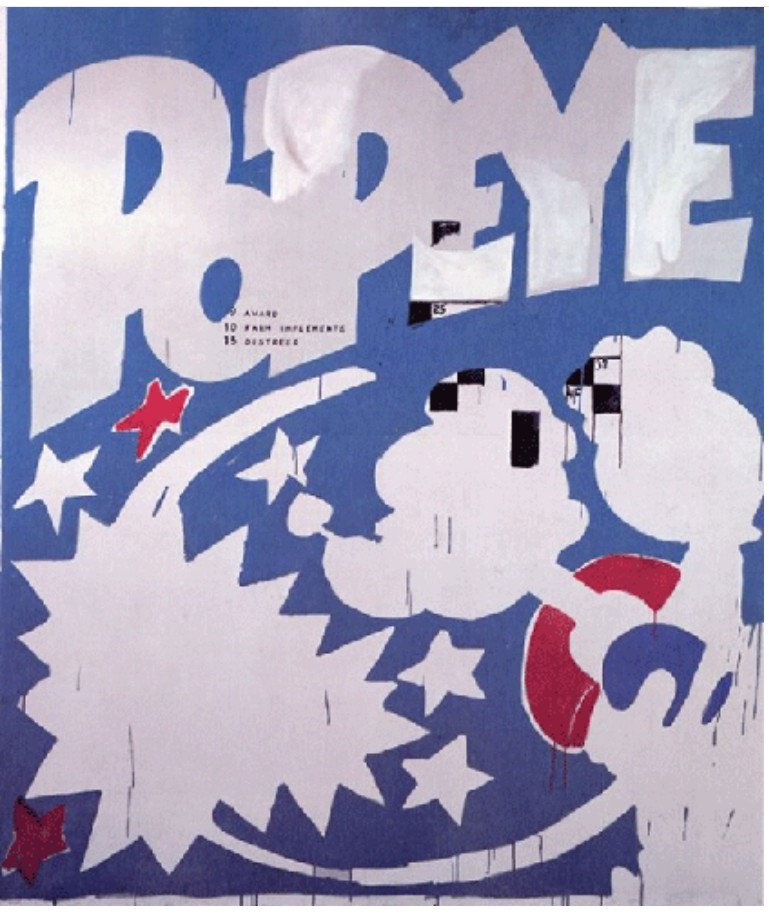
Andy Warhol, Popeye, 1961. Artwork © 2019 The Andy Warhol Foundation for the Visual Arts, Inc.
Licensed by Artists Rights Society (ARS), New York
Created a year before his death, Coup de Chapeau I encapsulates Lichtenstein’s unique visual vocabulary as well as his anticipation for a century he would not experience; reexamining his entire oeuvre, the sculpture underscores his career-long concerns with irony, cross-media dialogue, and the “super flat” composition of comic books. As a result, Coup de Chapeau I both ridicules and earnestly challenges mid-20th century artistic tenets and conservatism, epitomizing Lichtenstein’s revolutionary post-modern spirit.
Petite coups de pinceau, 1988
Petite coups de pinceau, 1988
Reflections on Pop: Works from the Collection of Dorothy and Roy Lichtenstein
Sotheby’s New-York: 26 September 2025
Estimated: USD 500,000 – 700,000
USD 444,500
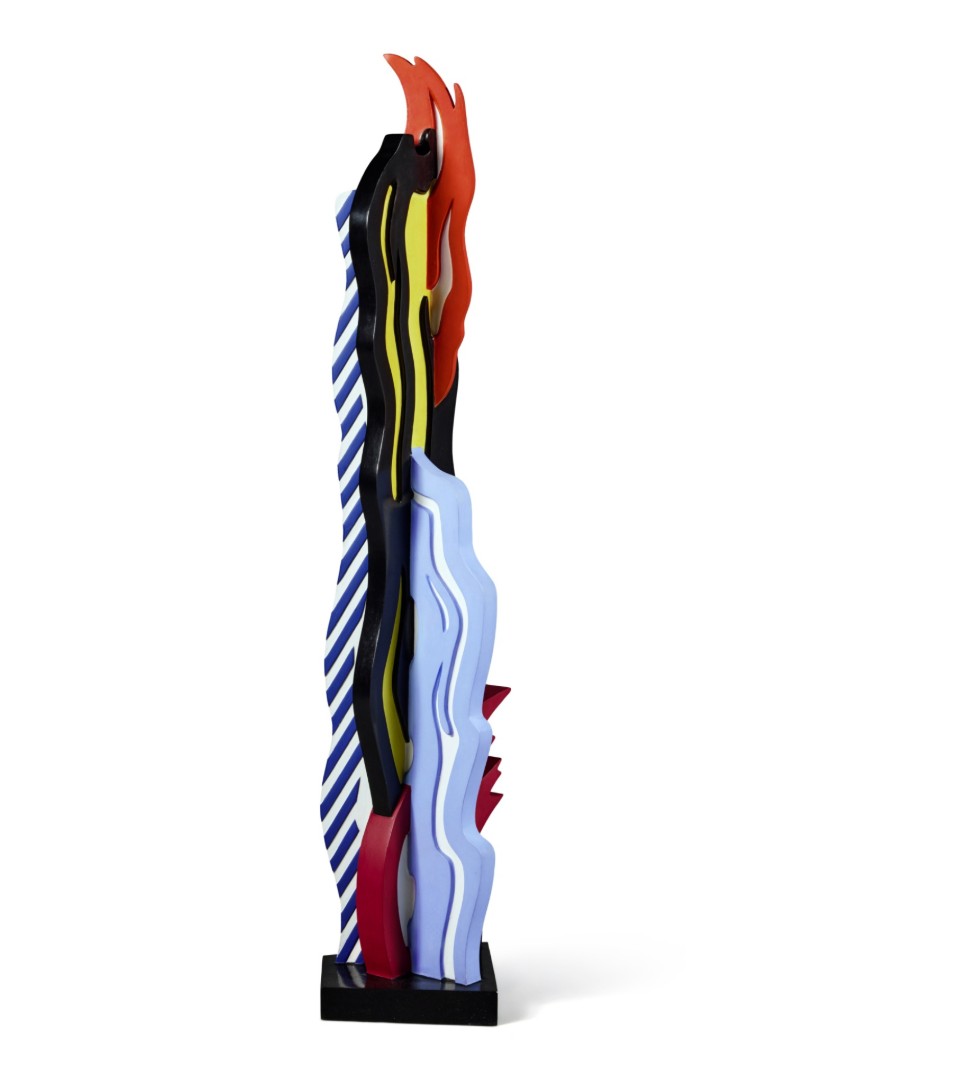
ROY LICHTENSTEIN (1923 – 1997)
Petite coups de pinceau, 1988
Painted and patinated bronze
40 ½ x 12 x 10 inches (102.9 x 30.5 x 25.4 cm)
Incised with the artist’s signature, number 1/3 and date ’88 (on the edge of the base)
Executed in 1988 Petite coups de pinceau is a key example from one of Roy Lichtenstein’s most important investigations: the Brushstroke motif. As one of the central themes running throughout his career, the Brushstroke allowed Lichtenstein to question the very nature of art-making and representation. In the present work, he transforms what had long been considered the ultimate sign of the artist’s hand into a subject in its own right, rendered with the clarity, irony, and precision that define his practice. Petite coups de pinceau encapsulates Lichtenstein’s ability to turn a familiar gesture into an enduring symbol, one that bridges painting and sculpture while challenging conventions of artistic expression.
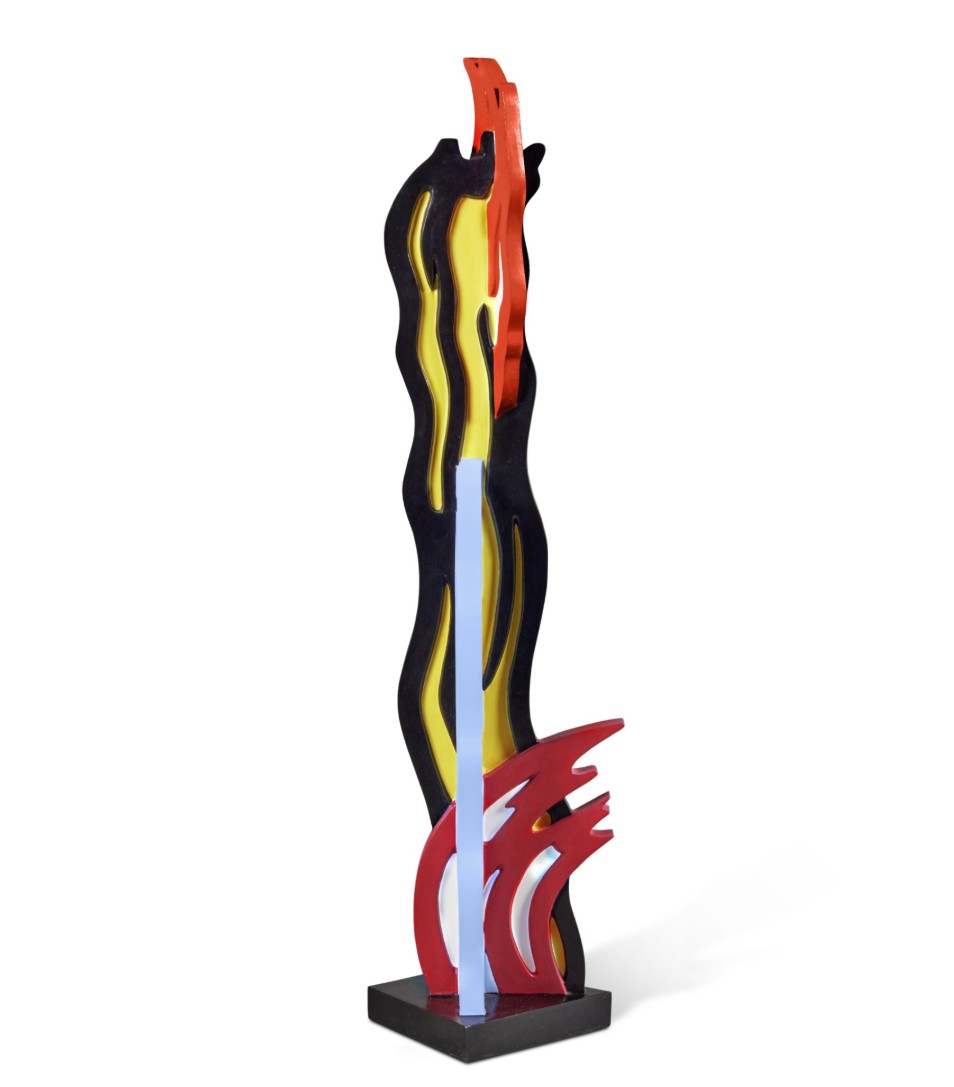
Between 1981 and 1996, Lichtenstein created nearly twenty freestanding Brushstroke sculptures, from small-scale studies to towering outdoor installations. Petite coups de pinceau and the monumental associated sculpture belong to this important cycle, which stands as a cornerstone of his sculptural practice. Here, the brushstroke, traditionally understood as a tool of painting, becomes the subject of the work itself. Rendered in bright colors and outlined in black contours, the gestures curl upward with a sense of animation, as though frozen mid-motion. Lichtenstein’s reimagining of the brushstroke as a three-dimensional object underscores his ability to translate painterly form into sculptural language, collapsing the boundaries between mediums.
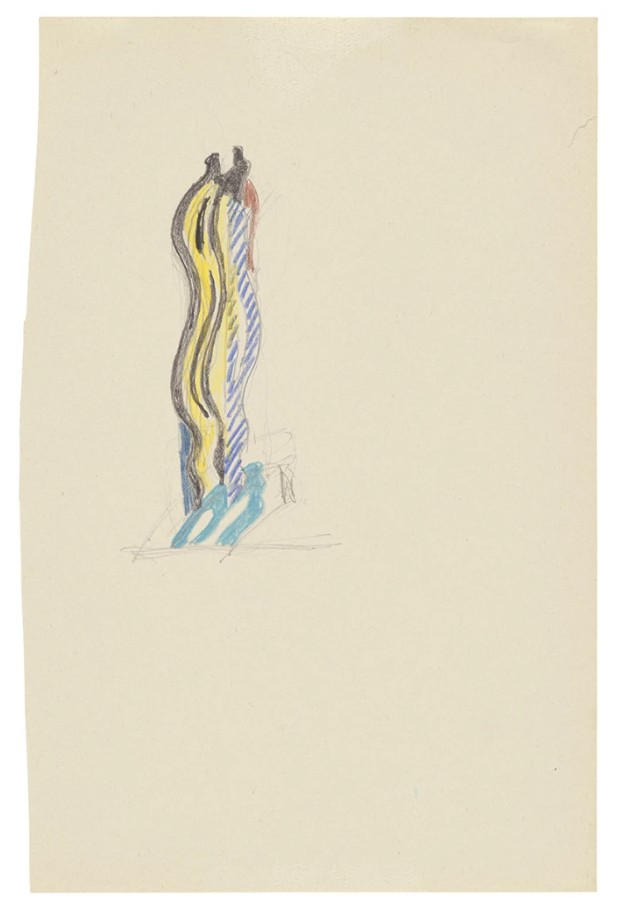
Roy Lichtenstein, Coups de pinceau and Petite coups de pinceau (study), 1988. Private Collection. Art © Estate of Roy Lichtenstein
This act of translation held meaningful implications within the context of postwar art. Since the 1950s, Abstract Expressionism had celebrated the brushstroke as the visible index of the artist’s presence. By contrast, Pop Art, with its reliance on commercial imagery and mechanical precision, was often seen as stripping art of the trace of the hand. With works such as Petite coups de pinceau, Lichtenstein challenged this binary. By isolating and enlarging the brushstroke, he transformed a symbol of spontaneity into a deliberate construction: what appears immediate is carefully composed, and what suggests uniqueness is presented as repeatable.
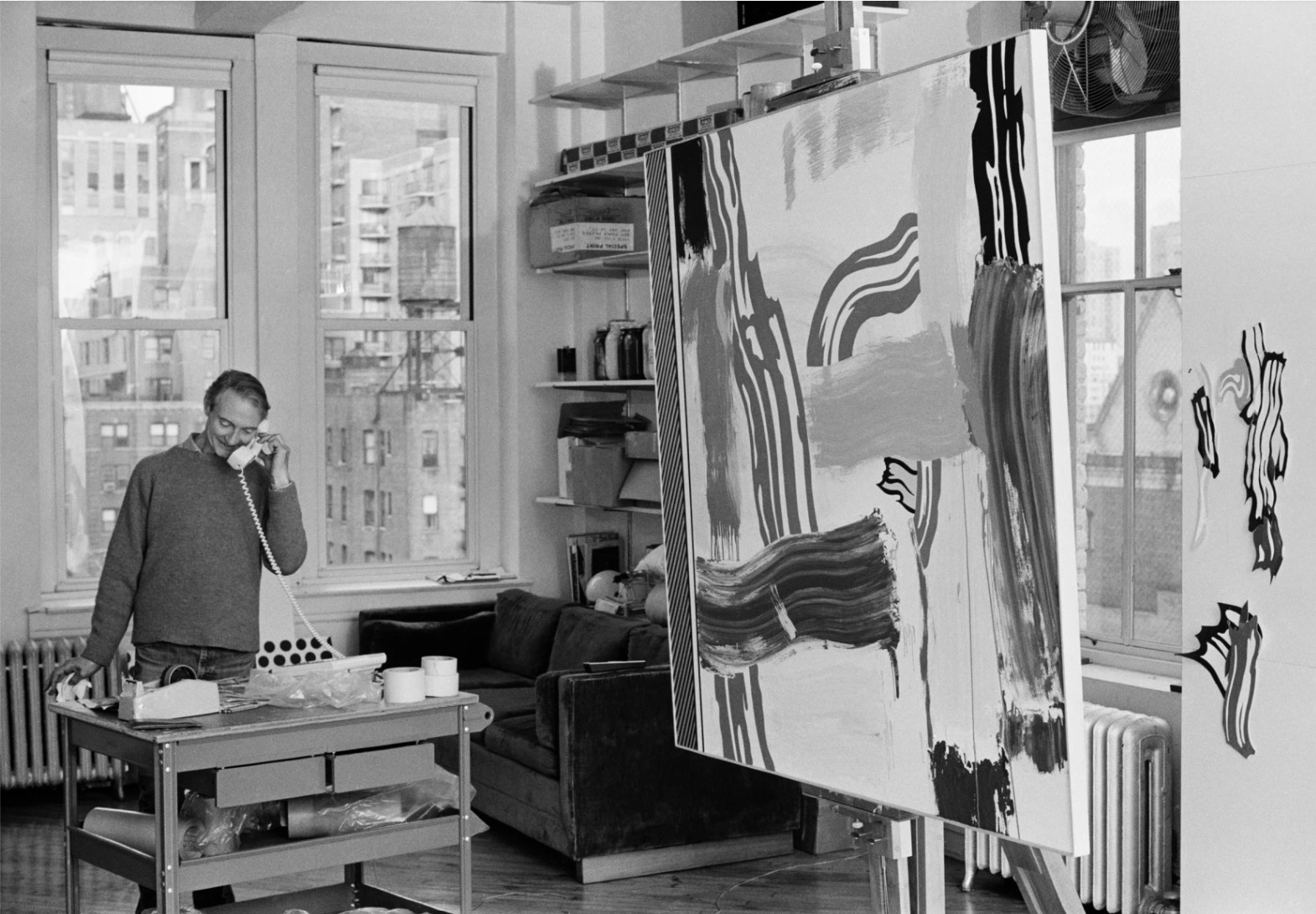
Roy Lichtenstein at 105 East 29th Street studio, 1984. Photo © Bob Adelman. Art © Estate of Roy Lichtenstein
Petite coups de pinceau thus exemplifies how Lichtenstein redefined one of art’s most familiar gestures, turning the brushstroke into a lasting icon that embodies both his wit and his rigorous exploration of image and form. As such, it stands as both a key statement within his sculptural practice and a reflection of the broader questions that shaped his artistic career.
Brushstrokes in Flight, 1983
Brushstrokes in Flight, 1983
Christie’s New-York: 15 May 2025
Estimated: USD 700,000 – 1,000,000
USD 882,000
ROY LICHTENSTEIN (1923-1997), Brushstrokes in Flight | Christie’s
ROY LICHTENSTEIN (1923-1997)
Brushstrokes in Flight, 1983
Painted and patinated bronze
55 1/4 x 21 x 10 inches (140.3 x 53.3 x 25.4 cm)
Incised with the artist’s signature, number and date ‘5⁄6 rf Lichtenstein ’83’ (on the base)
This work is number five from an edition of six plus one posthumous cast
Roy Lichtenstein’s iconic sculpture Brushstrokes in Flight (1983) stands as a testament to the artist’s brilliance as a Pop Art pioneer, seamlessly blending his signature wit with an unrelenting drive to challenge and redefine artistic conventions. In Lichtenstein’s Brushstrokes series of paintings, his signature flat, comic book style—drawing inspiration from American comic books and pulp magazines—is utilized to depict the brushstrokes of an abstract painting. The present work is an expansion on the series, one in which Lichtenstein shifts mediums and disciplines, moving from painting to sculpture.
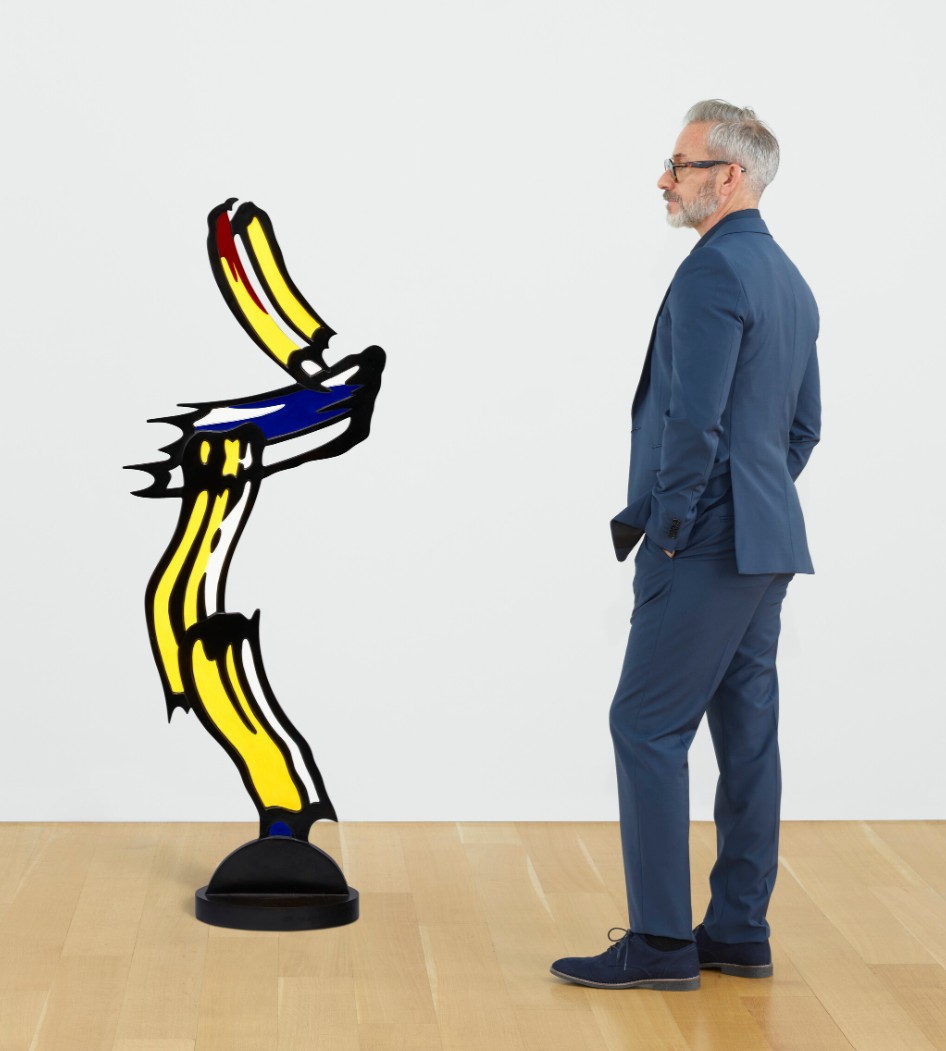
In this strikingly satirical piece, at once parody and tribute, Lichtenstein represents the bold, gestural brushstrokes of the Abstract Expressionist painters in his characteristic Pop Art style. Thick, animated brushstrokes careen from the sculpture’s base, rendered in bright colors and bold outlines, as though they’ve been lifted from the pages of a pulp magazine. Here, Lichtenstein is at his best, producing an insightful amalgam of two seemingly diametrically opposed postwar American art movements—taking the gestural brushstroke and rendering it in an entirely different medium. Depicting an abstract painting in such an archly mannered, ironic style constitutes a serious feat of both imagination and technique on Lichtenstein’s part. Brushstrokes in Flight is a testament to the unbridled creative impulse and sharp intellect behind the works of a Pop Art master.
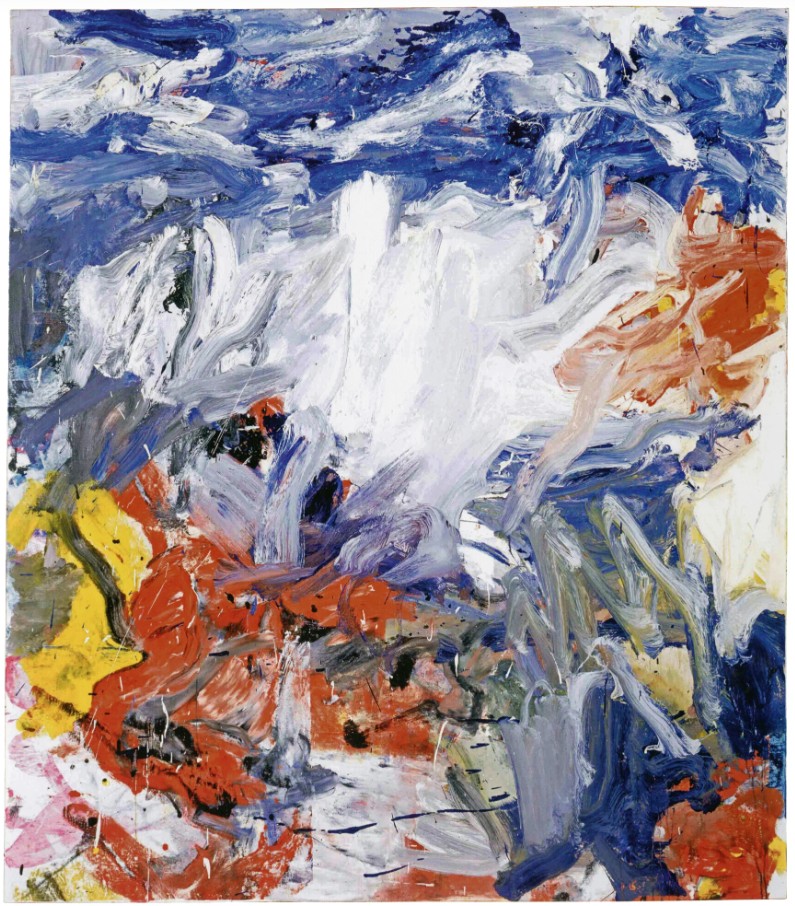
Willem de Kooning, Untitled V, 1977. Albright-Knox Art Gallery, Buffalo.
Artwork: © 2025 The Willem de Kooning Foundation / Artists Rights Society (ARS)
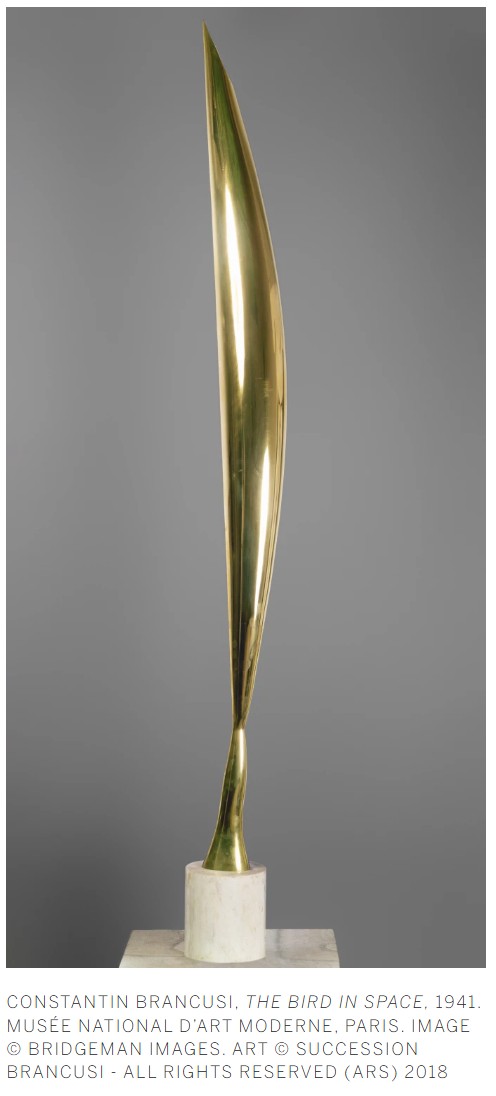
The strongly gestural brushstrokes depicted in the present work emerge from the sculpture’s base, at first glance embodying the expressive will of an action painter in the vein of Jackson Pollock, Willem de Kooning, or Franz Kline. One is reminded of the totemic qualities of the modernist sculptures in Brâncuși’s Bird in Space series—the abstract forms of which parallel those in the present work. Notably, Lichtenstein paid direct homage to an iconic Brâncuși sculpture with his Paintings with Sleeping Muse, also from 1983. In Brushstrokes in Flight, the brushstrokes are made three-dimensional, rising up to become vertical figures in space. The artist’s dry wit is on full display—here, Lichtenstein transforms the gestural brushstrokes of abstract painting into a literal totem or monument, acknowledging their status as art historical and cultural signifiers while simultaneously poking fun at their semi-hallowed status.
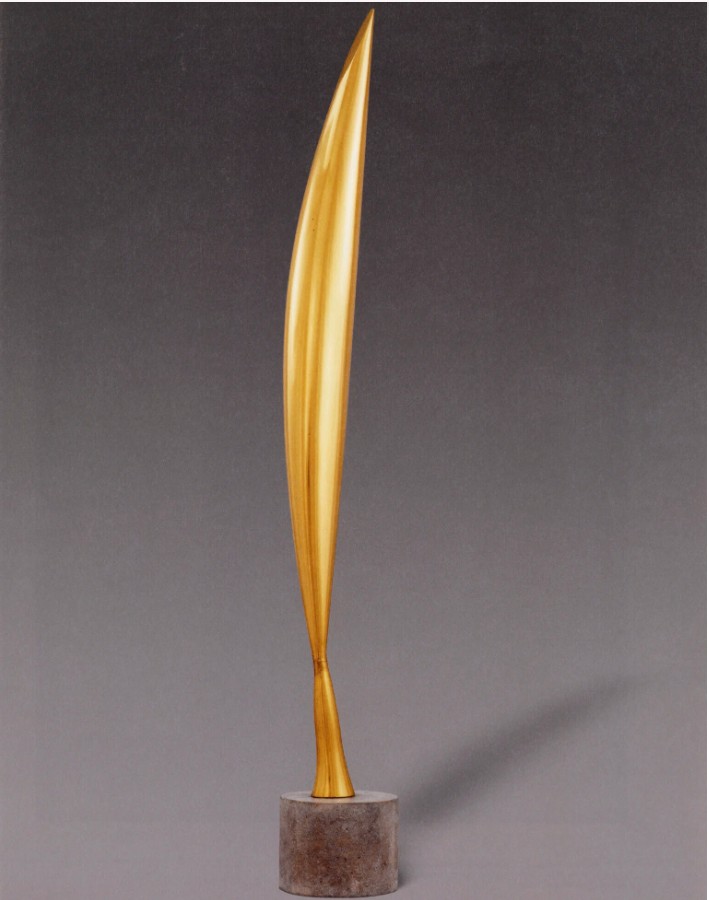
Constantin Brancusi, Bird in Space, 1928. Museum of Modern Art, New York.
This conceptual transposition of dimensions bears resemblance to, though not necessarily the visual characteristics of, the works of Pop sculptor Claes Oldenburg, whose creations magnify quotidian objects to monumental scales. It is this “both-and” quality intrinsic to Pop sculpture that Brushstrokes in Flight encapsulates most compellingly—the dual gesture of tribute to and critique of Abstract Expressionism and broader art historical motifs. Brushstrokes in Flight operates simultaneously as a playful deconstruction and a reverent celebration, embodying the high-low dialectics that render Lichtenstein’s oeuvre so captivating. Ultimately, Brushstrokes in Flight transcends mere visual pun; it asserts the enduring power of Pop Art to reconstruct and recontextualize the lexicon of art history and cultural iconography.
Brushstroke Sculpture, 1982
Brushstroke Sculpture, 1982
Phillips New-York: 16 May 2023
Estimated: USD 500,000 – 700,000
USD 1,016,000
Roy Lichtenstein – 20th Century & Conte… Lot 117 May 2023 | Phillips
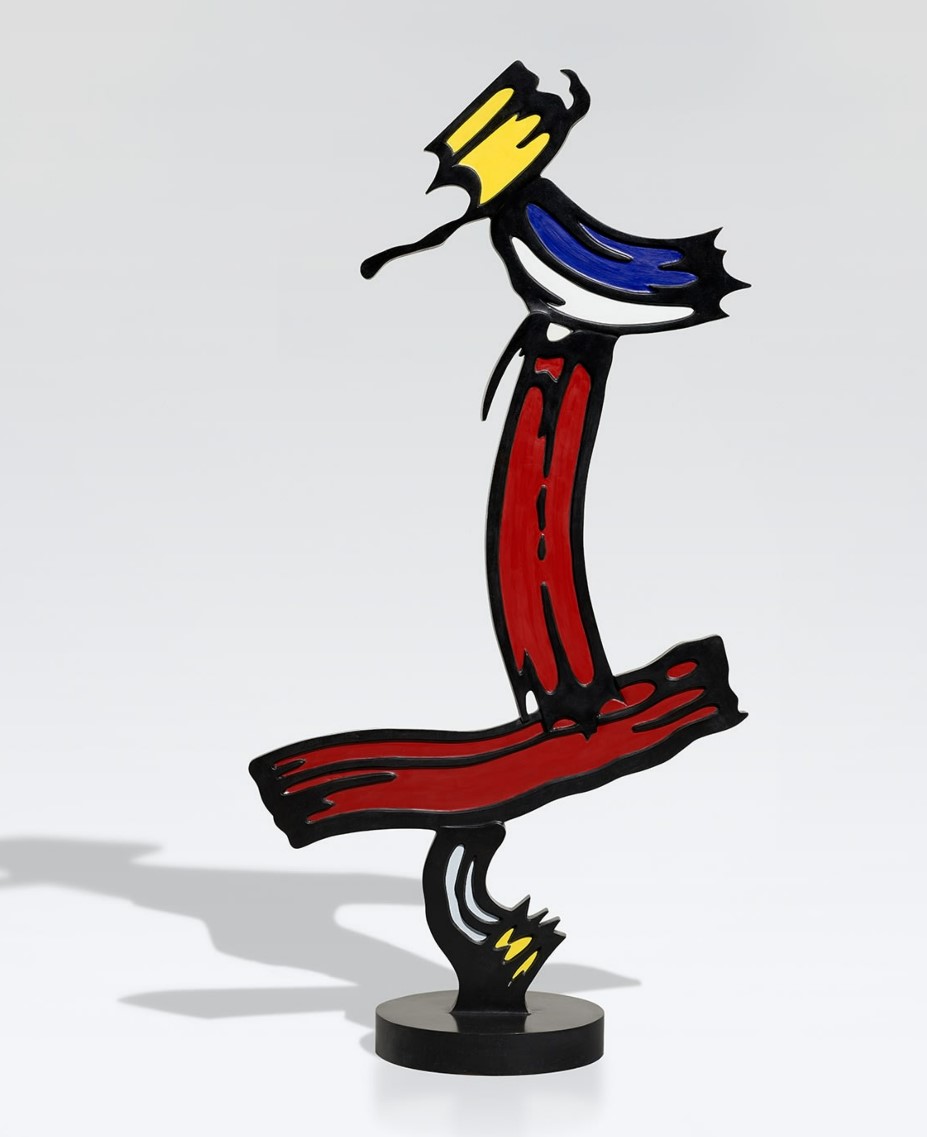
ROY LICHTENSTEIN
Brushstroke Sculpture, 1982
Paint on patinated bronze
54 1/4 x 27 1/2 x 11 inches (137.8 x 69.9 x 27.9 cm)
Incised with the artist’s signature, number, foundry mark and date “6/6 rf Lichtenstein ’82” on the base
This work is number 6 from an edition of 6
Between 1981 and 1996, Roy Lichtenstein created seventeen unique freestanding Brushstroke sculptures, ranging from desk-sized to monumental, alongside several editioned sculptures. In each of these works, the artist takes the brushstroke motif, which appears in his graphic work as early as the 1960s, and turns it into three dimensions. In Brushstroke Sculpture, 1982, we are faced with a four and a half-foot tall solid bronze depiction of six swift motions of paint rendered in vivid primary colors, each housed within a dramatic black border. The strokes are captured as if in action, leaving lingering bits of black paint drips in their wake, mid-air. The center of the sculpture is anchored by two large red strokes of paint forming an upside-down T shape, balancing upon bits of white and yellow, which connect to an oval base. By giving the bronze a shiny patina, Lichtenstein illustrates the raw, expressive materiality of the subject in a way that resembles wet paint. The wet brushstrokes are now pure subject matter, the act of painting broken down to its most basic form—moving paint across a canvas with a brush—while challenging the notion that a brushstroke is just a tool in a painter’s arsenal. In 3D form, Lichtenstein’s brushstrokes are not just a means to an end, but rather the end itself.
Brushstroke Sculpture, 1982
Sotheby’s London: 10 February 2016
Estimated: GBP 400,000 – 600,000
GBP 509,000 / USD 736,735
REPEAT SALE
Sotheby’s New-York: 13 November 2012
Estimated: USD 700,000 – 900,000
USD 722,500
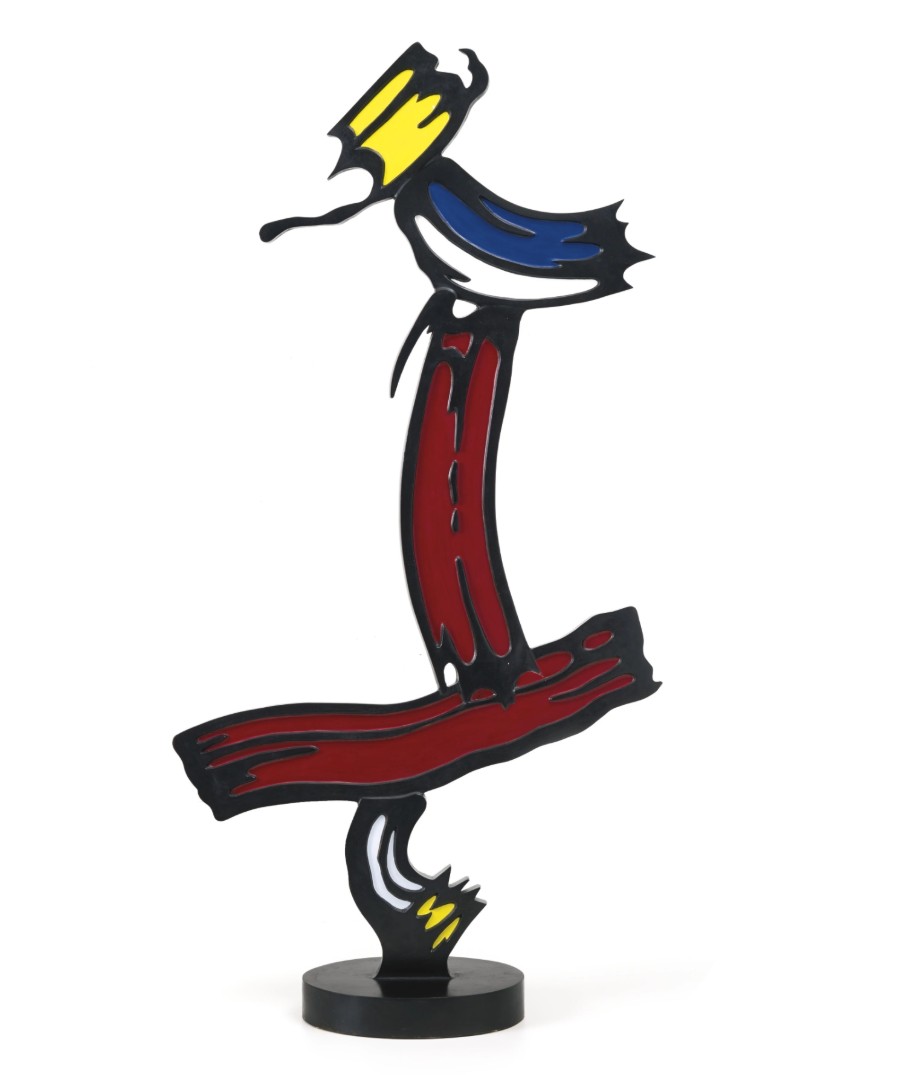
ROY LICHTENSTEIN
Brushstroke Sculpture, 1982
Painted and patinated bronze
54 1/2 x 27 1/2 x 10 1/2 inches (138.4 x 69.8 x 26.7 cm)
Incised with the artist’s signature, dated 82 and numbered 5/6 on the base
This work is number 5 from an edition of 6
Provenance
Leo Castelli Gallery, New York (LC# 911)
Private Collection, New York
Sotheby’s, New York, Contemporary Art Day Sale, 15 November 2007, Lot 200
Gagosian Gallery, New York
Sotheby’s, New York, Contemporary Art Evening Auction, 13 November 2012, Lot 51 (consigned from the above to benefit the Solomon R. Guggenheim Museum, New York)
Private Collection (acquired from the above sale)
Private Collection, Asia
Acquired from the above by the present owner in 2013
As much a deliberate nod to the grand legacy of Abstract Expressionism as it is a manifestation of the very ethos of Pop art, Roy Lichtenstein’s painted bronze Brushstroke Sculpture of 1982 is a work whose significance is determined by a central paradox. Existing somewhere on the spectrum between painting and sculpture – strategically placed by its creator in deliberate limbo in the midst of these two historically opposed genres – Brushstroke Sculpture makes manifest the characteristic indifference to medium-specificity that dominated much of Lichtenstein’s prodigious and categorically groundbreaking career. Though his legacy is most often evaluated for its contributions to the graphic arts, sculpture occupied a central position in Lichtenstein’s oeuvre from the first time he cast one of his iconic blonde heroines in glazed ceramic in 1965 until his death in 1997. Indeed, the artist’s inclination toward boundary-blurring is nowhere more successful or more apparent than in his sculpted works, whose origins are inseparable from his paintings: here the two disciplines flow freely into and out of one another. Brushstroke Sculpture, its inherently two-dimensional source image rendered fascinatingly complex by its three-dimensional casting, is perhaps the most perfect exemplar of Foster’s apt analysis.
Lichtenstein first explored the theme of the brushstroke in a series of paintings and drawings begun in 1965 and extending into 1967. These canvases seize on the most overt feature of Abstract Expressionism – its hyperbolic painterliness and the heroic, emotive strokes that dominated its canvases – encapsulating within a single image the perceived essence of that hallowed art historical era. As much as these 1960s paintings broadcast a celebration or elevation of the primacy of the artist’s stroke, however, they also fully demystify and popularize Abstract Expressionism’s famously enigmatic reputation. Fifteen years later, in 1982, Lichtenstein took this playful view of the most inherently painterly of images, the symbolic distillation of the very act of painting, one step further, casting it in bronze to create Brushstroke Sculpture. Lifting his depicted brushstroke from the canvas, Lichtenstein situates it solidly, gravity-bound, in space. Suddenly, upstanding and building upon each other’s contours to achieve a quasi-figurative verticality, the artist’s primary yellow, blue, red, and white strokes are liberated from the confines of the canvas and redefined as something altogether new.
Brushstroke Sculpture, 1981
Brushstroke Sculpture, 1981
Phillips Hong-Kong: 26 May 2019
Estimated: HKD 2,500,000 – 3,500,000
HKD 2,250,000 / USD 286,655
Roy Lichtenstein 20th Century & Contemporary Art Evening Sale
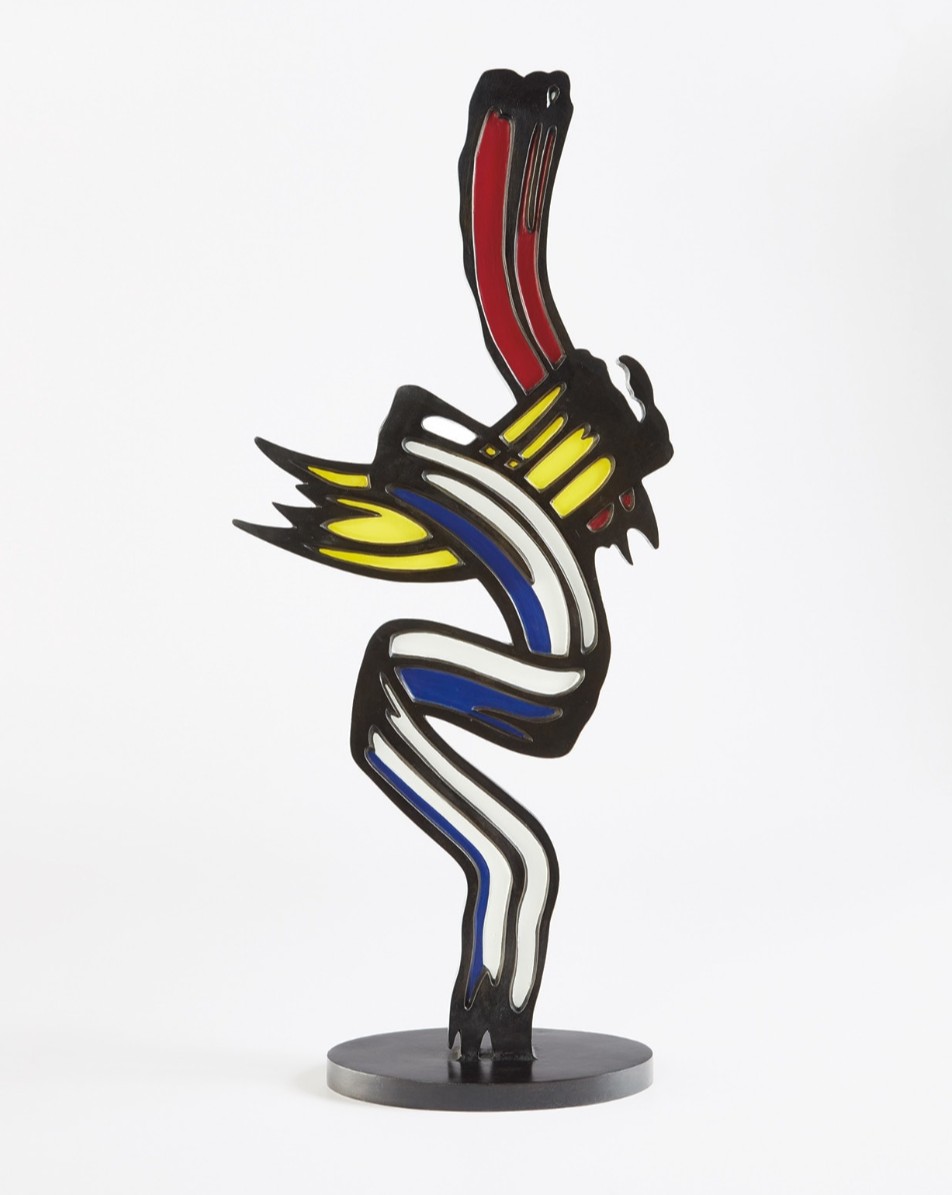
ROY LICHTENSTEIN
Brushstroke Sculpture, 1981
Painted bronze
31 1/2 x 13 x 6 1/2 inches (80 x 33 x 16.5 cm)
Incised with the artist’s signature
Number and date ‘3/6 rf Lichtenstein ’81’ and stamped with the Tallix foundry mark on the base
This work is number 3 from an edition of 6
Like Andy Warhol’s soup-cans, Lichtenstein’s brushstrokes were, clearly and at first glance, generational icons. They proposed a critique of the immediate past, clearly intending to supersede it without destroying it—to propose something new that would renew the past, as well.”(Dave Hickey, “Brushstrokes”, from Brushstrokes: Four Decades, New York, 2002, p. 10).
As a seminal addition to the history of sculpture, Roy Lichtenstein’s definitive bronze, Brushstroke Sculpture, 1981, provides the ultimate challenge to our ideas on representation and the stylistic paradigms of 20th century visual culture. As the very first sculpture made by Lichtenstein on the brushstroke motif, the present work (from a limited edition of six) is testament to the prestige of the collection from which it originates, and the ability of its original owners – Miles and Shirley Fiterman – to acquire the most significant Pop Art pieces at the time of their production. In the present work the founding father of Pop Art employs his longstanding preoccupation with the mediation of images to a mesmerically confounding effect. Disrupting the traditional division between artistic mediums, Lichtenstein gives the art of painting three dimensional form. Executed in 1981, inaugurating an expansive series, Brushstroke Sculpture draws from the elegantly kitsch stylings of Lichtenstein’s iconic Brushstroke paintings of the mid 1960s. These groundbreaking paintings were based on cartoon-esque images of painted brushwork that Lichtenstein sourced from print media, forming a witty riposte to the supremacy of non-referential abstraction within the history of modern American painting. Further challenging the idea that painting in its purest form should refer solely to the act of painting itself, in Brushstroke Sculpture, Lichtenstein employs Duchampian strategies of dislocation and re-contextualisation, instead making a work of art that disrupts accepted definitions of art itself. Through his characteristic gloss of primary colours laid upon the classical medium of bronze, Lichtenstein narrows the gap between the avant-garde and popular culture; a schism that was expounded upon by post-war art critics such as Clement Greenberg and propagated by the Abstract Expressionist painters he championed in the early days of Lichtenstein’s career. As such, Brushstroke Sculpture represents the enduring centrality of pastiche as a visual tactic used by Lichtenstein as he constructed the radical parameters that defined Pop Art – the most important aesthetic and conceptual movement in the 20th century.
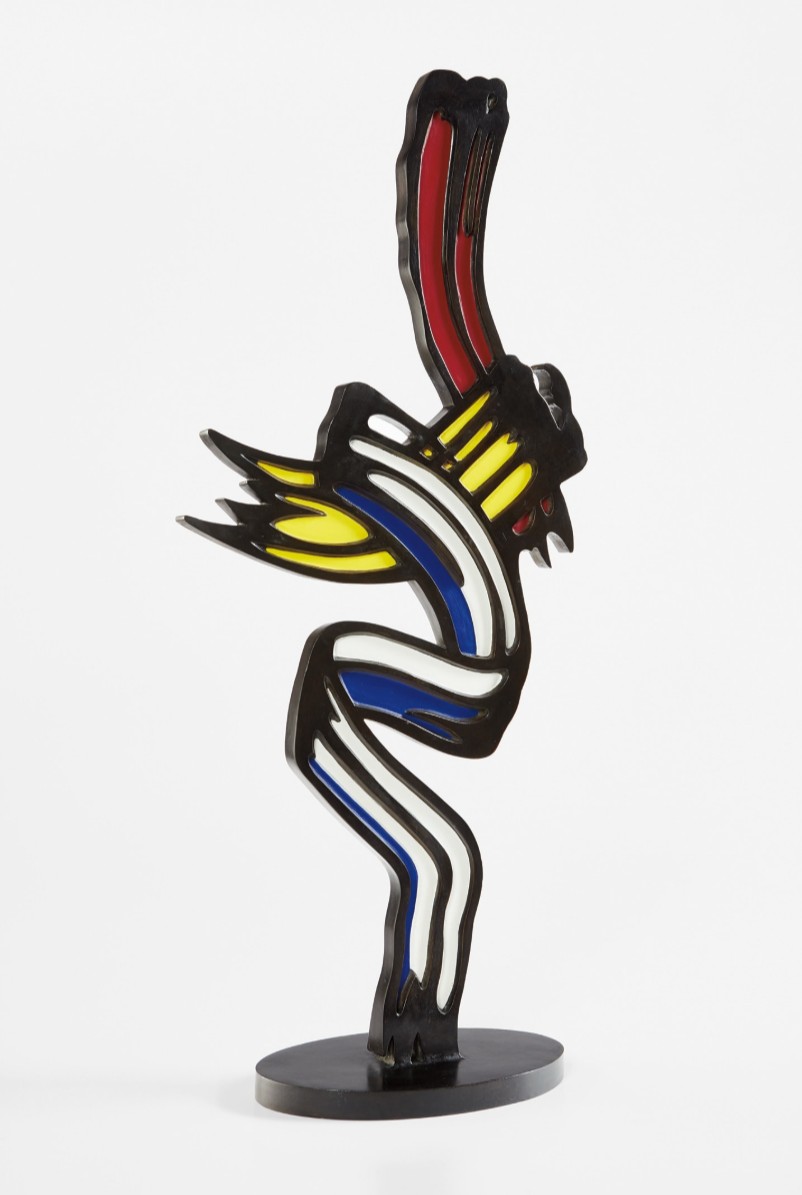
A crucial paradox of Lichtenstein’s engagement with the brushstroke motif is that he portrayed the ultimate symbol of self expression in a style that seems to completely efface the presence of the author. Rather than showing the artist’s hand, he would defer representation to the ubiquitous and recognisable lexicon of graphic fiction. Brushstroke with Spatter, 1966, in the collection of the Art Institute of Chicago, is a paradigmatic example of how Lichtenstein parodied the expressive mark-making and bravura application of paint that had long dominated American painting in the 1950s. Long revered as a spiritualistic embodiment of the creative moment, when Lichtenstein thematised the Brushstroke Sculpture in the mid 1960s he represented common gestures from action painting – the splatters of Jackson Pollock or the raw unblended marks of Willem de Kooning and Franz Kline – with the thick black outlines and block primary colours. In his distinctive comic book style, actual brushstrokes that composed images of brushstrokes remained invisible. As the artist noted, “Visible brushstrokes in a painting convey a sense of grand gesture. But, in my hands, the brushstroke becomes a depiction of a grand gesture. So the contradiction between what I’m portraying and how I am portraying it is sharp.” (Roy Lichtenstein, A Review of My work since 1961: a slide presentation, 1995, transcript online).
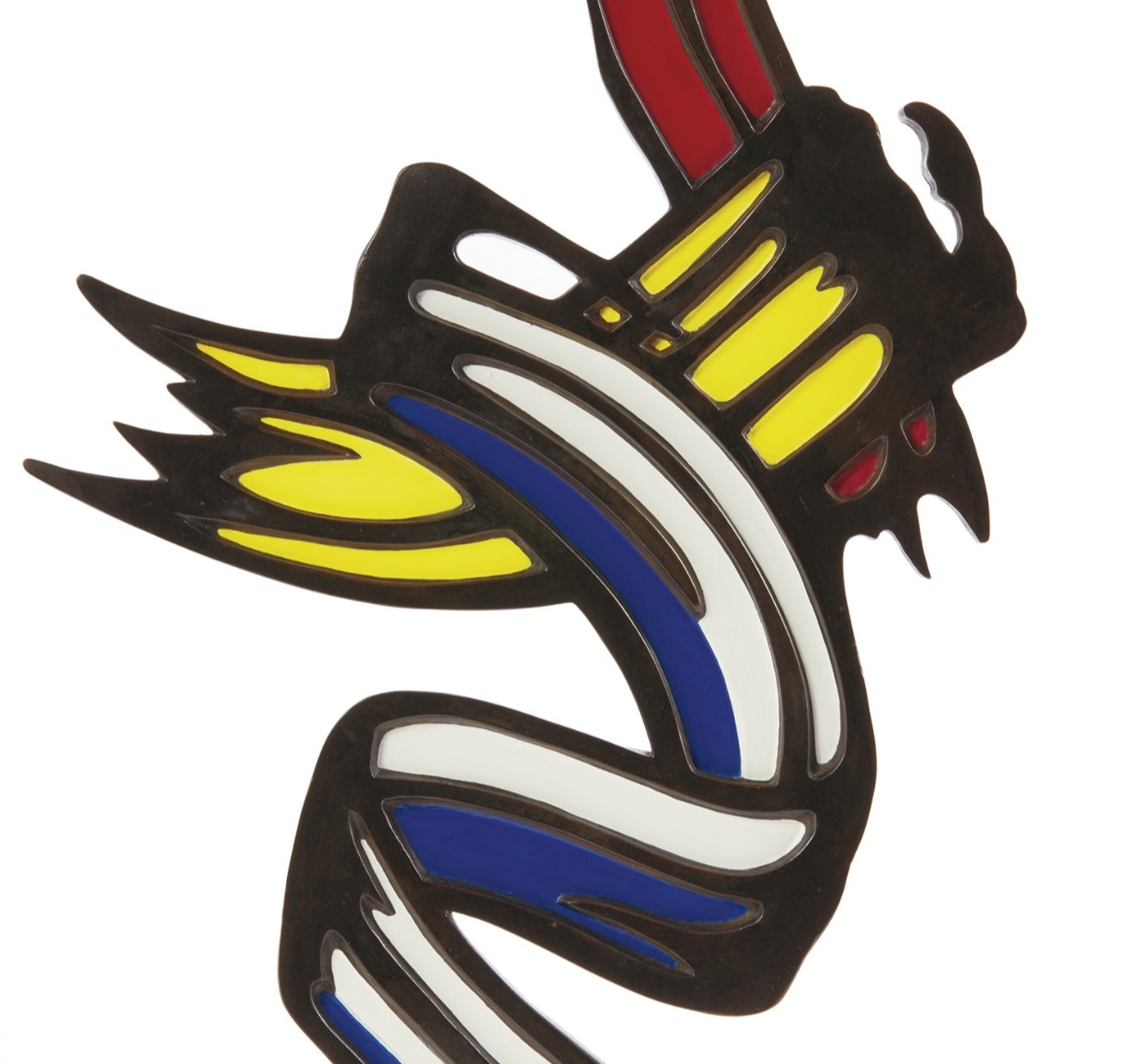
Whilst Lichtenstein engaged with different artistic styles and movements throughout his career, the present work comes from a period where he begins to re-engage with his own work, referencing past series. Created in 1981, the present work is the very first time that Lichtenstein transfers his iconic brushstroke motif to the medium of sculpture, thus giving it greater monumentality as an icon of his own making. As noted by renowned art critic and historian Hal Foster, the work is the first instance where “traditional bust meets abstract mannequin, Abstract Expressionist brushstroke meets cartoon sign of the same.” (Hal Foster, Roy Lichtenstein, Sculpture, New York and London, 2005). Lichtenstein constructs an elegant totem that enunciates a set of three brushstrokes in his characteristic bold black outlines and primary colours. A swirling vertical slick of white and blue supports a horizontal dash of ebullient yellow which in turn supports and vibrant red vertical swipe. Each is articulated as an image that holds a false sense of urgency, which is crucially at odds with the permanence of the medium. Lichtenstein conjures an idea of quick-handed expression with his erratic lines, despite the classically symbolic material or bronze requiring consideration and planning in its execution. As a medium that has been utilised from ancient times to the present day, Lichtenstein initiates an instance in which bronze is not simply painted, but becomes a representation of paint. Whilst sculpture occupied a central position in Lichtenstein’s oeuvre from the first time he cast a female figure in glazed ceramic in 1965, crucially Brushstroke Sculpture plays with our expectations of sculpture as a plastic and three dimensional medium. When Lichtenstein began his career, minimalist artists such as Frank Stella and Ellsworth Kelly were making paintings that presented themselves as objects; by 1981, in Brushstroke Sculpture, Lichtenstein reverses this transcendental process with great humor, creating a beguiling object that presents an unconvincing image of itself as paint.
BRUSHSTROKE HEADS
In 1987, Roy Lichtenstein produced a related group of sculptural multiples titled Brushstroke Head I, II, III, and IV. Cast in bronze, painted, and mounted on circular bases, the works extend Lichtenstein’s long-standing Brushstroke motif into the domain of figuration, merging the language of the graphic stroke with the outline of a head in profile. Unlike the wall-mounted Brushstroke multiples of the previous year, the Brushstroke Head series is fully autonomous in space. The forms rise vertically from their bases and are meant to be read in the round, even though their silhouettes retain a strong frontal orientation. The head is not modeled in a traditional sculptural manner; it is assembled from layered, cut-out elements that echo the flatness of Lichtenstein’s paintings while occupying real volume.
Each sculpture combines several of the artist’s established visual devices. Curved brushstroke shapes define hair, facial contours, and structural supports, while areas of Benday dots articulate surfaces associated with skin or mass. Strong black outlines organize the compositions, separating zones of red, yellow, blue, white, and black. As in Lichtenstein’s two-dimensional work, these elements function as signs rather than descriptive details.
Brushstroke Head I–IV, 1987
Painted bronze, free-standing sculptural multiples
Edition of 6 each
The four versions differ in balance and emphasis. Some configurations stress vertical alignment, with elongated supports and compact heads, while others introduce more pronounced curves and lateral extensions. The distribution of dotted and flat color areas shifts from one work to another, producing variations within a consistent formal framework. None suggests an individual likeness; the “head” remains schematic and impersonal.
The use of bronze introduces a material historically associated with permanence and monumentality, yet the painted surface neutralizes those associations. The finish conceals the casting process and minimizes texture, maintaining a visual distance between material substance and pictorial appearance. The series thus continues Lichtenstein’s practice of separating what an artwork looks like from how it is made. Within Lichtenstein’s broader oeuvre, the Brushstroke Head multiples can be understood as a synthesis of several strands of his work: the critique of painterly gesture, the stylization of the human figure, and the translation of graphic imagery into sculptural form. By combining the brushstroke with the head, Lichtenstein aligns gesture and identity, while treating both as constructed images.
Issued in small editions, these works occupy a distinct position among Lichtenstein’s late sculptural multiples. They are not reductions of existing paintings but independent objects that apply his visual system to a three-dimensional, figurative format. The series reflects his continued interest in repetition, variation, and the controlled use of form as a means of examining the conventions of representation. Taken together, Brushstroke Head I–IV present a measured exploration of how a familiar motif can be adapted to sculpture without adopting traditional modeling or expressive intent. The works maintain a deliberate distance from naturalism, reinforcing Lichtenstein’s broader inquiry into how images are constructed, circulated, and understood.
Brushstroke Head I, 1987
Brushstroke Head I, 1987
Bonhams New-York: 16 May 2017
Estimated: USD 700,000 – 900,000
USD 1,147,500
ROY LICHTENSTEIN (1923-1997)
Brushstroke Head I, 1987
Painted and patinated bronze
39 3/4 x 16 1/2 x 8 1/2 inches (101 x 41.9 x 21.6 cm)
Incised ‘© rf Lichtenstein 87 5/6’ and with the Tallix, Inc. foundry mark (on the base)
This work is number five from an edition of six, plus one artist’s proof
Provenance
Castelli Gallery, New York
Mitchell-Innes & Nash, New York
Private Collection, Arizona (acquired from the above in 2002)
Acquired from the above by the present owner
The first iteration of an iconic series within the artist’s prolific body of work, Brushstroke Head I, 1987, is emblematic of Roy Lichtenstein’s lifelong critical engagement with the symbiosis of pictorial presentation and mass communication. Rendered in his signature Ben-Day dots, Brushstroke Head I is a challenging and exuberant example of Lichtenstein’s consistent preoccupation with the synthesis of the detached, impersonally manufactured style of newsprint and the emotive quality of the female as muse which clearly informs the thematic content of the present work. Unquestionably, Brushstroke Head I is posited at the crux of Lichtenstein’s artistic legacy: universally enthralling, commercially relevant and critically hailed as a “generational icon”.1
At its core, Brushstroke Head I is a powerful fusion of bisecting ideals, a complex construction evocative of Piet Mondrian’s return to colorful simplicity that deftly mirrors the physical dexterity of Alexander Calder’s delicate wire sculptures. Though on the surface, and further suggested by its title, Brushstroke Head I is a reflection on the fluid, sweeping painterly style of Abstract Expressionism, it also exhibits a classic tenet of Pop appropriation that goes beyond a bold exploration of color. It elevates the status of the mundane, often overlooked elements of modern life in its gestural projection of the highly personal artist’s mark, transforming the prosaic into the celebrated, the unsung into the exalted.
In the creation of Brushstroke Head I, Lichtenstein invites us to consider the aesthetic properties of bronze by inserting motion where it previously did not exist and implying the fluidity of liquid in a static, passive object. In doing so, Lichtenstein revolutionizes the way in which sculpture is visually consumed. Not quite at rest, yet not kinetic in nature, Brushstroke Head I is a seminal piece suspended in a plane that spans the impressive gestures of Abstract Expressionism and the subversive levity of Pop. Lichtenstein himself once labeled his process as “… a reaction to the turn of Contemporary painting back toward an expressionist path, toward the revealing of the brushstroke in the surface of the painting.” Lichtenstein would later take this idea even further in his realization of the figural Brushstroke Head series in a bronze medium, translated directly from earlier sketched variations.
Critically trained in formal painting methods, Lichtenstein adopted elements of Surrealism and Cubism early on in his career. By 1961, however, Lichtenstein had begun working regularly with pre-processed commercialized images found in advertising, amplifying and repositioning them in an ironic, concentrated effort to expose the artificiality of a recognizable visual language that purported to present a ubiquitous version of reality to the general public. Around this time, he became interested in industrial fabrication, an important thread that would re-emerge with vigor in the later years of Lichtenstein’s lengthy career. Concurrent to the conception of initial sketches for the Brushstroke Head series was a barrage of media onslaught in which mass marketing and dominant visual imagery reigned supreme. Subsequently, Lichtenstein sought quiet refuge in his Southampton studio where he worked to reconcile the basic language of painting as it previously existed within a classical context and as it was evolving in a new technological era. Lichtenstein later returned to New York City in the 1980s, where he would show his Brushstroke Head sculptures for the very first time at famed dealer Leo Castelli’s Thompson Street gallery. It is unsurprising that the caliber of Lichtenstein’s Brushstrokes was immediately recognized by Castelli, further adding to the illustrious provenance of the present work.
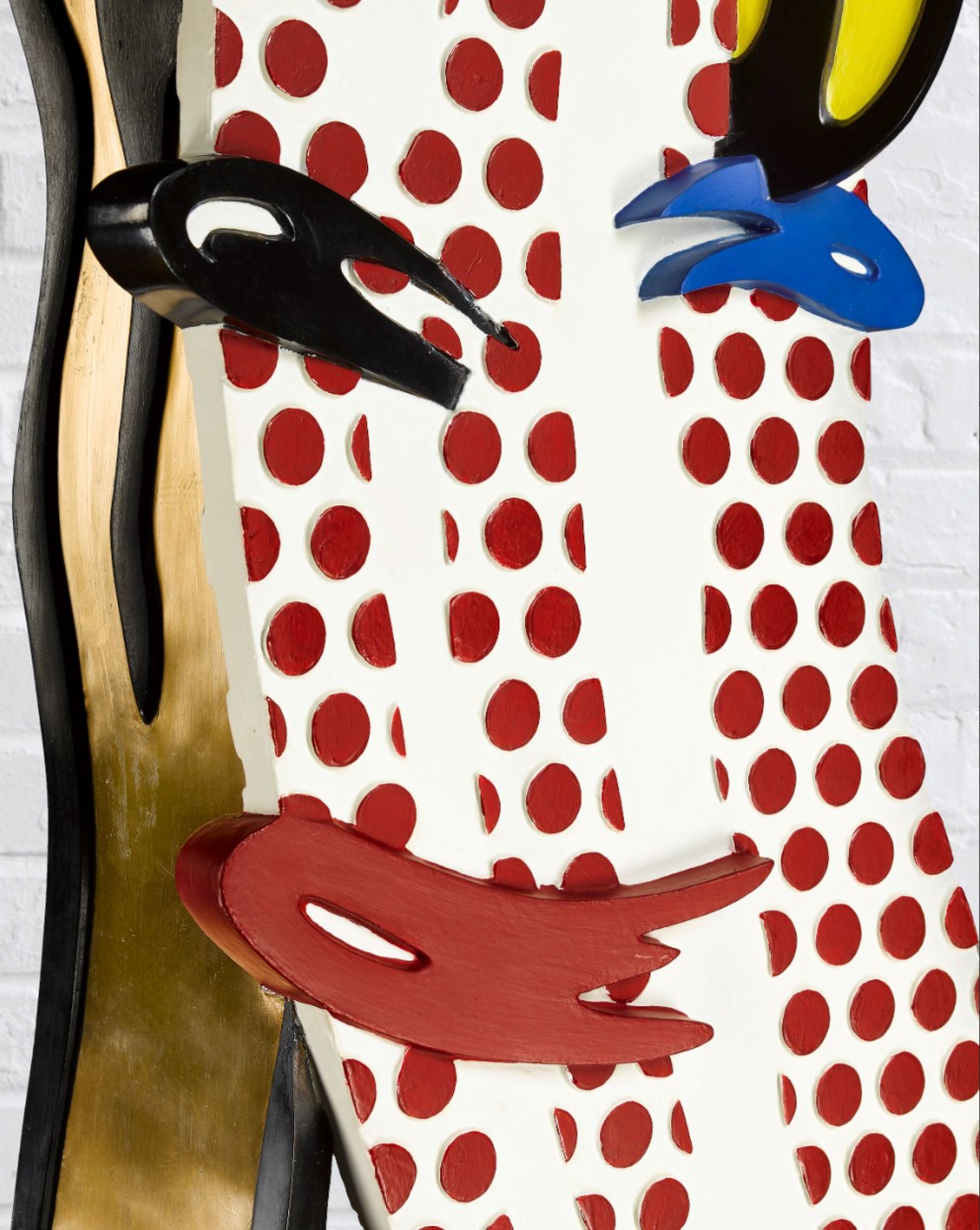
Brushstroke Head I employs a calculated approach to a linear representation of the brushstroke’s embodiment of femininity. Lichtenstein was ultimately concerned with disassembling the concepts of artistic portrayal as they existed in a traditional sense, where the brushstroke alluded to the intense subjectivism of the Abstract Expressionists, and the woman was a distant epitome upon which to confer notions of sensuality and fragility. Poised and resolute, Brushstroke Head I is liberated from the weighty constructs of the female as a sex icon and the brushstroke as a symbol of spontaneity. Instead, the present work satirizes these constructs, highlighting their banality and abstraction. As former assistant to the artist Cassandra Lozano aptly notes, “Roy was always concerned with archetypes, and was driven to capture the essential in things.”3 In Brushstroke Head I, Lichtenstein unpacks the archetypal postulation of the feminine muse within an art historical framework. Here, he projects the familiar intimation of the golden-haired, ethereal heroine onto a distinctly unmoving, leaden object, thereby forcing the viewer to reconsider traditional means of expressions of reality. Former director of the Museum of Contemporary Art in Chicago Robert Fitzpatrick remarks, “They are not sensuous or even sexy, but objectified to elicit the same response as would an ashtray or potted plant, indicative of Lichtenstein’s fondness for elevating the commonplace (telephone book ads) to the extraordinary, and of reducing the extraordinary (nudes) to the commonplace.”4 Lichtenstein’s translation of the female form and its subsequent superimposition onto the reflexive brushstroke is thus more self-referential and appreciative than it is a cursory appropriation.
The curving, elongated silhouette of the present work places distinct emphasis on pictorial style and isolated gesture, elevating the brushstroke from a fragment of an expressionist composition into an icon of its own. Paradoxically, Brushstroke Head I accentuates the inherent artificiality of Lichtenstein’s source material, printed advertisements, while bringing pre-existing imagery into direct confrontation with the painterly language of the Abstract Expressionists. By capturing the stylistic authenticity of his source images, Lichtenstein harnesses emotion, action and gestural vibrancy in one figure that appears as if lifted directly from the pages of a comic book. There is a subtle subterfuge in Lichtenstein’s clever re-imaging of advertisements. He achieves this by shifting and exaggerating the scale to dismantle the viewer’s perception of hierarchal constructs within art and life, masterfully fusing elements of highbrow culture with mass reproduction. In the Brushstroke Head series, Lichtenstein explores the very concepts of representation and appropriation in his isolation and distillation of the brushstroke to its purest, most original form.
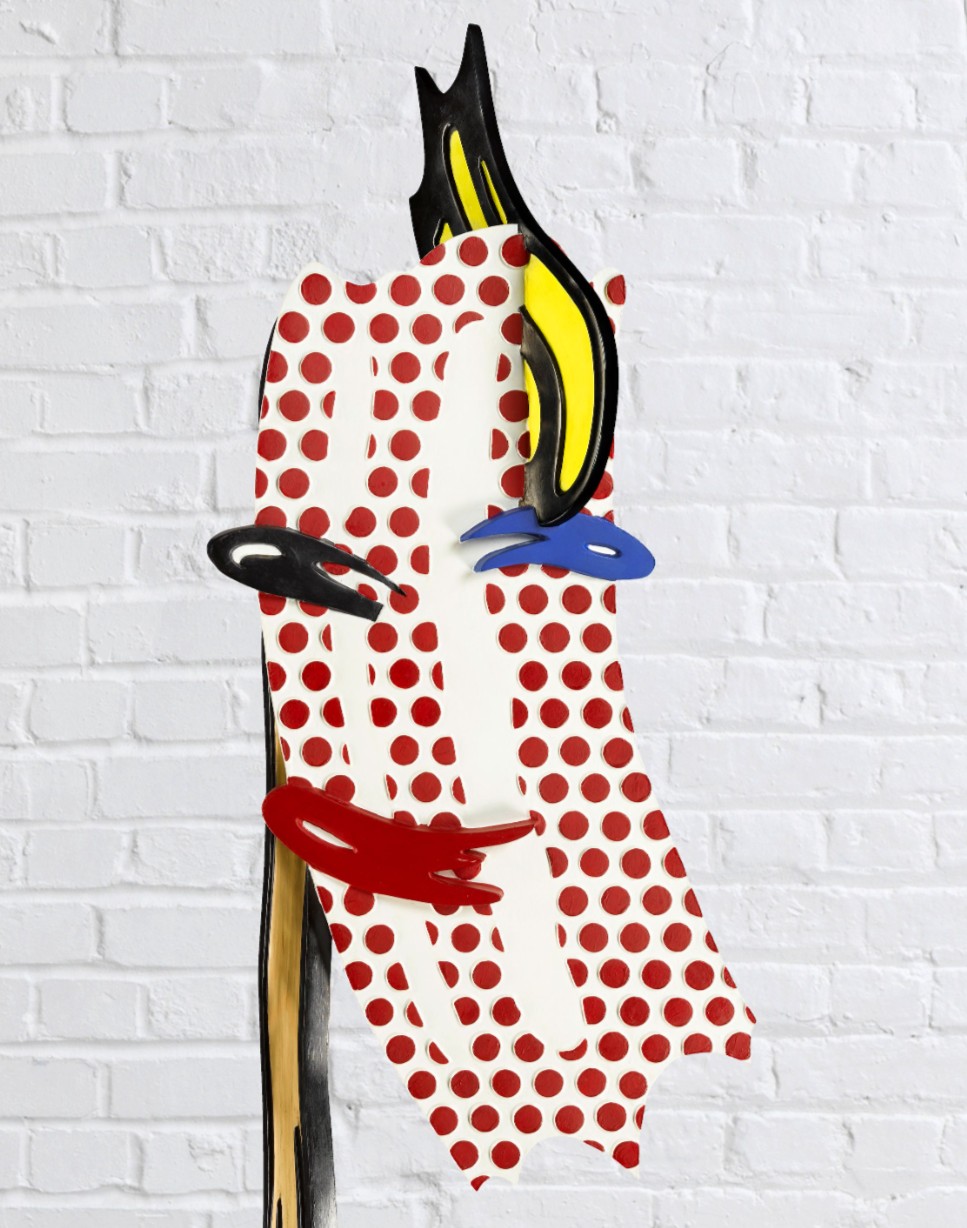
The precise execution of the present work speaks to Lichtenstein’s technical proficiency as a draftsman. Mystically, the work maintains a pictorial flatness emblematic of Lichtenstein’s most renowned works on canvas. He achieves his trademark comic book effect in which a larger cohesive image is comprised of various smaller, uniform dots by applying pigment to a flat canvas through a perforated metal screen. In and of itself, this process is painstakingly specialized: when this function is performed on sculpture, it is rendered nearly inconceivable. So innate was his understanding of the ability of found images to inform and influence individual perception, however, that Lichtenstein did so with ease, presenting in one singular visage a multidimensional reading of Contemporary modes, the structural narrative of the brushstroke, and the paradigmatic feminine effigy. In Brushstroke Head I, Lichtenstein enlarges his quintessential Ben-Day dots, their graduated scale illustrative of the freckled face of so many of his comic heroines. Vivid swaths of the artist’s brush make up the figure’s eyes and mouth, playfully alluding to Lichtenstein’s jovial irony. Similarly, larger brushstrokes flank the top and bottom of the composition, anchoring the work by twisting in opposite directions as if propelled into motion by some unknown force.
The four main compositional elements of the sculpture, although seemingly spontaneous in form, are, in fact, tightly orchestrated and deeply balanced, a nod to Lichtenstein’s mastery of formal technique. Each component sits in a harmonized repose, serving a tangible purpose to unify the work and expose Lichtenstein’s trademark sense of humor. Though Lichtenstein’s approach generally tended towards a graphically minimal use of primary colors, the present work also incorporates a contoured metallic spine, punctuated by a bold black border. Primary colors are rendered richly: ebullient yellow, oceanic blue and luscious red complement one another, creating a dynamic juxtaposition with the stark white and deep onyx that delineate the composition. Ben-Day dots seem to explode against a recessed pristine white backdrop, inching off the sculptural plane and closer to the viewer.
In Brushstroke Head I, Lichtenstein investigates the spatial relationship between viewer and object, illustrative of his enduring interest in reworking built artistic tropes. Of breaking down the rigid barrier between two- and three-dimensionality within western contemporary art, the artist thoughtfully noted, “The kind of organization which I think it is about has to do with the sense of positions existing at a related distance and direction from the artist. Sculpture might have an exterior form and then it has changes within that form which create contrast… Contrast may be in a cast shadow or in the illusion of a cast shadows, or contrast can be created in any conceivable way. Now, as you turn the sculpture, or move your position, you continually perceive it differently. It’s the relationship of contrast to contrast, rather than volume to volume which makes it work. So, even though I realize it is three-dimensional, it is always a two-dimensional relationship to me, or as two-dimensional as a drawing is.”8 Lichtenstein’s artistic practice can then be considered a harbinger of postmodern consciousness, a careful yet colorful appropriation that allowed for a codified style – that hovered somewhere between abstraction and representation – to be perceived as the highest form of art.
Brushstroke Head I, 1987
Sotheby’s New-York: 12 November 2014
Estimated: USD 800,000 – 1,200,000
USD 965,000
Results for “roy lichtenstein brushstroke”
REPEAT SALE
Sotheby’s New-York: 15 November 2006
Estimated: USD 500,000 – 700,000
USD 1,136,000
Results for “roy lichtenstein brushstroke”
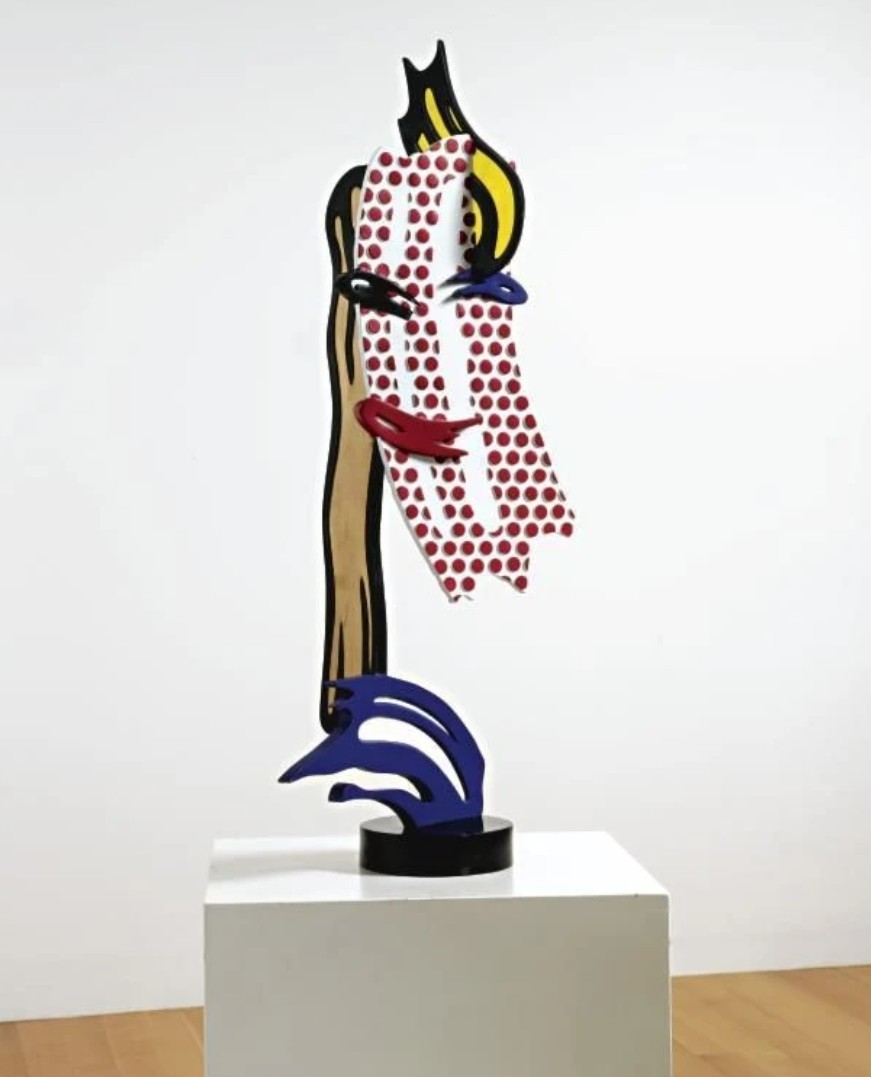
ROY LICHTENSTEIN (1923-1997)
Brushstroke Head I, 1987
Painted and patinated bronze
39 3/4 x 16 1/2 x 8 1/2 inches (101 x 41.9 x 21.6 cm)
Edition: 2/6
Brushstroke Head II, 1987
Brushstroke Head II, 1987
Sotheby’s New-York: 14 May 2024
Estimated: USD 500,000 – 700,000
PASSED
Brushstroke Head II | Contemporary Day Auction | 2024 | Sotheby’s (sothebys.com)

ROY LICHTENSTEIN (1923 – 1997)
Brushstroke Head II, 1987
Painted bronze
29x17x14 inches (74 x 43.2 x 35.6 cm)
Incised with the artist’s signature, date ’87 and number 5/6 (on the base)
Brushstroke Head II, 1987 encapsulates the thematic and artistic impact of Roy Lichtenstein illustrious career—from his ground-breaking pop art in the 1960s through the final days of his career in his exploration of sculpture. Brushstroke Head II directly harkens back to his renowned Brushstroke series initiated in the mid-1960s, fusing elements of his early canvases with a three-dimensional form that challenges and redefines traditional sculpture. Integrating abstract brushstrokes with recognizable features—a nod to both Abstract Expressionism and his love of comic book art, particularly the depiction of a femme fatale heroine—Brushstroke Head II oscillates between abstraction and representation. As one moves around the sculpture, deconstructed elements of a female face emerge, where swooping brushstrokes transform into detailed eyelashes, an elongated nose, and pouting lips. This sculptural play employs Lichtenstein’s trademark Ben-Day dots, not merely as a stylistic echo of mass-produced media but as a sophisticated commentary on visual perception and art’s reproducibility.
This artwork marks a significant point in Lichtenstein’s exploration of sculpture, much like Brushstroke Head IV (Barcelona Head), which was one of the final forms developed for his Barcelona commission. Here, Lichtenstein is not only revisiting but also expanding upon his earlier investigations into the brushstroke motif that began in 1981 with Brushstroke Sculpture. This continuity and evolution highlight a dynamic interrogation of his own artistic methodologies and the conventions of Pop Art. The evolution from his earlier Brushstroke Paintings to sculptures like Brushstroke Head II illustrates Lichtenstein’s enduring fascination with Abstract Expressionism. His sculptures cleverly subvert the subjectivity and spontaneity of gestural painting through a calculated replication of action painting’s most expressive elements, instead using the industrial techniques of Ben-Day dots. Brushstroke Head II becomes a witty and critical reflection on the art historical dominance of Abstract Expressionism during the 1960s, juxtaposing Pop and Abstract elements creating an entirely new style. Lichtenstein’s integration of a traditional female bust with abstract, cartoonish elements represents a sophisticated collision of art historical genres and styles—continuously pushing the boundaries between what is considered high art and popular imagery.
In Brushstroke Head II, Lichtenstein offers a masterful commentary on the process of artistic creation and its reception, making the sculpture not only a hallmark of his career but also a profound exploration of the intersections and tensions within modern art. The sculpture exemplifies how Lichtenstein, even in his later years, remained at the forefront of challenging and expanding the possibilities of pop art, ensuring his legacy as an innovator who consistently reimagined the potential of his medium.
Brushstroke Head II, 1987
Christie’s New-York: 18 May 2017
Estimated: USD 700,000 – 900,000
USD 847,500
Roy Lichtenstein (1923-1997), Brushstroke Head II | Christie’s
ROY LICHTENSTEIN (1923-1997)
Brushstroke Head II, 1987
Painted and patinated bronze
28 7/8 x 13 1/4 x 17 1/4 inches (78.3 x 33.7 x 43.8 cm)
Signed, numbered and dated ‘3/6 rf Lichtenstein ’87’ (on the base)
This work number three from an edition of six
Working within the medium of sculpture was a significant aspect of Roy Lichtenstein’s art practice from the beginnings of his career in the 1960s right through to the last decade of the artist’s life in the 1990s. Here, Brushstroke Head II translates the artist’s signature Pop style into three-dimensional form as it shares the qualities of Lichtenstein’s iconic paintings—the graphic, color-splashed, Ben-Day dot universe that was the pop culture’s image of America in the 1950s & 1960s.
Brushstroke II captures many of the defining motifs that Lichtenstein made a career articulating: the visual language derived from the pages of comics and print advertising with their primary colors, bold black lines, and bang! Pow! explosive statements. The flattened forms—Pop culture humor, Ben-Day dots, and, of course, the stylized brushstroke motif itself, are all referenced here. The artist was interested in exploring issues of three-dimensional space via his sculptural versions of his two-dimensional images, and the present work successfully conveys that theme, as the viewer takes note of the stylized facial features (eyes, lips, hair, and face) and the flat plane on which they are depicted.
Lichtenstein had a lifelong fascination with the idea of the brushstroke. Early on he began to explore and deconstruct the motif—what is, essentially, the building block of Western painting. Brushstrokes are conventionally conceived as vehicles of expression, but Lichtenstein made them into a subject. Modern artists have typically maintained that the subject of a painting is painting itself and Lichtenstein took this idea one imaginative step further turning it into a compositional element that could serve as the subject matter of a work. His brushstroke is at once a playful yet serious exploration of key themes in art history: high culture and low art; abstraction and representation; and, of course, the artist’s ironic nod to the slashing painterly gesture so central to the style of the Abstract Expressionist painters.
One of America’s most influential and innovative artists to have emerged in the second half of the 20th century, Lichtenstein was a pioneer of Pop Art, a movement with which he is closely identified. He developed his style based on pictorial motifs of comic strips and print advertisements, which he then interpreted in a style that played-off the crudeness of mid-century era newspaper print production. Lichtenstein deliberately sought out to interrogate commercial art’s visual material, universally reviled by fine artists in the early 1960s, which he then set out to improve upon. The artist’s painted bronze sculptures also challenged the medium’s conventional defining characteristics of three-dimensionality, stability, and solidity. His sculptures tended to be flat and thin and in preparing them this way, Lichtenstein was working to suggest associations closer to those pertaining to the drawn line than to sculpture’s solid mass.
Roy Lichtenstein tackled head-on conventional notions of taste and quality. What was typically disparaged as trivial, he elevated to a classical and mythical status. “To all of [Lichtenstein’s] images there was…a particular and unmistakably American quality: a lean, laconic scrutiny of the world that separated his art even from the paintings of Europeans of his generation, like Richard Hamilton and Sigmar Polke, who also borrowed from pop culture sources” (M. Kimmelman, “Roy Lichtenstein, Pop Master, Dies at 73,”
The New York Times, September 30, 1997).
Lichtenstein’s approach sent American art in an entirely new direction, altering the course of contemporary art and influencing numerous younger artists. The New York Times wrote that at the time of his death “his ideas had so infiltrated art that they were no longer only his. Mixing text and image, high and low, his whole strategy of appropriation paved the way for a generation of artists not yet born, or at least not yet out of elementary school, when he cribbed a picture of a girl holding a beach ball aloft from a newspaper advertisement for Mount Airy Lodge in the Poconos” (Ibid.)
Brushstroke Head III, 1987
Brushstroke Head III, 1987
Sotheby’s New-York: 10 May 2012
Estimated: USD 350,000 – 500,000
USD 752,500
Results for “roy lichtenstein brushstroke”
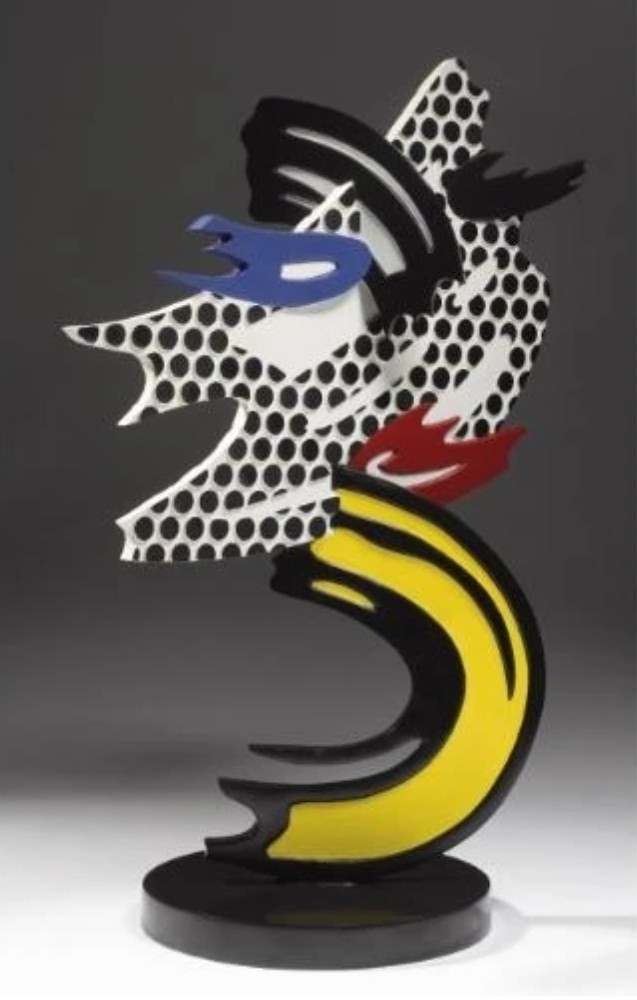
ROY LICHTENSTEIN (1923-1997)
Brushstroke Head III, 1987
Painted and patinated bronze
29x21x11 inches (73.6 x 53.3 x 27.9 cm)
Signed, numbered and dated ‘5/6 rf Lichtenstein ’87’ (lower edge)
This work is number five from an edition of six
Brushstroke Head III, 1987
Christie’s New-York: 9 November 2011
Estimated: USD 400,000 – 600,000
USD 482,500
Roy Lichtenstein (1923-1997) , Brushstroke Head III | Christie’s
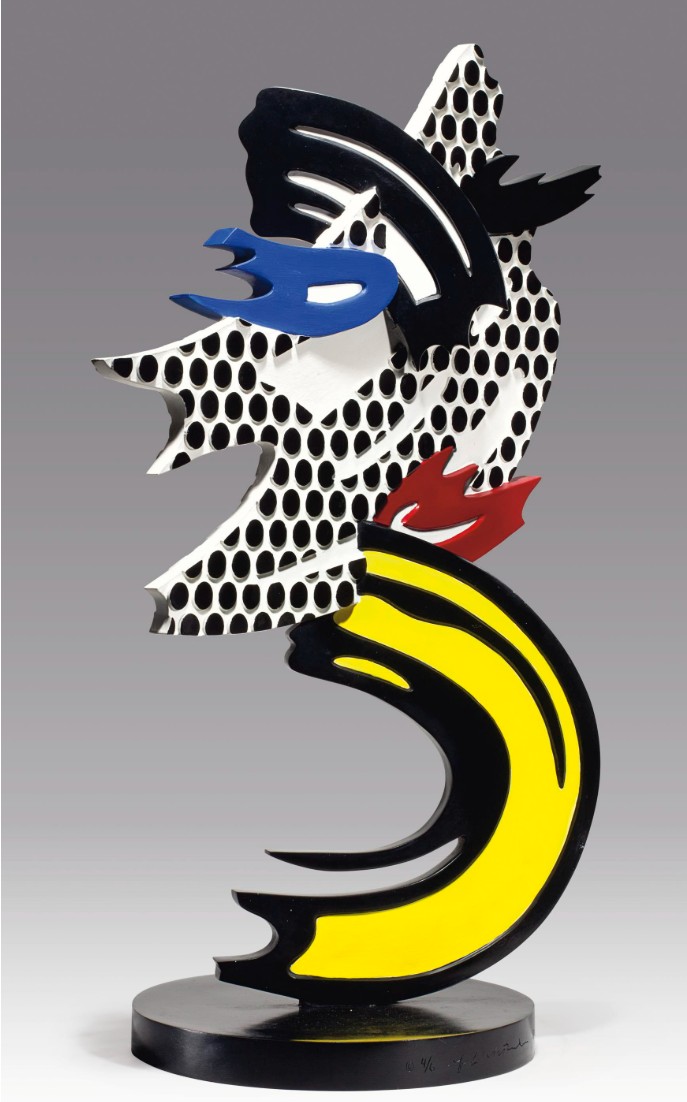
ROY LICHTENSTEIN (1923-1997)
Brushstroke Head III, 1987
Painted and patinated bronze
29x21x11 inches (73.6 x 53.3 x 27.9 cm)
Signed, numbered and dated ‘4/6 rf Lichtenstein ’87’ (lower edge)
This work is number four from an edition of six
Brushstroke Head IV, 1987
Brushstroke Head IV, 1987
Christie’s New-York: 15 May 2025
Estimated: USD 600,000 – 800,000
USD 756,000
ROY LICHTENSTEIN (1923-1997), Brushstroke Head IV | Christie’s
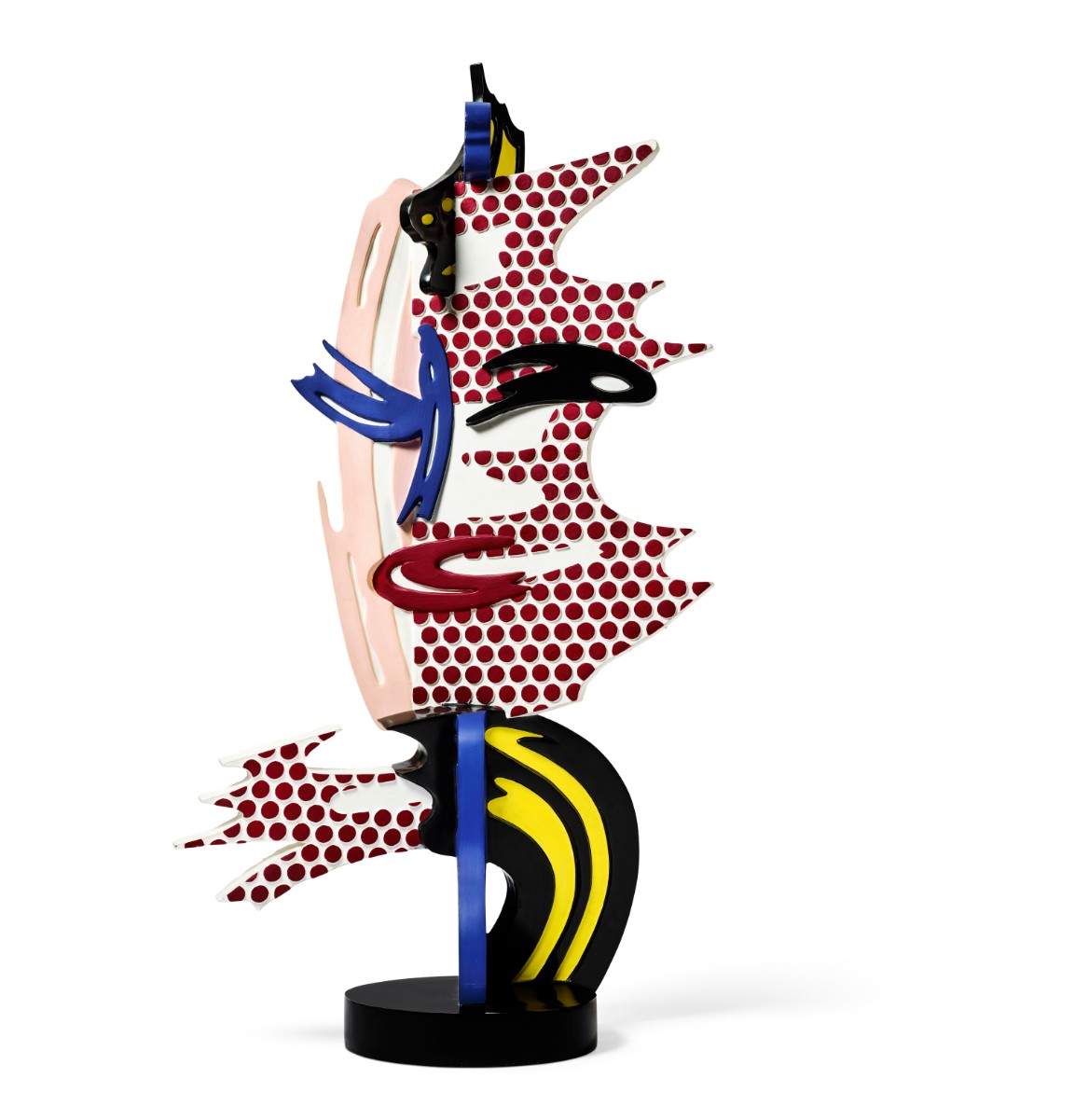
ROY LICHTENSTEIN (1923-1997)
Brushstroke Head IV, 1987-1988
Painted and patinated bronze
43 1/4 x 23 5/8 x 11 3/4 inches (110 x 60 x 29.9 cm)
Incised with the artist’s signature, number, date and foundry mark ‘1⁄6 rf Lichtenstein 87’ (on the base)
Conceived in 1987 and cast in 1988, this work is number one from an edition of six plus one artist’s proof
Brushstroke Head IV (Barcelona Head), 1987
Property from the Miles and Shirley Fiterman Collection
Phillips New-York: 13 November 2019
Estimated: USD 600,000 – 800,000
USD 800,000
Roy Lichtenstein 20th C. & Contemporary Art Day Sale, Morning Session
ROY LICHTENSTEIN
Brushstroke Head IV (Barcelona Head), 1987
Painted and patinated bronze
44x20x10 inches (111.8 x 50.8 x 25.4 cm)
Incised with the artist’s signature, number and date “© 3/6 rf Lichtenstein ’87”
Stamped with the Tallix foundry mark on the base
This work is number 3 from an edition of 6
Remaining in the Miles and Shirley Fiterman Collection for over four decades, Roy Lichtenstein’s Brushstroke Head IV (Barcelona Head), 1987, presents the striking precursor to the large-scale public sculpture Barcelona Head, which the artist created as a commission for the 1992 Olympic Games in Barcelona. Towering over 45 feet tall to this day in the center of Barcelona, it is among the most iconic of Lichtenstein’s sculptures and epitomizes the triumphal return of the female figure in the last decade of the Pop artist’s life. With a sly nod to Abstract Expressionism, his own 1960s Pop art idiom and the traditional motif of the female bust, Lichtenstein here puts forth a dynamic sculpture that oscillates between abstraction and representation. A deconstructed female face emerges as the viewer walks around the sculpture, and swooshing brushstrokes and Ben-Day dots give way to forms redolent of eyelashes, an elongated nose, and pouting lips. Executed in 1987 in an edition of six, this work represents the culmination of a series of four Brushstroke Head iterations that Lichtenstein created as part of his lengthy and exacting process, and the final form for his Barcelona commission.
Brushstroke Head IV (Barcelona Head) brilliantly expands upon Lichtenstein’s three-dimensional interrogation of the brushstroke motif that he had first commenced in 1981 with Brushstroke Sculpture, an example of which also resided in the Fitermans’s revered collection. Harkening back to his early Brushstroke Paintings from the mid 1960s, Lichtenstein here too subverts the subjectivity of the gestural brushstroke with his trademark graphic line and boldly colored Ben-Day dots, the dot system used in mass-circulation commercial printing. While Lichtenstein zoomed into the very gesture of action painting in direct reaction against – and parody of – the dominating movement of Abstract Expressionism in the 1960s, he returned to the motif in 1981 in sculptural form.
The present work brilliantly furthers the artist’s early investigations by challenging the primacy of abstract painting and division between artistic media that critics such as Clement Greenberg had espoused. As Jack Cowart observed, “Lichtenstein seems busily deconstructing the language and painterly idioms of Abstract Expressionism to make its artistic medium the actual message… In these brushstroke sculptures it is as if Lichtenstein wanted us to think this is what Franz Kline, as well, might have done had he worked in three dimensions. Clearly this historic appropriation is the case with Lichtenstein’s next suite of four Brushstroke Heads, 1987, in editions of six, where he takes de Kooning like face forms and casts them in painted and patinated bronze. Since we already know that de Kooning made sculpture (but not at all like this), we appreciate the conceptual and visual puns all the more” (Jack Cowart, Lichtenstein: Sculptures & Drawings, exh. cat., The Corcoran Gallery of Art, Washington, D.C., 1999, p. 19).
While Lichtenstein engaged with different artistic styles and movements throughout his career, Brushstroke Head IV (Barcelona Head) comes from a period where the artist was re-engaging with his very own practice. Embracing a post-modern meta-discourse with artistic precedents, Lichtenstein offers a masterful double loop of appropriation that explores the conventions of art historical precedents – including his own world-famous oeuvre. Indeed, beyond echoing his early Brushstroke paintings, Lichtenstein here also reprises the motif of the female figure that had lain dormant in the preceding decades and would culminate in the 1990s with such works as Woman: Sunlight, Moonlight, 1996. Whereas Lichtenstein’s early “Girl Paintings” were driven by an interest in elevating the clichés and banalities of popular culture, while also exploring notions of reproduction, his exploration of the female figure, starting in the late 1980s, reflects his movement towards the pastiche of established art historical traditions.
With Brushstroke Head IV (Barcelona Head), Lichtenstein boldly challenges traditional sculptural norms – both through his application of high gloss, vibrant paint upon the revered medium of bronze, and his deconstruction of the female bust. As Hal Foster observed, “The collision of high and low modes is the very strategy of his art, indeed of Pop in general, and here he extends it to sculpture as well: traditional bust meets abstract mannequin, Abstract Expressionist brushstroke meets cartoon sign of the same…if there is a radical edge in Lichtenstein, it lies here: less in his thematic appropriation of comics and the like, and more in his formal reconciliation of lowly contents and high forms” (Hal Foster, Roy Lichtenstein, Sculpture, exh. cat., Gagosian Gallery, New York, 2005, p. 10). Lichtenstein’s conception of this work as a precursor to the monumental public sculpture Barcelona Head expands upon this eradicating of boundaries between high and low art. Formally and conceptually complex, Brushstroke Head IV (Barcelona Head) not only demonstrates the core tenets that catapulted Lichtenstein to acclaim in the 1960s, it moreover speaks of an artist in his twilight years relentlessly re-inventing his practice.
WALL-MOUNTED WOOD
In 1986, Roy Lichtenstein produced a series of six wall-mounted sculptural multiples titled Brushstroke I, II, III, IV, V, and VI. Executed in painted cherry wood and issued in editions of ten, the works extend one of Lichtenstein’s most persistent motifs, the brushstroke, into three-dimensional space. Each work in the series proposes a distinct configuration. Vertical compositions alternate with more lateral arrangements; some forms appear compact and stacked, while others unfold horizontally or incorporate detached elements. Despite these variations, the visual language remains consistent across the group. Bold contours, flat zones of color, and simplified shapes maintain a clear link to Lichtenstein’s painted vocabulary.
The use of cherry wood introduces a material traditionally associated with craft, yet the finish suppresses any evidence of manual handling. Surfaces are smooth, edges are sharply defined, and colors are applied in uniform planes. The result reinforces the distance between appearance and process: the forms suggest spontaneity while remaining entirely predetermined. Mounted directly on the wall, the works occupy an intermediate position between painting and sculpture. They project into space and cast shadows, but remain anchored to the wall plane. This spatial ambiguity echoes Lichtenstein’s long-standing interest in questioning medium boundaries and the conventions attached to them.
Brushstroke I–VI, 1986
Painted cherry wood, wall-mounted multiples
Edition of 10 each
Within the broader context of Lichtenstein’s practice, Brushstroke I–VI can be read as a continuation of his examination of painterly language and its historical associations, particularly those tied to Abstract Expressionism. By rendering the brushstroke as a reproducible object, the series addresses issues of authorship, repetition, and the constructed nature of artistic expression. Conceived as multiples rather than derivatives of existing paintings, these works occupy a distinct place within Lichtenstein’s sculptural output. Their limited editions, durable materials, and recognizable imagery have contributed to their steady presence in institutional collections and the secondary market.
Taken together, Brushstroke I–VI present a systematic exploration of a familiar motif, translated into object form and stripped of expressive intent. The series reflects Lichtenstein’s continued engagement with the mechanics of image-making and his sustained interest in how meaning is produced through form, repetition, and distance.
Brushstroke I, 1986
Brushstroke I, 1986
Sotheby’s New-York: 13 May 2021
Estimated: USD 100,000 – 150,000
USD 126,000
Brushstroke I | Contemporary Art Day Auction | 2021 | Sotheby’s (sothebys.com)
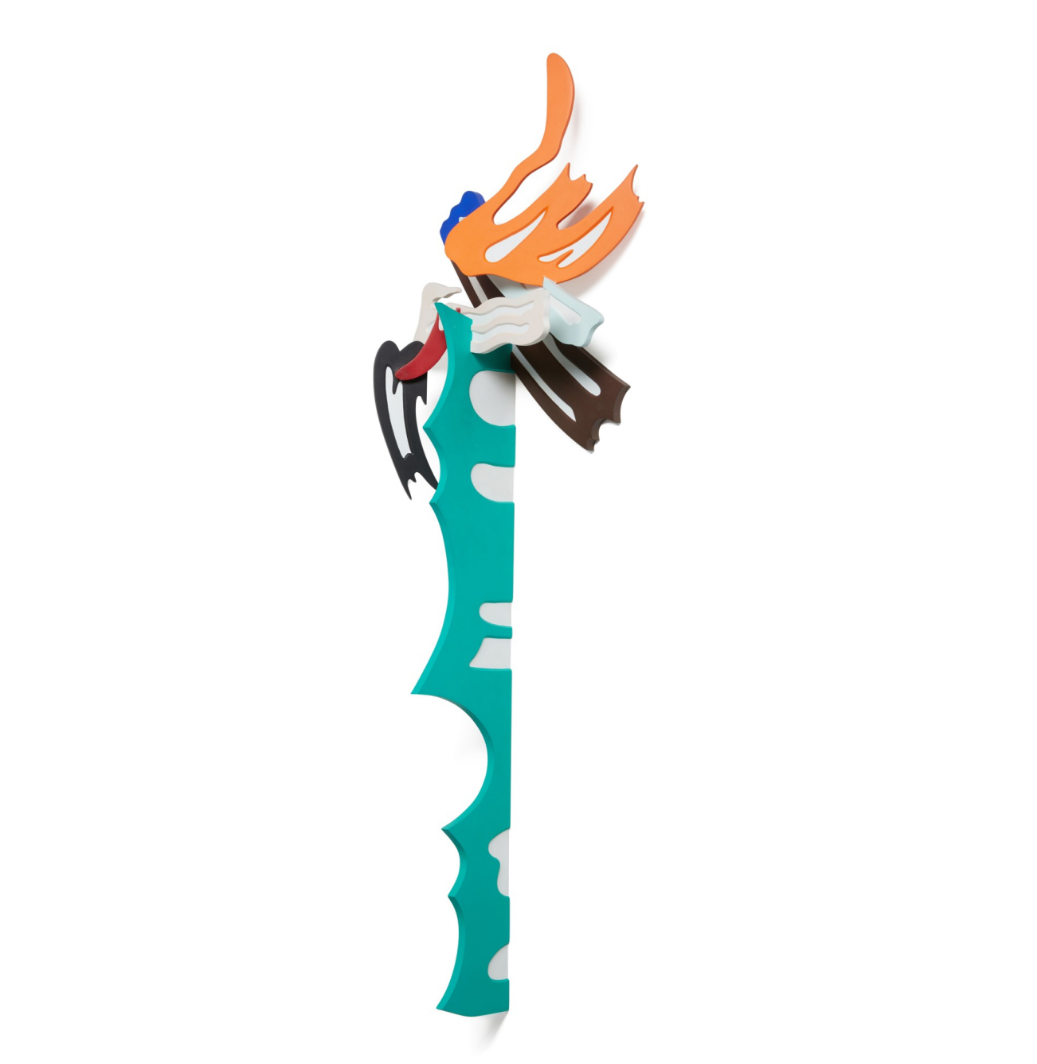
ROY LICHTENSTEIN (1923 – 1997)
Brushstroke I, 1986
Acrylic and epoxy on cherry wood
52x16x8 inches (132.1 x 40.6 x 20.3 cm)
Signed on the reverse
This work is number 8 from an edition of 10, plus 1 artist’s proof and 1 publisher’s proof
Brushstroke I is part of an important series of sculptures first executed in 1965 that upholds the qualities of irony and aesthetic mischief that one can expect from Roy Lichtenstein. A patently calculated, witty reflection of Lichtenstein’s bravura, the present work serves as a parody of the conventions held by Abstract Expressionism.

ROY LICHTENSTEIN IN HIS STUDIO, SOUTHAMPTON, 1990 © ESTATE OF ROY LICHTENSTEIN.
Humorous in its aesthetic, Brushstroke I attaches to the wall and forms a three-dimensional painting of vibrant colors. Executed with painstaking attention to detail and hand-painted by Lichtenstein, the present work is fluid and dynamic, ready to spill and fly playfully off the wall. A painted form arranged in space, Lichtenstein successfully creates his own archetype through this illusionistically witty work of sculpture.
Brushstroke I, 1986
Dorotheum Vienna: 21 November 2019
Estimated: EUR 120,000 – 140,000
EUR 176,950 / USD 210,000
Roy Lichtenstein – Contemporary Art I 2019/11/27 – Realized price: EUR 176.949 – Dorotheum
ROY LICHTENSTEIN (New York 1923–1997)
Brushstroke I, 1986
Acrylic, lacquer on cherry-wood
132.1 x 40.6 x 20.3 cm
Signed on the reverse rf lichtenstein
Inscribed I A-12
No 7 from the edition of 10 (incised on the label)
Produced and published by Tyler Graphics Ltd., Bedford Village
Roy Lichtenstein’s sculptural work is primarily based on motifs from his paintings. The three-dimensional sculptures, onto some of which he even transfers black contours and shadow grids, are based on the realisation of his two-dimensional pictorial motifs. Roy Lichtenstein experiments with the transformation of paintings into three-dimensional explosion forms as wall reliefs, table sculptures and freestanding large sculptures. The “Brushstrokes” series in particular takes the element of ‘painterly’ sculpture to absurd lengths. Several interlocking brushstrokes made of wood are arranged vertically, diagonally and horizontally and connected with each other. They are joined together to form a three-dimensional, expansive sculpture. The constantly changing shadow cast on the wall behind the linear and frontally aligned “Brushstroke” wall relief becomes itself a permanent work of art through its interaction with the observer.
Brushstroke I, 1986
Christie’s New-York: 14 November 2019
Estimated: USD 80,000 – 120,000
USD 106,250
Roy Lichtenstein (1923-1997), Brushstroke I | Christie’s
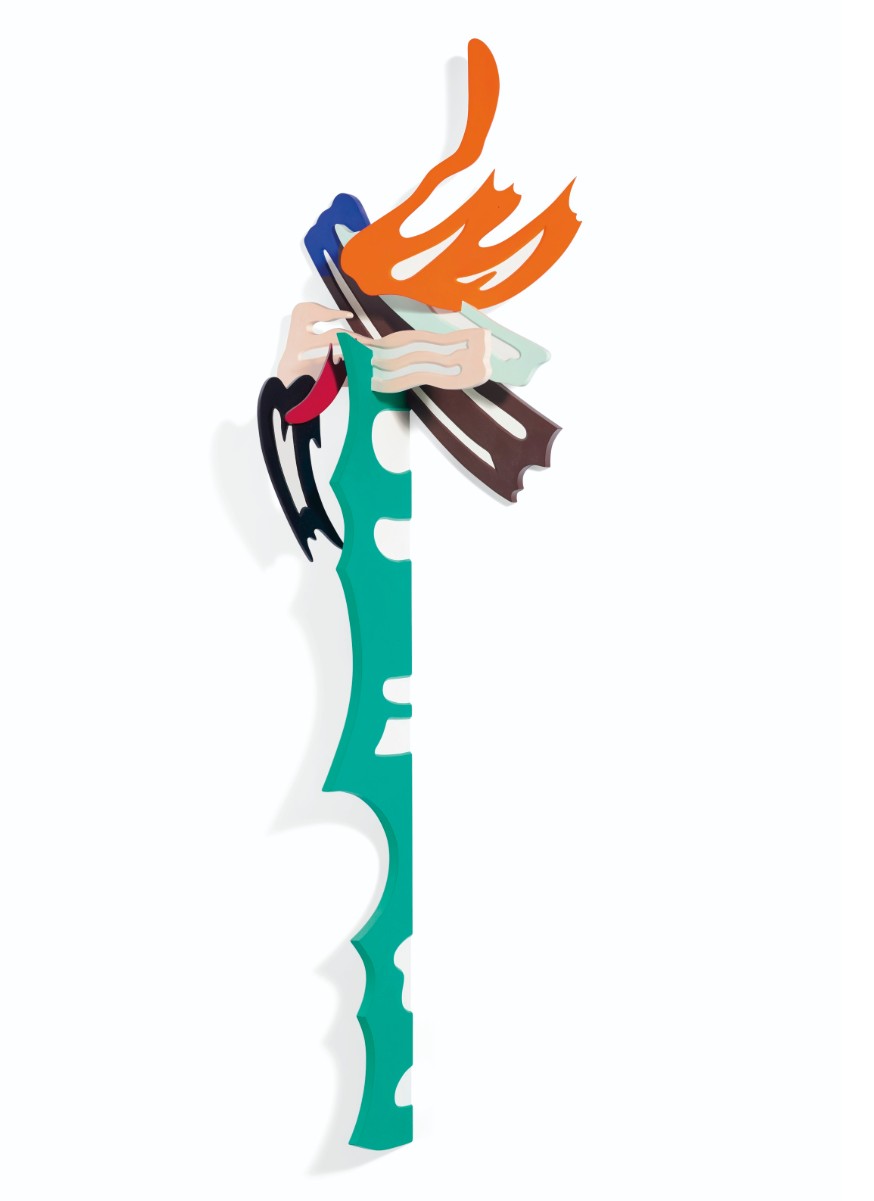
ROY LICHTENSTEIN (1923-1997)
Brushstroke I, 1986
Epoxy paint, acrylic lacquer and enamel on cherry wood
52 3/4 x 16 x 8 inches (134 x 40.6 x 20.3 cm)
Signed ‘rf Lichtenstein’ (on the reverse)
Incised with number ‘9/10’ (on a plaque affixed to the reverse)
This work is number nine from an edition of ten plus one artist’s copy and one printer’s copy
Brushstroke III, 1986
Brushstroke III, 1985-86
Christie’s New-York: 13 March 2024
Estimated: USD 150,000 – 200,000
USD 151,200
ROY LICHTENSTEIN (1923-1997), Brushstroke III | Christie’s
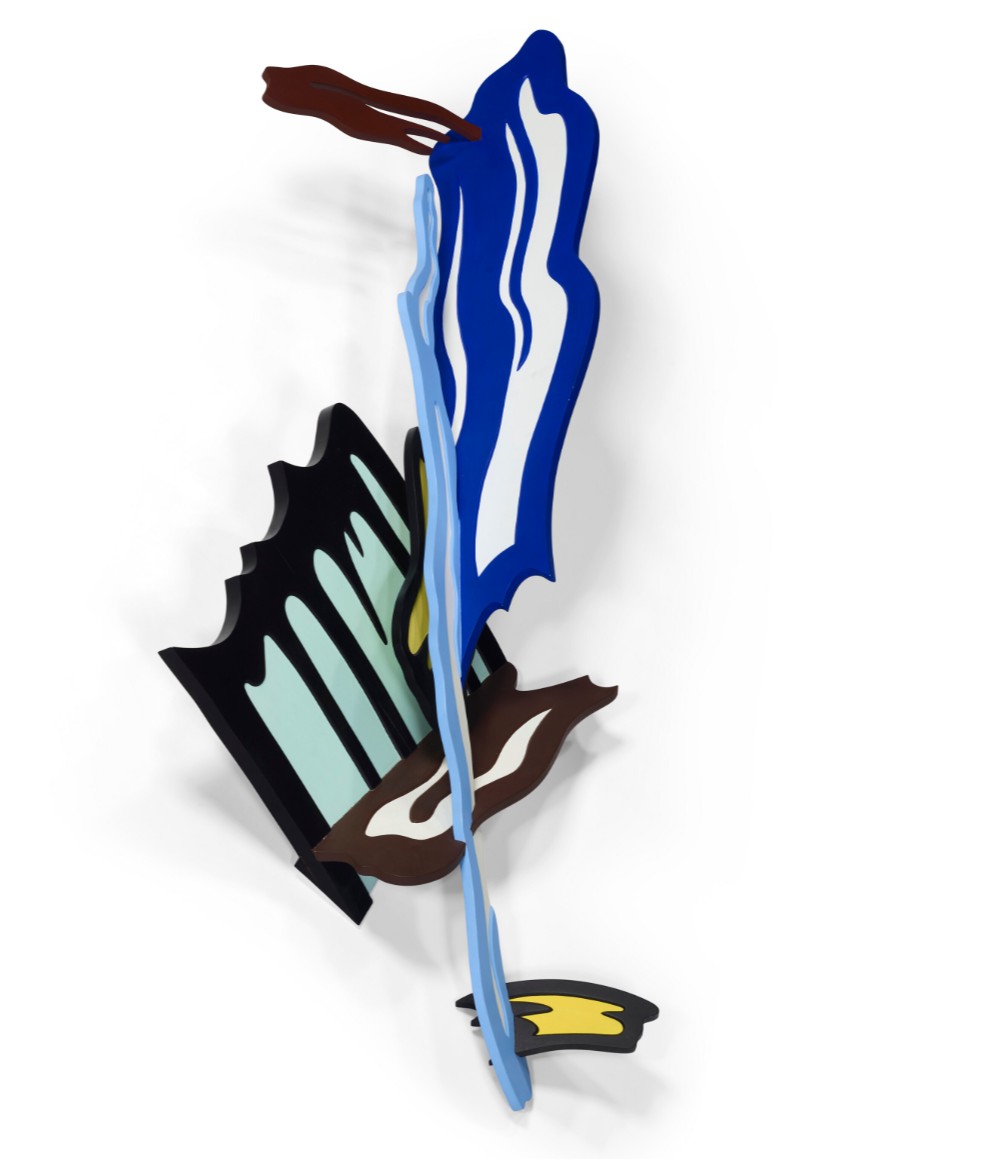
ROY LICHTENSTEIN (1923-1997)
Brushstroke III, 1985-86
Painted cherry wood
64 x 27 x 11 3/4 inches (162.6 x 68.6 x 29.8 cm)
Signed ‘rf Lichtenstein’ (on the reverse)
Numbered ‘5/10’ (on a plate affixed to the reverse)
This work is number five from an edition of ten
Provenance
Galerie Maurice, Chestnut Hill, circa 1986
Private collection, Vermont
Anon. sale; Sotheby’s, New York, 29 November 1997, lot 330
Acquired at the above sale by the present owner
Brushstroke III, 1986
LA Modern: 24 October 2021
Estimated: USD 150,000 – 180,000
USD 212,500
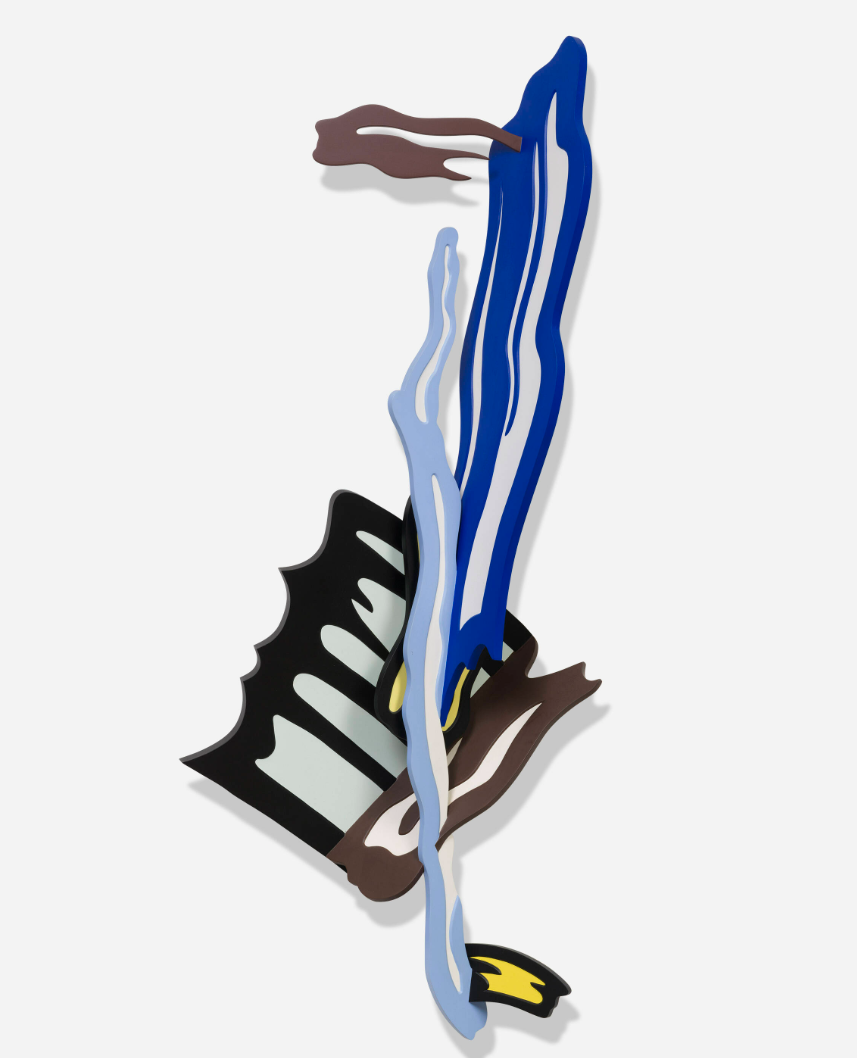
ROY LICHTENSTEIN (1923–1997)
Brushstroke III, 1986
Epoxy paint, acrylic lacquer, and acrylic paint on cherry wood
63 × 27 × 11 1/2 inches (160×69×29 cm)
Signed and inscribed to verso ‘rf Lichtenstein III C-9’
Numbered to brass label on verso ‘10/10’
This work is number 10 from the edition of 10 published and fabricated by Tyler Graphics Ltd., Mount Kisco
Celebrated for his Pop-inflected irony and meta-interrogation of media forms and formats, Roy Lichtenstein cultivated a long and fruitful relationship with the primary symbol of painting: the brush and brushstroke. Brushstroke III, created in tandem with Tyler Graphics in 1986, is one of Lichtenstein’s early forays into translating his series of Brushstrokes paintings into sculpture and bringing his signature playfulness and precision into three dimensions.
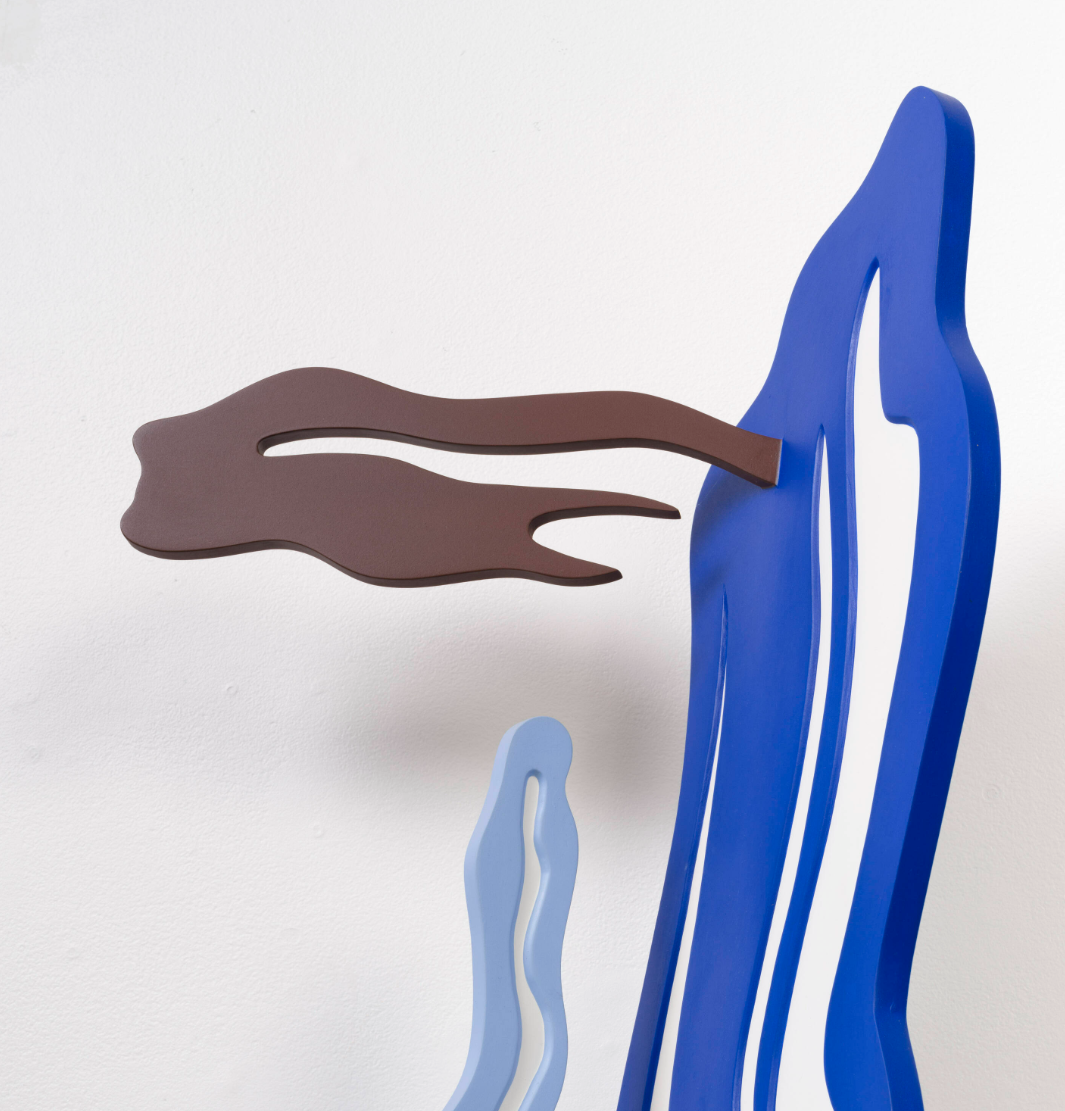
Lichtenstein first began to explore the brushstroke as subject in 1965, using an image drawn from the comic Strange Suspense Stories to inform his now-iconic version of the motif. The series of paintings that emerged were a direct comment on the all-pervasive Abstract Expressionist movement, in which Lichtenstein isolated, interrogated, and transformed the primary gesture of the medium.
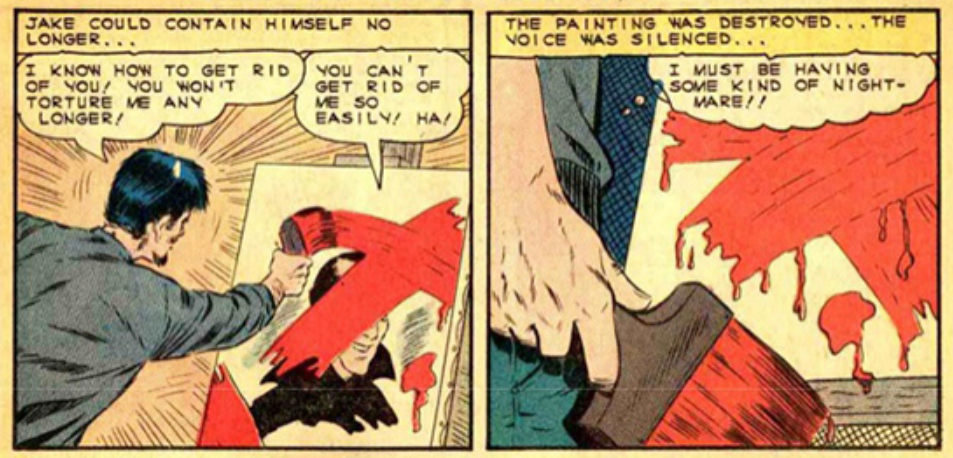
From ‘The Painting’ in the October 1964 ‘Strange Suspense Stories #72’, Charlton Comics
Lichtenstein first began to experiment with monumentalizing his brushstroke in the early 1980s. He completed several commissions of free-standing brushstrokes made from painted aluminum, towering between 20 and 30 feet tall. Brushstroke III emerged amidst this new chapter, a distinct moment in Lichtenstein’s pendulum swing between painting and sculpture and back again. At just over five feet in height and made to be mounted on the wall, arranged in such a way as to alternately appear flat and dimensional, Brushstroke III in many respects synthesizes Lichtenstein’s test of the boundaries of medium, standing as a crowning example of the artist’s technical mastery and hunger to experiment.
Brushstroke IV, 1986
Brushstroke IV, 1986
Christie’s New-York: 14 November 2019
Estimated: USD 150,000 – 200,000
USD 162,500
Roy Lichtenstein (1923-1997), Brushstroke IV | Christie’s
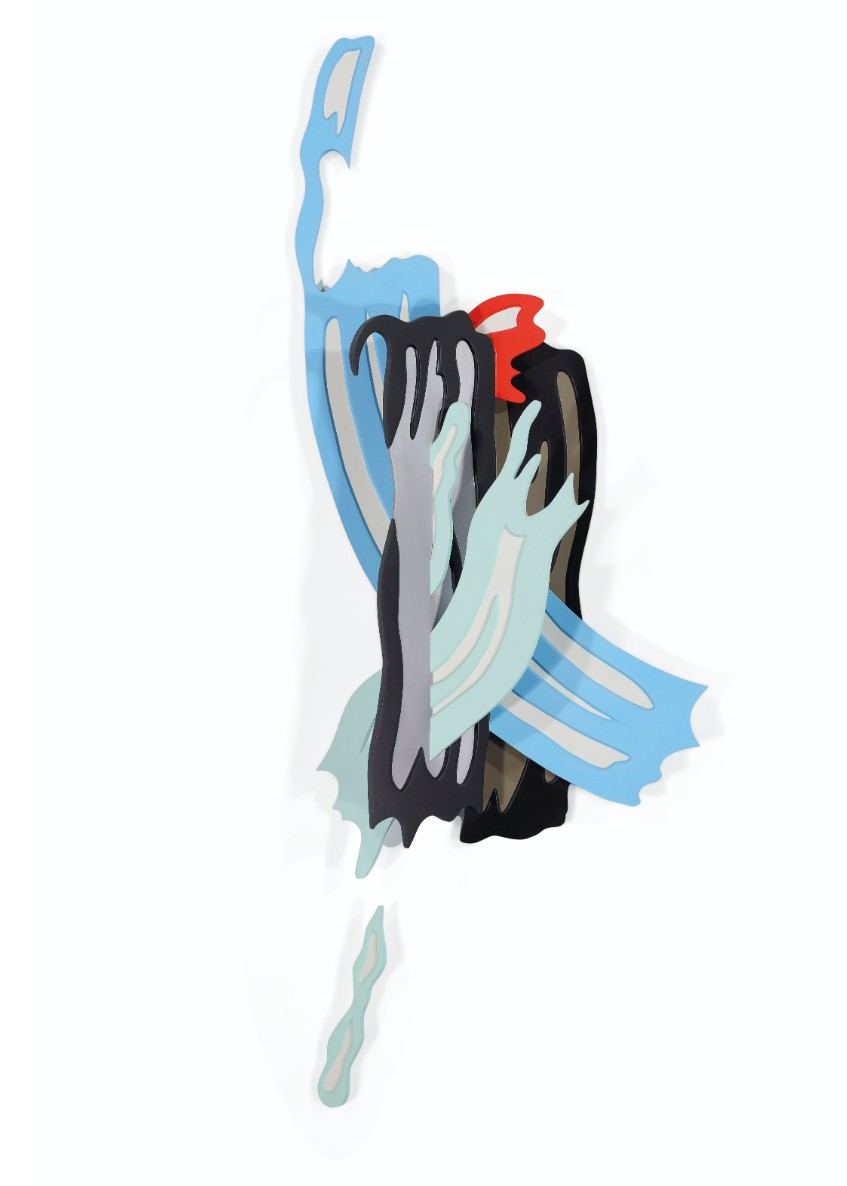
ROY LICHTENSTEIN (1923-1997)
Brushstroke IV, 1986
Acrylic lacquer and enamel on cherry wood, in two parts
Overall: 68 x 30 x 8 1/4 inches (172.7 x 76.2 x 21 cm)
Signed ‘rf Lichtenstein’ (on the reverse)
Incised with number ‘8/10’ (on a plaque affixed to the reverse)
This work is number eight from an edition of ten plus one artist’s copy and one printer’s copy
Brushstroke IV, 1986
Sotheby’s New-York: 24 November 2015
Estimated: USD 200,000 – 300,000
USD 225,000
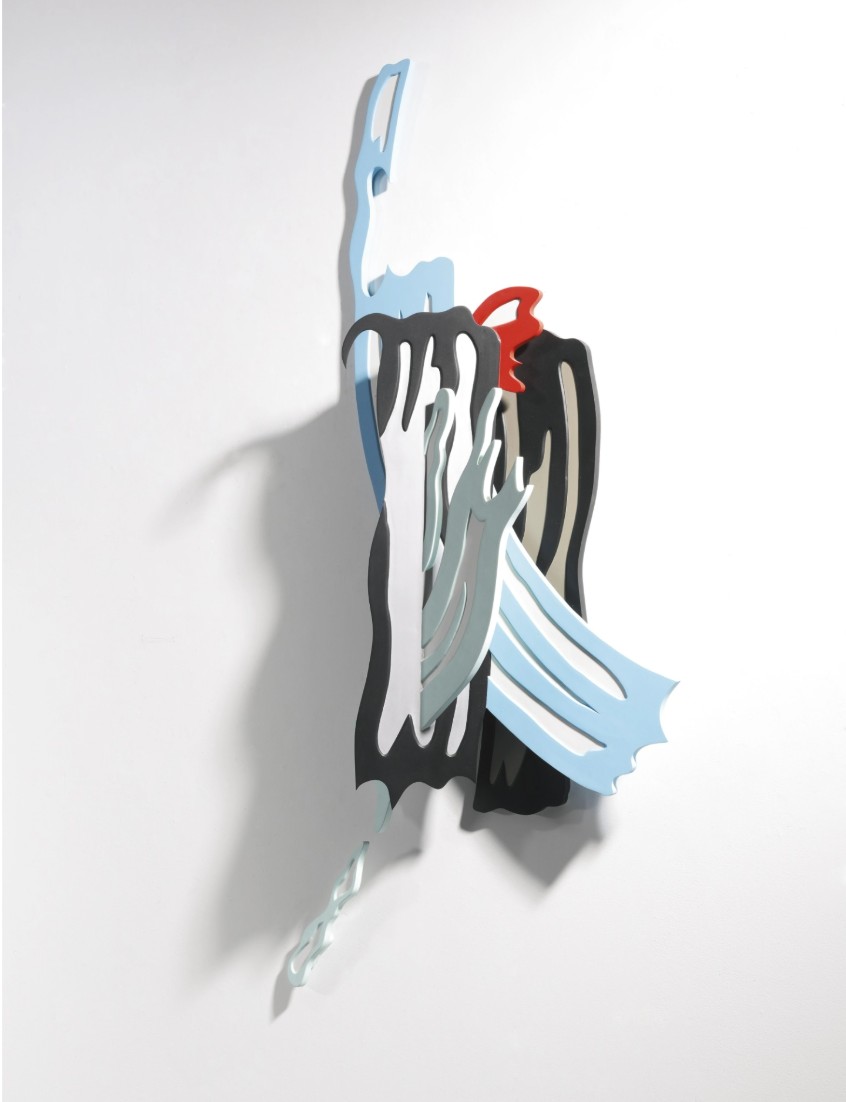
ROY LICHTENSTEIN (1923-1997)
Brushstroke IV, 1986
Hand painted cherry wood wall-mounted sculpture
Overall:66 1/8 x 26 x 7 1/8 inches (168x66x18 cm)
Signed in black on the verso
Incised ‘7/10’ on a plaque affixed to the reverse
Fabricated and published by Tyler Graphics Ltd., New York
Brushstroke VI, 1986
Brushstroke VI, 1986
Sotheby’s New-York: 29 September 2015
Estimated: USD 120,000 – 180,000
USD 322,000
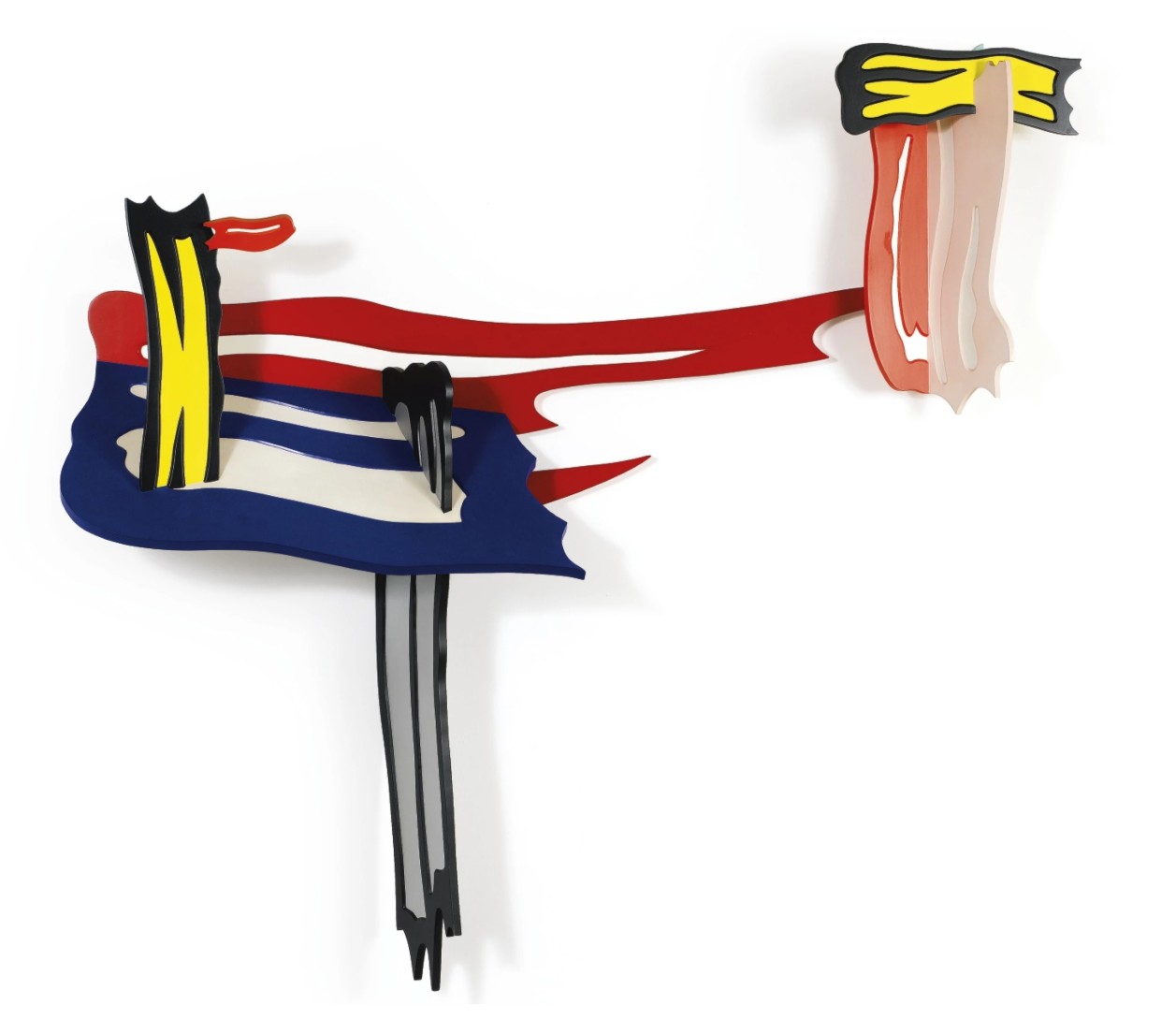
ROY LICHTENSTEIN
Brushstroke VI, 1986
Painted cherry wood
51x61x10 inches (129.5 x 154.9 x 25.4 cm)
Signed and partially titled on the reverse
Stamped with the number 7/10 on a plate affixed to the reverse
This work is number 7 from an edition of 10
Provenance
Private Collection, California
By descent to the present owner from the above
Brushstroke VI, 1986
Christie’s New-York: 14 May 2008
Estimated: USD 150,000 – 200,000
USD 337,000
Roy Lichtenstein (1923-1997) , Brushstroke VI | Christie’s
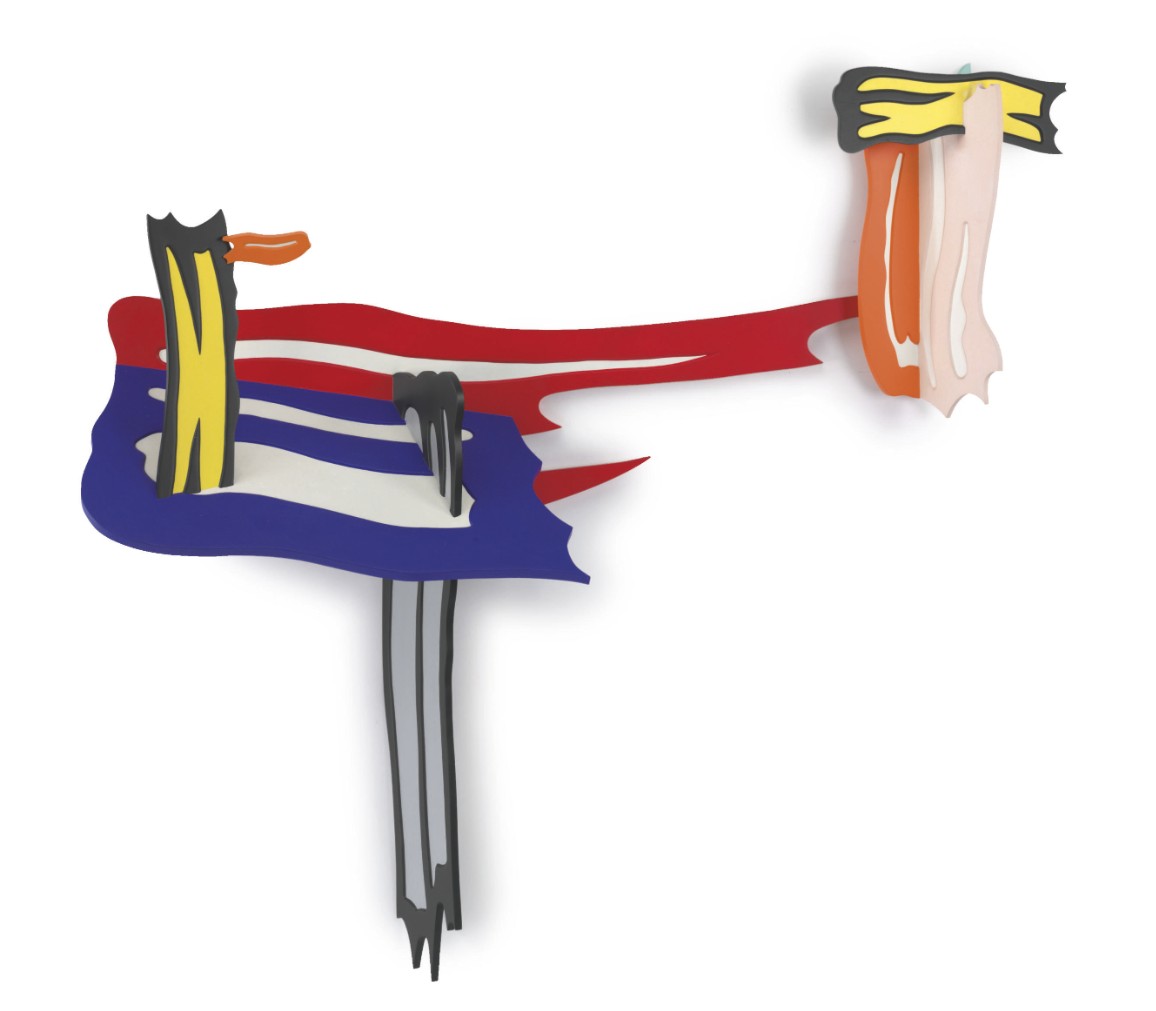
ROY LICHTENSTEIN (1923-1997)
Brushstroke VI, 1986
Painted cherry wood
60x58x10 inches (152.3 x 147.3 x 25.4 cm)
Signed ‘rf Lichtenstein’ (on the reverse)
This work is number two from an edition of ten
Provenance
Tony Shafrazi Gallery, New York
Private collection
Anon. sale; Sotheby’s, New York, 15 November 2001, lot 121
Gasiunasen Gallery, Palm Beach
Acquired from the above by the present owner