WORK IN PROGRESS
Introduction
Claude Monet (1840–1926) was a pioneering French painter whose work laid the foundation for the Impressionist movement, emphasizing the depiction of light and natural forms through plein air (outdoor) painting.
Born on November 14, 1840, in Paris, Monet grew up in Le Havre, Normandy. His early interest in art was nurtured by Eugène Boudin, who introduced him to painting outdoors, a practice that became central to Monet’s approach. In 1859, he moved to Paris to study art, where he met fellow artists Pierre-Auguste Renoir, Frédéric Bazille, and Alfred Sisley. Together, they developed a new style focused on capturing transient effects of light and color.
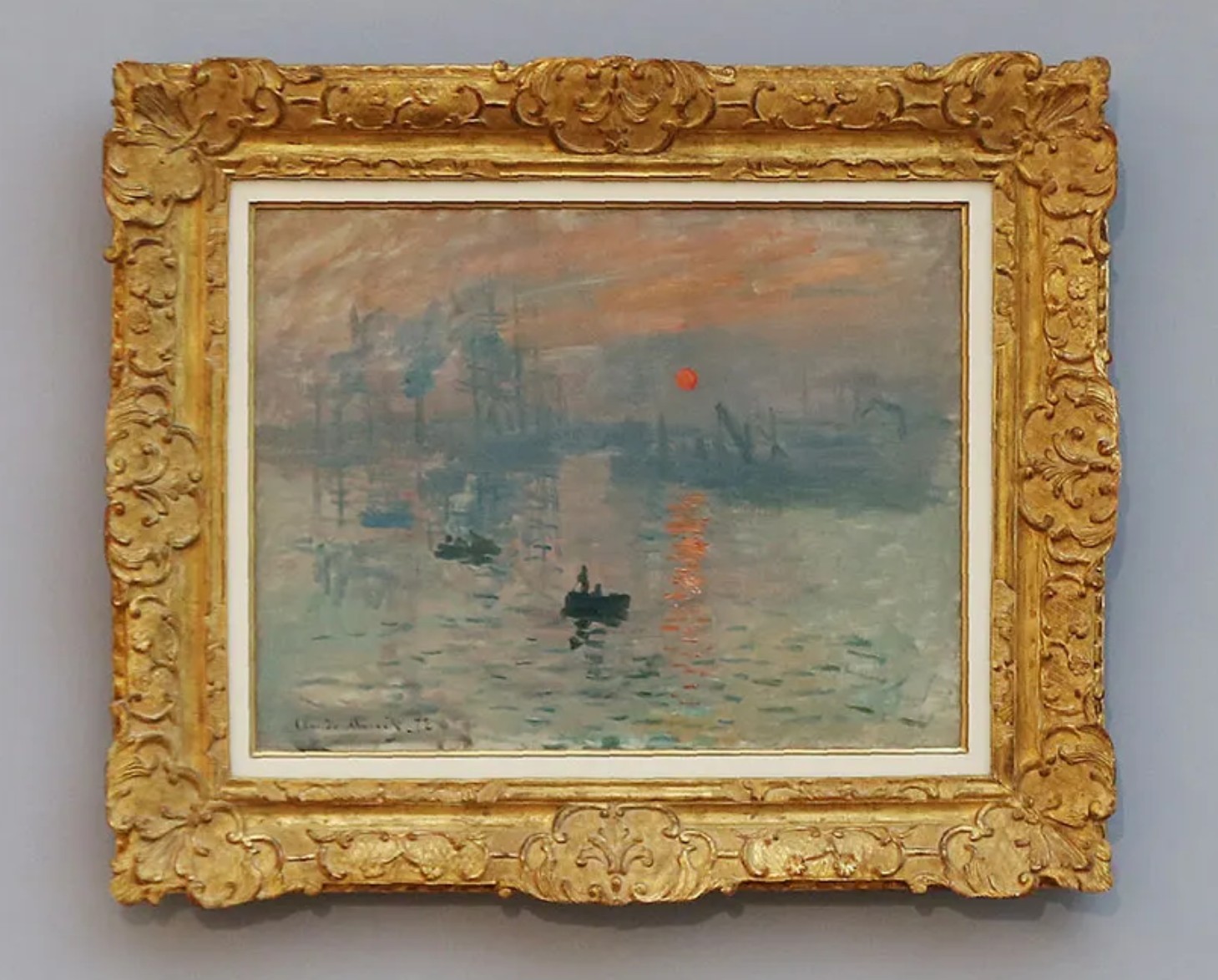
The term “Impressionism” originated from Monet’s painting “Impression, Sunrise” (1872), which he exhibited in 1874. This work, characterized by loose brushwork and an emphasis on light over detail, led critics to coin the term, initially used derisively. Despite early criticism, Monet and his contemporaries continued to refine their techniques, gradually gaining recognition.
Claude Monet is renowned for his series paintings, where he depicted the same subject under varying light and weather conditions to explore changes in perception. Painted between 1890 and 1891 near his home in Giverny, Les Meules (Haystacks) comprises 25 canvases showcasing stacks of harvested wheat. Monet captured the stacks at different times of day and seasons, emphasizing the interplay of light and atmosphere. Over approximately 30 years, Monet created around 250 Nymphéas paintings focusing on the water lily pond in his Giverny garden. These works delve into reflections, light, and color, moving towards abstraction. The series culminated in large panels displayed at the Musée de l’Orangerie in Paris, offered to the French state as a symbol of peace after World War I. Between 1899 and 1901, during stays in London, Monet painted over 40 views of Waterloo Bridge from his room at the Savoy Hotel. These paintings explore the effects of fog and light on the Thames River, blending architectural elements with atmospheric conditions. In the early 1890s, Monet painted more than 30 canvases depicting the façade of Rouen Cathedral at different times of day and under various lighting conditions. This series highlights his fascination with light’s impact on architectural surfaces.
Monet’s innovative techniques and dedication to capturing ephemeral natural effects significantly influenced modern art. His approach to color, light, and brushwork paved the way for movements like Abstract Expressionism. Artists such as Mark Rothko and Jackson Pollock drew inspiration from Monet’s emphasis on the act of painting and the sensory experience of art. His work also had a profound impact on subsequent generations, bridging 19th-century art with 20th-century modernism. Monet’s gardens in Giverny, meticulously designed by the artist, continue to attract visitors worldwide, offering insight into the environment that inspired some of his most celebrated works. Through his relentless exploration of light and atmosphere, Monet not only transformed landscape painting but also left an indelible mark on the trajectory of modern art.
Nymphéas: A Life Reflected in Water
Few themes in the history of modern art are as universally revered as Claude Monet’s Nymphéas. More than a mere series of paintings, the water lilies became the culmination of a lifetime of observation, devotion, and artistic evolution. They stand today not only as a masterwork of Impressionism but as an enduring symbol of modernity and inner vision.
The Genesis of the Water Garden (1883–1893)
The story begins in April 1883, when Monet moved to the village of Giverny with Alice Hoschedé and their combined family of eight children. Nestled at the confluence of the Seine and the Epte, Giverny was then a quiet hamlet of 300 inhabitants. The family rented—and later, in 1890, purchased—a large pink house called Le Pressoir, set on two acres of land. “Certain of never finding a better situation or more beautiful countryside,” Monet wrote to his dealer Durand-Ruel, he resolved to turn his surroundings into a personal Eden.
A passionate gardener since youth, Monet immediately began transforming the grounds. He replaced the vegetable plots with flowerbeds in what would become the Clos Normand. In 1893, emboldened by commercial success, Monet acquired an adjacent parcel of land and applied for permission to dig a pond “for the pleasure of the eyes and also for the purpose of having subjects to paint.” Despite protests from local farmers, who feared foreign plants would poison their cattle, the request was granted.

“Everything I have earned has gone into these gardens,
I do not deny that I am proud of them.”
That same year, he created his now-iconic lily pond—a thousand square meters of aquatic paradise graced by irises, agapanthus, cherry trees, bamboo, and the Japanese bridge that would become a recurrent motif.
Planting Before Painting (1893–1897)
Despite the garden’s grandeur, Monet did not immediately begin painting the lilies. Between 1893 and 1897, he painted only three views of the pond—hesitant beginnings that suggest he was still observing, allowing the landscape to mature before attempting to translate its elusive beauty onto canvas.
“It took me a long time to understand my water lilies. A landscape takes more than a day to get under your skin. And then all at once, I had the revelation—how wonderful my pond was—and reached for my palette.”
By 1897, this moment of epiphany arrived. That same year, Monet completed Matinée sur la Seine, a contemplative series of dawn views along the river. These explorations of light, reflection, and atmosphere unlocked a new way of seeing, and soon, his gaze turned inward—downward—onto the surface of his own pond.

The First Nymphéas Series (1897–1909)
Between 1904 and 1909, the artist worked with almost unbroken intensity, producing more than sixty paintings of the water garden. Eschewing traditional perspective, he lowered his gaze to the surface of the pond, yielding a dazzling and radically destabilized vision of shifting, disintegrating forms; the world beyond the plane of the water exists only as the most ephemeral reflections.
“The water-flowers themselves are far from being the whole scene. Really, they are just the accompaniment. The essence of the motif is the mirror of water, whose appearance alters at every moment.”
When these works were exhibited in May 1909, they were met with critical astonishment. Jean Morgan, writing for Gil Blas, declared, “His vision increasingly is simplifying itself… to amplify, to magnify the impression of the imponderable.” Monet could not have hoped for a warmer response. And yet, the years that followed were marked by personal tragedy: the deaths of his wife Alice and son Jean, the onset of cataracts, and flooding that damaged his gardens. “I am going to pack up my colors for good,” he lamented to his stepdaughter Blanche in 1911.
The Great Project: Les Grandes Décorations (1914–1926)
Monet’s creative spirit rekindled in 1914. “I have thrown myself back into work,” he wrote, “so much so that I am getting up at four a.m. and am grinding away all day long.” Inspired by a vision he had shared as early as 1897—a circular space enveloped in panoramic views of the pond—he now committed fully to the monumental project that would become Les Grandes Décorations.

In painting his larger panels for the Grandes décorations, Monet worked in his newly-built studio, specially designed and constructed in 1915 despite the ravages and privations of the First World War, a mark of his passion for the project. While Monet could work on the largest canvases indoors in the studio all year long, come rain or shine, the ‘smaller,’ more manageable pictures like Le bassin aux nymphéas would often be propped up with an arrangement of ropes and weights so that he could paint them before the pond itself. An insight into this process was provided by René Gimpel, who wrote of a visit he made to Monet’s studio in 1918, mentioning a group of pictures that Daniel Wildenstein stated almost certainly included Le bassin aux nymphéas:

Working with mural-sized canvases, many over two meters in width, Monet embraced a new scale and boldness. Gone was the compositional restraint of the earlier Nymphéas; in its place came sweeping, expressionistic brushwork, daring color, and emotional immediacy. “Monet often made these paintings sites of contention,” wrote Paul Tucker, “pitting order against balance, and forcing forms and reflections into spaces that might otherwise be lulling and seductive.”
At the height of World War I, Monet painted furiously while his stepson fought at the front. Refusing to abandon Giverny, he vowed: “I shall die in front of my canvases, in front of my life’s work.” The paintings became both personal refuge and patriotic offering. “It occupies me enough so that I don’t have to think too much about this terrible, hideous war,” he confided.
In 1918, the day after the Armistice, Monet wrote to Prime Minister Georges Clemenceau offering the completed panels as a gift to the nation. “It’s little enough, but it’s the only way I have of taking part in the victory.” Installed in the Musée de l’Orangerie in 1927, shortly after his death, Les Grandes Décorations represent the crowning achievement of his career.
Legacy
Monet’s late water lily paintings remained largely unseen until after World War II. When Alfred H. Barr, Jr., acquired one for MoMA in 1955, it marked a turning point. American Abstract Expressionists such as Jackson Pollock and Mark Rothko saw in Monet’s late work a kindred freedom—a liberation of form and sensation. “Monet taught me to understand what a revolution in painting can be,” declared André Masson. “Only with Monet does painting take a turn. He bestows absolute poetry on color.”
Monet’s Nymphéas are more than depictions of a pond—they are symphonies of vision, meditations on light, color, and time. In their presence, we are invited to see not only the world as Monet saw it, but as we might perceive it ourselves: fluid, fleeting, and infinitely luminous.
Auction Results (Chronological)
Nymphéas, 1907
Property from the Kawamura Memorial DIC Museum of Art
Christie’s New-York: 17 November 2025
Estimated: USD 40,000,000 – 60,000,000
USD 45,485,000
CLAUDE MONET (1840-1926), Nymphéas | Christie’s
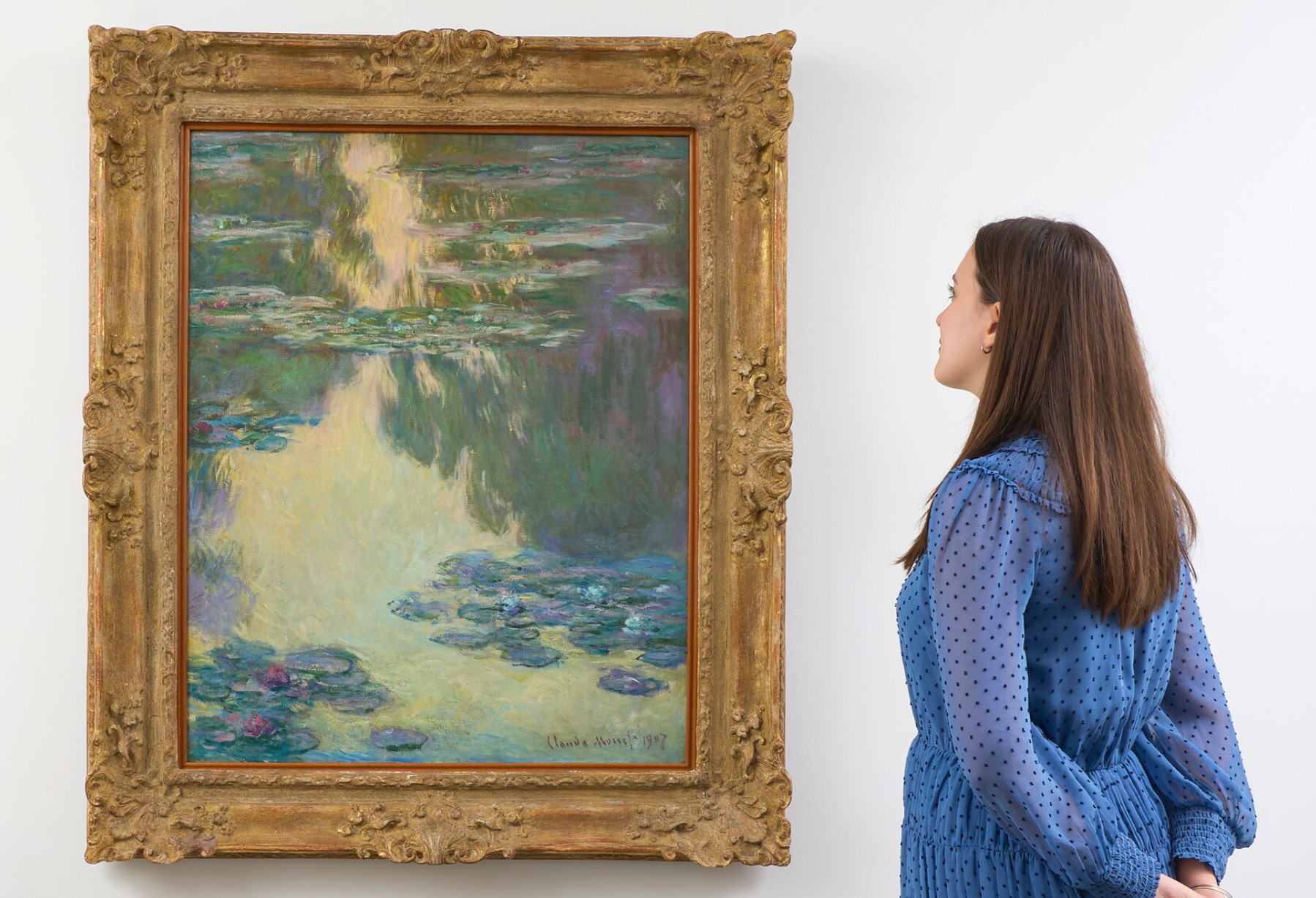
CLAUDE MONET (1840-1926)
Nymphéas, 1907
Oil on canvas
92 x 73.6 cm (36 1/4 x 29 inches)
Signed and dated ‘Claude Monet 1907’ (lower right)
2024
Nymphéas, circa 1914-17
Sotheby’s New-York: 18 November 2024
Estimate on Request
USD 65,500,000
Nymphéas | A Legacy of Beauty: The Collection of Sydell Miller Evening Auction | 2024 | Sotheby’s
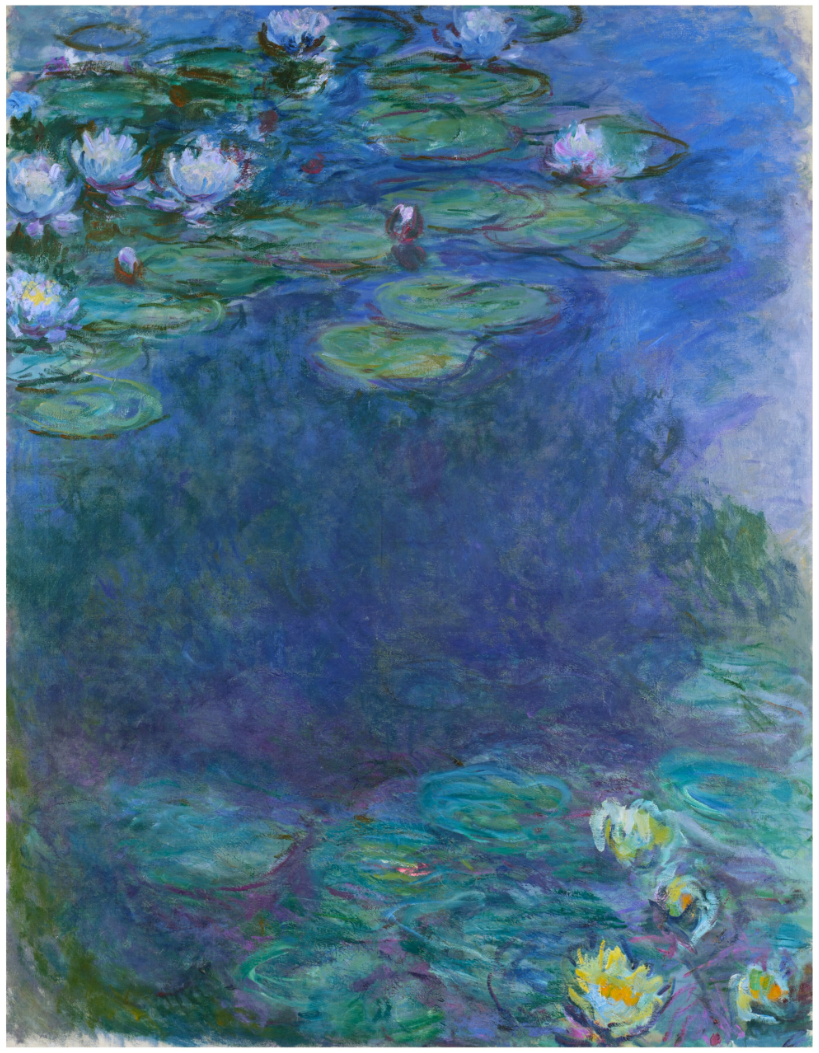
CLAUDE MONET (1840 – 1926)
Nymphéas, circa 1914-17
Oil on canvas
175 x 135.4 cm (68 7/8 x 53 3/8 inches)
Stamped with the signature Claude Monet (on the reverse)
Stamped again (on the stretcher)
Nymphéas, circa 1897-1899
Christie’s Hong-Kong: 26 September 2024
Estimated: HKD 200,000,000 – 280,000,000
HKD 233,375,000 / USD 29,973,518
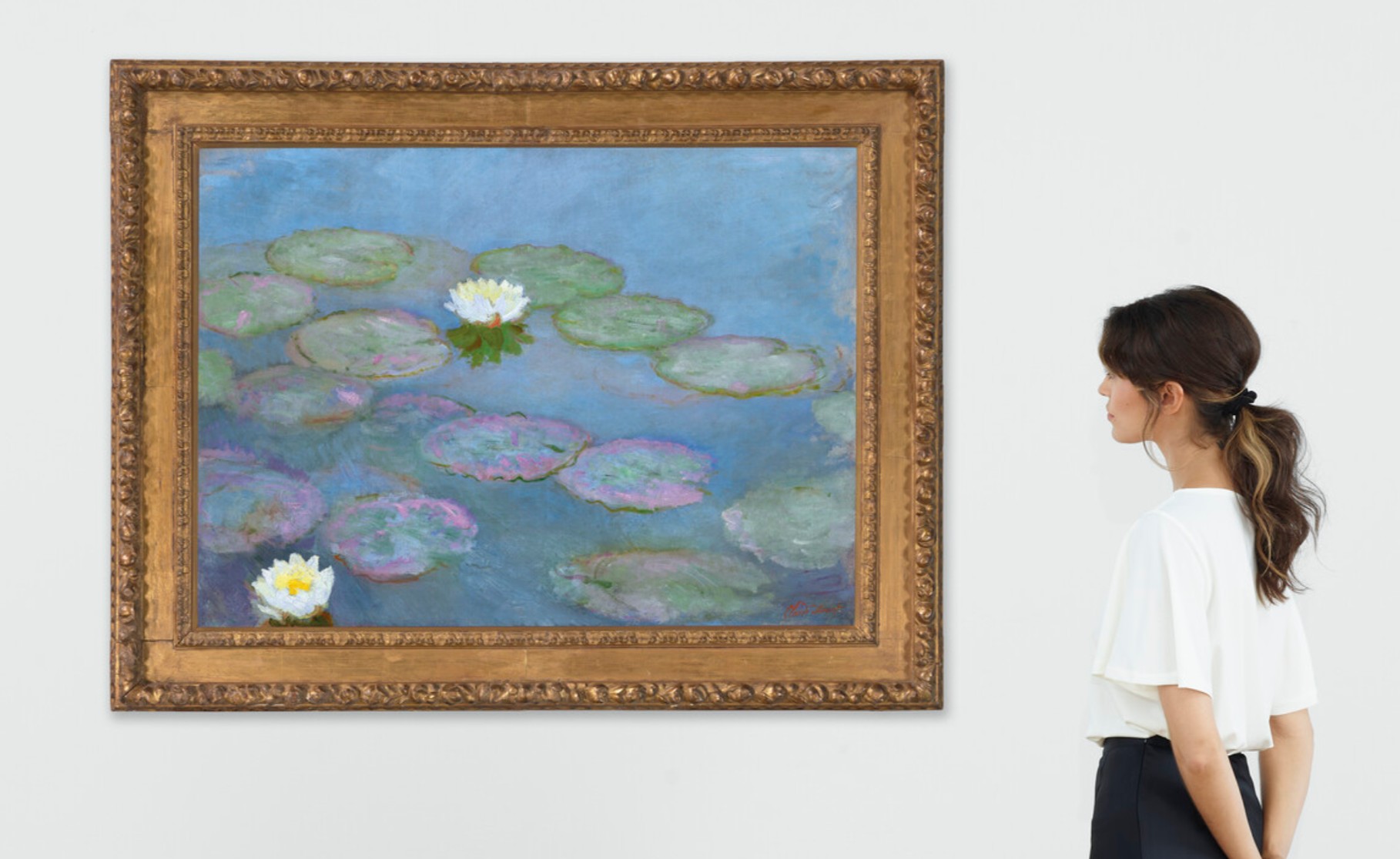
CLAUDE MONET (1840 – 1926)
Nymphéas, circa 1897-1899
Oil on canvas
73.3 x 101 cm (28 7/8 x 39 3/4 inches)
Stamped with signature ‘Claude Monet’ (Lugt 1819b; lower right)
Stamped again with signature ‘Claude Monet’ (Lugt 1819b; on the reverse)
2023
Le bassin aux nymphéas, 1917-1919
Christie’s New-York: 9 November 2023
Estimate on Request
USD 74,010,000
CLAUDE MONET (1840-1926) (christies.com)

CLAUDE MONET (1840-1926)
Le bassin aux nymphéas, 1917-1919
Oil on canvas
100.1 x 200.6 cm (39 3/8 x 78 7/8 inches)
Stamped with signature ‘Claude Monet’ (Lugt 1819b; lower right)
Stamped again with signature ‘Claude Monet’ (Lugt 1819b; on the reverse)
2022
Nymphéas, temps gris, 1907
Christie’s London: 28 June 2022
Estimated: GBP 20,000,000 – 30,000,000
GBP 30,059,500 / USD 36,872,190
CLAUDE MONET (1840-1926), Nymphéas, temps gris | Christie’s
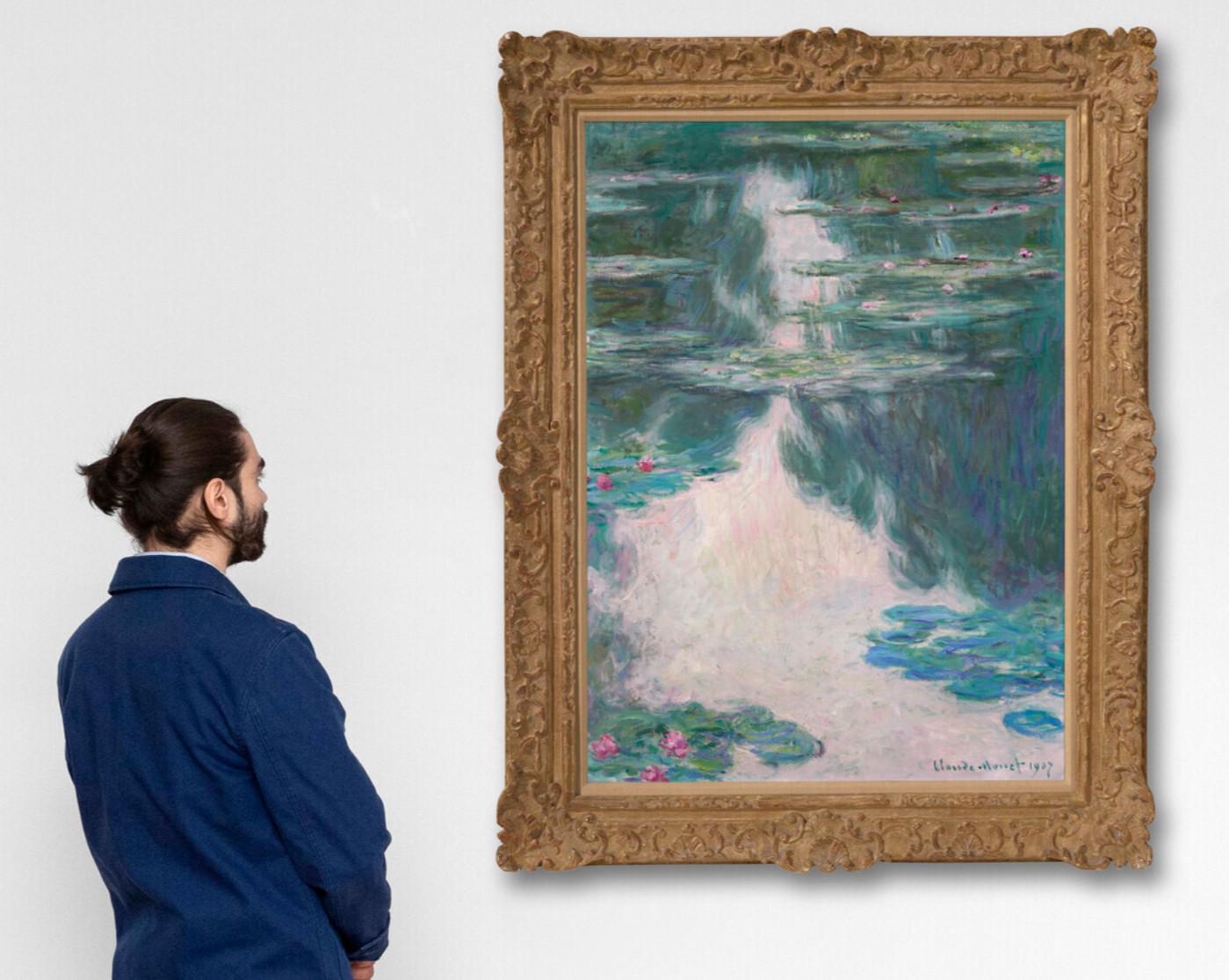
CLAUDE MONET (1840-1926)
Nymphéas, temps gris, 1907
Oil on canvas
100.2 x 73.2 cm (39 1/2 x 28 3/4 inches)
Signed and dated ‘Claude Monet 1907’ (lower right)
Nymphéas, 1907
Christie’s New-York: 12 May 2022
Estimated: USD 35,000,000 – 55,000,000
USD 56,495,000
CLAUDE MONET (1840-1926), Nymphéas | Christie’s
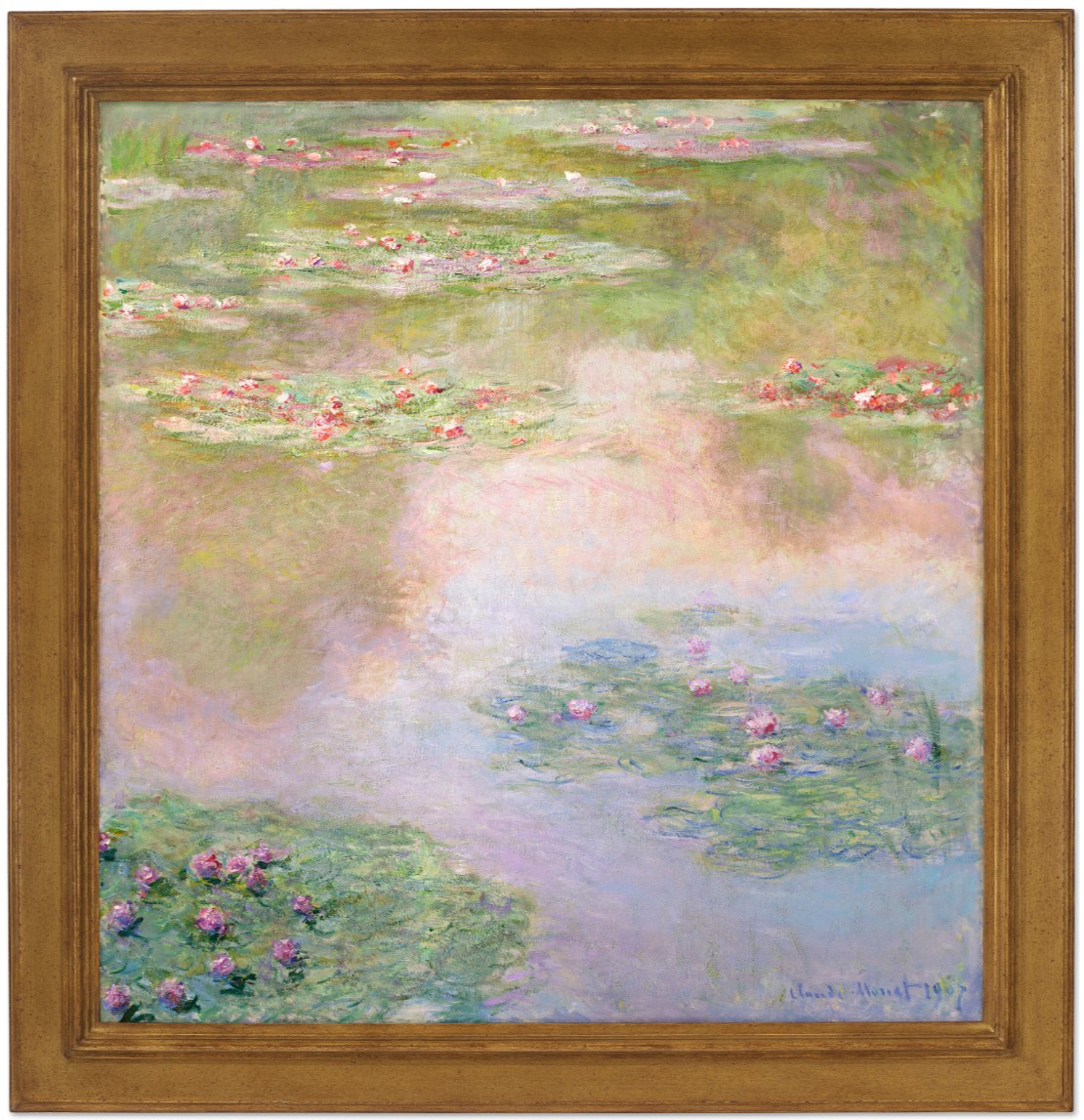
CLAUDE MONET (1840-1926)
Nymphéas, 1907
Oil on canvas
93.8 x 89.3 cm (37 x 35 1/4 inches)
Signed and dated ‘Claude Monet 1907’ (lower right)
Nymphéas, 1914-17
Sotheby’s London: 2 March 2022
Estimated: GBP 15,000,000 – 20,000,000
GBP 23,228,500 / USD 30,963,530
Nymphéas | Modern & Contemporary Evening Auction | 2022 | Sotheby’s
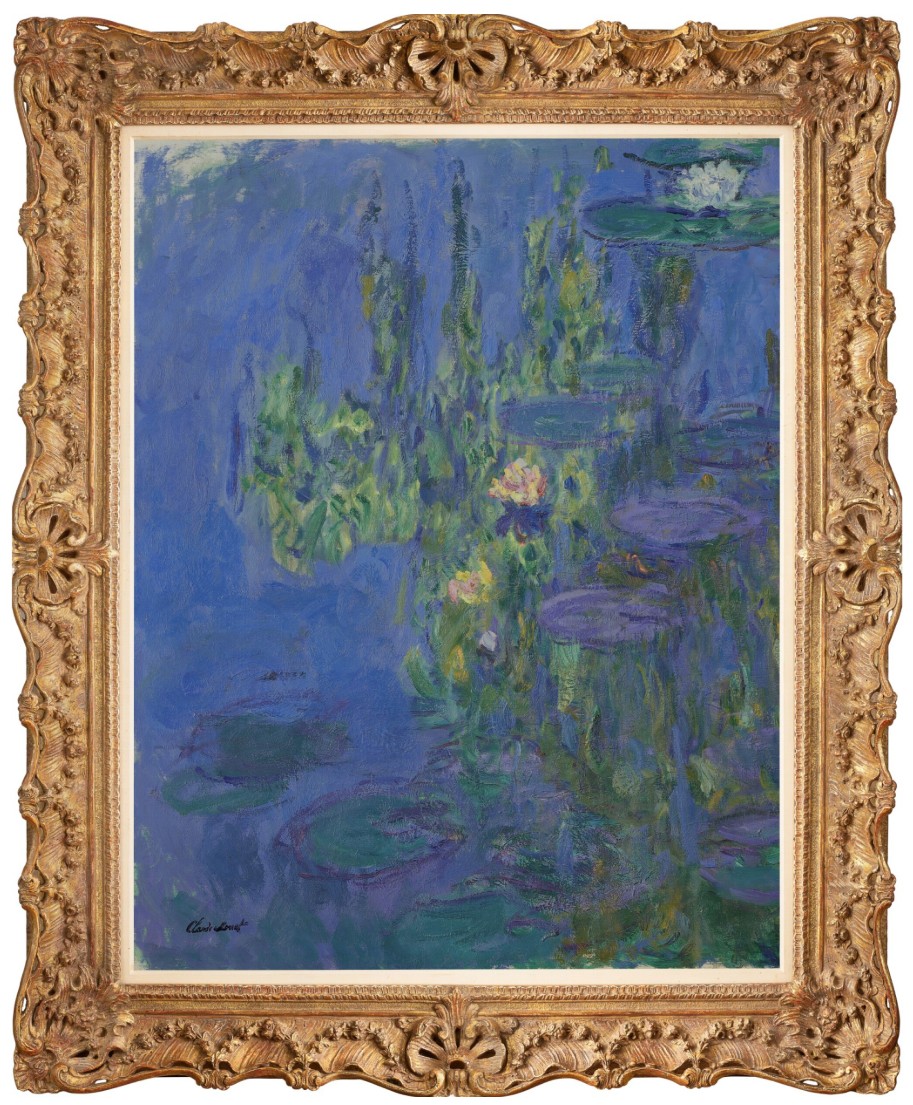
CLAUDE MONET (1840 – 1926)
Nymphéas, 1914-17
Oil on canvas
130.5 x 100 cm (51 3/8 x 39 3/8 inches)
Stamped Claude Monet (lower left)
Stamped Claude Monet on the reverse and again on the stretcher
2021
Coin du bassin aux nymphéas, 1918
Sotheby’s New-York: 16 November 2021
Estimates on Request
USD 50,820,000
Coin du bassin aux nymphéas | Modern Evening Auction | 2021 | Sotheby’s
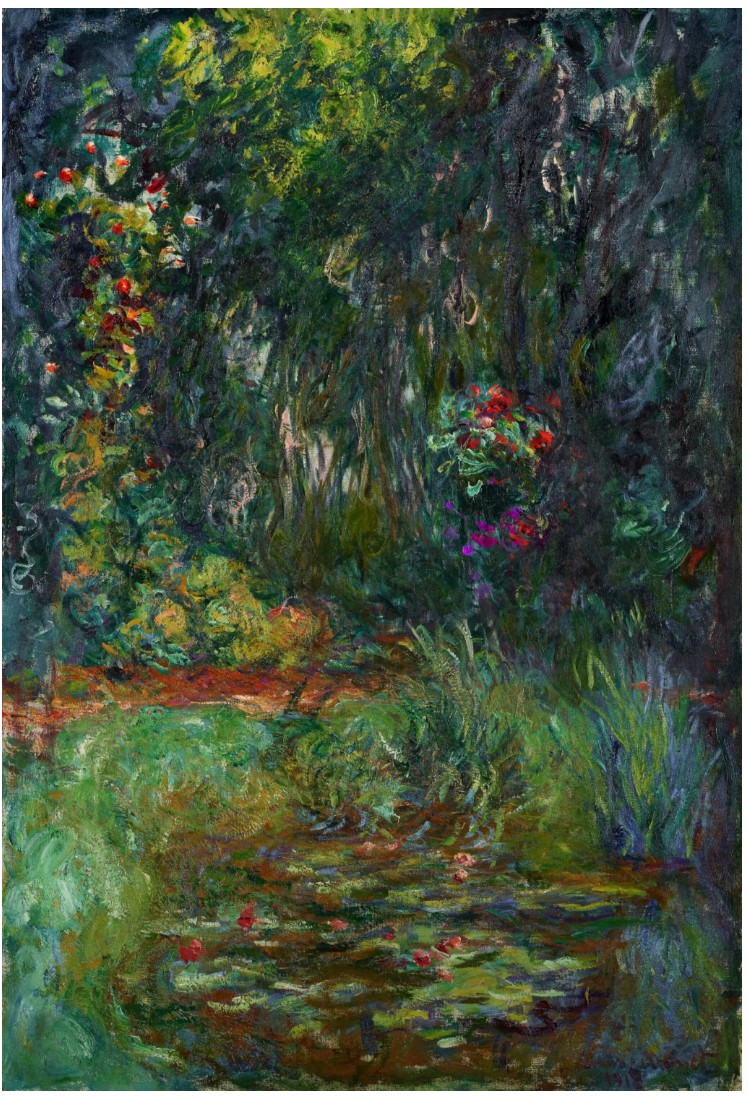
CLAUDE MONET (1840 – 1926)
Coin du bassin aux nymphéas, 1918
Oil on canvas
131 x 88.8 cm (51 1/2 x 35 inches)
Signed Claude Monet and dated 1918 (lower right)
Le Bassin aux nymphéas, 1917-19
Sotheby’s New-York: 12 May 2021
Estimate on Request
USD 70,353,000
Le Bassin aux nymphéas | Impressionist & Modern Art Evening Sale | 2021 | Sotheby’s
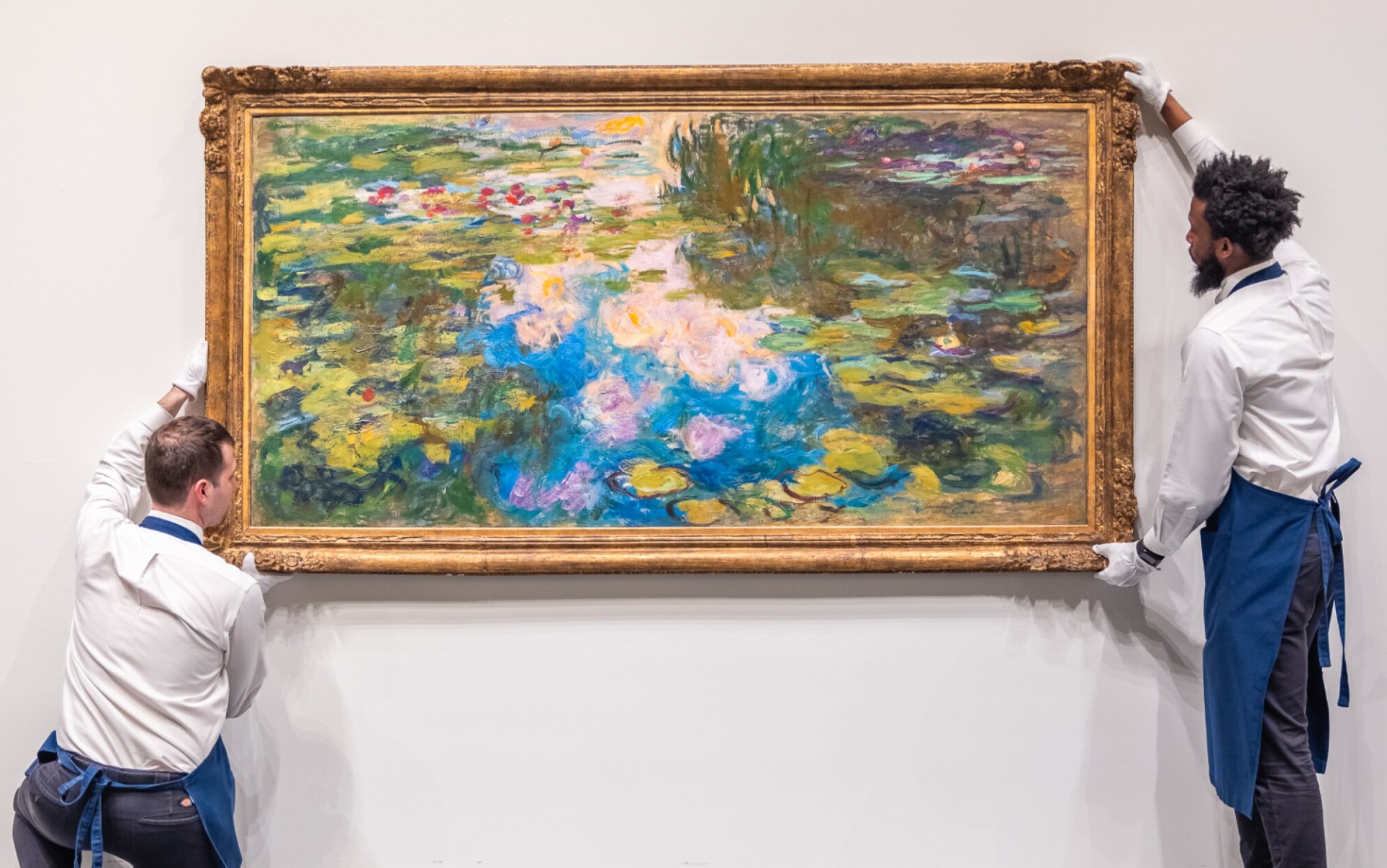
CLAUDE MONET (1840 – 1926)
Le Bassin aux nymphéas, 1917-19
Oil on canvas
100×200 cm (39 3/8 x 79 inches)
Bears the signature Claude Monet (lower right)
2020
No Nymphéas Painting sold at auction in 2020
2019
Nymphéas (Fragment)
Sotheby’s New-York: 12 November 2019
Estimated: USD 600,000 – 800,000
USD 2,480,000
(#436) CLAUDE MONET | Nymphéas (Fragment)
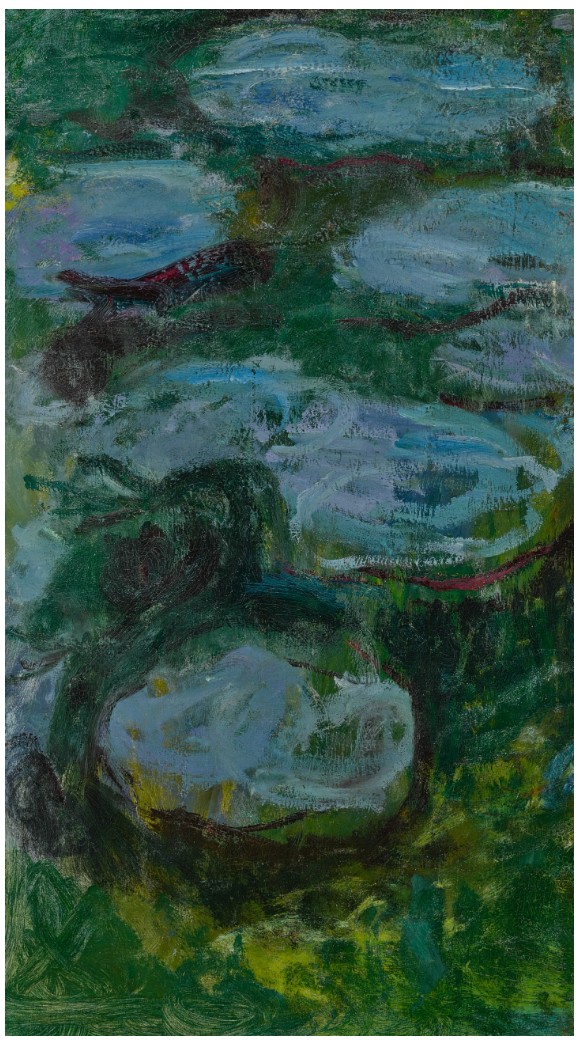
CLAUDE MONET
Nymphéas (Fragment)
Oil on canvas
103.4 x 58.4 cm (40 3/4 x 23 inches)
Nymphéas, 1908
Sotheby’s London: 19 June 2019
Estimated: GBP 25,000,000 – 35,000,000
GBP 23,731,625 / USD 29,876,465
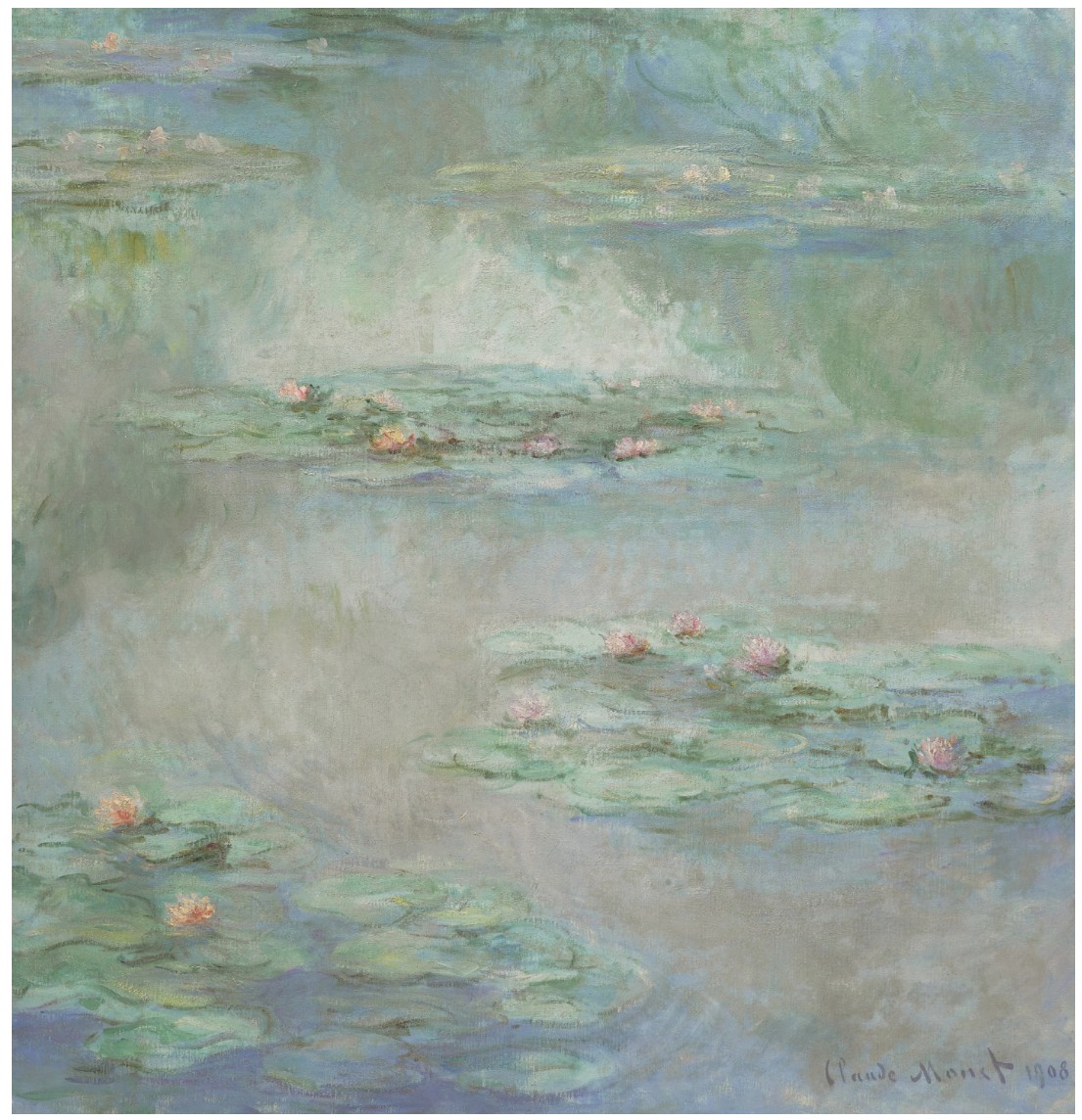
CLAUDE MONET
Nymphéas, 1908
Oil on canvas
92×89 cm (36 1/4 x 35 inches)
Signed Claude Monet and dated 1908 (lower right)
Coin du bassin aux nymphéas, circa 1918-1919
Christie’s New-York: 13 May 2019
Estimated: USD 15,000,000 – 25,000,000
USD 21,840,000
Claude Monet (1840-1926), Coin du bassin aux nymphéas | Christie’s
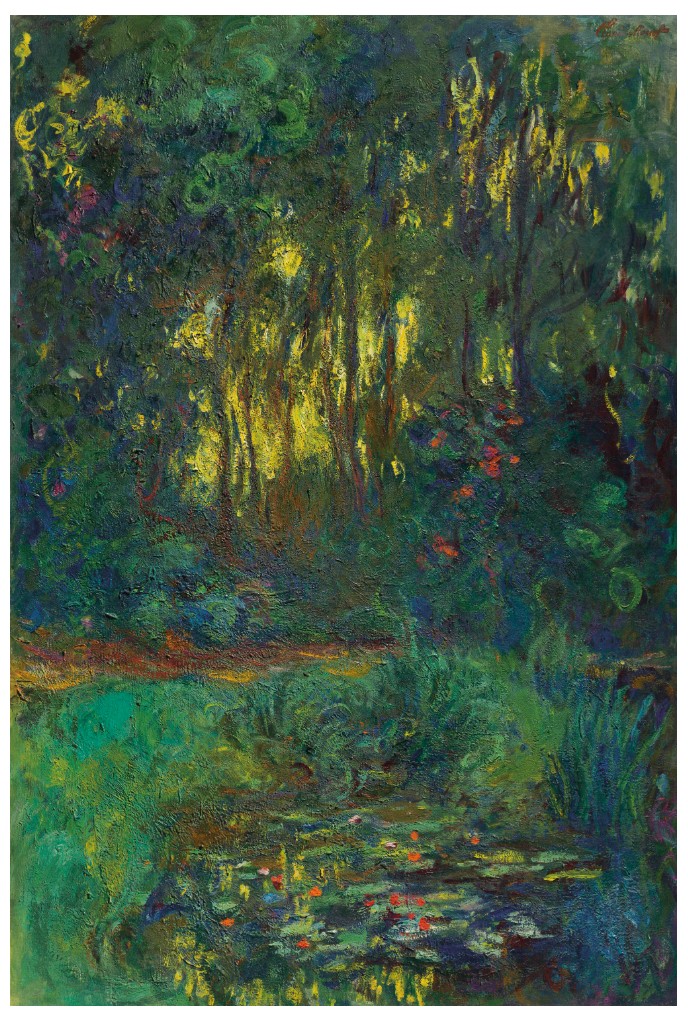
CLAUDE MONET (1840-1926)
Coin du bassin aux nymphéas, circa 1918-1919
Oil on canvas
130.5 x 88.8 cm (51 3/8 x 35 inches)
Stamped with signature ‘Claude Monet’ (Lugt 1819b; upper right)
Stamped again with signature ‘Claude Monet’ (Lugt 1819b; on the reverse)
Nymphéas (fragment)
Christie’s London: 28 February 2019
Estimated: GBP 100l000 – 150,000
GBP 100,000 / USD 132,640
Claude Monet (1840-1926), Nymphéas (fragment) | Christie’s
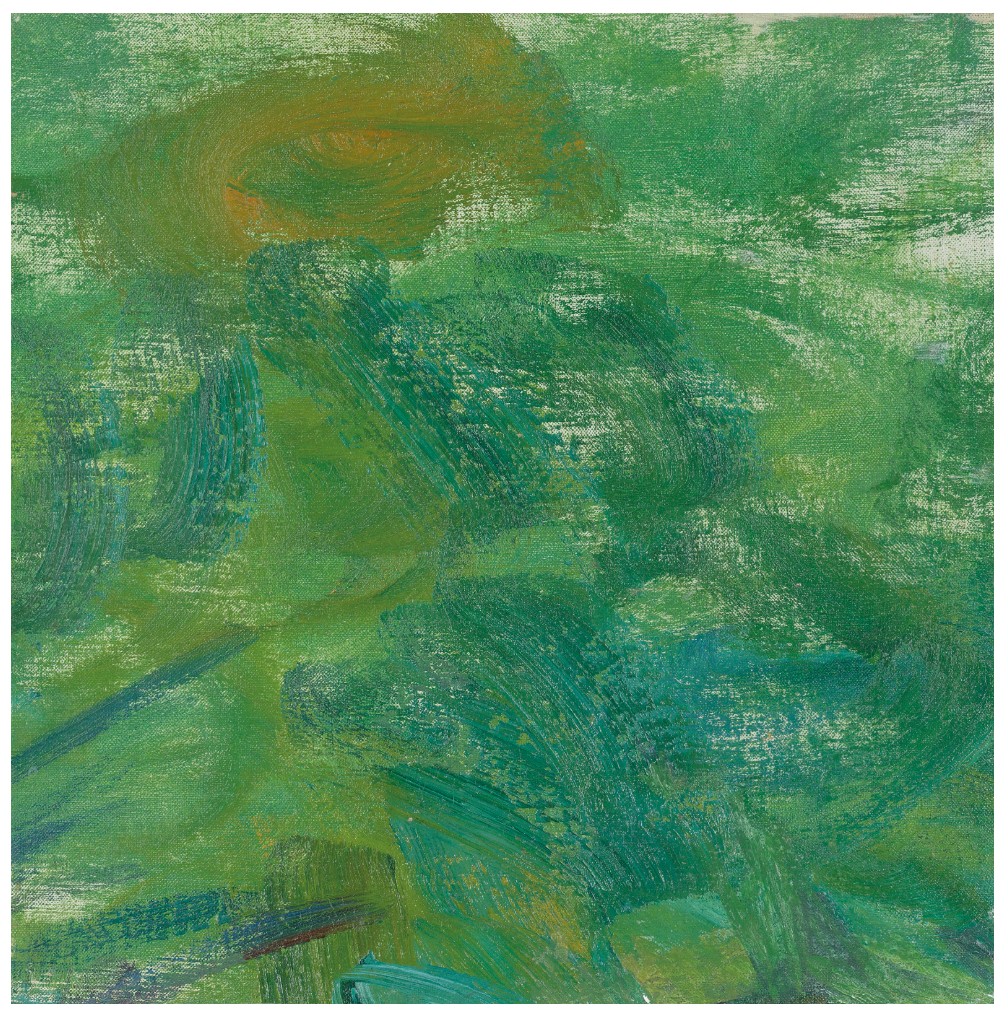
CLAUDE MONET (1840-1926)
Nymphéas (fragment)
Oil on canvas
23.3 x 23.2 cm (9 1/4 x 9 1/8 inches)
2018
Le bassin aux nymphéas, 1917-1919
Christie’s New-York: 12 November 2018
Estimated: USD 30,000,000 – 50,000,000
USD 31,812,500
Claude Monet (1840-1926), Le bassin aux nymphéas | Christie’s
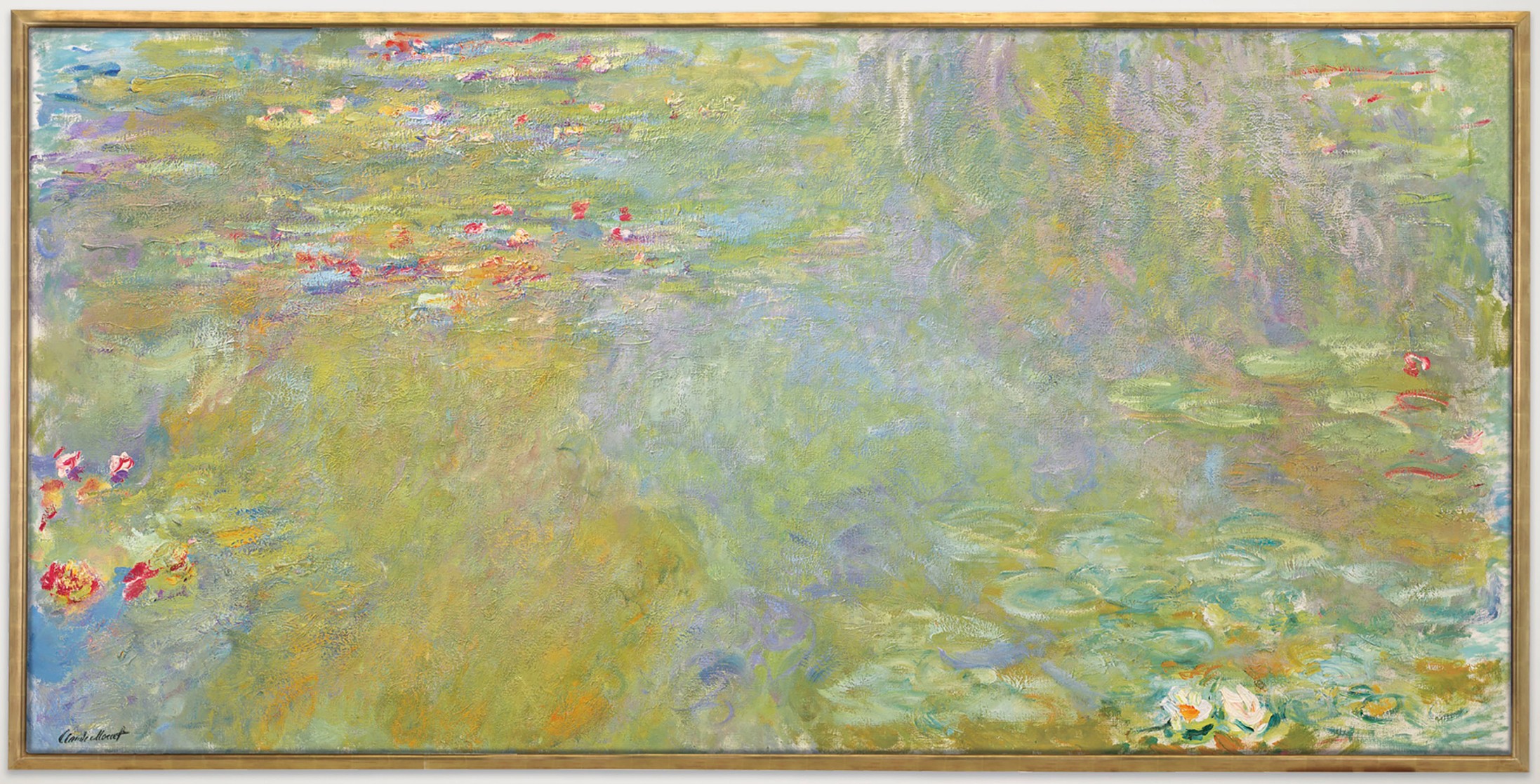
CLAUDE MONET (1840-1926)
Le bassin aux nymphéas, 1917-1919
Oil on canvas
100.7 x 200.8 cm (39 3/4 x 79 inches)
Stamped with signature ‘Claude Monet’ (Lugt 1819b; lower left)
Stamped again with signature ‘Claude Monet’ (Lugt 1819b; on the reverse)
Nymphéas (fragment)
Christie’s New-York: 12 November 2018
Estimated: USD 150,000 – 250,000
USD 200,000
Claude Monet (1840-1926), Nymphéas (fragment) | Christie’s
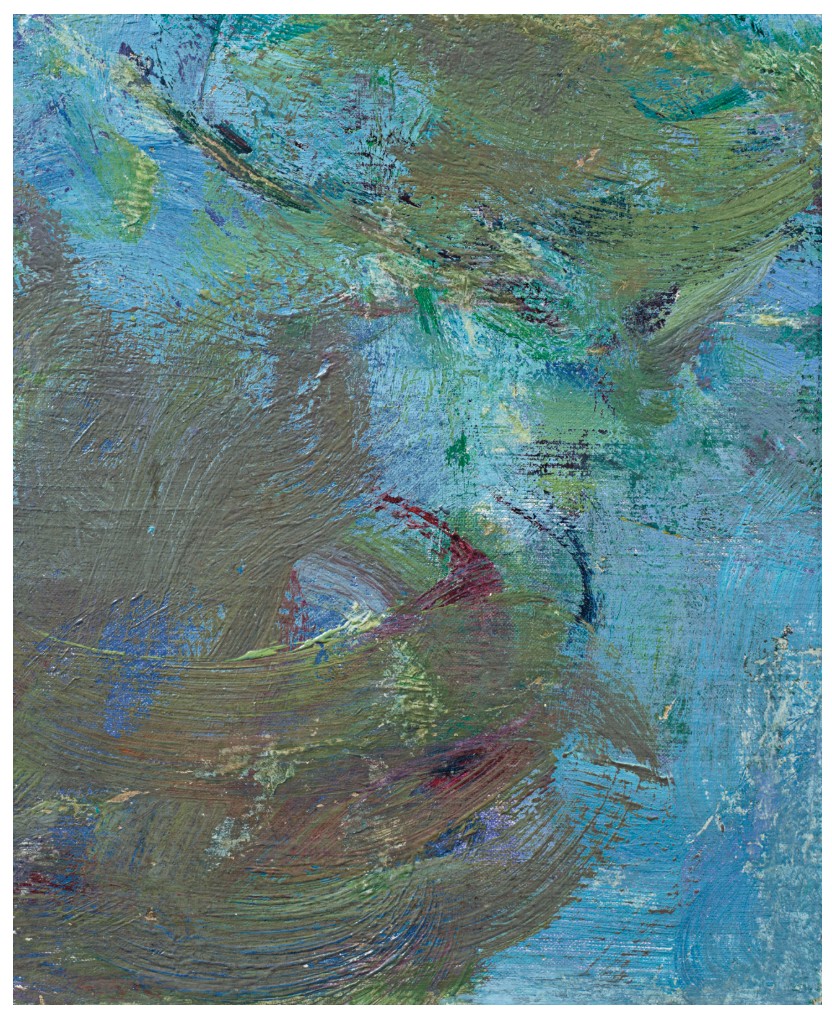
CLAUDE MONET (1840-1926)
Nymphéas (fragment)
Oil on canvas
21.8 x 17.8 cm (8 5/8 x 7 inches)
Nymphéas en fleur, circa 1914-1917
Christie’s New-York: 7 May 2018
Estimate on Request
USD 84,687,500
Claude Monet (1840-1926), Nymphéas en fleur | Christie’s

CLAUDE MONET (1840-1926)
Nymphéas en fleur, circa 1914-1917
Oil on canvas
160.3 x 180 cm (63 x 70 7/8 inches)
Stamped with signature ‘Claude Monet’ (Lugt 1819b; on the reverse)
Nymphéas (fragment)
Christie’s Paris: 23 Mars 2018
Estimated: EUR 150,000 – 250,000
EUR 463,500 / USD 572,235
Claude Monet (1840-1926), Nymphéas (fragment) | Christie’s
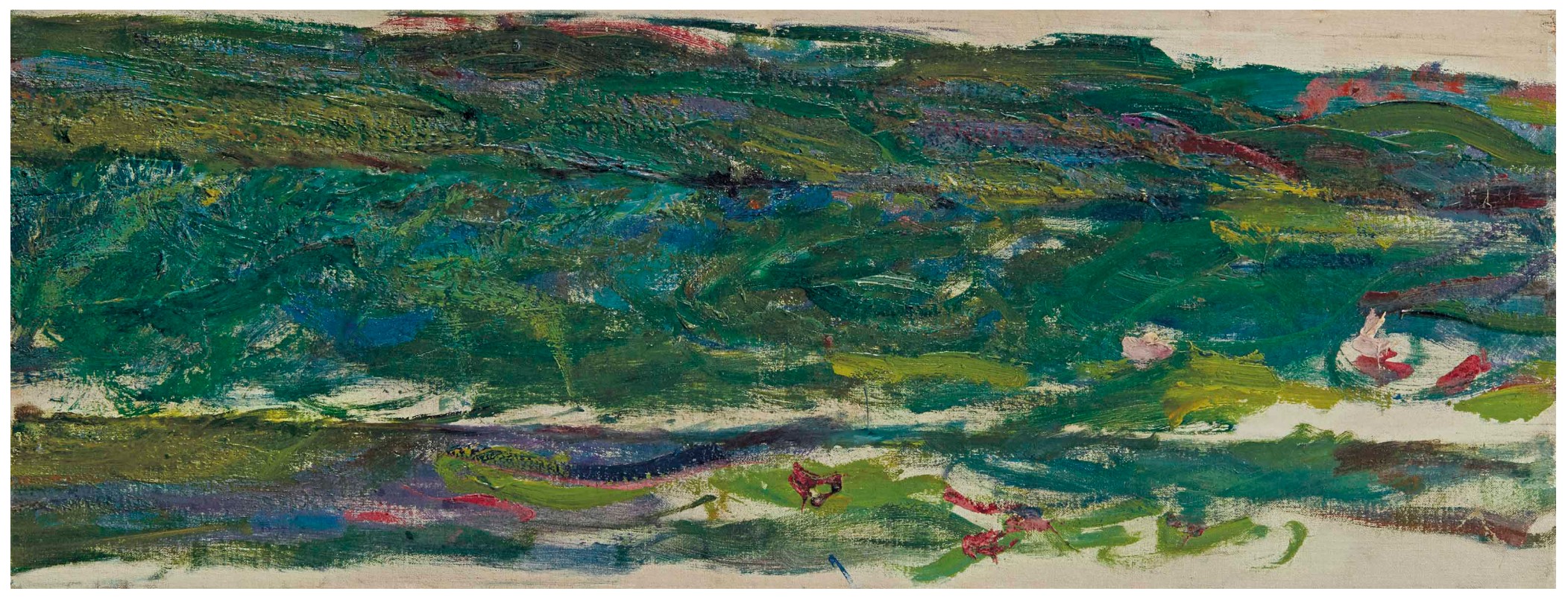
CLAUDE MONET (1840-1926)
Nymphéas (fragment)
Oil on canvas
22.1 x 58 cm (8 3/4 x 22 3/4 inches)
2017
Nymphéas (fragment)
Christie’s New-York: 14 November 2017
Estimated: USD 250,000 – 350,000
USD 672,500
Claude Monet (1840-1926), Nymphéas (fragment) | Christie’s
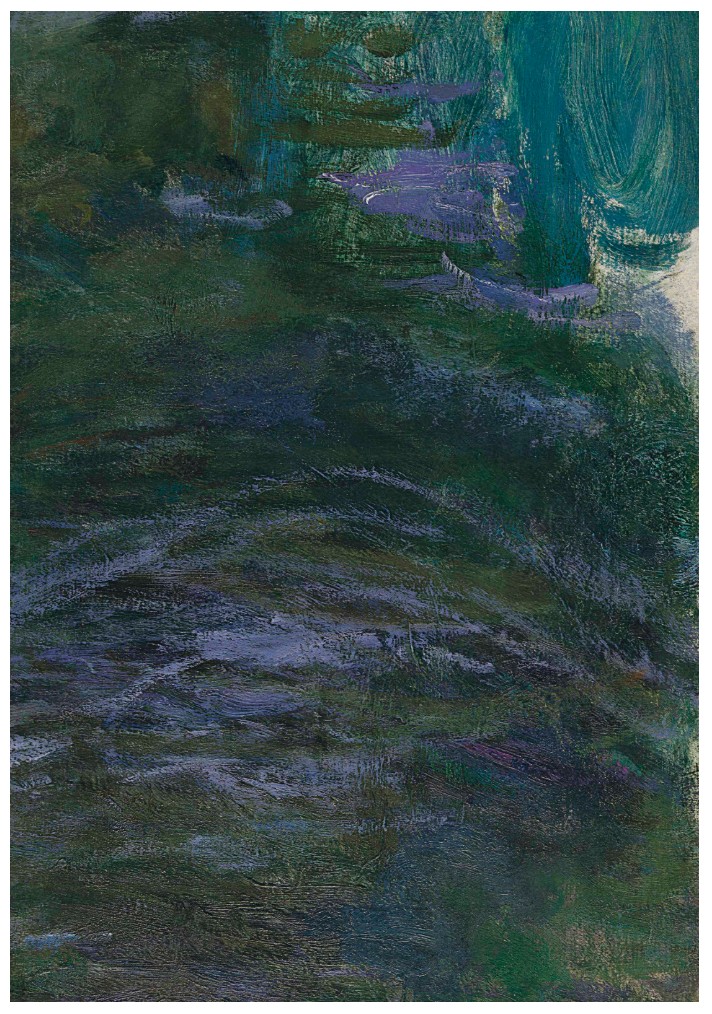
CLAUDE MONET (1840-1926)
Nymphéas (fragment)
Oil on canvas
59×39 cm (22 1/8 x 15 3/8 inches)
Le Bassin aux nymphéas, 1917
Sotheby’s New-York: 15 May 2017
Estimated: USD 14,000,000 – 18,000,000
USD 15,987,500
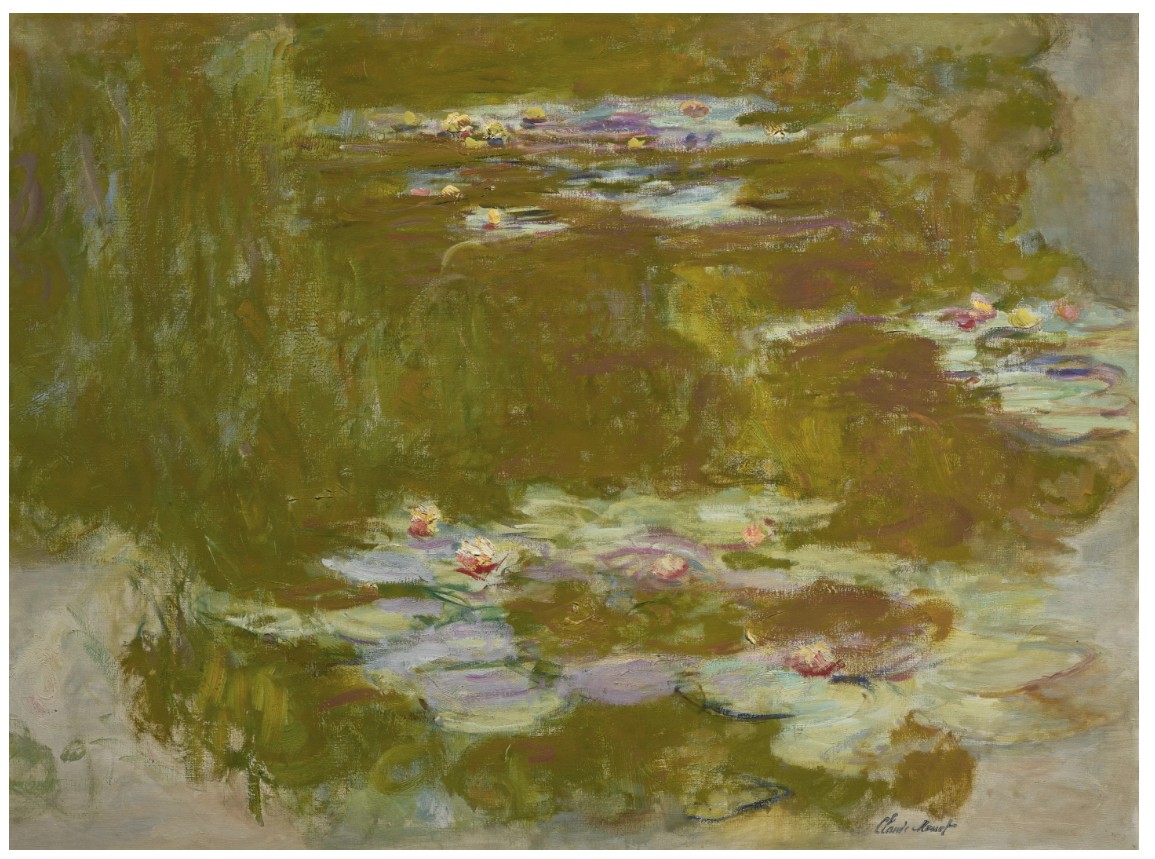
CLAUDE MONET
Le Bassin aux nymphéas, 1917
Oil on canvas
97.2 x 129.9 cm (38 1/4 x 51 1/8 inches)
Stamped Claude Monet (lower right)
Stamped Claude Monet (on the reverse)
2016
Le bassin aux nymphéas, 1919
Christie’s New-York: 12 May 2016
Estimated: USD 25,000,000 – 35,000,000
USD 27,045,000
Claude Monet (1840-1926), Le bassin aux nymphéas | Christie’s
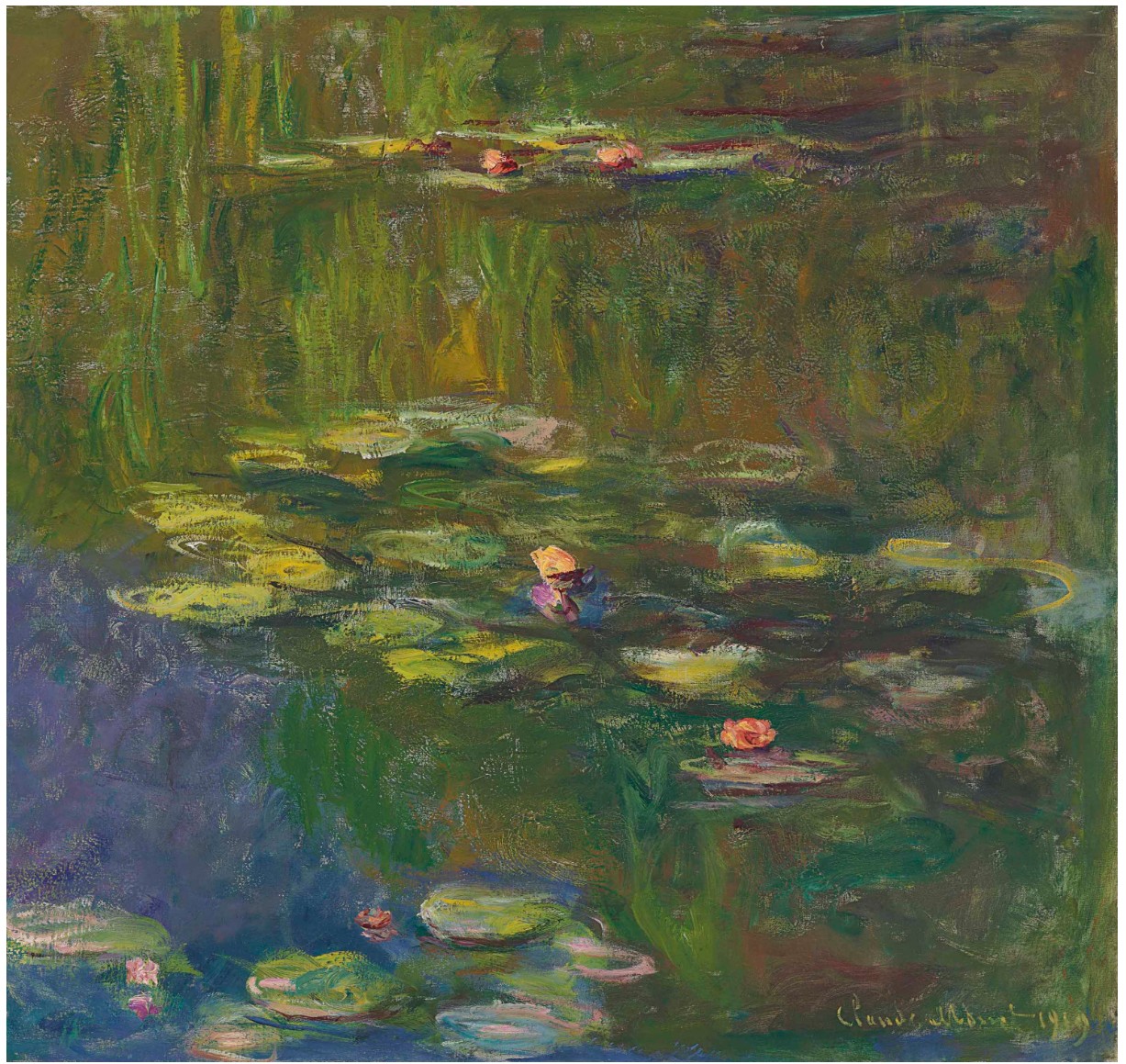
CLAUDE MONET (1840-1926)
Le bassin aux nymphéas, 1919
Oil on canvas
99.6 x 103.7 cm (39 3/8 x 40 7/8 inches)
Signed and dated ‘Claude Monet 1919’ (lower right)
2015
Nymphéas, 1908
Sotheby’s New-York: 4 November 2015
Estimated: USD 30,000,000 – 50,000,000
USD 33,850,000
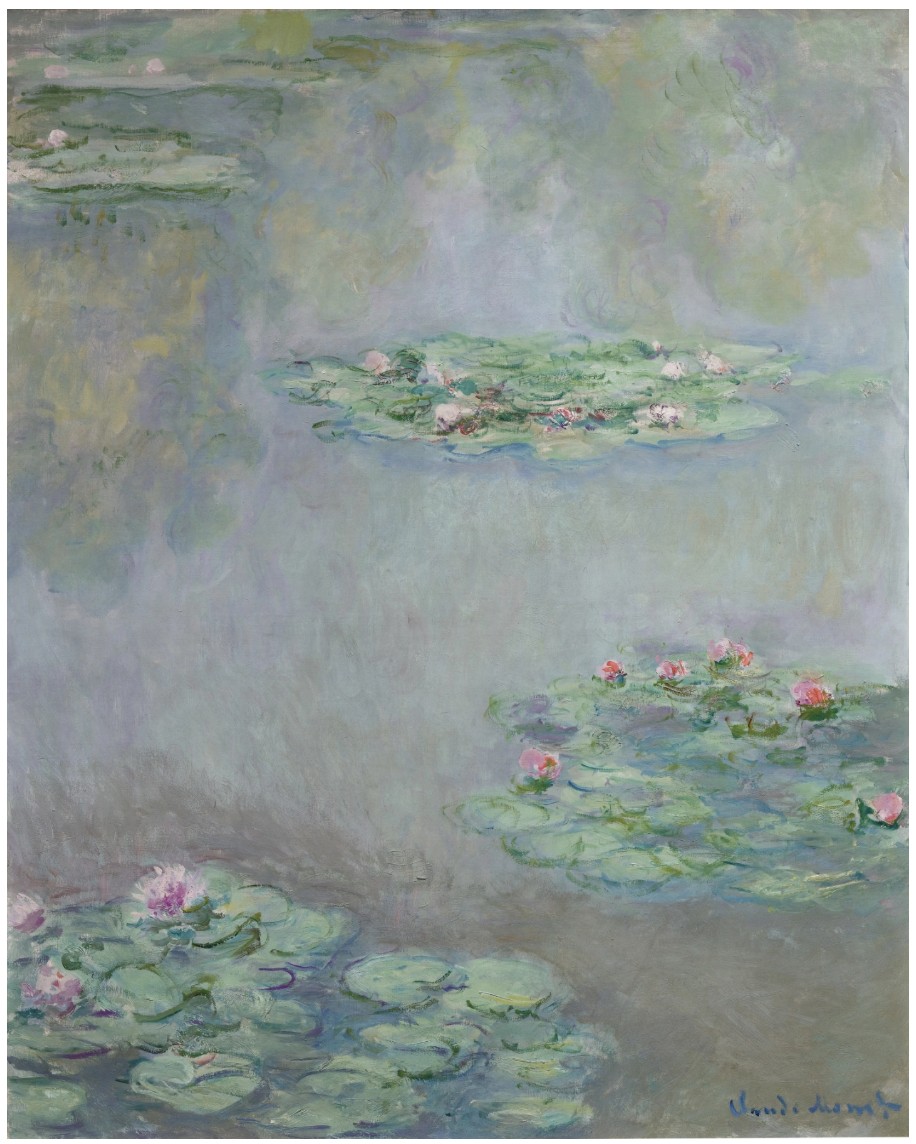
CLAUDE MONET
Nymphéas, 1908
Oil on canvas
100 x 81.3 cm (39 3/8 x 32 inches)
Signed Claude Monet (lower right)
Nymphéas, 1905
Sotheby’s New-York: 4 May 2015
Estimated: USD 30,000,000 – 35,000,000
USD 54,010,000
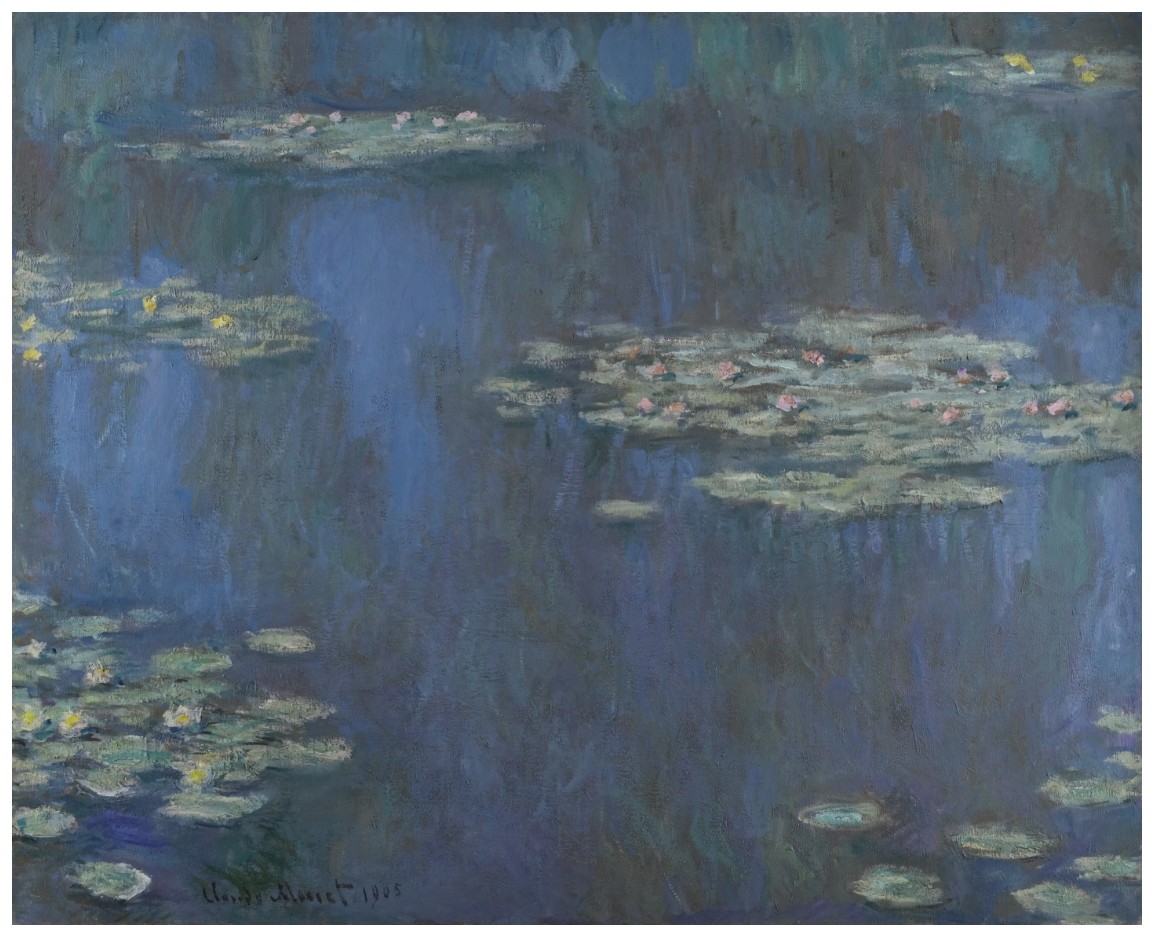
CLAUDE MONET
Nymphéas, 1905
Oil on canvas
81 x 100.5 cm (31 7/8 x 39 1/2 inches)
Signed Claude Monet and dated 1905 (lower left)
2014
Nymphéas, 1906
Sotheby’s London: 23 June 2014
Estimated: GBP 20,000,000 – 30,000,000
GBP 31,722,500 / USD 54,022,320
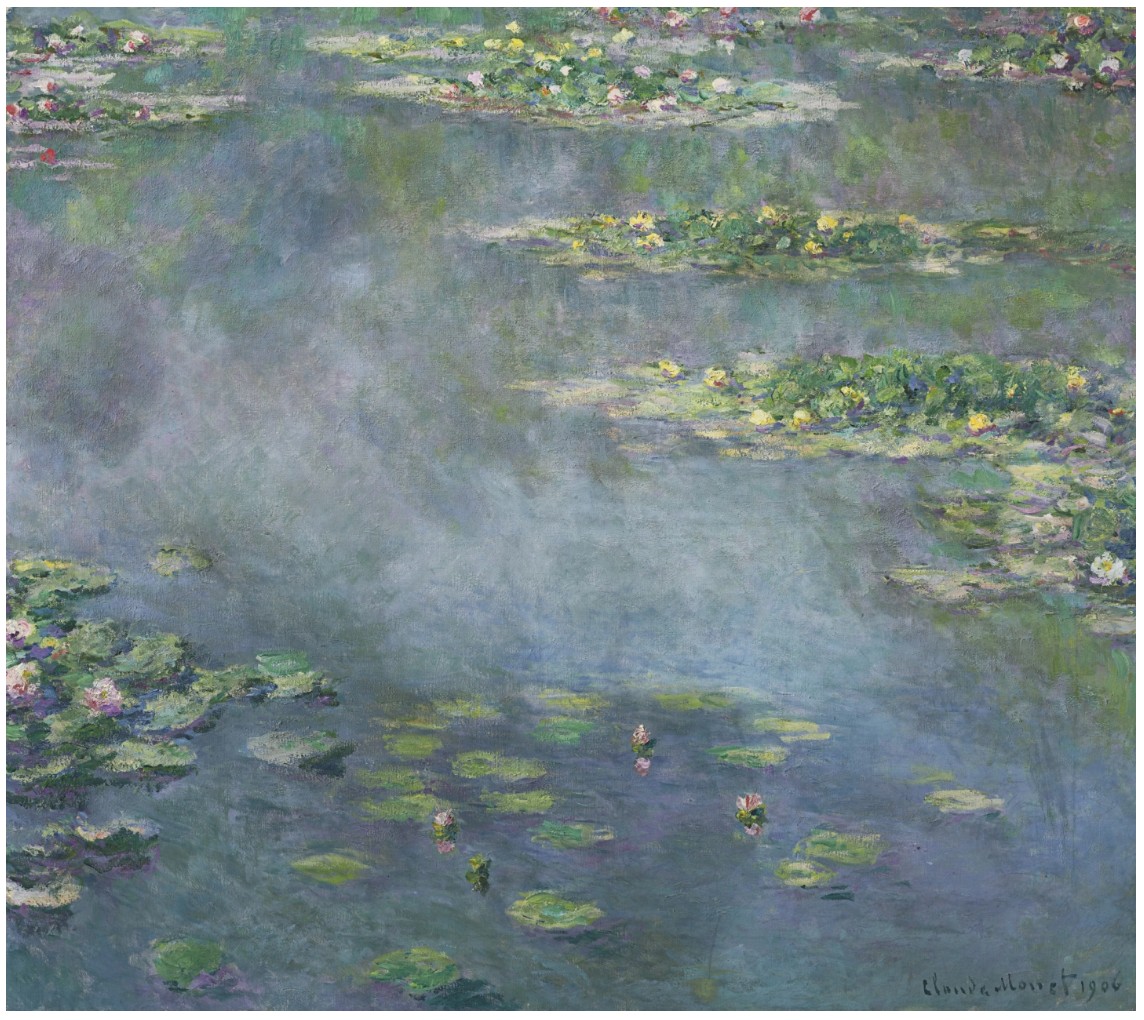
CLAUDE MONET
Nymphéas, 1906
Oil on canvas
88.5 x 100 cm (34 3/4 x 39 3/8 inches)
Signed Claude Monet and dated 1906 (lower right)
Nymphéas, 1907
Christie’s New-York: 6 May 2014
Estimated: USD 25,000,000 – 35,000,000
USD 27,045,000
Claude Monet (1840-1926) , Nymphéas | Christie’s
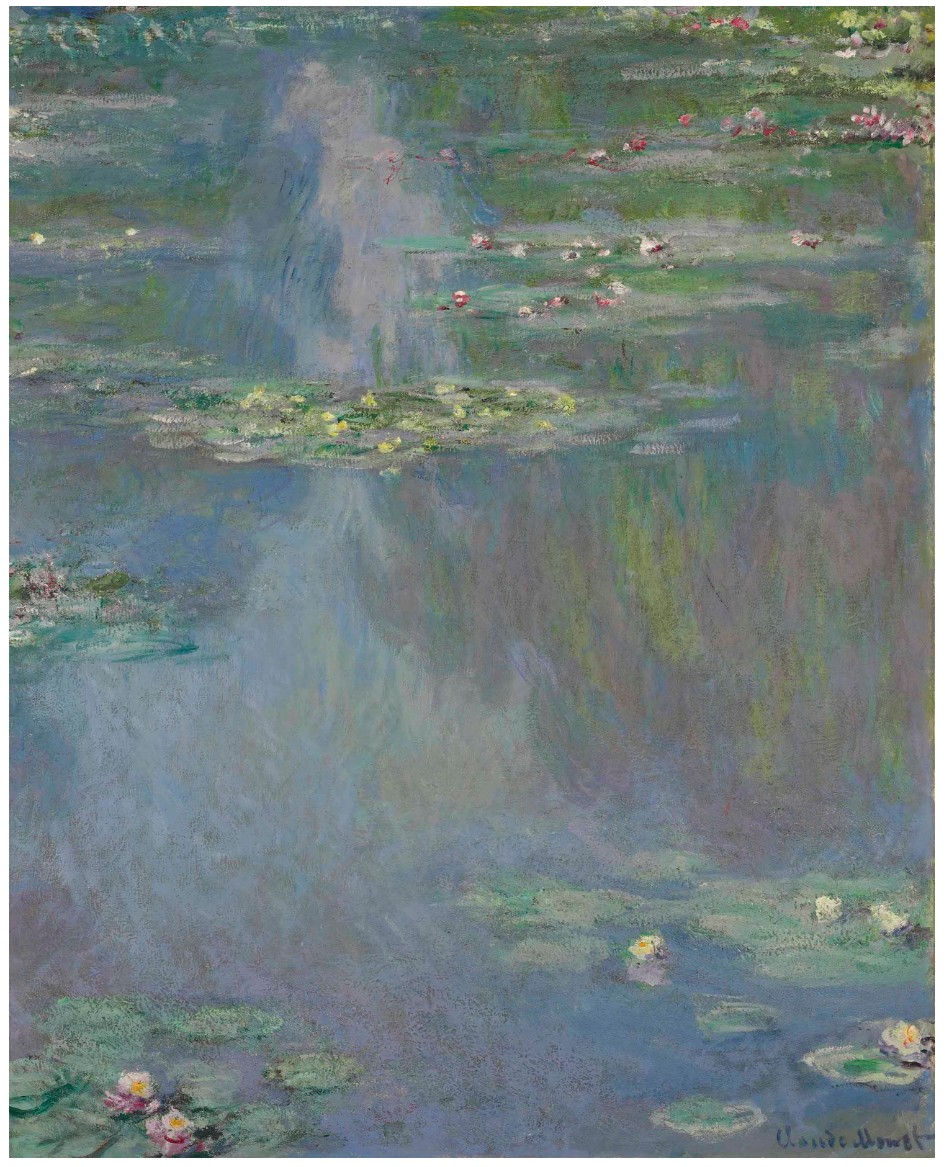
CLAUDE MONET (1840-1926)
Nymphéas, 1907
Oil on canvas
100.1 x 81.2 cm (39 3/8 x 32 inches)
Signed ‘Claude Monet’ (lower right)
The Most Expensive Nymphéas
You will find below auction results for paintings from this iconic series, in decreasing order of price realized. Nympheas en fleur, a painting dated 1914-1917, sold at Christie’s in New-York, on 7 May 2018, for USD 84,867,500, the highest price achieved at auction for the series. The top 10 most expensive paintings from the series all sold for over USD 50 million except one, and generated a cumulative turnover of USD 634,248,860.
#1. Nymphéas en fleur, circa 1914-1917
Christie’s New-York: 7 May 2018
Estimate on Request
USD 84,687,500
Claude Monet (1840-1926), Nymphéas en fleur | Christie’s
CLAUDE MONET (1840-1926)
Nymphéas en fleur, circa 1914-1917
Oil on canvas
160.3 x 180 cm (63 x 70 7/8 inches)
Stamped with signature ‘Claude Monet’ (Lugt 1819b; on the reverse)
Monet’s late Nymphéas took a motif that he had long adored and lent them a new scale and a new vigour. Le bassin aux nymphéas has an expressionistic flair that was less evident in his pre-1914 paintings which had evolved over the intervening half decade. The word ‘décoratif’ which was used in association with these works was less because of an inherent decorative quality, but instead because of the sheer modernity of these engaging and absorbing visions: it was a result of the subjective means of rendering the scene, which viewers felt was less linked than most art with the real world. Pictures such as Le bassin aux nymphéas were almost abstract, rather than realist, and therefore were considered décoratifs.
#2. Le bassin aux nymphéas, 1919
Christie’s London: 24 June 2008
Estimated: GBP 18,000,000 – 24,000,000
GBP 40,921,250 / USD 80,588,542
Claude Monet (1840-1926) , Le bassin aux nymphéas | Christie’s

CLAUDE MONET (1840-1926)
Le bassin aux nymphéas, 1919
Oil on canvas
100.4 x 201 cm (39 1/2 x 79 1/8 inches)
Signed and dated ‘Claude Monet 1919’ (lower right)
Monet had begun a new series of large-scale Nymphéas in 1914, and these would lead ultimately to his Grandes décorations, the celebrated frieze now in the Musée de l’Orangerie, Paris. The large scale and bold, almost abstracted expressionistic brushwork that characterised those works is equally evident in Le bassin aux nymphéas; these qualities would later come to have a lasting influence on a range of artists including Pierre Bonnard, the Abstract Expressionists and even the ideas behind Informel. Dated 1919, when Monet signed the picture and sold it with three sister-works to Bernheim-Jeune in November that year, Le bassin aux nymphéas is one of the tiny handful of pictures from this period that he relinquished, as he tended to view his paintings of water lilies as a large, cumulative work in progress and guarded them all jealously, seldom allowing them to leave his studio. This, then, is not a study, like so many other works from this period, but instead a highly finished work. The rarity of Le bassin aux nymphéas is reflected by the fact that of its three fellow paintings, one is now in the Metropolitan Museum, New York, while another was sold from the estate of Ralph Friedman at Christie’s in New York in 1992 for the then impressive price of $12,100,000; and the fourth was sadly cut into two (becoming W1893/1 and W1893/2).
The provenance of Le bassin aux nymphéas itself speaks of its exceptional importance as, before becoming the centrepiece of the formidable collection assembled by J. Irwin and Xenia S. Miller, it was owned by Mr and Mrs Norton Simon. The founder of the Norton Simon Foundation that would come to give the celebrated Pasadena museum his name, Norton Simon was an immensely successful and philanthropic businessman whose private collection included a string of paintings by artists including Degas, Picasso and Van Gogh.
USD 80 million
#3. Le bassin aux nymphéas, 1917-1919
Christie’s New-York: 9 November 2023
Estimate on Request
USD 74,010,000
CLAUDE MONET (1840-1926) (christies.com)

CLAUDE MONET (1840-1926)
Le bassin aux nymphéas, 1917-1919
Oil on canvas
100.1 x 200.6 cm (39 3/8 x 78 7/8 inches)
Stamped with signature ‘Claude Monet’ (Lugt 1819b; lower right)
Stamped again with signature ‘Claude Monet’ (Lugt 1819b; on the reverse)
Absorbing and expressionistic, with an extraordinary play of impasto and vibrant brushwork, Le bassin aux nymphéas is a key example from this famed series of works dedicated to the water lilies, executed on a large-scale canvas that stretches over two meters across. At once searingly modern and timeless, the painting focuses on the play of silvery light and the intricate dance of reflections across the lily-pond, conveying a vivid sense of the undulations of the surface of the water and the delicate bobbing flowers, as they shift and change in response to their surroundings.
Dating from 1917-1919, Le bassin aux nymphéas hails from an important period of renewal and experimentation in Monet’s painterly visions of the lily-pond, spurred on by his desire to create mural-scale images of the motif, rather than the smaller paysages d’eau that he had hitherto painted of his gardens. These grand, monumental depictions were filled with gestural, vigorous bolts of color that coalesce to form the watery landscape, the vibrancy and gestural quality of the brushwork revealing the impressive energy that lay behind the artist’s paintings, even at this late stage of his career. Though these revolutionary compositions initially met with mixed reactions from Monet’s contemporaries, they found favor among a younger generation of artists and collectors in later decades of the twentieth century, most notably among the painters of the bourgeoning Abstract Expressionist movement. Held in the same family collection for the past fifty years, Le bassin aux nymphéas is a captivating example from this great body of work, encapsulating Monet’s searing, prescient creative vision.

In Le bassin aux nymphéas, Monet’s innate ability to organize his sensations of the transience of natural phenomena is readily apparent. Here, he focusses principally on the surface of the water, stripping out all superfluous details, allowing the quicksilver-like water to fill the canvas, only interrupted by small constellations of floating water lilies. The flowers themselves are rendered with layers of rich impasto to give them a sculptural presence, affirming their position on the top of the pond, while in the watery areas, layers of color are laid on top of one another to suggest the refractions of light and the changing hues in the pond’s depths. It is the surface of the pond itself that captivates the artist’s imagination, rippling with the reflections of the willow trees that line the water’s edge as well as the slivers of intense, deep, lush lapis-colored sky above. While Monet has tightly focused his view on a small sliver of the vast pond, creating a closely framed composition that seemingly allows for no foreground or background, he has nonetheless used the water as a portal of sorts, allowing a complex interplay of the near and the far, in which the world beyond the pond exists in mirror-image.
#4. Le Bassin aux nymphéas, 1917-19
Sotheby’s New-York: 12 May 2021
Estimate on Request
USD 70,353,000
Le Bassin aux nymphéas | Impressionist & Modern Art Evening Sale | 2021 | Sotheby’s
CLAUDE MONET (1840 – 1926)
Le Bassin aux nymphéas, 1917-19
Oil on canvas
100×200 cm (39 3/8 x 79 inches)
Bears the signature Claude Monet (lower right)
Painted at the same time and directly related to the artist’s monumental Grandes Décorations works were a suite of slightly smaller yet equally impactful works of the same horizontal format. These canvases from 1917-19, including Le Bassin aux nymphéas, retain the awesome power of the grand panels and employ a daring color scheme and bold, expressionistic handling of paint. In the large-scale composition of the present work, Monet achieves a remarked breadth of color which seems to capture reflections in motion.
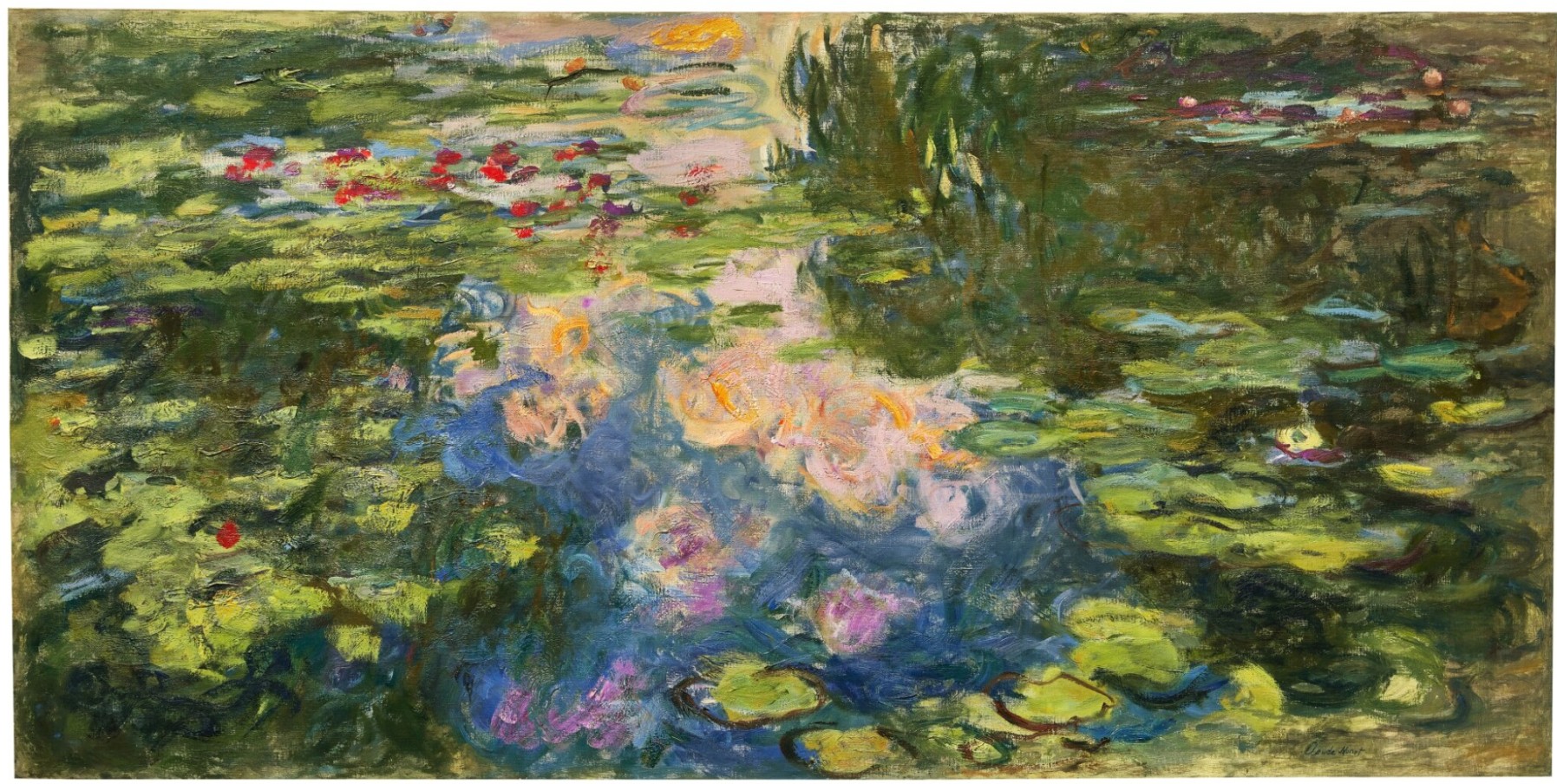
The majestic willow trees which surrounded the pond—and which became the subjects of their own discrete series—here reappear in the upper right. The viewer is brought closer to the water’s surface, observing the scenery as if hovering above the shifting colors in the pond’s reflections. At center is a trail of florid pink tufts, just loose enough in their handling to question their source; are these blossoms fallen upon the water’s surface or the mere echo of flowers just out of view? The lively palette of the present work stands out in contrast to the more subdued colors of his earlier water lilies and the handling is decidedly looser and more fluid, with flowers indicated by bold strokes of paint as mere suggestions of form. The vigorous brushwork heightens the sense of motion within the scene as the overlapping strokes of color and wet-on-wet paint application lends a tactility and gradient effect to the painting.
USD 70 million
#5. Nymphéas, circa 1914-17
Sotheby’s New-York: 18 November 2024
Estimate on Request
USD 65,500,000
Nymphéas | A Legacy of Beauty: The Collection of Sydell Miller Evening Auction | 2024 | Sotheby’s
CLAUDE MONET (1840 – 1926)
Nymphéas, circa 1914-17
Oil on canvas
175 x 135.4 cm (68 7/8 x 53 3/8 inches)
Stamped with the signature Claude Monet (on the reverse)
Stamped again (on the stretcher)
Executed in a kaleidoscopic palette of jewel-toned purples and luscious blues, energized by the touches of white, pink and yellow used to describe the namesake flowers, the present Nymphéas is an exceptional example of Monet’s deft ability to translate fleeting atmosphere and the protean effects of light into paint. Nymphéas stands as the forerunner of a specific series of water lilies typified by more elaborate backgrounds featuring the nuanced reflections of trees along the opposite bank of the pond. It is precisely on account of the way Monet uses the pond as a technical device to blur the boundary between the real and the reflected that the work takes on its distinctly modern inflection. In its close cropping and all-over painterly effect, the work likewise marks a radical, early foray into abstraction, one which would prove a decisive stylistic inroad for the Abstract Expressionists who, following in Monet’s footsteps, would come to transform the idiom of modern art thirty years later.
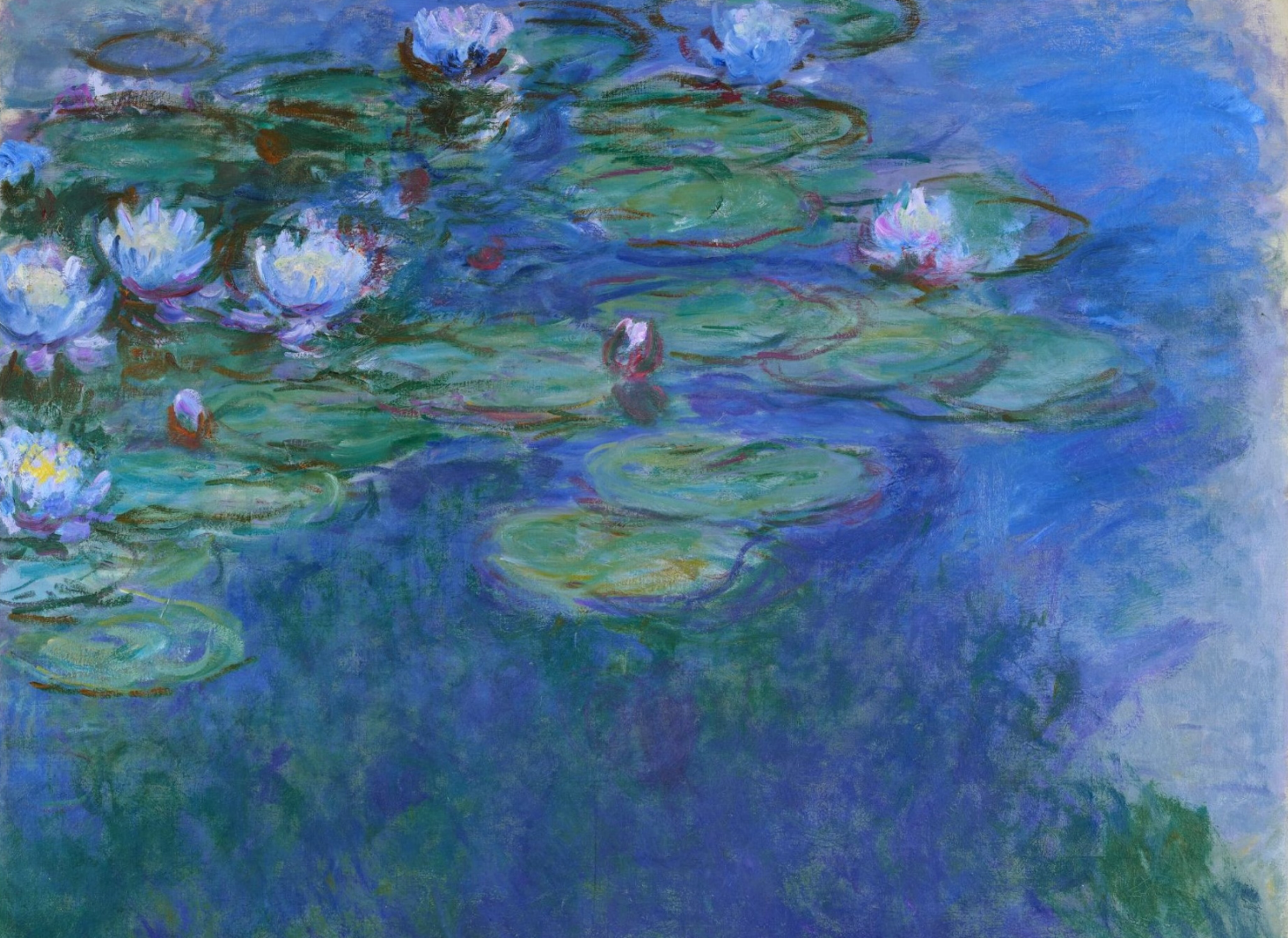
In 1903, Monet began to dispense with the conventional structures of landscape painting, narrowing his scope to focus directly on the surface of the pond and its reflections. In these earlier works on the theme, the illusion of pictorial depth is upheld by the diminishing forms of the lilies, as they recede towards an invisible horizon. By 1910, however, Monet went a step further to remove any lingering suggestion of perspective. Hovering above his subject from this new vantage point, Monet was presented with an almost flat plane of water and increasingly came to treat the surface of the canvas as if it were a mirror to that of the pond itself. When compared with the 1906 canvas held in the collection of the Art Institute of Chicago, the transformative effect of this shift in perspective on the overall composition becomes apparent. Whereas in the 1906 canvas, there maintains a palpable suggestion of perspectival depth, in the present work the group of lilies in the top left and bottom right corners of the work appear almost flat against the water’s surface, rendered from the same scale, distance and angle, just a few degrees shy of a bird’s eye view. The ovoid lily pads offer the only suggestion of a recession in space, as opposed to the circular shape they would take when seen directly from above. The distorted perspective is heightened by the rotation of the horizontal surface of the water onto the vertical orientation of the canvas, distending the composition in a strangely frontal extension. Meanwhile, Monet’s masterful handling of tone in the modulated blue expanse at the center confers the imperceptible depth of the pond onto the painted surface.
USD 60 million
#6. Nymphéas, 1907
Christie’s New-York: 12 May 2022
Estimated: USD 35,000,000 – 55,000,000
USD 56,495,000
CLAUDE MONET (1840-1926), Nymphéas | Christie’s
CLAUDE MONET (1840-1926)
Nymphéas, 1907
Oil on canvas
93.8 x 89.3 cm (37 x 35 1/4 inches)
Signed and dated ‘Claude Monet 1907’ (lower right)
Monet created two different sub-series of Nymphéas during 1907. The first, which includes the present canvas, was painted in the morning or early afternoon (Wildenstein, nos. 1694-1702). The pictures in this group depict lilies with wide-open blossoms floating on the surface of the water, in which unified masses of reflected foliage surround a central expanse of light. The paintings in the second set, more pronouncedly vertical in format and produced closer to sundown, are characterized by a long stream of light that traverses the full height of the canvas, slicing its way through clusters of lily pads and swirling eddies of vegetation (Wildenstein, nos. 1703-1717).
The latter paintings are dramatic in their contrasts and brooding in their mood—so much so that Durand-Ruel worried when he eventually saw them about their marketability. In the present canvas and the related Nymphéas, by contrast, Monet mitigated the value differences between the horizontally striated islands of lilies and the vertical reflections, producing an effect of integration and harmony. Conventional spatial recession, indicated by the diminishing scale of the blossoms and lily pads, is played against the flat surface of the canvas, which Monet emphasizes through his vigorous, textural brushwork.
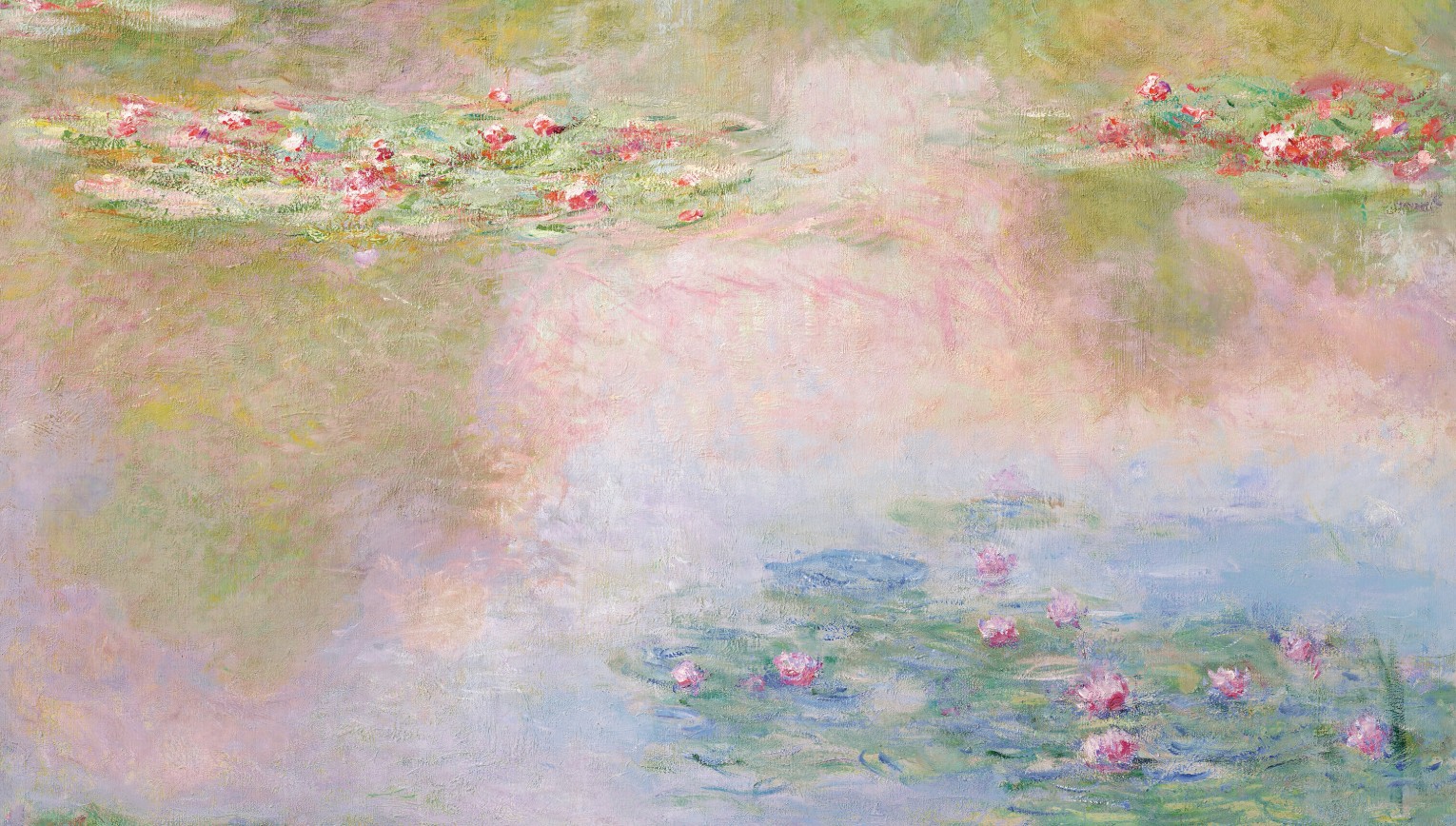
The flowers themselves are rendered with the most impasto to give them a sculptural presence, affirming their position on the top of the pond, while in the watery areas, thin layers of color are laid on top of one another to suggest the refractions of light and the changing hues in the pond’s depths.
Monet and Durand-Ruel had originally agreed on a date of 1907 for the inaugural exhibition of the Nymphéas series. The artist, though, repeatedly postponed the show, “full of fire and confidence,” he told the dealer, and determined to keep working (quoted in exh. cat., op. cit., 1998, p. 47). When the exhibition finally opened in May 1909, it was stunning success—well worth the wait. Forty-eight views of the lily pond were featured, more than Monet had ever exhibited from a single series; the present painting was no. 28 in the group. Critics marveled at how transcendent and nearly abstract the pictures appeared, even by comparison with Picasso and Braque’s latest Cubist experiments.
#7. Nymphéas, 1906
Sotheby’s London: 23 June 2014
Estimated: GBP 20,000,000 – 30,000,000
GBP 31,722,500 / USD 54,022,320
CLAUDE MONET
Nymphéas, 1906
Oil on canvas
88.5 x 100 cm (34 3/4 x 39 3/8 inches)
Signed Claude Monet and dated 1906 (lower right)
Claude Monet’s Nymphéas are amongst the most iconic and celebrated Impressionist paintings. The profound impact the series has made on the evolution of Modern Art marks them out as Monet’s greatest achievement. The famous lily pond in his garden at Giverny provided the subject matter for most of his major late works, recording the changes in his style and his constant pictorial innovations. The present work, which dates from 1906, is a powerful testament to Monet’s enduring vision and creativity in his mature years. Monet’s Nymphéas from 1905-1907 are triumphantly achieved monuments of color; the water reflects the skies’ shifting hues and the lilies themselves are elegant touches of paint applied with bravura. As Daniel Wildenstein notes, all the works created in 1906 were painted from the same spot, and took an especially close up view of the pond, with a number of water lilies in the foreground of their compositions. The spectacular field of colour presented by Nymphéas is created to elicit an instinctive emotional response rather than to record a particular location, temporal conditions or natural phenomena. Over the course of three crucial years, from 1905 until 1907, Monet experimented with different approaches and painting techniques. The paintings from 1905 were thickly painted with a dense surface and horizontally oriented, whilst those from 1906 have a more painterly interplay between rich impastoed areas with finer luminous washes. In 1907 Monet used his canvases vertically and experimented with longer brushstrokes. Another important feature of the works from this period is how Monet removed the perspectival elements that had existed in his earlier renditions of the lily pond, so the banks and borders which sometimes featured no longer informed the scope or scale of the works. Since the birth of Impressionism, Monet’s primary concern had been the sensation of color and its properties and these technical innovations underwrote his highly advanced theoretical approach. In Marcel Proust’s À la recherche du temps perdu, the narrator goes to visit a fictional painter called Elstir who was based in part on Monet. Here, in the studio the narrator begins to see Elstir’s new purpose for art. ‘But I was able to discern from these that the charm of each of them lay in a sort of metamorphosis of the things represented in it, analogous to what in poetry we call metaphor, and that, if God the Father had created things by naming them, it was by taking away their names or giving them other names that Elstir created them anew. The names which denote things correspond invariably to an intellectual notion, alien to our true impressions, and compelling us to eliminate from them everything that is not in keeping with itself’ (quoted in Charles Prendergast, The Triangle of Representation, New York, 2000, p. 154). Monet’s Nymphéas fulfils the promise of Elstir’s intentions, managing to transcend paintings traditional, illusory function in order to create a new sense of purpose for art.
#8. Nymphéas, 1905
Sotheby’s New-York: 4 May 2015
Estimated: USD 30,000,000 – 35,000,000
USD 54,010,000
CLAUDE MONET
Nymphéas, 1905
Oil on canvas
81 x 100.5 cm (31 7/8 x 39 1/2 inches)
Signed Claude Monet and dated 1905 (lower left)
Claude Monet’s Nymphéas are amongst the most iconic and celebrated Impressionist paintings. The profound impact the series has made on the evolution of Modern Art marks them out as Monet’s greatest achievement. The famous lily pond in his garden at Giverny provided the subject matter for most of his major late works, recording the changes in his style and his constant pictorial innovations. The present work, which dates from 1905, is a powerful testament to Monet’s enduring vision and creativity in his mature years. Monet’s Nymphéas from 1905-1907 are triumphantly achieved monuments of color; the water reflects the skies’ shifting hues and the lilies themselves are elegant touches of paint applied with bravura. As Daniel Wildenstein notes, it was in 1905 that Monet’s canvases took an especially close up view of the pond, with a number of water lilies in the foreground of their compositions, and no sign of the banks. This innovative approach can be seen in the present work and a closely related painting in the National Museum of Wales. The spectacular field of color presented by Nymphéas is created to elicit an instinctive emotional response rather than to record a particular location, temporal conditions or natural phenomena. Over the course of three crucial years, from 1905 until 1907, Monet experimented with different approaches and painting techniques. The paintings from 1905 were thickly painted with a dense surface and horizontally oriented, whilst those from 1906 interplay between rich impastoed areas with finer washes. In 1907 Monet used his canvases vertically and experimented with longer brushstrokes. Another important feature of the works from this period is how Monet removed the perspectival elements that had existed in his earlier renditions of the lily pond, so the banks and borders which were sometimes featured no longer informed the scope or scale of the works. Since the birth of Impressionism, Monet’s primary concern had been the sensation of color and its properties and these technical innovations underwrote his highly advanced theoretical approach. In Marcel Proust’s À la recherche du temps perdu, the narrator goes to visit a fictional painter called Elstir who was based in part on Monet. Here, in the studio the narrator begins to see Elstir’s new purpose for art. “But I was able to discern from these that the charm of each of them lay in a sort of metamorphosis of the things represented in it, analogous to what in poetry we call metaphor, and that, if God the Father had created things by naming them, it was by taking away their names or giving them other names that Elstir created them anew. The names which denote things correspond invariably to an intellectual notion, alien to our true impressions, and compelling us to eliminate from them everything that is not in keeping with itself” (quoted in Charles Prendergast, The Triangle of Representation, New York, 2000, p. 154). Monet’s Nymphéas fulfils the promise of Elstir’s intentions, managing to transcend paintings traditional, illusory function in order to create a new sense of purpose for art.
#9. Coin du bassin aux nymphéas, 1918
Sotheby’s New-York: 16 November 2021
Estimates on Request
USD 50,820,000
Coin du bassin aux nymphéas | Modern Evening Auction | 2021 | Sotheby’s
CLAUDE MONET (1840 – 1926)
Coin du bassin aux nymphéas, 1918
Oil on canvas
131 x 88.8 cm (51 1/2 x 35 inches)
Signed Claude Monet and dated 1918 (lower right)
The theme of waterlilies—which became not only Monet’s most celebrated series of paintings, but one of the most iconic images of the Impressionist movement—dominated the artist’s work over several decades, recording the changes in his style and his constant pictorial innovations. The present large-scale oil, which dates from 1918, is a powerful testament to Monet’s enduring vision and creativity in his mature years. This work and the related canvases in the series led to the celebrated Grandes Décorations (now in the Musée de l’Orangerie in Paris) which are now considered “the crowning glory of Monet’s career, in which all his work seemed to culminate” (Daniel Wildenstein, Monet, Catalogue raisonné, vol. IV, Cologne, 1996, p. 840). Three other canvases join the present work in this limited series featuring this specific corner of the artist’s water garden, opposite the Japanese bridge. Arguably the strongest and most luminous of the series, the present work is one of two works from this series in private hands, with W.1878 and W.1879 belonging to the collections of the Musée de Grenoble and Geneva’s Musée d’art et d’histoire, respectively. W.1881, the other painting in private hands, remained unsold in the artist’s lifetime and bears the estate stamp, while the present composition was signed and dated by the artist upon the sale of the work in early 1919.
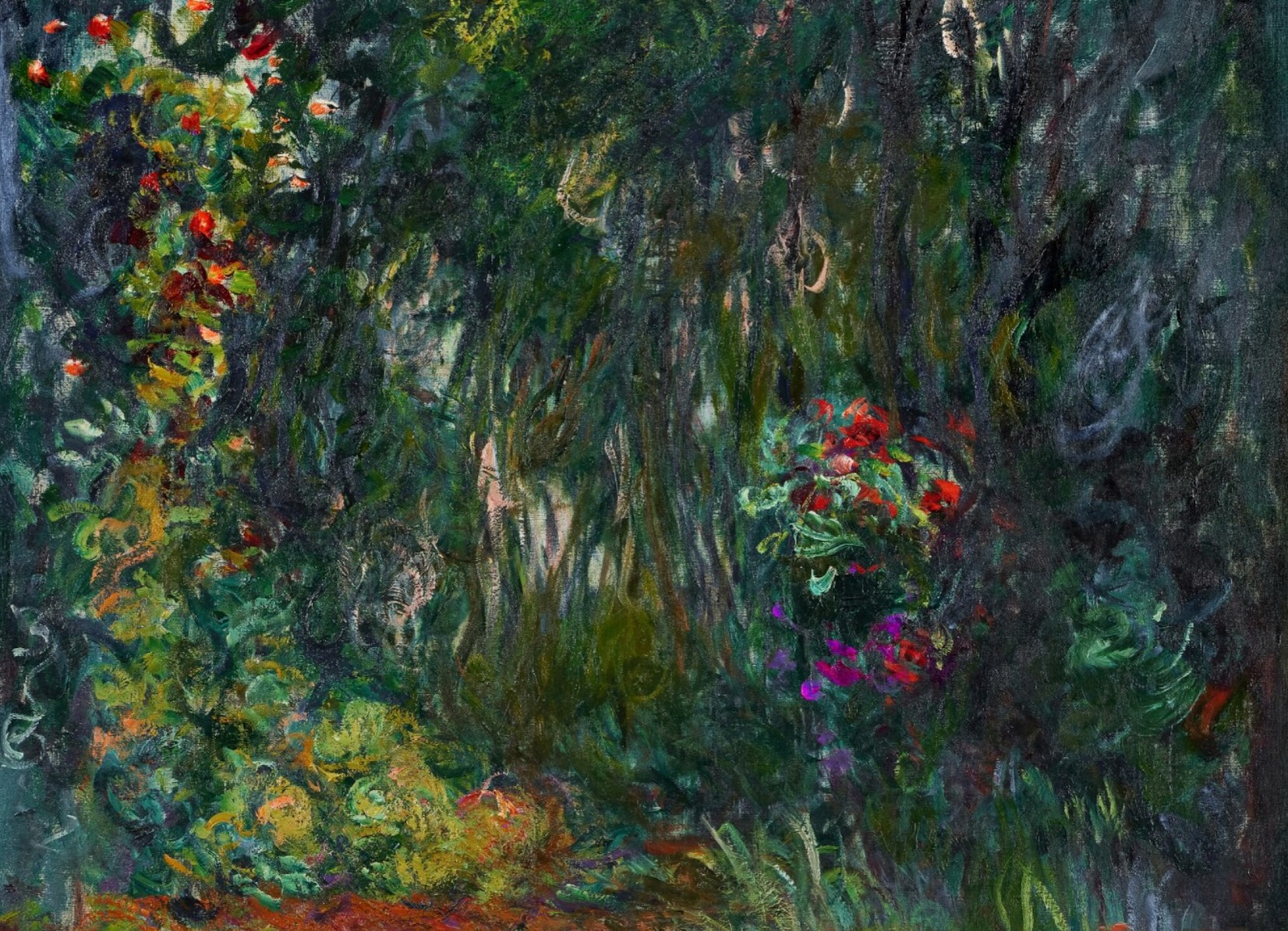
The present work’s surface is a testament to Monet’s best canvases of the period. The artist’s brushstrokes and thick application of pigment—in almost every color imaginable—yields an almost three-dimensional feeling to the lily pond and the complex flora behind it. The rich impasto found on this canvas speaks to the time and care Monet devoted to this particular work and distinguishes it from the other works in this limited series. In Coin du bassin aux nymphéas, Monet juxtaposes the waterlilies floating on the lilypond’s surface with the reflections of the trees above. Together with the long fronds of the water grasses, the tendrils of weeping willow and boughs of rambling roses lend a truly dynamic sense of motion to the composition. Moving towards an increasingly abstract treatment of space, the artist focused on the effect of light and shadow, using the surface of the water to reflect the wealth of color around it and blurring the boundary between the real and the refracted. By obscuring the horizon line, Monet virtually eliminates traditional perspective and instead builds an abbreviated sense of depth through the contrasting patterns and gestural brushwork in the foliage. The richly worked surface becomes a kaleidoscopic tapestry of color and light built upon the contrasts of the sinewy leaves and rounded blossoms.
USD 50 million
#10. Nymphéas, 1907
Property from the Kawamura Memorial DIC Museum of Art
Christie’s New-York: 17 November 2025
Estimated: USD 40,000,000 – 60,000,000
USD 45,485,000
CLAUDE MONET (1840-1926), Nymphéas | Christie’s
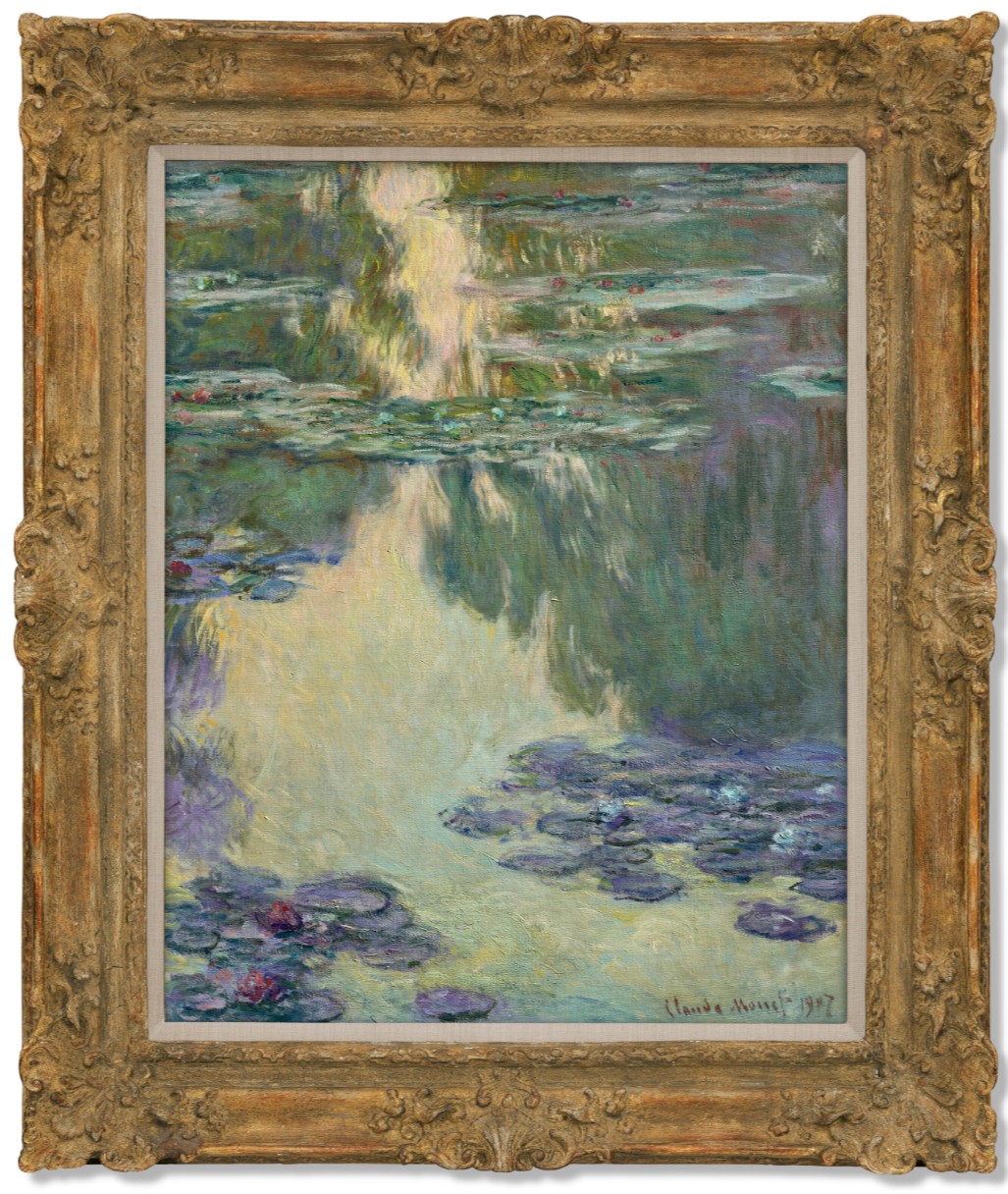
CLAUDE MONET (1840-1926)
Nymphéas, 1907
Oil on canvas
92 x 73.6 cm (36 1/4 x 29 inches)
Signed and dated ‘Claude Monet 1907’ (lower right)
Perhaps no other subject fascinated Claude Monet so intensively and persistently than the elaborate gardens he constructed at his home in Giverny. During the last twenty-five years of his life the artist devoted himself almost single-mindedly to depicting the flowing planes of flowers, towering willow trees and the expansive waterlily pond that he had fashioned within the grounds, producing an astonishingly complex and diverse group of canvases that capture the unique atmosphere of this arcadian landscape.
The resulting paintings stand among the most innovative and influential works of Monet’s entire oeuvre—while they affirm his life-long belief in the primacy of vision and experience, they are in many ways more abstract and daring than anything he had previously painted, and as such, offer a visionary, modern approach to painting for the twentieth century.
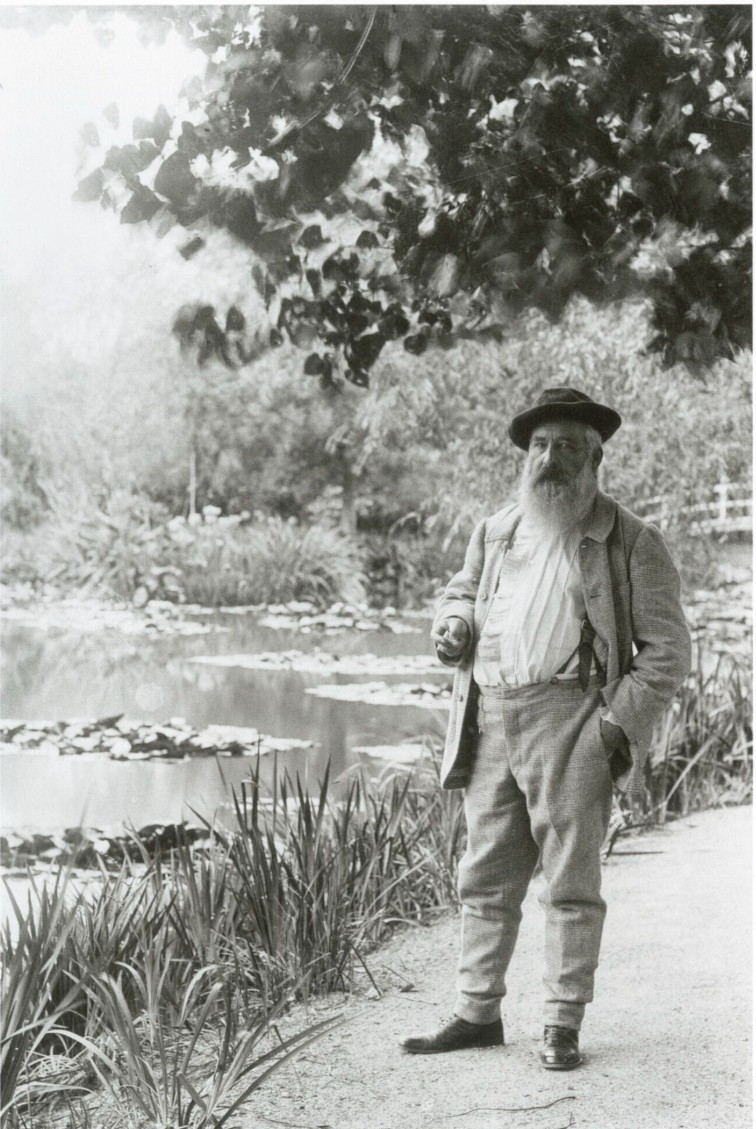
Claude Monet at the water-lily pond, Giverny, 1905. Photograph by Jacques-Ernest Bulloz.
The present Nymphéas comes from a small, concentrated series of fifteen canvases painted in a moment of intensive creativity in 1907 (Wildenstein, nos. 1703-1717). Having spent the cold, wet winter months re-touching the previous year’s output in his studio, Monet was eager to return to the water garden as soon as the weather allowed. Over the course of the spring and summer, he began to explore a new variation on his favored subject, employing a rare vertical format and an intensely close-up, cropped view to capture the dramatic, shimmering effects of light on his waterlily pond. Monet was clearly pleased with the final outcome of this approach, choosing to feature a large portion of the series, including this painting, in his celebrated exhibition at the Galerie Durand-Ruel in Paris in the spring of 1909. This marked the first occasion that the waterlily paintings were seen together in a single show.
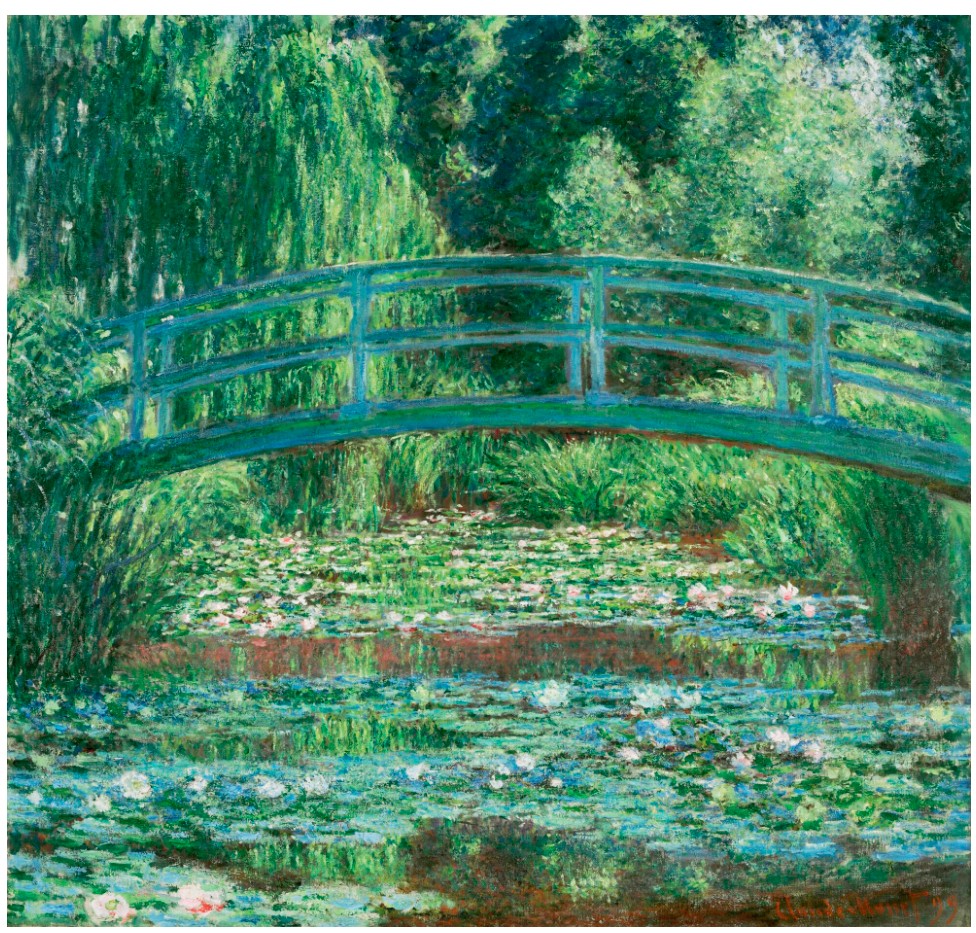
Claude Monet, Le bassin aux nymphéas, 1899. Philadelphia Museum of Art.
Monet had moved his family to Giverny in the spring of 1883, in search of a permanent base which they could finally call home after years of upheaval. Situated some forty miles from Paris, at the confluence of the Seine and the river Epte, Giverny was a small farming community of just three hundred inhabitants, a countryside enclave that remained untouched by the encroaching modernization which had dramatically altered scores of villages and hamlets along the Seine. Here, Monet found the tranquil retreat for which he had been searching, renting a sprawling, pink stucco house called La Pressoir (The Cider Press) from a wealthy local landowner who had recently retired to nearby Vernon. Sandwiched between the main village road and the regional thoroughfare connecting Vernon and Gasny, the house boasted a kitchen garden and orchard, as well as a barn to the west that Monet soon converted into a studio.
“I have always loved sky and water, leaves and flowers.
I found them in abundance in my little pool.”
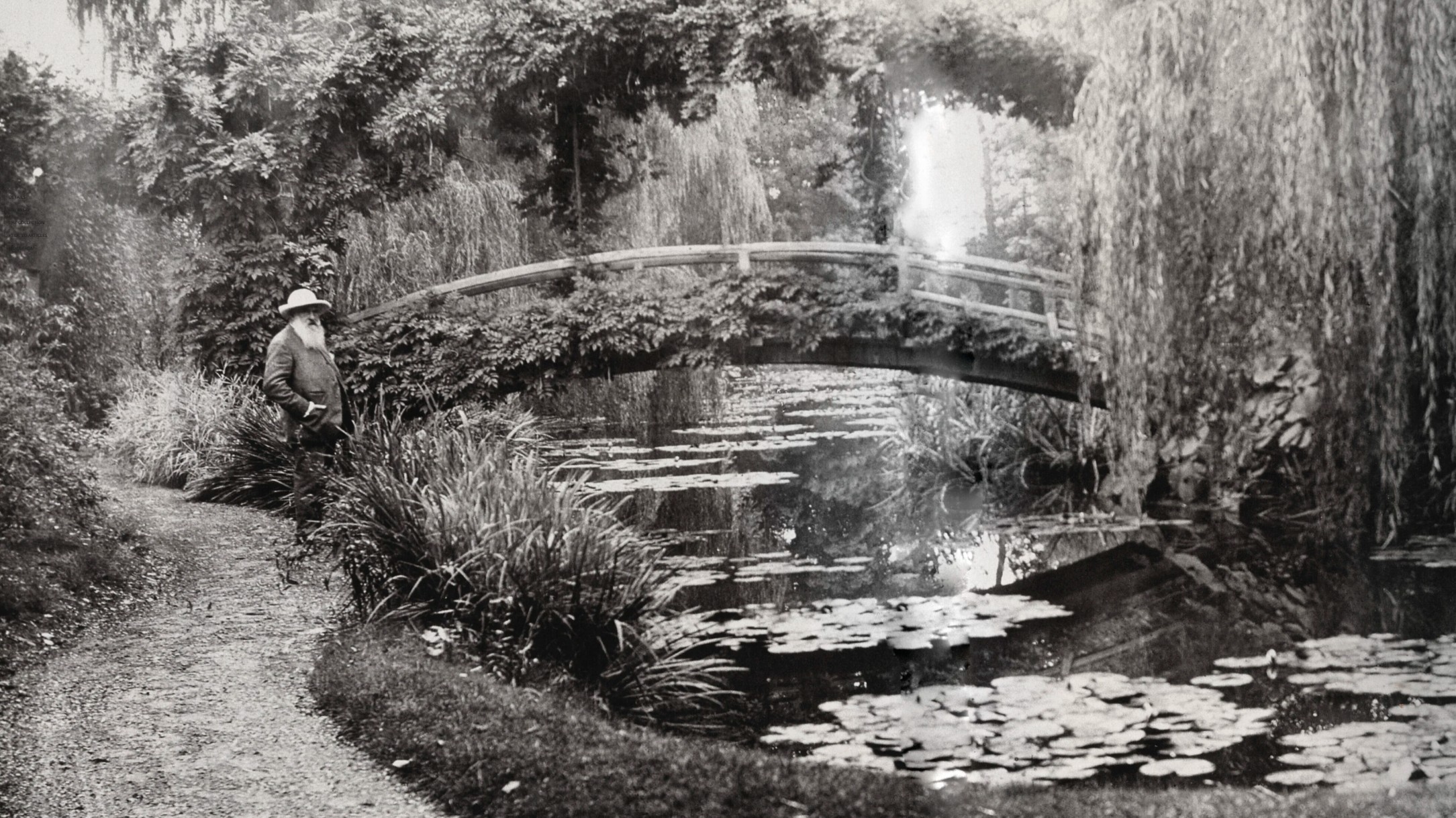
Claude Monet by his water-lily pond at Giverny. Photograph by Pierre Choumoff.
When the property came up for sale in 1890, Monet made the swift decision to purchase it, “certain of never finding a better situation or more beautiful countryside,” he wrote to his dealer Paul Durand-Ruel (quoted in P.H. Tucker, op. cit., 1995, p. 175). Monet immediately began tearing up the existing gardens and planting extensive beds of flowers, together with wide arches over which grew tumbling clematis and roses. Three years later, he acquired an adjacent plot of land—a small meadow that lay beyond the railroad tracks bordering the end of the garden, flanked on one side by a small tributary known as the Ru. A modest pond lay within this meadow, and Monet soon applied to the local government for permission to refresh it “for the purpose of cultivating aquatic plants” (quoted in ibid., p. 176). Over the years that followed, this seemingly simple request would enable Monet to create the extraordinary landscape that served as the basis for his art for much of the rest of his life. By the autumn of 1893, he had converted nearly one thousand square meters into a lavish waterlily pond, spanned by a wooden footbridge at one end, and enhanced by an artful arrangement of flowers, trees and shrubs along its banks.
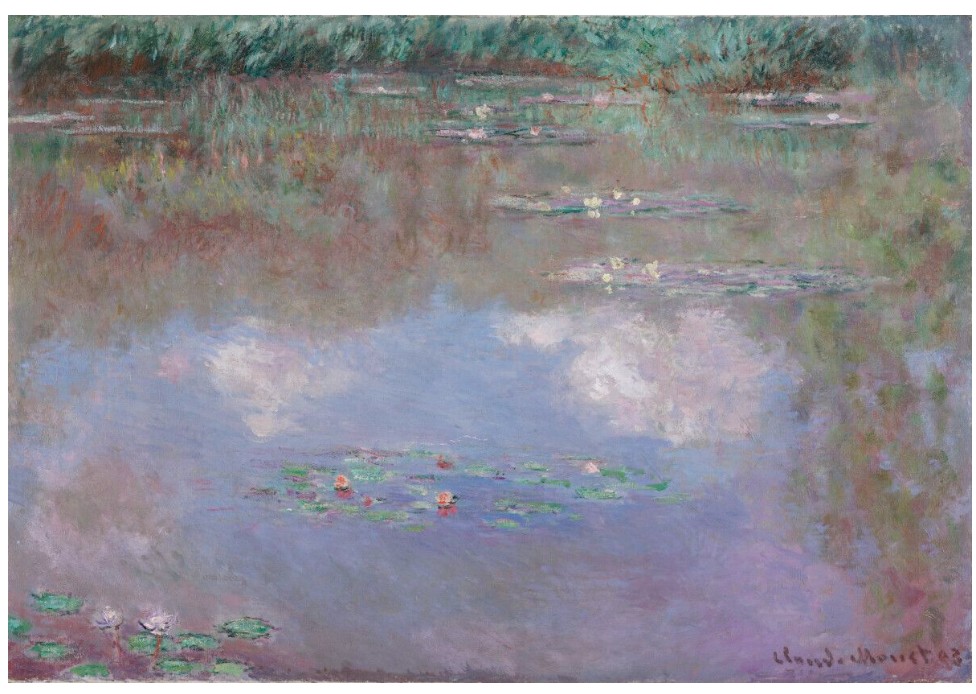
Claude Monet, Nymphéas, paysage d’eau, les nuages, 1903. Dallas Museum of Art.
Despite the extensive time, passion, and funds that Monet devoted to his ambitious horticultural project, he did not immediately embark upon painting the water garden, instead waiting for the plants to develop and mature naturally. It was not until the closing years of the nineteenth century that he first depicted the verdant paradise he had fashioned.
“It took me some time to understand my waterlilies. A landscape takes more than a day to get under your skin. And then all at once, I had the revelation—how wonderful my pond was—and reached for my palette. I’ve hardly had any other subject since that moment.”
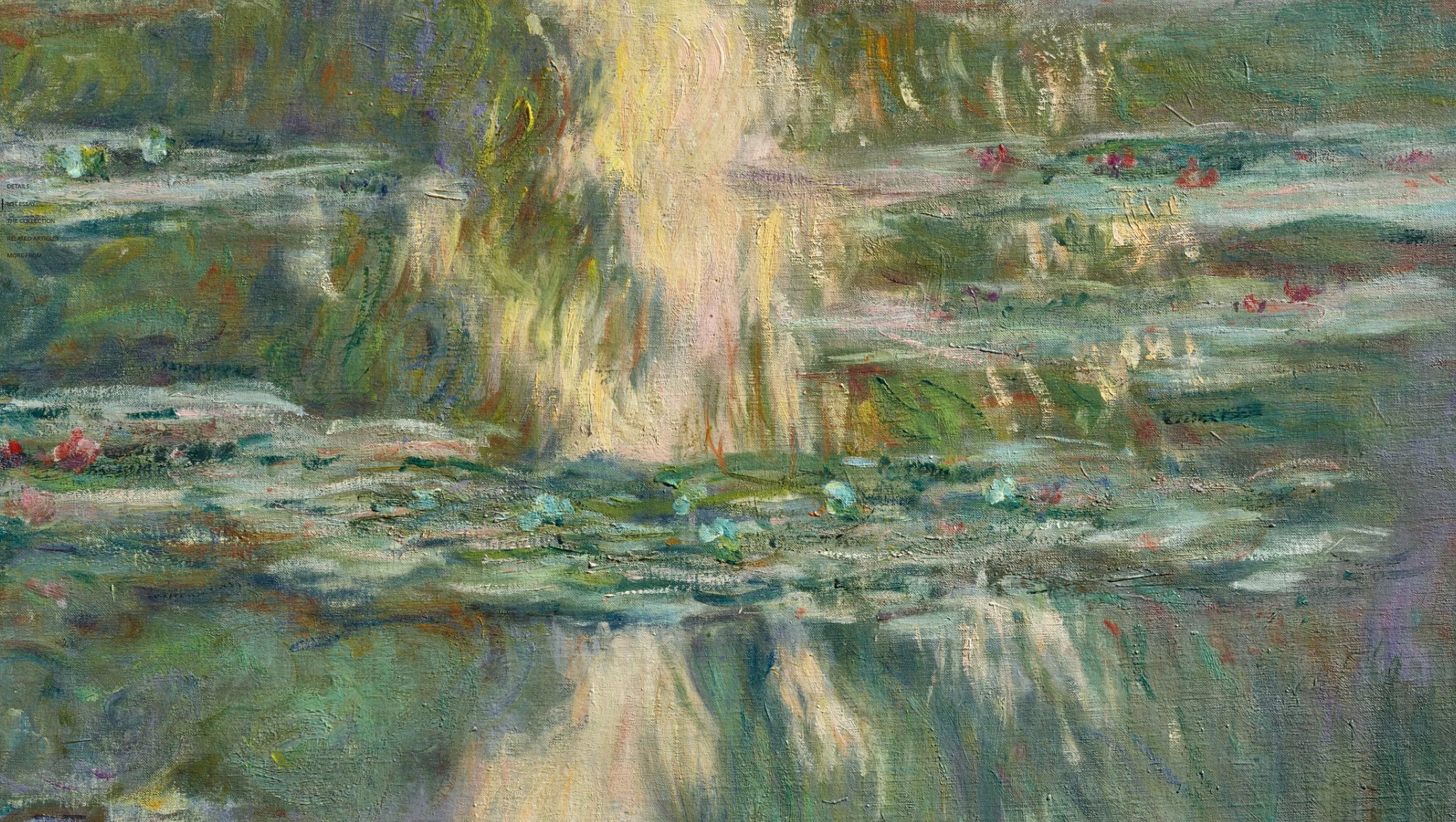
Shortly thereafter, Monet decided the pond needed to be extended, which would allow him to attain a larger surface with greater and more varied visual effects. There was no more space in his land as it stood, so the artist set about purchasing part of a meadow on the other side of the Ru. Altering the course of this tributary, Monet was able to triple the size of the pond. From this point on, the reflections of the surface of the water intersected by the tranquil floating blooms became the predominant focus of his waterlily paintings. Monet gradually removed references to the surrounding landscape, eliminating the banks along the edge of the pool, the horizon line, and other stable pictorial elements, to focus solely on transient light effects, the shimmering water, and ephemeral reflections of the constantly changing skies above.
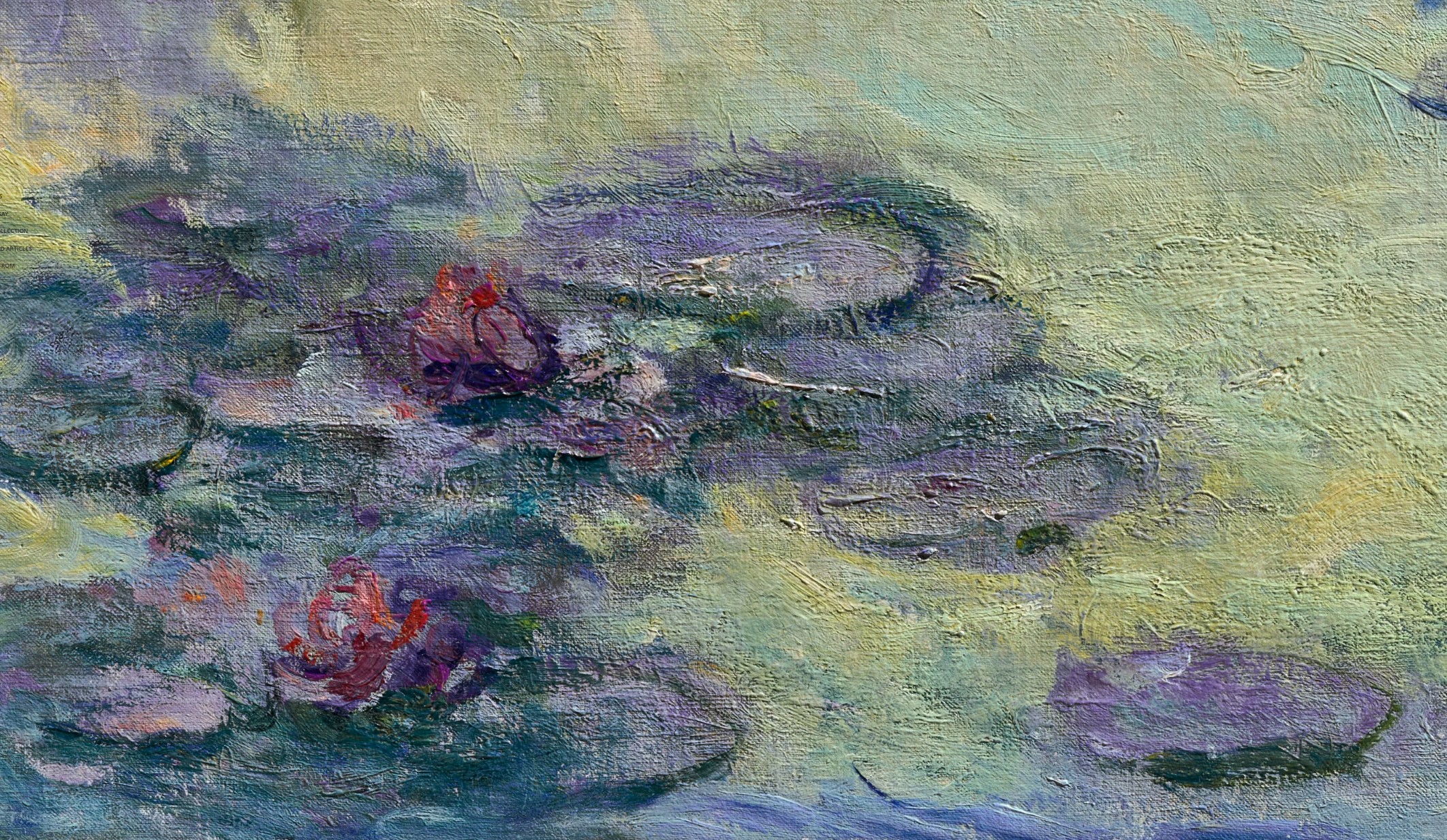
“I have painted so many of these waterlilies, always shifting my vantage point, changing the motif according to the seasons of the year and then according to the different effects of light the seasons create as they change. And, of course, the effect does change, constantly, not only from one season to another, but from one minute to the next as well, for the water flowers are far from being the whole spectacle; indeed, they are only its accompaniment. The basic element of the motif is the mirror of water, whose appearance changes at every instant because of the way bits of the sky are reflected in it, giving it life and movement. The passing cloud, the fresh breeze, the threat or arrival of a rainstorm, the sudden fierce gust of wind, the fading or suddenly refulgent light—all these things, unnoticed by the untutored eye, create changes in color and alter the surface of the water. It can be smooth, unruffled, and then, suddenly, there will be a ripple, a movement that breaks up into almost imperceptible wavelets or seems to crease the surface slowly, making it look like a wide piece of watered silk. The same for the colors, for the changes of light and shade, the reflections.”
From 1905 onwards, Monet worked with a furious passion on this subject, producing more than sixty views of the waterlily pond, concentrating his focus on the surface of the water. He painted the present Nymphéas in 1907, at a time which he uncharacteristically proclaimed he was “full of fire and confidence.” Between April and September, he was so absorbed in his work that he wrote only six letters—a rare occurrence in the usually prolific correspondence that the artist maintained. “Here all goes well,” he finally reported to Durand-Ruel in the early autumn of that year. “I have worked, and I am still working, with passion” (quoted in D. Wildenstein, Monet or the Triumph of Impressionism, Cologne, 1999, p. 379). Pleased with his progress, he invited the dealer to come and see the latest paintings at Giverny. “They are still a sort of groping research,” he claimed, “but I think that they are among my best efforts” (ibid., p. 379).
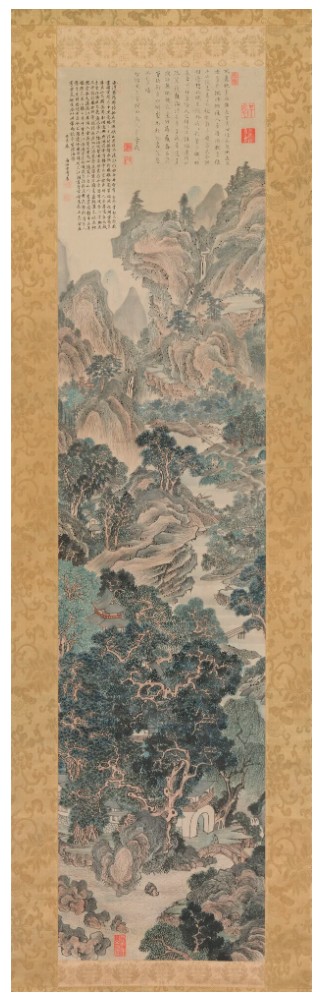
Yanagisawa Kien, Landscape in the Blue-and-Green Manner, first half of the 18th century. The Metropolitan Museum of Art, New York.
During this burst of creativity, Monet used an elongated, vertical format of canvas that was relatively unusual within his oeuvre. Each measuring roughly three feet in height, the fifteen paintings within this group appear to have drawn inspiration from Japanese hanging scrolls and decorative screens, examples of which Monet would have been deeply familiar with at this time. Long fascinated by Japanese art, he was an avid collector of ukiyo-e prints, their bold, colorful compositions filling the walls of the small salon and dining room, as well as lining the stairwells, of his home in Giverny.
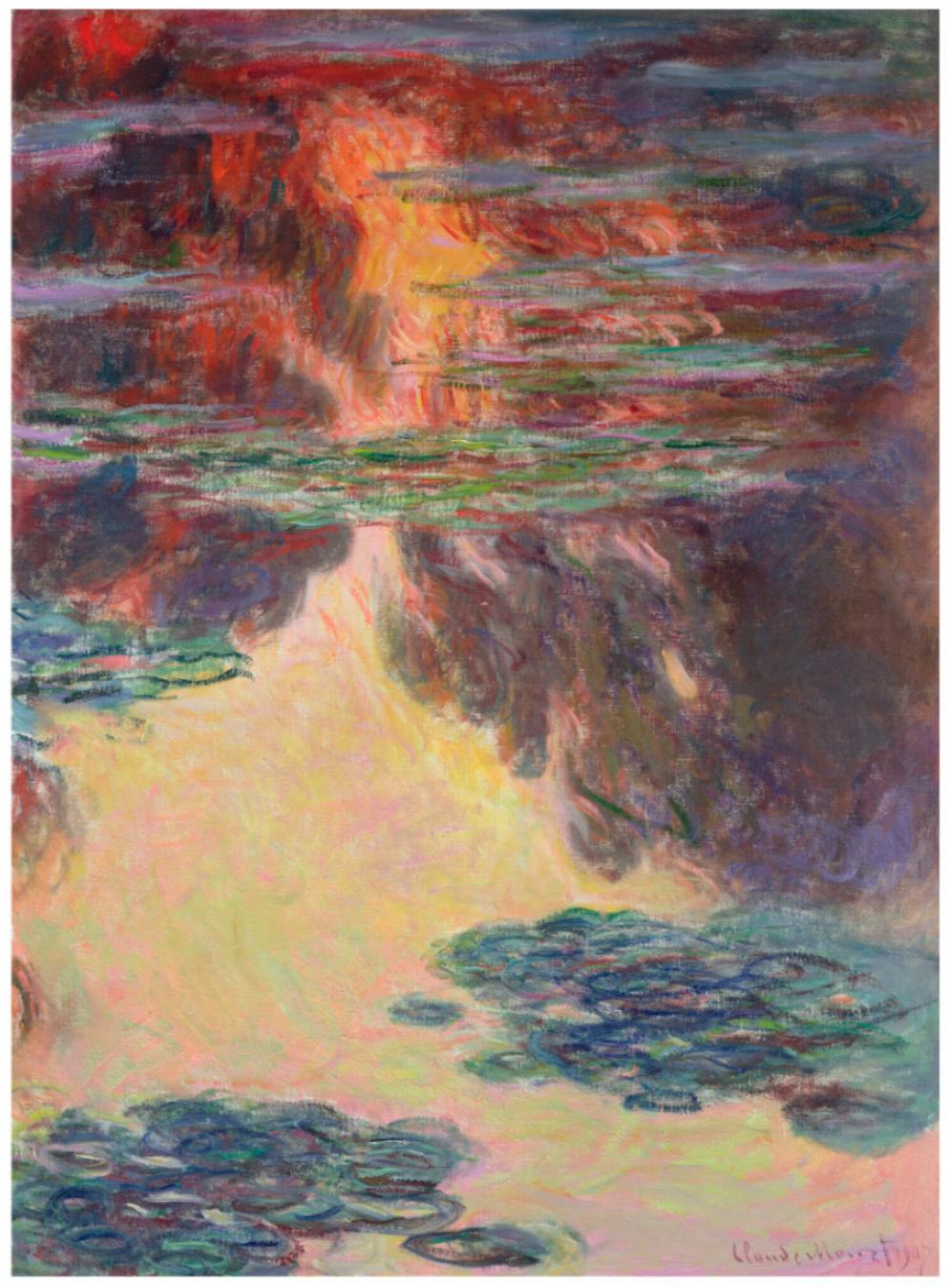
Claude Monet, Nymphéas, 1907. Musée Marmottan Monet, Paris. Photo: Bridgeman Images.
Monet regularly sought out particular prints by his favorite artists, and visited and corresponded with specialist dealers in Paris in his hunt for treasures. The growing taste for Asian art in France during the second half of the nineteenth century ensured that a vast array of Japanese objets d’art—including hanging scrolls, known as kakemono, folding screens, hand scrolls (makimono), ceramics and lacquerware—were readily available for connoisseurs and enthusiasts to peruse in the galleries, museums and collections around Paris. For Monet, these sources opened his imagination up to a different way of perceiving and interpreting nature, bringing the transient, ephemeral aspects of the natural world to the fore.
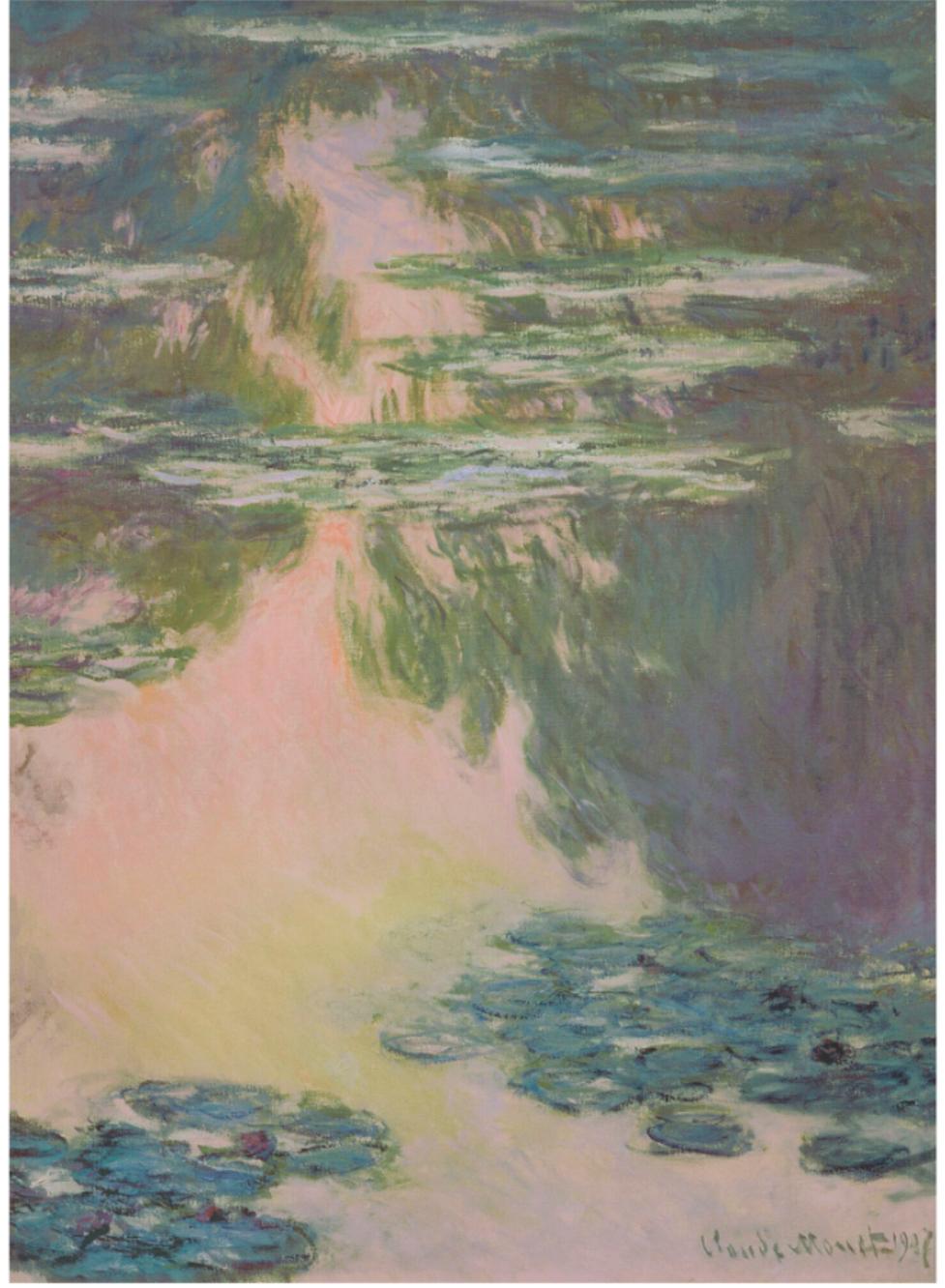
Claude Monet, Nymphéas, 1907. Artizon Museum, Ishibashi Foundation, Tokyo. Photo: © Peter Willi / Bridgeman Images.
Each of the 1907 paintings take a close-up view of the waterlily pond, looking down on the surface from above, allowing the water and the delicate aquatic plants to fill the canvas entirely. The principle focus of these works is the channel of light that runs down the middle of the composition, recording the reflection of the constantly shifting sky seen through the willows at the western edge of the pond. In some paintings from the group, the water is alight with the fiery red hues of sunset, while in others, the diffused light of an overcast grey day casts the scene in a cool palette of lavenders.
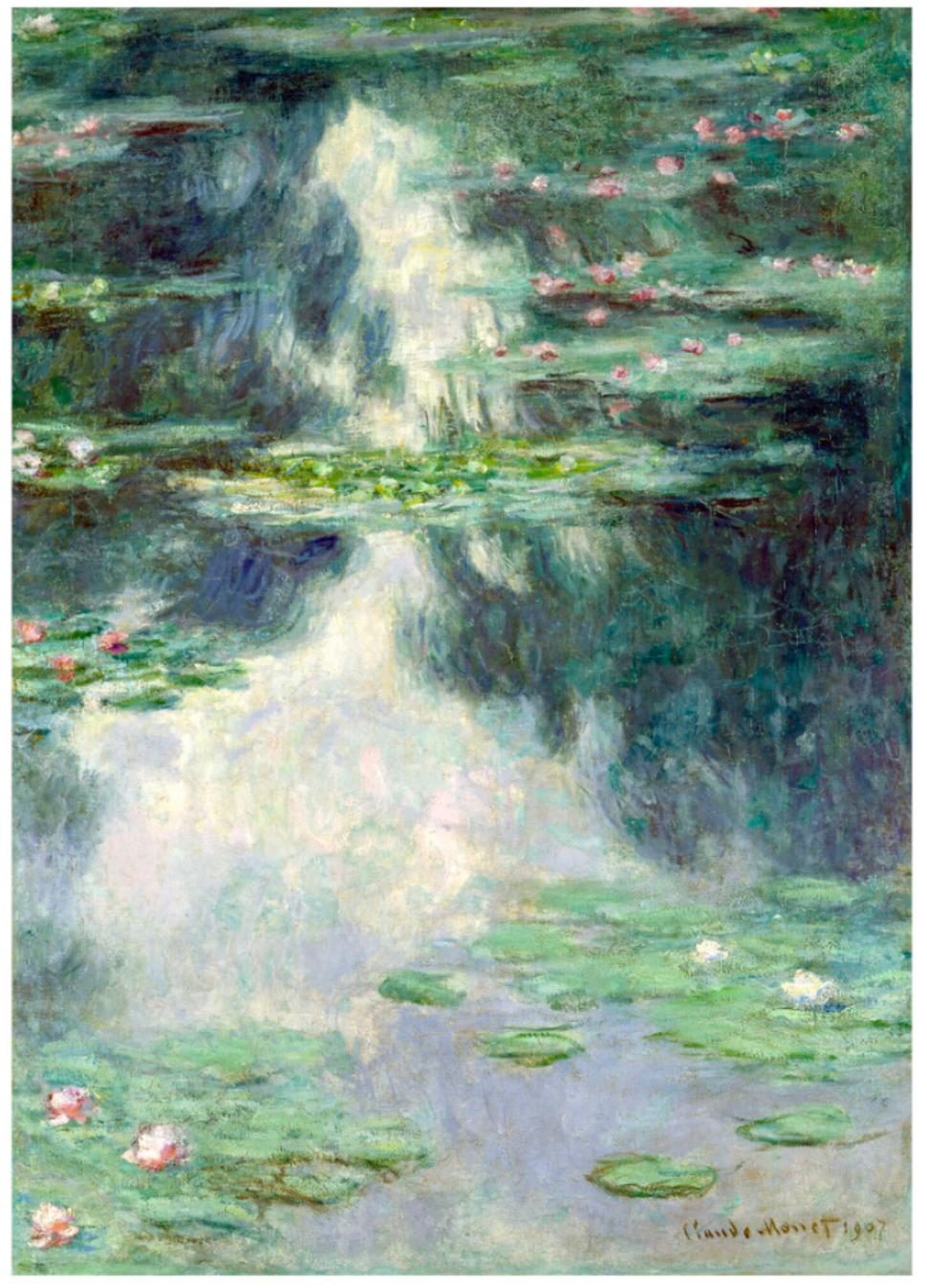
Claude Monet, Nymphéas, 1907. The Israel Museum, Jerusalem.
In the present Nymphéas, Monet deployed a variety of painterly techniques to masterfully capture both the reflections of light on the surface of the pond, and the changing hues within its depths, filling the canvas with an abundance of color in the process. For example, the waterlilies gain a distinct sculptural presence through the build-up of pigment and rich impasto, affirming their position on the top of the pond, while around them, layers of lustrous pigment are laid on top of one another to suggest the refractions of light and the shifting tones of the water. The vertical streak of light that runs from the top to the lower edge of the canvas in a sinuous, meandering path creates a striking contrast with the dramatic dark greens and blues of the surrounding foliage and its reflections. This stream of light—delineated in softly gradated hues of golden yellow, pink, lilac, and light blue—distorts any sense of conventional pictorial perspective, creating a complex confluence of sky and water within the image.
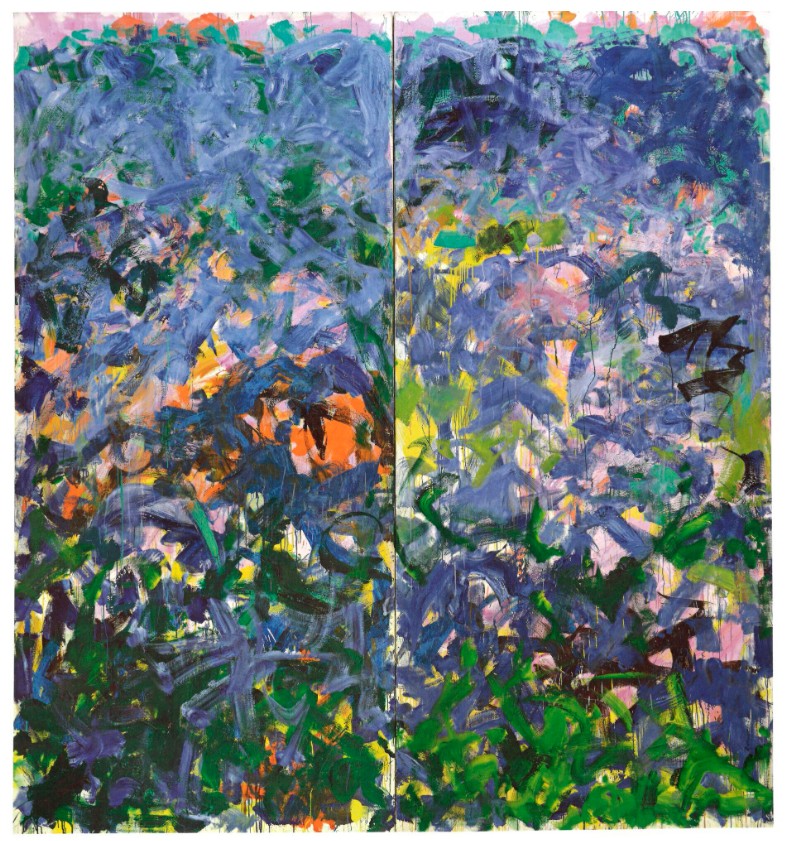
Joan Mitchell, La Grande Vallée XVII, Carl, 1984. Le Frac Provence-Alpes-Côte d’Azur. © Estate of Joan Mitchell.
In May 1909, Monet’s long-awaited exhibition, Les Nymphéas: Séries de paysages d’eau, opened in Paris. While the title appears to have been an homage by the artist to Gustave Courbet’s earlier Paysages de mer paintings, the exhibition served as a powerful showcase for not only the range and dynamism of the waterlily series, but also the continued inventiveness of Monet’s painterly style during the opening decade of the new century. The exhibition featured forty-eight canvases, the largest number of which dated to 1907 and included the present Nymphéas, a clear reflection of the standing with which the artist himself considered these paintings. This was the first time the public had the opportunity to see Monet’s most recent work in five years, and the show was met with rapturous acclaim.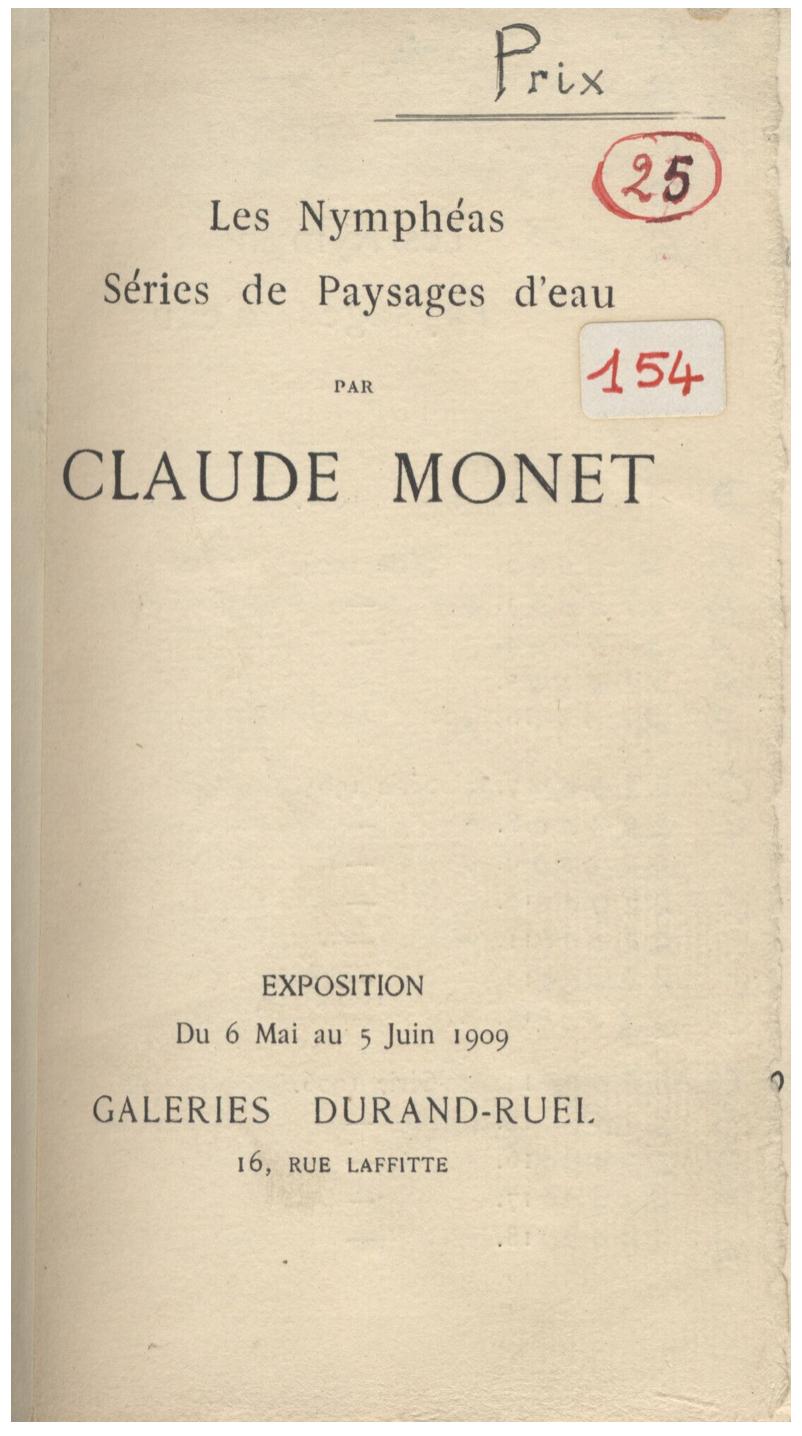
Cover of Les Nymphéas: Séries de paysages d’eau par Claude Monet, Galeries Durand-Ruel, Paris, 1909.
For example, a critic for The Burlington Magazine wrote, “One has never seen anything like it. These studies of waterlilies and still water in every possible effect of light and at every hour of the day are beautiful to a degree which one can hardly express without seeming to exaggerate… There is no other living artist who could have given us these marvelous effects of light and shadow, this glorious feast of color” (quoted in P.H. Tucker, op. cit., 1995, p. 196). Many praised Monet’s ability to continually push the boundaries of his own art, taking his depiction of the landscape to new heights in these works and attaining a level of abstraction that was entirely novel. Writing in the Gazette des Beaux-Arts, Roger Marx famously stated, “No more earth, no more sky, no limits now… Here the painter deliberately broke away from the teachings of Western tradition by not seeing pyramidal lines or a single point of focus. The nature of what is fixed, immutable, appears to him to contradict the very essence of fluidity… Through the incense of soft vapors, under a light veil or silvery mist, ‘the indecisive meets the precise.’ Certainty becomes conjecture and the enigma of the mystery opens the mind to the world of illusion and the infinity of dreams” (quoted in exh. cat., op. cit., 1998, p. 50).
#11. Nymphéas, 1905
Christie’s New-York: 7 November 2012
Estimated: USD 30,000,000 – 50,000,000
USD 43,762,500
Claude Monet (1840-1926) , Nymphéas | Christie’s
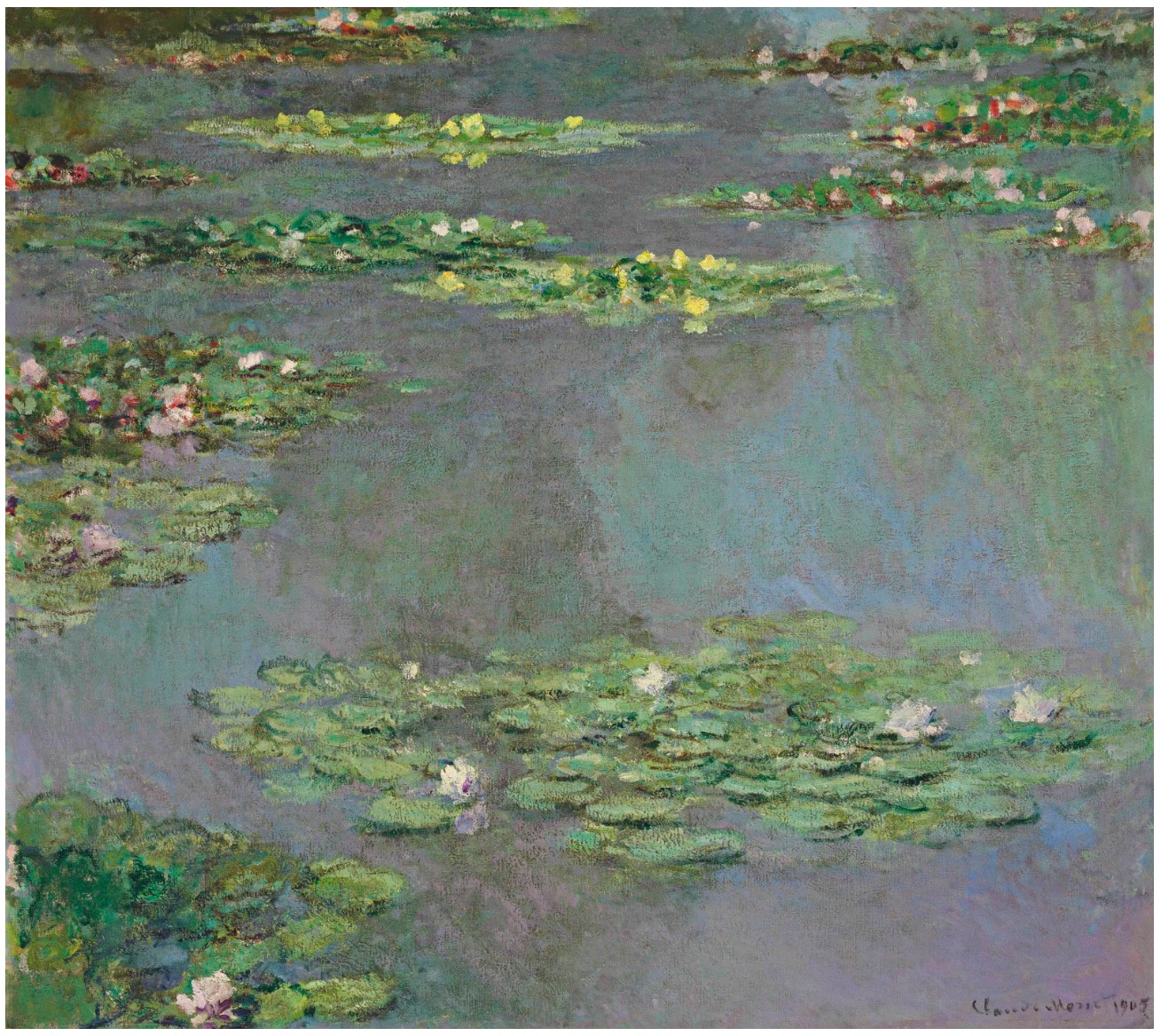
Claude Monet (1840-1926)
Nymphéas, 1905
Oil on canvas
88.3 x 99.5 cm (34 3/4 x 38 3/4 inches)
Signed and dated ‘Claude Monet 1905’ (lower right)
Having established the basic compositional scheme for his water-lily series, Monet began to work feverishly, completing more than sixty views of the pond between 1905 and 1908, or about one every three weeks. The present painting dates to the beginning of this enormously fertile period. He repeatedly postponed the opening of the Nymphéas exhibition at Durand-Ruel, “full of fire and confidence” (as he told the frustrated dealer) and determined to keep working (quoted in P. Tucker, op. cit., 1998, p. 47). Within the limitations that he had set for himself, Monet devised a dazzling array of variations, altering the arrangement of the blossoms, increasing or reducing the amount of reflected material, and exploring a wide range of lighting effects. The present painting, for example, is part of an important subset of canvases from 1905-1907, which are characterized by large, horizontally striated islands of lilies, juxtaposed with undulating, vertical reflections of trees and sky. Conventional spatial recession, indicated by the diminishing scale of the blossoms and lily pads, is played against the flat surface of the canvas, which is emphasized by vigorous, textural brushwork. The flowers themselves are rendered with the most impasto to give them a sculptural presence, affirming their position on the top of the pond, while in the watery areas, thin layers of color are laid one on top of another to suggest the refractions of light and the changing hues in the pond’s depths. The paintings from 1907-1908, in contrast, largely focus on the effect of a central stream of light that slices through floating clusters of lilies and dense eddies of reflected foliage.
USD 40 million
#12. Nymphéas, temps gris, 1907
Christie’s London: 28 June 2022
Estimated: GBP 20,000,000 – 30,000,000
GBP 30,059,500 / USD 36,872,190
CLAUDE MONET (1840-1926), Nymphéas, temps gris | Christie’s
CLAUDE MONET (1840-1926)
Nymphéas, temps gris, 1907
Oil on canvas
100.2 x 73.2 cm (39 1/2 x 28 3/4 inches)
Signed and dated ‘Claude Monet 1907’ (lower right)
Claude Monet’s depictions of the horticultural oasis that he designed and cultivated in Giverny are among the greatest works of his career. Nymphéas, temps gris is one of a small series that Monet painted in a moment of intense creativity in 1907. Here, Monet has employed a rare vertical format to capture the spectacular effects of late afternoon light upon his beloved waterlily pond. Flanked by swirling eddies of vegetation and dramatic reflections, a long stream of light streaks through the height of the canvas, overlaid in places by clusters of lily pads. Using a variety of painterly techniques – gestural brushstrokes, rich impasto for the flowers, and myriad layers of colour in the watery areas – with this vertical canvas, Monet has masterfully captured both the reflections of light on the surface of the pond, and the changing hues in its depths. As a result, this canvas is filled with a majestic visual drama that sets this series apart from others of the same period.
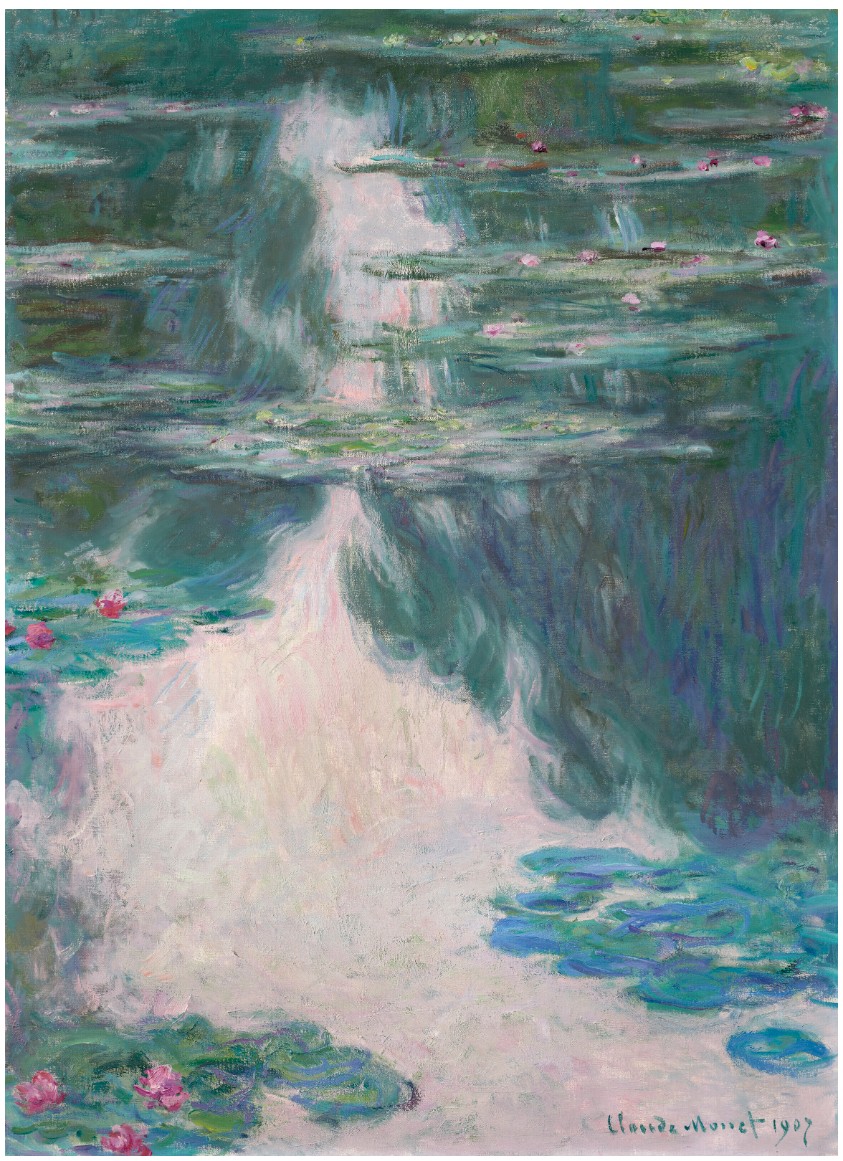
Of this rare series of fifteen vertical Nymphéas of 1907, eight are now held in museum collections including the Museum of Fine Arts, Houston, and the Artizon Museum, Tokyo (Wildenstein, nos. 1703-1717). Included in Monet’s celebrated Nymphéas exhibition held at the Galerie Durand-Ruel, Paris in 1909 – the first time he showed solely the water lily paintings – this work has a distinguished provenance. It was initially acquired by the Parisian pharmaceutical magnate and devoted Monet collector, Henri Canonne, who amassed an extensive collection of the artist’s work, particularly focused on his Nymphéas.
#13. NYMPHÉAS, 1904
Sotheby’s London: 19 June 2007
Estimated: GBP 10,000,000 – 15,000,000
GBP 18,500,122 / USD 36,753,480
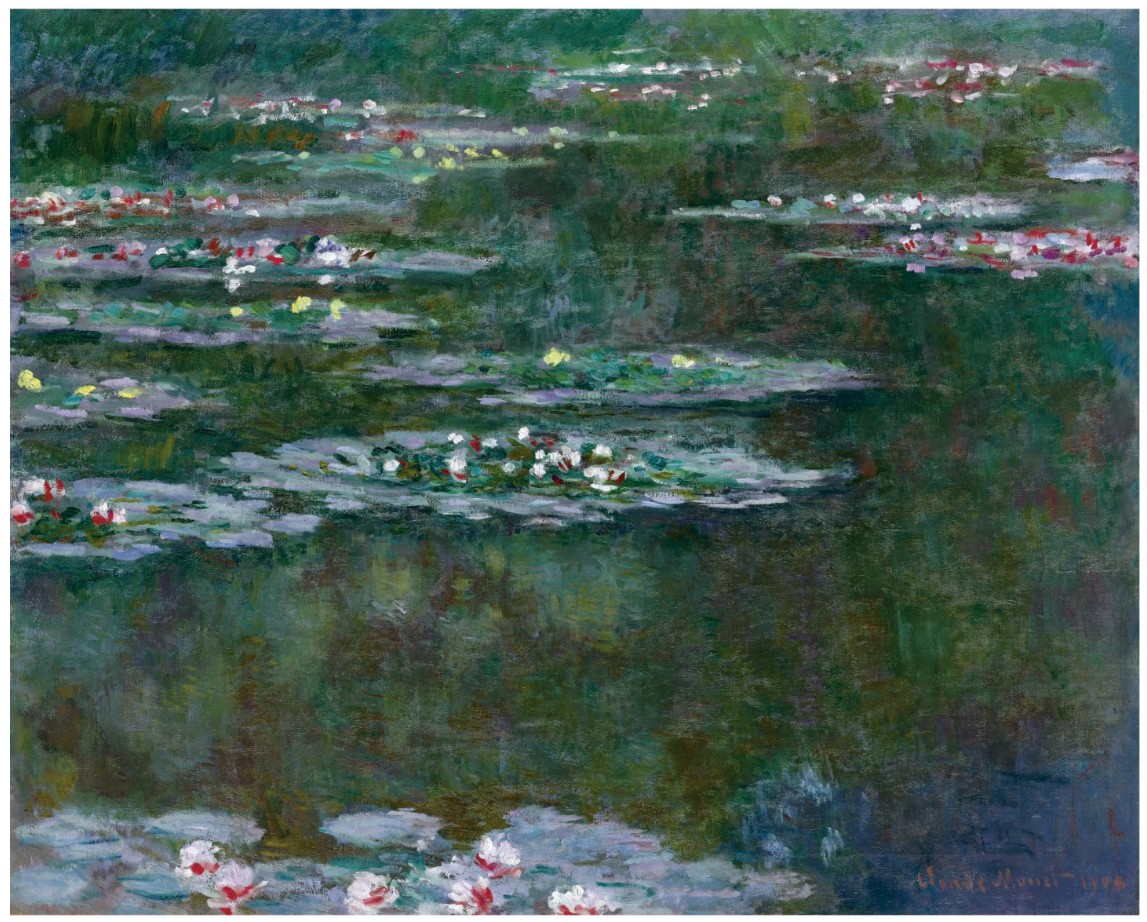
CLAUDE MONET
NYMPHÉAS, 1904
Oil on canvas
81×100 cm (31 7/8 x 39 3/8 inches)
Signed Claude Monet and dated 1904 (lower right)
In the present work, Monet’s primary interest is in depicting the effects of light on the surface of the pond and on the waterlilies themselves and the play of shadows and modulations of light that the weather creates. Moving towards an increasingly abstract treatment of space, Monet focused almost entirely on the water surface. He reduced the horizon to a small patch of blue pigment in the upper left corner of the composition, thus minimizing the illusion of depth and perspective. The sky and the trees, placed outside the scope of the canvas, are present through their reflection in the water. The surface of the canvas thus becomes a two-dimensional pattern, acquiring a spatial continuity in which all parts of the composition are treated with equal importance. The elimination of the horizon line led Monet towards a transition from the horizontal format to the square canvases, that he started using in the year the present work was executed.
#14. Nymphéas, 1908
Sotheby’s New-York: 4 November 2015
Estimated: USD 30,000,000 – 50,000,000
USD 33,850,000
CLAUDE MONET
Nymphéas, 1908
Oil on canvas
100 x 81.3 cm (39 3/8 x 32 inches)
Signed Claude Monet (lower right)
Claude Monet’s Nymphéas are among the most iconic and celebrated Impressionist paintings. The profound impact these pictures have made on the evolution of Modern Art marks this series as Monet’s greatest achievement. The famous lily pond in his garden at Giverny provided the subject matter for most of his major late works. These spectacular canvases document the changes in his style and his constant pictorial innovations as he continued to paint this theme until his death in 1926. The present work dates from circa 1908 when he painted what are arguably the finest and most technically sophisticated examples from the series. The canvas here is an extraordinary example of the artist’s virtuosity as a colorist. The surface texture is rich with detail, particularly in the passages where the blossoms float atop the water. This distinction between reflection and surface, water and flora, and the general clarity of the scene are particularly striking in Monet’s canvas here, and evidence its distinction as one of the most technically sophisticated of the entire series. The spectacular field of color presented by Nymphéas is created to elicit an instinctive emotional response rather than to record a particular location, temporal conditions or natural phenomena. Over the course of several years, Monet experimented with different approaches and painting techniques. The paintings from 1905 were thickly painted with a dense surface and horizontally oriented, while those from 1906 interplay between rich impastoed areas with finer washes. In 1907 Monet positioned his canvases vertically and experimented with longer brushstrokes.
#15. Le bassin aux nymphéas, 1917-1919
Christie’s New-York: 12 November 2018
Estimated: USD 30,000,000 – 50,000,000
USD 31,812,500
Claude Monet (1840-1926), Le bassin aux nymphéas | Christie’s
CLAUDE MONET (1840-1926)
Le bassin aux nymphéas, 1917-1919
Oil on canvas
100.7 x 200.8 cm (39 3/4 x 79 inches)
Stamped with signature ‘Claude Monet’ (Lugt 1819b; lower left)
Stamped again with signature ‘Claude Monet’ (Lugt 1819b; on the reverse)
In mid-1918, when Monet likely began the present Le bassin aux nymphéas, the outcome of the First World War hung precariously in the balance after four years of devastating, all-out combat. This exquisitely delicate, contemplative rendering of his celebrated water-lily pond at rural Giverny—of the mysterious and elusive beauty that he found in his own garden—seems at first glance entirely removed from the catastrophic events of the day. Yet Monet himself saw his Nymphéas, with their compelling mixture of poetry and urgency, as deeply interwoven with the collective efforts of the nation. “I am on the verge of finishing two decorative panels that I want to sign on the day of the Victory and I am going to ask you to offer them to the State,” he wrote to Prime Minister Clemenceau on 12 November 1918, the day after the Armistice. “It’s not much, but it is the only way I have of taking part in the victory” (quoted in ibid, 1998, p. 77). The present Bassin aux nymphéas enters the story at this important juncture. On 30 April 1918, perhaps prompted by conversations with his visitors and by the result of strides he had made on his project, Monet ordered a large quantity of pre-stretched canvases measuring 1 meter high by 2 meters wide—the same elongated, horizontal format as the Grandes décorations, at roughly half the scale. As soon as they were delivered, he set up his easel at the pond’s edge and began work on a new and compositionally unified group of Nymphéas, with lily pads clustered towards the lateral edges of the canvas and a stream of sunlight in the center. He would eventually complete fourteen paintings in this format, including the present canvas, plus an additional five on a slightly different scale (1.3 x 2 meters; the full sequence is Wildenstein, nos. 1883-1901, three of which have been cut in two). One of the 1 x 2 meter paintings (no. 1886) is dated ‘1917’ in Monet’s hand, suggesting that the artist may have initiated the sequence in that year; Tucker has proposed that the 1.3 x 2 meter canvases are the earliest in the group, and that Monet appended the earlier date to no. 1886 after its completion to signal the conception of the group as a whole (ibid, p. 218).
These paintings are all structured around three irregularly shaped areas of light and shadow, created by a single vertical band of reflected sky that pushes through darker sections of mirrored foliage spreading out horizontally on either side. The central cascade of light—a motif that Monet had first developed in a group of Nymphéas he completed during 1907—descends from the top of the scene, wending its way between competing reflections and lily pads before spilling out into a broad pool. In some canvases, Monet used strongly contrasting hues and sweeping, graphic brushwork to stake out the constituent parts of the image; in others, including the present Bassin aux nymphéas, he unified the ensemble through diaphanous veils of color laid down with a lighter, more transparent touch, emphasizing the spatial breadth of the composition. “In contrast to the earlier 1907 pictures,” Tucker has written, “the newer canvases have a physical and emotional expansiveness that allow them to breathe in a bolder, fuller fashion” (exh. cat., op. cit., 1998, p. 74).
#16. Nymphéas, 1914-17
Sotheby’s London: 2 March 2022
Estimated: GBP 15,000,000 – 20,000,000
GBP 23,228,500 / USD 30,963,530
Nymphéas | Modern & Contemporary Evening Auction | 2022 | Sotheby’s
CLAUDE MONET (1840 – 1926)
Nymphéas, 1914-17
Oil on canvas
130.5 x 100 cm (51 3/8 x 39 3/8 inches)
Stamped Claude Monet (lower left)
Stamped Claude Monet on the reverse and again on the stretcher
The theme of waterlilies—which became not only Monet’s most celebrated series of paintings, but one of the most iconic images of the Impressionist movement—dominated the artist’s work over several decades, recording the changes in his style and his constant pictorial innovations. The present large-scale oil, dates from the last great period of these experiments as the artist moved further and further towards the realm of abstraction. The present work belongs to the group of Nymphéas that Monet painted during the First World War as he worked towards his Grandes Décorations, a sequence of monumental paintings of the gardens that would take his depictions of the waterlily pond in dramatic new directions. The artist envisaged an environment in which the viewer would be completely surrounded by the paintings. He wrote: ‘The temptation came to me to use this water-lily theme for the decoration of a drawing room: carried along the length of the walls, enveloping the entire interior with its unity, it would produce the illusion of an endless whole, of a watery surface with no horizon and no shore; nerves exhausted by work would relax there, following the restful example of those still waters […] a refuge of peaceful meditation in the middle of a flowering aquarium’ (quoted in Claude Roger-Marx, ‘Les Nymphéas de Monet’, Le Cri de Paris, Paris, 23rd May 1909). Rendered in vivid blues, purples and greens, the present work is one of only a small number of canvases from 1914-17 to be painted in the vertical format, an arrangement that the artist would continue to explore as the decade wore on, particularly in Coin du basin aux nymphéas (fig. 4). Indeed there is a connection with that slightly later group of paintings which show a small corner of the pond with the rich foliage of the garden behind. In the present work, Monet depicts not only the waterlilies floating on the surface of the water but the hanging branches of a willow reflected in that surface. This creates an extraordinary effect; with the tree necessarily depicted upside down, orientation is redundant, so too is depth. The lilies are painted over the willow, but the richly textured use of paint and gestural brushstrokes merge them together as Monet moves increasingly away from a sense of subject into an exploration of pure color and form.
USD 30 million
#17. Nymphéas, circa 1897-1899
Christie’s Hong-Kong: 26 September 2024
Estimated: HKD 200,000,000 – 280,000,000
HKD 233,375,000 / USD 29,973,518
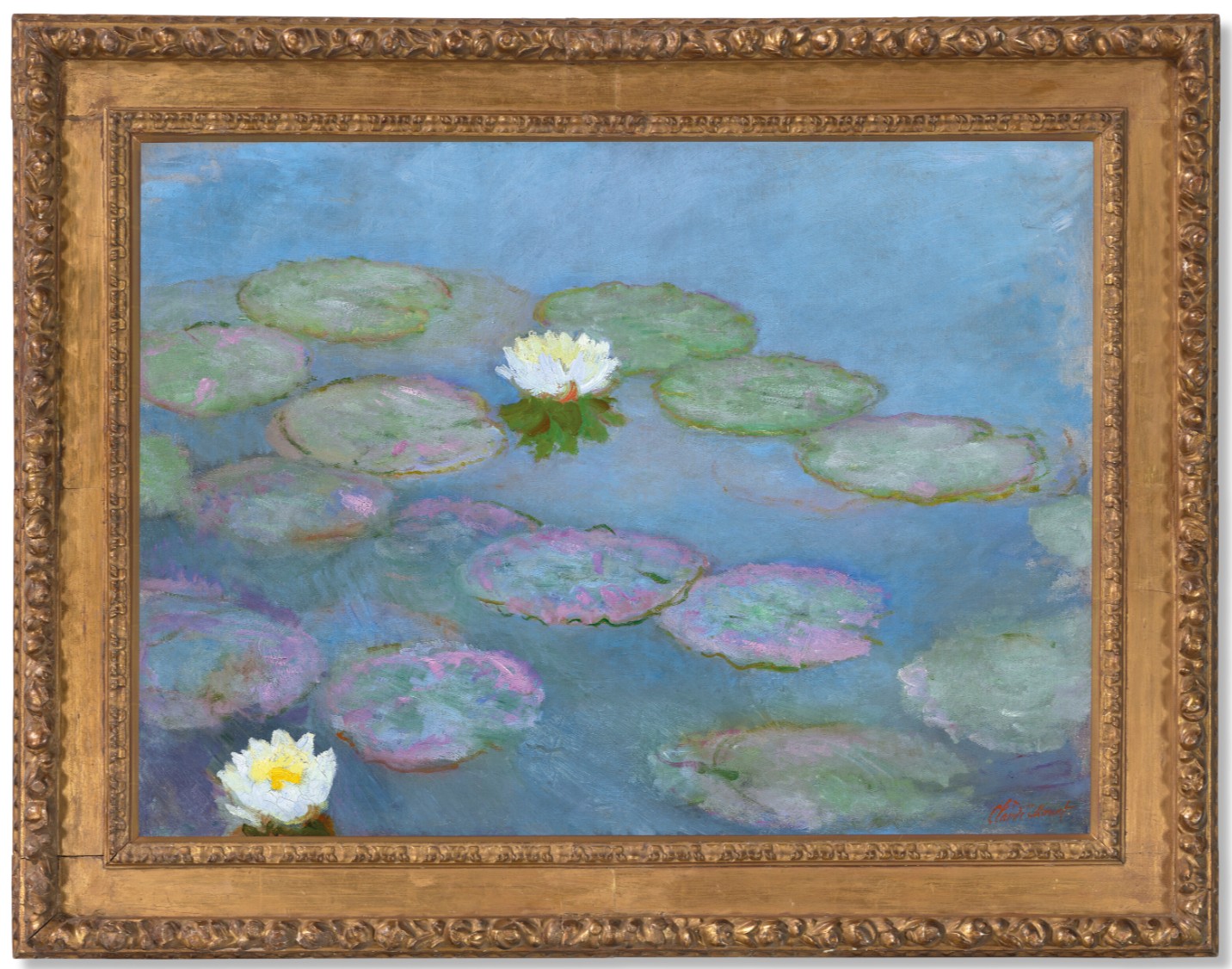
CLAUDE MONET (1840 – 1926)
Nymphéas, circa 1897-1899
Oil on canvas
73.3 x 101 cm (28 7/8 x 39 3/4 inches)
Stamped with signature ‘Claude Monet’ (Lugt 1819b; lower right)
Stamped again with signature ‘Claude Monet’ (Lugt 1819b; on the reverse)
“I have always loved sky and water, leaves and flowers.
I found them in abundance in my little pool.”
Immersing the viewer in a shimmering aquatic world, Nymphéas occupies a pivotal position in the life and art of Claude Monet. Painted circa 1897-1899, this canvas is one of the earliest works to take as its subject the artist’s beloved water-lily pond at his home in Giverny. From this time onwards, this motif would dominate Monet’s art, serving as the inspiration for over two hundred canvases that he created until the end of his life. One of a small and rare series of just eight paintings, Nymphéas presents the defining artistic preoccupations of these iconic works—the complex, constantly shifting relationships between water, atmosphere and light that transformed the pond’s surface with each passing moment, providing endless creative inspiration (Wildenstein, nos. 1501-1508). Four of the eight water-lily paintings from 1897-1899 are housed in museums today, including the Musée Marmottan Monet, Paris, Los Angeles County Museum of Art, Kagoshima City Museum of Art and the Galleria Nazionale d’Arte Moderna, Rome.
These inaugural Nymphéas also stand at the dawn of Monet’s investigations in the creation of a bold and ambitious ensemble of decorative paintings on the theme of the lily pond—a project that would ultimately come to fruition in the last years of his life with the mural-sized Grandes décorations. When the journalist Maurice Guillemot visited the artist in Giverny in August 1897, Monet granted him a rare tour of his water-lily pond, which he described as “an immobile mirror [on which] float water lilies, aquatic plants, unique species with broad spreading leaves and disquieting flowers of a strange exoticism.” “These are the models for a decoration,” Guillemot continued, “for which Monet has already begun to paint…large panels, which he showed me afterwards in his studio” (quoted in “Claude Monet,” La Revue illustrée, 15 March 1898, quoted in Monet in the Twentieth Century, exh. cat., Museum of Fine Arts, Boston, 1998, p. 19). Monet then laid out for Guillemot his vision of an enclosed space lined with paintings that would transport the viewer into the realm of aesthetic reverie.
“Imagine a circular room in which the dado beneath the moulding is covered with [paintings of] water, dotted with these plants to the very horizon, walls of transparency alternately green and mauve, the calm and silence of the still waters reflecting the opened blossoms. The tones are vague, deliciously nuanced with a dreamlike delicacy”
The present Nymphéas may well have been one of the canvases that Guillemot admired in Monet’s studio in 1897, with which he was beginning to stake out this new and revolutionary pictorial territory.
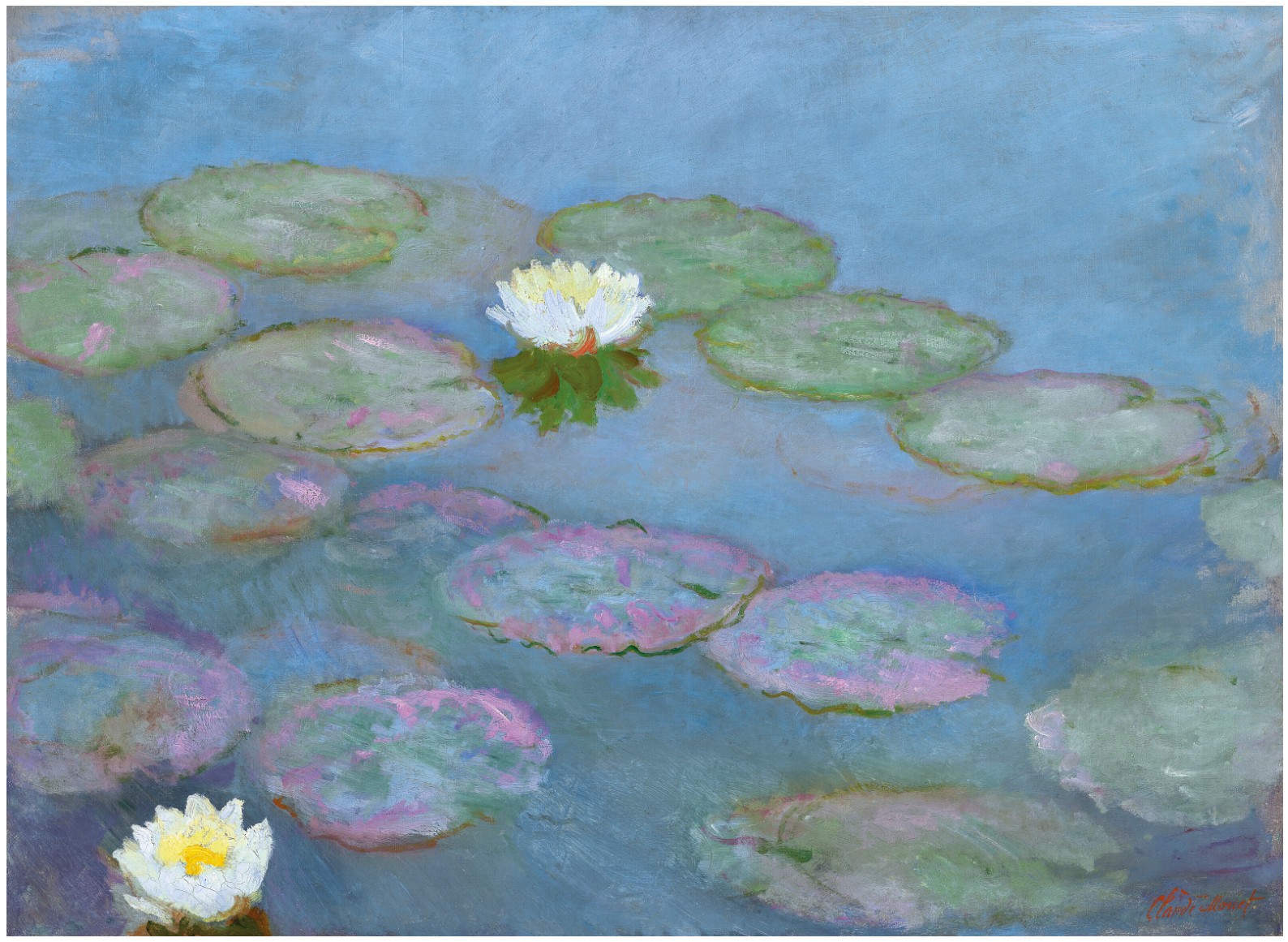
Nymphéas and the seven other paintings from this inaugural campaign are varied in format, size, colour and handling as Monet revelled in the myriad pictorial potentials of this novel motif. The present work has the most unified and subtle palette of the group, the still, silent plane of the water and the lily pads rendered in a harmonious range of iridescent blues, delicate violet and indigos, and the deeper greens and turquoises of the plants, with the two luminous white blossoms standing out in vivid counterpoint. While each of these works takes as its subject a closely cropped segment of the pond, the range of compositions preempts the endless formal experimentations that this motif inspired in Monet over the following decades. In addition, the present work introduces one of the most important and radical aspects of Monet’s Nymphéas—the elimination of a perspectival viewpoint. His tightly focused scene plunges the viewer into the center of the pond, removing all other peripheral detail to focus entirely on the harmonious world of color, light and the reflections that move, in this case, imperceptibly across the inky water’s surface.
#18. Nymphéas, 1908
Sotheby’s London: 19 June 2019
Estimated: GBP 25,000,000 – 35,000,000
GBP 23,731,625 / USD 29,876,465
CLAUDE MONET
Nymphéas, 1908
Oil on canvas
92×89 cm (36 1/4 x 35 inches)
Signed Claude Monet and dated 1908 (lower right)
The beauty and purity of the waterlilies are indeed abundantly evident in the present work, an extraordinary example of the artist’s virtuosity as a colourist. The surface texture is rich with detail, particularly in the passages where the blossoms float atop the water. The distinction between reflection and surface, water and flora, and the general clarity of the scene are particularly striking in this composition. Here, Monet’s primary interest is in depicting the effects of light on the surface of the pond and on the waterlilies themselves and the play of shadows and modulations of light that the weather creates. Writing about the group of canvases that includes the present work, Daniel Wildenstein observed: ‘The Nymphéas dated 1908 are characterized by a stream of light which descends towards the right, curving round a large pad of water-lilies in the foreground’ (D. Wildenstein, op. cit., 1996, p. 793). While in some of the related compositions the light is intercepted by a lily pad in the foreground, in the present example it meanders all the way to the bottom of the canvas, describing an S-shape curve around the waterlily pads across the composition. Moving towards an increasingly abstract treatment of space, here Monet focused entirely on the water surface, eliminating the horizon line and thus minimizing the illusion of depth and perspective. The sky, placed outside the scope of the canvas, is present only through its reflection in the water. The surface of the canvas thus becomes a two-dimensional pattern, acquiring a spatial continuity in which all parts of the composition are treated with equal importance. The elimination of the horizon line led Monet towards a transition from the horizontal format to the square canvases, that he started using in his waterlily compositions of 1904.
#19. Le bassin aux nymphéas, 1919
Christie’s New-York: 12 May 2016
Estimated: USD 25,000,000 – 35,000,000
USD 27,045,000
Claude Monet (1840-1926), Le bassin aux nymphéas | Christie’s
CLAUDE MONET (1840-1926)
Le bassin aux nymphéas, 1919
Oil on canvas
99.6 x 103.7 cm (39 3/8 x 40 7/8 inches)
Signed and dated ‘Claude Monet 1919’ (lower right)
Monet probably began the present Bassin aux nymphéas in mid-1918, when after nearly four years of fighting the outcome of the First World War still hung precariously in the balance; he completed and signed it the next year, after the Allies had achieved victory. Reveling in freedom and experimentation, in nuanced color harmonies and expressive brushwork, in the shifting and incalculable world of nature, the painting seems to eschew the “call to order” that gripped the avant-garde during and after the war. Yet Monet saw his Nymphéas, with their compelling mixture of poetry and urgency, as deeply interwoven with the collective efforts of the nation. “I am on the verge of finishing two decorative panels that I want to sign on the day of the Victory and I am going to ask you to offer them to the State,” he wrote to Prime Minister Clémenceau in November 1918. “It’s not much, but it is the only way I have of taking part in the victory” (quoted in ibid., p. 77).
The present Bassin aux nymphéas enters the story at this important juncture. On 30 April 1918–“prompted by conversations with his visitors,” Tucker has suggested, “by the result of strides he had made on his project”–Monet ordered a large quantity of pre-stretched canvases measuring 1 meter high by 2 meters wide (op. cit., 1998, p. 74). As soon as they were delivered, he set up his easel at the pond’s edge and began work on a new and compositionally unified group of Nymphéas, with lily pads clustered towards the lateral edges of the canvas and a stream of sunlight in the center. He would eventually complete fourteen paintings in this format, plus an additional five on a slightly different scale (1.3 x 2 meters; the full group is Wildenstein, nos. 1883-1901). At some point before 1944, one of the canvases was divided down the middle to create two separate paintings, each one meter square; the right-hand composition is the present Bassin aux nymphéas, and the left-hand pendant is housed today in the Tel Aviv Museum.
In comparison with the emphatically elongated canvases from this suite, the present painting is much more classically balanced in composition, harking back to the authoritative Nymphéas of the Durand-Ruel show. The lilies are grouped in three large clusters, one near the bottom, one near the top, and one almost centered on the square canvas. Conventional spatial recession, indicated by the diminishing scale of the floating blossoms and lily pads, is played against the flat surface of the picture, which Monet has emphasized through vigorous, textural brushwork. The horizontal islands of lilies, seen directly, contrast with the vertical reflections of foliage, seen as if in a mirror; the entangled vegetation has an undulating, striated quality, and its deep green tones, mysterious and impenetrable, form a striking backdrop for the lighter hues of the lily pads on the water’s surface. The blossoms themselves are rendered with the most impasto to give them a sculptural presence, affirming their position on the top of the pond.
Sunlight now enters the canvas at the bottom left corner of the canvas, creating a dynamic wedge of reflected blue sky that energizes the relatively stable composition. Monet had explored the effects of stream of light in a group of canvases from 1907, among the most daring and dramatic of the Nymphéas that he showed at Durand-Ruel (Wildenstein nos. 1703-1716); here, the looser, more instinctive handling only heightens this effect. “In contrast to the earlier 1907 pictures, the newer canvases have a physical and emotional expansiveness that allow them to breathe in a bolder, fuller fashion,” Tucker has written, “even though each of them depicts a greater number of plants and has a more heavily worked surface” (ibid., p. 74).
#20. Nymphéas, 1907
Christie’s New-York: 6 May 2014
Estimated: USD 25,000,000 – 35,000,000
USD 27,045,000
Claude Monet (1840-1926) , Nymphéas | Christie’s
CLAUDE MONET (1840-1926)
Nymphéas, 1907
Oil on canvas
100.1 x 81.2 cm (39 3/8 x 32 inches)
Signed ‘Claude Monet’ (lower right)
Monet was sixty-six years old when he painted this Nymphéas in 1907. He was arguably France’s most acclaimed artist. Together with Renoir and Degas, he was the last surviving member of the legendary Impressionist group, whose work–once disparaged and denounced for the challenge it posed to Salon norms–the French public had by then come to understand and venerate; the following generation of painters acknowledged their status as founding fathers of the modern movement. All of the Impressionists were represented by this time in the Musée du Luxembourg, France’s national museum for living artists; Renoir had been awarded the Légion d’Honneur, the highest honor in the nation, and Monet is said to have been offered the accolade but to have refused it. More than three decades after the First Impressionist Exhibition, Impressionism had long since lost its power to shock. The undisputed leader of the avant-garde was now Matisse, then aged thirty-eight, who scandalized the public and bewildered the critics with Nu bleu: Souvenir de Biskra at the Salon des Indépendants in March 1907. And close on Matisse’s heels, of course, was Picasso, a young man of only twenty-five, who completed his ground-breaking, proto-cubist manifesto, Les Demoiselles d’Avignon, just a few months later.
Nymphéas fragments
Nymphéas (fragment)
Christie’s London: 28 February 2019
Estimated: GBP 100l000 – 150,000
GBP 100,000 / USD 132,640
Claude Monet (1840-1926), Nymphéas (fragment) | Christie’s
CLAUDE MONET (1840-1926)
Nymphéas (fragment)
Oil on canvas
23.3 x 23.2 cm (9 1/4 x 9 1/8 inches)
A Nymphéas fragment provides a particular sense of abstraction, because it is by its own nature an abstraction: a close-up detail, random, isolated from the whole yet recognizable, evocative in and of itself. In the present fragment a single spot on the surface of the artist’s renowned lily-pond is captured in thickly applied green and blue paint; stripped of superfluous detail, it focuses completely on the aquatic foliage and the quicksilver-like water. Never was the artist’s brushstroke so free, so detached from the definition of forms, to the point that the details of the plants and their reflections disappear amidst the vigorous, gestural strokes of paint. The subtle combination of colours and textures demonstrated in this fragment provide a glimpse into the rich surroundings which inspired Monet on a daily basis, and their ability to provoke experimentation in his work. The contrast between the flowing green, swirls of ochre and thick turquoise blue add to the illusion of depth and hint at the expressive brushstrokes of future abstract painters. The areas of raw canvas and partially unfinished borders accentuate this insistence on painting as a surface covered with paint, a quality that solidifies Monet’s status as a master of modernism and the abstract gesture, decades before the emergence of Jackson Pollock and Clement Greenberg.
Nymphéas (fragment)
Christie’s New-York: 12 November 2018
Estimated: USD 150,000 – 250,000
USD 200,000
Claude Monet (1840-1926), Nymphéas (fragment) | Christie’s
CLAUDE MONET (1840-1926)
Nymphéas (fragment)
Oil on canvas
21.8 x 17.8 cm (8 5/8 x 7 inches)
The present work serves as close-up view of the lily pond at Giverny, a mixture of mossy green and sky blue punctuated with notes of deep purple and flashes of bright chartreuse that mimic dappled sunlight. In April 1883, Monet and his family moved to Giverny, situated at the confluence of the Seine and the Epte about forty miles northwest of Paris. Giverny at the time was a quiet, picturesque farming community of only 279 residents. By autumn, he converted nearly one thousand square meters of his estate into a lavish lily pond, crossed by a Japanese wooden footbridge and ringed by an artful arrangement of flowers, trees and bushes. Silent, mysterious and contemplative, the water garden took its inspiration from the east, a feature that Monet accentuated by planting bamboo, ginkgo trees and Japanese fruit trees around the pond. Although Monet created the lily pond in part to fulfill his passion for gardening, he also intended it as a source of artistic inspiration. Widely hailed as a landmark of late Impressionism, his Nymphéas paintings constitute some of the most innovative and influential works of Monet’s entire oeuvre. The focused nature of the present Nymphéas fragment allows one to examine Monet’s technique of combining contrasting shades to create the illusion of new colors—a technique inspired by advances made in the scientific fields of optics and light. In understanding how the human eye functioned, Monet was able to use this knowledge to manipulate his viewers’ perception using his palette. The contrast of gestures evident between the whirling green and flowing blue add to this illusion of depth and hint at the expressive brushstrokes of future abstract painters. The dynamic combination of colors and textures demonstrated in the present work give a window into the views of Monet’s daily setting as well as his affinity for experimentation, the quality that solidifies his status as a master of modernism.
Nymphéas (fragment)
Christie’s Paris: 23 Mars 2018
Estimated: EUR 150,000 – 250,000
EUR 463,500 / USD 572,235
Claude Monet (1840-1926), Nymphéas (fragment) | Christie’s
CLAUDE MONET (1840-1926)
Nymphéas (fragment)
Oil on canvas
22.1 x 58 cm (8 3/4 x 22 3/4 inches)
In the present work, Monet strips out the superfluous details, instead using thickly applied, green, blue and rose paint to focus completely on the quicksilver-like water itself. Never was the artist’s brushstroke so free, so detached from the definition of forms. A close-up view of the canvas provides a sense of total abstraction, because the brushstrokes are stronger than the identification of the plants or their reflections. The unfinished borders accentuate this insistence on painting as a surface covered with paint, which was a source of inspiration for artists after the Second World War, particularly American painters exploring “abstract landscapes” and “lyrical abstraction”.