Introduction
In 1967, Lichtenstein expanded the parameters of his Pop Art vernacular to come face-to-face with the illustrious history of modern art. Broadening both his scope and ambition, the celebrated Pop artist now tackled the great “isms” of the Western canon. He called this series “Modern Paintings.” These beloved paintings proved to be some of his most radical and groundbreaking to date, with examples now found in prestigious museum collections around the world, including the Stedelijk Museum, Amsterdam, the Museum of Modern Art, New York, and the Hirshhorn Museum and Sculpture Garden in Washington, D.C.

Roy Lichtenstein in his studio, Bowery Street, New York, 1964. Photo: Ugo Mulas © Ugo Mulas Heirs. All rights reserved. Artwork: © Estate of Roy Lichtenstein.
Lichtenstein often worked from reproductions and photographs that would have appeared in newspapers and magazines. He sampled freely from all areas of art history, and his deliberately flat style calls to mind the inherent flatness of the pictorial plane, and the fact that all representative art is in fact a false presentation meant to mimic the look of the real thing. He also understood the way in which the most radical and progressive artistic movements ultimately became co-opted, a watered-down pastiche of the real thing. Indeed, Lichtenstein seems to remind us, time and again, that his ultimate subject matter was not the comic book or Janson’s “History of Art.” Rather, it was the very act of artmaking itself, and he therefore–with characteristic tongue-in-cheek glee–inserted himself into the very canon that he once sought to disrupt.
The Modern Paintings corresponded to a period of increasing international acclaim. In 1966, Lichtenstein was selected as one of five artists chosen to represent the United States at the Venice Biennale. The following year, he was given his first European retrospective, at the Stedelijk Museum in Amsterdam. He was also included in the 1967 “Whitney Annual” (now known as the Whitney Biennial), where Modern Painting with Ionic Column debuted to the art-going public in December of 1967.
Auction Results (Paintings)
#1. Modern Painting with Ionic Column, 1967
Christie’s New-York: 16 May 2024
Estimated: USD 6,000,000 – 8,000,000
USD 7,310,000
ROY LICHTENSTEIN (1923-1997), Modern Painting with Ionic Column | Christie’s (christies.com)

ROY LICHTENSTEIN (1923-1997)
Modern Painting with Ionic Column, 1967
Acrylic, oil and graphite on canvas
62 x 82 1/8 inches (157.5 x 208.6 cm)
Signed and dated ‘rf Lichtenstein ‘67’ (on the reverse)
#2. Modern Painting with Small Bolt, 1967
Sotheby’s New-York: 16 November 2022
Estimated: USD 6,000,000 – 8,000,000
USD 6,873,800
Modern Painting with Small Bolt | Contemporary Evening Auction | | Sotheby’s (sothebys.com)
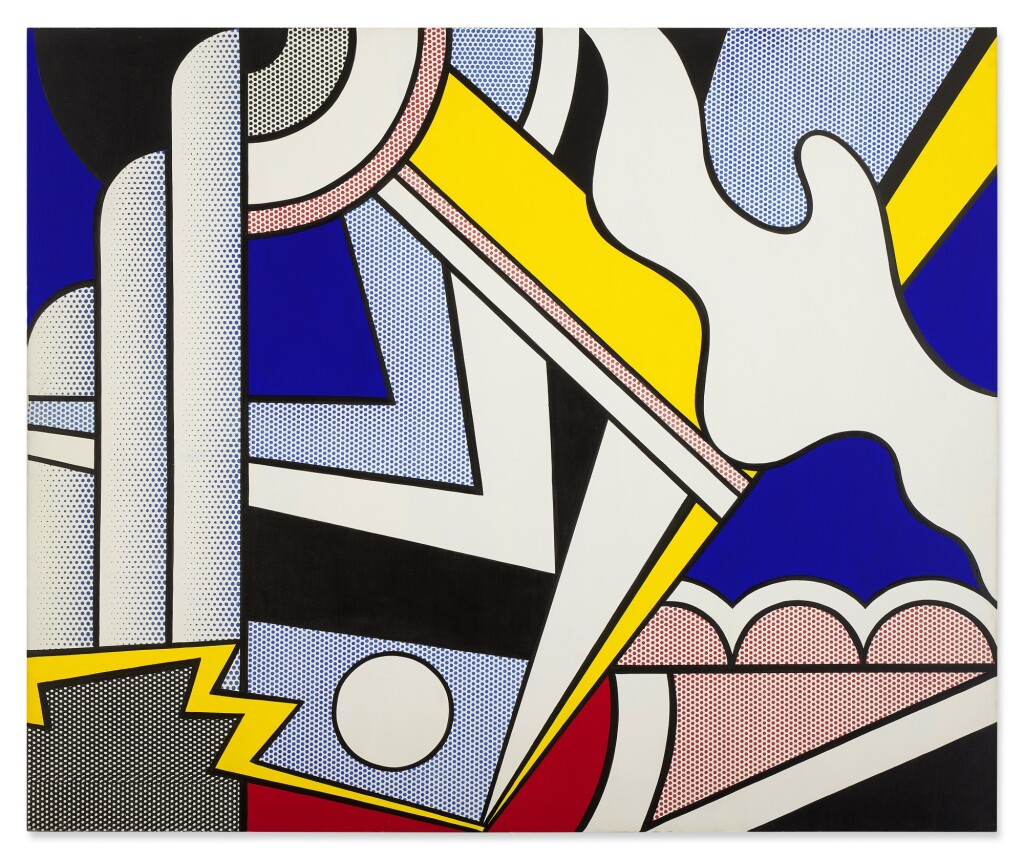
ROY LICHTENSTEIN (1923-1997)
Modern Painting with Small Bolt, 1967
Oil and Magna on canvas
68 ⅜ x 82 ⅛ inches (173.7 x 208.6 cm)
Signed rf Lichtenstein and dated ‘67 (on the reverse)
#3. Modern Painting Triptych II, 1967
A Legacy Reimagined: Works from the Collection of Dorothy and Roy Lichtenstein
Sotheby’s New-York: 18 November 2025
Estimated: USD 3,500,000 – 4,500,000
USD 4,442,000
Modern Painting Triptych II | The Now & Contemporary Evening Auction | 2025 | Sotheby’s
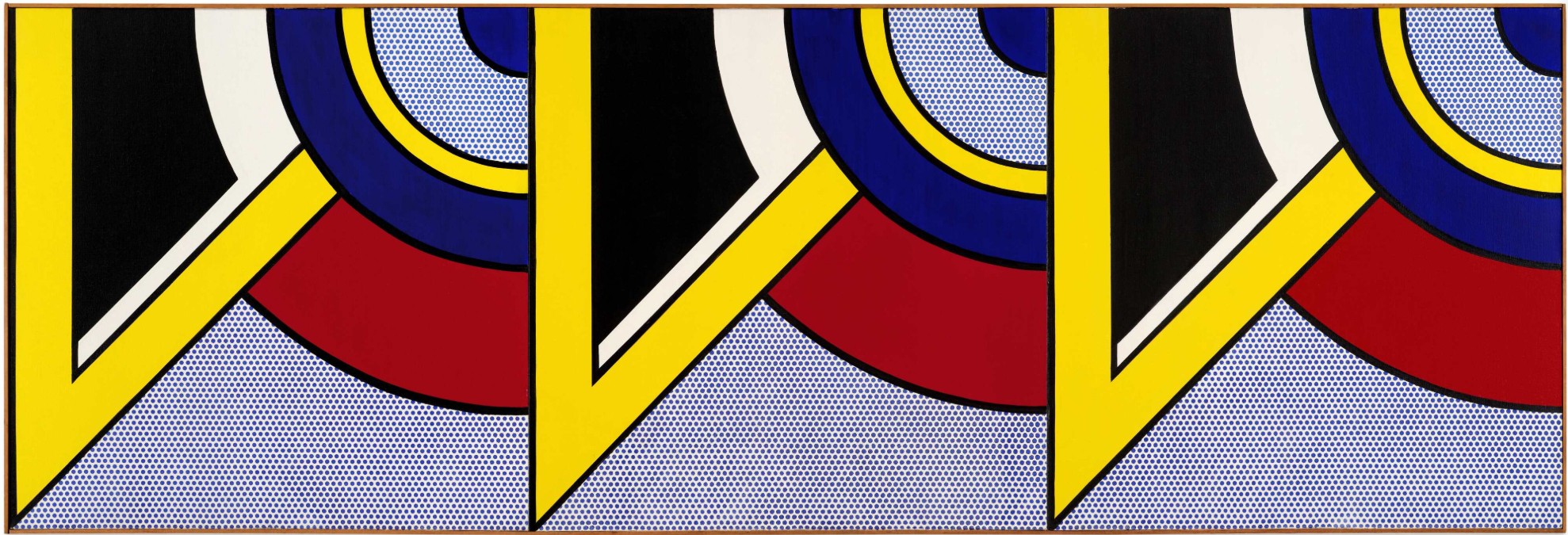
ROY LICHTENSTEIN (1923 – 1997)
Modern Painting Triptych II, 1967
Acrylic, oil and graphite on canvas, in three parts
Each: 36×36 inches (91.4 x 91.4 cm)
Overall: 36×108 inches (91.4 x 274.3 cm)
Signed and dated ‘67 (on the reverse)
#4. Modern Painting with Yellow Interweave, 1967
Sotheby’s New-York: 12 November 2015
Estimated: USD 1,500,000 – 2,000,000
USD 3,430,000
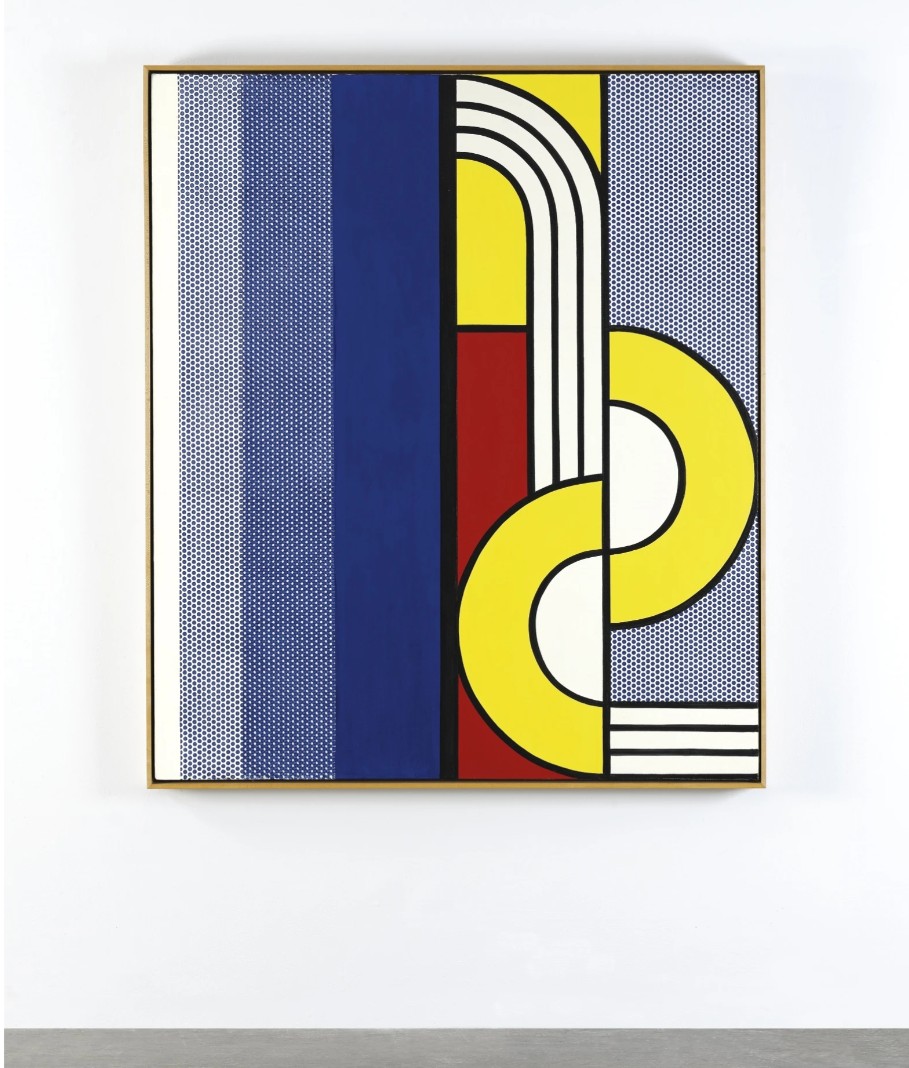
ROY LICHTENSTEIN
Modern Painting with Yellow Interweave, 1967
Oil and magna on canvas
56×48 inches (142.2 x 121.9 cm)
Signed and dated 67 on the reverse
#5. Modern Painting, 1967
Property from the Miles and Shirley Fiterman Collection
Phillips New-York: 16 May 2019
Estimated: USD 2,000,000 – 3,000,000
USD 2,900,000
Roy Lichtenstein 20th Century & Contemporary Art Evening Sale
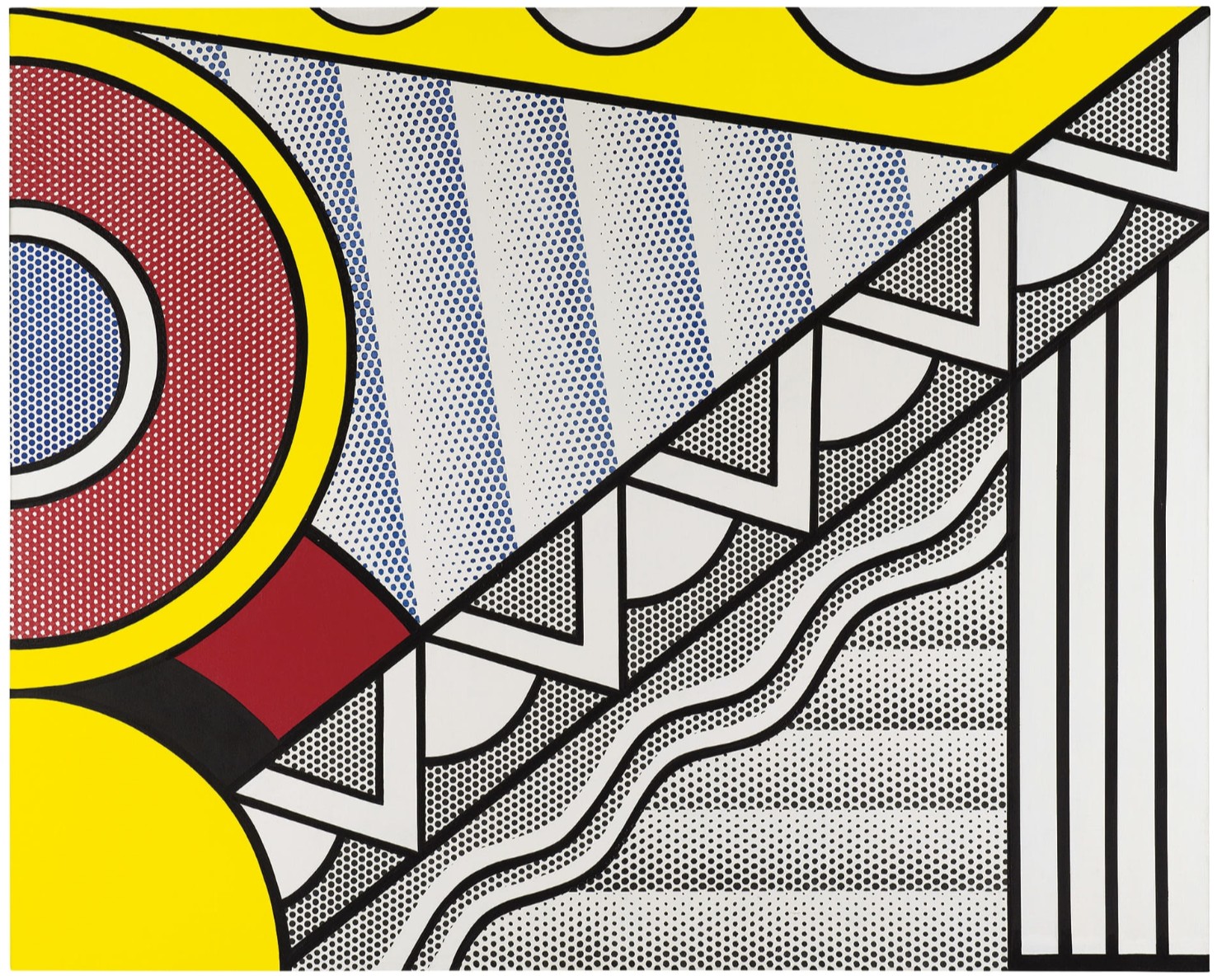 ROY LICHTENSTEIN
Modern Painting, 1967
Oil and Magna on canvas
48×60 inches (121.9 x 152.4 cm)
Signed and dated “rf Lichtenstein ’67” on the reverse
#6. Modern Painting with Fishes, 1967
Sotheby’s New-York: 9 November 2010
Estimated: USD 1,500,000 – 2,000,000
USD 1,762,500
REPEAT SALE
Sotheby’s New-York: 14 November 2006
Estimated: USD 1,000,000 – 1,500,000
USD 2,256,000
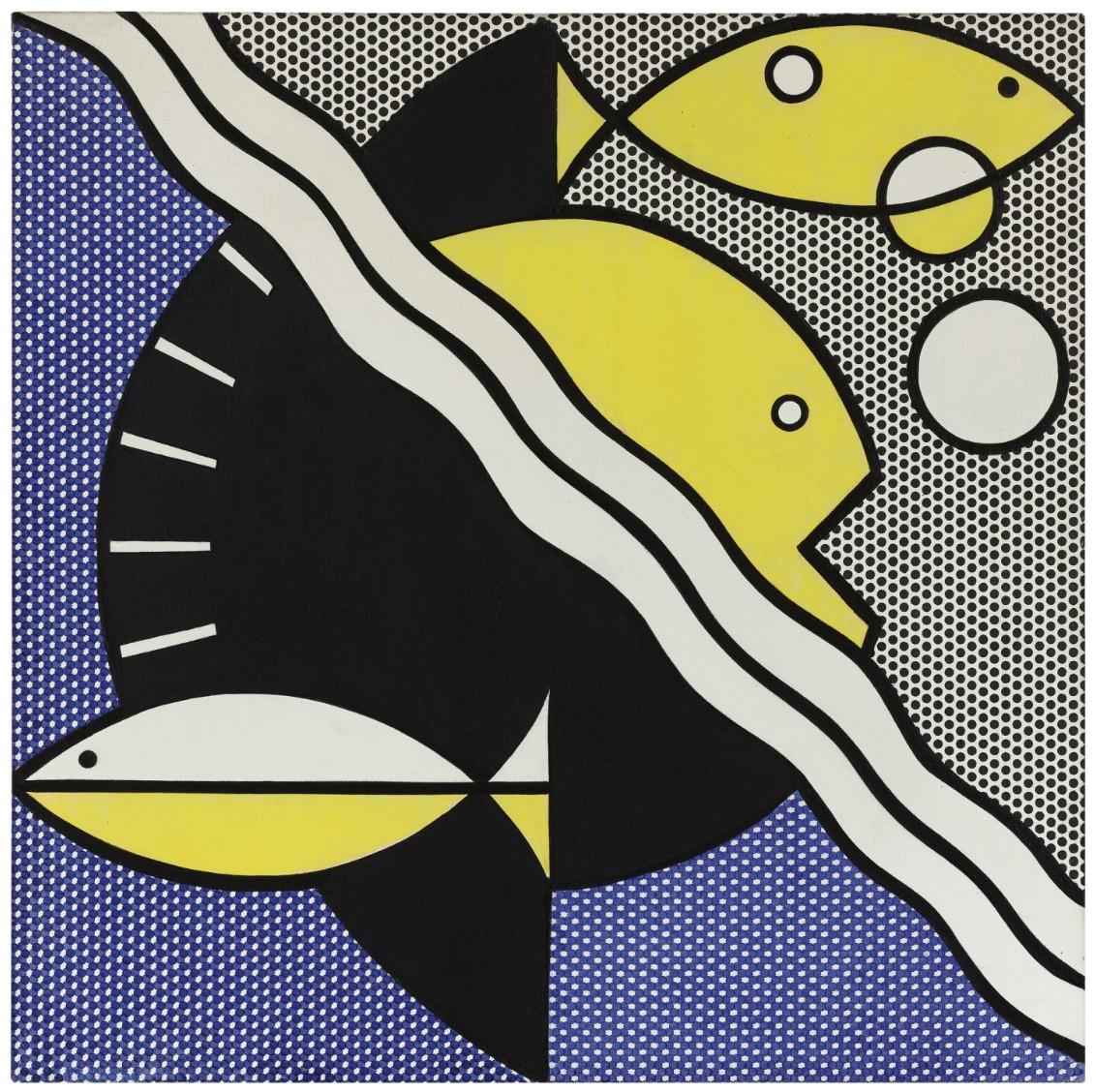
ROY LICHTENSTEIN
Modern Painting with Fishes, 1967
Oil and Magna on canvas
36×36 inches (91.5 x 91.5 cm)
Signed and dated 67 on the reverse
Modern Painting with Yellow Arrow, 1967
Sotheby’s New-York: 27 September 2024
Estimated: USD 450,000 – 650,000
USD 660,000
Modern Painting with Yellow Arrow | Contemporary Curated | 2024 | Sotheby’s (sothebys.com)
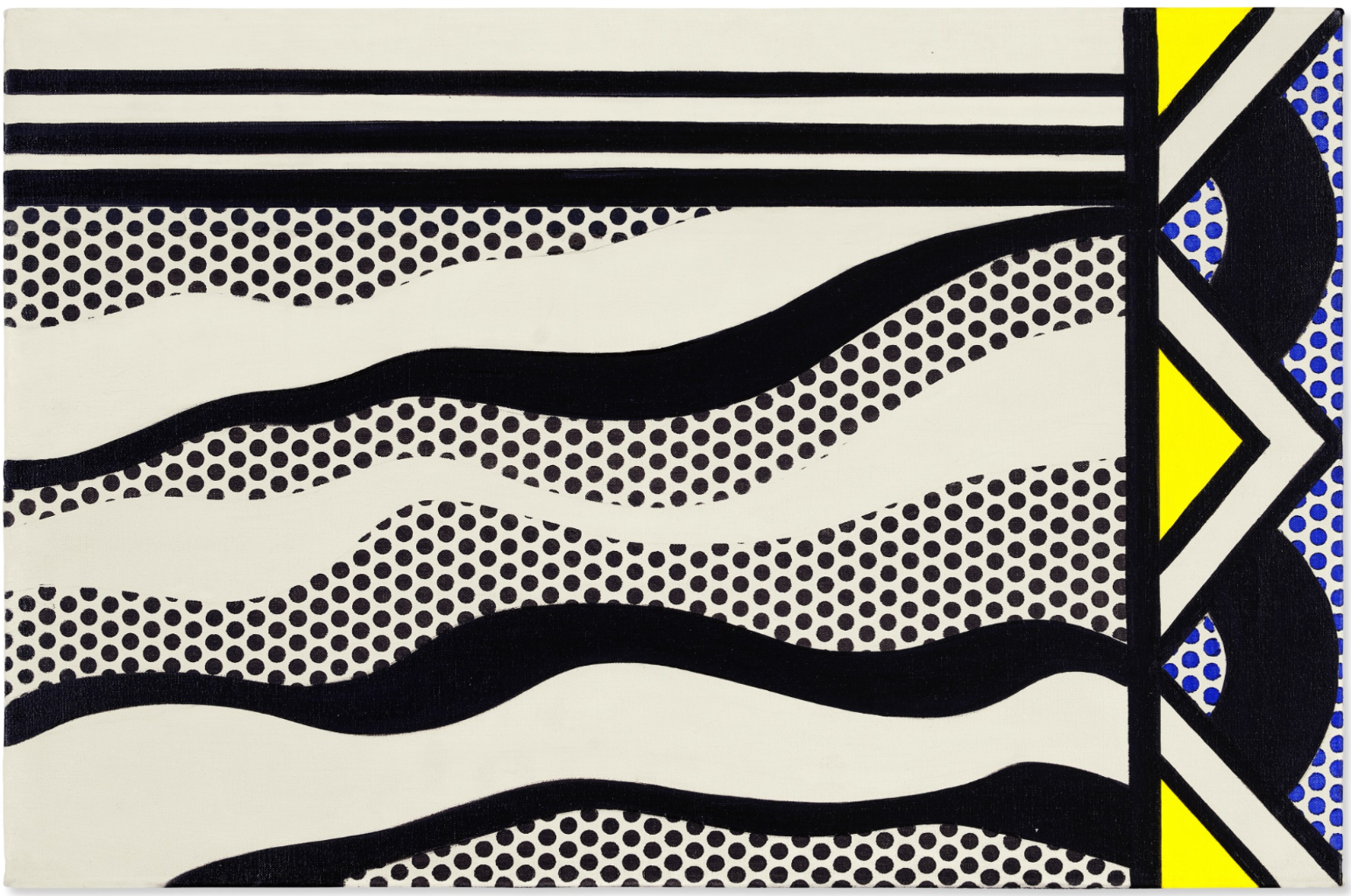
ROY LICHTENSTEIN (1923 – 1997)
Modern Painting with Yellow Arrow, 1967
Acrylic, oil and graphite on canvas
16 x 24 1/4 inches (40.6 x 61.6 cm)
Signed and dated ’67 (on the reverse)
PAINTINGS
Modern Painting with Ionic Column, 1967
Modern Painting with Ionic Column, 1967
Christie’s New-York: 16 May 2024
Estimated: USD 6,000,000 – 8,000,000
USD 7,310,000
ROY LICHTENSTEIN (1923-1997), Modern Painting with Ionic Column | Christie’s (christies.com)

ROY LICHTENSTEIN (1923-1997)
Modern Painting with Ionic Column, 1967
Acrylic, oil and graphite on canvas
62 x 82 1/8 inches (157.5 x 208.6 cm)
Signed and dated ‘rf Lichtenstein ‘67’ (on the reverse)
A heroic painting from the 1960s, whose visual inventiveness rivals his best work, Roy Lichtenstein’s Modern Painting with Ionic Column is a Pop Art work of genius where the history of Western art collides with the Art Deco motifs of an Industrial Age and the Classical architecture of Ancient Greece. In 1967, Lichtenstein expanded the parameters of his Pop Art vernacular to come face-to-face with the illustrious history of modern art. Broadening both his scope and ambition, the celebrated Pop artist now tackled the great “isms” of the Western canon. He called this series “Modern Paintings.” In the present example,, Lichtenstein references Art Deco, Greek Architecture, Cubism, Futurism and Purism, proving that, as critic Dave Hickey explained, “art history flows any way it wants to: forward, backward, or to the side” (D. Hickey, Roy Lichtenstein: Modern Paintings, exh. cat., Richard Gray Gallery, New York, 2010, p. 12). These beloved paintings proved to be some of his most radical and groundbreaking to date, with examples now found in prestigious museum collections around the world, including the Stedelijk Museum, Amsterdam, the Museum of Modern Art, New York, and the Hirshhorn Museum and Sculpture Garden in Washington, D.C.
A ceaseless innovator whose work continues to represent the very pinnacle of American Pop Art painting, Roy Lichtenstein, in the mid-to-late 1960s, expanded his visual repertoire beyond comic-book heroines to enter into the realm of High Art. With the improvisational flair of a jazz musician, Lichtenstein riffs off Western culture in the present work. Proceeding from left to right, he begins with the Ancient Greeks and their eternal quest for balance and harmony, which is represented by an Ionic column and artist’s palette. In the center panel, we encounter the fractured pictorial planes of Cubism, with a red circle and a field of benday dots possibly representing Picasso’s guitar. Three puffy clouds in the upper register evoke a blue sky, but these are now flattened into geometric shapes and “shaded” with benday dots. Along the right edge we find the Art Deco style of the Industrial Age, where the stylized depiction of a mighty steam ship sets a course for an epic collision between past, present and future.

Tamara de Lempicka, Portrait du Suzy Solidor, 1933. Château Musée, Cagnes-sur-mer. © 2024 Tamara Art Heritage / ADAGP, Paris / ARS, NY
Fernand Léger, Woman Holding a Vase (definitive state), 1927. Solomon R. Guggenheim Museum, New York. Photo: The Solomon R. Guggenheim Foundation / Art Resource, NY.
As the art critic Lawrence Alloway noted, Lichtenstein’s work at this time “can do two things – it can switch a comic book into fine art, or it can switch fine art into comic style” (L. Alloway, “On Style: An Examination of Roy Lichtenstein’s Development Despite a New Monograph on the Artist,” Artforum, March 1972, p. 54). Indeed, for Lichtenstein, the Western art historical canon was not meant to be opined over or lauded. Instead, it’s simply grist for the mill. This proved to be a rewarding and fertile enterprise for the artist, as the subject of “Art History” would continue to fascinate him well into the 1970s and ‘80s. During that time, Lichtenstein created thought-provoking and original paintings using just a modicum of means, typically limiting his palette–as he does in the present work–to primary colors, benday dots and raking diagonal lines. In his paintings that referenced Cubism, Surrealism, Expressionism, and Still Life painting, Lichtenstein reminds us that “Pop art [is], by and large, an art of quotations, translations, imitations, double takes” (L. Alloway, Ibid., pp. 54-55).

Roy Lichtenstein, Modern Painting with Clef, 1967. Hirschhorn Museum and Sculpture Garden, Washington, DC. © Estate of Roy Lichtenstein.
The impetus for the Modern Paintings dates to the summer of 1966, when Lichtenstein was asked to design a poster for Lincoln Center. He took as his inspiration the Art Deco architecture of 1920s and ‘30s New York, which he simplified and exaggerated, limiting his palette to primary colors, Ben-Day dots and featuring the same comic-book style of the earlier ‘60s. The artist perceived the many layers of reference already encoded in the Art Deco style, which he humorously referred to as “Cubism for the Home.” The clean, sleek look of Art Deco came to symbolize New York as a modern metropolis, characterized by stylized zigzags, chevrons and geometric shapes.
“The sensibility that I’m trying to bring is apparent anti-sensibility. I think that’s the important part of it! It’s a modern sensibility. Instead of…the European sensibility, I’m using flat areas of color opposed to dotted areas, which imitate Benday dots in printing and become industrialized textures…but it’s a modern industrial texture and it’s not one that is nostalgic or refers back to European painting… It has its own mode, its own sensibility.”

Robert Rauschenberg, Persimmon, 1964. © 2024 Robert Rauschenberg Foundation / Licensed by VAGA at Artists Rights Society (ARS), New York. Photo: Bridgeman Images.
These epic and masterful “Modern” paintings reward the spectator’s time in close looking, often revealing Lichtenstein’s sly and clever sleight of hand. Particularly in the present work, Lichtenstein uses a variety of artistic shorthand devices. His dots lend a three-dimensional modeling and roundness to the things they depict, but they are also used arbitrarily, as in the artist’s palette at left, which thereby flips the relationship between the foreground and background into a flickering back-and-forth where none of the imagery is what it seems. The canvas is divided into five relatively equal diagonal segments, with the black and white diagonals representing shafts of light, the fretboard of a guitar, or the upper deck of a steamship.
Modern Painting with Small Bolt, 1967
Modern Painting with Small Bolt, 1967
Sotheby’s New-York: 16 November 2022
Estimated: USD 6,000,000 – 8,000,000
USD 6,873,800
Modern Painting with Small Bolt | Contemporary Evening Auction | | Sotheby’s (sothebys.com)
ROY LICHTENSTEIN (1923-1997)
Modern Painting with Small Bolt, 1967
Oil and Magna on canvas
68 ⅜ x 82 ⅛ inches (173.7 x 208.6 cm)
Signed rf Lichtenstein and dated ‘67 (on the reverse)
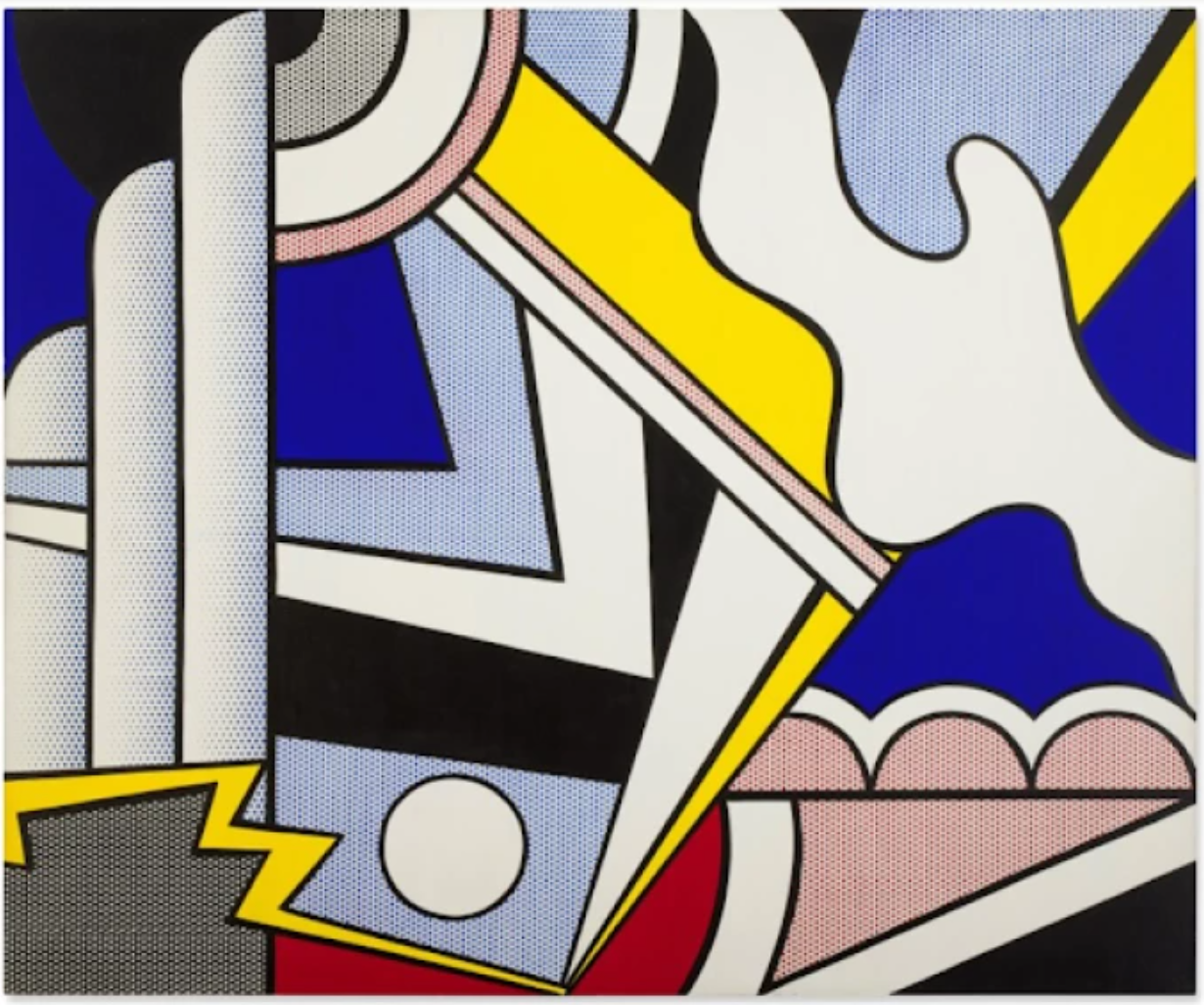
An electrifying composition of saturated colors and searing forms, Modern Painting with Small Bolt is the ultimate embodiment of Roy Lichtenstein’s pioneering investigation into the form, content, and meaning of Contemporary Art. A testament to Roy Lichtenstein’s mastery of composition and space, Modern Painting with Small Bolt of 1967 is an iconic exemplar from the artist’s pivotal series of Modern Paintings, in which Lichtenstein breaks free of his signature Pop Art graphics to interrogate the very foundations of art historical precedents. Exemplifying Lichtenstein’s career-long investigation of art history, the present work takes as its inspiration the sleek and stylized forms of the Art Deco movement of the 1920s and 30s, reimagined and reorganized into a complex network of industrial images. Here, the familiar ornamentation and decorative motifs of that era are made new, deftly rearticulated in the sleek commercial style of Lichtenstein’s signature Pop idiom. A kaleidoscopic vision of overlapping shapes and symbols, the present work further demonstrates Lichtenstein’s fascination with the work of de Stijl artists such as Theo van Doesberg and Piet Mondrian, whose inspiration is legible in the industrial ligatures and chromatic dissonance of the present work. Testifying to the significance of this series, examples of Lichtenstein’s Modern Paintings are held in esteemed institutions such as the Museum of Modern Art, New York and the Hirshhorn Museum and Sculpture Garden, Washington, D.C.
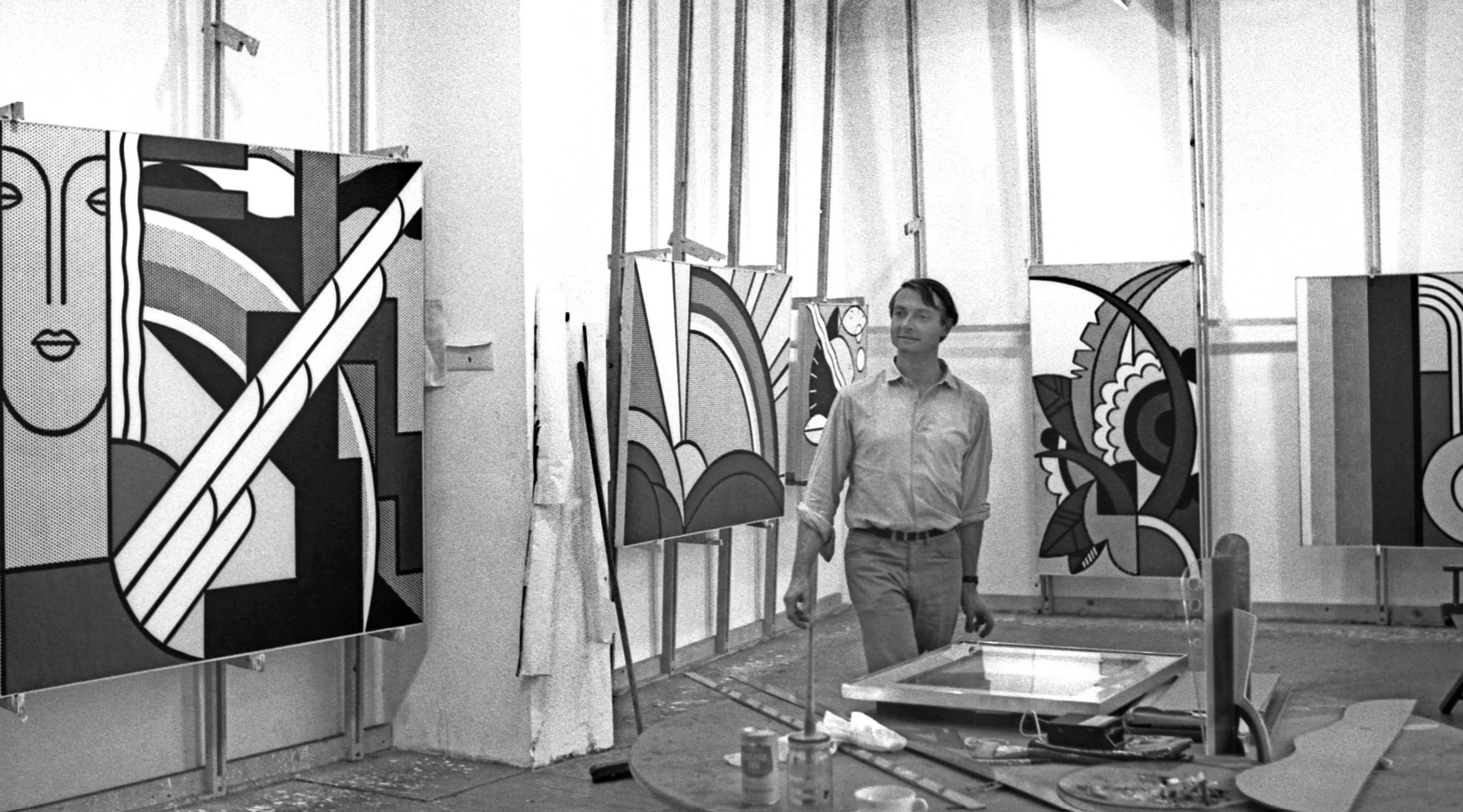
PORTRAIT OF THE ARTIST IN HIS STUDIO AT 190 BOWERY, NEW YORK IN 1967 WITH THE MODERN PAINTINGS SERIES TAKEN BY UGO MULAS. IMAGE © UGO MULAS HEIRS. ALL RIGHTS RESERVED. ART © 2022 ESTATE OF ROY LICHTENSTEIN, ALL RIGHTS RESERVED
Within Modern Painting with Small Bolt, an iconic industrial skyline emerges, composed with fractured symmetry and a signature graphic aesthetic. A master of symbolic parody, Lichtenstein pulls visual motifs seamlessly into the complex composition: a tiered structure rises along the left-hand side of the picture plane, while two beams of light cut diagonally across the composition, these individual compositional components deftly bound tightly together into an aggregate geometric puzzle. Initially inspired by his commissioned design for the 1967 Lincoln Center poster, which also includes a similarly composed towering structure and soaring beams of light, the present work plays on iconic motifs from the Art Deco movement. While exceptionally unified and balanced, Modern Painting with Small Bolt is full of stylistic contradictions: a current of vibrant yellow cuts a jagged line through the foreground with a sharp angularity, while a cloud of billowing white smoke rises along the upper right-hand side of the picture plane; industrial forms slice through the fractured blue sky while curving rings and semicircles pulse against the linearity of the picture. These contradictions serve to further parody these highly popular, industrial motifs typical of Art Deco design, and deepen the conceptual nuance of this iconic work.
Modern Painting Triptych II, 1967
Modern Painting Triptych II, 1967
A Legacy Reimagined: Works from the Collection of Dorothy and Roy Lichtenstein
Sotheby’s New-York: 18 November 2025
Estimated: USD 3,500,000 – 4,500,000
USD 4,442,000
Modern Painting Triptych II | The Now & Contemporary Evening Auction | 2025 | Sotheby’s
ROY LICHTENSTEIN (1923 – 1997)
Modern Painting Triptych II, 1967
Acrylic, oil and graphite on canvas, in three parts
Each: 36×36 inches (91.4 x 91.4 cm)
Overall: 36×108 inches (91.4 x 274.3 cm)
Signed and dated ‘67 (on the reverse)
Roy Lichtenstein’s unmistakable graphic vocabulary crystallizes into scarlet, yellow, and ultramarine geometry, arching and interlocking into an urban panorama: Modern Painting Triptych II. Here, the steel ornamentation and industrial ligatures—joints of sleek new feats in engineering—of Manhattan’s Art Deco skyline are synthesized and recast in broad passages of primary-colored Ben-Day dots. Modern Painting Triptych II is one of 48 paintings which constitute the Modern Paintings series; of the just six multipanel works, including the present work, half belong in prestigious institutional collections: the Norton Simon Museum, Pasadena; Hirshhorn Museum and Sculpture Garden, Washington, D.C.; and Ryobi Foundation, Carbondale. Lichtenstein’s discoveries in the Modern Paintings would prove so formative that they would form the basis of his next body of work: the repetition of forms in Modern Painting Triptych II anticipates the series of Modular Paintings to follow, whose duplicating compositional grids developed upon these same themes of mechanization and seriality in the industry age.
Further testament to its significance in Lichtenstein’s oeuvre, Modern Painting Triptych II bears an extraordinary exhibition history, from its 1967 debut in Lichtenstein’s solo presentation at the legendary Leo Castelli Gallery to an extended loan at the National Collection of Fine Arts, Smithsonian American Art Museum in Washington, D.C. Just as Art Deco fused Futurism, Cubism, de Stil, and ancient Mesopotamia and Mesoamerica, taking old and new to create an architecture for present, Lichtenstein, too, proves himself to be an architect of his time through his triumphant Modern Paintings.
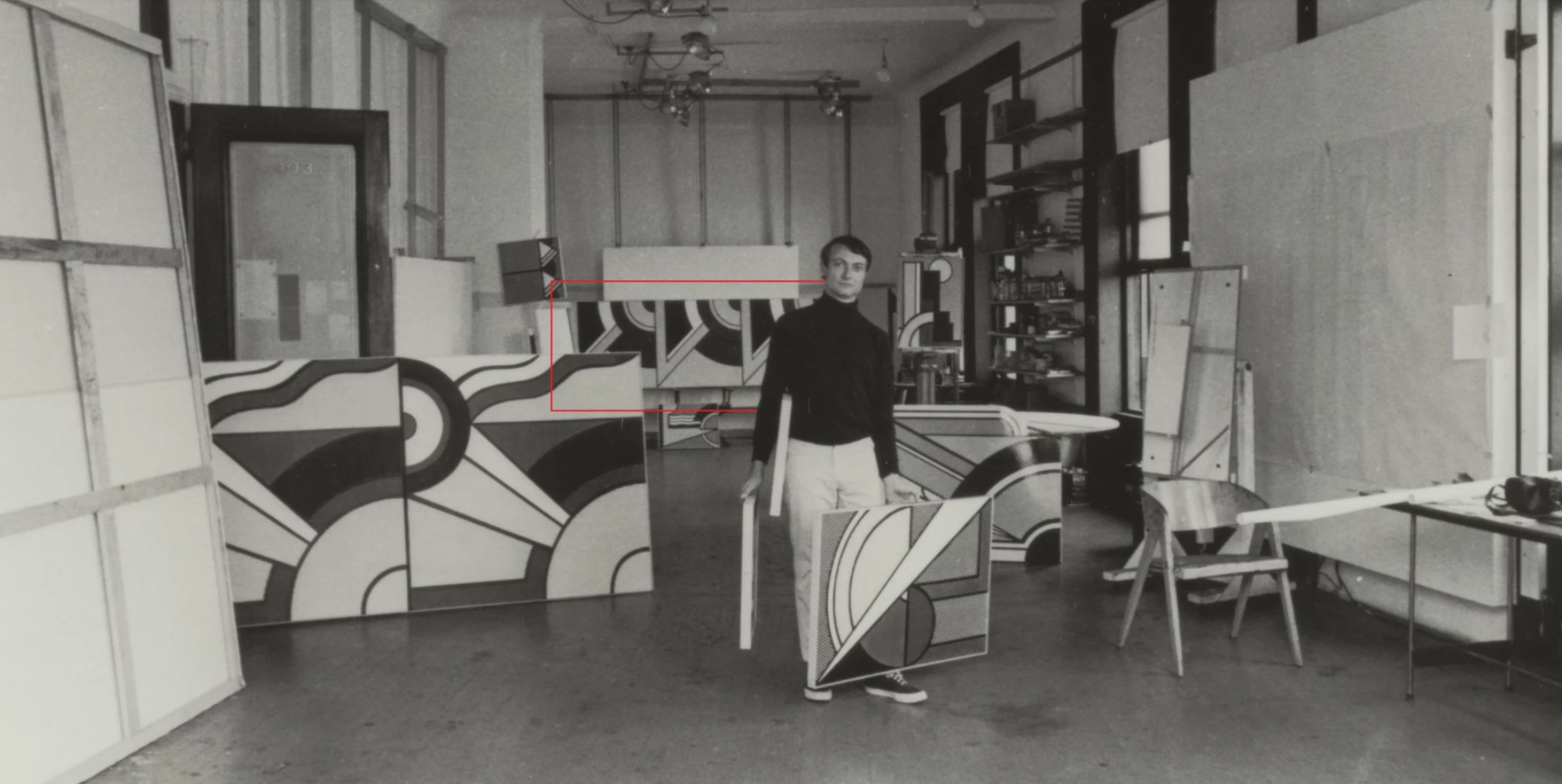
The present work pictured with Roy Lichtenstein in his 190 Bowery studio, 1967.
Photo by Judy B. Ross, courtesy RLF Archives. Art © Estate of Roy Lichtenstein
Lichtenstein created his first Modern Paintings in 1966, four decades after the earliest Art Deco projects began studding the Manhattan skyline. Art Deco, unveiled at the 1925 Exposition Internationale des Arts Décoratifs et Industriels Modernes in Paris, was the style that gave New York City, where Lichtenstein lived and worked, its character and cadence: from the Empire State to the Chrysler, the most iconic buildings boasted a novel decorative quality and towering verticality. Yet just as the style became the face of twentieth-century modernity, Modernism outpaced it—William Van Alen and Raymond Hood were usurped by Ludwig Mies van der Rohe, Philip Johnson, and Louis Kahn, whose glass-encased constructions made the vanguard of just a few thirty years prior feel dated.
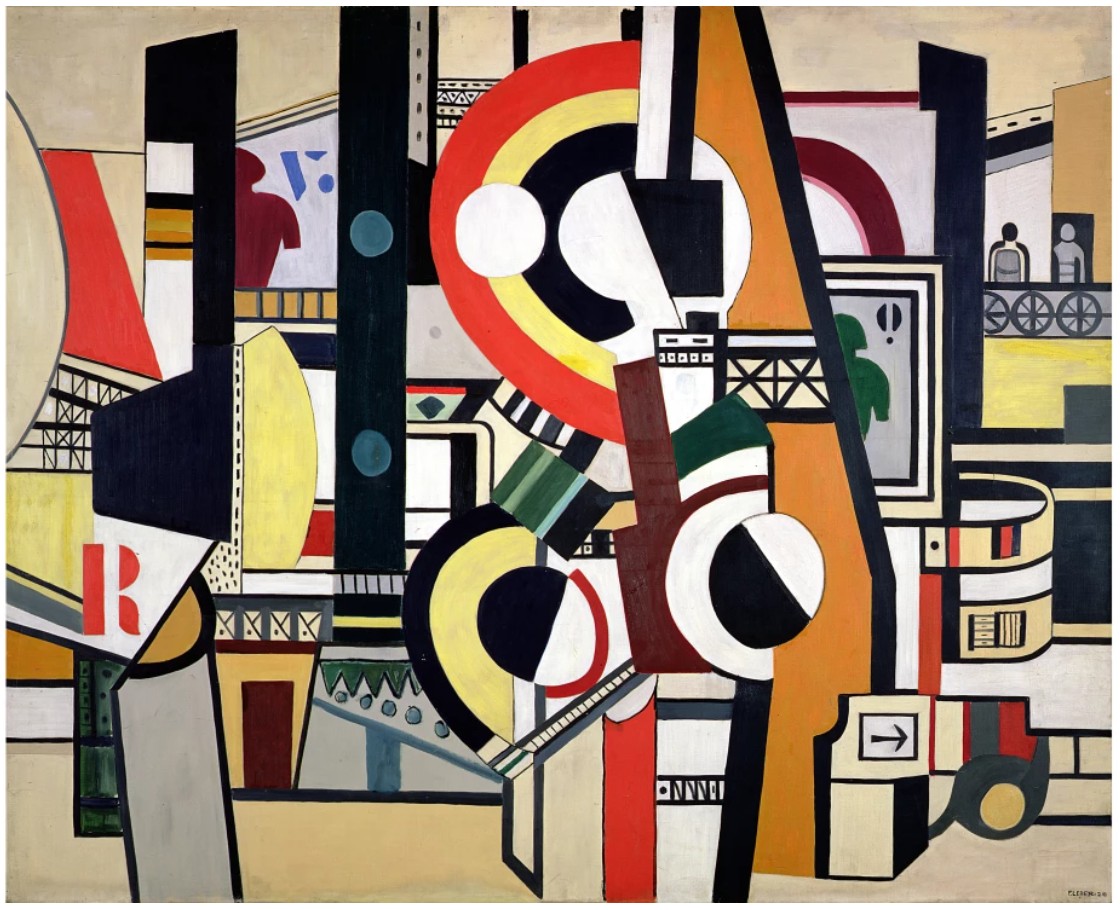
Fernand Léger, The Discs in the City, 1921. Musée National d’Art Moderne, Paris.
Image © Peter Willi / Bridgeman Images. Art © 2025 Artists Rights Society (ARS), New York / ADAGP, Paris
With his characteristic levity, Lichtenstein now parodied the vernacular of so-called modernity, his painterly pastiches engineering a reconciliation of once-spectacular innovation with Pop ingenuity. “What is particularly unnerving about the series is what is most relevant to the subject of Modernism versus Postmodernism,” David Antin observes, “The pathos of Modern Art is particular to itself… It was the specific claim of ‘modernism’ to be finally and forever open. That was its ‘futurism,’ and now that its future has receded into the past it can be had as a sealed package whose contents have the exotic look of something released from a time capsule.” (David Antin, “Modernism and Postmodernism: Approaching the Present in American Poetry,” boundary 2, Iss. 1, 1972, p. 99) Modern Painting Triptych II thus stylizes the already stylized, retrofitting the bygone past for the future.
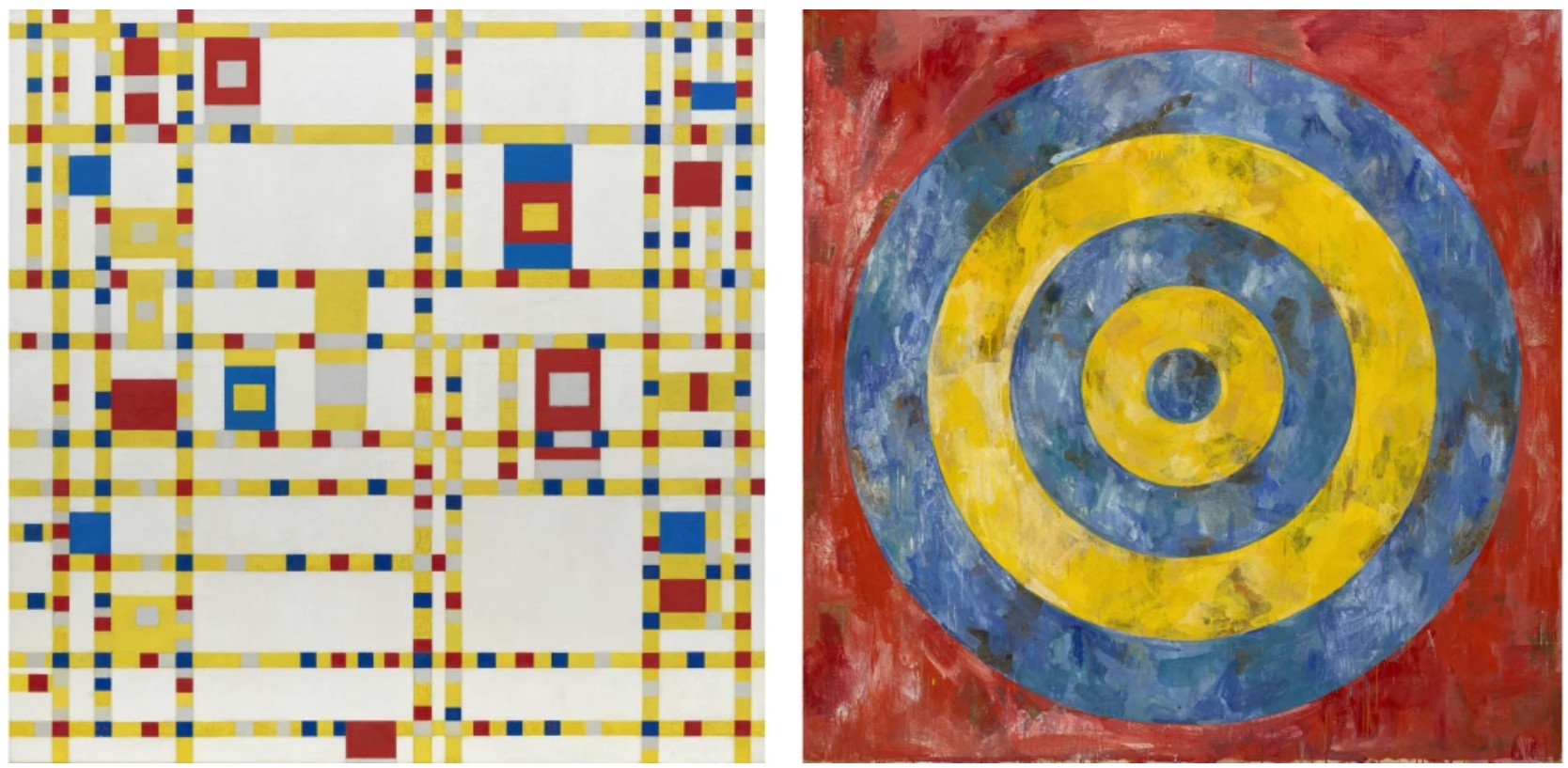
Left: Piet Mondrian, Broadway Boogie Woogie, 1942-43. The Museum of Modern Art, New York. Image © The Museum of Modern Art / Licensed by SCALA / Art Resource, NY. Right: Jasper Johns, Target, 1961. The Art Institute of Chicago, Chicago. Image © The Art Institute of Chicago / Art Resource, NY. Art © 2025 Jasper Johns / Licensed by VAGA at Artists Rights Society (ARS), NY
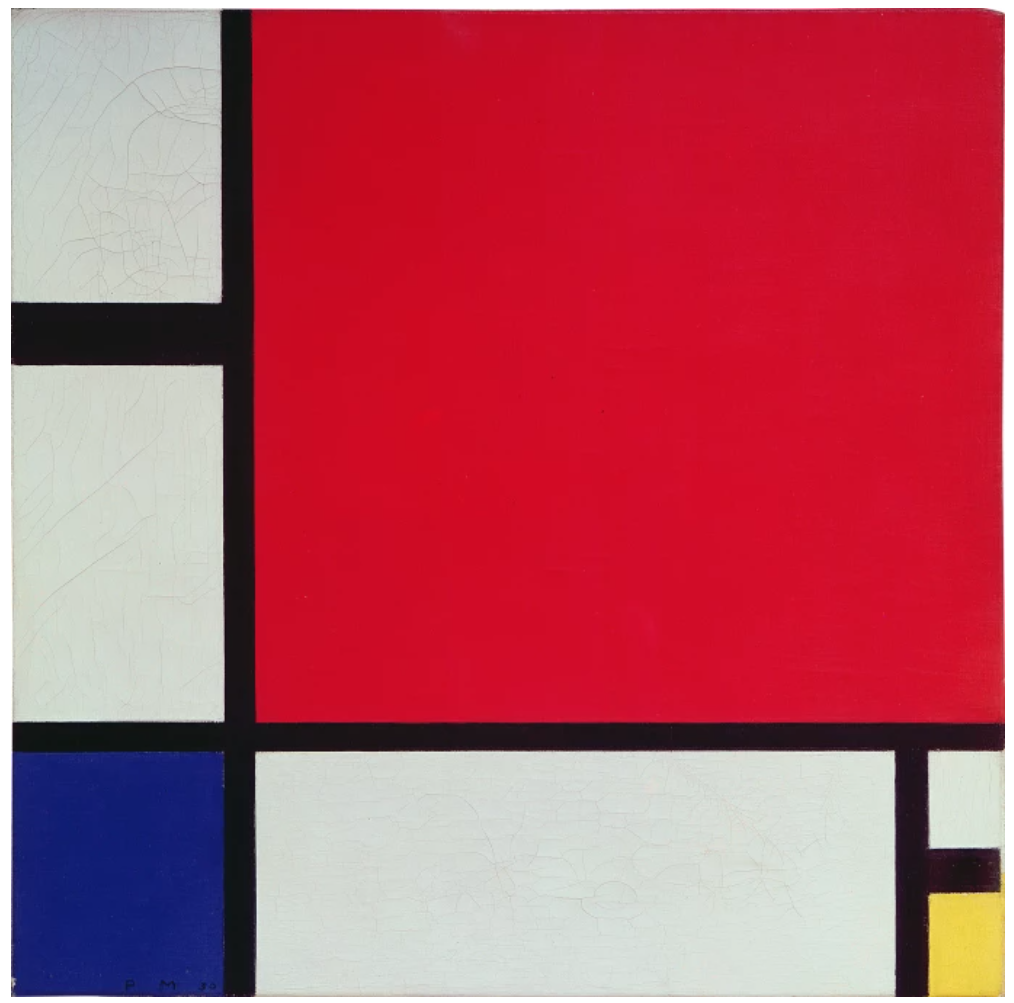
The primary palette and geometric composition of Modern Painting Tripych II also obliquely appropriates the advents of such renowned de Stijl artists as Piet Mondrian and Theo van Doesberg. Lichtenstein wrestled at length with Mondrian’s work in particular, interrogating the dissonance between Mondrian’s utopian notions of structure and order and the political unrest that underpinned the period of their creation.
Modern Paintings in Museum Collections
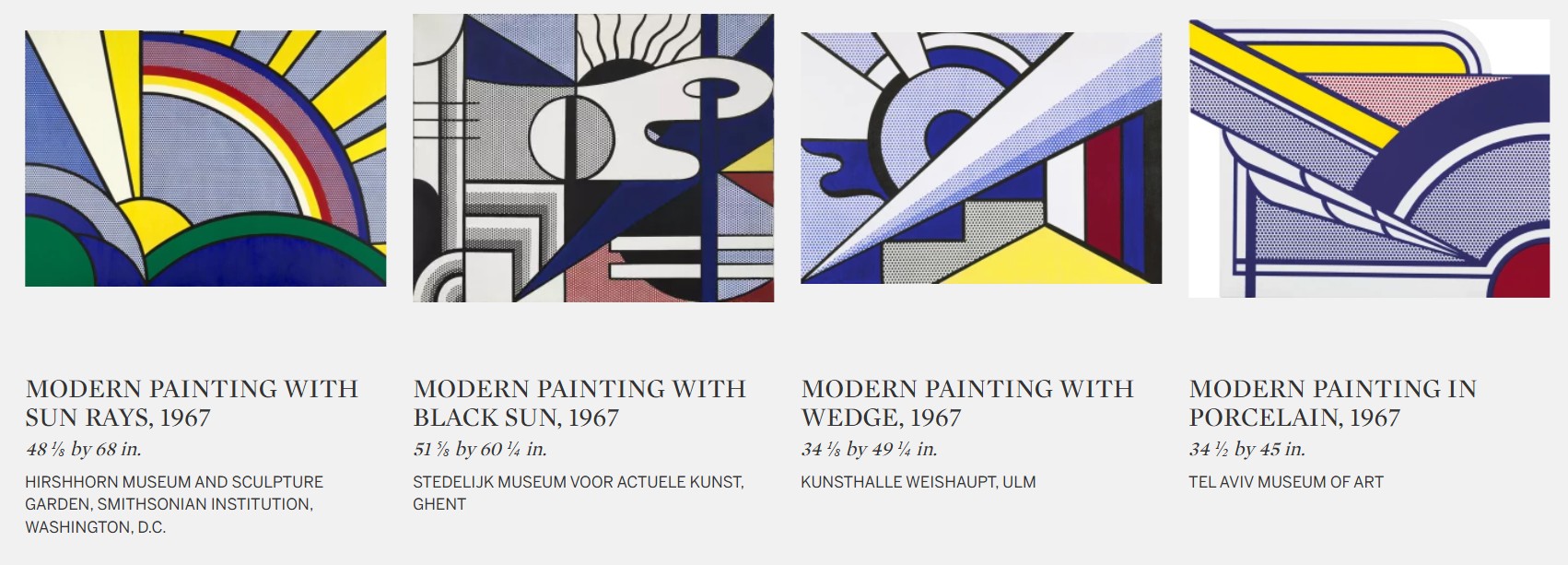
Modern Painting Triptych II embodies Lichtenstein’s examination of this distinctly Modern turbulence beneath the pristine surface of the two-dimensional canvas’ visual register, and his output would only continue to invest further and further into a dialogue with the history, criticism, and methodology of art. What began as a recontextualization of kitsch, everyday iconography would evolve into an unerring investigation of his predecessors in the paintings to follow. But the Modern Paintings reveal an early and prognostic engagement with art history in real-time: the quotidian imagery of consumer goods and comic book scenes of hopeful, hopeless war and romance through which he found his artistic footing would usher him toward the architectural polemics of the world around him. In this way Modern Painting Triptych II rests firmly on the bedrock of Lichtenstein’s artistic enterprise—an undiscriminating embrace of art and imagery and subverting the associations of taste bound to them.
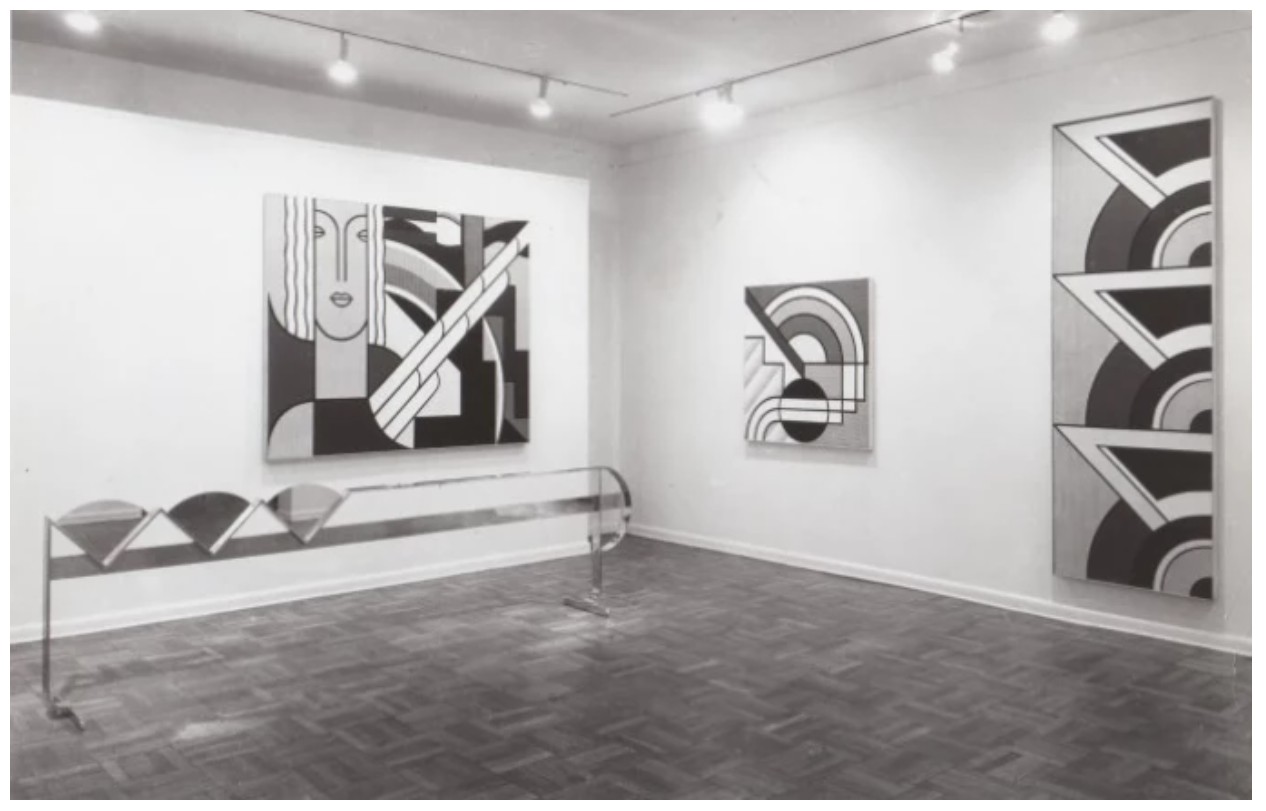
The present work installed at Leo Castelli Gallery, October – November 1967. Art © Estate of Roy Lichtenstein
Though the Modern Paintings sought new inspiration in metropolitan America, they stand as representations of Lichtenstein’s extant commitment to seeing the world as it is and painting it anew. Though fast dated, the Art Deco ecosystem that shaped New York would, Lichtenstein made sure, remain forever relevant. “From ash-tray to movie-theater foyer,” Lawrence Alloway notes, “the 30s are with us; as places to go, objects to use, the products of the period are a known, though [sic.] unvalued, part of our environment. They are definitely one of our common, non-esoteric fields of reference. Lichtenstein’s new paintings and sculptures are trophies of the 30s; trophies in the sense of mementos and memorials annexed from somebody else. In this case, the other is the form-sense of a preceding period.” (Lawrence Alloway quoted in: Exh. Cat., Cincinnati, Contemporary Arts Center, Roy Lichtenstein: Exhibition of Paintings and Sculpture, December 1967 – January 1968, n.p.) Thus, Modern Painting Triptych II not only encapsulates Lichtenstein’s compelling question of taste and aesthetics but challenges how artistic invention—even those close in the rearview of the avant-garde—can be traced, disrupted, and forever reinvented.
Modern Painting with Yellow Interweave, 1967
Modern Painting with Yellow Interweave, 1967
Sotheby’s New-York: 12 November 2015
Estimated: USD 1,500,000 – 2,000,000
USD 3,430,000
ROY LICHTENSTEIN
Modern Painting with Yellow Interweave, 1967
Oil and magna on canvas
56×48 inches (142.2 x 121.9 cm)
Signed and dated 67 on the reverse
Provenance
Leo Castelli Gallery, New York (LC# 483)
Bert Stern, New York
Richard Gray Gallery, Chicago
Private Collection, New York
Sotheby’s, New York, November 13, 2003, lot 194
Acquired by the present owner from the above sale
In 1966, Roy Lichtenstein moved from his much-celebrated imagery of the early 1960s, comic-style heroines and expressive brushstrokes, and began to make compositions that resist easy classification. In the summer of 1966, while still working on his Brushstrokes series, Lichtenstein designed a poster for New York City’s Lincoln Center, taking as his subject the architecture and design of the 1920s and 1930s. This initiated a group of works that parodied the style of Art Deco, which Lichtenstein ironically described as “Cubism for the Home.” Using his characteristic Ben Day dots and geometric shapes and lines, Lichtenstein rendered incongruous, challenging images out of familiar architectural structures, patterns borrowed from Art Deco and other subtly evocative, often sequential, motifs. Like the Landscapes paintings that preceded them, the artist’s Modern works are among the relatively rare pieces in his oeuvre without an anchoring reference to a specific artist or object. They are inventions based on one of his favored notions: impure style. Lichtenstein humorously stylizes an already-stylized style.
“I think of Art Deco as Cubism for the home. It seems mathematical and intellectual rather than visceral, closer to my way of working.”
With its swirling montage of Art Deco motifs and its bright Pop colors, Modern Painting with Yellow Interweave represents Roy Lichtenstein’s celebratory tribute to the modern age. The present work reflects Lichtenstein’s interest in modernist ideologies and in this case, the imagery that defined material and visual culture during the 1920s and 1930s. Yet it does not draw on the high-minded idealism of classic Modernism, but rather the decorative and commercial corruption of its style by architects and industrial manufacturers. Here the artist brings together various easily identifiable emblems of Art Deco design in its fractured composition.
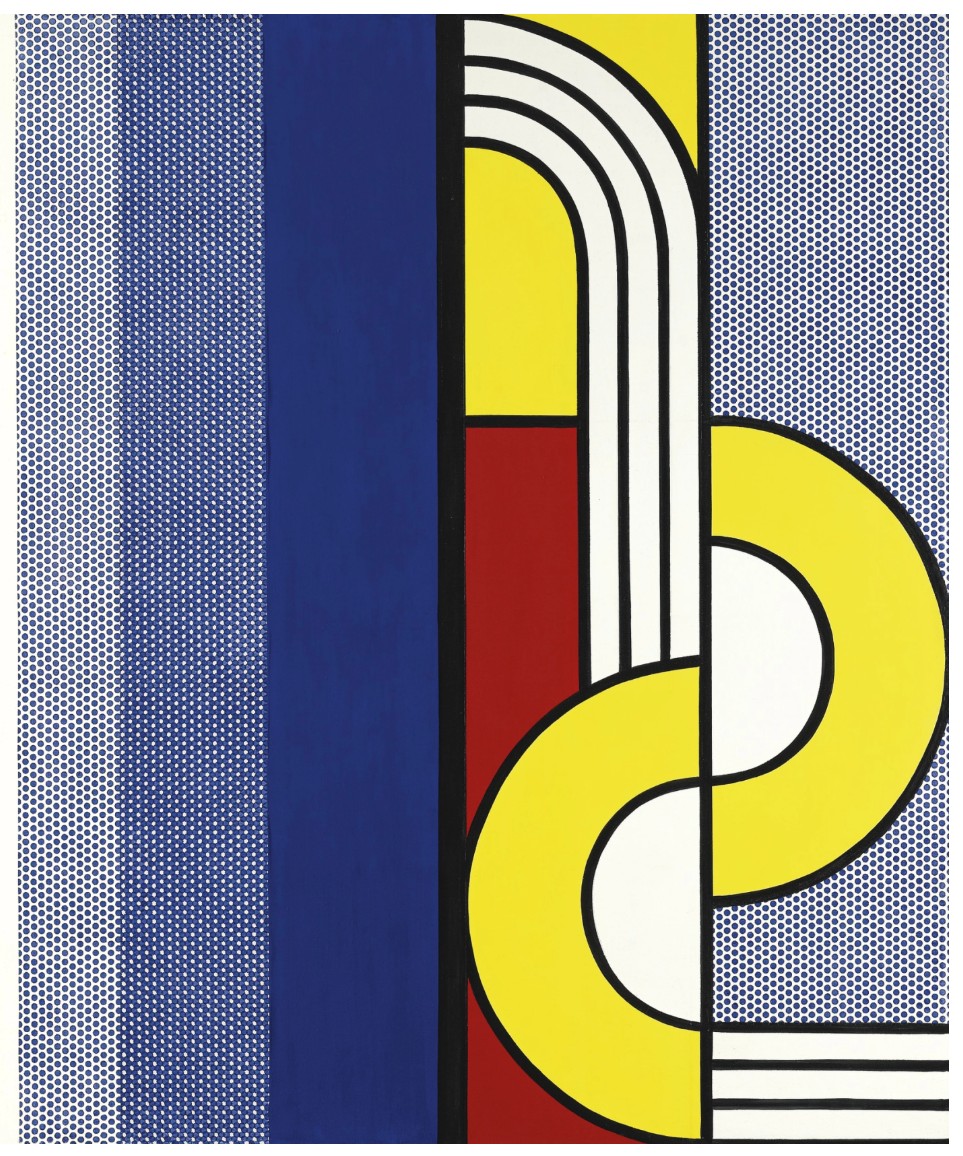
In Modern Painting with Yellow Interweave, the curved shapes both divide and unify the canvas. Gradations of royal blue Ben Day dots flank either side of the canvas composed of bold primary colors, black and white. The work contains minimal symmetry and parallel divisions of space yet it is compositionally harmonious and balanced. Lichtenstein constructed the compositions of these paintings out of a basic set of forms – circle, semicircle, rectangle, square and triangle – arranged in the manner of classic Art Deco design (in sets of threes of fours, for example). These subdivisions and repetitions activate each composition, creating a hub of energy contained only by the parameters of the canvas. Lines of speed or vectors appear to converge or diverge among the densely packed forms. The energy generated by these strategies is boosted by the tension between jagged or irregular silhouettes and self-contained geometric shapes.
Lichtenstein parodied “modernist” movements using geometric forms, industrial imagery and his own dotted technique. Based on the once popular 1930s ‘modern,’ a corrupt and ornamental version of Cubism, Modern Painting with Yellow Interweave evokes the taste and style of that period. As all great artists are, Lichtenstein was a head of his time. In true avant-garde fashion he understood the powerful influence of mass media and its visual language. Modern Painting with Yellow Interweave is a prescient contemplation on the power of pop culture and the role it would play in defining art for generations to come.
Modern Painting, 1967
Modern Painting, 1967
Property from the Miles and Shirley Fiterman Collection
Phillips New-York: 16 May 2019
Estimated: USD 2,000,000 – 3,000,000
USD 2,900,000
Roy Lichtenstein 20th Century & Contemporary Art Evening Sale
ROY LICHTENSTEIN
Modern Painting, 1967
Oil and Magna on canvas
48×60 inches (121.9 x 152.4 cm)
Signed and dated “rf Lichtenstein ’67” on the reverse
Provenance
Locksley Shea Gallery, Minneapolis
Acquired from the above by the present owner
Roy Lichtenstein’s Modern Painting, 1967, provides an alluring invitation to analyze and dissect the key aesthetic innovations the artist gifted the history of art. Moving beyond the narrative-based works that had gained him widespread fame at the start of the decade, Lichtenstein engaged with the genre of landscape painting in the mid-1960s before moving to compositions of geometric shapes and clean abstract details referring to Art Deco design in 1966. Painted the following year in 1967, Modern Painting is demonstrative of the enthralling effects of this union between 20th century design and Lichtenstein’s own signature aesthetic. The hand-painted surface appears mechanically executed in its refined clarity, rhythmically pulsating despite the architectural solidity of its formal components. The geometric forms are boldly delineated with the thick black lines borrowed from the comic book illustrations that he appropriated in the early 1960s. A central frieze of repeated elements bisects the canvas diagonally, simultaneously challenging the orthogonal orientation of the picture plane and creating a dialogue between the monochromatic lower section and the electric flashes of primary colors in the upper part of the composition. Contrasting luminous yellow with deep cerulean blue and two crowning discs of red, Lichtenstein eloquently balances the distribution of tones across the canvas, establishing a centrifugal mechanism of chromatic energy.
Crucially, Modern Painting exhibits a particularly exquisite mastery of Lichtenstein’s most important pictorial innovation: the Ben-Day dot. Modulating their size and density in successive bands, he articulates the effect of shading as the canvas shimmers with the vibrancy of a pointillist masterpiece. Acquired by Miles and Shirley Fiterman from the eminent Minneapolis-based Locksley Shea Gallery, the work stands as a testament to the couple’s exceptional dedication to collecting defining Pop Art masterworks as well as to their ability to access the greatest quality of works at the time of their conception.
In Modern Painting Lichtenstein makes yet another challenge to the influential critic and champion of Abstract Expressionist painting, Clement Greenberg. In his seminal text Avant-Garde and Kitsch from 1939, Greenberg had posited a divide between “high culture”, represented by the canonical painters of art history, and the mass-produced aesthetics of decorative arts, represented by the burgeoning visual culture of the domestic sphere. Through a coolly mechanical gloss of painted forms that also eschew the expressionistic brushwork of Abstract Expressionism and Color Field painting – those whom Greenberg saw to be the logical inheritors of the high modernist tradition – Lichtenstein irreverently ushers in forms that were widely considered “decorative” into the canon of art history that Greenberg sought to defend. As is perfectly illustrated in Modern Painting, for Lichtenstein all stylistic idioms, “high” or “low”, proved fertile ground to expand upon the very definition of painting.
Modern Painting with Fishes, 1967
Modern Painting with Fishes, 1967
Sotheby’s New-York: 9 November 2010
Estimated: USD 1,500,000 – 2,000,000
USD 1,762,500
REPEAT SALE
Sotheby’s New-York: 14 November 2006
Estimated: USD 1,000,000 – 1,500,000
USD 2,256,000
ROY LICHTENSTEIN
Modern Painting with Fishes, 1967
Oil and Magna on canvas
36×36 inches (91.5 x 91.5 cm)
Signed and dated 67 on the reverse
Provenance
Leo Castelli Gallery, New York (LC# 481)
Mr. and Mrs. Horace Solomon, New York (acquired in 1967)
Renée Lachowsky, Brussels
Vanthournout Collection, Brussels (acquired by the present owner from the above circa 1975)
Sotheby’s, New York, November 14, 2006, Lot 16
Acquired by the present owner from the above
In 1967, Roy Lichtenstein embarked on a series entitled “Modern Paintings,” including the present work, Modern Painting with Fishes. Intensely geometric and focused on a single inanimate object or form, Lichtenstein’s primary enterprise with this series was the adoption of a reduced, simplified and more pure composition.
The Modern Paintings are a clear break from his prior focus on romance and war comics, and share more in common with the French Cubist Fernand Léger in their compartmentalization of space. In addition, Lichtenstein now looked to the Art Deco style for its simplified shapes and clearly articulated linearity as a means by which to organize his canvases. In the artist’s archives, one of the source images for Modern Painting with Fishes is a photograph taken by Lichenstein of an Art Deco frieze displaying an underwater scene. The Benday dots, tightly edited details, and primary colors are still just as prevalent in this work as in his 1960s canvases. By carefully manipulating these design elements bisected by two diagonal wave-like bolts, Lichtenstein instilled a playful dynamism in this painting.
In this premiere example of the series, Lichtenstein maintained a clever balance between the compartmentalized structure and formal elements of the Modern Paintings with the amusing subject matter of the fishes, a break from the norm in that they are one of the few living objects aside from humans to be depicted by the artist.
Modern Painting with Yellow Arrow, 1967
Modern Painting with Yellow Arrow, 1967
Sotheby’s New-York: 27 September 2024
Estimated: USD 450,000 – 650,000
USD 660,000
Modern Painting with Yellow Arrow | Contemporary Curated | 2024 | Sotheby’s (sothebys.com)
ROY LICHTENSTEIN (1923 – 1997)
Modern Painting with Yellow Arrow, 1967
Acrylic, oil and graphite on canvas
16 x 24 1/4 inches (40.6 x 61.6 cm)
Signed and dated ’67 (on the reverse)
Executed in 1967, Modern Painting with Yellow Arrow hails from one of Roy Lichtenstein’s most celebrated series, Modern Paintings, which refashioned formal aspects from the Modernist movements and reappropriated them into the artist’s singular style. A stylish celebration of ornament, the work exemplifies Lichtenstein’s career-long investigation of art history, alluding to Art Deco motifs while remaining staunchly Pop. Taking inspiration from the sleek lexicon of the 1920s and 30s, its elements are here reimagined and reorganized into a complex network of shape, line, and color. Compositionally, it is a harmonious combination of rigid geometry and measured abstraction, with undulating lines washing over rows of uniform but dynamic Ben-Day dots. Lichtenstein’s unrivaled linework is on full display in this piece, with each brushstroke meticulously rendered in his deliberately invisible hand. By combining commercial techniques indicative of the explosion of mass media throughout the 1950s and 60s with the formal and fundamental questions of painting, Modern Painting with Yellow Arrow exemplifies Lichtenstein’s expert manipulation of Modernist iconography to render the new Postmodernist sensibility that would signal the beginnings of Contemporary art itself.
Roy Lichtenstein, Modern Painting with Small Bolt, 1967. Private Collection. Art © 2024 Estate of Roy Lichtenstein.
A the crux of Lichtenstein’s practice is the combination of semiotics and draftsmanship which divulge the visual systems that construct our reality. Dappled with his trademark Ben-Day dots, the interpolating circles in Modern Painting with Yellow Arrow reference the commercial production of comic books, a reference that remains a cornerstone of Lichtenstein’s practice. Tyler Graphics, Lichtenstein’s long-term print collaborators, emphasized his fascination with comic books as an essential source of his style, writing that “the subject of ornament—the original form of abstraction—Lichtenstein has found another means as potent as the comic strip for expressing, through mockery and irony the contradictions of our time” (Barbara Rose, Entablatures, New York, 1976, n.p.). In an era characterized by the mass proliferation of images resulting from technological advances like the consumer camera and television, Lichtenstein is attentive to the cultural effects of this inundation of visual and commercial information. By disguising his gesture with flawless linework reminiscent of printmaking, and applying this commercial pictorial language to the vernacular of Modern abstract forms, the Modern Paintings elevate the commercial imagery that characterized his own era.
STUDIES
Modern Tapestry (Study), 1967
Modern Tapestry (Study), 1967
Sotheby’s New-York: 4 March 2025
Estimated: GBP 300,000 – 400,000
GBP 381,000 / USD 487,680
Modern Tapestry (Study) | Modern & Contemporary Evening Auction | 2025 | Sotheby’s
ROY LICHTENSTEIN (1923 – 1997)
Modern Tapestry (Study), 1967
Printed paper, marker, ink, graphite, and paint color swatches on board
21 x 26 3/8 inches (53.5 x 67 cm)
Signed (lower right)
Variously inscribed (in the margins)
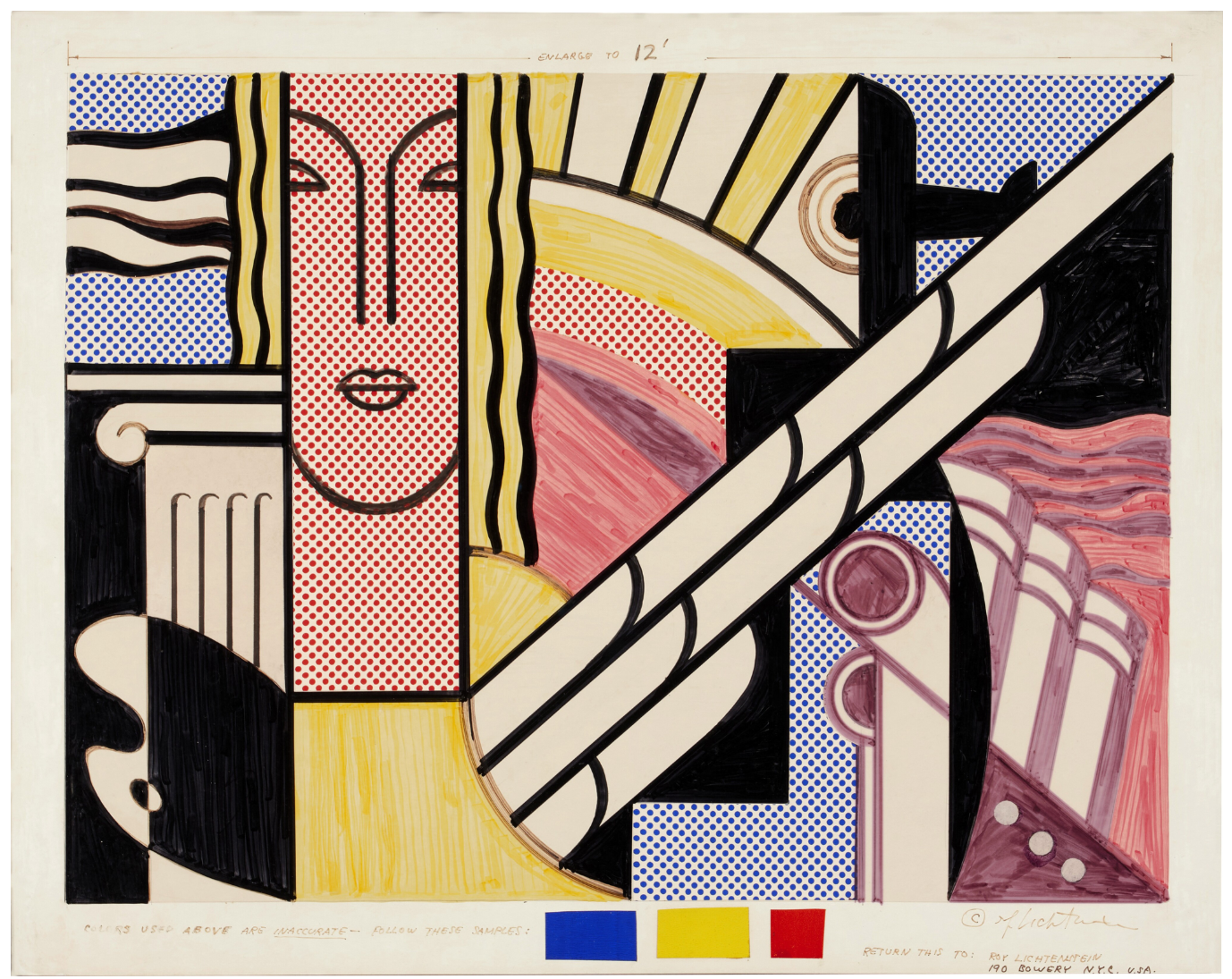
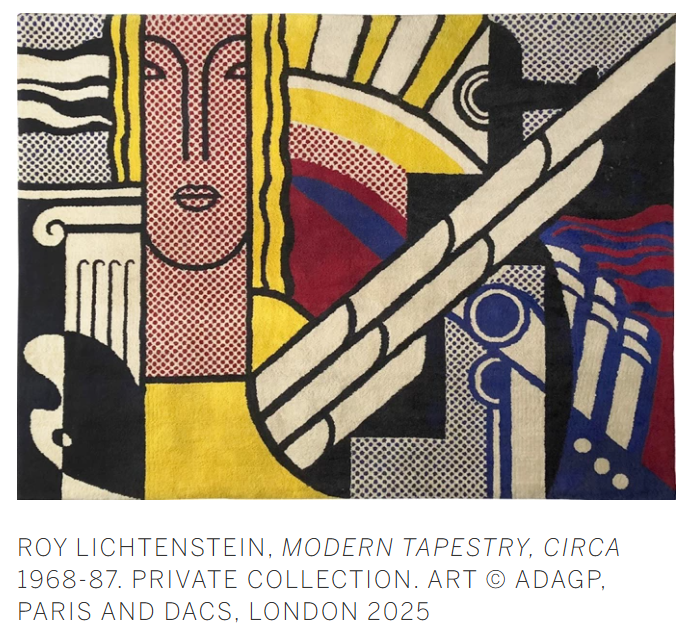
Executed in 1967, Roy Lichtenstein’s Modern Tapestry (Study) was created as the principal study for the artist’s first two recorded tapestries, both woven on a monumental scale in 1968. Marking a pivotal moment in Lichtenstein’s exploration of new mediums and artistic language, the present work stands as an outstanding example of his radical creative vision and meticulous compositional planning. Featuring his signature Ben Day dots and bold primary hues, the present work belongs to Lichtenstein’s celebrated Modern series that he began in the summer of 1966 with his poster for the Lincoln Center in New York, and which he continued to explore for the following half-decade. Inspired by the grandeur of New York’s Art Deco architecture, particularly the iconic Radio City Music Hall, Lichtenstein has constructed a composition that fractures and reassembles the visual language of Cubism. The result is a witty fusion of archetypal styles – parodying and championing the pervasive modernist aesthetics of the 1920s and 30s. Declaring an undaunted departure from the iconic imagery of his earlier Pop and comic-strip paintings, Lichtenstein reinterprets the modern metropolis of New York, characterized by stylized zigzags, chevrons and geometric shapes. Through his observant eye, Modern Tapestry (Study) is imbued with the opulence and technological optimism that accompanied the prosperity of American interwar technological progression.
Piet Mondrian, Composition with Red, Blue and Yellow, 1930. Image: Bridgeman Images. Art © 2025 Mondrian/Holtzman Trust
Lichtenstein often conceptualized works with a pencil sketch, before beginning his more refined collages that employed printed and felt-tip pen colored papers as the basis for his image matrix. These materials, with their rigid lines and flat layers, offered him the flexibility to experiment with composition and color without the commitment of more permanent media. Annotations along the upper and lower border offer Lichtenstein’s specific instructions on his desired scale and color tone, functioning as directives for the weavers. He specifies that the length of the carpet should span a monumental 12 feet, or 365 cm, and notes that the colours in the collage are “inaccurate,” advising the weavers to instead match the samples he has cut from color swatches to achieve a vibrancy and chromatic richness deeper than the ink of his markers – specifications that all four weavers honored in their production. Lichtenstein’s precise artistic control is wholly observable in the present work, even in the collaborative production of the tapestries. Known to produce works for nontraditional or unconventional purposes, Lichtenstein made only a handful of tapestries during his lifetime, and as such, the present work occupies a unique position in his wide-spanning oeuvre.
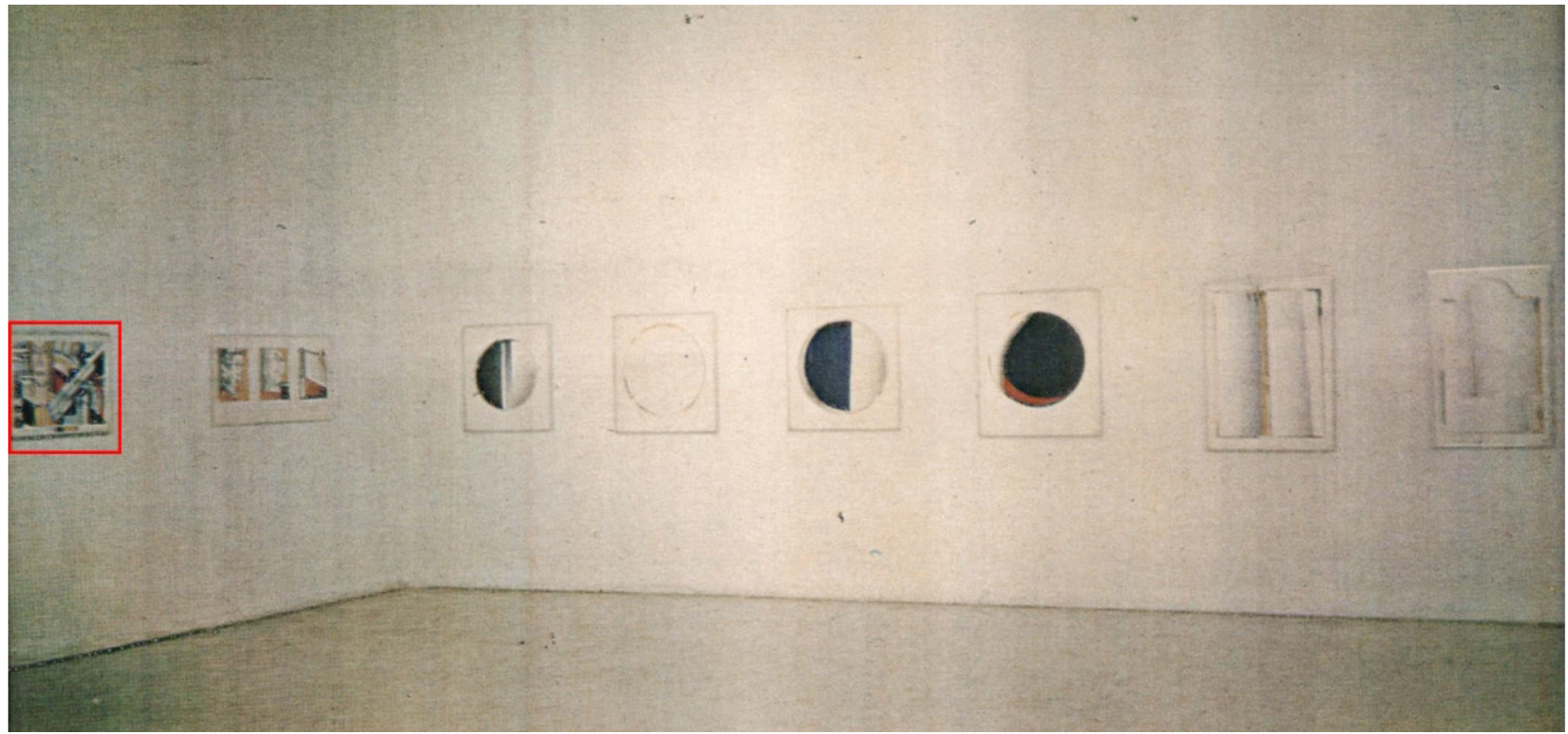
The present work installed in Roy Lichtenstein: Collages at the Visual Arts Museum, New York 1976.
Image courtesy of the School of Visual Arts. Art © Estate of Roy Lichtenstein/DACS 2025
Functioning as a pastiche of Art Deco’s visual tropes, while also engaging with ancient history, the present work collages Lichtenstein’s felt-tip pen drawn motifs: a fragment of a brushstroke in the upper left quadrant self-references the artist’s then ongoing Brushstroke series (1965-71), while the ancient Greek Ionic column and painter’s palette speak to the eternal Hellenistic quest for balance and harmony; a blond ‘Classical head’ dominates the composition, presaging his later interest in the subject explored through his series of Head sculptures (1974-1991). Through the Heads, Lichtenstein sought to depict humans as machines possibly in response to the implicit trust placed in technological advancement that pervaded post-war America. Lichtenstein continues this subversive interrogation through the remainder of the collage, pasting together a sun, wings, an aeroplane, large pipes, and an industrial ship with smoke expelling from its funnels. This last group of motifs holds an underlying evocation of Streamline Moderne, a sleeker form of Art Deco which emphasized speed and progress through curved forms and smooth lines – a response to the Great Depression and the subsequent economic realities of the 1930s. Set against the rising sun – a new dawn – Lichenstein’s last set of motifs speak to the aerodynamic design of aeroplanes soaring above and the powerful curves of transatlantic ships cutting through waves. Lichtenstein has rendered an incongruous image from a panoply of historical allusions, where symbols are spliced together and yet, characteristically for the Modern series, they together weave stories of a utopian vision based on American idealism.
Characteristic of the Modern series, the present work functions as a rejection of monumental post-war abstraction, against the rationale of Abstract Expressionism in its decision to take subjects directly from what Louisiana Museum director Poul Erik Tøjner described as “the riotously proliferating image bank of contemporary American culture” (Poul Erik Tøjner, “I know how you must feel…,” in Roy Lichtenstein: All About Art, Esbjerg 2003, p. 28). Beyond his relationship to the immediate post-war American artistic landscape, there is a thread that can be traced from the present work further back, to that of European artistic traditions: Cubism, recalling the urbanistic compositions of Fernand Léger where forms undergo a process of metamorphosis from figuration to geometry; to Futurism and its celebration of industry and technology; and to the Le Corbusier influenced style of Purism based on a rational and mathematical approach to design. While the Abstract Expressionists focused on answering questions of color and form, driven largely by emotional and spiritual factors, Lichtenstein’s similar concerns with form and composition were motivated by interrogating the American visual lexicon. Much like Léger’s key work The City (1919), Lichtenstein also brings together a framework of vivid hues and clashing shapes to produce a visual intensity that could rival the modern urban environment. The fractured composition of the present work would also act as a prelude to his later Modern works, with compositions that took influence from Picasso’s Cubist portraits of the late 1930s that employed his characteristic curvilinear geometry. With Modern Tapestry (Study), Lichtenstein expands the parameters of his Pop Art vernacular to the illustrious history of modern art history.
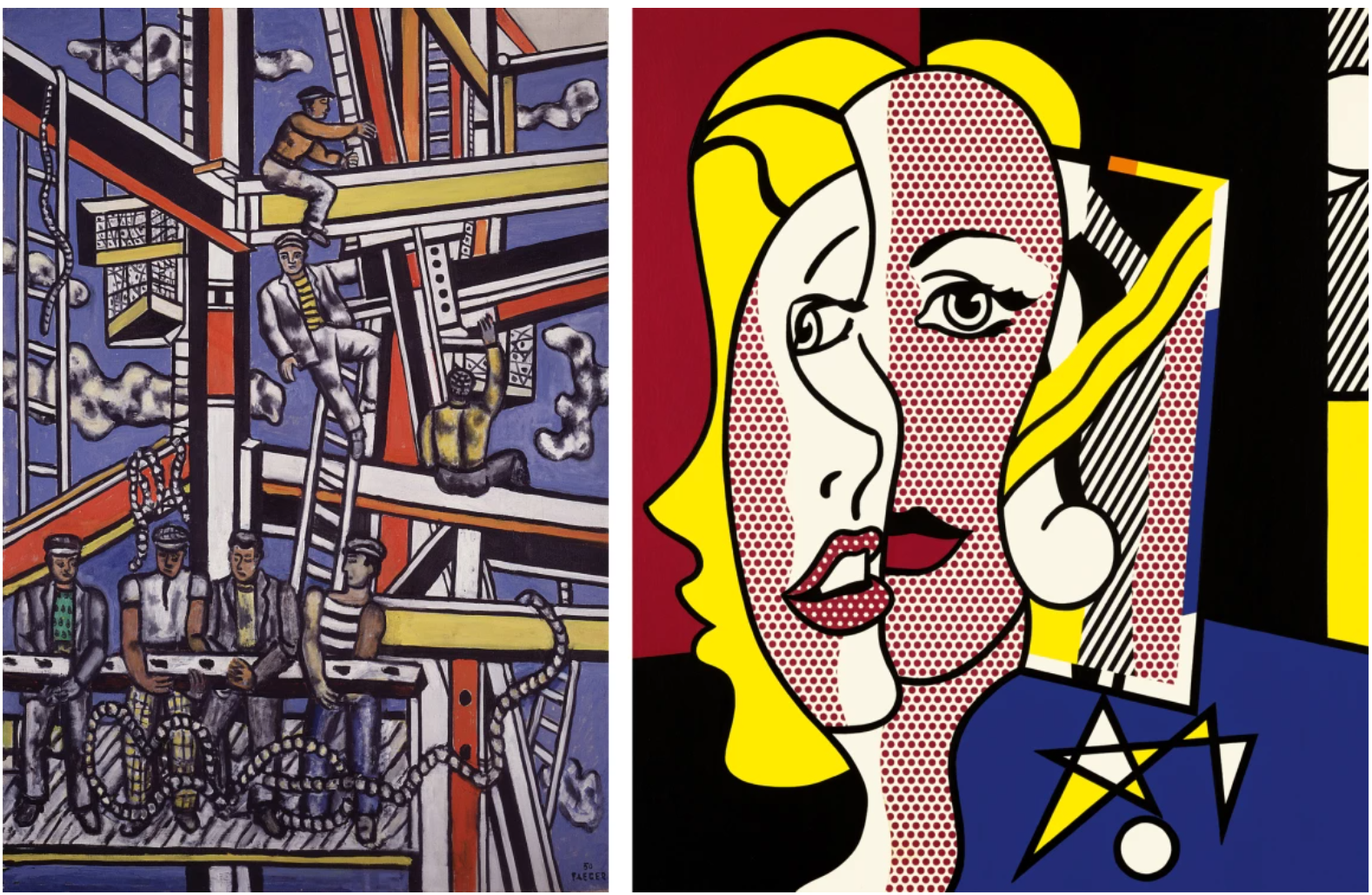
Left: Fernand Leger, Study for The Constructors, Blue Background, 1950-1951. Musee Leger, Biot. Image © Photo Josse / Bridgeman Images. Art © ADAGP, Paris and DACS, London 2025
Right: Roy Lichtenstein, Female Head, 1977. Private Collection. Sold Sotheby’s New York, November 2017 for $24,501,500. Art © 2025 Estate of Roy Lichtenstein/DACS 2025
Modern Tapestry (Study) embodies Lichtenstein’s capability for progress, both within the history of art, and within his own celebrated oeuvre. Lichtenstein demonstrates an ability to reconfigure the language of painting by drawing upon symbolism that is distinctly rooted in the American cultural imagination. Though they appear seemingly disparate, the amalgamation of these motifs to construct a uniquely American composition remains one of Lichtenstein’s lasting legacies. The Modern series, exemplary in Modern Tapestry (Study) are a vivid comment on the decadence of the modern movement; its final accomplishment, however, according to curator Elisabeth Sussman was to be “vital presences of a new art” (Elisabeth Sussman, Roy Lichtenstein: The Modern Work, 1965-1970, Boston 1978, p. 14). Beyond this, his hallmark Ben Day dots, primary tones, and bold linework are instantly recognizable in the present work, encapsulating the enduring potency of the artist’s signature pop aesthetic and visual language. Lichtenstein’s oeuvre is predicated on a semiotic investigation of how systems of representation allow us to conceptualize and interpret the world around us.
Modern Painting with Zigzag (Study), 1967
Modern Painting with Zigzag (Study), 1967
Reflections on Pop: Works from the Collection of Dorothy and Roy Lichtenstein
Sotheby’s New-York: 26 September 2025
Estimated: USD 80,000 – 120,000
USD 69,850
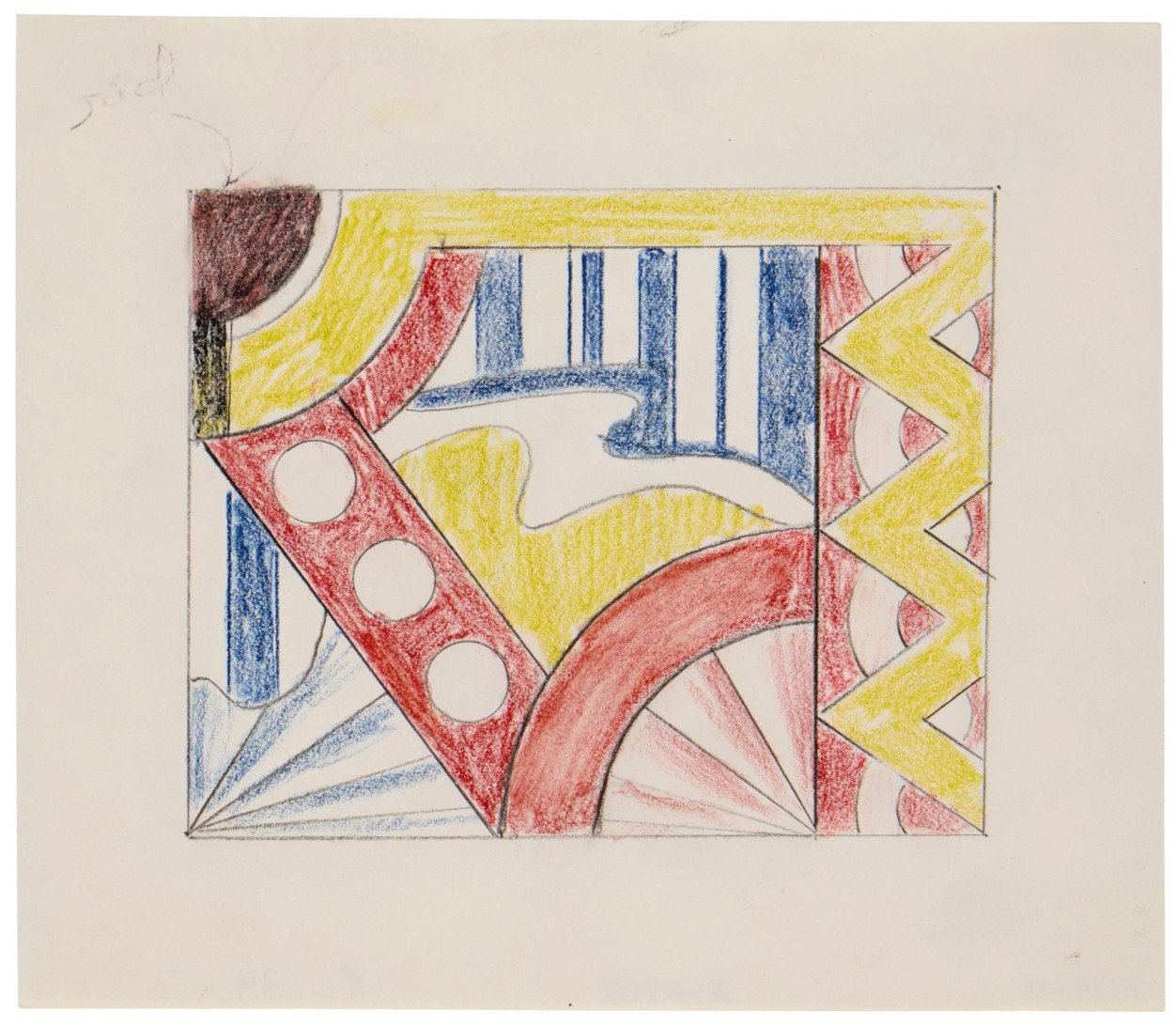
ROY LICHTENSTEIN (1923 – 1997)
Modern Painting with Zigzag (Study), 1967
Colored pencil and graphite on paper
Image: 3 7/8 x 4 5/8 inches (9.8 x 11.9 cm)
Sheet: 5 3/4 x 6 3/4 inches (14.6 x 17.1 cm)
“What is particularly unnerving about the series is what is most relevant to the subject of modernism versus postmodernism… The pathos of Modern Art is particular to itself. There is after all nothing pathetic about Baroque or Victorian Art. But it was the specific claim of “modernism” to be finally and forever open. That was its “futurism,” and now that its future has receded into the past it can be had as a sealed package whose contents have the exotic look of something released from a time capsule.”
DAVID ANTIN, “MODERNISM AND POSTMODERNISM: APPROACHING THE PRESENT IN AMERICAN POETRY,” BINGHAMTON, NEW YORK, BOUNDARY 2, 1972, P.99
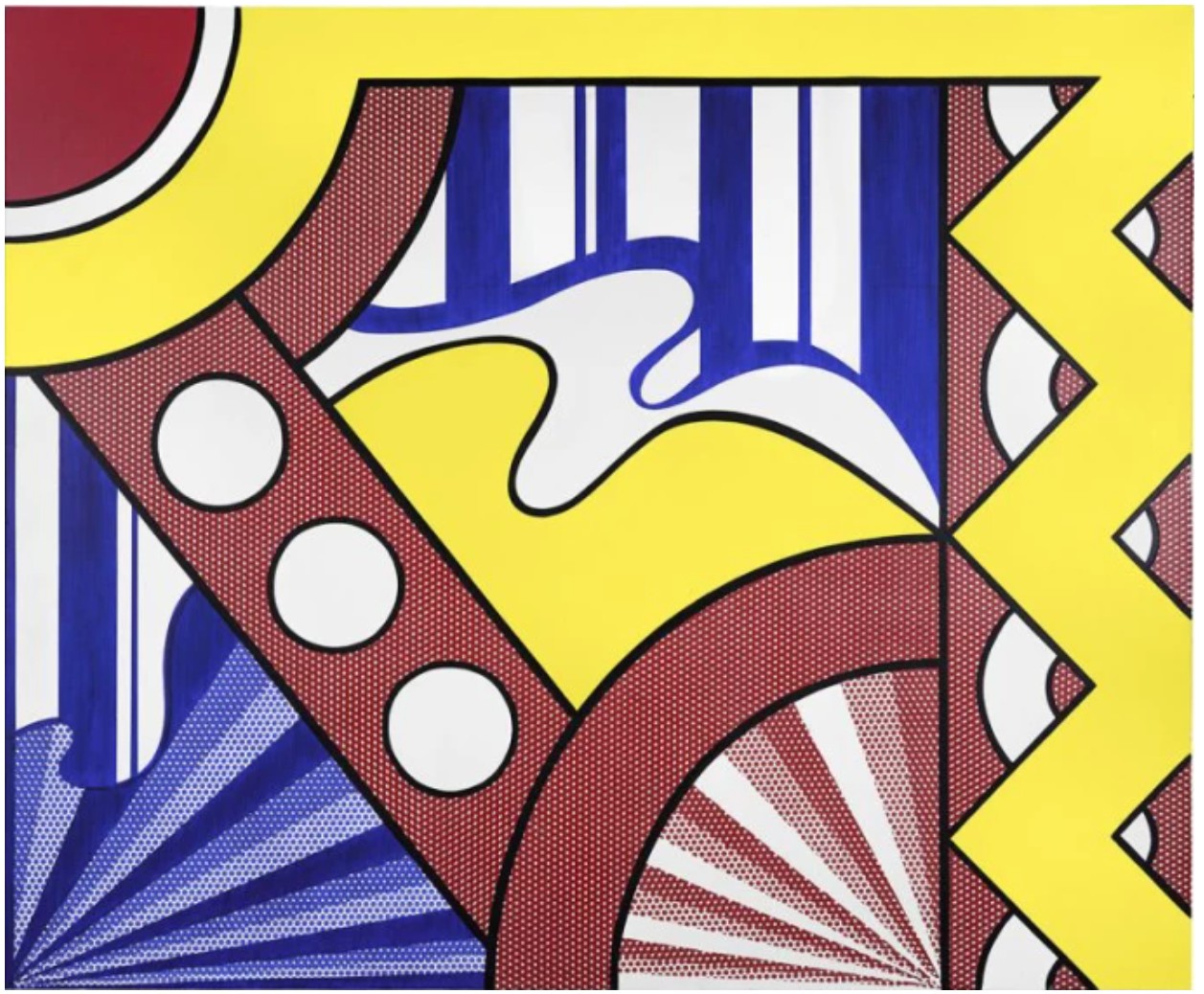
Roy Lichtenstein, Modern Painting with Zigzag, 1967. Private Collection. Art © Estate of Roy Lichtenstein
Modular Painting with Nine Panels (Study), circa 1968
Modular Painting with Nine Panels (Study), circa 1968
Reflections on Pop: Works from the Collection of Dorothy and Roy Lichtenstein
Sotheby’s New-York: 26 September 2025
Estimated: USD 70,000 – 100,000
USD 114,300
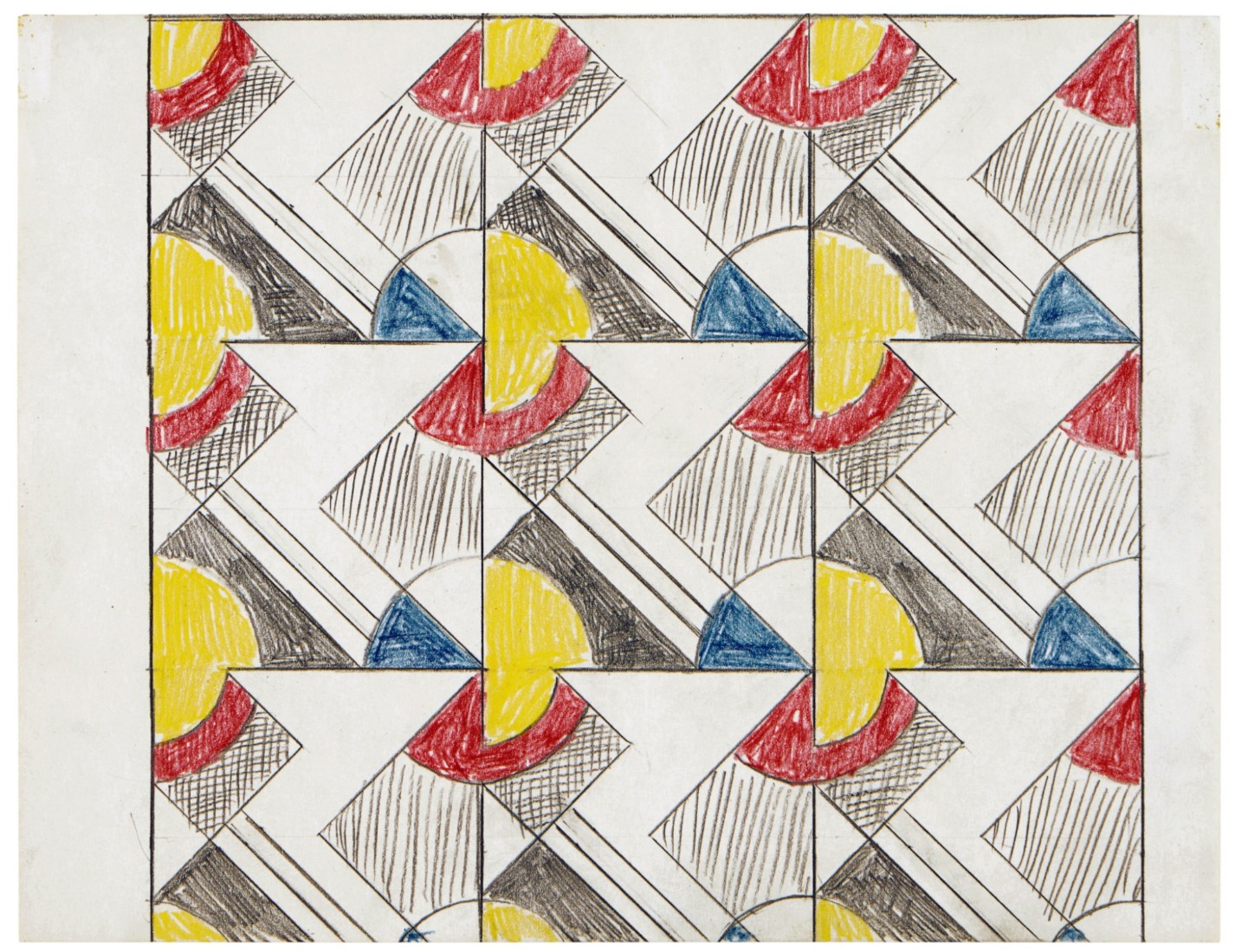
ROY LICHTENSTEIN (1923 – 1997)
Modular Painting with Nine Panels (Study), circa 1968
Colored pencil and graphite on paper
Image: 8 3/8 x 9 inches (21.3 x 22.9 cm)
Sheet: 8 3/8 x 11 inches (21.3 x 27.9 cm)
Begun in 1968, Roy Lichtenstein’s Modular series draws heavily on the clean lines, symmetry, and stylized forms of 1930s Art Deco, a design movement celebrated in the architecture and interiors of that era. Through these works, Lichtenstein explored how Art Deco imagery had been reproduced and disseminated in the mass media, stripping it of its original luxury associations and embedding it in popular culture.
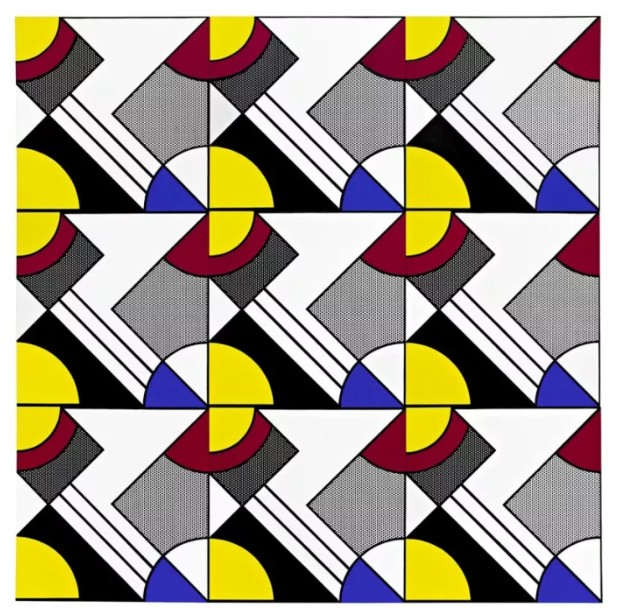
Roy Lichtenstein, Modular Painting with Nine Panels, 1968. Private Collection. Art © Estate of Roy Lichtenstein
Across bold and geometric compositions, Lichtenstein wittily undermines the formality and grandeur of the Art Deco style. At the same time, the series reflects a deeper cultural observation: the merging of high art and mass-produced design in a postwar America increasingly defined by advertising, consumer goods, and media saturation. Playful yet incisive, the Modular series stands as both a tribute to and a critique of the ways in which style, technology, and popular culture intersect.