Introduction
Lichtenstein created some of his best paintings during the last decade of his career. Thoughtful, virtuosic, many times layered with meaning, the paintings of this era witnessed a prolific artist at the height of his powers. Coming of age in the 1960s, Lichtenstein defined himself against the prevailing aesthetic of Abstract Expressionism, a style that had devolved into a second generation of imitative copycats, one that many artists felt derivative and lifeless. Crisp, cool, seemingly devoid of the messy, gestural emotion of the Abstract Expressionists, Lichtenstein’s Pop Art propelled him to fame seemingly overnight, but as early as the 1970s, the artist realized even his own work was in danger of being repetitive. Lichtenstein’s answer to this, an artist’s most daunting challenge, was to seek innovation while continuing to work within his signature style.
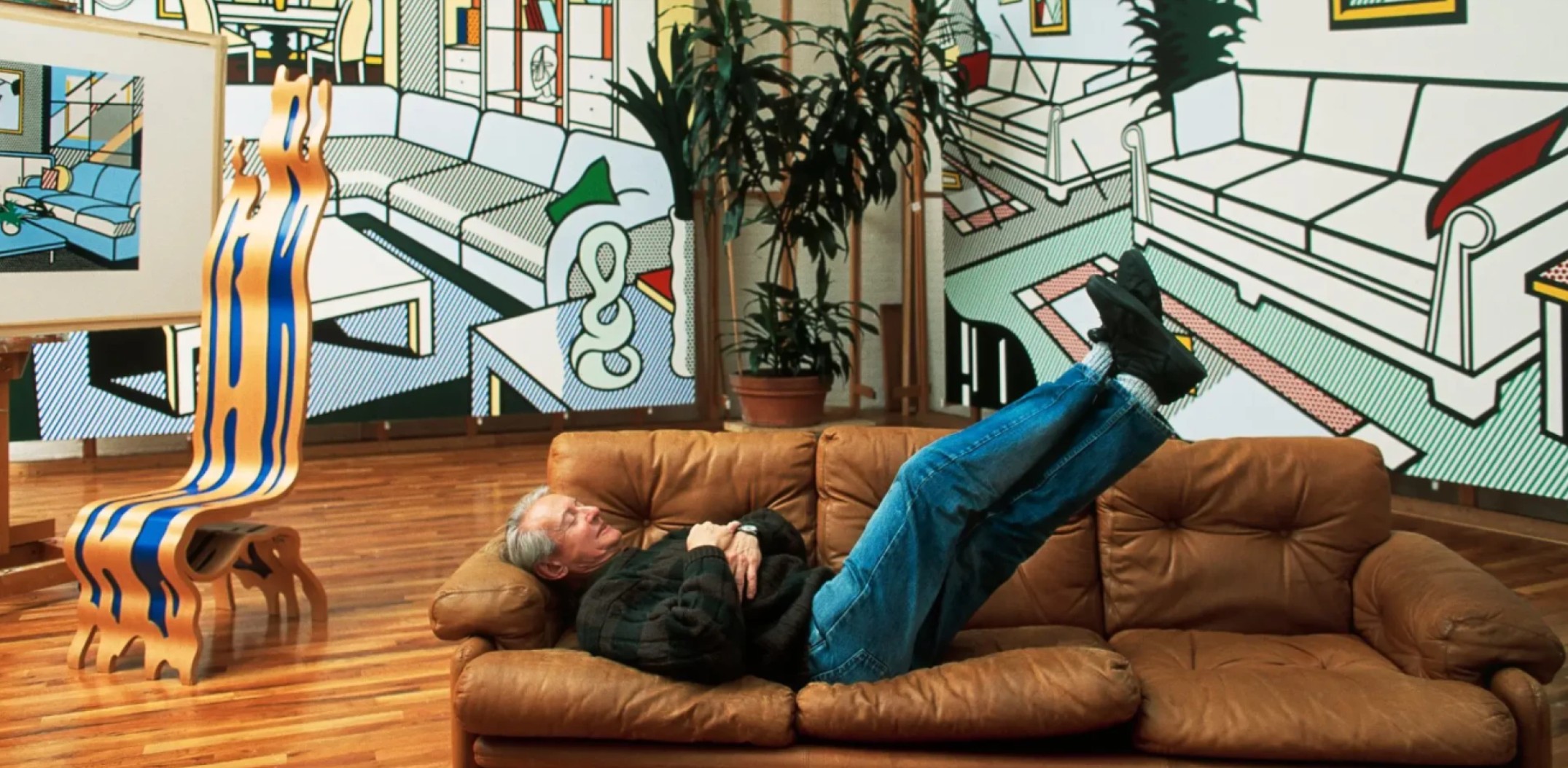
Roy Lichtenstein in his Washington Street studio, 1992. Photo © Thomas Hoepker / Magnum Photos. Art © Estate of Roy Lichtenstein.
A series of thoughtful still life paintings emerged, in which Lichtenstein engaged with the great Modernist masters, from Matisse to Picasso and Braque, only to evolve into the more complex and masterful Artist’s Studio series. In the 1990s, Lichtenstein’s Interiors were born of this continued pursuit. Infused with the sardonic in-jokes that only an artist of his stature could pull off, the Interiors are witty, knowing paintings that are some of Lichtenstein’s best, most accomplished work.
Auction Results
1. Paintings
#1. Interior: Perfect Pitcher, 1994
Christie’s New-York: 13 May 2021
Estimated: USD 20,000,000 – 30,000,000
USD 21,500,000
Roy Lichtenstein (1923-1997) (christies.com)
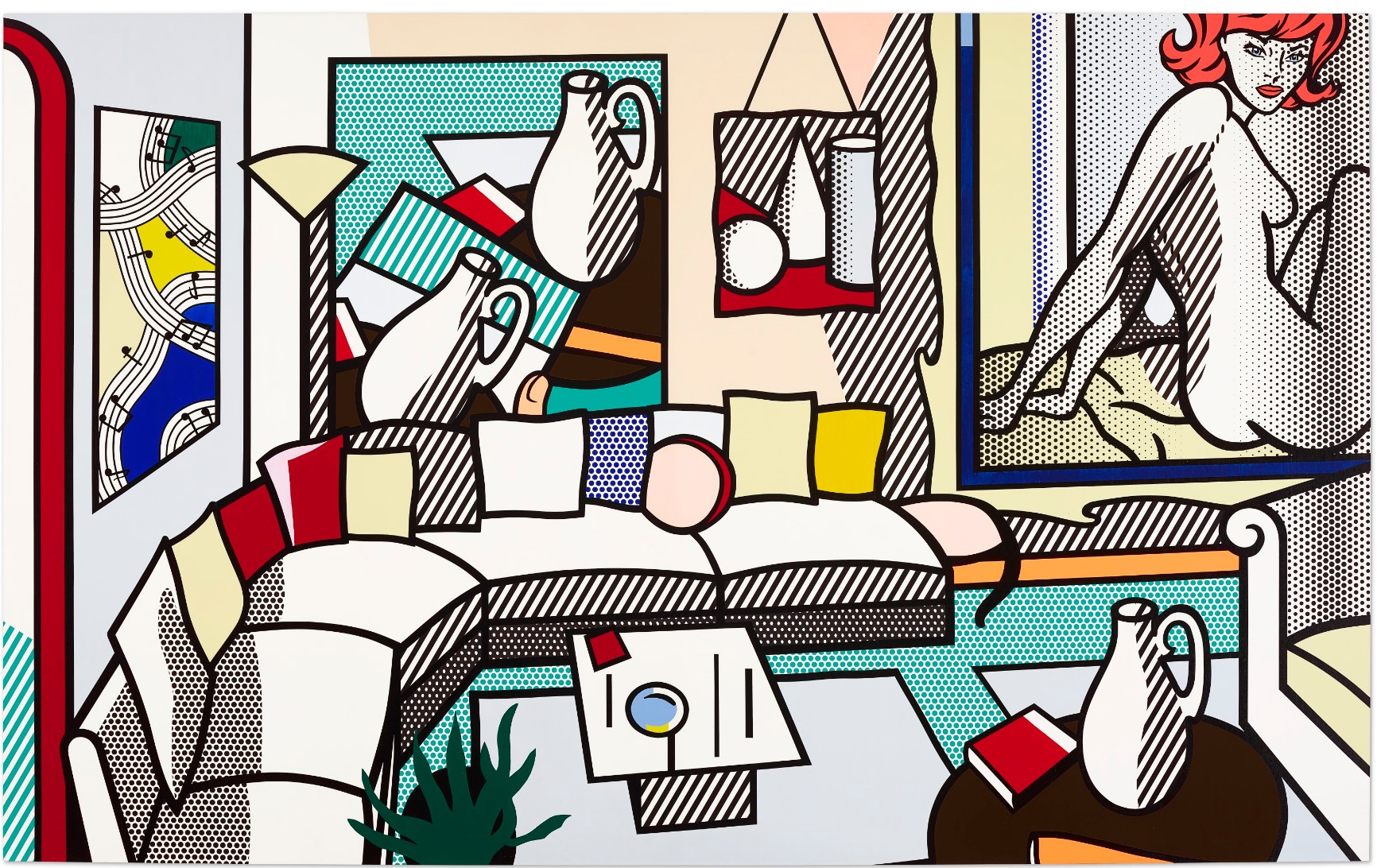
ROY LICHTENSTEIN (1923-1997)
Interior: Perfect Pitcher, 1994
Oil and Magna on canvas
120 ½ x 194 inches (306.1 x 492.8 cm)
#2. Interior with Red Wall, 1991
Sotheby’s New-York: 11 November 2008
Estimated: USD 8,000,000 – 10,000,000
USD 7,026,500
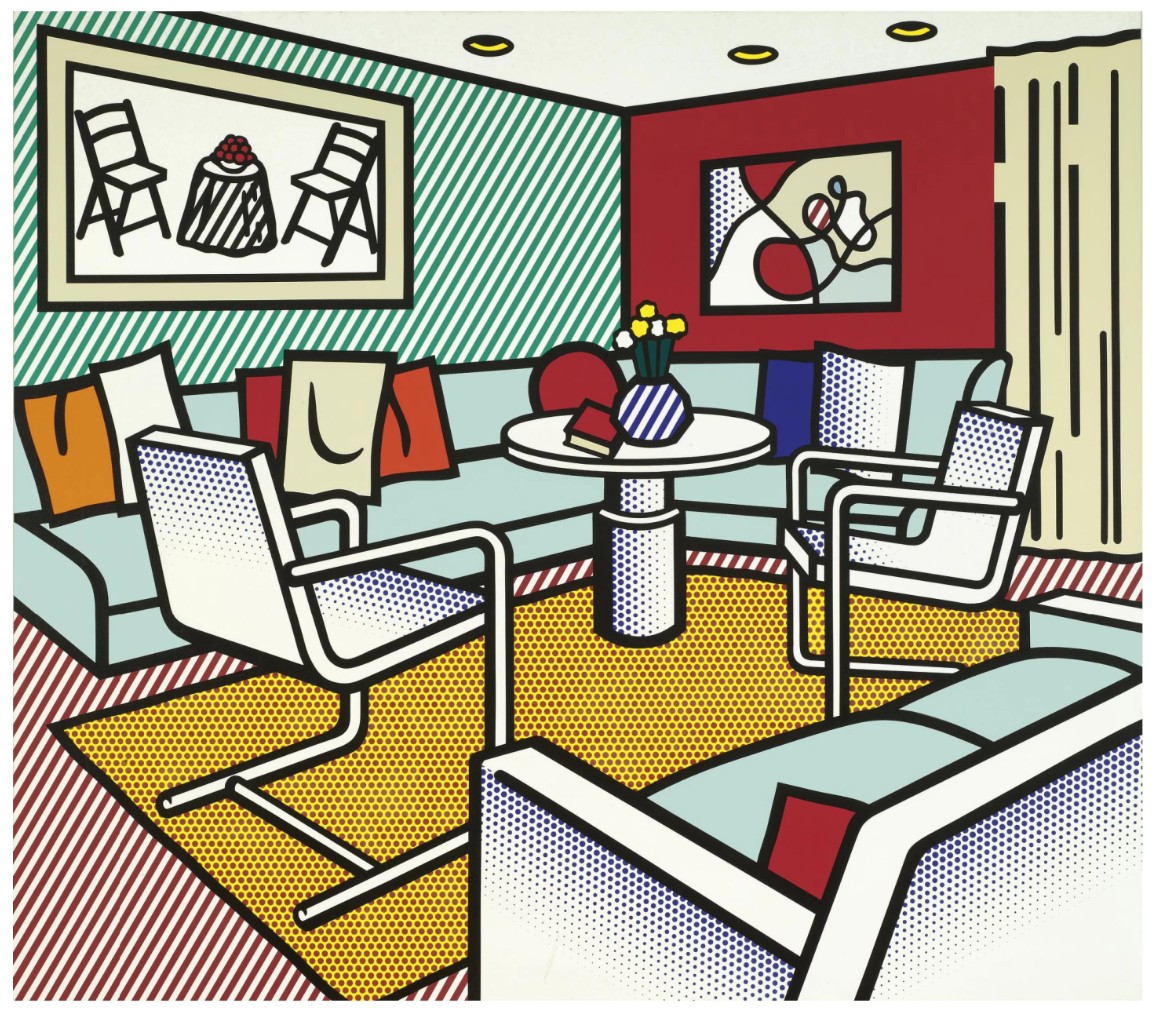
ROY LICHTENSTEIN
Interior with Red Wall, 1991
Oil and Magna on canvas
118×134 inches (299.7 x 340.4 cm)
Signed and dated 91 on the reverse
#3. Interior with Yves Klein Sculpture, 1991
Christie’s New-York: 10 November 2015
Estimated: USD 7,000,000 – 10,000,000
USD 6,661,000
Roy Lichtenstein (1923-1997), Interior with Yves Klein Sculpture | Christie’s
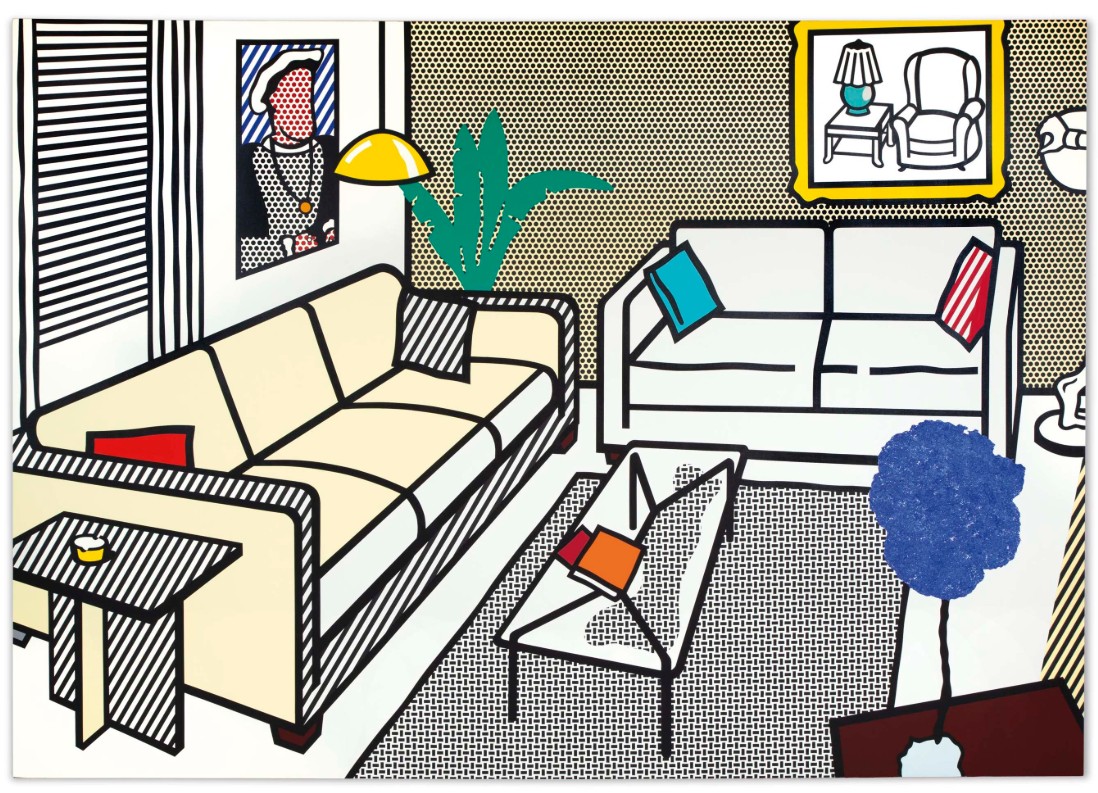
ROY LICHTENSTEIN (1923-1997)
Interior with Yves Klein Sculpture, 1991
Oil and Magna on canvas
120 x 170 1/4 inches (304.8 x 432.4 cm)
Signed and dated ‘rf Lichtenstein ’91’ (on the reverse)
Interior with Shadow, 1993
Roy’s Lichtensteins: Works from the Collection of Dorothy and Roy Lichtenstein
Sotheby’s Paris: 24 October 2025
Estimated: EUR 2,500,000 – 3,500,000
EUR 2,299,500 / USD 2,671,370
Interior with Shadow | Modernités | 2025 | Sotheby’s
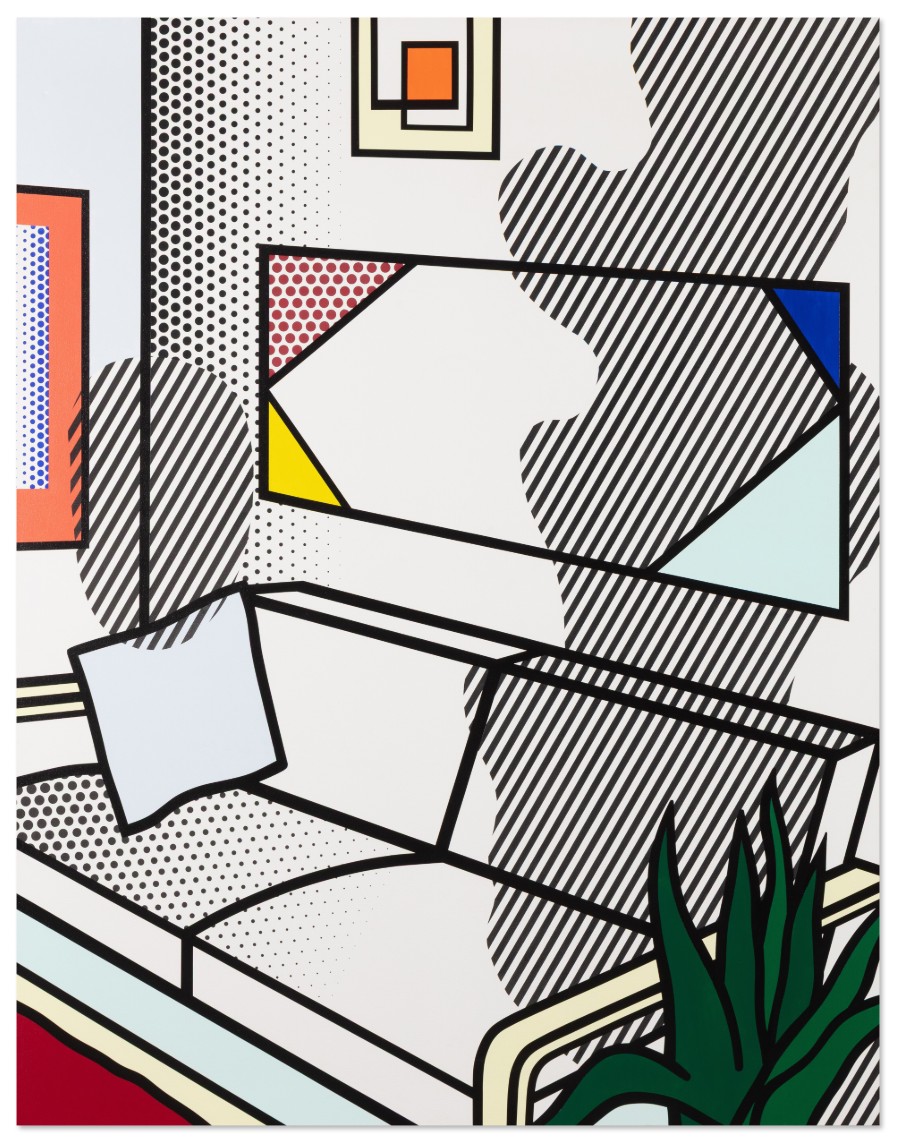
ROY LICHTENSTEIN (1923 – 1997)
Interior with Shadow, 1993
Acrylic, oil and graphite pencil on canvas
82 1/8 x 64 1/8 inches (208.5 x 162.8 cm)
Signed and dated ’93 (on the reverse)
2. Studies
Interior with African Mask (Study), 1990
Works from the Collection of Dorothy and Roy Lichtenstein
Sotheby’s New-York: 16 May 2025
Estimated: USD 800,000 – 1,200,000
USD 2,522,o00
Interior with African Mask (Study) | Contemporary Day Auction | 2025 | Sotheby’s
ROY LICHTENSTEIN (1923 – 1997)
Interior with African Mask (Study), 1990
Sut painted paper, cut printed paper, tape, marker and graphite on board
Image: 34 1/4 x 44 inches (86.8 x 111.8 cm)
Sheet: 38 1/2 x 48 1/4 inches (97.6 x 122.6 cm)
Interior with Mirrored Wall (Study), 1990
A Legacy Reimagined: Works from the Collection of Dorothy and Roy Lichtenstein
Sotheby’s New-York: 19 November 2025
Estimated: USD 500,000 – 700,000
USD 1,638,000
Interior with Mirrored Wall (Study) | Contemporary Day Auction | 2025 | Sotheby’s
ROY LICHTENSTEIN (1923 – 1997)
Interior with Mirrored Wall (Study), 1990
Cut painted and printed paper, tape and graphite on board
Image: 26 1/2 x 33 inches (67.3 x 83.8 cm)
Board: 34 1/2 x 40 3/4 inches (87.6 x 103.5 cm)
Signed and dated ’90 (on the verso)
Large Interior with Three Reflections (Mural Panel) (Study), 1993
A Legacy Reimagined: Works from the Collection of Dorothy and Roy Lichtenstein
Sotheby’s New-York: 18 November 2025
Estimated: USD 1,000,000 – 1,500,000
USD 1,575,000
WORK ON PAPER
ROY LICHTENSTEIN (1923 – 1997)
Large Interior with Three Reflections (Mural Panel) (Study), 1993
Colored pencil and graphite on paper
Image: 9 1/8 x 24 1/4 inches (23 x 61.6 cm)
Sheet: 16 1/4 x 30 1/8 inches (41.3 x 76.4 cm)
Interior (Study), 1991
Reflections on Pop: Works from the Collection of Dorothy and Roy Lichtenstein
Sotheby’s New-York: 26 September 2025
Estimated: USD 700,000 – 1,000,000
USD 1,079,500
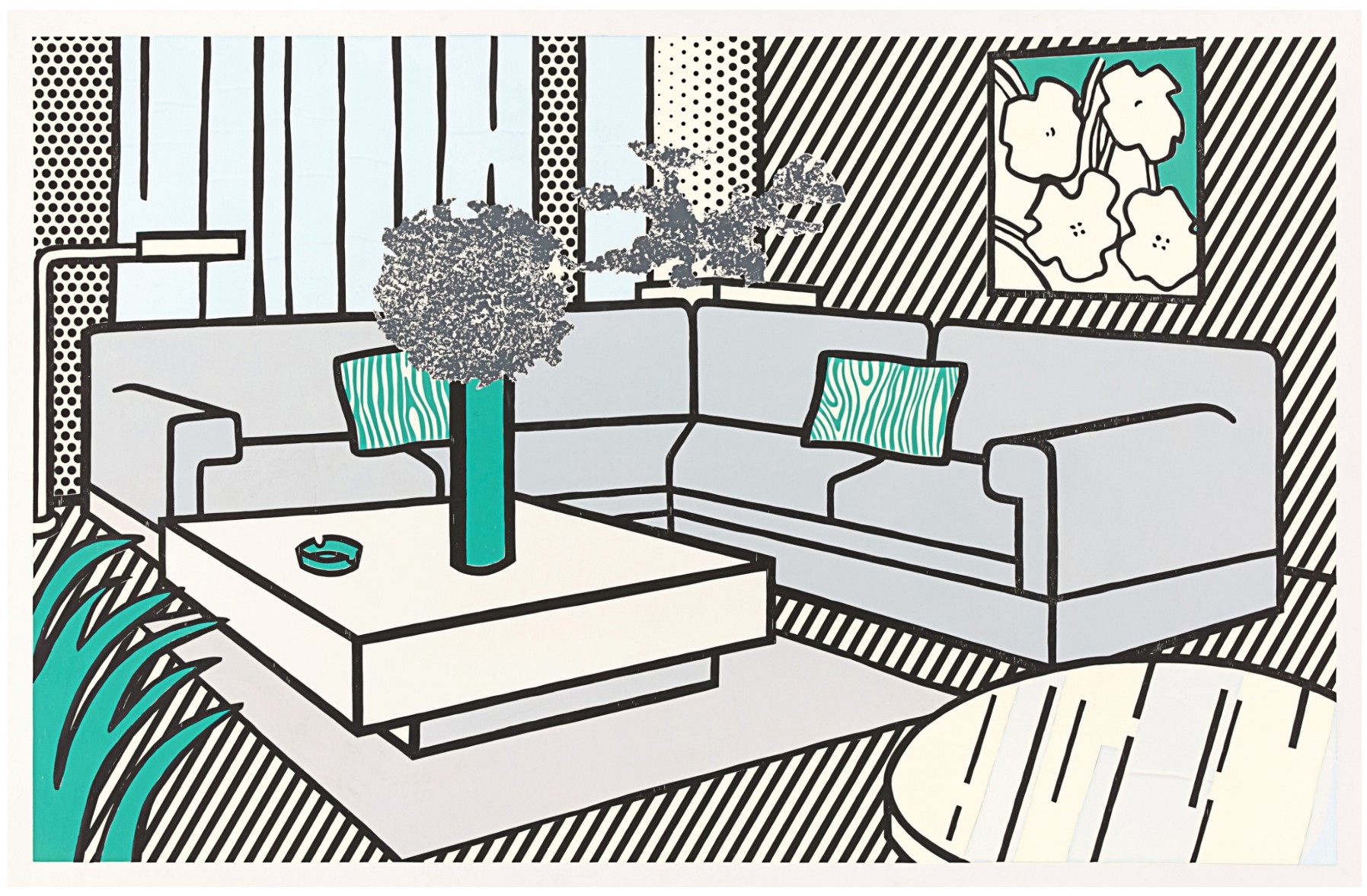
ROY LICHTENSTEIN (1923 – 1997)
Interior (Study), 1991
Tape, cut painted paper, cut paper on printed paperboard
Image: 49 3/4 x 78 3/8 inches (126.4 x 199.1 cm)
Paperboard: 55 3/4 x 84 1/4 inches (141.6 x 214 cm)
Interior with Painting of House (Study), 1997
Works from the Collection of Dorothy and Roy Lichtenstein
Sotheby’s London: 24 June 2025
Estimated: GBP 500,000 – 700,000
GBP 742,000 / USD 1,001,700
Interior with Painting of House (Study) | Modern & Contemporary Evening Auction | 2025 | Sotheby’s
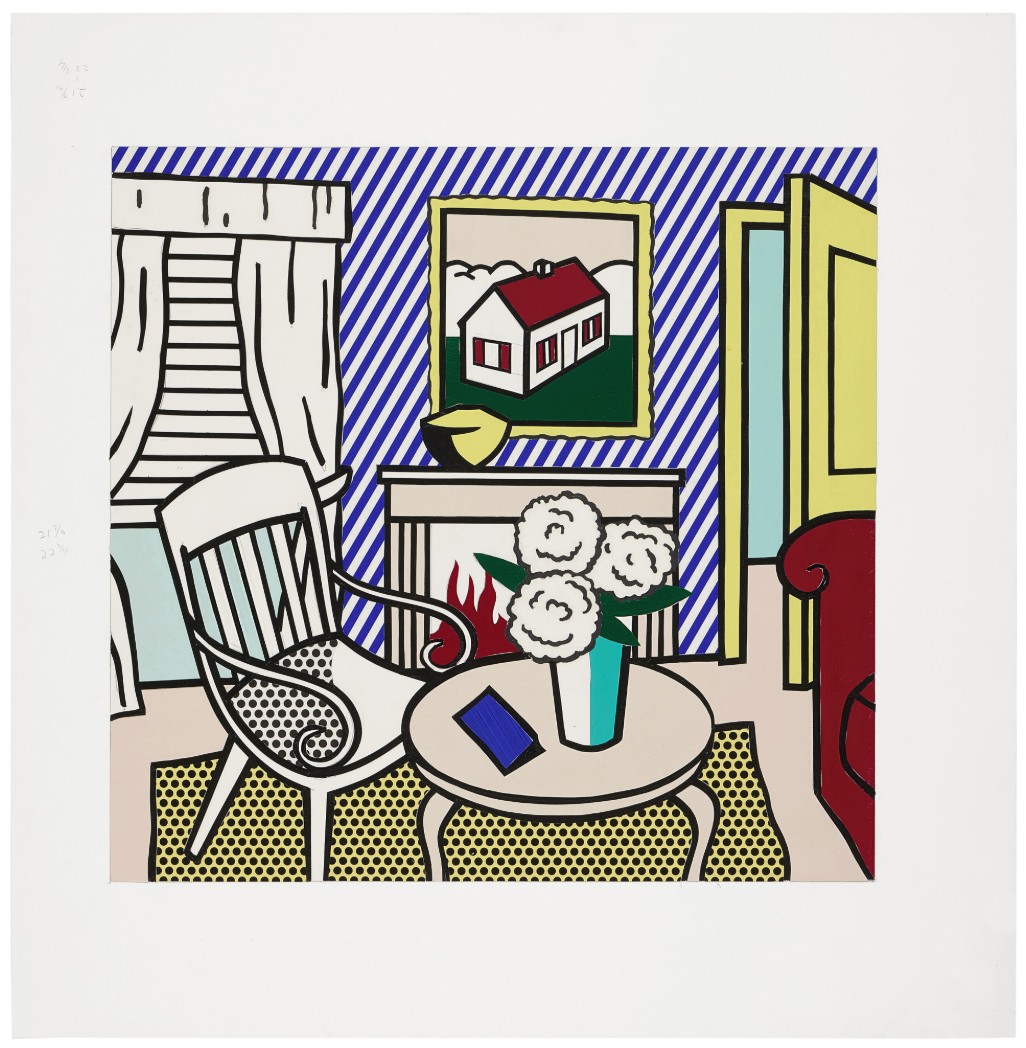
ROY LICHTENSTEIN (1923 – 1997)
Interior with Painting of House (Study), 1997
Cut painted paper, cut printed paper, tape, marker and graphite on board
Image: 21 7/8 x 22 3/4 inches (55.6 x 57.9 cm)
Board: 30 5/8 x 29 7/8 inches (77.8 x 75.9 cm)
Interior with Ajax (Study), 1997
Property from the Collection of Dorothy and Roy Lichtenstein
Sotheby’s Riyadh: 31 January 2026
Estimated: USD 600,000 – 800,000
USD 889,000
Interior with Ajax (Study) | Origins II | 2026 | Sotheby’s
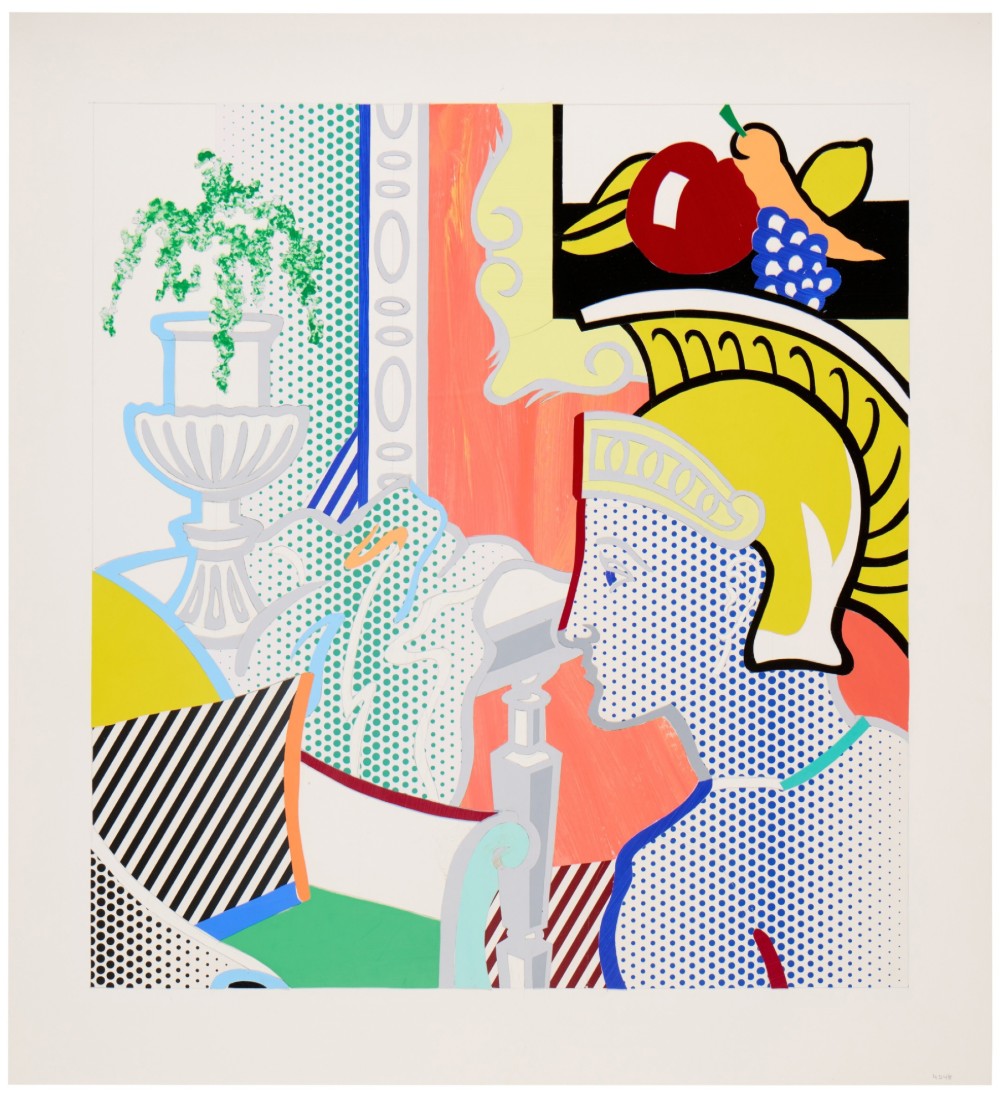
ROY LICHTENSTEIN (1923 – 1997)
Interior with Ajax (Study), 1997
Cut painted and printed paper and graphite on paperboard
Image: 26 7/8 x 25 inches (68.2 x 63.4 cm)
Paperboard: 32 3/4 x 30 inches (83.2 x 76.2 cm)
Signed R. Lichtenstein and dated ’97 (on the reverse)
Interior with Swimming Pool Painting (Study), 1992
Works from the Collection of Dorothy and Roy Lichtenstein
Sotheby’s New-York: 16 May 2025
Estimated: USD 400,000 – 600,000
USD 762,000
Interior with Swimming Pool Painting (Study) | Contemporary Day Auction | 2025 | Sotheby’s
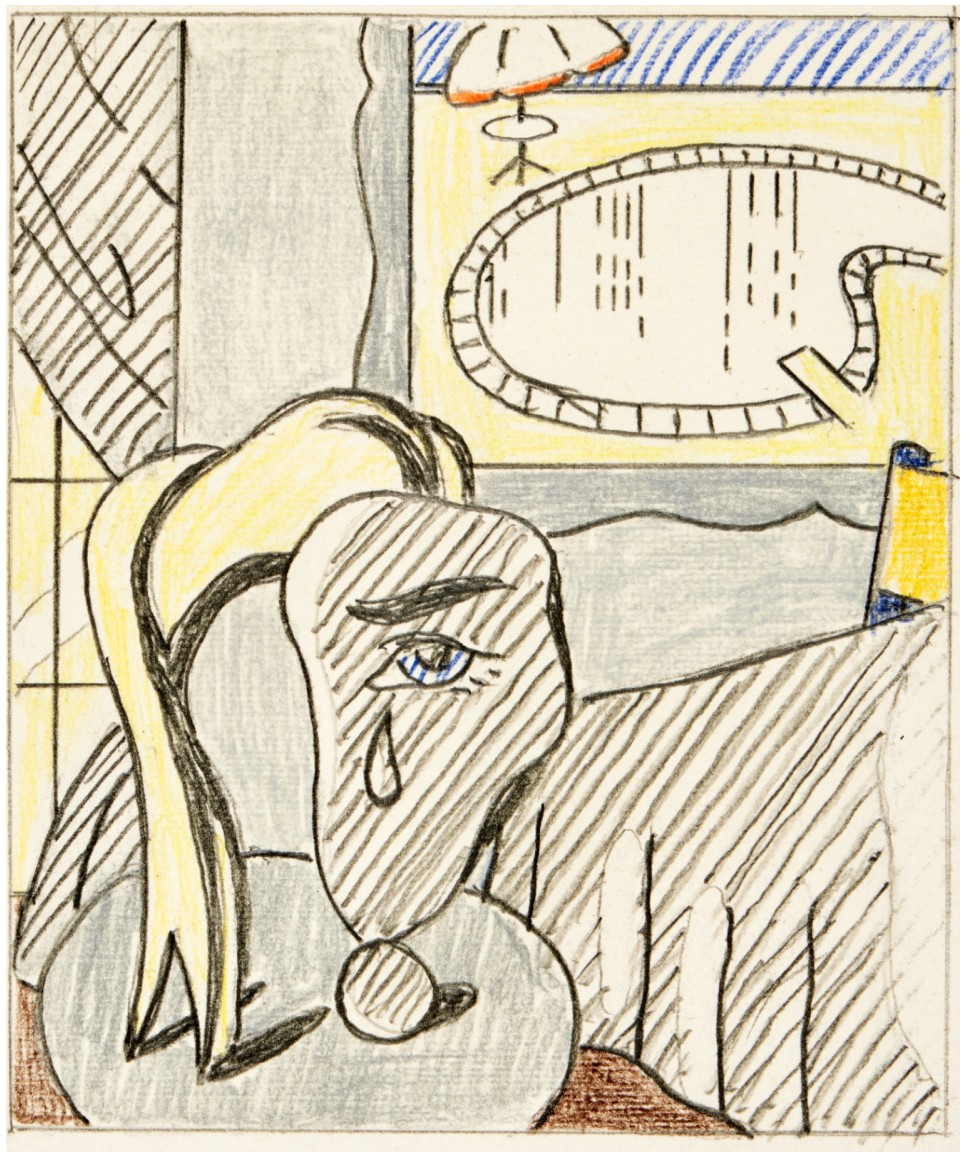
ROY LICHTENSTEIN (1923 – 1997)
Interior with Swimming Pool Painting (Study), 1992
Colored pencil and graphite on paper
Image: 6×5 inches (15.2 x 12.7 cm)
Sheet: 9 7/8 x 6 3/4 inches (25.1 x 17.1 cm)
Signed and dated ’92 (on the verso)
PAINTINGS
Interior: Perfect Pitcher, 1994
Interior: Perfect Pitcher, 1994
Christie’s New-York: 13 May 2021
Estimated: USD 20,000,000 – 30,000,000
USD 21,500,000
Roy Lichtenstein (1923-1997) (christies.com)
ROY LICHTENSTEIN (1923-1997)
Interior: Perfect Pitcher, 1994
Oil and Magna on canvas
120 ½ x 194 inches (306.1 x 492.8 cm)
Roy Lichtenstein’s epic painting, Interior: Perfect Pitcher, is an encyclopedic retrospective of his unique artistic legacy. Containing many of the subjects and practices that sustained his long and prolific career, it also contains the first example of his celebrated late nudes, in addition to being the final painting in his series of Interiors. Painted towards the end of his life, this large-scale canvas is reflective of Lichtenstein’s unique Pop aesthetic, and also of his deep understanding and appreciation of art history. Using his iconic Ben-Day dots and hard-edged lines, the painting features a striking flame-haired woman (reminiscent of his iconic Girl paintings from the 1960s), plus other art-historic themes, including interior scenes, classic still lifes, Cubist compositions, his clever renditions of the reflections on glass and mirrored surfaces, plus his melodic painting of a musical score. Acquired by the present owner in 2002 directly from the Estate of Roy Lichtenstein, it has remained in their private collection for the past almost twenty years. Recapitulating the key themes of the artist’s classic 1960s paintings by integrating comic book heroines and everyday objects of consumer culture, with an investigation into the nature of visual aesthetics, Lichtenstein’s Interior: Perfect Pitcher becomes the perfect “picture,” a panoply of a lifetime of artistic innovation.
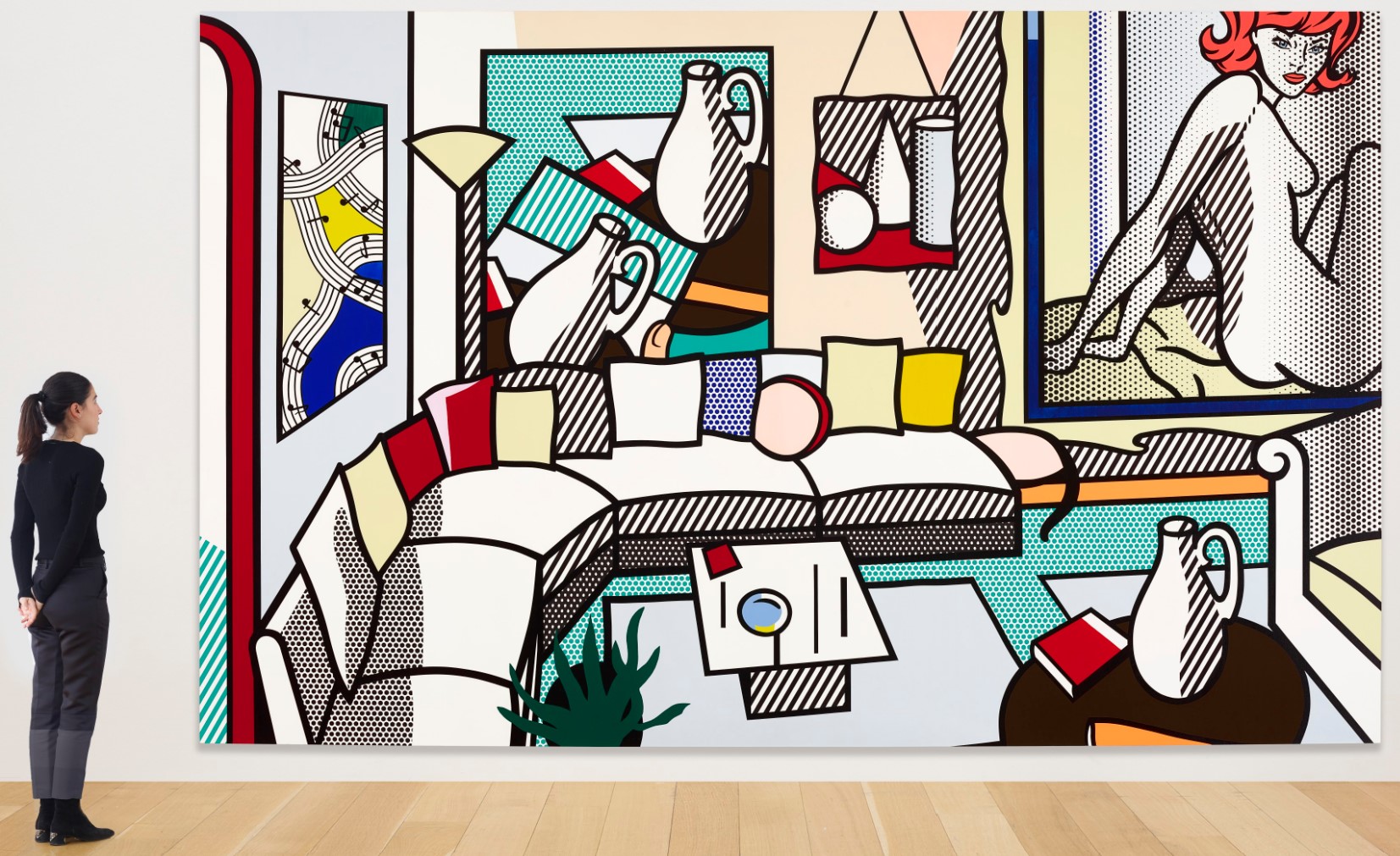
This monumental picture displays the interior of an impeccably-styled domestic setting. A large sectional sofa snakes its way around the room; on it rest multi-colored cushions in a Mondrian-esque palette of primary red, yellow and blue. A square glass-topped table with a round ashtray occupies the middle of the space, and across from it, a round table upon which sits one of the titular “perfect pitchers” and a red book. Adorning the walls are a series of paintings that reflect Lichtenstein’s interest in the history of art; from the classic nude, to Cubist collages, and an arrangement of geometric vessels that recall the work of Giorgio Morandi, each of these paintings can be read as a nod to significant moments in the art historical canon.
Lichtenstein has long been an artist who sought innovation while continuing to work within his trademark style, and during this period he began to translate the comic heroines of the ‘60s into classical nudes. In the present work, the artist returns to the DC Comics that he had first used in 1963 as the basis for the sleek red-haired nude that is displayed upon the interior wall, and whose fiery coif stands in brisk contrast to the sensuous curves of her naked body. The ‘60s comic book Falling in Love #59 provides the source image for this nude, with other elements inspired by a black-and-white illustration of a sectional sofa, along with a musical motif that he would later use in his painting—Unchained Melody, 1994—that he includes along the left interior wall. With all the mastery of a great conductor, Lichtenstein arranges these seemingly disparate elements within a beautifully-composed interior scene. Rather than merely copying from the original material, Lichtenstein made several revisions to his red-haired nude that can be traced from his original drawing, to the collage study, and to the final painting. As in the original Falling in Love panel, the lascivious gaze of his heroine conveys a keen sense of sexuality, yet in stripping her bare, Lichtenstein subtly twists and elongates the figure’s body, so that it fills the picture plane. Not unlike Ingres’s Odalisques, Lichtenstein lengthens and elongates her figure, in order to lend a palpable sensuality and softness to his otherwise crisply-rendered form. He renders her ‘60s coiffure and luscious lips in a vibrant, flaming red. Ben-Day dots of varying sizes and bold striations are used to convey the tender skin of her nude body.
Interior with Yves Klein Sculpture, 1991
Interior with Yves Klein Sculpture, 1991
Christie’s New-York: 10 November 2015
Estimated: USD 7,000,000 – 10,000,000
USD 6,661,000
Roy Lichtenstein (1923-1997), Interior with Yves Klein Sculpture | Christie’s
ROY LICHTENSTEIN (1923-1997)
Interior with Yves Klein Sculpture, 1991
Oil and Magna on canvas
120 x 170 1/4 inches (304.8 x 432.4 cm)
Signed and dated ‘rf Lichtenstein ’91’ (on the reverse)
Provenance
Gagosian Gallery, Los Angeles
Acquired from the above by the present owner, 1998
Masterfully-executed upon a vast canvas, Roy Lichtenstein’s Interior with Yves Klein Sculpture is a monumental example of the artist’s Interiors series. A dazzling interplay of color, pattern and line, the painting engulfs the viewer in its fictitious, art-filled world by nature of its massive scale and flawless execution. An entire wall is given over to Lichtenstein’s signature Ben-Day Dots, meticulously rendered in precise, finite detail against a yellow background, its effect dynamic and lively. The surface of Lichtenstein’s canvas is like no other. Its impeccable appearance belies the months-long, painstaking process of its creation. Crisply-rendered dots and diagonals punctuate the composition while a bright, Pop palette activates and energizes the sleek and modern living area he depicts. The Yves Klein sculpture, depicted in the most precise blue hue, evokes Klein’s work with profound accuracy. Rendered with an actual sponge, the effect of Lichtenstein’s lively daubs against the crisply-ordered, perfectionist interior is revelatory. Created in 1991, this lively and inventive painting is an exceptional example of the artist’s Interiors series, where many of the key themes of his classic paintings are revitalized and rediscovered, as they engage in a witty dialogue with the history of art itself.
In Interior with Yves Klein Sculpture, masterworks of art history mingle side-by-side with everyday objects of consumer culture within a sleek, modern interior. On one wall, a portrait of Henry VIII by Hans Holbein has been translated into Lichtenstein’s signature style. Its original background of luxurious ultramarine has been transformed into diagonal blue stripes, its facial features reduced to a field of red Ben-Day dots. In the foreground, the whimsical depiction of a 1959 Yves Klein sponge sculpture energizes the pristine space with a potent jolt of blue, while in the background, the poised heel of the Discus Thrower and its arm-wielding disk can just be seen, rendered in cartoon-like black-and-white as if pulled from the pages of a 1960s comic book.
Along the back wall, Lichtenstein frames an unusual painting that finds no place alongside the greatest wonders of art history: a homey, quotidian armchair rendered in simple, black-and-white outlines upon a non-descript, blank background, its only accoutrements a humble blue lamp and a traditional side table. Since Lichtenstein often included his own paintings within the Interiors series, it is tempting to conclude that this painting of common objects might represent his own work. The painting reiterates the succinct, matter-of-fact style of Lichtenstein’s earliest black-and-white paintings of the 1960s. Painting himself onto the wall, Lichtenstein arranges his own work among the “greatest hits” of art history, a clever trick that only an artist at the height of his powers could pull off. The painting’s pastiche of an ornate, gilded frame provides an ironical punch, which is all the more telling considering the Holbein is not even framed at all. Does this indicate the supremacy of Pop Art over the hallowed lineage of art history’s greatest masters like Holbein, whose portraits of unparalleled realism established the genre of portraiture as we know it today?
Along the painting’s right edge, the poised heel of the Discus Thrower is set upon a simple, round base, humorously rendered in black-and-white as if lifted from the pages of a comic-book illustration. Its disc-wielding arm and upturned heel are both cropped along the painting’s edge, leaving the pent-up tension of the figure’s body entirely to the viewer’s imagination. Lichtenstein even transforms the venerable Henry VIII portrait into the simple graphics of his signature style. The sixteenth century portrait so prized for its exacting detail, sumptuous use of materials and lifelike verisimilitude is reduced, flattened and exaggerated to comical effect.
Source materials from the artist’s studio indicate the artist based his depiction on reproductions of the works, rather than copying from life—the Discobolus from the pages of a 1962 art book and the Yves Klein from a Sidney Janis Gallery exhibition catalogue from 1986. By copying from a copy, Lichtenstein acknowledges the ubiquitous nature of these familiar art historical images in a media-saturated world, a concept which is all the more telling considering the Discobolus depicted was actually a Roman copy of the Greek original.
By this time in his career, Lichtenstein certainly recognized his own hallowed standing in the canonical roster of history’s greatest artists, and by depicting his own work in a mock-ornate frame alongside the likes of Holbein, Yves Klein and the classical Greeks, he engages in a sardonic dialogue with the history of art itself. By selecting such diverse imagery as if from an encyclopedia of art’s greatest hits, and by depicting them within his own spare and reduced visual language, Lichtenstein reduces art to its archetypes, to those codified symbols embedded in our collective consciousness. In much the same way that his earliest paintings of ordinary objects pointed to the abundance of consumer products in a post-war America and its homogenization, Lichtenstein’s Interiors expand that notion to the history of art itself, including Lichtenstein’s own work. As the Lichtenstein scholar Graham Bader so aptly described: “The paintings suggest that to make art is to engage in a game of reflection and refraction that stretches across history and between works, enveloping artist, image and viewer alike” (Graham Bader, quoted in “Painting Reflection,” Roy Lichtenstein Reflected, exh. cat., Mitchell, Innes & Nash, New York, 2011, p. 57).
In 1992, Interior with Yves Klein Sculpture was included in a now-legendary exhibition at the Castelli Gallery that marked the dealer’s 35th anniversary and the 30th anniversary of Lichtenstein’s debut there in 1962. Reviewing the paintings for the New York Times, the inimitable critic Roberta Smith lauded the Interiors, singling out Interior with Yves Klein Sculpture from others in the group. She wrote: “Roy Lichtenstein has a nearly inexhaustible talent for putting his best-known visual strategies to fresh uses. This is resoundingly affirmed by his latest paintings, a series of big, cartoonish domestic interiors on view. … Clean of color, crisp of line, these paintings are full of Mr. Lichtenstein’s most famous motifs and devices. His signatory black outlines and Ben Day dot patterns, borrowed from the comics in the early 1960’s, are here, as are quotations from other art and artists through the ages. Yet these images of well-appointed living rooms and bedroom suites outfitted with paintings and sculptures seem strikingly unfamiliar, as if every element in them has been rethought and retooled. … In short, the show includes some of the best paintings Mr. Lichtenstein has produced in the last 15 years” (R. Smith, quoted in “Review/Art; Inviting (if Fanciful) Rooms from the View of Roy Lichtenstein,” New York Times, 7 February 1992).
Interior with Red Wall, 1991
Interior with Red Wall, 1991
Sotheby’s New-York: 11 November 2008
Estimated: USD 8,000,000 – 10,000,000
USD 7,026,500
ROY LICHTENSTEIN
Interior with Red Wall, 1991
Oil and Magna on canvas
118×134 inches (299.7 x 340.4 cm)
Signed and dated 91 on the reverse
Provenance
Leo Castelli Gallery, New York (LC# 1125)
Ace Gallery, New York (acquired from the above in 1991)
Acquired by the present owner from the above in October 1993
Interior with Red Wall, 1991, is a splendid example from Roy Lichtenstein’s important series of paintings titled Interiors. One of the last major series produced before the artist’s death, these paintings represent a culmination of Lichtenstein’s method of appropriating images from popular media to produce iconic aesthetic masterpieces that comment on our time. Seductive commercial images of the modern home interior formed the inspirational basis of the series, as Lichtenstein focused on a subject that has long captured the fascination of Pop artists: the myth of blissful bourgeois domesticity. One of the earliest seminal works of Pop art, Richard Hamilton’s Just what is it that makes today’s homes so different, so appealing?, from 1956, is a touchstone for this investigation, depicting a living room collaged over with the accoutrements of the ideal middle-class lifestyle as it appeared in the prevailing media.
From his earliest Pop works, interiors played a vital role in Lichtenstein’s oeuvre. His first interior painting, Bathroom, from 1961 belongs to his black and white period, derived primarily from newspaper advertisements, which encapsulated a dramatic period of change in American art. Lichtenstein and his fellow Pop artists were embarking on a complex process of exploring new methods, new subjects, and new boundaries in art. Lichtenstein returned to the Interiors with full force and heightened focus much later in his career. The present work and others from the 1990s series achieve a cleaner, more mechanical appearance, leaving behind the vestiges of hand-painting of his early works such as Bathroom. But from their opposing positions in the timeline of his career, both paintings, with their graphic elements and commercial subject matter, address Lichtenstein’s conversion of non-artistic images into non-artistic paintings, posing the question of the meaning of art in our time.
Lichtenstein made his initial break from the canons of Abstract Expressionism with his choice of subject and source. Having worked as a commercial artist in the 1950s, he chose to depict common, every-day subjects from our popular culture, found in newspapers, comic books, and catalogues. The artist’s sourcebooks are brimming with clippings that formed his pictorial lexicon. In transforming these pedestrian images into art, Lichtenstein and his colleagues, dissolved the usual distinction between “high” and “low”. Among his colleagues, Lichtenstein’s approach was the most conceptual and intellectual, intent on commenting ironically on the artifice of painting and the very essence of the practice. Despite initial appearances, a close study of his notebooks and files confirms that Lichtenstein’s compositions were never mere copies of his sources, but careful reconstructions with finely tuned editing and a remarkable eye for design and effect.
The Interiors were the first major body of work undertaken by Roy Lichtenstein in the 1990s and are a caricature of the types of excessive interiors prevalent in the 1980s that graced the pages of Architectural Digest. Works such as Interior with Red Wall showcase uncluttered and idealized interiors in a highly graphic and stylized manner. The immense paintings from this series went through three stages of being – first a sketch, then a collage and lastly the final work on canvas. The collages were an invaluable tool, with their ease of adjustment providing a high degree of flexibility in the creation of compositions and balancing of color values. The ratio between the collages and the monumental paintings was an expansive one to four. In the process, Lichtenstein fine-tuned the compositions and made slight changes to the painting – repositioning objects, shifting color tones – in order to prevent the canvas from being a simple enlargement of the collage.
Lichtenstein unified the composition of Interior with Red Wall through the skillful distribution of color and graphics, orchestrating the collision of bold colors and strong geometrics into a harmonious and muscular balance. He demonstrated this skill in the contrast of the red striped floor that spreads throughout the composition and frames the carpet that rests on it. The white expansive sofas create vectors that are balanced by the bold diagonals on the left wall. Art itself plays a role in this tableau of acquisition and possession. Leo Castelli commented on Lichtenstein’s Interiors, “What I see when I stand in front of any interior of Roy’s is a work of an important artist that I immediately recognize: a Calder, a blue sponge sculpture by Yves Klein, a Lichtenstein, a Johns from the late eighties. But if you eliminate these works from the interiors they become unreal. They are too perfect. The environment is too clean to be habitable.” (Leo Castelli in Exh. Cat., Chicago, Museum of Contemporary Art, Roy Lichtenstein: Interiors, 1999, p. 23). By executing the painting in an oversized format (almost on the scale of a commercial billboard) and in the standardized sharp graphics of the artist’s vocabulary, Lichtenstein makes a powerful impact with the present work. The artist revealed the alienation sometimes experienced in conventional contemporary life and commented on the predictability and uniformity among bourgeois American homes.
Interior with Shadow, 1993
Interior with Shadow, 1993
Roy’s Lichtensteins: Works from the Collection of Dorothy and Roy Lichtenstein
Sotheby’s Paris: 24 October 2025
Estimated: EUR 2,500,000 – 3,500,000
EUR 2,299,500 / USD 2,671,370
Interior with Shadow | Modernités | 2025 | Sotheby’s
ROY LICHTENSTEIN (1923 – 1997)
Interior with Shadow, 1993
Acrylic, oil and graphite pencil on canvas
82 1/8 x 64 1/8 inches (208.5 x 162.8 cm)
Signed and dated ’93 (on the reverse)
Simultaneously Pop and postmodern, and profoundly free in its motifs and references, Interior with Shadow embodies in 1993 the bold and melancholic Roy Lichtenstein of the final four years of his life. As a tribute to the three major periods that marked his career (the Pop years (1960s), the postmodern period (1970s–1980s), and the classical period (1990s)), Lichtenstein brings them together in this work. In his Interiors series, the artist revisits a subject that until then was rarely part of the art world: an image of an apartment interior, impersonal and sanitized, drawn from advertising brochures or lifestyle magazines. The framing of this canvas seems to wink at another popular cultural language of the time: cinema, with its zooms, focal points, and moving shadows, suggesting the imminent arrival of an unexpected event. This archetypal image of modern society is constructed from a visual vocabulary of Lichtenstein’s own making—the streamlined, efficient, and sometimes aggressive forms of advertising culture.
The apartment interior is delineated with a few sober black lines, juxtaposed against a white background that overwhelms the walls and sofa with a provocatively neutral tone. A few bright, almost primary colors catch the eye, much like advertising posters or commercial signs, such as the angle of a carpet or a few abstract paintings on the walls. The artist’s instantly recognizable Ben-Day dots and hatching evoke the Pop aesthetic of posters, but above all their two-dimensionality.
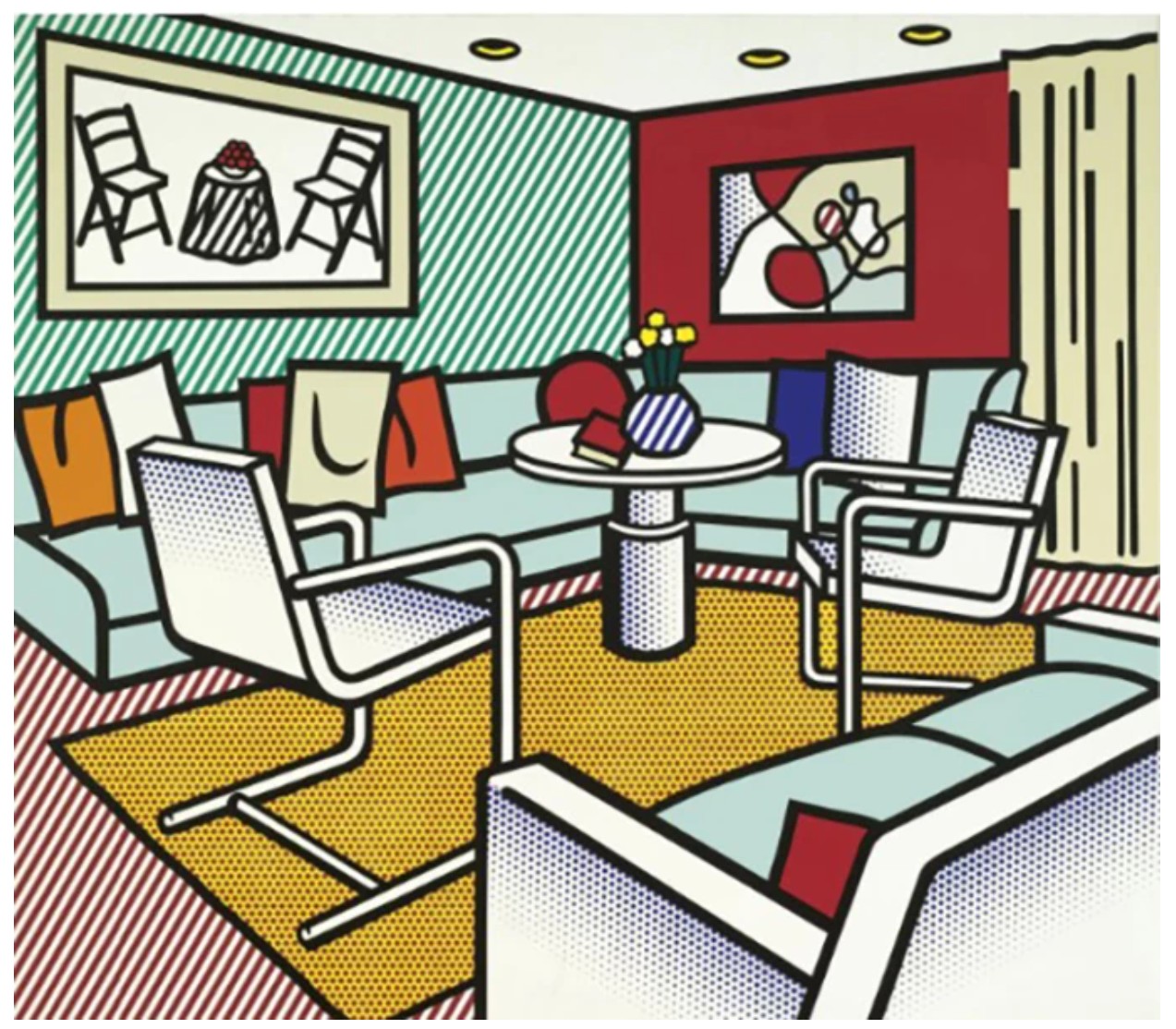
Roy Lichtenstein, Interior with Red Walls, 1991, sold at Sotheby’s New York for $7,026,50
This flatness precisely challenges traditional perspective, the cornerstone of Western painting. It is in this respect that the work is postmodern: it references a recurring motif in painting, the domestic interior, while questioning the traditional foundations on which it rests. The plant, introducing almost a still-life motif, is placed at the bottom right of the canvas and reinforces the two-dimensionality of the surface, which the diagonal armrest of the sofa had previously suggested by introducing depth. Through a small painting suspended at the top of the image, Lichtenstein also seems to reference Theo Van Doesburg, situating his painting in the canon art history but, above all, in popular culture, which has retained only a vague geometric poster hung on a wall. Although it questions the traditional foundations of art history, Lichtenstein’s work rests on the principle of imitation: of interior scenes from academic painting, of Cubist geometrization, of comic strips, of lifestyle magazine pages, and of modern printing techniques. Yet these copies are not quite copies; their subtle variations reveal what resists: the cliché, the archetype.
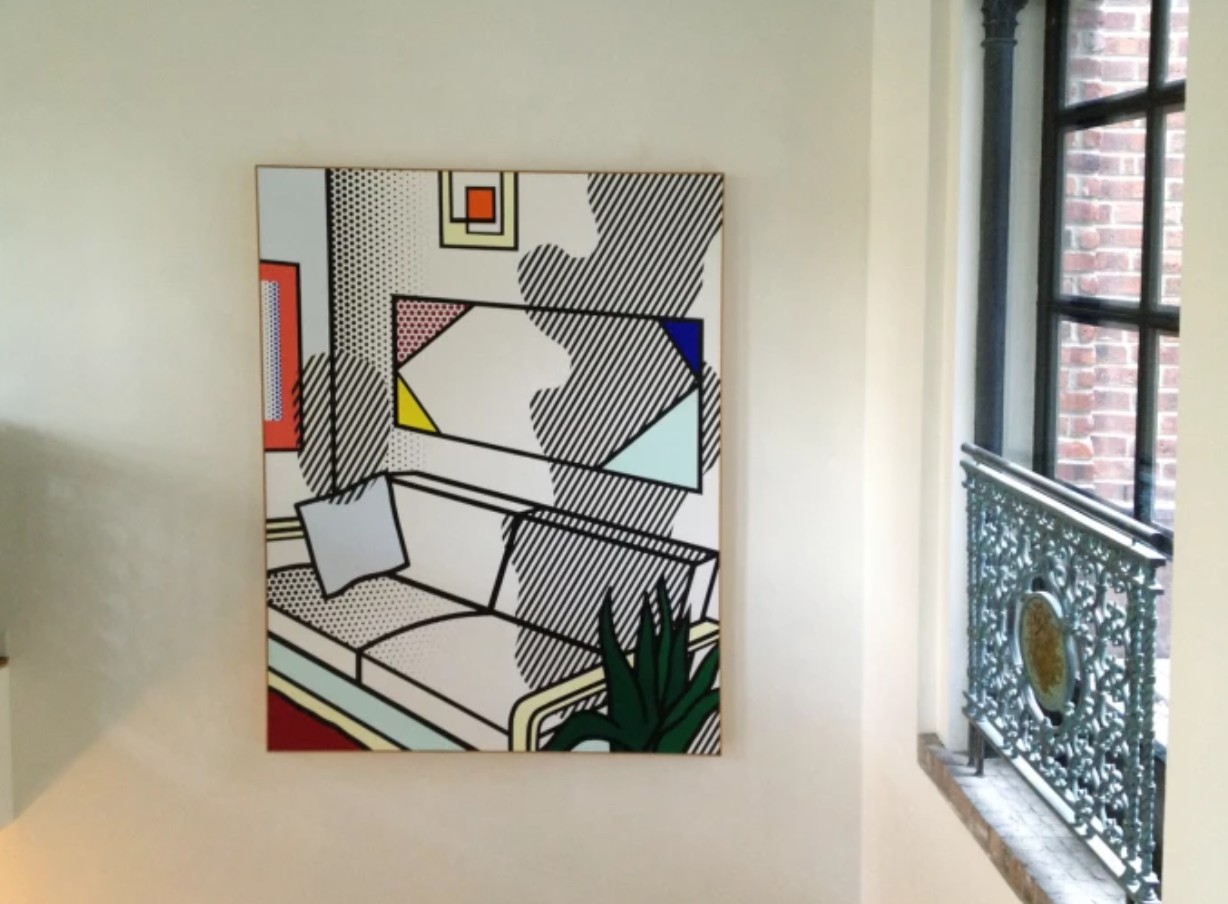
It is precisely this merging of Pop, postmodernism, and classicism that highlights both the prevalence of the archetype and its absurdity and fragility. Through its references to industrial popular culture—posters, magazines, mass prints, advertisements, cinema—Interior with Shadow attests to the omnipresence of these images in modern life. Yet through its flatness and provocative neutrality, its schematic forms, and the interplay of transparency created by the dots and hatching that traverse the white decor, Lichtenstein reminds us that this reality is only an illusory artifice. This printed-image appearance, seemingly produced industrially without human intervention, is in fact the result of persistent and meticulous technique. Like the majority of Lichtenstein’s works, Interior with Shadow is the product of numerous preparatory studies, but especially of a long process of simplification: cropping, recoloring, degradation, cutting, drawing, projection, brush or tape touch-ups, application of dots—procedures all the more astonishing because they leave no trace. This obsessive, jeweler-like work is carried out in such a way that it disappears entirely.
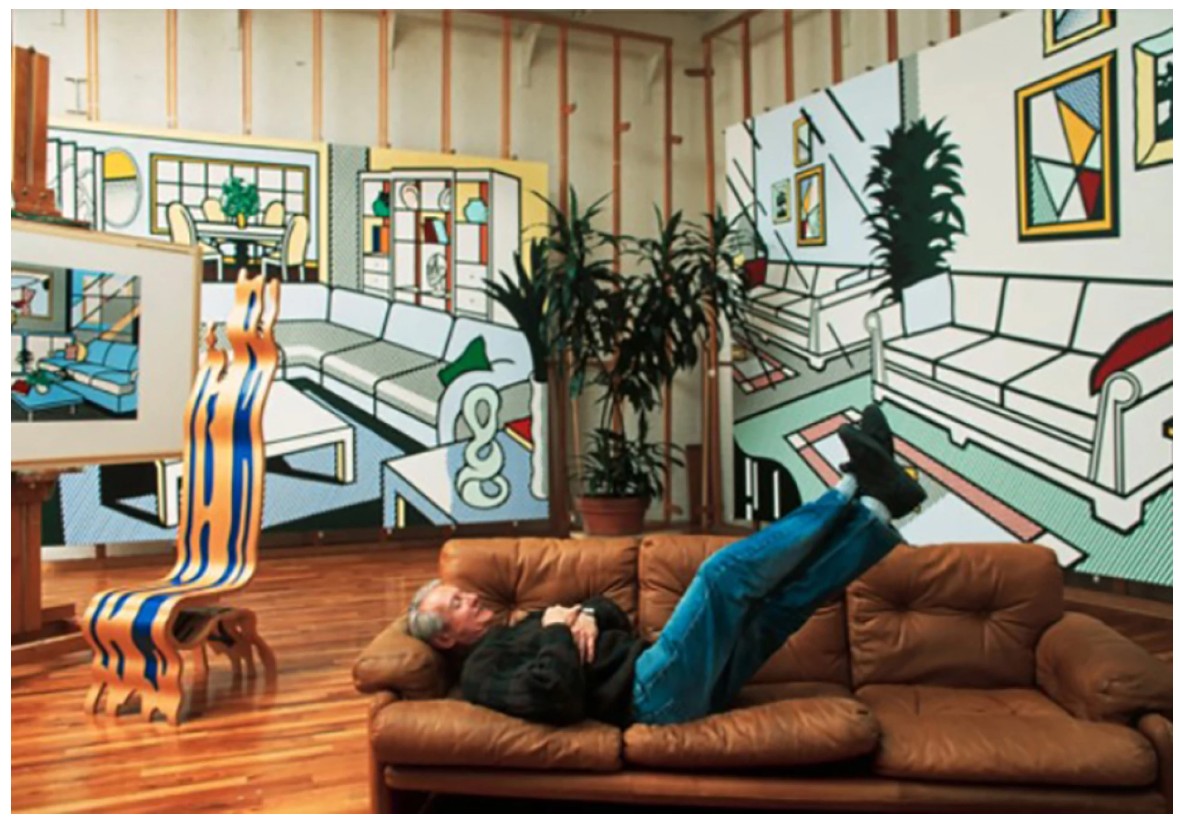
Roy Lichtenstein in his Washington Street studio, 1992. Photo © Thomas Hoepker / Magnum Photos. Art © Estate of Roy Lichtenstein.
At the twilight of his life, Lichtenstein unites in one work the major trends of his career, essentializing and simplifying his forms while demonstrating greater freedom. Whereas his famous Ben-Day dots and hatching previously conveyed shadows and reflections of light—on glass in his Modern Paintings, on the surfaces of Mirrors, or on the reliefs of Entablatures—they take on autonomy here. They ripple across the canvas, extending beyond the contours of figures, no longer corresponding to any particular form. The artist thus seems to conduct, in the final years, plastic experiments on the independence of color: “I used gradient Ben-Day dots or colors that transitioned from one form to another, but the idea was to have the lines behave this way to create zones and spaces independent of other elements. The autonomy of the Ben-Day dots relative to the subject manifests the autonomy of the pictorial medium.” Far from presenting it passively to the eye like the thousands of images that populate modern life, Lichtenstein endows Interior with Shadow with a marvelous evocative power, similar to the narrative force of Hopper’s suspended moments.
STUDIES
Interior with African Mask (Study), 1990
Interior with African Mask (Study), 1990
Works from the Collection of Dorothy and Roy Lichtenstein
Sotheby’s New-York: 16 May 2025
Estimated: USD 800,000 – 1,200,000
USD 2,522,o00
Interior with African Mask (Study) | Contemporary Day Auction | 2025 | Sotheby’s
ROY LICHTENSTEIN (1923 – 1997)
Interior with African Mask (Study), 1990
Sut painted paper, cut printed paper, tape, marker and graphite on board
Image: 34 1/4 x 44 inches (86.8 x 111.8 cm)
Sheet: 38 1/2 x 48 1/4 inches (97.6 x 122.6 cm)
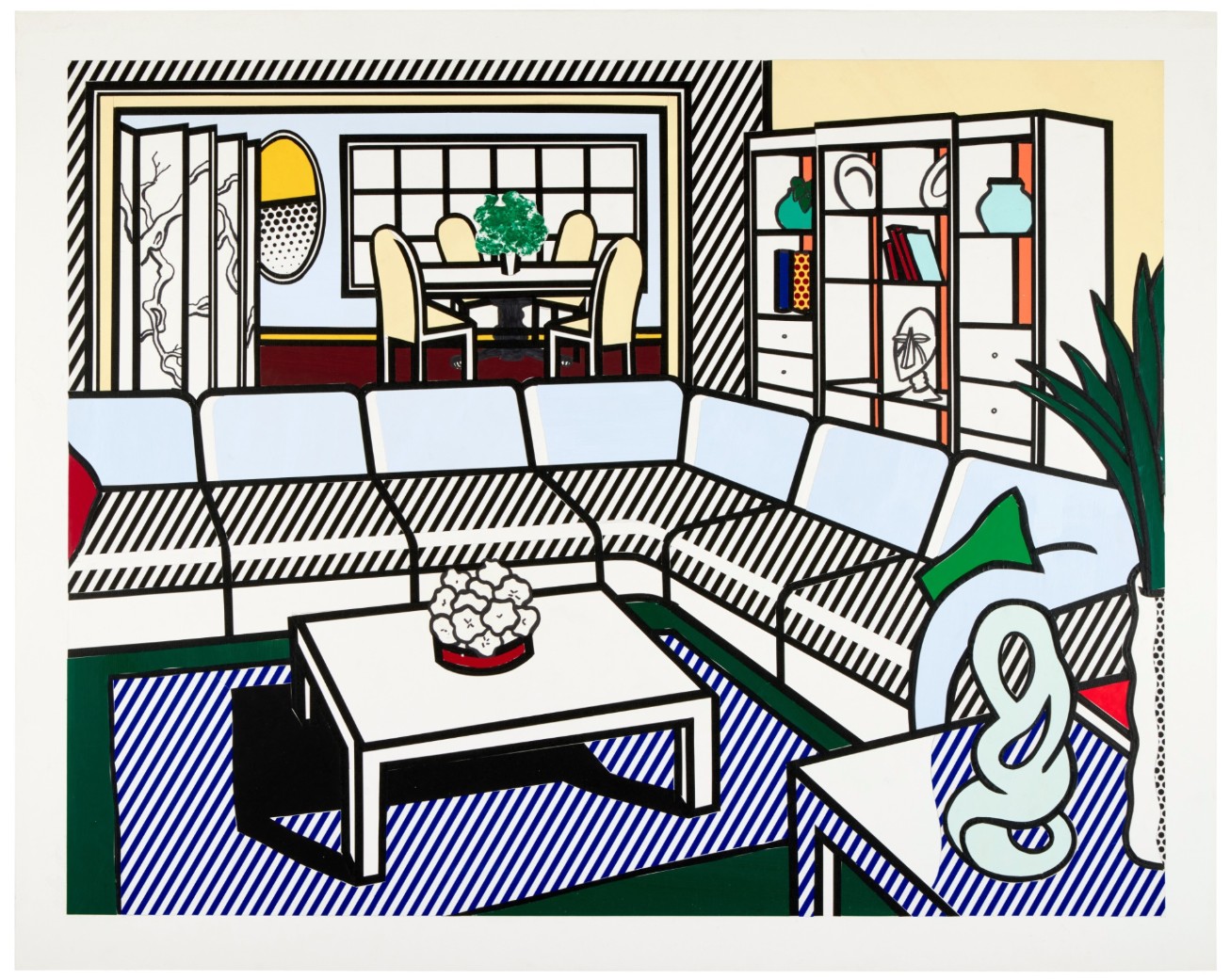
Meticulously composed and conceptually rich, Interior with African Mask (Study) from 1990 marks a vital moment in Roy Lichtenstein’s late career, encapsulating his enduring interest in the intersection between modernist art, popular culture, and domestic life. As part of the celebrated Interiors series, this work restates many of the artist’s original Pop concerns, mass media imagery, commercial aesthetics, and the fiction of representation, while simultaneously engaging with deeper questions around cultural appropriation and art historical legacy. Like many works in the Interiors series, Interior with African Mask (Study) was conceived as a preparatory collage for a larger painting. These studies functioned as essential blueprints in Lichtenstein’s process, allowing him to test his visual language of spatial illusion and stylization on a more intimate scale. In this particular study, the artist offers a striking view of an impeccably staged living room. A pristine sectional sofa curves elegantly into the foreground, flanked by angular coffee tables and modular shelving. Every surface, from the patterned rug to the glossy tabletop, bears the unmistakable hallmarks of Lichtenstein’s signature visual lexicon: Ben-Day dots, black outlines, and tightly contained blocks of color.
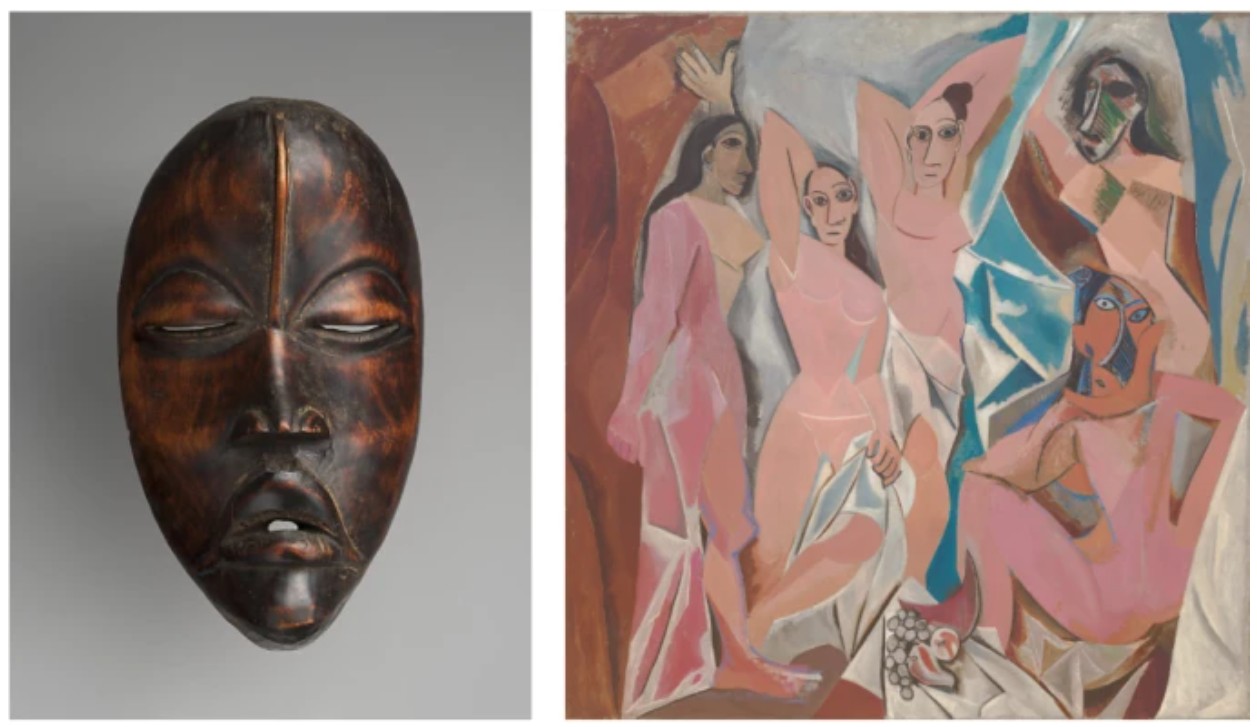
Left: Dan artist, Face Mask, 19th–mid-20th century. The Metropolitan Museum of Art, New York. Right: Pablo Picasso, Les Demoiselles d’Avignon. Paris, June-July 1907. The Museum of Modern Art, New York. © 2025 Estate of Pablo Picasso / Artists Rights Society (ARS), New York
The centerpiece of the composition, and its most poignant visual element, is the African mask displayed on a shelf at center right. While seemingly just another piece of decor within this idealized interior, the mask introduces an important and deliberate tension. It recalls the long history of Western artists, Pablo Picasso foremost among them, who incorporated African art into their own practices. But Lichtenstein’s inclusion of the mask goes beyond homage or citation. By embedding it within a commercialized, hyper-stylized American living room, he highlights how non-Western art has often been stripped of context and reframed as a mere aesthetic object within Euro-American systems of taste.
“I think Picasso is the greatest artist of the twentieth century by far. Is there any real doubt about that? I think he had more just more magic, more insanity, more images, more styles, more productions than any others.”
As Diane Waldman has observed of the broader Interiors series: “In these 1990s Interiors, Lichtenstein restates some of his original concerns. He uses images from the media, such as a bathroom, bedroom, or living room, which still typify our consumer culture, as one reality, and compares and contrasts them with the reality of the art that he depicts on the living room walls – two different levels of illusion… to remind us of the fiction of the painting and suggests that everything is fiction, including reality itself. He conveys the notion that all of art and life is a series of reflections and illusions” (Diane Waldman, Roy Lichtenstein, New York, 1993, p. 309). These spaces, seemingly drawn from design catalogs or lifestyle advertisements, represent not lived environments but aspirational fantasies, visual constructs of domestic perfection. And yet within them, Lichtenstein plants subtle disruptions: a Klein sculpture on a coffee table, a Warhol silkscreen on the wall, or here, a decontextualized African mask. These references both elevate and destabilize the scene, drawing attention to the layered fictions at play.
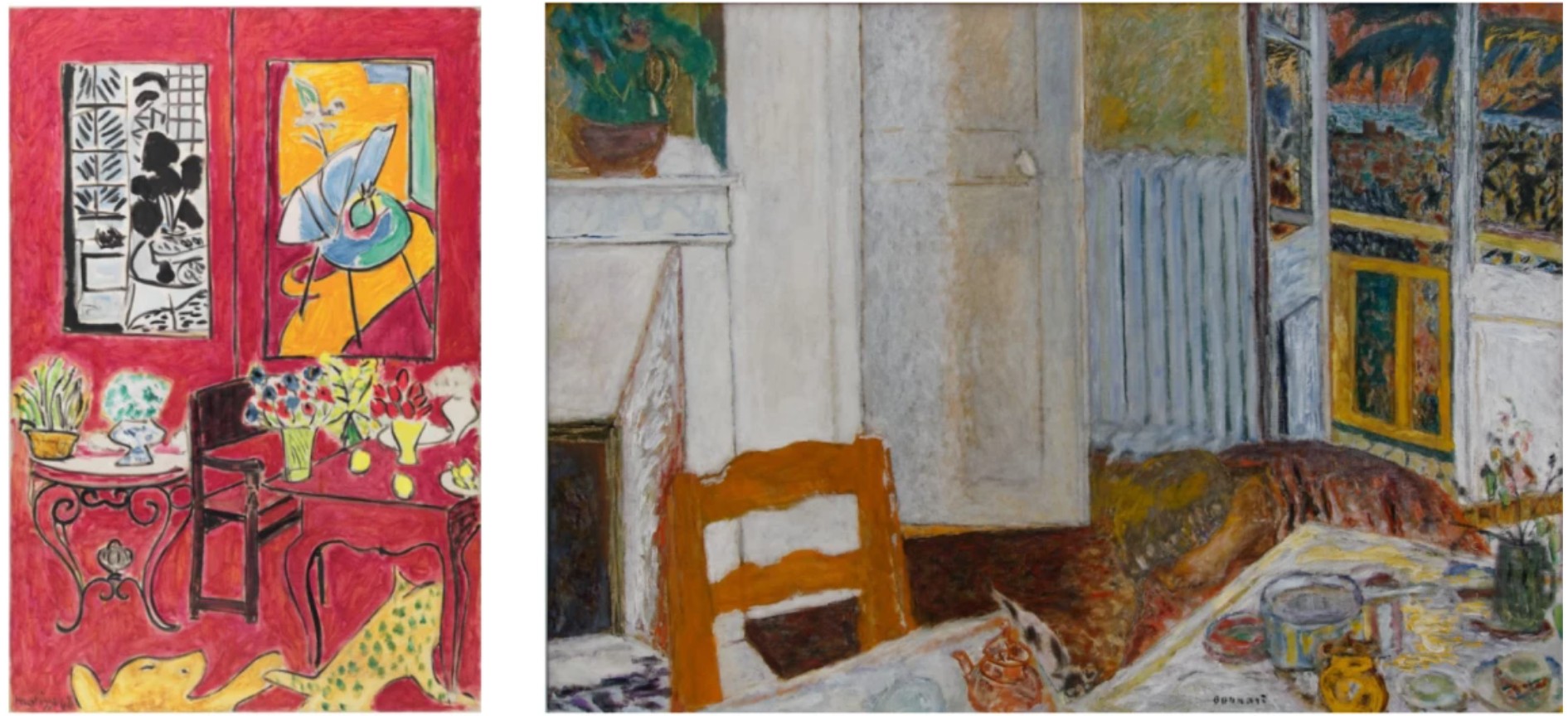
Left: Henri Matisse, Grand Intérieur rouge, spring 1948. Centre national d’art et de culture Georges Pompidou, Paris. Art © 2025 Succession H. Matisse / Artists Rights Society (ARS), New York Right: Pierre Bonnard, Intérieur blanc, 1932. Musée de Grenoble. Art © 2025 Artists Rights Society (ARS), New York / ADAGP, Paris
Lichtenstein’s decision to focus on the domestic interior in the 1990s was not arbitrary. From Bathroom executed 1961 to the monumental Interiors of his final decade, the subject allowed him to revisit and synthesize many of the themes that had preoccupied him for over thirty years. Interior with African Mask (Study) is exemplary in this regard, marrying the visual tropes of advertising with the intellectual rigor of modernist appropriation. It is a work of formal elegance and conceptual provocation, where everything from the placement of a pillow to the inclusion of a sculpture invites closer reflection on art’s place in everyday life. At the same time, this study demonstrates Lichtenstein’s unwavering commitment to the flat, graphic style that defined his oeuvre. The meticulously balanced composition, the interplay of decorative motifs, and the carefully chosen palette all reinforce the artist’s belief in the visual power of simplification and stylization. But rather than flatten meaning, this aesthetic clarity deepens it. By reducing the world to signs and symbols, Lichtenstein prompts viewers to consider how our environments, especially our domestic ones, are coded with values, histories, and ideologies.
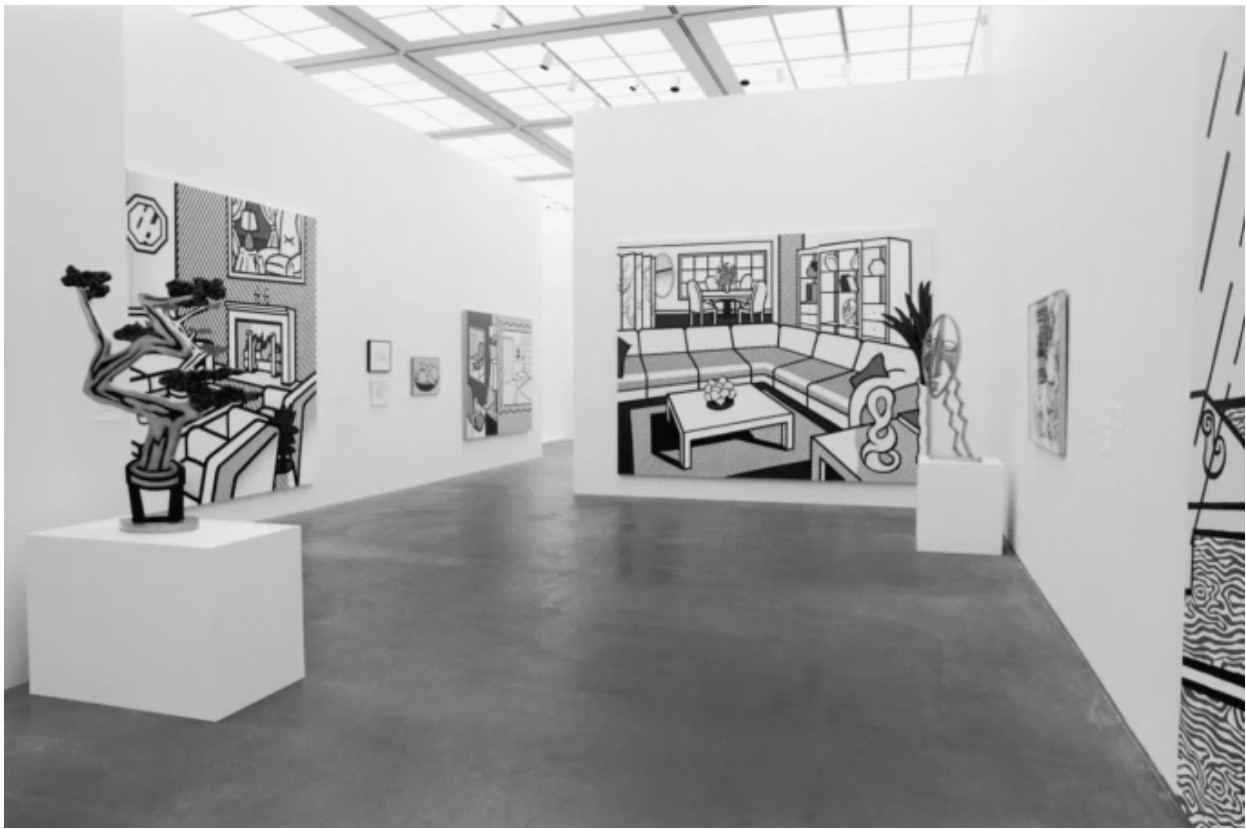
Installation view of MCA Chicago, Roy Lichtenstein: Interiors, July – October 1999.
Photo: James Isberner © MCA Chicago. Art © Estate of Roy Lichtenstein.
Interior with African Mask (Study) stands as a sophisticated meditation on the artifice of modern living and the shifting meanings of cultural objects within it. It exemplifies the intelligence and irony that define Lichtenstein’s greatest works, offering not only a visual delight but a critical lens through which to view the aesthetics of everyday life. Within its elegant lines and polished surfaces lies a profound inquiry into how art is made, displayed, and ultimately consumed. Beautifully rendered and deeply reflective, Interior with African Mask (Study) deserves to be counted among the most significant works of the Interiors suite, an incisive dialogue between Pop and modernism, decoration and depth, surface and substance.
Interior with Mirrored Wall (Study), 1990
Interior with Mirrored Wall (Study), 1990
A Legacy Reimagined: Works from the Collection of Dorothy and Roy Lichtenstein
Sotheby’s New-York: 19 November 2025
Estimated: USD 500,000 – 700,000
USD 1,638,000
Interior with Mirrored Wall (Study) | Contemporary Day Auction | 2025 | Sotheby’s
ROY LICHTENSTEIN (1923 – 1997)
Interior with Mirrored Wall (Study), 1990
Cut painted and printed paper, tape and graphite on board
Image: 26 1/2 x 33 inches (67.3 x 83.8 cm)
Board: 34 1/2 x 40 3/4 inches (87.6 x 103.5 cm)
Signed and dated ’90 (on the verso)
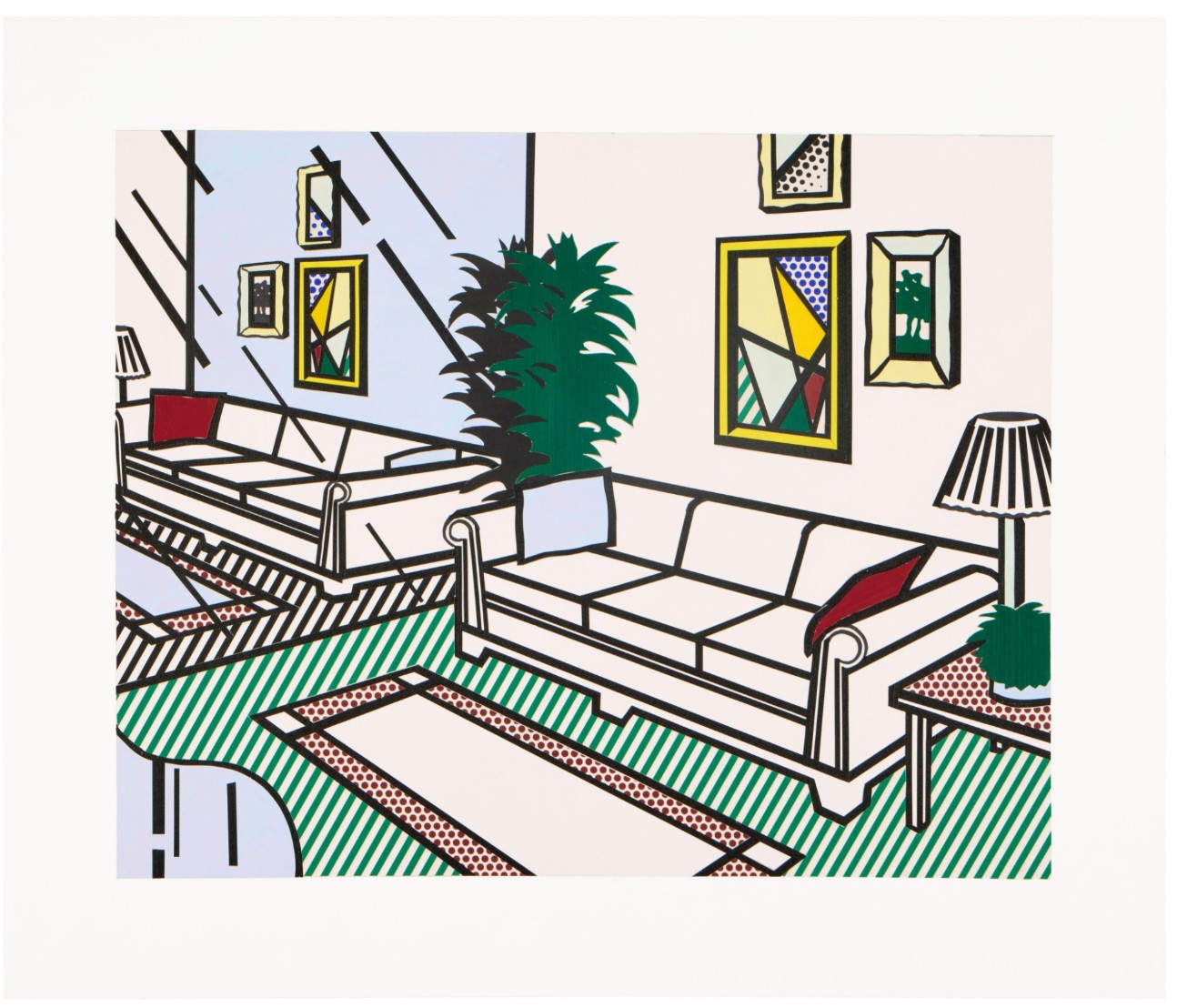
Crisp, elegant, and meticulously composed, Interior with Mirrored Wall (Study) from 1990 exemplifies Roy Lichtenstein’s late mastery of the interior as subject, a theme through which he transformed ordinary domestic spaces into rigorous meditations on form, perception, and representation. Lichtenstein distills his signature vocabulary of flat color, bold contour, and Ben-Day patterning into a serene composition anchored by the witty inclusion of a mirrored panel. Here, geometry, structure, and reflection coalesce in a vision that is at once intimate and conceptually expansive. Created just three years before his landmark retrospective at the Guggenheim, Interior with Mirrored Wall (Study) belongs to a period of extraordinary confidence, when Lichtenstein revisited his core motifs with renewed assurance. In this composition, the ordinary room is elevated into a meditation on seeing itself: a reflection on space, on representation, and on the very act of looking.
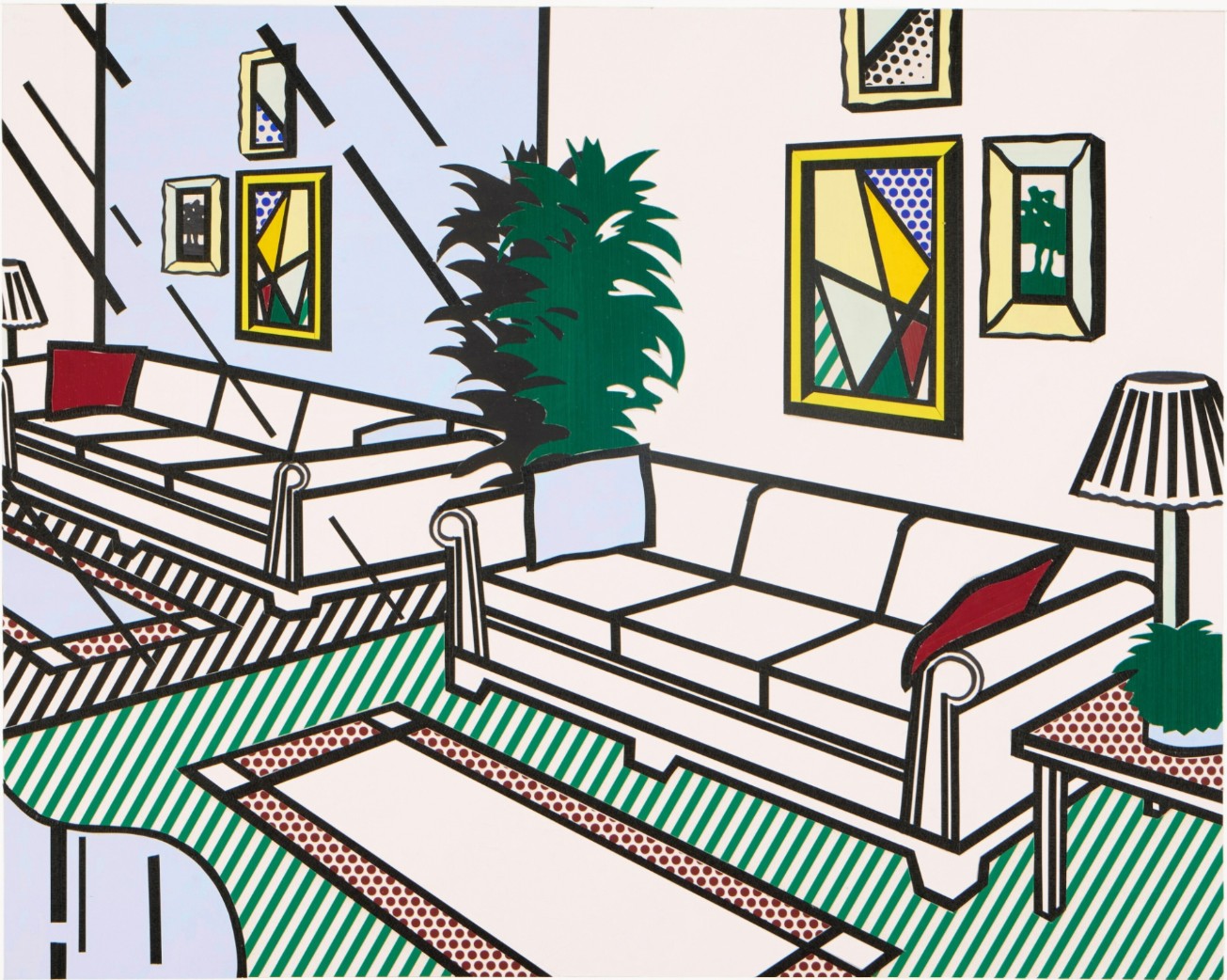
The interiors, which became a major focus of Lichtenstein’s production in the 1980s and 1990s, extended his longstanding project of reimagining the visual codes of everyday life through the clarity of Pop. If the 1960s were dominated by comic-strip drama and the 1970s by the architectonic abstraction of the Entablatures, the interiors mark a later turn toward the spaces of design and domesticity. In Interior with Mirrored Wall (Study), tables, chairs, and patterned walls are stripped to schematic essentials, their geometry tightly ordered yet softened by the doubling effect of the mirror, which both expands and flattens the space. The collage medium intensifies this tension. Cut and layered forms provide crisp material edges, foregrounding the artifice of construction, while at the same time offering a provisional glimpse of Lichtenstein’s working process. The mirrored surface functions less as depth than as another flat panel, folding reflection into the composition and reminding the viewer that even illusion is subject to mediation.
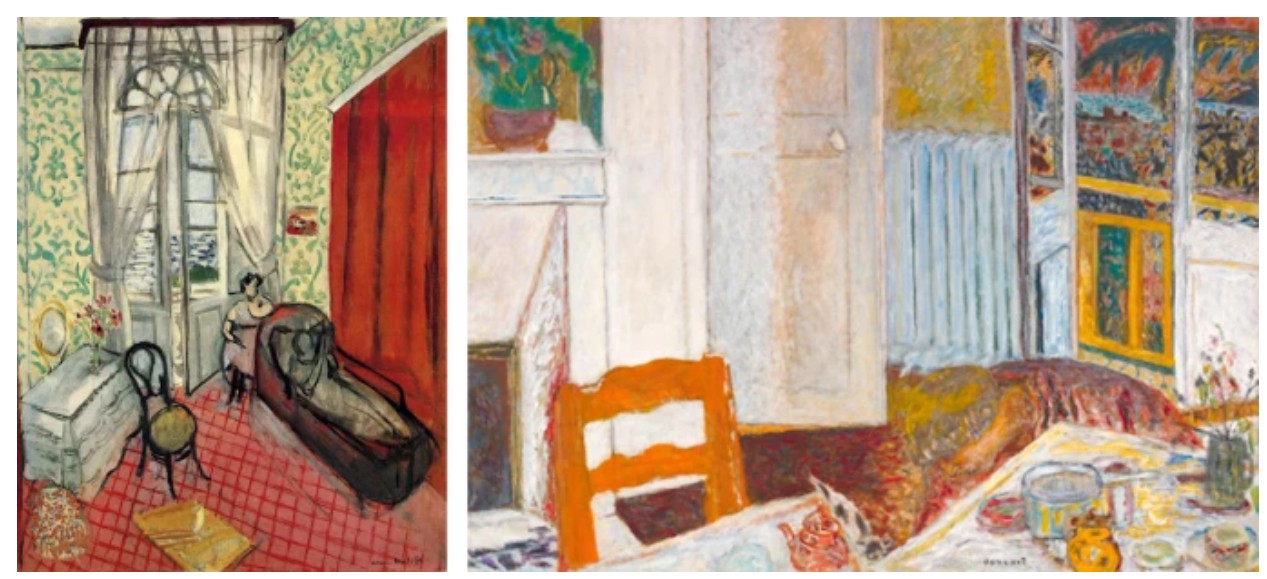
Left: Henri Matisse, Woman On The Couch, 1921. Musée de l’Orangerie, Paris.
Right: Pierre Bonnard, White Interior (Le Cannet), 1932. Musée de Grenoble, France.
This play of interior and reflection situates the work within a long lineage of modern interiors, from Matisse’s exuberant patterned rooms to de Chirico’s enigmatic metaphysical spaces. Yet Lichtenstein’s approach is uniquely his own: a domestic setting pared down to its structural signs, where the mirror becomes less a literal surface than a conceptual device, collapsing the distance between depiction and perception. As a study, the work reveals Lichtenstein’s method of testing spatial balance and compositional rhythm before scaling up to canvas. Yet it also operates as a complete vision in its own right, encapsulating the wit and clarity that define his late oeuvre. With its elegant geometry, conceptual precision, and understated wit, Interior with Mirrored Wall (Study) epitomizes the late flowering of Lichtenstein’s career. At once modest in medium and ambitious in scope, it demonstrates the artist’s ability to transform the most familiar of spaces into enduring reflections on the language of modern art.
Large Interior with Three Reflections (Mural Panel) (Study), 1993
Large Interior with Three Reflections (Mural Panel) (Study), 1993
A Legacy Reimagined: Works from the Collection of Dorothy and Roy Lichtenstein
Sotheby’s New-York: 18 November 2025
Estimated: USD 1,000,000 – 1,500,000
USD 1,575,000
WORK ON PAPER
ROY LICHTENSTEIN (1923 – 1997)
Large Interior with Three Reflections (Mural Panel) (Study), 1993
Colored pencil and graphite on paper
Image: 9 1/8 x 24 1/4 inches (23 x 61.6 cm)
Sheet: 16 1/4 x 30 1/8 inches (41.3 x 76.4 cm)
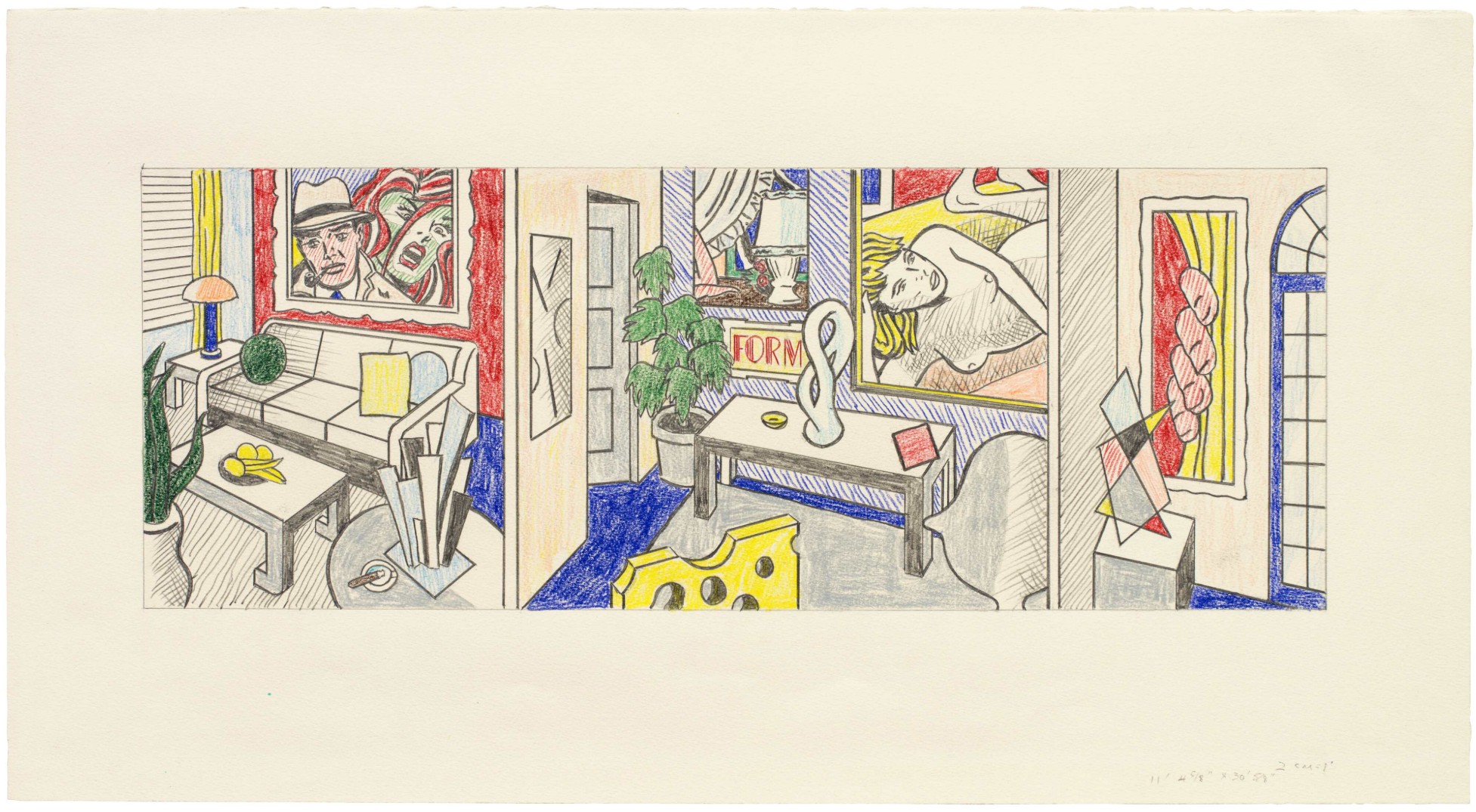
A retrospective encapsulation of Roy Lichtenstein’s career in one entrancing composition, Large Interior with Three Reflections (Mural Panel) (Study) is replete with reference to the artist’s legendary oeuvre, cleverly synthesizes multiple perspectives, blending fiction and reality. The present work dates to Lichtenstein’s acclaimed Interiors of the 1990s, a series in which the artist explored domestic spaces as popularized in mass media, adorning them with icons from art history and his own practice. Here, Lichtenstein’s signature wit and distinctive Pop vernacular reaches its zenith: after decades of appropriating from art historical forebears, Lichtenstein turns to his own oeuvre for his subject matter. Predating a monumental mural of the same subject, the present work reveals Lichtenstein’s process and intellectual inquiry through compositional development. From his 1962 Curtains and Swiss Cheese to his melodramatic comic-book romance scenes, his 90s Cityscape and Imperfect Sculpture, Large Interior with Three Reflections (Mural Panel) (Study) is abounding with self-referential treasures—a trove of Lichtenstein’s incomparable oeuvre.
Although Lichtenstein’s exploration of interiors began in earnest in the early 1990s, the subject Lichtenstein engaged with the subject throughout his practice, dating back to the early 60s with iconic works like Bathroom (1961) in the collection of the Whitney Museum of American Art and Curtains (1962) in the collection of the Saint Louis Art Museum. In 1973, Lichtenstein again returned to the interior, creating the iconic Artist’s Studio “Look Mickey” in the collection of the Walker Art Center, Minneapolis, which incorporated elements of his own practice, including the Stretcher Bar paintings, Mirrors, and even a reproduction of his own 1961 work, Look Mickey. In the 90s, he returned to the theme with a renewed intensity, transforming his interiors into sites that engage with themes across his now four-decade body of work. Compelled by the banality and commercialization of domestic décor across popular media and advertisements, Lichtenstein created interiors with rich compositional complexity and the spirit of fantasy. Lichtenstein’s spaces feel familiar and yet uncanny, bearing the cinematic and atemporal quality of the comic realm.
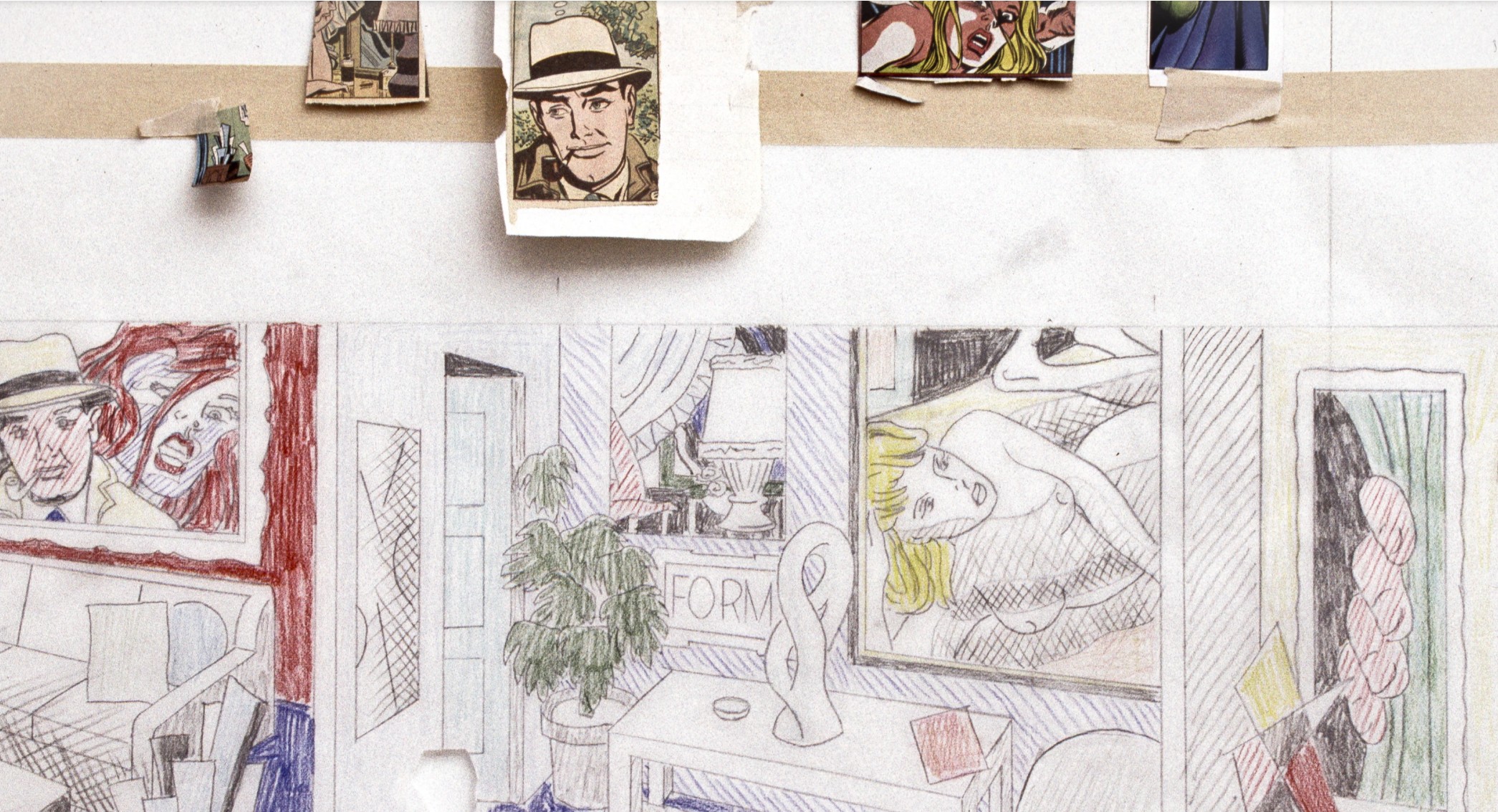
Image of Lichtenstein’s studio with studies for his Interior drawings, 1993. Image © Bob Adelman. Art © Estate of Roy Lichtenstein
Expanding from a single interior space, Lichtenstein here presents the viewer with the cross-section of a home, revealing three rooms at once. The tripartite interior exemplifies the playful invention at the core of Lichtenstein’s work; as our eyes meander through these three rooms, we are equally convinced of the reality and reminded of the inherent artificiality of the scene. Far from static, Lichtenstein’s composition offers a narrative unveiling which charts his career. In the living room, above the sofa, Lichtenstein appears to render a version of his 1960s, comic-book-inspired scenes, perhaps an amalgamation of Forget It! Forget Me! (1962) and Tension (1964), which capture a couple in conflict. Lichtenstein further adorns the room with his 1972 still life, Bananas and Grapefruit I, and his 1995 Cityscape. Wandering through the open door—itself an homage to the 1961 drawing Knock Knock, the viewer enters the foyer. Above the consol, in pride of place, Lichtenstein depicts a nude figure in repose—echoing both the tradition of the reclining female nude in the Western art historical canon and his own Nudes of the 1990s.
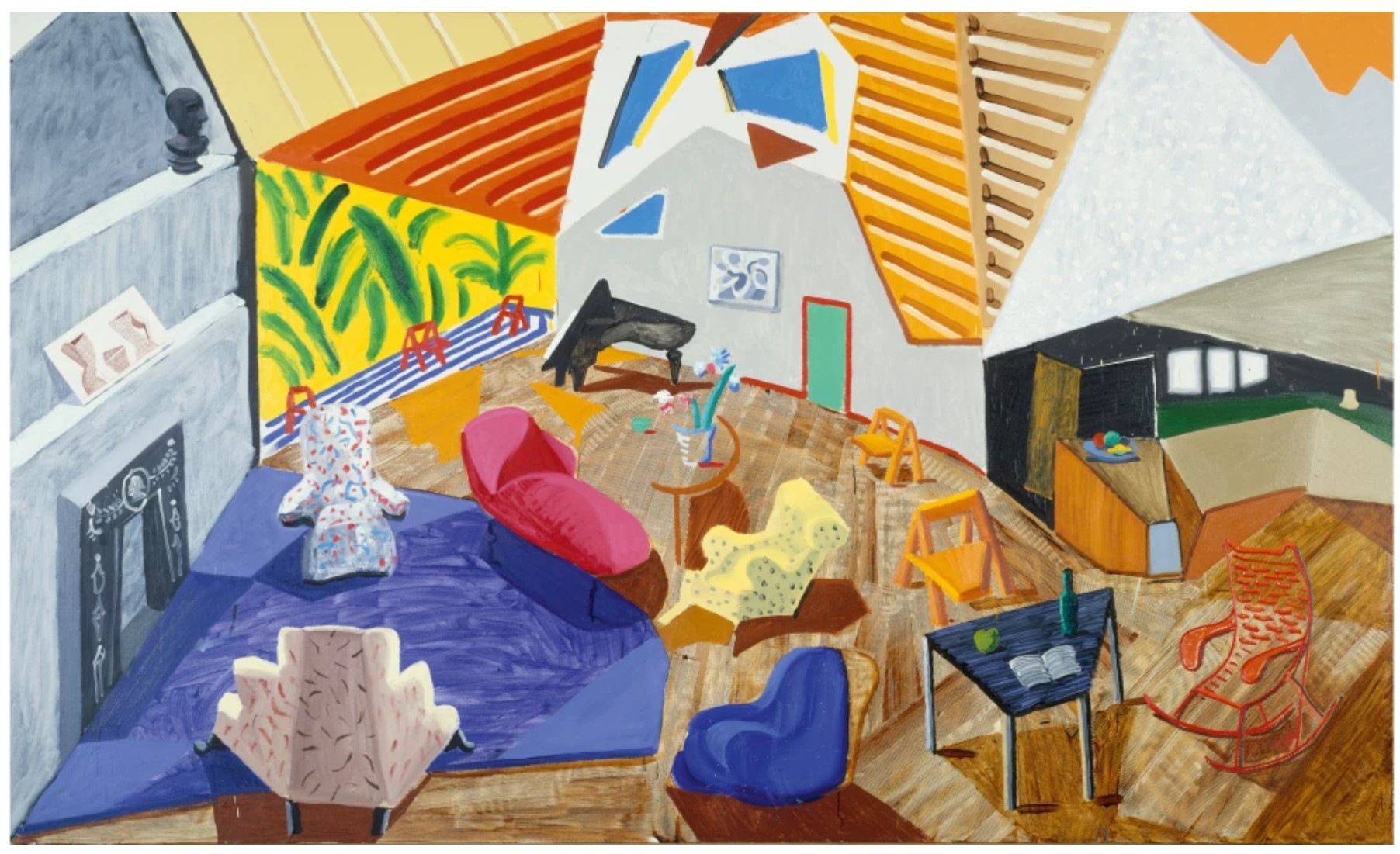
David Hockney, Large Interior, Los Angeles, 1988. The Metropolitan Museum of Art, New York.
Image © The Metropolitan Museum of Art / Art Resource, NY. Art © 2025 David Hockney
Just to the left of the nude, Lichtenstein evokes his 1962 painting, Curtains, with an intimate interior scene featuring a ruffled curtain drawn back before a moody sky. And just below this work, he incorporates a painting with a single word: FORM. Here, one cannot help but recall the artist’s iconic 1962 painting, ART, which featured the same palette of red text on yellow ground. At the foreground of the center frame, Lichtenstein playfully includes a sculptural version of his 1962 painting, Swiss Cheese. And, finally, in the rightmost vignette, above his 1995 Imperfect Sculpture, Lichtenstein makes a very clever addition. Here, in jest with the viewer, Lichtenstein depicts four fingers pulling back a curtain, as if the artist himself is pulling back the curtain to reveal the inherent artificiality of the picture.
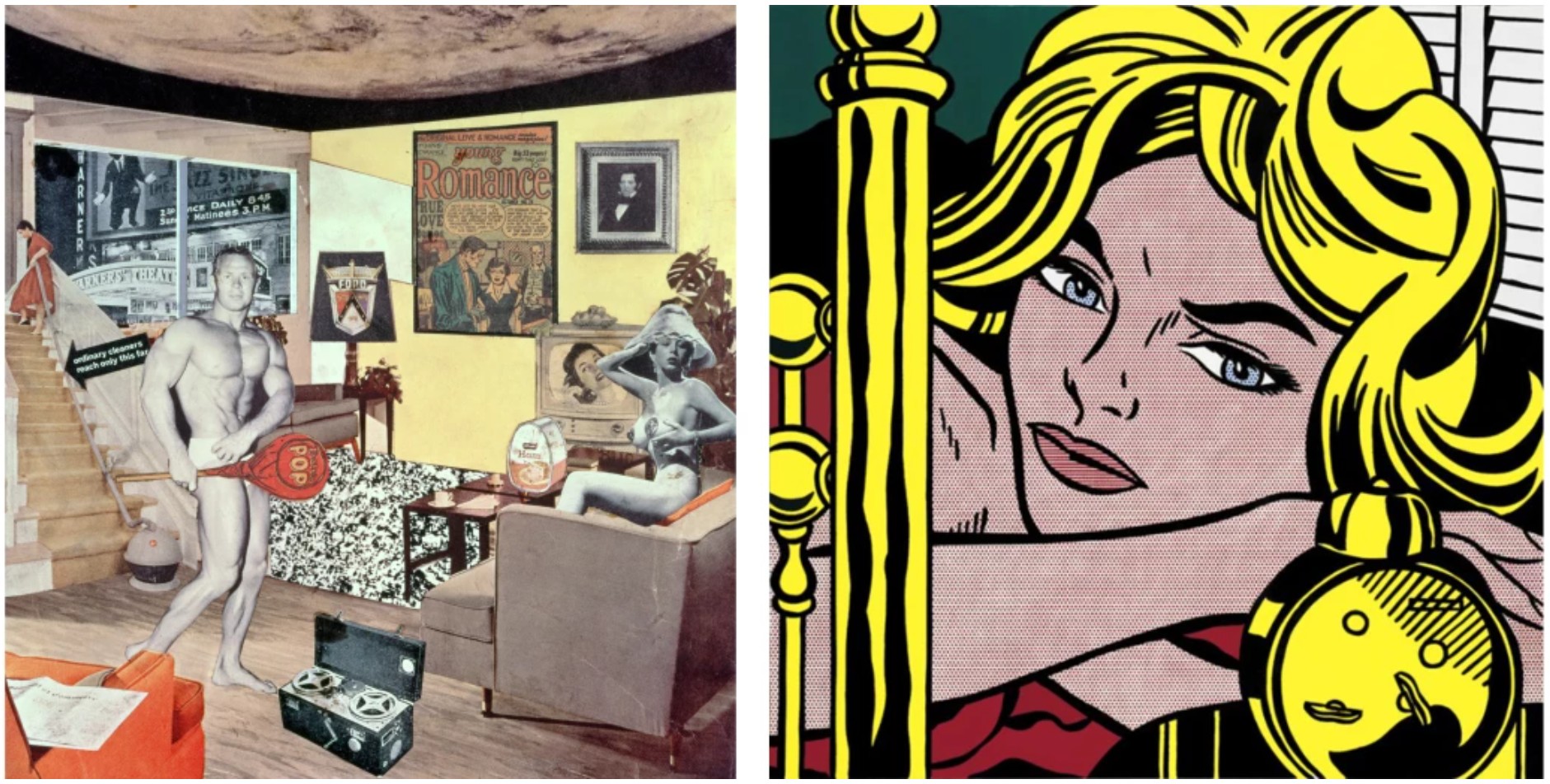
Left: Richard Hamilton, Just What Is It That Makes Today’s Homes So Different, So Appealing?, 1956. Kunsthalle Tubingen, Tubingen. Image © Bridgeman Images. Art © 2025 Artists Rights Society (ARS), New York / DACS, London. Right: Roy Lichtenstein, Blonde Waiting, 1964. Private Collection. Art © Estate of Roy Lichtenstein
Meticulous, inventive and ever clever, Lichtenstein captivates the viewer, synthesizing reality and illusion. Large Interior with Three Reflections (Mural Panel) (Study) perfectly encapsulates the driving inquiries of Lichtenstein’s career, transforming the ordinary into the extraordinary.
Interior (Study), 1991
Interior (Study), 1991
Reflections on Pop: Works from the Collection of Dorothy and Roy Lichtenstein
Sotheby’s New-York: 26 September 2025
Estimated: USD 700,000 – 1,000,000
USD 1,079,500
ROY LICHTENSTEIN (1923 – 1997)
Interior (Study), 1991
Tape, cut painted paper, cut paper on printed paperboard
Image: 49 3/4 x 78 3/8 inches (126.4 x 199.1 cm)
Paperboard: 55 3/4 x 84 1/4 inches (141.6 x 214 cm)
Meticulously composed and conceptually rich, Interior (Study) marks a vital moment in Roy Lichtenstein’s late career, encapsulating his enduring fascination with the intersection of modernist art, popular culture, and domestic life. As part of the acclaimed Interiors series, this work revisits many of the artist’s foundational Pop concerns: mass media imagery, commercial aesthetics, and the fiction of representation—while simultaneously engaging with the dialogue between art history and consumer culture. Like many works in the Interiors series, Interior (Study) functioned as a collage for a larger painting, serving as an essential blueprint in Lichtenstein’s artistic process. These studies allowed him to experiment with spatial illusion and his signature stylization. Here, Lichtenstein offers a striking view of a meticulously staged living room. A sleek sofa curves gracefully into the foreground, surrounded by plants, wall art, drapes and angular coffee tables. Every surface—from the patterned rug to the glossy tabletops—bears the unmistakable hallmarks of Lichtenstein’s visual lexicon: Ben-Day dots, bold black outlines, and tightly contained blocks of color.
Prominently displayed on the wall is a rendition of an iconic Andy Warhol Flowers painting. This inclusion introduces an intriguing intertextual layer, reflecting Lichtenstein’s ongoing dialogue with contemporary art history and the dynamics of artistic influence. The Warhol Flower, rendered in Lichtenstein’s characteristic graphic style, bridges the Pop canon by referencing another Pop giant, while simultaneously transforming a familiar image through his own visual language. By situating Warhol’s floral motif within a commercialized, hyper-stylized American living room, Lichtenstein underscores the complex relationship between high art and popular imagery. The painting within the painting serves as a critical reminder of how art is mediated by domestic spaces and consumer culture, transforming works into objects of everyday aesthetic consumption.
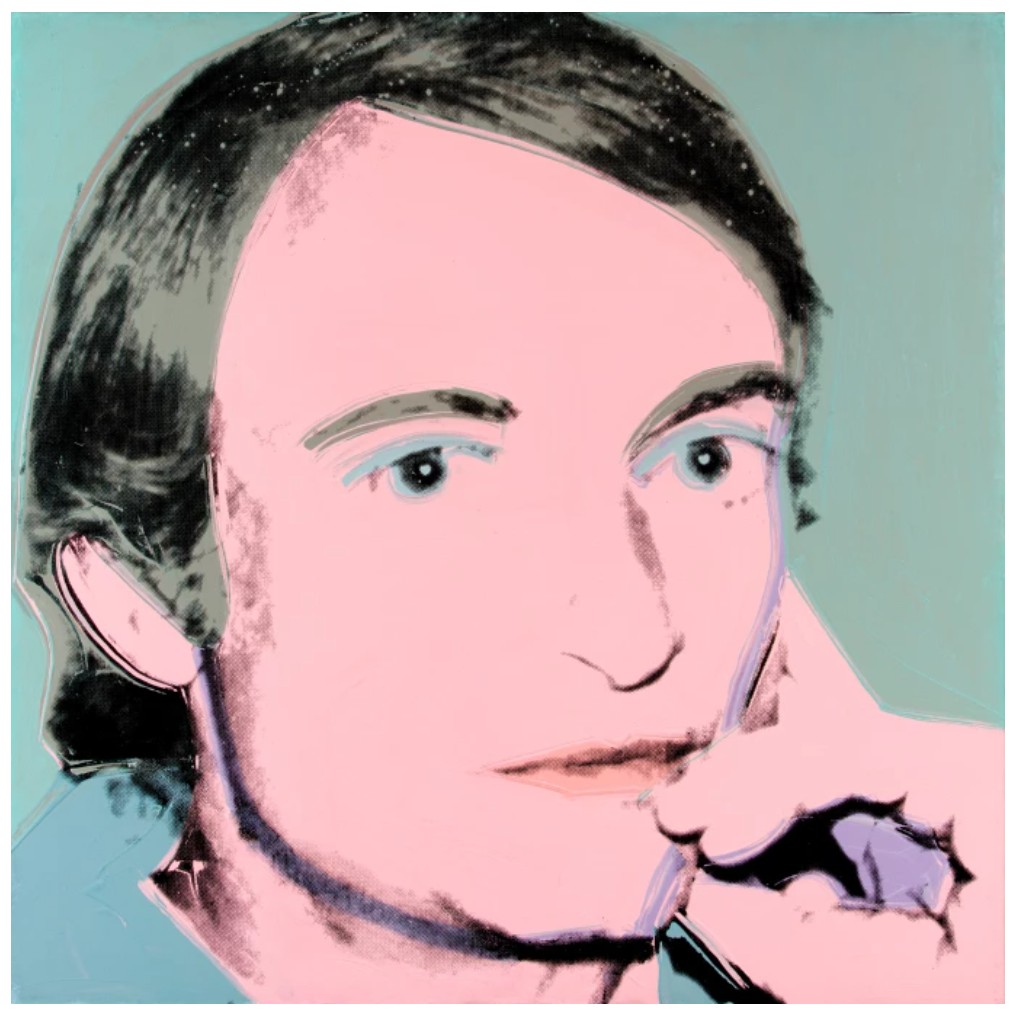
Andy Warhol, Roy Lichtenstein, 1976. Private Collection. Sold at Sotheby’s New York in November 2014 for $413,000. Art © 2025 Andy Warhol Foundation for the Visual Arts / Artists Rights Society (ARS), New York
From early works such as Bathroom (1961) to the monumental Interiors of his final decade, the domestic setting allowed Lichtenstein to revisit and synthesize themes that had captivated him for over three decades. Interior (Study) is exemplary in this regard, merging the visual tropes of advertising with the intellectual rigor of modernist and Pop art appropriation. It is a work of formal elegance and conceptual depth, where every detail—from the placement of the sofa to the depiction of a painting—invites closer reflection on art’s place within everyday life.
Interior (Study) serves as a thoughtful exploration of the constructed nature of modern life and the evolving significance of cultural objects within it. Beneath its clean lines and polished surfaces lies a deep investigation into the processes of art creation, presentation, and consumption. Elegantly crafted and richly contemplative, Interior (Study) stands as one of the standout pieces in the Interiors series—offering a compelling conversation between Pop art and modernism, decoration and meaning, surface and substance.
Interior with Painting of House (Study), 1997
Interior with Painting of House (Study), 1997
Works from the Collection of Dorothy and Roy Lichtenstein
Sotheby’s London: 24 June 2025
Estimated: GBP 500,000 – 700,000
GBP 742,000 / USD 1,001,700
Interior with Painting of House (Study) | Modern & Contemporary Evening Auction | 2025 | Sotheby’s
ROY LICHTENSTEIN (1923 – 1997)
Interior with Painting of House (Study), 1997
Cut painted paper, cut printed paper, tape, marker and graphite on board
Image: 21 7/8 x 22 3/4 inches (55.6 x 57.9 cm)
Board: 30 5/8 x 29 7/8 inches (77.8 x 75.9 cm)
Interior with Painting of House (Study) from 1997 belongs to Roy Lichtenstein’s illustrious and highly acclaimed Interiors series, a late body of work that revisited the conceptual terrain that had shaped his practice since the early 1960s. In these works, Lichtenstein re-engages with the vocabulary of consumer culture – magazine layouts, catalogue pages, and aspirational advertising – while simultaneously reflecting on the nature of perception, illusion, and the mediated environments of modern life. Rendered in cut and painted paper, marker, and graphite, Lichtenstein’s studies are not merely preparatory sketches but fully resolved compositions that exemplify the artist’s lifelong investigations of illusionistic representational devices and his concern with the intersection of Modernist style and domestic desire. That large scale Interior paintings such as Interior with Mirrored Wall from 1991 are held in esteemed collections including the Guggenheim in New York, is a testament to the importance of this epochal series within the artist’s timeless oeuvre.
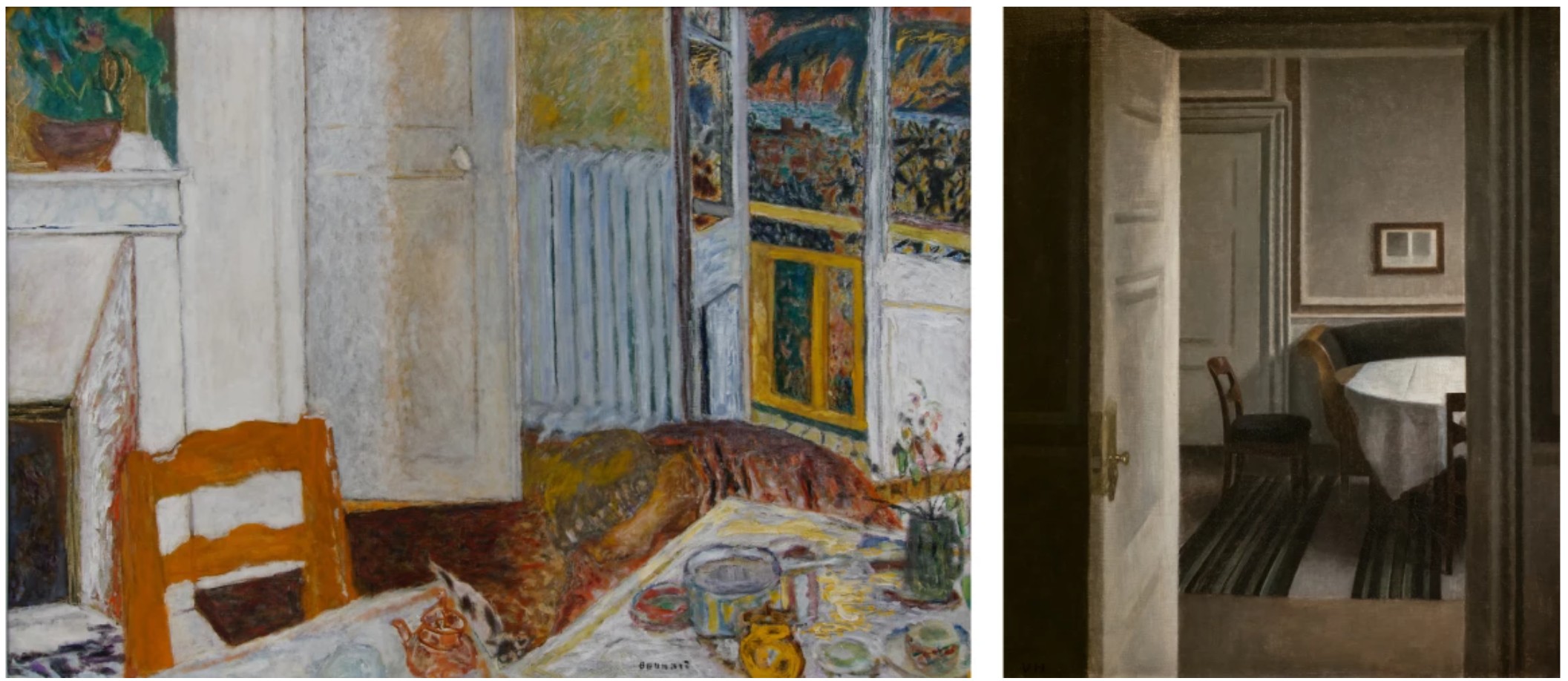
Left: Pierre Bonnard, Intérieur blanc, 1932. Musée de Grenoble. Art © 2025 Artists Rights Society (ARS), New York / ADAGP, Paris
Right: Vilhelm Hammershoi, Interior, Strandgade 30, 1904, Musee d’Orsay, Paris, Image: © Bridgeman Images
Coming from the esteemed collection of Roy and Dorothy, the present work delineates a staged living room in the artist’s iconic graphic lexicon: flattened color fields, bold black outlines, and the mechanical regularity of his Ben-Day dots. A crisp white chair, deep burgundy sofa, and angular patterned rug are arranged in geometric equilibrium, forming a stylised tableau that speaks more to artifice than habitation. Echoes of Henri Matisse’s decorative surfaces reverberate through the rug’s rhythmic geometry, while the spatial compression of the interior recalls the formal innovations of Fernand Léger’s Cubist compositions. Yet the most conceptually charged element lies on the far wall: a framed painting of a house, presented as a discrete artwork within the artwork. This internal picture is not a generic decorative element but a direct quotation from Lichtenstein’s own earlier series of house paintings, a deliberate act of self-reference that implicates the artist’s past oeuvre within the fictional space of the present scene. By inserting one of his own images into this highly mediated environment, Lichtenstein collapses the boundary between creator and constructed world, invoking the recursive logic of mise en abyme to destabilize the viewer’s sense of pictorial reality. The house painting becomes both a compositional anchor and a conceptual pivot, reinforcing the artificiality of the scene while simultaneously asserting the artist’s presence within it. In this way, Lichtenstein offers not simply a critique of bourgeois domestic aesthetics, but a reflexive meditation on the mechanisms of representation itself – how art inhabits space, circulates meaning, and ultimately constructs the visual language through which cultural identity is performed.
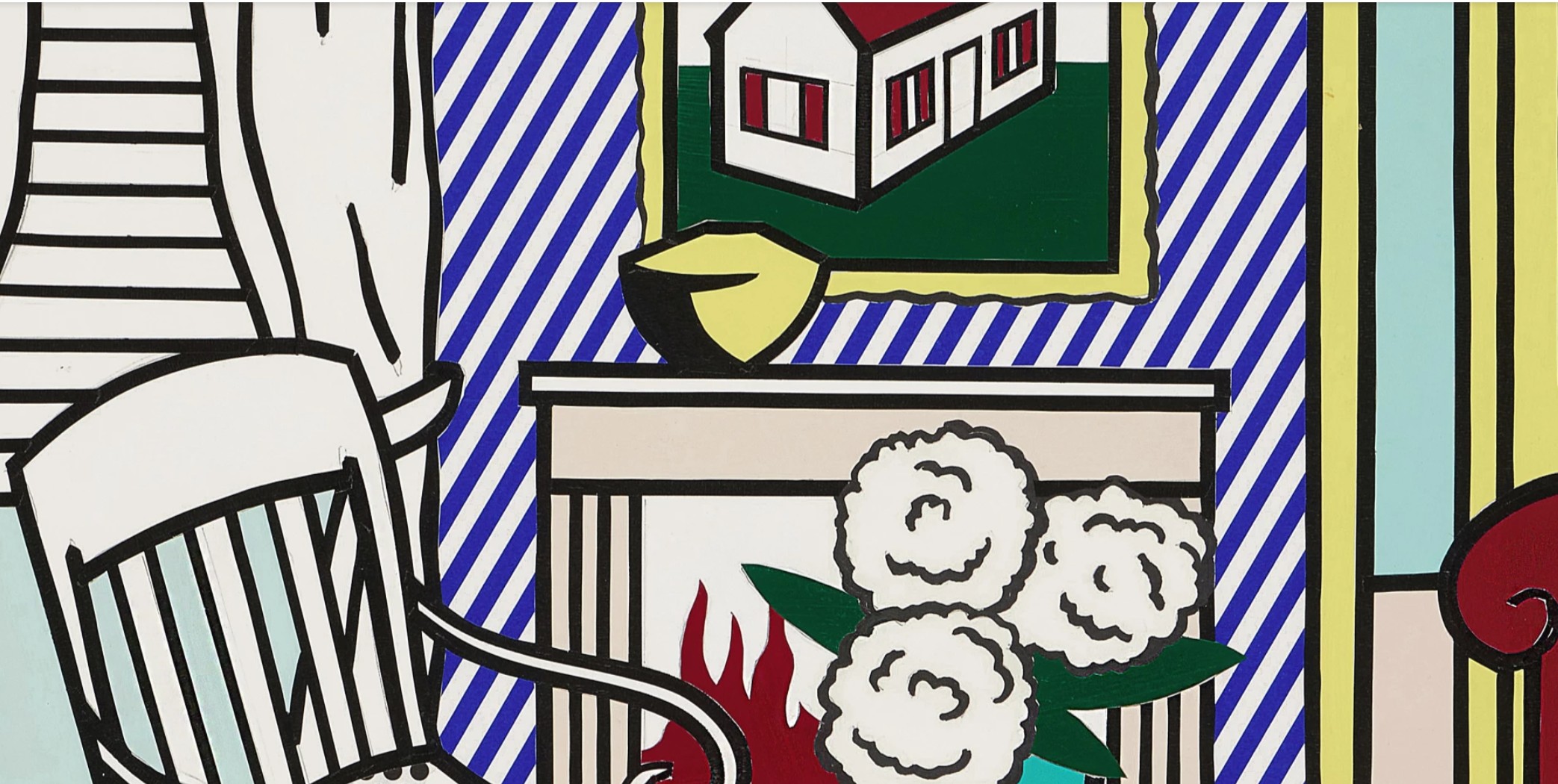
Though conceived as a study, the present work distills the intellectual and formal sophistication of Lichtenstein’s larger paintings. These collaged maquettes were an essential part of his working process, allowing him to manipulate compositional dynamics and visual rhythms with a precision that the final canvases would formalize. The medium of collage introduces a tactile contrast to the smooth, detached aesthetic for which Lichtenstein is best known. The hand-cut edges, visible seams, and layered textures offer a glimpse into the artist’s methodology, revealing the artifice beneath the surface of seamless design. In this way, the work retains a quiet materiality even as it performs the visual language of mass production. Interior with Painting of House (Study) should therefore be understood not merely as a formal exercise, but as a meditation on how images circulate, are consumed, and come to shape our cultural consciousness.
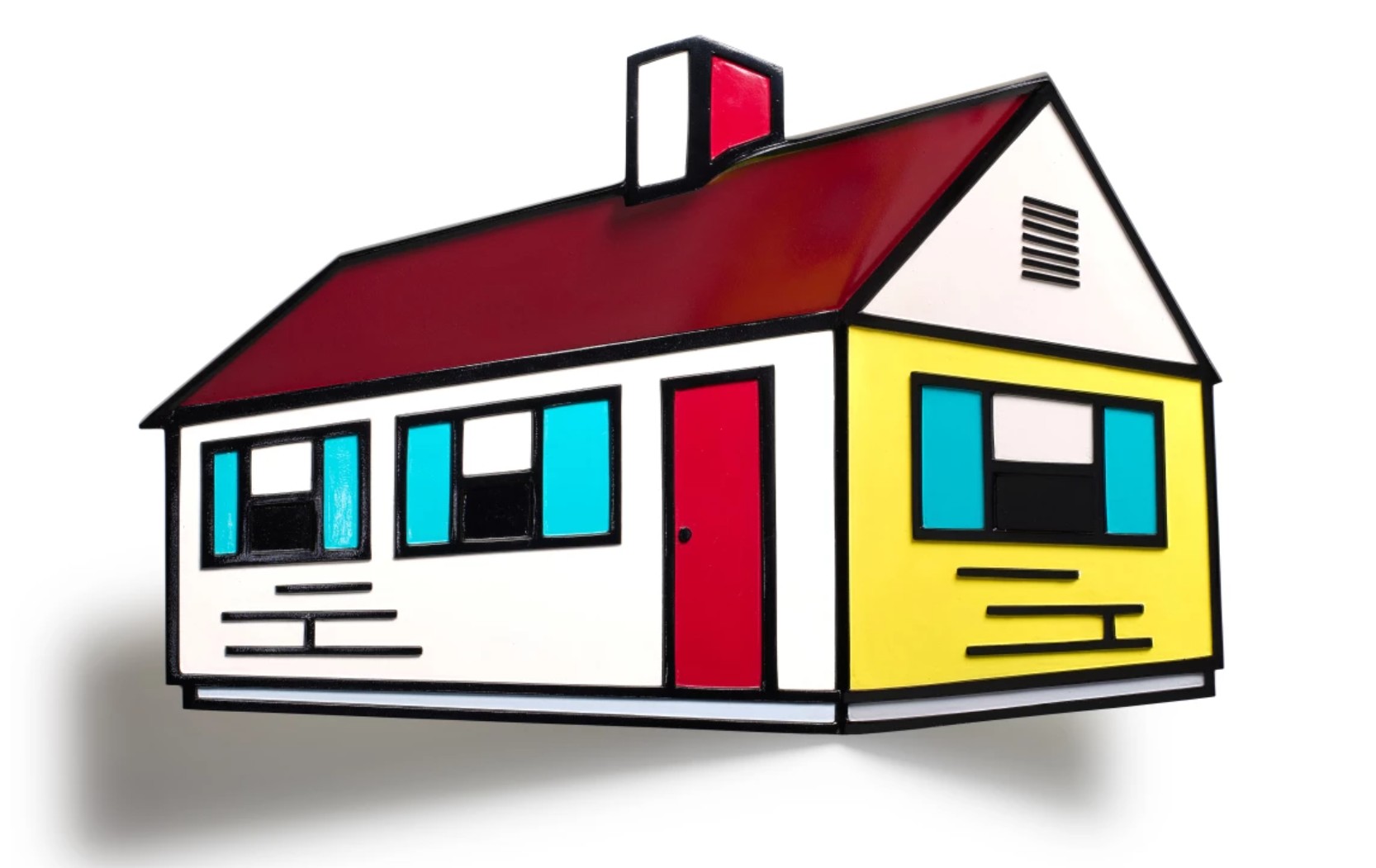
Roy Lichtenstein, Small House, 1997. Sold Sotheby’s New York, November 2024, for $1.14 million.
Art © Estate of Roy Lichtenstein / DACS 2025
In its celebration of comfortable consumerism, Interior with Painting of House (Study) and other works within the series recall Richard Hamilton’s seminal collage of 1956, Just what is it that makes today’s homes so different, so appealing? Considered one of the earliest manifestations of Pop Art, Hamilton’s prophetic collage depicts an interior awash with the latest ‘must-have’ appliances for the ideal home and infused with the over-inflated desires and beauty stereotypes propagated by consumer culture. Lichtenstein’s late interiors present a similarly ‘idealized’ version of daily life in the modern home updated for the 1990s: the flashy, synthetic color scheme sardonically perpetuates the excessive inflation of consumer dreams first acknowledged as part of the USA’s turbo-economy following World War II.
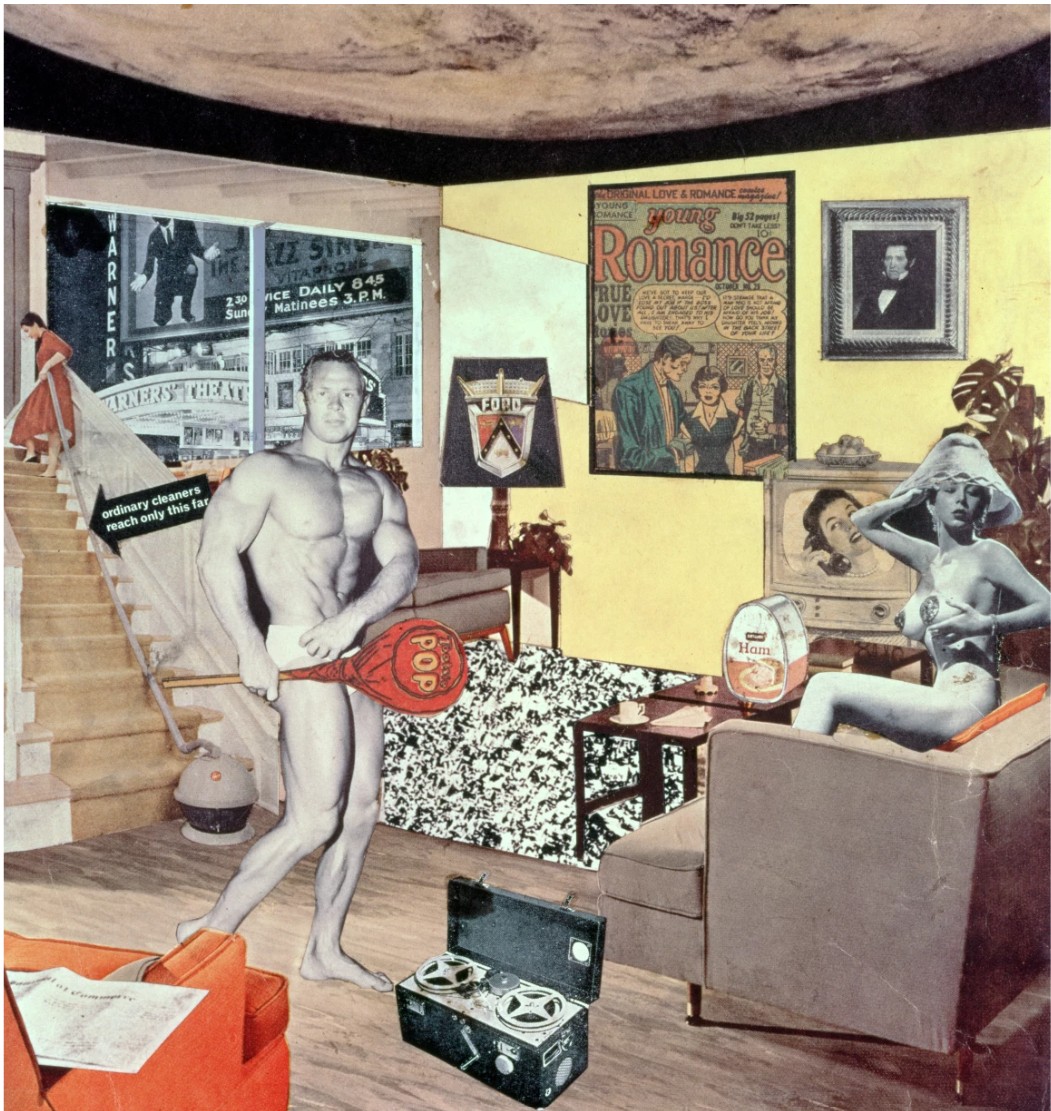
Richard Hamilton, Just what is it that makes today’s homes so different, so appealing?, 1956, Kunsthalle, Tubingen, Germany.
© Bridgeman Images 2025 Bridgeman Images
Rather than reproducing reality, Lichtenstein’s stylized interiors critique its representations; uncovering the visual codes and underlying ideologies that define modern domestic life. Collapsing the distinction between high art and low image culture, and drawing attention to the semiotic systems through which space, value, and identity are constructed. Interior with Painting of House (Study) thus reflects Lichtenstein’s consummate ability to transform the ordinary into the iconic, the commercial into the conceptual. The room he constructs is not a room at all, but an image of a room, a surface designed to be seen, decoded, and desired.
Interior with Ajax (Study), 1997
Interior with Ajax (Study), 1997
Property from the Collection of Dorothy and Roy Lichtenstein
Sotheby’s Riyadh: 31 January 2026
Estimated: USD 600,000 – 800,000
USD 889,000
Interior with Ajax (Study) | Origins II | 2026 | Sotheby’s
ROY LICHTENSTEIN (1923 – 1997)
Interior with Ajax (Study), 1997
Cut painted and printed paper and graphite on paperboard
Image: 26 7/8 x 25 inches (68.2 x 63.4 cm)
Paperboard: 32 3/4 x 30 inches (83.2 x 76.2 cm)
Signed R. Lichtenstein and dated ’97 (on the reverse)
Roy Lichtenstein’s Interior with Ajax (Study) belongs to the celebrated series of Interiors that the artist developed in the final decade of his career. These works reveal the mature confidence of an artist who had already transformed the visual language of postwar art and who, by the 1990s, was boldly experimenting and exploring novel directions for his oeuvre. In the Interiors, Lichtenstein brought together many of the themes that shaped his earlier decades, but also created something strikingly fresh and forward-looking. He combined the graphic immediacy of Pop, the crisp geometry of design, the elegance of classical reference, and the dialogic of postmodern quotation. Interior with Ajax (Study) is a sophisticated example of this synthesis. Commissioned directly from the artist by legendary fashion designer Gianni Versace, the work reflects a remarkable encounter between two creative figures whose sensibilities overlapped in their shared love of vivid color, theatrical staging, and classical imagery reframed for contemporary audiences.
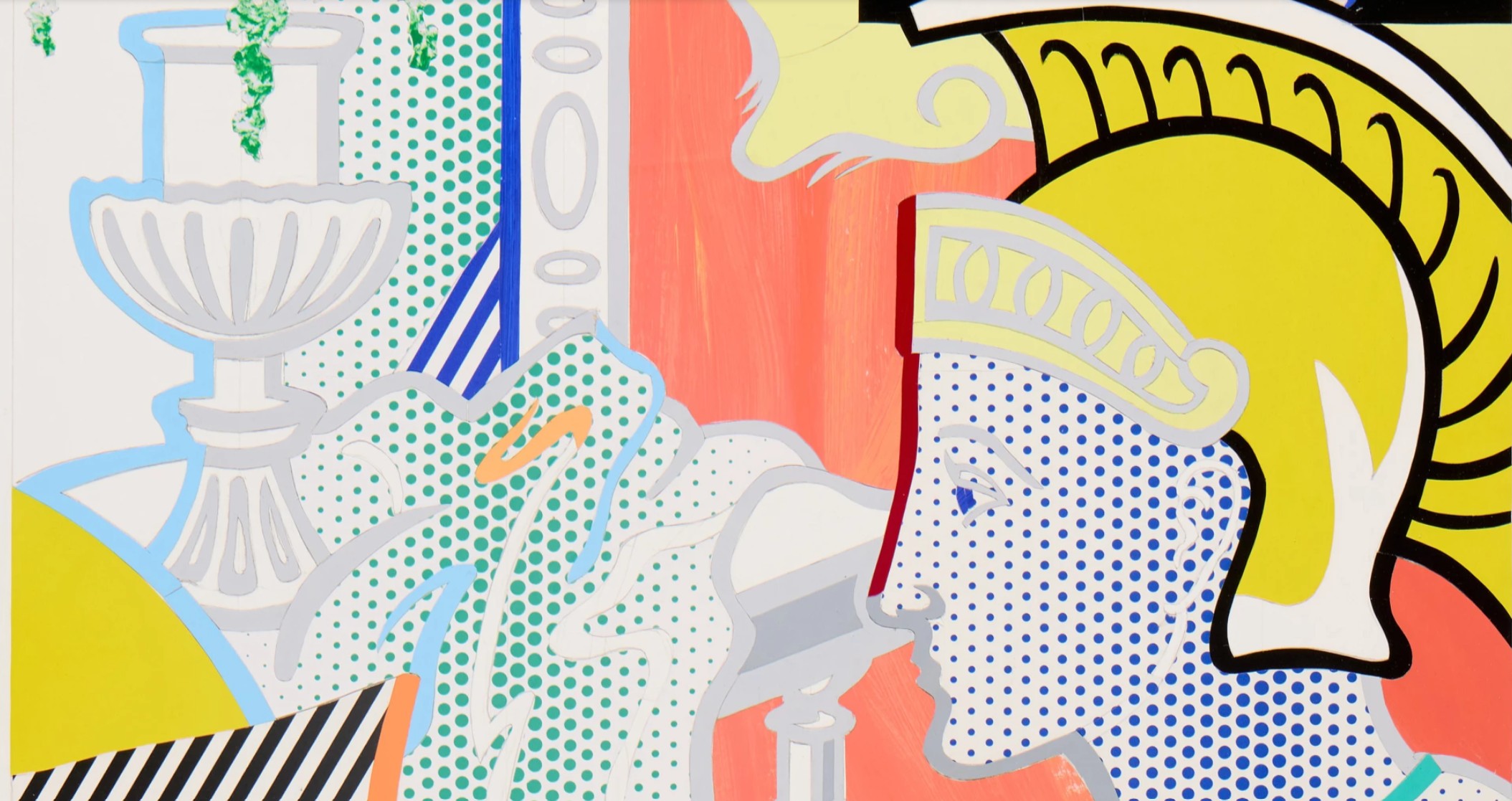
Executed in 1997, Interior with Ajax (Study) employs Ben-Day dots, bold outlines, diagonal stripes, and flat, radiant color to depict a tightly orchestrated domestic environment. Lichtenstein’s use of graphic devices flattens the pictorial space and immerses the viewer into the interior. Furniture, drapery, architectural ornament, and decorative objects appear in close proximity, as if arranged on the plane of a stage rather than receding into realistic depth. This heightened immediacy animates the scene and positions the viewer as an active participant in a world that is both familiar and theatrically animated. At the center of this exuberant composition is Ajax, the legendary hero of the Trojan War. His helmet, profile, and bare chest instantly identify him as a figure from classical antiquity, yet his body is rendered in Lichtenstein’s signature blue Ben-Day dots. He stands not as a distant mythological presence, but as a graphic character who seems to inhabit the exuberant space. This unexpected placement dissolves the boundaries between ancient history and contemporary design. Ajax does not simply decorate the interior – he occupies it. His presence introduces an element of humor and conceptual tension, since the viewer must reconcile the solemnity of a Greek hero with the polished contemporary décor that surrounds him.
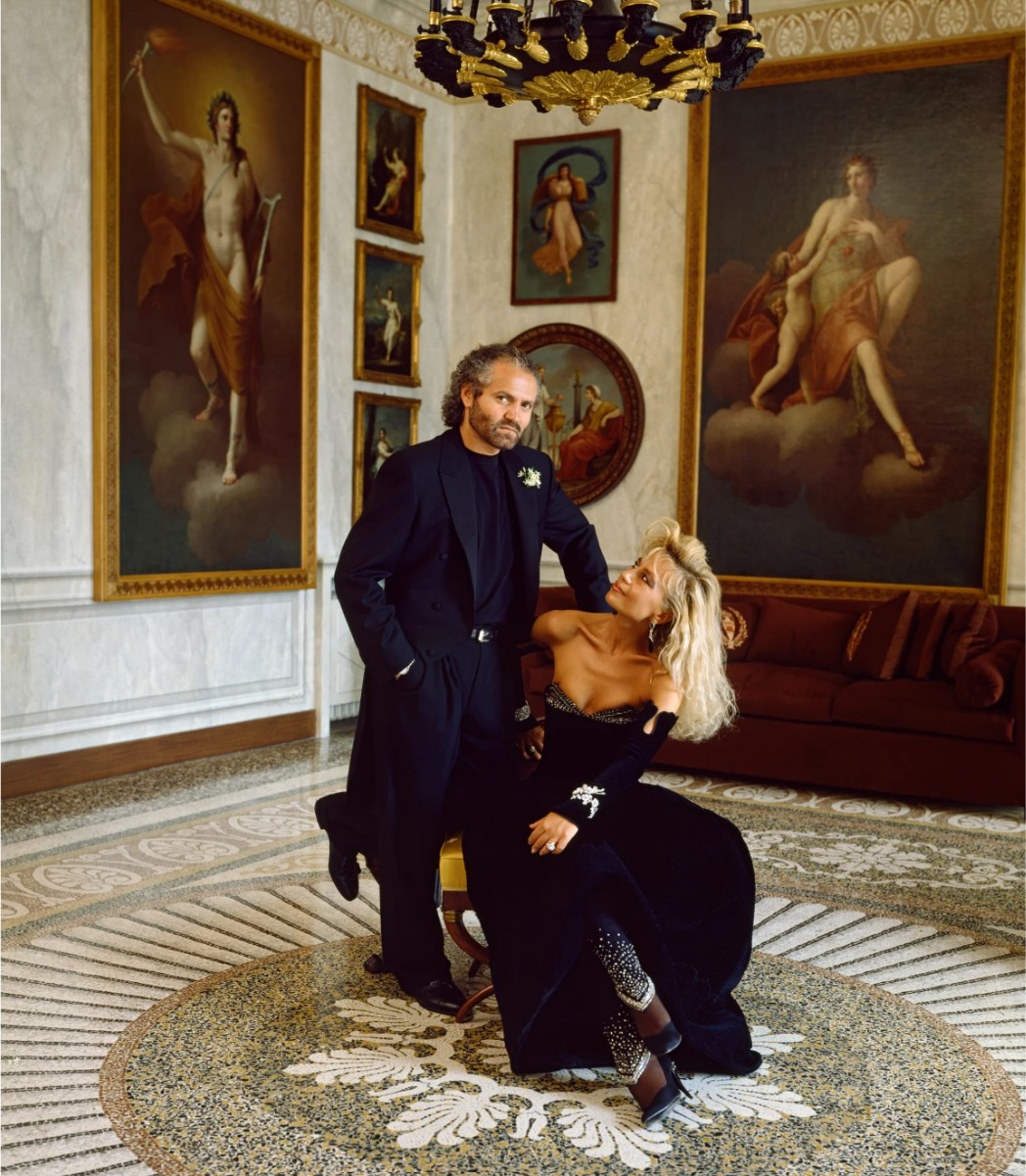
Gianni Versace with his sister Donatella Versace, Lake Como, Italy, 1988. Photo by Evelyn Hofer/Getty Images.
Although Ajax is not based on a specific source, Lichtenstein successfully evokes the essence of classical sculpture. Indeed, the figure feels instantly recognizable. This technique echoes the broader strategy of the Interiors, which do not depict real rooms but rather composite spaces drawn from design magazines, cartoons, and earlier works by Lichtenstein. Lichtenstein constructs an interior that feels familiar without being literal, a quality central to his ability to bridge fine art and mass culture. Above Ajax’s helmet appears a framed still life of fruit. The bold shapes recall the graphic advertisements and poster imagery that shaped Lichtenstein’s earliest Pop paintings. The small inset painting acts as a playful reminder of his artistic origins. It also sets up a visual and conceptual dialogue between the different forms of representation in the work. Modern interior, classical hero, commercial-style still life: each belongs to a separate visual tradition, yet all coexist within the same picture.

Giovanni Demin, Ajax, 19th century. Belluno, Museo Civico.
The unity of these disparate elements can be traced to Lichtenstein’s consistent use of pattern. The blue Ben-Day dots that articulate Ajax’s flesh reappear in the upholstery, drapery study, and the architectural passage visible through the far doorway. These repeating dots act as a connective motif that binds the objects together. Their presence assures coherence, even as the scene incorporates references that span centuries and genres. Lichtenstein uses the dots not merely for stylistic continuity, but also as a reminder of the mediated nature of the image. Everything in the room, from the human figure to the furniture, is filtered through the same system of stylized marks. The commission from Gianni Versace adds another dimension to the work’s meaning. Versace, renowned for his command of classical iconography and his bold reinterpretation of historical motifs in fashion, recognized in Lichtenstein a kindred spirit. Both embraced bright color, stylized line, and theatricality. Versace’s own designs often incorporated mythological imagery, and his commission of Interior with Ajax (Study) suggests an appreciation for Lichtenstein’s ability to fuse antiquity with contemporary aesthetics. This commission highlights the fluid exchange between fine art and fashion at the end of the twentieth century, while underscoring the heightened cultural prestige that Lichtenstein commanded in his later years.
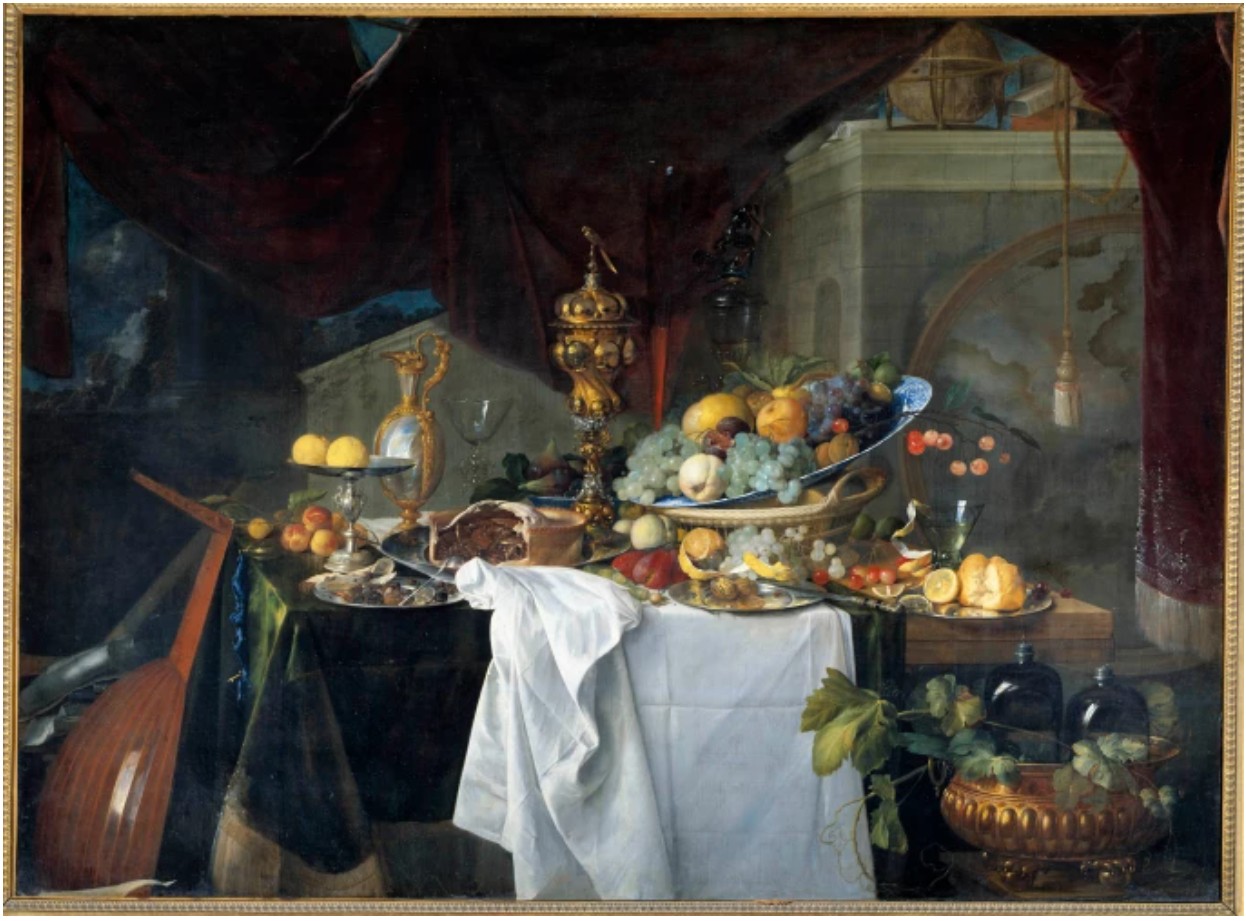
Jan Davidsz. de Heem, A table of desserts, 1640. The Louvre, Paris. Photo © Erich Lessing / Bridgeman Images
In Interior with Ajax (Study), Lichtenstein moves beyond Pop’s early fascination with mass media and comic strips. He enters a domain shaped by formal inquiry, historical reflection, and conceptual play: the domestic space. The work demonstrates a deep understanding of how images from different times and contexts can coexist within a single aesthetic system. They function instead as components of a unified visual vocabulary, shaped by the graphic clarity and wit that remained hallmarks of Lichtenstein’s career. Building off his sustained interest in the domestic realm, in the final years of Lichtenstein’s life, he developed a series titled Virtual Interiors. These works are characterized by the artist’s experimentation with new outlines, using colorful or differently weighted lines from the stark black that characterized much of his oeuvre. Similarly to how the Interiors uniquely synthesized past, present and future, such works prolonged Lichtenstein’s inquiries into the future of art, specifically as it pertains to the virtual realm.
Ultimately, the work invites the viewer to consider how art history, domestic space, and popular culture intersect. It asks us to reflect on how ancient myths continue to shape contemporary imagination and how modern life contains echoes of the past that appear in unexpected forms. Through this layering of references, Lichtenstein constructs a world that feels playful yet contemplative, precise yet imaginative. Interior with Ajax (Study) stands as a testament to his late-career mastery. It brings together humor, sophistication, and visual intelligence with remarkable ease, offering a vivid demonstration of why Lichtenstein remains one of the central figures in twentieth-century art.
Interior with Swimming Pool Painting (Study), 1992
Interior with Swimming Pool Painting (Study), 1992
Works from the Collection of Dorothy and Roy Lichtenstein
Sotheby’s New-York: 16 May 2025
Estimated: USD 400,000 – 600,000
USD 762,000
Interior with Swimming Pool Painting (Study) | Contemporary Day Auction | 2025 | Sotheby’s
ROY LICHTENSTEIN (1923 – 1997)
Interior with Swimming Pool Painting (Study), 1992
Colored pencil and graphite on paper
Image: 6×5 inches (15.2 x 12.7 cm)
Sheet: 9 7/8 x 6 3/4 inches (25.1 x 17.1 cm)
Signed and dated ’92 (on the verso)
Delicate in scale yet conceptually rich, Roy Lichtenstein’s Interior with Swimming Pool Painting (Study) (1992) offers an intimate glimpse into the artist’s creative process during the final decade of his life. Executed in colored pencil and graphite, this refined drawing is a preparatory study for Lichtenstein’s painting Interior with Swimming Pool, now held in a private collection. Coming directly from the Estate of the artist, this work is distinguished not only by its rarity, but by its exceptional provenance—providing a direct connection to the artist’s hand and studio practice.
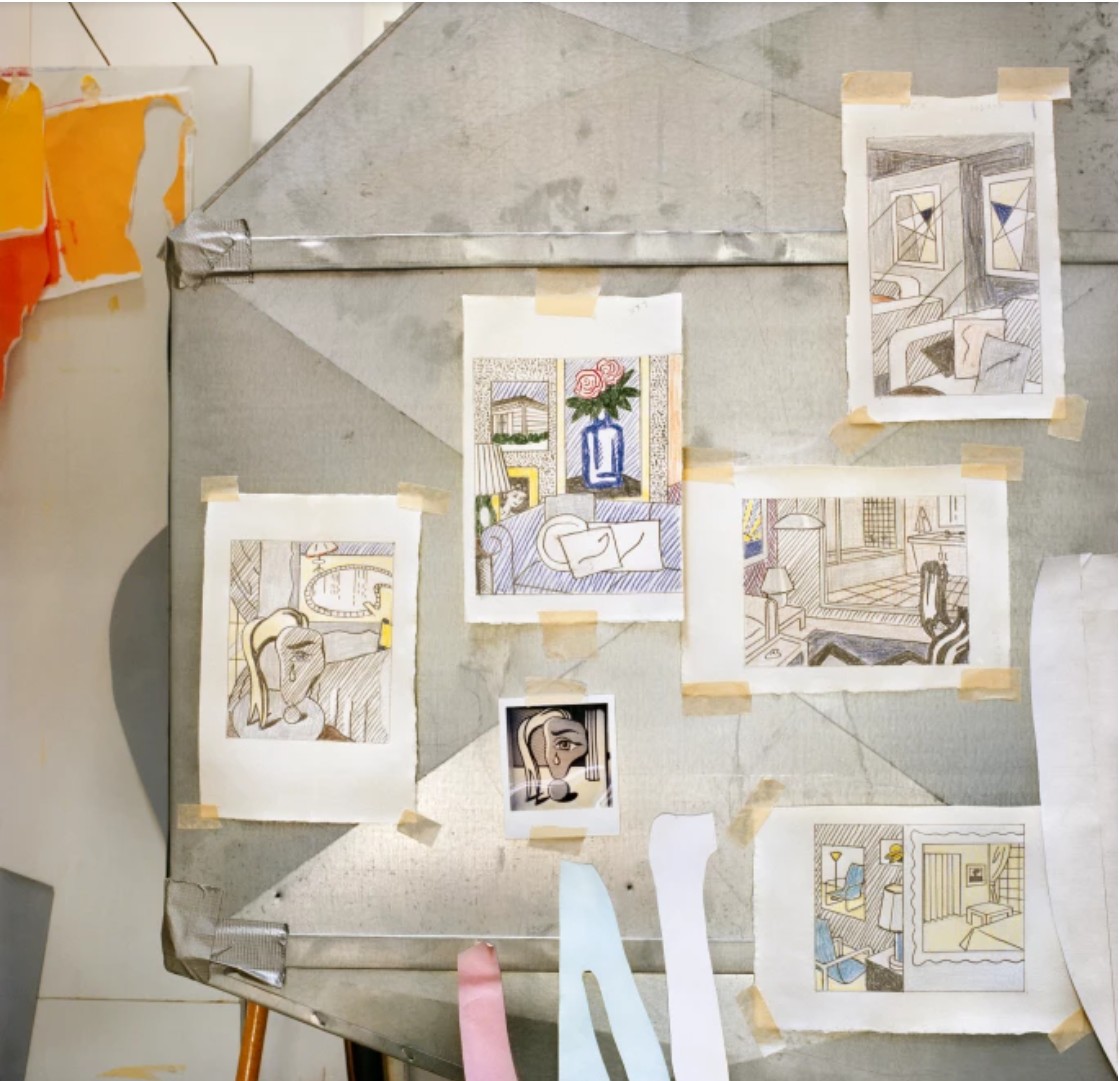
Roy Lichtenstein’s drawings and sketches, including the present work at left, in his studio, 1992.
Photo © Laurie Lambrecht. Art © Estate of Roy Lichtenstein
The drawing belongs to Lichtenstein’s celebrated Interiors series, begun in the early 1990s, which reimagined domestic spaces as arenas for visual play and historical reference. Combining design motifs, art historical citations, and Pop formalism, these works are constructed as layered images-within-images, where paintings hang on walls within paintings, and domestic furnishings become stylized symbols. Interior with Swimming Pool stands out in the series for its surreal juxtaposition of a modernist interior and an imagined poolscape visible through a picture window or possibly an art piece. In the present study, Lichtenstein reduces the composition to its essential forms with precision and economy. A stylized, fragmented figure with flowing yellow hair and a prominent tear occupies the foreground—likely referencing Picasso’s Weeping Woman (1937), a recurring source in Lichtenstein’s late work. Behind her, the setting is demarcated by tightly controlled lines and areas of color, suggesting architectural space. A window or painting reveals the schematic outline of a pool and tiled patio rendered in Lichtenstein’s iconic linear shorthand.
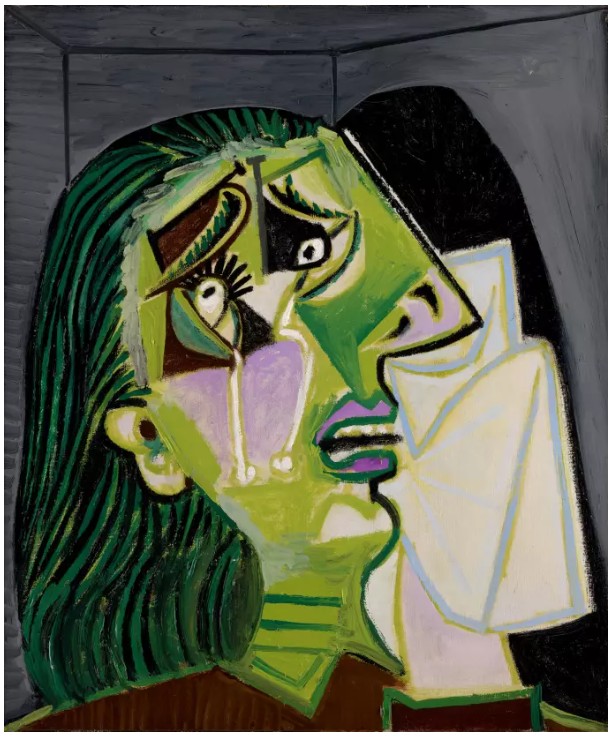
Pablo Picasso, Femme en pleurs, 1937. National Gallery of Victoria, Melbourne.
Bridgeman Images. Art © 2025 Estate of Pablo Picasso / Artists Rights Society (ARS), New York
The use of colored pencil and graphite lends the study a sense of immediacy and directness; the artist’s hand is palpable. The drawing reveals how the artist meticulously planned compositional balance, the distribution of line, and the integration of borrowed imagery. This aspect of the work deepens its significance: far from a spontaneous sketch, it is a compositional blueprint, critical to the development of a major painting. It captures the moment where concept meets execution.
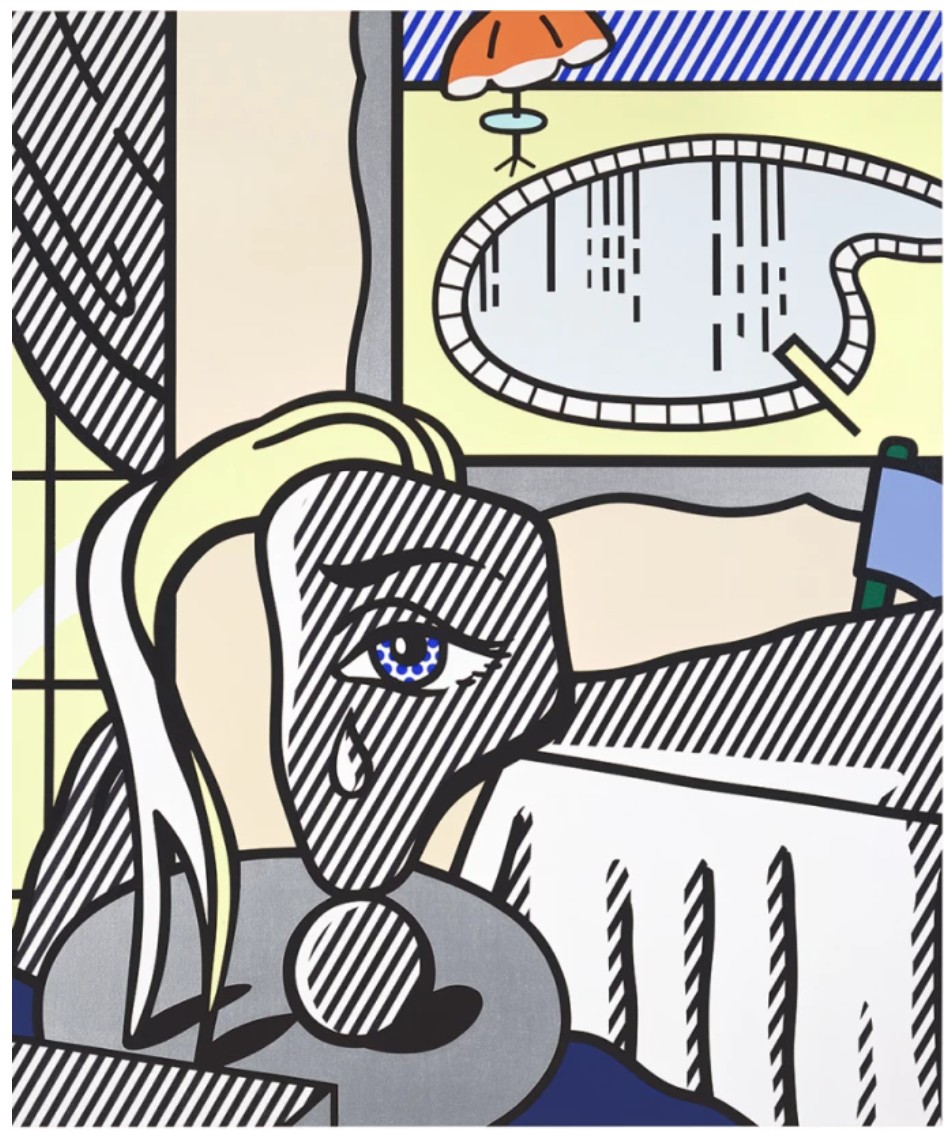
Roy Lichtenstein, Interior with Swimming Pool Painting, 1992. Private Collection. Art © Estate of Roy Lichtenstein.
Thematically, the work is as much about looking as it is about making. The interior becomes a frame for reflection—on the history of modernism, on domestic life, and on the constructed nature of perception. By placing the swimming pool within the window or framed image, Lichtenstein plays with the boundary between reality and representation. The viewer is invited not just to observe, but to decode the layers of visual language at play. Studies like Interior with Swimming Pool Painting (Study) serve as keystones in understanding Lichtenstein’s method: how he rehearsed and revised visual ideas before translating them into final paintings. With its rare estate provenance and connection to a significant late work, this drawing is not only a refined example of Lichtenstein’s draftsmanship but also a poignant artifact of his lifelong dialogue with art history and the visual world around him.
Hologram Interior (Study), 1996
Hologram Interior (Study), 1996
Works from the Collection of Dorothy and Roy Lichtenstein
Sotheby’s New-York: 16 May 2025
Estimated: USD 70,000 – 100,000
USD 215,900
Hologram Interior (Study) | Contemporary Day Auction | 2025 | Sotheby’s
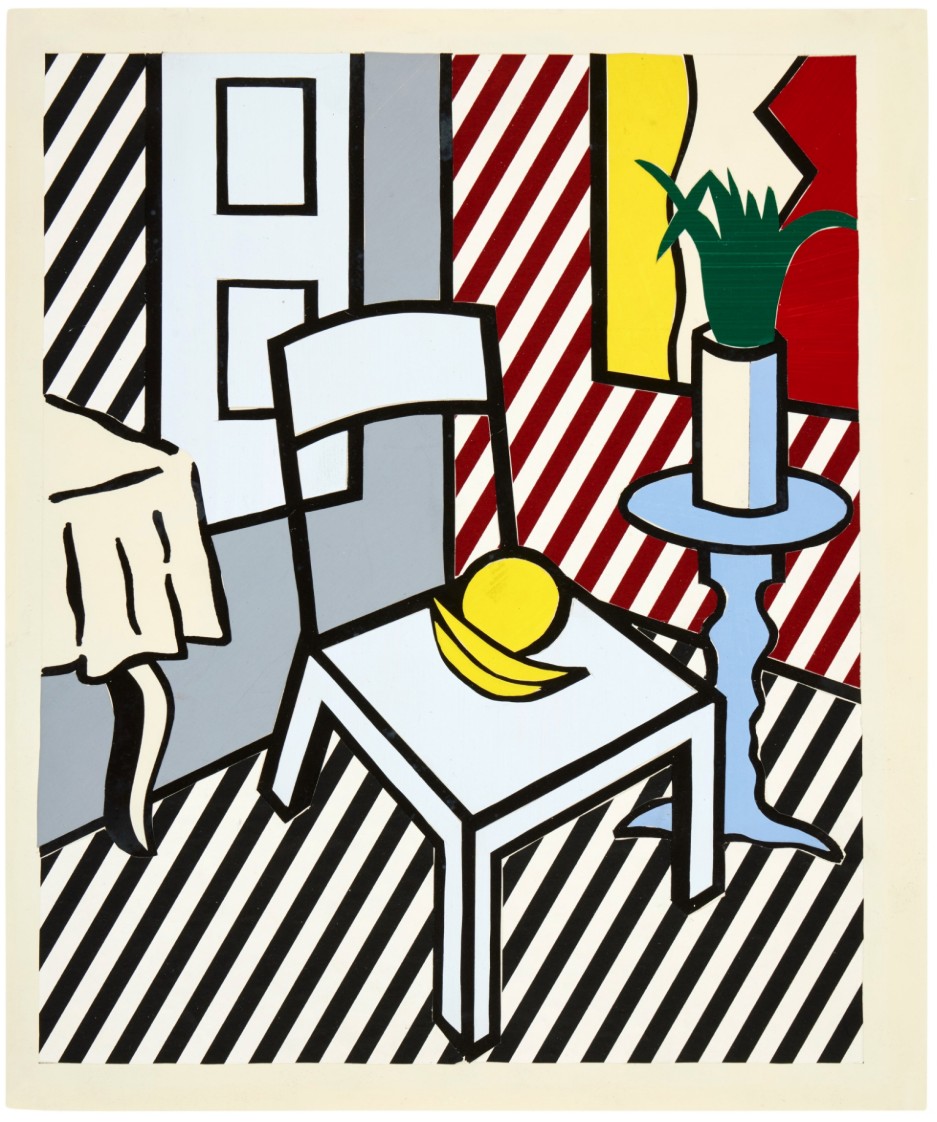
ROY LICHTENSTEIN (1923 – 1997)
Hologram Interior (Study), 1996
Cut painted paper and cut printed paper on printed paper
13 5/8 x 11 1/4 inches (34.6 x 28.6 cm)
“Solitary and unlived in, the interiors represent domestic settings in which daily life and private acts can only be imagined. There is no clutter, no human presence — even the occasional nude seems to adorn rather than inhabit the space.”
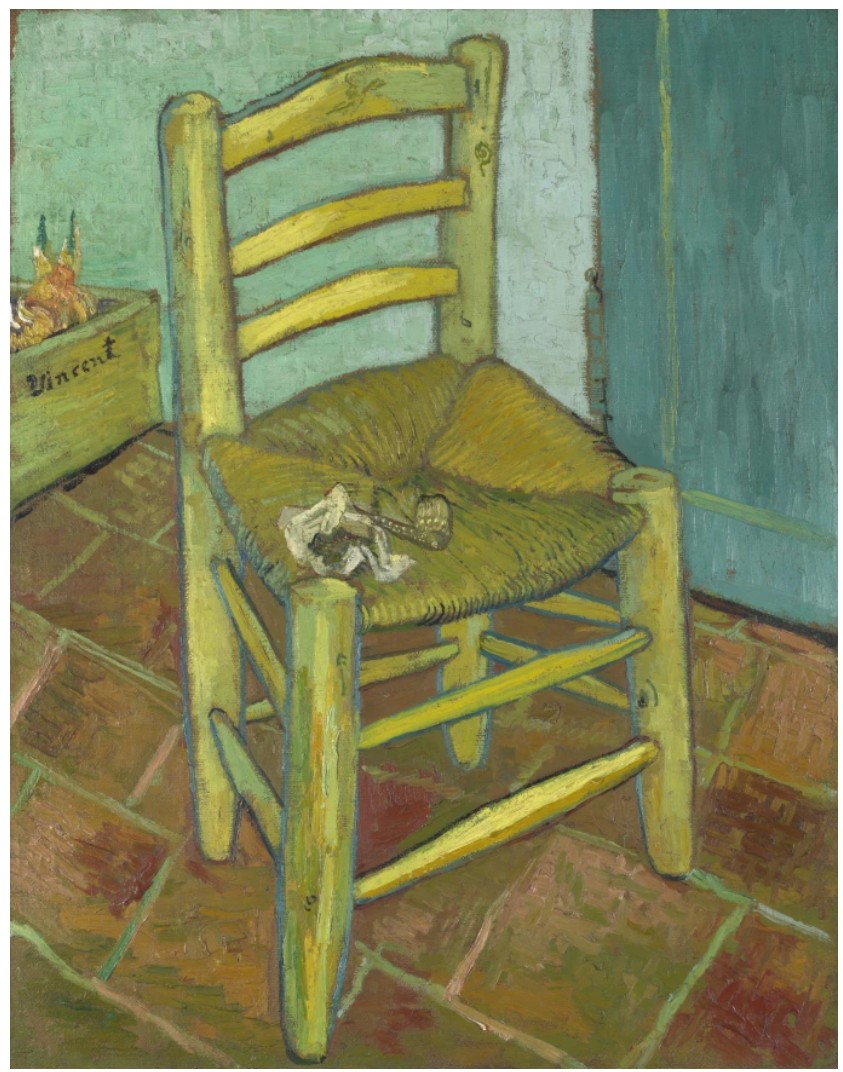
Vincent van Gogh, Van Gogh’s Chair, 1888, The National Gallery, London
Collage for Interior with Painting and Still Life, 1997
Phillips New-York: 24 June 2021
Estimated: USD 800,000 – 1,200,000
USD 1,421,500
Roy Lichtenstein – 20th Century & Cont… Lot 112 June 2021 | Phillips
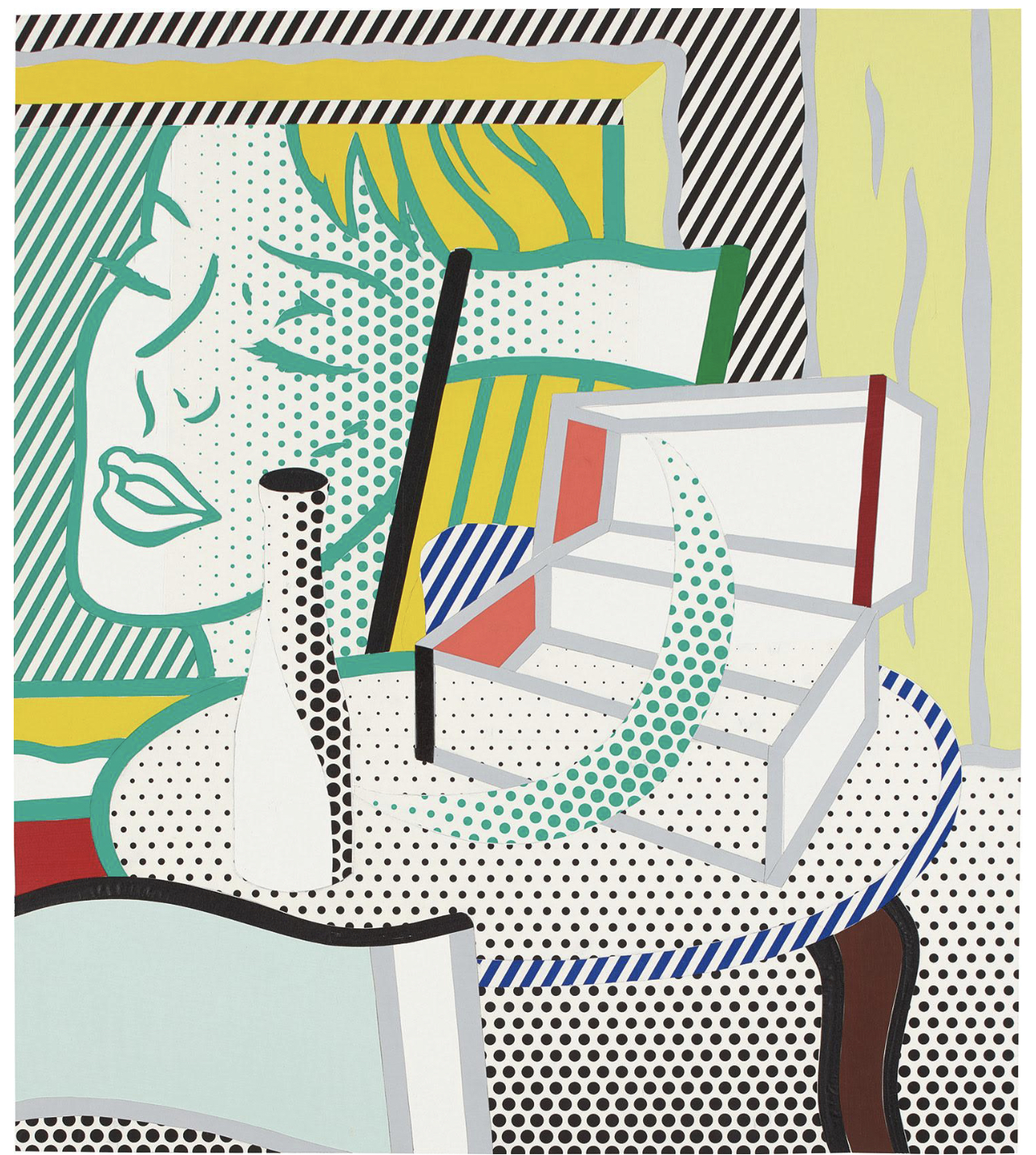
ROY LICHTENSTEIN
Collage for Interior with Painting and Still Life, 1997
Tape, graphite, painted and printed paper collage on board
Image: 31 3/4 x 27 7/8 inches (80.6 x 70.8 cm)
Board 38 1/2 x 33 7/8 inches (97.8 x 86 cm)
Signed and dated “rf Lichtenstein ’97” on the reverse
Nearly 40 years after skyrocketing to fame for his idiosyncratic Pop vernacular, Roy Lichtenstein masterfully employed his iconic cartoon-strip style to a quiet domestic scene in Collage for Interior with Painting and Still Life, 1997. Created in the final year of the artist’s life, this superb work is emblematic of the artist’s mature approach, executed during a time when Lichtenstein was reflecting on his own career as well as the history of art at large. Unlike the comic book subjects and cartoon iconography that he took as subject in his early paintings, this still life and interior scene features timeless tropes that have reappeared throughout art history for centuries. From Pablo Picasso—an artist who Lichtenstein unabashedly admired—to Henri Matisse and Paul Cézanne, the great figurative masters of modernism all revisited traditional genres to new aesthetic and conceptual ends. First galvanized to embark upon a series of interior scenes while flipping through a phone book, Lichtenstein masterfully captured the spirit of America during the second half of the 20th century in this important series by applying his Pop principles and ubiquitous contemporary iconography to age-old themes.
Lichtenstein developed his distinct Pop idiom by adopting the appearance of the printed imagery of consumer culture in post-war America. Widely known for his humor and irony, Lichtenstein devised a visual language in which his utterly unique and highly recognizable style consciously mimicked the generality of mass-produced materials. In Collage for Interior with Painting, Lichtenstein’s characteristic Ben-Day dots recall the printing techniques used for mid-century advertisements, and his signature hard-edge line appears to have been rendered with mechanical precision. Along with his contemporaries, including Andy Warhol, Claes Oldenburg, and Tom Wesselmann, Lichtenstein was rebelling against the high modernism preached by the critics of Abstract Expressionism, who exalted the primacy of the artist’s hand and the mutual exclusion of kitsch and fine art. Lichtenstein went against the grain, radically seeking to remove any trace of his own hand in his works and incorporating iconography from everyday life into his work.
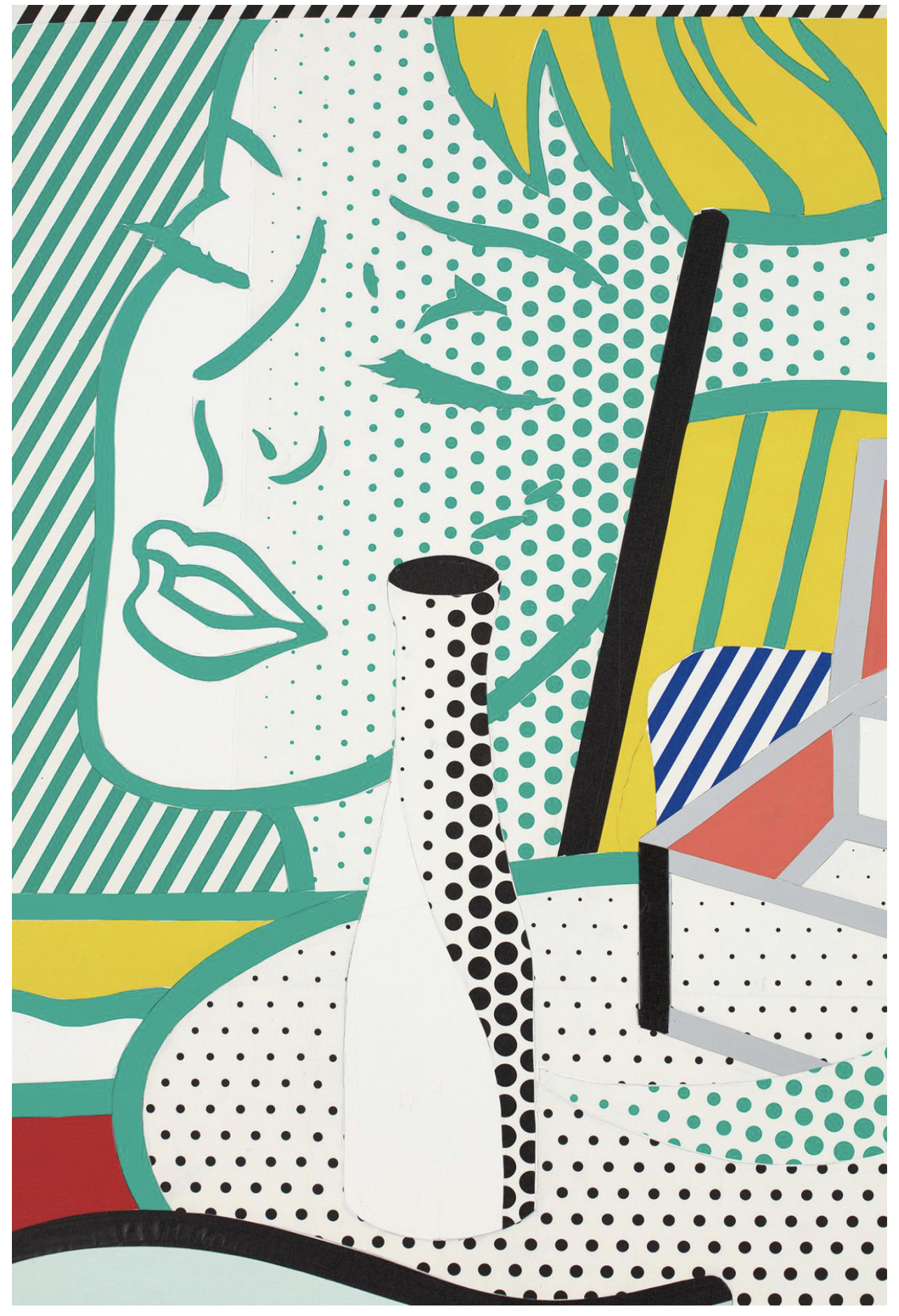
In Lichtenstein’s works, which involve a process painstakingly perfected through a series of sketches and collages, all suggestions of their handmade quality and the methodology underlying the final composition are eradicated. His preparatory works, such as Collage for Interior with Painting, offer a unique window into the Pop master’s process, revealing the ironically handcrafted quality of his work and the systematic planning which allow the paintings to appear effortless and mechanical. Layers of tape, cut paper, and graphite markings in the present work unveil the guarded secrets of Lichtenstein’s compositions, granting the viewer a greater understanding of the artist’s process and practice.
Other Interior Studies
Virtual Interior (Study), 1995
Sotheby’s New-York: 28 September 2023
Estimated: USD 25,000 – 35,000
USD 25,400
Virtual Interior (Study) | Contemporary Curated | 2023 | Sotheby’s (sothebys.com)
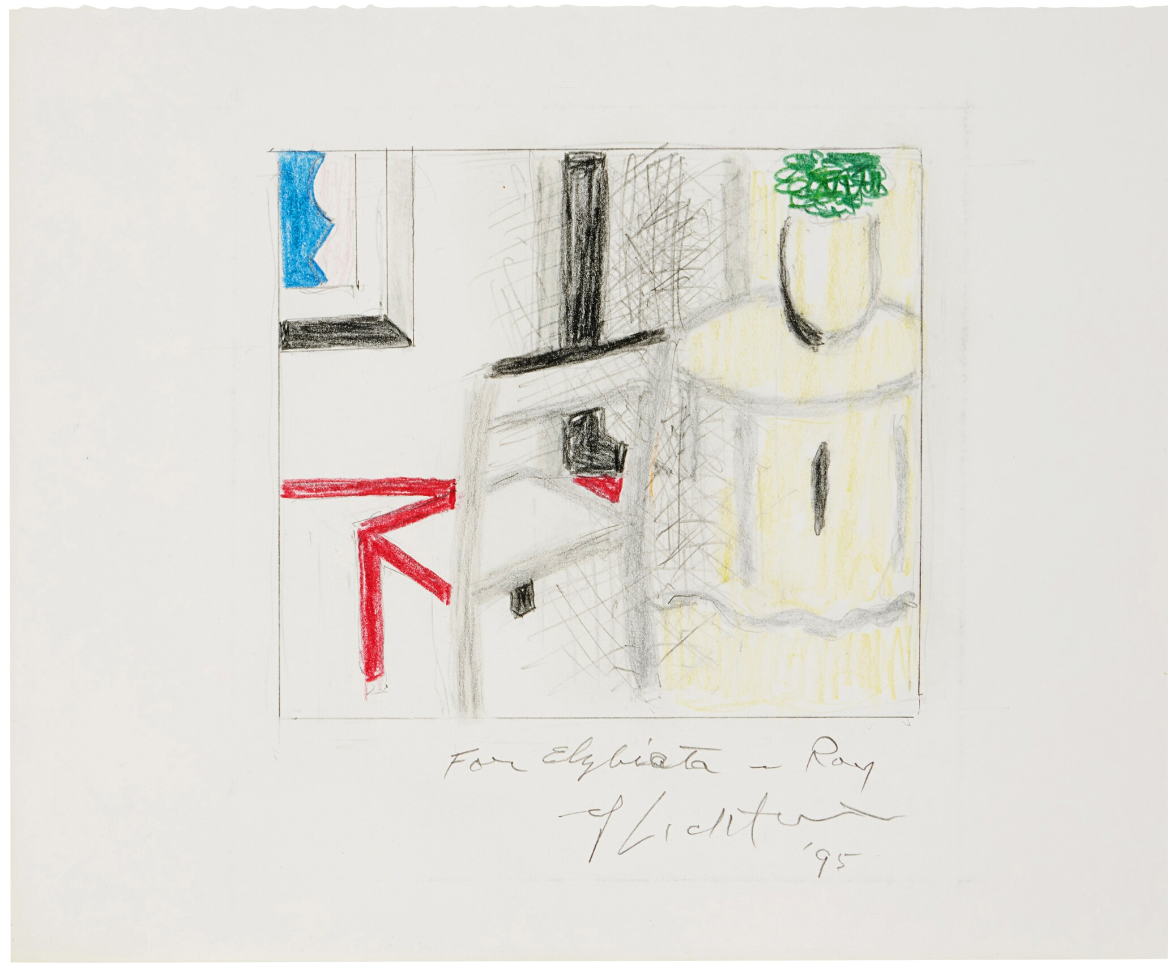 ROY LICHTENSTEIN (1923 – 1997)
Virtual Interior (Study), 1995
Colored pencil and graphite on paper
Sheet: 7 7/8 x 9 1/2 inches (20.3 x 24.1 cm)
Signed, dated ’95, and dedicated For Elizabieta—Roy (lower edge)
A study for a larger painting completed the following year, Study for Virtual Interior is being offered from the collection of the Polish visual artist Elka Krajewska. At the time the work was gifted, Krajewska was soon to be married to the American novelist Frederic Tuten, one of Lichtenstein’s closest friends towards the end of his life. The present gift was an offer “of himself” in secret admiration, as at the time Roy gifted the work to Krajewska, he had told her that should she ever stop loving Fred, perhaps she could return his love.
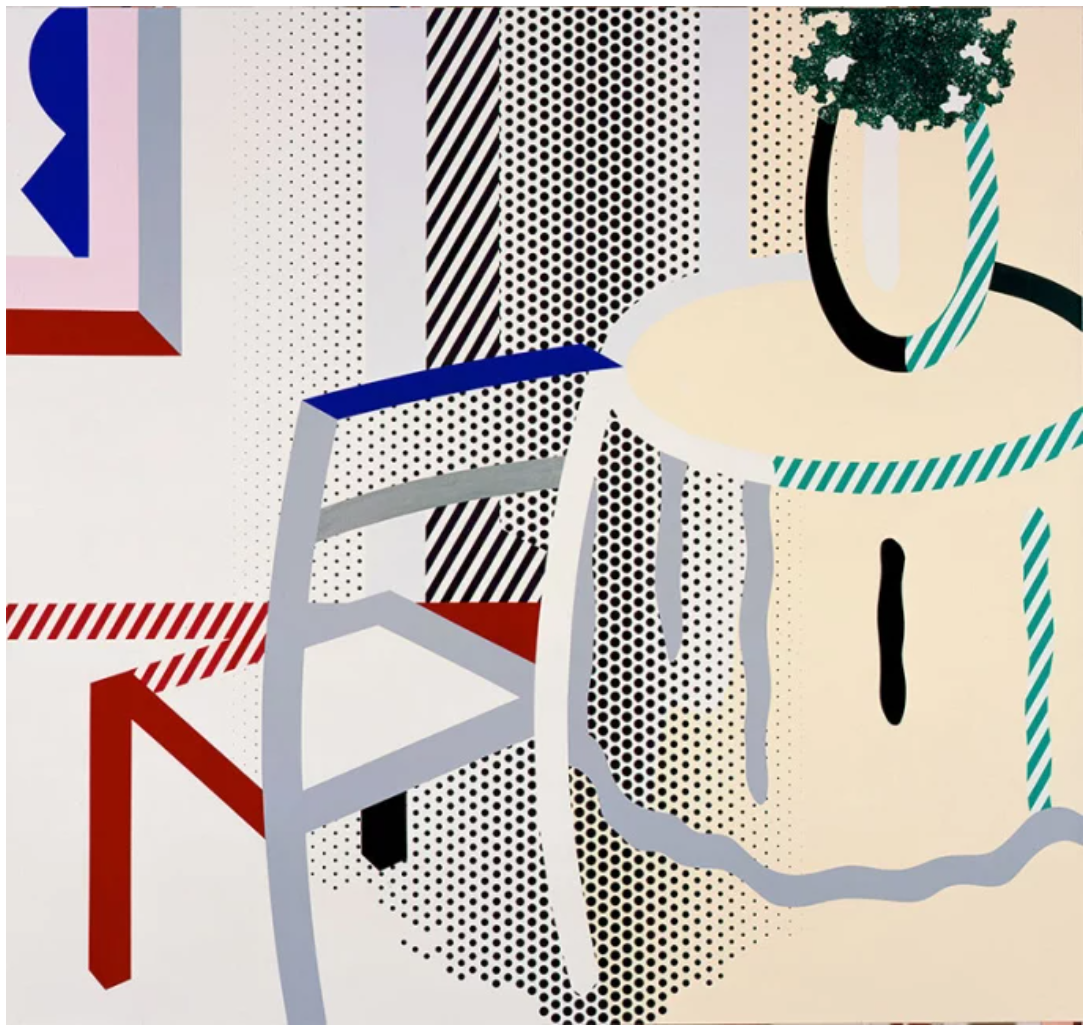
ROY LICHTENSTEIN, VIRTUAL INTERIOR, 1996 IMAGE © 2023 PRIVATE COLLECTION ART © 2023 ROY LICHTENSTEIN FOUNDATION
Lichtenstein literalized this personal offering by hiding his name through various symbols in the otherwise apparently innocent domestic scene— the striped and solid red lines in the wall and chair make the “R”, the trapezoid in the seat of the chair makes the “O”, and the flower vase with the table leg make the “Y”. The present work is a token of an intimate story in the centenary of Lichtenstein’s birth.
Interior with Perfect Painting, 1992
Christie’s New-York: 12 May 2023
Estimated: USD 60,000 – 80,000
USD 170,100
ROY LICHTENSTEIN (1923-1997), Interior with Perfect Painting | Christie’s (christies.com)
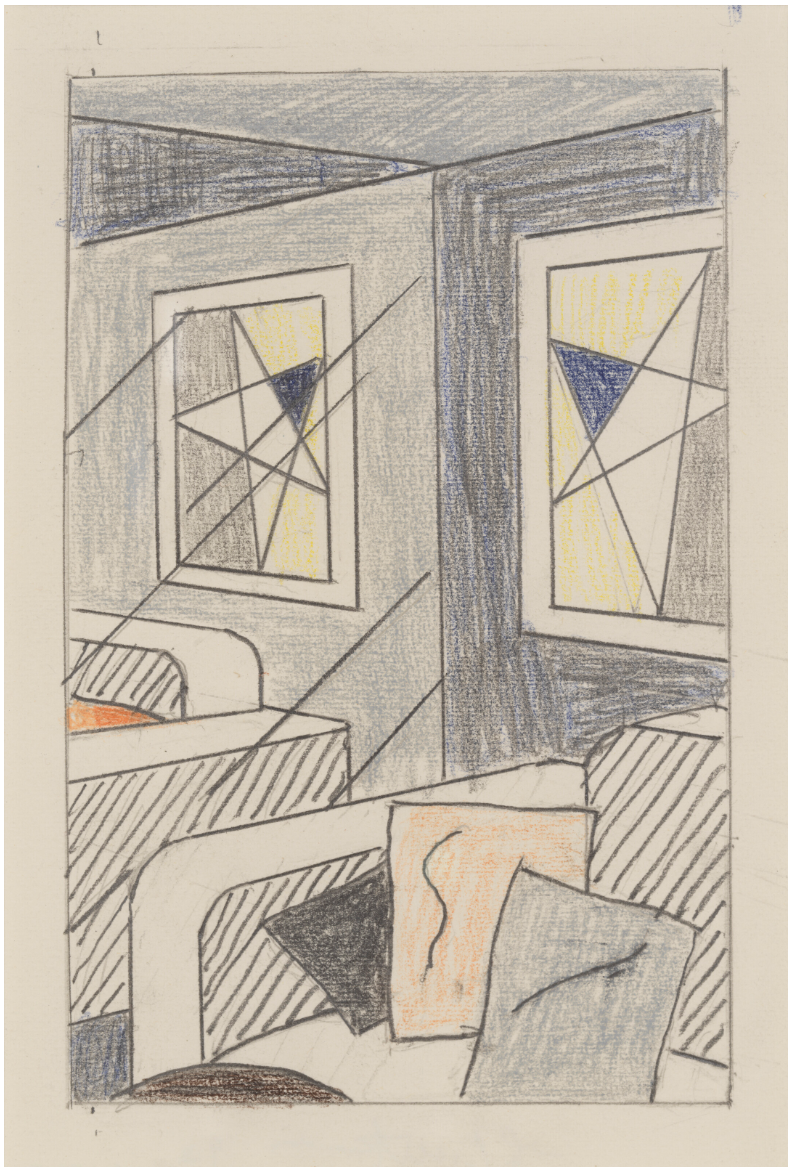
ROY LICHTENSTEIN (1923-1997)
Interior with Perfect Painting, 1992
Colored pencil and graphite on paper
Sheet: 9 7/8 x 6 1/2 inches (24.9 x 16.5 cm)
Image: 7 3/4 x 5 inches (18.5 x 12.7 cm)
Signed and dated ‘R. Lichtenstein ’92’ (on the reverse)