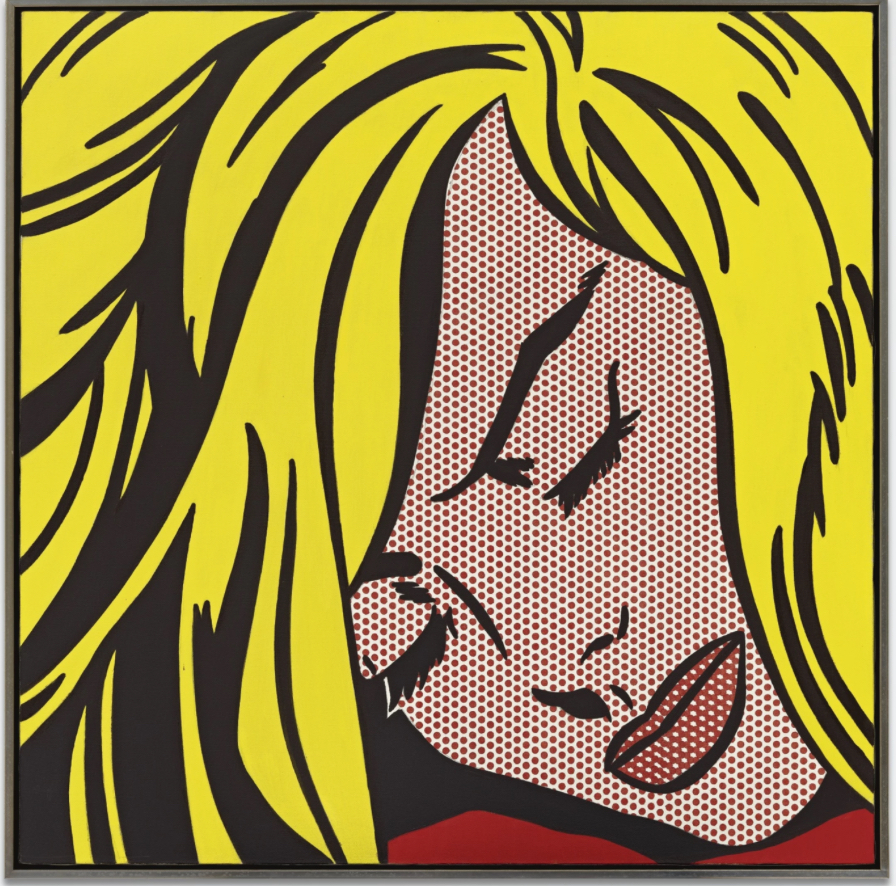
ROY LICHTENSTEIN
Sleeping Girl, 1964
Oil and Magna on canvas
36×36 inches (91.5 x 91.5 cm)
Signed and dated ’64 on the reverse
Provenance
Ferus Gallery, Los Angeles
Acquired by the present owner from the above in 1964
Auction History
Sotheby’s New-York: 9 May 2012
Estimated: USD 30,000,000 – 40,000,000
Price realized: USD 44,882,500
(#16) Roy Lichtenstein (sothebys.com)
Held within a swirling frame of abundant blonde hair, the weary head of flawless beauty rests upon a red pillow. Invited into her bounded domain as if through a keyhole, our gaze rests upon her profound contemplation; immersed by such elusive thoughts as can only be encountered in sleep’s deepest dreams. We scan her expression for some sign to her preoccupation, but her secrets remain locked within. While our focus falls on her immediately close presence, her focus strays far away. The assuredly iconic depiction of a strikingly intimate and vulnerable moment, Sleeping Girl is a masterpiece of irresistible seduction. Black and white, yellow and red, the composition exists through sensational graphic efficiency and brilliant color of shocking confidence. The polarized schema of the hair is rendered in sublime cadence, dramatically accentuating the flatness of the picture plane and perfectly framing the face beyond. The eponymous Lichtenstein Benday dots of the portrait are perfectly regimented to create a kinetic dynamism that in turn invests a powerful sense of indefinable tension in the subject’s expression. Executed at the very height of the artist’s technical prowess, Sleeping Girl is a masterpiece of irresistible seduction.
Defining the apogee of Lichtenstein’s artistic innovation, Sleeping Girl is concrete embodiment of one of the most exciting art historical moments of the past century. Aesthetically sublime and conceptually radical, its enduring presence remains as ravishing today as it first appeared to Irving Blum and Bea Gersh in the Ferus Gallery in December 1964. Cherished in the Gersh Collection for almost half a century, Sleeping Girl’s illustrious provenance compounds its position as a masterpiece of twentieth-century American art, and naturally worthy of the most prestigious museum collection. For this is a contemporary portrait of both the beauty and the psychology of our time. As it advances the eminent and historic arc of precedent to celebrate female beauty, Lichtenstein’s canvas is timeless. By sensationally departing from all previous modes of artistic expression and inventing a new artistic lexicon, Lichtenstein’s canvas also defines a new period of Art History.
1964 was the apogee of Lichtenstein’s comic strip paintings, the series that propelled the artist to international fame. Lichtenstein was not merely an artist; he was an innovator, able to catapult mass-produced commercial images into the realm of fine art. His innate gift for editing found images and subsequent presentation so as to capture the telling gesture of an emotive moment defines the Pop leader’s profoundly insightful understanding of the nature of perception. Twenty-two years ago Kerry Brougher explained that “Roy Lichtenstein’s Sleeping Girl…clearly attacked the triumph of abstract expressionism…But the work is more than that. It is not just a painting of a girl, it is an image that can be precisely located in the comic book genre, an emblem of mass media. As such, it is not an illusion of the real, it is, unlike nearly all representational work that preceded it, not an illusion at all. Pop art’s function, as Leo Steinberg suggested, was not to return to representation, but to conceive of the picture ‘as the image of an image'” (Kerry Brougher in: Exh. Cat., Los Angeles, The Museum of Contemporary Art, Selections from the Beatrice and Philip Gersh Collection, November 1989 – March 1990, n. p.) Lichtenstein’s espousal of the prosaic commonplaces of popular culture – both in style and frame of reference – and his alchemy of the mass-produced visual qualities of ‘base’ commercial images into poetic pictorial elements worthy of fine art, is unequivocally one of the most original innovations of twentieth-century art practice. Sleeping Girl represents the climactic endpoint of Lichtenstein’s most acclaimed and sustained body of work, painted between 1961 and 1965, which looked to the low-brow, vapid, cult comic literature to provide its stylistic blueprint. Lichtenstein never copied an image verbatim, and it is in the subtle manipulation of the images that the artist’s true genius lies.
Close comparison with the source image for Sleeping Girl, taken from the graphic work of Tony Abruzzo for the story “Don’t Kiss Me Again!,” in the December 1964 issue of DC Comic’s Girls’ Romances, reveals the remarkable significance of Lichtenstein’s subtle yet critical editing process. When asked to discuss the disjunction between the exaggerated emotional content of the comics and the rigidity of their style Lichtenstein answered, “I was very excited about and interested in the highly emotional content yet detached, impersonal handling of love, hate, war etc., in these cartoon images…It is an intensification a stylistic intensification of the excitement which the subject matter has for me; but the style is, as you say, cool. One of the things a cartoon does is to express violent emotion and passion in a completely mechanical and removed style.” (interview with G.R. Swenson cited in Exh. Cat., London, Tate Gallery, Roy Lichtenstein, 1968, p. 9). While a cursory glance may suggest Sleeping Girl is an exact replication of the comic strip, this is very far from the truth. Lichtenstein makes a number of crucial adjustments to alter not only the composition, but also to transform fundamentally the character of his portrait and the emotional import of his image. Most obviously absent from Lichtenstein’s painting is the single tear drop, gathering in the corner of the comic girl’s eye, teetering on the cusp of coursing a mascara streaked line down her cheek. Also removed is any trace of her slender hand reaching up to her temple, which in the comic explains why her head is tilted to meet her fingertips. Lichtenstein’s portrait is portrayed at precisely the same angle, yet without the supporting hand her face appears rather to be resting on a soft red pillow, as opposed to drooping in front of the bright red coat in the comic. This deceptively simple alteration also affects how we perceive her voluminous folds of yellow hair. In the comic, the manner in which her glossy locks fall indicates that her head is slumped forward, while the upward flick of the end of her hair implies movement and that her collapse in posture has only just occurred. By contrast, Lichtenstein’s tightened focus on her face crops out the end of her golden waves of hair, and in place of a sense of movement we are presented with the undulations of hair pushed up against itself by a pillow during sleep.
The tight framing of the composition, swirl of enveloping hair and perfect square format also induces an almost vertiginous viewing experience and suggests the possibility of multiple orientations. This invitation to substitute perspectives is highly evocative of the dislocated sensation of sleep itself and the power of dreams to disorientate. This is also inherently related to the artist’s working practice, as attested by Dorothy Lichtenstein: “before he even started painting in the so-called Pop art style, he designed an easel that rotated. This way he could work on a painting sideways and upside down. And he usually worked with a mirror in the background to get as much distance from the canvas as possible, so he could try to see it as a whole and in reverse.” (Dorothy Lichtenstein in conversation with Jeff Koons in Exh. Cat, New York, Gagosian Gallery, Lichtenstein: Girls, 2008, p. 10).
Most subliminally impactful of all Lichtenstein’s economic yet brilliant editorship of the readymade source is also the least immediately obvious. Not only does the cartoon heroine hang her head in despair as the tears gather, but her furrowed forehead, indicated by two diagonal lines extending upwards from her eyebrows, is a sure sign of an inner turmoil and angst that will remain within her however much she wants to hide from the world. By contrast, Lichtenstein’s girl harbors an ulterior expression, for these simple lines are gentler and less oblique in character. This fractional adjustment suggests a more profound interior contemplation, evocative of the indeterminate emotions that occupy our sleep and far more elusive to categorization. Even without the tears the comic girl would still be immersed in sadness. Sleeping Girl has far more on her mind: intriguing and mysterious, she demands our attention and seduces our gaze, ultimately becoming the consummate muse of both artist and viewer.
Roy Lichtenstein’s Girls stand as undisputed icons of Post-War American art. Few pictures, either by Lichtenstein or any of his contemporaries, subvert the heroic ideals of modern abstract painting as directly and successfully. Conceptually, they continue to fuel one of the most contentious theoretical dialogues in contemporary art: what constitutes “high” versus “low” culture; that is, what is the distinction between the fine art destined for museums as opposed to commercial advertising and media imagery that pervades our daily lives. The series of Girls is equal in importance and instant recognition to Warhol’s Soup Cans and Jasper Johns’ Flag. When surveying the seminal works of American art, these three artists and their chosen subject matter remain omnipotent and will continue to articulate America’s cultural triumph in the Pop era. While the brilliantly objective, albeit irreverent, individuality of the Campbell’s Soup Can is subverted through the repetitive uniformity of its commercial origin, no motif is more associated with Johns’ pictorial language, and his rich and rewarding investigation into the epistemology of the sign, than that of the American flag. Lichtenstein’s Girls are equally synonymous with the pioneering achievements of Pop Art. All three artists demonstrate brilliant facility in negotiating fine art and common currency, and the cultural landmarks they produced are as fresh and compelling today as they were to their original audience.
Lichtenstein’s painting is inherently and breathtakingly beautiful, both in its subject and its physical facture. It encapsulates the prevalent archetype of feminine beauty that had become the socio-cultural aspiration for millions since the Second World War. The dream of looking like Sleeping Girl, or of winning the heart of Sleeping Girl, drove entire industries and billions of sales. Alfred Hitchcock populated his classic movie thrillers with a cast of divine blonde actresses – Grace Kelly, Eva Marie Saint and Kim Novak – who played the part of independent, sassy protagonists before invariably being rescued by Cary Grant or James Stewart and safely returned to reassuring domesticity. Regarding Roy’s Girls series, Dorothy Lichtenstein has said “I think that he was portraying his idea of the dream girl” (Dorothy Lichtenstein in conversation with Jeff Koons in: Exh. Cat, New York, Gagosian Gallery, Lichtenstein: Girls, 2008, p. 15), and the compelling attraction of Sleeping Girl certainly belongs to the world of dreams. Informed by the irrational hope inspired by cinematic fantasy and comic book fiction, the character of Sleeping Girl triggers an inexplicably emotional reaction from the viewer.
And yet, through its electrifying conceptual purpose, this painting is also a deconstruction of beauty, seemingly inspired by the statement of Lichtenstein’s great hero Picasso made thirty years earlier: “Academic training in beauty is a sham. We have been deceived, but so well deceived that we can scarcely get back even a shadow of the truth. The beauties of the Parthenon, Venuses, Nymphs, Narcissuses are so many lies. Art is not the application of a canon of beauty but what the instinct and the brain can conceive beyond any canon” (Pablo Picasso in conversation with Christian Zervos, Cahiers d’Art, Paris, 1935, Vol. X, 7-10, p. 176). Sleeping Girl dares to measure beauty through the mechanical Benday dot, and is thus direct descendant of Picasso’s own spectacular interrogations of the limits of beauty via the fracture of the image. Eventually, both Picasso and Lichtenstein arrive at the exact point at which their art tips between the most revolutionary revelation of the creative process, and the most powerful depiction of humanity itself.