Auction Results
Crying Girl, 1964
Christie’s New-York: 9 November 2015
Estimated: USD 7,000,000 – 9,000,000
Price realized: USD 13,381,000
Roy Lichtenstein (1923-1997), Crying Girl | Christie’s

ROY LICHTENSTEIN (1923-1997)
Crying Girl, 1964
Porcelain enamel on steel
46×46 inches (116.8 x 116.8 cm)
Signed, numbered and dated ‘rf Lichtenstein #4 of 5 1964’ (on the reverse)
This work is number four from an edition of five
Girl in Mirror, 1964
Phillips London: 7 March 2019
Estimated: GBP 4,500,000 – 6,500,000
GBP 4,800,000 / USD 6,283,460
Roy Lichtenstein 20th Century & Contemporary Art Evening Sale
REPEAT SALE
Christie’s New-York: 10 November 2010
Estimated: USD 3,000,000 – 4,000,000
USD 4,898,500
Roy Lichtenstein (1923-1997) , Girl in Mirror | Christie’s
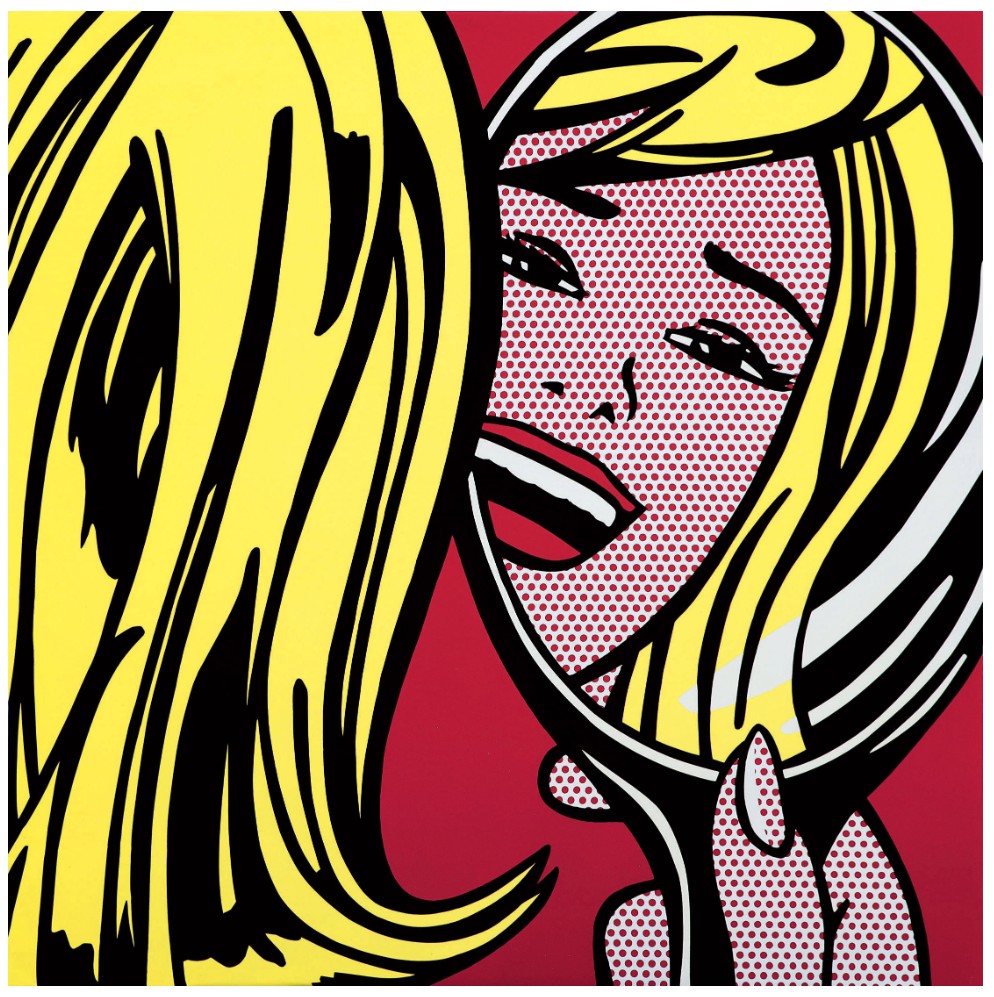
ROY LICHTENSTEIN (1923-1997)
Girl in Mirror, 1964
Porcelain enamel on steel
42x42x2 inches (106.7 x 106.7 x 5.1 cm)
Signed, dated and numbered ‘rf Lichtenstein 3/8 1964’ (on the reverse)
This work is number three from an edition of eight
Girl in Mirror, 1964
Phillips New-York: 17 May 2023
Estimated: USD 4,500,000 – 5,500,000
USD 5,505,000
Roy Lichtenstein – 20th Century & Contem… Lot 35 May 2023 | Phillips
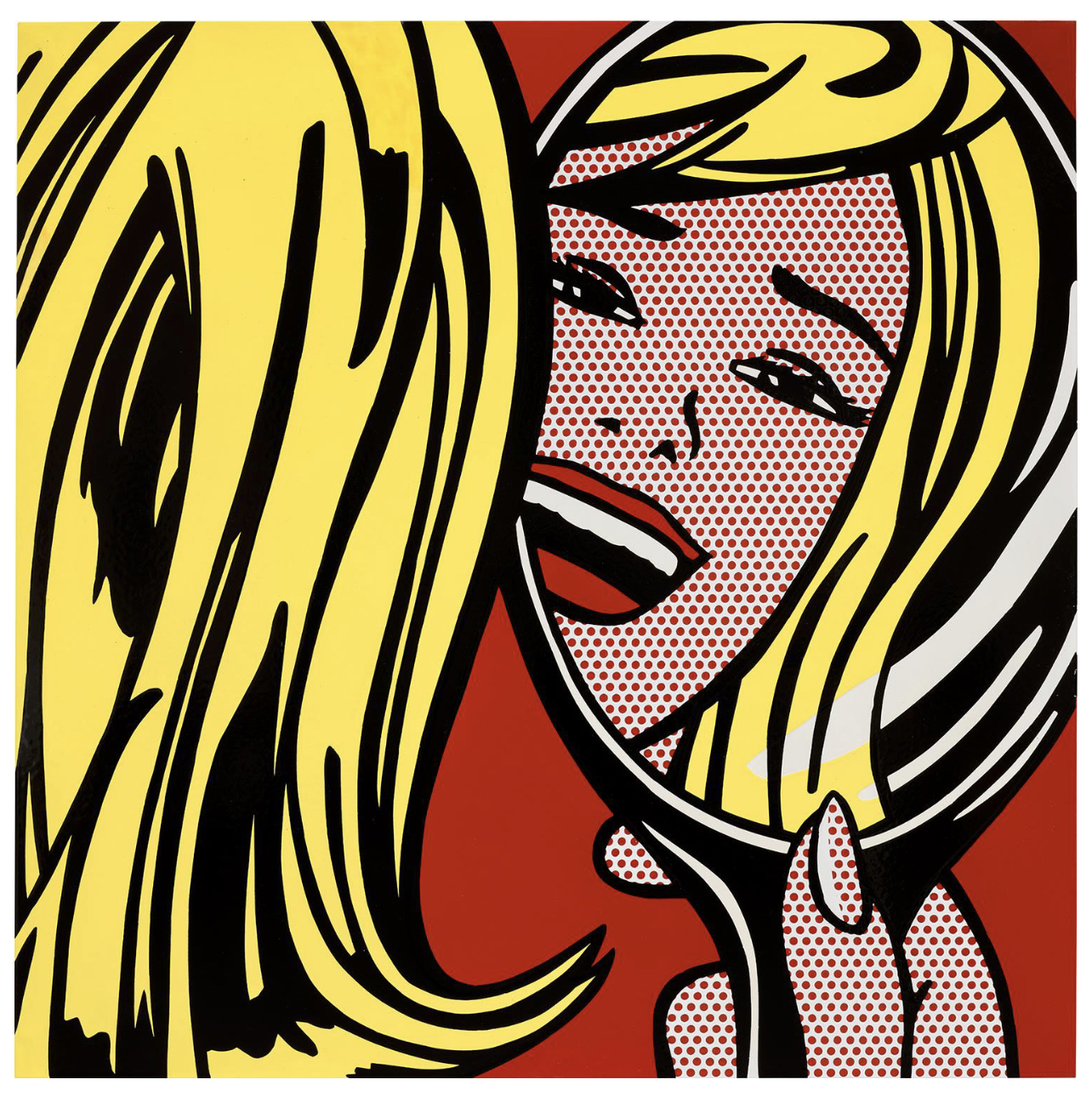
ROY LICHTENSTEIN
Girl in Mirror, 1964
Porcelain enamel on steel
41 7/8 x 41 7/8 x 1 1/8 inches (106.4 x 106.4 x 2.9 cm)
Signed and dated “rf Lichtenstein 1964” on the reverse
This work is number 1 from an edition of 8 plus 2 artist’s proofs
Crying Girl, 1964
Crying Girl, 1964
Christie’s New-York: 9 November 2015
Estimated: USD 7,000,000 – 9,000,000
Price realized: USD 13,381,000
Roy Lichtenstein (1923-1997), Crying Girl | Christie’s
ROY LICHTENSTEIN (1923-1997)
Crying Girl, 1964
Porcelain enamel on steel
46×46 inches (116.8 x 116.8 cm)
Signed, numbered and dated ‘rf Lichtenstein #4 of 5 1964’ (on the reverse)
This work is number four from an edition of five
Provenance
Leo Castelli Gallery, New York
William Rubin, New York, acquired from the above, 21 October 1964
Leo Castelli Gallery, New York
Acquired from the above by the present owner, 20 April 1971
With her scarlet lips and flowing locks of golden hair, Roy Lichtenstein’s Crying Girl belongs to one of the most iconic series in the 20th century artistic canon. One of the resounding images of the Pop generation, Lichtenstein takes as his muse one of the phalanx of heroines that were to be found within the covers of the mass produced romance novels often found in bookshops and at supermarket checkouts across the country. This larger than life-size work exemplifies Lichtenstein’s artistic practice, as it casts a spotlight onto the way that images are created and understood in the mass-media age. Here he assembles a series of abstract lines and dots that come together and become comprehensible. One of the artist’s earliest works which he executed in porcelain enamel on steel, Crying Girl also explores the boundaries between subject and object as the artist examines the ephemera of popular culture, and shines a spotlight on the way images function within the broad mass of the populace.
Crying Girl employs Lichtenstein’s signature style—his range of motifs that ape the style of the hugely popular comic romance novels from the 1950s. These bold lines, Ben-day dots and brash colors were the language conveyed by the explosion in the printed media. Here, the flat passages of golden yellow that make up her hair are defined by the broad flourishes of royal blue that act almost as highlights—outlining her luscious curls. The same strokes define the silhouette of her pert nose and perfectly plucked eyebrows, even managing to contain the vibrant red of her seductive—slightly pursed—lips. Lichtenstein goes on to denote her complexion with a veil of Ben-Day dots, each one rendered with perfect precision. The evenness of their application, applied without gradation or a sense of shading, implies a flawless (almost ivory-like) quality to the skin—the only sense of dissonance being a single vertical line that indicates just the merest hint of a furrow to her forehead. The fact that all this is executed to such a high standard in enamel only adds to the porcelain-like quality of this work.
Framed by her flawlessly coiffed shock of blond hair, Lichtenstein’s subject is caught in a moment of apparent vulnerability. Wiping away a tear from her perfectly shaped eye, the artist invites contemplation as to her current state. Why is she crying, who has upset her and what will happen next? If one refers to the original source image, the narrative is clear. “The night seemed filled with a thousand empty eternities…” says text in the opening scene, while the heroine’s speech bubble declares “I… I can’t stand it… I’ll apologize tomorrow… after all—it was his first success… He was excited… forgetful…” (Phyllis Read (ed.)., Secret Hearts #88, June 1963). In Crying Girl, Lichtenstein removes all the text and in withholding the narrative succeeds in heightening the sense of drama. In the present work we ostensibly see a girl crying, wiping away the tear that forms in the corner of her eye. But with no accompanying information, the reason behind her tears are left to our imagination. By isolating this one cell from the usual strip format of the cartoon layout and rendering it devoid of any contextual speech bubbles or setting, we the viewer are invited to fill in the blanks and resolve the inherent sense of drama with our own imagination. Executed in 1964, Crying Girl sits alongside the pantheon of other iconic paintings that Lichtenstein created during the early 1960s, such as Hopeless, 1963 (Kunstmuseum Basel), Drowning Girl, 1963 (Museum of Modern Art, New York) and Hello, 1963 (Los Angeles County Museum of Art) all depicting a solitary young woman suffering from some form of emotional distress.
From the earliest stages of his career, Lichtenstein was something of a polymath and produced works using a wide range of media. From canvases to works on paper and even works which incorporated Plexiglas, Lichtenstein was an accomplished practitioner in whichever medium he choose. With Crying Girl, Lichtenstein chose enamel, a medium with a noble tradition that dates back centuries, but also one which perfectly suited his crisp Pop aesthetic. Lichtenstein’s decision to execute the work in this particular medium also acts as a precursor to his adoption of sculpture, which became an increasingly important part of his later career. He was beginning to recognize the importance of different mediums in helping him to achieve the clean aesthetic that eschewed all signs of the artist’s hand. By combining the use of a steel support with crisp enamel, Lichtenstein has chosen the perfect medium to replicate the smooth surface of a mirror. As the curator Diane Waldman has observed, “With enamel, Lichtenstein accomplished two objectives: he reinforced the look of mechanical perfection that paint could only simulate but not duplicate and it provided the perfect opportunity to make an ephemeral form concrete” (D. Waldman, quoted in Roy Lichtenstein, New York, 1971, p. 23). One of the relatively few enamel works from this pioneering period of his career, Crying Girl was produced in an edition of five, with one of the edition being housed in the permanent collection of the Milwaukee Art Museum in Wisconsin.
However, what was most important to Lichtenstein above all else, were the formal properties of his paintings and the sense of “visual unity”, or “perceptual organization” he could attain with an image. In order to achieve a tightly unified composition with a commanding presence, he would detach himself from the content of the picture and concentrate on its form. His second wife Dorothy would later explain: “…when Roy worked, he would start with a very strong image, but once he decided what he was going to paint, he would try to get beyond the image to look at it as marks on a canvas–to look at it from as much of an abstract perspective as possible so that he wouldn’t just be reproducing a picture of something. That’s why before he even started in the so-called Pop art style, he designed an easel that rotated. This way he could work on a painting sideways and upside down. And he usually worked with a mirror in the background to get as much distance from the canvas as possible, so he could see it as a whole and in reverse. He was very interested in form and style” (D. Lichtenstein quoted in J. Koons, ‘Conversation’, Women, exh. cat., New York, 2008, p.10).
Lichtenstein’s choice of images and his reductive style obscured his intentions in a way that made the paintings both accessible to the general public and irritating to critics who viewed him as a philistine. But it was this tension between style and subject matter that was the foundation of his practice. He chose comics as they were culturally low and emotionally hot and transformed them into something culturally high and emotionally cool. “At that time,” Lichtenstein recalled, “I was interested in anything I could use as a subject that was emotionally strong – usually love, war, or something that was highly charged and emotional subject matter to be opposite to the removed and deliberate painting techniques. Cartooning itself usually consists of very highly charged subject matter carried out in standard, obvious, and removed techniques” (R. Lichtenstein, quoted in J. Coplands, ed., Roy Lichtenstein, New York, 1972, p. 89). Lichtenstein certainly found in this material a potential for the dispassionate portrayal of exaggerated emotion. The paradox of his work has always remained that its outward embrace of quotidian imagery belies an inward concern for art as arrangements of colors and shapes. It is as if he has taken Mondrian’s emphasis on the inherent flatness of the picture plane and combined it with the concept of the Duchamp readymade. But instead of producing something dry and cerebral he has created a painting that is sensual, ironically witty, and full of energy.
Paintings such as Roy Lichtenstein’s Crying Girl are among the most recognizable images in Pop. On the surface, the subject is the ultimate teenage fantasy; girls identified with her and boys wanted to be with her. With his arsenal of bold lines, Ben-Day dots and striking color, the artist produces an image which depicts, reinforces yet also begins to dissect the dominance of American popular culture during the postwar years. With these deceptively simple signifiers, Lichtenstein conjures up an image of drama and intrigue; an image that poses as many questions as it answers and seeks to query how we understand our increasingly visual world, subverting the universal language that helped to codify it.
Girl in Mirror, 1964
Girl in Mirror, 1964
Phillips New-York: 17 May 2023
Estimated: USD 4,500,000 – 5,500,000
USD 5,505,000
Roy Lichtenstein – 20th Century & Contem… Lot 35 May 2023 | Phillips
ROY LICHTENSTEIN
Girl in Mirror, 1964
Porcelain enamel on steel
41 7/8 x 41 7/8 x 1 1/8 inches (106.4 x 106.4 x 2.9 cm)
Signed and dated “rf Lichtenstein 1964” on the reverse
This work is number 1 from an edition of 8 plus 2 artist’s proofs
Provenance
Leo Castelli Gallery, New York
Private Collection (acquired from the above in December 1964)
Leo Castelli Gallery, New York (acquired from the above in 1979)
Gabriel Levinas, Buenos Aires (acquired from the above in 1980)
Leo Castelli Gallery, New York and Peder Bonnier, Inc.
Private Collection (acquired from the above in 1983)
Gagosian Gallery, New York
Private Collection, New York (acquired from the above in 2009)
Gagosian Gallery, New York
Acquired from the above by the present owner in 2019
Girl in Mirror, 1964, encapsulates Roy Lichtenstein’s innovative Pop aesthetic. Executed in porcelain enamel on steel, the work depicts an idealized blonde woman smiling at her reflection in a mirror. The work adheres to Lichtenstein’s intentionally limited palette of primary red, yellow, black, and white, with red Ben-Day dots to articulate the woman’s skin tone. The present work dates to the peak of Lichtenstein’s investigation of Pop aesthetics in the early 1960s; beneath its shiny surface, however, Girl in Mirror provides a trenchant commentary on commodification and femininity in the early 1960s. Lichtenstein is best known for his cartoon-based approach to Pop Art, whereby, in a proto-Appropriationist move, he based his compositions on panels from newspaper cartoons and comic books. The young woman of Girl in Mirror recalls characters like Betty Cooper from Archie, and fashion comics such as Katy Keene aimed at young female audiences. Beyond the aesthetics of comic book art, however, the composition of Girl in Mirror reveals the strictures of performing femininity in the United States in the early 1960s.
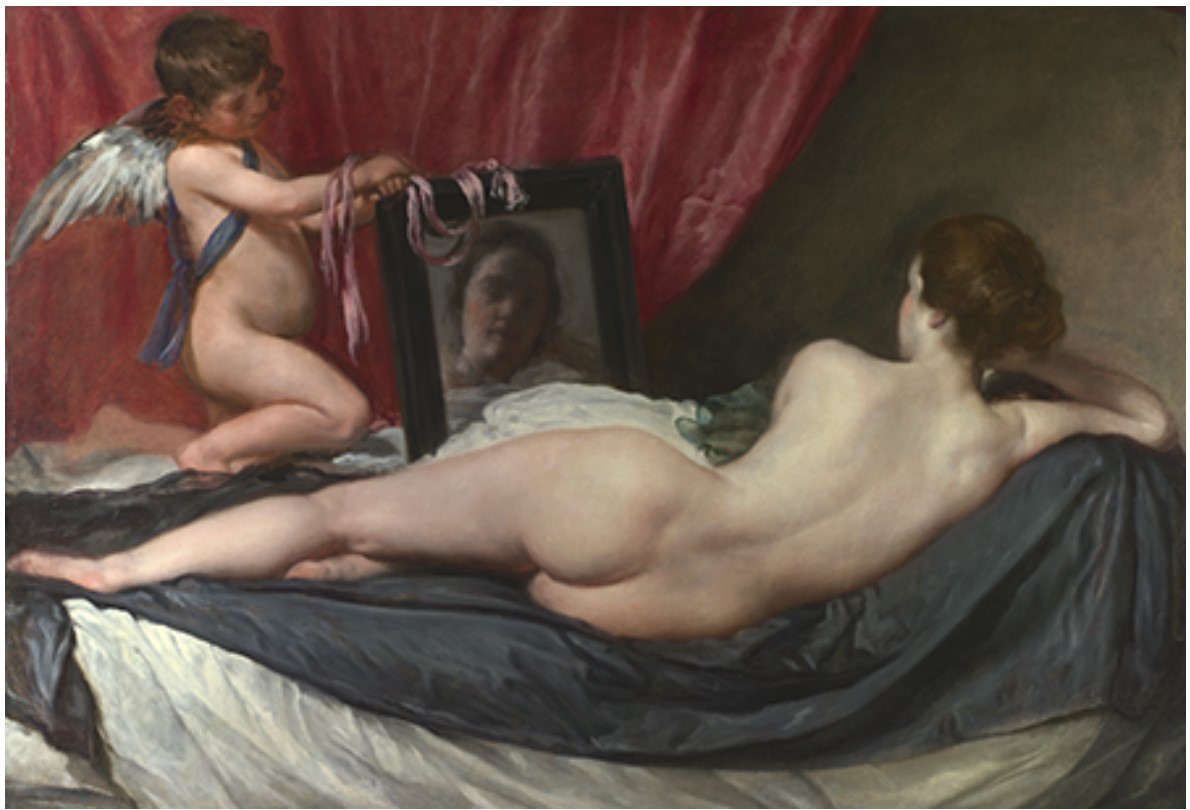
Velázquez, The Toilet of Venus (the Rokeby Venus), 1647-1651.
The National Gallery, London. Image: © National Gallery, London / Art Resource, NY
Within Girl in Mirror, the girl’s face is only visible in the cosmetic mirror she holds towards the viewer, a compositional move which places the visual interest on her body, rather than her face—the girl herself is, quite literally, in the mirror. Her blonde hair, which dominates the left half of the composition, is intentionally artificial, its classic 1960s swoop echoing the curve of the mirror. Even her hand is perfectly manicured, to an unreal degree. As Lichtenstein explained, the artificiality of his characters is part of his artistic experiment.
In Lichtenstein’s hand, his female protagonist is part of the surface—“the kind of girls I painted were really made up of black lines and red dots,” he said. He sees them “that abstractly;” for Lichtenstein, there’s a clear distinction between real women and cartoon women, but he also plays with the ways in which beauty standards and art(ifice) distort our perception of the human form. Within Girl in Mirror, the female form, especially the made-up, make-believe woman of 1960s cartoons, is simply that: a form, a figure to play with on the painted surface, not unlike the brushstrokes of Lichtenstein’s Abstract Expressionist peers. His wife, Dorothy, corroborated this, explaining how her husband rotated his work on the easel, so that the formal elements of the painting were effective, no matter the work’s orientation.
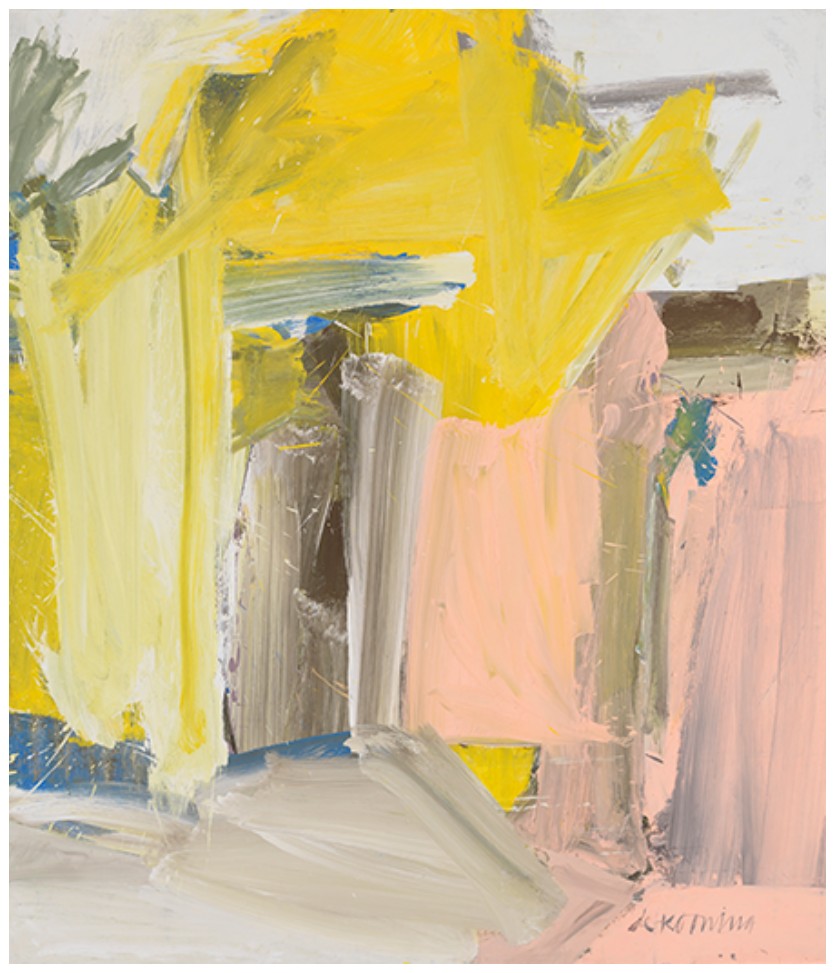
Willem de Kooning, Door to the River, 1960. The Whitney Museum of American Art, New York. Image: © Whitney Museum of American Art / Licensed by Scala / Art Resource, NY, Artwork: © 2023 The Willem de Kooning Foundation/Artists Rights Society (ARS), New York
With Girl in Mirror, Lichtenstein engages the long history of pairing beautiful women with mirrors in Western art. Taken together, the visual elements of Girl in Mirror embody the theme of vanitas, or (the futility of) vanity, which Lichtenstein, working in the post-War, consumerist boom of mid-century America, surely saw reflected in the world around him. The second wave of feminism was still in its infancy when Girl in Mirror was created, with Betty Freidan’s seminal The Feminine Mystique only published one year prior. Akin to Lichtenstein’s New York World’s Fair mural of the same year, Girl in Mirror interrogates themes of vanity, surface, and the commodification of the self, the hallmarks of Lichtenstein’s strongest period of Pop art.
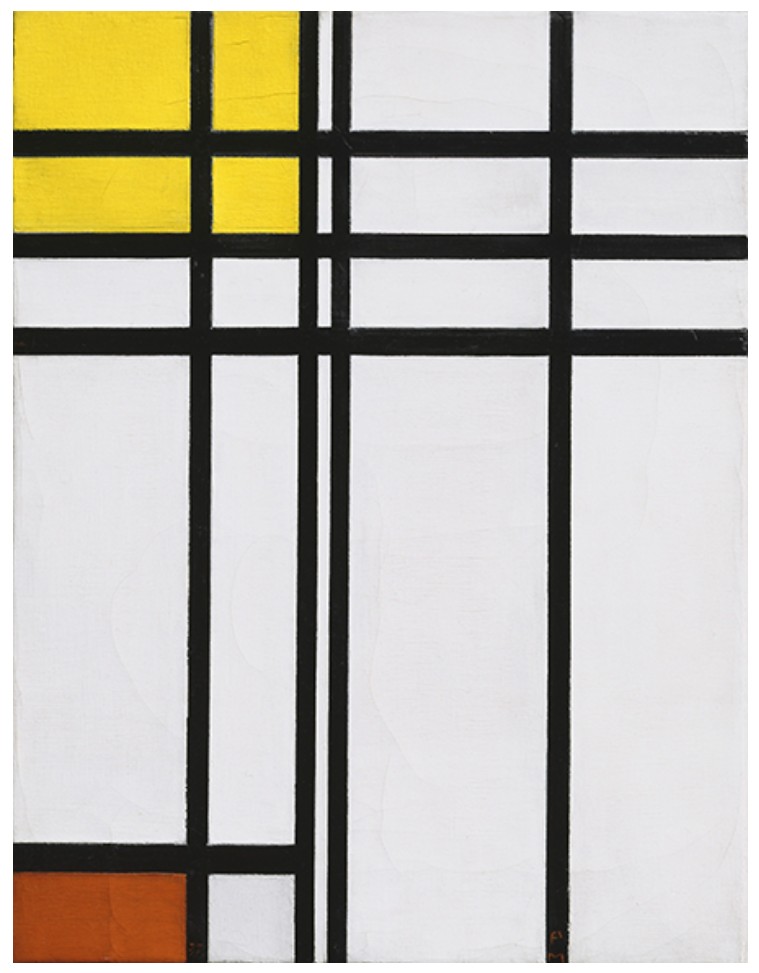
Piet Mondrian, Opposition of Lines, Red and Yellow, 1937. Philadelphia Museum of Art. Image: A.E. Gallatin Collection / Bridgeman Images
Lichtenstein’s use of Ben-Day dots in Girl in Mirror provides duly formal and symbolic meaning. The Ben-Day dot is a printing technique, popularized at the turn of the 20th century, used to inexpensively add color to newspaper illustrations, particularly cartoons. Over time, cartoonists adapted to the process, and soon began to dot their own work to represent shading and depth; the mechanical process thus becomes an aesthetic choice. In other words, the shifting quality of Ben-Day can recall the effect of viewing one’s reflection from varying angles; the idiosyncrasy of their application in Girl in Mirror to the girl’s face and hand suggesting variations in texture, a glimpse of humanity in an intentionally flat and industrial surface. Beyond subject matter and technique, Lichtenstein’s material choices for Girl in Mirror are emblematic, as well. The work is made of steel and porcelain enamel, two materials is closely tied to the advent of modernity in the Industrial Revolution; Lichtenstein’s modern America, so ironically captured by his Pop sensibility in Girl with Mirror, could not exist without the very materials of the present work. The shiny surface of Girl in Mirror holds the reflection of the material foundations of the 20th century up to the viewer.
Girl in Mirror, 1964
Phillips London: 7 March 2019
Estimated: GBP 4,500,000 – 6,500,000
GBP 4,800,000 / USD 6,283,460
Roy Lichtenstein 20th Century & Contemporary Art Evening Sale
REPEAT SALE
Christie’s New-York: 10 November 2010
Estimated: USD 3,000,000 – 4,000,000
USD 4,898,500
Roy Lichtenstein (1923-1997) , Girl in Mirror | Christie’s
ROY LICHTENSTEIN (1923-1997)
Girl in Mirror, 1964
Porcelain enamel on steel
42x42x2 inches (106.7 x 106.7 x 5.1 cm)
Signed, dated and numbered ‘rf Lichtenstein 3/8 1964’ (on the reverse)
This work is number three from an edition of eight
Provenance
Leo Castelli Gallery, New York
Charles H. Carpenter, New Canaan
O.K. Harris Works of Art, New York
Acquired from the above by the late owner, 1973
Girl in Mirror perfectly blends the conceptual games and wit that mark Roy Lichtenstein’s greatest works. The mirror was an important motif in his work from his earliest days, as he explored and deconstructed how the viewer ‘reads’ images in the modern, media-saturated world. While he found it easy to paint everyday domestic objects by assembling his characteristic Benday dots, a reflection challenged him more, as he tried to capture the fleeting image that appears on the mirror’s surface. In Girl in Mirror, Lichtenstein used the graduation of dots to highlight the face and give a sense of light cast across the reflective surface. He deconstructed the not the ‘reality’ of the mirror but instead the artistic shorthand by which mirrors are represented. By limiting his use of Benday dots to the face’s reflection, Lichtenstein highlights the reflection’s artificiality. ‘Mirrors are flat objects that have surfaces you can’t easily see since they’re always reflecting what’s around them,’ Lichtenstein explained.
‘There’s no simple way to draw a mirror, so cartoonists invented dashed or diagonal lines to signify ‘mirror.’ Now, you see those lines and you know it means ‘mirror,’ even though there are obviously no such lines in reality. If you put horizontal, instead of diagonal, lines across the same object, it wouldn’t say ‘mirror.’ It’s a convention that we unconsciously accept” (R. Lichtenstein, quoted in M. Kimmelman, PORTAITS, Talking with Artists at the Met, The Modern, The Louvre and Elsewhere, reproduced at www.lichtensteinfoundation.org).
Lichtenstein invokes our reflex understanding of the image, tapping into his career-long fascination with how we see, instilled in him early by his teacher Hoyt L. Sherman. Lichtenstein casts a spotlight on the absurd way these abstract dots, lines, and areas of canvas come together and become comprehensible. In Girl in Mirror, he takes an age-old subject, used by artists such as Van Eyck and Velasquez to create a picture-within-a-picture, and then plays with the boundaries between subject and object. Rather than examining popular culture’s ephemera, Lichtenstein’s Pop Art explores how images function within the broad mass of the populace.
Lichtenstein decided to execute Girl in Mirror in porcelain enamel on steel, a significant decision since he went on to adopt sculpture as an ever more important part of his career. He was beginning to recognize that diverse mediums were important in helping him to achieve a clean aesthetic that eschewed all signs of the artist’s hand. Lichtenstein chose the perfect medium to replicate the mirror’s smooth surface, combining steel support with enamel’s crisp aesthetic. As the curator Diane Waldman observed, ‘With enamel, Lichtenstein accomplished two objectives: he reinforced the look of mechanical perfection that paint could only simulate but not duplicate and it provided the perfect opportunity to make an ephemeral form concrete’ (quoted in Roy Lichtenstein, New York, 1971, p. 23).
Throughout his oeuvre, Lichtenstein challenged rigid art-historical stereotypes while maintaining his idiosyncratic world view. Girl in Mirror embodies Roy Lichtenstein’s innovative artistic vision, combining an awareness of art history with a deliberate visual duality contrasting abstraction and realistic depiction.
Sound of Music (Study), circa 1963-64
Sound of Music (Study), circa 1963-64
A Legacy Reimagined: Works from the Collection of Dorothy and Roy Lichtenstein
Sotheby’s New-York: 19 November 2025
Estimated: USD 800,000 – 1,200,000
USD 508,000
WORK ON PAPER
Sound of Music (Study) | The Now & Contemporary Evening Auction | 2025 | Sotheby’s
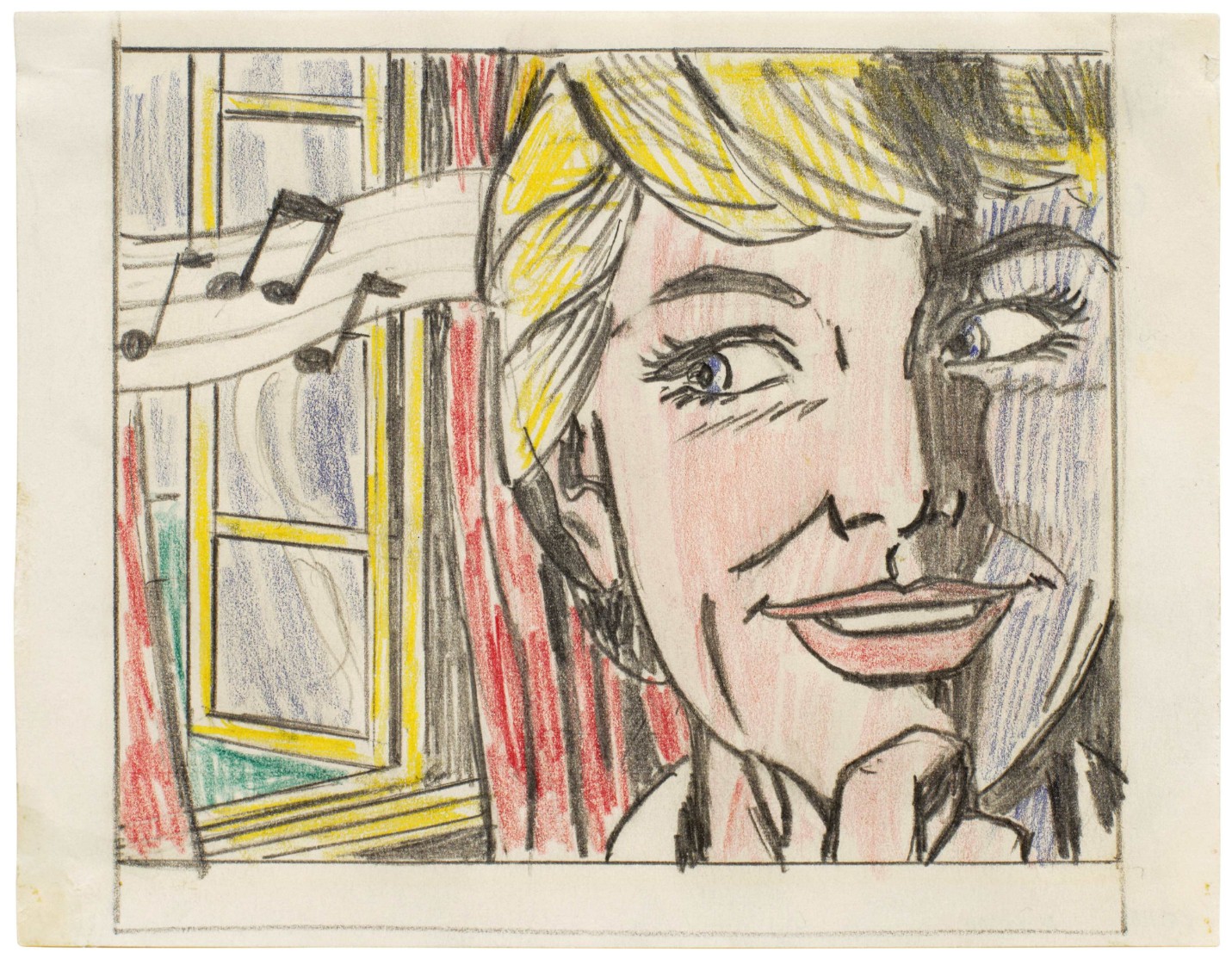
ROY LICHTENSTEIN (1923 – 1997)
Sound of Music (Study), circa 1963-64
Colored pencil and graphite on paper
Image: 4 x 4 3/4 inches (10.2 x 12.1 cm)
Sheet: 4 1/2 x 5 3/4 inches (11.4 x 14.6 cm)
Like a soft breeze, ledger lines gracefully stream through the open window, capturing our heroine’s attention with the “sound of music.” Executed circa 1963-64, Lichtenstein’s Sound of Music (Study) is an intimate scene of total enchantment. The present work is an iconic example of Lichtenstein’s legendary comic-inspired Pop works of the 1960s, which frequently capture beautiful heroines in melodramatic moments of surprise or marvel. Lichtenstein’s works from this period are among his most celebrated and paradigmatic, as the works which would catapult his fame and solidify his legendary status in Contemporary art. Preceding the artist’s iconic large-scale painting by the same title, the present work captures a moment of wonder and joy, paying homage to a 1962 comic illustration by Arthur Peddy published in the popular romance comic book, Heart Throbs. Lichtenstein’s studies are integral to his practice, as not only antecedents for large-scale paintings, but also fully realized works in and of themselves. The richly worked surface of the present work further reveals Lichtenstein’s presence and the conceptual development obscured from the precise execution of his paintings. Further testament to its importance, the present work has been featured in numerous major international exhibitions of Lichtenstein’s work, including the 2013 Retrospective at the Solomon R. Guggenheim Museum, New York (and traveling), the most comprehensive exhibition of the artist’s work to date.
“Each generation of illustrators makes modifications and reinforcements of these symbols, which then become part of the vocabulary of all. The result is an impersonal form. In my own work, I would like to bend this toward a new classicism.”

Roy Lichtenstein with musical notes, 1964. Photo Ugo Mulas © Ugo Mulas Heirs. All Rights Reserved
Entranced by musical melodies from afar, Lichtenstein’s subject gazes out towards the source of dazzling sounds. Her crystal blue eyes turn towards the window, her hand inquisitively rests on her chin, and her lips turn up in a smile. As with many of his early paintings, Lichtenstein closely crops the composition, so the figure’s face fills the majority of the picture plane. Her gaze, at once curious and playful, equally captivates the viewer who is privy to this clandestine moment of intrigue and intimacy. Inspired by the graphic and playful illustrations of contemporary comic book spreads, Lichtenstein recasts this popular iconography into the realm of fine art. An archival photograph from the artist’s studio reveals that Lichtenstein’s inspiration for the present work was a 1962 comic-book illustration for an amusing love story. Upon hearing a string of “La-La-La-La” from the window, the protagonist looks out and exclaims: “Oh, What a lovely baritone voice!” Lichtenstein’s figure appears deeply allured and intrigued by the music, coyly resisting the urge to turn her face fully towards the window, surrendering only a delicate smile. In Lichtenstein’s version, all text references are omitted from the composition, creating an additional layer of intrigue and fantasy to the scene. While created one year prior to the iconic 1965 film, The Sound of Music, Lichtenstein’s figure bears an undeniable resemblance to Maria Von Trapp and her infectious spirit which radiates a joyous mixture of innocence, mischief and exuberance.
Revealed through subtle shading and crisp graphite lines, Sound of Music (Study) offers a rare glimpse into Lichtenstein’s masterful creative process and the interventions hidden from his painted works. Through his studies, Lichtenstein resolved questions of composition and color, developing the structure for his bold contour lines, Ben-Day dots, and refined planes of pigment. Here, Lichtenstein renders the composition with vigorous graphite lines, defining areas of shading which will be replaced with Ben-Day dots in the painted iteration. The golden yellow of the protagonist’s hair gleams against the soft red and blue colored pencil used to render her face. The windowpanes are open and curtains billow in the breeze. In shifting from red to blue dots across the shadow of the figure’s face in the later canvas, Lichtenstein presages the same optical devices and illusions as Woman: Sunlight, Moonlight from 1996 and its collage study. His famed Ben-Day dots become a method of pictorial illusion, creating a juxtaposition between fullness and depth that further lends the work into fiction. This interplay between the study and the finished work reveals Lichtenstein’s creative interrogation of composition and depth, and the ongoing dialogue surrounding the representation of the female figure in the modern era.
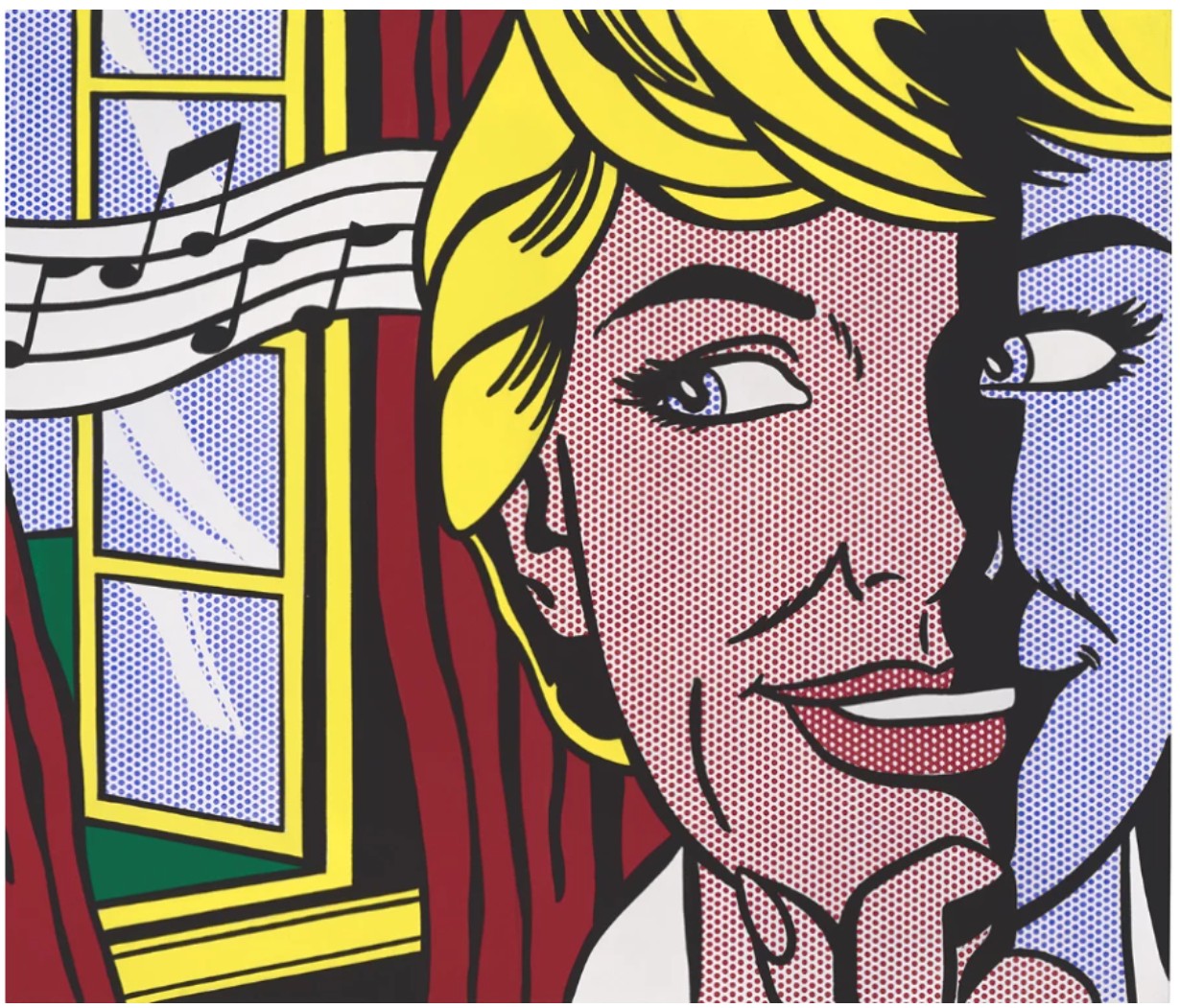
Roy Lichtenstein, Sound of Music, 1964. Private Collection. Art © 2025 Estate of Roy Lichtenstein / DACS
Drawn from the visual vocabulary of 1960s romance comics, Lichtenstein’s subject is simultaneously iconic and archetypal, embodying Lichtenstein’s enduring exploration of mass media’s portrayal of and commodification of feminine beauty. In his legendary “Girl Paintings,” Lichtenstein appropriates the artificial cliches of mid-century female glamour from magazines and advertisements, recasting them on canvas and brilliantly blurring the boundaries of high and low art. Through this method of appropriation, Lichtenstein exposed the artificiality of the comic-book heroes and their method of production. Reimaging these mass-produced fictional images through a process which is inherently manual and human. Somehow, the visibility of Lichtenstein’s intervention provides transparency and honesty to an image which is, of course, invented. Standing before Lichtenstein’s Sound of Music (Study), the viewer is enraptured by her wandering gaze and a sublime feeling of joy by the whisper of music. Lichtenstein’s rendering is a departure from the original comic illustration, imbued with a whimsy and innovation in the artist’s instantly recognizable Pop sensibility.