WORK IN PROGRESS
Claude Monet (1840–1926) was a pioneering French painter whose work laid the foundation for the Impressionist movement, emphasizing the depiction of light and natural forms through plein air (outdoor) painting.
Born on November 14, 1840, in Paris, Monet grew up in Le Havre, Normandy. His early interest in art was nurtured by Eugène Boudin, who introduced him to painting outdoors, a practice that became central to Monet’s approach. In 1859, he moved to Paris to study art, where he met fellow artists Pierre-Auguste Renoir, Frédéric Bazille, and Alfred Sisley. Together, they developed a new style focused on capturing transient effects of light and color.
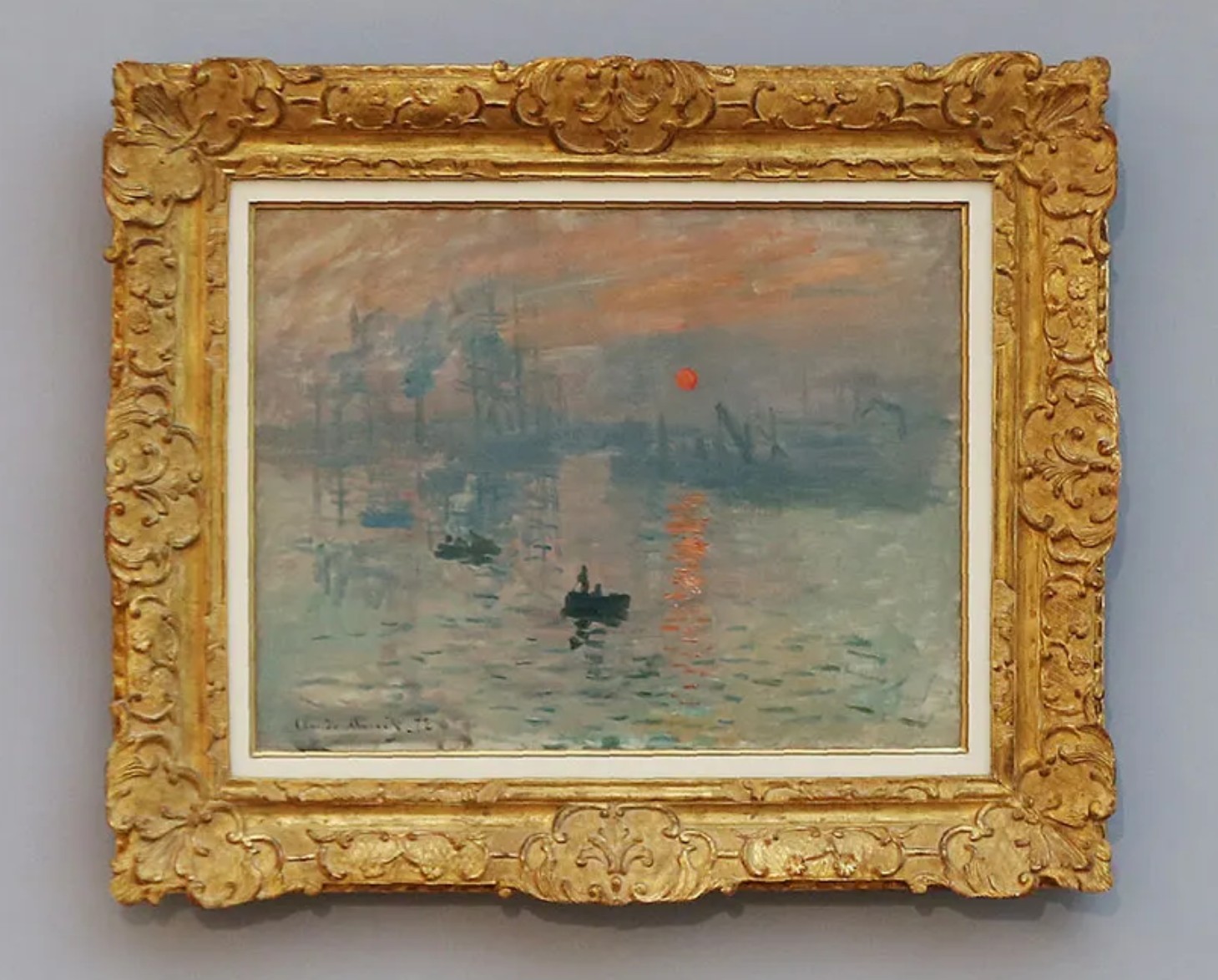
The term “Impressionism” originated from Monet’s painting “Impression, Sunrise” (1872), which he exhibited in 1874. This work, characterized by loose brushwork and an emphasis on light over detail, led critics to coin the term, initially used derisively. Despite early criticism, Monet and his contemporaries continued to refine their techniques, gradually gaining recognition.
Claude Monet is renowned for his series paintings, where he depicted the same subject under varying light and weather conditions to explore changes in perception.
Les Meules (Haystacks)
Painted between 1890 and 1891 near his home in Giverny, this series comprises 25 canvases showcasing stacks of harvested wheat. Monet captured the stacks at different times of day and seasons, emphasizing the interplay of light and atmosphere.
Les Nymphéas (Water Lilies)
Over approximately 30 years, Monet created around 250 paintings focusing on the water lily pond in his Giverny garden. These works delve into reflections, light, and color, moving towards abstraction. The series culminated in large panels displayed at the Musée de l’Orangerie in Paris, offered to the French state as a symbol of peace after World War I.
Waterloo Bridge
Between 1899 and 1901, during stays in London, Monet painted over 40 views of Waterloo Bridge from his room at the Savoy Hotel. These paintings explore the effects of fog and light on the Thames River, blending architectural elements with atmospheric conditions.
Rouen Cathedral
In the early 1890s, Monet painted more than 30 canvases depicting the façade of Rouen Cathedral at different times of day and under various lighting conditions. This series highlights his fascination with light’s impact on architectural surfaces.
Monet’s innovative techniques and dedication to capturing ephemeral natural effects significantly influenced modern art. His approach to color, light, and brushwork paved the way for movements like Abstract Expressionism. Artists such as Mark Rothko and Jackson Pollock drew inspiration from Monet’s emphasis on the act of painting and the sensory experience of art. His work also had a profound impact on subsequent generations, bridging 19th-century art with 20th-century modernism. Monet’s gardens in Giverny, meticulously designed by the artist, continue to attract visitors worldwide, offering insight into the environment that inspired some of his most celebrated works. Through his relentless exploration of light and atmosphere, Monet not only transformed landscape painting but also left an indelible mark on the trajectory of modern art.
PART I: SUMMARY

Auction Market Overview
2025 AUCTION STATISTICS
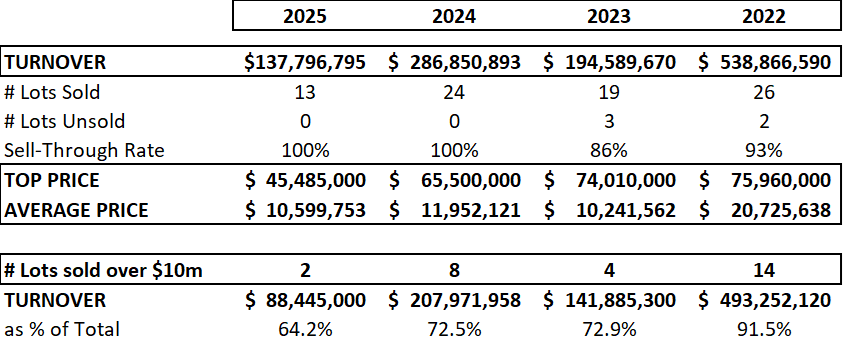
Turnover: USD 137,796,795
-52% vs. 2024
# Lots sold: 13 Lots
Sell-Through Rate: 100%
Highest Price Achieved at Auction:
USD 110,747,000
(14 May 2019)
Auction Summary
2025 Auction Highlights
13 lots sold at auction in 2025 for a total turnover of USD 137,796,795. With no lot failing to sell, the sell-through rate is 100%. The top lot for 2025 is Nympheas, a painting dated 1907, from The Collection of the Kawamura Memorial DIC Museum of Art in Japan, that sold at Christie’s in New-York, on 17 November 2025, for USD 45,585,000.
2025 Top 3 Lots
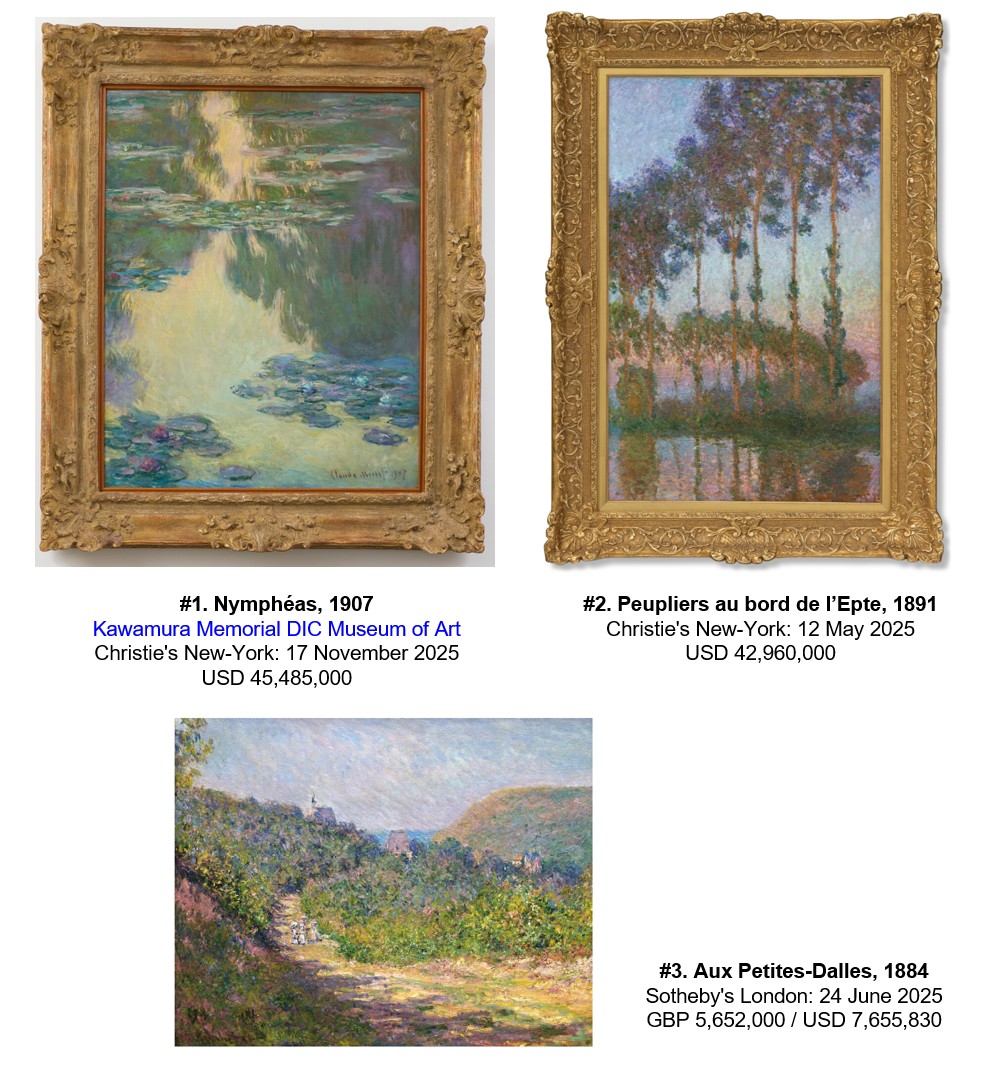
2 lots sold for more than USD 10 million, generating a cumulative turnover of USD 88,445,000, representing 64.2% of the total turnover for 2025.
2024 Auction Highlights
24 lots sold at auction in 2024 for a total turnover of USD 287,357,783. With not lot failing to sell, the sell-through rate is 100%. Nympheas, a painting dated 1914-1917 sold at Sotheby’s in New-York on 18 November 2024 for USD 65,500,000, the highest price paid for a painting by Claude Monet in 2024.
2024 Top 3 Lots
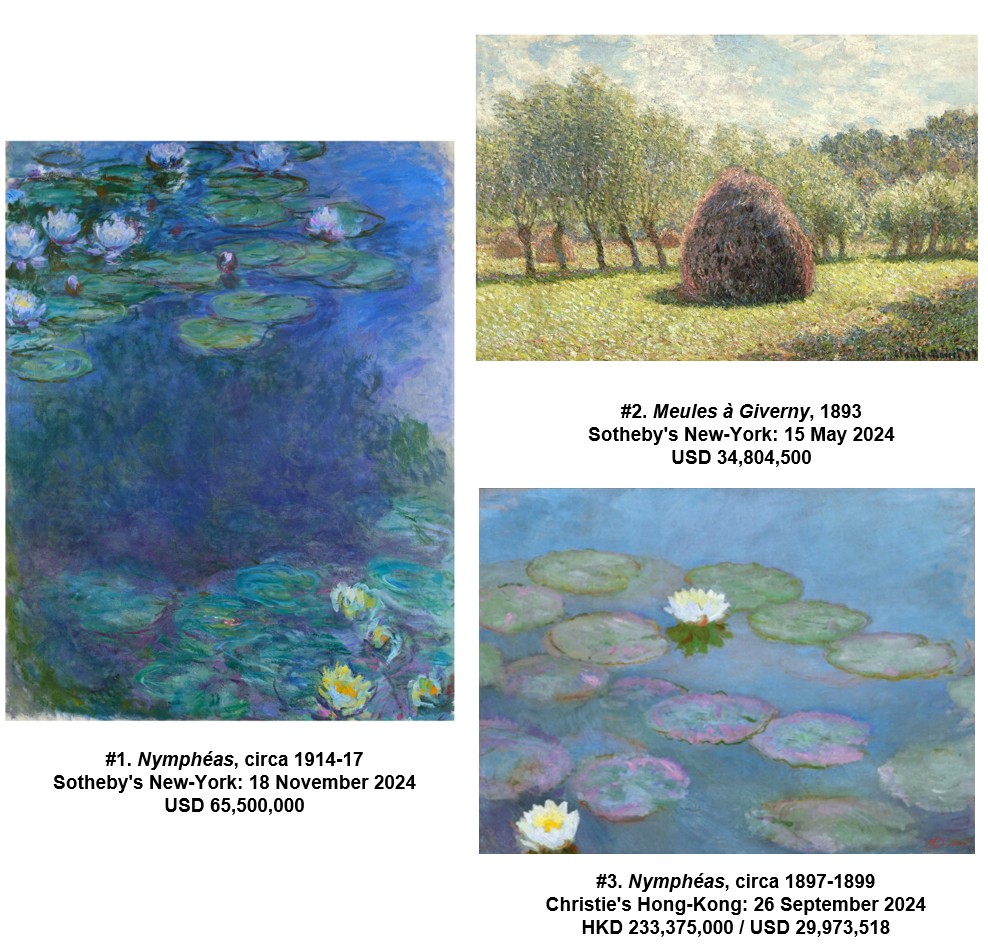
8 lots sold for more than USD 10 million, generating a cumulative turnover of USD 207,971,958, representing 72.4% of the total turnover for 2024.
2023 Auction Highlights
19 lots sold at auction in 2023 for a total turnover of USD 194,589,670. With 3 lots failing to sell, the sell-through rate is 86%. The highest price of 2023 has been achieved by Le bassin aux nympheas, a painting dated 1917-1919 that sold at Christie’s on 9 November 2023 for USD 74,010,000.
2023 Top 3 Lots
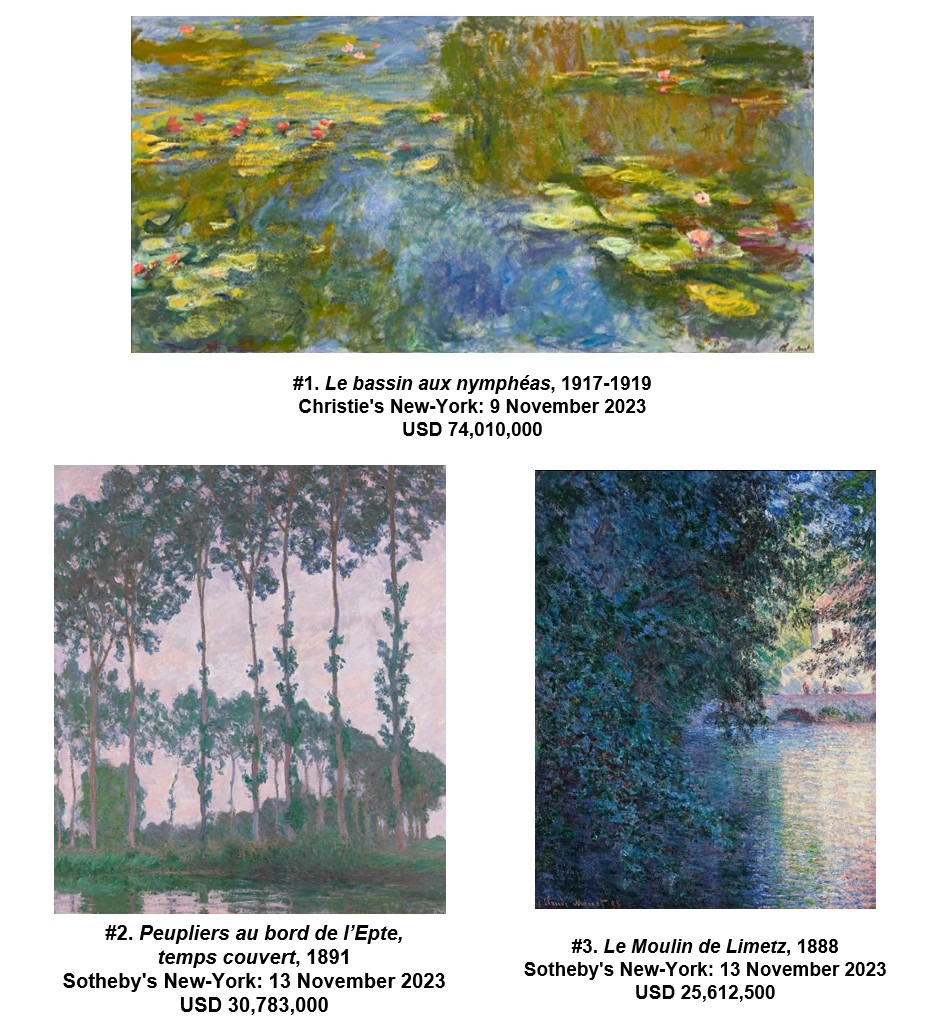
5 lots sold for more than USD 10 million, generating a cumulative turnover of USD 141,885,300, representing 72.9% of the total turnover for 2023.
2022 Auction Highlights
26 lots sold at auction in 2022 for a total turnover of USD 538,866,590. With 2 lots failing to sell, the sell-through rate is 93%. The highest price for 2022 was achieved by Le Parlement, soleil couchant, a painting dated 1900-1903, that sold at Christie’s in New-York, on 12 May 2022, for USD 75,960,000.
2022 Top 3 Lots
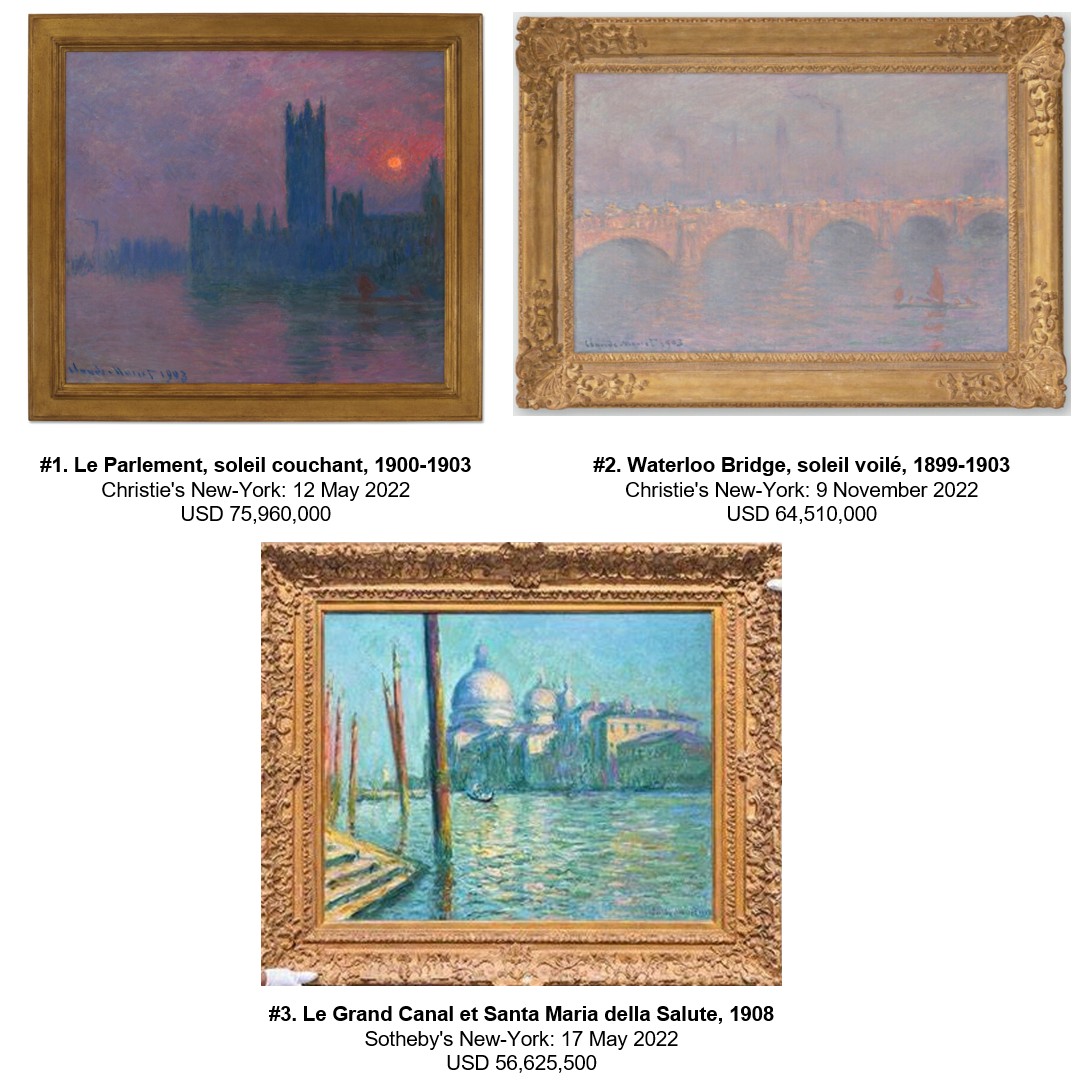
14 lots sold for more than USD 10 million, generating a cumulative turnover of USD 493,252,120, representing 91.5% of the total turnover for 2022.
Top Lots
#1. Meules, 1890
Sotheby’s New-York: 14 May 2019
Estimate on Request
USD 110,747,000
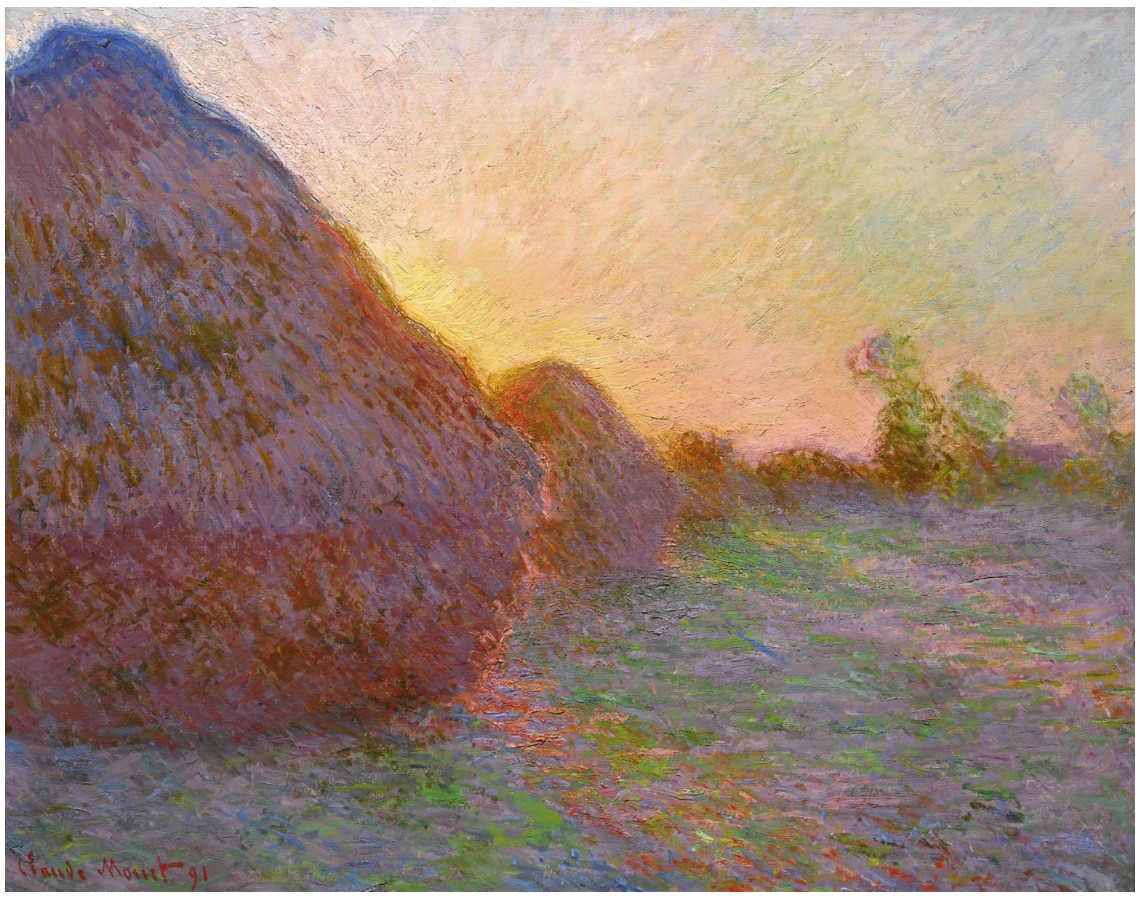
CLAUDE MONET
Meules, 1890
Oil on canvas
72.7 x 92.6 cm (28 5/8 x 36 3/4 inches)
Signed Claude Monet and dated 91 (lower left)
#2. Nymphéas en fleur, circa 1914-1917
Christie’s New-York: 7 May 2018
Estimate on Request
USD 84,687,500
Claude Monet (1840-1926), Nymphéas en fleur | Christie’s

CLAUDE MONET (1840-1926)
Nymphéas en fleur, circa 1914-1917
Oil on canvas
160.3 x 180 cm (63 x 70 7/8 inches)
Stamped with signature ‘Claude Monet’ (Lugt 1819b; on the reverse)
#3. Meule, 1891
Christie’s New-York: 16 November 2016
Estimate on Request
USD 81,447,500
Claude Monet (1840-1926), Meule | Christie’s
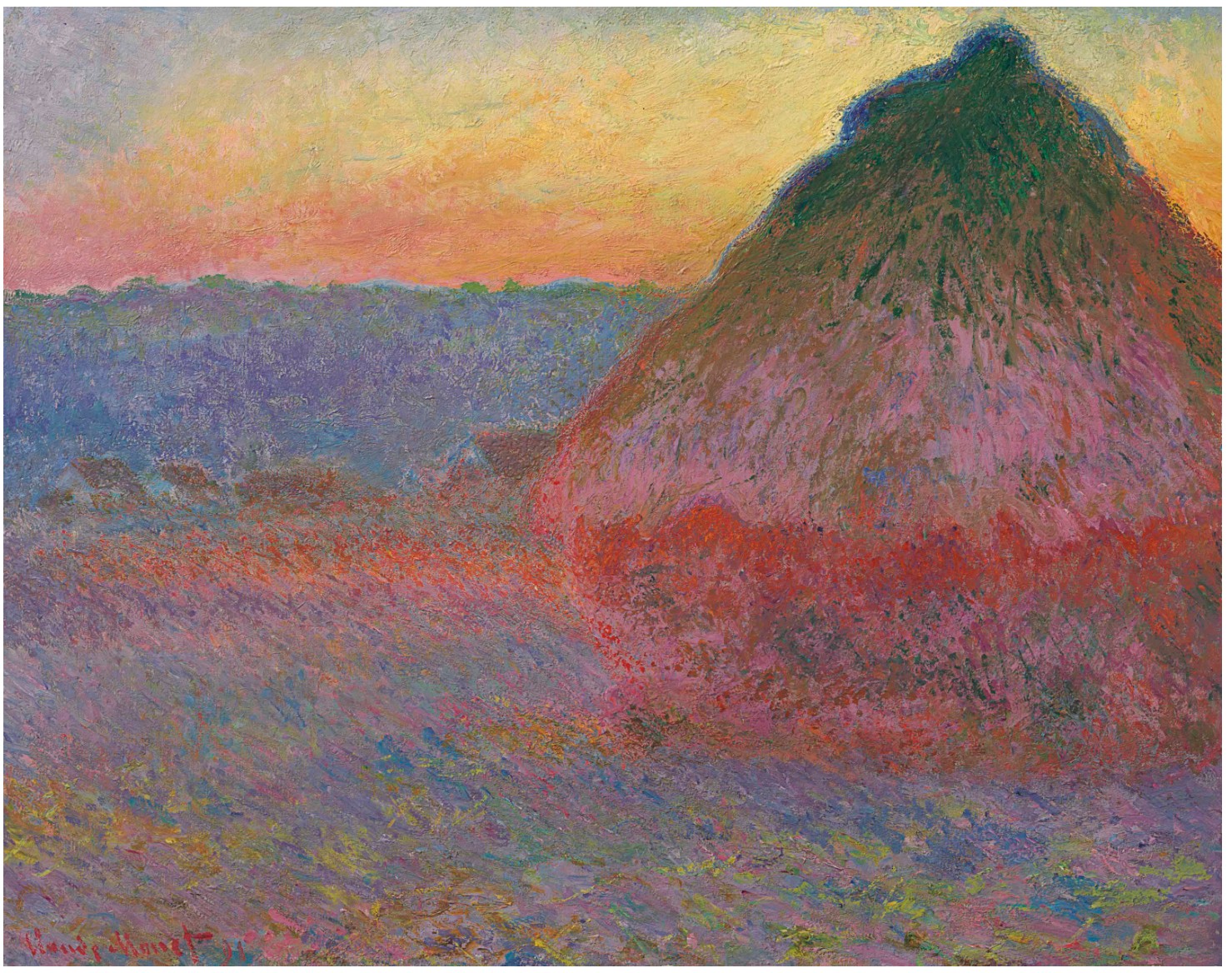
CLAUDE MONET (1840-1926)
Meule, 1891
Oil on canvas
72.7 x 92.1 cm (28 5/8 x 36 1/4 inches)
Signed and dated ‘Claude Monet 91’ (lower left)
#4. Le bassin aux nymphéas, 1919
Christie’s London: 24 June 2008
Estimated: GBP 18,000,000 – 24,000,000
GBP 40,921,250 / USD 80,588,542
Claude Monet (1840-1926) , Le bassin aux nymphéas | Christie’s

CLAUDE MONET (1840-1926)
Le bassin aux nymphéas, 1919
Oil on canvas
100.4 x 201 cm (39 1/2 x 79 1/8 inches)
Signed and dated ‘Claude Monet 1919’ (lower right)
#5. Le Parlement, soleil couchant, 1900-1903
Christie’s New-York: 12 May 2022
Estimated: USD 40,000,000 – 60,000,000
USD 75,960,000
CLAUDE MONET (1840-1926), Le Parlement, soleil couchant | Christie’s
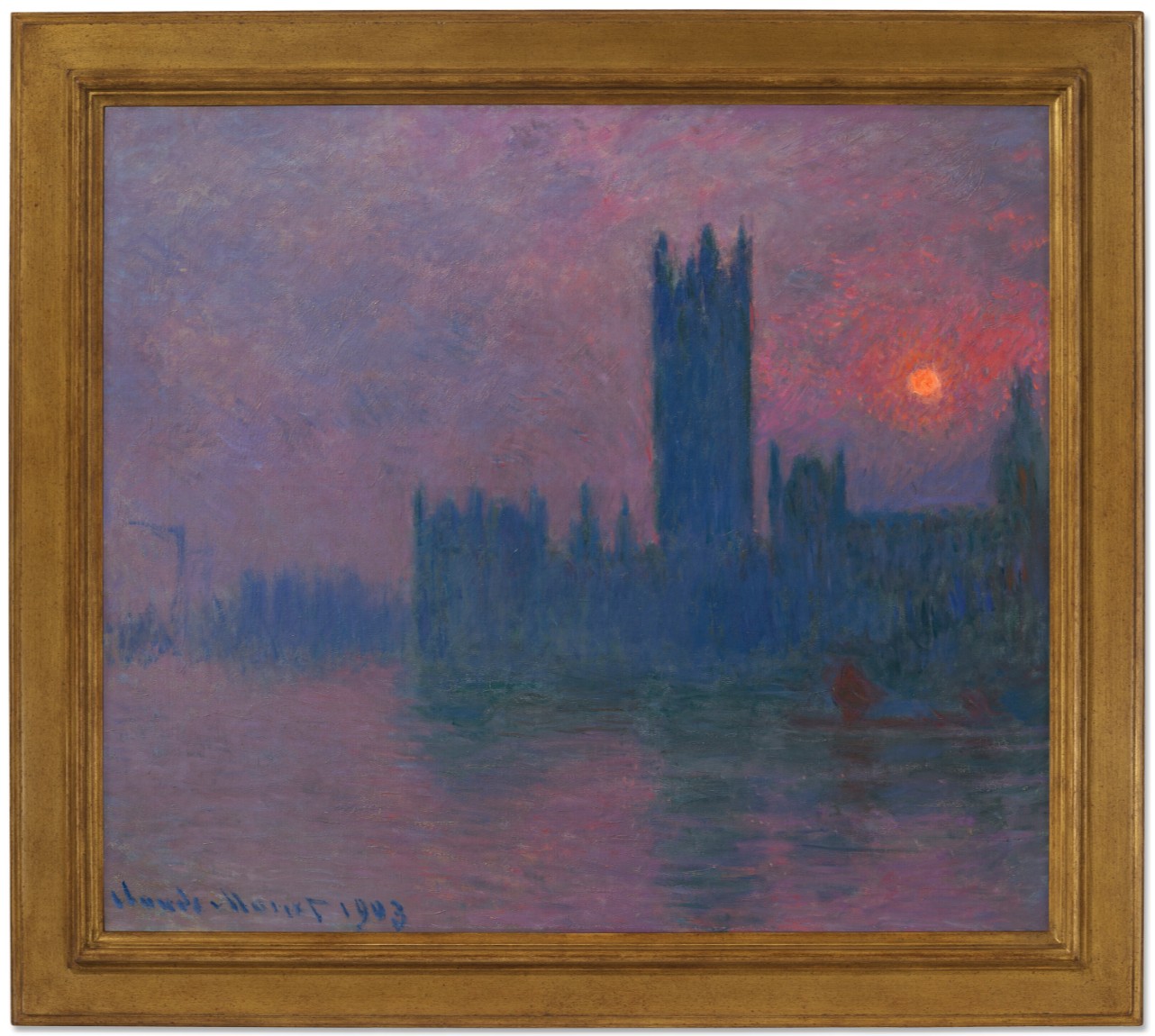
CLAUDE MONET (1840-1926)
Le Parlement, soleil couchant, 1900-1903
Oil on canvas
81.2 x 92 cm (32 x 36 1/4 inches)
Signed and dated ‘Claude Monet 1903’ (lower left)
#6. Le bassin aux nymphéas, 1917-1919
Christie’s New-York: 9 November 2023
Estimate on Request
USD 74,010,000
CLAUDE MONET (1840-1926) (christies.com)

CLAUDE MONET (1840-1926)
Le bassin aux nymphéas, 1917-1919
Oil on canvas
100.1 x 200.6 cm (39 3/8 x 78 7/8 inches)
Stamped with signature ‘Claude Monet’ (Lugt 1819b; lower right)
Stamped again with signature ‘Claude Monet’ (Lugt 1819b; on the reverse)
#7. Le Bassin aux nymphéas, 1917-19
Sotheby’s New-York: 12 May 2021
Estimate on Request
USD 70,353,000
Le Bassin aux nymphéas | Impressionist & Modern Art Evening Sale | 2021 | Sotheby’s
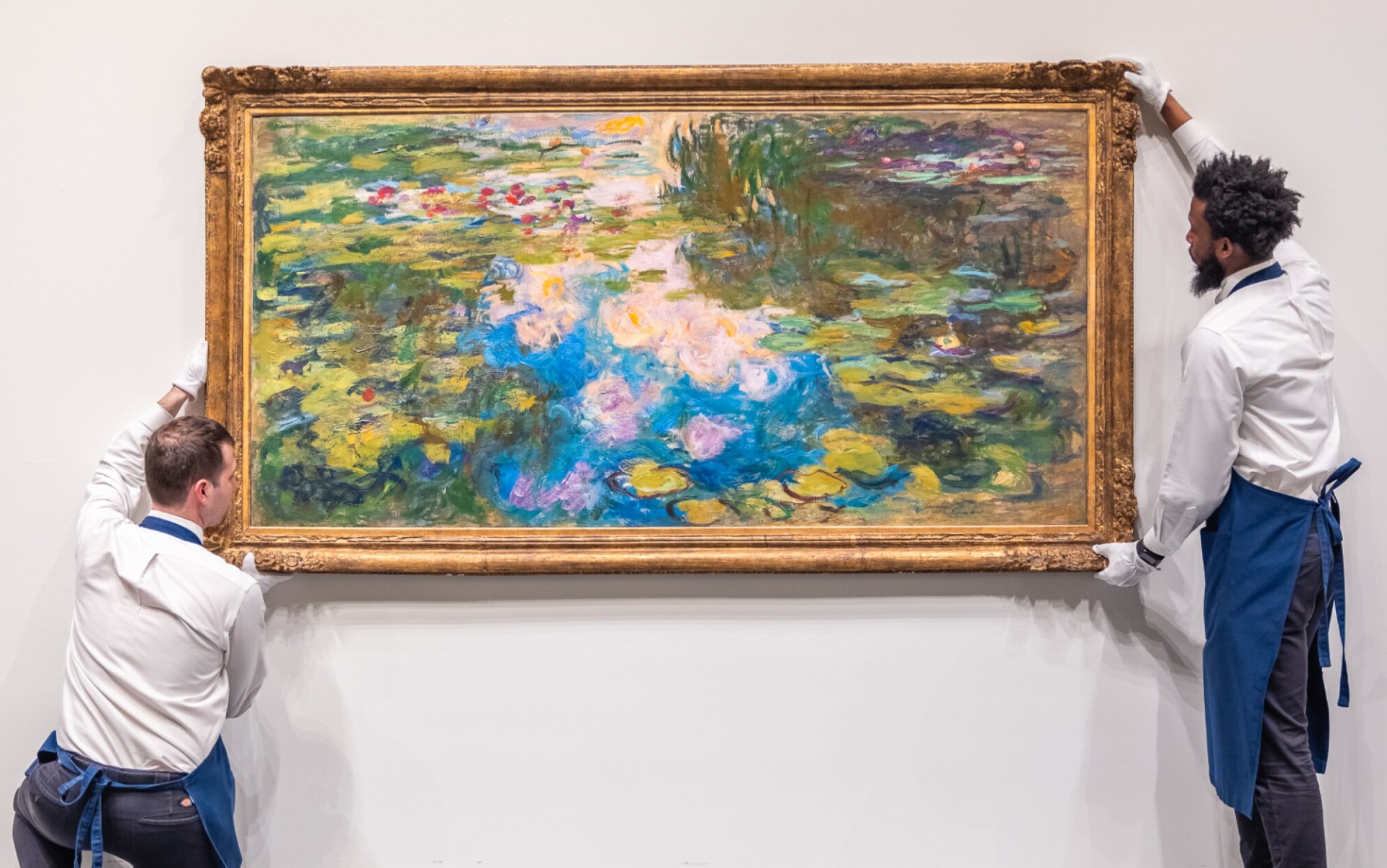
CLAUDE MONET (1840 – 1926)
Le Bassin aux nymphéas, 1917-19
Oil on canvas
100×200 cm (39 3/8 x 79 inches)
Bears the signature Claude Monet (lower right)
#8. Nymphéas, circa 1914-17
Sotheby’s New-York: 18 November 2024
Estimate on Request
USD 65,500,000
Nymphéas | A Legacy of Beauty: The Collection of Sydell Miller Evening Auction | 2024 | Sotheby’s
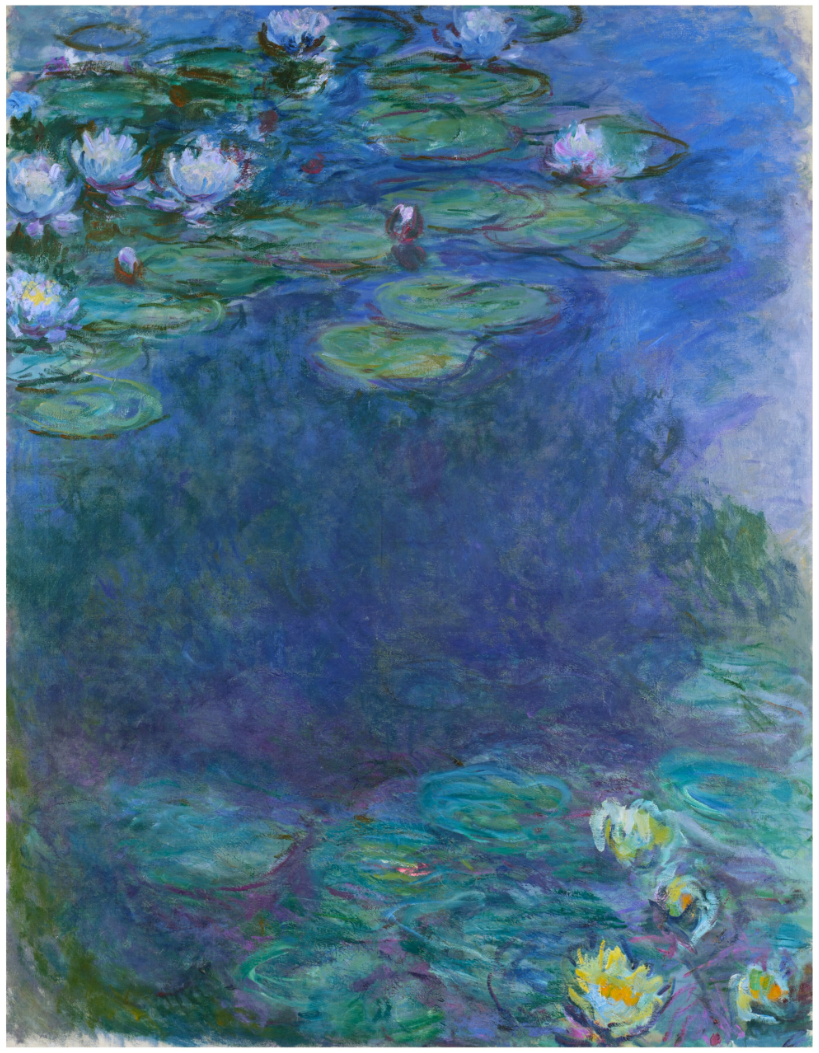
CLAUDE MONET (1840 – 1926)
Nymphéas, circa 1914-17
Oil on canvas
175 x 135.4 cm (68 7/8 x 53 3/8 inches)
Stamped with the signature Claude Monet (on the reverse)
Stamped again (on the stretcher)
PART II: AUCTION RESULTS
2026 Auction Results
PRELIMINARY AUCTION RESULTS
As of 30 June 2026
#1. Nymphéas, 1907
Property of a Distinguished Private Collector
Sotheby’s London: 24 June 2026
Estimated: GBP 30,000,000 – 40,000,000
GBP 40,760,000 / USD 53,800,630
Claude Monet | Nymphéas | Modern & Contemporary Evening Auction |
REPEAT SALE
Christie’s New-York: 12 May 2022
Estimated: USD 35,000,000 – 55,000,000
USD 56,495,000
CLAUDE MONET (1840-1926), Nymphéas | Christie’s
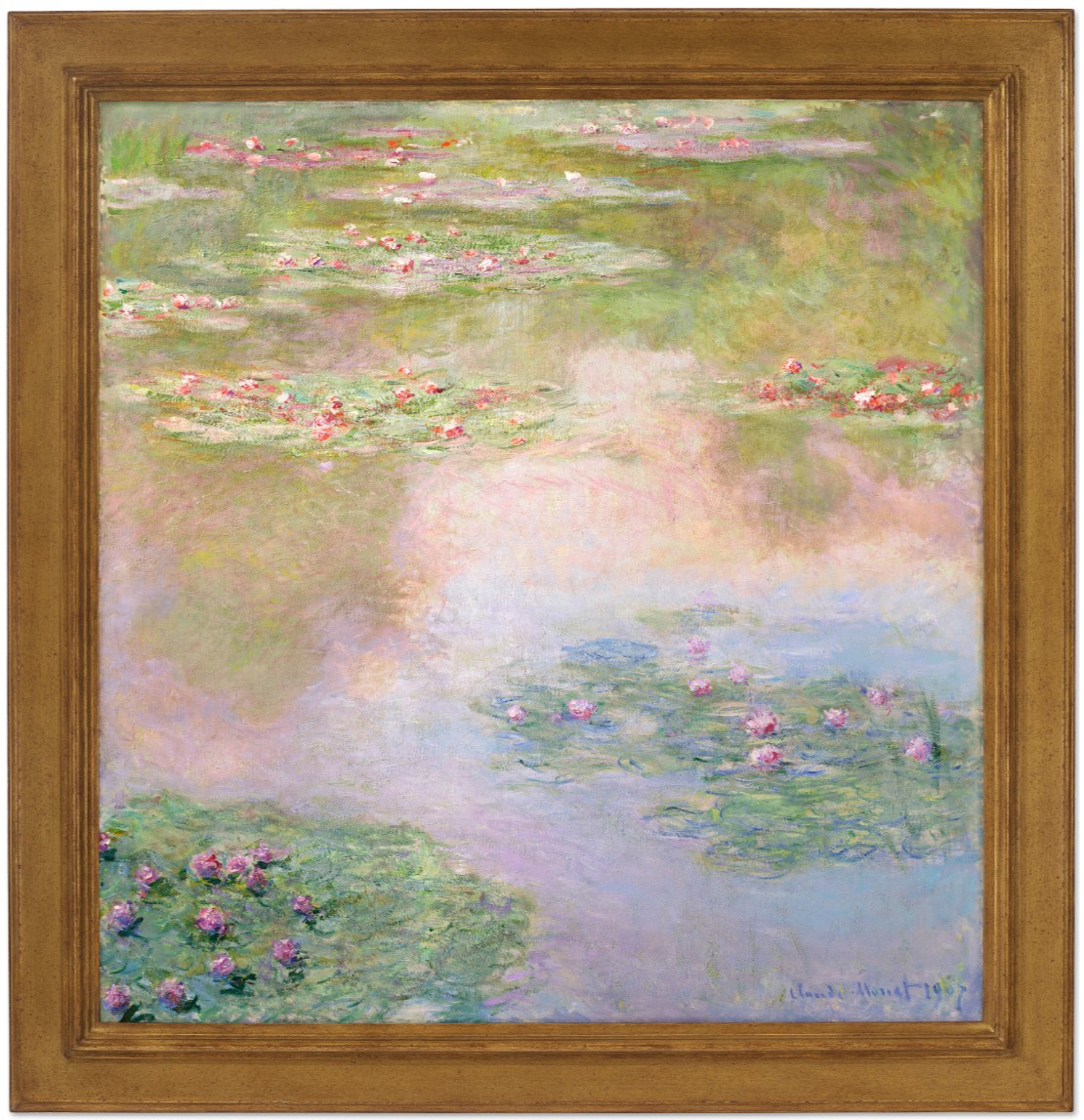
CLAUDE MONET (1840 – 1926)
Nymphéas, 1907
Oil on canvas
93.7 x 89.5 cm (36-7/8 x 35-1/4 inches)
Signed Claude Monet and dated 1907 (lower right)
USD 50 million
#2. Pommiers, Vétheuil, 1878
Property from the Collection of Suzanne S. Dixon, Lake Forest, Illinois
Christie’s New-York: 18 May 2026
Estimated: USD 6,000,000 – 8,000,000
USD 19,610,000
CLAUDE MONET (1840-1926), Pommiers, Vétheuil | Christie’s
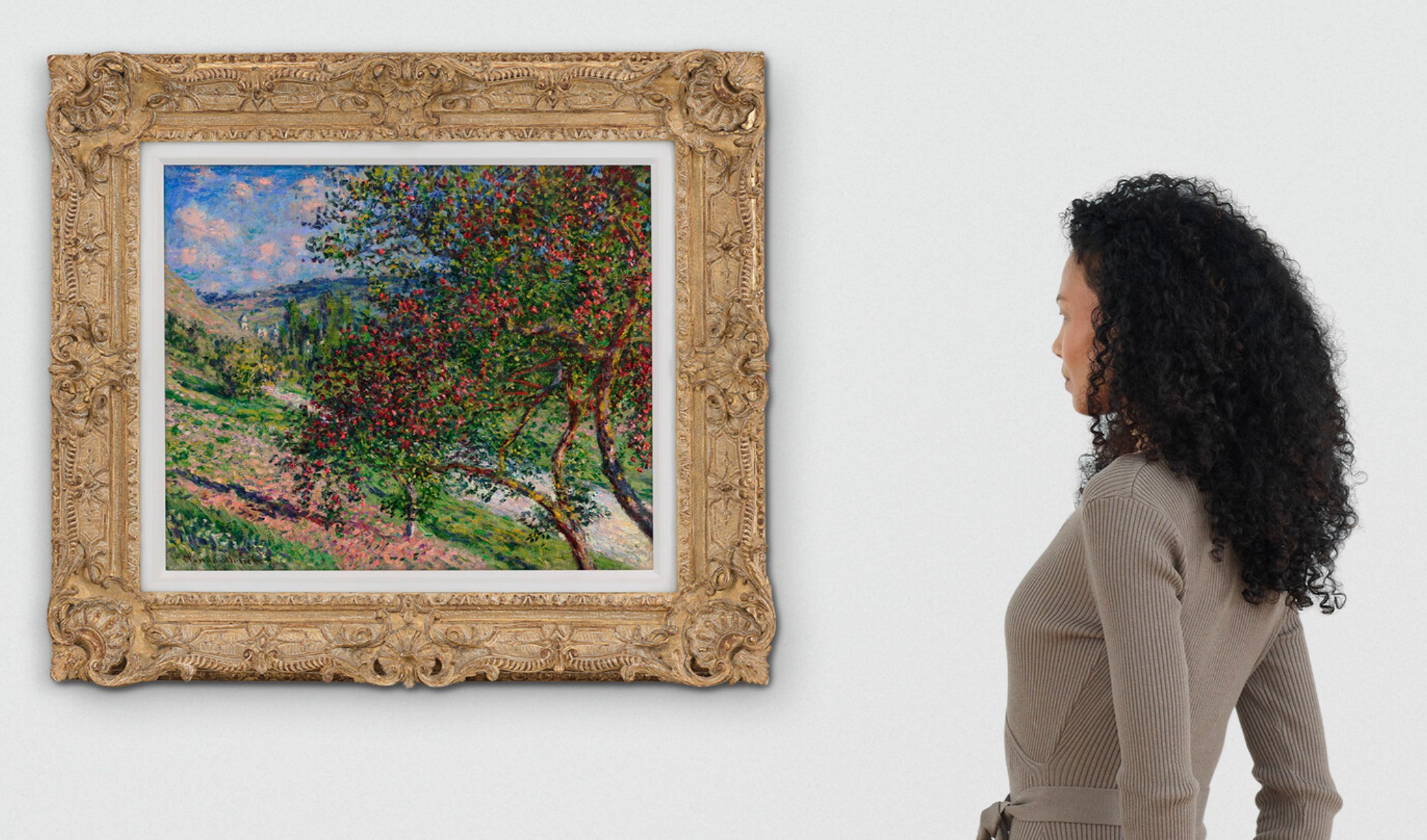
CLAUDE MONET (1840-1926)
Pommiers, Vétheuil, 1878
Oil on canvas
55.2 x 66 cm (21-3/4 x 26 inches)
Signed ‘Claude Monet’ (lower left)
#3. Vétheuil, effet du matin, 1901
Property from a Private Collection
Sotheby’s Paris: 16 April 2026
Estimated: EUR 6,000,000 – 8,000,000
EUR 10,197,500 / USD 12,014,085
Claude Monet | Vétheuil, effet du matin | Art Moderne et Contemporain
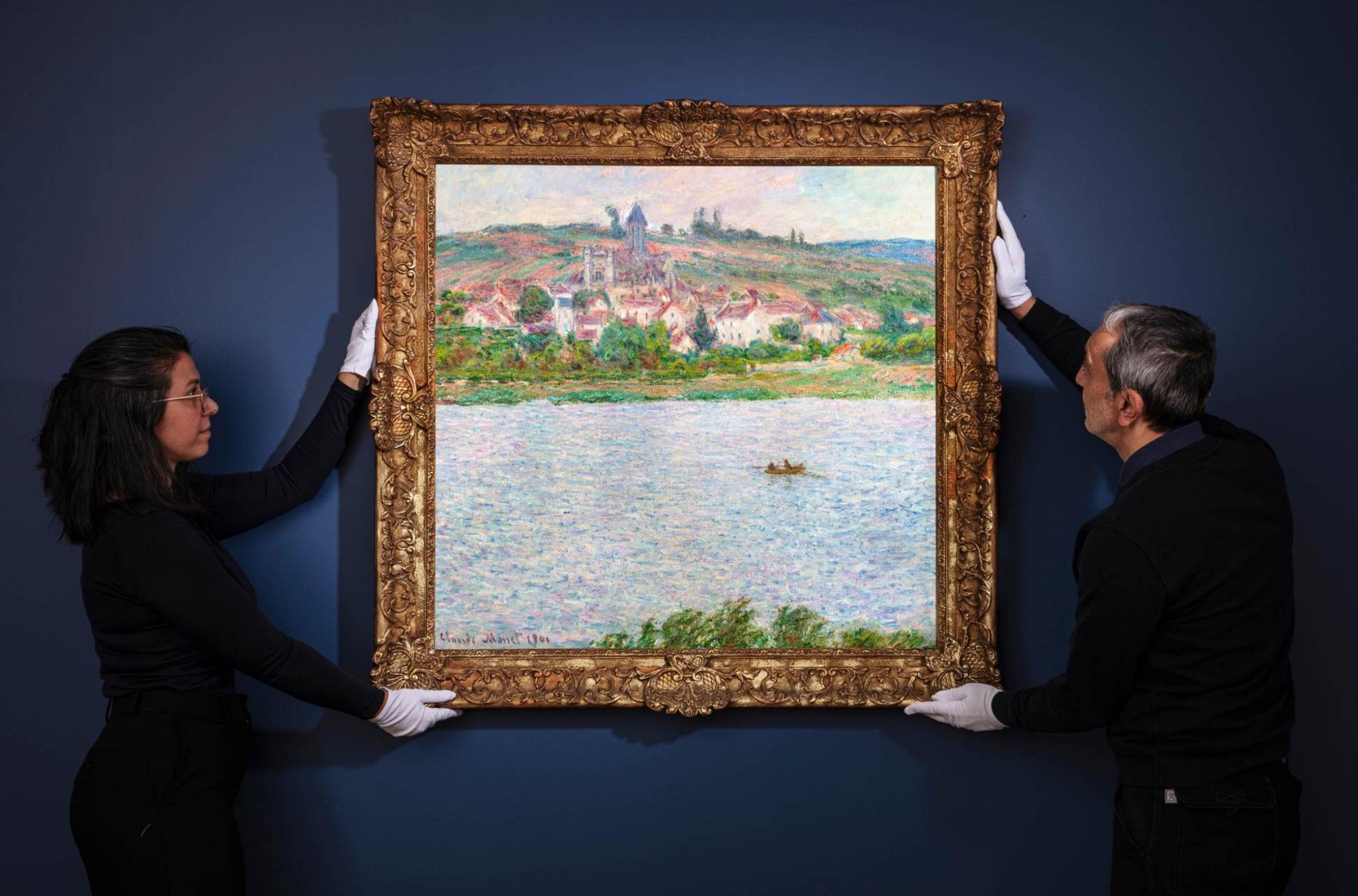
CLAUDE MONET (1840 – 1926)
Vétheuil, effet du matin, 1901
Oil on canvas
89.1 x 92.1 cm (35-1/8 x 36-1/4 inches)
Signed Claude Monet and dated 1901 (lower left)
#4. Maison de jardinier, 1884
Sotheby’s London: 4 March 2026
Estimated: GBP 6,500,000 – 8,500,000
GBP 8,215,000 / USD 11,131,390
Claude Monet | Maison de jardinier | Modern & Contemporary Evening
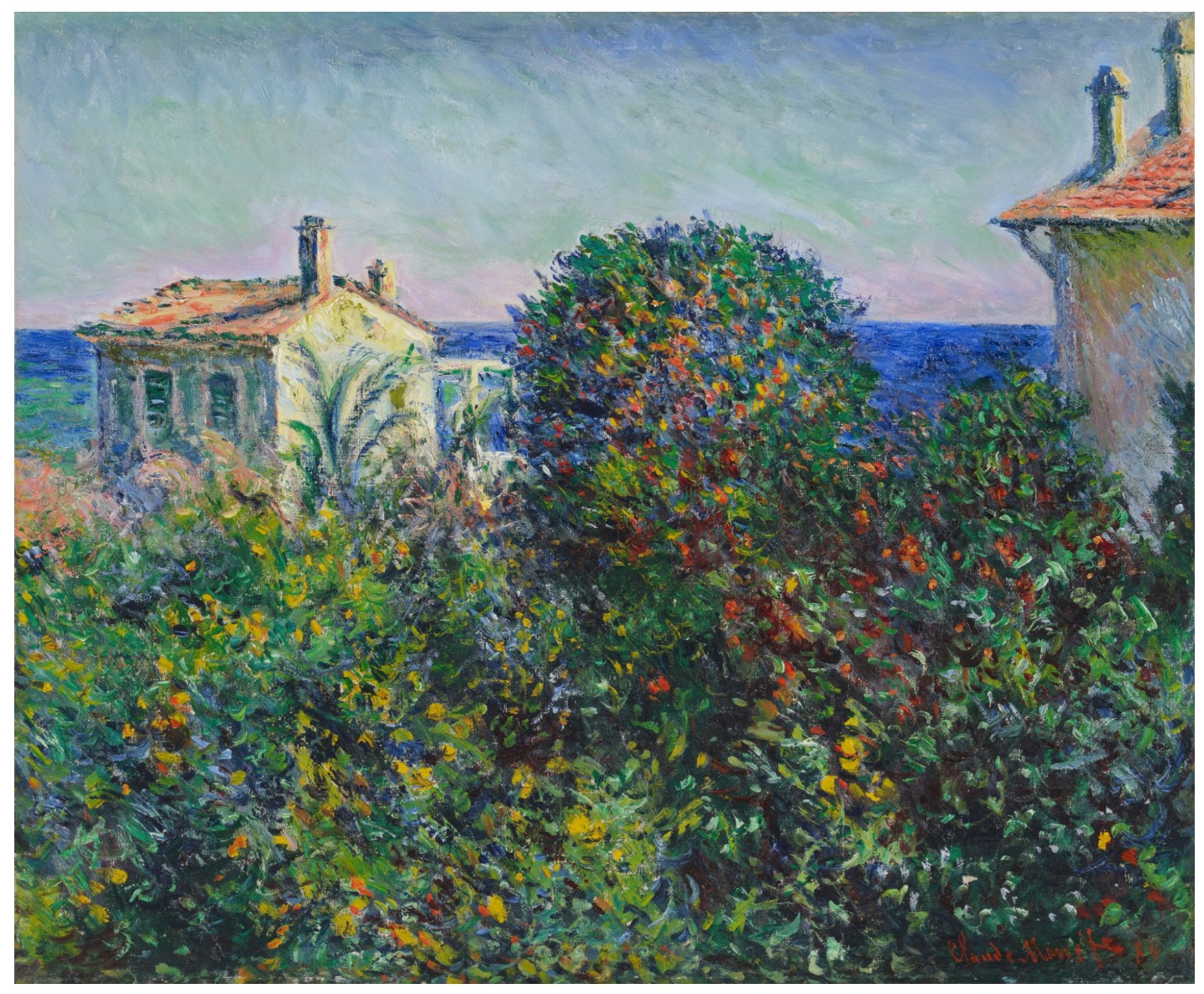
CLAUDE MONET (1840 – 1926)
Maison de jardinier, 1884
Oil on canvas
60.5 x 73 cm (23-5/8 x 28-7/8 inches)
Signed Claude Monet and dated 84 (lower right)
Executed in Bordighera in 1884
USD 10 million
#5. La Route de Vétheuil, effet de neige, 1879
Phillips New-York: 19 May 2026
Estimated: USD 7,000,000 – 10,000,000
USD 9,290,000
Claude Monet Modern & Contemporary Art Evening Sale
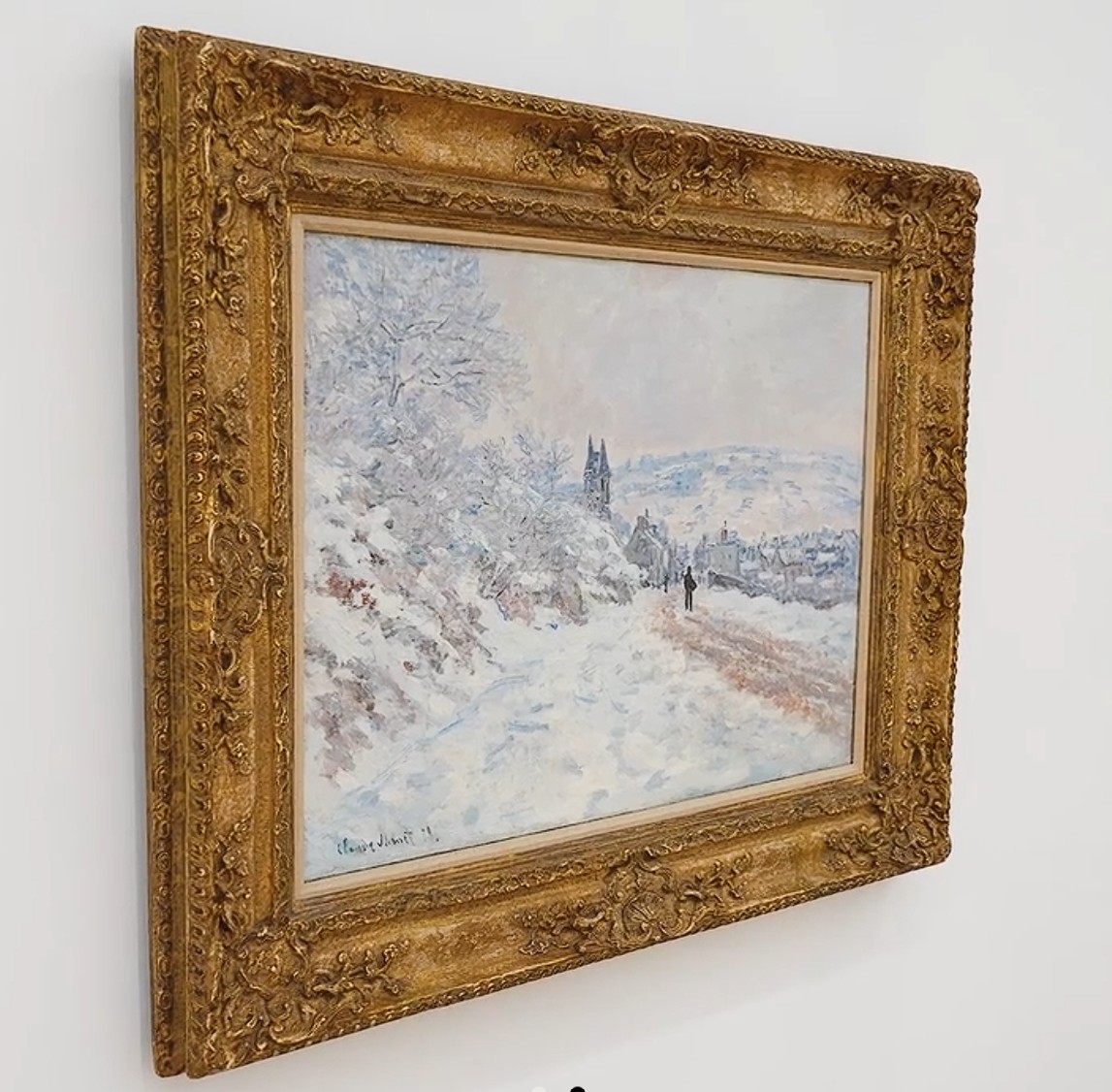
Oil on canvas
61×81 cm (24 x 31-7/8 inches)
Signed and dated “Claude Monet 79.” lower left
Painted in Vétheuil, France, in 1879
#6. Le Parc Monceau, 1878
Christie’s London: 5 March 2026
Estimated: GBP 5,500,000 – 8,500,000
GBP 6,760,000 / USD 9,002,415
CLAUDE MONET (1840-1926), Le Parc Monceau | Christie’s
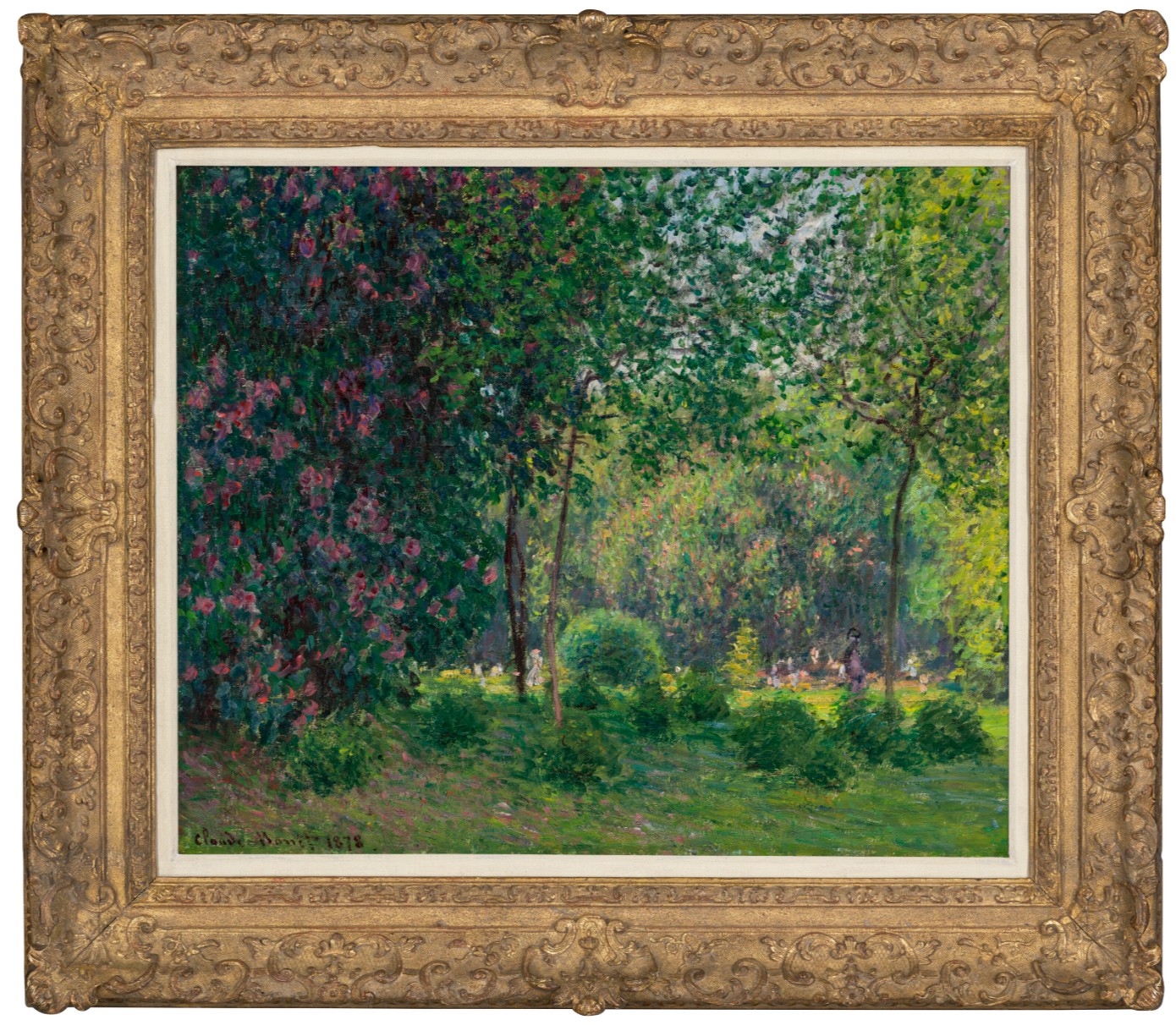
CLAUDE MONET (1840-1926)
Le Parc Monceau, 1878
Oil on canvas
54.1 x 65 cm (21-1/4 x 25-5/8 inches)
signed and dated ‘Claude Monet 1878.’ (lower left)
#7. Les Îles de Port-Villez, 1883
Property from a Private Collection
Sotheby’s Paris: 16 April 2026
Estimated: EUR 3,000,000 – 5,000,000
EUR 6,449,000 / USD 7,597,825
Claude Monet | Les Îles de Port-Villez | Art Moderne et Contemporain
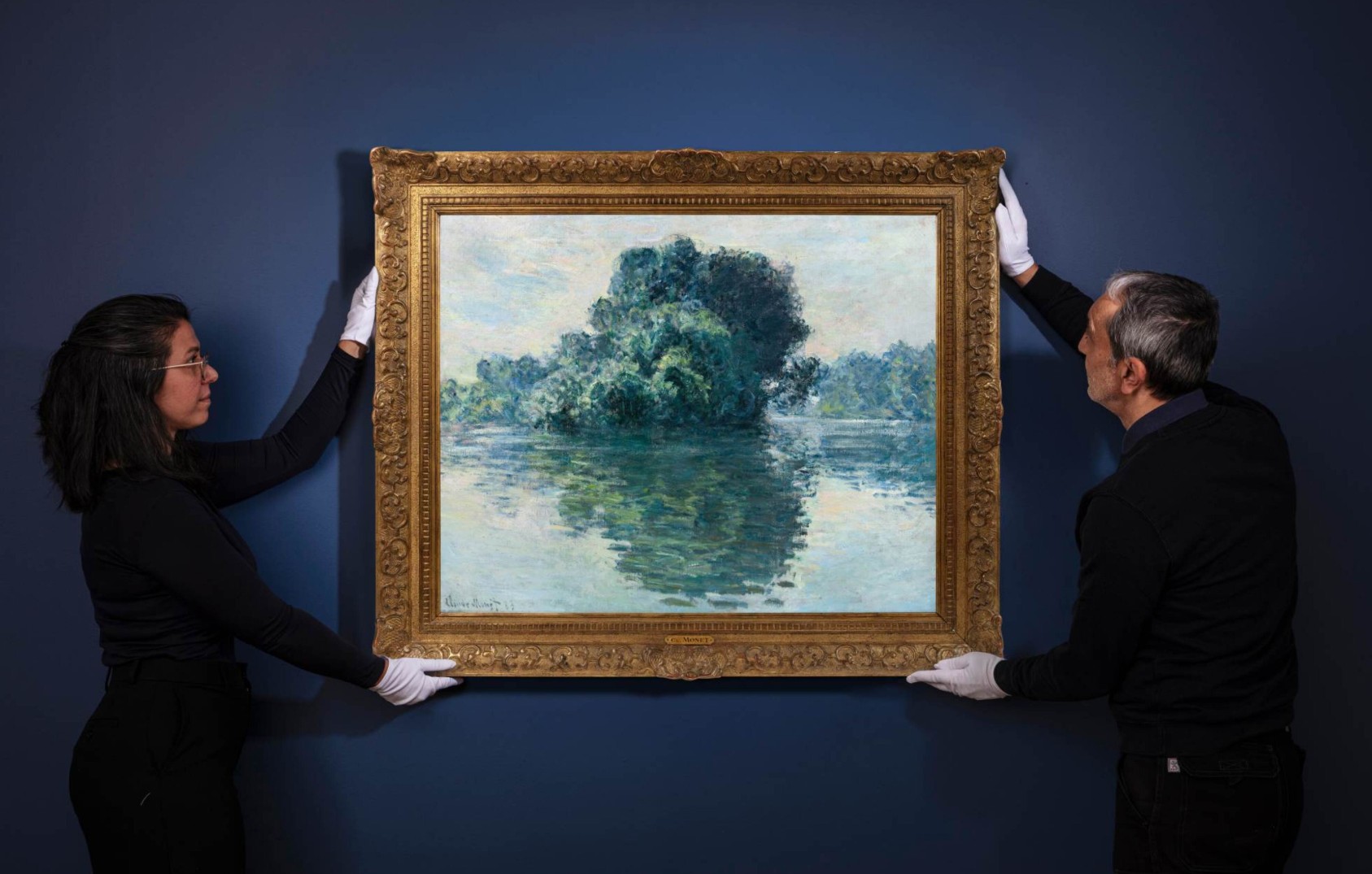
CLAUDE MONET (1840 – 1926)
Les Îles de Port-Villez, 1883
Oil on canvas
65.5 x 81.8 cm (25-3/4 x 32-1/4 inches)
Signed Claude Monet and dated 83 (lower left)
#8. La Falaise d’Amont, 1885
Property from a Private North American Collection
Sotheby’s New-York: 19 May 2026
Estimated: USD 5,000,000 – 7,000,000
USD 6,037,000
Claude Monet | La Falaise d’Amont | Modern Evening Auction | 2026 |
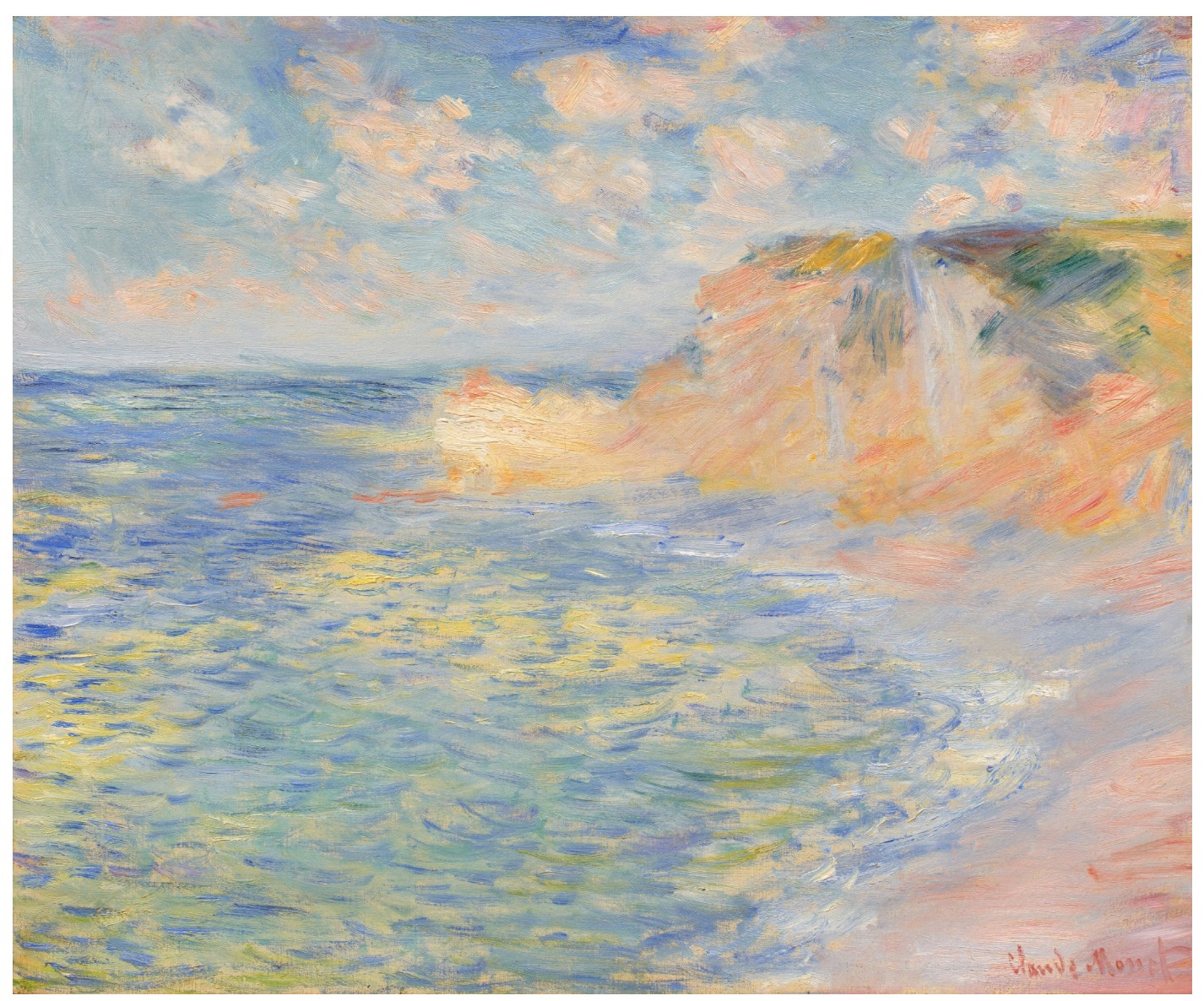
CLAUDE MONET (1840 – 1926)
La Falaise d’Amont, 1885
Oil on canvas
61 x 73.6 cm (24×29 inches)
Signed Claude Monet (lower right)
#9. La maison à travers les roses, 1925-1926
Christie’s Hong-Kong: 27 March 2026
Estimated: HKD 16,000,000 – 26,000,000
HKD 23,070,000 / USD 2,946,360
REPEAT SALE
Sotheby’s New-York: 13 November 2018
Estimated: USD 800,000 – 1,200,000
USD 1,035,000
(#425) CLAUDE MONET | La Maison à travers les roses
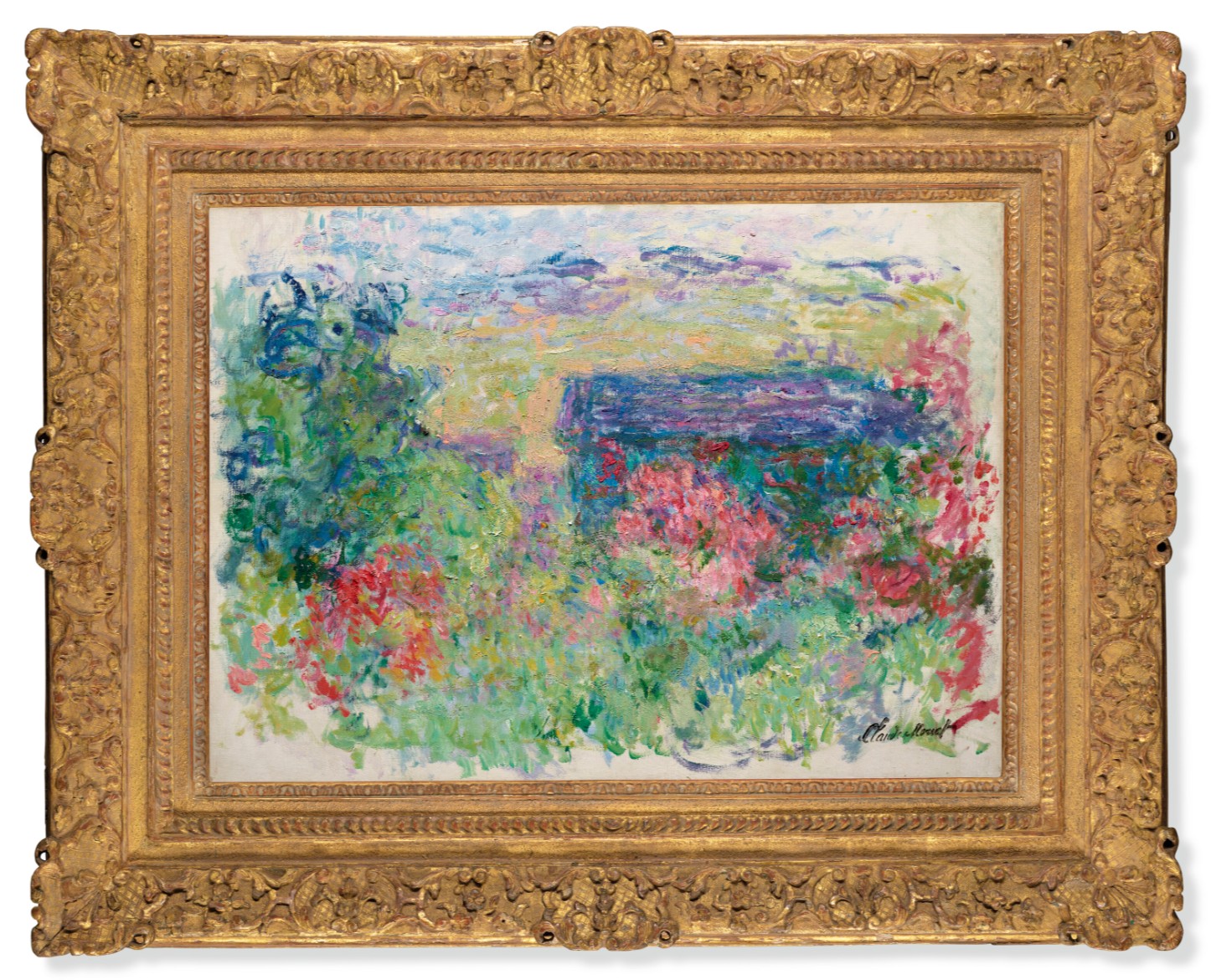
CLAUDE MONET (1840 – 1926)
La maison à travers les roses, 1925-1926
Oil on canvas
62.2 x 81.6 cm (24-1/2 x 32-1/8 inches)
Stamped ‘Claude Monet’ (Lugt 1819b; lower right)
Painted in Giverny in 1925-1926
#10. Portrait d’homme debout, 1864
Masterpieces from the Lewis Collection
Sotheby’s London: 25 June 2026
Estimated: GBP 150,000 – 200,000
GBP 1,024,000 / USD 1,371,800
Claude Monet | Portrait d’homme debout | Modern Day Auction including
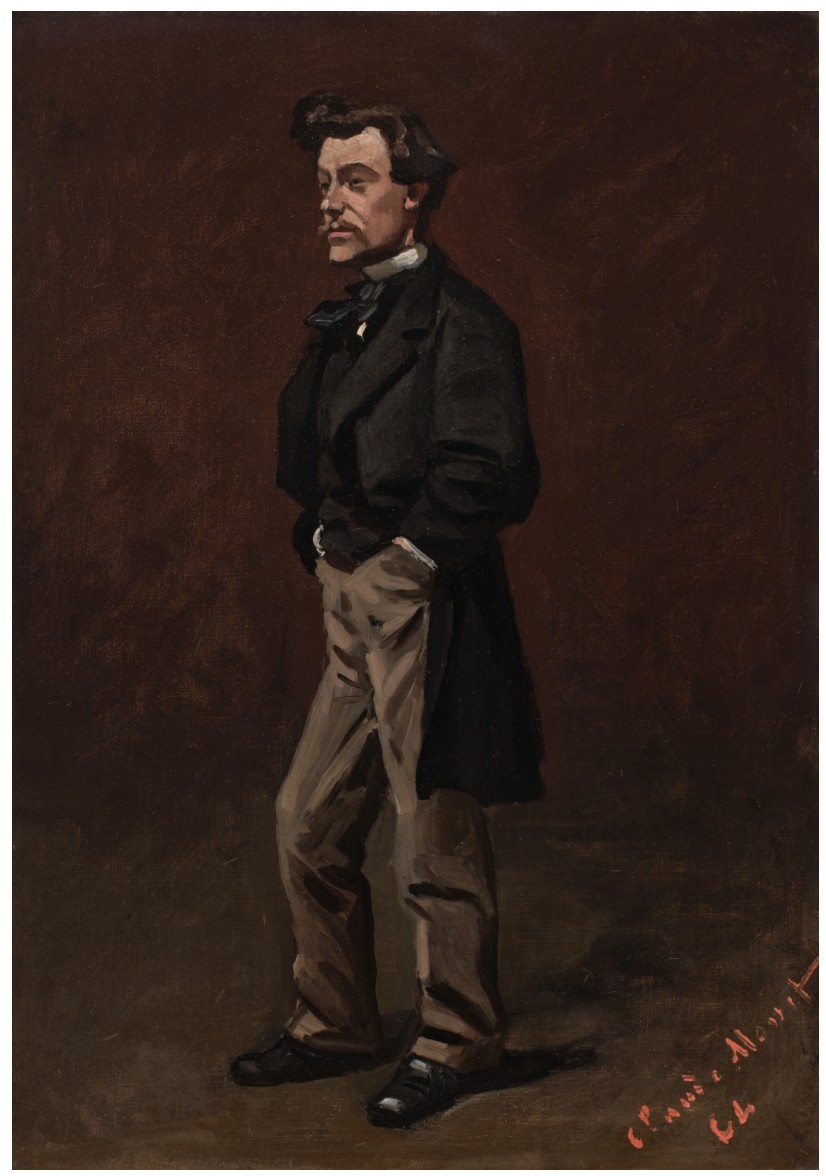
CLAUDE MONET (1840 – 1926)
Portrait d’homme debout, 1864
Oil on canvas
46.2 x 32.6 cm (18-1/4 x 12-7/8 inches)
Signed Claude Monet and dated 64 (lower right)
#11. Waterloo Bridge, 1900/01
Koller Zurich: 26 June 2026
Estimated: CHF 350,000 – 450,000
CHF 1,061,200 / USD 1,312,980
WORK ON PAPER
CLAUDE MONET Waterloo Bridge. 1900/01.
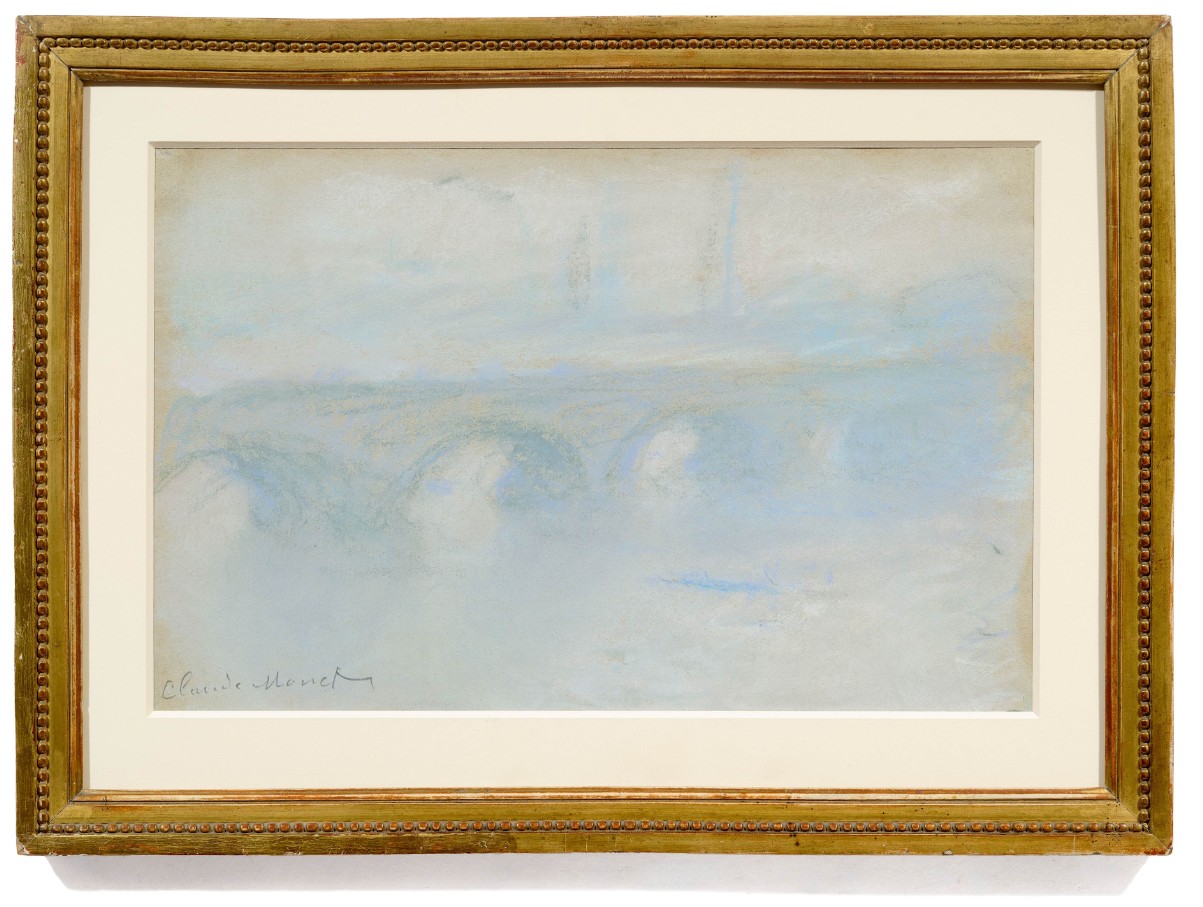
CLAUDE MONET (Paris 1840–1926 Giverny)
Waterloo Bridge, 1900/01
Pastel on paper
31.7 x 48.3 cm
Signed lower left: Claude Monet
#12. Bord de mer, circa 1868
Christie’s Paris: 15 April 2026
Estimated: EUR 300,000 – 500,000
EUR 857,250 / USD 1,011,525
WORK ON PAPER
Claude Monet (1840-1926), Bord de mer | Christie’s
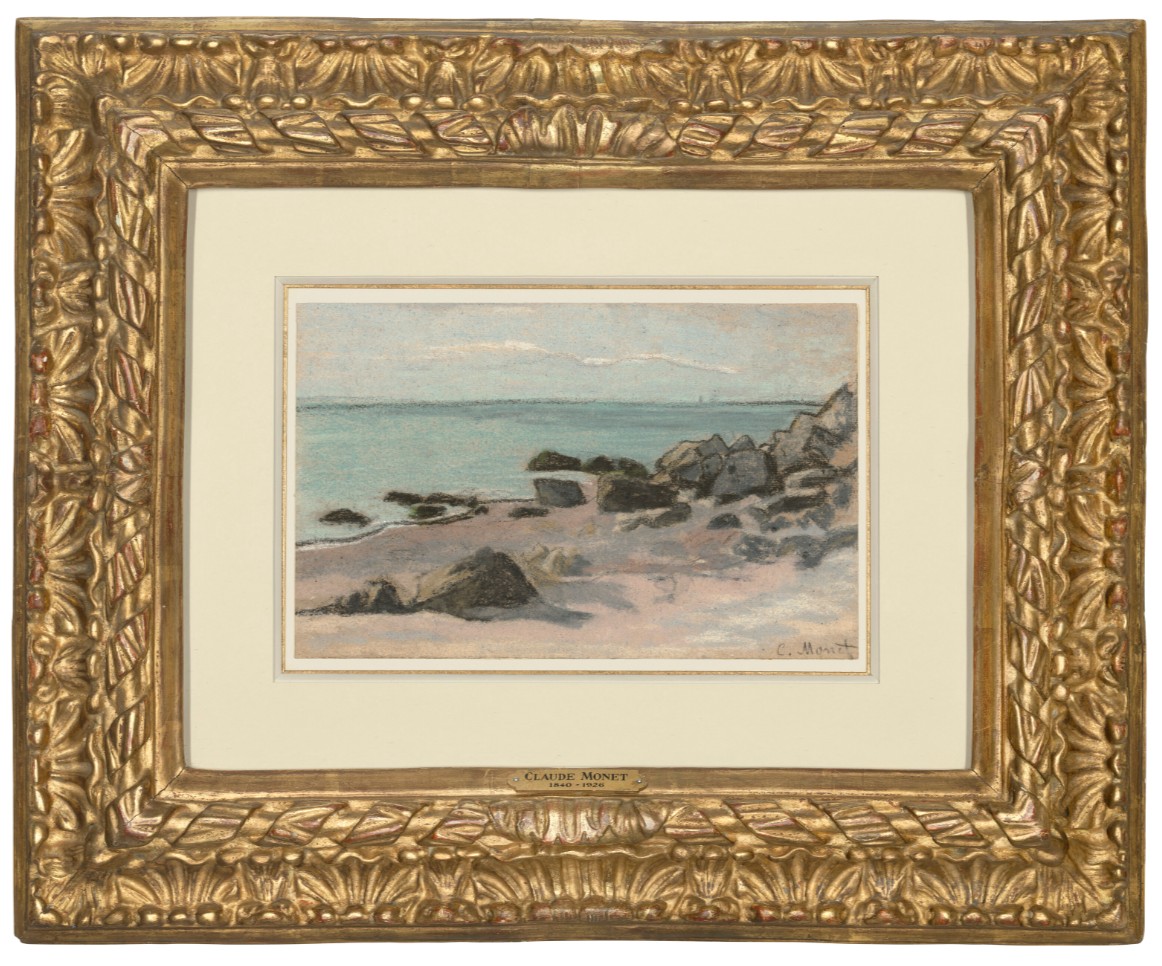
CLAUDE MONET (1840-1926)
Bord de mer, circa 1868
Paste on paper
17.8 x 28 cm (7×11 inches)
Signed ‘C. Monet’ (lower right)
#13. Waterloo Bridge, Brouillard, 1901
Dorotheum Vienna: 19 May 2026
Estimated: EUR 300,000 – 500,000
EUR 611,000 / USD 700,000
WORK ON PAPER
Claude Monet – Modern Art 2026/05/19 – Realized price: EUR 611.000 – Dorotheum
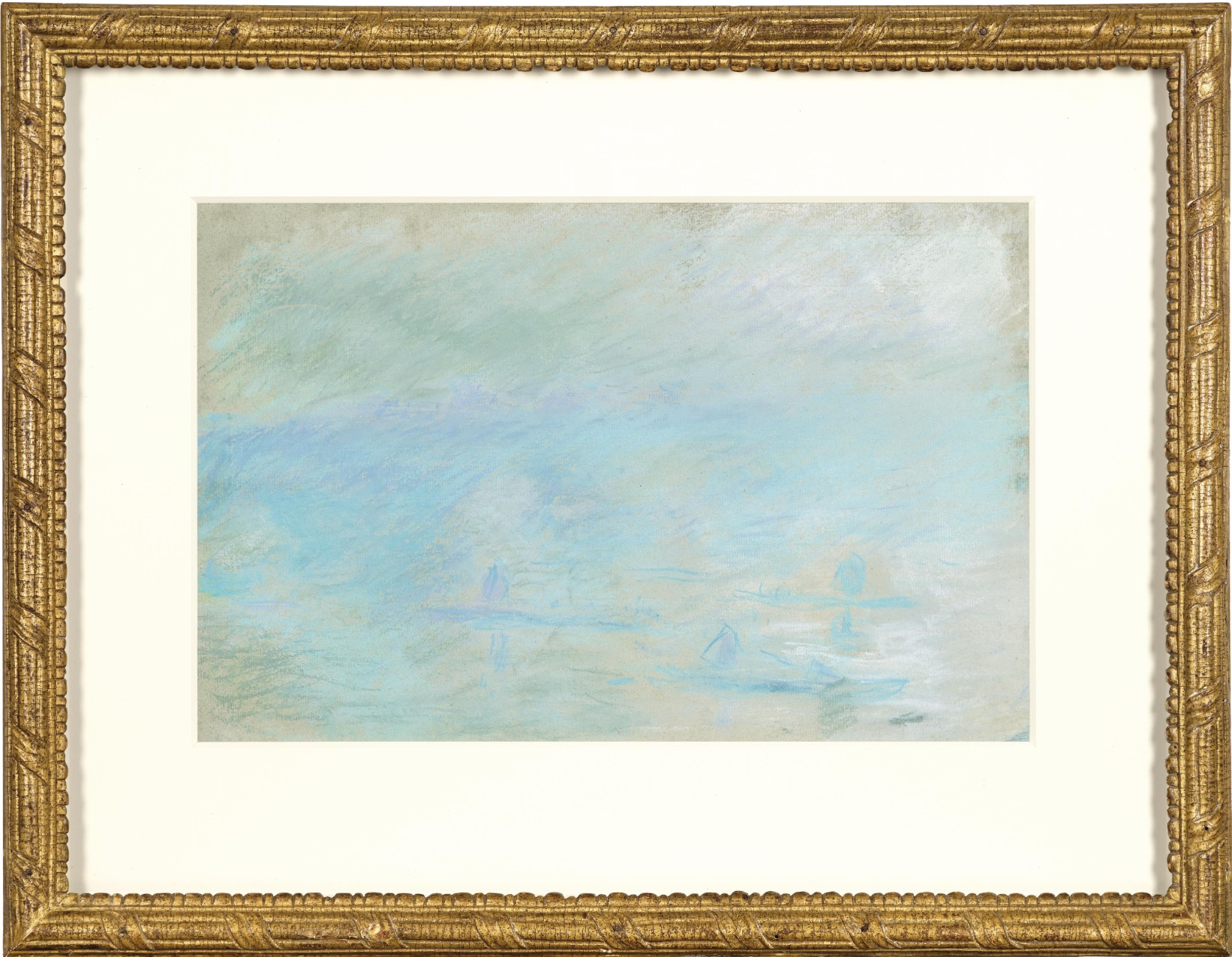
CLAUDE MONET (Paris 1840–1926 Giverny)
Waterloo Bridge, Brouillard, 1901
Pastel on paper
31.5 x 47.8 cm
Lots Passed
Camille assise sur la plage à Trouville, 1870
Sotheby’s London: 24 June 2026
Estimated: GBP 7,000,000 – 10,000,000
PASSED
Claude Monet | Camille assise sur la plage à Trouville | Modern &
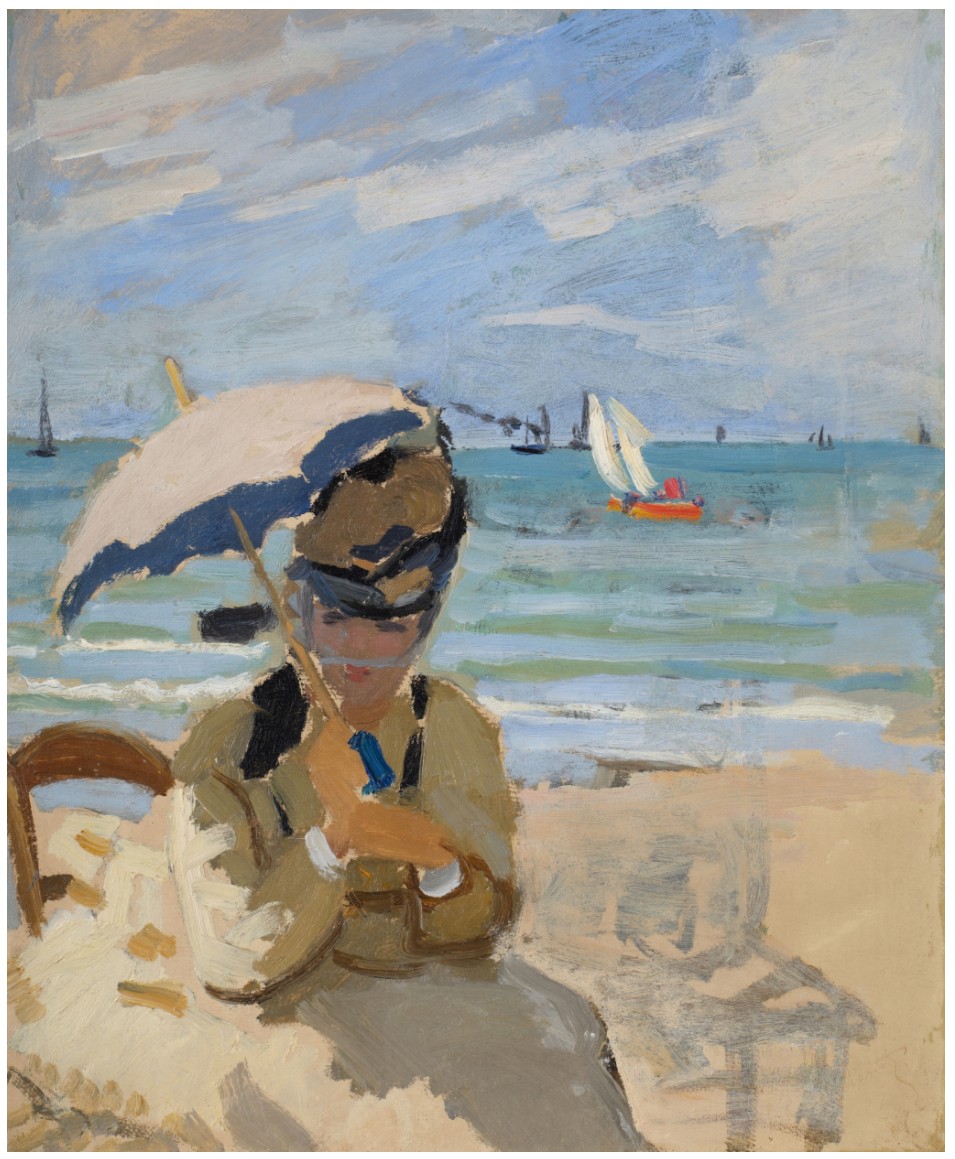
CLAUDE MONET (1840 – 1926)
Camille assise sur la plage à Trouville, 1870
Oil on canvas
46.2 x 38.3 cm (18-1/8 x 15 inches)
Indistinctly signed Claude Monet (lower right)
2025 Auction Results
13 lots sold at auction in 2025 for a total turnover of USD 137,795,795. With no lot failing to sell, the sell-through rate is 100%. The top lot for 2025 is Nympheas, a painting dated 1907, from The Collection of the Kawamura Memorial DIC Museum of Art in Japan, that sold at Christie’s in New-York, on 17 November 2025, for USD 45,585,000.
2025 Top 3 Lots
2 lots sold for more than USD 10 million, generating a cumulative turnover of USD 88,445,000, representing 64.2% of the total turnover for 2025.
#1. Nymphéas, 1907
Property from the Kawamura Memorial DIC Museum of Art
Christie’s New-York: 17 November 2025
Estimated: USD 40,000,000 – 60,000,000
USD 45,485,000
READ MORE IN FOCUS SECTION
CLAUDE MONET (1840-1926), Nymphéas | Christie’s
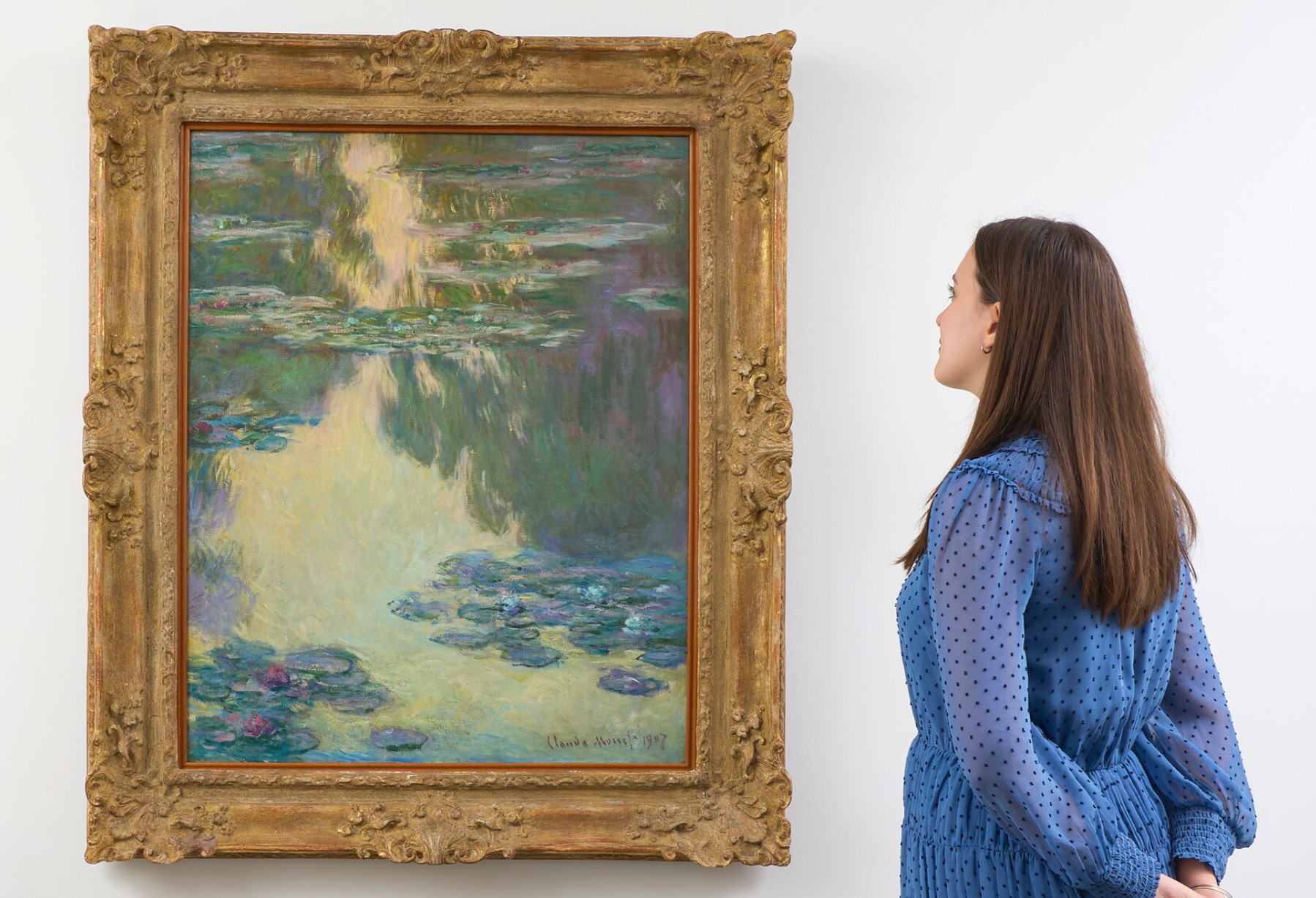
CLAUDE MONET (1840-1926)
Nymphéas, 1907
Oil on canvas
92 x 73.6 cm (36 1/4 x 29 inches)
Signed and dated ‘Claude Monet 1907’ (lower right)
#2. Peupliers au bord de l’Epte, crépuscule, 1891
Christie’s New-York: 12 May 2025
Estimated: USD 30,000,000 – 50,000,000
USD 42,960,000
READ MORE IN FOCUS SECTION
CLAUDE MONET (1840-1926), Peupliers au bord de l’Epte, crépuscule | Christie’s
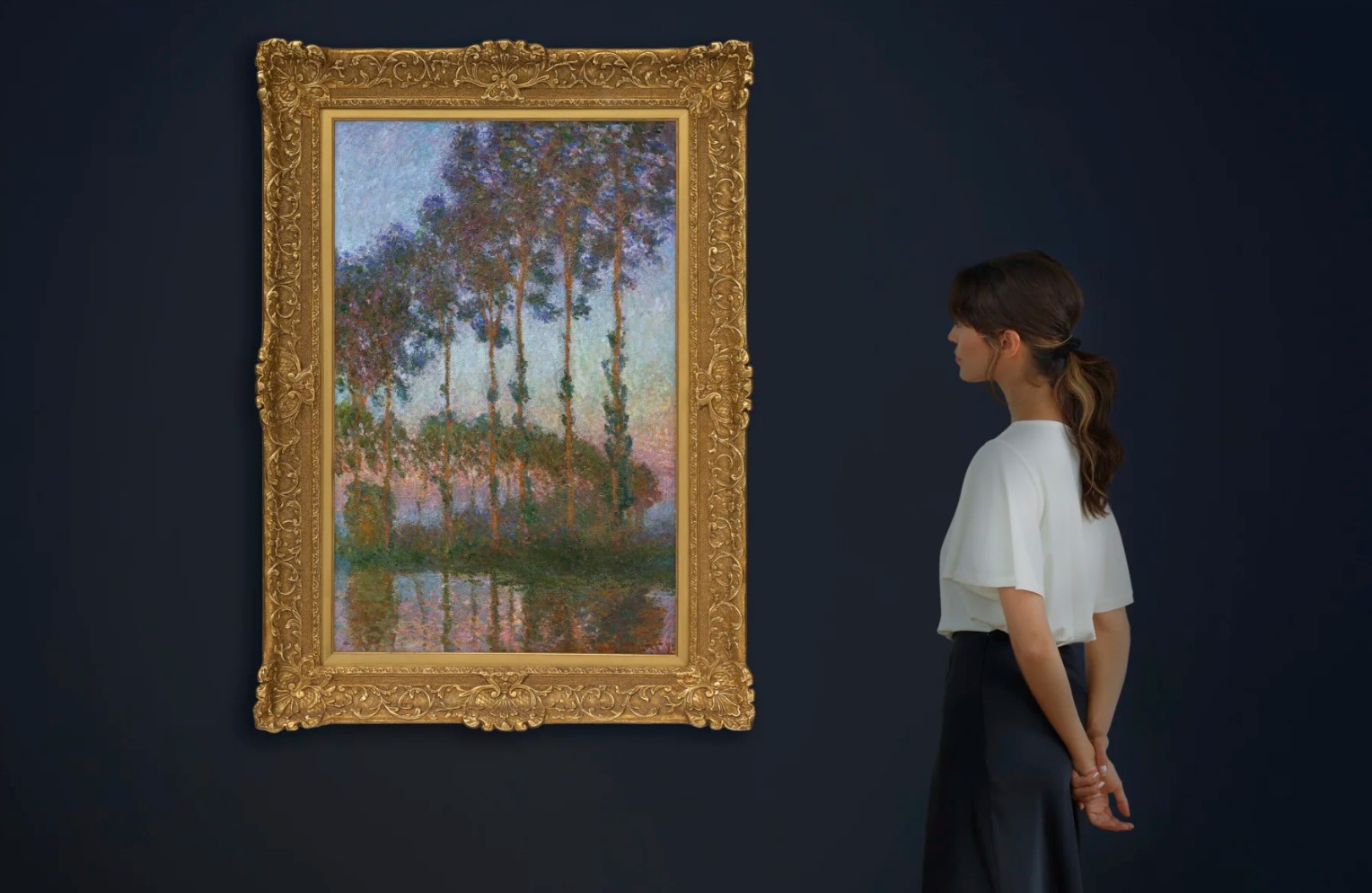
CLAUDE MONET (1840-1926)
Peupliers au bord de l’Epte, crépuscule, 1891
Oil on canvas
100 x 65.1 cm (39 3/8 x 25 5/8 inches)
Signed and dated ‘Claude Monet 91’ (lower right)
USD 10 million
#3. Aux Petites-Dalles, 1884
Sotheby’s London: 24 June 2025
Estimated: GBP 5,000,000 – 7,000,000
GBP 5,652,000 / USD 7,655,830
Aux Petites-Dalles | Modern & Contemporary Evening Auction | 2025 | Sotheby’s
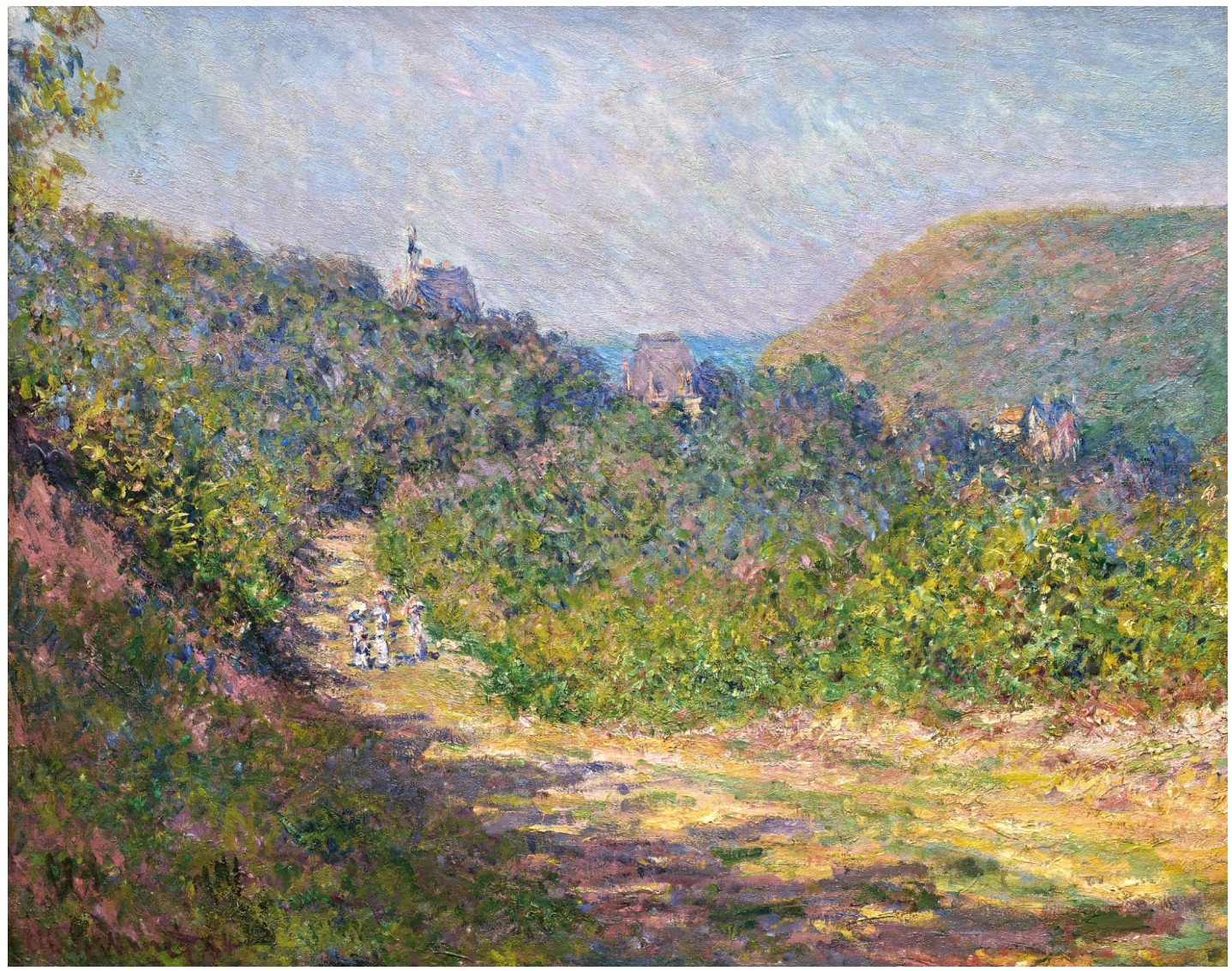
CLAUDE MONET (1840 – 1926)
Aux Petites-Dalles, 1884
Oil on canvas
66 x 82.6 cm (26 x 32 1/2 inches)
Signed Claude Monet and dated 84 (lower left)
#4. Vue de Rouen depuis la côte Sainte-Catherine, circa 1892
Property from The Schlumberger Collection
Sotheby’s New-York: 20 November 2025
Estimated: USD 3,000,000 – 4,000,000
USD 7,370,000
Vue de Rouen depuis la côte Sainte-Catherine | Modern Evening Auction | 2025 | Sotheby’s
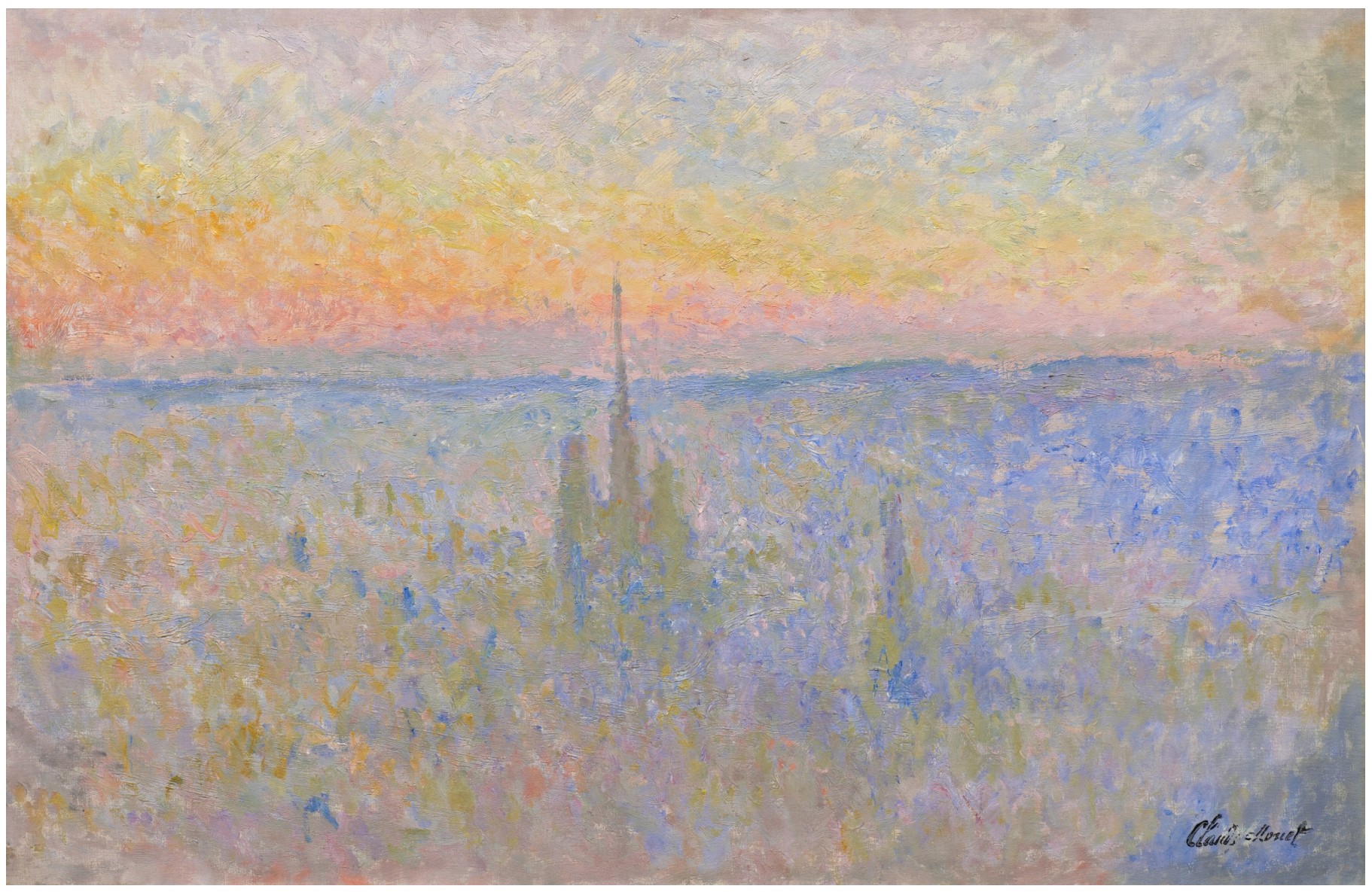
CLAUDE MONET (1840 – 1926)
Vue de Rouen depuis la côte Sainte-Catherine, circa 1892
Oil on canvas
65.3 x 100.2 cm (25 3/4 x 39 1/2 inches)
Stamped with the signature Claude Monet (lower right)
Stamped again (on the reverse)
#5. Église de Vernon, Soleil, 1894
Sotheby’s New-York: 13 May 2025
Estimated: USD 6,000,000 – 8,000,000
USD 7,100,000
Église de Vernon, Soleil | Modern Evening Auction | 2025 | Sotheby’s
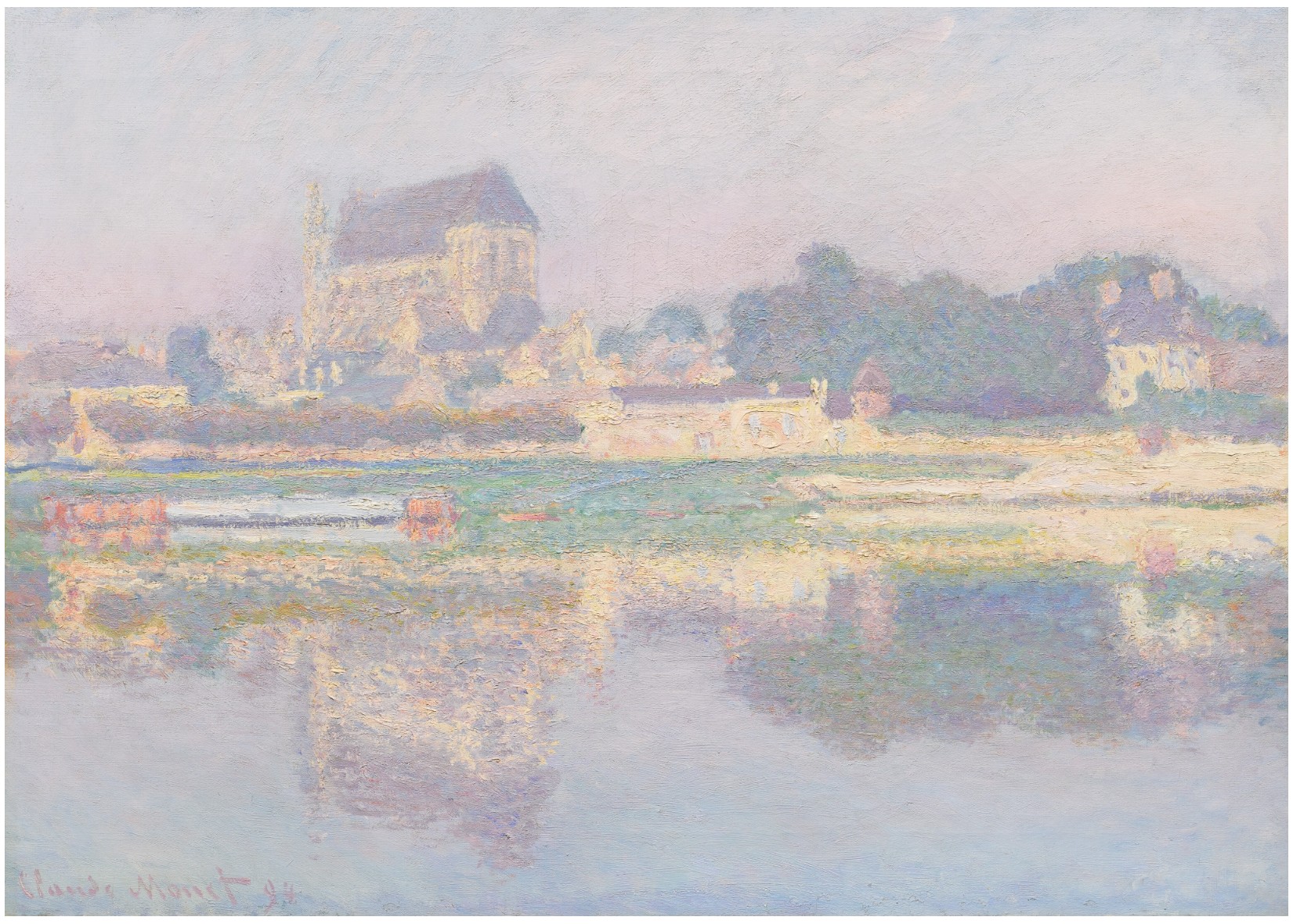
CLAUDE MONET (1840 – 1926)
Église de Vernon, Soleil, 1894
Oil on canvas
66.4 x 92.4 cm (26 1/8 x 36 3/8 inches)
Signed Claude Monet and dated 94 (lower left)
#6. Port-Coton, Le Lion, 1886
Sotheby’s New-York: 13 May 2025
Estimated: USD 5,000,000 – 7,000,000
USD 6,516,000
Port-Coton, Le Lion | Modern Evening Auction | 2025 | Sotheby’s
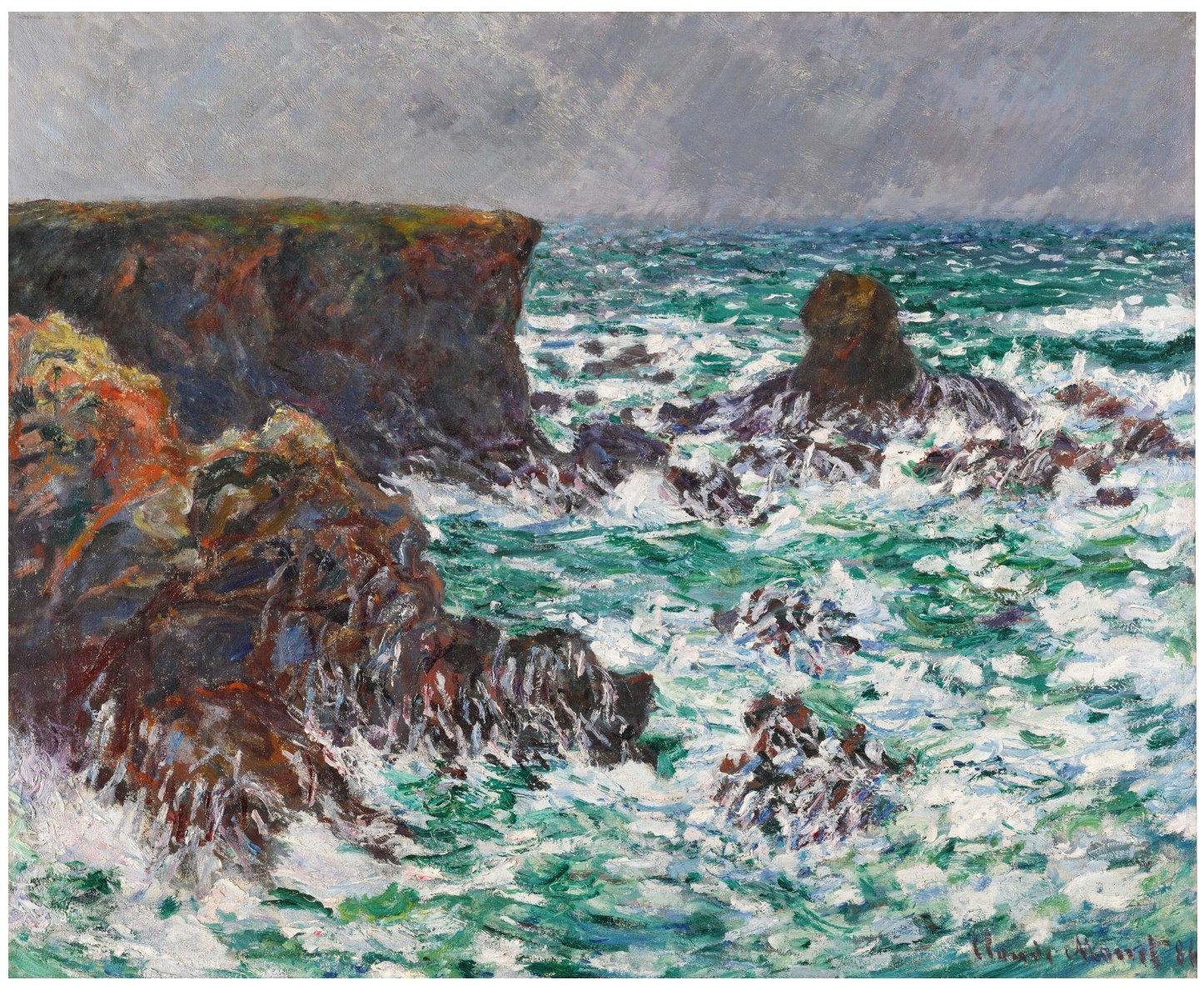
CLAUDE MONET (1840 – 1926)
Port-Coton, Le Lion, 1886
Oil on canvas
61×74 cm (23 5/8 x 29 1/2 inches)
Signed Claude Monet and dated 86 (lower right)
USD 5 million
#7. Printemps à Giverny, effet d’après-midi, 1885
Christie’s Hong-Kong: 26 September 2025
Estimated: HKD 33,000,000 – 55,000,000
HKD 37,100,000 / USD 4,768,640
Printemps à Giverny, effet d’après-midi
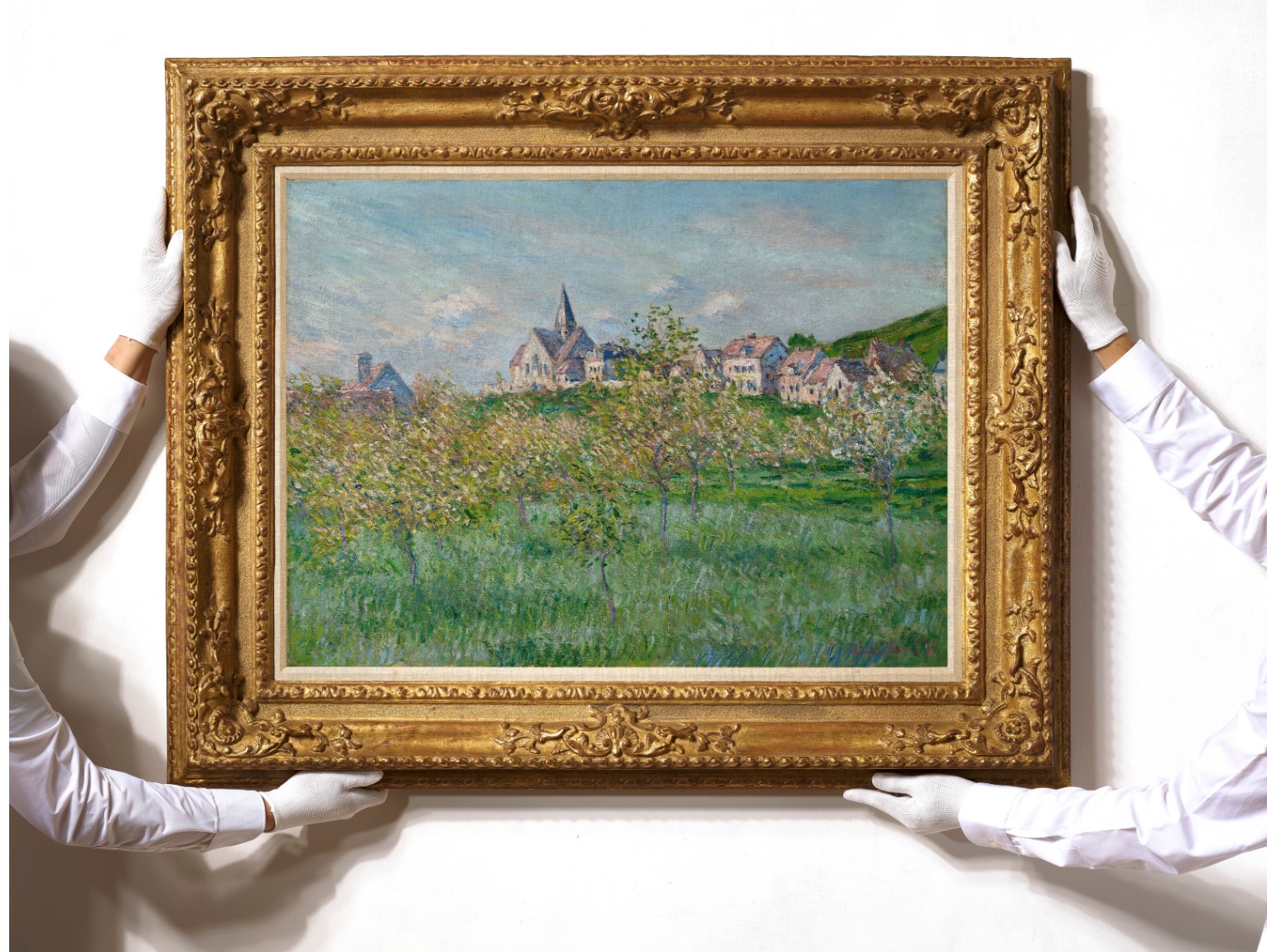
CLAUDE MONET (1840-1926)
Printemps à Giverny, effet d’après-midi, 1885
Oil on canvas
60.4 x 81.7 cm (23 5/8 x 32 1/8 inches)
Signed and dated ‘Claude Monet 85’ (lower right)
#8. Falaise des Petites-Dalles, 1881
The Art of Collecting: Property from a Distinguished Private Collector
Christie’s New-York: 17 November 2025
Estimated: USD 2,800,000 – 3,500,000
USD 3,247,000
CLAUDE MONET (1840-1926), Falaise des Petites-Dalles | Christie’s
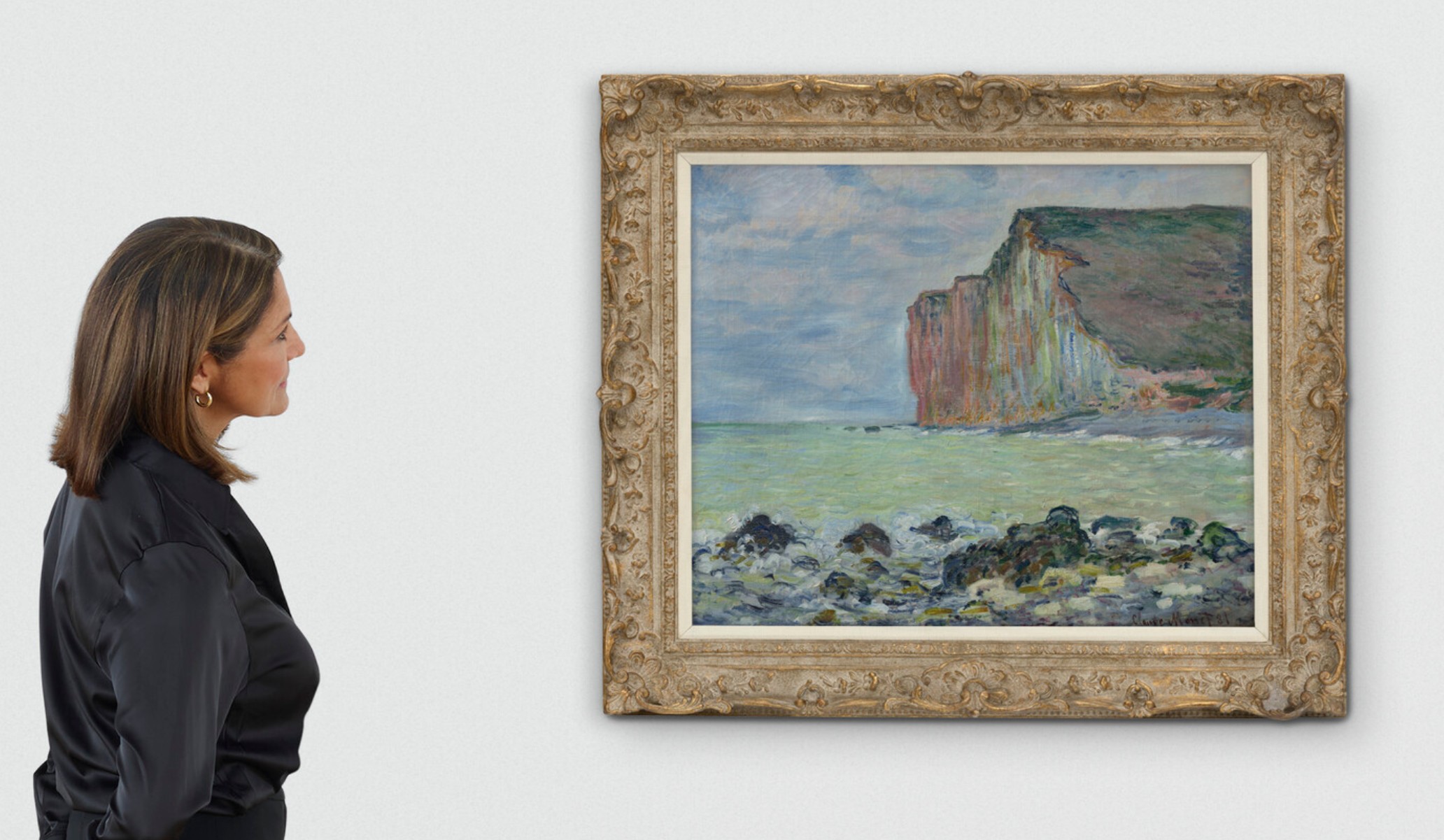
CLAUDE MONET (1840-1926)
Falaise des Petites-Dalles, 1881
Oil on canvas
59.5 x 73 cm (23 3/8 x 28 3/4 inches)
Signed and dated ‘Claude Monet 81’ (lower right)
#9. Vétheuil, circa 1901-1902
Christie’s New-York: 13 May 2025
Estimated: USD 1,500,000 – 2,500,000
USD 3,196,000
CLAUDE MONET (1840-1926), Vétheuil | Christie’s
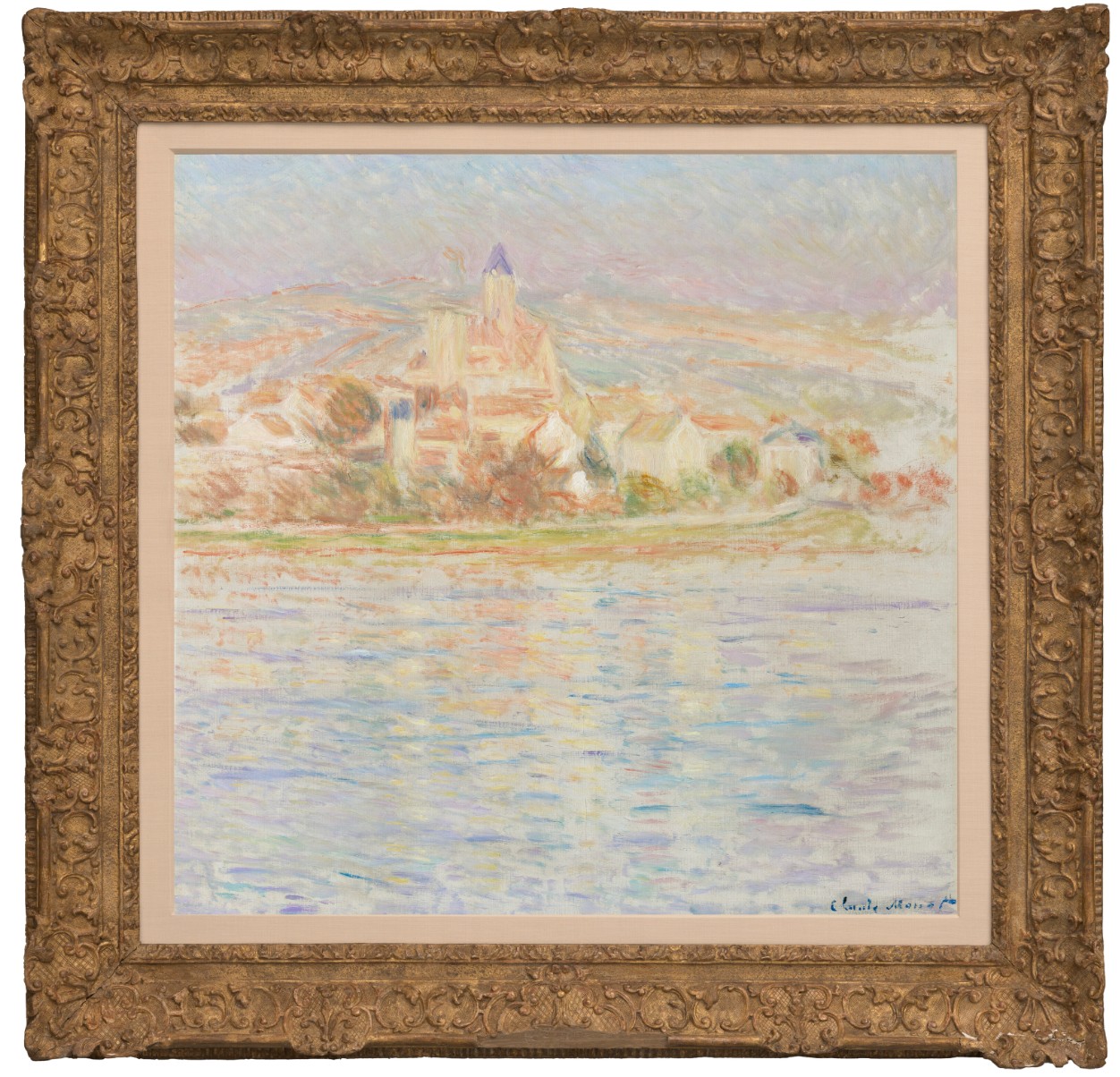
CLAUDE MONET (1840-1926)
Vétheuil, circa 1901-1902
Oil on canvas
89.5 x 92.5 cm (35 1/4 x 36 3/8 inches)
Bears the signature ‘Claude Monet’ (lower right)
#10. Printemps, saules, 1885
Christie’s London: 15 October 2025
Estimated: GBP 1,800,000 – 2,500,000
GBP 2,368,000 / USD 3,154,620
CLAUDE MONET (1840-1926), Printemps, saules | Christie’s
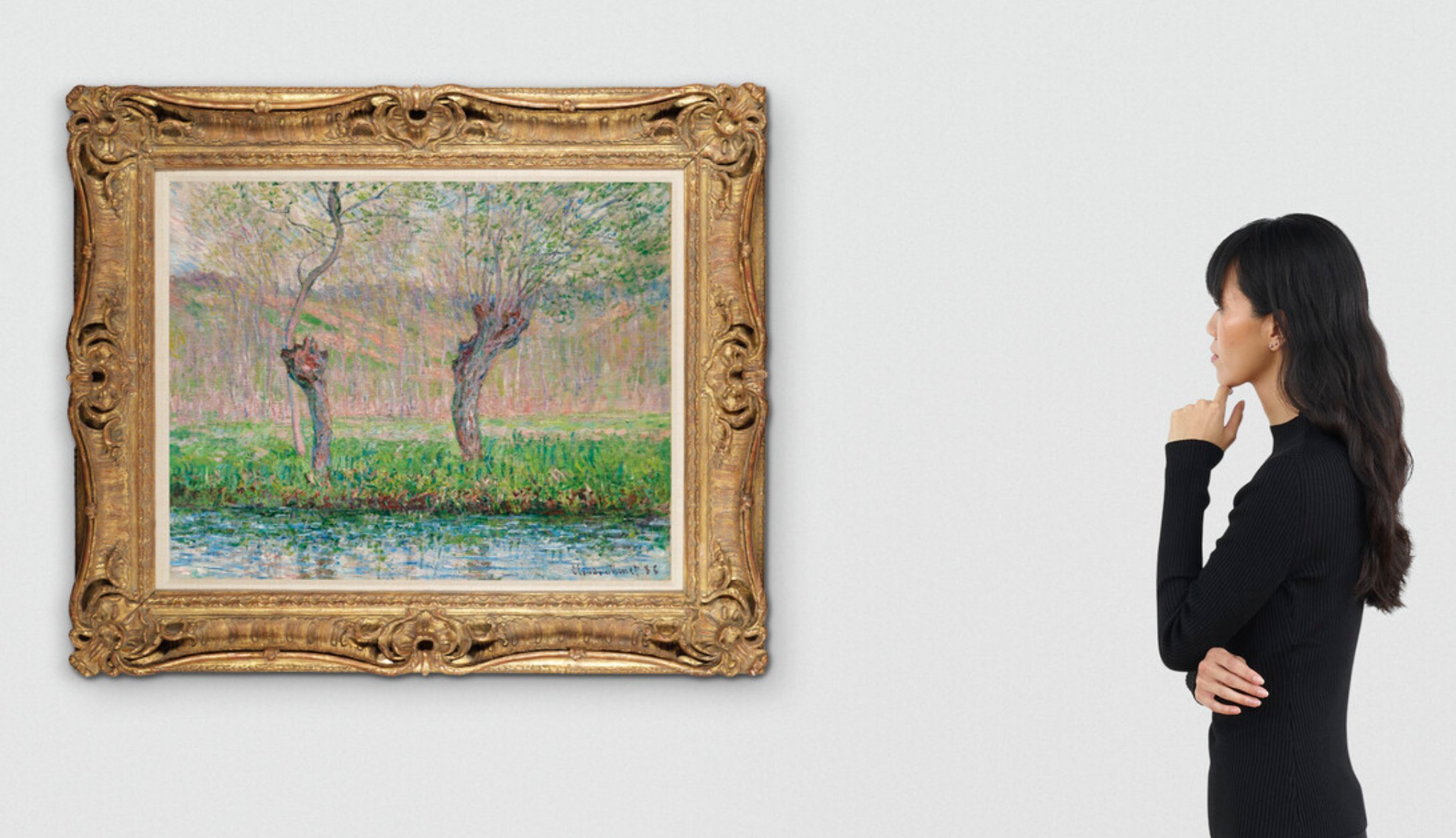
CLAUDE MONET (1840-1926)
Printemps, saules, 1885
Oil on canvas
65.3 x 81.6 cm (25 3/4 x 32 1/8 inches)
Signed and dated ‘Claude Monet 86’ (lower right)
#11. Waterloo Bridge, 1901
Christie’s London: 5 March 2025
Estimated: GBP 1,000,000 – 1,500,000
GBP 1,855,000 / USD 2,372,320
WORK ON PAPER
READ MORE IN FOCUS SECTION
CLAUDE MONET (1840-1926), Waterloo Bridge | Christie’s
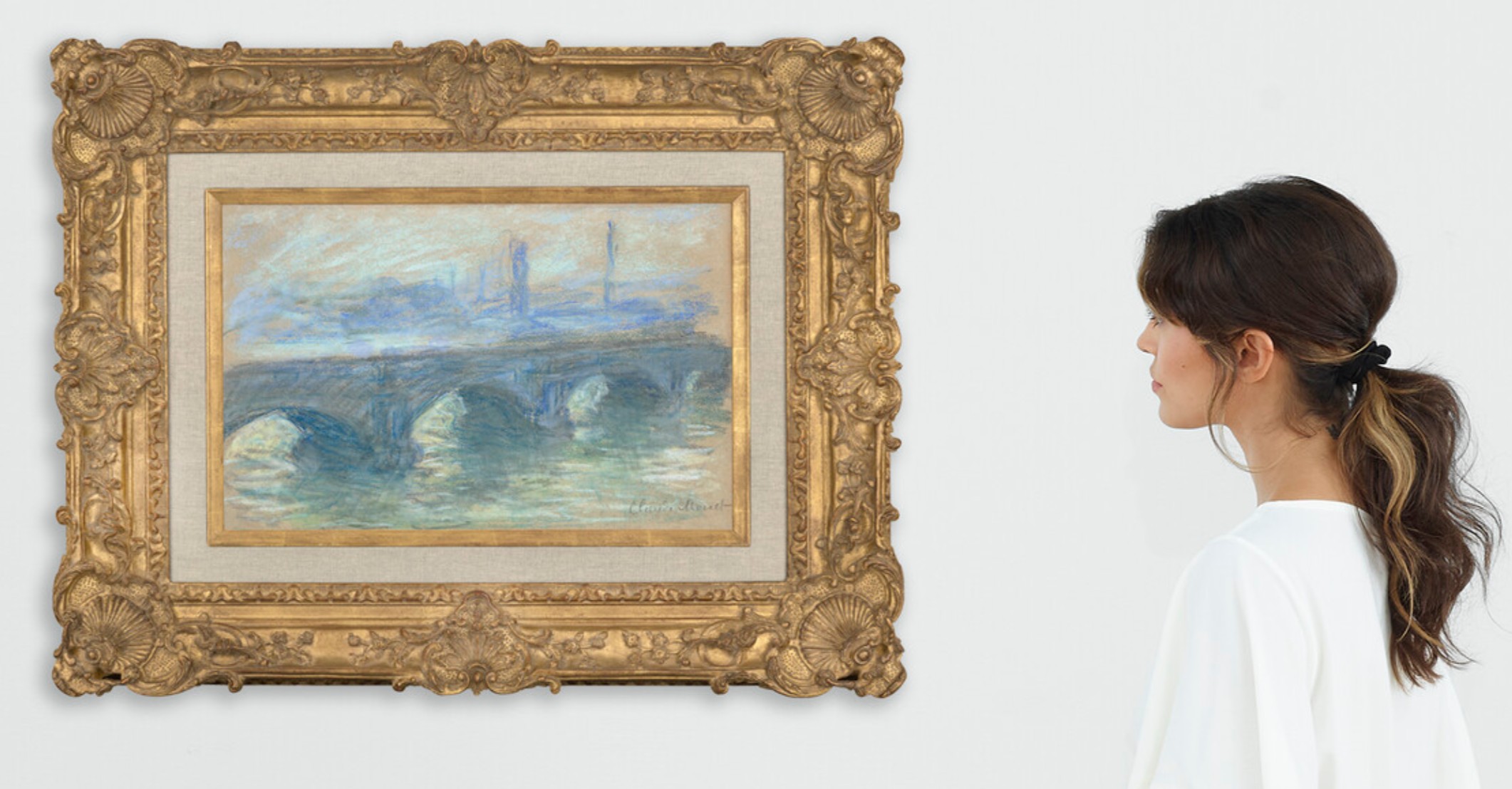
CLAUDE MONET (1840-1926)
Waterloo Bridge, 1901
Pastel on paper
31 x 48.6 cm (12 1/4 x 19 1/8 inches)
Signed ‘Claude Monet’ (lower right)
#12. La route de Giverny, 1885
Bonhams London: 16 October 2025
Estimated: GBP 1,500,000 – 2,000,000
GBP 1,742,400 / USD 2,335,385
Bonhams : CLAUDE MONET (1840-1926) La route de Giverny (Painted in 1885)
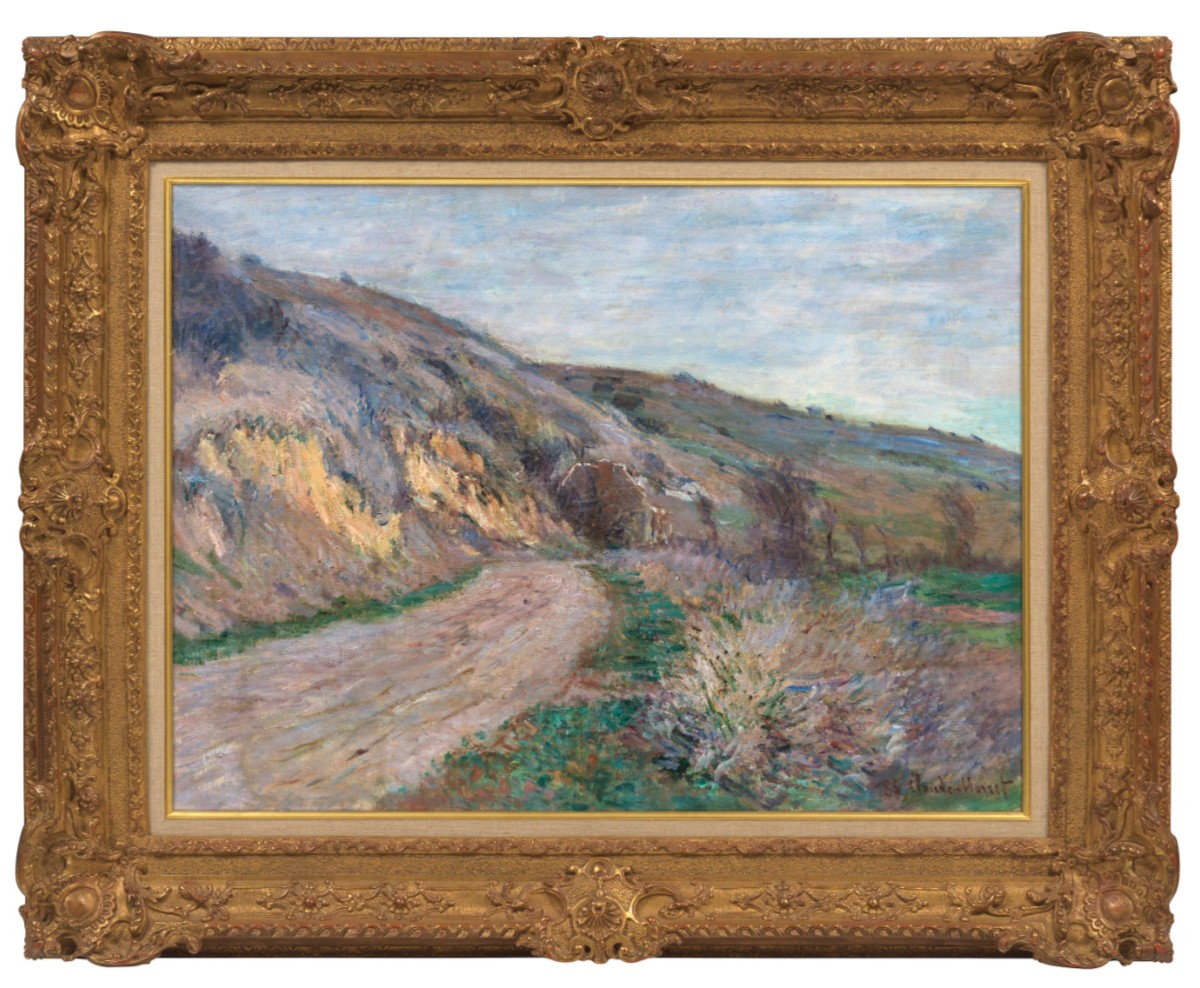
CLAUDE MONET (1840-1926)
La route de Giverny, 1885
Oil on canvas
60.4 x 81.4 cm (23 3/4 x 32 1/16 inches)
Signed and dated ’85 Claude Monet’ (lower right)
#13. Hiver à Giverny, 1886
Sotheby’s New-York: 21 November 2025
Estimated: USD 1,200,000 – 1,800,000
USD 1,636,000
Hiver à Giverny | Modern Day Auction | 2025 | Sotheby’s
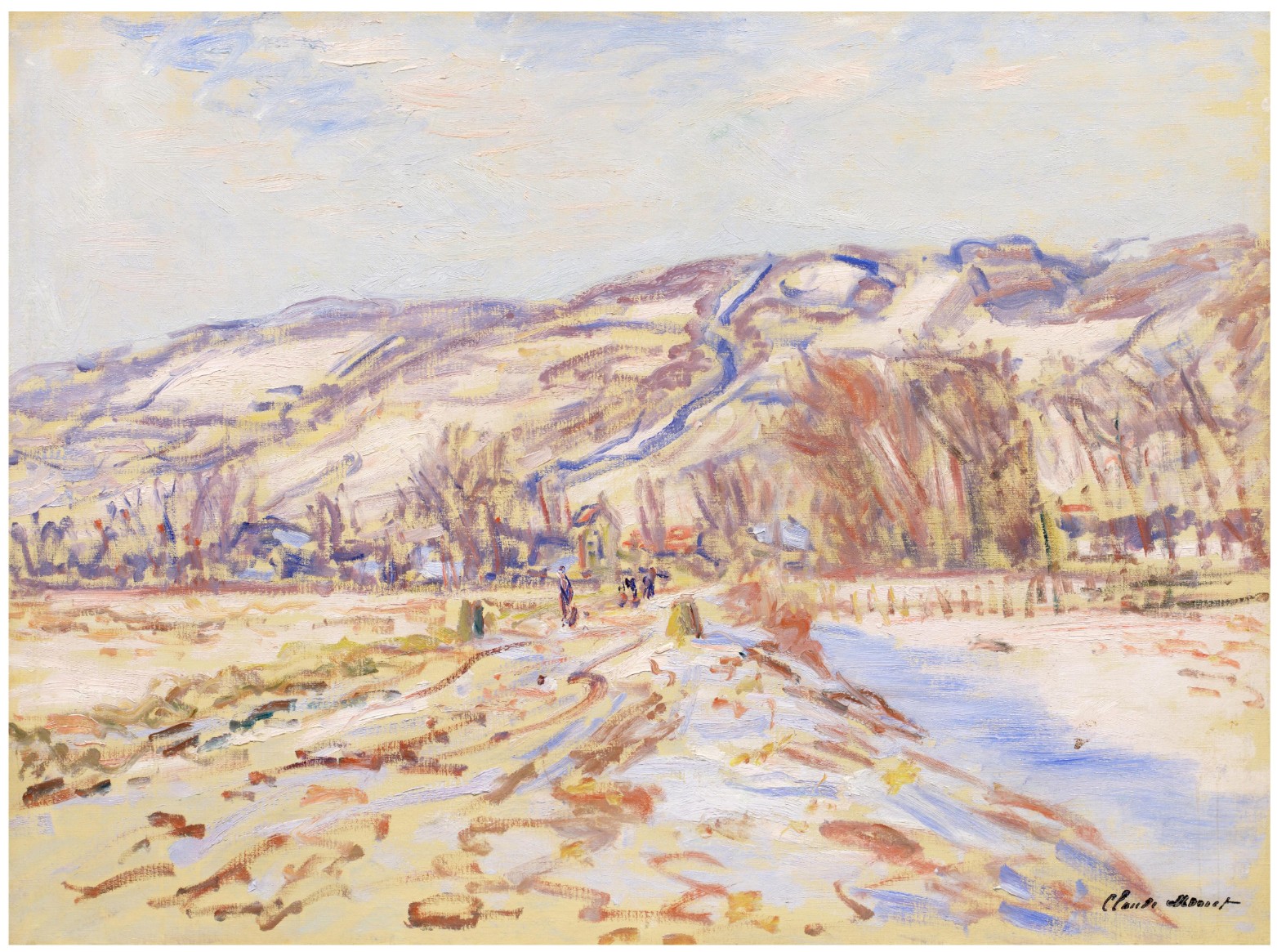
CLAUDE MONET (1840 – 1926)
Hiver à Giverny, 1886
Oil on canvas
60 x 81.6 cm (23 5/8 x 32 1/8 inches)
Stamped Claude Monet (lower right)
Stamped Claude Monet (on the reverse)
2024 Auction Results
24 lots sold at auction in 2024 for a total turnover of USD 287,357,783. With not lot failing to sell, the sell-through rate is 100%. Nympheas, a painting dated 1914-1917 sold at Sotheby’s in New-York on 18 November 2024 for USD 65,500,000, the highest price paid for a painting by Claude Monet in 2024.
2024 Top 3 Lots
8 lots sold for more than USD 10 million, generating a cumulative turnover of USD 207,971,958, representing 72.4% of the total turnover for 2024.
#1. Nymphéas, circa 1914-17
Sotheby’s New-York: 18 November 2024
Estimate on Request
USD 65,500,000
READ MORE IN FOCUS SECTION
Nymphéas | A Legacy of Beauty: The Collection of Sydell Miller Evening Auction | 2024 | Sotheby’s
CLAUDE MONET (1840 – 1926)
Nymphéas, circa 1914-17
Oil on canvas
175 x 135.4 cm (68 7/8 x 53 3/8 inches)
Stamped with the signature Claude Monet (on the reverse)
Stamped again (on the stretcher)
#2. Meules à Giverny, 1893
Sotheby’s New-York: 15 May 2024
Estimate on Request
USD 34,804,500
READ MORE IN FOCUS SECTION
Meules à Giverny | Modern Evening Auction | 2024 | Sotheby’s (sothebys.com)
GUARANTEED

CLAUDE MONET (1840 – 1926)
Meules à Giverny, 1893
Oil on canvas
65.5 x 100.2 cm (25 7/8 x 39 1/2 inches)
Signed Claude Monet and dated 93 (lower right)
#3. Nymphéas, circa 1897-1899
Christie’s Hong-Kong: 26 September 2024
Estimated: HKD 200,000,000 – 280,000,000
HKD 233,375,000 / USD 29,973,518
READ MORE IN FOCUS SECTION
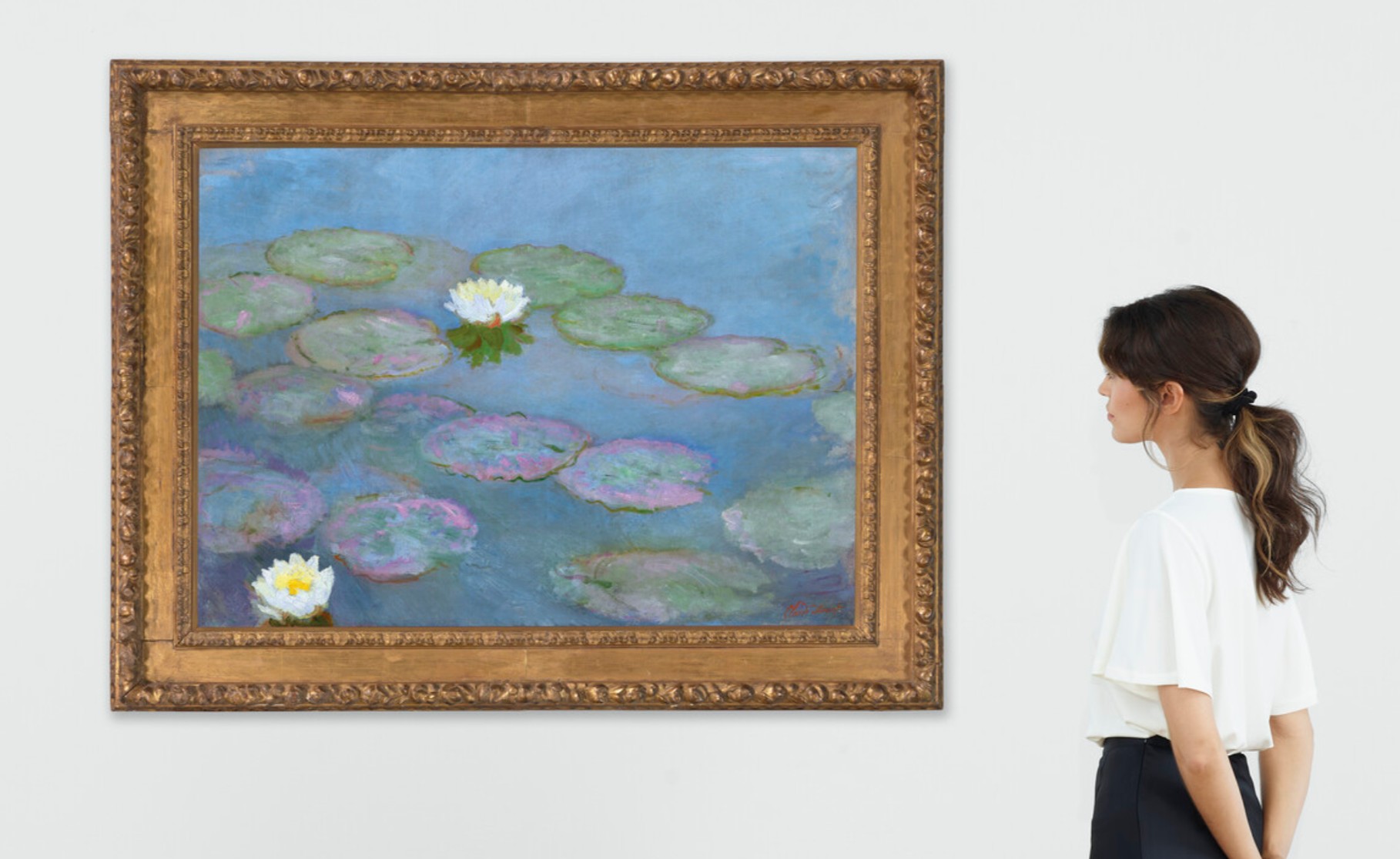
CLAUDE MONET (1840 – 1926)
Nymphéas, circa 1897-1899
Oil on canvas
73.3 x 101 cm (28 7/8 x 39 3/4 inches)
Stamped with signature ‘Claude Monet’ (Lugt 1819b; lower right)
Stamped again with signature ‘Claude Monet’ (Lugt 1819b; on the reverse)
#4. Moulin de Limetz, 1888
Christie’s New-York: 16 May 2024
Estimated: USD 18,000,000 – 25,000,000
USD 21,685,000
READ MORE IN FOCUS SECTION
CLAUDE MONET (1840-1926), Moulin de Limetz | Christie’s (christies.com)
GUARANTEED

CLAUDE MONET (1840-1926)
Moulin de Limetz, 1888
Oil on canvas
92.5 x 72.8 cm (36 3/8 x 28 5/8 inches)
Signed and dated ‘Claude Monet 88’ (lower left)
#5. Matinée sur la Seine, temps net, 1897
Christie’s London: 7 March 2024
Estimated: GBP 12,000,000 – 18,000,000
GBP 14,397,500 / USD 18,256,030
READ MORE IN FOCUS SECTION
CLAUDE MONET (1840-1926), Matinée sur la Seine, temps net | Christie’s (christies.com)
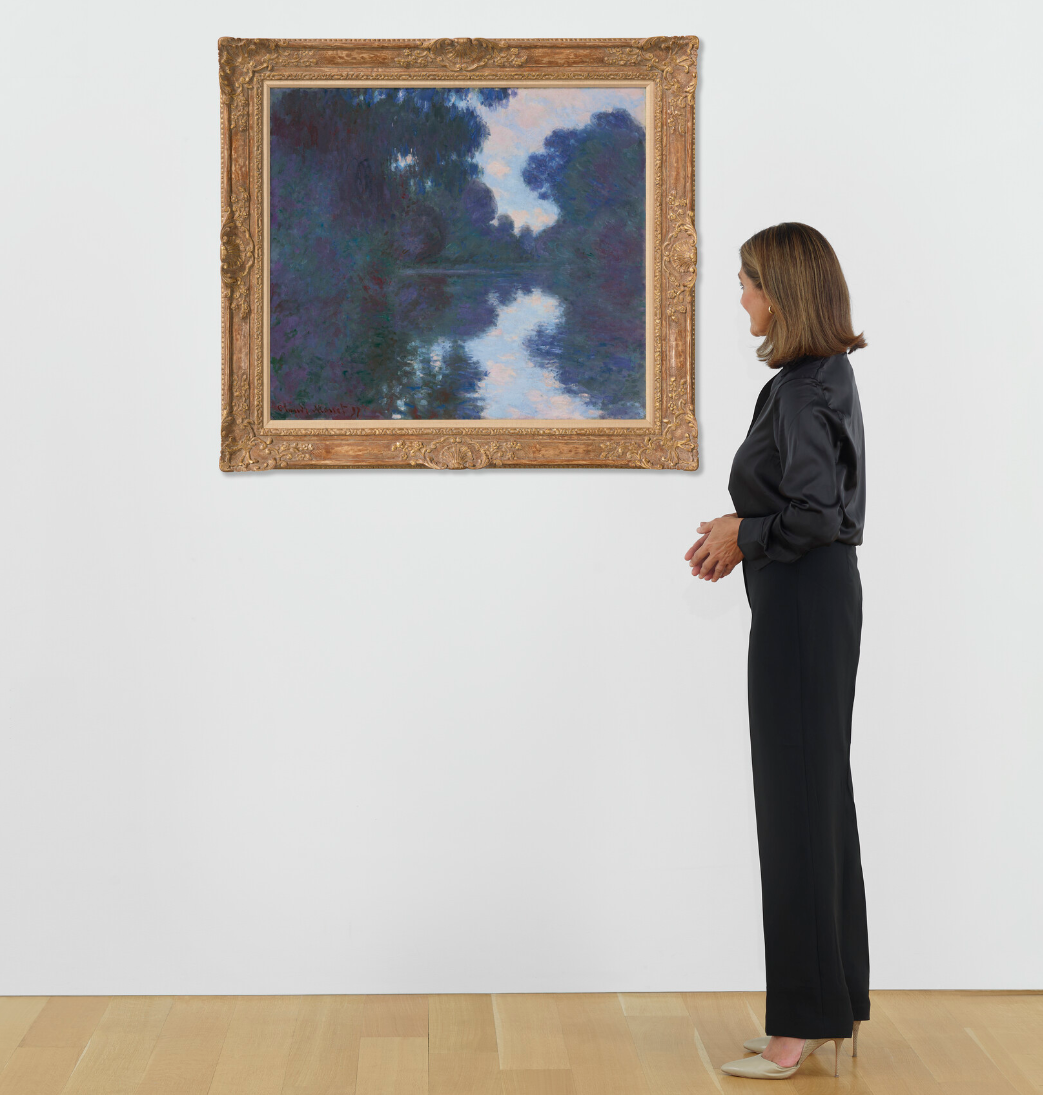
CLAUDE MONET (1840-1926)
Matinée sur la Seine, temps net, 1897
Oil on canvas
81.6 x 92.4 cm (32 1/8 x 36 3/8 inches)
Signed and dated ‘Claude Monet 97’ (lower left)
#6. Antibes vue de la Salis, 1888
Sotheby’s New-York: 15 May 2024
Estimated: USD 12,000,000 – 18,000,000
USD 14,122,500
Antibes vue de la Salis | Modern Evening Auction | 2024 | Sotheby’s (sothebys.com)

CLAUDE MONET (1840 – 1926)
Antibes vue de la Salis, 1888
Oil on canvas
65.5 x 91 cm (25 3/4 x 35 7/8 inches)
Signed Claude Monet and dated 88 (lower right)
#7. Saint-Georges Majeur, 1908
Christie’s New-York: 16 May 2024
Estimated: USD 12,000,000 – 18,000,000
USD 13,635,000
CLAUDE MONET (1840-1926), Saint-Georges Majeur | Christie’s
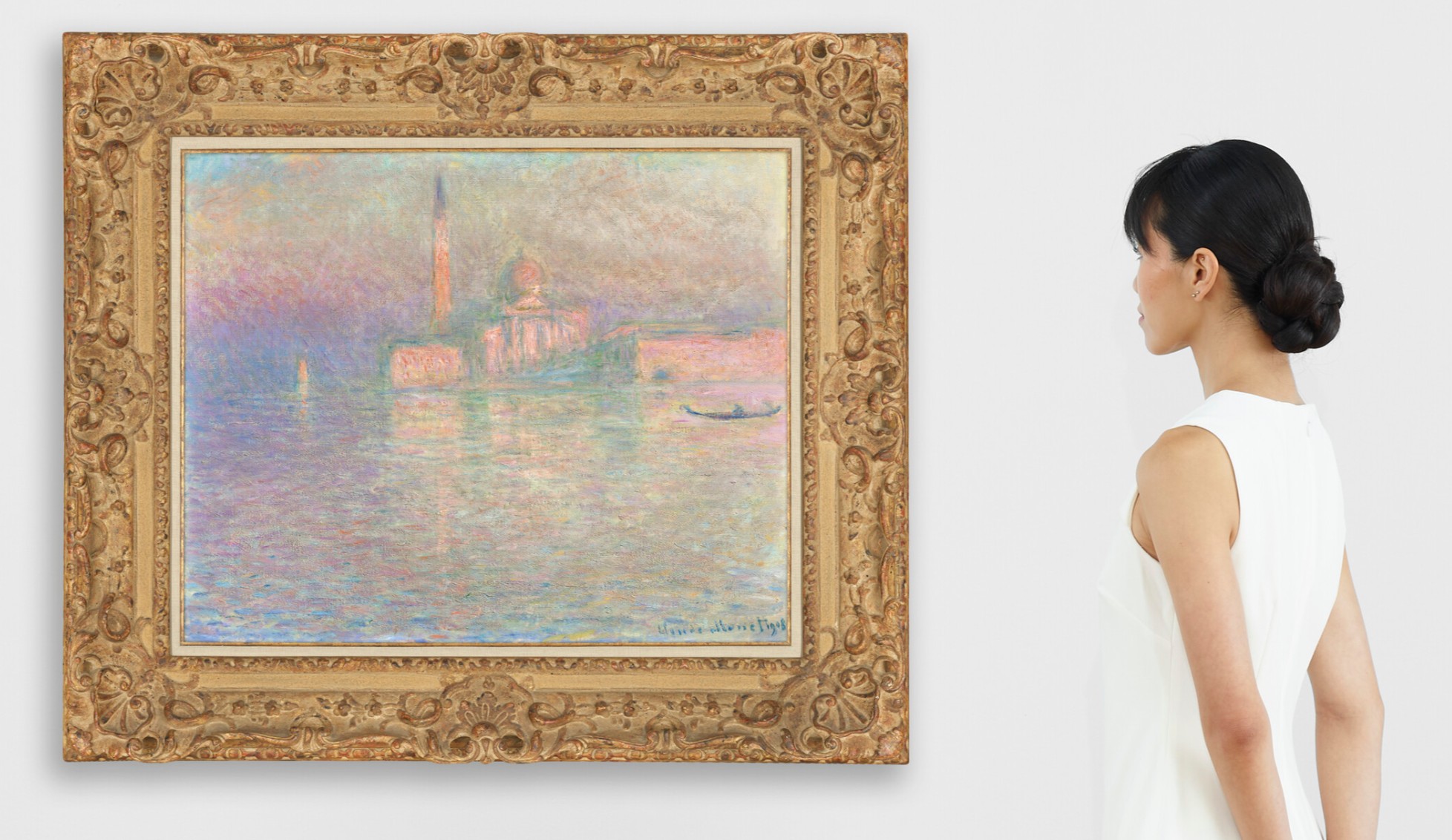
CLAUDE MONET (1840-1926)
Saint-Georges Majeur, 1908
Oil on canvas
59.9 x 73.2 cm (23 5/8 x 28 7/8 inches)
Signed and dated ‘Claude Monet 1908’ (lower right)
#8. La Roche Guibel, Port-Domois, 1886
Christie’s New-York: 16 May 2024
Estimated: USD 6,000,000 – 8,000,000
USD 10,185,000
CLAUDE MONET (1840-1926), La Roche Guibel, Port-Domois | Christie’s
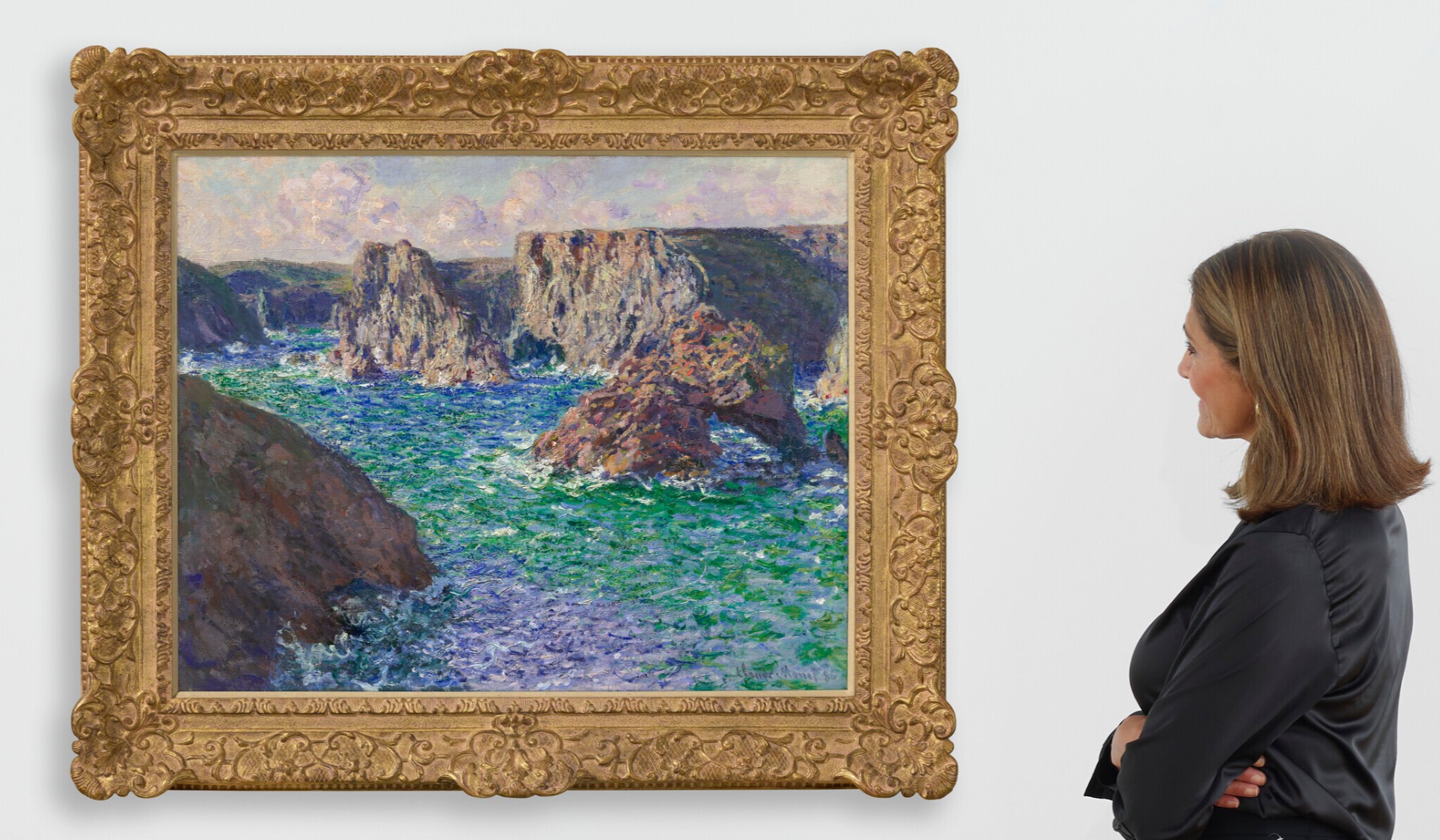
CLAUDE MONET (1840-1926)
La Roche Guibel, Port-Domois, 1886
Oil on canvas
66.7 x 82.5 cm (26 1/4 x 32 1/2 inches)
Signed and dated ‘Claude Monet 86’ (lower right)
USD 10 million
#9. Arbres au bord de l’eau, printemps à Giverny, 1885
Sotheby’s London: 6 March 2024
Estimated: GBP 5,000,000 – 7,000,000
GBP 7,748,300 / USD 9,843,980
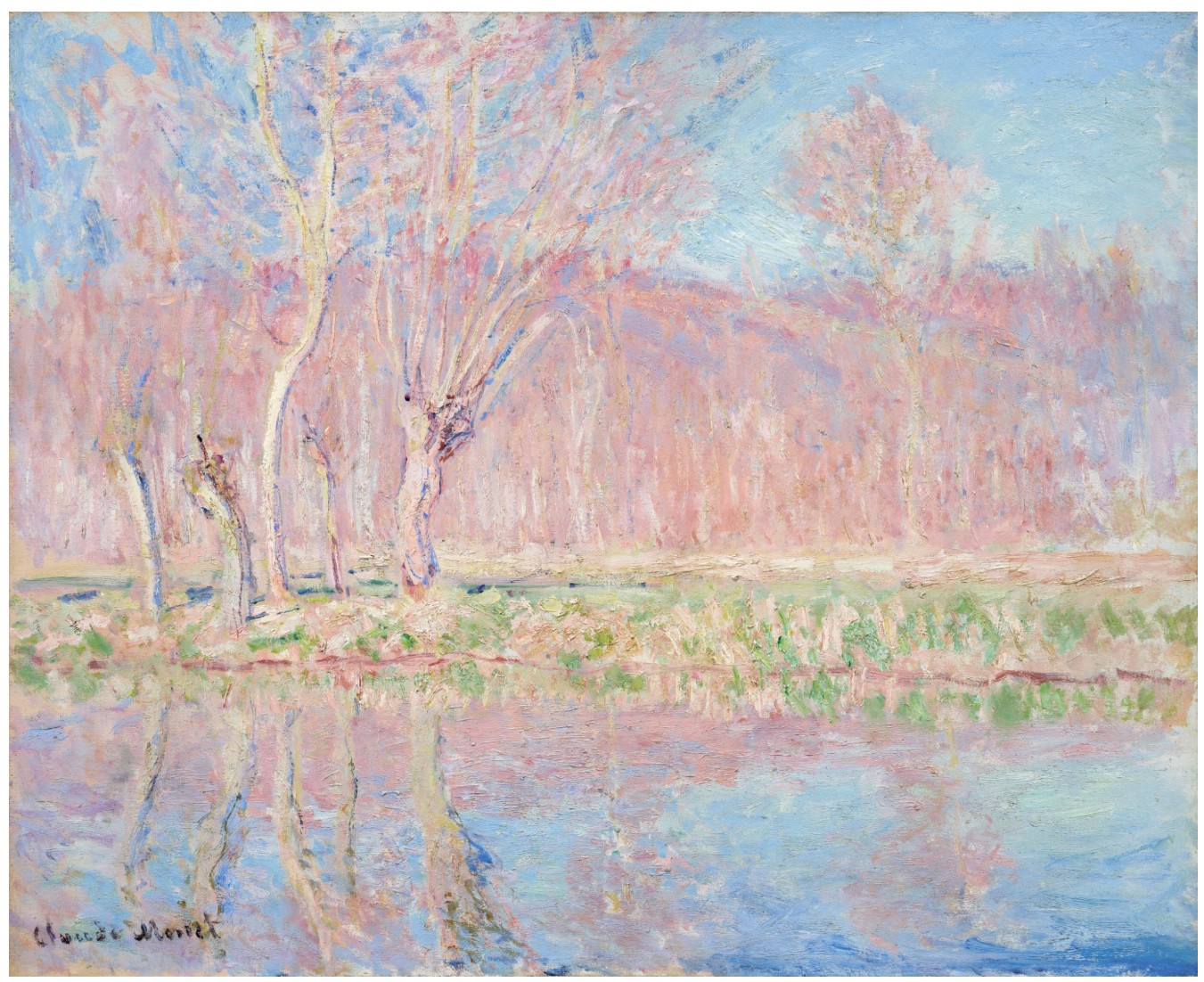
CLAUDE MONET (1840 – 1926)
Arbres au bord de l’eau, printemps à Giverny, 1885
Oil on canvas
81×100 cm (31×39 inches)
Signed Claude Monet (lower left)
#10. Route près de Giverny, 1885
Christie’s New-York: 19 November 2024
Estimated: USD 7,000,000 – 10,000,000
USD 9,035,000
CLAUDE MONET (1840-1926), Route près de Giverny | Christie’s
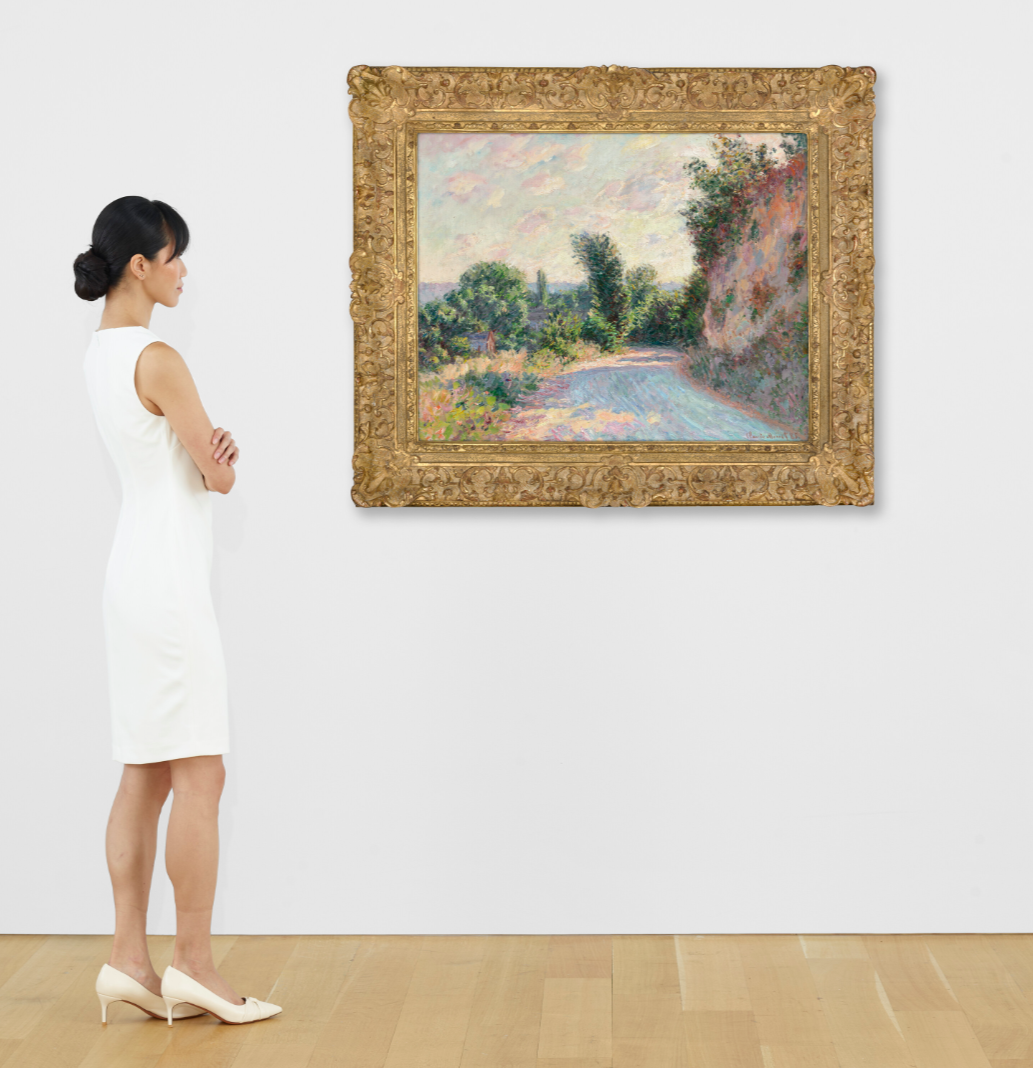
CLAUDE MONET (1840-1926)
Route près de Giverny, 1885
Oil on canvas
65.5 x 81.2 cm (25 3/4 x 32 inches)
Signed and dated ‘Claude Monet 85’ (lower right)
#11. Pommiers en fleurs, 1872
Christie’s New-York: 19 November 2024
Estimated: USD 7,000,000 – 10,000,000
USD 9,035,000
CLAUDE MONET (1840-1926), Pommiers en fleurs | Christie’s
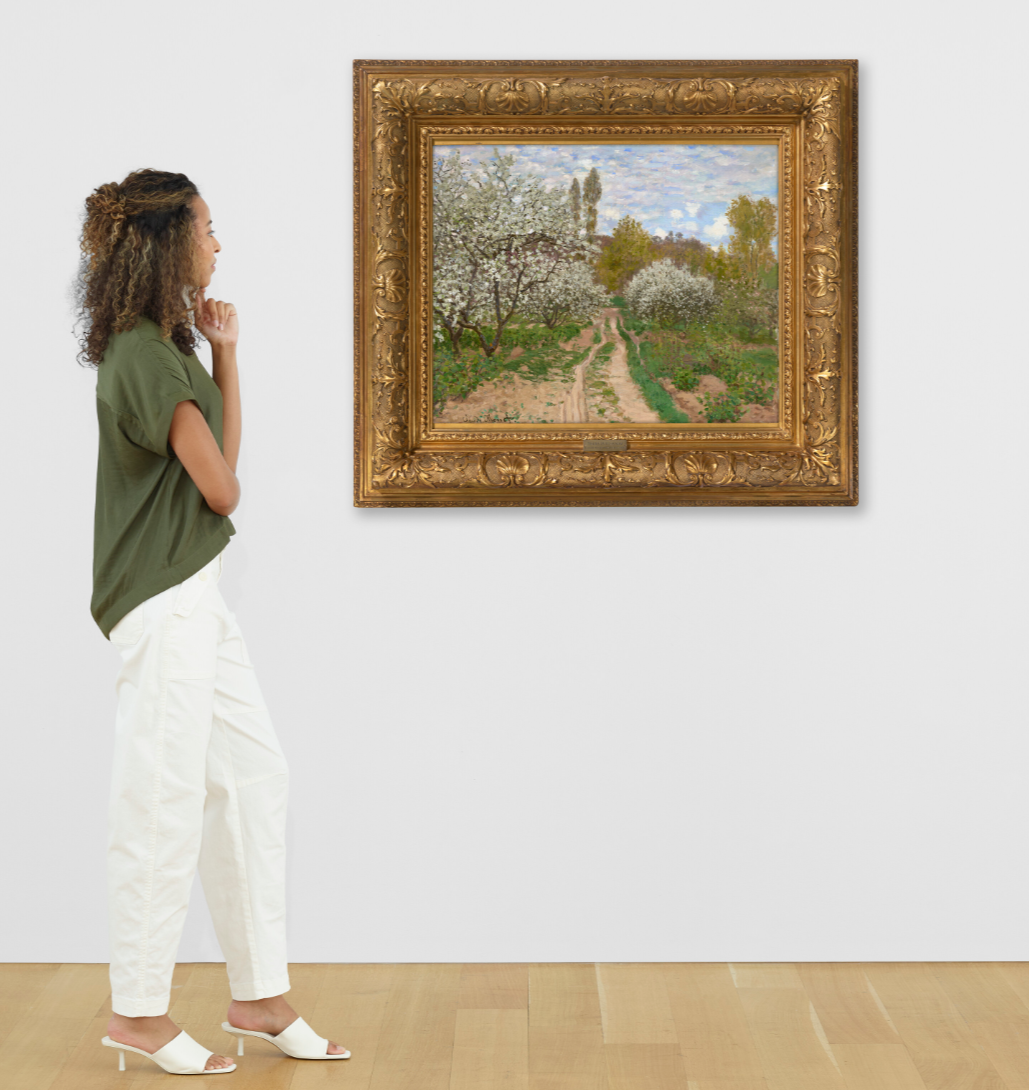
CLAUDE MONET (1840-1926)
Pommiers en fleurs, 1872
Oil on canvas
59.3 x 73.7 cm (23 3/8 x 29 inches)
Signed ‘Claude Monet.’ (lower left)
Painted in Argenteuil in 1872
#12. Prairie fleurie à Giverny, 1890
Christie’s London: 7 March 2024
Estimated: GBP 5,500,000 – 8,500,000
GBP 6,290,000 / USD 8,010,850
CLAUDE MONET (1840-1926), Prairie fleurie à Giverny | Christie’s
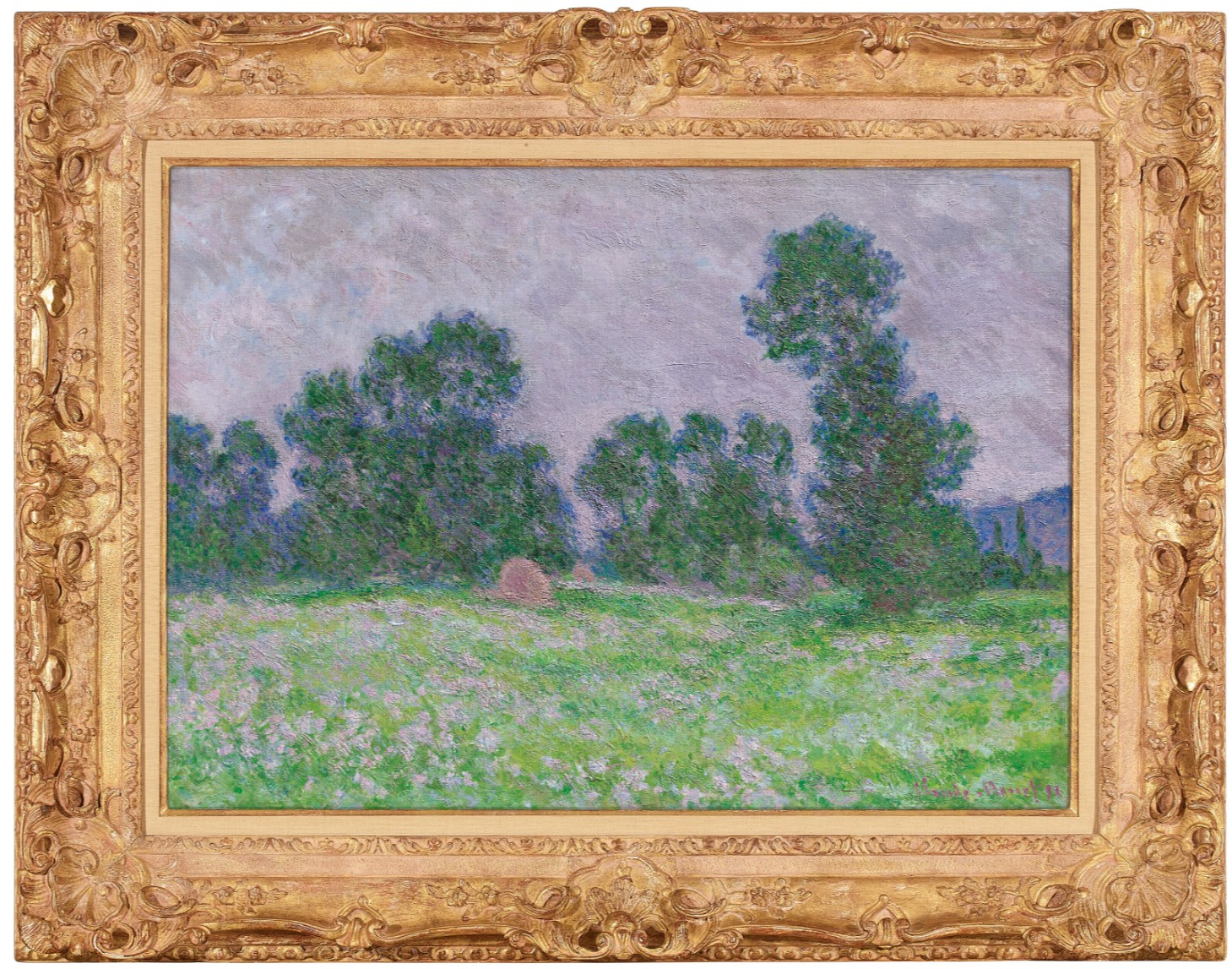
CLAUDE MONET (1840-1926)
Prairie fleurie à Giverny, 1890
Oil on canvas
65×92 cm (25 1/2 x 36 1/4 inches)
Signed and dated ‘Claude Monet 90’ (lower right)
#13. Route de Monte-Carlo, 1883
Sotheby’s Hong-Kong: 5 April 2024
Estimated: HKD 45,000,000 – 65,000,000
HKD 61,489,000 / USD 7,861,033

CLAUDE MONET (1840 – 1926)
Route de Monte-Carlo, 1883
Oil on canvas
65.7 x 80.6 cm (25 7/8 x 31 3/4 inches)
Signed Claude Monet and dated 84 (lower left)
#14. Bennecourt, 1887
Sotheby’s New-York: 15 May 2024
Estimated: USD 6,000,000 – 8,000,000
USD 6,883,800
Bennecourt | Modern Evening Auction | 2024 | Sotheby’s
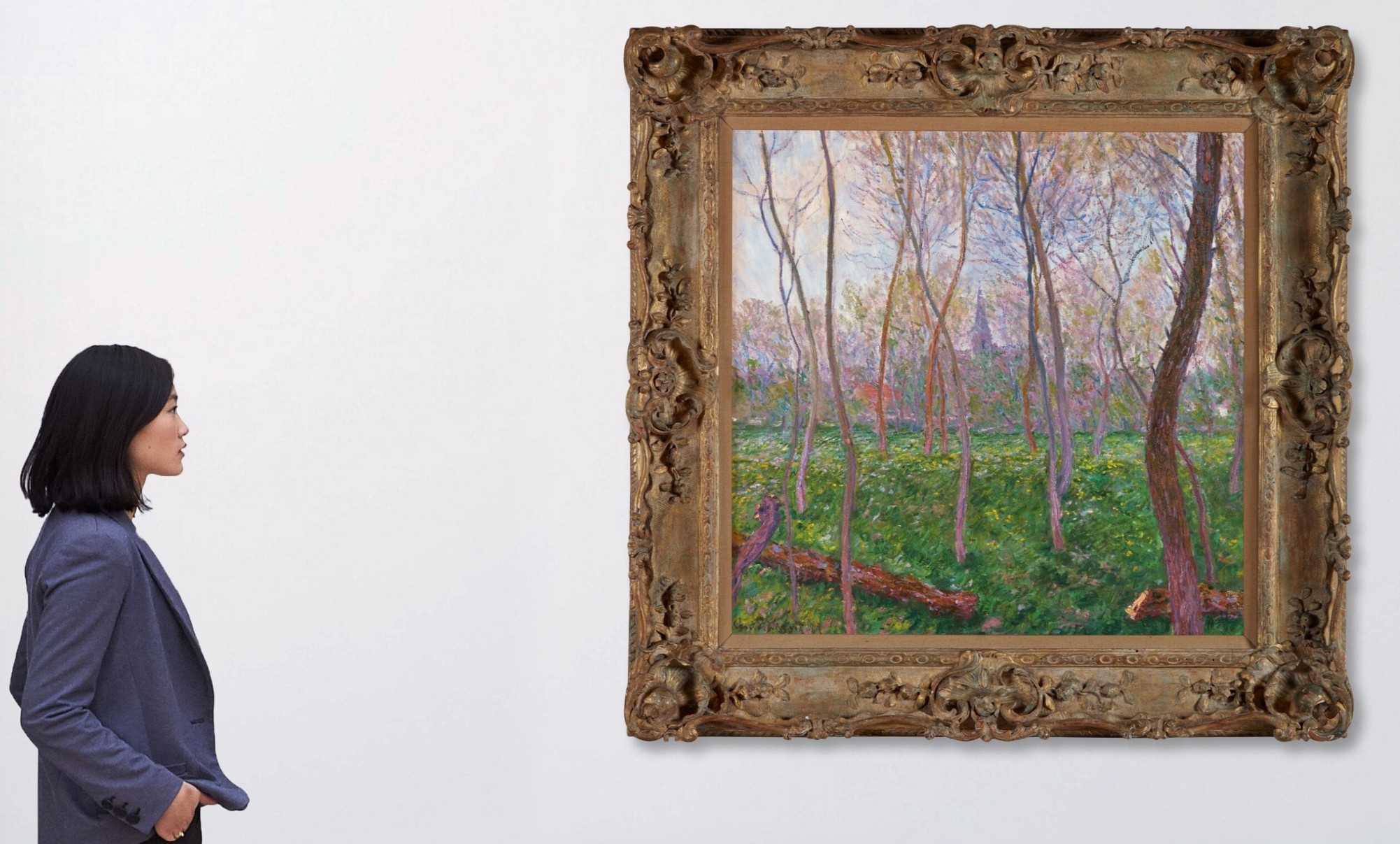
CLAUDE MONET (1840 – 1926)
Bennecourt, 1887
Oil on canvas
81.8 x 82.5 cm (32 1/4 x 32 1/2 inches)
Signed Claude Monet and dated 87 (lower left)
#15. La Seine à Lavacourt, débâcle, 1880
Christie’s New-York: 19 November 2024
Estimated: UD 4,000,000 – 6,000,000
USD 4,890,000
CLAUDE MONET (1840-1926), La Seine à Lavacourt, débâcle | Christie’s
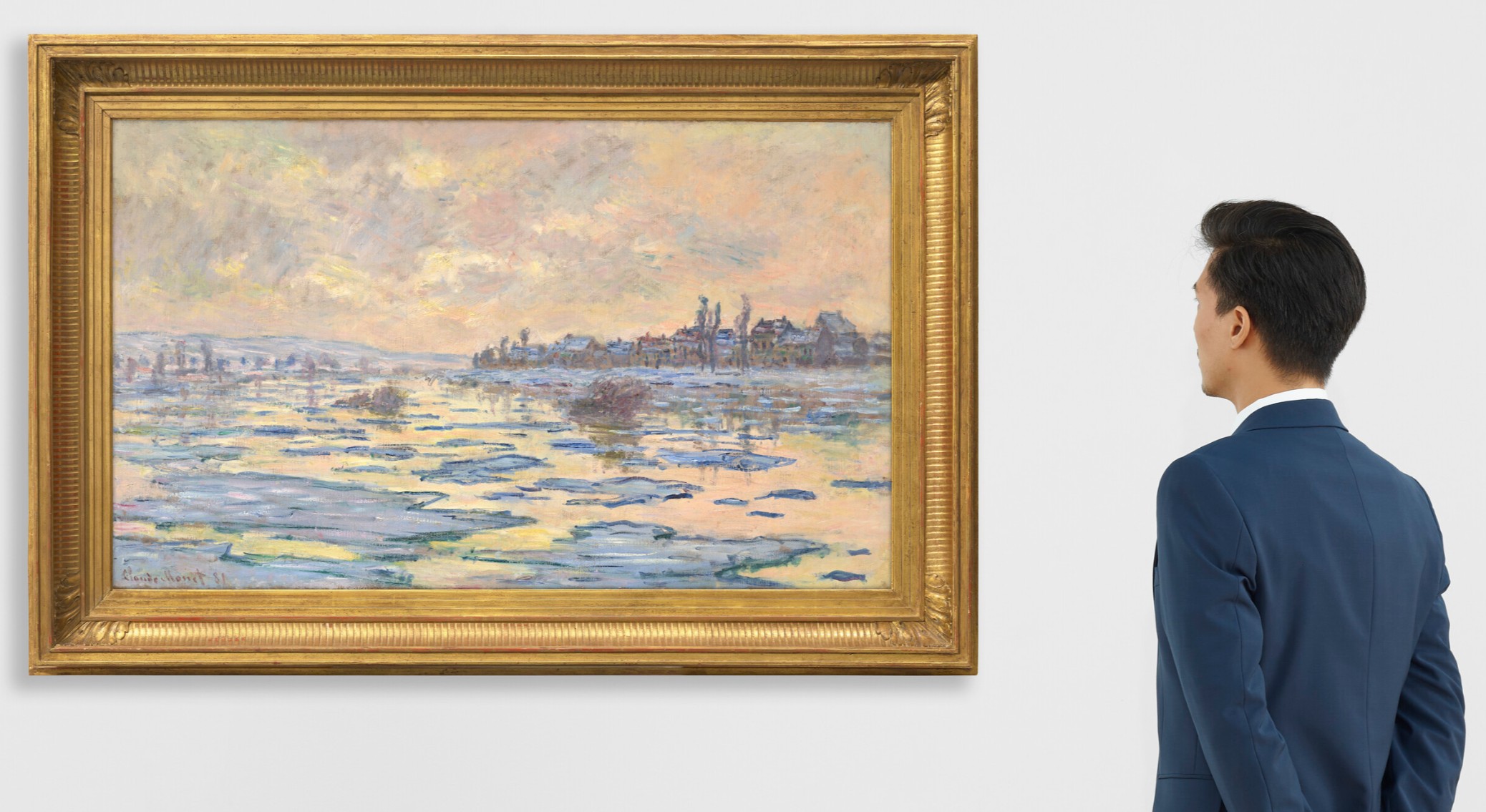
CLAUDE MONET (1840-1926)
La Seine à Lavacourt, débâcle, 1880
Oil on canvas
60.4 x 99.4 cm (23 3/4 x 39 1/8 inches)
Signed and dated ‘Claude Monet 81’ (lower left)
#16. Vue de la tour Montalban, Amsterdam, 1874
Sotheby’s New-York: 15 May 2024
Estimated: USD 4,000,000 – 6,000,000
USD 4,658,000
Vue de la tour Montalban, Amsterdam | Modern Evening Auction | 2024 | Sotheby’s
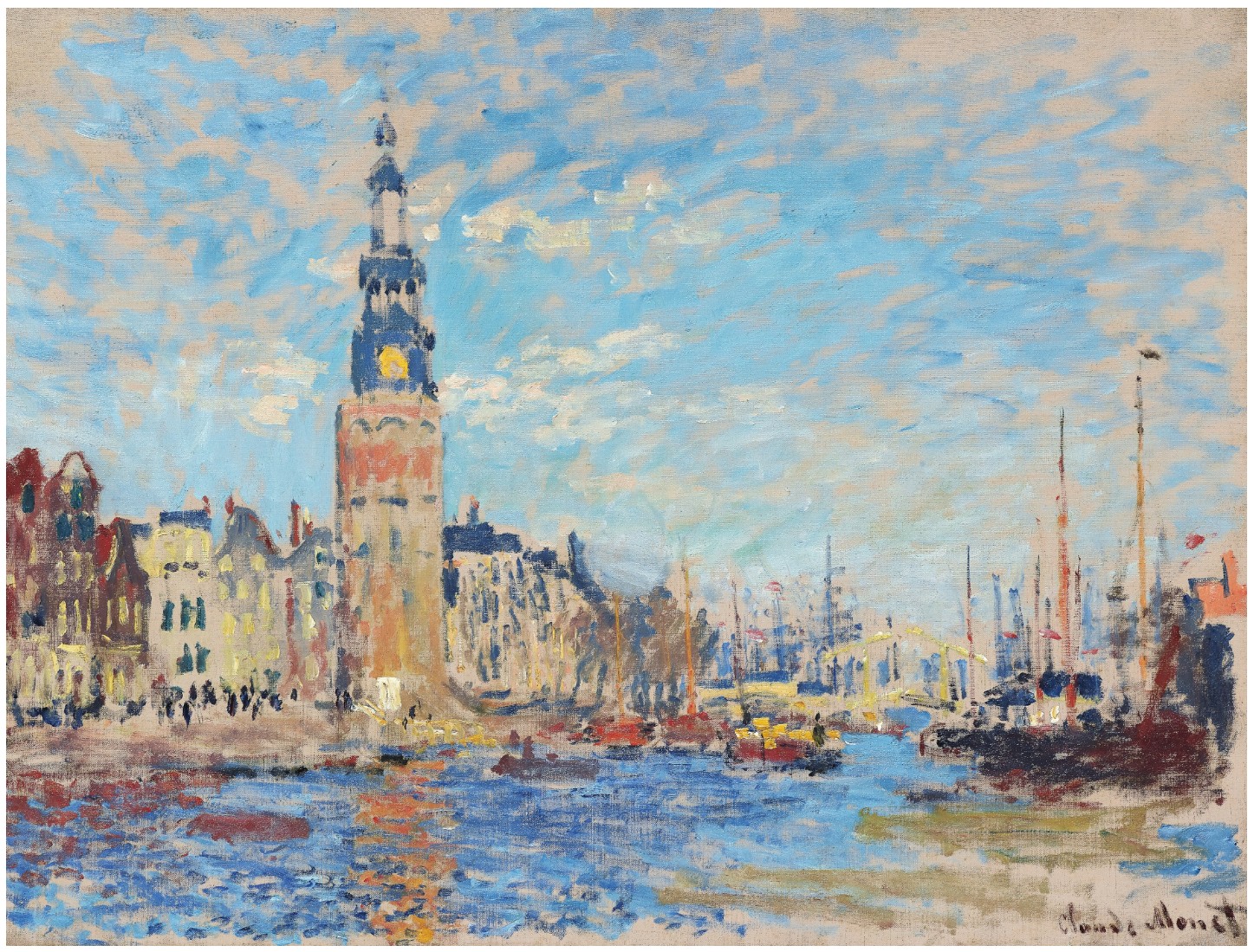
CLAUDE MONET (1840 – 1926)
Vue de la tour Montalban, Amsterdam, 1874
Oil on canvas
61.2 x 81.7 cm (24 1/8 x 32 1/4 inches)
Signed Claude Monet (lower right)
#17. Glaçons, environs de Bennecourt, 1893
Sotheby’s London: 6 March 2024
Estimated: GBP 2,500,000 – 3,500,000
GBP 3,133,500 / USD 3,981,015
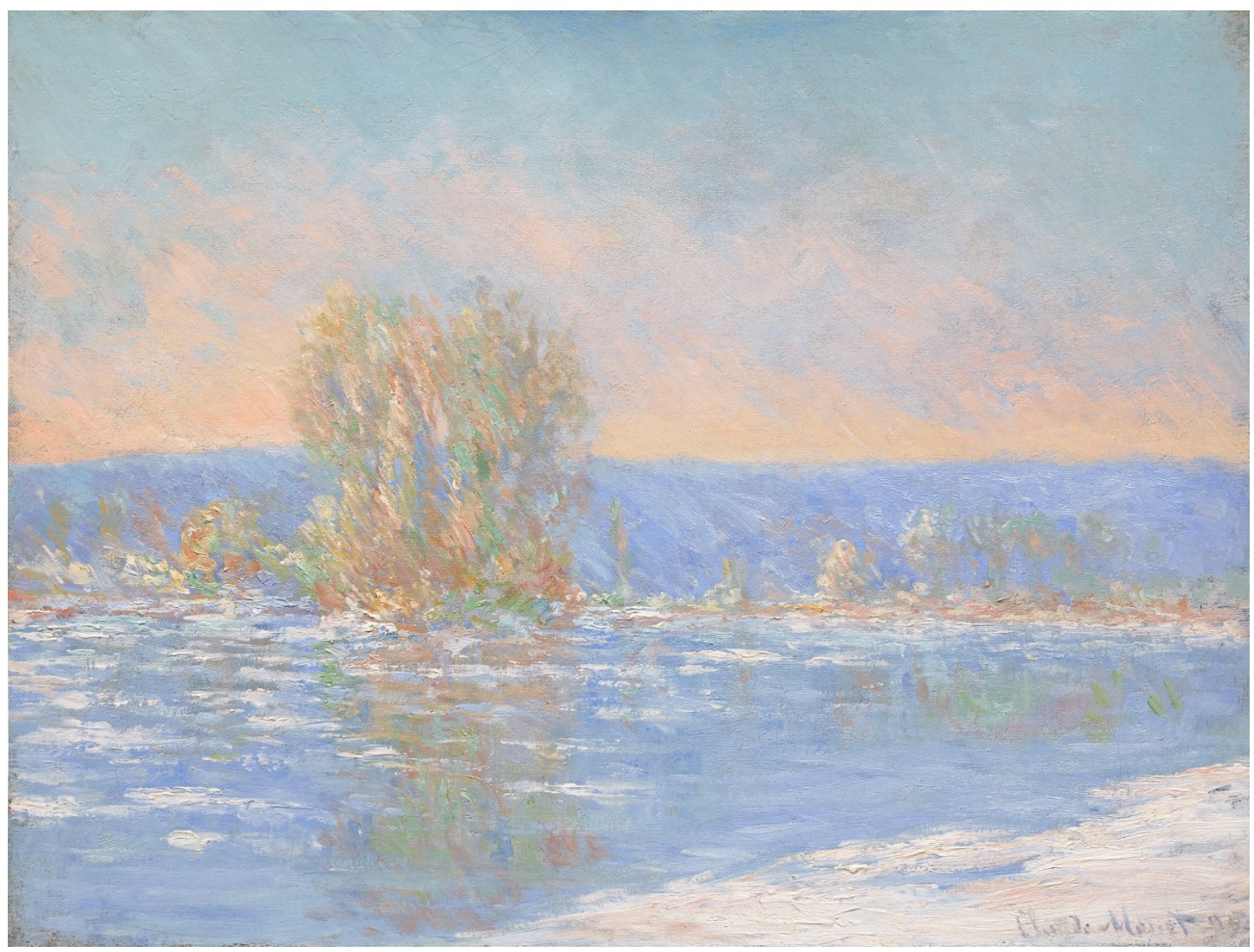
CLAUDE MONET (1840 – 1926)
Glaçons, environs de Bennecourt, 1893
Oil on canvas
40.5 x 54 cm (15 7/8 x 21 1/4 inches)
Signed Claude Monet and dated 93 (lower right)
#18. Mer agitée à Pourville, 1882
Lempertz Cologne: 29 November 2024
Estimated: EUR 3,000,000 – 4,000,000
EUR 3,036,000 / USD 3,206,095
Mer agitée à Pourville – Lot 16
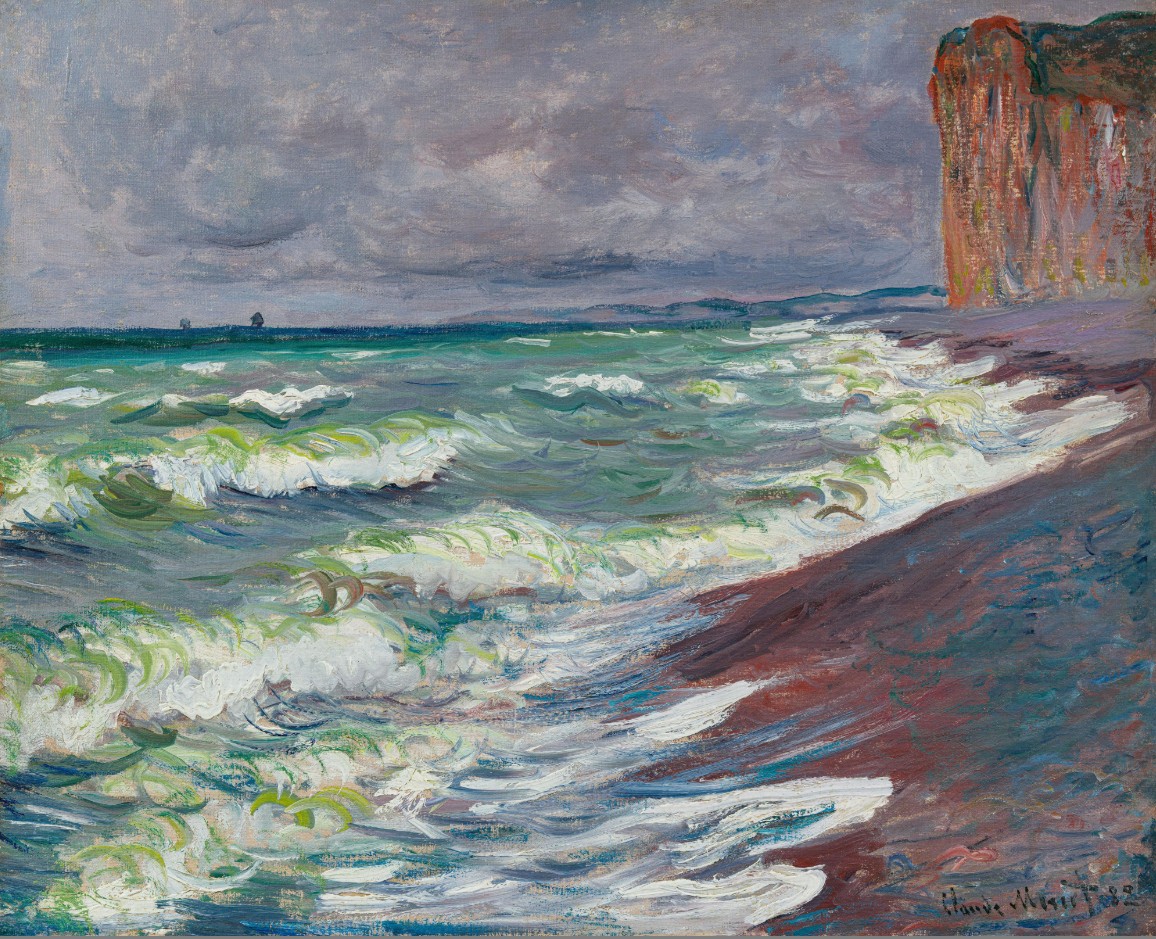
CLAUDE MONET
Mer agitée à Pourville, 1882
Oil on canvas
59.5 x 73.5 cm (23 4/8 x 29 inches)
Signed and dated ‘Claude Monet 82’ lower right in black
#19. Inondation à Giverny, 1886
Sotheby’s Hong-Kong: 5 April 2024
Estimated: HKD 15,500,000 – 20,000,000
HKD 20,415,000 / USD 2,607,895
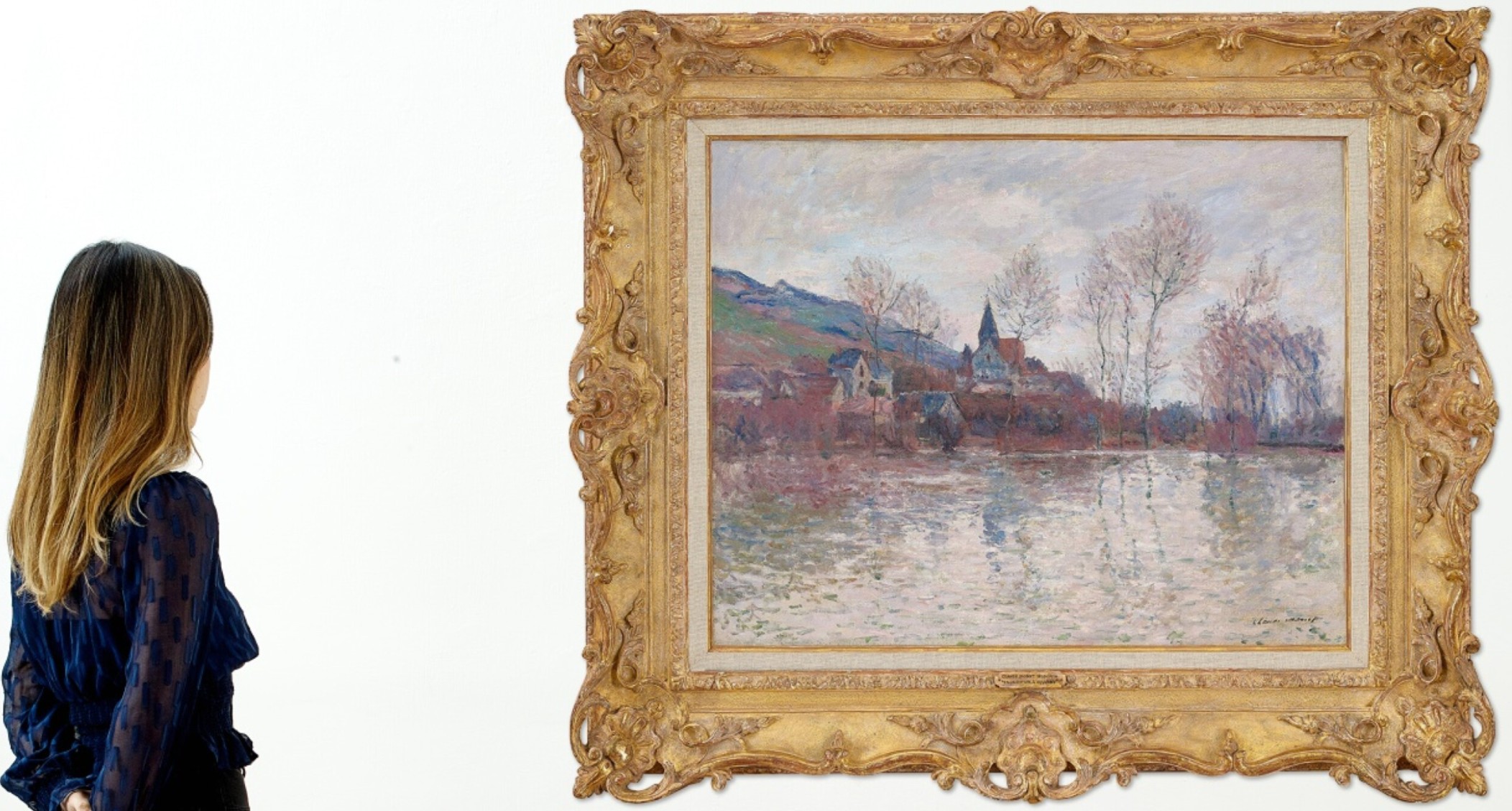
CLAUDE MONET (1840 – 1926)
Inondation à Giverny, 1886
Oil on canvas
65 x 81.3 cm (25 5/8 x 32 inches)
Stamped with signature Claude Monet (lower right)
#20. Le Fjord de Christiania (Oslo), 1895
Christie’s New-York: 16 May 2024
Estimated: UD 3,000,000 – 5,000,000
USD 2,470,000
CLAUDE MONET (1840-1926), Le Fjord de Christiania (Oslo) | Christie’s
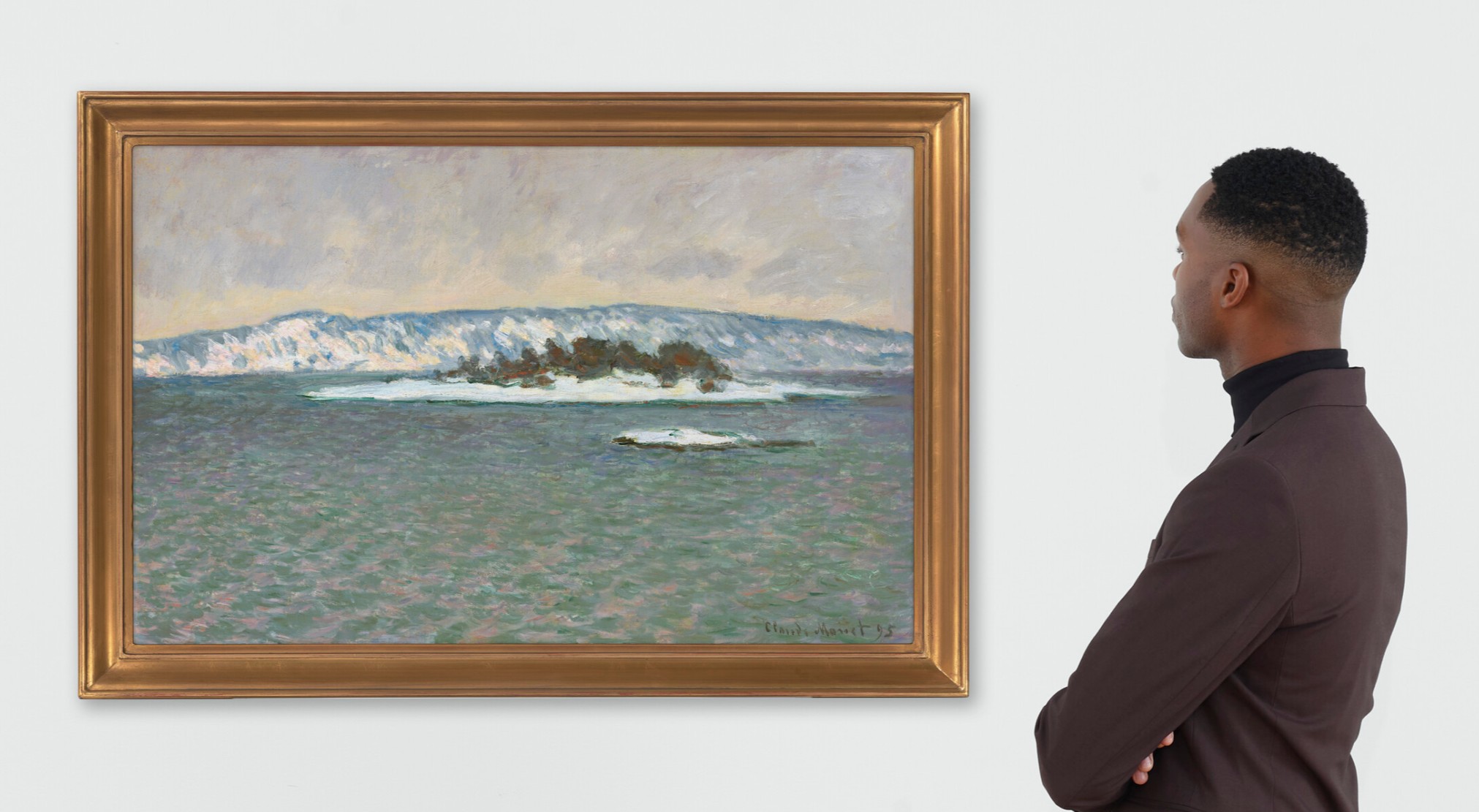
CLAUDE MONET (1840-1926)
Le Fjord de Christiania (Oslo), 1895
Oil on canvas
65.2 x 101 cm (25 5/8 x 39 3/4 inches)
Signed and dated ‘Claude Monet 95’ (lower right)
#21. L’église de Vernon, 1894
Christie’s New-York: 16 May 2024
Estimated: UD 2,500,000 – 3,500,000
USD 2,288,500
CLAUDE MONET (1840-1926), L’église de Vernon | Christie’s
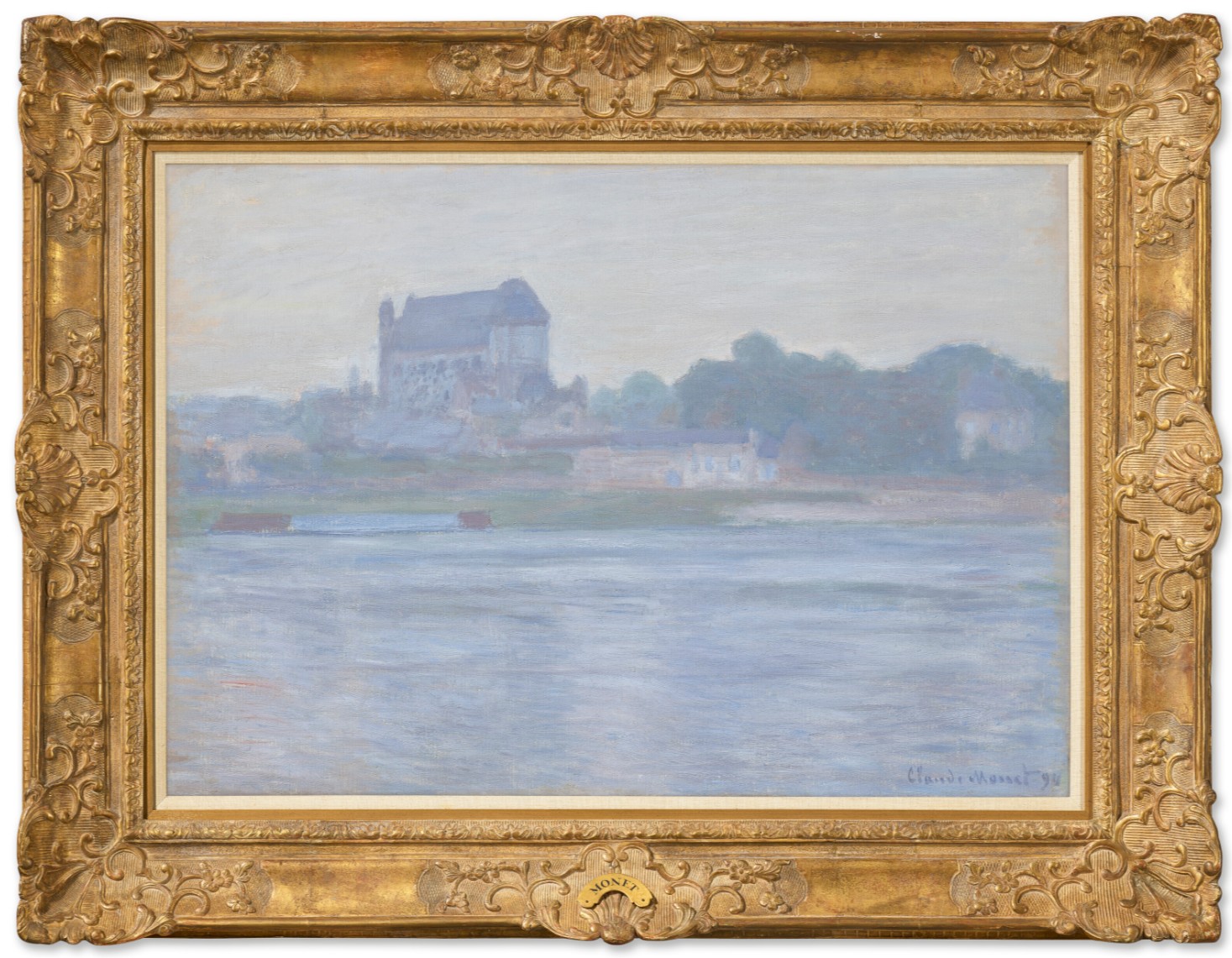
CLAUDE MONET (1840-1926)
L’église de Vernon, 1894
Oil on canvas
66 x 93.2 cm (26 x 36 3/4 inches)
Signed and dated ‘Claude Monet 94’ (lower right)
#22. Prairie à Giverny, 1886
Christie’s New-York: 18 May 2024
Estimated: USD 2,000,000 – 3,000,000
USD 2,228,000
CLAUDE MONET (1840-1926), Prairie à Giverny | Christie’s (christies.com)

CLAUDE MONET (1840-1926)
Prairie à Giverny, 1886
Oil on canvas
92.7 x 81.3 cm (36 1/2 x 32 inches)
Signed and dated ‘Claude Monet 86’ (lower left)
#23. Paysage, bord de la Seine, près de Jeufosse (Eure), 1884
Sotheby’s New-York: 18 November 2024
Estimated: USD 700,000 – 1,000,000
USD 960,000
WORK ON PAPER
Paysage, bord de la Seine, près de Jeufosse (Eure) | Modern Evening Auction | 2024 | Sotheby’s
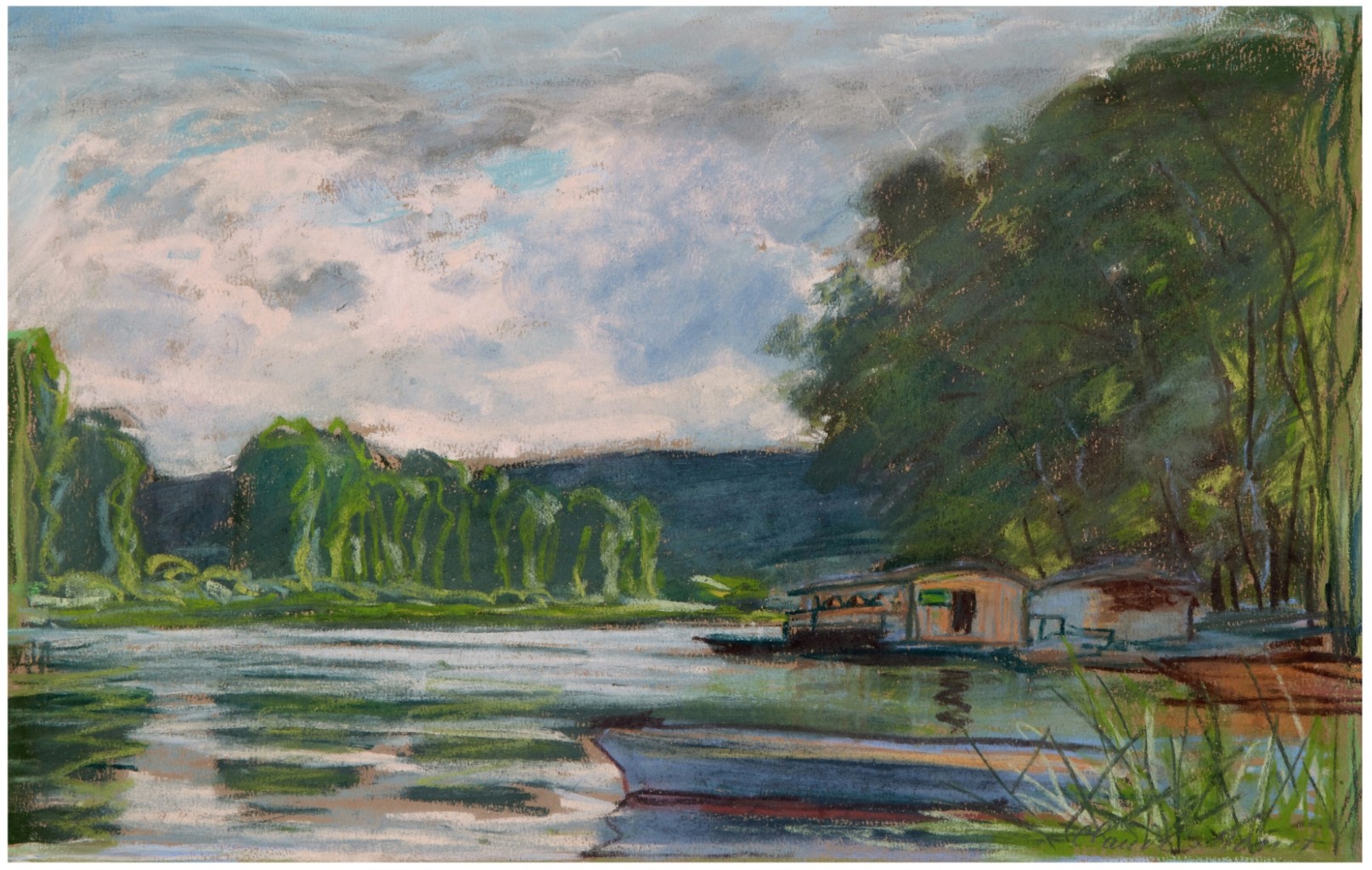
CLAUDE MONET (1840 – 1926)
Paysage, bord de la Seine, près de Jeufosse (Eure), 1884
Pastel on paper
31.2 x 47.6 cm (12 1/4 x 18 3/4 inches)
Signed Claude Monet (lower right)
#24. Les nuages, circa 1868 – 1869
Sotheby’s Hong-Kong: 12 November 2024
Estimated: HKD 3,000,000 – 6,000,000
HKD 7,200,000 / USD 925,950
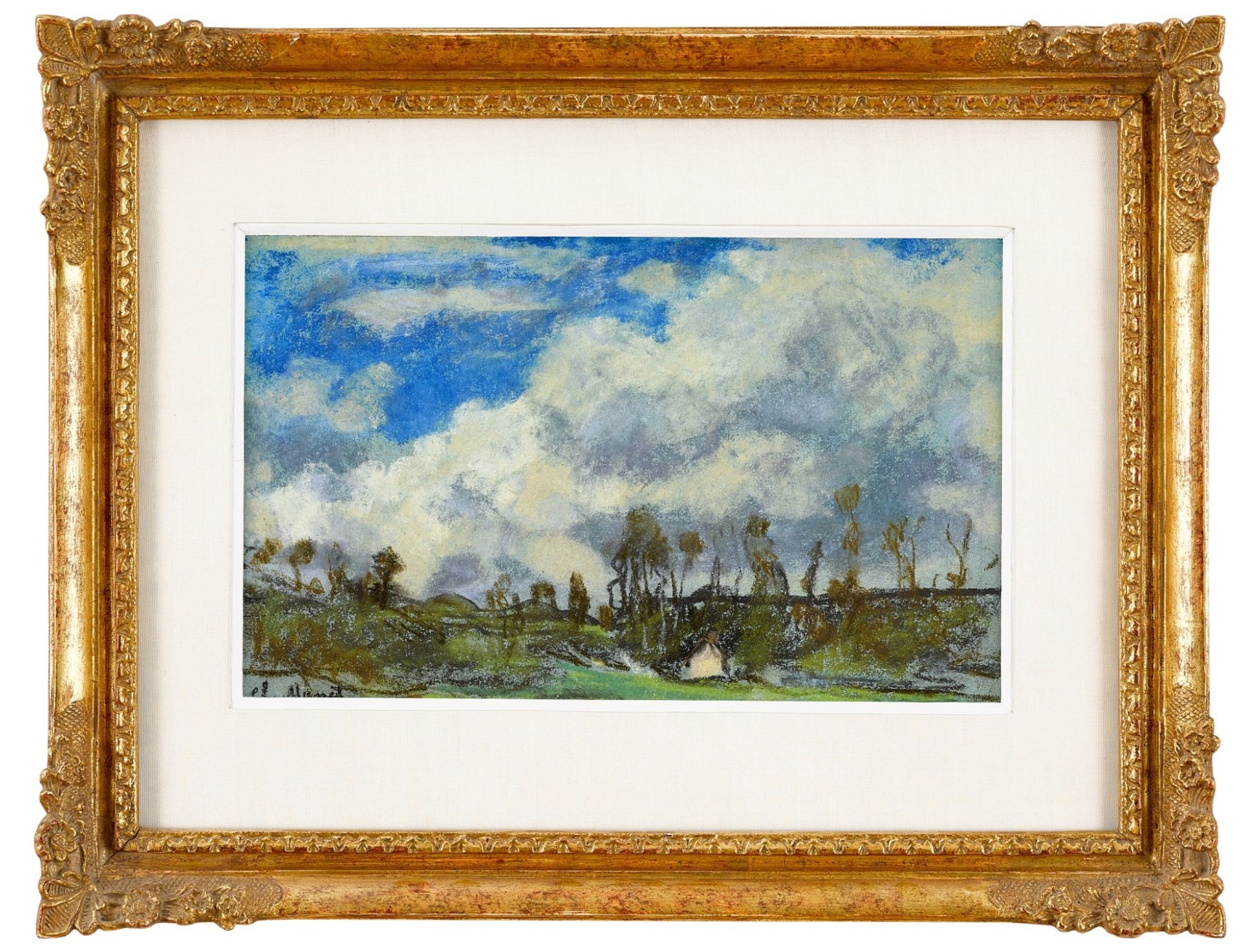
CLAUDE MONET (1840 – 1926)
Les nuages, circa 1868 – 1869
Pastel on blue paper laid on card
23.8 x 39 cm (9 3/8 x 15 3/8 inches)
Signed Cl. Monet (lower left)
2023 Auction Results
19 lots sold at auction in 2023 for a total turnover of USD 194,589,670. With 3 lots failing to sell, the sell-through rate is 86%. The highest price of 2023 has been achieved by Le bassin aux nympheas, a painting dated 1917-1919 that sold at Christie’s on 9 November 2023 for USD 74,010,000.
2023 Top 3 Lots
5 lots sold for more than USD 10 million, generating a cumulative turnover of USD 141,885,300, representing 72.9% of the total turnover for 2023.
#1. Le bassin aux nymphéas, 1917-1919
Christie’s New-York: 9 November 2023
Estimate on Request
USD 74,010,000
CLAUDE MONET (1840-1926) (christies.com)
CLAUDE MONET (1840-1926)
Le bassin aux nymphéas, 1917-1919
Oil on canvas
100.1 x 200.6 cm (39 3/8 x 78 7/8 inches)
Stamped with signature ‘Claude Monet’ (Lugt 1819b; lower right)
Stamped again with signature ‘Claude Monet’ (Lugt 1819b; on the reverse)
#2. Peupliers au bord de l’Epte, temps couvert, 1891
Sotheby’s New-York: 13 November 2023
Estimated: USD 30,000,000 – 40,000,000
USD 30,783,000
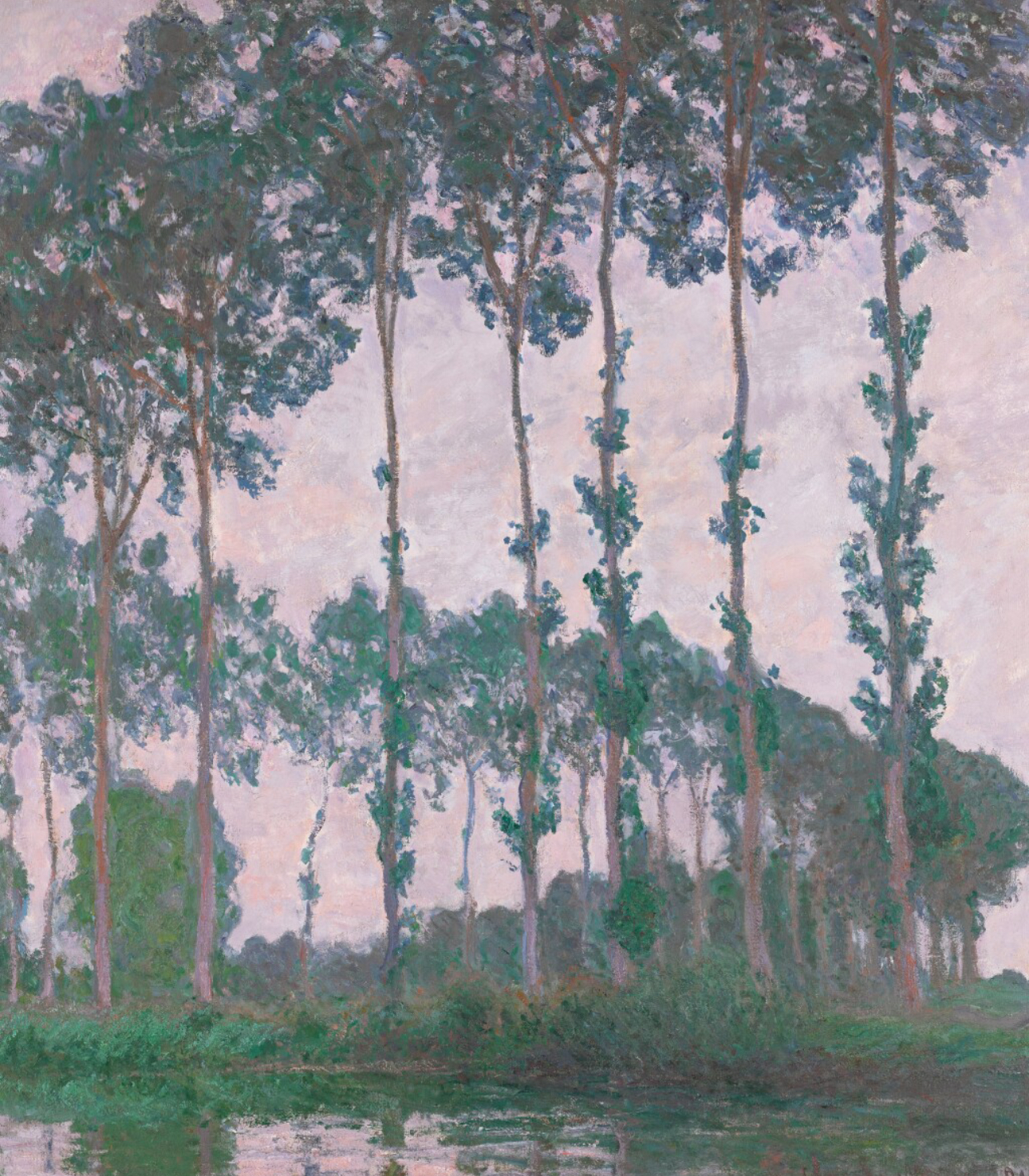
CLAUDE MONET (1840 – 1926)
Peupliers au bord de l’Epte, temps couvert, 1891
Oil on canvas
91.5 x 81.5 cm (36 x 32 1/8 inches)
Signed Claude Monet and dated 91 (lower right)
#3. Le Moulin de Limetz, 1888
Sotheby’s New-York: 13 November 2023
Estimated: USD 12,000,000 – 18,000,000
USD 25,612,500
Le Moulin de Limetz | Modern Evening Auction | 2023 | Sotheby’s (sothebys.com)
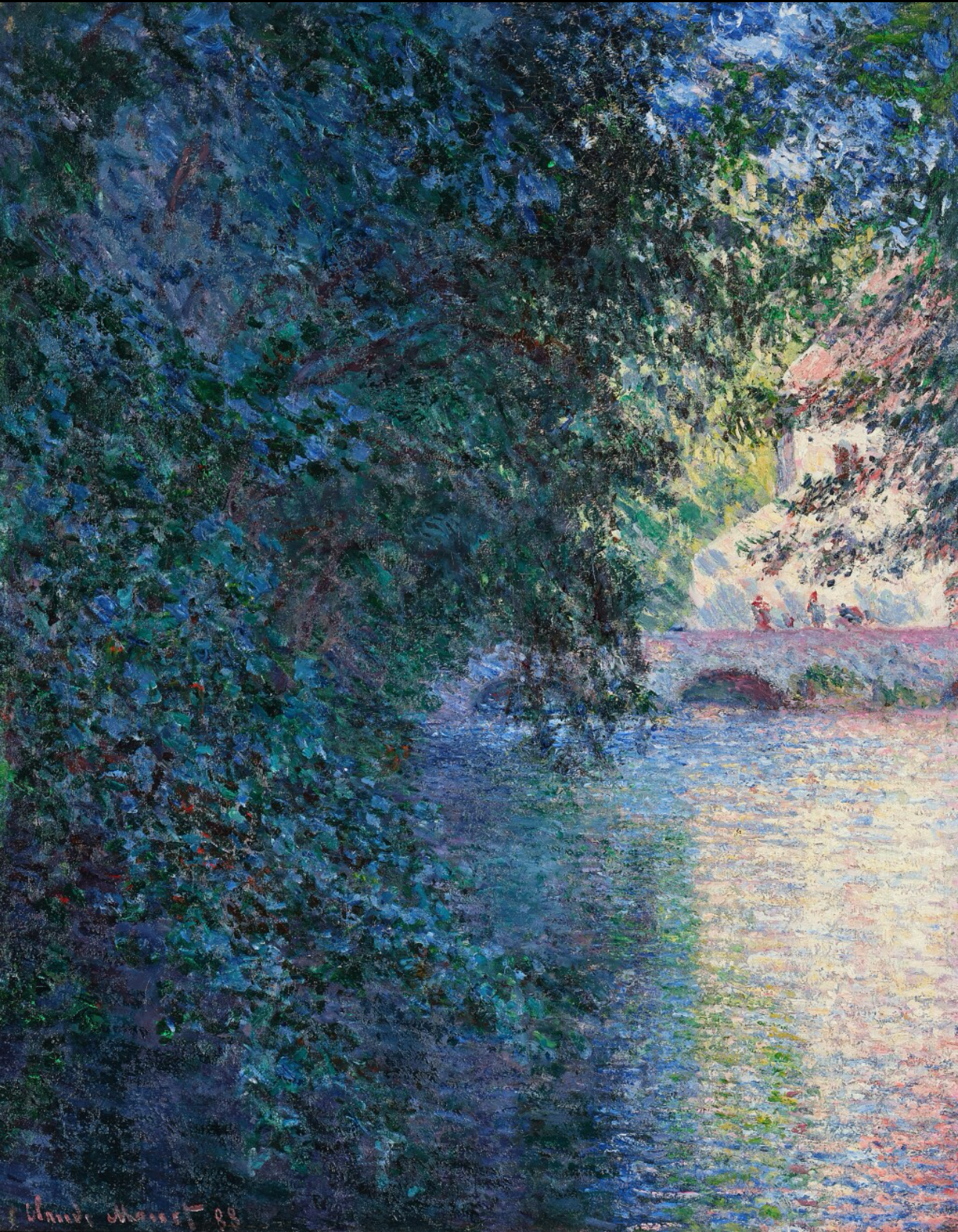
CLAUDE MONET (1840 – 1926)
Le Moulin de Limetz, 1888
oil on canvas
92 x 72.9 cm (36 1/4 x 28 3/4 inches)
Signed Claude Monet and dated 88 (lower left)
#4. Au Cap Martin, 1884
Sotheby’s New-York: 16 May 2023
Estimated: USD 10,000,000 – 15,000,000
USD 11,479,800
Au Cap Martin | Modern Evening Auction | 2023 | Sotheby’s (sothebys.com)
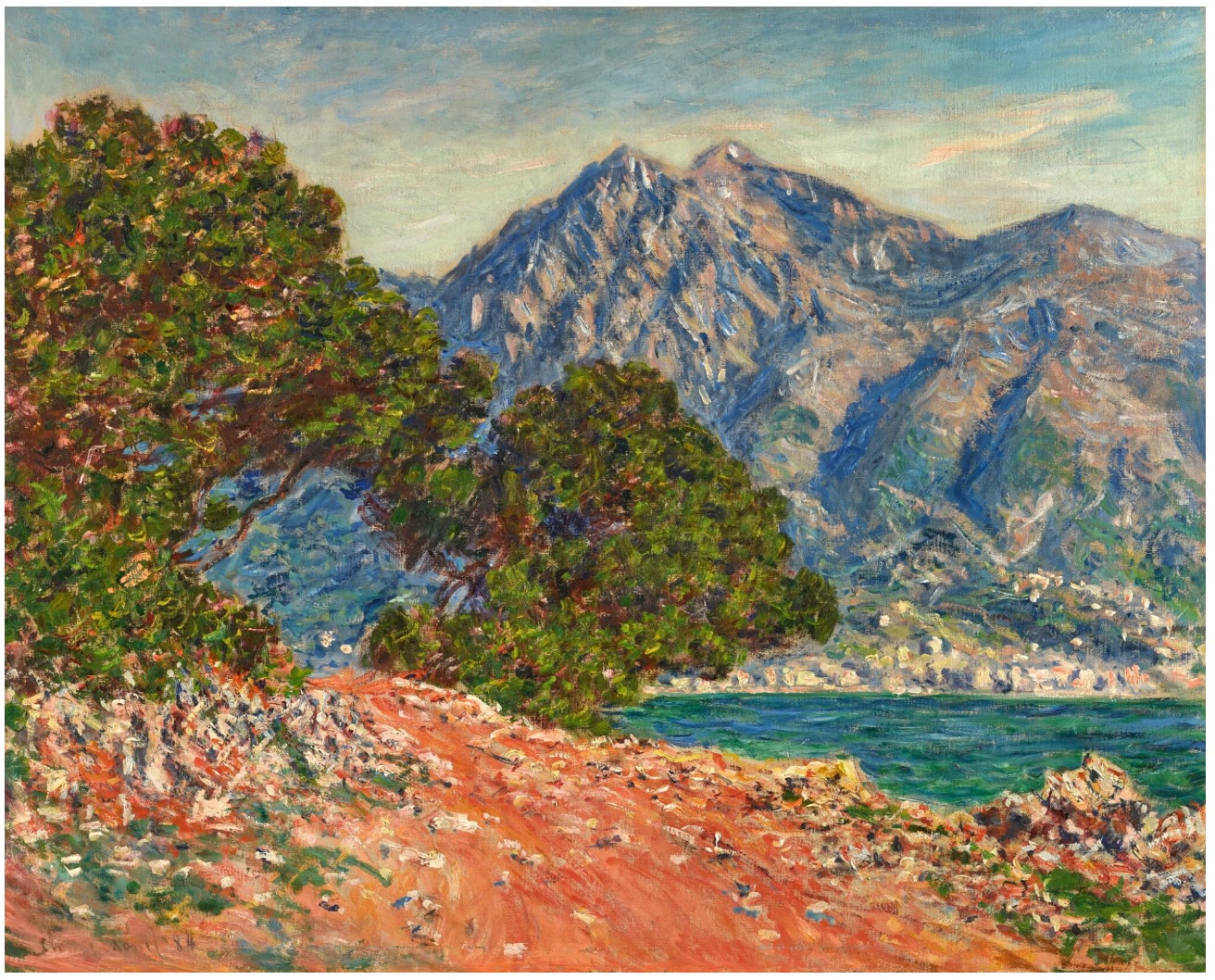
CLAUDE MONET (1840 – 1926)
Au Cap Martin, 1884
Oil on canvas
65.2 x v81 cm (25 5/8 x 32 inches)
Signed Claude Monet and dated 84 (lower left)
USD 10 million
#5. Soleil sur la Petite Creuse, 1889
Sotheby’s New-York: 13 November 2023
Estimated: USD 7,000,000 – 10,000,000
USD 8,607,300
Soleil sur la Petite Creuse | Modern Evening Auction | 2023 | Sotheby’s
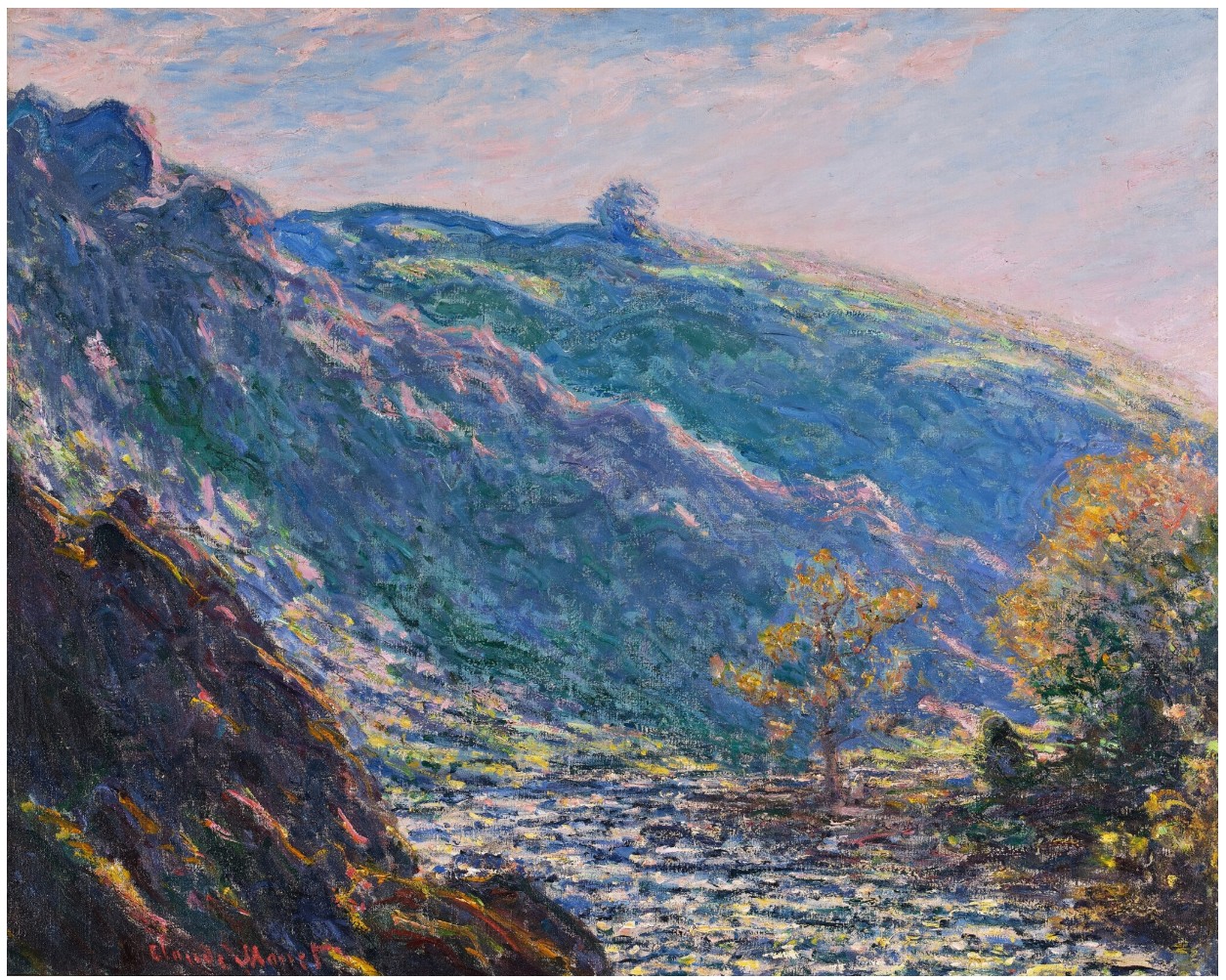
CLAUDE MONET (1840 – 1926)
Soleil sur la Petite Creuse, 1889
Oil on canvas
73 x 92.6 cm (28 3/4 x 36 1/2 inches)
Signed Claude Monet (lower left)
#6. Sandviken, Norvège, effet de neige, 1895
Christie’s New-York: 9 November 2023
Estimated: USD 2,500,000 – 3,500,000
USD 6,705,000
CLAUDE MONET (1840-1926), Sandviken, Norvège, effet de neige | Christie’s
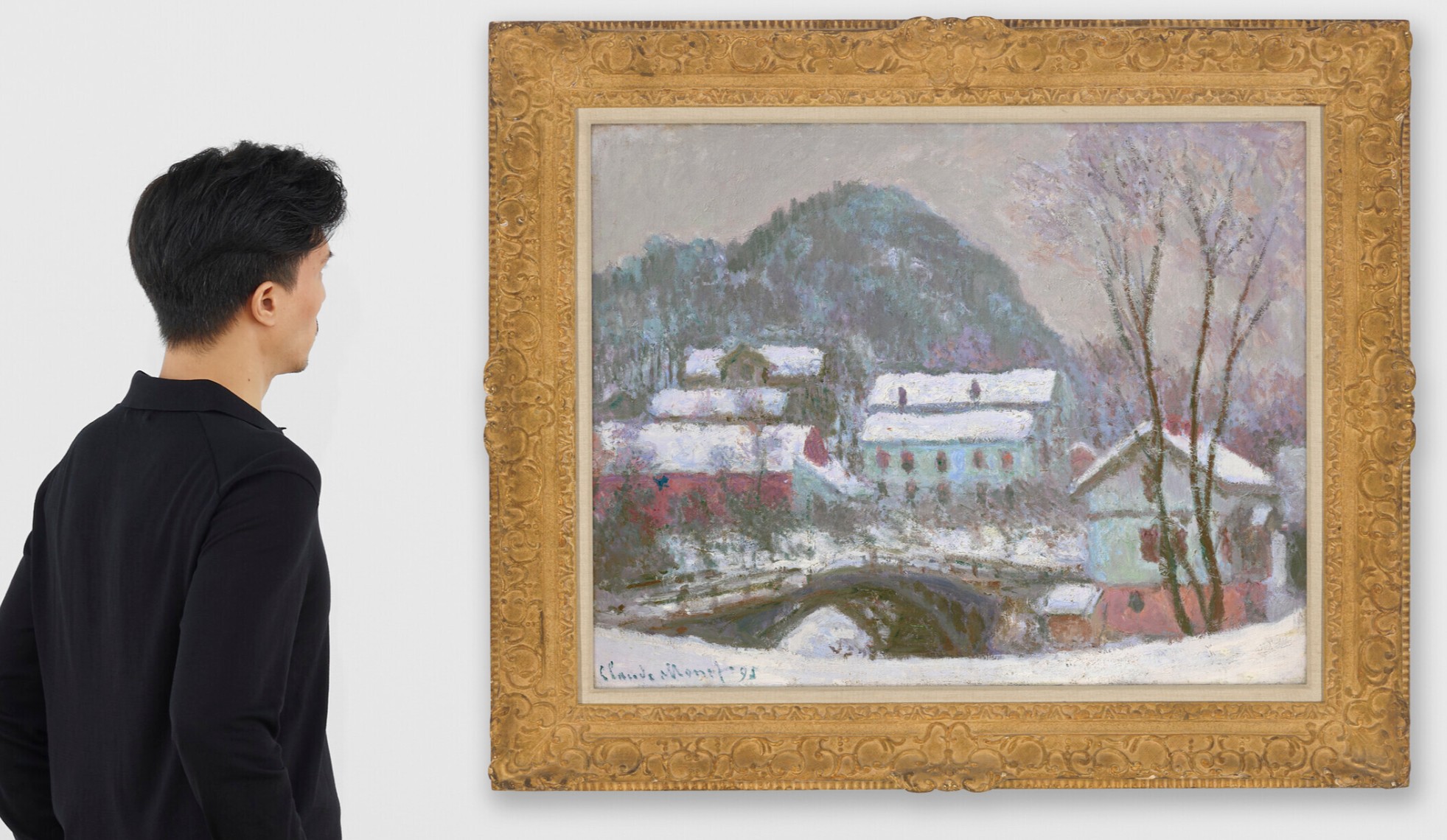
CLAUDE MONET (1840-1926)
Sandviken, Norvège, effet de neige, 1895
Oil on canvas
73.2 x 92.2 cm (28 7/8 x 36 3/8 inches)
Signed and dated ‘Claude Monet 95’ (lower left)
#7. La Seine près de Giverny, 1888
Bonhams New-York: 14 December 2023
Estimated: USD 4,000,000 – 6,000,000
USD 6,352,500
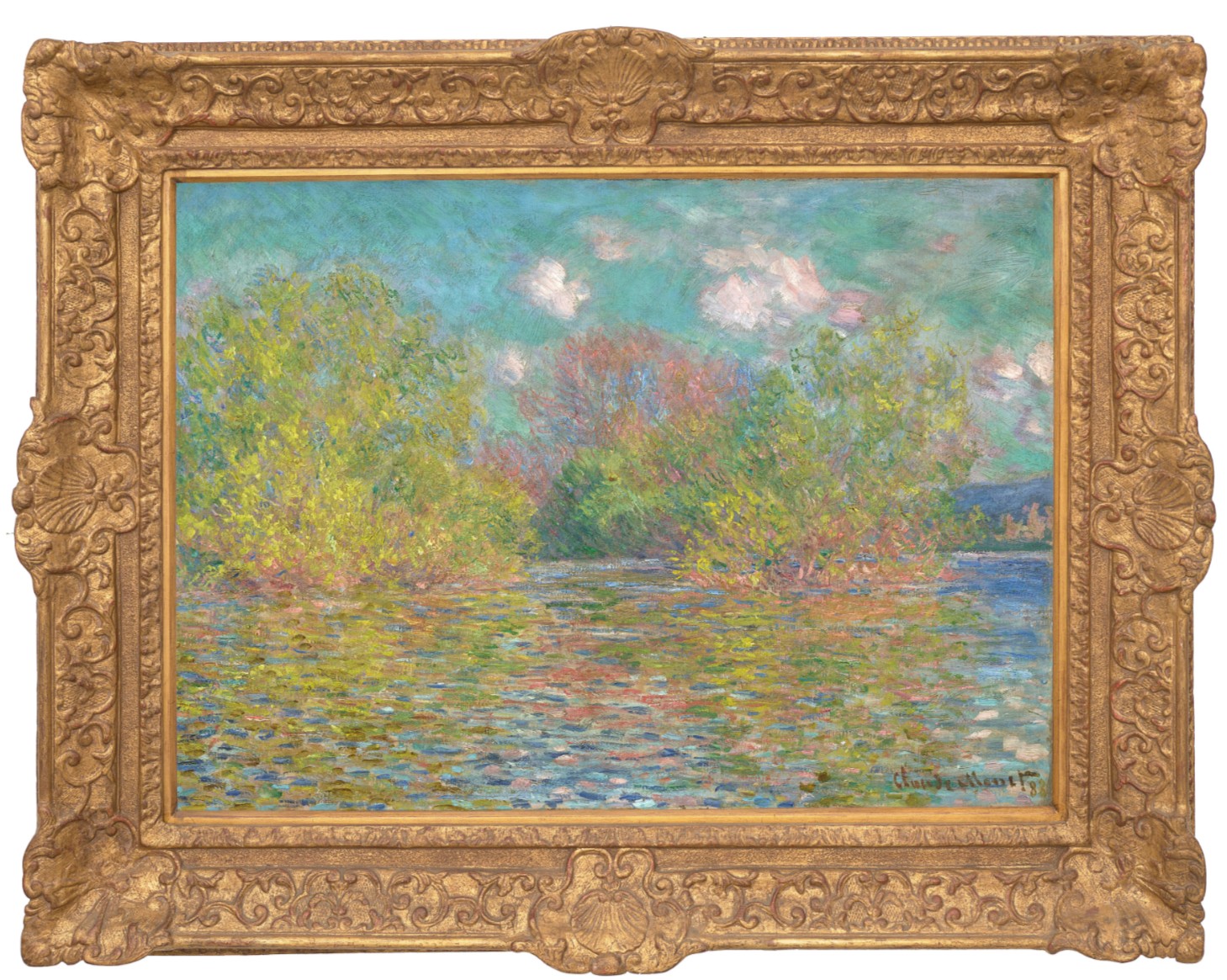
Oil on canvas
65.4 x 92.3 cm (25 3/4 x 36 5/16 inches)
Signed and dated ‘Claude Monet 88’ (lower right)
#8. Palmier à Bordighera, 1884
Sotheby’s New-York: 16 May 2023
Estimated: USD 5,000,000 – 7,000,000
USD 5,849,700
Palmier à Bordighera | Modern Evening Auction | 2023 | Sotheby’s
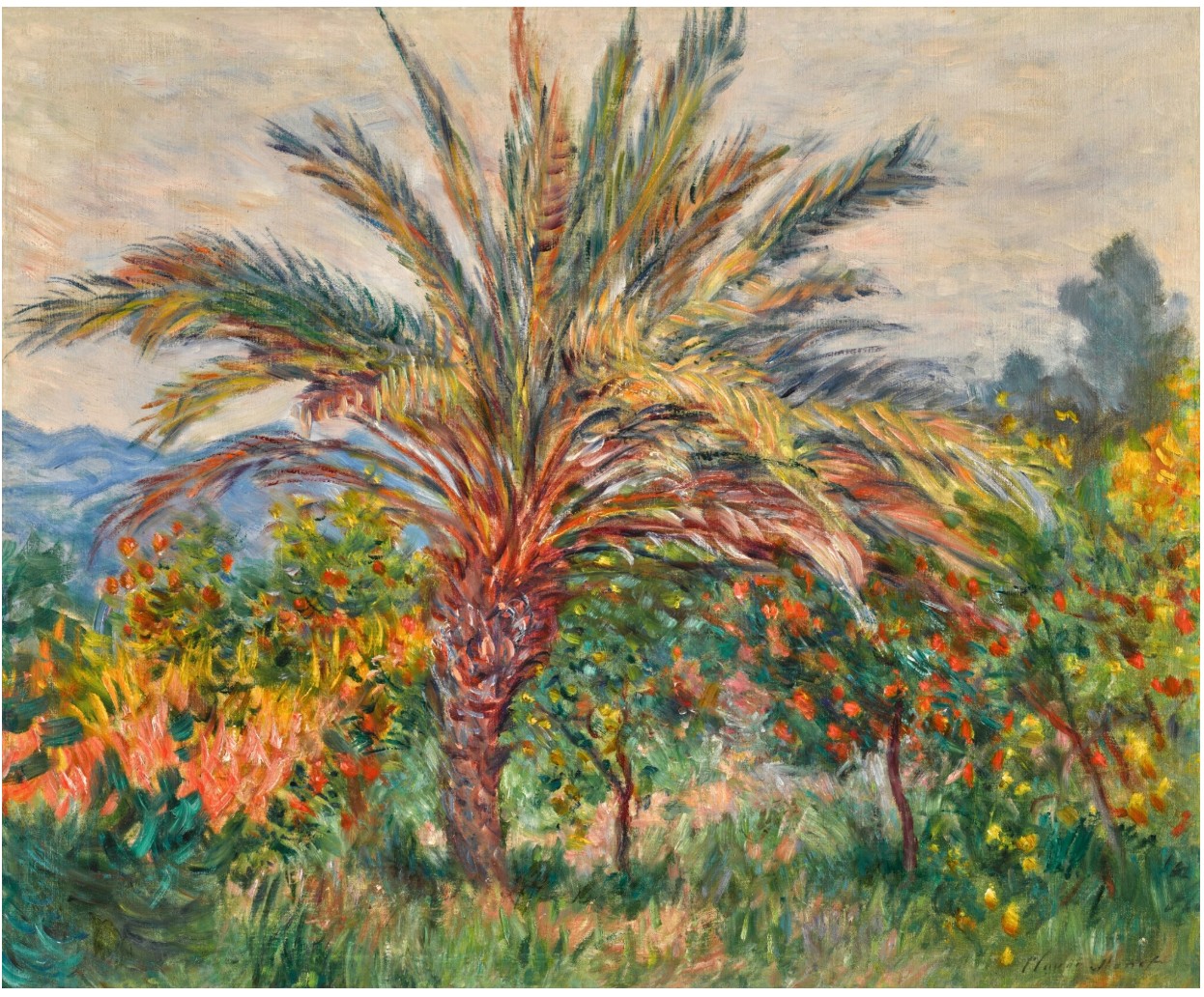
CLAUDE MONET (1840 – 1926)
Palmier à Bordighera, 1884
Oil on canvas
60.9 x 73.9 cm (24 x 29 1/8 inches)
Stamped with the signature Claude Monet (lower right)
USD 5 million
#9. L’Aiguille de Cléopâtre et Charing Cross Bridge, circa 1899
Sotheby’s New-York: 13 November 2023
Estimated: USD 4,000,000 – 6,000,000
USD 4,841,000
L’Aiguille de Cléopâtre et Charing Cross Bridge | Modern Evening Auction | 2023 | Sotheby’s
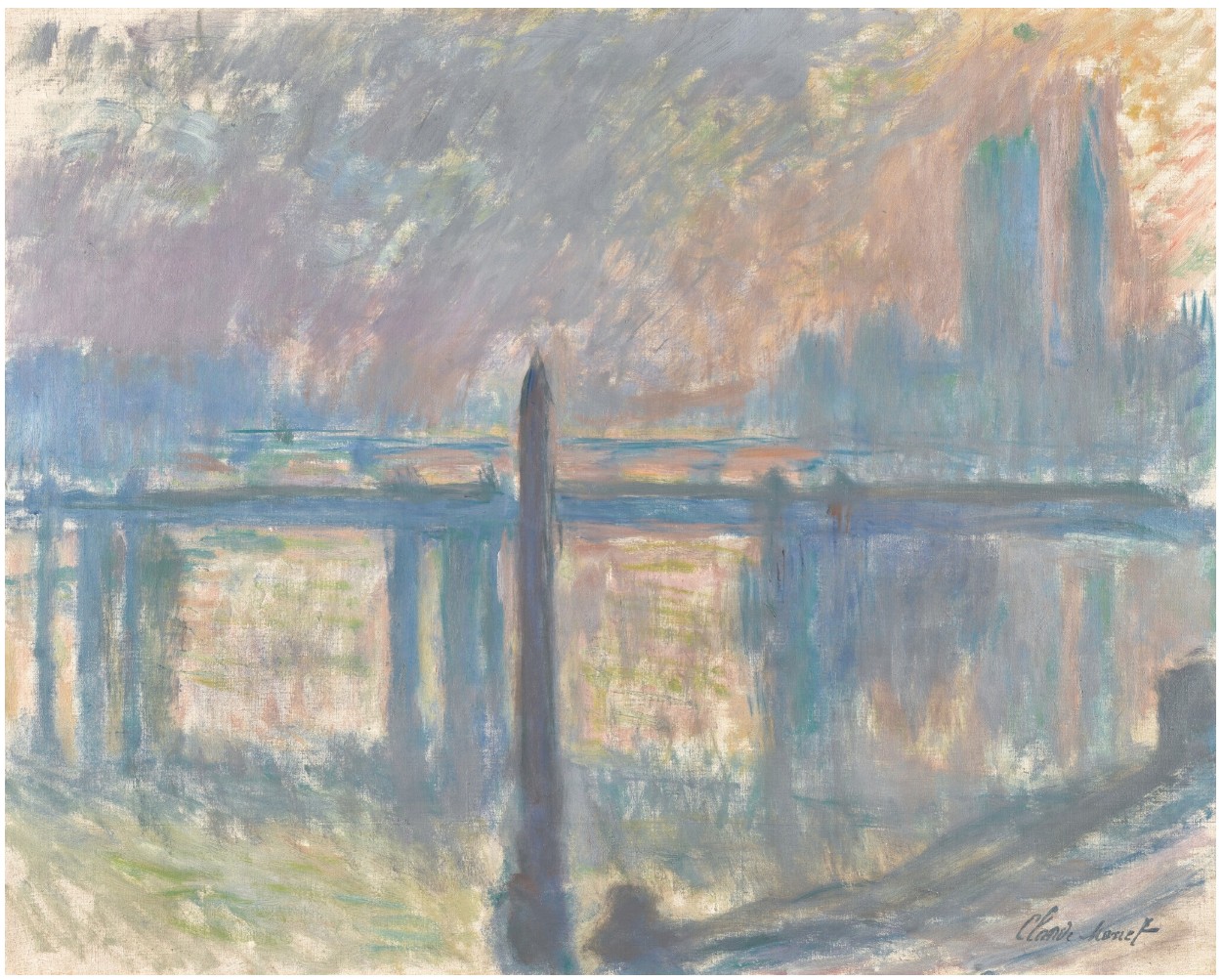
CLAUDE MONET (1840 – 1926)
L’Aiguille de Cléopâtre et Charing Cross Bridge, circa 1899
Oil on canvas
64.8 x 81.3 cm (25 1/2 x 32 inches)
Stamped with the signature (lower right)
Stamped again (on the reverse)
#10. Les bords de la Seine près de Vétheuil, 1881
Christie’s New-York: 11 November 2023
Estimated: USD 1,500,000 – 2,500,000
USD 3,438,000
CLAUDE MONET (1840-1926), Les bords de la Seine près de Vétheuil | Christie’s
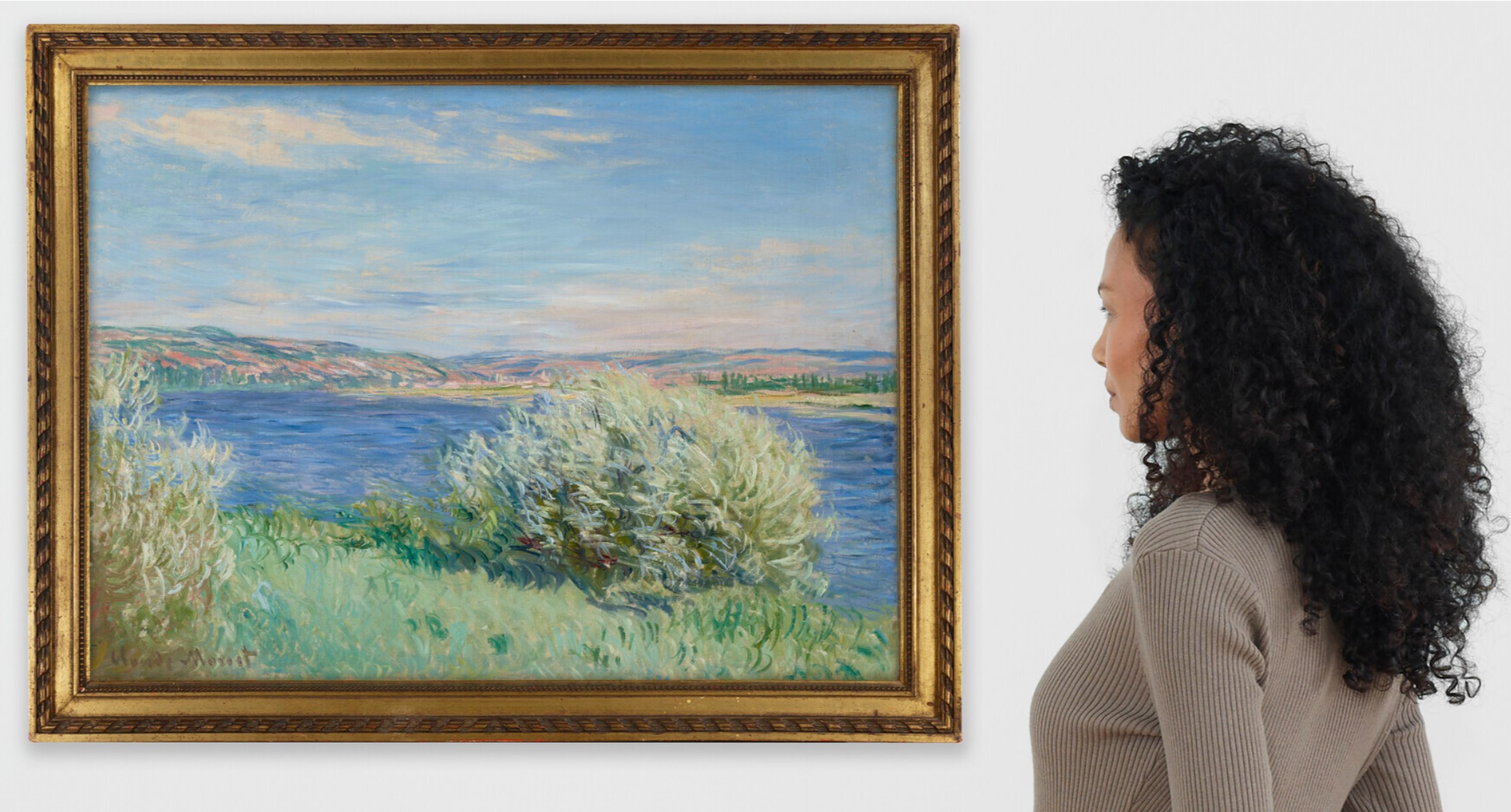
CLAUDE MONET (1840-1926)
Les bords de la Seine près de Vétheuil, 1881
Oil on canvas
58.4 x 78.7 cm (23×31 inches)
Signed ‘Claude Monet’ (lower left)
#11. La Tamise, 1901
Christie’s New-York: 13 May 2023
Estimated: USD 400,000 – 600,000
USD 2,954,000
CLAUDE MONET (1840-1926), La Tamise | Christie’s
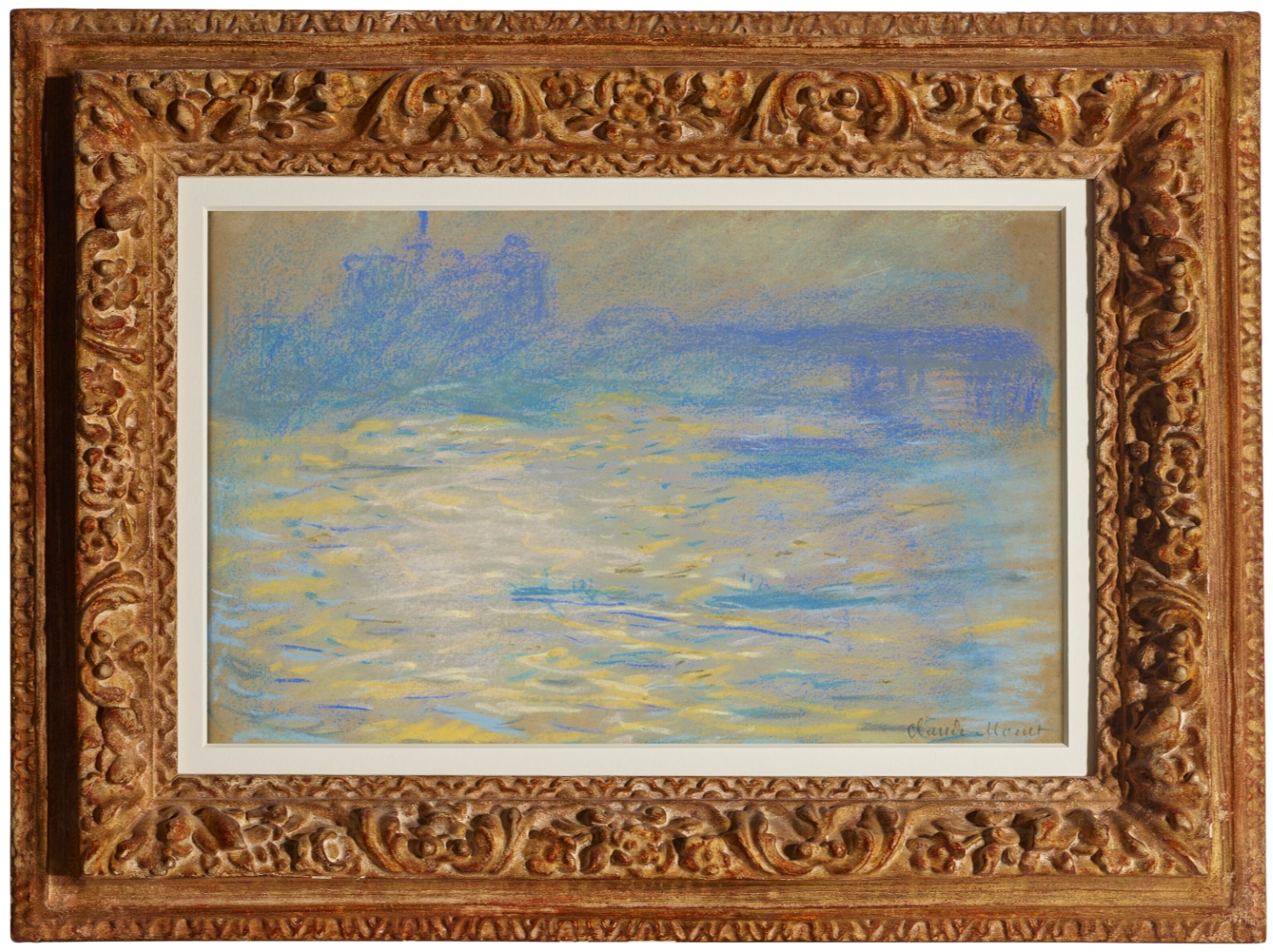
CLAUDE MONET (1840-1926)
La Tamise, 1901
Pastel on toned paper
31.5 x 47.6 cm (12 3/8 x 18 3/4 inches)
Signed ‘Claude Monet’ (lower right)
#12. Marine, 1882
Sotheby’s London: 28 June 2023
Estimated: GBP 1,200,000 – 1,800,000
GBP 1,923,500 / USD 2,451,640
Marine | Modern & Contemporary Day Auction | 2023 | Sotheby’s
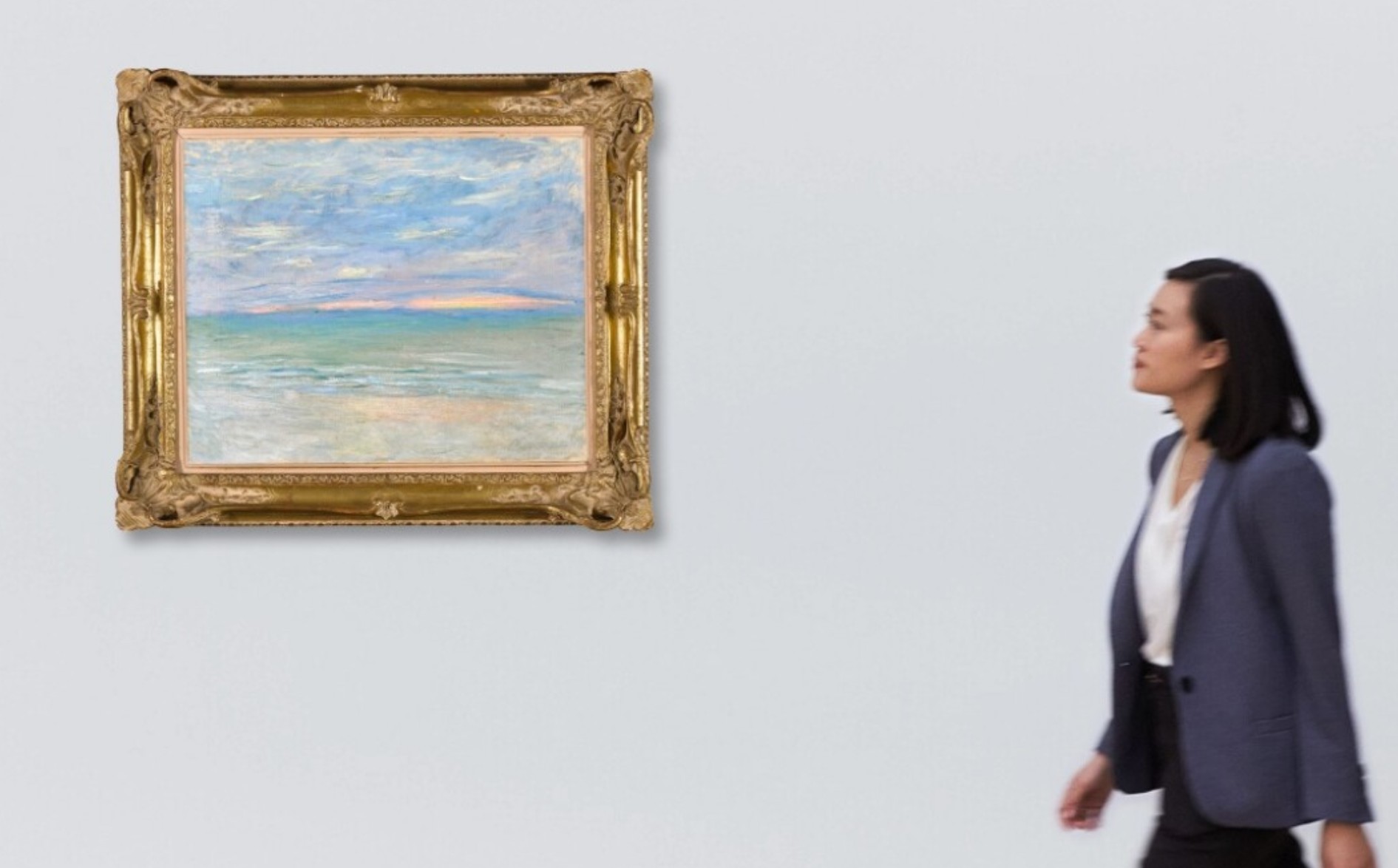
CLAUDE MONET (1840 – 1926)
Marine, 1882
Oil on canvas
53.8 x 65.3 cm (21 1/4 x 25 3/4 inches)
Stamped Claude Monet indistinctly (lower right)
Stamped ClaudeMonet (on the reverse)
#13. La Seine dans la brume, 1894
Artcurial Paris: 5 December 2023
Estimated: EUR 250,000 – 350,000
EUR 2,220,400 / USD 2,406,325
Impressionniste & Moderne – Vente du soir
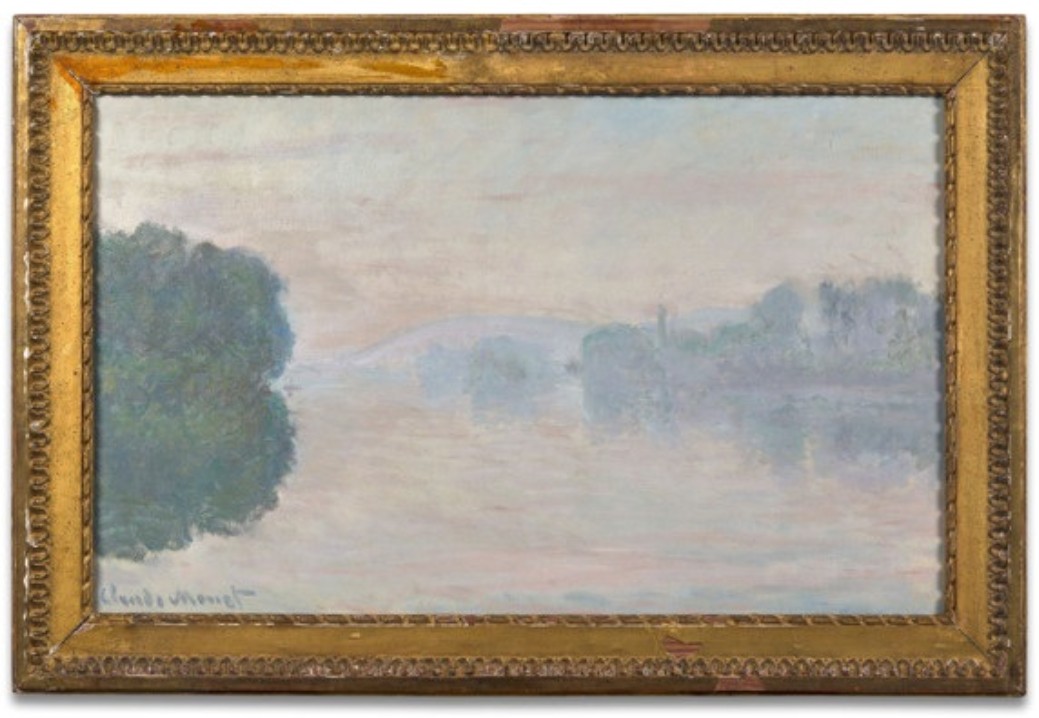
CLAUDE MONET (1840 – 1926)
La Seine dans la brume, 1894
Oil on canvas
50×81 cm (19 5/8 x 31 7/8 inches)
Signed Claude Monet lower left
#14. Pavots rouge et rose, 1883
Sotheby’s London: 27 June 2023
Estimated: GBP 1,500,000 – 2,000,000
GBP 1,802,500 / USD 2,294,948
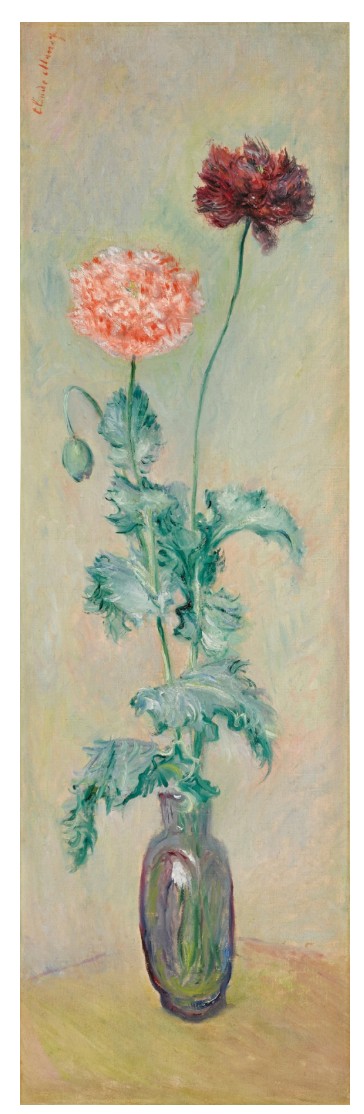
CLAUDE MONET (1840 – 1926)
Pavots rouge et rose, 1883
Oil on canvas
119.4 x 36.8 cm (47 x 14 1/2 inches)
Signed Claude Monet (upper left)
#15. Barques de pêche, 1866
Sotheby’s New-York: 17 May 2023
Estimated: USD 800,000 – 1,200,000
USD 2,177,000
Barques de pêche | Modern Day Auction | 2023 | Sotheby’s (sothebys.com)
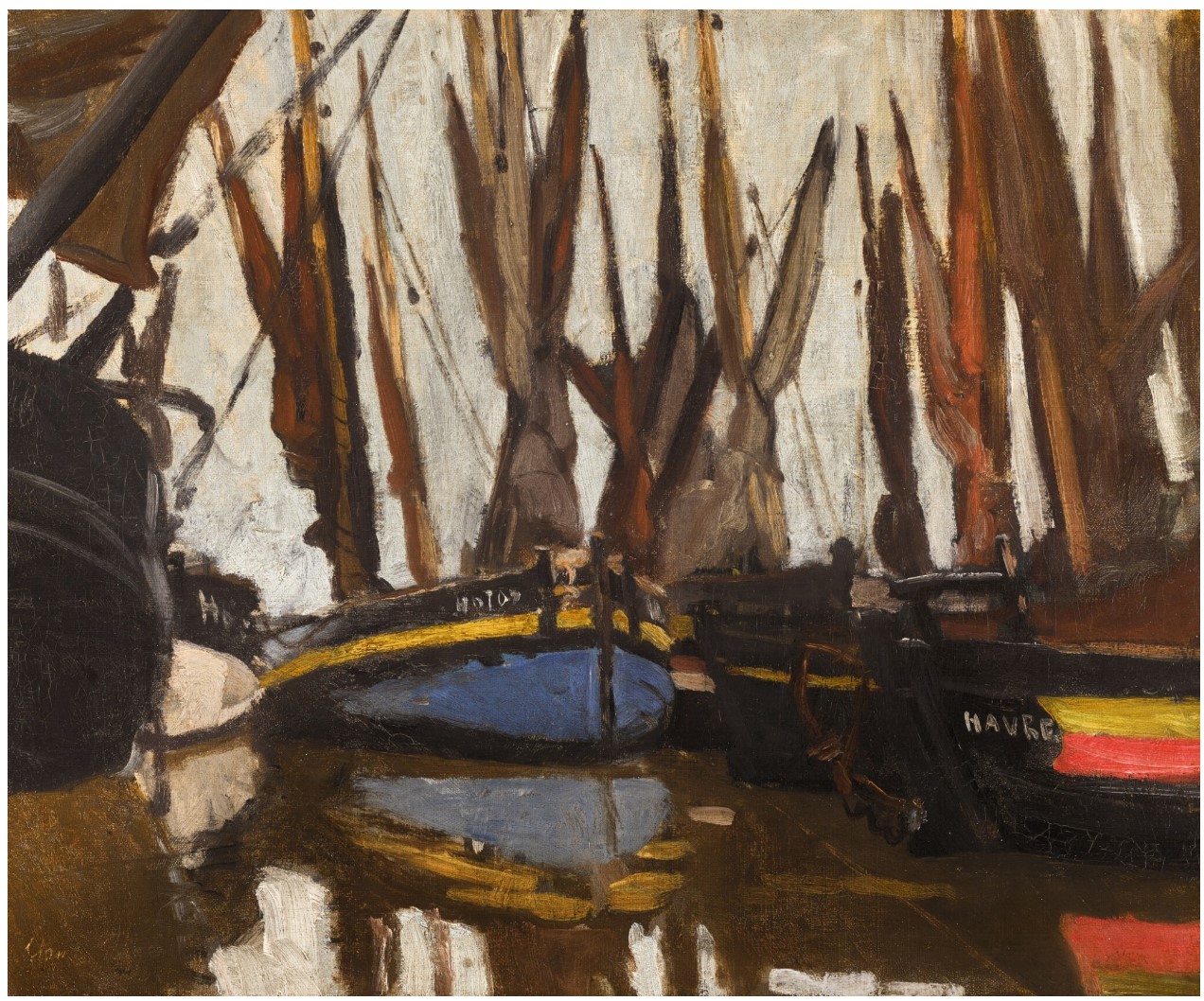
CLAUDE MONET (1840 – 1926)
Barques de pêche, 1866
Oil on canvas
46 x 55.5 cm (18 1/8 x 21 7/8 inches)
Bearing the signature Clau (lower left)
#16. La Seine à Bougival, 1870
Christie’s New-York: 11 November 2023
Estimated: USD 800,000 – 1,200,000
USD 1,623,000
CLAUDE MONET (1840-1926), La Seine à Bougival | Christie’s
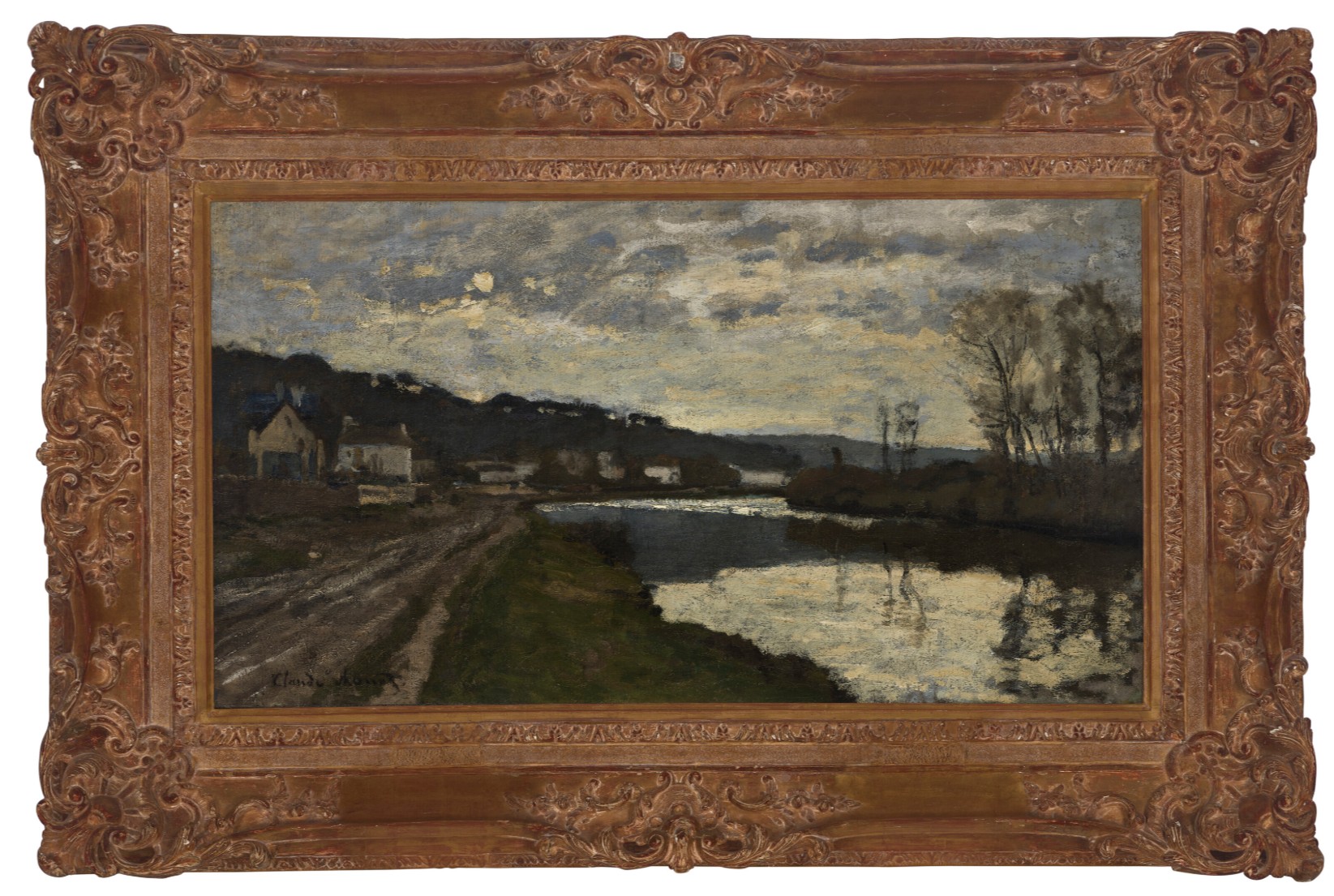
CLAUDE MONET (1840-1926)
La Seine à Bougival, 1870
Oil on canvas
40.3 x 73.4 cm (15 7/8 x 28 7/8 inches)
Signed ‘Claude Monet.’ (lower left)
#17. La Seine à Lavacourt, 1879
Christie’s New-York: 11 November 2023
Estimated: USD 600,000 – 800,000
USD 1,320,500
CLAUDE MONET (1840-1926), La Seine à Lavacourt | Christie’s
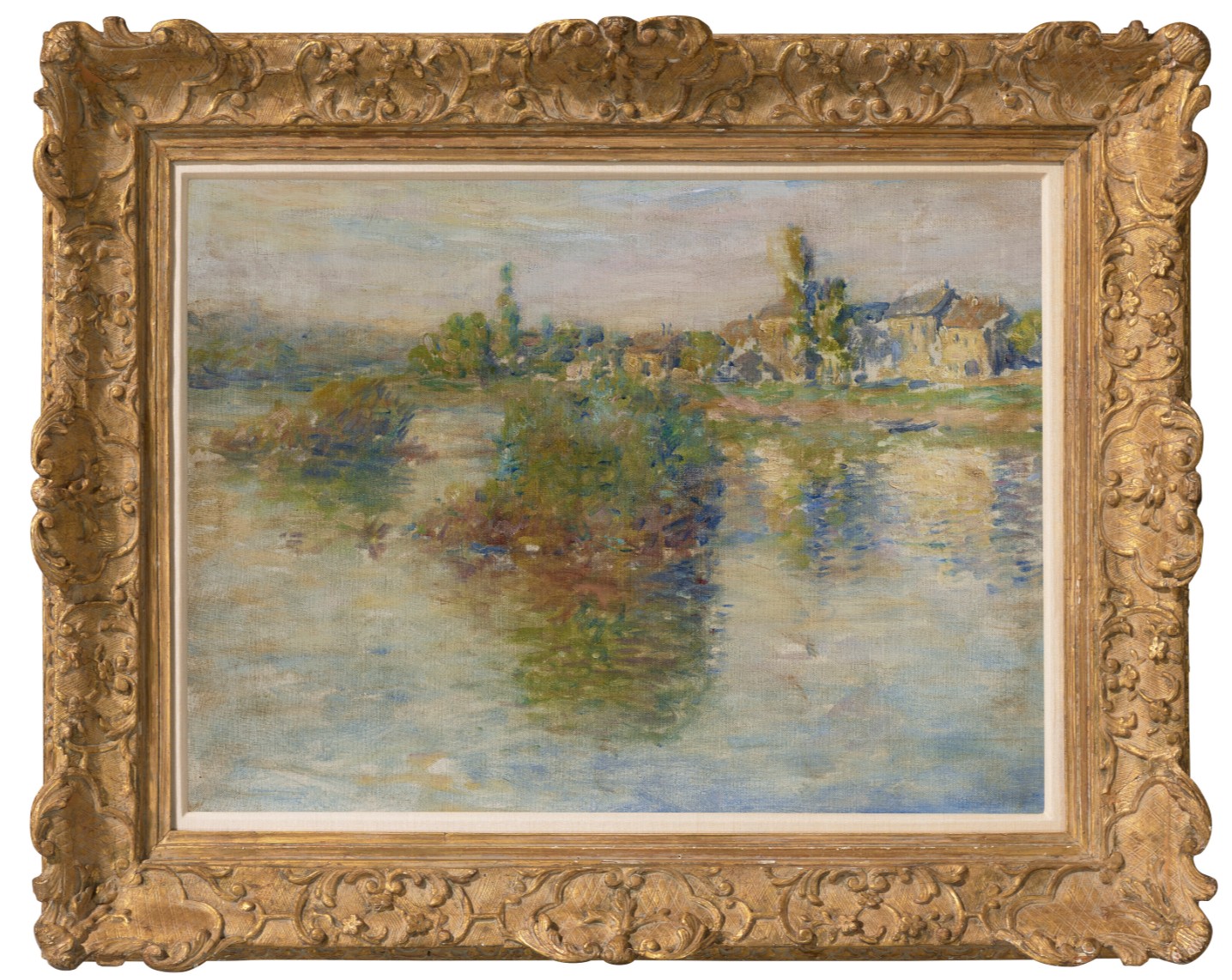
CLAUDE MONET (1840-1926)
La Seine à Lavacourt, 1879
Oil on canvas
45.4 x 61 cm (17 7/8 x 24 inches)
#18. Paysage à Villez, circa 1883
Phillips Hong-Kong: 30 March 2023
Estimated: HKD 5,500,000 – 8,500,000
HKD 8,890,000 / USD 1,132,495
Claude Monet – 20th Century & Contempo… Lot 19 March 2023 | Phillips
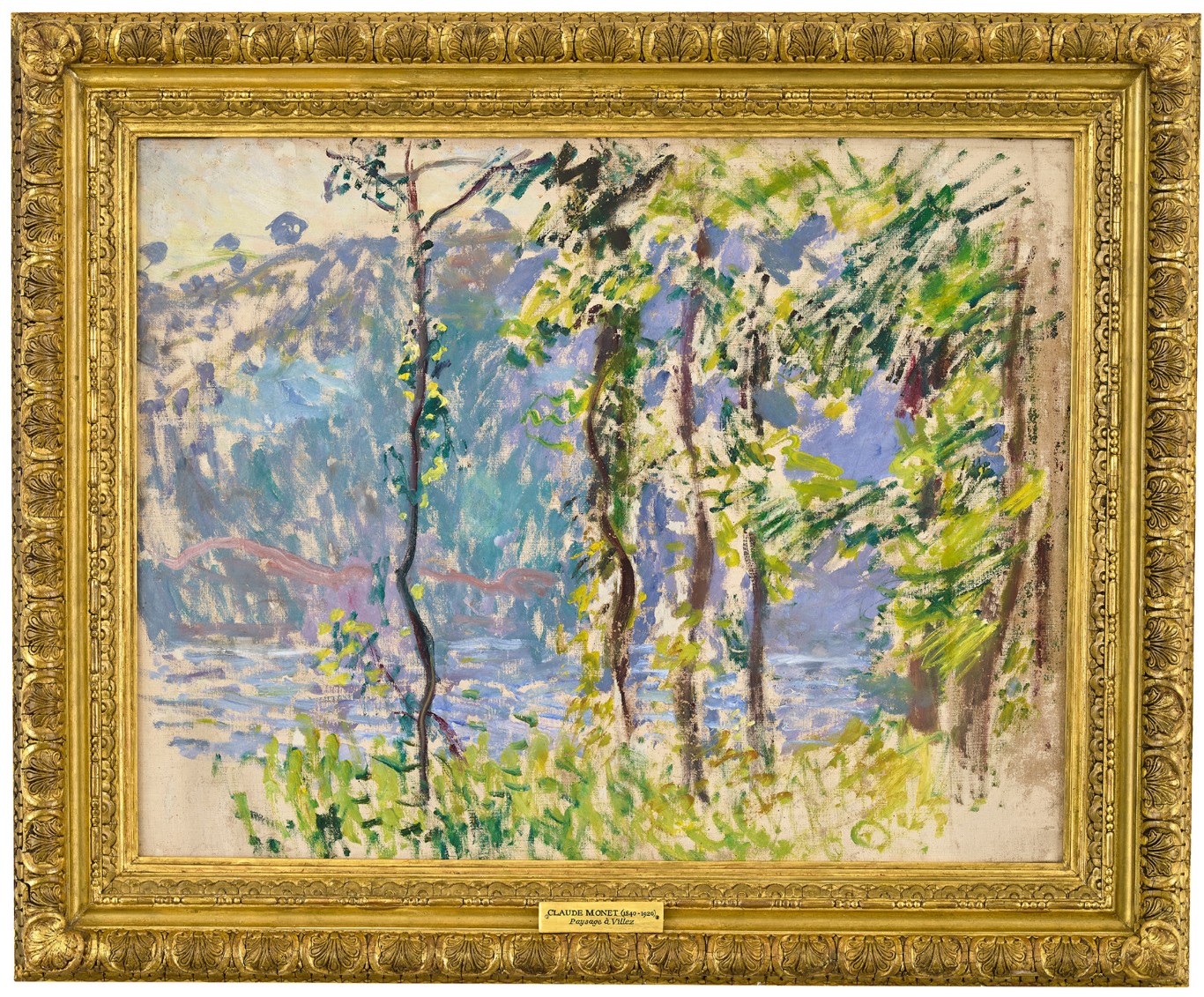
CLAUDE MONET
Paysage à Villez, circa 1883
Oil on canvas
60.3 x 78.8 cm (23 3/4 x 31 inches)
#19. Sainte-Adresse, Les rochers du cap de la Hève
Sotheby’s London: 2 March 2023
Estimated: GBP 350,000 – 550,000
GBP 508,000 / USD 610,960
Sainte-Adresse, Les rochers du cap de la Hève | Modern & Contemporary Day Auction | 2023 | Sotheby’s
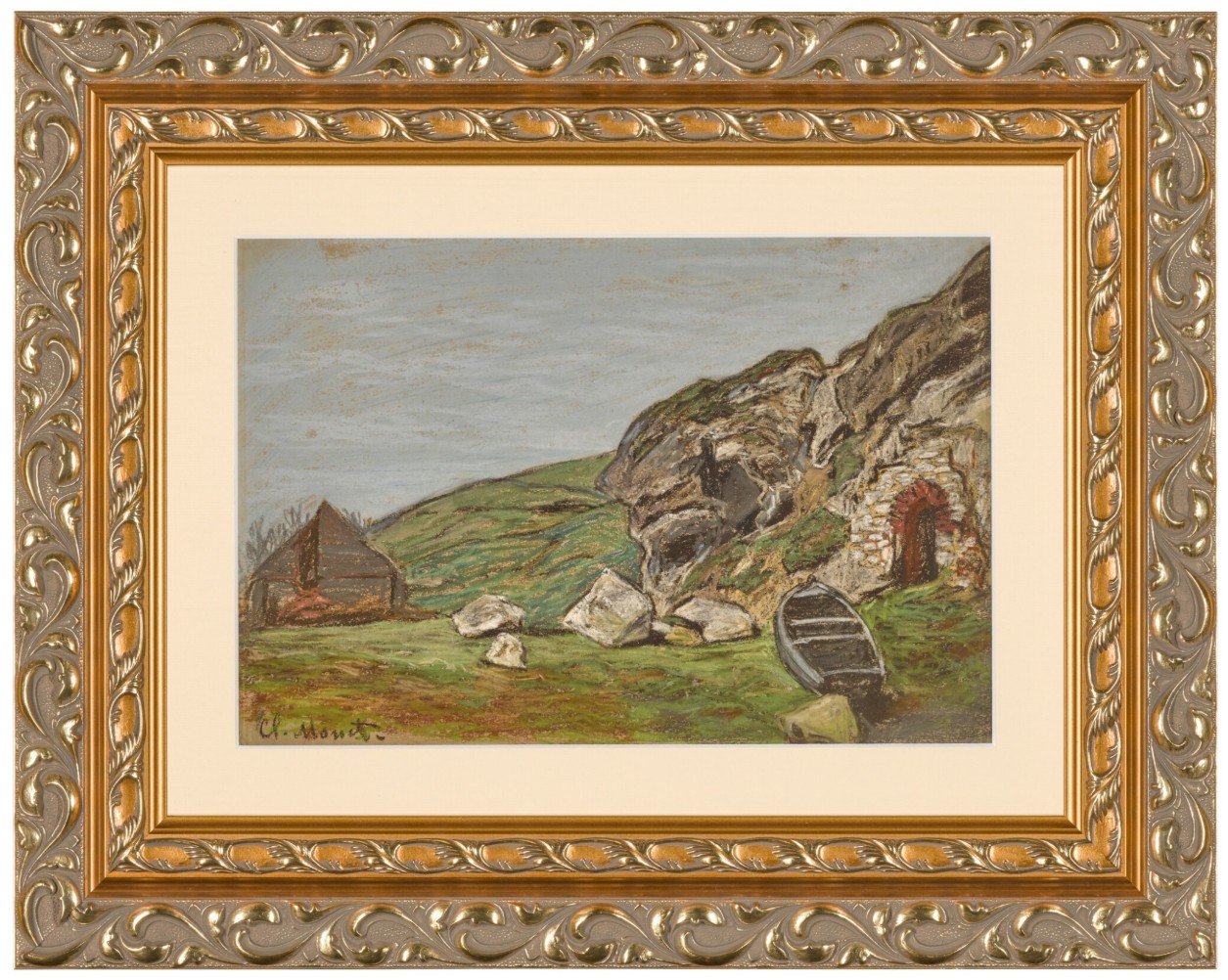
CLAUDE MONET (1840 – 1926)
Sainte-Adresse, Les rochers du cap de la Hève
Pastel on paper
24.5 x 36 cm (9 5/8 x 14 1/8 inches)
Signed Cl. Monet (lower left)
2022 Auction Results
26 lots sold at auction in 2022 for a total turnover of USD 538,866,590. With 2 lots failing to sell, the sell-through rate is 93%. The highest price for 2022 was achieved by Le Parlement, soleil couchant, a painting dated 1900-1903, that sold at Christie’s in New-York, on 12 May 2022, for USD 75,960,000.
2022 Top 3 Lots
14 lots sold for more than USD 10 million, generating a cumulative turnover of USD 493,252,120, representing 91.5% of the total turnover for 2022.
#1. Le Parlement, soleil couchant, 1900-1903
Christie’s New-York: 12 May 2022
Estimated: USD 40,000,000 – 60,000,000
USD 75,960,000
CLAUDE MONET (1840-1926), Le Parlement, soleil couchant | Christie’s
CLAUDE MONET (1840-1926)
Le Parlement, soleil couchant, 1900-1903
Oil on canvas
81.2 x 92 cm (32 x 36 1/4 inches)
Signed and dated ‘Claude Monet 1903’ (lower left)
#2. Waterloo Bridge, soleil voilé, 1899-1903
Christie’s New-York: 9 November 2022
Estimates on Request
USD 64,510,000
CLAUDE MONET (1840-1926), Waterloo Bridge, soleil voilé | Christie’s
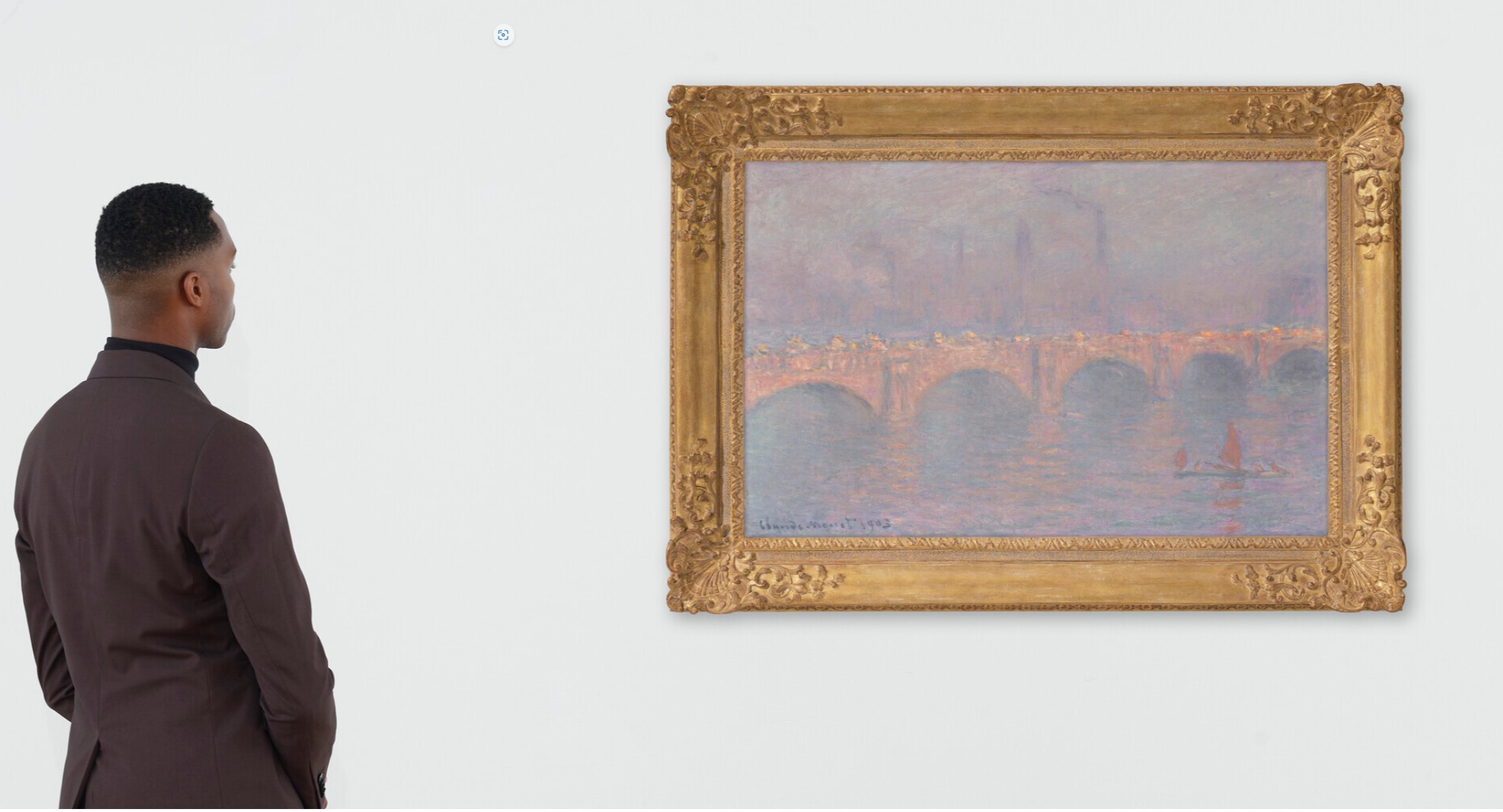
CLAUDE MONET (1840-1926)
Waterloo Bridge, soleil voilé, 1899-1903
Oil on canvas
65.4 x 100 cm (25 3/4 x 39 1/2 inches)
Signed and dated ‘Claude Monet 1903’ (lower left)
#3. Le Grand Canal et Santa Maria della Salute, 1908
Sotheby’s New-York: 17 May 2022
Estimates on Request
USD 56,625,500
Le Grand Canal et Santa Maria della Salute | Modern Evening Auction | 2022 | Sotheby’s
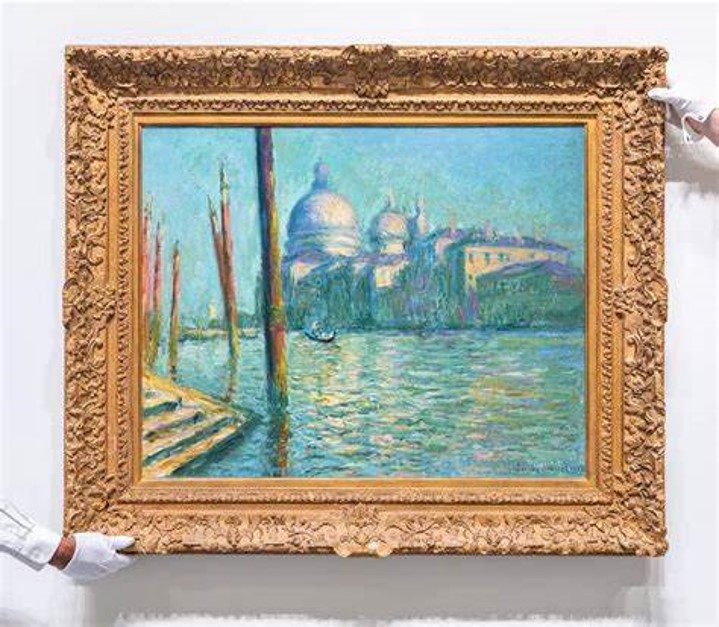
CLAUDE MONET (1840-1926)
Le Grand Canal et Santa Maria della Salute, 1908
Oil on canvas
73.5 x 92.5 cm (29 x 36.5 inches)
Signed Claude Monet and dated 1908 (lower right)
#4. Nymphéas, 1907
Christie’s New-York: 12 May 2022
Estimated: USD 35,000,000 – 55,000,000
USD 56,495,000
CLAUDE MONET (1840-1926), Nymphéas | Christie’s
CLAUDE MONET (1840-1926)
Nymphéas, 1907
Oil on canvas
93.8 x 89.3 cm (37 x 35 1/4 inches)
Signed and dated ‘Claude Monet 1907’ (lower right)
#5. Waterloo Bridge, effet de brume, 1899-1904
Christie’s London: 28 June 2022
Estimated: GBP 22,000,000 – 32,000,000
GBP 30,059,500 / USD 36,872,190
CLAUDE MONET (1840-1926), Waterloo Bridge, effet de brume | Christie’s
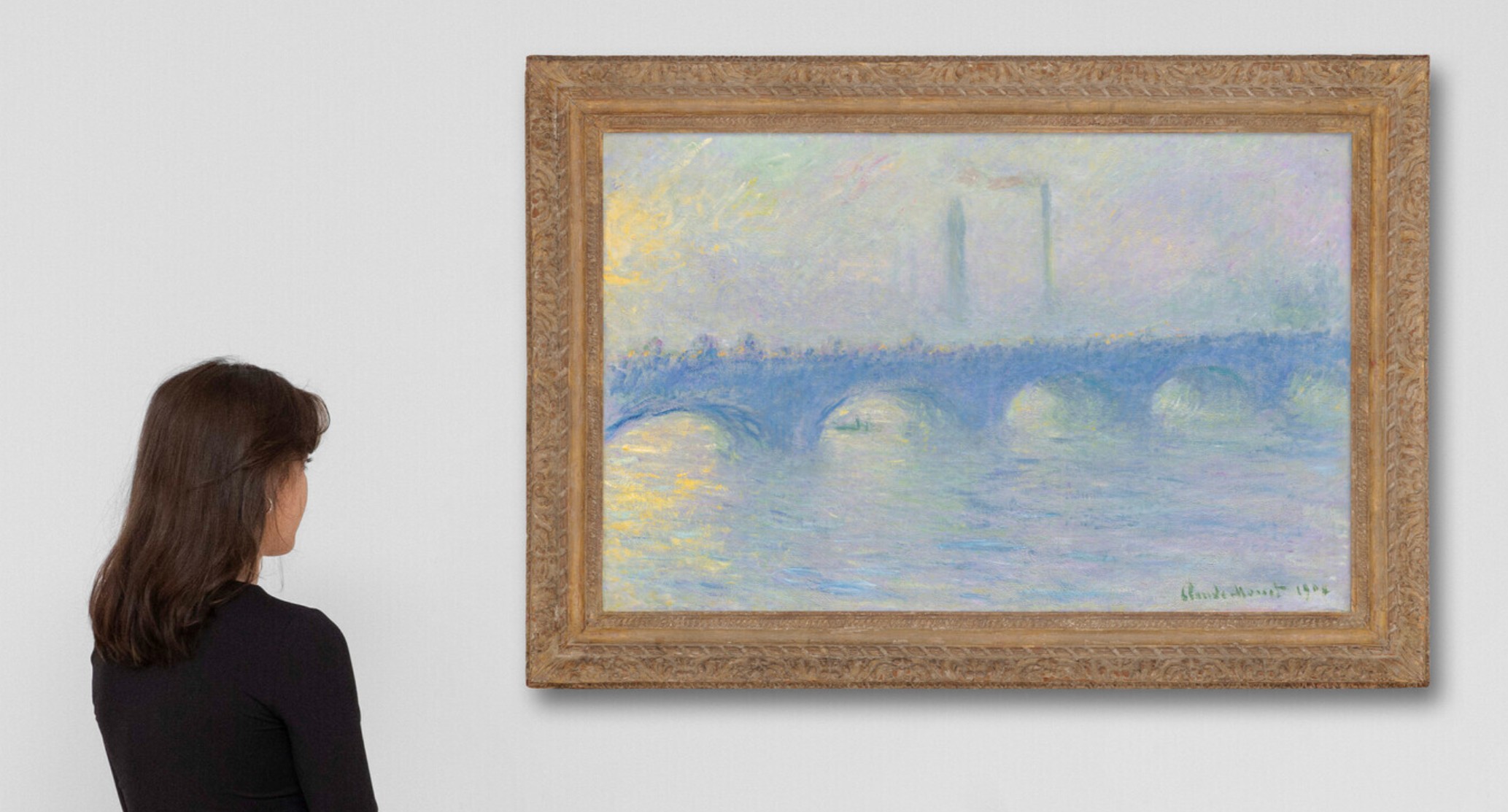
CLAUDE MONET (1840-1926)
Waterloo Bridge, effet de brume, 1899-1904
Oil on canvas
65.2 x 100.7 cm (25 5/8 x 39 5/8 inches)
Signed and dated ‘Claude Monet 1904’ (lower right)
#6. Nymphéas, temps gris, 1907
Christie’s London: 28 June 2022
Estimated: GBP 20,000,000 – 30,000,000
GBP 30,059,500 / USD 36,872,190
CLAUDE MONET (1840-1926), Nymphéas, temps gris | Christie’s
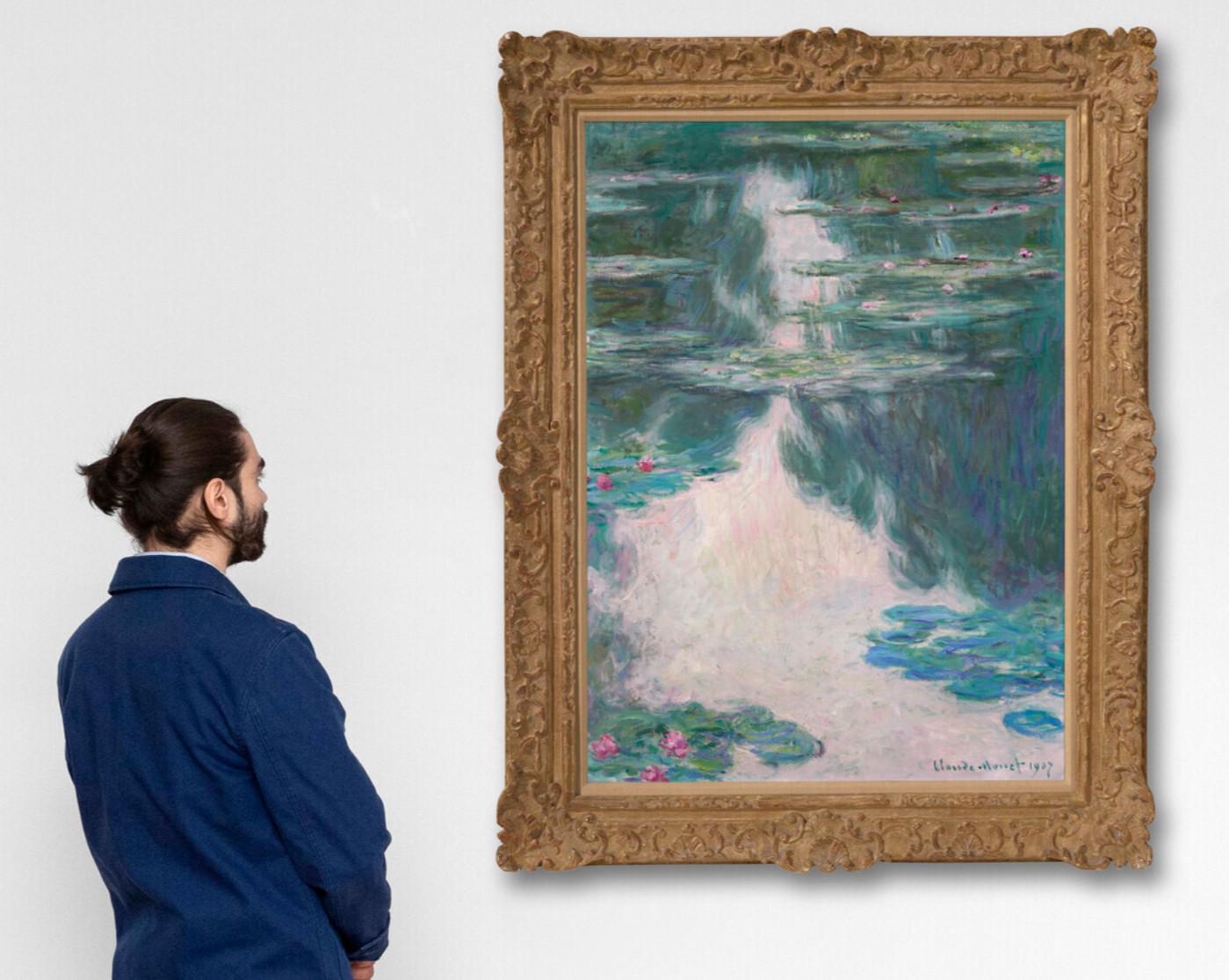
CLAUDE MONET (1840-1926)
Nymphéas, temps gris, 1907
Oil on canvas
100.2 x 73.2 cm (39 1/2 x 28 3/4 inches)
Signed and dated ‘Claude Monet 1907’ (lower right)
#7. Peupliers au bord de l’Epte, automne, 1891
Christie’s New-York: 12 May 2022
Estimated: USD 30,000,000 – 50,000,000
USD 36,457,500
CLAUDE MONET (1840-1926), Peupliers au bord de l’Epte, automne | Christie’s
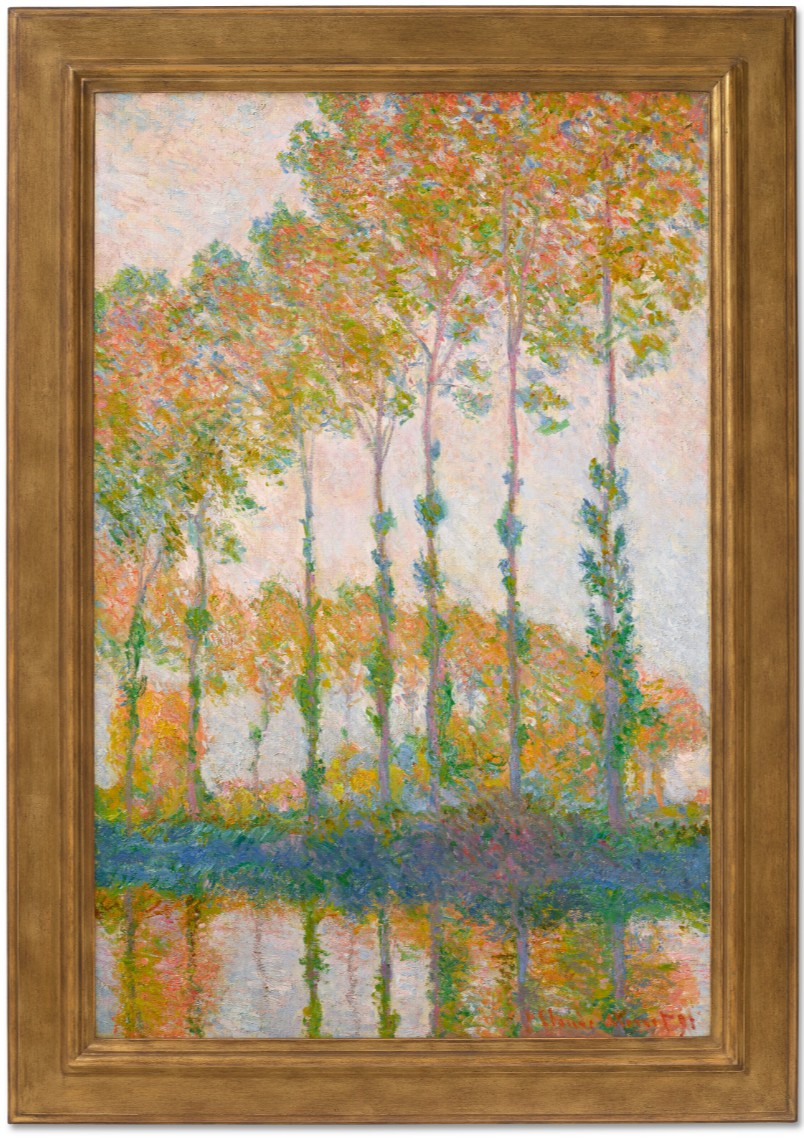
CLAUDE MONET (1840-1926)
Peupliers au bord de l’Epte, automne, 1891
Oil on canvas
101 x 65.7 cm (39 3/4 x 25 7/8 inches)
Signed and dated ‘Claude Monet 91’ (lower right)
#8. Nymphéas, 1914-17
Sotheby’s London: 2 March 2022
Estimated: GBP 15,000,000 – 20,000,000
GBP 23,228,500 / USD 30,963,530
Nymphéas | Modern & Contemporary Evening Auction | 2022 | Sotheby’s
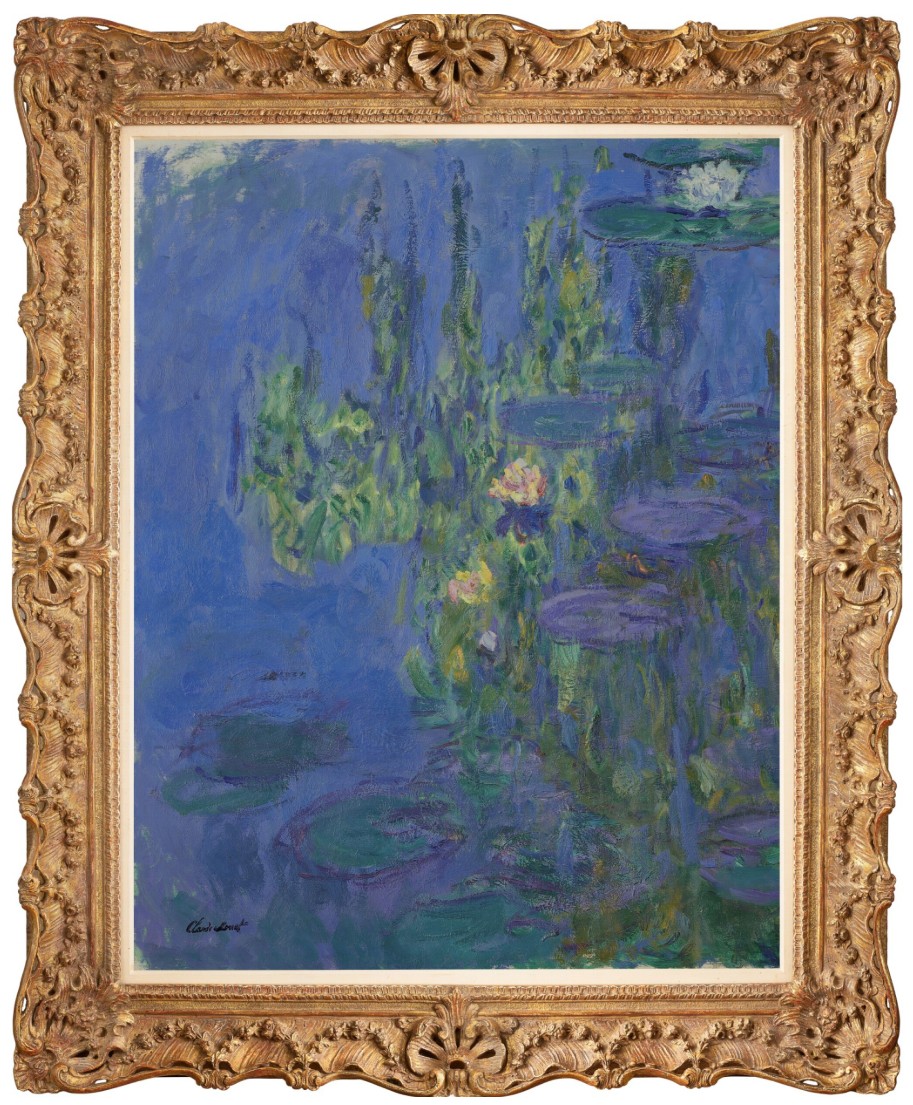
CLAUDE MONET (1840 – 1926)
Nymphéas, 1914-17
Oil on canvas
130.5 x 100 cm (51 3/8 x 39 3/8 inches)
Stamped Claude Monet (lower left)
Stamped Claude Monet on the reverse and again on the stretcher
#9. La mare, effet de neige, 1874-1875
Christie’s New-York: 12 May 2022
Estimated: USD 18,000,000 – 25,000,000
USD 25,580,000
CLAUDE MONET (1840-1926), La mare, effet de neige | Christie’s
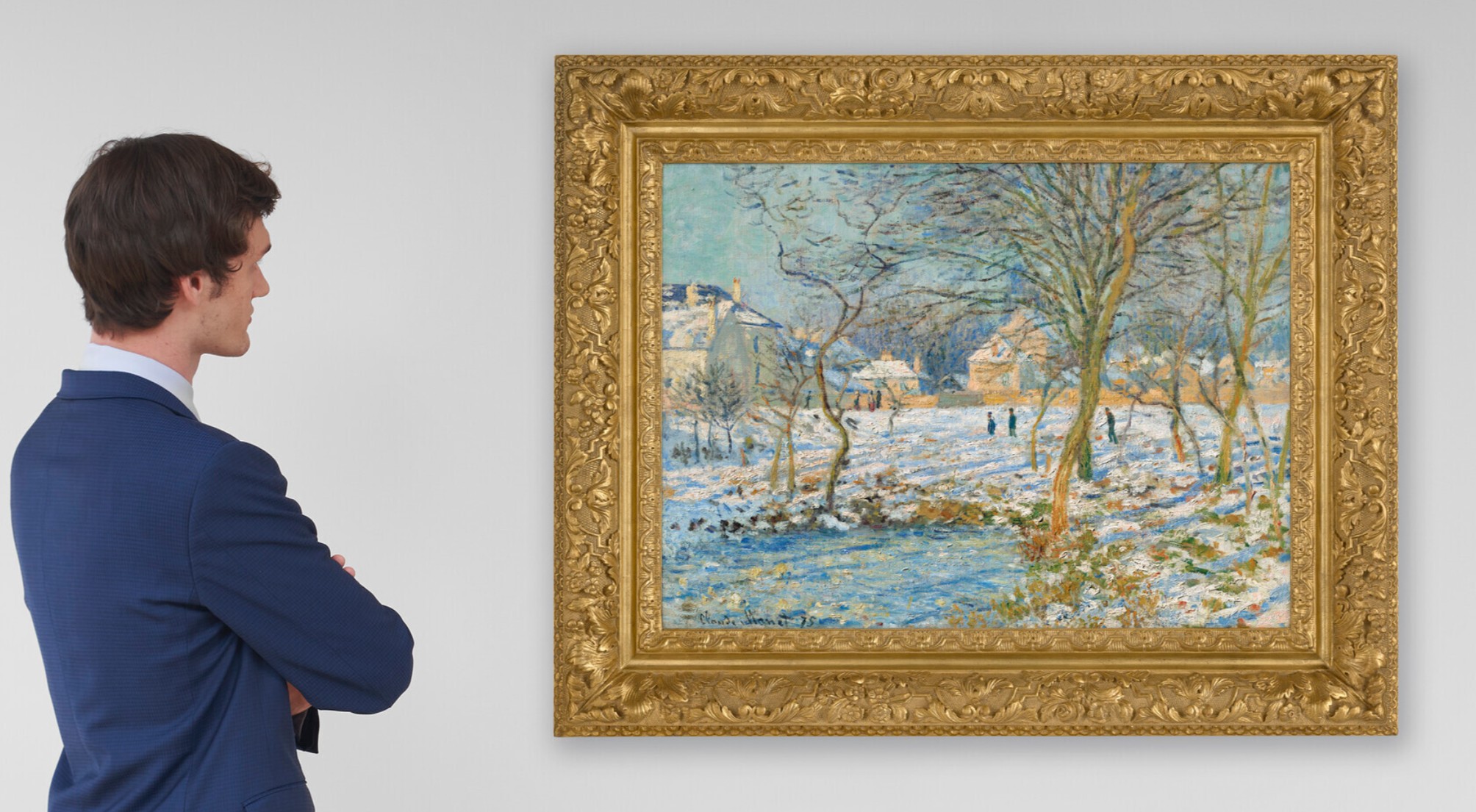
CLAUDE MONET (1840-1926)
La mare, effet de neige, 1874-1875
Oil on canvas
60.6 x 81.7 cm (23 7/8 x 32 1/8 inches)
Signed and dated ‘Claude Monet 75’ (lower left)
#10. Les Arceaux de Roses, Giverny, 1913
Sotheby’s New-York: 17 May 2022
Estimated: USD 20,000,000 – 30,000,000
USD 23,304,500
Les Arceaux de roses, Giverny | Modern Evening Auction | 2022 | Sotheby’s
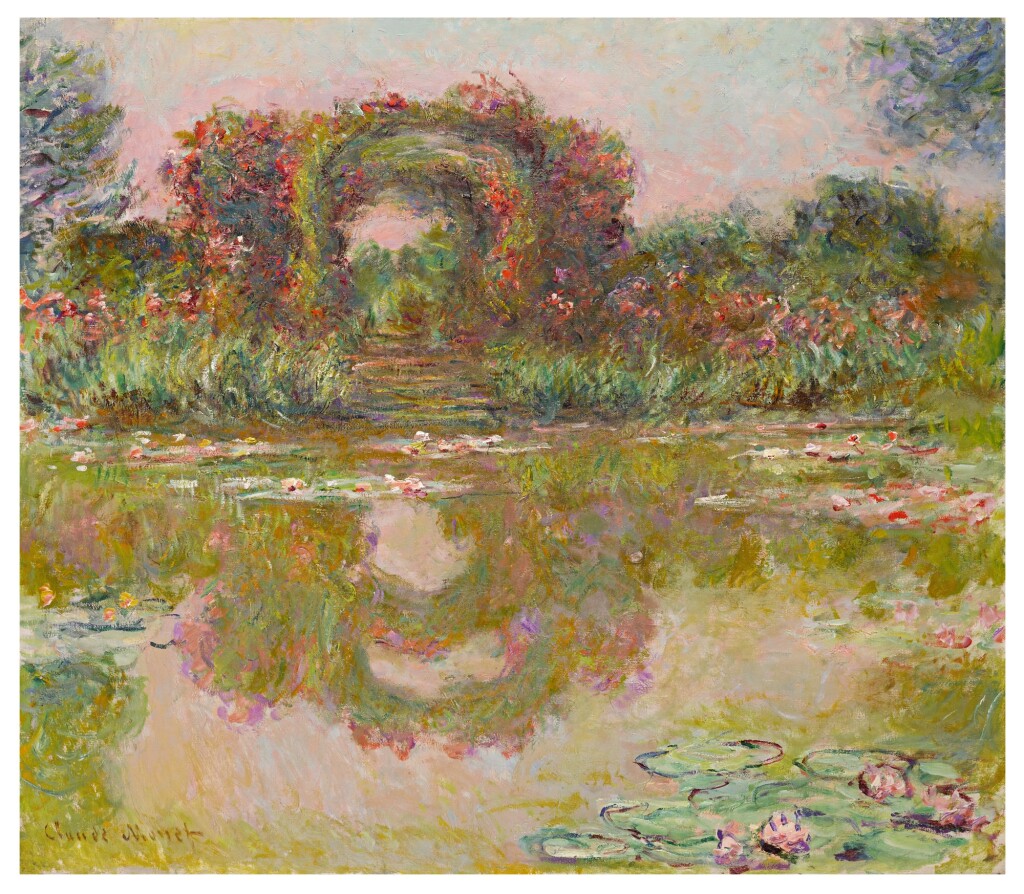
CLAUDE MONET
Les Arceaux de Roses, Giverny, 1913
Oil on canvas
81.5×93.5 cm (32×37 inches)
Signed Claude Monet (lower left)
#11. Vétheuil, 1880
Sotheby’s London: 29 June 2022
Estimated: GBP 10,000,000 – 15,000,000
GBP 11,738,500 / USD 14,306,660
Vétheuil | Modern & Contemporary Evening Auction | 2022 | Sotheby’s
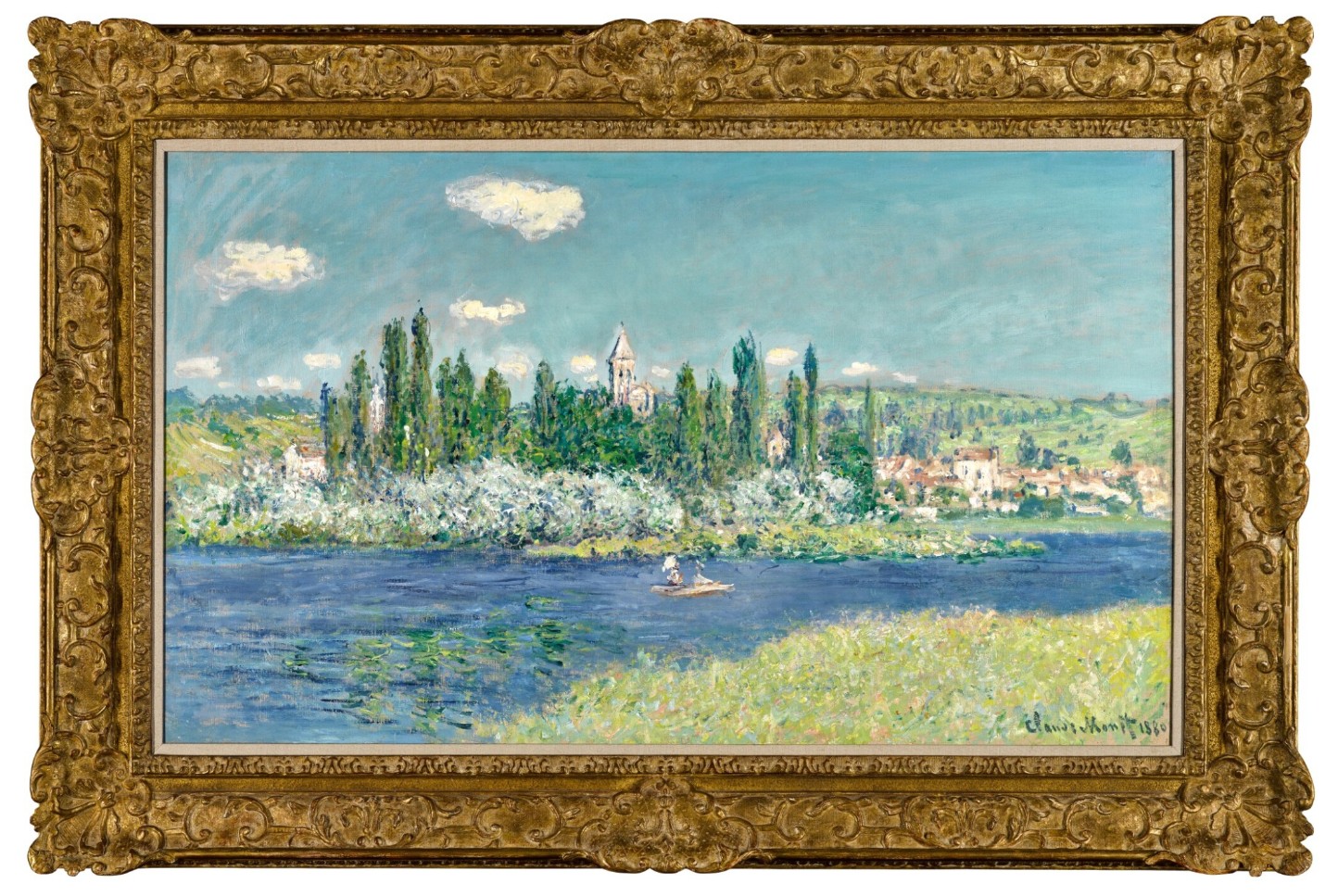
CLAUDE MONET (1840 – 1926)
Vétheuil, 1880
Oil on canvas
60.1 x 100.2 cm (23 5/8 x 39 1/2 inches)
Signed Claude Monet and dated 1880 (lower right)
#12. Champ d’avoine et de coquelicots, 1890
Christie’s New-York: 12 May 2022
Estimated: USD 12,000,000 – 18,000,000
USD 14,130,000
CLAUDE MONET (1840-1926), Champ d’avoine et de coquelicots | Christie’s
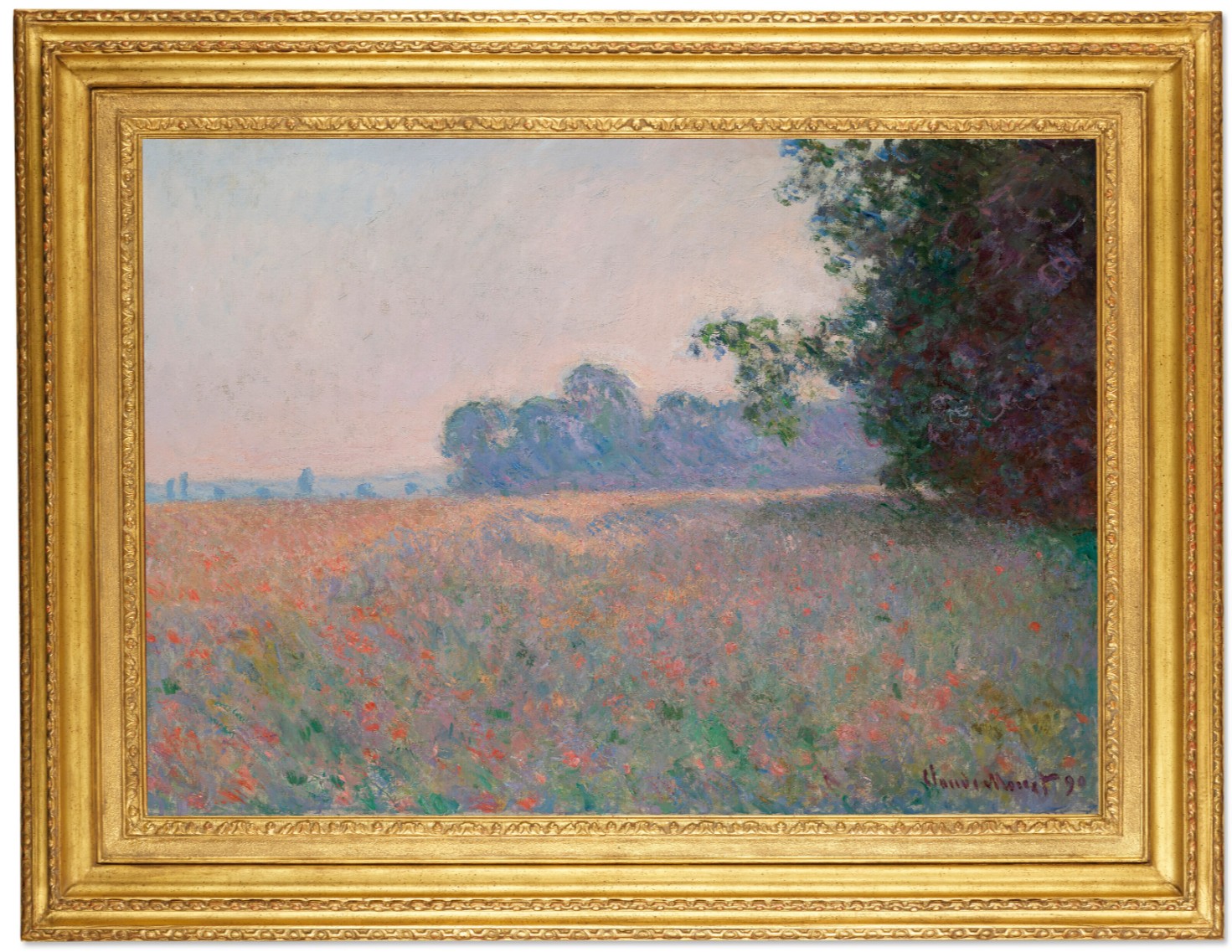
CLAUDE MONET (1840-1926)
Champ d’avoine et de coquelicots, 1890
Oil on canvas
65 x 92.1 cm (25 5/8 x 36 1/4 inches)
Signed and dated ‘Claude Monet 90’ (lower right)
#13. Massif de chrysanthèmes, 1897
Sotheby’s London: 2 March 2022
Estimated: GBP 10,000,000 – 15,000,000
GBP 8,291,500 / USD 11,052,550
Massif de chrysanthèmes | Modern & Contemporary Evening Auction | 2022 | Sotheby’s
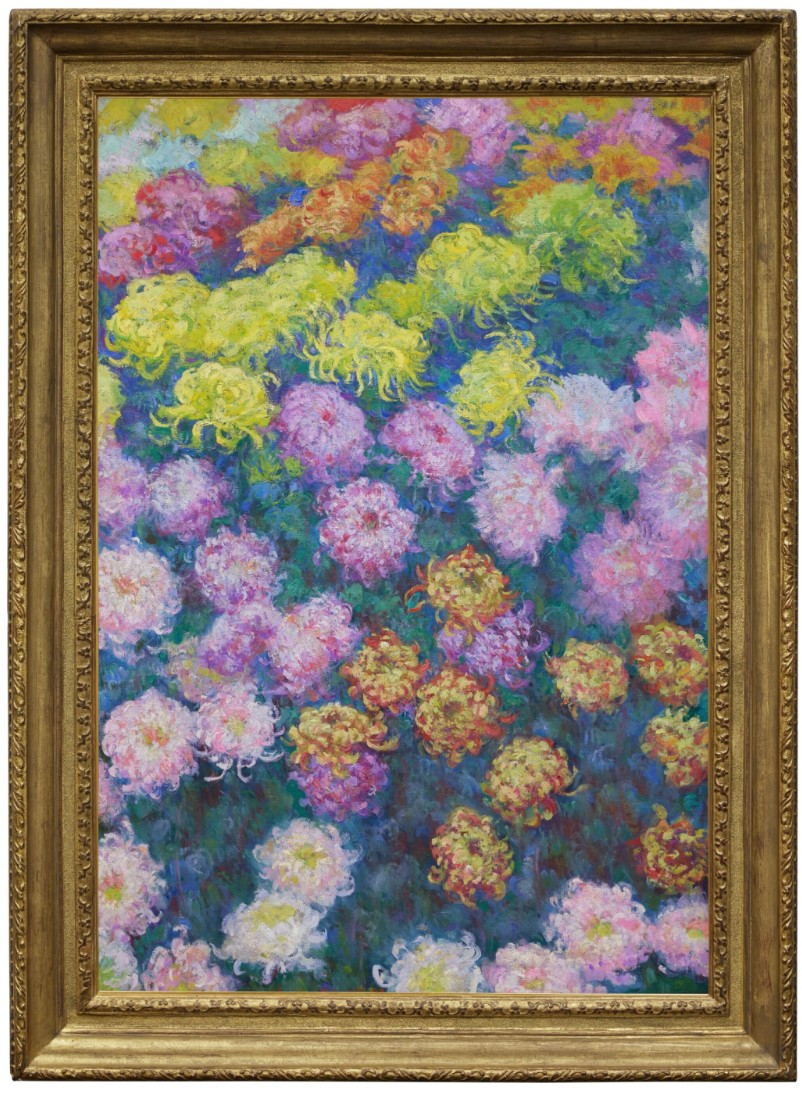
CLAUDE MONET (1840 – 1926)
Massif de chrysanthèmes, 1897
Oil on canvas
130.7 x 88.8 cm (51 1/2 x 35 inches)
Signed Claude Monet and dated 97 (lower centre)
#14. L’arbre en boule, Argenteuil, 1876
Christie’s New-York: 11 May 2022
Estimated: USD 7,000,000 – 10,000,000
USD 10,122,500
CLAUDE MONET (1840-1926), L’arbre en boule, Argenteuil | Christie’s
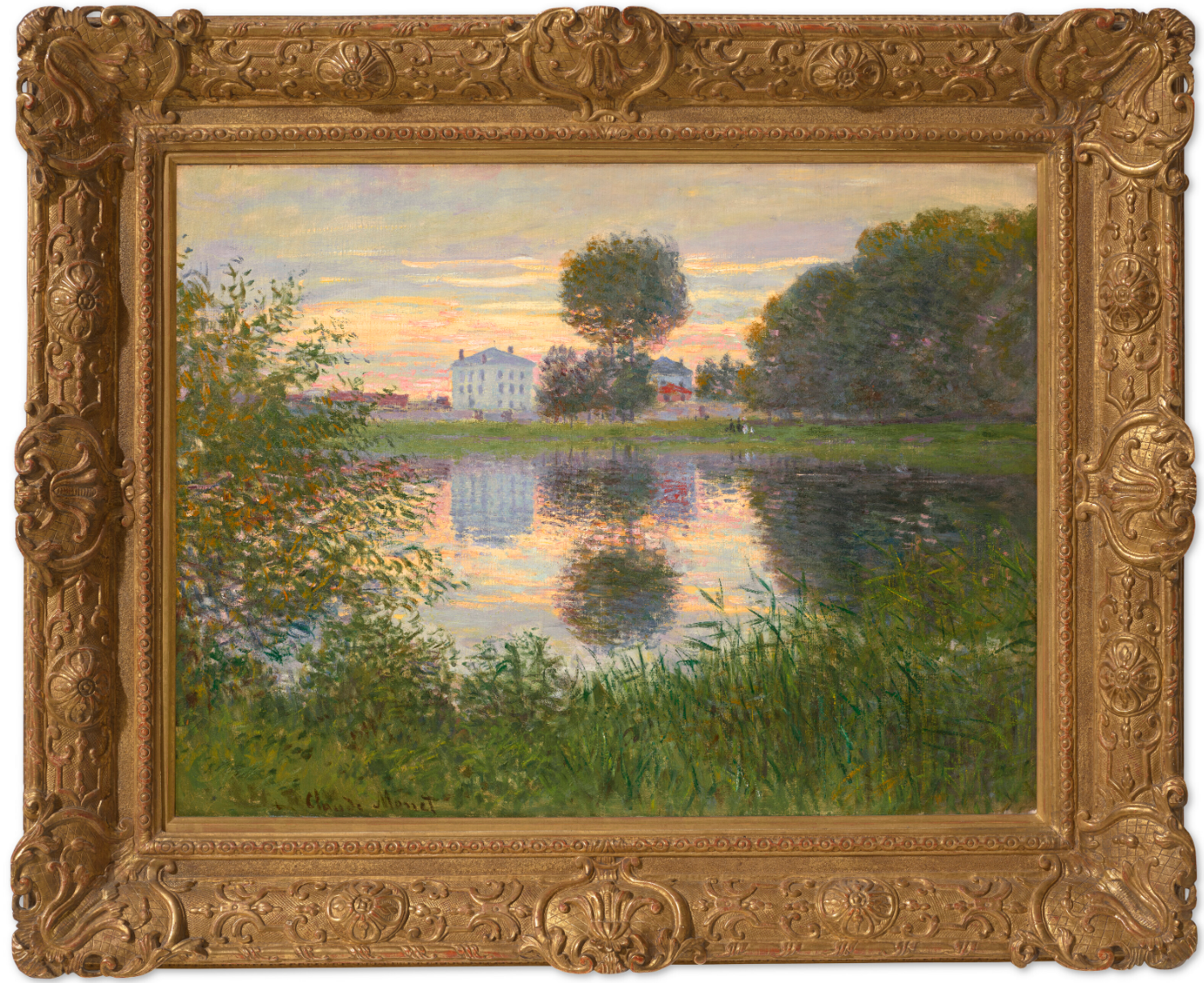
CLAUDE MONET
L’arbre en boule, Argenteuil, 1876
Oil on canvas
60.3 x 80.2 cm (23.7 x 31.5 inches)
Signed ‘Claude Monet’ (lower left)
#15. Sur la Falaise près de Dieppe, soleil couchant, 1897
Sotheby’s London: 2 March 2022
Estimated: GBP 3,500,000 – 5,000,000
GBP 5,304,100 / USD 7,070,350
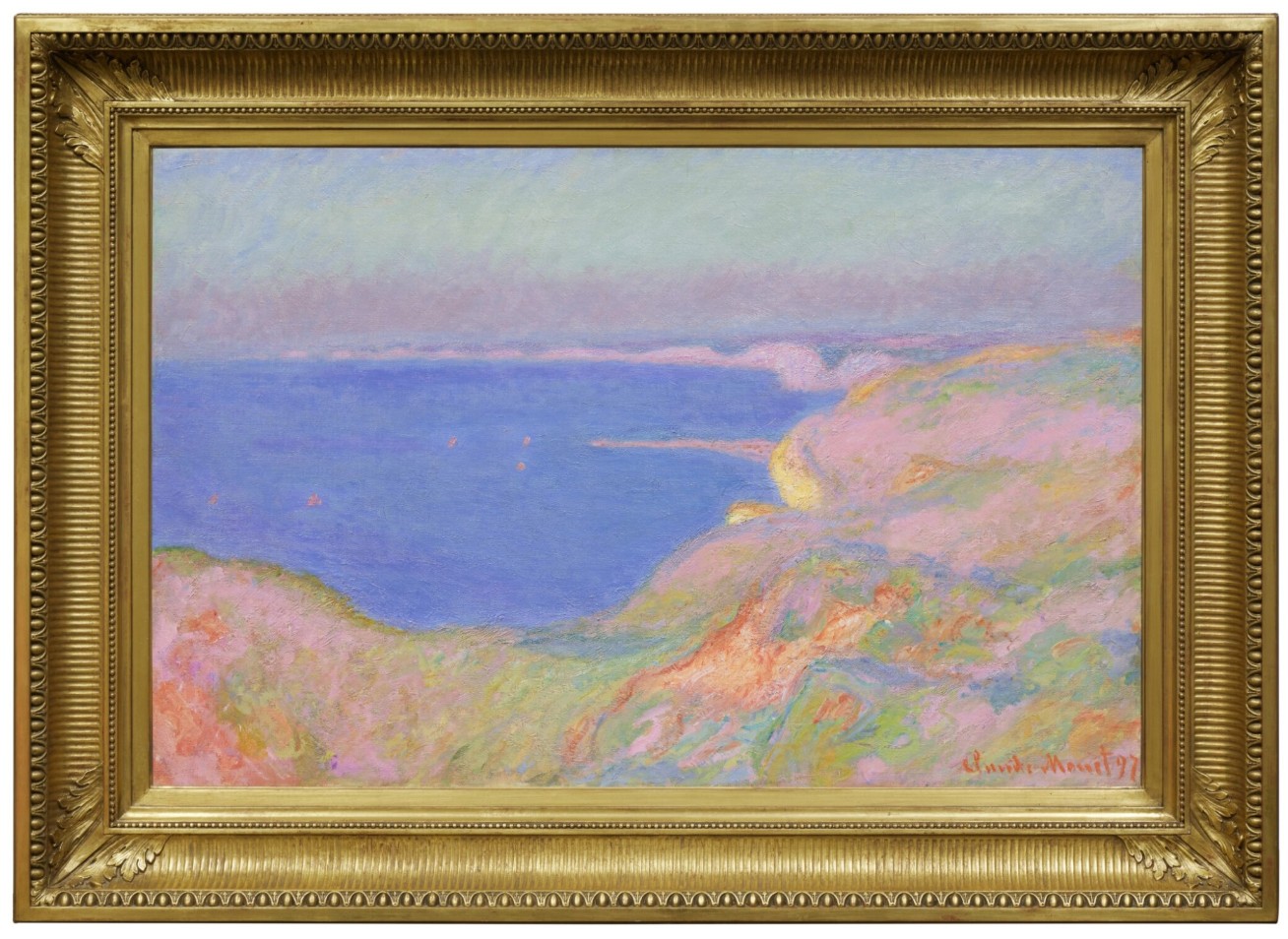
CLAUDE MONET (1840 – 1926)
Sur la Falaise près de Dieppe, soleil couchant, 1897
Oil on canvas
65×100 cm (25 5/8 x 39 3/8 inches)
Signed Claude Monet and dated 97 (lower right)
PART III: FOCUS
Nymphéas / Water Lillies
Few themes in the history of modern art are as universally revered as Claude Monet’s Nymphéas. More than a mere series of paintings, the water lilies became the culmination of a lifetime of observation, devotion, and artistic evolution. They stand today not only as a masterwork of Impressionism but as an enduring symbol of modernity and inner vision.
PLEASE CLICK BELOW TO ACCESS ALL AUCTION RESULTS FOR NYMPHEAS PAINTINGS
Meules / Haystacks
The year 1890 was a watershed moment in Claude Monet’s life—he turned fifty, bought property for the first time and negotiated the purchase of Édouard Manet’s Olympia and its ensuing placement in the French national collection. Any of these could have been the most notable occurrence of that period, but 1890 was also the year that Monet painted the most definitive artistic series of the nineteenth century—his Meules. Monet found his inspiration in the fields adjacent to his home in Giverny; taking the principal imagery of the monolithic grainstacks which dominate the harvested fields from the high spring onward. Commonly known as his Haystacks, these canvases are anchored by gigantic conical structures, composed of wheat or grain, stacked in such a way as to allow the stalks to dry and prevent mold prior to the grain’s separation from the stalk by a threshing machine. Each village did not possess its own thresher, and the wait for one of these traveling machines to reach a specific location often took months—grain cut in the summer might sit in its neat and careful stack until January or February of the following year. These stacks were over ten feet in height, sometimes reaching over twenty feet, their shape varying by region.

The subject of the haystack (or grainstack in some cases) had appeared in Monet’s canvases as early as the mid-1880s (see carousel below). In 1884, haystacks (composed of hay) sit in front of a row of poplars (W. 900-902); while in 1885, the stacks are leaned against by young figures dressed for a summer day (W. 993-95), and, in 1886, they form a small part of a broader and more expansive view of the surrounding countryside (Wildenstein 1073-74). It was not until two years later in 1888 that Monet began to place these grainstacks as the central motif of a composition (W. 1213-17) and then in 1890-91 Monet completed was is commonly viewed as his first series, some twenty-five canvases in which the Meules are depicted in a variety of light and weather effects (W. 1266-90). Meules à Giverny, along with two other works (W. 1363 and W. 1364), was completed in the midst of his Cathedral paintings in 1893. This was the last moment Monet fully engaged with the subject of the large haystacks (three oils completed the following year depict the very different shape of meulettes, a preparatory stage in the storing process (W. 1383-85)).
In choosing these powerful grainstacks as his subject, Monet continued a long tradition of depicting the French countryside and its abundant riches as seen in the paintings of such artists as Millet and the Barbizon school. Monet’s fellow Impressionists, most notably Camille Pissarro, had also included imagery of haystacks in their work. As early as 1873, Pissarro places a haystack front and center, its roughly triangular form breaking the horizon line and dominating the field and figures that surround it. Almost twenty years later his haystacks appear smaller in size, tucked between trees and pathways near his home in Éragny. However, Monet updated and adapted this tradition to striking effect: his grainstacks series contain virtually no anecdotal detail; no dogs or laborers, no figures walking through the fields or birds flying in the sky. The artist pares down his vision to focus solely on the grainstacks themselves, on the play of light or night on them, on the sky and the horizon. In this reduction of motif, Monet echoes the purity of line and form evident in Japanese colored woodblock prints by such masters as Hokusai that began to be seen in the West in the mid-nineteenth century, and also demonstrates a divergence of approach from contemporary artists such as Vincent van Gogh, who treated the same subject in Arles during 1890 with very different aims, imbuing his subject with a wealth of details that Monet chose to exclude from his painting.

LEFT: CAMILLE PISSARRO, PAYSANS ET MEULES DE FOIN DANS UN CHAMP, 1878, PRIVATE COLLECTION
TOP RIGHT: KATSUSHIKA HOKUSAI, SOUTH WIND AND CLEARING WEATHER THIRTY-SIX VIEWS OF MT. FUJI, CIRCA 1831, YALE UNIVERSITY ART GALLERY, NEW HAVEN
BOTTOM RIGHT: VINCENT VAN GOGH, STACKS OF WHEAT BY A FARM, JUNE 1888, RIJKSMUSEUM KRÖLLER-MÜLLER, OTTERLO
While van Gogh’s stacks, situated by a farmhouse, portray a scene of continuing work and human interaction, Paul Gauguin portrays them mid-construction, where local women manipulate the interior of the stack while thronged by chickens. This context underscores the separation from Pissarro and Millet’s imagery, showing the stacks primarily as temporary architectural constructions in the landscape. A step even further removed can be found in Degas’ Quatre danseuses, where ballerina’s print and spin in front of an ideal pastoral backdrop featuring several towering grainstacks.

LEFT: PAUL GAUGUIN, LES MEULES JAUNES (LE MOISSON BLONDE), 1889, MUSÉE D’ORSAY, PARIS
RIGHT: EDGAR DEGAS, QUATRE DANSEUSES, CIRCA 1899, NATIONAL GALLERY OF ART, WASHINGTON, D.C.
The theme of the harvest, as an essential cyclical human activity which indicated success or failure, feast or famine and ensured the passage of time, has a storied presence in artistic imagery since ancient times. From a wall painting from the Ramesside period of ancient Egypt circa 13th-11th centuries B.C. to an idealized image of medieval peasant life for the month of June in the Très riches heures of the Duke de Berry, executed by the Limbourg brothers in the early 1400s to Pieter Bruegel the Elder’s The Harvesters, the growth and collection of grain is depicted as integral to human life and development and can be conflated with the rise of human civilization (see figs. 8-10).

TOP: HARVEST SCENE ON THE EAST WALL OF THE TOMB OF SENNEDJEM, DEIR EL-MEDINA, 13TH-11TH CENTURIES B.C.
BOTTOM LEFT: LIMBOURG BROTHERS, LES TRÈS RICHES HEURES DU DUC DE BERRY, JUIN, CIRCA 1412-16, MUSÉE CONDÉ, CHANTILLY
BOTTOM RIGHT: PIETER BRUEGEL THE ELDER, THE HARVESTERS, 1565, THE METROPOLITAN MUSEUM OF ART, NEW YORK
Though the new modern behemoth, the railroad, wended its way across France by 1893, the importance of the harvest for the countryside, town and state was still paramount. In the careful preparation, harvest and storage methods exhibited by each grainstack, the economic health of the countryside was demonstrated. A good harvest and correct farming methods ensured the prosperity of the farmer and town, and by extension the city and state. The notion of the stacks carrying the wealth of their owners finds a resonance in Monet’s depiction of their surfaces and the volumetric play of their shapes. The primary stack in the present composition and those that populate the more distant background are broad, full structures that suggest the great fertility and bountifulness of the Normandy landscape. Their surfaces are gilded and burnished with the light of the sun, and the whole scene is infused with a sense of well-being, vitality and the harmony of nature.
Fifteen of Monet’s Meules were exhibited for the first time in May of 1891 at the Galerie Durand-Ruel in Paris. Several other works accompanied the exhibition, but the attention of the public was captured by the grainstacks. It is impossible to know each of the fifteen paintings from the series which were included as the catalogue descriptions are imprecise and no photographs were taken of the exhibition—much to the dismay of later scholars. The exhibition would prove to be a success in sales and in prestige. Many of the art critics of the day wrote praise-laden reviews and Pissarro, not usually taken with Monet’s work, wrote privately to his son that, despite his misgivings, it “was the work of a very great artist.” The famed critic Felix Fénéon, who had coined the term “Neo-Impressionist” some four years earlier, wrote in rhapsodic prose: “When did Monet’s colors ever come together in more harmonious clamor, with more sparkling impetus? It was the evening sun that most exalted Grainstacks: in summer they were haloed in purple flakes of ire; in winter, their phosphorescent shadows rippled in the sun, and, a sudden frost enameling them blue, they glittered on a sky first pink, then gold” (F. Fénéon quoted in D. Wildenstein, Monet or the Triumph of Impressionism, Cologne, 1996, pp. 279-80). In its warmth and generosity of vision, in its elevation of the humble grainstack to an icon of Impressionism and in its emphasis on form and light over content and the burden of detail, Meules is truly the masterpiece from Monet’s series of grainstacks.
Auction Results
#1. Meules, 1890
Sotheby’s New-York: 14 May 2019
Estimate on Request
USD 110,747,000
CLAUDE MONET
Meules, 1890
Oil on canvas
72.7 x 92.6 cm (28 5/8 x 36 3/4 inches)
Signed Claude Monet and dated 91 (lower left)
The present oil is the most evocative and glorious example from the most famed group of pictures in the nineteenth-century western canon. The present canvas breaks from the overall organization of the series in several ways. The “parallel bands” are less dominating in structure, rather the strong diagonal extending from the left edge of the canvas towards the horizon line becomes dominant. In only one other canvas is this the case (Wildenstein 1272). Monet also employs a radical cropping in Meules, which contributes to the sense of dynamism in the receding diagonal line of the stacks; this is in direct opposition to the sun, hidden behind the stacks, which casts diagonal beams of light towards the lower right corner of the composition, suffusing the edges of the stacks and the ground with reds, oranges and vibrant greens. By cutting off a portion of the largest stack at the left edge he conveys the monumentality of these monoliths and further impresses the manipulation of light in the landscape caused by their physical presence.
“The Haystacks are best understood,” writes Charles S. Moffett, “in terms of the evolution of Monet’s late work. They were the first of several series, and as such they mark the appearance of a mode that interested the artist for the rest of his career. In this connection, Geffroy makes a remark in his 1891 catalogue essay that is both insightful and prescient. He likened the haystacks in the field near Monet’s house to mirror-like ‘object passagers’ (‘transitory objects’), the primary function of which was to reflect the surrounding effects of light and atmosphere, or, in the terminology that Monet used when speaking to Byvanck… ‘These haystacks, in an empty field, are mirror-like objects in a kind of open thoroughfare where environmental influences, atmospheric effects, puffs of breeze, and short-lived light effects manifest themselves’” (C. S. Moffett, “Monet’s Haystacks” in J. Rewald & F. Weitzenhoffer, eds., Aspects of Monet, a symposium on the artist’s life and times, New York, 1984, p. 155).
The essential trouble with capturing a fleeting effect and memorializing it on canvas was not, by 1890, a new concept. Monet, however, wanted, as ever, to push the boundaries of what this meant and how to depict it. “Monet was focusing on what was in a sense the most transitory of all subjects,” states John House, “and the one most suited to the rapid sketch—the atmosphere itself, the ever-changing envelope which gave color and life to inert objects. As Geffroy reported in his ‘Salon de 1890’, using a phrase which Monet repeated in later interviews, Monet ‘does not want to represent the reality of things, he wants to record the light which lies between him and the objects.’ The key to Monet’s later works lies in this paradox and in ways in which he resolved it: he was seeking a way of translating nature’s most fleeting effects into fully realized, complete works of art. No longer could the impression be an end in itself; the work of art had to transcend the initial experience and yet still retain a sense of the immediacy of the experience, of ‘l’instantanéite’” (J. House, “Monet in 1890” in ibid., p. 133).
How was Monet to accomplish immediacy? A close examination of the surface of Meules betrays the concept, and the rather romantic idea, of Monet completing all of his work en plein air. While much of the initial work was done in the fields, examining light, perspective, and various ephemeral effects, the staggering complexity of pigment application, color and light in Meules speaks to close and time-consuming work in the artist’s studio following his initial sessions out of doors. As John House describes: “In the Meules, the surfaces, though dense, are generally less insistent; the effect of the instantaneity of the envelope is recreated in elaboration of the final stages of the execution of the paintings, when soft yet animated touches of endlessly varied color were added over less variegated paint layers. Paradoxically, then, the instantaneity of the initial effect could only be finally realized in paint at the end of a protracted period of reworking, and given the transistoriness of the subject, this can only have been achieved in the studio. So, in one sense the initial effect was recreated as the painting was worked up, but in another sense the elaboration and resolution of the painting itself transcended the momentariness of its initial stimulus. The ‘more serious qualities’ which Monet sought in these paintings emerge as the viewer contemplates them at his leisure. Their starting point may have been an instant of vision, but the pictures can in no way be apprehended in an instant…. Looking at the picture is now an experience absolutely different from, and divorced from, the experience of looking at nature itself” (ibid., pp. 134-35).
#2. Meule, 1891
Christie’s New-York: 16 November 2016
Estimate on Request
USD 81,447,500
Claude Monet (1840-1926), Meule | Christie’s
CLAUDE MONET (1840-1926)
Meule, 1891
Oil on canvas
72.7 x 92.1 cm (28 5/8 x 36 1/4 inches)
Signed and dated ‘Claude Monet 91’ (lower left)
It is difficult to imagine a more iconic Impressionist masterpiece than the work to be offered for sale on November 16, Monet’s Meule, 1891, possibly the most vibrantly colorful of all the painter’s slightly more than thirty variations on this motif that revolutionized modern art. Monet painted six of his grainstacks (“meule” in French) compositions already in 1888, and then fully realized his obsession with the subject starting in the autumn of 1890. This particular Meule is one of three canvases that are three inches taller than any of the others in format. Its pointed top rising to the upper edge of the canvas and its side cropped, the massive stack in the foreground is transcribed with short dashes of richly muted sunset colors, as is everything observed near and far, to the shadowy horizon of purplish hills visible in the distance across the Seine. Monet’s writer friend and fellow gardener Octave Mirbeau acclaimed Monet’s new grainstack series in March 1891 as nothing less than “states of the planet’s consciousness” and “the drama of the earth.” Landscape as a theater for such cosmic forces was what Vincent van Gogh sought until his untimely death in the summer of 1890, only two or three months before Monet began to complete his grainstack series. Vincent’s art dealer brother Theo bought two of the grainstack paintings and reserved a third already in January 1891. The pioneering abstract painter Wassily Kandinsky never forgot the revelation from seeing a grainstack painting at an exhibition in Moscow in 1896. Monet’s primary goal was to capture the flood of multi-colored daylight as visionary experience, but his painting represents a farmer’s field with a typical round stack for the storage of harvested wheat to be thrashed. In Monet’s increasingly urbanized world, such stacks had become postcard symbols of agricultural bounty as a blessing. Determined with his grainstack paintings to go beyond the brilliantly exacting transcription of visual sensations at the heart of Impressionist landscape painting, Monet explained the challenge to his art critic friend, Gustave Geffroy in October 1890: “… the further I go, the more I see that a lot of work is needed to get at what I am looking for: instantaneity, above all the envelope, the same light suffused everywhere. ” Although the colors blend into an opalescent haze at a distance, up close Monet’s Meule features hundreds of short staccato brushstrokes aligned as waves of colored light, layers of one color raking across previously applied layers to capture the pulse of light as a life force. It was Monet’s obsession to capture the scintillating play of light that prompted Paul Cézanne’s comment: “Monet is only an eye. But what an eye!” Monet habitually traveled as far afield as Brittany and the Mediterranean to find dramatic landscape subjects and fairytale light effects, especially after 1883 when he leased a large property in the Seine-side village of Giverny with room enough for his family of ten. He was successful enough to take a year off from painting starting in mid-1889 to run a fund-raising campaign for the purchase Eduouard Manet’s Olympia as a donation to the French state. Did his devotion to his late friend’s masterpiece provide Monet the incentive to return to his grainstacks and realize with them a new paradigm for contemporary art, as revolutionary as Olympia was thirty years earlier? Six weeks into his grainstacks campaign, Monet celebrated his fiftieth birthday on Nov. 14, 1890 and three days later he purchased his Giverny home. To the west his property bordered the farm field where he recorded his most subtle observations with countless touches of interwoven paint colors. From seeing his grainstack paintings together in his studio, Monet realized how they enhanced one another and in December 1890 he pressed his dealer Paul Durand-Ruel for a solo exhibition. The May 1891 show, with fifteen grainstacks, sold out in days, according to Camille Pissarro, who at first complained that Monet was just repeating himself, but later in the year converted to series painting. In the preface to the May 1891 exhibition catalogue Geffroy compared the visual intensity of the grainstack paintings to gems, fire and blood. Indeed the idea to create and show groups of similar works together immediately became the norm for modern artists and galleries, and remains so today. It was thanks to this exhibition Monet became an international contemporary art star, as collectors competed to own not just one, but if possible several different examples. Most of all in demand were the paintings of sunsets. Having delivered five grainstacks to the agent for the New York dealer Knoedler in October 1891, Monet pointed out in particular one entitled “Derniers rayons du soleil”: “I believe that I have succeeded well and it is not often that I say that about what I do.” The exquisite Meule on offer is quite possibly the painting Monet described. Charles Stuckey, Curator of Claude Monet, 1840-1926 presented at The Art Institute of Chicago in 1995.
“These stacks, in that deserted field, are transitory objects on which are reflected, as in a mirror, the influences of the environment, atmospheric conditions, sudden bursts of light. They are a fulcrum for light and shadow; they reflect the final warmth, the last rays,” wrote Gustave Geffroy, Monet’s most faithful interpreter, when the artist’s now-iconic paintings of grainstacks–the first of the great serial endeavors that would come to define his artistic legacy–received their inaugural exhibition in May 1891. “At the close of the day the stacks glow like heaps of gems. Their sides split and light up. These red-glowing grainstacks throw lengthening shadows that are strewn with emeralds. Later still, under an orange and red sky, darkness envelops the grainstacks which have begun to glow like hearth fires…” (quoted in P.H. Tucker, Monet in the ’90s: The Series Paintings, exh. cat., Museum of Fine Arts, Boston, 1989, p. 109).
The Grainstack series that Geffroy so poetically extolled–twenty-five canvases in all–was the most challenging and revolutionary endeavor that Monet, then fifty years old, had ever undertaken. While he had experimented during the later 1880s with depicting a single landscape subject under different lighting and weather conditions, never before had he conceived of painting so many pictures that were differentiated almost entirely through color, touch, and atmospheric effect. “A landscape hardly exists at all as a landscape,” Monet told a visitor to the 1891 exhibition, “because its appearance is constantly changing; it lives by virtue of its surroundings–the air and light–which vary continually” (quoted in ibid., p. 104). At the same time, the serial format allowed Monet to move beyond the description of isolated and fleeting events–the Impressionist stock-in-trade–to convey a sense of nature’s deeper wholeness and continuity. Revealing their secrets only at length, encouraging deep contemplation if not spiritual reverie, the Grainstacks thus represent the most crucial turning point in Monet’s entire career, marking out a path that the artist would follow well into the twentieth century.
The present painting is among the most formally adventurous of all the Grainstacks–part of a trio of canvases in which a single conical meule is seen close up and cropped by the frame, transcending naturalism in form and color alike (Wildenstein, nos. 1288-1289; Kunsthaus, Zürich, and Museum of Fine Arts, Boston). Wildenstein places these monumental stacks at the very end of the series, as a fitting culmination to the entire project. Compared with earlier examples in the sequence, in which the effects of light and shade are more specific, the present view seems to convey what Monet felt and experienced before the motif as much as what he actually saw. He painted the scene looking southwest, with the sun setting behind the grainstack in the far right distance and the late afternoon sky glowing peach and gold. Rather than being darkened by shadow, however, the front face of the immense stack is suffused with pink and red as though the structure had absorbed the dazzling brilliance of the sunset through and through. “These fireworks of light and color emancipate themselves from their subject, their familiar natural environment, and they metamorphose into pure painting,” Christian von Holst has written (Claude Monet: Fields in Spring, exh. cat., Staatsgalerie Stuttgart, 2006, p. 34).
When Kandinsky saw one of Monet’s Meules in an exhibition in Moscow in 1896, it struck him with the force of a revelation–as the inception of autonomous painting, the very beginning of abstraction. Yet to find the motif for this visionary and transformative project, Monet needed only to walk out his door at rural Giverny, to a field known as the Clos Morin that lay just west of his home. There, following the harvest, local farmers piled hundreds of sheaves of bound wheat stalks into tightly packed stacks, rising from fifteen to twenty feet in height and capped with thatched conical roofs. These served as storage facilities, protecting the crop from moisture and rodents until spring, when the grain could be more easily separated from the chaff. Monet set up his easel near the boundary wall of his garden, looking by turns west or southwest across the field toward the hills on the far bank of the Seine, about a mile away. From this vantage point, the landscape resolved before Monet’s eyes into an extremely spare and strongly geometric composition, which he rendered as parallel bands of field, hills, and sky that extend across the entire canvas, with a single grainstack or a pair dominating the foreground.
Monet first investigated the pictorial possibilities of these local grainstacks in five exploratory canvases that he painted during the fall and winter of 1888 (Wildenstein, nos. 1213-1217). His work was interrupted, however, early in 1889 first by a three-month painting campaign in the Creuse Valley, then by his major retrospective with Rodin at the Galerie Georges Petit and by a time-consuming project that he had initiated to donate Manet’s Olympia to the French State. In late July 1890, when he took up his brushes again after a hiatus of nearly a year, he consciously sought to reacquaint himself with Giverny’s fundamentally agrarian character, painting ten canvases that depict fields of hay, oats, and poppies at full maturity (nos. 1251-1260). He set these aside, however, as soon as the first unassuming grainstacks began to rise on the landscape–most likely in late August, when agrarian manuals of the time indicate that farmers would have started cutting their fields.
By early October, Monet was entirely absorbed in the project and had succeeded at delineating his aesthetic aims. “I’m working away at a series of different effects (of stacks),” he wrote to Geffroy, “but at this time of year, the sun sets so quickly that I can’t keep up with it. The further I go, the better I see that it takes a great deal of work to succeed in rendering what I want to render: instantaneity, above all the enveloppe, the same light diffused over everything” (quoted in J. House, Monet: Nature into Art, New Haven, 1986, p. 198). He pleaded with Durand-Ruel for more time when the dealer pressed him to deliver the oat and poppy pictures, and he canceled a proposed return visit to the Creuse Valley. When the property that he had been renting at Giverny since 1883 came up for sale in November, he hastened to purchase it at the hefty asking price rather than risk any disruption in his labors. “I am in the thick of work,” Monet could still declare in mid-January. “I have a huge number of things going and cannot be distracted for a minute, wanting above all to profit from these splendid winter effects” (quoted in P.H. Tucker, op. cit., 1989, p. 80).
Monet had evidently brought the series to some sort of conclusion by early February 1891, when he invited Durand-Ruel to come to Giverny. He was eager for the dealer to see the results of his labors, which–to judge from his later accounts of the series’ inception–he fully recognized as a radical new departure in his art. “When I started, I was just like the others,” he told a visitor to his studio. “I thought two canvases were enough–one for a ‘gray’ day, one for a ‘sunny’ day. At that time I was painting grainstacks that had caught my eye; they formed a magnificent group, right near here. One day I noticed that the light had changed. I said to my stepdaughter, ‘Would you go back to the house, please, and bring me another canvas.’ She brought it to me, but very soon the light had again changed. ‘One more!’ and, ‘One more still!’ And I worked on each one only until I had achieved the effect I wanted; that’s all. That’s not very hard to understand…” (quoted in M. Call, Claude Monet, Free Thinker, New York, 2015, p. 95).
Monet was never one for theorizing, and this oft-repeated account is thus vastly over-simplified, as the artist himself well knew. Although he began the paintings en plein air, grappling with nature’s transitory effects, he then spent upwards of two months re-working them in the studio–“harmonizing” the set, he called it–before releasing a batch to Durand-Ruel in May. “Clearly the realization of this series was an act of memory,” Andrew Forge has written, “as much as it was an observation of the instant” (Claude Monet, Chicago, 1995, p. 48). In the present canvas, Monet has retained only the faintest vestige of the deep shadow that the backlit meule would have cast diagonally across the foreground, indicating the passage of time; instead, he has rendered the field as a highly subjective mosaic of pastel touches. Bergson’s theory of la durée, popular among Monet’s Symbolist colleagues, was first published in 1889, and Darwin’s long-view of natural change, a favorite of the artist’s friend Clemenceau, was circulating as well. Surely these informed Monet’s revelatory treatment of time in the Meules, which evoke the eternal within the temporal, duration within the fleeting moment.
The grainstack motif itself, far from a mere pretext for such explorations, also has its own powerful resonance. The long-standing notion that France’s greatest strength lay in her rich land and beneficent climate had gained renewed momentum in the later nineteenth century, as cities and industry grew exponentially. There was a national outcry in 1889 when one of the nation’s most celebrated icons of rural life, Millet’s Angelus, was sold to an American collector; the painting’s return to France the following year was greeted with relief and fanfare. In selecting the grainstacks at Giverny as a motif, Monet was offering tangible evidence of the land’s fertility and compelling testimony to the health of rural France. “Monet’s paintings implied that the countryside was a place where one could find reassurances about the world,” Paul Tucker has proposed, “where contemporary problems seemed to vanish, and a deeper union with nature appeared possible” (op. cit., 1989, p. 111).
Monet imbued the Meule series, moreover, with a profoundly social dimension, despite the fact that rural workers and other overt signs of labor are entirely absent. The grainstacks at Giverny represented the local farmers’ livelihood–the fruits of their labors and their hopes for the future. In the background of all but two of the paintings in the sequence, Monet depicted these smallholders’ houses and barns, nestled at the base of the distant hills; when the meules become enormous, as in the present canvas, these structures meet the stacks at the exact center of the composition. From one painting to the next, we also sense Monet’s own deep engagement with the stacks, which assert themselves as individual entities at the same time that they become one with the enveloping atmosphere. “Although inert, the stacks seem to be invested with great feeling,” Tucker has written, “for when the morning sun appears, they turn their faces to greet it; when it goes down in a brilliant display of warmth and power, they quiver at the sight. They swelter in the midday heat of summer, huddle together in the fading light of winter, and stand mournfully alone in the evenings, like solitary actors on a dimly lit, deserted stage” (ibid., p. 90).
Durand-Ruel knew a good thing when he saw it. Although he had initially envisioned reviving the Impressionist group show in 1891, he acquiesced without complaint to Monet’s insistence on a solo exhibition of select recent work–a marketing strategy that would hold sway for the rest of the artist’s career. The show opened to great acclaim in mid-May, with fifteen Meules on view and a smattering of earlier paintings; Monet by then was hard at work on the next of his great serial endeavors, the Poplars. By the close of 1891, all but two of the Grainstacks had left the artist’s studio, leading Pissarro for one to lament his own lesser fortunes. “For the moment, people want nothing but Monets. Apparently he can’t paint enough pictures to meet the demand. Worst of all, they all want Grainstacks in the Setting Sun!” (quoted in ibid., p. 106). The present painting is believed to be one of five from the series that Knoedler selected from the artist in September 1891, and the only one from that group to remain today in private hands (Wildenstein, nos. 1271, 1279, 1284, and 1289).
Meules à Giverny, 1893
Sotheby’s New-York: 15 May 2024
Estimate on Request
USD 34,804,500
Meules à Giverny | Modern Evening Auction | 2024 | Sotheby’s (sothebys.com)
GUARANTEED
CLAUDE MONET (1840 – 1926)
Meules à Giverny, 1893
Oil on canvas
65.5 x 100.2 cm (25 7/8 x 39 1/2 inches)
Signed Claude Monet and dated 93 (lower right)
In 1893, at the height of the hay-making season, Claude Monet set up his easel in the meadow just to the south of the site of his future water-lily pond and painted Meules à Giverny. Infused with light, shadow, color and movement, this oil exemplifies the best of Monet’s bucolic Impressionism, taking as its subject one of the artist’s most beloved—that of the haystack. Unlike any paintings on this subject he had executed before, the present work and two directly related compositions (W. 1363 and W. 1364) make full use of the revelations in surface handling that Monet discovered in his series focused on Rouen Cathedral, which he began in 1892 and finished in 1894. During the associated painting campaigns in Rouen the artist, rather unsurprisingly, reflected in his letters to his wife that he was not a city person: “… it is decidedly not my business to be in cities.” According to Paul Hayes Tucker, “he also spoke of how he missed Giverny and how he wanted to paint in the spring. He made these same statements during his second campaign in Rouen. ‘This Cathedral is admirable,’ he admitted to Alice in March of 1893, ‘but it is terribly dry and hard to do; it will be a delight for me after this to paint en plein air.’ ‘Giverny must be so beautiful that I dare not even think about it’” (Exh. Cat., Boston, Museum of Fine Arts, Monet in the ‘90s, The Series Paintings, 1989-90, p. 165). It was with this desire that Monet set out to paint Meules à Giverny and it is this deep sense of fulfilled longing and homecoming that suffuses every brushstroke of the present work.

Monet found his inspiration in the fields adjacent to his home in Giverny; taking the principal imagery of the monolithic grainstacks which dominate the harvested fields from the high spring onward. Commonly known as his Haystacks, these canvases are anchored by gigantic conical structures, composed of wheat or grain, stacked in such a way as to allow the stalks to dry and prevent mold prior to the grain’s separation from the stalk by a threshing machine. Each village did not possess its own thresher, and the wait for one of these traveling machines to reach a specific location often took months—grain cut in the summer might sit in its neat and careful stack until January or February of the following year. These stacks were over ten feet in height, sometimes reaching over twenty feet, their shape varying by region.
The subject of the haystack (or grainstack in some cases) had appeared in Monet’s canvases as early as the mid-1880s (see carousel below). In 1884, haystacks (composed of hay) sit in front of a row of poplars (W. 900-902); while in 1885, the stacks are leaned against by young figures dressed for a summer day (W. 993-95), and, in 1886, they form a small part of a broader and more expansive view of the surrounding countryside (Wildenstein 1073-74). It was not until two years later in 1888 that Monet began to place these grainstacks as the central motif of a composition (W. 1213-17) and then in 1890-91 Monet completed was is commonly viewed as his first series, some twenty-five canvases in which the Meules are depicted in a variety of light and weather effects (W. 1266-90). Meules à Giverny, along with two other works (W. 1363 and W. 1364), was completed in the midst of his Cathedral paintings in 1893. This was the last moment Monet fully engaged with the subject of the large haystacks (three oils completed the following year depict the very different shape of meulettes, a preparatory stage in the storing process (W. 1383-85)).

In choosing these powerful grainstacks as his subject, Monet continued a long tradition of depicting the French countryside and its abundant riches as seen in the paintings of such artists as Millet and the Barbizon school. Monet’s fellow Impressionists, most notably Camille Pissarro, had also included imagery of haystacks in their work. As early as 1873, Pissarro places a haystack front and center, its roughly triangular form breaking the horizon line and dominating the field and figures that surround it. Almost twenty years later his haystacks appear smaller in size, tucked between trees and pathways near his home in Éragny. However, Monet updated and adapted this tradition to striking effect: his grainstacks series contain virtually no anecdotal detail; no dogs or laborers, no figures walking through the fields or birds flying in the sky. The artist pares down his vision to focus solely on the grainstacks themselves, on the play of light or night on them, on the sky and the horizon. In this reduction of motif, Monet echoes the purity of line and form evident in Japanese colored woodblock prints by such masters as Hokusai that began to be seen in the West in the mid-nineteenth century, and also demonstrates a divergence of approach from contemporary artists such as Vincent van Gogh, who treated the same subject in Arles during 1890 with very different aims, imbuing his subject with a wealth of details that Monet chose to exclude from his painting.
LEFT: CAMILLE PISSARRO, PAYSANS ET MEULES DE FOIN DANS UN CHAMP, 1878, PRIVATE COLLECTION
TOP RIGHT: KATSUSHIKA HOKUSAI, SOUTH WIND AND CLEARING WEATHER THIRTY-SIX VIEWS OF MT. FUJI, CIRCA 1831, YALE UNIVERSITY ART GALLERY, NEW HAVEN
BOTTOM RIGHT: VINCENT VAN GOGH, STACKS OF WHEAT BY A FARM, JUNE 1888, RIJKSMUSEUM KRÖLLER-MÜLLER, OTTERLO
While van Gogh’s stacks, situated by a farmhouse, portray a scene of continuing work and human interaction, Paul Gauguin portrays them mid-construction, where local women manipulate the interior of the stack while thronged by chickens. This context underscores the separation from Pissarro and Millet’s imagery, showing the stacks primarily as temporary architectural constructions in the landscape. A step even further removed can be found in Degas’ Quatre danseuses, where ballerina’s print and spin in front of an ideal pastoral backdrop featuring several towering grainstacks.
LEFT: PAUL GAUGUIN, LES MEULES JAUNES (LE MOISSON BLONDE), 1889, MUSÉE D’ORSAY, PARIS
RIGHT: EDGAR DEGAS, QUATRE DANSEUSES, CIRCA 1899, NATIONAL GALLERY OF ART, WASHINGTON, D.C.
The theme of the harvest, as an essential cyclical human activity which indicated success or failure, feast or famine and ensured the passage of time, has a storied presence in artistic imagery since ancient times. From a wall painting from the Ramesside period of ancient Egypt circa 13th-11th centuries B.C. to an idealized image of medieval peasant life for the month of June in the Très riches heures of the Duke de Berry, executed by the Limbourg brothers in the early 1400s to Pieter Bruegel the Elder’s The Harvesters, the growth and collection of grain is depicted as integral to human life and development and can be conflated with the rise of human civilization (see figs. 8-10).
TOP: HARVEST SCENE ON THE EAST WALL OF THE TOMB OF SENNEDJEM, DEIR EL-MEDINA, 13TH-11TH CENTURIES B.C.
BOTTOM LEFT: LIMBOURG BROTHERS, LES TRÈS RICHES HEURES DU DUC DE BERRY, JUIN, CIRCA 1412-16, MUSÉE CONDÉ, CHANTILLY
BOTTOM RIGHT: PIETER BRUEGEL THE ELDER, THE HARVESTERS, 1565, THE METROPOLITAN MUSEUM OF ART, NEW YORK
Though the new modern behemoth, the railroad, wended its way across France by 1893, the importance of the harvest for the countryside, town and state was still paramount. In the careful preparation, harvest and storage methods exhibited by each grainstack, the economic health of the countryside was demonstrated. A good harvest and correct farming methods ensured the prosperity of the farmer and town, and by extension the city and state. The notion of the stacks carrying the wealth of their owners finds a resonance in Monet’s depiction of their surfaces and the volumetric play of their shapes. The primary stack in the present composition and those that populate the more distant background are broad, full structures that suggest the great fertility and bountifulness of the Normandy landscape. Their surfaces are gilded and burnished with the light of the sun, and the whole scene is infused with a sense of well-being, vitality and the harmony of nature.

THE PRESENT WORK INSTALLED IN THE 1905 MONET EXHIBITION AT COPLEY HALL, BOSTON
Meules à Giverny has a storied provenance. Just two years after it was painted, the present work was acquired by the artist Dwight Blaney on a trip to Paris. Bringing Meules à Giverny back to the United States, Blaney lent the painting almost immediately to the Museum of Fine Arts, Boston. He continued to lend the painting, including to the 1905 Monet exhibition at the Copley Society in Boston where it hung alongside dozens of other works by the artist and adjacent to works by Rodin (see fig. 11). Blaney’s summer home on Ironbound Island in Maine’s Frenchman’s Bay was a magnet for artists of the time including his close friend John Singer Sargent, who painted Blaney on a number of occasions (see fig. 12). Coincidentally, Sargent was the first owner of Claude Monet’s Bennecourt, also coming to auction from the same collection as the present work (see lot 13). Blaney kept Meules à Giverny throughout his life. Shortly after his death in 1944, John Hay Whitney acquired this painting for his tremendous collection. For the past twenty years Meules à Giverny has been held in a private collection and has rarely been shown publicly.
Giverny
Route près de Giverny, 1885
Christie’s New-York: 19 November 2024
Estimated: USD 7,000,000 – 10,000,000
USD 9,035,000
CLAUDE MONET (1840-1926), Route près de Giverny | Christie’s
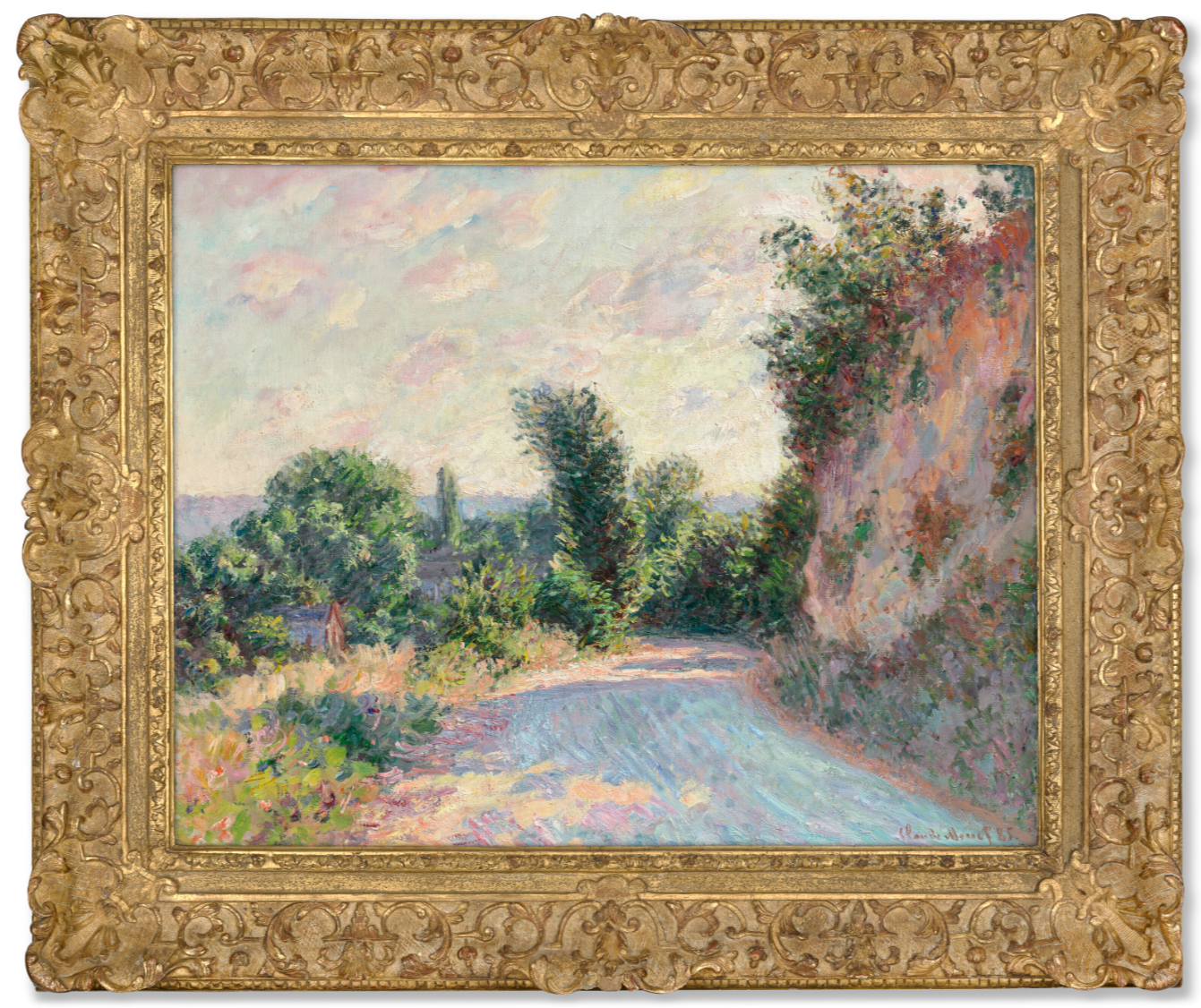
CLAUDE MONET (1840-1926)
Route près de Giverny, 1885
Oil on canvas
65.5 x 81.2 cm (25 3/4 x 32 inches)
Signed and dated ‘Claude Monet 85’ (lower right)
In 1883, Claude Monet and his family relocated to Giverny, outside of Paris, a move that would profoundly impact his artistic career. They took up residence at Le Pressoir, the pink farmhouse with green shutters that Monet would go on to purchase in 1890. Although the artist had previously lived in Paris, Argenteuil, and Vétheuil, among several other locales, it was in Giverny, the small village located at the confluence of the Seine and Epte rivers, where he was to remain for the rest of his life. Shortly after his arrival, Monet wrote to his dealer Paul Durand-Ruel: “Once settled, I hope to produce masterpieces, because I like the countryside very much” (quoted in D. Wildenstein, “Monet’s Giverny” in Monet’s Years at Giverny: Beyond Impressionism, exh. cat., The Metropolitan Museum of Art, New York, 1978, pp. 15-16). During his time in Giverny, the artist did just that, spending the first years diligently and enthusiastically roving the hills and fields with his paints and brushes to discover what the land had to offer.
With only a few hundred inhabitants, the village of Giverny was a bucolic idyll of dappled sunlight and greenery, a sense evoked in Route près de Giverny. Executed in 1885, the painting shows a countryside road curving through a verdant landscape. Touches of pale blue and lavender evoke the early morning shadows while above, soft clouds capture the first rays of sunshine. Light glints off the trees and shrubbery, while broader, more gestural marks define the hillside on the right side of the composition. Route près de Giverny likely depicts a road that runs along the left bank of the Seine towards the town of Notre-Dame-de-la-Mer. The houses hidden among the trees lie on the outskirts of Port-Villez, a village that Monet painted several times during this period, including in Bords de la Seine à Port-Villez (Wildenstein, no. 1005; Wallraf-Richartz-Museum & Fondation Corboud, Cologne).
Prairie à Giverny, 1886
Christie’s New-York: 18 May 2024
Estimated: USD 2,000,000 – 3,000,000
USD 2,228,000
CLAUDE MONET (1840-1926), Prairie à Giverny | Christie’s (christies.com)

CLAUDE MONET (1840-1926)
Prairie à Giverny, 1886
Oil on canvas
92.7 x 81.3 cm (36 1/2 x 32 inches)
Signed and dated ‘Claude Monet 86’ (lower left)
This luminous depiction of a picturesque meadow was painted by Monet at his beloved home of Giverny. The artist had moved to this rural village, set on the confluence of the Seine and the Epte, some fifty miles northwest of Paris, in April 1883. He rented a pink stucco house, called Le Pressoir, which, over the years that followed, he turned into a horticultural oasis. Together with the idyllic surrounding landscape, his home would offer endless artistic inspiration for the rest of his life.
Not long after Monet and his family moved to Giverny, the artist wrote his dealer, Paul Durand-Ruel, “Once settled, I hope to produce masterpieces, because I like the countryside very much” (quoted in P.H. Tucker, Monet in the ‘90s: The Series Paintings, exh. cat., Museum of Fine Arts, Boston, 1989, pp. 14-15). He began exploring the surrounding terrain with a renewed sense of creativity. He set out with his canvases each day at dawn, walking over hills and through valleys, in marshes and meadows, among streams and poplars. He painted along the banks of the Seine, winding country roads and houses nestled into the rolling hills, as well as expansive fields. “This was the landscape he came to know most intimately,” James Wood has written, “and its accessibility made possible the extended serial treatment that is the underlying structure for the work of the entire Giverny period” (Monet’s Years at Giverny: Beyond Impressionism, exh. cat., The Metropolitan Museum of Art, New York, 1978, p. 11).

Claude Monet, Pré à Giverny, 1885. Museum of Fine Arts, Boston. Digital image: © 2024 Museum of Fine Arts, Boston. All rights reserved / Bridgeman Images.
The artist’s decision to settle at Giverny was propitious and would shape the direction of his career for the decades that followed. Not only was the ever encroaching modernization of Paris still a distant concern, this rural farming village untouched and as bucolic as it had been for centuries, but, as Daniel Wildenstein has pointed out, throughout the day, the sun’s path followed the line of hills around Giverny. As a result, in order “to paint what was reflected in the water, the movement of leaves before the light, the mist veiling the sun, a sunset or sunrise, Monet had only to follow the natural slope of the land from his house to the fields and meadows laced by water and trees. There the landscape, shimmering in the iridescent light, was constantly changing, and the hills—depending on the weather—seemed alternately purple and blue, close and far away. It was Impressionism at its purest, registered instantaneously in a natural setting that was always new and endlessly absorbing” (quoted in ibid., p. 15).

Claude Monet, Prairie à Giverny, effet d’automne, 1886. Museum of Fine Arts, Boston. Digital image: © 2024 Museum of Fine Arts, Boston. All rights reserved / Bridgeman Images.
The year 1886 was particularly busy for Monet. He spent the first months of the year on the Normandy coast, in Etretat, and returned to Giverny in March. He did not stay long, however, continuing to travel both near and far, spending time in Holland, Paris, and Brittany, where he remained for three months, from June to August. Prairie à Giverny belongs to a group of works from the late summer when Monet, at home for a time, was clearly both reinvigorated and comforted by the vistas of his home. With these works, he captured the effects of light and the charm of the surrounding countryside. The present work was painted not far from the river Epte, its wooded bank seen in the background of the composition. This painting is one of three works that depict this quiet corner of rural Giverny, one of which is now housed in the Museum of Fine Arts, Boston (Wildenstein, nos. 1081-1083). With this trio of paintings, Monet captured the nuances of the gradually shifting seasons, as summer gave way gradually to fall. In Prairie à Giverny, the scene is infused by a golden light that throws the bordering trees into shadow, suggesting that he painted it at the end of the day. Monet depicted some of these statuesque trees with rich tones of crimson and deep pink, masterfully capturing the leaves on the brink of turning. Together, the pastel-hued dusky sky, the bank of cool trees, and the radiant green plane of the field in the foreground exist in perfect harmony, as Monet turned this quiet, quotidian scene into a timeless, radiant image.

View of Giverny, circa 1933. Country Life Magazine, London. Photo: A. E. Henson / © Country Life.
Soon after he painted Prairie à Giverny, Monet set off on his travels once more. On 15 September he went to Belle-Île, where he stayed until the end of November. This rugged, dramatic coastline offered him a starkly contrasting range of motifs compared to his beloved Giverny. With the infamous debut of Georges Seurat’s pointillist masterpiece, Un dimanche d’été à l’Ile de La Grande Jatte (The Art Institute of Chicago) in the final Impressionist exhibition held earlier in the year, Monet must have felt at this time more dedicated than ever to pushing forward his distinctive form of Impressionism. Though he had refused to participate in the exhibition, “I am still an Impressionist,” he had declared, “and will always remain one” (quoted in exh. cat., op. cit., 1989, p. 20). Turning from the sun-dappled quiet of a picturesque corner of the countryside to the storm-swept, uninhabitable coastline of Brittany, Monet was masterfully demonstrating, whether consciously or not, his indomitable ability to distill the essence of a landscape.
Inondation à Giverny, 1886
Sotheby’s Hong-Kong: 5 April 2024
Estimated: HKD 15,500,000 – 20,000,000
HKD 20,415,000 / USD 2,607,895
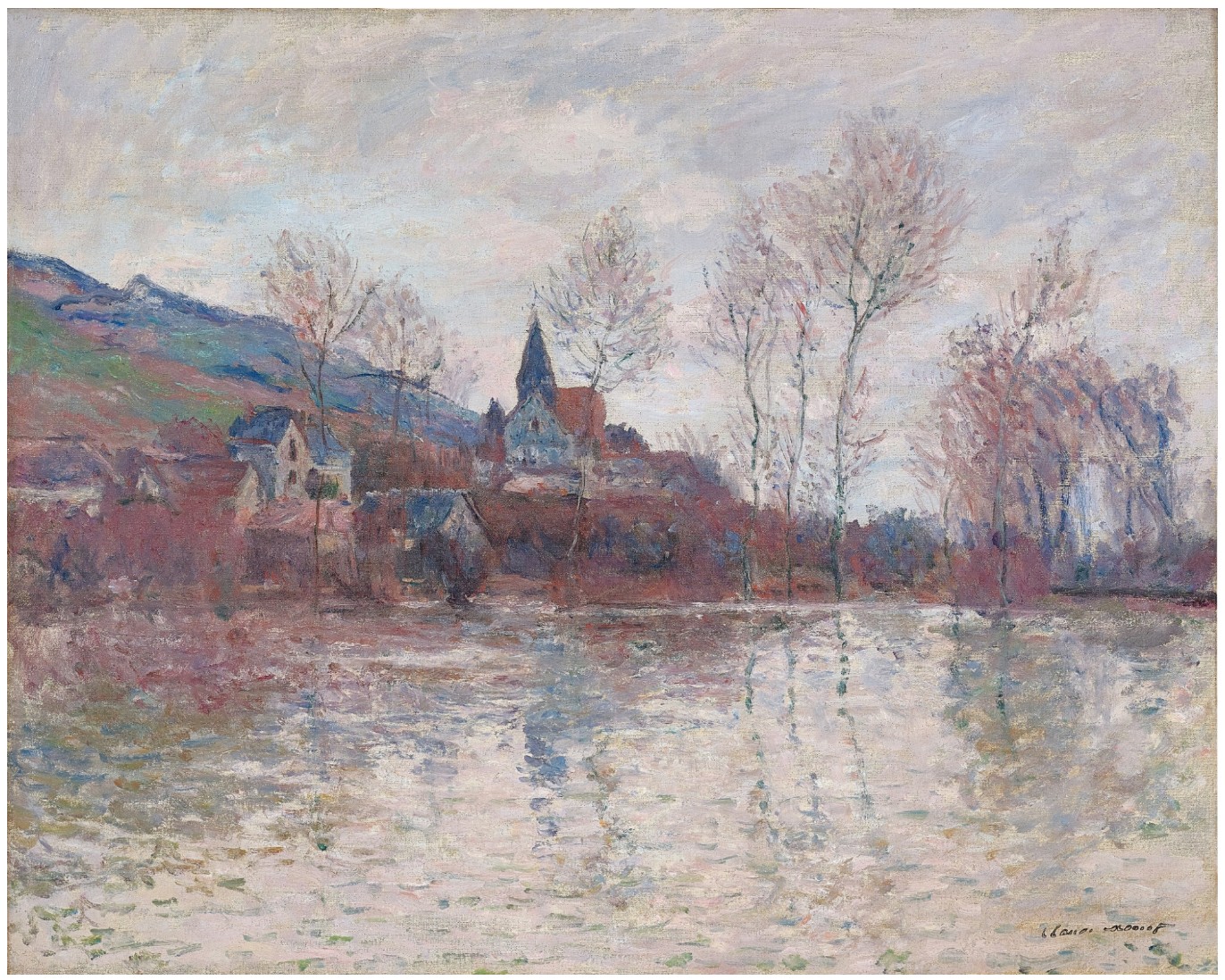
CLAUDE MONET (1840 – 1926)
Inondation à Giverny, 1886
Oil on canvas
65 x 81.3 cm (25 5/8 x 32 inches)
Stamped with signature Claude Monet (lower right)
In Inondation à Giverny, Claude Monet conjures a pulsating landscape illuminated in natural light. Painted with rapid, short brushstrokes, the present work epitomizes the Impressionist desire to render the characteristics of light as it changes the appearance of nature With patches of colors that form the rolling hills of the distant landscape and the expansive waterbody that reflects the image of Giverny’s church and townscape on its surface, Monet dexterously portrays the atmospheric quality of the rural landscape.
The pastoral town of Giverny rests against the hills on the east bank of the Seine, where the valley broadens and offers extraordinary vistas of the sprawling rural landscape. Having moved to the small town in 1883, Claude Monet found abundant inspiration in the hills overlooking the village, the roads and field near his home, along the banks of the Seine and ultimately amidst the vast landscaping project in his extensive flower gardens. Here, he would discover the subjects of his best-known works, such as Les Meules à Giverny, Les Peupliers, Matinée sur la Seine and Nymphéas.
One of the foundational goals of the Impressionists was to capture the transitory nature of existence by depicting most ephemeral moments of the world with a sense of immediacy. This small stretch of the Seine that contains both Givery and Vétheuil provided innumerable opportunities for Monet to observe the same, or similar, views in different seasons and at different times of day and to explore the resulting nuances of light and color. During a period of heavy rain in the early spring of 1886, the meadows next to Monet’s property flooded with overflow from the nearby river. As a chronicler of the village and surrounding landscape, Monet clambered to higher ground to capture the event in the present work. By capturing the passing floodwaters that filled the valley near his home Monet has provided a rare glimpse into a moment otherwise lost in time. The work brims with a sense of heightened intensity, while still retaining the soft beauty of the picturesque scene. The clouds withdraw as the town comes to a momentary standstill.
Prairie fleurie à Giverny, 1890
Christie’s London: 7 March 2024
Estimated: GBP 5,500,000 – 8,500,000
GBP 6,290,000 / USD 8,010,850
CLAUDE MONET (1840-1926), Prairie fleurie à Giverny | Christie’s
CLAUDE MONET (1840-1926)
Prairie fleurie à Giverny, 1890
Oil on canvas
65×92 cm (25 1/2 x 36 1/4 inches)
Signed and dated ‘Claude Monet 90’ (lower right)
Filled with a vivid play of gestural brushwork, Claude Monet’s Prairie fleurie à Giverny celebrates the inherent beauty of the idyllic rural town the artist called home for the final four decades of his life. Painted during the opening months of 1890, the composition focuses on a familiar site for Monet, a broad meadow adjacent to his property in Giverny, seen beneath a vast sky, as the wind jostles through the scene and sets the violet-tinged trees, the vibrant green grass and soft white flowers dancing. Though he must have encountered this view on an almost daily basis, the simple field remained a fascinating source of inspiration for the artist for almost a decade, reappearing in his paintings under a variety of different atmospheric conditions and times of day. ‘A landscape hardly exists at all as a landscape,’ Monet explained, just a year after the present canvas was completed, ‘because its appearance is constantly changing; it lives by virtue of its surroundings – the air, the light – which vary continually’ (quoted in P.H. Tucker, Monet in the ‘90s: The Series Paintings, exh. cat., Museum of Fine Arts, Boston, 1989, p. 104).
Monet had first settled in Giverny in the spring of 1883, ending his search for a permanent base after years of living a peripatetic lifestyle. Situated some forty miles from Paris, at the confluence of the Seine and the river Epte, Giverny at this time was a small farming community of just three hundred inhabitants, a countryside enclave which remained untouched by the encroaching modernisation which had dramatically altered scores of villages and hamlets along the Seine. Here, Monet found the tranquil retreat he had been searching for, renting a sprawling pink stucco house called La Pressoir (The Cider Press) from a wealthy local landowner who had recently retired and moved away. Sandwiched between the main village road and the regional thoroughfare connecting Vernon and Gasny, the house boasted a kitchen garden and orchard in front and a barn to the west that Monet later converted into a studio.
While the artist had initially been drawn to the fruit trees and gardens surrounding the property, he was immediately captivated by the wider setting and landscape he discovered in Giverny. ‘Once settled, I hope to produce masterpieces,’ he wrote to Durand-Ruel within days of his arrival, ‘because I like the countryside very much’ (quoted in ibid., pp. 15-16). Throughout his first years at Giverny, Monet explored the surrounding terrain with a keen eye, setting out each morning with his canvases, walking over hills and through valleys, across marshes and meadows, among streams and poplars, constantly searching for fresh subjects. Compositions focusing on the meandering flow of the Seine and the banks of the river Epte were interspersed by views of the winding country roads, houses nestled into the rolling hills, orchards and groves of poppies, and vast fields that stretched towards the horizon.
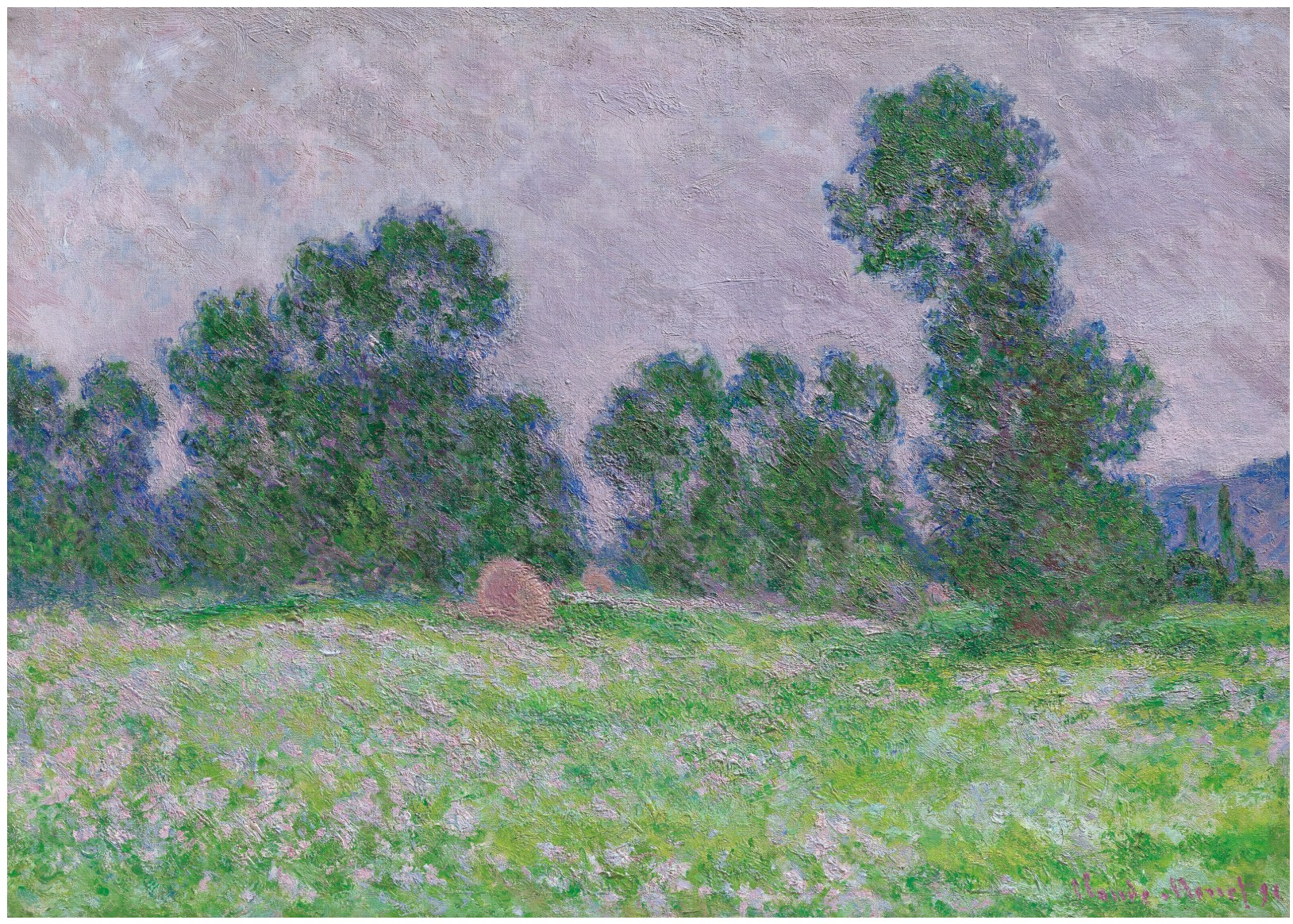
Among the most frequent motifs that Monet explored during this period was the verdant meadow known as La Prairie, situated a short walk from La Pressoir and separated from the property by the small brook which would later feed the artist’s celebrated water-lily pond. Monet had first tackled this alluring spot shortly after his arrival, painting a trio of views north across the field and haystacks, towards a row of poplars that bordered the meadow, with the hills overlooking the town just visible in the distance (Wildenstein, nos. 900-902). Over the course of the following two years, Monet returned to the site on several occasions, depicting it from multiple different viewpoints, often posing members of his extended family wandering through the pasture.
In Les meules à Giverny (Wildenstein, no. 993; Private collection) from 1885, Alice Hoschedé, her daughter Germaine and son Jean-Pierre, as well as the artist’s son Michel, traverse the meadow, sheltered from the bright mid-day sun in the shadows cast by the trees along the boundary of the field. The grass is shorn short, and the cuttings gathered in loose piles to dry out, creating tall mounds that tower over the figures. While in some paintings these soft haystacks stood in the distance, blending into the surrounding foliage of the meadow, in others Monet allowed them to occupy centre stage in his compositions – in La meule de foin (Wildenstein, no. 994; Ohara Museum of Art, Kurashiki), for example, the haystack is positioned in the immediate foreground, its tumbling, multi-coloured surface catching slivers of sunlight through the trees as Alice and Michel rest at its base.
Though Monet spent a large portion of the next seven years travelling around the country, as well as venturing abroad, in the pursuit of his art, he remained intensely captivated by Giverny, proclaiming he was ‘certain of never finding a better situation or more beautiful countryside’ (quoted in P.H. Tucker, Claude Monet: Life and Art, New Haven, 1995, p. 175). It was to this familiar countryside, its timeless, idyllic views and the richness and fecundity of its landscape, that Monet returned time and again, whenever he found himself in need of creative refreshment. This was particularly true in the opening months of 1890 – for much of the previous year, the artist had been distracted by preparations for a major retrospective at the Galerie Georges Petit alongside Rodin, as well as the time-consuming project he had initiated to secure Edouard Manet’s Olympia and donate it to the French State. As a result, Monet found himself with little time for painting, and he completed only a few compositions through the latter half of 1889. As the new year dawned, he began to immerse himself in the landscape around Giverny once more, revelling in the beauty and serenity of this bucolic setting.
In early spring, Monet painted a quartet of closely related compositions, focusing on the familiar terrain of La Prairie (Wildenstein, nos. 1245-1248), including the present Prairie fleurie à Giverny. From his vantage point, the landscape resolved before Monet’s eyes into a strongly geometric composition, which he rendered as parallel bands of field, trees, and sky that extend across the entire width of the canvas. In the present work, the poplars demarcating the edge of the field had grown full and leafy, while the verdant meadow is thick with waves of grass, interspersed with delicate white blossoms. Using a palette of richly variegated greens, golds and white, Monet depicts the undulating mass of foliage in thickly impastoed layers of paint, his brushstrokes woven together in a dense pattern that shimmers and shifts before the eye.
In the middle distance, a pair of haystacks appear along the edge of the field, the piles of dried prairie grass appearing much less monumental and imposing than Monet’s earlier depictions. Similarly, unlike his later Meules series, where the grainstacks were carefully bound and packed closely together to create a highly structured canonical shape, here, the mounds of grass appear once again as more of a haphazard bundle, as if they have been quickly gathered by a local farmer and allowed to settle naturally into their current shapes. As a result, there is a relaxed, organic feel to the scene, as if the field’s beauty has been conjured by nature alone.
Prairie fleurie à Giverny first appeared at auction in 1900, where it was offered by the American Art Association to fund a programme of building works on their headquarters in Manhattan. In the catalogue for the sale, Monet was not only hailed as the undisputed leader of Impressionism, but a visionary artistic voice: ‘His contribution to artistic knowledge has been unique. Viewing nature with the independent eye of genius, he has discovered that in sunlight there is height of light and shadow never dreamed of by painters before. It is a discovery which has revolutionized painting and influenced a number of men consciously and unconsciously. By temperament a realist, he is not concerned with making pictures, but with recording facts as they present themselves, not as he might select them. Yes, unless one is blind to the charm of sunshine and its mystery of play on the colours of nature, it is impossible not to appreciate and, at time, to rejoice in his rendering of light and air’ (Private Collection of Mr. Frederic Bonner, with additions by The American Art Association, New York, 1900, n.p.).
Pommiers en fleurs, 1872
Christie’s New-York: 19 November 2024
Estimated: USD 7,000,000 – 10,000,000
USD 9,035,000
CLAUDE MONET (1840-1926), Pommiers en fleurs | Christie’s
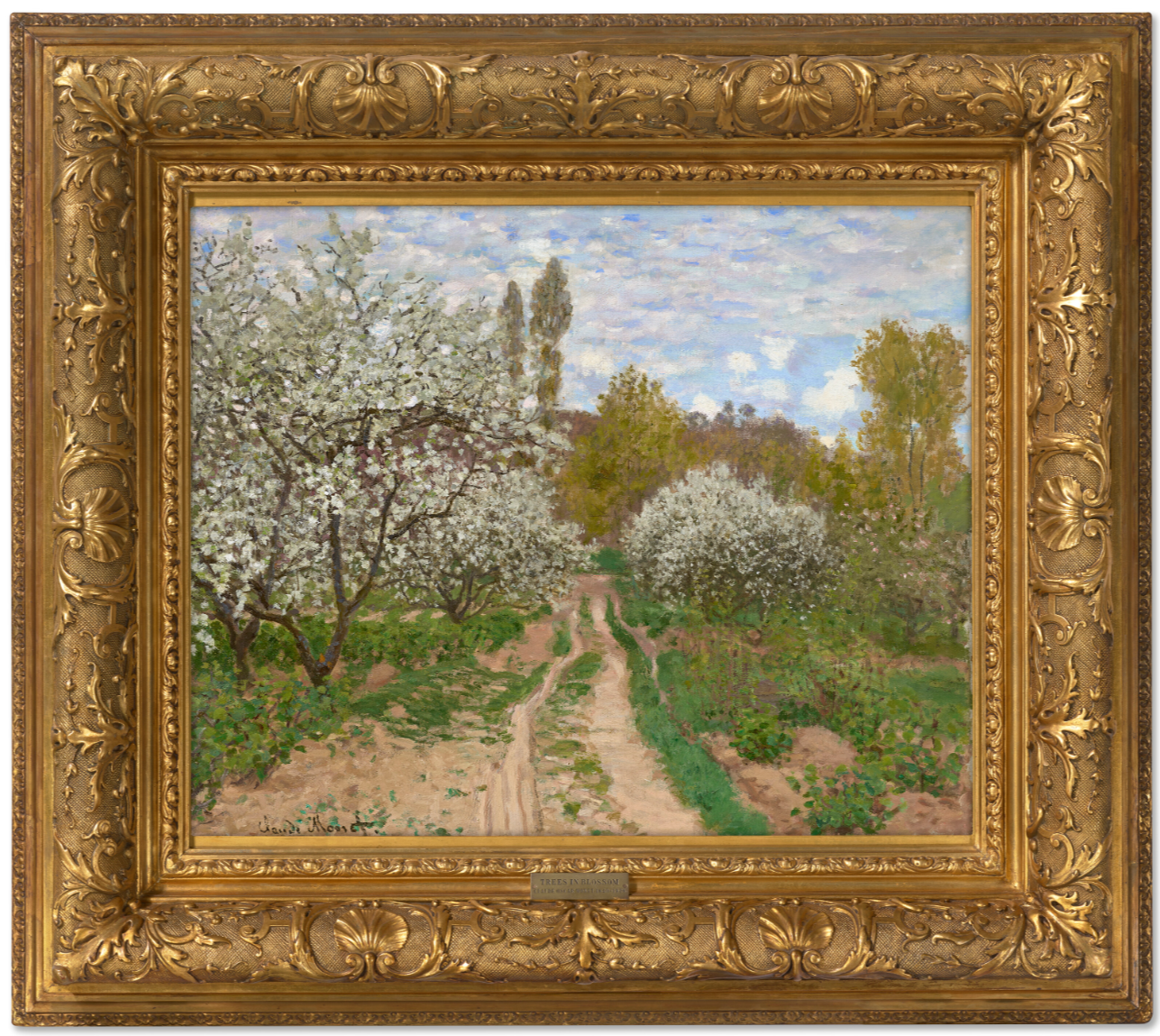
CLAUDE MONET (1840-1926)
Pommiers en fleurs, 1872
Oil on canvas
59.3 x 73.7 cm (23 3/8 x 29 inches)
Signed ‘Claude Monet.’ (lower left)
Painted in Argenteuil in 1872
The fruit trees are fragrant bouquets of pink and white newly washed by the showers from misty April skies. The broken clouds are scattered over sapphire skies and moisture lingers in the atmosphere… Monet has painted spring meadows fragrant with bloom. He heard the voices of evening, the jubilation of morning, and he painted the eternal undulations of light on the same objects…” These lines, written in the 1907 collection catalogue of the Union League Club of Chicago, vividly describe Claude Monet’s Pommiers en fleurs, an early and quintessentially Impressionist scene that entered the venerated Club’s esteemed collection in 1895 (L.M. McCauley, Catalogue of Paintings, Etchings, Engravings and Sculpture, Chicago, 1907, p. 35).
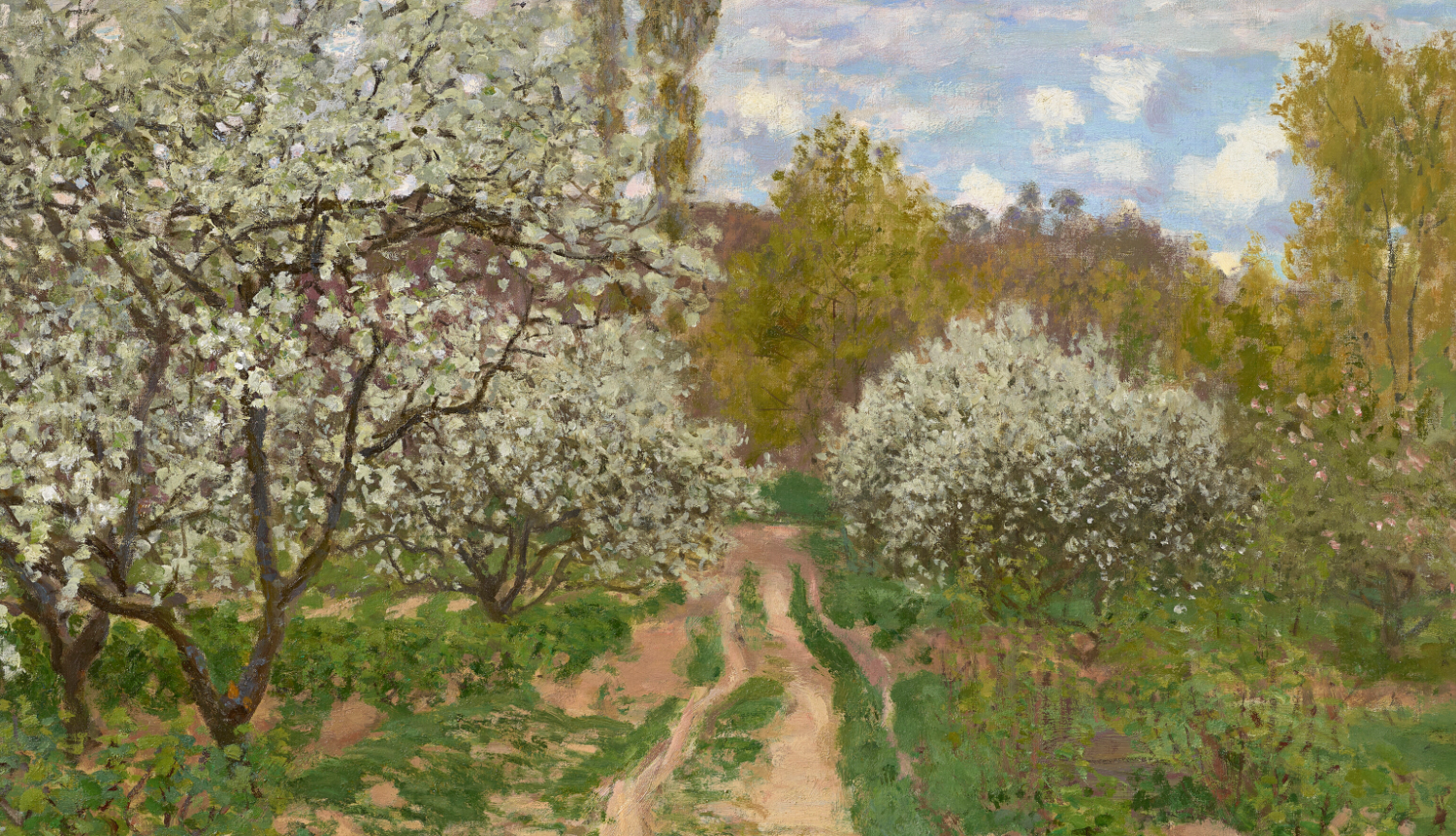
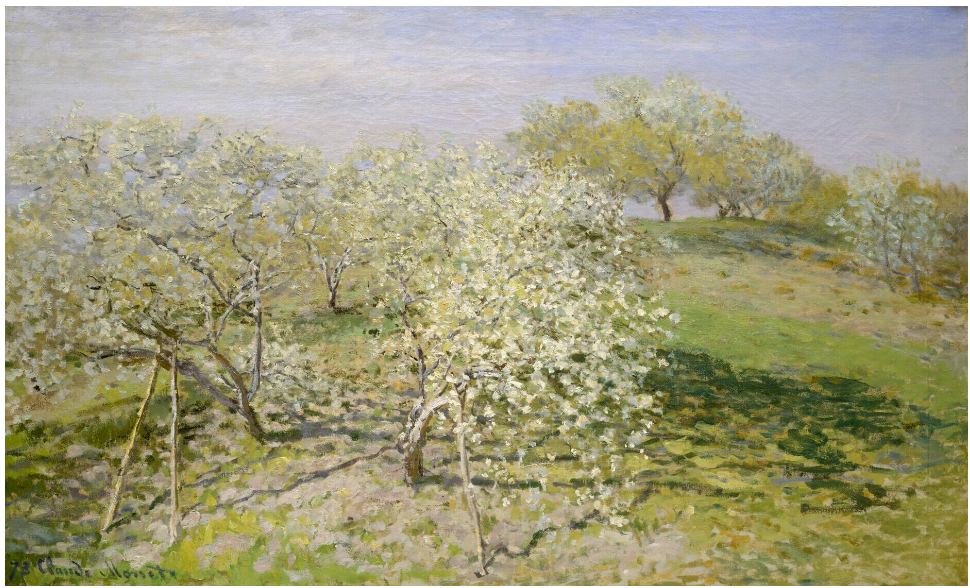
© The Metropolitan Museum of Art. Image source: Art Resource, NY
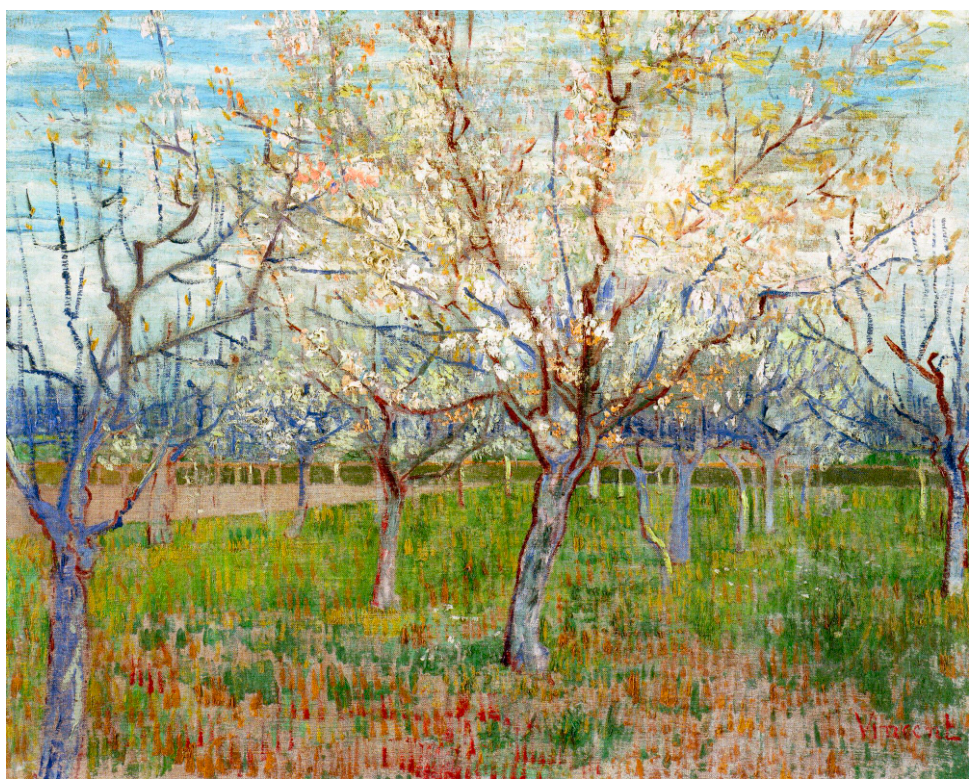
With these works, Monet turned away from the reality of his setting—from his garden he would likely have heard the rumble of trains passing nearby and could have seen the other neighboring houses bordering his own—to instead create a rural idyll, with no trace of the signs of the ever-encroaching modernity present. At this time, Argenteuil was a fast-growing suburb of Paris, with commercial structures increasingly appearing amid the previously rural landscape. In his works of this time, Monet chose to artfully eliminate many of these industrial subjects, a reflection of the fact that while his Impressionist paintings have the appearance of spontaneity, their compositions were in fact carefully crafted. Employing his innate sensibility for pictorial construction, Monet was able to balance a range of pictorial elements and motifs to create works filled with a sense of harmony, beauty and poeticism.
When, four years after its creation in 1872, Pommiers en fleurs was included in the Second Impressionist exhibition under the title Le Printemps, it was shown alongside other masterpieces by the artist—Les bains de la Grenouillère (Wildenstein, no. 134; The Metropolitan Museum of Art, New York), La Promenade (Wildenstein, no. 381; The National Gallery of Art, Washington, D.C.), and Le Pont d’Argenteuil (Wildenstein, no. 311, Musée d’Orsay, Paris), to name but a few—as well as major works by Gustave Caillebotte, Berthe Morisot, Alfred Sisley, and Renoir.
This was an important exhibition in the history of Impressionism, proving to the public that the Société anonyme, as the group had called themselves in the first 1874 show, was not a one-time event, but an ongoing phenomenon, a movement with consistent members and shared formal and stylistic qualities. It attracted more critical attention than the first exhibition, with a number of critics picking out Pommiers en fleurs in their reviews. One by Charles Bigot described it as, “a garden path, flushed with grass, that disappears between blossoming apple trees and shrubs bursting into leaf… [It is] an impression of the month of May that delights the eyes” (quoted in R. Berson, The New Painting: Impressionism, 1874-1886, San Francisco, 1996, vol. 1, p. 60).
Les Arceaux de Roses, Giverny, 1913
Sotheby’s New-York: 17 May 2022
Estimated: USD 20,000,000 – 30,000,000
USD 23,304,500
Les Arceaux de roses, Giverny | Modern Evening Auction | 2022 | Sotheby’s
CLAUDE MONET
Les Arceaux de Roses, Giverny, 1913
Oil on canvas
81.5×93.5 cm (32×37 inches)
Signed Claude Monet (lower left)
Dazzling in its use of color and exploration of the properties of reflection, Les Arceaux de roses, Giverny is one of only five canvases painted by Claude Monet between the summer of 1912 and 1914. Three of these paintings, including the present work, focus on trellises covered in roses, set on the boat landing on the south side of Monet’s water garden. The present work is a stunning symphony of richly applied and worked pigment and by far the most energetic in the series. The other two works painted during this period, both titled La Maison de l’artiste à Giverny, depict a view of Monet’s house and gardens in the immediate vicinity of his front door. Writing about these two groups, Paul Hayes Tucker states: “Despite certain resemblances to those earlier works, each of these new groups is quite distinctive. The various forms of foliage in the views of the house, for example, surge and swirl as if competing for prominence in the scene while the house peers into the fray from behind the tangled brushwork like an inquisitive though somewhat fearful spectator. The vitality of the bushes and trees in these two pictures is repeated in the flower-wrapped pergolas and the far bank in the water-garden paintings, although the intensity of the views of the house is slightly reduced here because of the smaller size and the distance of the fauna…. These three new pond paintings are meditative, mysterious and expansive, commensurate with their Eastern inflection (Exh. Cat., London, Royal Academy of Arts and Boston, Museum of Fine Arts, Monet in the 20th Century 1998-99, p. 58).
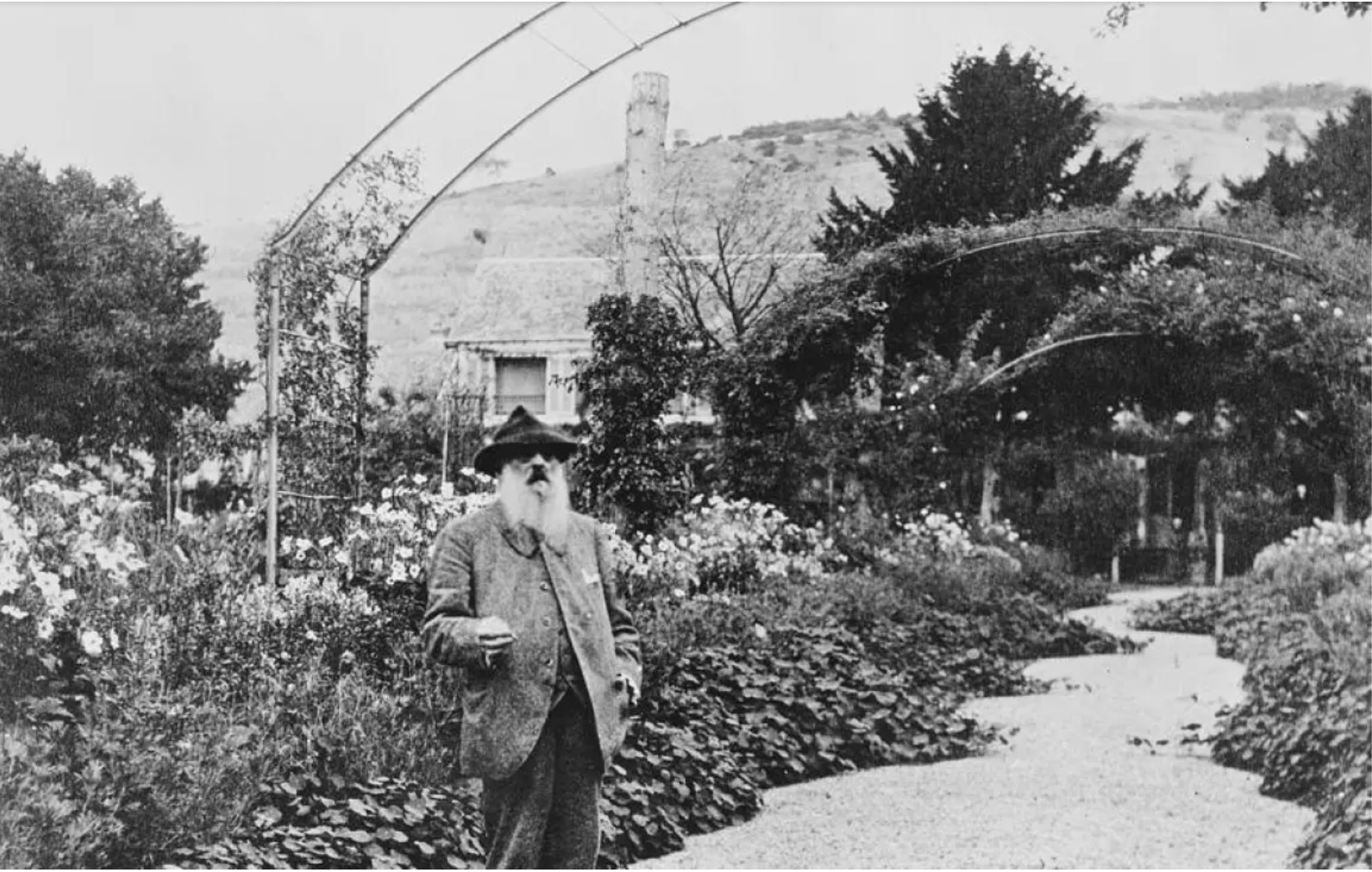
Monet in front of his house at Giverny
By 1890, Monet had become financially successful enough to buy the house and large garden at Giverny, which he had rented since 1883 (see fig. 2). With enormous vigor and determination, he swiftly set about transforming the gardens and creating a large pond, in which waterlilies gradually matured. Once the garden was designed according to the artist’s vision, it offered a boundless source of inspiration, and provided the major themes that dominated the last three decades of Monet’s career. Towards the end of his life, he told a visitor to his studio:
“It took me some time to understand my water lilies. I planted them purely for pleasure; I grew them with no thought of painting them. A landscape takes more than a day to get under your skin. And then, all at once I had the revelation – how wonderful my pond was – and reached for my palette. I’ve hardly had any other subject since that moment.”
Once discovered, the subject of waterlilies offered a wealth of inspiration that Monet went on to explore for several decades. His carefully designed garden presented the artist with a micro-cosmos in which he could observe and paint the changes in weather, season and time of day, as well as the ever-changing colors and patterns. John House wrote: “The water garden in a sense bypassed Monet’s long searches of earlier years for a suitable subject to paint. Designed and constantly supervised by the artist himself, and tended by several gardeners, it offered him a motif that was at the same time natural and at his own command – nature re-designed by a temperament. Once again Monet stressed that his real subject when he painted was the light and weather” (John House, Monet: Nature into Art, New Haven, 1986, p. 31).
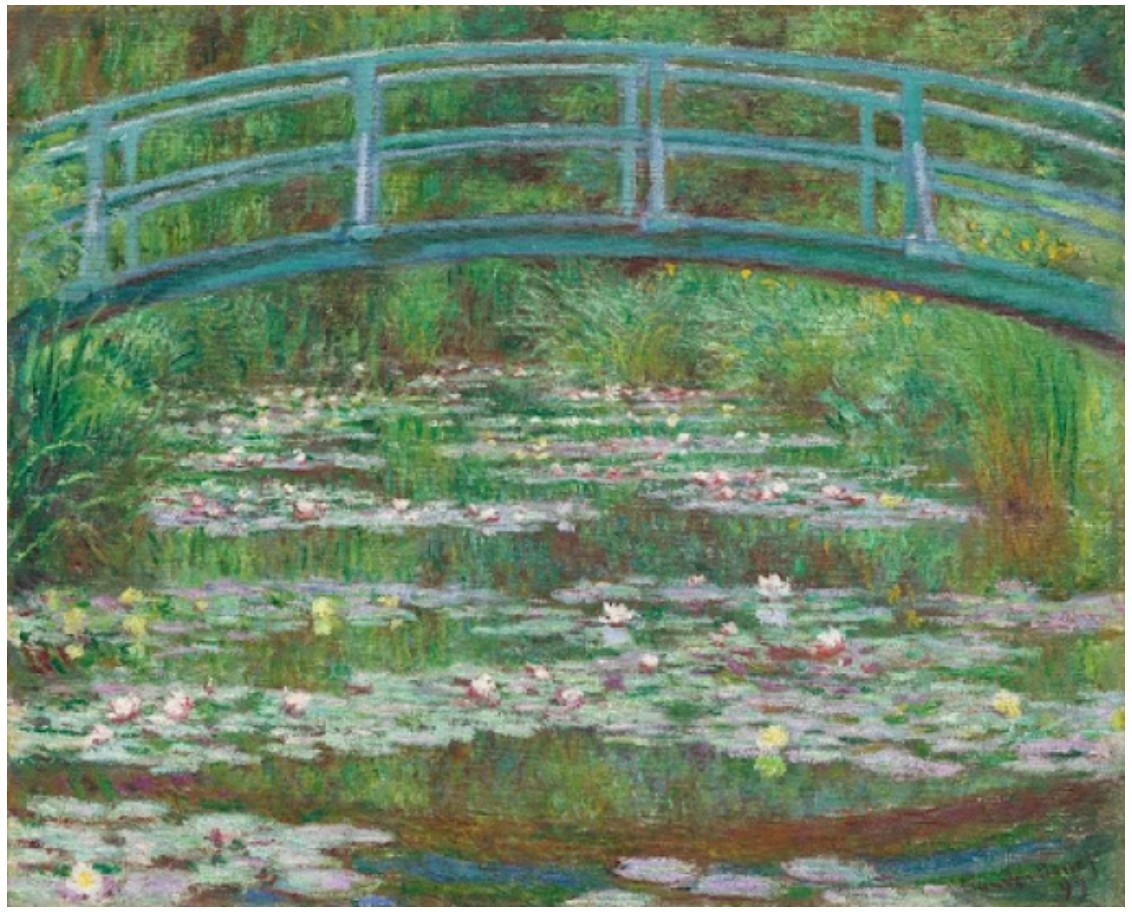
Claude Monet, The Japanese Footbridge, 1899, oil on canvas, National Gallery of Art, Washington D.C.
Monet often approached his subjects at Giverny in series, a method that he had developed in his high Impressionist works and perfected in his famous series paintings of the early 1890s, such as those of haystacks, poplar trees and the façade of Rouen cathedral. Monet fascinated over the varying effects of seasonal light upon these subjects. In Giverny, subjects such as the Japanese footbridge (see fig. 3) or, as in the present work, a garden arch provided the artist with an anchor for a given series.
Monet thus paid exacting attention to the details of the garden, including maintaining the pond and plants in a perfect state for painting. Elizabeth Murray writes, “The water gardener would row out in the pond in a small green flat-bottomed boat to clean the entire surface. Any moss, algae, or water grasses which grew from the bottom had to be pulled out. Monet insisted on clarity. Next the gardener would inspect the water lilies themselves. Any yellow leaves or spent blossoms were removed. If the plants had become dusty from vehicles passing by on the Chemin du Roy, the dirt road nearby, the gardener would take a bucket of water and rinse off the leaves and flowers, ensuring that the true colors and beauty would shine forth” (E. Murray, Monet, Late Paintings of Giverny from the Musée Marmottan, New Orleans, 1995, p. 53).
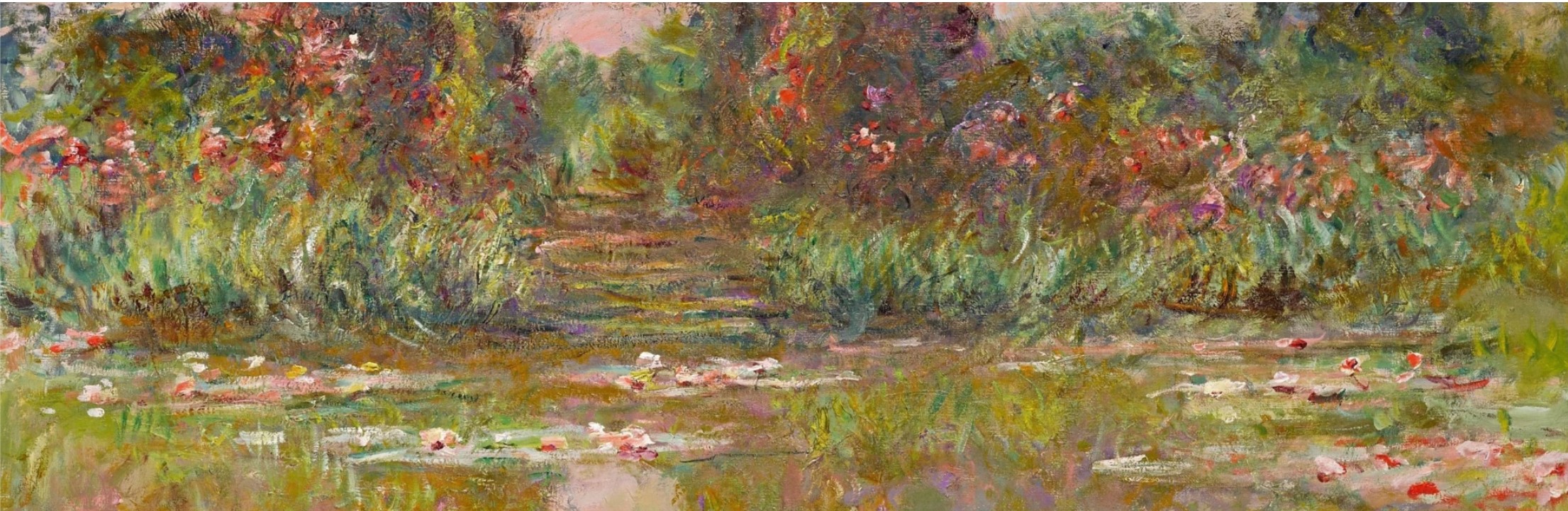
In 1908 Jean-Claude Nicolas Forestier visited Monet at Giverny and gave a thoughtful description of Monet’s working methods for the review Fermes et Châteaux: “In this mass of intertwined verdure and foliage… the lilies spread their round leaves and dot the water with a thousand red, pink, yellow and white flowers… The Master often comes here, where the bank of the pond is bordered with thick clumps of irises. His swift, short strokes place brushloads of luminous color as he moves from one place to another, according to the hour… The canvas he visited this morning at dawn is not the same as the canvas we find him working on in the afternoon. In the morning, he records the blossoming of the flowers, and then, once they begin to close, he returns to the charms of the water itself and its shifting reflections, the dark water that trembles beneath the somnolent leaves of the water-lilies” (quoted in D. Wildenstein, Monet or The Triumph of Impressionism, Cologne, 2003, p. 384). The unending variety of forms and tones that the ponds provided allowed Monet to work consistently on a number of canvases at the same time (see fig. 4). With large scale and a wide-ranged palette, Les Arceaux de roses, Giverny is a unique and grand statement of adoration for this artist’s haven.
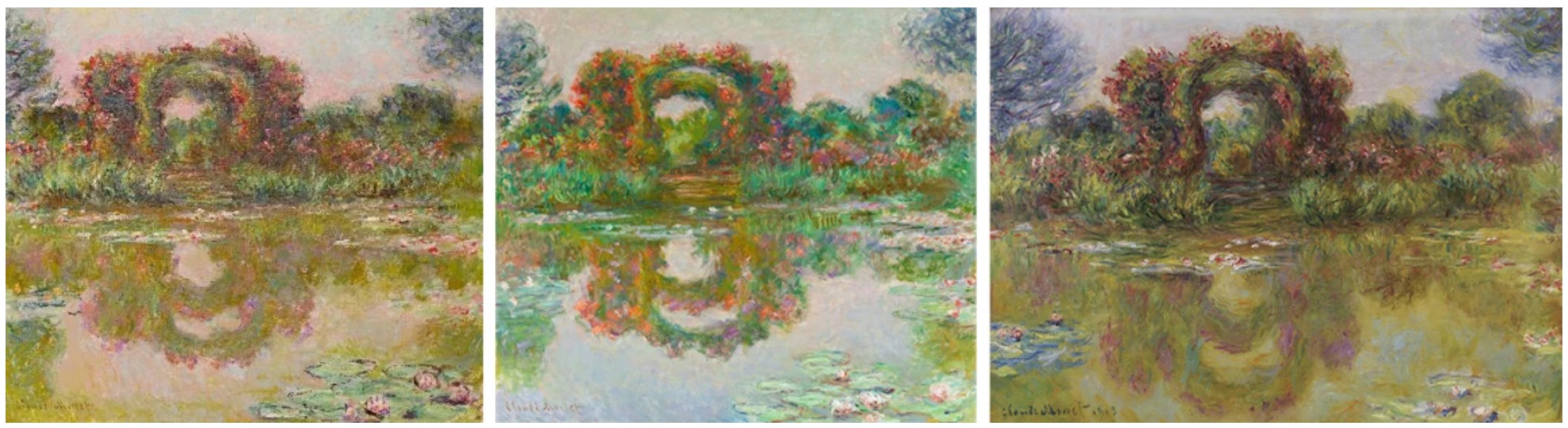
Left: Fig. 5 The present work;
Center: Fig. 6 Claude Monet, Les Arceaux fleuris, Giverny, 1913, oil on canvas, Phoenix Art Museum;
Right: Fig. 7 Claude Monet, Les Arceaux fleuris, Giverny, 1913, oil on canvas, sold: November 2021 for $24.1 million
Distinct from his earlier, pre-1910 depictions of his garden at Giverny, these later compositions are remarkably daring. The brushstrokes are heavily laden and equally applied across the surface of the canvas. This painterly technique brings the eye to the surface of the canvas and contends with the illusions of a receding space and a differentiation between the physical properties of the water, foliage and structure. Among this limited series of three paintings (see figs. 5-7), the present work is the same size and format at that in the collection of the Phoenix Art Museum (W. 1779). The other related work (W. 1781), with a more rectangular format and mossier aesthetic, was sold at auction in November 2021 for $24.1 million.
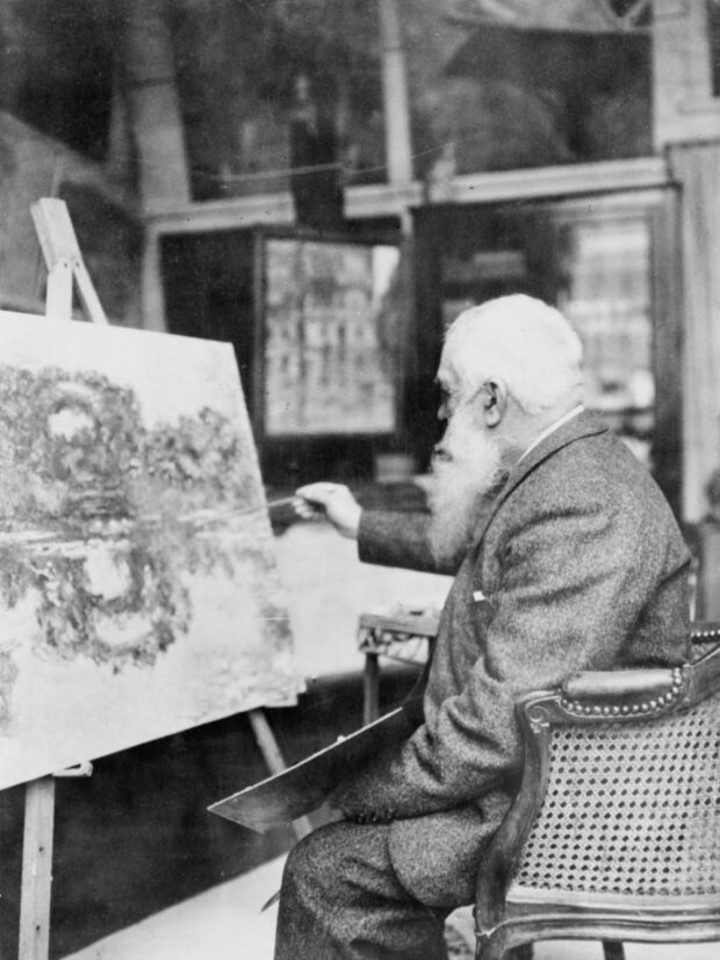
Unique to the present composition is the heightened sense of immediacy as seen in the carefully delineated group of waterlilies in the foreground at right. Crystalline pinks, blues and blue meet in the sky of Les Arceaux de roses, Giverny, lending a lustrous atmosphere to the work. The soft reflection of the flowered arches play along the surface of the water, illuminating the midground in tones of violet and rose. Highlighted by white blossoms throughout the water and the trellis, the work presents a veritable symphony of color to its audience.
La Seine
La Seine à Lavacourt, débâcle, 1880
Christie’s New-York: 19 November 2024
Estimated: UD 4,000,000 – 6,000,000
USD 4,890,000
CLAUDE MONET (1840-1926), La Seine à Lavacourt, débâcle | Christie’s
CLAUDE MONET (1840-1926)
La Seine à Lavacourt, débâcle, 1880
Oil on canvas
60.4 x 99.4 cm (23 3/4 x 39 1/8 inches)
Signed and dated ‘Claude Monet 81’ (lower left)
Claude Monet’s La Seine à Lavacourt, débâcle is a remarkable example from a suite of seventeen oil paintings the artist created depicting a dramatic meteorological event that took place in the first days of 1880. The winter of 1879-1880 was one of Europe’s coldest on record, with relentless snowfalls and heavy frosts throughout the months of December and January, bringing Paris and its environs to a halt. In the first days of the new year the frozen Seine began to thaw, dislodging large ice floes which inundated the banks of the river, pulling trees, bridges, and houses down. Monet’s neighbor and future companion Alice Hoschedé described the phenomenon in a letter to her then husband in January 1880, shortly after the event: “At five in the morning I was woken up by a frightful noise like the rumbling of thunder… on top of this noise came cries from Lavacourt; very quickly I was at the windows and despite considerable obscurity saw white masses hurling about. This time it was the débâcle, the real thing” (quoted in D. Joel, Monet at Vétheuil and on the Norman Coast 1878-1883, Woodbridge, 2002, p. 93).
The year prior, Monet had moved from Argenteuil, further down the Seine, to Vétheuil, a small medieval village located some forty miles northwest of Paris. He and his family, along with the Hoschedés and their children, shared a house on the river, and Monet would often take a small boat out to paint. The day after the catastrophic breaking of the ice, Monet hired a carriage and set off with Alice and their various children to explore the surrounding countryside and witness what had transpired. The plain behind Lavacourt, a small village across the river from Vétheuil, was strewn with blocks of ice and the little islands on the Seine had disappeared. That afternoon, things grew calm, and a procession of ice floes drifted down the river. In a later letter, Monet described the beauty of the frozen landscape as “heart-rending” (quoted in D. Wildenstein, Monet or the Triumph of Impressionism, Cologne, 1999, p. 152).
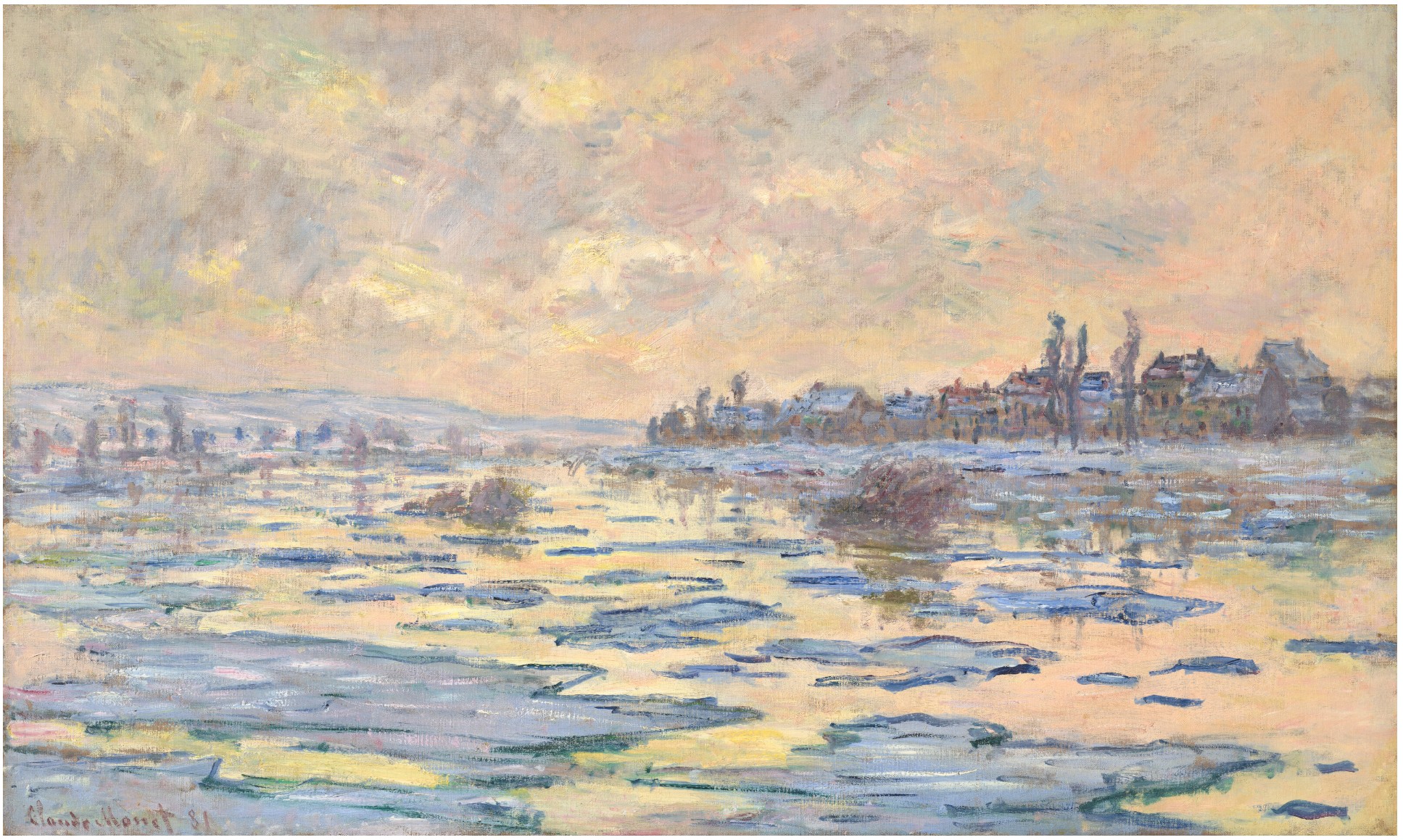
Despite the calamity of the event, Monet was fascinated by the natural beauty of the ice on the river. The artist had long shown an interest in both winter scenes and depicting the fleeting and changing nature of water. In his paintings of the débâcle, he sought to capture the effect of the moment the ice split to pieces and was carried by the current, studying the changes this event wrought on the river and its surroundings over the following days. Eager to seize the opportunity presented, Monet braved exceptionally harsh weather conditions to paint his motif en plein air, pushing aside ice floes as he crossed by boat to Lavacourt, filling his pockets with hot bottles to maintain warmth.
Likely painted in the first days of 1880, La Seine à Lavacourt, débâcle is a sweeping scene offering a serene view of the thawing river, depicting the Seine looping upstream from the Vétheuil bank, with Lavacourt on the right. The painting has a particularly elongated landscape format, broken only by the vertical thrust of the trees and their reflection in the water. Monet vacillates between free, quick brushstrokes noted in the intense, Impressionistic depiction of the sky and tufts of clouds, and the more deliberate rendering of the quiet river, dotted with the finely executed remnants of the ice and of the village in the distance. The overall scene is treated in a soft palette befitting of the frigid weather, and the sense of peace is amplified by the dappling of pastel oranges and pinks. These canvases display a sustained effort to capture a single subject in all its moods, and from various perspectives, showcasing Monet’s earnest and attentive attempts to paint nature’s enigmatic temporality and permanence.
Monet sold La Seine à Lavacourt, débâcle to Paul Durand-Ruel in the opening months of the following year, at which point the artist signed the canvas and dated it 1881. It was subsequently bought by the esteemed entrepreneur and prolific collector Catholina Lambert, who had amassed one of the finest private art collections in the United States. Lambert’s now disseminated collection included paintings by Pierre-Auguste Renoir, Camille Pissarro, Eugène Delacroix and Camille Corot, and works by Renaissance masters such as Sandro Botticelli and Andrea del Sarto. Works from his collections are now in prominent institutions such as The Metropolitan Museum of Art in New York, The Brooklyn Museum, and The National Gallery in London. Lambert later sold La Seine à Lavacourt, débâcle to Paul Durand-Ruel in New York, from whom it was acquired by George Washington Vanderbilt III in 1892, and it remained with the Vanderbilt family for nearly a century.
Matinée sur la Seine, temps net, 1897
Christie’s London: 7 March 2024
Estimated: GBP 12,000,000 – 18,000,000
GBP 14,397,500 / USD 18,256,030
CLAUDE MONET (1840-1926), Matinée sur la Seine, temps net | Christie’s (christies.com)
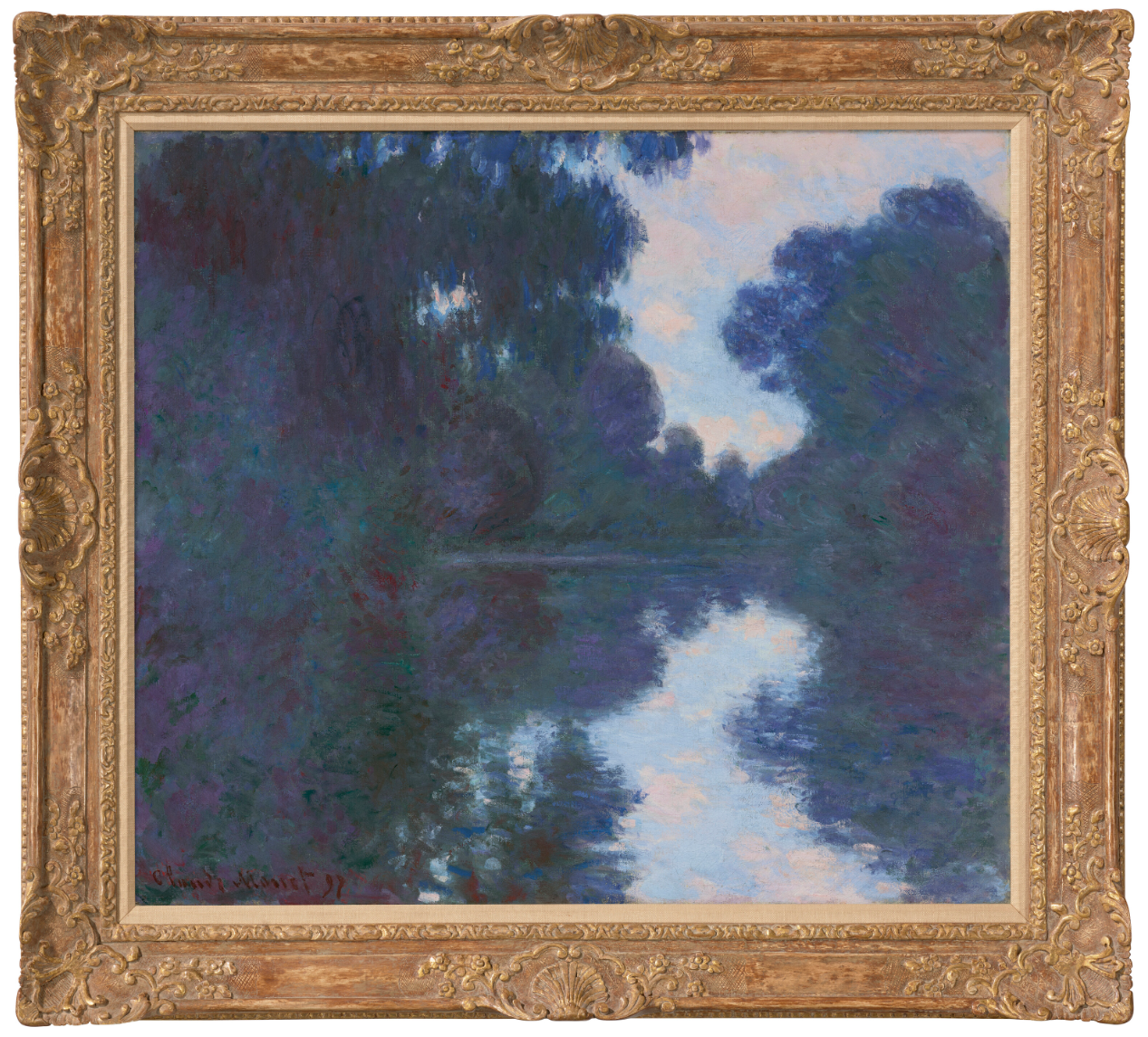
CLAUDE MONET (1840-1926)
Matinée sur la Seine, temps net, 1897
Oil on canvas
81.6 x 92.4 cm (32 1/8 x 36 3/8 inches)
Signed and dated ‘Claude Monet 97’ (lower left)
In his captivating, meditative series known as the Matinées sur la Seine, Claude Monet captures the enchanting tranquility of early mornings on a quiet stretch of the river near his home at Giverny. Across twenty-one canvases, each focusing on the same view of the waterway and painted during the summer of 1896 and 1897, the artist trained his eye on the diaphanous light cast upon the river as the sun rose, recording the delicate, elusive effects of the changing sky on the surrounding landscape. Tracing the sun as it passes over the scene, from the first rays of light at dawn, to the full brilliance of the sun at mid-morning, and every nuanced moment in between, this extraordinary sequence of canvases would prove to be among the last scenes the artist created of his cherished Seine, which had been an enduring subject in his work for decades. Eschewing any sign of human presence, Monet focused his attention solely on nature, on the play of water, land and sky, on reflection and light, to evoke the poetry of daybreak. The emphatic contrast in the present view between the foliage in shadow and the brightening light of the new day, achieved by means of a contre-jour effect, carries this hushed, elegant composition to the very brink of abstraction.
During the previous two years, Monet had embarked on extended painting campaigns in Norway and along the Channel coast, battling difficult weather conditions to depict dramatic weather conditions on these rugged locales. It came as a welcome pleasure for him, then, to return to the sanctuary of Giverny, and during the summer of 1896 he took the opportunity to immerse himself once again in the lush, verdant landscape near his home and cherished gardens. He completed four canvases of the Matinée sur le Seine sequence during that year, and probably began several others in the larger group as well. That was as far as Monet could take the series in 1896, however. Forty-one days of nearly incessant rainfall during September and October – ‘frightful weather,’ he lamented to Durand-Ruel – forced the artist to cease work on these pictures. He resorted instead to painting several scenes of flooded riverside meadows in Giverny, and only resumed his Matinée sur le Seine series the following summer, completing those canvases already underway as well as new ones, to all of which he applied a date of 1897. The present work, Matinée sur la Seine, temps net, belongs to this second group of canvases, executed at a time when Monet was fully immersed in the series, and well acquainted with the motif. Here, the sun has yet to fully rise. Deep purples blanket the foliage and the overhanging branches of the surrounding trees, which form sweeping arabesques that frame the pale sky and call attention to the flat surface of the picture plane. The gradually brightening light, a soft blue, glows in contrast to the still dark land, creating a crepuscular scene which appears to be slowly revealing itself to the viewer, pockets of shadow blurring the boundaries between the surface of the water and the edge of the riverbanks. To further emphasize his impressions, Monet rendered a dramatic contre-jour effect, backlighting the trees to create a powerful contrast between the different elements of the scene and guide the viewer’s eye towards the gradually shifting sky in the distance.
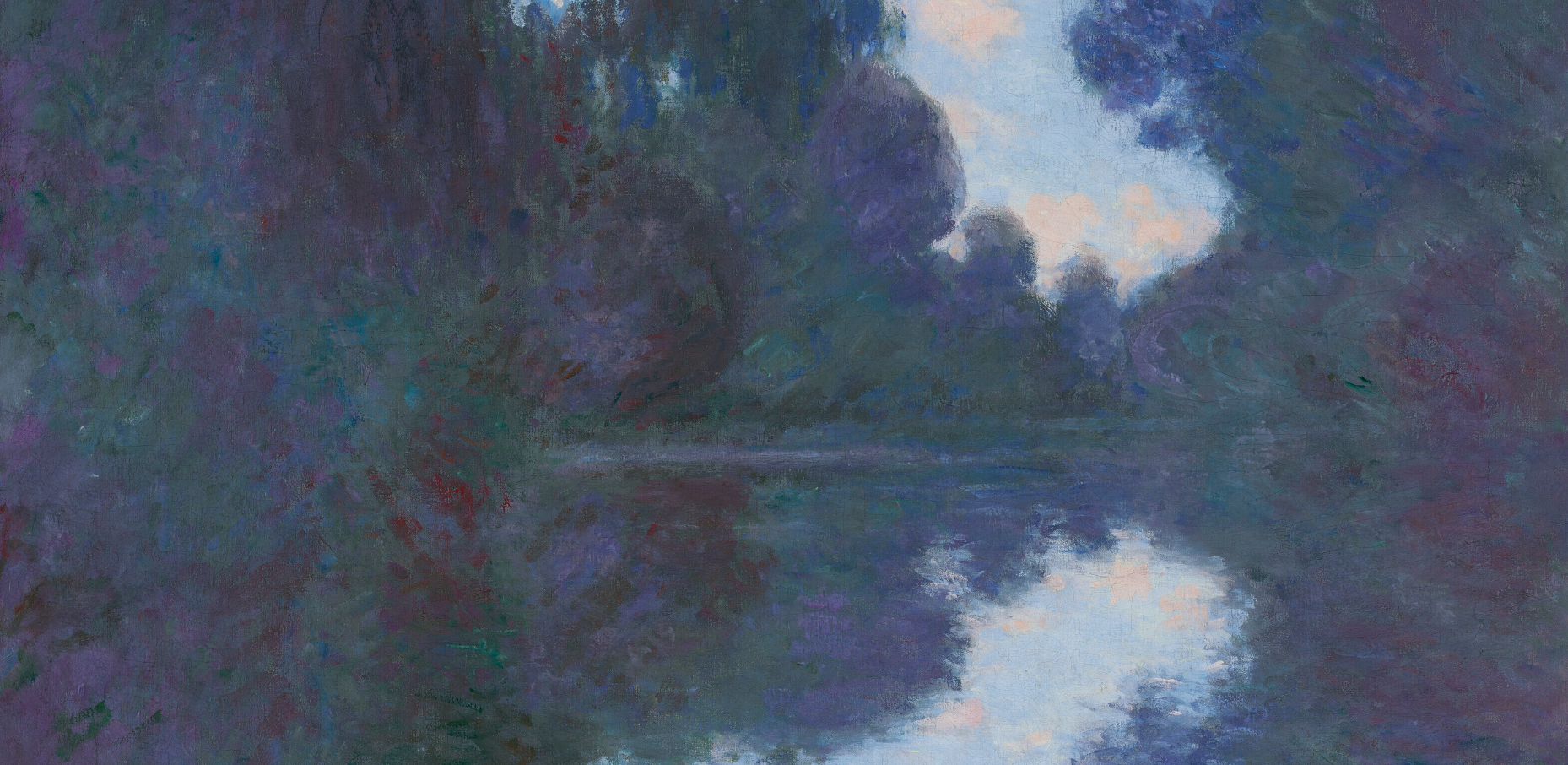
Rather than painting a wide-open expanse of the river, as he often had before, Monet chose for this series a quiet, protected backwater where the Epte tributary fed into the Seine, working from his famed bateau-atelier. Monet left this specially designed studio-boat anchored mid-river for the duration of the summer, rowing out to it each morning in a small skiff, ensuring that his viewpoint remained unchanged from one day to the next. As the artist looked upstream into the breaking dawn, on his left was the Giverny bank and on his right was the Île aux Orties, one of several wooded islets that then dotted this stretch of the Seine. He emphasized the meditative qualities of the site by selecting a spot where the trees on the Giverny shore were especially full, arching out over the narrow channel of water. These overhanging branches fill the upper left quadrant of the paintings in the series like a curtain being raised on the ethereal, early-morning landscape.
La Seine à Bougival, 1870
Christie’s New-York: 11 November 2023
Estimated: USD 800,000 – 1,200,000
USD 1,623,000
CLAUDE MONET (1840-1926), La Seine à Bougival | Christie’s
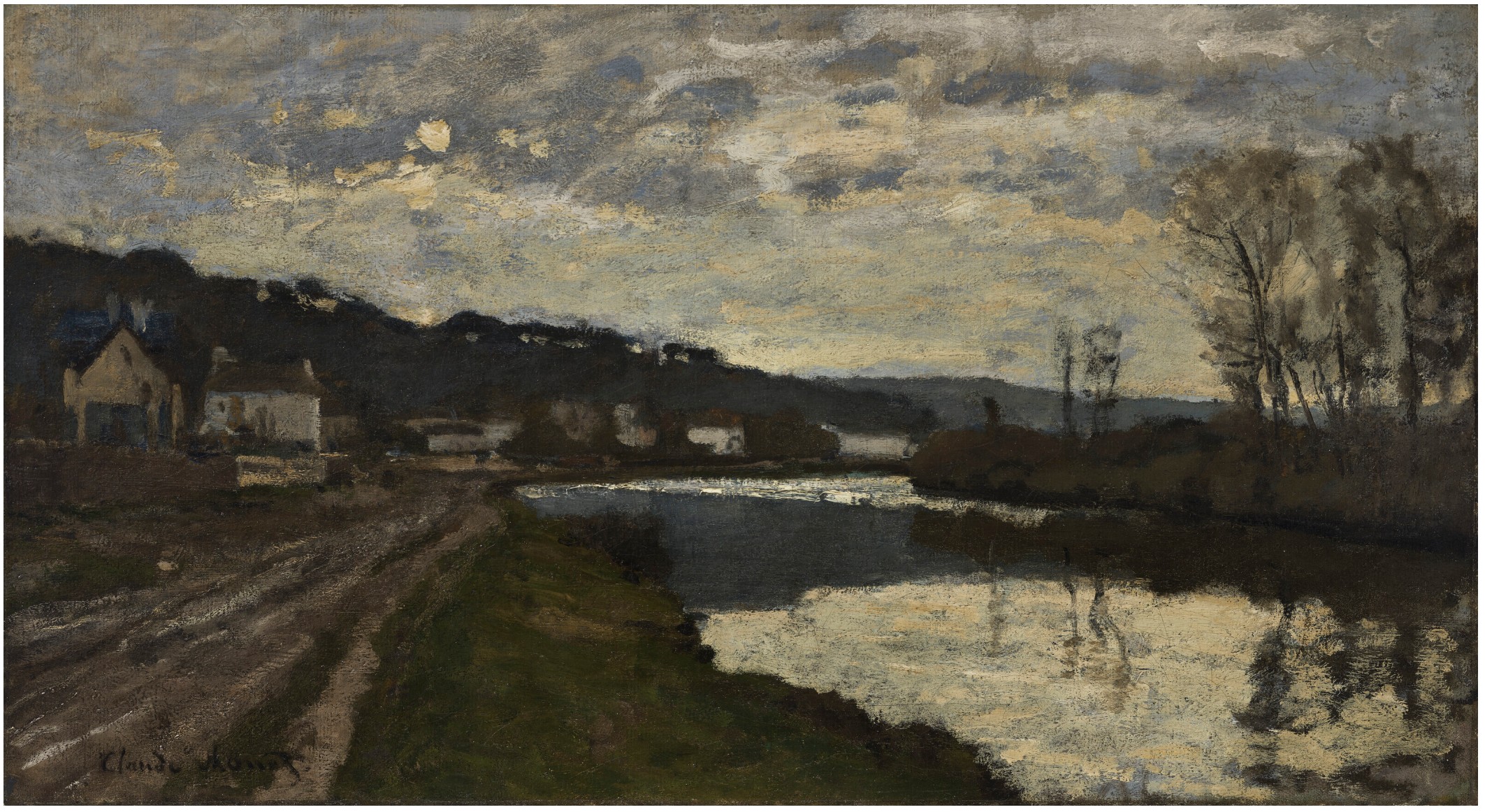
CLAUDE MONET (1840-1926)
La Seine à Bougival, 1870
Oil on canvas
40.3 x 73.4 cm (15 7/8 x 28 7/8 inches)
Signed ‘Claude Monet.’ (lower left)
Claude Monet was twenty-eight years old in the spring of 1870 when he set up his easel on the banks of the Seine River at Bougival to paint this dramatic scene. Facing in the direction of Marly, Monet observed the whiplash curve of the Seine and its bare-earth banks, lined with houses; the cluster of trees on the Ile de Crossy; and, above all, the subtle agitation of the clouds in the sky, reflected to brilliant effect in the river below. The resulting canvas, La Seine à Bougival, embodies Monet’s devotion to the genre of landscape and his early experiments in painting en plein air—recording his impressions of nature in all of its transient, temperamental glory.
The year 1870 was consequential for Monet and for France. In March, Monet’s work was refused from the Salon, the annual juried exhibition staged by the Académie des Beaux-Arts in Paris. Meanwhile, paintings by Monet’s close friends Jean-Frédéric Bazille and Pierre-Auguste Renoir were accepted by the Salon jury. This rejection was a crushing blow to Monet’s pride; it also cast serious doubt upon his ambitions to support his family as an artist. Still, in June, Monet married Camille Doncieux, his longtime love and the mother of his first son—despite his family’s vehement rejection of Camille. Just one month later, France declared war on Prussia, soon followed by the siege of Paris and the collapse of the Second Empire. These difficult conditions primed the artist to carve a radical new path for himself. This ultimately led him, four years later, to participate in a group exhibition with a number of other artists rejected from the Salon who shared his artistic vision: the Société Anonyme des artistes, peintres, sculpteurs, graveurs, later known as the Impressionists.
During this difficult period, Monet and his young family lived in a small rented house in the village of Saint-Michel near Bougival. Located some ten miles from Paris, Bougival was a popular destination for city-dwellers seeking fresh air and foliage, especially in the summer months. In the summer of 1869, Monet worked side by side with Renoir, observing the tourists as depicted in the painting La Grenouillère (Wildenstein no. 134; The Metropolitan Museum of Art, New York), a floating resort on the Ile de Crossy. This scene was a sunny, jubilant one, with bathers gathered on a dock to swim and diners cavorting in the open-air restaurant nearby. Bougival was particularly lively in the summer, but Monet found ample inspiration there in all kinds of weather—from the deep freeze of winter to the cruel blue skies of spring. The present work was likely painted in the tenuous transition between those two seasons, when the snow melted to reveal the raw earth underneath.
Around the same time, Monet painted another depiction of this same landscape from the inverted perspective; the resulting canvas now belongs to the Smith College Museum of Art (Wildenstein, no. 151). The artist painted this related work on the marshy Ile de Crossy in the middle of the river, looking back towards Bougival. From that vantage point, a few landmarks are faintly visible in the distance: a seventeenth-century aqueduct built by Louis XIV and a modern bridge crossing the Seine. The Smith College picture also represents a different hour than the present work: the radiant, sherbet-colored hues of sunset contrast sharply with the cool shadow of dusk. In revisiting the same site under different conditions, Monet observed the profound differences in color and light. This pair of paintings demonstrates Monet’s repetitive working methods, that would later come to define his serial painting practice.
This particular view of the Seine also held appeal for Monet’s future Impressionist colleagues. In 1871, the following year, Camille Pissarro painted a remarkably similar view in a muddier color palette. Albert Lebourg, a lesser-known painter who participated in the fourth and fifth Impressionist exhibitions, also visited to this place some fifteen years after Monet to paint his own version. Monet was undoubtedly a leading figure in the Impressionist group, despite his occasional refusal to participate in their exhibitions; his landscape paintings served as an enduring model for his friends and followers.
La Seine à Lavacourt, 1879
Christie’s New-York: 11 November 2023
Estimated: USD 600,000 – 800,000
USD 1,320,500
CLAUDE MONET (1840-1926), La Seine à Lavacourt | Christie’s
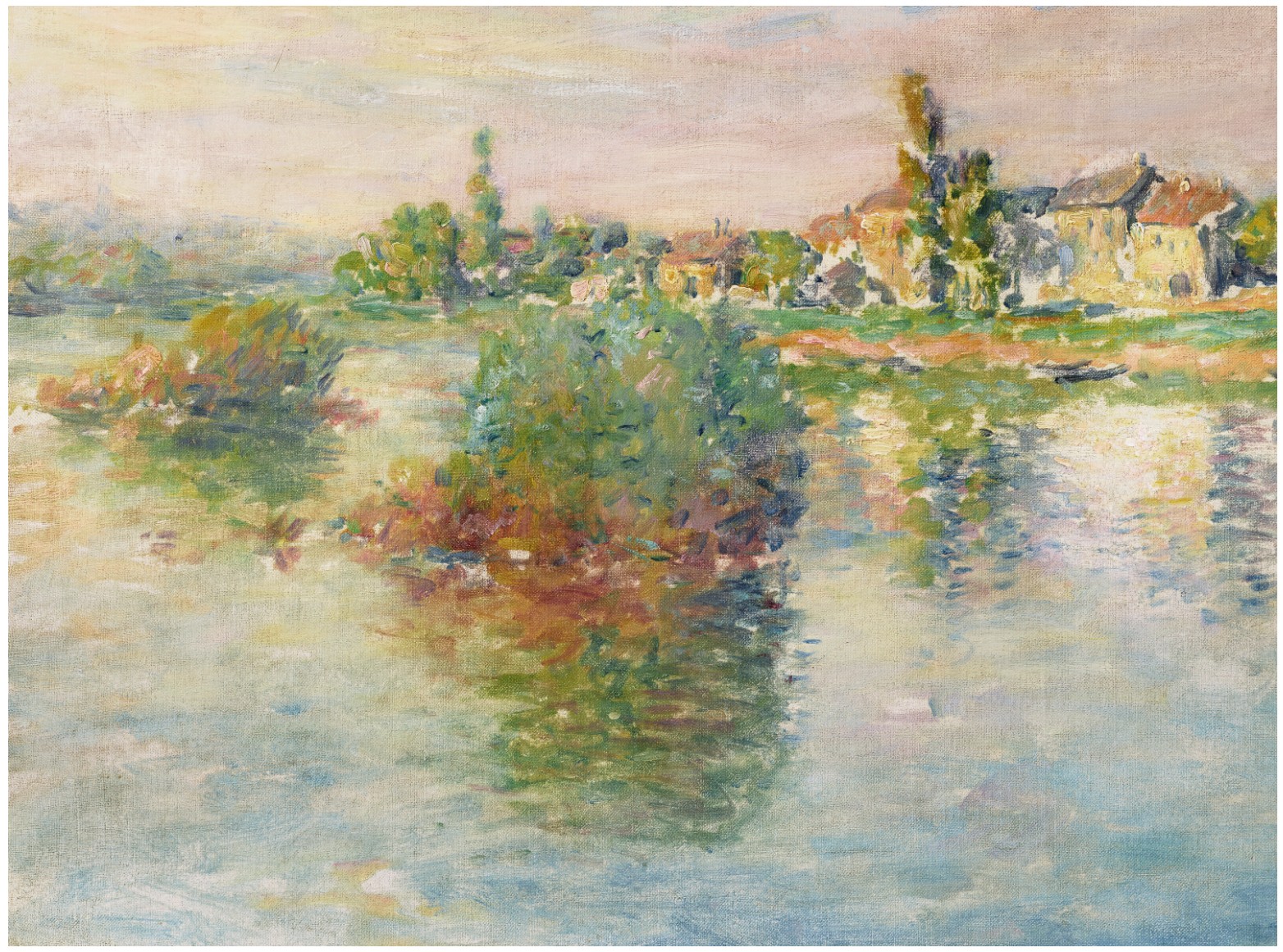
CLAUDE MONET (1840-1926)
La Seine à Lavacourt, 1879
Oil on canvas
45.4 x 61 cm (17 7/8 x 24 inches)
In 1879, Claude Monet and his family lived in a rented house in the town of Vétheuil. From his backyard, Monet could see the Seine river and the town of Lavacourt on the opposite bank—a view that he painted dozens of times, in different seasons of the year and hours of the day. The present work is one of the sunniest and warmest of the series. Monet recorded his observations of the yellow and pink sky; the houses and poplar trees lining the embankment; and the foliage of the bushes marooned in the center of the river. With a few quick, confident strokes, he also conveyed the brilliant reflections on the ever-changing surface of the river, blurring the distinction between liquid, solid and air. The present version of La Seine à Lavacourt is related to a slightly larger painting, Bords de la Seine (Wildenstein, no. 538), that now belongs to the collection of The Frick Pittsburgh.
Monet initially painted an exquisite series of the Seine at Lavacourt during the harsh winter, when the river was frozen and the landscape covered in snow. Yet the warmer months of spring and summer provided the artist with entirely new coloristic possibilities—and kinder conditions for painting en plein air. As Daniel Wildenstein observed: “The paintings from the first winter spent in Vétheuil have a melancholy quality that might have been sintered as much by the artist’s worries as by the season itself. But when spring burst into life, joy returned to Monet’s palette…He began a period of almost frenzied activity, his subject matter constantly changing” (op. cit., 1991, vol. I, p. 141). Monet maintained this urgent productivity throughout the glorious summer of 1879.
This phase of Monet’s career was marked by terrible financial precarity, in addition to remarkable formal experimentation. The artist struggled to sell his work and he began to regret his affiliation with the Impressionist painters. The painter Gustave Caillebotte eventually convinced a reluctant Monet to show some of his paintings at the fourth Impressionist exhibition, which opened in Paris in April 1879. Monet declined to attend the exhibition in person, so Caillebotte sent him news clippings featuring positive reviews of his work—while kindly omitting the negative responses. Art critic Albert Wolff succinctly articulated the most common criticism of Monet’s paintings: “M. Monet has sent 30 landscapes that look as if they were done in a single afternoon” (quoted in ibid., p. 142). Henry Harvard took less issue with the hastiness of Monet’s execution, than with his wide-ranging color palette and inventive brushwork; Harvard wrote in Le Siècle: “I confess humbly I do not see nature as [Monet and Pissarro] do, never having seen these skies fluffy with pink cotton, these opaque and moiré waters, this multi-colored foliage. Maybe they do exist. I do not know them” (quoted in The New Painting: Impressionism, 1874-1886, exh. cat., National Gallery of Art, Washington, D.C., 1986, p. 286).
Still desperate to generate funds, Monet abstained from the Fifth Impressionist exhibition the following year. Instead, he submitted his work to the Salon, the annual exhibition of the Académie des Beaux-Arts. In Monet’s view, the Salon was a more respectable venue to display his work to the public—and more importantly, to appeal to potential buyers. Monetsubmitted two canvases to the Académie but only one was accepted: another Lavacourt riverscape, now in the collection of the Dallas Museum of Art (Wildenstein, no. 578). At the Salon, Monet’s work found at least one admirer in the Marquis de Chennevieres, who wrote in La Gazette: “The light-toned, luminous quality [of Lavacourt] makes all the landscapes surrounding it in the same gallery seem dark” (quoted in ibid., p. 159). The present work similarly exemplifies Monet’s studies of luminescence through the color and texture of paint.
Moulin de Limetz
Moulin de Limetz, 1888
Christie’s New-York: 16 May 2024
Estimated: USD 18,000,000 – 25,000,000
USD 21,685,000
CLAUDE MONET (1840-1926), Moulin de Limetz | Christie’s (christies.com)
GUARANTEED

CLAUDE MONET (1840-1926)
Moulin de Limetz, 1888
Oil on canvas
92.5 x 72.8 cm (36 3/8 x 28 5/8 inches)
Signed and dated ‘Claude Monet 88’ (lower left)
Ater a spring painting campaign in the south of France, Claude Monet traveled back to his beloved home in Giverny at the end of April 1888. On his return, he devoted himself once more to depicting the idyllic rural landscape of this area, finding a wealth of inspiration in the verdant meadows and marshes, the tranquil waters of the river Epte and Seine, and, as the farmers began their harvest, the grainstacks that appeared in the fields near his house. Moulin de Limetz is one of two canvases in which Monet pictured the mill at Limetz-Villez, a village just over a mile south of Giverny, with a branch of the Epte, the so-called Bras de Limetz, flowing gently past.

Though the seeming protagonist of this large canvas is the mill, this was for Monet simply a pretext for capturing the striking, sun-dappled foliage of the tree that covers over half of the composition, together with the shimmering reflections on the river that stretches towards the bridge in the distance. While the pendant picture (Wildenstein, no. 1210a; Hasso Plattner Collection, Museum Barberini, Potsdam) presents the same scene in cool shadow, in the present work, Monet has conveyed the rich, warm light of a summer’s day. Though green tones appear on first glance to preside, the canvas is composed of a dazzling array of colors, from inky blues, violet and flashes of emerald green, to soft, pastel pinks and creams, applied with a thick impasto. The surface is richly textured, a tapestry of luminous tones that appears almost abstract in places. The flurry of strokes that represent the fluttering leaves on the branches both frame and obstruct the view of the mill beyond—a radical type of repoussoir that overturns conventional notions of landscape painting. In contrast to the dancing strokes of color that constitute the leaves in the foreground, the water is rendered with an exquisite delicacy. The reflections, a symphonic combination of blues, greens, whites and pinks, sweep across the width of the canvas in soft vertical stripes, mirroring the tangible elements of the scene, as well as the small glimpse of blue sky above. Light and air therefore become subjects in themselves, masterfully distilled by Monet into painterly form.
With its bold brushwork and emphatic focus on the varying qualities and effects of light, Moulin de Limetz is a defiantly Impressionist work, painted at a time when this movement was moving into new directions. The final Impressionist exhibition had been held two years earlier, in the spring of 1886. From the start of this decade, many of the leading proponents of Impressionism had begun to pursue different artistic ideas. Pierre-Auguste Renoir had gone to Italy in 1881 to study Classicism and the Renaissance, Edgar Degas had refused to exhibit in the Impressionist exhibition in 1882, Camille Pissarro had fallen under the spell of the Neo-Impressionists in 1885, introducing more studied, careful brushstrokes into his painting. In 1888, Pissarro invited the Neo-Impressionist leader, Georges Seurat, to join that year’s Impressionist exhibition—a decision that had caused Monet, Renoir, and Alfred Sisley to abstain from participating. There, Seurat debuted his pointillist masterpiece, Un dimanche d’été à l’Ile de La Grande Jatte (The Art Institute of Chicago), “nothing less than a direct assault on the style and subjects of his Impressionist forbears,” Paul Hayes Tucker has written (op. cit., 1995, p. 126).

Moulin de Limetz remained in Monet’s collection until 1891, when Durand-Ruel acquired it. It was bought not long after by the collector, Lucien Sauphar, with whom it remained until 1936. Acquired from Sauphar’s estate sale jointly by Durand-Ruel and M. Knoedler & Co., New York, the painting crossed the Atlantic, where, a few years later, in 1941, it was bought by Joseph S. and Ethel B. Atha, of Kansas City. It remained in their collection until Ethel died in 1986. At her bequest, it was gifted partially to The Nelson-Atkins Museum of Art. Upon the death of Ethel’s daughter, Ethelyn Atha Chase, in September 2023, who held a life interest in part of the painting, the work will now be sold. Proceeds from the sale will be used to support future art acquisitions for The Nelson-Atkins Museum of Art.
Le Moulin de Limetz, 1888
Sotheby’s New-York: 13 November 2023
Estimated: USD 12,000,000 – 18,000,000
USD 25,612,500
Le Moulin de Limetz | Modern Evening Auction | 2023 | Sotheby’s (sothebys.com)
CLAUDE MONET (1840 – 1926)
Le Moulin de Limetz, 1888
oil on canvas
92 x 72.9 cm (36 1/4 x 28 3/4 inches)
Signed Claude Monet and dated 88 (lower left)
Executed in 1888, Claude Monet’s Le Moulin de Limetz is an exceptionally luminous and prismatic encapsulation of Impressionist technique. One of only two canvases to feature this views of the grain mill at Limetz (the other example held in the collection of the Nelson-Atkins Museum of Art) , the present work was painted in the small village of Limetz on the River Epte, about a mile away from the artist’s Giverny home. Monet’s focus in both compositions is not the mill itself—visible at far right, dwarfed by distance and softened by the artist’s characteristic taches—but rather the dazzling diffusion of the mill’s reflection on the water’s surface, seen through the dense, thickly painted leaves of a willow tree that veil the mill and stone bridge. Monet likely advanced both canvases simultaneously, balancing the curtain of foliage at left with the rippling reflection of forms in the river at right.
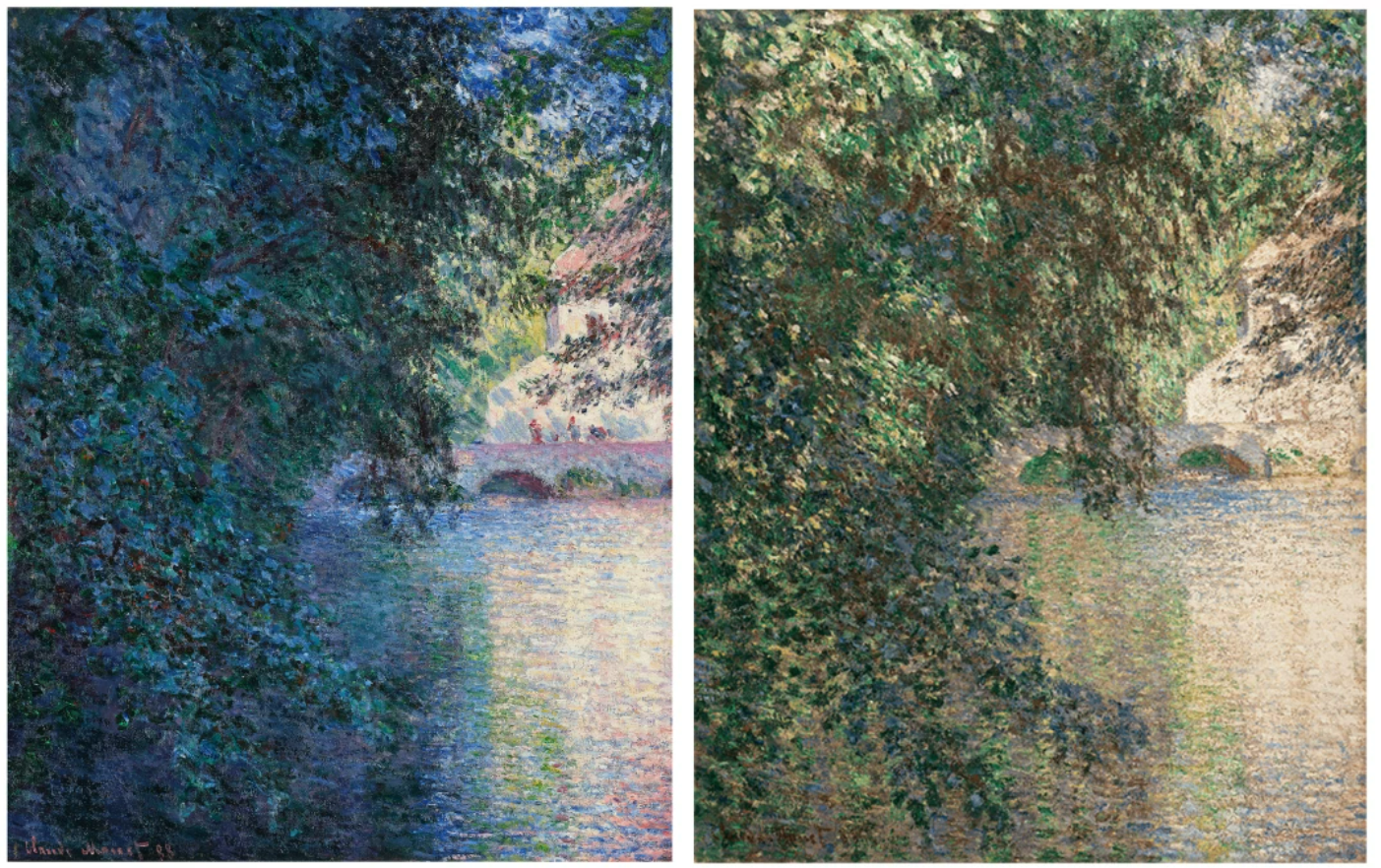
LEFT: THE PRESENT WORK
RIGHT: CLAUDE MONET, MOULIN DE LIMETZ, 1888, THE NESLON-ATKINS MUSEUM
Compared to the Nelson-Atkins version, which is dominated by a green and yellow palette, the present painting is a symphony of sparkling jewel-toned greens, purples, and pinks, punctuated by passages of nearly ecstatic light and bursts of red that altogether contribute to a radiant and ravishing view. The present composition was executed just a few years before Monet would experiment in earnest with a single subject across a series in his notable Meules of 1890-91, Peupliers of 1891, Cathédrales de Rouen of 1892-94, and, for the last 25 years of his life, his beloved Nymphéas at Giverny. Le Moulin de Limetz presages these radical pictorial experiments, already realizing the power of variations on a single motif.
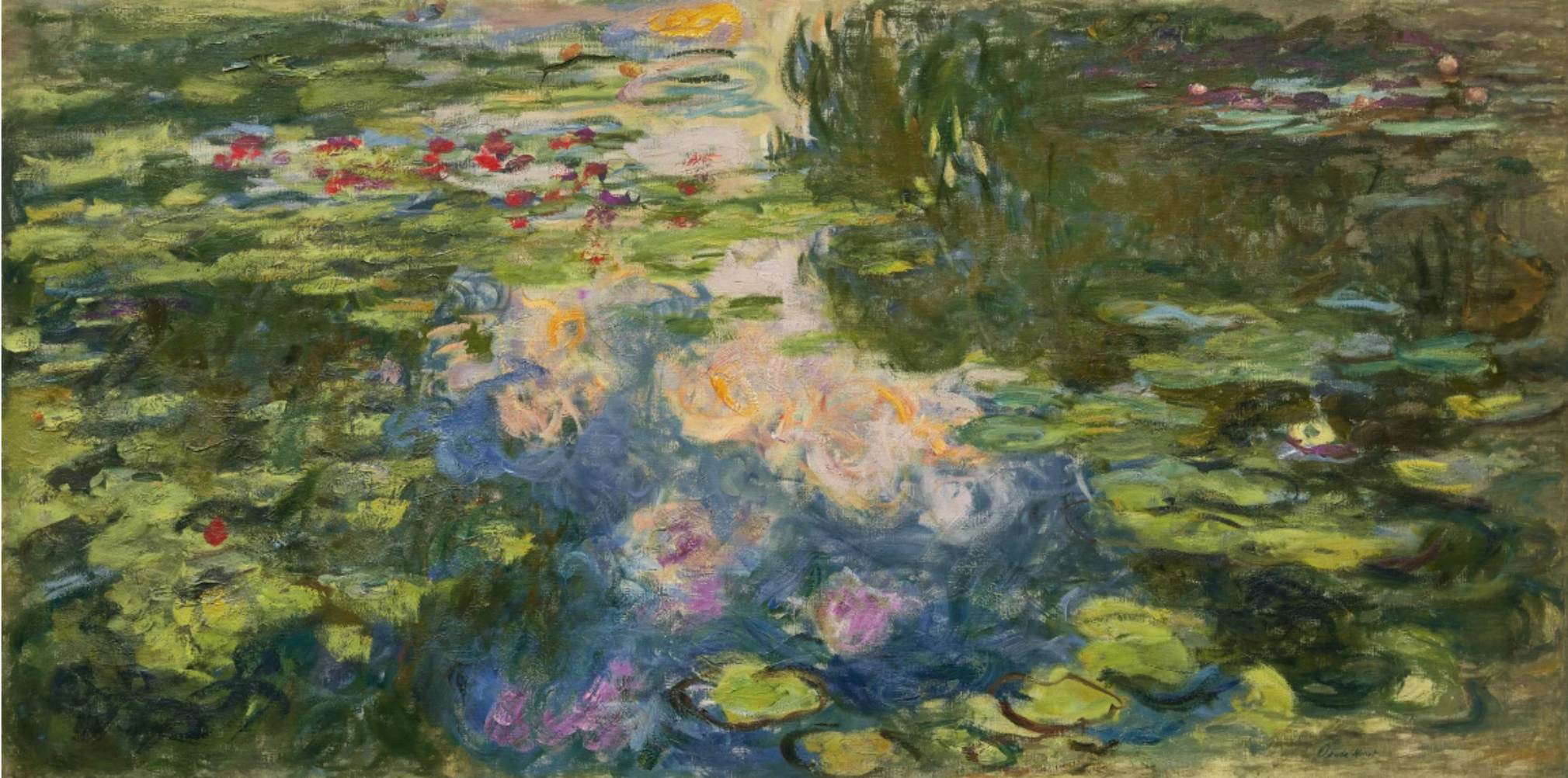
CLAUDE MONET, LE BASSIN AUX NYMPHÉAS, 1917-19
Striving to capture the fleeting effects of nature—light, water, air—Monet favored potent, newly commercially available prismatic colors that would continue to inform his palette in subsequent decades.The brilliant effects of light and shadow upon the rippling water in Le Moulin de Limetz prefigures the masterful interplay of color and texture which would define Monet’s later Nymphéas.
Peupliers
Peupliers au bord de l’Epte, crépuscule, 1891
Christie’s New-York: 12 May 2025
Estimated: USD 30,000,000 – 50,000,000
USD 42,960,000
CLAUDE MONET (1840-1926), Peupliers au bord de l’Epte, crépuscule | Christie’s
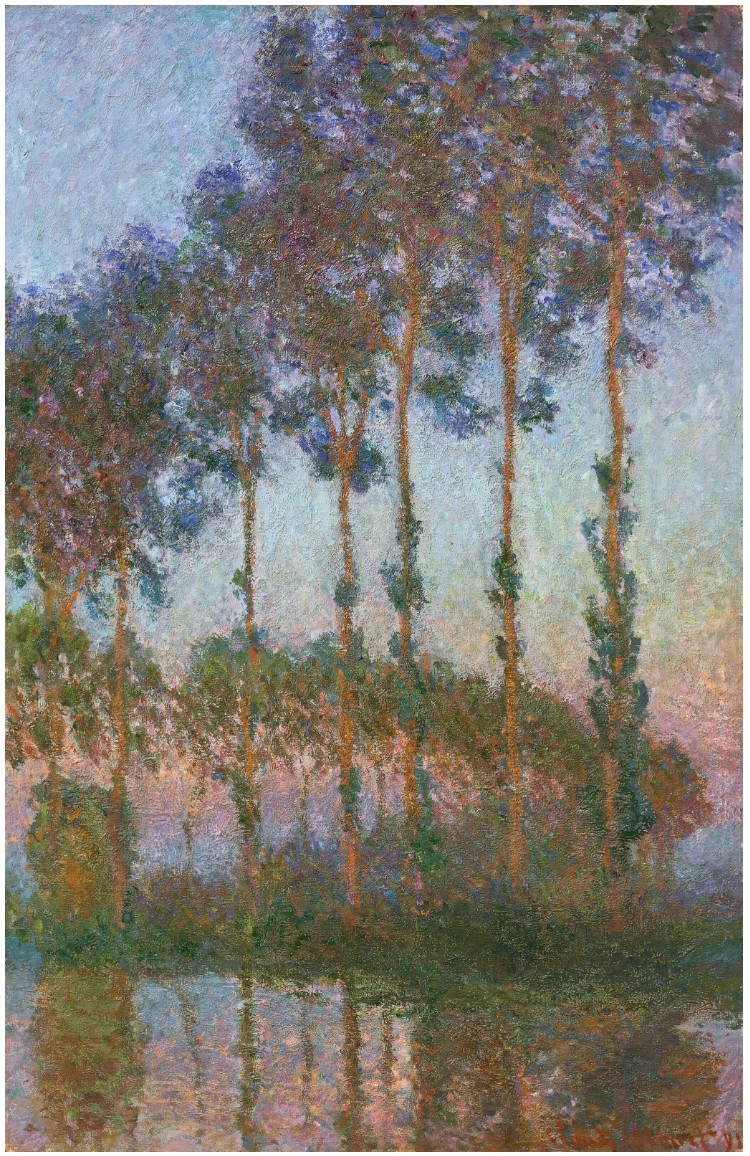
CLAUDE MONET (1840-1926)
Peupliers au bord de l’Epte, crépuscule, 1891
Oil on canvas
100 x 65.1 cm (39 3/8 x 25 5/8 inches)
Signed and dated ‘Claude Monet 91’ (lower right)
Bathed in the intense pink hues of the setting sun, Claude Monet’s Peupliers au bord de l’Epte, crépuscule is a masterful study of the dramatic play of light that transforms the landscape as day gives way to night. One of just four works from the artist’s acclaimed Peupliers series to specify a particular time of day in their titles, the composition appears through a richly worked network of vivid color, each layer of pigment and touch of the brush carefully chosen to convey the nuances and dynamism of the fading light, which Monet observed while working en plein air before his motif. Across this concentrated sequence of paintings focusing on the poplar tree, Monet embraces a bold, instinctive approach to facture and color that almost hovers on the edge of abstraction, offering a startlingly prescient vision of the landscape that anticipates many of the developments that transformed art-making through the twentieth century. Formerly owned by the pioneering Impressionist dealer Paul Durand-Ruel—in whose family it remained until 1955—the painting has been held in the same private collection for the past sixty-five years.
Across the group of two dozen works that make up the Peupliers series (Wildenstein, nos. 1291-1313), Monet focused on the slender, towering form of the poplar tree, an iconic and instantly recognizable element within the surrounding countryside. He had come across a picturesque stretch of these trees planted on the edge of the river Epte just a few kilometers from his home in Giverny during the spring of 1891, and spent much of the rest of the year studying their changing character under various atmospheric conditions. Each created from almost exactly the same vantage point, near a spot where the Epte bends back on itself twice to create a distinctive S-shape, the resulting compositions are a powerful showcase of the artist’s bourgeoning serial technique, which would come to define Monet’s output across the final three decades of his career.
“You have to know how to seize just the right moment in a landscape instantaneously, because that particular moment will never come again, and you’re always wondering if the impression you got was truthful.”
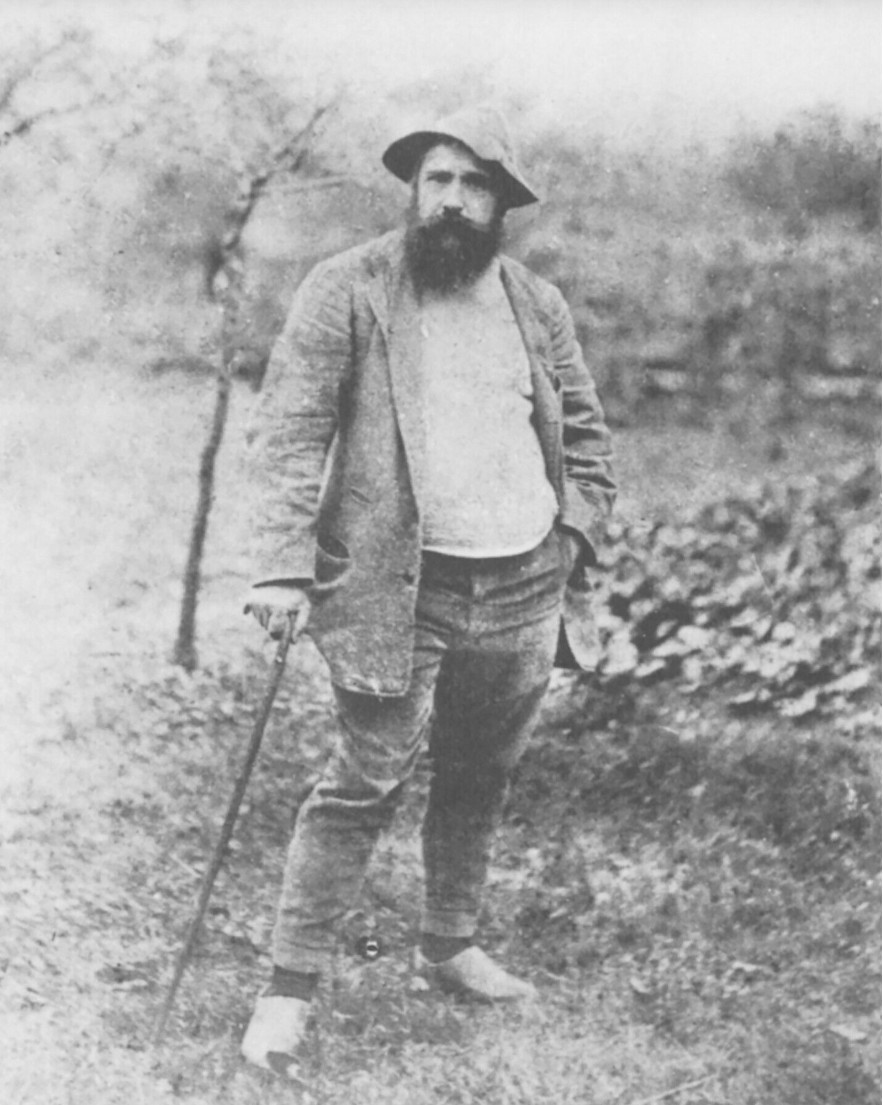
Claude Monet at Giverny, 1889. Photograph by Theodore Robinson. Fondation Wildenstein, Paris.
A common feature within the French countryside during the nineteenth century, poplars were typically found lining the entrance routes to grand châteaux, or standing along rural roads as windshields for tilled fields, while land owners around the country planted them as a form of fencing to demarcate property boundaries. Lithe and elegant, they grew quickly—generally twenty-five to thirty feet in a decade—making them a popular investment for speculators, while their ability to quickly absorb large amounts of water made them a perfect addition to river banks as protection against flooding. Moreover, following the French Revolution, the poplar had become a symbol of liberty, largely due to its name, which derived from the Latin populus, meaning both “people” and “popular.” By 1793, sixty thousand poplars had been planted in France, and hundreds of broadsides were issued featuring the tree as a symbol of the new republic. Ceremonial plantings were common on important anniversaries, most notably in 1889 to mark the centenary of the Revolution, and the tree was seen as an emblem of the stability, beauty and fecundity of rural France within the public imagination.
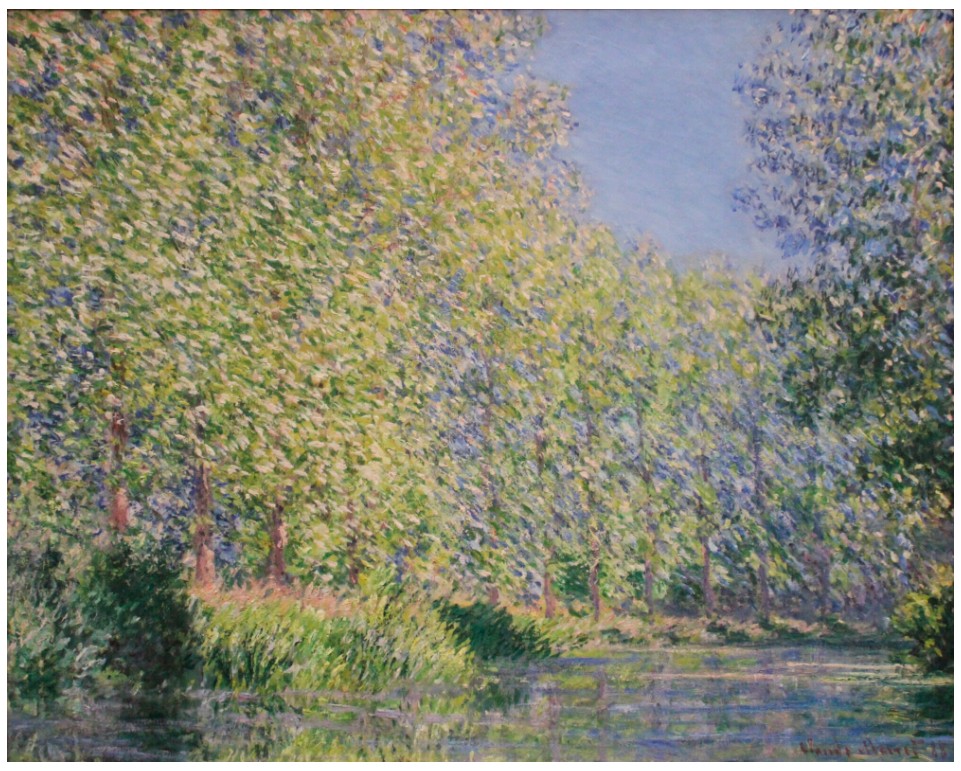
Claude Monet, Un tournant de l’Epte, 1888. The Philadelphia Museum of Art.
Poplars had been a favorite motif of Monet’s since the beginnings of his painterly career—in one of his earliest known compositions, Vue prise à Rouelles (1858, Wildenstein, no. 1; Marunuma Art Park, Asaka) a bank of poplars occupies the center of the composition, their slender forms rising above the surrounding vegetation to draw the eye towards the middle distance. Similarly, the trees abound in a number of the artist’s views of Argenteuil and Vétheuil, while the sequence of paintings devoted to the verdant meadows that emerged following his move to Giverny in 1883 most often featured a row of regularly spaced poplars along the edge of the field. While they appear in the background of nearly half of the artist’s Meules paintings, it was not until his fortuitous discovery of the sweeping row of poplars along the Epte that Monet took the opportunity to focus on the slender silhouettes of these trees fully, bringing them in from the edge of the landscape to the foreground of his paintings, and granting them a new prominence and monumentality in the process.
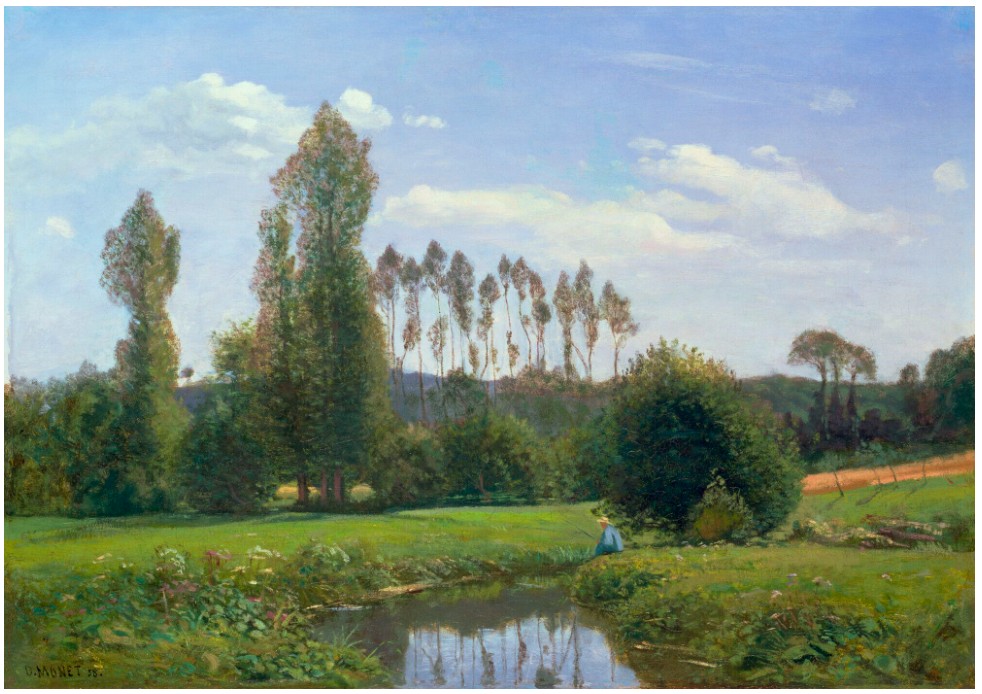
Claude Monet, Vue prise à Rouelles, 1858. Marunuma Art Park, Asaka. Photo: Bridgeman Images.
Anchoring his view in the natural topography of the river, as it winds its way through the countryside, in these works Monet presents a dynamic view of the poplars along the water’s edge . Most of the series focuses on a screen of tall, slender poplars in the foreground, while behind, looping away along the river bank, the rest of the trees generate a striking arabesque pattern as they follow the water. In Peupliers au bord de l’Epte, crépuscule, rather than looking directly at the poplars, Monet turned slightly to the left to accentuate the sweeping, diagonal progression of the trees, generating a vivid sense of depth within the painting, as the eye follows their line from right to left and back again, before they disappear into the distance in a flurry of foliage. The lower portion of the canvas is devoted to the rippling surface of the water, filled with the reflections of the tree trunks, which seem to softly dematerialize before the eye, offering a striking contrast to the strong, upright forms of the poplars themselves.
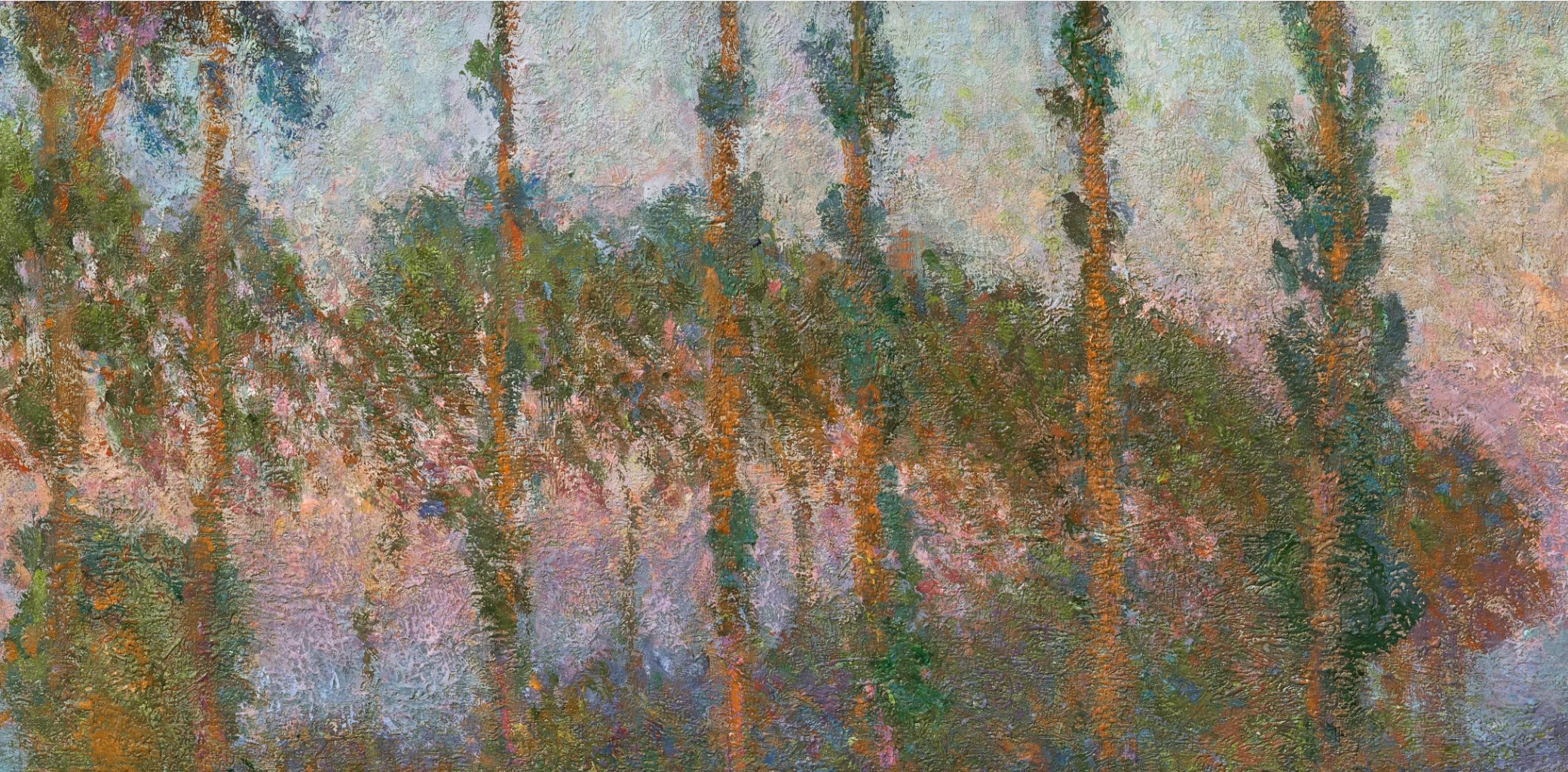
The low vantage point, just slightly above the level of the water, suggests that the artist worked from the bateau atelier that he had built during his years at Argenteuil. This ingeniously modified, modest row boat allowed the artist to bring multiple canvases, painting supplies, and even an easel with him to his chosen site. Each morning, rather than walking from his home in Giverny, Monet was able to set off from his gardens, rowing directly to this section of the river via a tributary that ran through his property. Once he reached the poplars, he anchored the boat in the center of the river Epte and set to work. Looking up at the trees from the deck of the boat, Monet sought to capture an impression of their vertiginous profiles, accentuating the height and verticality of the trees by elongating the poplars and their reflections so that they filled the entire stretch of his canvas.
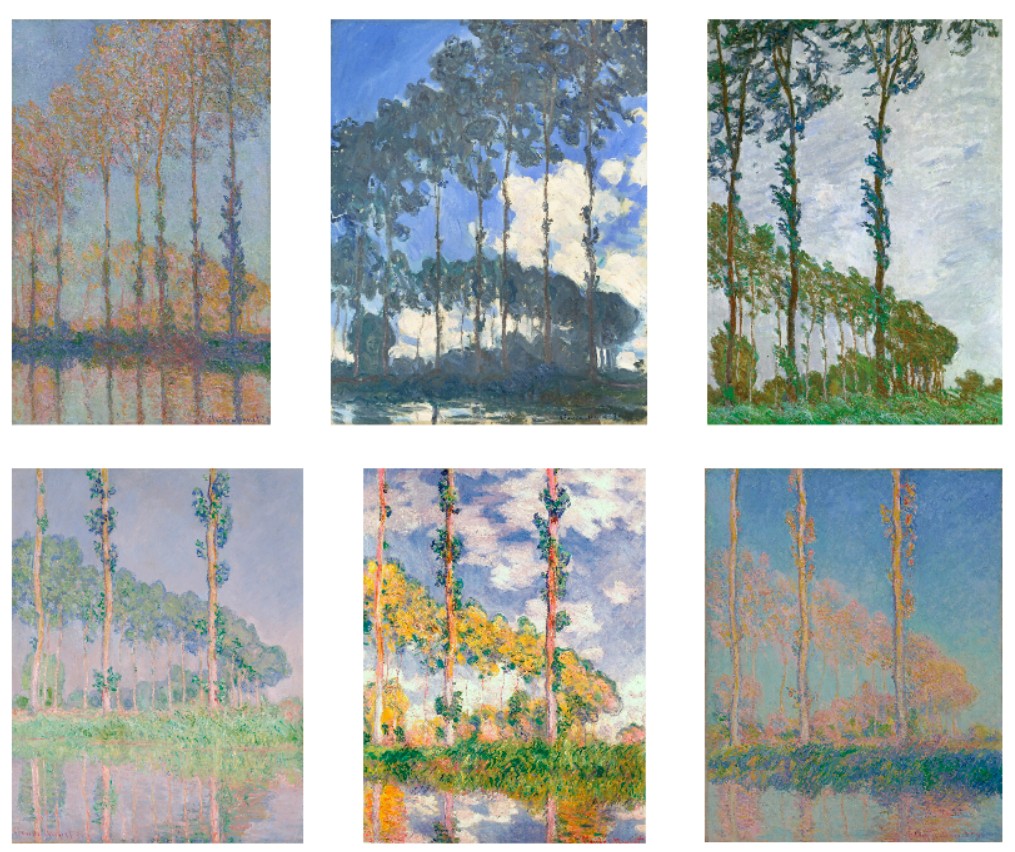
However, just as he was fully immersed in this intriguing new motif, Monet received word that the village of Limetz, which owned the trees along the Epte, intended to sell the bank of poplars at an upcoming auction. They had been planted on communal land as a cash crop, and by June 1891 had reached an appropriate height for harvest. The artist appealed directly to the local mayor to delay the sale, but to no avail, and in a letter of 28 July, Monet lamented that there remained “quantities of new canvases which I must finish” (quoted in J. House, Monet: Nature into Art, New Haven, 1986, p. 201). It was only on the day of the auction itself that he came up with a solution, striking an agreement with a local timber merchant in a last ditch effort to preserve the view. “I asked him how high a price he expected to pay,” Monet later told a biographer, “promising to make up the difference if the bid went over his amount, on the condition that he would buy the trees for me and leave them standing for a few more months” (quoted in P.H. Tucker, Claude Monet: Life and Art, New Haven and London, 1997, p. 146).
The arrangement proved successful—when the gavel came down, Monet and the lumber merchant were co-owners of the poplars, with the artist proclaiming, “my wallet felt the damage” (quoted in D. Wildenstein, Monet, or the Triumph of Impressionism, Cologne, 1996, p. 280). The venture provided Monet with a reprieve, allowing him to complete the full series of Peupliers paintings over the course of the ensuing months, during which he charted the changing colors of the autumnal foliage as they swept through the landscape, and the seasonal shifts in the weather, which brought overcast skies and brisk winds that buffeted the trees wildly.
The thick, verdant foliage and warm tones of Peupliers au bord de l’Epte, crépuscule appear to suggest that the view was captured at the height of the trees’ summer growth, and was perhaps one of the paintings Monet was anxious to finish before the impending auction. The painting is particularly remarkable within the series for its extraordinary appreciation of the nuances of changing light, capturing the moment when the sun descends and casts the sky aglow with a resplendent play of vibrant, yet soft, color. A delicately variegated band of pink, peach, blue and purple hues cuts across the middle of the canvas, almost directly in line with the tops of the trees in the middle-distance, the short touches of pigment generating an almost pointillist effect, as they mix and intermingle in carefully structured layers of gently shifting tones. These colors are echoed not only in the reflections in the river, but also within the spray of foliage, and along the barks of the trees, emphasizing the manner in which the final, rich orange rays of the sun transformed the entire landscape with their warmth. In this way, the painting reveals a new level of accuracy in Monet’s observations of the precise nature of light, its dynamic, vibrating surface revealing the hours, days, and weeks he had spent observing the poplars at this particular moment of the day.
Peupliers au bord de l’Epte, temps couvert, 1891
Sotheby’s New-York: 13 November 2023
Estimated: USD 30,000,000 – 40,000,000
USD 30,783,000
CLAUDE MONET (1840 – 1926)
Peupliers au bord de l’Epte, temps couvert, 1891
Oil on canvas
91.5 x 81.5 cm (36 x 32 1/8 inches)
Signed Claude Monet and dated 91 (lower right)
Belonging to one of the greatest series of his career, Monet’s Peupliers au bord de l’Epte, temps couvert stands among the finest depictions of the tree-lined banks of the river Epte. Executed beginning in the spring of 1891, the remarkable series of twenty four works stands at the crux of Monet’s acclaimed oeuvre, painted just after the iconic Meules series of 1890-91 and presaging the radical views of his London pictures, and ultimately, his defining Nymphéas.
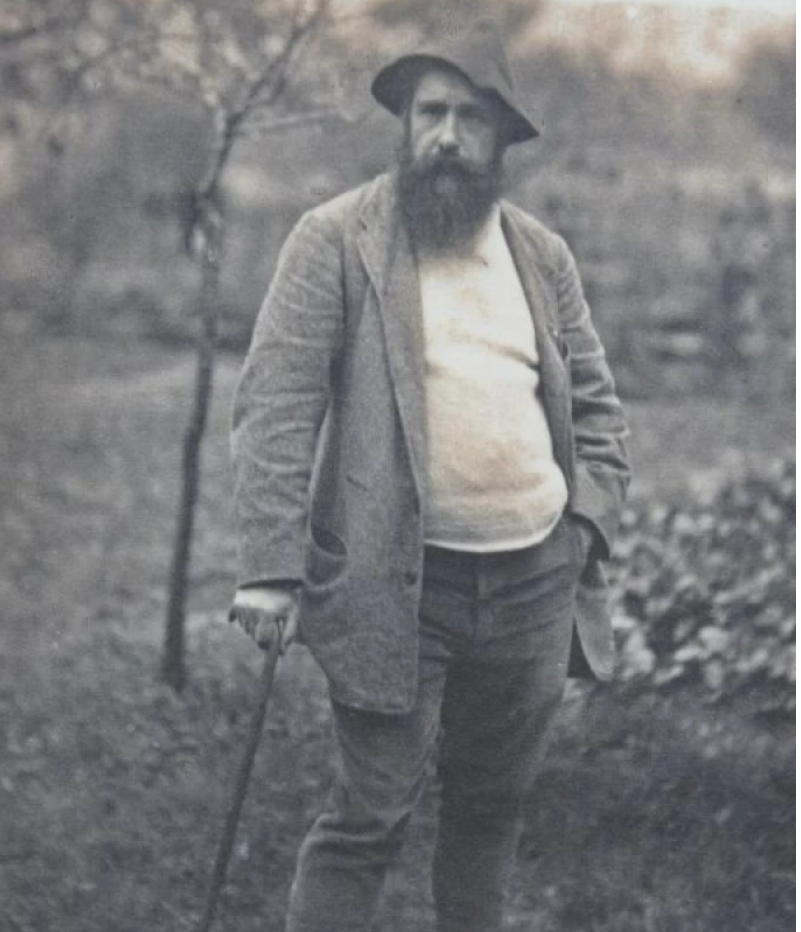
Monet’s paintings executed in the Eure during the late 1880s and early 1890s offer a vision of pastoral contentment; the fecundity of France and its vibrant seasons are portrayed in the most advanced Impressionist style. Discussing the artist’s daily routine at his home, Claire Joyes wrote: “The landscape at Giverny fascinated him. He spent a long while exploring, walking over hills and through valleys, in marshes and meadows, among streams and poplars. Or, drifting down the quiet river in his boat he would watch with a hunter’s concentration for the precise moment when light shimmered on grass or on silver willow leaves or on the surface of the water. Suddenly or by degrees his motif would be revealed to him” (Claire Joyes, Monet at Giverny, London, 1975, p. 20). Once settled on a subject Monet would rise early, breakfast lavishly, and set out across the fields with his canvases and painting paraphernalia in a wheelbarrow, often accompanied by an “assistant” in form of his step daughter Blanche Hoschedé.
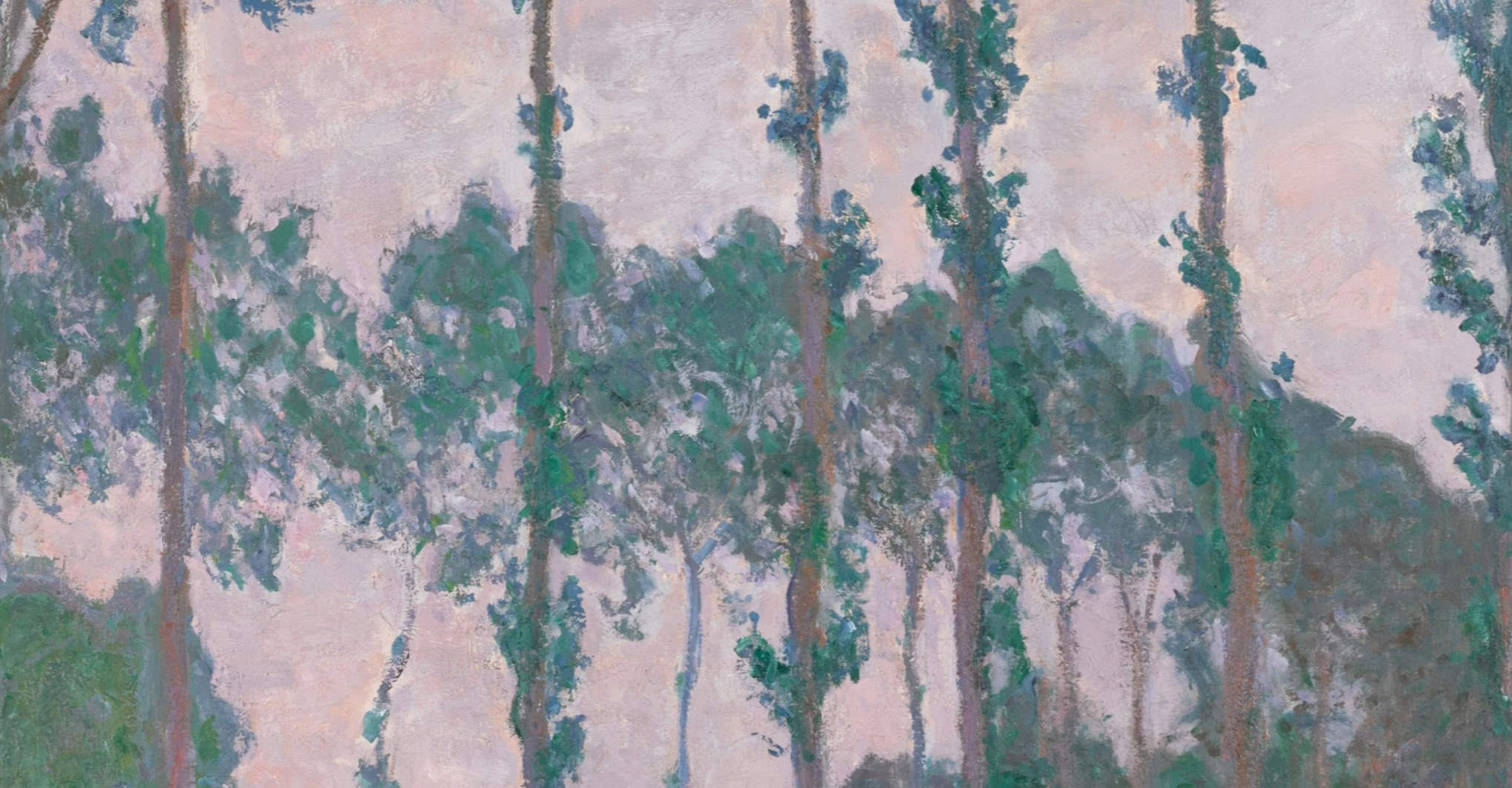
In the Spring of 1891, Monet began a group of twenty-four paintings of a group of poplars located two kilometers from his house in Giverny. The poplars lined the banks of the Epte in the nearby village of Limetz. As it happened, not long after Monet began to paint them, the town of Limetz decided to auction off the trees. They had been planted as a cash crop on property belonging to the town, and in the summer of 1891 they were ready to be harvested. Monet’s request to the town elders to delay their sale was turned down so he turned to the owner of the saw mill. As he relayed the story years later to René Gimpel he asked “what price he [the saw mill owner] was going to buy them for. ‘Go higher’ he said to the timber merchant. ‘I’ll pay the difference but let me have time to paint them” (René Gimpel, Diary of an Art Dealer, New York, 1987, p. 314). Monet’s particular requirements regarding time of day, light and weather, led to the artist modifying and actively painting multiple canvases each day.
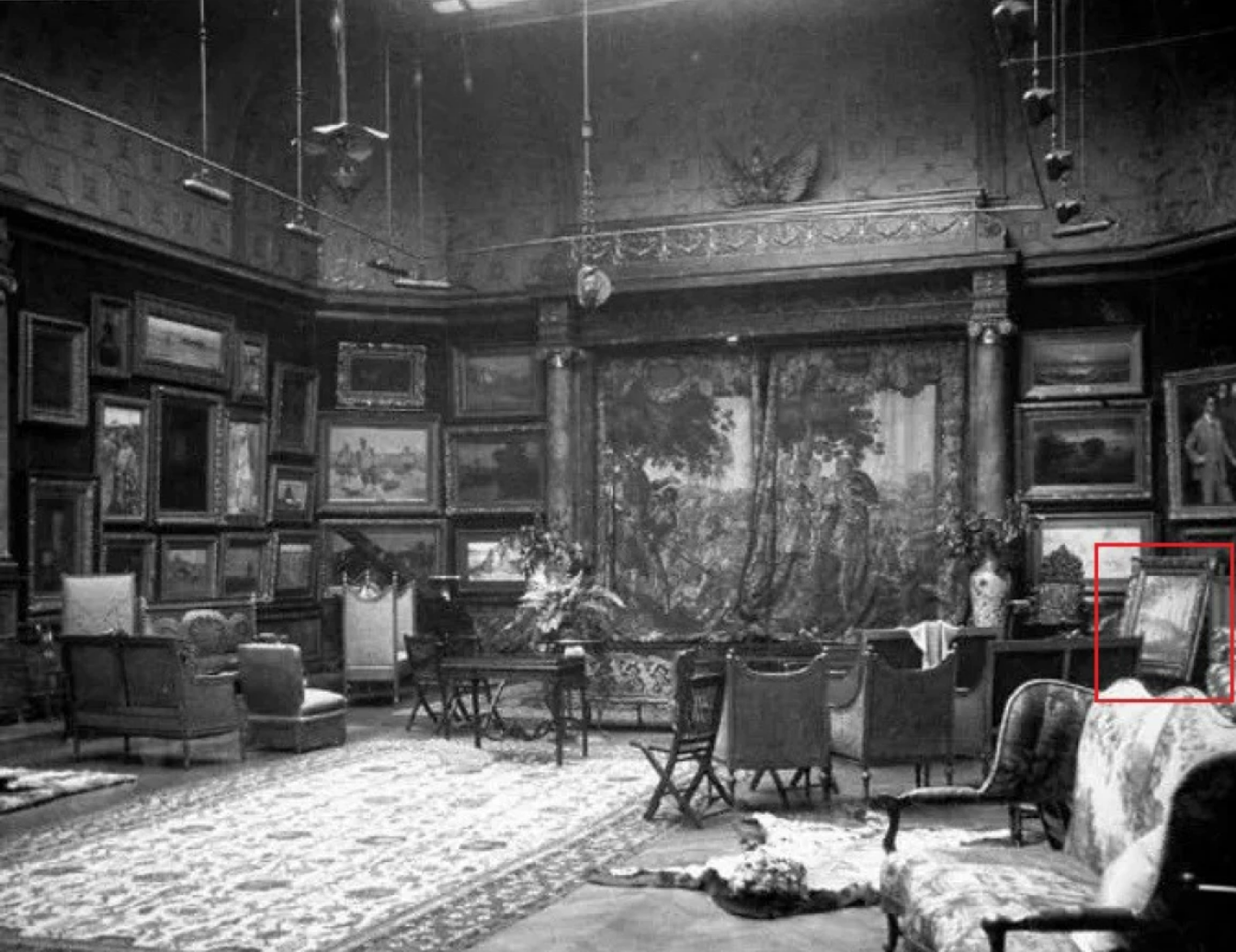
The provenance of the present work exemplifies the important role Monet’s early collectors and dealers played in the promotion of his work, especially in America. Comfortably the richest couple in Chicago at the time, Bertha and Potter Palmer were not averse to spending their prodigious wealth. From 1891 to 1892, Potter Palmer and his wife Bertha acquired a staggering amount of Impressionist art, primarily from the dealers Durand-Ruel in Paris and Knoedler in New York. Bertha was the driving force behind the collection, and intriguingly seems to have operated almost in the manner of a dealer, buying and selling works of art after owning them for a relatively short period of time. In the end, the Palmers had owned ninety paintings by Monet alone, including eight works from the Meules series of 1890-91, a great number of which were bequeathed to the Art Institute of Chicago in 1922. Their act of generosity helped to establish the museum as one of the greatest collections of Impressionist art in America. Among the twenty-three surviving works in the Peupliers series, the present work is one of the most lyrical examples, its cottony lilac-blue skies contrasted by brilliant gem-like hues of green. Peupliers au bord de l’Epte, temps couvert belongs to the smaller subset of works within the series which are painted in a squarer format, the broader canvas allowing for the sweeping serpentine curves of the line of poplar trees. The nearly-square format of Peupliers au bord de l’Epte, temps couvert also presages the aritst’s famed Nymphéas series, some of the earliest of which are executed on the same scale.
Peupliers au bord de l’Epte, automne, 1891
Christie’s New-York: 12 May 2022
Estimated: USD 30,000,000 – 50,000,000
USD 36,457,500
CLAUDE MONET (1840-1926), Peupliers au bord de l’Epte, automne | Christie’s
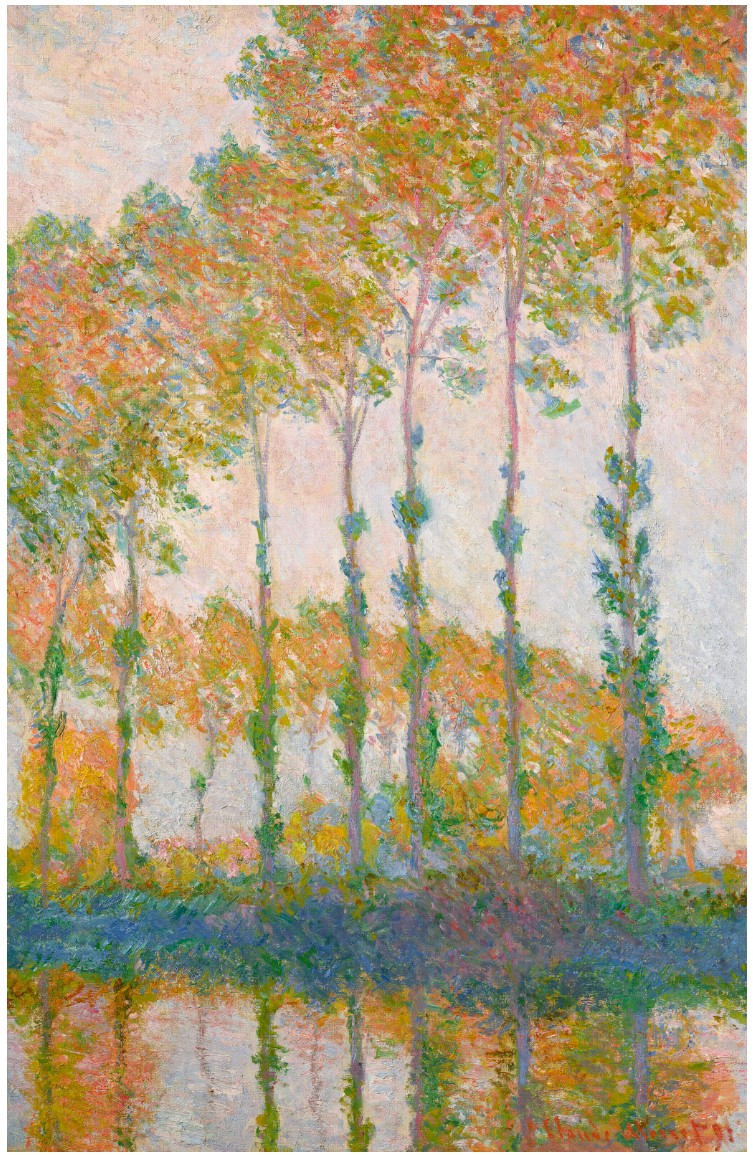
CLAUDE MONET (1840-1926)
Peupliers au bord de l’Epte, automne, 1891
Oil on canvas
101 x 65.7 cm (39 3/4 x 25 7/8 inches)
Signed and dated ‘Claude Monet 91’ (lower right)
During the spring of 1891, Claude Monet discovered an intriguing new subject in a stretch of elegant poplars lining the banks of the river Epte, just two kilometers south of his home at Giverny. Inspired by their towering forms and the regular rhythm of their placement along the water’s edge, he began a concentrated series of paintings which placed the poplar as the central protagonist within the composition. Building on the development of his experiments in the Meules series (Wildenstein, nos. 1266-1290), which had occupied him over the course of the previous winter and were likely completed around the same time as the poplar paintings were begun, Monet set out to capture the trees in a variety of light conditions, tracking the changes in their shape, form and color as they transitioned from early spring, through the height of their summer growth, and into early autumn. Executed in an array of rich, vigorous brushstrokes, their forms overlapping and intertwining across the canvas, Peupliers au bord de l’Epte, automne is among the most dynamic and richly worked paintings in the series, capturing the trees as the season shifts and their leaves turn a golden-red hue.
The Peupliers series emerged at an important moment in the artist’s personal life. Just a few months prior, the house Monet had been renting for almost a decade, Le Pressoir, had gone on the market and he had seized the opportunity to settle permanently in the idyllic hamlet of Giverny, purchasing the dwelling and its surrounding plot of land outright. “[I] would never find a parallel situation,” he told his dealer at the time, Paul Durand-Ruel, “nor so beautiful an area” (quoted in P.H. Tucker, Monet in the ‘90s: The Series Paintings, exh. cat., Museum of Fine Arts, Boston, 1989, pp. 81-84). Over the course of the following decade, Monet would dedicate himself almost exclusively to the depiction—and intentional celebration—of the pastoral surroundings of Giverny, as he reveled in the natural beauty of this corner of France. While the poplars had featured prominently in two canvases from 1887 (Wildenstein, nos. 1155-1156), and appear in the background of nearly half of the Meules paintings, the discovery of the stretch of trees along the Epte prompted a new creative outpouring for the artist. The natural location of the trees on the banks of the river as it wound its way through the landscape had captured Monet’s imagination, and inspired him to create extraordinary, dynamic compositions in which the poplars are depicted in staggered arcs as they disappear into the distance.
With their strict linearity and intrinsic decorative elegance, the poplar held an obvious aesthetic allure for Monet—indeed, the trees had long been a recurring feature within his paintings of the landscape, from his views of Argenteuil from the 1870s, to more rural pastures and open fields of Giverny through the 1880s and early 1890s. A common feature within the French countryside during the nineteenth century, poplars were typically found lining the entrance routes to grand châteaux, or used along rural roads as windshields for tilled fields, while land owners around the country planted them as a form of fencing to demarcate property boundaries. Svelte and elegant, they grew quickly—generally twenty-five to thirty feet in a little over a decade—making them a popular investment for speculators, while their ability to quickly absorb large amounts of water made them a perfect addition to river banks as protection against flooding. Moreover, following the French Revolution, the poplar had become a symbol of liberty, largely due to its name, and ceremonial plantings were common on important anniversaries. As such, the tree became an emblem of the stability, beauty and fecundity of rural France within the public imagination.
In June however, Monet’s progress was threatened by news that the village of Limetz, which owned the trees along the Epte, intended to auction off the bank of poplars. They had been planted on communal land as a cash crop, and by June 1891 had reached an appropriate height for harvest. The artist’s request to delay the August sale was refused by the mayor, and in a letter of 28 July, Monet lamented that there remained “quantities of new canvases which I must finish” (quoted in J. House, Monet: Nature into Art, New Haven, 1986, p. 201). It was only on the day of the auction itself that he came up with a solution, striking an agreement with a local timber merchant: “I asked him how high a price he expected to pay,” Monet later told a biographer, “promising to make up the difference if the bid went over his amount, on the condition that he would buy the trees for me and leave them standing for a few more months” (quoted in P.H. Tucker, Claude Monet: Life and Art, New Haven and London, 1997, p. 146). The arrangement proved successful—when the gavel came down, Monet and the lumber merchant were co-owners of the poplars, with the artist proclaiming, “my wallet felt the damage” (quoted in D. Wildenstein, Monet, or the Triumph of Impressionism, Cologne, 1996, p. 280).
This anecdote reveals not only the monetary investment Monet was willing to place in his motifs, a practice that would be seen most clearly in his later compositions of the gardens at Giverny, but also his continued commitment to painting en plein air, directly before the motif. Although he would finish all of the poplar paintings in his studio, direct observation of the trees in their natural setting and their shifting character under different weather conditions, seasons, and times of day remained central to Monet’s working methods. This is seen most clearly in works such as Peupliers au bord de l’Epte, automne—the successful delay in harvesting the poplars allowed Monet to observe the trees as fall began to slowly transform the countryside, causing the foliage to change to a rich, reddish-gold, as the warm rays of summer gave way to cooler, crisper tones in the soft autumnal sunlight. Indeed, the effects of the changing seasons appears to have been Monet’s primary focus in the Peupliers series, with the artist subtitling most of the paintings with an indication of what season they represented, as they charted the shifting character of the landscape from spring, to summer, to fall.
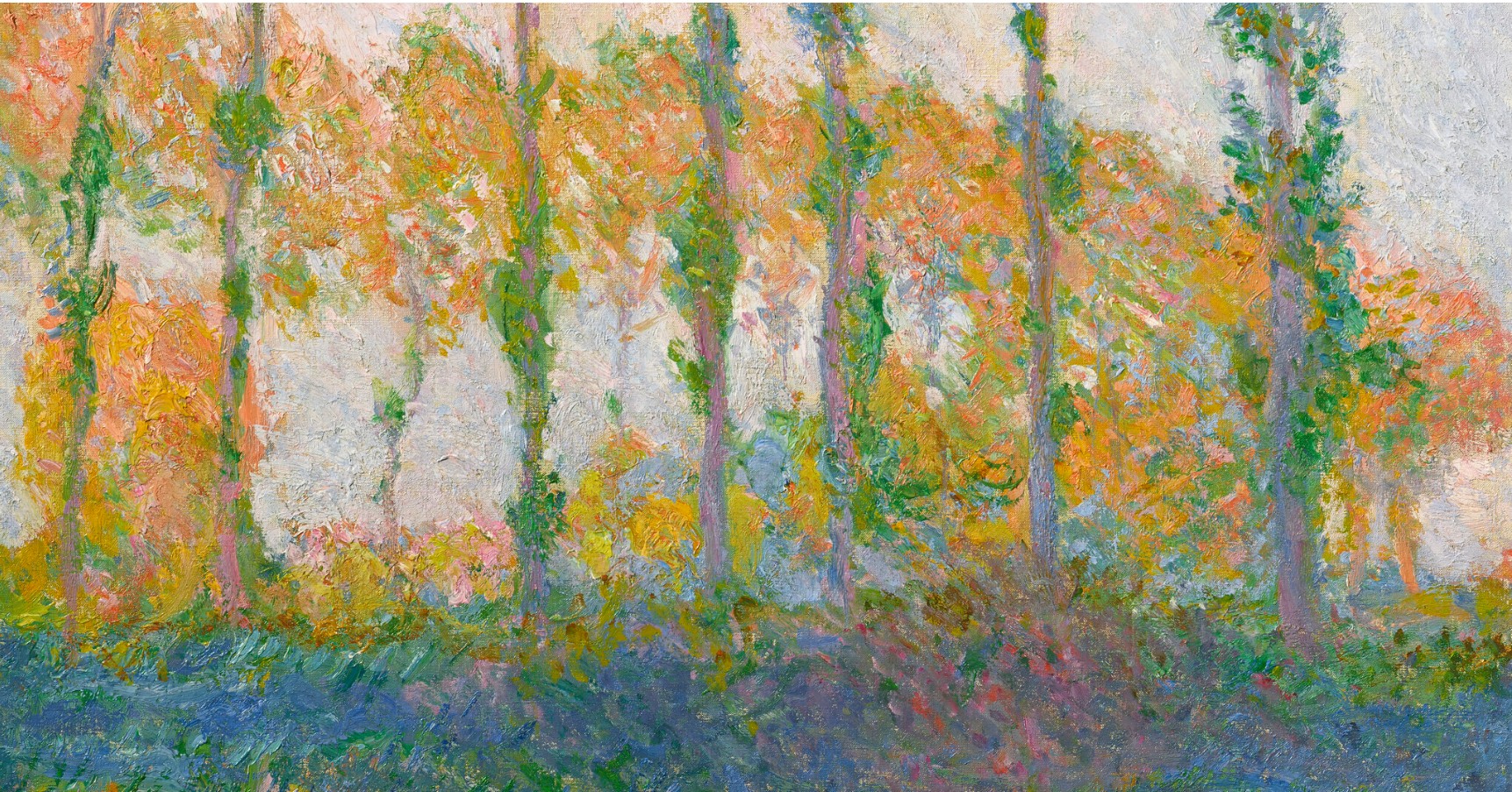
The twenty-four paintings in the Peupliers series (Wildenstein, nos. 1291-1313) were all created from almost the exact same vantage point, near a spot where the Epte bends back on itself twice to create a distinctive S-shape. Whereas the Meules series had focused on isolated grainstacks, an effect which endowed them with a greater sense of weight and monumentality, it is in their sheer numbers and their relationship to one another that the poplars achieve their greatest effect. Most of the series focuses on a screen of tall, slender poplars in the foreground, while behind, looping away along the river bank, the rest of the trees make up a beautiful arabesque pattern. In the present composition, the sweep begins behind the bushy tree in the background on the left, moving first to the right and then to the left to touch each side of the scene, before finally culminating in the upper right corner, with the poplars gradually growing in size as they approach the viewer. Rather than looking directly across the river at the poplars, Monet turned slightly to the left to accentuate the rise and fall of the trees as they followed the curving bank, generating a dynamic sense of movement and depth within the composition.
The low vantage point that Monet adopts throughout the series, just slightly above the level of the water, suggests that the artist worked from the bateau atelier that he had built during his years at Argenteuil, anchoring it in the center of the river Epte as he painted. The boat allowed the artist to bring a myriad of canvases, painting supplies, and even an easel with him to the site, and would have made the commute from the house at La Pressoir to the poplars much easier—rather than walking, Monet was able to row from his home directly to this section of the river, as a tributary ran through his property. Looking up at the trees from the deck of the boat in this way allowed Monet to stretch the poplars and their reflections from the bottom of the canvas almost to the top, silhouetting their straight, nearly leafless trunks dramatically against the sky to create a tension between the screen of trees in the foreground, which forcefully asserts the surface of the canvas, and the graceful line of poplars that recedes into the distance. Given the absence of any horizon line in Peupliers au bord de l’Epte, automne, depth is indicated primarily by this staggering of the trees, as well as by the differentiated shadows in the foliage, which consist of a myriad of small strokes in green, blue, yellow and orange tones.
Between 1 March and 10 March 1892, fifteen of the Peuplier series were exhibited at the Galerie Durand-Ruel in Paris, including Peupliers au bord de l’Epte, automne. While the exhibition of the artist’s Meules series the previous year had included several compositions by the artist which dealt with other subjects, for this show Monet chose to limit the display to the Peupliers alone. Presenting the suite of paintings en-masse in this way would, he believed, create a greater visual impact, and encourage visitors to fully appreciate the subtle differences from composition to composition. The show was a resounding triumph, and the Peupliers were extraordinarily well-received by collectors and critics. In a review of the exhibition, George Lecomte affirmed Monet’s attachment to nature, and wrote that the artist “seems more and more to abstract the durable character of single things from complex appearances and, by a more synthetic and pre-meditated rendering, to accentuate meaning and decorative beauty” (quoted in P.H. Tucker, op. cit., 1989, p. 143). In a letter to the artist, Octave Mirbeau was even more dramatic, describing the new paintings as “absolutely admirable, a series in which you [Monet] renew yourself… and… attain the absolute beauty of great decoration” (quoted in ibid., p. 142). Moreover, Mirbeau expressed the undeniable power of these images, which clearly overwhelmed him. As he explained, in front of these paintings, he felt “complete joy… an emotion that I cannot express, so profound [was it] that I wanted to hug you… Never did any artist ever render anything equal to it” (ibid., pp. 142-143).
For many contemporary commentators, the Peupliers paintings owed a great debt to Monet’s interest in Japanese art, which was at its height in the 1890s. The artist had begun to collect Japanese woodcut prints as early as 1871, and by the time that he painted the present series, the walls of his house at Giverny were covered with them. The Japanese were widely seen by French observers as masters at extracting decorative patterns from nature, and Théodore Duret went so far as to claim that the Peupliers had been inspired by the sweeping curves of trees in Utagawa Hiroshige’s Numazu: Twilight (Numazu, tasogare zu), from the series Fifty-three Stations of the Tokaido Road (Tokaido gojusan tsugi no uchi) (circa 1833-1834). But as is true with all of Monet’s work, these paintings were not a direct response to any such singular source, nor Japanese prints in general—their surfaces are more manipulated, their colors more varied, as he artfully invoked Eastern sensibilities while remaining true to his native French roots and individual creative sensibilities. Indeed, in Peupliers au bord de l’Epte, automne, the entire canvas is filled with overlapping, darting brushstrokes, in a dynamic display of Monet’s skills with a paintbrush. Though at first glance they may suggest a certain spontaneity of execution, these richly worked surfaces were carefully constructed, underpinned by striking color harmonies that enhanced the decorative effect of the finished composition.
Although Monet’s paintings of Giverny are steeped in pride for La belle France, many of them did not remain in the country for long. In April 1886, eager to broaden his customer base, Durand-Ruel had mounted an exhibition of French Impressionist painting in New York, which marked the first large-scale introduction of the art of Monet and his colleagues to American audiences. The show was a great success—“one of the most important artistic events that has ever taken place in this country,” the reviewer for The Cosmopolitan proclaimed—and by the time it closed, Durand-Ruel was thoroughly committed to the American market (quoted in E.M. Zafran, “Monet in America” in Claude Monet: A Tribute to Daniel Wildenstein and Katia Granoff, exh. cat., Wildenstein & Co. Inc., New York, 2007, p. 88).
Peupliers au bord de l’Epte, automne was among Monet’s most recent works to catch the attention of these new American collectors. Durand-Ruel purchased the painting directly from Monet in early 1892, after which it was swiftly acquired by the Boston-based collector Henry Sayles. A wealthy banker and broker, Sayles was an active member of the city’s art scene and an avid collector, with a deep enthusiasm for the art of Gustave Courbet, Jean-François Millet and pastoral scenes by the Barbizon school. Encouraged by his artist friends, he began to enhance his collection to include more avant-garde works by the French Impressionists, purchasing Monet’s Poste de douaniers à Dieppe (1882; Wildenstein, no. 735) in the summer of 1891, before adding Peupliers au bord de l’Epte, automne in 1892. The painting remained with Sayles for the rest of his life, at which point it joined the esteemed art collection of Stephen C. Clark, before being purchased in 1949 by Mr. and Mrs. Kurt F. Pantzer of Indianapolis, who also owned an impressive collection of watercolors by J.M.W. Turner. Peupliers au bord de l’Epte, automne was acquired by Mrs. Bass in 1982, and it quickly became a cherished center-piece of her collection.
Venice
Saint-Georges Majeur, 1908
Christie’s New-York: 16 May 2024
Estimated: USD 12,000,000 – 18,000,000
USD 13,635,000
CLAUDE MONET (1840-1926), Saint-Georges Majeur | Christie’s
CLAUDE MONET (1840-1926)
Saint-Georges Majeur, 1908
Oil on canvas
59.9 x 73.2 cm (23 5/8 x 28 7/8 inches)
Signed and dated ‘Claude Monet 1908’ (lower right)
Not long after Claude Monet arrived in Venice in October 1908, he declared the city to be “too beautiful to be painted” (quoted in J. Pissarro, Monet and the Mediterranean, exh. cat., Kimbell Art Museum, Fort Worth, 1997, p. 49). Monet was initially overawed by the splendor of the floating city, as it rises mirage-like from the luminous turquoise waters of the Lagoon, enveloped in an eternal array of dancing reflections. It was not long, however, until the artist, unable to resist the unique spectacle of the famed city of light and water, picked up his brushes and began painting.
Over the next ten weeks, Monet captured Venice in a series of thirty-seven works that stand among the crowning achievements of his career (Wildenstein, nos. 1736-1772). On this, his final foreign painting campaign, and the last trip he made with his wife, Alice, Monet painted works that together form a brilliant conclusion to his lifelong love of travel and his endless pursuit of transient atmospheric effects, and also serve among the most renown and apt portrayals of La Serenissima.
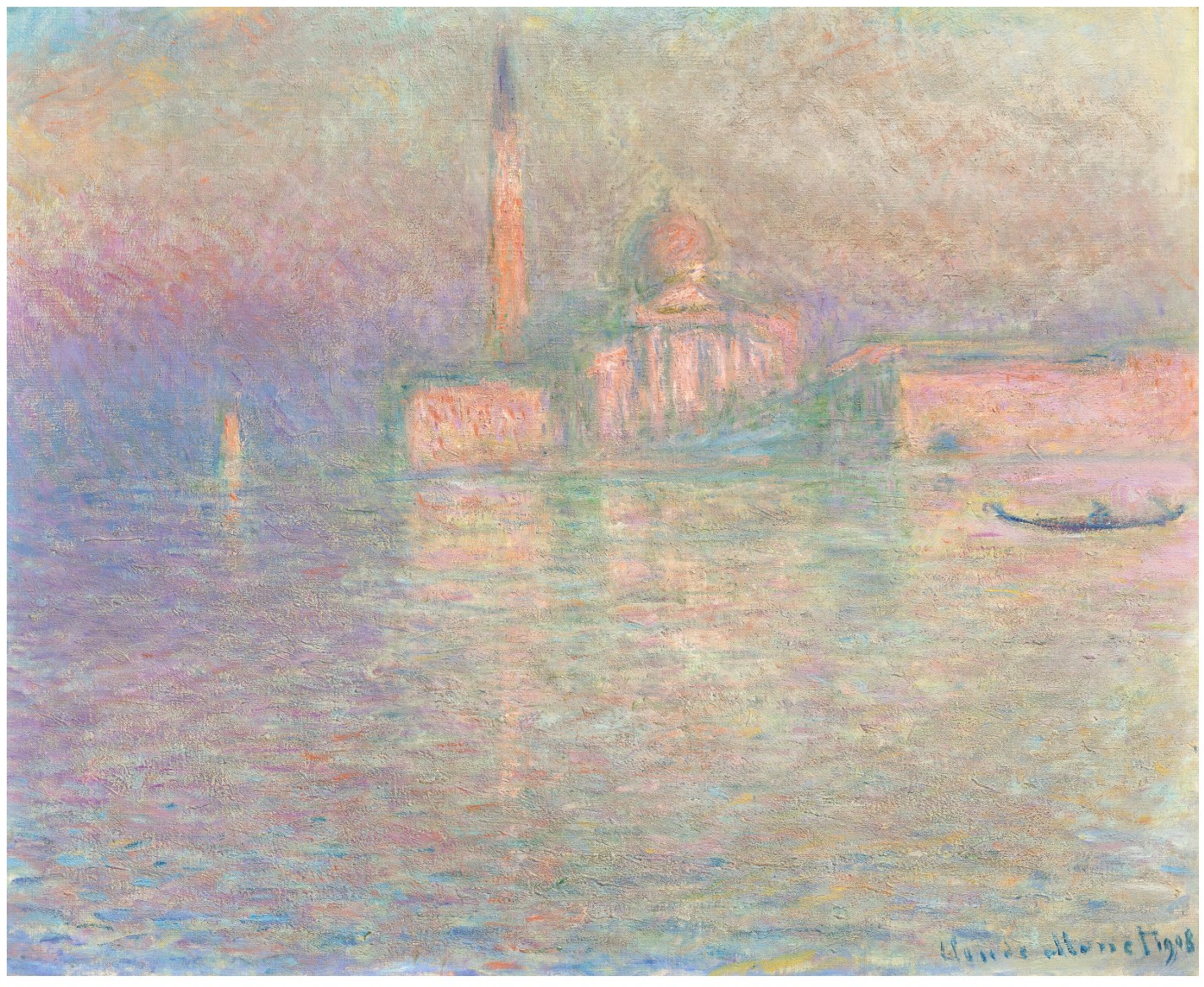
Saint-Georges Majeur is one of six works in which Monet captured the expansive view across the Lagoon to the sixteenth-century Palladian church, San Giorgio Maggiore (Wildenstein, nos. 1745-1750). The church is set upon its own island, next to the larger La Giudecca. Monet depicted this floating edifice from the other side of the Bacino di San Marco, a viewpoint that allowed him the maximum expanse of water and sky—and by extension, light and reflections. The luminous white marble of the western façade of the basilica glows in this small series, delicately rendered with soft pinks, peaches and white tones, suggesting that Monet painted these works in the afternoon. Each canvas, however, was painted under different light conditions, as their subtly varying palettes demonstrate. The present work shimmers with an array of pastel tones that distill the luminescence that defines the floating city. Amid Monet’s pearlescent palette, the church seems to vanish in and out of the immersive haze of color. Of this series of six, two works now reside in museum collections, Indianapolis Museum of Art and the National Museum of Wales, Cardiff.
By 1908, Monet had become increasingly insular. Having created his beloved gardens and water lily pond at his home in Giverny, he had little reason to leave, finding all the artistic inspiration he needed for his Nymphéas in his horticultural paradise. After a productive summer that was brought to an end by the onset of poor weather, Monet and his wife received an unexpected invitation from their friend, Mary Young Hunter, an American whom they had met during their travels to London some years earlier. Hunter asked if the Monets would like to stay with her in Venice, in the Palazzo Barbaro, an opulent fifteenth-century Gothic palace situated in prime position on the Grand Canal, just east of the Accademia Bridge.
The Monets arrived in Venice on 1 October. With the height of the tourist season past, the artist and his wife immediately ventured out around the city. Alice wrote to her daughter, “I live in a dream—arriving in Venice, it is just so wonderful, the calm that wins you over, the careful attention of Mrs Hunter, this admirable place—it feels like a fairy tale come true… If Monet works, [my wishes] will be fulfilled” (quoted in ibid., p. 49).
After a few days, Monet began painting. Among his first motifs was the imposing façade of the Doge’s Palace, a view he pictured from the island of San Giorgio Maggiore. In his afternoons, he painted the Grand Canal from the steps of the Palazzo Barbaro, capturing the splendid domes of Santa Maria della Salute. He also depicted a number of palazzi in closely cropped compositions that feature the famed gothic façades that lined Venice’s central waterway.
Monet likely painted the vista of the present work after he and Alice moved to the Grand Hotel Britannia in mid-October. Situated on the Grand Canal, the hotel offered a dazzling view out across the lagoon to San Giorgio Maggiore. The nearby Hotel Danieli was the more popular choice of accommodation at the time, favored by John Ruskin, Emile Zola and Antonin Proust among others, however, a boat dock outside blocked the artist’s view across the water. In a letter of 16 October, Alice wrote, “We have finally arrived at the Hotel Britannia, with a view, if such a thing were possible, even more beautiful than that of Palazzo Barbaro…” (quoted in P. Piguet, Monet et Venise, Paris, 2008, p. 38). Towards the end of his stay, Monet returned to a similar panorama once again, this time capturing it at sunset in a pair of dramatically colored compositions that mark the conclusion of his time in Venice (Wildenstein, nos. 1768-1769).
In contrast to past painting campaigns, Monet did not revisit his chosen motifs at different times of day. Rather, he wanted to capture the subject under the same conditions. “The implication of this decision is very simple,” Joachim Pissarro has written, “for Monet in Venice, time was not to be one of the factors of variations for his motifs. Rather, it was the ‘air,’ or what he called ‘the enveloppe’—the surrounding atmospheric conditions, the famous Venetian haze—that became the principal factor of variation with these motifs” (ibid., p. 50).
The combination of water and architecture provided more than enough inspiration for Monet. Perhaps the defining feature of Venice, the strangely luminous, turquoise waters of the canals and the endlessly shimmering reflections they cast on their surroundings, creates an effect like no other. The whole city appears ephemeral, intangible, magical—almost surreal in its beauty. Attempting to render this immaterial effect in painterly form lay at the heart of Monet’s Venetian campaign.
The prospect of painting Venice was not a simple one for Monet. Venice was, as it remains today, a city steeped in the magnificent heft of its own artistic history and iconography. The place where colore had triumphed over disegno during the Renaissance, it was the home of Giovanni Bellini, Giorgione, Titian, Giovanni Battista Tiepolo, Paolo Veronese, and Canaletto. Turner had famously captured the city’s unique light. Latterly, Monet would have been aware of his contemporaries’ attempts to render this loaded city—his mentor Eugène Boudin, Edouard Manet, Pierre-Auguste Renoir, as well as James Abbott McNeill Whistler, John Singer Sargent, and Paul Signac, from whom Monet had bought a watercolor of the Grand Canal.
In addition to this venerated artistic heritage, Venice was also a city increasingly mired in cliché, fast becoming a victim of its own popularity. As it remains today, perilously in danger of sinking into the lagoon, so it was then, the beauty of its revered monuments fast fading. It had also started to become overrun by tourists, its churches, canals, and gondolas reproduced ad infinitum into numerous kitsch picture post-cards, a city turned into a floating pastiche.
“How was Monet going to reconcile the opposing sides of this Janus-like city?” Paul Hayes Tucker has asked. “How could he pay homage to its celebrated history, perhaps even contribute to its artistic legacy, when he was painting the very kinds of subjects that had been rendered so often that they had become almost meaningless?” (“Revolution in the Garden: Monet in the Twentieth Century,” in Monet in the Twentieth Century, exh. cat., The Museum of Fine Arts, Boston, 1998, p. 56). The artist’s wife pondered similar questions, “It is so beautiful and so made to tempt you,” she wrote, “but really, who is capable of rendering these marvelous effects.” Her loyalty to her husband made the answer very clear: “I really see only one capable of that: my Monet” (quoted in exh. cat., op. cit., 1997, p. 51).
Monet successfully captured the city through a variety of strategies. First, he embraced Venice’s mirage-like quality. Just as he had in his London paintings, he always set water between himself and the architecture he was depicting, ensuring that the play of light and its effect on the surrounding physical structures—the tenets of his career-long Impressionist enterprise—was central to his compositions. Human presence is all but expunged; two floating gondolas in the present work are the only signs of life.
While in many ways Monet seemed to align himself with the vedute tradition of rendering the architecture of the city, using identifiable buildings as the basis for his compositions—San Giorgio Maggiore, the Doge’s Palace, or Santa Maria della Salute, for example—he depicted light in such a way—either brightly, so as to cast these structures into contrasting shadow and light, or softly, enveloping them into a veil of color, as in the present work—so as to ensure the specific details of these sites were lost and a sense of abstraction was gained. As a result, Venice appears mysterious, its monuments rising from the constantly moving waters to be adorned with dazzlingly colored reflections. “Monet made his Venice somehow disembodied, a vision over the water,” Richard Thomson has written, “[he] saw the city as something apart, its monuments rather intangible and mysterious, identifiable yet unspecific, bathed in its own light, or that he accorded it as its own. For Monet, perhaps more than with any other of his city series, orchestrated Venice to suit his own vision” (Monet and Architecture, exh. cat., The National Gallery, London, 2018, p. 207).
Yet, Monet’s visions of Venice were not simply abstract confections of color and light. In each of his motifs Monet played with compositional structure, incorporating often complex pictorial contrasts that ensure his works are elevated from the picturesque. In the present work and the rest of the Saint-Georges Majeur series, the most open, expansive scenes of the Venice group, Monet has heightened the sense of wide space with the addition of insistent horizontal markers: the horizon line set higher, reinforced by the calligraphic strokes that depict the gondolas traversing through the scene. This strong sense of horizontality is broken by the soaring tower of the church’s campanile, which reaches almost beyond the top of the canvas. Monet has given no indication as to where he stood to paint the scene—the lapping waters come right up to the picture plane in the immediate foreground, placing the viewer firmly within this transient realm of light and water. This compositional device heightens the floating quality of the church, the apparent protagonist of the scene. Between the wide planes of the sky and the Lagoon, the architectural focus appears at once to dissolve and emerge from the enveloping, violet-hued atmosphere.
As the end of 1908 drew closer, Monet was reluctant to leave Venice. “Monet is working passionately,” Alice wrote to Gustave Geffroy in November, the artist clearly so absorbed in his work that she had taken over his correspondence. “Venice has got hold of him and won’t let him go” (quoted in D. Wildenstein, Monet or the Triumph of Impressionism, Cologne, 1996, p. 387). Finally, their departure date was set, and the Monets returned to Giverny in early December. On his last day in Venice, Monet wrote to Geffroy: “[My enthusiasm for Venice] has done nothing but grow, and the moment has now come to leave this unique light. I grow very sad. It is so beautiful… I have spent some delightful moments here and nearly forgot that I am the old man that I am” (quoted in exh. cat., op. cit., 1997, p. 53).
Few, if any Venice paintings were completed in the city. Monet returned with them to Giverny, where they remained in his studio to be finished. Several years would pass, however, until the artist revisited his evocative visions of the city. Over the course of the next few years, Monet was faced with a number of tragedies. Alice’s health had begun to decline. At the beginning of 1910, his beloved garden was flooded. Eventually confined to bed, Alice died in May 1911, leaving Monet completely bereft. “I am totally worn out,” he wrote in August. “Time passes and I cannot make anything out of my sad existence. I don’t have the taste for anything and don’t even have the courage to write” (quoted in P.H. Tucker, Claude Monet: Life and Art, New Haven, 1997, p. 200).
Gradually, Monet’s strength and spirits recovered. By early spring he returned to his art, choosing his Venice pictures as the first works to which to return. Perhaps Monet looked to these works in particular to remember happy memories spent with Alice in Venice. Regarded in this context, the paintings became, “meditations on the nature of experience, the practice of art, and the multiple levels of human understanding as much as they are about Venice and its particulars” (P.H. Tucker, exh. cat., op. cit., 1998, p. 57). Almost all of the canvases were completed, and they were exhibited together, including the present work, for the first time in May 1912 at the Galerie Bernheim-Jeune in Paris.
Monet’s latest body of work was met with rapturous praise. As Paul Signac wrote to Monet: “When I looked at your Venice paintings with their admirable interpretation of the motifs I know so well, I experienced a deep emotion, as strong as the one I felt in 1879 when confronted with your train stations, your streets hung with flags, your trees in bloom, a moment that was decisive for my future career. And these Venetian pictures are stronger still, where everything supports the expression of your vision, where no detail undermines the emotional impact… I admire them as the highest manifestation of your art” (quoted in Turner, Whistler, Monet, exh. cat., Tate Britain, London, 2005, p. 207).
Saint-Georges Majeur was acquired not long after it was exhibited by the Boston-based collector, Alexander Cochrane. In 1909, Cochrane had bought a major Nymphéas (Wildenstein, no. 1697) from Monet’s dealer, Paul Durand-Ruel. Saint-Georges Majeur was one of two works he acquired from Monet’s Venice series, the other was Le Grand Canal et Santa Maria della Salute (Wildenstein, no. 1738). A trustee of the Museum of Fine Arts, Boston, Cochrane bequeathed this, together with the Nymphéas, to the museum upon his death in 1919. Saint-Georges Majeur, however, remained in the Cochrane family until at least 1942.
Le Grand Canal et Santa Maria della Salute, 1908
Sotheby’s New-York: 17 May 2022
Estimates on Request
USD 56,625,500
Le Grand Canal et Santa Maria della Salute | Modern Evening Auction | 2022 | Sotheby’s
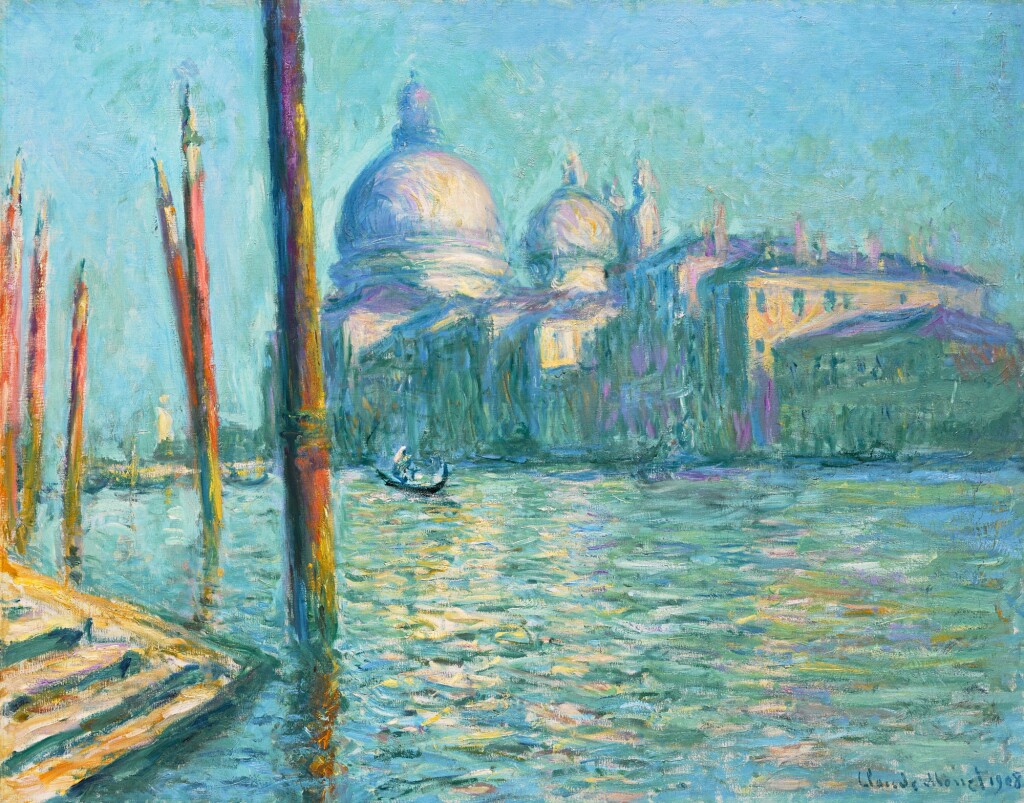
CLAUDE MONET (1840-1926)
Le Grand Canal et Santa Maria della Salute, 1908
Oil on canvas
73.5×92.5 cm (29×36.5 inches)
Signed Claude Monet and dated 1908 (lower right)
Le Grand Canal et Santa Maria della Salute is a masterpiece not only from within Claude Monet’s Venice series but also from his entire artistic output. A shimmering, luminescent view of the Grand Canal and Santa Maria della Salute, the present canvas is one of the finest works created during the artist’s Venetian sojourn and presents a daring encapsulation of the traits that make Monet one of the most unique and visionary artistic voices of the twentieth century.
Up until almost the day of his and his wife Alice’s departure, Monet dragged his feet in going to Venice. Initially conceived as a vacation from painting, in the past five years Monet had completed roughly one-hundred Nymphéas canvases, within a week of their arrival the artist shifted in tone from finding Venice “too beautiful to paint” to a painting campaign that would result in nearly forty oils created from a number of vantage points throughout the storied city.
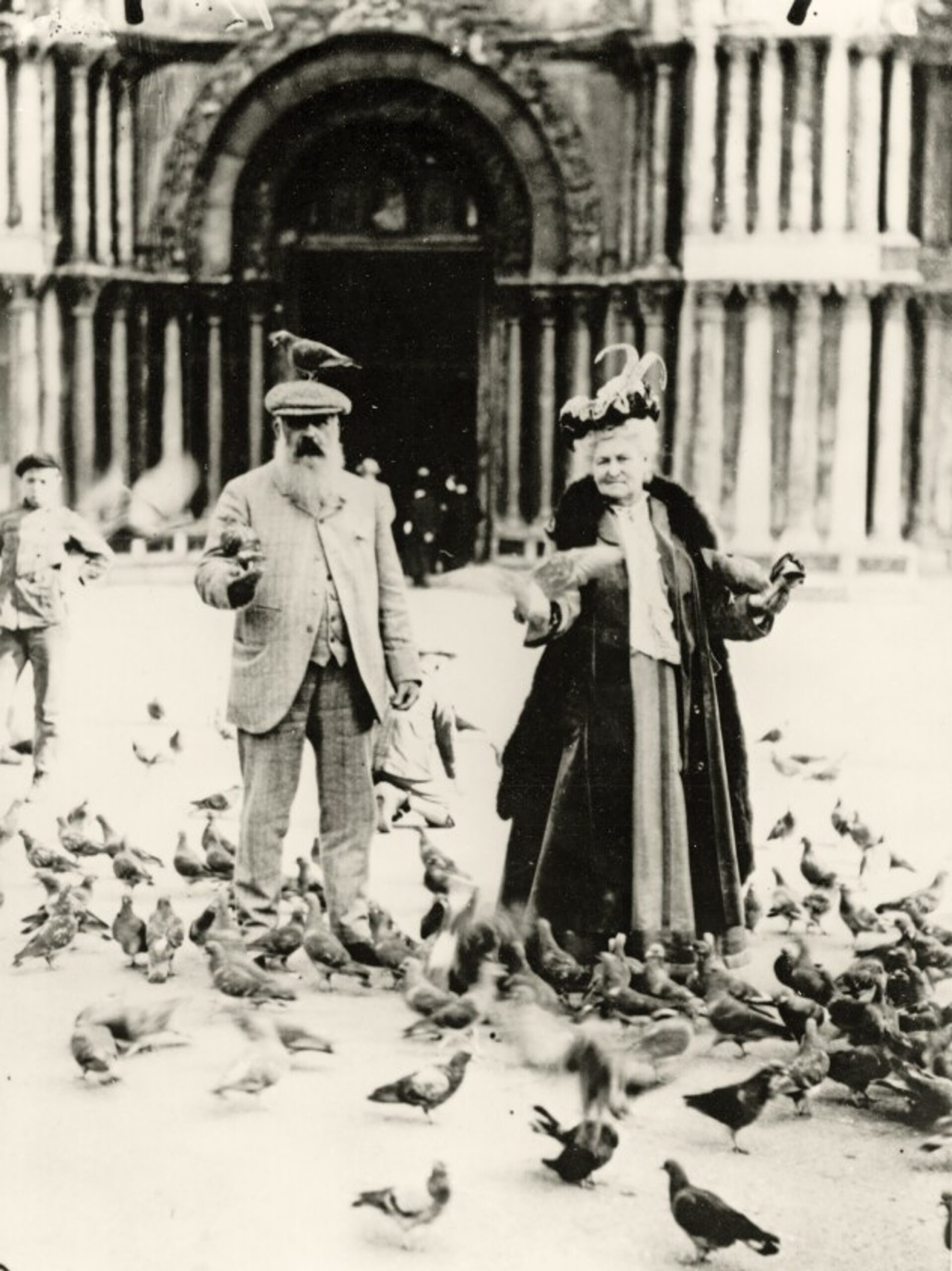
Indeed it was the very fame of Venice that may have irked Monet when first confronted with the idea of a visit. From the seventeenth century onward the city of Venice was an essential stop on the Grand Tour for well-bred English and European young men of means and by the mid-to-late nineteenth century this extended to women and Americans as well. Commercial artists seized on a captive audience and created a new genre of painting, the Venetian veduta, which depicted the most famed views around the city. Brought home and hung in the respective residences of the well-educated and monied throughout Europe and the United States, a painting of the Grand Canal or the Doge’s Palace was far from Monet’s usual subject matter. “How was Monet going to reconcile the opposing sides of this Janus-like city,” asked art historian and curator Paul Hayes Tucker, “How could he pay homage to its celebrated history, perhaps even contribute to its artistic legacy, when he was painting the very kinds of subjects that had been rendered so often that they had become almost meaningless? Would he not be perceived as pandering to public taste instead of trying to elevate it, which was his responsibility as one of France’s leading painters? Monet devised several solutions. Most important he emphasized the city’s miragelike quality. Either he filled his scenes with such moist light that the buildings lose detail—which is just the opposite of what most view-painters wanted to achieve—or he heightened the contrast between lights and darks, thereby suppressing specifics in favor of a play of brilliant moments against multicolored shadows. In both instances he achieved similar effects; the buildings appear to emerge mysteriously from the enveloping atmosphere or to float magically on the surface of the constantly moving water” (Exh. Cat. London, Royal Academy of Arts and Boston, Museum of Fine Arts, Monet in the 20th Century, 1998-99, p. 56).
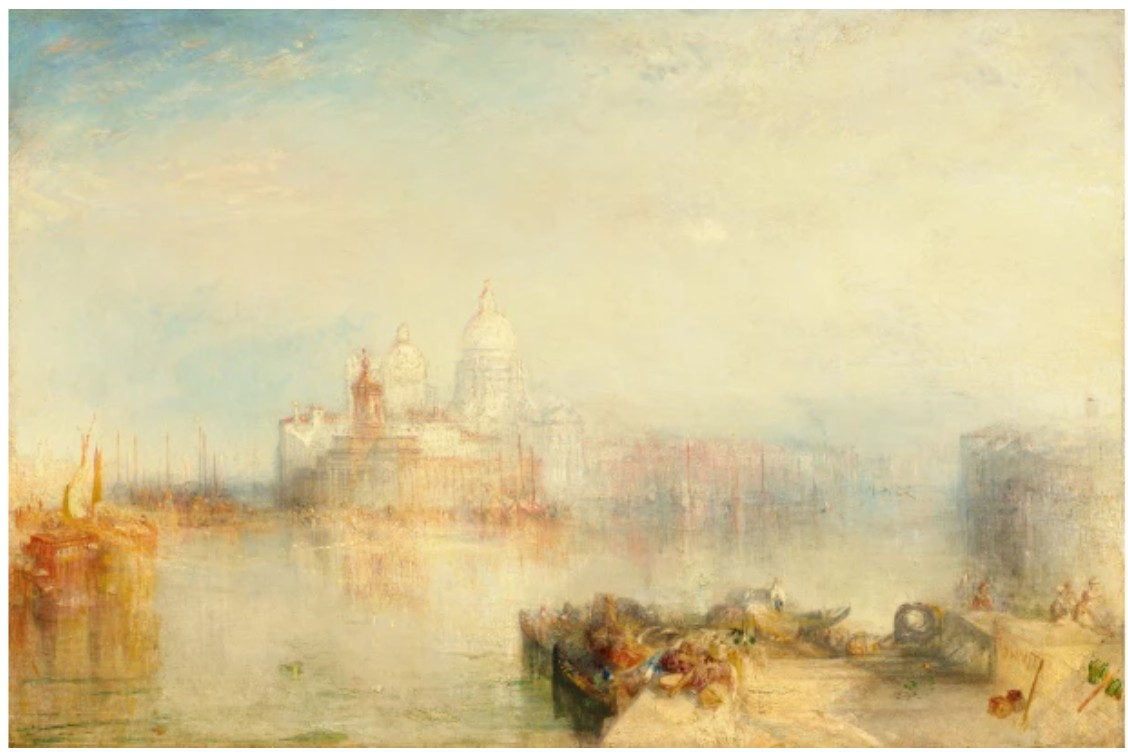
Joseph Mallord William Turner, The Dogana and Santa Maria della Salute, Venice, 1843, oil on canvas,
National Gallery of Art, Washington, D.C
Monet was not the first to use atmospheric effects to separate himself from the more traditional painters of Venice. Henri Matisse noted: “…it seemed to me that Turner must have been the link between the academic tradition and impressionism” and divined a special connection between Turner’s works and Monet’s (quoted in Exh. Cat. Toronto, Art Gallery of Ontario; Paris, Galeries Nationales du Grand Palais & London, Tate Britain, Turner, Whistler, Monet: Impressionist Visions, 2004-05, p. 203). Writing in the catalogue for the Turner, Whistler, Monet exhibition, Katherin Lochnan pinpoints the Venice pictures as the culmination of Monet’s discourse with those two painters: “These beautiful and poetic works are portals through which the viewer can enter a world of memories, reveries and dreams. Fearing that they might constitute the final chapter in his artistic evolution, Monet sounded in them the last notes of his artistic dialogue with Turner and Whistler that had been central to his artistic development” (K. Lochnan in ibid. p. 35; see figs. 1 and 2). Monet’s fellow Impressionists Édouard Manet and Pierre-Auguste Renoir had each created their own visions of the Serennissima. Manet’s works hold a solidity and geometric structure reminiscent of his Spanish-influenced paintings while Renoir’s energetic brushwork and light-suffused scenes give the feeling of rush-hour on the Grand Canal, showing the waterways as a location of high activity and verve with gondolas ferrying patrons to-and-fro throughout the city (see figs. 3 and 4). Human figures are notably absent from Monet’s Venice scenes, save on great occasion for the ghostly silhouette of a gondolier standing at the stern of his craft.
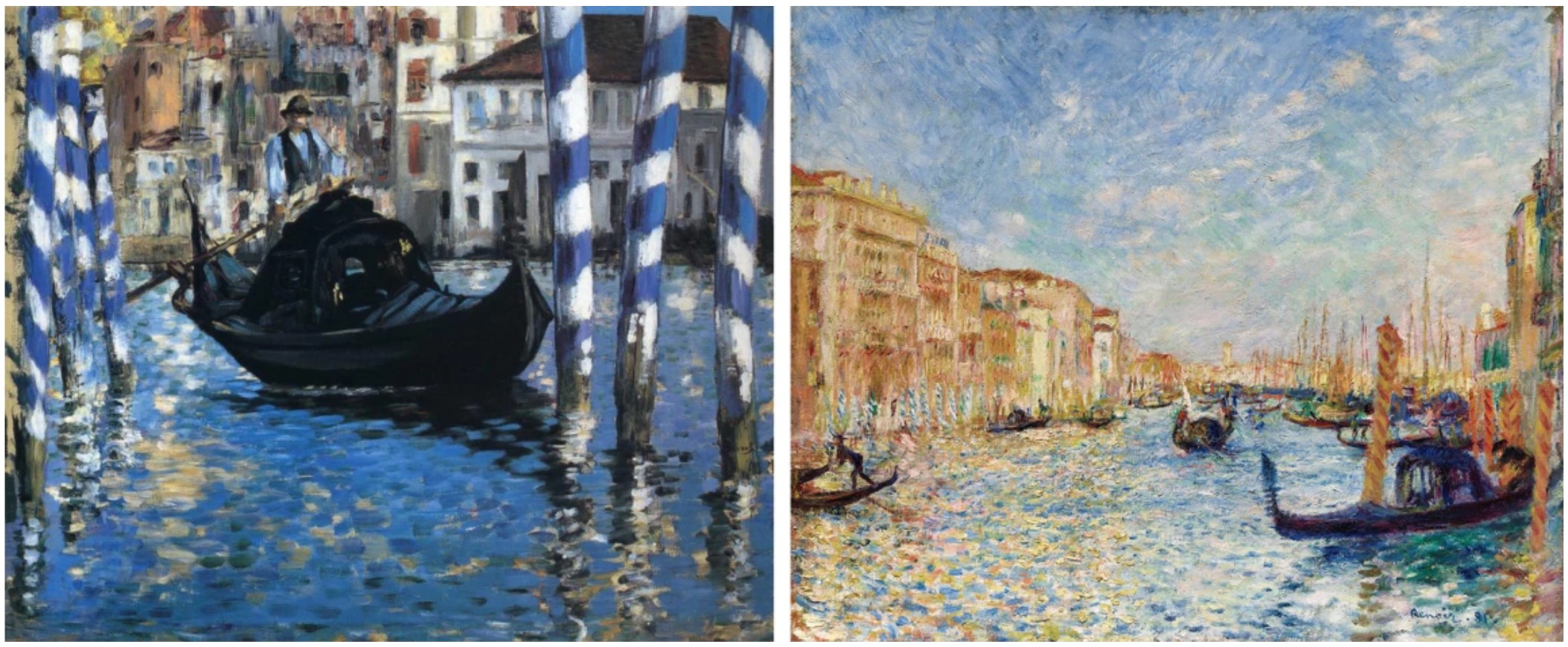
Left: Fig. 3 Édouard Manet, The Grand Canal, Venice, 1875, Shelburne Museum, Vermont
Right: Fig. 4 Pierre-Auguste Renoir, Grand Canal, Venice, 1881, oil on canvas, Museum of Fine Arts, Boston
In Venice Monet continued to observe, as he had in the views of the river Thames he completed in 1904, how light reflected off a wide stretch of water dissolves and liquefies the solid, uneven surfaces of stone walls. In Venice, however, the closeness of the buildings to the water’s edge led him to explore more abstract compositions, accentuating the interplay between the rhythms of the ornate façades of the palazzi, with their arched openings and horizontal divisions, and the rhythmic expanse of water. The glorious late canvases that Turner produced in the early 1840s, such as The Dogana and Santa Maria della Salute, presents a Venice which is transfigured by light (see fig. 1). Similarly in Le Grand Canal et Santa Maria della Salute, Monet has suffused the very stones, water and sky with amethyst, lilac and cobalt blue. In his introduction to the Bernheim-Jeune exhibition in which the present work was included, Octave Mirbeau observed that the atmosphere in Monet’s views of Venetian palaces was “mixed with color as though it had passed through a stained-glass window” (reproduced in Robert Gordon and Andrew Forge, Monet, New York, 1983, p. 188).
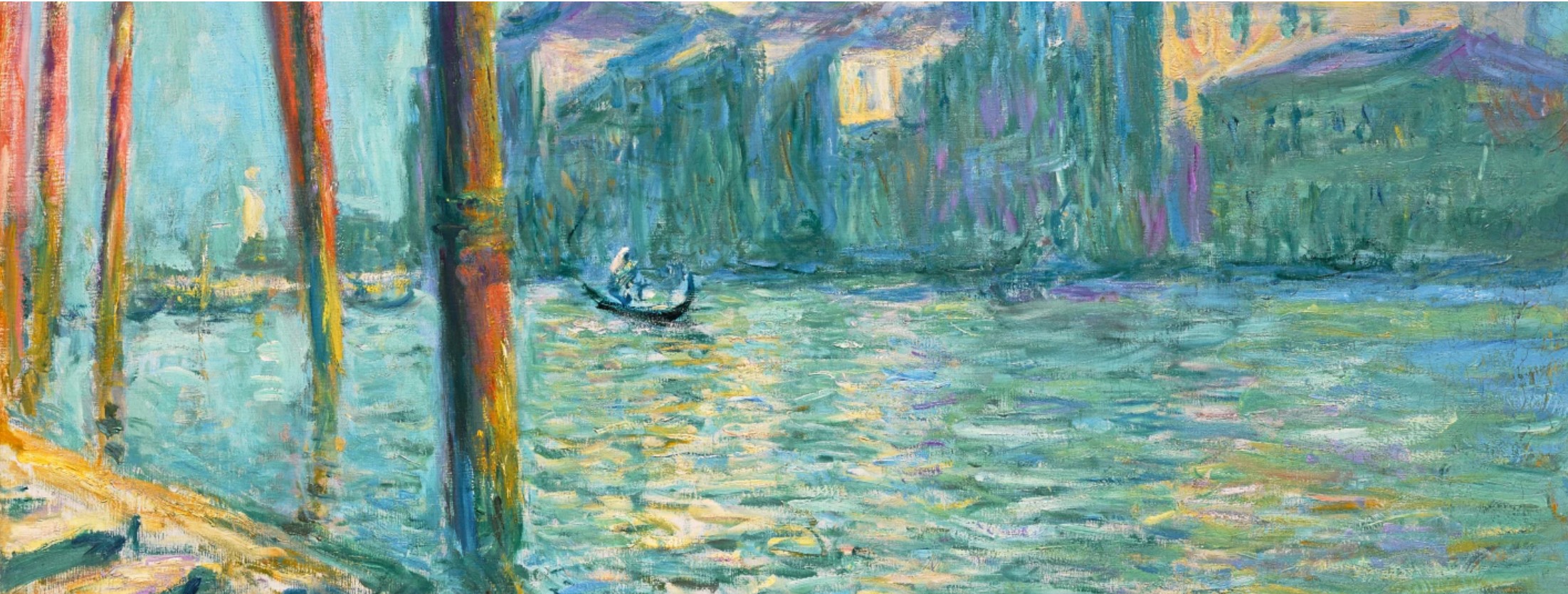
Arriving in Venice on October 2nd, Monet and his wife Alice took up residence in the Palazzo Barbaro as guests of Mrs. Hunter, a great friend of John Singer Sargent. Sargent’s cousin Daniel Sargent Curtis owned the Palazzo Barbaro, which was prominently situated on the Grand Canal, and had let it out to Mrs. Hunter in early October of 1908. The Curtis’s, a wealthy American couple, hosted numerous artistic expatriates including Henry James, who wrote a number of manuscripts in the Palazzo’s library. The architecture of the Palazzo would inspire the elaborate home of Boston-based collector Isabella Stewart Gardner. The Monets would remain at this Palazzo until October 15th, when Mrs. Hunter continued on to Aix-en-Provence and the Monets resettled just down the Grand Canal at the Grand Hotel Britannia. They too were originally to have departed at around this time but by now Monet was deeply entranced in his new location, using the city as a laboratory to explore his continued fascinations with light, atmosphere and reflection.
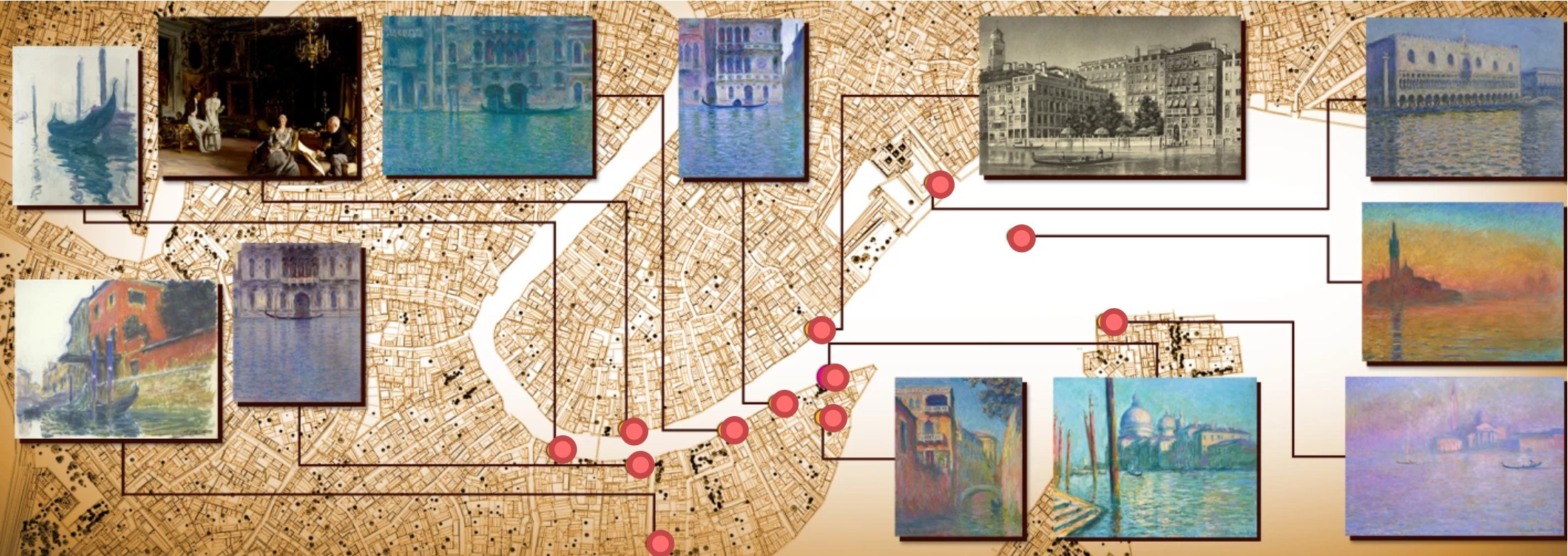
Rather than approaching his Venetian works as he had done his series of the 1890s where he sought to capture changing light and weather on one motif over a period of time, in Venice Monet instead focused on a number of different motifs, each at their appointed time of day (see map above). He zig-zagged around the city, following the same schedule with precision: “One could say he had a fixed appointment with his motifs at the same time each day,” writes Joachim Pissarro. “The implications of this decision is very simple: for Monet in Venice, time was not to be one of his factors of variations for his motifs. Rather, it was the ‘air,’ or what he called ‘the envelope’—the surrounding atmospheric conditions, the famous Venetian haze—that became the principal factor of variations with these motifs. Monet started work at 8:00 A.M., sitting on the protruding platform of the island of San Giorgio Maggiore…. From this position, Monet faced San Marco and began work on his first series of canvases focusing on the facade of the Doges’ Palace, framed on the left by the tower of the Campanile and on the right by the platform of the Schiavoni. According to Alice, Monet would then move from San Giorgio to San Marco, from whence he could observe his second motif, the island of San Giorgio itself. In other words, Monet moved from the point of observation to the point observed…. After lunch, Monet would work from the steps of the Palazzo Barbaro itself, not wanting to exert himself too much after a rich meal. There he could level his gaze at the Palazzo Contarini… which he represented in two important canvases. Also executed at this site was one of the key groups in the entire Venice series, six works focusing on the Church of Santa Maria della Salute…. From 3:00 to 7:00 PM he and Alice would go on a gondola tour of the canals until twilight” (Exh. Cat. Fort Worth, The Kimbell Museum of Art and Brooklyn Museum of Art, Monet and the Mediterranean, 1997-98, p. 50).
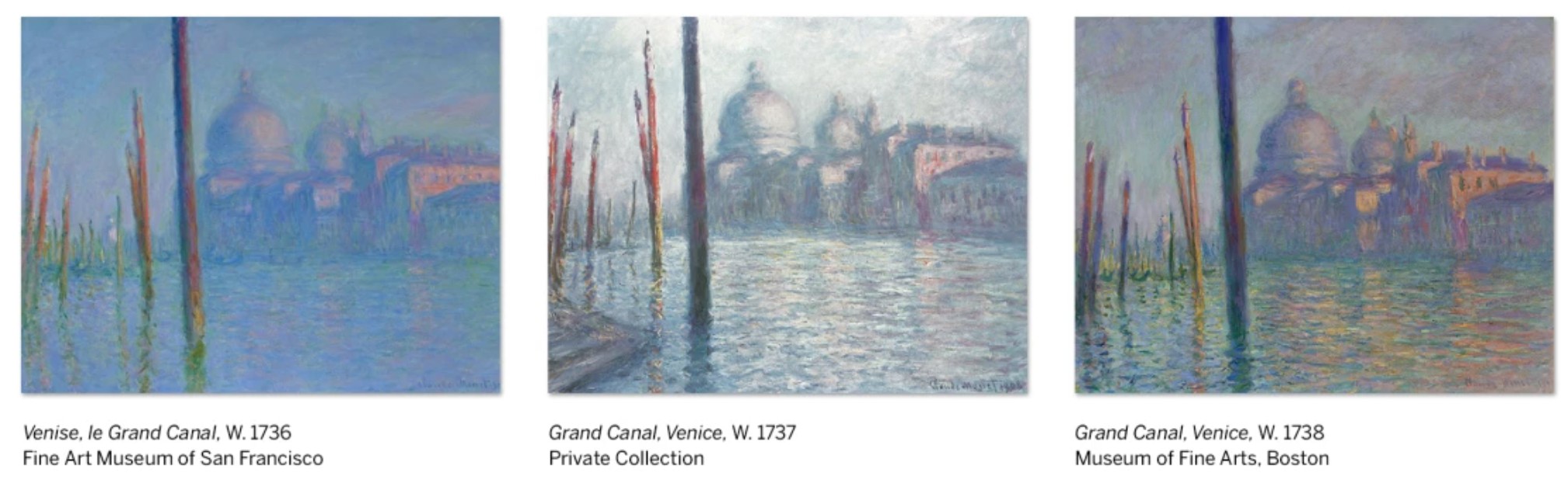
Le Grand Canal et Santa Maria della Salute comes from a discrete group of six canvases (W. 1736-1741, see above) painted from the steps of the Palazzo Barbaro looking across and down the Grand Canal towards Santa Maria della Salute. The present work is the finest example of the six views, two of which are held in museum collections and four of which are held privately. According to Joachim Pissarro: “This is unquestionably one of Monet’s most systematic series. The six canvases are almost exactly the same dimensions… the layout of the motif is virtually identical in all, and each of the canvases was painted at the same time of day, probably in the afternoon. The fact that Monet chose to represent the tide changes that covers and uncover the steps of the Palazzo Barbaro-Curtis is not incidental: Monet deliberately emphasizes that we are on the sea (‘his element’), not on fresh water. Establishing in advance the conditions of observation and the context of his experimentation, Monet used Venice as another pictorial laboratory, gauging changes in the ‘envelope’ (the indefinable Venetian ‘haze’) under identical circumstances. There are two typically Venetian effects that animate these views of Santa Maria della Salute: the filtering haze eithers heightens the colors of the prism, almost setting them alight, or, on the contrary, it dampens them and unites them in a sort of muffled monotonous harmony” (ibid., p. 146). The present work and the two canvases found in museum collections belongs to the sub-group of heightened color, while the remaining three works in private hands Pissarro identifies with this “muffled monotonous harmony.” Pissarro continues: “If the first group displays incandescent tonalities, the second resorts to more evanescent tones, stressing the diaphanous quality of the air in Venice and heightening its rather monochromatic impact. In the 1912 Venise exhibition at Bernheim-Jeune’s, Monet chose to hang these works by balancing each painting from the first group with one from the second” (ibid.).
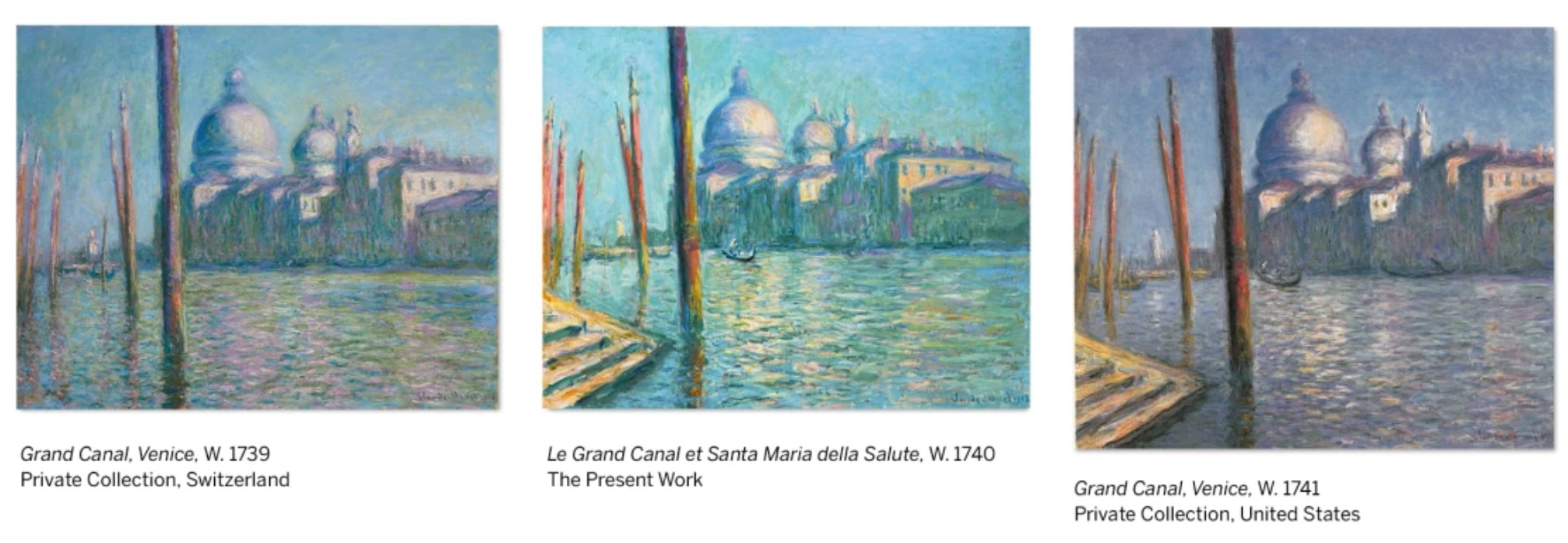
The structure of each of the six Grand Canal works is divided between water, buildings and sky—between light, shadow and reflection. At right the façades of the palazzi leading to Santa Maria della Salute are cast in shadow. In the architectural elements, the bright, direct light is reserved for the domes of the church and the bits and bobs of buildings at the upper register leading towards these domes. It is the reflections in the water, which makes up more than half of the composition, as well as the generally vertical thrusts of the pali that become the primary light sources of each canvas. These pali, arranged in the left portion of each painting, recede towards the background, providing the primary vertical thrust in each picture. Technically used as moorings for the hundreds of gondolas the glided throughout the canals, in Monet’s Venice they serve a different purpose, providing not just vertical grounding but also a distinct area for ochres and other warmer tones to gather. In Monet’s compositional structure he presages Mondrian, whose seemingly rigid orientation of his pictures belies the studied irregularities of shape and thickness and straightness of line. It was these subtle irregularities that create both tension and balance within Mondrian’s work (see fig. 5). Writing about Monet Venice scenes and Mondrian’s paintings, curator and art historian William Seitz opines: “The pulsation which Monet achieves by vibrating color, brushstroke, and architectural lines is paralleled in Mondrian’s studies, by the free rendering of similar horizontal and vertical accents—an effect which he characterized as ‘the emotional restlessness of the Impressionists’ technique” (William Seitz, “Monet and Abstract Painting,” The College Art Journal, Autumn, 1956, vol. I, no. 1, p. 44).
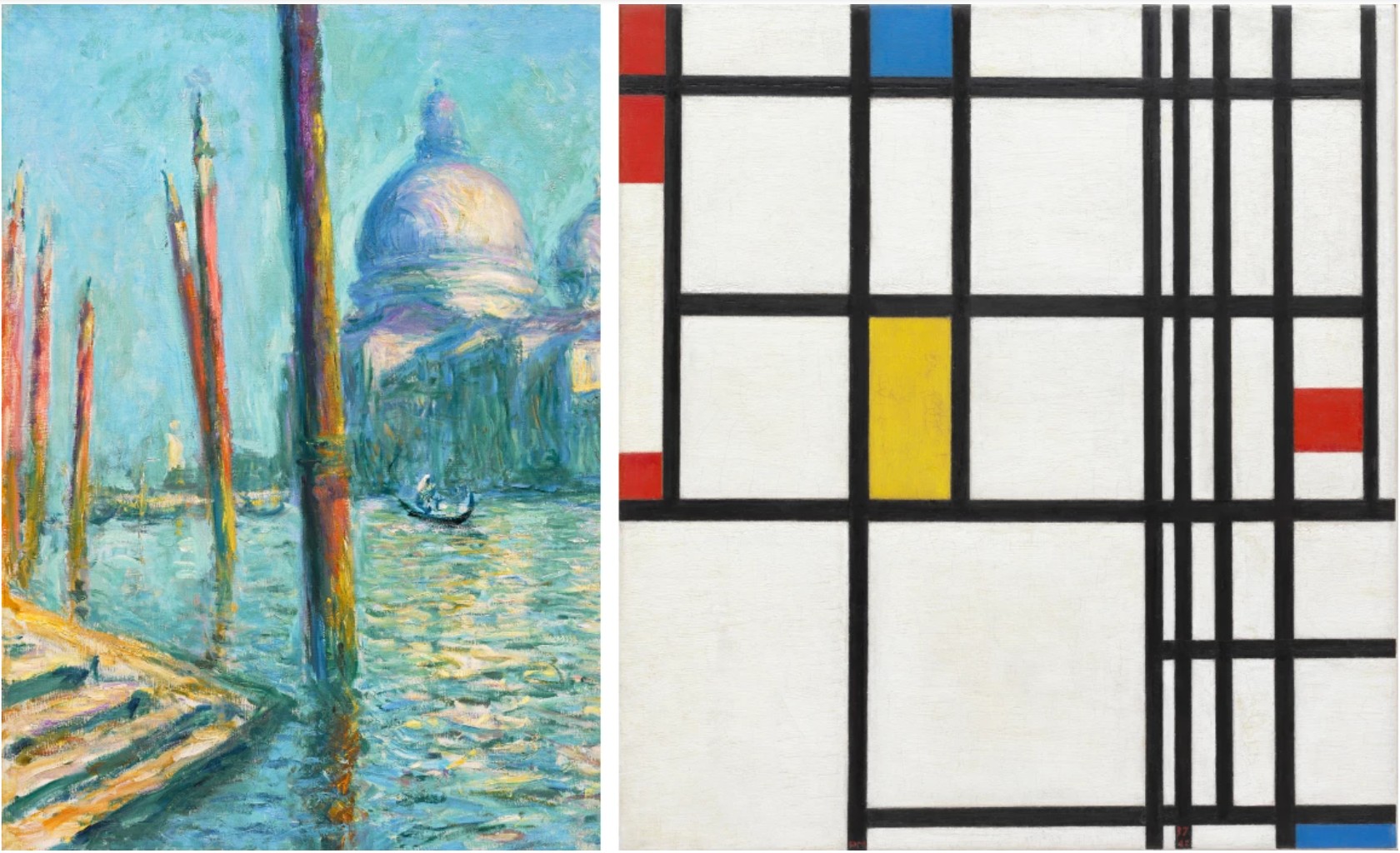
Left: A detail of the present work
Right: Fig. 5, Piet Mondrian, Composition in Red, Blue and Yellow, 1937-42, oil on canvas, The Museum of Modern Art, New York
In this preoccupation with the emotional vibrations of light, Monet is indeed closer to artists like Dan Flavin, Robert Irwin and James Turrell. Flavin’s sculpted constructions impose, by the very light they emit, into the space around them; his fluorescent line drawings reflect their hues onto the surrounding floor and walls, diffusing multicolored swathes of light and shadow. An ardent admirer of Monet (Flavin famously wrote a letter to MoMA in the 1950s asking for a piece of the original pair of water lily paintings destroyed in a fire), Flavin produces ambient atmospheres that recall the emotionally-charged, miragelike quality of the present work (see fig. 6). This meditative, extrasensory quality is continued in the work of Robert Irwin, whose site-specific artwork uses the natural or architectural space to explore the effects of light. Installations such as LACMA’s Miracle Mile (see fig. 7) responds to both Primal Palm Garden, another work by Irwin constructed out of plants and located outside the Museum’s galleries and to Wiltshire boulevard, situated entirely outside the Museum’s physical footprint. According to Irwin, “This world is not just somehow given to us whole. We perceive, we shape the world, and as artists we discover and give value to our human potential to ‘see’ the infinite richness (beauty?) in everything, creating an extended aesthetic reality” (the artist reproduced in Exh. Cat. Los Angeles Museum of Contemporary Art, Robert Irwin, 1993, p. 35). Monet’s Venice scenes offer an immediate perception of his surroundings and in Monet’s precise movements each day—his scheduled appointments from one site to the next, often painting what he will soon travel to and vice versa—are echoed in this discourse within and among Irwins works.
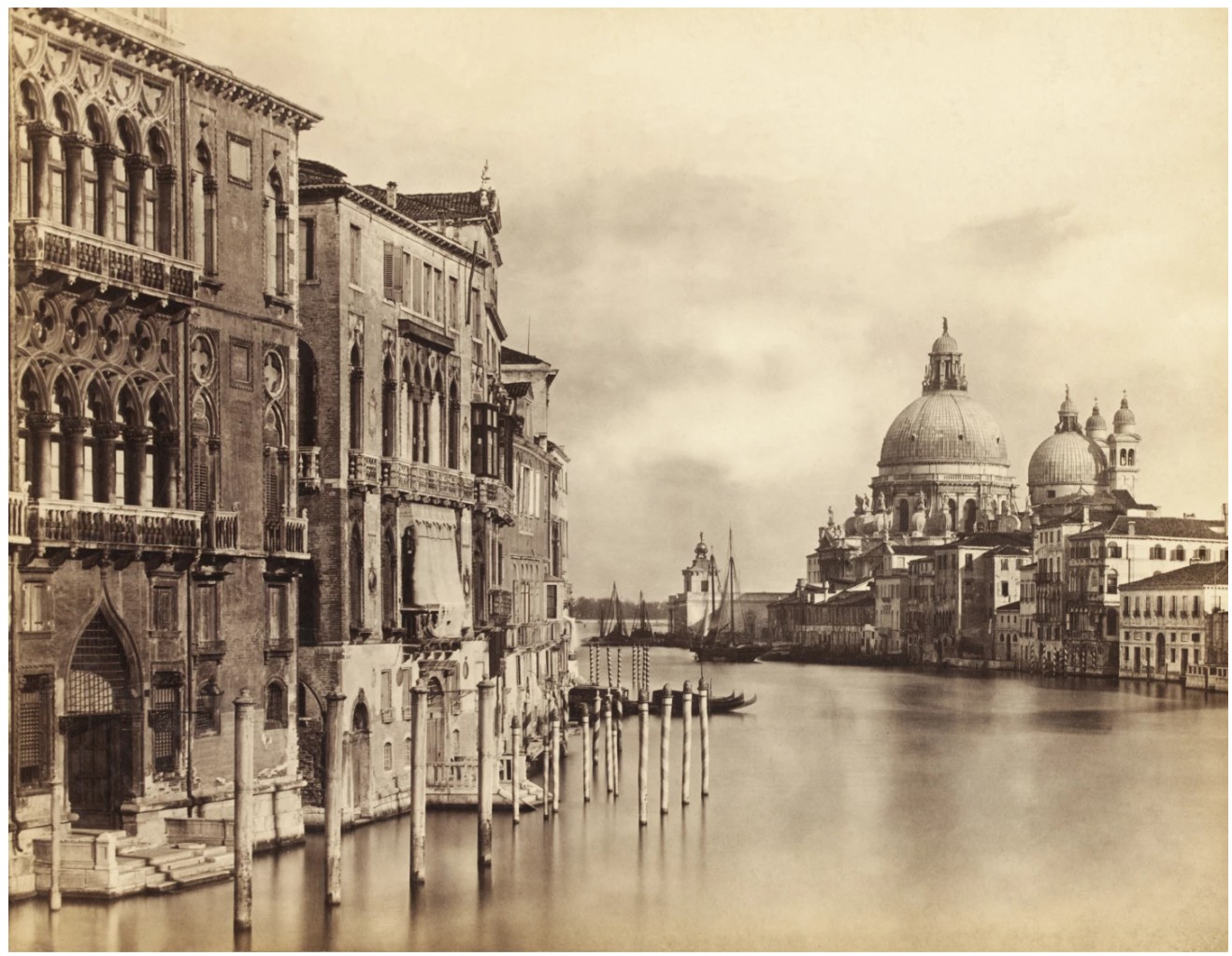
Francis Frith, Grand Canal, Venice, late 19th Century, Victoria and Albert Museum, London © Victoria and Albert Museum, London
Similarly, James Turrell’s investigations into the materiality of light focuses on the sensorial experience of space, color, and awareness. His projections embrace and suffuse their surroundings, altering our perceptions of the environment—such as in Aten Reign, which created artwork out of the negative space at the center of the Guggenheim Museum. Roberta Smith wrote in her review of Aten Reign “As the colors shift, spread and drain, as the tiers seem (but only seem) to alternate between concave and convex or change in width and depth, as you struggle to catch every nuance, you realize how much more there is to perceive than you normally do” (Roberta Smith, “New Light Fixture for a Famous Rotunda,” The New York Times, 20 June 2013). Claude Monet in his late works—whether lilies on his pond in Giverny or the rounded domes of Santa Maria della Salute and the constantly-moving water beneath—sought too to convey this quality of the light in all of its gradations. Le Grand Canal et Santa Maria della Salute holds and reflects the light of the afternoon on the Grand Canal in a myriad of iridescent brushstrokes conveying not a place but a moment.
Left: Fig. 6 Dan Flavin, Untitled, 1996, Installation View, Richmond Hall, The Menil Collection, Houston © 2022 Dan Flavin / Artists Rights Society (ARS), New York
Right: Fig. 7 Robert Irwin, Miracle Mile, 2013, Los Angeles County Museum of Art © 2022 Robert Irwin / Artists Rights Society (ARS), New York
In mid-November Monet was still hard at work on his motifs and there was cause for further celebration: on the 13th the weather cleared, allowing Monet to again take in the dazzling sun over the Venetian lagoon. On the 14th Monet turned sixty-eight and by the end of the month, some sixty days into his stay in Venice, some of his canvases were nearly complete. On his departure on December 7th he writes to his friend Gustave Geffroy “Well! [My enthusiasm for Venice] has done nothing but grow, and the moment has now come to leave this unique light. I grow very sad. It is so beautiful, but one has to see reason: many factors force us to return home. The only consolation I have is the thought of coming back here next year, for I have been able to do nothing but sketches, beginnings. But what a dreadful shame that I did not come here when I was young and would dare anything! Anyway… I have spent some delightful moments here and nearly forgot that I am the old man that I am” (reproduced in Exh. Cat. Fort Worth, The Kimbell Museum of Art and Brooklyn Museum of Art, Monet and the Mediterranean, 1997-98, p. 54). The two months in Venice had led to thirty-seven canvases focusing on a variety of motifs around the city. Eighteen of these works are now held in museum collections (see below).
La Mediterranee
Route de Monte-Carlo, 1883
Sotheby’s Hong-Kong: 5 April 2024
Estimated: HKD 45,000,000 – 65,000,000
HKD 61,489,000 / USD 7,861,033
CLAUDE MONET (1840 – 1926)
Route de Monte-Carlo, 1883
Oil on canvas
65.7 x 80.6 cm (25 7/8 x 31 3/4 inches)
Signed Claude Monet and dated 84 (lower left)
Route de Monte Carlo represents the triumphant apex of Claude Monet’s seminal series of works produced as part of his excursion to the Mediterranean in 1883 and 1884. Monet had a lifelong commitment to painting en plein air as he explored how atmospheric conditions affect light and color. In December 1883, Monet was near completion of six large interior panels at the apartment of his dealer, Paul Durand-Ruel, when he realized his extreme frustration with this project because he felt that his creativity was being stifled by the indoor surroundings. He then impulsively departed to the Mediterranean with fellow Impressionist, Pierre-Auguste Renoir. This trip proved to be immensely liberating for Monet, as the unfamiliar landscape of the Riviera offered the painter limitless inspirations that sparked new pictorial imagination.

Route de Monte Carlo was one of the first two works executed by Monet on the shores of Monte Carlo, capturing his first glimpse and fascination with the region. The other work would be Pres Monte Carlo, painted from a spot along the same route, but facing towards the sea rather than the mountains. Route de Monte Carlo was created during the height of impressionism, manifesting Monet’s lifelong commitment to painting en plein air as he explored how atmospheric conditions affect light and colors. Monet captured the beauty of the exotic scenery with quick brushstrokes and an extensive color palette, particularly that of a pastel tone, conveying the dazzling light under the midday sun in Côte d’Azur. The cohesiveness of the composition is assured through chromatic complementaries: the sun-drenched path to Monte Carlo contrasts with the purplish shadow cast on the sandy surface, while the sunlit townscape in the background contrasts with the shaded foliage in the foreground. Rendered with sumptuous impasto, the intensive interplay of colour heightens the dramatic effects in this otherwise idyllic vista.

Route de Monte Carlo is Monet’s first experimentation with the Mediterranean light and colors, setting precedents for a seminal group of canvases of the same subject in the following years. Shortly after this 1883 excursion with Renoir, Monet returned to the Riviera in early 1884, this time in solitude, to explore Bordighera, Monte Carlo and Menton in depth. Monet’s satisfaction with the present work is evident as he revisited the same composition, referencing some key elements in a series of works he executed during the 1884 sojourn. Most notably, Vue de Bordighera (Collection of Hammer Museum Los Angeles) depicts the same townscape now nestled in a jumble of vegetation, while Le Corniche de Monaco (Collection of Rijksmuseum, Amsterdam) closely echoes with the present work for its sunlit sandy path that anchored a magnificent vantage point. By depicting similar compositions at varied times of day, from multiple angles, Monet here presages the sequential practice, such as Haystacks and the Rouen Cathedral, for which he is perhaps best known. The present work is a superior example of the remarkable affinity between Monet’s ardent Impressionist ideals and the scintillating light of the Côte d’Azur. Catalyzing further artistic ventures in the region and beyond, the pictorial innovations present in Route de Monte Carlo testify to the invigorating changes and enduring impact of this Mediterranean excursion on Monet’s oeuvre.
Au Cap Martin, 1884
Sotheby’s New-York: 16 May 2023
Estimated: USD 10,000,000 – 15,000,000
USD 11,479,800
Au Cap Martin | Modern Evening Auction | 2023 | Sotheby’s (sothebys.com)
CLAUDE MONET (1840 – 1926)
Au Cap Martin, 1884
Oil on canvas
65.2 x v81 cm (25 5/8 x 32 inches)
Signed Claude Monet and dated 84 (lower left)
Au Cap Martin represents the triumphant apex of Claude Monet’s seminal series of works produced as part of his 1884 excursion to the Mediterranean. A iridescent vision of Menton bathed in the potent morning sun, Au Cap Martin brims with the textural richness and chromatic potency that characterizes Monet’s best works. Typifing the signature advancements of the dazzling Mediterranean light upon Monet’s oeuvre, every luminous ridge and shadowed valley of the twin peaks are attentively articulated with energetic brushwork. Such planar contrasts are suggestive of the artistic interchange between Monet and Paul Cézanne during this period. A visit to Cézanne’s Aix-en-Provence studio at the end of Monet and Renoir’s 1883 Mediterranean voyage “had an immediate effect on Monet” (Joachim Pissarro, Fort Worth, Kimbell Art Museum, ibid., p. 20). Equally, scholar Charles F. Stuckey observes that Monet’s Cap Martin depictions are, “Surprisingly similar to Cézanne’s Provencal landscapes…it is tempting to suppose that Monet’s [works depicting Cap Martin] may have prompted Cézanne to develop what would eventually become acclaimed as his greatest landscape motif, the many serial views of La Montagne Sainte-Victoire” (Exh. Cat., New York, Wildenstein, Claude Monet (1840-1926): A Tribute to Daniel Wildenstein and Katia Granoff, 2007, p. 62).
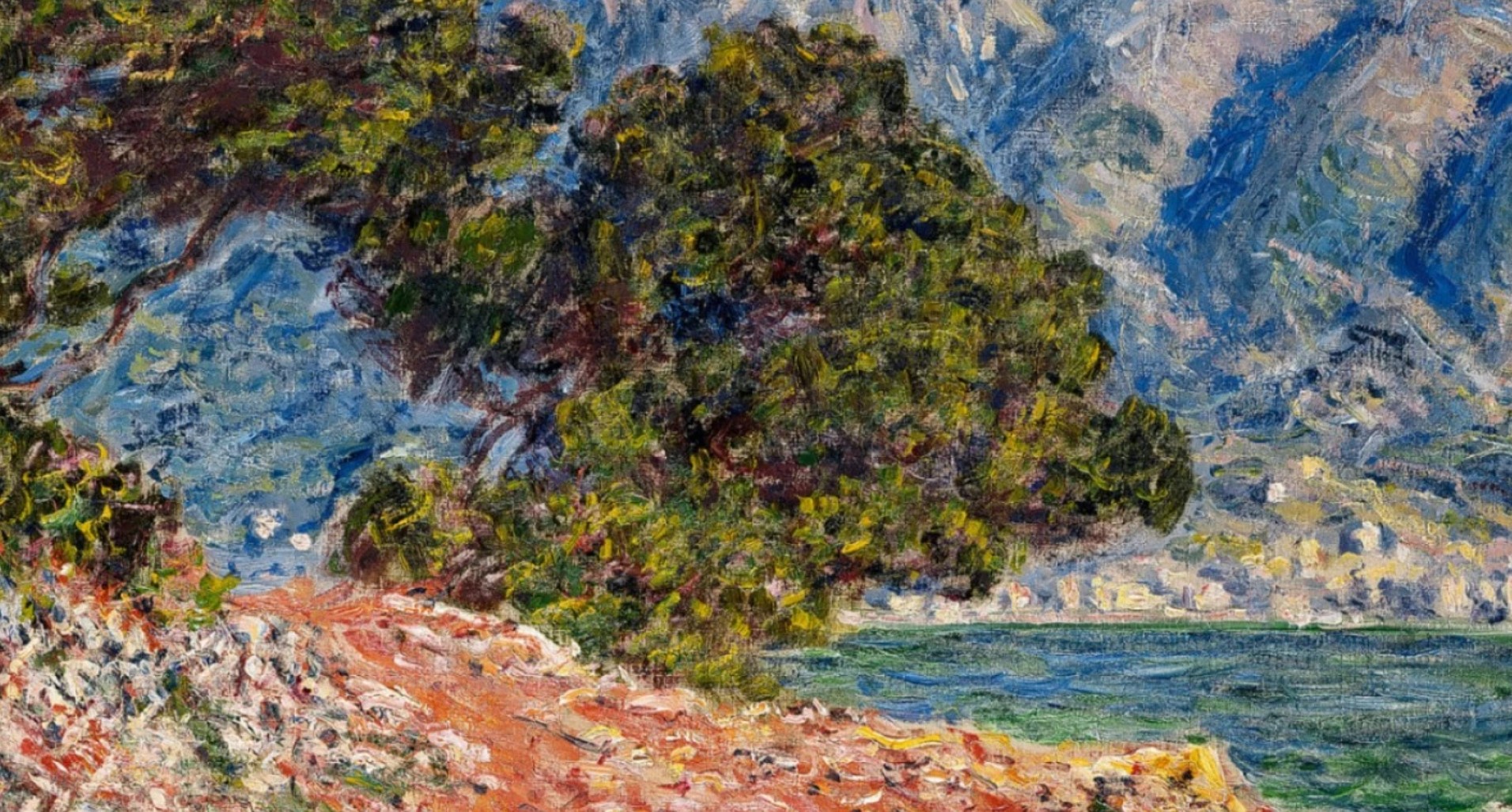
Rendered with sumptuous impasto, the intensive interplay of color present in Au Cap Martin captivates the eye of the viewer. The lush turquoise and azure nestled within the expansive coastline of the placid Mediterranean convey Monet’s delight in revisiting the “water, beautiful blue water” that he described as “very much [his] element” after refraining from painting such seascapes in Bordighera (quoted in Éluère, ibid., Paris, 2006, p. 43). A gestural yet rigorous handling of the windswept trees equally reflects his attentive studies of lush vegetation while in Italy. Most strikingly innovative is Monet’s evocation of the Cap Martin’s rocky terrain through textural daubs of supernatural pinks, yellows and oranges. These “brilliant hues,” concludes art historian Joachim Pissarro, “have the intense tonality…announcing, on some level, the art of Munch, or of some of the German Expressionists” (Exh. Cat., Fort Worth, The Kimbell Art Museum, ibid., p. 108; see figs. 4 and 5). Monet’s surrendering of naturalistic representation to the effects of light and color, as epitomized by Au Cap Martin, directly impacted Wassily Kandinsky’s decision to become an artist. Upon viewing the paintings of Monet for the first time at an exhibition in 1896, Kandinsky committed to pursuing a mode of art that similarly eschewed traditional representation. Monet’s pictorial innovations were thus integral to the development of abstract art. Paralleling the present work, Kandinsky employed depictions of the Bavarian Alps near Murnau, Germany, as the basis for his earliest experimentations with color, line and form. He frequently returned to mountains as a motif throughout his journey to full abstraction.
Views of London
Waterloo Bridge, 1901
Christie’s London: 5 March 2025
Estimated: GBP 1,000,000 – 1,500,000
GBP 1,855,000 / USD 2,372,320
WORK ON PAPER
CLAUDE MONET (1840-1926), Waterloo Bridge | Christie’s
CLAUDE MONET (1840-1926)
Waterloo Bridge, 1901
Pastel on paper
31 x 48.6 cm (12 1/4 x 19 1/8 inches)
Signed ‘Claude Monet’ (lower right)
Executed in 1901, Waterloo Bridge dates from Claude Monet’s famed series of trips to London at the turn of the Twentieth Century. Staying at the newly opened Savoy Hotel on Victoria Embankment, Monet could admire the Thames stretched before him, bathed in pale winter sun diffused through a dense atmosphere of mist mingled with coal smoke from domestic fires and industrial furnaces. From his hotel suite, he could look out to the right, where the Houses of Parliament rose impressively beyond the iron structure of Charing Cross railway bridge, and to his left, to the rhythmic arches of Waterloo Bridge, framed by a plethora of factory chimneys, complete with bellowing plumes of smoke, that lined the south banks of the river. These three landmarks became the principal subjects of Monet’s acclaimed views of London, as he transformed the city and its fog-filled skies into ethereal, near abstract visions at once timeless and modern. Within these atmospheric compositions, it is the motif of Waterloo Bridge that features most prevalently, and with their expansive skies and wide stretches of rippling water with shimmering light reflections, these works are among the most radical and varied within the series.
‘This goes further than painting,’ the art critic Arsène Alexandre described of the artist’s views of London. ‘It’s an enchantment of atmosphere and light. London appeared fantastic in its fogs of dream, coloured by the magic of the sun’ (quoted in G. Seiberling, Monet in London, exh. cat., High Museum of Art, Atlanta, 1988, p. 95). Monet was hypnotized by the refractions of sunlight through the enveloping mantles of smoke, mist, and fog that descended on the increasingly industrialised city, and his fascination with this interplay of light led him to develop a daily routine for his compositions, allowing him to exploit his three main themes to maximum effect. ‘In the morning, as Monet looked east, the light was behind Waterloo Bridge. Later in the day he painted the afternoon light picking out the columns which ornamented the bridge. As he followed the course of the sun, he looked toward Charing Cross Bridge and painted midday and afternoon effects… The views of the Houses of Parliament were done late in the day, with the effects of the sun setting and the light fading’ (ibid., p. 8).
Monet’s campaign of London works marked a pivotal return by the artist to depictions of bustling metropolitan life, a subject he had not engaged with in such an extensive manner since his acclaimed paintings of the Gare Saint Lazare almost two decades previously. His most recent work had focused largely on bucolic views of the French countryside, from his serene meditations of morning light on the Seine, to the rhythmic patterns of poplar trees along the banks of the river Epte, and the iconic profiles of the Meules or haystacks that were a common sight in the landscape surrounding his home at Giverny. Immersing himself in the urban modernity of the London cityscape, Monet’s studies of the Thames pushed him to the extremes of his artistic powers, testing the fundamental Impressionist tenet of capturing the ephemeral, fleeting effects of nature. He was obsessed with the mercurial nature of the weather in London, simultaneously fascinated and frustrated by its constant changes. He wrote to his wife, Alice, ‘I can’t tell you about this fantastic day. What marvellous things, but only lasting five minutes, it’s enough to drive you crazy’ (quoted in D. Wildenstein, Claude Monet: Biographie et catalogue raisonné, Paris, 1985, vol. IV, letter 1593). As Monet quickly discovered, the sun could shine at one moment, transforming the Thames into a spectacle of sparkling gold reflections, before minutes later disappearing behind thick cloud or blocked out entirely as the infamous fogs descended. It was to these evanescent hazes of smoke and fog that Monet was most drawn, and his Vue de Londres series marked the fulfilment of his longstanding desire ‘to try to paint some effects of fog on the Thames’ (Monet, quoted in op. cit., p. 37).
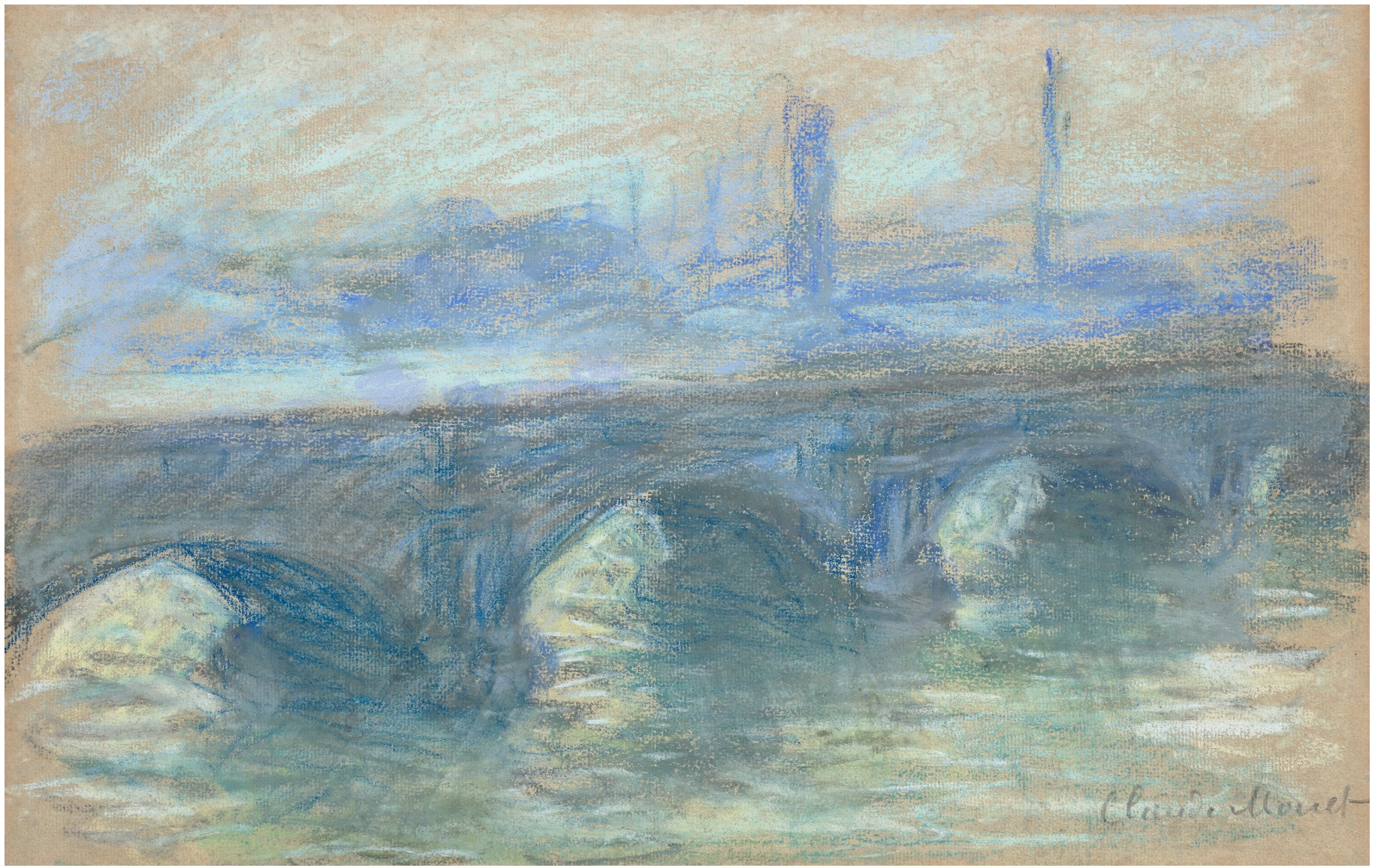
Monet was not the first artist to seek to render the beguiling London fog, and James McNeill Whistler’s depictions of the Thames in the early 1870s had transformed the sometimes impenetrable smoke and fog into symphonic arrangements of colour. The pair were close acquaintances, and Monet was aware of Whistler’s contributions to the contemporary depiction of London, describing Whistler as having successfully captured ‘that mysterious cloak’ of London fog, which made ‘those regular, massive blocks [of the city] grandiose’ (quoted in P. Tucker, Monet in the ‘90s: The Series Paintings, exh. cat., The Museum of Fine Arts, Boston, 1989, p. 266). By embarking on his series of London riverscapes, Monet was entering into an artistic lineage that included the art of the British master, J.M.W. Turner, whose work Monet had studied during his time in London in the 1870s, and continued to speak admiringly of, even years later. It would have been impossible for an artist – especially one so concerned with atmospheric effects of light and colour – not to have masterpieces such as Rain, Steam, and Speed—The Great Western Railway (1844, National Gallery, London) or The Burning of the House of Lords and Commons, 16th October, 1834 (1834-1835, Philadelphia Museum), in mind when beginning a series based around the Thames. ‘Few landscape painters in the history of art had been as inventive or as passionate, or had captured nature’s elusive ways with as much power and poetry… Turner, therefore, was a soulmate, a guide, and a special challenge for Monet. If one were going to be a truly great landscape painter, this was necessary business to settle’ (ibid., p. 267).
Upon arrival at the Savoy for his third London sojourn of the series, in January 1901, Monet found that his canvases and paints had yet to be delivered, and so, for the following week, the artist worked solely with pastel. Monet had used pastels to great effect from the earliest stages of his career as an artist, but acknowledged in his letters to Alice from London that he had drifted from the medium in recent years, ‘this amuses me a lot, even though I’m no longer accustomed to it, it occupies me and may be useful’ (quoted in Wildenstein, op. cit.,1985, vol. IV, letter 1589). His prediction was indeed an astute one, and in a letter to Alice just five days later, he wrote of the merits of the medium: ‘it’s thanks to my promptly made pastels that I can see how it should be done’ (quoted in ibid., letter 1591). Indeed, they were far more suited to capturing the capricious London light, as the artist could complete the work in far less time, creating a more immediate reflection of the ephemeral weather conditions.
Completing only twenty-six pastels during his stay in London in 1901, many of which are now held in museums and prestigious collections around the world, Monet later regretted not producing more such works: ‘this is not a country where you can finish a picture on the spot; the effects never reappear. I should have made just sketches, real impressions’ (quoted in D. Wildenstein, Monet, The Triumph of Impressionism, Cologne, 1999, p. 354). Waterloo Bridge exquisitely shows how Monet managed, as he surmised, to capture the strange London light by using speed of execution to his advantage. The gentle haze of the mist, punctuated by the rhythmic shadows of the bridge and relieved by the golden light that shimmers on the water, has been instantaneously rendered on paper, as Monet perfectly condenses the atmosphere and impression of this London scene.
Monet’s depictions of London hold a position of enduring acclaim amongst his oeuvre, and the lasting appeal of these evocative cityscapes was demonstrated by the Courtauld Gallery’s radical and groundbreaking sold-out 2024 exhibition, Monet and London: Views of the Thames. One of the Courtauld’s most popular shows of all time, the exhibition brought together the largest group of Monet’s Vues de la Tamise oil paintings since the 1904 public debut of the series at Galerie Durand-Ruel in Paris. Monet had handpicked thirty-seven of his London works to be displayed at Galerie Durand-Ruel, and the show was an instant critical and commercial success, solidifying his status as one of the greatest artists of his day. Monet had wanted the series to be shown in London too, but the exhibition never materialized, and so it was in 2024, some one hundred and twenty years after he first intended, that his ambition for his London works to be displayed in the very city they depicted was finally fulfilled. The Courtauld brought together twenty-one of the works Monet had originally curated for the 1904 show, and once again, this dedicated exhibition of his views of London was met with great acclaim and admiration.
L’Aiguille de Cléopâtre et Charing Cross Bridge, circa 1899
Sotheby’s New-York: 13 November 2023
Estimated: USD 4,000,000 – 6,000,000
USD 4,841,000
L’Aiguille de Cléopâtre et Charing Cross Bridge | Modern Evening Auction | 2023 | Sotheby’s
CLAUDE MONET (1840 – 1926)
L’Aiguille de Cléopâtre et Charing Cross Bridge, circa 1899
Oil on canvas
64.8 x 81.3 cm (25 1/2 x 32 inches)
Stamped with the signature (lower right)
Stamped again (on the reverse)
A delicate and evocative rendering of the London skyline at the turn of the century, L’Aiguille de Cléopâtre et Charing Cross Bridge stands as one of only two depictions from this vantage point in Claude Monet’s lauded London series.
“What I like most of all in London is the fog…Without the fog, London would not be a beautiful city. It’s the fog that gives it its magnificent breadth…”
While global circumstances had brought Monet to the British capital previously—he and his wife Camille and son Jean had relocated there after the outbreak of the Franco-Prussian War in 1870—the three trips Monet made to London between 1899 and 1901 would prove foundational to the artist’s series pictures. Monet’s first trip also coincided with Camille Pissarro’s arrival in London; together the two artists painted outdoors, explored the sites of the city and visited museums. The fortuitous encounter with J. M. W. Turner’s depiction of a railway emerging from the foggy city surrounds would leave a lasting impression on the French painters (see figs. 1-2).
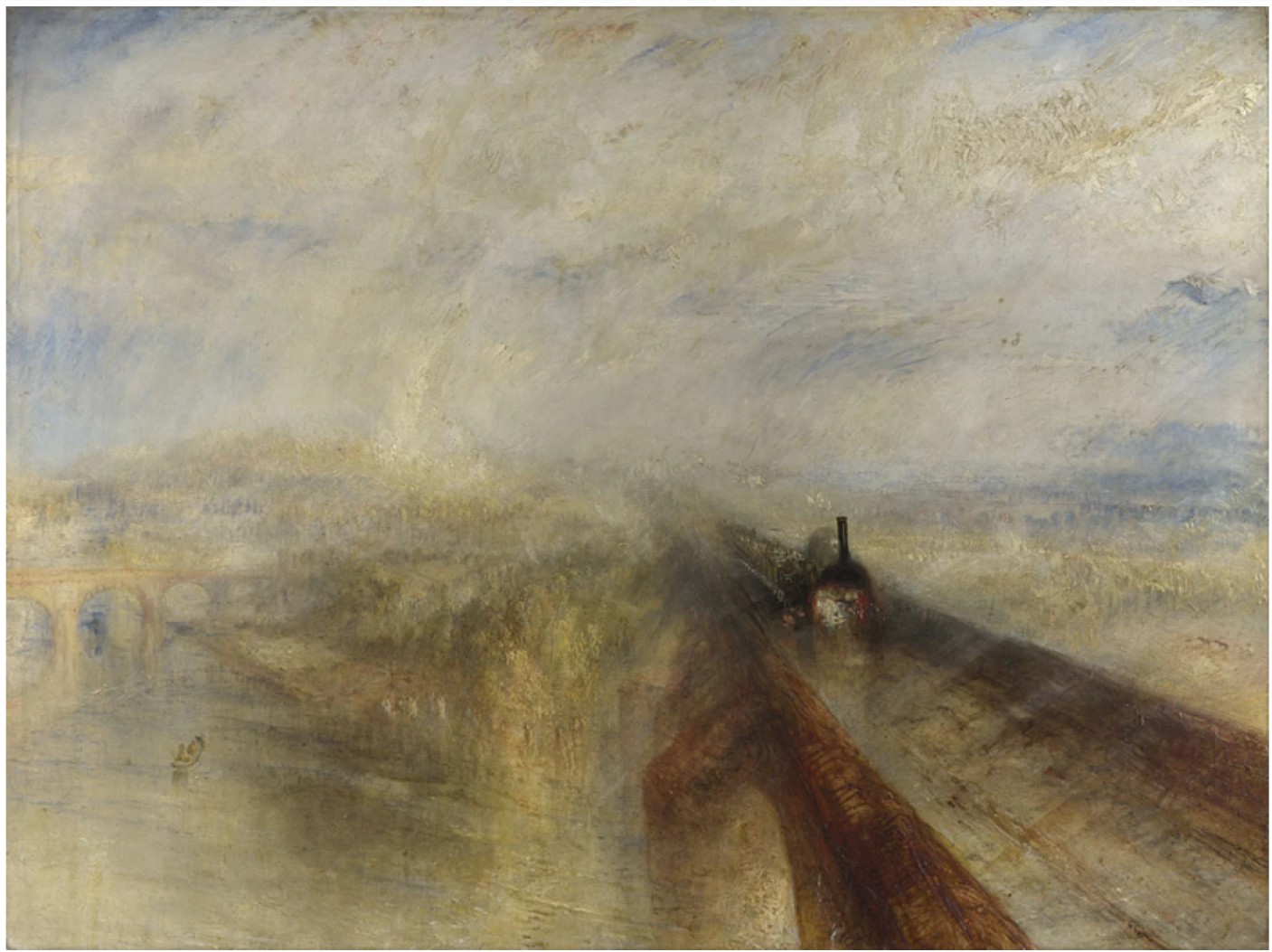
Joseph Mallord William Turner, Rain, Steam, and Speed, The Great Western Railway, 1844, The National Gallery, London
Upon his return to London in 1899, Monet took a room at the Savoy Hotel along the Victoria Embankment overlooking the River Thames. The waterway and its associated bridges would become central motifs to the series of London pictures eventually totaling more than 100 canvases in all. With few exceptions, the artist began his mornings painting the view of Charing Cross and Waterloo Bridges from his hotel room at the Savoy. Later in the afternoon, he’d gather his supplies and move across the river to depict the sunset behind the House of Parliament. The ever-changing atmospheric conditions over the water made it difficult for Monet to work on one picture for too long, compelling him to frequently begin yet another canvas. Often worked on in overlapping bursts of activity, Monet’s ‘Londons,’ as he called them, display varying mélanges of color. each highlighted by unique interplays of light and shadow—the quintessence of Impressionist painting.
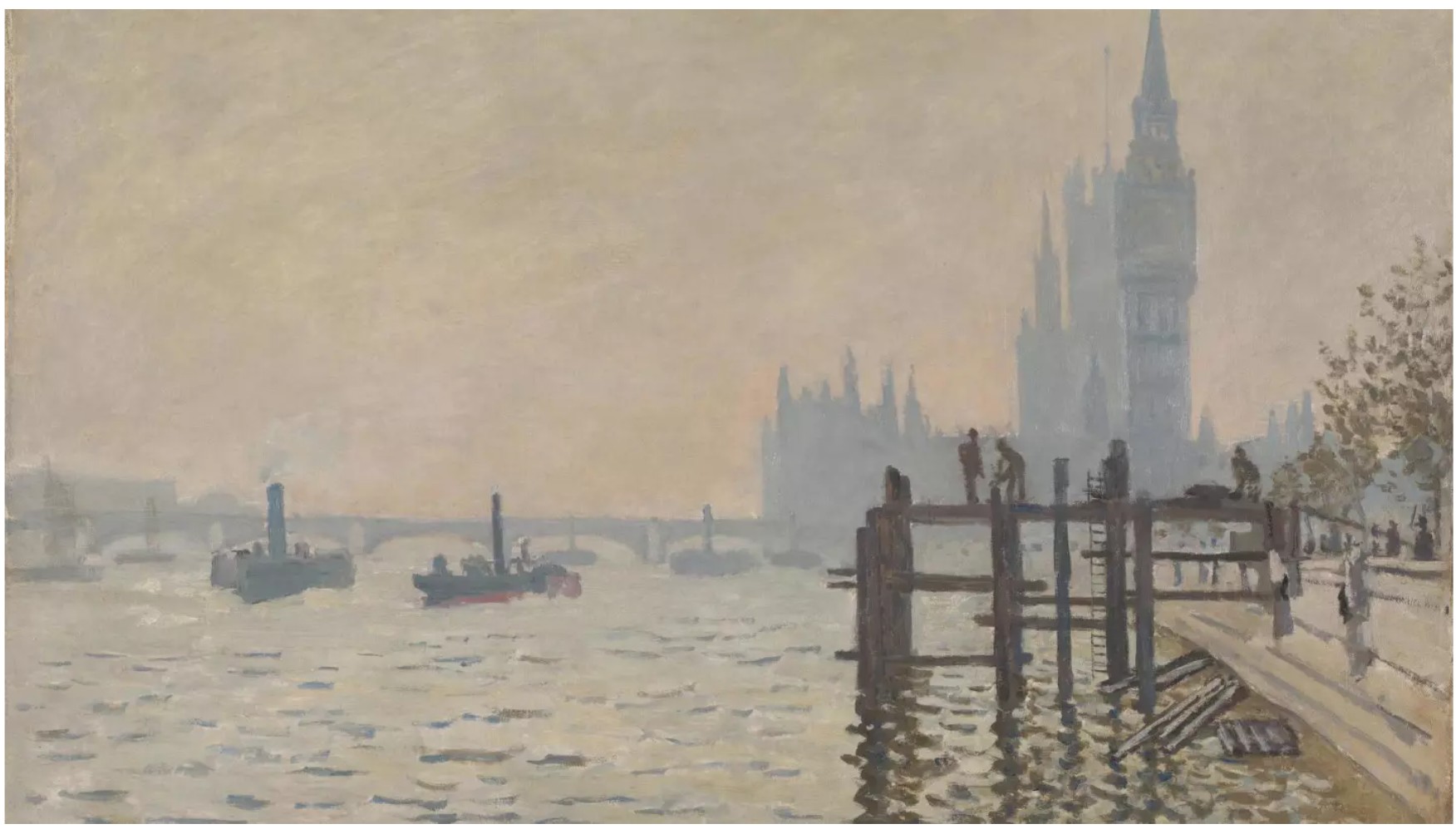
Claude Monet, La Tamise et le Parlement, 1871, The National Gallery, London
Wrapped in a thin veil of fog, the Charing Cross bridge takes its place at the midground of L’Aiguille de Cléopâtre et Charing Cross Bridge, dividing Cleopatra’s Needle (see fig. 3)—the tall Egyptian obelisk at center—from the House of Parliament in the distance. The present composition and its companion painting, now at the The Mohamed Mahmoud Khalil Museum, Giza are the only two surviving pictures from the London years painted from this vantage and including the iconic monument. According to Wildesntein’s catalogue raisonné, “The fact the Cleopatra’s Needle, which stands on the Vicotria Embankement south of the Savoy Hotel, can be seen int his painting, seems to indicate that it was not painted from the same window as previous ones” (Daniel Wildenstein, Claude Monet, Catalogue raisonné, vol. III, Cologne, 1996, no. 1544, p. 667).
“What marvellous things, but only lasting five minutes. It’s enough to drive you crazy. No, there’s no land more extraordinary for a painter.”
Monet found the famous London fog to be a particularly apt vehicle for filtering changes in light and atmosphere. Once underway with his London canvases, the artist would frequently complain about how swiftly effects would vary—though it was this very caprice that allowed him to create such a variety of masterpieces. “What I like most of all in London is the fog,” he told René Gimpel later in life. “Without the fog, London would not be a beautiful city. It’s the fog that gives it its magnificent breadth….” With his London pictures of the 1890s, Monet was returning to a motif that had preoccupied him decades earlier when he had been in exile in England. As Paul Tucker notes, “The London pictures can be understood as the result of Monet’s evident interest in reworking older motifs and in endowing them with the grandeur that he was now able to see in them… the London views are far more monumental than his earlier Thames pictures. In their muffled qualities, brilliantly diffused light and subject matter they also appear to be tinged with nostalgia, a feeling reinforced by the purple and yellows, blues and roses with which they were painted” (Paul Hayes Tucker, Claude Monet, Life and Art, New Haven & London, 1995 pp. 244-45; see fig. 4).
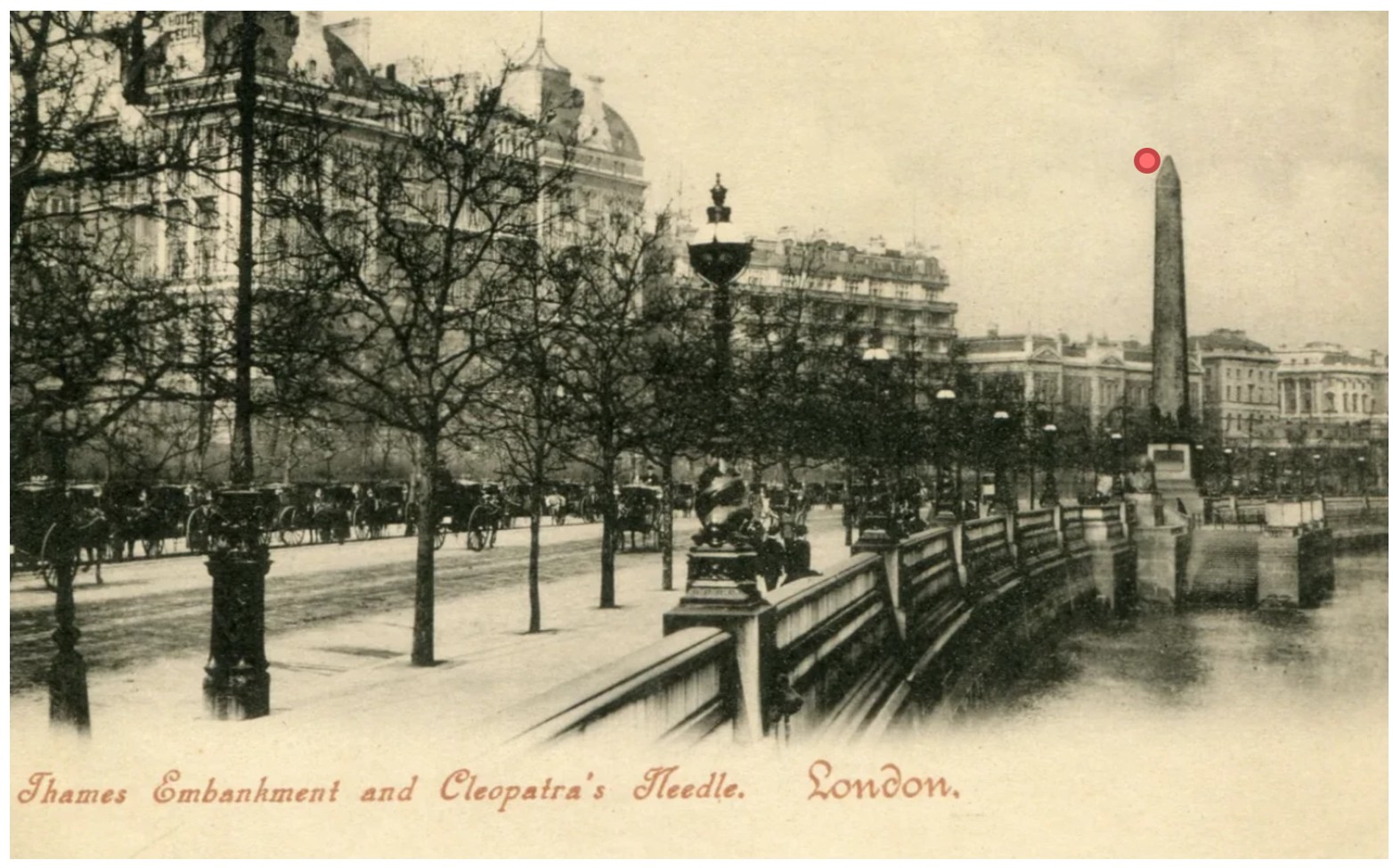
Postcard of Cleopatra’s Needle on the River Thames, London
Upon his return the France, Monet would continue to work on some of his London canvases until 1904 when a selection were included in his exhibition at Galerie Durand-Ruel. The response to his latest series pictures was one of resounding acclaim. Critics heaped praise on the pictures, stating that Monet’s accomplishments rivaled those of Turner, the then-undisputed champion of English landscape painting. Awash in crystalline hues, the present work offers a lyrica glimpse of the River Thames and its iconic architecture, embodying the essence of the Impressionist movement. The present work was most recently exhibited in the 2018 Monet & Architecture exhibition at London’s National Gallery—one of the first of its kind to be held in the UK in the twenty-first century.
Le Parlement, soleil couchant, 1900-1903
Christie’s New-York: 12 May 2022
Estimated: USD 40,000,000 – 60,000,000
USD 75,960,000
CLAUDE MONET (1840-1926), Le Parlement, soleil couchant | Christie’s
CLAUDE MONET (1840-1926)
Le Parlement, soleil couchant, 1900-1903
Oil on canvas
81.2 x 92 cm (32 x 36 1/4 inches)
Signed and dated ‘Claude Monet 1903’ (lower left)
Claude Monet’s emphatic passion for England’s capital is magnificently displayed in his monumental, landmark series, the Vues de Londres. Started in London in 1899 and completed in Giverny in 1904, this series remains today among his greatest achievements, as he transformed the city into magical, elegiac visions at once timeless and modern. Charing Cross Bridge, Waterloo Bridge, and the Houses of Parliament served as the principal subjects of this seminal group, each landmark a pretext for symphonic, often near abstract combinations of light and color. A host of both subtle and dramatic meteorological conditions, from the soft, gray morning light, to spectacular, fog-filled evening skies filled with pink, purple, and orange by the setting sun, gave rise to a theater of effects that Monet reveled in from his vantage point at the Savoy Hotel and St. Thomas’s Hospital. The largest series of paintings the artist had yet produced, numbering almost a hundred canvases, the Vues de Londres pushed Monet to the extremes of his artistic powers, testing the fundamental Impressionist tenet of capturing the ephemeral, fleeting atmospheric effects of nature. Crowning this series are the nineteen paintings of the Houses of Parliament, of which Le Parlement, soleil couchant is one of the finest. This painting shows the golden orb of the sun, having burnt through the impenetrable cloak of clouds and fog to cast the scene into an atmospheric array of jewel-like violets and lilacs, cobalt and inky blues, and deep pink tones. Dwarfing the tugboat that noiselessly crosses the river, the majestic, windowless silhouette of the Houses of Parliament appears mystical, the rising and falling pattern of towers seemingly both emerging from the sulphurous light and at the same time, dissolving into the expansive, still waters of the Thames, London’s silent witness of epochs past.
Waterloo Bridge, soleil voilé, 1899-1903
Christie’s New-York: 9 November 2022
Estimates on Request
USD 64,510,000
CLAUDE MONET (1840-1926), Waterloo Bridge, soleil voilé | Christie’s
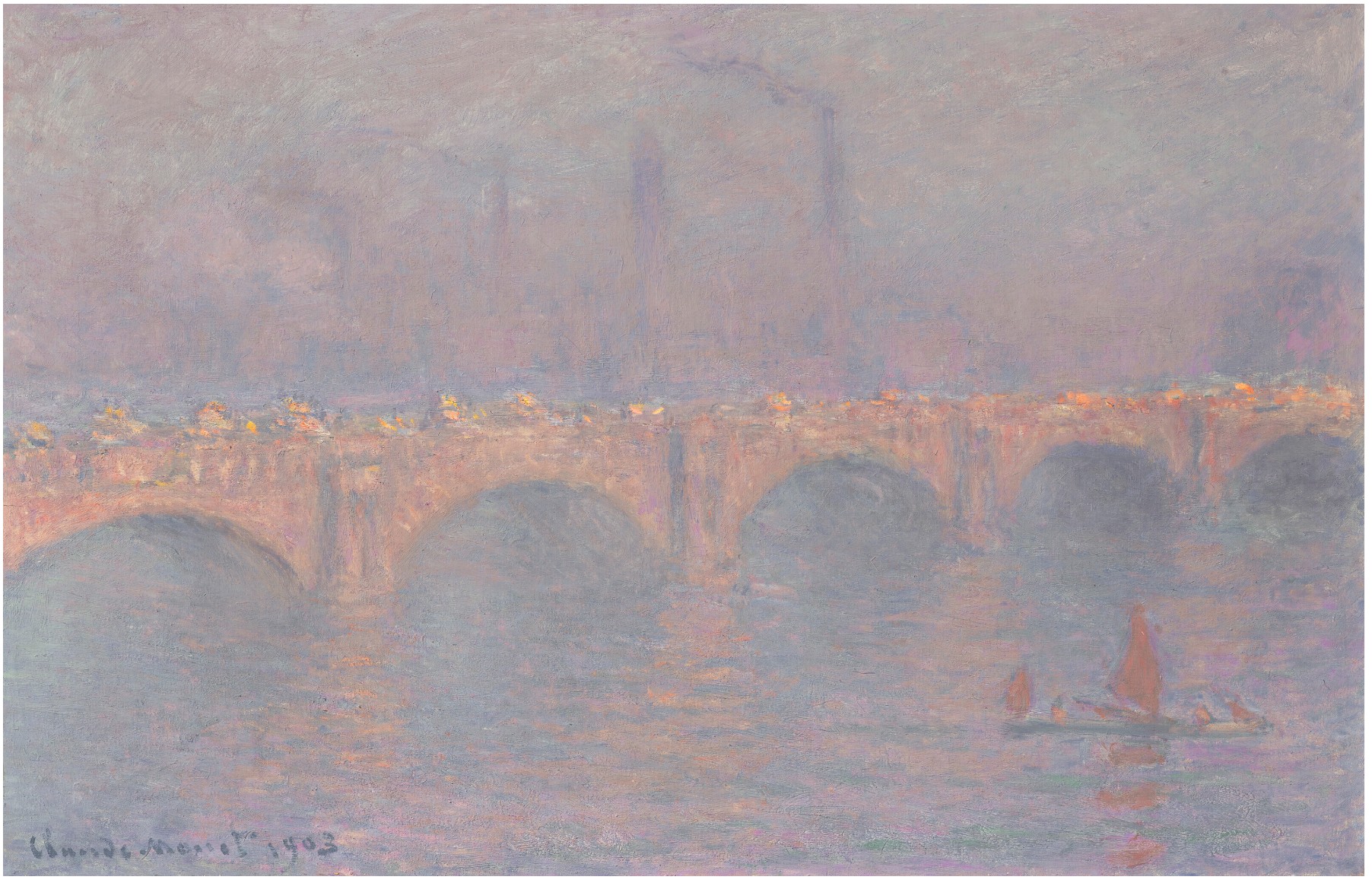
CLAUDE MONET (1840-1926)
Waterloo Bridge, soleil voilé, 1899-1903
Oil on canvas
65.4 x 100 cm (25 3/4 x 39 1/2 inches)
Signed and dated ‘Claude Monet 1903’ (lower left)
In 1899, Claude Monet began work on what would become the largest body of paintings he had yet produced. The artist had arrived in London on 15 September of this year, accompanied by his wife, Alice, and step-daughter, Germaine Hoschedé. The purpose of this trip was for the family to visit Michel Monet, the son of the artist, who was staying in the capital at the time to improve his English. Monet, however, had long been contemplating a painting campaign in the city, and, though this trip was purportedly a holiday, he had brought his paint supplies with him.
Staying on the sixth floor of the fashionable Savoy Hotel, which stood on the banks of the Thames, between Waterloo Bridge and Charing Cross Bridge with views of the Houses of Parliament beyond, Monet was instantly inspired. What was initially supposed to be a month long holiday became a six week trip. Leaving his family to sightsee together by day, he converted one of the rooms of their suite into a studio and commenced the great series of works known as the Vues de Londres. From his hotel window, the heart of London stretched before him, the sky frequently filled with the capital’s notorious fog, or by contrast, bathed in the soft autumnal light.
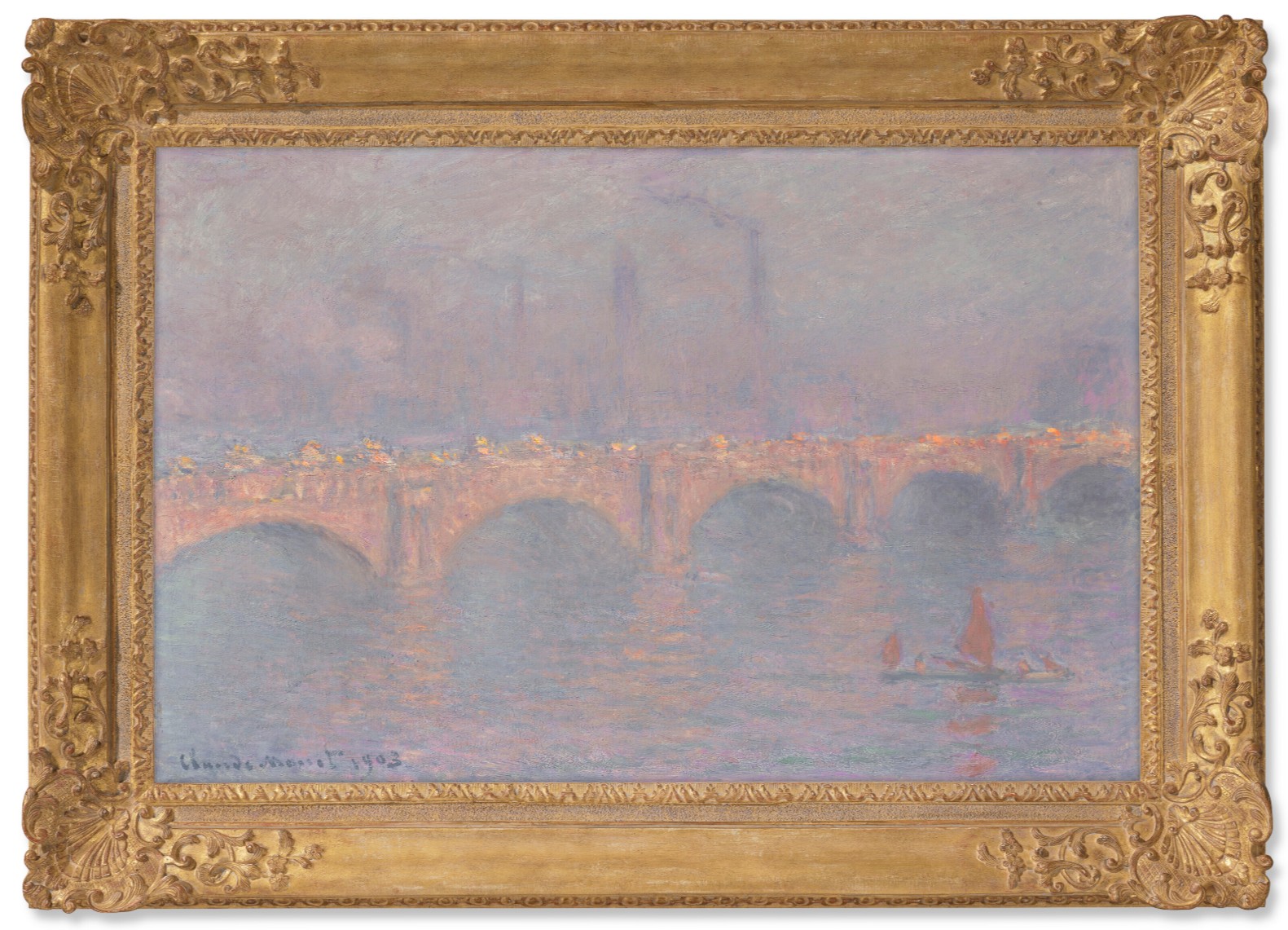
Monet made two subsequent trips back to England’s capital, in the springs of 1900 and 1901. Over the course of this sustained project, he painted almost a hundred views of the city, the majority of which featured three principal motifs: Waterloo Bridge, Charing Cross Bridge, and the Houses of Parliament. For the first two subjects, the artist painted from his hotel room; for the third, he stood outside St. Thomas’s Hospital, on the opposite bank of the river, and captured the iconic British landmark with the sun setting behind.
Rendered with a richly worked, multi-layered and multi-hued haze of delicate lilac, blue and violet tones, Waterloo Bridge, soleil voilé captures the river in the afternoon, as the westerly moving sun penetrated the dense atmosphere that had built up over the course of the day to gently light up the wide arches of the bridge. Sky, land and water are painted with the same palette, as Monet transformed the bustling urban cityscape into a delicate harmony of color and light. Specific anecdotal detail has been softened, immersed in the evanescent haze of smoke and fog that Monet loved so much. While a single boat moves silently across the still waters, the reflections of its red sails cascading down the river in bold strokes, a cavalcade of carriages and cars cross the bridge in a glittering procession, their lights gleaming amid the soft blue and lilac world that Monet has conjured.
It was to this scene—Waterloo Bridge with the smoke stacks and factory chimneys of the south bank rising magisterially beyond—that Monet returned most frequently. This series stands as the largest group within the Vues de Londres, numbering a total of forty-one works (Wildenstein, nos. 1555-1595). Over half of these canvases are now housed in major museums. Monet chose the present Waterloo Bridge, soleil voilé to feature in his critically acclaimed 1904 exhibition, Claude Monet: Vues de la Tamise à Londres at the Galerie Durand-Ruel.
Monet captured his view of Waterloo Bridge in a remarkably varied number of ways. Some were painted in the morning, when the sun was rising to the east, behind the bridge, sometimes shining through its arches, while the canvases from later in the day, such as the present work, show the sun illuminating the columns that ornamented the bridge. While all have subtly shifting palettes, ranging from luminous blue and violet, to soft green, or more naturalistically-toned, the compositional structure also changes. In some works, the horizon line is very high, removing the far bank of the river entirely to make the expansive waters the primary focus; in others, more factories are present beyond as he played with the angle of the diagonal sweep of the bridge, depending on the overall atmospheric effect with which he was trying to engage.
Monet reveled in two central aspects: the rippling water and its reflections, and the multi-hued sky above, two of the most ephemeral, elusive elements of a landscape. “For me, a landscape does not exist in its own right,” he once stated, “since its appearance changes at every moment; but the surrounding atmosphere brings it to life, the air and the light, which vary continually… For me, it is only the surrounding atmosphere that gives subjects their true value” (quoted in J. House, Monet’s London: Artists’ Reflections on the Thames, Ghent, 2005, p. 33). This concept is embodied in Waterloo Bridge, soleil voilé. Here, the scene takes on a mystical quality, the physical components—the bridge, factories, omnibuses and carriages—of this misty view dematerialized into a symphony of color, the industrial din and sense of movement muffled by the sense of all-encompassing silence and stillness that pervades.
Waterloo Bridge itself was a relatively new feature on London’s central waterway. Designed by John Rennie, it had opened in 1817, at first requiring tolls to cross from bank to bank, though these were scrapped not long after. The bridge formed—as it continues to do today—an important part of the infrastructure of the city, leading, in Monet’s time, to the wharfs and factories that stood on the south bank. Formed of nine arches flanked by Doric columns, topped by an entablature and cornice, the bridge became a beloved landmark. The sculptor Antonio Canova remarked upon visiting London that this was “the noblest bridge in the world,” “alone worth coming from Rome to London to see” (quoted in G. Seiberling, Monet in London, exh. cat., High Museum of Art, Atlanta, 1988, p. 49). The bridge as Monet painted it no longer exists today. In 1934, it was destroyed due to poor traffic flow and unstable foundations. As a result, Monet’s extensive visions of this architectural feature now stand as important records of a part of London that has long disappeared.
Monet was keenly aware of Whistler’s contributions to the contemporary depiction of London. The pair were close acquaintances and Monet had described the artist successfully capturing “that mysterious cloak” of London fog, which made “those regular, massive blocks [of the city] grandiose” (quoted in P. Tucker, Monet in the ’90s: The Series Paintings, exh. cat., Museum of Fine Arts, Boston, 1989, p. 266). It was, Paul Tucker has written, “his uncanny power to evoke the mystery of early evening light on the Thames in his numerous Nocturnes, which Monet surely thought of when he began his own London series” (ibid., p. 266).
Entering into this artistic lineage also meant confronting the art of British master, J.M.W. Turner. It would have been impossible for an artist—especially one so concerned with atmospheric effects of light and color—not to have masterpieces such as Rain, Steam, and Speed—The Great Western Railway (1844, National Gallery, London) or The Burning of the House of Lords and Commons, 16th October, 1834 (1834-1835, Philadelphia Museum), in mind when beginning a series based in the city, and especially around the Thames. “Few landscape painters in the history of art had been as inventive or as passionate, or had captured nature’s elusive ways with as much power and poetry… Turner, therefore, was a soulmate, a guide, and a special challenge for Monet. If one were going to be a truly great landscape painter, this was necessary business to settle” (ibid., p. 267). Turning sixty in 1900, Monet was at this time keenly aware of his own legacy and was engaged in a nostalgic revisiting of some of his earlier motifs. His monumental London series now stands among the greatest depictions of the city, his name firmly integrated within the great canon of artists who have distilled the appearance and atmosphere of the British capital.
For Monet, an artist who had for years honed his ability to capture fleeting, ephemeral atmospheric effects, London’s distinctive and unpredictable climate presented the ultimate challenge, testing the limits of the Impressionist tenets he had founded some decades prior. Given the fast changing weather, Monet worked on multiple canvases at a time, each one capturing a different effet, as he moved from painting to painting to depict the spectacular cityscape that unfolded and altered before his eyes.
Waterloo Bridge, effet de brume, 1899-1904
Christie’s London: 28 June 2022
Estimated: GBP 22,000,000 – 32,000,000
GBP 30,059,500 / USD 36,872,190
CLAUDE MONET (1840-1926), Waterloo Bridge, effet de brume | Christie’s
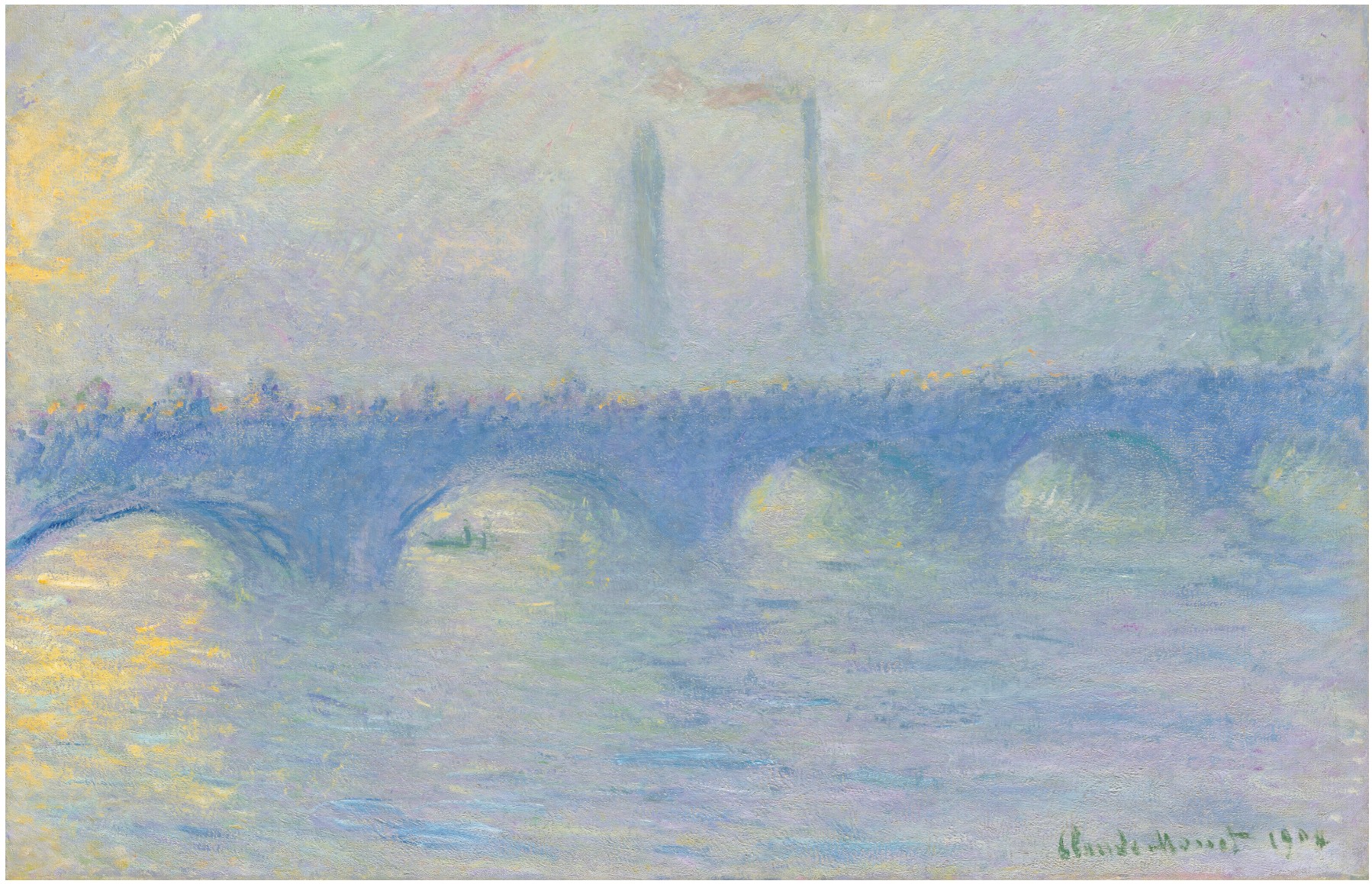
CLAUDE MONET (1840-1926)
Waterloo Bridge, effet de brume, 1899-1904
Oil on canvas
65.2 x 100.7 cm (25 5/8 x 39 5/8 inches)
Signed and dated ‘Claude Monet 1904’ (lower right)
Depicting the Thames through an effervescent, sunlit haze, Waterloo Bridge, effet de brume is a key painting from Claude Monet’s monumental, landmark series known as the Vues du Londres (Views of London). Numbering almost a hundred canvases in total, the artist had begun this grand project during the opening years of the twentieth century, focusing on the play of light across the Thames through three principal subjects – Charing Cross Bridge, the Houses of Parliament, and Waterloo Bridge. In contrast to the bustling modernity of the Charing Cross paintings and the solemn grandeur of the Houses of Parliament compositions, Monet’s views of Waterloo Bridge stand as pure meditations on colour, light, and atmosphere, evocatively capturing the shifting character of the famous bridge under a series of different conditions. Comprising over forty views, each subtly different from the next, many of the Waterloo Bridge paintings are now held in renowned museum collections across the world, including the Philadelphia Museum of Art, the Art Institute of Chicago, the National Gallery of Art, Washington, D.C., the Kunsthalle, Hamburg and the National Museum of Western Art in Tokyo.
The idea of a series of paintings set in London had been percolating in Monet’s mind for a number of years – ‘When you come through Paris you can advise me on what the chances could be for me in coming to spend several weeks in London where I could paint some aspects of the Thames,’ the artist had written to the critic Théodore Duret in 1880 (quoted in G. Seiberling, Monet in London, exh. cat., Atlanta, 1988, p. 35). Seven years later, a brief trip to the English capital allowed him the opportunity to admire his friend James McNeill Whistler’s poetic Nocturnes series, which transformed the twilit and nocturnal fog-laden skies above the Thames at Chelsea and Battersea into enigmatic, evocative visions of the city. These paintings left a powerful impression on Monet, and by the beginning of the 1890s his own portrayal of the English capital seemed inevitable, with Camille Pissarro proclaiming, ‘Everyone is awaiting with impatience his series of London impressions’ (quoted in ibid., p. 37). However, it was not until 1899 that the artist returned to the city for an extended stay, accompanied by his wife, Alice Hoschedé and her daughter, Germaine. This visit would mark the first of a trio of important painting campaigns the artist undertook in London over the course of two years, during which the Vues du Londres were born.
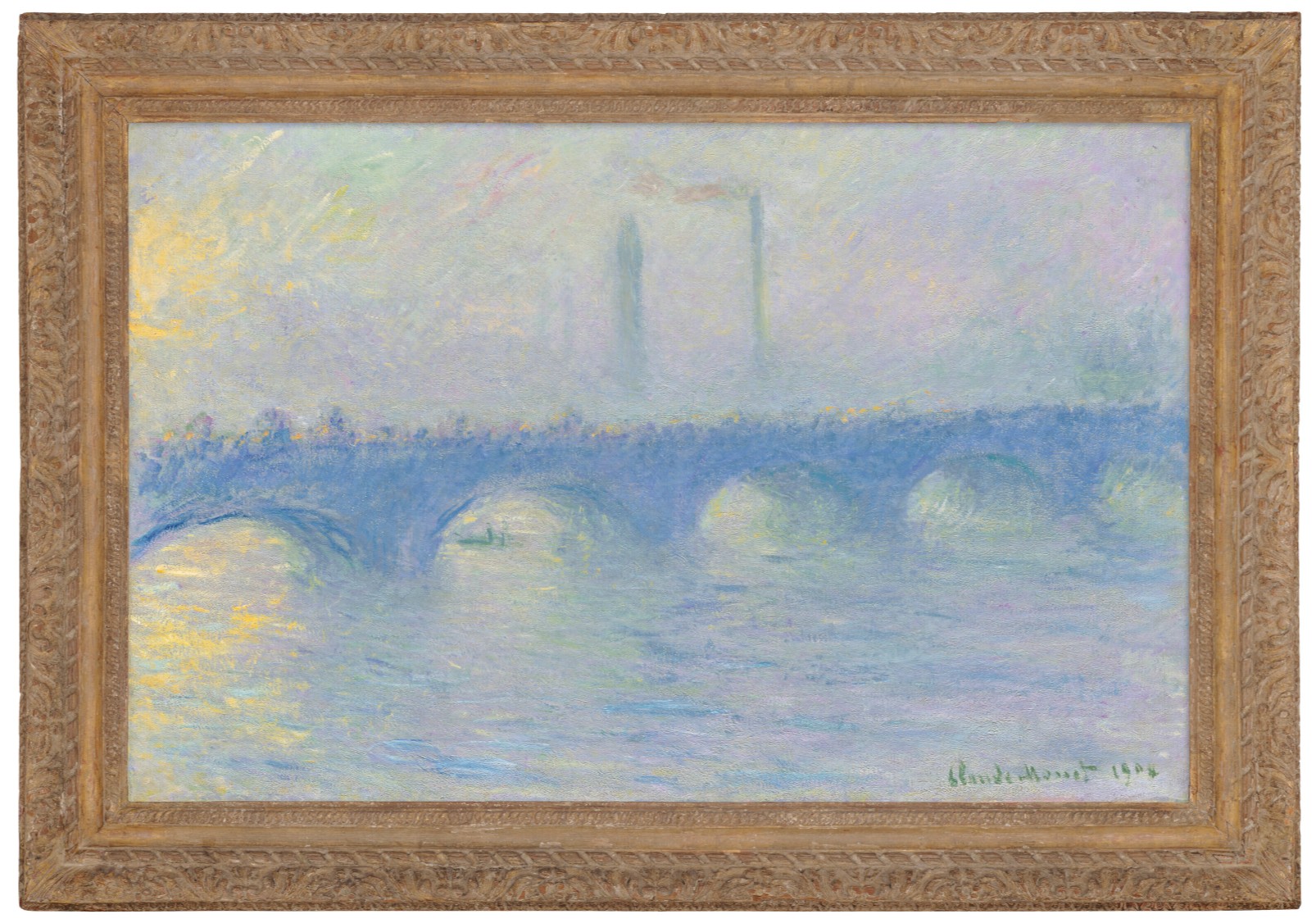
Among the most ambitious of Monet’s series, which would continuously challenge his painterly skills and push his Impressionist vision to new heights, the Vues du Londres represented something of a shift in direction for the artist. His most recent work had focused largely on bucolic views of the French countryside, from his serene meditations of morning light on the Seine, to the rhythmic patterns of Poplar trees along the banks of the river Epte, and the iconic profiles of the Meules or haystacks that were a common sight in the landscape surrounding his home at Giverny. Returning to the bustling life of the metropolis, a subject he had not engaged with in such an extensive manner since his acclaimed paintings of the Gare Saint Lazare almost two decades previously, Monet immersed himself in the modernity of the London cityscape. The artist had long held British culture in high esteem – he had a traditional English breakfast every morning at Giverny, wore suits of English wool made to order, and had sent his oldest son Michel across the Channel in order to study the language. However, the lure of London lay primarily in its dramatic, everchanging atmosphere, the enthralling combination of smoke, fog, light and colour that transformed the city’s monuments and architecture from one moment to the next.
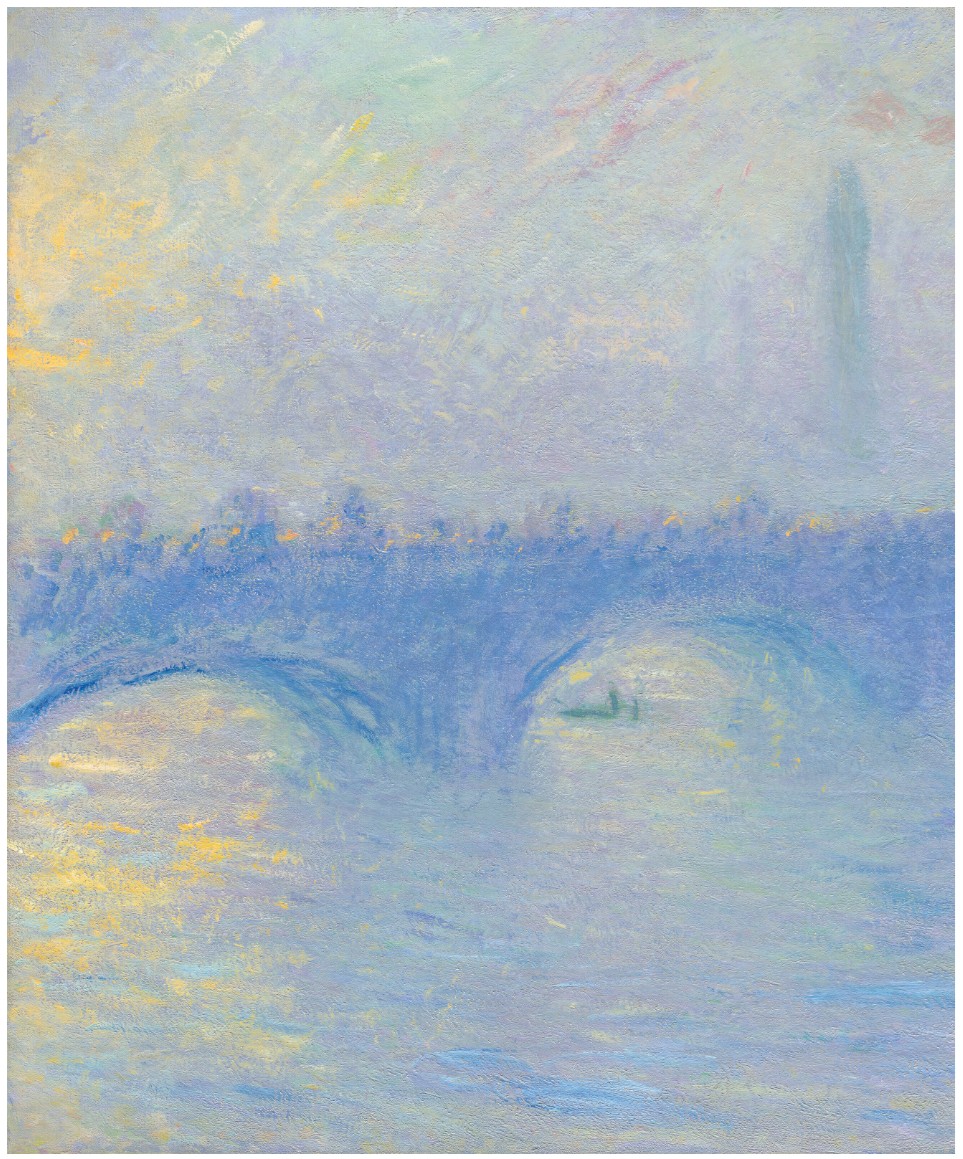
The artist and his family installed themselves in the celebrated Savoy Hotel, set on the banks of the Thames just behind the Strand, settling in a suite of rooms on the 6th floor with a balcony that boasted a breath-taking panorama of the river below. Looking to the right, Monet would have seen the Houses of Parliament rising impressively beyond the iron structure of Charing Cross railway bridge; to the left, the elegant arches of Waterloo Bridge framed by a plethora of factory chimneys complete with bellowing plumes of smoke that lined the south banks of the river eastwards into the City and beyond. Bathed in the pale autumn sun diffused through a dense atmosphere of fog and mist, the cityscape became a romantic, almost mystical environment that shifted and changed before the artist’s eye. Indeed, a promotional brochure for the Savoy, published at the turn of the century, boasted not only of its luxuriously appointed rooms, but also of the smoky, vaporous views of the Thames that it offered. Thrilled with his set-up, Monet quickly converted one of the hotel’s rooms into a studio, leaving his family to sightsee, while he explored the artistic potential of his surroundings.
In February 1900 Monet returned to London with the sole purpose of creating more paintings, remaining in the capital until April. Once again, the artist was captivated. ‘I don’t need to tell you that I work like a madman,’ he wrote to his stepdaughter Germaine during the sojourn, ‘and that’s the right term, as you know, and if it weren’t for my evenings out and dinners in town, which are rather frequent, I would become stupefied with it, not being able to stop myself from looking at my canvases and thinking about them without stopping’ (D. Wildenstein, Claude Monet: Biographie et catalogue raisonné, Paris, 1985, vol. IV, letter 1528). He quickly established a daily painting routine: in the morning and early afternoon, he worked from the Savoy on views of Charing Cross and Waterloo Bridge. As the day drew on, and the low winter sun moved westwards, Monet crossed the river and made his way to St. Thomas’s Hospital, where he depicted the third of his trio of London motifs, the Houses of Parliament. He would work here for the rest of the day, capturing the Neo-Gothic palace bathed in late-afternoon light. As a result of London’s distinctive and unpredictable climate, Monet had to work on multiple canvases at a time, each one capturing a different effet, as he moved from painting to painting to record the spectacular scene as it transformed before his eyes. The slightest breath of wind over the river could modify the scene in a matter of seconds, causing a shift in the density of the mist or fog, filtering or blotting out the light, changing its quality from a warm, refractive haze to a thick, opaque blanket. In several letters from his London visits, Monet signs off abruptly, leaving his correspondence in order to capture a particular effect before it disappeared: ‘I have to go,’ he explained in one letter to his wife Alice, ‘the effect will not wait’ (ibid., letter 1521).
Other Series
Vue de Rouen depuis la côte Sainte-Catherine, circa 1892
Property from The Schlumberger Collection
Sotheby’s New-York: 20 November 2025
Estimated: USD 3,000,000 – 4,000,000
USD 7,370,000
Vue de Rouen depuis la côte Sainte-Catherine | Modern Evening Auction | 2025 | Sotheby’s
CLAUDE MONET (1840 – 1926)
Vue de Rouen depuis la côte Sainte-Catherine, circa 1892
Oil on canvas
65.3 x 100.2 cm (25 3/4 x 39 1/2 inches)
Stamped with the signature Claude Monet (lower right)
Stamped again (on the reverse)
Dating to circa 1892, Vue de Rouen depuis la côte Sainte-Catherine was painted during Claude Monet’s visit to the city of Rouen the same year. One of the first works executed during that pivotal trip, it forms a critical part of the artist’s exploratory process which culminated in his celebrated series depicting the majestic Gothic façade of the Rouen cathedral, widely considered as the triumph of the Impressionist movement.
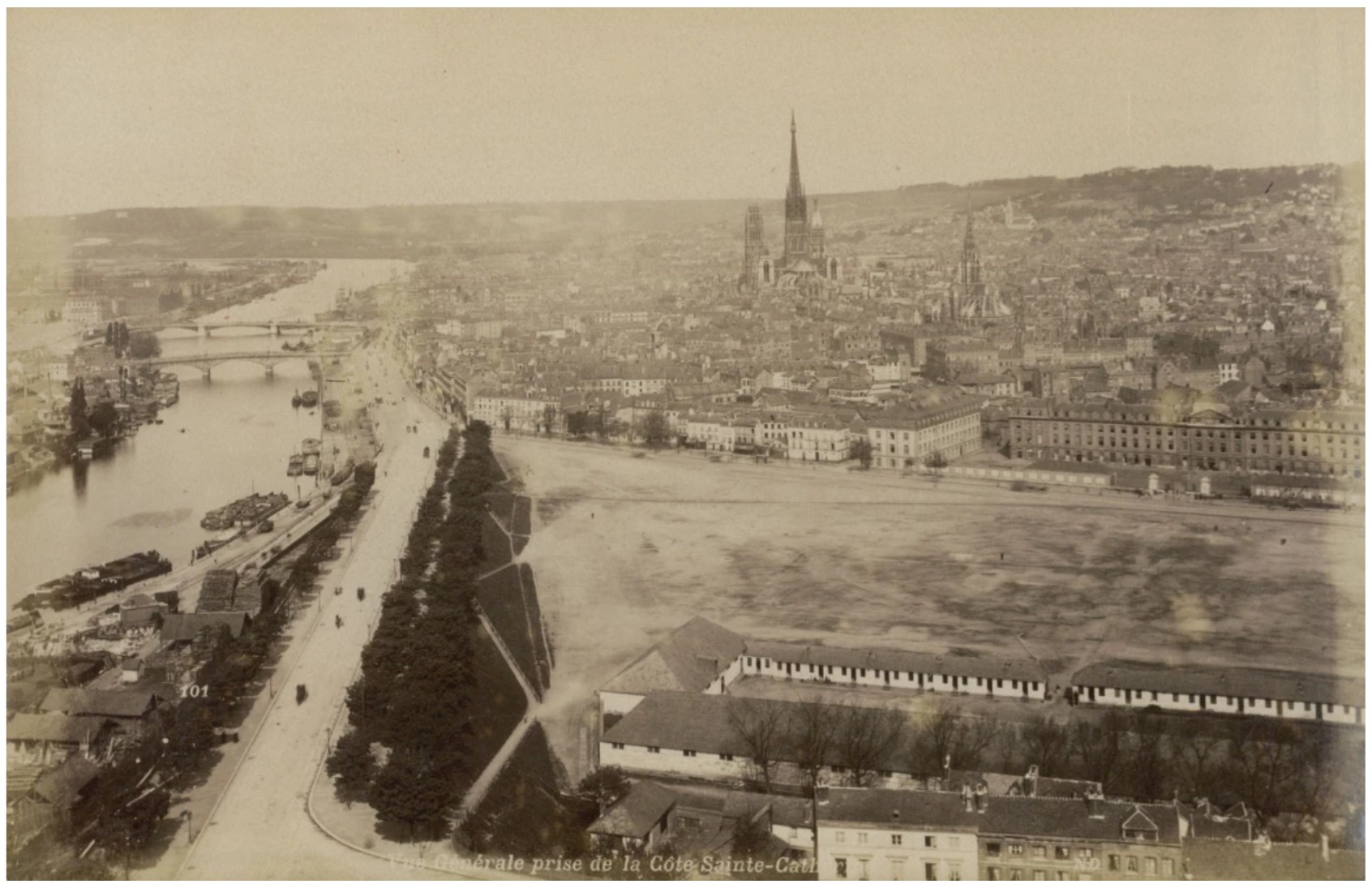
A view of Rouen from Côte Sainte-Catherine, circa 1880
With the picturesque Seine flowing through the middle of the city, its wonderfully preserved, dramatic medieval architecture, and bustling atmosphere as a trade center and the capital of Normandy, Rouen had served as a source of inspiration for artists across centuries. Monet’s close friend Camille Pissarro compared its beauty to that of Venice, as Christopher Lloyd describes: “…for Pissarro, Rouen possessed a potency that Venice had once exerted, and indeed continues to exert, on the European consciousness. In both cities there was a similar magic in the effects derived from the aesthetic relationship between the buildings and the water—in Rouen the Seine, and in Venice the lagoon or the canals” (Christopher Lloyd, Pissarro, Geneva, 1981, p. 88)
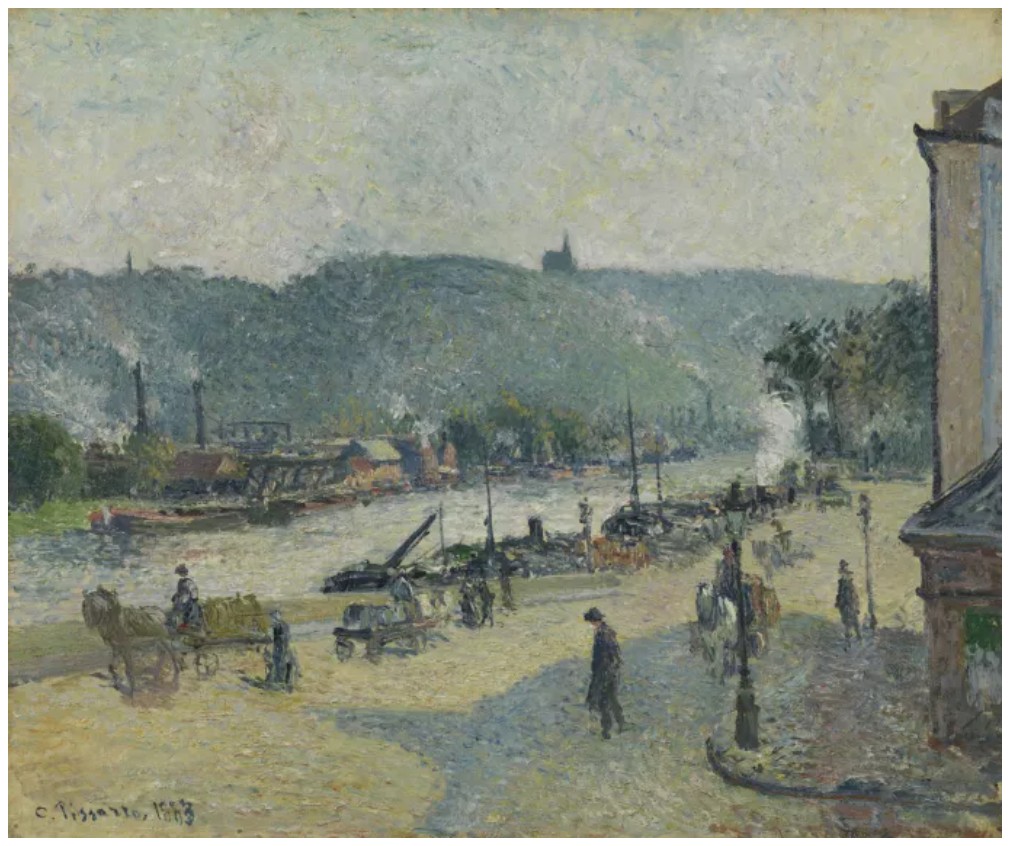
Camille Pissarro, Place Lafayette, Rouen, 1883, The Courtauld Gallery, London
It was Pissarro who had first introduced Monet to the vista in the present work, as recorded in a letter the former wrote to his son in October 1883: “…yesterday I was paid a visit by Monet, his brother and his son, by Durand-Ruel and his son. We spent the day together in Déville, on a high hill. There we saw the most splendid landscape that a painter could ever dream of: a view of Rouen, in the distance, with the Seine flowing, unfolding, as calm as a mirror, sunny slopes, splendid foregrounds: it was magical [feérique]. No doubt, I will go back to this village to paint there: it is marvelous” (quoted in Joachim Pissarro, Monet’s Cathedral: Rouen, 1892-1894, 1990, p. 12).
A native of Normandy, Monet visited Rouen frequently since childhood and painted it for the first time over two decades prior. On this occasion, Monet arrived in the city in early February 1892 and remained there until April. His visit was initially motivated by family matters: following the untimely death of his half-sister Maria, who had inherited a number of his works from their father, the artist was now keen, with the help of his brother Léon, to buy these paintings back from their mother. Only a handful of early Rouen canvases are known. These include the present work, as well as a markedly more sketch-like version rendered from the same viewpoint, Vue de Rouen, in the collection of Musée des Beaux-Arts de Rouen; La Rue de L’Épicerie à Rouen, and two further works depicting the foggy riverbank of the Seine.
These oils, combined with a number of pencil drawings Monet sketched out at the same time, provide a unique insight into the artist’s working process during this period. They also underscore that the Rouen Cathedral series, which shortly followed thereafter, was by no means “a premediated subject”. Rather, it was the result of a conscious and laborious search for a subject that would best allow Monet to address the concerns at the heart of his artistic quest. While most of the early Rouen canvases from 1892 focused on capturing the city’s specific viewpoints and architectural elements—acting as part of Monet’s process of scouting for location—Monet here focuses more on the transient effects of weather and time of the day on the city’s topography. He chooses not to depict the Seine or the more verdant section of the city that immediately surrounds it. Instead, Monet conveys the transformation of the surrounding scenery—the valley, the rooftops and the cathedral’s spire—under the soft, hazy sunshine that envelops them. The cathedral spire, the smaller towers and rooftops—the smaller spire on the right likely denoting the Church of Saint-Maclou – also serve as important vertical elements, endowing the present composition with a sense of pictorial rhythm.
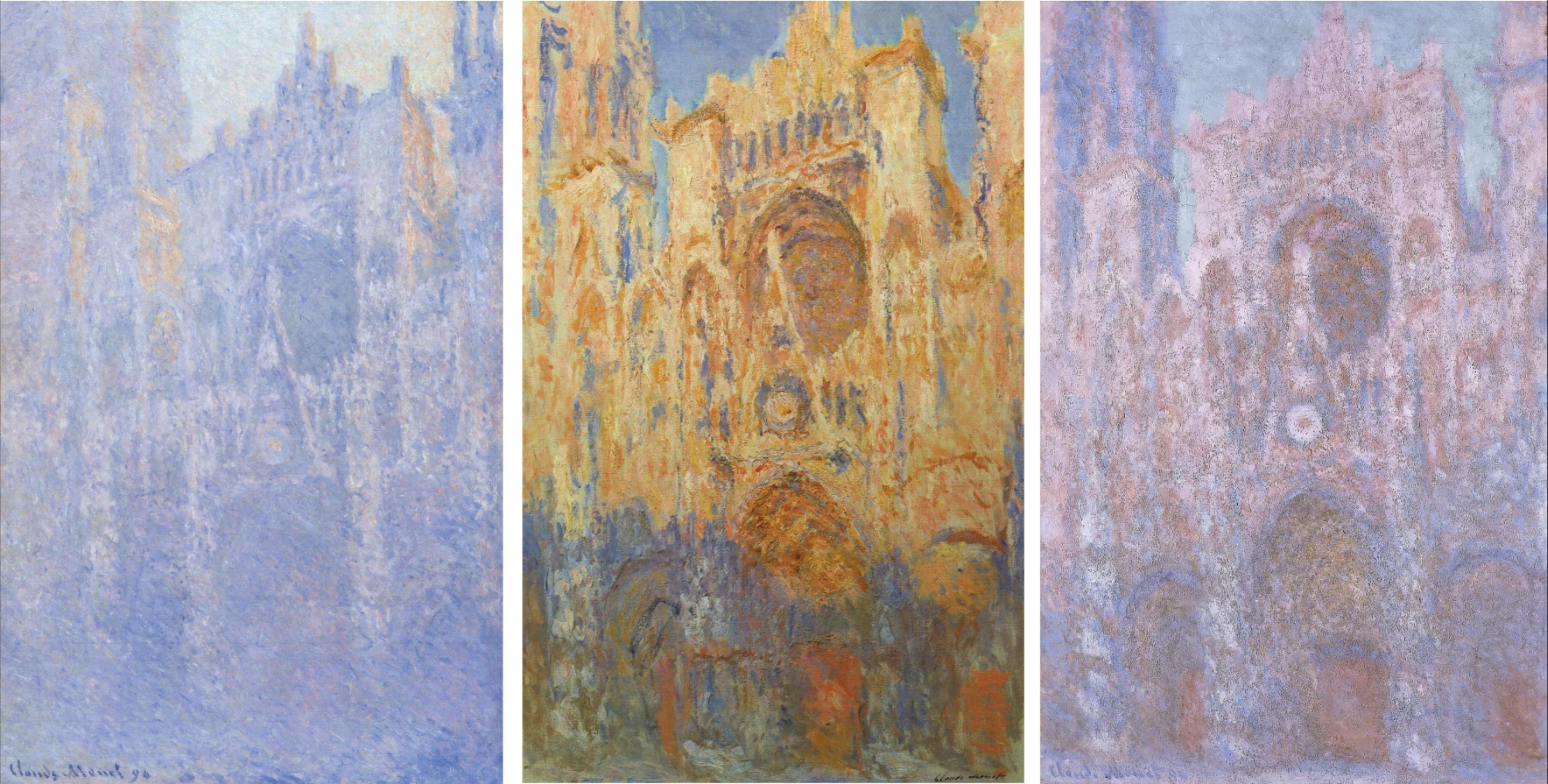
Claude Monet, Le Portail, brouillard matinal, 1894, Folkwang Museum Essen
Claude Monet, Cathédrale de Rouen, effet de soleil, fine de journée, 1892, Musée Marmottan Monet, Paris
Claude Monet, Cathédrale de Rouen, symphonie en gris et rose, 1894, National Museum Cardiff, Wales
It is through Monet’s masterful rendering of the sky and air in the present work—using soft, feathery brushstrokes to capture the subtle gradations of tone as the sun and fog transform the scene—that one perceives the artist’s deep fascination with the fleeting atmospheric effects of this great northern city and its landscape. After experimenting with various locations and viewpoints, Monet ultimately focused on depicting these effects in his iconic canvases of the Rouen Cathedral, its imposing medieval façade providing the perfect backdrop for their most potent expression. Integral to the working process that resulted in the creation of his arguably most celebrated and pictorially innovative series, Vue de Rouen depuis la côte Sainte-Catherine is an important canvas from a crucial period in Monet’s career. Remaining in the esteemed Schlumberger collection for over sixty years, the present work comes to auction for the first time.
Falaise des Petites-Dalles, 1881
The Art of Collecting: Property from a Distinguished Private Collector
Christie’s New-York: 17 November 2025
Estimated: USD 2,800,000 – 3,500,000
USD 3,247,000
CLAUDE MONET (1840-1926), Falaise des Petites-Dalles | Christie’s
CLAUDE MONET (1840-1926)
Falaise des Petites-Dalles, 1881
Oil on canvas
59.5 x 73 cm (23 3/8 x 28 3/4 inches)
Signed and dated ‘Claude Monet 81’ (lower right)
Buoyed with newfound enthusiasm as well as the success of the 1880 paintings—the dealer Paul Durand-Ruel purchased fifteen pictures, including two of Les Petites-Dalles—Monet eagerly returned to Normandy in 1881. He installed himself in Fécamp and spent his days roaming the coast in search of motifs that caught his eye. It was during this trip that he painted Falaise des Petites-Dalles, a spirited seascape awash in soft, diaphanous tonalities. Committed to painting en plein air, Monet would have set up his easel on the rocky beach and cast his eye towards the eastern side of the harbor of Les Petites-Dalles as he developed this composition. The towering form of the cliff dominates the present work, the sheer height of its façade suggested by an intricate weave of vertical brushstrokes. Wintery light has turned the Channel seafoam green, and impastoed swirls of white paint evoke the waves’ froth crashing against the shore. The imagery is dynamic and teeming with movement; as the renowned art historian Richard Bretell noted, “Monet’s coastal pictures of the 1880s clearly demonstrate his uncanny ability to depict the invisible—the wind” (Monet in Normandy, exh. cat., Fine Arts Museums of San Francisco, 2006, p. 98). Working in solitude and facing adverse weather conditions—his outings were often impacted by the heavy rains and winds that buffeted the northern coast—Monet spent his days in the pursuit of nature’s transient effects.