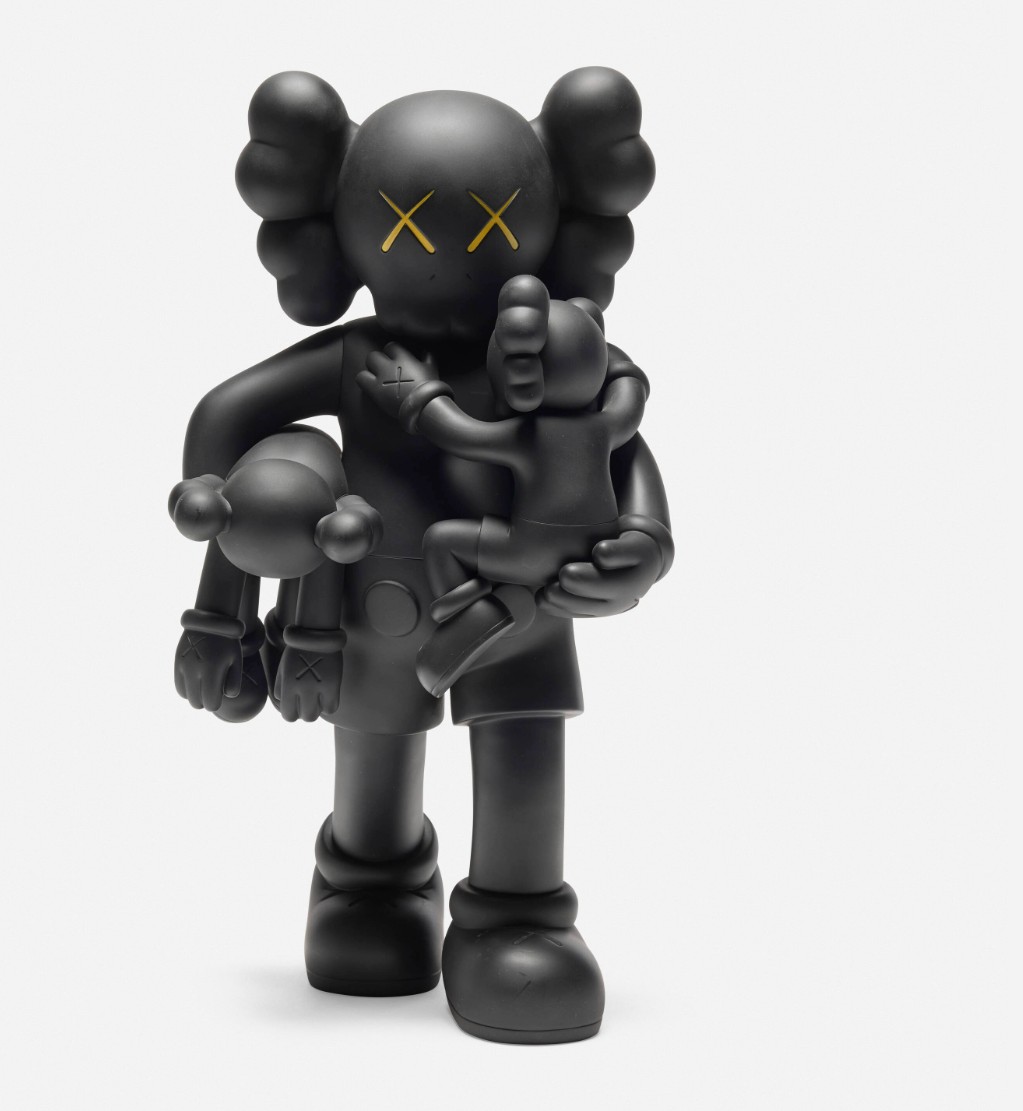
CLEAN SLATE is one of the most structurally narrative sculptures in KAWS’ practice, defined by the presence of three figures: one adult COMPANION holding two children simultaneously. This triadic construction is essential. The central figure stands upright, yet its posture is subtly compromised, leaning forward under accumulated weight rather than posed in balance.
Introduction
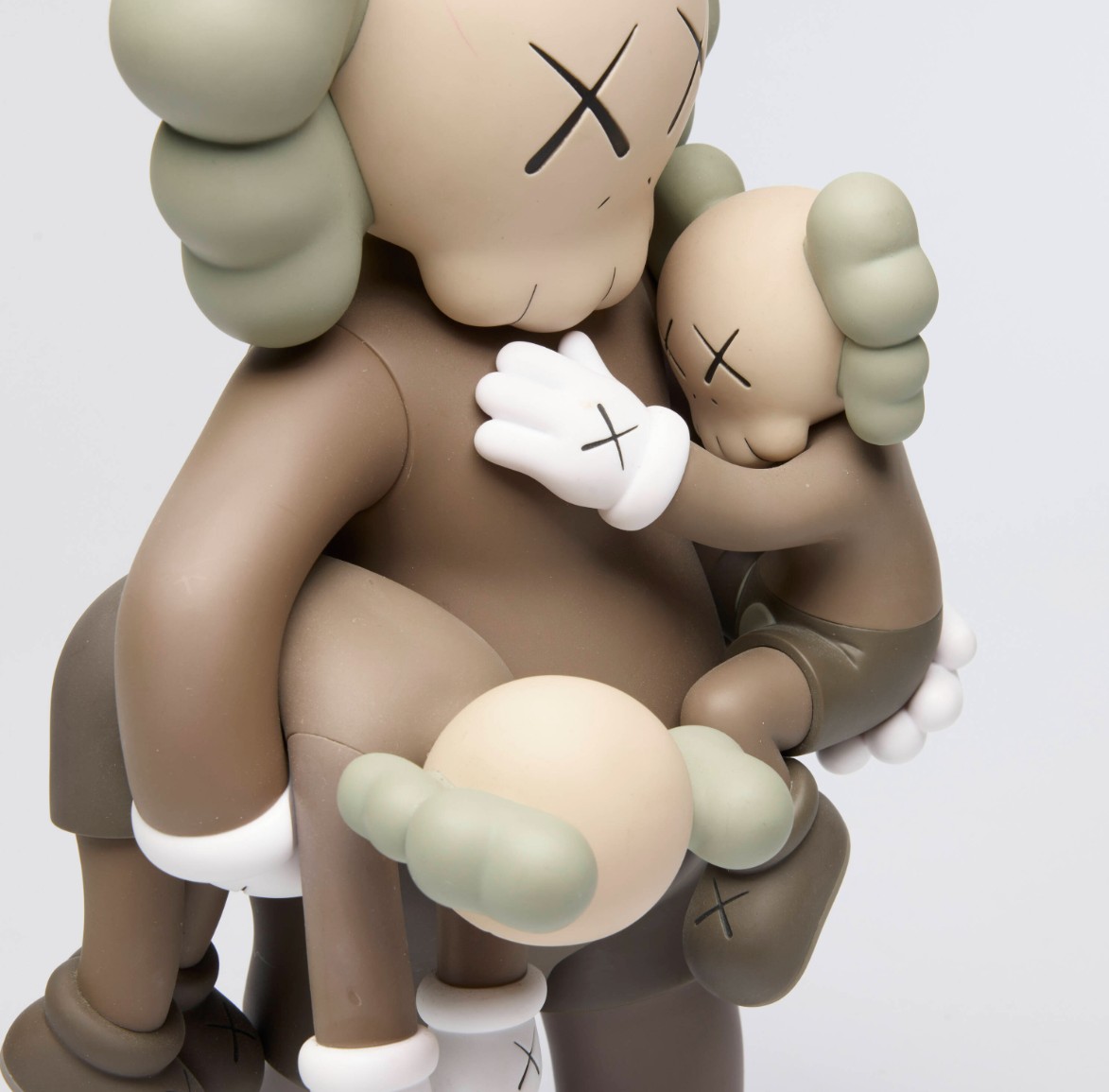
The two children are deliberately differentiated. One is held across the body, its limbs hanging downward, almost inert, suggesting fatigue or surrender. The other clings actively to the adult’s chest, arms wrapped tightly around the neck, legs gripping the torso. This contrast, passive versus attached, introduces a precise tension: the sculpture is not simply about care, but about uneven dependency and the impossibility of distributing attention equally.
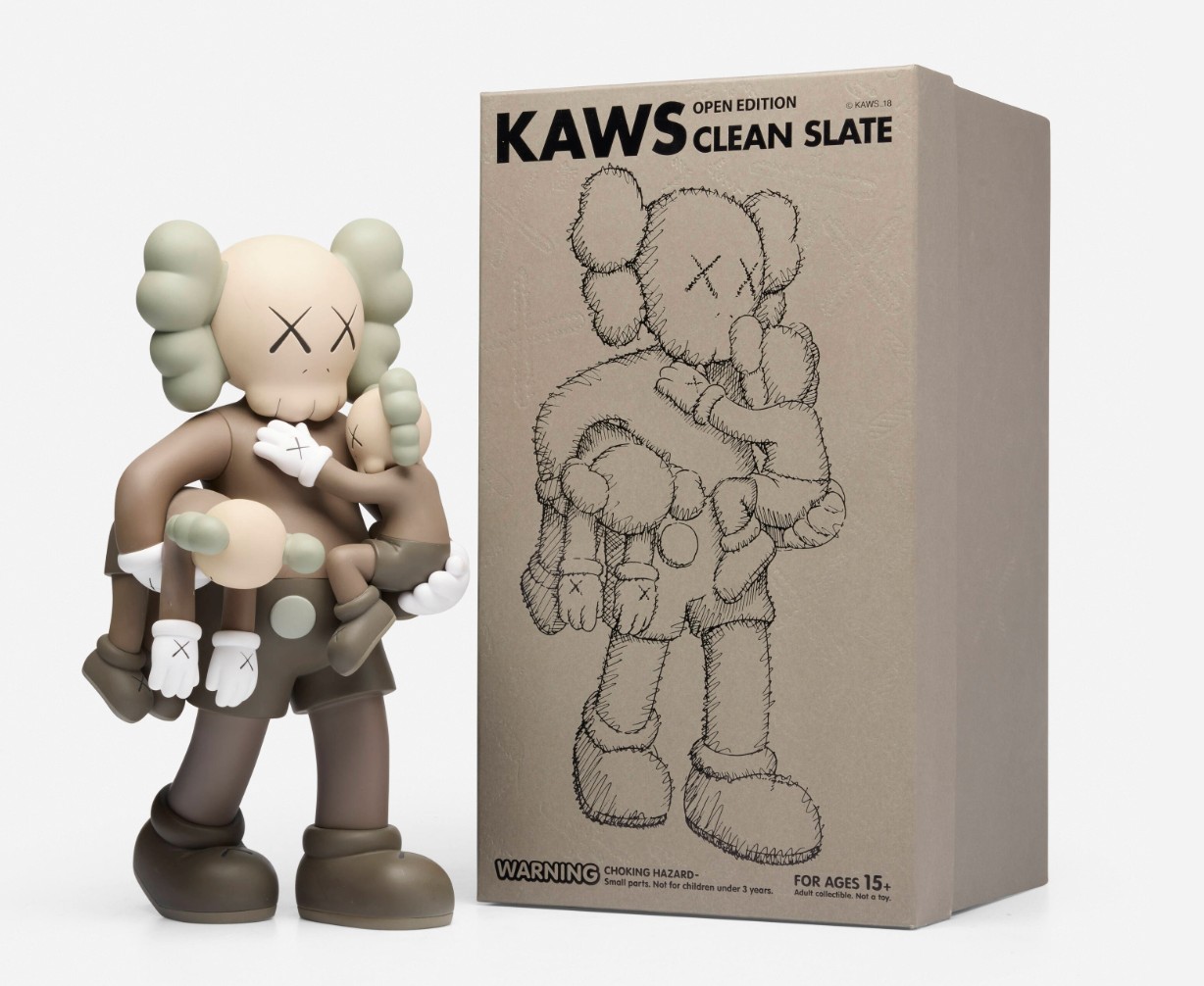
Clean Slate (Brown)
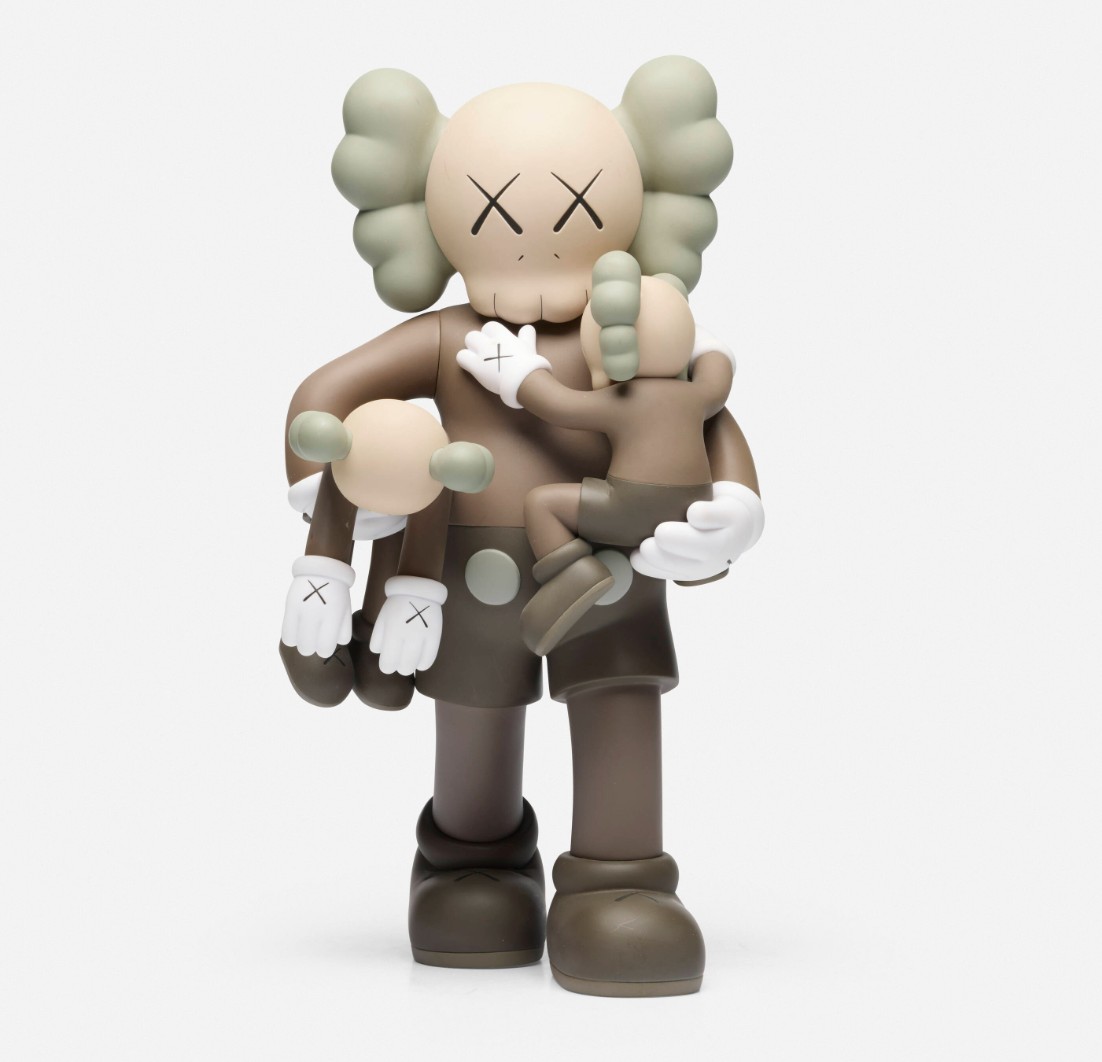
The adult COMPANION’s face remains neutral, its “X” eyes fixed and unreadable. There is no facial expression to guide interpretation; meaning is carried entirely by posture and weight distribution. The hands are functional, positioned to secure both figures rather than express emotion. The composition is therefore resolved through structure, not gesture.
Medium, Edition, and Release Context
Released in 2018, CLEAN SLATE was produced as a painted cast vinyl sculpture in collaboration with Medicom Toy. The work stands approximately 14 inches high and was issued in a finite, closed edition across three colorways—brown, grey, and black—without publicly disclosed numbering. While distributed through drop-based releases, the work should not be considered an open edition. A smaller version, released subsequently, functions closer to an open edition and is more widely available.
The release follows the institutional consolidation of KAWS’ career, notably after KAWS: WHERE THE END STARTS (2016–2017). By this point, his editioned works were operating at full global demand, with immediate sell-outs and strong secondary market circulation.
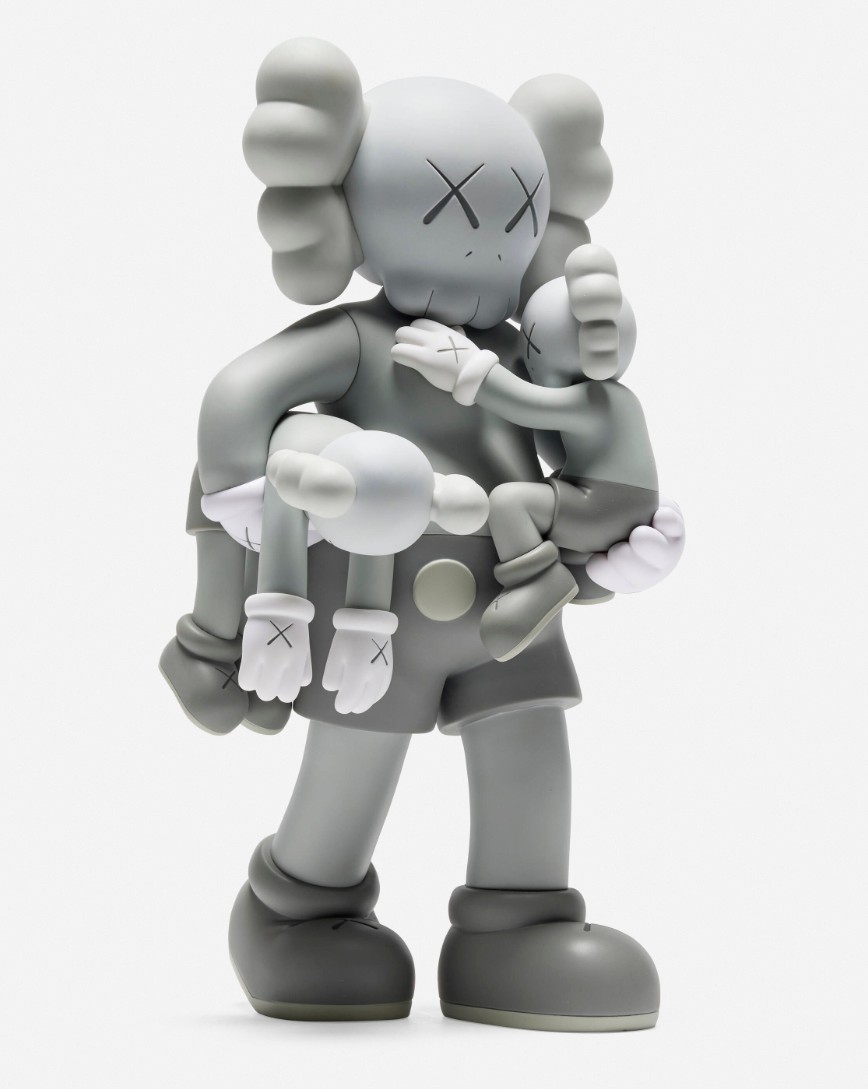
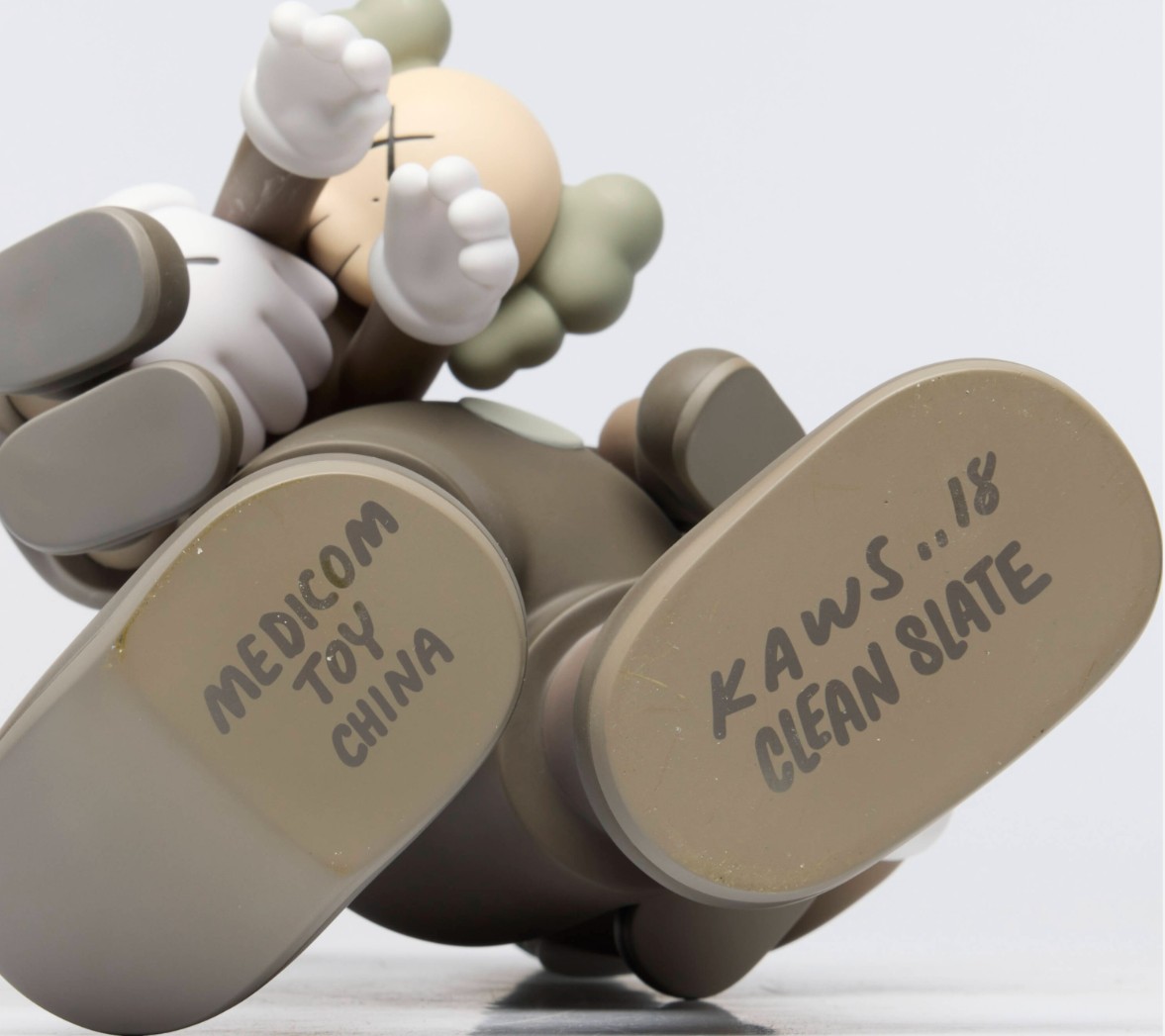
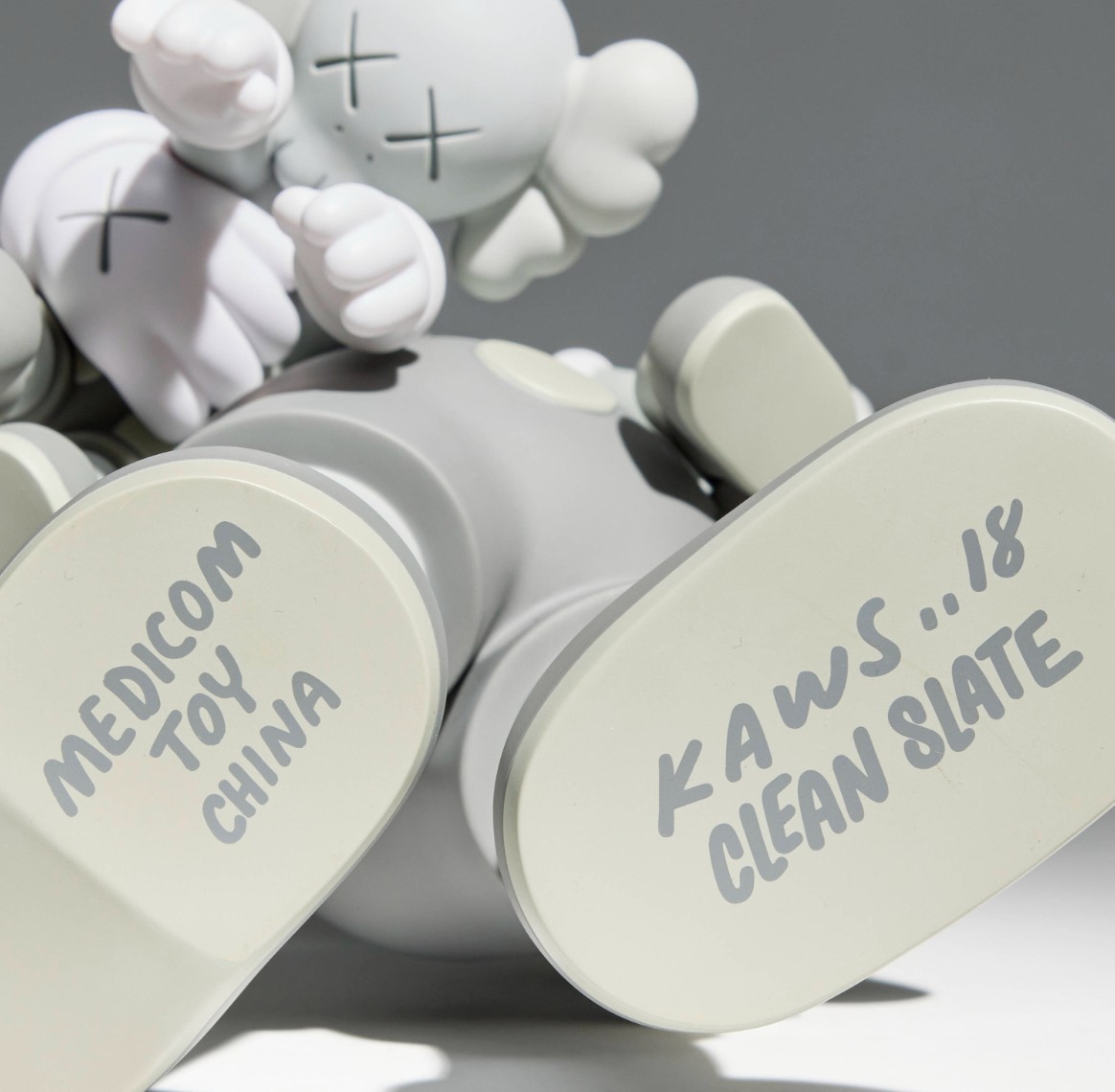
Clean Slate (Grey)
Within this context, CLEAN SLATE is part of a shift toward constructed narratives. Unlike earlier works rooted in appropriation or isolated figures, this sculpture introduces a self-contained scenario—one that does not rely on external references but on internal relationships between forms.
The Three Colorways: Brown, Grey, and Black
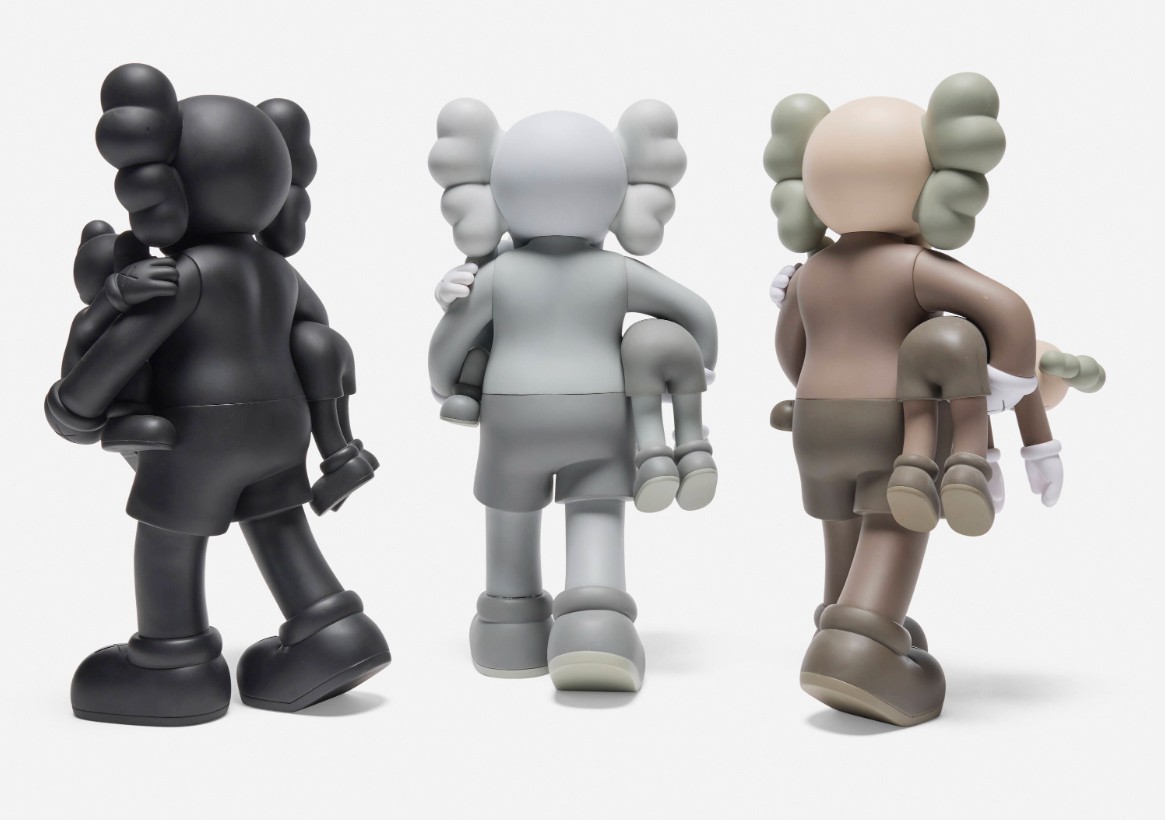
The sculpture was released in three colorways, brown, grey, and black, each producing a distinct reading of the same composition.
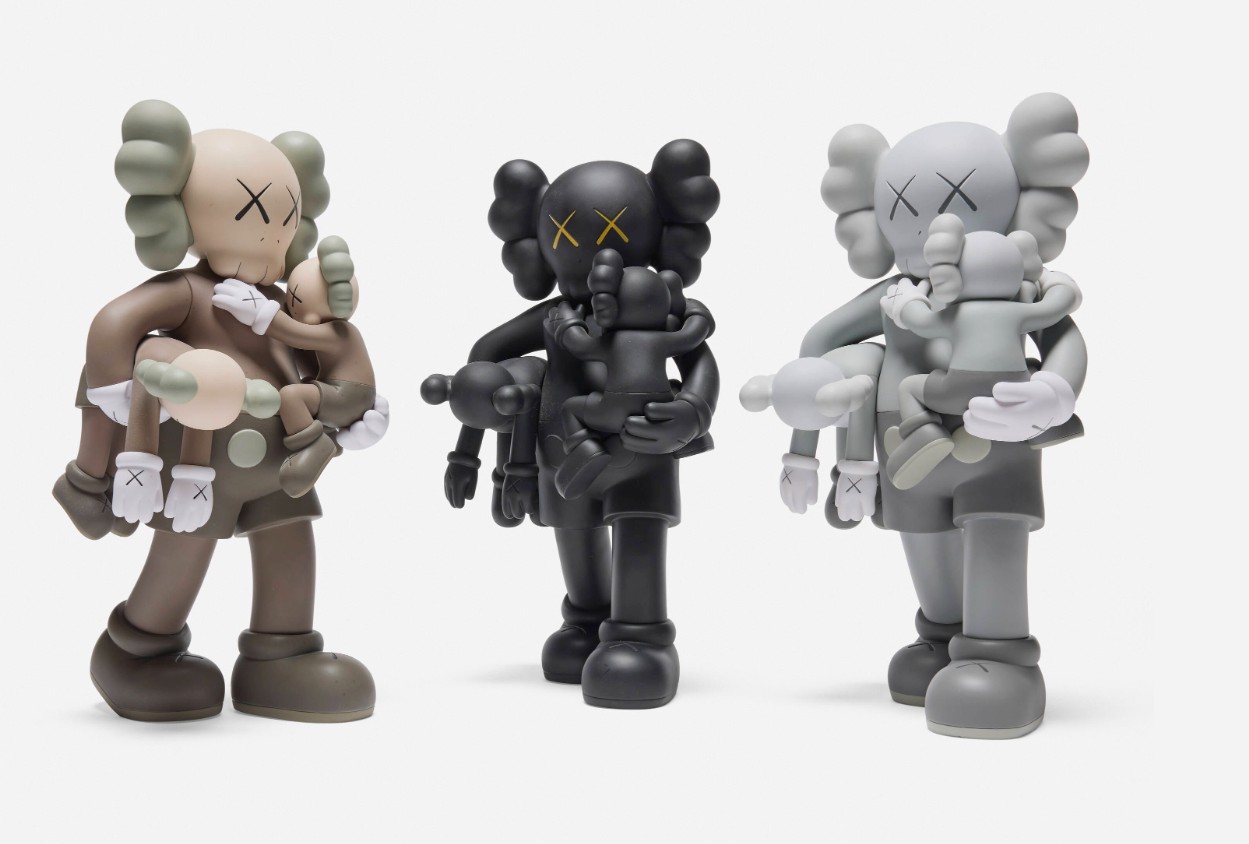
The brown version is the most articulated. It combines multiple tones—beige, muted green, and soft brown—creating visual differentiation between the figures. This segmentation introduces a more humanized reading, where each body feels distinct rather than absorbed into a single mass. The emotional tone is more intimate and grounded, closer to a domestic or lived scenario.
The grey version reduces the composition to a near-monochrome field. The figures merge visually, and the emphasis shifts toward volume and structure. The narrative becomes less explicit, replaced by a more formal reading of balance, weight, and sculptural cohesion.
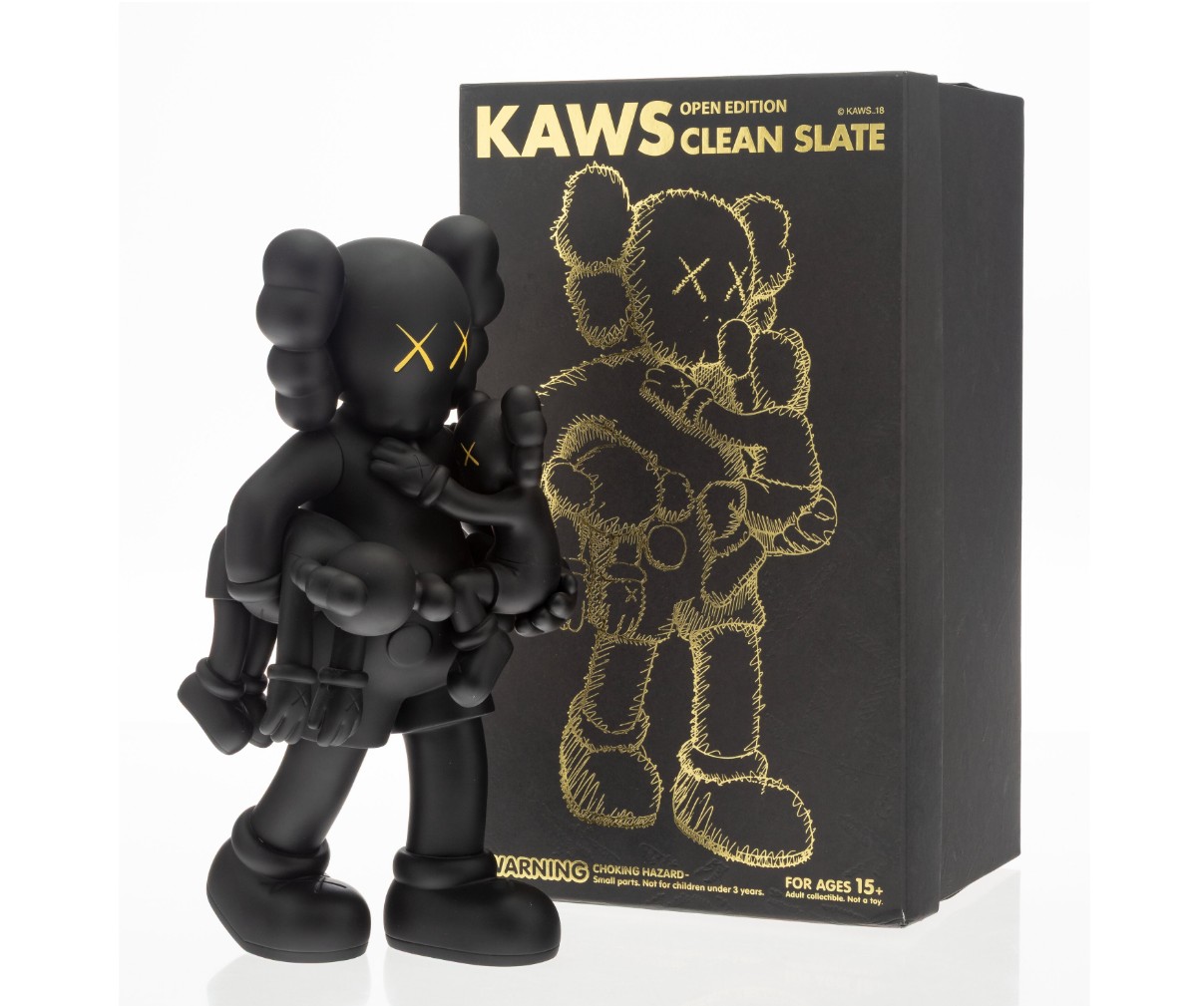
The black version is the most graphic. Executed in deep matte black with contrasting yellow “X” eyes, it restores a strong visual hierarchy. The figures collapse into a single silhouette, and the composition reads more as an emblem than a scene. The emotional register becomes sharper, more distant, and more aligned with KAWS’ earlier visual identity.
The structure is identical across all three, yet the distribution of meaning shifts through color: the brown emphasizes relationship, the grey emphasizes form, and the black emphasizes symbol.
Title and Conceptual Meaning
The title CLEAN SLATE introduces a deliberate contradiction. Conventionally, the phrase implies renewal, erasure of the past, and the possibility of beginning again without burden. The sculpture, however, presents the opposite condition.
The central figure is already carrying weight—literally and structurally. There is no moment of release, no gesture of starting over. Instead, the work suggests that any “clean slate” is theoretical at best. The figure does not arrive at a new beginning empty-handed; it does so already responsible, already engaged, already encumbered.
The presence of two children reinforces this reading. The figure is not choosing between past and future—it is managing multiple obligations simultaneously. One child demands active attention, the other imposes passive weight. The title, in this context, reads almost ironically: not as a promise, but as an unattainable condition.
Rather than depicting renewal, the sculpture articulates continuity—specifically, the persistence of responsibility across any supposed reset. The slate is never clean; it is simply rewritten under pressure.
Exhibition Context and Relation to Monumental Practice
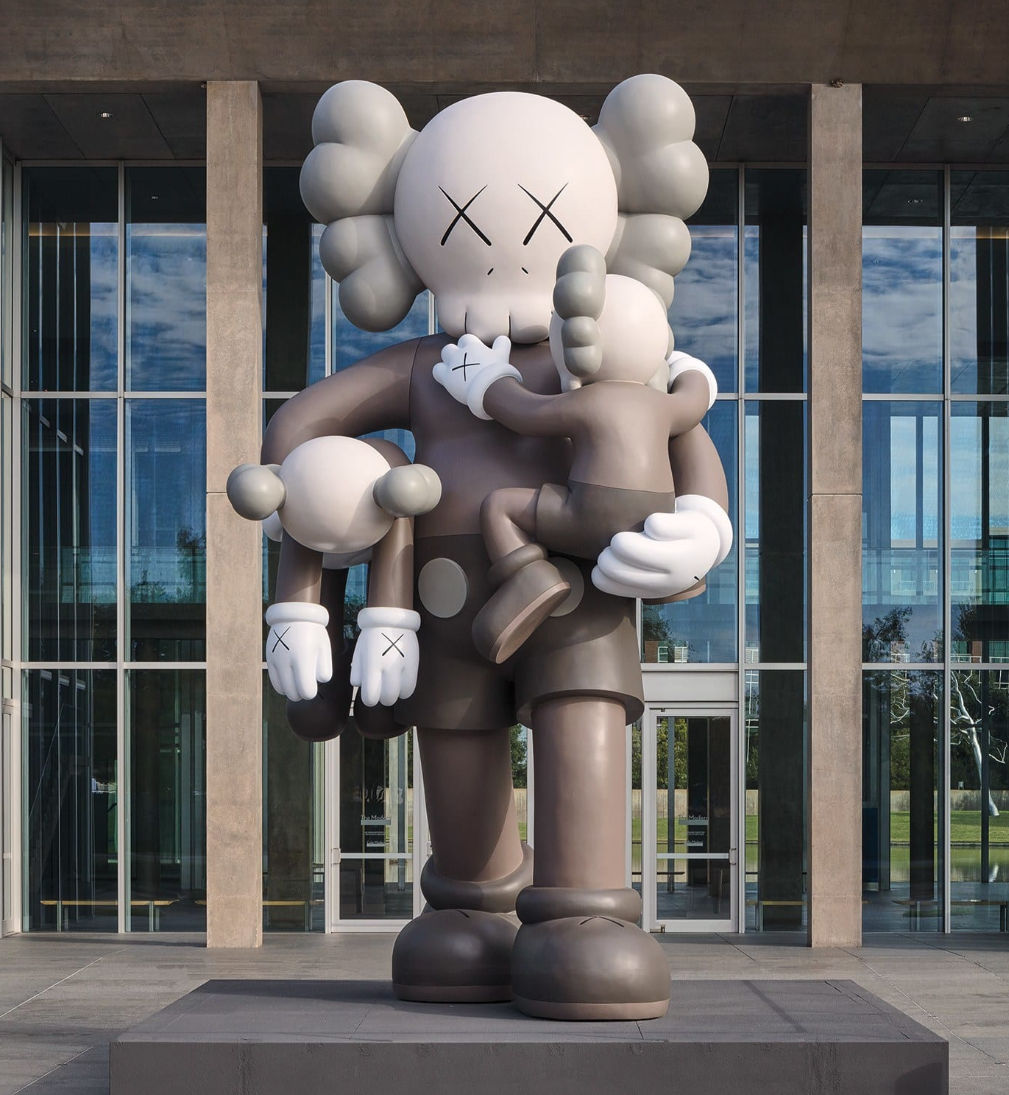
CLEAN SLATE aligns with KAWS’ broader sculptural vocabulary, particularly his large-scale COMPANION figures installed globally in cities such as Hong Kong, Seoul, and Taipei. While those works often emphasize solitude or introspection, CLEAN SLATE introduces a more complex relational structure.
The composition has not been as widely monumentalized as single-figure works, likely due to its density and asymmetry. However, it has been included in exhibition contexts where its clarity and narrative precision allow it to function as a focal point without reliance on scale.
Its strength lies precisely in this compression: a multi-figure dynamic resolved within a compact format, capable of operating equally in gallery and institutional environments.
Clean Slate (Black)
Position within KAWS’ Oeuvre
CLEAN SLATE marks a transition from isolated figures to interdependent compositions, and from ambiguity to defined narrative tension. The introduction of two children transforms the COMPANION into a figure embedded within a system rather than standing apart from it.
The sculpture does not resolve its tension. The figure is neither overwhelmed nor in control—it is simply holding. This state of suspension, rather than resolution, is what gives the work its precision.
If earlier KAWS works operate through recognition, CLEAN SLATE operates through structure. It demonstrates that his visual language, while reduced, is capable of sustaining complex relationships when deployed with discipline.
CLEAN SLATE, 2018
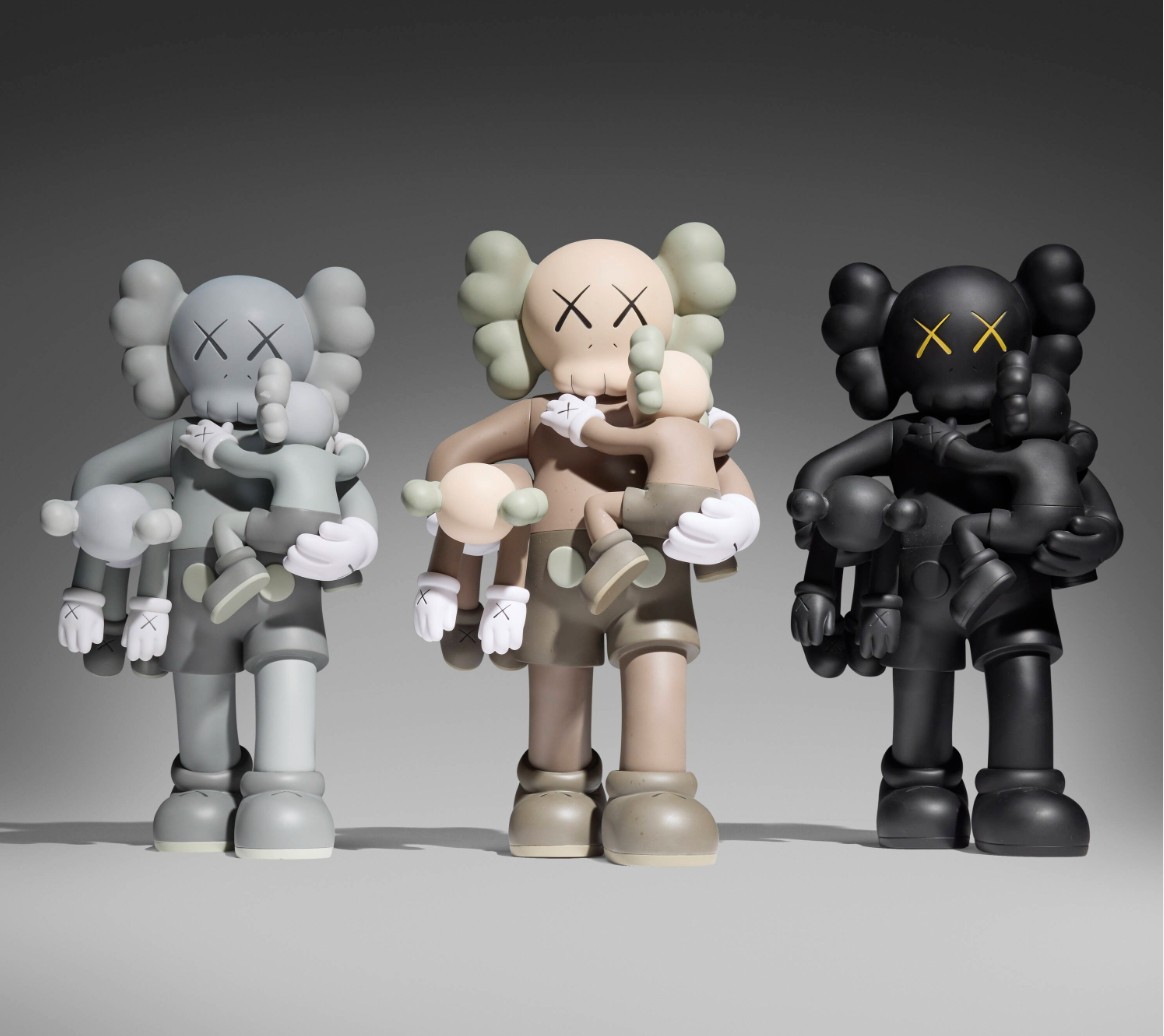
CLEAN SLATE (Grey, Brown, Black)
The complete set of 3 works
Medium: Painted cast vinyl
Year: 2018
Dimensions: 37x20x19 (14-5/8 x 7-5/8 x 7-1/2 inches)
Edition: unknown size
Produced by Medicom Toy, Tokyo
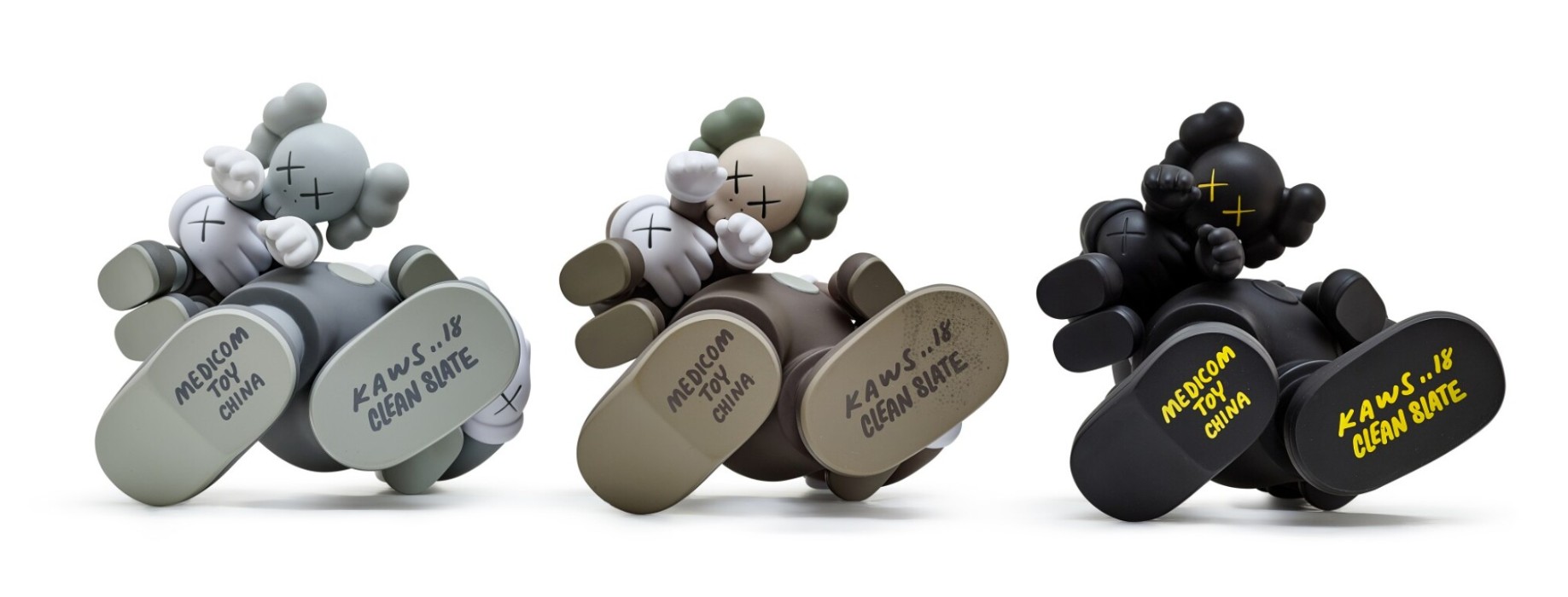
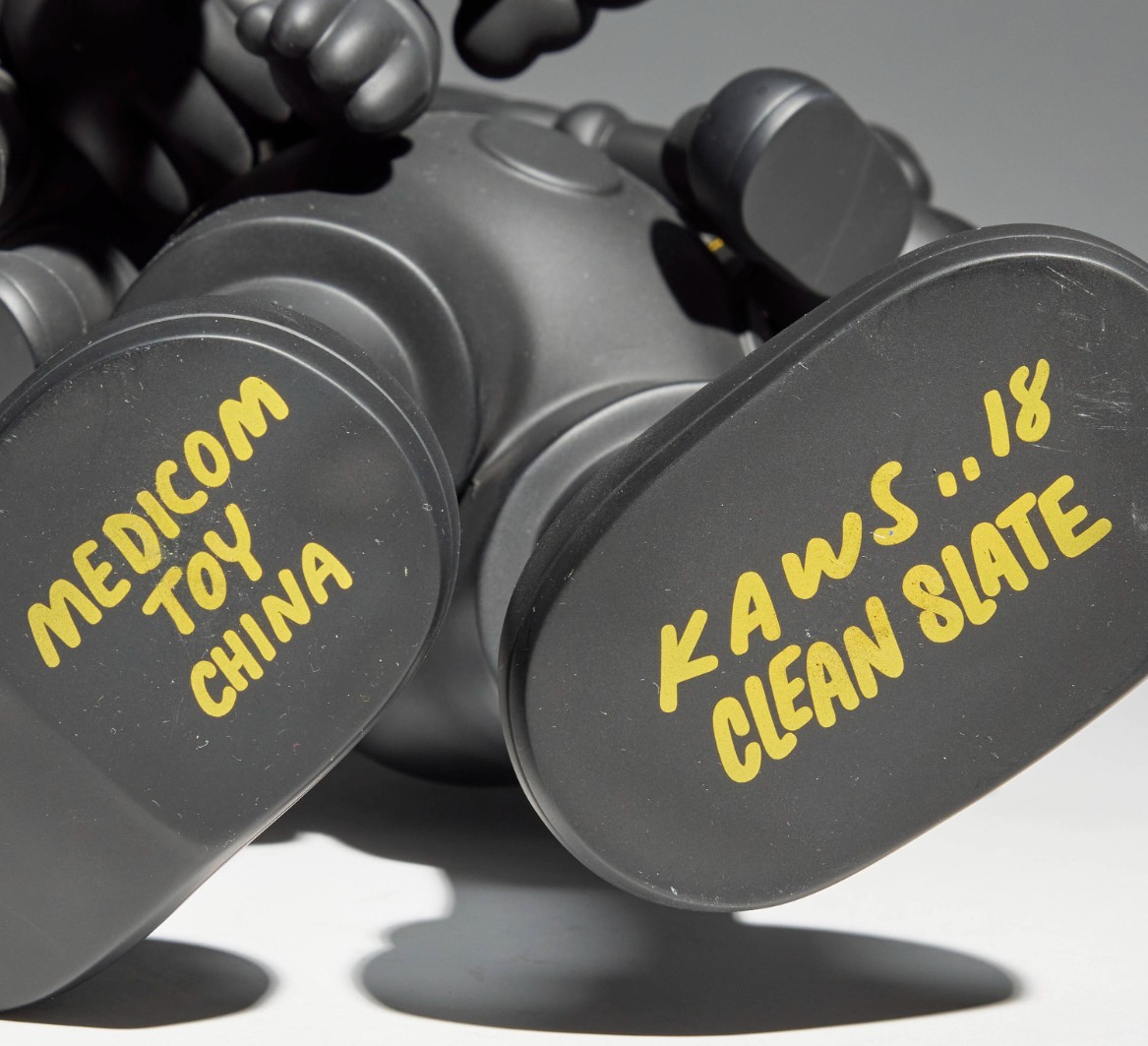
Stamped signature, title, date and manufacturer’s mark to underside
‘Kaws.. 18 Clean Slate Medicom Toy China’
Auction Results
SBI Art Auction: 12 September 2025
Estimated: JPY 150,000 – 250,000
JPY 299,000 / USD 2,020
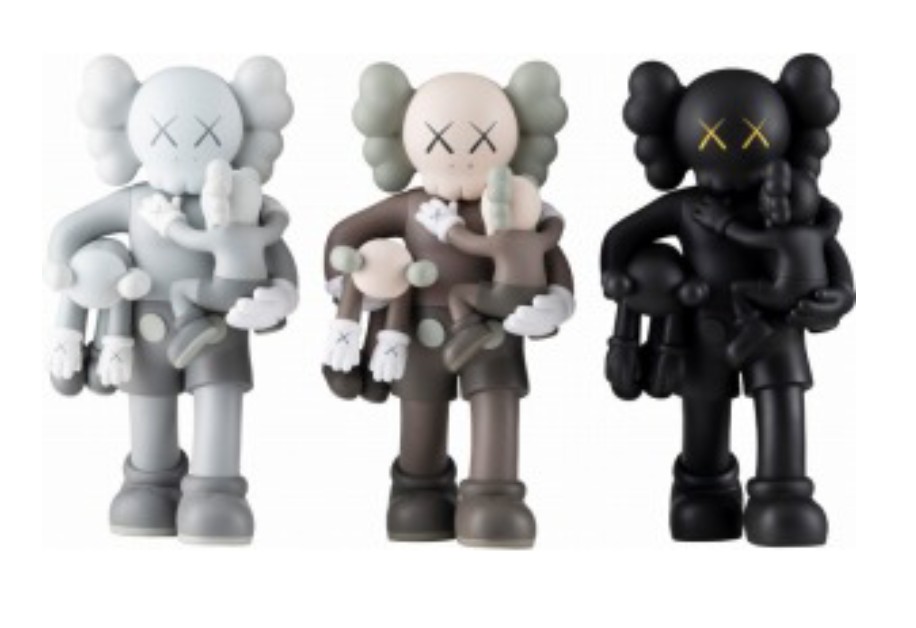
KAWS
CLEAN SLATE OPEN EDITION (Gray, Brown, Black), 2018
Vinyl, multiple with original case, 3 works
LA Modern: 28 August 2024
Estimated: USD 2,000 – 3,000
USD 2,064
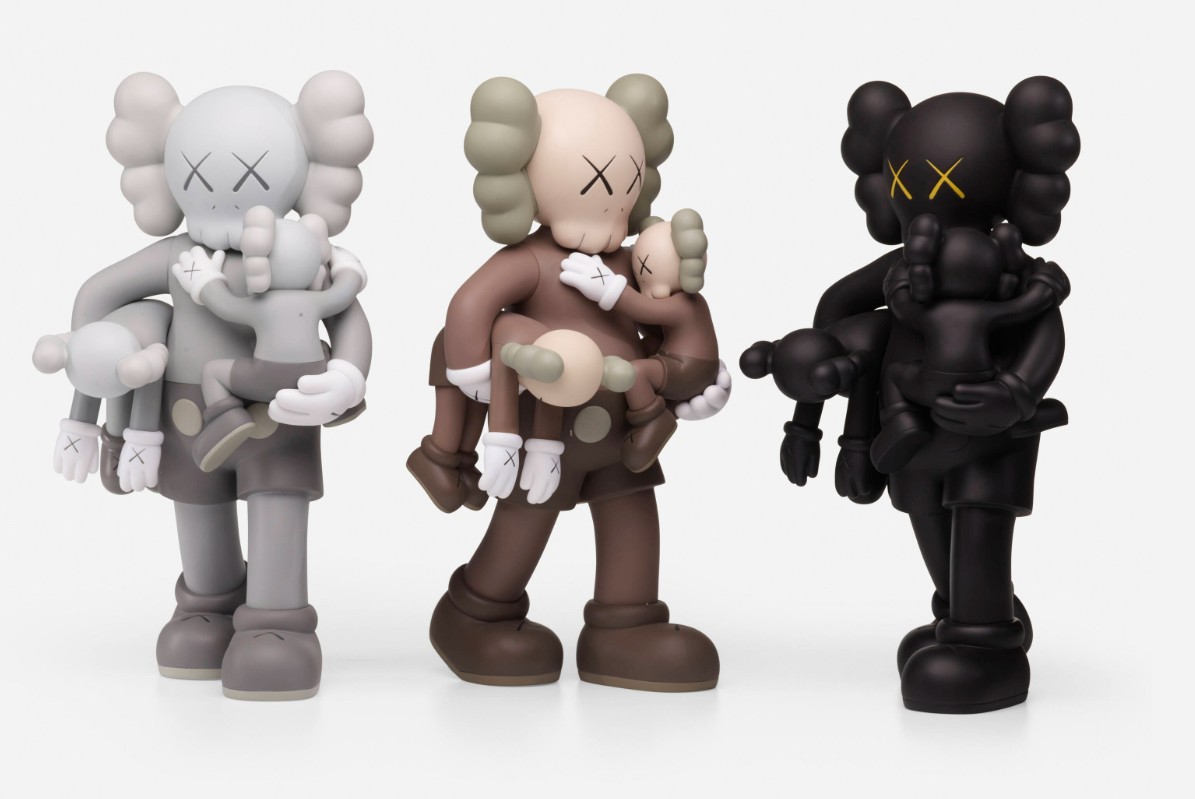
KAWS (Brian Donnelly, b.1974)
Clean Slate (three works), 2018
Painted cast vinyl
Stamped signature, title, date and manufacturer’s mark to underside of each work
‘Kaws.. 18 Clean Slate Medicom Toy China’
This complete set of three works is from the edition of unknown size
Produced by Medicom Toy, Tokyo
Sold with original packaging
Sotheby’s Hong-Kong: 15 September 2020
Estimated: HKD 9,000 – 15,000
HKD 40,320 / USD 5,200
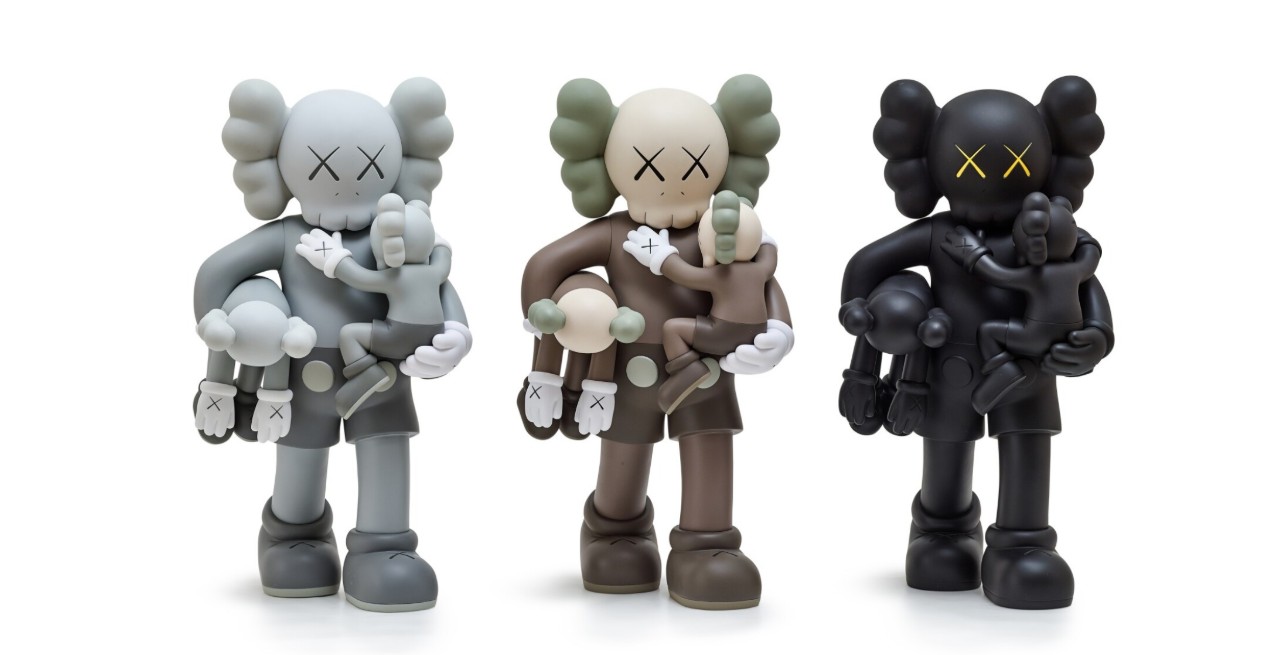
KAWS (b.1974)
CLEAN SLATE (BROWN/ BLACK/ GREY) (THREE WORKS), 2018
Painted cast vinyl, with respective original product box
Each printed with the artist’s signature, title and dated 18 and fabricator on the underside
Executed in 2018, these works are from an open edition produced by Medicom Toy
Clean Slate (Brown)
Clean Slate (Grey)
Clean Slate (Black)
Monumental
CLEAN SLATE
Medium: Fiberglass, metal structure and paint
Year: 2014
Base: 19 5/8 x 216 1/2 x 216 1/2 inches (49.8 x 549.9 x 549.9 cm)
Sculpture: 275 5/8 x 216 x 216 inches (700.1 x 548.6 x 548.6 cm)
Overall: 295 1/4 x 216 1/2 x 216 1/2 inches (749.9 x 549.9 x 549.9 cm)
Edition: 3 unique color variants
Towering over its viewers and animating its surroundings with a uniquely uncanny presence, KAWS’ CLEAN SLATE, 2014, comprises the ultimate monument to the artist’s trademark Companion figure. Recreated in fiberglass at a colossal scale, the Companion is captured midstride, holding two smaller, cloned child-like versions of itself in its arms as it moves forward with a resolution and confidence that seems to reflect the notion of starting with a “Clean Slate” as its title suggests. Since its unveiling in Hong Kong in 2014 as one of KAWS’ largest public sculptures, CLEAN SLATE has taken a prominent position as the artist’s most recognizable figure. Not only was it the first KAWS sculpture of that magnitude to be exhibited in mainland China when it was subsequently erected in Shanghai Times Square in 2015, it was also the key highlight of KAWS’ major museum exhibition KAWS: WHERE THE END STARTS where it was displayed outside of the Modern Art Museum of Fort Worth in 2016 and 2017. With the figure inspiring the artist to create smaller versions, both for exhibitions at such seminal venues as the Yorkshire Sculpture Park as well as in the form of limited edition toys, it has become a truly global icon of our time that captures the way in which KAWS has irrevocably changed the relationship between fine art and pop culture.
It has been with large-scale sculptures such as the present one that KAWS, aka Brian Donnelly, has in recent years claimed his position among the most forward-looking contemporary sculptors of our present age. Like his artistic idols Claes Oldenburg and Jeff Koons before him, he scales up pop cultural motifs with an irreverent nod to the grand tradition of sculpture. CLEAN SLATE perfectly demonstrates how KAWS re-contextualizes the role of mass culture in art, based as it is on the Companion character that initially took the form of small-scale figurines starting in 1999. KAWS, then largely known as a graffiti provocateur, began collaborating with the Japanese apparel line Bounty Hunter to create a limited edition of vinyl toys. What began as toy versions radically expanded in the past decade to become supersize works of sculpture, deliberately aimed at dismantling distinctions between high and low art. As KAWS explained, speaking of his strategy of blurring the lines between toys and sculptures, “to me they involve the same thought process, so it’s funny that when I work big in bronze, it’s called a sculpture, but something I do that’s small and plastic is called a toy” (KAWS, quoted in Carlo McCormick, “From the Streets to TV to Fine Art Galleries, KAWS Is Everywhere”, Paper, November 4, 2013, online). As the present work exemplifies, KAWS still manages to convey toy-like plushness in the sculptural surface of his monumental works in a manner that echoes Jef Koons’s “Play-doh” sculptures.
A bold affront to the classical medium of sculpture, CLEAN SLATE confronts the viewer with a hybrid character that is emblematic of the visual tactic of cartoon appropriation KAWS has become synonymous with. Enacting a sardonic appropriation of arguably the most recognizable cartoon character of all time, Mickey Mouse, KAWS takes on a subject that previously entered art history through the appropriated images of pop artists Roy Lichtenstein and Andy Warhol. Yet here the regular reading of the endearing and upbeat cartoon character is disturbed by KAWS’ supplanting of the head with his own eerie skull motif; an irreverent decapitation that instantaneously elicits an emotionally weighted sense of the uncanny amongst a familiar audience. At once saccharine and regal, KAWS privileges the potency of hybridity as a creative tactic to challenge and deconstruct cultural boundaries. KAWS taps into the nostalgic potency of universally cherished childhood characters, importantly imbuing them with emotional undertones as he updates them for our contemporary context.
KAWS conceived of CLEAN SLATE specifically for his second collaboration with Harbour City, Hong Kong’s largest shopping mall that had previously hosted his first exhibition in Greater China in 2010. Reflecting on PASSING THROUGH, the work that he had created for the first iteration and featured a seated Companion with its head in his hands, KAWS noted, “I went on a site visit to Kowloon and there was just a sea of people. It’s easy to pass people sitting on the street like this all day long – you don’t think twice – but when you see something on that scale you might stop and think a little more about what’s going on” (KAWS, quoted in “Toy Story 2: This Time It’s Artistic”, The Independent, January 31, 2016, online). KAWS monumentalizes his Companion with the present work to similar ends, seeking a diverse public to encourage viewers and unsuspecting passersby alike to pause and reflect in the maelstrom of our contemporary age.
“Companion is a figure in the world now, and it’s not all great out there,” KAWS has explained. “Even though I use a comic language, my figures are not always reflecting the idealistic cartoon view that I grew up on…Companion is more real in dealing with contemporary human circumstances. I think when I’m making work it also often mirrors what’s going on with me at that time” (KAWS, quoted in KAWS: WHERE THE END STARTS, exh. cat., Modern Art Museum of Fort Worth, Fort Worth, 2016, p. 5). If KAWS’ Companion was caught in a state of isolation with PASSING THROUGH, here he marches resolutely forward with two smaller child-like Companions in his arms in a manner that embodies the optimism and dynamism its very title “CLEAN SLATE” suggests. Like GOOD INTENTIONS, 2005, a large-scale sculpture comprised of a large and small, toddler-like Companions, this sculpture offers a highly intimate portrait of parenthood that, not unlike Henry Moore’s Mother and Child sculptures, is likely reflective of KAWS’s own experience of becoming a father at that time. As Andrea Karnes noted, his Companions “seemingly empathize with us while we emphasize with them – plodding through life” (Andrea Karnes, KAWS: WHERE THE END STARTS, exh. cat., Modern Art Museum of Fort Worth, Fort Worth, 2016, p. 49).
Despite being imbued with autobiographical undertones, CLEAN SLATE is of universal resonance. Both mourning and celebrating a globalized age of expedited communication, this grand statue reminds usof our own place within society. In the world of cartoons where emotions and violence are readily sanitized for consumption, KAWS’s evolved hybrids operate in a liminal state between life and death, somehow immune to the relentless appeals to shock made by mass media. KAWS leaves behind art’s romantic anti-commercial idealism, and looks toward contemporary Japanese distribution and the world of fantasy icons. His “X” eyes show blindness in a universe only inhabited by logos and brands – a world of homogeneity and indifference, but also a world where there remains hope and faith in the power of human relations.
CLEAN SLATE, 2014
Phillips New-York: 15 November 2018
Estimated: USD 900,000 – 1,200,000
USD 1,995,000
KAWS – 20th Century & Contemporary … Lot 27 November 2018 | Phillips
KAWS
CLEAN SLATE, 2014
Fiberglass, metal structure and paint
This work is 1 of 3 unique color variants