JEAN-MICHEL BASQUIAT
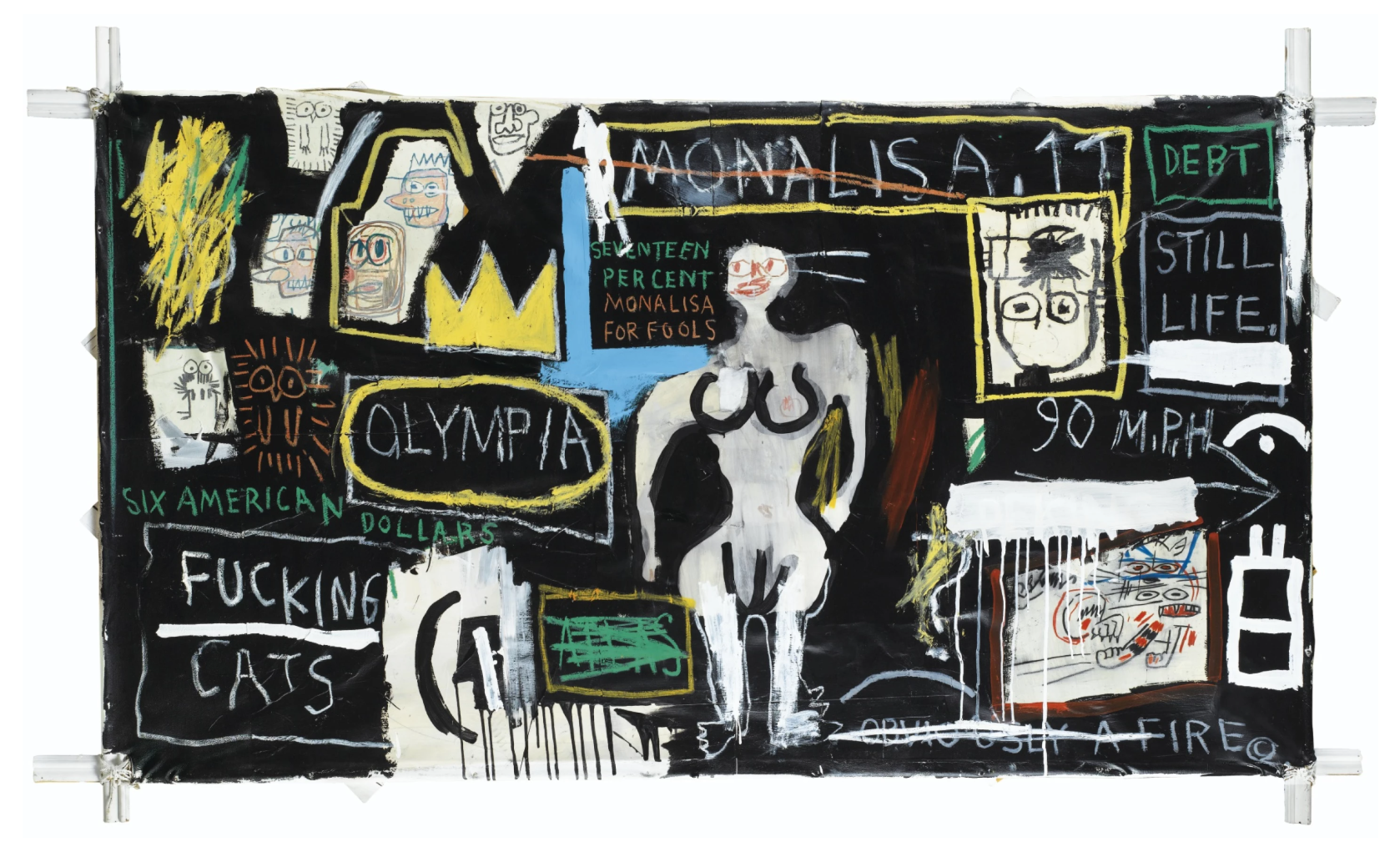
Crown Hotel (Mona Lisa Black Background), 1982
Acrylic and paper collage on canvas
48 5/8 x 85 inches (124×216 cm)
Signed, titled and dated on reverse
Provenance
Galerie Bruno Bischofberger, Zurich
Asher Edelman, New York
Mary Boone Gallery, New York
Acquired in May 1999 by the current owner
Auction History
Sotheby’s Paris: 6 June 2013
Estimated: EUR 5,000,000 – 7,000,000
EUR 5,697,500
The dense and eruptive composition of this work—structured around a monumental central female figure surrounded by multiple heads, symbols, writings, brushstrokes, and bursts of color with no apparent connection—reveals a profusion of visual and conceptual references that lie at the heart of Jean-Michel Basquiat’s aesthetic.
At first glance, nothing seems more visually distant from Crown Hotel (Mona Lisa Black Background) than Leonardo da Vinci’s Mona Lisa. The very choice of subject is surprising for an artist associated with Street Art. Yet, Leonardo played a fundamental role in Basquiat’s self-taught formation: by transposing this icon into a new aesthetic universe, Basquiat confronts and measures himself against his mentor. The result of this clash of titans is a work of unparalleled richness and complexity—powerful and coherent.
At the age of seven, after suffering a serious car accident, Jean-Michel Basquiat received a copy of the famous Gray’s Anatomy from his mother; throughout his recovery, the book fascinated the young boy. Later, the anatomical drawings of Leonardo that Basquiat discovered in the monograph published by Reynal and Company in 1966 became the idealized artistic extension of his first understanding of the human body. More than just the source of his artistic awakening, these drawings inspired him and remained a constant and lasting reference throughout his career, leading Basquiat to passionately study the Florentine Master.
During the crucial years of 1982–1983, Leonardo da Vinci’s influence frequently appears in Basquiat’s paintings; particularly obsessive, the Mona Lisa recurs in Mona Lisa (1983), Thesis (1983), and Boone (1983). Crown Hotel (Mona Lisa Black Background) (1982), however, stands out as the first of his most elaborate works on the subject: such a concentration of visually powerful images, imbued with meaning and ideology, exemplifies how Basquiat would henceforth approach and explore this theme.
These references to the Mona Lisa bear little resemblance to Marcel Duchamp’s irreverent and almost blasphemous reinterpretation in his famous L.H.O.O.Q., where a mustache and a small beard adorn a postcard-sized reproduction of La Joconde. Nor do they belong to the postmodernist culture of the 1980s, where citation became commonplace—exemplified by Andy Warhol’s Mona Lisa Cycle (1978–1983), created around the same time.
Marc Miller: What about Leonardo da Vinci… you often reference him in this exhibition at the Fun Gallery.
Jean-Michel Basquiat: (…) He’s my favorite artist, you know?
MM: And so you cite him frequently…
JMB: No, I don’t cite him.
MM: Then what is the connection between the title and the work?
JMB: Aesthetic.
MM: Aesthetic? In what sense? Leonardo is known for his carefully balanced compositions and the refinement of his tones.
JMB: No, they’re even more beautiful when they’ve been water-damaged.
(Jean-Michel Basquiat: An Interview)
Basquiat’s refusal to engage in direct quotation reflects a much deeper relationship with classical art, embodied by the Mona Lisa. His way of understanding and capturing the past involves a process of image deconstruction—not with iconoclastic intent, but with the goal of assimilating and integrating an archetypal ideal of perfection into his own personal universe, teeming with references and ideological resonances.
As the first Black artist to achieve meteoric international success (in 1982, at just twenty-two, he was the youngest invited artist at Documenta in Kassel), Basquiat was aware of the problematic, or at least ambiguous, position he occupied concerning Black culture—a culture historically denied a past, a history, and the possibility of claiming an ideal for identification. “For Basquiat, Leonardo da Vinci’s Mona Lisa, as the ultimate embodiment of beauty, represents the traditions of art history whose definitions and subsequent canon are inextricably racialized and culturally exclusive; consequently, the Mona Lisa symbolizes for Basquiat the grand tradition of art that he, with irony, seeks to dismantle and penetrate through his own artistic contribution” (J.E. Braziel, Artist, Performers, and Black Masculinity in the Haitian Diaspora, Bloomington, 2008, p. 178).
Thus, while the background landscape in the Mona Lisa reflects Mona Lisa’s ideal, Platonic, and mysterious beauty, Basquiat’s Mona Lisa is characterized by its Black Background, conceived not just as the space where the portrait stands but as a dense and powerful environment in its own right.
In Basquiat’s painting, Leonardo’s ideal of Platonic beauty dissolves into a central female figure—diaphanous, almost phosphorescent, lacking real substance, except for an exaggerated sexual identity that deliberately contrasts with the cultivated sexual ambiguity in Leonardo’s portrait.
The recurring use of white in multiple areas of the composition further accentuates the clash between two cultures, while the deliberately exposed white-painted stretcher frame extends beyond the canvas as a metaphorical support for the intense blackness of the background.
In Crown Hotel, to the left of the frontal figure, the direct reference to Manet’s Olympia (another subject Basquiat tackled in his 1982 works, such as Three Quarters of Olympia Minus the Servant or Untitled (Detail of Maid from Olympia)) stems not only from his bold determination to provide Black culture with a different representation than that of the enslaved figure perpetuated by Western tradition, but also from his intention to reveal the heroism of the Black servant. This heroism is signified and symbolized by a magnificent golden crown dominating the composition.
Thus, the ideal archetype of beauty in the Mona Lisa metamorphoses into a modern Olympia—a prostitute, a woman without status but not without dignity, imagined within the fictional Crown Hotel, a place where the Black woman could exist.
Conversely, the Platonic perfection represented by the Mona Lisa, whose beauty as such has no place in Basquiat’s work, finds its counterpoint in the grotesque heads painted on the left side of the canvas, where Basquiat depicts the raw reality of human physiognomy: exaggerated, deformed, even caricatured features that expose the flaws of nature. These character heads, frequently found in Leonardo’s works, inspired several of Basquiat’s drawings. In at least one of them (Untitled, Leonardo and his Five Grotesque Heads, 1983), the reference to the Master is explicit.
It is worth turning to music—an essential element in Basquiat’s life—as a source of clues for interpreting his works, whose dense narrative framework is particularly allusive. Even before the start of his artistic career, music revealed the impact of Leonardo’s Mona Lisa on Basquiat’s work: *“During one of his performances at the Mudd Club in the late 1970s, Basquiat recited a poem to the rhythm of a melody that evoked Leonardo da Vinci’s Mona Lisa. He then followed with a rendition of Mona Lisa, a jazz ballad written by Ray Evans and Jay Livingston, popularized by Nat King Cole in 1950:
Mona Lisa, Mona Lisa
Men have named you
A second-class citizen
Tea-stained brown
With missing pages
If shown the motor
Each man would use
Two hundred pounds of effort
Denied the logic of
Primitive cartoon.”*
(J.E. Braziel, Artist, Performers, and Black Masculinity in the Haitian Diaspora, Bloomington, 2008, p. 181).
The complexity and semantic richness of Crown Hotel (Mona Lisa Black Background) defy any attempt at exhaustive interpretation, leaving the work open to endless readings. This painting exceptionally expresses Basquiat’s creative power and the diversity of his artistic resources. It is, moreover, a work where concept and execution merge in perfect balance. Crown Hotel (Mona Lisa Black Background) stands as an early artistic triumph in which expression, ideological consciousness, and autobiography unite in a powerful and iconic masterpiece.