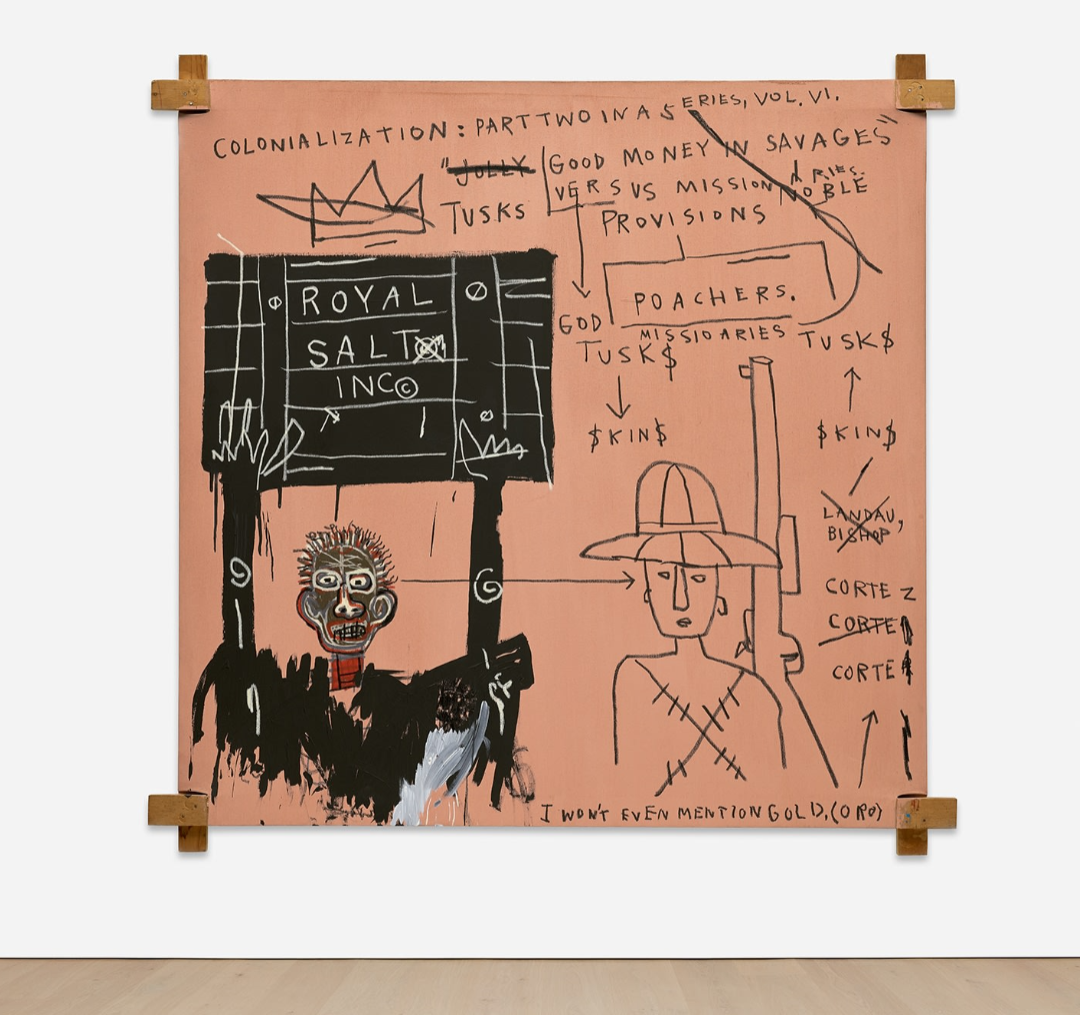
JEAN-MICHEL BASQUIAT
Native Carrying Some Guns, Bibles, Amorites on Safari, 1982
Acrylic and oil stick on canvas on wood supports
72 1/8 x 71 3/4 inches (183.2 x 182.2 cm)
Signed, titled, dedicated and dated ‘”NATIVE CARRYING GUNS + BIBLES AMORITES ON SAFARI” Jean-Michel Basquiat 1982 to Glenn O’Brien’ on the reverse
Provenance
Glenn O’ Brien, New York (acquired directly from the artist)
Annina Nosei Gallery, New York (acquired from the above)
Francesco Pellizzi, New York (acquired from the above in 1983)
Thence by descent to the present owner
Auction History
Phillips Hong-Kong: 31 May 2024
Estimated: HKD 90,000,000 – 120,000,000
HKD 98,735,000 / USD 12,640,507
https://www.phillips.com/detail/jeanmichel-basquiat/HK010124/10
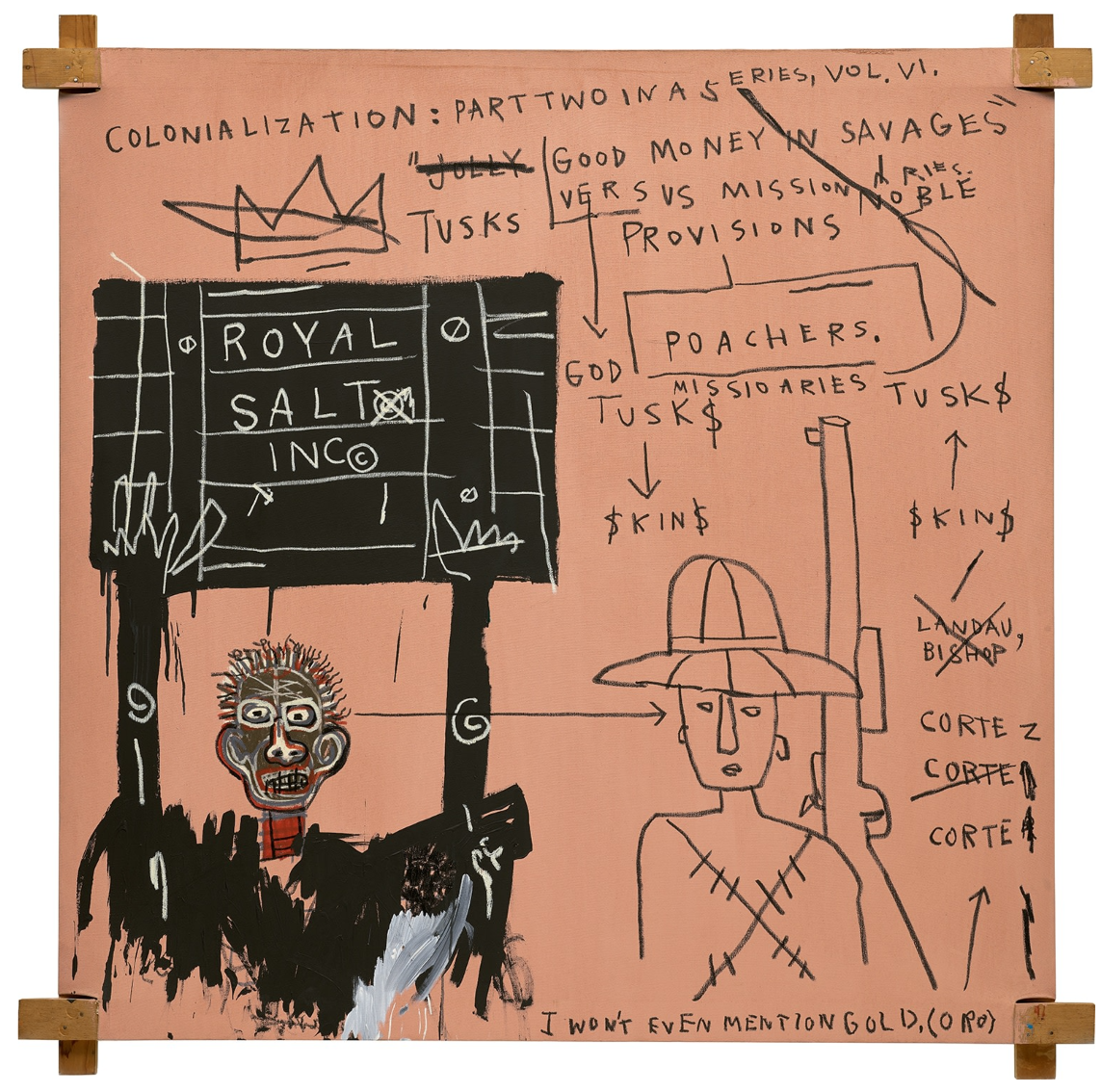
In Jean-Michel Basquiat’s Native Carrying Some Guns, Bibles, Amorites on Safari, 1982, a Black figure dominates the canvas, arms raised to the sky, confronting a colonial poacher. The present artwork evinces Basquiat’s visual poetry, as layered linguistic meaning intertwines with vivid imagery to provoke thought and reflection on themes including slavery and empire. The exposed stretcher enhances its gritty narrative, infusing it with a raw, unrestrained essence and a near-sculptural presence characteristic of Basquiat’s celebrated stretcher paintings. Reduced to caricatures, Basquiat’s figures symbolize ‘native’ and ‘colonizer.’ They stand as a poignant critique of colonial commerce, encapsulating broader themes of colonization, commercialization, and African American history. In Native Carrying Some Guns, Bibles, Amorites on Safari, Basquiat’s art amalgamates diverse cultural influences, ranging from the Bible to African tribal masks, with textual references to money, value, authenticity, and ownership. This synthesis creates a unique iconography reflective of his New York experience as well as his Caribbean ethnicity and West-African heritage.
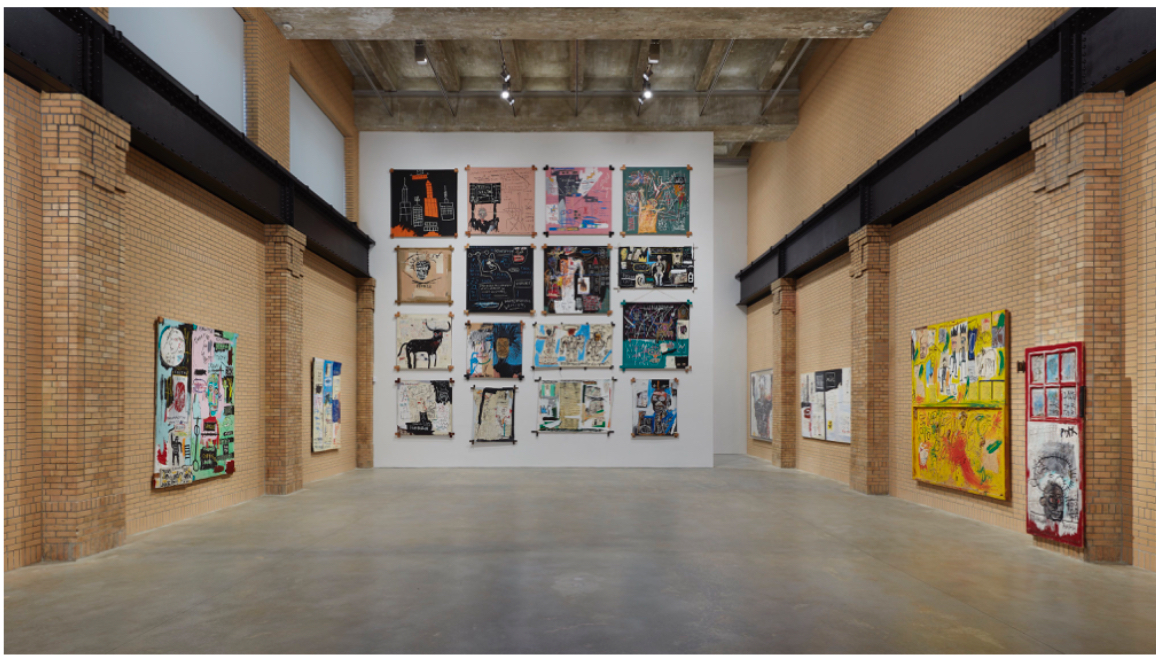
Present work installed at The Brant Foundation, Jean-Michel Basquiat, March 6 – May 14, 2019. Image: Tom Powel Imaging, Artwork: © Estate of Jean-Michel Basquiat. Licensed by Artestar, New York
The present work was created in 1982, a significant year in Basquiat’s career marked by his first solo show in the United States, staged at Annina Nosei Gallery in New York. The work was first owned by the influential author Glenn O’Brien (and is in fact dedicated to him on the reverse), before being acquired by Francesco Pellizzi in 1983. An inspired collector and friend of the artist, Professor Pellizzi was the co-founder and editor of the journal Res, Anthropology, and Aesthetics, published by the Peabody at Harvard and Chicago University Press. Native Carrying Some Guns, Bibles, Amorites on Safari was first showcased in an exhibition dedicated to the Collection of Francesco Pellizzi, held at the Hofstra Museum in New York in 1989. It is prominently featured on the cover of the accompanying catalogue. The painting has been extensively discussed in the broader scholarly literature on the artist and has been featured in numerous highly acclaimed traveling retrospectives, including exhibitions organized by the Whitney Museum of American Art in New York in 1992, the Brooklyn Museum in New York in 2005 and, most recently, the Brant Foundation in New York in 2019 where it was part of a dramatic salon-style wall grid of wooden support paintings from 1982.
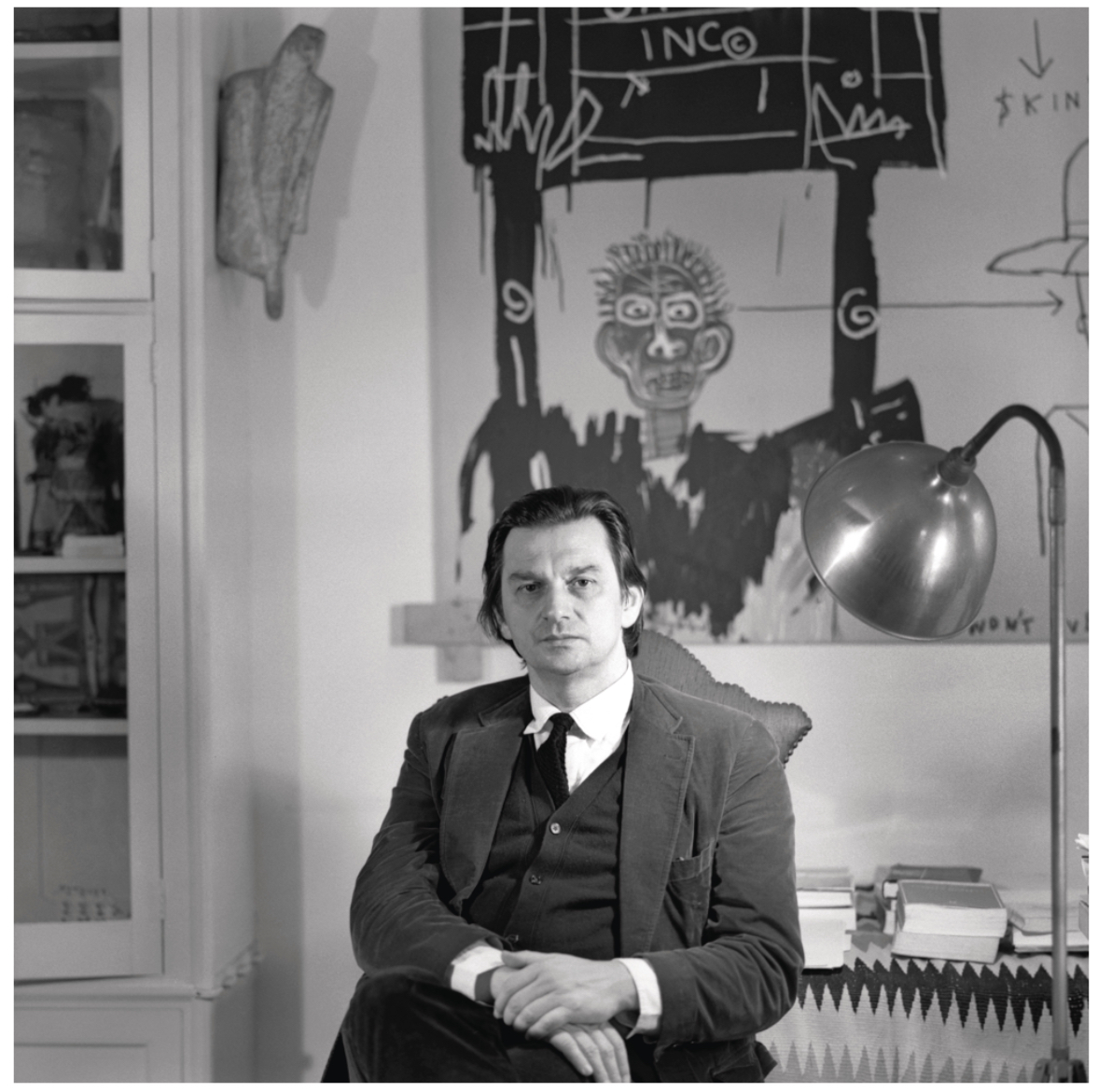
Francesco Pellizzi seated in front of Native Carrying Some Guns, Bibles, Amorites on Safari, 1982, n.d. Photograph by Jeannette Montgomery Barron. Image: © Jeannette Montgomery Barron / Trunk Archive
Artwork: © Estate of Jean-Michel Basquiat. Licensed by Artestar, New York
Native Carrying Some Guns, Bibles, Amorites on Safari belongs to a distinctive group of paintings executed during Basquiat’s meteoric ascent in 1982. This important work, distinguished by its exposed stretcher bars fixed at the corners, belongs to a series lauded by art critic Richard Marshall as Basquiat’s ‘most important group of paintings.’ Painted after severing ties with his former dealer and facing criticism from critics who argued that his rising international fame and ties to SoHo galleries were causing his work to lose its edge, the adoption of this daring new format signified that the young artist was unwilling to adhere to conventional norms. Basquiat introduced the first stretcher-bar paintings in an anarchic and intentionally ‘messy’ installation at his debut solo show at Patti Astor’s Fun Gallery on the Lower East Side in November 1982. Examples of the exposed stretcher bar paintings can be found in esteemed museum collections worldwide, including the Whitney Museum of American Art in New York, the Broad Art Foundation in Los Angeles, the Menil Collection in Houston, and the Montreal Museum of Fine Arts.
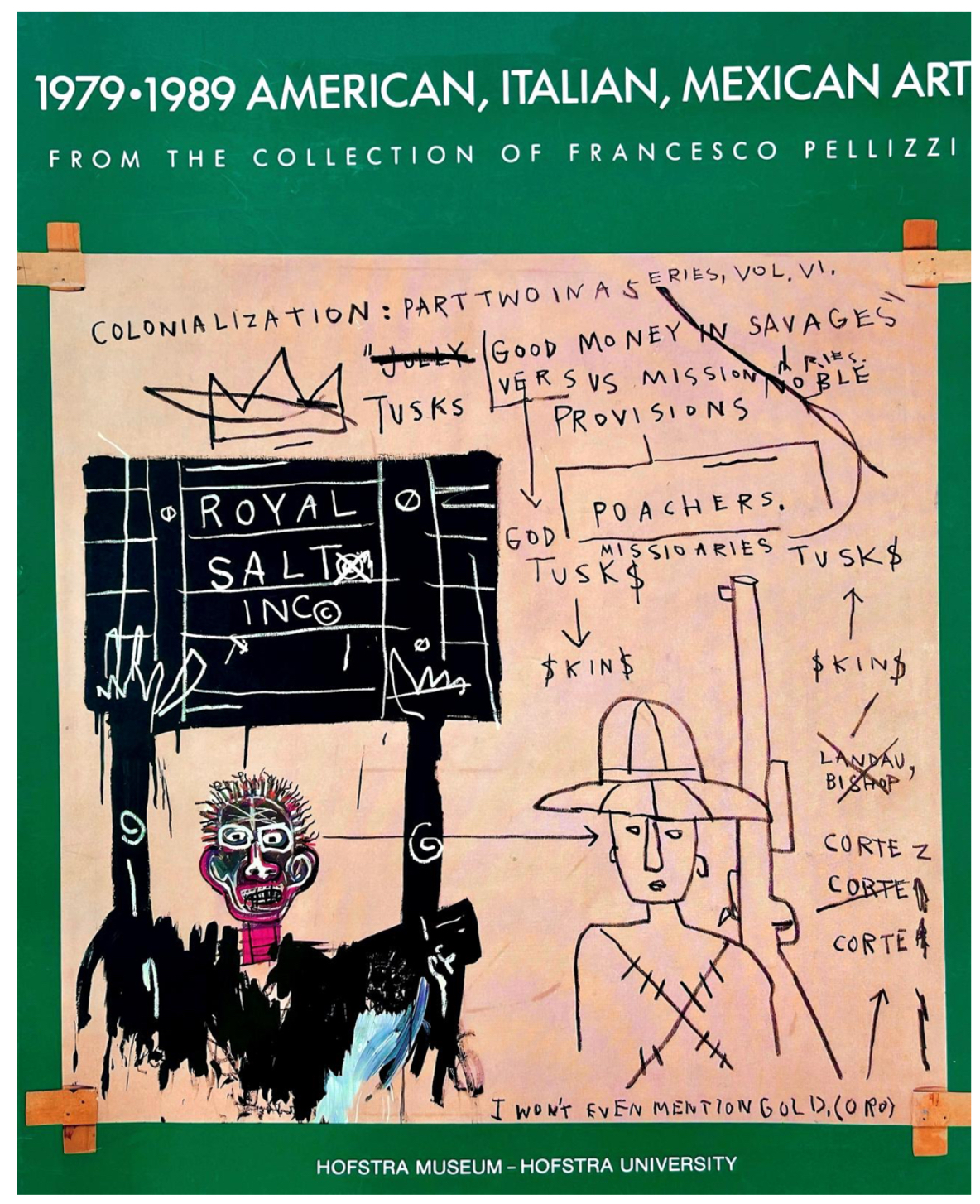
The present work illustrated on the cover of 1979–1989 American, Italian, Mexican Art from the Collection of Francesco Pellizzi, Hempstead, Hofstra Museum, Hofstra University; Bethlehem, Lehigh University Art Galleries, 1989
Marshall enthused that works with this unique construction embody Basquiat’s deliberate dismantling of traditional canvas painting, infusing it with a raw, primitive aesthetic reminiscent of African shields and Spanish devotional objects. The visible stretcher on Basquiat’s canvas serves as the antithesis of a frame; it dismantles and de-frames the already unframed picture-object. Informal and overtly handmade, this structure imbues the history of painting on canvas—directly linked to the Western tradition of art—with a more sculptural, decorative, or functional legacy aligned with non-Western artistic practices. Additionally, it nods to a material vocabulary of assemblage and the found object, famously championed in postwar American art by neo-Dada practitioners like Robert Rauschenberg and Jasper Johns.
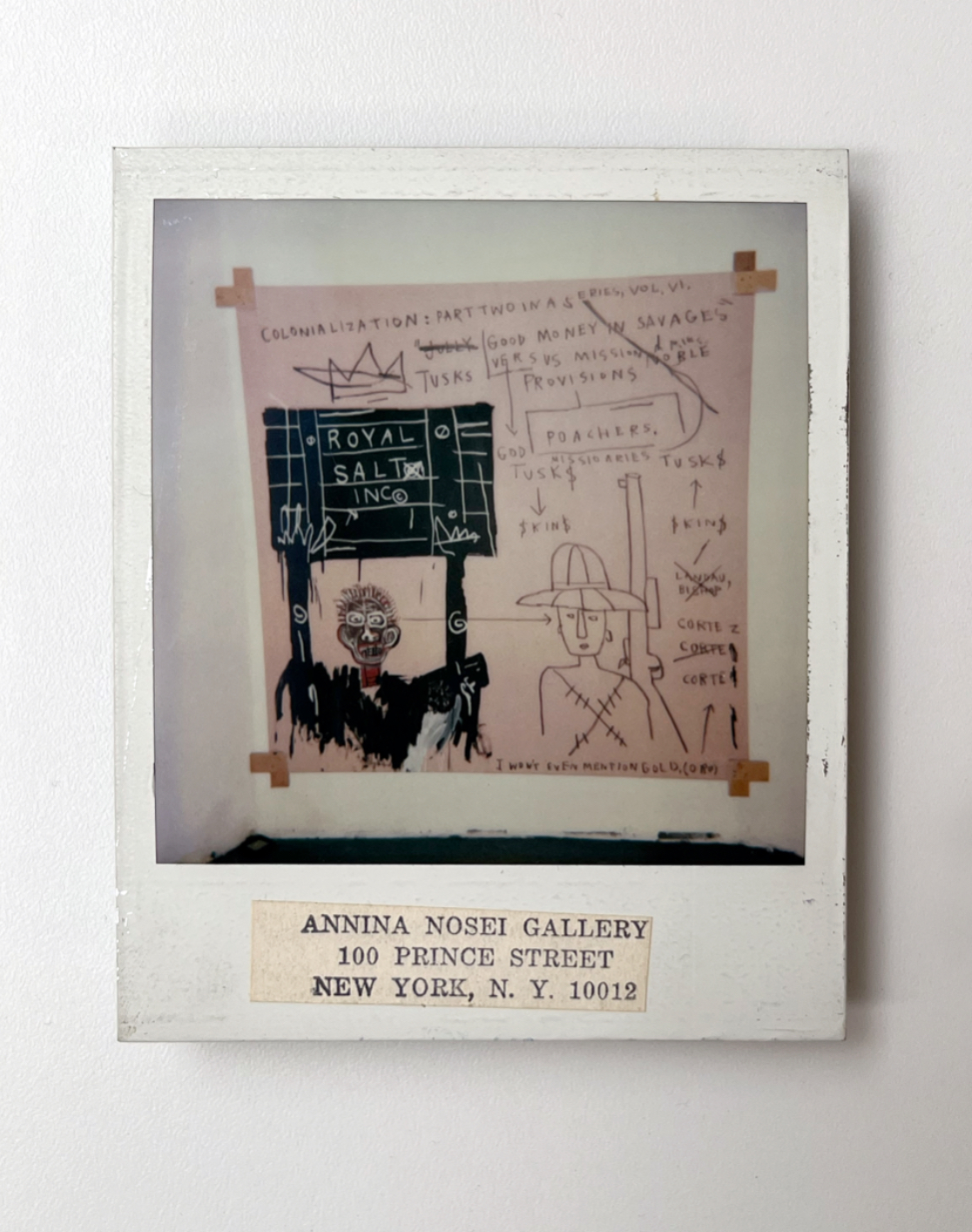
Original Polaroid taken by Annina Nosei of the present work installed at her Prince Street gallery in the early 1980s. Artwork: © Estate of Jean-Michel Basquiat. Licensed by Artestar, New York
The present work was completed in October 1982 at Basquiat’s new Crosby Street studio. Stephen Torton, his former studio assistant, was entrusted with sourcing materials to build the stretcher. ‘I would go out in the middle of the night and find the stuff,’ Torton recalls, likening the process to making sculpture. Indeed, the simplicity of the support structure in the present work enhances the credibility and legitimacy of its raw expression. Native Carrying Some Guns, Bibles, Amorites on Safari brims with insouciant energy, characterized by drips, scrawls, outline used in suggestion of form, and textual interventions reminiscent of Basquiat’s past output as a street artist in the late 1970s. During this time, he gained prominence as a street poet using the pseudonym SAMO©, leaving his mark as a relentless tagger across the city’s deteriorating infrastructure. Though the present work is executed on canvas rather than a public wall, Basquiat’s incorporation of visible wooden supports, extending beyond the picture plane and interacting with the surrounding space, powerfully evokes his deep-rooted connection to the urban environment, reminiscent of his formative years when the cityscape served as his primary canvas. Juxtaposing the rough-hewn materiality of the present work’s construction, its imagery is elegantly suspended within a clear and refined pictorial space. The syncopated rhythm of line, language, and insignia set against a spare, flat expanse of adobe or clay-like color conjures the flattened profile and hieratic logic of hieroglyphics or ancient cave paintings.
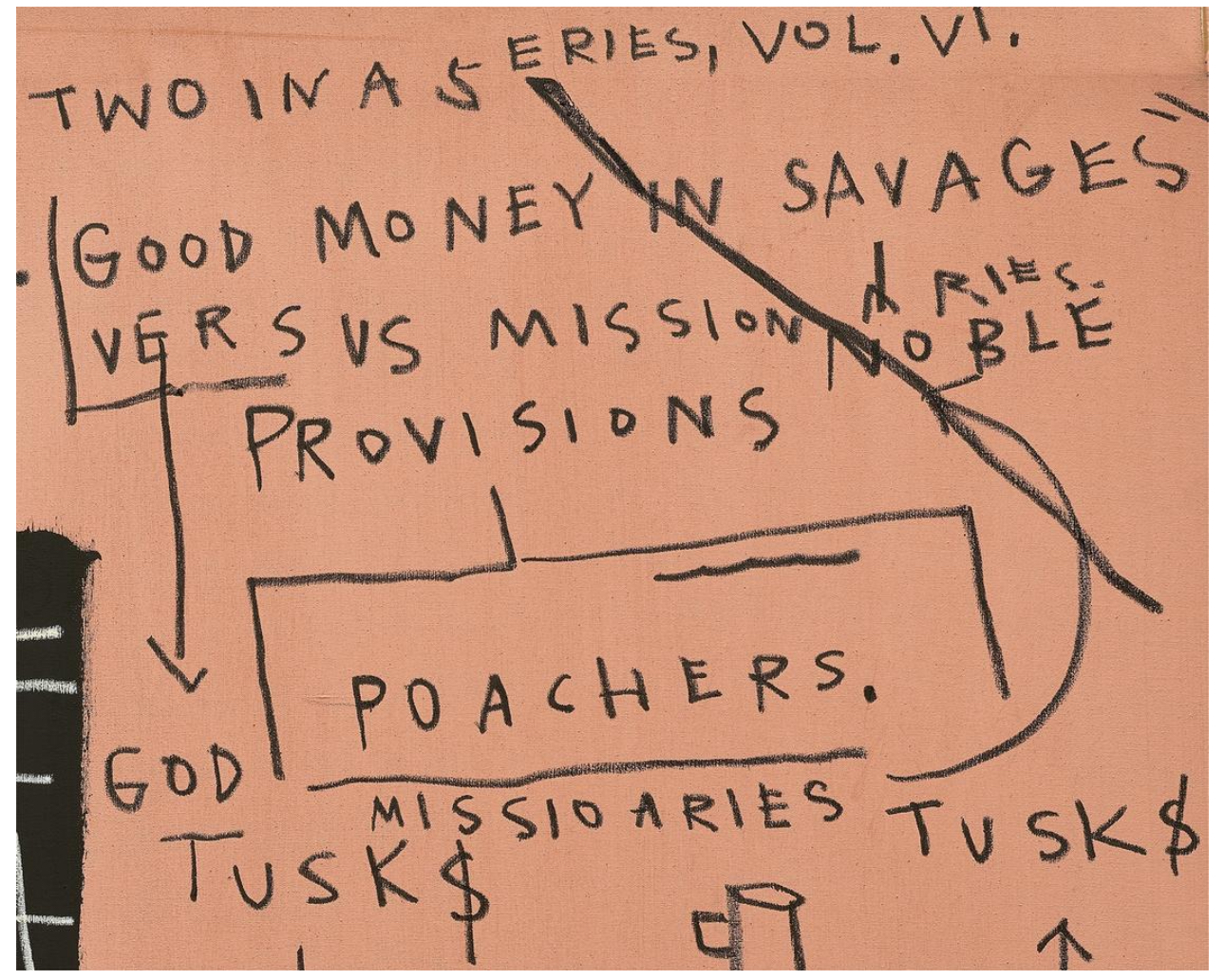
Words in Native Carrying Some Guns, Bibles, Amorites on Safari wield as much power as his graphic iconography. By merging the ‘cut-up’ method popularized by poet William Burroughs with the sampling techniques pioneered by early hip-hop artists like Fab 5 Freddy, Basquiat fashioned artwork that was uniquely innovative yet deeply grounded in a rich linguistic legacy. In the present work, Basquiat leverages the inherent flexibility of language to forge a lyrical fusion of poetry and street-action art transposed onto canvas. Art historian Robert Storr termed the effect ‘Eye Rap’ in reference to the captivating visual rhythm and syncopation of Basquiat’s inimitable dialect.ix In Native Carrying Some Guns, Bibles, Amorites on Safari, Basquiat’s painted rap challenges linguistic representations of subjugation, oppression, and genocide. He scrawls ‘MISSIONARIES,’ ‘POACHERS,’ and ‘CORTEZ,’ inviting contemplation of the narrative associations evoked by these words. The canvas is replete with billboard-style proclamations advertising ‘$KIN$’ and ‘TUSK$,’ while the painting’s protagonist holds up his own sign-within-a-sign in the form of a crate with ‘ROYAL SALT INC©’ emblazoned on the front. This signboard, remarkably similar to the smaller works in Basquiat’s stretcher-bar painting series, adds a captivating layer of comparison and self-referential imagery to the composition. Arrows and lines provide a semblance of order or enumeration, yet their rationale is solely visual; words are struck through, revised, hemmed in, punctuated, and underlined. At the bottom, beneath his crown, copyright claim, and codes of currency, Basquiat wryly opines ‘I WON’T EVEN MENTION GOLD (ORO),’ a fitting phrase for an artist who – even at the height of his success – delighted in questioning the value and nature of art.
“I cross out words so you will see them more;
the fact that they are obscured makes you want to read them.”
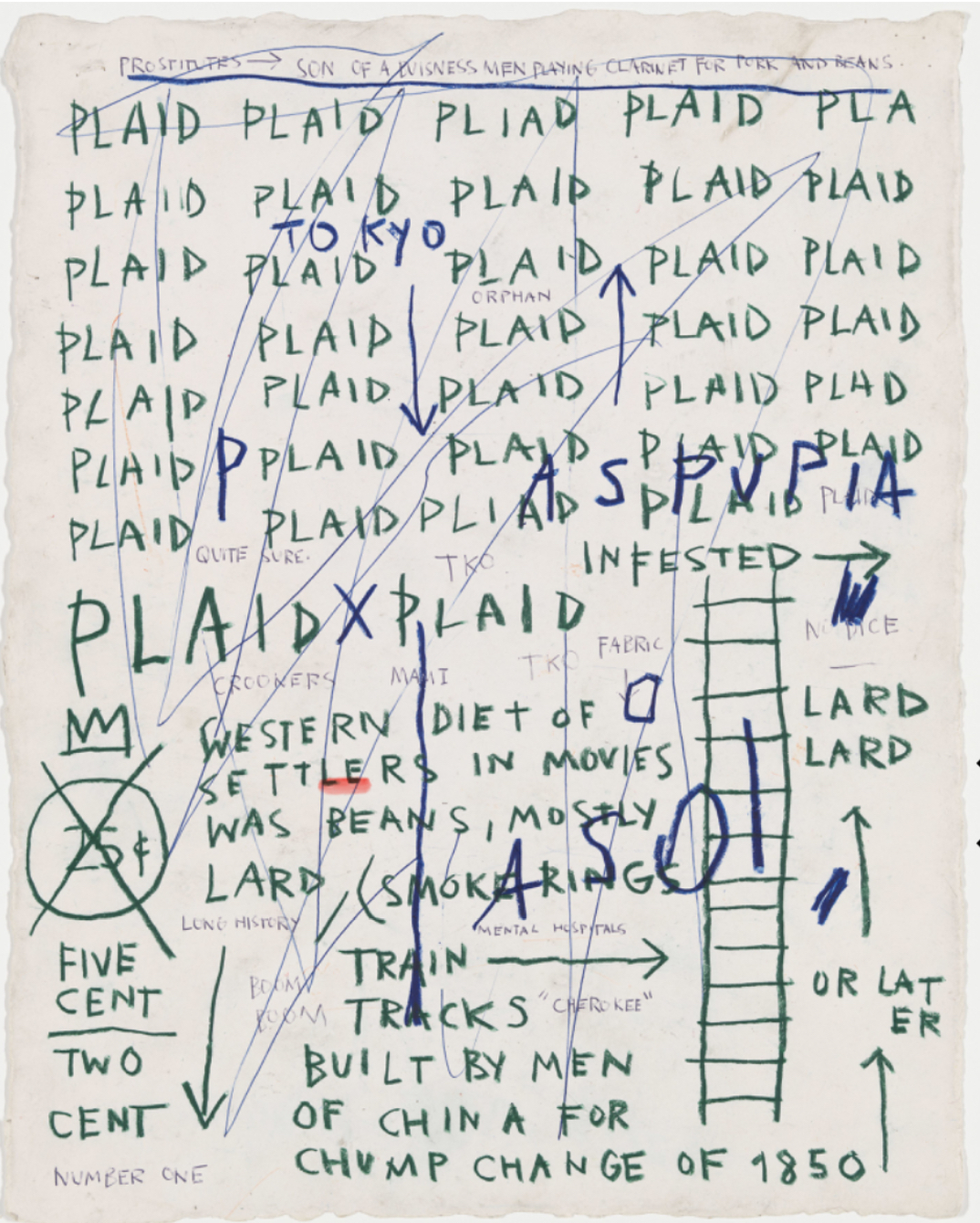
Jean-Michel Basquiat, Untitled (Plaid), 1982.
The Whitney Museum of Art, New York. Image: Whitney Museum of American Art / Licensed by Scala
Artwork: © Estate of Jean-Michel Basquiat. Licensed by Artestar, New York
Basquiat’s aesthetic sensibilities were shaped by his upbringing in a richly diverse immigrant milieu, and his artistic concerns encompassed not only the enduring legacy of Africa in North America, but also extended to all forms of oppression and exploitation. In a comparably charged 1982 piece, The Whitney Museum of American Art’s Untitled (Plaid), Basquiat confronts the exploitation of Chinese labor in America by intertwining currency symbols with the stark declaration that the construction of the Western United States railroad was ‘BUILT BY MEN OF CHINA FOR CHUMP CHANGE OF 1850.’ Through an integration of image and text in Native Carrying Some Guns, Bibles, Amorites on Safari, Basquiat directly addresses the conflicted history of Black and indigenous labor at the service of its own exploitation. Above the figures of a Black native and a white settler, the top text reads ‘COLONIALIZATION: PART TWO IN A SERIES, VOL. VI,’ connecting the image to an ongoing history of racial violence. Basquiat’s use of language was largely poetic and functioned as a commentary on the power of words to shape our understanding of the world. It becomes important to note specific connotations of meaning. While colonization is the process of establishing a colony, ‘COLONIALIZATION’ refers to ‘the act of bringing into subjection or subjugation by colonializing,’ implying the suppression of a people, in addition to the appropriation of pre-populated land.
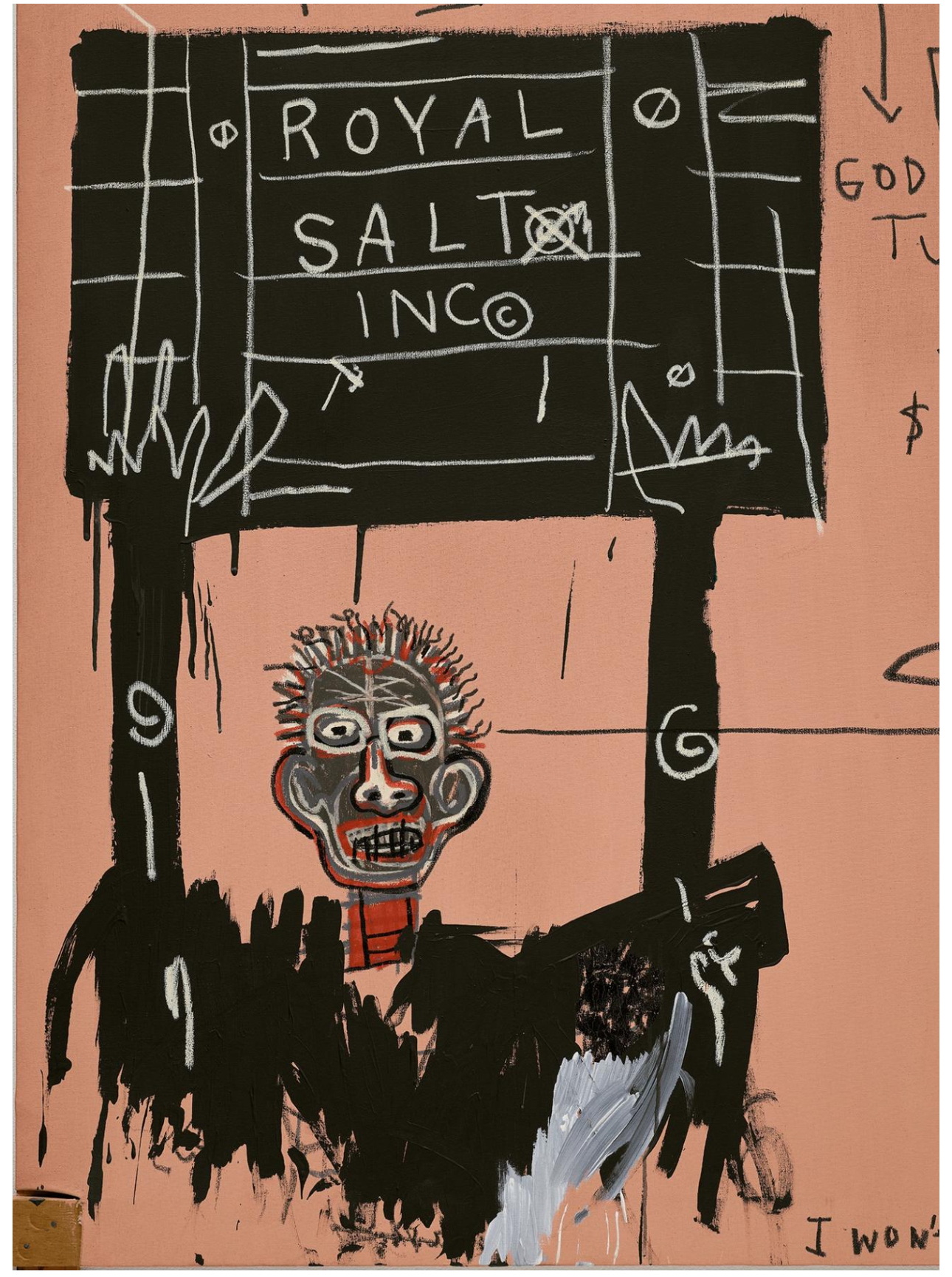
Central to the composition are two figures: a Black man holding a wooden sign bearing the logo ‘ROYAL SALT INC©’ and a heavily armed white man wearing a pith helmet of the kind routinely issued to European military personnel serving overseas in hot climates from the mid-nineteenth to the mid-twentieth century. Here, Basquiat employs ‘INC©’ to imply the economic and political significance of controlling the distribution of natural products, linking it to human subjugation through his use of ‘SALT’ (followed by another, crossed-out copyright symbol) as a commodity reference. The symbol itself connotes a legally binding lifetime ownership, while the implication of its excessive use in this case evokes a nightmarish satire of greed. Primarily associated with the British Empire, the pith helmet, which Basquiat mocks in the present work with his reference to monarchy and use of the partially crossed-out Britishism ‘JOLLY GOOD,’ has come to be seen as an archetypal symbol of colonial power. In the 1970s, it even featured in poster art produced by OSPAAAL (The Organization of Solidarity with the People of Asia, Africa & Latin America). Basquiat, born to Puerto Rican and Haitian parents, lived in Puerto Rico from 1974 to 1976, overlapping with the end of the island’s Golden Age of Political Poster Art (1957–1973). This likely heightened his awareness of the highly politicized Puerto Rican art scene, particularly its focus on the colonial condition. Through its poignant critique of the imposition of Western ideologies onto indigenous cultures, Native Carrying Some Guns, Bibles, Amorites on Safari, lays the groundwork for Basquiat’s deeper engagement with grand historical themes. It foreshadows Basquiat’s large-scale history paintings of 1983, which explore themes of the Black diaspora, power dynamics, and racial inequality, echoing concerns raised in the present work. As an important precursor to his iconic multi-panel narrative paintings, this painting exemplifies Basquiat’s commitment to challenging dominant narratives and provoking critical reflection on history and society through his distinctive visual language.