Yayoi Kusama, the renowned Japanese artist, has a deeply intricate relationship with women’s fashion, which plays a significant role in her artistic narrative. Throughout her work, Kusama frequently incorporates elements of fashion, such as hats, high heels, and dresses, using them as powerful symbols to explore themes of identity, femininity, and societal expectations.
Kusama’s use of fashion is not merely decorative; it is a way for her to critique and reflect on the roles imposed on women in society. Hats, for instance, often appear in her work as symbols of status and identity, while also serving as a metaphor for the masks that women are expected to wear. High heels, another recurring motif, represent both elegance and the constraints of traditional femininity, highlighting the duality of fashion as both a means of self-expression and a tool of societal control.
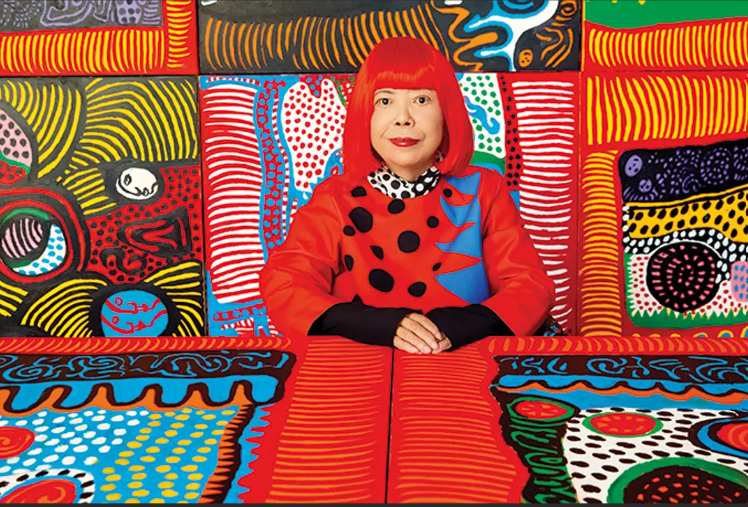
Dresses in Kusama’s art often symbolize the body and its relationship to space, echoing her fascination with infinity and the cosmos. The repetitive patterns she uses to adorn these garments can be seen as a reflection of the repetitive and often suffocating nature of societal norms imposed on women. Yet, at the same time, these patterns also convey a sense of liberation and endless possibility, characteristic of Kusama’s unique vision.
In many ways, Kusama’s exploration of fashion in her work is deeply personal. It reflects her own experiences as a woman artist navigating a male-dominated art world and society. By integrating elements of fashion into her art, Kusama not only critiques the superficial aspects of gender roles but also reclaims these symbols, transforming them into powerful tools of self-empowerment and expression.
Text co-written with ChatGPT
1. High Heels / Shoes
Yayoi Kusama’s exploration of shoes and heels in her artwork carries profound symbolic significance, reflecting both traditional Japanese imagery and her personal relationship with fashion and identity as a woman artist. In her prints, Kusama often revisits the motif of shoes and heels, infusing these everyday objects with layers of meaning that speak to broader cultural and personal narratives.
In traditional Japanese culture, footwear has long been associated with status, respect, and ritual. Shoes were not just practical items but also carried social implications, often indicating one’s rank or role within society. Kusama’s use of shoes and heels in her art draws from this rich cultural heritage but reinterprets it through her unique perspective. The shoes in her work often appear as larger-than-life, surreal objects, suggesting a departure from mere functionality towards something more symbolic and introspective.
For Kusama, heels, in particular, resonate with the complexities of femininity and the expectations placed upon women in both traditional and modern societies. Heels are often seen as symbols of elegance, power, and sometimes, societal pressure to conform to specific standards of beauty. Through her art, Kusama challenges these notions, using the exaggerated and repetitive forms of shoes and heels to question the roles and identities imposed on women, especially in the context of her own experiences as a female artist in a predominantly male-dominated world.
Kusama’s relationship with fashion is deeply intertwined with her identity and artistic expression. Her use of shoes and heels can be seen as a commentary on the intersection of art, fashion, and self-presentation. These motifs become a way for her to explore her position within the social fabric, challenging traditional gender roles while also celebrating the complexities of womanhood.
By elevating shoes and heels to central themes in her artwork, Kusama transforms them into powerful symbols of identity, resistance, and self-expression. Her art invites viewers to reconsider the significance of these seemingly ordinary objects, recognizing their deeper connections to cultural expectations, gender dynamics, and personal freedom. Through her bold and innovative depictions, Kusama continues to push the boundaries of how we perceive fashion, art, and the roles they play in shaping our lives.
High Heels are a recurring motif in Yayoi Kusama’s artistic output, including in prints, paintings, and sculptures. Those instantly recognized heels are the testimony of the artist’s involvement in the fashion world, she has been collaborating with Louis Vuitton for many years for example, but they also celebrate the joy of self-expression and liberty. Indeed, Yayoi Kusama unique fashion statement, as she has been wearing clothing featuring her own patters relentlessly together with impeccable red hair, testifies that she is indeed an extension to her own art.
In High Heels, Kusama places a pair of yellow high heels at the center of each print. Those prints are quintessential Yayoi Kusama, as the shoes are filled with her signature Polka Dot pattern, and they are placed within an Infinity Nets background, all with bright, joyful colors. Even though each print, with bold colors, are clearly a celebration of the feminine attribute, the viewer is left with empty shoes, awaiting for their unknown future wearer…
Going to the field with shoes on, 1979 (ABE 1)
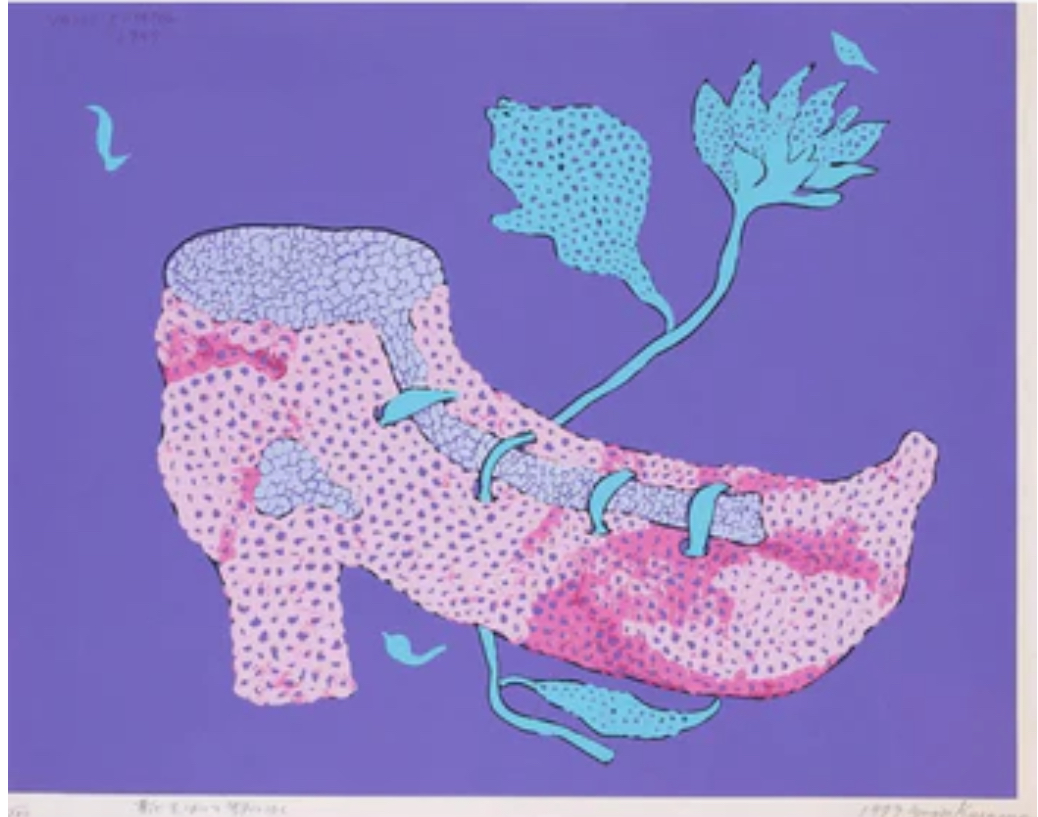
Going to the field with shoes on, 1979
Screenprint on Hakou-shi paper
Sheet: 54.5 x 69 cm (21.5 x 27.2 inches)
Edition: 100 + 10 AP
Literature: ABE 1
Shoes, 1984 (ABE 43)
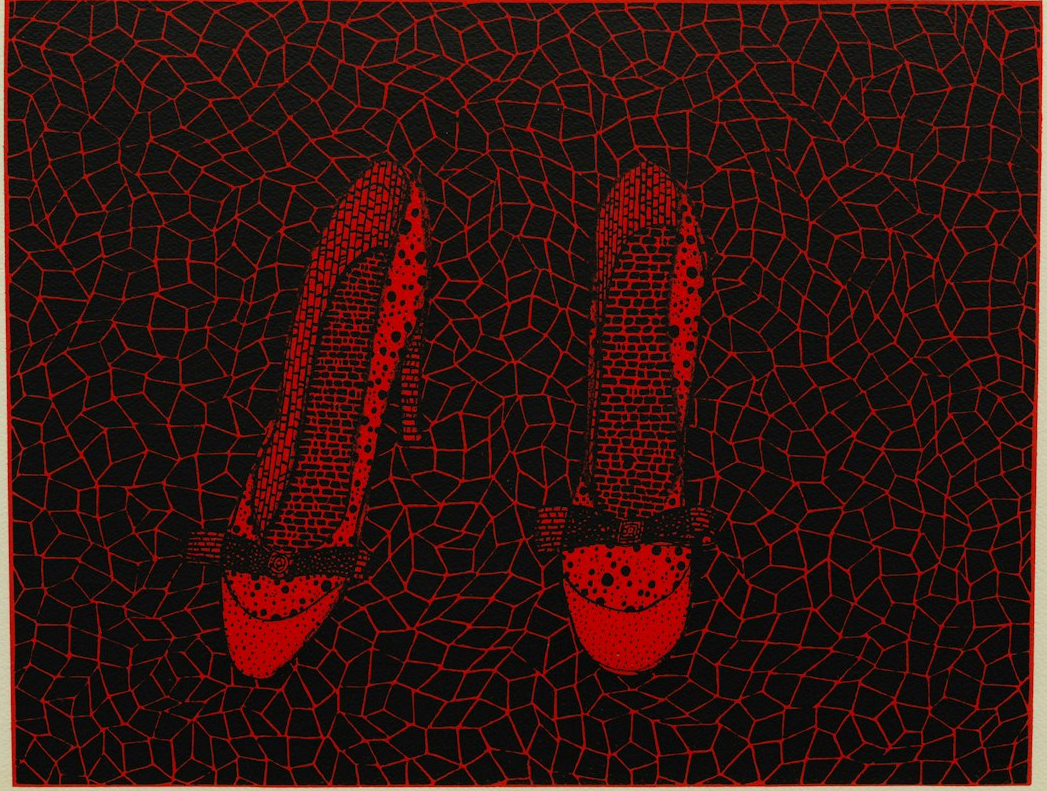
Shoes, 1984
Lithograph in colors on Verin d’Arches paper
Sheet: 43 x 56.5 cm (16.9 x 22.2 inches)
Edition: 30 + 3 AP + 1 PP
Literature: ABE 43
Shoes, 1984 (ABE 44)
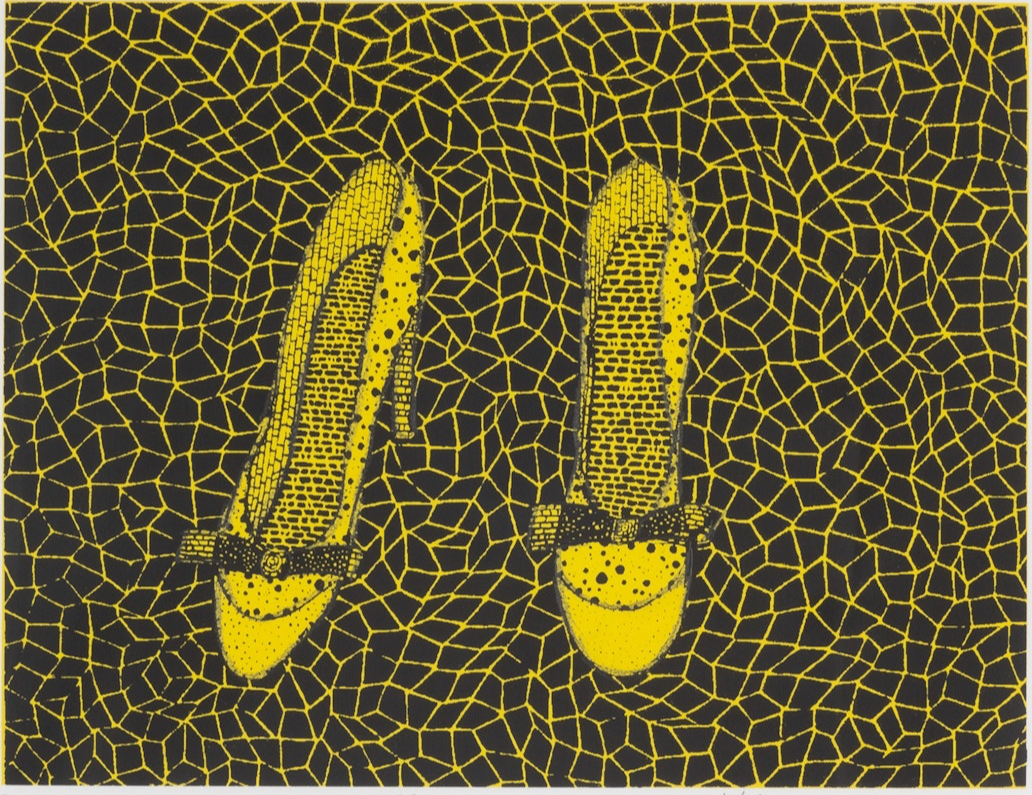
Shoes, 1984
Lithograph in colors on Verin d’Arches paper
Sheet: 43 x 56.5 cm (16.9 x 22.2 inches)
Edition: 30 + 3 AP + 1 PP
Literature: ABE 44
Shoes, 1984 (ABE 45)
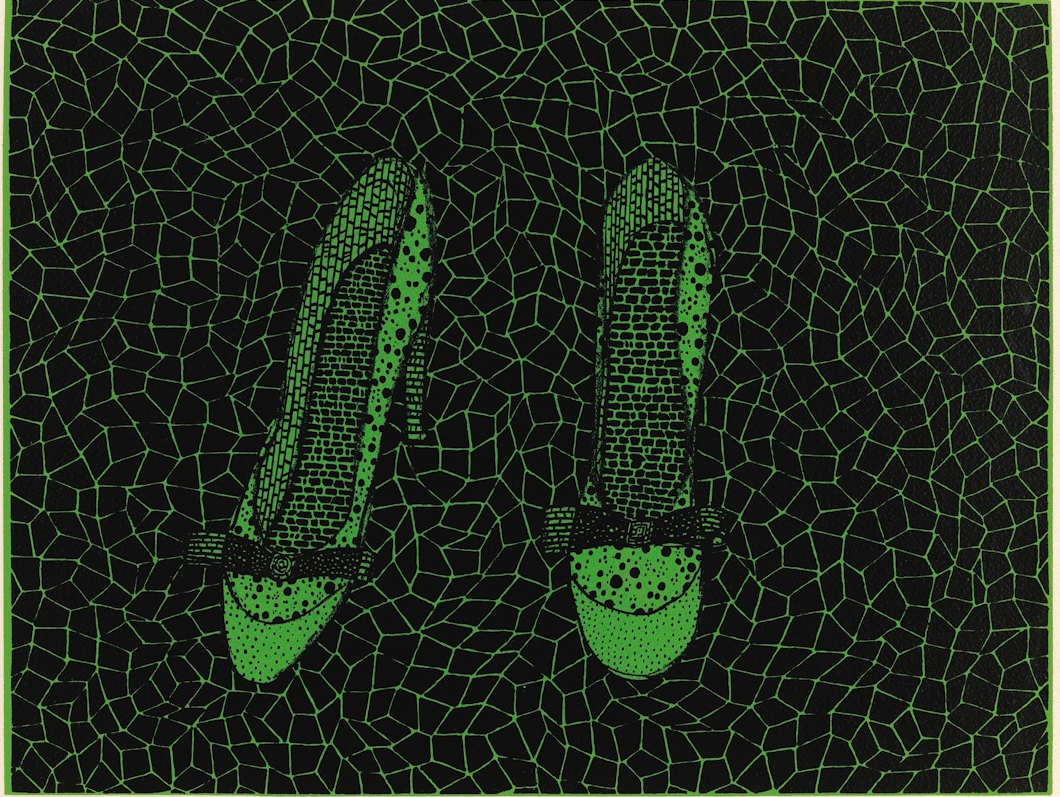
Shoes, 1984
Lithograph in colors on Verin d’Arches paper
Sheet: 43 x 56.5 cm (16.9 x 22.2 inches)
Edition: 30 + 3 AP + 1 PP
Literature: ABE 45
Shoes, 1985 (ABE 78)
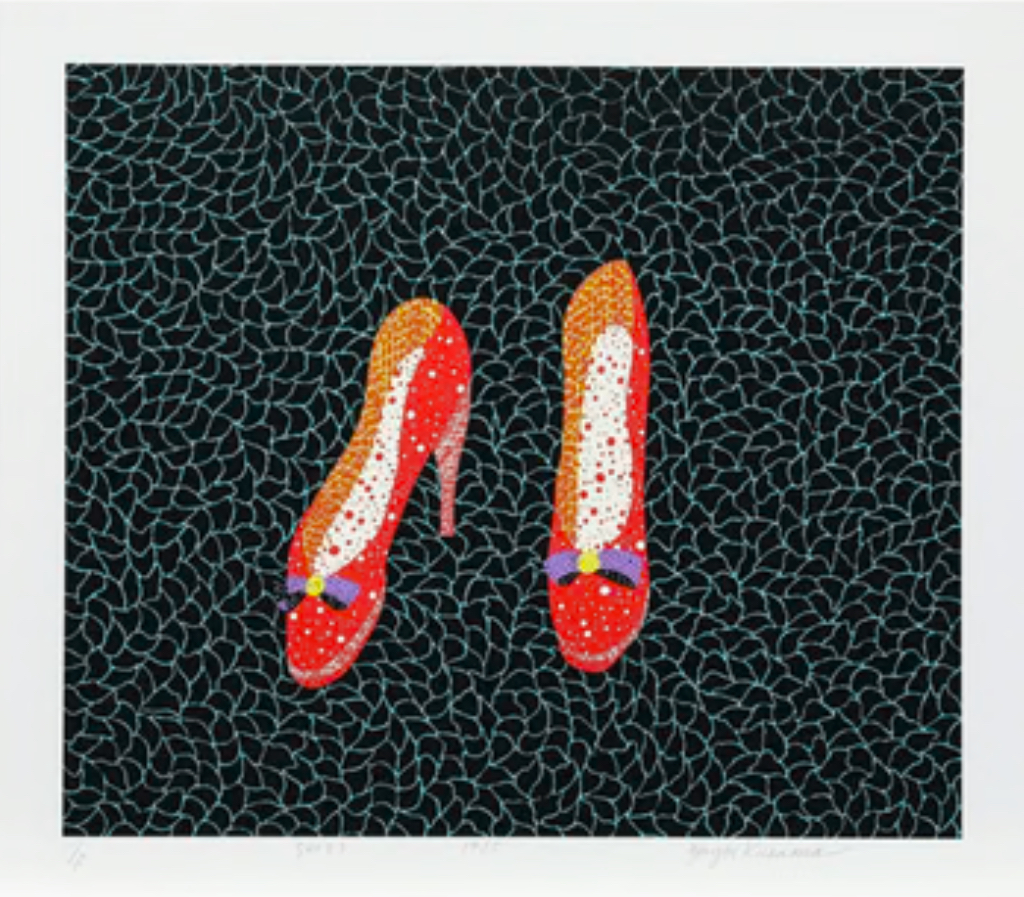
Shoes, 1985
Screen-print in colors on Izumi paper
Sheet: 53.5 x 60.5 cm (19.9 x 23.6 inches)
Edition: 100 + 10 AP
Literature: ABE 78
High Heels (1)-(4), 1999
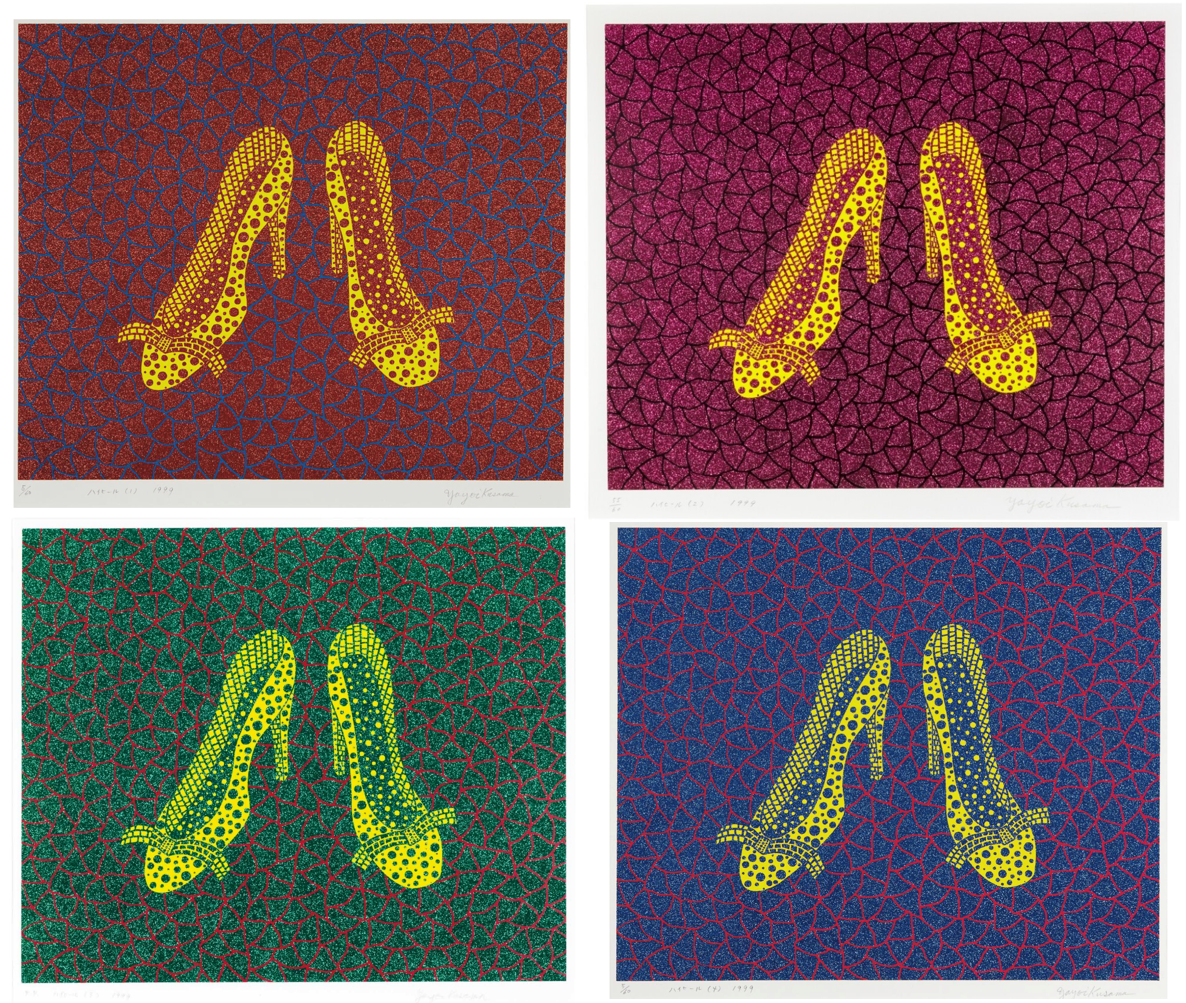
High Heels (1)-(4), 1999
Screen-print in colors on Kakita-shi paper with Lame
Sheet: 60×68 cm (23.6 x 26.8 inches)
Edition: 60 + 6/11 AP + 5 PP
Literature: ABE 259-262
2. Hat
Yayoi Kusama, the renowned Japanese artist, has a deep connection with the imagery of hats in her artwork, which holds both personal and cultural significance. Throughout her career, Kusama has often used the motif of a hat, particularly in her prints and original works, as a symbol that transcends mere fashion or utility. For Kusama, the hat represents a bridge between the personal and the societal, a blend of her own unique perspective and the broader context of traditional Japanese culture.
In traditional Japanese society, hats carry connotations of status, identity, and even spirituality. They have been used historically to denote rank, occupation, and social roles, often imbued with meaning far beyond their practical function. Kusama’s use of hats taps into this rich cultural heritage, but she reinterprets it through her distinct lens, often incorporating her signature polka dots and other repetitive patterns that symbolize infinity and the dissolution of boundaries.
For Kusama, the hat also seems to represent a form of self-expression and a way to explore identity. In her work, it becomes a vessel of both protection and exposure, shielding the wearer from the outside world while also making a bold statement about their place within it. The recurring hat motif in Kusama’s art thus becomes a powerful symbol of the intersection between tradition and individuality, reflecting her lifelong exploration of themes such as mental health, personal freedom, and the tension between the self and society.
Kusama’s artwork, especially her prints featuring hats, invites viewers to consider the deeper implications of everyday objects and their connections to our inner lives and cultural contexts. Through her art, she elevates the hat from a simple accessory to a meaningful symbol that speaks to the complexities of human existence and the rich tapestry of Japanese tradition.
Hat left behind in the field, 1981 (ABE 3)
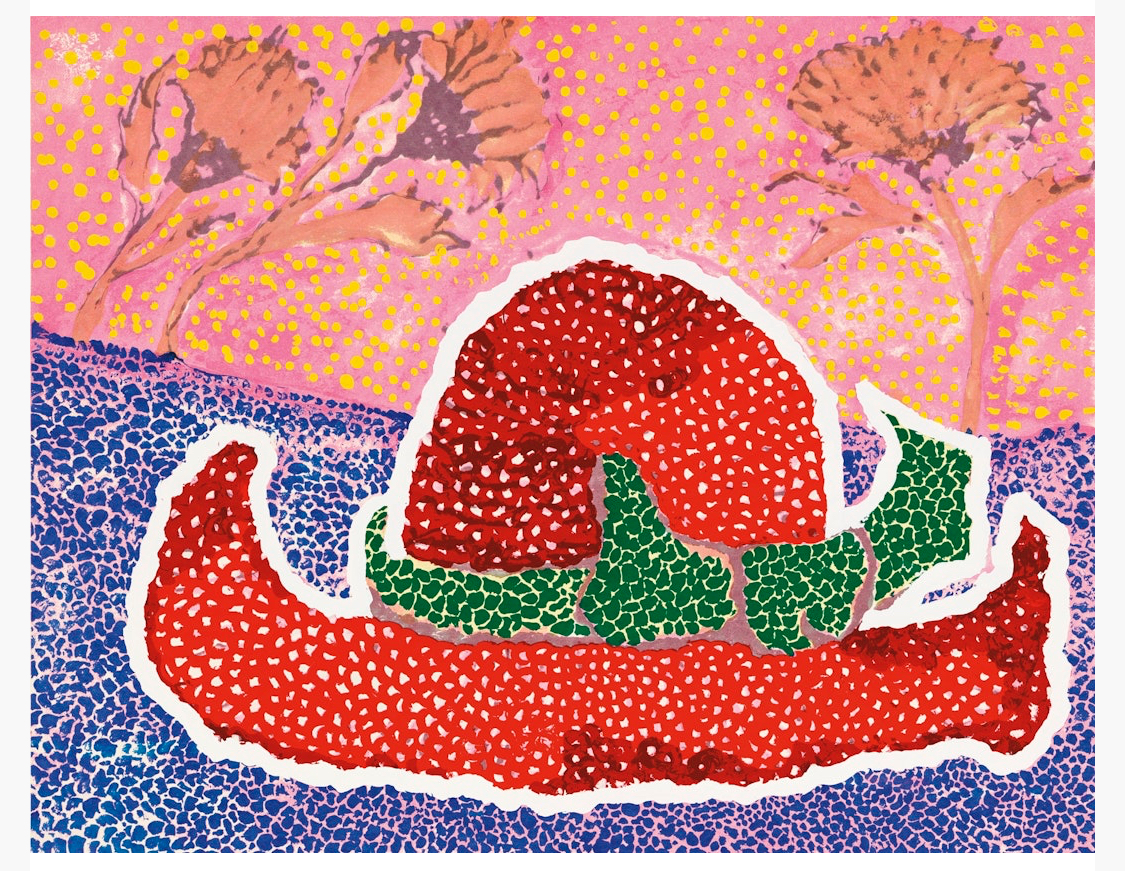
Hat left behind in the field, 1981
Screenprint on Hakou-shi paper
Sheet: 50.5 x 65 cm (19.9 x 25.6 inches)
Edition: 100 + 10 AP
Literature: ABE 3
Hat, 1982 (ABE 13)
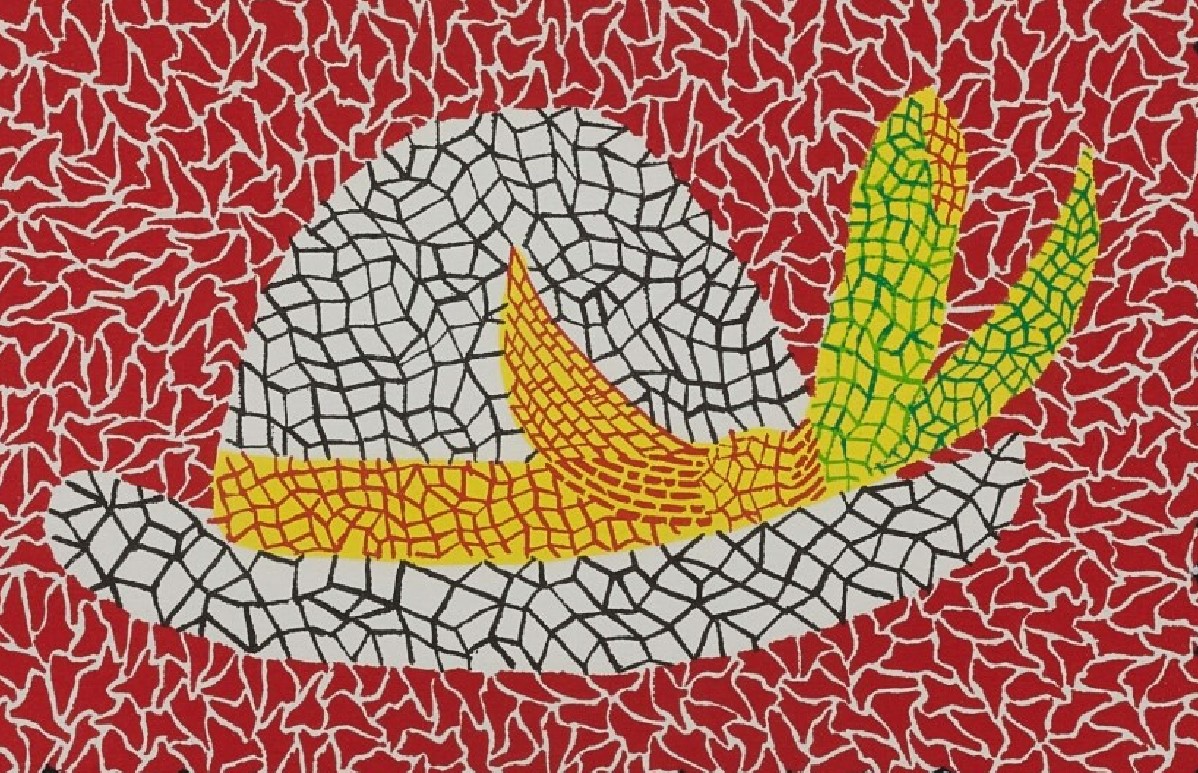
Hat, 1982
Lithograph with collage on Verin d’Arches paper
Sheet: 27 x 33.5 cm (10 5/8 x 13 1/8 inches)
Edition: 100 + 3 AP + 3 PP
Literature: ABE 13
Hat, 1983 (ABE 21)
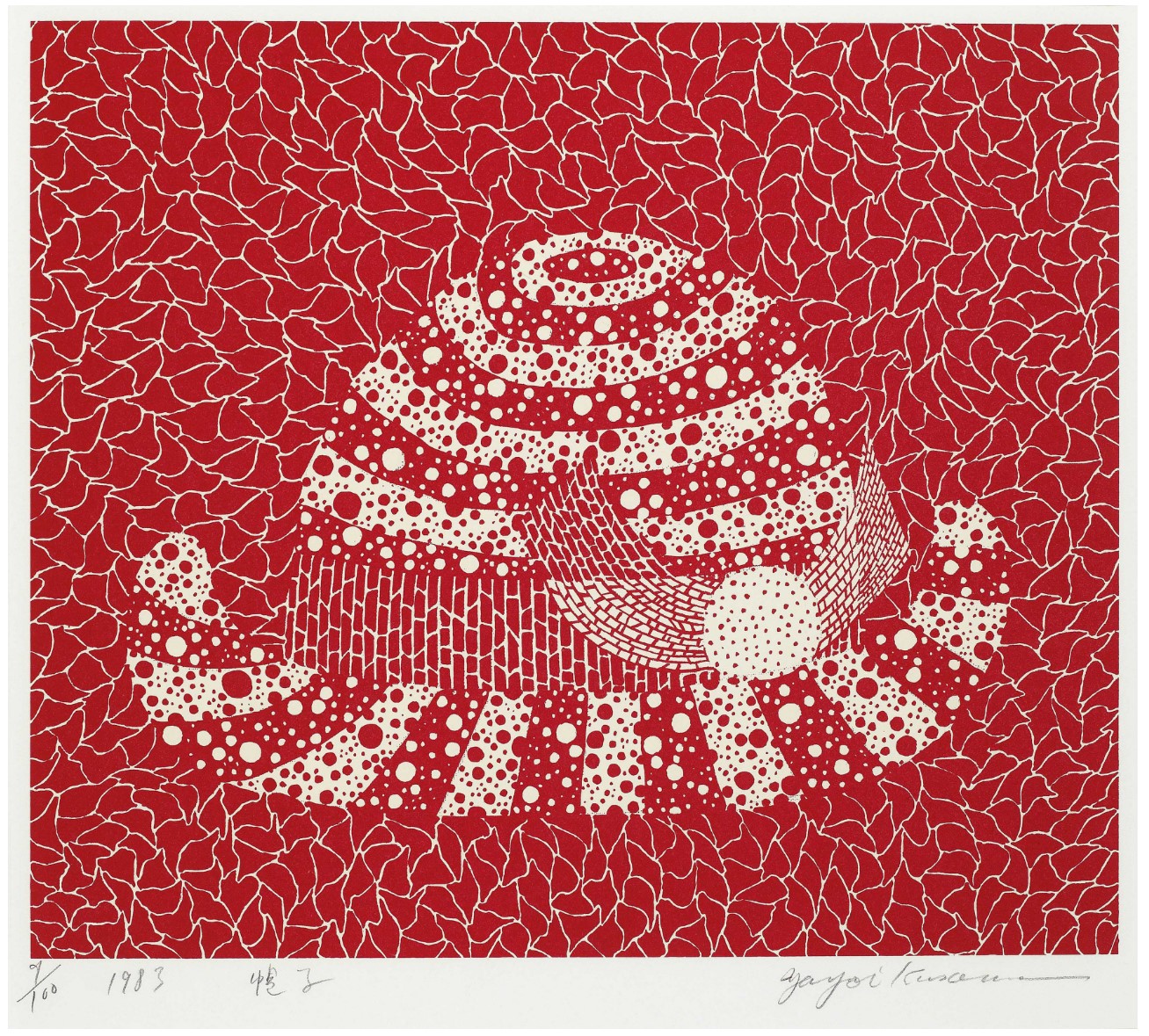
Hat, 1983
Screen-print in colors on Peche Soleil paper
Sheet: 55.5 x 64.3 cm (21.9 x 25.3 inches)
Edition: 100 + 10 AP + 3 PP
Literature: ABE 21
Hat, 1984
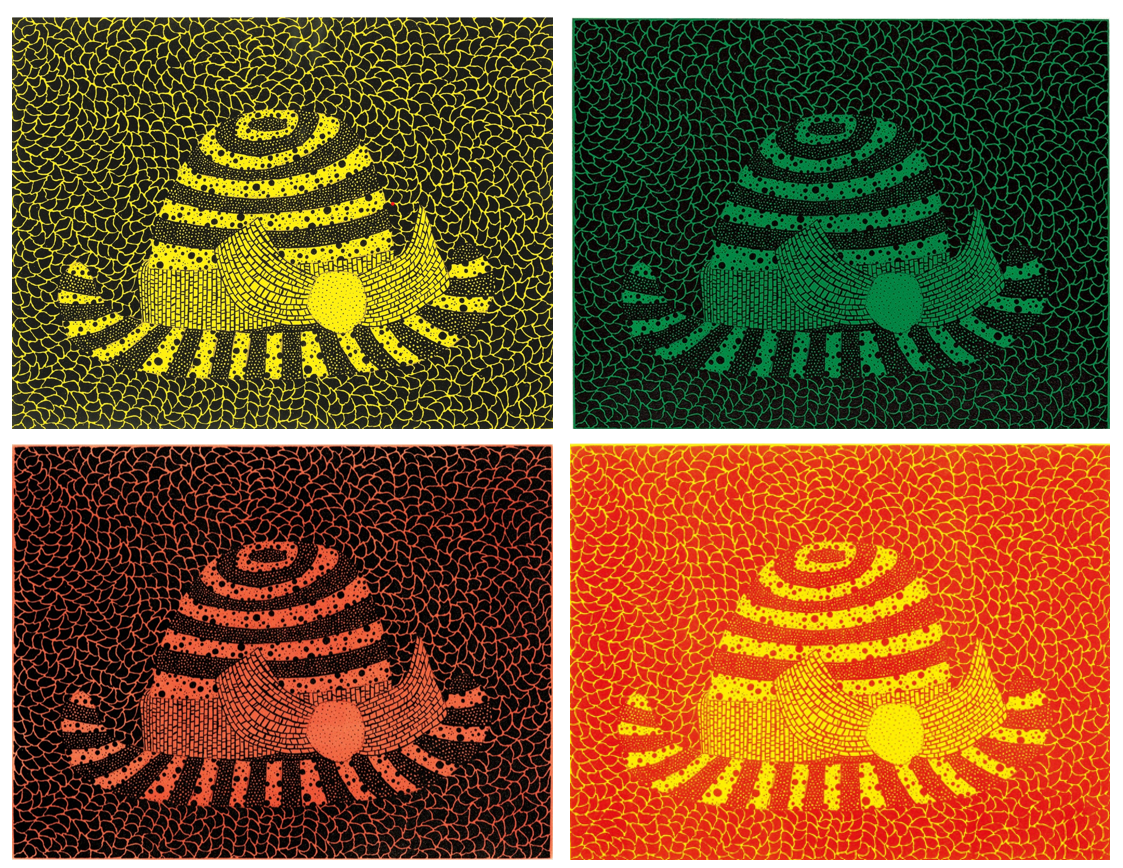
Hat, 1984
[4 Lithographs]
Medium: Lithograph in colors on Verin d’Arches paper
Sheet: 43 x 56.5 cm (16.9 x 22.2 inches)
Edition: 30 + 3 AP + 1 EP + 1 PP
Literature: ABE 35-38
Hat, 1986 (ABE 89)
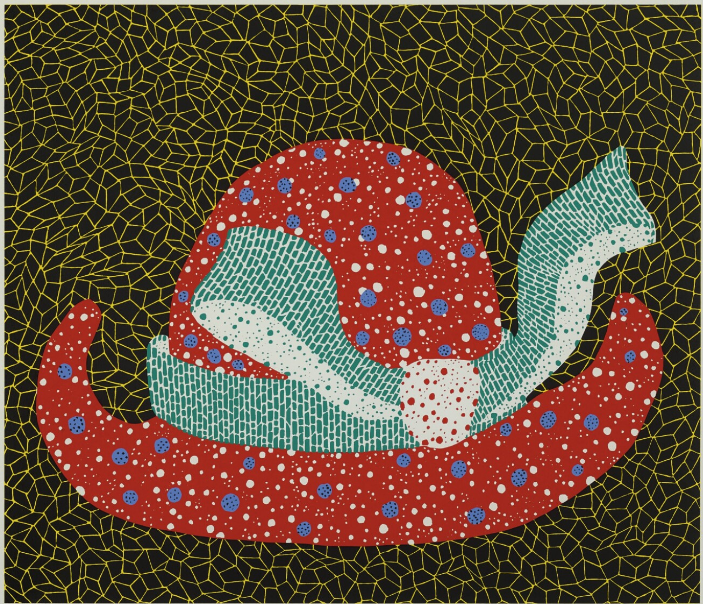
Hat, 1986
Screen-print in colors on Izumi paper
Sheet: 54 x 61.8 cm (21.3 x 24.3 inches)
Edition: 75 + 8 AP + 3 PP
Literature: ABE 89
Chapeau (I), 2000 (ABE 284)
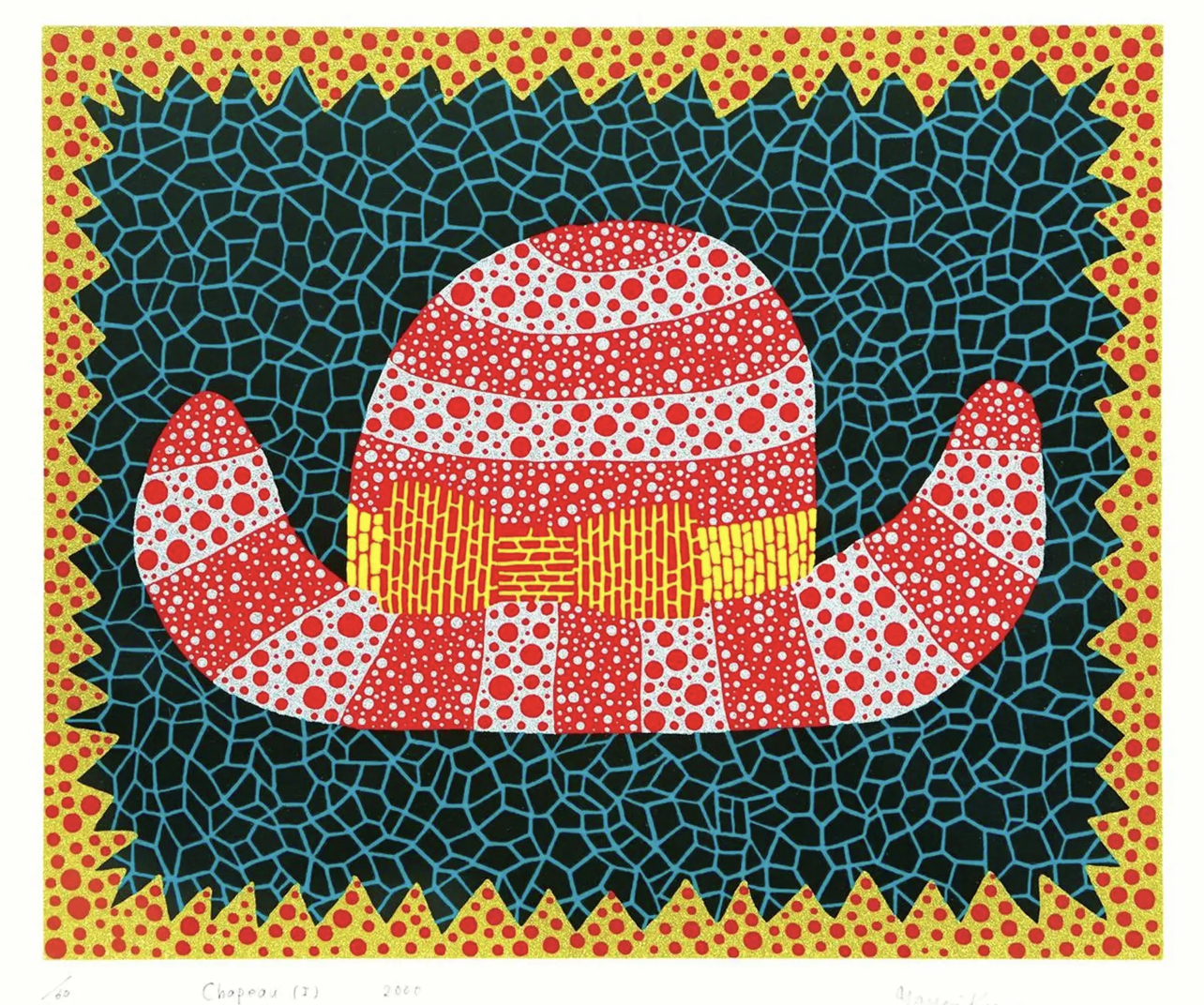
Chapeau (I), 2000
From Amour Pour Toujours
Screen-print and lamé in colors on BFK Rives paper
Sheet: 50×65 cm (19.7 x 25.6 inches)
Edition: 60 + 6 AP + 12 HC
Literature: ABE 284
Chapeau (II), 2000 (ABE 285)
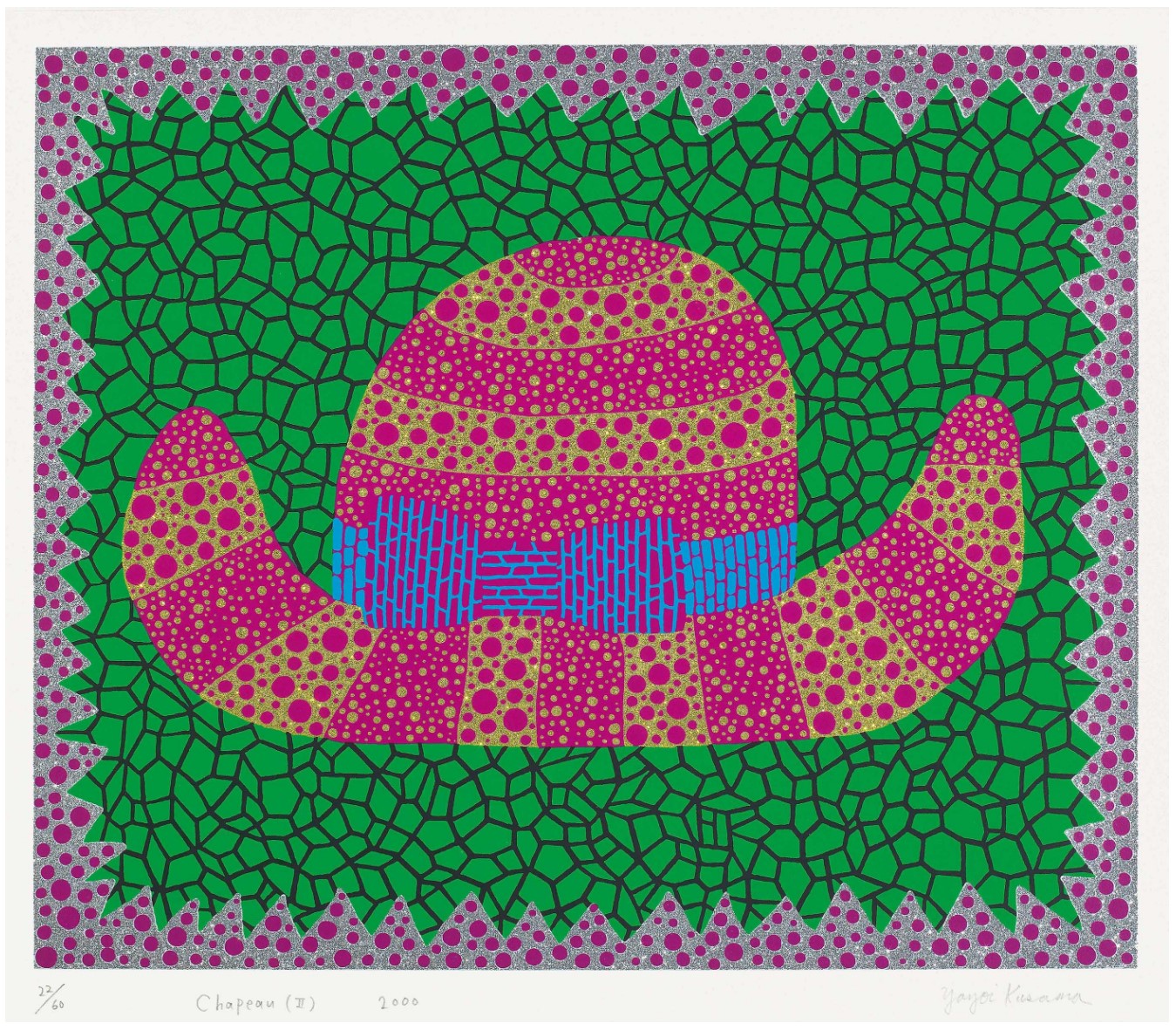
Chapeau (II), 2000
From Amour Pour Toujours
Screen-print and lamé in colors on BFK Rives paper
Sheet: 50×65 cm (19.7 x 25.6 inches)
Edition: 60 + 6 AP + 12 HC
Literature: ABE 285