Yayoi Kusama’s fascination with flowers is a recurring theme that has permeated her work throughout her long and illustrious career. For the artist, the representation of flowers is deeply symbolic, often intertwined with her personal experiences, cultural heritage, and broader artistic vision. Unpretentious and childlike, flowers likely speak to Kusama’s early memories of growing up in the rural provincial town of Matsumoto, and of formative visits to the botanical greenhouses and meadows of her grandparents’ plant nursery.
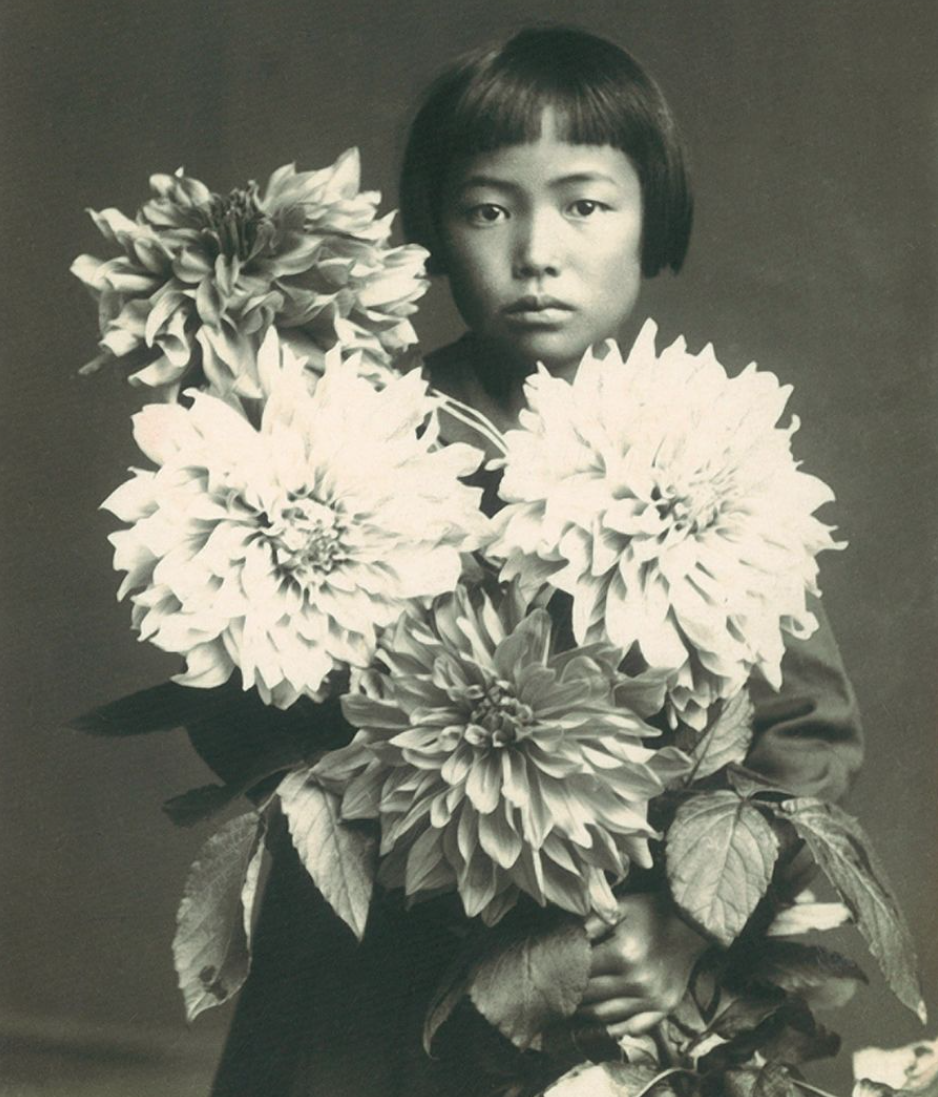
Yayoi Kusama at the age of ten in 1939. Private collection. © 2024 YAYOI KUSAMA.
From the beginning of her career, Kusama has used flowers as a means of expressing both beauty and the psychological struggles she faced. Her early works often feature flowers in a way that reflects the intensity of her emotions, sometimes depicting them with obsessive repetition or in a surreal, almost dreamlike manner. These flowers, with their vibrant colors and unusual forms, seem to transcend mere representation and instead evoke a sense of otherworldliness or psychological depth.
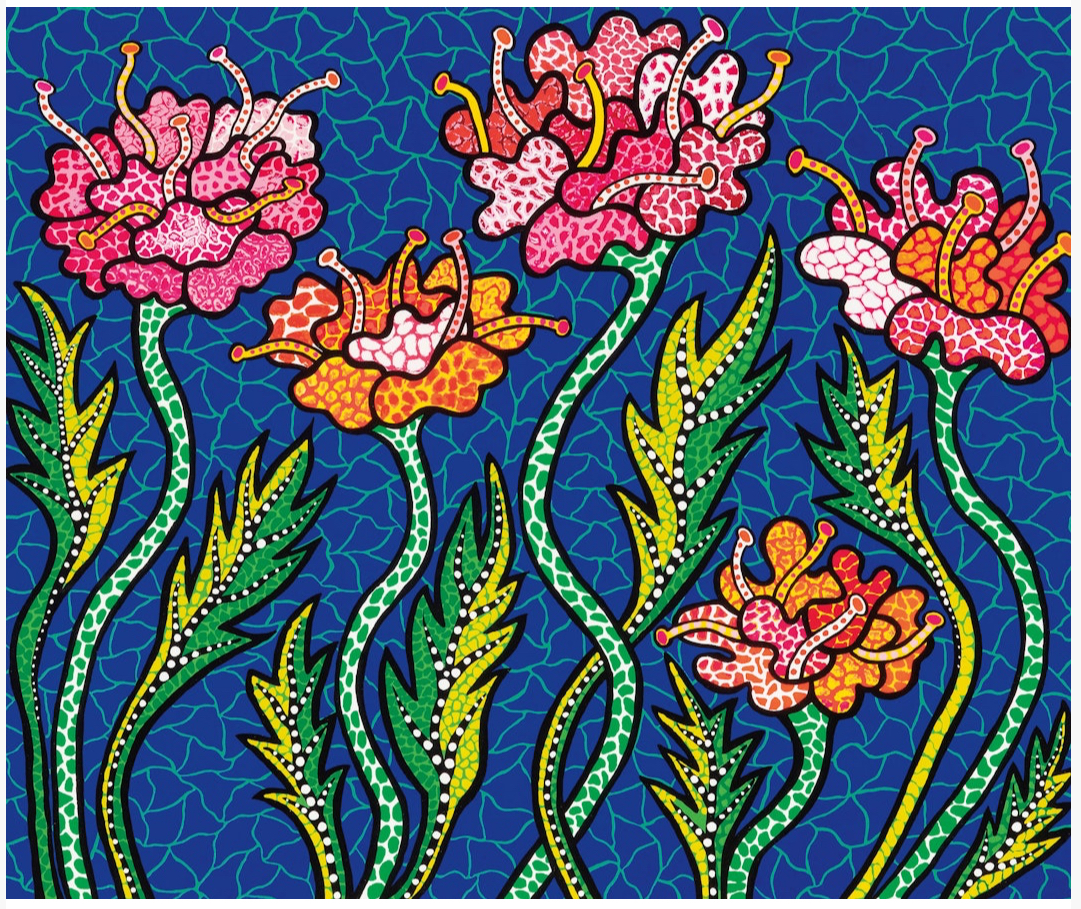
As her career progressed, Kusama’s flower prints began to take on a more refined and meditative quality. While the bold colors and repetitive patterns remained, there is a noticeable shift towards more intricate and detailed depictions. The flowers in her later prints often appear as both delicate and powerful, suggesting a deeper connection to nature and a reflection of her own growth as an artist. They can be seen as symbols of life, regeneration, and the infinite cycles of nature—themes that Kusama has long explored in her work.
“Born into this world of people, parting to me is like silent footprints in the path of flowers.”
Kusama’s choice of flowers also reflects her cultural background. In Japan, flowers like chrysanthemums and cherry blossoms hold significant cultural meaning, representing life, death, and the ephemeral nature of existence. Kusama’s prints often echo these traditional Japanese symbols, but she reinterprets them through her unique perspective, blending them with her own experiences and thoughts on mental health, feminism, and the role of women in society.
The continuous presence of flowers in her art might also be a form of self-healing and expression. Kusama has spoken openly about her struggles with mental illness, and the act of creating repetitive patterns, especially with flowers, can be seen as a therapeutic process—a way for her to impose order on chaos. The flowers in her prints are not just decorative elements; they are vehicles for her to communicate her innermost thoughts and emotions.
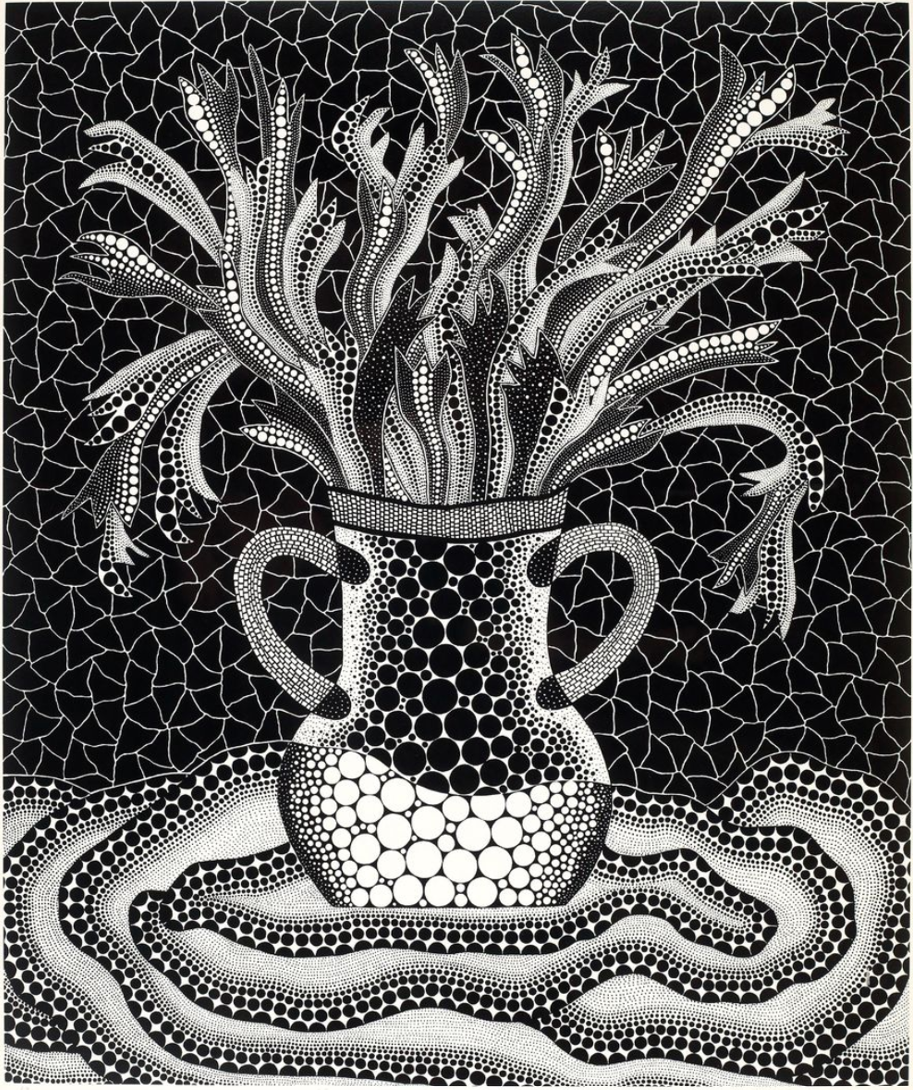
In summary, flowers in Kusama’s prints signify more than just nature’s beauty. They are deeply symbolic, reflecting her personal journey, cultural identity, and philosophical explorations. The evolution of her floral prints—from the intense, almost frenzied depictions of her early years to the more serene and detailed representations later on—mirrors her growth as an artist and a person. Through flowers, Kusama continues to explore themes of life, death, and the infinite, making them a central and enduring motif in her artistic oeuvre.
Moreover, Kusama’s floral motifs also explore the tension between individual isolation and collective unity. Her large-scale sculptures and prints often depict flowers that, while part of a larger composition, maintain distinct identities. This reflects Kusama’s broader exploration of themes such as solitude and community, where each flower can be seen as a metaphor for the individual’s place within society—both a part of a whole and uniquely isolated.
Finally, Kusama’s use of flowers is deeply tied to her fascination with infinity and the cycles of life and death. The repetition of floral patterns in her work, whether in her prints or her expansive installations, underscores the cyclical nature of existence, blending joy with melancholy. By transforming what could be seen as ordinary botanical forms into vivid, sometimes surreal artworks, Kusama invites viewers to contemplate the endless cycles of growth and decay that define the human experience.
Yayoi Kusama set out to create sculptures in the late 1990s and positioned herself as a sculptor more than a painter. In 2000, she began to create large-scale public outdoor sculptures, including “The Visionary Flowers” in Matsumoto City Art Museum, Nagano Prefecture, Japan in 2002, “Tsumari in Bloom” in Matsushiro-cho, Niigata, Japan in 2003, and “Hymn of Life: Tulips” in Beverly Hills, USA in 2007. Flowers have always been one of Kusama’s favored themes. They symbolize the flowering and withering of life, celebration and grief, hardness and softness. These fragile, organic, bountiful life– forms sprawl all over the paintings, dominating both the canvas and the fantastical world that the artist is seeking to create.
“One day, when I was a little girl, I found myself trembling, all over my body, with fear, amid flowers incarnate, which had appeared all of a sudden. I was surrounded by hundreds of violets in a flower garden. The violets, with uncanny expressions, were chatting among themselves like human beings. No sooner had they and I had spiritual dialogues than I became infatuated with them, drawn into glitter of illusion, away from this world.”
In addition to the canvas, Yayoi Kusama also engages in three dimensions creation. Through exhibiting her theme originally on canvas, the actual space that can be touched by all senses, providing an extra level of visual stimulation. “Flowers – That Bloom at Midnight” created in 2009, which multicolored releases a strong sense of vitality. This vibrant flower is one of the large scale sculptures of Kusama, with delicate texture and abundant colors. The longitudinal leaves stretch out, the blooming flower looks innocent and the stamen is replaced with a large eye, that is so infectious and powerful. Kusama creates a fascinating space and artistic conception, which sees through her dreamlike spiritual world, that in turn transforms into her most dazzling and wonderful creation.
Flowers Paintings
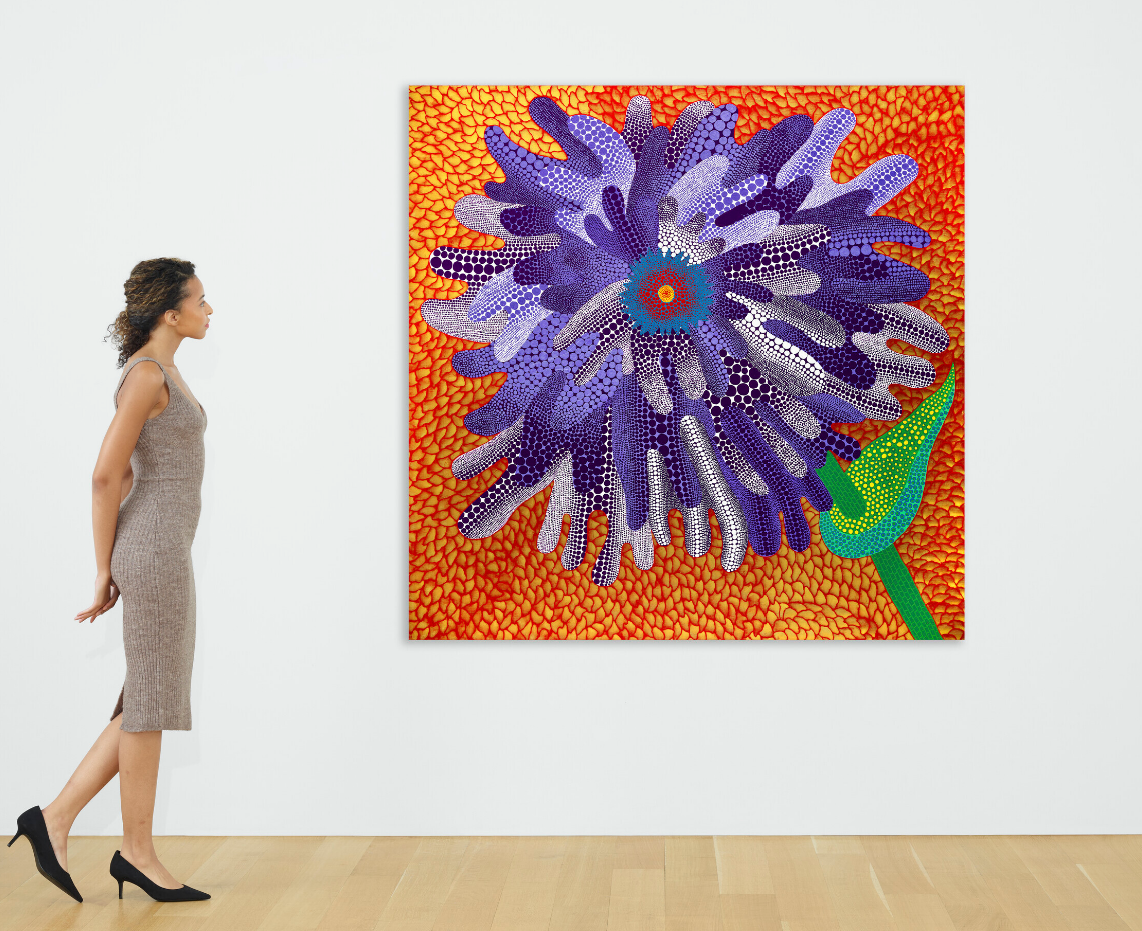
#1. A FLOWER, 2014
Christie’s Hong-Kong: 28 November 2023
Estimated: HKD 65,000,000 – 85,000,000
HKD 78,125,000 / USD 10,029,987
21391-yayoi-kusama-a-flower (christies.com)
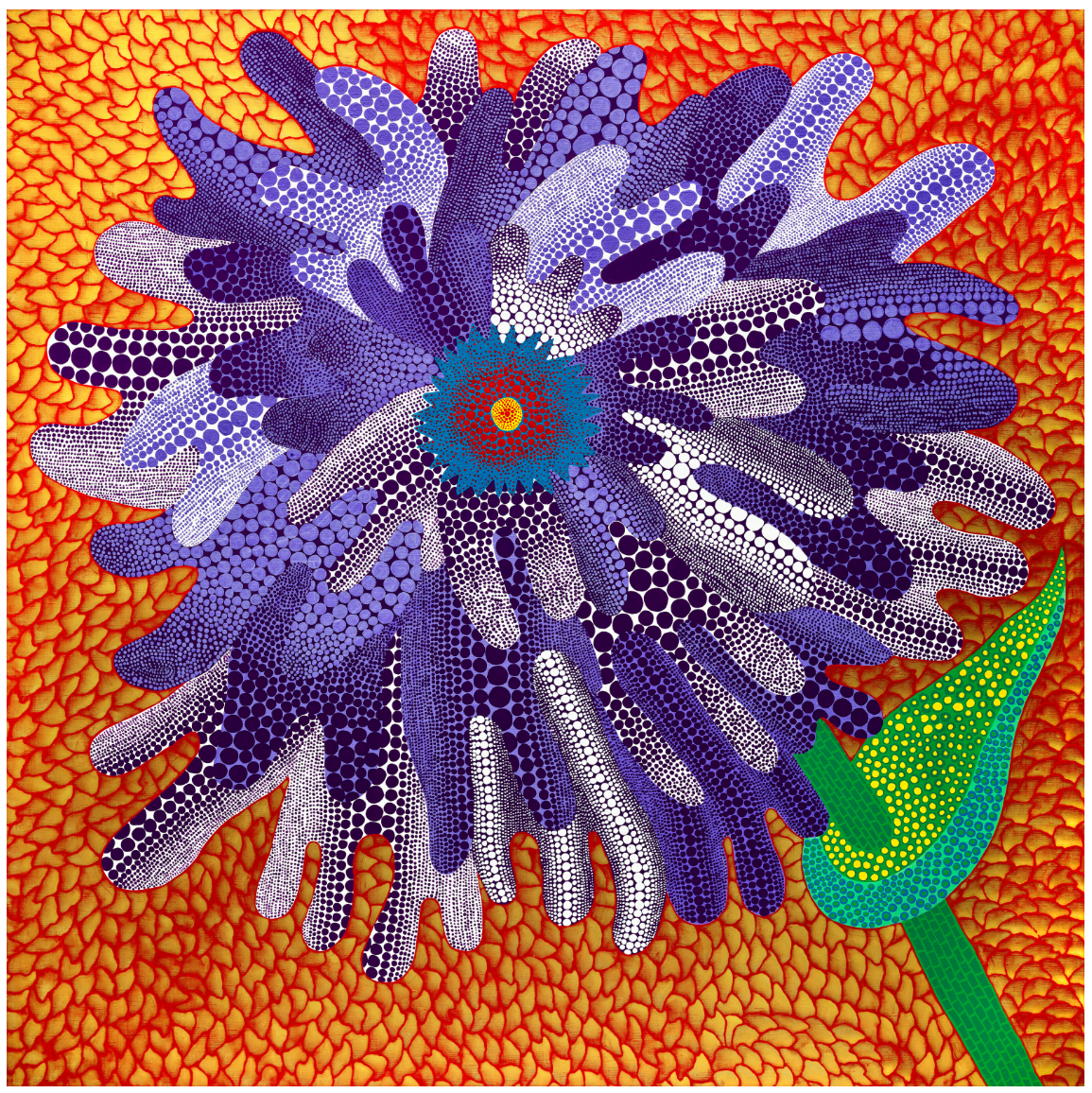
YAYOI KUSAMA (B. 1929)
A FLOWER, 2014
Acrylic on canvas
162.2 x 162.2 cm. (63 7/8 x 63 7/8 inches.)
titled in Japanese; signed, titled and dated ‘YAYOI KUSAMA 2014 A FLOWER’ (on the reverse)
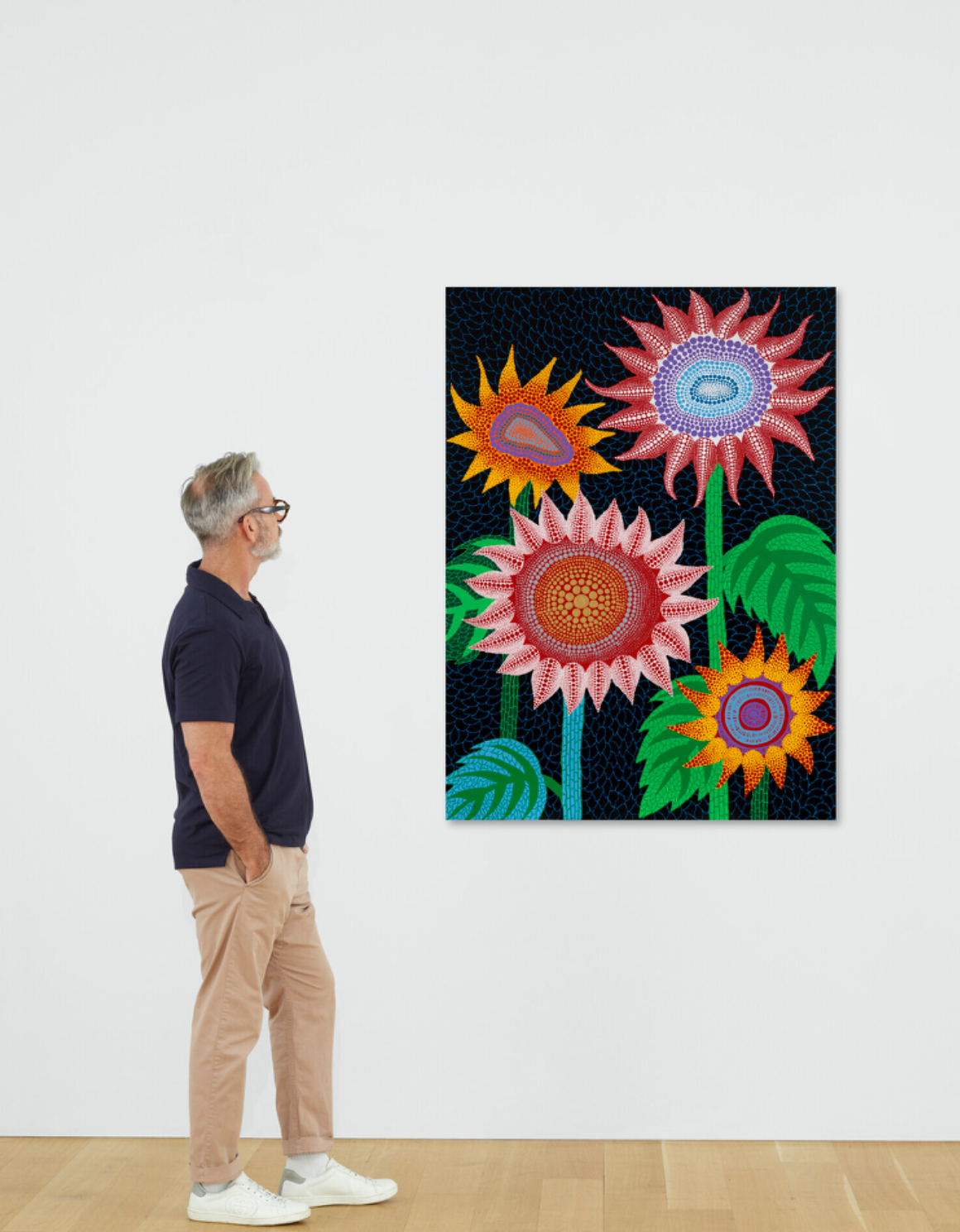
#2. Flowers, 2015
Christie’s Hong-Kong: 28 May 2023
Estimated: HKD 32,000,000 -55,000,000
HKD 58,455,000 / USD 7,463,651
YAYOI KUSAMA (B. 1929) (christies.com)
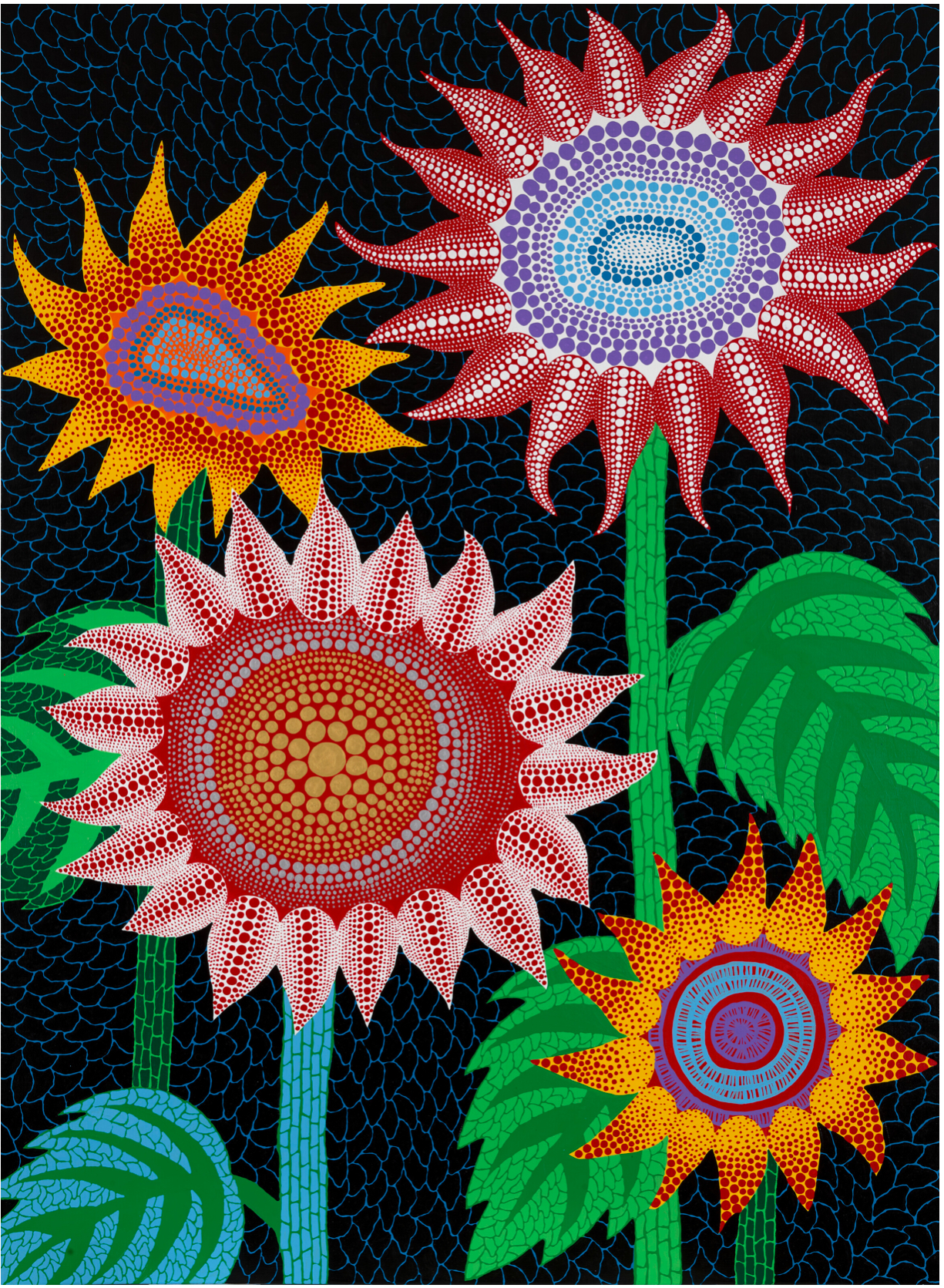
YAYOI KUSAMA (B. 1929)
Flowers, 2015
Acrylic on canvas
130.3 x 97 cm (51 1/3 x 38 1/5 inches)
Signed, titled and dated ‘FLOWERS 2015 YAYOI KUSAMA’ (on the reverse)
#3. Flower, 2008
China Guardian Beijing: 19 December 2017
Estimated: CNY 2,000,000 – 3,000,000
CNY 8,625,000 / USD 1,305,610
Auctions – Lot details (cguardian.com)
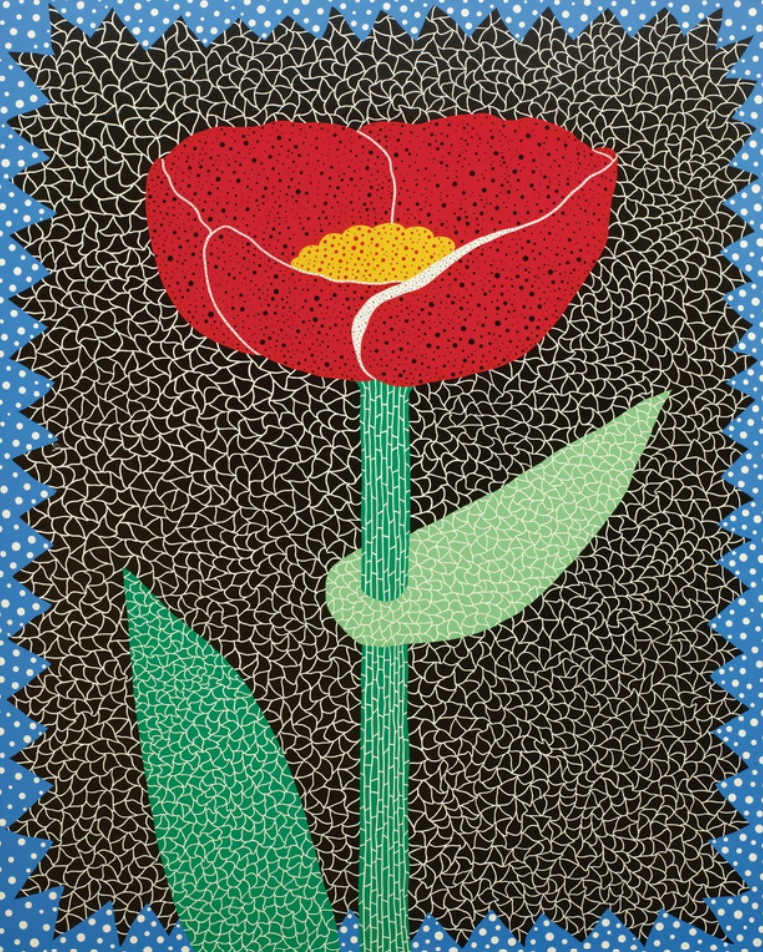
YAYOI KUSAMA
Flower, 2008
Oil on canvas
228×182 cm (89 3/4 x 71 5/8 inches)
Signed, titled and dated on the reverse
#4. A Flower, 2000
Christie’s Hong-Kong: 27 May 2022
Estimated: HKD 5,000,000 – 9,000,000
HKD 8,820,000 / USD 1,123,630
YAYOI KUSAMA (B. 1929), A Flower | Christie’s (christies.com)
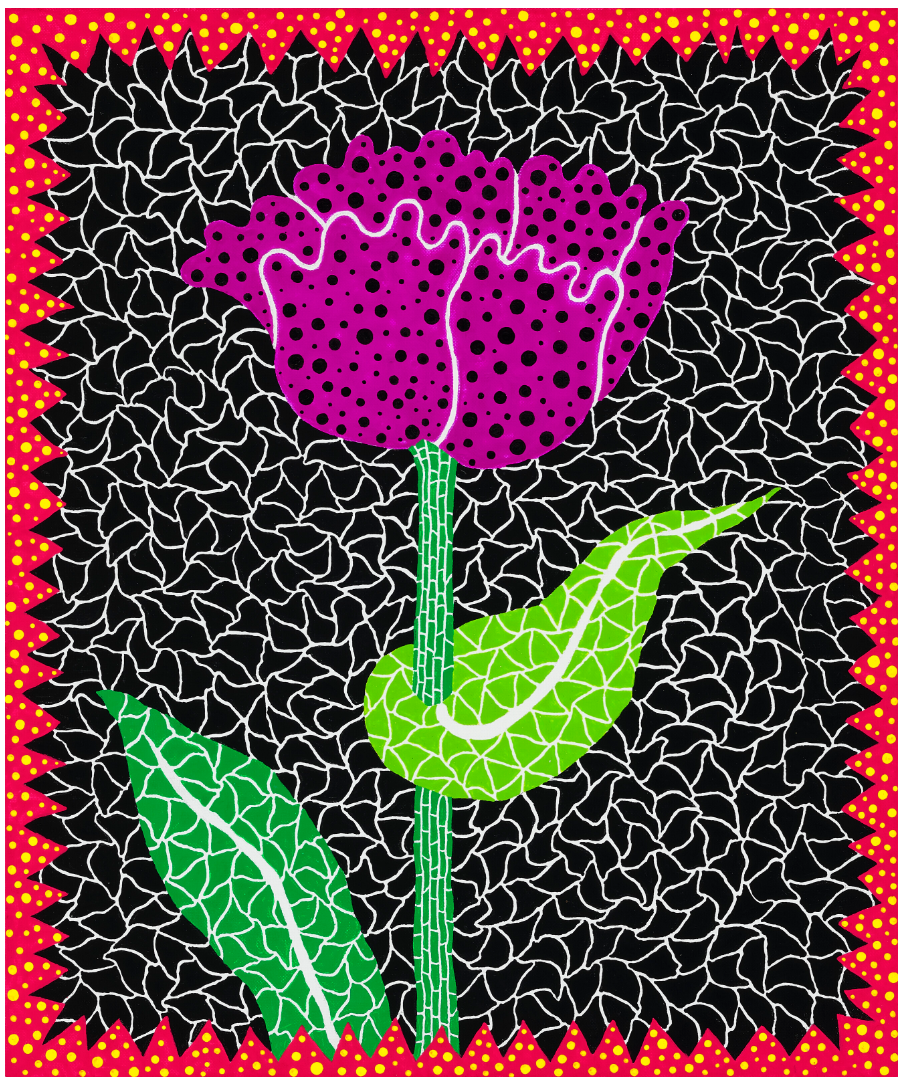
YAYOI KUSAMA (B. 1929)
A Flower, 2000
Acrylic on canvas laid on board
45.5 x 37.5 cm (17 7/8 x 14 3/4 inches)
Signed, titled and dated ‘Yayoi Kusama 2000 A Flower’
Titled again in Japanese (on the reverse)
#5. FLOWERING, 1989
Est-Ouest Auctions Tokyo: 29 May 2022
Estimated: JPY 70,000,000 – 120,000,000
JPY 112,700,000 / USD 886,460
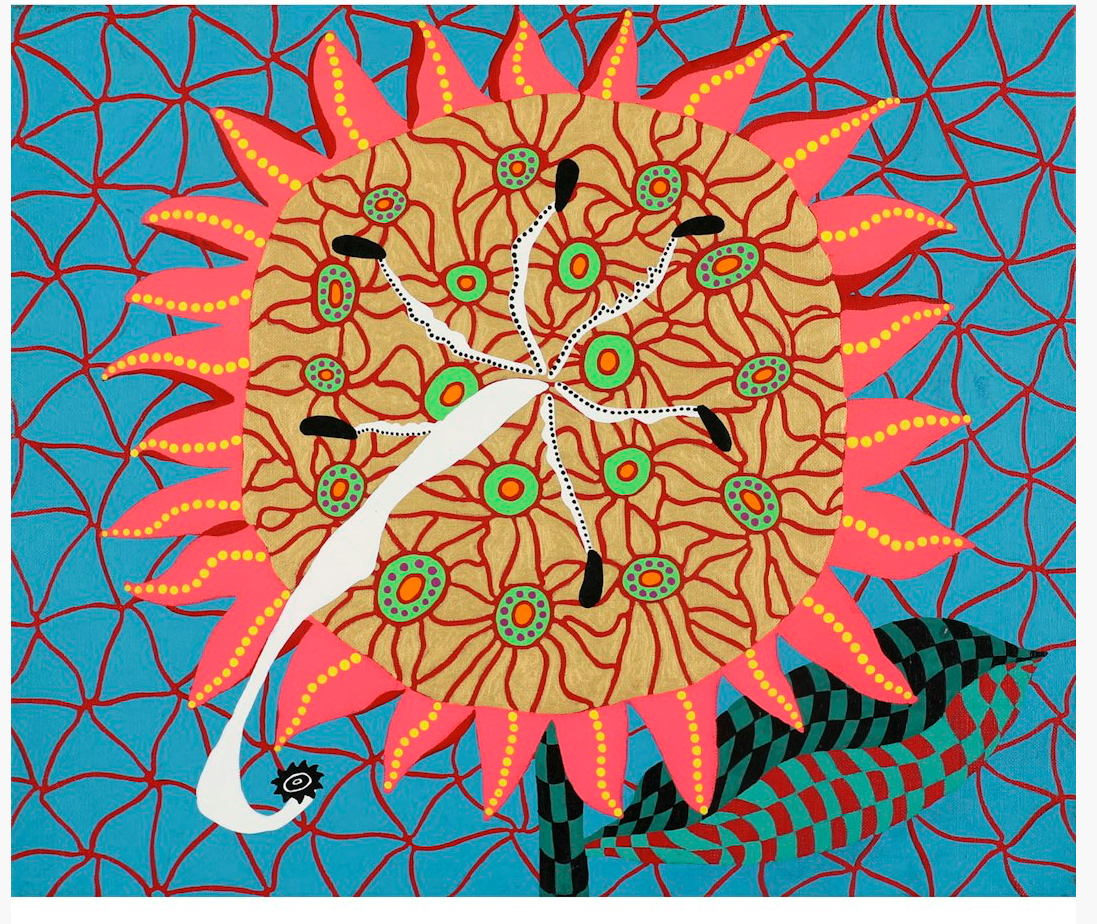
YAYOI KUSAMA
FLOWERING, 1989
Acrylic on canvas
38 x 45.5 cm (15 x 17 7/8 inches)
Signed, titled and dated on the reverse
#6. Flowers, 1996
Christie’s Hong-Kong: 29 May 2024
Estimated: HKD 1,500,000 – 2,500,000
HKD 8,820,000 / USD 1,123,630
YAYOI KUSAMA (B. 1929), Flowers | Christie’s (christies.com)
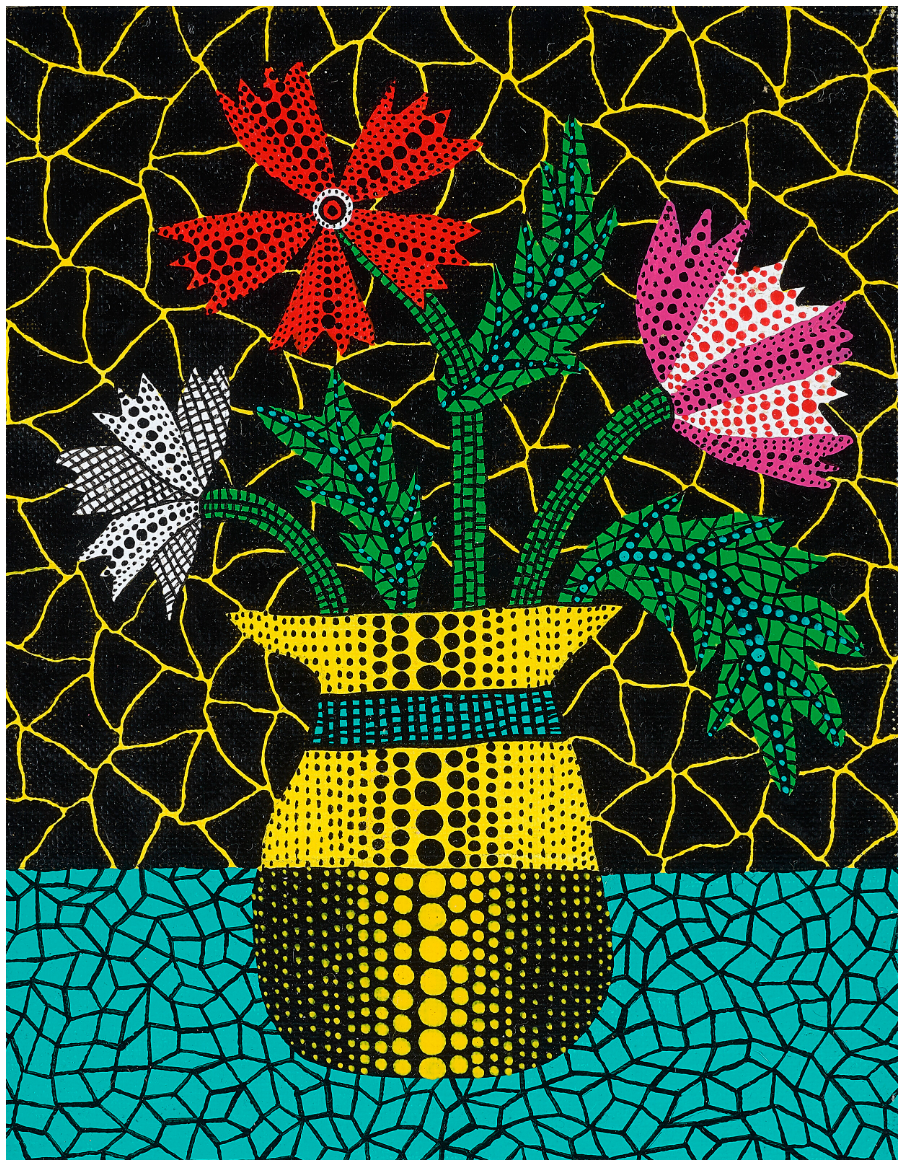
YAYOI KUSAMA (B. 1929)
Flowers, 1996
Acrylic on canvas
18×14 cm (7 1/8 x 5 1/2 inches)
Signed, titled in Japanese, and dated ‘Yayoi Kusama 1996’ (on the reverse)
#7. Sunflower, 1987
Christie’s Shanghai: 3 April 2025
Estimated: CNY 5,000,000 – 8,000,000
CNY 5,670,000 / USD 780,175
YAYOI KUSAMA (B. 1929), Sunflower | Christie’s
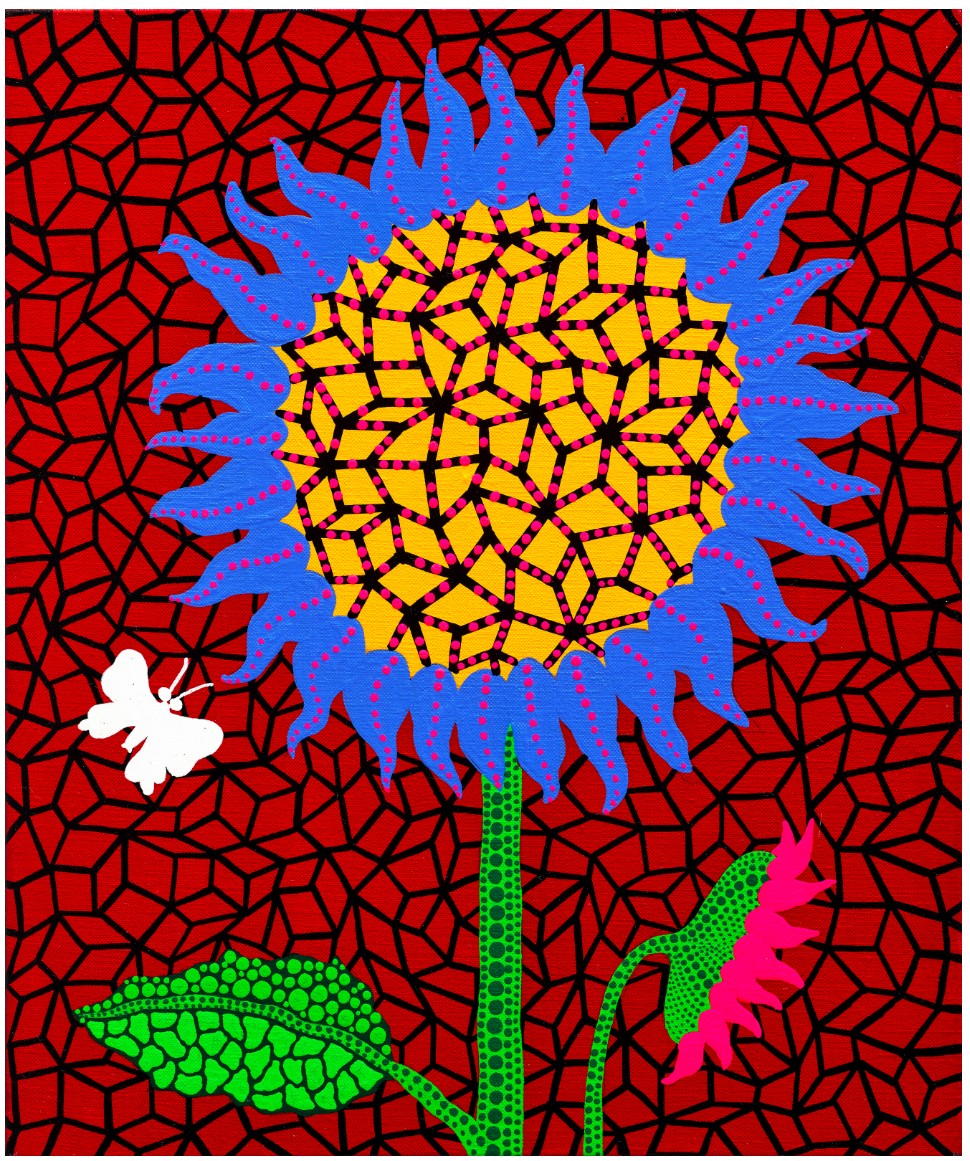
YAYOI KUSAMA (B. 1929)
Sunflower, 1987
Acrylic on canvas
45.5 x 38 cm (17 7/8 x 15 inches)
Signed, dated and titled in Japanese ‘Yayoi Kusama 1987’ (on the reverse)
A Flower (TZSS), 2005
China Guardian: 7 April 2025
Estimated: HKD 5,000,000 – 8,000,000
HKD 6,000,000 / USD 771,870
Auction | China Guardian (HK) Auctions Co., Ltd.
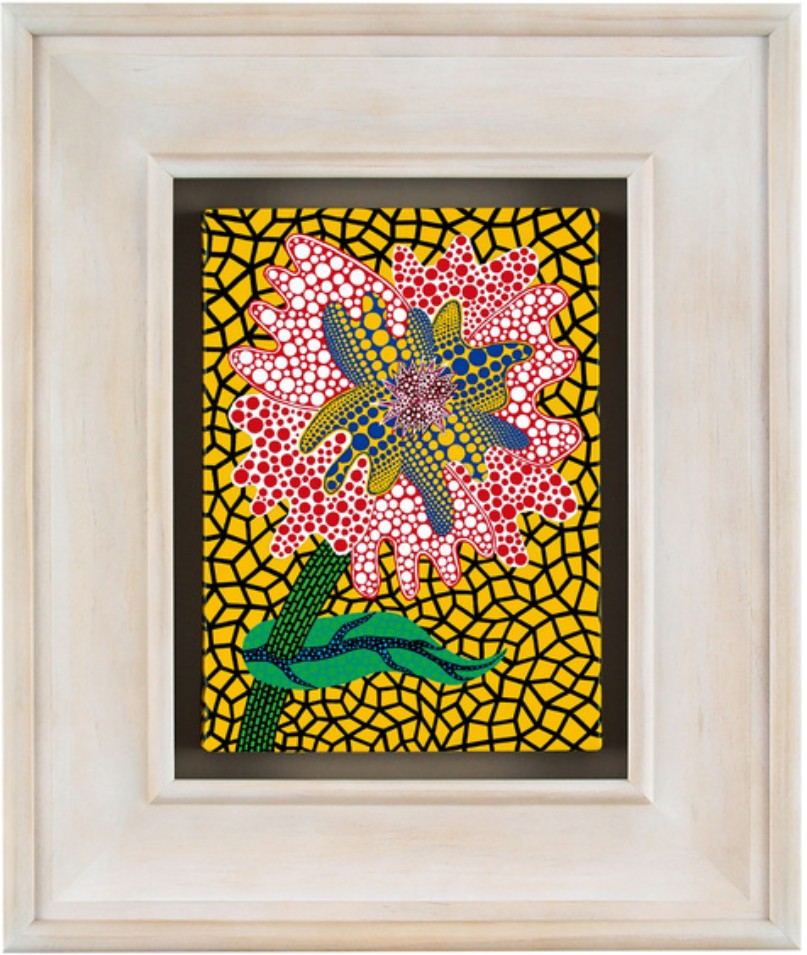
A Flower (TZSS), 2005
Acrylic on canvas
33.3 x 24.2 cm (13 1/8 × 9 1/2 inches)
Signed in English, dated, and titled in English and Japanese Kanji on the reverse
Untitled, circa 1970
Christie’s Hong-Kong: 29 May 2023
Estimated: HKD 3,200,000 – 4,800,000
HKD 5,796,000 / USD 739,927
YAYOI KUSAMA (B. 1929) (christies.com)
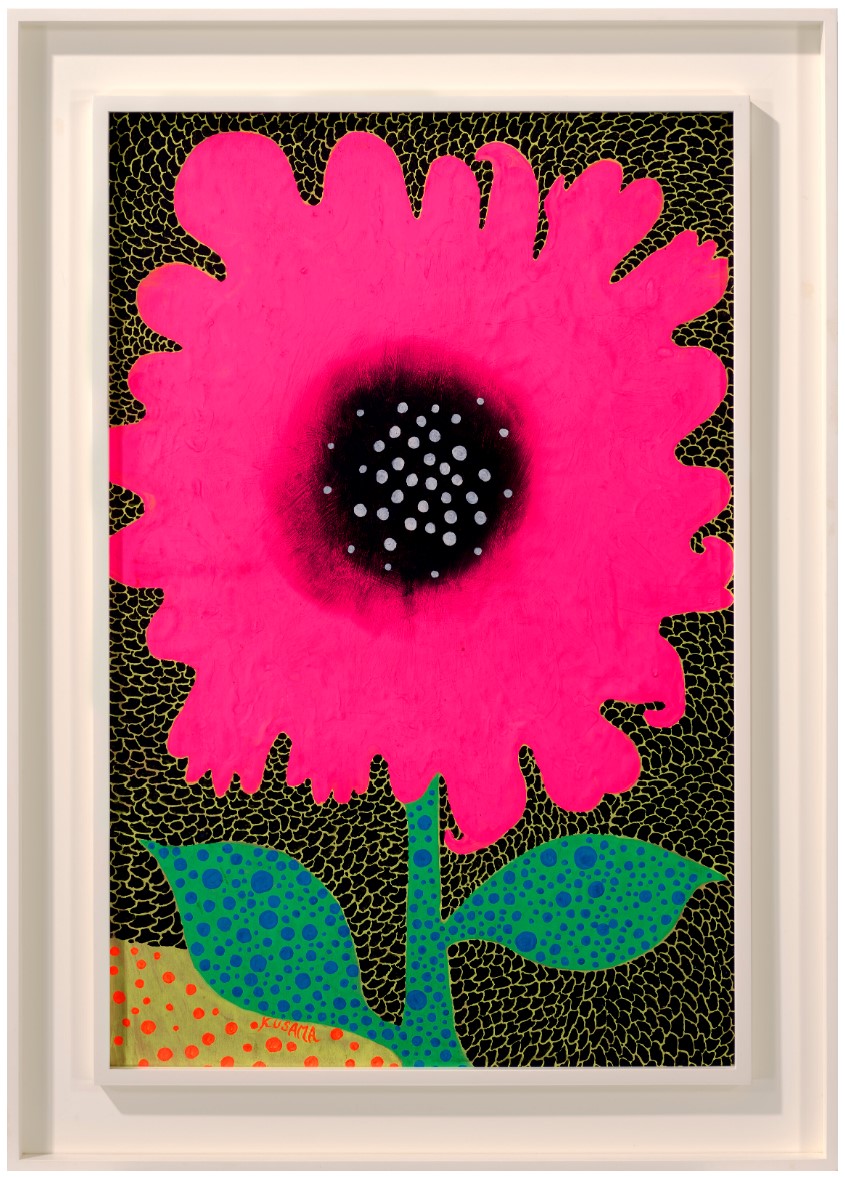
YAYOI KUSAMA (B. 1929)
Untitled, circa 1970
Gouache and mixed media on paperboard
80.6 x 53 cm (31 3/4 x 20 7/8 inches)
Signed ‘Kusama’ (lower edge)
#8. Flower, 1996
China Guardian Hong-Kong: 9 October 2022
Estimated: HKD 2,500,000 – 3,500,000
HKD 5,760,000 / USD 733,785
Auction | China Guardian (HK) Auctions Co., Ltd. (cguardian.com.hk)
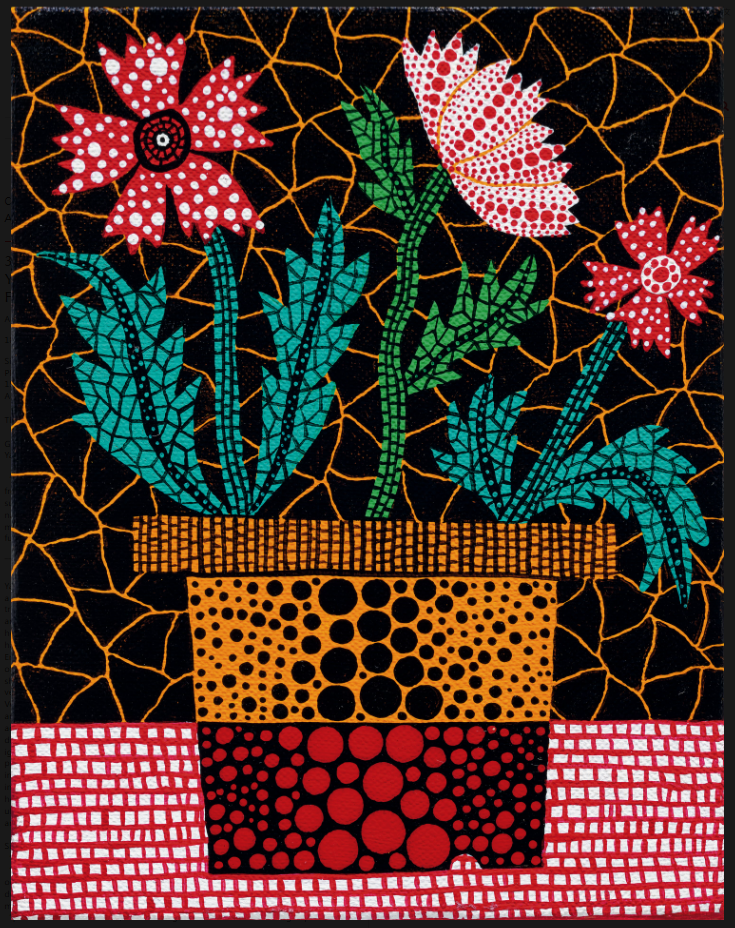
Flower, 1996
Acrylic on canvas
18×14 cm (7 1/8 × 5 1/2 inches)
Signed in English, titled in Japanese and dated on the reverse
Flowers, 1989
Estimated: HKD 3,000,000 – 5,000,000
HKD 4,788,000 / USD 613,909
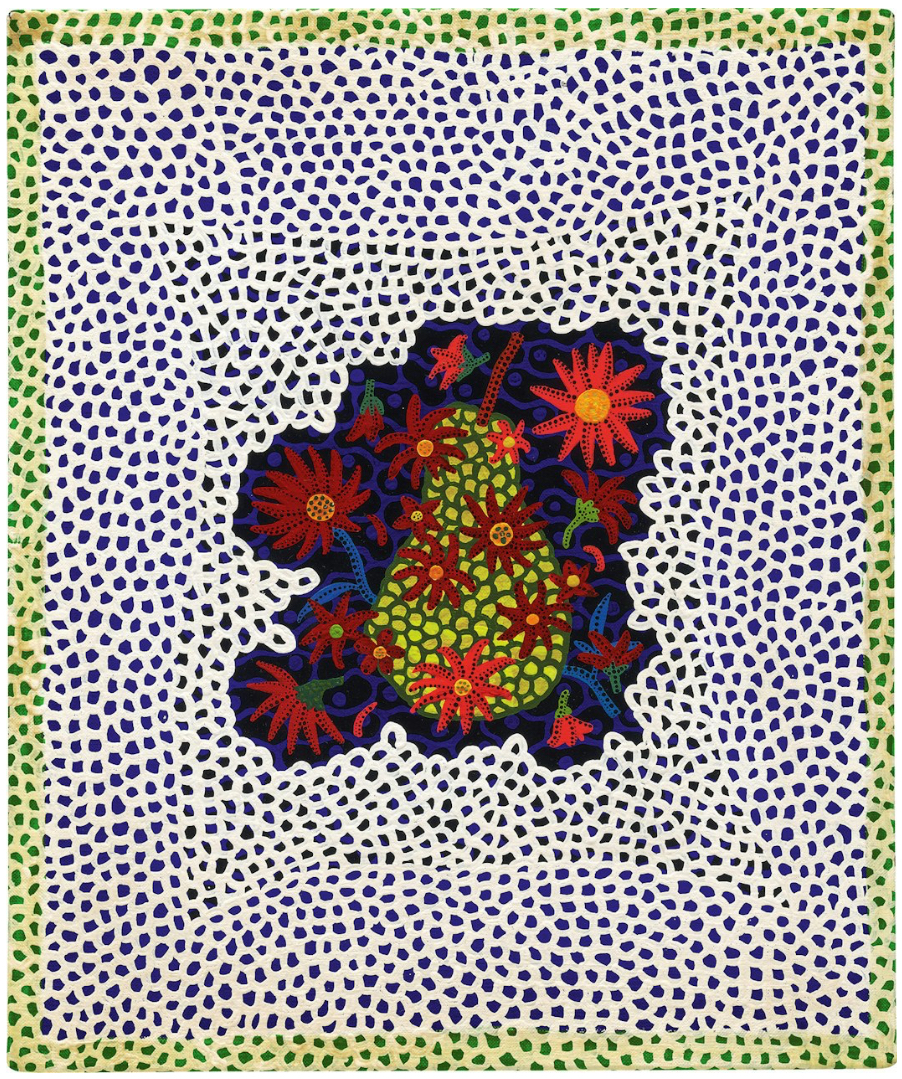
YAYOI KUSAMA
Flowers, 1989
Acrylic on canvas
45.5 x 38 cm (18×15 inches)
Signed, titled and dated ‘”Flowers [in Kanji]” 1989 Yayoi Kusama’ on the reverse
Window, 1979
Christie’s Hong-Kong: 1 December 2022
Estimated: HKD 6,800,000 – 9,800,000
HKD 20,850,000 / USD 2,680,706
YAYOI KUSAMA (B. 1929) (christies.com)
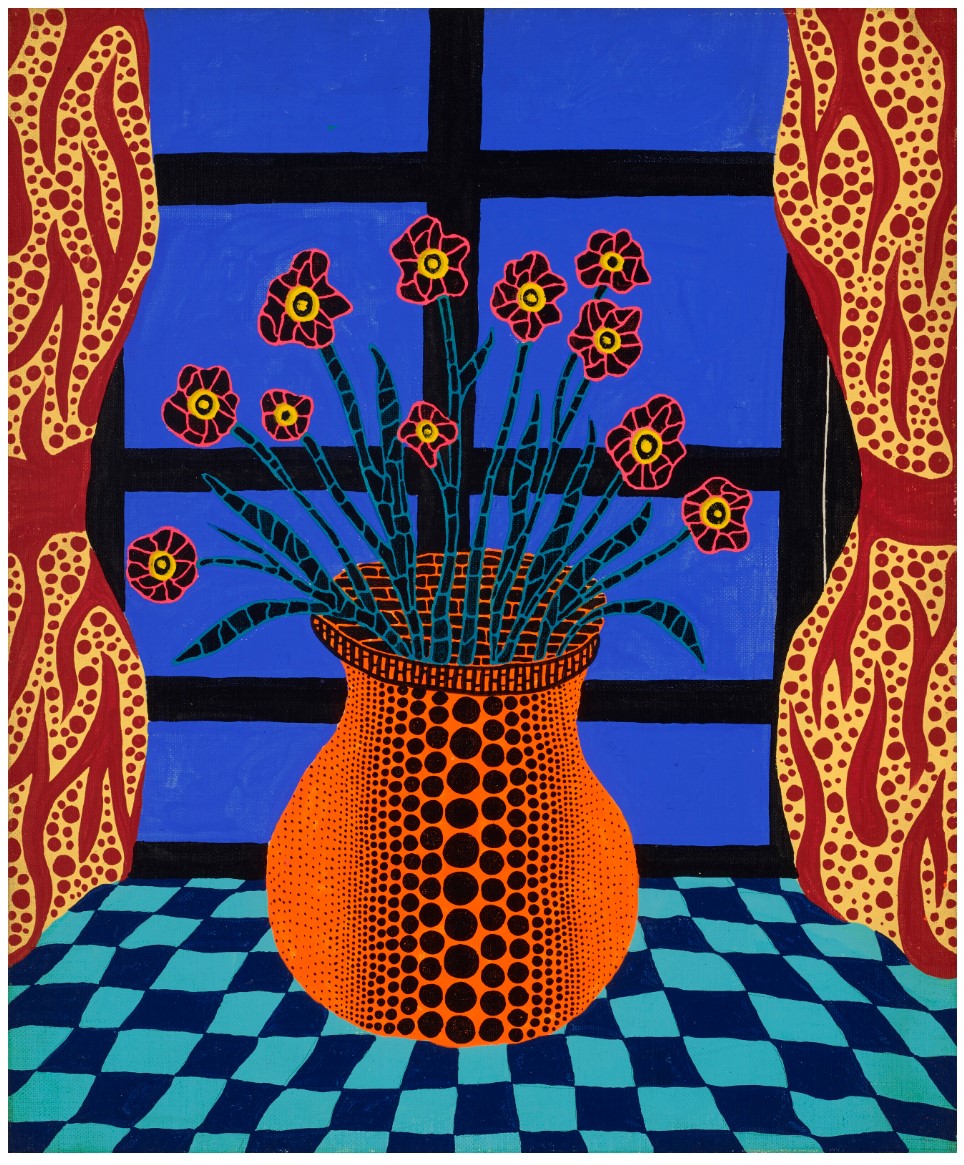
YAYOI KUSAMA (B. 1929)
Window, 1979
Acrylic on canvas
45×38 cm (17 3/4 x 15 inches)
Signed and dated ‘Yayoi Kusama 1979’, titled in Japanese (on the reverse)
Painted in 1979 and fresh to the market, Window is at once exemplary and exceptional in Yayoi Kusama’s oeuvre. Encompassing multiple signature motifs on one canvas—polka dots on the vase, the undulating, organic pattern on the curtain and colorful still life with the flowers, the present work is a powerful showcase of Kusama’s diverse visual vocabulary established as early as late 1970s. Yet the work distinguishes itself from other Kusama’s still-life where the background is flat with the pattern of infinity nets or dots—the vase and flowers are placed in an ambivalent space outlined by the black framed window in the back and checkerboard pattern on the ground.
Flowers Sculptures
#1. FLOWERS THAT BLOOM TOMORROW (M), 2010
Est-Ouest Auctions Tokyo: 1 October 2021
Estimated: JPY 100,000,000 – 150,000,000
JPY 226,650,000 / USD 2,023,890
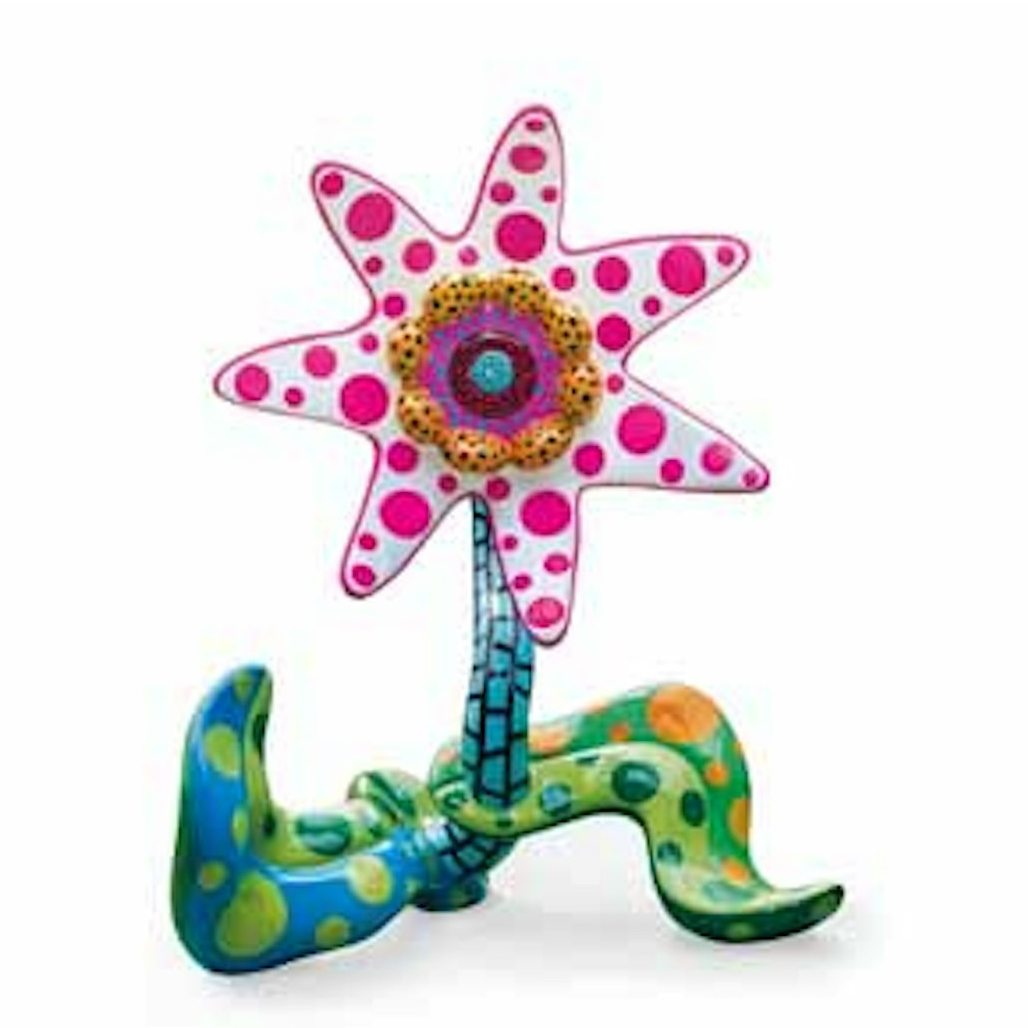
YAYOI KUSAMA
FLOWERS THAT BLOOM TOMORROW (M), 2010
Urethane paint, metal, fiber reinforced plastics
290x205x185 cm (114 1/8 x 80 5/8 x 72 7/8 inches)
Signed and dated on the base
#2. Flowers – That Bloom at Midnight, 2009
Ravenel Taipei: 6 December 2020
Estimated: TWD 30,000,000 – 40,000,000
TWD 40,640,000 / USD 1,425,965
Ravenel | Yayoi KUSAMA《Flowers – That Bloom at Midnight》 Ravenel Autumn Auction 2020 Taipei Lot 222
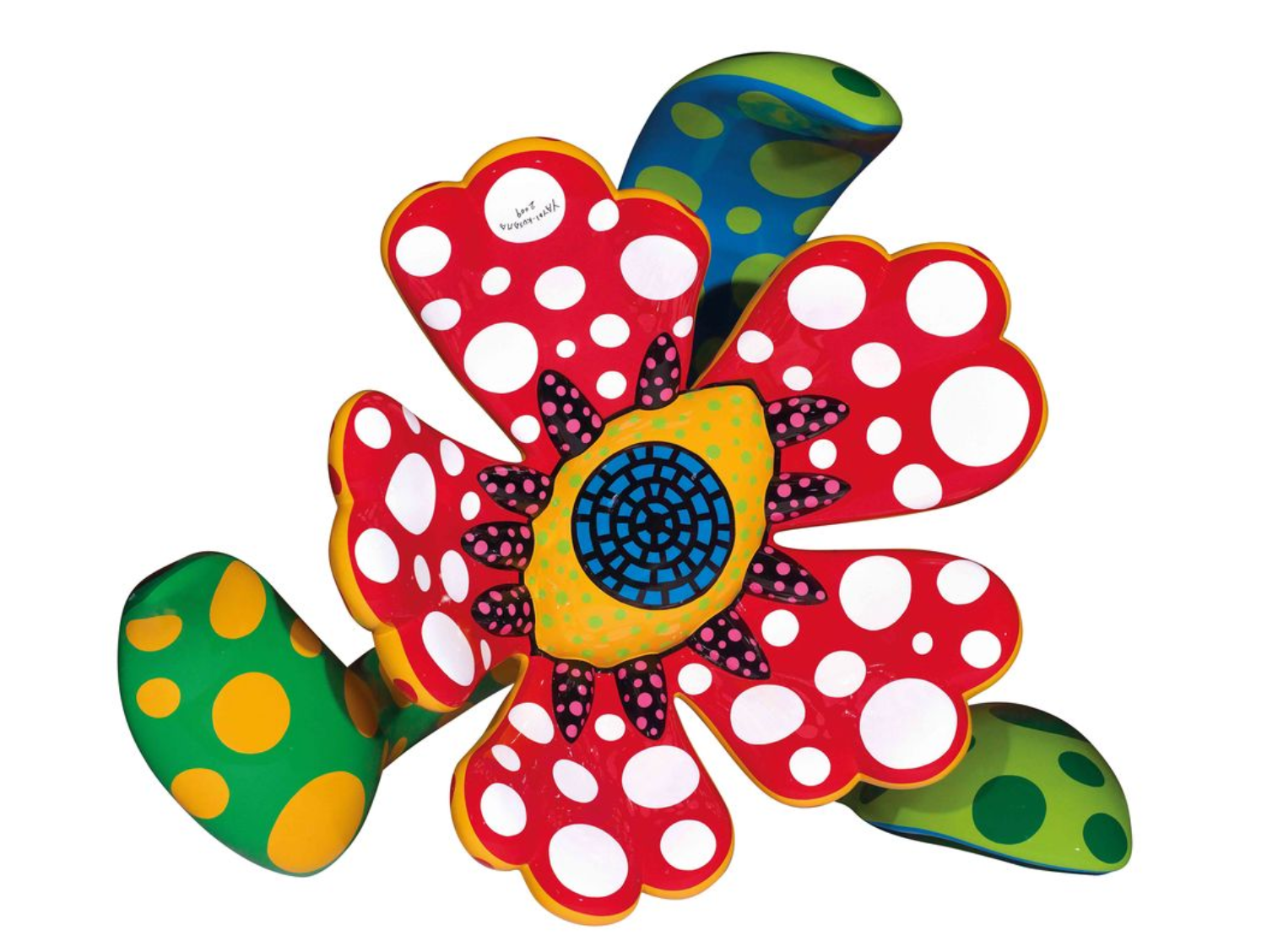
YAYOI KUSAMA (Japanese, 1929)
Flowers – That Bloom at Midnight, 2009
FRP, metal, all-weather urethane Paint
228x220x136 cm
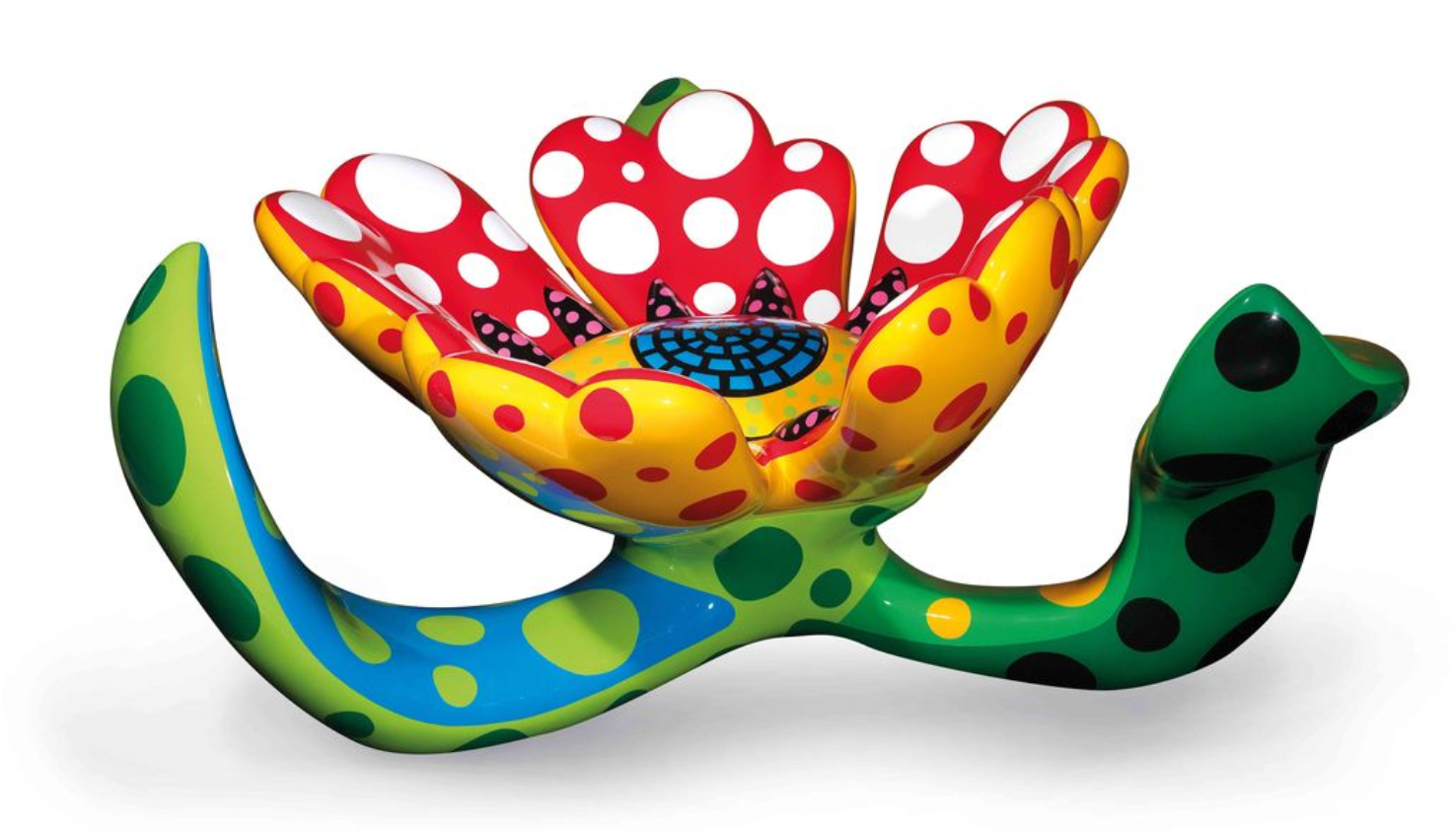
#3. Flowers That Bloom at Midnight, 2009
Sotheby’s Hong-Kong: 30 September 2018
Estimated: HKD 6,000,000 – 8,000,000
HKD 9,120,000 / USD 1,164,985
(#1062) KUSAMA YAYOI | Flowers That Bloom at Midnight (sothebys.com)
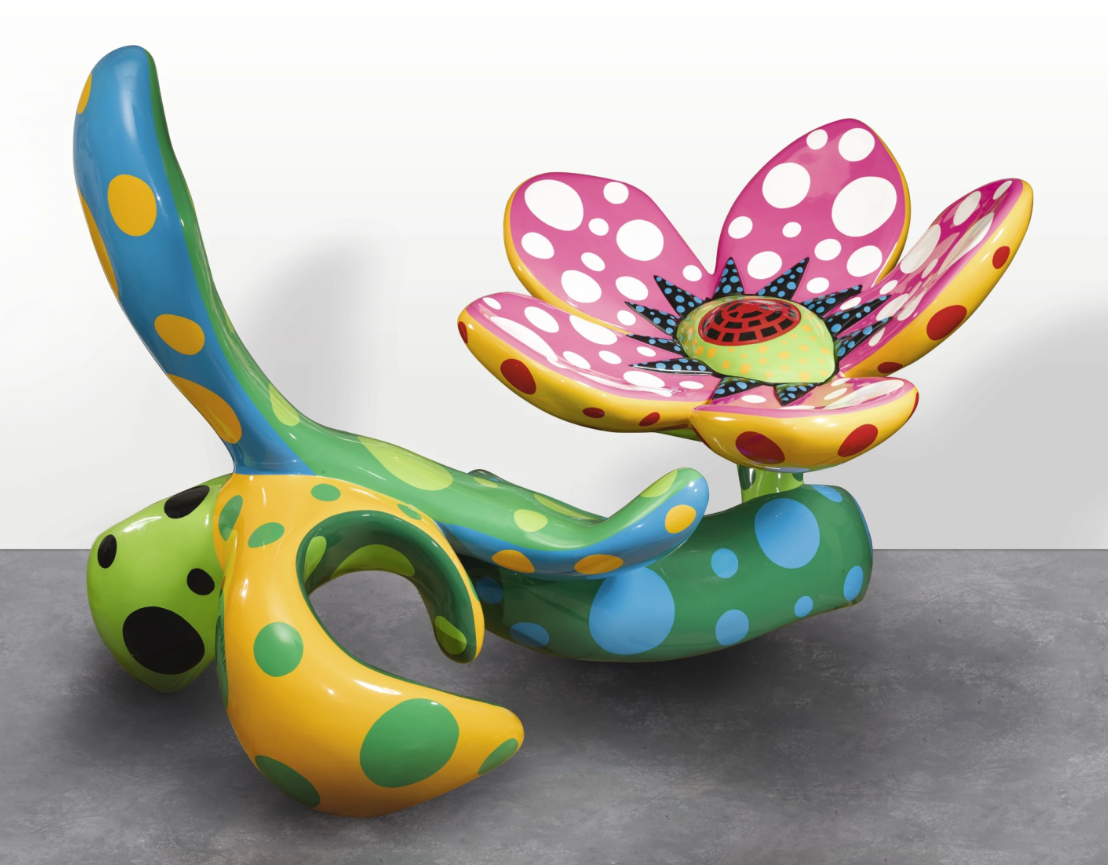
YAYOI KUSAMA
Flowers That Bloom at Midnight, 2009
Urethane on FRP and metal
175x190x310 cm (68 7/8 x 74 7/8 x 122 inches)
Signed in English and dated 2009
Flamboyant, uncannily anthropomorphic and exuberantly bizarre, Kusama Yayoi’s Flowers That Bloom at Midnight manifests an instantly arresting and compelling presence. The monstrous flower comes to life through its human-scaled size, bright riotous gaudy colors and curvaceous bodily form; positioned in a lounging disposition reminiscent of the canon of the reclining nude, the sculpture confronts the viewer with an idiosyncratic Surreal-Pop aura that is at once whimsical and sinister, quirky and playful yet subtly haunting. Meticulously hand painted, the sculpture exhibits the singular hallucinogenic vision that drives Kusama’s legendary career. The present work is a part of an original series of seven flower sculptures that was later re-visited by the artist to become a unique series of fifteen; the original series, titled Flowers That Bloom at Midnight, was displayed at the Queensland Gallery of Modern Art in Australia in 2011 and subsequently at the Tuilleries gardens in Paris by the Louvre, which coincided with her first French retrospective at the Centre Pompidou in 2012.
A psychedelic science-fiction object, the sculpture is an extraordinary manifestation of Kusama’s hallucinations embodying one of the artist’s most iconic and well-known motifs, the flower. As a child, Kusama experienced hallucinations in which an overwhelming multitude of flowers would bloom, fill the room around her, and communicate with her. In the artist’s own words: “From a very young age I used to carry my sketchbook down to the seed-harvesting grounds. I would sit among beds of violets, lost in thought. One day I suddenly looked up to find that each and every violet had its own individual, human-like facial expression, and to my astonishment they were talking to me… They were all like little human faces looking at me” (Kusama Yayoi, Infinity Net, the Autobiography of Yayoi Kusama, Tate 2011, pp. 62). In another well-known hallucination: “One day, when I was a little girl, I found myself trembling, all over my body, with fear, amid flowers incarnate, which had appeared all of a sudden. I was surrounded by hundreds of violets in a flower garden. The violets, with uncanny expressions, were chatting among themselves like human beings. No sooner had they and I had spiritual dialogues than I became infatuated with them, drawn into glitter of illusion, away from this world” (Kusama Yayoi, “The Struggle and Wandering of My Soul”, 1975, in exh. cat. Yayoi Kusama, Phaidon, pp. 118).
Kusama first engaged in the medium of sculpture in the late 1990s and defined herself as more of a sculptor than painter or colorist (Damien Hirst, ‘Across the Water’ in Exh. Cat., New York, Damien Hirst and Yayoi Kusama, Yayoi Kusama: Now, Robert Miller Gallery, 1998, pp. 134-140). During the first decade of the 21st century, she began to create monumental public outdoor sculptures, including several major outdoor commissions, that contended with the likes of Jeff Koons and Paul McCarthy. She first made large-scale floral sculptures in 2000 for Kirishima Open-air Museum in Yusui, Japan, followed by permanent commissions including The Visionary Flowers (2002) for Matsumoto City Museum of Art in Nagano, Japan; Tsumari in Bloom(2003) for Matsudai village, Niigata, Japan, Tulipes de Shangri-La (2003) for Eurolille in Lille, France; and The Hymn of Life: Tulips (2007) for the city of Beverly Hills, United States. Executed in 2009, the present lot is exemplary of Kusama’s large-scale flower sculptures and displays her refined sculptural prowess: cast in fiberglass-reinforced plastic before being hand-painted in urethane, the sculpture’s luminous plastic surfaces create a joltingly disorienting hypnotic effect, mirroring the artist’s idiosyncratic inner visions that drive her oeuvre.
With its vast scale and fleshly physicality, Flowers That Bloom at Midnight compels the viewer to participate and engage with it by walking around all of its protrusions. Twisting and stretching its leaves vertically and outwardly, the flower seems animated, eager to rise up and come alive. Its form is distinctively anthropomorphic, with leaves resembling limbs, the stem resembling a neck, and the blossom the head; while the capitulum of the flower is replaced by a single large eye. Sentient, whimsically child-like yet also faintly ominous, Flowers consummately encapsulates the dueling dichotomies often found in Kusama’s complex, multifarious yet universally resonant and critically acclaimed oeuvre.
Flowers Prints
Flower, 1982 (ABE 10)
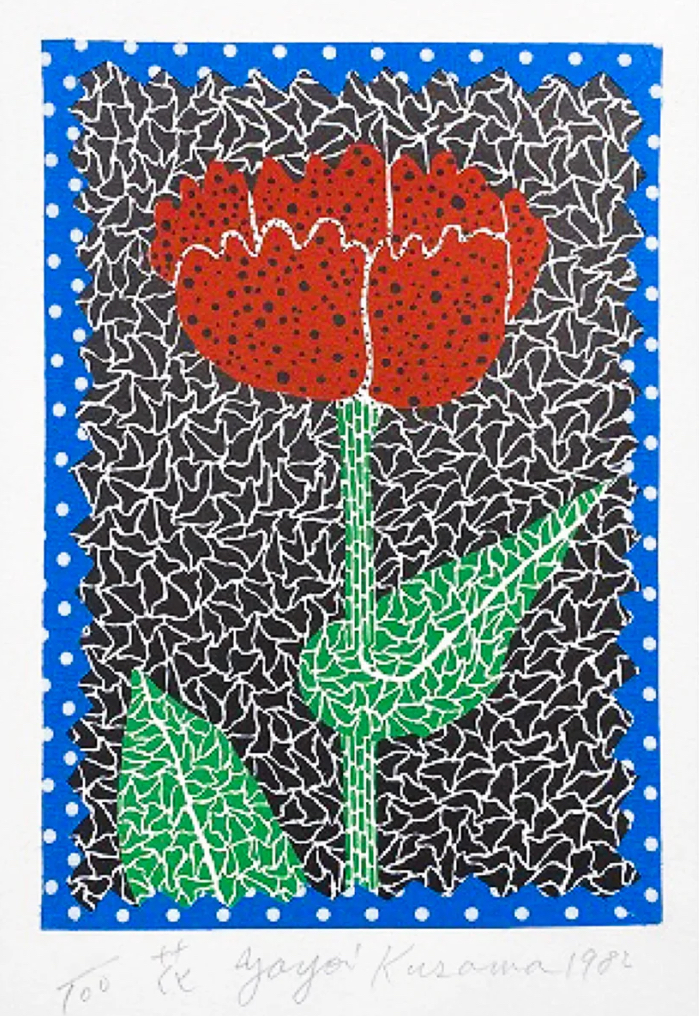
Flower, 1982
Lithograph with collage on Verin d’Arches paper
Sheet: 35.5 x 27.5 cm (14 x 10.8 inches)
Edition: 100 + 3 AP + 3 PP + 1 HC
Literature: ABE 10
Flowers, 1984 (ABE 34)
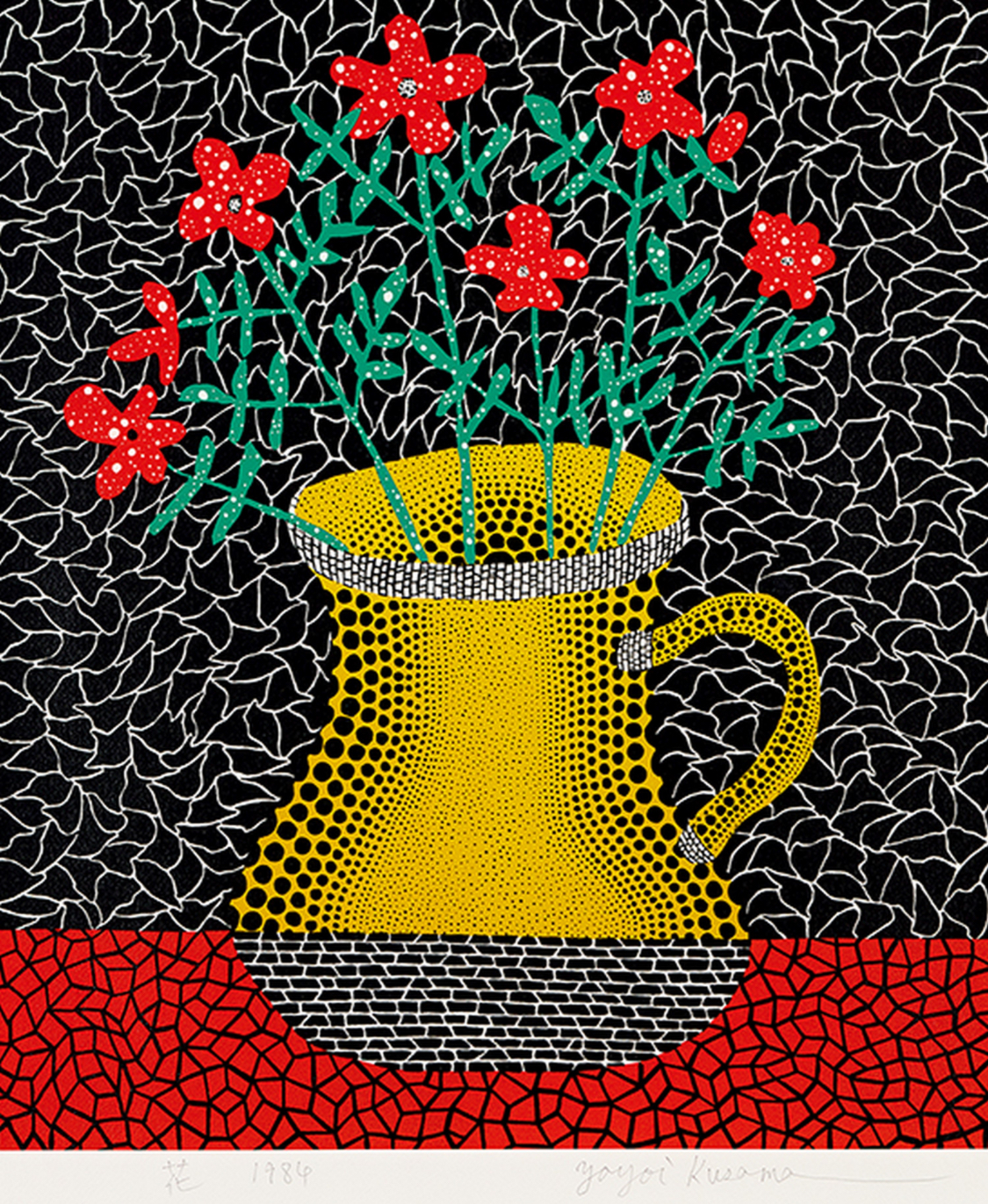
Flowers, 1984
Screen-print in colors on Verin d’Arches paper
Sheet: 61 x 53.5 cm (24 x 21.1 inches)
Edition: 100 + 10 AP
Literature: ABE 34
FLOWERS, 1985 (ABE 77)
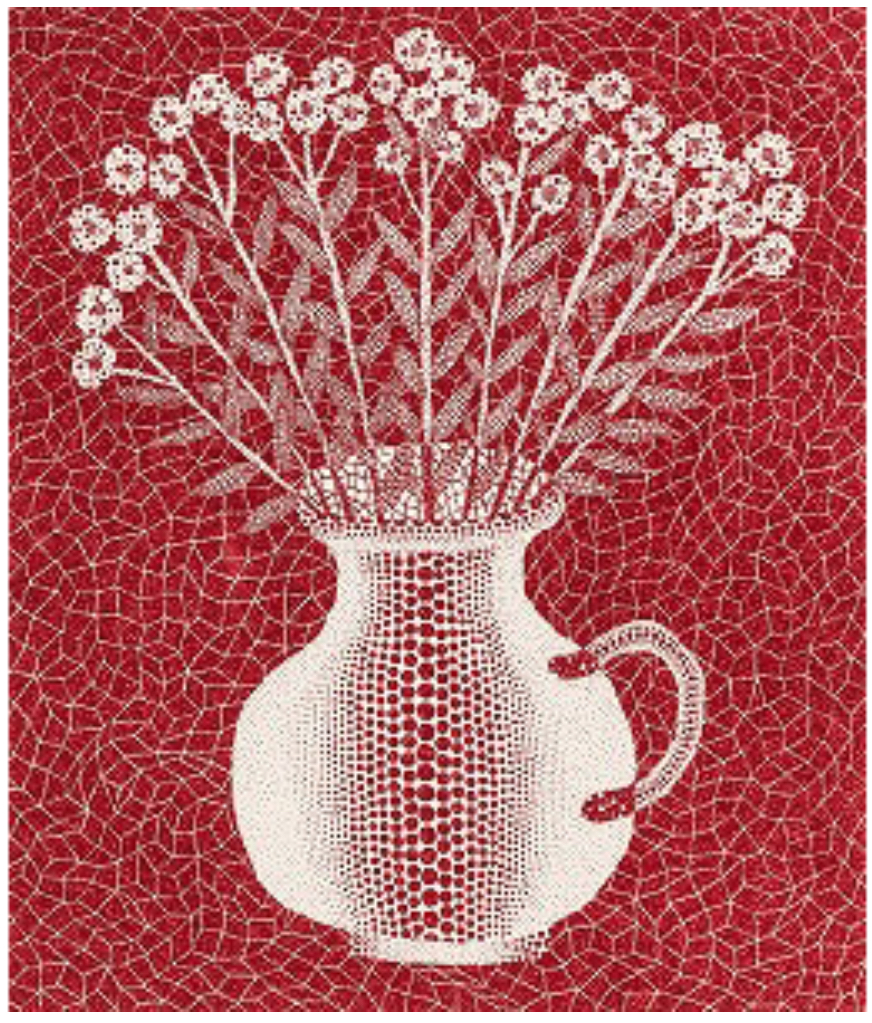
FLOWERS, 1985
Screenprint on Mishima paper with Lame
Sheet: 61 x 53.5 cm (24 x 21.1 inches)
Edition: 100 + 10 AP
Literature: ABE 77
FLOWERS, 1985 (ABE 83)
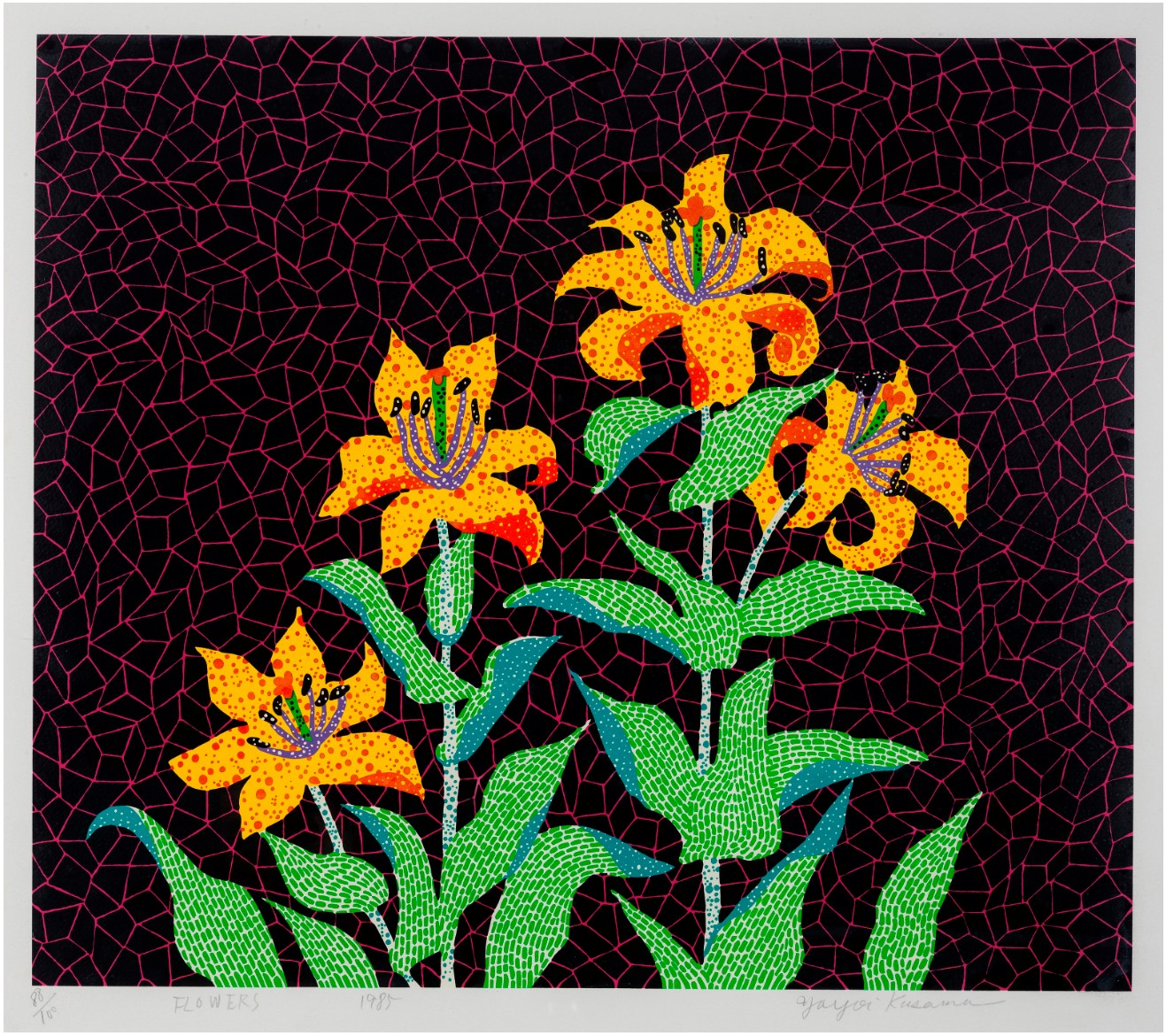
FLOWERS, 1985
Screen-print in colors on Verin d’Arches paper
Sheet: 53.3 x 60.8 cm (21 x 23.9 inches)
Edition: 100 + 10 AP
Literature: ABE 83
FLOWERS, 1985 (ABE 84)
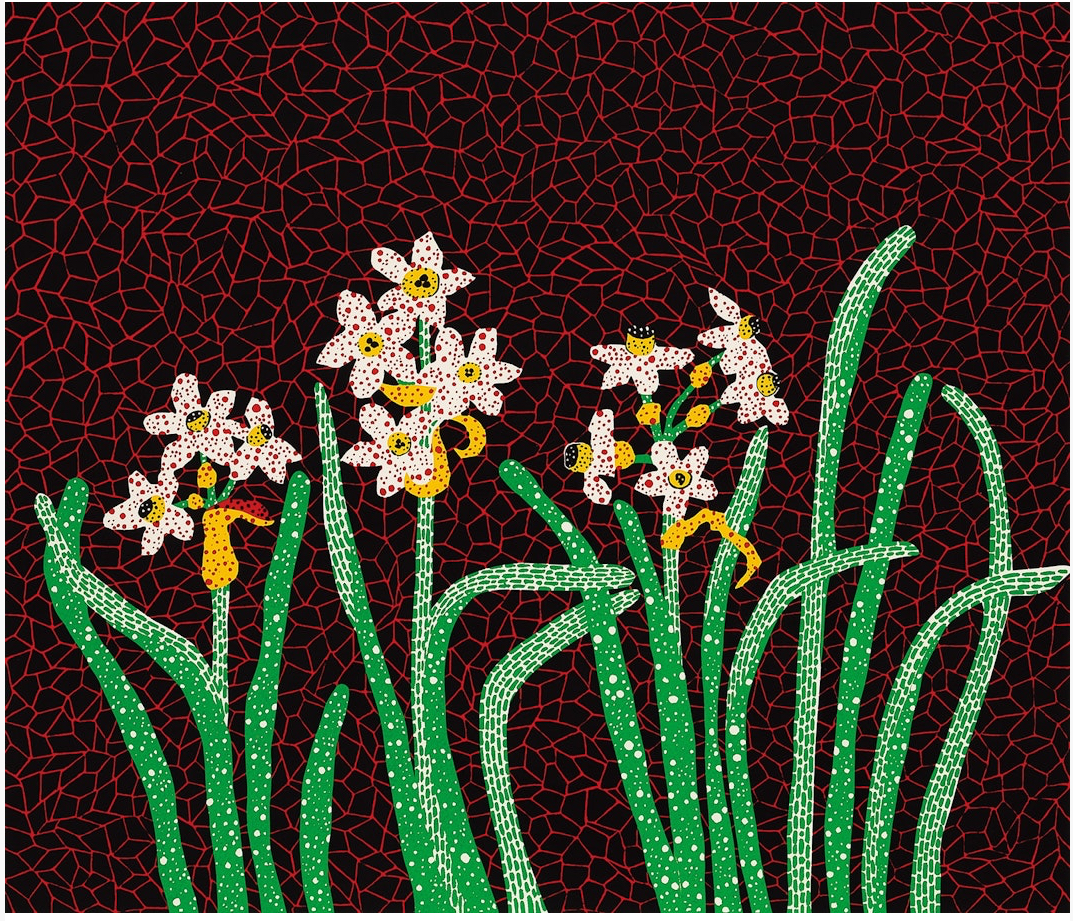
FLOWERS, 1985
Screen-print in colors on Verin d’Arches paper
Sheet: 53.5 x 60.8 cm (21.1 x 23.9 inches)
Edition: 100 + 10 AP
Literature: ABE 84
DANDELIONS, 1985 (ABE 85)
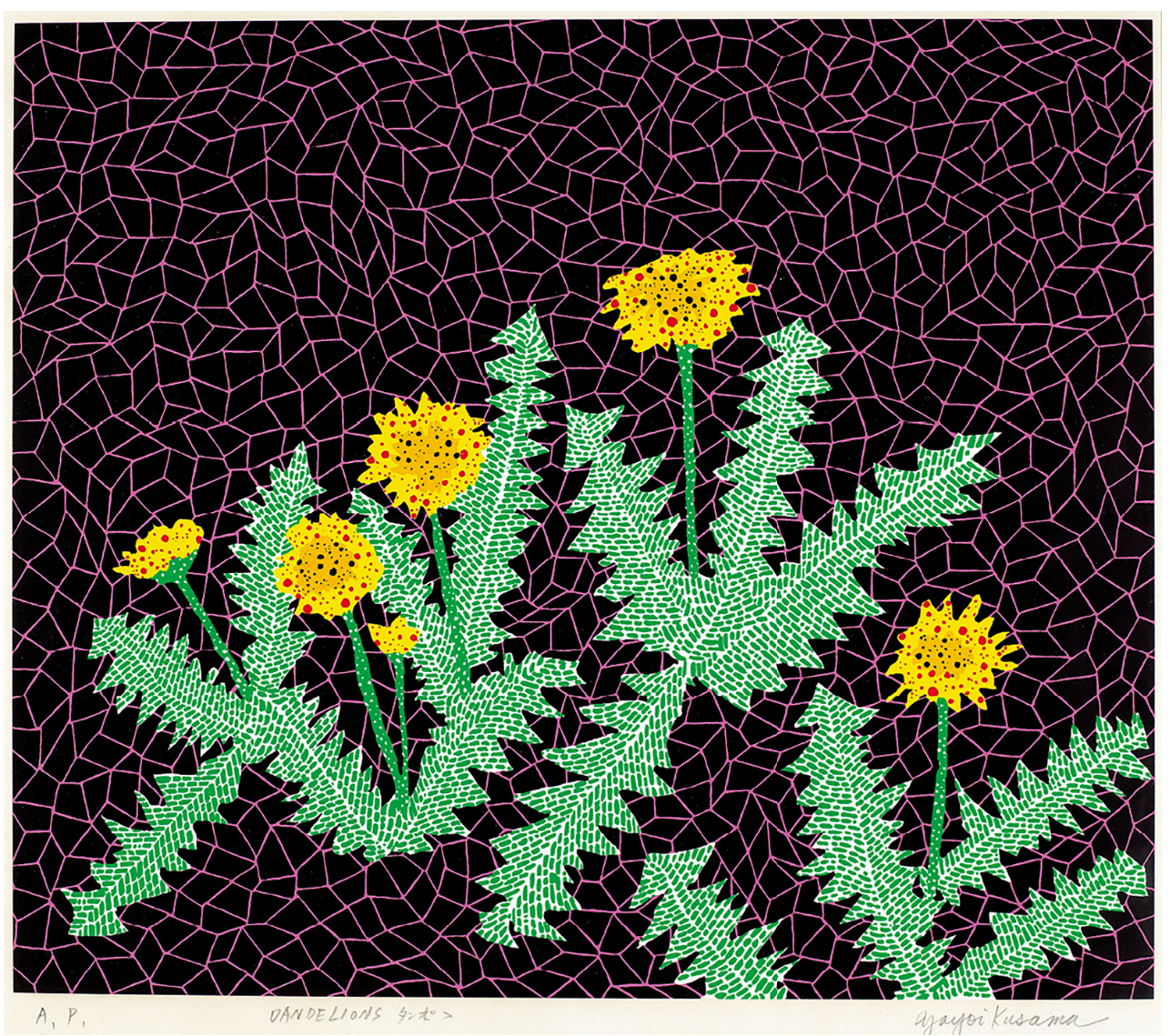
Dandelions, 1985
Screen-print in colors on Izumi paper
Sheet: 53.5 x 61 cm (21.2 x 24 inches)
Edition: 100 + 10 AP + 3 PP
Literature: ABE 85
FLOWERS (1), 1985 (ABE 86)
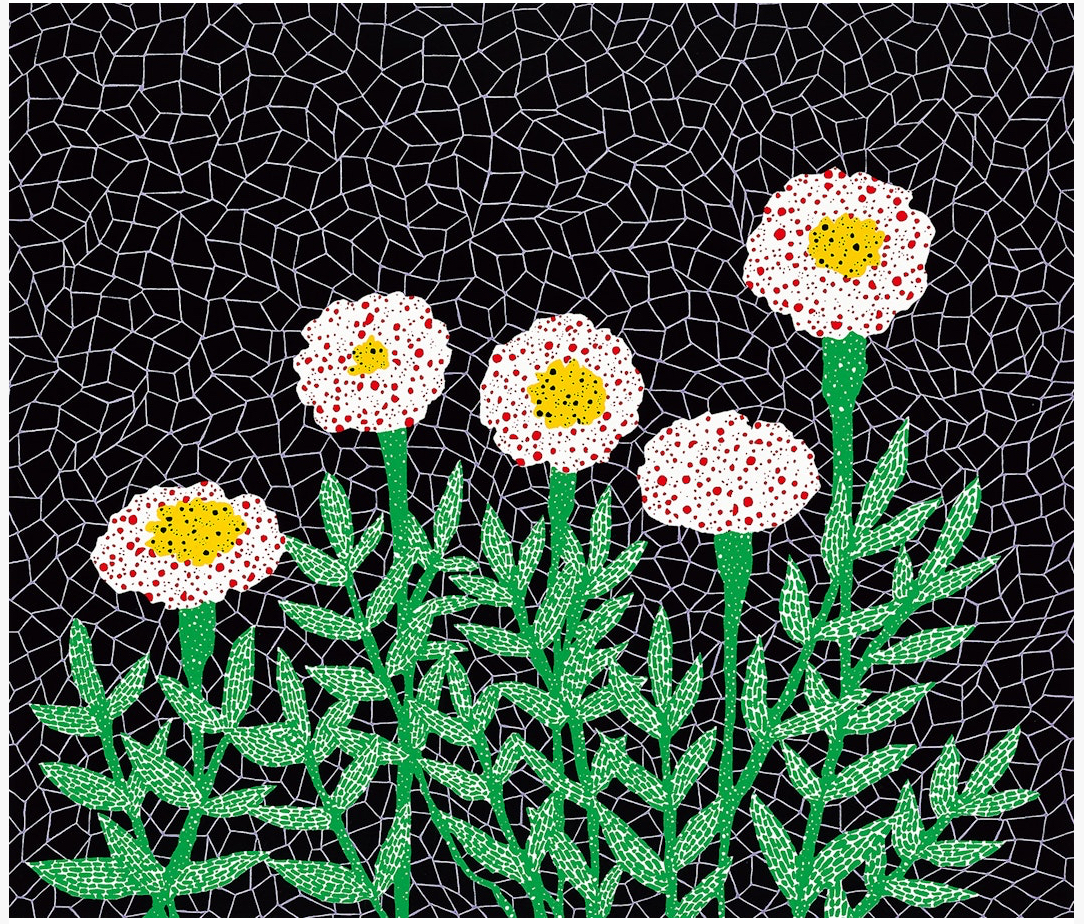
FLOWERS (1), 1985
Screen-print in colors on Izumi paper
Sheet: 53.3 x 61 cm (21 x 24 inches)
Edition: 100 + 10 AP + 3 PP
Literature: ABE 86
FLOWERS (2), 1985 (ABE 87)
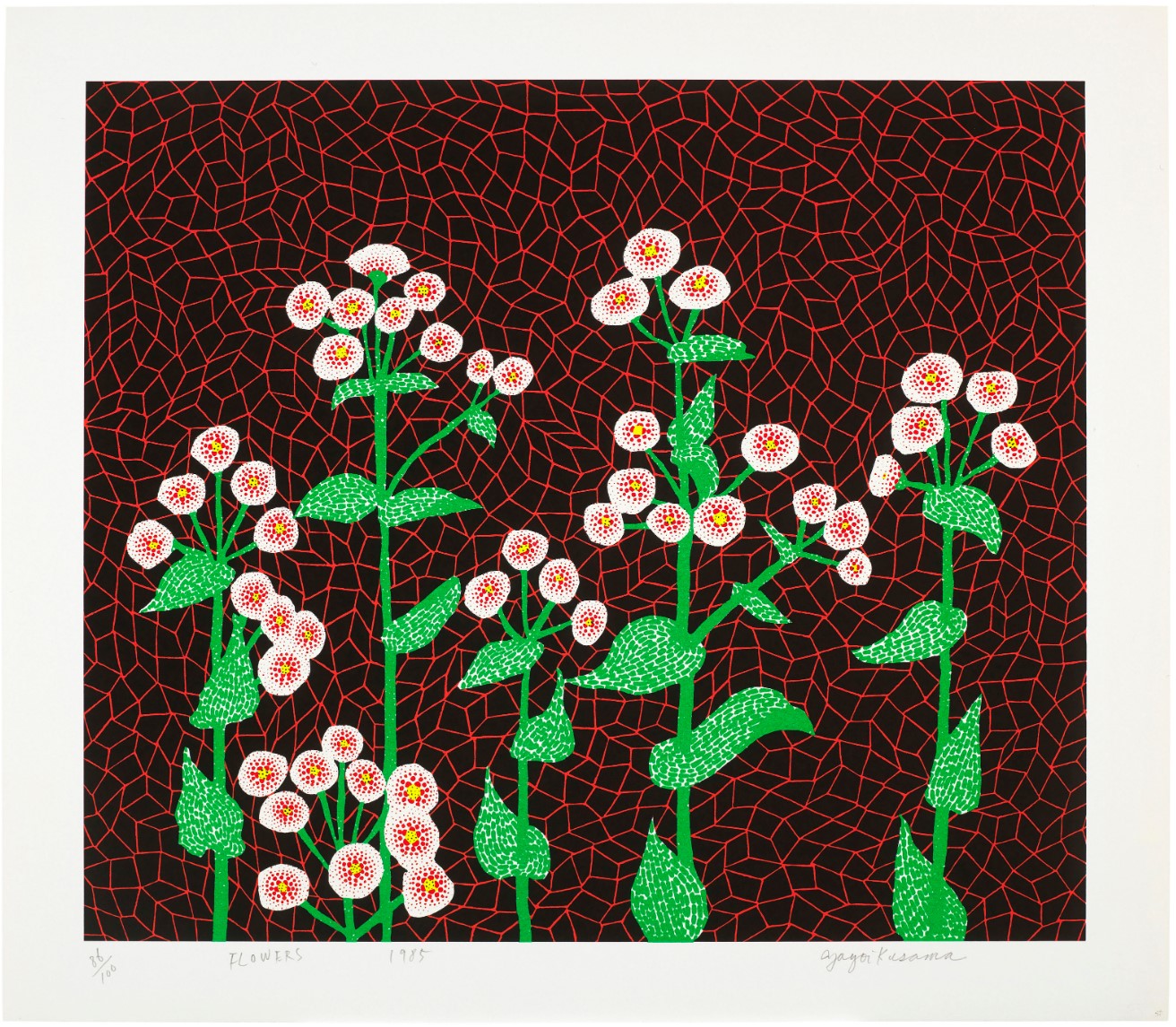
Flowers (2), 1985
Screen-print in colors on Izumi paper
Sheet: 53.3 x 61.3 cm (21 x 24.1 inches)
Edition: 100 + 10 AP + 3 PP
Literature: ABE 87
Sunflowers, 1989 (ABE 126)
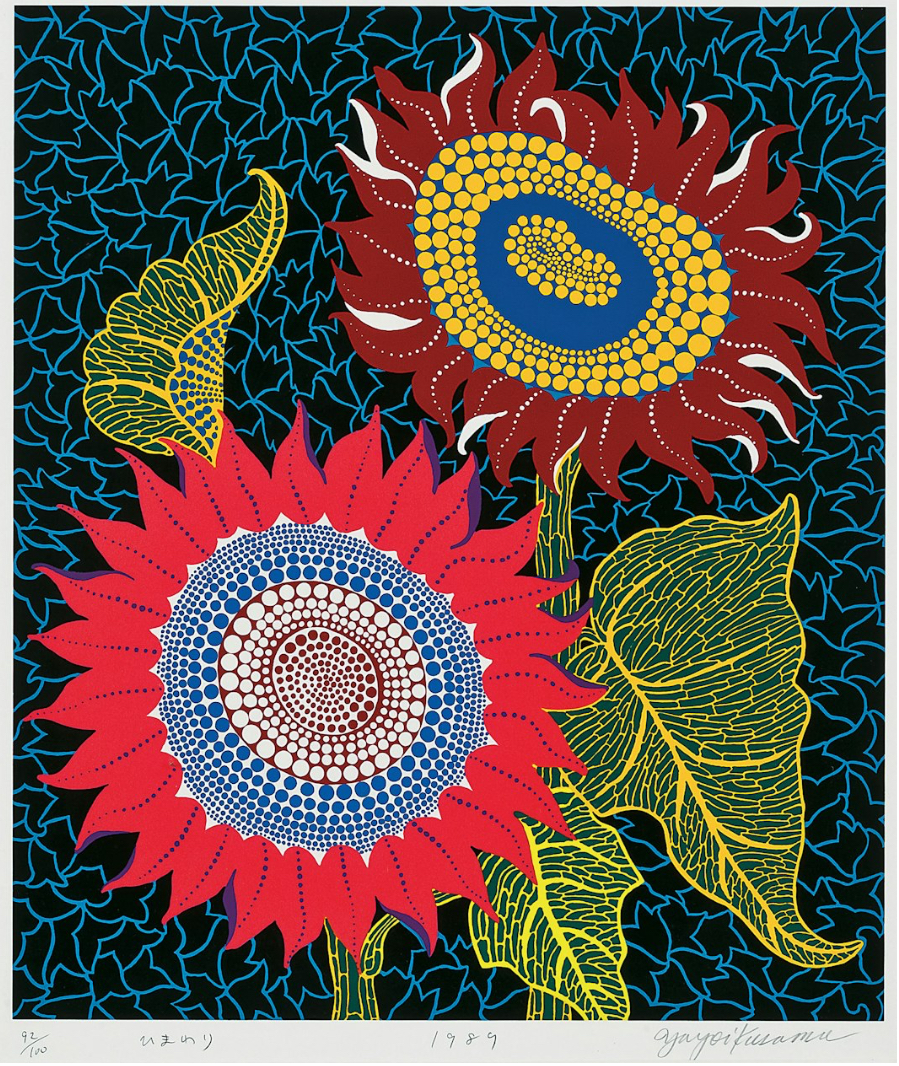
Sunflowers, 1989
Screen-print in colors on Izumi paper
Sheet: 53.5 x 61 cm (24 x 21.1 inches)
Edition: 100 + 8 AP
Literature: ABE 126
Summer Flowers, 1990 (ABE 140)
Summer Flowers, 1990
Screen-print in colors on Izumi paper
Sheet: 53.5 x 61 cm (21.2 x 24 inches)
Edition: 100 + 8 AP
Literature: ABE 140
Three Flowers (I), 1992 (ABE 160)
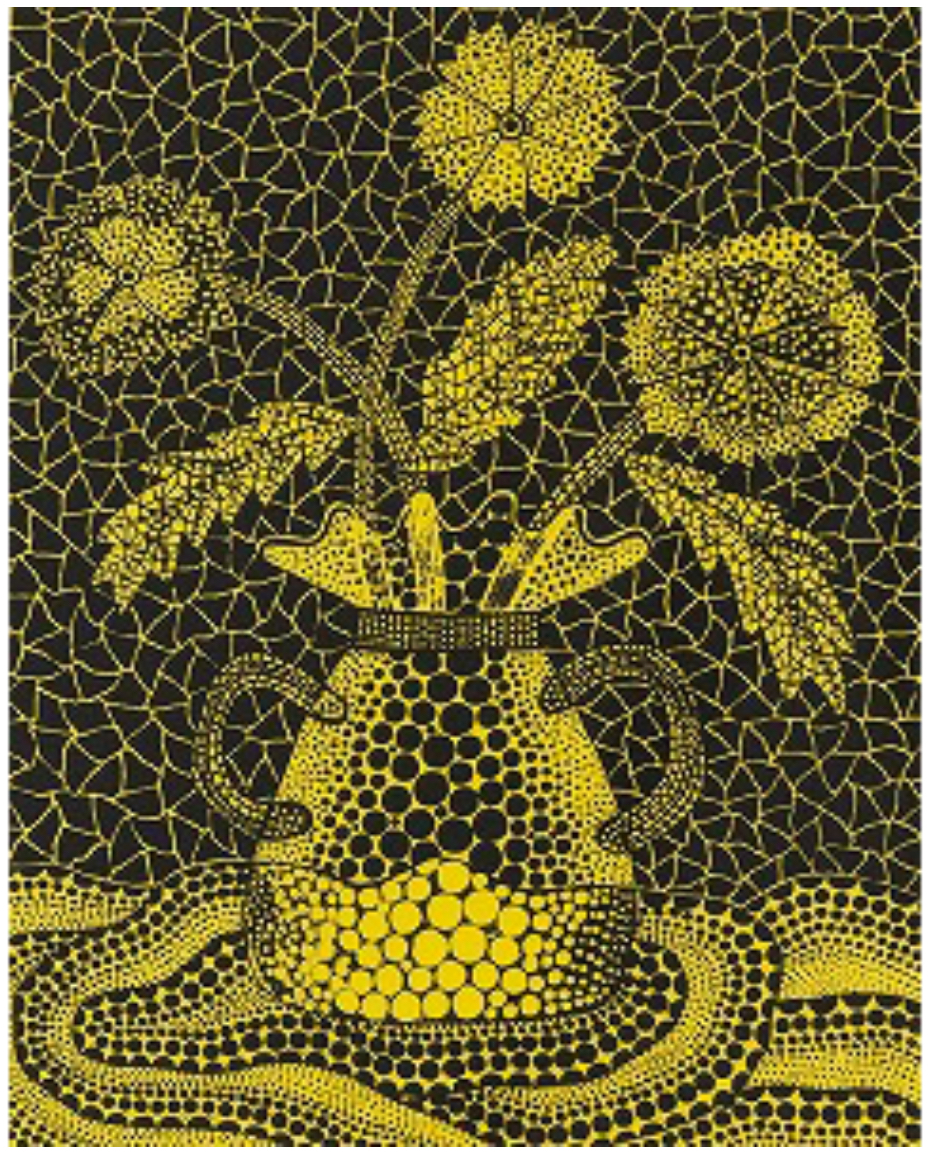
Three Flowers (I), 1992
Lithograph in colors on Verin d’Arches paper
Sheet: 44.6 x 31.7 cm (17.6 x 12.5 inches)
Edition: 50 + 2 PP + 2 HC
Literature: ABE 160
Three Flowers (II), 1992 (ABE 161)
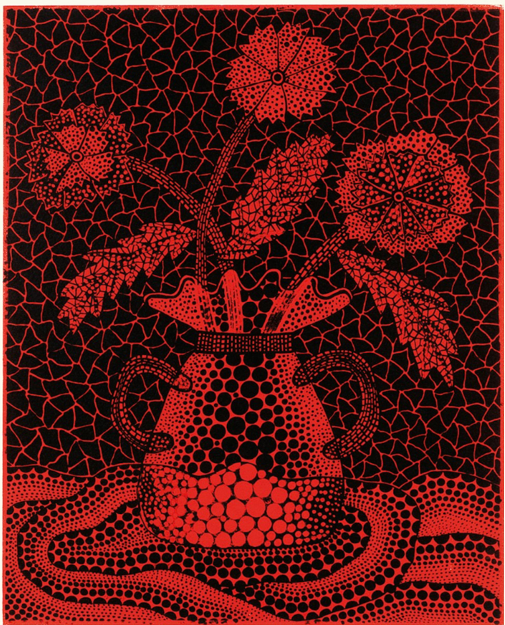
Three Flowers (II), 1992
Lithograph in colors on Verin d’Arches paper
Sheet: 44.6 x 31.7 cm (17.6 x 12.5 inches)
Edition: 50 + 2 PP + 2 HC
Literature: ABE 161
Three Flowers (III), 1992 (ABE 162)
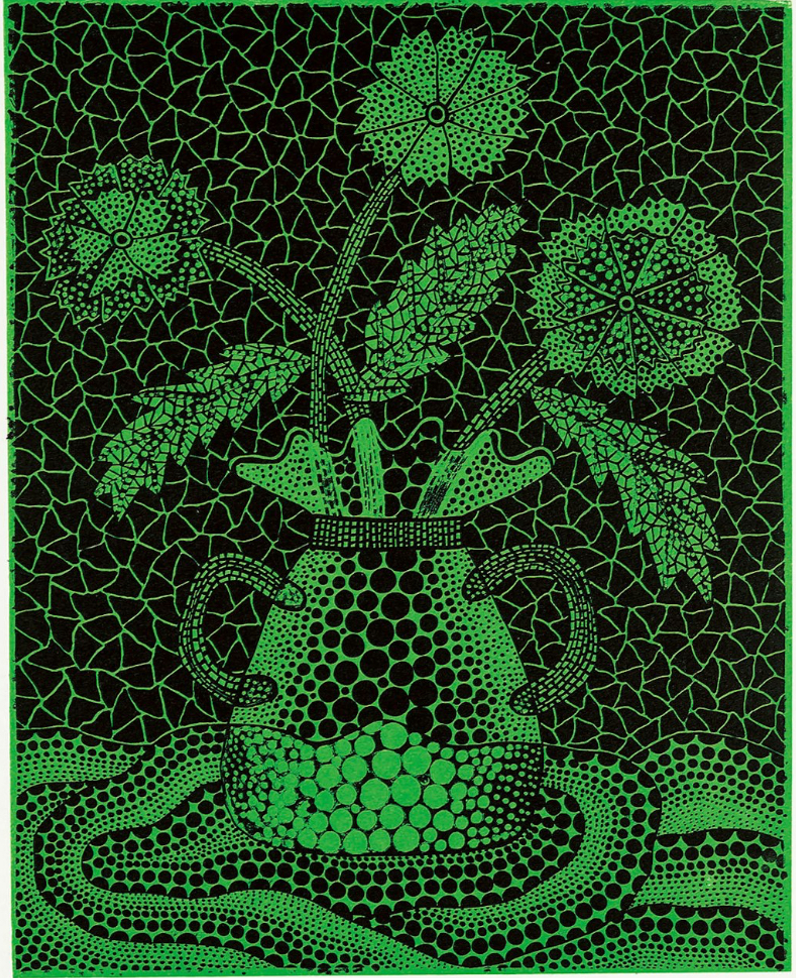
Three Flowers (III), 1992
Lithograph in colors on Verin d’Arches paper
Sheet: 44.6 x 31.7 cm (17.6 x 12.5 inches)
Edition: 50 + 2 PP + 2 HC
Literature: ABE 162
Flower (1), 1992 (ABE 163)
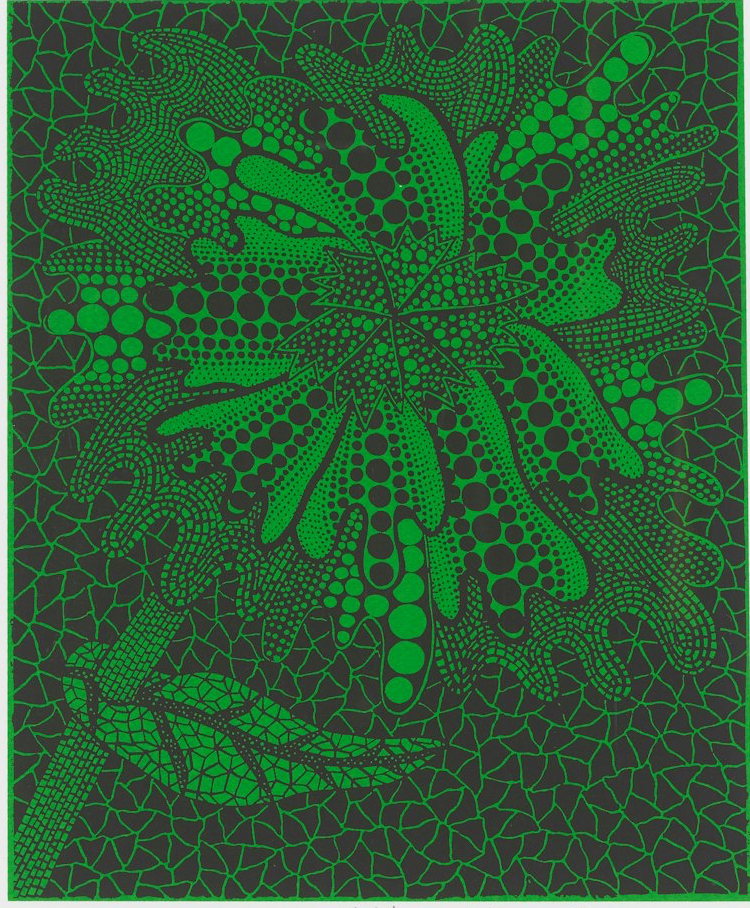
Flower (1), 1992
Lithograph in colors on Verin d’Arches paper
Sheet: 44.6 x 31.7 cm (17.6 x 12.5 inches)
Edition: 50 + 2 PP + 2 HC
Literature: ABE 163
Flower (2), 1992 (ABE 164)
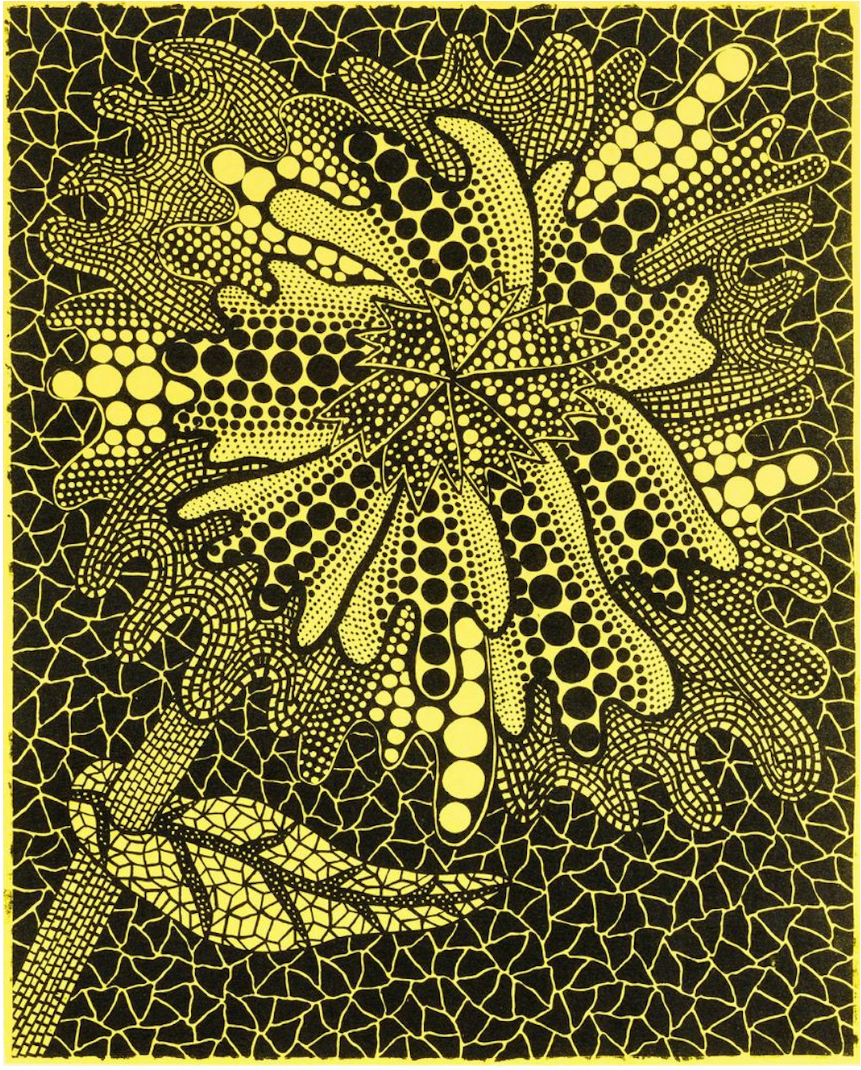
Flower (2), 1992
Lithograph in colors on Verin d’Arches paper
Sheet: 44.6 x 31.7 cm (17.6 x 12.5 inches)
Edition: 50 + 2 PP + 2 HC
Literature: ABE 164
3. Flower (3) (ABE 165)
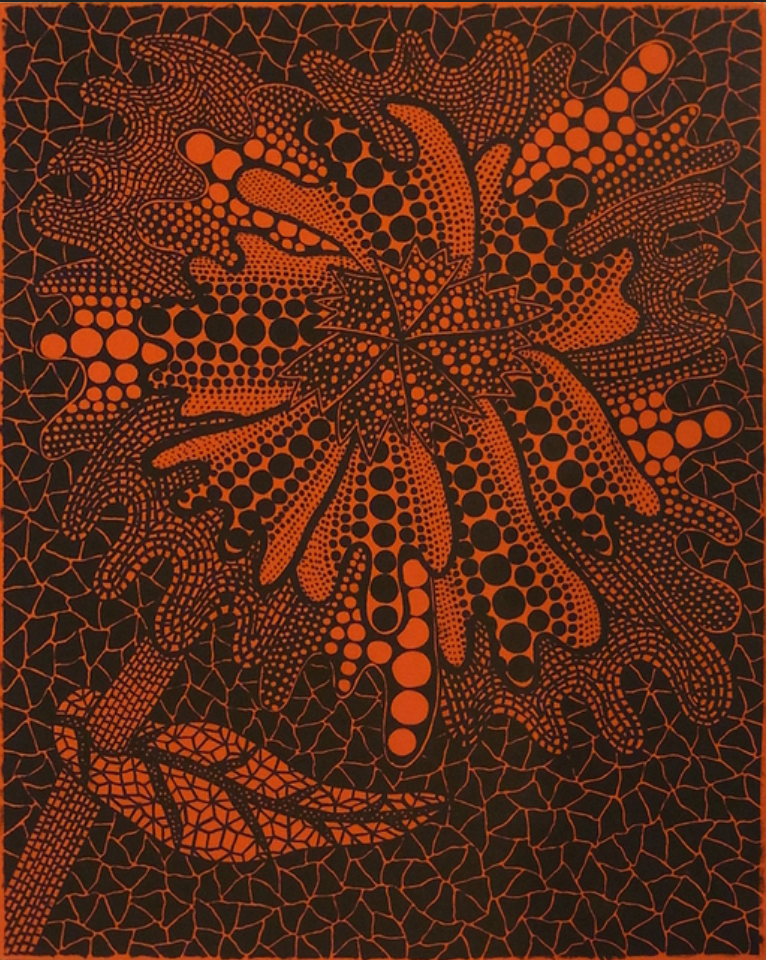
Flower (3), 1992
Lithograph in colors on Verin d’Arches paper
Sheet: 44.6 x 31.7 cm (17.6 x 12.5 inches)
Edition: 50 + 2 PP + 2 HC
Literature: ABE 165
Vase (1), 1992 (ABE 166)
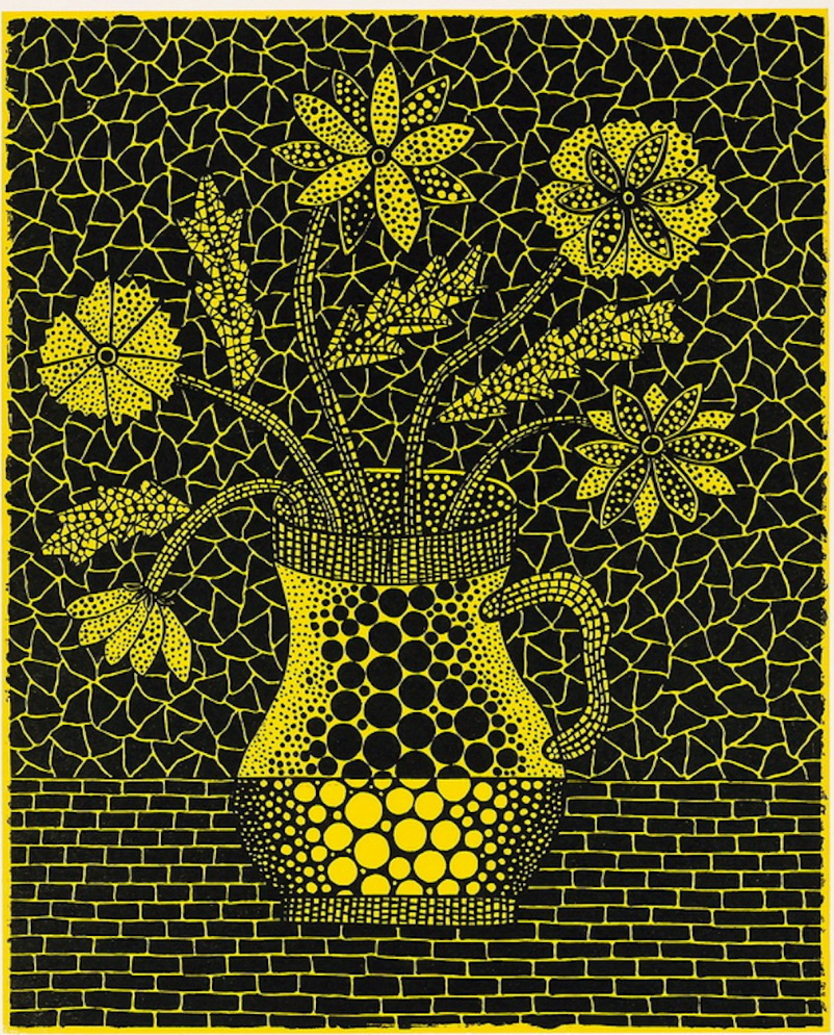
Vase (1), 1992
Lithograph in colors on Verin d’Arches paper
Sheet: 44.6 x 31.7 cm (17.6 x 12.5 inches)
Edition: 50 + 2 PP + 2 HC
Literature: ABE 166
Vase (2), 1992 (ABE 167)
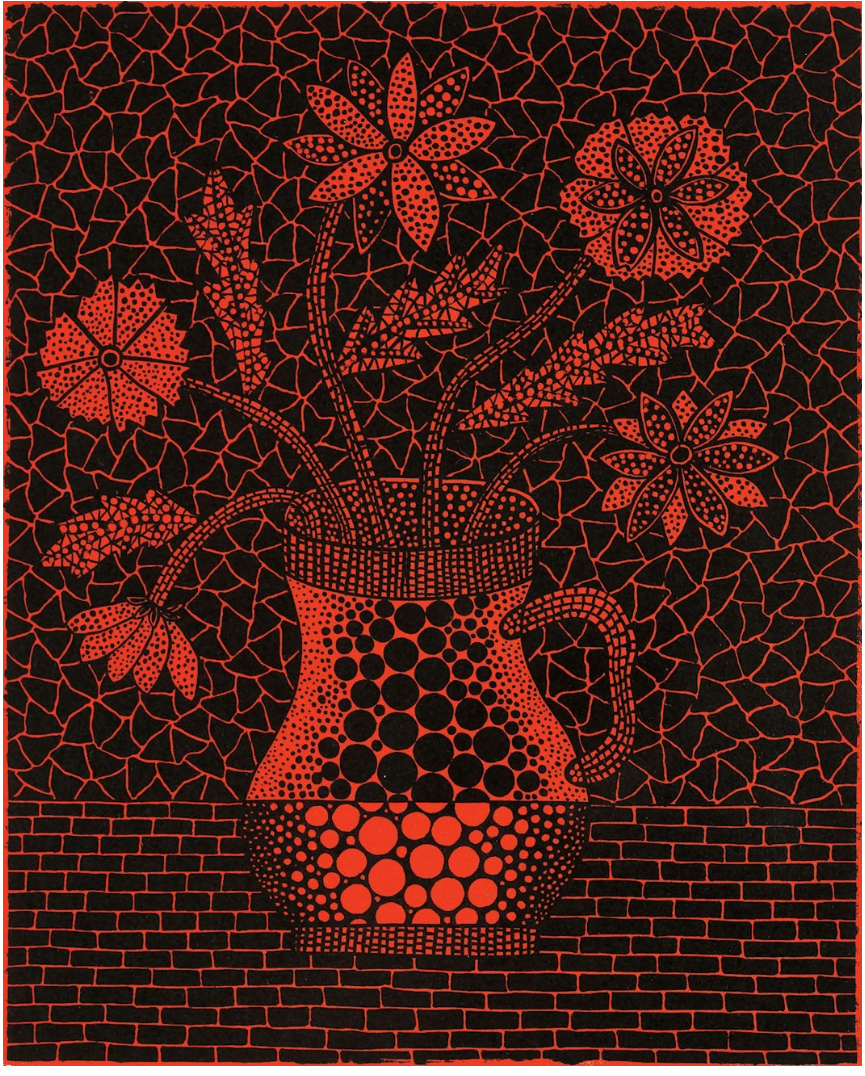
Vase (2), 1992
Lithograph in colors on Verin d’Arches paper
Sheet: 44.6 x 31.7 cm (17.6 x 12.5 inches)
Edition: 50 + 2 PP + 2 HC
Literature: ABE 167
Vase (3), 1992 (ABE 168)
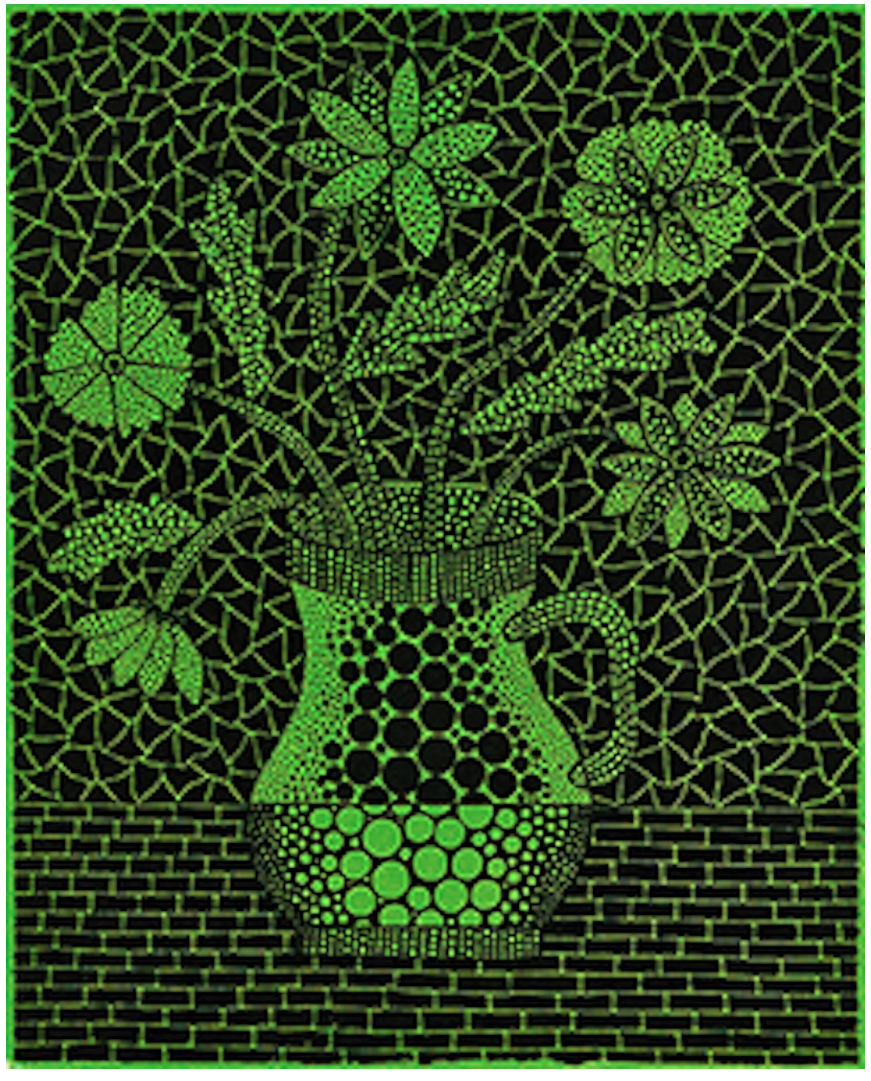
Vase (3), 1992
Lithograph in colors on Verin d’Arches paper
Sheet: 44.6 x 31.7 cm (17.6 x 12.5 inches)
Edition: 50 + 2 PP + 2 HC
Literature: ABE 168
Flowers AZ, 1993 (ABE 175)
Flowers AZ, 1993
Screen-print on Verin d’Arches paper
Sheet: 84×71 cm (33.1 x 28 inches)
Edition: 90 + 9 AP + 5 PP
Literature: ABE 175
Flowers BH, 1993 (ABE 176)
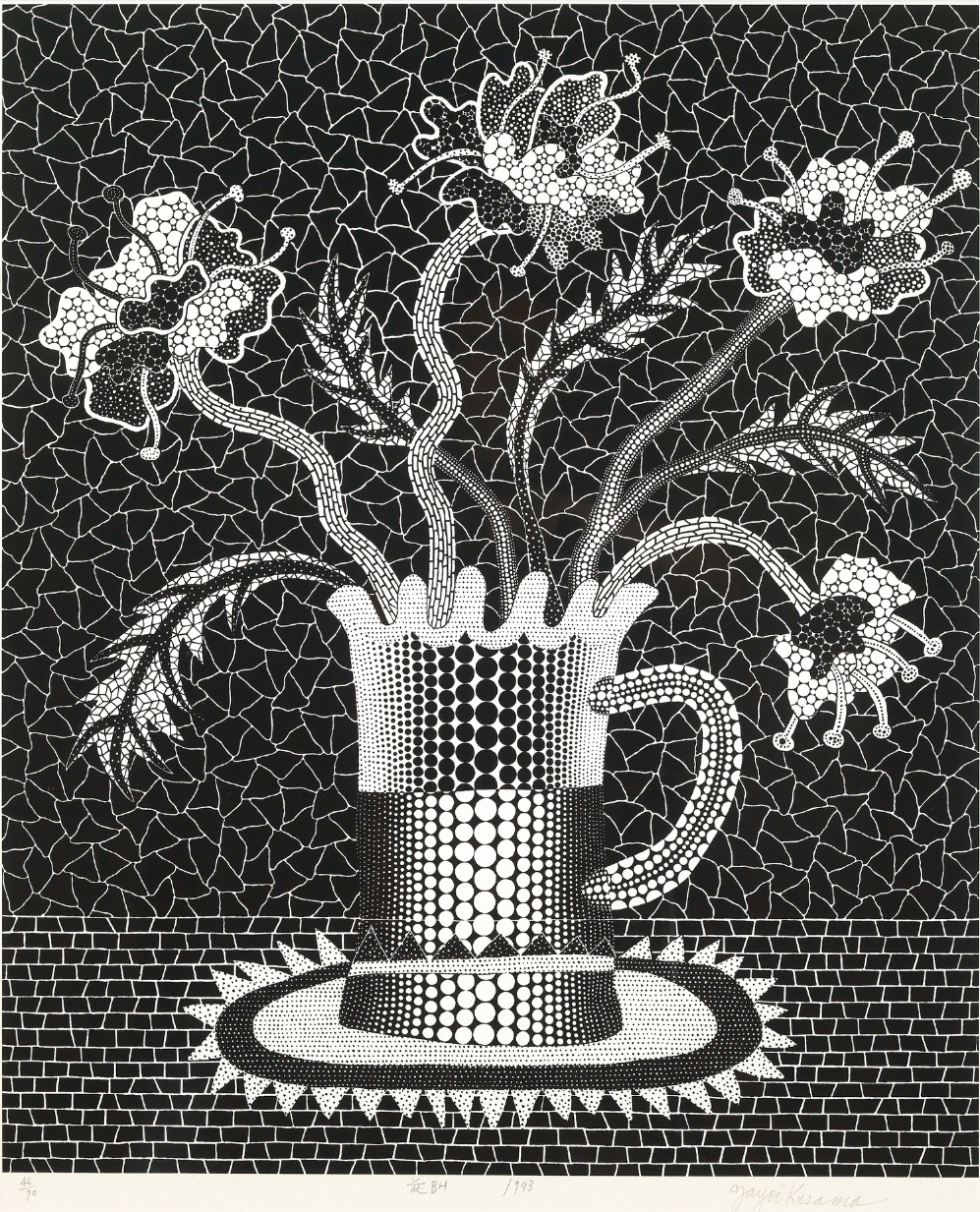
Flowers BH, 1993
Screen-print on Verin d’Arches paper
Sheet: 84×71 cm (33.1 x 28 inches)
Edition: 90 + 9 AP + 5 PP
Literature: ABE 176
Flowers FW, 1993 (ABE 177)
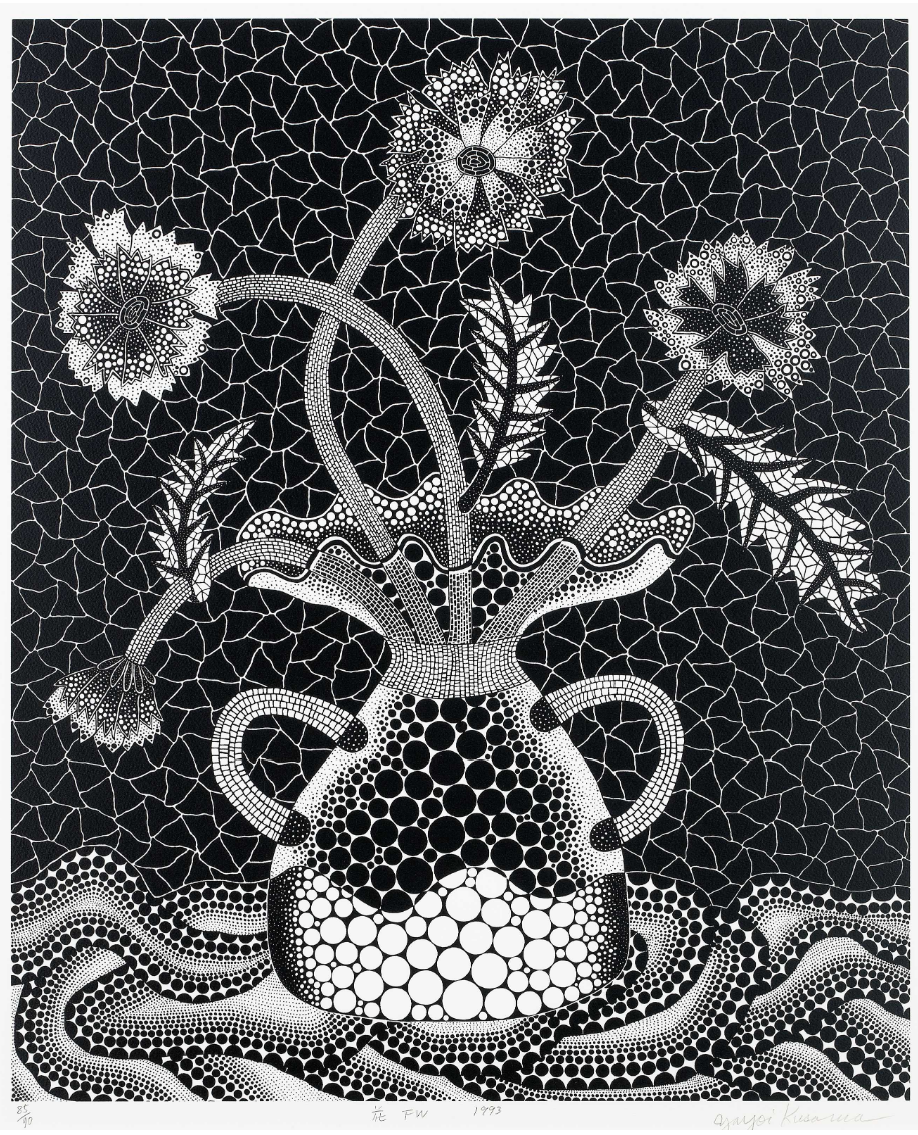
Flowers FW, 1993
Screen-print in colors on Verin d’Arches paper
Sheet: 84×71 cm (33.1 x 28 inches)
Edition: 90 + 9 AP + 5 PP
Literature: ABE 177
Flowers QE, 1993 (ABE 178)
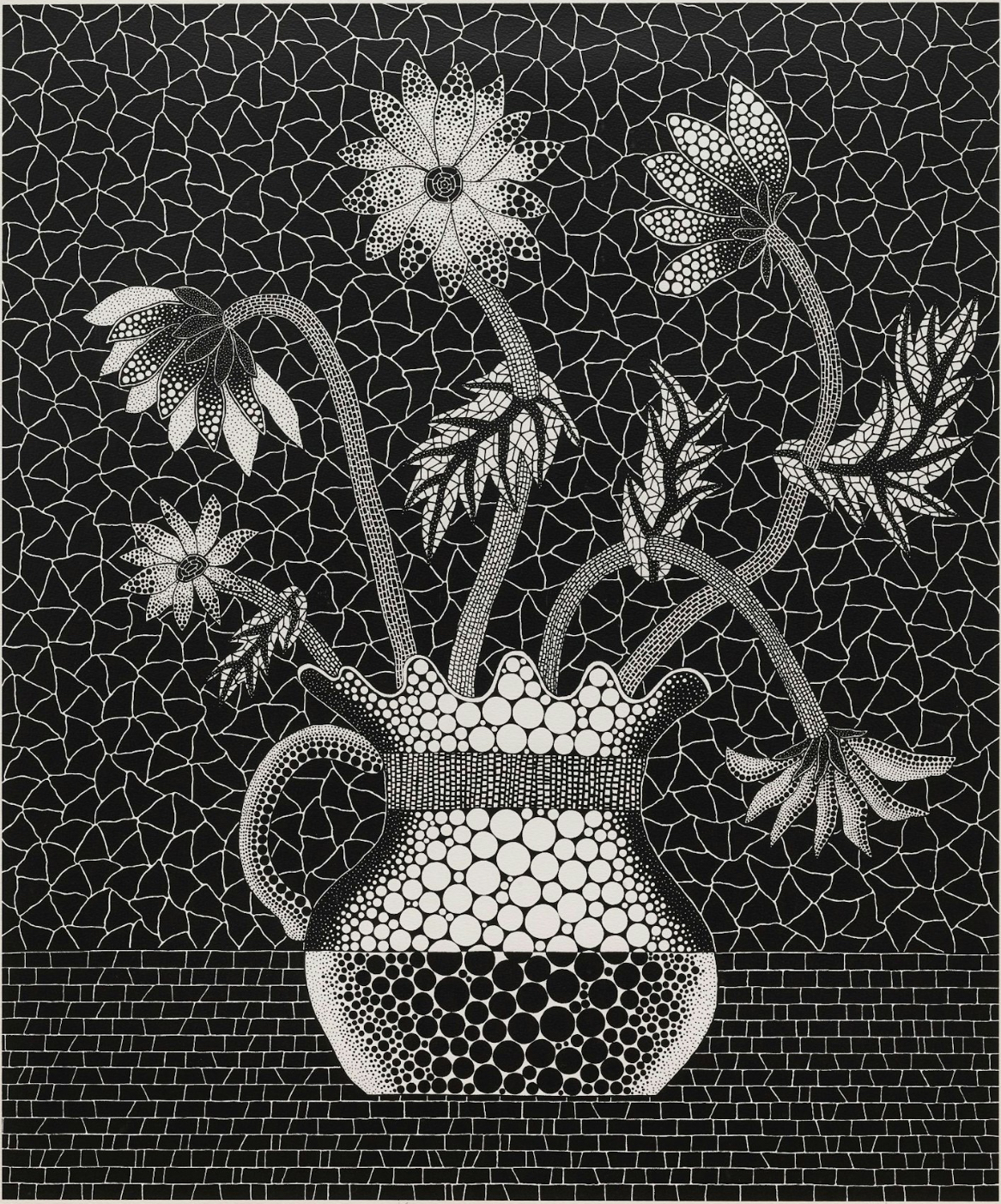
Flowers QE, 1993
Screen-print in colors on Verin d’Arches paper
Sheet: 84×71 cm (33.1 x 28 inches)
Edition: 90 + 9 AP + 5 PP
Literature: ABE 178
Flowers PX, 1993 (ABE 179)
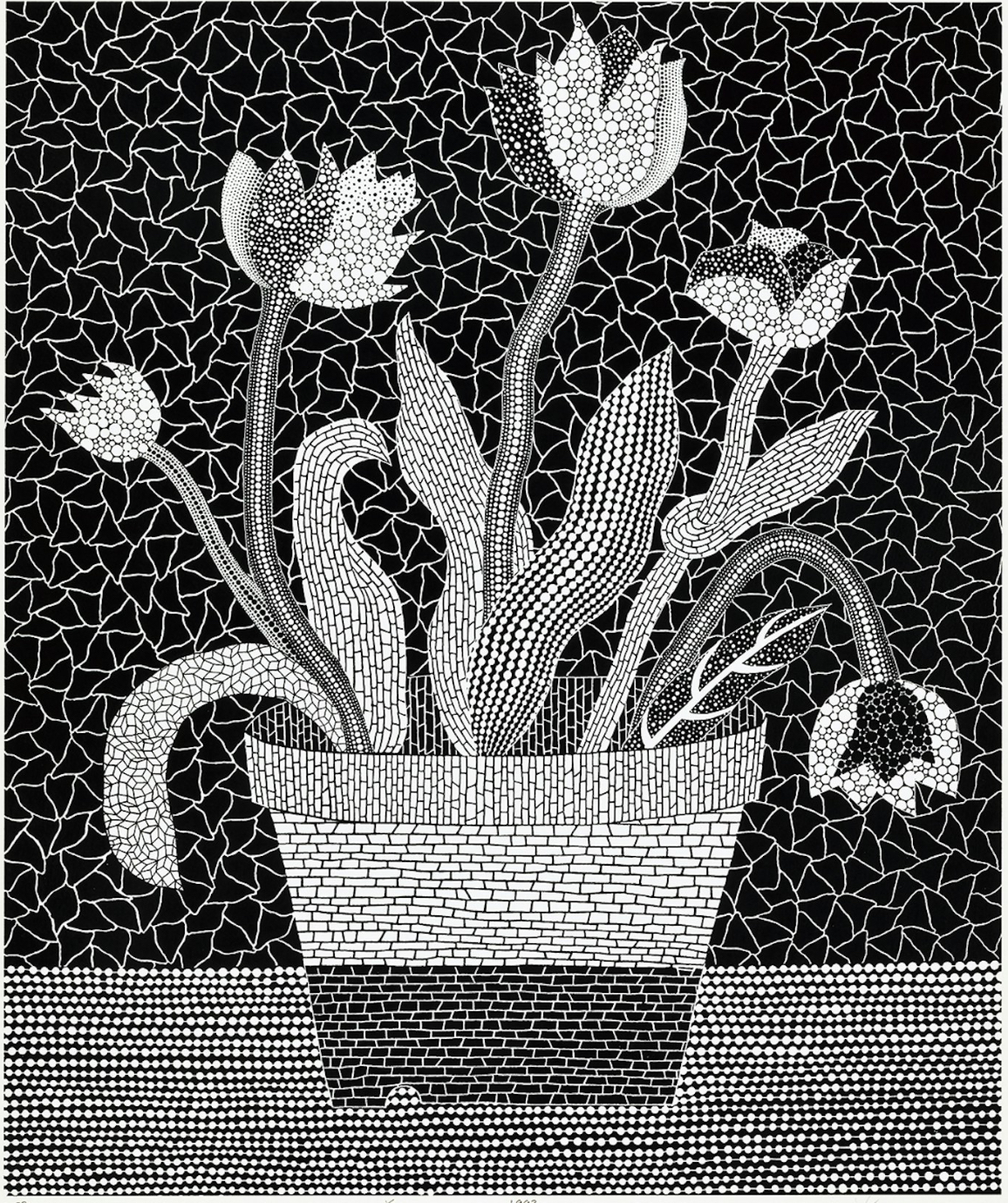
Flowers PX, 1993
Screen-print in colors on Verin d’Arches paper
Sheet: 84×71 cm (33.1 x 28 inches)
Edition: 90 + 9 AP + 5 PP
Literature: ABE 179
Night Flowers, 2003 (ABE 314)
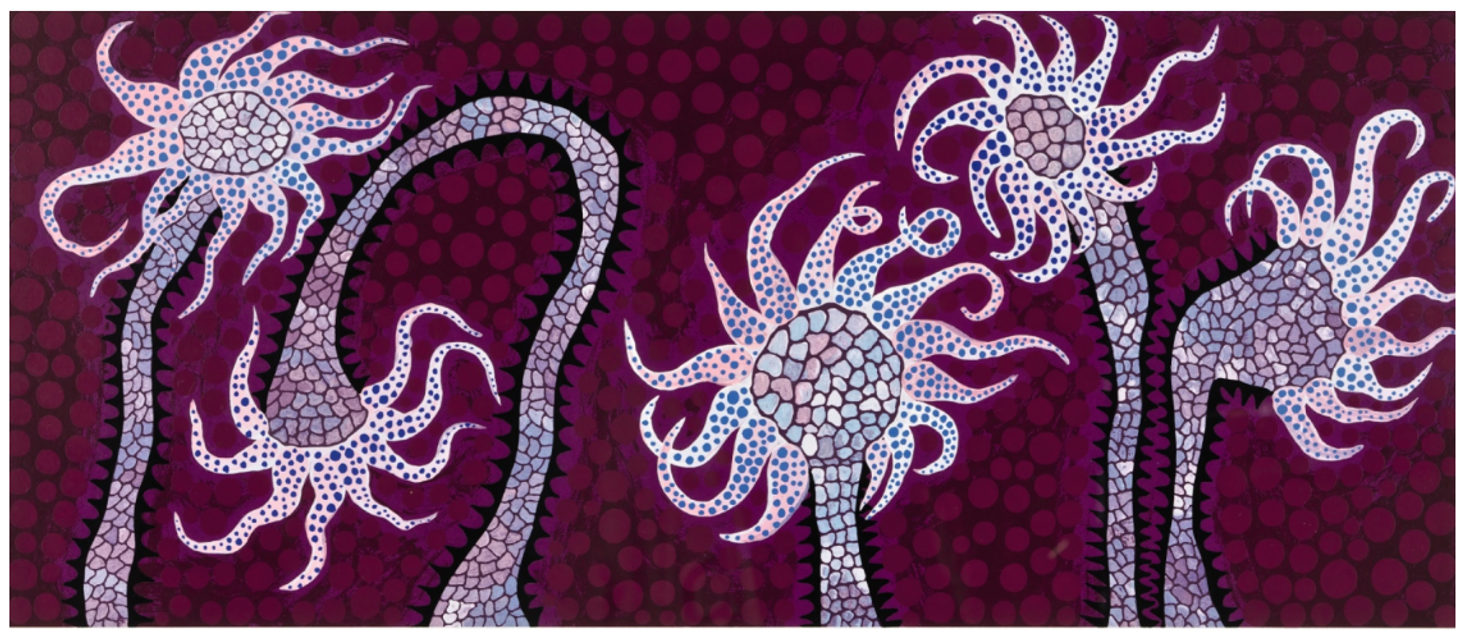
Night Flowers, 2003
Screen-print in colors on Kakita-shi paper
Sheet: 43×80 cm (16.9 x 31.5 inches)
Edition: 120 + 12 AP + 5 PP
Literature: ABE 314
Night Flowers (B), 2003 (ABE 315)
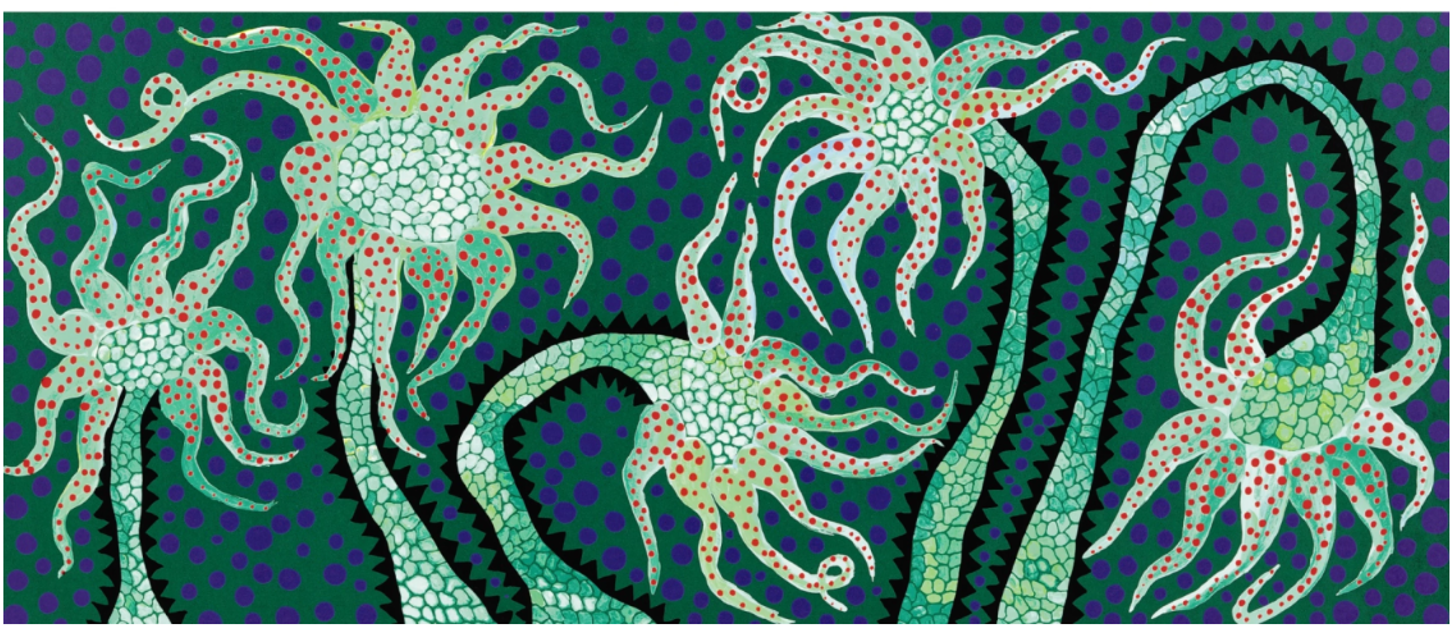
Night Flowers (B), 2003
Screen-print in colors on Kakita-shi paper
Sheet: 43×80 cm (16.9 x 31.5 inches)
Edition: 120 + 12 AP + 5 PP
Literature: ABE 315
FLOWERS A, 2005 (ABE 343)
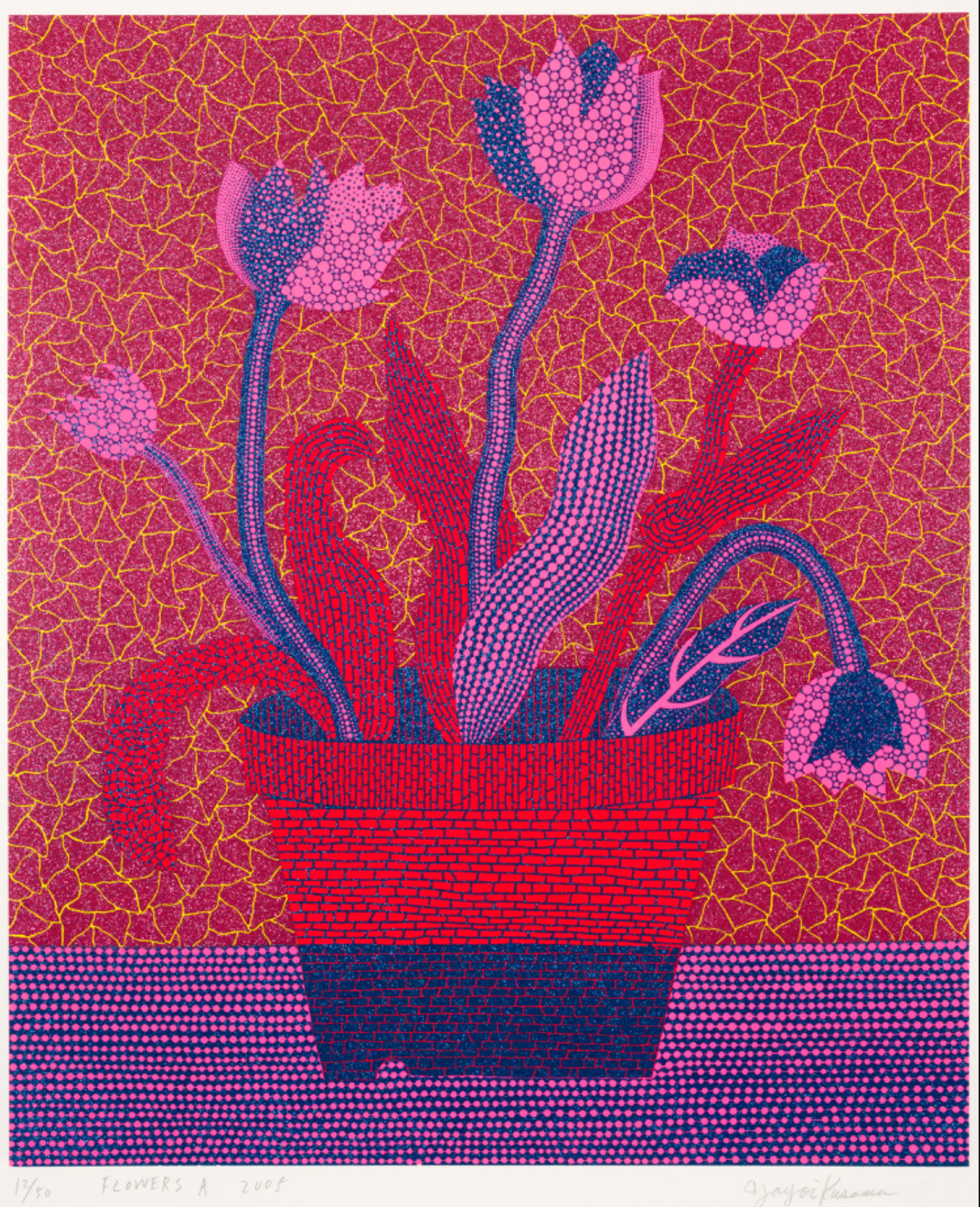
FLOWERS A, 2005
Screen-print in colors on Kakita-shi paper with Lame
Sheet: 71.5 x 60.3 cm (28.1 x 23.7 inches)
Edition: 50 + 6 AP + 6 PP
Literature: ABE 343
FLOWERS B, 2005 (ABE 344)
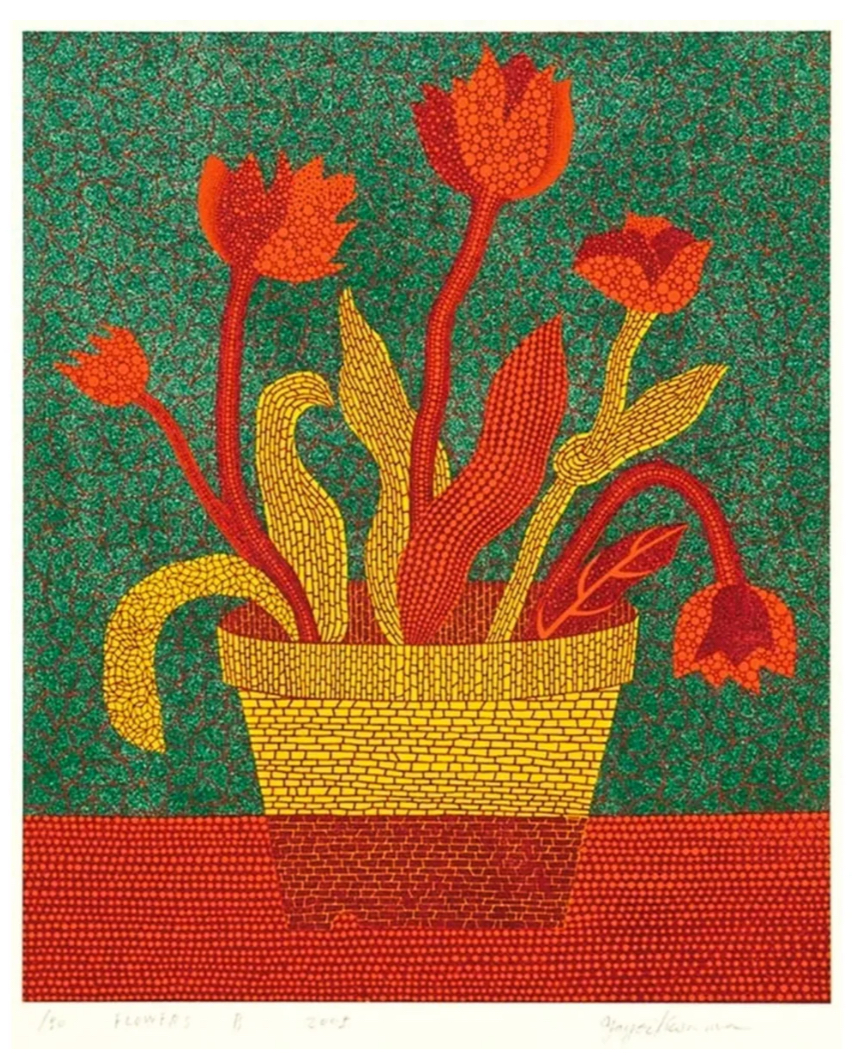
FLOWERS B, 2005
Screen-print in colors on Kakita-shi paper with Lame
Sheet: 71.5 x 60.3 cm (28.1 x 23.7 inches)
Edition: 50 + 6 AP + 5 PP
Literature: ABE 344
FLOWERS C, 2005 (ABE 345)
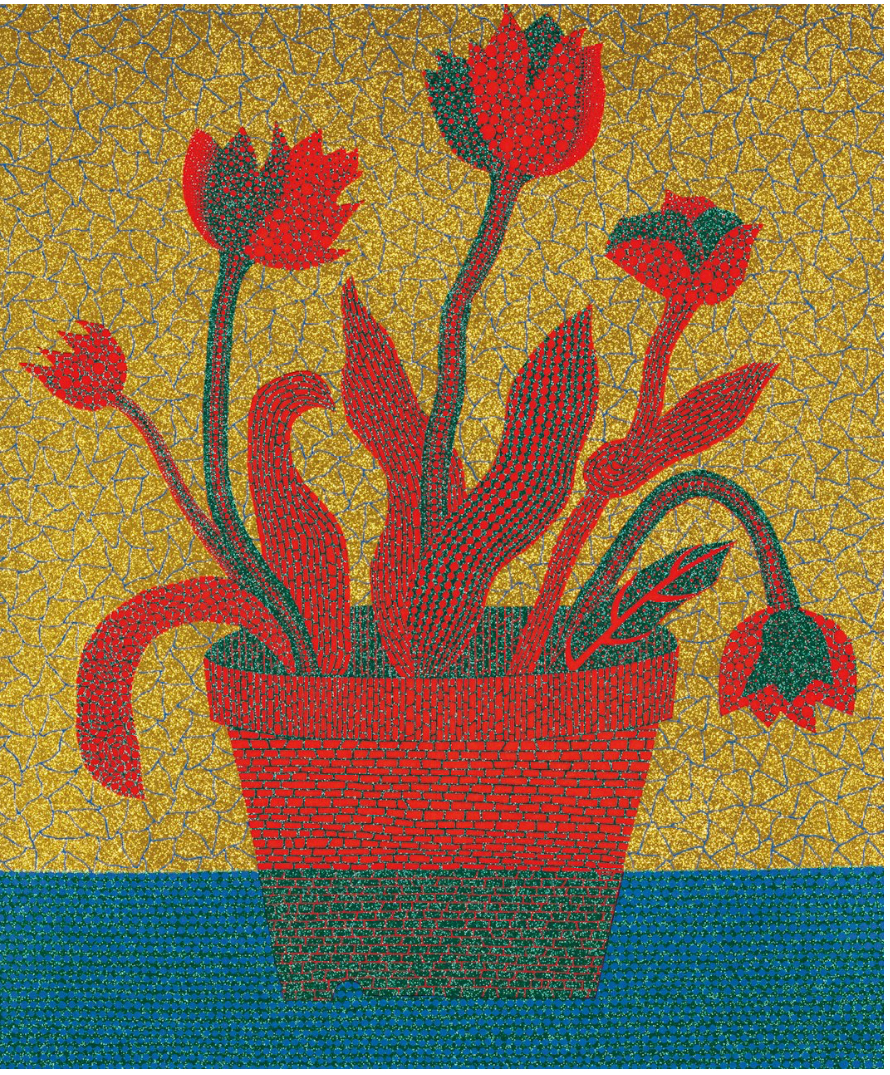
FLOWERS C, 2005
Screen-print in colors on Kakita-shi paper with Lame
Sheet: 71.5 x 60.3 cm (28.1 x 23.7 inches)
Edition: 50 + 6 AP + 5 PP
Literature: ABE 345
FLOWERS A, 2005 (ABE 346)
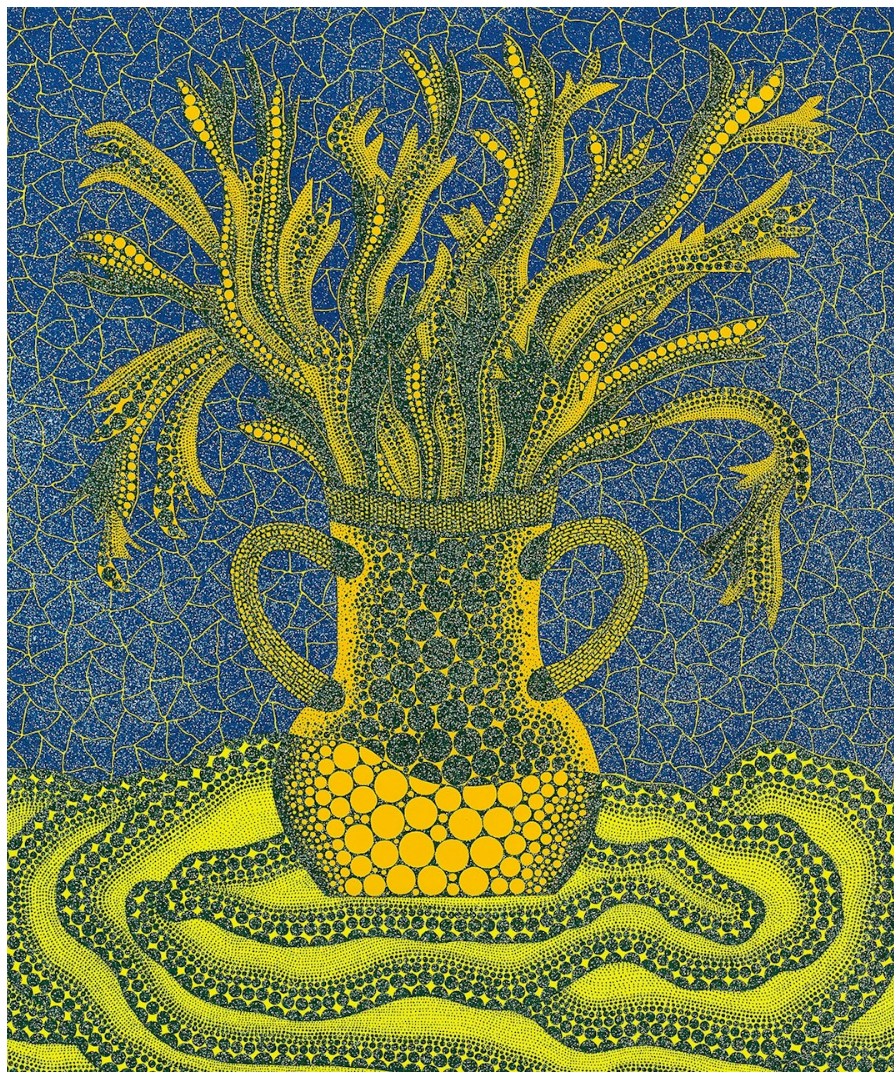
FLOWERS A, 2005
Screen-print in colors on Kakita-shi paper with Lame
Sheet: 71.5 x 60.3 cm (28.1 x 23.7 inches)
Edition: 50 + 6 AP + 4 PP
Literature: ABE 346
FLOWERS B, 2005 (ABE 347)
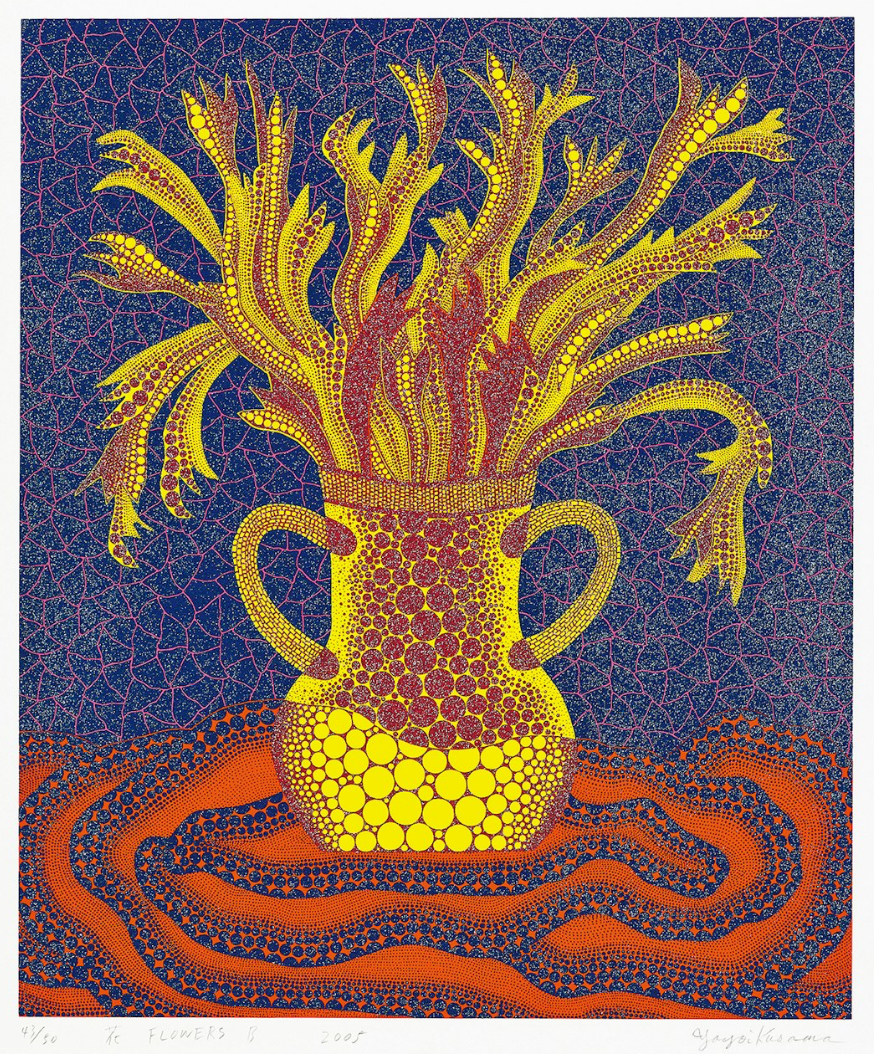
FLOWERS B, 2005
Screen-print in colors on Kakita-shi paper with Lame
Sheet: 71.5 x 60.3 cm (28.1 x 23.7 inches)
Edition: 50 + 6 AP + 4 PP
Literature: ABE 347
FLOWERS C, 2005 (ABE 348)
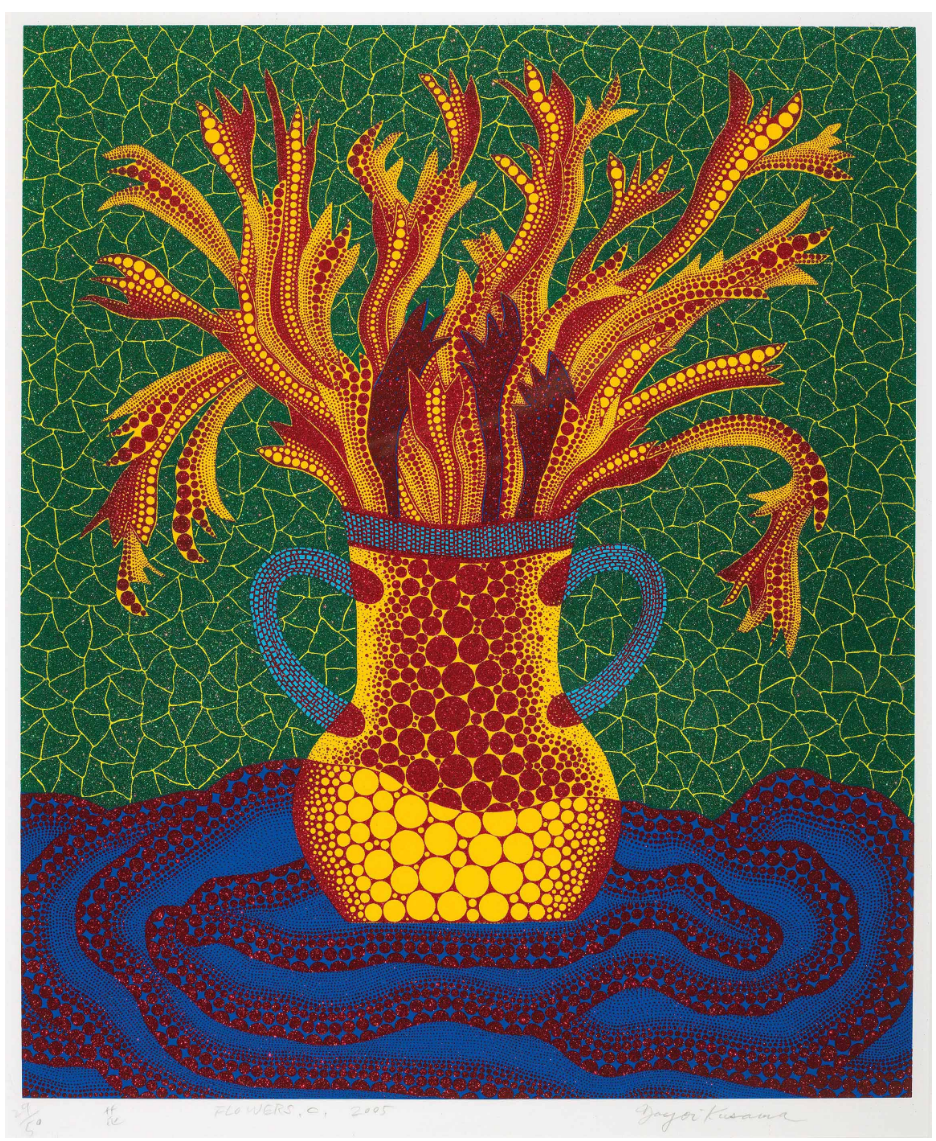
FLOWERS C, 2005
Screen-print in colors on Kakita-shi paper with Lame
Sheet: 71.5 x 60.3 cm (28.1 x 23.7 inches)
Edition: 50 + 6 AP + 4 PP
Literature: ABE 348
FLOWERS A, 2005 (ABE 349)
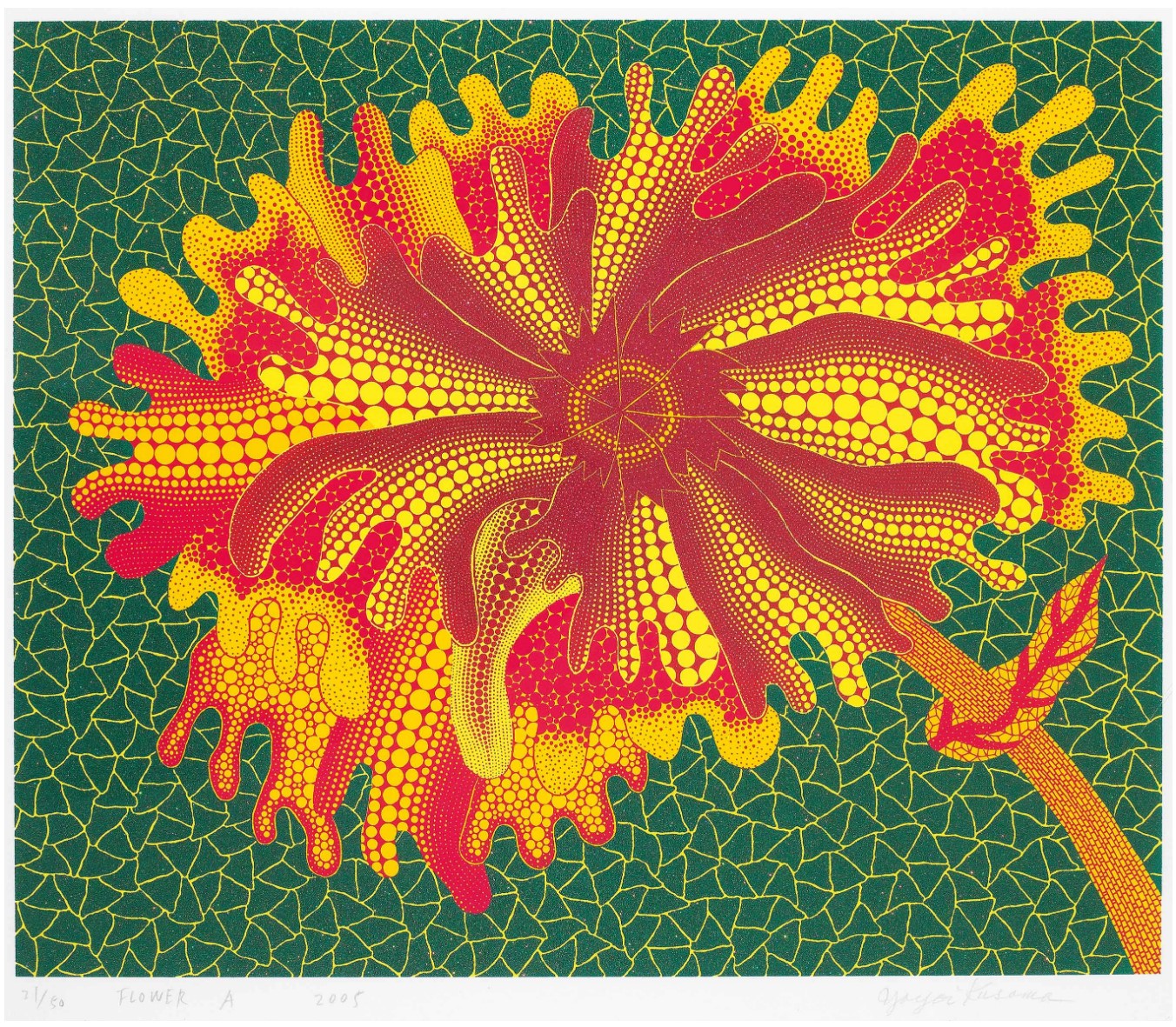
FLOWERS A, 2005
Screen-print in colors on Kakita-shi paper with Lame
Sheet: 60.3 x 71.5 cm (23.7 x 28.1 inches)
Edition: 50 + 5PP + 4/6 PP
Literature: ABE 349
FLOWERS B, 2005 (ABE 350)
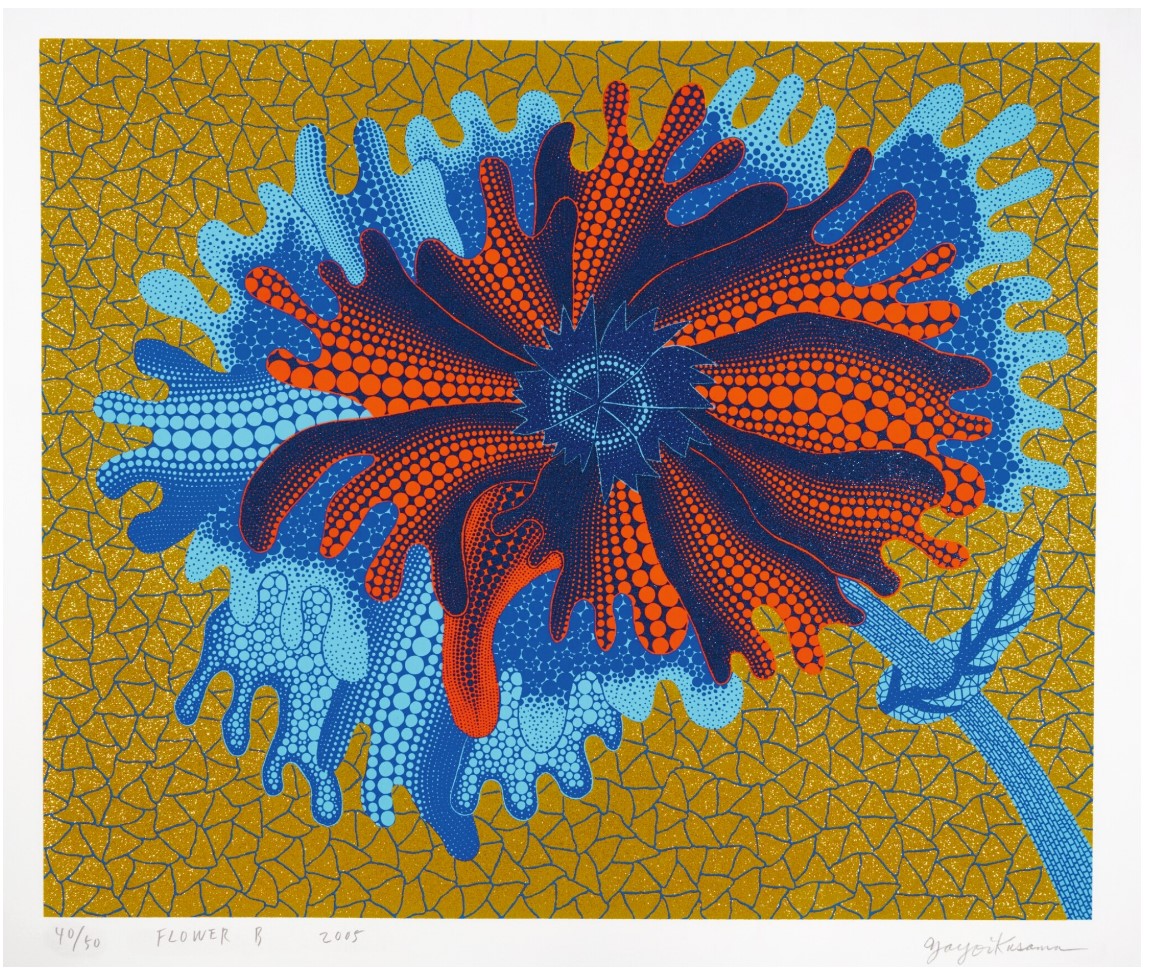
FLOWERS B, 2005
Screen-print in colors on Kakita-shi paper with Lame
Sheet: 60.3 x 71.5 cm (23.7 x 28.1 inches)
Edition: 50 + 5PP + 4/6 PP
Literature: ABE 350
FLOWERS C, 2005 (ABE 351)
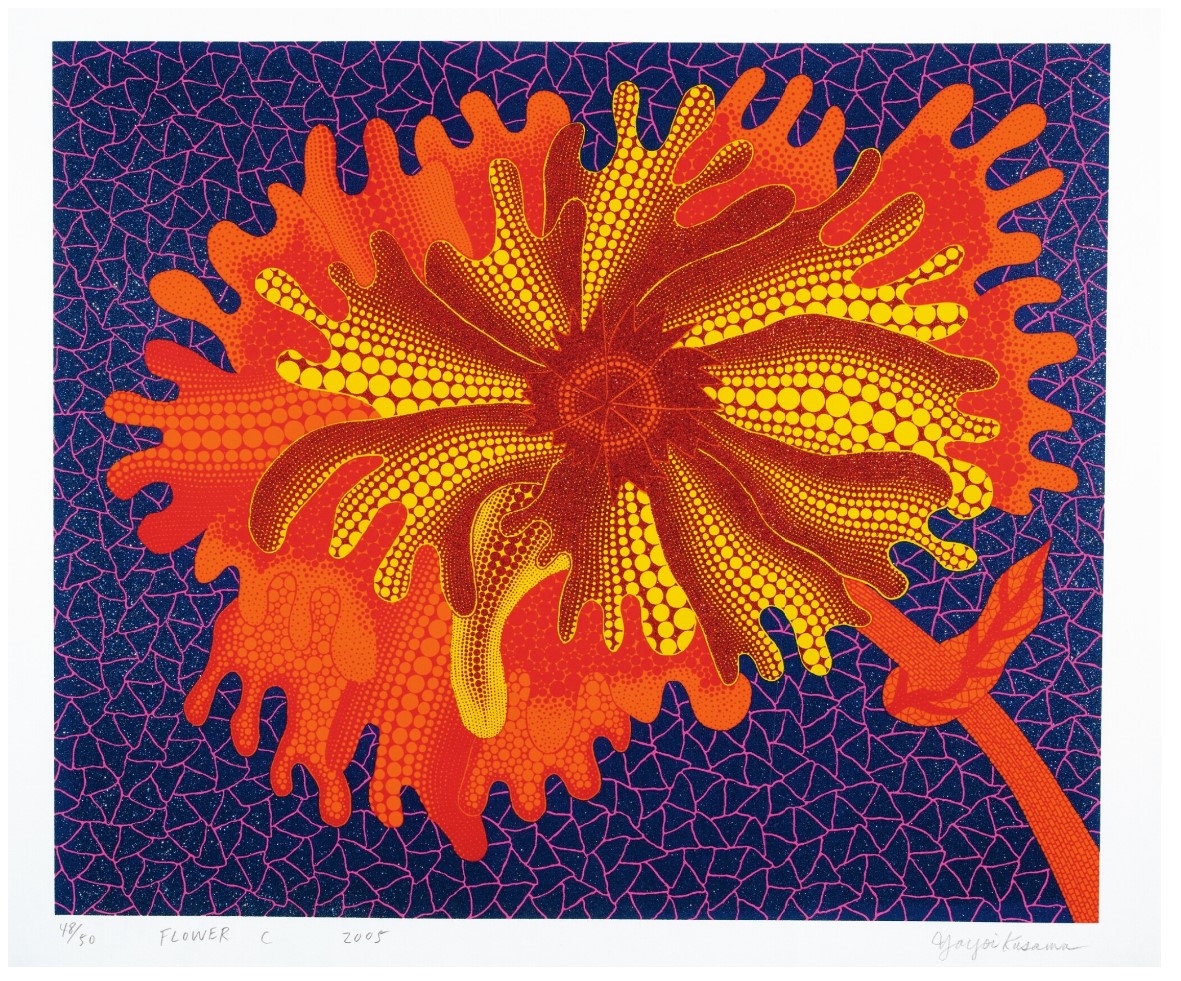
FLOWERS C, 2005
Screen-print in colors on Kakita-shi paper with Lame
Sheet: 60.3 x 71.5 cm (23.7 x 28.1 inches)
Edition: 50 + 5PP + 4/6 PP
Literature: ABE 351
A Flower (TZSS), 2005
China Guardian: 7 April 2025
Estimated: HKD 5,000,000 – 8,000,000
HKD 6,000,000 / USD 771,870
Auction | China Guardian (HK) Auctions Co., Ltd.
A Flower (TZSS), 2005
Acrylic on canvas
33.3 x 24.2 cm (13 1/8 × 9 1/2 inches)
Signed in English, dated, and titled in English and Japanese Kanji on the reverse
There is a well-known photograph of 10-year-old Yayoi Kusama holding a bouquet of dahlias surrounded by flowers taken in 1939. The dahlias in the photo are of unparalleled beauty, each one chosen by young Kusama herself and held in front of her chest, almost covering her whole body. This image later became a precious memory and the artist’s earliest moment of being at one with and immersed in nature.
Yayoi Kusama at the age of ten in 1939. Private collection. © 2024 YAYOI KUSAMA.
Born into a family that ran a plant seed wholesale business in a mountainous area of Nagano, Japan, Kusama traveled alone to New York with nothing but dreams of being an artist to sustain her, on a trip that marked the first step in her ascent to the very pinnacle of the global art world and her journey to becoming the “Queen of Avant-Garde.” Throughout her career, the artist has drawn on the power she derives from the protection, self-confidence, blossoming, and unity with nature provided by flowers and nature, to develop her unique creative concept of “self-obliteration” with all things. Indeed, Kusama’s artistic achievements have received widespread recognition and success in both Japan and abroad over multiple decades. For example, in 1993, she became the first female to represent Japan at the Venice Biennale as a solo artist. She has also engaged in cross-discipline collaboration with brands such as Louis Vuitton and Ferragamo, and her works have been collected by more than 90 major museums worldwide. At the same time, the global “Kusama craze” made her name synonymous with fashion and avant-garde art. Moreover, Kusama has consistently employed flowers and her soul to write the story of her life, avant-garde, unbridled, fearless in the face of the worldly drabness and true. Yayoi Kusama’s 2005 work A Flower (TZSS) with its dahlia motif establishes a connection to the photograph of the artist holding a dahlia as a child taken 66 years earlier and is an important autobiographical work based on her concept of “identifying with flowers.”
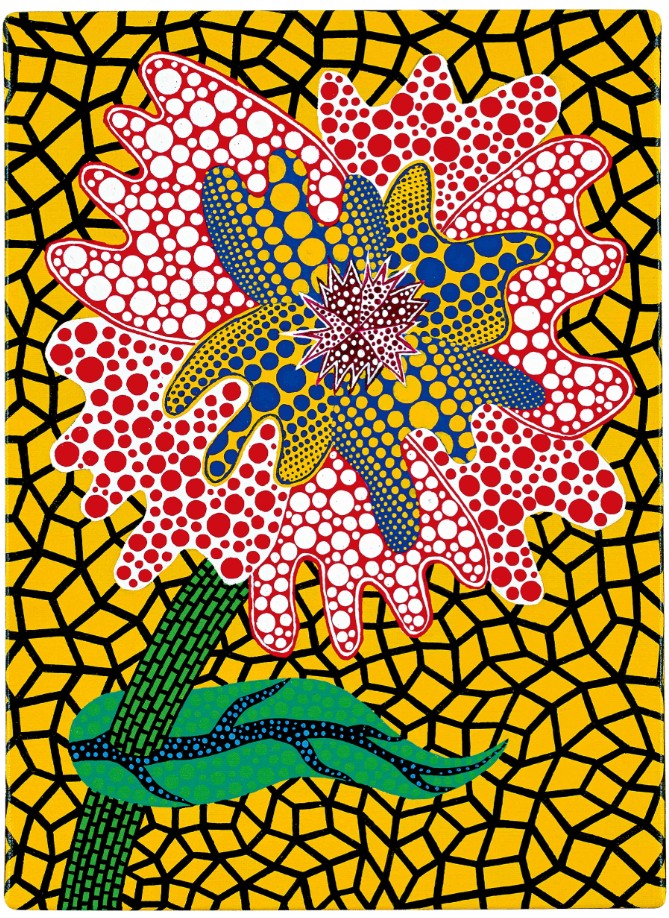
Flowers occupy a central place in the fantastical world created by Kusama and became one of her most important motifs, symbolizing the starting point of her fantastical vision, admiration for American female artist Georgia O’Keeffe, boldness in moving to New York and the ultimate incarnation of her own life. This is clearly seen in A Flower (TZSS), into which Kusama poured over 60 years of passion for “flowers” and autobiographical references. Unusually, the focus of the piece is an elegant and poised, purple-red dahlia against a yellow background decorated with a black net pattern symbolic of the colours at the beginning of creation. In addition, the outward-reaching flower petals radiate energy and are replete with a sense of the surreal. The dahlia has large layered petals in brilliant colours that resemble a kaleidoscope, making it the perfect focus for Kusama’s eye-catching artistic forms. Currently, only two oil paintings by the artist of dahlias have been sold at auction, of which A Flower (TZSS) is the earliest completed work, highlighting its unique and extraordinary rareness. The second piece, completed nine years later, Flower, sold for HKD 78.125 million, the second highest ever for a work by Kusama, underscoring the particular appeal of the dahlia in her artistic oeuvre.
“The door of illusion is pushed open
Amidst the anguish of flowers,
this moment is never ending
Before the steps to heaven,
my heart will rest in their love
In the air, constantly exchanging,
unquestioning, a clear blue sky
Mixed with the shadows of illusion,
cumulonimbus clouds rise
Devouring the colours of hibiscus and the sound of falling tears
I am become stone
No longer eternal,
But in a fleeting moment.”
–Yayoi Kusama, 1978
In A Flower (TZSS), Kusama combines the three iconic artistic languages she developed in her career: “infinity nets,” “polka dots” and “flowers.” The artist depicts four inner and outer spatial layers, but more unusually departs from her usual use of two or three colours for flowers. Indeed, in this piece she uses up to five different colours: purple, white, yellow, blue and red. This technique, particularly in terms of Kusama’s use of floral motifs is extremely rare, showcasing the uniqueness of the work.
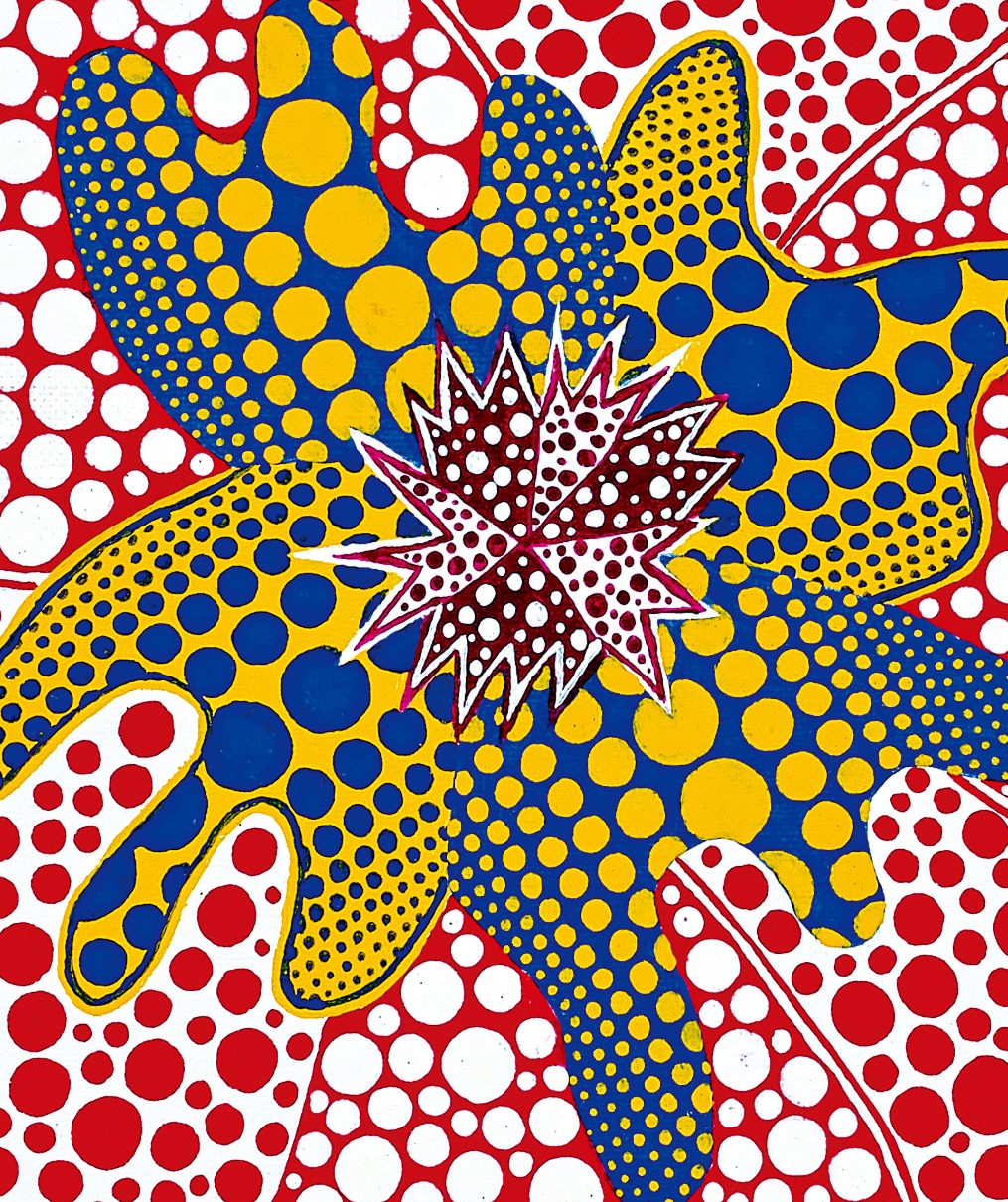
The center of the dahlia is divided into three layers expanding from the inside outwards: the first layer focuses on the “pistil” and is comprised of radiating straight lines and purple-white polka dots, this layer forms a six-petal flower heart akin to an explosion of fireworks. The second layer is of “pseudo flowers,” which represent the classical compound inflorescence of the dahlia, made up of four smaller flower petals comprised of polka dots that extend from the center outwards. The gradually changing sizes of the yellow and blue dots emphasize the dynamism of change, which further expands the visual space. The third layer has six flower petals with alternating different-sized red and white polka dots, arranged in such a way that the red and white patterns are reversed on each petal, highlighting the presence of the red flowers and the boundless changes of nature. The background to the work is an infinity net comprised of yellow blocks and black lines, which the writer calls the fourth layer of space. All four layers are explosive, dizzying, representing an expansion of power and infinitely enveloping – highlighting extreme visual stimulation and images that captivate the attention and mind of the viewer. Moreover, the dahlia in the middle of this yellow-black net, seems to grow stronger and more robust within its tightly defined confines.
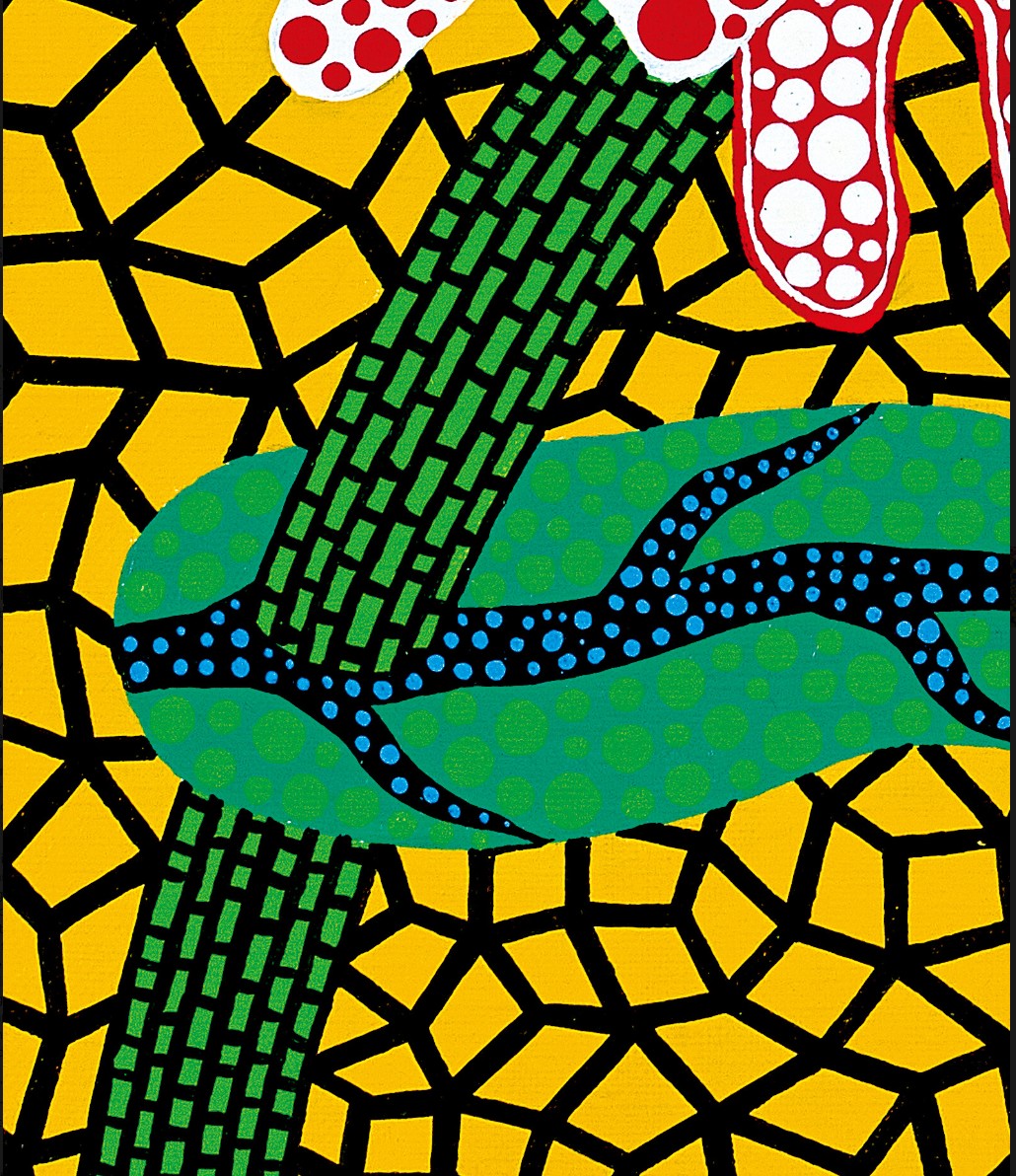
Unlike Kusama’s standard straight-line compositions of individual flowers, A Flower (TZSS) adopts a diagonal structure that showcases a deeper spatial extension and dynamic effect. The stalk of the flower gently bends, emerging from the ground in one corner and highlighting the swaying and rhythm of natural growth. The use of red and purple at the heart of the flower echoes a diary entry written by the artist in the 1970s. “As flowers are colored red or purple to symbolize they are being alive.” In addition, the “flower language” of the dahlia is “gorgeous elegance and rich grace,” with red symbolizing sweet love and purple signifying courage. Moreover, this dahlia, nurtured by love and courage, embodies Kusama’s best expectations for life.
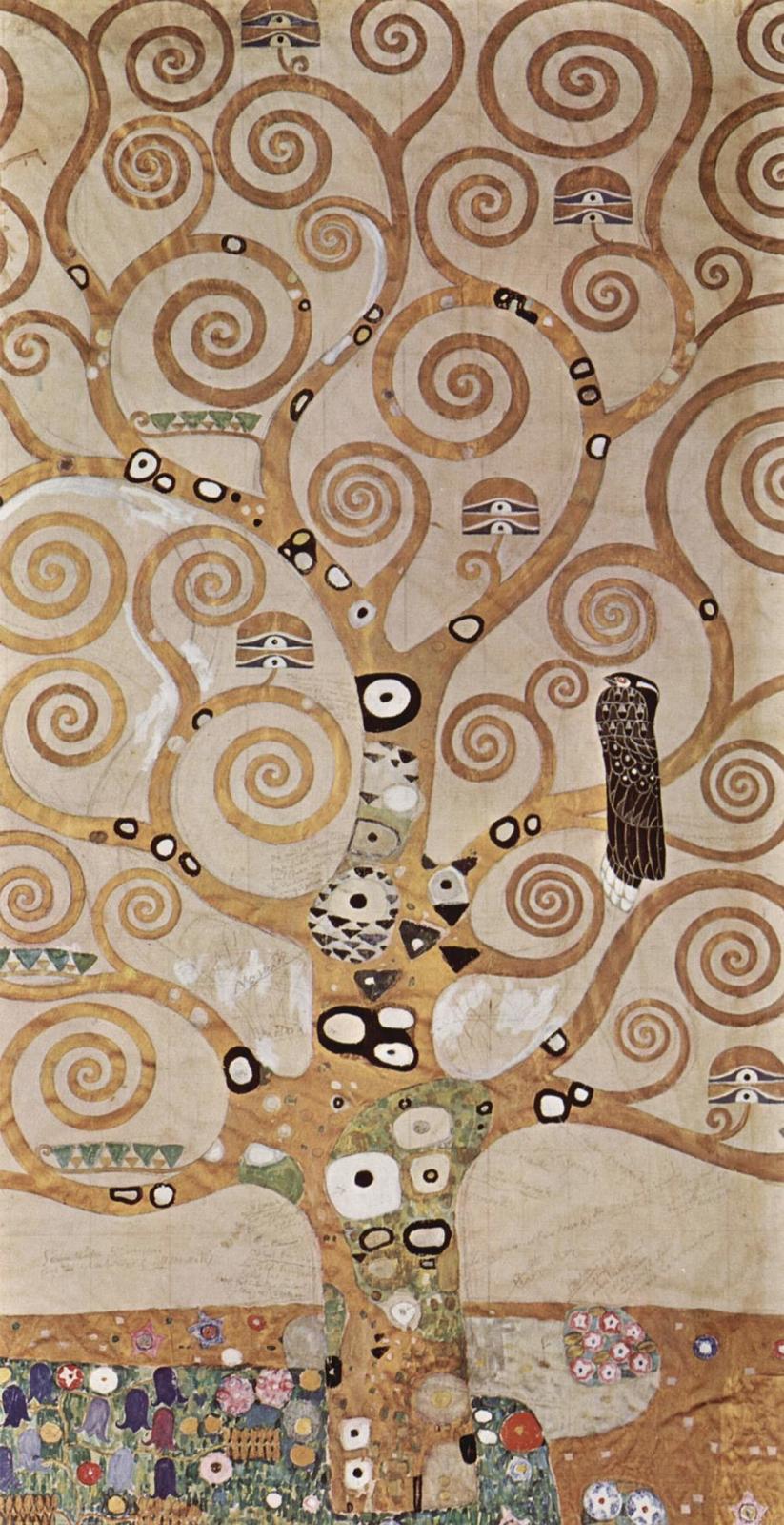
Gustav Klimt, The Tree of Life, 2010, oil on canvas, Museum of Applied Arts, Vienna, Austria
Kusama’s work breaks with conventional visual perspective, preferring to depict the dahlia in a supernatural, magical form that transcends human perception. The stalk and leaf are covered with an infinity net of neatly arranged rectangles that mimick the palisade cell layer and bubbles observed under a microscope in plant epidermal cells, thereby highlighting the “delicate network” that exists within the plant. For a fleeting moment this is projected as the stars of the universe and displays great propagative power. In addition, the flower continuously give birth to new life colours, the repeated cycle of polka dots transporting life and using it to fill the empty space, growing with abandon in spirals in a way that is reminiscent of Tree of Life by Austrian artist Gustav Klimt.
For Kusama, “flowers” symbolize two sides of one coin, the blooming and withering of life, the macroscopic and the microscopic. They are seemingly delicate but possess great tenacity, endlessly intertwining, growing and ultimately become towering existence in organic form. Kusama creates a red flower of the soul in her own unique way and guided by the infinity net it blooms at the end of time, loudly telling a story of life, like a personal declaration from the artist.
Flowers, 1989
Estimated: HKD 3,000,000 – 5,000,000
HKD 4,788,000 / USD 613,909
YAYOI KUSAMA
Flowers, 1989
Acrylic on canvas
45.5 x 38 cm (18×15 inches)
Signed, titled and dated ‘”Flowers [in Kanji]” 1989 Yayoi Kusama’ on the reverse
“I am a polka dot. You are also a polka dot. Another dot is a friend of that dot. The earth is a polka dot. The sun is the shape of a polka dot and the moon is the shape of a polka dot. The polka dot does not exist as a single being. The solidarity of totalitarianism has allowed the polka dot to elevate itself to the form of an independent individual for the first time.”