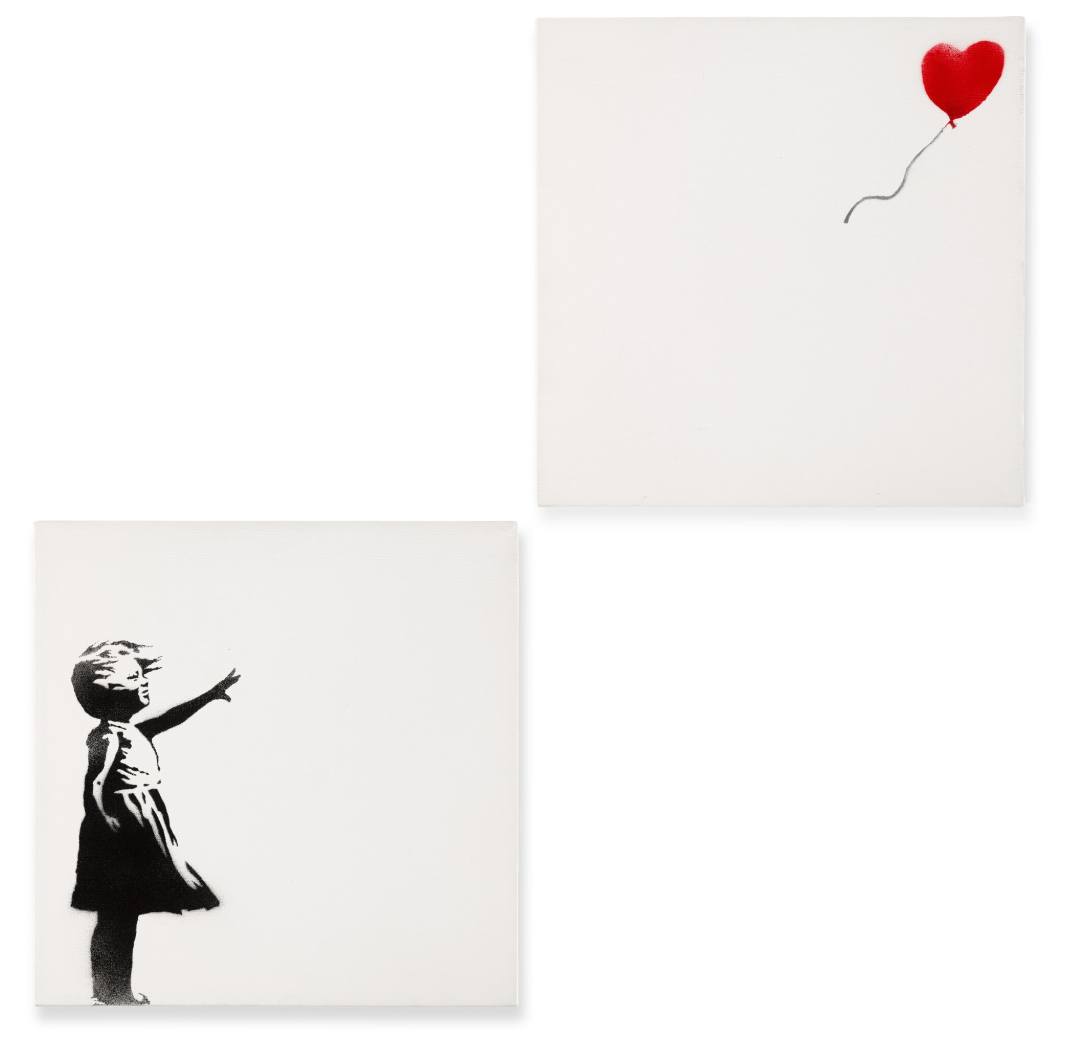
Girl with Balloon Diptych
Medium: Spray paint on canvas, in two parts
Year: 2006
Each: 30×30 cm (12×12 inches)
Edition: 25
Depicting a small girl reaching out towards a bright red, heart-shaped balloon Girl with Balloon presents the most famous motif of Banksy’s iconic oeuvre. Unclear whether the girl is reaching out to catch the balloon – a vibrant emblem of childhood delight – or has rather let it slip from her fingers, the image is fundamentally ambiguous. Akin to Andy Warhol’s soup cans and Damien Hirst’s spots, the image has appeared and reappeared throughout Banksy’s output and onwards through global visual culture.Composed here in acrylic on canvas in two parts which emphasise the simultaneous separation and connection between girl and balloon, this signature Banksy motif first appeared in 2002 in street murals on the walls of Shoreditch and the South Bank in London. In 2017, Girl with Balloon was voted the nation’s favourite artwork in a poll, beating Turner’s The Fighting Temeraire, Constable’s The Hay Wain, and Hockney’s A Bigger Splash. As an image it is transcendent and immediately recognizable.
A poignant two-part version of Banksy’s most iconic image, Girl with Balloon (Diptych) is a vision of innocence and hope. The work consists of two square canvases, each on an intimate 30 x 30 cm scale. In one stands a small girl, stencilled in black against the white background, with her hand upraised; in the other, a red, heart-shaped balloon drifts away into the sky. Created in 2005—just one year after the Girl with Balloon motif made its famed public appearance on a wall on London’s South Bank—the diptych highlights the simple pathos of Banksy’s composition. The balloon has escaped from one panel into another: the distance between the two is palpable. Is the girl reaching for something that she has lost, or has she released a message of love into the world? As with all of Banksy’s work, the image’s universal resonance is not without ambiguity, and its ultimate meaning lies with the viewer. In 2017, Girl with Balloon was voted Britain’s favourite artwork of all time. Its extraordinary, pervasive power is testament to Banksy’s conviction that art should circulate freely in our daily lives, up for discussion by all, and unbound from the conventions of frames, galleries and museums.
Banksy has taken the world as his canvas since the 1990s, using graffiti as a powerful form of social commentary and critique. Beginning in his native Bristol, the anonymous artist moved to London towards the turn of the millennium, where his signature stenciled images became a distinctive part of the urban landscape. Over the years, his projects have taken him across the globe: from Gaza to Glastonbury, and from Los Angeles to the Louvre. Appearing by stealth in unexpected places, his works have addressed a host of social, cultural and political issues, most recently confronting topics such as Brexit, climate change, migration and the COVID-19 pandemic. Fuelling Banksy’s practice is a belief that art should belong to the people, and that—in reflecting their concerns—it has the power to change the world for the better. Girl with Balloon has held a constant role in this mission for almost twenty years.
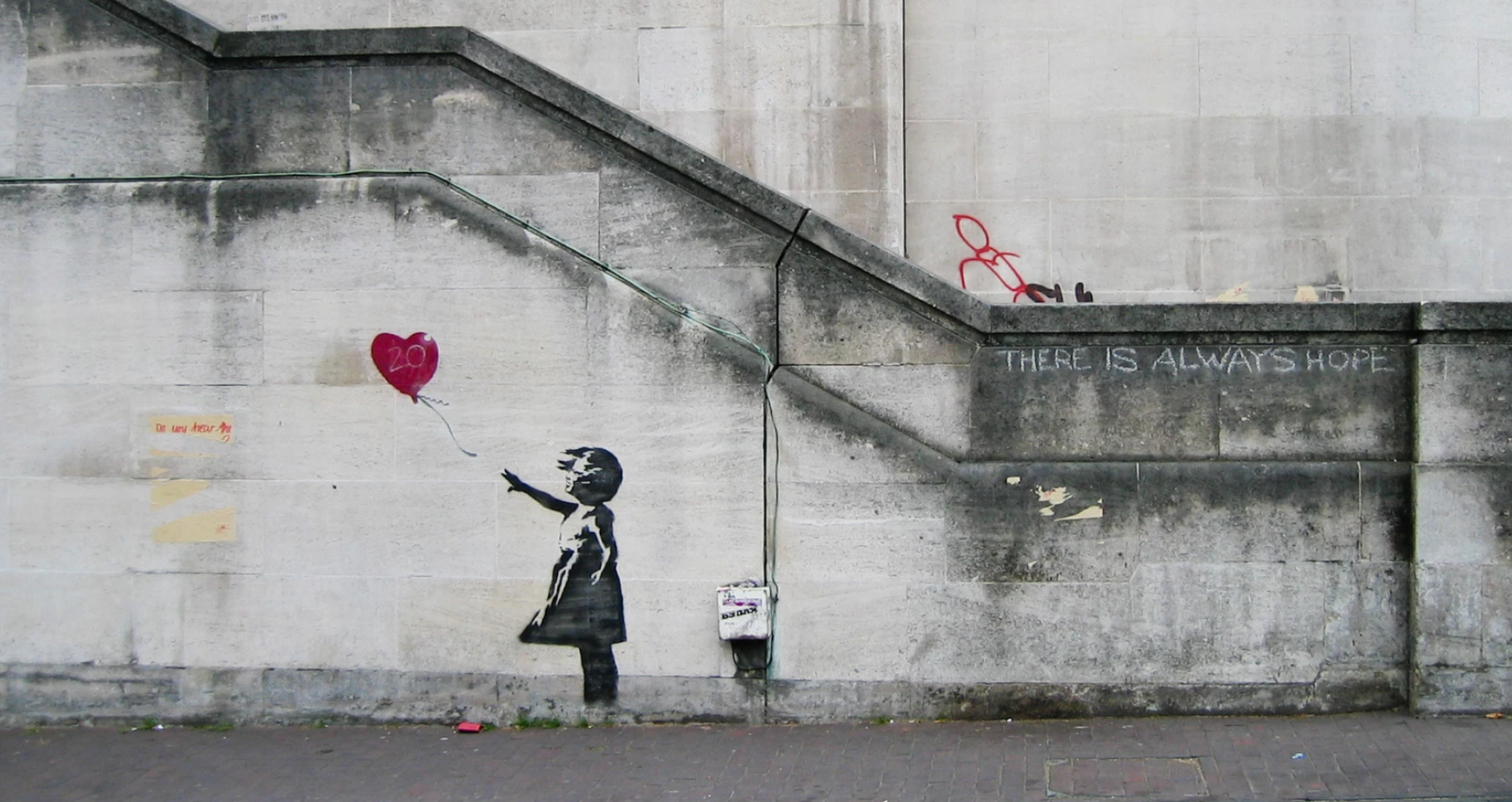
The original mural of Girl with Balloon appeared outside a Shoreditch printing shop in 2002; two years later, another version sprang up on London’s South Bank, this time accompanied by a message reading ‘There Is Always Hope.’ Much like Banksy’s Game Changer (2020)—also depicting a small child—the image’s purpose and power lay in its universality. It was not a static object confined to a gallery, but rather an ephemeral, constantly-evolving performance that lived among the people, and spoke to them in different ways. In 2005, Banksy produced another variant of the motif on the West Bank barrier wall, this time with a bunch of balloons lifting the girl into the sky. In 2014, a version featuring a child with a headscarf was projected onto Nelson’s Column and other global landmarks in support of crisis victims in Syria. Across all these contexts, Girl with Balloon has proved an enduring icon of transcendent, multivalent meaning.
Banksy first hit upon his trademark stenciling method as a teenager: he studied the lettering on a lorry while hiding from the Bristol police, and realised the stencil could let him lay down images swiftly and discreetly. This quickfire wit would go on to inform many of his most famous works, from the monumental Love Is In The Air (Flower Thrower), first seen on a wall in Jerusalem in 2003, to irreverent murals such as Kissing Coppers, which appeared in Brighton two years later. More recent public interventions—such as Nottingham’s girl hula-hooping with a bicycle wheel, and the sneezing woman who brightened up pandemic-struck Bristol in 2020—demonstrate his continued commitment to the medium, bringing joy to local neighborhoods with their humorous, carefully staged tableaux. All these years later, however, Girl with Balloon remains perhaps the purest expression of Banksy’s visual genius. Instantly recognizable and timelessly moving, the present work encapsulates the spirit of his art: with just two beautifully simple elements, he has created a picture that has touched the hearts of millions.
Auction Results
Girl with Balloon (Diptych) sold 4 times at auction. It last sold at Sotheby’s in London, on 14 October 2022, for GBP 882,000 (USD 996,800). This is a serious discount as compared to its all-time high auction record of GBP 3,042,500 (USD 4,183,940) achieved at Christie’s in London on 15 October 2021, but still a very strong upside as compared to prices realized 10 years ago.
Girl with Balloon Diptych, 2006
Sotheby’s London: 14 October 2022
Estimated: GBP 1,200,000 – 1,800,000
GBP 882,000 / USD 996,800
Girl with Balloon Diptych | The Now Evening Auction | 2022 | Sotheby’s (sothebys.com)

BANKSY (b. 1974)
Girl with Balloon Diptych, 2006
Spray paint on canvas, in two parts
Each: 30×30 cm (12×12 inches)
Left canvas: signed Banksy, dated 2006 and numbered Artist Proof 00/25 (on the reverse)
Right canvas: tagged (on the overturn edge)
Provenance
Acquired directly from the artist in 2006
Girl with Balloon (Diptych), 2005
Christie’s London: 15 October 2021
Estimated: GBP 2,600,000 – 3,500,000
GBP 3,042,500 / USD 4,183,940
BANKSY, Girl with Balloon (Diptych) | Christie’s (christies.com)

BANKSY
Girl with Balloon (Diptych), 2005
Spray paint on canvas, in two parts
Each: 30.2 x 30.2 cm (11 7/8 x 11 7/8 inches)
(i) numbered ‘6/25′ (on the stretcher)
(ii) tagged ‘BANKSY’ (on the overlap); signed and dated ‘BANKSY 5⁄9/05‘ (on the stretcher)
This work is number six from an edition of twenty-five
Provenance
Private Collection, London.
Acquired from the above by the present owner in circa 2013
Girl with a Balloon, 2005
Sotheby’s London: 13 October 2012
Estimated: GBP 35,000 – 45,000
GBP 46,850 / USD 75,305

BANKSY
Girl with a Balloon, 2005
Acrylic and spraypaint on canvas, diptych
Each: 30.2 x 30.2cm (11 7/8 x 11 7/8 inches)
(ii) tagged on the side edge; signed, dated 11/12/05 and numbered 8/25 on the stretcher
Provenance
Lazarides Gallery, London
Private Collection, Sweden
Acquired directly from the above by the present owner
Girl and Balloon, 2005
Christie’s London: 12 September 2012
Estimated: GBP 30,000 – 50,000
GBP 58,850 / USD 94,755
Banksy (b. 1975) , Girl and Balloon | Christie’s

BANKSY (b. 1975)
Girl and Balloon, 2005
Spray enamel on canvas, in two parts
Each: 30.2 x 30.2 cm ( 11 7/8 x 11 7/8 inches)
Tagged ‘Banksy’ (on the overlap)
Signed, numbered and dated ‘Banksy 11/12/05 11/25’ (on the reverse)
This work is number eleven from an edition of twenty-five
Provenance
Lazarides Galleries, London.
Acquired from the above by the present owner in 2007.