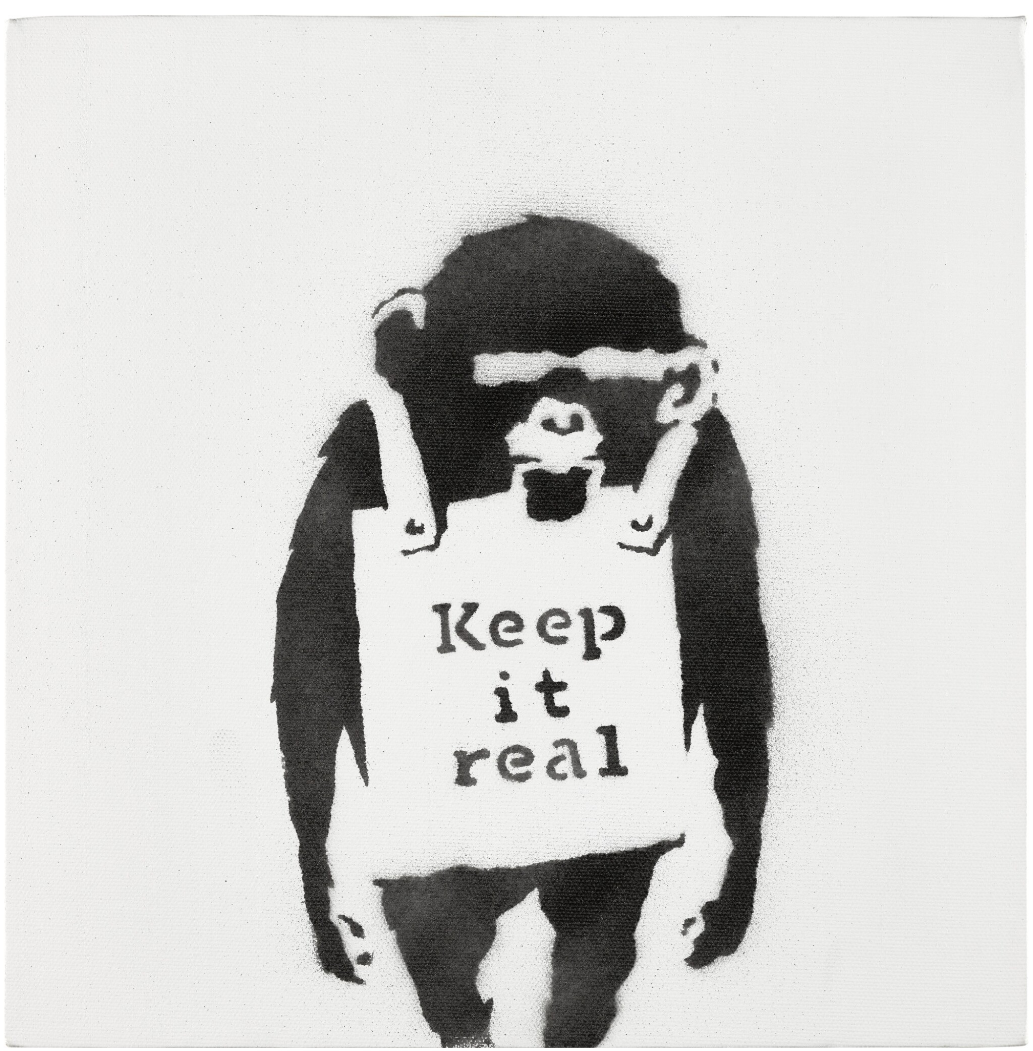
Keep It Real
Medium: Acrylic and spray-paint on canvas
Year: 2003
Dimensions: 30.5 x 30.5 cm (12×12 inches)
Edition: 15
Stencil signed on the overturn edge
Numbered on the stretcher
One of Banksy’s most iconic and immediately recognizable images, Keep it Real encapsulates the artist’s biting sense of humor and cutting social satire. Rendered in Banksy’s signature graphic monochromatic visual language, the figure of the monkey appears apathetic, his lumbering shoulders slouched, his arms slack by his side and his heavy brow furrowed. Adorned with a sandwich board bearing the command ‘Keep it Real’, this enigmatic chimpanzee appears simultaneously as a figure of subservience and of domination; the perfect visual vehicle for Banksy’s cutting analyses of contemporary mass culture.
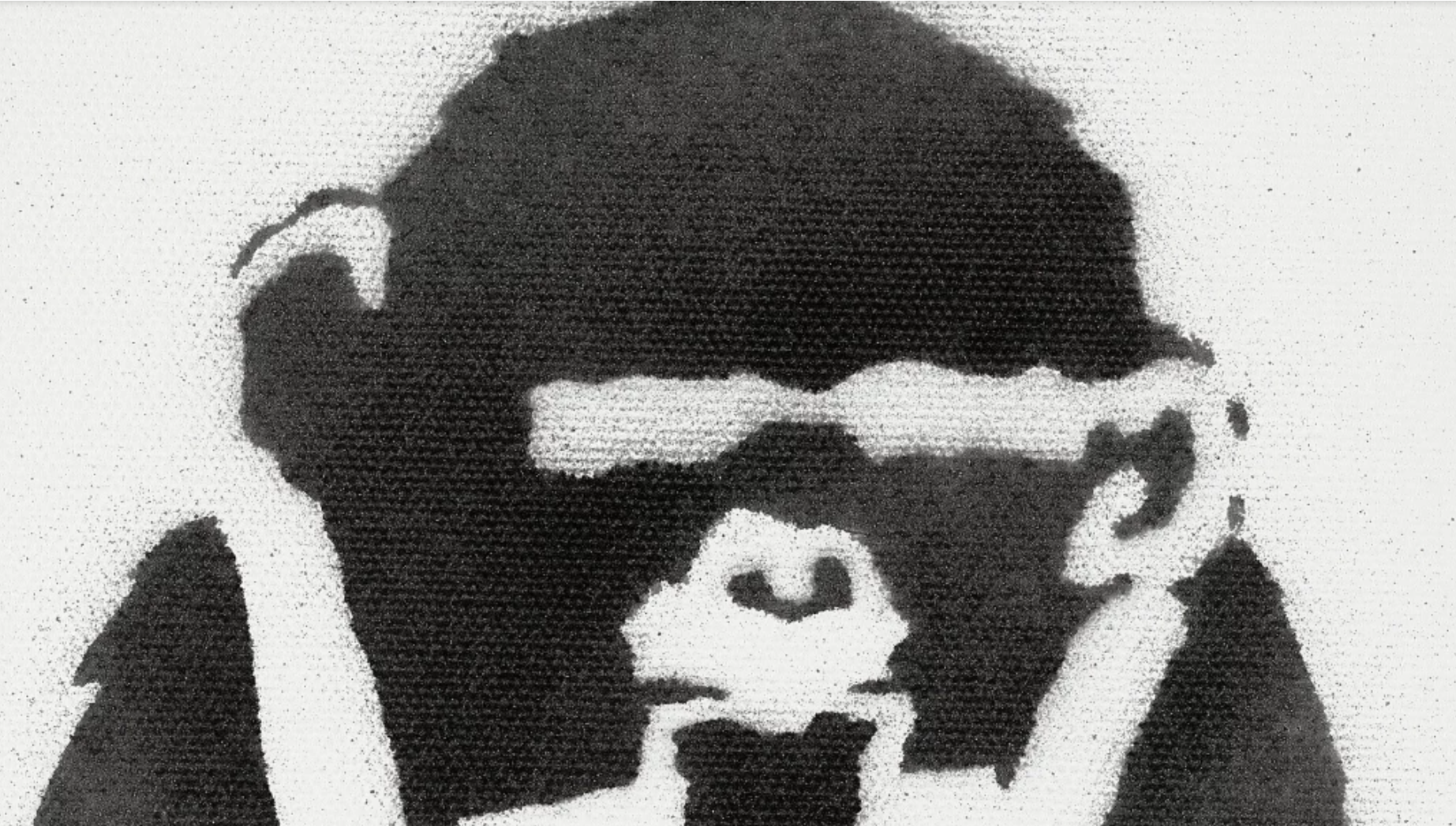
Banksy’s monkeys first appeared in 2002 in a sprawling stenciled mural commissioned by a nightclub in Brighton, where ten stenciled chimpanzees stood one after the other in a militaristic row with each figure featuring a placard emblazoned with the phrase ‘Laugh now, but one day we’ll be in charge” It was from this work that subsequent versions of the forlorn-looking monkey were created, and consequently became one of the artist’s most iconic and widely disseminated images. In its successive incarnations, the chimpanzees are often paired with signage imparting pithy remarks that provide pejorative commentaries on a range of socio-political aspects of contemporary life.
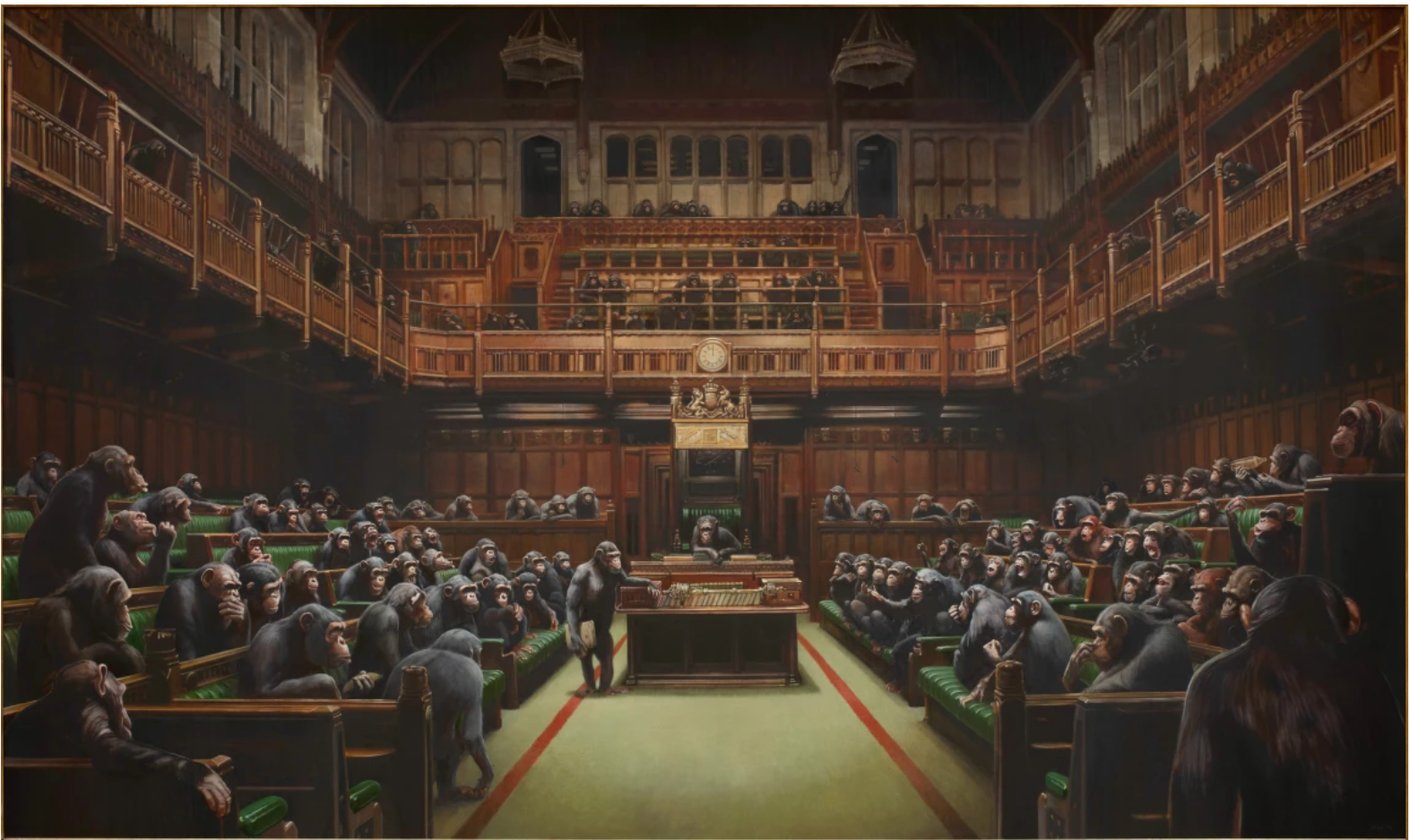
BANKSY, DEVOLVED PARLIAMENT, 2009 / ARTWORK: © BANKSY 2021 DAVID EMENEY
From its first iteration, Banksy has mobilized the figure of the monkey with all its Darwinian associations of docility, inferiority and intellectual simplicity, as the perfect visual representation of the subordination of the masses. In this light, Keep it Real, can be understood as a critique of the authoritarian manipulation of the working class, despondent and suppressed under the forces of capitalism. Conversely Banksy’s chimpanzees, rather than inhabiting a purely docile existence, may also be seen as deviant and mischievous clever characters. It is through this duality of association, that the monkey has taken center stage in Banksy’s practice as one of the most widely recognizable motifs in the artist’s arsenal through which to represent both the dejected and disillusioned masses and the authoritarian figures of the establishment. From the earliest Monkey Detonator through to works that directly mock the establishment, notably the ambitious dystopian reimagining of the House of Commons run amok with irate chimps (Devolved Parliament, 2009), primates are Banksy’s most frequently called-upon symbol, as a means through which to mock and challenge perceived authority and the establishment. Indeed, the figure of the chimpanzee has remained central in the decades succeeding its inception.
Christie’s New-York: 9 November 2021
Estimated: USD 1,800,000 – 2,500,000
USD 2,190,000
BANKSY, Monkey Detonator | Christie’s (christies.com)
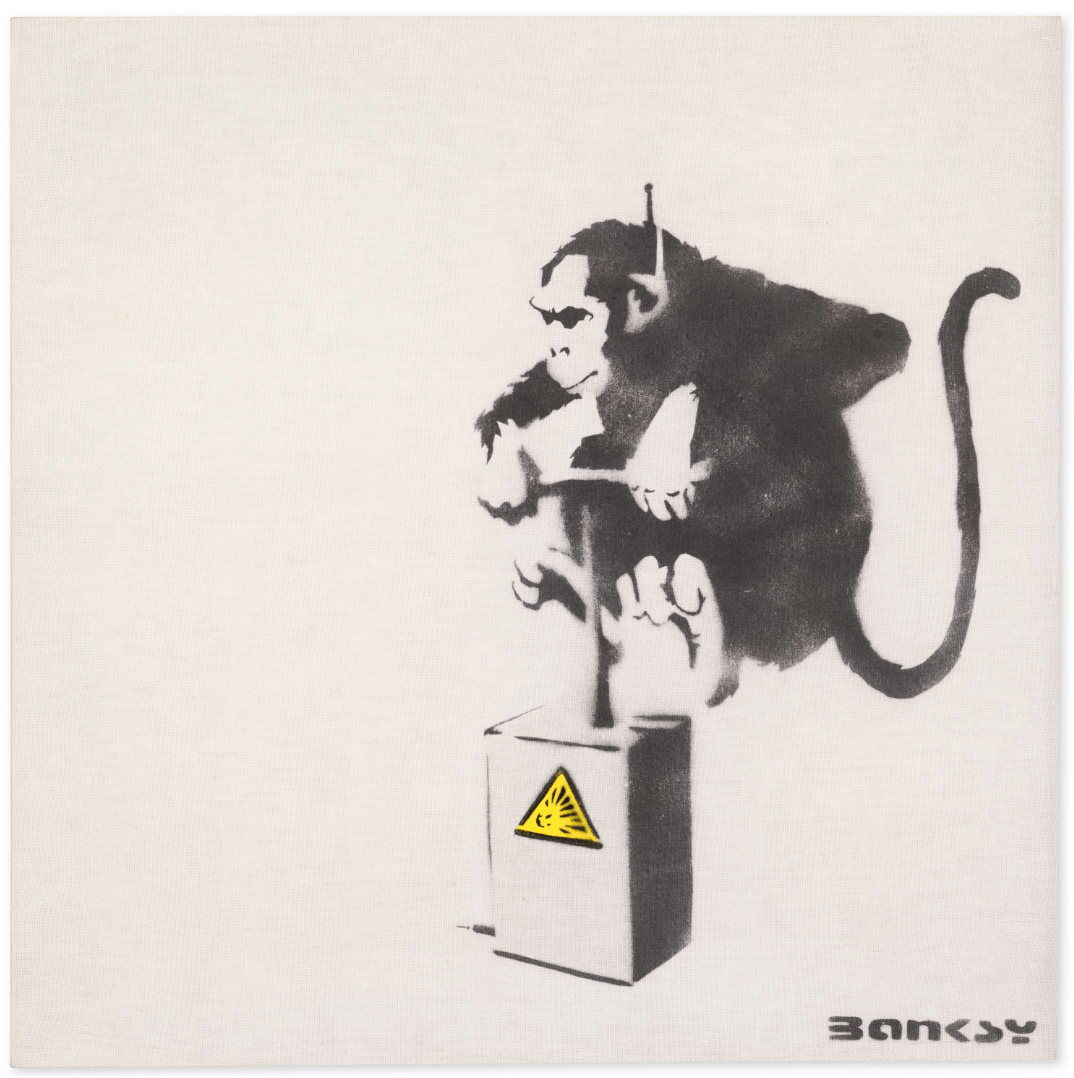
BANKSY
Monkey Detonator, 2000
Spray paint on canvas
76.2 x 76.2 cm (30×30 inches)
Tagged ‘Banksy’ (lower right)
This work is from a varying series
It is this distinctive cutting social commentary and political undertone that has underpinned Banksy’s position as one of the most important artists of our time and garnered his cult-like following. Mobilizing a longstanding tradition of social satire and visual parody, Banksy has inherited the role of the British pictorial satirists in the contemporary sphere, following in the distinctly unapologetic footsteps of the likes of William Hogarth to penetrate public consciousness and challenge the role of the establishment. Banksy’s finest work is situated within an esteemed tradition of raising an unforgiving and illuminating mirror up to the world. With his dark humour and subversive epigrams, Banksy perfectly encapsulated his defiantly anti-authoritarian stance with the maxim: “Art should comfort the disturbed and disturb the comfortable” – a contemporary take on the turn-of-the-century American satirist Finley Peter Dunne’s declaration that the duty of a newspaper is to “comfort the afflicted and afflict the comfortable” (Finley Peter Dunne cited in: Dean P. Turnbloom, Ed., Prizewinning Political Cartoons, Gretna 2010, p. 146). It is Banksy’s uncanny ability to translate complicated socio-political commentary into striking, highly legible images presented for the public, in public.
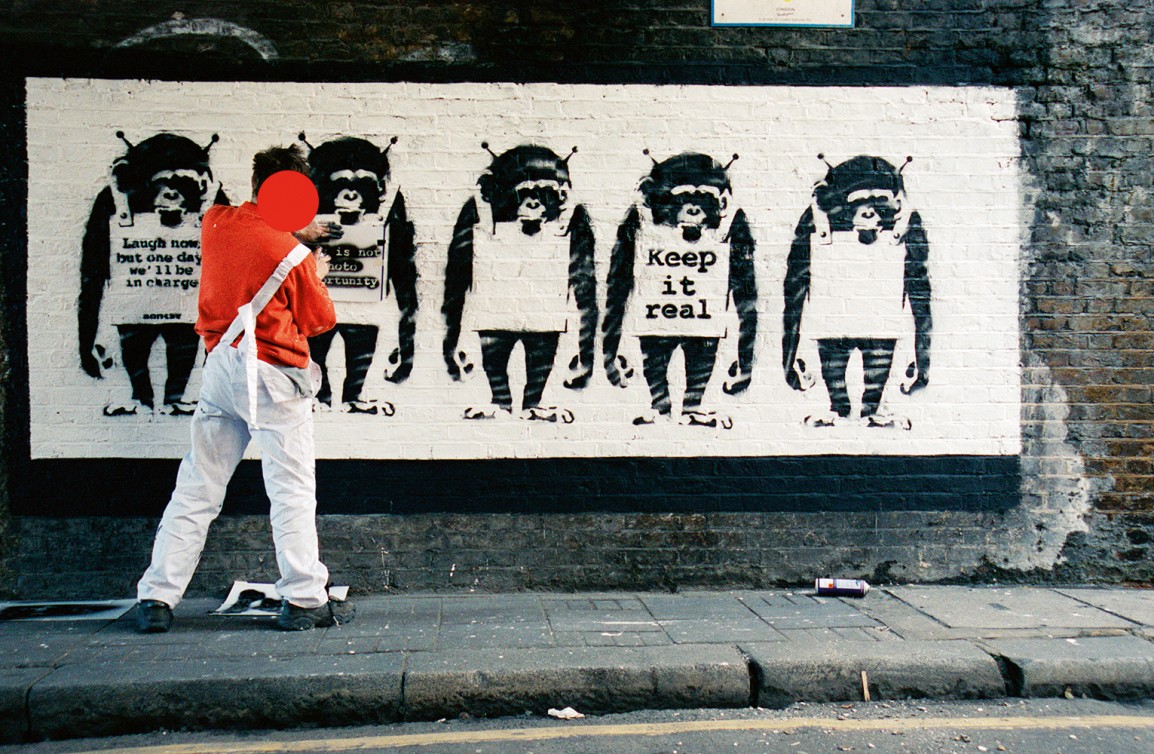
Rivington Street
Despite the cynical puns, witty punchlines, and an espousal of anti-taste and shock tactics, there is a sense of ambiguity that more often than not authentically challenges issues concerning representation and power structures in contemporary life. This is what makes his work so fascinating, appealing, and ultimately so enduring. XXX
Auction Results
Keep It Real, 2003
Sotheby’s London: 15 October 2021
Estimated: GBP 400,000 – 600,000
GBP 499,000 / USD 686,210
Keep It Real | Contemporary Art Day Auction | 2021 | Sotheby’s (sothebys.com)

BANKSY (b. 1974)
Keep It Real, 2003
Acrylic and spray paint on canvas
30.5 x 30.5 cm (12×12 inches)
Stenciled with the artist’s signature on the overturn edge
Numbered 10/15 on the stretcher
This work is number 10 from an edition of 15
Provenance
Pictures on Walls, London
Acquired from the above by the present owner

Keep it Real, 2003
Sotheby’s New-York: 15 November 2018
Estimated: USD 100,000 – 150,000
USD 250,000
(#507) BANKSY | Keep it Real (sothebys.com)

BANKSY
Keep it Real, 2003
Acrylic and spray paint stencil on canvas
30×25 cm (11 3/4 x 9 7/8 inches)
Signed on the turning edge
Dated 2003 and numbered 5/15 on the stretcher
This work is number 5 from an edition of 15
Provenance
Tom Tom Gallery, London
Acquired from the above by the present owner