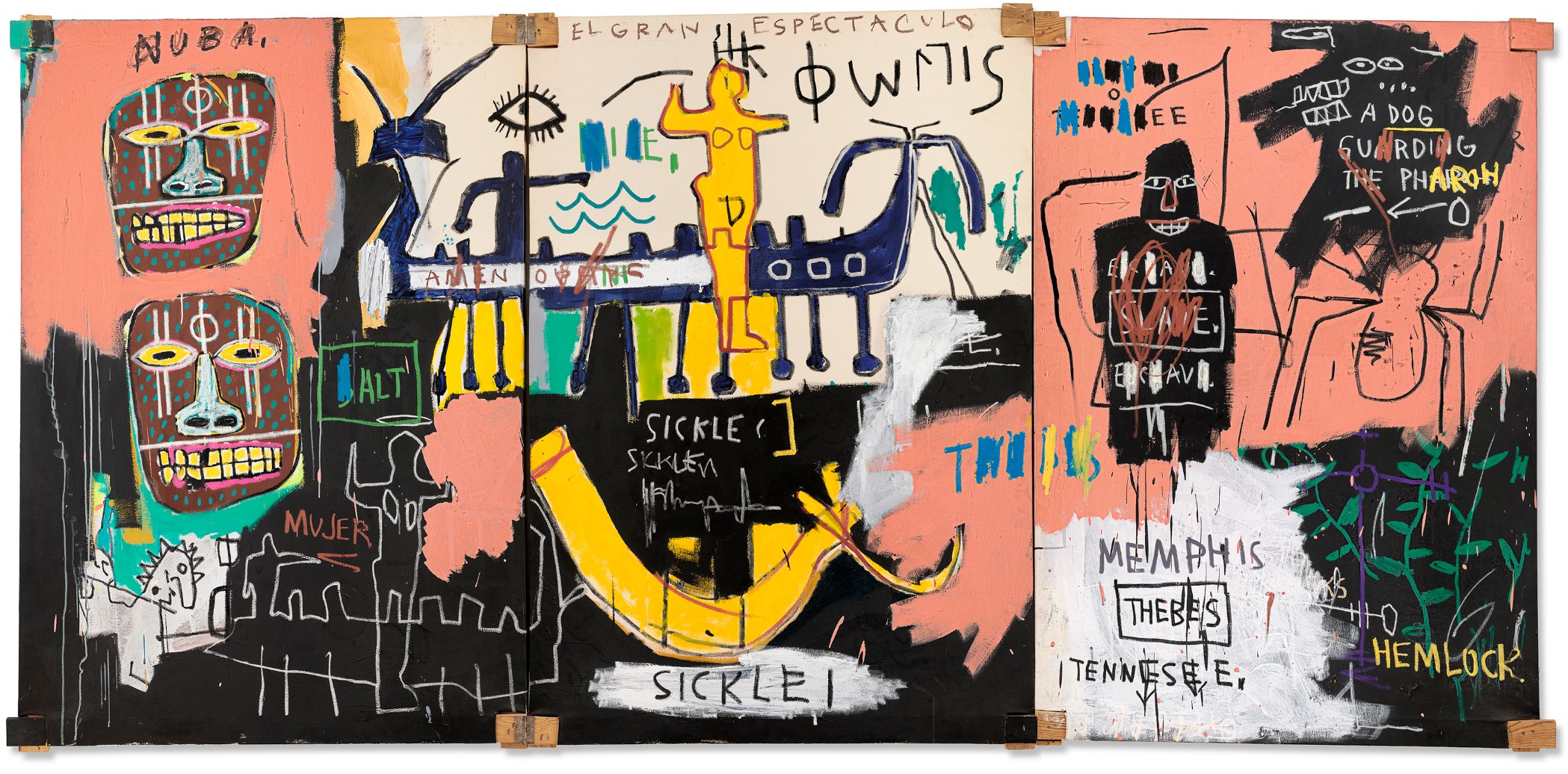
JEAN-MICHEL BASQUIAT (1960-1988)
El Gran Espectaculo (The Nile), 1983
Acrylic and oilstick on canvas mounted on wooden supports, in three parts
Overall: 68×141 inches (172.7 x 358 cm.)
Titled ‘EL GRAN ESPECTACULO’ (upper center)
Signed, titled and dated ‘“THE NILE” 1983 Jean-Michel Basquiat’ (on the reverse)
Provenance
Annina Nosei Gallery, New York
Enrico Navarra, Paris
Anon. sale; Sotheby’s, New York, 9 November 2005, lot 38
Acquired at the above sale by the present owner
Christie’s New-York: 15 May 2023
Estimate On Request
USD 67,110,000
JEAN-MICHEL BASQUIAT (1960-1988) (christies.com)
Painted when the artist was just 22 years-old, El Gran Espectaculo (The Nile) stands as one of the most important paintings in Jean-Michel Basquiat’s short but explosive career. It is one of three large-scale canvases executed in 1983 in which the artist ambitiously and audaciously proclaims that his central concern from this point on is to use painting to address issues of representation within the grand theater of world history. Thus, the present work becomes Basquiat’s quintessential history painting, as across its highly animated surface an intoxicating array of signs and signifiers unlocks the history of the Black diaspora. From Ancient Egypt to present day America, Basquiat’s employs his unique visual language to chart the Black experience as part of Western Civilization. “
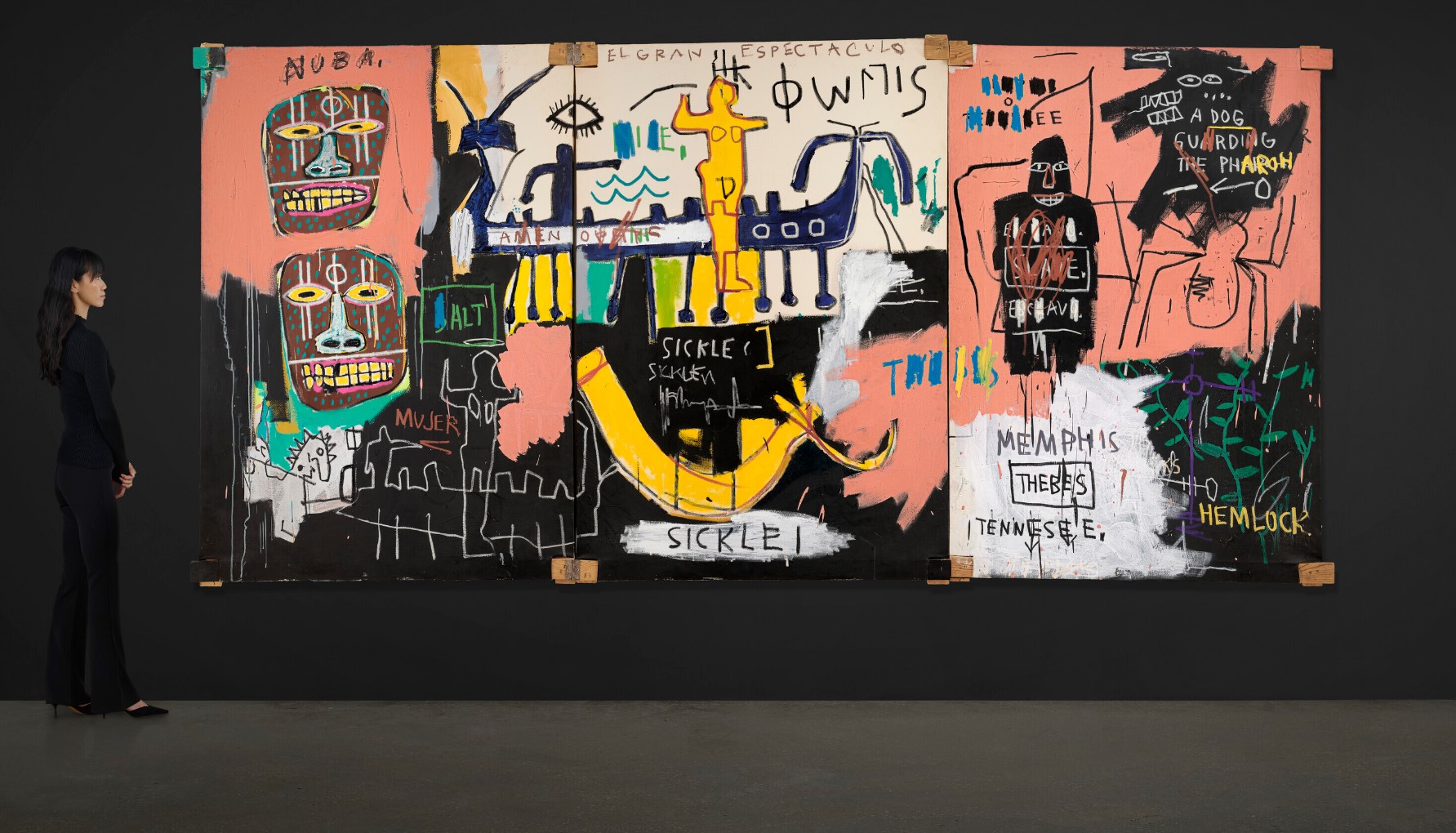
Previously owned by Enrico Navarra, a prominent collector of the artist’s work and the co-author of what is widely considered to be the most comprehensive catalogue of Basquiat’s paintings, El Gran Espectaculo (The Nile) is discussed at length in the wider scholarly literature on the artist. It has been exhibited in numerous critically acclaimed retrospectives including one organized by the Whitney Museum of American Art, New York in 1992 and the Brooklyn Museum of Art in 2006. Held in the same private collection for the past fifteen years, this is a rare opportunity to acquire one of Basquiat’s seminal works.
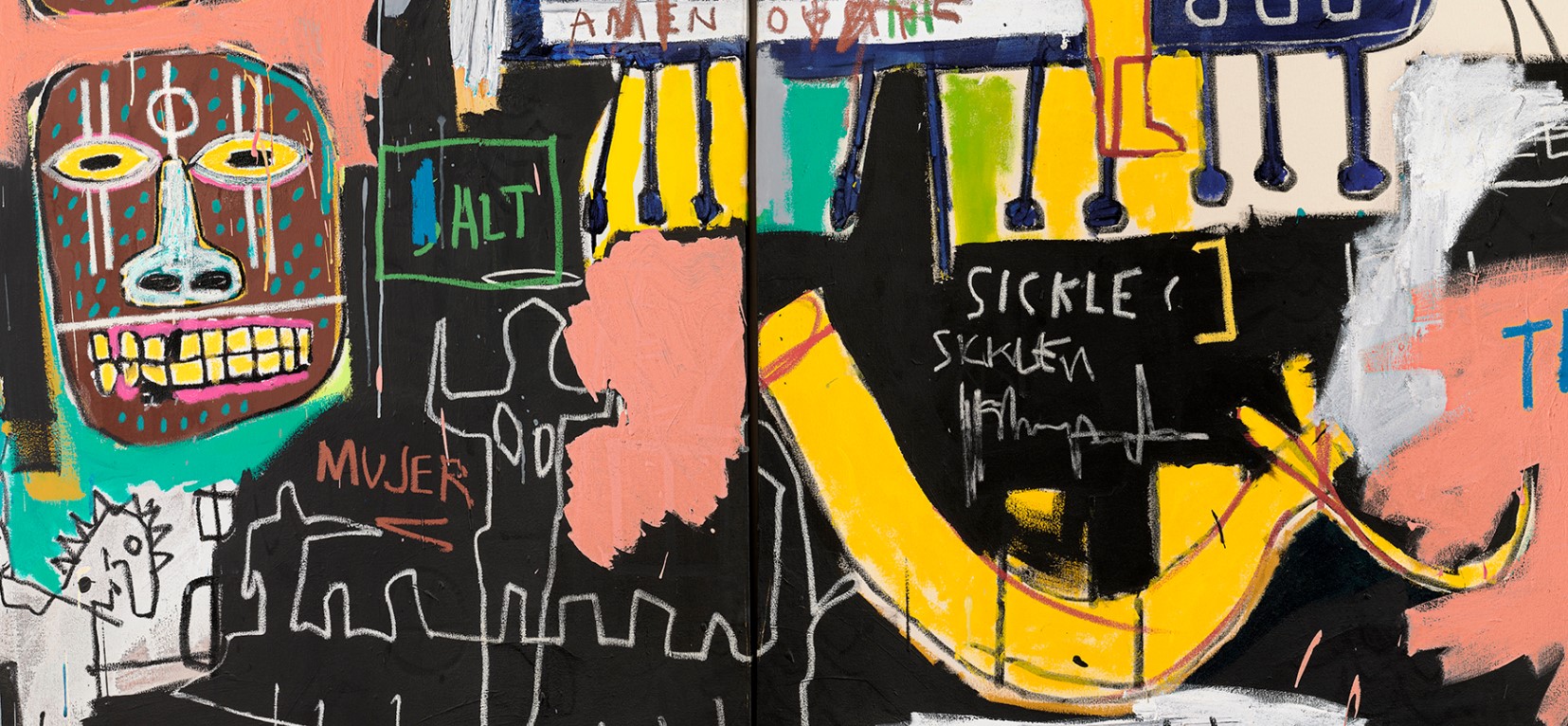
With the present work, Basquiat joins a distinguished group of artists who have confronted humanity’s darkest forces through the power of art. From Picasso’s Guernica to Francis Bacon’s 1944 painting Three Studies for Figures at the Base of the Crucifixion, and Andy Warhol’s Race Riot, artists have employed the visual and emotional resonance of art to process events which seem unfathomable. Yet what is remarkable about El Gran Espectaculo (The Nile) is that this highly complex and accomplished painting was completed by someone so young; Picasso was 56 years old when he executed his treatise on the horrors of the Spanish Civil War, Basquiat painted the present work when he was barely out of his teenage years. Across one of the artist’s hand-constructed canvases, Basquiat choreographs a heady arrangement of evocative graphic symbols, scrawled words, and painterly drips; all characteristic elements of his unique painterly language. Often painting late into—and through—the night, what at first appears to be a chaotic composition, is in fact a highly organized assembly of symbolic signifiers.