Self-Portrait as a Heel (Part Two), 1982
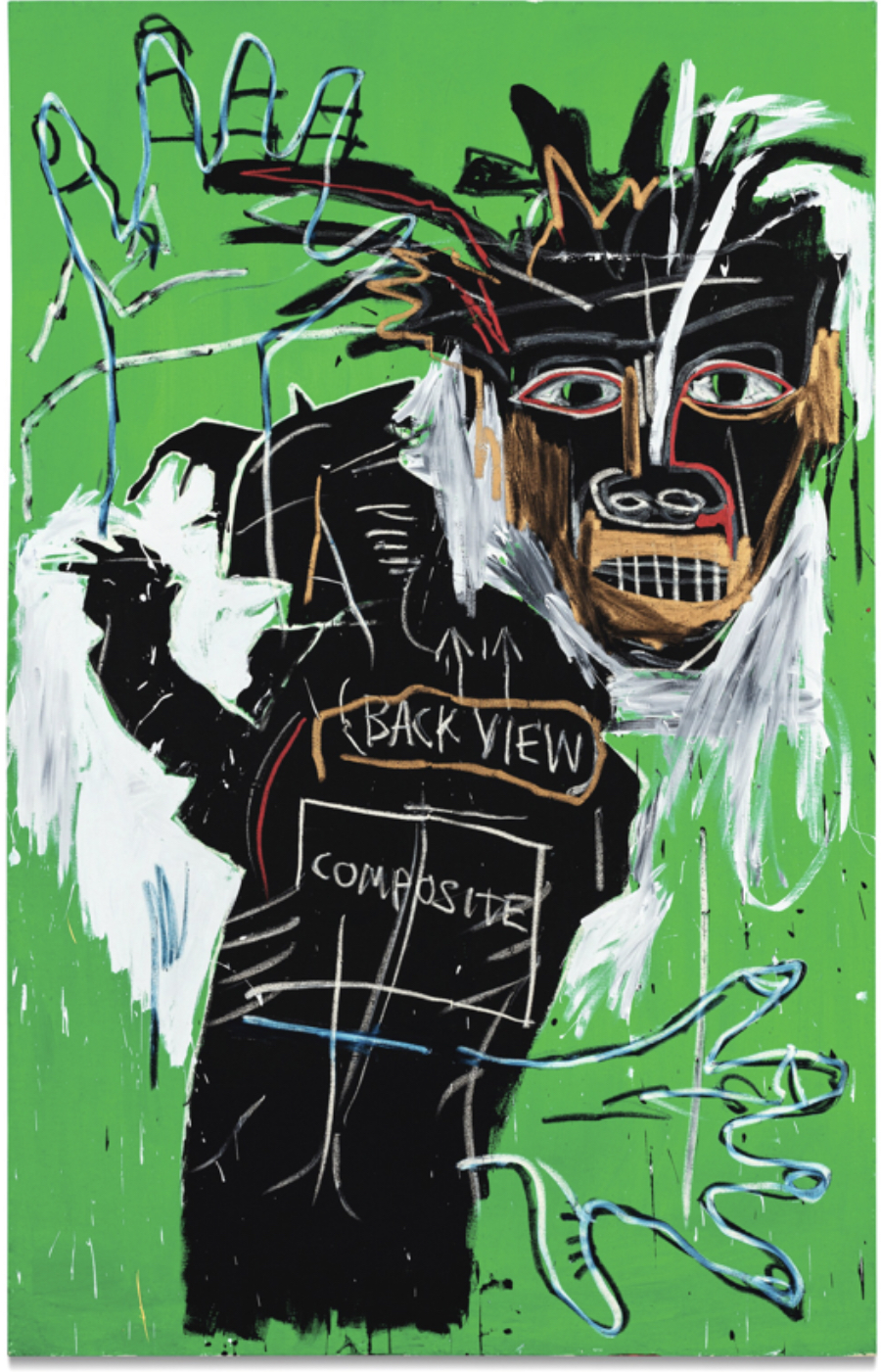
JEAN-MICHEL BASQUIAT (1960 – 1988)
Self-Portrait as a Heel (Part Two), 1982
Acrylic and oilstick on canvas
96 x 61 1/2 inches (243.8 x 156.2 cm)
Signed, titled, dated 1982 and variously inscribed (on the reverse)
Provenance
Larry Gagosian Gallery, Los Angeles
Stéphane Janssen, Belgium (acquired by 1985)
Christie’s New York, 19 May 1999, lot 16 (consigned by the above)
Private Collection, New York (acquired from the above)
Blain Southern Gallery, London
Acquired from the above by the present owner
Sotheby’s New-York: 15 November 2023
Estimated: USD 40,000,000 – 60,000,000
USD 42,000,000
Self-Portrait as a Heel (Part Two) | Contemporary Evening Auction | 2023 | Sotheby’s (sothebys.com)
Amidst a cacophony of fragmented body parts upon a luminescent green field, Basquiat’s collective image emerges piece by piece in his monumental Self-Portrait as a Heel (Part Two), wholly enveloping the viewer with the artist’s profound understanding of selfhood at the pinnacle of his brief but explosive career. By the time Basquiat painted the present work in 1982, he had already arrived at the center of critical acclaim as he ascended from SAMO ©, the street provocateur, to the avant garde prodigy of the mainstream art world. Emerging from the downtown crucible of his native New York, Basquiat executed Self-Portrait as a Heel (Part Two) during a pivotal visit to Los Angeles between 1982 and 1983, a critical turning point in his life when he debuted in his first West Coast exhibitions at Larry Gagosian Gallery and prominently featured the present work therein. Alongside Versus Medici and Anybody Speaking Words, the present work was originally one of several monumental standing Black figure paintings that formed the core of esteemed Belgian collector Stéphane Janssen’s collection – an esteemed Belgian collector and an early champion of Basquiat – and is distinguished today as among the artist’s most assured, early masterworks. Its sister painting, the first Self-Portrait as a Heel from 1982, similarly depicts a stylized rendering of the artist’s own head with swirling dreadlocks; meanwhile, the overall titular motif remained significant for the artist, notably continuing in an inscription “Self-Portrait as a Heel, Part Three” that is scribbled alongside a portrait of himself and two friends – Toxic and Rammellzee – in his later 1983 painting Hollywood Africans, now held in the Whitney Museum of American Art as an autobiographical depiction of his legendary experience in Los Angeles. A majestically viridescent monument to the inseparability between Basquiat’s art and his own life as a Black American man, Self-Portrait as a Heel (Part Two) powerfully reflects one of the artist’s most powerful and philosophical rendition of the self as, in his words here, a “COMPOSITE” – not only of who he understands himself to be, but also what others will inevitably perceive and identify him as.
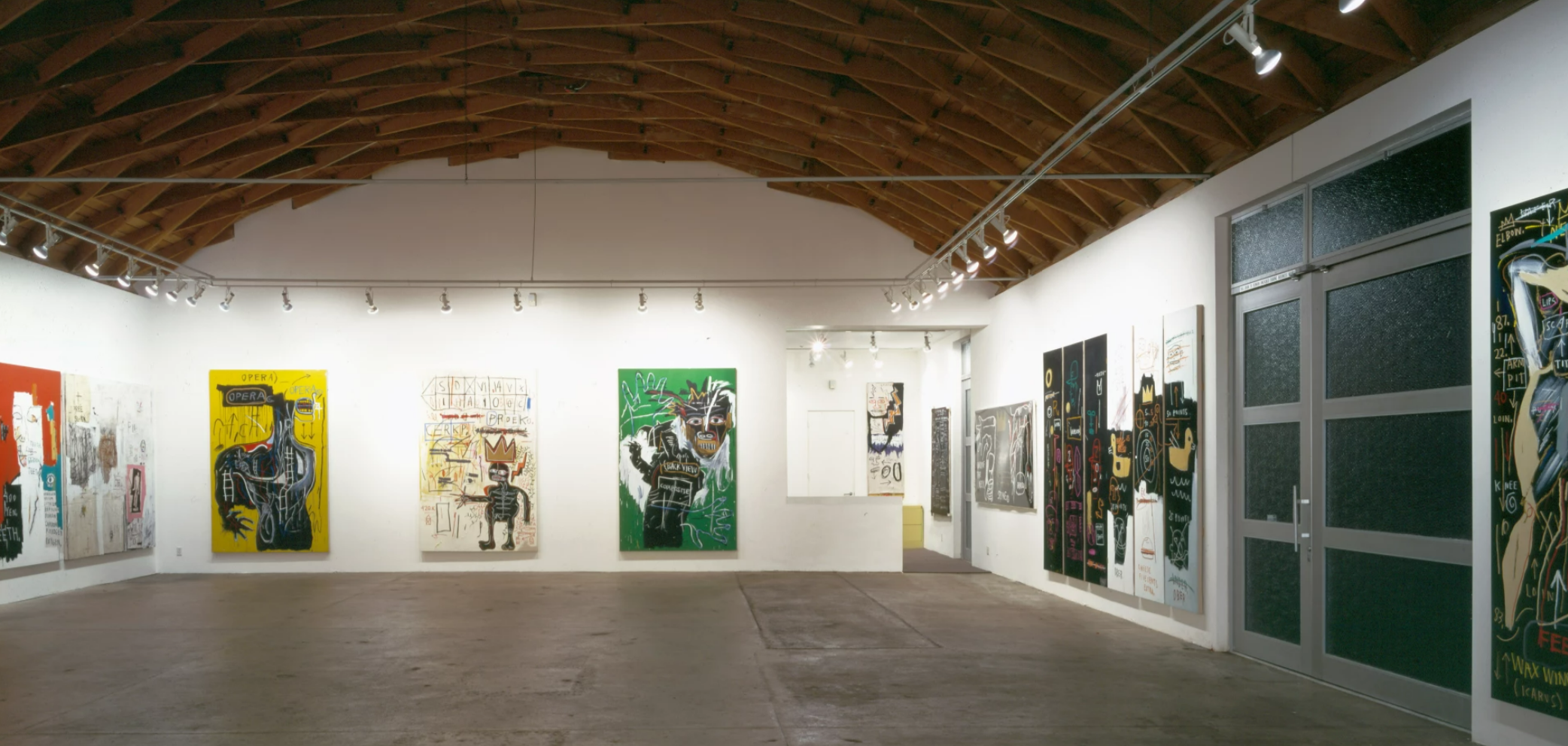
THE PRESENT WORK INSTALLED IN JEAN-MICHEL BASQUIAT: NEW PAINTINGS, LARRY GAGOSIAN GALLERY, LOS ANGELES, MARCH – APRIL 1983. ART © ESTATE OF JEAN-MICHEL BASQUIAT. LICENSED BY ARTESTAR, NEW YORK.
More so than depictions of himself, Basquiat’s self-portraits during the 1980s serve as nuanced portrayals of his self-consciousness as he navigated the white, Western artistic continuum: by representing himself from the “BACK VIEW” in Self-Portrait as a Heel (Part Two), Basquiat unmistakably presents an onlooker’s perspective of him while avoiding our direct gaze. Emerging with a halo of flurried white brushstrokes yet cast in the stark umbra of shadow, the artist’s black silhouette seems to lurk in sinister darkness, providing a counterpart to his disembodied head as it vigorously confronts us with contours resembling an African tribal mask and his signature crown of dreadlocks. In this context, the titular “heel” references not only the back of a shoe, but also the pejorative used to indicate a delinquent, or the boxing term for a professional wrestler who acts as the antagonist within a match, the foil to the boxer cast as the hero. Regarding Basquiat’s multivalent application of the word “heel”, Richard Marshall interprets it as “a self-deprecating description of himself as a ‘cad’ or ‘jerk,’ perhaps commenting on his behavior with friends, dealers, or girlfriends, and secondly, he enjoyed the act of labeling something a HEEL, in the same way he labeled parts of the body in his anatomical works.” (Richard D. Marshall and Jean-Louis Prat, Jean-Michel Basquiat, 1st. Ed., vol. I, Paris, 1996, p. 20). Lending his pithy poeticism to the canonical mode of self-portraiture, Basquiat allegorizes the dualities of his selfhood through the opposition between the “heel” and hero, and he contends with the cultural stereotypes and alienation that he encountered as a young Black man in Twentieth-Century America.
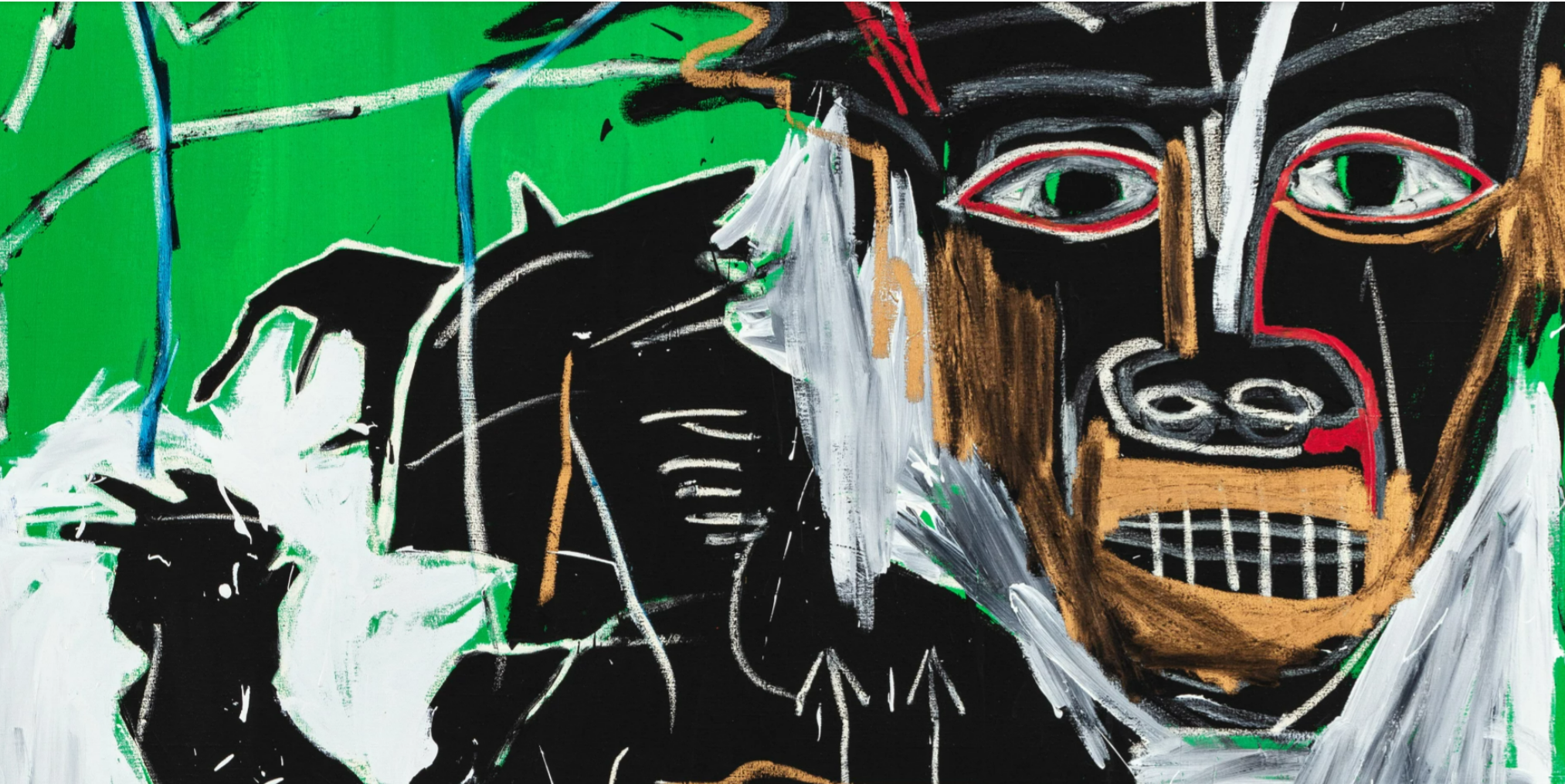
Gazing outward while simultaneously performing an inward examination, Basquiat lays bare the dialectical construction of public and private selves, while his hand sketches leave behind traceries of his struggle to grasp his own composition. Unfurled across the vibrant jade field, in Self-Portrait as a Heel (Part II), he scatters fragmented pieces of himself like entrails — raw, unconcealed, exuding a palpable sense of confidence and vulnerability at once. Ego, id, and superego subsequently collapse into a raw painterly manifesto of the self in this relic from the absolute apex of Basquiat’s career in 1982, testifying to the transcendental breakthrough that is the artist’s indelible legacy. “I knew he was great—he was electric,” recalls Glenn O’Brienn about the late artist. “A tesla coil with dreadlocks—cool fire emanating wherever he went. Magic.” (Glenn O’Brien, “Basquiat: The Show Must Go On,” 17 September 2013 (online)) Nowhere is this visceral sense of magic best exerted than in Self-Portrait as a Heel (Part II), a lustrous masterpiece of mystifying emerald green splintered into the philosophical throughlines of Basquiat’s selfhood, yet illuminated and enchanted with the seismic force of the artist’s gestural bravado. In this painterly battleground whereby Basquiat examines and poignantly reflects upon the precarity of own Black selfhood, he reifies one of his most iconic proclamations: “I’m not a real person. I’m a legend” (Jean-Michel Basquiat quoted in Anthony Haden-Guest, “Burning Out”, Vanity Fair, November 1988, p. 197 (online)).