
Francis Bacon (1909 – 1992) was an Irish-born British figurative painter known for his raw, unsettling imagery. Focusing on the human form, his subjects included crucifixions, portraits of popes, self-portraits, and portraits of close friends, with abstracted figures sometimes isolated in geometrical structures. Rejecting various classifications of his work, Bacon said he strove to render “the brutality of fact.” He built up a reputation as one of the giants of contemporary art with his unique style. Bacon said that he saw images “in series”, and his work, which numbers in the region of 590 extant paintings along with many others he destroyed, typically focused on a single subject for sustained periods, often in triptych or diptych formats.
Introduction
Francis Bacon is widely regarded as one of the most influential painters of the twentieth century. Born in Dublin in 1909, Bacon spent most of his life in London, where he developed a radically new form of figurative painting that captured the psychological anxiety and existential tension of the modern era.
Largely self-taught, Bacon began painting seriously in the late 1920s, but it was his breakthrough work Three Studies for Figures at the Base of a Crucifixion (1944) that established his reputation. The painting introduced a terrifying new visual language, distorted figures suspended in ambiguous spaces, that would define his artistic practice for the rest of his career.
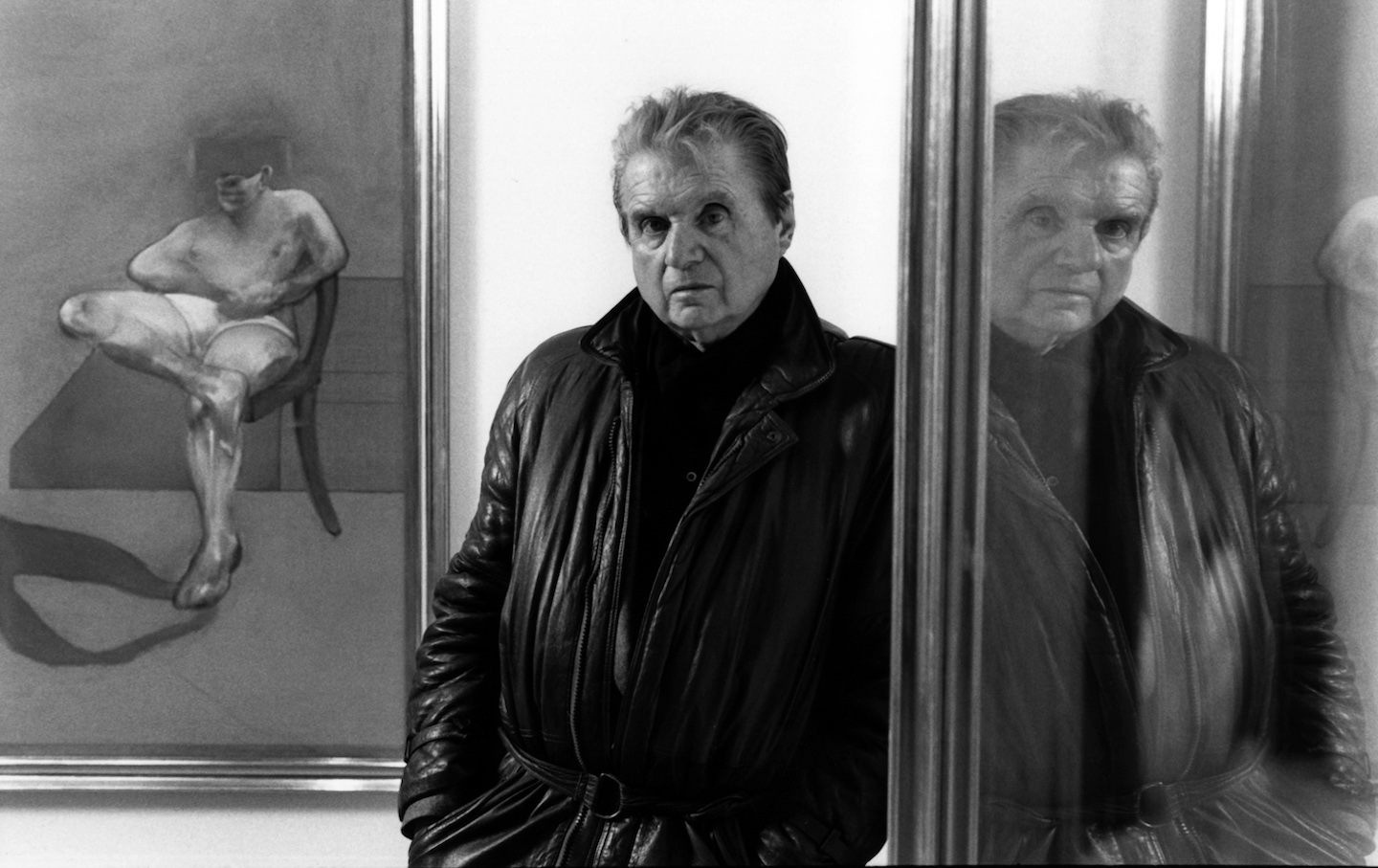
Over the following decades, Bacon became one of the leading figures of postwar British painting. His works confront themes of mortality, violence, isolation, and the fragility of the human condition, making him a central voice in the existential mood that shaped much of twentieth-century culture.
Technique and Visual Language
Bacon’s paintings are instantly recognizable for their raw emotional intensity and radical distortions of the human figure. Working primarily in oil on canvas, he developed a unique painterly method that combined spontaneous gestures with deliberate compositional structures. His figures often appear trapped within geometric frameworks—cages, circles, or transparent boxes—that heighten the sense of psychological confinement. Faces dissolve into violent smears of paint, while bodies twist and mutate into unsettling forms that seem caught between representation and abstraction. Bacon frequently worked from photographic sources rather than live models. Among his most important references were photographs by Eadweard Muybridge, whose studies of human movement provided Bacon with a visual vocabulary for depicting distorted bodies in motion. The result is a form of painting that feels simultaneously visceral and controlled—an approach that places Bacon in dialogue with artists such as Pablo Picasso and later figures like Adrian Ghenie, who similarly explore the boundary between figuration and abstraction.
His output can be broadly described as sequences or variations on single motifs; including the 1930s Picasso-influenced bio-morphs and Furies, the 1940s male heads isolated in rooms or geometric structures, the 1950s “screaming popes,” the mid-to-late 1950s animals and lone figures, the early 1960s crucifixions, the mid-to-late 1960s portraits of friends, the 1970s self-portraits, and the cooler, more technical 1980s paintings. Bacon did not begin to paint until his late twenties, having drifted in the late 1920s and early 1930s as an interior decorator, bon vivant and gambler. He said that his artistic career was delayed because he spent too long looking for subject matter that could sustain his interest.
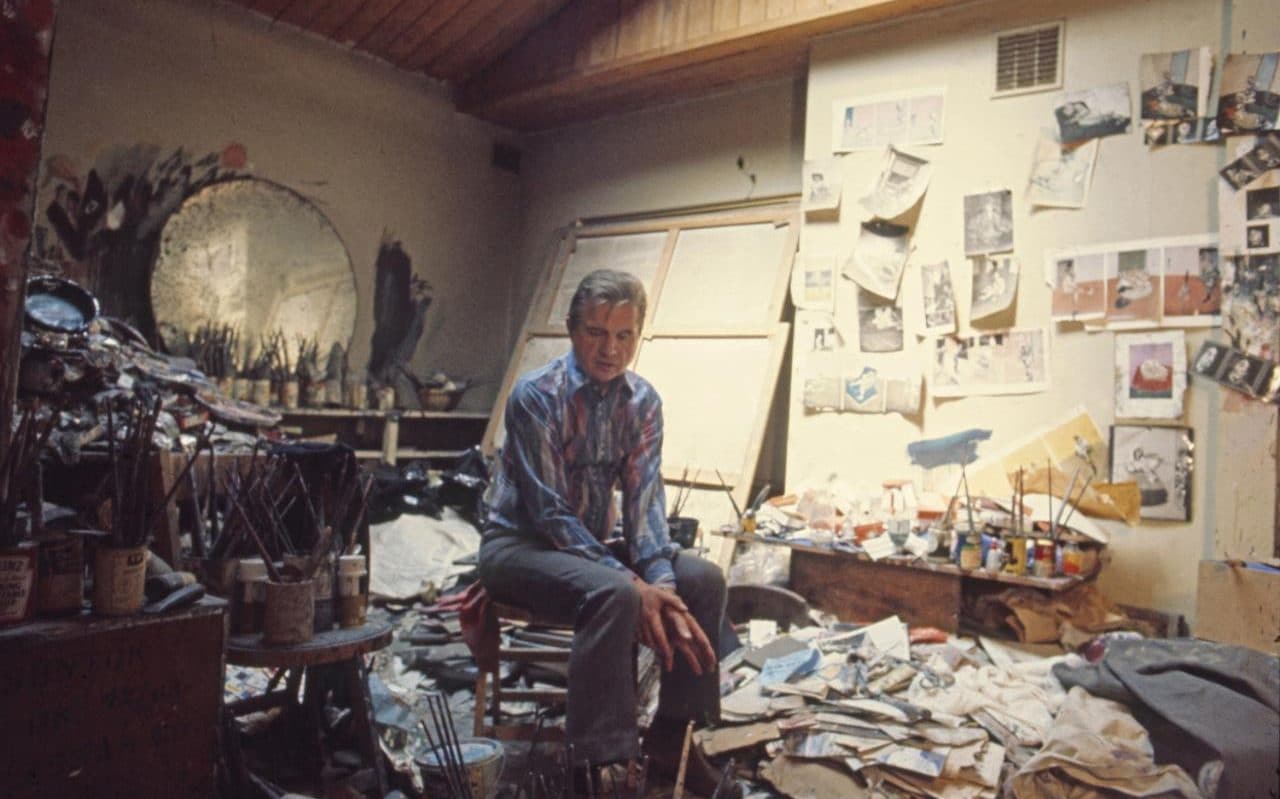
His breakthrough came with the 1944 triptych Three Studies for Figures at the Base of a Crucifixion, which sealed his reputation as a uniquely bleak chronicler of the human condition. From the mid-1960s he mainly produced portraits of friends and drinking companions, either as single, diptych or triptych panels. Following the suicide of his lover George Dyer in 1971 (memorialized in his Black Triptychs, and a number of posthumous portraits) his art became more somber, inward-looking and preoccupied with the passage of time and death. The climax of his later period is marked by the masterpieces Study for Self-Portrait (1982) and Study for a Self-Portrait—Triptych, 1985–86. Despite his existentialist and bleak outlook, Bacon was charismatic, articulate and well-read. A bon vivant, he spent his middle age eating, drinking and gambling in London’s Soho with like-minded friends including Lucian Freud (although they fell out in the mid-1970s, for reasons neither ever explained), John Deakin, Muriel Belcher, Henrietta Moraes, Daniel Farson, Tom Baker and Jeffrey Bernard. After Dyer’s suicide he largely distanced himself from this circle, and while still socially active and his passion for gambling and drinking continued, he settled into a platonic and somewhat fatherly relationship with his eventual heir, John Edwards. Since his death, Bacon’s reputation has grown steadily, and his work is among the most acclaimed, expensive and sought-after on the art market. In the late 1990s a number of major works, previously assumed destroyed, including early 1950s pope paintings and 1960s portraits, re-emerged to set record prices at auction.
Main Series and Iconic Bodies of Work
Throughout his career, Bacon developed several iconic series that have become central to the history of modern painting.
One of the most famous is the series of Screaming Popes, inspired by the portrait of Pope Innocent X painted by Diego Velázquez. Rather than copying the original painting, Bacon transformed the figure of the pope into a haunting symbol of authority distorted by existential anguish. These works remain among the most recognizable images in twentieth-century art.
Another crucial body of work is Bacon’s numerous Triptychs, a format he adopted extensively beginning in the 1960s. The three-panel structure allowed him to explore sequences of psychological states, fragmented narratives, or multiple perspectives on the same figure. These triptychs are widely considered among the most powerful achievements of postwar painting.
Bacon also produced deeply personal portraits of friends, lovers, and fellow artists. His paintings of Lucian Freud and his partner George Dyer are particularly significant. Following Dyer’s tragic death in 1971, Bacon created a series of profoundly moving memorial triptychs that confront themes of grief, loss, and mortality.
Another recurring motif in his work is the reinterpretation of religious imagery, particularly the theme of the Crucifixion. Rather than presenting traditional Christian symbolism, Bacon used this subject as a framework for exploring suffering and the brutality of existence.
Institutional Recognition and Exhibitions
Francis Bacon achieved extraordinary institutional recognition during his lifetime and remains a central figure in museum collections worldwide. Major retrospectives of his work have been organized by institutions such as the Tate in London, the Centre Pompidou, and the Museo Nacional del Prado. These exhibitions have highlighted the enduring power of Bacon’s work and its influence on generations of painters.
His paintings are held in major museum collections around the world, including the Museum of Modern Art and the Tate Britain, reinforcing his status as one of the defining artists of the twentieth century.
Gallery Representation
During his lifetime, Bacon was closely associated with several influential galleries that helped establish his international reputation. The most important among them was Marlborough Gallery, which represented the artist for many years and organized major exhibitions of his work.
Today, Bacon’s estate and exhibitions are handled by leading international galleries including Gagosian and Marlborough Gallery, both of which continue to present important works by the artist on the global market.
Francis Bacon transformed the language of figurative painting. At a time when abstraction dominated much of the art world, he demonstrated that the human figure could still serve as a powerful vehicle for expressing the deepest anxieties of modern existence. His paintings confront viewers with raw psychological intensity, exploring themes of isolation, violence, and mortality with a directness rarely seen in modern art. Through his radical distortions and visceral painterly approach, Bacon created images that remain profoundly unsettling—and profoundly human. Today, his influence can be seen across generations of artists who continue to explore the emotional and existential possibilities of painting.
PART I: SUMMARY
Auction Market Overview
2025 AUCTION STATISTICS
Turnover: USD 55,257,460
-9.8% vs. 2024
# of Lots sold: 4
Sell-Through Rage: 100%
Highest Price Achieved at Auction:
Three Studies of Lucian Freud, 1969
Christie’s New-York: 12 November 2013
USD 142,405,000
Francis Bacon’s paintings are among the most valuable works of twentieth-century art. His large triptychs and portraits regularly achieve exceptional results at auction. One of the most famous examples is Three Studies of Lucian Freud (1969), which sold for over USD 140 million in 2013, briefly becoming one of the most expensive paintings ever sold at auction. Such results reflect both the rarity of major Bacon works and the extraordinary demand among collectors and institutions.
Auction Summary

2025 Auction Highlights
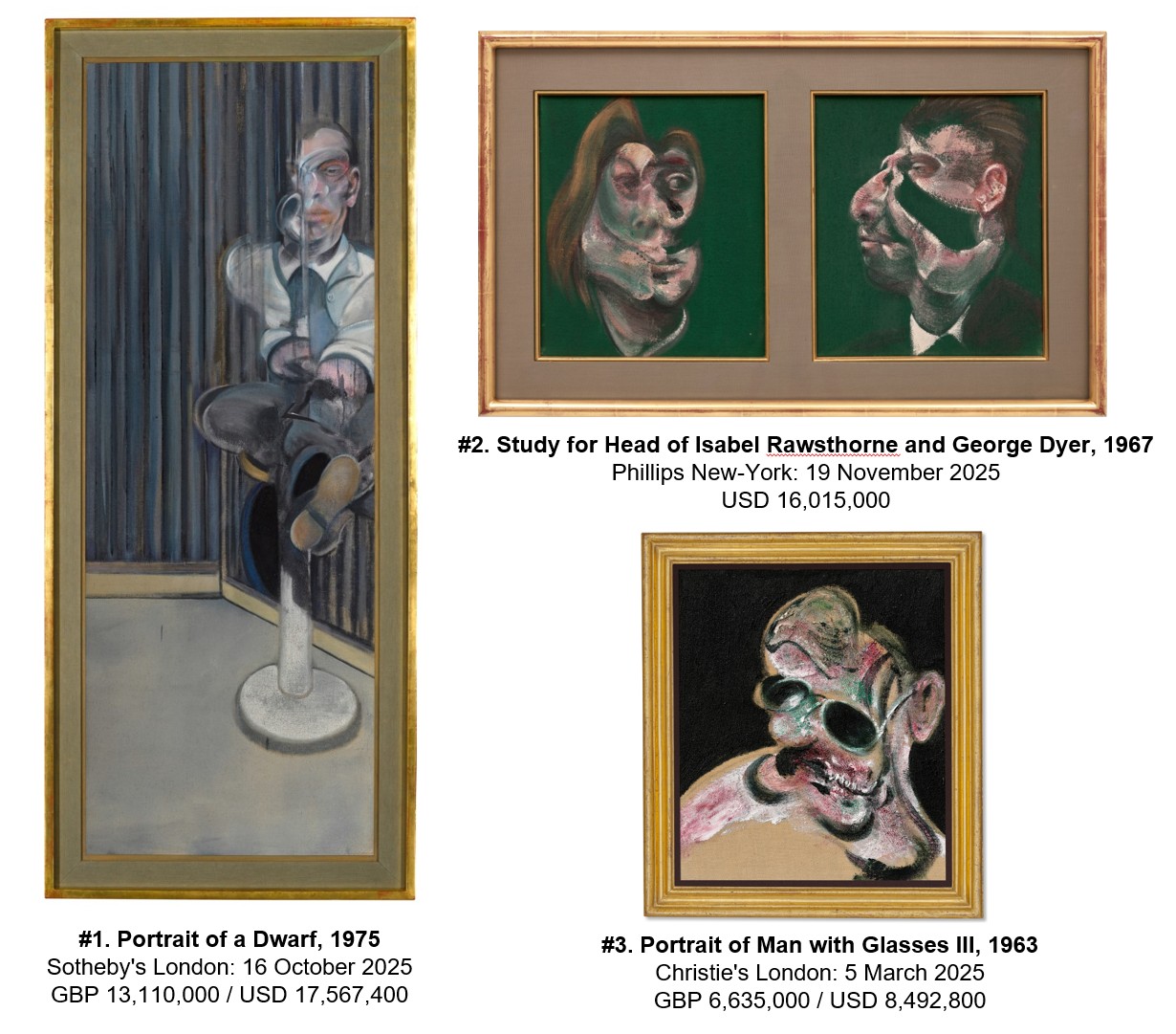
4 lots sold at auction in 2025 for a total turnover of USD 55,257,460. With no lot failing to sell, the sell-through rate is 100%. The highest price in 2025 was achieved by Portrait of a Dwarf, a painting dated 1975, that sold at Sotheby’s in London, on 16 October 2025, for GBP 13,110,000 (USD 17,567,400).
2025 Top 3 Lots
2024 Auction Highlights
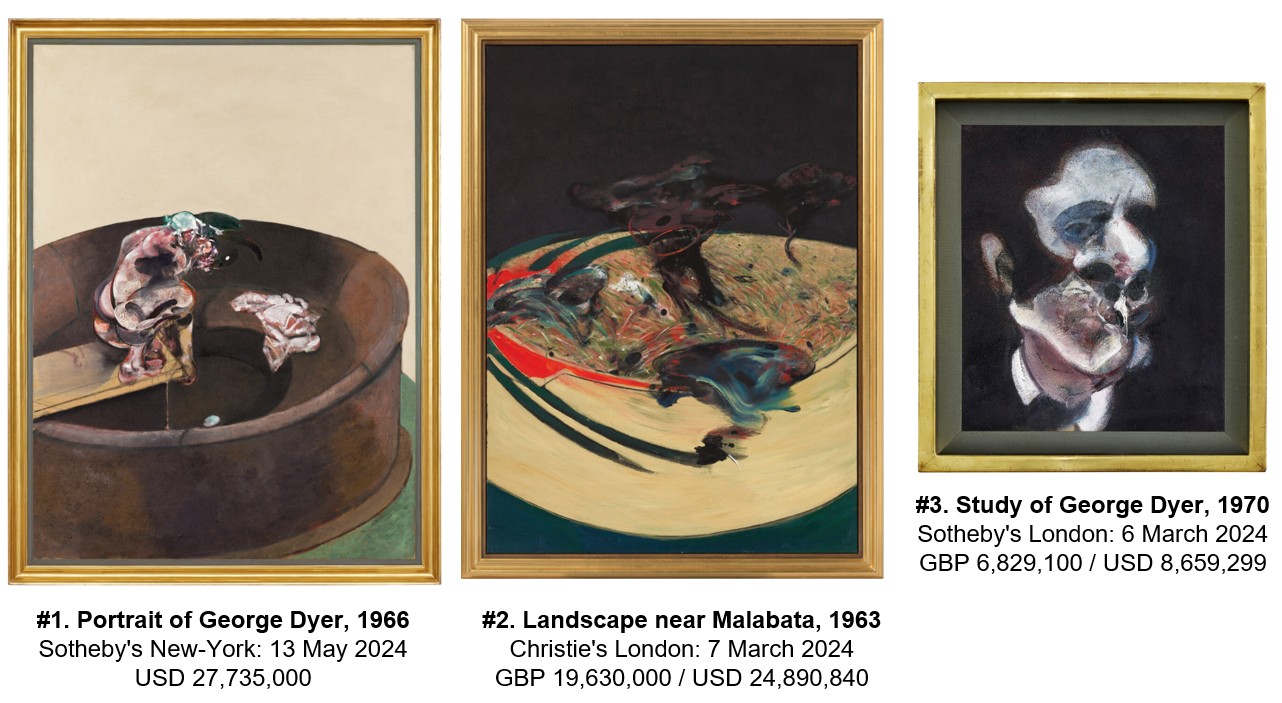
3 lots sold at auction in 2024 for a total turnover of USD 61,285,139. With no lot failing to sell, the sell-through rate is 100%. One lot was withdrawn from Christie’s London on 7 March 2024.
2024 Top 3 Lots
2023 Auction Highlights
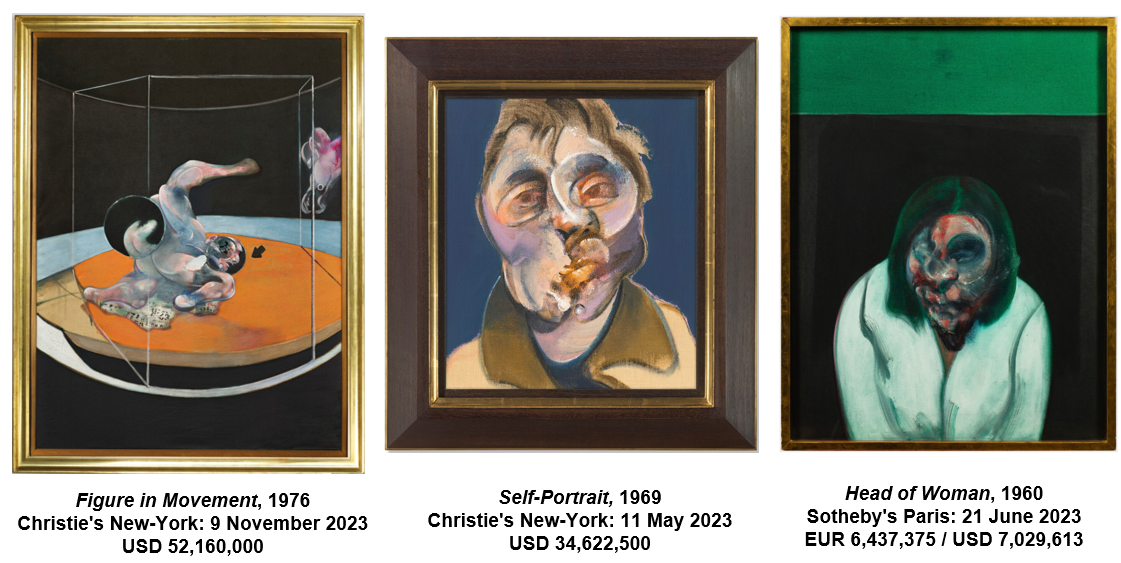
4 lots sold at auction in 2023 for a total turnover of USD 99,086,738. With no lot failing to sell, the sell-through rate is 100%. The highest price was achieved by Figure in Movement, a painting dated 1976, that sold at Christie’s in New-York for USD 52,160,000 on 9 November 2023.
2023 Top 3 Lots
2022 Auction Highlights
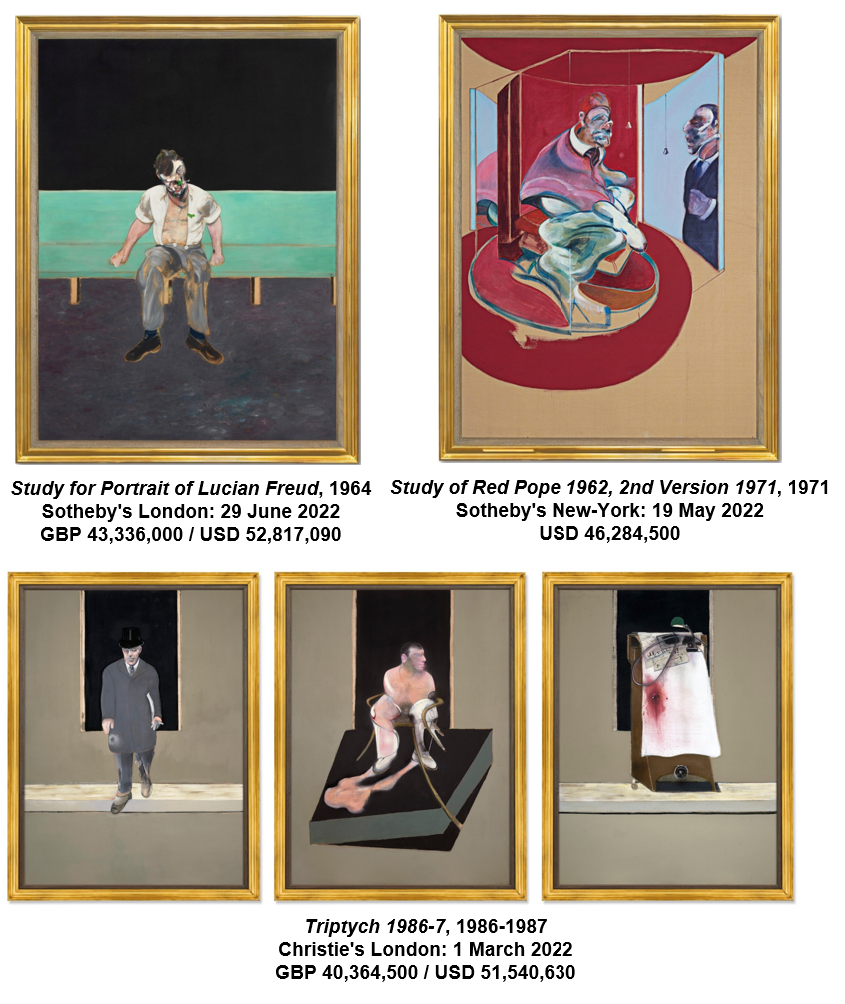
10 lots sold at auction in 2022 for a total turnover of USD 253,019,398. With no lot failing to sell, the sell-through rate is 100%. The highest price has been achieved at Sotheby’s in London on 29 June 2022, when Study for a Portrait of Lucian Freud sold for GBP 43,336,000 (USD 52,817,090). 6 lots sold for more than USD 20 million, generating a cumulative turnover of USD 236,396,080, representing 93.4% of the total turnover for 2022.
2022 Top 3 Lots
2021 Auction Highlights
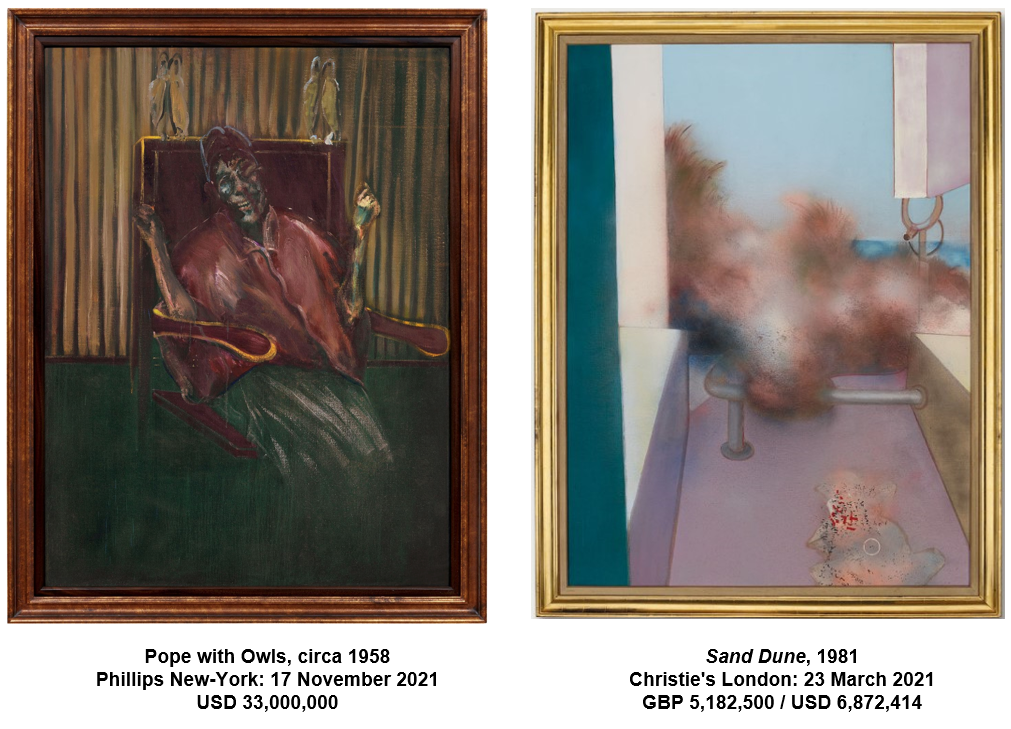
2 lots sold at auction in 2021 for a total turnover of USD 39,872,414. With no lot failing to sell, the sell-through rate is 100%. The highest price has been achieved at Phillips in New-York on 17 November 2021 when Pope with Owls, circa 1958, sold for USD 33,000,000.
2021 Top 2 Lots
Top Lots
#1. Three Studies of Lucian Freud, 1969
Christie’s New-York: 12 November 2013
Estimate on Request
USD 142,405,000
Francis Bacon (1909-1992) (christies.com)
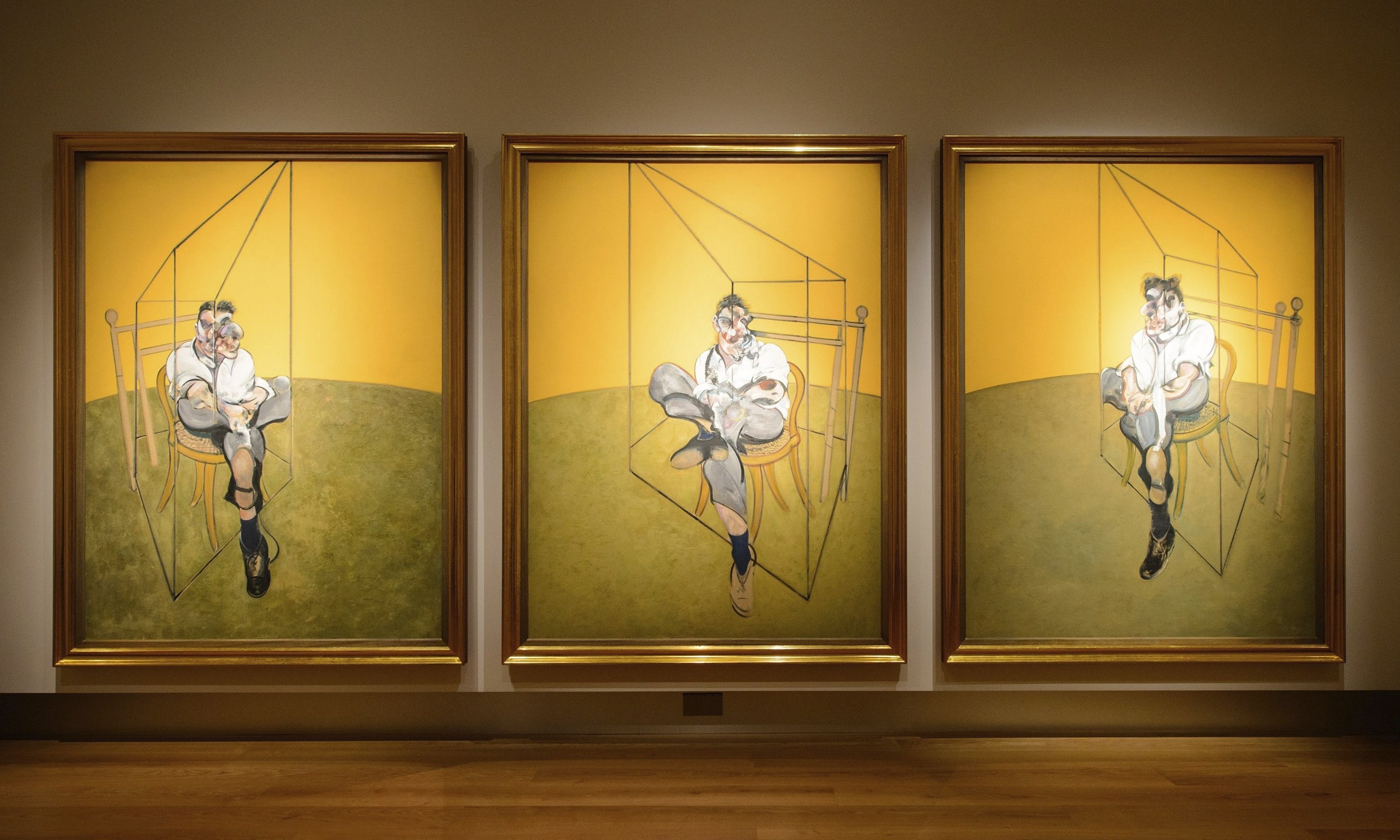
Francis Bacon (1909-1992)
Three Studies of Lucian Freud, 1969
Oil on canvas, in 3 parts
Each: 78×58 inches (198 x 147.5 cm)
Titled and dated ‘3 studies for portrait Lucian Freud 1969’ (on the reverse of the center panel)
#2. Triptych, 1976
Sotheby’s New-York: 14 May 2008
Estimate on Request
USD 86,281,000
(#33) Francis Bacon (sothebys.com)
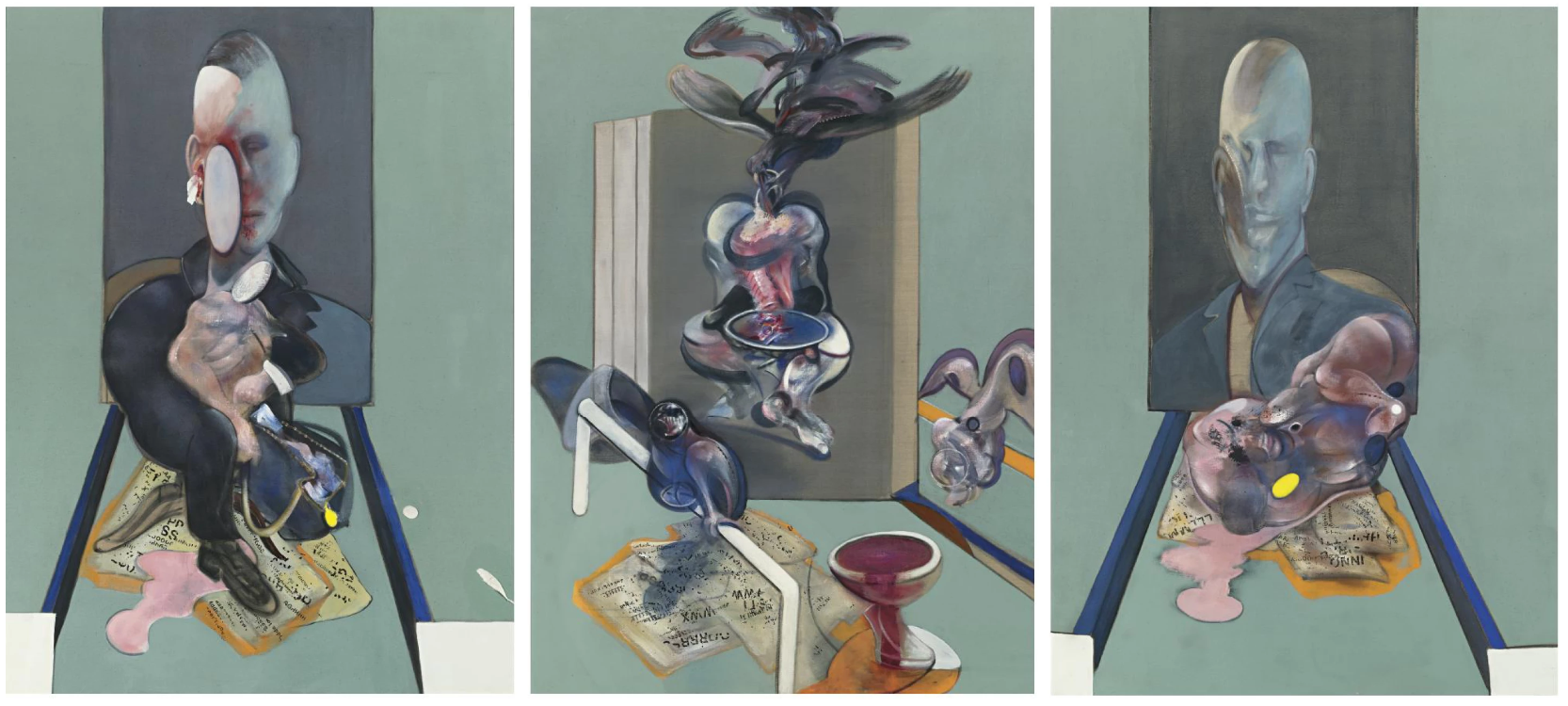
FRANCIS BACON
Triptych, 1976
Oil and pastel on canvas in three parts
Each: 78×58 inches (198 x 147.5 cm)
Signed, titled and dated 1976 on the reverse of the right panel
Titled and dated 1976 on the reverse of the center panel
#3. Triptych inspired by the Oresteia of Aeschylus, 1981
Sotheby’s New-York: 29 June 2020
Estimated: USD 60,000,000 – 80,000,000
USD 84,550,000
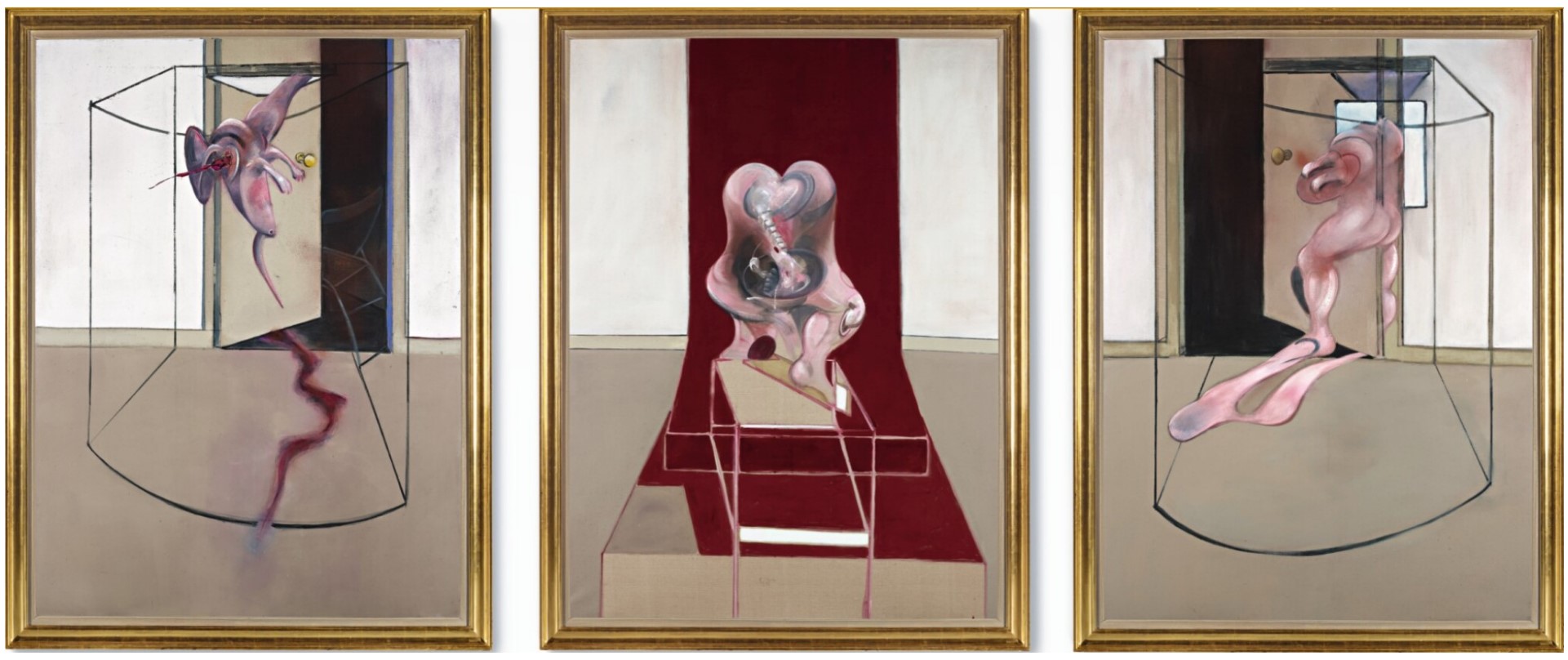
FRANCIS BACON (1909 – 1992)
TRIPTYCH INSPIRED BY THE ORESTEIA OF AESCHYLUS, 1981
Oil on canvas, in three partsq
Each: 78×56 inches (198 x 147.5 cm)
Signed, titled, dated 1981 and variously inscribed on the reverse of each panel
#4. Three Studies for a Portrait of John Edwards, 1984
Christie’s New-York: 13 May 2014
Estimate on Request
USD 80,805,000
Francis Bacon (1909-1992) (christies.com)
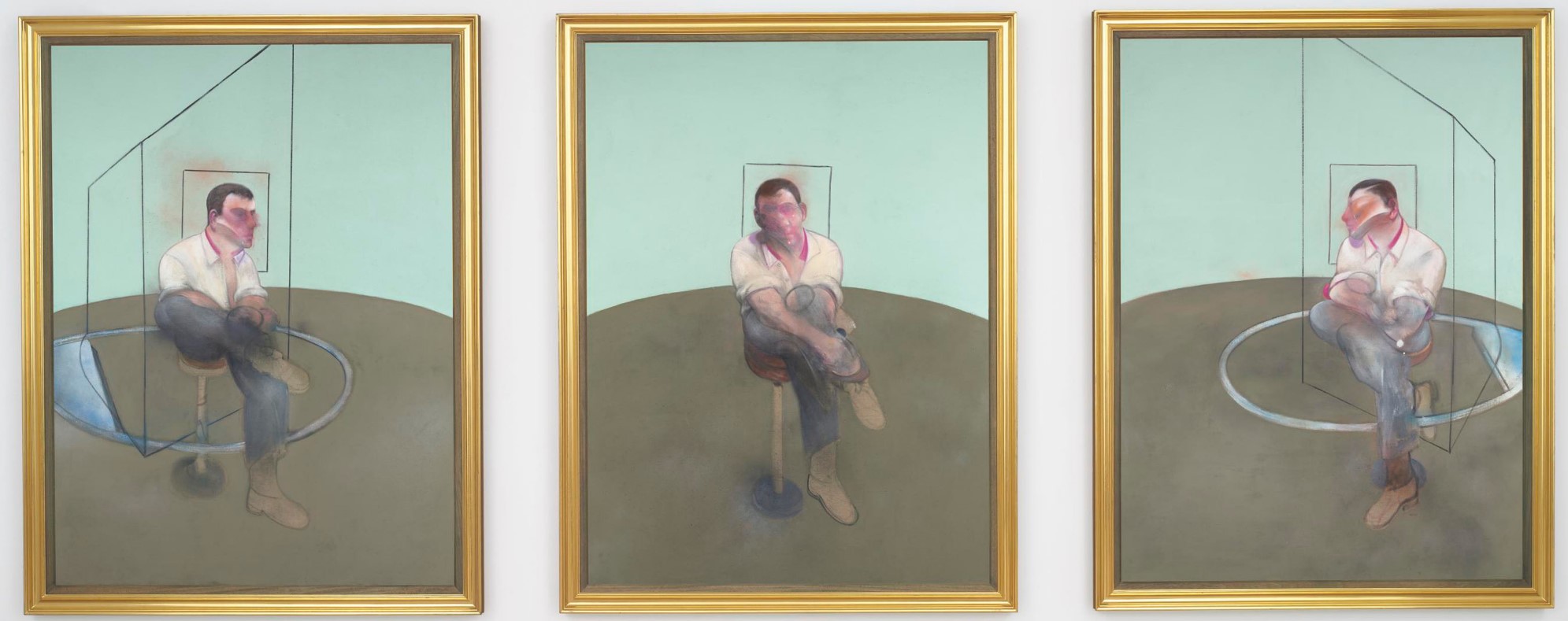
Francis Bacon (1909-1992)
Three Studies for a Portrait of John Edwards, 1984
Oil on canvas, in three parts
Each: 78 1/8 x 58 1/4 inches (198.3 x 148 cm)
Signed, titled, inscribed and dated ‘3 Studies for a Portrait of John Edwards Francis Bacon 1984 left panel’ (on the reverse of the left panel)
Signed, titled, inscribed and dated ‘3 Studies for a Portrait of John Edwards Francis Bacon 1984 center panel’ (on the reverse of the center panel)
Signed, titled, inscribed and dated ‘3 Studies for a Portrait of John Edwards Francis Bacon 1984 right panel’ (on the reverse of the right panel)
#5. Portrait of George Dyer Talking, 1966
Christie’s London: 13 February 2014
Estimate on Request
GBP 42,194,500 / USD 70,279,422
Francis Bacon (1909-1992) (christies.com)
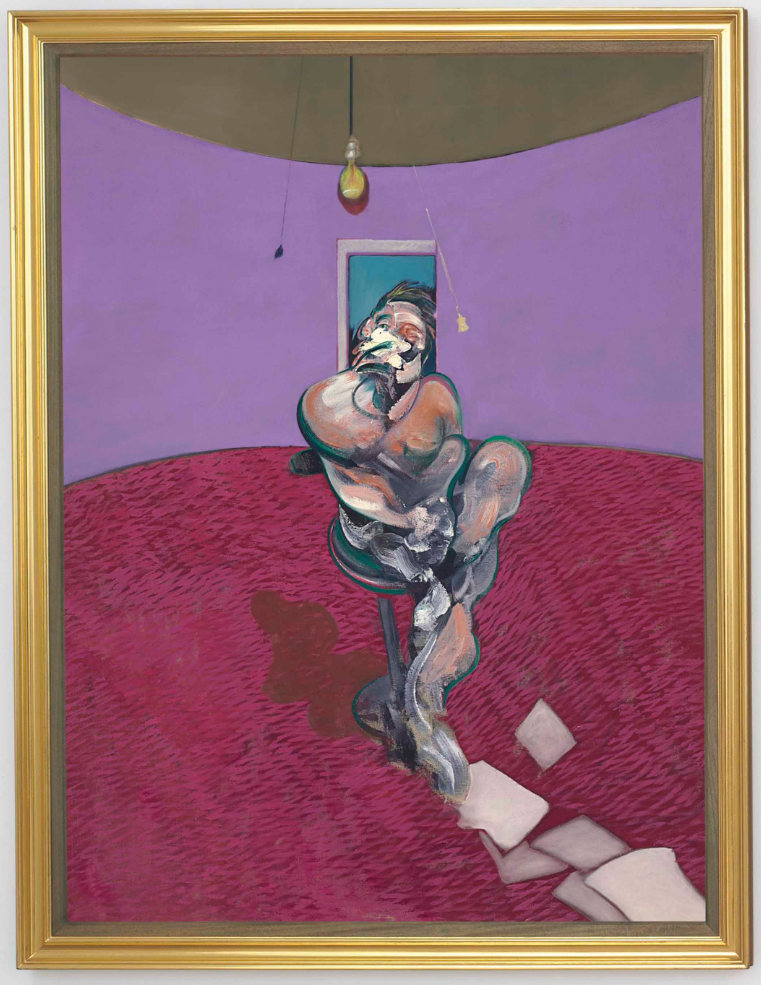
FRANCIS BACON (1909-1992)
Portrait of George Dyer Talking, 1966
Oil on canvas
78×58 inches (198.2 x 147.3cm)
Titled and dated ‘Portrait of George Dyer Talking 1966’ (on the reverse)
#6. Study for Portrait of Lucian Freud, 1964
Sotheby’s London: 29 June 2022
Estimate on Request
GBP 43,336,000 / USD 52,817,090
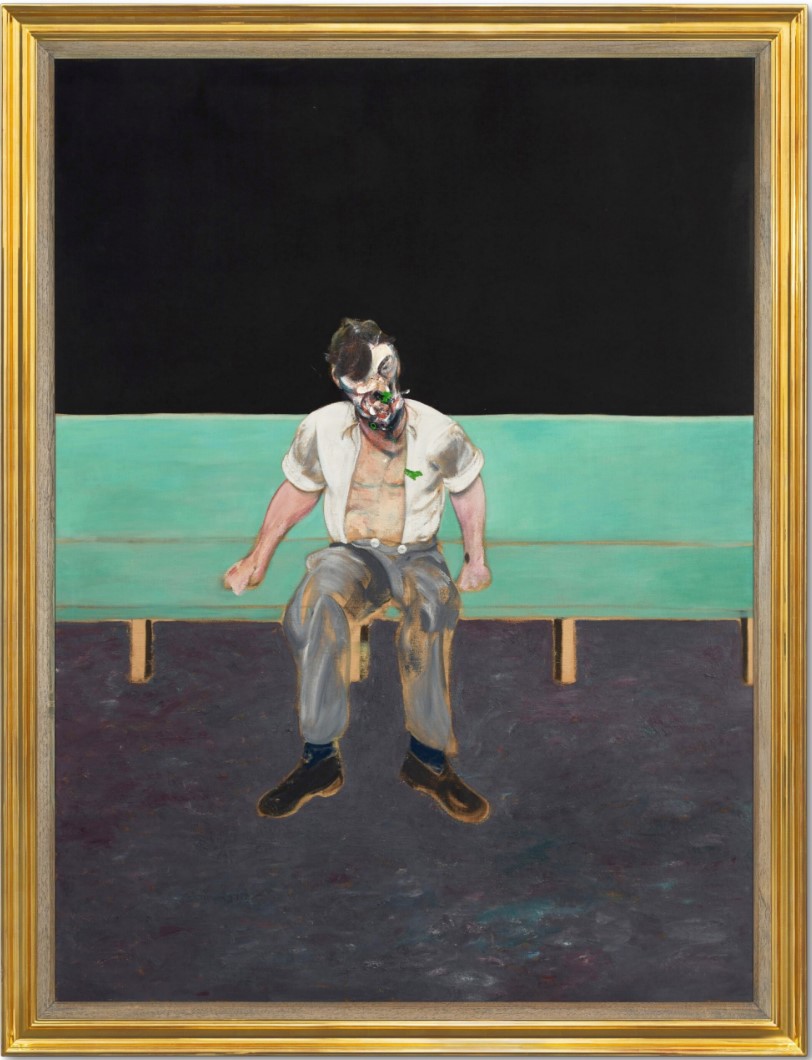
FRANCIS BACON (1909 – 1992)
Study for Portrait of Lucian Freud, 1964
Oil on canvas
198 x 147.5 cm (78×58 inches)
#7. Figure in Movement, 1976
Christie’s New-York: 9 November 2023
Estimate On Request
USD 52,160,000
FRANCIS BACON (1909-1992) (christies.com)
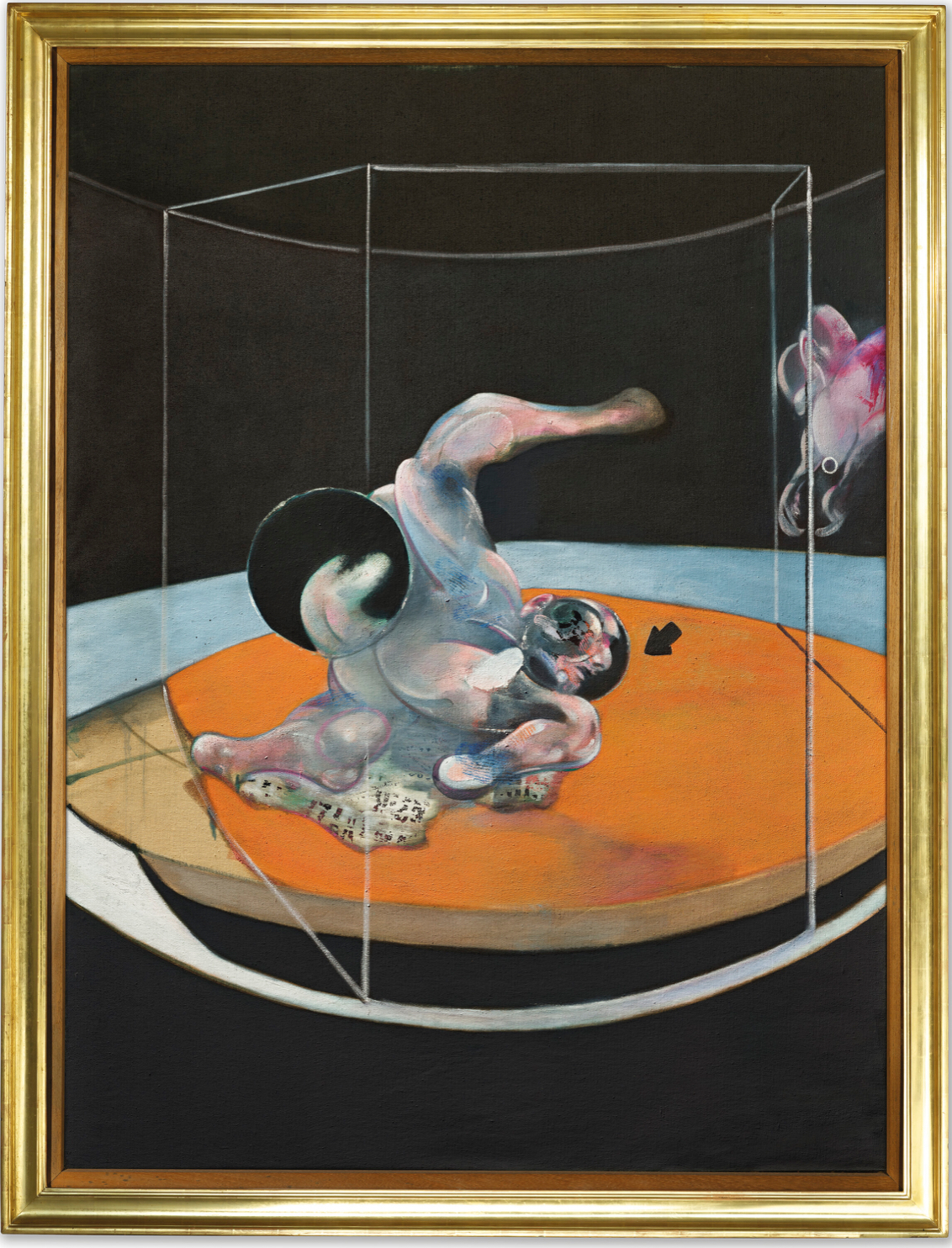
FRANCIS BACON (1909-1992)
Figure in Movement, 1976
Oil and dye transfer lettering on canvas
78 1/4 x 58 inches (198.9 x 147.3 cm)
Signed and dated ‘Francis Bacon 1976’ (on the reverse)
#8. Three Studies for a Portrait of George Dyer, 1963
Christie’s New-York: 17 May 2017
Estimate on Request
USD 51,767,500
Francis Bacon (1909-1992) (christies.com)
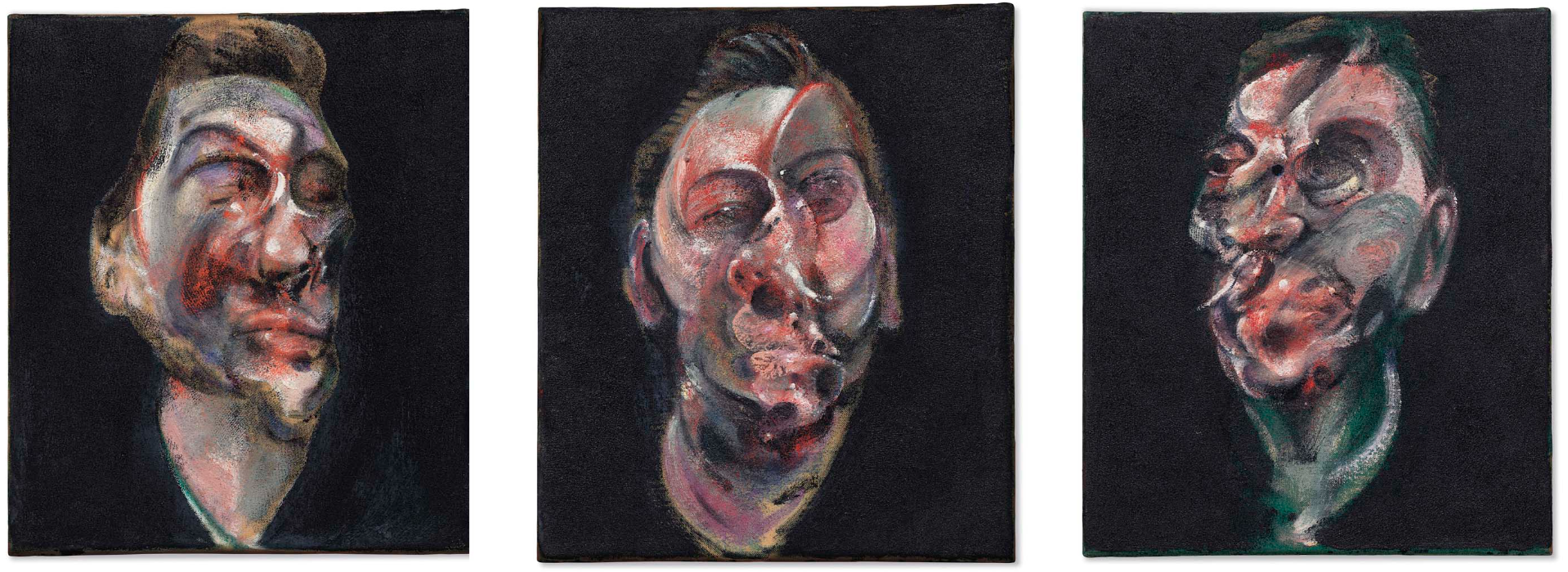
FRANCIS BACON (1909-1992)
Three Studies for a Portrait of George Dyer, 1963
Triptych, oil on canvas
Each: 14×12 inches (35.5 x 30.5 cm)
Titled and dated ‘3 Studies For Portrait of George Dyer 1963.’ (on the reverse of the center canvas)
#9. Triptych 1974-1977
Christie’s London: 6 February 2008
Estimate on Request
GBP 26,340,500 / USD 51,601,294
Francis Bacon (1909-1992) (christies.com)
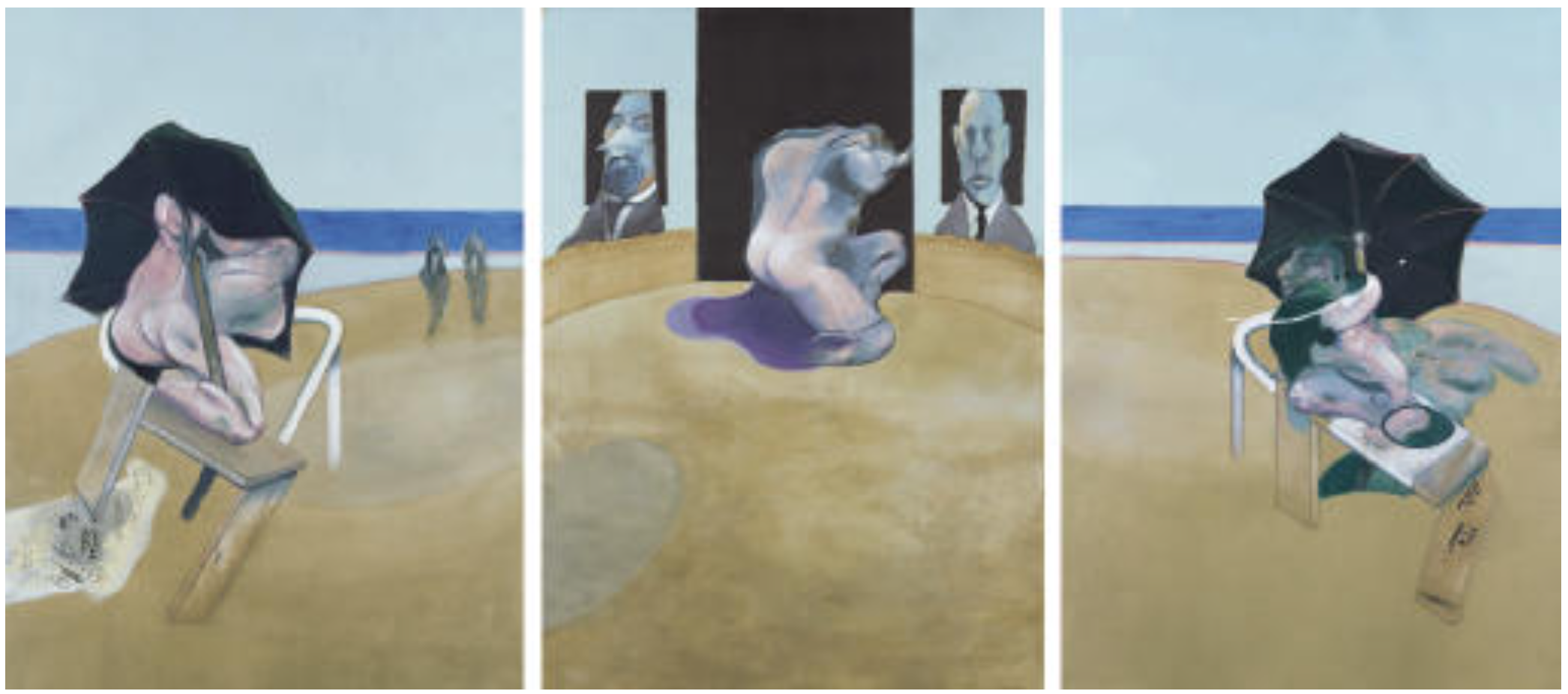
FRANCIS BACON (1909-1992)
Triptych 1974-1977, 1974-1977
Oil, pastel and Letraset on canvas, in three parts
Each: 78 x 58 1/8 inches (198 x 147.5 cm)
Overall: 78 x 174 1/4 inches (198 x 442.5 cm)
Signed, titled and dated ‘Tryptich May-June 1974 Francis Bacon’ (on the reverse of each canvas)
#10. Triptych 1986-7, 1986-1987
Christie’s London: 1 March 2022
Estimated: GBP 35,000,000 – 55,000,000
GBP 40,364,500 / USD 51,540,630
FRANCIS BACON (1909-1992) (christies.com)
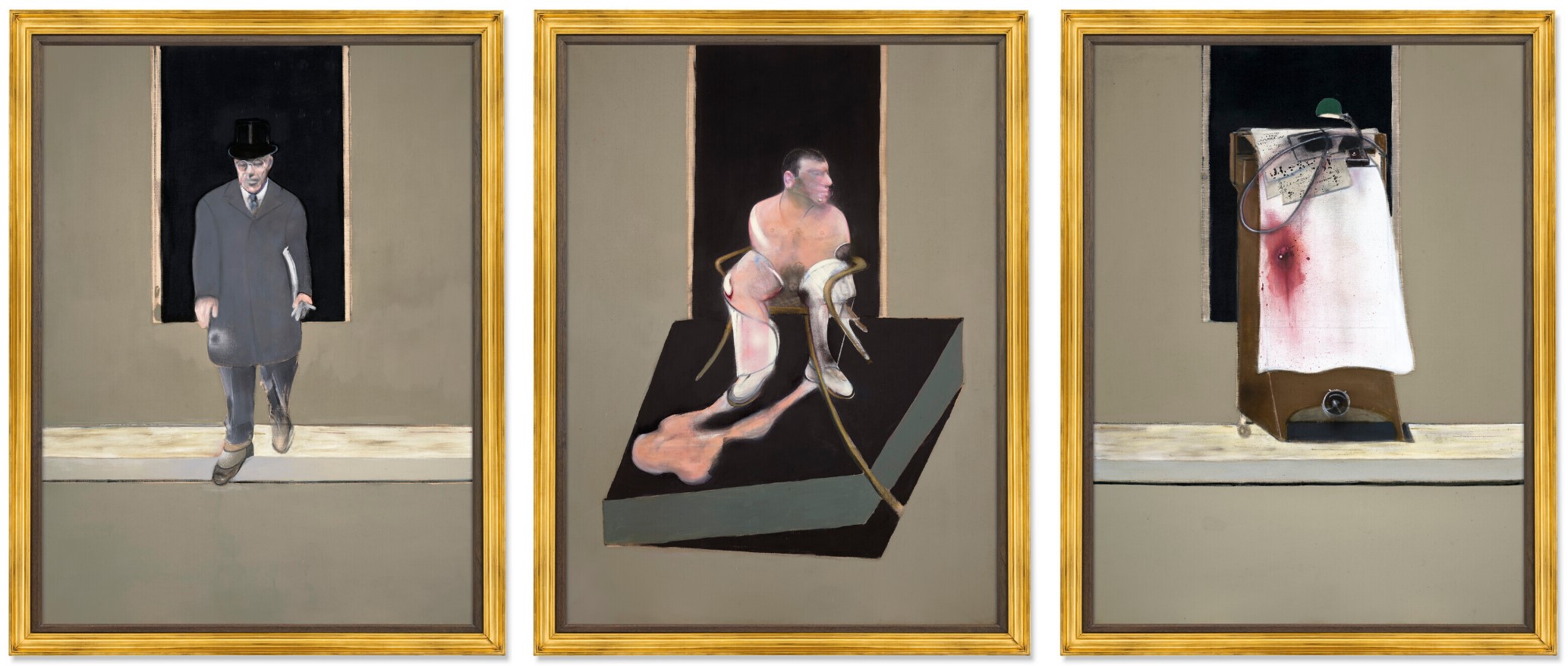
FRANCIS BACON (1909-1992)
Triptych 1986-7, 1986-1987
Oil, pastel, aerosol paint and dry transfer lettering on canvas, in three parts
Each: 78×58 inches (198 x 147.5 cm)
PART II: AUCTION RESULTS
2026 Auction Results
Self-Portrait, 1972
Masterpieces from the Lewis Collection
Sotheby’s London: 4 March 2026
Estimated: GBP 8,000,000 – 12,000,000
GBP 16,035,000 / USD 21,421,155
Self-Portrait | Modern & Contemporary Evening Auction | 2026 | Sotheby’s
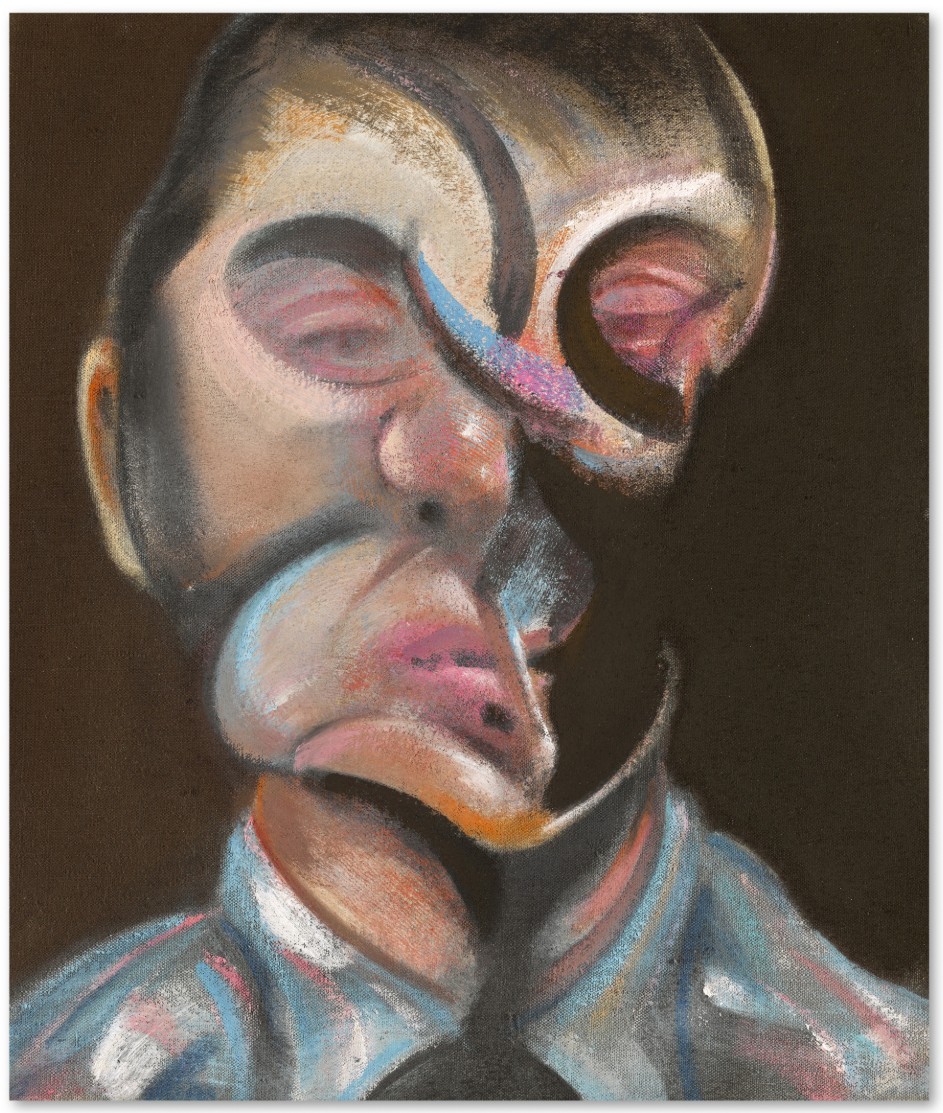
FRANCIS BACON (1909 – 1992)
Self-Portrait, 1972
Oil on canvas
14-1/8 x 12 inches (36 x 30.5 cm)
Signed, titled and dated 1972 (on the reverse)
2025 Auction Results
4 lots sold at auction in 2025 for a total turnover of USD 55,257,460. With no lot failing to sell, the sell-through rate is 100%. The highest price in 2025 was achieved by Portrait of a Dwarf, a painting dated 1975, that sold at Sotheby’s in London, on 16 October 2025, for GBP 13,110,000 (USD 17,567,400).
2025 Top 3 Lots
#1. Portrait of a Dwarf, 1975
Sotheby’s London: 16 October 2025
Estimated: GBP 6,000,000 – 9,000,000
GBP 13,110,000 / USD 17,567,400
READ MORE IN FOCUS SECTION
Portrait of a Dwarf | Contemporary Evening Auction | 2025 | Sotheby’s
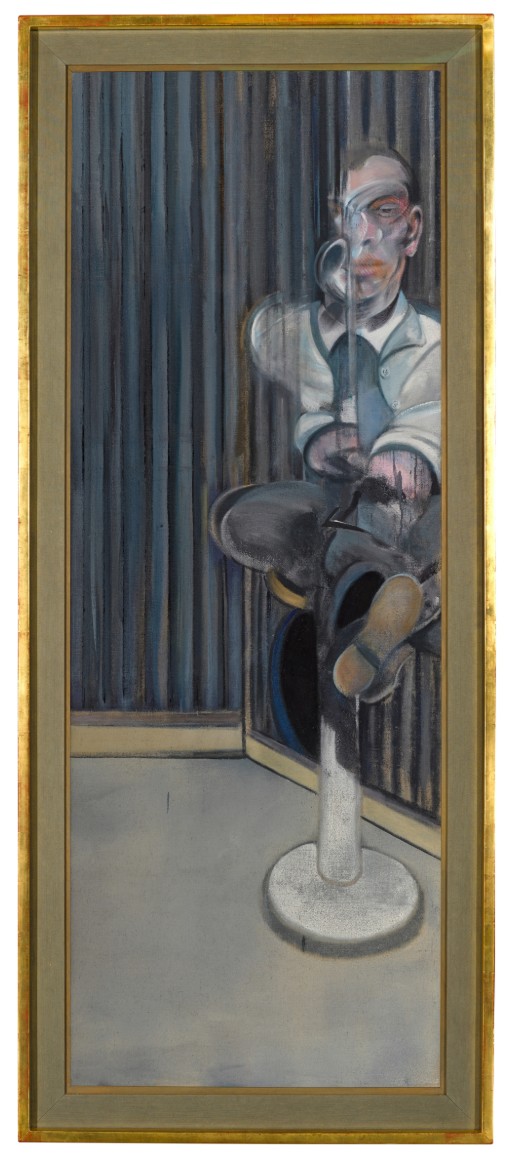
FRANCIS BACON (1909 – 1992)
Portrait of a Dwarf, 1975
Oil on canvas
62 5/8 x 23 inches (159 x 58.4 cm)
Signed twice, titled and dated 1975 (on the reverse)
#2. Study for Head of Isabel Rawsthorne and George Dyer, 1967
Phillips New-York: 19 November 2025
Estimated: USD 13,000,000 – 18,000,000
USD 16,015,000
READ MORE IN FOCUS SECTION
Francis Bacon Modern & Contemporary Art Evening Sale featuring Cera the Triceratops
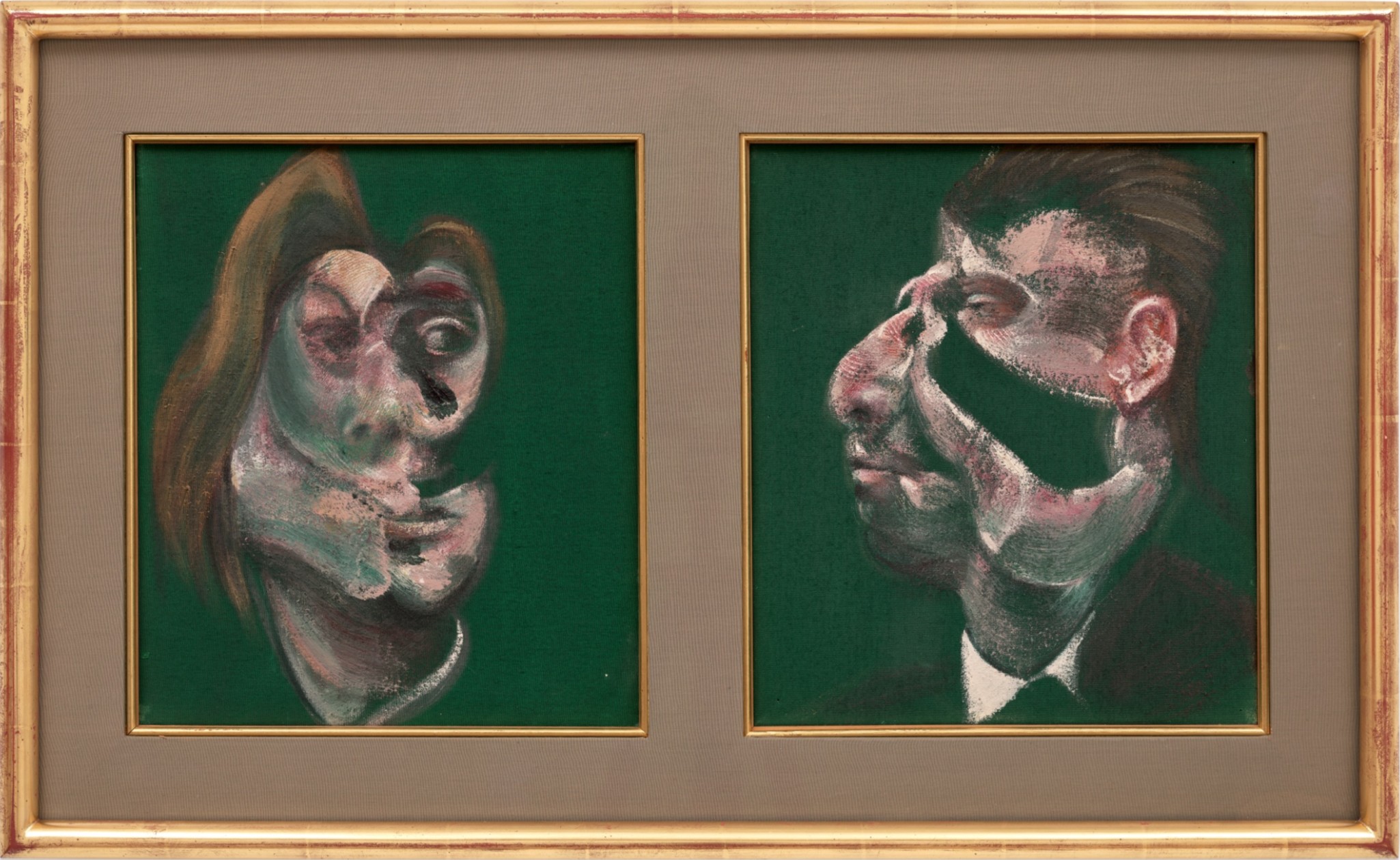
Oil on canvas, diptych
Each 14×12 inches (35.6 x 30.5 cm)
Titled and dated “Study for Head of Isabel Rawsthorne 1967.” on the reverse of the left canvas
Titled and dated “Study for Head of George Dyer 1967.” on the reverse of the right canvas
USD 10 million
#3. Portrait of Man with Glasses III, 1963
Christie’s London: 5 March 2025
Estimated: GBP 6,000,000 – 9,000,000
GBP 6,635,000 / USD 8,492,800
READ MORE IN FOCUS SECTION
FRANCIS BACON (1909-1992), Portrait of Man with Glasses III | Christie’s
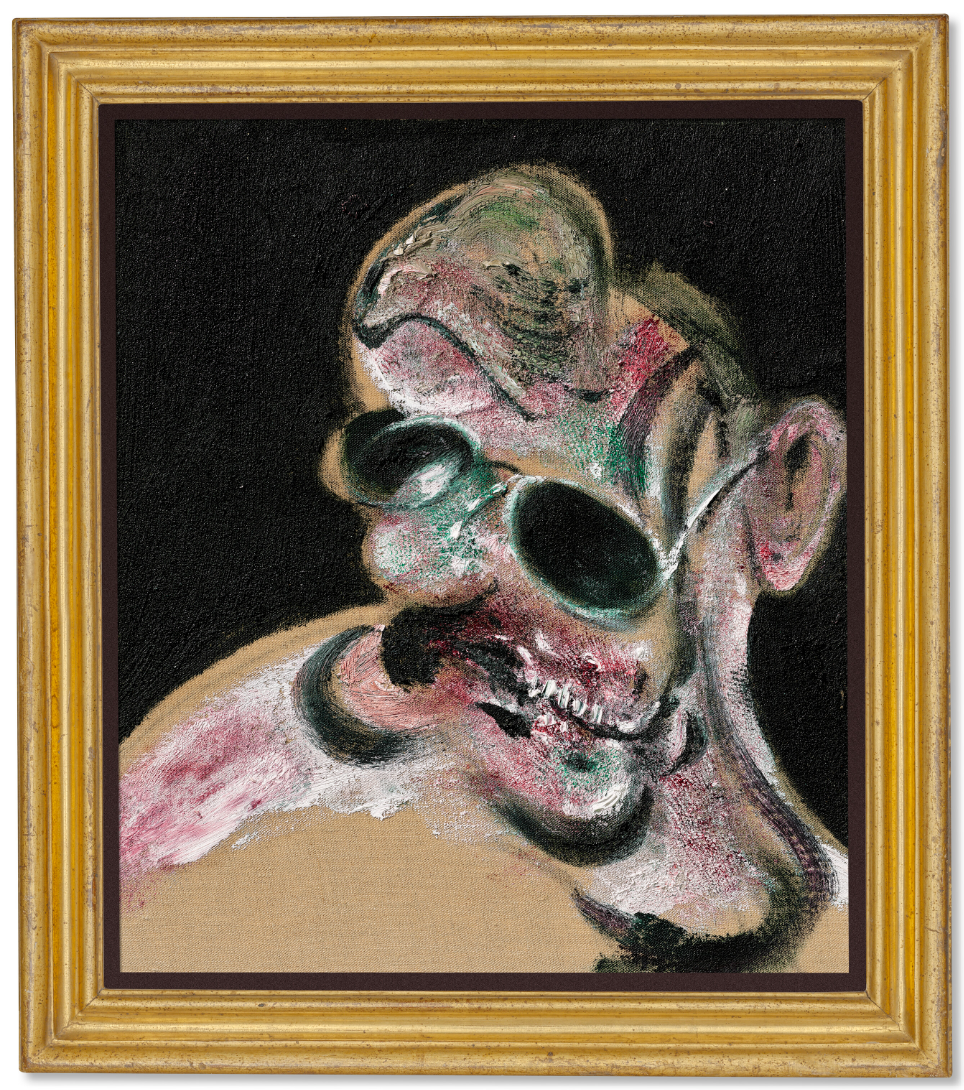
FRANCIS BACON (1909-1992)
Portrait of Man with Glasses III, 1963
Oil and silver sand on canvas
14 1/8 x 12 1/8 inches (36 x 30.7 cm)
#4. Study for Self-Portrait, 1980
Sotheby’s London: 16 October 2025
Estimated: GBP 5,000,000 – 7,000,000
GBP 5,774,000 / USD 7,737,160
READ MORE IN FOCUS SECTION
Study for Self-Portrait | Contemporary Evening Auction | 2025 | Sotheby’s
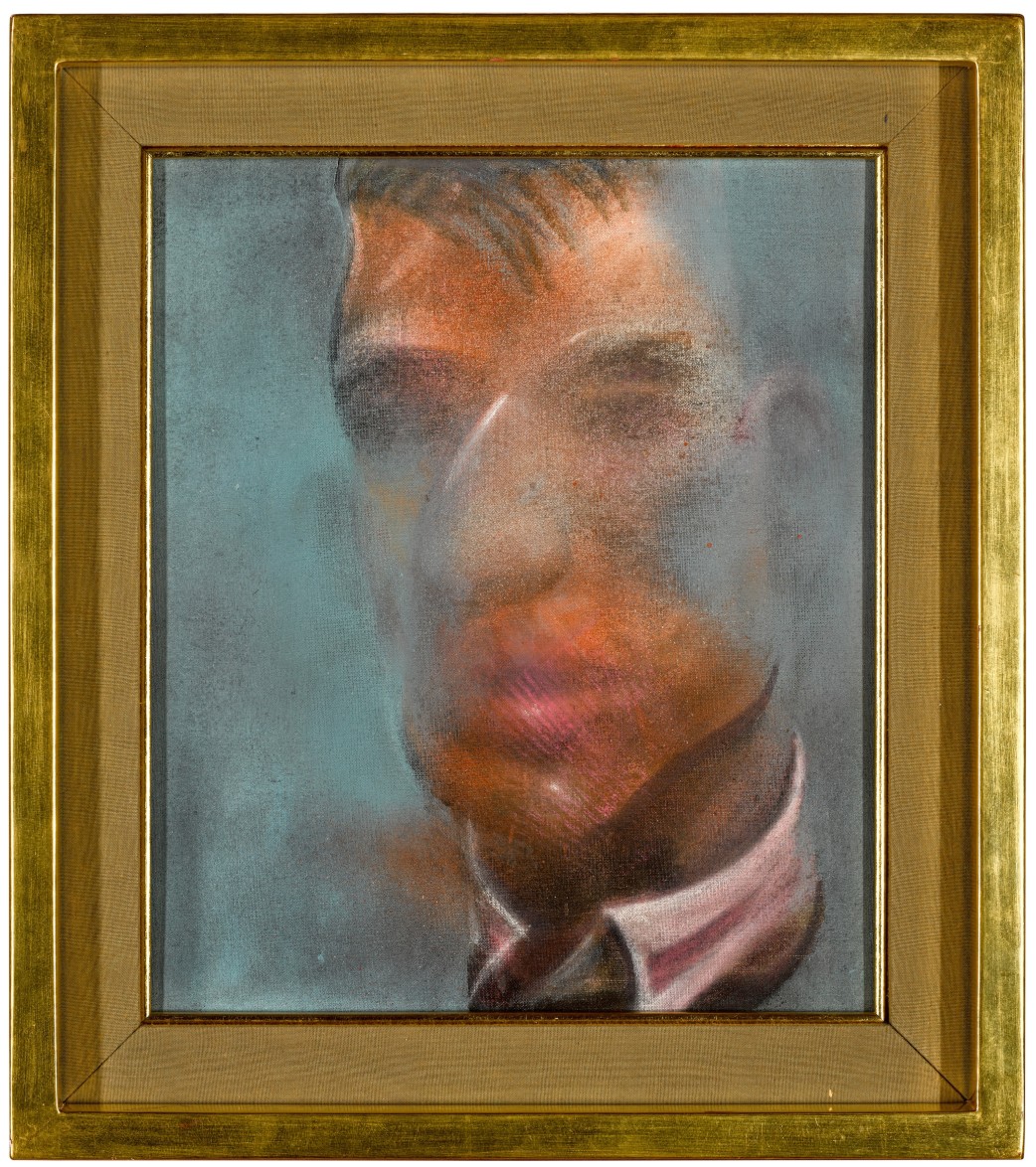
FRANCIS BACON (1909 – 1992)
Study for Self-Portrait, 1980
Oil on canvas
14×12 inches (35.5 x 30.5 cm)
Signed, titled and dated 1980 (on the reverse)
2024 Auction Results
3 lots sold at auction in 2024 for a total turnover of USD 61,285,139. With no lot failing to sell, the sell-through rate is 100%. One lot was withdrawn from Christie’s London on 7 March 2024.
2024 Top 3 Lots
#1. Portrait of George Dyer Crouching, 1966
Sotheby’s New-York: 13 May 2024
Estimated: USD 30,000,000 – 50,000,000
USD 27,735,000
Portrait of George Dyer Crouching | Contemporary Evening Auction | 2024 | Sotheby’s (sothebys.com)

FRANCIS BACON (1909 – 1992)
Portrait of George Dyer Crouching, 1966
Oil on canvas
78 x 57 7/8 inches (198×147 cm)
Titledand dated 1966 (on the reverse)
#2. Landscape near Malabata, Tangier, 1963
Christie’s London: 7 March 2024
Estimated: GBP 15,000,000 – 20,000,000
GBP 19,630,000 / USD 24,890,840
FRANCIS BACON (1909-1992), Landscape near Malabata, Tangier | Christie’s (christies.com)
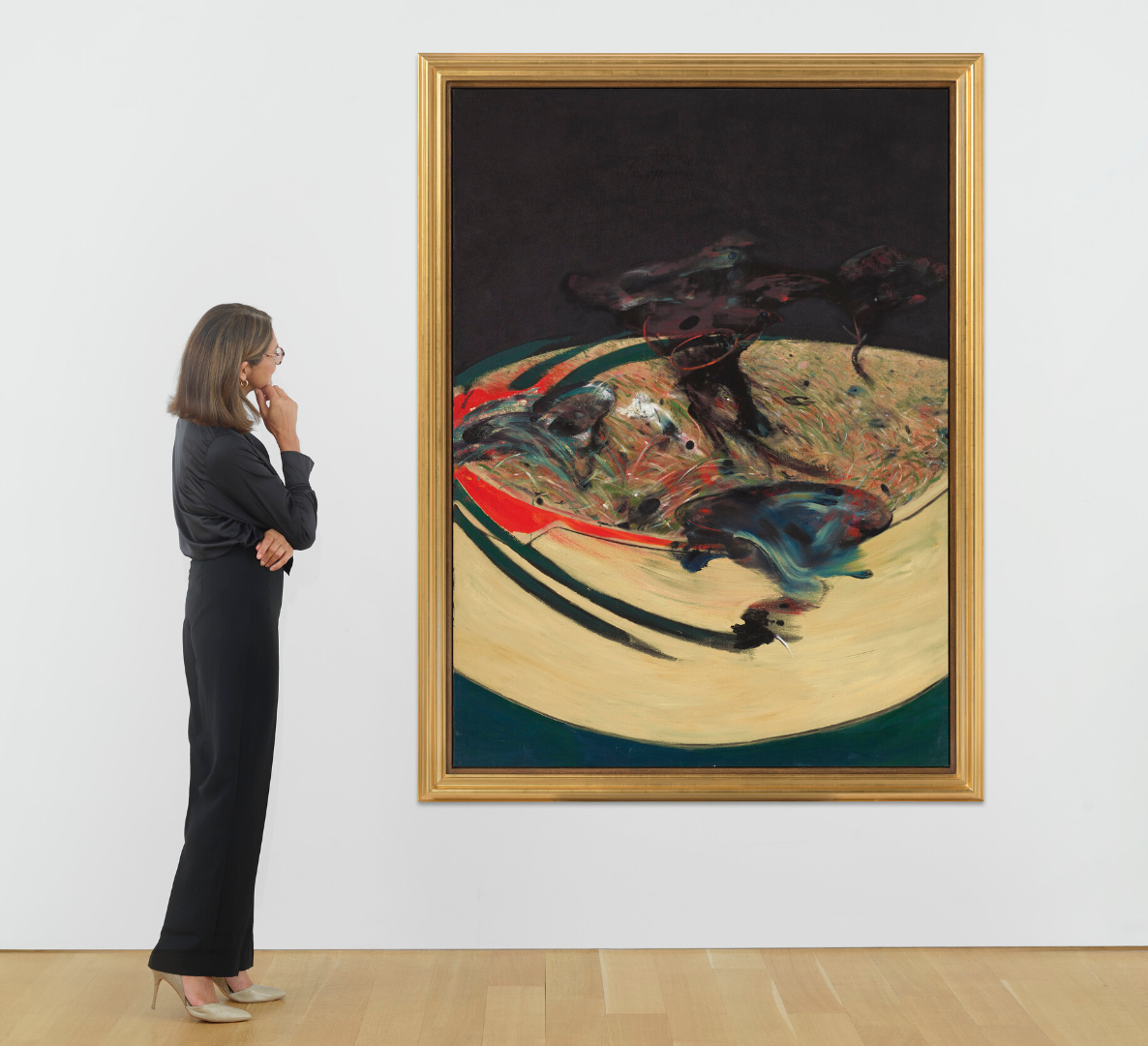
FRANCIS BACON (1909-1992)
Landscape near Malabata, Tangier, 1963
Oil on canvas
78×57 inches (198.1 x 144.8cm.)
Titled and dated ‘Landscape near Malabata, Tangier 1963’ (on the reverse)
#3. Study of George Dyer, 1970
Sotheby’s London: 6 March 2024
Estimated: GBP 5,000,000 – 7,000,000
GBP 6,829,100 / USD 8,659,299
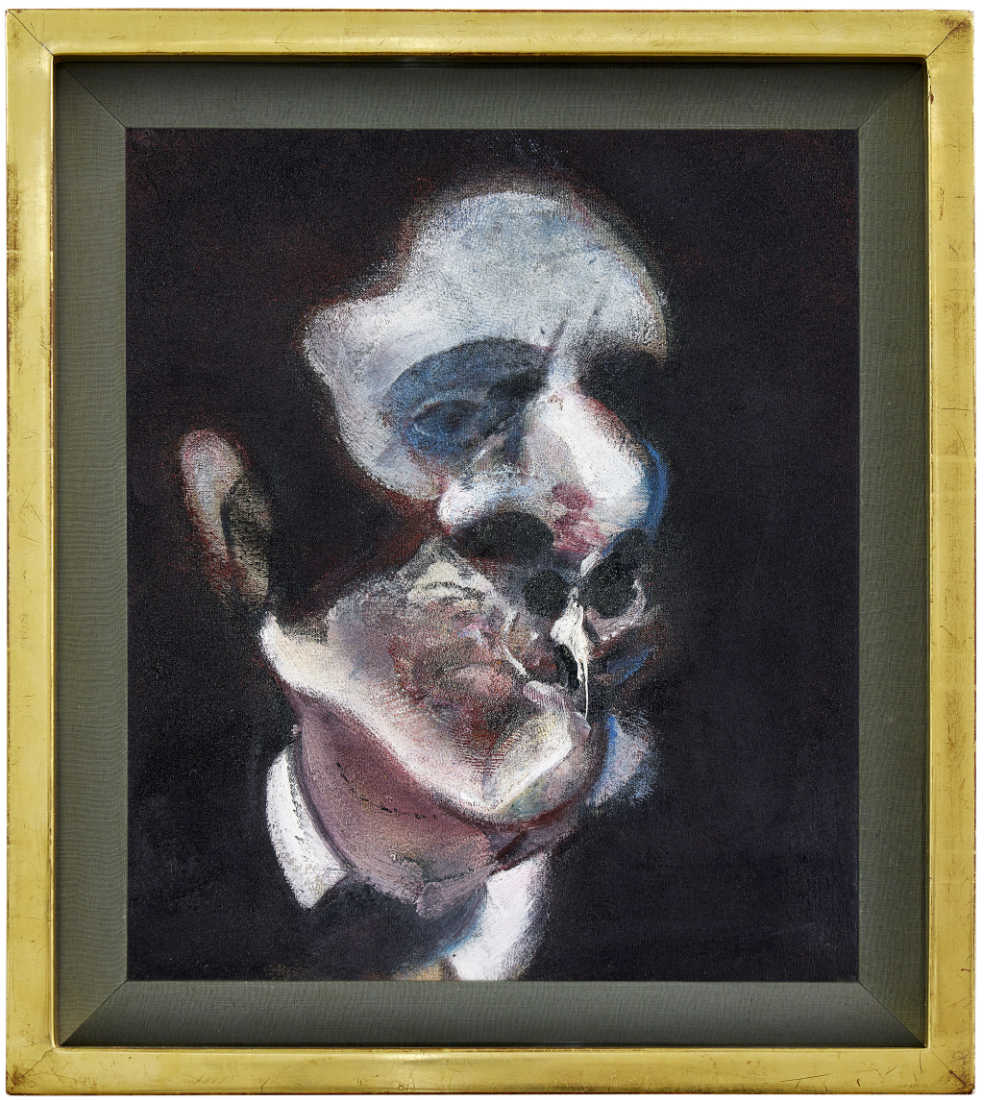
FRANCIS BACON (1909 – 1992)
Study of George Dyer, 1970
Oil on canvas
14×12 inches (35.5 x 30.5 cm)
Titled and dated 1970 (on the reverse)
2023 Auction Results
4 lots sold at auction in 2023 for a total turnover of USD 99,086,738. With no lot failing to sell, the sell-through rate is 100%. The highest price was achieved by Figure in Movement, a painting dated 1976, that sold at Christie’s in New-York for USD 52,160,000 on 9 November 2023.
2023 Top 3 Lots
#1. Figure in Movement, 1976
Christie’s New-York: 9 November 2023
Estimate On Request
USD 52,160,000
FRANCIS BACON (1909-1992) (christies.com)
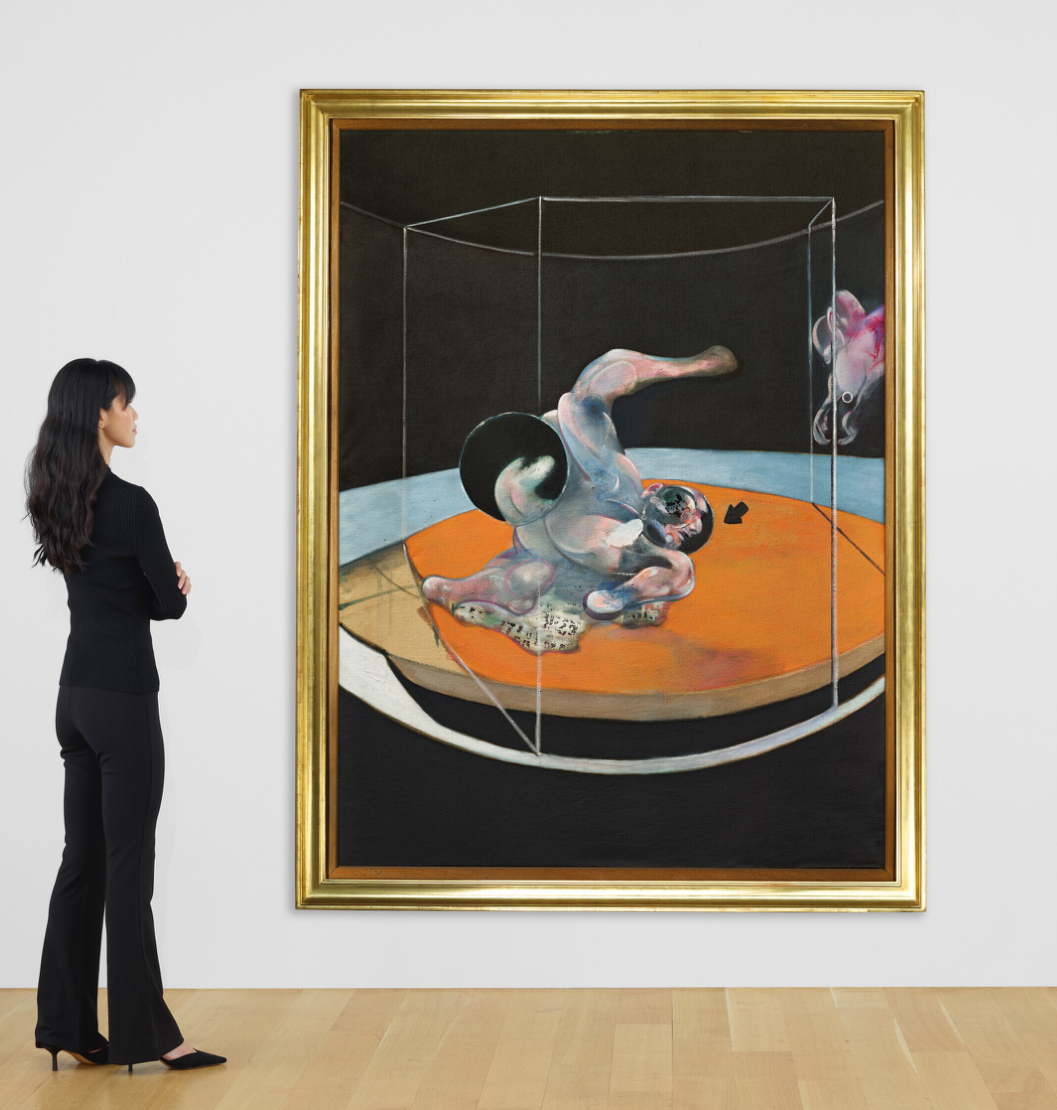
FRANCIS BACON (1909-1992)
Figure in Movement, 1976
Oil and dye transfer lettering on canvas
78 1/4 x 58 inches (198.9 x 147.3 cm)
Signed and dated ‘Francis Bacon 1976’ (on the reverse)
#2. Self-Portrait, 1969
Christie’s New-York: 11 May 2023
Estimated: USD 22,000,000 – 28,000,000
USD 34,622,500
FRANCIS BACON (1909-1992) (christies.com)
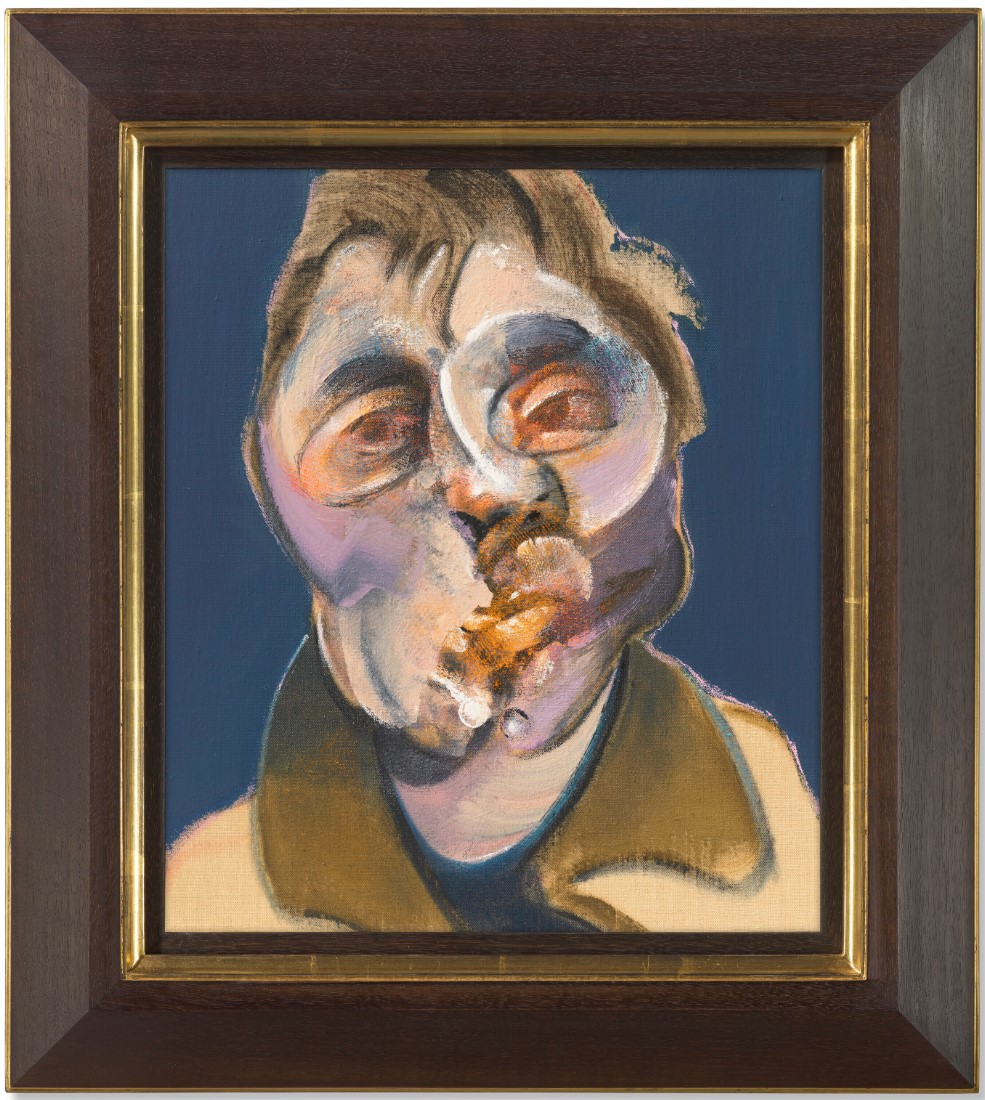
FRANCIS BACON (1909-1992)
Self-Portrait, 1969
Oil on canvas
14×12 inches (35.6 x 30.5 cm)
Signed, dedicated, titled and dated ‘Self-Portrait 1969 Francis Bacon to V with all very best wishes Francis’ (on the reverse)
#3. Head of Woman, 1960
Sotheby’s Paris: 21 June 2023
Estimated: EUR 6,000,000 – 8,000,000
EUR 6,437,375 / USD 7,029,613
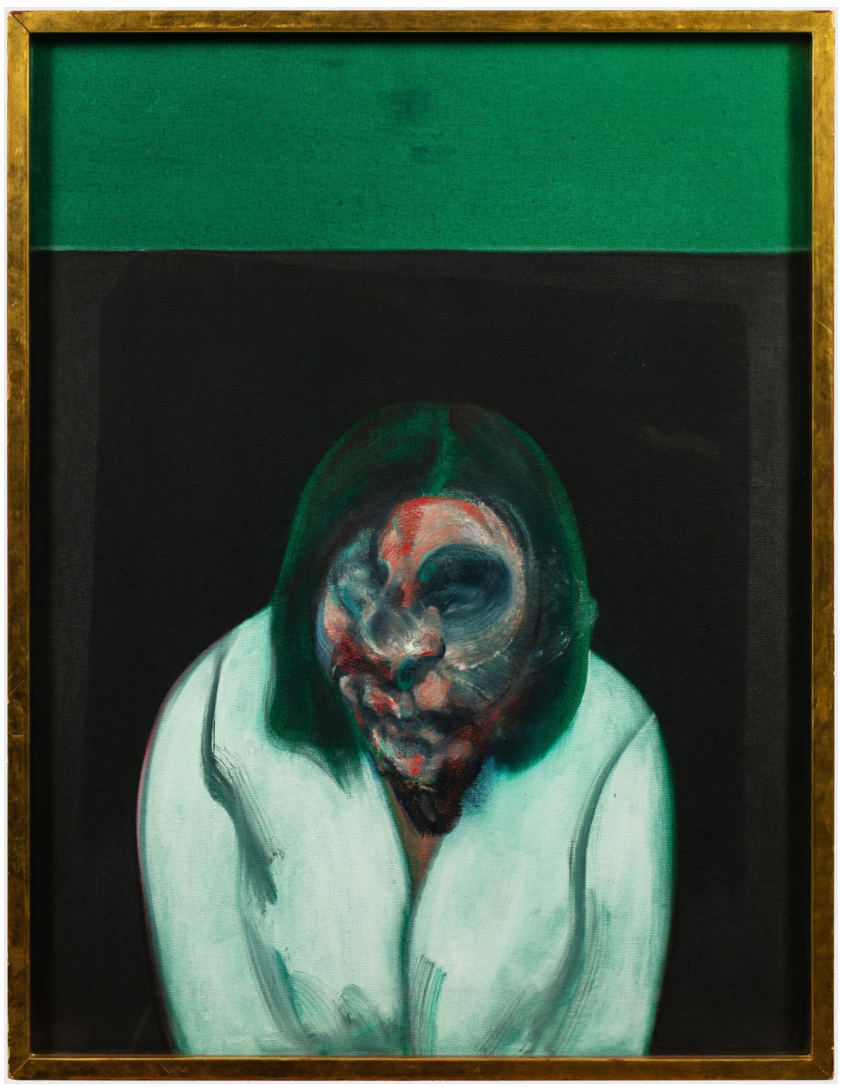
FRANCIS BACON (1909 – 1992)
Head of Woman, 1960
Oil on canvas
35×27 inches (89 x 68.5 cm)
#4. Study for a Portrait, 1979
Sotheby’s London: 12 October 2023
Estimated: GBP 3,500,000 – 4,500,000
GBP 4,283,000 / USD 5,274,625
Study for a Portrait | Contemporary Evening Auction | 2023 | Sotheby’s (sothebys.com)
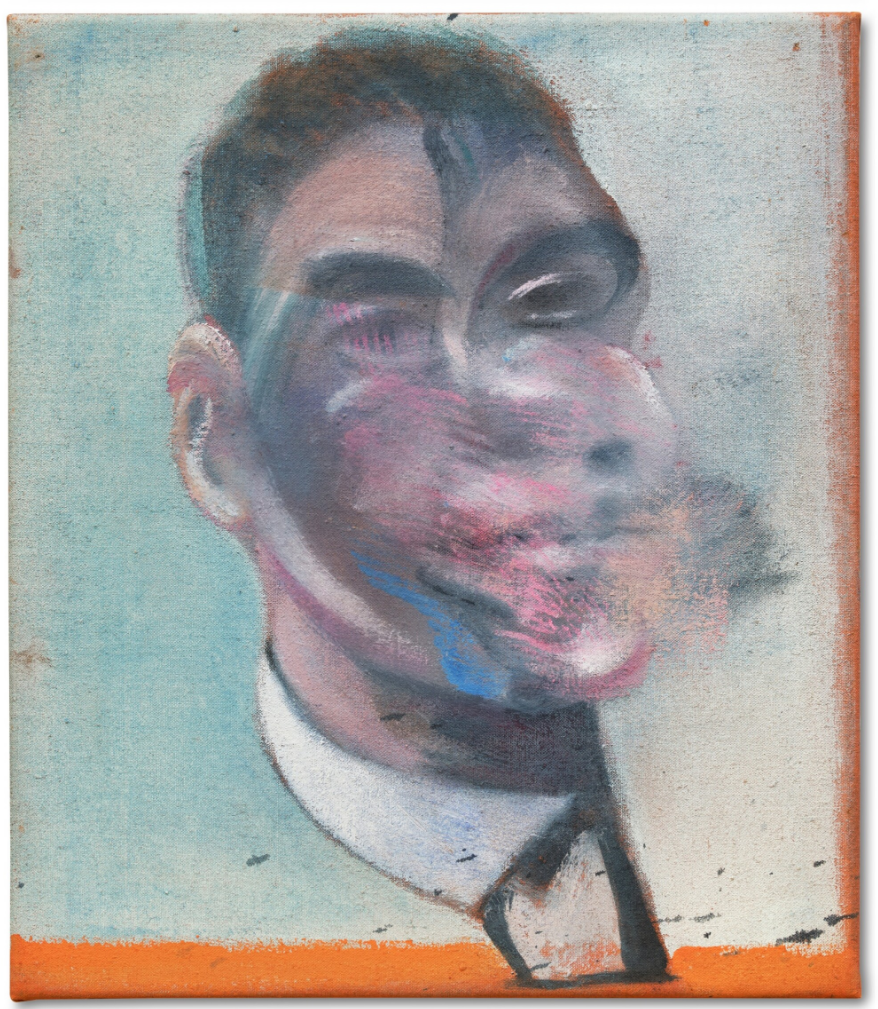
FRANCIS BACON (1909 – 1992)
Study for a Portrait, 1979
Oil on canvas
36.2 x 30.5 cm (14 1/4 x 12 inches)
Signed, titled and dated 1979 (on the reverse)
2022 Auction Results
10 lots sold at auction in 2022 for a total turnover of USD 253,019,398. With no lot failing to sell, the sell-through rate is 100%. The highest price has been achieved at Sotheby’s in London on 29 June 2022, when Study for a Portrait of Lucian Freud sold for GBP 43,336,000 (USD 52,817,090). 6 lots sold for more than USD 20 million, generating a cumulative turnover of USD 236,396,080, representing 93.4% of the total turnover for 2022.
2022 Top 3 Lots
#1. Study for Portrait of Lucian Freud, 1964
Sotheby’s London: 29 June 2022
Estimate on Request
GBP 43,336,000 / USD 52,817,090
FRANCIS BACON (1909 – 1992)
Study for Portrait of Lucian Freud, 1964
Oil on canvas
198 x 147.5 cm (78×58 inches)
#2. Triptych 1986-7, 1986-1987
Christie’s London: 1 March 2022
Estimated: GBP 35,000,000 – 55,000,000
GBP 40,364,500 / USD 51,540,630
FRANCIS BACON (1909-1992) (christies.com)
FRANCIS BACON (1909-1992)
Triptych 1986-7, 1986-1987
Oil, pastel, aerosol paint and dry transfer lettering on canvas, in three parts
Each: 78×58 inches (198 x 147.5 cm)
#3. Study of Red Pope 1962, 2nd Version 1971, 1971
Estimated: USD 40,000,000 – 60,000,000
USD 46,284,500
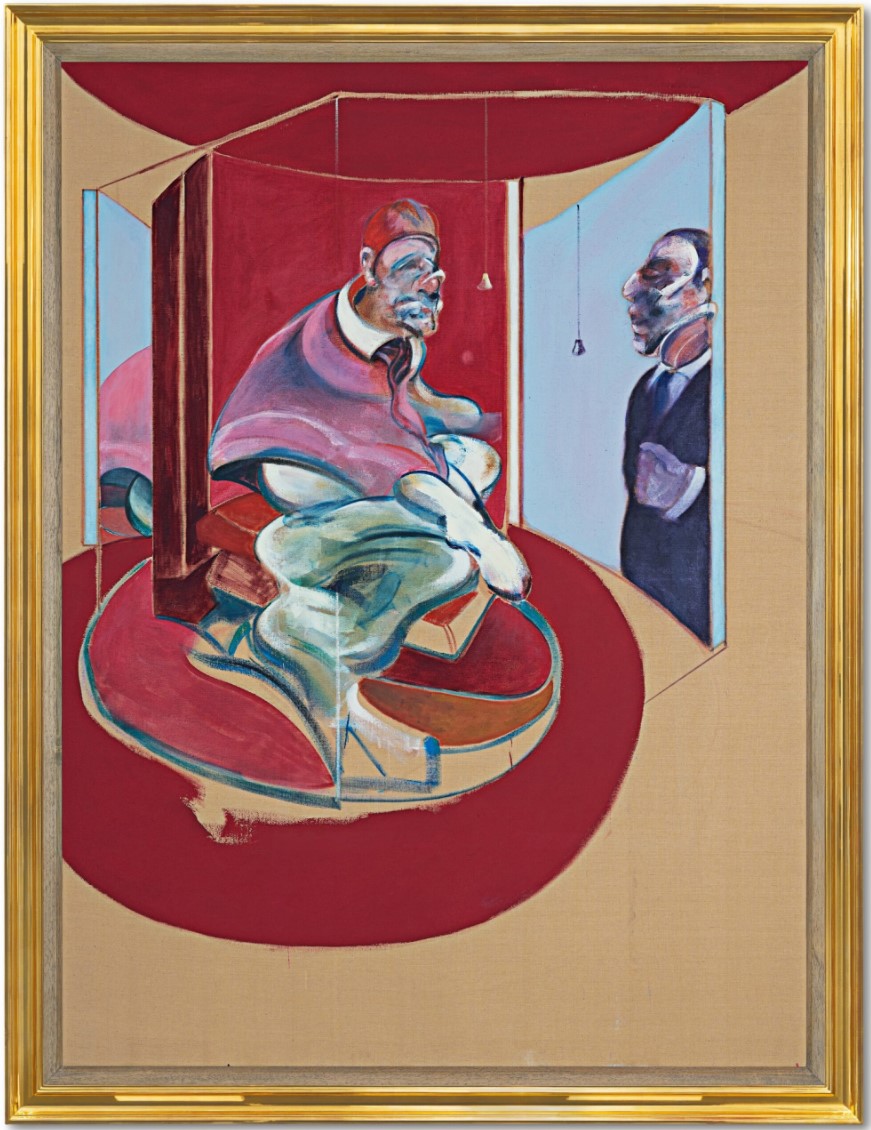
FRANCIS BACON (1909 – 1992)
Study of Red Pope 1962, 2nd Version 1971, 1971
Oil on canvas
78×58 inches (198 x 147.5 cm)
signed Francis Bacon, titled and dated Study of Red Pope 1962, 2nd Version 1971 (on the reverse)
#4. Three Studies for Portrait of Lucian Freud, 1964
Sotheby’s New-York: 16 November 2022
Estimated: USD 30,000,000 – 40,000,000
USD 30,000,000
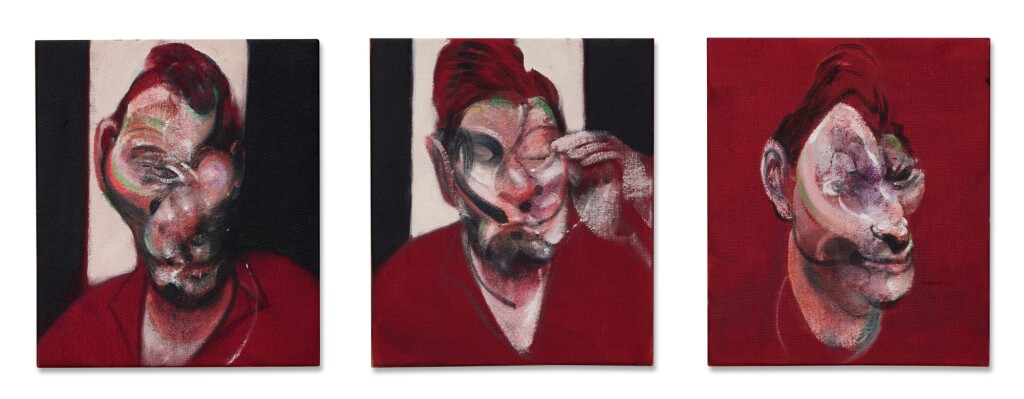
FRANCIS BACON (1909-1992)
Three Studies for Portrait of Lucian Freud, 1964
Oil on canvas, in three parts
Each: 14×12 inches (35.6 x 30.5 cm)
#5. Three Studies for Self-Portrait, 1979
Christie’s New-York: 9 November 2022
Estimated: USD 25,000,000 – 35,000,000
USD 29,015,000
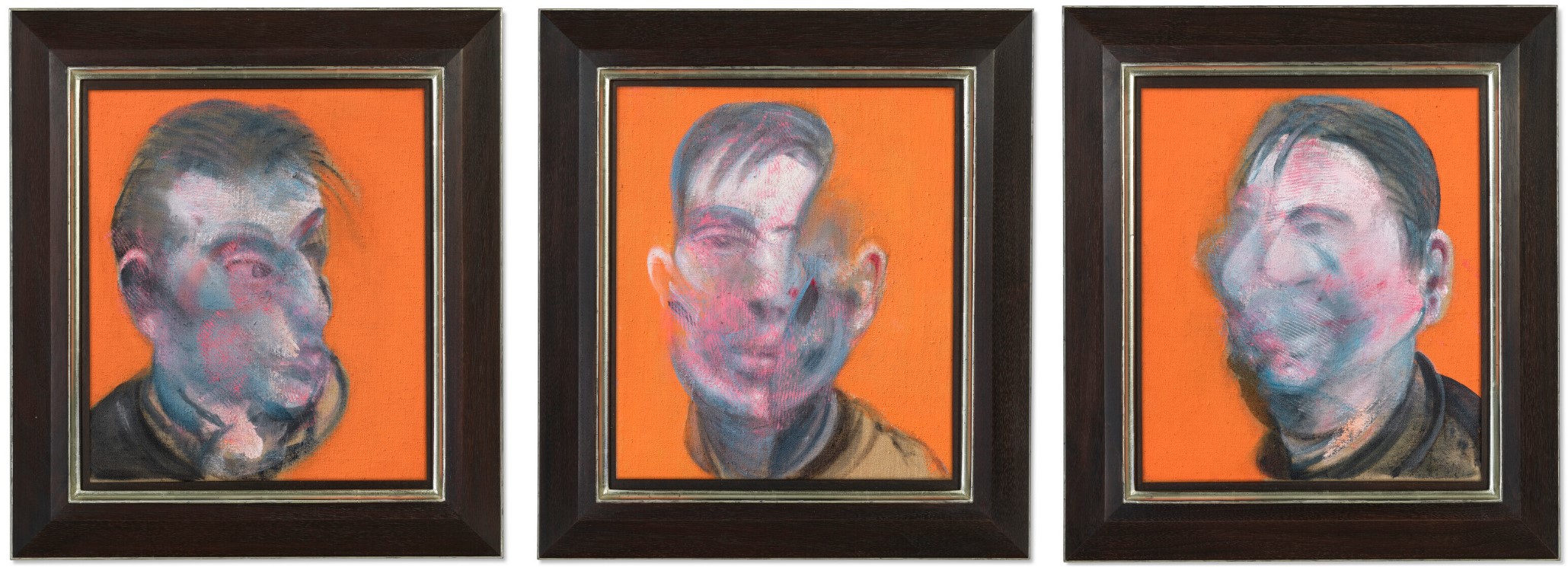
Three Studies for Self-Portrait, 1979
Oil on canvas, in three parts
Each: 14 x 12 inches (35.6 x 30.5 cm)
#6. Three Studies for Portrait of Henrietta Moraes, 1963
Sotheby’s London: 14 October 2022
Estimate on Request
GBP 24,300,000 / USD 27,242,152
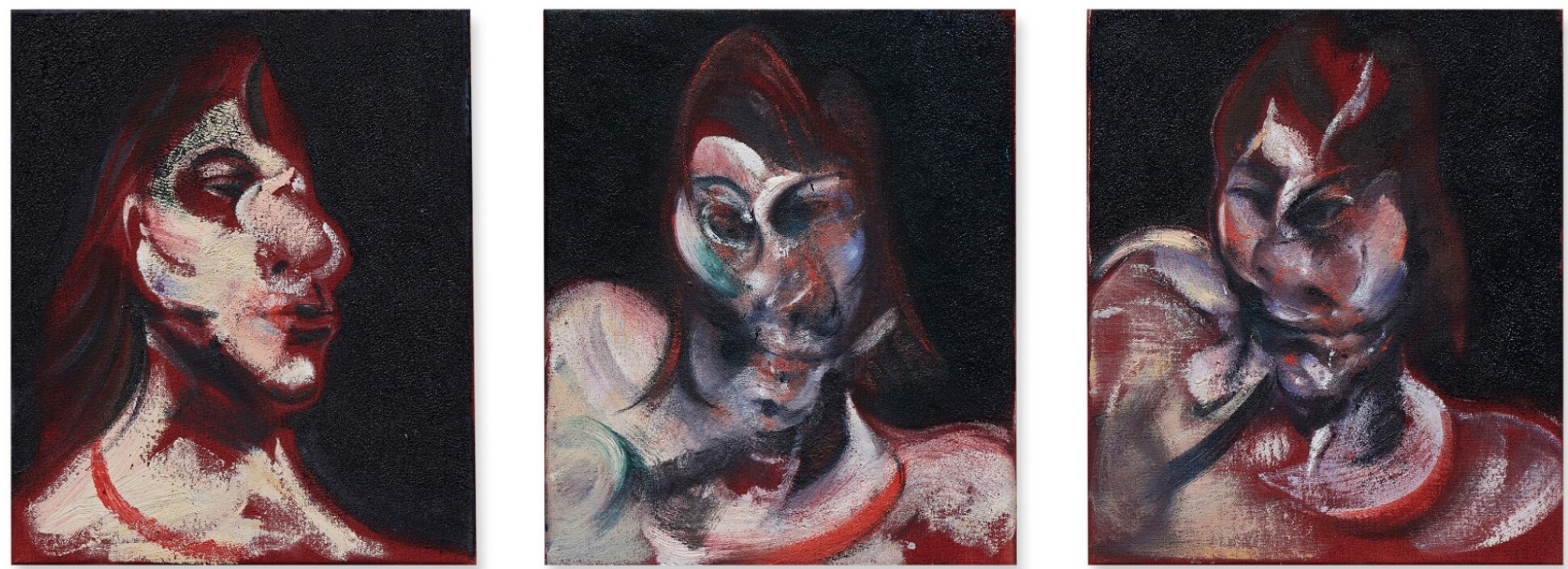
FRANCIS BACON (1909 – 1992)
Three Studies for Portrait of Henrietta Moraes, 1963
Oil on canvas, in three parts
Each: 35.5 x 30.5 cm (14×12 inches)
Titled 3 Studies For Portrait of Henrietta Moraes and dated 1963
(on the reverse of the central canvas)
#7. Painting 1990, 1990
Christie’s London: 13 October 2022
Estimated: GBP 7,000,000 – 9,000,000
GBP 7,102,250 / USD 8,056,091
FRANCIS BACON (1909-1992) (christies.com)
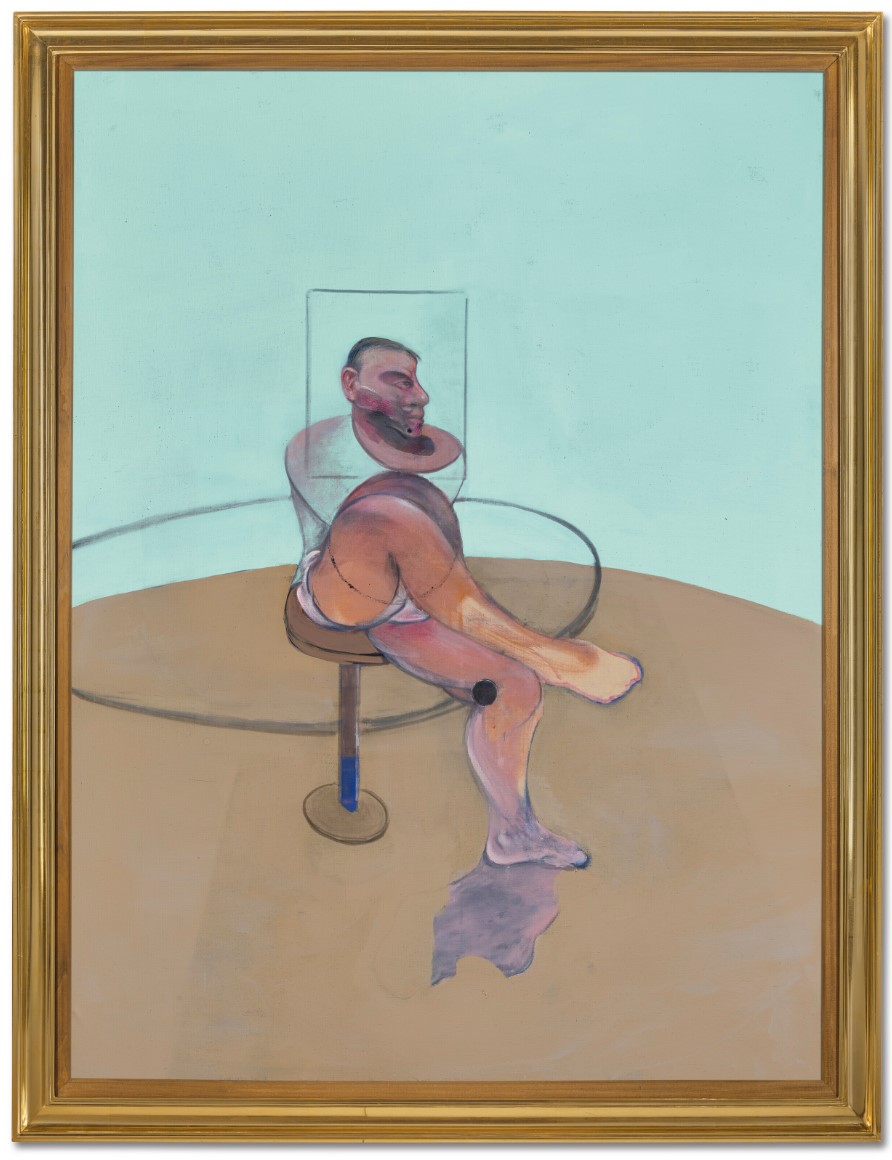
FRANCIS BACON (1909-1992)
Painting 1990, 1990
Oil on canvas
78 x 58 1/8 inches (198 x 147.5 cm)
Signed, titled and dated ‘Painting 1990 Francis Bacon’ (on the reverse)
#8. Figure Crouching, 1949
Estimated: EUR 3,500,000 – 5,000,000
EUR 4,021,900 / USD 3,971,462
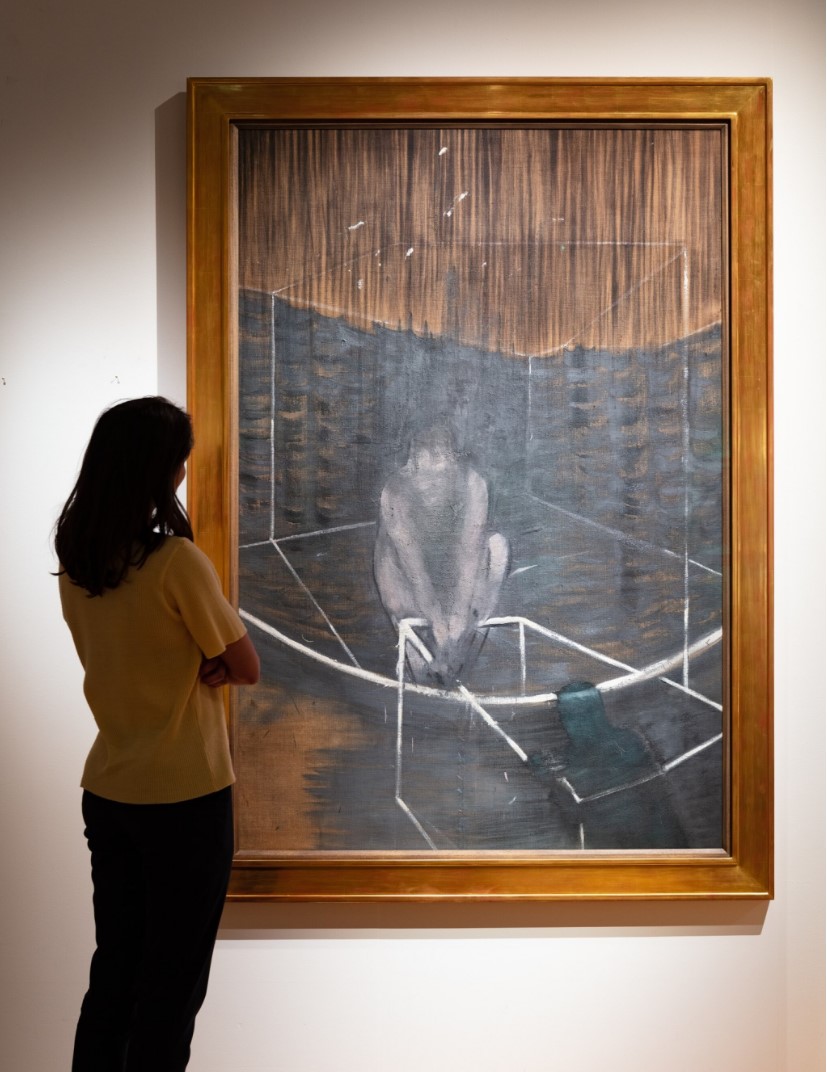
FRANCIS BACON (1909 – 1992)
Figure Crouching, 1949
Oil and sand on canvas
180×122 cm (70 7/8 x 48 inches)
#9. Seated Man, circa 1957
Christie’s London: 28 June 2022
Estimated: GBP 2,000,0000 – 3,000,000
GBP 2,922,000 / USD 3,556,459
FRANCIS BACON (1909-1992), Seated Man | Christie’s (christies.com)
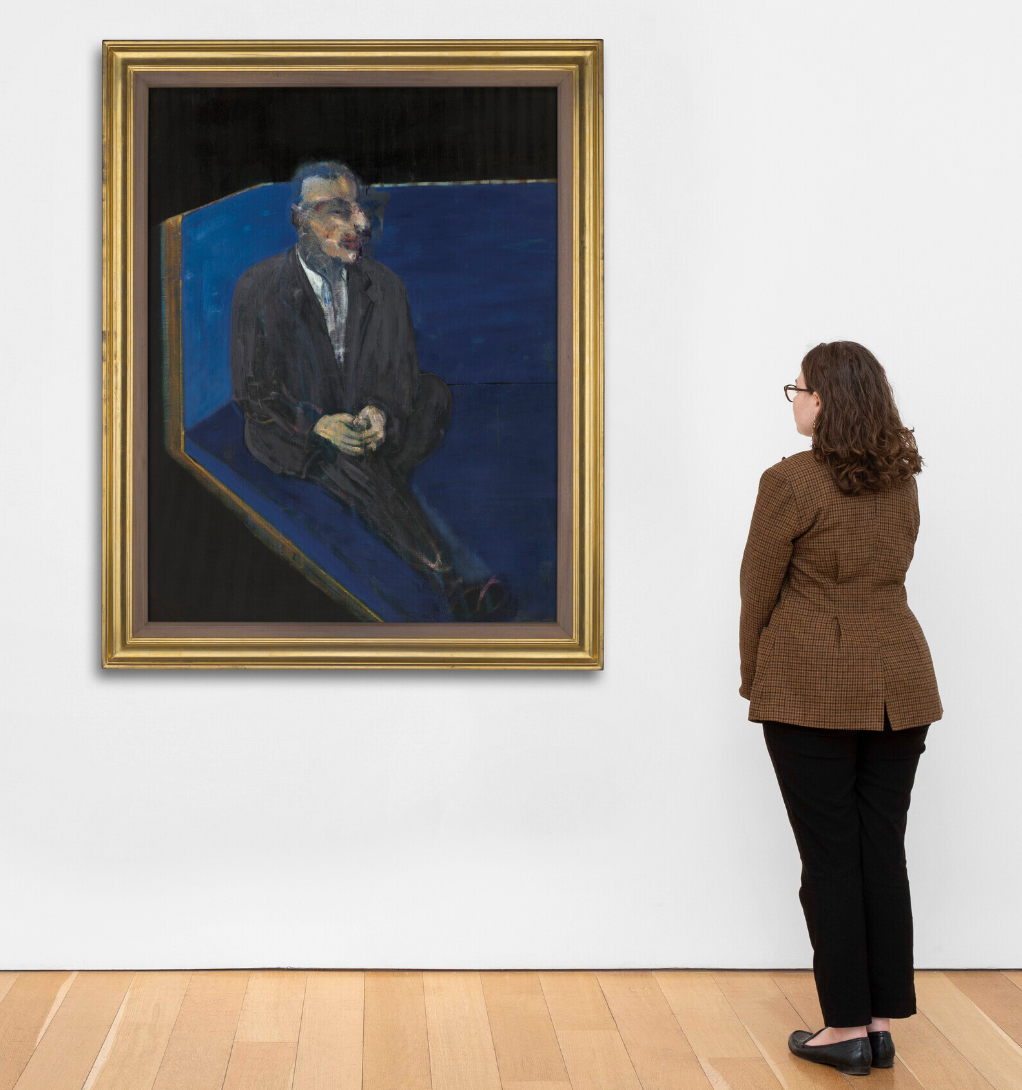
FRANCIS BACON (1909-1992)
Seated Man, circa 1957
Oil on canvas
55 x 43 3/8 inches (140×110 cm)
#10. Untitled (Head), 1948
Phillips London: 3 March 2022
Estimated: GBP 600,000 – 800,000
GBP 772,700 / USD 1,029,306
Francis Bacon – 20th Century & Contemp… Lot 23 March 2022 | Phillips
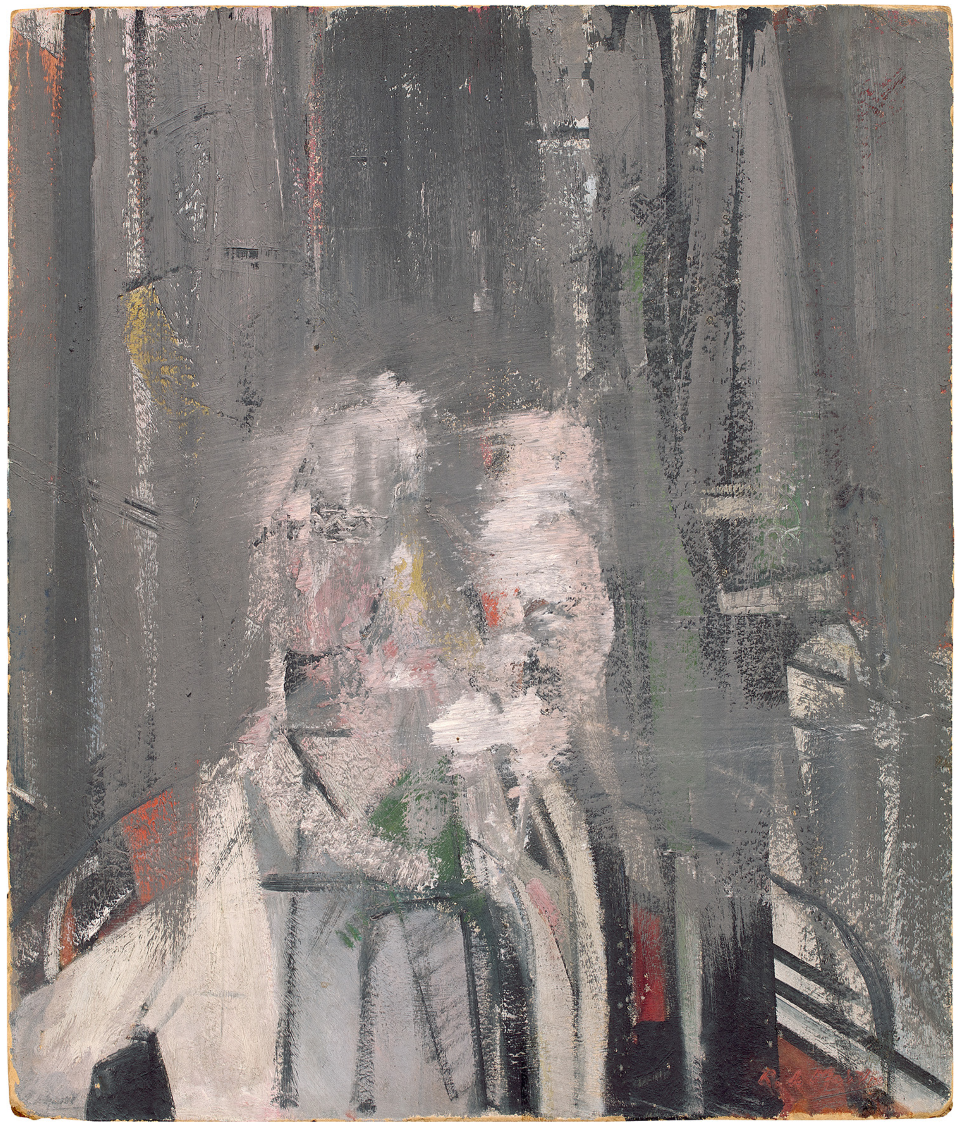
FRANCIS BACON
Untitled (Head), 1948
Oil on fiberboard
25 3/4 x 21 7/8 inches (65.5 x 55.5 cm)
2021 Auction Results
2 lots sold at auction in 2021 for a total turnover of USD 39,872,414. With no lot failing to sell, the sell-through rate is 100%. The highest price has been achieved at Phillips in New-York on 17 November 2021 when Pope with Owls, circa 1958, sold for USD 33,000,000.
2021 Top 2 Lots
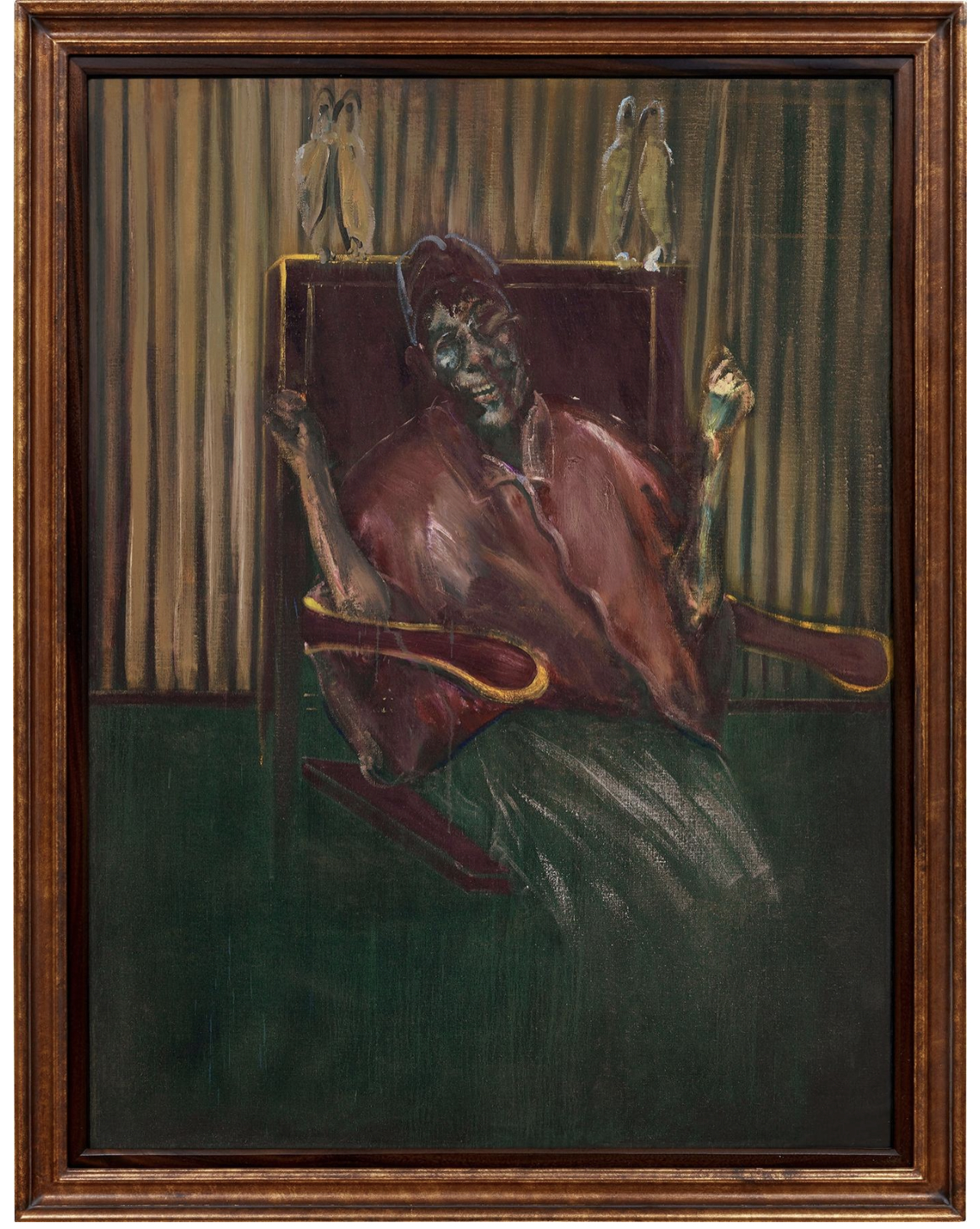
#1. Pope with Owls, circa 1958
Phillips New-York: 17 November 2021
USD 35,000,000 – 45,000,000
USD 33,000,000
Francis Bacon – 20th Century & Cont… Lot 16 November 2021 | Phillips
FRANCIS BACON
Pope with Owls, circa 1958
Oil on canvas
57 1/4 x 43 inches (145.4 x 109.2 cm)
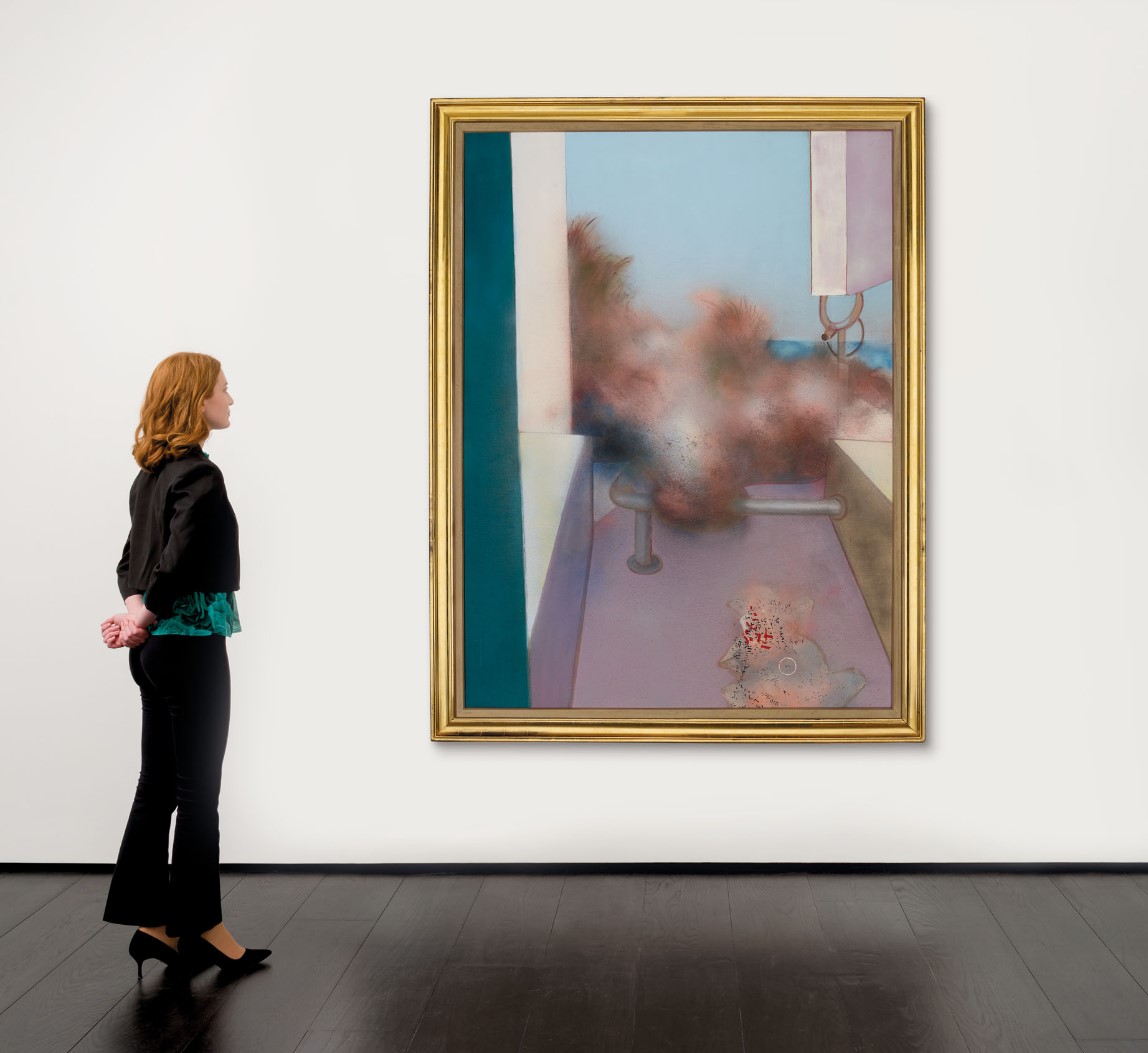
#2. Sand Dune, 1981
Christie’s London: 23 March 2021
Estimate on Request
GBP 5,182,500 / USD 6,872,414
FRANCIS BACON (1909-1992) (christies.com)
FRANCIS BACON (1909-1992)
Sand Dune, 1981
Oil, pastel, dust and dry transfer lettering on canvas
78 x 58 1/8 inches (198 x 147.5 cm)
Signed, titled and dated ‘Sand Dune 1981 Francis Bacon’ (on the reverse)
PART III: FOCUS
Triptychs
Three Studies for Portrait of Lucian Freud, 1964
Sotheby’s New-York: 16 November 2022
Estimated: USD 30,000,000 – 40,000,000
USD 30,000,000
FRANCIS BACON (1909-1992)
Three Studies for Portrait of Lucian Freud, 1964
Oil on canvas, in three parts
Each: 14×12 inches (35.6 x 30.5 cm)
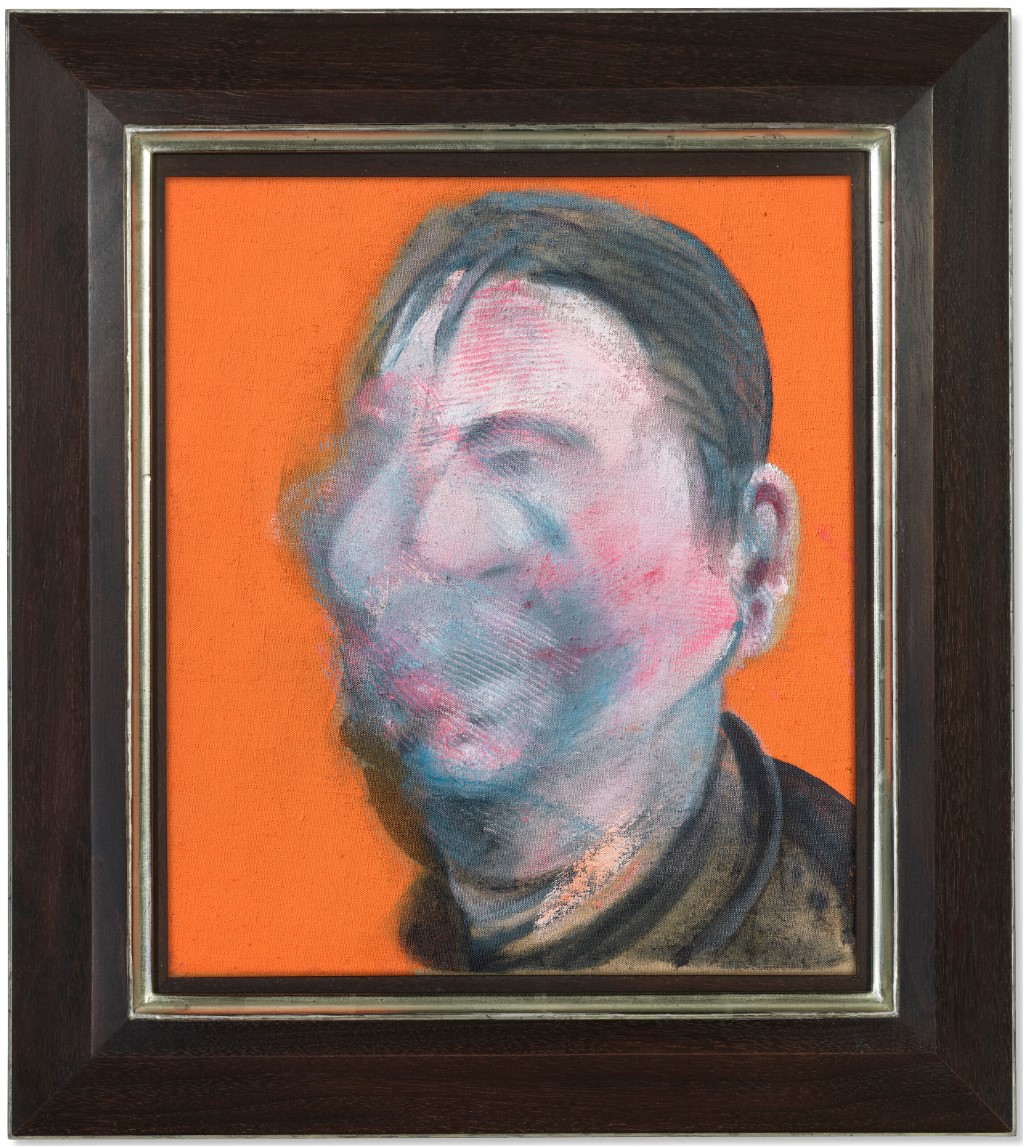
A threefold distortion of Lucian Freud’s effigy in vicious strokes of searing scarlet, Three Studies for Portrait of Lucian Freud from 1964testifies to a powerful dialogue rarely matched in history: the great friendship and epochal rivalry between Francis Bacon and Lucian Freud, two of Britain’s most celebrated painters. With each loaded brushstroke, Bacon animates and disfigures the head of his friend, conjuring in its restlessness Freud’s uncanny likeness in deep shades of red impasto and active jolts of greens and whites. Bacon executed the present work in 1964 at the height of his prodigious career, debuting it one year later in his major 1965 solo exhibition Francis Bacon, which travelled internationally from the Hamburger Kunstverein, Hamburg to the Moderna Museet, Stockholm and the Municipal Gallery of Modern Art, Dublin.
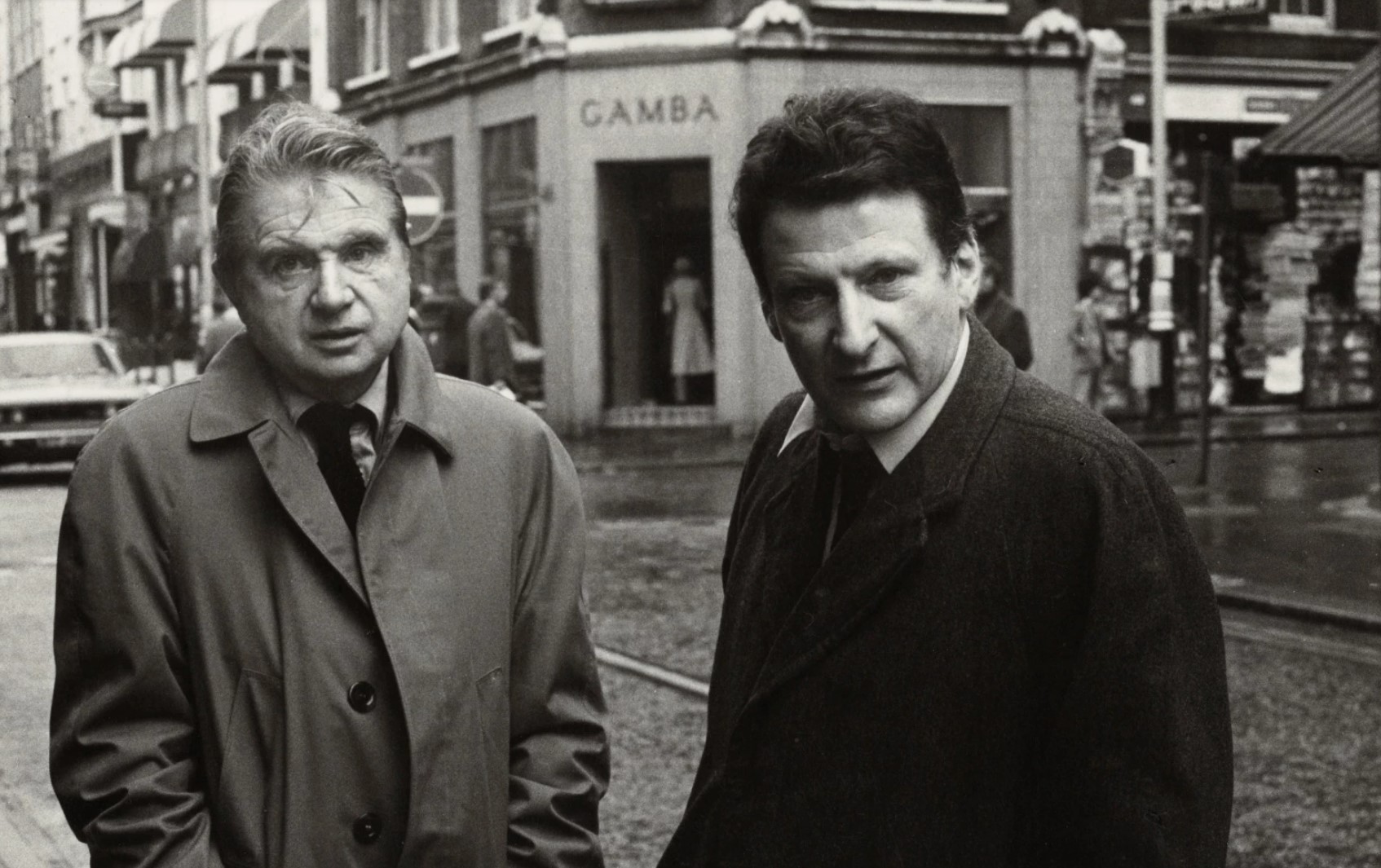
HARRY DIAMOND, FRANCIS BACON; LUCIAN FREUD, 1974. IMAGE © THE NATIONAL PORTRAIT GALLERY, LONDON
Francis Bacon and Lucian Freud first met in 1945, quickly becoming regular companions following their introduction by painter Graham Sutherland. When a young Freud had asked Sutherland whom he considered the best painter in England, Sutherland identified Bacon, not yet recognizable at the time: “Oh, someone you’ve never heard of; he’s like a cross between Vuillard and Picasso; he’s never shown and he has the most extraordinary life.” (L. Freud, quoted in W. Feaver, Lucian Freud, exh. cat., Tate Britain, London, 2002, p. 26) Drawn to Freud’s quick wit and notorious penchant for risk, Bacon found in him an immediate counterpart to his own mercurial yet charismatic attitude. By the 1950s, the two were inseparable, holding court nearly every night in the bars and clubs of Soho, London’s Bohemanian enclave, where they would gossip, drink, and exchange ideas, gathering in their wake a carousing coterie of other eccentrics, writers, poets, musicians, and hangers-on.
In the 1950s, the two figurative artists also began to document their friendship through the familiar medium of portraiture. Beginning in 1951 with Portrait of Lucian Freud, which now resides in the permanent collection of London’s Whitworth Gallery, Bacon would continue to paint Freud’s portrait over the next twenty years, and then the shadow of his unnamed presence long thereafter. In 1952, Freud painted his own legendary full-length portrait of Francis Bacon, one of only two he painted of him, conjuring an intangible air of distracted distance in the face of his friend that perfectly narrates the dimensions of their unconventional friendship – the two had sat knee to knee in the studio dutifully for three months to have completed this painting, which was famously later stolen from the Tate Collection, never to be found again. By 1954, the duo represented Britain at the Venice Biennale along with Ben Nicholson, securing their respective reputations at the vanguard of postwar figurative painting as well as their relationship as artistic contemporaries.
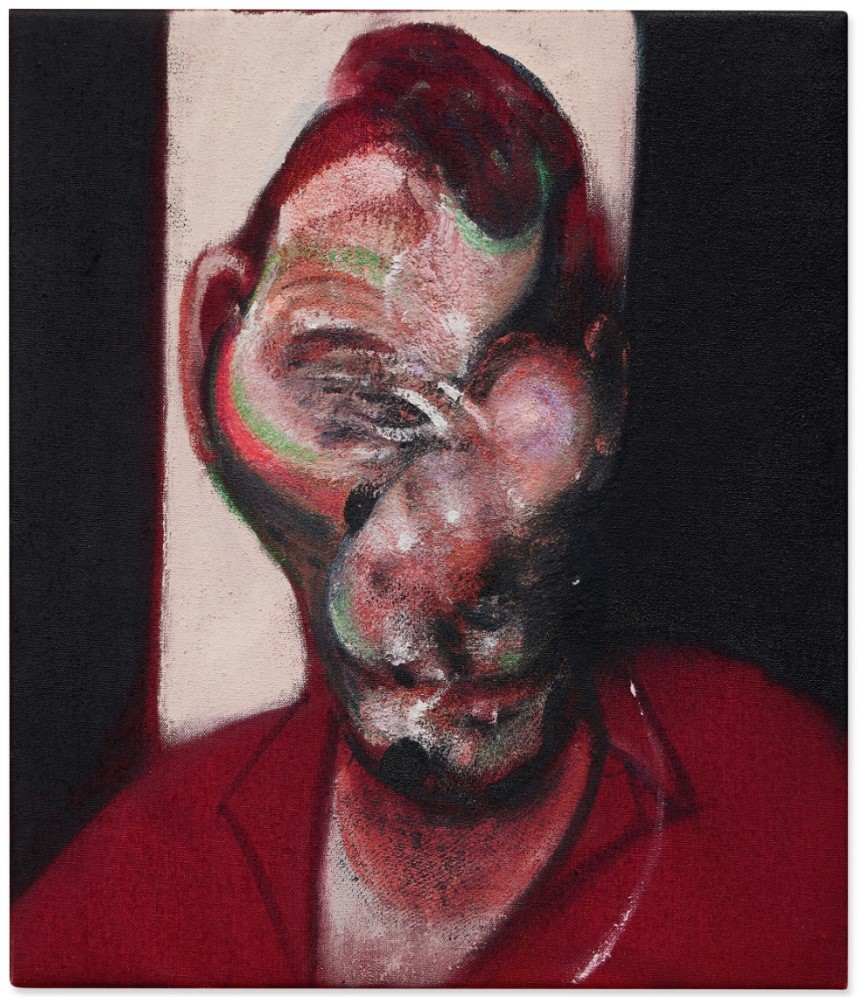
Highlights of venom green and recesses of bruise purple index the textural contours of Freud’s crimson face not as marks of brutality, but rather Bacon’s radical instincts towards prismatic depth and painterly chance. Contrasted against a backdrop of depthless black and coarsely woven, unprimed canvas, the explosive plasticity of Bacon’s smeared, brushed, and flickered impasto forms the sculptural character of bitumen onto Freud’s flesh, a point of stylistic divergence between he and Freud. While Freud harnessed portraiture as a means of telling the labored truth behind his sitters, Bacon privileged their psychic essence: “Real imagination is technical imagination. It is in the ways you think up to bring an event to life again. It is in the search for the technique to trap the object at a given moment..” (The artist quoted Time Magazine, New York 1952.)
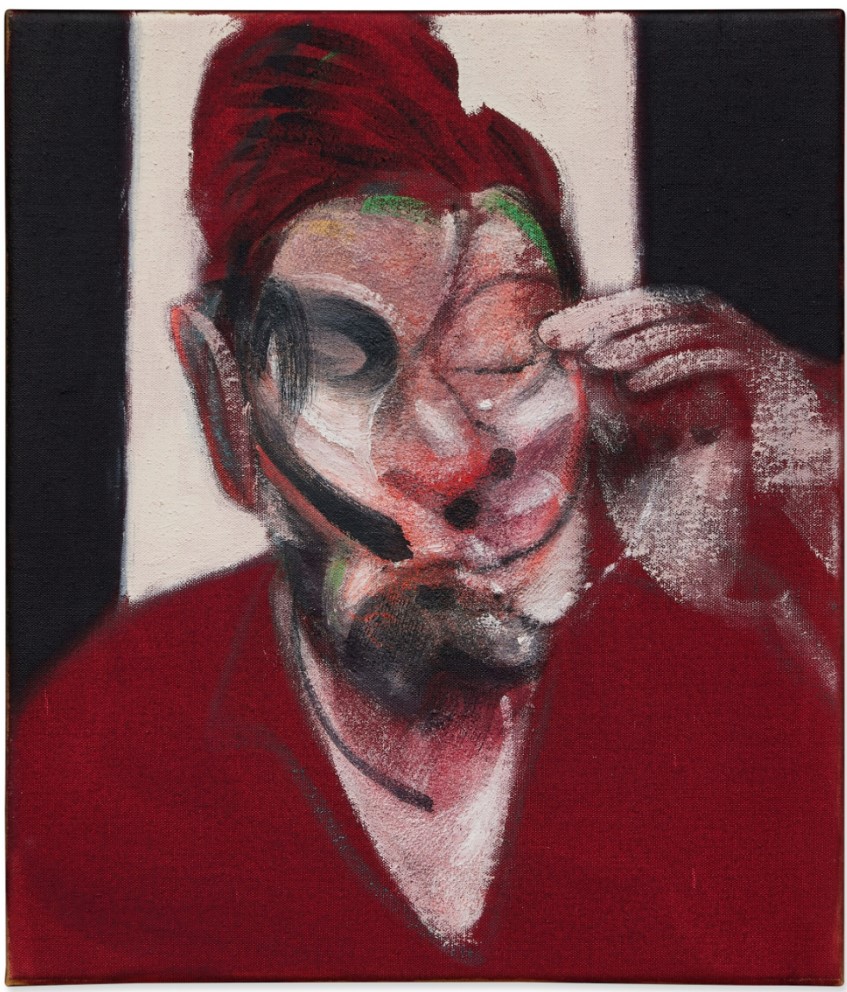
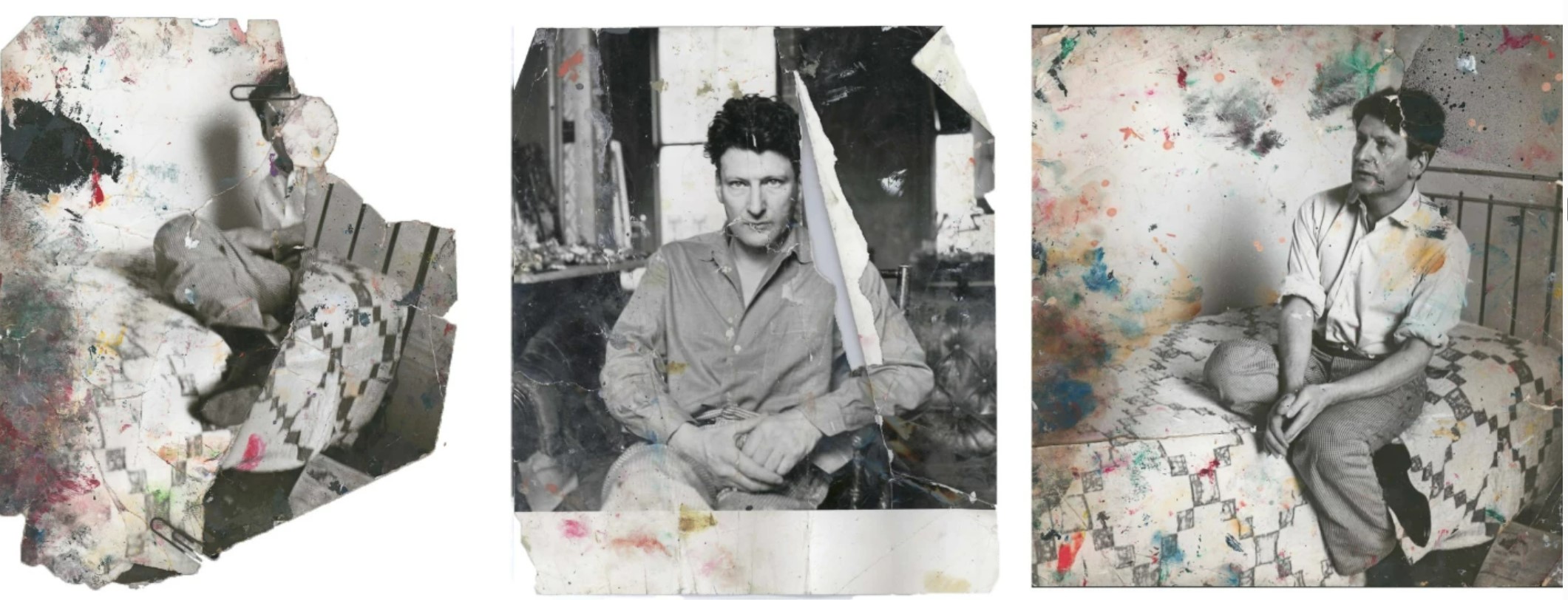
Also unlike Freud, Bacon avoided painting his sitters from life, preferring to reference photographs of subjects as source material from which to extrapolate the semblance of their being. Bacon’s portraits of Freud drew from black-and-white photographs taken of him in the 1960s by their mutual friend John Deakin, many of which found themselves naturally torn, crumpled, folded, and blemished by paint in the famous disarray of Bacon’s studio. In Three Studies for Portrait of Lucian Freud, the effacement of these photographs finds parallel in the variegated strokes of paint that distort Freud’s effigy, residue of Bacon’s gestural impulses swept across its three different incarnations. Extending far beyond the mere moments captured in a time-delayed photograph, however, the present triptych distills the ineffable poignancy of time and the shadows of memory itself as Bacon creates a panoptic view into Freud’s character as he has observed over a decade of friendship.
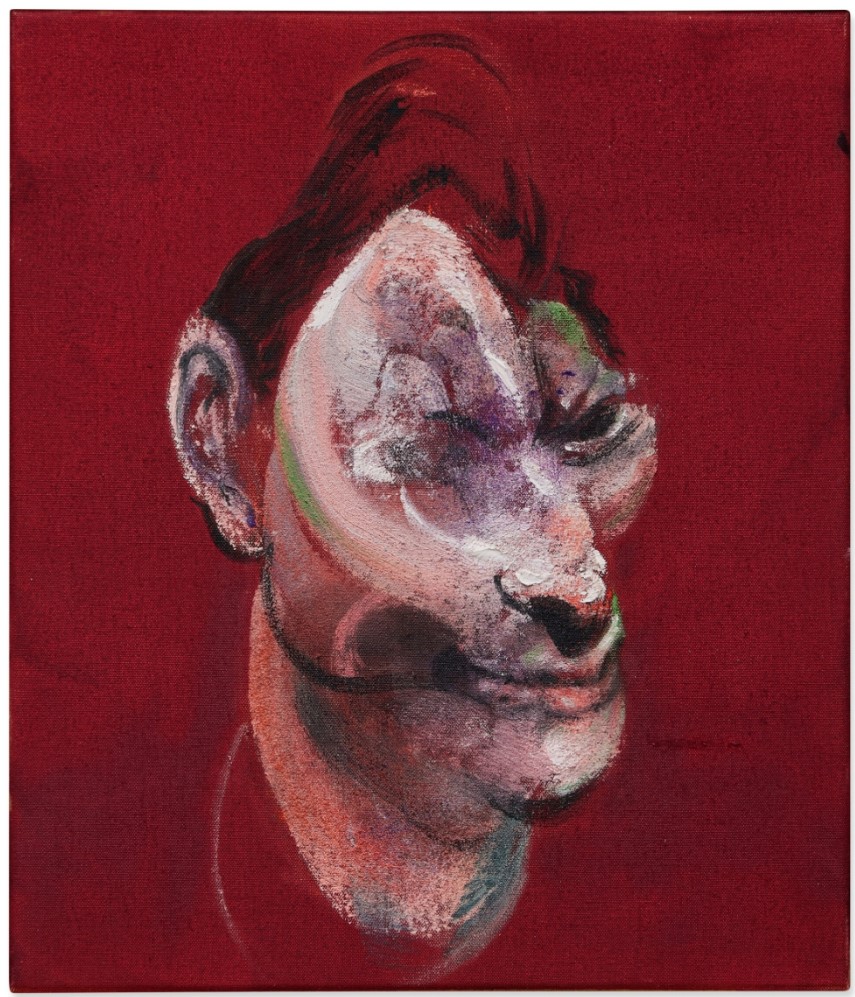
The iconic 14×12 inch canvas is of particular significance for Bacon: beginning in 1961, Bacon had employed the 14×12 inch canvas size exclusively for an epic portraiture cycle that depicted his circle of close friends, a project that occupied him for the remainder of his life. A central motif to Bacon, the triptych formed a balanced compositional unit that allowed him to reveal the images of his mind in sequence, resembling a slow panoramic photograph. The first of only five triptychs he created of Lucian Freud, Three Studies for Portrait of Lucian Freud sees Bacon draw upon the profound intimacy that is born of close friendship interwoven with artistic rivalry. In the pastose landscape of Freud’s visage, Bacon achieves the sublime balance between the mythic allure and haunting weight of a person’s selfhood, evincing his inimitable capacity to unveil through paint the deepest complexities of the human psyche.
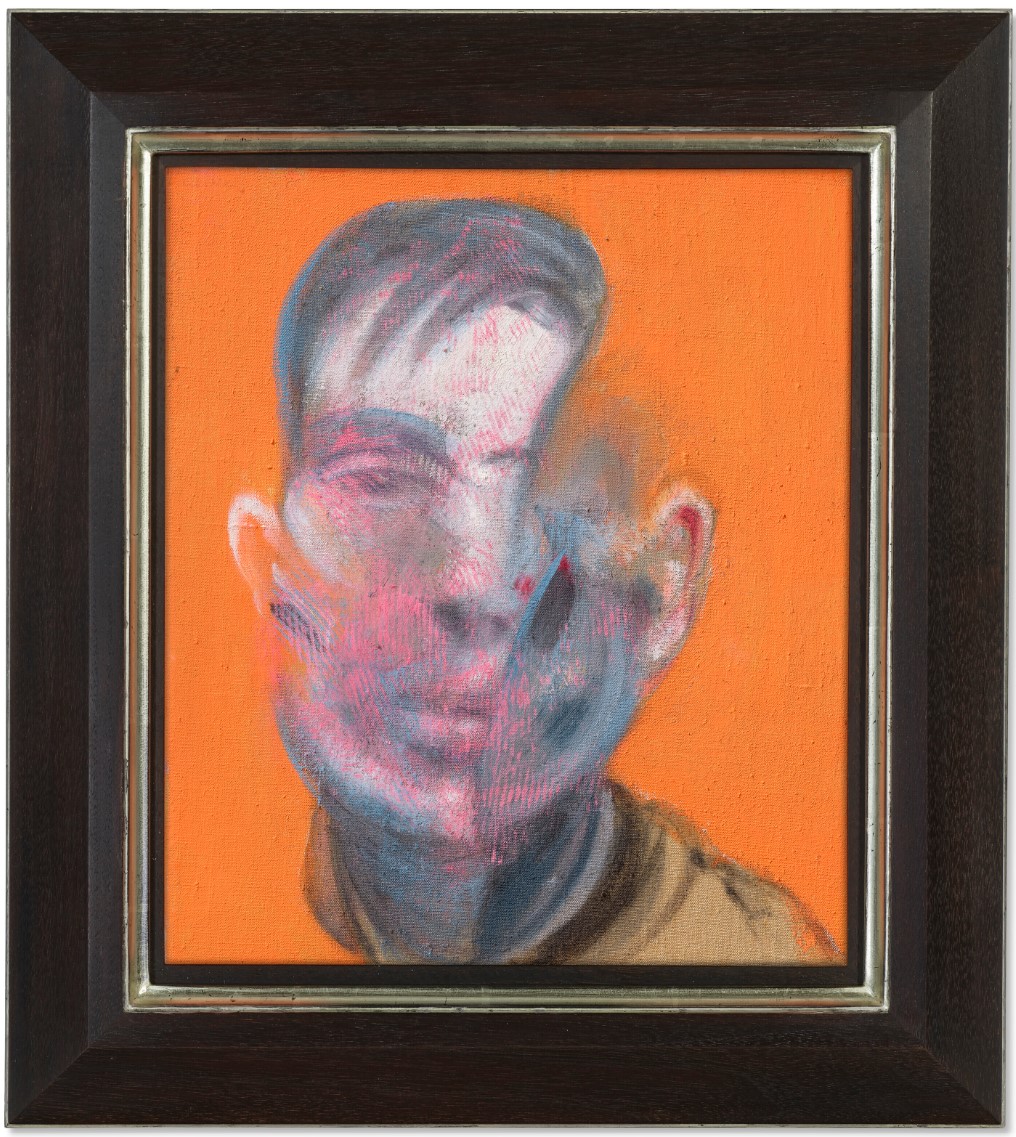
Three Studies for Self-Portrait, 1979
Christie’s New-York: 9 November 2022
Estimated: USD 25,000,000 – 35,000,000
USD 29,015,000
Three Studies for Self-Portrait, 1979
Oil on canvas, in three parts
Each: 14 x 12 inches (35.6 x 30.5 cm)
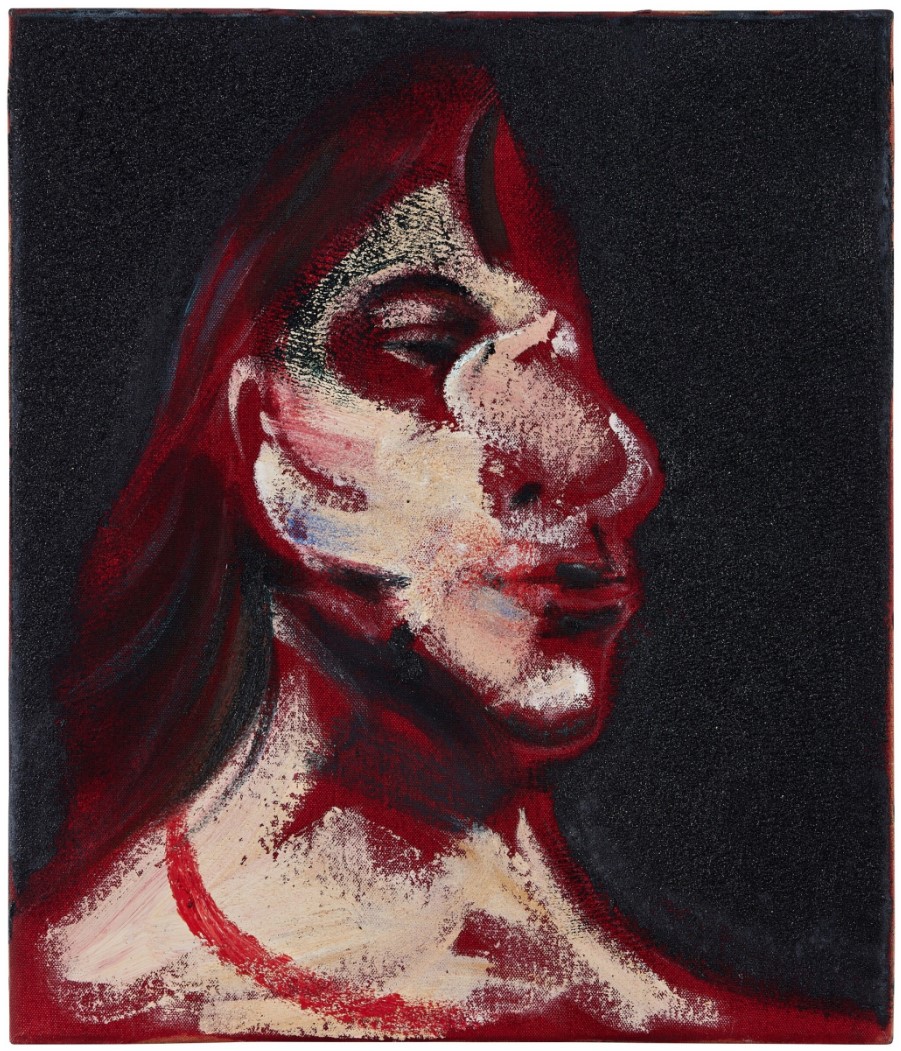
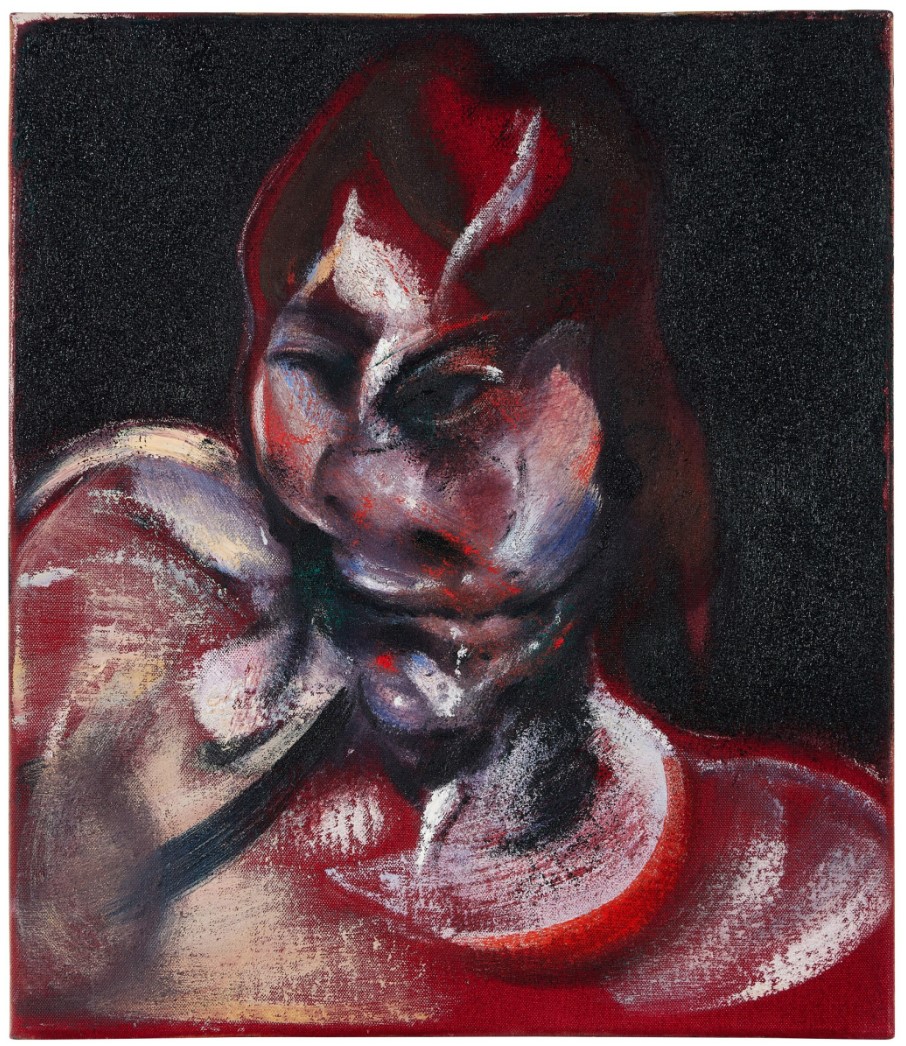
Three Studies for Portrait of Henrietta Moraes, 1963
Sotheby’s London: 14 October 2022
Estimate on Request
GBP 24,300,000 / USD 27,242,152
FRANCIS BACON (1909 – 1992)
Three Studies for Portrait of Henrietta Moraes, 1963
Oil on canvas, in three parts
Each: 35.5 x 30.5 cm (14×12 inches)
Titled 3 Studies For Portrait of Henrietta Moraes and dated 1963
(on the reverse of the central canvas)
Painted in 1963, Three Studies for Portrait of Henrietta Moraes is unequivocally one of the finest and most accomplishedsmall portrait triptychs ever created by Francis Bacon. The first named portrait of Henrietta Moraes in Bacon’s oeuvre, and the second ever triptych executed in the iconic 14 by 12 inch canvas format, this is a work of great historical importance and unrivalled execution. Delivering a seamless interlocking of paint and image, these three canvases epitomize the consummate painterly virtuosity and uncompromising power of their creator. In his Catalogue Raisonné entry for this painting, Bacon scholar Martin Harrison praises this very work, identifying it as the artist’s “consummation” of the small portrait triptych, in which “Bacon’s execution has a power, skill and confidence that he scarcely ever surpassed in this format” (Martin Harrison, Ed., Francis Bacon Catalogue Raisonné, Volume III 1958-71, London 2016, p. 733). In a manner unparalleled by any before or since, Bacon had an ability to capture beauty, pathos and violence in a flickof paint, a talent that surpassed a translation of mere form and likeness to deliver something closer to the raw fact of existence. The present work delivers this with aplomb: here we bear witness to a portrait of a legendary Soho Bohemian, a subject whose unconventional, uninhibited lifestyle and gregarious nature is writ large across each canvas. Three Studies for Portrait of Henrietta Moraes was the last picture included in Bacon’s early Catalogue Raisonné, to which its editor Ronald Alley wrote that it was “painted partly from life”; a positing that situates it as one of the final works Bacon executed in this manner, as from 1962 Bacon began principally to rely on photographs of his friends/subjects taken by John Deakin (Ronald Alley and John Rothenstein, Francis Bacon: Catalogue Raisonné and Documentation, London and New York, 1964, p. 155) Reinforced by Bacon’s own proclivity for the peril of life’s roulette wheel, Moraes’s very essence projects forth through a confluence of daring brushwork and imagination: a powerful coalescence of colour, texture and form that radiates sheer vitality. Hung upon an armature of disfigured facial features contained by the focussed proportions of these three canvases, the present triptych harnesses chaos, chance, beauty, and violence to deliver images of astonishing intensity and carnal grace.
As a debut work in Bacon’s newly forged small-triptych format, Three Studies for Portrait of Henrietta Moraes announced a sea-change in Bacon’s practice. The motifs and tropes of the previous decade were abandoned in favour of unadorned and focussed portrayals of the human form in closely cropped and consistent proportions. Alongside the small 14 by 12inch canvas format, Bacon would also standardise his larger production in panels measuring 78 by 58 inches: from 1962 onwards these two formats provided the structural basis for the rest of Bacon’s career. Where the large panels acted as arenas for Bacon’s operatic musings on the human condition, the smaller canvases were to become, in the words of esteemed art historian John Russell, “the scene of some of the artist’s most ferocious investigations” (John Russell, Francis Bacon, London, 2001, p. 99). With Three Studies for Portrait of Henrietta Moraes Bacon powerfully laid down the harrowing introspective quality and unadorned immediacy that would become intrinsic to the small portrait triptychs.
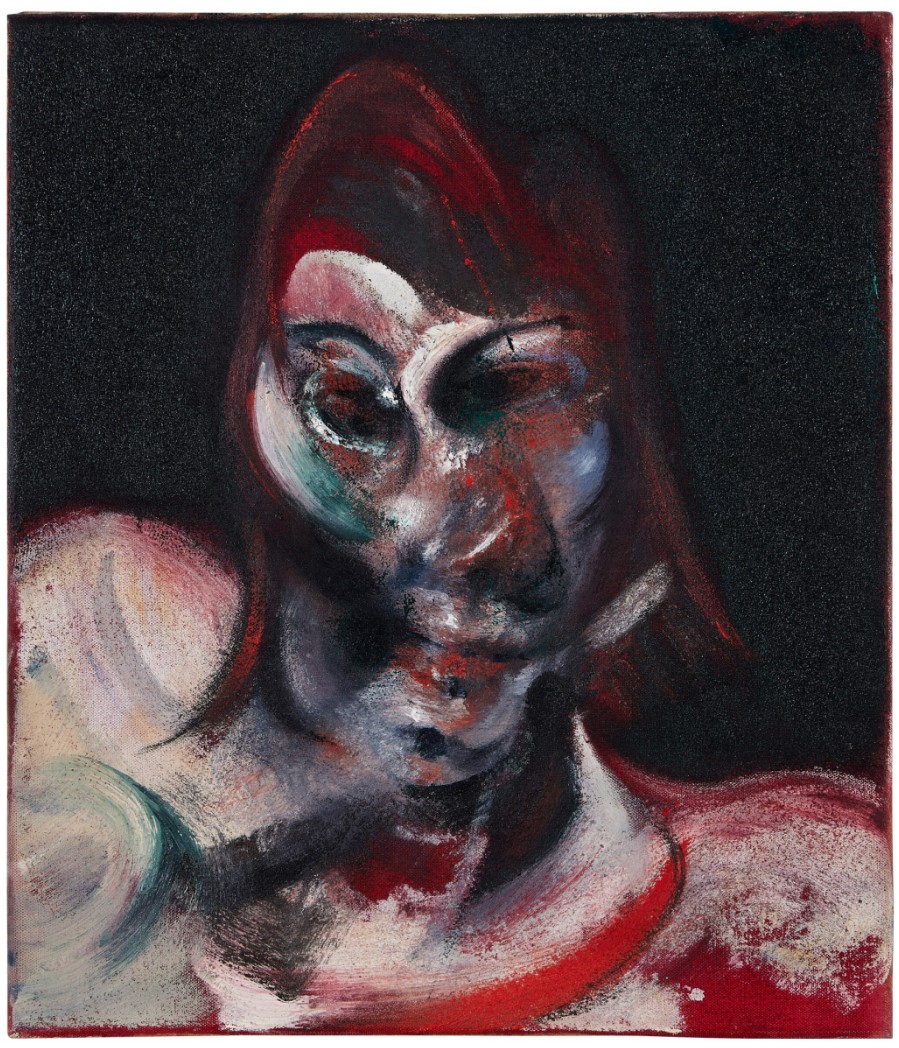
The second small scale triptych ever created by Francis Bacon and arguably his finest, Three Studies for Portrait of Henrietta Moraes is a tour-de-force of visceral technique and painterly invention. Tightly focussed and with nowhere to hide, three head-and-shoulders images of Moraes play out as a sequence of superimposed states. Here we see Bacon truly define the power and impact possible within the confines of three 14 by 12 inch canvases. Across a bituminous, tar-like ground of thick texture, Moraes’s likeness emerges in swipes of crimson and white. The more refined silhouette of the left-hand canvas – a form that exudes the influence of Picasso’s Dora Maar – gives way to two gnarled and contorted images accented with tones of green, blue, and purple.
Even when making the comparison to Bacon’s other great small triptychs of this period – notably Three Studies for a Portrait of George Dyer (1963) and Three Studies for Portrait of Lucian Freud (1964) which share the same bituminous ground and dominant red/black colour palette respectively – it is clear that Bacon’s Three Studies for Portrait of Henrietta Moraes embodies his greatest achievement in this format.
Triptych 1986-7, 1986-1987
Christie’s London: 1 March 2022
Estimated: GBP 35,000,000 – 55,000,000
GBP 40,364,500 / USD 51,540,630
FRANCIS BACON (1909-1992) (christies.com)
FRANCIS BACON (1909-1992)
Triptych 1986-7, 1986-1987
Oil, pastel, aerosol paint and dry transfer lettering on canvas, in three parts
Each: 78×58 inches (198 x 147.5 cm)
Triptych inspired by the Oresteia of Aeschylus, 1981
Sotheby’s New-York: 29 June 2020
Estimated: USD 60,000,000 – 80,000,000
USD 84,550,000
FRANCIS BACON (1909 – 1992)
TRIPTYCH INSPIRED BY THE ORESTEIA OF AESCHYLUS, 1981
Oil on canvas, in three partsq
Each: 78×56 inches (198 x 147.5 cm)
Signed, titled, dated 1981 and variously inscribed on the reverse of each panel
Rife with tragic allusion and fraught with chilling grandeur, Francis Bacon’s spellbinding Triptych Inspired by the Oresteia of Aeschylus evinces the artist’s singular translation of psychological tension into painted form. A magisterial treatise on the human experience, the present work wrestles with timeless philosophical preoccupations: mercy versus punishment, justice versus vengeance, and sacrifice versus self-preservation—concerns which consumed Bacon for the entirety of his life. Executed in 1981, at the zenith of his prodigious career, Triptych Inspired by the Oresteia of Aeschylus provides a masterful return to the same classical text that inspired Three Studies for Figures at the Base of the Crucifixion, 1944, which announced Bacon’s debut on the world stage and is now in the Tate Collection, London. One of just 28 large-scale triptychs in Bacon’s oeuvre—nearly half of which reside in museum collections—the present work emerges from the Astrup Fearnley Museet, having resided in the museum’s collection for over thirty years. Selected for inclusion in nearly every major exhibition of Bacon’s work since its execution, Triptych Inspired by the Oresteia of Aeschylus has been exhibited at the Tate Gallery in London, the Museo Nacional del Prado in Madrid, the Metropolitan Museum and the Museum of Modern Art in New York, the Hirshhorn Museum and Sculpture Garden in Washington, D.C., the Los Angeles County Museum of Art, the Galleria Borghese in Rome, the Fondation Beyeler in Basel, and most recently the celebrated exhibition at the Centre Georges Pompidou in Paris, Bacon en toutes lettres. Paradigmatic of the artist’s painterly bravura and pictorial authority, Triptych Inspired by the Oresteia of Aeschylus elevates the personal to the universal, transmitting a palpable vulnerability through profound aesthetic concision.
Bacon’s triptychs are his most iconic works, and are a format he returned to repeatedly. Between 1962 and 1991 he painted 28 triptychs in this 78 by 56-inch size, but throughout his career he executed numerous triptychs on smaller scales, fascinated by the power and compositional balance that this format afforded him. Deeply aware of the significance of the number three in Christian liturgy as reflective of the tripartite nature of God – Father, Son, and Holy Ghost – this choice of format reflected Bacon’s wider employment of Christian drama, as well as, in the case of the present work, Greek mythology, as armature on which to hang his experience of the world. Bacon clung to Western literary masterpieces in order to communicate fundamental human concerns and, in doing so, positioned himself as the descendant of a storied lineage of artistic genius.
“As for my latest triptych and a few other canvases painted after I re-read Aeschylus, I tried to create images of the sensations that some of the episodes created inside me. I could not paint Agamemnon, Clytemnestra or Cassandra, as that would have been merely another kind of historical painting when all is said and done. Therefore, I tried to create an image of the effect that was produced inside me.”
The present work finds its form in the tragedy of the Oresteia—the only extant ancient Greek trilogy—written by Aeschylus in the 5th century BC. It is a play that revolves around themes of guilt and vengeance. Before the action begins, the audience is aware that before he set sail for the Trojan War, Agamemnon, the king of Argos, sacrificed his daughter Iphigenia to appease the goddess Artemis, who was blocking his fleet’s progress. The first play commences upon Agamemnon’s return to Argos, and the drama revolves around his wife Clytemnestra, and her ultimately successful plot to murder the king and avenge her daughter’s death. The second play follows Agamemnon and Clytemnestra’s son Orestes, who avenges his father’s death by committing matricide, and the third and final play sees Orestes pursued by the Furies, Ancient Greek deities of vengeance. Harpy-like, they torment him until he appeals to Athena, who arranges a trial of Orestes by his peers, the first courtroom trial.
Three Studies for a Portrait of John Edwards, 1984
Christie’s New-York: 13 May 2014
Estimate on Request
USD 80,805,000
Francis Bacon (1909-1992) (christies.com)
Francis Bacon (1909-1992)
Three Studies for a Portrait of John Edwards, 1984
Oil on canvas, in three parts
Each: 78 1/8 x 58 1/4 inches (198.3 x 148 cm)
Signed, titled, inscribed and dated ‘3 Studies for a Portrait of John Edwards Francis Bacon 1984 left panel’ (on the reverse of the left panel)
Signed, titled, inscribed and dated ‘3 Studies for a Portrait of John Edwards Francis Bacon 1984 center panel’ (on the reverse of the center panel)
Signed, titled, inscribed and dated ‘3 Studies for a Portrait of John Edwards Francis Bacon 1984 right panel’ (on the reverse of the right panel)
Painted in 1984, Three Studies for a Portrait of John Edwards is a celebration of what was probably the most important and significant relationship of Francis Bacon’s life. The subject of this painting is John Edwards, a bar manager from the East End of London, who Bacon had met a decade earlier and who went on to become one of the artist’s closet and most trusted companions. Across its three panels, Bacon records with his characteristic verve and painterly flourishes the lithe figure of Edwards dressed in a simple outfit of a white shirt and grey pants. Locating his subject in an ethereal arena-like space, Bacon focuses attention on Edwards’ soft features, infusing each brushstroke not with angst and fear, as he had done in his earlier portraits, but with a considered sense of warmth and serenity that was to become the hallmark of his later work. One of only twenty-nine triptychs, this example marks a revival of sorts of this favored format. Other examples from this period are contained in prestigious museum collections around the world, including the Tate in London, the Museum of Modern Art in New York and the Astrup Fearnley Museum in Oslo. Of all the portaits that Bacon painted, he held this particular example in high regard. He fell out with the writer Bruce Bernard, who was working on a book about Bacon and refused the artist’s attempts to feature this work prominently in its pages and when interviewed by British television in 1984 Bacon said this work was one of the most successful portraits he had ever completed. Thus, Three Studies for a Portrait of John Edwards becomes a rare and important triptych that in many ways reflects the different nature of Bacon’s relationship with Edwards; a major work that attempts to capture the essence of the straightforward and forthright character of the artist’s friend. This three-paneled portrait was chosen by Bacon to be the final work of his second major retrospective exhibition at the Tate Gallery in 1985. This exhibition celebrated Bacon’s great triptych paintings, beginning with one of his most famous paintings of all time, the iconic 1944 work Three Studies for Figures at the Base of a Crucifixion, and culminating with the present work, which had been painted just one year earlier. Across a magnificent triumvirate of monumental canvases, Bacon paints near life-size portraits of his companion in a relaxed pose. Each painting displays a different aspect of Edwards’ handsome profile, beginning with the right side, before moving onto a full frontal view and ending with a glimpse of the left side of Edwards’ face. In each painting, Edwards sits on a tall stool, his right leg pulled tightly upwards over his left knee. His classically sartorial combination is embellished by a brilliant flash of crimson red collar from a garment that Edwards wore underneath his crisp, white shirt.
Triptych, 1976
Sotheby’s New-York: 14 May 2008
Estimate on Request
USD 86,281,000
(#33) Francis Bacon (sothebys.com)
FRANCIS BACON
Triptych, 1976
Oil and pastel on canvas in three parts
Each: 78×58 inches (198 x 147.5 cm)
Signed, titled and dated 1976 on the reverse of the right panel
Titled and dated 1976 on the reverse of the center panel
Triptych, 1976, is without question one of the most important works in Bacon’s oeuvre and a landmark of the 20th century canon. Of the precious few large triptychs remaining in private hands, it is critically regarded as one of the best. Arguably Bacon’s most ambitious and most enigmatic triptych, many of the motifs that appeared separately in his work combine into a layered masterpiece of new allegorical complexity. At the zenith of his career, Bacon revisited the same classical text that inspired Three Studies for Figures at the Base of the Crucifixion, 1944, which announced his debut on the world stage and is now in the Tate Collection, London. A parallel to that early triumph, Triptych, 1976 reveals in a single work the entire range of Bacon’s iconography developed over three decades of painting. A masterpiece of the first order, Triptych, 1976 provokes a range of interpretations, matching the tragic grandeur of the Greek playwright Aeschylus in a 20th century setting. Most poignantly, the role of Prometheus, the tormented figure punished for bringing fire to mankind, is an echo of Bacon’s confrontations with his inner demons. Bacon created this monumental work as the centerpiece for his show at the Galerie Claude Bernard in Paris in 1977, a presentation of twenty new paintings which was the key exhibition of new work in his later career. One of only three full size triptychs in the show, Triptych, 1976 was illustrated on the cover of the catalogue and symbolized a watershed moment in the evolution of Bacon’s style. In part, this was a result of the sheer density of the imagery and the vigor of the paint-handling, unlike anything previous in Bacon’s output. In the central panel, a headless body is savaged by a swirling bird of prey whose wingspan spirals downwards. This Prometheus figure is reminiscent of the headless, armless goddess identified as Leto or Hestia of the 5th Century B.C., among the Elgin marbles in the British Museum. Bacon admired the disrepair of ancient Greek sculpture caused by centuries of ruin. In Bacon’s interpretation, the time-worn marble form is flayed beyond recognition, appearing more as meat than human flesh, reminiscent of Chaim Soutine’s depictions of sides of beef in slaughterhouses. The base of the spinal column is scrutinized in detail, as in the diagrammatic illustrations of vertebra in one of Bacon’s sources, K. C. Clarke’s manual, Positioning in Radiography (1939). The microscopic detail of an exposed and twisted spine appeared in Three Figures and a Portrait (1975) which also included elements of a perched bird and an ominous head that gain prominence as brooding components of Triptych, 1976.
Triptych 1974-1977
Christie’s London: 6 February 2008
Estimate on Request
GBP 26,340,500 / USD 51,601,294
Francis Bacon (1909-1992) (christies.com)
FRANCIS BACON (1909-1992)
Triptych 1974-1977, 1974-1977
Oil, pastel and Letraset on canvas, in three parts
Each: 78 x 58 1/8 inches (198 x 147.5 cm)
Overall: 78 x 174 1/4 inches (198 x 442.5 cm)
Signed, titled and dated ‘Tryptich May-June 1974 Francis Bacon’ (on the reverse of each canvas)
One of the finest and most mysterious of Bacon’s paintings from the 1970s, Triptych 1974-77 is the last in the great series of triptychs that Bacon painted in response to the tragic death of his lover George Dyer in 1971. Painted between May and June of 1974, this great, strangely open, Baconian landscape was the last work the artist made before a major retrospective of his work held at the Metropolitan Museum of Art in New York in 1974. As the most recent and also one of the most elaborate and ambitious of the artist’s paintings to be included in this exhibition, it formed the culmination of this important survey of Bacon’s career from the late 1960s onwards and was immediately recognised as both a major landmark and also perhaps a turning point in Bacon’s career. With its sequential images of dark ominous umbrellas and George Dyer writhing and struggling on a near deserted beach overlooked by the spectre of two terrifying monochrome Orwellian witnesses, the subject-matter and the open-air landscape setting of this work, appeared to mark this work as both a conclusion and, a new departure in Bacon’s art.
George Dyer
Study for Head of Isabel Rawsthorne and George Dyer, 1967
Phillips New-York: 19 November 2025
Estimated: USD 13,000,000 – 18,o00,000
USD 16,015,000
Francis Bacon Modern & Contemporary Art Evening Sale featuring Cera the Triceratops
Oil on canvas, diptych
Each 14×12 inches (35.6 x 30.5 cm)
Titled and dated “Study for Head of Isabel Rawsthorne 1967.” on the reverse of the left canvas
Titled and dated “Study for Head of George Dyer 1967.” on the reverse of the right canvas
Created in 1967 at the height of Francis Bacon’s most prolific and critically significant decade, Study for Head of Isabel Rawsthorne and George Dyer is the first of only 12 diptychs which employ the compacted 14 by 12 inch format produced by the artist to such powerful effect from 1961 onwards. Study for Head of Isabel Rawsthorne and George Dyer is especially significant as one of only two depicting Rawsthorne and Dyer together in a single diptych, featuring these two profoundly important intimates of Bacon’s circle side by side.
“I’ve always thought of friendships as where two people really tear one another apart and perhaps in that way learn something from one another.”
Alongside Soho stalwarts Muriel Belcher and Henrietta Moraes, Isabel Rawsthorne and George Dyer were constant companions during this fruitful period. Taking on a near-mythical status within Bacon’s oeuvre, these two companions would come to define this triumphant decade in magisterial portraits such as the 1967 Portrait of Isabel Rawsthorne Standing on a Street in Soho, housed in the Staatliche Museen zu Berlin, Nationalgalerie; the 1968 Portrait of George Dyer in a Mirror, held at the Museo Thyssen-Bornemisza in Madrid; and the 1969 Three Studies of George Dyer, in the collection of the Louisiana Museum of Modern Art, Humlebaek. Alongside the staggering 40 portraits in various formats of his lover and muse that Bacon produced between their meeting in 1963 and Dyer’s tragic death by suicide on the eve of the opening of Bacon’s landmark 1971 retrospective at the Grand Palais in Paris, Bacon also produced an impressive 19 portraits of Rawsthorne between 1964 and 1983, matched only in number by those of Moraes, with whom she ranks as Bacon’s most important and immediately recognizable female sitters. Exquisitely rendered, Study for Head of Isabel Rawsthorne and George Dyer conveys the central importance of Bacon’s intimate circle of friends and lovers in this critical period, and the triumph of his artistic vision.
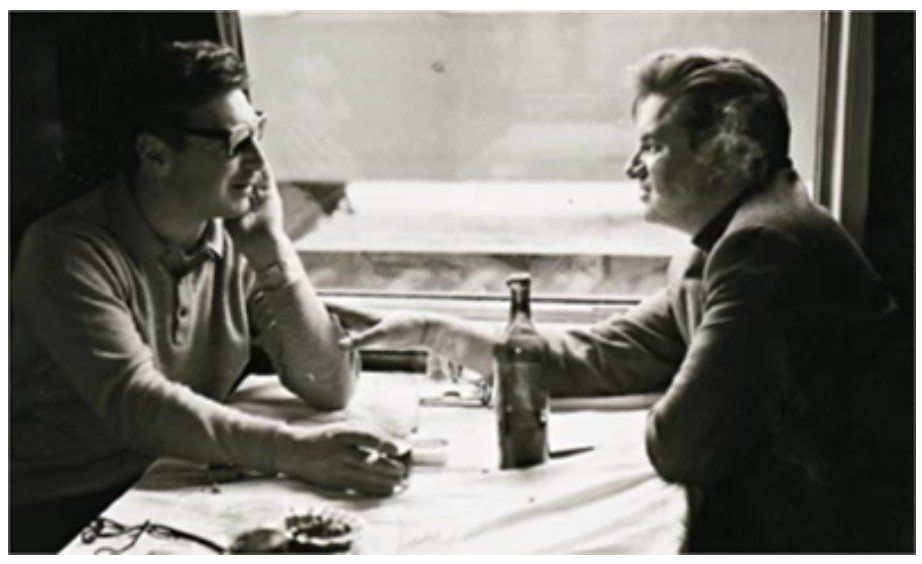
George Dyer and Francis Bacon on the Orient Express in 1965.
Photograph by John Deakin. Image: © John Deakin Archive / Bridgeman Images
Although eclipsed somewhat by her notoriety as a muse of various modern masters including Alberto Giacometti and Pablo Picasso, Isabel Rawsthorne was herself an accomplished and dedicated artist and set designer, whose own commitment to exploring the limits of the body pushed figuration into newly expressive territory in ways that resonated deeply with Bacon’s own artistic vision.
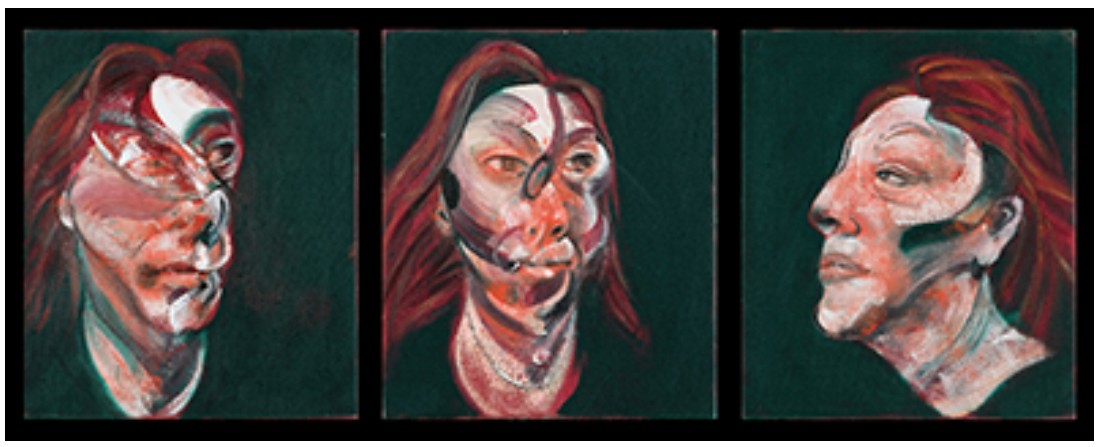
Francis Bacon, Three Studies for Portrait of Isabel Rawsthorne, 1965. Sainsbury Centre for Visual Arts, Great Britain.
Artwork: © 2025 Estate of Francis Bacon/Artists Rights Society (ARS), New York/DACS, London
Bacon and Rawsthorne had first met in Paris shortly after the Second World War, where she had been residing since 1934. It was when the two returned to London in the late 1940s that the deep bonds of their friendship were solidified, as regular denizens of Soho’s vibrant night scene and fixtures at Muriel Belcher’s Colony Room Club, where they would drink and discuss art, philosophy, and gossip long into the night. Sharing a deep sensuality and preference for the pleasures in life, she was amongst Bacon’s most trusted and respected confidantes.
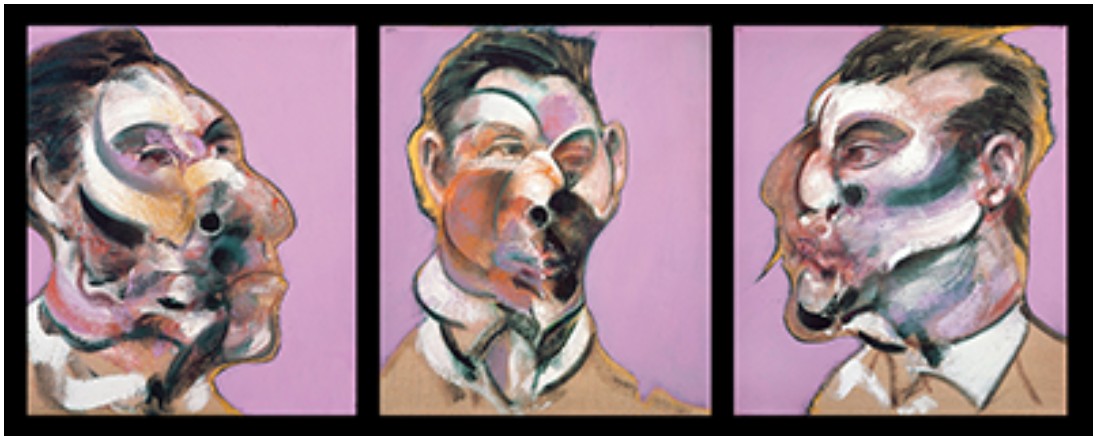
Francis Bacon, Three Studies of George Dyer, 1969. Louisiana Museum of Modern Art, Humlebæk.
Artwork: © 2025 Estate of Francis Bacon/Artists Rights Society (ARS), New York/DACS, London
Although Lucian Freud would later give a more prosaic account of Dyer and Bacon’s first meeting having taken place in a Soho club after Dyer offered to buy a round of drinks, a rich mythology soon developed around the conspicuous couple. By far the most colorful account of their initial encounter describes a housebreaking Dyer falling through the skylight of Bacon’s Reece Mews studio, surprising the artist and making off with a couple of his paintings, and speaks much more to Dyer’s colorful history and certain prejudices related to differences in their age and background than to historical accuracy. Muscular, with a prominent profile, thickly nasal Cockney drawl, and an air of criminality despite his elegant, Edwardian attire, Bacon was immediately captivated by Dyer, who would go on to become his principal subject through the remainder of the decade, producing three small-format triptychs within a year of their meeting. Both hailing originally from London’s East End, a place whose anti-establishment mythology and codes of family and honor impressed themselves deeply upon the more genteel Bacon, Rawsthorne and Dyer were perhaps understood by the artist as representing dual aspects of an intensely raw, existential condition, the perfect – and profoundly complementary – vehicles for his painterly “interrogation on the limits of the self.” Perhaps it was this duality – or, even more compellingly, the artist’s projection of two sides of himself onto these sitters – that led Bacon to experiment with combining their portraits in these diptychs.
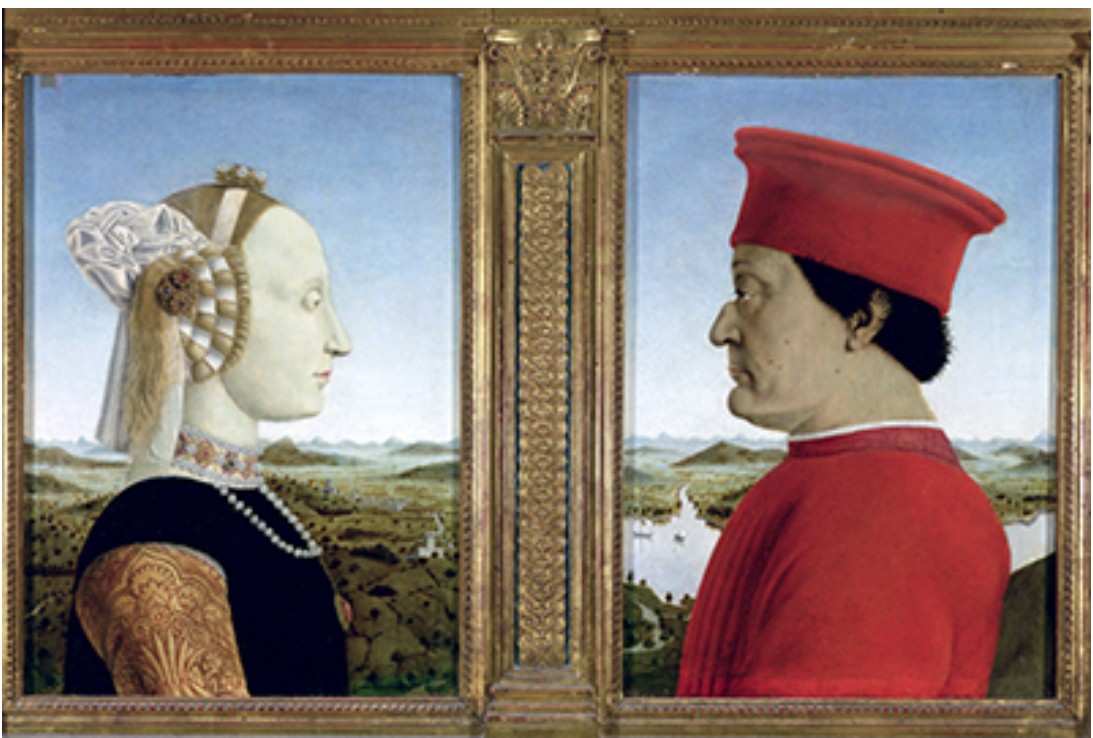
Piero della Francesca, Diptych of Federico da Montefeltro and Battista Sforza, 1473-1475, Uffizi Gallery, Florence. Image: Bridgeman Images
Rich in art historical associations, the diptych thrived in the Middle Ages as a devotional tool, featuring religious subjects and often hinged as private, portable objects. Adopted in more secular contexts during the early Renaissance in the mode of double-profile marriage portraits such as Piero della Francesca’s masterful Portraits of the Duke and Duchess of Urbino, 1465-1472, the treatment of two, facing figures speaks powerfully to notions of balance, union, and the resolution of disparate parts. Part of what makes Study for Head of Isabel Rawsthorne and George Dyer such a captivating and compelling work is its complication of this more illustrative tradition, the primary relationship explored not between the two sitters exclusively, but on Bacon’s own, more complex relationship to both. Without doubt, Rawsthorne and Dyer represented the two singularly most important figures in Bacon’s life during this period, and in this respect, it is worth noting the oft-quoted anecdote that Rawsthorne was the only woman with whom Bacon had been physically intimate, the two perhaps even representing a balance of masculine and feminine energies for the artist.
“I couldn’t [paint] people I didn’t know very well […] It wouldn’t interest me to try […] unless I had seen a lot of them, watched their contours, watched the way they behaved.”
The question of duality fascinated Bacon, and in his adoption of the diptych format we can trace the ways in which the artist formalized his investigations into the oppositional forces at work between certain individuals such as Dyer and Rawsthorne, or painters Freud and Frank Auerbach. Such conflicts or oppositions were not only interpersonal but allowed Bacon to probe the inner conflicts and contradictions of the soul, often staging more introspective reflections of his own, complex feelings towards a specific sitter. The intense rivalry and intimacy that existed between Bacon and Freud is especially loaded on this point, bringing forth some of Bacon’s most psychologically intense and compelling works. Meeting almost daily, the two exchanged ideas furiously, challenging each other to ever more ambitious heights. As with Rawsthorne and Dyer, Bacon painted Freud’s likeness repeatedly, producing some 17 portraits of his friend and fellow artist between 1951 and 1973.
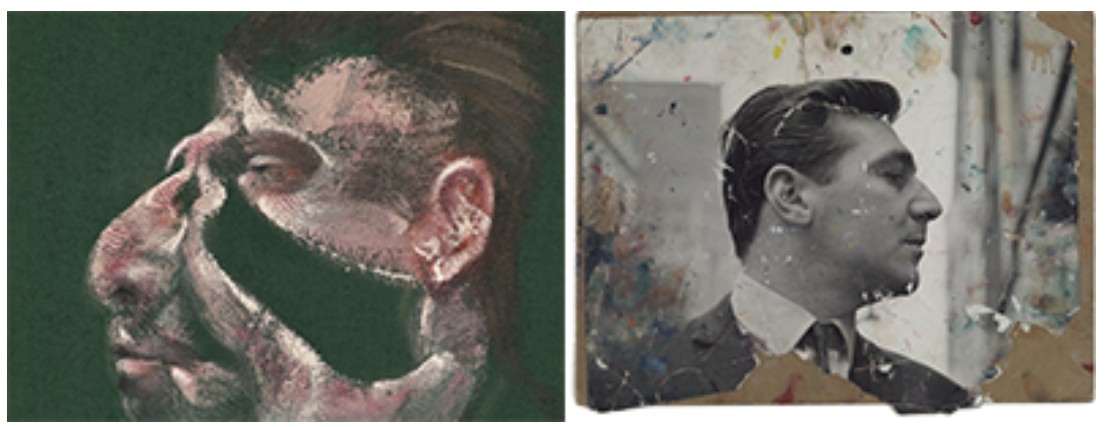
[Left] Detail of the present work.
[Right] George Dyer, c.1964. Photograph by John Deakin. Image: © John Deakin Archive / Bridgeman Images / The Estate of Francis Bacon. All rights reserved, DACS Images
Executed with an almost sculptural tactility in expressive sweeps of thick, heavily impastoed paint, the heads of Rawsthorne and Dyer emerge from a rich, forest-green ground, one that Bacon had made his own in an earlier series of works. Although facing the viewer, Rawsthorne’s gaze slides across to the unmistakable side profile of Dyer, an electrifying moment of connection that commands the living, breathing presence of these two figures into being. Profoundly tender, while Bacon’s uniquely deconstructive approach to form is masterfully deployed here, the violence so typically associated with Bacon’s painterly gesture is softened into a dignified, almost regal treatment of the two, the sensual sweep of Rawsthorne’s hair, sculptural planes of her face, and her intelligent, bright eyes counterbalanced by the pent-up energy and proud solidity of Dyer’s prominent profile. In this respect Study for Head of Isabel Rawsthorne and George Dyer succinctly captures the exquisite balance struck in Bacon’s finest work between distortion and the limits of our selfhood, of his unique skill in distilling and deconstructing the various physical, emotional, and psychological aspects of his subjects as a means of powerfully “conveying the mysterious aura of feeling- shaped flesh.”
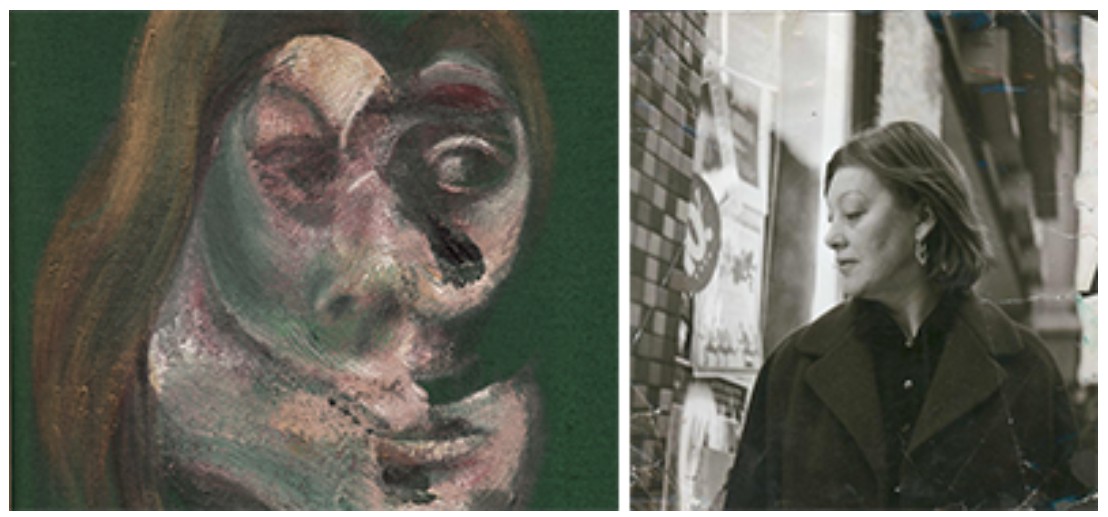
[Left] Detail of the present work.
[Right] Bacon studio material, Isabel Rawsthorne in Soho, c. 1965. Photograph by John Deakin. Collection Dublin City Gallery The Hugh Lane. Image: © John Deakin Archive / Bridgeman Images
Seemingly caught in motion, Bacon’s portraits were less interested in capturing physical movement than the quiver of a passing moment or imperceptible shattering of an internal shudder, a feature of his paintings radically extended in the diptychs and triptychs. Working from photographs — most infamously those taken by his friend and frequent Soho companion John Deakin which have survived, torn and paint-splattered records of the artist’s working practice — Bacon created a critical distance from his subjects, one that paradoxically better allowed him to reach the essence of their humanity.
“The living quality is what you have to get. In painting a portrait the problem is to find a technique by which you can give over all the pulsations of a person […] The sitter is someone of flesh and blood and what has to be caught is their emanation.”
A poignant and enduring tribute to two of the most important and constant forces in the artist’s life — two who defined his most celebrated decade — Study for Head of Isabel Rawsthorne and George Dyer powerfully illustrates the existential charge of Bacon’s portraiture, and the central role of his intimate circle of friends and lovers in achieving this.
Portrait of George Dyer Crouching, 1966
Sotheby’s New-York: 13 May 2024
Estimated: USD 30,000,000 – 50,000,000
USD 27,735,000
Portrait of George Dyer Crouching | Contemporary Evening Auction | 2024 | Sotheby’s (sothebys.com)
FRANCIS BACON (1909 – 1992)
Portrait of George Dyer Crouching, 1966
Oil on canvas
78 x 57 7/8 inches (198×147 cm)
Titledand dated 1966 (on the reverse)
If Francis Bacon’s art was defined by “the brutality of fact,” the attempt to get to the essence of human existence in all its forms, it was his portrayal of his lived experience through those closest to him which defined his finest work. George Dyer, Bacon’s greatest love and muse, provided some of the highest highs and lowest lows. It is his cycle of ten single-panel paintings executed during their dramatic, intertwined life together and the seminal Black Triptychs following his tragic early death which, in many ways, define Bacon’s vision. The very first painting in this cycle, Portrait of George Dyer Crouching, was executed in 1966 at the peak of their passion for each other. It inaugurates a critical cycle of ten monumental portraits that Bacon painted between 1966 and 1968, which sees George Dyer as a conduit of the full range of human drama that defined their love affair – vulnerable and brooding; romantic; heroic and tortured – and ultimately results in, for Martin Harrison, “one of the most unflinching, even harrowing serial portrayals in art history.” (Martin Harrison, ed., Francis Bacon Catalogue Raisonné, Volume III, 1958-71, London, 2016, p. 794)

GEORGE DYER AND FRANCIS BACON IN SOHO IN THE 1950S. PHOTO © JOHN DEAKIN, COLLECTION: DUBLIN CITY GALLERY THE HUGH LANE.
Coiled with unbridled energy and perched at the brink, Francis Bacon’s most iconic muse peers at his discarded shirt as if to stare at his own reflection. Afflicted with the awareness of self, his ever-shifting head turns towards us, threatening to fade into total oblivion before a mystical, textured, ivory background. The central focus of the painting is the astonishing head at its heart. With his unwinking eye at its central axis, George Dyer’s head flickers in a tripartite movement: in simultaneity, he turns into the left, twists outward towards the right, and even merges with Bacon’s own face at the center. The eye, we realize, is Bacon’s own. Executed with a technical mastery of paint virtually unmatched in history, Bacon takes Cubist Picasso into a vastly more complex material realm, overlaying sequential images which become almost filmic, eruptive brushstrokes, dabbing his corduroy jacket full of paint to create a material texture, and throwing paint at the canvas with an extraordinary control and mastery which evoked that of his relationship with Dyer. It is arguably one of his greatest portrayals of not only the human head, but also the human condition.

Testifying to the supreme rarity and quality of this suite of portraits that Bacon created of George Dyer, three are now held in international museum collections, including Foundation Beyeler, Riehen; Sara Hildén Art Museum, Tampere; and Thyssen-Bornemisza National Museum, Madrid. Tragically one of the paintings was destroyed in a fire, which leaves just six left in private hands. Debuting at Bacon’s seminal 1966 solo exhibition at Galerie Maeght, Paris, Portrait of George Dyer Crouching has since been shown in some of the artist’s most significant exhibitions, including his 1971 retrospective held at the Grand Palais, Paris – the scene of Dyer’s final tragedy – and, most recently, the 2022 exhibition Man and Beast at the Royal Academy of Arts, London.
As the first monumental single portrait that Bacon executed of Dyer, Portrait of George Dyer Crouching bears a visual intensity that is commensurate with the level of passion shared between the two. Bacon expresses their romantic entanglement most literally in Dyer’s head, which vigorously amalgamates with his own at its center. A flurry of scumbled painterly marks spirals into Bacon’s singular eye, which directly confronts the viewer as it is superimposed onto Dyer’s head. Partially obliterated, partially fused with Bacon’s own face, Dyer’s head then mutates in three distinct yet overlaid phases that together evoke the brusque velocity of a man eyeing his surroundings relentlessly. Dyer’s visage emerges from the projectile paint that Bacon has daringly launched onto the canvas, reminiscent of his instinctive techniques that define such later paintings as Study for Bullfight No.2 from 1969, where the artist exercises painterly risks upon the surface to capture the spontaneity of sudden movement. As Andrew Forge observes of Dyer’s physicality here, “At once, the figure and head emerge from formlessness and fall into detailed organization. The weight and thickness of the thighs, the downward stretch of the arm, the massive crest of muscle across the shoulders, the motionless concentration of the lowered head, all seem to leap out of the paint, triggered by the hard saurian eye which, as with some fantastic knobbly lizards, seems to be embedded like a living jewel in material that follows another order of form.” (Andrew Forge, Exh. Cat., London, Tate Gallery, Francis Bacon, May – August 1985, p. 29)

LEFT: CHAIM SOUTINE, CARCASS OF BEEF, 1926. IMAGE © MINNEAPOLIS INSTITUTE OF ART / GIFT OF MR. AND MRS. DONALD WINSTON AND AN ANONYMOUS DONOR / BRIDGEMAN IMAGES. RIGHT: MARK ROTHKO, NO. 9 (WHITE AND BLACK ON WINE), 1958. IMAGE © GLENSTONE, POTOMAC, MARYLAND. ART © 1998 KATE ROTHKO PRIZEL & CHRISTOPHER ROTHKO / ARTISTS RIGHTS SOCIETY (ARS), NEW YORK
Like cages in Bacon’s paintings, the spatial organization in Portrait of George Dyer Crouching encloses the carnal specimen of Dyer squarely within the composition and sharpens his animalistic energy into greater focus. Divided into lateral sections throughout the canvas, the compositional structure recalls the aesthetic influence of Abstract Expressionism, which Bacon interpreted with resolute realism. At the center left edge, Bacon reinterprets a coffee table as the diving board on which Dyer crouches by carving this out with a section of raw canvas left unprimed and unpainted. Meanwhile, the threefold distortion of Dyer, chromatic palette of lavish beige and brown, and circular construction in the present work finds its foundations in Bacon’s earlier 1964 triptych Three Figures in a Room – his first ever depiction of Dyer, wherein “the outer panels depict George Dyer, sexualized in the first flush of Bacon’s relationship with him,” according to Martin Harrison, “while in the center panel Dyer’s portrait is morphing with Bacon’s,” (Harrison, Op. Cit., p. 760). The elliptical floor extending across this triptych warps into a similarly surreal banquette below Dyer in the present work, which, according to scholar John Russell, is “a sofa of modish design – salvaged, conceivably, from one of Bacon’s forays into the furniture-shops. But as treated by him, it turns into a blocked-up well: a well-upholstered point of no return.” (Russell, Op. Cit., p. 62) This rusty-colored cylindrical structure is replete with additional art historical references: it is reminiscent of Muybridge’s zoopraxiscope; the tubs found in Degas’s paintings of bathing women; the photographs of operating theaters illustrated in medical books by which Bacon was fascinated; or, according to art historian Margarita Cappock, the baptismal baths found in the center of the Temple of Jupiter, an archaeological complex located in present-day Rome.
Study of George Dyer, 1970
Sotheby’s London: 6 March 2024
Estimated: GBP 5,000,000 – 7,000,000
GBP 6,829,100 / USD 8,659,299
FRANCIS BACON (1909 – 1992)
Study of George Dyer, 1970
Oil on canvas
14×12 inches (35.5 x 30.5 cm)
Titled and dated 1970 (on the reverse)
Charged with extraordinary intimacy and emerging from a seductive dark ground, Francis Bacon’s Study of George Dyer is a masterpiece of intense physiognomic analysis that perfectly summates his incredible working process. Within the grand theatre of Bacon’s life and work, George Dyer inhabits a position of paramount importance. Appearing in over forty paintings, with as many created following his death as executed during his lifetime, Dyer wields a power unlike any other. His portrayal spans the full extent of human drama: at once vulnerable, brooding, romantic, surreal, heroic and tortured Bacon’s painterly incarnations of Dyer reveal a multifaceted, tempestuous and passionate love affair. Painted in early 1970, during a period of exceptional turmoil in their relationship, this mutating and vibrant portrait combines masterfully scumbled, scraped and diffused painterly bravura with arresting intensity and consummate psychological depth.
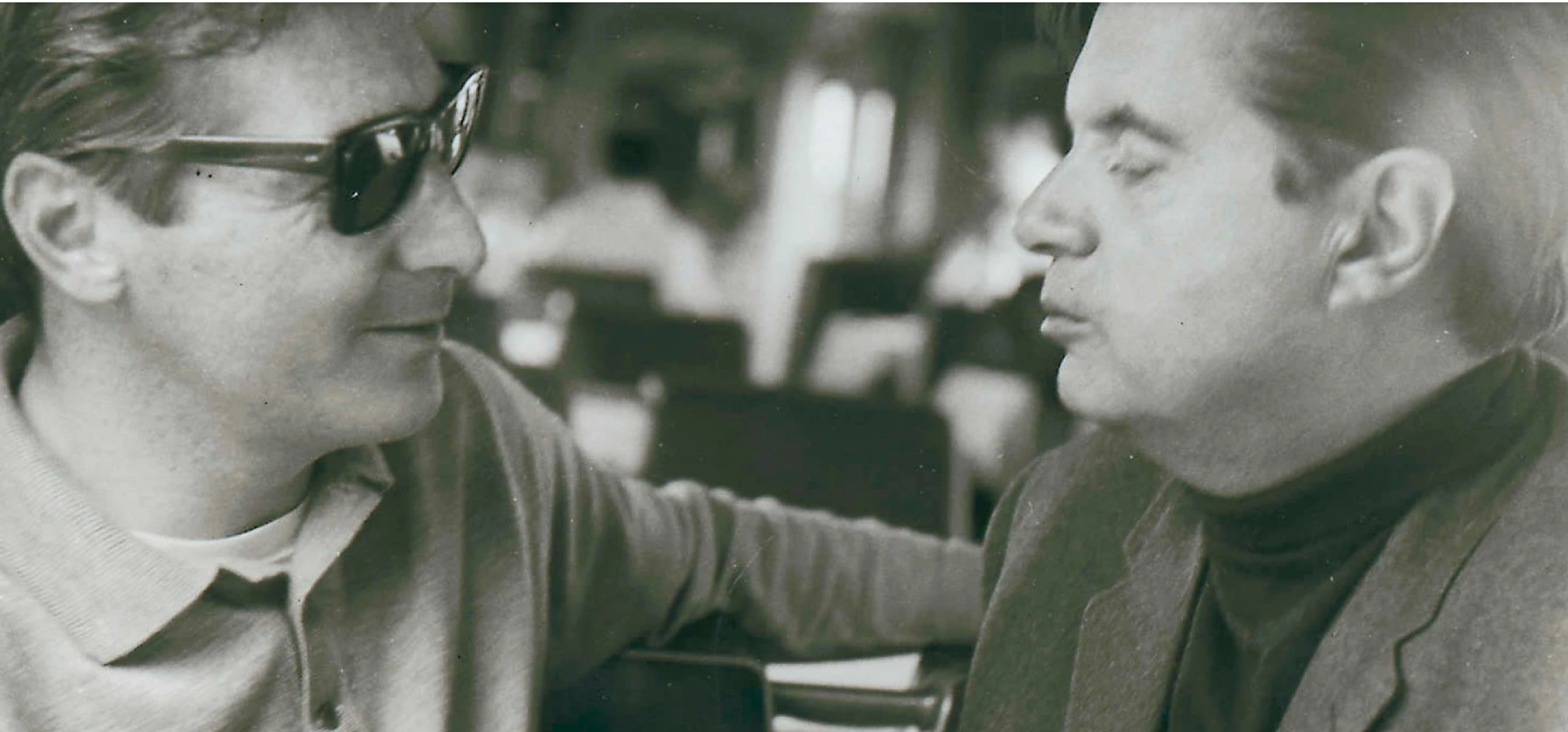
BLACK AND WHITE PHOTOGRAPH OF FRANCIS BACON AND GEORGE DYER ON THE ORIENT EXPRESS, 1965 PHOTO: JOHN DEAKIN COLLECTION: DUBLIN CITY GALLERY THE HUGH LANE © THE ESTATE OF FRANCIS BACON / DACS 2024
Not only is the present work outstanding in its execution, presenting a virtuosity of brushwork and exuberance of colour that rivals any other masterpiece the artist produced, but it is also extraordinarily rare, as the very last intimately scaled portrait of Dyer completed before his tragic death the following year. It serves as an apt counterpoint to the so-called ‘Black Triptychs’ of the early and mid-1970s that commemorate Dyer, which are widely considered to be among the greatest triumph of Bacon’s whole output. An exceptional work therefore that possesses an equally exceptional exhibition history, Study of George Dyer was hand chosen by the artist for inclusion in the single most important exhibition in Bacon’s lifetime, the grand scale retrospective held at the Grand Palais in 1971 (an accolade only previously afforded to Pablo Picasso among living painters). Tragically, this apogee in Bacon’s career would be the catalyst for Dyer’s inevitable demise: on the eve of the opening, he was killed by an overdose of barbiturates. Thus the present work—the last portrait electrified by the fervour of Bacon’s passion for his living lover—remains an incredibly rare gemlike composition that exudes emotion, vitality and an ardor that has immortalised both Bacon’s deep infatuation with his muse as well as his inimitable style.
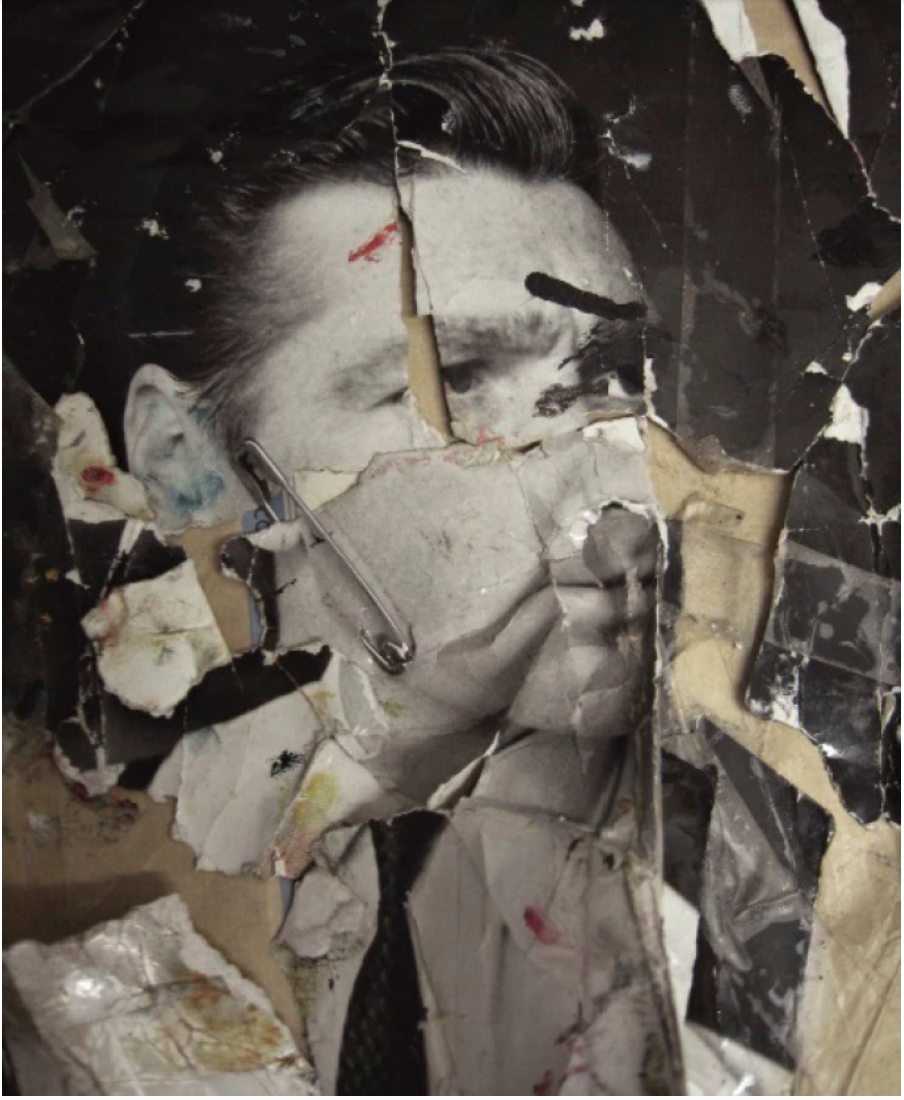
PHOTOGRAPH OF GEORGE DYER, MANIPULATED BY FRANCIS BACON AND MOUNTED ON AN ENVELOPE, C. 1965. PHOTO: JOHN DEAKIN COLLECTION: DUBLIN CITY GALLERY THE HUGH LANE © THE ESTATE OF FRANCIS BACON / DACS 2024
The compositional catalyst for this work was a series of photographs of Dyer taken by John Deakin in Soho in about 1964. Bacon had commissioned Deakin to capture a multitude of images of his most frequent sitters, as he preferred to paint in absentia relying predominantly on the combination of photographic material and memory to inform his image creation. He viewed painting by nature as an artifice and felt that having the model before him suffocated spontaneous creative invention. In the way it both correlates with and departs from its source Bacon’s painting is one of the most sophisticated uses of photography in the history of painting. As a surviving eulogy to the Bacon-Dyer relationship, this work’s rarity is amplified by Bacon’s practice of destroying any canvas that he deemed unsatisfactory. Indeed, despite one hundred and twenty-nine photographs of Dyer being found in Bacon’s studio after the artist’s death, a number vastly exceeding that for any other subject, this painting is one of only two known designated portrayals of Dyer in this single fourteen- by twelve-inch format. Of this jewel-like size, John Russell has said, “The single head, fourteen inches by twelve, was from 1961 onwards the scene of some of Bacon’s most ferocious investigations. Just as a gunshot sometimes leaves an after-echo or parallel report, so these small concentrated heads carry their ghosts within them” (John Russell, Francis Bacon, London, 1993, p. 99). As a result, these extraordinarily rare small portraits of Dyer represent a life-force that with his passing, were never to return.
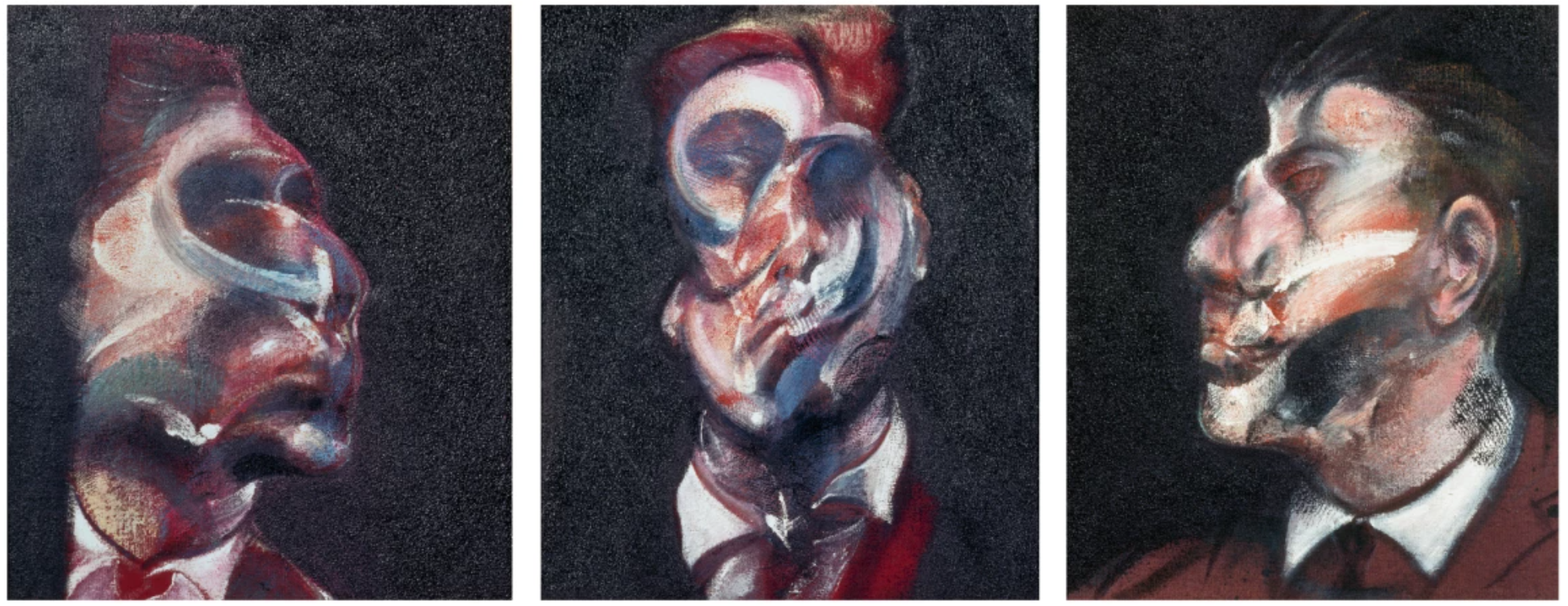
FRANCIS BACON, THREE STUDIES OF GEORGE DYER, 1966. SOLD SOTHEBY’S NEW YORK, NOVEMBER 2017 FOR $38.6 MILLION. © THE ESTATE OF FRANCIS BACON. ALL RIGHTS RESERVED. / DACS, LONDON 2024
Bacon’s radical handling of paint and perspective was profoundly inspired by his voracious devouring of canonical precedent. With ferocious alacrity, he consumed and digested the pictorial conventions of masterpieces and the terms of their execution. Whether cast from mythical allegory, classical Antiquity or contemporary culture, devices invented by such masters as Michelangelo, Rembrandt, and Pablo Picasso, to name but a few, provided supreme examples of psychological cross-examination and perspective. Bacon spoke most admirably of Picasso, especially his work of the 1920s and 1930s, in which he saw a syntax of “organic form that relates to the human image but is a complete distortion of it” (the artist quoted in: Milan Kudera and France Borel, Bacon: Portraits and Self-Portraits, London 1996, p. 10).
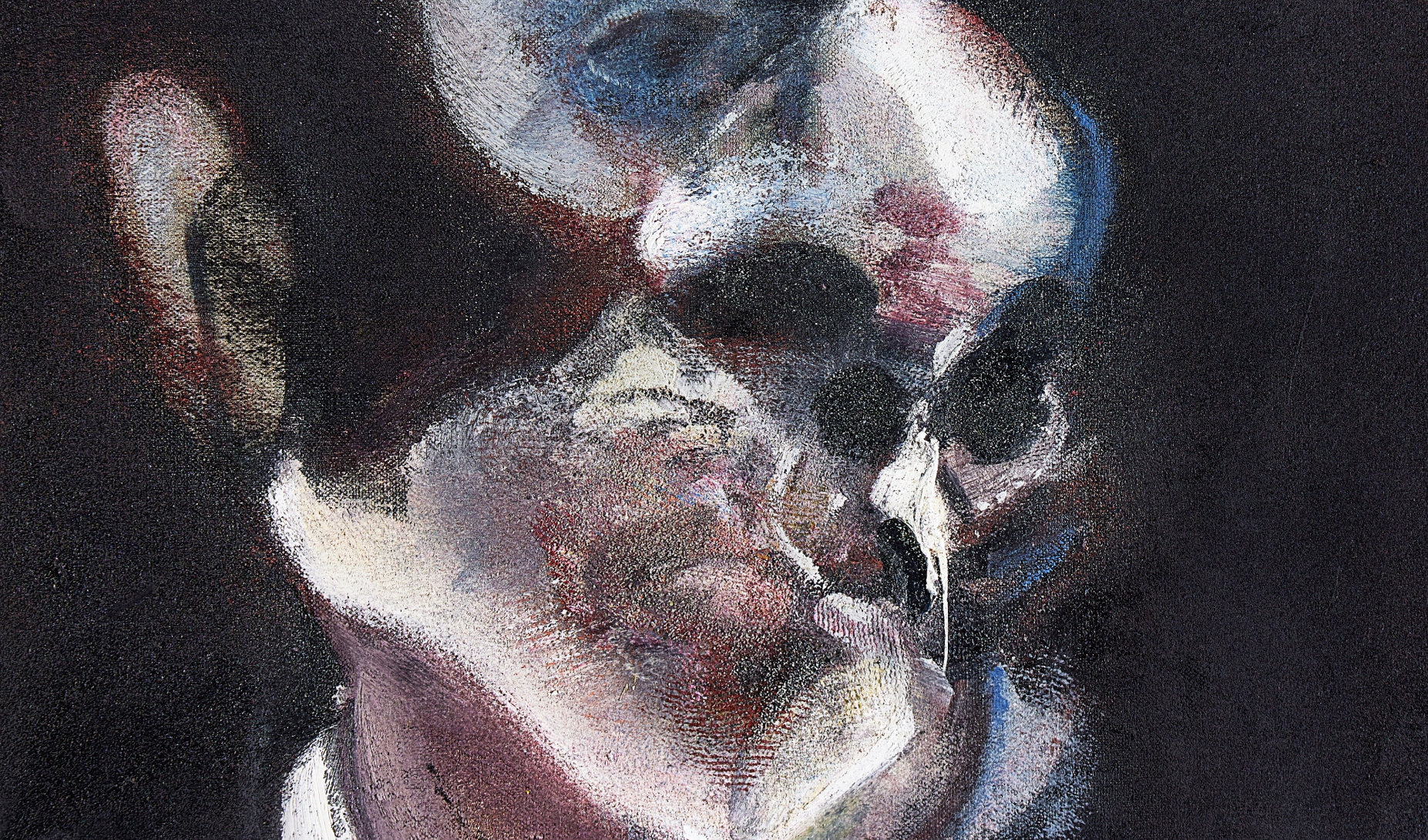
Furthermore, renderings by such titans as Picasso, Vincent Van Gogh, and Alberto Giacometti were influenced by subjective experiences of their deeply familiar sitters, often chosen from a small circle of family and friends, and repeatedly depicted. Indeed, David Sylvester has described how “Bacon had something of Picasso’s genius for transforming his autobiography into images with a mythic allure and weight” (David Sylvester, Looking Back at Francis Bacon, London 2000, p. 186), and Study of George Dyer superbly projects personal experience from Bacon’s microcosmic realm onto the macrocosmic stage of global relevance. On the one hand it is devoted to the character and psychology of George Dyer, yet from another it is a metaphor for inner conflict. As a symposium of virtuoso expression and profound universality, Study for George Dyer is poised between chaotic immediacy and syncopated rhythm that finds few parallels within Bacon’s pantheon of small portrait studies.
Figure in Movement, 1976
Christie’s New-York: 9 November 2023
Estimate On Request
USD 52,160,000
FRANCIS BACON (1909-1992) (christies.com)
FRANCIS BACON (1909-1992)
Figure in Movement, 1976
Oil and dye transfer lettering on canvas
78 1/4 x 58 inches (198.9 x 147.3 cm)
Signed and dated ‘Francis Bacon 1976’ (on the reverse)
Standing among the great icons of Francis Bacon’s oeuvre, Figure in Movement is an extraordinary meditation on love, loss and the transience of the human condition. Painted in 1976, it takes its place within the canon of masterworks that followed the tragic death of his beloved George Dyer in 1971. Described by the critic David Sylvester as the greatest large single canvas produced during these years, it is a staggering image of human flesh in motion. A visceral tangle of limbs is suspended within an empty arena, shot through with the influence of Michelangelo and Muybridge. A circle magnifies the figure’s face, fusing hints of Dyer’s likeness with fleeting echoes of Bacon’s own. Illegible fragments of text spill onto the fiery orange ground like literature. In the corner hangs a bird-like spectre, referencing the ancient Greek “Furies” that had long haunted Bacon’s art. Conversant with the elegiac “black triptychs” that had dominated the artist’s output since Dyer’s death, it is a work of near-operatic grandeur: a fantasy of bodies entwined before the abyss, an image of life illuminated against the void, and a portrait of flesh on the brink of transcendence.
With an outstanding exhibition history that includes landmark retrospectives at the Tate Gallery, London, the Museo Correr, Venice and the Centre Georges Pompidou, Paris, Figure in Movement has been widely celebrated in scholarship. For Sylvester, whose seminal interviews with Bacon were published the year before the painting, it was a monument “to George Dyer’s tragic fall, in which a whole range of Baconian devices are brought together with a compelling mastery” (D. Sylvester, Francis Bacon in Dublin, exh. cat. Hugh Lane Municipal Gallery of Modern Art, Dublin 2000, p. 109). For Martin Harrison, author of Bacon’s catalogue raisonné, it is one of the artist’s “quintessential images of entropy, a boldly-colored masterpiece of disorder and inquietude” (M. Harrison, Francis Bacon Catalogue Raisonné: Volume IV 1971-92, London 2016, p. 1090). The poet Yves Peyré, meanwhile, wrote that “This picture paints man’s sui generis destiny … In the vehemence of its efficiency, this painting has the import of a treatise. It would be easy to think that few paintings could compare to this wonder” (Y. Peyré, Francis Bacon or The Measure of Excess, London 2019, p. 232).
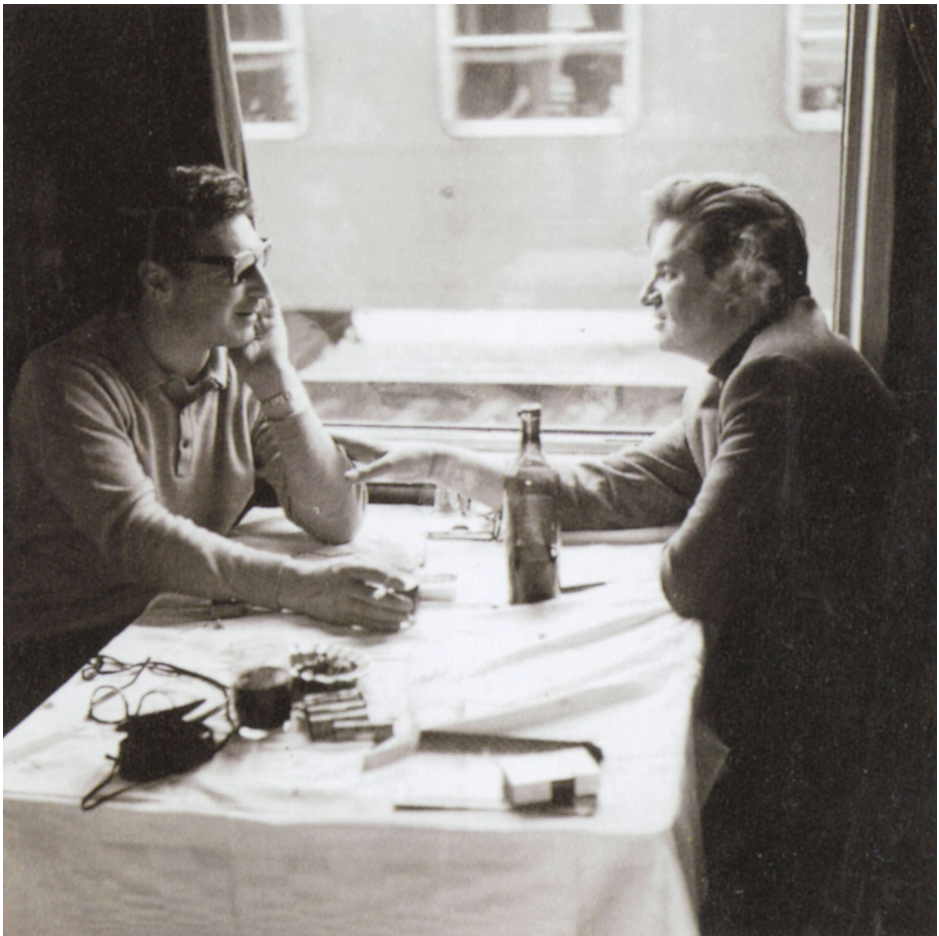
Francis Bacon and George Dyer on the Orient Express Train to Athens, 1965. Photo: John Deakin. © The Estate of Francis Bacon. All rights reserved / DACS, London / ARS, New York 2023.
Bacon was fascinated by movement. He was particularly inspired by cinema and photography—most notably the work of Eadweard Muybridge, whose images captured moving figures in successive frames. Since the dawn of his practice Bacon had set out to paint what he described as the “emanation” of his subjects: the pulsations of energy that flowed through their veins and sent their spirit out into the world. He, in turn, drew heavily upon the motions and impulses of his own nervous system, seeking—as he put it—to “trap this living fact alive.” In the present work, his figure descends into metamorphosis. Harrison, in his commentary on the painting, invokes what the philosopher and Bacon scholar Gilles Deleuze termed “derisory athleticism”: a state of chaos, in which the flesh seems to escape its own confines. Like the Futurists’ depictions of speed, or Marcel Duchamp’s Nude Descending a Staircase, the body is fixed in multiple positions simultaneously. The figure seems to float in free-form through time and space, his flesh sublimated by forces beyond his control.
Three Studies for a Portrait of George Dyer, 1963
Christie’s New-York: 17 May 2017
Estimate on Request
USD 51,767,500
Francis Bacon (1909-1992) (christies.com)
FRANCIS BACON (1909-1992)
Three Studies for a Portrait of George Dyer, 1963
Triptych, oil on canvas
Each: 14×12 inches (35.5 x 30.5 cm)
Titled and dated ‘3 Studies For Portrait of George Dyer 1963.’ (on the reverse of the center canvas)
Three Studies for a Portrait of George Dyer is the very first portrait Francis Bacon painted of his greatest muse. Executed in 1963, this mesmeric triptych was completed mere months after Bacon first met George Dyer, a handsome petty thief from London’s East End. It marks the inception of their turbulent and ultimately tragic relationship. The encounter between the two lovers was transformative, with Dyer becoming to Bacon what Dora Maar famously was to Picasso. His masculinity and muscularity, his sexual aura and anxious persona, acted as a wellspring for pictorial breakthroughs that helped stake Bacon’s claim as one of the 20th-century’s most celebrated artists. This triptych is the beginning of a journey that saw Bacon paint Dyer’s face and body obsessively for many years. Dyer would appear in at least 40 of Bacon’s paintings, many of which were created after his death in Paris in 1971, barely 36 hours before Bacon’s major retrospective opened at the Grand Palais. The convulsive beauty of the present work represents the flowering of Bacon’s infatuation with the man portrayed and is only one of five triptychs of Dyer that the artist painted in this intimate scale. This example is unique among them, as it does not depict the white shirt and sharp suit that Dyer invariably wore. Instead, the head and neck emerge disembodied from the darkness—explosive, agitated, naked, and unmoored from spatial or temporal reality.
Portrait of George Dyer Talking, 1966
Christie’s London: 13 February 2014
Estimate on Request
GBP 42,194,500 / USD 70,279,422
Francis Bacon (1909-1992) (christies.com)
FRANCIS BACON (1909-1992)
Portrait of George Dyer Talking, 1966
Oil on canvas
78×58 inches (198.2 x 147.3cm)
Titled and dated ‘Portrait of George Dyer Talking 1966’ (on the reverse)
Painted in 1966, Portrait of George Dyer Talking (1966) is a glowing tribute to George Dyer, Bacon’s great lover and muse. The subject of some of Bacon’s most arresting portraits including Two Studies of George Dyer (1968) (Art Museum Ateneum, Helsinki), Portrait of George Dyer in a Mirror (1968) (Museo Thyssen-Bornemisza, Madrid), and Portrait of George Dyer Riding a Bicycle (1966) (Fondation Beyeler, Basel), it was this man who was to dominate the artist’s greatest decade in paint: the 1960s. Even on the eve of the artist’s major retrospective at the Grand Palais, Paris in 1971, an occasion which marked his career’s achievements, it was Dyer who was to mark the occasion, tragically taking his life just hours before the opening. Bacon subsequently painted the seminal black triptychs: Triptych – In Memory of George Dyer (1971) (Foundation Beyeler, Basel), Triptych. August (1972) (Tate Gallery, London) and Triptych. May-June (1973) in posthumous tribute to his lover. These paintings, which still reverberate with an acute intensity, were Bacon’s attempts at catharsis, exorcising the anguish and guilt in iterative portraits. Rendered against a regal palette of ruby red and luxuriant swathes of lilac, Portrait of George Dyer Talking reaches its climax with the figure, which appears almost incandescent and brimming with nervous energy. In this painting, Bacon has situated the figure of Dyer at the center of a revolving room; the walls, floor and ceiling forced to curve like a centrifuge. Under the heady momentum, the body of Dyer appears to unravel like cotton from a spinning bob, his very essence seeping out from his outstretched limb onto the scattered cluster of papers littering the floor. His torso appears to undergo some extreme torsion while his head revolves, whipping around to the left and forcing open his jaw.
Lucian Freud
Study for Portrait of Lucian Freud, 1964
Sotheby’s London: 29 June 2022
Estimate on Request
GBP 43,336,000 / USD 52,817,090
FRANCIS BACON (1909 – 1992)
Study for Portrait of Lucian Freud, 1964
Oil on canvas
198 x 147.5 cm (78×58 inches)
Executed in 1964, Study for Portrait of Lucian Freud exemplifies an iconic pairing of two of the most significant painters within the canon of twentieth-century art. Last seen by the public during a travelling exhibition in Hamburg, Stockholm and Dublin between January and May 1965, the present work is testament to Francis Bacon’s capacity to provoke emotion and capture in paint the complexities of the human psyche. Study for Portrait of Lucian Freud illuminates a powerful dialogue rarely matched in history: The great friendship and epochal rivalry between Bacon and Freud that lasted from 1944 until the apex of their artistic sparring in the mid-1980s. Though their visual styles differed considerably throughout their respective oeuvres, both painters were deeply committed to the human figure. They sat for each other on multiple occasions; Bacon painted Freud fourteen times between 1964 and 1971, in a combination of two small panels, four large panels (one destroyed), two small triptychs, three large triptychs (of which the present work was part) and part of larger compositions. Indeed, the present painting was originally part of one of only three full-length triptychs measuring 1.9 metres in height, depicting a restless Freud in alternating poses within differing architectural spaces. Study for Portrait of Lucian Freud is only comparable in its excellence to Bacon’s masterpieces Double Portrait of Lucian Freud and Frank Auerbach (1964, Moderna Museet, Stockholm), Three Studies for Portrait of Lucian Freud (1966, Private Collection), and Three Studies of Lucian Freud (1969, Private Collection).
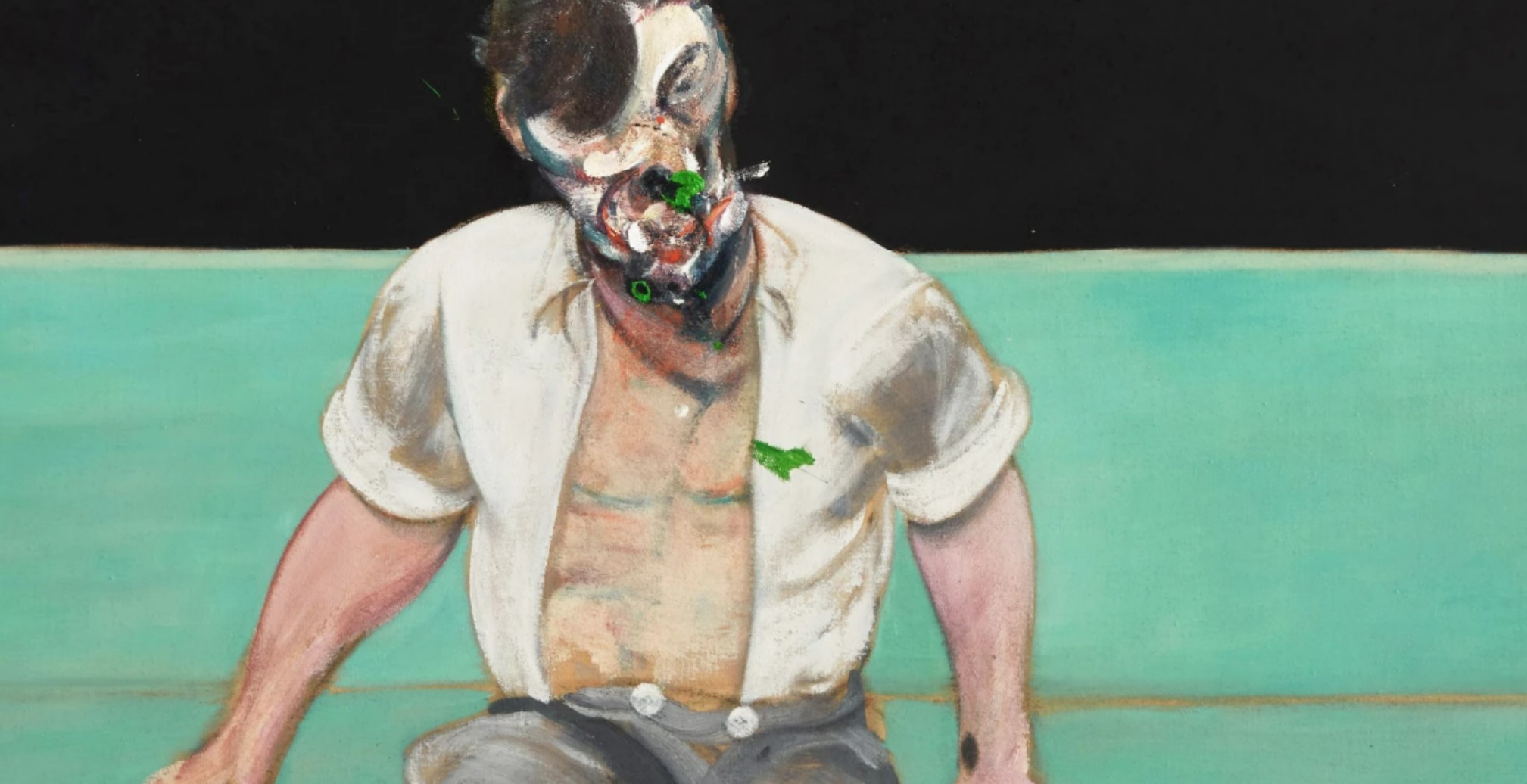
The thick bands of exuberant and alternating colour on the surface of the present work unquestionably reveal the influence of the expansive colour-field canvases of Barnett Newman and Mark Rothko, which Bacon would have seen at The New American Painting exhibition at the Tate Gallery in 1959. The broad, horizontal bands of black and sea green evoke Barnett Newman’s sublime vertical stripe or ‘zip’ paintings, such as Abraham (1949) and Concord (1948) which were both included in the 1959 Tate show. Such colouristic compositions clearly held enduring appeal for Bacon and the bands of colour on the surface of Study for Portrait of Lucian Freud help create an illusion of depth. Here, perspective is simplified into a confined, flattened space, the bench painted with swathes of rich sea green and positioned against a matte black ground. In rich blue and green hues, the lower third of the composition is thickly worked, and the imprint of corduroy can be seen across this highly textured area; Bacon employed corduroy as a painting material throughout his oeuvre, and the texture can be found on the door of his Reese Mews studio, which suggests the he applied the oil paint from the tube first to the studio door, and then printed the corduroy and set it against the canvas. These painterly passages recall the abstracted, spatially ambiguous compositions of Monet’s water lilies in an instantly recognizable color palette of blue, green and lilac. As Martin Harrison writes in the artist’s catalogue raisonné, “The textured carpet is the closest Bacon came to reprising Monet’s Nymphéas” (Martin Harrison, ed., Francis Bacon: Catalogue Raisonné, Volume III, 1958-71, London, 2016, p. 752). Bacon’s gestural daubs of oil paint are accented by flecks of white, the impressionistic surface fully recalling Monet’s celebrated triptychs such as Water Lilies (1914-26) now in the collection of The Museum of Modern Art, New York.
Three Studies of Lucian Freud, 1969
Christie’s New-York: 12 November 2013
Estimate on Request
USD 142,405,000
Francis Bacon (1909-1992) (christies.com)
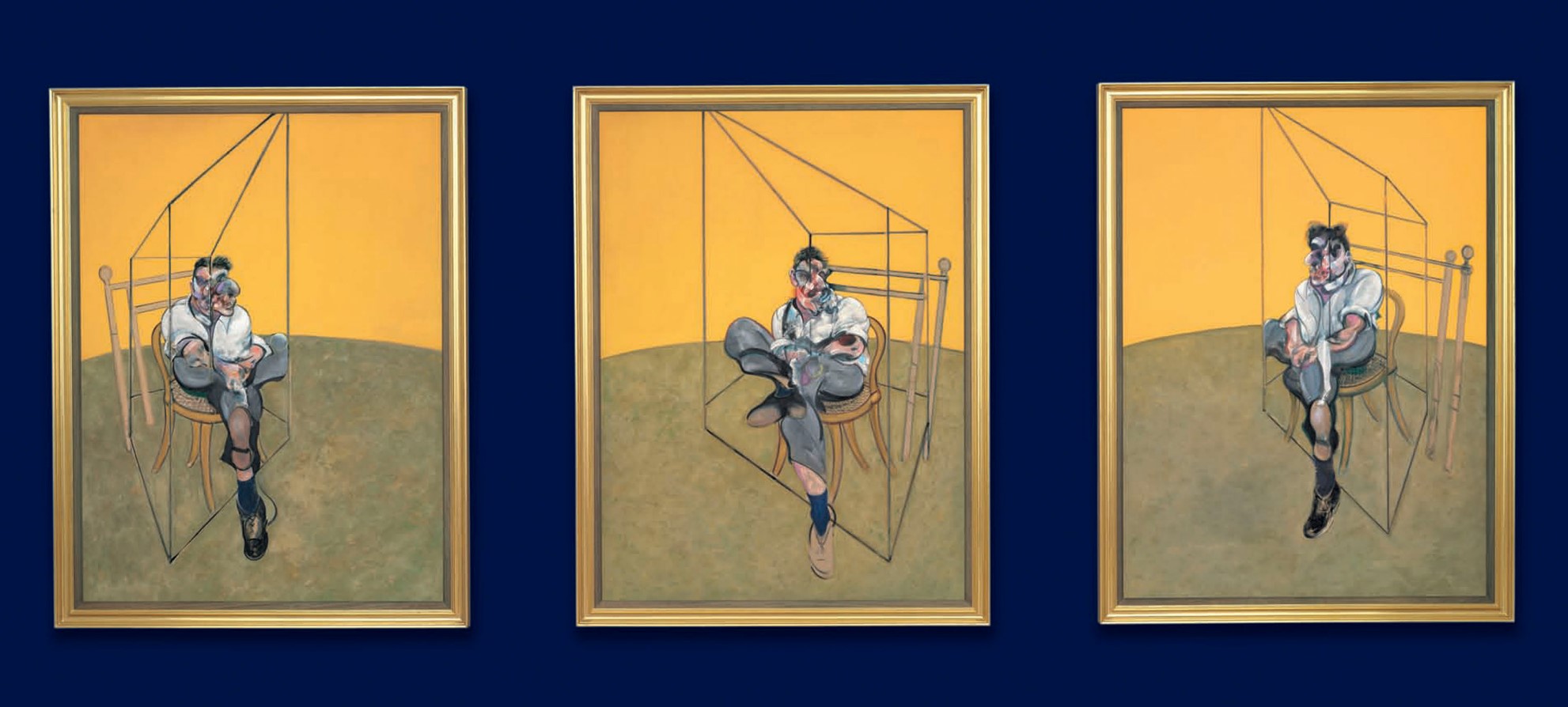
Francis Bacon (1909-1992)
Three Studies of Lucian Freud, 1969
Oil on canvas, in 3 parts
Each: 78×58 inches (198 x 147.5 cm)
Titled and dated ‘3 studies for portrait Lucian Freud 1969’ (on the reverse of the center panel)
An undeniable icon of twentieth century art, the masterpiece triptych Three Studies of Lucian Freud (1969) marks the epic culmination of Francis Bacon’s relationship with fellow painter and chronicler of the human condition, Lucian Freud. Glowing in a palette of sunshine yellow and carried out in Bacon’s celebrated triptych format, the towering, life-size painting pulses with vitality. With each masterful sweep of the brush, Bacon has animated his friend, Freud being seen to restlessly reposition himself, pivot his raised foot, kneed his hands in his lap and rotate his head from canvas to canvas. Reincarnated in paint, we are invited to get up close and personal with Freud.
In Three Studies of Lucian Freud, Bacon has combined with characteristic alacrity, a vital human form with a precise description of the architecture of space, and explosive, stochastic outbursts of thick texture. One of the greatest artistic friendships and rivalries of the twentieth century, the trajectory of their relationship over nearly half a century, from the moment of their introduction through Graham Sutherland in early 1945, goaded each man to greater levels of excellence in the field of figurative painting. Painter to painter, their practices impacted one another, as did their characters: Bacon finding a compliment to his own charismatic but capricious nature in Freud’s confident and considered manner. Just as Freud’s intimate portrait of Bacon painted in 1952, tragically stolen from the Tate collection while on display in Berlin in 1988, stands as one of the artist’s greatest achievements, so Three Studies of Lucian Freud an be understood to be one of Bacon’s greatest masterpieces.
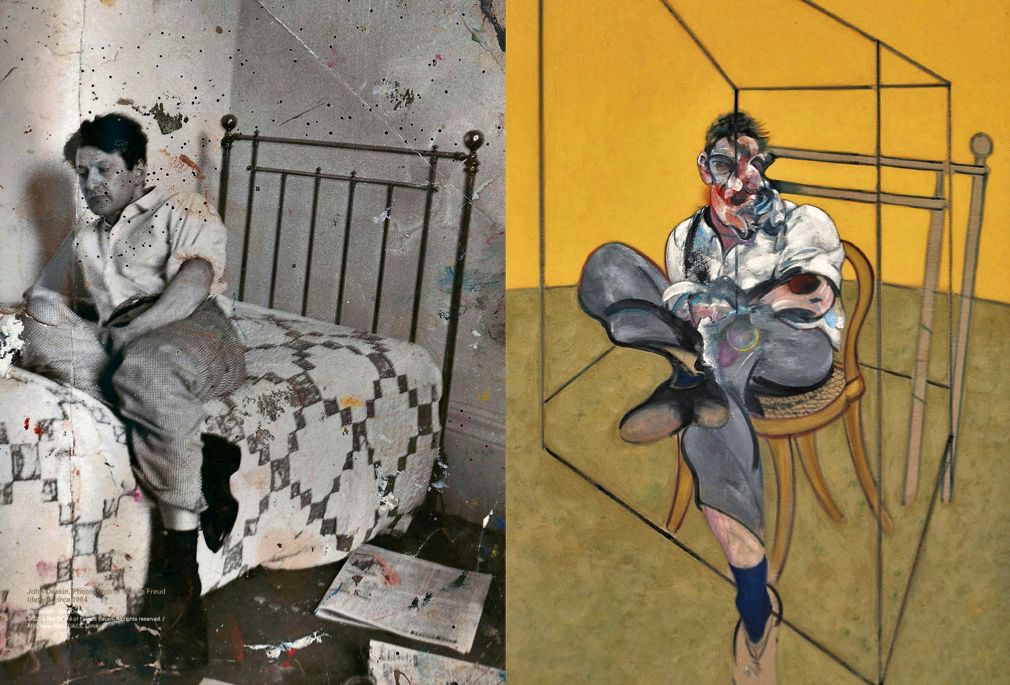
A golden masterpiece, the three paintings of Three Studies of Lucian Freud form a near-devotional trinity to Freud: friend and foil, confidant and rival. Each exceptional in their own right, the paintings are spectacularly resolved and harmonious in unity, from left to right teaming with life in every brushstroke. Bacon has animated every one of his figures: the lean, sculpted limbs and lithe figure of Freud flowing with smooth gestures of the brush, while each face courses with energy and attitude lent by impulsive, staccato dashes of color. The scene for each painting is set up with precision, Bacon carefully establishing the radiant colored ground and building clean, crystalline prisms, to then rapidly establish the figure, using his free but controlled hand with extraordinary facility. It is along this fine knife’s edge of calculated contingency that Bacon operates, balancing his fury and his flair with the paintbrush to ‘clinch the image’. In each image, Freud is wearing a white shirt rolled up to its sleeves. His hands disappear into his lap as Bacon’s attention turns to the flowing contours of the forearm and smooth curve of the thighs and calf. In every painting, the soles of Freud’s leather-clad brogues turn up to confront the viewer, while in two paintings, left and center we catch a glimpse of bare skin, as the artist’s trouser leg rises above the tidal mark of his navy blue sock. The cane-bottomed chair belongs to Bacon’s studio, but he has also incorporated the headboard from the bed in John Deakin’s photo shoot, to create a clean, linear backdrop to the drama of the figure.
Self-Portraits
Self-Portrait, 1972
Masterpieces from the Lewis Collection
Sotheby’s London: 4 March 2026
Estimated: GBP 8,000,000 – 12,000,000
GBP 16,035,000 / USD 21,421,155
Self-Portrait | Modern & Contemporary Evening Auction | 2026 | Sotheby’s
FRANCIS BACON (1909 – 1992)
Self-Portrait, 1972
Oil on canvas
14-1/8 x 12 inches (36 x 30.5 cm)
Signed, titled and dated 1972 (on the reverse)
Francis Bacon’s Self-Portrait is an unequivocal masterwork from the most inwardly scrutinizing year of his life: a small canvas that elicits in all its potent and concentrated form, the full violence and tenderness of his self-regard. The painting belongs to what Martin Harrison identified as Bacon’s most prolific year for small self-portraits – the present work is one of nine self-portrait panels in the 14 by 12-inch format, including a diptych and triptych in this format – as it was painted at a time of personal loss and vulnerability for Bacon, soon after the death of his partner George Dyer. Among the self-portraits produced in this seminal year, “none is more incisively painted than this painting or most closely aligned with Degas’s pastels in its predominantly blue and pink palette” (Martin Harrison, Francis Bacon, Catalogue Raisonné, Volume IV, 1971–92, London 2016, p. 1022). The present work is undoubtedly one of the most striking iterations within Francis Bacon’s acclaimed pantheon of self-images; testament to this, it has been exhibited in major exhibitions globally and widely referenced in literary scholarship on the artist. Its provenance further distinguishes the work: Bacon gifted the work to his long-term physician, Dr Paul Brass, who later sold the work at Sotheby’s before it was acquired by the Lewis Collection in 1994, where it has remained ever since. This body of work is today considered one of the artist’s greatest achievements, sitting him squarely among the ranks of art history’s canonical masters of the discipline: Rembrandt, Van Gogh, and Picasso. Yet Bacon’s distinction lies in his refusal of the consolations that self-portraiture has often offered: coherence, heroism, the assurance of likeness. If anything, his mirror is an arena. As he told David Sylvester, quoting Jean Cocteau, “Each day in the mirror I watch death at work. This is what one does to oneself” (the artist quoted in David Sylvester, The Brutality of Fact, London 1990, pp. 130–133). Bacon’s self-portrait powerfully elicits this statement: the image presents a face in the act of coming undone, yet held, paradoxically by an intelligence of paint so controlled that the very brutality becomes a kind of order. Startling in color, bold in gesture, and unmistakably Baconian in effect, this painting is a masterwork of self-interrogation.
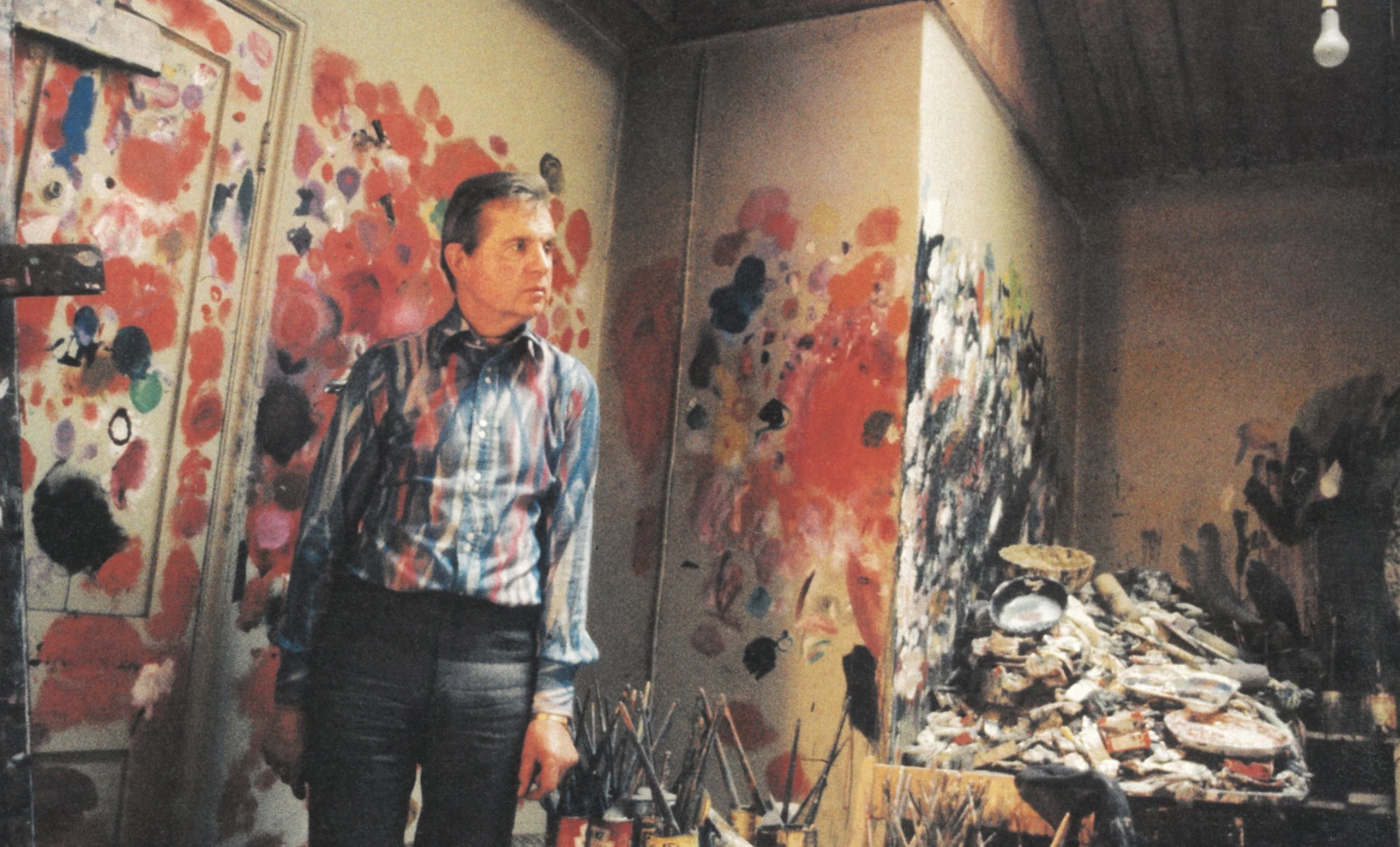
Francis Bacon at his studio, 7 Reece Mews, London, 1974. Photo © Michael Holtz
Formally, the composition stages a confrontation between darkness and illumination. The black ground is almost a sealed atmosphere – velvety, oppressive and airless – against which the head emerges as a striking, luminous injury. Bacon constructs the face through unstable pastel hues: light blues bleeding into mauves, pinks and purples, chromatic delicacy continually undercut by impact. Abrupt black incisions around the brow and eyes operate like surgical, precise gestures while the facial structure seems simultaneously built and violated. In this compact space, Bacon’s handling oscillates between smear and control: passages of scraped and dragged pigment suddenly stabilised by moments of literal description, notably the finely delineated forelock of hair. Bacon’s characteristic diagonal inflection across the brow lends the face a fatal punctuation. Michel Leiris, Surrealist writer and Bacon’s close friend, famously described this motif as “a reckless comma staunchly inscribed across his brow” (Michel Leiris, Francis Bacon: Full Face and in Profile, New York, 1983, p. 12).
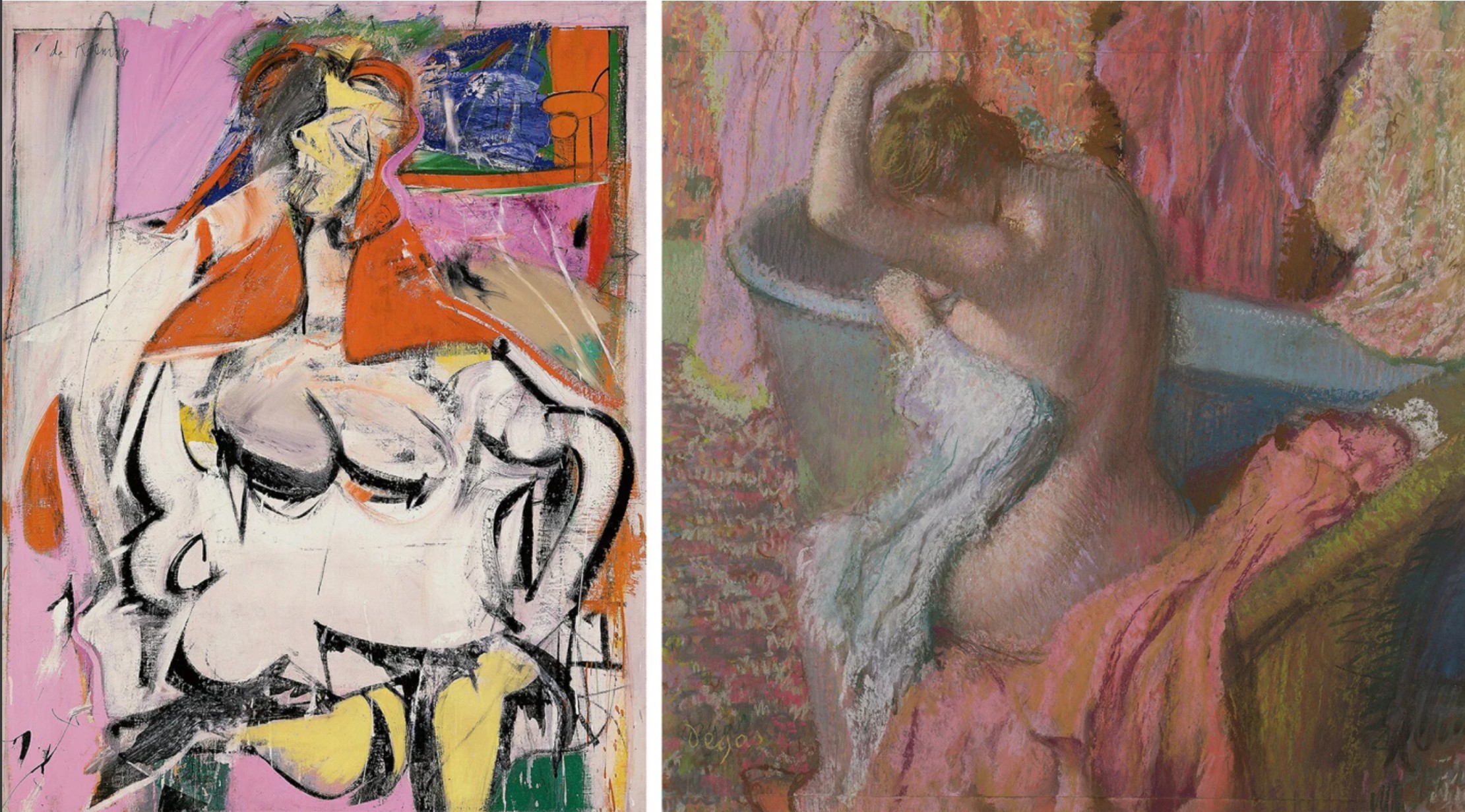
Left: Willem de Kooning, Woman, 1949. Private Collection. Art/Image: © 2026 The Willem de Kooning Foundation
Right: Edgar Degas, Bather, 1899 Private Collection. Image: © Bridgeman Images
What we encounter is not an assured likeness, but an exposed, volatile ‘emanation’ that charged a sense of presence Bacon sought to seize beyond resemblance. The tension between accident and precision was central to his method, and his way of evading what he called ‘illustration.’ The present work epitomises that high-wire balance, in which the image appears to cohere only moment by moment, always threatened by dissolution. As David Sylvester recorded, Bacon insisted: “The living quality is what you have to get. In painting a portrait the problem is to find a technique by which you can give over all the pulsations of a person… The sitter is someone of flesh and blood and what has to be caught is their emanation” (David Sylvester, Looking Back at Francis Bacon, London 2000, p. 98). In this painting, that ‘living quality’ is inseparable from damage: the face seems unable to settle into a fixed identity. Bacon’s twisted, scraped and gushed paint handling conveys arresting intensity and psychological depth, with pastel hues interwoven with electric swathes of mauve, pink and blue applied directly from the tube and punctuated by chalky whites that animate the surface. The constant alternation between abstraction and naturalistic detail gives the impression of the artist wrestling with his own appearance, the portrait registering solitude and melancholy not least through the violence inflicted upon the face itself — a potent cipher for the turbulence and loss surrounding Bacon at this moment in his life.
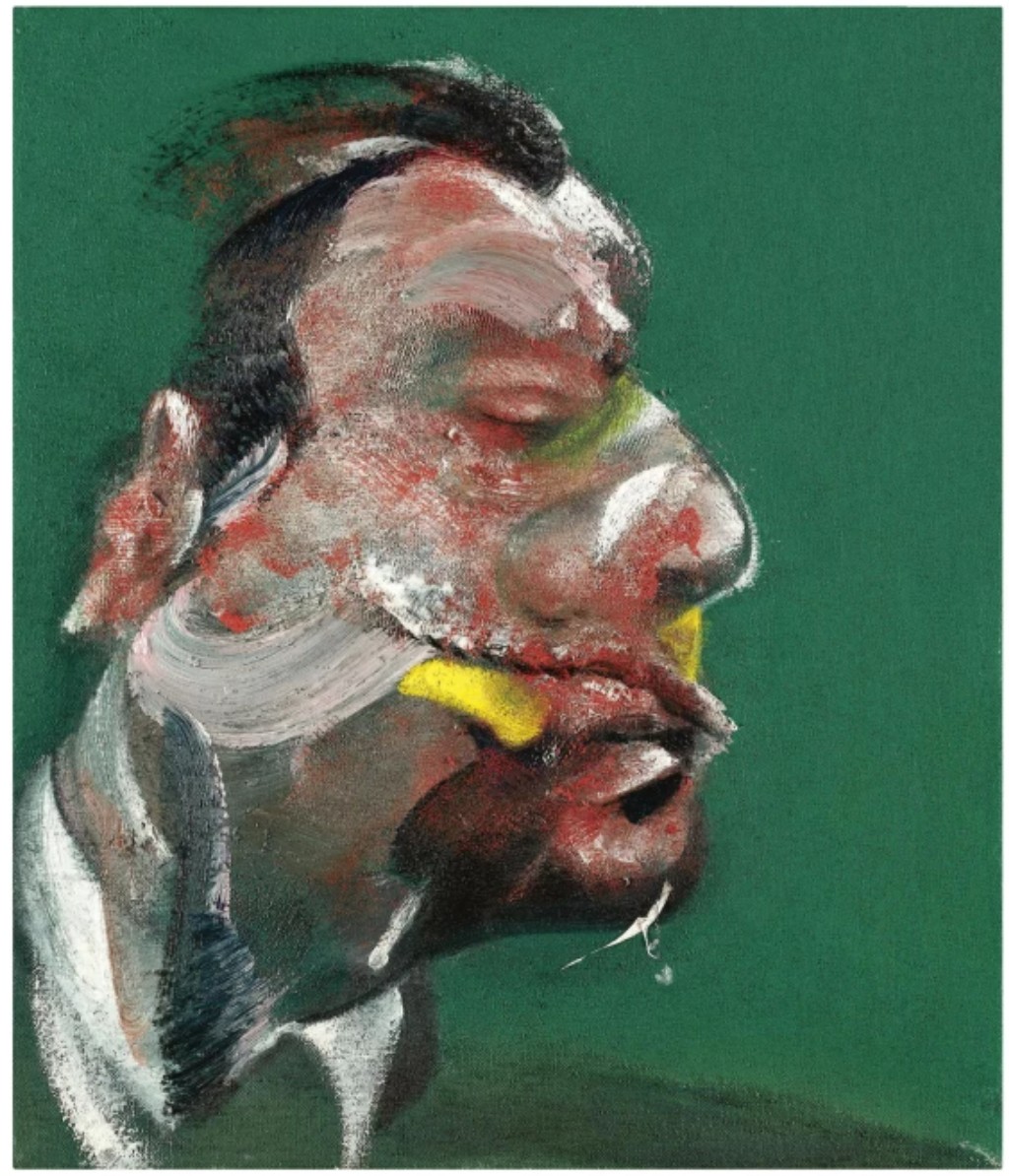
Francis Bacon, Study for Head of George Dyer, 1967. Private Collection. Sold Sotheby’s London, July 2008, for £13.8 million. Art/Image: © 2026 The Estate of Francis Bacon. All rights reserved, DACS
Bacon’s work from the early 1970s is widely regarded as his most introspective phase, shaped by accumulating grief and a corrosive sense of responsibility. Bacon never truly relinquished the guilt and responsibility he felt in fueling Dyer’s tragic juggernaut of a life, and the suite of large-scale ‘black triptychs’ painted between 1971 and 1974 offer exorcising lamentation over his death. Produced in tandem with these works, Bacon’s self-portraits proliferated and became increasingly complex. Across these mournful paintings, both large-scale and in the intimate fourteen-by-twelve-inch scale, the artist appears as a modern-day allegory for melancholia – leaning on a washbasin, with facial features violently mutilated, or with his wristwatch prominently emphasising life’s transience.
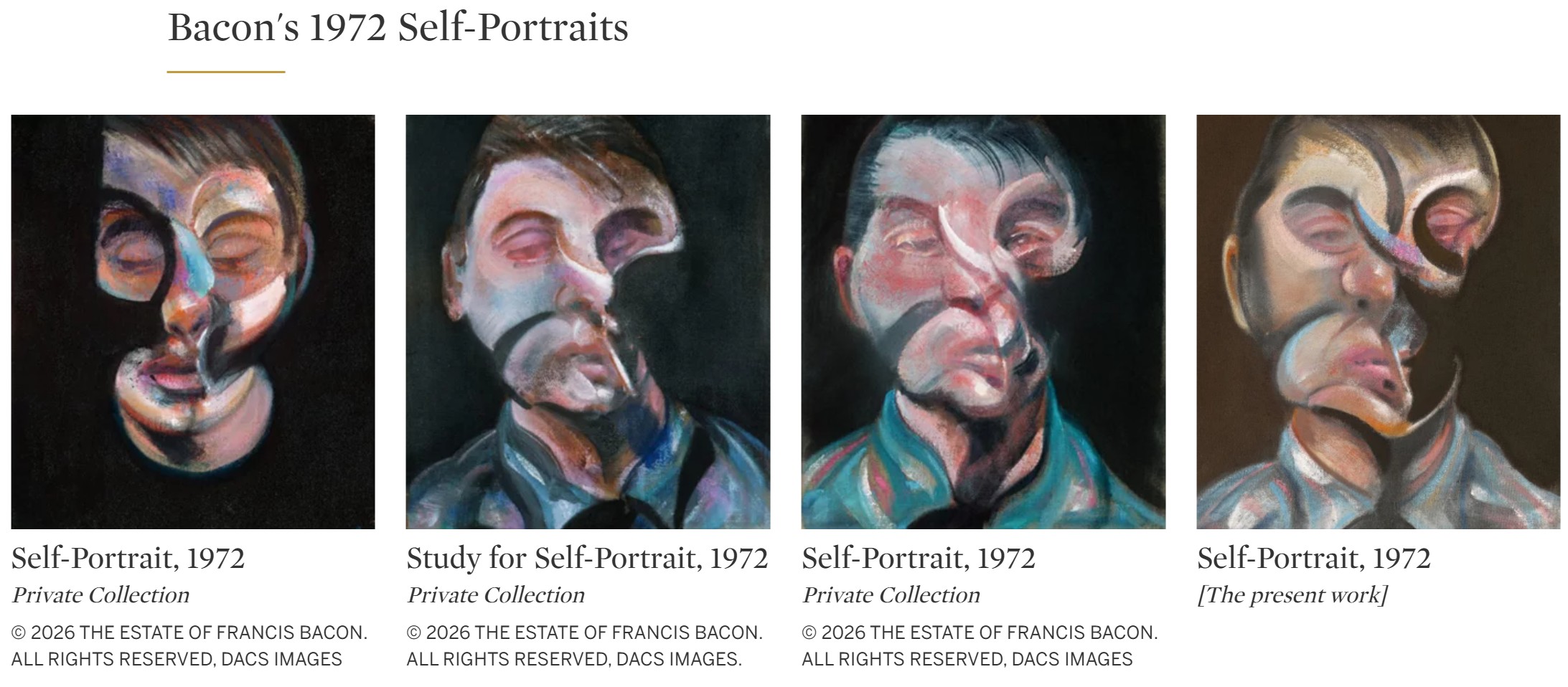
Whether heroically scaled or intimately proportioned, the self-portraits form a link to Oscar Wilde’s Portrait of Dorian Gray: where Bacon’s grief was stoically concealed from life, the canvases became the face of his suffering and pain. Not long after George Dyer’s tragic death in November 1971, the artist’s Soho companion and Vogue photographer John Deakin passed away. And, in an especially stark admission, he explained the proliferation of self-portraiture in the wake of such losses: “I’ve done a lot of self-portraits, really because people have been dying around me like flies and I’ve had nobody else to paint but myself” (the artist quoted in David Sylvester, Ibid., p. 129). Characteristically sharp in his admission, the self-portrait became a vehicle for the artist to express his sheer anguish and loss in the wake of Dyer’s death.
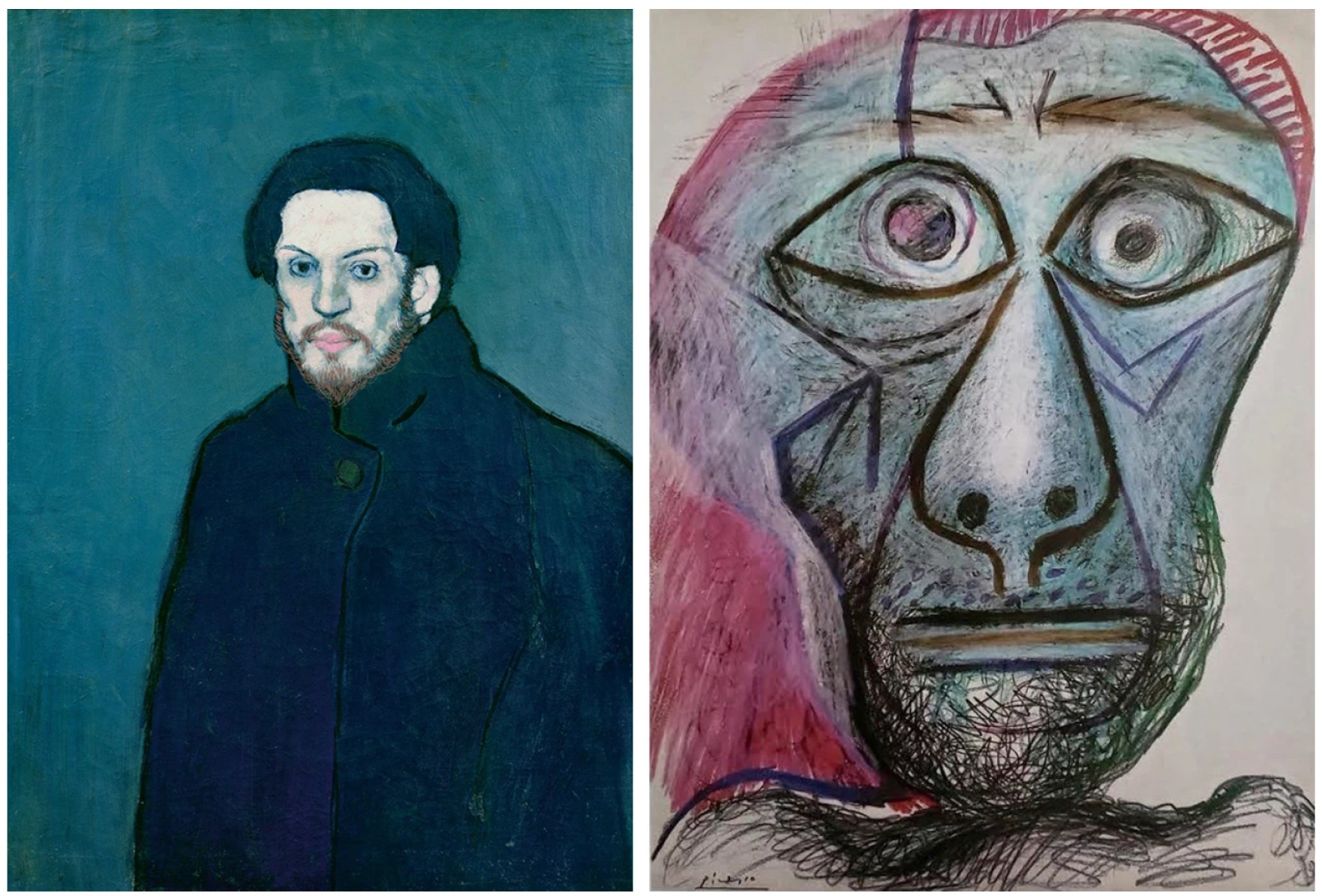
Left: Pablo Picasso, Self-portrait, 1901. Musée national Picasso, Paris. Art: © 2026 Succession Picasso, Image: DACS, London
Right: Pablo Picasso, Self-Portrait Facing Death, 1972. Fuji Television Gallery, Tokyo. Art: © 2026 Succession Picasso. Image: DACS, London
Peppiatt recalled Bacon in 1972 as “almost translucent, with a strange bluish hue as if he were deathly cold” (Mark Stevens and Annalyn Swan, eds., Francis Bacon: Revelations, London 2021, p. 566), an observation that seems to echo the chilled, blue-inflected tonality coursing through the present work, hovering somewhere between the pallor of the man himself and the familiar blue of the denim shirt he so often wore. In fact, the blue striped Turnball & Asser shirt he wears in the present work was the distinctive motif across many of the works from this period. It was, moreover, a period Bacon later framed as one of inward extremity: he spoke to Denis Wirth-Miller of a quasi-religious experience in the South of France, and spent week-long stays in the room at the Hotel des Saints-Pères where the incident had happened in an attempt to exorcise the trauma of Dyer’s death, making 1972 a year of stark self-reflection and contemplation. Bacon did not, however, romanticise bereavement: “Time does not heal. There isn’t an hour of the day that I don’t think about him [George Dyer]” (the artist quoted in Exh. Cat., Lugano, Museo d’Arte Moderna di Lugano, Francis Bacon, 1993, p. 44). This was emphasised by Anne Dunn who commented, “He was shattered by George’s death. He felt tremendously responsible – he hadn’t realised that George was in the state that he was” (Stevens and Swan, Op. cit., p. 565).
Self-Portrait was held in the collection of Bacon’s long-term physician Dr. Paul Brass. Brass had inherited Bacon as a patient from his father Dr. Stanley Brass. The present work was in fact gifted to Brass by the artist in the early 1980s as a token of his gratitude for Brass’ unwavering medical and emotional support during such a turbulent period. The violence of the present image resonates with Bacon’s medical record from 1972. Brass treated Bacon in early 1972 as he had “slipped on the stairs and one of the metal strips hit the right of his eye and put it half out” (Ibid., p. 566). In the doctor’s report from the time, Brass notes that “Fell 10 days ago – knocked out for 20 minutes – injured left side of face – laceration of left cheek and outer end of eyebrow Followed by left facial and frontal headaches” (Martin Harrison and Sophie Pretorius, eds., Revisions: Francis Bacon in the Act of Painting, London 2024, p. 48). However, Brass often used ‘fallen’ as a euphemism for Bacon’s injuries acquired during sex (Ibid, p. 51). These observations sharpen the painting’s emphasis on the orbital zone: the strained eyelid, mauve-shadowed socket, and the sense that the face has been gouged or partially collapsed. The pronounced indentation on one side of the face, warped lips, bruised chromatics, and reddened sclera – a device Bacon repeatedly employed in 1972 – register as painterly equivalents of laceration and swelling, while the dark ground appears to seep into the head, as if the void were consuming the portrait from within. The sustained injury is most apparent in Self-Portrait with Bandaged Eye (1972), in which the injury surfaces with unmistakable literalness.
“Anything I paint, if it comes off at all in my work, I feel it in myself. If I don’t feel it physically, I know it just can’t be working. With all the figures that work, I feel that this is physically right, and this is a thing that I feel within my body”
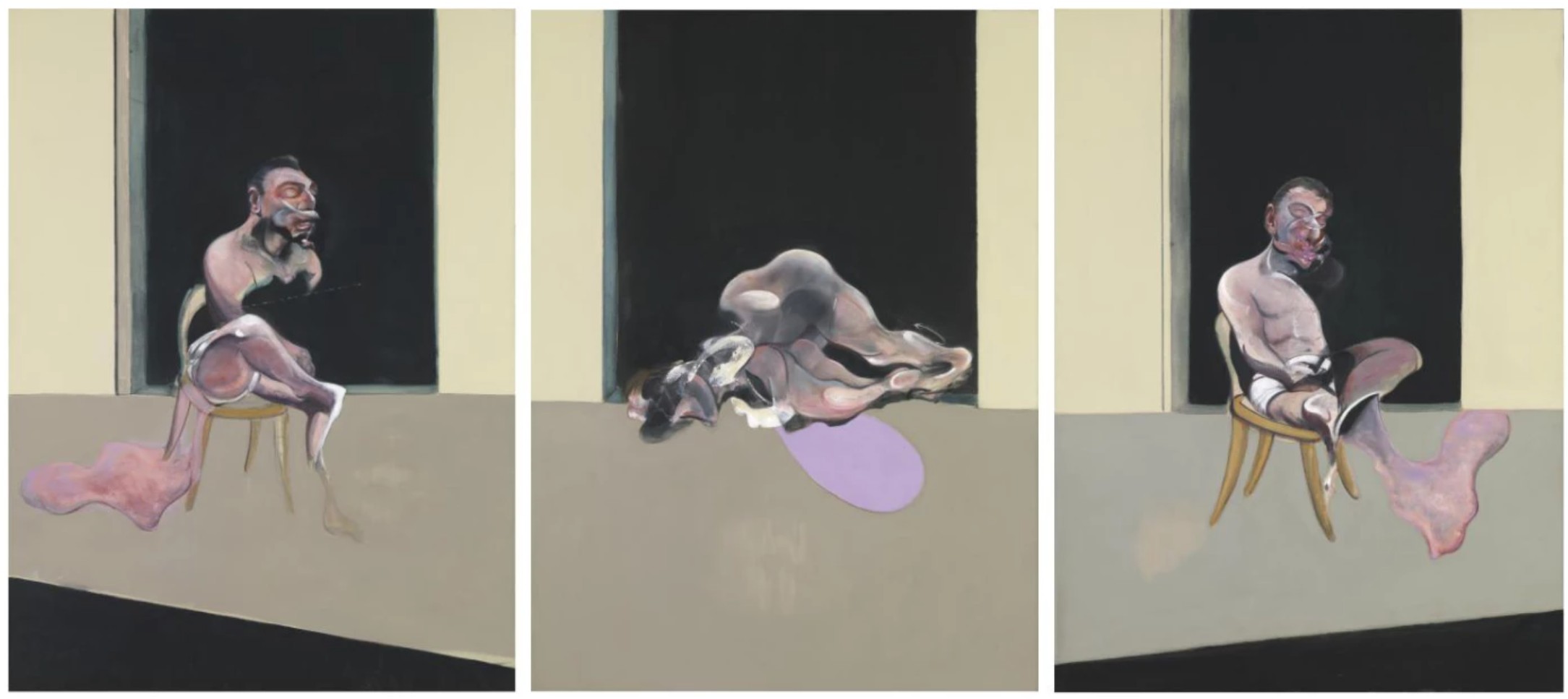
Fancis Bacon, Triptych August 1972, 1972. Tate, London. Art/Image: © 2026 The Estate of Francis Bacon. All rights reserved, DACS Images Francis Bacon/Photo: Tate
The work was first photographed by the Marlborough Gallery in early 1972, although the precise date remains uncertain; it was subsequently photographed again in October of that year in its final state, by which point Bacon had already undertaken further revisions. Such revisions were characteristic of his practice during this period. As Sophie Pretorius notes, “of the ten paintings of his face that Bacon made within two years of this injury, he had five of them returned to his studio to wound some more” (Ibid,, p. 48), often they were returned to him after initially being photographed. These reworkings were deliberate artistic modifications intended to intensify the image’s psychological charge. In the present painting, such revisions included “violating his face, making a dark incision into his cheek, and darkening the black mark surrounding the right-hand eye. In revising this painting […] Bacon darkened and thickened many of the black areas, a mannered kind of chiaroscuro. He also tended to revise the corners of mouths, so they bled into an area of darkness, perhaps an evocation of the abject drool and fluids leaving the body in death” (ibid, p. 51). As in the present work, Bacon often added further strokes of black paint to the hollow of the cheek or the crease of the eye socket, partially erasing and reconstituting the image in the same act. Within this context, the encroaching dark passages assume a distinctly corporeal urgency, transforming the self-portrait into an image of vulnerability in which Bacon appears simultaneously as observer and subject, with grief and guilt inscribed where stable likeness might traditionally reside.
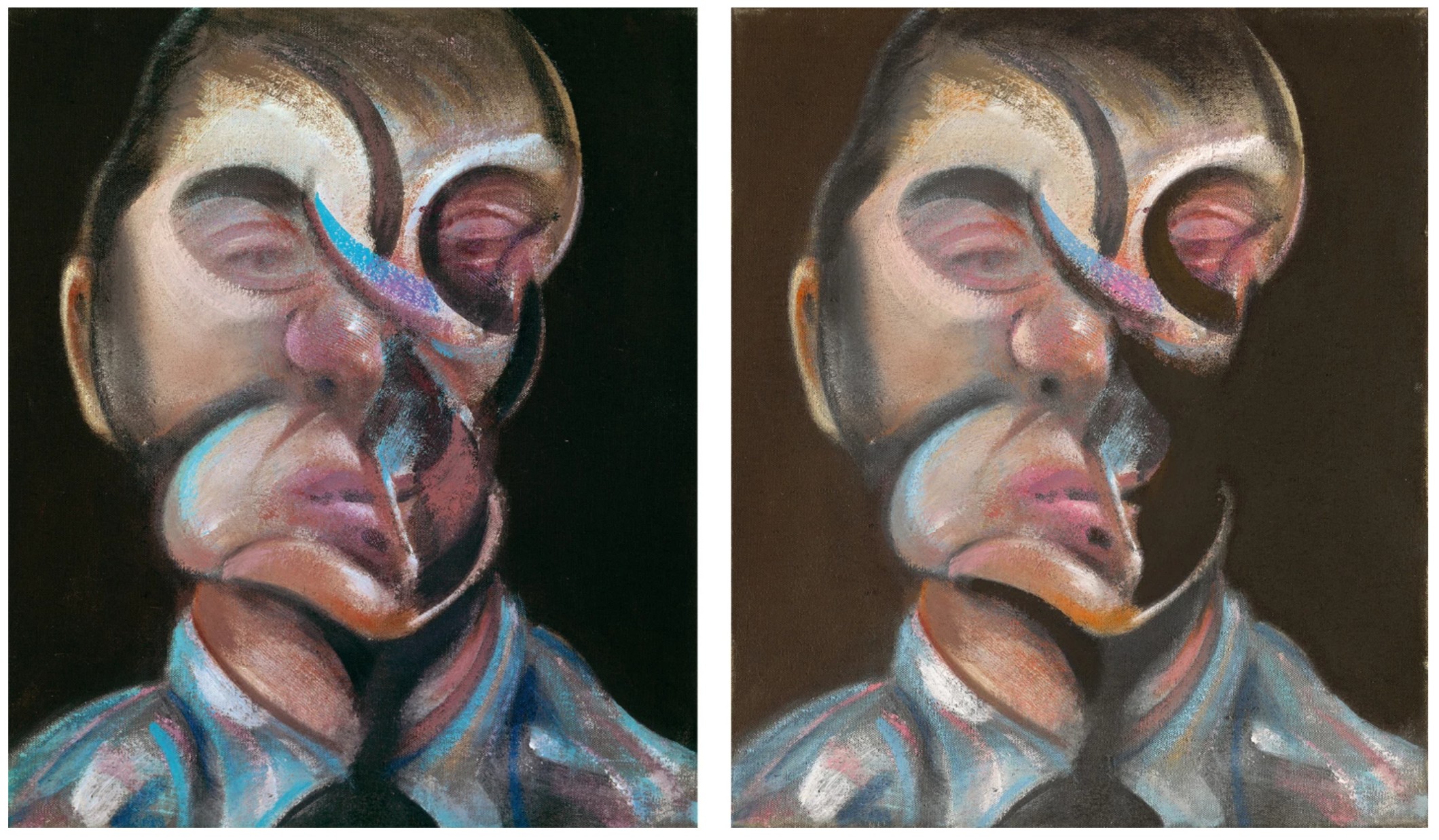
Left: First version of the present work, painted c. 1972. Art/Image: © 2026 The Estate of Francis Bacon. All rights reserved, DACS Images.
Right: The present work, photographed in October 1972
In this way, Bacon revitalized the genre of self-portraiture for the twentieth century with an unprecedented fusion of pictorial invention and psychological candor. As Michael Peppiatt has observed, Bacon’s self-portraits now stand among the “most pictorially inventive and psychologically revealing portraits of the Twentieth Century” (Exh. Cat., Rome, Galleria Borghese, Caravaggio Bacon, 2009, p. 210). The potency of Self-Portrait lies precisely in its refusal of narrative resolution or emotional consolation: the painting does not explain grief so much as embody its distortions, nor does it memorialize death symbolically; instead, it shows death “at work” within the living face (the artist quoted in Sylvester, The Brutality of Fact, pp. 130–133). Likeness is not pursued as an end in itself but as a vehicle for that volatile ‘emanation’ Bacon sought to capture – the unstable sense of human presence that persists even as the image fractures. Crucially, this ferocity is never merely destructive. The small scale intensifies rather than diminishes the painting’s ambition, confirming John Russell’s observation that Bacon’s fourteen-by-twelve-inch heads were “the scene of some of Bacon’s most ferocious investigations,” images that “carry their ghosts within them” (John Russell, Francis Bacon, London 1993, p. 99). In Self-Portrait, the face appears haunted – by previous states of the self, by the absent dead, by bodily vulnerability, and by the mirror’s relentless rehearsal of mortality – producing an intimacy that is less comforting than claustrophobic, as though the viewer were confined within the unyielding scrutiny of a mind unwilling to look away.
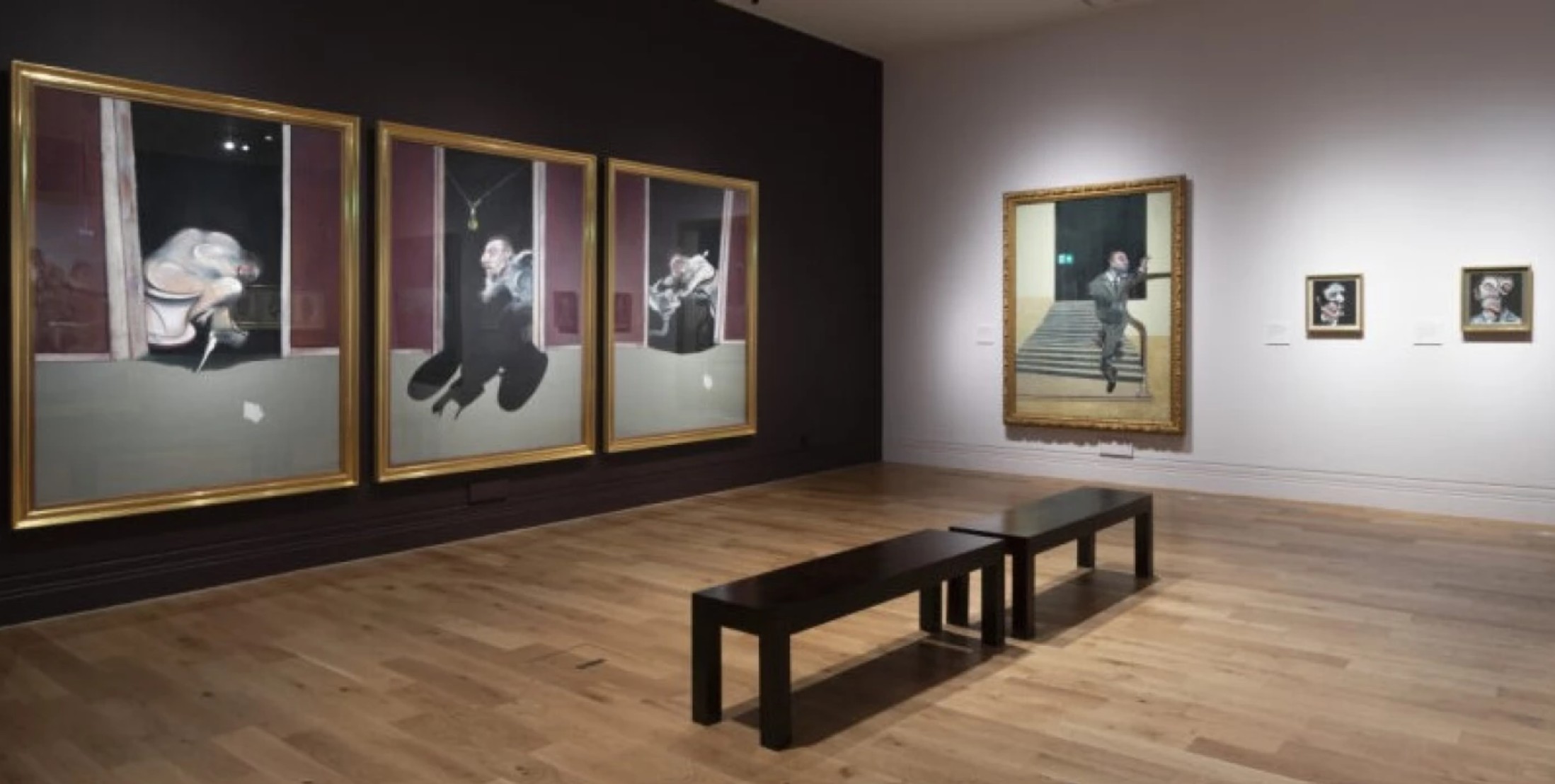
The present work installed in Francis Bacon: Human Presence, National Portrait Gallery, London, 2024. Art: © 2026 The Estate of Francis Bacon. All rights reserved, DACS Images. Image: National Portrait Gallery, London
If Bacon’s art sought the height of painterly expression as a reflection of life, then his self-portraits represented the core of that exploration. Throughout his career, from the first self-portrait of 1956 to the last in 1987, Bacon’s self-portraits register a life marked by extremes, responding directly to periods of exhilaration, loss, and reflection. If the late 1960s provided some of his happiest moments, the early 1970s provided undeniably his most introspective moment. The tension between these emotional poles, so powerfully distilled in Self-Portrait, produces one of the most complex depictions of emotional presence in modern art. The painting’s great achievement lies in its refusal to explain grief; instead, it gives visual form to its distortions. By confronting the viewer with a face that appears simultaneously present and collapsing, it implicates us directly in the act of looking. We witness an ongoing struggle between dissolution and form, grief and endurance, despair and fragile perseverance and one that secures Self-Portrait as a definitive masterwork within the canon of Bacon’s self-portraiture and within the longer tradition it so ruthlessly renews.
Study for Self-Portrait, 1980
Sotheby’s London: 16 October 2025
Estimated: GBP 5,000,000 – 7,000,000
GBP 5,774,000 / USD 7,737,160
Study for Self-Portrait | Contemporary Evening Auction | 2025 | Sotheby’s
FRANCIS BACON (1909 – 1992)
Study for Self-Portrait, 1980
Oil on canvas
14×12 inches (35.5 x 30.5 cm)
Signed, titled and dated 1980 (on the reverse)
Executed in the artist’s eighth decade at the age of 71, Study for Self-Portrait of 1980 ranks amongst the greatest iterations of Francis Bacon’s legendary scrutiny of his own iconic features. Startling in color, bold in gesture, and unmistakably Baconian in effect, this painting is a masterwork of self-interrogation. Wielding the full force of a life’s worth of retrospect, Bacon here looks back at himself as a young man; a translucent blue haze partially occludes his younger visage, giving physical form to the ephemeral, long-past memories and emotions it depicts. In a searching translation and recapitulation of his own physical likeness, Bacon revisits the starched collared and suited figures from his 1950s via a mature, and almost luminescent, mastery of paint. Closely aligned to the captivating and penetrating examples prestigiously housed in the Centre Pompidou, Paris and the Musée Cantini, Marseille, the present work delivers an extraordinary and atmospheric embodiment of Bacon’s abiding engagement with self-portraiture. Deeply meditative and profoundly reflective, Study for Self-Portrait significantly preserves one of the very final depictions of Bacon’s likeness in this uncharacteristically tender, intimate and crucial single-canvas format.
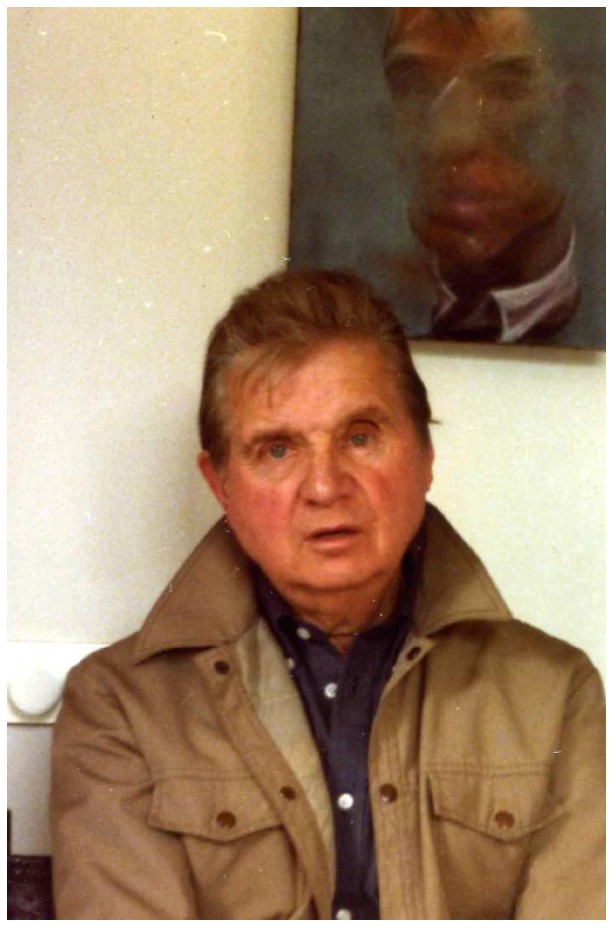
Francis Bacon with the present work. Photo: Eddy Batache. Art © The Estate of Francis Bacon. All rights reserved. DACS 2025
Amid the spectacular color and virtuoso brushwork Bacon here presents an ethereal and unearthly form that is unmistakable: in evidence is the artist’s distinctive forelock of hair, those inimitable diagonal brush marks which the esteemed French poet, and friend of Bacon’s, Michel Leiris once described as “a reckless comma staunchly inscribed across his brow” (Michel Leiris, Francis Bacon Full Face and in Profile, New York 1983, p. 12). Dressed in a formal white collar, Bacon’s features emerge from a soft blue mist – reminiscent of Claude Monet’s late Nymphéas – which serves to heighten the blurred, even nostalgic presence that emanates from the canvas. This painting does not possess the carved tangle of physiognomic forms or time-weariness evident in self-portraits from the 1970s; instead, it emanates an alert youthfulness and contemplative poignancy. His smooth, sculpted features are offset by a single corduroy swipe of bright pink across the mouth and illuminated by accents of white.
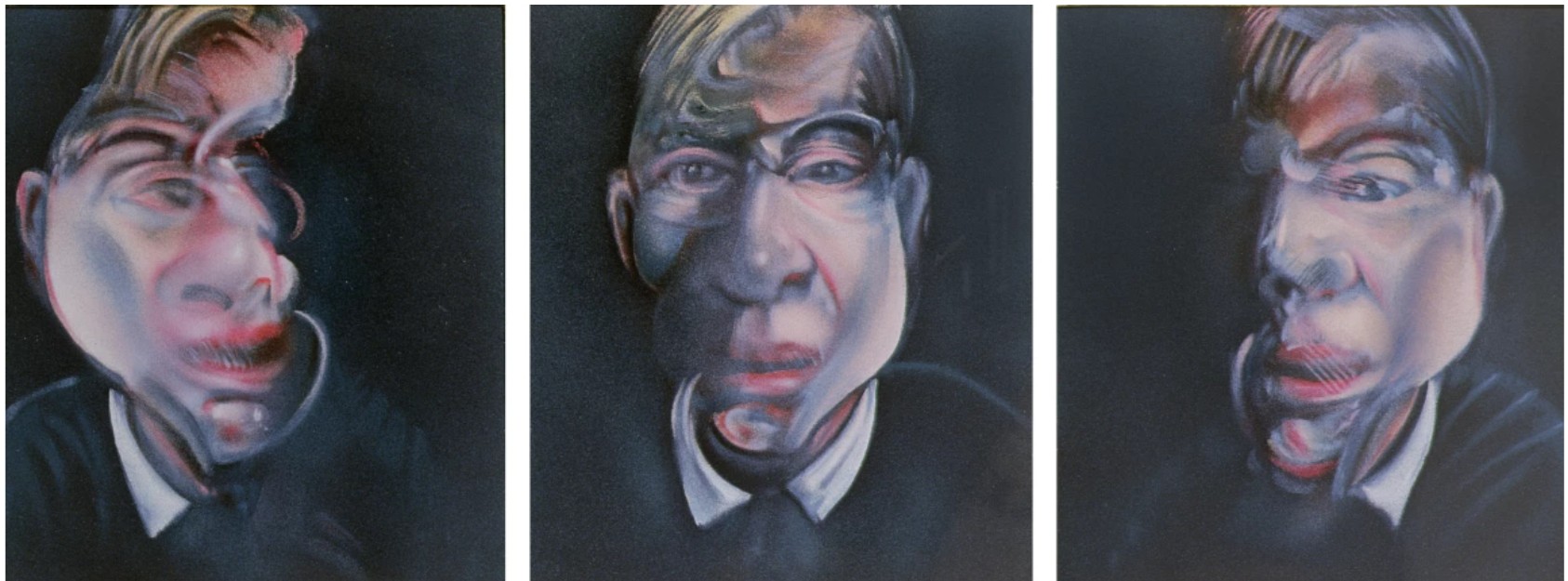
Francis Bacon, Three Studies for Self-Portrait, 1979. The Metropolitan Museum of Art, New York. Jacques and Natasha Gelman Collection. Image: Bridgeman Images. Art © The Estate of Francis Bacon. All rights reserved. / DACS, London 2025
As if attempting to recall a dream or clouded memory of himself, Bacon makes visible the ambiguous slippages of reality through the vaporous spray. Powerfully evincing Bacon’s essential artistic aim, the present example fulfils a compelling visual counterpart to the artist’s own desire for his work: “I would like my pictures to look as if a human being had passed between them, like a snail, leaving a trail of human presence and memory trace of past events, as the snail leaves its slime” (the artist, cited in: David Sylvester, Looking Back at Francis Bacon, London 2000, p. 33).
Claude Monet, Nymphéas, ca. 1916. National Gallery, London. Image: Bridgeman Images
Considered the most introspective and inwardly scrutinizing phase of his career, Bacon’s late production of the 1970s and 80s is characterised by the searing self-images that emerged following the sudden death in 1971 of Bacon’s former lover George Dyer. Whether heroically scaled or intimately proportioned, the self-portraits form a link to Oscar Wilde’s Picture of Dorian Gray: where Bacon’s grief was stoically concealed from life, the canvases became the face of his suffering and pain. Although the major work of Bacon’s mourning came to an end with the black triptychs in ‘74, the spirit of Dyer and practice of self-portraiture endured, fed by an ever-increasing number of bereavements as Bacon grew older. Not long after Dyer in 1971, the artist’s Soho companion and Vogue photographer John Deakin passed away, followed by the Colony Room’s famous matriarch, Muriel Belcher in 1979. These losses famously led Bacon to proclaim: “I’ve done a lot of self-portraits, really because people have been dying around me like flies and I’ve had nobody else to paint but myself” (Ibid., p. 129). By the turn of the decade however, the opening of a retrospective at the Metropolitan Museum in New York, his growing success in Paris, and the increasing prominence of two younger men in his life, Peter Beard and John Edwards, ushered in a tonal change that signalled the beginnings of a late style, exemplified by the unusually kind self-depiction of the present work.
LEFT: Pablo Picasso, Self-Portrait Facing Death, 1972. Fuji Television Gallery, Tokyo. Art © 2025 Estate of Pablo Picasso / DACS, London
RIGHT: Alberto Giacometti, Buste de Diego, c. 1962-64. Fondation Albert & Annette Giacometti. Image: Bridgeman Images. Art © The Estate of Alberto Giacometti / DACS, London / ADAGP, Paris 2025
This painting also narrates a phase of Bacon’s life in which he strengthened his ties to the Parisian avant-garde. An avowed Francophile, Bacon believed Paris to be the epicenter of the artistic world: home to the birth of Modernism, it was in Paris at the end of the 1920s that Bacon, inspired by a Pablo Picasso exhibition, first nurtured his ambitions to become a painter. Many aspects of Study for Self-Portrait – its chromatic subtlety and luminous brilliance – anchor it to the increasingly extended periods Bacon spent living and working in Paris. Inspired by the great masters who notably lived and worked there – from the Impressionist painters and sculptors such as Claude Monet and Auguste Rodin to later Modernists like Pablo Picasso and Alberto Giacometti – Bacon observed, interpreted, and integrated a myriad of source material. In describing Study for Self-Portrait, Bacon himself proclaimed, “This is my Impressionist period” (the artist cited in Martin Harrison, ed., Francis Bacon Catalogue Raisonné, Volume IV, 1971-92, London 2016, p. 1203). Paintings such as this, executed during his most concentrated time in France, are imbued with the essence of great historical precedent.
Self-Portrait, 1969
Christie’s New-York: 11 May 2023
Estimated: USD 22,000,000 – 28,000,000
USD 34,622,500
FRANCIS BACON (1909-1992) (christies.com)
FRANCIS BACON (1909-1992)
Self-Portrait, 1969
Oil on canvas
14×12 inches (35.6 x 30.5 cm)
Signed, dedicated, titled and dated ‘Self-Portrait 1969 Francis Bacon to V with all very best wishes Francis’ (on the reverse)
Painted in 1969, the present work is a masterful and poignant self-portrait from a pivotal moment in Francis Bacon’s career. The artist’s unmistakable countenance emerges in swirling, evanescent strokes of lilac, teal, bone-white and vermillion set against a rich blue backdrop. Flashes of turquoise, orange and magenta halo his silhouette. Bacon has bruised and blushed his features, using a corduroy rag to print delicate, striated impressions across his mouth, nose and shadowed eye sockets. Impastoed sweeps of white convey the sheen of skin under bright electric light. Zones of raw canvas shape his beige trenchcoat and shine through his deftly brushed hair. The artist’s large, hooded eyes gaze out with a subtle glitter. A far cry from some of the more violent distortions of Bacon’s portraiture, it is a remarkably tender self-image. Its warmth may reflect his feelings towards its intended recipient: Bacon presented the work as a gift to Valerie Beston, who had overseen his affairs at London’s Marlborough Gallery since 1958, playing an important role in his personal and professional lives. The 1960s had been a decade of huge success for Bacon, witnessing a flowering of ambition and drama in his painting as he embraced new colors, techniques and subjects. Here, months before his sixtieth birthday, he emerges as a poised and contemplative figure brimming with creative life. Two years later, the work was included in his career-defining retrospective at the Grand Palais, Paris; it has been shown in a number of major international exhibitions across the decades since.
Other Portraits
Portrait of a Dwarf, 1975
Sotheby’s London: 16 October 2025
Estimated: GBP 6,000,000 – 9,000,000
GBP 13,110,000 / USD 17,567,400
Portrait of a Dwarf | Contemporary Evening Auction | 2025 | Sotheby’s
FRANCIS BACON (1909 – 1992)
Portrait of a Dwarf, 1975
Oil on canvas
62 5/8 x 23 inches (159 x 58.4 cm)
Signed twice, titled and dated 1975 (on the reverse)
Executed in Paris in 1975, Portrait of a Dwarf stands alone in Francis Bacon’s oeuvre. Four years after George Dyer’s tragic death on the eve of the artist’s Grand Palais retrospective in the same city, Bacon turned to Velazquez, his ‘God’, once again for inspiration. In the same way as his Popes had been presented on a dais or throne, here his subject is raised up to meet and confront the viewer directly. An amalgamation of Dyer’s hairline, Peter Beard’s face, Lucian Freud’s torso and Bacon’s own foreshortened legs, this figure melds some of his closest friends and greatest loves – yet still recalls Velazquez’s A Dwarf Sitting on the Floor. Purposefully set off-centre, the vertical format is entirely unique in the artist’s oeuvre and heightens the figure’s raw intensity. Reminiscent of his great black triptychs of the same period and the curtained backdrops of his Pope series of the 1950s, the acutely physical presence is underscored by the compressed interior space.
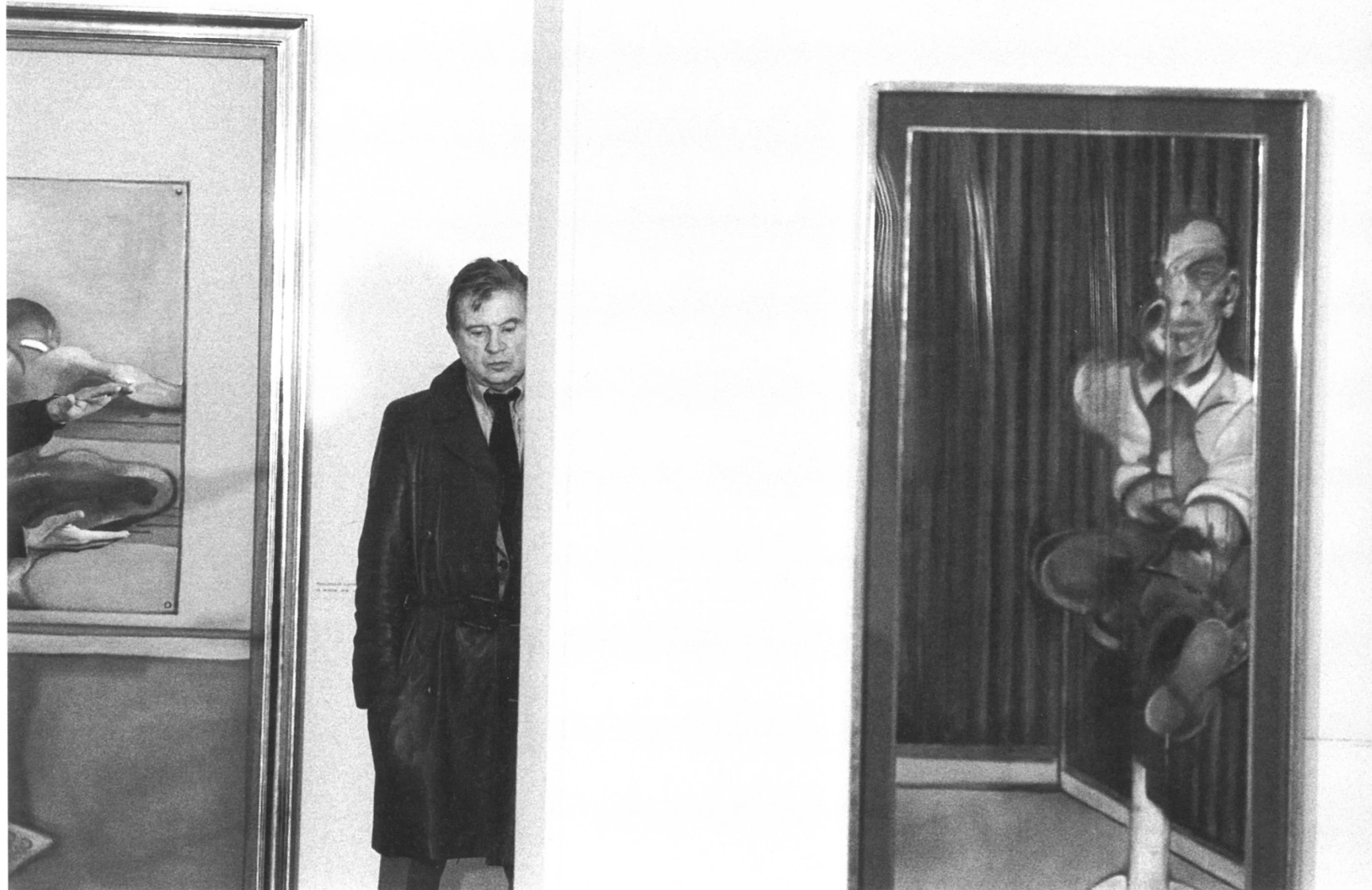
Francis Bacon at Galerie Claude Bernard, Paris, 1977. Photo: Michel Soskine.
Art © The Estate of Francis Bacon. All rights reserved. DACS 2025
The contrapposto pose of the body, expressed in muted tones of black, slate blue, and creamy white, is counterbalanced by the still, arresting gaze of the remarkably rendered face, exquisite in shades of pale pink, lilac, and warm orange, heightened by elegant scumbled impressions of corduroy imprinted onto the surface. In an exceptionally rare step for the artist, Bacon retained Portrait of a Dwarf in his own collection for several years and even exhibited it as ‘property of the artist’ in a series of exhibitions, most notably in the acclaimed Galerie Claude Bernard exhibition in Paris in 1977, a testament to the painting’s personal significance for the artist. Since then, the present work has been widely exhibited and referenced in literature, and has remained in the same private collection since it was acquired from the artist in 1981. A singular and powerful embodiment of Bacon’s inimitable praxis, Portrait of a Dwarf is a masterwork of psychological intensity and personal significance as great as any in the artist’s momentous corpus.
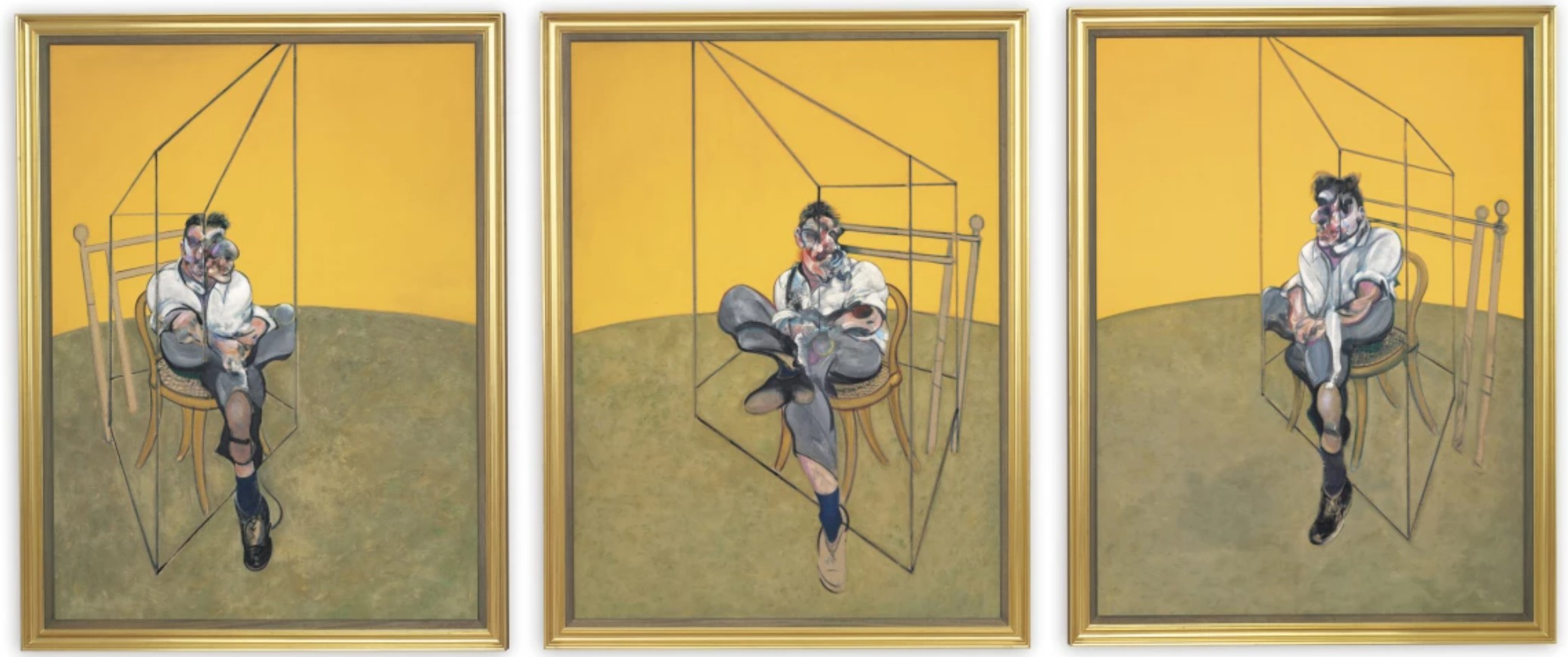
Francis Bacon, Three Studies of Lucian Freud, 1969. Private Collection, USA.
Art © The Estate of Francis Bacon. All rights reserved. DACS 2025
The present work’s unique composition is a result of Bacon’s notoriously relentless self-editing: he not only destroyed many of his paintings, but also reworked and continuously altered some that had already been deemed ‘completed.’ Originally part of a larger canvas, Bacon viewed Portrait of a Dwarf as the entirety of his finished composition, preserving this part and signing it on the back, as was his custom, not once but twice. Eddy Batache – scholar, art historian and close friend of the artist – recounts its creation: “The Dwarf is a very exceptional item in Francis’s work. He never did that format before. The reason is that it was part of a bigger panel. Francis said [to Reinhard Hassert]: ‘I’m a bit uneasy about that composition; it doesn’t seem to work altogether’; to which Reinhard responded: ‘Well, there’s one thing which is absolutely wonderful: it’s that right part with the dwarf on it.’ Francis said: ‘Yes, I agree with you. That works very well. But it doesn’t work with the other half’; to which Reinhard replied: ‘Look for God’s sake whatever you do, save the dwarf.’ Francis responded: ‘I’m going to cut off that painting and throw out the part which is on the left.’ We were convinced that the left part had been destroyed… After he died we saw the left part of the painting in an exhibition in Düsseldorf. No signature on the back. Francis wanted to have The Dwarf on its own and he disregarded the other half.” (Eddy Batache in video conversation, 2025). The resulting format adds a remarkable potency, as the narrow, confining space emphasises the figure’s contorted body with an uneasy, yet unwaveringly intense focus.
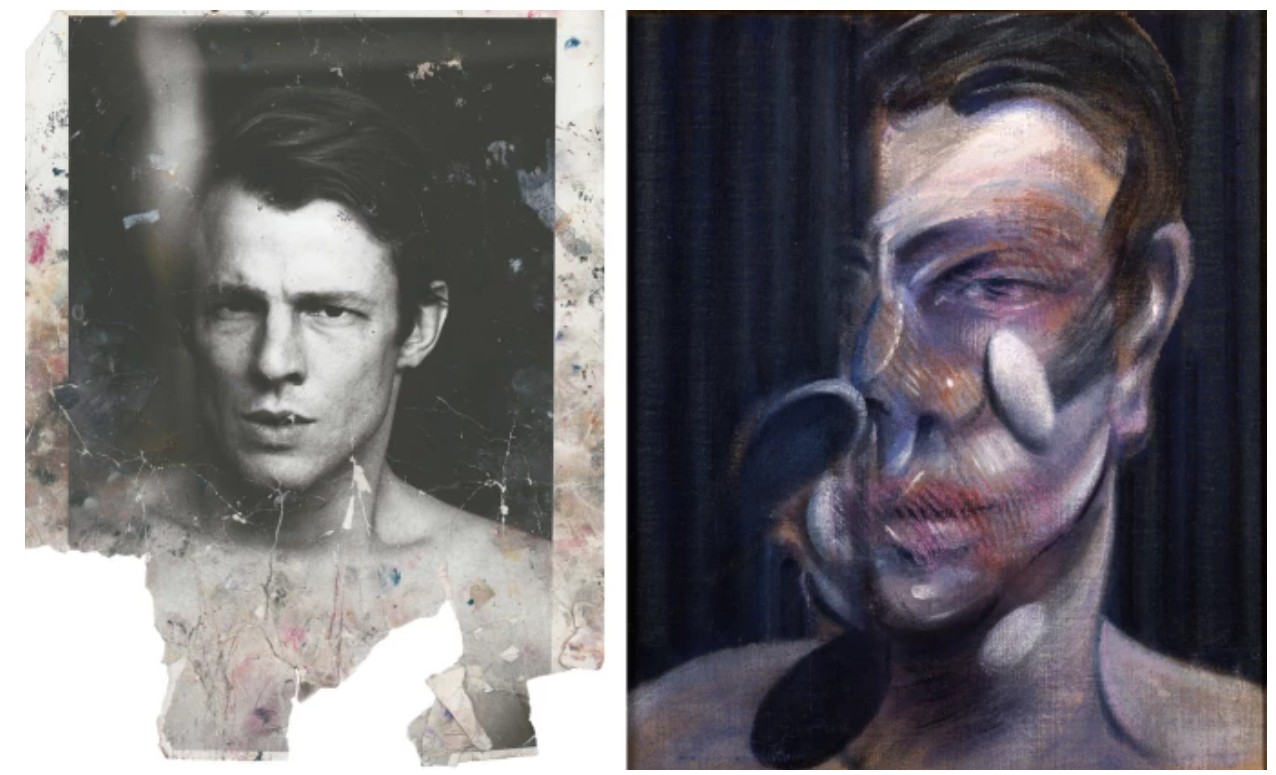
LEFT: Bacon studio material, photograph of Peter Beard. Collection: Dublin City Gallery The Hugh Lane Photo © Peter Beard. Source © The Estate of Francis Bacon
RIGHT: Francis Bacon, Study for Portrait (Peter Beard), 1975. Private Collection. Image: Bridgeman Images. Art © The Estate of Francis Bacon. All rights reserved. DACS 2025
The figure itself is particularly well composed: while the head resembles depictions of both Peter Beard and George Dyer, the torso recalls that of Lucian Freud as seen in the artist’s renowned photographic source images taken by John Deakin, and the lower limbs relate directly to Bacon’s full-body self-portraits. In this painterly ‘collage’ of bodies, Bacon combines elements of his most frequent and cherished subjects into a new and potent figure, at once recapitulating what he had done before yet, as ever, reinventing and reimagining his composition. In this way, the critical importance of photography in Bacon’s working method is brought to the fore; synthesizing a wide range of imagery, memories, and spontaneous invention, Bacon delivers a painting of enigmatic allusion and complex metaphor.
“How can you cut your flesh open and join it with another person? It is an impossibility to do. So it is with art, it is almost like a love affair with images, appearances and sensations. You may love somebody very much but how near can you get to them? You are still always unfortunately strangers.”
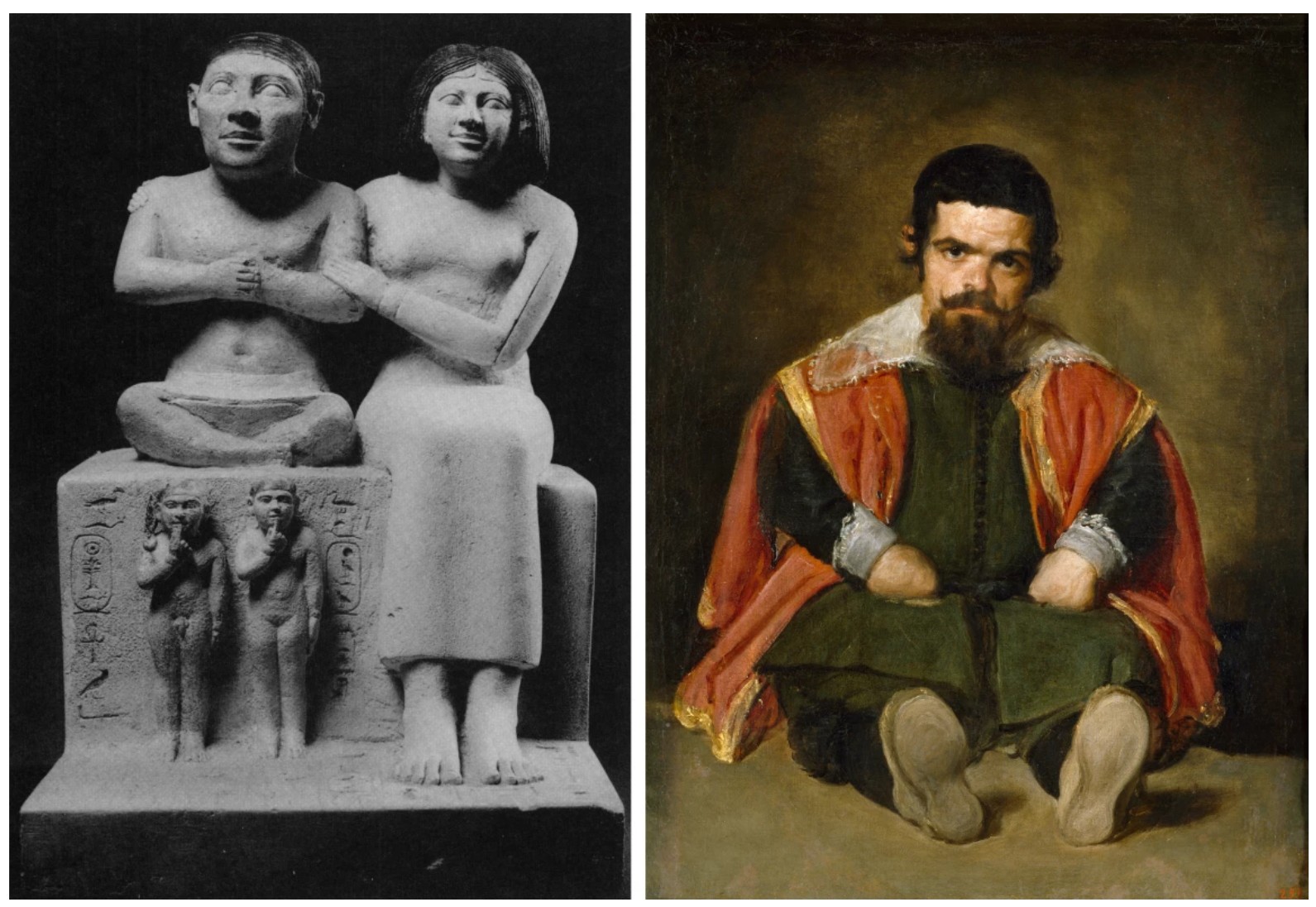
LEFT: Statue of Seneb and his Family, 24th – 23rd Century BC. Egyptian Museum, Cairo
RIGHT: Diego Velázquez, Portrait of Sebastián de Morra, c. 1644. Museo del Prado, Madrid
In its subject, Portrait of a Dwarf reflects Bacon’s passion for Diego Velázquez, who painted the dwarfs who customarily attended the seventeenth-century Spanish court. As noted by author and art historian Martin Harrison, “The dwarf’s seated, cross-legged pose recalls both Velázquez’s A dwarf sitting on the floor (c. 1645) and the ancient Egyptian statue of Seneb, the chief of the palace dwarves, in the National Museum, Cairo; Bacon, who considered Egyptian art to have been mankind’s highest cultural achievement, had visited Cairo in 1951 and is likely to have seen the figure” (Martin Harrison, “Francis Bacon: Lost and Found,” Apollo 161, March 2005, p. 94). Underscoring the connection to Velázquez is the rapid striations of dark blue and black paint that cover the walls of the interior, a ‘shuttering’ effect that Bacon adapted from the pastels of Edgar Degas and incorporated into many of his screaming Papal portraits, themselves inspired by Velázquez’s 1650 Portrait of Innocent X. Used throughout his oeuvre to express a release of tension, these lines create a kind of shuddering optical static that destabilizes the figure-ground relationship, recalling the flickering motion of a Muybridge slideshow, while also emphasizing the work’s sense of psychological distortion. This effect is further heightened by Bacon’s elevation of the figure on a pedestal; similar to his famed cage motif, the dais serves both to focus the viewer’s attention and to emphasize the subject’s carnal physicality. Exposed and vulnerable, his twisted body becomes a symbol of raw emotion and psychic anxiety, characteristic of Bacon’s greatest masterworks.
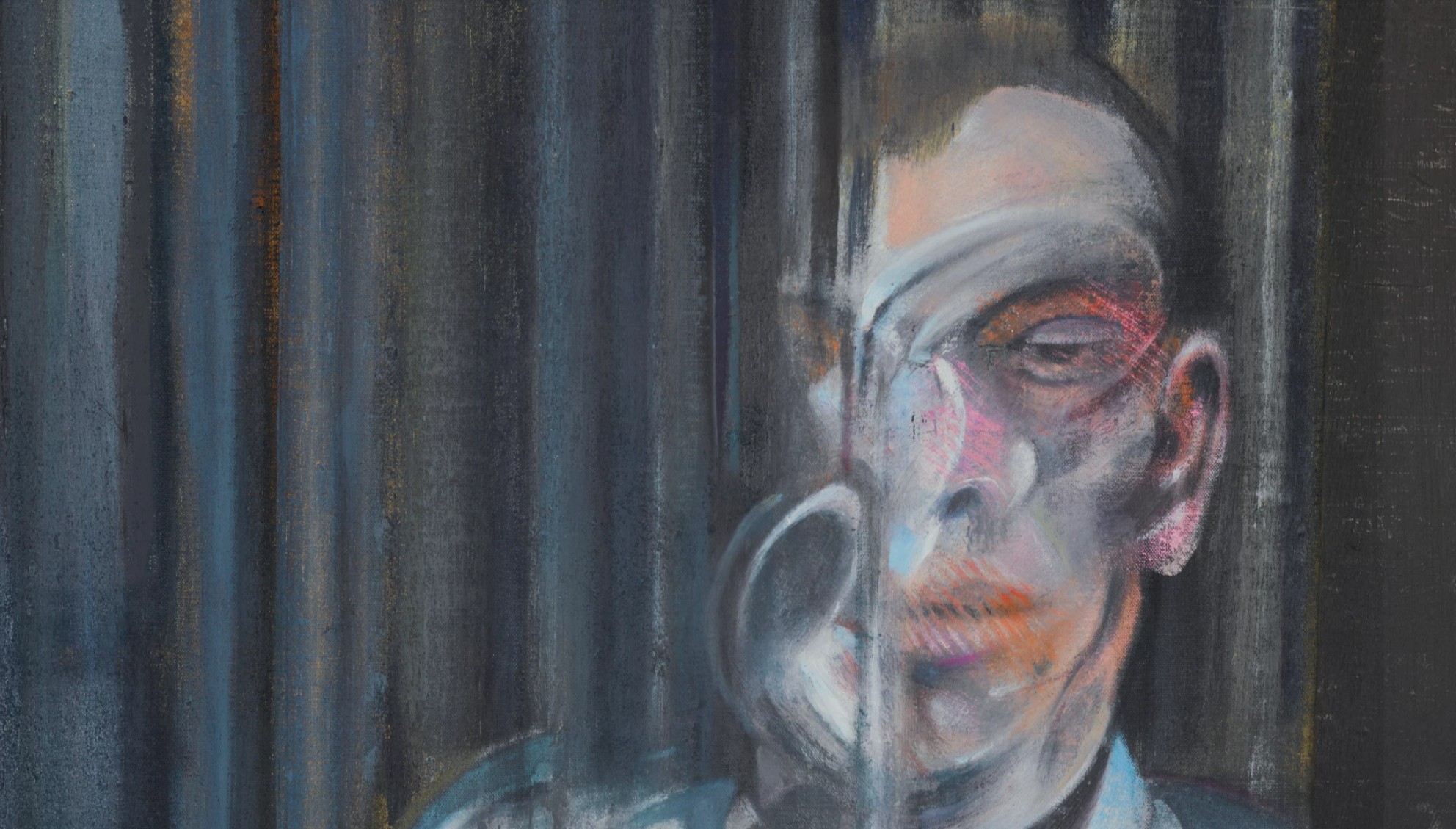
In Bacon’s quintessential style, the present composition is exquisitely balanced between urgent spontaneity and calculated precision. As eloquently described by Eddy Batache, “[T]he element of instinct, though Bacon does not disown it, is far from constituting the essence of his painting. He attaches enormous importance to the details he so lovingly polishes and repolishes, even though he knows that nobody but himself would perceive the subtle transformations he has wrought in them… The Portrait of a Dwarf, one of Bacon’s most successful works in the last few years, is particularly significant for its seemingly paradoxical co-existence of these two elements. Only an impulse welling up from the depths of his being could have drawn the main lines of the character, his attitude, his presence. But apart from this outlining, one cannot fail to appreciate the extraordinary finish of the work, of a perfection that can only be attained through consummate professionalism” (Eddy Batache, “Francis Bacon and the last convulsions of Humanism,” Art and Australia, Summer 1985, pp. 222-23). An instinctual painter, who said he wanted to work as close to the nervous system and unconscious as possible, Bacon employed whatever was at hand in his infamously unkempt studio, from photographic source material to unconventional media. As well as brushes, he used his hands, rags of wool and textile, newspapers and paint tubes to apply and manipulate the paint, exploiting the malleability and tactility of the nearly-dry oils to create chance visual effects, clearly visible here in the pink and orange pigment that has been swiped across the figure’s eye and mouth with a corduroy rag.
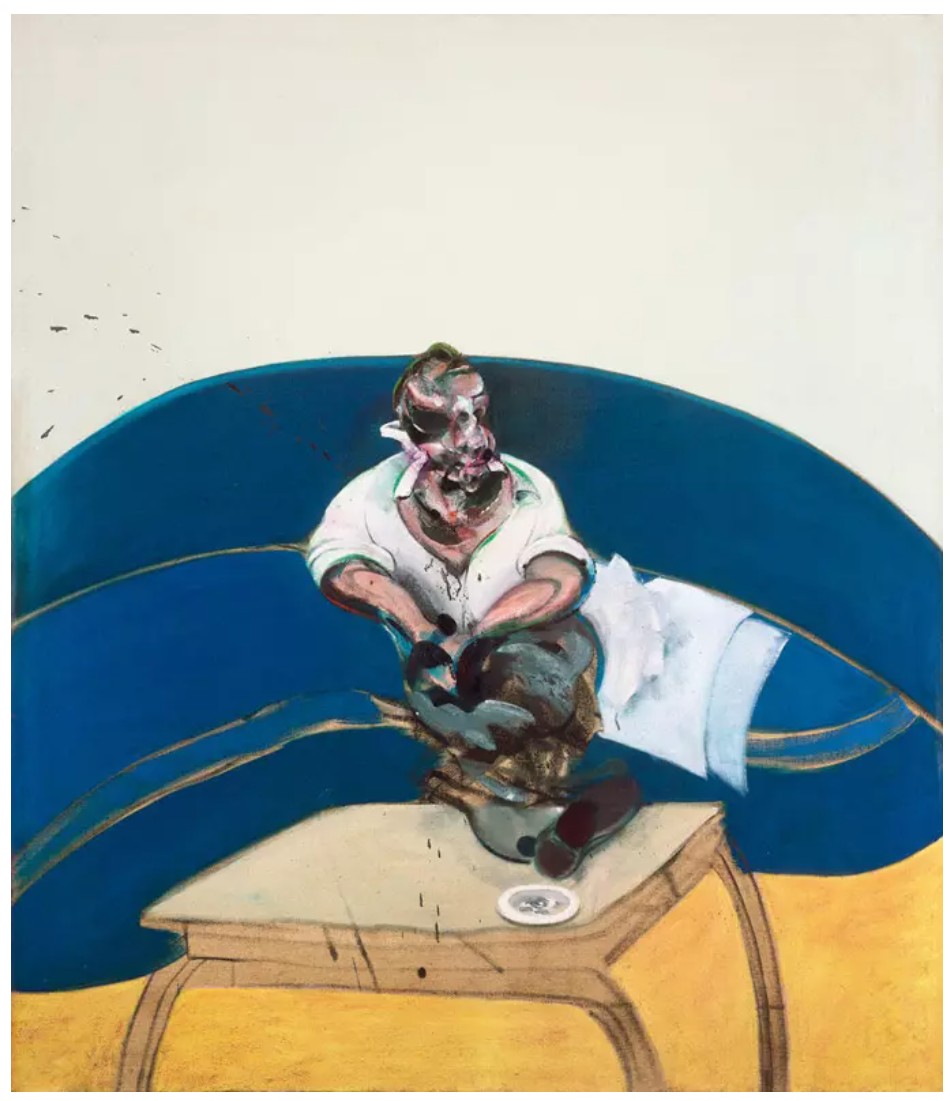
Francis Bacon, Study for Self-Portrait, 1963. National Museum and Gallery, Cardiff.
Art © The Estate of Francis Bacon. All rights reserved. DACS 2025
As with all of Bacon’s greatest paintings, the present work confronts us with a body that does not perform as we expect; in its defamiliarization, the figure becomes a cipher for psychological angst and the uncomfortable, even painful truth of the human condition. For centuries, portraiture was a means by which to reach an absolute representation of an individual: direct, unambiguous statements of a person’s character and statehood, categorized by identifiers of dress, ownership, and other iconographic markers. With the onset of Modernism, however, artists displayed their doubt in the truthfulness of this structured view of human personality, turning away from a monolithic view of human nature defined by power, and instead to a variable, contingent expression of individuals characterised by flaws and ambiguity. Unapologetic and strident in its representation and recapitulation of the human form and more broadly the human condition, Portrait of a Dwarf represents a milestone in Bacon’s oeuvre, both for its position in his canon and for the quality of its execution. The only work which he kept and exhibited as his own, Portrait of a Dwarf represents Bacon at the height of his powers and stands as a singularly potent homage to those he loved most.
Portrait of Man with Glasses III, 1963
Christie’s London: 5 March 2025
Estimated: GBP 6,000,000 – 9,000,000
GBP 6,635,000 / USD 8,492,800
FRANCIS BACON (1909-1992), Portrait of Man with Glasses III | Christie’s
FRANCIS BACON (1909-1992)
Portrait of Man with Glasses III, 1963
Oil and silver sand on canvas
14 1/8 x 12 1/8 inches (36 x 30.7 cm)
A vision in jewel-like color and vital, dynamic form, Portrait of Man with Glasses III (1963) is a masterwork from a pivotal moment in Francis Bacon’s career. Part of a key early group of his iconic 14×12-inch portraits, it displays the new flowering of formal freedom that defined his works of 1963. Swift, energetic brushstrokes coalesce to form the head of a man in dark spectacles, revealing flashes of raw canvas beneath. Stark whites are blushed with tones of pink and teal, pressed into the wet paint with textured fabric. Drama builds in the interplay between positive and negative space. The man’s glasses are dark, slanted voids: the black backdrop, with silver sand mixed into the pigment, sparkles like coaldust. Perhaps most arresting is the figure’s mouth. With a delicate impasto of bared teeth and sensual, diaphanous color, its startling beauty might be said to realize Bacon’s ambition—stated in 1962—
“to paint the mouth like Monet painted a sunset”
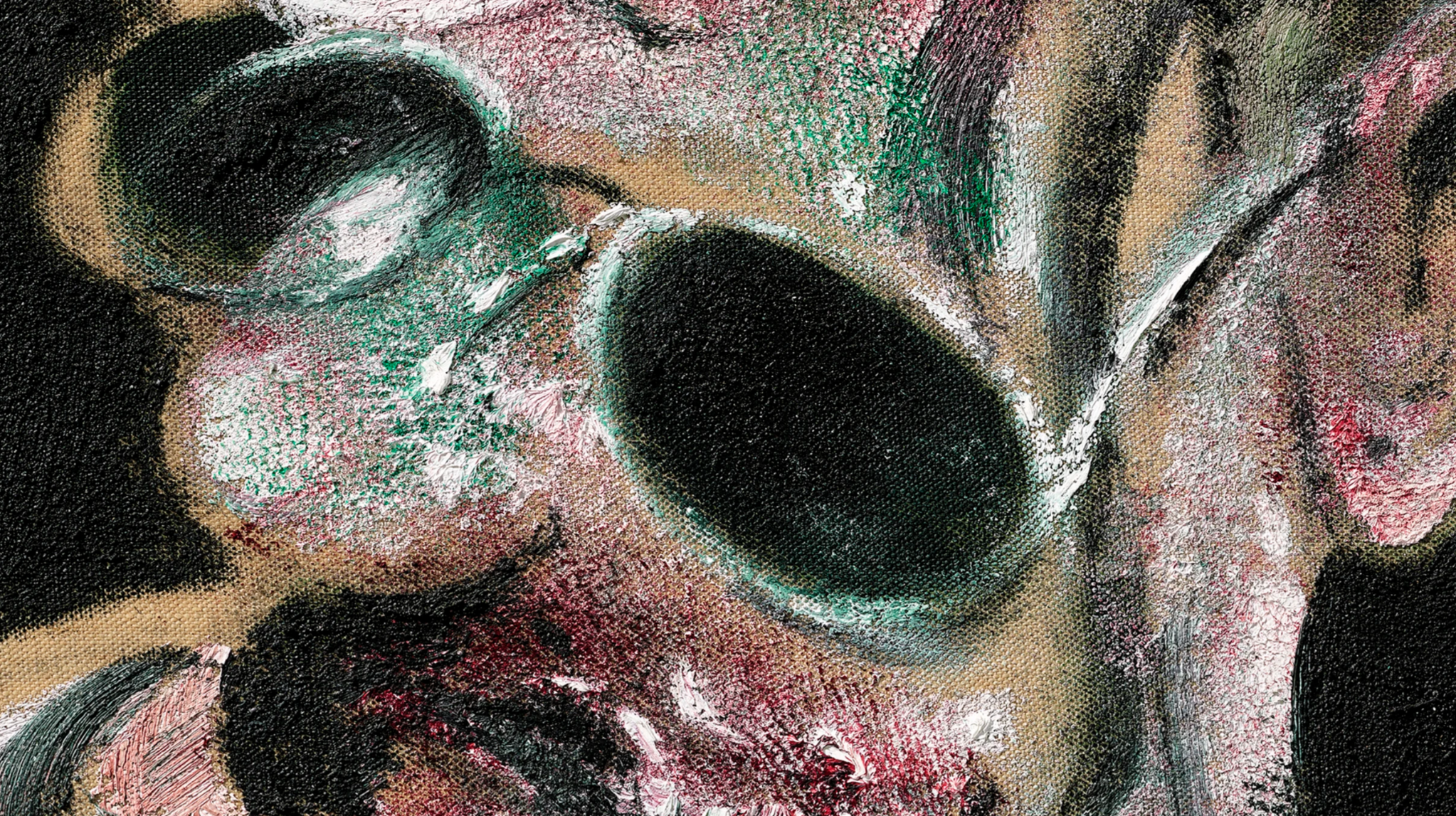
Bacon created four ‘Man with Glasses’ paintings in 1963, debuting them at Marlborough Gallery in London that summer. Martin Harrison, author of Bacon’s catalogue raisonné, describes them as ‘among the most potent, if disquieting, of his portrait busts’ (M. Harrison, Francis Bacon: Catalogue Raisonné, Volume III, London 2016, p. 724). While Portrait of Man with Glasses I resides in the Seattle Art Museum, none has received as much critical attention as Portrait of Man with Glasses III, which curator Dennis Farr singled out as ‘the most dramatic and disquieting of the series’ (D. Farr, ‘Catalogue of the Works’, in Francis Bacon: A Retrospective, exh. cat. Yale Center for British Art, New Haven 1999, p. 130). The work has been included in a suite of major Bacon exhibitions during the past three decades, appearing in seventeen cities across the world. Notably, it served as the catalogue cover for Francis Bacon/Henry Moore: Flesh and Bone, which opened at the Ashmolean Museum, Oxford in 2013: most recently it was seen in London, as part of the National Portrait Gallery’s acclaimed 2024-2025 retrospective Francis Bacon: Human Presence.
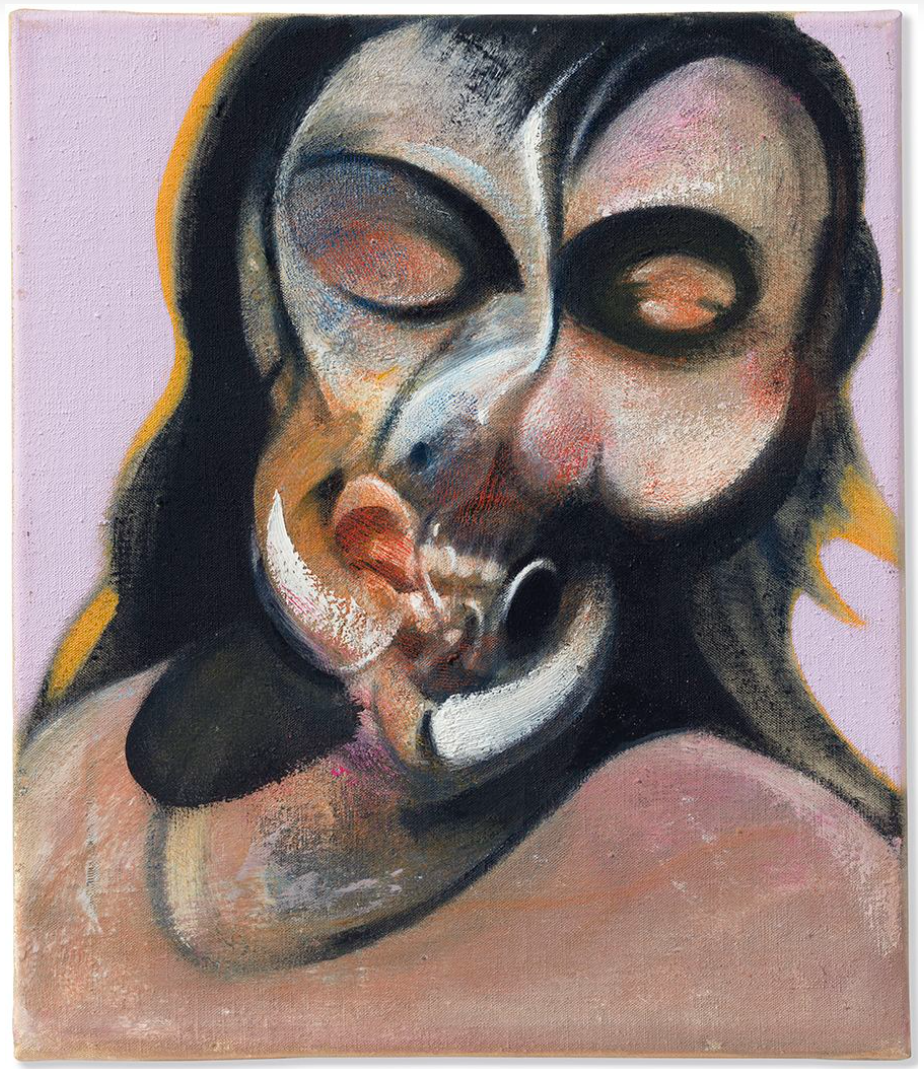
Francis Bacon, Study of Henrietta Moraes Laughing, 1969. Private collection. Artwork: © The Estate of Francis Bacon. All rights reserved. DACS 2025
1963 was a watershed year for Bacon. He had held his first museum retrospective at the Tate in London the previous year. On the day of its opening, he learned that his lover, Peter Lacy, had passed away in Tangier. Their turbulent relationship, seared into so much of Bacon’s work since the early 1950s, had ended in 1961, and the artist was left haunted by his loss. Towards the anniversary of his death, Bacon painted a memorial to Lacy: Landscape Near Malabata, Tangier (1963), an extraordinary image of grief, desire and longing in which shadows flit round a desert vortex beneath a dark, heated sky. One of Bacon’s most important paintings, this work’s whirling, elliptical forms foreshadow the distinctive torsion seen in Portrait of Man with Glasses III, which was made within weeks of Landscape Near Malabata, Tangier.
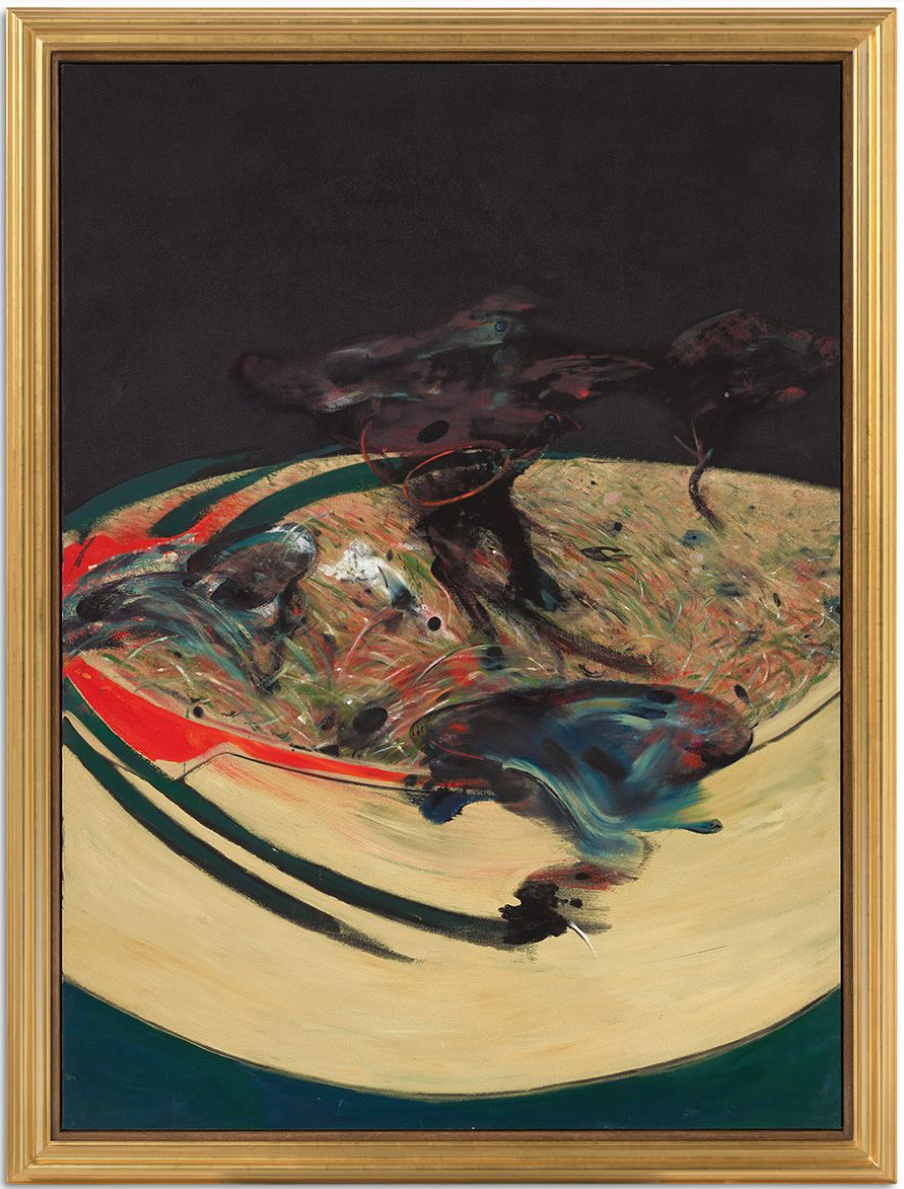
Francis Bacon, Landscape near Malabata, Tangier, 1963. Private collection.
Artwork: © The Estate of Francis Bacon. All rights reserved. DACS 2025.
In the wake of his triumph and tragedy, Bacon was beginning to explore new colors, techniques and subjects. The dark, existentialist tenor of the previous decade gave way to a mood of openness and vigour that suffuses the works of 1963. The ‘Man with Glasses’ series was where the 14 x 12” head—‘the scene of some of Bacon’s most ferocious investigations’—‘really got under way’, writes John Russell (J. Russell, Francis Bacon, rev. ed., London 2010, pp. 99, 123). Embracing this concentrated format, which he had first experimented with in 1961, Bacon created seminal triptych portraits of his friend Henrietta Moraes, and—following their meeting in autumn 1963—his new partner George Dyer, who would soon become one of his principal sitters. The year concluded with the October opening of Bacon’s first major American exhibition at the Solomon R. Guggenheim Museum, New York.
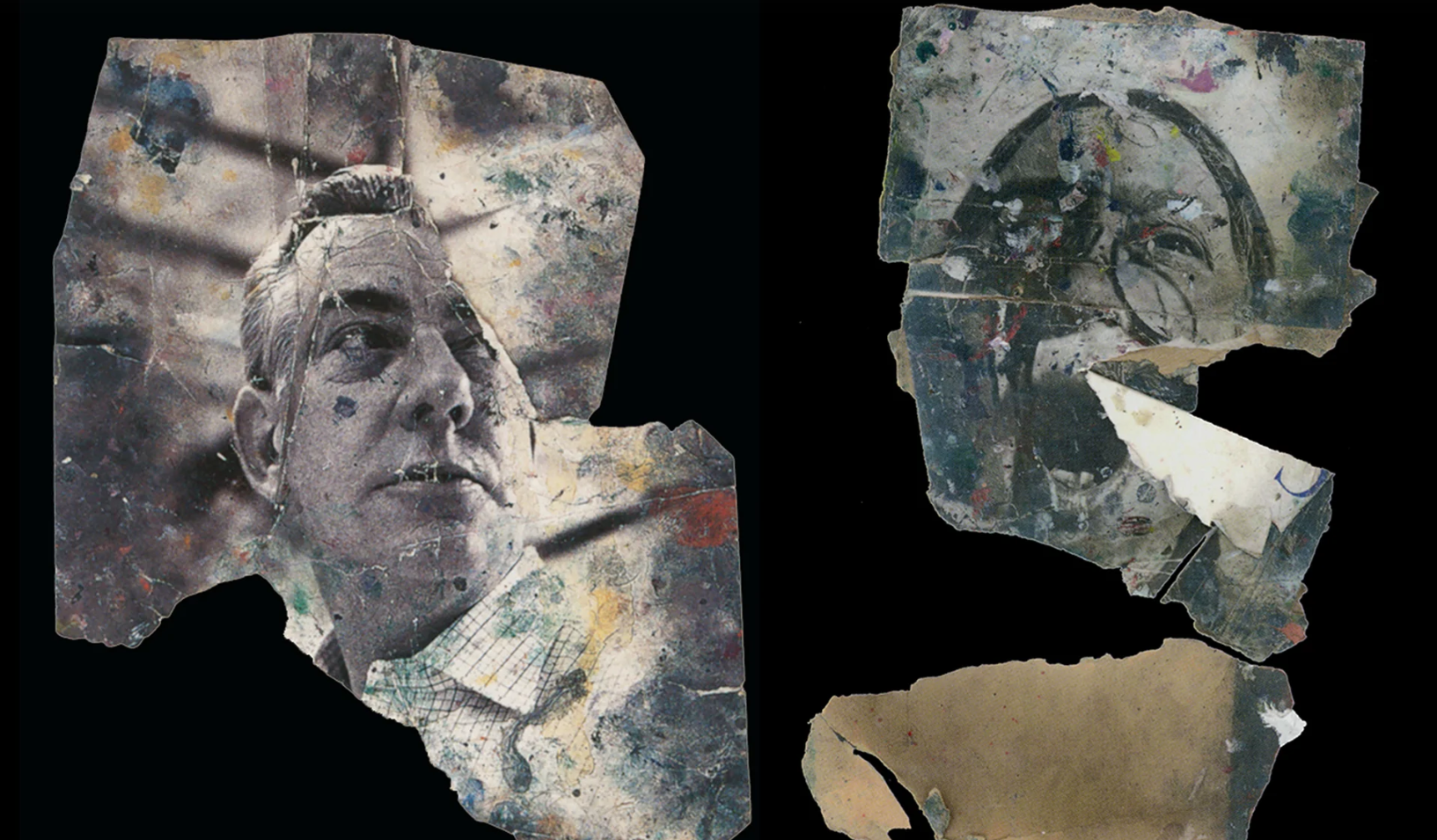
Left: Peter Lacy, late 1950s–early 1960s. © The Estate of Francis Bacon. All rights reserved, DACS/Artimage 2025. Photograph by John Deakin.
Right: Bacon studio material, ‘Screaming Woman’ from Sergei Eisenstein, Battleship Potemkin, 1925. Illustration of film still from unknown source. Collection: Dublin City Gallery The Hugh Lane © The Estate of Francis Bacon. All rights reserved, DACS 2025.
The mouth in Portrait of Man with Glasses III represents the climax of a theme that had fascinated Bacon for decades. As a young man in 1920s Paris, he had become mesmerized by a ‘second-hand book which had beautiful hand-coloured plates … of the mouth open and of the examination of the inside of the mouth’: around the same time, he saw Sergei Eisenstein’s 1922 film Battleship Potemkin, in which a famous close-up shot captures the open-mouthed scream of an injured woman. ‘I did hope one day’, he said, ‘to make the best painting of the human cry’ (F. Bacon quoted in D. Sylvester, ibid., p. 40). These images, fused in Bacon’s fascination, would resound through his early paintings. They are there in the toothy maws of Three Studies for Figures at the Base of a Crucifixion (1944, Tate, London), and in his crucial first ‘Heads’, howling Popes and animal studies of the 1940s and 1950s.
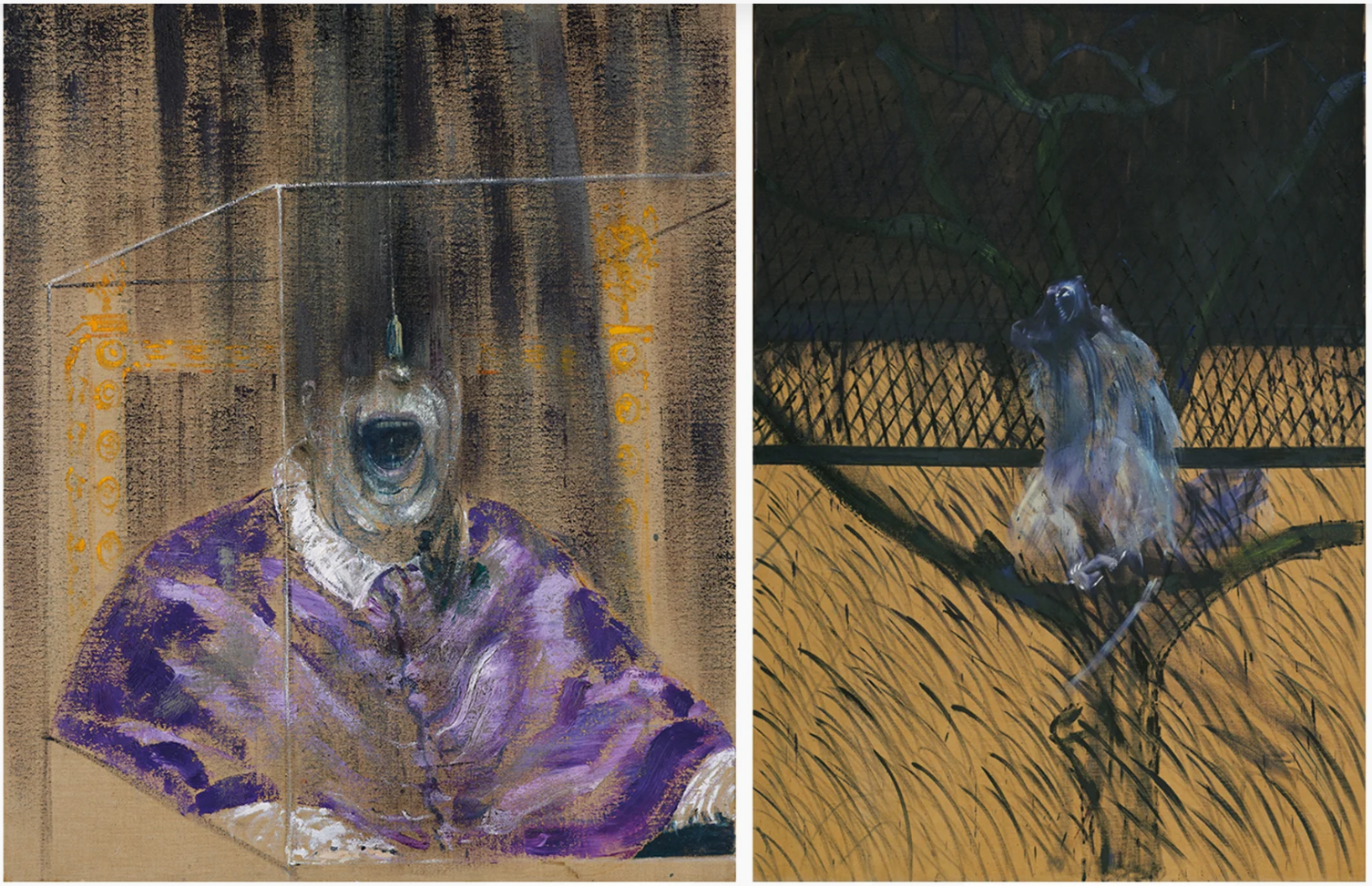
Left: Francis Bacon, Head VI, 1949. Arts Council Collection, Southbank Centre, London. Artwork: © The Estate of Francis Bacon. All rights reserved. DACS 2025. Photo: Prudence Cuming Associates Ltd.
Right: Francis Bacon, Study of a Baboon, 1953. Museum of Modern Art, New York. Artwork: © The Estate of Francis Bacon. All rights reserved. DACS 2025. Digital image: The Museum of Modern Art, New York/Scala, Florence.
In a Europe ravaged by conflict, Bacon’s post-war work was conversant with the era’s darkness. Drawing on existential philosophy and literature, his early mouths were voids of mortal loneliness, sounding the animal cries of trapped and tormented beings. By the time of the present work—painted amid the rise of Swinging London, Pop Art and Bacon’s own buoyant critical success—his motifs had become freer and more multivalent. Portrait of Man with Glasses III realizes his ambition to match Monet in capturing ‘the glitter and color that comes from the mouth’, alive with movement and subtle light. At the same time Bacon was deepening his interest in Pablo Picasso, who, he said, had suggested a whole area ‘which in a way has been unexplored, of organic form that relates to the human image but is a complete distortion of it’ (F. Bacon quoted in D. Sylvester, ibid., pp. 40, 9). In Portrait of Man with Glasses III the face itself twists like a chrysalis, as if physically enacting a metamorphosis in Bacon’s art.
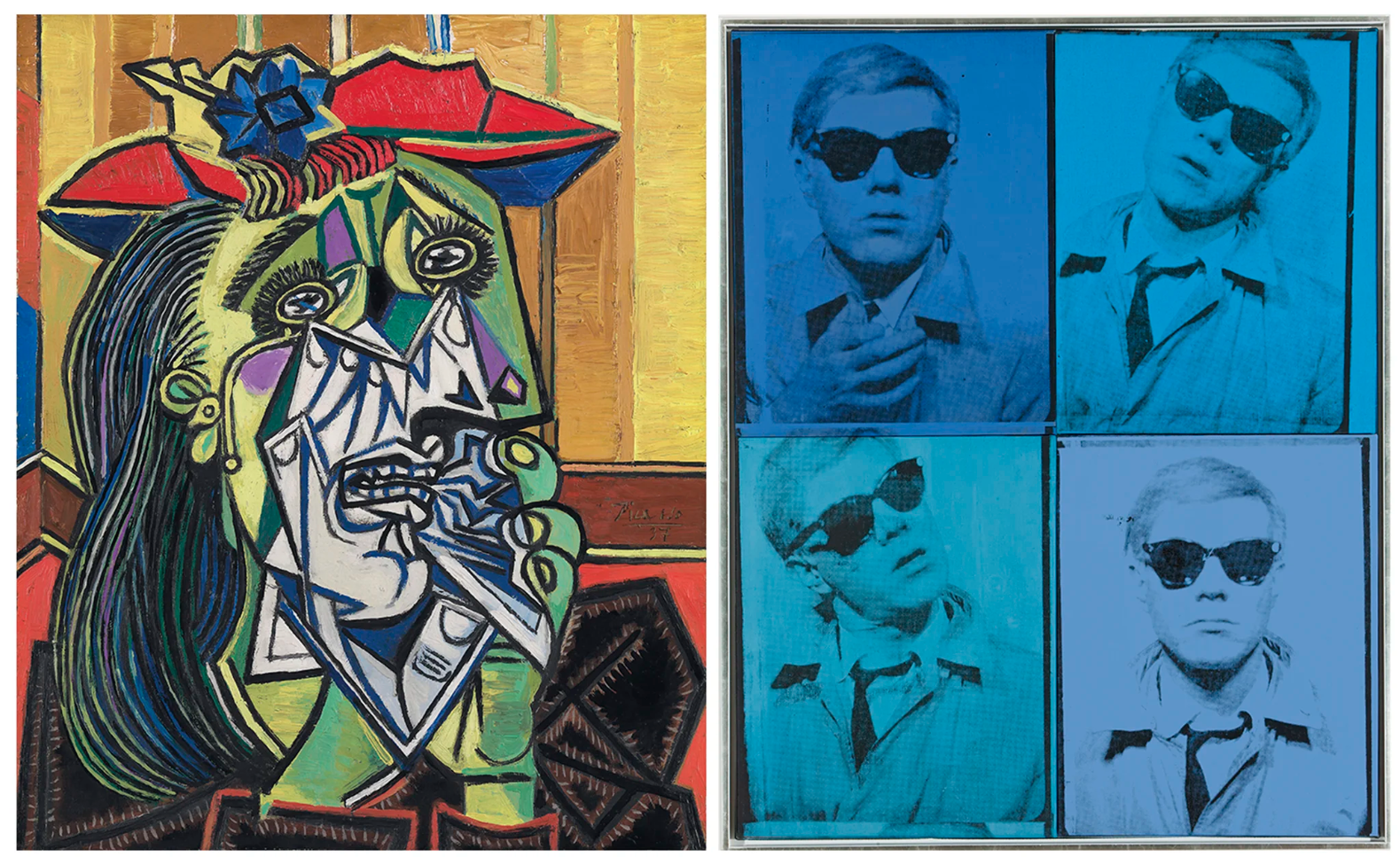
Left: Pablo Picasso, Weeping Woman, 1937. Tate, London. Artwork: © Succession Picasso/DACS, London 2025. Digital image: Tate.
Right: Andy Warhol, Self-Portrait, 1963-1964. Private collection. Artwork: © 2025 The Andy Warhol Foundation for the Visual Arts, Inc. / Licensed by DACS, London. Digital image: © 2025 Christie’s Images, London/Scala, Florence.
Picasso’s Primitivist and Cubist reworkings of the human head—the features distorted and rearranged, and seen from multiple angles at once—were foundational for Bacon. Portrait of Man with Glasses III bears fractured echoes of Picasso’s ‘Weeping Women’, and David Sylvester noted a similarity with two wartime portraits made in 1939. The man’s glasses slip, glinting, down a warped face with the mouth swept round to one side. His hairline, skull and shoulders morph into liquid silhouettes, adorned with the vortical shape of an ear. While indebted to Picasso’s faces, however, Portrait of Man with Glasses III has none of their mask-like fixity. The subject instead seems—paradoxically—caught in the act of refusing to be pinned down. Where Picasso’s heads might happily be reproduced as sculptures, writes Russell, ‘… Bacon’s heads by contrast are pure painting and could not be transposed into any other medium: the thing said and the way of saying it interlock completely’ (J. Russell, ibid., p. 123).
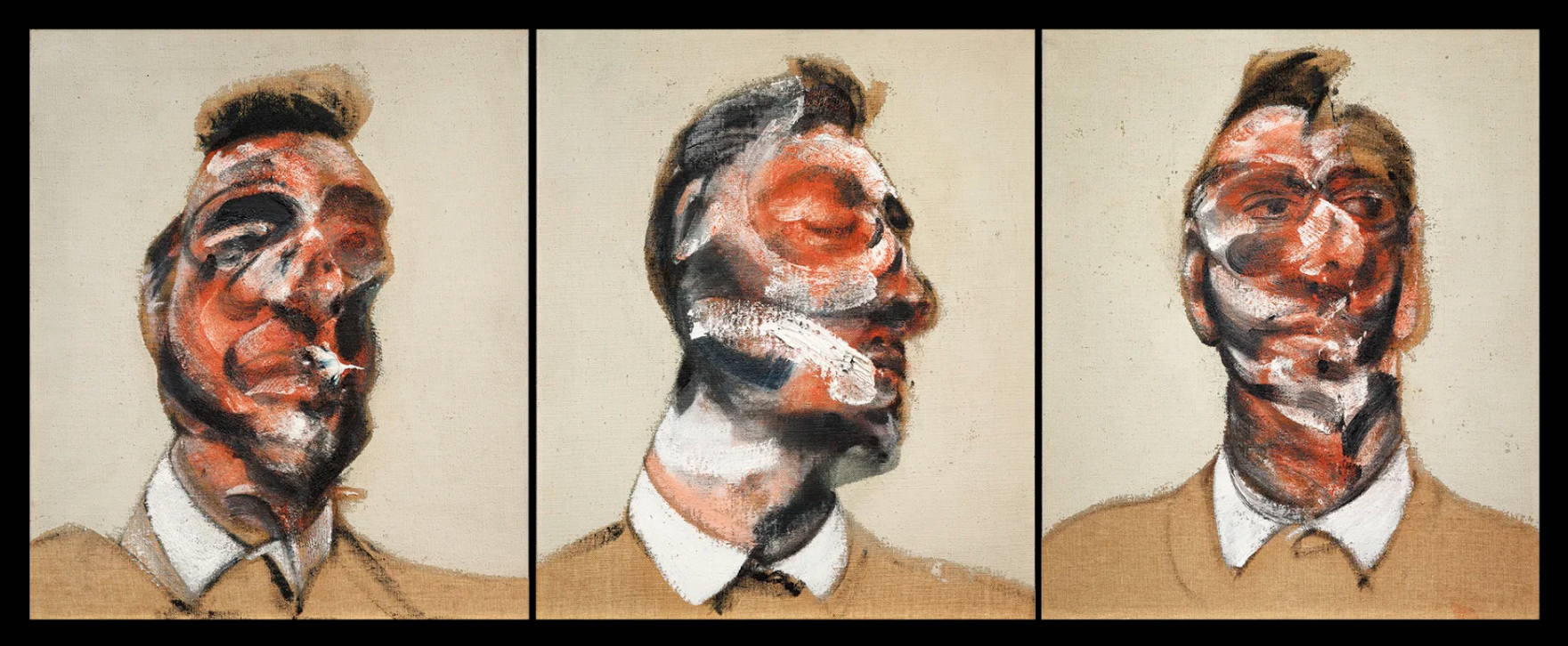
Francis Bacon, Three Studies for Portrait of George Dyer (on light ground), 1964
Artwork: © The Estate of Francis Bacon. All rights reserved, DACS/Artimage. Photo: Prudence Cuming Associates Ltd.
This fusion of medium and message was central to Bacon’s outlook. He strove constantly to combine what he referred to as ‘fact’, or recognisable, figurative reality, with the radical artistic risk of his painterly technique. ‘It’s a very, very close and difficult thing to know why some paint comes across directly onto the nervous system’, he said, ‘and other paint tells you the story in a long diatribe through the brain’ (F. Bacon quoted in D. Sylvester, ibid., p. 18). To achieve this elemental directness, Bacon painted the present work on the reverse of the canvas, as he had done since the 1940s. The tooth of the unprimed surface enabled dry paint to be dragged into broken, lucent strokes. The black background’s profound darkness, impregnated with sand, contrasts vividly with the fabric striations—Bacon commonly used a scrap of corduroy, or a cashmere jumper—which touch the paint, like skin, with a final delicate caress.
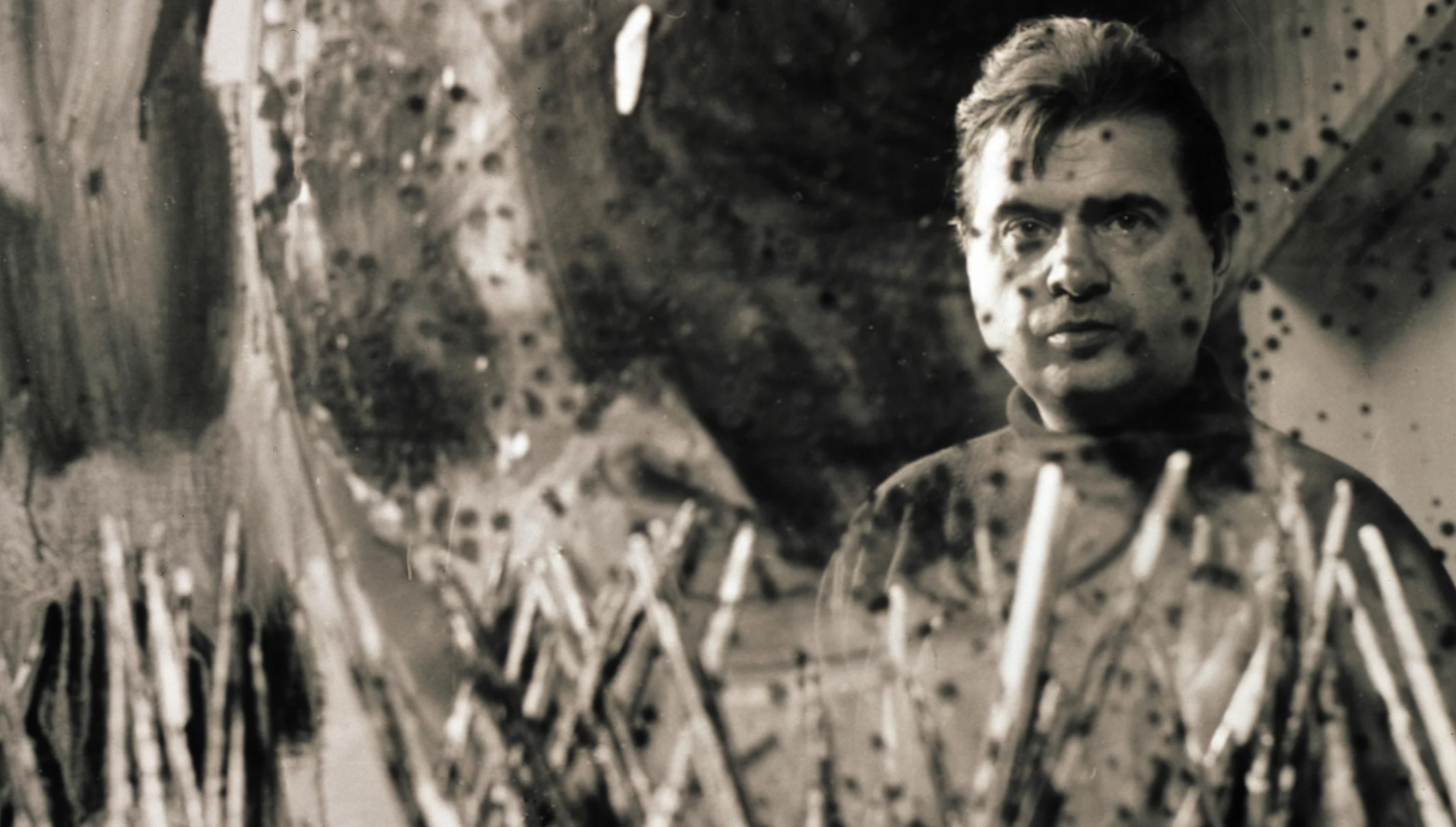
Francis Bacon in his studio at 7 Reece Mews, London, 1963.
Photograph by Jorge Lewinski. Photo: © The Lewinski Archive at Chatsworth / Bridgeman Images.
Engaged with diverse modes of image-making, Bacon drew upon photographs from a wide range of genres, including film stills, reproductions of paintings and sculptures, contemporary newsprint, Eadweard Muybridge’s 19th-century motion studies, and portraits of his Soho circle taken by the photographer John Deakin. Among his early inspirations was the 1939 book Positioning in Radiography by T. C. Clark, whose early X-ray images unveiled—as T. S. Eliot had written— ‘the skull beneath the skin’ (T. S. Eliot, ‘Whispers of Immortality’, Poems, New York 1920, p. 31). The way in which the X-ray showed the teeth, quoted in Portrait of Man with Glasses III, appears to have been a source of special attraction for Bacon. The man’s light-ringed black lenses also recall the diagrammatic, circular photographs seen in the book. Further abstracted, these dark discs would appear increasingly in Bacon’s introspective self-portraits of the mid-1970s, punching ocular holes in the artist’s own image.
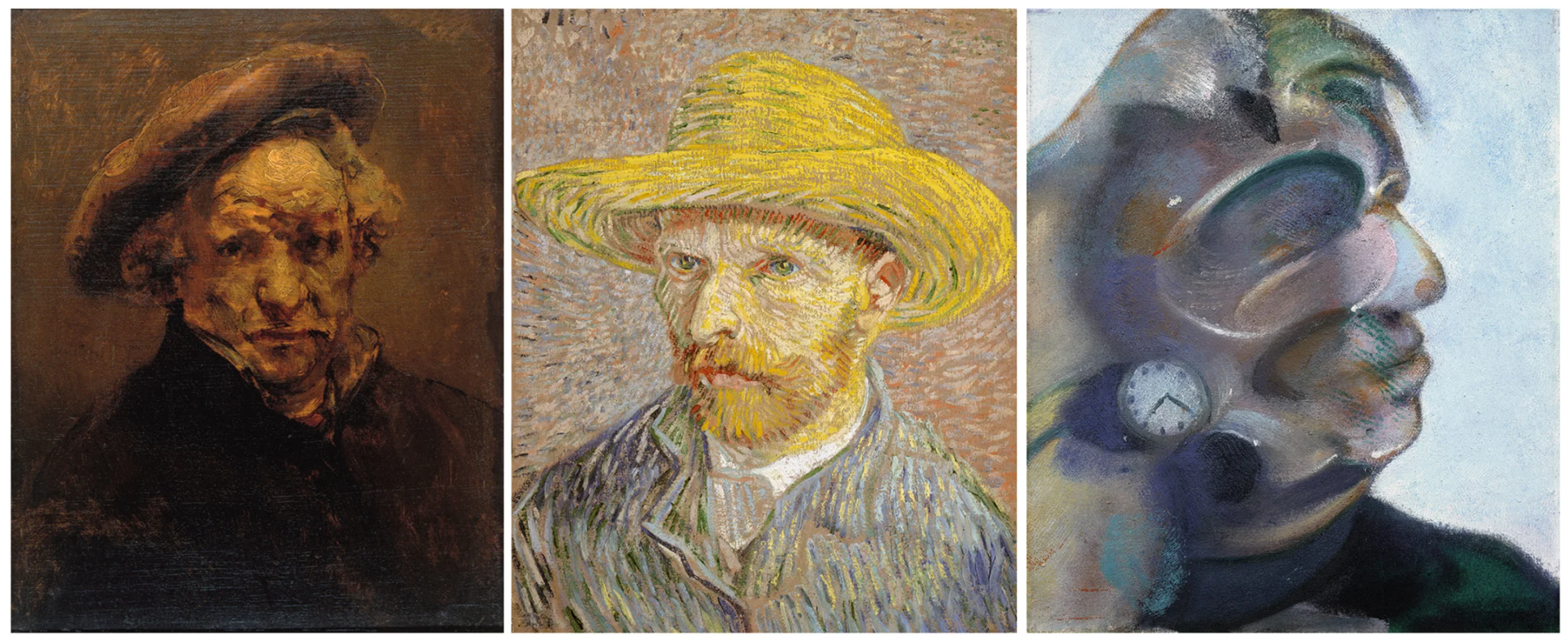
Left: Rembrandt van Rijn, Self-Portrait with Beret, circa 1659. Musée Granet, Aix-en-Provence.
Centre: Vincent Van Gogh, Self-Portrait with a Straw Hat, 1887. Metropolitan Museum of Art, New York. Digital image: © 2025 The Metropolitan Museum of Art/Art Resource/Scala, Florence.
Right: Francis Bacon, Study for Self-Portrait, 1973. Private collection. Artwork: © The Estate of Francis Bacon. All rights reserved. DACS 2025.
Indeed, while the ‘Men with Glasses’ depict no known sitter—suggestions have included the ophthalmologist Patrick Trevor-Roper, and the author James Joyce—all of Bacon’s works contain an aspect of self-portraiture. Bacon saw himself as part of a lineage of painters who had truly put themselves into their work, including Vincent van Gogh, Diego Velázquez and his own contemporary Lucian Freud. Greatest of all, he believed, was Rembrandt. The Dutch master’s Self-Portrait with Beret (circa 1659), Bacon enthused, was ‘almost completely anti-illustrational … there is a coagulation of non-representational marks which have led to making up this very great image.’ He saw these mysterious, impulsive marks as more powerful than anything achieved in abstract art, because they were allied with the recording of visual ‘fact’: a tension held together by Rembrandt’s ‘profound sensibility’ (F. Bacon quoted in D. Sylvester, ibid., p. 67). In the free brushwork of Portrait of Man with Glasses III, we see Bacon’s own sensibility come to the fore.
Claude Monet, The Houses of Parliament, Sunset, 1903. National Gallery of Art, Washington, D.C.
Digital image: © DeAgostini Picture Library/Scala, Florence.
Painting, Bacon said, ‘is the pattern of one’s own nervous system being projected on canvas’ (F. Bacon quoted in ‘Art: Survivors’, Time, Vol. 54, No. 21, 21 November 1949, p. 44). Portrait of Man with Glasses III offers this insight in more ways than one. Situated at a fulcrum in his practice, it calls upon the most dark, visceral achievements of Bacon’s early paintings while also looking forward to a phase of optimism and exploration: to his portraits of his friends, himself and George Dyer that would define the work of the coming decade, and to a fresh unfurling of daring form and colour. At its centre is the mouth, which—no longer the rictus of the skull—becomes a thing of mobile, shimmering splendor. The mouth, for Bacon, was also a site of sensuality, laughter and conversation. Here, he speaks with all the eloquence of a new painterly language.
Study for a Portrait, 1979
Sotheby’s London: 12 October 2023
Estimated: GBP 3,500,000 – 4,500,000
GBP 4,283,000 / USD 5,274,625
Study for a Portrait | Contemporary Evening Auction | 2023 | Sotheby’s (sothebys.com)
FRANCIS BACON (1909 – 1992)
Study for a Portrait, 1979
Oil on canvas
36.2 x 30.5 cm (14 1/4 x 12 inches)
Signed, titled and dated 1979 (on the reverse)
Combining both a dazzling display of painterly bravura and a multi-layered psychological intensity, Study for a Portrait from 1979 exemplifies the salient features of Francis Bacon’s tremendous output. Composed of a three-quarter profile set against a soft blue background and a strip of bright cadmium orange, the present work is a classic example from Bacon’s seminal suite of small portrait heads. The painting first began as a framed head nailed to a wall of cadmium orange, a prominent color in Bacon’s 1970s works as well as in the 1944 Crucifixion triptych. When Bacon repurposed the original piece into the present smaller format, he retained a strip of cadmium orange at the bottom. The beautiful composition of the present work is thus arranged around a schema of framing devices: the overlapping matrices of paint hatching, and modulations of texture carefully organize the containment of the head within the frame, preparing the viewer from the outset that this portrayal is pensive, focused and enduring.
The extraordinary compression of the image, together with the soft blue background heightens the drama and magnifies the prominence of the visage. Painted in an intimate scale, the intensity of each stroke is contained in the twisting head as it flickers with the faintest movement. Bacon preferred to paint in absentia relying predominantly on the combination of photographic material and memory to inform his image production. He viewed painting by nature as an artifice and felt that having the model before him suffocated spontaneous creative invention. Bacon spoke admirably of Picasso, especially his work of the 1920s and 1930s, in which he saw a syntax of “organic form that relates to the human image but is a complete distortion of it” (Francis Bacon quoted in: Milan Kudera and France Borel, Bacon: Portraits and Self-Portraits, London 1996, p. 10). Bacon consistently returned to the portrait format throughout his career and steadfast in his belief that abstraction was merely aesthetic, and that art devoid of human content lacked emotional resonance. As a committed portraitist, Bacon was seeking to visually explain the variations of the human condition and capture the distinct psyche and intensity of his sitters. \
Head of Woman, 1960
Sotheby’s Paris: 21 June 2023
Estimated: EUR 6,000,000 – 8,000,000
EUR 6,437,375 / USD 7,029,613
FRANCIS BACON (1909 – 1992)
Head of Woman, 1960
Oil on canvas
35×27 inches (89 x 68.5 cm)
Bacon returned to London from Tangier after summer 1959 without having finished no painting there to his satisfaction. After having taken part in two exhibitions at the Musée des Arts décoratifs as well as at the Salon de mai at the Musée d’art modern de la ville de Paris in 1960, the artist had to prepare for his first solo show at the Marlborough gallery (March 23, 1960). Having produced too few paintings to justify a first solo exhibition at his new gallery, he moved to St. Ives, Cornwall, allegedly in order to paint without London’s distractions.
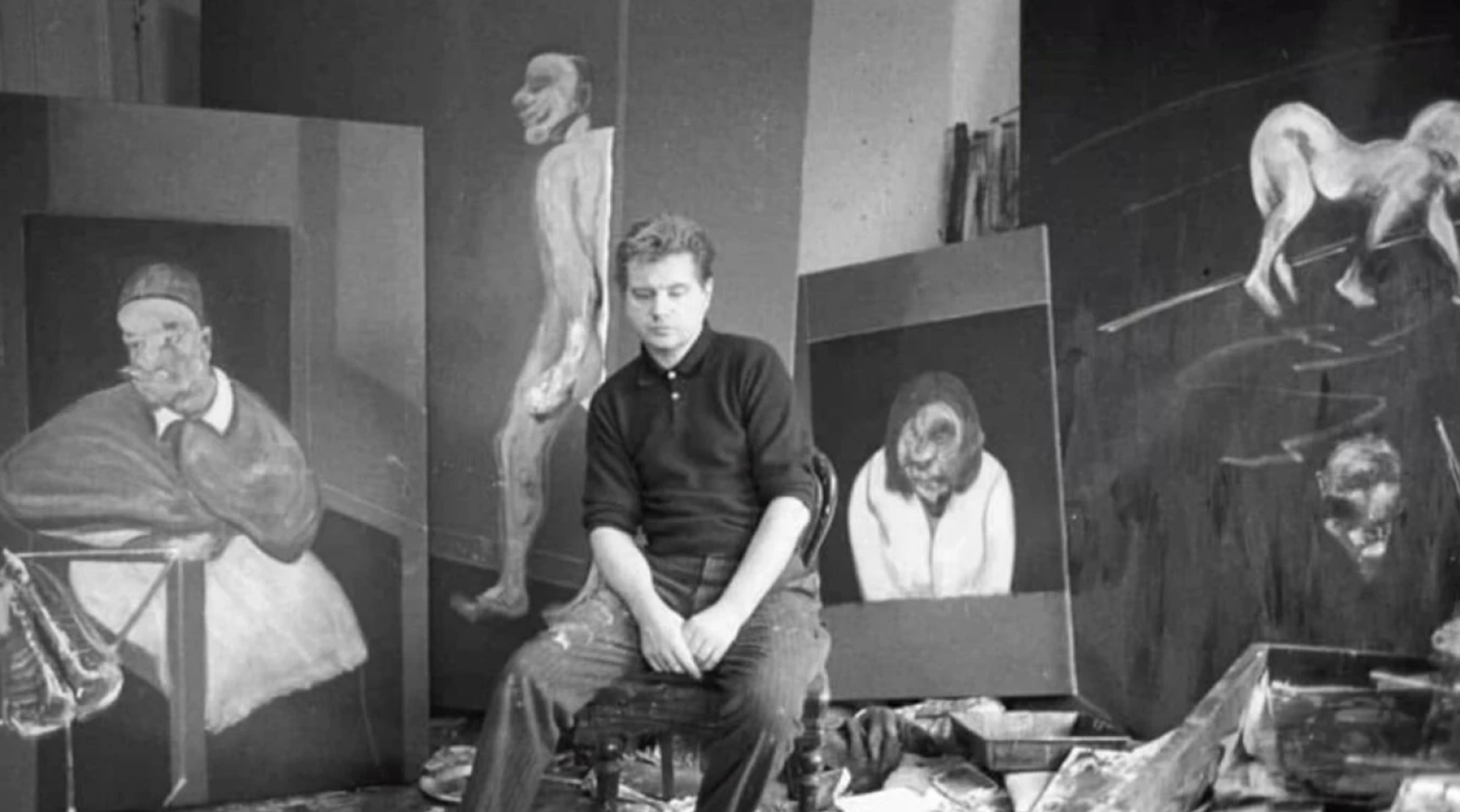
FRANCIS BACON PHOTOGRAPHED IN HIS STUDIO BY DOUGLAS GLASS, 1960, © ADAGP, PARIS 2023
The picture is one of the three Head of Woman painted by Bacon in 1960 (the third one at the Sainsbury Center for Visual Arts, University of East Anglia, Norwich): as Alley noted these were ‘based on the wife of one of the artists at St Ives’. She was Mary Redgrave, wife of William Redgrave, the artist from whom Bacon rented 3 Porthmeor Studios, St Ives, between September 1959 and January 1960. William Redgrave’s diaries, which document Bacon’s activities during this period in considerable detail, make no mention of the portraits of his wife. Presumably Mary Redgrave was unaware that Bacon was painting her portrait, and Bacon said he painted the three Head of Woman from memory. This painting is one of the rare works of the decade produced with no visual aids. From 1960 onwards, Bacon commissions John Deakin to create a series of photographs representing his close friends including Peter Lacy, George Dyer, Isabel Rawsthorne and Lucian Freud. These documents will function as an important source of inspiration for his later portraits. Bacon explains: “I find that photographs are very much more interesting than either abstract or figurative painting. I’ve always been haunted by them” (Francis Bacon, David Sylvester, Interviews with Francis Bacon, Thames & Hudson, 1975, p.37)
The present work is the second portrait of Mary Redgrave. A photograph by Cecil Beaton, taken in the Overstrand Mansions studio shortly after Bacon’s return from St Ives in January 1960, shows the painting with a large band of green at the left, which Bacon subsequently cut off. It must have been painted originally in a square format, 35×35 in. (89×89 cm).
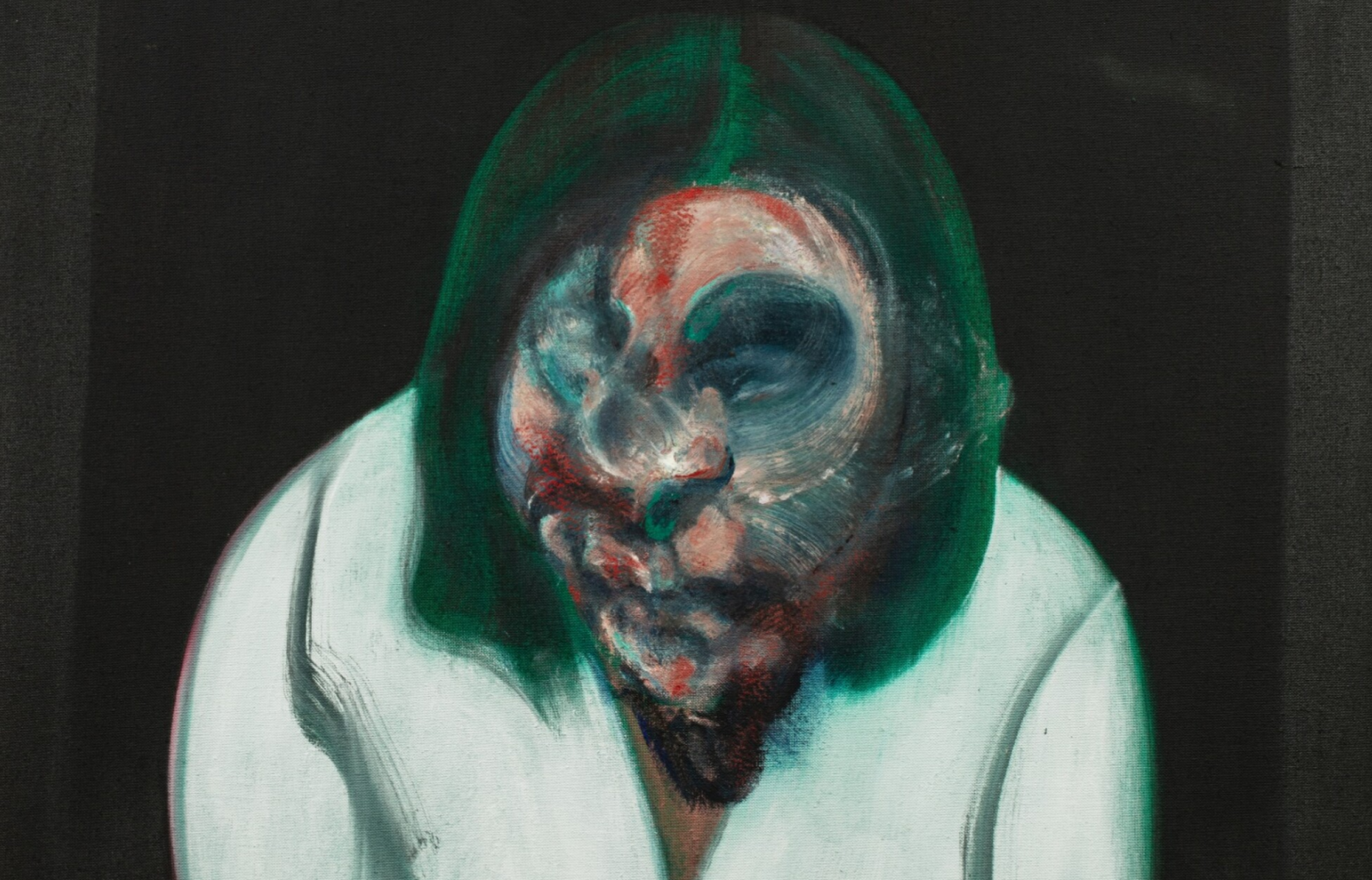
During his time working at Overstrand Mansions, Bacon received financial support from Robert and Lisa Sainsbury. The couple began to collect his works and was later portrayed by the artist who made a painting of Robert and eight studies of Lisa. As well as their interest in modern works, the Sainsburys shared a passion for African art and built one of the finest collections in this field. In 1978 they founded the Sainsbury Center for Visual Arts located on the campus of the University of East Anglia in which are housed 300 artworks and objects from their personal collection. They also enabled the creation of a Research Unit for the arts of Africa, Oceania, and the Americas. These multiple initiatives participated in forging a link between contemporary and tribal art.
The painting of the head shares a near-fauvist vigor of what may be considered the prototype of all the “St Ives portraits”, Miss Muriel Belcher, 1959 and the same framed composition and palette as that of Head of Man – Study of drawing by van Gogh, 1959. This brilliant emerald hue that encompasses most of Bacon’s works from the early 1960s, increases the sense of doubt and discomfort that are already inherent to these paintings. This chromatic shift testifies to a transitional period in the artist’s career. The viridian green which is also used in Head of Men (Self-portrait) imbues the work with a sense of darkness and uncertainty. The latter counterbalances the gleam of light that emanates from the figure’s shirt.
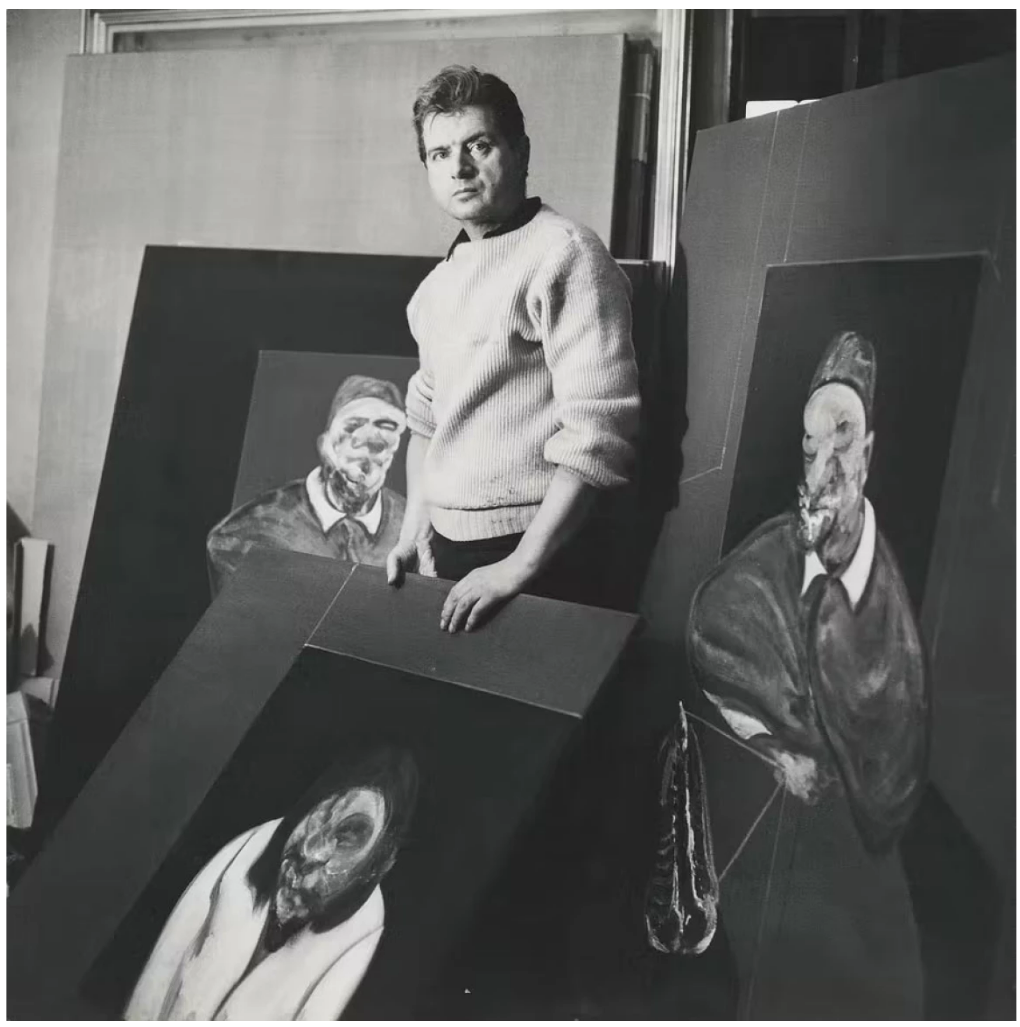
CECIL BEATON, FRANCIS BACON, 1960, © ADAGP, PARIS 2023
The picture was part of the seminal first solo exhibition at Marlborough Gallery in London (Francis Bacon: paintings 1959-1960, 23 March – 22 April 1960) that also included a remarkable series of portraits from real life and history – among which Study from Portrait of Pope Innocent X by Velasquez (1959) , Pope n.2 (1960), Pope n.3 (1960), Lying Figure (1959), Man with Arm raised, Walking figure (1960), Reclining Figure (1959), Lying Figure (1959).
Seated Man, circa 1957
Christie’s London: 28 June 2022
Estimated: GBP 2,000,0000 – 3,000,000
GBP 2,922,000 / USD 3,556,459
FRANCIS BACON (1909-1992), Seated Man | Christie’s (christies.com)
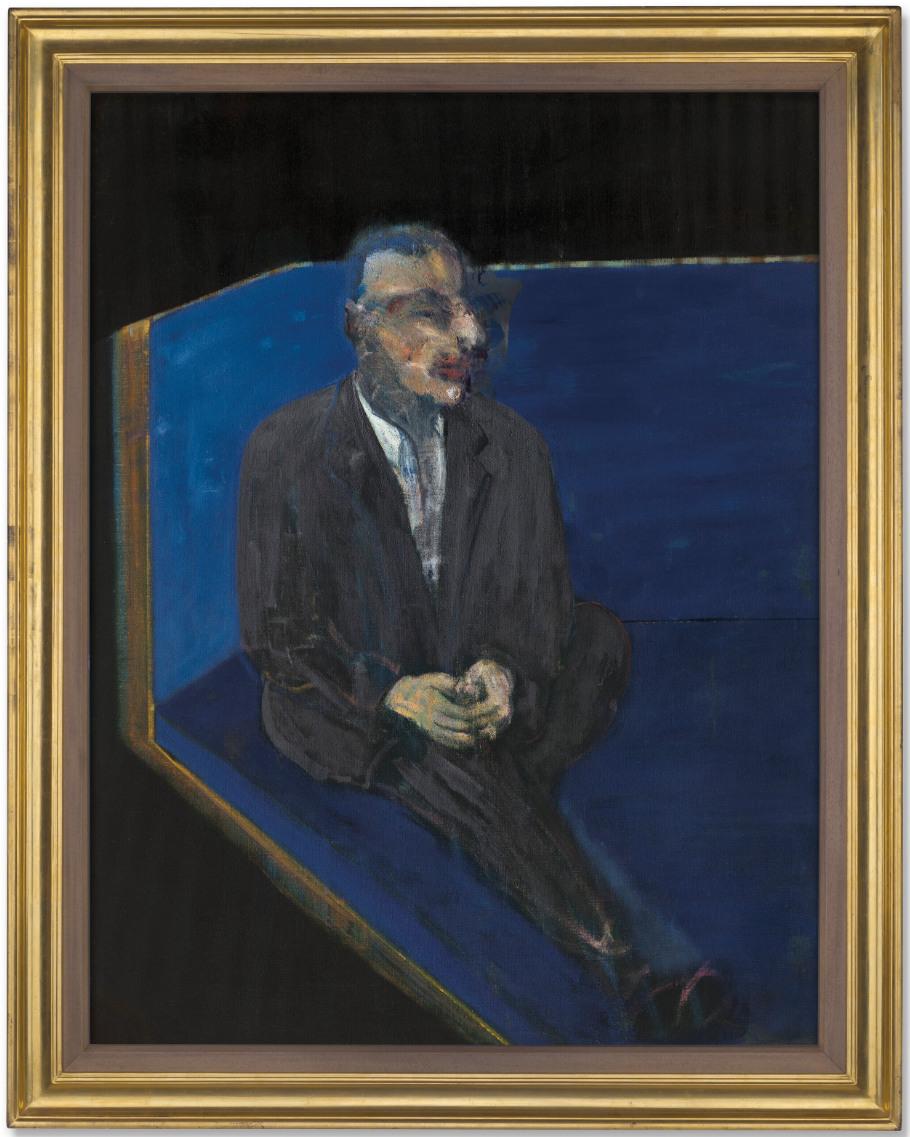
FRANCIS BACON (1909-1992)
Seated Man, circa 1957
Oil on canvas
55 x 43 3/8 inches (140×110 cm)
Painted at the height of Francis Bacon’s most transformative decade, Seated Man (1957) is a brooding portrait of the artist’s first true love and muse, Peter Lacy. Suspended within a blackened void, Lacy reclines against a deep Prussian blue backdrop, edged with gold in a manner reminiscent of Bacon’s Papal portraits. Rendered with rapid, intuitive brushstrokes, he flickers like an image caught on camera, infused with a powerful, restless motion. Executed in Tangier, where Lacy had moved in 1956, the work’s composition posits it as a companion piece to Bacon’s Self-Portrait of 1958, painted immediately afterwards and now held in the Hirshhorn Museum and Sculpture Garden, Washington, D.C. During this period, the couple’s already-tempestuous relationship had become increasingly fraught, creating a volatile, destructive dynamic that would continue until Lacy’s tragic death in 1962. Though shrouded in shadow, the present work’s luxuriant, velvety blue indicates the near-abstract fields of bright colour that gradually began to encroach upon Bacon’s language, inspired perhaps by the radiant light of North Africa. Enveloped, Lacy hovers illusively as if within a shrine: the object of Bacon’s most ardent desires, and the source of his greatest turmoil.
Bacon and Lacy had met in 1952 at the Colony Room in Soho. A former fighter pilot who served in the Battle of Britain, Lacy was nonetheless a deeply troubled man, and his mercurial personality would provide the artist with one of his most important early character studies. Their relationship was fueled by obsession, passion and vehement bouts of rage—all of which found potent expression in Bacon’s canvases. Lacy’s form haunted his first portrait triptych of 1953, his ground-breaking depictions of male couplings and his celebrated Man in Blue series, as well as works now held in the Phillips Collection, Washington D. C. and Tate, London, among others. Following his move to Tangiers, their relationship began to deteriorate, exacerbated by Lacy’s increasing dependence on alcohol. Bacon received the devastating news of his death shortly before the opening of his major Tate retrospective and continued to mourn his lover in paint—most notably in the 1963 masterpiece Landscape near Malabata, Tangier. Despite his tumultuous relationship with Lacy, in 1957 Bacon was on the brink of international acclaim. The previous year, six of his works were shown at the Museum of Modern Art, New York, whose director Alfred Barr would subsequently describe him as ‘England’s most interesting painter’. Having represented Great Britain at the Venice Biennale in 1954, his work also garnered interest in Europe, culminating in his triumphant first solo exhibition in Paris in 1957. As his star rose internationally, he began to move away from the dark, existentialist visions that had dominated his early practice. As well as absorbing the influence of Abstract Expressionism—though he denied it at the time—Bacon drew increasing inspiration from the work of Vincent van Gogh, producing a major series of works based on The Painter on the Road to Tarascon (1888) during the mid-1950s. The loose, expressionistic brushwork he gleaned from these sources is tangible in Seated Man: the harsh vertical ‘shuttering’ of his Papal portraits is quelled, replaced instead by fluid streaks of color that seek to capture the carnal life force of his subject. It is a tribute to the man who would change the artist’s life and practice forever, propelling it into daring new territory.
Untitled (Head), 1948
Phillips London: 3 March 2022
Estimated: GBP 600,000 – 800,000
GBP 772,700 / USD 1,029,306
Francis Bacon – 20th Century & Contemp… Lot 23 March 2022 | Phillips
FRANCIS BACON
Untitled (Head), 1948
Oil on fiberboard
25 3/4 x 21 7/8 inches (65.5 x 55.5 cm)
Executed in 1948, Head is a visually striking example of one of British artist Francis Bacon’s earliest and most important bodies of work, the Heads that he intensively devoted himself to between 1948 and 1949. One of his earliest single-figure portrait studies, Head clearly signposts major compositional motifs and themes that would preoccupy the artist in subsequent years; establishing the foundations of his unmistakable visual vocabulary these pivotal works also testify to Bacon’s unflinching treatment of the human condition, even at this early stage. Painted in anticipation of his first major solo exhibition at London’s Hannover Gallery where six of these extraordinarily concentrated works announced Bacon as a forceful presence of the British avant-garde, Head documents the rapid evolution of the artist’s work during this short period, bridging the raw, animalistic power of Head I with the bold theatricality of the thickly textured vertical veils of grey paint that would come to be such an iconic feature of his early painting and exemplifying Bacon’s desire ‘to paint like Velázquez but with the texture of hippopotamus skin’.
“I am always surprised when people speak of violence in my work. I don’t find it at all violent myself. […] There is an element of realism in my pictures which might perhaps give the impression, but life is violent; so much more violent than anything I can do!”
Testament to the foundational importance of these early, single-figure portrait studies on Bacon’s subsequent production, Head I, Head II, and Head VI all belong to major public collections, and three paintings from this core series of six are currently on view as part of the critically acclaimed retrospective Francis Bacon: Man and Beast at London’s Royal Academy of Arts. Presented together in this way we get a powerful sense of the pivotal importance of 1948 and 49 in defining Bacon’s practice as the figure clearly emerges as the central focus of his work. Bringing examples of these early Heads together too underscores their direct relationship to the artist’s iconic series of Screaming Popes, made explicit with the inclusion of Head VI, the last of the 1949 series and the first of Bacon’s paintings to directly reference Diego Velázquez’s masterpiece Portrait of Innocent X.
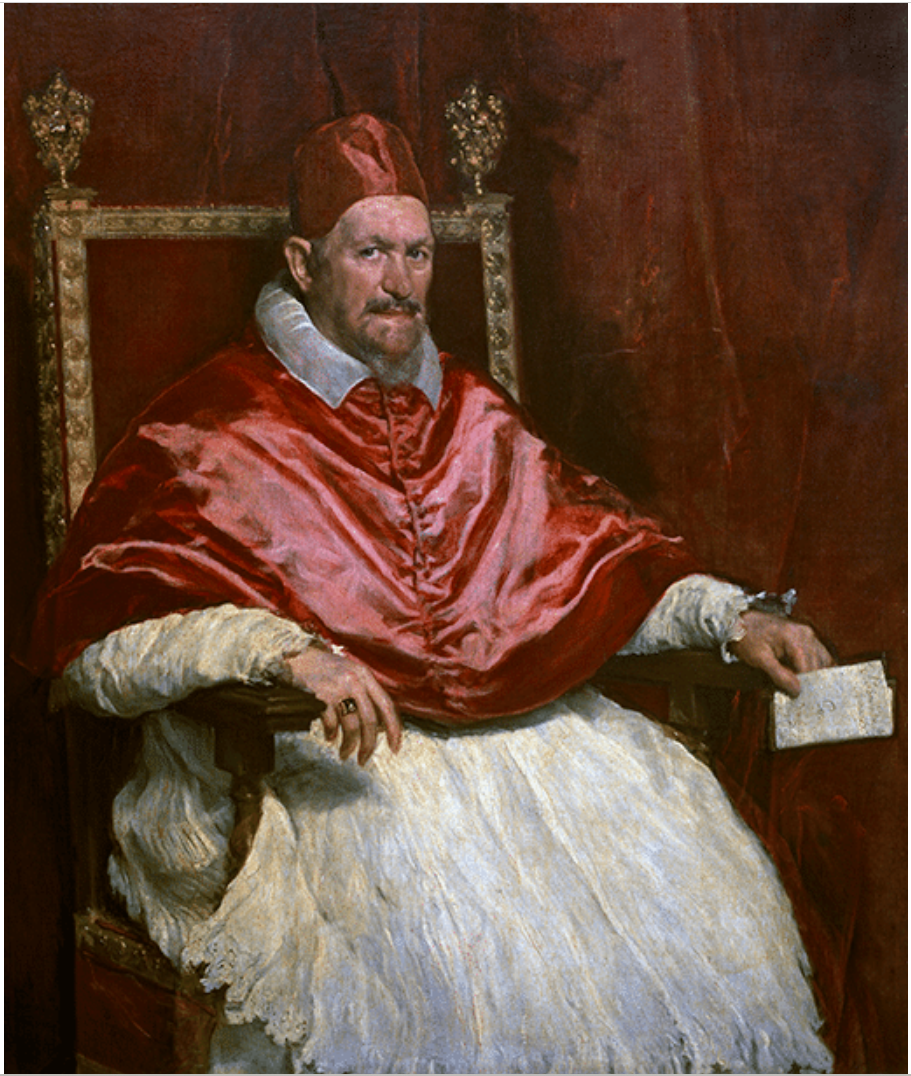
Diego Velásquez, Pope Innocent X, c. 1650, Galleria Doria Pamphilj. Image: akg-images
Bacon first embarked on his series of Heads after his breakthrough 1946 work Painting, an early and particularly arresting iteration of the crucifixion motif that would also take such precedence in the artist’s oeuvre. Like that larger-scale work, Head also incorporates the circular framing device and the beginnings of the cage motif, the ‘delicate geometric structure that encloses the central part of the scene’ that he would employ with increasing confidence as the Heads progressed.
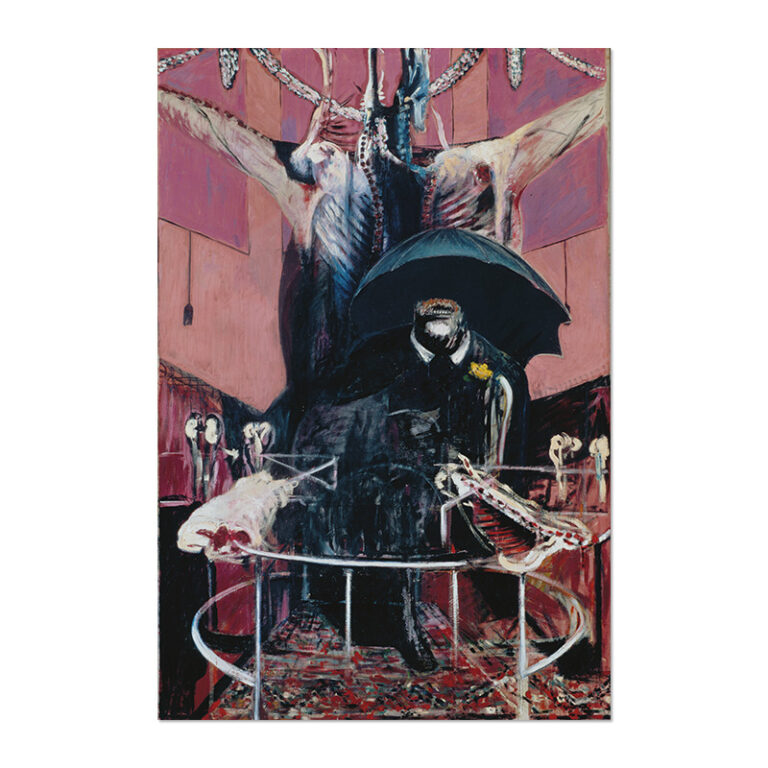
The 1946 Painting proved to be the springboard for this body of Heads on a practical as well as technical level. After being invited to Bacon’s studio by fellow artist and friend Graham Sutherland in 1948, Erica Brausen – owner of the Hanover Gallery – immediately purchased the work and offered Bacon his first solo exhibition that would be held the following year. As well as establishing his status as a major artist of the British avant-garde at home, Brausen was also highly instrumental in launching Bacon on an international stage, swiftly gifting Painting to Alfred Baar at The Museum of Modern Art in New York where it was immediately celebrated in an exhibition of recent acquisitions in 1948.
Although some of these works were started in Monaco, the Heads were primarily executed in Bacon’s legendary Cromwell Place Studio, with its consistent northern light and proximity to the Natural History and Science Museums, as well as the extensive Victoria and Albert collection, as detailed by Michael Peppiatt. When Bacon vacated the premises in 1951, he left several works in the care of Robert Buhler, to whom he sold the lease, Head being one of only two works to remain in the family’s collection until 2008. As was not uncommon in this period of post-war scarcity, Head is painted on a wood fiberboard known as Sundeala board, which Roy de Maistre and Graham Sutherland had also been using for reasons of economy during this period. Interestingly, as detailed in the catalogue raisonné, the fiberboard support in fact bears evidence of a previous work by di Maistre beneath Bacon’s composition. As Bacon discovered in his employment of the crucifixion motif in Painting, the close focus on the structure of the head – and the scream that so often contorted it under the artist’s hand – provided ‘a magnificent armature on which you can hang all types of feelings and sensation’ that is used to particularly powerful effect in the present work. For Bacon, the head connected his major themes: the thin line between animal and man, and a profound ability to capture the brutal horror of existence.
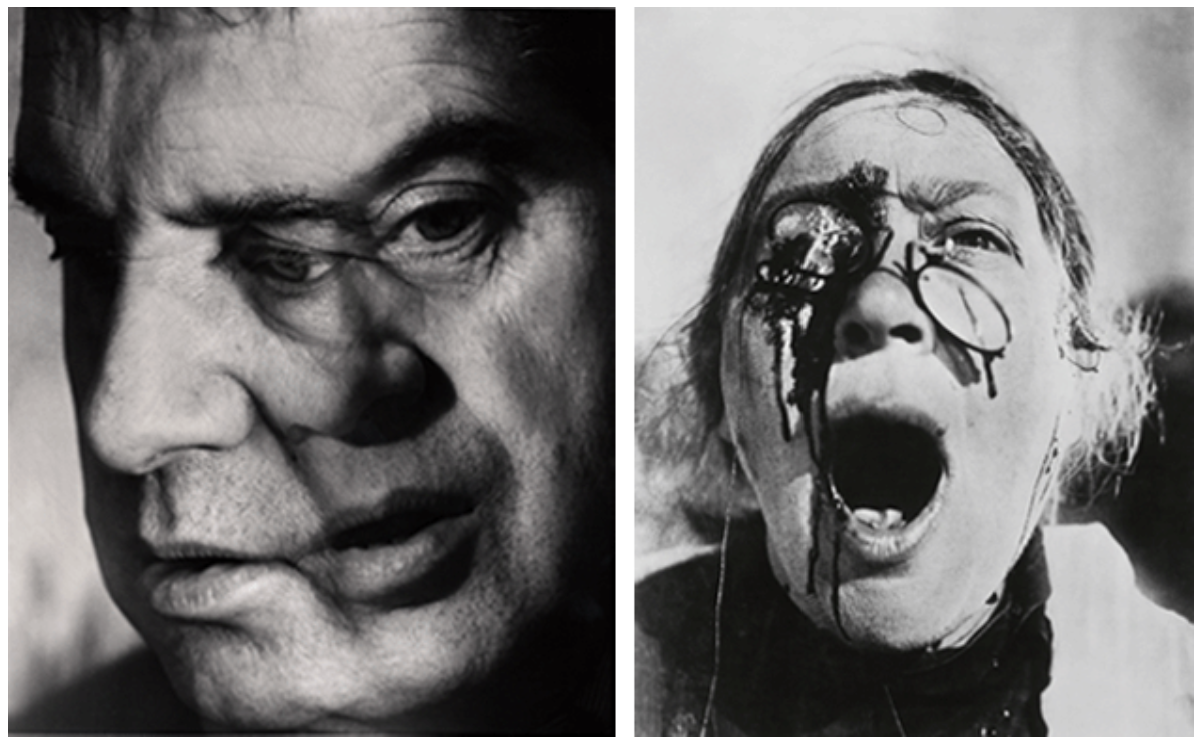
Left: Francis Bacon, 1967. Image: © The Lewinski Archive at Chatsworth. All Rights Reserved 2022 / Bridgeman Images
Right: Still from Battleship of Potemkin. Image: Album / Alamy Stock Photo
Alongside reproductions of Velázquez’s Portrait of Innocent X, Bacon obsessively collected other images focused on heads and faces, notably reproductions of the frenzied oratory conducted at Nazi rallies, and medical texts, a favorite being one focused on diseases of the mouth that he chanced upon in Paris, and that fueled a life-long fascination with medical imagery and research. Torn, crumpled, and splattered with paint, Bacon also kept a still from Sergei Eisenstein’s 1925 cinematic masterpiece Battleship Potemkin in his studio. Pioneering in his use of montage, rapid cuts, and claustrophobic close-ups, Eisenstein understood the power of the face to convey intense and extreme emotion in an age of silent film, a fact remarked upon by Bacon himself who cited the ’tremendous force’ of the image in this era. Capturing the distinct balance of violence and vulnerability conveyed by Eisenstein, Head appears suspended in a moment of distorting transformation, like a face contorted into a scream. As a formal exercise it is a marvelous illustration of Bacon’s observation that ‘Painting in this sense tends towards a complete interlocking of image and paint, so that the image is the paint and vice versa.’
In its layers of chalky whites and fleshy pinks shot through with greens, yellows, and vibrant flashes of red, Head is one of the more chromatically vibrant and tonally complex paintings from this body of work, which tend to resolve in an all-over grisaille. Similarly, there is a remarkable freedom to the brushwork, especially pronounced by the juxtaposition of the explosive handling of paint in the head to the broader vertical treatment of the veiled background. Often read as the embodiment of post-war angst, Bacon’s brutal treatment of the structure of the head here testifies to his uncanny ability to transform paint into the substance of the object depicted; taking on the materiality of flesh and bone, he endows the work with incredible weight and presence. Powerfully expressive, Head conforms to what Yves Peyré has described as ‘this play between the central figure in the full crisis of presence and the background, which receives the tribute of being such a mystery in action. Something violent explodes in the midst of calm.’
Popes
Study of Red Pope 1962, 2nd Version 1971, 1971
Estimated: USD 40,000,000 – 60,000,000
USD 46,284,500
FRANCIS BACON (1909 – 1992)
Study of Red Pope 1962, 2nd Version 1971, 1971
Oil on canvas
78×58 inches (198 x 147.5 cm)
signed Francis Bacon, titled and dated Study of Red Pope 1962, 2nd Version 1971 (on the reverse)
A defining masterpiece and triumphant finale to the artist’s seminal series of Pope paintings, Study of Red Pope 1962, 2nd version 1971 depicts the first and only encounter within Francis Bacon’s oeuvre between his two most important subjects: the Pope raised on a dais, drawn from Diego Velázquez’s Portrait of Pope Innocent X,1650, and George Dyer, the love of Bacon’s life and one of his most celebrated muses. First unveiled at Bacon’s landmark retrospective at the Grand Palais in 1971, a career-defining exhibition and an accolade only previously afforded to Pablo Picasso among living painters, Study of Red Pope 1962, 2nd version 1971 remains a testament to Bacon’s limitless capacity to provoke and capture the most fundamental of human emotions. In the present work, Bacon reworks the composition of his 1962 painting Study from Innocent X, revising the portrait to include his love George Dyer, as if the figure of the Pope, not only the progenitor of Bacon’s practice but a stand-in for authority, the canon, and the father, finds its counterpart in Bacon’s lover, instantly identifiable by his curved nose. On October 26th, 1971, the Francis Bacon retrospective opened to great acclaim, the galleries at the Grand Palais were filled with admirers, yet George Dyer’s presence was tragically absent. Less than thirty-six hours prior, Dyer had taken his own life in their Paris hotel room. Executed shortly before the Retrospective, Study of Red Pope 1962, 2nd version 1971 reveals a haunting premonition of the devastating loss of Bacon’s lifelong love, a singular meeting of his two greatest muses and charts Bacon’s artistic maturation between 1962 and 1971. Having remained in private hands since 1972, the present work’s importance is further attested to by its inclusion in the major retrospective Francis Bacon Books and Painting at the Centre Pompidou in 2019.
Pope with Owls, circa 1958
Phillips New-York: 17 November 2021
USD 35,000,000 – 45,000,000
USD 33,000,000
Francis Bacon – 20th Century & Cont… Lot 16 November 2021 | Phillips
FRANCIS BACON
Pope with Owls, circa 1958
Oil on canvas
57 1/4 x 43 inches (145.4 x 109.2 cm)
Forming part of Francis Bacon’s celebrated papal portrait series which spanned over two decades, ‘Pope with Owls’, circa 1958 is positioned at a critical juncture in the evolution of the artist’s interrogations into one of the most recognizable subjects in his oeuvre. The work takes as its reference the canonical portrait of Pope Innocent X by Velázquez, an image which acted as a touchstone for the artist’s explorations into the rendering of flesh and psychological deconstruction between 1949 and 1971. The Papal paintings have gained art historical significance not only for Bacon’s masterful execution but also for their subversion of the old master source; in so doing, Bacon succeeded in increasing the iconoclastic potency of his own version and elevated himself to the position of inheritor of a distinguished tradition. The work arrives for the first time at auction having been held in the same prestigious private collection for nearly four decades.
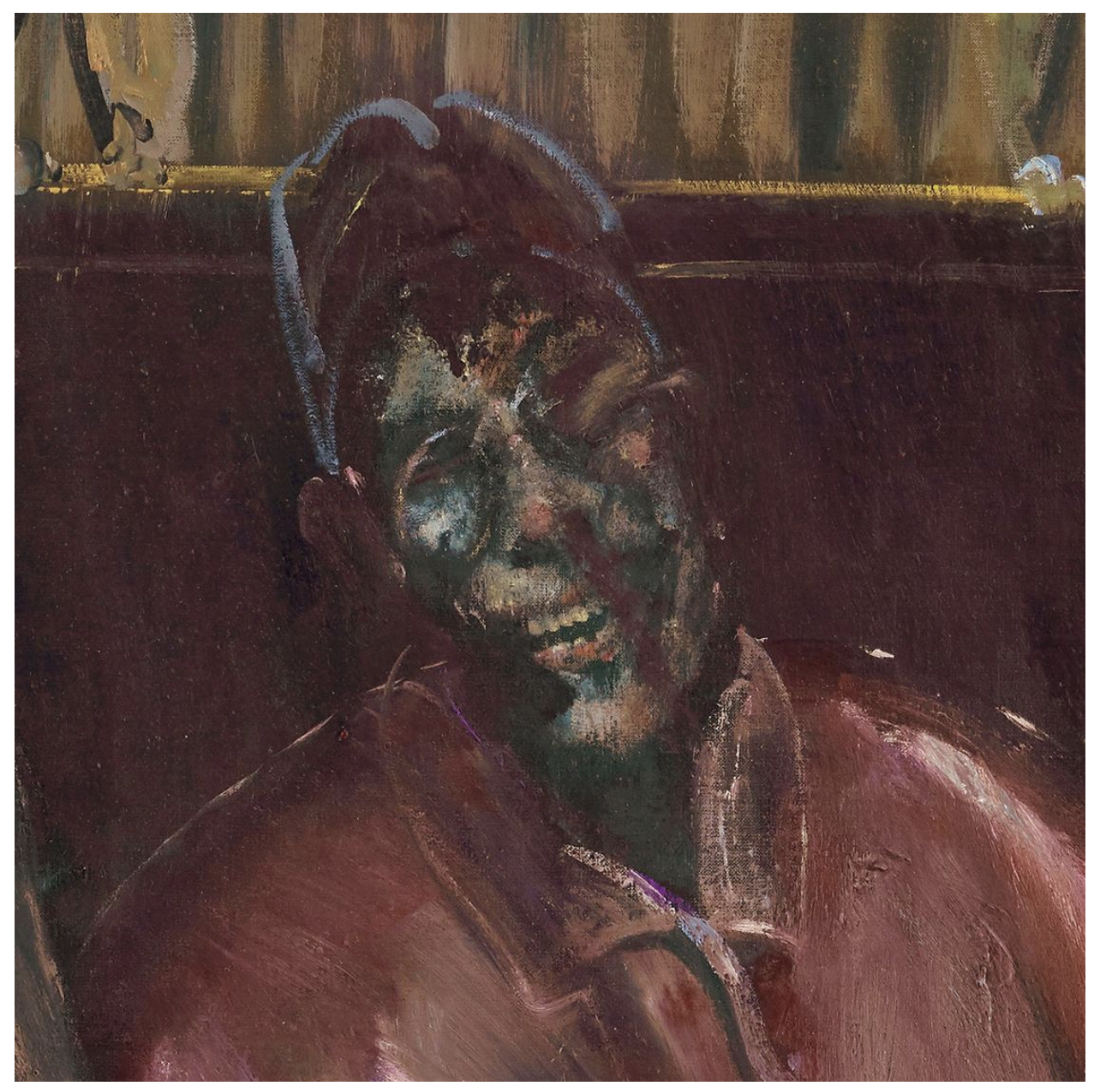
Much of Bacon’s best work is characterized by the evidence he leaves of the very physical act of his painterly process. Bacon conveys the viscerality of flesh through the immediate gestures of his loaded brush. Discrete blotches of yellow, blue, white, and lilac coalesce to form a haunting mien in grit and grimace. Drags of pigment tussle with staccatoed impasto passages culminating in a dissolution of anatomy suffused with referentiality. The circle over the right eye undoubtedly echoes the screaming nurse from the Odessa Steps sequence in Eisenstein’s The Battleship Potemkin—a motif that Bacon had grafted onto his “Popes” since 1949. However, it is the large loop denoting an ear and the grimaced teeth that most closely recall the photographs of Bacon’s lover at the time, Peter Lacey. Indeed, the greenish-yellow smudge across the other eye socket and the smear of dark purple from the nose reverb with the personal violence of that ill-fated relationship.
“I think it is one of the greatest portraits that have ever been made, and I became obsessed by it. I buy book after book with this illustration in it of the Velazquez Pope, because it just haunts me, and it opens up all sorts of feelings and areas of – I was going to say – imagination, even, in me…it’s the magnificent color of it.”
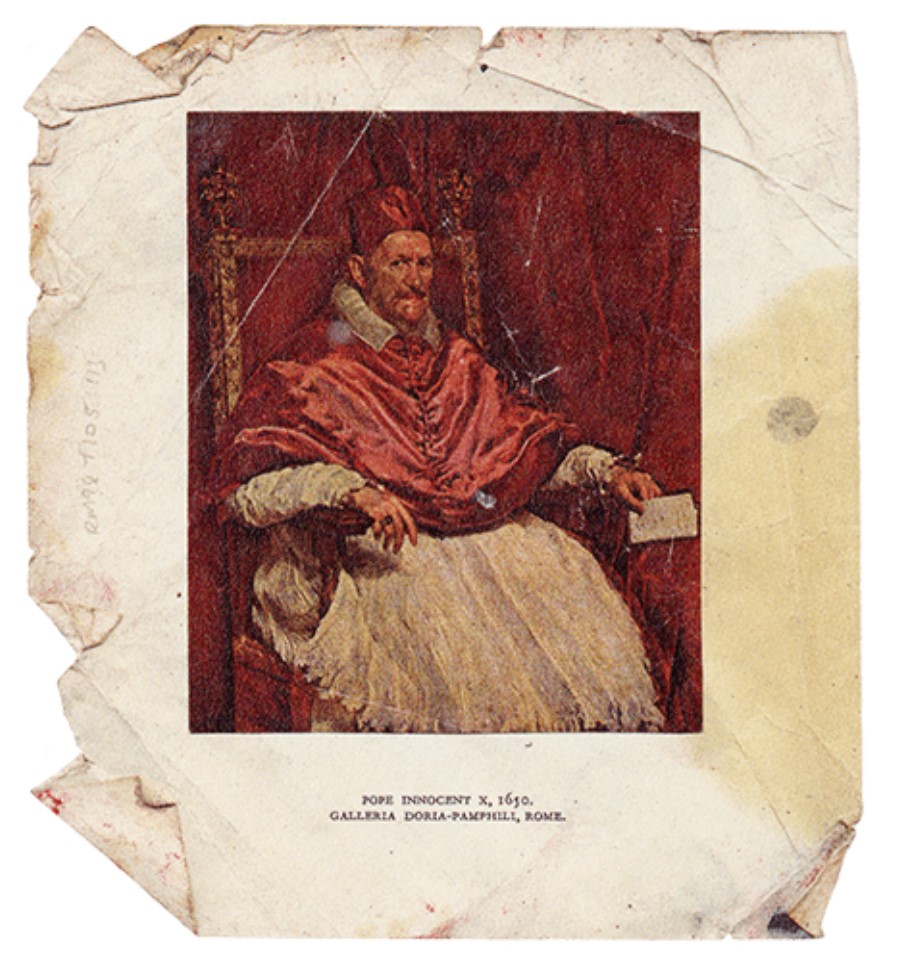
Sheet from unidentified book with color plate of Velázquez’s Portrait of Pope Innocent X, (1650). Artwork: © 2021 Estate of Francis Bacon/Artists Rights Society (ARS), New York/DACS, London
Extending from the darker papal paintings of the 1950s, ‘Pope with Owls’ acts as a crucial step in the development of Bacon’s engagement with the subject. Not only does ‘Pope with Owls’ still engender the haunting agony of his “Popes” from his first impulses engaging with the subject matter, but it also moves towards the violently brilliant palette and full-length figure which would go on to define his “Popes” of 1961 through the subsequent decade. In ‘Pope with Owls’, the purple robes of his 1953 Popes begin to anticipate the radical scarlet that characterize his “Popes” of 1961. Having declared himself to be in awe of Velázquez’s “magnificent color,” it is here in Tangier that Bacon begins to avail himself of a more baroque palette. It has been argued that the impetus to experiment with a more vivid color palette was precipitated by the bright Moroccan light. Here, the deep purples act as a chromatic backdrop to the richer, red undertones that Bacon has built up in successive layers of light and shadow. Following the gestural undulation of the cape’s opening, Bacon’s media seems to roll off his figure’s shoulders in a downward trajectory, pooling in the voluminous arm holes.
Other Works
Landscape near Malabata, Tangier, 1963
Christie’s London: 7 March 2024
Estimated: GBP 15,000,000 – 20,000,000
GBP 19,630,000 / USD 24,890,840
FRANCIS BACON (1909-1992), Landscape near Malabata, Tangier | Christie’s (christies.com)
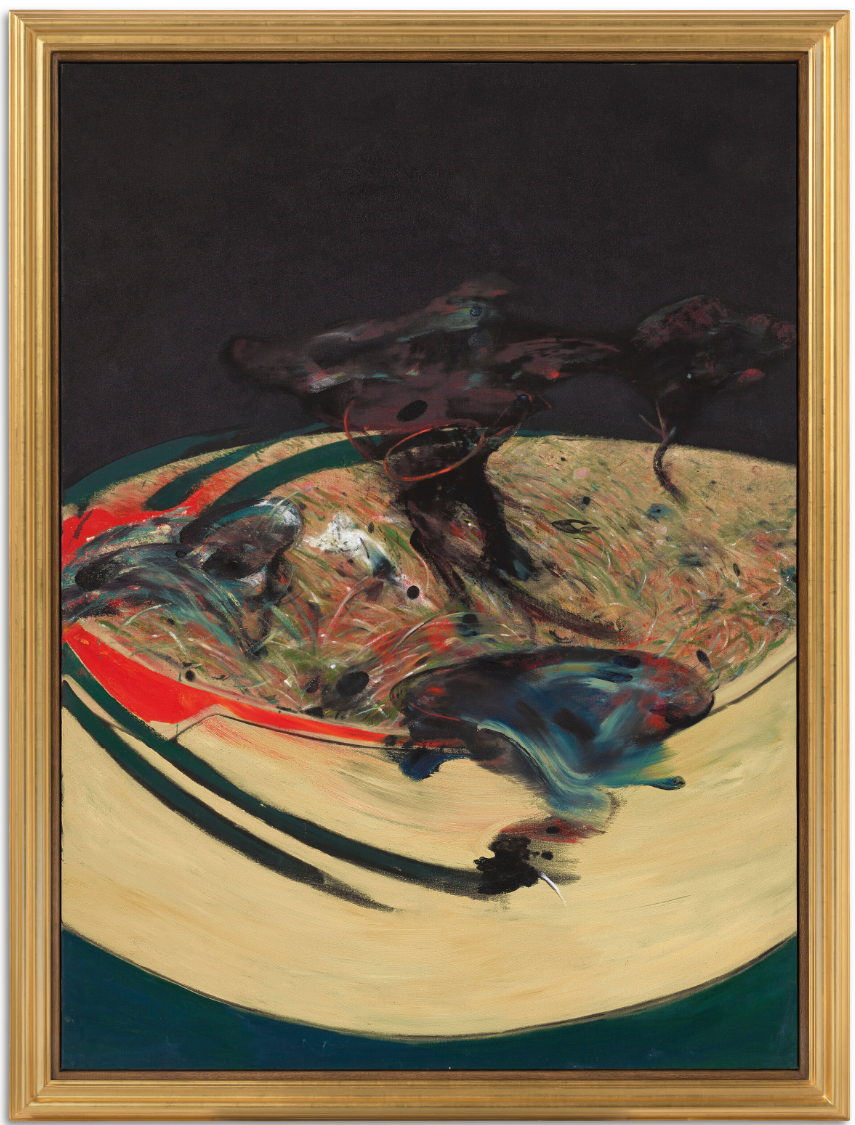
FRANCIS BACON (1909-1992)
Landscape near Malabata, Tangier, 1963
Oil on canvas
78×57 inches (198.1 x 144.8cm.)
Titled and dated ‘Landscape near Malabata, Tangier 1963’ (on the reverse)
A rare and seminal masterpiece that stands among Francis Bacon’s most poignant paintings, Landscape near Malabata, Tangier is a powerful and passionate memorial to his great love Peter Lacy. It was painted in London in 1963, the year after Lacy’s tragic death in Tangier, and depicts the landscape where he was laid to rest. Here, the artist pays tribute to their relationship in a singular image of grief, desire and longing. Two shadowy forms orbit a luminous vortex, bound together by the sweeping gestural motion of Bacon’s brush. Hauntingly anthropomorphic, they dissipate like spirits beneath the glaring North African sun. Visually unparalleled within the artist’s oeuvre, the work serves as a summation of his entire practice, drawing together elements from his early portraits of Peter Lacy and his Van Gogh-inspired paintings of the 1950s, while pointing towards the elliptical arenas and metaphorical landscapes that would evolve over the next two decades. With exceptional provenance, it is one of the artist’s most prominently exhibited paintings: an extraordinary portrait of love and loss, capturing the inevitable circularity that eventually returns flesh to earth.
Martin Harrison, author of the artist’s catalogue raisonné, describes the work as ‘Bacon’s ultimate, oblique memorial to his lover, and one of his greatest, most impassioned paintings’ (M. Harrison, Francis Bacon: Catalogue Raisonné, Volume III, London 2016, p. 720). Its history, indeed, bears witness to its significance. Shortly after its creation, it was unveiled at the Solomon R. Guggenheim Museum in New York, and featured in the pages of Vogue, where the critic Lawrence Alloway hailed its ‘dazzling color range, and the emotive power of [its] imagery’ (L. Alloway, ‘Francis Bacon: A great, shocking, eccentric painter’, Vogue, vol. 142, no. 8, November 1963, p. 182). Not long after, it was acquired by the celebrated author Roald Dahl, who purchased a number of masterworks by Bacon including the landmark Three Studies for a Portrait of George Dyer (1963). Over the years, critics from David Sylvester and Grey Gowrie to the writer Colm Tóibín have named it among his finest and most important paintings. It has been included in almost all of his major retrospectives across twenty-seven cities worldwide, most recently featuring in Bacon’s acclaimed survey at the Royal Academy of Arts, London in 2022.
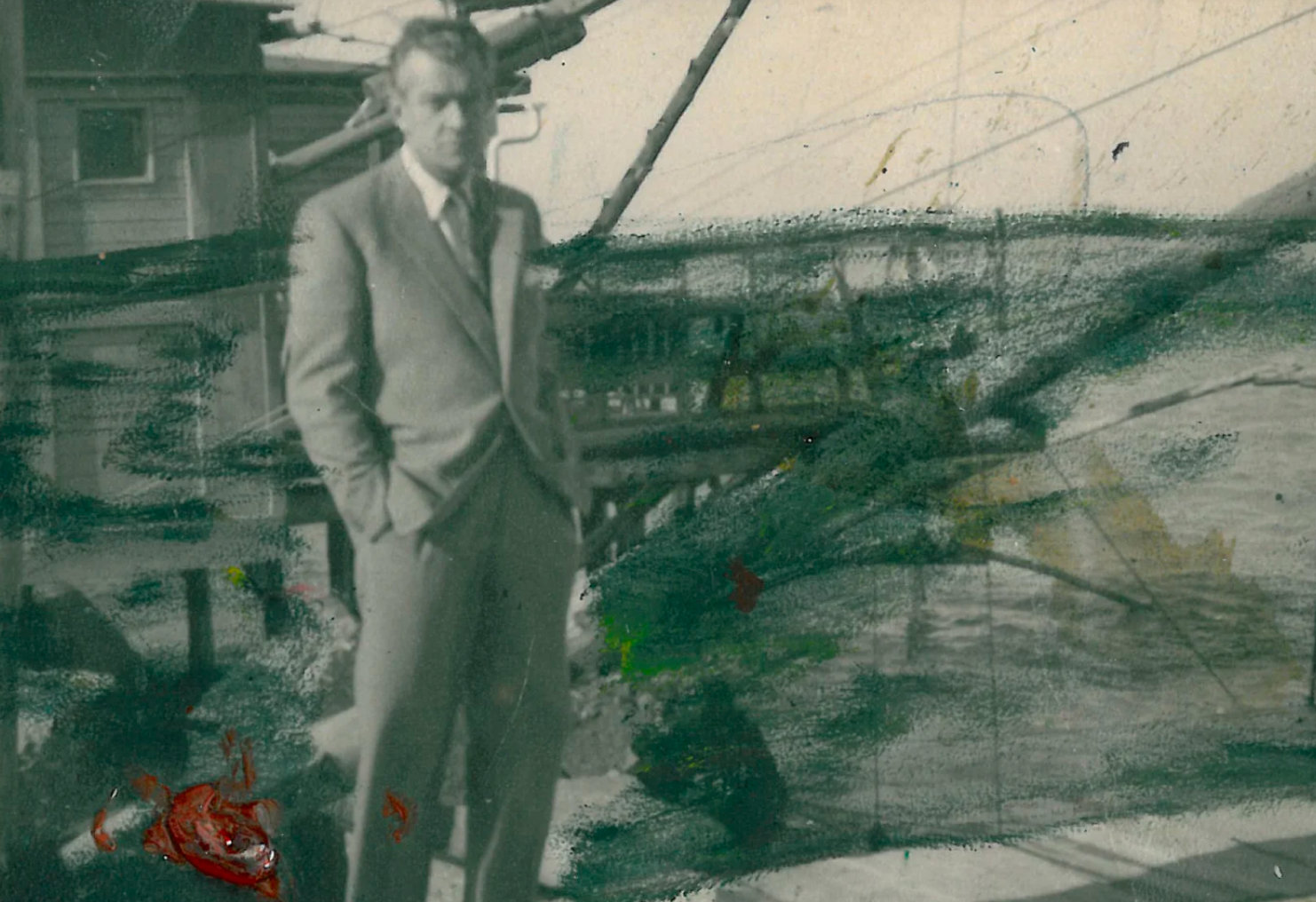
Bacon and Lacy had first met in 1952. Some trace their first encounter to the artist’s beloved Colony Room in Soho; others suggest they may have met at Careless Talk, where Lacy worked as a pianist. ‘I’d never really fallen in love with anyone until then,’ Bacon recalled; ‘… he had this extraordinary physique—even his calves were beautiful. And he could be wonderful company … he had a real kind of natural wit’ (F. Bacon, quoted in M. Peppiatt, Francis Bacon: Anatomy of an Enigma, London 1996, p. 145). Beneath this exterior, however, Lacy was a troubled man: a former pilot who had served during the Second World War. Both he and the artist were tempestuous, mercurial characters, and their relationship—from Lacy’s home near Henley-on-Thames, to trips to the South of France and Rome—was fueled by a turbulent mixture of passion, infatuation, violence and hysteria. On one occasion, Lacy hurled Bacon’s clothes off the side of a ship in anger; on another, he reportedly pushed the artist himself out of a window. ‘I couldn’t live with him’, Bacon confessed, ‘and I couldn’t live without him’ (ibid., p. 151).
It was there, under the dazzling Moroccan sky, that the couple’s relationship reached its explosive denouement. Ever-restless and dissatisfied with his life in London, Lacy had moved to Tangier in 1955. Though his affair with Bacon had already approached breaking point, the artist visited him every summer, and the two continued their volatile liaison abroad. With its glistening sun, lively expatriate community and liberal gay scene, Tangier quickly surpassed Monte Carlo as Bacon’s favorite exotic retreat. Among its residents were Beat Generation poets such as Allen Ginsberg and William Burroughs, who was working on his 1959 novel The Naked Lunch, as well as the playwright Tennessee Williams and the composer Paul Bowles. Lacy, too, had carved a new life for himself, playing the piano in Dean’s Bar. Increasingly penniless and dependent on alcohol, however, his feelings towards Bacon spiraled out of control. ‘Consider me dead!’, he had said to the artist in a burst of rage after a visit in 1960. The artist’s final trip in 1961—intended to patch things up—was a disaster, punctuated by cold-shouldering and betrayal. Bacon never heard from Lacy again.
Figure Crouching, 1949
Estimated: EUR 3,500,000 – 5,000,000
EUR 4,021,900 / USD 3,971,462
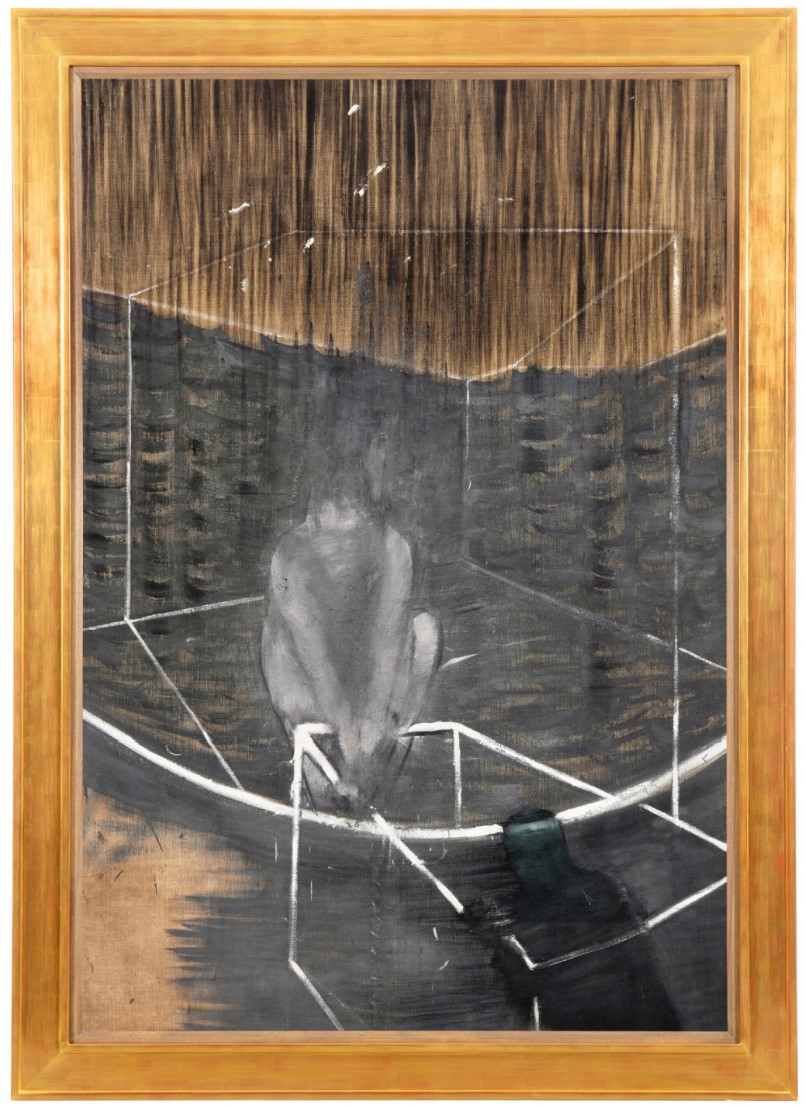
FRANCIS BACON (1909 – 1992)
Figure Crouching, 1949
Oil and sand on canvas
180×122 cm (70 7/8 x 48 inches)
Never before seen on the market, Figure Crouching is an intriguing work of great art historical significance. Featuring a solitary and seemingly half-human, half-animal figure, isolated in a confined space which hangs mysteriously in a dark void, the present work brings together some of the most iconic motifs of Bacon’s oeuvre at their earliest conception. Executed in 1949, Figure Crouching is the earliest surviving painting of Bacon’s long-lasting series of hunched subjects which he would continue into the 1970s. Featuring a vulnerable nude creature balancing precariously on a rail within a transparent and weightless cube, this image is also one of the first instances in which Bacon isolates his subject within a defined space of the canvas. The linear structure here, often referred to as a ‘space frame’, foreshadows the white structure which reappears in Bacon’s Pope paintings of 1951. Paradigmatic of the artist’s painterly bravura and pictorial authority, ‘Figure Crouching’ is a compelling evocation of beast and barrier, transmitting a palpable vulnerability through profound aesthetic concision.
Bacon believed that ‘our greatest obsession is with ourselves. Then possibly with animals, and then with landscapes.’ Growing up in the eastern midlands of Ireland, Bacon’s childhood was surrounded by animals. In the early 1950s, the artist made two visits to his family residing in South Africa where he was captivated by the dry, arid veld in which he observed wild creatures in their natural habitat. At the time, Bacon was already building a library of books by wildlife photographers from Arthur Radclyffe Dugmore to Marius Maxwell and was fascinated by the sequential photographic stills of human and animal bodies in motion which were produced by Eadweard Muybridge in the late nineteenth century. Photographs found among Bacon’s studio materials evidence that the posture of the figure in the present work was even prompted by Muybridge’s photographic studies of the human body in motion as well as Auguste Rodin’s bronze sculpture, The Thinker. Bacon would go on to paint his former lover George Dyer in a similar position in two of his paintings, George Dyer Crouching from 1966, and in one of his legendary so-called ‘Black Triptychs’ entitled May June 1973, in an evocation of his tragic death in a Parisian hotel.
Painting 1990, 1990
Christie’s London: 13 October 2022
Estimated: GBP 7,000,000 – 9,000,000
GBP 7,102,250 / USD 8,056,091
FRANCIS BACON (1909-1992) (christies.com)
FRANCIS BACON (1909-1992)
Painting 1990, 1990
Oil on canvas
78 x 58 1/8 inches (198 x 147.5 cm)
Signed, titled and dated ‘Painting 1990 Francis Bacon’ (on the reverse)
Painted just over a year before Francis Bacon’s death, Painting 1990 is a poignant and majestic work that stands among the artist’s last great canvases. Rendered in the stark, distilled painterly language that came to define his extraordinary late output, it is a radiant tribute to the vitality of the human form, its central figure aglow with the visceral dynamism of living flesh. According to Martin Harrison, author of the artist’s catalogue raisonné, Bacon’s subject is a hybrid vision. The face, framed like a portrait within a portrait, resembles José Capelo: the artist’s last significant love and muse, and the man he was visiting in Madrid when he died. The figure’s cross-legged pose, meanwhile, is hauntingly reminiscent of the artist’s former lover George Dyer—who tragically died in 1971—as well as his subsequent companion John Edwards. Both their forms populated Bacon’s art throughout the 1970s and 1980s: the present work, indeed, is the last in his oeuvre to feature this iconic posture. It is a powerful testament to those he loved—and had loved—and a vivid summation of his art.
Sand Dune, 1981
Christie’s London: 23 March 2021
Estimate on Request
GBP 5,182,500 / USD 6,872,414
FRANCIS BACON (1909-1992) (christies.com)
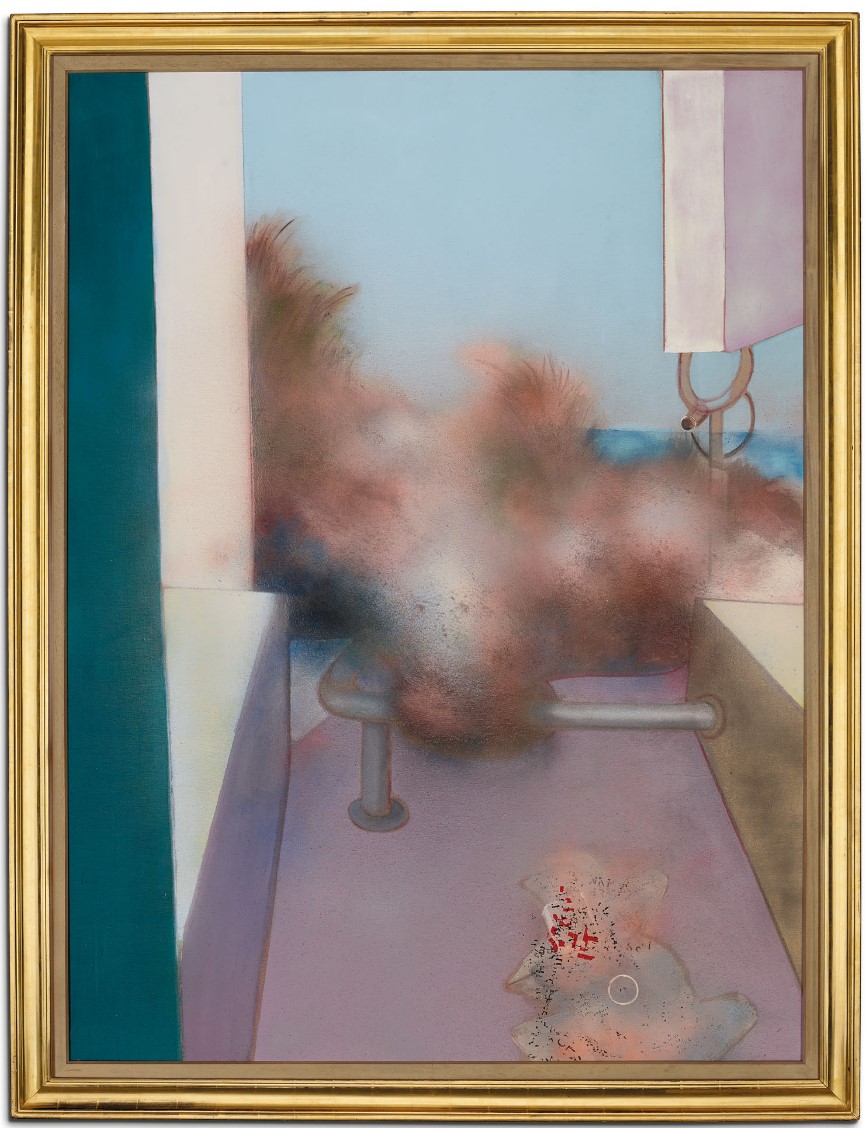
FRANCIS BACON (1909-1992)
Sand Dune, 1981
Oil, pastel, dust and dry transfer lettering on canvas
78 x 58 1/8 inches (198 x 147.5 cm)
Signed, titled and dated ‘Sand Dune 1981 Francis Bacon’ (on the reverse)
Held in the same private collection for nearly four decades, Sand Dune is a rare masterwork from Francis Bacon’s distinguished body of landscape paintings. Executed in 1981, during one of his most extraordinary creative periods, it is the first of two works to take the sand dune as its subject: the second, dating from 1983, resides in the Fondation Beyeler. With an outstanding exhibition history—ranging from Bacon’s landmark Tate retrospective in 1985, to his acclaimed survey at the Centre Georges Pompidou last year—it captures the visionary artistic language that came to define his spectacular final decade. Angular geometries, saturated planes of color, inscrutable fragments of text and ethereal textures morph into a surreal mise-en-scène. A crystalline ocean horizon glimmers on the distance; in the center, a blaze of grass erupts like a burning bush, infused with the same visceral charge as his depictions of human flesh. Alluring and enigmatic, it captures Bacon’s fundamental ambition at the height of his powers: to strip away the wild painterly excesses of his youth, leaving in their place a raw, distilled trace of reality.
Bacon’s landscape paintings punctuate his practice like jewels. Among their select number are some of his greatest achievements, including the early masterpiece Study of Figure in a Landscape (1952, (Phillips Collection, Washington, D.C.) and the immortal Landscape Near Malabata, Tangier (1963). Sand Dune takes its place within a period of renewed emphasis on this subject matter, which began in 1978 and continued for the next decade. While the majority of Bacon’s early landscapes had featured figures, these later offerings were largely devoid of human presence. Instead, they infused their natural subjects with anthropomorphic qualities, treating grass, sand and sea with the same intensity as Bacon had formerly lavished upon human hair and skin. The present work shares a number of features in common with the remarkable 1979 work Jet of Water, which similarly sets up a tension between the billowing chaos of nature and the surreal, industrial framework that surrounds it. Like the angular ‘space frames’ that once housed Bacon’s writhing nudes and screaming Popes, the strange, clinical armature of pipes and shelves seems to contain the carnal explosion at the center of the painting—a bid, as the artist once put it, to ‘trap this living fact alive’.
Prints
WORK IN PROGRESS
Triptyque août 1972 (after, Triptych August 1972), 1979
Phillips London: 6 June 2024
Estimated: GBP 15,000 – 20,000
GBP 40,640 / USD 51,985
Francis Bacon – Evening & Day Editions Lot 160 June 2024 | Phillips
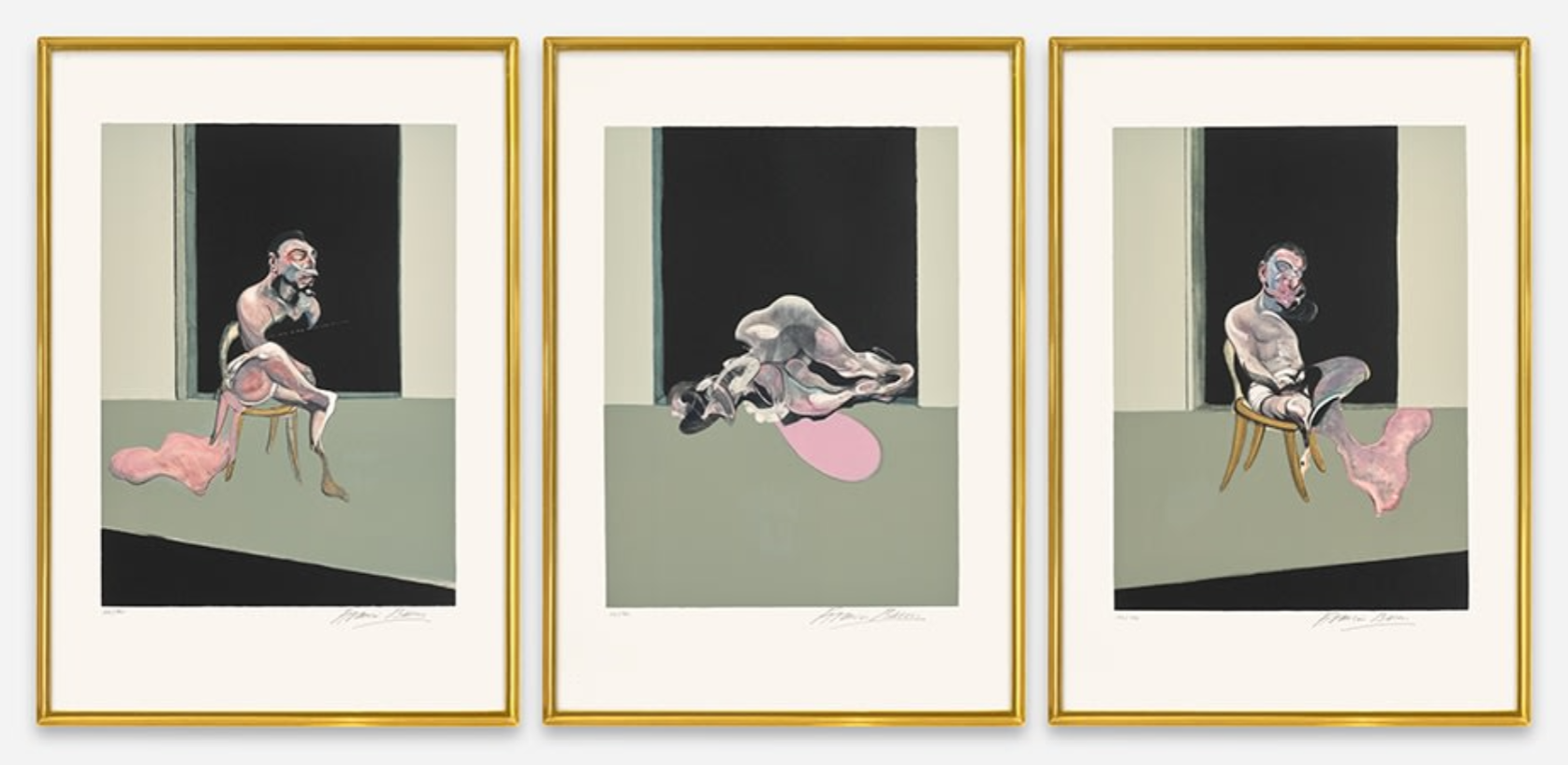
FRANCIS BACON
Triptyque août 1972 (after, Triptych August 1972) (Sabatier 23), 1979
The complete set of three lithographs in colors on Arches paper
Image: 66 x 48.5 cm (25 7/8 x 19 1/8 inches)
Sheet: 90.3 x 62.5 cm (35 1/2 x 24 5/8 inches)
All signed and numbered 126/180 in pencil
There were also some artist’s proofs and hors commerce impressions
Published by Galerie Lelong, Paris
Étude pour une Corrida, after Study for Bullfight No. 1, 1971
Sotheby’s New-York: 19 April 2024
Estimated: USD 40,000 – 60,000
USD 40,640
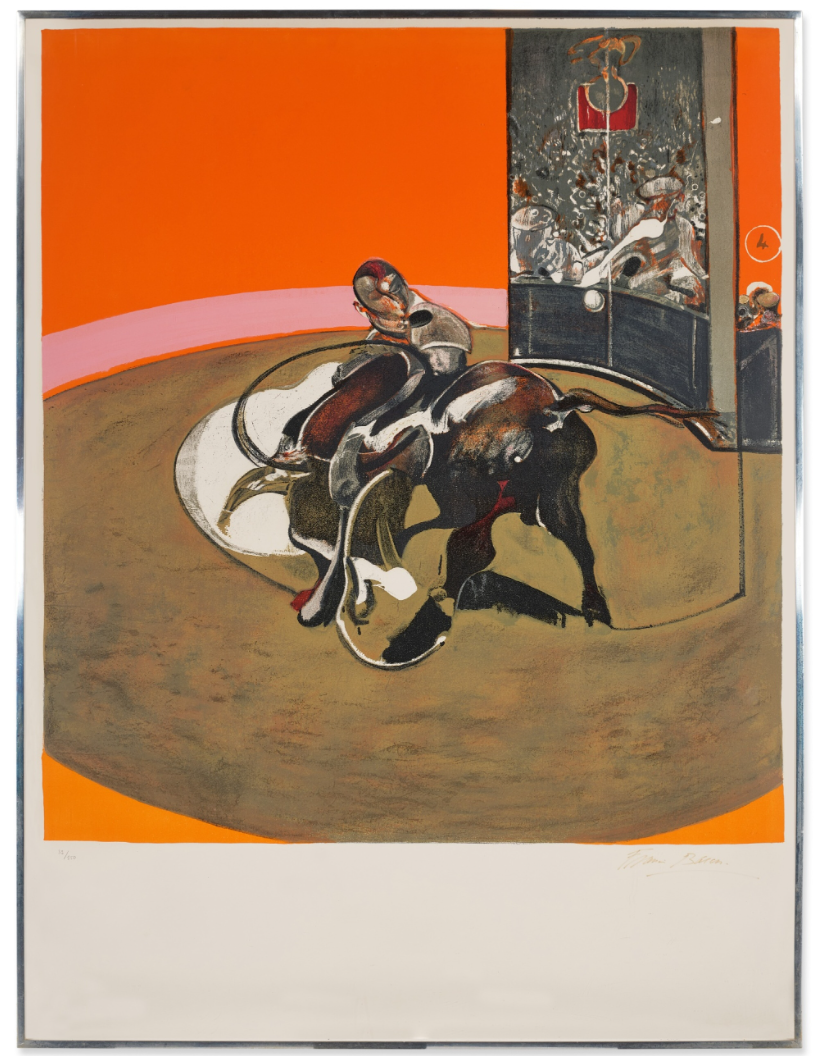
FRANCIS BACON (1909 – 1992)
Étude pour une Corrida, after Study for Bullfight No. 1 (Sabatier 10), 1971
Lithograph printed in colors on wove paper
Image: 49 5/8 x 45 3/8 inches (126.2 x 115.4 cm)
Sheet: 63 x 47 3/8 inches (160 x 120.3 cm)
Signed in felt-tip pen and numbered 32/150
Published by Musée du Grand Palais
Seated Figure (after, Study for a Portrait 1981), 1983
Phillips London: 18 January 2024
Estimated: GBP 8,000 – 12,000
GBP 15,240
Francis Bacon – Evening & Day Editions Lot 7 January 2024 | Phillips
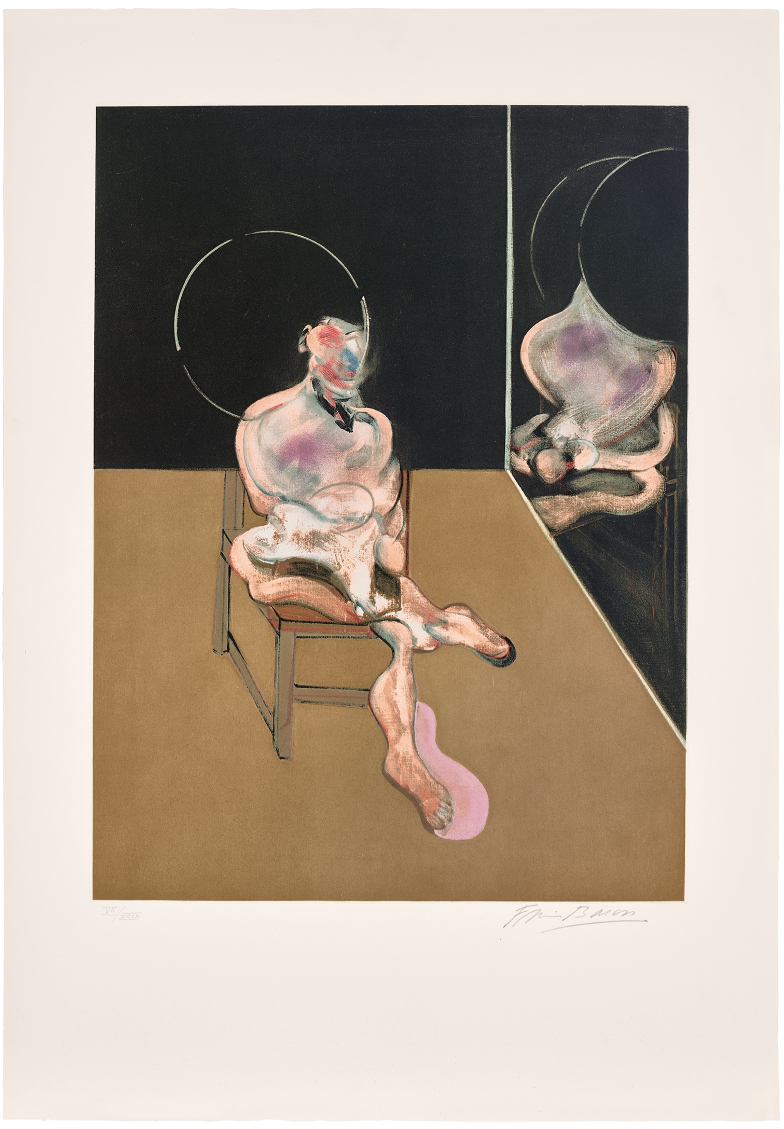
FRANCIS BACON
Seated Figure (after, Study for a Portrait 1981) (Sabatier 5), 1983
Etching and aquatint in colors on Arches paper
Image: 72.7 x 54 cm (28 5/8 x 21 1/4 inches)
Sheet: 101.4 x 70.9 cm (39 7/8 x 27 7/8 inches)
Signed and numbered VII/XCIX in pencil
One of 99 impressions in Roman numerals
There were also 99 impressions on Guarro paper in Arabic numerals and 15 artist’s proofs for each paper
Published by Ediciones Polígrafa, S.A., Barcelona