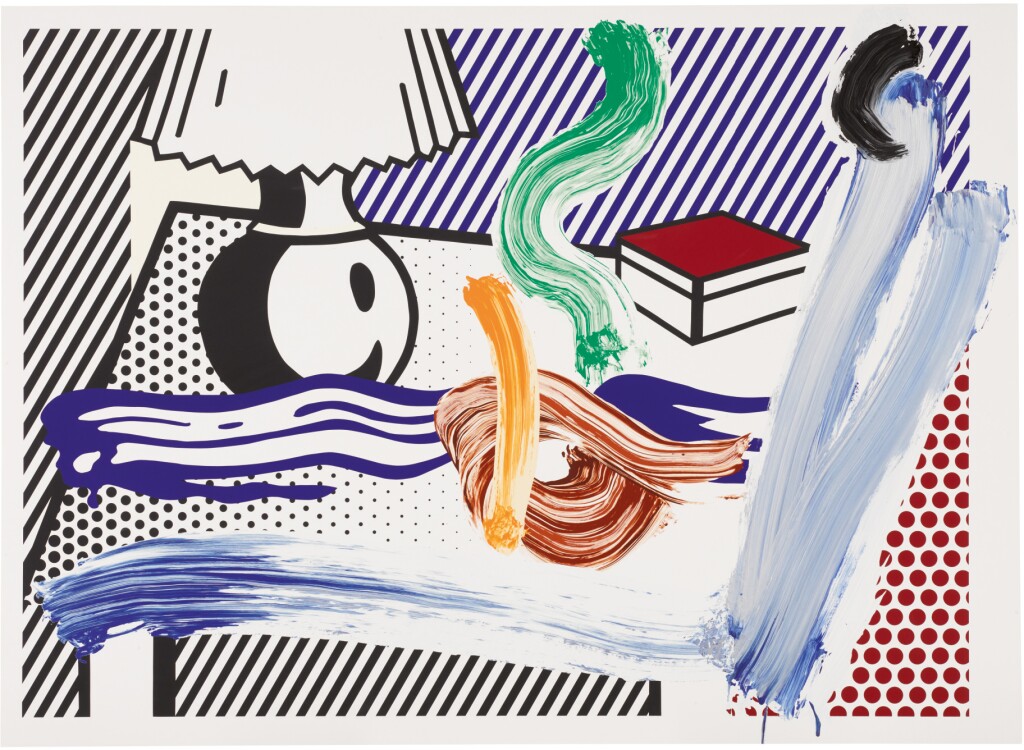
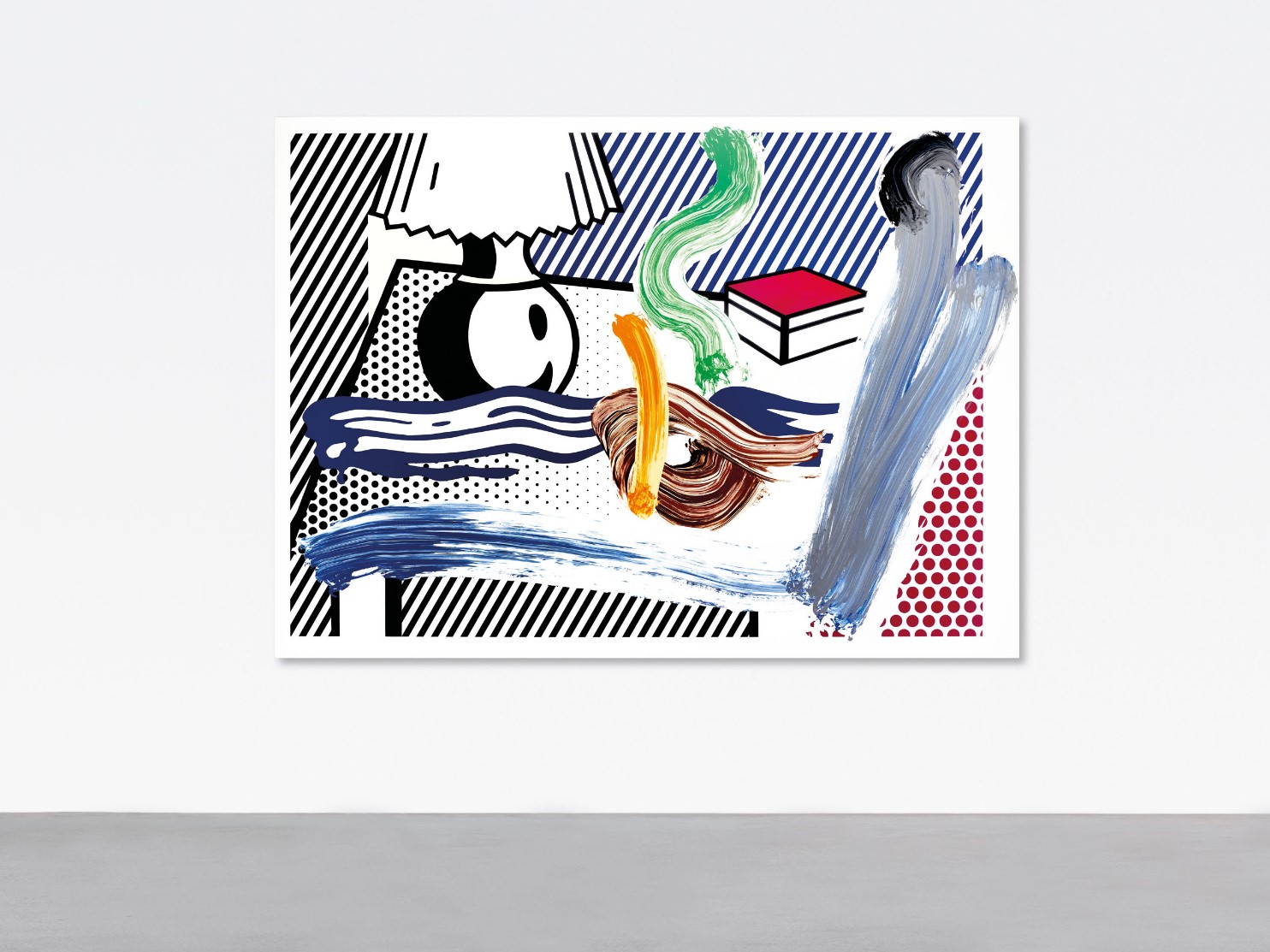
Brushstrokes Still Life with Lamp
Medium: Screenprint, with hand-painted magna, on honeycomb-core aluminum panel insert in a white wood frame
Year: 1997
Frame: 54 x 72 1/2 x 1 3/4 inches (137.2 x 184.2 x 4.5 cm)
Panel: 49 1/2 x 68 x 1 inches (125.7 x 172.7 x 2.5 cm)
Edition: 24
Artist’s Proofs: 8 AP
Printer’s Proofs: 3
Literature: Corlett 308
Roy Lichtenstein Catalogue Raisonne: RLCR 4661
Signed dated and numbered in pencil
Brushstrokes Still Life with Lamp is singular in Lichtenstein’s print oeuvre in that each impression, in addition to the printed brushstrokes, incorporates unique brushstrokes hand-painted by the artist. One of a suite of three prints in process at Saff and Company in Oxford, Maryland, at the time of the artist’s death, it was the only one the artist was able to complete with the addition of the hand-painted strokes. Lichtenstein had executed several small paintings with the obliterating brushstroke theme before beginning on the print project early in 1996. Following his usual practice, he executed drawings and then a finished collage for each image in the suite. He also designed the frames.
Saff and Company photographically enlarged the collage image to the final size so that stencils could be cut to make the screens for the flat-color areas. Working with the printers at his studio in New York, Lichtenstein executed brushstrokes to the new scale by painting them on a clear Mylar sheet placed over a black-line proof. These brushstrokes on Mylar would be processed photographically in order to make the screens for the printed brushstrokes.
Honeycomb-core aluminum panels—chosen because the surface would not warp or deform as would paper with the stress of repeated inking and heavy applications of paint—were painted with flat, white alkyd enamel at the Oxford boat yard. The result was a look similar to stretched and prepared canvas. The panels were then screenprinted with oil-based enamel ink, completing the image except for the hand-painted stroke. At the artist’s request, a pale blue stroke was also screenprinted to mark the location of the hand-painted stroke and serve as a guide. In June of 1997 Lichtenstein travelled to the Saff and Company workshop to execute the hand-painted strokes of Brushstroke Still Life with Lamp. Each hand-painted stroke is actually a composite, consisting of multiple passes, wet on wet, with different colors.
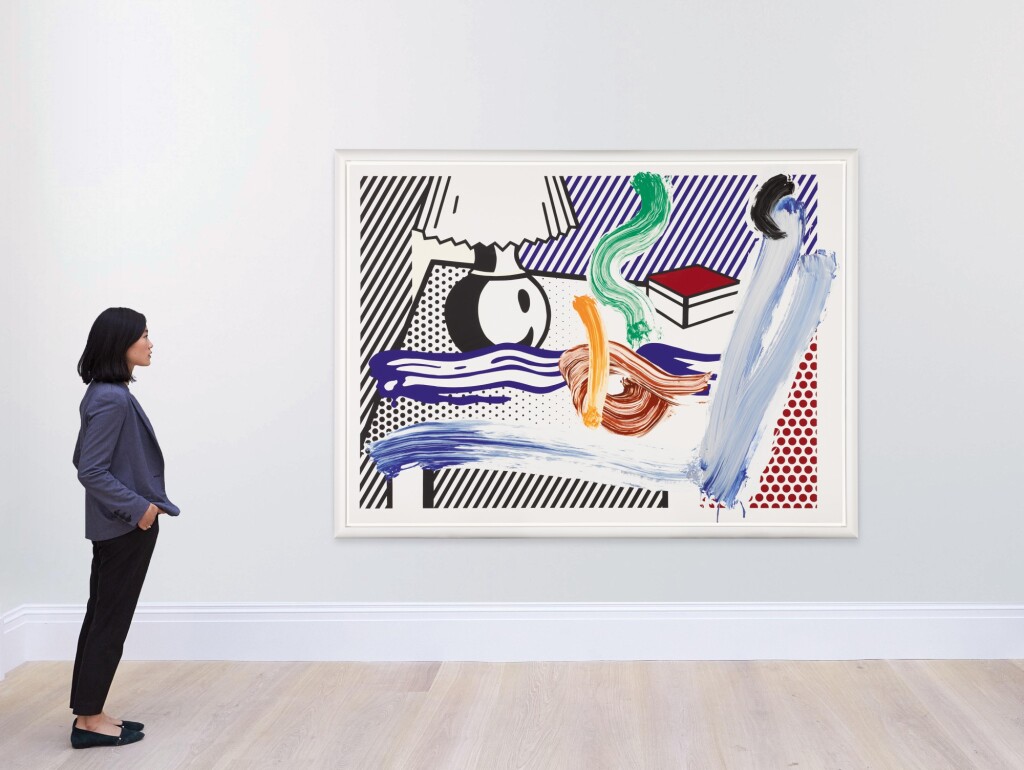
At once mechanical and handcrafted, Roy Lichtenstein’s Brush Stroke, Still Life with Lamp toys with romantic notions surrounding the artist’s gesture. Combining methods of silkscreen with hand painted elements on aluminum, the present work explores what the artist termed the ‘obliterating brush stroke’ which effaces elements of the work beneath it as it sweeps over the surface of an image. This concept came to Lichtenstein in a dream and has permeated his artistic practice since the mid-1960s. Brushstroke, Still Life with Lamp is part of an extremely limited series of still life prints executed in 1997, which were among the last works Lichtenstein completed before his death in September of that year. Its companion pieces, Still Life with Coffee Pot and Still Life with Box, though left unfinished at the time of Lichtenstein’s death, also feature these signature brush marks which became the trademark of the Pop era.
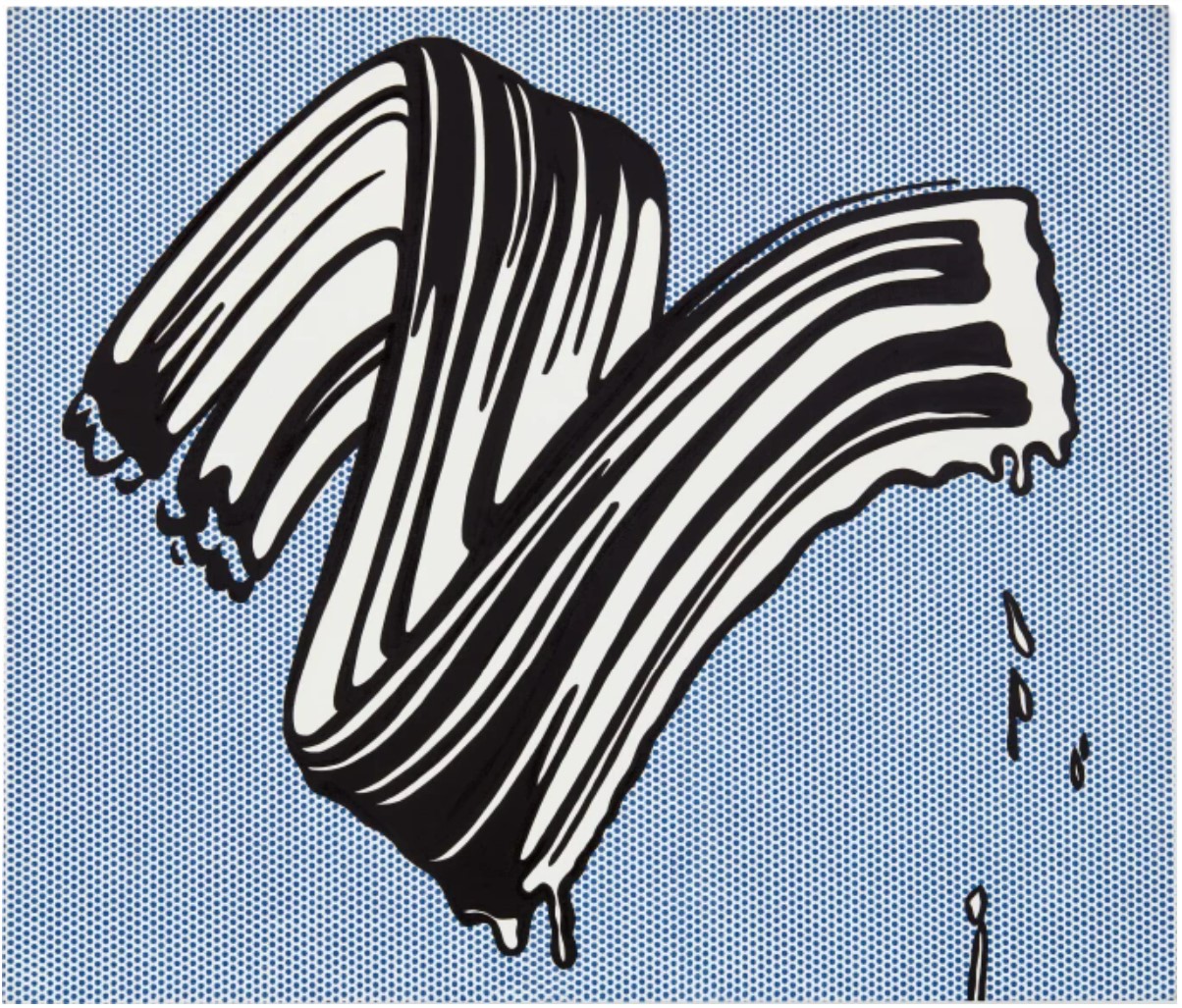
ROY LICHTENSTEIN, WHITE BRUSHSTROKE I, 1965
ARTWORK: © ESTATE OF ROY LICHTENSTEIN/DACS 2021
Throughout his career, Lichtenstein explicitly engaged with art history, drawing on and responding to a range of sources from modern masters like Pablo Picasso and Piet Mondrian to contemporaries like Robert Rauschenberg. Indeed, it was Rauschenberg who first parodied the now-cliché idea of the gestural brushstroke popularized by Abstract Expressionism when he made his own works from thrown paint and duplicated them.
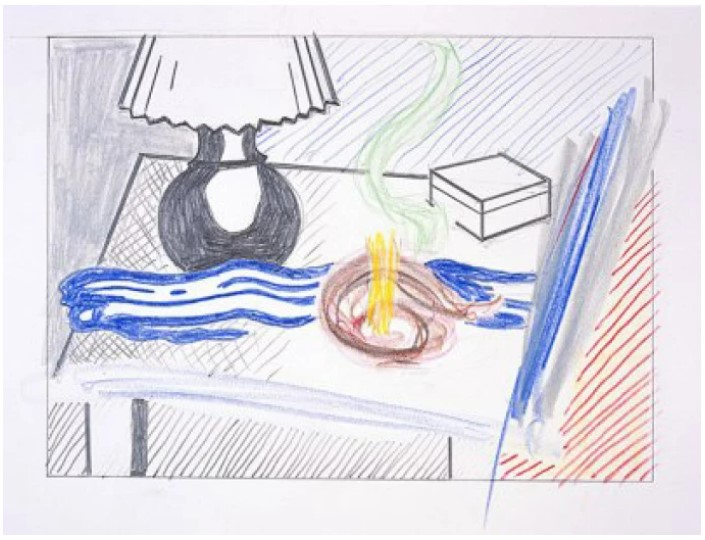
DRAWING STUDY FOR BRUSHSTROKE STILL LIFE WITH LAMP, 1996. ART © ESTATE OF ROY LICHTENSTEIN
As a result of his use of ‘popular’ subject matter, Lichtenstein’s work was labelled as ‘Pop art’, a term used for the first time in print by Lawrence Alloway in 1958. However, Lichtenstein considered the popularity of his subjects as the least important aspect of his artistic practice. Instead, he considered his use of mundane objects as crucial to questioning what makes art “art” much like his predecessor Marcel Duchamp. Lichtenstein was one of the few American artists at the time – alongside Andy Warhol, Jasper Johns and Rauschenberg – who experimented with this concept using a range of techniques including assemblage, appropriation and mass production. Lichtenstein used his early comic paintings as Duchampian ready-mades, taking them out of context and altering the way we look at them. Lichtenstein extends this approach to his interior paintings, extracting advertisements of the ideal home from the Yellow Pages and blowing them up to envelope and overwhelm the viewer, questioning their message that money and material wealth can buy happiness. Brush Stroke, Still Life with Lamp is no exception; standing at four and a half feet tall and six feet wide the fantasy of the middle-class American dream is inescapable.
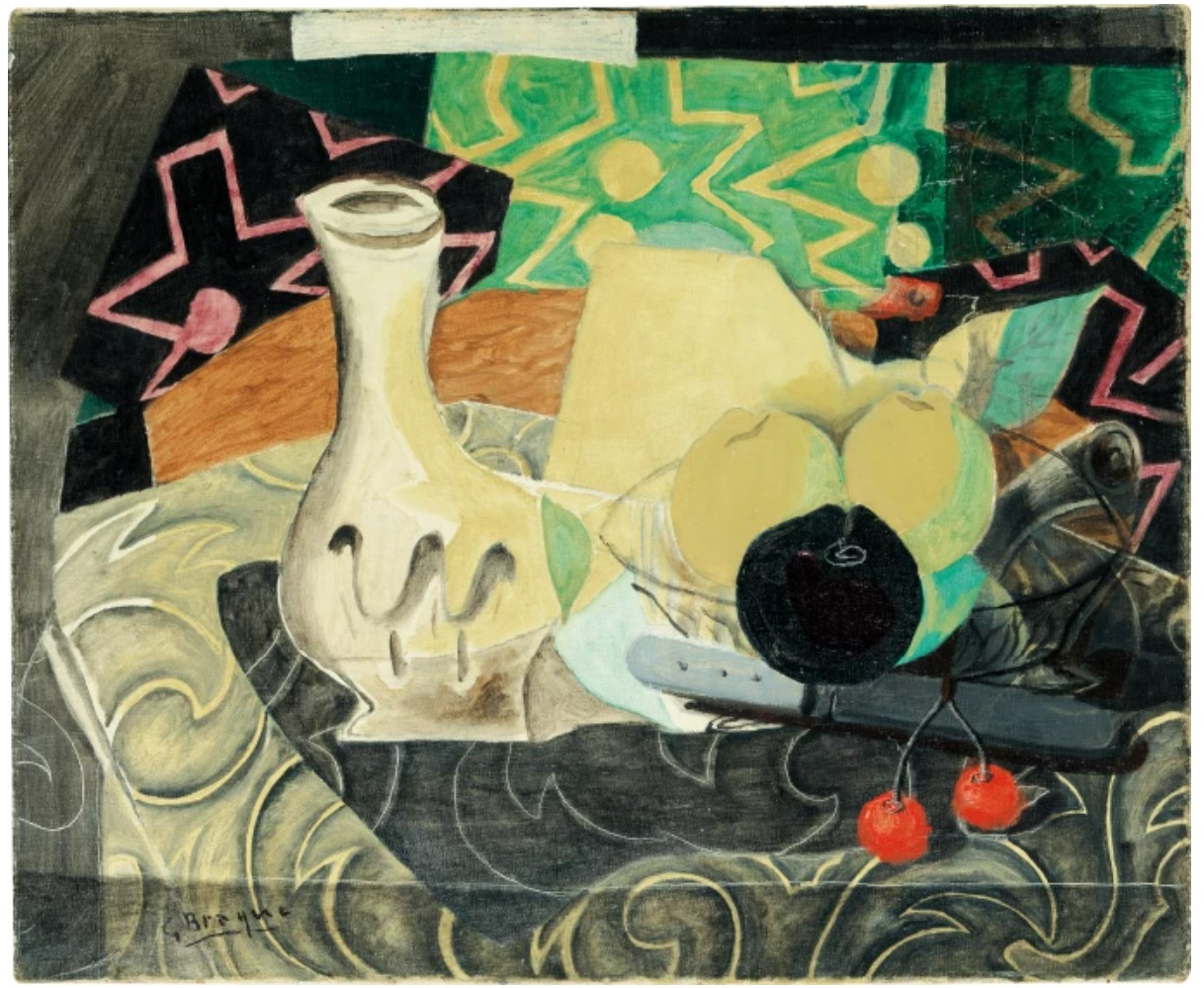
GEORGES BRAQUE, NATURE MORTE AUX CERISES, 1936
ARTWORK: © ADAGP, PARIS AND DACS, LONDON 2021
Lichtenstein throws the reality of this dream into question with his flattened and simplified visual language. He attributes the origins of his characteristic style to Cubism.
“I think the aesthetic influence on me is probably more Cubism than anything. I think even the cartoons themselves are influences by Cubism, because the hard-edged character which is brought about by the printing creates a kind of cubist look which perhaps wasn’t intended”
Brush Stroke, Still Life with Lamp seems to reference Picasso and Georges Braque in the conflicting viewpoints being offered by the nightstand, lamp and box, further confused by the maelstrom of painted and printed brushstrokes which blur the scene. Looking back at his art historical antecedents, Lichtenstein actively engages with old ideas to make new and innovative arguments for the importance of art in our contemporary age.
Auction Results
Works from the Collection of Dorothy and Roy Lichtenstein
Sotheby’s New-York: 26 September 2025
Estimated: USD 250,000 – 350,000
USD 279,400
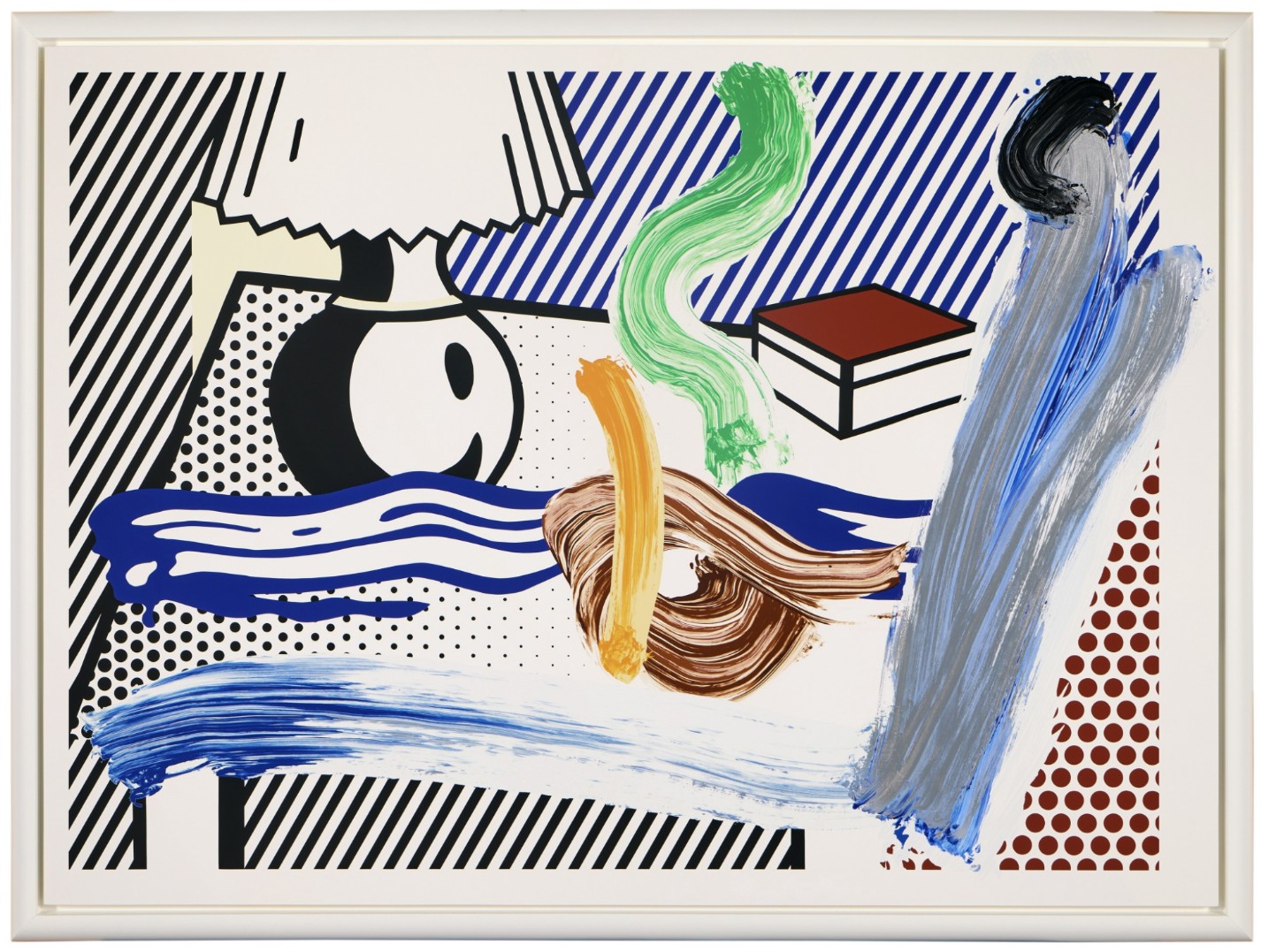
ROY LICHTENSTEIN (1923 – 1997)
Brushstroke Still Life with Lamp (Corlett 308), 1997
Screenprint in colors with hand-painted magna on honey-comb core aluminum panel inset in a white wood frame
Signed, dated ’97 and inscribed AP 4/8 (on the right edge of the panel)
One of 8 artist’s proofs aside from the numbered edition of 24
Christie’s New-York: 22 November 2024
Estimated: USD 250,000 – 350,000
USD 453,600
AUCTION RECORD FOR BRUSHSTROKE STILL LIFE WITH LAMP
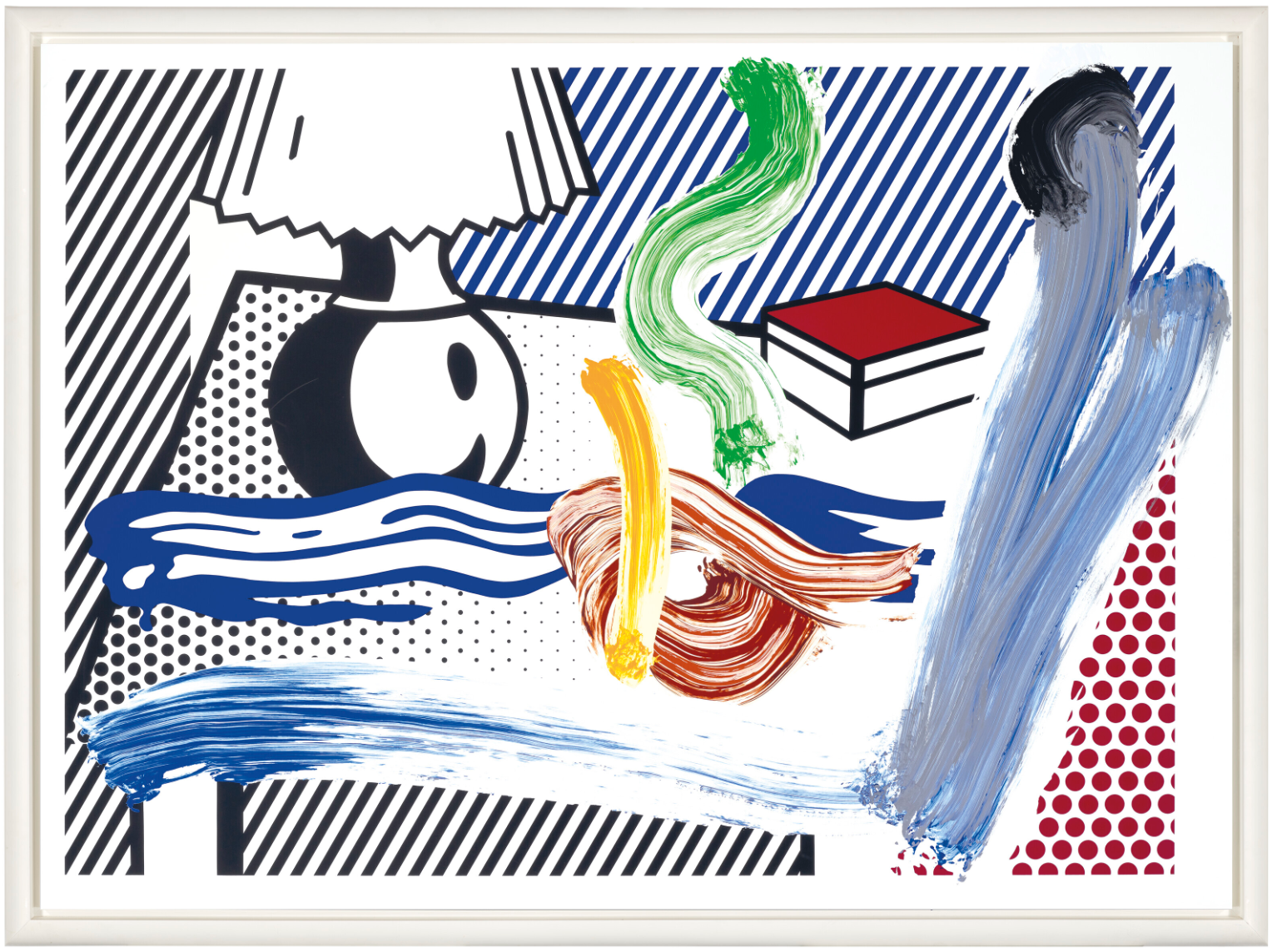
ROY LICHTENSTEIN (1923-1997)
Brushstroke Still Life with Lamp, 1997
Screenprint with hand-painted Magna on honeycomb-core aluminum panel, in artist’s frame
Aluminum panel: 49 1/2 x 68 inches (124.7 x 172.7 cm)
Overall: 54 x 72 1/2 inches (137.2 x 184.2 cm)
Signed, numbered and dated ’23⁄24 rf Lichtenstein ’97’ (on the right edge)
This work is number twenty-three from an edition of twenty-four plus eight artist’s proofs
Sotheby’s London: 26 March 2021
Estimated: GBP 150,000 – 200,000
GBP 315,000 / USD 434,542
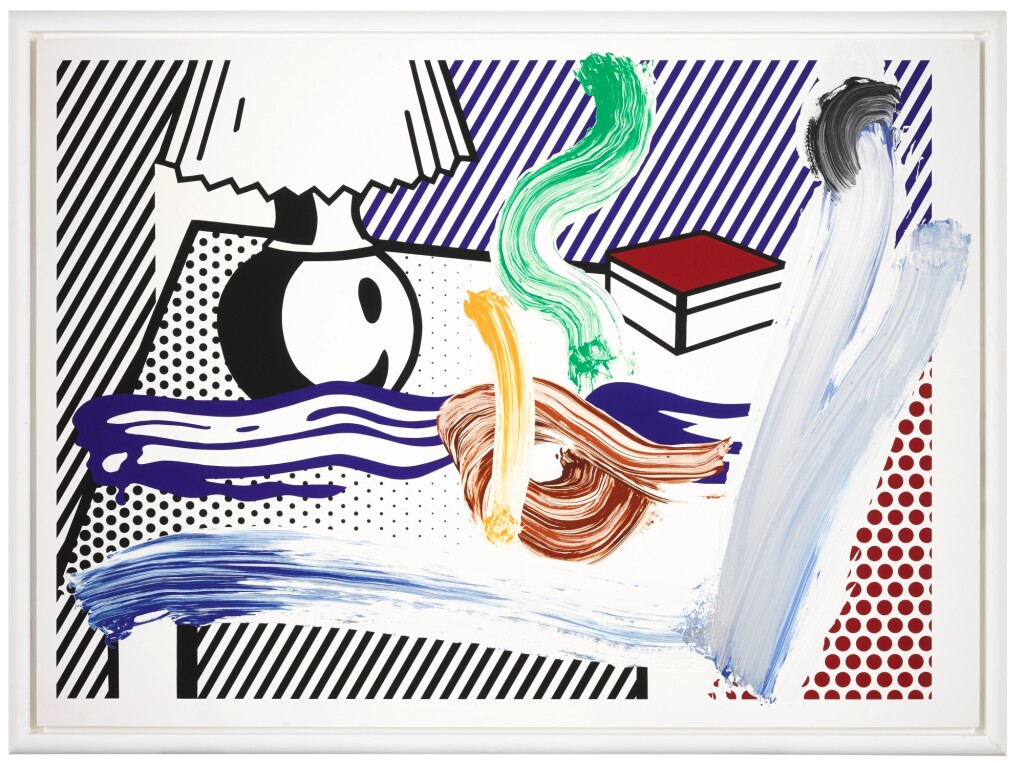
ROY LICHTENSTEIN (1923 – 1997)
Brush Stroke, Still Life with Lamp, 1997
Screen-print with hand-painted magna on aluminum, in artist’s frame
Framed: 49 1/2 x 68 3/4 inches (137.2 x 184.2 cm)
Signed, dated 97 and numbered 22/24 on the overturn edge
This work is number 22 from an edition of 24
Sotheby’s New-York: 2 October 2020
Estimated: USD 200,000 – 300,000
USD 378,000
ROY LICHTENSTEIN (1923 – 1997)
BRUSHSTROKES STILL LIFE WITH LAMP, 1997
Screen-print with hand-painted magna on honeycomb-core aluminum panel, in artist’s frame
Signed, dated ’97 and numbered 23/24
This work is number 23 from an edition of 24, plus 8 artist’s proofs and 3 printer proofs
Christie’s Paris: 4 December 2020
Estimated: EUR 120,000 – 180,000
EUR 300,000
ROY LICHTENSTEIN (1923-1997)
Brushstroke Still Life with Lamp, 1997
Screen-print with hand-painted Magna on aluminum panel in artist’s frame
Signed, dated and numbered ‘SP 2/2 Roy Lichtenstein 77’ (on the overlap)
Aside from the edition of twenty-four copies, and aside from the edition of eight artist’s proofs