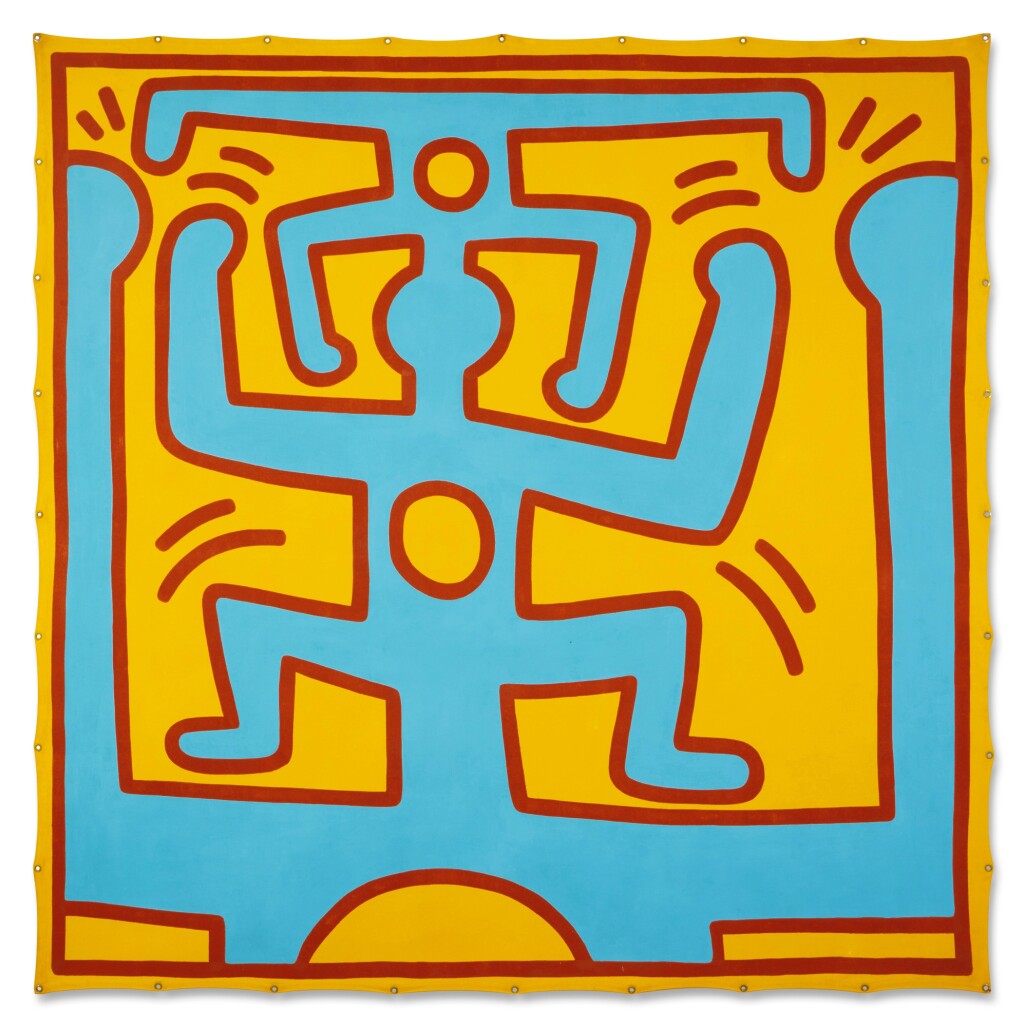
KEITH HARING (1958-1990)
Untitled, 1987
Acrylic on canvas tarp
95 x 95 ¼ inches (241.3 x 241.9 cm)
Signed © K. Haring and dated Aug. 27 (on the overlap)
Provenance
Acquired circa 1995 by the present owner
Sotheby’s New-York: 16 November 2022
Estimated: USD 3,000,000 – 5,000,000
Source: Sotheby’s
Untitled | Contemporary Evening Auction | | Sotheby’s (sothebys.com)
Dazzlingly vibrant and brimming with graphic positivity, Keith Haring’s Untitled of 1987 is emblematic of the compositional dynamism and iconic figuration from one of the most upbeat and confident artistic voices of our time. Created in the final years of Haring’s life, Untitled is a seminal example of the artist’s distinct visual language, and his determination to celebrate music, movement and an interconnected human spirit through his art– despite the overwhelming challenges of the decade. Across the monumental tarp, Haring depicts three tiers of interlocking figures in a moment of spectacular activity, rendered in the bold, simplistic chromatic pallet for which he is best known. Commissioned by renowned gallerist Martin S. Blinder for the Martin Lawrence Gallery 1987 annual calendar, the present work has remained in the private collection of famed Tony Shafrazi since it was acquired in 1995. Since its completion, the present work has been exhibited among Haring’s most prominent exhibitions, including his solo show at the Whitney Museum of American Art, New York in 1997, The Keith Haring Show at Fondazione Triennale di Milano in 2005, and was exhibited extensively at Shafrazi’s own Chelsea gallery, including the 20-year memorial show commemorating Haring’s tragic passing in 2010. Exemplary of the vibrant urban environment by which Haring’s oeuvre was so heavily inspired, Untitled endures as a record of the artist’s prolific career.
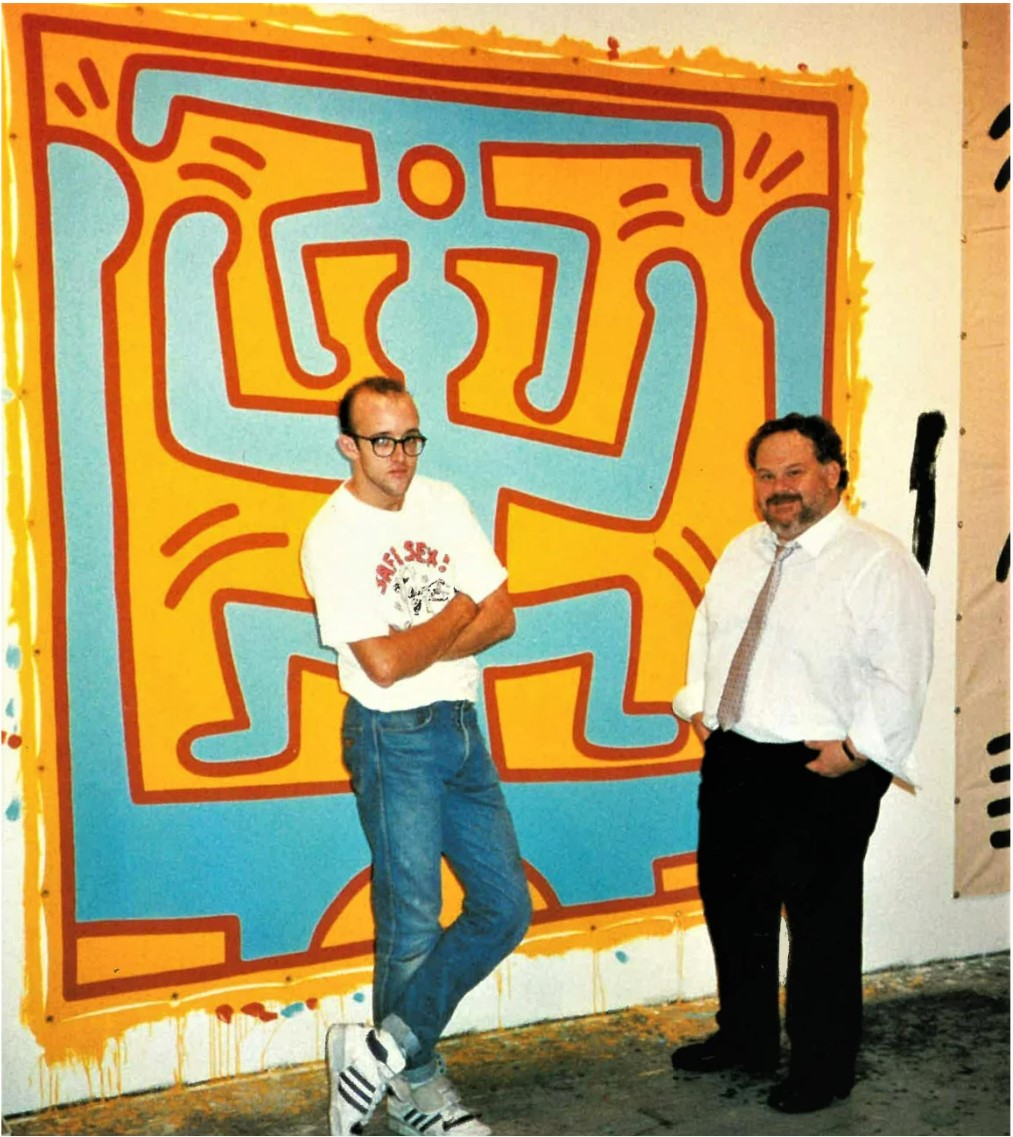
KEITH HARING AND MARTIN S. BLINDER IN FRONT OF THE PRESENT WORK AT HARING’S DOWNTOWN STUDIO, 1987. PHOTO © COURTESY OF MARTIN LAWRENCE GALLERIES. ART © 2022 THE KEITH HARING FOUNDATION
At once highly structural and dizzyingly dynamic, Untitled epitomizes Haring’s unique pop vernacular and effusive spirit. Within the present work, a towering collective of three gesturing figures rises in bold blue and searing red against a brilliant yellow backdrop. This iconic work utilizes several symbolic themes within Haring’s signature painterly lexicon, including the stylized stick figure with a hole in their stomach, a signature motif in Haring’s work after John Lennon was shot and tragically killed in 1980. Balanced on top of each other, the stacked figures are posed in a moment of intense gestural movement, recalling the B-Boys and break dancers native to Haring’s surroundings in downtown New York. For Haring, the dance move becomes a broader symbol of life and coexistence. Robert Farris Thompson has described Haring’s employment of dancers coming together, as exhibited in the present composition, as “not merely dancing. They are living a principle: work with your brother, share space in relation to time. Haring expands on that. It turns into an emblem.” (Robert Farris Thompson, Haring and the Dance, Keith Haring, New York, 1997, p. 218) At once vibrantly expressive and lyrically balanced, the present work performs with a potent energy. The interlocking dancing figures, inextricable conjoined through head and torso, emanate a pulsating movement that reverberates in waves over the monumental canvas.
“It was the idea of making the movements I was doing into a kind of choreography – a kind of dance. I was thinking that the very act of painting placed you in an exhilarated state.”
Densely packed within the borders of the painting, the burgeoning figures of the present work stand as an early articulation of Haring’s 1988 Growing series, in which the artist further experimented with the boundaries of his own symbolism. Having developed a significant body of visual motifs and iconography, Haring began to play with his own visual language, creating endlessly intricate, hieroglyphic-like symbols in a web of interconnecting, individual figures. In the present work, we see Haring begin to conceptualize the limitations of his iconic figurations: enormous arms press against the left and right edge of the picture plane, framing the parallel limbs of the receding figures that themselves arise from the largest figures’ shoulders. The interconnected bodies serve to extend the metaphorical bounds of Haring’s pathos: his search for a unity of human spirit through active expression.