JEAN-MICHEL BASQUIAT (1960-1988)
Farina
Acrylic and oilstick on canvas
86×68 inches (218.4 x 172.7 cm)
Signed, titled and dated ‘1984 “FARINA” Jean-Michel Basquiat’ (on the reverse)
Provenance
Galerie Bischofberger, Zürich
Acquired from the above by the present owner, 1993
Christie’s New-York: 17 November 2022
Estimated: USD 8,000,000 – 10,000,000
Source: Christie’s
JEAN-MICHEL BASQUIAT (1960-1988) (christies.com)
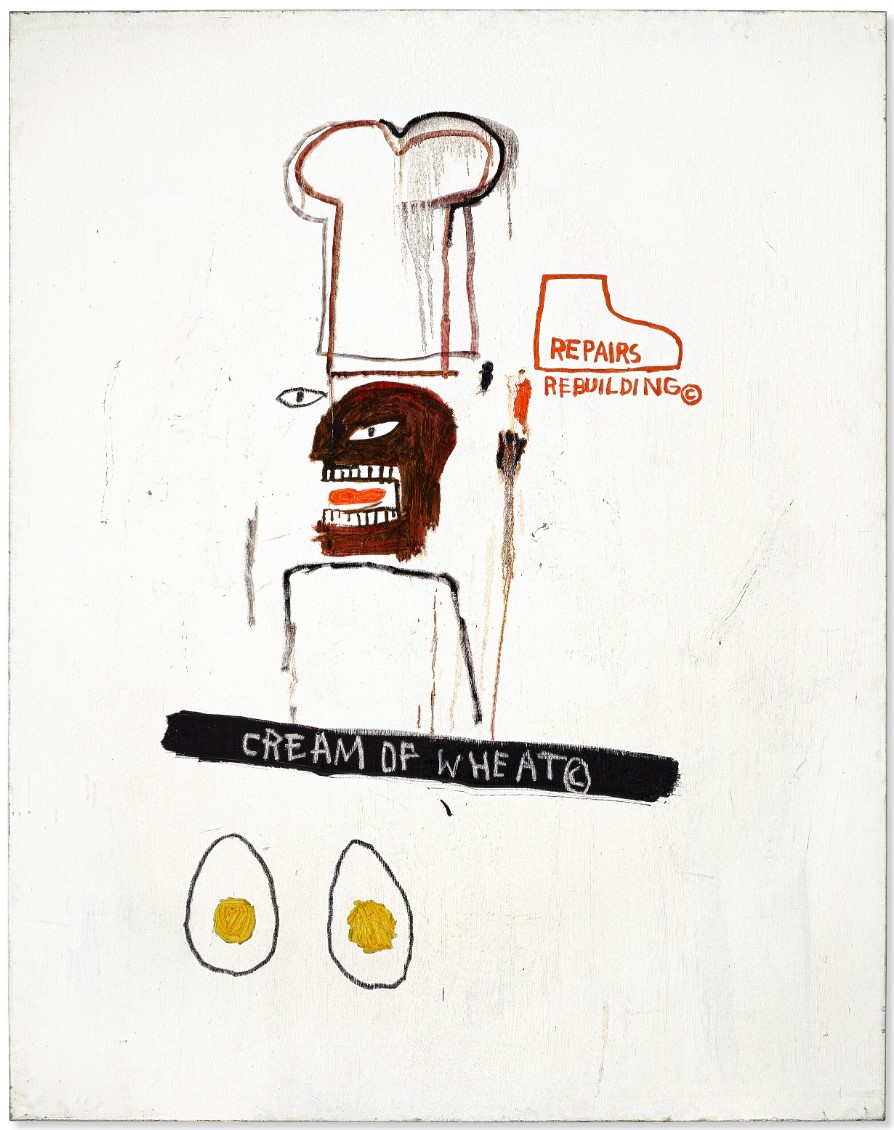
Screaming atop a luminous, textural painted white surface, Jean-Michel Basquiat’s Farina is a cutting example of the artist’s signature visual language, learned eye and radically palpable energy. Painted is the singular figure of a chef amidst what appears to be a rush hour frenzy. In removing this figure from his assumed landscape and throwing him into a contrasting relief with the pure background, the viewer is allowed a rare glimpse at Basquiat’s mastery of energy through figuration. Disjointed eyes, one floating next to its head, arrest the viewer’s gaze and implicate them in his agitation. Fire-licks of red constitute a scorching tongue between the chef’s maniacal grin, and blaze from his raised hand, igniting the painted shoe and adjoined words ‘REPAIRS’ and ‘REBUILDING ©’ above. A second pair of cutting eyes reveal themselves in the two eggs that rest toward the base of the canvas, their glowing yellow yolks perhaps the perfect product of the chef’s mania. Slashing through the chef’s torso is a bold passage of midnight black, atop which the artist has written ‘CREAM OF WHEAT ©’, a nod to the artist’s continued use of the copyright symbol and the ubiquity of aforementioned dish on American breakfast tables. Basquiat’s investigation in the use of a Black chef may also be noted in his Eyes and Eggs, which is presently housed in the permanent collection of The Broad in Los Angeles. Both works exemplify the artist’s fascination with anatomy, with the present example’s hat resembling a femur. The composition of Farina is inherently skeletal, leaning into the artist’s passion for Grey’s Anatomy, an influence that can also be read in his chilling work, Riding with Death. Through the juxtaposition of this elegantly economic range of elements, Basquiat manages to create a web of illusions and allusions that cut to the heart of his art.
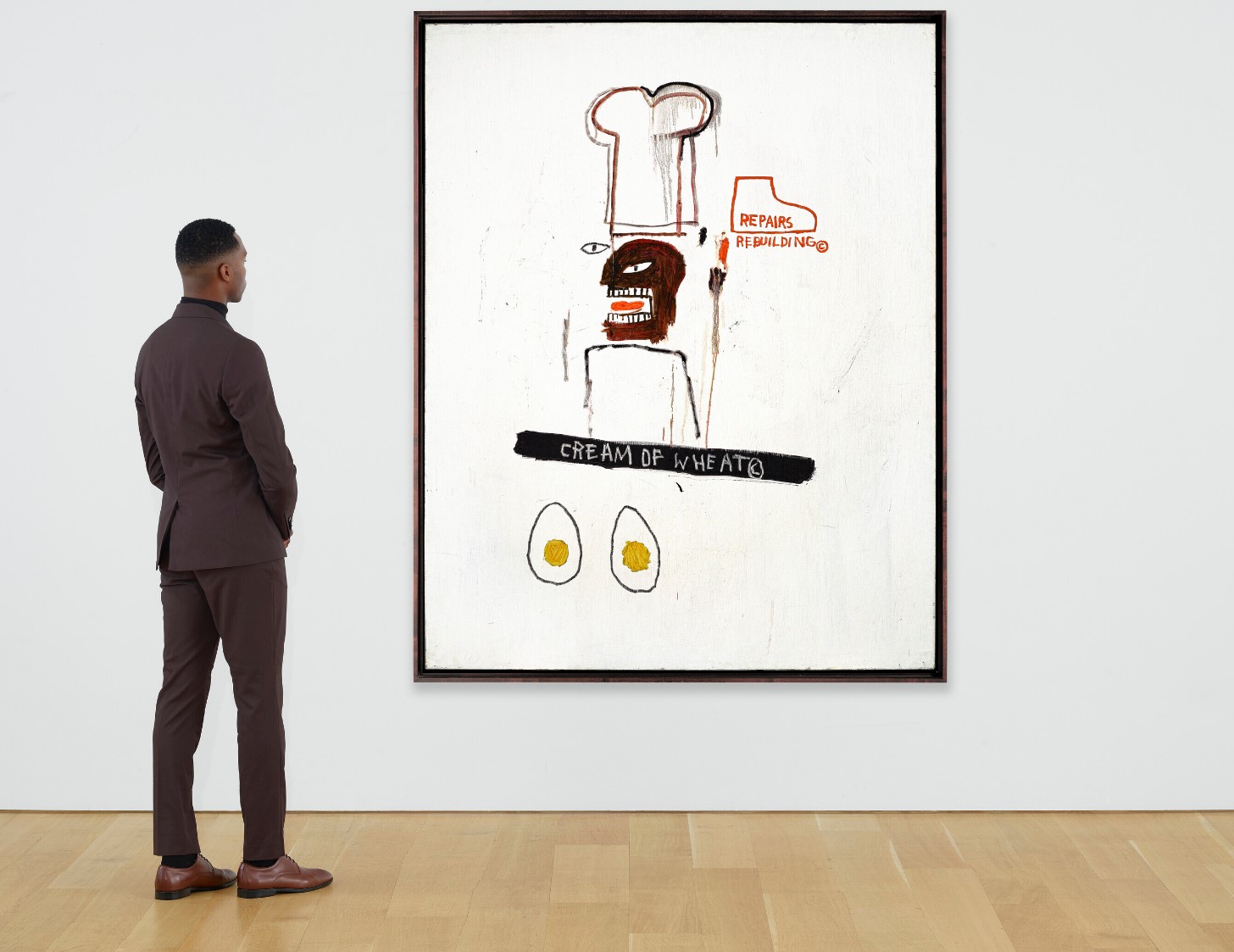
Here, the viewer is offered a rare glimpse of the artist’s perception of figuration and composition on a deceivingly pared-down plane. Upon further inspection, this work is full of Basquiat’s complex iconographies and the academic countenance for which he is most celebrated. The title of the work, Farina, refers to a type of milled wheat eaten in North and Central America as a hot breakfast cereal. It is also a play on the Spanish word for “flour.” Contemporaries of the artist continue to explore this subject matter, as can be noted in Robert Gober’s Untitled (1993-1994), a larger-than-life sculptural replication of a Farina box. In this painting, Basquiat appropriates an historical advertisement for the brand Cream of Wheat that depicted a smiling African-American chef called Rastus wearing a chef’s hat and holding a steaming bowl of cereal.
In Basquiat’s depiction, the bowl of cereal is replaced with the silhouette of a shoe with the words ‘REPAIRS’ on the side and ‘REBUILDING©’ underneath. The painting includes two copyright marks, a symbol Basquiat employed in many works to explore authorship, ownership, monetization and branding. The chef encapsulates the intellectual versatility apparent in Basquiat’s greatest works, serving as a palimpsest of references and meanings beyond its initial simplicity. A referential artist, Basquiat’s use of ‘CREAM OF WHEAT ©’ may be seen as an echo to the Pop Art signs and logos appropriated by his friend and artistic muse, Andy Warhol. At this stage in Basquiat’s career, he and Warhol were actively juxtaposing their languages in bold collaborations on a frequent basis.