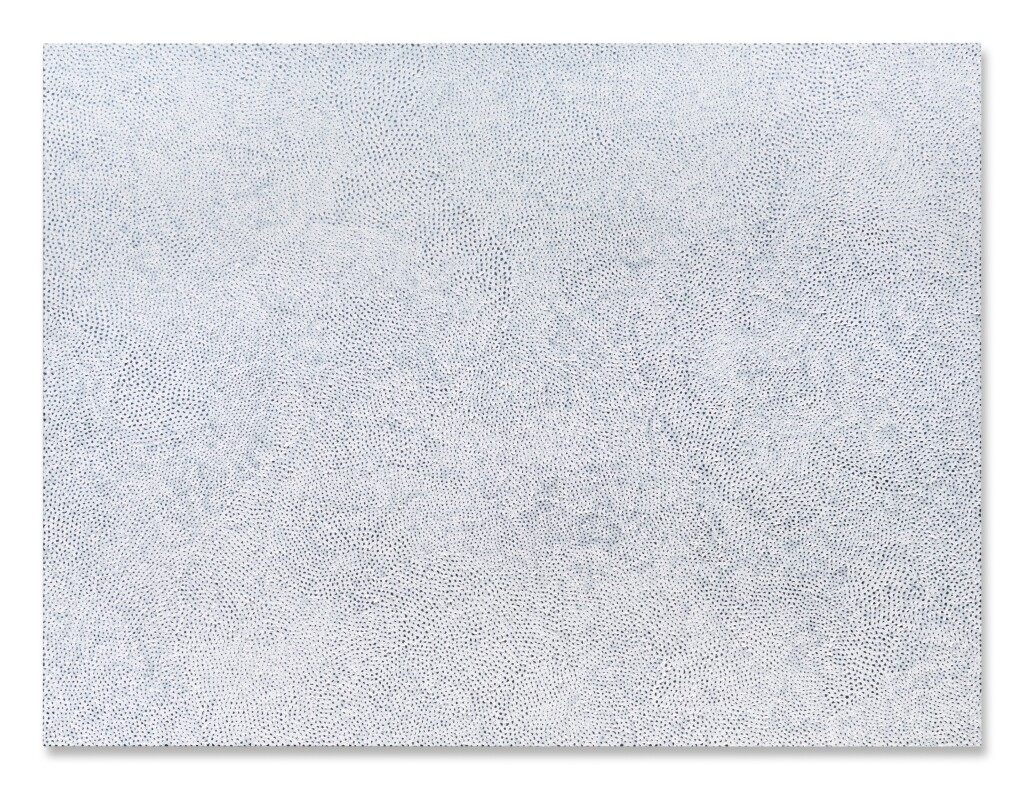
YAYOI KUSAMA
Infinity-Nets (QOTP), 2010
Acrylic on canvas
194×259 cm (76 ⅜ x 102 inches)
Signed Yayoi Kusama, titled Infinity-Nets QOTP and dated 2010 (on the reverse)
Provenance
Victoria Miro, London
Acquired from the above by the present owner in 2011
Auction History
Sotheby’s London: 14 October 2022
Estimated: GBP 1,800,000 – 2,500,000
GBP 3,423,000 / USD 3,837,444
Infinity-Nets (QOTP) | Contemporary Evening Auction | 2022 | Sotheby’s (sothebys.com)
Infinity-Nets (QOTP) from 2010 is an ethereal, dynamic and imposing example from Yayoi Kusama’s most iconic and consequential series of paintings. Kusama’s radical and singular practice defies categorization, her visual semantics of infinity and repetition spanning painting, performance, video, sculpture and installation. Amongst this diverse body of work, however, it is the Infinity Nets that stand as the most important and enduring iteration of her ground-breaking artistic expression. Produced decades after the first iteration of the series, the white impasto lattice on the surface of the present work swells and ebbs across the picture plane. Here an expansive canvas ground delivers an immersive experience by which we are given a glimpse into Kusama’s fantastical and illusory mind-space. Infinity-Nets (QOTP) continues Kusama’s legendary series, employing the same repetitive and hypnotic mark-making that characterizes the very best of Kusama’s oeuvre.
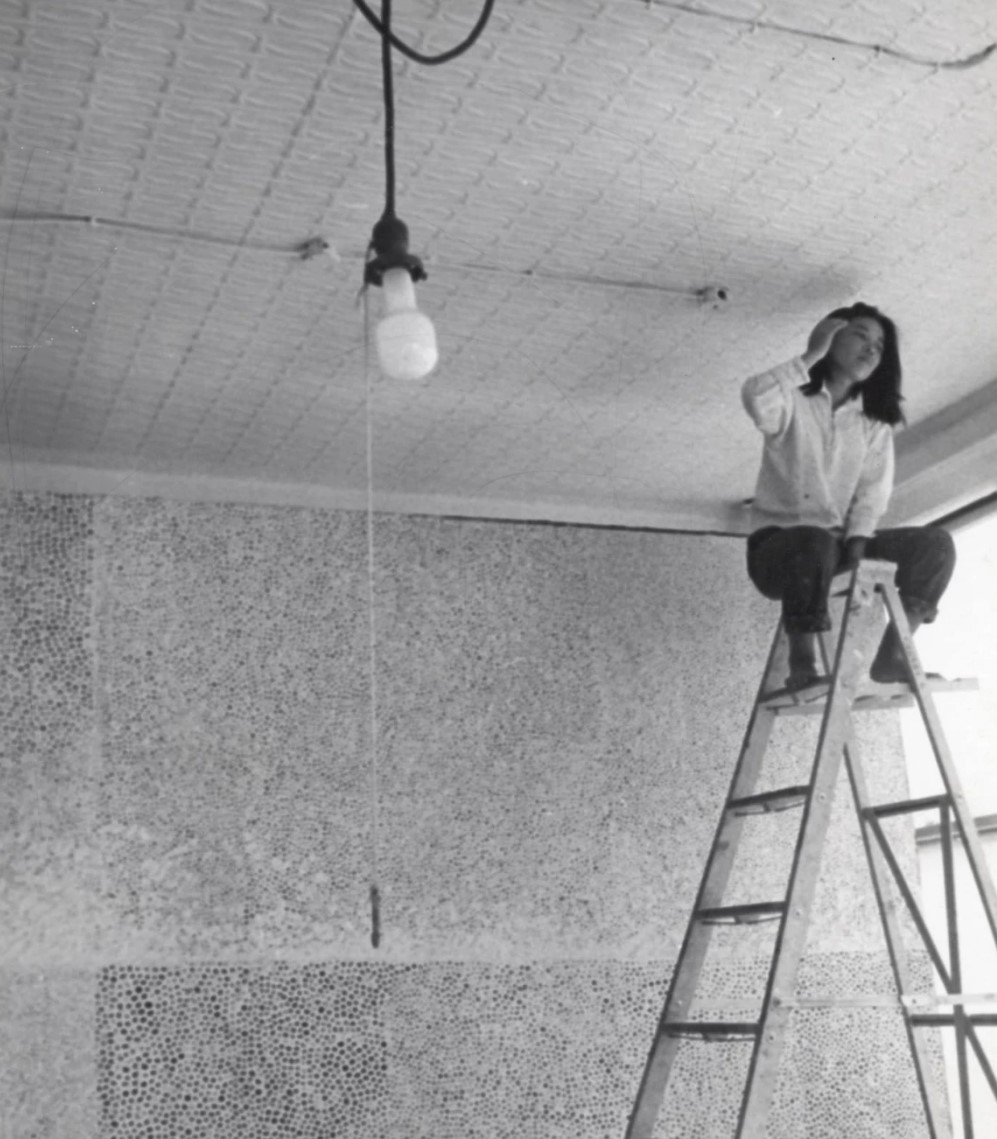
Begun in 1958 in ambitious response to the male-dominated and machismic works of the Abstract Expressionists – specifically the work of Jackson Pollock – the Infinity Nets serve a dual function. At once rivalling the scale and ambition of her male forebears and contemporaries – adopting the aesthetic disciplines of all-over abstraction and championing the qualities of paint and form over figuration – these pieces also gave expression to Kusama’s enduring impetus to convey infinity and overwhelming bodily experiences. Where the early nets, executed in oil date from 1958 until the mid-1960s, their reprisal does not occur with full momentum until the 2000s, and this time in the medium of acrylic paint. The impulse to reprise this significant early body of work can perhaps be attributed somewhat to the lack of works that survive from this period owing to their lackluster reception. When Kusama first arrived in New York City in June 1958, she recalls climbing to the top of the Empire State Building and looking down at the latticed city below in complete awe. At 29 years old, she realized that in order to succeed in the city she would have to do something spectacular.
“I aspired to grab everything that went on in the city and become a star.”
Indeed, although Kusama was incredibly productive and driven upon her arrival in New York, acclaim and respect from an existing and white male dominated art world was not forthcoming. The ensuing years marked a series of radical changes in Kusama’s practice: after the Nets came the phallic soft-sculptures, large-scale sculptural and mirrored installations took form, after which radical and politicized performances took center stage. Where this period of work is today considered a hugely significant art historical moment in her career, Kusama experienced this decade as frustrating and disappointing. The scale of her ambitions was not matched by her reception as an artist, and in the 1970s she returned to Japan and withdrew from artmaking until the 1980s when a new appreciation for her work rejuvenated her artistic practice. Where Kusama’s paintings of the late 1980s and 1990s celebrate color and patternation, the 2000s brought forth a new body of Infinity Nets in the color palette of the earliest works in this series: monochrome black and white.
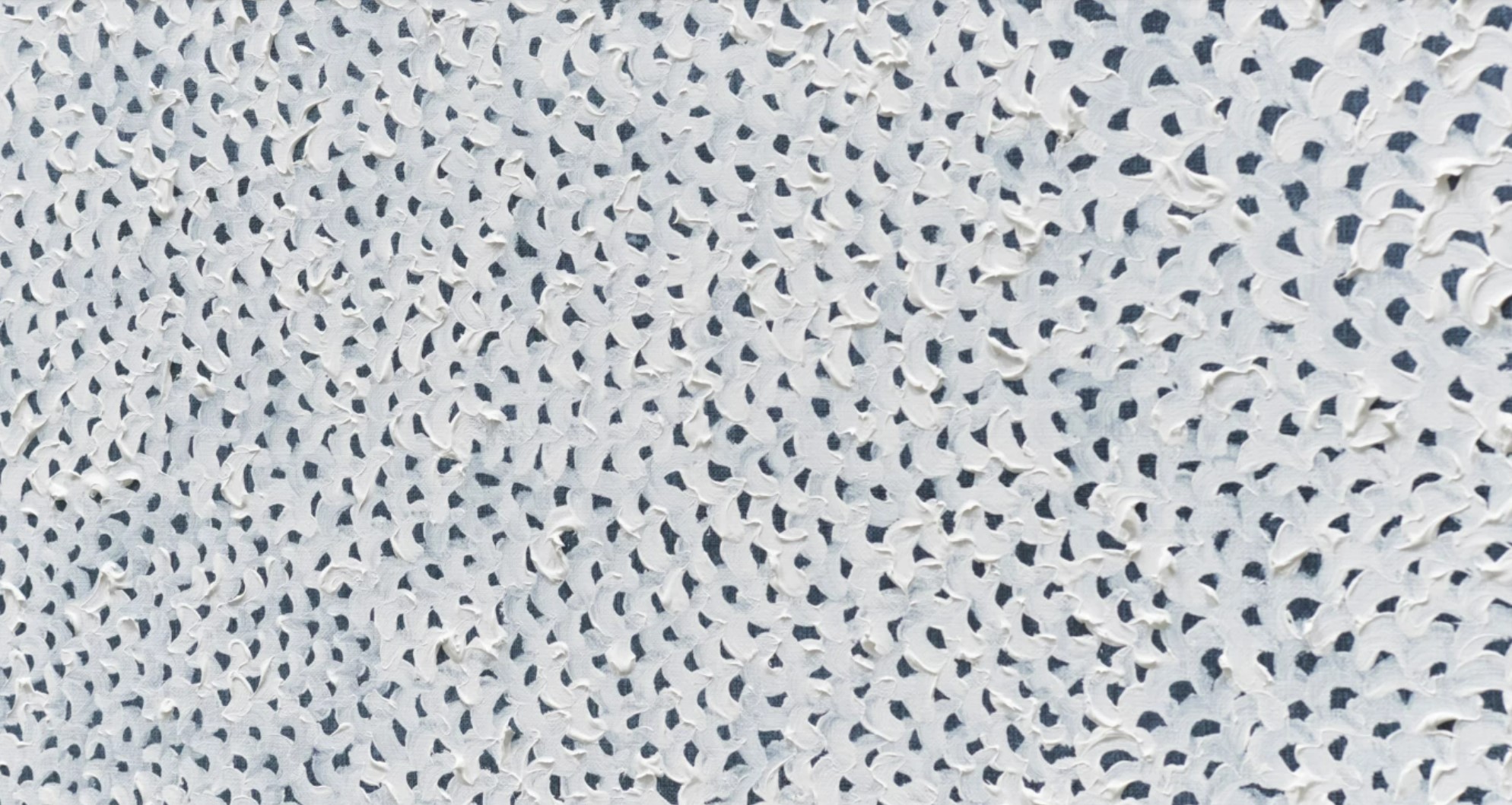
n the present work we witness Kusama’s obsessive and meditative focus; the movement of her brush is swift across the surface of her canvases with precise, minute flicks of the wrist, carefully weaving a complex skein of overlapping loops to create a lyrical and undulating pattern. At once meditatively simple and fascinatingly complex, the Infinity Nets occupy a distinct liminality somewhere between gestural Abstract Expressionism, contemplative Minimalism and even ritualistic performance. Kusama’s practice has a unique ability to function along both parallel and intersecting paths with each of the preeminent movements of the past half-century. Comparable to Robert Ryman’s monochrome paintings, Kusama’s use of texture creates nuanced shadows which bring a distinct tonality to the painting’s surface. With an emphasis on seriality and grasp of materiality, the artist’s practice links strongly to crucial tenets of Minimalism and Post-Minimalism, possibly a result of her close relationships with artists including Donald Judd and Eva Hesse. However, her painting goes much further than its sheer physicality as it transcends into a more mystical realm, suggestive also of works by Richard Pousette-Dart who has often described his own rather spiritual paintings as a “reflection of being.” Having produced many of her nets in extended, uninterrupted sessions, sometimes up to 48 continuous hours, Kusama’s work is imbued with a performative or ritualistic element which distinguishes it again from any prevailing abstract art movement. Though completed in 2010, Infinity Nets (QOTP) highlights the timeless significance of the series within Kusama’s life.
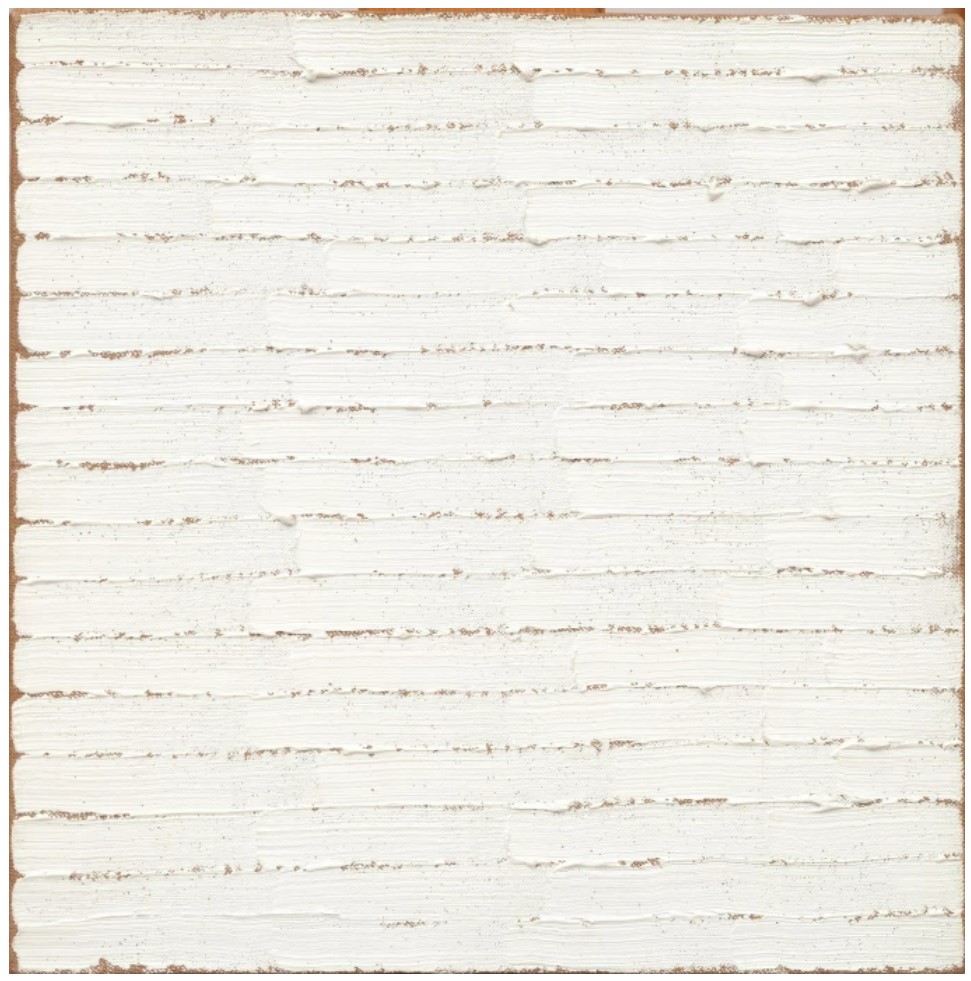
ROBERT RYMAN, UNTITLED, 1965 / MUSEUM OF MODERN ART, NEW YORK
Very much akin to the earliest works from the series, Infinity Nets (QOTP) is comprised from a lace-like surface that exudes a vivid luminosity through an application of lush impasto brushstrokes. The restricted palette imparts a sense of ethereality onto the canvas; the work is vaporous, texturally anomalous and full of reflected light. The artist’s labyrinthine web of mesmeric pigment loops display irrepressible force, drawing the viewer towards the shimmering spaces contained within the tightly woven blanket of paint. The undulating, almost topographical surface of the work hypnotically meanders across the extent of the picture plane, mirroring the process in which it is created. Kusama’s innumerable brushstrokes pile onto one another, culminating in some parts of the canvas in mounds of expressive impasto, and congealing into radiating planes of pigment in others. Each dab of paint is laid with a punctilious devotion to the act of mark-making, consuming the canvas in a field of texture. For all the flurry of countless brushstrokes across this grand canvas, with its elegant palette and intricate construction, the work remains entirely serene and utterly spellbinding to the artist and viewer alike.