WORK IN PROGRESS
The Ads portfolio is an acclaimed part of Warhol’s oeuvre as it depicts some of the icons of American consumer culture. Its subjects cover film, celebrity, glamour, fashion, television and advertising. By turning mass media imagery into art, Warhol elevated the everyday, celebrating the democratization of popular consumer culture. Warhol created a series of different color versions of each image on canvas, before selecting one to be printed as a series of prints in an edition of 190.
“What’s great about this country is America started the tradition where the richest consumers buy essentially the same things as the poorest. You can be watching TV and see Coca-Cola, and you can know that the President drinks Coke, Liz Taylor drinks Coke, and just think, you can drink Coke, too.”
The Ads portfolio consists of 10 different visuals: Mobil, Blackglama (Judy Garland), Paramount, Life Savers, Chanel, Rebel Without a Cause (James Dean), Van Heusen (Ronald Reagan), The New Spirit (Donald Duck), Volkswagen and Apple. More than any other artistic movement of the twentieth century, Pop Art was intertwined with its period of production, and in his Ads series Warhol confronts more directly than ever the consumerism that defined the capitalist culture of his era. Taking on brands such as Chanel, Mackintosh, Paramount and Mobilgas, Warhol reproduced logos and advertisements, elevating these images to the realm high art and in doing so exposing the artistry and power of the carefully crafted symbols themselves. Does the old time-y logo of Mobilgas, pictured as if a metal sign swinging in the wind off the side of a High Street, not conjure notions of tradition, familiarity and friendliness for the multi-national oil drilling company? Similarly, are we not seduced by the luster of Chanel’s iconic No. 5, luminous in its glass vial, justifying its expense by its very appearance?
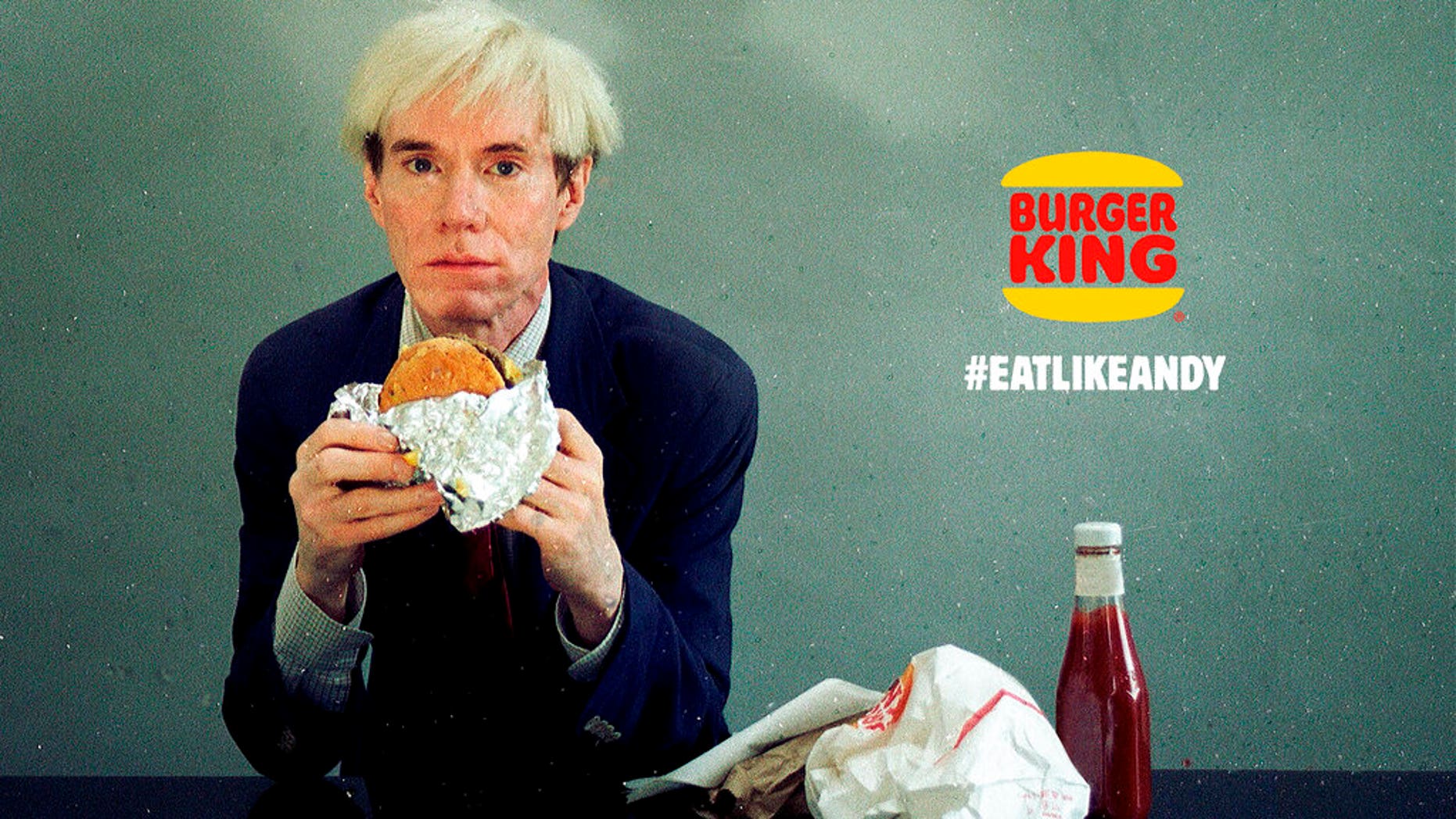
The Ads portfolio represents the artist’s early career inspirations as well as the stylistic motifs that characterized his late period works. Warhol moved from Pittsburgh to New York in 1949 and became a successful commercial illustrator working for the likes of Tiffany, Vogue and Colombia Records. These early illustrations demonstrate the Warhol’s skill as a draughtsman and his formative printmaking process. The artist achieved the signature blotted line that appeared in these delicate drawings by transferring an ink illustration onto a separate piece of paper. This monoprint technique was an early exploration into the process of image reproduction that came to characterize Warhol’s practice. Highlighting such famous companies and figures as Chanel, Paramount, Apple Computers, Donald Duck, Ronald Reagan, James Dean and Judy Garland; Warhol’s Ads series from 1985, like so many other series from the artist’s last decade, is a true reexamination of his early works. In this series, Andy Warhol’s career truly comes full circle, blending his early days as a commercial illustrator with his mature Pop style.
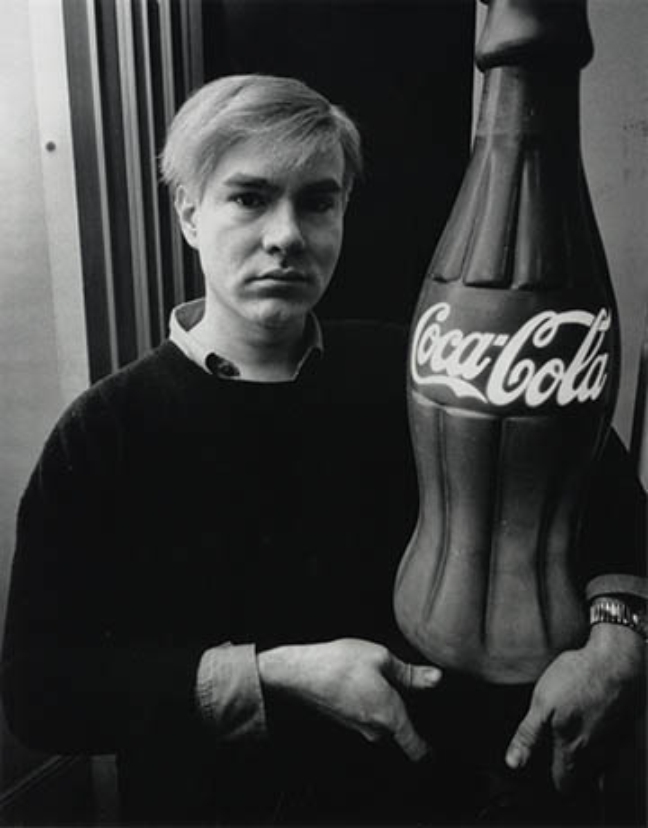
Using vivid hues, flat planes of color, and spirited linework, paintings in Warhol’s Ads Series transform popular advertisements into individual works of art. The series consists of 10 images which clearly merge Warhol’s commercial advertising skills with his artistic mastery; as the artist has said, “I’m still a commercial artist. I was always a commercial artist.” This series is deeply ingrained in American culture, as Warhol was acutely aware of the strong influence that advertisements could have on anyone. Through the works in this portfolio, Warhol is positing art as something simultaneously elite and for the people—he uses imagery from a consumer vernacular that resonates with the common man, then elevates it to exist within his acclaimed oeuvre.
Life Savers
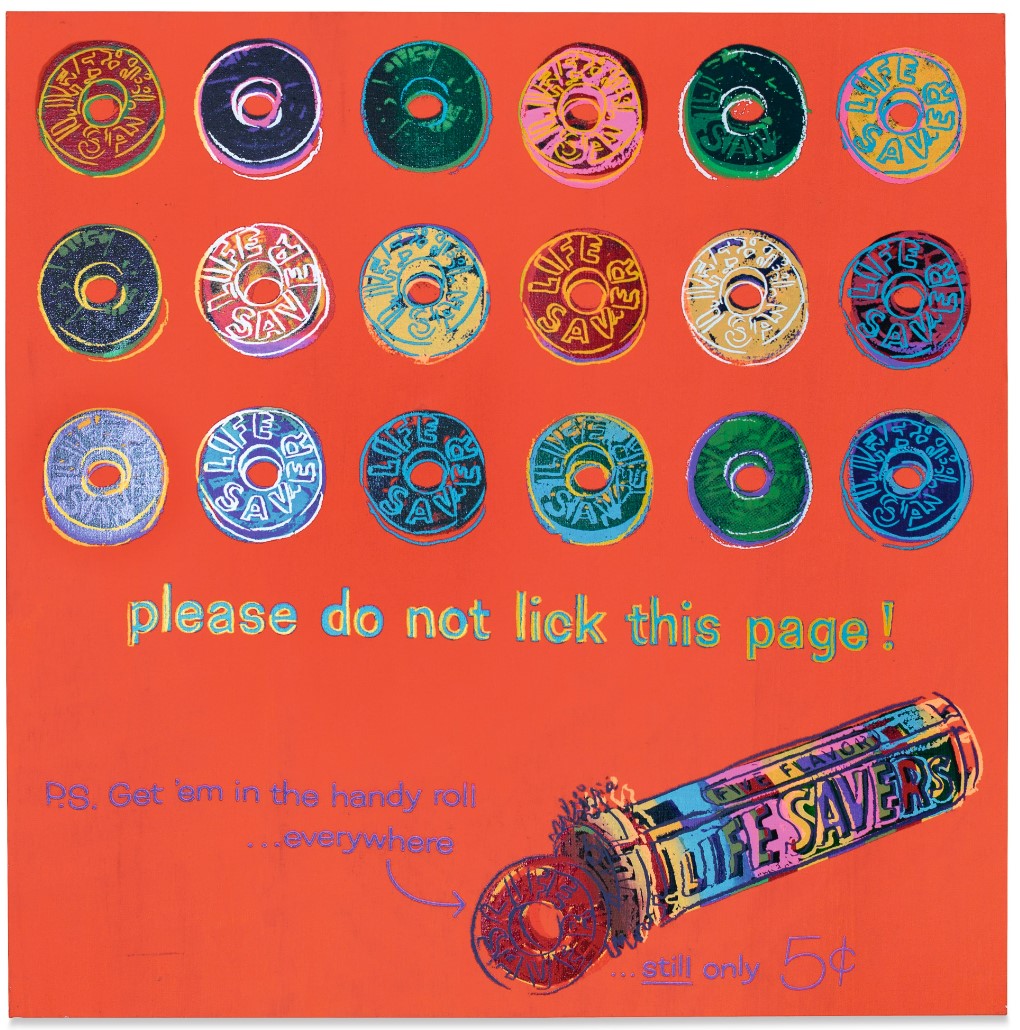
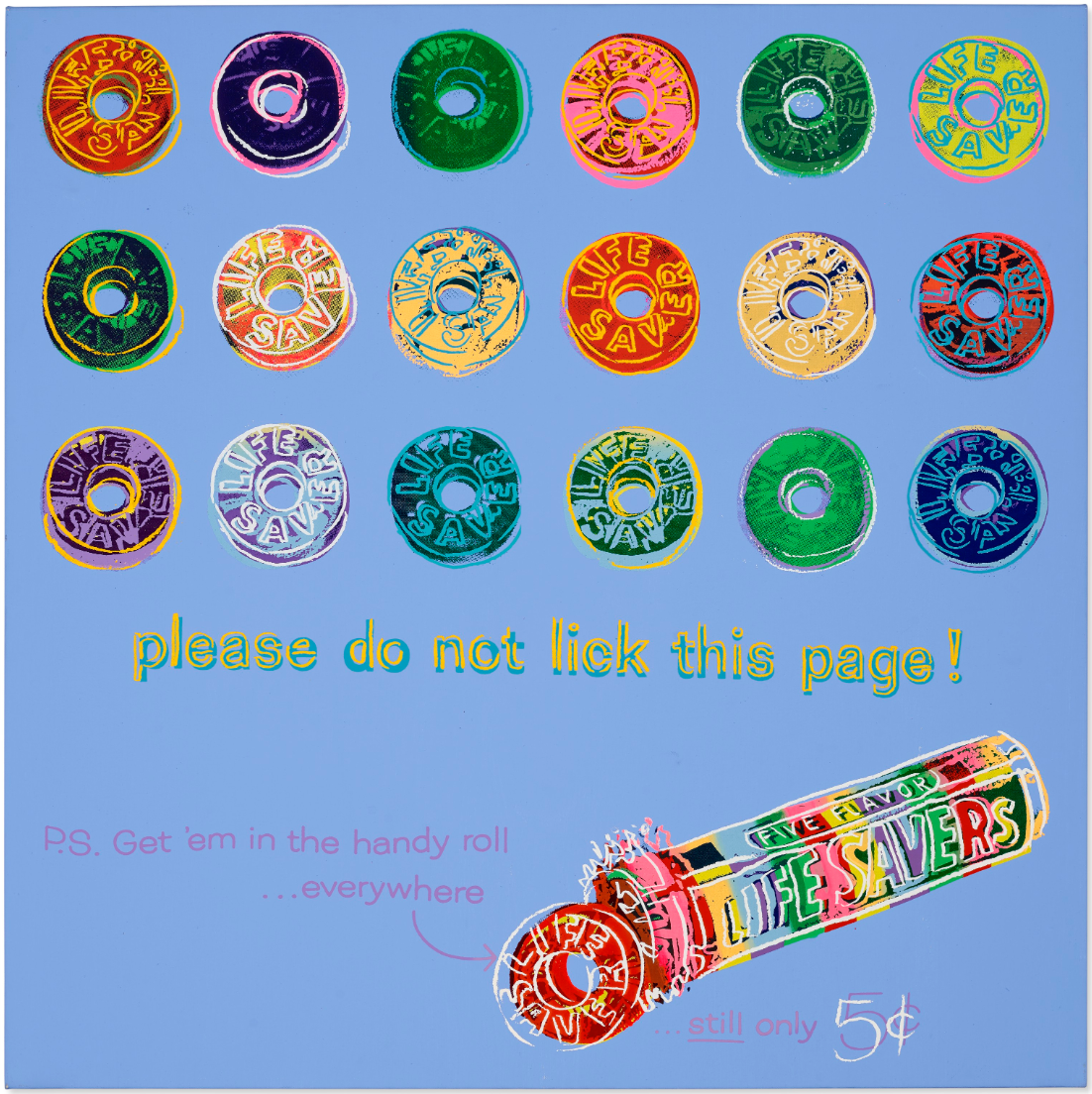
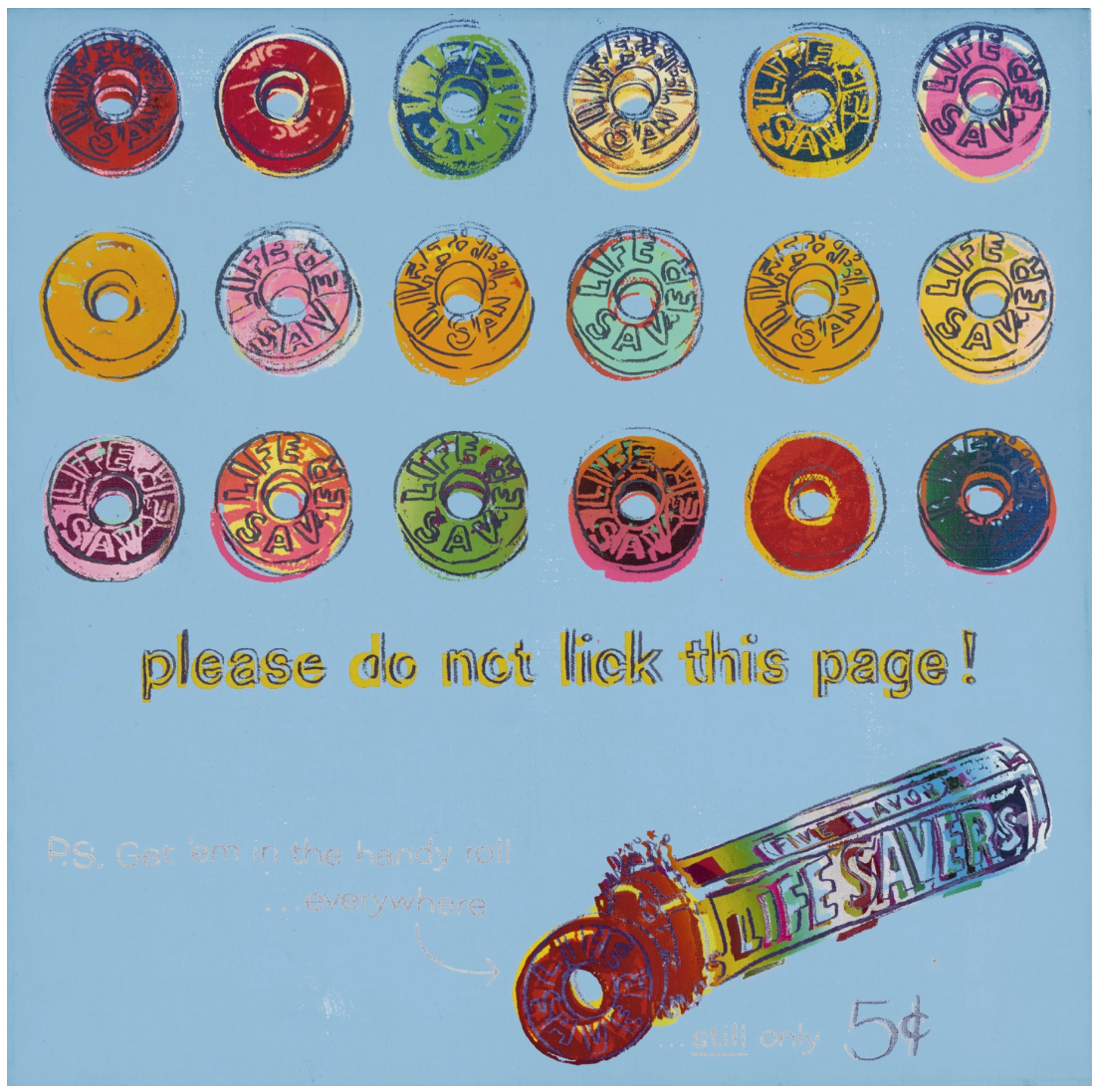
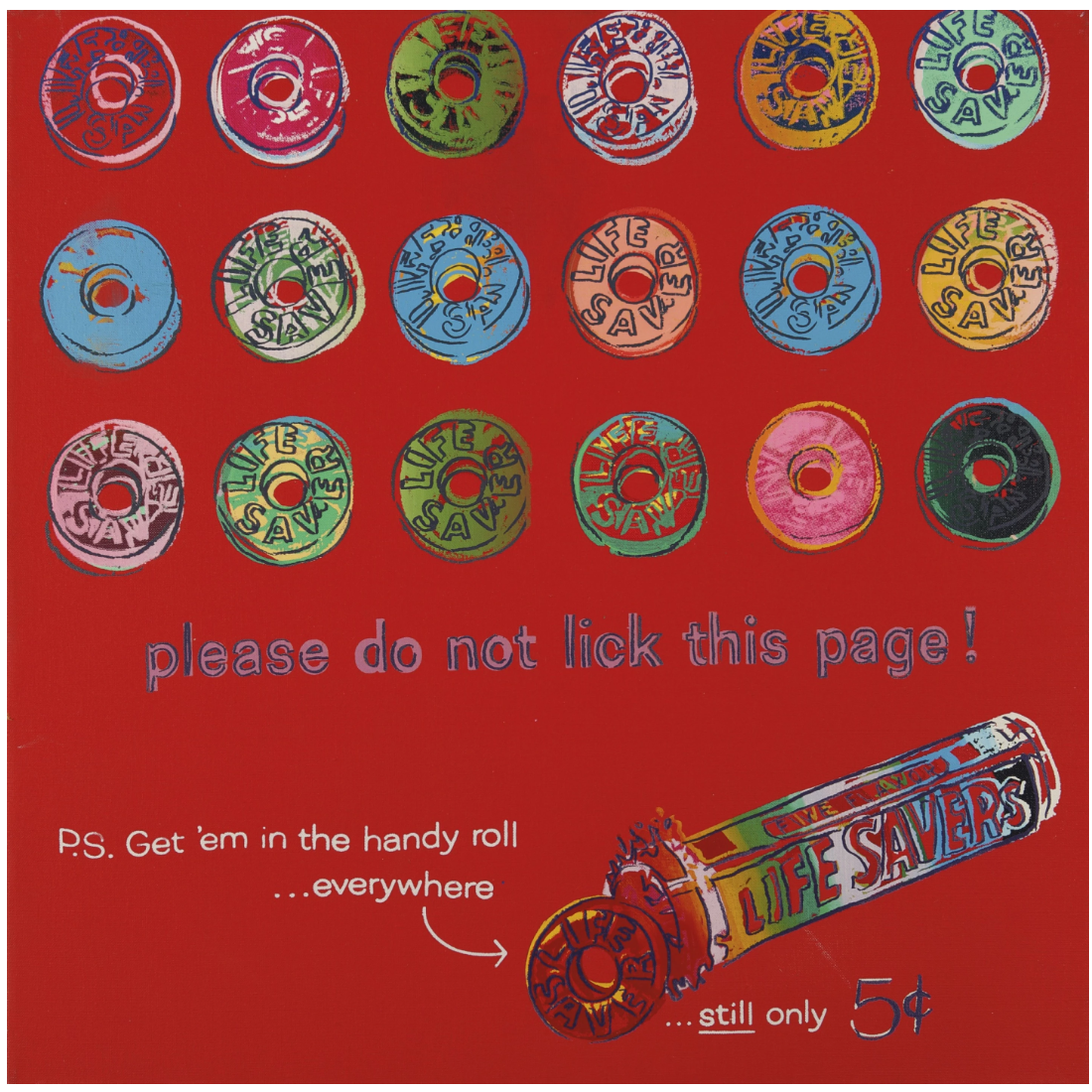
Lifesavers is distinguished by its vibrant, candy-colored decadence, itself a symbol of the succulent temptation of pervasive consumerism. The tempting rows of layered circular sweets printed in an array of pastels and vibrant tones ask to viewer to pick his favorite and lick it. To lick an advertisement is one thing, but to lick a painting, let alone a painting by Andy Warhol, who by this time was as much a known brand as the companies whoso advertisements he coopted in Ads, is sheer lunacy. Further undermining the function of the image, isolating the signifier and by doing so altering the signified, Lifesavers epitomizes the subversive nature of Warhol’s practice, at a time in American history where advertising was king.

Life Savers connects to Warhol’s early paintings of everyday household groceries such as Campbell’s Soup and Coca-Cola, as well as the vibrant hues and subtle nods to “frutti-tutti” flavors in his iconic Marilyn series, which boasts such titles as Lemon, Cherry, Licorice, and Grape Marilyn. Warhol arrived in New York in the summer of 1949. Known then as Andrew Warhola, he immediately began making connections through various advertising agencies and fashion magazines. Securing jobs at renowned publications such as Harper’s Bazaar, Glamour, Vogue, and high-end retail stores like Bergdorf Goodman, Tiffany & Co., and Lord and Taylor, Warhola quickly cemented his spot as a leading commercial illustrator. Of course, his largest client—and the one for which he is most well-known—was the shoe company I. Miller.
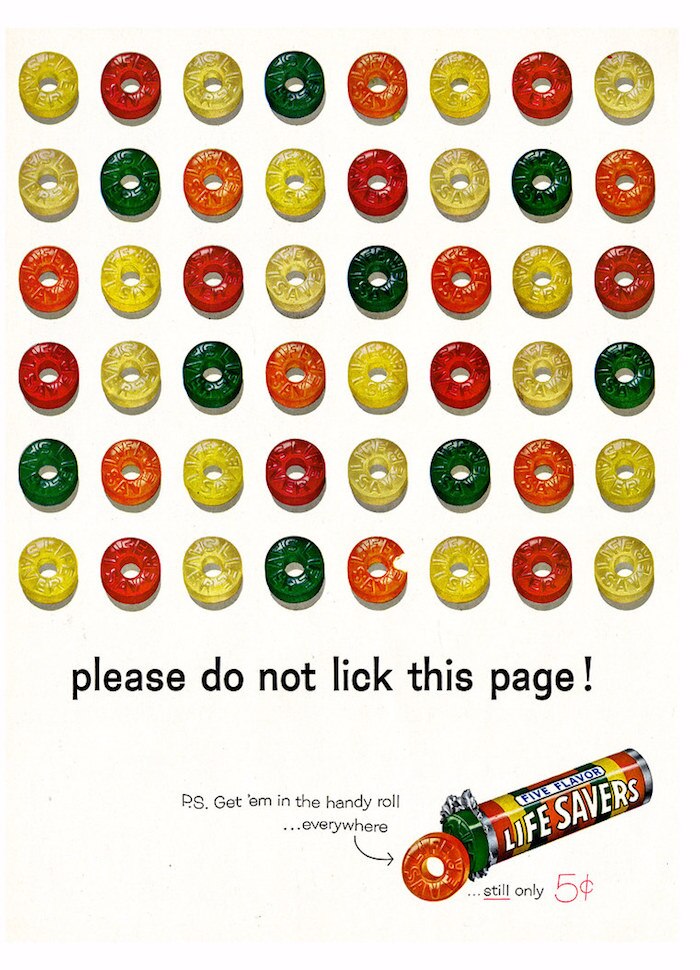 The history of the inconspicuous Life Saver fits perfectly among Warhol’s Campbell’s Soup and Coca-Cola narrative. Known for its distinctive aluminum packaging and iconic ring-shaped candy, Life Savers were first introduced in 1912. The hard candies were invented to offer a sweet alternative to chocolates which often melted in the summer heat. While Life Savers have gone through many iterations—from flavors such as anise, clove, and lavender—the iconic fruit flavors were developed in 1921. A staple candy for many Americans, during the second World War many other candy manufacturers donated their sugar rations to keep Life Savers in production so that they could be shared with the Armed Forces stationed abroad as a sweet reminder of life at home. Warhol’s lasting idea that a coke could be enjoyed by anyone no matter what their status in life, rings perfectly true for the donut shaped candies.
Life Savers, 1985
Phillips Hong-Kong: 30 March 2023
Estimated: HKD 4,500,000 – 6,500,000
HKD 5,334,000 / USD 679,499
Andy Warhol – 20th Century & Contempor… Lot 26 March 2023 | Phillips
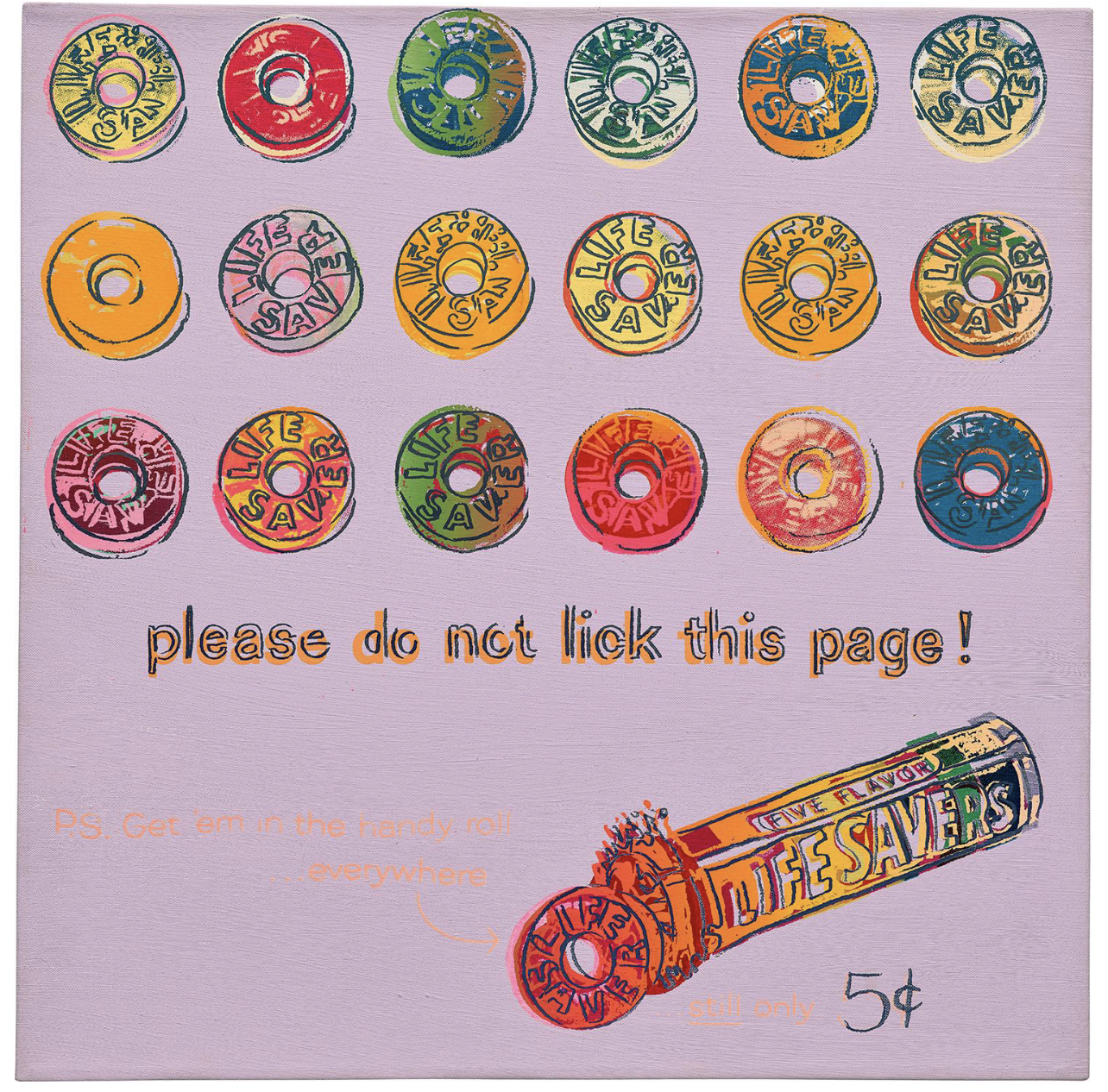
ANDY WARHOL
Life Savers from the series Ads, 1985
Acrylic and silkscreen enamel on canvas
22×22 inches (55.9 x 55.9 cm)
Signed and dated ‘Andy Warhol 85’ on the overlap
Lifesavers (from Ads), 1985
Sotheby’s New-York: 28 October 2020
Estimated: USD 700,000 – 1,000,000
USD 1,774,500
ANDY WARHOL
Lifesavers (from Ads), 1985
Acrylic and silkscreen on canvas
40×40 inches (101.6 x 101.6 cm)
Stamped by The Estate of Andy Warhol and The Andy Warhol Art Authentication Board
Numbered PA11.001 on the overlap
Numbered PA11.001 on the stretcher
The present work is further distinguished by its vibrant, candy-colored decadence, itself a symbol of the succulent temptation of pervasive consumerism. The tempting rows of layered circular sweets printed in an array of pastels and vibrant tones ask to viewer to pick his favorite and lick it.
Lifesavers, 1985
Christie’s New-York, 2 December 2020
Estimated: USD 700,000 – 1,000,000
USD 1,410,000
Andy Warhol (1928-1987) (christies.com)
ANDY WARHOL
Lifesavers, 1985
Acrylic and silkscreen ink on canvas
40×40 inches (101.6 x 101.6 cm)
Stamped twice with the Estate of Andy Warhol and the Andy Warhol Foundation for the Visual Arts stamps and numbered ‘PA11.003’ (on the overlap)
Numbered again ‘PA11.003’ (on the stretcher)
Stamped again with the Andy Warhol Foundation for the Visual Arts stamp (on the reverse)
Lifesavers, 1985
Sotheby’s New-York: 19 May 2017
Estimated: USD 350,000 – 450,000
USD 492,500
(#194) Andy Warhol (sothebys.com)
ANDY WARHOL
Lifesavers, 1985
Acrylic and silkscreen ink on canvas
22×22 inches (55.9 x 55.9 cm)
Signed and dated 85 on the overlap
Lifesavers, 1985
Sotheby’s New-York: 15 November 2015
Estimated: USD 250,000 – 350,000
USD 586,000
(#104) Andy Warhol (sothebys.com)
ANDY WARHOL
Life Savers (from Ads), 1985
Acrylic and silkscreen ink on canvas
22×22 inches (55.9 x 55.9 cm)
Signed and dated 85 on the overlap
Lifesavers Candy, 1986
Christie’s London: 20 June 2007
Estimated: GBP 200,000 – 300,000
GBP 290,300
Andy Warhol (1928-1987) (christies.com)
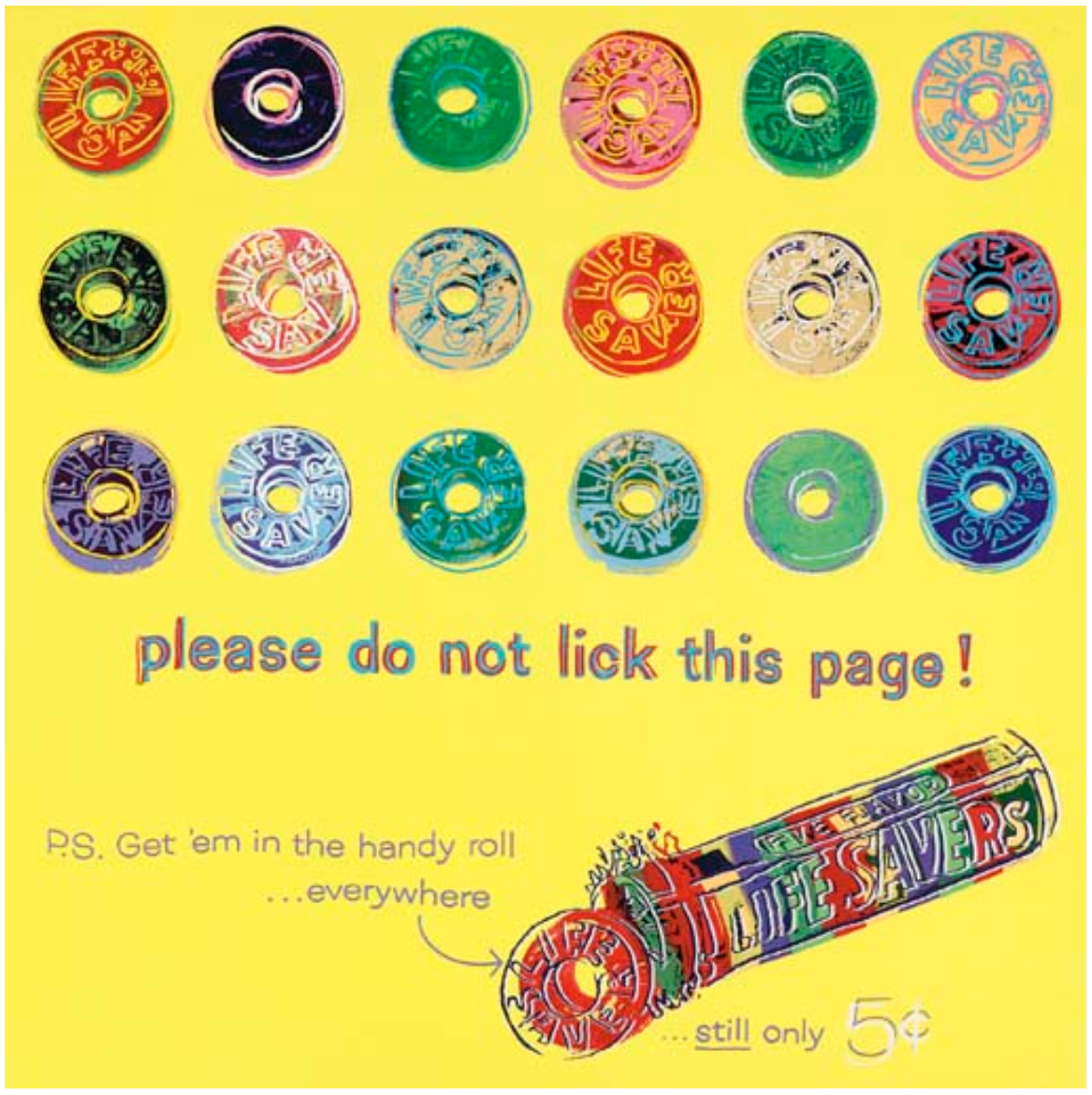
ANDY WARHOL (1928-1987)
Lifesavers Candy, 1986
Synthetic polymer paint and silkscreen inks on canvas
40 1/8 x 40 1/8 inches (102×102 cm)
With the Estate of Andy Warhol stamp and numbered ‘PA11.002’ (on the overlap)
Mobil
1931 saw a historic merger of two of America’s up-and-coming oil companies when Vacuum Oil and Standard Oil joined forces to become Socony-Vacuum Corp. Together they formed the world’s third-largest oil corporation and trademarked the now globally recognised Mobiloil/Mobilgas brand name. Soon after, they patented the “Flying Red Horse” logo, and their regal Pegasus appeared in advertising nationwide, accompanied by the promise, “A new sign rises to guide America’s car owners to the gasoline and service they want.” The Flying Red Horse became a familiar sight to all Americans, and an inviting beacon to drivers, with its crimson wings outstretched over gas stations across the country.
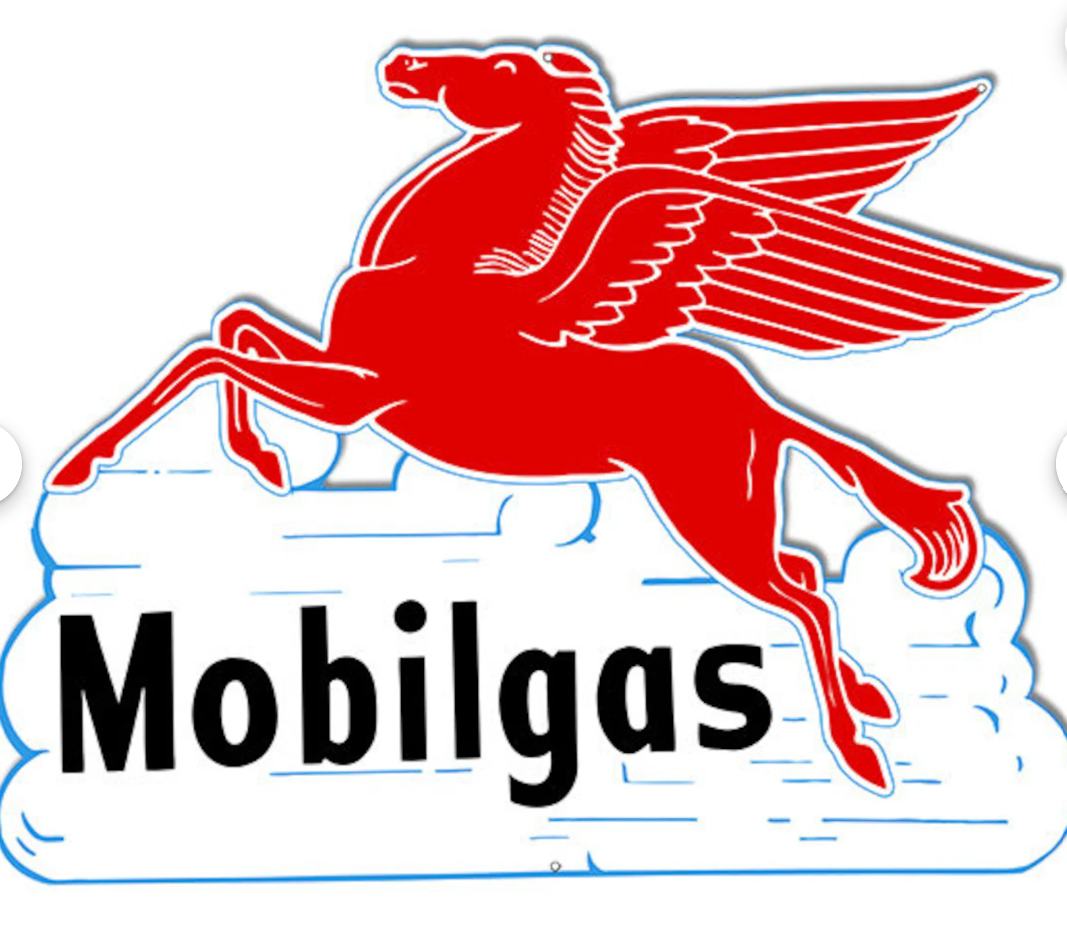
Decades later, the ubiquitous Pegasus – by then one of the most recognized corporate symbols in history – was re-imagined by Andy Warhol as part of his 1985 Ads series. In the standard edition of the Ads series, the Mobilgas Pegasus was printed in its traditional primary red pigment, with electric yellow linework on the logo and Mobilgas name. Yellow gestural lines contrast with the red body of the mythical winged horse, Pegasus, in the center print.The color contrast accentuates the body of the creature originating from Greek mythology, making it the focal point of the print. This technique adds depth to the screen print. While Warhol chose a 1980’s-inspired neon colour palette for this subject, he looked to a vintage iteration of the Mobilgas placard, one of the shield-like metal signs which would have swung in the breeze along Route 66. By taking a piece of Americana and giving it the Warholian twist, the artist looked to both America’s past and future, paving the way for a new generation of creators in the commercial sphere.
Mobilgas, 1985
Phillips Hong-Kong: 30 March 2023
Estimated: HKD 3,000,000 – 5,000,000
HKD 3,810,000 / USD 485,357
Andy Warhol – 20th Century & Contempor… Lot 27 March 2023 | Phillips
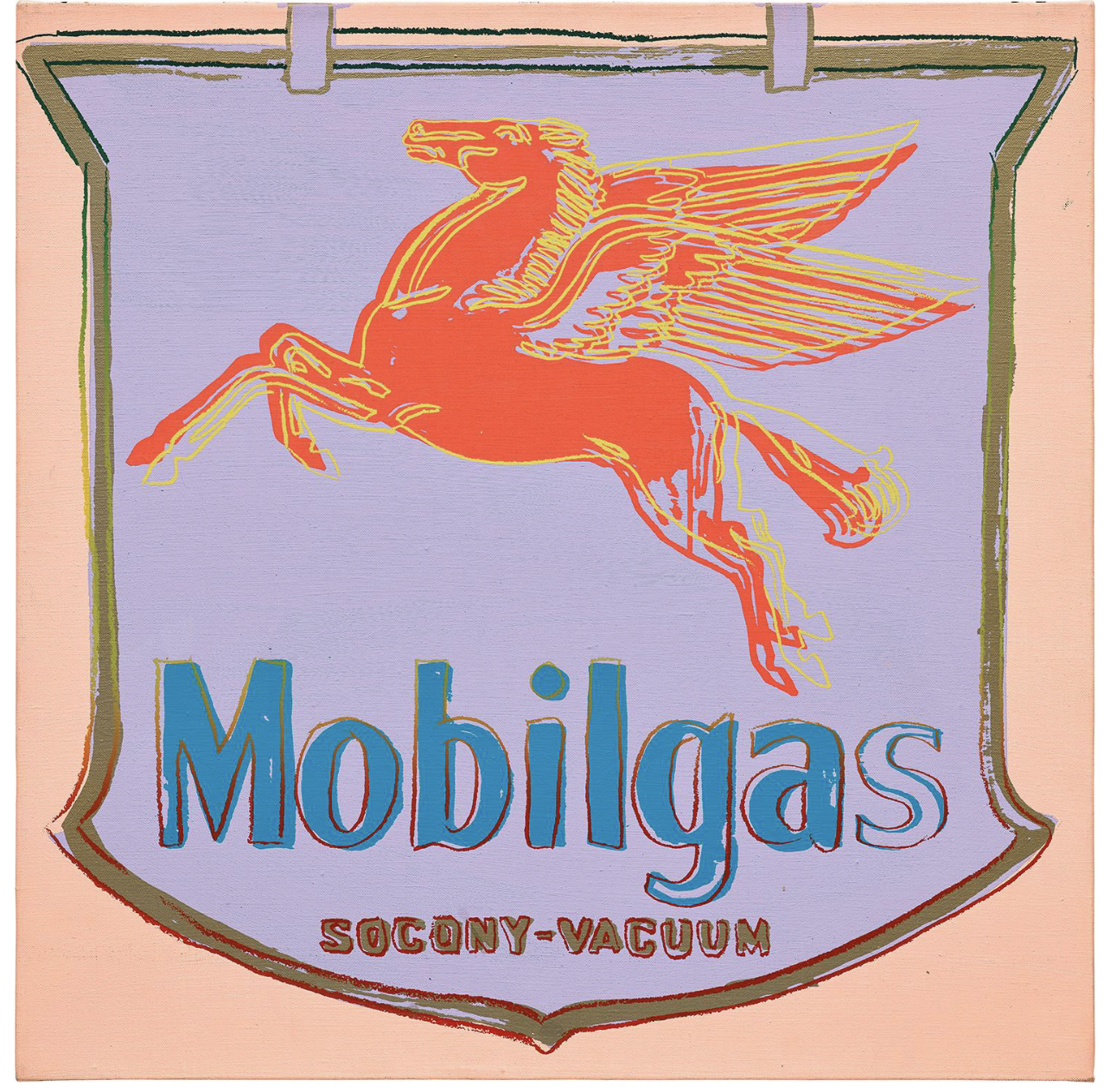
ANDY WARHOL
Mobilgas from the series Ads, 1985
Synthetic polymer and silkscreen inks on canvas
22×22 inches (55.9 x 55.9 cm)
Signed and dated ‘Andy Warhol 85’ on the overlap
Mobil (from Ads), 1985
Sotheby’s New-York: 12 November 2015
Estimated: USD 200,000 – 300,000
USD 502,000
(#106) Andy Warhol (sothebys.com)
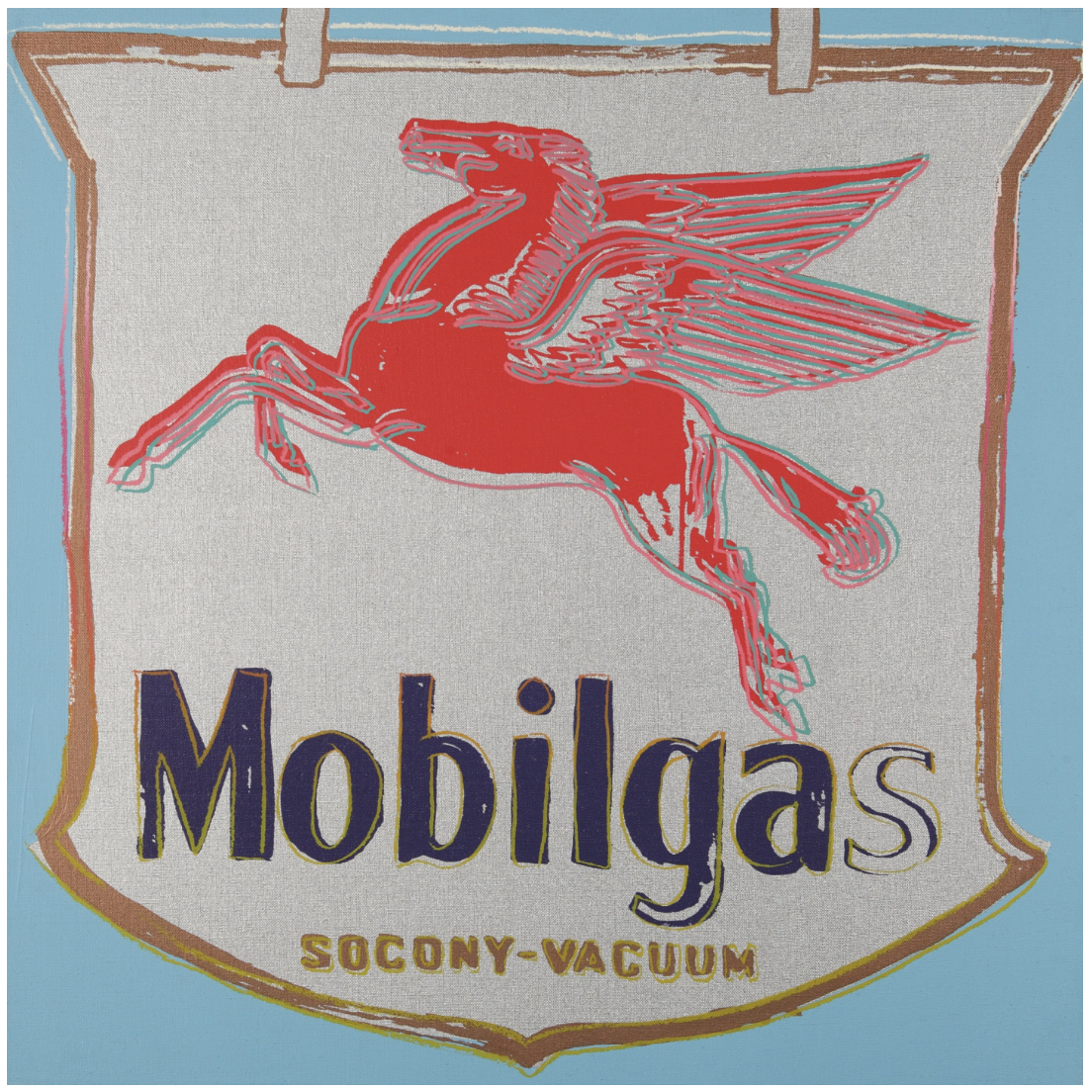
ANDY WARHOL
Mobil (from Ads), 1985
Acrylic and silkscreen ink on canvas
22×22 inches (55.9 x 55.9 cm)
Signed and dated 85 on the overlap
Mobilgas, 1985
Phillips New-York: 10 November 2015
Estimated: USD 60,000 – 80,000
USD 100,000
Andy Warhol – 20th Century & Conte… Lot 237 November 2015 | Phillips
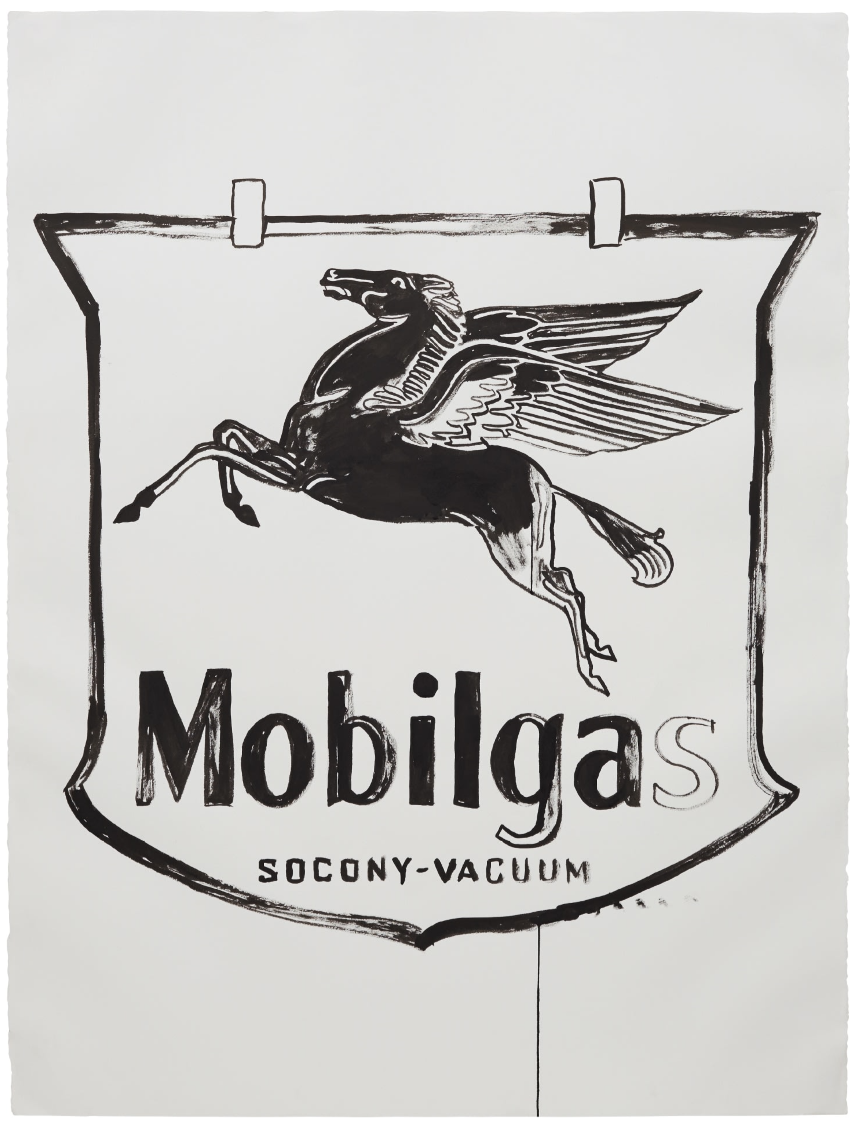
ANDY WARHOL
Mobilgas, 1985
Synthetic polymer paint on HMP paper
50×38 inches (127 x 96.5 cm)
Stamped by the Estate of Andy Warhol and the Andy Warhol Foundation for the Visual Arts, Inc.
Numbered “02.002” on the reverse
The New Spirit (Donald Duck)
The New Spirit (Donald Duck), 1985
Christie’s New-York: 17 November 2022
Estimated: USD 250,000 – 350,000
USD 611,100
ANDY WARHOL (1928-1987) (christies.com)
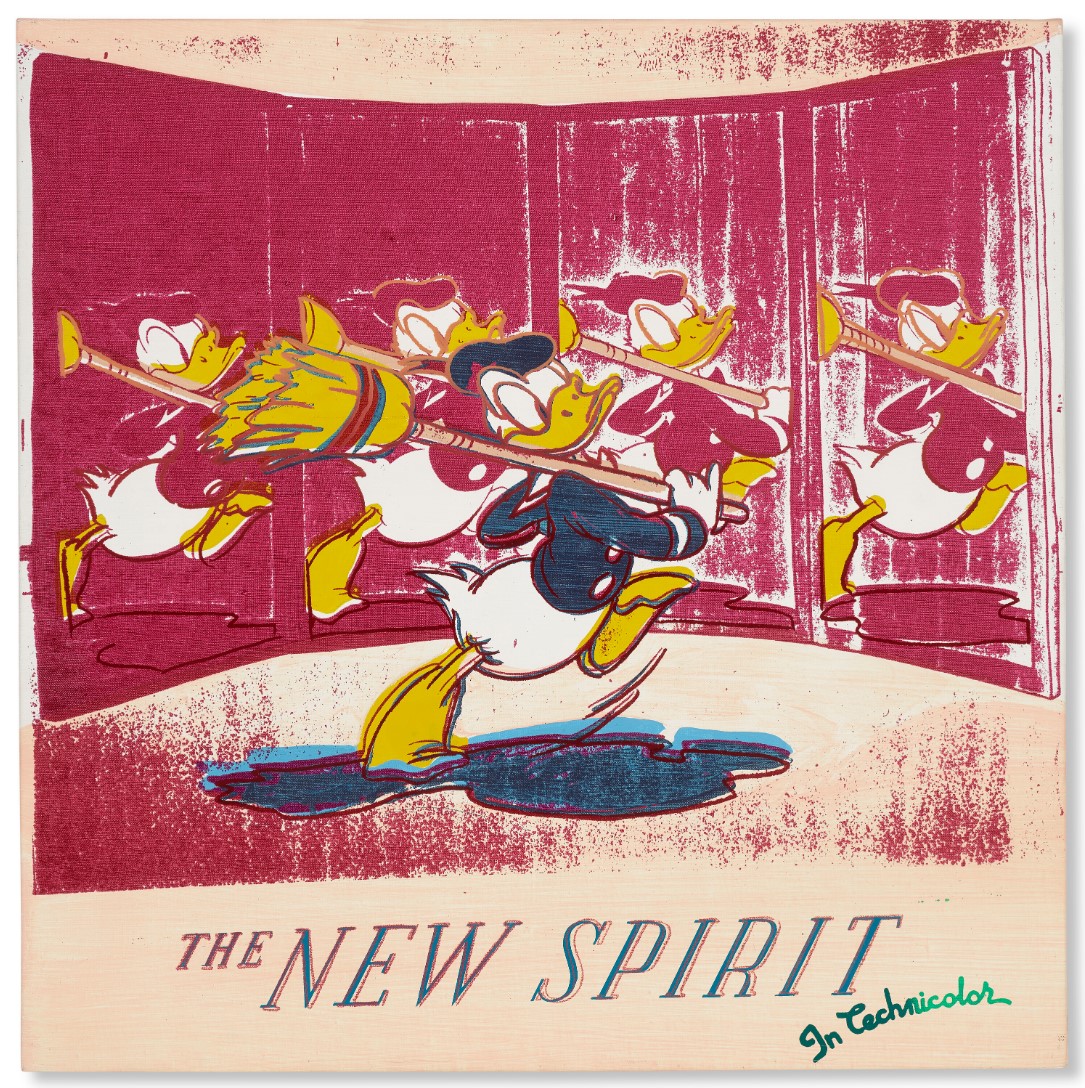
ANDY WARHOL (1928-1987)
The New Spirit (Donald Duck), 1985
Acrylic and silkscreen ink on canvas
22×22 inches (55.8 x 55.8 cm)
Signed and dated ‘Andy Warhol 85’ (on the overlap)
The New Spirit (Donald Duck) depicts an image of Donald Duck originating from an animated short film produced by Walt Disney Productions in 1942. Printed on Lenox Museum Board, this dynamic print is rendered in bold and saturated colors, characteristic of Warhol’s iconic Pop Art style. Donald Duck is captured in movement, marching across the print, in front of a repeated series of four other Donalds, adding to the sense of dynamism in this image. Warhol’s use of organic and gestural lines in blue and green delineate Donald Duck’s figure. Warhol used this image to comment on the impact of mass media in capitalist America. The short film, The New Spirit, from which this image originates was a wartime propaganda film encouraging American citizens to pay their income tax. It was the first film created as part of Walt Disney’s World War II propaganda production. Using a highly saturated color palette, Warhol transforms this image of Donald Duck from a propaganda film made 42 years ago into a1980s pop icon.
“Donald is encouraged by a radio bulletin to pay his income tax promptly to support the war effort. Using wartime propaganda and Disney humor, the public is encouraged to pay their income tax with a minimum of grumbling. Instead of mailing his money in, Donald is shown eagerly running across country from California to Washington, D.C. to deliver his tax payment in person. The animation then shifts to less humorous, more warlike images. A Japanese battleship with the Rising Sun painted on its side explodes, and this Rising Sun slowly sinks beneath the ocean to the strains of Beethoven’s Fifth. A Nazi submarine is also blown up, and the film cuts to a closeup of the Nazi flag being flushed away in a vortex of dark, swirling water. Allied aircraft and tanks are shown destroying a huge Nazi war machine monster. The final shot of the short reveals a watercolor wash sky of multicolored clouds that form the U.S. flag”
(J. Edwards, The Encyclopedia of Disney Animated Shorts, www.disneyshorts.org).
Rebel Without a Cause (James Dean)
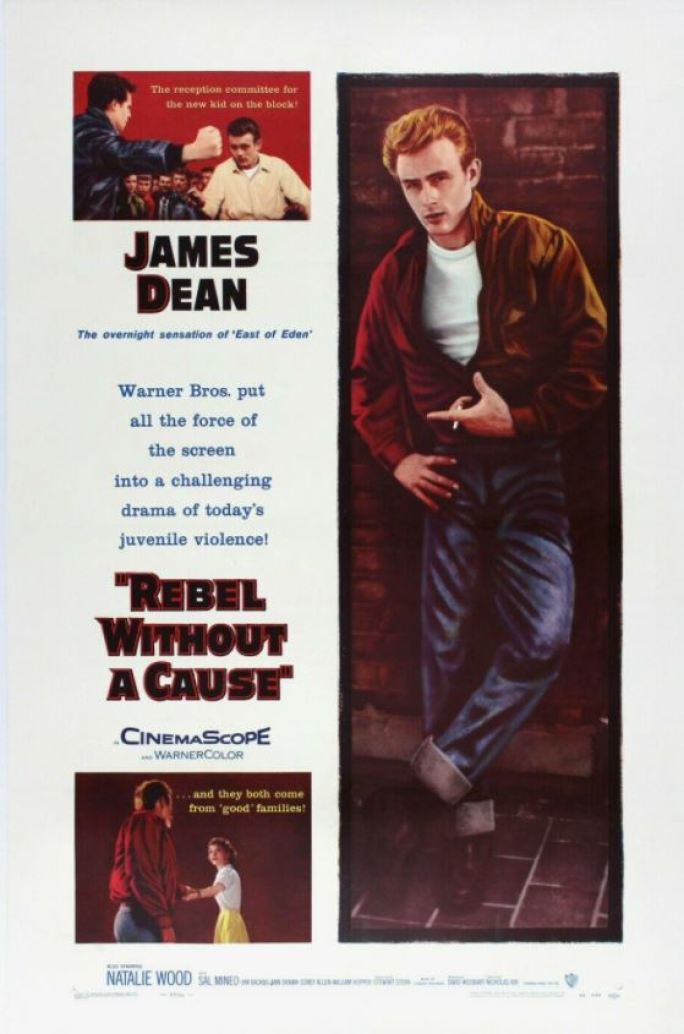
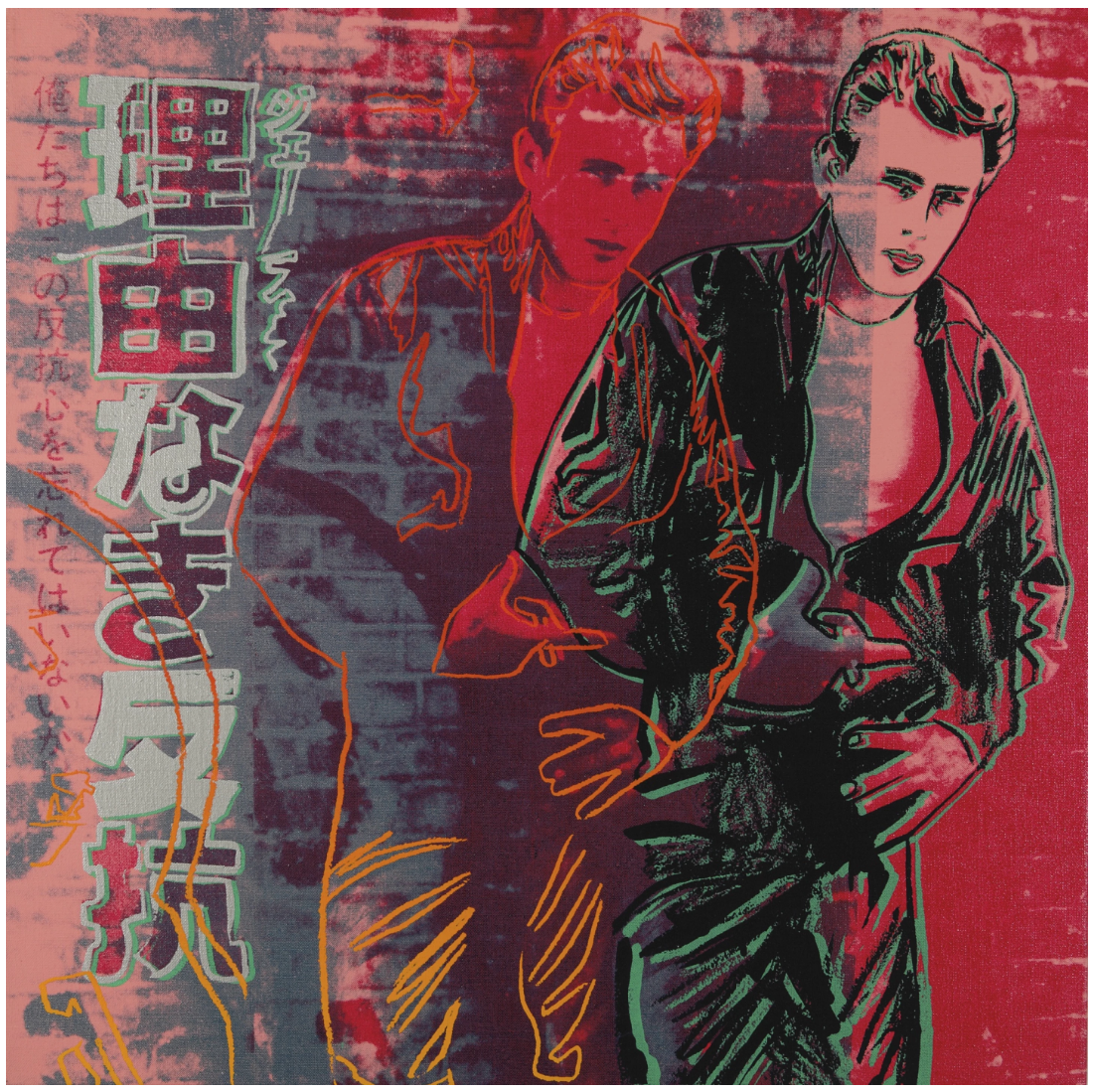
In Rebel Without A Cause (James Dean), Andy Warhol illustrates further his passion for and interest in popular culture. This print of a Japanese film poster for the 1950s film, Rebel Without a Cause, depicts James Dean as the troublemaking teenager, Jim Stark. Printed on Lenox Museum Board, this image contains an element of nostalgia, harking back to the 1950s, the era in which Warhol rose to fame. The image is rendered in unlikely colors, with bold black and green gestural lines delineating Dean’s body against a vibrant red backdrop. Dean dominates the right side of the print with a repetition of the actor appearing faintly in the center of the print. The left of the composition shows the film’s title in duotone blue Japanese script.
“James Dean is not our hero because he was perfect, but because he so perfectly represented the damaged but beautiful soul of his time.”
Star of the 1955 film Rebel Without a Cause, James Dean became a cultural icon, ultimately lifted to mythical status due to his untimely death in a car accident at the age of 24. Warhol certainly would have seen the film shortly after he moved to New York and, a strong believer in the myth of stardom, the artist was captivated by Dean. Warhol was attuned to the nuance of celebrity, obsessed with encapsulating the tension between their public life and private personas.
Drawn to the youthful and famous, Warhol immortalizes them in this series, which also includes Judy Garland, and Ronald Reagan. What is present, too, in Rebel Without a Cause (James Dean) is a note of imminent disaster. There is an outlined shadow figure of Dean, leading one to see the young actor as transient or fading from view—the effect is ghostly. This commentary on death and the question of permanence is particularly resonant, as it brings forth that though Warhol was entranced by the concept of celebrity, he was not unaware of the painful truths of untimely death—in fact, perhaps his fascination with Dean is rooted in this painful loss, and Rebel Without a Cause (James Dean) ultimately immortalizes the memory of Dean as a tragic, teenage idol who embodies the promise and disappointment of Hollywood.
Rebel Without a Cause (James Dean) (From Ads), 1985
Sotheby’s New-York: 17 November 2020
Estimated: USD 600,000 – 800,000
USD 806,500
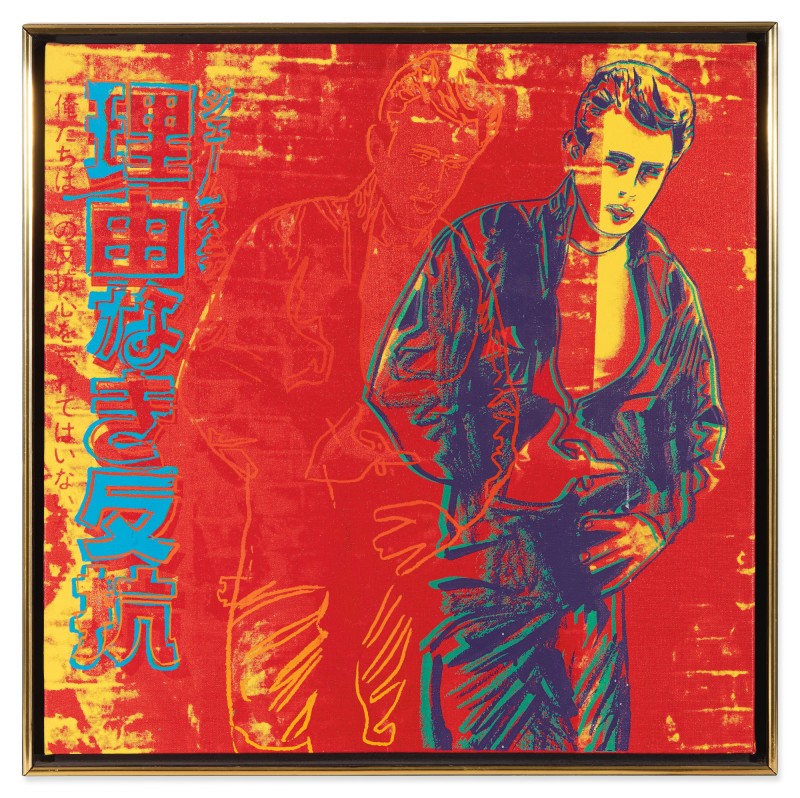
ANDY WARHOL
Rebel Without a Cause (James Dean) (From Ads), 1985
Acrylic and silkscreen ink on canvas
22×22 inches (55.9 x 55.9 cm)
Signed and dated 85 on the overlap
Rebel Without a Cause (James Dean) (from Ads), 1985
Sotheby’s New-York: 12 November 2015
Estimated: USD 500,000 – 700,000
USD 910,000
(#108) Andy Warhol (sothebys.com)
ANDY WARHOL
Rebel Without a Cause (James Dean) (from Ads), 1985
Acrylic and silkscreen ink on canvas
22×22 inches (55.9 x 55.9 cm)
Signed and dated 85 on the overlap
Volkswagen
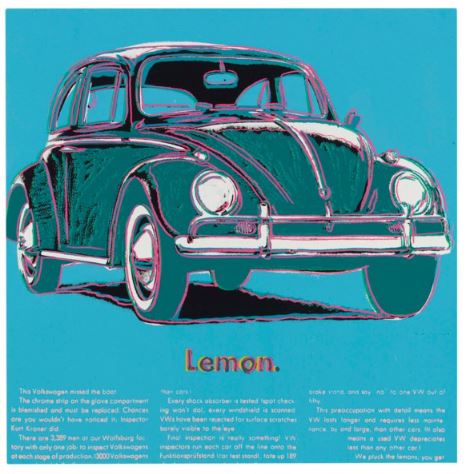
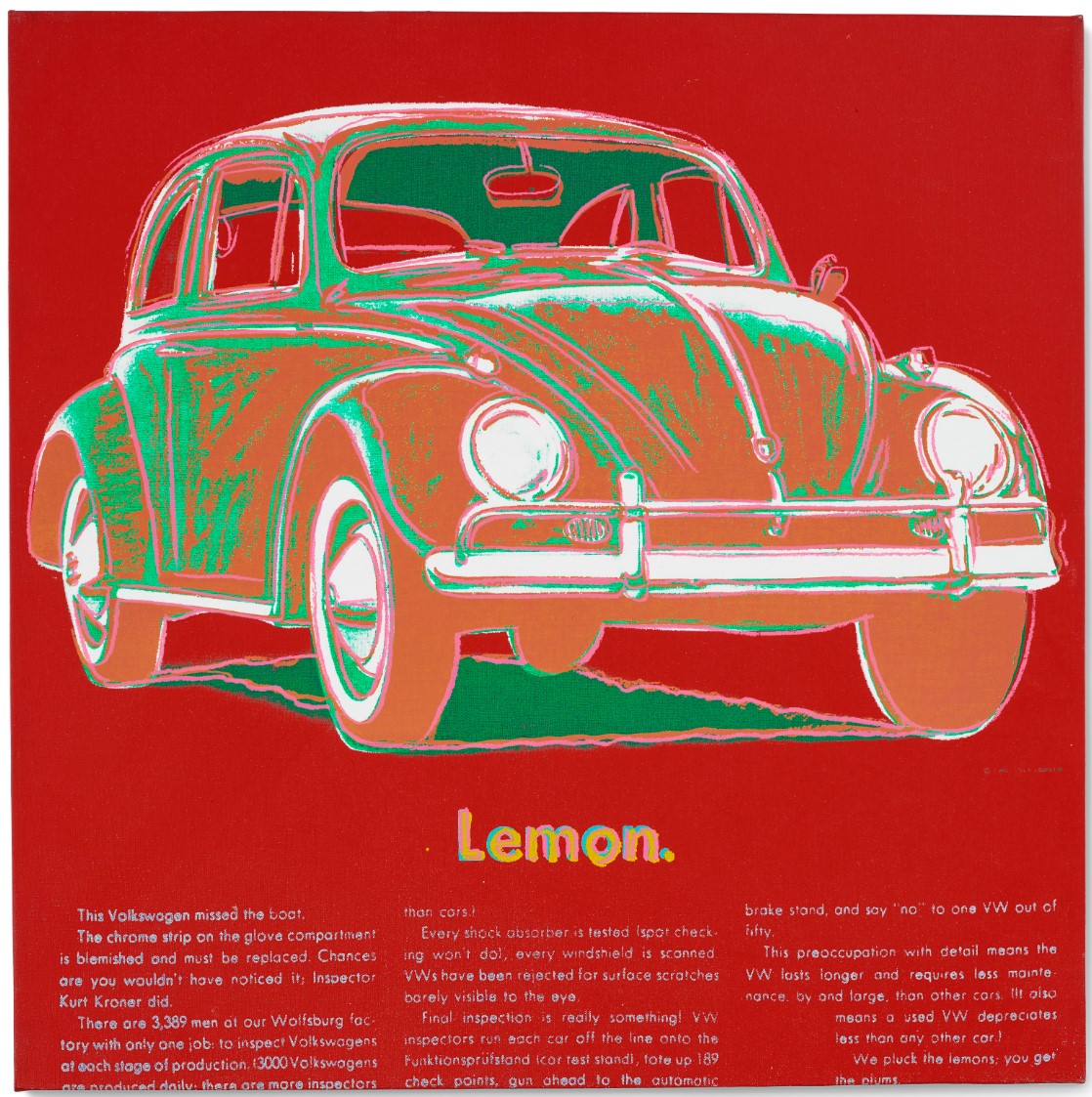
Volkswagen depicts the iconic Volkswagen Beetle advertisement titled “Lemon” from the 1960s. The German car company, seeking to market their vehicles to countless American veterans returning from the war, labeled the image of a perfect Volkswagen model as a ‘Lemon’ or a flawed, cheaply made foreign car. This advertisement proved successful in rebranding their company and showing off the exceptional make of their car through self-deprecating humor. Warhol cleverly uses these defining moments and figures in the history of American consumerism to question what art can be and elevate advertisement to the status of fine art. This print reflects how Warhol wanted his work to target the majority, rather than the affluent minority, through his choice to depict everyday consumer goods. By transforming an everyday object, a Volkswagen Beetle, into art, Warhol deconstructs the boundary between high and low culture. The image also captures Warhol’s ability to identify icons of 20th century popular culture and memorialize them in his work.
Untitled (Volkswagen Lemon), 1985
Synthetic polymer and silkscreen inks on canvas
22×22 inches (55.8 x 55.8 cm)
Volkswagen (from Ads), 1985
Christie’s New-York: 7 October 2020
Estimated: USD 350,000 – 550,000
USD 650,000
Andy Warhol (1928-1987) (christies.com)
Sotheby’s New-York: 12 November 2015
Estimated: USD 300,000 – 400,000
USD 406,000
ANDY WARHOL
Volkswagen (from Ads), 1985
Acrylic and silkscreen ink on canvas
22×22 inches (55.9 x 55.9 cm)
Signed and dated ‘Andy Warhol 85’ (on the overlap)
Apple
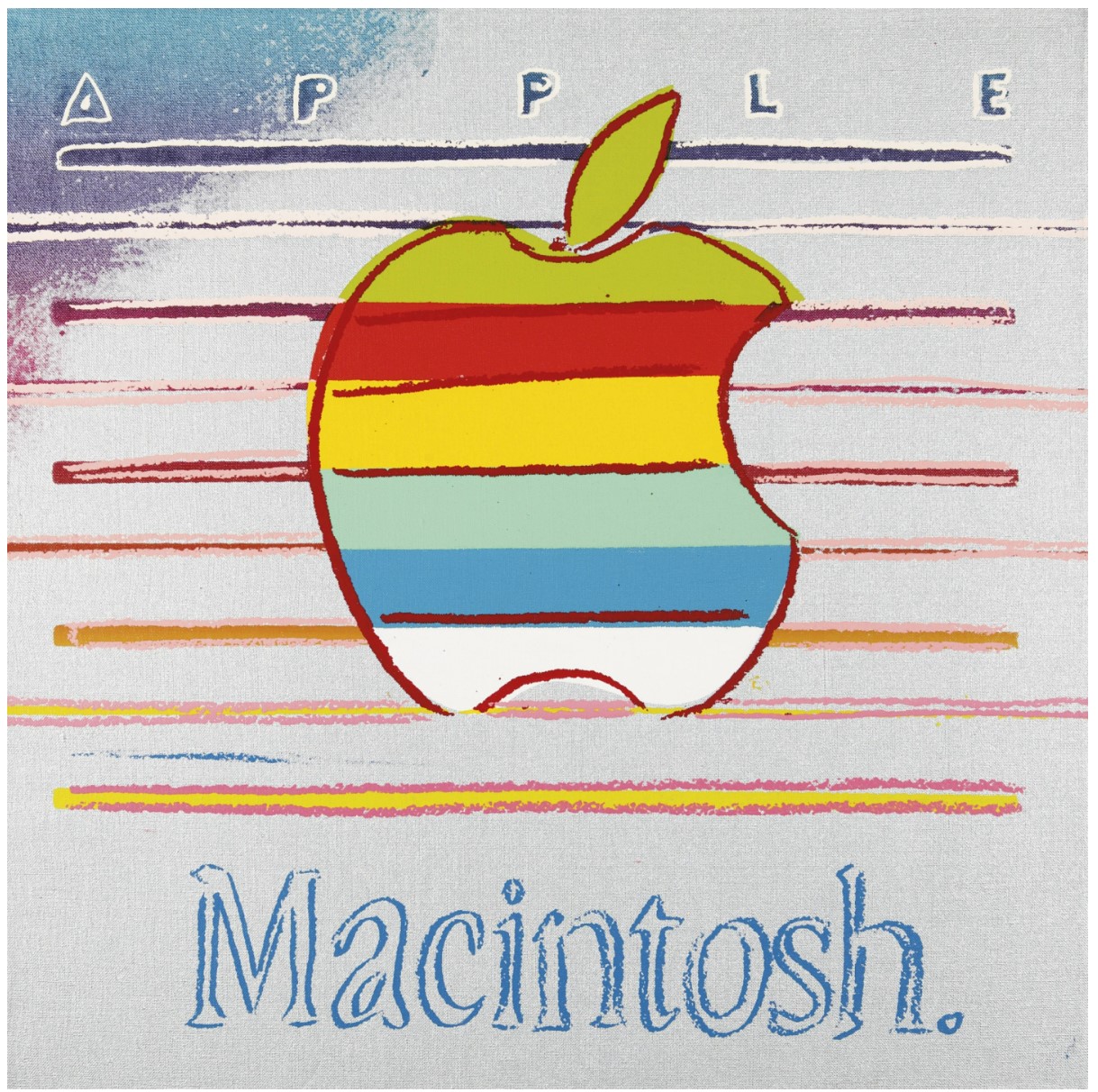
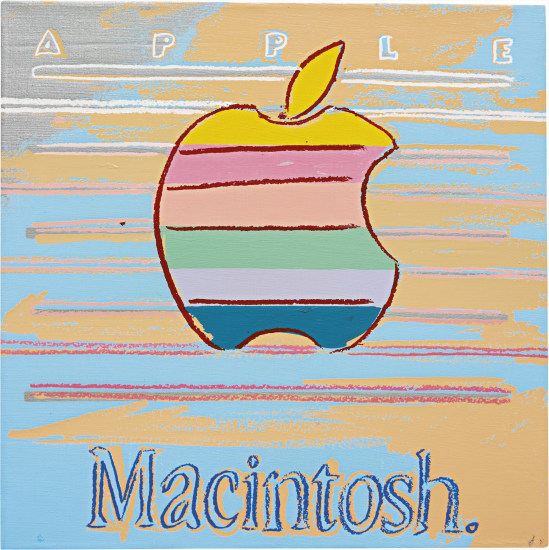
Apple features the multicolored, striped Apple Macintosh logo, rendered against a pastel pink backdrop. Printed on Lenox Museum Board, the logo is framed by the brand’s name, Apple Macintosh, drawing explicit attention to the association between this logo and global consumerism. The vivid colors in this print reflect Warhol’s celebration of American consumer culture and his transformation of the everyday into art, which led to a blurring of the boundaries between high and low culture. Indeed, this print is emblematic of how Warhol turned mass media imagery into art. The bold color in this print, achieved by multiple screens and a layering of paint, is accompanied by gestural lines, delineating the Apple logo.
As Apple was refining its visual brand, Andy Warhol was expanding his; Warhol’s work in the late 1970s drew upon new subject matter and methods of production, including his oxidation paintings, his first work with camouflage, and the nightmarish integration of weaponry, guns, and knives into his work. Yet as the 1970s turned into the 1980s, he maintained his affinity for the subject matter of modern iconography. “Warhol was marvelously intuitive in this kind of project by drawing his images from the vernacular, by using ready-made images.” (A. Danto, “Warhol and the Politics of Prints”, Andy Warhol Prints, Edited by F. Feldman and C. Defendi, New York, 2003, p. 15). As he curated the visual components of his Ads series, one logo in particular had risen to the top of recognition by the American public.
While most of Warhol’s visual source material was traced then subjected to serigraphy (his preferred method of painting: silkscreening), Apple (From Ads set A), 1985, bears a unique aspect of design—a picture of Warhol’s making. Across the top portion of the picture, “Apple” appears in a bold, glowing, uppercase font, almost as the dominating shadow of the picture, the corporate God that gave birth to both the revolutionary product and its equally revolutionary design. Bordering the lower portion of the painting, we witness the identity of the product itself, obeying the grammatical function of a proper noun alone: only the rest letter is capitalized, the rest of the word in an approachable and friendly typeface. As if to emphasize its simplicity, “Macintosh” bears a single period after itself, punctuating its perfect form.
Apple (from Ads), 1985
Sotheby’s New-York: 12 November 2015
Estimated: USD 400,000 – 600,000
USD 910,000
(#102) Andy Warhol (sothebys.com)
 ANDY WARHOL
Apple (from Ads), 1985
Acrylic and silkscreen ink on canvas
22×22 inches (55.9 x 55.9 cm)
Apple, 1985
Synthetic polymer and silkscreen inks on canvas
22×22 inches (55.9 x 55.9 cm)
Blackglama (Judy Garland)
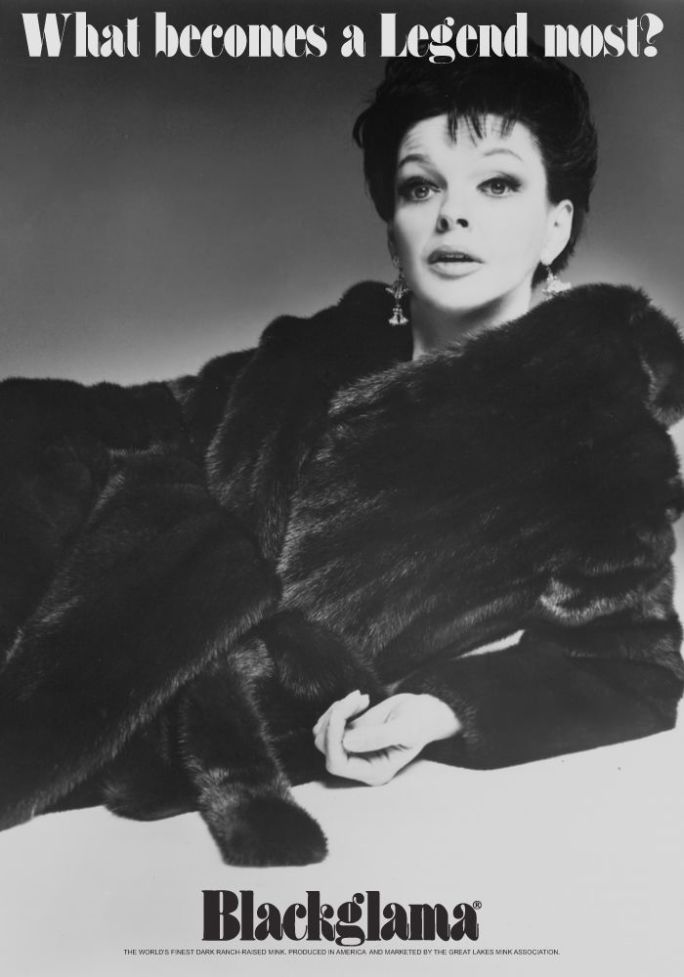
Blackglama depicts famous actress Judy Garland as part of his Ads portfolio. Warhol was inspired by Judy Garland’s advertising campaign for Blackglama Fur company and their ubiquitous tagline “What becomes a Legend most?” Many legends from the fashion world or pop culture have modeled for the company over the years, including Diana Ross, Brigitte Bardot, Lauren Bacall, Julie Andrews, Ray Charles and Marlene Dietrich. Known for her starring role in the 1939 film, The Wizard of Oz, Judy Garland was described by Fred Astaire as “the greatest entertainer who ever lived.” She also had major roles in movies like Meet Me in St. Louis (1945)
“Judy Garland grew up on the M.G.M. lot! To meet a person like Judy whose real was so unreal was a thrilling thing. She could turn everything on and off in a second; she was the greatest actress you could imagine every second of her life.”
Blackglama, 1985
Christie’s New-York: 16 May 2019
Estimated: USD 380,000 – 500,000
USD 435,000
Andy Warhol (1928-1987), Blackglama | Christie’s
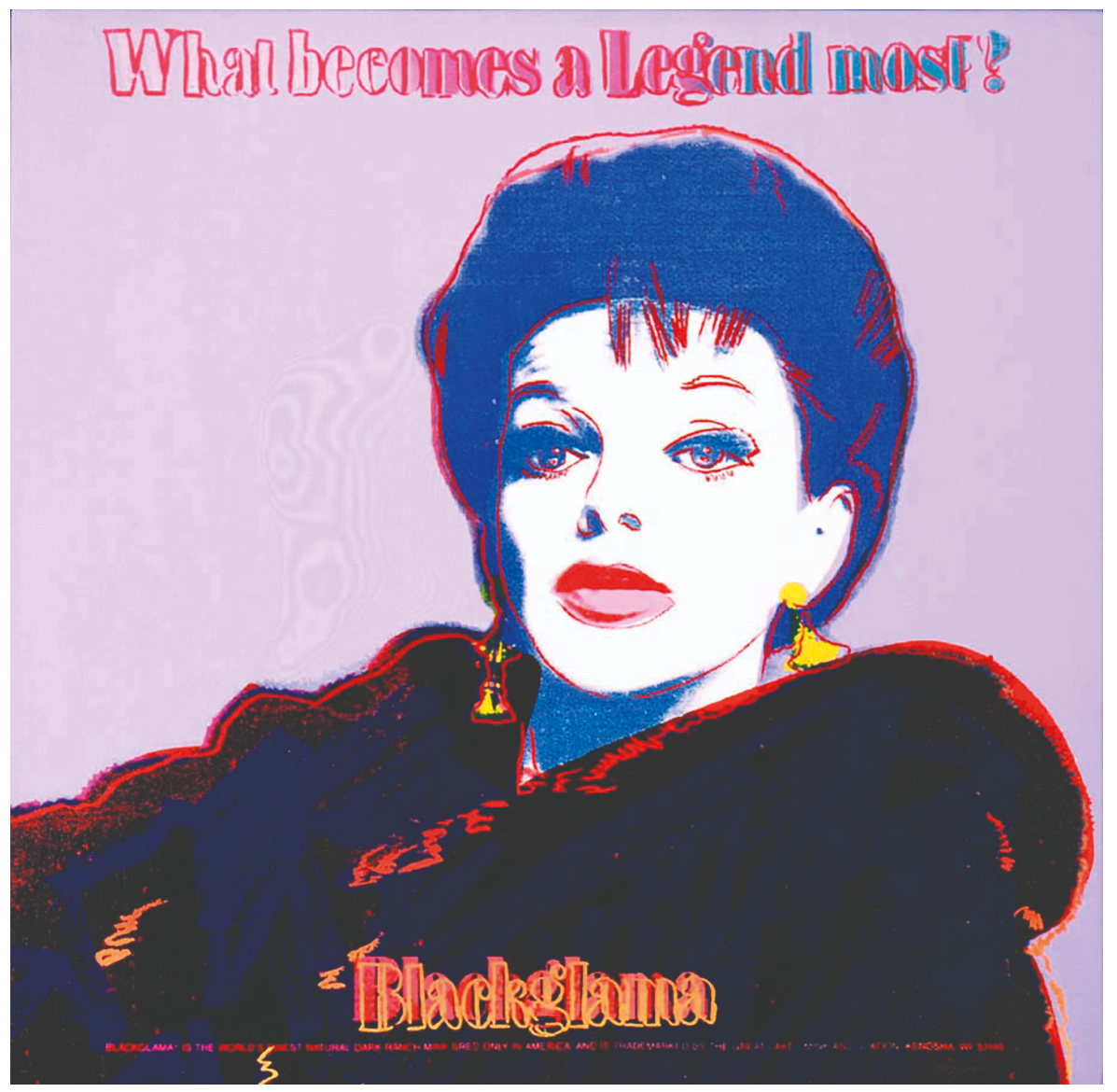
ANDY WARHOL (1928-1987)
Blackglama, 1985
Acrylic and silkscreen ink on canvas
22×22 inches (55.9 x 55.9 cm)
Signed and dated ‘Andy Warhol 85’ (on the overlap)
Blackglama (Judy Garland) (From Ads), 1985
Sotheby’s New-York: 19 May 2017
Estimated: USD 350,000 – 450,000
USD 444,500
(#193) Andy Warhol (sothebys.com)
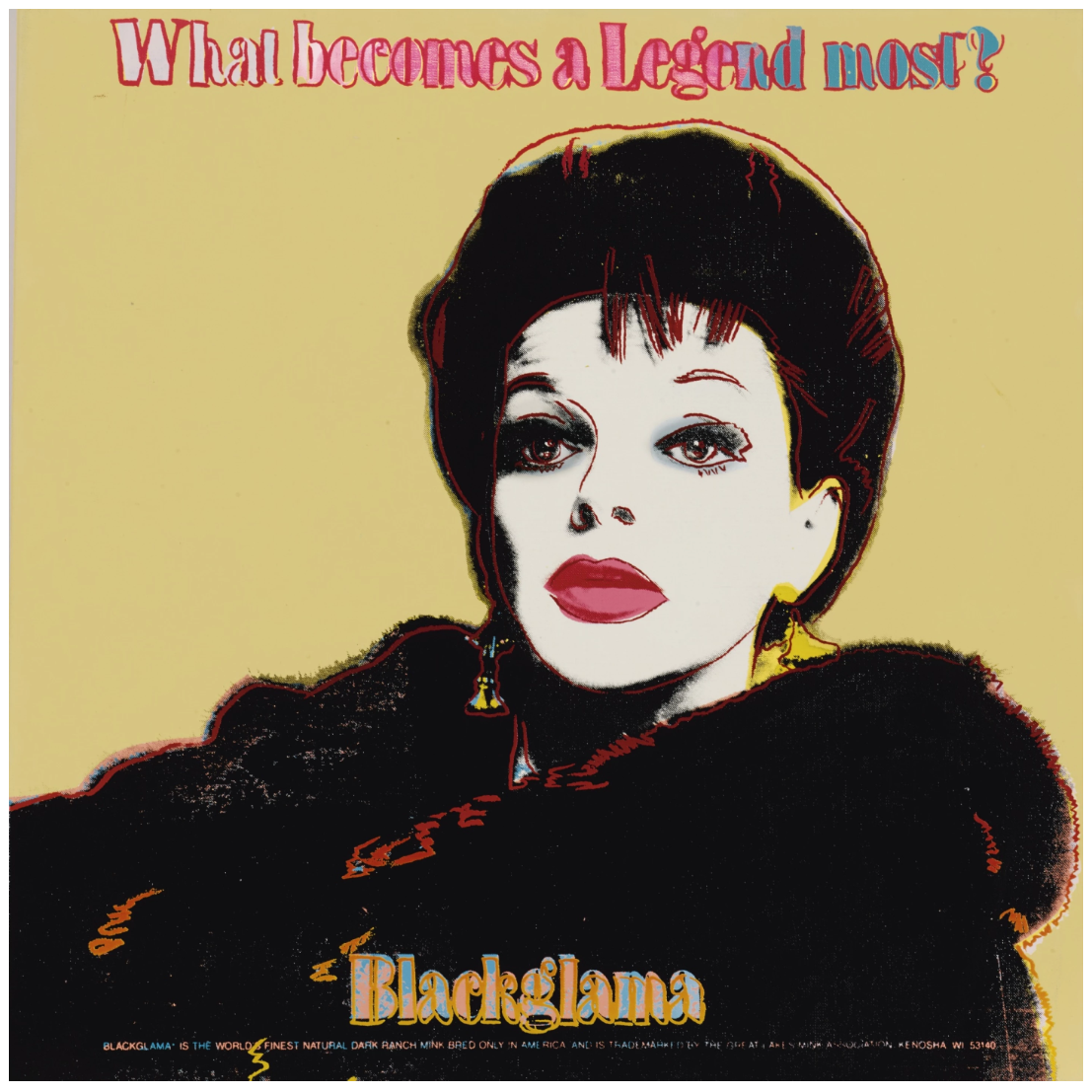
ANDY WARHOL
Blackglama (Judy Garland) (From Ads), 1985
Acrylic and silkscreen ink on canvas
22×22 inches (55.9 x 55.9 cm)
Signed and dated 85 on the overlap
Blackglama (Judy Garland) (From Ads), 1985
Sotheby’s New-York: 12 November 2015
Estimated: USD 300,000 – 400,000
USD 418,000
(#107) Andy Warhol (sothebys.com)
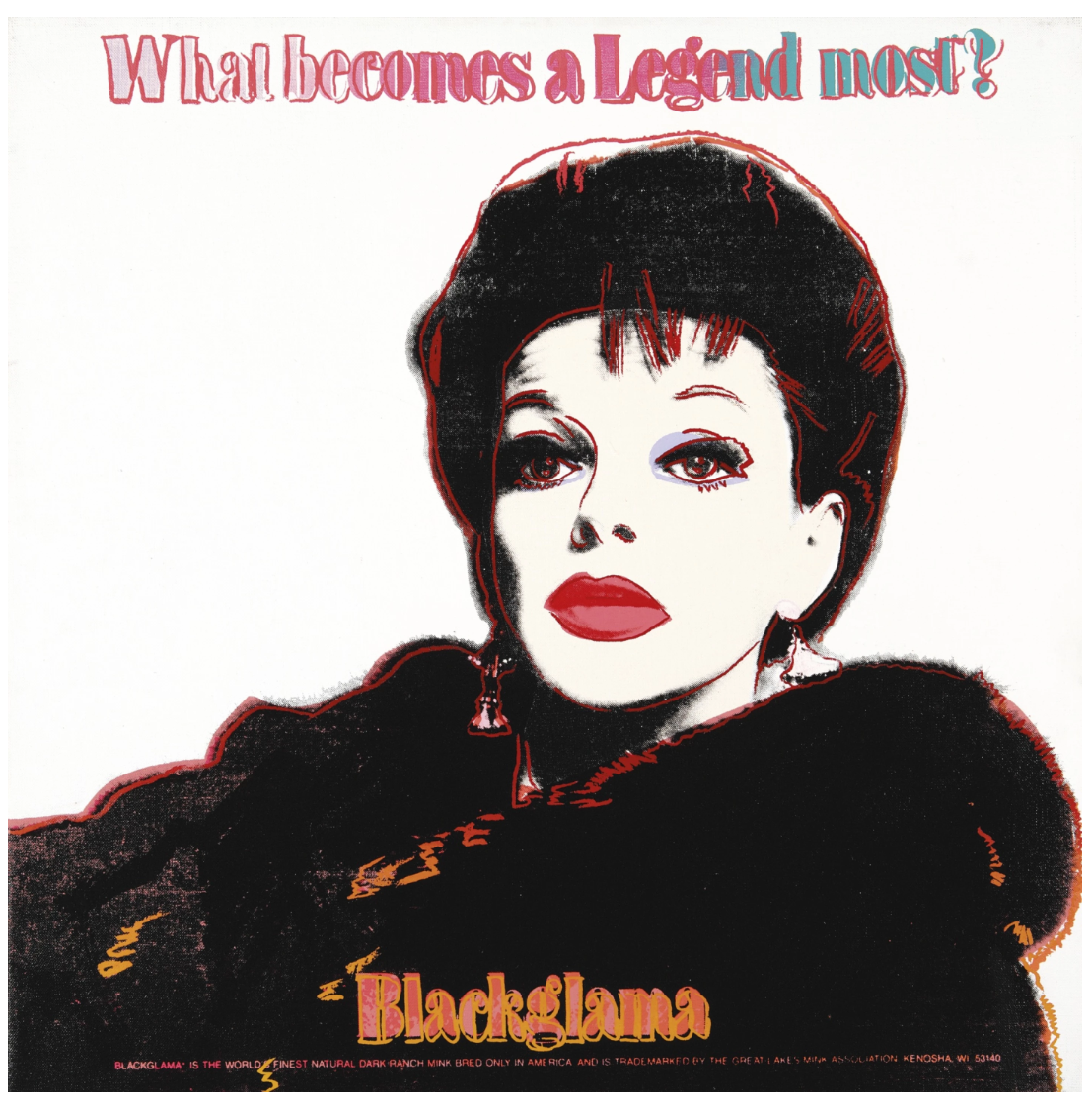
ANDY WARHOL
Blackglama (Judy Garland) (From Ads), 1985
Acrylic and silkscreen ink on canvas
22×22 inches (55.9 x 55.9 cm)
Signed and dated 85 on the reverse
Paramount
Paramount is a colorful screen print that captures the well-known logo of the American film studio, Paramount Pictures. Warhol depicts the logo’s iconic mountaintop, rendered in white against a tricolored backdrop of pink, red and blue. The circular logo in the middle of the print is surrounded by an arch of stars in yellow and green. These vivid and unlikely colors contrast with the print’s white background. Warhol’s use of color and gestural lines works to vivify the mountain and its surrounding text. The production company’s name, Paramount, stands out, which reflects Warhol’s keen interest in American popular culture and mass media production.
Paramount (from Ads), 1985
Sotheby’s New-York: 12 November 2015
Estimated: USD 250,000 – 350,000
USD 478,000
(#105) Andy Warhol (sothebys.com)
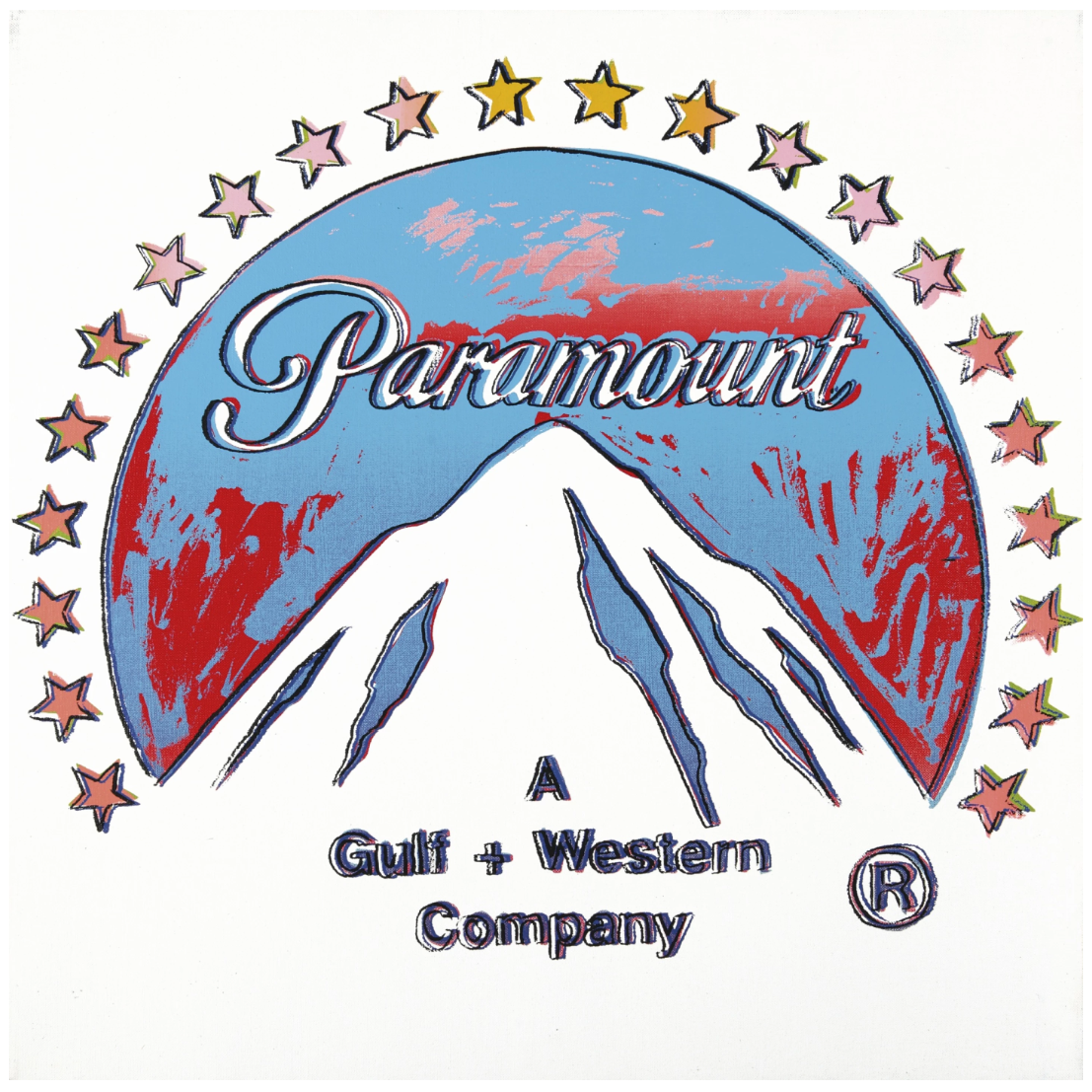
ANDY WARHOL
Paramount (from Ads), 1985
Acrylic and silkscreen ink on canvas
22×22 inches (55.9 x 55.9 cm)
Signed and dated 85 on the overlap
Paramount, 1985
Phillips New-York: 10 November 2015
Estimated: USD 60,000 – 80,000
USD 90,000
Andy Warhol – 20th Century & Conte… Lot 236 November 2015 | Phillips
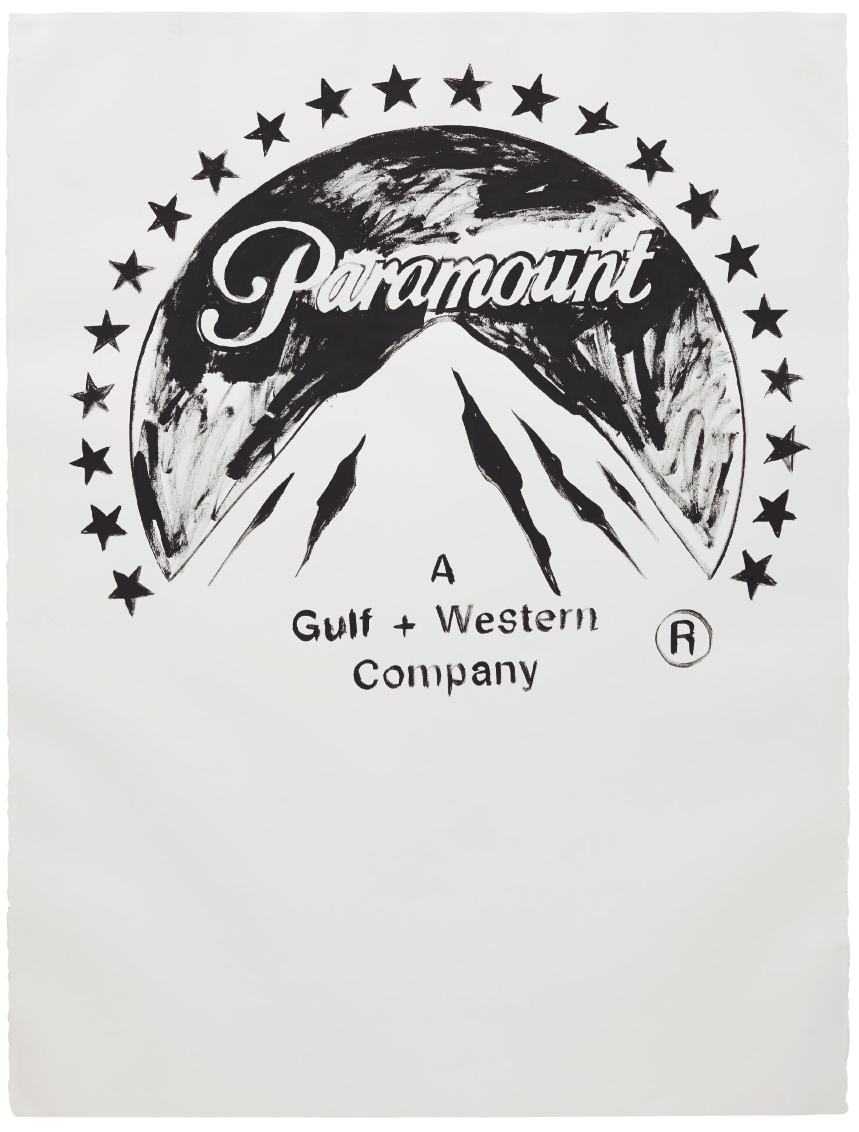
ANDY WARHOL
Paramount, 1985
Synthetic polymer paint on HMP paper
50×38 inches (127 x 96.5 cm)
Stamped by the Estate of Andy Warhol and the Andy Warhol Foundation for the Visual Arts, Inc.
Numbered “02.010” on the reverse
Chanel
Chanel captures the tremendous influence consumer culture had on Warhol’s work. This canvas depicts a Chanel No. 5 perfume bottle. Using minimal colors, unlike some of the other, bolder canvases in the Ads series, pink gestural lines accentuate the bottle’s sleek and chic design. Rendered in pink against a purple backdrop, Warhol exaggerates how the Chanel bottle became emblematic of consumerism, femininity and sophistication.
Chanel (from Ads), 1985
Sotheby’s New-York: 12 November 2015
Estimated: USD 250,000 – 350,000
USD 1,810,000
(#101) Andy Warhol (sothebys.com)
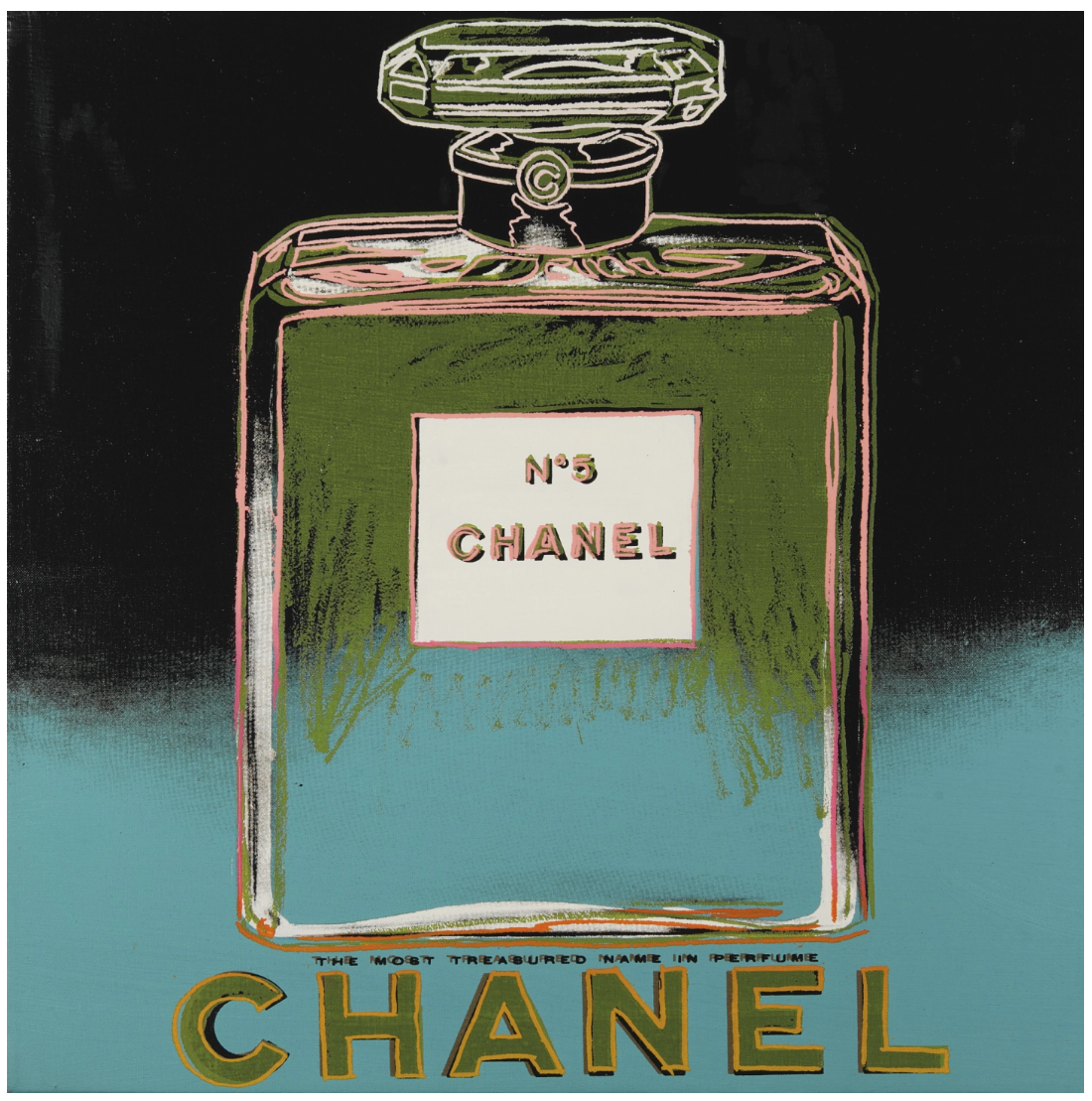
ANDY WARHOL
Chanel (from Ads), 1985
Acrylic and silkscreen ink on canvas
22×22 inches (55.9 x 55.9 cm)
Signed and dated 85 on the overlap
Van Heusen (Ronald Reagan)
Van Heusen (Ronald Reagan) reflects Warhol’s keen interest in consumer culture. Indeed, the image source of this print is an advert Ronald Reagan did for Van Heusen shirts in 1953.
“How can a president not be an actor?”
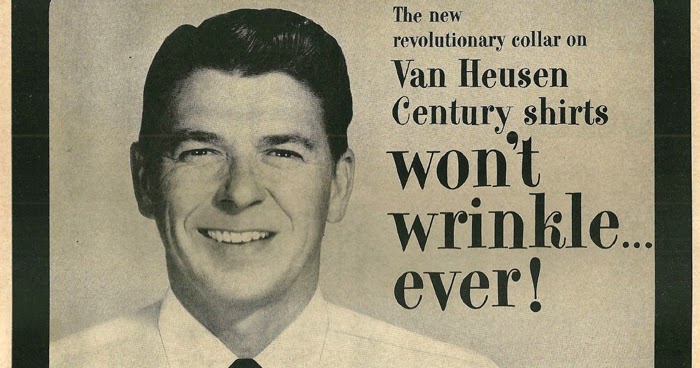
Reagan is depicted in ahead and shoulders portrait and red lines are used to delineate his body against a white backdrop. The right of the composition is dominated by the ad campaign’s slogan in red and green. The layering of red and green results is a looser style when compared to the mechanical aesthetic of Warhol’s early prints.
Van Heusen (Ronald Reagan) (from Ads), 1985
Sotheby’s New-York: 12 November 2015
Estimated: USD 150,000 – 200,000
USD 346,000
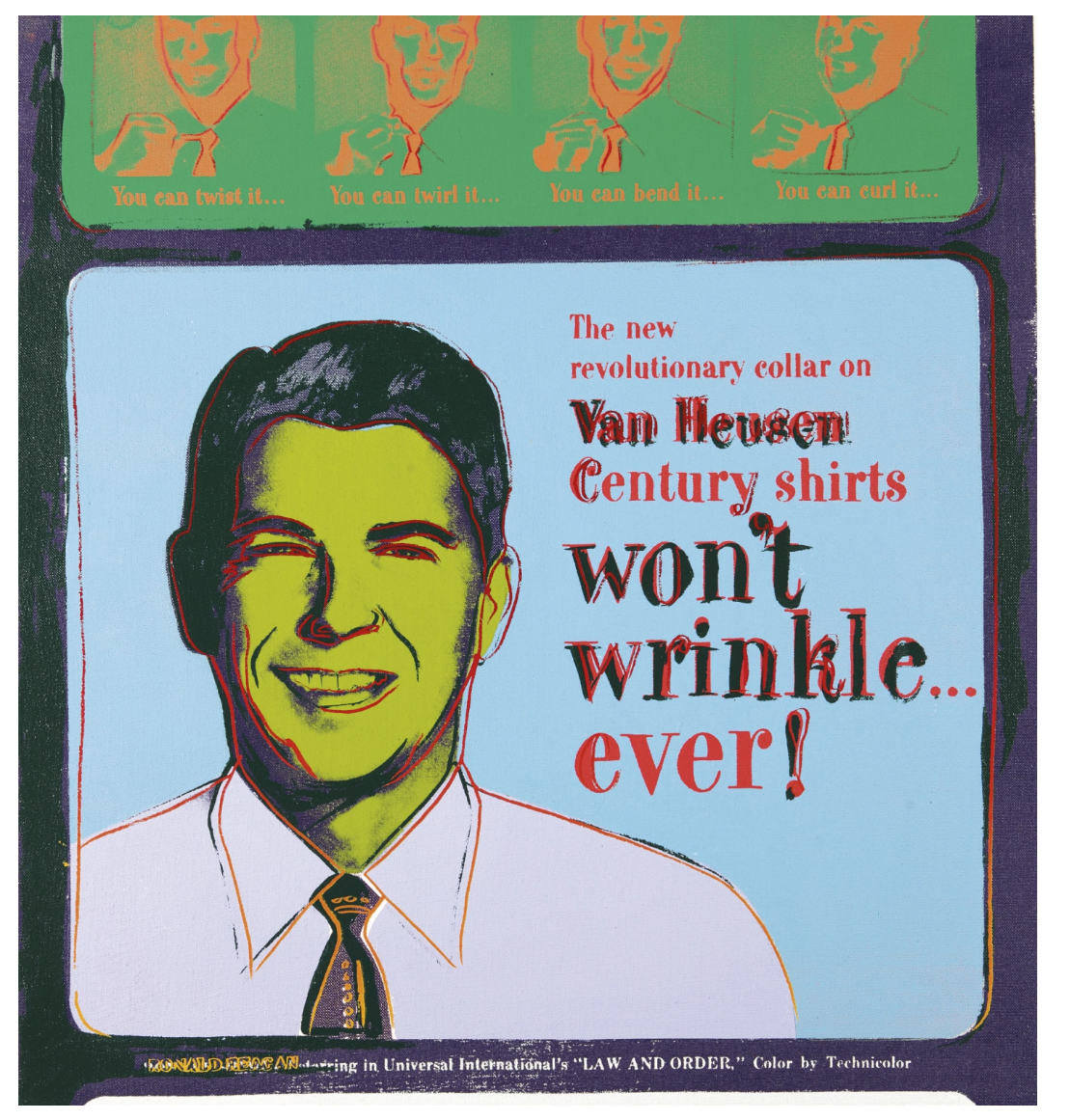
ANDY WARHOL
Van Heusen (Ronald Reagan) (from Ads), 1985
Acrylic and silkscreen ink on canvas
22×22 inches (55.9 x 55.9 cm)
Signed and dated 85 on the overlap