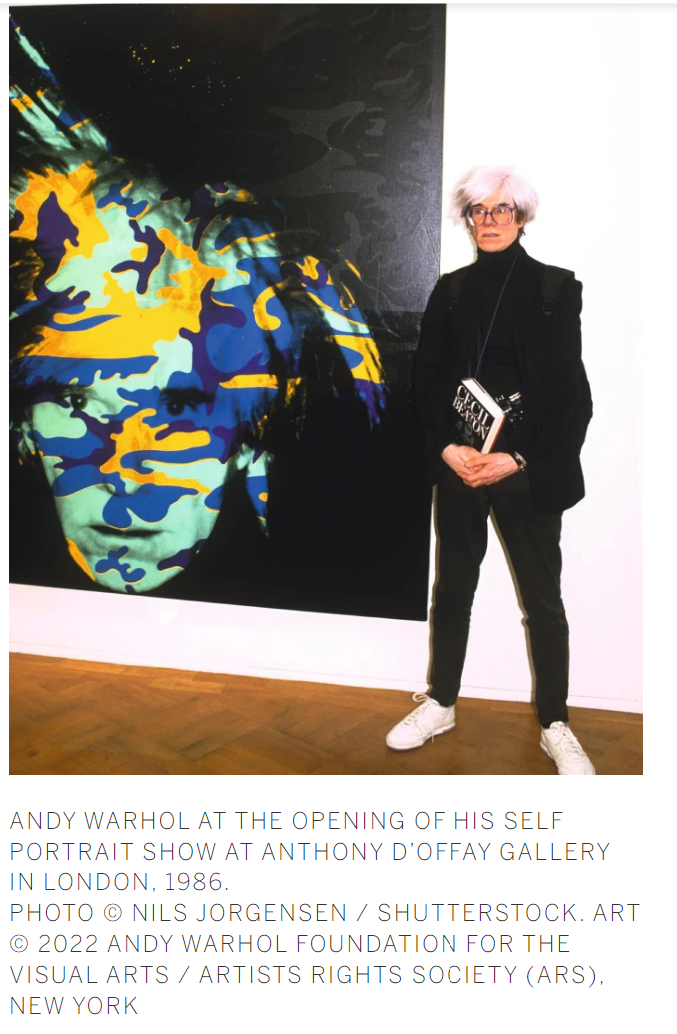
Executed in 1986 as one of the final self-portraits that Andy Warhol would create before his untimely death the following year, Self-Portrait endures as his last grand artistic gesture and embodies the artist’s ultimate meditation on mortality, identity, and image: Warhol, who dedicated his career to exploring the construction of identity and the power of media, now turns to face his own mortality. Often referred to as the Fright Wig paintings, this bold series immortalizes the mysterious and enigmatic artistic persona that Warhol had meticulously cultivated throughout his career. In this last and final version, Warhol stares out towards the viewer in an intense gaze, vivid colored head floating against a stark black ground. Piercing and all-consuming, Self-Portrait presents a resounding image of both Warhol the man and Warhol the artistic phenomenon.
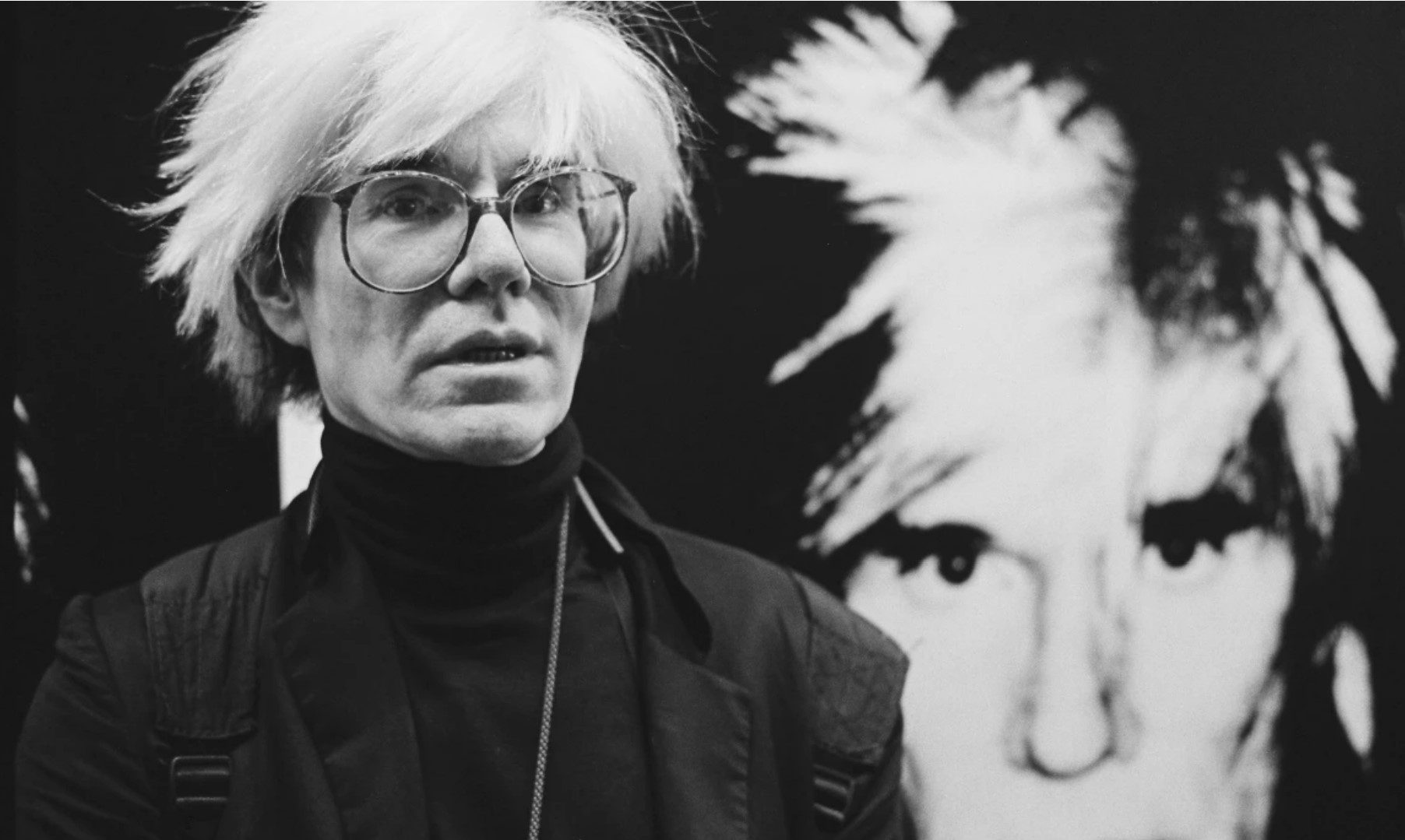
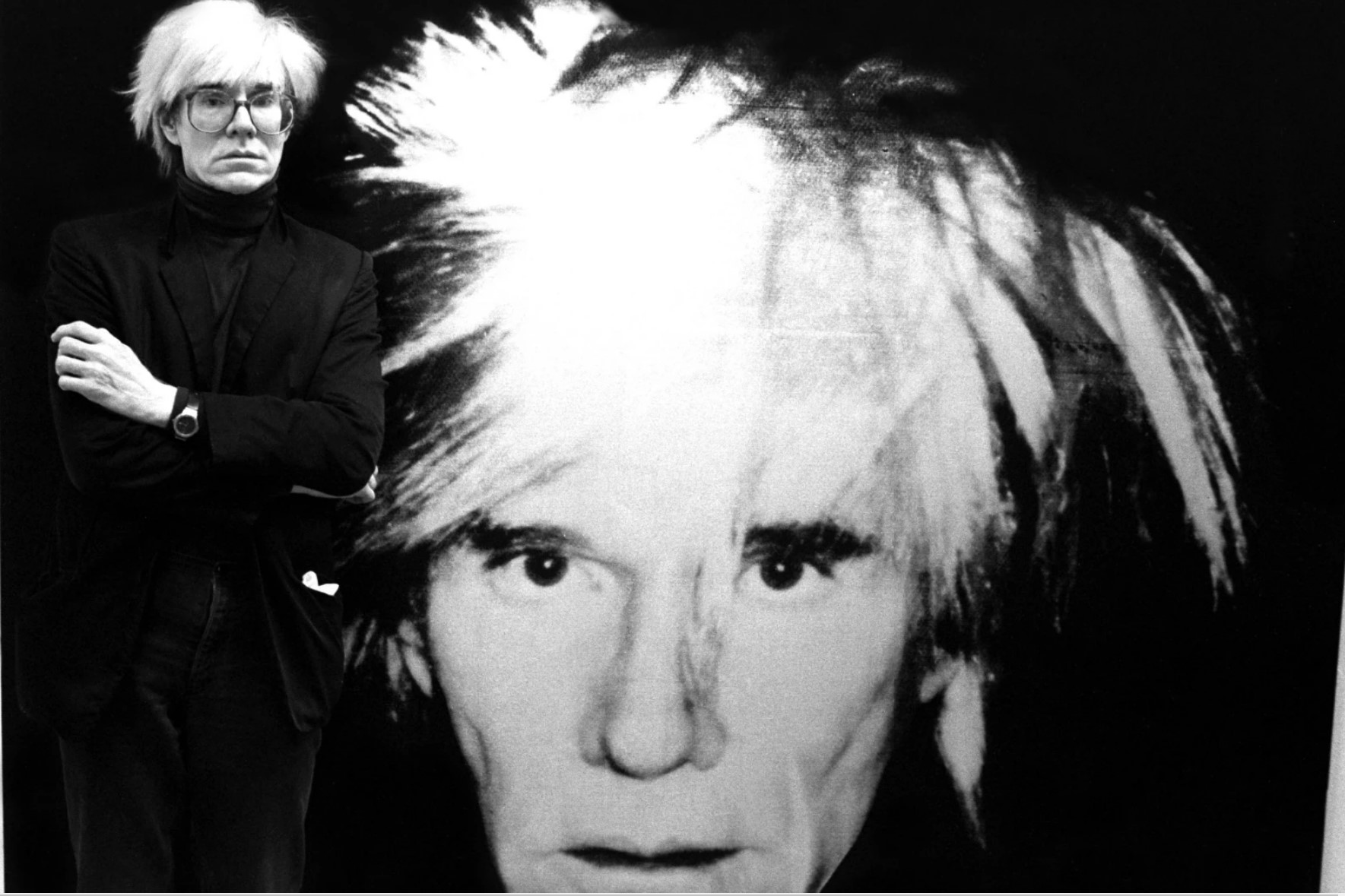
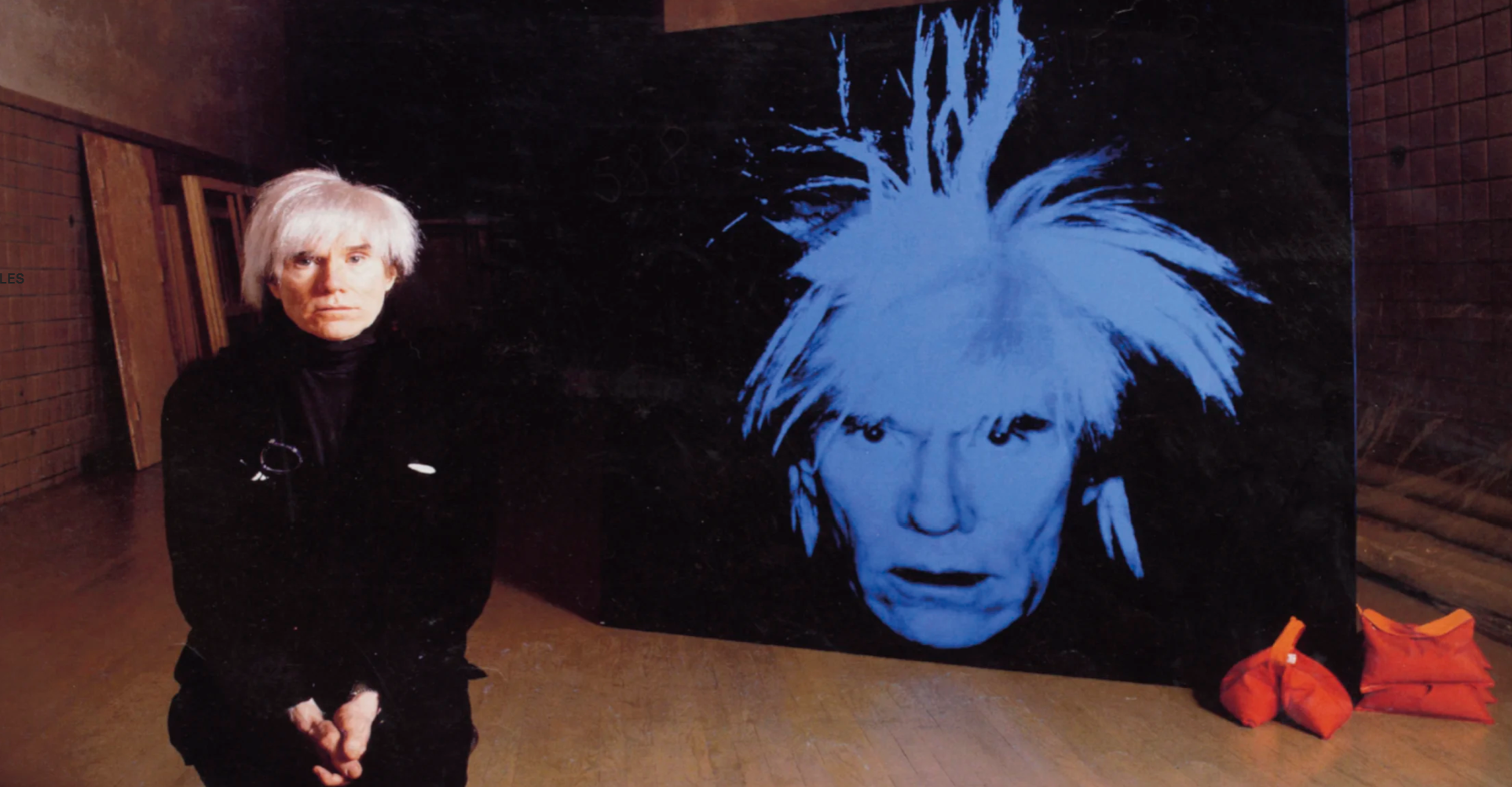
ANDY WARHOL AT THE OPENING OF THE EXHIBITION ANDY WARHOL, ANTHONY D’OFFAY GALLERY, LONDON, 1986. IMAGE: © CLAUDE CROMMELIN / FLICKR
Introduction
The viewer sees the artist tackling the challenges of self-depiction with an unrivalled and up-close intensity: Depicting himself as if on the brink of eternity, Warhol here evokes a feeling of the supernatural through a vibrantly contrasting composition.
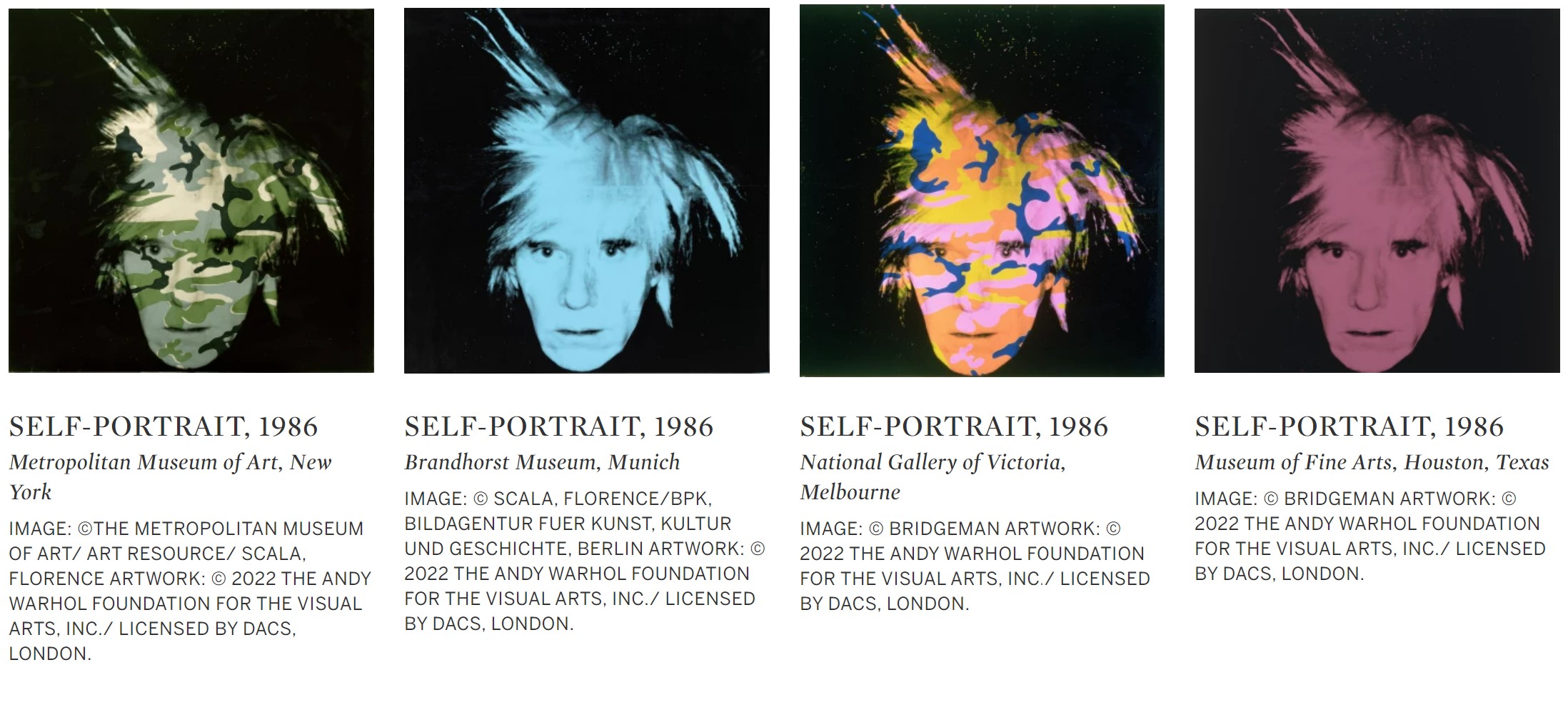
Andy Warhol Fright Wig paintings in Museum Collections
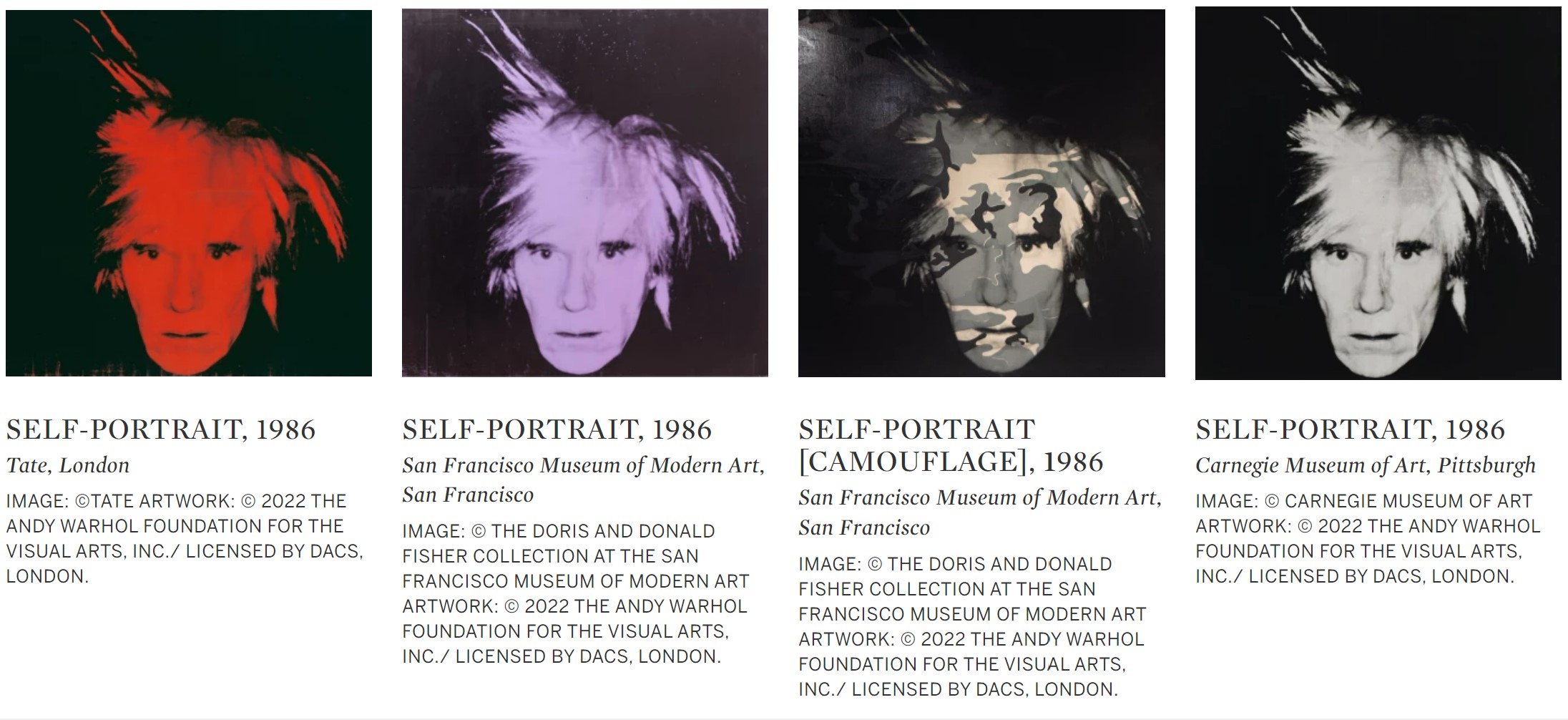
The retrospectively named Fright Wig paintings build upon Warhol’s earlier forays into self-portraiture and were similarly the result of a commission, but this time from the highly influential gallerist Anthony d’Offay.
The revered patron subsequently recalled its beginnings:
“I realized two things: First that Warhol was without question the greatest portrait painter of the Twentieth Century, and secondly that it was many years since he had made an iconic self-portrait. A week later I visited Warhol in New York and suggested to him an exhibition of new self-portraits. A month later he had a series of images to show me in all of which he was wearing the now famous ‘fright wig’. One of the images not only had a demonic aspect but reminded me more of a death mask. I felt it was tempting fate to choose this image, so we settled instead on a self-portrait with a hypnotic intensity.”
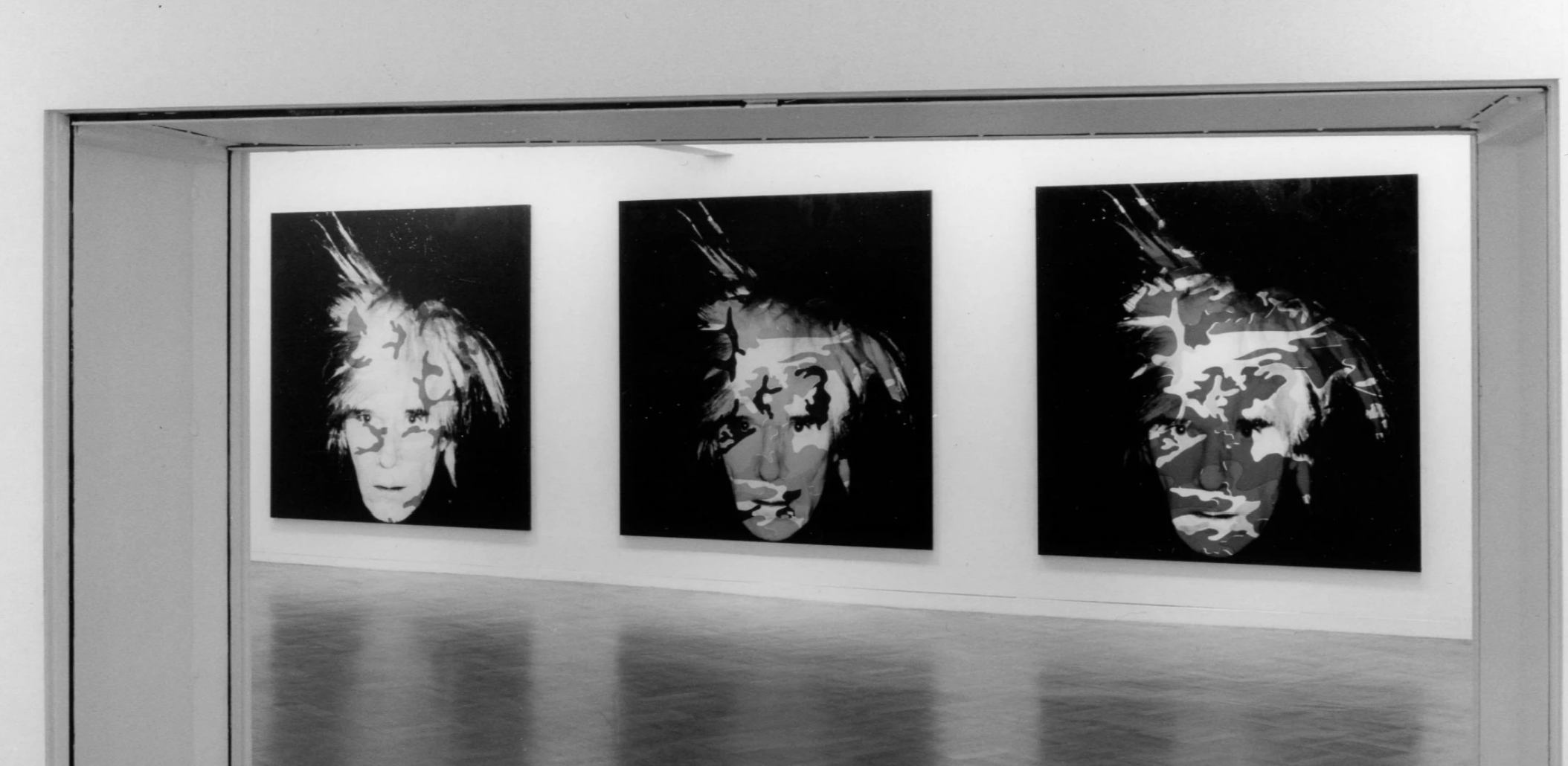
ANDY WARHOL: SELF PORTRAITS, ANTHONY D’OFFAY GALLERY, LONDON, 1986. PHOTO © COURTESY ANTHONY D’OFFAY GALLERY, LONDON. ART © 2023 ANDY WARHOL FOUNDATION FOR THE VISUAL ARTS / ARTISTS RIGHTS SOCIETY (ARS), NEW YORK
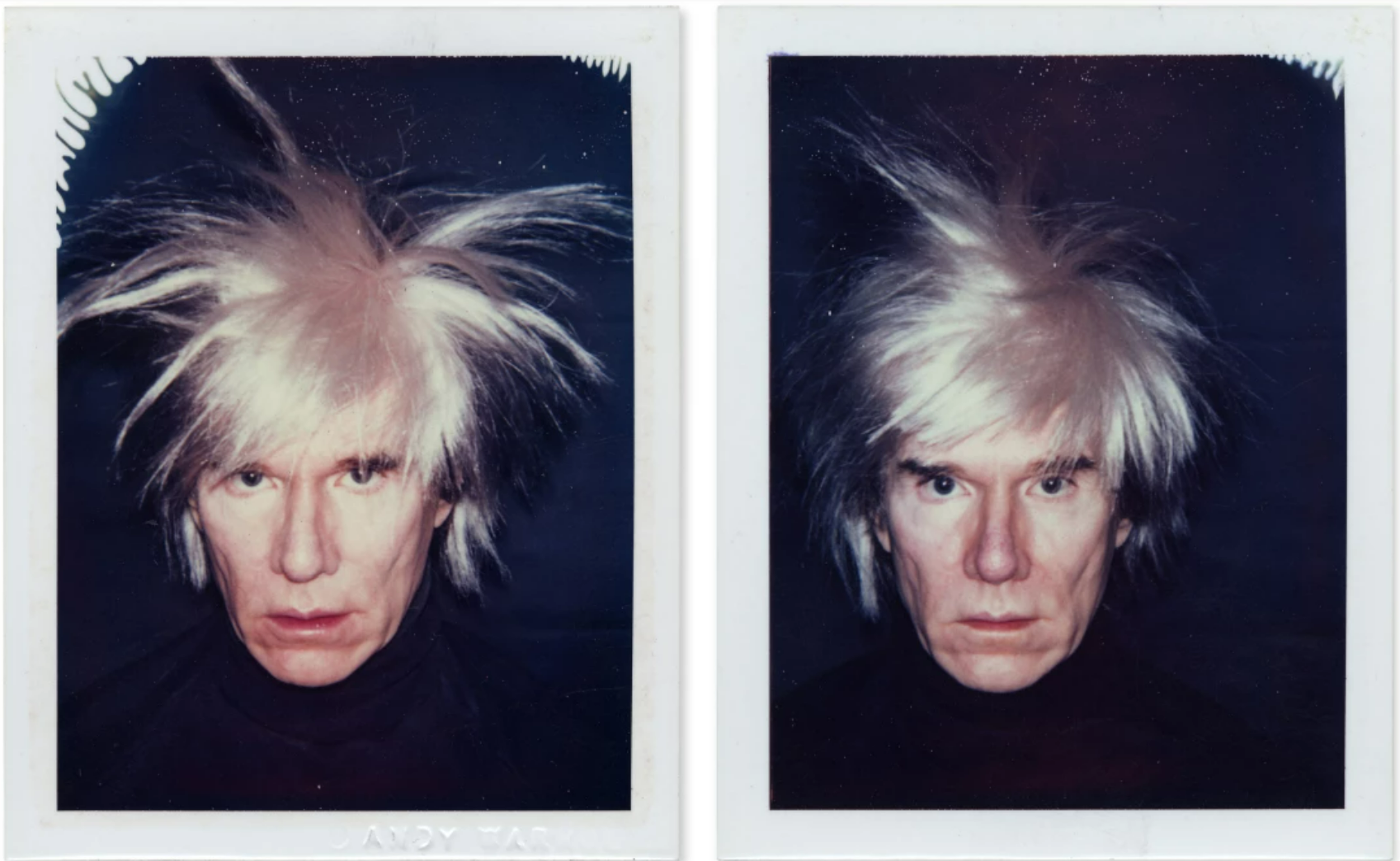
Unveiled at d’Offay’s London gallery in July 1986, many of the Fright Wig self-portraits formed the first and only show in Warhol’s career dedicated to the theme of self-portraiture. The two polaroid images that were used as the basis of this cycle of self-portraits were the only ones exhibited in the landmark 1986 show – an exhibition that would prophetically become Warhol’s last major commercial outing.
The composition of the self-portraits from 1986 are based on polaroid photographs in which Warhol’s head hovers eerily against an impenetrable black background, his neck disappearing and the silver hair of his wig jutting out above his face at severe angles. The wig is undoubtedly the most animated aspect of the portrait, as sweeps of thick hair form strong diagonals from upper left to lower right. Warhol had an obsessive preoccupation with sudden death, even before Valerie Solanas shot and nearly killed him on June 3rd, 1968. This morbid fascination is openly reflected in his work, especially in the often gruesome Death and Disaster and Electric Chair series, yet even in the most glamorous of celebrity subjects such as his portraits of Marilyn Monroe. The mysterious image of the artist’s gaunt features in Self-Portrait reflects Warhol’s lifelong fascination with the transience of life and seems to convey an awareness of his own impending demise. Acknowledging the theme of death that runs beneath the surface of much of Warhol’s oeuvre, many viewers therefore consider these self-portraits as expressions of memento mori. Indeed, Warhol’s cheeks appear relatively sunken, and the wig alienates his face, almost abstracting any sense of self.
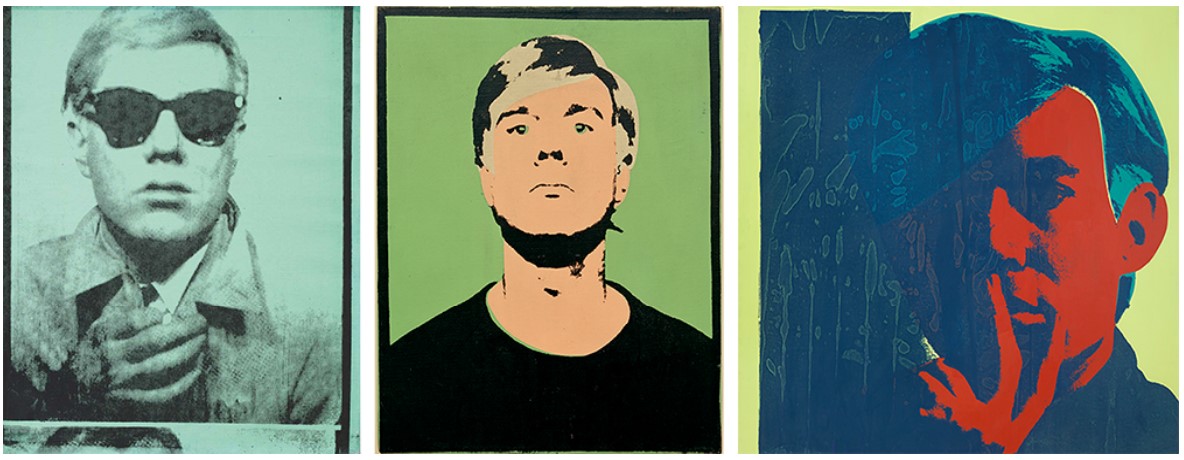
[Left] Self-Portrait, 1964. Private Collection. Artwork: © 2023 The Andy Warhol Foundation for the Visual Arts, Inc. / Licensed by Artists Rights Society (ARS), New York
[Center] Self-Portrait, 1964. Museum Brandhorst, Munich. Image: akg-images, Artwork: © 2023 The Andy Warhol Foundation for the Visual Arts, Inc. / Licensed by Artists Rights Society (ARS), New York
[Right] Self-Portrait, 1967. San Francsisco Museum of Modern Art. Image: San Francisco Museum of Modern Art / Bridgeman Images, Artwork: © 2023 The Andy Warhol Foundation for the Visual Arts, Inc. / Licensed by Artists Rights Society (ARS), New York
Warhol’s Self-Portrait catalogues the transformation of the artist’s ageing features in dialogue with the technical transformation of his painterly practice. Using his face as an arena for technical and compositional experimentation, by the 1980s Warhol had harnessed and honed to sheer perfection the silkscreen process which he had introduced to his fine art practice in the early 1960s. Here the brilliant pink visage of the artist is of such controlled clarity that it resounds in our memory even when we cease to look. The silkscreen captures every minutia and contour, from his sunken cheeks and parted lips to his incredibly penetrating stare. If Warhol’s credo was the seductive surface, here it reaches its apogee in the slick, black lamina of ink which lends the works a surface unity worthy of the clean, flat surfaces predicated by Minimalism. Unlike his canvases from the 1970s which had thick, gestural acrylic surfaces, here Warhol returned to the ineluctable flatness of the picture plane.
ANDY WARHOL, SELF-PORTRAIT, 1986. IMAGE: © ANDY WARHOL FOUNDATION FOR THE VISUAL ARTS
Warhol’s first series of self-portraits as an established artist, created from 1963-64, depicts the artist shamelessly self-styled with dark glasses and a trench coat. In this early series, Warhol presented a sense of enigma exacerbated by his crude mastery of the silkscreen process at the time. Mirroring the playfully equivocal image that he was consciously constructing at the time with regards to his media persona, Warhol’s third series of self-portraits from 1966-67 show an aloof face half caught in shadow and adopting a pensive hand-to-mouth pose. Much like the immediately preceding set of full frontal portraits from 1964 in which the artist’s features are subsumed in the vibrant pop tones of the background, the 1966-67 works revel in blasts of dramatic color blocking which vibrate with the sensations of thermal imagery and through which the artist is almost enveloped in his own abstractions. In these images we witness the complete conflation of the artist and the sensational style that he had become known for. In contrast to the long-idealized view of a self-portrait stemming from an artist’s introspective volition, Warhol’s own self-portraiture was a means of performing and cultivating a public image.
“If you want to know about Andy Warhol, then just look at the surface of my pictures, my movies and me and there I am; there’s nothing in between.”
By 1966 Warhol was firmly a star in his own right. Maintained through his aloof conduct in interviews, wild social calendar and the styling of his physical appearance, his fastidiously constructed and highly affected public image was almost as famous as his artistic production. Embodying the constructs of fame, value and appearances that he examined, Warhol’s genius lies in the fact that this persona was itself intrinsic to the conceptual purview of his practice. Fundamentally what his self-portraits represent is both the highly self-conscious construction and maintenance of the celebrity that Warhol so fervently valorized in earlier works, and which existed for Warhol intrinsically within the realm of superficial appearances.
“Really, what’s life about? You get sick and die. That’s it. So you’ve got to keep busy.”
More than any artist before him, Warhol’s image was inextricably bound to his art, as he lived within the realm of celebrity that his work so crucially examined. Self-Portrait epitomizes a lifelong obsession with image and identity, life and death, and depicts an artist who had become more famous than the legion of celebrity sitters he had painted. In his last series of theatrical masks, Warhol truthfully offers himself up to art history as an enduring monument. The overwhelming effect of the show, however, was that in these paintings Warhol, was addressing one of the great themes of art history, that of the aging master taking perhaps a last look at himself. For Warhol himself, the exhibition was also an important landmark even if he had felt awkward being among solely pictures of himself. This exhibition – the last to take place in London during Warhol’s lifetime – was a spectacular critical and commercial success, though the predominant reaction from the public was one of shock. Many viewers left the show ‘deeply moved’.
2024 Auction Results
Self-Portrait, 1981
Phillips New-York: 19 November 2024
Estimated: USD 4,000,000 – 6,000,000
USD 3,448,000
Andy Warhol – Modern & Contemporary… Lot 15 November 2024 | Phillips
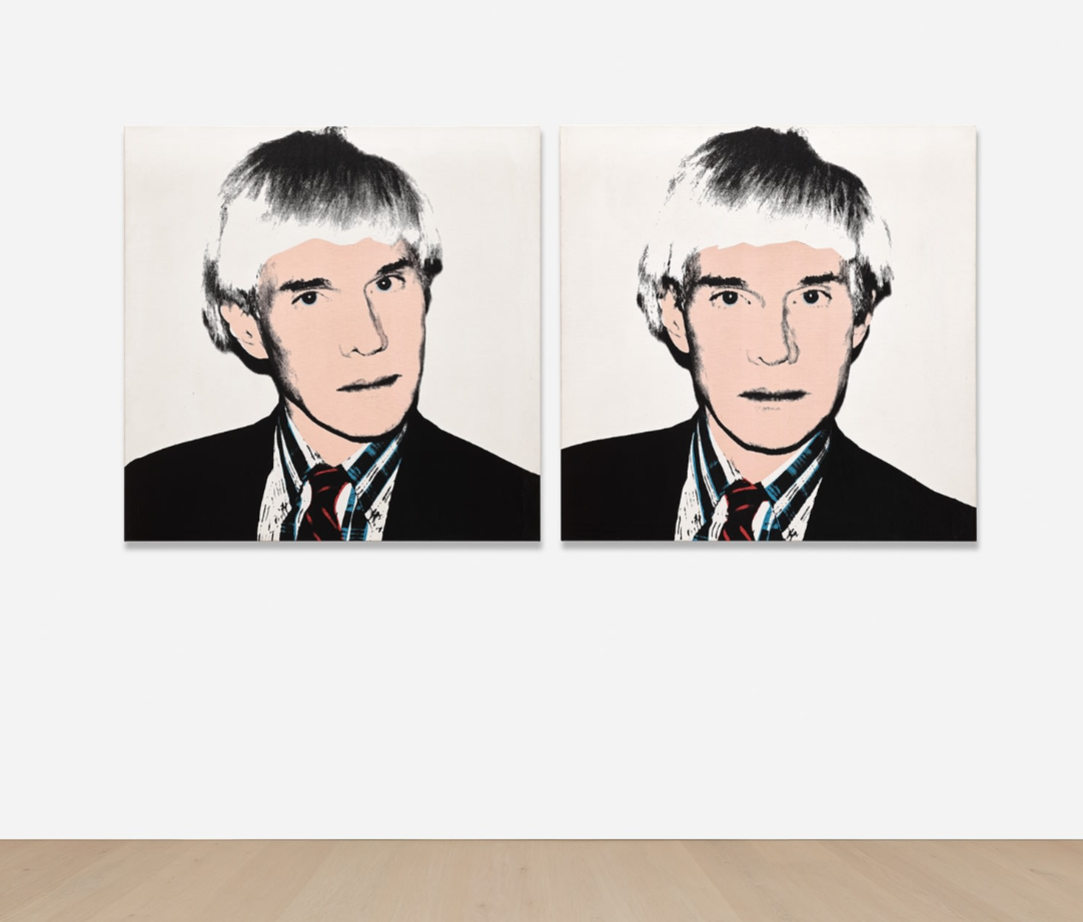
ANDY WARHOL
Self-Portrait, 1981
Synthetic polymer paint and silkscreen ink on canvas, diptych
Each: 40×40 inches (101.6 x 101.6 cm)
Each signed and dated “Andy Warhol 81” on the overlap
Self-Portrait (Fright Wig), 1986
Christie’s London: 7 March 2024
Estimated: GBP 700,000 – 1,000,000
GBP 819,000 / USD 1,038,492
ANDY WARHOL (1928-1987), Self-Portrait (Fright Wig) | Christie’s (christies.com)
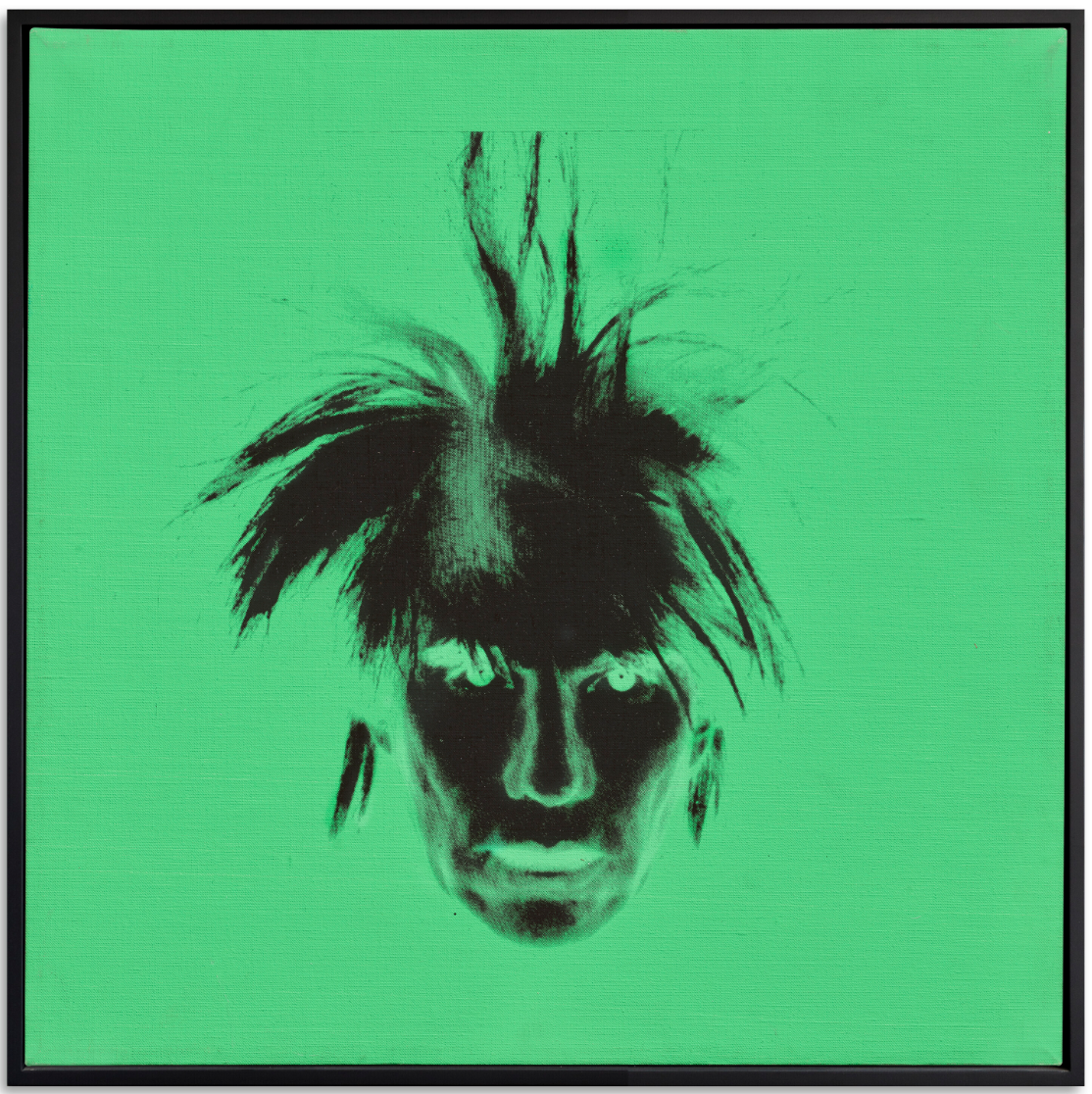
ANDY WARHOL (1928-1987)
Self-Portrait (Fright Wig), 1986
Acrylic and silkscreen ink on canvas
14x 14 inches (35.4 x 35.4 cm)
Stamped with the Estate of Andy Warhol stamp, the Andy Warhol Foundation for the Visual Arts Inc. stamp
Numbered ‘PO 40.017’ (on the overlap)
2023 Auction Results
Self-Portrait, 1986
Sotheby’s New-York: 8 November 2023
Estimated: USD 15,000,000 – 20,000,000
USD 18,144,000
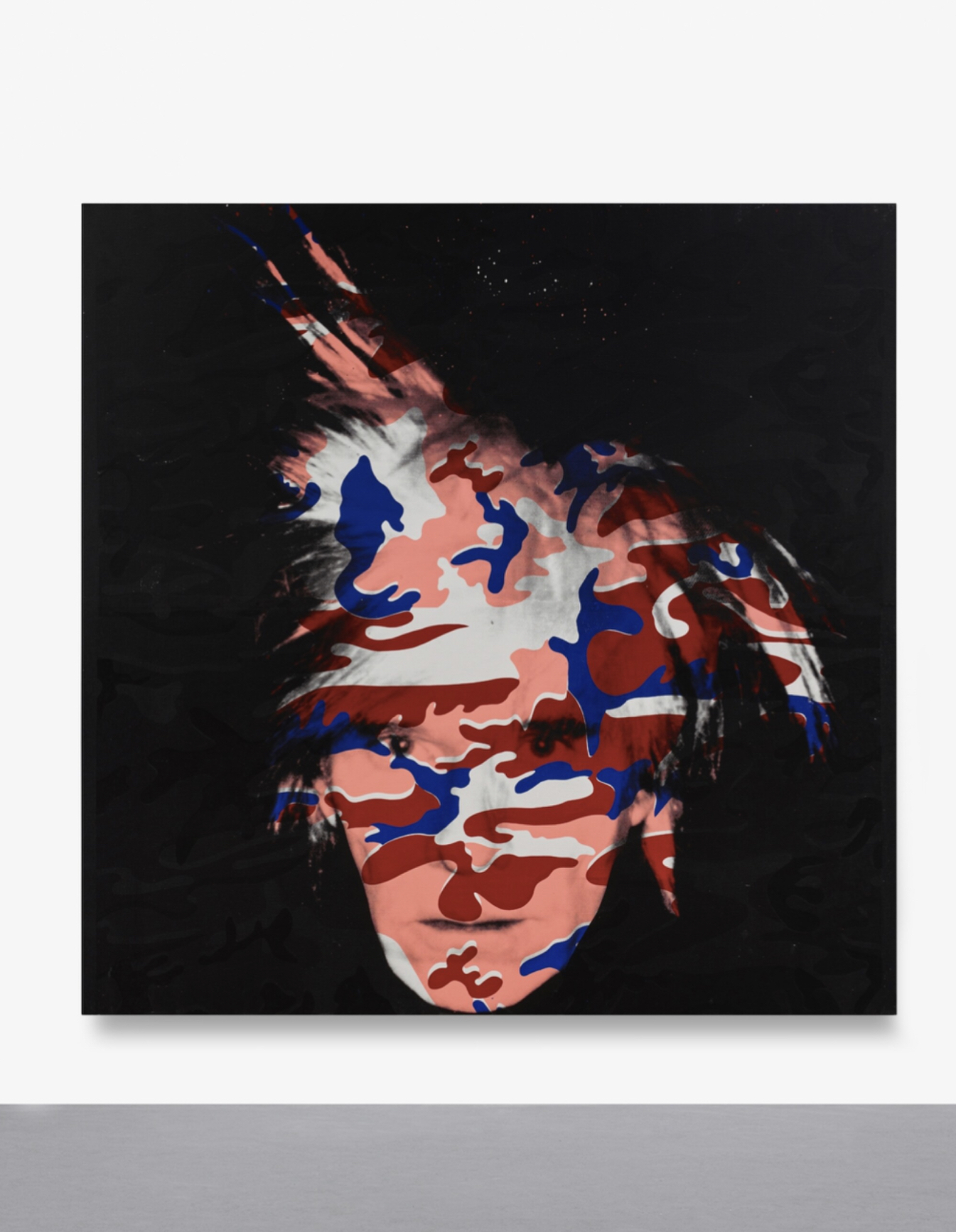
ANDY WARHOL (1928 – 1987)
Self-Portrait, 1986
Acrylic and silkscreen ink on canvas
80×80 inches (203.2 x 203.2 cm)
Signed and dated 86 (on the overlap)
Self-Portrait (Fright Wig), 1986
Phillips New-York: 17 May 2023
Estimated: USD 800,000 – 1,200,000
USD 1,633,000
Andy Warhol – 20th Century & Contemporar… Lot 10 May 2023 | Phillips
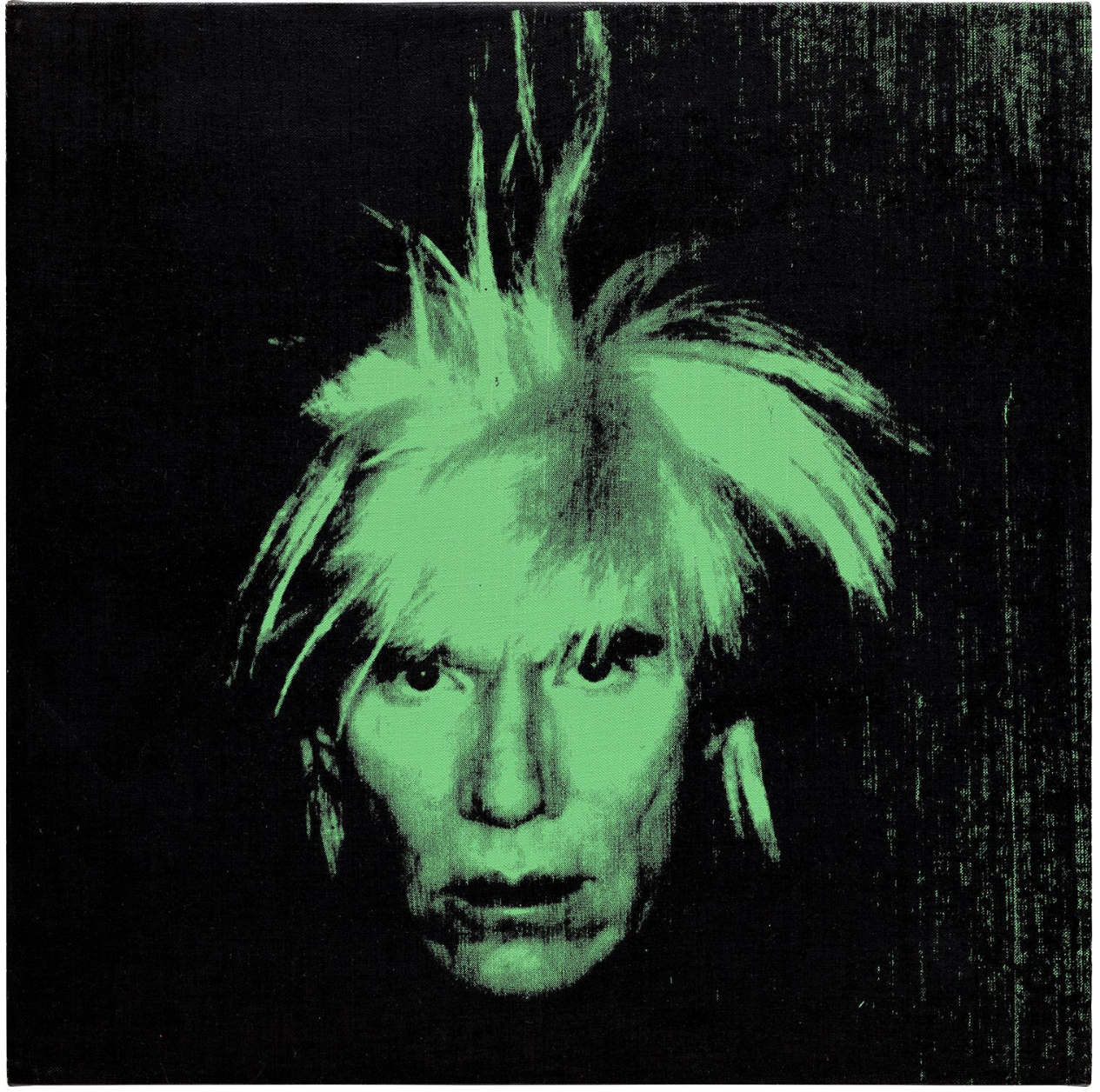
ANDY WARHOL
Self-Portrait (Fright Wig), 1986
Synthetic polymer paint and silkscreen ink on canvas
12×12 inches (30.5 x 30.5 cm)
Stamped twice by the Estate of Andy Warhol and the Andy Warhol Foundation for the Visual Arts, Inc., New York, and numbered “VF P040.010” on the overlap
2022 Auction Results
Self-Portrait, 1986
Estimated: GBP 12,000,000 – 18,000,000
GBP 12,737,500 / USD 15,524,223
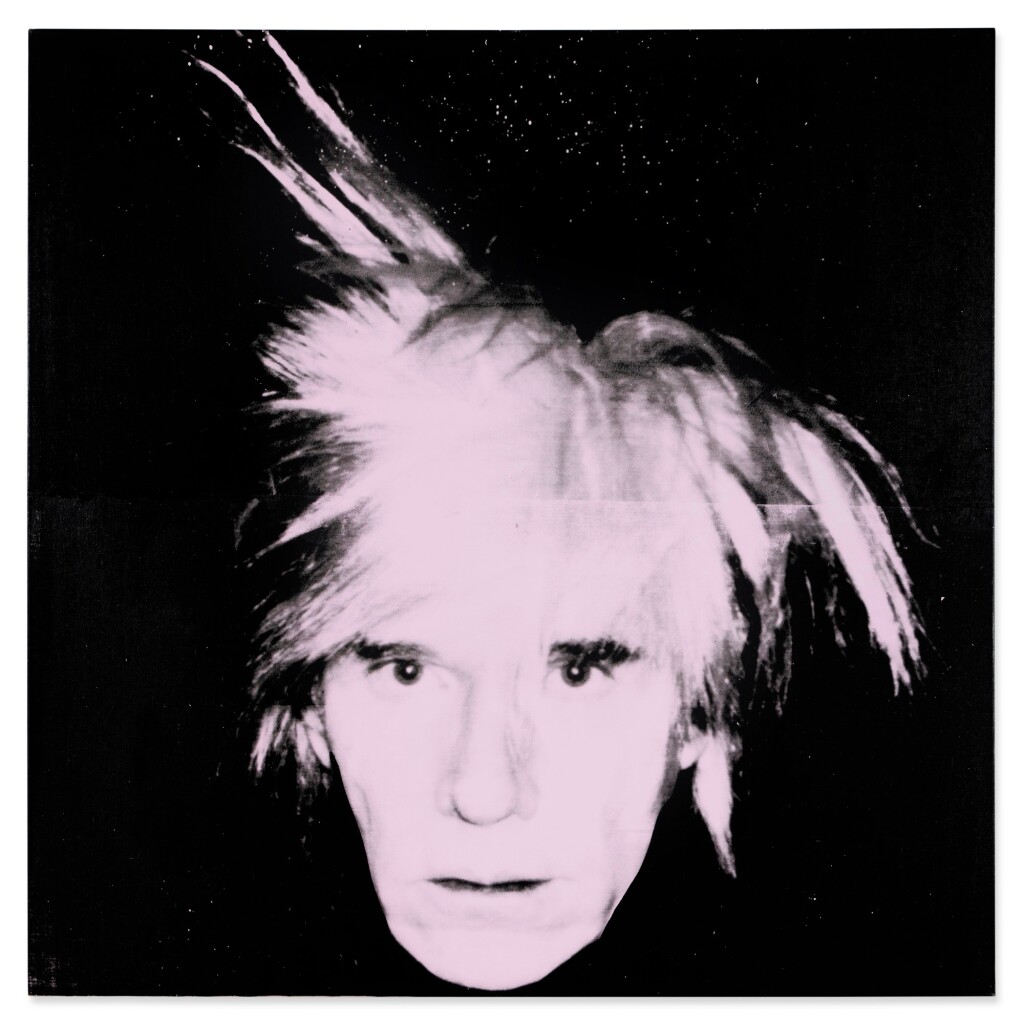
ANDY WARHOL
Self-Portrait, 1986
Acrylic and silkscreen ink on canvas
80×80 inches (203.2 x 203.2 cm)
Stamped with the artist’s signature, dated 1986,
Authenticated by Frederick Hughes (on the overlap)
Numbered PA40.056 (on the stretcher)
Self-Portrait, 1986
Sotheby’s New-York, 16 May 2022
Estimated: USD 15,000,000 – 20,000,000
USD 18,708,500
Self Portrait | The Macklowe Collection | 2022 | Sotheby’s (sothebys.com)
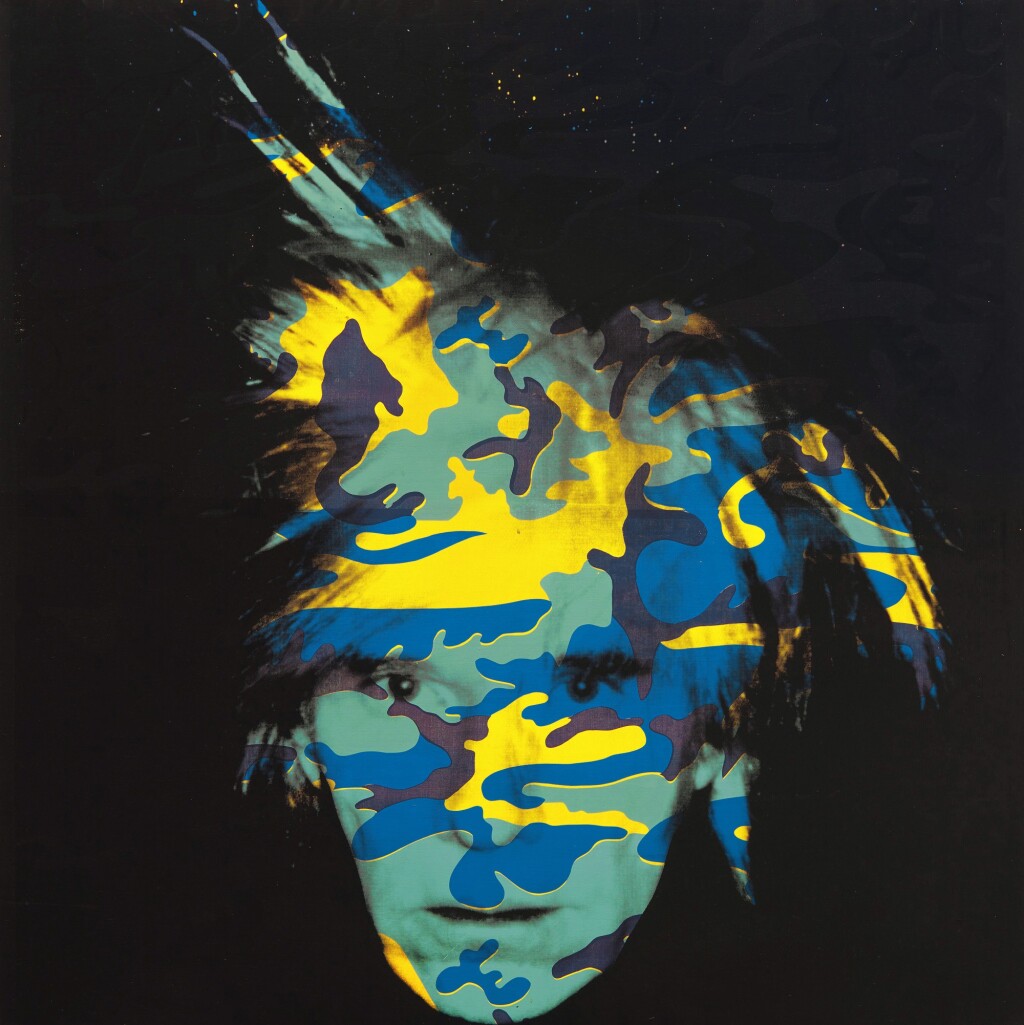
ANDY WARHOL
Self-Portrait, 1986
Acrylic and silkscreen ink on canvas
80×80 inches (203.2 x 203.5 cm)
Self-Portrait (Fright Wig), 1986
Christie’s New-York: 17 November 2022
Estimated: USD 600,000 – 800,000
USD 1,071,000
ANDY WARHOL (1928-1987) (christies.com)
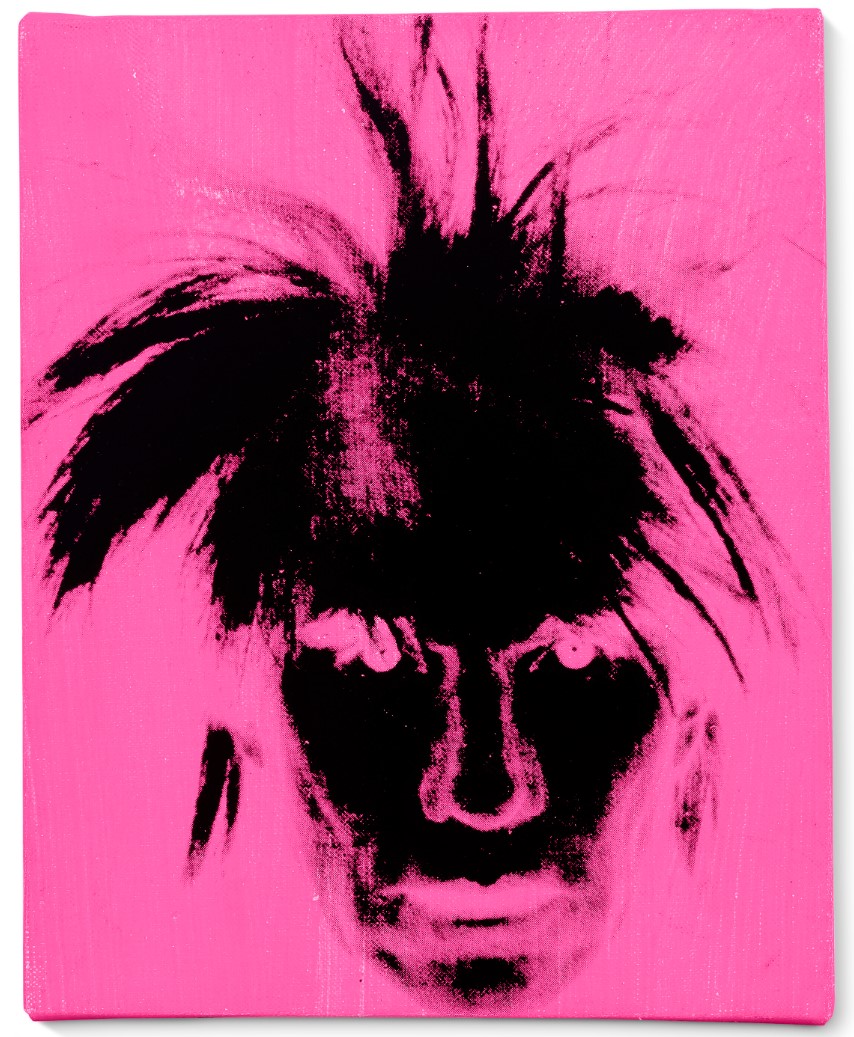
Self-Portrait (Fright Wig), 1986
Acrylic and silkscreen ink on canvas
10×8 inches (25.4 x 20.3 cm)
Signed, stamped with the Andy Warhol Art Authentication Board, Inc. stamp
Numbered and dated ‘Andy Warhol 86 A153.0310’ (on the overlap)
Self-Portrait (Fright Wig), 1986
Estimated: USD 500,000 – 700,000
USD 1,197,000
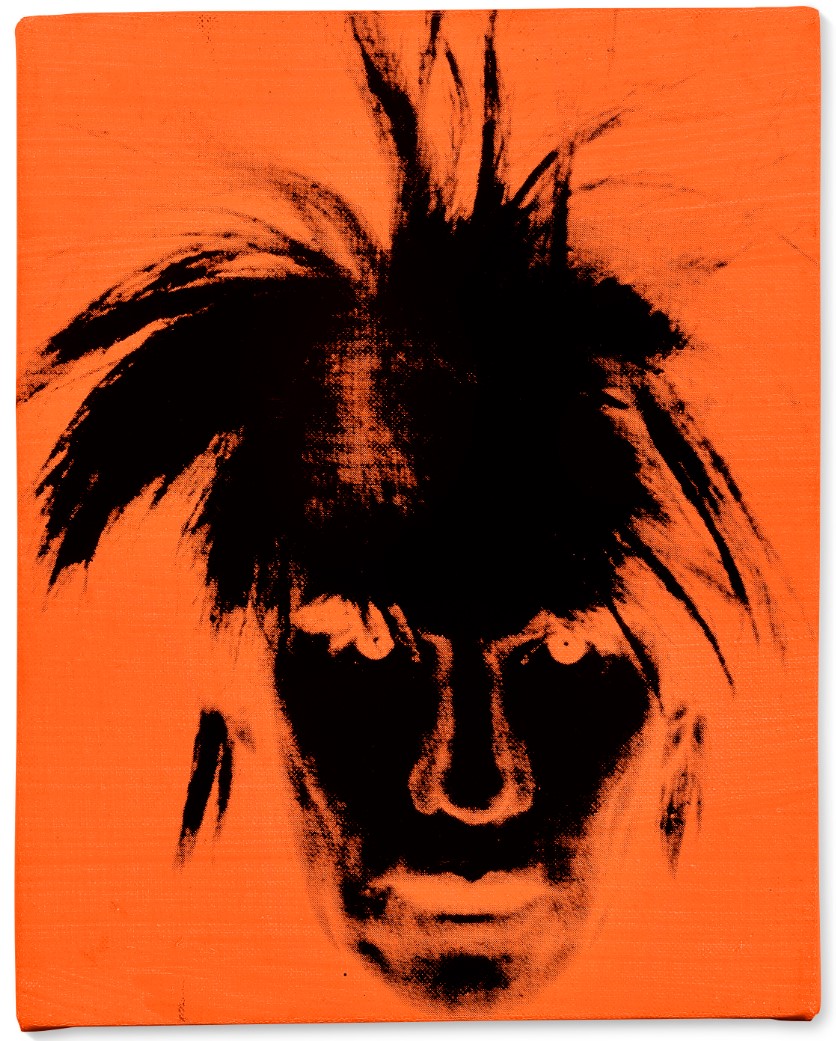
Self-Portrait (Fright Wig), 1986
Acrylic and silkscreen ink on canvas
10×8 inches (25.4 x 20.3 cm)
Signed, stamped with the Andy Warhol Art Authentication Board, Inc. stamp
Numbered and dated ‘Andy Warhol 86 A152.0310’ (on the overlap)
Self-Portrait (108×108)
Self-Portrait, 1986
Christie’s New-York: 11 May 2011
Estimated: USD 30,000,000 – 40,000,000
USD 27,522,500
Andy Warhol (1928-1987) (christies.com)
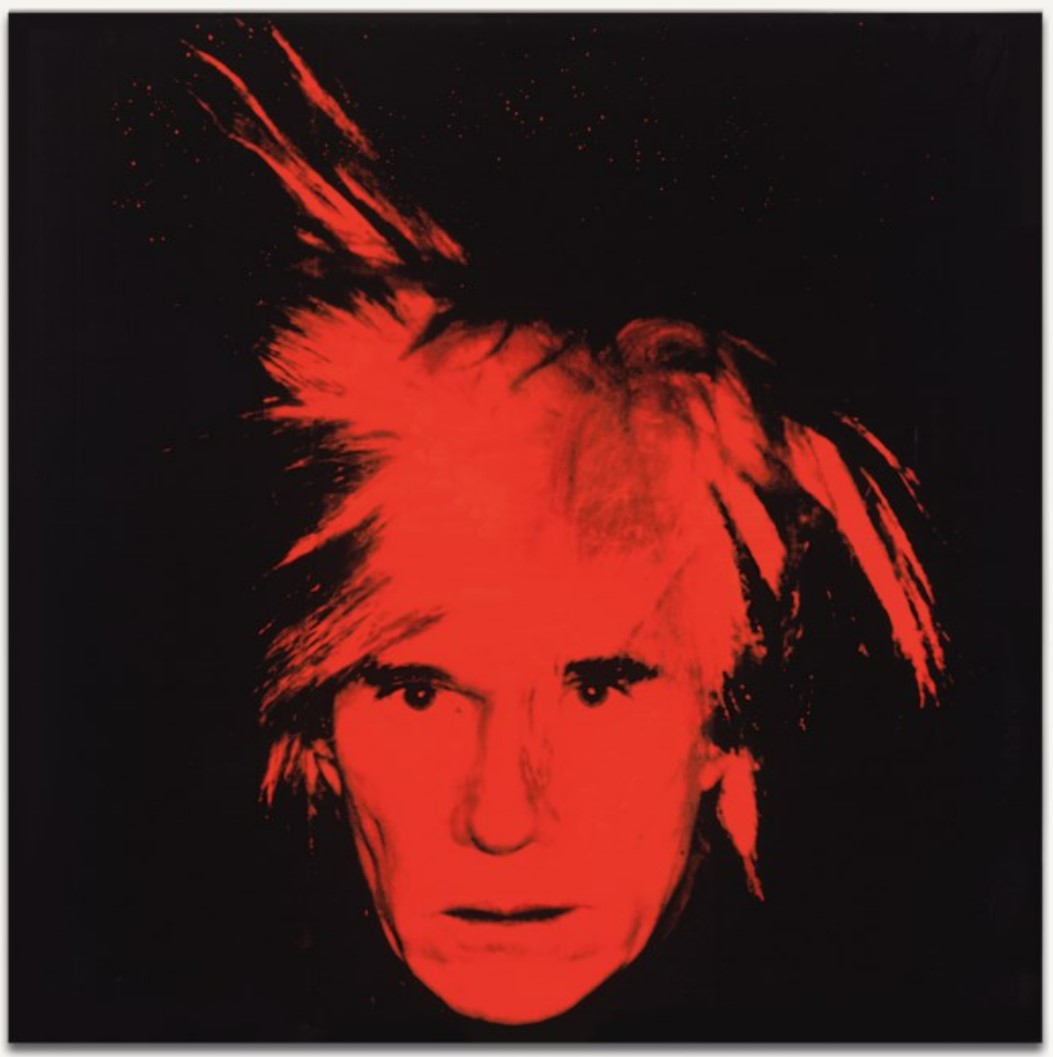
ANDY WARHOL
Self-Portrait, 1986
Synthetic polymer and silkscreen ink on canvas
106.7 x 106.5 inches (271.2 x 270.5 cm)
Signed with stamp, numbered and dated ‘1986 Andy Warhol PO40.084’ (on the overlap)
Comprising solely of a flat, vibrant fiery-red silkscreen image of Warhol emblazoned like a single and dramatic paint-splash over the black void of the canvas, this particular Self-Portrait is an imposing, ominous and ultimately poignant work from Warhol’s great last series of self-portraits made in 1986. One of what is believed to be only five versions (green, blue, purple, yellow and here, red) that were made on this monumental scale, this vast but simple, even in some ways minimalist, image of the artist’s famous but time-worn face peering tentatively out from under the wild hair of his instantly recognizable “fright-wig” is one of the great self-portrait images of the Twentieth Century.
Self Portrait, 1986
Sotheby’s New-York: 12 May 2010
Estimated: USD 10,000,000 – 15,000,000
USD 32,562,500
(#9) Andy Warhol (sothebys.com)
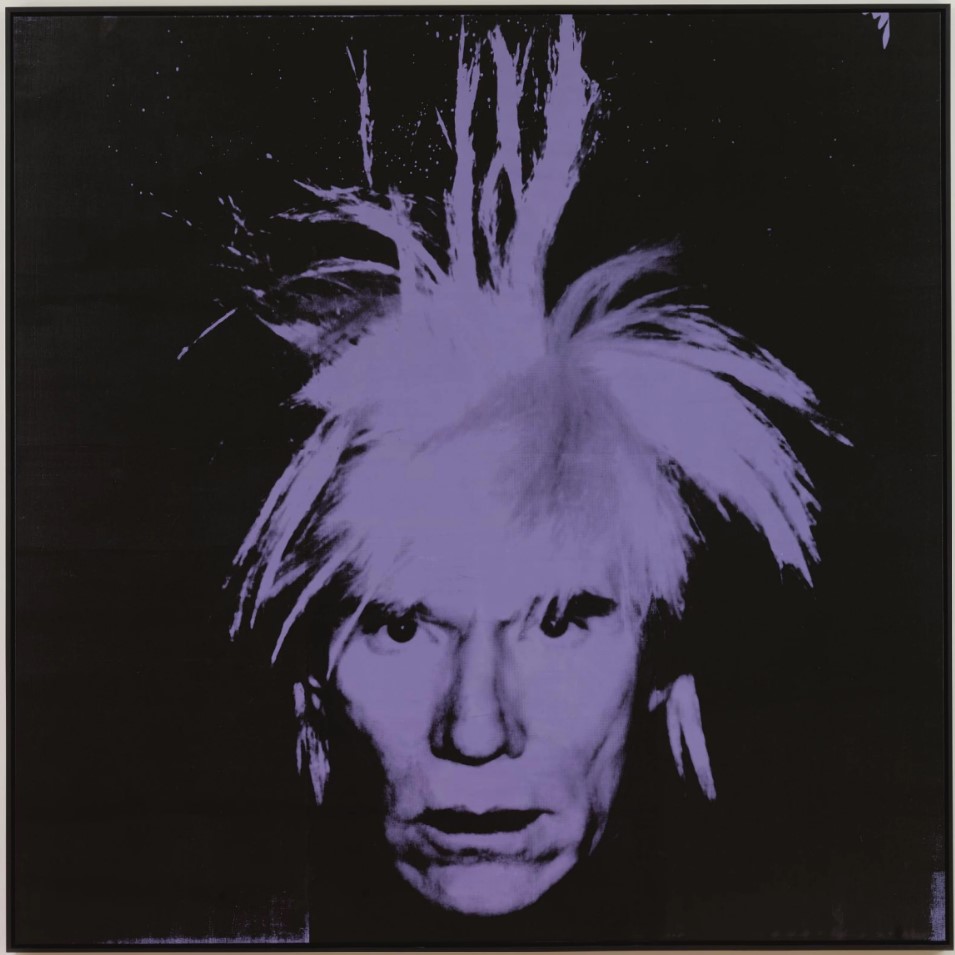
ANDY WARHOL
Self Portrait, 1986
Acrylic and silkscreen ink on canvas
108×108 inches (274.3 x 274.3 cm)
Although the present monumental purple and black canvas is by far the largest format for any Warhol self-portrait and could be viewed as the most disconnected from reality because of size alone, it is also the most raw and intimate look into the artist in the last months of his life. Possibly it is a clarity that comes with approaching death that allowed Warhol to forgo his vanity and be confident enough to reveal his entire face. Warhol was always intrigued by the human face. Here, for the first time, the artist’s own features take center stage in an impactful masterpiece that leaves the artist exposed. Resembling the canonical self-portraits from Dürer to Cézanne to Bacon, this is an intimate exploration of the self, unedited and brutally honest. The present work is both a continuation of and assault on that tradition. The process of the photographic silkscreen satisfied a need for resemblance and allowed Warhol to manipulate contrasts and highlight certain areas while blowing out others.
Self-Portrait (80×80)
Self-Portrait, 1986
Sotheby’s New-York: 8 November 2023
Estimated: USD 15,000,000 – 20,000,000
USD 18,144,000
ANDY WARHOL (1928 – 1987)
Self-Portrait, 1986
Acrylic and silkscreen ink on canvas
80×80 inches (203.2 x 203.2 cm)
Signed and dated 86 (on the overlap)
Pulsating with the intensity of its confrontational gaze, Warhol’s unmistakable portrait emerges from inky black aura; he is obscured by a veil of camouflage, the silkscreen overlay of which graphically renders the dichotomy of inner and public self that pervaded Warhol’s enigmatic persona, while his patriotic palette of red, white and blue nod to the American identity and broader cultural milieu in which the artist operated. The present work’s monumental 80-inch format—exceeded only in scale by seven known 108-inch examples—endows it with a unique status as both an engulfing cenotaph and a highly personal encounter. Attesting to the undeniable and universally acknowledged significance of these works, other Fright Wig self portraits of the same 80-inch format grace international museum collections including the Tate Gallery, London; the San Francisco Museum of Modern Art; the Andy Warhol Museum, Pittsburgh; the Baltimore Museum of Art; and the Carnegie Museum of Art, Pittsburgh. The present work is further distinguished for its inclusion in Warhol’s seminal 1986 exhibition at Anthony d’Offay Gallery, London, from which Emily Fisher Landau acquired it the following year. Piercing and all-consuming, Self-Portrait presents a resounding memorial of both Warhol the man and Warhol the artistic phenomenon.
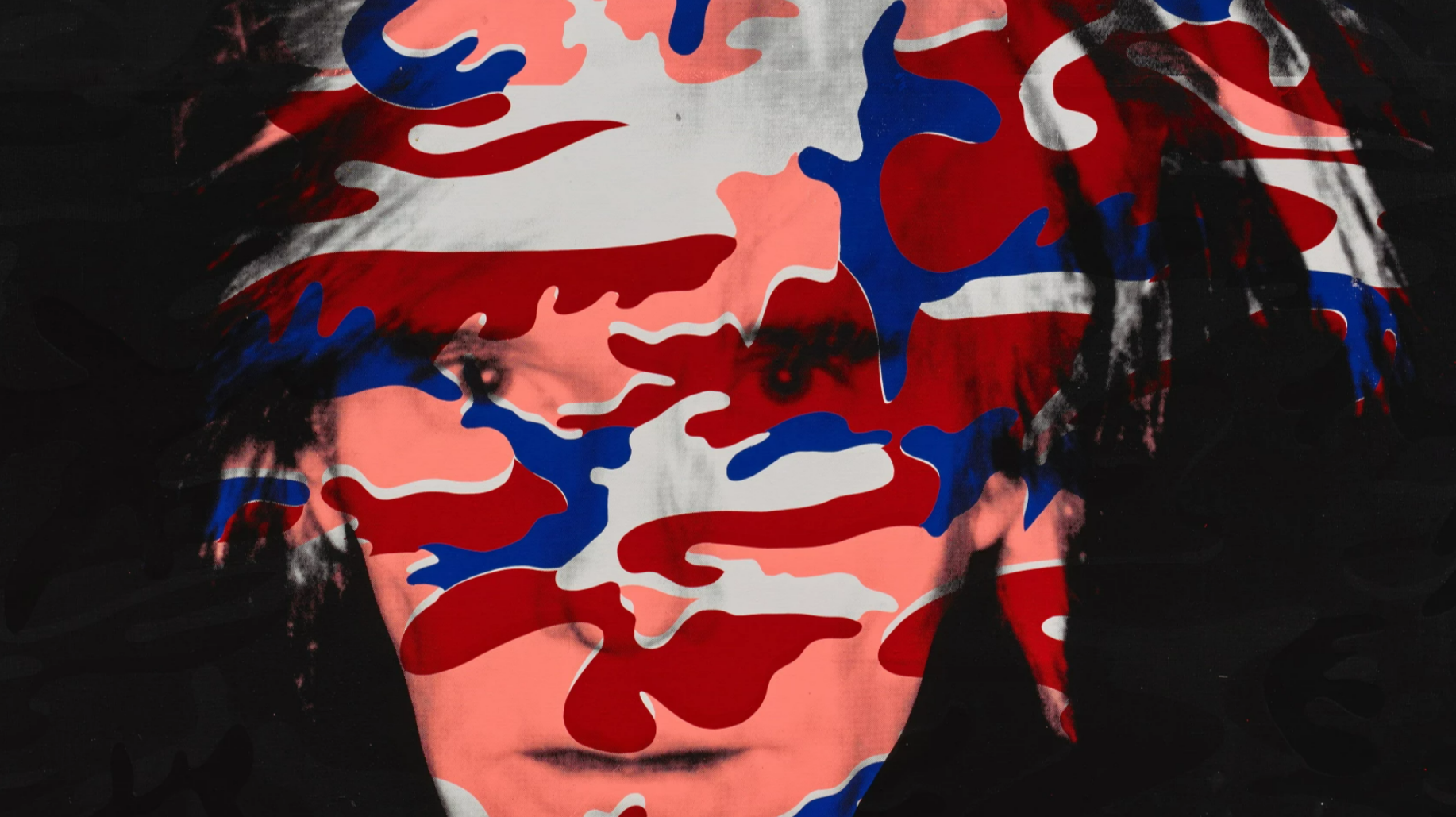
Designed originally for purposes of concealment and disguise, the camouflage pattern in Self-Portrait becomes a nuanced paradoxical motif when applied to the figure of Warhol himself: rather than blending into the background, Warhol is distinguished, even further amplified by his famous fright wig. Camouflage, in this way, embodies Warhol’s critical commentary on the artifice inherent in fame in his mature career, symbolizing the fraught tensions between visibility and invisibility that he experienced as both artist and persona, while his red, white and blue chromatic coating alludes to the American culture that his legacy forever changed. Indeed, for Warhol, the son of Slovakian immigrants in working class Pittsburg, fame in America was not merely the province of actors, musicians, or politicians; as he realized, fame could be harnessed by artists themselves, even manufactured.
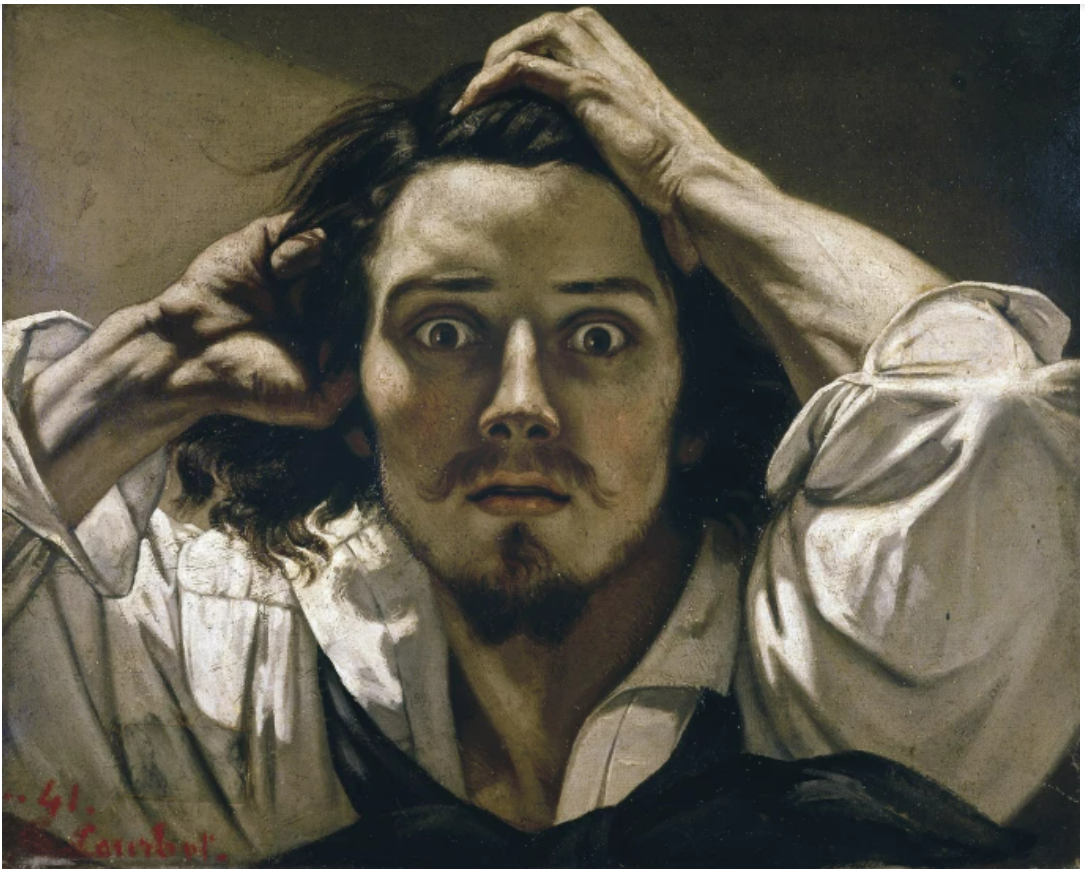
GUSTAVE COURBET, THE DESPERATE MAN (SELF-PORTRAIT), 1835-45. PRIVATE COLLECTION. IMAGE © HIP / ART RESOURCE, NY
Moving away from the vibrant monochrome colors used for his silver-screen stars, in the present camouflaged silkscreen, we find the most melancholic manifestation of Warhol’s prophetic epiphany: a true legend is a posthumous legend. As the twentieth century’s paragon of Pop Art and maven of American mass culture, Warhol faces his own mortality in Self-Portrait from 1986, revealing the most iconic vision of an artist so famously obsessed with the transience of life and the enduring power of image. Emerging from slick, black lamina and shaded with graphic contours of red, white and blue camouflage, the most recognizable American artist of all time simultaneously appears and disappears in front of our eyes. Paradoxically knowable and unknowable, concealed and emergent, vulnerable and guarded, the present portrait of duality captures the quintessence of Andy Warhol during the final years of his life and inducts the artist into the limited cadre of great self-portraitists who have masterfully defined the genre’s captivating history.
Self-Portrait, 1986
Estimated: GBP 12,000,000 – 18,000,000
GBP 12,737,500 / USD 15,524,223
ANDY WARHOL
Self-Portrait, 1986
Acrylic and silkscreen ink on canvas
80×80 inches (203.2 x 203.2 cm)
Stamped with the artist’s signature, dated 1986,
Authenticated by Frederick Hughes (on the overlap)
Numbered PA40.056 (on the stretcher)
Andy Warhol’s final series of self-portraits, executed in 1986 in the months preceding his untimely death, are among the most intense and iconic works of his career. Often referred to as the Fright Wig paintings, this bold series immortalizes the mysterious and enigmatic artistic persona that Warhol had meticulously cultivated throughout his career. On the surface of the present work, Warhol stares out towards the viewer in an intense gaze, his vivid pink head floating against a stark black ground. Piercing and all-consuming, Self-Portrait presents a resounding image of both Warhol the man and Warhol the artistic phenomenon. The viewer sees the artist tackling the challenges of self-depiction with an unrivalled and up-close intensity: Depicting himself as if on the brink of eternity, Warhol here evokes a feeling of the supernatural through a vibrantly contrasting composition. Thoroughly encapsulated in the unique ghostly pink of the present example, the stark chiaroscuro of the silkscreened image endows the series with a spectral presence that is compounded by the proximity of its creation to Warhol’s passing. Undoubtedly the fantastic allure of this late work is the seemingly prophetic character they hold in which Warhol creates his ultimate memento mori; a reminder of the inescapable link between life and death. Amidst a profound sense of success, a vibrant social life and myriad business ventures, the transience of life still weighed heavy on Warhol’s mind and, in part, propelled him to create what are undeniably some of his greatest masterpieces.
Self-Portrait, 1986
Sotheby’s New-York, 16 May 2022
Estimated: USD 15,000,000 – 20,000,000
USD 18,708,500
Self Portrait | The Macklowe Collection | 2022 | Sotheby’s (sothebys.com)
ANDY WARHOL
Self-Portrait, 1986
Acrylic and silkscreen ink on canvas
80×80 inches (203.2 x 203.5 cm)
In his 1986 Self Portrait, Andy Warhol offers himself as a monument to the ages: as Warhol the celebrity, ‘Warhol’ the artistic style, and Warhol the man. As the final major body of work that Warhol produced, painted just months before his untimely death in February of 1987, the 1986 Self Portraits are universally acknowledged as the Pop pioneer’s last great artistic gesture. The present work’s monumental 80-inch format—exceeded only in scale by seven known 108-inch examples—endows it with a unique status as both an engulfing cenotaph and a highly personal encounter. Attesting to the undeniable and universally acknowledged significance of these works, other Fright Wig self portraits of the same 80-inch format grace international museum collections including the Tate Gallery, London; the San Francisco Museum of Modern Art; the Andy Warhol Museum, Pittsburgh; the Baltimore Museum of Art; and the Carnegie Museum of Art, Pittsburgh. The present work is further distinguished for its inclusion in Warhol’s seminal 1986 exhibition of Self Portraits at Anthony d’Offay Gallery in London. Signifying the artist’s ultimate mastery of his long-sustained and famous silkscreen method, the perfected clarity of the transferred image in the present example is arguably unparalleled within his oeuvre. Like an anticipatory elegy, Self Portrait crafts the most iconic vision of the artist who, having been so obsessed with the transience of life and the enduring power of the image, finally faces his own looming mortality. In the present work, Warhol’s visage is presented to the viewer obscured by a veil of camouflage; the silkscreen camouflage overlay makes graphically evident the dichotomy of inner self and public self that pervaded Warhol’s enigmatic persona. This portrait of duality—the knowable and unknowable—is quintessential Warhol.
Warhol’s genius for contradiction is nowhere more dramatic than in the present Self Portrait: the employment of disguise in the act of revelation. Warhol here finally allows full scrutiny of his visage, offering a sense of unmediated access never yet afforded to his public; and yet, the portrait head is veiled in a pattern defined by its ability to conceal. In Self Portrait, the ability of the camouflage pattern to deconstruct the underlying object is at its most powerful and poignant. Floating against the velvety black ground, Warhol’s visage is powerfully reminiscent of the enormous face of the wizard of Oz in the 1939 film of the same name, which Warhol would undoubtedly have watched as a child. Like Oz, Warhol’s face looms larger than life, awe-inspiring and almost fearsome in its graphic force.
Self Portrait (Camouflage), 1986
Sotheby’s New-York: 13 May 2013
Estimated: USD 7,000,000 – 9,000,000
USD 6,997,000
(#34) Andy Warhol (sothebys.com)
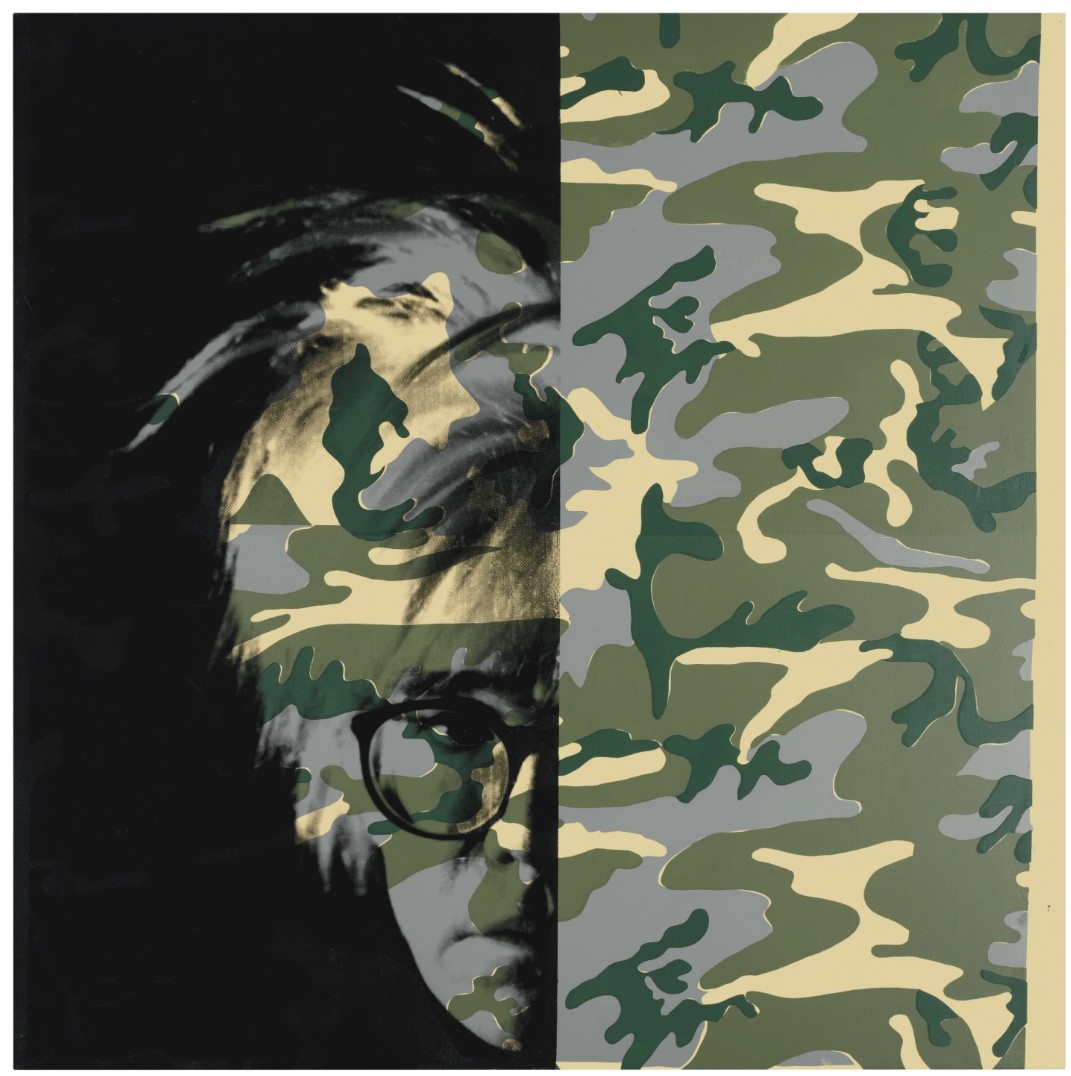
ANDY WARHOL
Self Portrait (Camouflage), 1986
Acrylic and silkscreen ink on canvas
80×80 inches (203.2 x 203.2 cm)
Signed and dated 86 on the overlap
The present painting’s divided self-portrait is an even more literal rendition of this duality. In Self-Portrait (Camouflage), Warhol is wearing glasses, ironically adding a device that can both disguise and accentuate. Yet he is also the ultimate observer of others, adopting a voyeuristic personality, while turning his observations upon himself with as much acuity. By screen-printing only one half of his face and infusing it with the camouflage surface, Warhol poetically returns to the elusive self-image at the beginning of his career – as a figment, a constructed fiction, a series of personas as affected and contrived as his own public image; it also recalls his diptych silkscreen paintings of Liz and Elvis as early as 1963, in which one silvered canvas of the diptych was left blank. The blank silver canvas and the camouflage not only sustain a visual and philosophical suspension from the dramatic and often tragic portraits, but also create a field where a ghost, a proxy of the original image, or simply an image in the viewer’s mind could appear to complete this Warholian duality. The visually dynamic portrait head is veiled in a pattern defined by its ability to conceal: Warhol’s genius for irony is nowhere more dramatic than in the employment of disguise in the act of revelation. Linked conceptually with the Shadow and Rorschach paintings as abstractions, Warhol created canvases that were all camouflage as well as using the device to mask portraits and other Warholian subjects such as the Last Supper paintings. In Self-Portrait (Camouflage), the ability of the camouflage pattern to deconstruct the underlying object is at its most powerful and poignant.
Self-Portrait (40×40)
Self-Portrait (Fright Wig), 1986
Sotheby’s New-York: 11 May 2016
Estimated: USD 7,000,000 – 10,000,000
USD 7,698,000
(#12) Andy Warhol (sothebys.com)
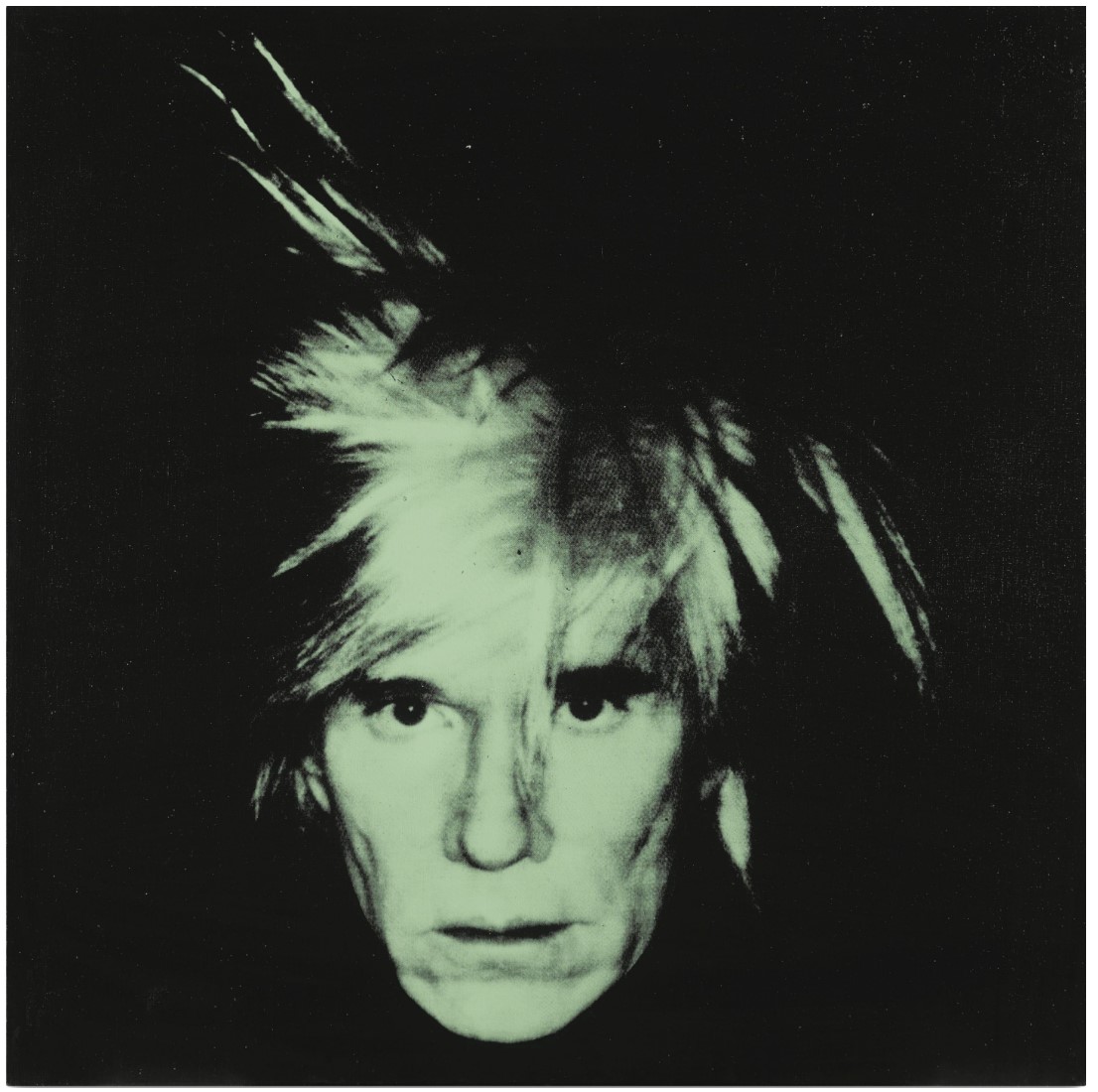
ANDY WARHOL
Self-Portrait (Fright Wig), 1986
Acrylic and silkscreen ink on linen
40.1 x 40.1 inches (102×102 cm)
Signed and dated ’86 on the overlap
Out of pure darkness, the momentary flash of a bulb reveals a stark countenance. Laid bare by a harshly synthetic chiaroscuro, the heavy contours of a worn face frame a piercingly enigmatic glare with perfect symmetry. Resonantly intense yet falling just short of a full emotional connection, it is an arresting confrontation with one of the greatest artistic geniuses of history. Created in 1986, just months before his unexpected passing, Andy Warhol’s Self-Portrait (Fright Wig) undeniably remains one of the most iconic instances of twentieth century self-depiction. We witness the Pop Art pioneer at his most penetratingly existential, returning to a genre that he experimented with throughout his career to enact a resonantly fundamental annunciation of self-hood. Adorned with a dramatically stylized version of his signature silvery gray wig, Warhol perfectly encapsulates his dichotomous identity caught between a flamboyant artistic persona and personal vulnerabilities. As his last great point of introspection Warhol stares his own mortality directly in the face and offers up a window onto the human behind the icon.
Self-Portrait (Fright Wig), 1986
Christie’s London: 1 July 2014
Estimated: GBP 6,000,000 – 9,000,000
GBP 6,354,500
Andy Warhol (1928-1987) (christies.com)
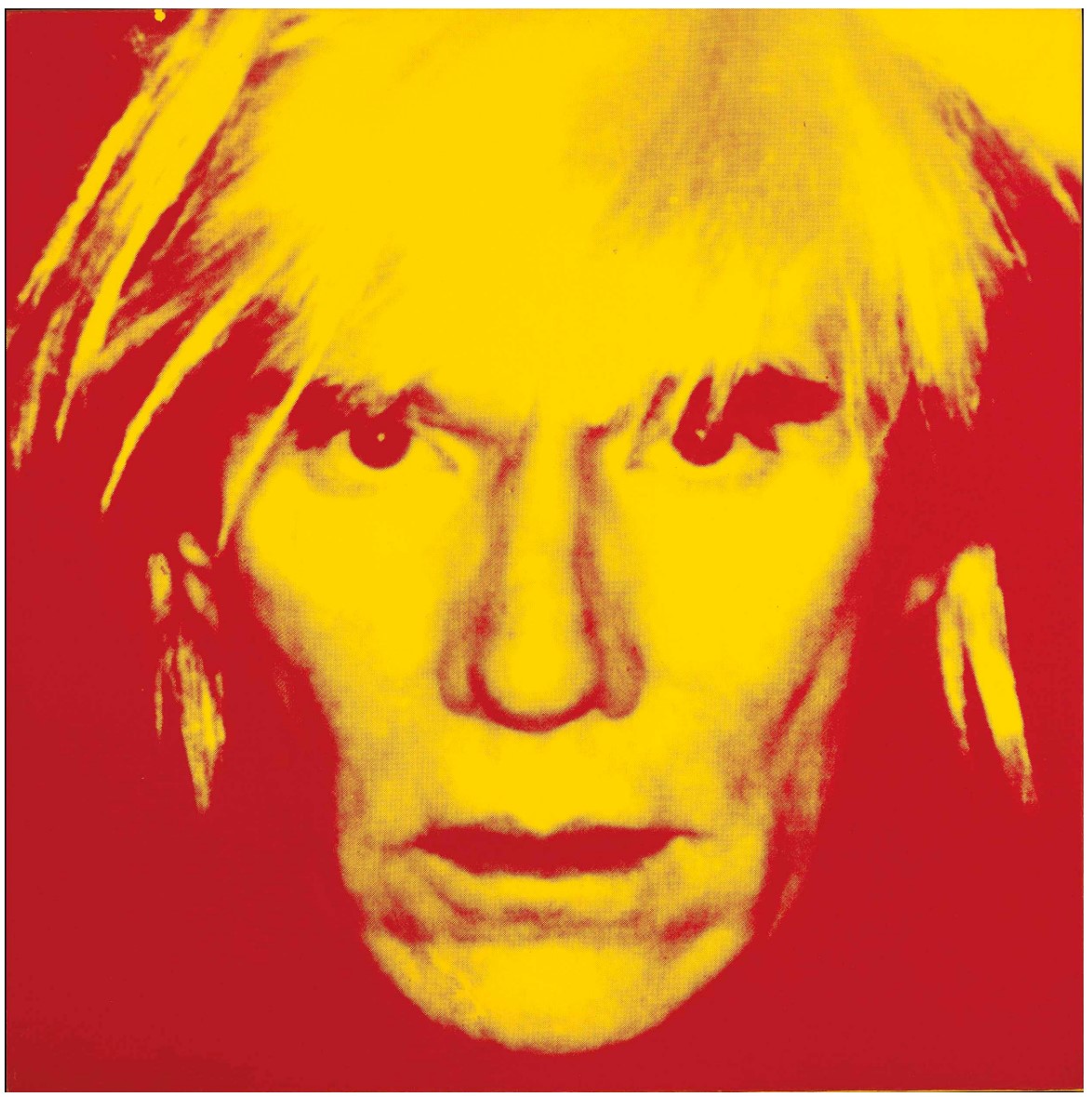
ANDY WARHOL
Self-Portrait (Fright Wig), 1986
Acrylic and silkscreen ink on linen
40×40 inches (101.6 x 101.6 cm)
Stamped with the Estate of Andy Warhol stamp and the Andy Warhol Foundation for the Visual Arts stamp and numbered ‘PA 40.021’ (on the overlap)
Stamped with the Andy Warhol Foundation for the Visual Arts stamp (on the reverse)
Numbered ‘PA 40.021’ (on the stretcher)
Completed shortly before his sudden death in 1987, Andy Warhol’s Self-Portrait, 1986 is rare in his series of late, great self-portraits, depicting the artist much larger than life-size, ‘up-close and personal’. With its searing and fiery colour combination of scarlet red and intense cadmium yellow, the closely cropped classic 40-inch square format, Warhol encourages us to stare deep into his darkened eyes and analyse every square inch of his visage. The artist’s sculpted appearance, heightened by the contrast between light and dark, makes the picture appear to act as both a self-examination as well as a self-presentation. This painting stands out in this renowned ‘fright wig’ series, of which other iterations depict the artist’s entire head and ‘fright wig’ against a deep black background.
Self-Portrait (Fright wig), 1986
Sotheby’s London: 22 May 2012
Estimated: GBP 2,000,000 – 3,000,000
GBP 5,361,250
(#18) Andy Warhol (sothebys.com)
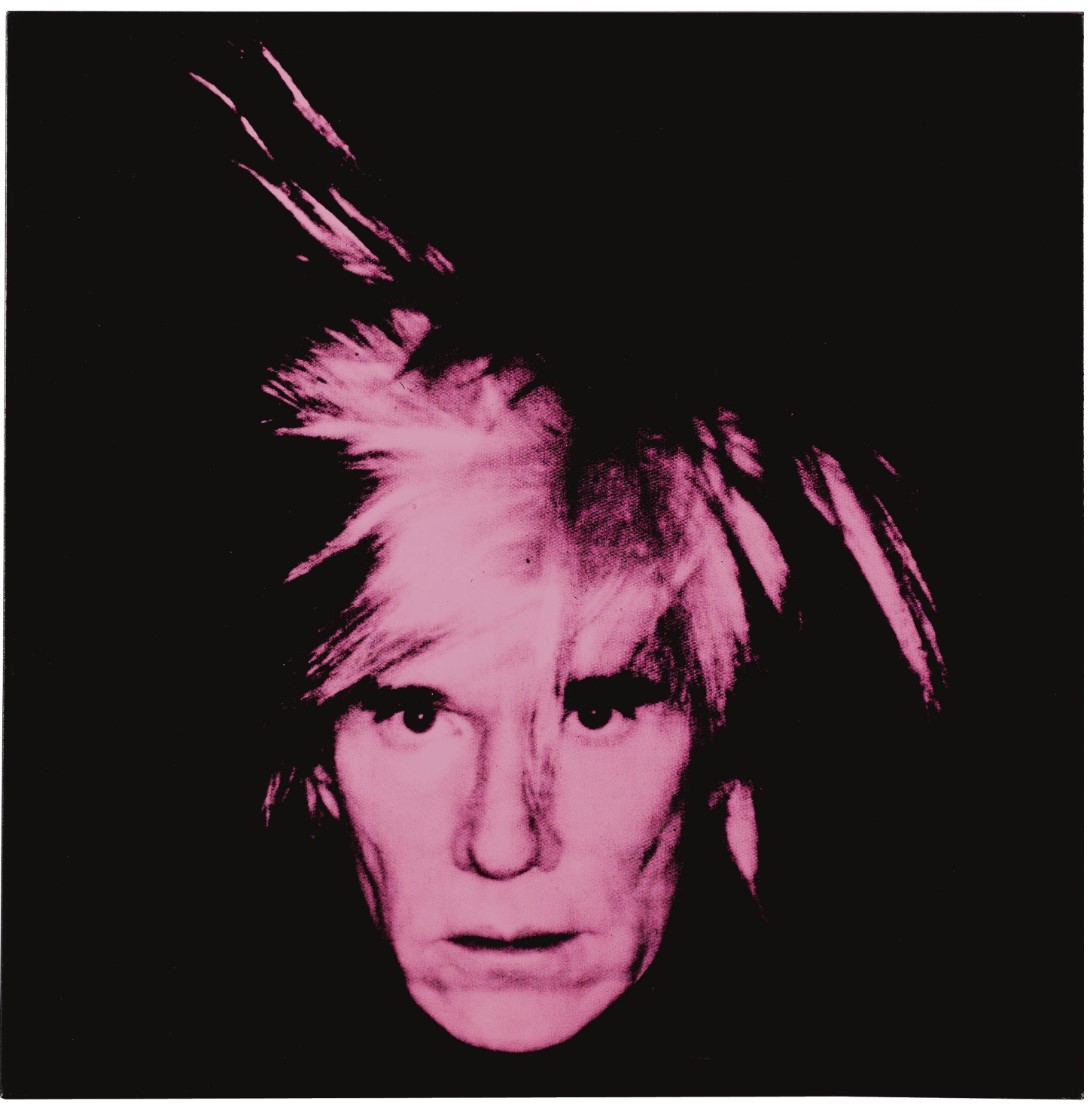 ANDY WARHOL
Self-Portrait (Fright wig), 1986
Acrylic and silkscreen ink on canvas
40.1 x 40.1 inches (102×102 cm)
Signed and dated 86 on the overlap
Despite the high chromatic register and high-keyed tonality, Warhol’s likeness delivers a bleak and moribund physiognomy. Set against the inky black background, the disembodied head takes on the resemblance of a skull, the consummate vanitas motif, a reminder of the ubiquity of life and death. The magnificent Self-Portrait from 1986 represents the ultimate conclusion to Gunter Sachs’ enduring esteem and unbridled passion for the groundbreaking work of Andy Warhol. Warhol constitutes the very core of the Gunter Sachs Collection; the presence of his last great artistic contribution here affirms Sachs’ expert commitment as the purveyor of one of the most outstanding and complete private collections of Pop art ever assembled. Prominently featured in a number of significant museum exhibitions of Warhol’s oeuvre to date and prestigiously chosen as the catalogue front cover for the Warhol retrospective held in Brussels and Paris at Galerie Isy Brachot in 1989, this chromatically arresting and imposing example is one of only six executed in this large size.
Self-Portrait, 1986
Christie’s New-York: 9 November 2010
Estimated: USD 3,500,000 – 4,500,000
USD 4,450,500
Andy Warhol (1928-1987) (christies.com)
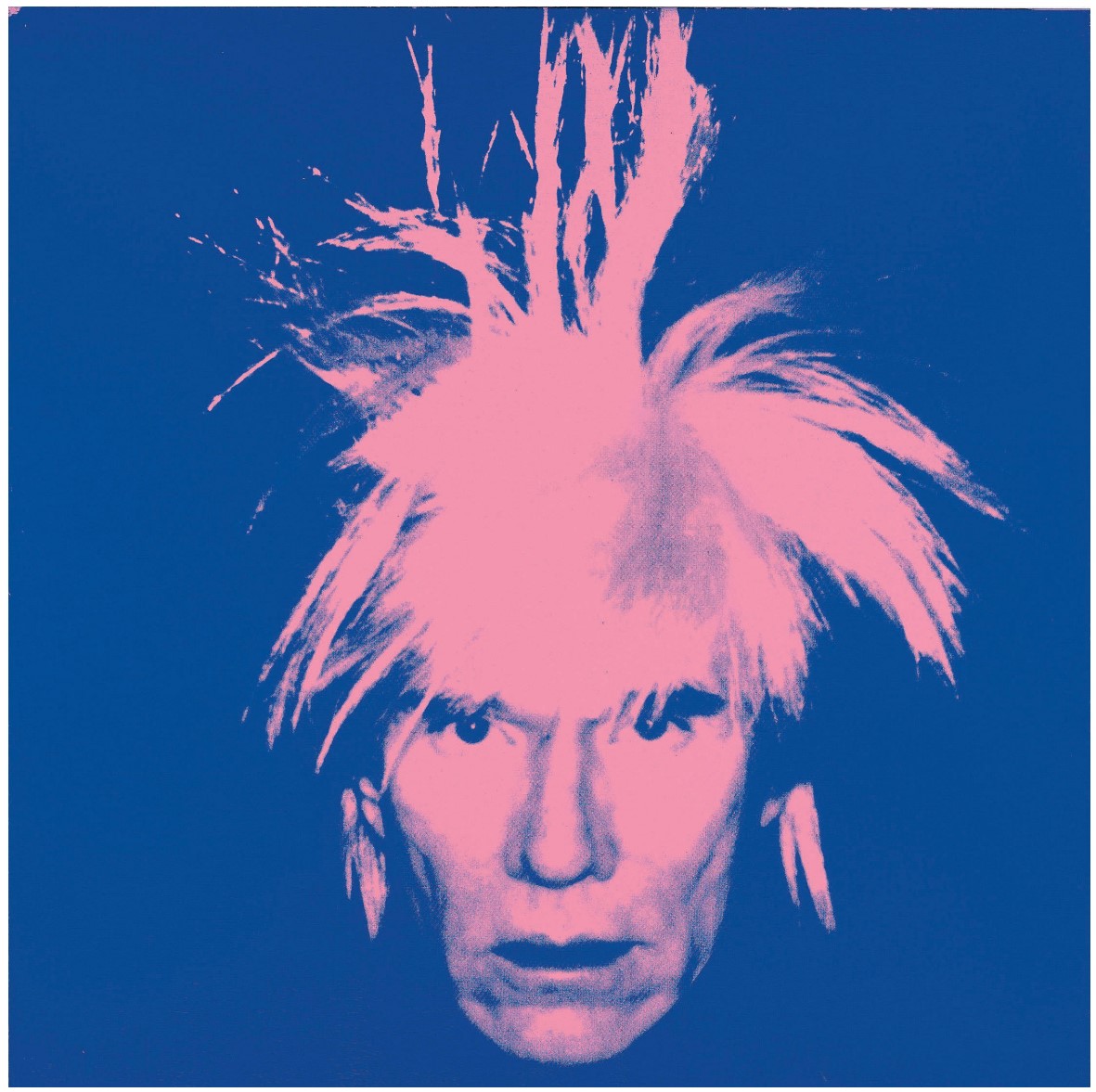
ANDY WARHOL
Self-Portrait, 1986
Synthetic polymer and silkscreen inks on canvas
40.2 x 40.2 inches (102.2 x 102.2 cm)
Stamped twice with The Estate of Andy Warhol and Andy Warhol Foundation for the Visual Arts, Inc. stamps and numbered ‘P040.028’ (on the overlap and on the stretcher)
In contrast to the larger canvases from this series, this particular work offers an intensely intimate encounter with Warhol. Using his favored 40′ canvases, the same size as his iconic early 1960s portraits of Marilyn Monroe and Liz Taylor, and mounted on the wall at Warhol’s height, the life-sized canvas captures our attention as Warhol engages the viewer with an intense stare that attempts to draw you into his incredibly creative and yet complex mind. Unlike any of his more enigmatic self-portraits, the scale of this work offers a tantalizing glimpse into the mind of a genius, the artist who both chronicled and changed popular culture in the last half of the 20th Century. This work’s unique color scheme, with Warhol’s bubblegum pink face against a background of patriotic blue, is a perfect amalgam of American culture and the artist’s personality. This increasingly restrained palette shows a more mature Warhol at work, but one who has not totally released himself from the grip of Pop. The shock of the pink contrasts with the ashen appearance of Warhol’s skin and the exceptional quality of this particular screen gives rise to an image of immense clarity. The individual contours of the skin, the deep piercing blue and pinpoint pink of the pupils and the individual delicate strands of the fright wig converge to give a uniquely detailed portrait.
Camouflage Self-Portrait, 1986
Sotheby’s London: 28 June 2010
Estimated: GBP 1,500,000 – 2,500,000
GBP 1,721,250
(#10) Andy Warhol (sothebys.com)
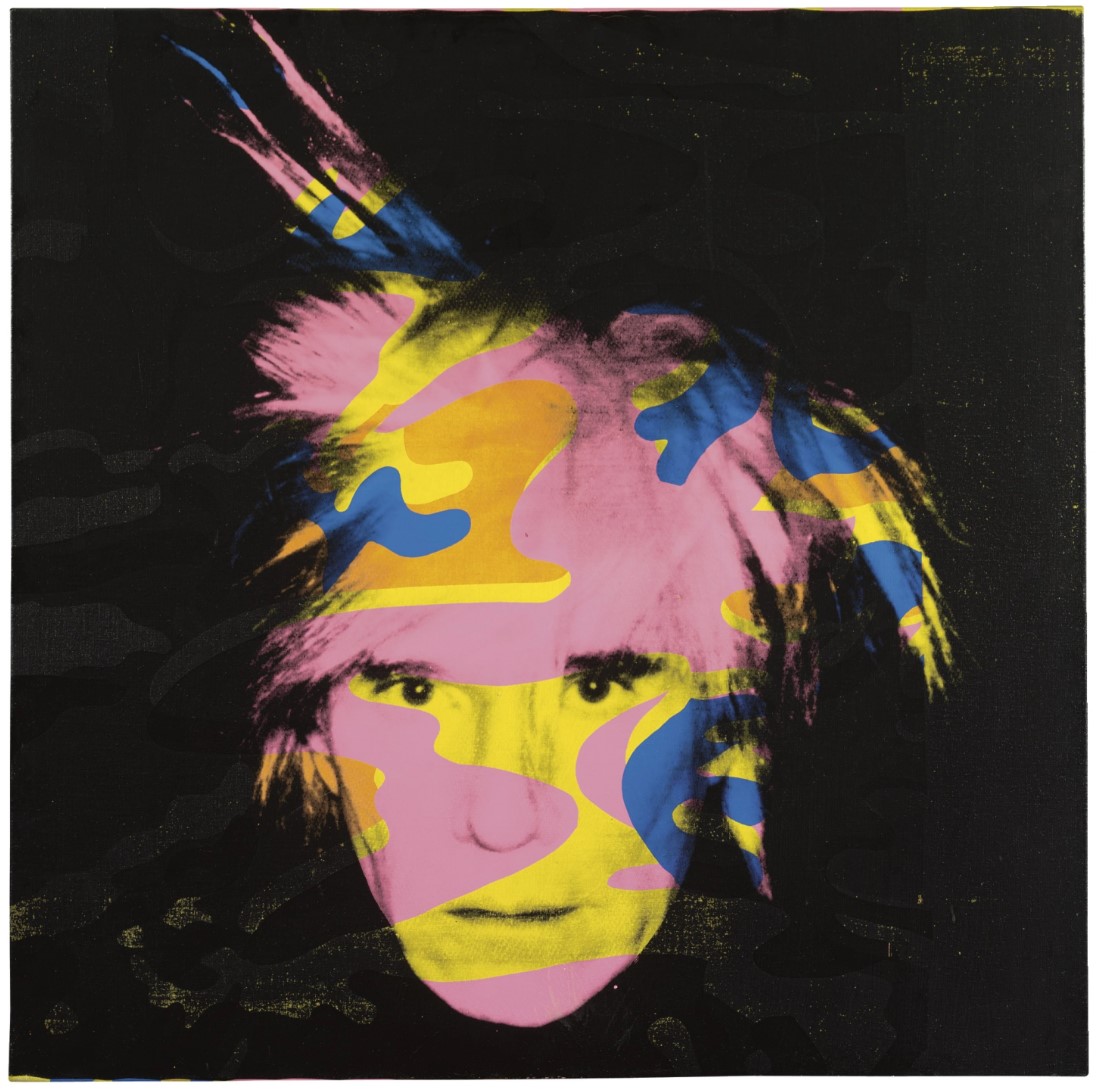 ANDY WARHOL
Camouflage Self-Portrait, 1986
Acrylic silkscreen ink on canvas
40×40 inches (101.6 x 101.6cm)
Signed and dated 86 on the overlap
The present work not only occupies the central ground of the cycle, but being beautifully composed through the pulsating camouflage schema is also injected with a spectacular chromatic intensity and all the sophisticated conceptual associations of his late adoption of camouflage. His adoption of brilliant pink, yellow, blue and orange in a patterned camouflage design transforms the present work into an even more powerfully elegiac painting. The visually dynamic camouflage is supposedly defined by its ability to conceal and so, while we are forced to ask what Warhol is concealing, the unashamed luminosity of the acrylic ground screams for our attention. Warhol’s genius for irony is seemingly most dramatic in the employment of disguise in the act of revelation.
Self-Portrait (22×22)
Self-Portrait, 1986
Christie’s London: 14 February 2012
Estimated: GBP 1,200,000 – 1,800,000
GBP 1,329,250
Andy Warhol (1928-1987) (christies.com)
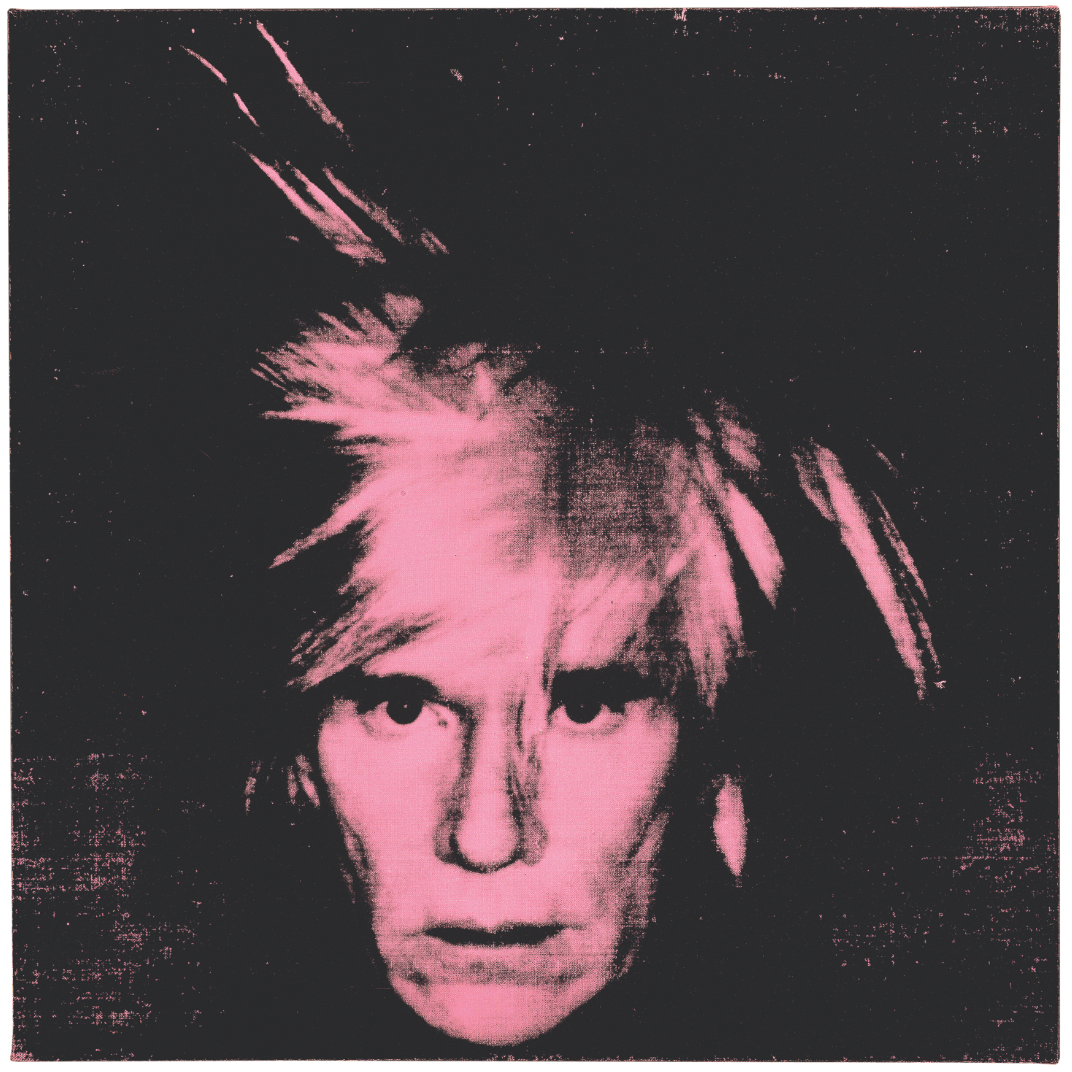
ANDY WARHOL (1928-1987)
Self-Portrait, 1986
Acrylic and silkscreen ink on canvas
22×22 inches (55.9 x 55.9 cm)
Stamped with the artist’s signature ‘Andy Warhol’ (on the overlap)
Numbered ‘P040.050’ (on the stretcher)
With its sumptuous clash of brash, bright, glowing pink emerging from the recesses of the thick inky black background, Andy Warhol’s Self-Portrait immediately arrests the senses. With its 22 by 22inch proportions, the image is slightly smaller than life-size but somehow Warhol’s head directly confronts us with his magnetic eyes and frontal vision, his colour an electric expansion on a natural skin colour. Glaring gauntly out from the shadows, Andy Warhol’s piercing stare commands the viewer’s gaze. The vivid colour with which the artist captures his own features creates a dramatic contrast with the darkness of the surrounding canvas, and this sense of fiery emanation is accentuated by the spikes of pale hair that leap from his head like solar flares trying to escape the sun. At the same time, this rich burst of colour lends a disco-like quality as does his iconic peroxide wig. The so-called ‘Fright Wig’ self-portraits that Warhol created in 1986 are often considered his most successful. Despite his often debilitating shyness, throughout his career he chronicled and charted his own appearance in a range of self-portraits, culminating in this final defining series of works. His fame was now so extensive and his features so instantly recognizable in their own right, that he had easily attained the status within the Pop firmament that merited his own inclusion in his pictures.
Six Self Portraits, 1986
Christie’s London: 6 March 2018
Estimate on Request
GBP 22,621,250 / USD 31,453,615
Andy Warhol (1928-1987), Six Self Portraits | Christie’s
REPEAT SALE
Sotheby’s New-York: 14 May 2014
Estimated: USD 25,000,000 – 35,000,000
USD 30,125,000
(#23) Andy Warhol (sothebys.com)
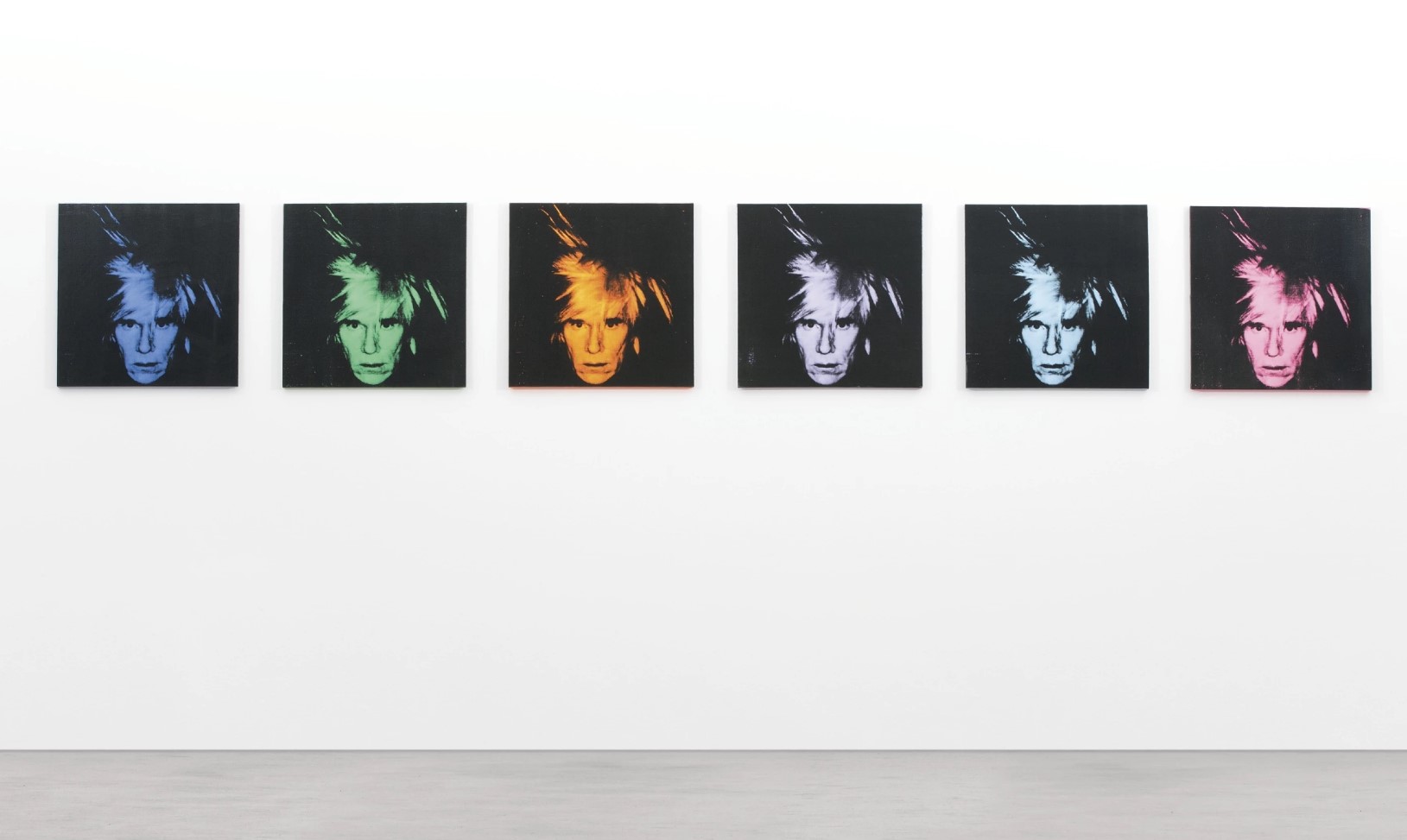
ANDY WARHOL
Six Self Portraits, 1986
Acrylic and silkscreen ink on canvas
Each: 22×22 inches (56×56 cm)
Each signed and dated 86 on the overlap
Despite their colors and high-keyed tonality, these are stark faces, moribund like a spectral head. Set against the inky black background, Warhol’s disembodied head takes on the resemblance of a skull, the consummate vanitas motif, a reminder of the ubiquity of life and death. Warhol had already explored this motif of the memento mori, first in a series of Skulls from 1976 and subsequently in a small series of self-portraits with a skull made two years later when the artist was fifty. In the present series, however, Warhol himself becomes the vanitas object. The heightened contrast emphasizes the bone structure of the skull below the taut skin. Ever since the Ethel Scull commission in 1963, Warhol understood the power of working in multi-panel, multicolored, repetitive compositions, which allowed him to exploit the given image to its limit. In his portraiture, this allowed him to explore the subtle nuances and permutations of the sitter, creating extra sensitivity through repetition. This is how he chose to exhibit his works – as a series – from the time of his breakthrough Campbell’s Soup exhibition at the Ferus Gallery in Los Angeles in 1962 onwards. Yet it is rare today to find such series still intact, rendering the present group exceptional. The presence of the repeated image here further rarefies an already iconic portrait of the artist. Indeed the disembodied heads can fuse to create a single image, as our eye scans from one to the other, never resting as no single head dominates. By repeating his self-representation, Warhol revealed in these pictures a fractured self-image where unity only exists in multiplicity. Through mechanical reproduction and anonymous facture, Warhol’s multiple Self-Portraits contradict the genre’s ideal of intimate self-expression; yet in fact, in harnessing the technique of the screen-print to such unbridled international success, the resulting image is anything but anonymous. On the contrary, Warhol’s image is here packaged and presented in his own instantly recognizable brand of Pop, on par with his 1960s portraits of Marilyn Monroe, Elvis Presley and Liz Taylor.
Self-Portrait, 1986
Christie’s New-York: 13 May 2008
Estimated: USD 2,500,000 – 3,500,000
USD 3,513,000
Andy Warhol (1928-1987) (christies.com)
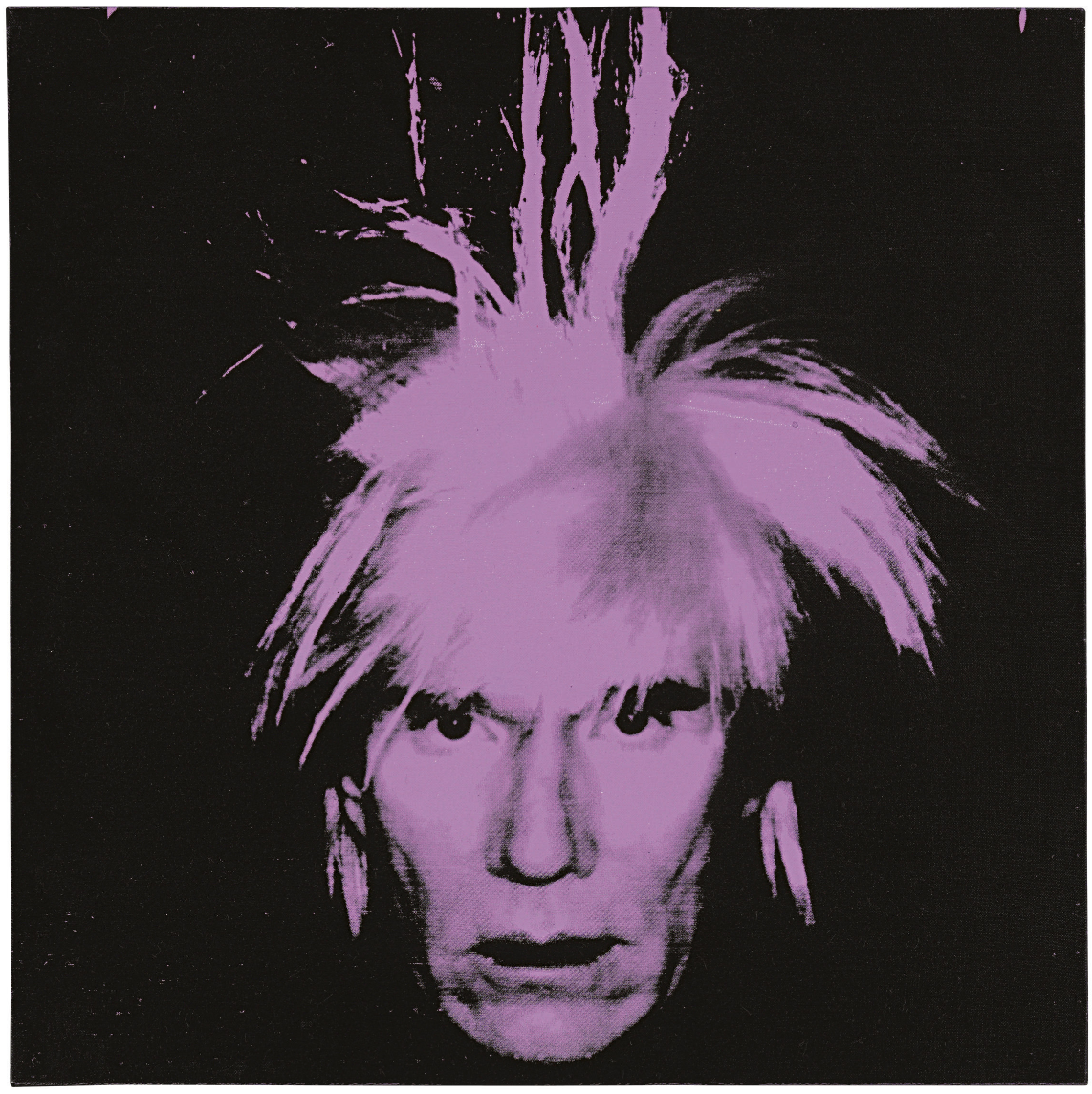
Andy Warhol (1928-1987)
Self-Portrait, 1986
Synthetic polymer and silkscreen inks on canvas
22×22 inches (56×56 cm)
Stamped with the Estate of Andy Warhol and the Andy Warhol Foundation for the Visual Arts, stamps and numbered ‘PO40.040’ (on the overlap and on the stretcher)
In this work, the artist’s explosively colored visage appears ghost-like, materializing from the darkness. By objectifying his image in this way, Warhol presents himself as a form of vanitas, a poignant symbol that appears to herald his own inevitable demise. The spectre of death haunts Warhol’s entire career as a leitmotif; from Marilyn Monroe in the early 1960s to the Endangered Species series in the early 1980s, his paintings extended his bleak vision of the natural world. Neurotically afraid of germs, disease and hospitals, Warhol was painfully aware of his own perishability. This grew more pronounced as he grew older and many of his closest friends fell victim to the newly discovered AIDS virus.
Self-Portrait (14×14)
Self-Portrait (Fright Wig), 1986
Christie’s London: 7 March 2024
Estimated: GBP 700,000 – 1,000,000
GBP 819,000 / USD 1,038,492
ANDY WARHOL (1928-1987), Self-Portrait (Fright Wig) | Christie’s (christies.com)
ANDY WARHOL (1928-1987)
Self-Portrait (Fright Wig), 1986
Acrylic and silkscreen ink on canvas
14x 14 inches (35.4 x 35.4 cm)
Stamped with the Estate of Andy Warhol stamp, the Andy Warhol Foundation for the Visual Arts Inc. stamp
Numbered ‘PO 40.017’ (on the overlap)
Executed the year before his untimely death in 1987, Andy Warhol’s Self-Portrait (Fright Wig) stands as the striking culmination of his career. A combination of Pop vitality and emotional resonance, the present picture exhibits and celebrates the complex nature of the artist’s life and work. Through his art Warhol examined the rise of celebrity culture, the commodification of America, and the fragility of life—all subjects touched on here. But arguably his greatest subject was himself, and during the course of his career he painted a number of self-portraits which reflected his changing sense of self. Rarely seen in public, this powerful self-portrait stands as the summation of this incredible journey.
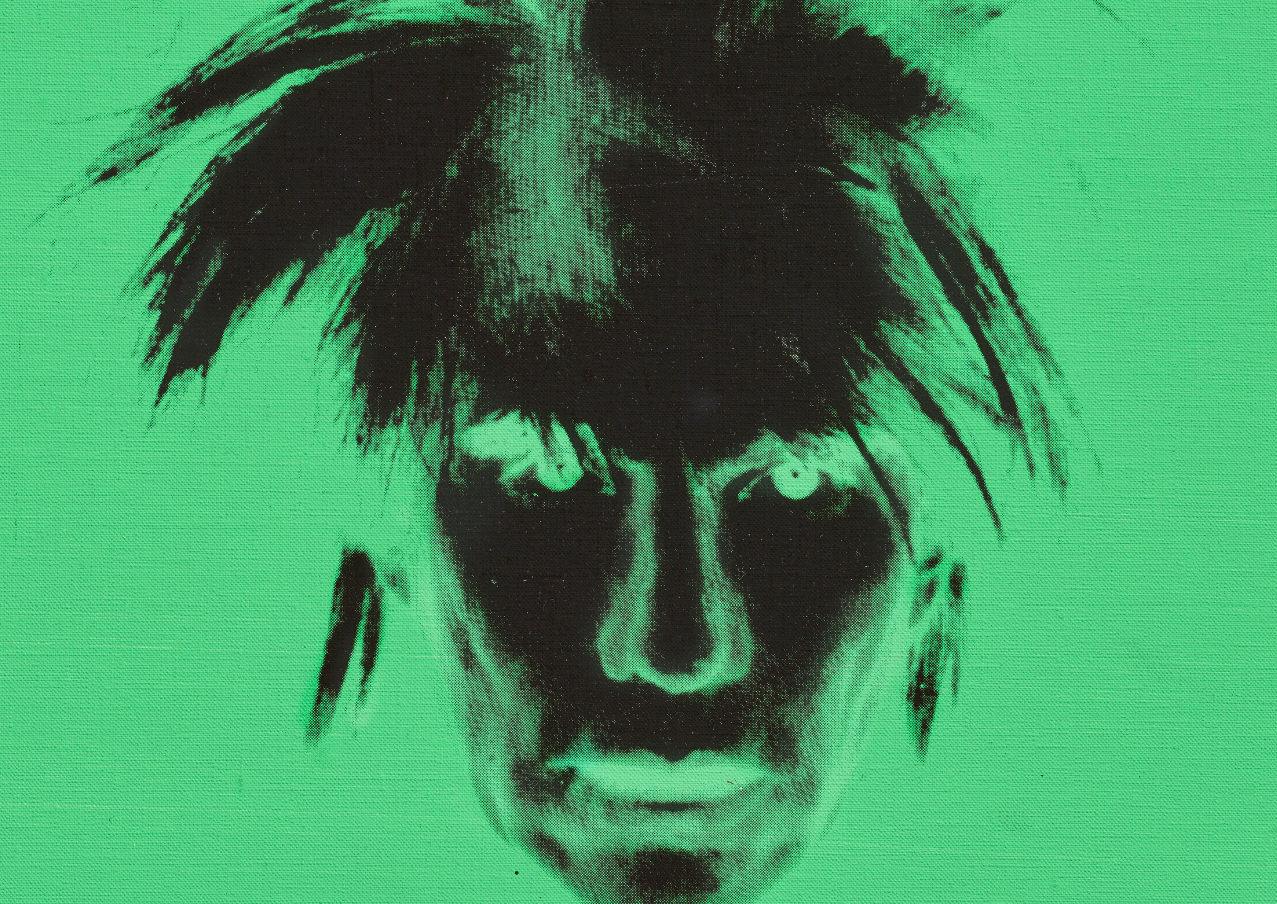
Set against a dramatic green ground, the haunting face of Andy Warhol stares out from the surface of the canvas. Distinguished by his iconic fright wig (a platinum blond hairpiece that the artist increasingly wore later in life), the darkness of his drawn features sits in stark contrast to the vividness of his chosen background. Unlike many of the self-portraits that Warhol executed during his lifetime, in the present work he has rendered a ‘negative’ image of himself, adding a further layer of conceptual depth and complexity to this already highly intangible series. Thus, the dark expanse of his sunken cheekbones, his high forehead, and elongated nose are offset by the dramatic magnetic luminosity of his engaging stare. The piercing gaze with which Warhol fixes his audience demonstrates that, even at the end of his career, the artist still has the ability to hypnotize us with the power and intensity of his art.
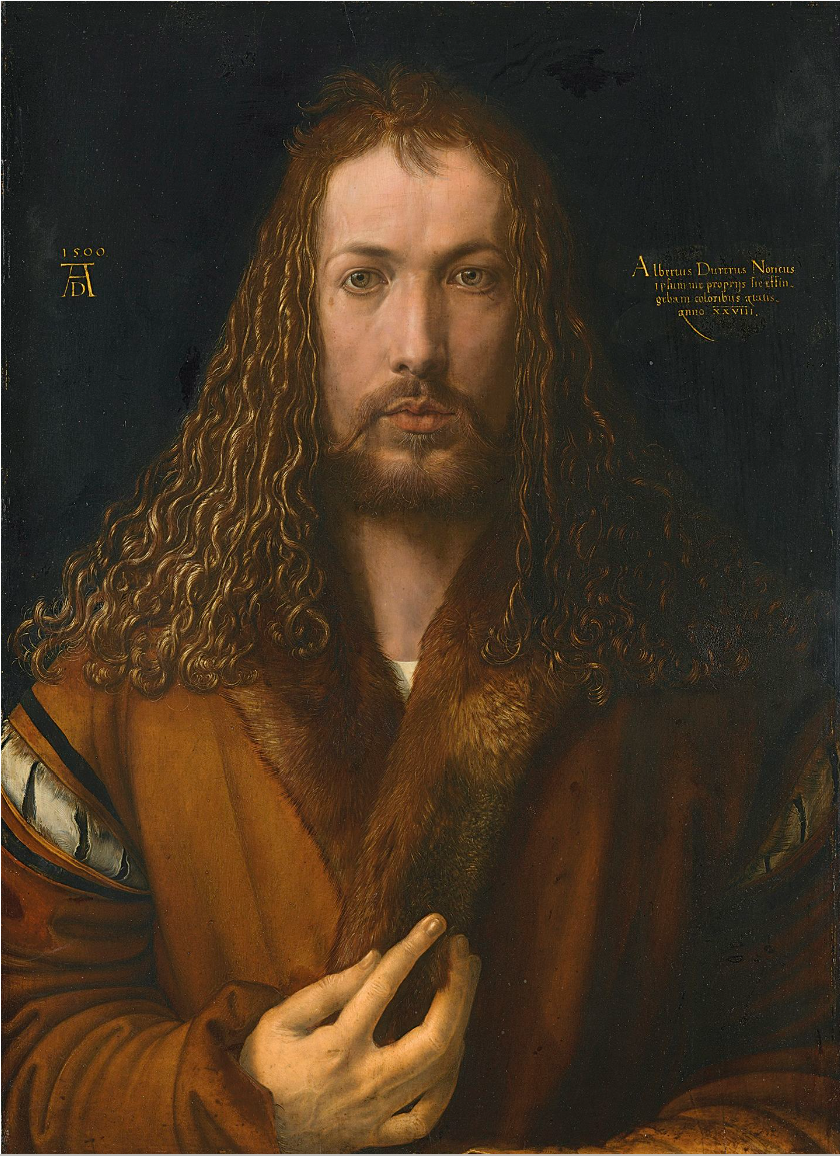
Albrecht Dürer, Self-Portrait with Fur Cloak, 1500. Alte Pinakothek Muenchen, Bayerische Staatsgemaeldesammlungen, Munich. Photo: © Scala, Florence/bpk, Bildagentur fuer Kunst, Kultur und Geschichte, Berlin.
Displaying his isolated face so openly, and with such seeming alacrity, no other body of work by Warhol demonstrates the paradox presented by the artist’s self-consciousness and his celebrity status better than these late Self-Portraits. He is knowingly representing himself as both recognizable and disguised; a real person, yet one abstracted through art. Robert Rosenblum, who has spoken eloquently of the spectral presence of death in these paintings, makes the profundity inherent to this series clear: ‘A sense of ultimate moment fills all these works, as well as a sense of staged artifice that, for a moment, can ward off the unstaged reality of death. Above all, spirit is about to conquer flesh, as if staring, frontal icon of Byzantine deity were created before our eyes’ (R. Rosenblum, ‘Warhol’s Masks’, in D. Elger (ed.), Andy Warhol: Self portraits, Hanover 2004, p. 37).
From his early career, death had been an ever-present leitmotif in Warhol’s work. Ever since a bout of scarlet fever as a child, he had been acutely aware of his own mortality, and his preoccupation with death remained constant. From the monumental works that comprised the early 1960s Death and Disaster series—the Car Crashes, Suicides, Electric Chairs, and Race Riots, which were based on photos from tabloids and movie magazines—to the posthumous portraits of Marilyn Monroe, his work extended this existential vision of the world. Not only was he neurotically afraid of germs, disease and hospitals, in 1968 he had survived an assassination attempt, even ‘dying’ momentarily on the operating table. As he grew older, many of his closest friends fell victim to the newly discovered AIDS virus. ‘I paint pictures of myself,’ he said once, ‘to remind myself that I’m still around’ (A. Warhol quoted in V. Bockris, The Life and Death of Andy Warhol, London 1989, p. 480).
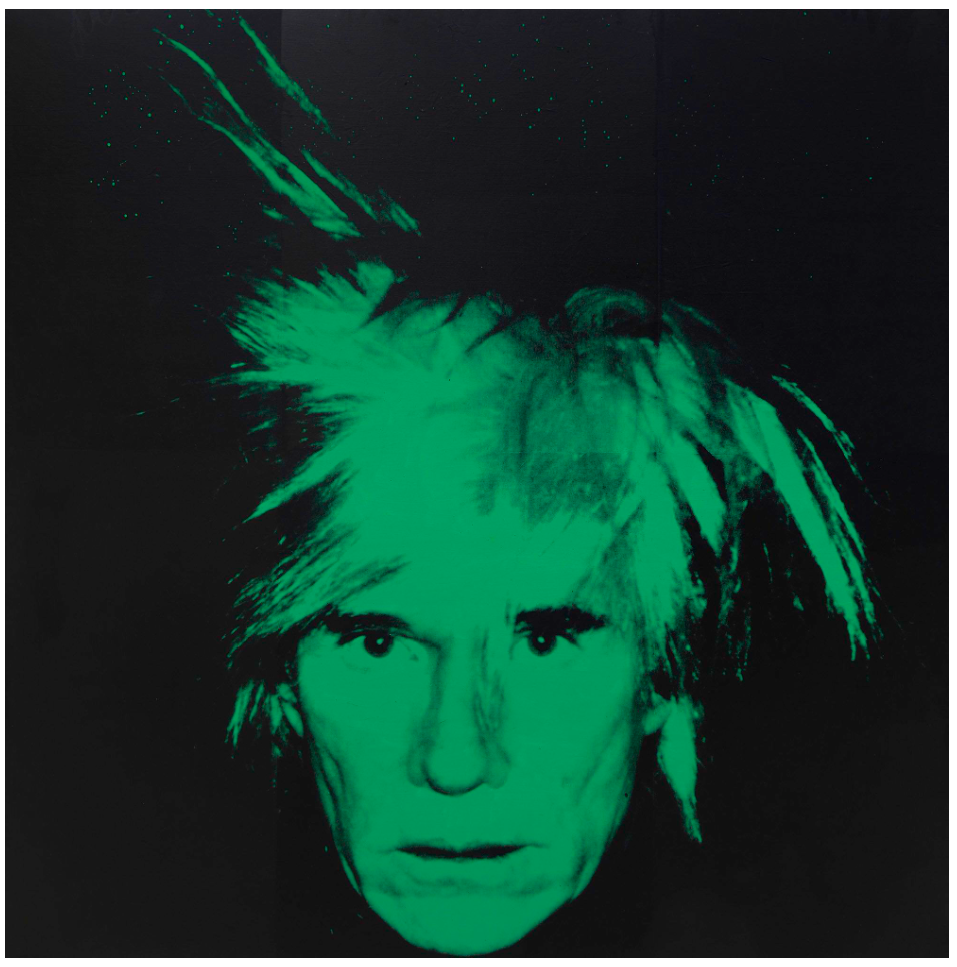
Andy Warhol, Self-Portrait, 1986. Solomon R. Guggenheim Museum, New York. Artwork: Artwork: © 2024 The Andy Warhol Foundation for the Visual Arts, Inc. / Licensed by DACS, London. Digital image: The Solomon R. Guggenheim Foundation/Art Resource, NY/ Scala, Florence.
Like many artists—from the Northern Renaissance painter Albrecht Dürer to Edvard Munch, who were both masters of manifesting their own image—throughout his lifetime Warhol was adept at presenting a version of himself to the public that he wanted to. In his very first painted self-portrait from 1963-1964, the young artist chose to depict himself shielded from the public gaze by dark sunglasses and the upturned collar of his trench coat. It was only with these later self-portraits that he himself embraced the Pop audacity that he had previously lavished on others. His response to the noble tradition of self-portraiture was to create an engaging series of works which were seemingly anonymous and emotionally vacant yet were in fact one of the most hauntingly accurate depictions of an artist ever made. Self-Portrait (Fright Wig) becomes, arguably, the work which establishes itself as the final icon of the famously enigmatic and often frighteningly clairvoyant persona that Warhol built for himself and presented to the world.
Self-Portrait (12×12)
Self-Portrait (Fright Wig), 1986
Phillips New-York: 17 May 2023
Estimated: USD 800,000 – 1,200,000
USD 1,633,000
Andy Warhol – 20th Century & Contemporar… Lot 10 May 2023 | Phillips
ANDY WARHOL
Self-Portrait (Fright Wig), 1986
Synthetic polymer paint and silkscreen ink on canvas
12×12 inches (30.5 x 30.5 cm)
Stamped twice by the Estate of Andy Warhol and the Andy Warhol Foundation for the Visual Arts, Inc., New York, and numbered “VF P040.010” on the overlap
Andy Warhol’s final series of self-portraits, created in the months before his untimely death in 1986, are the culmination of the artist’s lifelong fascinations with fame and death in the cult of celebrity. Self-Portrait (Fright Wig), 1986, is named for the spiky, peroxide blonde wig Warhol wears in the original Polaroid image. Warhol’s final self-portraits encapsulate the enigmatic celebrity persona Warhol cultivated throughout his career, reminding us that Warhol’s own performance of celebrity is an artistic feat on par with his accomplishments in silkscreen, portraiture, and film.
Three Self-Portraits, 1986
Christie’s London: 23 March 2021
Estimated: GBP 1,200,000 – 1,800,000
GBP 1,462,500 / USD 2,017,241
ANDY WARHOL (1928-1987) (christies.com)
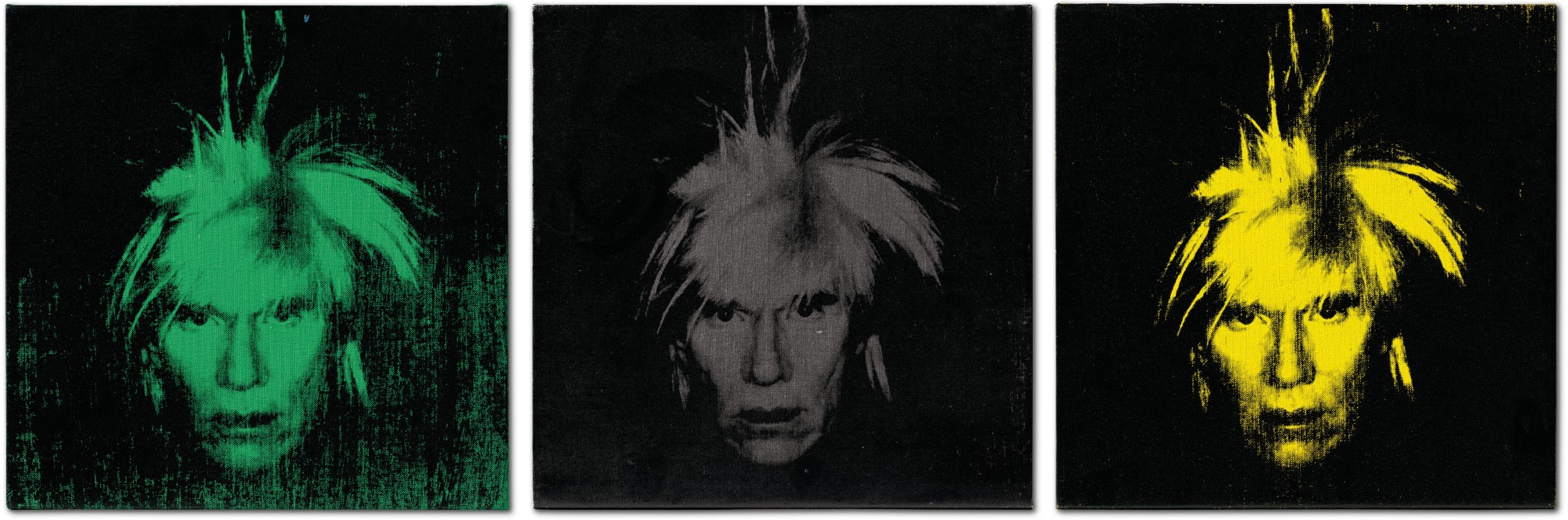
ANDY WARHOL (1928-1987)
Three Self-Portraits, 1986
Acrylic and silkscreen ink on canvas, in three parts
Each: 12×12 inches (30.5 x 30.5 cm)
Each stamped by the Estate of Andy Warhol and the Andy Warhol Foundation for the Visual Arts, Inc. Numbered ‘PA40.006’/’PA40.012’/’PA40.011’ (on the overlap and the stretcher)
A true landmark in the history of art, Andy Warhol’s 1986 self-portrait stands among his most iconic images. Created just months before his death, it takes its place alongside masterworks by Rembrandt, Van Gogh, Picasso and other artists who took their own aging visage as their last great subject. Adorned with a so-called ‘fright wig’, the artist’s skull-like face looms large amid a deep black void, haunting and enigmatic. In Three Self-Portraits, a trio of heads confronts the viewer, vividly rendered in green, silver and yellow. The work is notable for its triptych structure: like Francis Bacon, who made similar use of the format for his own late self-portraits, the artist stages a bold encounter with his mortality, meeting our gaze three times with his own penetrating stare. At the same time, the image is laced with dark humor, subversion and role play, befitting an artist whose identity and persona remained permanently shrouded in intrigue. It is a final flourish from one of the twentieth century’s greatest cultural giants: an image that continues to keep the world guessing.
Self-Portrait (10×8)
Self-Portrait (Fright Wig), 1986
Christie’s New-York: 17 November 2022
Estimated: USD 600,000 – 800,000
USD 1,071,000
ANDY WARHOL (1928-1987) (christies.com)
Self-Portrait (Fright Wig), 1986
Acrylic and silkscreen ink on canvas
10×8 inches (25.4 x 20.3 cm)
Signed, stamped with the Andy Warhol Art Authentication Board, Inc. stamp
Numbered and dated ‘Andy Warhol 86 A153.0310’ (on the overlap)
Self-Portrait (Fright Wig), 1986
Estimated: USD 500,000 – 700,000
USD 1,197,000
Self-Portrait (Fright Wig), 1986
Acrylic and silkscreen ink on canvas
10×8 inches (25.4 x 20.3 cm)
Signed, stamped with the Andy Warhol Art Authentication Board, Inc. stamp
Numbered and dated ‘Andy Warhol 86 A152.0310’ (on the overlap)
Self-Portrait, 1981
Self-Portrait, 1981
Phillips New-York: 19 November 2024
Estimated: USD 4,000,000 – 6,000,000
USD 3,448,000
Andy Warhol – Modern & Contemporary… Lot 15 November 2024 | Phillips
ANDY WARHOL
Self-Portrait, 1981
Synthetic polymer paint and silkscreen ink on canvas, diptych
Each: 40×40 inches (101.6 x 101.6 cm)
Each signed and dated “Andy Warhol 81” on the overlap
Andy Warhol’s 1981 Self-Portrait diptych captures a rare vulnerability within the artist’s otherwise meticulously crafted public image. Executed in synthetic polymer and silkscreen ink on canvas within the forty-by-forty-inch format typical of his commissioned celebrity portraits, this double self-portrait elevates Warhol’s own likeness to the monumental status he usually reserved for Hollywood stars and political figures. Debuting in the celebrated 1999 exhibition Andy Warhol: Paintings and Sculpture at the Anthony d’Offay Gallery in London, where it was the sole image on the invitation card, Self-Portrait continued to gain recognition on a major European tour of Warhol’s iconic “selfies” between 2004 and 2005, showcasing the portrait in a new light. Visually, the diptych departs from his earlier, staged self-images: Warhol’s head tilts slightly away, yet his gaze locks directly into the lens with an expression that borders on vacant, almost evasive, striking his signature contradictory balance between sincerity and artifice. Distinguished by its rarity, this striking composition disrupts the deliberately enigmatic public persona of “Andy Warhol,” offering a rare glimpse into the artist’s reflections on fame, identity, and the complexities of self-representation throughout his career.
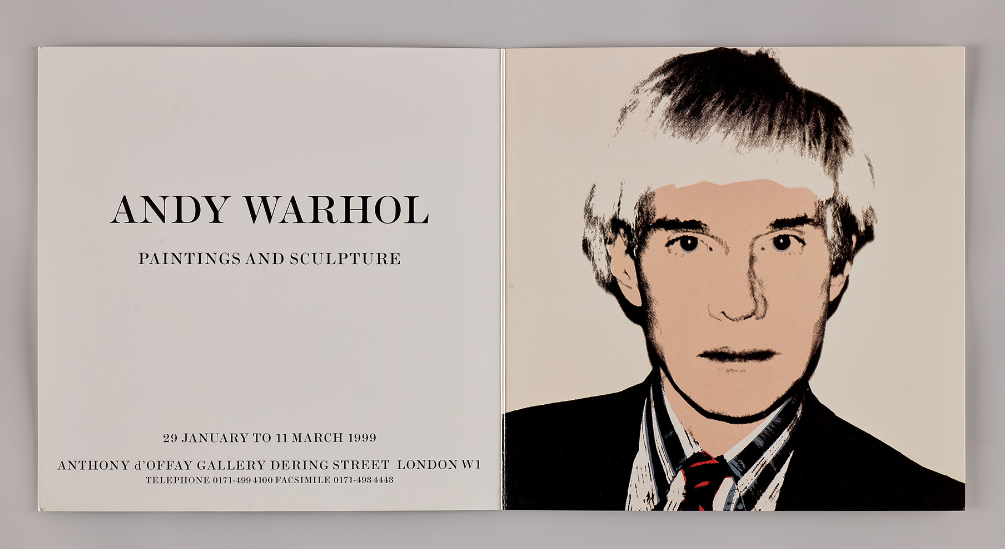
The present work illustrated on the invitation card for Andy Warhol: Paintings and Sculpture (January 29–March 11, 1999) at Anthony d’Offay Gallery, London.
Artwork: © 2024 The Andy Warhol Foundation for the Visual Arts, Inc. / Licensed by Artists Rights Society (ARS), New York
By the early 1980s, Warhol’s public image was a meticulously controlled fabrication, a “character” that he inhabited, marked by his trademark white wig, glasses, and iconic attire.
“If you want to know about Andy Warhol, then just look at the surface of my pictures and there I am; there’s nothing in between.”
Self-Portrait both embodies this philosophy and subtly undermines it; while it invites viewers to engage with his familiar visage, there is a sense of exposure here that unsettles the usual boundary between Warhol the icon and Warhol the individual. His carefully constructed image—his “surface”—is present, yet something about the reserved tones and somber gaze suggests a Warhol who is, for once, less guarded. Yet, in Self-Portrait, Warhol appears deviate slightly from his public identity as eccentric self-fashioned Superstar, showing himself stripped-back, straight on, and even somewhat self-conscious. This complex portrayal offers a critique of the image he had so carefully constructed, portraying a Warhol both embedded within and detached from his own mythology.
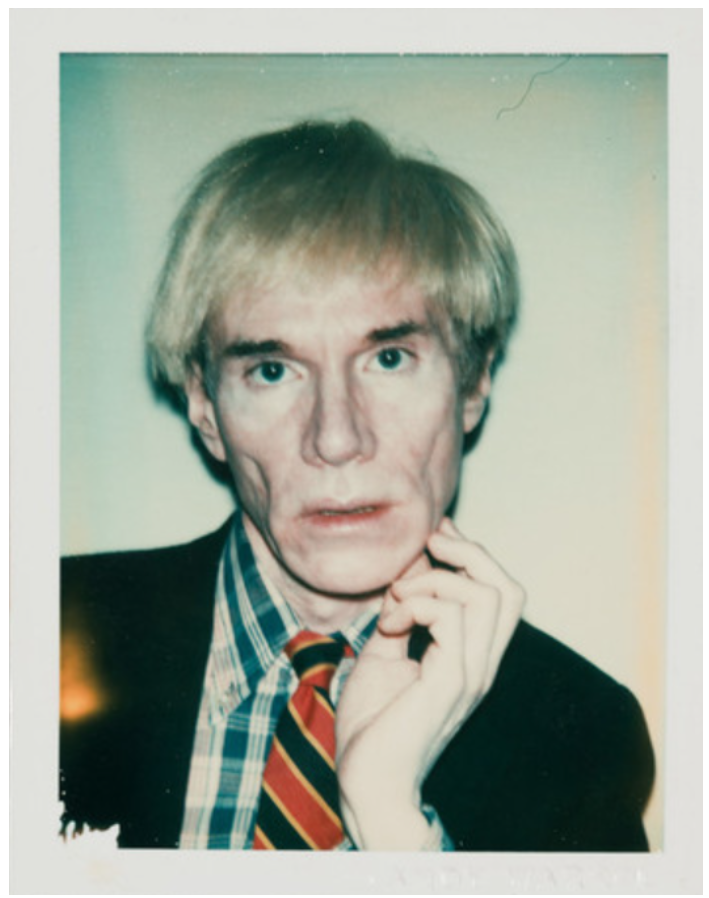
Andy Warhol, Self-Portrait, 1981. Both Polaroids, The Andy Warhol Museum, Pittsburgh; Founding Collection, Contribution The Andy Warhol Foundation for the Visual Arts, Inc. Artwork: © 2024 The Andy Warhol Foundation for the Visual Arts, Inc. / Licensed by Artists Rights Society (ARS), New York
As Warhol’s fame continued to grow and his persona as an impassive, scene-shifting observer became a marketable asset, he launched a second career as a model and product spokesperson. Around the time of this painting’s execution, he signed with both the Ford and Zoli modeling agencies, appearing in print and television ads for brands like Barney’s, Sony, and Drexel Burnham, among others. The source images used in this diptych are photos of Warhol taken by Christopher Makos for a set card distributed by the Zoli Modeling Agency, Inc., even appearing alongside his profile in the agency’s spring 1981 model book, noted as available for “Special Bookings Only.” While Warhol typically appeared in ads, such as those for Vidal Sassoon Hair Spray, sporting his signature hairstyle and gravity-defying wigs, the Zoli headshots reveal a more unadorned Warhol, with fewer signs of the staging that characterizes his other self-portraits. These stripped-back images lend the diptych a rawness that stands in contrast to his other major self-portrait series of 1981, in which he appeared in variations of drag makeup and costuming, or his 1986 Fright Wig series—the last self-portrait cycle before his untimely death the following year.
“When I did my self-portrait, I left all the pimples out because you always should… Always omit the blemishes—they’re not part of the good picture you want.”
This philosophy holds true in the present example, though less so than in his self-portraits of the 1960s and 1970s, where saturated colors and layered effects gave his appearance an unnatural, even hyper-human quality that made his image a powerful tool for brands, helping them stand out in a market dominated by anonymous, uniformly attractive models. Warhol’s image cast an artistic glow on everything he touched—if he was secretly mocking the products he endorsed, no one seemed to notice. In Self-Portrait, however, Warhol proves that this glow was his own, independent of any single facet of his carefully crafted persona.
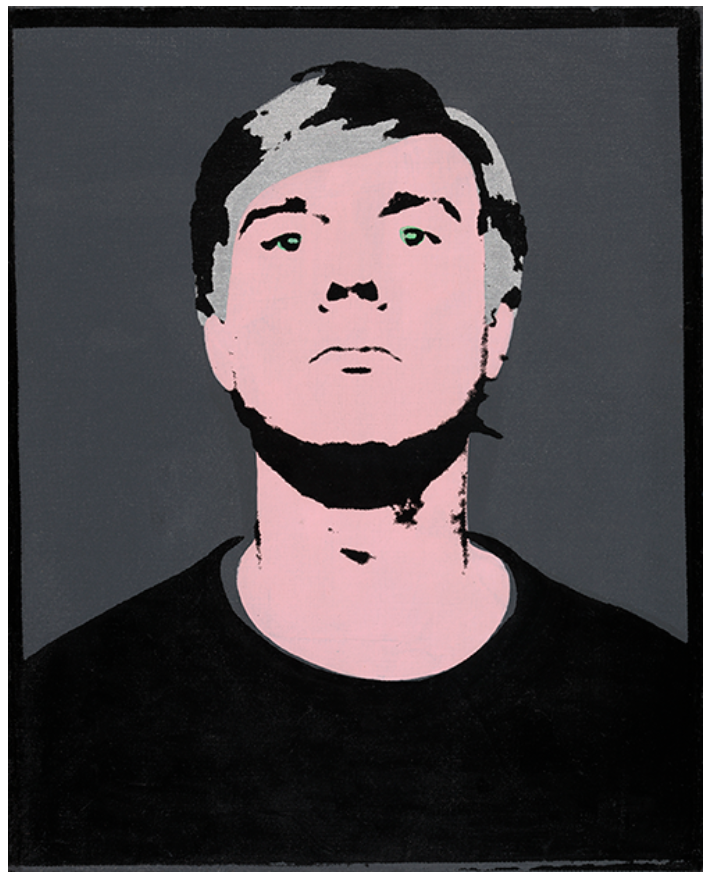
Andy Warhol, Self-Portrait, 1964. The Art Institute of Chicago.
The muted palette and pared-back composition of Self-Portrait contribute to a haunting stillness that is almost melancholic, distancing this work from the bold vibrancy of Warhol’s typical celebrity portraits. His face, rendered in soft shades, is devoid of his characteristic brightness, allowing a more somber tone to emerge. Warhol’s expression is uncharacteristically shy and inward, his gaze directed off-center as though evading the viewer’s scrutiny.The scale—typical of his commissioned celebrity portraits—elevates the present work, aligning Warhol’s self-image with the monumental presentation of his iconic subjects. This choice subtly reinforces Warhol’s dual role as both artist and cultural icon, presenting him as an individual worthy of the same visual reverence as the celebrities he portrayed. Yet, the simplicity of the composition contrasts with the bold, manufactured personas he typically depicted, capturing Warhol in a rare moment that is unguarded, even vulnerable. The portraits are punctuated by blue and red “outlines,” almost like a Wayne Thiebaud portrait where the figures are realistically rendered against white but have brightly colored edges that animate the form. This use of vibrant contours also resonates with Alice Neel’s signature electric blue line, carving out the figure and drawing the viewer’s eye, lending an expressionistic energy to Warhol’s otherwise subdued self-portrait. This intimate tone suggests a quiet introspection, veering away from his usual cool aesthetic and offering a glimpse of Warhol beyond the persona.
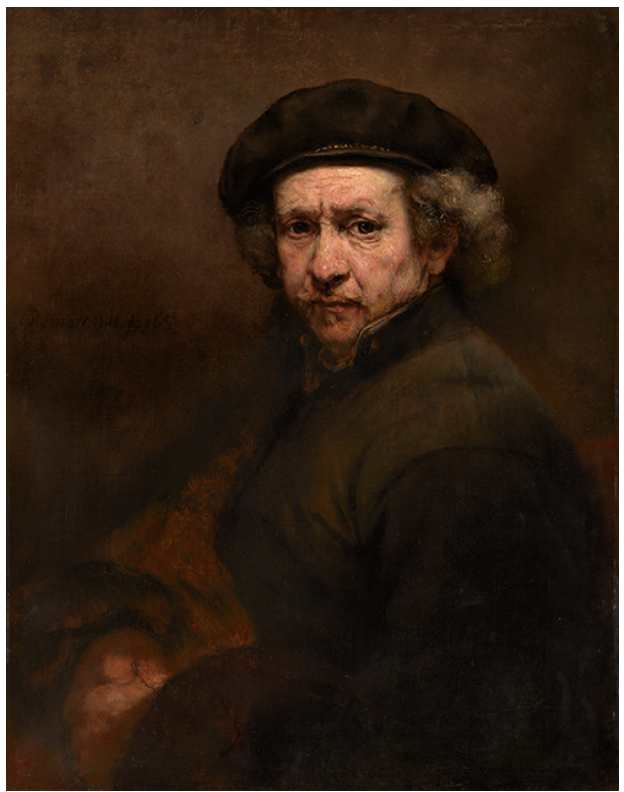
Rembrandt van Rijn, Self-Portrait, 1659. National Gallery of Art, Washington, D.C.
In Self-Portrait, Warhol aligns himself with a lineage of artists who have historically explored self-portraiture as a space of introspection. This work calls to mind the “tragic late self-portraiture” of artists like Rembrandt and Van Gogh, whose portraits often exposed raw emotion and a profound inward gaze. While these artists used self-portraiture to reveal intimate truths, Warhol’s Self-Portrait does not lay bare his psyche but instead suggests a tension between surface and depth, revelation and artifice. His assertion transforms self-portraiture from a space of revelation into one of spectacle, a canvas on which identity becomes a carefully curated image, distancing the viewer from the artist’s interior world while simultaneously asserting the primacy of surface over substance. In his fashioning of his self-image for a new decade, Warhol’s Self-Portrait subverts established expectations, treating self-representation not as a window into the soul but as a stage for constructing and performing identity. He once remarked on the commodification of his persona, describing how companies sought to purchase his “aura” rather than his art or ideas. This notion of “aura” encapsulates Warhol’s view of identity as surface, as a consumable and performative element of public life.
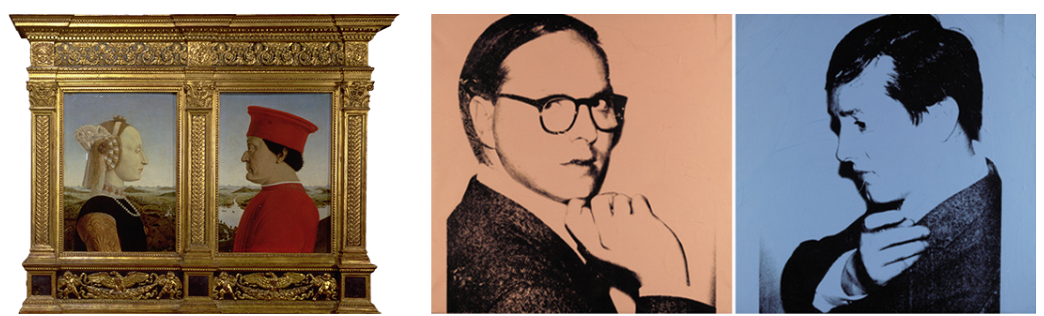
[Left] Piero della Francesca, Diptych of Federico da Montefeltro and Battista Sforza, 1465-1466.
[Right] Andy Warhol, Gilbert and George, 1975. Tate, London.
The diptych format adds a further layer of complexity to Self-Portrait, situating Warhol within the rich tradition of self-portraiture while exploring themes of fragmentation and duality. Historically, diptychs have been used to juxtapose contrasting elements—earthly and divine, light and dark, or secular and sacred—often evoking the devotional associations of religious altarpieces or commissioned portraits meant to inspire reverence and contemplation. By adopting this format, Warhol alludes to these historical conventions yet subverts them to reflect his own fractured identity as both an icon and a man concealed behind layers of artifice. The two panels, while nearly identical, reveal subtle variations in expression, evoking a suspended self-dialogue that captures the tension between Warhol’s public persona and private self. One image appears more reticent, the other slightly more assertive, suggesting an internal conflict between vulnerability and self-assured spectacle. This duality emphasizes Warhol’s role as both the orchestrator and the subject of his art, blurring the lines between self and spectacle, authenticity and performance. As noted by art historian Robert Rosenblum, this interplay creates a Warhol who is “both startlingly intimate and totally artificial,” inviting viewers to grapple with his complex relationship to fame and the ever-elusive nature of his true self.