Andy Warhol’s Crosses formed part of a 1982 exhibition in Madrid entitled “Guns, Knives and Crosses”, a trinity of subjects linked at the time to the Spanish Civil War and the country’s staunch Catholicism. However, these images clearly transcend their initial context, forming part of Warhol’s lifelong meditation on beauty, death and the passage of time. We can trace their lineage back to the iconic Death and Disaster series of the 1960s and the memento mori Skulls of the late 1970s. Despite his love of fame and public life, Warhol was intimately acquainted with tragedy and came close to death himself when he was shot by Valerie Solanas in 1968, an incident from which he never fully recovered.
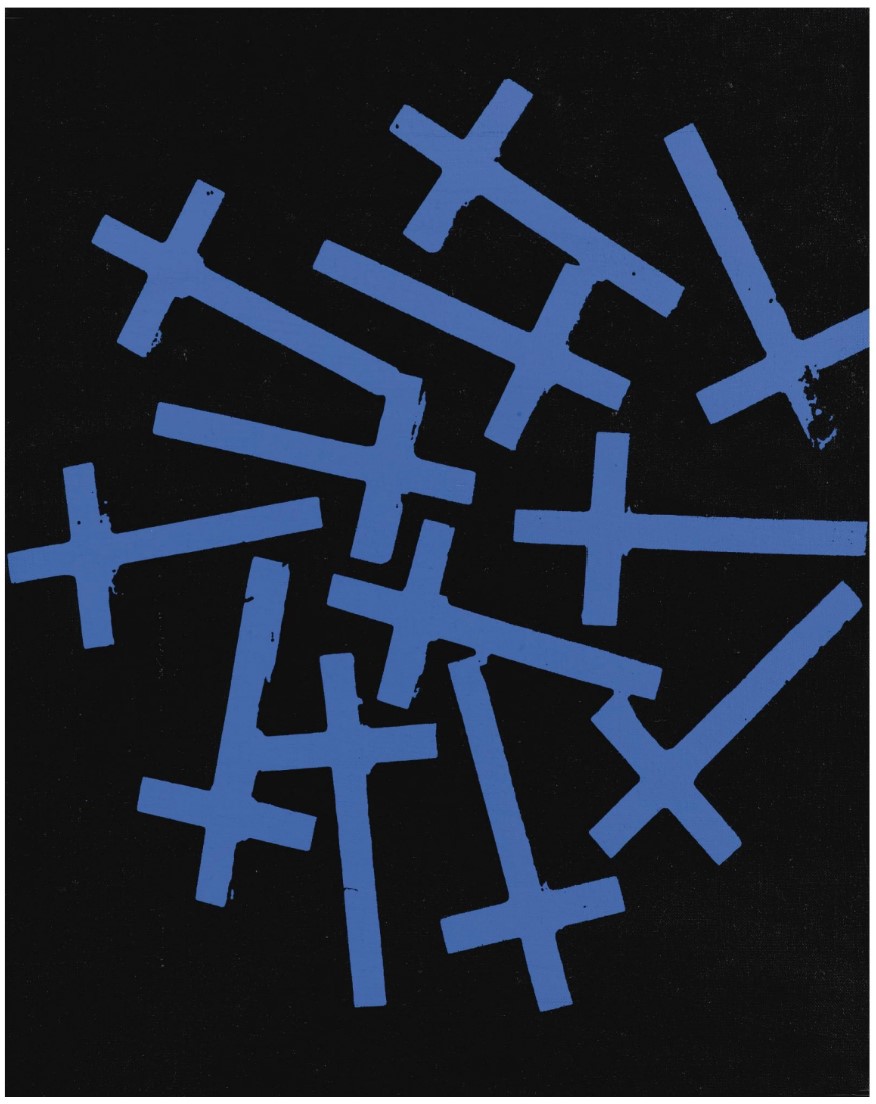
The cross is, of course, one of the most instantly recognizable and emotionally divisive symbols of the last two millennia, loaded with religious, cultural and historical associations. Warhol strips it to its simplest form, bringing to mind the rows of crosses in military cemeteries. In the present work, the crosses are clustered in a fan-like shape, so that their symbolic load is diluted not only through replication but also through the grid design formed by the multitude of intersecting bars in blue, pink and green. The association of the cross with the processes of industrial mass production can be interpreted as an irreverent take on the commoditization of religion, however it should also be remembered that Warhol was raised a Byzantine Catholic and that in the final years of his life he turned increasingly to Catholic themes. He began to merge the secular and the sacred in works such as his Last Supper paintings, based on Leonardo da Vinci’s masterpiece, and the series Details of Renaissance Paintings which features angels, Madonnas and the interiors of churches, sometimes in fragments.
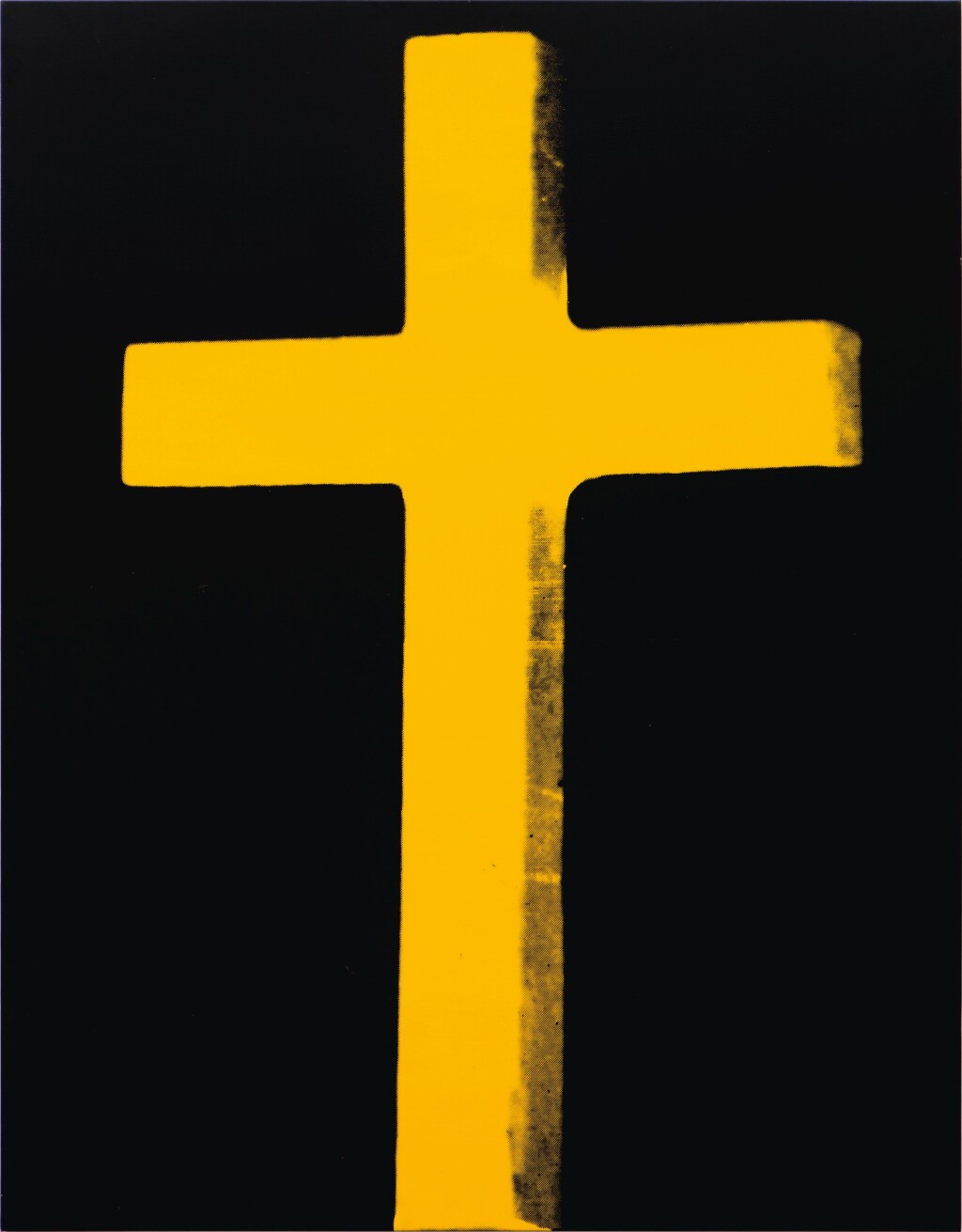
The defining artist of the contemporary age, Andy Warhol integrated the full spectrum of mass culture into his practice, depicting consumer goods with the same cool detachment as sensationalized car accidents and deceased Hollywood starlets. A devout Catholic, it was only the last decade of Warhol’s career that saw the artist consistently engaging with the subject of religion, culminating in commanding works such as Cross from 1982. A deeply personal painting that comments on the commodification of images and beliefs, as well as a highly conceptual foray into abstraction and pictorial flatness, Cross is an enduring masterwork of Warhol’s oeuvre.
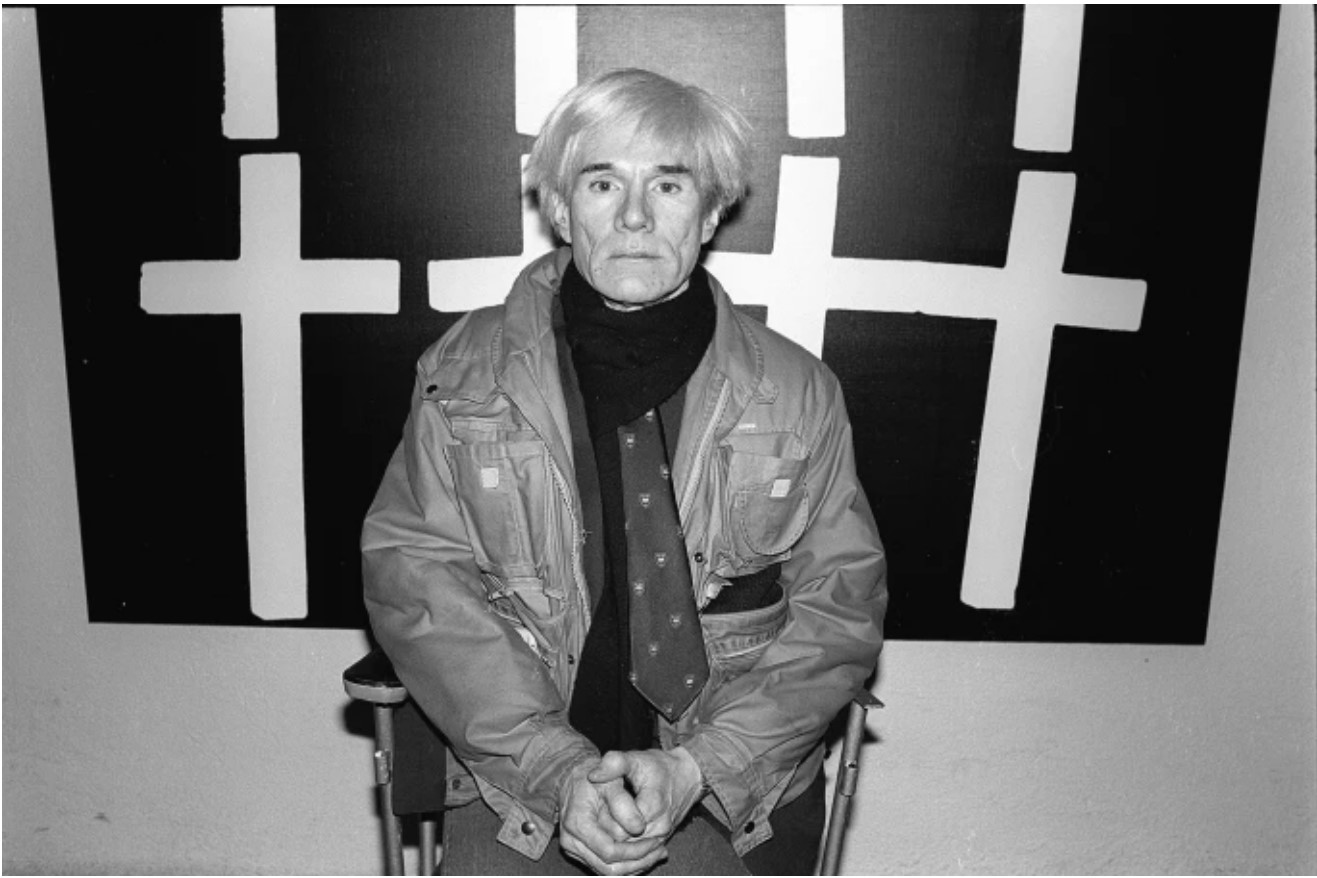
ANDY WARHOL PHOTOGRAPHED AT THE GALLERIA FERNANDO VIJANDE IN MADRID, 1983. PHOTO © CHRISTOPHER MAKOS. ART © 2020 ANDY WARHOL FOUNDATION FOR THE VISUAL ARTS / ARTISTS RIGHTS SOCIETY (ARS), NEW YORK
Andy Warhol was born in 1928 and raised in a profoundly religious Byzantine Catholic family in Pittsburgh, attending multiples services a week during his adolescence. While the young artist would later leave Pennsylvania for New York to become a commercial illustrator and eventually find critical success, Warhol’s formative relationship with religion would prove to be an enduring influence on his life and art, and according to the late art historian John Richardson, “Andy was a Catholic who went to Mass every single day of his life.” (John Richardson in conversation with Tobias Meyer, New York, October 2013).
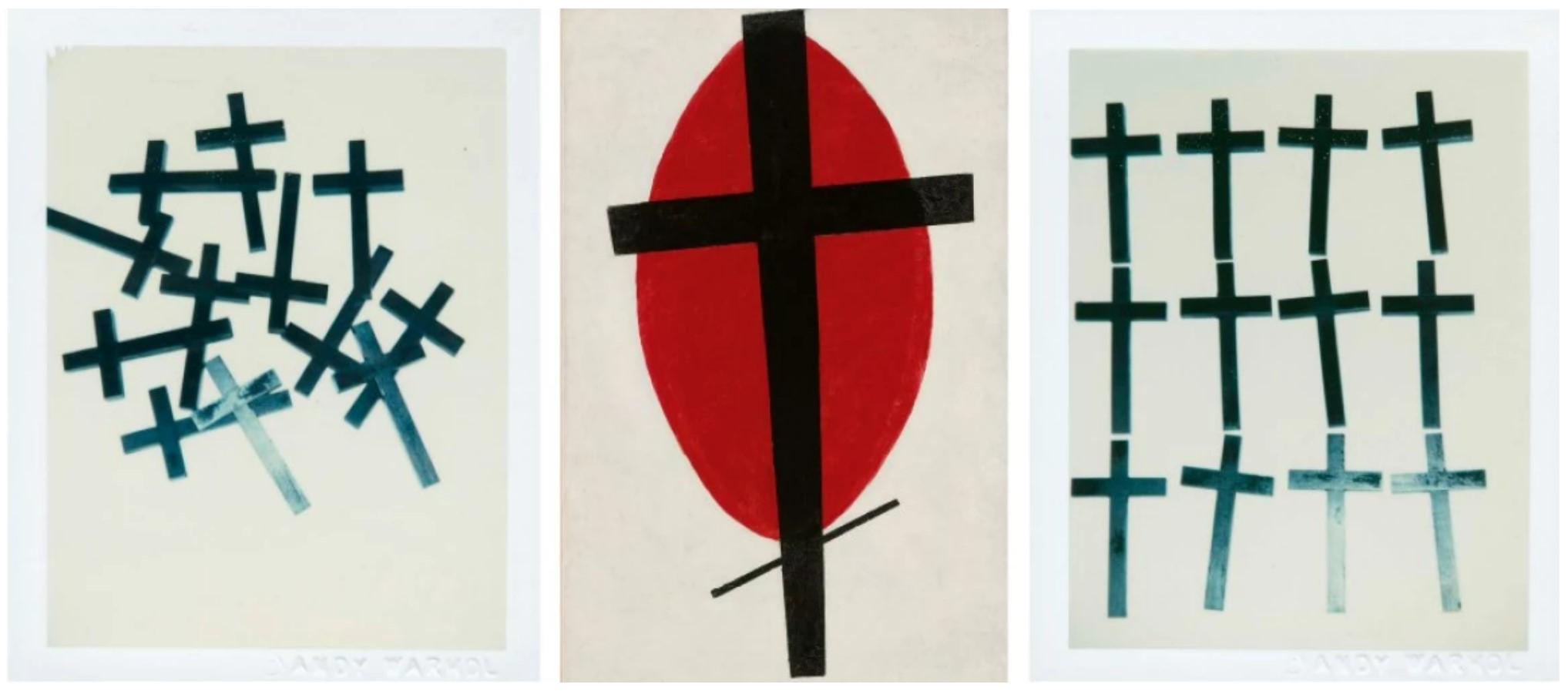
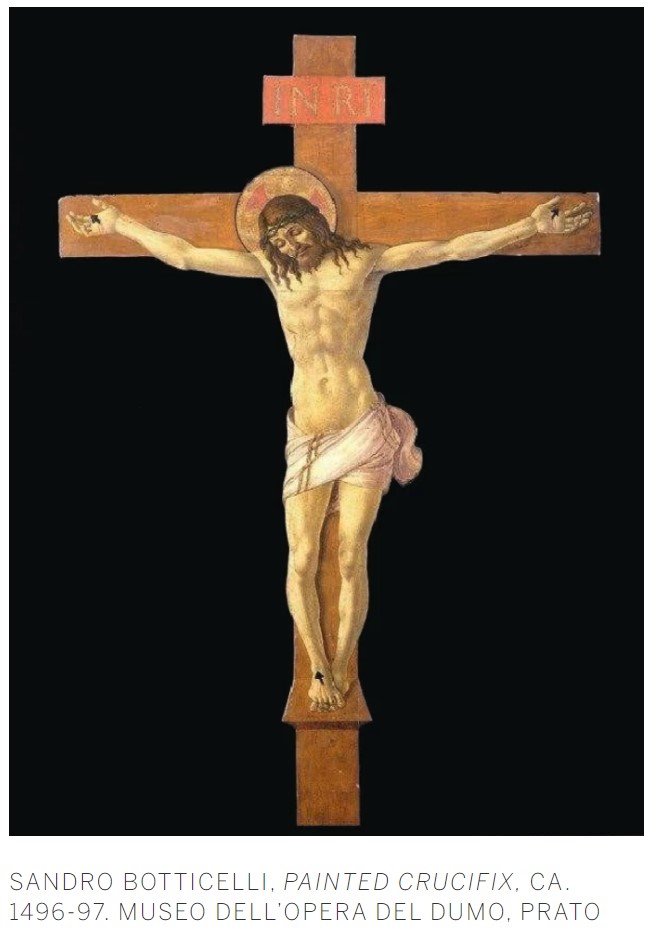
LEFT AND RIGHT: ANDY WARHOL, POLAROID OF CROSSES, 1982. ART © 2020 ANDY WARHOL FOUNDATION FOR THE VISUAL ARTS / ARTISTS RIGHTS SOCIETY (ARS), NEW YORK
MIDDLE: KAZIMIR MALEVICH, MYSTIC SUPREMATISM (BLACK CROSS ON RED OVAL), 1920-1922. PRIVATE COLLECTION. SOLD SOTHEBY’S NOVEMBER 2015 FOR $37.7 MILLION
The tenets of Christian artistic tradition permeated Warhol’s oeuvre even in his depiction of secular subject matter. The artist mapped the contemporary fascination with death and spectacle onto sacred frameworks, engaging the concept of memento mori in forms as diverse as portraits of Jackie Kennedy and Marilyn Monroe, still lifes of skulls and weapons, and literal depictions of tragedy in his Death and Disaster series. Keenly aware of his own mortality, particularly following an attempt on his life in 1968, Warhol returned to this formative subject matter in the 1980s, appropriating images of Leonardo da Vinci’s Last Supper as well as crosses, culminating in the present work.
Cross is an interpretation of ancient tradition in a contemporary context, bringing disparate visual languages from the twentieth century into conversation with much older religious and cultural concepts. The large yellow cruciform is the subject of the work as well as a formal device, splitting the canvas into geometric planes in the vein of Kazimir Malevich’s Supremacist compositions. While darker tones along the right edge of the form denote three-dimensionality, the work is not a mimetic rendering of its subject; the eponymous Cross is isolated in a void, a glowing, graphic construction of linear forms that underscore the artist’s ability to make the rote and familiar feel entirely new, echoing the Flag paintings of Jasper Johns. Keenly aware of the semiotic power of the cross as an almost universal graphic symbol, Warhol’s painting undermines that authority. Within the artist’s visual world, there was little difference between mass-produced soup cans and mass-produced religious paraphernalia. In an age where the acquisition of property and consumer goods had come to be viewed as noble a pursuit as religious devotion, Warhol’s Cross became the apotheosis of his career-defining artistic aims, blurring the lines between the sacred and the profane.
1. Cross (90×70)
Sotheby’s New-York: 29 June 2020
USD 2,660,000
ANDY WARHOL
Cross, 1982
Acrylic and silkscreen ink on canvas
90×70 inches (228.6 x 177.8 cm)
Signed and dated 82 on the overlap
Stamped by The Andy Warhol Art Authentication Board
Numbered A106.113 on the overlap
Imposing in scale, Cross is an interpretation of ancient tradition in a contemporary context, bringing disparate visual languages from the twentieth century into conversation with much older religious and cultural concepts. The large yellow cruciform is the subject of the work as well as a formal device, splitting the canvas into geometric planes in the vein of Kazimir Malevich’s Supremacist compositions. While darker tones along the right edge of the form denote three-dimensionality, the work is not a mimetic rendering of its subject; the eponymous Cross is isolated in a void, a glowing, graphic construction of linear forms that underscore the artist’s ability to make the rote and familiar feel entirely new, echoing the Flag paintings of Jasper Johns. Keenly aware of the semiotic power of the cross as an almost universal graphic symbol, Warhol’s painting undermines that authority. Within the artist’s visual world, there was little difference between mass-produced soup cans and mass-produced religious paraphernalia. In an age where the acquisition of property and consumer goods had come to be viewed as noble a pursuit as religious devotion, Warhol’s Cross became the apotheosis of his career-defining artistic aims, blurring the lines between the sacred and the profane.
Christie’s New-York: 13 May 2008
USD 2,001,000
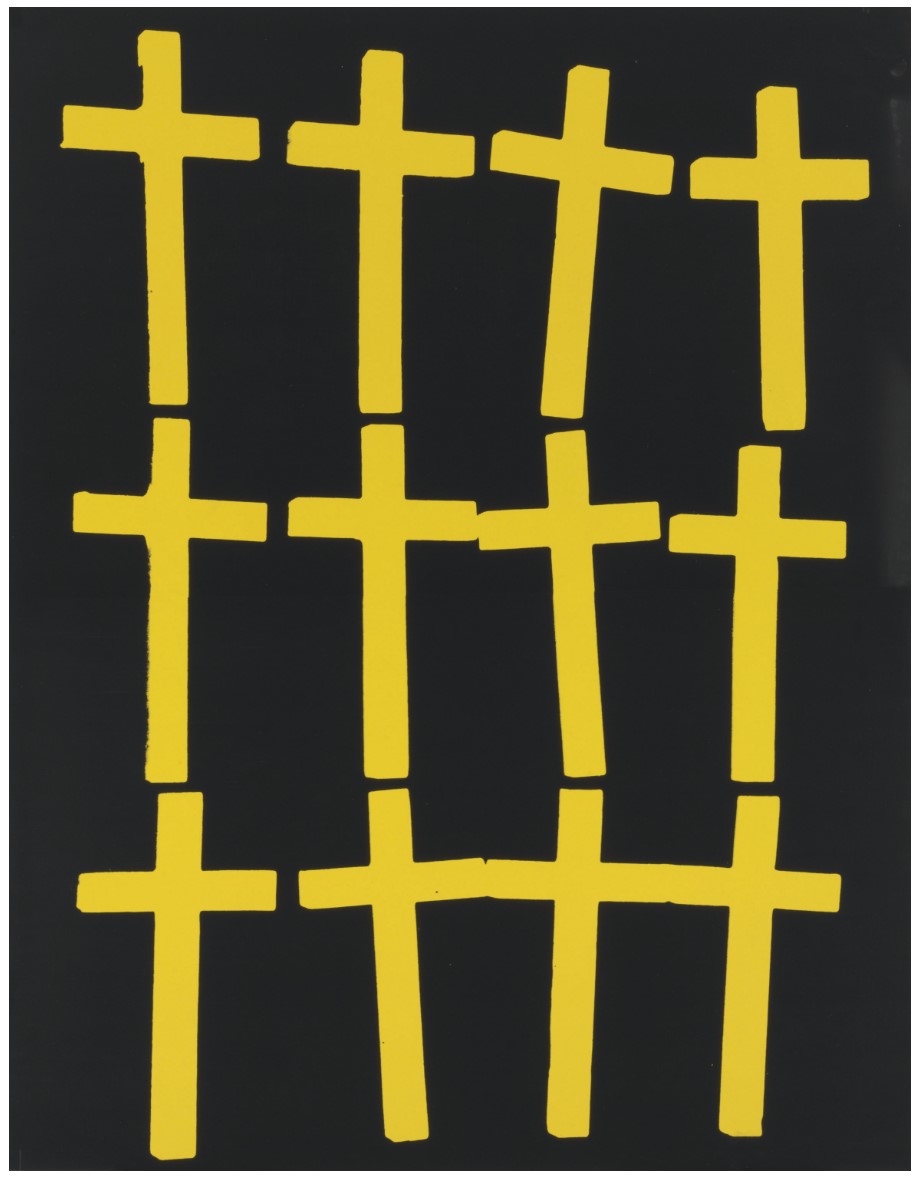
ANDY WARHOL
Crosses, 1981-82
Synthetic polymer and silkscreen inks on canvas
90×70 inches (203.2 x 177.8 cm)
2.Cross (45×50)
Sotheby’s New-York: 11 May 2011
USD 410,500
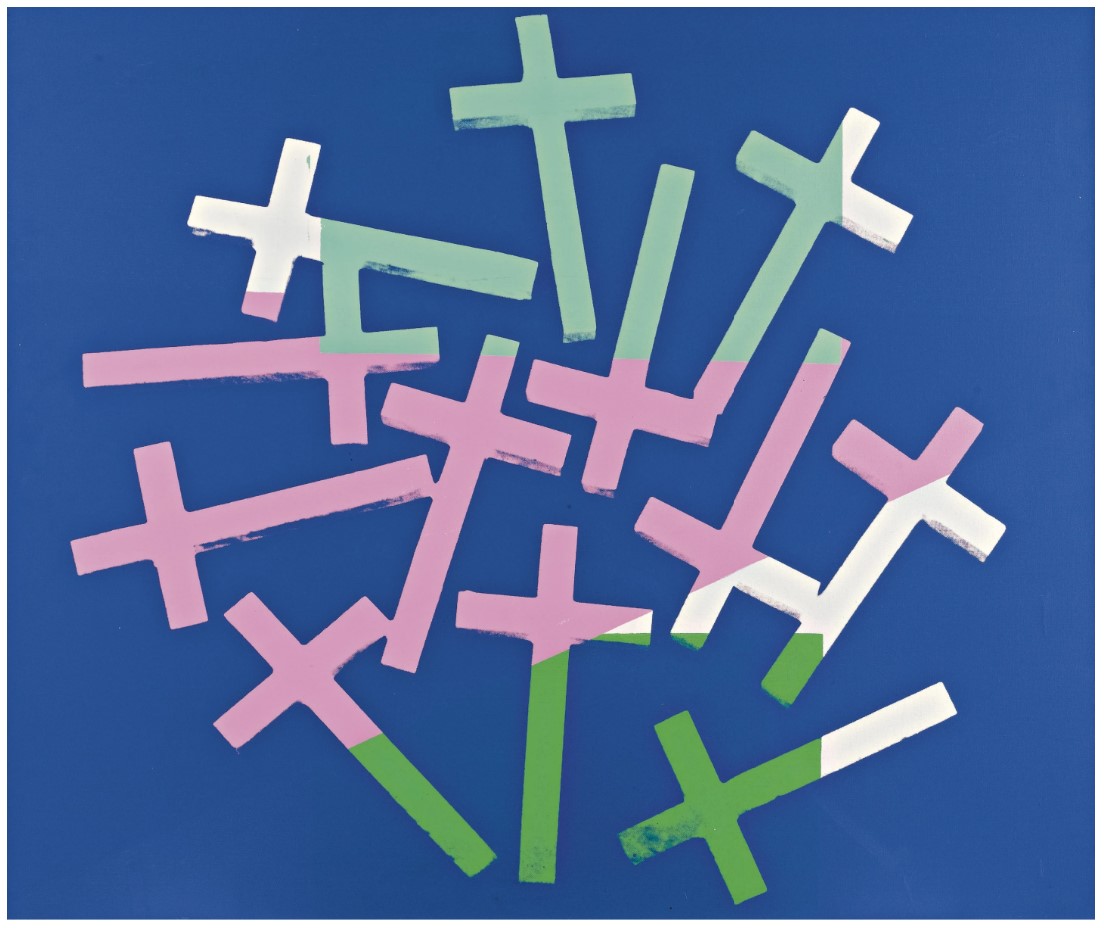 ANDY WARHOL
Crosses, 1982
Synthetic polymer paint and silkscreen ink on canvas
42×50 inches (106.7 x 127 cm)
Stamped by the Andy Warhol Art Authentication Board, Inc.
Numbered A103.113 on the overlap
Signed and dated 82 on the overlap
3. Cross (16×20)
Sotheby’s New-York: 13 May 2009
USD 123,500
ANDY WARHOL
Crosses
Synthetic polymer paint and silkscreen inks on canvas
20×16 inches (50.8 x 40.6 cm)
Sotheby’s New-York: 15 May 2008
USD 175,000
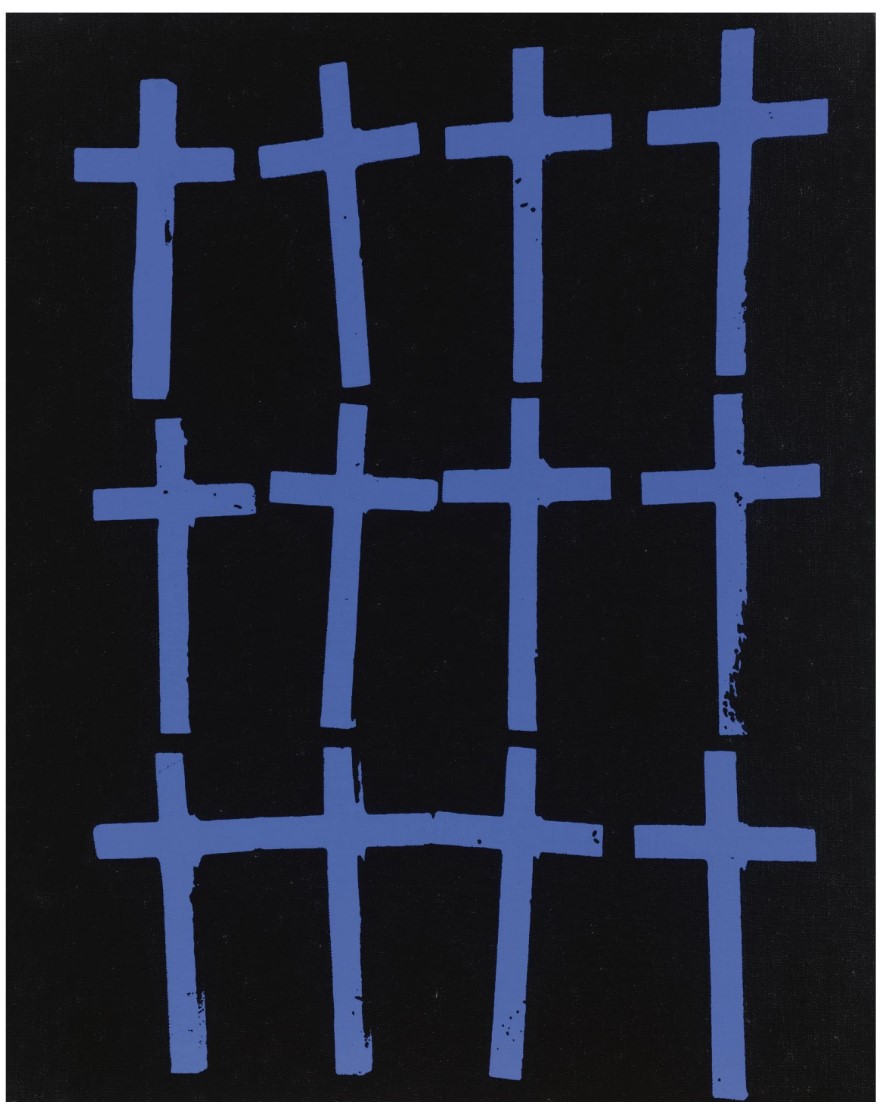 ANDY WARHOL
Crosses (Blue), 1981-1982
Acrylic and silkscreen ink on canvas
16×20 inches (40.5 x 50.8 cm)