Very New Paintings were executed in the artist’s Malibu studio between 1992 and 1993. This concise corpus of work explores and unites the traditions of abstract and landscape painting via rich hues and complex spatial arrangements.
“Someone said that the Very New Paintings are abstract narratives. Certainly a great deal of thought and feeling have gone into them. For example, here at the beach I am between two great forces, the mountains and the sea. The mountains were made by a great force of nature, a thrusting force, which calmed in time, leaving them here, grand and peaceful. While below the other thrust continues, the endless movement of the sea. These forces are present, I believe, in the paintings”
This series is comprised of twenty-five works, and iterations have been included in recent and critically acclaimed retrospectives on Hockney’s work, including the major travelling exhibition David Hockney at Tate Britain, London, Centre Georges Pompidou, Paris, and The Metropolitan Museum of Art, New York between February 2017 and February 2018.
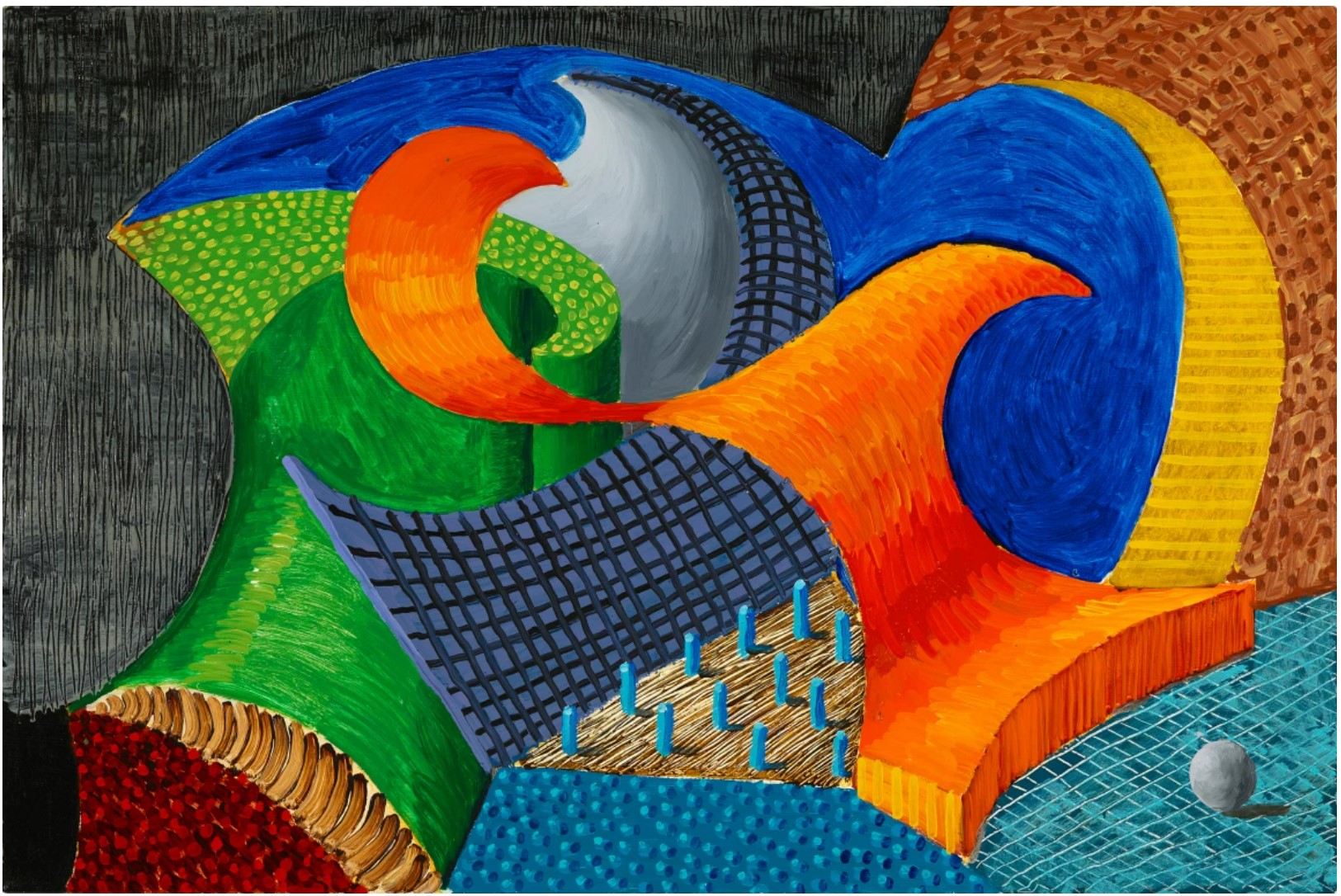
DAVID HOCKNEY, THE ELEVENTH V.N. PAINTING, 1992
THE DAVID HOCKNEY FOUNDATION COLLECTION
IMAGE: © RICHARD SCHMIDT
ARTWORK: © DAVID HOCKNEY
A number of works from the series reside in the collection of The David Hockney Foundation, such as The Fourth V.N. Painting and The Eleventh V.N. Painting, both executed in 1992, a testament to the series’ importance within the artist’s expansive oeuvre.
The Twelfth V.N. Painting, 1992
Christie’s Hong-Kong: 27 September 2025
Estimated: HKD 15,000,000 – 20,000,000
HKD 27,340,000 / USD 3,514,140
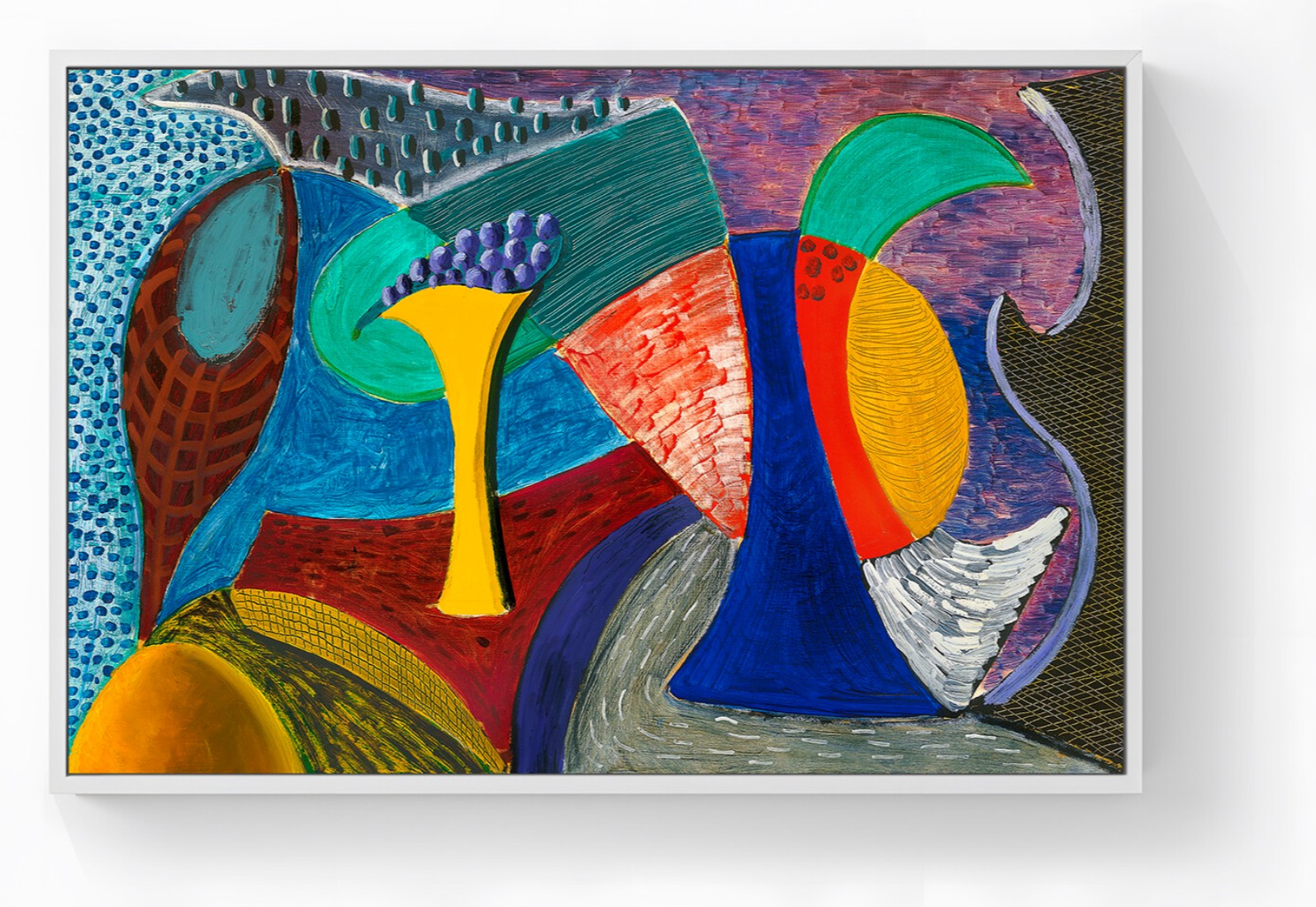
DAVID HOCKNEY (B. 1937)
The Twelfth V.N. Painting, 1992
Oil on canvas
24 x 36 inches (61 x 91.4 cm)
Signed, titled and dated ‘David Hockney 92 The Twelfth V N Painting’ (on the reverse)
Highly stylized, bold, and bursting with kaleidoscopic energy, The Twelfth V.N. Painting is a remarkable example from David Hockney’s The V.N. Paintings (short for Very New Paintings)—a seminal series of 26 abstract pieces that marked a pivotal moment in his artistic evolution. The series reflected a fusion of influences – the spatial awareness developed through his opera set designs, his personal theories on perspective, and the vivid inspiration drawn from the Malibu coastline. The present work was featured in several notable exhibitions throughout the 1990s and beyond, such as the Summer Exhibition at London’s Royal Academy of Art in 1993 and in Crosscurrents: Modern Art from the Sam Rose and Julie Walters Collection at the Smithsonian American Art Museum in Washington D.C. from 2015 to 2016.
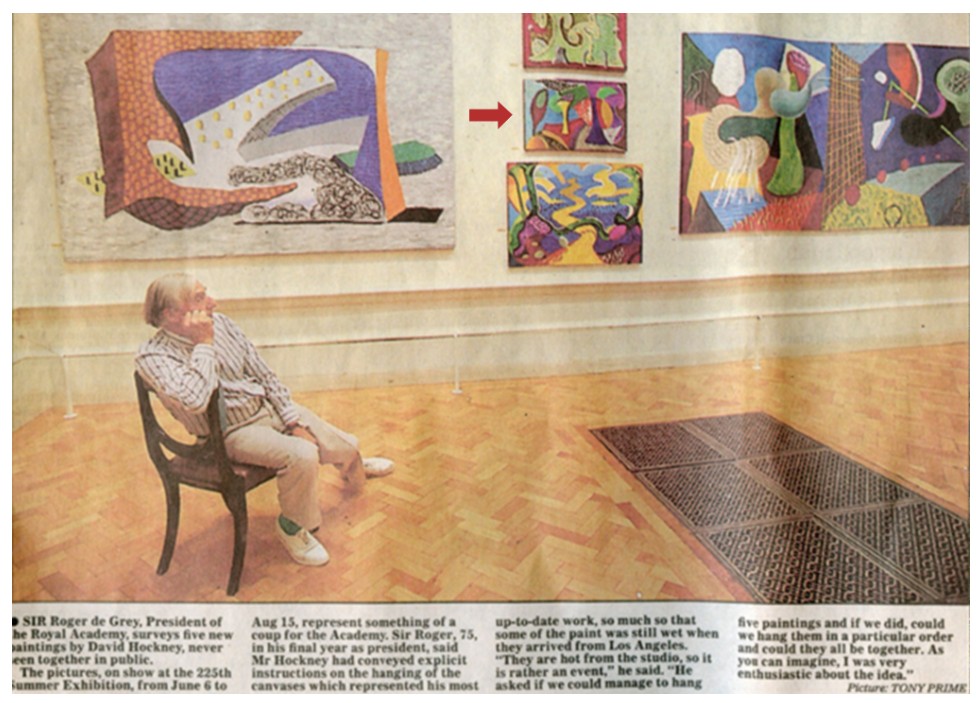
Roger de Grey sitting in front of David Hockney’s contribution to the 1993 Summer Exhibition, current lot is marked with arrow, reproduced in The Daily Telegraph, 26 May 1993. Digital image courtesy of Tony Prime
Hockney became deeply involved in stage design in the late 1980s, creating sets for Tristan und Isolde (1987), followed by Turandot and Die Frau ohne Schatten in 1992, the same year he painted The Twelfth V.N. Painting. The intense hues of greens and blues, fiery oranges and reds of the present work immediately capture the viewer’s attention, the effect of which mirrors the phantasmagorical lights that cast across the landscape of stage design of Die Frau Ohne Schatten.
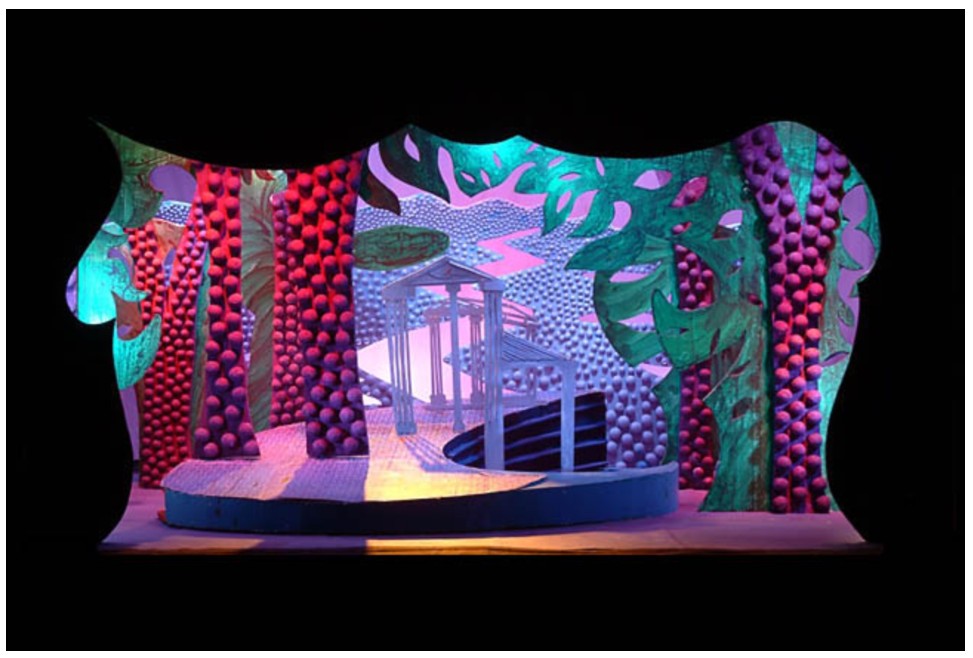
Stage design for Die Frau Ohne Schatten, performed at the Royal Opera, London, 1992. © David Hockney
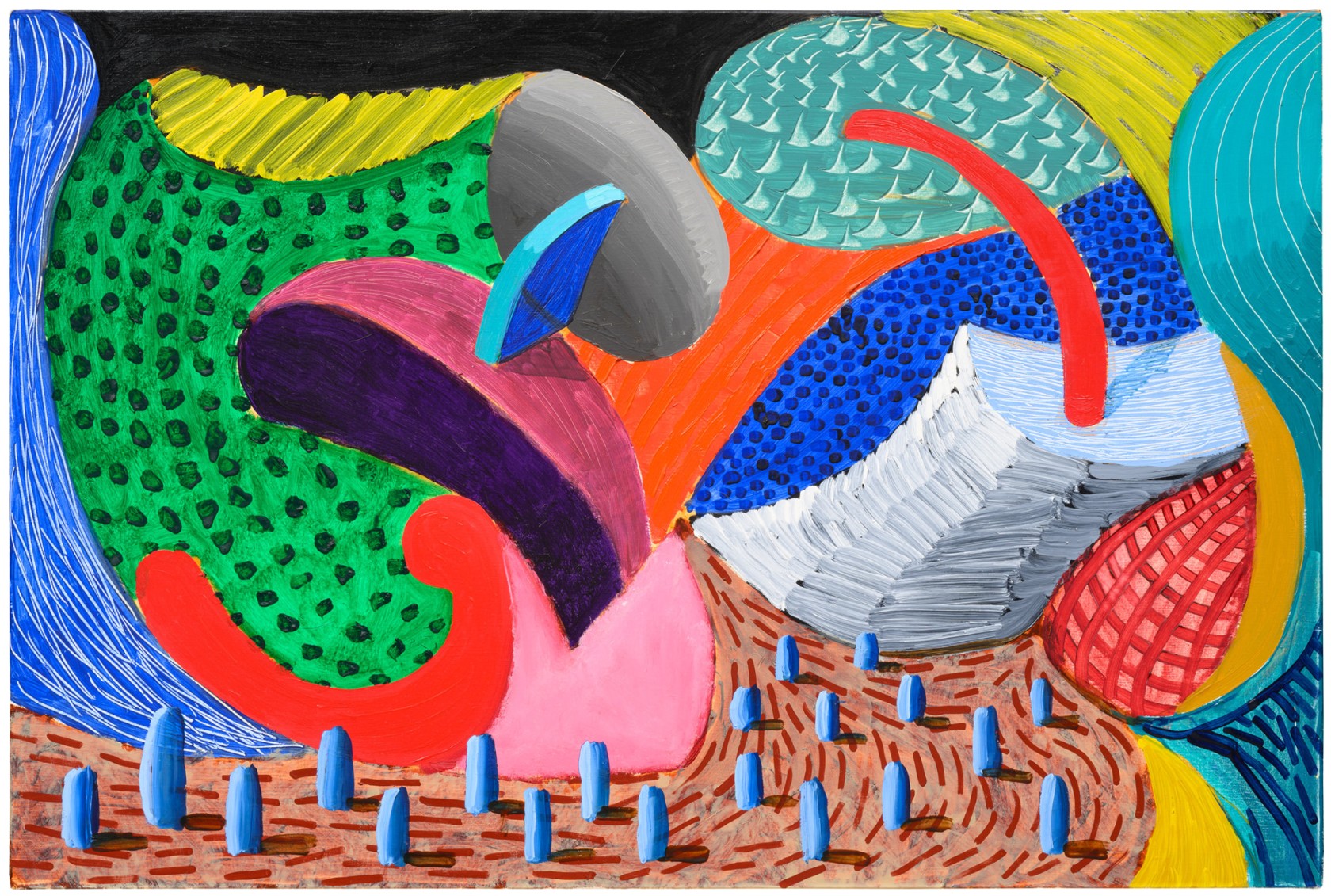
Set against a grey-blue outcrop in the upper left and center of the composition, several rows of carefully placed blue roundels evoke the presence of performers on an opera stage.
The V.N. Paintings series marks a turning point in Hockney’s art as it reveals his deep engagement with the traditions of art history. In the present work, the vibrant swathes of saturated color evoke the influences of several early twentieth-century masters. Its vibrant energy recalls Picasso’s dynamic layering of paint, while the interplay of shapes and tones echoes Robert Delaunay’s balance between abstraction and figuration. Franz Marc’s expressive compositions also resonate here, sharing a similar sense of movement and emotional intensity.
“People said that the New Paintings had a three-dimensional look. I feel that is true, in the sense that they have two spatial dimensions – vertical and horizontal – and that the third dimension is of course time, the time you give a picture when you look at it and it pulls you in and moves you round and you therefore become aware of taking time.”
Rather than presenting a fixed narrative, Hockney’s work invites the viewer into an immersive experience, encouraging a personal journey through what he calls the “internal landscape.” This connection resonates prominently in the Twelfth (the present work) through the Fourteenth V.N. Paintings, as they were created in Bridlington, Yorkshire, during Hockney’s visit to his mother and sister in June 1992. The intimacy of that setting subtly informs the emotional depth and introspective quality of these works. In The Twelfth V.N. Painting, Hockney constructs a dynamic visual field in the foreground using short white strokes scattered across a soft grey backdrop. These marks suggest the motion and rhythm of a highway, guiding the viewer’s eye through the composition like directional cues.
To the left, a grid of curved lines on a yellow background connects with a red surface, creating spatial depth and evoking the contours of a stadium or amphitheater. The interplay between these linear elements introduces a sense of three-dimensionality and transforms the flat canvas into an immersive environment.
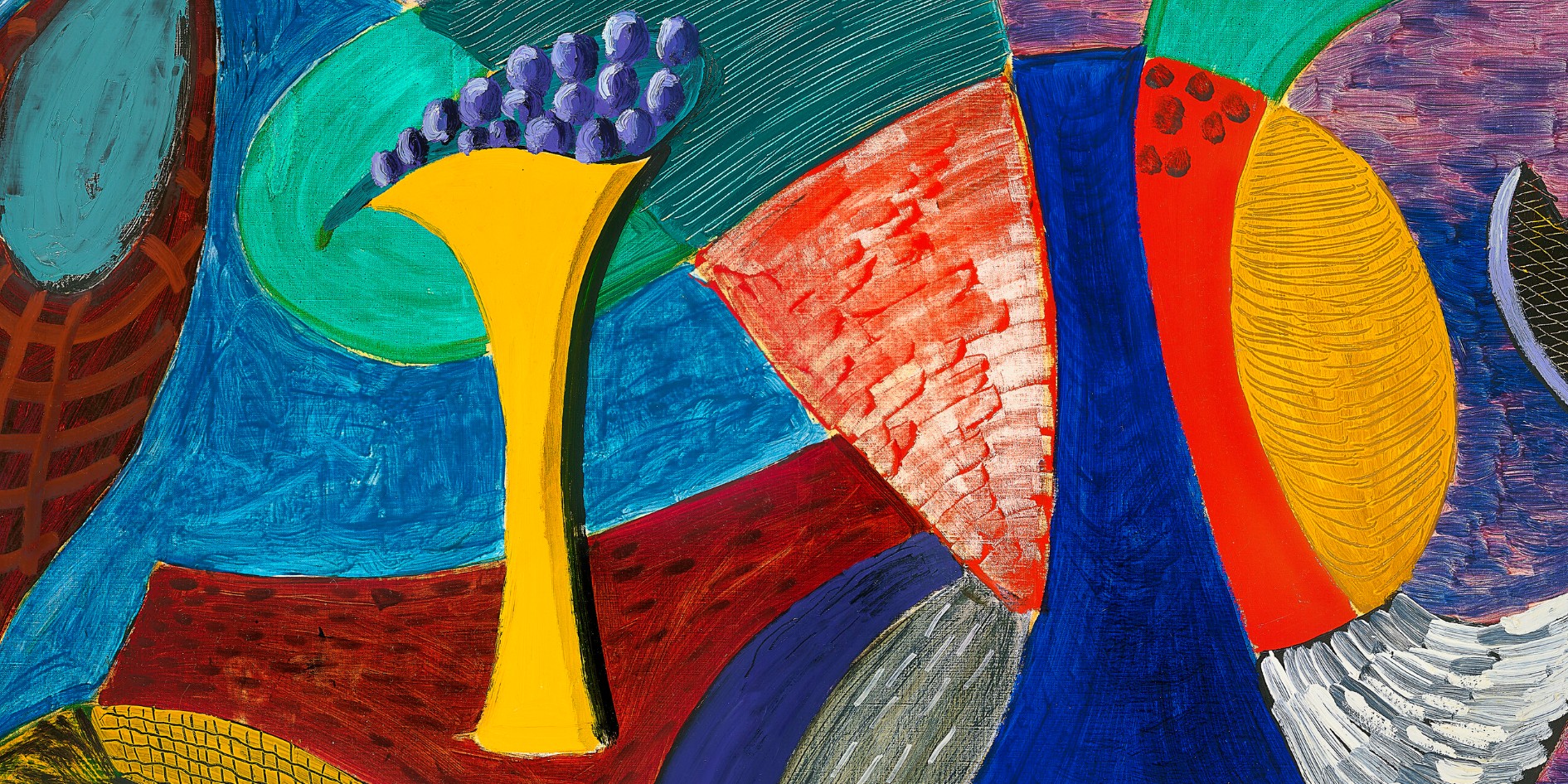
From the outset, Hockney had viewed the two-dimensional world of the picture as both a challenge and a trap, believing that rigid conventional perspective often falls short of capturing the way we truly see and experience our surroundings. Traditional perspective tends to present time as static and space as fixed, anchoring the viewers in place and limiting their presence. For Hockney, truly seeing requires active observation, and real representation should capture that lived experience. When real space entered his creative process through the medium of stage design and the vast, dynamic landscape of Malibu, it profoundly shaped his artistic trajectory. These encounters allowed him to think more expansively about how art could reflect the way we move through and feel space, not just how we see it in a static frame. Ultimately, they marked a shift in his focus from the purely pictorial to a deeper exploration of spatial experience.
The Twenty-Sixth V.N. Painting, 1992
Estimated: USD 2,500,000 – 3,500,000
USD 2,722,000
“At one side of my little house in Malibu is the Pacific Coast Highway; at the other is the beach. I step out of my kitchen door and there, right there, is the sea. So when I am painting in my studio I am very aware of nature, in its infinity, and of the sea endlessly moving.”
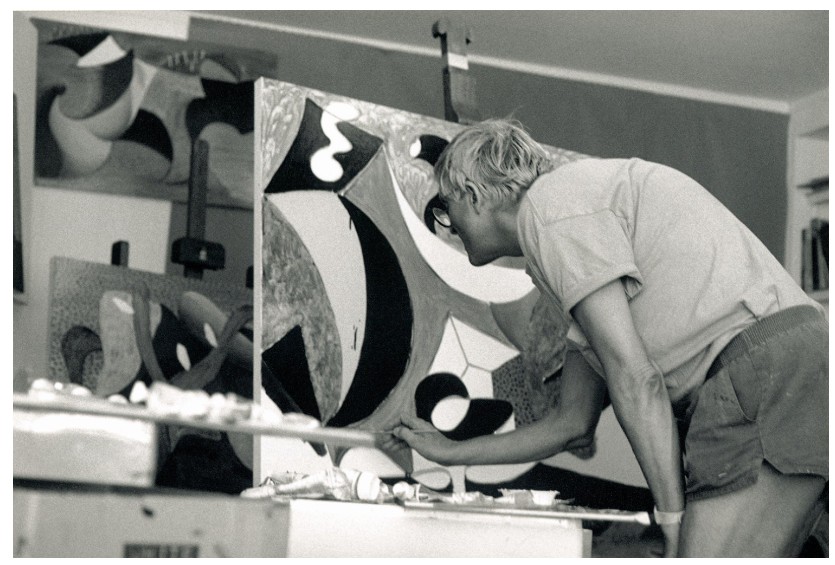
David Hockney in his studio, 1992. Image: Science History Images / Alamy Stock Photo
First exhibited alongside the other twenty-five works from the series in the 1993 show Some Very New Paintings presented by André Emmerich Gallery in New York, examples from this pivotal body of work have featured in every major subsequent retrospective to date, the present painting especially notable for its inclusion in the monographic 2017-2018 exhibition which travelled between Tate Britain in London, The Musée Nationale d’Art Moderne, Centre Georges Pompidou in Paris, and the Metropolitan Museum in New York. Tellingly, in establishing the curatorial parameters for his current and critically acclaimed career retrospective at the Fondation Louis Vuitton, Hockney paid special attention to this pivotal moment in his practice, his Very New Paintings marking at once the close of his long and illustrious California chapter, and the start of a highly inventive and industrious period passed between Yorkshire, London, and Normandy.
In 1988, Hockney relocated from his longtime residence in the Hollywood Hills to a coastal studio in Malibu, framed by the momentum and restless energy of the Ocean on the one side and the hum of the Pacific Coast Highway on the other. It is this centrifugal force that makes itself particularly felt in The Twenty-Sixth V.N. Painting, its patterned passages and complex surface textures bordered by the swooping striated forms of aquamarine and cerulean tones.
“[…] here at the beach I am between two great forces, the mountains and the sea. The mountains were made by a great force of nature, a thrusting force, which calmed in time, leaving them here, grand and peaceful. While below the other thrust continues, the endless movement of the sea. These forces are present, I believe, in the paintings.”
While the work and the larger series to which it belongs share the unmistakable hot tones, vertiginous perspectives, and winding vistas of his celebrated Californian landscapes epitomized by works such as the 1980 Mulholland Drive: The Road to the Studio, it is significant that Hockney did not turn his attention to the ocean until this decisive move, its fluid, mutable surface introducing a powerful, elemental energy to the works made after 1988.
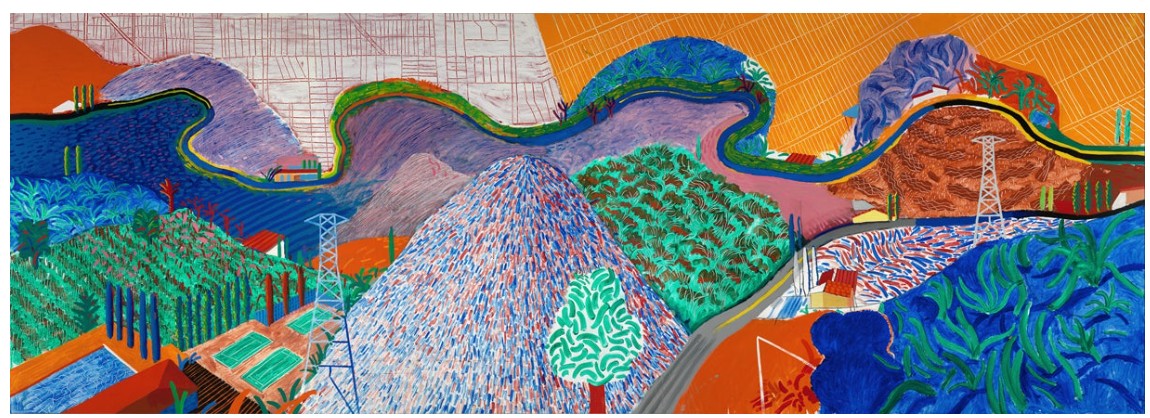
David Hockney, Mulholland Drive: The Road to the Studio, 1980. Los Angeles County Museum of Art.
Image: Richard Schmidt, Artwork: © David Hockney
Pulsating with the same quintessentially Californian energy that the artist had made unmistakably his own over the course of the previous decade, Hockney’s restlessly innovative approach nevertheless makes its presence felt in the Very New Paintings, most forcefully in their spatial complexity and challenge to the pictorial conventions of single point perspective. Although conceding that these Very New Paintings might “seem a jumble to the viewer at first,” Hockney here advocates a slow approach to looking’
“They take time to unfold. They’re a bit mind-boggling, but they are meant to be. The viewer can roam freely within them, finding his or her own space. That’s why there are no figures in them. You construct your own space mentally.”
It was this question of the experience of space and its representation that preoccupied Hockney more and more during the 1980s as his work moved away from the cooly detached and strikingly naturalistic modes that had first secured his reputation as a painter of sun-soaked pools and West Coast playboys in the 1960s. While these conformed to the traditions of single point perspective with its clear vanishing point, Hockney felt increasingly as though this placed the viewer outside of the composition, failing to capture the movement, depth, and complexity of the act of looking itself.
“I couldn’t play in that space—the one-point perspective was terribly constricting—and it’s only by playing with the space in the years since that I’ve been able to make it clearer. Everything since then has been a progression towards a playful space which moves around and is still clear.”
In their radical challenge to the conventions of fixed, single point perspective, and their introduction of movement and the experience of time into their compositions, the early Cubist experiments of Pablo Picasso and Georges Braque would prove to be an important touchstone in this respect. While Hockney was already in close dialogue with Picasso and applying the lessons of Analytical Cubism to his innovative photocollages in the early 1980s, an important trip back to London in 1983 consolidated these investigations, coinciding with the opening of the first significant exhibition of Cubism in the city, The Essential Cubism: Braque, Picasso and Their Friends, 1907 – 1920 organized by Tate director Alan Bowness and curated by Douglas Cooper and Gary Tinterow. A major event, the exhibition presented the visual history of Cubism together for the first time, and would have a profound impact on Hockney, who returned a purported seven times during his short visit.
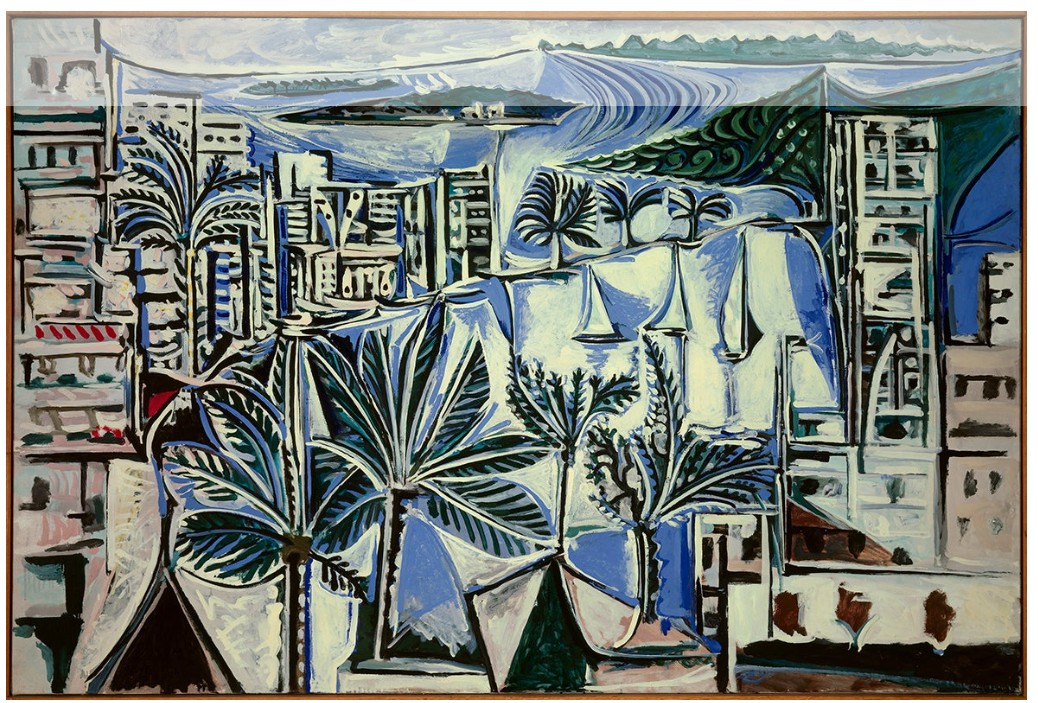
Pablo Picasso, La Baie de Cannes, 1958. Musée Picasso, Paris.
Image: Photo Josse / Scala, Florence, Artwork: © 2025 Estate of Pablo Picasso / Artists Rights Society (ARS), New York
While Hockney’s palette here owes more to the vibrant Fauvist tones of André Derain and Henri Matisse, his careful organization of space and dissection of volumetric form is rooted in the early lessons of Picasso’s Cézannesque landscapes, extended by the artist in his flattened, light-soaked Mediterranean landscapes from the 1950s which, although falling beyond the scope of the 1983 exhibition serve as a compelling reference point here.
“All the work I have done in the theater has been useful to me […] what is most important is using real space. You begin to think spatially much more.”
Synthesizing all of these elements, it was Hockney’s experiences designing theatrical sets for the stage that proved to be “the consistent motor for change through the late 1970s and into the 1980s’, these operatic sets introducing ‘a new experience of space [that] always acknowledged the involvement and emotional response of the audience.” Following his first commission to produce sets and costumes for a 1975 iteration of Igor Stravinsky’s The Rake’s Progress at Glyndebourne, Hockney spent the best part of the following two decades focused on these interdisciplinary projects, even following more directly in Picasso’s footsteps with his 1981 reimagination of Parade, for which the modern master had first designed the avant-garde sets and costumes in 1917.
With the move to Malibu inspiring an energetic return to painting, the sweeping vistas, juxtaposed textures, and concentrated drama of these operatic environments would directly inform Hockney’s painting during this period. In 1991 Hockney was finalising the designs for Puccini’s Turnadot in collaboration with Ian Falconer, travelling to Chicago in July to oversee production. On his return journey, Hockney travelled through Monument Valley and the Grand Canyon in a camper van, the monumental lunar rock formations of that landscape appearing almost immediately in his painting, and would form the basis of both his final set designs for Richard Strauss’ Die Frau ohne Schatten which opened in London’s Royal Opera House the following year, and the highly personalised motifs and more abstract forms of the Very New Paintings.
“The first thing I made for Die Frau, on a small model, was an abstract representation of a river, like a snake. I put little dots on it which were actually derived from the textures that were appearing in these paintings. Turandot is mostly architectural interiors; even the garden, which is nearest to nature is a Chinese garden, stylized, formal, not raw nature. In Die Frau, on the other hand, we are dealing with nature in the wild […] and I knew these paintings were going to influence its design.”
As Hockney explains, while the designs for Turandot had focused on architectural space, the context of Die Frau ohne Schatten allowed him to work with the natural landscape and its forms in a more direct manner, the set designs and paintings working in close dialogue with one another in the realization of his vision. Hockney started the Very New Paintings in earnest immediately after completing work on the Die Frau ohne Schatten commission, works from this cycle of “internal landscapes” gradually becoming more complex, “using different marks and textures to create space, so that the viewer wanders around.”
Capturing the essence and vernacular of the American West, The Twenty-Sixth V.N. Painting showcases the remarkable inventiveness and complexity of Hockney’s vision, the simultaneity of its multiple viewpoints, bold use of non-naturalistic color and pattern, and harmonious balance of forms all working together to under score his fundamental commitment to the question of representation itself. As the last work in this pivotal series, The Twenty-Sixth V.N. Painting is an especially important work, representing the summation – not just of the ideas, themes, and motifs that informed this suite of paintings – but of this entire long chapter in Hockney’s career, laying important foundations for his return to Yorkshire at the end of the decade, and his radical extension of a tradition of landscape painting there.
The Twenty First V.N. Painting, 1992
Sotheby’s London: 6 March 2024
Estimated: GBP 1,200,000 – 1,800,000
GBP 1,813,000 / USD 2,298,884
REPEAT SALE
Phillips London: 16 October 2013
Estimated: GBP 250,000 – 350,000
GBP 338,500 / USD 538,512
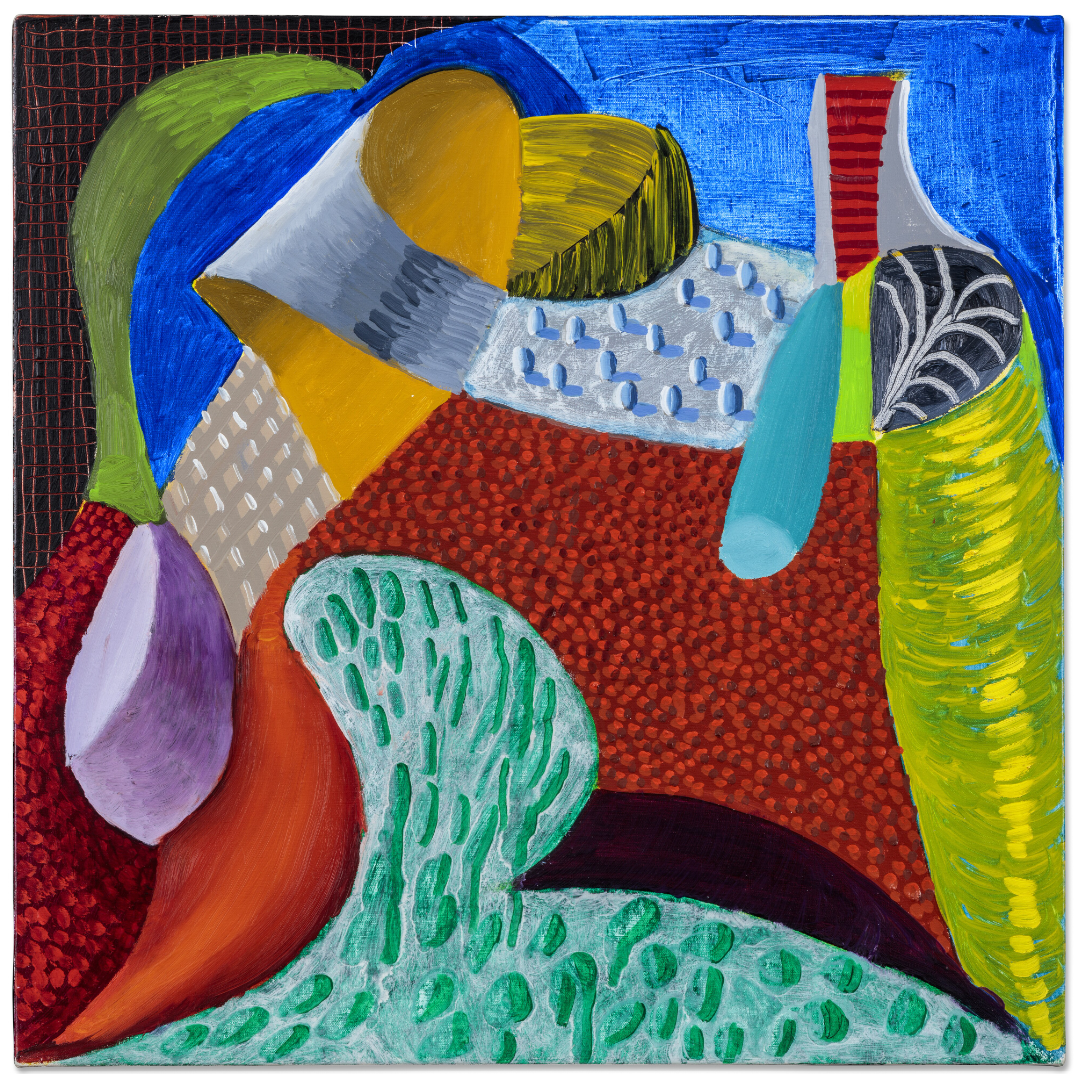
DAVID HOCKNEY (b. 1937)
The Twenty First Very New Painting, 1992
Oil on canvas
24×24 inches (61×61 cm)
Signed, titled and dated 1992 (on the reverse)
Bold forms and jubilant colors unwind and coalesce on the surface of The Twenty First Very New Painting, an exceptional example from David Hockney’s concise yet seminal corpus of V. N. Paintings executed in the artist’s Malibu studio between 1992 and 1993. Together with the other twenty-five works in the series, the present work has been exhibited in New York City, Glasgow, Saltaire, Yorkshire and Venice, California. Iterations have been included in all of the artist’s most important museum retrospectives to date, including those at the Tate, Pompidou, and Metropolitan Museum in 2017 and 2018.
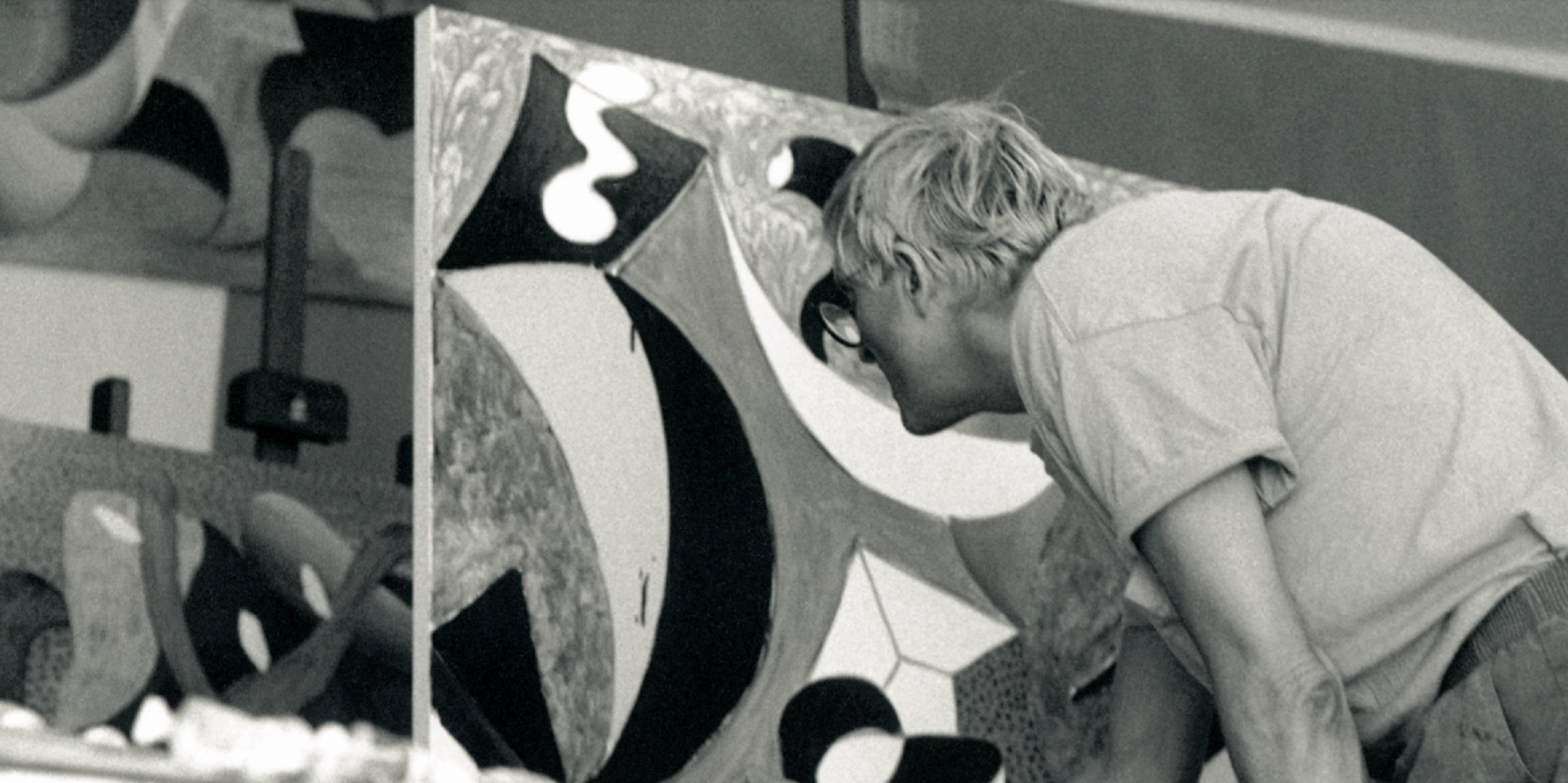
DAVID HOCKNEY WORKING IN HIS LOS ANGELES STUDIO. IMAGE: © BASIL LANGTON/PHOTO RESEARCHERS HISTORY/GETTY IMAGES. ARTWORK: © DAVID HOCKNEY
A number are still held in the artist’s personal collection, a testament to the significance of the series within his body of work. The V.N. Paintings – short for ‘Very New’ – are unlike anything Hockney had previously created. The artist drew upon both his recent landscape paintings of the Santa Monica Mountain and his theatre set designs to explore representation, abstraction, and light. In 1990 and 1991 he worked on the production design for Puccini’s Turandot and Strauss’s Die Frau ohne Schatten, both of which opened in 1992. The opera sets were masterful studies of the effects projected light can have on a surface, fantastical landscapes shifting constantly under the bath of jewel-toned light. The present work evokes the surreal, dreamlike effect achieved by those sets—distilled and encapsulated by rich hues and complex spatial arrangements into an otherworldly abstract landscape.
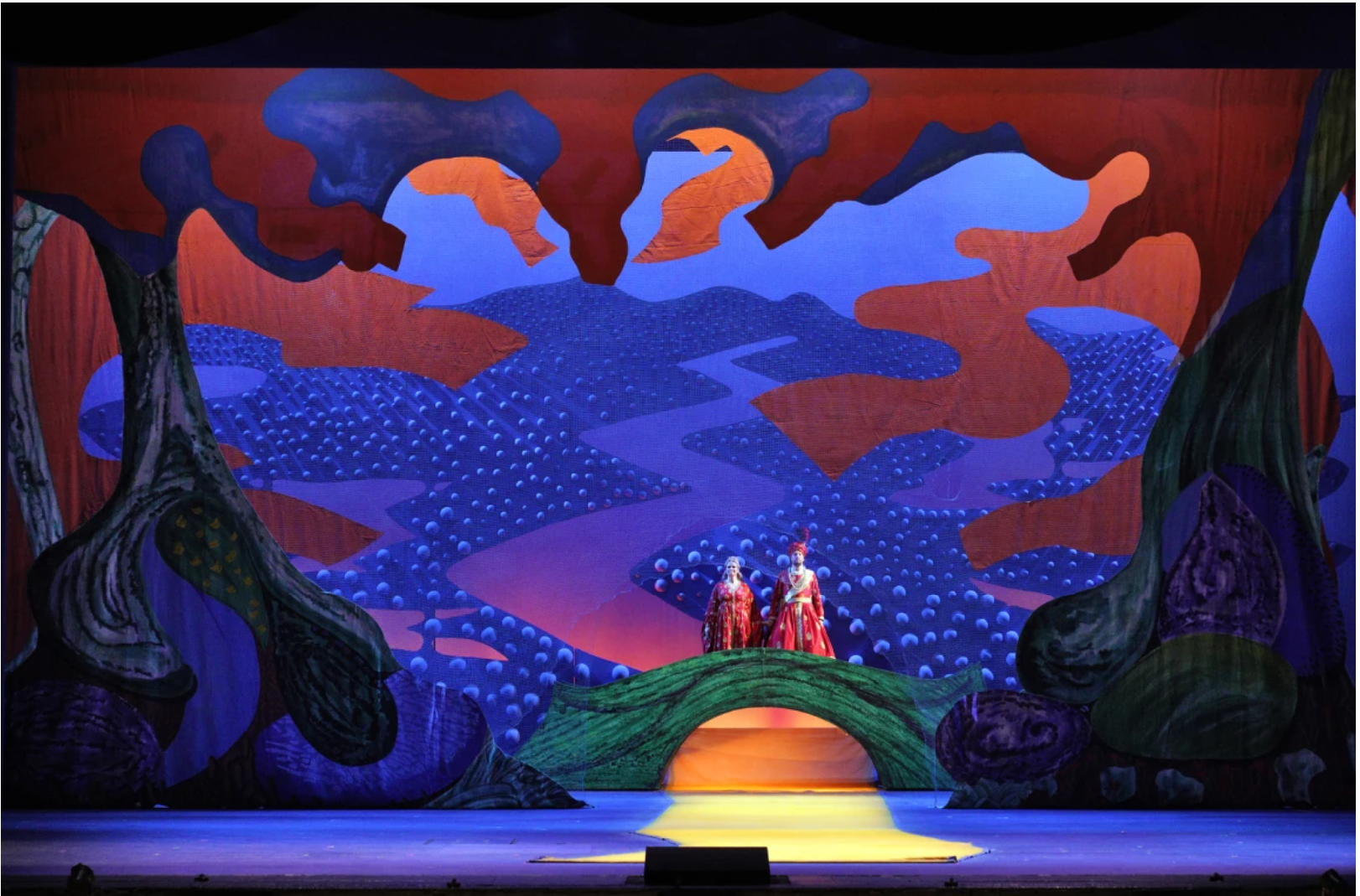
DAVID HOCKNEY’S SET DESIGN FOR DIE FRAU OHNE SCHATTEN. CORY WEAVER/COURTESY SAN FRANCISCO OPERA/ ARTWORK: © DAVID HOCKNEY. THE DAVID HOCKNEY FOUNDATION
Textures, colors, shapes, and patterns abound in The Twenty First V.N. Painting. Sixteen blue roundels are carefully positioned on a grey outcrop at the top right of the composition in a manner redolent of players on a stage; we can observe their individual shadows suggesting dramatic lighting, and sea of stippled red in front of them recalls a vast audience. The swathes and passages of daubed and flecked color that surge up along the left and right sides act to frame the composition, like the walls of an enormous theatre. Light seems to come from both the front, behind, and above the scene all at once. Meanwhile, to the fore, a large teal shape, resembling an oxbow lake, brims with organic ovoid forms resembling cells or amoebae, surging upward as if to swallow the upper register. The overall effect is at once wildly uncanny yet unexpectedly balanced.
The First V.N. Painting
Sotheby’s London: 2 March 2022
Estimated: GBP 1,000,000 – 1,500,000
GBP 1,547,500 / USD 2,068,573
The First V.N. Painting | Modern & Contemporary Evening Auction | 2022 | Sotheby’s
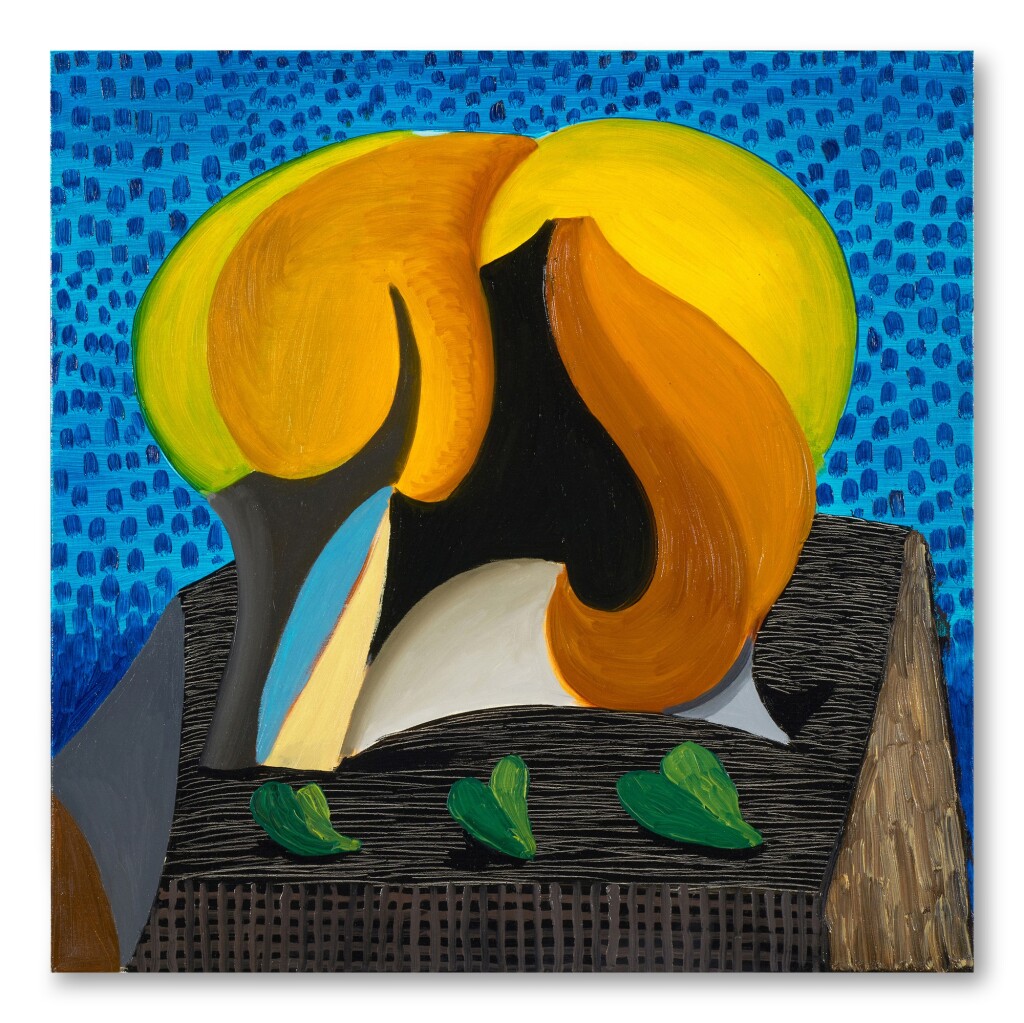
DAVID HOCKNEY
The First V.N. Painting, 1992
Oil on canvas
24×24 inches (61×61 cm)
signed David Hockney
Dated 92 and titled The First V.N. Painting (on the verso)
Bold forms and jubilant colors unwind and coalesce on the surface of The First V.N. Painting, a work that comprises the first example from David Hockney’s seminal series of Very New Paintings executed in the artist’s Malibu studio between 1992 and 1993. While predominantly abstract, the intertwined, textured forms of the present work are reminiscent of the sun-drenched Californian terrain for which Hockney is best known. The vibrant yellow and blue hues on the surface of the present work are indeed reminiscent of the Californian sun, the sky and the ever-pulsating ocean, while the darker highly textured sequences in the lower half of the composition are evocative of mountains or a rocky coastal terrain.
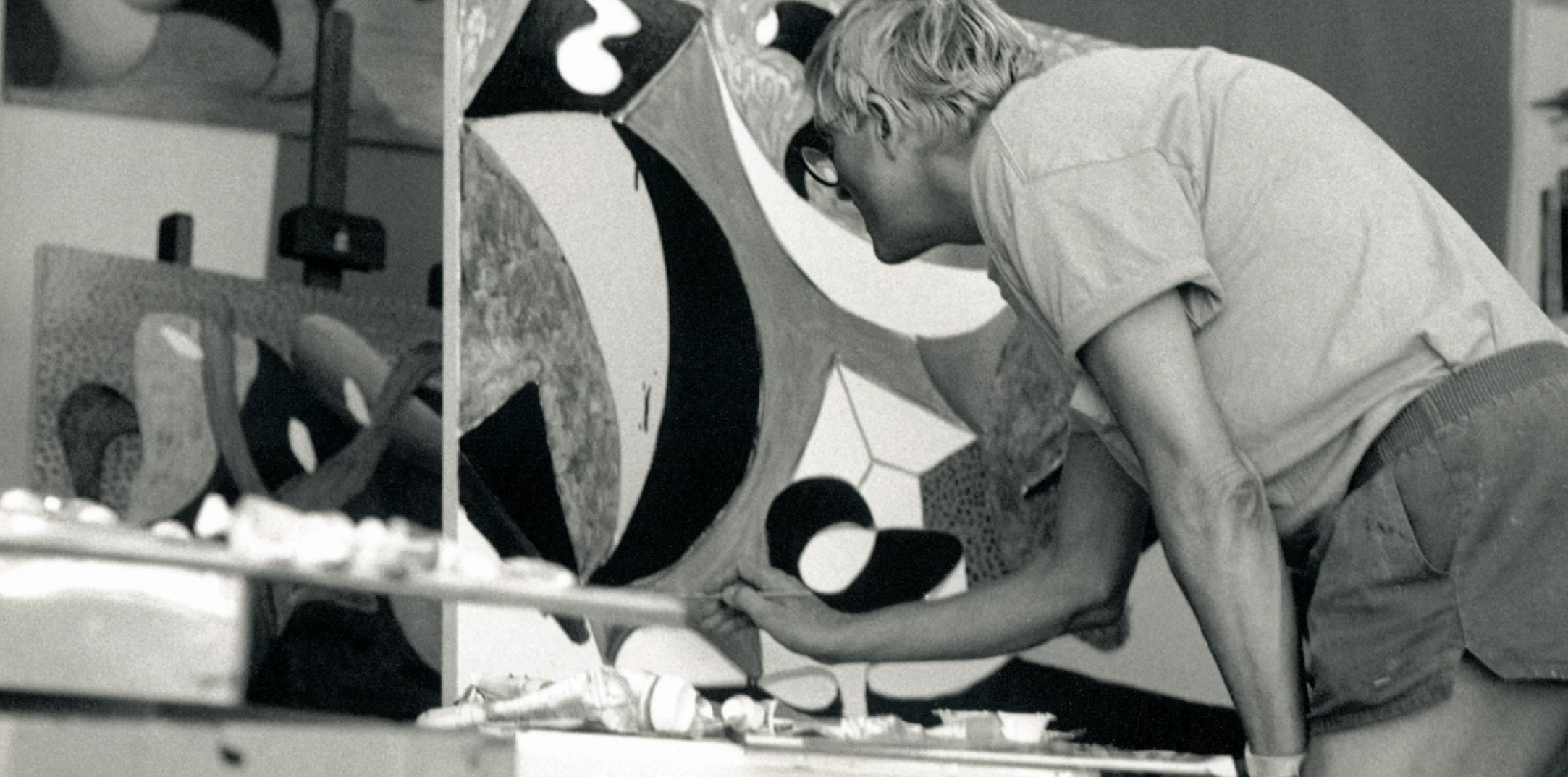
DAVID HOCKNEY WORKING IN HIS LOS ANGELES STUDIO
IMAGE: © BASIL LANGTON/PHOTO RESEARCHERS HISTORY/GETTY IMAGES
ARTWORK: © DAVID HOCKNEY
The V.N. Paintings build upon Hockney’s celebrated, career-long investigation into the genre of landscape painting. The compositions throughout the series echo the subject matter central to his early painterly practice – such as the landscapes of the Hollywood Hills, Santa Monica, Malibu, or the Grand Canyon – but they also draw upon the unique depictions of space and three-dimensionality across his landscape painting of the 1980s and 1990s. Mulholland Drive: The Road to the Studio (1980, Los Angeles County Museum of Art) and Pacific Coast Highway and Santa Monica (1990, Private Collection) are particularly relevant precursors to the V.N. Paintings in their ground-breaking destabilization of conventional perspective. On the surface of both works, space flows in a series of sequences and perspectives that fold into each other on one compressed picture plane, offering numerous points of view from differing vantage points. The Very New Paintings offer a departure point from the artist’s earlier landscapes however, in a move towards pure abstraction in their depiction of space. In 1993, having completed the series of V.N. Paintings, Hockney noted, “So ‘how’ we see the world greatly affects ‘what’ we see. No doubt, we have not always been at this level of consciousness…I think now, however, spatial feelings and, therefore, depictions of space, have a great effect on us, a profound effect. It was the growing awareness of this on my part that made me begin to be a little obsessed with ways of depicting space” (David Hockney cited in: David Hockney, That’s the way I See It, London 1993, p. 129). Indeed, Hockney’s spatial investigations are reminiscent of those of the Surrealists, and the swirling shapes eerie placement of the more figurative elements of the painting – such as the bright green leaves in the lower half of the composition – evoke the seemingly misplaced objects of Salvador Dali’s strange dreamscapes. The Great Masturbator (1929, Museo Nacional Centro de Arte Reina Sofia, Madrid) is a particular point of reference for the present work.
The winding, interwoven abstract motifs of The First V.N. Painting also echo Hockney’s spectacular theatre sets, which preoccupied him during the late 1980s and early 1990s. Giacomo Puccini’s Turandot opened at the Lyric Opera of Chicago in January 1992, and Richard Strauss’s Die Frau ohne Schatten opened at the Royal Opera House in Covent Garden, London later that year. Hockney was commissioned to design the sets of both shows, which debuted the year the present work as executed to wide-spread critical acclaim. Hockney’s treatment of line, space and colour in his theatrical sets – at once architectural and organic – mirror those in his paintings from the period. Following his preoccupation with theatre design, Tate curator Andrew Wilson writes, “Hockney returned to Malibu and started on a series of paintings that fused all these spatial ideas together to create a language that, although formally abstract, was suggestive of landscape. Hockney believed that the forms of the painting – French curves, serpentine lines, swirls, tunnels, plans and cones – were a direct result of his being situated at Malibu, between the forces of mountains and ocean” (Andrew Wilson, ‘Experiences of Space’ in: Exh. Cat., London, Tate Britain (and travelling), David Hockney, 2017, p. 147). These works represent the sum of Hockney’s experiences in the preceding years – from Malibu landscapes to London opera houses – and yet, through their inventive abstract compositions, move his oeuvre forward in a new direction. Executed at a pivotal moment in Hockney’s career, The First V.N. Painting is a joyous and theatrical composition quintessential the artist’s celebrated 1990s output.
The Fifth V.N. Painting
Sotheby’s New-York: 19 November 2021
Estimated: USD 1,500,000 – 2,000,000
USD 2,319,000
The Fifth V.N. Painting | Contemporary Day Auction | 2021 | Sotheby’s
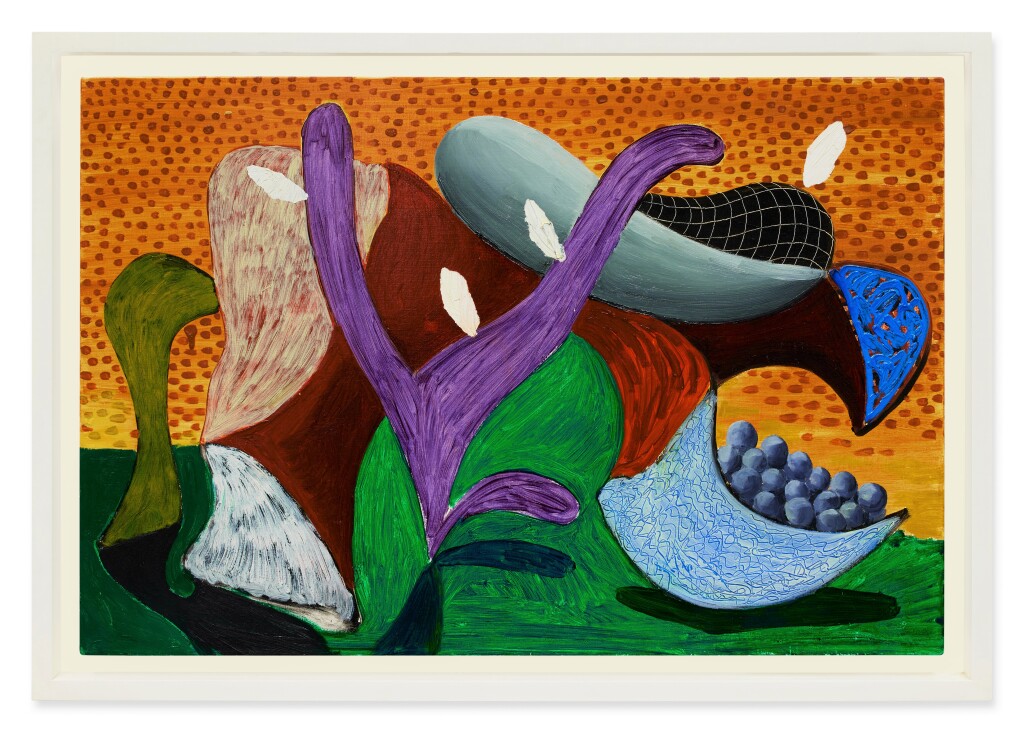
DAVID HOCKNEY
The Fifth V.N. Painting, 1992
Oil on canvas
24×36 inches (61 x 91.5 cm)
Signed, titled and dated 92 (on the reverse)
The Fifth V.N. Painting is an otherworldly early example of David Hockney’s explosively abstract V.N. Paintings of 1992. The artist drew upon both his recent landscape paintings of the Santa Monica Mountain and his theatre set designs to explore representation, abstraction, and light. In 1990 and 1991 he worked on the production design for Puccini’s Turandot and Strauss’s Die Frau ohne Schatten, both of which opened in 1992. The opera sets were masterful studies of the effects projected light can have on a surface, fantastical landscapes shifting constantly under the bath of jewel-toned light. The present work evokes the spirit of a drive through Malibu, where Hockney lived at the time, but several times removed: imagine, perhaps, a scenic drive through Mars at dusk.
“Someone said that the V.N. Paintings are abstract narratives. Certainly a great deal of thought and feeling have gone into them. For example, here at the beach I am between two great forces, the mountains and the sea. The mountains were made by a great force of nature . . . while below the other thrust continues, the endless movement of the sea. These forces are present, I believe, in the paintings. They are also quite sexual . . . These things were on my mind when I was painting them. Perhaps these paintings seem a jumble to the viewer at first. They take time to unfold. They’re a bit mind-boggling, but they are meant to be. The viewer can roam freely within them, finding his or her own space. That’s why there are no figures in them. You construct your own space mentally.”
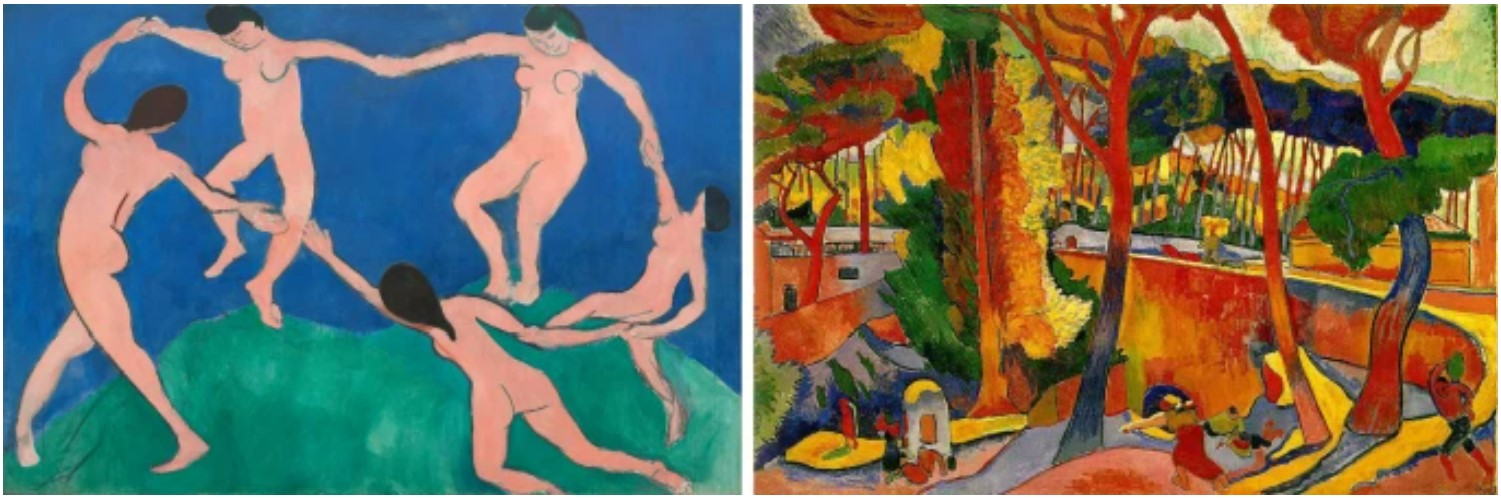
LEFT: HENRI MATTISE, THE DANCE I, 1910, THE MUSEUM OF MODERN ART, NEW YORK
RIGHT: ANDRÉ DERAIN, THE TURNING ROAD, L’ESTAQUE, 1906. MUSEUM OF FINE ARTS, HOUSTON
Textures, colors, shapes, and patterns abound in The Fifth V.N. Painting. The rich orange sky is decked with red dots and dashes like the seeds of a pomegranate. A reddish cave opens wide to swallow the teal ground and the writhing lavender form growing from it. Other forms attach themselves like intergalactic slugs; black checks, a grey curve, blue curls, and miniature Miro are all balanced within the composition like the pile of rock-like nubs emerging behind it. Light seems to come from both the front, behind, and above the scene all at once. Little white feathers fluttering down, a motif Hockney would revisit in The Sixth V.N. Painting. It is an altogether wild and dreamlike work.
By opening up his oeuvre to abstraction in the V.N. series, Hockney also opened up an entirely new field of influence. Indeed, through the swathes of saturated color, we can recognize the influence of a number of the great artists of the early Twentieth Century in the present work. We think of Pablo Picasso, who created works of comparable chromatic dynamism, with different passages of paint appearing to flow over one another; meanwhile, the specific juxtapositions of shape, tone, and hue, recall the work of Robert Delaunay, whose works hover between abstraction and figuration just like Hockney; or even Franz Marc, who executed colourist works that were just as dynamic, energetic, and engaging as this, using similar compositional devices. Impressionist and Post-Impressionist precedent has always been important to Hockney, and one would be tempted to chalk up the brusque horizontal dabs of brushwork that proliferate in this work as a reference to Claude Monet’s broad style.
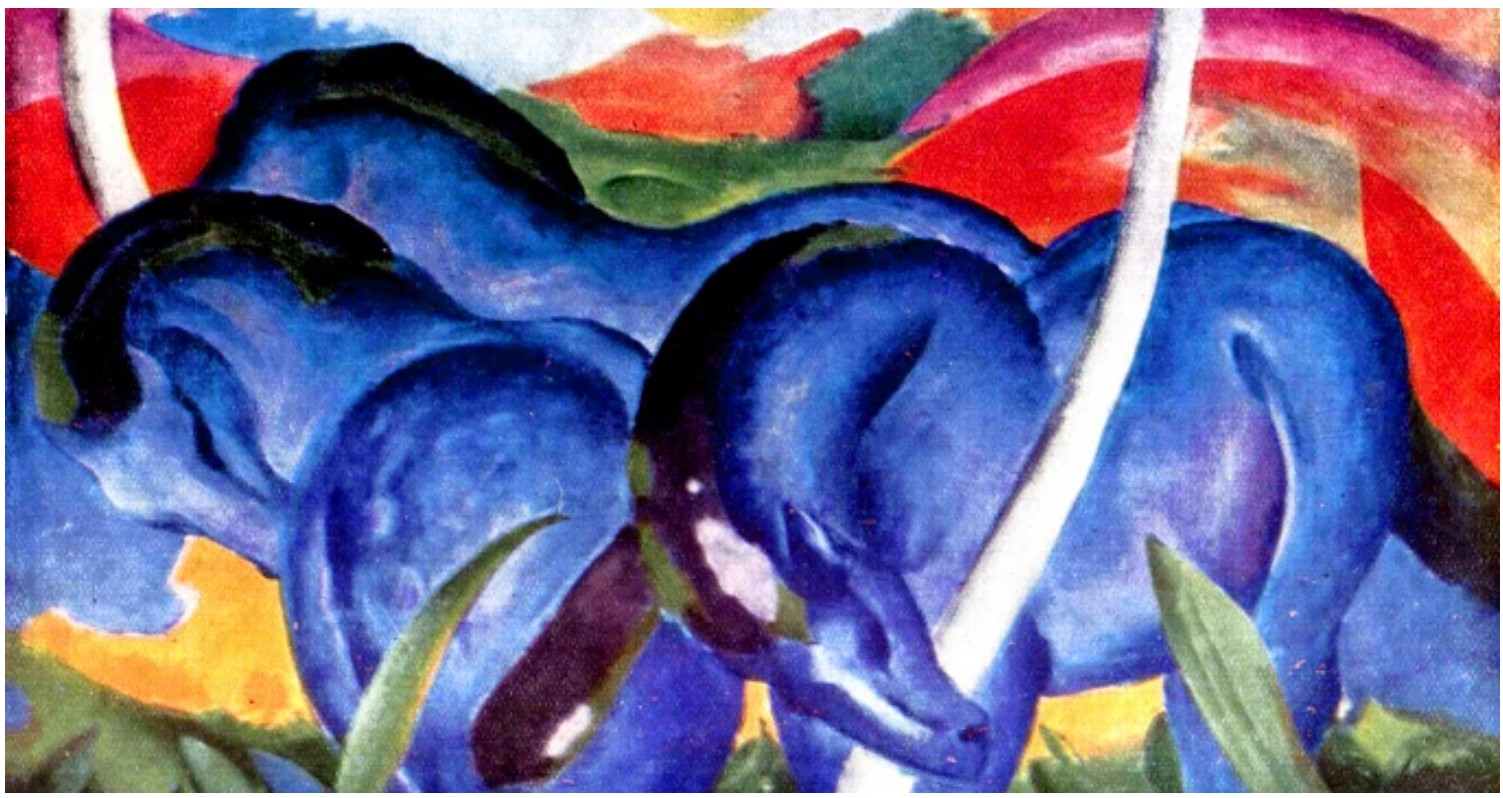
FRANZ MARC, THE LARGE BLUE HORSES, 1911
WALKER ART CENTER, MINNEAPOLIS
That last dimension, Hockney says, is time: “the time you give a picture when you look at it and it pulls you in and moves you round and you therefore become aware of taking time.” (The artist in That’s the way I see it, London, 1993, p. 234). The Fifth V.N. Painting reveals Hockney in a stage of pure, unadulterated abstraction, combining his skills in theatre set design with his own theories on perspective and metaphysics, as well as the eternal inspiration derived from the California landscape.
The Fourteenth V.N. Painting
Sotheby’s London: 5 October 2017
Estimated: GBP 480,000 – 650,000
GBP 548,750 / USD 720,428
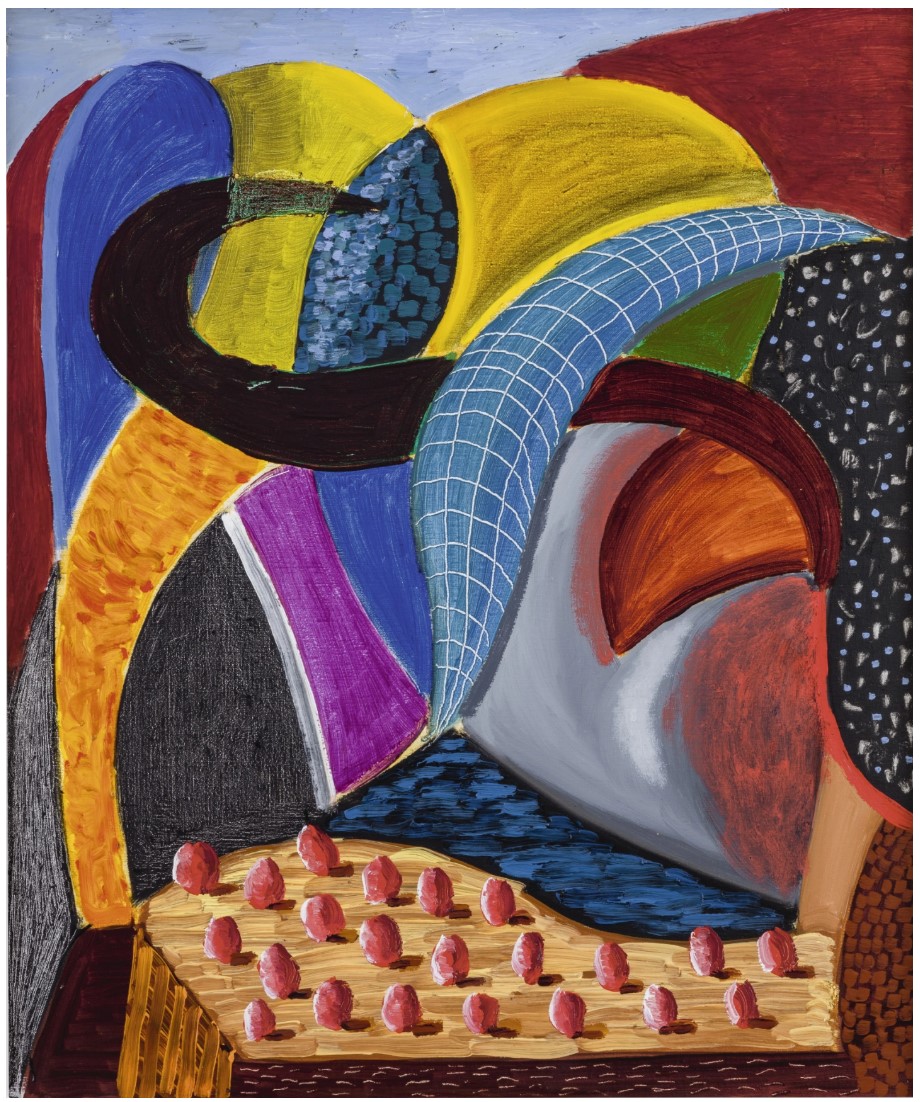 DAVID HOCKNEY
The Fourteenth V.N. Painting, 1992
Oil on canvas
24×20 inches (61 x 50.8 cm)
The Fourteenth V.N. painting is an exuberant example from a concise series of 26 works; iterations of which have been included in all of Hockney’s most important museum retrospectives to date, including those at the Tate and the Pompidou in 2017. The V.N. Paintings – short for Very New – show Hockney at his most abstract, combining skills learnt in theatre set design with his own theories on perspective, and the inspiration that the Malibu landscape provided. In the late 1980s, Hockney was closely involved with opera set design, crafting stages for Tristan und Isolde in 1987 as well as for Turandot and Die Frau ohne Schatten in 1992 – the same year as the present work’s creation. He had been fascinated by the genre since the 1960s, and these endeavours should be considered the pinnacle of his engagement with the subject. The Fourteenth V.N. Painting, although nominally abstract, seems absolutely attuned to these contemporaneous pursuits. Twenty-two pink roundels are carefully positioned on a beige outcrop at the bottom of the composition in a manner entirely redolent of players on a stage; we can observe their individual shadows suggesting dramatic lighting, and the horizontal beige brushstrokes recalling the boards of a wooden stage. Meanwhile, the swathes and passages of daubed and flecked colour that surge up around these egg-like forms appear as though on stage, bedecked with extraordinary spotlights. In the early 1990s, Hockney was living in Malibu, and the landscape of the Californian coastline was also proving hugely inspirational to his work. In the preceding years he had created a number of paintings of the surrounding landscape, in which his sense of depth, recession, perspective, and scaling became more and more abstract. Exemplary amongst these carefully constructed works is Mulholland Drive: The Road to the Studio, 1980, which shows the winding mountain highway that Hockney took on his way to work in a warped and foreshortened manner, and even features the city grid of Los Angeles as its imagined backdrop. The V.N. Paintings should be seen as the next logical step to works such as this; a unique moment within Hockney’s oeuvre upon which his experimentations into, and manipulations of, perspective and human perception ceased to be limited to identifiable figurative subject matter.All of Hockney’s most important works are steeped in art-historical reference. By opening up his oeuvre to abstraction in the V.N. series, Hockney also opened up an entirely new field of influence. Indeed, through the swathes of saturated color, we can recognize the influence of a number of the great artists of the early Twentieth Century in the present work. We think of Pablo Picasso, who created works of comparable chromatic dynamism, with different passages of paint appearing to flow over one another; meanwhile, the specific juxtapositions of shape, tone, and hue, recall the work of Robert Delaunay, whose works hover between abstraction and figuration just like Hockney; or even Franz Marc, who executed colourist works that were just as dynamic, energetic, and engaging as this, using similar compositional devices. Impressionist and Post-Impressionist precedent has always been important to Hockney, and one would be tempted to chalk up the brusque horizontal dabs of brushwork that proliferate in this work as a reference to Claude Monet’s broad style. However, in the sheer variance of texture and technique on the canvas, we are better reminded of Hockney’s painterly contemporary, Howard Hodgkin. Hodgkin and Hockney were friends and peers, who painted each other at various stages in their career. Their relationship was one of immense mutual respect and influence, and in the hot oranges, cool blues, and thick sharp brushstrokes that populate this composition, Hockney seems to be have made direct reference to his compatriots work.
As explicated by the present work, the V.N. Paintings represent an extraordinary moment within David Hockney’s oeuvre. They represent the sum of his experience in the preceding years – in opera houses and Malibu landscapes, and in deference to art history – and yet, through their extraordinary abstract compositions, also appear to look forward. As described by, Tate Britain curator, Andrew Wilson: “the geometries that Hockney was exploring would go on to inform his paintings of the Grand Canyon later in the decade and his first paintings of Yorkshire. The narratives contained within each painting are what the viewer brings to it in terms of their movement into and through its depicted and suggested surfaces and spaces. With these paintings, Hockney believed that he was starting to find a way to represent three and four dimensions, space and movement – as well as emotion – on the flat surface of two dimensions” (Andrew Wilson, ‘Experiences of Space’ in: Exh. Cat., London, Tate Britain (and travelling), David Hockney, 2017, p. 147).
The Eighteenth V.N. Painting
Phillips New-York: 11 November 2013
Estimated: USD 450,000 – 550,000
USD 869,000
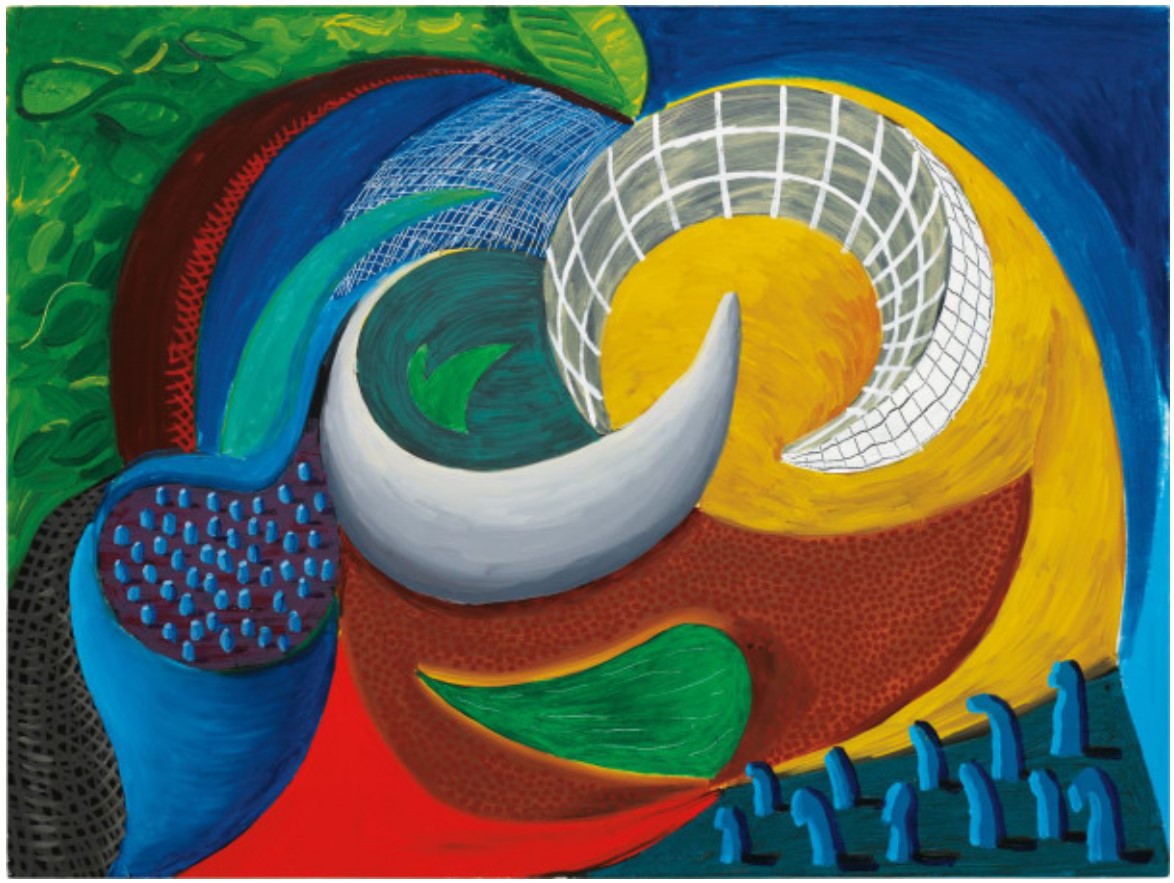
DAVID HOCKNEY
The Eighteenth V.N. Painting, 1992
Oil on canvas
36×48 inches (91.4 x 121.9 cm)
Signed, titled and dated “David Hockney 92 The Eighteenth VN Painting” on the reverse
The undulating, vibrant forms of David Hockney’s The Eighteenth V.N. Painting transcend the boundaries of both space and time, capturing the visceral experience of abstraction. One of the twenty-six works that comprise the artist’s Very New Paintings series from 1992, the present work radiates with kaleidoscopic energy, inviting the viewer to perceive and mold his own animated, exotic landscape.
Both a departure from and continuation of Hockney’s prior practice, The Very New Paintings are a material and theoretical manifestation of the artist’s experience in theatre and opera set design, synthesized with imagery of the bright, dynamic California landscapes so dominant in Hockney’s work in the 1960’s and early 1970s. Echoing the abstract landscapes that Hockney created for productions of Die Frau ohne Schatten and Turandot, The Eighteenth V.N. Painting also challenges traditional concepts of depth perception and perspective in a manner evocative of early modern masters such as Pablo Picasso and Vincent Van Gogh in his Van Gogh’s Bedroom in Arles (Paris, Musée d’Orsay).
Hockney’s painterly experimentation in The Very New Paintings partially derives from his philosophical awareness of “…nature both in its physical forms and in its invisible forces” (ibid, p. 236). Highly stylized, the bold, spherical contours found in The Eighteenth V.N. Painting awaken the senses, balancing the work’s intangible, seductive energy with an impressive exploration of textural elements. Informed by Hockney’s earlier fax drawings in which textural representations supplanted the use of color and form, the present painting unifies these visual and transcendent elements, suggesting corporeality without certainty; the artist implicitly welcomes the viewer into the painting, encouraging an exploration of the “internal landscape.”