A chilling portrait of one of America’s most infamous inventions, Electric Chair is the defining image of Andy Warhol’s Death and Disasters series, a seminal body of work that saw the artist penetrate the shining veneer of postwar American life and reveal the darker realities that lay simmering beneath.
Electric Chair: A Study in Death and Spectacle
1. Introduction: Electric Chair in Context
Andy Warhol’s Electric Chair (1964–1965) stands as a chilling testament to his exploration of mortality and the macabre. This haunting artwork is a pivotal piece in Warhol’s Death and Disaster series, a collection that delves into the darker undercurrents of postwar American life. Central to this work is the stark image of an unoccupied electric chair, a symbol of institutionalized death that is both unsettling and eerily mundane.
The composition’s jarring juxtaposition of somber subject matter with decorative pastel tones underscores Warhol’s mastery in provoking complex, often contradictory emotions. As Warhol himself mused, “When you see a gruesome picture over and over again, it doesn’t really have any effect.” This sentiment reverberates throughout the Death and Disaster series, challenging viewers to confront their desensitization to violence in media.
2. Origin of the Death and Disaster Series
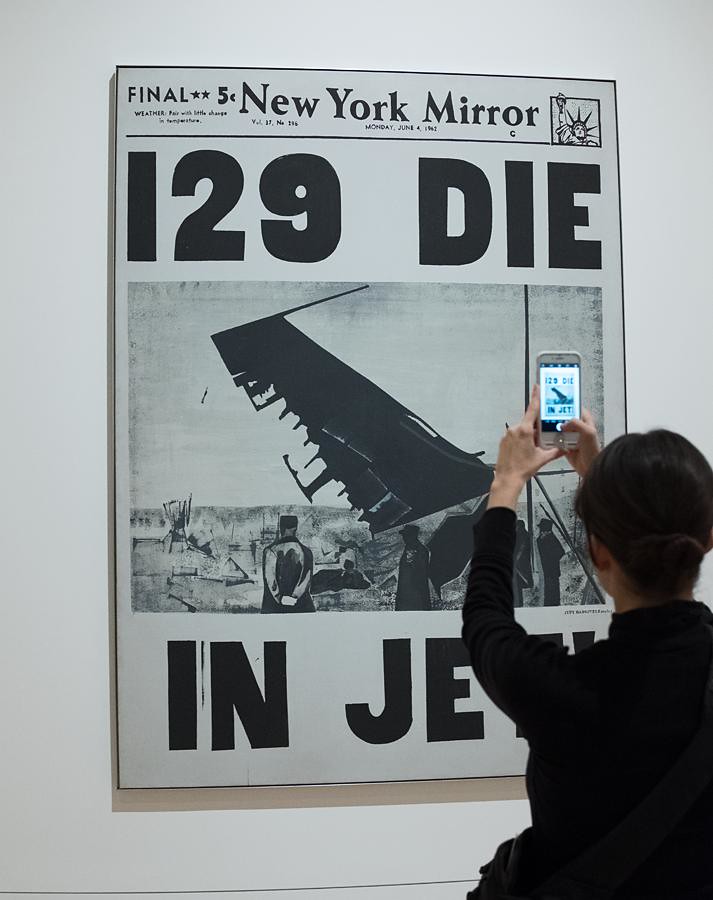
The genesis of the Death and Disaster series can be traced back to a pivotal moment in June 1962. During lunch, Henry Geldzahler handed Warhol a newspaper with the headline “129 DIE IN JET.” Reflecting on this, Geldzahler recalled telling Warhol, “It is enough life. It is time for a little death” (Factory Made: Warhol and the Sixties).
This interaction prompted Warhol to explore themes of mortality, initially creating works that depicted plane crashes. In his words, “I realized that everything I was doing must have been Death. It was Christmas or Labour Day—a holiday—and every time you turned on the radio, they said something like, ‘4 million are going to die.’ That started it.”
By 1964, Warhol planned to unveil these works at the Sonnabend Gallery in Paris under the title Death in America. Choosing to confront the French intelligentsia with America’s raw tragedies, Warhol presented images of car crashes, suicides, atomic bombs, and race riots. These stark depictions stood in contrast to the idyllic postwar American dream.
3. Subject and Symbolism: The Electric Chair
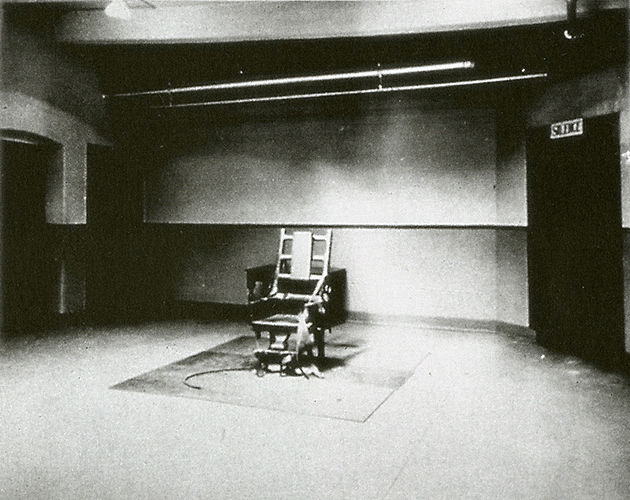
The electric chair, a uniquely American invention, became a focal point in Warhol’s exploration of death. The image originated from a press photograph of Sing Sing prison’s execution chamber, where Julius and Ethel Rosenberg were executed for espionage in 1953. Warhol’s choice of this subject was deliberate, reflecting his belief that electrocution was a “typically American way to go” (Warhol, D. Bourdon).
The SILENCE sign looming above the empty chair amplifies the atmosphere of foreboding. By omitting human figures, Warhol forces viewers to confront the starkness of the apparatus itself. Art historian Neil Printz described the electric chair as “the most iconic image in the Death and Disaster series,” noting its power to encapsulate both institutional violence and societal indifference.
4. Technique and Aesthetic Choices
Warhol employed silkscreen printing to transfer the image of the electric chair onto monochromatic or brightly colored grounds. Each version of Little Electric Chair featured unique color palettes, ranging from garish yellows and oranges to soothing blues and pinks. These decorative tones create a jarring contrast with the grim subject, aligning with Warhol’s intent to “change people’s perceptions of acceptance” (G. Malanga, “Electric Chairs on Display in Toronto”).
The mechanical precision of silkscreen printing mirrors the cold, systematic nature of state-sanctioned execution. Warhol’s repetition of the image across the series reflects his fascination with how repeated exposure to violent imagery diminishes its emotional impact. As he observed, “Like static or ‘white noise’ that fills the background, it does not capture notice.”
In this specific work, the chiaroscuro effect—contrasting light and shadow—heightens the chair’s ominous presence. Cy Twombly, a collector of one version, admired Warhol’s use of light to evoke a sense of impending doom, likening it to the dramatic techniques of Renaissance masters.
5. Reception and Legacy
Critics and scholars have hailed Little Electric Chair as a defining work in Warhol’s oeuvre. Unlike other pieces in the Death and Disaster series, this work avoids explicit violence. Instead, it relies on psychological terror, drawing viewers into a macabre narrative. The cinematic composition recalls Alfred Hitchcock’s suspenseful storytelling, where the horror is implied rather than shown.
Warhol’s contemplation of mortality extended to his personal philosophy. “I never understood why when you died, you didn’t just vanish,” he remarked. “I always thought I’d like my own tombstone to be blank. No epitaph, and no name. Well, actually, I’d like it to say ‘Figment.’”
6. Market Value and Auction Records
Warhol created approximately 40 versions of Little Electric Chair. The series’ rarity and cultural resonance have made it highly sought after in the art market. Notable sales include:
- Christie’s New York (2019): $8,220,000
- Sotheby’s New York (2015): $4,170,000
- Christie’s London (1998): £782,500
The Big Electric Chair series (1967–1968), featuring larger and more compositionally complex works, achieved even higher prices. A standout sale occurred at Sotheby’s New York in 2014, where a piece fetched $20,437,000. These auction results underscore the enduring significance of Warhol’s commentary on mortality.
7. Conclusion: The Chilling Power of Warhol’s Vision
Andy Warhol’s Little Electric Chair exemplifies his ability to transform the macabre into mesmerizing art. By isolating the electric chair in an empty chamber, Warhol captures the essence of death’s anonymity and inevitability. The interplay of color, repetition, and stark imagery creates a work that is as thought-provoking as it is unsettling.
As Neil Printz eloquently stated, “The electric chair is not merely an image but a mirror reflecting society’s complex relationship with mortality.” Warhol’s Little Electric Chair remains a haunting reminder of the fragility of life in an era dominated by mechanization and media saturation.
Essay
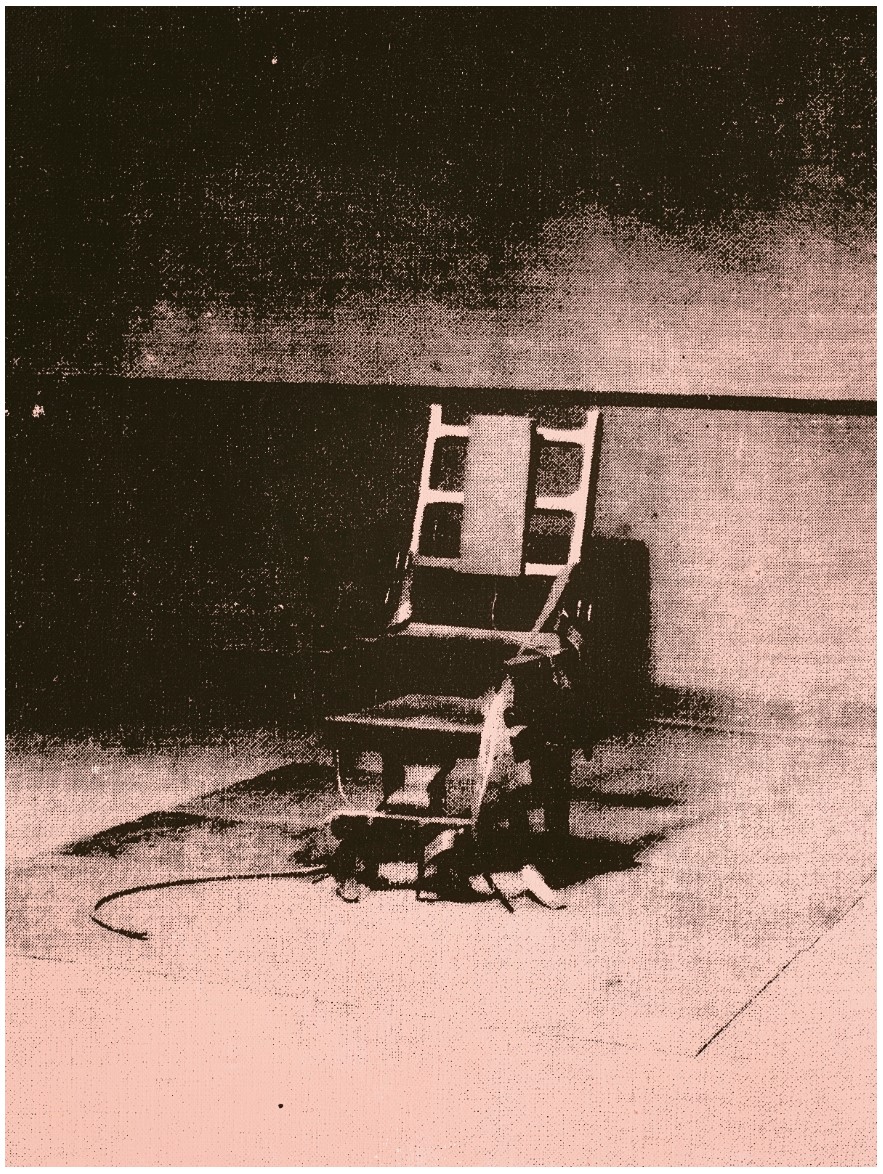
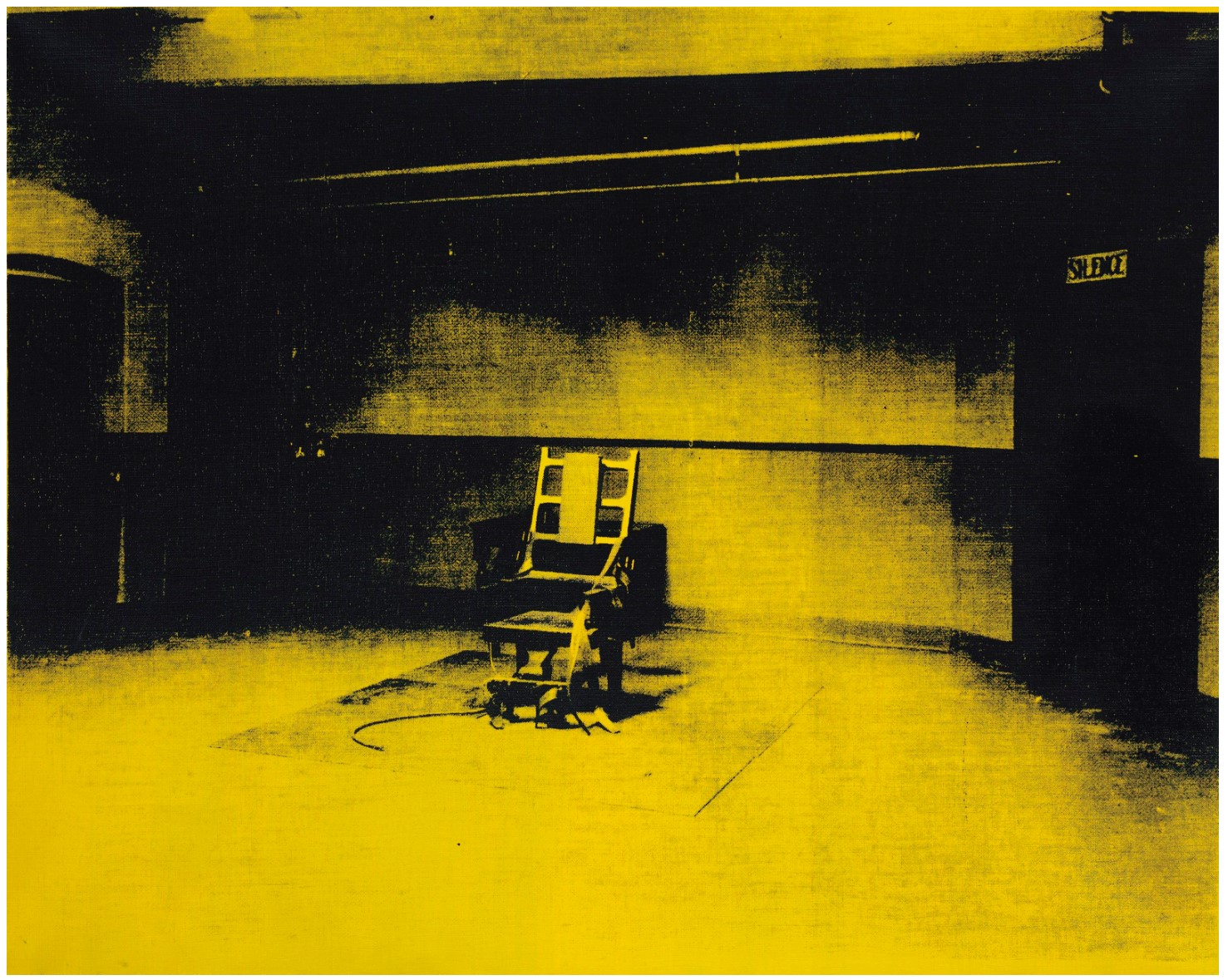
The sinister spectacle of the electric chair, alone save for the SILENCE sign that emerges from the darkness of the door, is bathed in a soft shade of flesh toned pink, a color unique to this group of works that was executed in late 1964-1965. Iconic both in its provocative subject matter and its unchanging reappearance throughout Warhol’s work, Electric Chair also demonstrates, in a single, unforgettable image, the artist’s unique ability at creating art that embodied the complex and contradictory sentiments of the postwar era.
The idea for the Death and Disasters series came about in June 1962, when Henry Geldzahler presented a copy of the day’s newspaper to Warhol over lunch, the headline “129 DIE IN JET” emblazoned across the front page.
“I wanted Andy to get serious. I said, It is enough life.
It is time for a little death”
(H. Geldzahler, quoted in S. Watson, Factory Made: Warhol and the Sixties, New York, 2003, p. 104).
Soon after, Warhol transferred the image of the plane wreckage onto canvas, the emphatic headline announcing the theme that would preoccupy the artist for the following years.
“I guess it was the big plane crash picture, the front page of a newspaper: 129 DIE. I was also painting the Marilyns. I realized that everything I was doing must have been Death. It was Christmas or Labour Day—a holiday—and every time you turned on the radio they said something like, ‘4 million are going to die.’ That started it”
Over the next two years, Warhol explored the theme of death through a variety of subjects, creating a powerful body of work that was intended for an exhibition at the Sonnabend Gallery in Paris in the spring of 1964, the first presentation of his art in Europe, that he planned to title “Death in America.” Believing that the French intelligentsia would scorn his Pop depictions of consumerist icons, Warhol instead chose to present the dark realities of everyday life in 60s America; those which were often overlooked in a zealous desire to uphold the wholesome, golden facade of the postwar American dream. In contrast to the cool commercialism of his Coca Cola bottles and Campbell’s soup cans, Warhol’s depictions of suburban car crashes, people jumping to their deaths from skyscrapers, the atomic bomb, race riots in the Deep South and more—each topical and specifically American tragedies—revealed the underside of the country’s overtly consumerist and capitalist culture.
The most disturbing, provocative and sinister of this series, the Electric Chairs serve as the quintessential symbols of the group. Presenting a uniquely American mode of death—this form of execution originated in New York and struck Warhol as a “typically American way to go” (D. Bourdon, Warhol, New York, 1989, p. 154)—electrocution was at the forefront of people’s minds when Warhol began the group in early 1963. The source image was a press photograph from January 1953 that showed the electric chair, known as ‘Old Sparky,’ at Sing Sing State Penitentiary, Ossining, New York. It was here that Julius and Ethel Rosenberg, the notorious couple convicted of Soviet espionage, were executed a few months later in June 1953. It is no coincidence that at the time Warhol painted the present work in 1964–1965, the issue of capital punishment had come to the fore of contemporary discourse once more, with protest against the death penalty at an all-time high. In New York, the electric chair in Sing Sing was used for the final times in March and August of 1963, before being finally outlawed two years later.
ANDY WARHOL
Little Electric Chair, 1964-1965
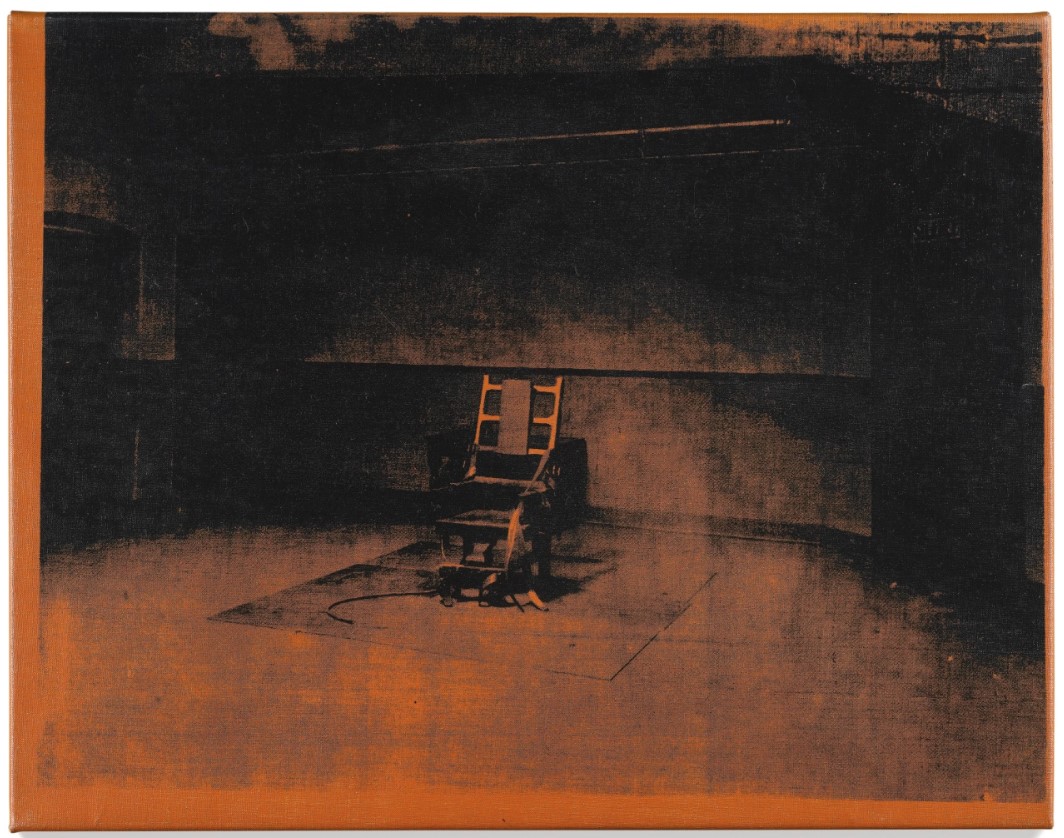
Located in the center of a 22×28 inch canvas, the eponymous electric chair is almost overwhelmed by the starkness and darkness of the room in which it stands. Overflowing with gloom and completely devoid of unnecessary adornments, the concrete space houses only the implements necessary to its function. The stark contrast between the light and dark areas causes the chair, its restraints and even the pipes of the sprinkler system that hangs from the ceiling to all take on an ominously enhanced status in this evocative staging. Housed for many years in the private collection of the artist Cy Twombly, it was this divergence between shadow and light that attracted the artist to this particular painting, an admiration bolstered by his understanding of chiaroscuro gained from his detailed study of Italian Renaissance painting undertaken during his time in his adopted homeland. Warhol’s restrained aesthetic masterfully heightens the portentous sense of emptiness as well as enabling key minute details to be visible, a characteristic that makes this particular example of Electric Chair stand out as one of the most evocative from the series.
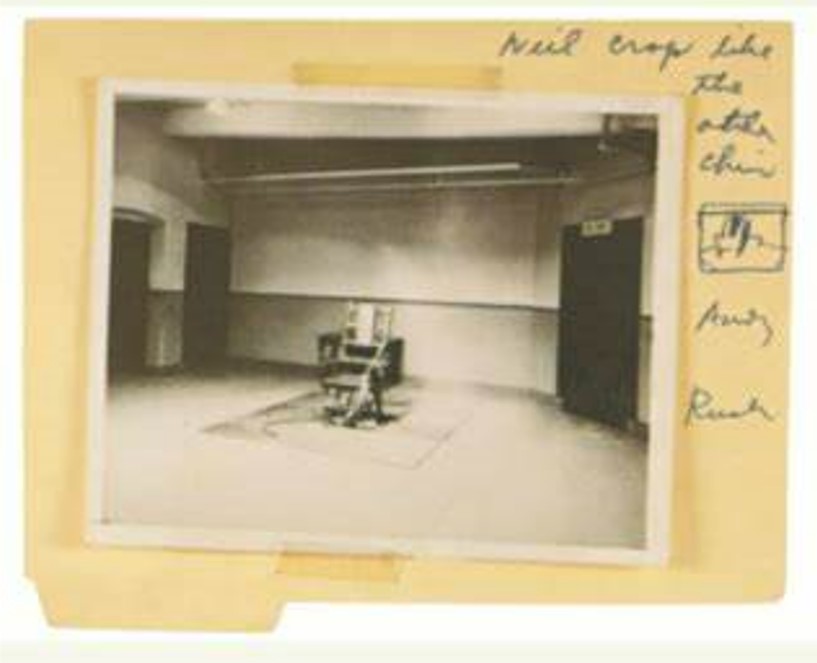
Taking this press photograph, which was already highly contrasted to increase its legibility for media dissemination, Warhol applied a single layer of monochrome color before printing the silkscreen. For this group of Little Electric Chairs, the artist used a range of colors from garish cadmium yellow and orange, to sugary lavenders and pinks, bright, artificial and ‘decorative’ tones creating a disturbing contrast with the sinister subject matter printed on top. his results in each canvas in the series having a unique color field, with different combinations producing different levels of visual intensity. By using a color that is usually associated with peace and tranquility, Warhol’s choice of blue perhaps aligns most closely with his original intention for this series.
Both the authorless monochrome ground and the near-mechanical mode of silkscreen printing were perfectly suited to the cold, mechanized method of killing that the image presented. While this depersonalized mode of production and the repetition of the same image throughout the series would seem to desensitize the viewer. In Warhol’s Death and Disaster series, the viewer is subject to the some of the most violent imagery in the history of art at that point. Warhol’s audacious incorporation of these horrifying images are often repeated in a single work-twice, twelve, fifteen times across the canvas. Like the barrage of news media imagery that flows through daily life, Warhol understood that a repeated image dissolves and loses its efficacy. It becomes like patterned wallpaper, like static or “white noise” that fills the background but does not capture notice.
“When you see a gruesome picture over and over again, it doesn’t really have any effect.”
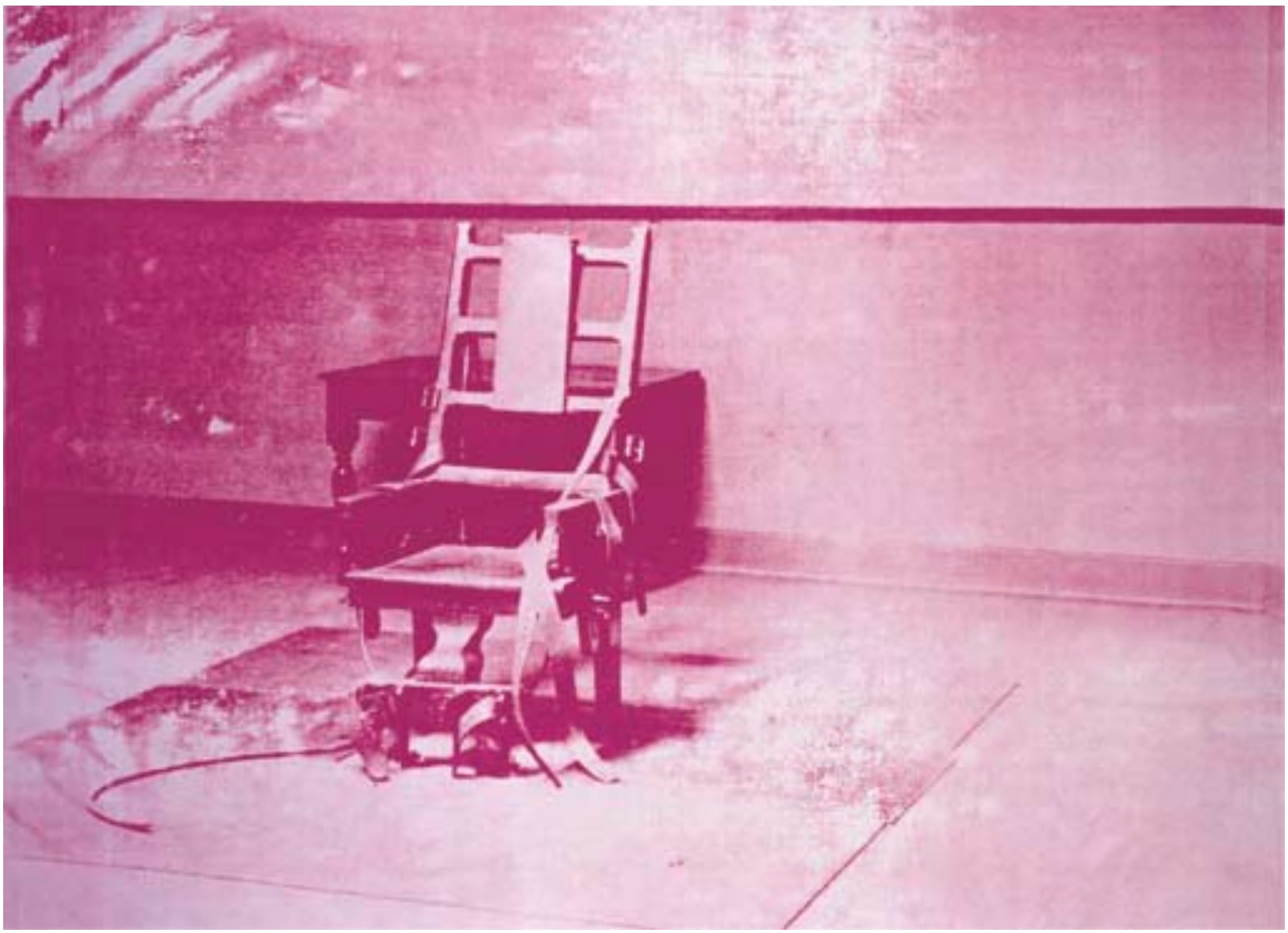
Unlike the Car Crash works, in which bodies are strewn out of wrecked cars or the Race Riots, which present frenzied snapshots of conflict and brutality, the Electric Chairs are exempt from explicit violence, defined by a stillness, emptiness and silence that sets them apart from these action-filled visions of death. Lacking any sign of human presence, Electric Chair is filled with a chilling sense of foreboding. Spot lit and set just off center, the instrument of death stands empty, the restraints hanging down limply as it awaits its next victim. The real terror is left unseen making it all the more horrifying; the viewer is left to imagine the gruesome events that will follow. Perfectly cropped to Warhol’s exact specification, this image appears as if a still from a film, a morbid theatre of death that simultaneously repulses and intrigues. Indeed, the cinematic, film noir composition and macabre contrast of light and shadow set amidst the soft pink glow all serve to endow this scene with a hypnotic visual power and a disturbing beauty.
It is in its very absence of human content that this image paradoxically serves as the complete embodiment of the concept of death that Warhol was exploring with this series. Picturing this empty death chamber and solitary chair in an image that is at once notorious yet entirely depersonalized, Warhol encapsulated his own ideas of death:
“I never understood why when you died, you didn’t just vanish and everything could just keep going the way it was, only you just wouldn’t be there. I always thought I’d like my own tombstone to be blank. No epitaph, and no name. Well, actually, I’d like it to say ‘Figment.’”
In Electric Chair, however, Warhol seems to highlight the resonance that a single, powerful image can produce. Rather than repeat it, Warhol instead insists on the chair’s singularity, thereby conveying its importance. The preeminent Warhol scholar Neil Printz describes the electric chair as “the most iconic image in the Death and Disaster series,” (Neil Printz, “Painting Death in America,” Andy Warhol: Death and Disaster, exh. cat., Menil Collection, Houston, 1988, p. 16).
Of all Warhol’s Death and Disaster paintings, the Electric Chair is the only work that shows no scene of violence. In this way, because Warhol presents a single, isolated electric chair in an empty execution chamber, the viewer is left to extrapolate the action of the scene. In essence, Warhol creates a kind of mise-en-scéne that recalls the work of Alfred Hitchcock or film noir, in which the real terror of the scene is left unfilmed. The mind of the viewer spectacularly re-enacts the gruesome electrocution of the victim, which is undoubtedly more terrifying a spectacle because it is created in the mind’s eye.
Warhol created roughly forty versions of the Electric Chair, each executed in black silkscreen ink applied over a differently colored ground. It has been noted that Warhol used bright and fanciful “decorator”–type colors in the Electric Chair series, from green to blue and even pink. Gerard Malanga, who worked closely with Warhol during this era, recalls: “Imagine, the premiere of Andy’s Electric Chair paintings in Toronto! Each painting seemed identical yet no two were really alike. Every color imaginable….Andy remarked how adding pretty colors to a picture as gruesome as this would change people’s perceptions of acceptance,” (G. Malanga, ‘Electric Chairs on Display in Toronto for First Time!’, Andy Warhol: Little Electric Chair Paintings, New York, 2001, p. 8).
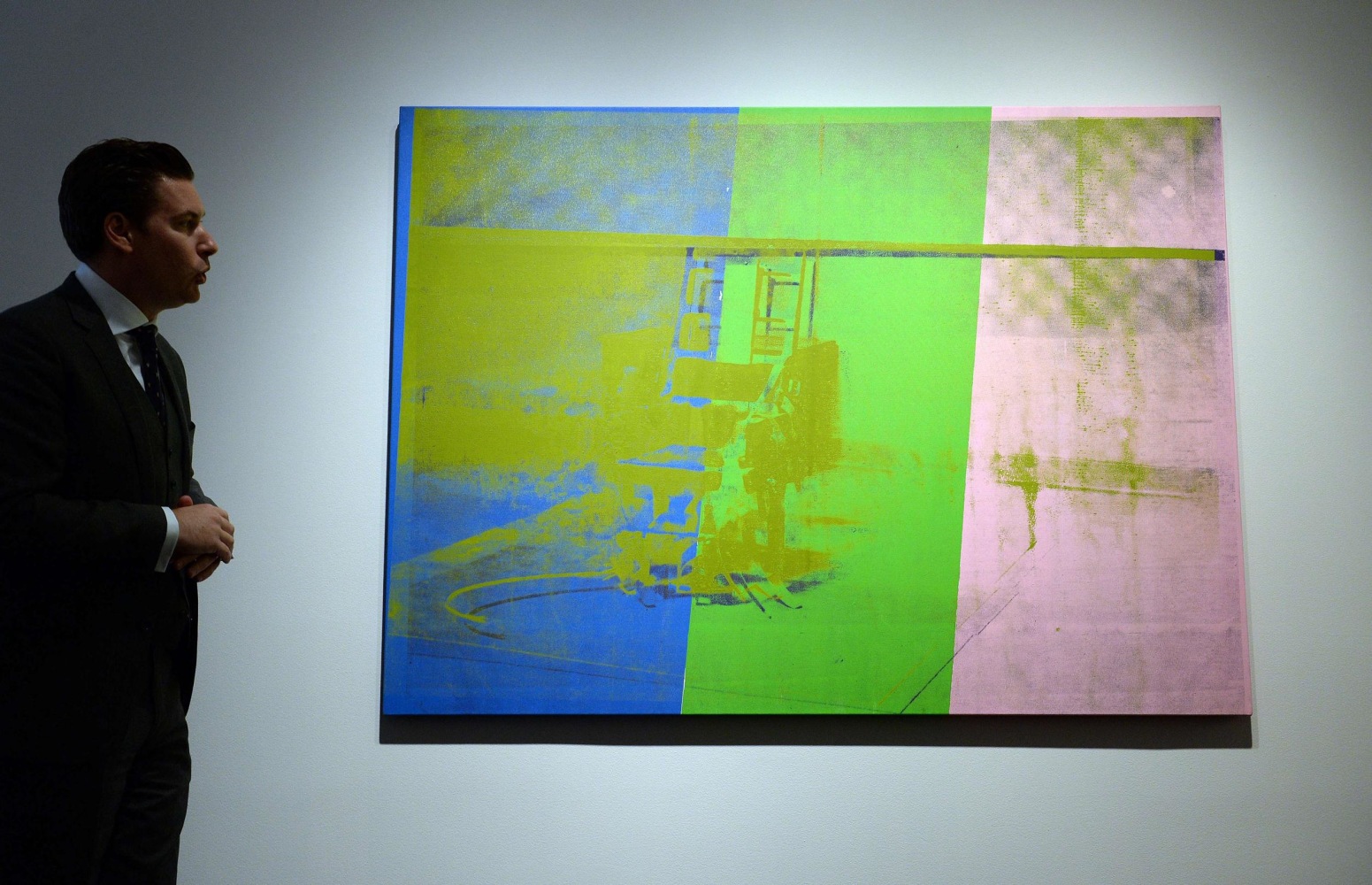
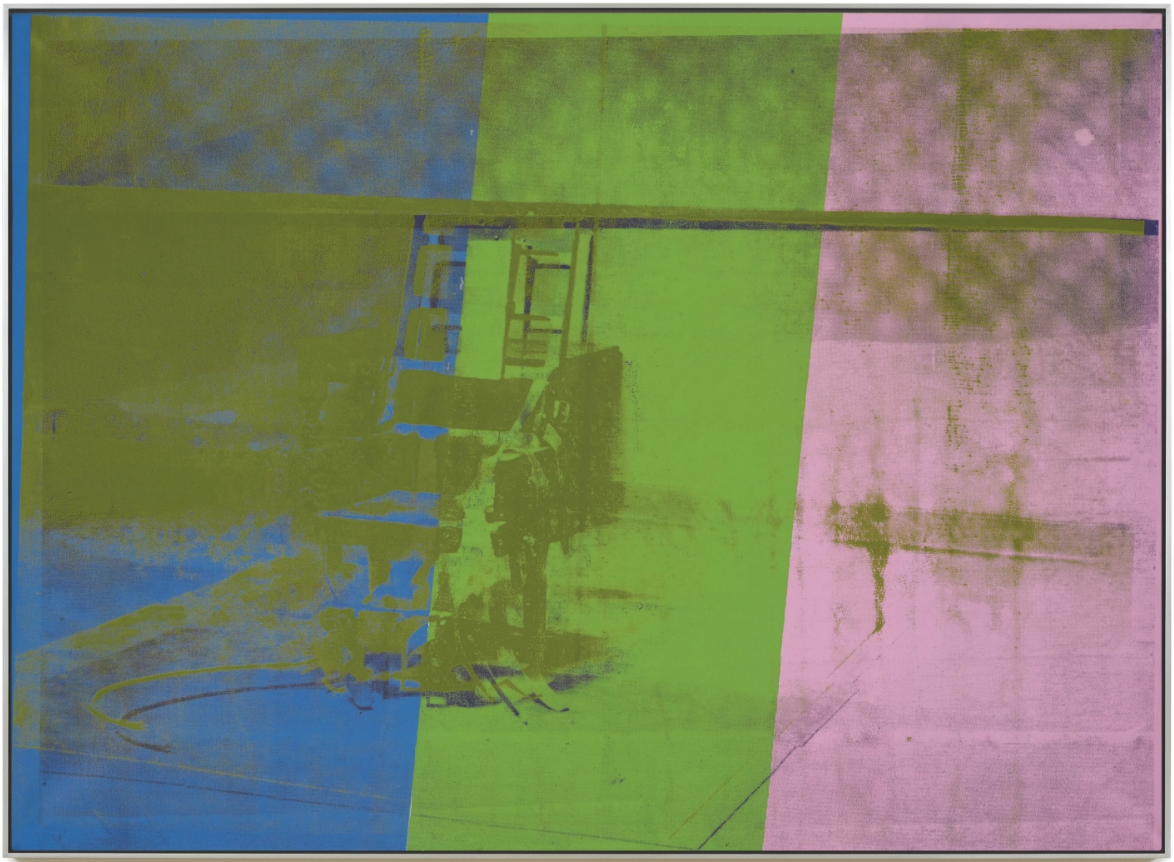
Nowhere else in Andy Warhol’s prodigious output does he more affectingly capture the metaphysical terror of living in the Technicolor Sixties than in Big Electric Chair. For the artist who singlehandedly defined the intense prismatic palette of Pop art, Big Electric Chair from 1967-1968 embodies the most daring and sophisticated deployment of color across all of Warhol’s most critically lauded Death and Disaster paintings. Exceptionally rare, it is one of only fourteen large-format depictions of the subject, of which the majority reside in major international collections such as the Centre Georges Pompidou in Paris, the Moderna Museet in Stockholm, the Neue National in Berlin, and the Menil Collection in Houston. The present work is the sole Big Electric Chair that saw Warhol divide the canvas into three discrete fields of uniform color and silkscreen the surface twice—once in a dark purple and subsequently in a velvet green. The paintings that Warhol previously executed in 1963 and 1965 depicting the same electric chair were strictly black-ink silkscreens on monochromatic grounds, either on much smaller canvases or serially repeated in the same image. Emphasizing its inimitable singularity, not only were the Big Electric Chairs the largest isolated iterations of the subject, but none aside from the present work saw Warhol segment the image into more than two oblique zones of color. Its polychromatic, high-key tonality without doubt renders it the most compositionally complex of all Electric Chairs.
Big Electric Chair’s phantasmagoria of color calls to mind the painting of Francis Bacon, whose most riveting canvases amalgamate the carnal horrors of disfigurement and profound psychological unrest with harrowingly bright hues. Michel Leiris wrote that Bacon’s paintings convey a modern mental state previously referred to as “le mal du siècle—the ardent awareness of being a presence permeable to all the charms of a world not notable, however, for its kindness, and the icy uncertainty that we are no more than this, have no real power, and are what we are only for a ridiculously limited time… he cannot do other than show the appalling dark side of life, which is the reverse of its bright surface.” (Michel Leiris, Francis Bacon: Full Face and In Profile, 1983, pp. 45-6) If Bacon’s colors served not only to inflate the surreal unease of his pictures, but expose the harlequin masking the macabre lurking beneath, Warhol instrumentally deploys a similarly brazen spectrum to highlight the existential malaise of living in the media-saturated climate of 1960s America.
Little Electric Chair
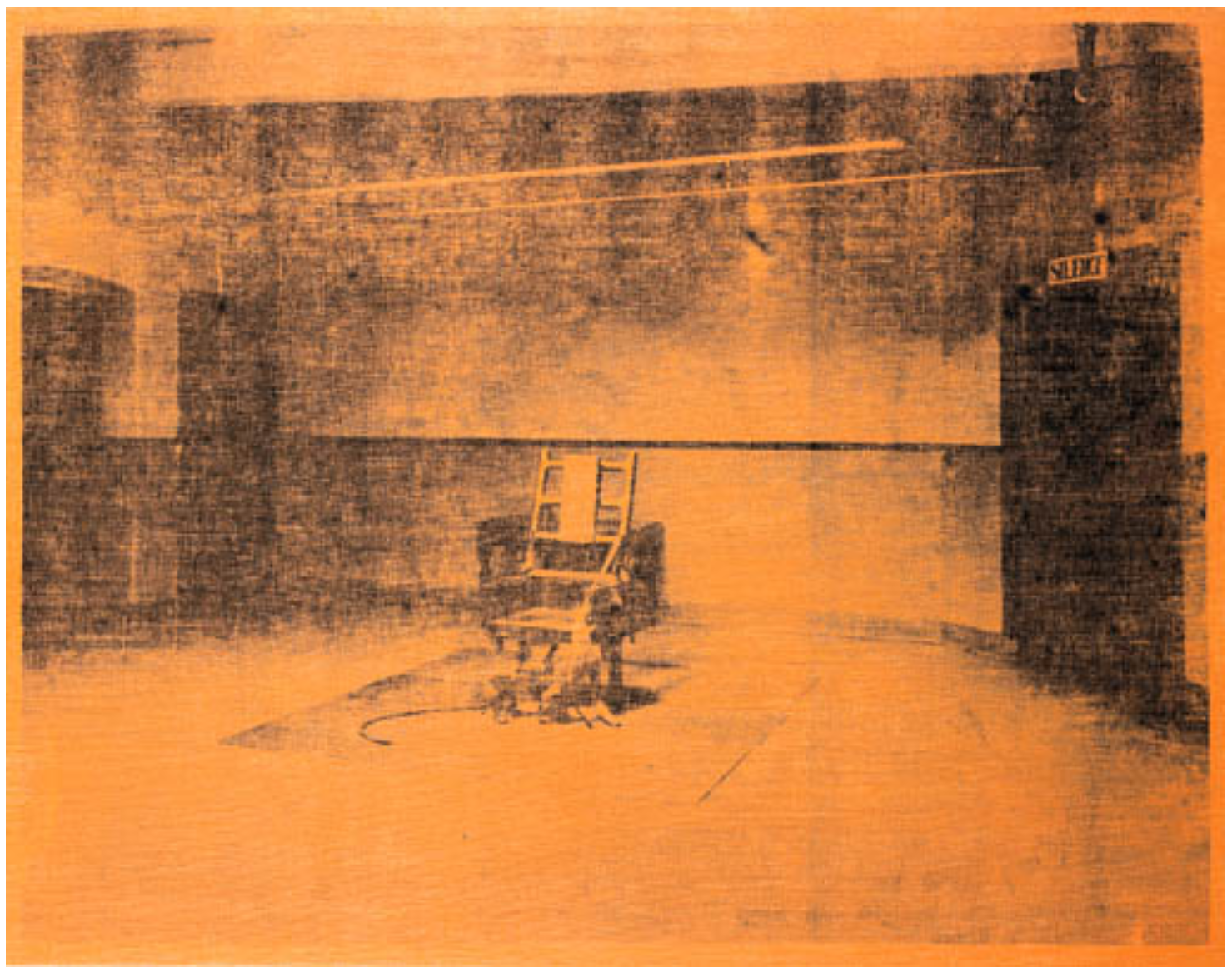
While some of Warhol’s earliest paintings were limited to a palette of black and white, the era in which Little Electric Chair was created is marked by a bold embrace of vivid color, which is especially evident in the Marilyn “flavors” of 1962, the Liz paintings and the Death and Disaster series. In Little Electric Chair, Warhol’s selection of the color yellow truly heightens the terror of the scene, calling to mind Rainer Crone’s comment that the colors in the series “serve to intensify the effect of alienation created by the realism of the visual content,” (R. Crone, Andy Warhol, 1970, p. 29). Rather than use a naturally-occurring hue, Warhol selects an altogether artificial yellow as the ground color for Little Electric Chair. The yellow that Warhol chose is altogether institutional in feeling and tone–the color of traffic safety signs and road markers. Furthermore, because Warhol’s silkscreen ink was a commercially processed product that he applied directly from the tube, it is also not unlike the artificial color of certain food products, like French’s yellow mustard, an American commodity as ubiquitous as Campbell’s tomato soup. Though not exactly the same hue, the painting can be compared to Warhol’s Mustard Race Riot and might therefore conjure more sinister aspects of the color, like mustard gas or even agent orange.
A deeply personal and highly resonant work, the Little Electric Chair provides a haunting glimpse into the inner life of the artist while providing pertinent commentary on the sociopolitical landscape of Post-War America. Shortly after it was painted, the painting was acquired by the preeminent collectors Kimiko and John Powers, who purchased the work from the Leo Castelli Gallery in New York. Considered the most iconic painting from Warhol’s Death and Disaster series, the Little Electric Chair is a brilliant example of the artist’s best work.
Little Electric Chair, 1964-65
Property from an Esteemed Private Collection
Christie’s New-York: 21 May 2026
Estimated: USD 2,000,000 – 3,000,000
USD 2,759,000
ANDY WARHOL (1928-1987), Little Electric Chair | Christie’s
ANDY WARHOL (1928-1987)
Little Electric Chair, 1964-65
Acrylic and silkscreen ink on canvas
22×28 inches (55.9 x 71.1 cm)
Stamped twice with the Estate of Andy Warhol and the Andy Warhol Foundation for the Visual Arts, Inc. stamps
Numbered twice ‘VF PA57.007 VF PA57.007’ (on the overlap)
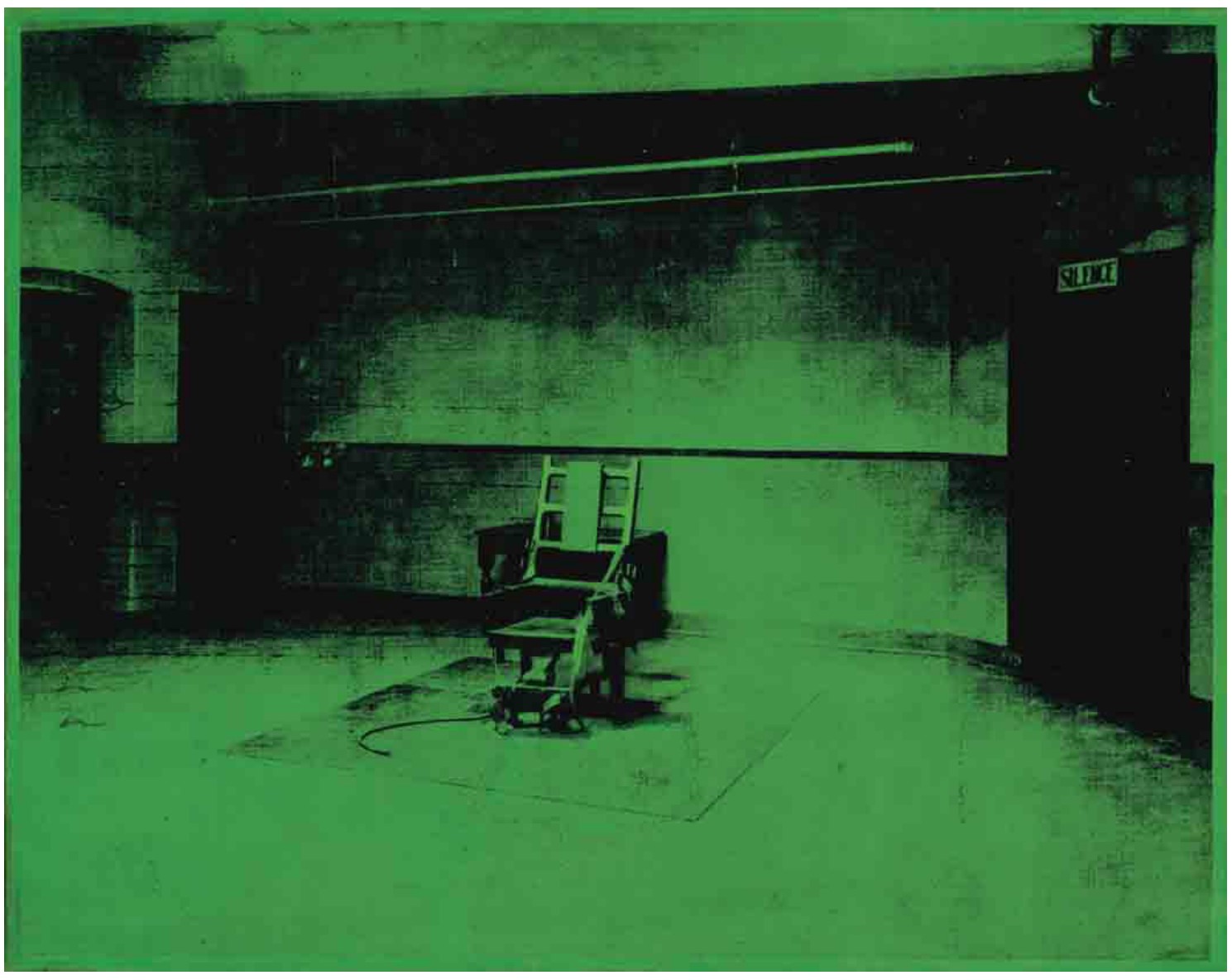
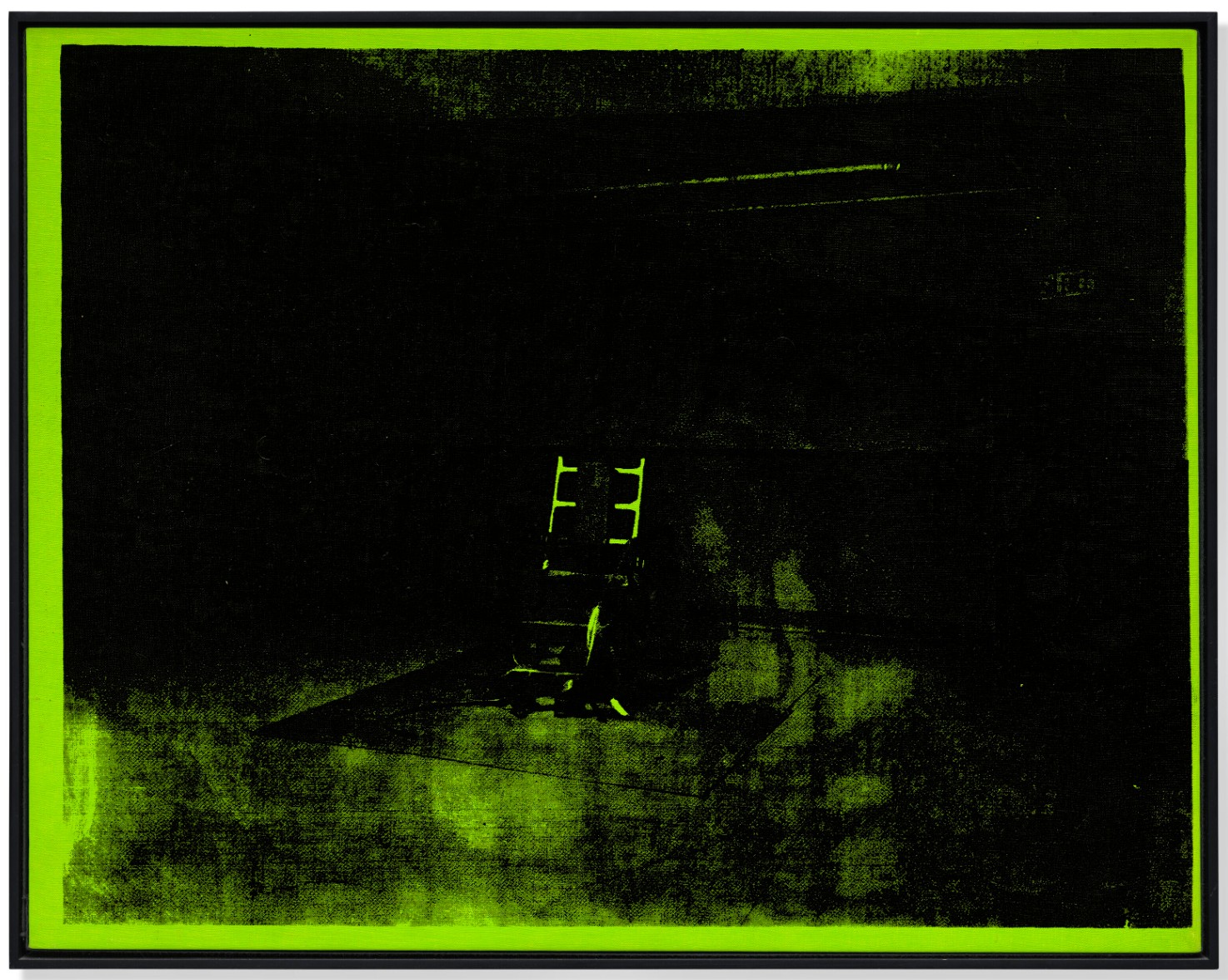
Stark and quietly unsettling, Little Electric Chair by Andy Warhol stands among the artist’s most iconic images. Executed in a vivid, distinctly unnatural green, the work transforms a journalistic photograph of the electric chair into a spectral scene that oscillates between documentation and abstraction. Isolated, silent, and devoid of human presence, the chair emerges from a murky field of shadow, its form at once legible and obscured. Rare and increasingly scarce, the Little Electric Chair paintings are among the most sought-after works in Warhol’s oeuvre, with nine examples now housed in major museum collections, including the Philadelphia Museum of Art, the Yale University Art Gallery, the San Francisco Museum of Modern Art, and the Menil Collection, Houston. At once inherently provocative and iconic within Warhol’s serial practice, Little Electric Chair distills the quiet, bureaucratic machinery of death in modern America into a single, unforgettable image.
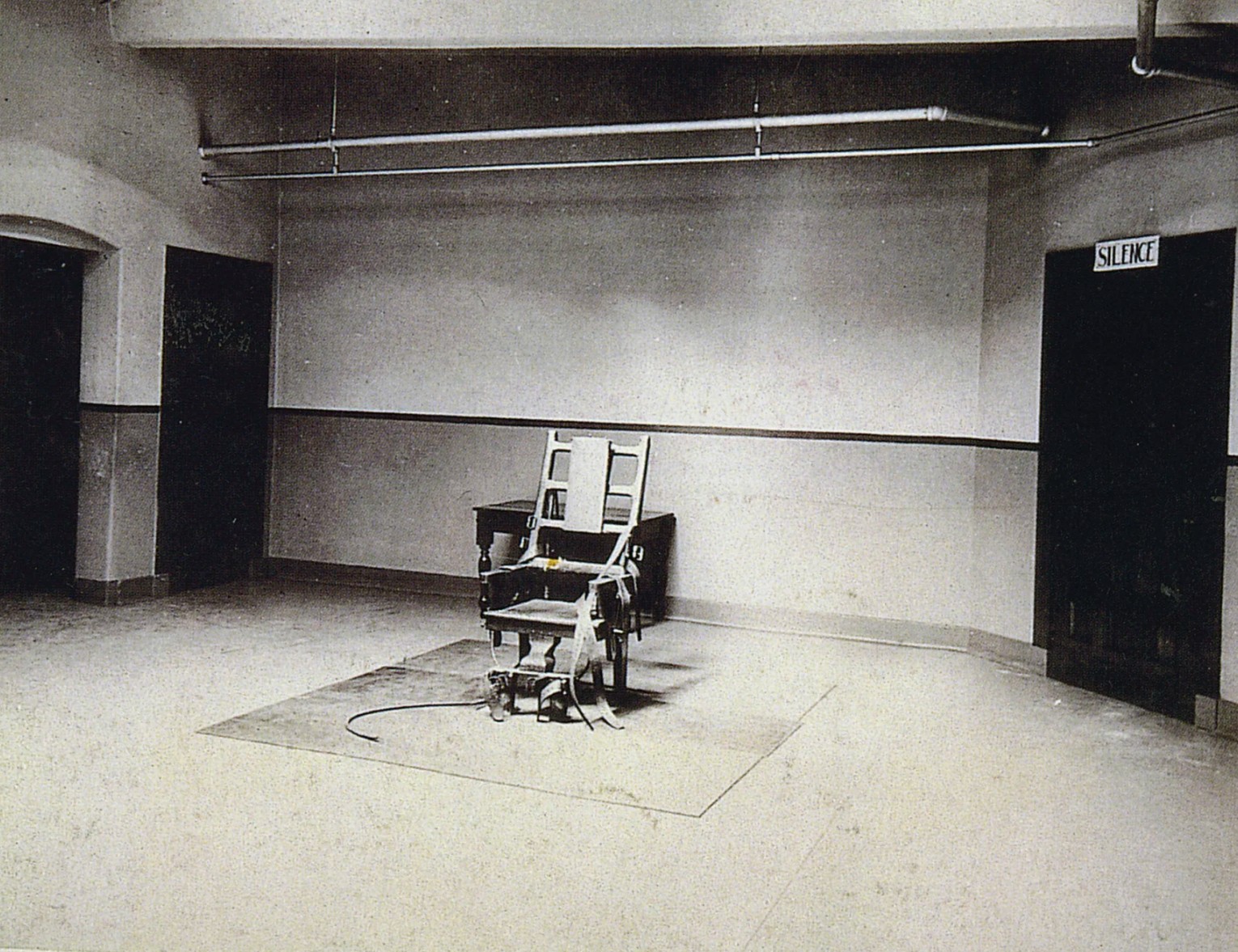
Source image for Electric Chair series. Archives of the Andy Warhol Museum, Pittsburgh.
© 2026 The Andy Warhol Foundation for the Visual Arts, Inc. / Licensed by Artists Rights Society (ARS).
The genesis of the Death and Disaster series is often traced to June 1962, when Henry Geldzahler presented Warhol with a copy of the day’s newspaper over lunch, the headline “129 DIE IN JET” emblazoned across the front page. “I wanted Andy to get serious,” Geldzahler later recalled. “I said, ‘It is enough life. It is time for a little death’” (H. Geldzahler, quoted in S. Watson, Factory Made: Warhol and the Sixties, New York, 2003, p. 104). Soon after, Warhol transferred the image of the plane wreckage onto canvas, initiating a sustained exploration of death across a range of subjects. Over the following two years, he developed a powerful body of work encompassing suburban car crashes, suicides, the atomic bomb, and race riots in the American South. These works were originally intended for an exhibition at the Ileana Sonnabend Gallery in Paris in the spring of 1964—his first presentation in Europe—which he planned to title Death in America. In contrast to the cool commercialism of his Coca-Cola bottles and Campbell’s soup cans, these works reveal a darker underside of American life, exposing the ways in which tragedy had become a consumable spectacle within the mass media.
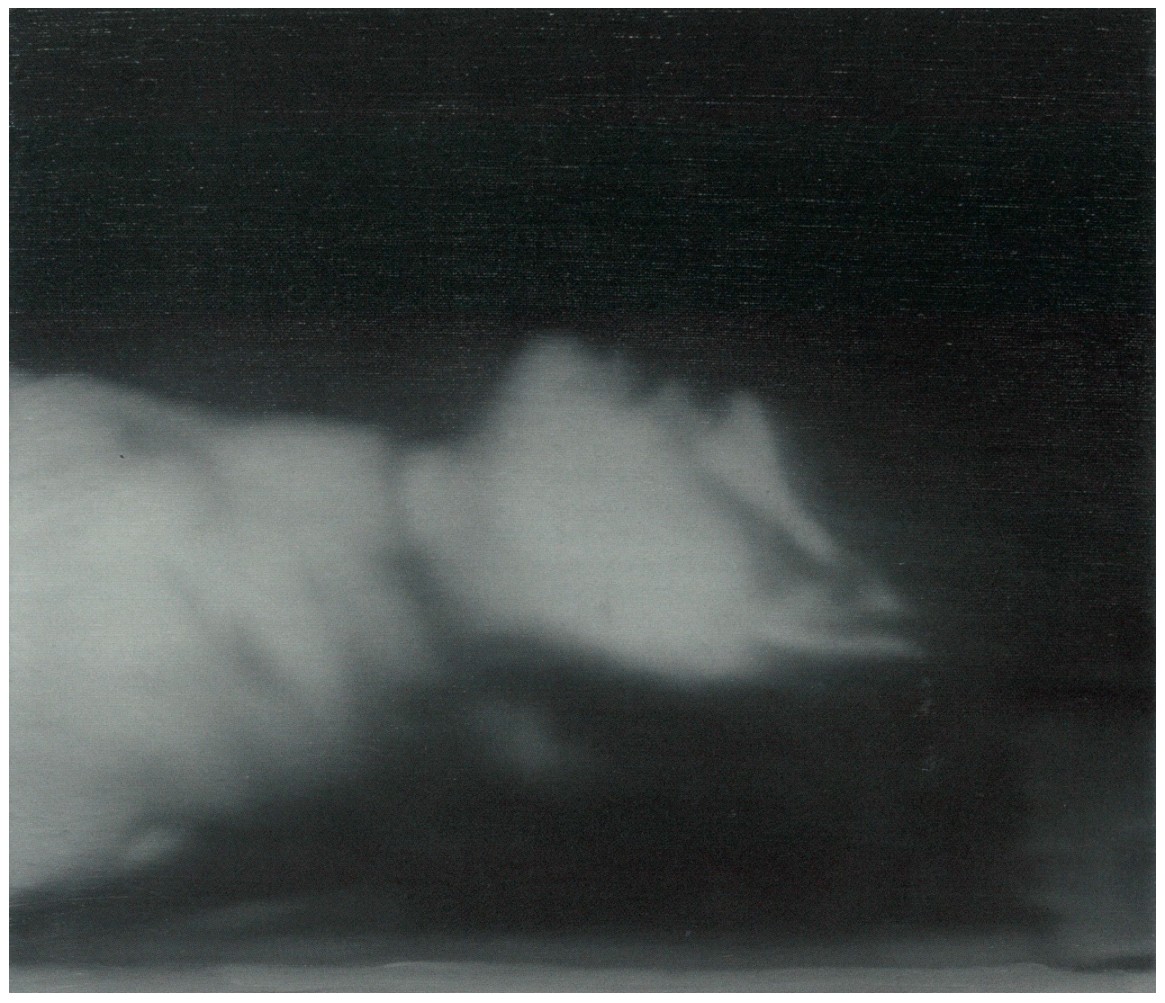
Gerhard Richter, Tote, 1988. Museum of Modern Art, New York. © Gerhard Richter 2026 (0111).
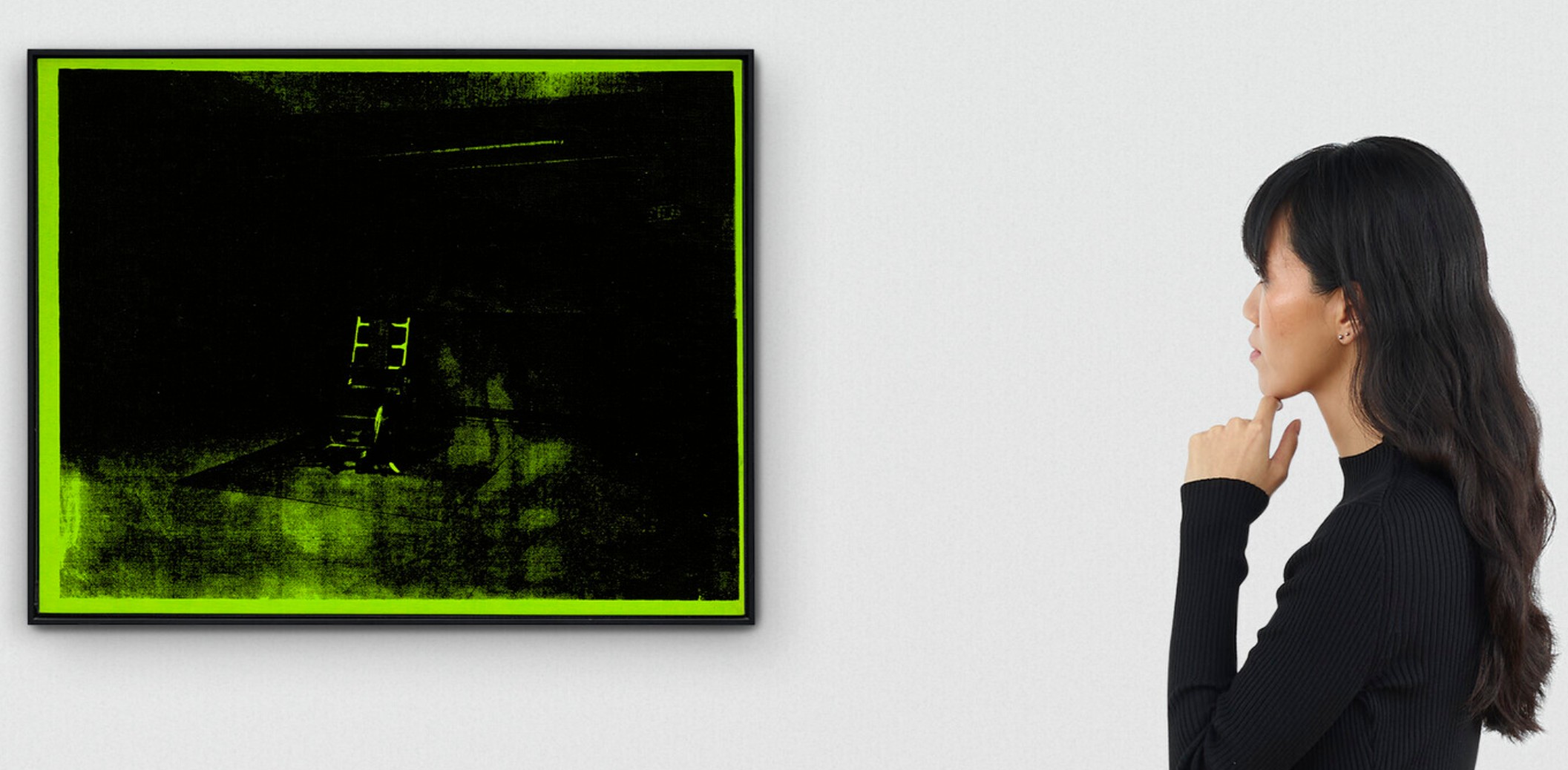
Among these works, the Little Electric Chair paintings stand as the most distilled and emblematic. Depicting a uniquely American mode of execution—one that originated in New York and struck Warhol as a “typically American way to go” (D. Bourdon, Warhol, New York, 1989, p. 154)—the series draws from a press photograph of the electric chair, known as “Old Sparky,” at Sing Sing State Penitentiary in Ossining, New York. When Warhol began the group in 1963, electrocution was once again at the forefront of public consciousness, and by the time he executed the present work in 1964–1965, debates surrounding capital punishment had re-emerged with renewed intensity.
Among these works, the Little Electric Chair paintings stand as the most distilled and emblematic. Depicting a uniquely American mode of execution—one that originated in New York and struck Warhol as a “typically American way to go” (D. Bourdon, Warhol, New York, 1989, p. 154)—the series draws from a press photograph of the electric chair, known as “Old Sparky,” at Sing Sing State Penitentiary in Ossining, New York. When Warhol began the group in 1963, electrocution was once again at the forefront of public consciousness, and by the time he executed the present work in 1964–1965, debates surrounding capital punishment had re-emerged with renewed intensity.
While this mode of production and repetition might seem to affirm Warhol’s well-known assertion that “when you see a gruesome picture over and over again, it doesn’t really have any effect” (A. Warhol, quoted in G. Swenson, op. cit., p. 19), the result here is the inverse. It is precisely this apparent indifference that heightens the image’s quiet horror. Warhol neither dramatizes nor diminishes his subject; instead, he presents it with a dispassionate clarity that compels sustained looking. The electric chair becomes one of the many “open sores” of American life at the time (T. Crow, “Saturday Disasters: Trace and Reference in Early Warhol,” Art in America, May 1987).
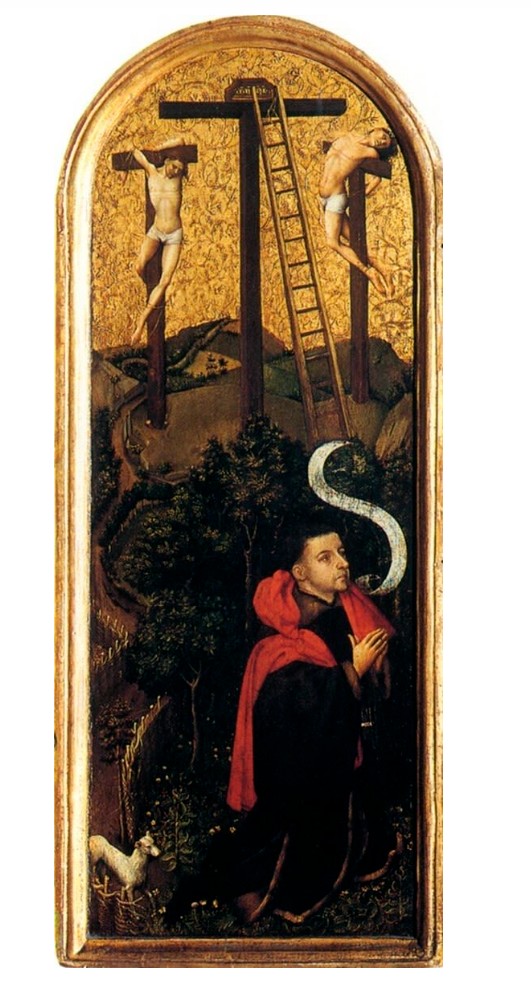
Robert Campin, Seilern Triptych, circa 1425 (detail). The Courtauld, London.
Despite its static composition, the work is charged with a profound sense of anticipation. The chair sits empty, its restraints hanging loosely, awaiting its next occupant. This vacancy is crucial: it is precisely this void that generates the image’s psychological intensity. In this respect, the work recalls early Netherlandish depictions of the Crucifixion after the Deposition, in which the cross remains standing, emptied of its body, with only the ladder and surrounding landscape bearing witness to what has already occurred. Like these images, Warhol’s electric chair persists as a structure without its subject, shifting attention from the spectacle of death to its lingering, institutional presence. Unlike the Car Crash or Race Riot works, which depict moments of violent action, the Little Electric Chair paintings are defined by stillness, silence, and suspension. The viewer is left to imagine the unseen event, projecting their own fears and associations onto the scene. In this sense, the work operates as what has been described as a “conjured void,” a representation of death not as spectacle, but as condition. As Neil Printz has observed, “The photograph selected by Warhol represents death as absence and silence, a conjured void” (N. Printz, “Painting Death in America,” in Andy Warhol: Death and Disasters, exh. cat., Houston, 1988–1989, p. 16). It is in this absence of human presence that the work most powerfully embodies Warhol’s meditation on death. Little Electric Chair confronts the viewer not with action, but with possibility—with the knowledge of what has occurred, and what will inevitably occur again. In its stark stillness, the image holds time in suspension, transforming a moment of institutional violence into an enduring and unsettling meditation on representation, memory, and the condition of modern life.
Little Electric Chair, 1964
Christie’s New-York: 9 March 2023
Estimated: USD 4,000,000 – 6,000,000
USD 4,500,000
ANDY WARHOL (1928-1987), Little Electric Chair | Christie’s
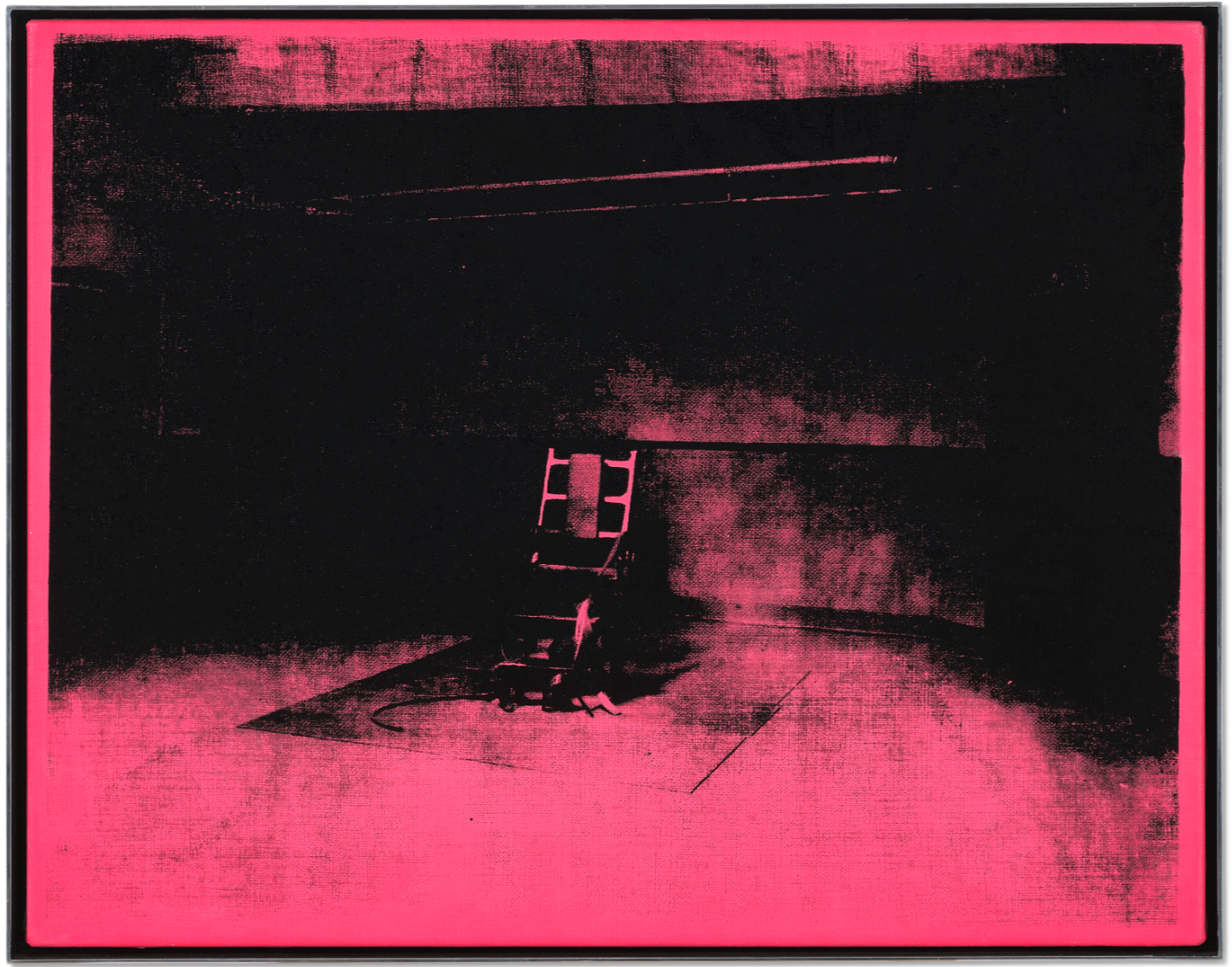
ANDY WARHOL (1928-1987)
Little Electric Chair, 1964
Acrylic and silkscreen ink on canvas
22×28 inches (55.9 x 71.1 cm)
Signed, numbered and dated ‘Andy Warhol 64 A1290.7’ (on the overlap)
Little Electric Chair, 1964-1965
Christie’s New-York: 15 May 2019
Estimated: USD 6,000,000 – 8,000,000
USD 8,220,000
Andy Warhol (1928-1987), Little Electric Chair | Christie’s
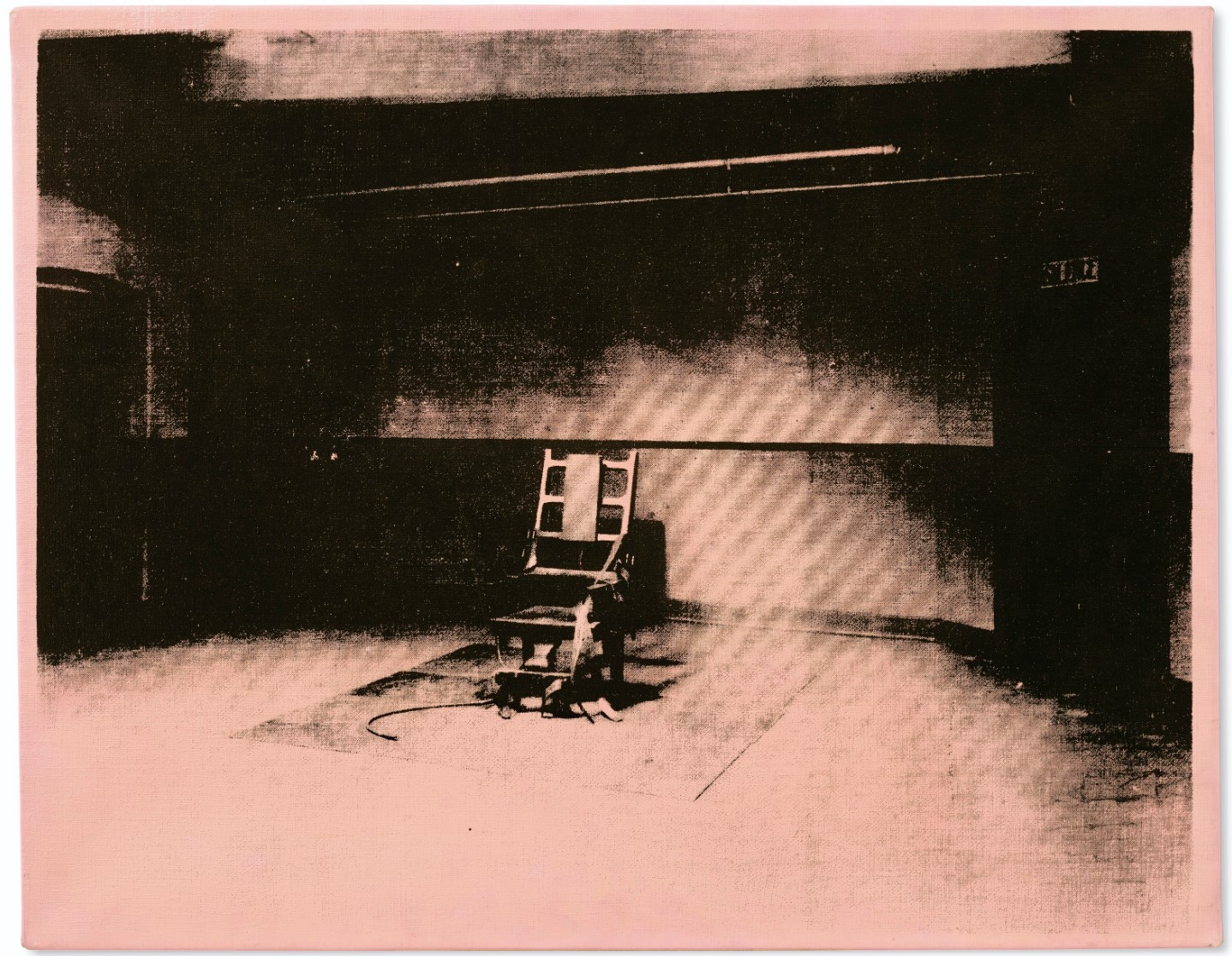
ANDY WARHOL
Little Electric Chair, 1964-1965
Acrylic and silkscreen ink on linen
22×28 inches (55.8 x 71.1 cm)
Signed and dated ‘Andy Warhol ’64’ (on the overlap)
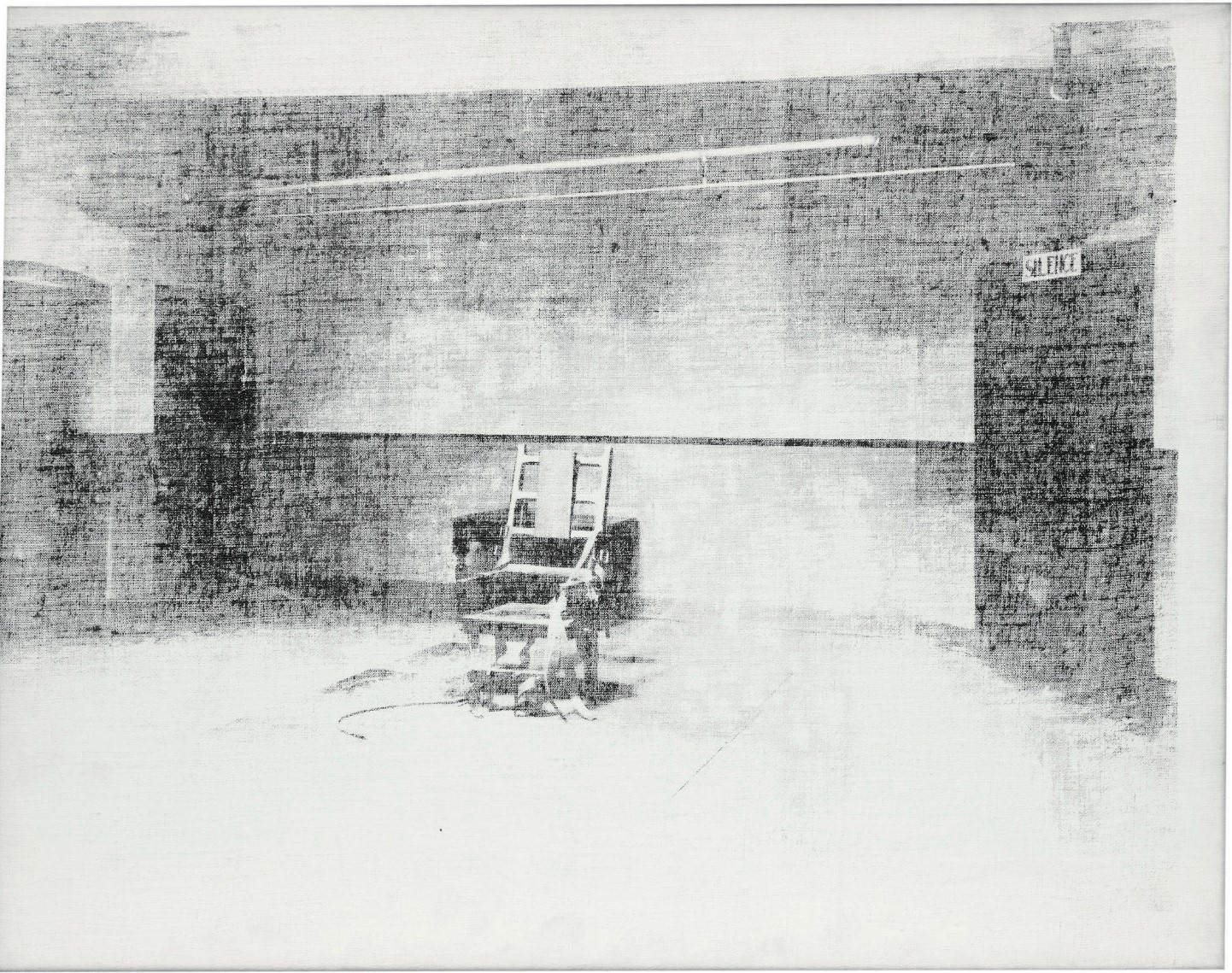
A chilling portrait of one of America’s most infamous inventions, Little Electric Chair is the defining image of Andy Warhol’s Death and Disasters series, a seminal body of work that saw the artist penetrate the shining veneer of postwar American life and reveal the darker realities that lay simmering beneath. The sinister spectacle of the electric chair, alone save for the SILENCE sign that emerges from the darkness of the door, is bathed in a soft shade of flesh toned pink, a colour unique to this group of works that was executed in late 1964-1965. Iconic both in its provocative subject matter and its unchanging reappearance throughout Warhol’s work, Little Electric Chair also demonstrates, in a single, unforgettable image, the artist’s unique ability at creating art that embodied the complex and contradictory sentiments of the postwar era.
Little Electric Chair, 1964
Christie’s New-York: 10 November 2015
Estimated: USD 6,000,000 – 9,000,000
USD 11,589,000
Andy Warhol (1928-1987), Little Electric Chair | Christie’s
ANDY WARHOL
Little Electric Chair, 1964
Acrylic and silkscreen ink on canvas
22×28 inches (55.9 x 71.1 cm)
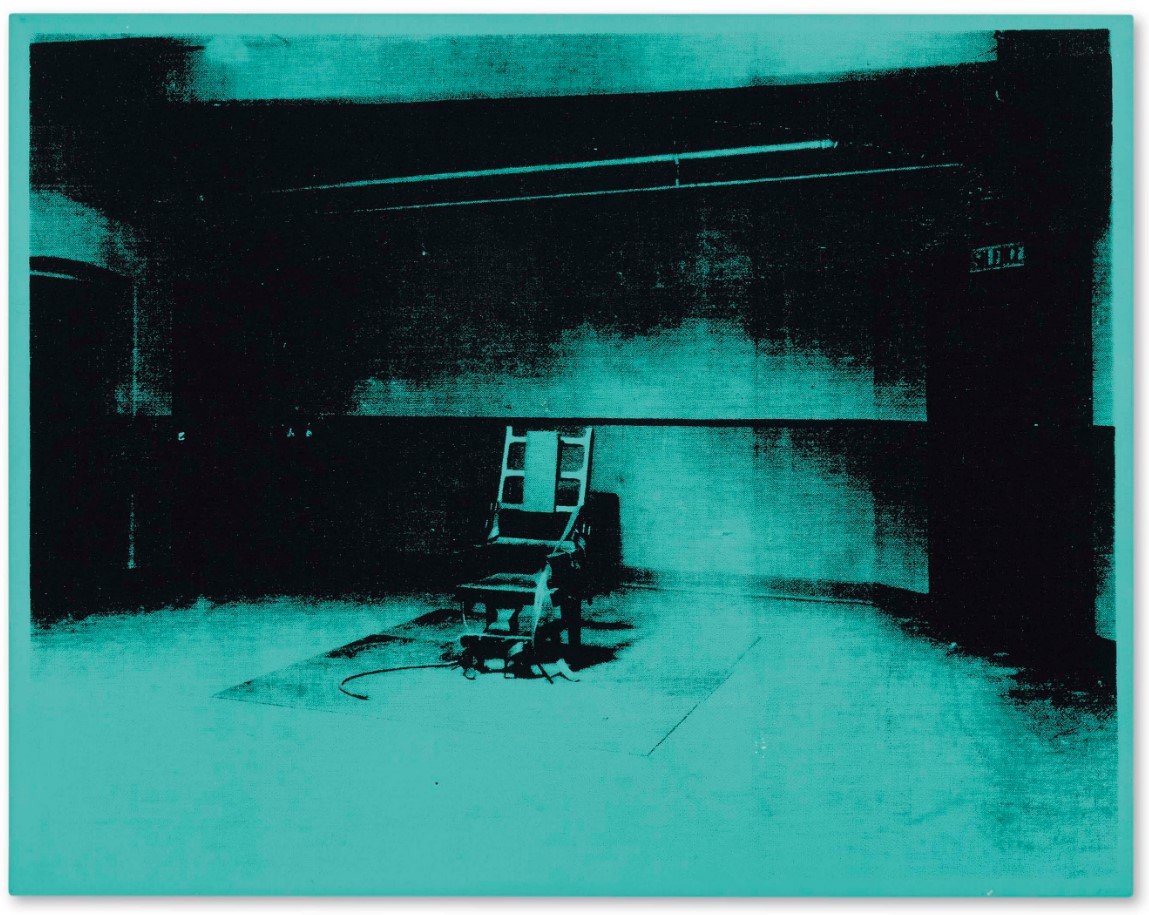
Rendered in black silkscreen ink upon a background of cool, blue acrylic, Warhol’s Little Electric Chair is a somber reminder of execution process. Warhol’s brilliant use of a bloodless, bodiless blue works in tandem with the perspectival distancing of the original source image; the walls appear to rapidly recede into the distance, the boxlike depiction of the empty room growing larger and larger. One of the most profound aspects of Warhol’s Little Electric Chair is not the grisly violence it evokes, but rather the overwhelming beauty and keen sense of pathos that is conveyed through the artist’s depiction. In an elegant reverie that borders on the sublime, Warhol creates a strange world awash in blue, a dream-like place of beauty completely antithetical to its subject. Warhol’s blue acquires a transcendent, celestial quality, as it evokes the wild blue skies and cool breezes of the Elysian fields, which Homer’s Odyssey so presciently described: “where life is easiest for men. No snow is there, nor heavy storm, nor ever rain, but ever does Ocean send up blasts of the shrill-blowing West Wind that they may give cooling to men.” (Homer, The Odyssey, 4.560–565; A.T. Murray, Homer, The Odyssey with an English Translation, Harvard University Press, 1919, Perseus Digital Library Project, Cambridge, MA.) In his depiction of the empty chair, might Warhol imply that the condemned has simply vanished, disappeared into the ether, or crossed over to the other side? It certainly implies a transcendental quality, which echoes Warhol’s own desire to disappear upon dying: “I never understood why when you died, you didn’t just vanish and everything could keep going the way it was, only you just wouldn’t be there. I always thought I’d like my own tombstone to be blank. No epitaph and no name,” (A. Warhol, quoted in America, New York, 1985, pp. 126 and 129; reprinted in Neil Printz, “Painting Death in America,” Andy Warhol: Death and Disaster, p. 17).
Little Electric Chair, 1965
Sotheby’s New-York: 12 May 2015
Estimated: USD 4,000,000 – 6,000,000
USD 4,170,000
ANDY WARHOL
Little Electric Chair, 1965
Acrylic and silkscreen ink on canvas
22×28 inches (55.9 x 71.1 cm)
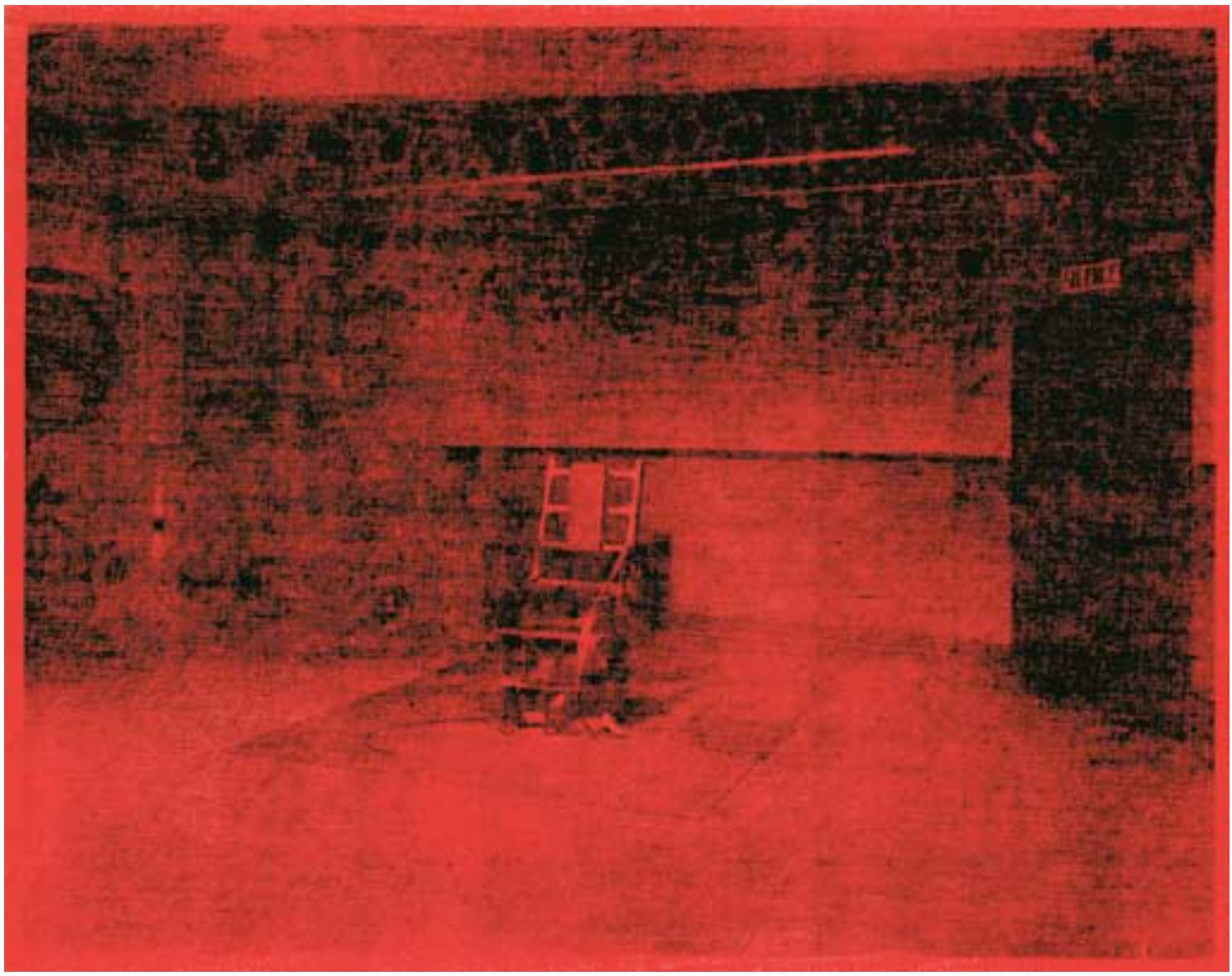
Glowing portentously with a garishly macabre proposition of terror, Andy Warhol’s Little Electric Chair from 1964-65 illuminates a hauntingly surreal and scintillating exposition of the anxiety that lurks beneath America’s exterior. Little Electric Chair exemplifies Andy Warhol’s most affecting deployment of Pop Art idioms to uncover the disturbing shadows amidst the Technicolor 60s. Executed in an alluring simmering orange red hue that augments the chilling fear of the image, the present work is a brilliant example from one of Warhol’s most compelling series. Humming with menace, the surreal glow of the painting buzzes with the precise moment of electrocution, metaphorically vibrating with the terrifying flash of death at the instant of its arrival. It is precisely this leitmotif of the uncanny juxtaposition between intoxicating bubblegum pop with mortality that permeates Warhol’s best pictures.
When Warhol exhibited his Little Electric Chairs for the first time at Jerrold Morris Gallery in Toronto in 1965, Gerard Malanga recalled, “Imagine, the premiere of Andy’s Electric Chair paintings in Toronto! Each painting seemed identical yet no two were really alike. Every color imaginable. I remembered then, while slowly looking at them, Andy’s remark how adding pretty colors to a picture as gruesome as this would change people’s perceptions of acceptance. Suddenly the space of the room cancels everything else out. The chair is no longer a weapon and it’s not the chair anymore.” (Gerard Malanga, “Electric Chairs on Display in Toronto for First Time!”, Andy Warhol: Little Electric Chair Paintings, New York, 2001, p. 8) Accentuating their momentous historical significance, nine of these Little Electric Chair paintings belong to eminent museum collections, including the Philadelphia Museum of Art, the Yale University Art Gallery, the San Francisco Museum of Modern Art, and the Menil Collection, Houston.
Just as Warhol challenged our voyeuristic impulses with his subversive depictions of celebrity, Little Electric Chair interrogates the moral psychoses of the mass media, as the candy-colored fluorescence of the canvas appealingly invokes the public’s voracious consumption of death onscreen. Warhol used as his source for the original silkscreen a wire service photograph of the chair at Sing Sing penitentiary in Ossining, New York, an industrial vehicle of ritual killing that executed 614 individuals between 1891 and 1963. This photograph was published by the press on June 19, 1953—the day that Julius and Ethel Rosenberg were put to death at Sing Sing after being convicted of spying for the Soviet Union at the height of the Cold War, allegedly smuggling information to the Russians pertaining to the atomic bomb. Warhol’s source photograph demonstrated death as it is propped up for the public’s viewing, our alternating emotional index oscillating between fear and an insatiable morbid fascination, reminiscent of the crowds that would gather for public hangings. Warhol inaugurated the Electric Chairs in 1963, the same year that the chair at Sing Sing was used for the last time in the executions of Frederick Charles Wood on March 21 and Eddie Lee Mays on August 15. When Warhol painted the first Electric Chair in January and February of 1963, the image bore a startling potentiality, however, after the last execution at Sing Sing and the repealing of capital punishment in New York State in 1965, the desolation of the image signaled a permanent vacancy. Of all of Warhol’s critically lauded Death and Disaster paintings, the Electric Chairs are the only paintings that don’t in fact show the death or the disaster; the terror happens off-screen. The violence is absent and only implied, leaving the viewer to feel only the shock rather than see it firsthand. In many ways, the imagination has the capacity to inflict a worse horror than simply witnessing the execution: with the ambiguity of death that Warhol’s image allows, looking at it we occupy the role of both voyeur and participant, the executioner and the executed. The compelling complexity of Andy Warhol’s project is laid bare by the present work, an image whose semantic associations are in perpetual flux dependent upon social context—what does not change, however, is the immediate power conjured by the picture and its dazzling hue, a grisly delirium that induces a fundamentally human emotional response.
Invented at the end of the Nineteenth Century by Harold P. Brown and Arthur Kennelly, employees of Thomas Edison, the electric chair was the United States’ answer to finding a method of capital punishment to replace hanging; New York State was the first to adopt the invention. Strapped firmly to a wooden chair and attached to numerous electrodes, the condemned would be subjected to a rapid sequence of alternating currents—cycles varying in voltage and duration surged through their body. The screen of Little Electric Chair portentously buzzes, an irradiation whose shadows provide a sense of three-dimensional space to invite the viewer into its reality, emphasized by the cord spiraling toward us at the bottom left of the canvas. The chromatic intensity impels the viewer to realize their own moral distance from the image, emphasizing and unveiling our desensitization to media violence. In a rare interview by Gene Swenson published by Art News in November 1963, Warhol said, “It was Christmas or Labor Day—a holiday—and every time you turned on the radio they said something like ‘4 million are going to die.’ That started it. But when you see a gruesome picture over and over again, it doesn’t really have any effect.” (Andy Warhol cited in Art News, November 1963) Heightening our awareness of a diminished emotional responsiveness to such images, and jolting us back into a state of mental shock, Warhol’s ultimate achievement is his ability to both revel in the concomitant abundance and futility of images while re-investing them with serious potency.
Among the car crashes, suicides, and race riots, Neil Printz declared, “The Electric Chair, with its near-frontality and unchanging recurrence, is the most iconic of Warhol’s Death and Disaster images.” (Neil Printz in Exh. Cat., Houston, The Menil Collection, Andy Warhol: Death and Disasters, 1989, p. 16) A uniquely American industrial invention capable of mechanizing death, the electric chair encompasses Warhol’s overarching enthrallment with the relationship between technological reproducibility and mortality. Paralleling the raw power of Warhol’s other famed Death and Disaster series – Suicides, Car Crashes, The Atomic Bomb – Little Electric Chair sees man become the orchestrator of his own demise through his invention of this killing machine—Warhol spins a circuitous parable of birth and death that marks a particular, yet timeless, moment in American history. In keeping with Warhol’s very best work, the absurdity of human transience is brilliantly encapsulated within this breathtaking painting, a treatise on the emotional conditioning of our time.
Little Electric Chair, 1964-1965
Christie’s New-York: 12 November 2014
Estimated: USD 3,500,000 – 5,500,000
USD 6,045,000
Andy Warhol (1928-1987), Little Electric Chair | Christie’s
ANDY WARHOL
Little Electric Chair, 1964-1965
Acrylic and silkscreen ink on linen
22×28 inches (55.8 x 71.1 cm)
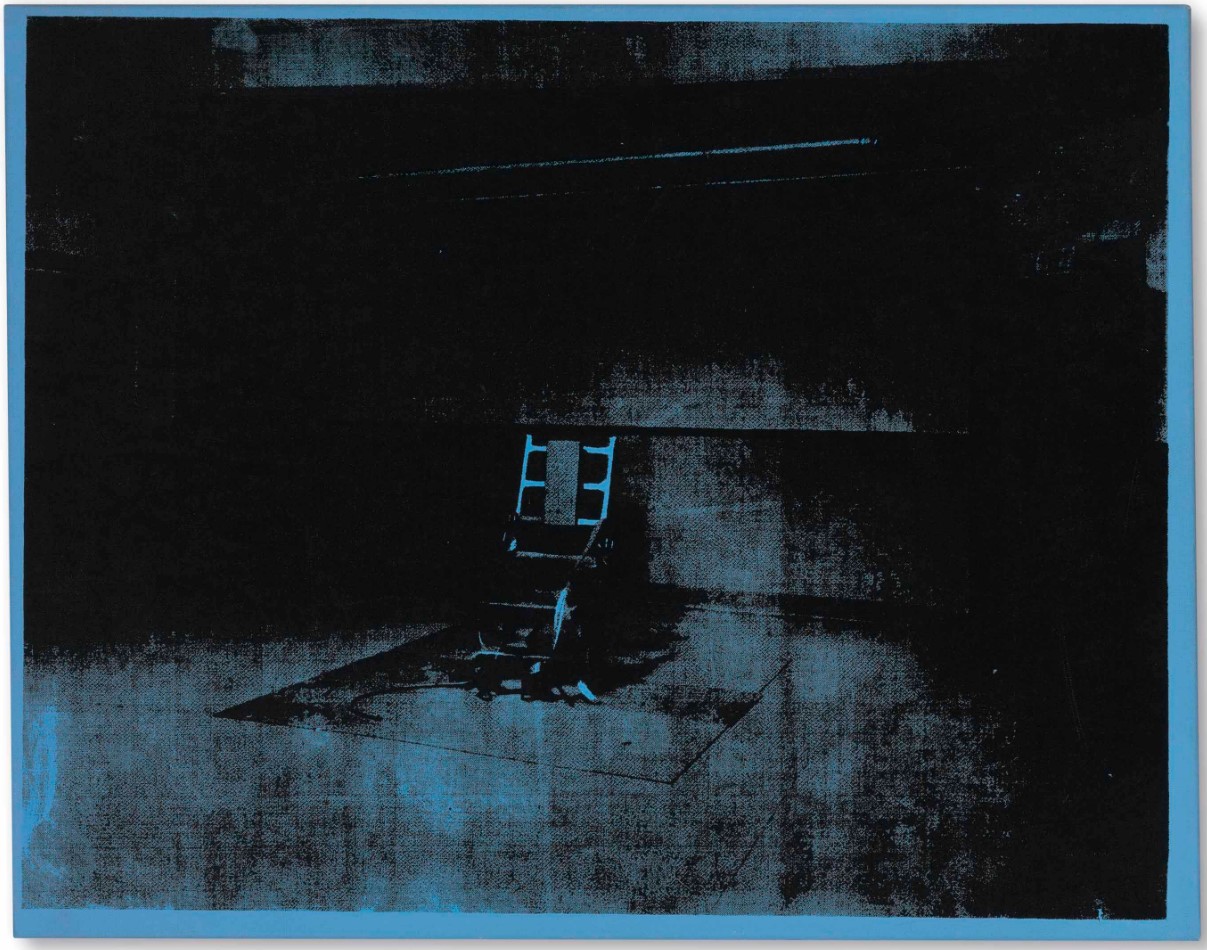
Andy Warhol’s hauntingly powerful portrait of one of America’s most notorious icons is among the artist’s finest and most complex pieces of social commentary. The pinnacle of his famed Death and Disaster series, Little Electric Chair follows in the tradition of his portrayals of American culture, with its celebration of Campbell’s soup and Coca-Cola, but this time substituting the aspirational championing of consumerism with a more subversive view of Americana. With exceptional crispness and clarity, yet still containing an ominous sense of foreboding, the simple blue-screened image of the electric chair at New York State’s Sing Sing Correctional Facility exemplifies the complexity of the impassioned debate that the image invokes. Warhol was the master exploiter of the modern image, and in this work he displays all his skill and insight to produce a work of tremendous power and emotion, which questions values at the very heart of a civilized society.
Located in the center of a 22 x 28 inch canvas, the eponymous electric chair is almost overwhelmed by the starkness and darkness of the room in which it stands. Overflowing with gloom and completely devoid of unnecessary adornments, the concrete space houses only the implements necessary to its function. The stark contrast between the light and dark areas causes the chair, its restraints and even the pipes of the sprinkler system that hangs from the ceiling to all take on an ominously enhanced status in this evocative staging. Housed for many years in the private collection of the artist Cy Twombly, it was this divergence between shadow and light that attracted the artist to this particular painting—an admiration bolstered by his understanding of chiaroscuro gained from his detailed study of Italian Renaissance painting undertaken during his time in his adopted homeland. Warhol’s restrained aesthetic masterfully heightens the portentous sense of emptiness as well as enabling key minute details to be visible, a characteristic that makes this particular example of Little Electric Chair stand out as one of the most evocative from the series. After producing the screen from a photograph of the chamber, Warhol painted his canvases with a variety of colors over which he would make a single screening of the image of the chair in black ink. This results in each canvas in the series having a unique color field, with different combinations producing different levels of visual intensity. Screened by hand onto a canvas painted in ultramarine blue, this particular version is one of the most atmospheric. By using a color that is usually associated with peace and tranquility, Warhol’s choice of blue perhaps aligns most closely with his original intention for this series.
Little Electric Chair, 1964
Sotheby’s London: 30 June 2014
Estimated: GBP 1,200,000 – 1,800,000
GBP 1,426,500
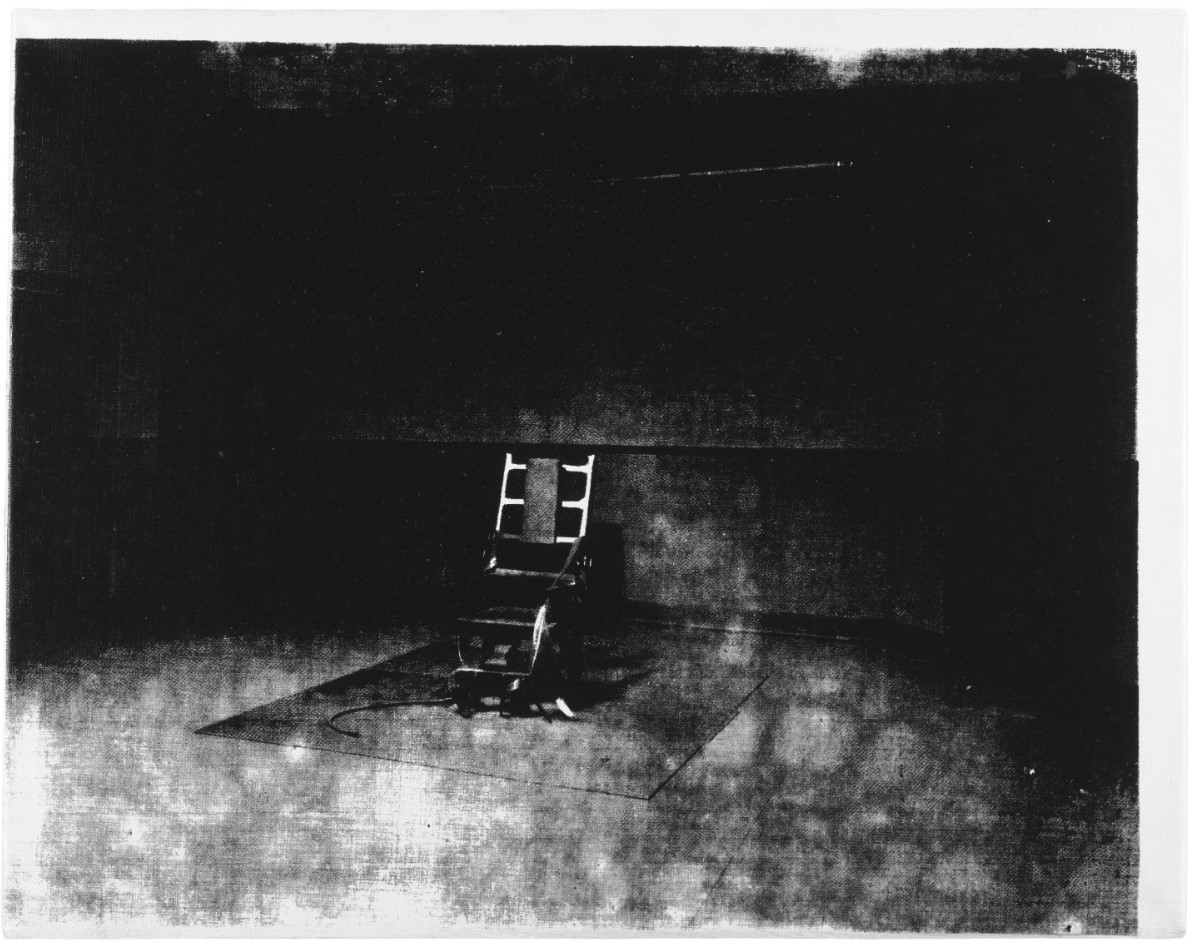 ANDY WARHOL
Little Electric Chair, 1964
Silkscreen ink on linen
22×28 inches (55.9 x 71.1 cm)
An image of eerie luminosity and profound verisimilitude, Little Electric Chair is both compelling and highly confrontational. Created in 1964, the work is an exceptional example of the artist’s Death and Disaster series, a seminal canon in Andy Warhol’s iconic career and one of the most revolutionary projects undertaken by any artist during the radical artistic experimentation of the 1960s. As pointed out by Heiner Bastian: “Whatever the many different conclusions arrived at in art-historical observations on the significance of Warhol’s work in the context of his time and his contemporaries, it is the images of disaster and death that he started to make in 1963 that Warhol the chronicler gains his credibility and Warhol the artist explains the world” (Heiner Bastian in: Exhibition Catalogue, London, Tate Modern, Andy Warhol: Retrospective, 2002, pp. 28-29). One of a series of 42 works, seven of which are now included in major museum collections, such as the Philadelphia Museum of Art, the San Francisco Museum of Modern Art and the Menil Museum, Houston, the present work boasts an entirely unique provenance, having been in the private collection of Andy Warhol’s long term partner Jed Johnson until his premature death in 1996. Johnson became Warhol’s lover of twelve years after a chance meeting at the Factory in 1968 and the tragedy of his untimely death in a plane crash off the coast of Long Island, New York, is inadvertently linked to the sinister subject of the present work.
An austere, solitary chair stands in the center of the somber chamber. Bathed in a bright light all other details of the room are swallowed up by the jet-black shadows that surround it. Unlike other works from the series, in which single layers of vibrant colors scintillate from underneath the black screen, an arresting chiaroscuro effect pervades the present work. As the room emanates a compelling stillness, the extreme dark and light polarities intensify the powerful emotions prompted by the subject. A haunting sense of emptiness permeates the image. Quiet and apprehensive, the vacant chair invokes an ominous invitation that places the viewer at the center of the horrifying scene. Luring us from our place as spectator to that of the condemned, the image creates a disquieting destabilization of the spectator’s objective distance.
Little Electric Chair, 1965
Christie’s New-York: 12 May 2014
Estimated: USD 7,500,000 – 9,500,000
USD 10,469,000
Andy Warhol (1928-1987) , Little Electric Chair | Christie’s
Little Electric Chair, 1965
Acrylic and silkscreen inks on canvas
22×28 inches (55.9 x 71.1 cm)
Little Electric Chair, 1964
Christie’s London: 27 June 2011
Estimated: GBP 1,800,000 – 2,200,000
GBP 2,057,250
Andy Warhol (1928-1987) , Little Electric Chair | Christie’s
Little Electric Chair, 1964
Acrylic and silkscreen ink on canvas
22×28 inches (56 x 71cm)
Located in the centre of a 22 x 28 inch canvas, the eponymous electric chair is almost overwhelmed by the starkness of the room in which it stands. Completely void of unnecessary adornments, the concrete space houses only the implements necessary to its function. Thus the chair, its restraints and even the pipes of the sprinkler system that hangs from the ceiling all take on an ominously enhanced status in this evocative staging. Warhol’s restrained aesthetic, together with the remarkable clarity of this particular screen, masterfully heightens the portentous sense of emptiness as well as enabling every minute detail to be visible, a characteristic which makes this particular example of Little Electric Chair stand out as one of the very best from this series. After producing the screen from a photograph of the chamber, Warhol painted his canvases with a variety of colors over which he would make a single screening of the image of the chair in black ink. This results in each canvas in the series having a unique color field, with different combinations producing different levels of visual intensity. Screened by hand onto a canvas painted in chromium oxide green, this particular version is one of the most atmospheric. By using a color that is usually associated with freshness and life, Warhol’s choice of green perhaps aligns most closely with his original intention for this series , as his assistant Gerard Malanga recalled, “I remembered Andy’s remark how adding pretty colors to a picture as gruesome as this would change people’s perceptions of acceptance” (G. Malanga, ‘Electric Chairs on Display in Toronto for First Time!’, Andy Warhol: Little Electric Chair Paintings, New York 2001, p. 8).
Little Electric Chair, 1964-1965
Christie’s New-York: 10 November 2010
Estimated: USD 2,000,000 – 3,000,000
USD 2,602,500
Andy Warhol (1928-1987) , Little Electric Chair | Christie’s
ANDY WARHOL
Little Electric Chair, 1964-1965
22×28 inches (55.9 x 71.1 cm)
Little Electric Chair (Red), 1964-1965
Christie’s New-York: 10 November 2004
Estimated: USD 1,000,000 – 1,500,000
USD 1,127,500
Andy Warhol (1928-1987) , Little Electric Chair (Red) | Christie’s
Little Electric Chair (Red), 1964-1965
Acrylic and silkscreen inks on canvas
22×28 inches (55.9 x 71.1 cm)
Little Electric Chair, 1965
Christie’s New-York: 15 November 2000
Estimated: USD 400,000 – 600,000
USD 556,000
Andy Warhol (1928-1987) , Little Electric Chair | Christie’s
ANDY WARHOL (1928-1987)
Little Electric Chair, 1965
Synthetic polymer and silkscreen inks on canvas–unframed
221/8 x 281/8 inches (56.4 x 71.3 cm)
Stamped with the Andy Warhol Estate stamp and numbered PA57.009
In the present painting, the yawning space, like the implied silence and unoccupied chair, leaves a pregnant emptiness, allowing abundant room for the viewer’s imaginative self-projections. The stillness of these Electric Chair paintings, their lack of the frenetic action or devastating destruction which characterizes so many of Warhol’s other images in the Death and Disaster series, heightens this effect.
Four Electric Chairs, 1964
Christie’s London: 10 December 1998
Estimated: GBP 400,000 – 600,000
GBP 782,500
Andy Warhol (1928-1987) , Four Electric Chairs | Christie’s
ANDY WARHOL
Four Electric Chairs, 1964
Silkscreen inks and synthetic polymer on canvas, in four parts
Each: 22×28 inches (56×71 cm)
Overall: 44×56 inches (111.7 x 142.3 cm)
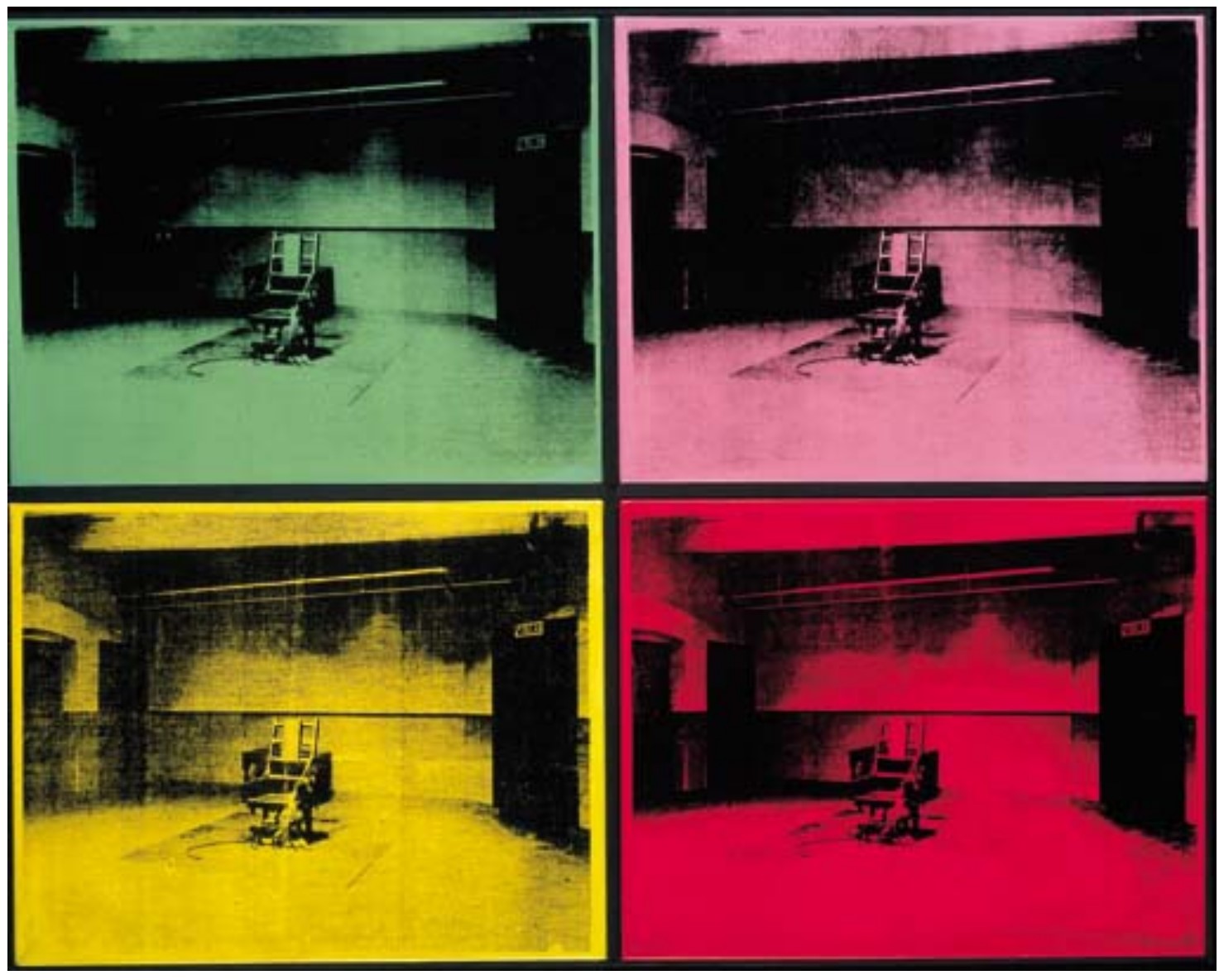
Part of the original series which Warhol executed in 1964, Four Electric Chairs uses a cropped image of the original photograph in order to force the death-chair to the forefront of the picture. In addition, the artist has imprinted each of the four separate canvases with a particularly dark and grainy resolution that serves to emphasize the atmosphere of sinister foreboding. This dark and bold image is reinforced by a startling use of strong, flat and contrasting “decorator” colours for the background of each canvas. But, this is no decorative, repetitive painting that dissolves into “dress fabric.” Rather it is a powerful grouping of paintings that when viewed collectively create the effect of each image vying with the others for the eye’s attention; each fighting to convey the same shocking and iconic form of the vacant American death-machine.
Big Electric Chair
Big Electric Chair, 1967-1968
Christie’s New-York: 13 November 2019
Estimated: USD 18,000,000 – 25,000,000
USD 20,137,500
Andy Warhol (1928-1987), Big Electric Chair | Christie’s
REPEAT SALE
Sotheby’s New-York: 13 May 2014
Estimated: USD 18,000,000 – 25,000,000
USD 20,437,000
ANDY WARHOL
Big Electric Chair, 1967-1968
Acrylic and silkscreen ink on canvas
54×74 inches (137.2 x 187.9 cm)
Stamped twice by The Andy Warhol Foundation for the Visual Arts and The Estate of Andy Warhol
Numbered PA57.011 on the overlap
A delirium of Fauvist colors spill across the tripartite surface, juxtaposing the vacant sobriety of the image with a vertiginous ecstasy of chromatic drama. The sequence of cobalt blue, acid-green and violet is paradigmatic of Warhol’s most powerful treatment of color, magnifying the nightmare of the image and its potent resonance. The 1967 Big Electric Chairs are further distinguished from earlier examples by their heightened immediacy—Warhol cropped the original source photograph to foreground the electric chair and eliminate the atmospheric emptiness of the background, pressing the chair closer to the viewer. Unlike any of Warhol’s other Death and Disaster paintings, the present work positions us within the center of its horror, implicating us as both spectators and potential victims. Meanwhile, Warhol’s doubling of the silkscreen within the same image creates a distinct off-register effect that haunts the picture, a heightened contouring that the artist attempted with only four of the fourteen Big Electric Chairs. The image portentously buzzes, a blurry irradiation whose shadows provide a sense of three-dimensional space to invite the viewer into its reality, emphasized by the cord spiraling toward us at the bottom left of the canvas. Much of the scholarship surrounding the Electric Chairs points to the potentiality of the image and the chair’s ominous invitation. However, the aggressive instantaneity of the present work’s color palette seems to transport us into the present moment of electrocution, metaphorically vibrating with the terrifying flash of death at the instant of its arrival.
Big Electric Chair, 1967
Christie’s New-York: 13 November 2002
Estimated: USD 3,000,000 – 4,000,000
USD 4,959,500
Andy Warhol (1928-1987) , Big Electric Chair | Christie’s
ANDY WARHOL
Big Electric Chair, 1967
Synthetic polymer and silkscreen inks on canvas
54×74 inches (137.2 x 188 cm)
With its chair, the instrument of death, looming in the otherwise unarticulated surroundings of the death chamber, Big Electric Chair, executed in 1967, is a simple and striking demonstration of the issues at the heart of Warhol’s Death and Disaster series. While the chair is instantly recognizable, an iconic image of legalized, almost ritualized and supposedly civilized killing, the decorative fuchsia upon which it has been presented here disrupts the menacing atmosphere the death chamber customarily invokes. Likewise the chair is empty, a factor which serves both to remove the human element, the concept of execution, from the picture and at the same time to give a sense of imminence, as though the victim were waiting in the eaves. It is interesting that the images Warhol produced in 1967 of the electric chair were on a large scale, avoiding any chance of daintiness. Big Electric Chair is similar in color to the famous Lavender Disaster in the Menil Collection, Houston, which appears almost as a frieze of chairs. However, Big Electric Chair confronts the viewer with a chair that is illustrated almost at half size. This chair invades the viewer’s environment, and while the color hints at the decorative, the chair is packed with force and menace. Unlike the frieze-like images like the Menil work, Big Electric Chair is a modern memento mori, an image that does not skirt around death but instead screams at the viewer, a potent reminder of our mortality.
Big Electric Chair, 1967
Christie’s London: 30 June 1999
Estimated: GBP 750,000 – 950,000
GBP 1,651,500
Andy Warhol (1928-1987) , Big Electric Chair | Christie’s
ANDY WARHOL
Big Electric Chair, 1967
Silkscreen inks and synthetic polymer on canvas
54 x 72.7 inches (137 x 185 cm)
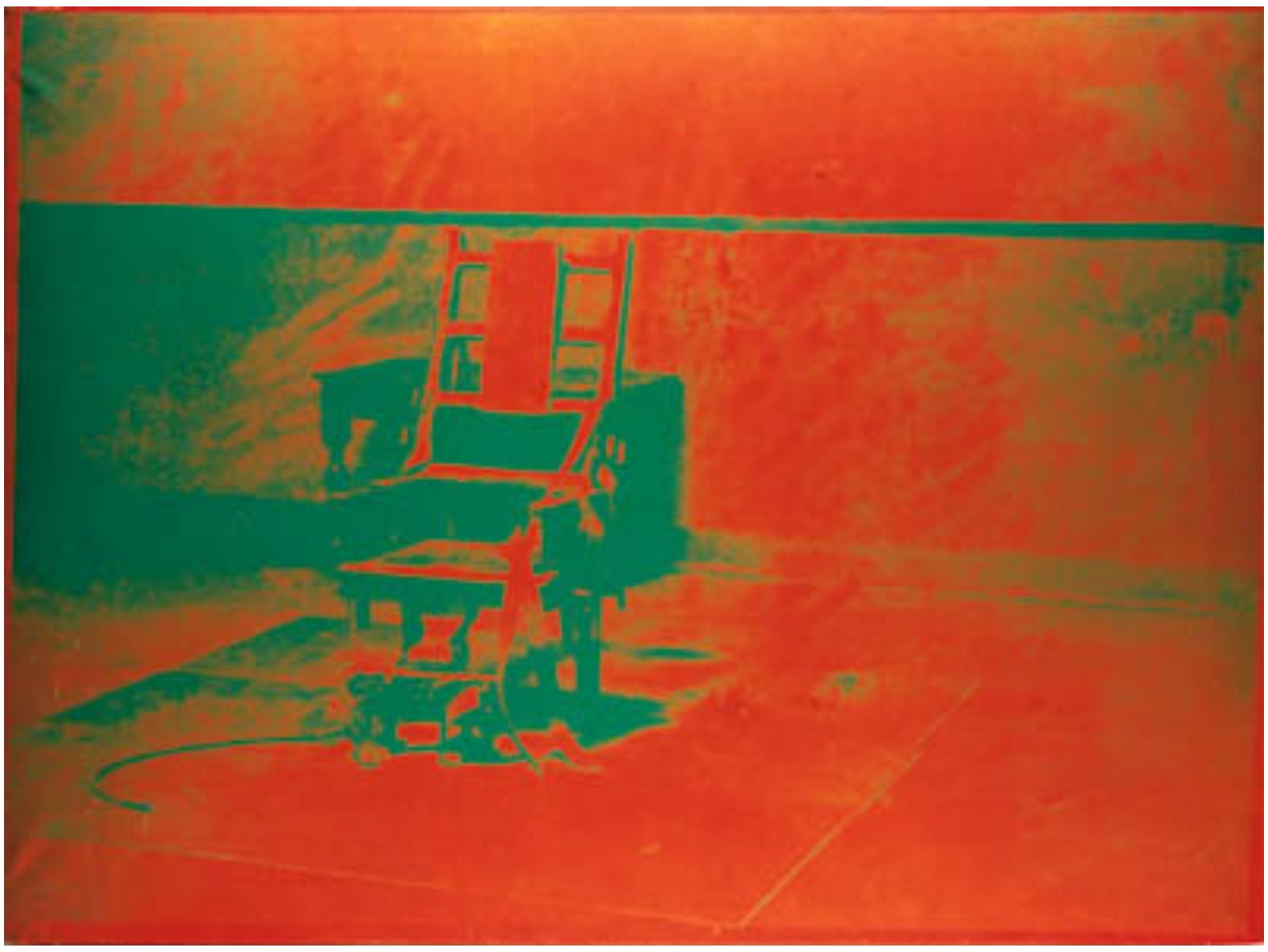
This monumental image of the macabre apparatus first designed in the 1880s and consequently used by U.S. State penitentiaries to kill people who had been sentenced to death by the state, is the ultimate symbol of Warhol’s celebrated “Death and Disaster” series and one of the most powerful icons of man’s violence against man in the history of 20th Century art. Measuring almost two meters in width, Big Electric Chair is part of a series of fourteen giant paintings of this simple but highly provocative image that Warhol produced during the “summer of love” in 1967 for an exhibition of his work at the Moderne Museet in Stockholm the following year. Using a close-up of the chair that has been cropped from the original source photograph, Warhol thrusts the bizarre killing machine with its metal plate, and loose hanging leather straps to the forefront of the picture and drenches the scene in an acidic flame orange and a deliberately clashing caustic green. The use of these searing colors has the wholly appropriate effect of presenting the image of the chair as if its form had been burnt onto the canvas by some explosive chemical experiment.
Big Electric Chair, 1967-1968
Christie’s New-York: 12 May 2025
Estimate on Request
WITHDRAWN
ANDY WARHOL (1928-1987), Big Electric Chair | Christie’s
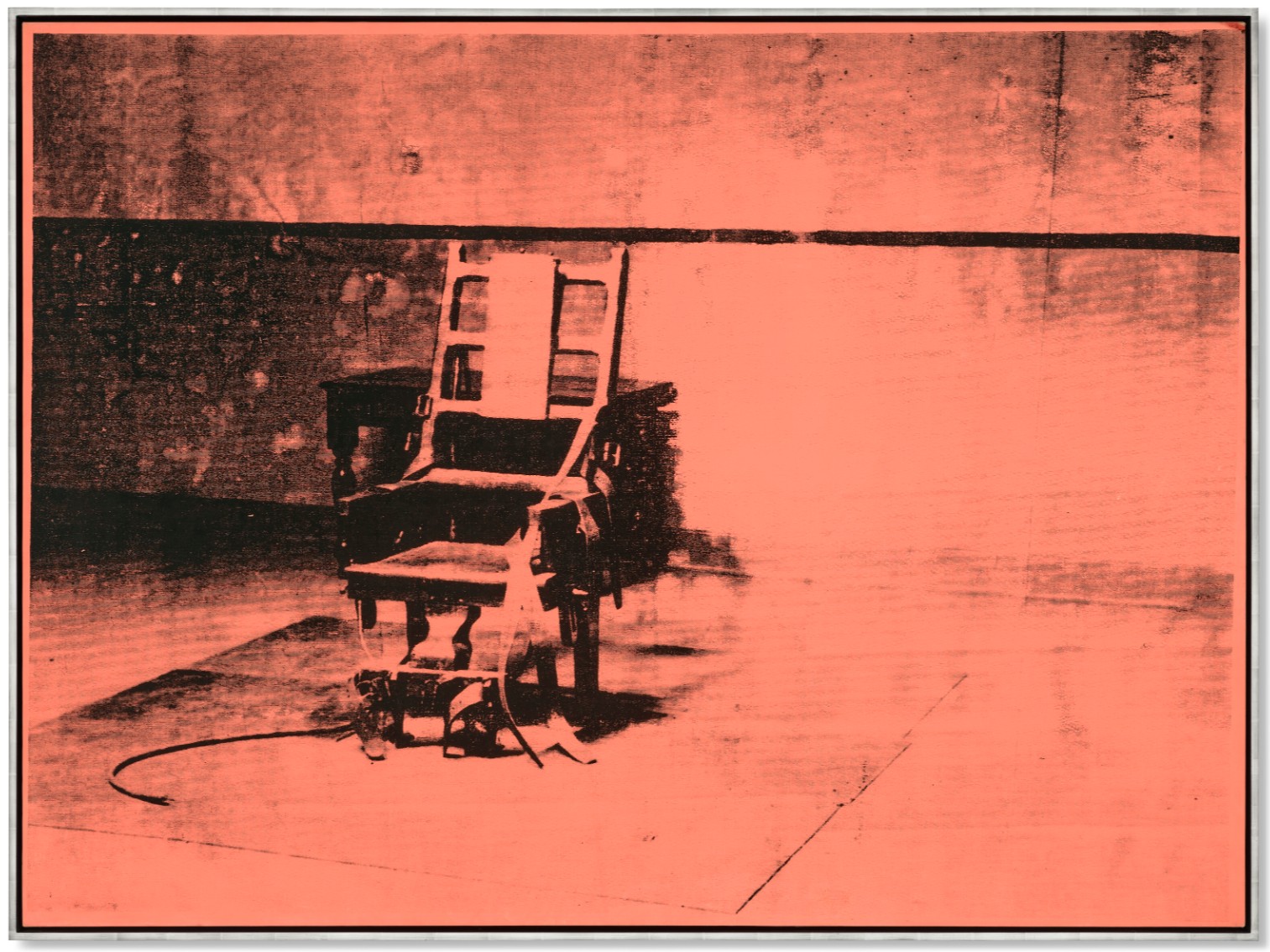
ANDY WARHOL (1928-1987)
Big Electric Chair, 1967-1968
Acrylic and silkscreen ink on canvas
54×74 inches (137.2 x 188 cm)
Andy Warhol’s Big Electric Chair is one of the most important paintings of the artist’s career. In addition to being the ultimate manifestation of both the visual and conceptual intensity of Warhol’s best work, this particular example has also played a central role in establishing his reputation as one of the twentieth-century’s most celebrated artists. It was included in the two most important exhibitions of Warhol’s career: the artist’s first major European retrospective, organized by Stockholm’s Moderna Museet in 1968, and his first U.S. institutional exhibition, at the Pasadena Art Museum, in 1970. After the Stockholm show it was acquired by the legendary collectors Roger Matthys and Hilda Colle. This groundbreaking couple did much to establish the status of Pop Art (and contemporary art in general) in Europe, and Big Electric Chair became the centerpiece of their world-famous collection. As part of their stewardship, they continued to loan the painting to other important retrospectives, ensuring it became one of the artist’s most celebrated works. The sustained level of interest in this painting by both museum curators, major collectors, and art audiences alike is testament to its venerated place within Warhol’s extensive body of work.
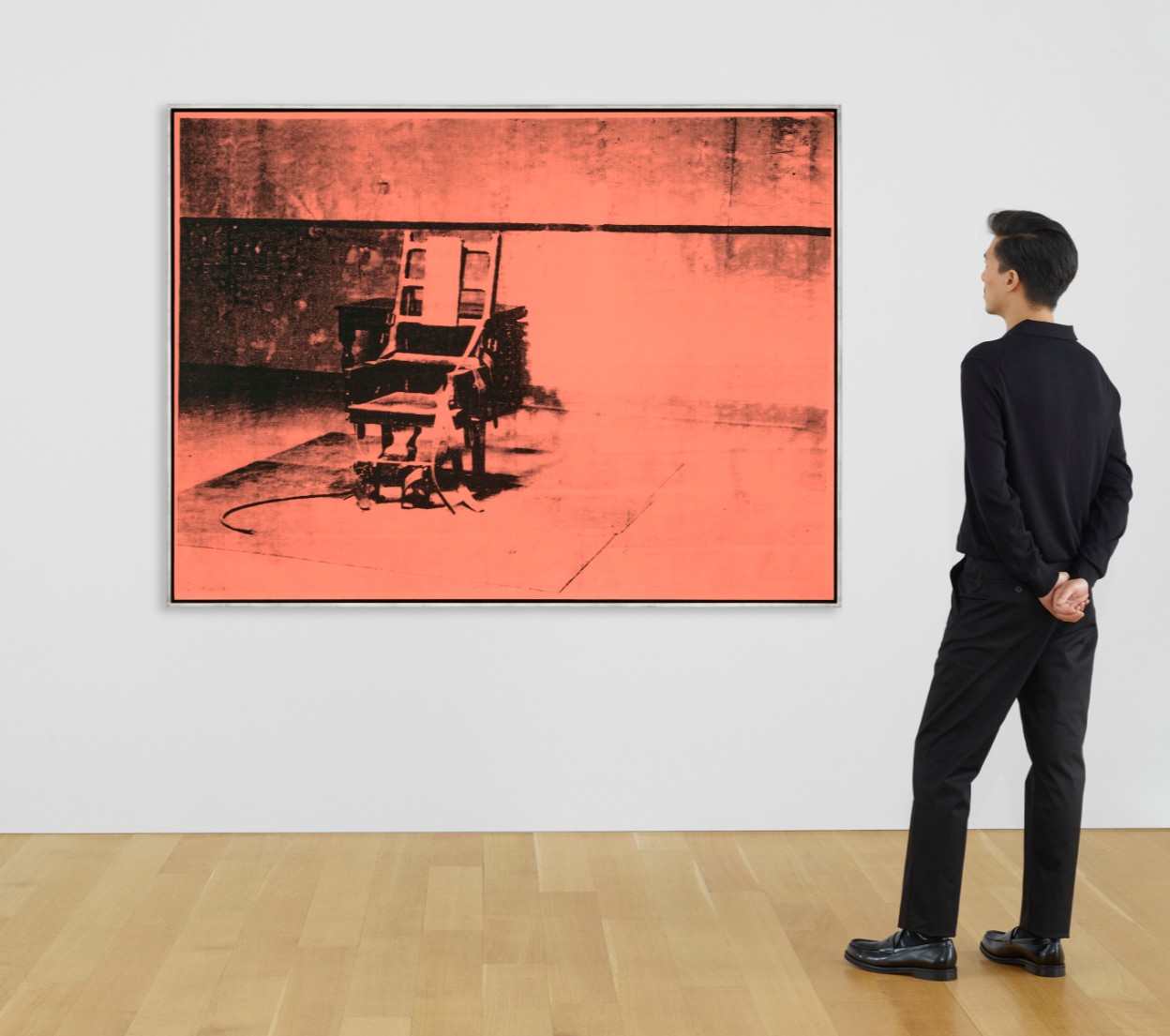
Often obsessed with celebrity and popular culture, in truth Warhol’s best paintings contain multiple layers of meaning imbedded within their silkscreened images. Big Electric Chair perfectly captures this often complex aspect of his work. In addition to its obvious references, the large-scale canvas can also be read as a significant still-life that reflects an alternative view of America. Dating back to Roman times, still lifes have portrayed everyday objects as having adopted different meanings that adapt to their time. Following his portrayals of Campbell’s Soup Cans and Coca-Cola bottles that symbolized the democratizing nature of the American Dream, with his Big Electric Chair, Warhol embarks on what has become his ultimate still life, a defiant painting that truly reflects the modern age.

Andy Warhol and Pontus Hultén in Warhol’s first solo exhibition at Moderna Museet in 1968 (present lot illustrated).
Photo: Nils-Göran Hökby, courtesy of Moderna Museet.
Artwork: © 2025 The Andy Warhol Foundation for the Visual Arts, Inc. / Licensed by Artists Rights Society (ARS).
Warhol’s Big Electric Chair paintings have been described by the legendary Metropolitan Museum of Art curator Henry Geldzahler as the most powerful paintings in Pop Art (B. Gopnik, Warhol, New York, 2020, p. 605). This reputation was garnered, in part, from its inclusion in one the artist’s most important early retrospectives. Organized by the Moderna Museet in Stockholm in 1968, and later traveling extensively throughout Europe, the exhibition featured his Big Electric Chair paintings, largescale versions of his iconic Flower canvases, and a large display of his Brillo Boxes. The legendary dealer Ileana Sonnabend described the assembled works as “the most important international show in Europe” (I. Sonnabend, ibid. p. 605), and of the twelve Big Electric Chairs that were included in the Stockholm show, nine are now in major international institutional collections.
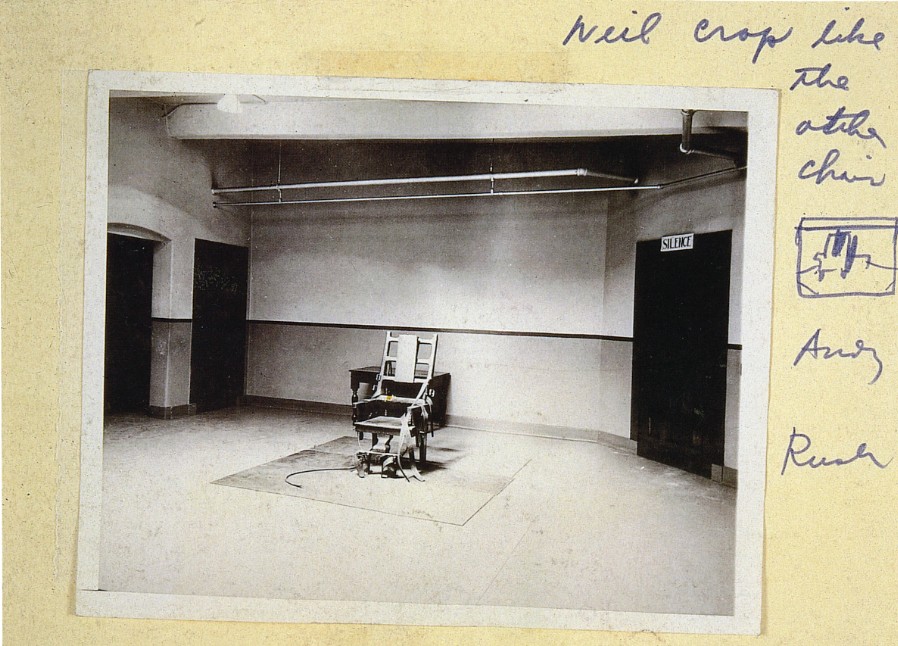
Source image for Electric Chair series, featuring a sketch on the side of the crop format for the Big Electric Chair series. Archives of the Andy Warhol Museum, Pittsburgh.
This is a highly cropped version of an image Warhol had used before. Beginning as early as 1963 with Orange Disaster #5 (The Solomon. R. Guggenheim Museum, New York), the artist had selected this image for a number of canvases that formed the basis of what became known as his Death and Disaster series. Yet in the present work, Warhol has altered the image radically, eliminating much of the apparatus that makes his earlier incarnations so chilling. Gone are the doors that lead into empty dark rooms beyond, and gone are the portentous signs above them that demand SILENCE. Missing too are the utility pipes that hang from the ceiling. Instead, we are left with just the chair, its silhouetted form emitting an eerie sense of quiet. The lack of ephemera and atmosphere encourages considered reflection on the object that stands before us. In addition to the succinct depiction of its subject, the clarity of the screen in the present work makes this a standout in the series. Warhol’s decision to leave this particular example untarnished by the flourishes that too often disrupt the composition of the other examples, adds a potency to this particular work. Some of the contradictions inherent in the original source image are most clearly visible in this work, such as the utilitarian details of the electric chair which sit in stark contrast to the decorative nature of the wooden table which lurks in the shadows behind it.
The present work is also a standout from the series of fourteen Big Electric Chairs in that it is the only canvas from the series in which Warhol screens the image solely with black silkscreen ink against a single color ground. This simplicity enhances the depth of the shadows when contrasted with the brightness of the chair’s highlights, both working in concert to clearly denote the anatomy of the chair in all its haunting detail. In each of the other examples, he experiments with using different colored inks to portray the subject of his painting. In other examples, the artist sometimes uses a combination of high-keyed pigments, but many of these appear to obscure the subject of Warhol’s painting rather than portraying the cool crispness of the subject as in the present work.