Andy Warhol’s monumental representation of one of the most iconic symbols of American patriotism is a subversive homage to the symbolic ideal of the American dream. Executed in 1986, Statue of Liberty, with her impenetrable facade that displays the unwavering commitment to the values of democratic freedom, is an exquisite example of Warhol’s singular brand of social critique, acerbic wit and deadpan irony.
Introduction
Warhol first used the Statue of Liberty as the subject of his work in 1962, when he painted two versions of the colossal sculpture based on a postcard of the New York harbor. Revisiting the subject in the mid-1980s, a period of both retrospective reassessment and abundant creativity, Warhol lent his muse a more somber mood, reflective of the seismic changes of the intervening twenty years.
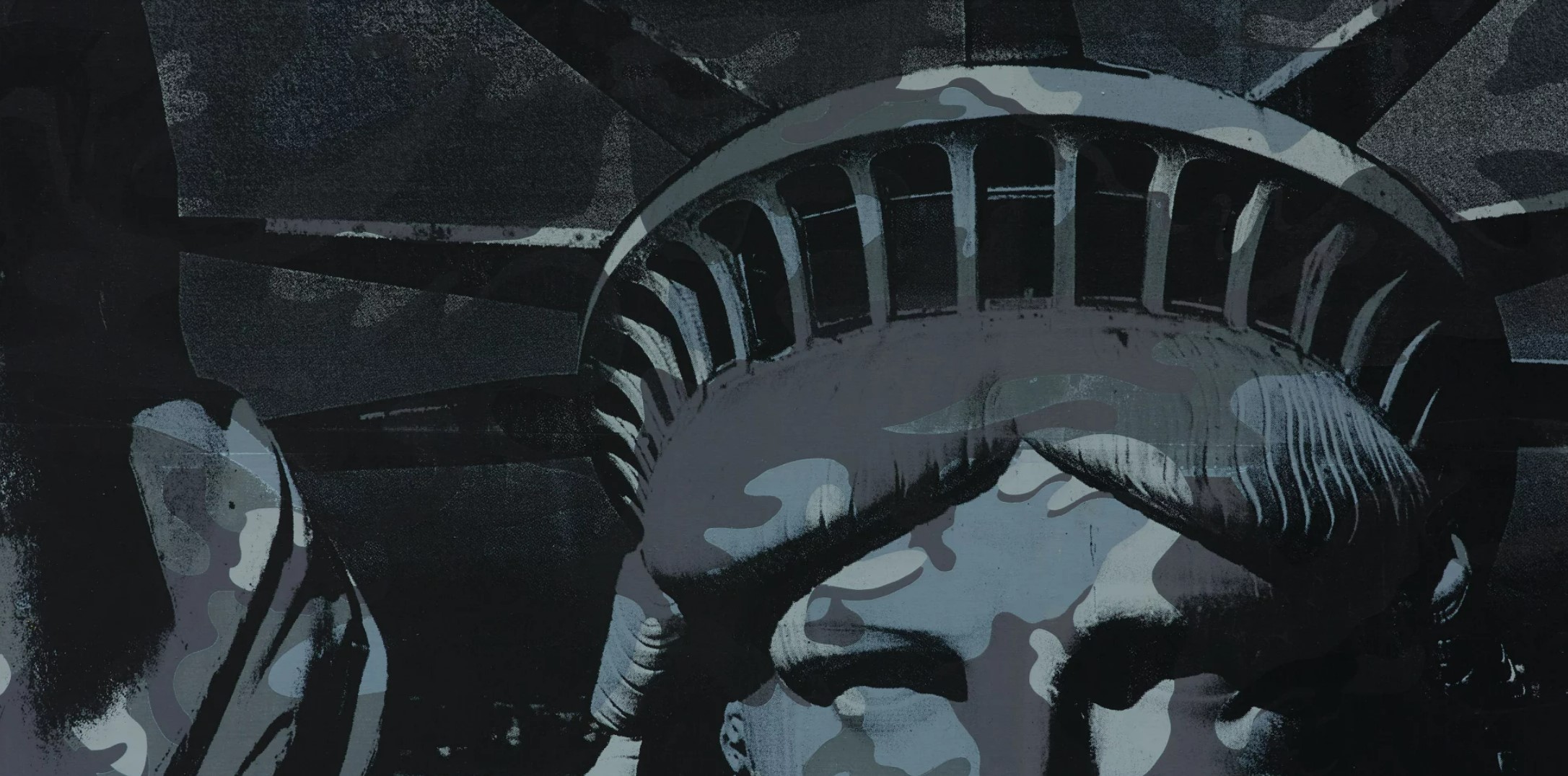
Rendered in an elegant palette of blue and grey tones, in Statue of Liberty, Warhol masks his subject with his recurring camouflage motif. By rendering the most quintessential American symbol in camouflage, Warhol invokes the specter of war that pervades the complicated narrative of American history, the Reagan-era politics that shaped the nation and the provocative sentiment that “freedom isn’t free.” The Camouflage series began in the mid-1980s and returned the artist to a profound investigation of painting. In his rendering of a highly recognizable and culturally loaded pattern, Warhol debates the multifarious capacities of the medium: its ability to refer to moments and cultural sentiments outside itself, as well as its very nature as a set of abstract forms manipulated on the canvas. Fascinated with the near religious reverence afforded to painters such as Jackson Pollock and Mark Rothko within his lifetime, this series can be linked conceptually with Warhol’s earlier Rorschach paintings and Oxidation series, in their challenge to the mysticism of self-professed ‘non-referential’ Abstract Expressionism. In a perfect visual pun, Warhol uses the army print to wage war on Abstract Expressionism by embracing an elemental pattern that is highly connotative of its original utilitarian and militarized purpose, as well as subsequent uses in fashion. Much like Jasper Johns’ iconic Flag paintings, the work is paradoxically purely abstract and highly referential. Statue of Liberty thus refers back to Warhol’s most essential obsession with a shared, mass-produced visual language.
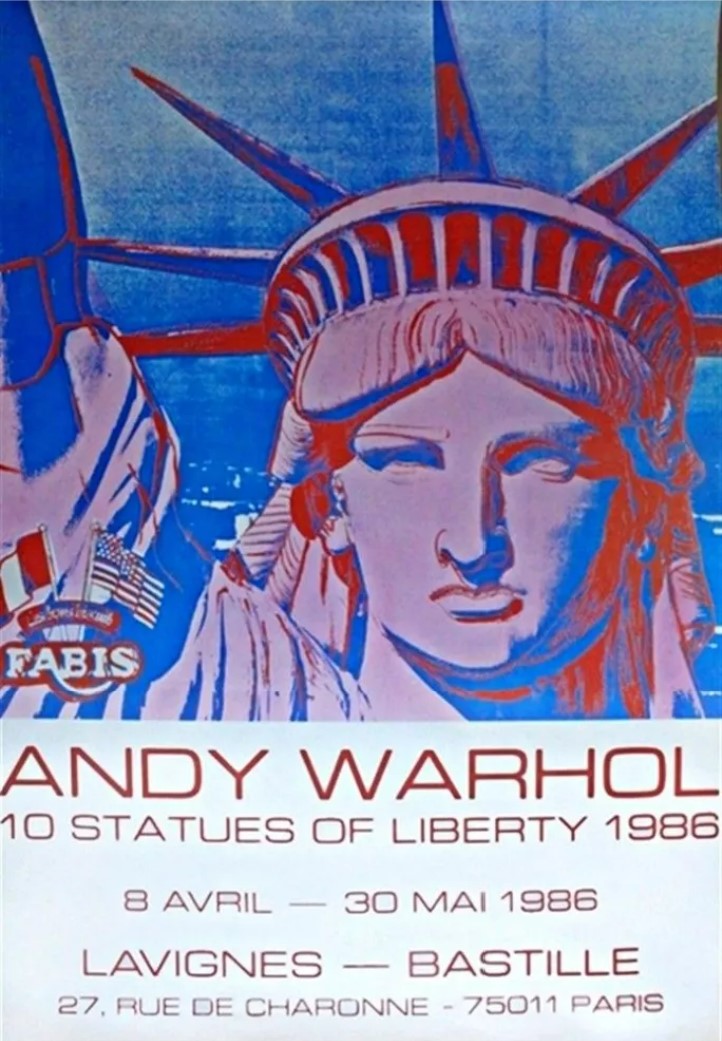
In the spring of 1986, Andy Warhol traveled to Paris to attend the opening of his Statue of Liberty series, where ten of the large-scale, six-foot paintings, including the present work, were exhibited at the Galerie Lavignes-Bastille. The location was fitting, as it was the French who had gifted the Statue to America exactly 100 years earlier. A keen observer of contemporary culture, Warhol could not have avoided the Statue of Liberty in the media that year, since 1986 marked the centennial anniversary of the iconic sculpture’s debut. Designed by Frédéric Auguste Bartholdi and built by Gustave Eiffel, the colossal sculpture was given as a gift to the American people as a celebration of democracy and unveiled in 1886.
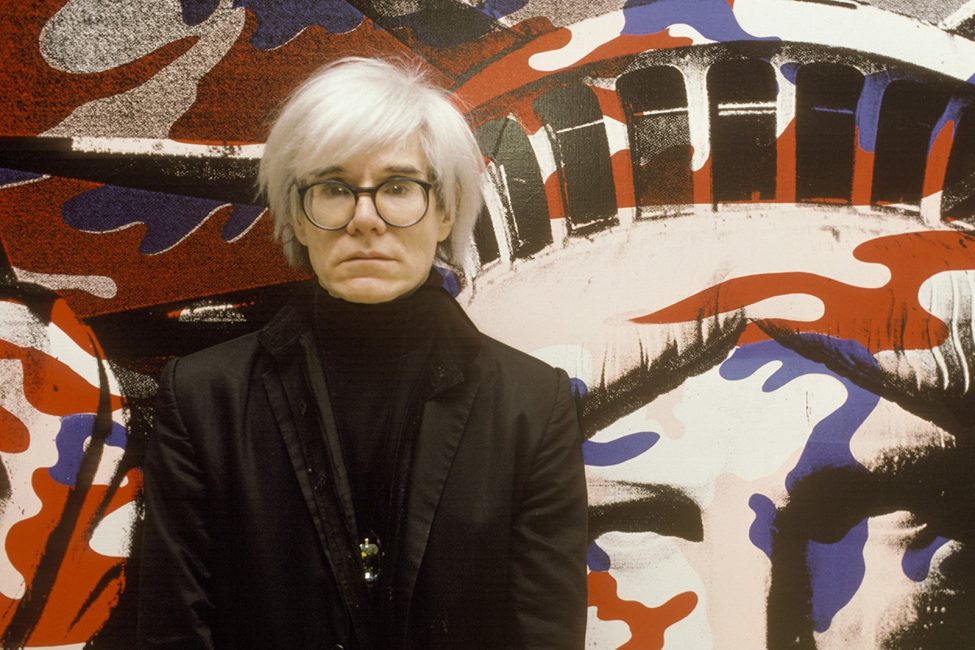
One hundred years later, over the 4th of July weekend 1986, the United States celebrated the centennial with the dramatic unveiling of the recently restored statue, which had undergone a costly two-year restoration. In the media frenzy leading up to the highly televised event, the Statue of Liberty was featured on nearly every conceivable media outlet, in newspapers and magazines. Warhol, fascinated by this degree of media saturation, based the imagery of his Statue of Liberty on a commemorative tin of cookies that featured Lady Liberty on its lid. The logo of the original tin is retained in the lower left corner of Statue of Liberty, which displays the French and American flags and the name of the cookie: “Les bons biscuits Fabis”. As he had done with Coca-Cola and Campbell’s Soup, Warhol lends a touch of irony to his portrayal of the cherished American icon, by retaining the brand name within the artwork.
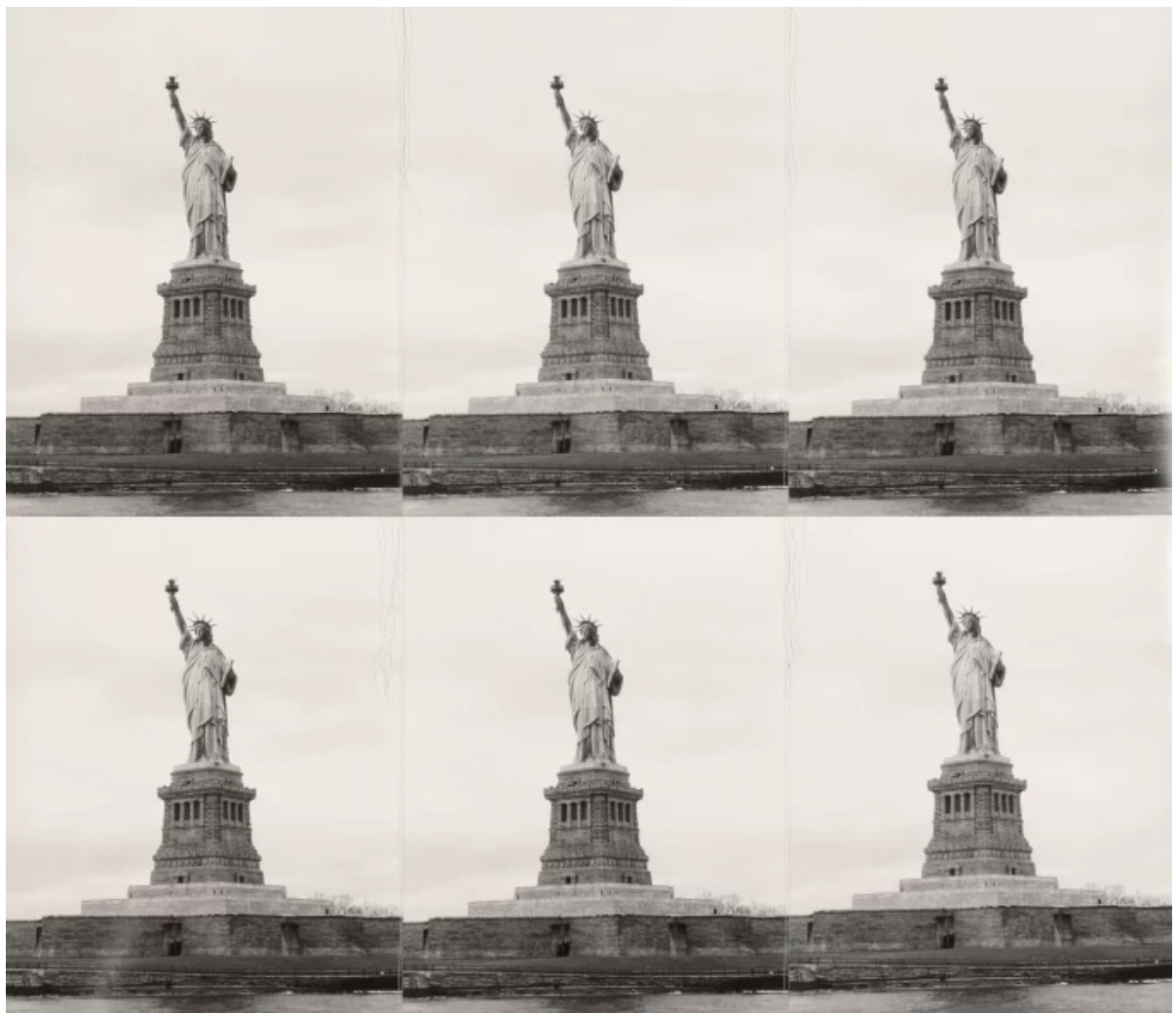
ANDY WARHOL, STATUE OF LIBERTY, 1976-1986. ART © 2020 ANDY WARHOL FOUNDATION FOR THE VISUAL ARTS / ARTISTS RIGHTS SOCIETY (ARS), NEW YORK
Throughout his career, Warhol gravitated toward the most ubiquitous products and images of daily American life, from a can of Campbell’s soup to the face of Jackie Kennedy. In Statue of Liberty, Warhol takes on one of the most pervasive American emblems but veils her in camouflage. By doing so Warhol established a distance between artist and subject. Although he would have realized and benefited hugely from the liberties afforded by the society in which he lived, in both his life and his art, Warhol was keenly aware of the price paid by many, both at home and abroad, for that privilege. Indeed, despite being a prominent public figure, especially at this late stage of his life, Warhol was closed to questions about his personal life, realizing that the bounds of the freedom afforded to him were by no means endless. As such, he lived in accordance with the usual function of the pattern chosen for the present work.
2025 Auction Results
Statue of Liberty, 1986
Bonhams New-York: 19 November 2025
Estimated: USD 800,000 – 1,200,000
USD 699,000
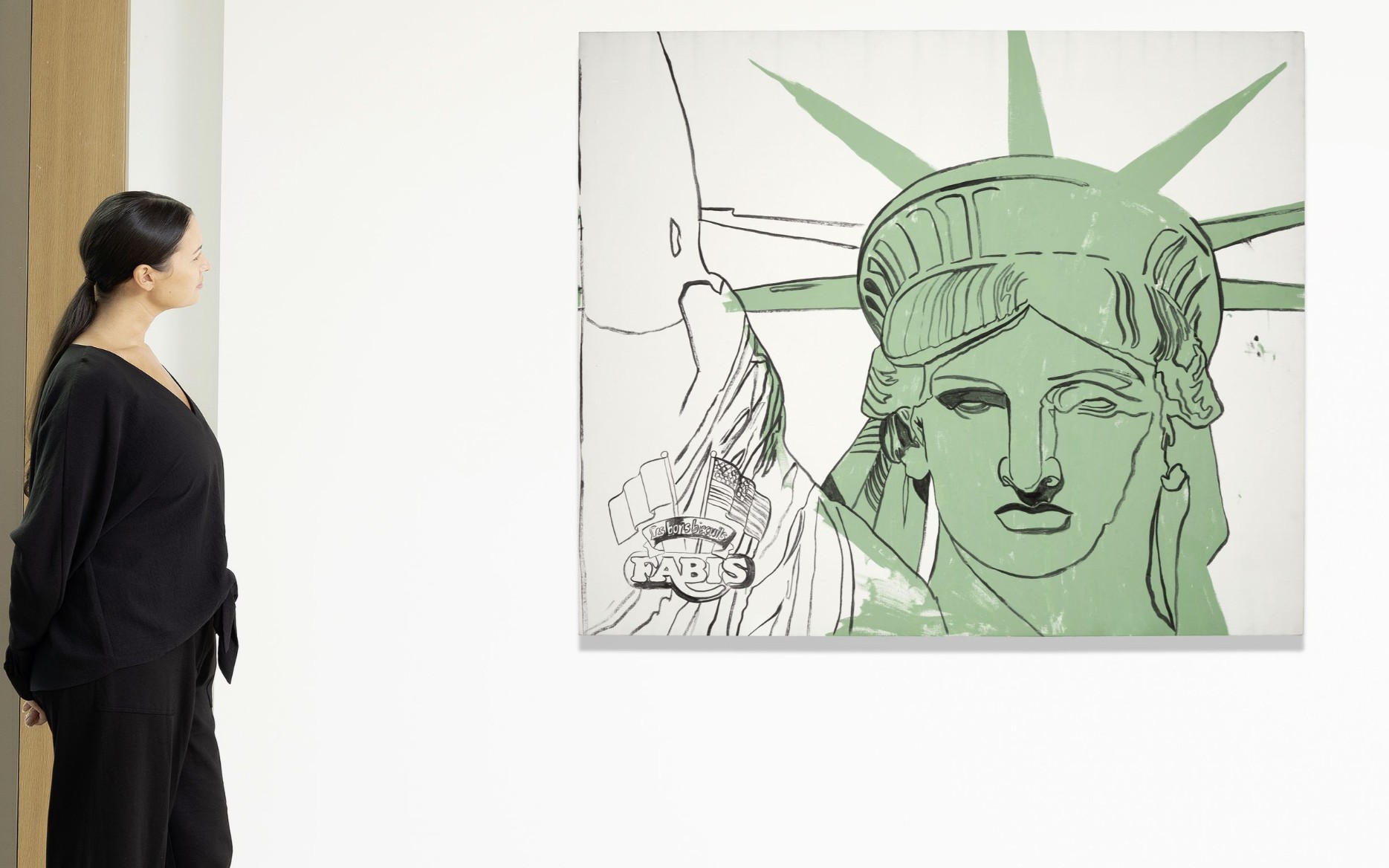
ANDY WARHOL (1928-1987)
Statue of Liberty, 1986
Synthetic polymer paint and silkscreen ink on canvas
50 1/8 x 60 1/4 inches (127.3 x 153 cm)
Stamped twice with the estate and foundation seals and inscribed ‘PA 64.010’ (on the overlap)
Statue of Liberty-Fabis, 1986
Phillips London: 18 October 2025
Estimated: GBP 60,000 – 80,000
GBP 58,050 / USD 77,785
WORK ON PAPER
Andy Warhol Modern & Contemporary Art Day Sale
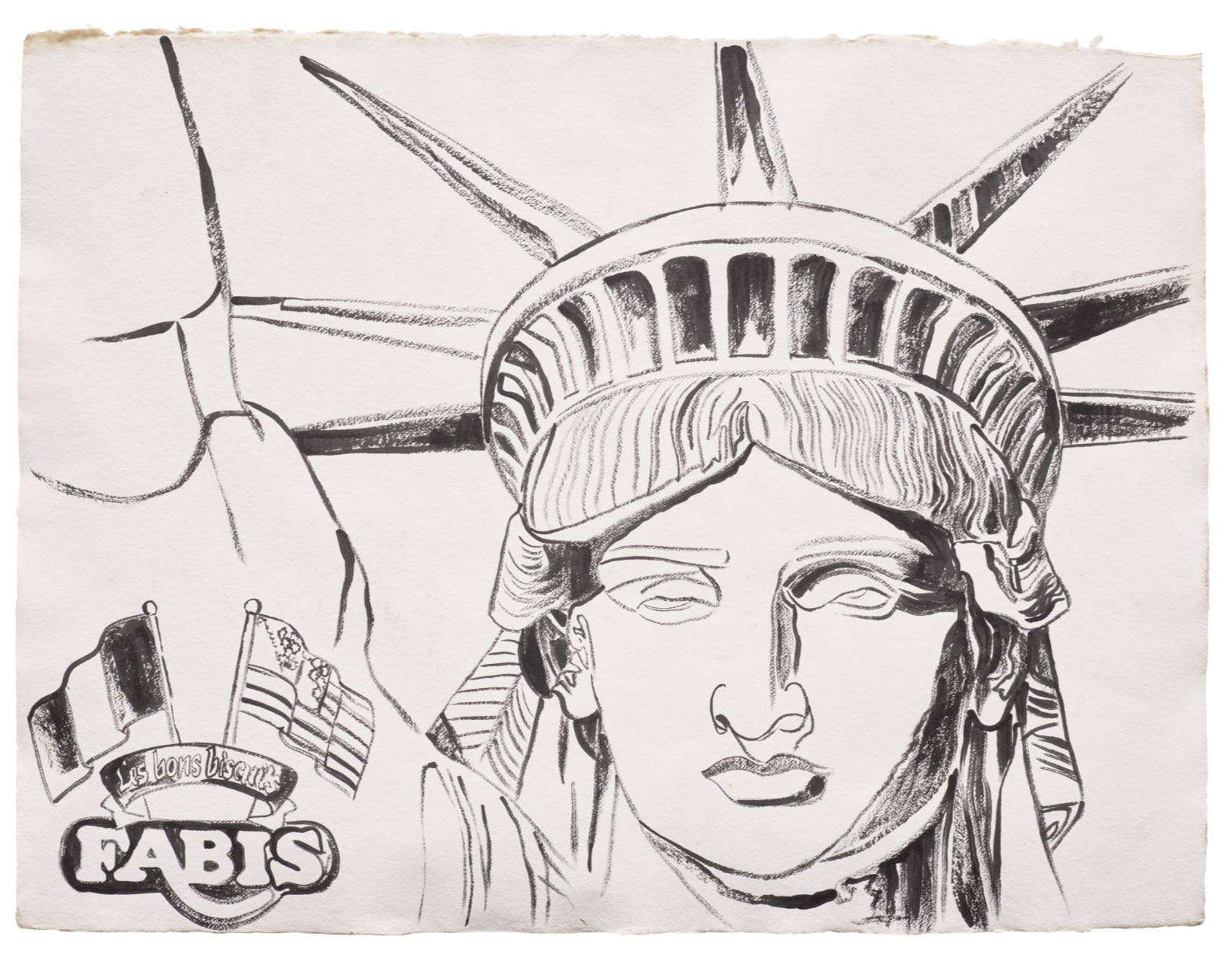
Numbered ‘VF 60.005’ on the reverse
2024 Auction Results
Statue of Liberty, 1986
Phillips New-York: 14 May 2024
Estimated: USD 800,000 – 1,200,000
USD 1,143,000
Andy Warhol – Modern & Contemporary Art … Lot 16 May 2024 | Phillips

ANDY WARHOL
Statue of Liberty, 1986
Synthetic polymer paint and silkscreen ink on canvas
50 x 54 1/2 inches (127 x 138.4 cm)
Stamped twice by the Andy Warhol Art Authentication Board, Inc. and the Estate of Andy Warhol and numbered
Inscribed twice “PA 64.015 VF” on the overlap
Statue of Liberty (50×60)
Statue of Liberty, 1986
Bonhams New-York: 19 November 2025
Estimated: USD 800,000 – 1,200,000
USD 699,000
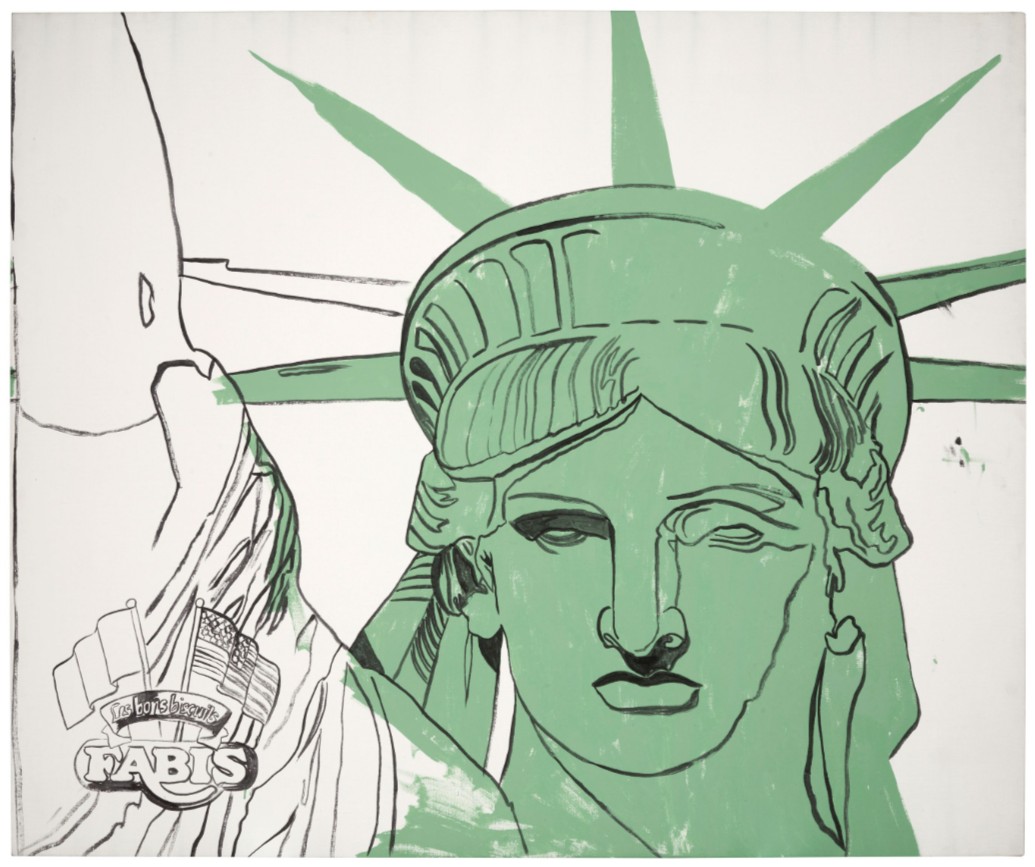
ANDY WARHOL (1928-1987)
Statue of Liberty, 1986
Synthetic polymer paint and silkscreen ink on canvas
50 1/8 x 60 1/4 inches (127.3 x 153 cm)
Stamped twice with the estate and foundation seals and inscribed ‘PA 64.010’ (on the overlap)
Painted the year before his death, Andy Warhol’s Statue of Liberty marks one of the last great declarations of the master Pop artist’s career. This synthetic polymer and acrylic painting is one in a larger series that captures a pivotal moment of renewal, turning his brush to one of the great American symbols in a swan song moment. An icon of American liberty and its vainglorious place amongst the global community, there are fewer images that conjure the American spirit as intensely as the visage of Lady Liberty. Warhol’s rendition, emerging through an energetic script of verdigris and inky black, provides us with an unfinished monument; an examination of a national-cultural symbol.
In the mid-1980s, Warhol had returned to creating entirely hand-painted canvases, a process reminiscent of his early years, while continuing a parallel practice of his signature silkscreen technique. His revived interest in a more manual approach coincided with a broader resurgence of gestural easel painting in the booming New York art scene. It was during that period that Swiss dealer Bruno Bischofberger initiated a high-profile collaboration between Warhol and two of the era’s rising stars, Jean-Michel Basquiat and Francesco Clemente. The partnership proved especially fruitful between Warhol and Basquiat, inspiring a refreshed painterly energy in Warhol’s solo production. The younger artist introduced him to the oil stick, prompting his embrace of expressive, hand-drawn elements, visible here in the loose handling of paint.
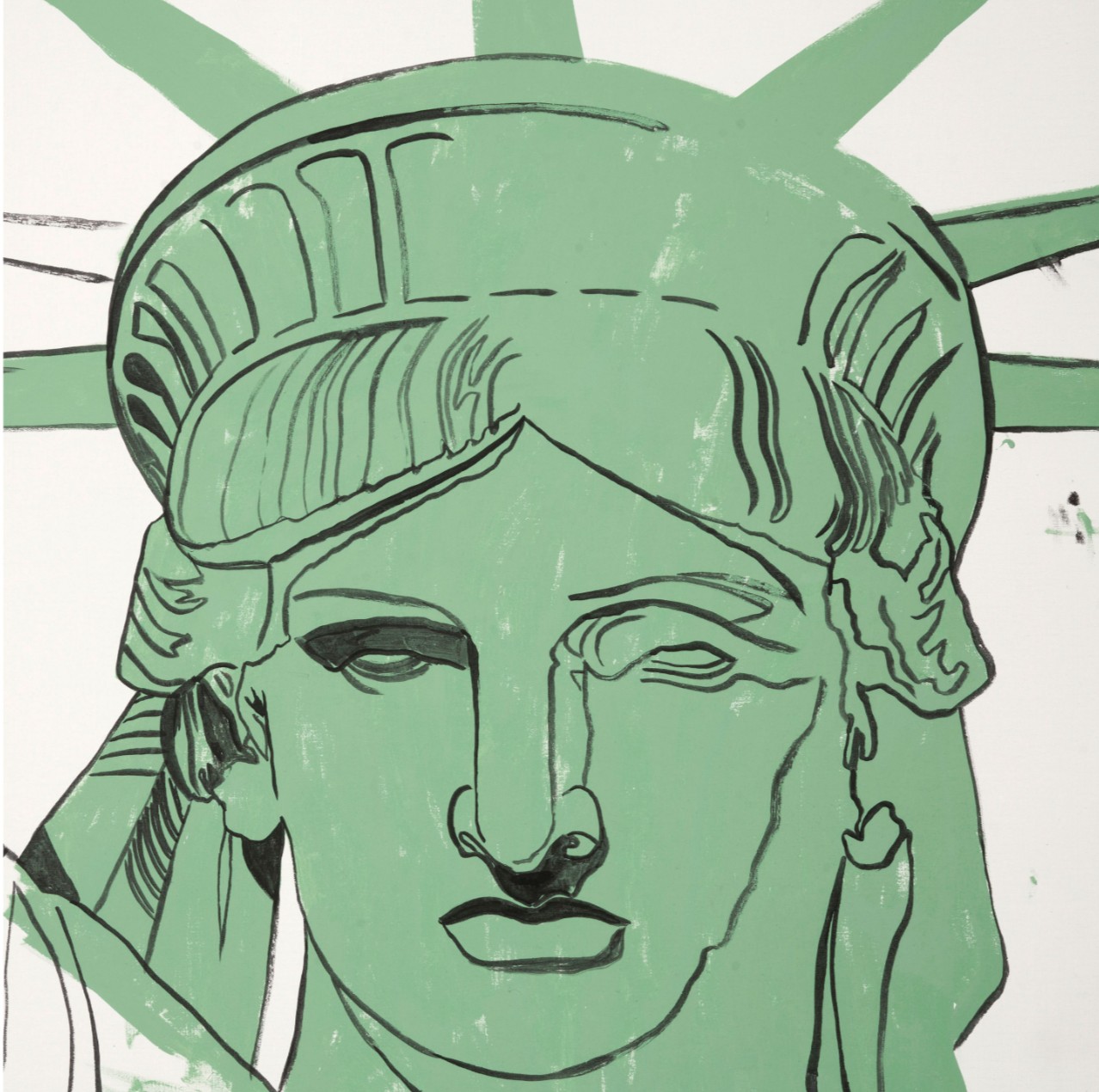
As a former graphic artist, Warhol immediately understood the power of a distinctive visual symbol that spoke to larger cultural mores, from the Hollywood celebrity to Leonardo da Vinci’s Last Supper to the dollar sign. The Statue of Liberty—which fit very well in this category—was not a new subject for Warhol. He had first explored it in 1962, basing a series of prints on a postcard image of the monument. The fact that it made a return to his oeuvre in 1986 should not be surprising, considering the statue’s omnipresence in the public imagination exactly one hundred years after the statue’s arrival in New York from France as a diplomatic gift. Recently restored to celebrate its centennial, new color photographs of the statue proliferated in print magazines, newspapers, and tourist memorabilia. The incessant press coverage fit perfectly with one of the artist’s trademark fascinations. Warhol was deeply invested in the social effects of this kind of media saturation, particularly the way that the repeated mechanical reproduction of an image—of a person or a symbol—changes our understanding of that very subject as something degraded and disconnected from its original source.
One such place where Lady Liberty’s face appeared was on a commemorative tin of Fabis brand French cookies that inspired this painting’s composition. At the lower left, Warhol painted the word “Fabis” in bubble letters, and above it, the tagline “les bons biscuits” (“the good cookies”). The American and French flags that appeared behind the logo of the souvenir tin allude to the statue’s origin and remind the public of the values of freedom and democracy shared between the two nations.
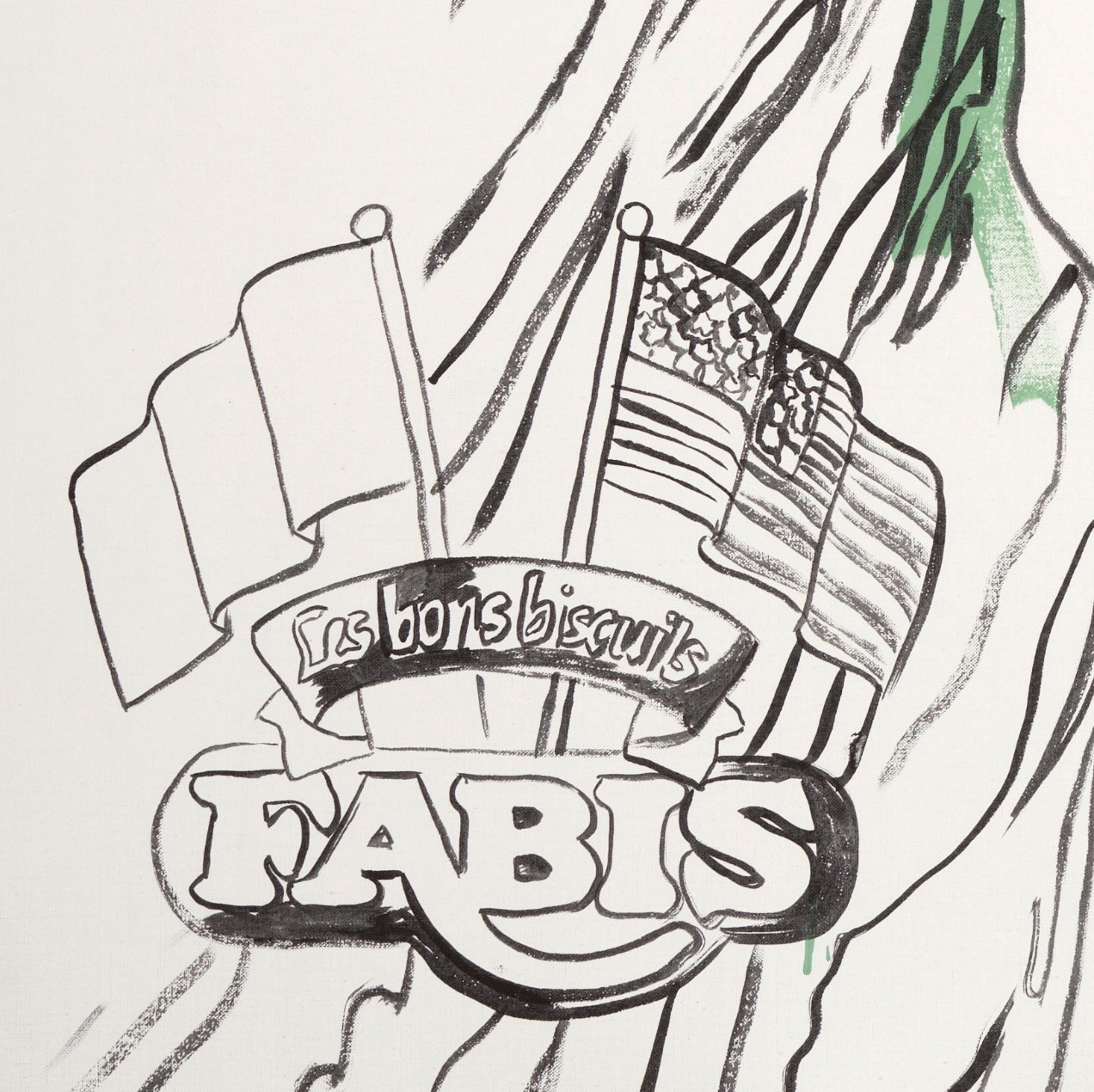
The origins of this image in such a mass culture product perfectly align with the artist’s lifelong preoccupation with the rampant commercialism of twentieth century capitalist society and its connection to symbolic abstractions of American moral principles. In many ways, this late work can be seen as a bookend to his career, evoking the hand-painted process and use of a brand logo that featured in his breakthrough 1962 Ferus Gallery show of 32 Campbell’s Soup Cans in Los Angeles. Warhol’s choice of a greenish hue, recalling the oxidized copper of the original monument sets it apart from other versions in this series, including silkscreens in varied palettes and camouflage motifs. Other examples from this late series are held in major public collections, including The Broad in Los Angeles and The Andy Warhol Museum in Pittsburgh.
Statue of Liberty, 1986
Phillips New-York: 14 May 2024
Estimated: USD 800,000 – 1,200,000
USD 1,143,000
Andy Warhol – Modern & Contemporary Art … Lot 16 May 2024 | Phillips
ANDY WARHOL
Statue of Liberty, 1986
Synthetic polymer paint and silkscreen ink on canvas
50 x 54 1/2 inches (127 x 138.4 cm)
Stamped twice by the Andy Warhol Art Authentication Board, Inc. and the Estate of Andy Warhol and numbered
Inscribed twice “PA 64.015 VF” on the overlap
Painted in the last year of Andy Warhol’s life, Statue of Liberty, 1986,serves as the artist’s clever meditation of one of the most recognizable symbols in the United States. The work belongs to a discrete body of paintings Warhol executed which portrays a close-up view of Lady Liberty’s resolute countenance and sharp-edged crown. The present example is notable for its pale green palette evoking the statue’s copper oxidation, a faithful rendition of this civic allegorical figure. As the decade progressed, Warhol’s imagery began to include ambiguous political and religious motifs, which have been interpreted as both earnest and critical. Depicting an iconic American emblem of opportunity and unity, this significant body of paintings have been read as a reflection of the prevailing concerns of this era, such as the burgeoning AIDS crisis and tensions of the Cold War. These nuanced responses have led this image to be celebrated as a prime exemplar of Warhol’s late career, represented by the holding of similar works from the series in major institutional collections, such as The Broad, Los Angeles.

Andy Warhol, Statue of Liberty, 1962. The Andy Warhol Museum, Pittsburgh, Pennsylvania.
Artwork: © 2024 The Andy Warhol Foundation for the Visual Arts, Inc. / Licensed by Artists Rights Society (ARS), New York
The Statue of Liberty featured prominently in media coverage in 1986, making it an ideal subject for Warhol—always an astute observer of contemporary culture. That year marked the centenary of its unveiling in New York in 1886, after the monumental statute designed by Frédéric Auguste Bartholdi and built by Gustave Eiffel, was presented as a gift as a symbolic celebration of American democracy. A century later, during the Fourth of July weekend in 1986, the United States marked this centennial anniversary with a dramatic reveal of the newly restored statue, following an expensive and ambitious two-year restoration. Amidst the media frenzy that preceded this highly-televised event, the icon of American culture saturated the publications and images of everyday life—extensively covered not only in newspapers and magazines, but also on commemorative trinkets such as keychains and coins. Warhol, intrigued by this overwhelming media exposure, culled the image of the Statue of Liberty depicted in the present work from a celebratory cookie tin lid. Even the original logo of the container is kept intact in the lower left corner of Statue of Liberty, featuring both the French and American flags and the inscription “Les bons biscuits Fabis.” Akin to his treatment of Coca-Cola and Campbell’s Soup, the present work represents the banal objects that characterize post-war consumerism, but it also takes this branding one step further to reflect how an American symbol of democracy and opportunity had become an icon of popular culture itself.

Cookie Tin produced by the French cookie company, “Les Bons Biscuits Fabis.”
In the last decade of his career, Warhol turned to his own corpus for source material. Beginning with his Retrospectives series in 1979, he returned to the very images that had solidified his position within modern art history. Warhol’s first depictions of the Statue of Liberty trace back to 1962, when he executed two paintings of the structure based on a postcard image of the New York harbor. The artist returned to the subject nearly twenty-five years later, during a period in his practice that was characterized by both introspective reflection and abundant creativity. He captured the Statue of Liberty under scaffolding for the cover of his 1985 photobook, America, before employing it in the present series of paintings and portraying it in a variety of hues. Towards the end of Warhol’s life, as his position was solidified as one of the most influential post-war artists, not even his own practice remained safe from his unceasing appropriation. In Statue of Liberty, Warhol applied his fundamental principle of reproduction to an image that had already been subject to persistent reproduction itself—on the front pages of newspapers, television, biscuit tins, and even in his own previous works. The ironically gestural, schematic approach manifest in the present work, intended to produce the appearance of brushstrokes, extends his characteristically deadpan wit. As one of the most famous structures in the world, the Statue of Liberty offered Warhol the opportunity for both self-reflection and societal reflection: probing the depths of American identity, freedom, and postmodern replication, it encapsulated the core themes that wove together Warhol’s oeuvre.
Statue of Liberty (72×72)
Statue of Liberty, 1986
Sotheby’s New-York: 28 October 2020
Estimated: USD 2,500,000 – 3,500,000
USD 3,045,000
ANDY WARHOL | STATUE OF LIBERTY | Contemporary Art Evening Auction | 2020 | Sotheby’s
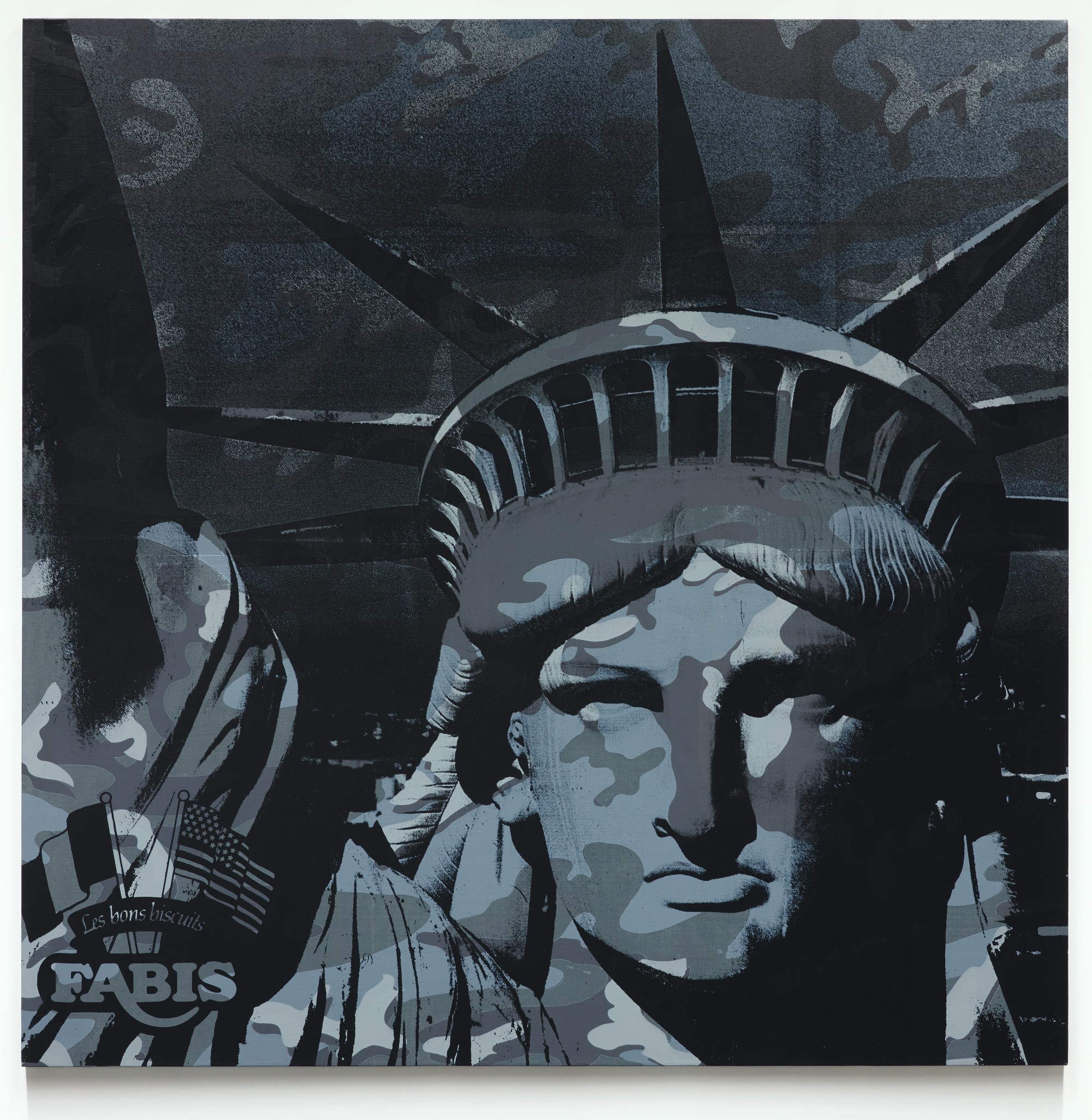
ANDY WARHOL
Statue of Liberty, 1986
Acrylic and silkscreen on canvas
72×72 inches (182.8 x 182.8 cm)
Signed and dated 86 on the overlap
Rendered in an elegant palette of blue and grey tones, in Statue of Liberty, Warhol masks his subject with his recurring camouflage motif. By rendering the most quintessential American symbol in camouflage, Warhol invokes the specter of war that pervades the complicated narrative of American history, the Reagan-era politics that shaped the nation and the provocative sentiment that “freedom isn’t free.” The Camouflage series began in the mid-1980s and returned the artist to a profound investigation of painting. In his rendering of a highly recognizable and culturally loaded pattern, Warhol debates the multifarious capacities of the medium: its ability to refer to moments and cultural sentiments outside itself, as well as its very nature as a set of abstract forms manipulated on the canvas. Fascinated with the near religious reverence afforded to painters such as Jackson Pollock and Mark Rothko within his lifetime, this series can be linked conceptually with Warhol’s earlier Rorschach paintings and Oxidation series, in their challenge to the mysticism of self-professed ‘non-referential’ Abstract Expressionism. In a perfect visual pun, Warhol uses the army print to wage war on Abstract Expressionism by embracing an elemental pattern that is highly connotative of its original utilitarian and militarized purpose, as well as subsequent uses in fashion. Much like Jasper Johns’ iconic Flag paintings, the work is paradoxically purely abstract and highly referential. Statue of Liberty thus refers back to Warhol’s most essential obsession with a shared, mass-produced visual language.
Statue of Liberty, 1986
Christie’s New-York: 15 November 2016
Estimated: USD 3,000,000 – 6,000,000
USD 3,719,500
Andy Warhol (1928-1987), Statue of Liberty | Christie’s
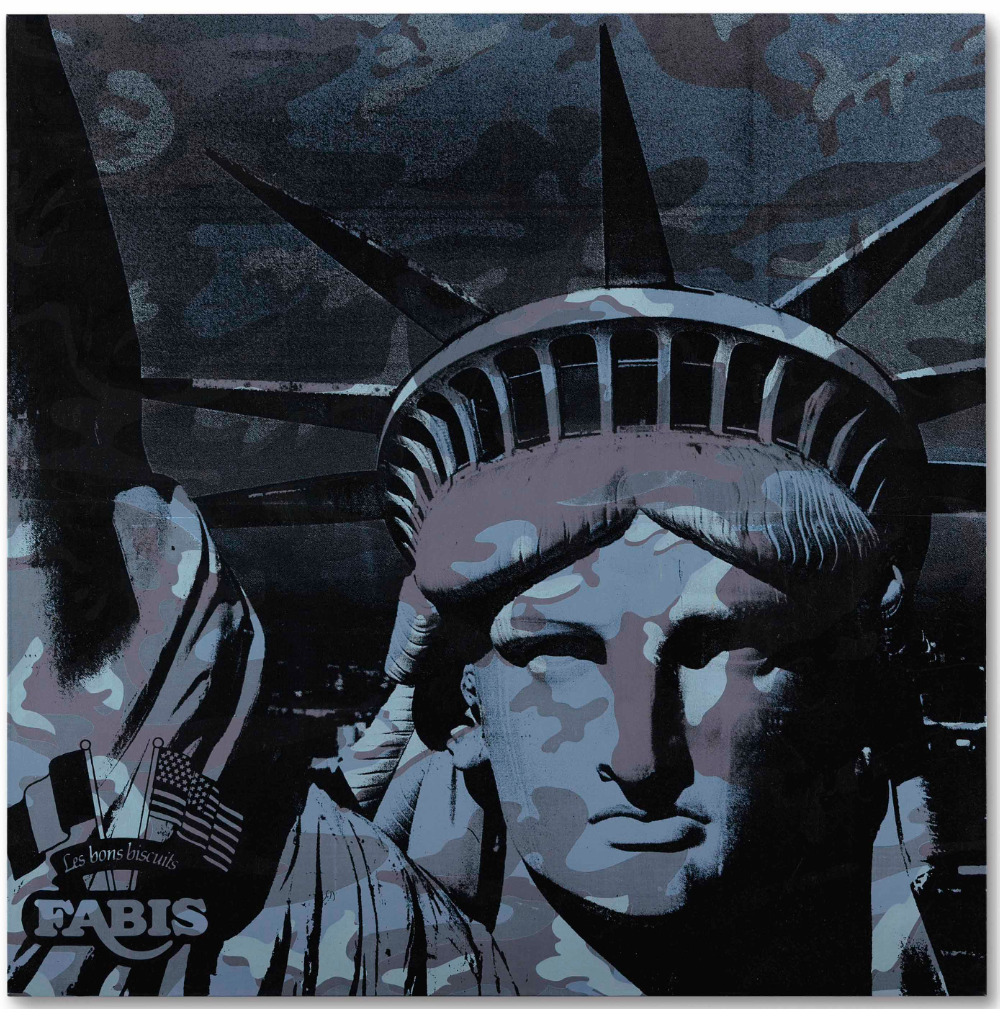
ANDY WARHOL (1928-1987)
Statue of Liberty, 1986
Synthetic polymer and silkscreen ink on canvas
72×72 inches (182.8 x 182.8 cm)
Signed and dated ‘Andy Warhol ’86’ (on the overlap)
Painted in 1986, Andy Warhol’s Statue of Liberty is a shrewd and clever homage to the symbolic ideals of the American dream. The large-scale, six-foot-square painting presents that most iconic American image, the Statue of Liberty, with her impenetrable facade that displays the unwavering commitment to the values of democratic freedom. Warhol’s first paintings of the Statue of Liberty date to 1962, when he painted two versions of the colossal sculpture based on a postcard of New York harbor. Warhol then revisited this iconic image during the late 1980s, which proved to be a period of both retrospective reassessment and abundant creativity. Rendered in an elegant palette that evokes Picasso’s Blue Period, Warhol overlays the iconic image of Lady Liberty with a powerful recurring motif—camouflage. The wry sense of irony in depicting a pattern designed to make its subject disappear must have appealed to Warhol, because he used the pattern in several works that year, including the celebrated Fright Wig self portraits and Last Supper. By rendering that most quintessential American icon in camouflage, Warhol invokes the specter of war that pervades the complicated narrative of American history, the Reagan-era politics that shaped the nation and the provocative sentiment “freedom isn’t free.” A powerful political critique clad in the vivid candy-colors of Pop, Warhol’s Statue of Liberty is a potent reminder that his most iconic imagery is always more complex than its gleaming Pop surface would suggest.
In the spring of 1986, Andy Warhol traveled to Paris to attend the world premiere of his Statue of Liberty series, where ten of the large-scale, six-foot Statue of Liberty paintings were exhibited at the Galerie Lavignes-Bastille. A Parisian opening for such an iconic American image was indeed a fitting one for Warhol’s Statue of Liberty, since another quintessentially American series made their debut in Paris as well. In early 1964, Warhol’s Death and Disaster paintings opened at the Paris gallery of Ileana Sonnabend. And indeed, Warhol’s first paintings of the Statue of Liberty date to 1962—the same year as the Death and Disaster series.
In Statue of Liberty, Warhol returns to the ubiquitous symbol of America in a large-scale, vividly-colored canvas. While the 1962 paintings depicted a full-length view of the colossal sculpture, in the present work, Warhol zooms in on the essential elements. He portrays a close-up view of Lady Liberty’s steely expression, whose unwavering commitment to freedom and liberty is symbolically conveyed by her massive, implacable façade and large, pointed crown. Rather than depict the sculpture in the classic green color of its oxidized copper armature, Warhol instead renders the painting in a symphony of blues, as if passed through a kaleidoscopic prism of blue camouflage. This remarkable technique has the dual-fold effect of simultaneously highlighting and obscuring the image, a technique Warhol exploited to great degree in his own series of Fright Wig self-portraits that same year.
The Statue of Liberty, 1986
Sotheby’s New-York: 13 November 2013
Estimated: USD 2,000,000 – 3,000,000
USD 3,189,000
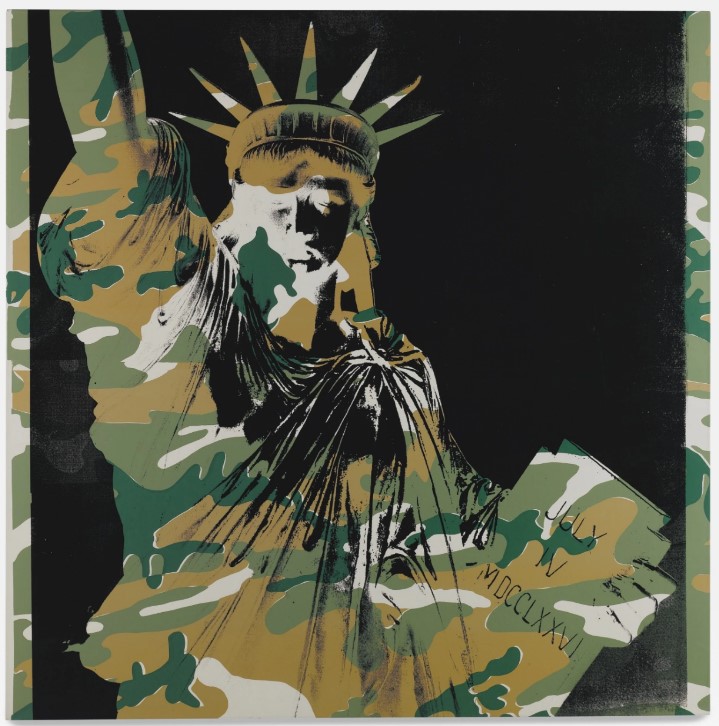
ANDY WARHOL
The Statue of Liberty, 1986
Acrylic and silkscreen ink on canvas
72×72 inches (182.9 x 182.9 cm)
Clothed entirely in camouflage, the immediately recognizable figure of The Statue of Liberty appears against a jet-black background, existing simultaneously as figure and abstraction. As such, the present work conveys a duality that encapsulates both the artist’s early silkscreened works and his later abstractions. Like his other great Camouflage paintings, the reduced amorphous forms of army green, khaki and white that comprise the camouflage design are graphically dominant; however, here they are used not to conceal but to reveal a figure. An unparalleled icon, laden with historical, social and cultural significance, The Statue of Liberty is a fitting subject for an artist who spent much of his career preoccupied by the dynamics of fame and the iconic. Designed by Frédéric Auguste Bartholdi and dedicated on 28 October 1886, The Statue of Liberty was a gift from the people of France to the United States. The statue is of a robed figure that represents Libertas, the Roman goddess of freedom, and has come, over the course of its life, to stand as the definitive symbol of the fundamental values of freedom and democracy that encapsulate the American Dream.
The work, therefore, is not a representation of The Statue of Liberty but a re-presentation of an omnipresent image of the Statue that has infiltrated our collective consciousness. By using a readily available and culturally ubiquitous image, Warhol remained true to his artistic practice, which steadfastly celebrated the social forces of mass commercialization and celebrity fascination that predominated mid-century American life. As opposed to his early Statue of Liberty representations, the present work displays a single image of the Statue, shown from the waist up. Framing his composition so as to include the statue’s crown and tablet but exclude her torch and the broken chain that rests at her feet, Warhol allowed his figure to occupy nearly the whole of the six-by-six foot canvas surface, resulting in a monumental representation of this seminal American muse. Like the artist’s celebrated single screen representations of Jackie Kennedy, Marilyn Monroe, and Elizabeth Taylor, The Statue of Liberty elevates an already prodigiously significant figure to the status of indisputable icon.
Statue of Liberty, 1986
Sotheby’s New-York: 10 May 2011
Estimated: USD 3,000,000 – 4,000,000
USD 3,442,500
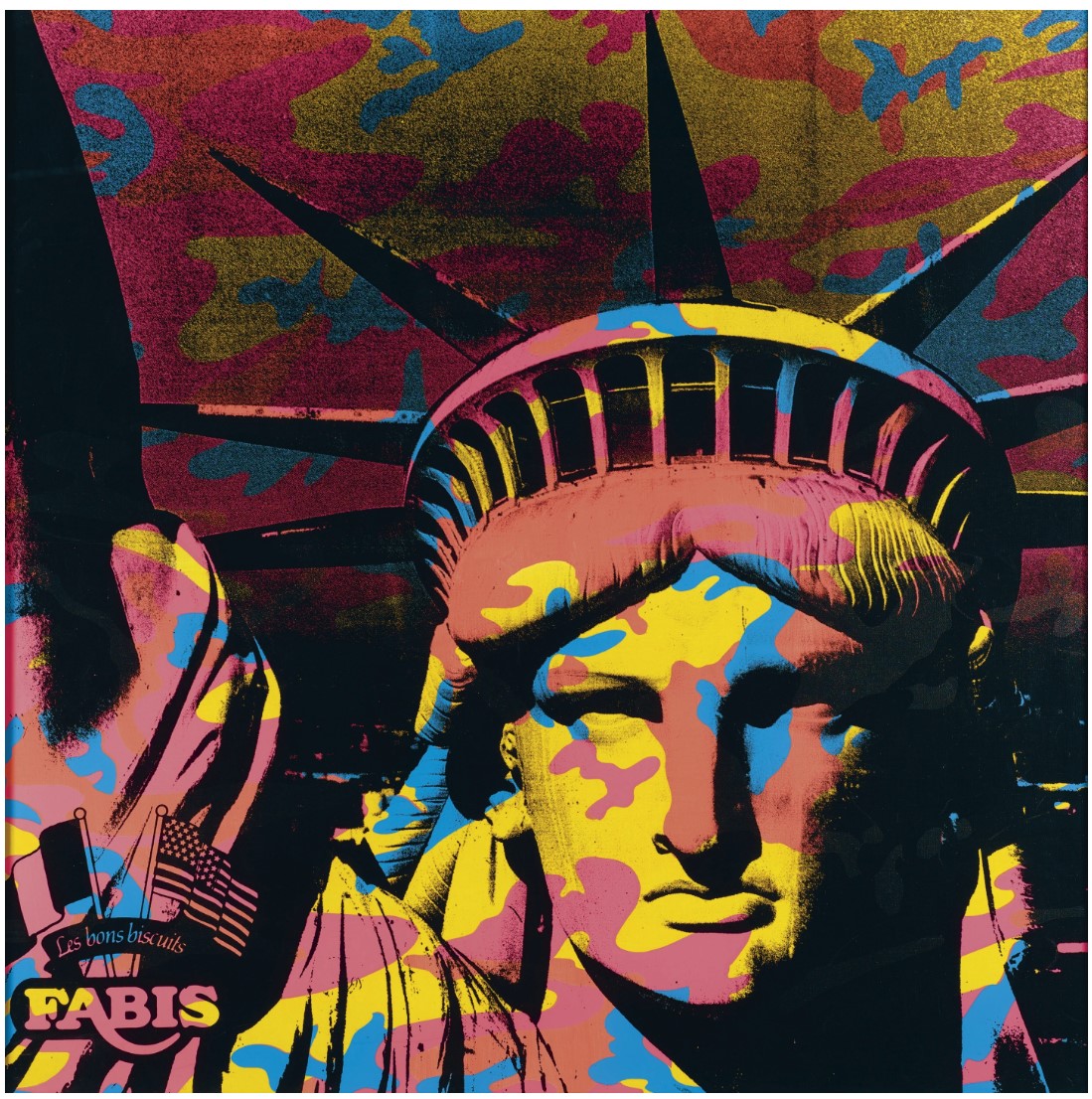
ANDY WARHOL
Statue of Liberty, 1986
Synthetic polymer and silkscreen ink on canvas
72×72 inches (182.9 x 182.9 cm)
Statue of Liberty, 1986
Sotheby’s New-York: 12 May 2010
Estimated: USD 2,500,000 – 3,500,000
USD 3,330,500
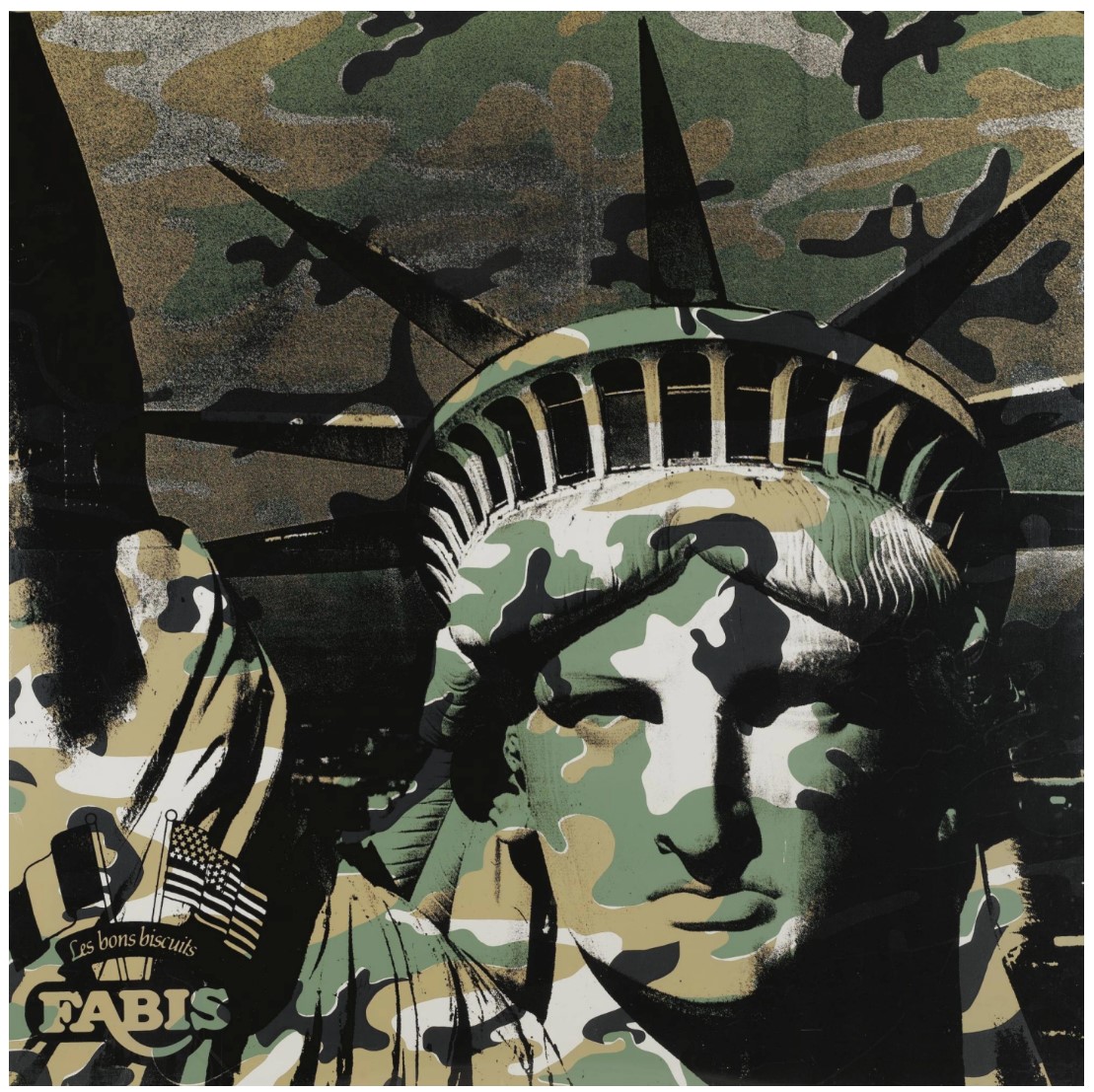
ANDY WARHOL
Statue of Liberty, 1986
Acrylic and silkscreen ink on canvas
72×72 inches (182.8 x 182.8 cm)
Sotheby’s New-York: 14 May 2008
USD 5,193,000
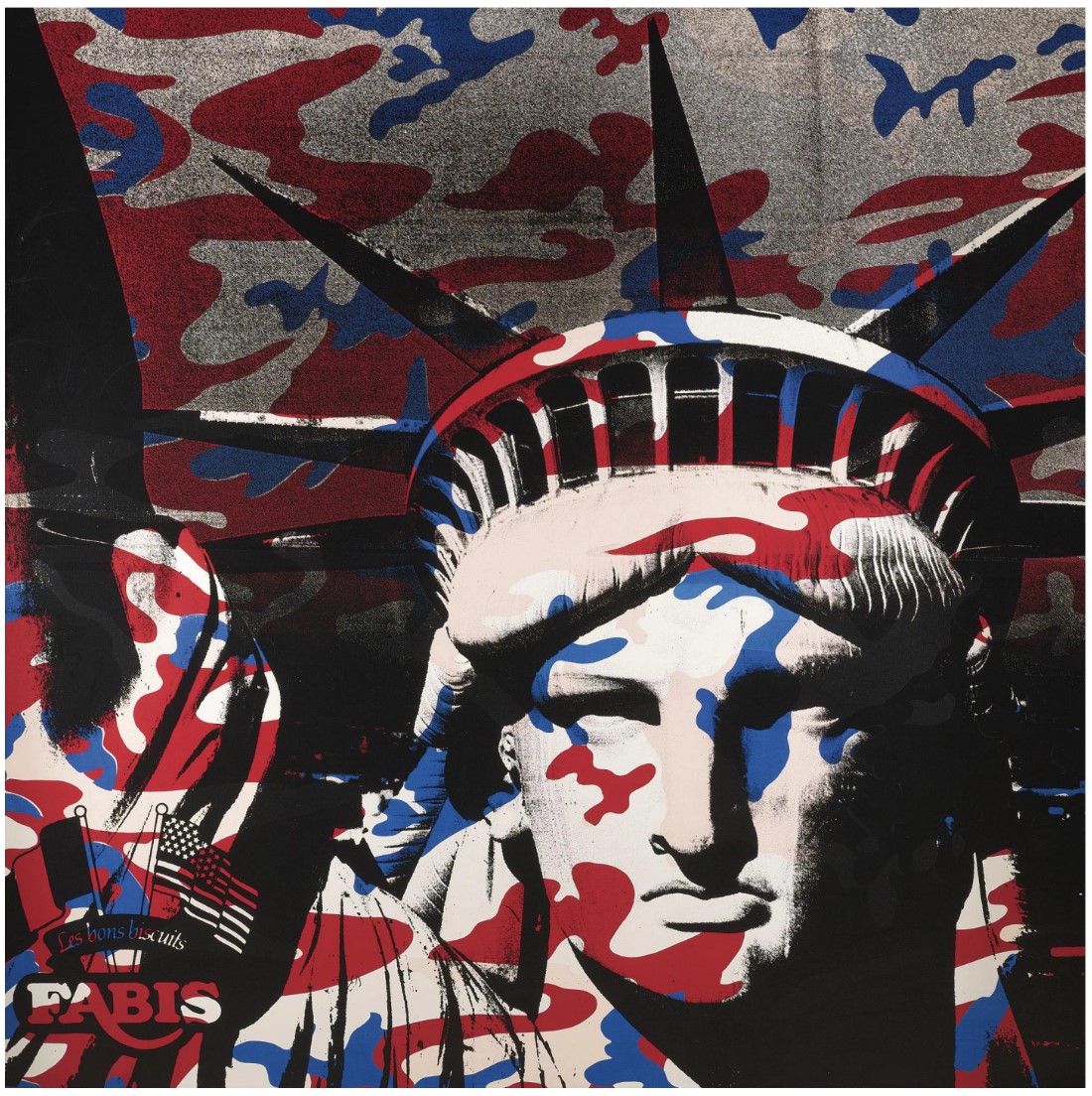
ANDY WARHOL
Statue of Liberty, 1986
Acrylic and silkscreen ink on canvas
72×72 inches (182.8 x 182.8 cm)
Statue of Liberty, 1986
Christie’s New-York: 15 May 2001
Estimated: USD 350,000 – 450,000
USD 391,000
Andy Warhol (1928-1987) , Statue of Liberty | Christie’s
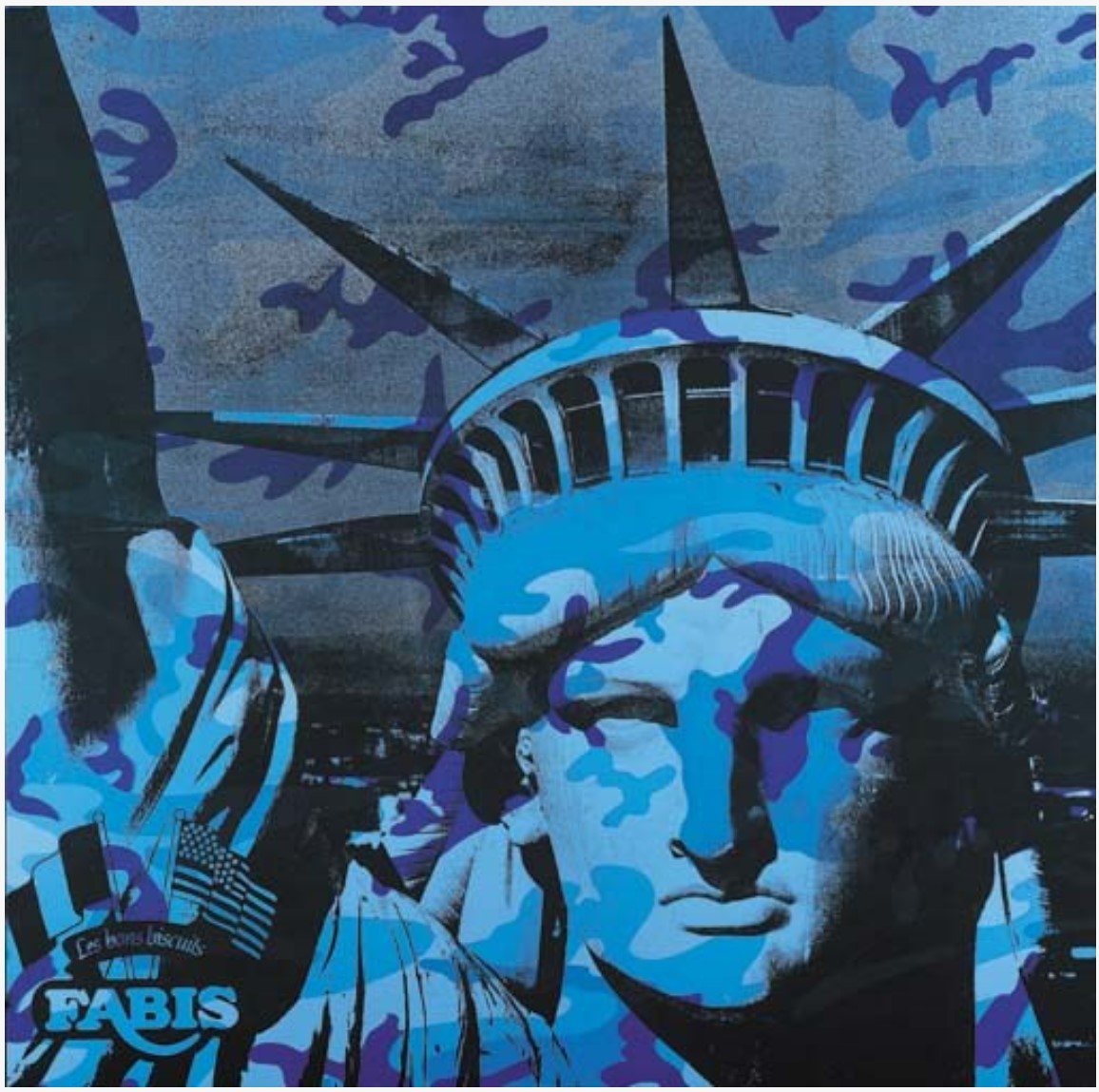
ANDY WARHOL
Statue of Liberty, 1986
Synthetic polymer and silkscreen inks on canvas
72×72 inches (182×183 cm)