MP, 1984
Acrylic and Xerox collage on canvas
Mary Boone Gallery, New York
Private Collection (acquired from the above in 1985)
Sotheby’s, Paris, 7 December 2011, lot 7
Acquired at the above sale by the present owner
Auction History
Phillips London: 26 June 2025
Estimated: GBP 3,500,000 – 5,500,000
GBP 4,888,000 / USD 6,696,560
Jean-Michel Basquiat Modern & Contemporary Art: Evening & Day Sale
Sotheby’s Paris: 7 December 2021
Estimated: EUR 700,000 – 900,000
EUR 1,296,750 / USD 1,735,865
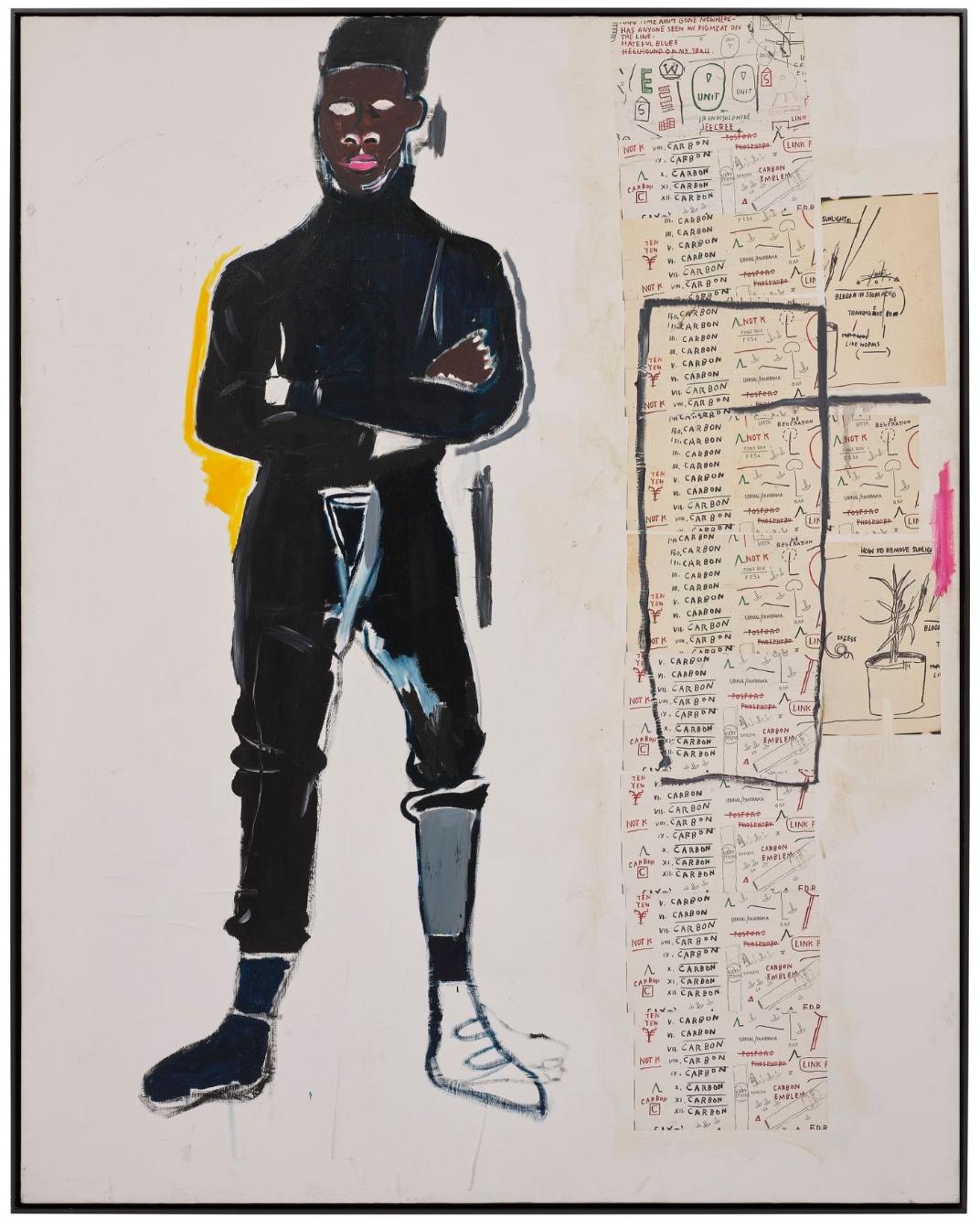
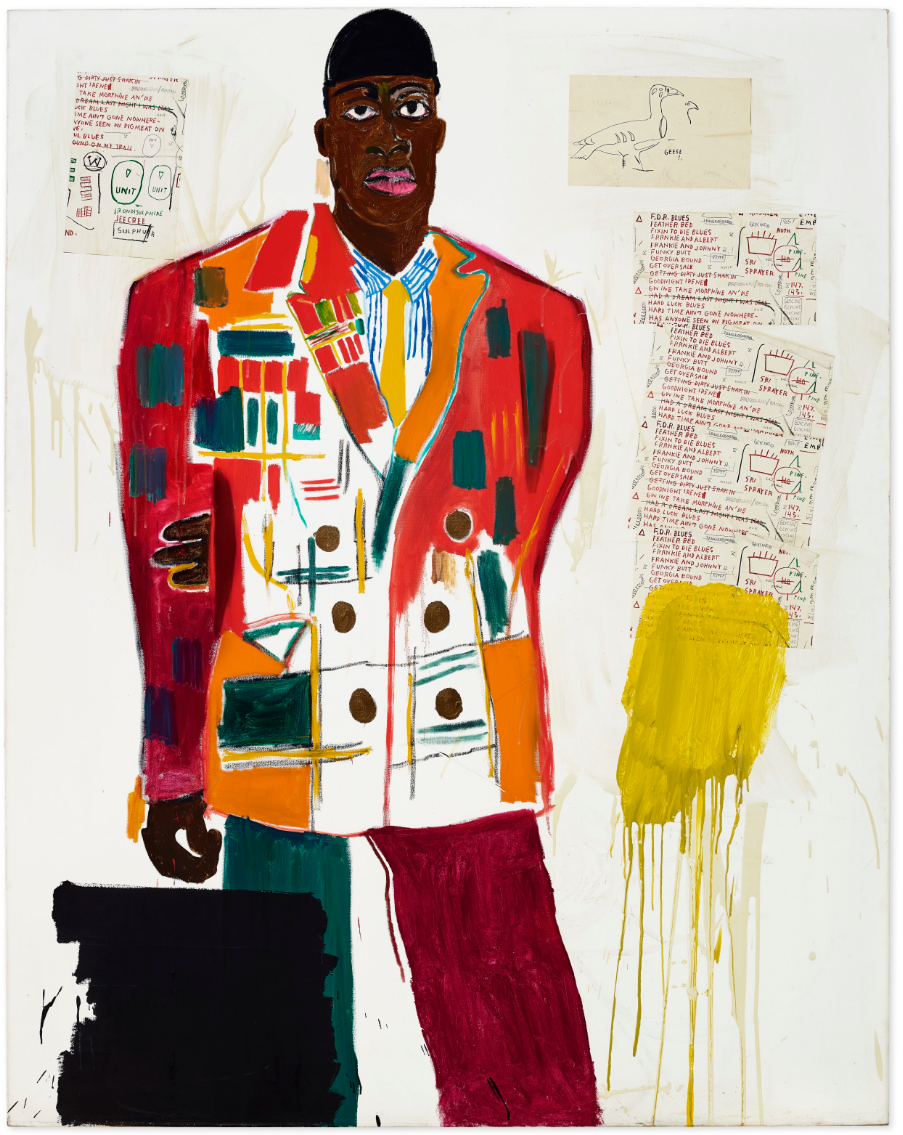
Standing starkly against an off-white ground, toes out turned, and arms folded confidently across his chest, the dramatically executed MP is an image of proud, self-possessed defiance. It is a portrait of exceptional force and power, not only as a celebration of Black youth and its potential best captured in Nina Simone’s iconic terms, but as a strikingly rare example of ‘Radiant Child’ Jean-Michel Basquiat working directly from life in the execution of a painting. Although Basquiat frequently incorporated well-known figures from Black cultural history into his paintings alongside detailed portraits of 20th Century artists such as Pablo Picasso and Andy Warhol, he very rarely painted from life, making MP – the second of two paintings of the same subject – truly extraordinary as quite possibly the only example of Basquiat working directly from life with the same male sitter on more than one occasion. A charismatic young photographer and stylist who moved in the same vibrant downtown club scene as Basquiat, Michael Patterson recalls first meeting the young artist by chance in a crowded hallway of legendary nightclub Area in 1984. On the spot, Basquiat asked Patterson to come and sit for him in his Great Jones Street studio. Dismissing the invitation as empty club talk, Patterson failed to show, an earnest Basquiat finding him in the toilets of the same club a fortnight later and pressing the invitation again.
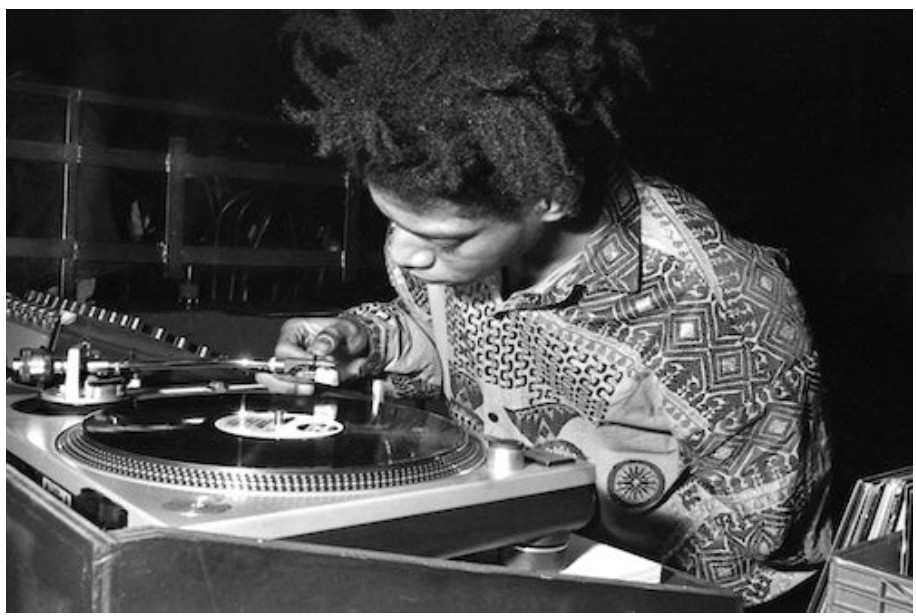
Jean-Michel Basquiat DJ’ing at Area Nightclub, New York, 1985. Image: © Ben Buchanan. All rights reserved 2025 / Bridgeman Images
Run by brothers Eric and Christopher Goode with Basquiat’s then girlfriend Jennifer Goode overseeing art direction, the club redefined the hedonistic club scene of 1980s New York, bringing together artists, designers, celebrities, and musicians in enormous, frequently changing art installations with themes ranging from ‘Suburbia’, ‘Natural History’, and ‘Carnival’. The opening parties especially were packed with a ‘who’s who’ of the art and club scenes of the day. More than any other club, Area distilled the zeitgeist of the moment, an especially fitting backdrop for Patterson and Basquiat’s first meetings as two icons who perfectly distilled the creative energy of their own time in distinct ways. Despite only being twenty-four years old, by the time of the present work’s execution in 1984, Basquiat was already an established figure on the international art scene. Represented by Mary Boone and showing with Larry Gagosian and Bruno Bischofberger, Basquiat was the youngest artist ever to be included in the prestigious documenta and had also been the subject of major solo exhibitions across America, Japan, and Europe. Retaining the intensity and immediacy of his earliest graffiti experiments, Basquiat’s work celebrated and centered Black cultural history and its heroes, often featuring references to prominent sportsmen, jazz musicians, and Civil Rights activists. Just as Pablo Picasso had measured his own success against that of Old Masters Jean Auguste Dominique Ingres and Diego Velázquez, reinterpreting and reworking their masterpieces in his own pictorial idiom, Basquiat similarly held Picasso in especially high esteem, reckoning directly with his legacy in a series of portraits of the artist completed in the same year as the present work. Given Picasso’s own, problematic appropriation of so-called ‘Primitivist’ sources of visual culture and the fundamental role that they would play in revolutionizing the course of twentieth-century Western art, Basquiat’s relationship to Picasso and to established art historical narratives was decidedly complex.
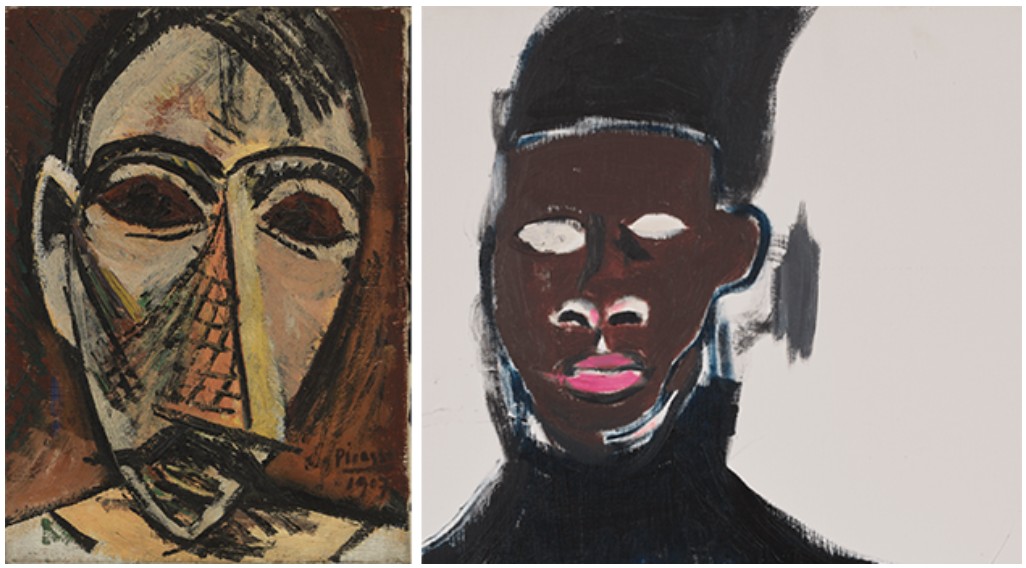
Left: Pablo Picasso, Tête d’homme, 1907, The Barnes Foundation, New York. Artwork: © Succession Picasso / DACS, London 2025
Right: Detail of the present work
While Basquiat’s first portrait of Patterson was more straightforwardly naturalistic, capturing his large eyes and details of his face and physique with remarkable distinction, in this second portrait ‘MP’ takes on a larger, more totemic role of the gifted young Black man and his place in the world. Rendered with extraordinary economy and precision, the work still clearly captures the confident swagger of Patterson’s stance and distinctive facial features, paying special attention to subtle modulations in skin tone offset by the delicate pink sweep of his lips and enhanced by the electrifying additions of yellow and steely grey framing his crossed arms. Importantly however, in filling in the eyes here, Basquiat transforms his sitter’s face into a mask, referencing Picasso’s assimilation of highly stylised elements of traditional African and Oceanic carving into his proto-Cubist work, and elevating Patterson as an emblematic symbol of the potential and power of Black youth.
As is typical of Basquiat’s work, image and text sit together in complex, synthesized relationships here, the multiple Xeroxed pages filled with repeating lines of text collaged to the right of the canvas reinforcing the visual codes of this potent portrait. Along the top sheet, Basquiat has inscribed the titles of blues songs by the likes of Robert Johnson, Bessie Smith, Memphis Minnie, and Lonnie Johnson. While Patterson recalls Basquiat playing jazz and blues as he sat for him in the Great Jones Street studio, these soulful pieces – ‘Hellhound on my Trail’, ‘Hateful Blues’, ‘Pig Meat on the Line’, and ‘Hard Time Ain’t Gone Nowhere’ – speak especially to long histories of oppression and deprivation, and of the power of resistance and aspiration in the face of such struggles. Beneath this list of titles and sitting alongside a series of cryptograms including a stylized hourglass and inverted triangles, the first sheet also features a familiar insignia from Basquiat’s repertoire, the ‘Link Parabole’, demarked as a circular form with three connective arms reaching out from the center. Related to simile and metaphor, a parabole describes a semantic occurrence whereby a resemblance or relationship is established between one thing and another, often across distinct categories. A potent symbol describing the juxtaposition and equivalence between word and text animating Basquiat’s entire artistic project, its appearance here in a portrait that draws together some of the artist’s key themes and concerns is highly revealing, as is the inclusion of the capitalized ‘JEE CREE’, a phonetic rendering of the French ‘J’ai cree’ (I create).
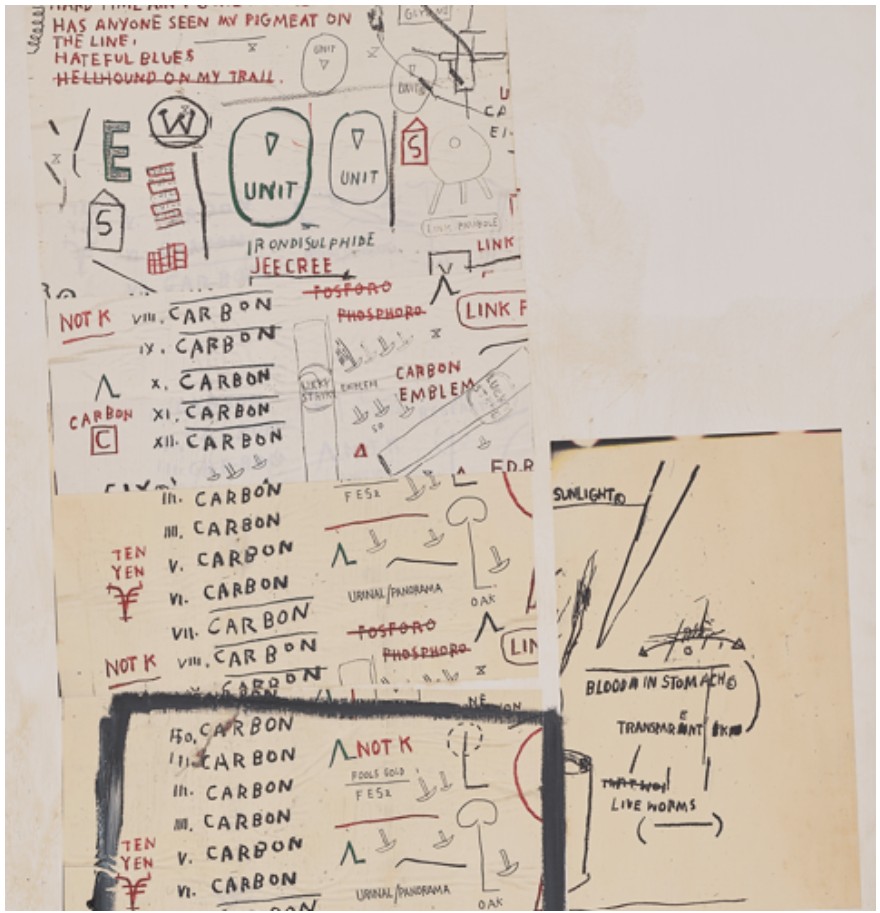
Further pages, including repeated Xerox sheets feature numbered lists of the word ‘CARBON’ and its chemical symbol ‘C’ are especially compelling, both in terms of the visual effect of their accumulations and for the element’s rich, associative meanings. A playful reference, perhaps to the carbon-copy replications performed by the Xerox machine, carbon is known anecdotally as ‘the king of elements’ because of its remarkable ability to form a diverse group of compounds and it is certainly tempting to read an oblique nod to Basquiat’s iconic crown symbol at work here. Alongside its well-known expression in the composition of diamonds, its Latin root ‘Carbo’ links carbon directly to its contemporary correlate ‘Coal’ and its derivatives including charcoal – materials noted both for their blackness and mark-making potential. Packets of Lucky Strike cigarettes and cryptogrammatic renderings of Oak trees further compound these grand cycles of elemental life and death, tobacco plantations themselves of course key sites in the history of the American South and the enslavement of peoples of African descent, perhaps indicated here in the repeated image of the sickle. The complex relationship between Blackness, creativity, labor, and capitalism is further emphasized with repeated reference to ‘RUPEES’, ‘TEN YEN’, and ‘Iron Disulfide’ – more commonly known as ‘Fools Gold’ – and offset here with words like ‘EXCESS’.
Stylistically related to his celebratory standing Black warrior figures, in this heroic repertoire of Kings, saints, warriors, and heroes extended in the depictions of the athletes, artists, and musicians that he most revered, Basquiat challenged the biases of Western art history and the everyday lived realities for Black men in America. Although well-known for his self-portraits and the insertion of himself into this lineage of heroic Black men, in this exceptional example of Basquiat working directly from life with a male sitter we find a new sense of urgency and responsibility surrounding this task, MP acknowledging the complex racial histories of the exploitation of labor and circulation of commodities upon which capitalism were based – and within which Basquiat’s own, stratospheric rise to fame was deeply enmeshed. In a powerful distinction from his first portrait of MP, here the figure emerges as a distillation of the complex history, power, and potential of Black male youth, an emblem of this celebratory promise and a totem against ‘the powerlessness experienced on slave ships, at the auction block, and in everyday life’.
JEAN-MICHEL BASQUIAT
MP, 1984
Acrylic and Xerox collage on canvas
86×68 inches (218.4 x 172.8 cm)
Signed, titled and dated ‘”MP” Jean-Michel Basquiat 1984’ (on the reverse)
Provenance
Mary Boone Gallery, New York
Galerie Bruno Bischofberger, Zürich
Akira Ikeda Gallery, Tokyo
Private collection, Japan
Anon. sale; Christie’s, New York, 4 May 1993, lot 38
Acquired at the above sale by the present owner
Auction History
Christie’s New-York: 6 October 2020
Estimated: USD 4,000,000 – 6,000,000
USD 4,590,000
Jean-Michel Basquiat (1960-1988), MP | Christie’s
Alive with the charisma of both artist and sitter, MP is a rare and beautiful portrait by Jean-Michel Basquiat. Against a spare off-white background adorned with Xeroxed sheets of text, symbols and drawings, Basquiat depicts Michael Patterson, a friend from the vibrant nightlife scene of 1980s New York. The two were regulars at Area, the short-lived Tribeca club infamous for its themed parties and extravagant, theatrical sets. Basquiat deejayed and sometimes even painted there; his then-girlfriend Jennifer Goode, whose brothers Eric and Chris co-owned the club, was one of its art directors. “The silver bar is where worlds collide”, wrote Jesse Kornbluth in a 1985 profile. “Andy Warhol might be brushing up against Malcolm Forbes, Keith Haring and Jean-Michel Basquiat against David Byrne or Giorgio Armani, Scavullo and Joan Rivers against Phoebe Cates or Henry Geldzahler. And if no one’s mixing, Stephen Saban, the Boswell of the night, will push them together, later to remind them what happened in his column in Details” (J. Kornbluth, “Inside Area: The Wizardry of New York’s Hottest Club”, New York Magazine, March 11, 1985, p. 34). Patterson recalls that he didn’t take Basquiat seriously when he first asked him to sit for a portrait. He saw Basquiat again at Area a fortnight later, and the artist asked why he hadn’t showed up. Patterson travelled from his Long Island home to Basquiat’s studio on Great Jones Street for his first sitting and entered the pantheon of art history.
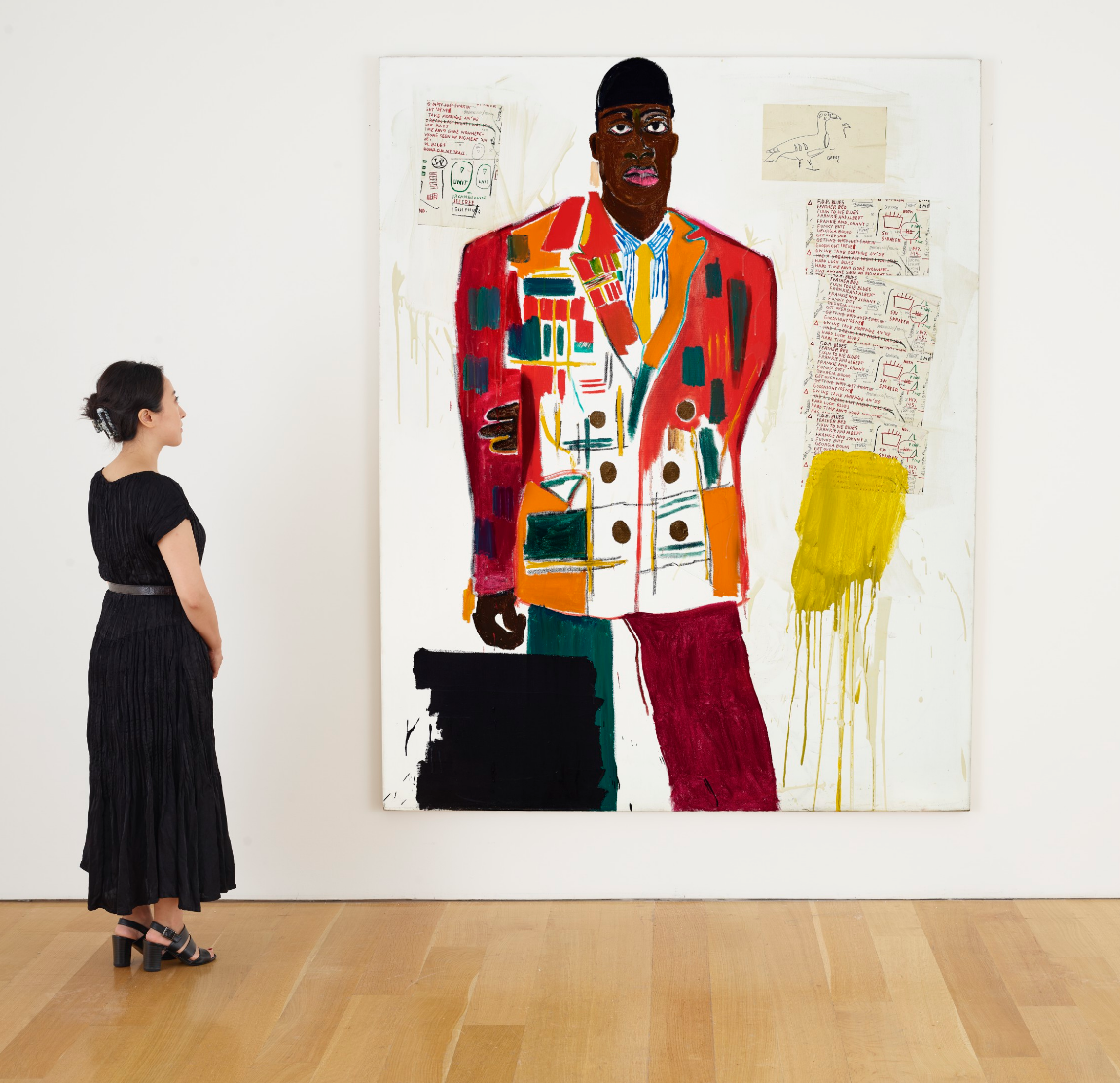
In MP, Patterson is immortalized as a regal presence. With one arm behind his back, he wears a resplendent gold-buttoned, double-breasted blazer—altered by Basquiat from its original tartan check into a map-like patchwork of red, orange, green and yellow—and a striped blue shirt with a yellow tie. His head is crowned by a black skullcap; a swathe of black at his right hand could be a briefcase, or painterly invention. A splash of bright yellow answers to the right. Rare among Basquiat’s works in depicting a subject from life, MP is also remarkable for its charge of personality. Best known as a synthesizer of disparate fragments of image, text and sound from second-hand sources, here Basquiat reveals himself as an adept portraitist. He captures Patterson’s face with deft economy, staring coolly out of the canvas with large, sensitive eyes. Distinct from his typically flat, graphic application of color, Basquiat’s attention to his subject’s skin is acute, nuancing his dark complexion with fuchsia lips and a chartreuse glow that recalls the technique of Alice Neel, the great chronicler of human life in mid-century Manhattan. It is clear that Patterson held particular fascination for Basquiat. Later that year, he would sit for a second painting – also titled MP – making him likely the only man painted from life more than once by Basquiat. He would also appear, snapping his fingers, in an MTV “Art Break” clip filmed in Basquiat’s studio in 1985, alongside other friends including experimental musician Arto Lindsay and designer Stephen Sprouse. MP stands as a vivid record of a creative exchange between the two men, and of the electric cultural moment in which they met.
By the time MP was painted, Basquiat had attained near-mythic status as the post-punk king of the art world. He had emerged as a graffiti artist at the start of the decade, plastering his “SAMO” tag and cryptic slogans throughout downtown Manhattan. Breakout group shows in 1980 and 1981 fired off a meteoric rise to stardom: over the following two years, he held solo exhibitions worldwide, collaborated with Andy Warhol and exhibited at Documenta VII in Kassel. He moved to the Great Jones Street loft space in August 1983, where his work reached new heights of material richness and thematic complexity. His first museum retrospective opened at the Fruitmarket Gallery, Edinburgh in August 1984. That same year, he mounted his debut solo show at Mary Boone Gallery in New York. MP was shown at his second exhibition there in March 1985, when Basquiat was just twenty-four years old.
“His Rasta Man in a double-breasted jacket (no doubt linen and silk) is the he-man punk harlequin”, wrote the critic Judd Tully in his review of the Mary Boone show. “The black attaché case and skull cap are new accessories for an art world filled with Michael Kordas” (J. Tully, “Barefoot Basquiat”, Art/World, March 6, 1985). Tully rightly recognized the originality of the work: Basquiat was celebrating the character, dress sense and identity of a cool and contemporary black New Yorker, a fresh subject for the realm of fine art. The Pan-African colors of red, green and gold that Tully picked up on also chime with an increasing interest in African spiritualism and history in Basquiat’s work at the time. Adding to his library of visual references—which included Gray’s Anatomy, Henry Dreyfuss’ Symbol Sourcebook (1972) and Burchard Brentjes’ African Rock Art (1969)—in 1983-84 the artist had started to draw images of masks, idols and ideograms from Robert Farris Thompson’s new volume Flash of the Spirit: African & Afro-American Art & Philosophy. Basquiat was likely introduced to the book by his friend Shenge Ka Pharaoh, who became an assistant in 1984, and who answered the door of 57 Great Jones Street to Patterson when he came to sit for his portrait.
Basquiat was so enamored with Flash of the Spirit that he asked Thompson to contribute a catalogue essay for the show where MP would make its debut. The scholar readily accepted. Drawing a musical or vocal equivalence between Basquiat’s work and the magic of a voodoo shaman, Thompson saw Basquiat as epitomizing a postmodern “creole” sensibility. “It is a known fact that major jazzmen listen with affection and a pointed interest to everything”, he wrote. “Similarly, the genius of Jean-Michel is founded precisely on that ability to move in creole time. Various formal languages serve as auxiliary rockets behind his signature figurations, his spirit-heads and crossed-out words and columns of painted diagrams and legends. Each gesture is potentially a fugitive from a different art history, adding to his incredible velocity” (R. Farris Thompson, “Activating Heaven: The Incantatory Art of Jean-Michel Basquiat,” in Jean-Michel Basquiat, exh. cat., Mary Boone-Michael Werner Gallery, New York, 1985, n.p).
In MP, among these “formal languages” is that of the blues. Running down the space next to Patterson is a collaged page of Basquiat’s scrawlings, Xeroxed and repeated four times. The sheet reads like a tracklist, naming songs like “Funky Butt”, “Fixin’ to Die Blues”, “Georgia Bound” and “Goodnight Irene” – titles made famous by early blues pioneers such as Buddy Bolden, Bukka White, Blind Blake and Leadbelly. As with his myriad references elsewhere to songs and albums by jazz artists like Thelonious Monk, Miles Davis and his hero Charlie Parker, this blues incantation situates Basquiat—and frames his sitter—within a lineage of African-American creative expression. It also provides an insight into how Basquiat channeled both seen and heard fragments into his art. The line “gwine take morphine an’ die”, for instance, is not a written title but a sung lyric from Leadbelly’s “Goodnight Irene”. Basquiat was listening to the record as he worked. For Thompson, the syncopation, disjunction and repetition in Basquiat’s application of these words to canvas was itself analogous to music: “Basquiat’s blues typography, at once interruptive and complete, makes visual black song, with equivalents to pause, shout, spacing, and breath” (R. Farris Thompson, ibid.).
Sourcebook—what look like icons related to engineering, as well as some green trees marked “pine”—and repeated words including “glycine”, “iron disulphide”, and “rupee.” Basquiat often juxtaposed chemicals and raw materials with currency in this way, reflecting on his art’s power to transform base matter into economic value – an alchemy that increasingly troubled him as his fame climbed ever higher. At other times, his selections seem guided by pure formal beauty. Floating above Patterson’s left shoulder is the elegant outline of a red-breasted goose, derived from one of the “Meidum geese”: a masterpiece of Ancient Egyptian tomb painting reproduced among the famous Charles K. Wilkinson facsimiles in New York’s Metropolitan Museum of Art, where Basquiat was a frequent visitor. Basquiat called his visual and verbal citations “facts.” Discussing them with Thompson in 1985, it is as if he had MP in mind. “I get my facts from books, stuff on atomizers, the blues, ethyl alcohol, geese in Egyptian style. I get my background from studying books. I put what I like from them in my paintings. I don’t take credit for my facts. The facts exist without me. A menu in a restaurant is a painting. I may not eat the roast pig on the menu but its legend remains before me. The menu, the text, go on without me” (J-M. Basquiat, quoted in R. Farris Thompson, ibid.).
Outside his books, New York was the center of Basquiat’s life and art: a maelstrom of visual and aural information where everything was available, and where the influences of voodoo and TV advertisements, Picasso and subway graffiti, da Vinci and Warhol could meet on equal footing. His works were vessels into which he poured images, sounds, and words, cataloguing and remixing the “text” of the world around him. In this sense, his practice can perhaps best be understood as one of selection. As Demosthenes Davvetas has put it, his work is “less like a mirror than like an eye and a voice: as eye, it observes and interprets life, collecting selected items and organizing them within itself; thus organized, it becomes voice, a clear utterance expressing what has been seen” (D. Davvetas, “Lines, Chapters and Verses: The Art of Jean-Michel Basquiat”, in E. Navarra (ed.), Jean-Michel Basquiat, 3rd ed., Paris, 2000, p. 59). If often dizzyingly polyvocal, Basquiat’s selections were far from indiscriminate. They were guided by a musical and poetic sense of power, and marshalled by a painterly genius for color and composition. In MP, Basquiat selected Michael Patterson. His vital presence speaks not only of the dynamism of 1980s New York, but also embodies the spirit of Basquiat’s own work, framed by allusions to black music and ancient art in an emphatic statement of cultural pride. “The black person is the protagonist in most of my paintings,” Basquiat told Cathleen McGuigan in 1985. “I realized that I didn’t see many paintings with black people in them” (J-M. Basquiat, quoted in C. McGuigan, “New Art, New Money, New York Times, February 10, 1985). Placing his subject center-stage, Basquiat pictures a new paradigm for painting: Patterson stands before us like a king, a saint, a fact.