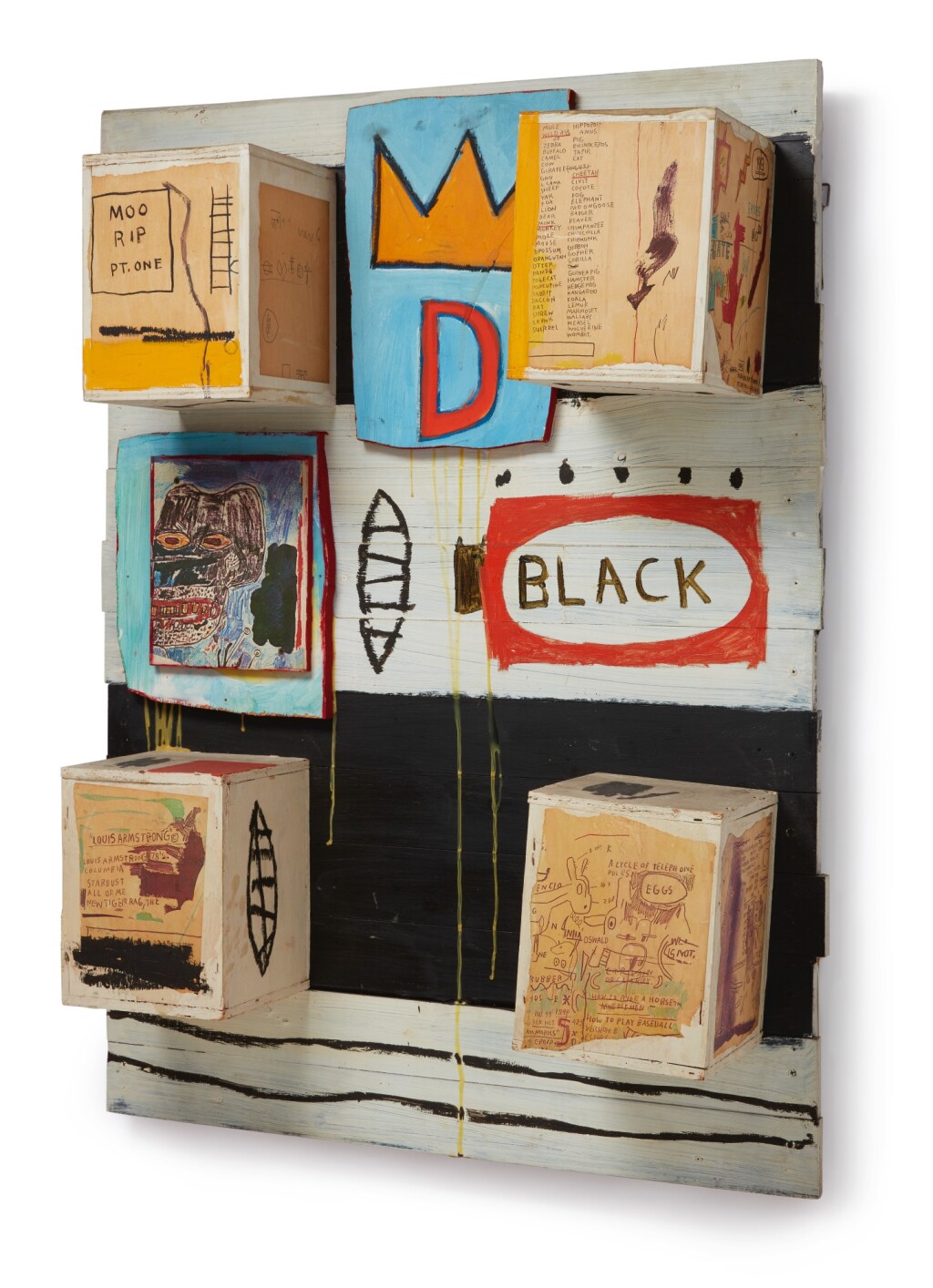
JEAN-MICHEL BASQUIAT
Black, 1986
Acrylic, oil, graphite, crayon and Xerox on wood
49.7 x 36.5 x 11.5 inches (126.4 x 92.7 x 29.2 cm)
Titled; signed, titled and dated 86 on the reverse
Provenance
Galerie Bruno Bischofberger, Zurich
Akira Ikeda Gallery, Nagoya (acquired from the above)
Acquired by the previous owner from the above in March 1996
Sotheby’s New York, 29 October 2020, lot 18
Acquired at the above sale by the present owner
Auction History
Christie’s Hong-Kong: 28 May 2023
Estimated: HKD 55,000,000 – 75,000,000
HKD 62,600,000 / USD 7,991,625
JEAN-MICHEL BASQUIAT (1960-1988) (christies.com)
REPEAT SALE
Black / Jazz: Property from the Collection of Enrico Navarra
Sotheby’s New-York: 28 October 2020
Estimated: USD 4,000,000 – 6,000,000
USD 8,134,650
JEAN-MICHEL BASQUIAT | BLACK | Contemporary Art Evening Auction | 2020 | Sotheby’s
An important work from the latter years of the artist’s short life, Jean-Michel Basquiat’s Black is a prime example of his revolutionary body of work. Once owned by the eminent Basquiat scholar and collector Enrico Navarra, and prominently featured on the slipcover of his seminal monograph on the artist’s work, Black demonstrates Basquiat’s insatiable desire to innovate. It incorporates many of the ideas and motifs which he had spent much of his career developing, but deployed in an entirely new and exciting way. Thus, in Black we see the inclusion of many signature motifs: his three-pointed crown, a heroic head, and an encyclopedic display of words and images which together represent one of the most original and prodigious artistic talents of late twentieth-century art.
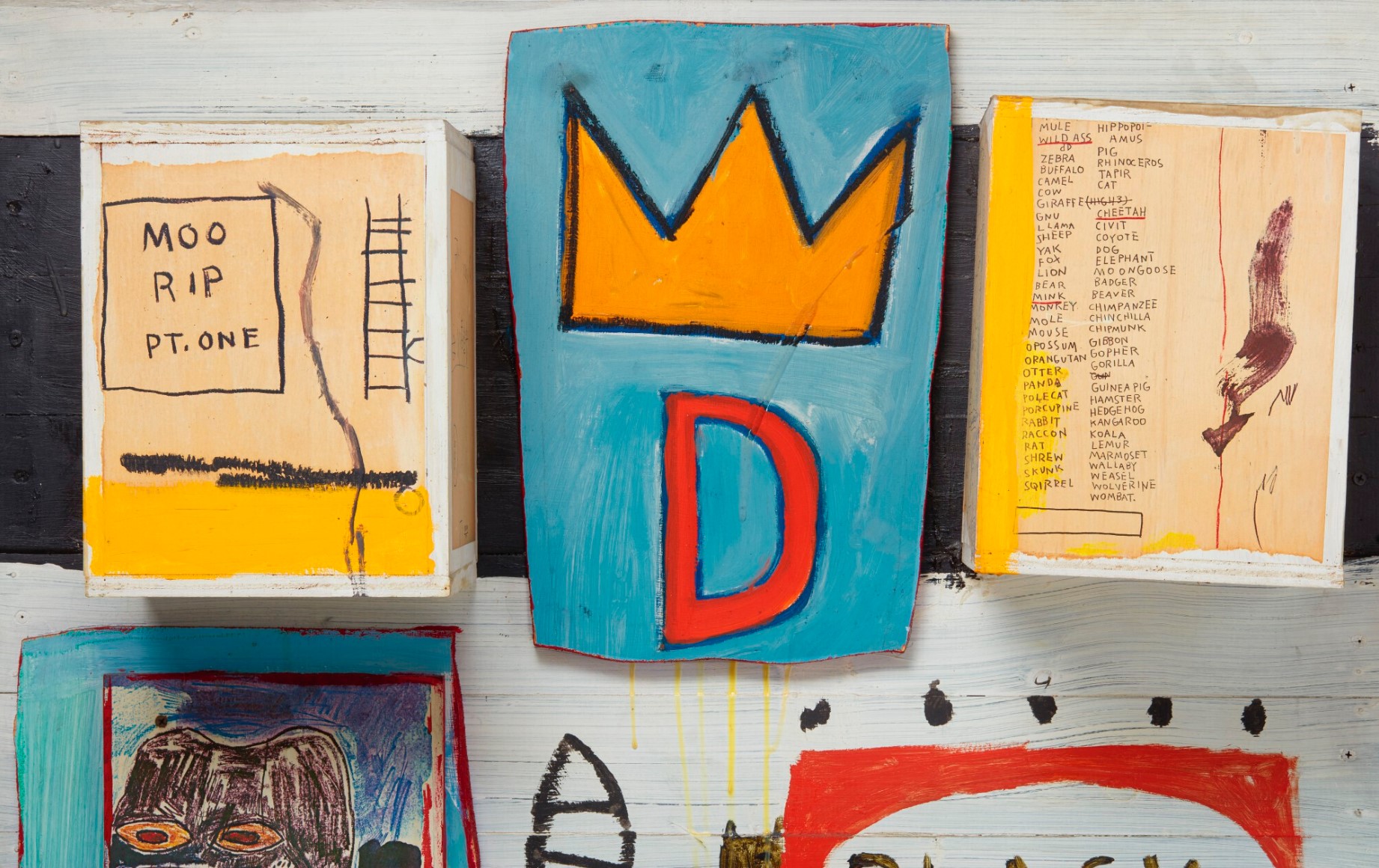
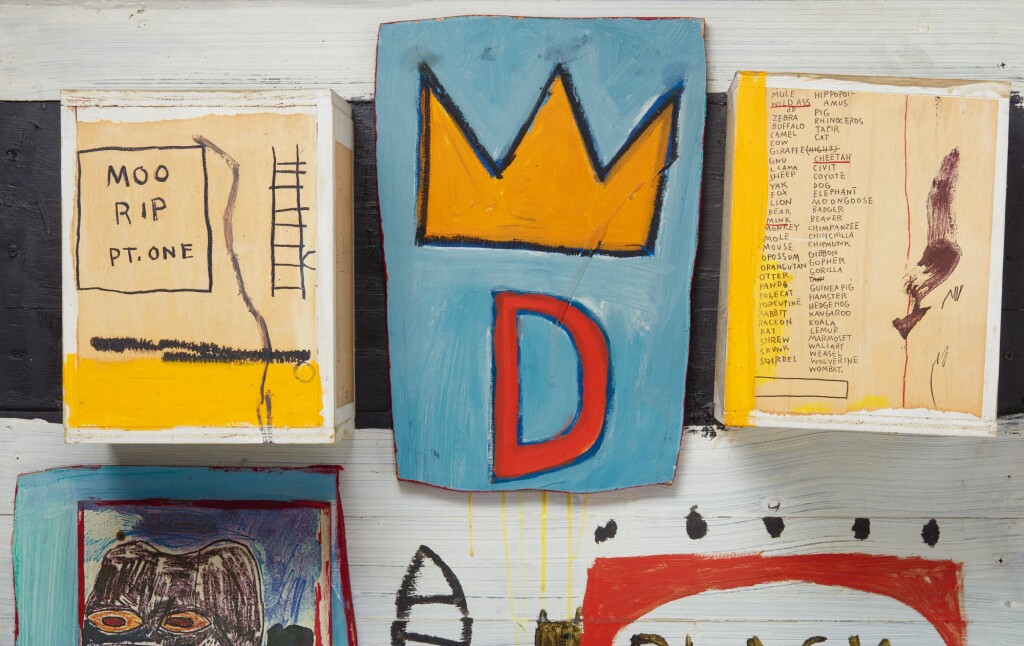
Occupying the space traditionally ignored by painters (that which sits between the picture plane and the viewer), Basquiat uses the three-dimensional nature of this work to present many more examples of his graphic style than would be possible with a traditional flat canvas. On a support constructed by the artist himself, Basquiat attaches four wooden boxes, together with a series of plaques. On each of these, he has mounted a series of xeroxed drawings that encompass his entire oeuvre. Thus, there are homages to the famous jazz musician Louis Armstrong (a particular hero of the artist and the subject of many paintings, including King Zulu (1986); also visible is a comprehensive list of animal names (including rat, pig, cheetah and lion), drawings of animals, along with titles of books and the names of songs as found on old vinyl records.
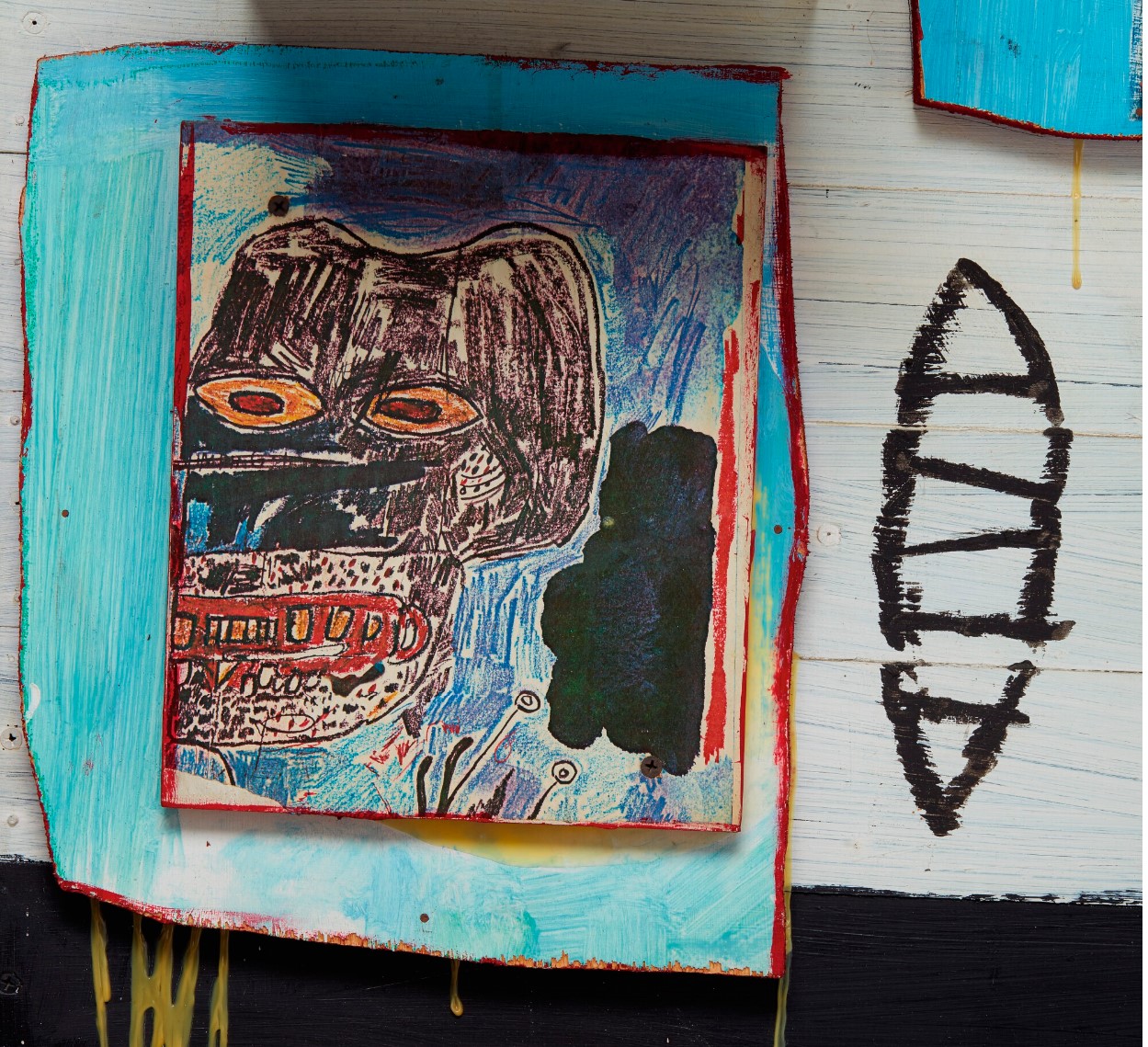
Dominating the composition, however, are three elements which are central to Basquiat’s art. On the left is an image of a singular head with fiery red eyes and a striking grin. Executed with a series of rapidly applied marks, this figure demonstrates the artist’s accomplished draftsmanship, as facial features, depth and tone all emerge from this flurry of activity. This form resembles the African masks that so enthralled Pablo Picasso and which the Spanish artist then appropriated for some of his earliest works such as Head of a Sleeping Woman (Study for Nude with Drapery) (1907). Basquiat was a big admirer of Picasso’s work and once said of his relationship with the Spanish artist ‘Picasso arrived at primitive art to give of its nobility to western art. And I arrived at Picasso to give his nobility to the art called “primitive”‘ (J. Basquiat, Basquiat, exh. cat., Museo Revoltella, Trieste, 1999, p. 126). This ‘reappropriation’ of African Art from the Western canon would become a theme that occupied Basquiat throughout much of his career, resulting in some of his most accomplished paintings such as Untitled (1981).
Presenting a captivating dialogue of image, emotion, and intent, Black and Jazz from 1986 are a seminal pair of paintings that, in their shared technical brilliance and thematic duality, deftly embody the essential themes and questions that lie at the heart of Jean-Michel Basquiat’s celebrated artistic practice. From the searing dual-images of the present works, Basquiat’s most iconic motifs emerge, emphatically declaring those images and symbols which form the essential visual vernacular of the artist’s practice. Although executed in 1986—just two years before the young artist’s untimely death—many of these symbols and drawings return the viewer to the earliest years of the artist’s career: from the familiar three-pointed crown, to the iconic copyright symbol, to the searing, skeletal visage, the intricately interwoven imagery of Black and Jazz powerfully summon the scrawls of Basquiat’s graffiti alter-ego SAMO, who emblazoned his moniker and chosen icons upon the abandoned walls of the city in the late 1970s. Dating from pivotal apex of Basquiat’s meteoric rise to critical and commercial acclaim, Black and Jazz represent a pivotal moment for the artist as, within these two works, Basquiat gathers the totemic remnants of his own practice and presents it to us as a retrospective of the self.
Underscoring the significance of Black and Jazz, these paintings were separately acquired by Enrico Navarra, celebrated collector, dealer and scholar of Basquiat’s oeuvre, within ten years of their execution. Years later, as editor of the artist’s catalogue raisonné, Navarra notably selected Black and Jazz to serve as dual images on the slipcase of the third and most recent edition of the publication. Further testifying to their extraordinary caliber, these paintings have been chosen for an unparalleled number of seminal exhibitions of Basquiat’s oeuvre organized by major museums in New York, Venice, Milan, Tokyo, and Sao Paulo, among others. Independent yet intertwined, reflective yet unique, the narrative created between these two paintings testifies to the extraordinary fusion of image, text, and idea which characterizes the very finest masterworks of Basquiat’s celebrated oeuvre.
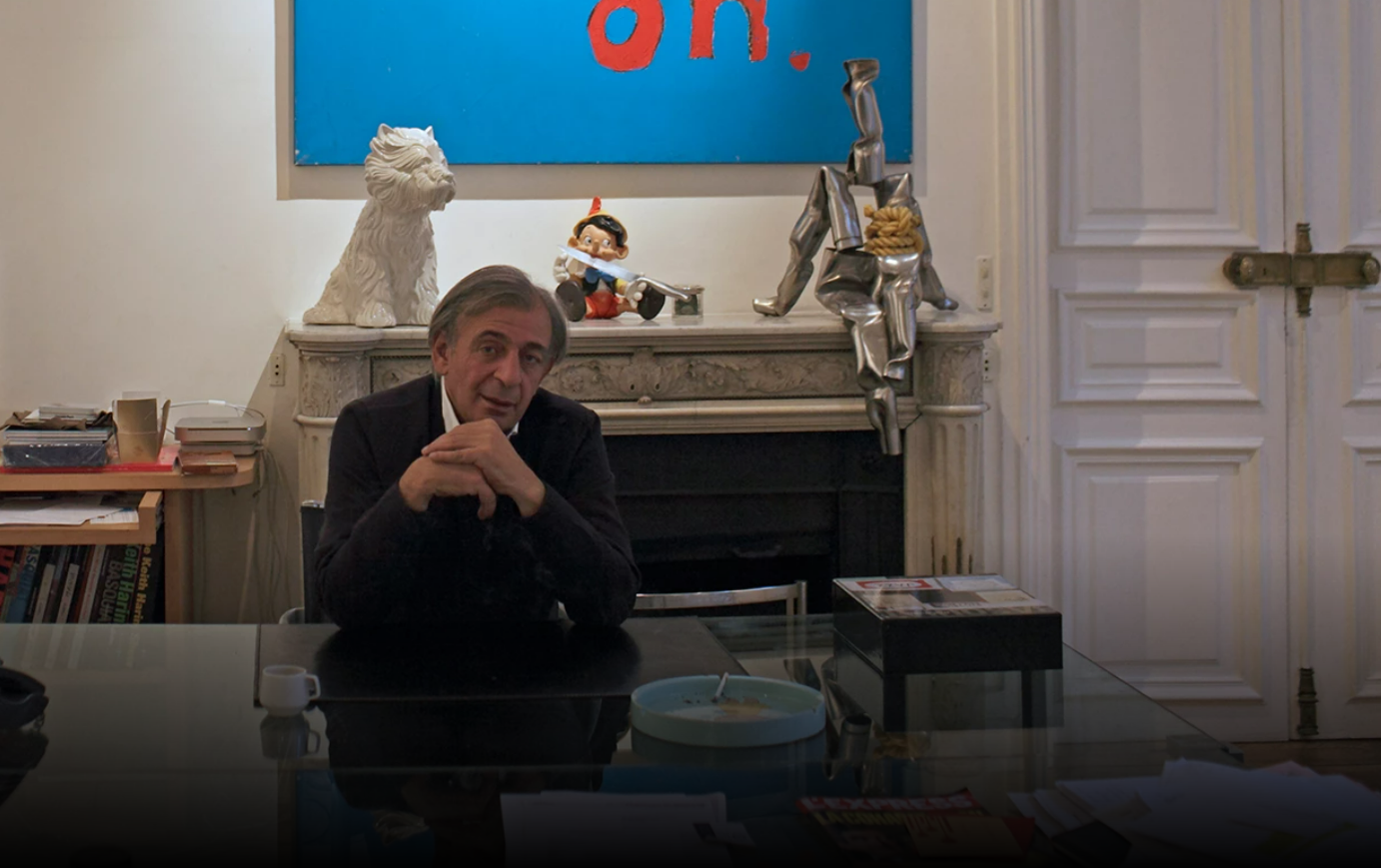
In the overt simplicity and immediate legibility of their titles alone, Black and Jazz present an extraordinary microcosm of the primary themes which lie at the heart of Basquiat’s oeuvre. Emblazoned upon the surface and highlighted in bold scarlet pigment, the titular ‘BLACK’ and ‘JAZZ’ of the respective paintings immediately recall the innumerable other masterworks in which Basquiat paid homage to the greatest African American musicians of the Twentieth Century – and the way that that homage brings to light the intersection of race, representation and culture that underscores so much of his practice. From famous athletes such as Sugar Ray Robinson, Cassius Clay, Tommie Smith and John Carlos, to political figures including Malcolm X and Marcus Garvey, to celebrated Jazz legends such as Lester Young and Charlie Parker, Basquiat’s oeuvre is punctuated by emphatic references to ground-breaking African American figures of the 20thcentury. Reverentially valorizing their successes in the face of staunch adversity and extreme racial prejudice, the historic development of American jazz music became a key arena in which Basquiat could explore the rich and influential products of that culture.
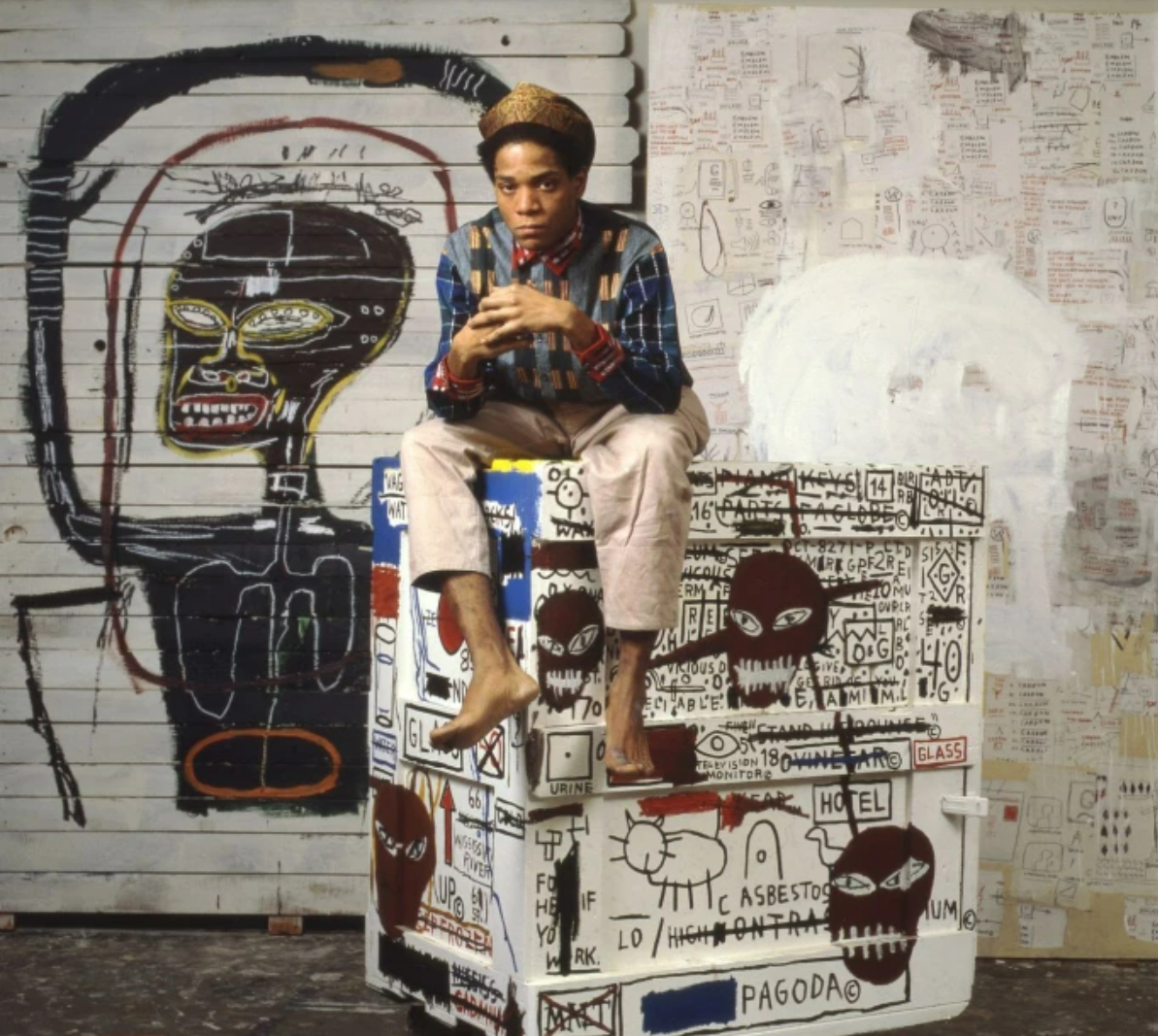
In works such as Horn Players of 1983, now in the collection of the Broad Museum in Los Angeles, as well as Now’s the Time of 1985 and the present work, Basquiat celebrated, as described by one scholar, “the innovative power of black male jazz musicians, whom he reveres as creative father figures.” (Bell Hooks, ‘Altars of Sacrifice: Re-membering Basquiat’ in Outlaw Culture: Resisting Representations, New York, 1994, p. 35) Indeed, in the Xerox drawing to the upper left of Jazz, Basquiat pays homage to Charlie Parker and his iconic track Now’s the Time by name, with the logo of Parker’s record label ‘SAVOY’ emblazoned above; opposite, a list of tracks from one of Parker’s recording sessions at Savoy Records in 1948—Marmaduke, Perhaps, Steeplechase—march down a collaged Xerox sheet in Basquiat’s familiar scrawl. As described by friend and contemporary Fed Braithwaite (Fab 5 Freddy): “Jean-Michel began to incorporate the names of these songs and the linear notes of the records, and mesh those words with images in his painting… He immortalized those records in a way that blended with his style and was very much a part of where he was coming from.” (Fred Braithwaite, “Jean-Michel as Told by Fred Braithwait a.k.a. Fab 5 Freddy, An interview by Ingrid Sischy,” in: Exh. Cat., Palacio Episcopal de Malaga, Jean-Michel Basquiat, 1996, p. 155)
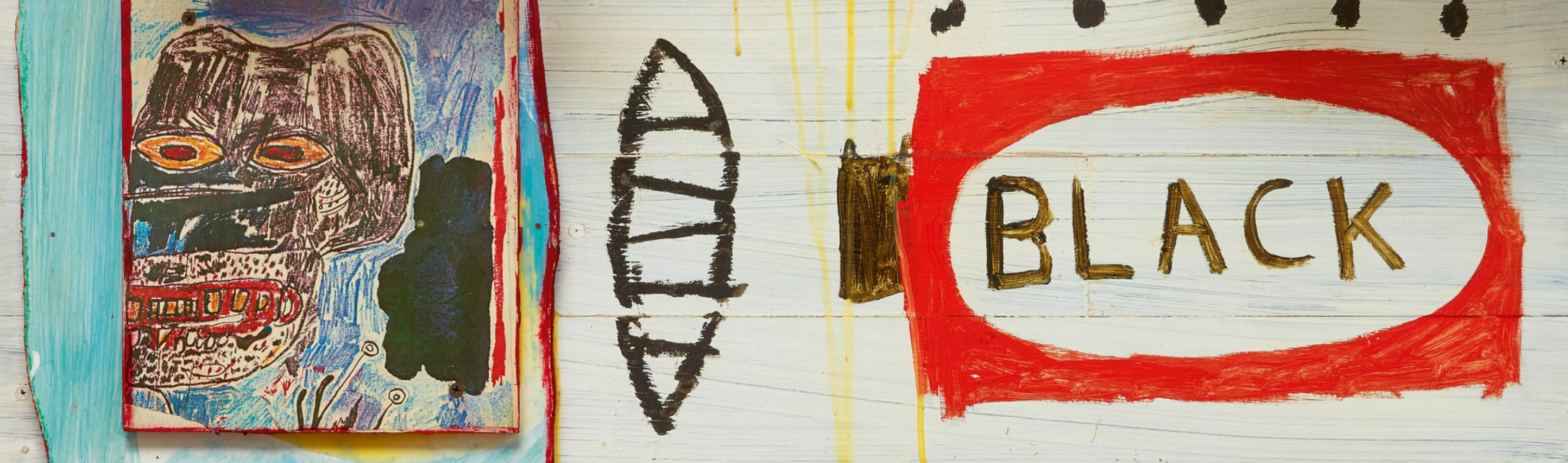
Ever the iconographic alchemist, Basquiat activates his pantheon of iconic symbols and motifs within the present works to unparalleled graphic effect. Standing before Black, the viewer’s eye is immediately drawn to the golden, three-point crown emblazoned at topmost center. In Jazz, Basquiat’s familiar crown is replaced by SAMO’s equally iconic copyright tag, almost as if in homage to the artist’s own, earlier alter-ego. Below the crown, the familiar image of the, skull-like head in Black—rendered here with searing golden eyes and grimaced teeth—recalls so many of the artist’s iconic paintings and drawings of that subject from 1982. Enduring as both idiosyncratic self-portraits and skull-like talismanic icons, these singularly ferocious faces prevail as a key conceptual anchor for Basquiat throughout his career, appearing in and dominating the majority of his best-known masterworks. This examination finds its counterpart in the lower register of Jazz, where an intricate mélange of anatomical renderings recalls the artist’s lifelong fascination with Leonardo’s anatomical studies and Gray’s Anatomy; this preoccupation with the interior architecture of the body dates to an incident in the artist’s childhood when, after being hit by a car, the artist’s mother gave him a copy of the seminal medical tomb Gray’s Anatomy. As surmised by cultural theorist Dick Hebidge “… in the reduction of line into its strongest, most primary inscriptions, in that peeling of the skin back to the bone, Basquiat did us all a service by uncovering (and recapitulating) the history of his own construction as a black American male.” (Dick Hebidge, “Welcome to the Terrordome: Jean-Michel Basquiat and the Dark Side of Hybridity,” in: Exh. Cat., New York, Whitney Museum of American Art, Jean-Michel Basquiat, 1993, p. 65) This retrospective of Basquiat’s most important motifs, phrases, images, and themes continues in the layered Xerox drawings which paper the variegated surfaces of Black and Jazz as Basquiat presents to us those images and symbols most vital to his practice.
In their unfiltered grit and guttural symbolism, Black and Jazz wholly embody the freedom and dexterity with which Basquiat approached diverse materials and media throughout his oeuvre. Emblazoned upon a constructed wooden surface and composed of remarkably diverse media, the composition of each painting unfolds upon its respective surface, recalling the regimented cells of comic-strips and the raw, tactile quality of graffiti paste-ups. The artist’s Xeroxed images are buried in the pigment, first adhered to the canvas, and then deftly combined to be made contiguous and whole. Basquiat was holistic in his conflation of the high and low, using traditionally revered oil paint with common, everyday Xerox, referencing simultaneously the aesthetic hallmarks of mass-media, street art, and his artistic forebears; like Robert Rauschenberg before him, Basquiat’s visual language was in a constant state of remix, a context in which he could reframe preexisting imagery to forge new meaning. Despite the conceptual intensity of this approach however, Robert Farris Thompson aptly notes: “[t]here was a kind of deliberate roughness to his paintings, as if to say: I remain a warrior of the streets; behold the world as seen through vernacular eyes.” (Robert Farris Thompson, “Three Works by Basquiat,” in: Exh. Cat., New Orleans, Ogden Museum of Southern Art, Basquiat and the Bayou, 2014-2015, p. 31-32) This description is particularly potent when considering the present works which, in their layers of oilstick on image, paint on paper, and Xerox on wood, powerfully recall the ravaged doors, windows and crates, scavenged from the New York City streets, that Basquiat would paint on in the earliest years of his career. Two masterfully composed mélanges of cryptic symbols, allusive figuration and coded language scrawled in rhythmic script, Black and Jazz testify Basquiat’s ability to weave a complex network of references within his painting to hold a mirror to the very production of meaning itself.