JEAN-MICHEL BASQUIAT
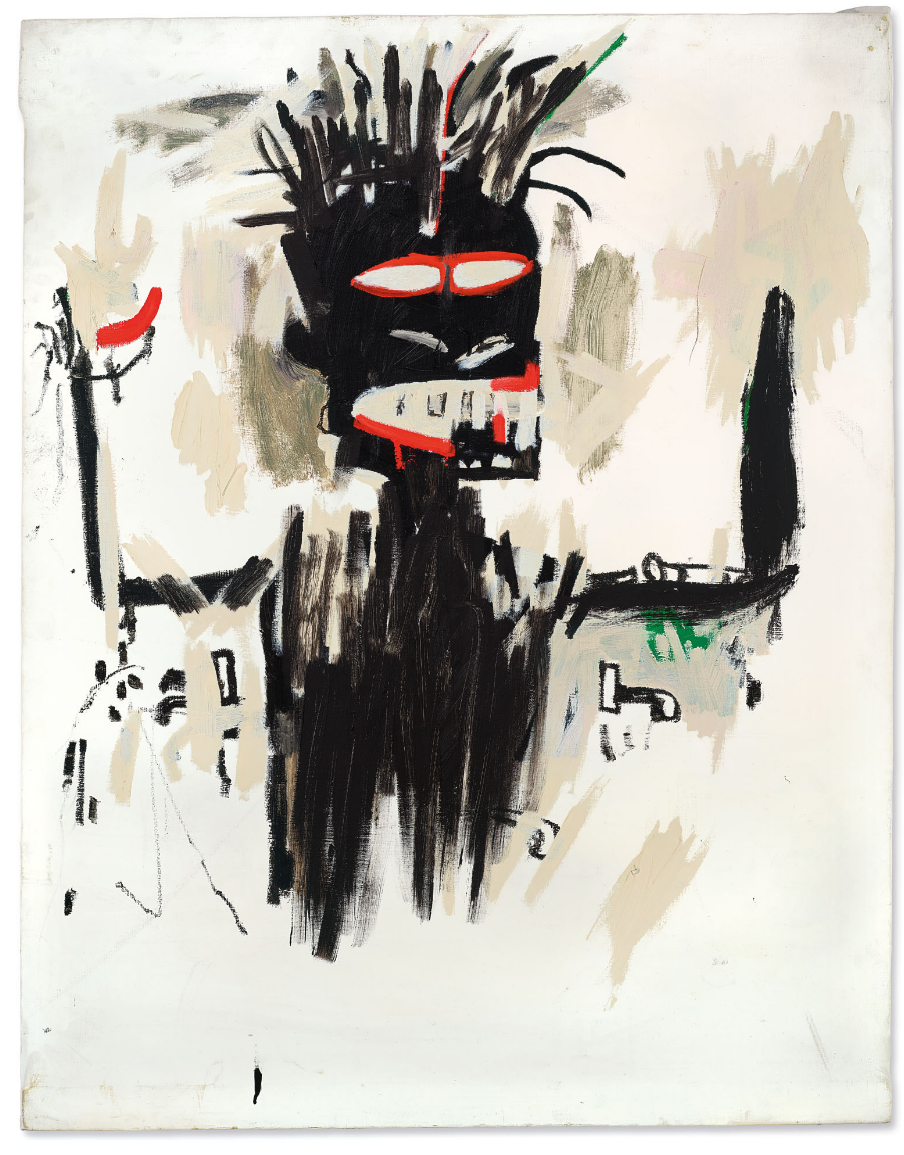
Self-Portrait, 1988
Acrylic on canvas
47.7 x 37.7 x 4 inches (121.3 x 95.9 x 10.2 cm)
Indistinctly signed and dated ’88’ (on the reverse)
Provenance
Galerie Thaddaeus Ropac, Salzburg.
Acquired from the above by the present owner in 1988.
Christie’s London: 22 March 2021
GBP 9,086,500 / USD 12,533,103
Source: Christie’s
JEAN-MICHEL-BASQUIAT-Self-Portrait (christies.com)
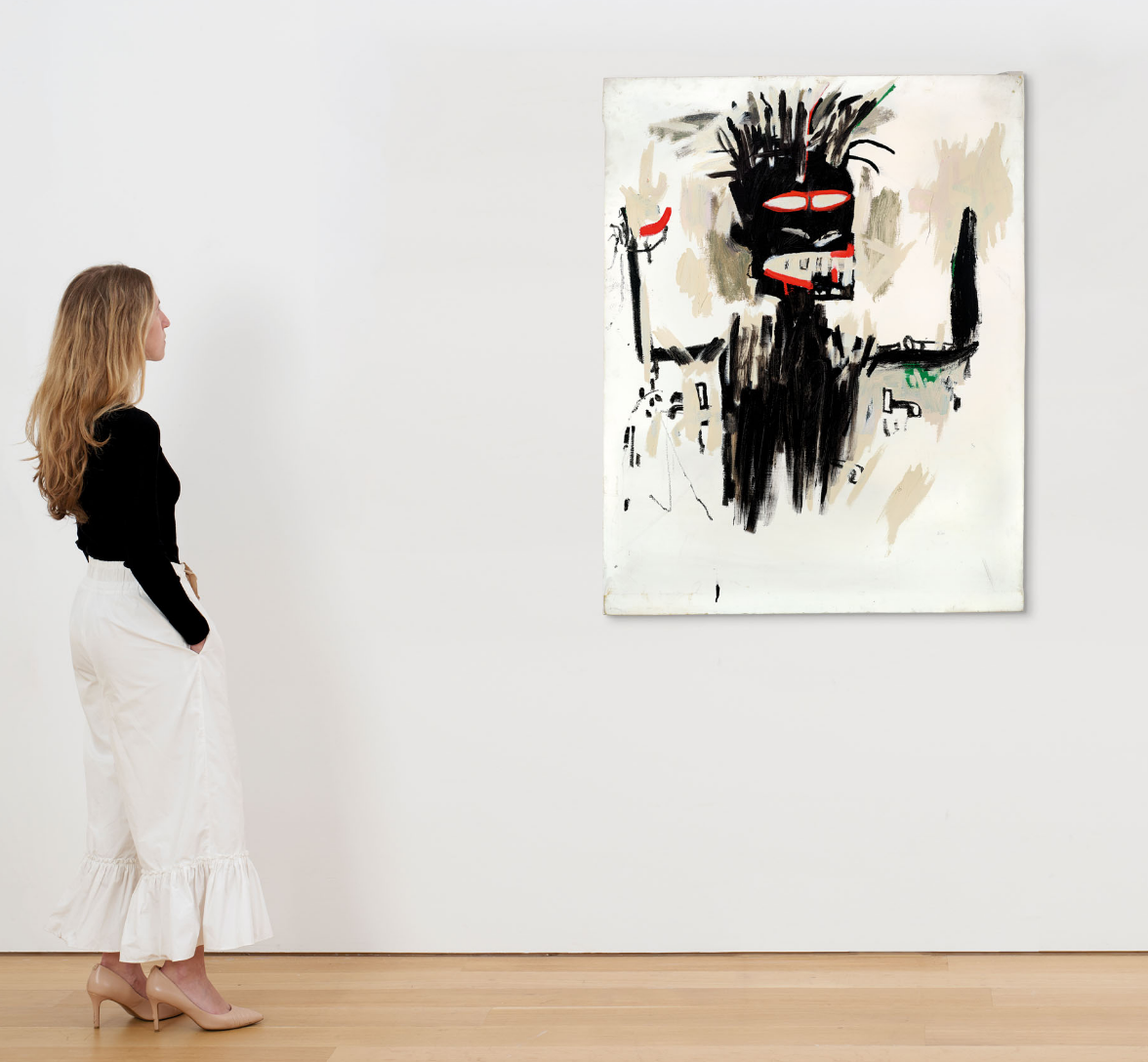
Painted in the final year of his life, Self-Portrait is a vivid climax to Jean-Michel Basquiat’s meteoric career. The artist’s black silhouette emerges from a stark white backdrop, wearing his distinctive crown of dreads. His eyes and grin gleam laser-red; flashes of green and gold lend him a regal underglow, like the gilded image of a saint. With his arms raised, the artist evokes his iconic depictions of victorious boxers, as well as the praying Dogon sculptures of central Mali, whose gestures symbolize a link between earth and heaven. At the same time, he seems to fall apart: his arms disintegrate in a flurry of expressive brushstrokes, like the wings of Icarus turning to ash. It is a striking self-image of power, pain and pride. Picturing both triumph and surrender, Basquiat asserts his status as king of the art world, and boldly faces his own mortality. In the summer of 1988, the painting was included in the last solo exhibition of his lifetime at Galerie Thaddaeus Ropac, Salzburg; it has been unseen in public since.
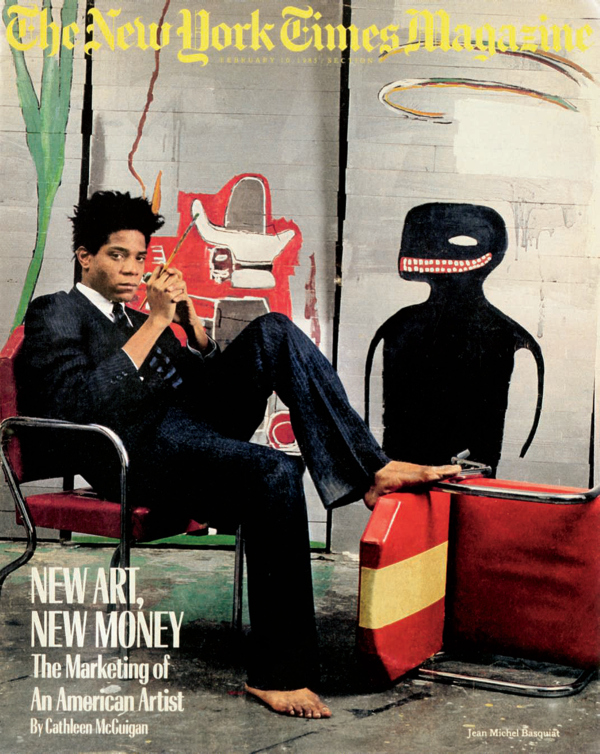
At twenty-seven years old, Basquiat was a near-mythical figure. He had emerged as a graffiti artist at the start of the decade, spraying his ‘SAMO’ tag and cryptic slogans throughout downtown Manhattan. Breakout group shows in 1981 fired off a spectacular rise to stardom: over the following two years, he held solo exhibitions worldwide, collaborated with Andy Warhol and became the youngest artist to exhibit at Documenta VII in Kassel. Working out of a liberating loft space on Great Jones Street, his art reached new heights of material and thematic grandeur. In 1985, he was featured on the cover of The New York Times Magazine as the face of the era’s heady contemporary art scene. Famed for his personal charisma as much as his creative genius, Basquiat’s legend—and the demand for his works—soared ever higher. He worked prolifically and lived intensely. Amid the whirlwind of success, on 12 August 1988, he died in his New York studio.
With its spare, potent composition, Self-Portrait bears comparison to Basquiat’s totemic late work Riding with Death (1988), in which a dark figure rides a skeletal mount across a ground of shimmering gold. It is a haunting vision, but not without hope. As the scholar bell hooks has noted, the painting summons ‘images of possession, of riding and being ridden in the Haitian voudoun sense—as a process of exorcism, one that makes revelation, renewal and transformation possible’ (b. hooks, ‘Altars of Sacrifice, Re-membering Basquiat’, Art in America, June 1993). Death, in this picture, holds the potential for a new kind of life—a form of return from the other side. A similar ambiguity defines Self-Portrait, which can likewise be seen to invoke aspects of Basquiat’s Haitian-Puerto Rican heritage. As a prophetic image of both arrival and dissolution, it holds multiple, even contradictory meanings in captivating tension.
In portraying himself with raised arms, Basquiat strikes the pose of the triumphant boxer: a motif employed in some of his most acclaimed paintings. Champion pugilists like Muhammad Ali and Joe Louis joined jazz musicians, baseball players and others in the artist’s personal pantheon of black heroes. They were men of incendiary talent, risen to positions of greatness despite the racism of American society. In his pictures, Basquiat blurred their identities with his own. Often adorning them with a halo or crown, he celebrated their glory, calling on the angels, saints, messiahs and kings of art history. Yet these towering images are laced with vulnerability. Whether through rapacious promoters, personal demons or the bigotry of the industries in which they worked, Basquiat knew that many of his idols had been destroyed or burnt out by their fame: pressures he himself felt all too keenly. Those arms may be raised in exultation, but they might also be seen as a plea for mercy.
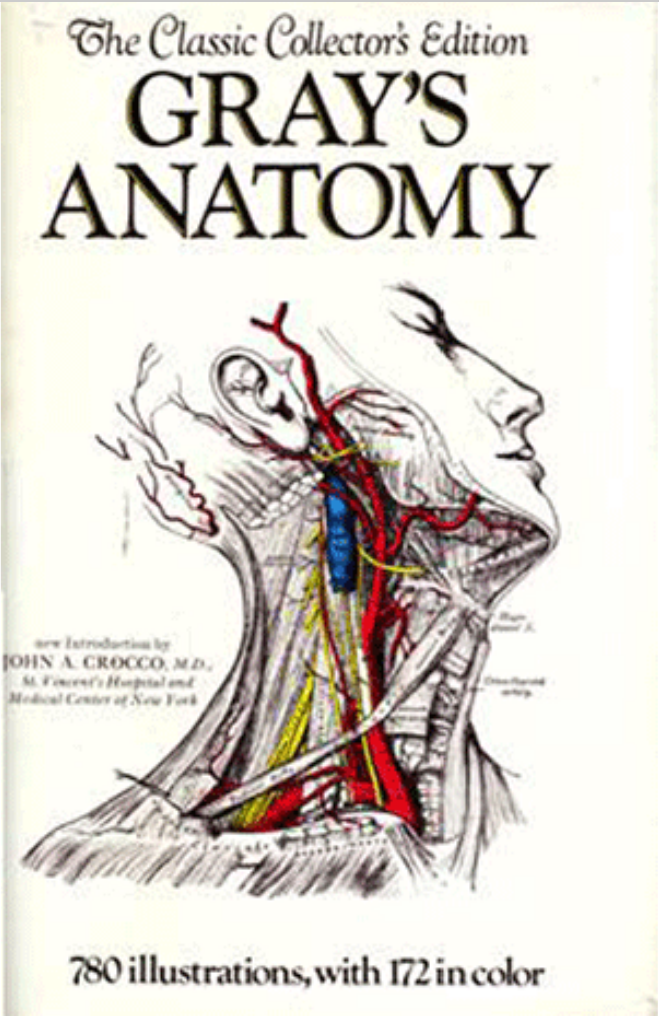
While he was in hospital following a childhood car accident, Basquiat’s mother had given him a copy of Gray’s Anatomy. It helped him to understand his body as it healed, and later became a key touchstone for his art. Many of his figures reveal their skulls, muscles and internal workings, as if seen through an X-ray. There is a violence in this revelatory gaze. Even Basquiat’s early self-images seem bedevilled by death, and as bell hooks observes, his hero-pictures are bruised and broken. ‘It is much too simplistic a reading’, she writes, ‘to see works like Jack Johnson (1982), Untitled (Sugar Ray Robinson) (1982), and the like, as solely celebrating black culture. Appearing always in these paintings as half-formed or somehow mutilated, the black male body becomes, iconographically, a sign of lack and absence … these figures have been worked down to the bone’ (b. hooks, ibid.). Self-Portrait exhibits this same disintegration. The figure’s hands are obscured, visible as faint pentimenti behind overlaid thickets of bone-white paint; his arms splinter and fragment, like a worn-out mechanism coming apart. For all its graphic strength, it is a body menaced by erasure in a whitewashed void.
While tracing Basquiat’s imagery can be informative, Self-Portrait is born of a compound approach that ultimately transcends specific referents. Robert Farris Thompson himself—invited by the artist to write an essay for a 1985 show—defined Basquiat’s work as a ‘heroic embodiment of the impact of Afro-Atlantic civilizations on the world, at levels of spiritual insight and artistic ecstasy … an avatar of universalising vision, multiply black, Afro-Atlantic.’ Drawing an equivalence between Basquiat’s practice and the aural magic of a voodoo shaman, Thompson saw him as epitomizing a postmodern ‘creole’ sensibility, informed as much by the cultural crucible of New York City as by his personal background. ‘I think we are witnessing the revelation of an unsuspected form of artistic developmental time,’ Thompson wrote, ‘running faster than ordinary Western archaic-classical-Hellenistic, or early-middle-late … The hurtling velocity of jazz or New York graffiti history derives its energy from the collision of more than two traditions’ (R. Farris Thompson, ‘Activating Heaven: The Incantatory Art of Jean-Michel Basquiat’, in Jean-Michel Basquiat, exh. cat. Mary Boone-Michael Werner Gallery, New York, 1985, n.p). Self-Portrait crackles with this syncretic force: it is a concentrated distillate of myriad voices, styles and ideas.
Condensing a wealth of influences into one fierce, refined surface, Self-Portrait is layered with Basquiat’s fascinations, and electric with the vigour of his mind. It gets beneath the skin, capturing the spirit of an artist whose burning ambition was shadowed by a deep ambivalence towards the world in which he found success. Even in his early text-based work as SAMO, Basquiat’s hand was unmistakable, with each letter carefully shaped and placed in space. Self-Portrait’s jagged black figure is a similarly distinct notation: it is uniquely, inimitably Basquiat, as eternal as a conqueror’s painted tomb, or the auratic image of an ancient martyr. Basquiat makes his mark in the physical realm. He leaves a self-image that is brilliantly present, yet which also speaks of the impossibility of being seen clearly, or remembered fully. It is a bittersweet realisation of one of his best-known statements: ‘I’m not a real person. I’m a legend’ (J-M. Basquiat, quoted in A. Haden-Guest, ‘Burning Out’, Vanity Fair, November 1988, p. 197).