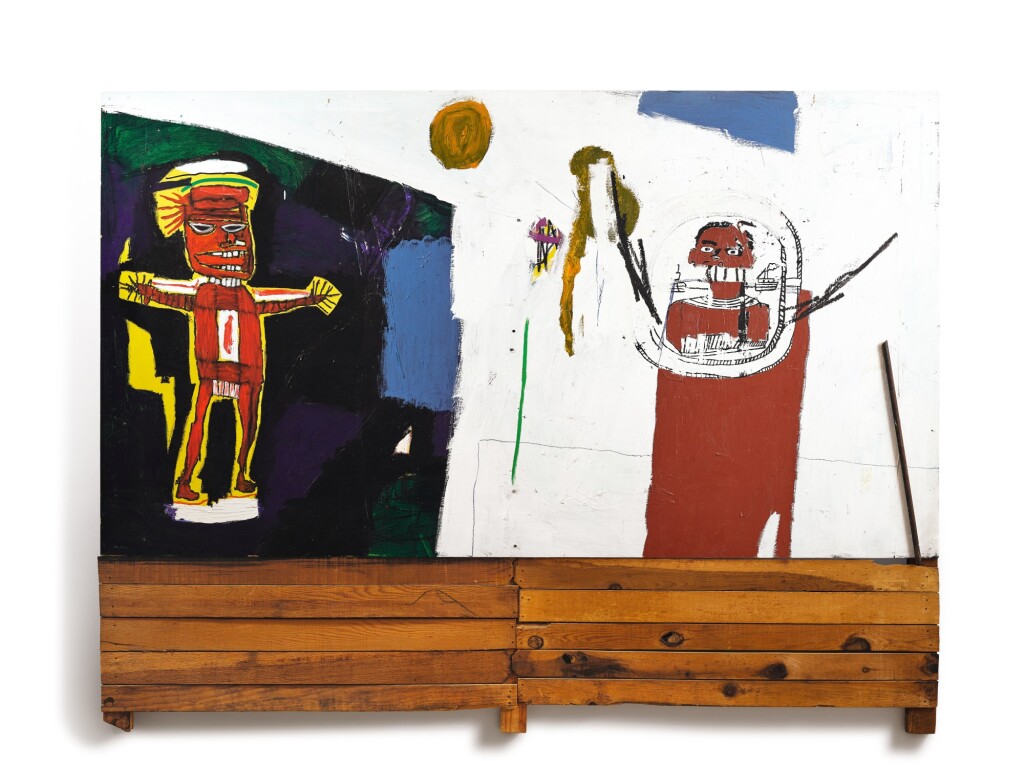
JEAN-MICHEL BASQUIAT
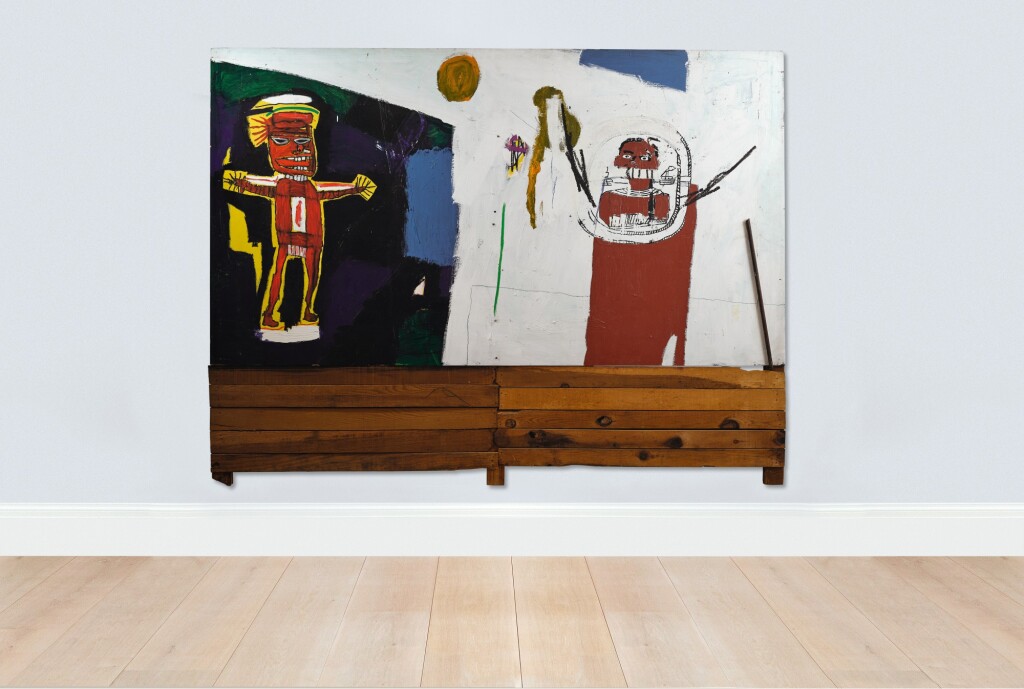
Water-Worshipper, 1984
Acrylic, oilstick, silkscreen ink and metal
82.5 x 107.9 x 4 inches 209.6 x 274 x 10.2 cm
Signed, titled and dated 1984 on the reverse
Provenance
Mary Boone Gallery, New York
Christie’s, New York, 4 May 1988, Lot 247
Private Collection
Galerie Beaubourg, Paris
Private Collection, France
Sotheby’s, Paris, 7 December 2010, Lot 9
Private Collection, Paris
Sotheby’s, London, 12 February 2014, Lot 36
Private Collection, London
Sotheby’s, Hong Kong, 2 April 2017, Lot 1042
Private Collection, Paris
Acquired from the above by the present owner
Sotheby’s Hong-Kong: 27 April 2022
Estimated HKD 62,000,000 – 93,000,000
Source: Sotheby’s
Jean-Michel Basquiat 尚・米榭・巴斯基亞 | Water-Worshipper 致水神 | Contemporary Evening Auction | | Sotheby’s (sothebys.com)
Rich in symbolism, Jean-Michel Basquiat’s highly complex works deeply influenced the New York art scene of the 1980s. At the mere age of 21, Basquiat was invited to participate at documenta 7 in Kassel in 1982 alongside works by Joseph Beuys, Anselm Kiefer, Gerhard Richter, Cy Twombly, and Andy Warhol. Today, his revolutionary oeuvre is compared to the grand masters of art history. His motifs and idiosyncratic aesthetic continue to inspire new artists and his art remains a contemporary mirror of present-day society. The topicality of Basquiat’s themes, his awareness of artistic strategies, his transformation of famous symbols and logos as well as the raw objectivity with which he approached his subjects are masterfully exemplified in Water-Worshipper from 1984.
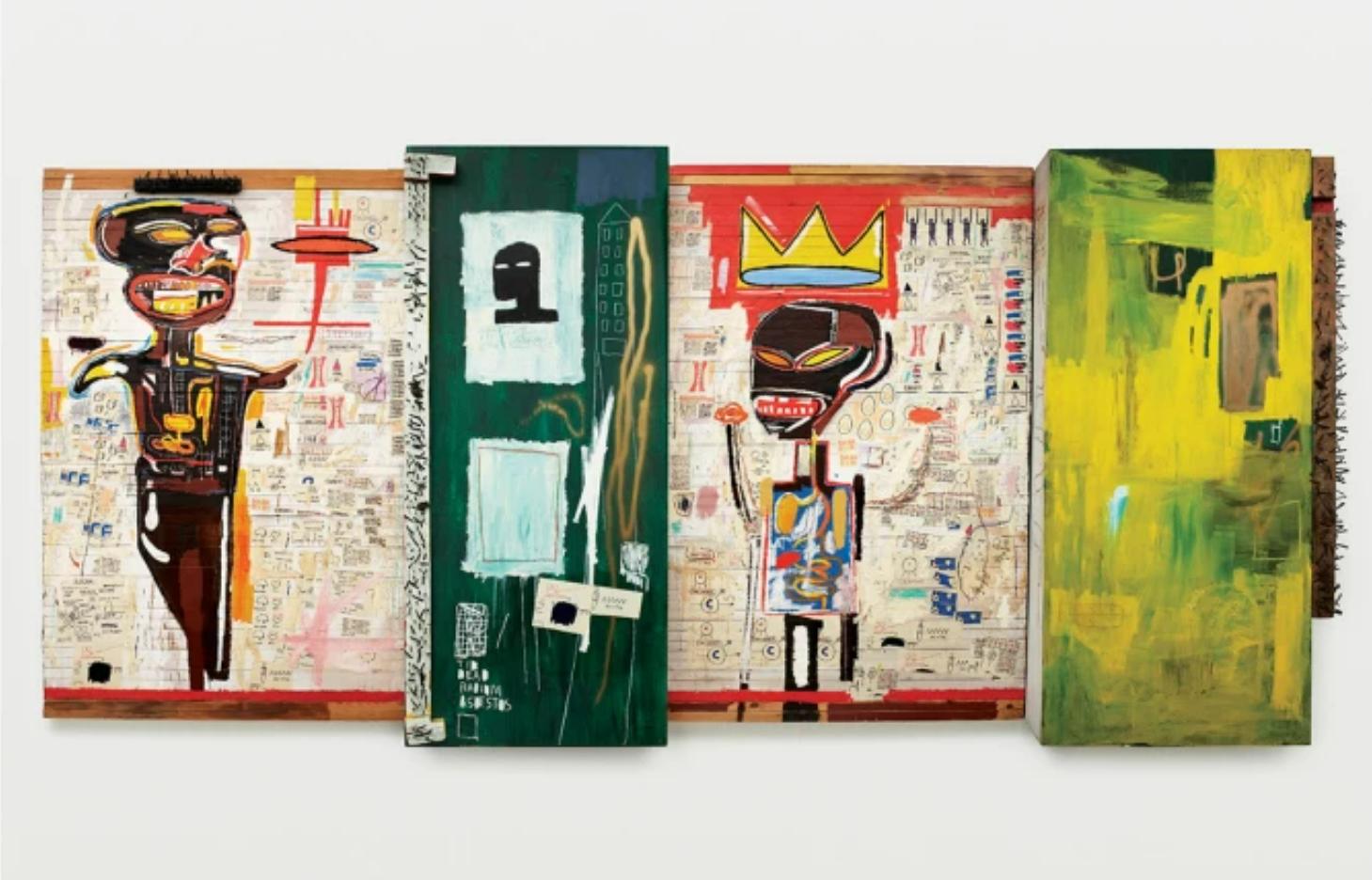
Thematically, it was around 1984 that Basquiat began to intensify his dialogue with religious systems of the African diaspora. In the monumental key work Grillo, Basquiat contrasted and overlapped the signs and pictograms originating from African tradition with those of Western civilisation as taken from Dreyfuss’s Symbol Sourcebook, tracing an African cultural continuity in America and thereby pointing towards an Afro-American self-confidence. Water-Worshipper is also linked with the great masterpieces of 1982/83 such as Undiscovered Genius of the Mississippi Delta. These works display Basquiat’s intensive engagement with racism, colonialism and slavery, which were both nurtured from personal experiences as well as his interest in Afro-American history. Glenn O’Brien reflected: “Jean-Michel — in designer clothes, pockets stuffed with hundred-dollar-bills — wasn’t able to get a taxi”. Basquiat himself noted that he enjoyed reading books by the American Realist Mark Twain, who in his books such as “The Adventures of Tom Sawyer” described quotidian racism with his protagonists being able to discern the hypocrisy and dishonesty of the ruling class.
Basquiat’s oeuvre reached its zenith in terms of pictorial complexity in 1983, after which in the following year he developed his intensive collaboration with Andy Warhol. After the collaboration on 15 works between Warhol, Basquiat and Francesco Clemente, which was initiated by Bruno Bischofberger, the joint output of Warhol and Basquiat grew to more than 150 works in 1984/85. Despite the differences between the two artists, the mutual influence on each other’s oeuvre is clearly visible. Inspired by Basquiat, Warhol returned to his painterly beginnings of the early 1960s whereas Basquiat started to sample his earlier collages via Warhol’s silkscreen technique. Comparable to his famous Blue Ribbon series, which today is part of the Schorr Family Collection, Basquiat created a series of paintings where he impressively combined elements of silkscreen, brushstroke and drawing. Water-Worshipper is the only documented work in which the artist experimented with silkscreen on plywood.
In Water-Worshipper Basquiat engages with religious systems of the African Diaspora as well as with slavery and racism. The reduced pictorial composition is mainly guided by three elements: firstly through a logo, which is applied via silkscreen and partially overpainted with brown color on the right; secondly a yellow framed standing figure with extended arms on the left; and thirdly the attached wooden slat below the image, out of which a metal rod extends into the image.