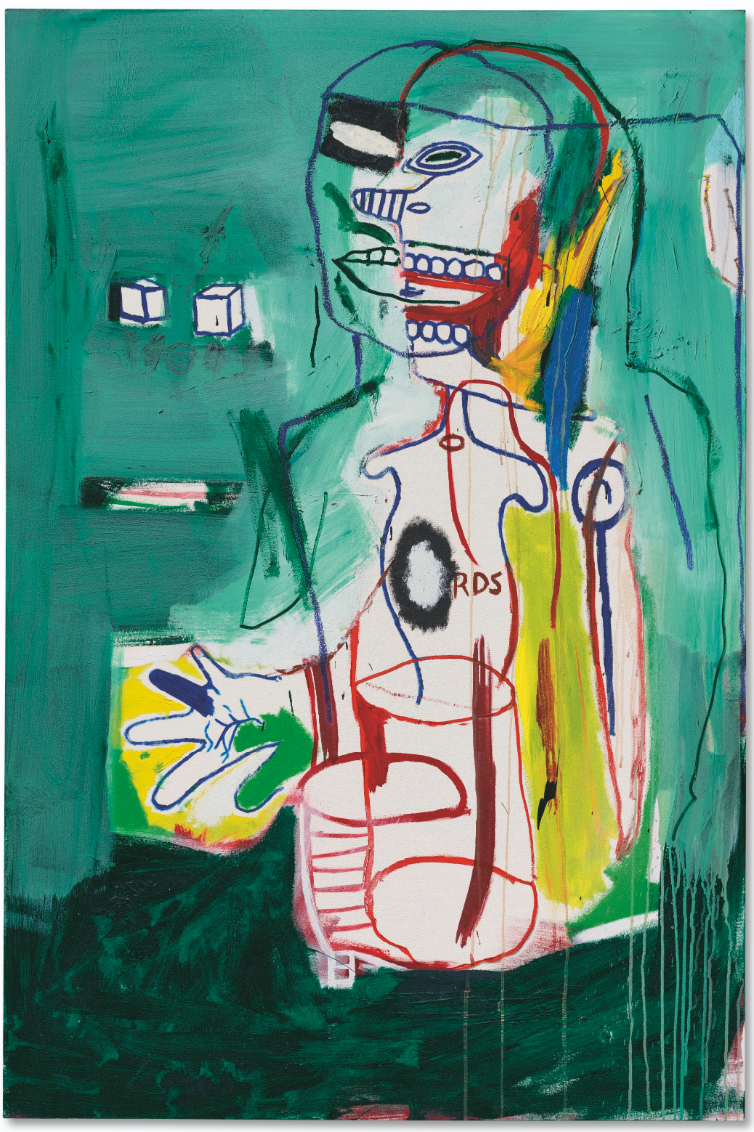
JEAN-MICHEL BASQUIAT
Untitled, 1984
Acrylic on canvas
72×48 inches (183.3 x 122.3 cm)
Provenance
Mary Boone Gallery, New York / Galerie Bruno Bischofberger, Zurich.
Private Collection.
Anon. sale, Sotheby’s London, 22 June 2007, lot 343.
Private Collection, Europe.
Anon. sale, Christie’s London, 18 October 2013, lot 29.
Duhamel Fine Art, Paris.
Private Collection, Europe.
Anon. sale, Poly Auction Hong Kong, 2 October 2017, lot 187.
Acquired at the above sale by the present owner.
Christie’s London: 29 June 2021
GBP 5,995,000
Source: Christie’s
JEAN-MICHEL BASQUIAT (1960-1988) (christies.com)
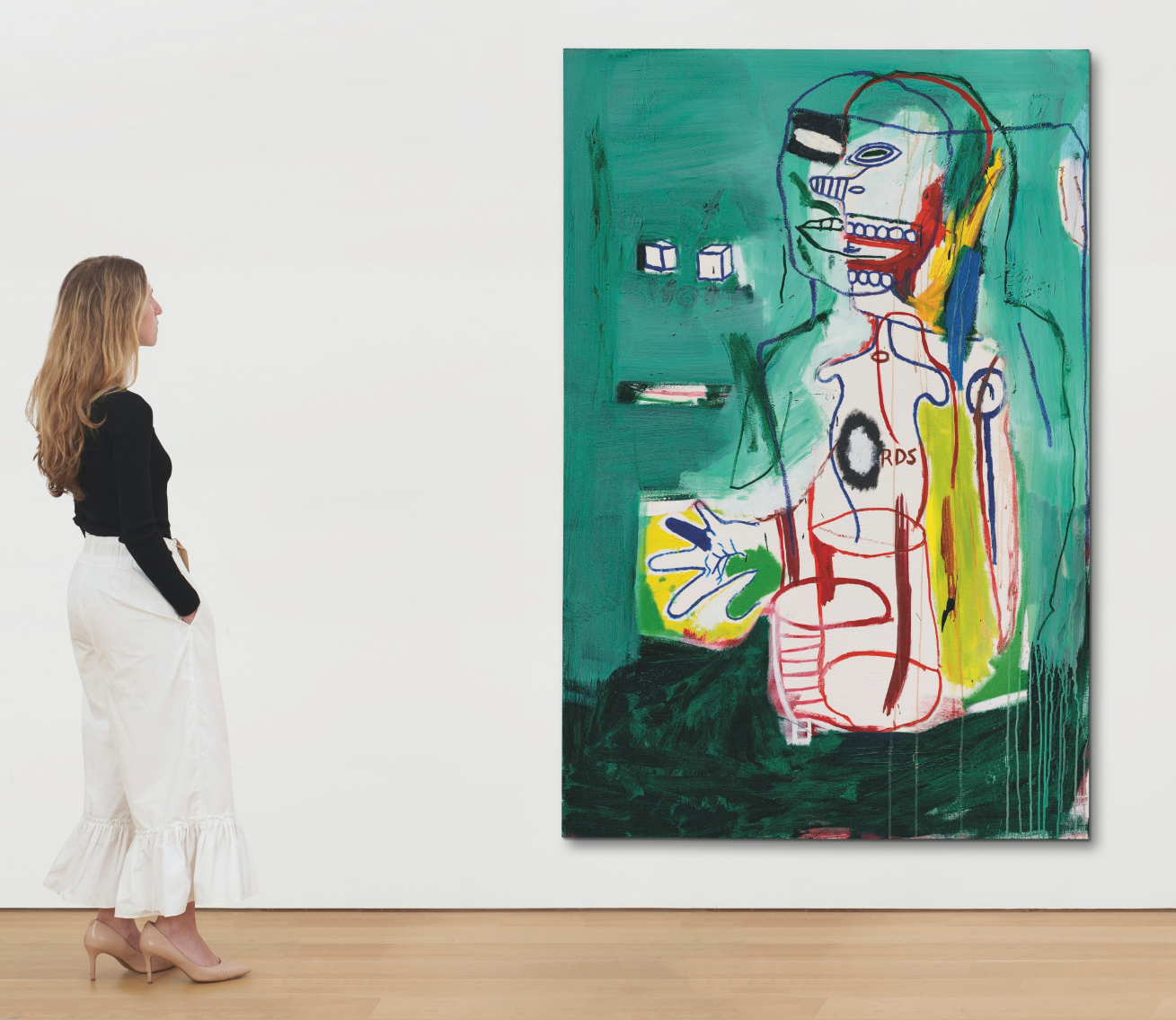
Towering nearly two metres in height, Untitled is an electrifying monument to the human form dating from a pivotal moment in Jean-Michel Basquiat’s career. Painted in 1984—the year of his first solo museum exhibition at the Fruitmarket Gallery, Edinburgh—it captures the thrilling maturation of his visual language just three years after he burst onto the New York art scene. Basquiat had been fascinated by the human skull and body since childhood, when he devoured a copy of Gray’s Anatomy in hospital. Here, the figure looms large like a totemic x-ray, visibly crackling with nervous energy. The head, with bared teeth and a gleaming eye, is fractured in the manner of a Picasso portrait, while an enlarged hand reaches out, stained—like Basquiat’s own—with paint. Lines pivot and ricochet like improvised jazz against a backdrop of free impasto, splashed, smeared and dripped with intuitive abstract flair. Letters, shapes and symbols—some half concealed—punctuate the surface, navigating a vibrant spectrum of teal, blue, red, green and neon yellow. Alive with colour, gesture and texture, it is a testament to the rich command of paint and imagery that powered Basquiat’s meteoric yet tragically brief career.
Henry Gray’s seminal textbook, with its exquisite medical drawings, had been gifted to Basquiat by his mother after he was hit by a car in the street. Just eight years old at the time, he sustained multiple injuries, including a broken arm and several internal complications that required his spleen to be removed. The book sparked a lifelong fascination with human anatomy that, over the years, would lead him to explore sources ranging from the drawings of Leonardo da Vinci and the sculptures of antiquity to African tribal art, Cubism, cartoons and graffiti. Here, the skull is divided and spliced like two diagrams fused together, its eyes pulled in opposing directions. Teeth are picked out with graphic precision, while ribbons of paint flow throughout the structure like blood vessels. Lower down, Basquiat maps the internal architecture of the torso, turning it inside out. The figure’s arms are severed like the Venus de Milo—a motif he used on various occasions—while red lines circle the figure’s interior like rims on a glass vial. A single line penetrates a hole at the top of the windpipe, leading to a black-rimmed void that perhaps alludes to Basquiat’s own surgical scarring. Power and fragility shift in and out of focus, as flesh gives way to internal chaos.
The work also bears witness to the depth of Basquiat’s abstract painterly technique. In 1981, the critic Rene Ricard had described the young artist as the lovechild of Jean Dubuffet and Cy Twombly: a dualism that is particularly evident here. The blue, red, white and black lines that demarcate the figure’s facial features evoke Dubuffet’s celebrated Hourloupe idiom, while the spirit of art brut lingers in Basquiat’s raw, impulsive brushwork. Echoes of Twombly, meanwhile, are palpable in the work’s sweeping backdrop of green and teal, which—with its scrubbed textures and lyrical drip stains—is reminiscent of the artist’s Dionysian painterly outpourings. Basquiat’s partially-visible symbols and letters, too, chime with Twombly’s cryptic sign systems: the inscription ‘RDS’ at the centre of the composition reads like a vestige of ‘WORDS’, alluding to the artist’s fascination with the poetics of erasure. Elsewhere, the ghosts of Abstract Expressionism loom large, notably conjuring the gestural dynamism and vibrant palette of Willem de Kooning. The visceral nature of the figure prompts particular comparison with the latter’s celebrated Women, who similarly confront the viewer as writhing carnal specimens.