
BANKSY
Laugh Now Panel A, 2002
Spray paint and emulsion on dry wall, in artist’s frame
178.5 x 74 cm (70.2 x 29.1 inches)
Provenance
33 1/3 Gallery, Los Angeles
Private Collection, United Kingdom
Acquired from the above by the present owner
Auction History
Phillips Hong-Kong: 8 June 2021
Estimated: HKD 22,000,000 – 32,000,000
HKD 24,450,000 / USD 3,150,815
Banksy – 20th Century & Contemporary Ar… Lot 22 June 2021 | Phillips
Globally revered as one of the most prolific creators of the 21st Century, British-born Banksy has amassed an unparalleled, legendary reputation as an artist-provocateur-phenomenon that far precedes his anonymous identity. Celebrated for pushing the boundaries with his street art interventions and distinctive studio practice, his oeuvre is characterized by dark humor, satire, and subversive epigrams that provide tongue-in-cheek yet poignant commentaries on social or political aspects of contemporary society. Rendered in his signature monochrome stenciled style, Laugh Now Panel A is immediately recognizable as one of Banksy’s most iconic motifs, featuring a forlorn monkey with slumped shoulders wearing a sandwich board that bears the foreboding pledge, ‘Laugh now, but one day we’ll be in charge.’ As a culturally formidable image that conveys more than it initially may suggest, the present work masterfully encapsulates Banksy’s ability to distil complex statements into a powerful means of artistic expression.

Laugh Now Panel A is a quintessential Banksy picture that shares its imagery with Laugh Now, a different work that also created in the watershed year of 2002 which marked the first public appearance of the chimpanzee in Banksy’s oeuvre. Instead of cropping up unexpectedly in public like the majority of his stenciled renderings, Laugh Now was unusual in that it was commissioned by the Ocean Rooms nightclub on Morley Street, Brighton, designed to form the backdrop of their bar. The six-meter work portrayed the repeated depiction of ten monkeys who confront the viewer with boards strapped to their bodies, six of which are emblazoned with the same slogan as in the present work, ‘Laugh now, but one day we’ll be in charge.’ Executed in the artist’s signature graphic aesthetic with compositionally simplistic yet visually striking imagery, Banksy used Laugh Now as his starting point to disseminate his message to a wider population.
“You paint 100 chimpanzees and they still call you a guerrilla artist”
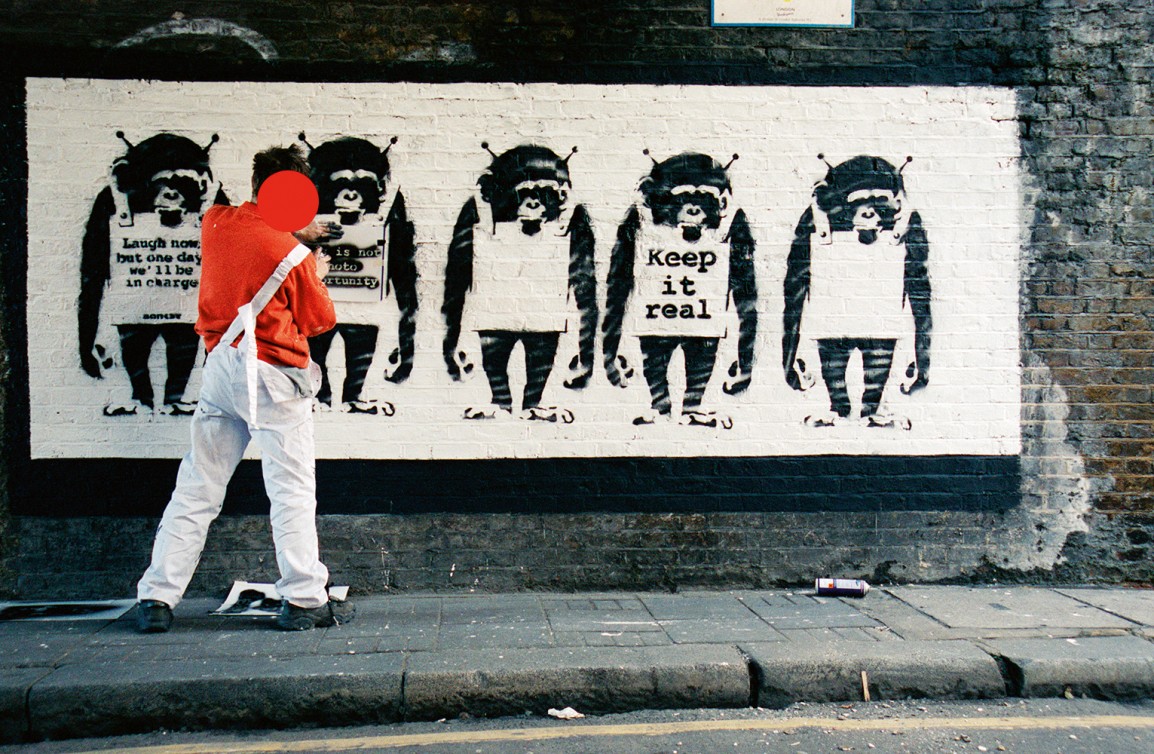
This is important, as since its inception, this motif of the monkey with his placard has since become one of Banksy’s most iconic, cherished, and instantly recognisable images. The composition has been recreated by the artist himself repeatedly in the years to follow, but also replicated and imitated countless times, with a simple Google search of ‘Banksy – Laugh Now’ producing over 660,000 image results. Indisputably, Banksy’s Laugh Now motif has helped to cement his position as a key figure in the art historical canon, and when the original work from Ocean Rooms l sold at auction in 2008, it broke the record for the artist at that time.
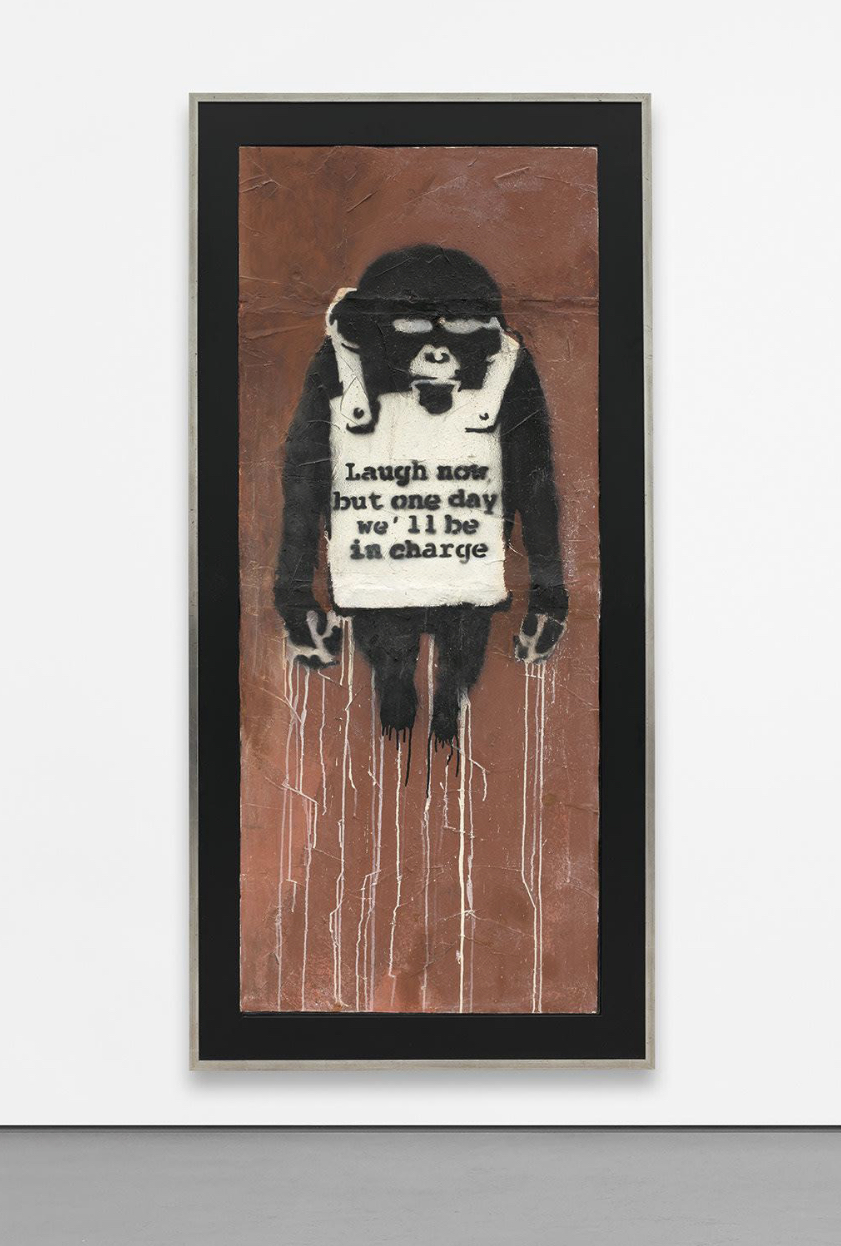
The present work is thus rare, not only because it was also created in the year 2002, making it one of Banksy’s first Laugh Now creations, but also because this specific iteration – Laugh Now Panel A– boasts the historical significance of having been unveiled at the artist’s first Los Angeles show (and fourth ever solo show in a formal exhibition space), which was hosted at 33 1/3 Gallery between 19 July – 18 August 2002. Titled Existencilism, the exhibition debuted works including Queen Victoria and Love is in the air, which along with his Laugh Now chimps, are now considered icons of our times. Laugh Now Panel A also comprised part of the major exhibition War, Capitalism, and Liberty at the prestigious Palazzo Cipolla Museum in Rome, which ran between 24 May – 4 September 2016. Visited by thousands, the museum show was highly praised as a thought-provoking display of his most well-known pieces, providing an insightful survey into Banksy’s contextual exploration into the globally prevalent issues the exhibition title lays out.
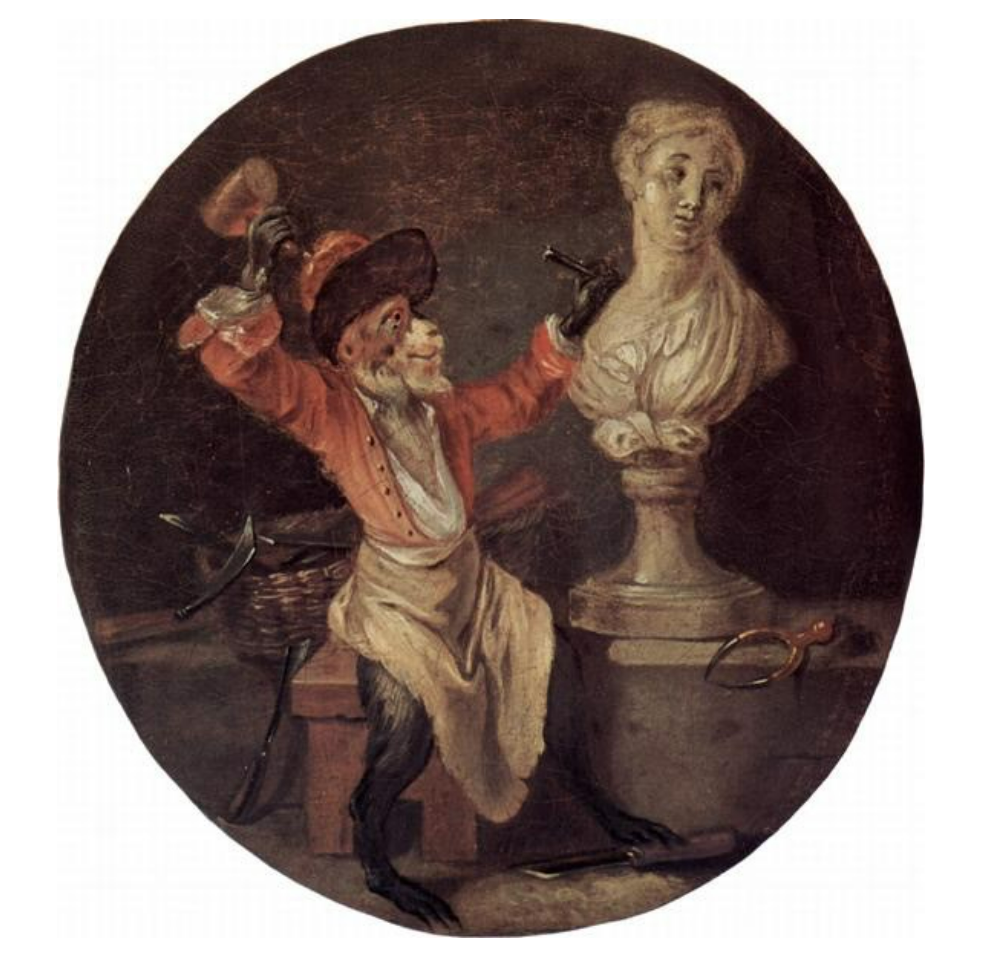
Antoine Watteau, The Monkey Sculptor, circa 1710
Collection of Musée des Beaux-Arts d’Orléans
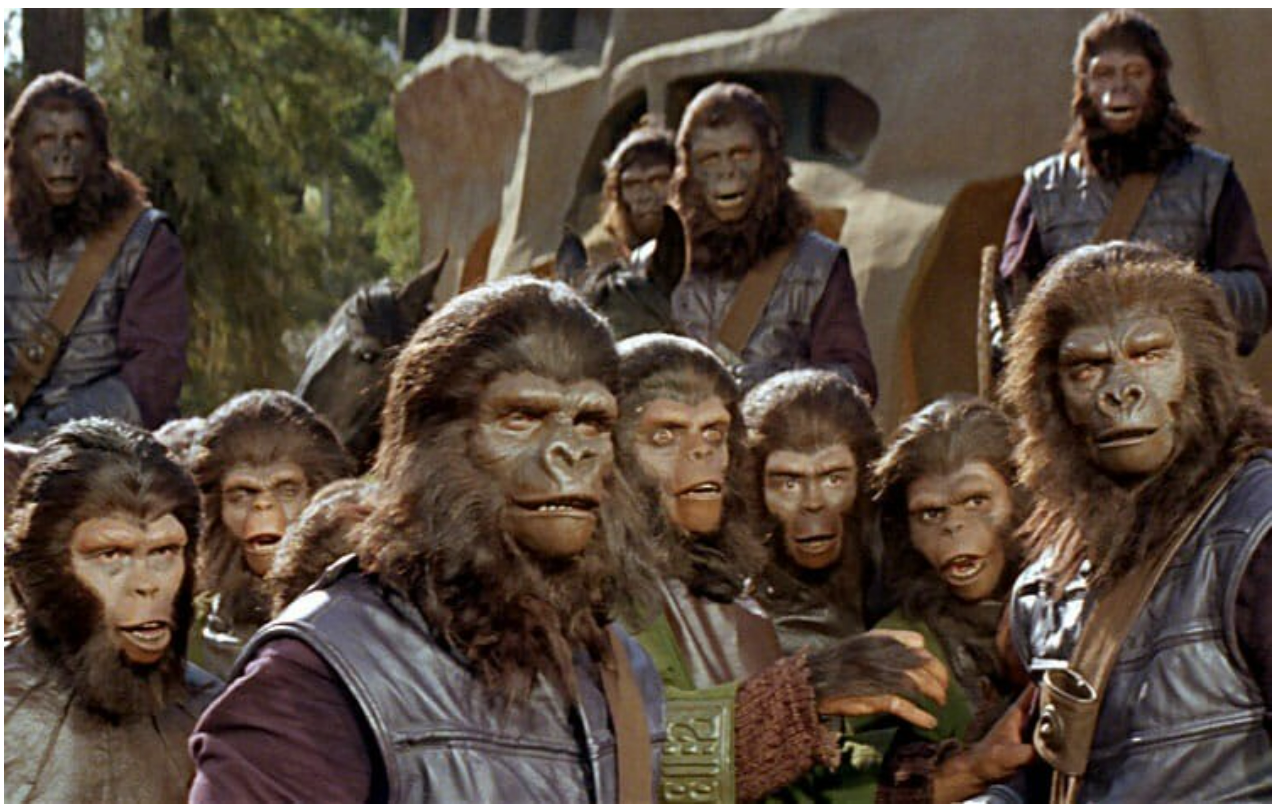
Like much of Banksy’s work, Laugh Now Panel A is ambiguous in nature yet carries discernible subversive undertones. Monkeys and humans have historically shared a close relationship, as expounded in Charles Darwin’s mid-1800s publication, Theory of Evolution. Darwin’s book asserted that humans evolved from apes and thus although humans may have set out to create distance between our relatives by ridiculing them as savages – as popularized by French artists in the 18th century in a visual arts genre called singerie, whereby monkeys are depicted in comical scenes aping human behavior – rather, so often we see humans acting in ways that cannot be considered as ‘above’ the animal kingdom. In contemporary popular culture, this is famously explored in the internationally iconic franchise, Planet of the Apes, a trilogy of science-fiction classics set on a futuristic planet where apes rule and humans are slaves. In their clash for control, complex sociological themes are explored, reflecting tensions relating to humanity and power that are also probed in Banksy’s satiric work.
By using the form of a solitary chimpanzee, who seems powerless, slumped with dejected eyes with their mouth set in a grim line, the viewer immediately feels sympathy for this creature, enticed to help the chimp out of its predicament. Whilst similar motifs arise in his oeuvre, this iteration of Banksy’s is a rare, unique rendering, spray painted in black and white onto the rusting-red surface of a drywall. This distinctiveness is heighted due to the dripping paint that cascades down in the lower half of the composition, with the element of chance thus making the stenciled painting a one of a kind. Indeed, this dripping effect only appears sporadically throughout Banksy’s overall series of Laugh Now works, contributing even more so to this work’s uniqueness. Falling from the chimp’s hands and feet, the white trails of paint recalls the image of heavy chains weighing the chimp down, working in tandem with the board strapped to his body.
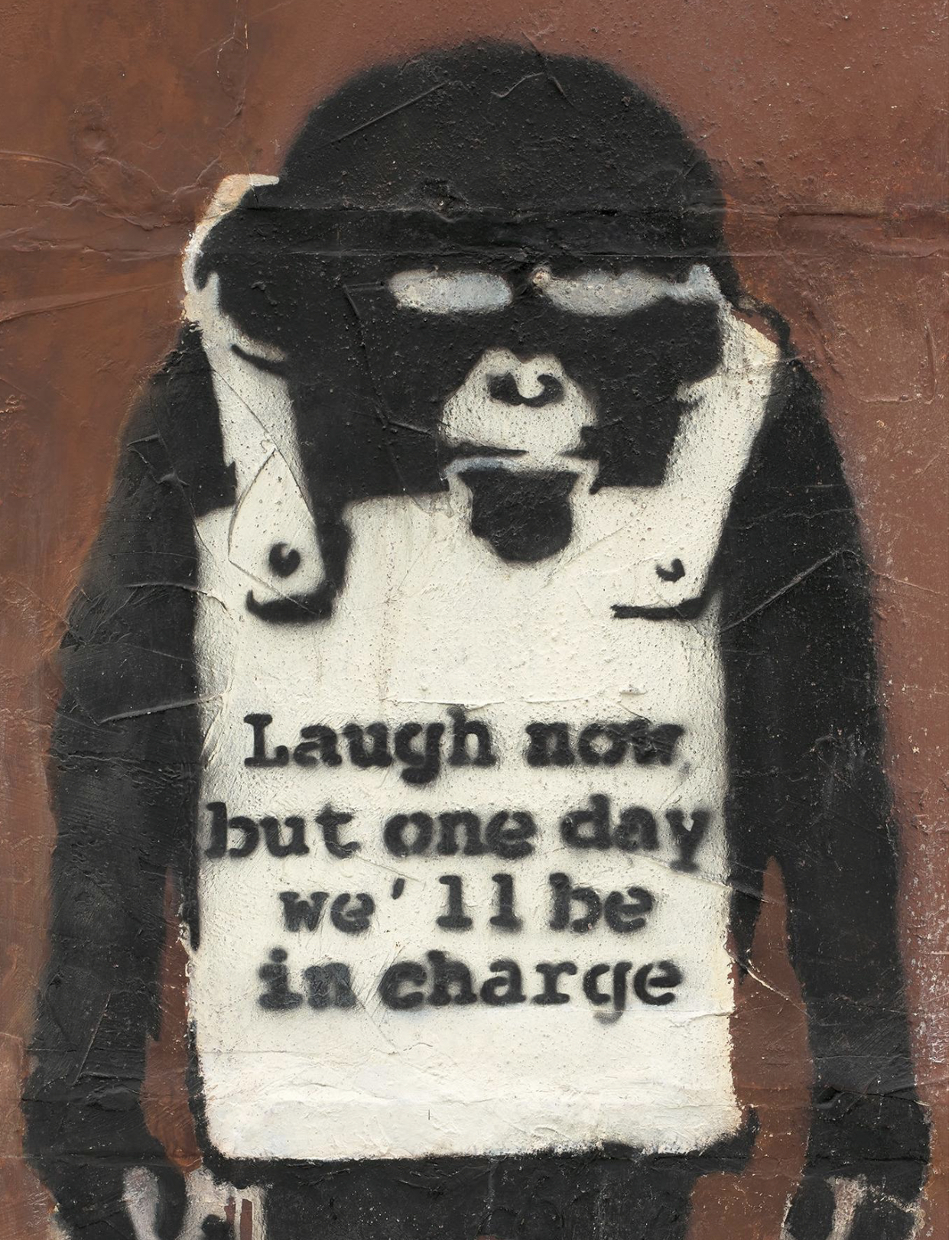
Hunched over the weight of their placard, the composition strikes a sense of despondency that many in the workforce have felt, quipping at ideas of social unrest. But through the text ‘Laugh now but one day we’ll be in charge’, Banksy disrupts the somber scene with his dark humor, and feelings of sadness for the chimp are replaced with the prospect that these symbols of the downtrodden will rise to become the figures in charge. Although not referring to a specific group or situation, Laugh Now Panel A allows the viewer to interpret the image how they please, and relate it to personal or general issues faced in contemporary society. As such, rendered in a clean aesthetic that is instantly digestible with a graphic bang, Banksy succeeds in giving form to a poignant message with maximum force. It is the simplicity of the composition that renders its message most effective, a fine balance only few can strike so well. Whilst image and text have largely been considered as distinct forms, here, Banksy’s inclusion of an engaging slogan perfectly showcases his ability to capture the attention of his audience through his navigation of the space between the two.