BANKSY
FORGIVE US OUR TRESPASSING, 2011
Acrylic, spray paint and marker pens on wooden panel, in four parts
Overall: 655×421 cm (257.9 x 165.7 inches)
Signed
Provenance
The Collection of Steve Lazarides
Acquired from the above by the present owner
Auction History
Sotheby’s Hong-Kong: 6 October 2020
Estimated: HKD 16,000,000 – 32,000,000
HKD 64,112,000 / USD 8,272,570
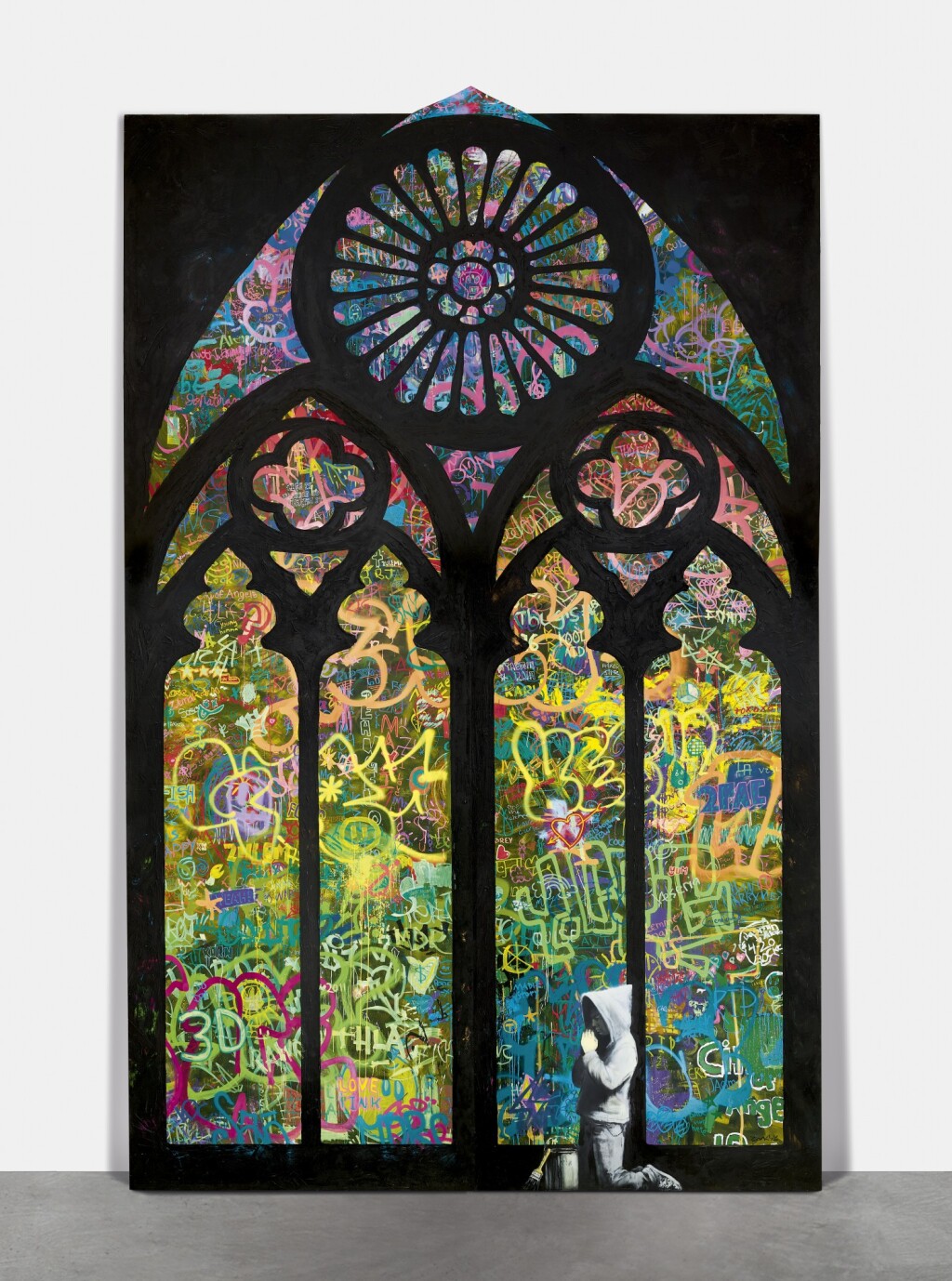
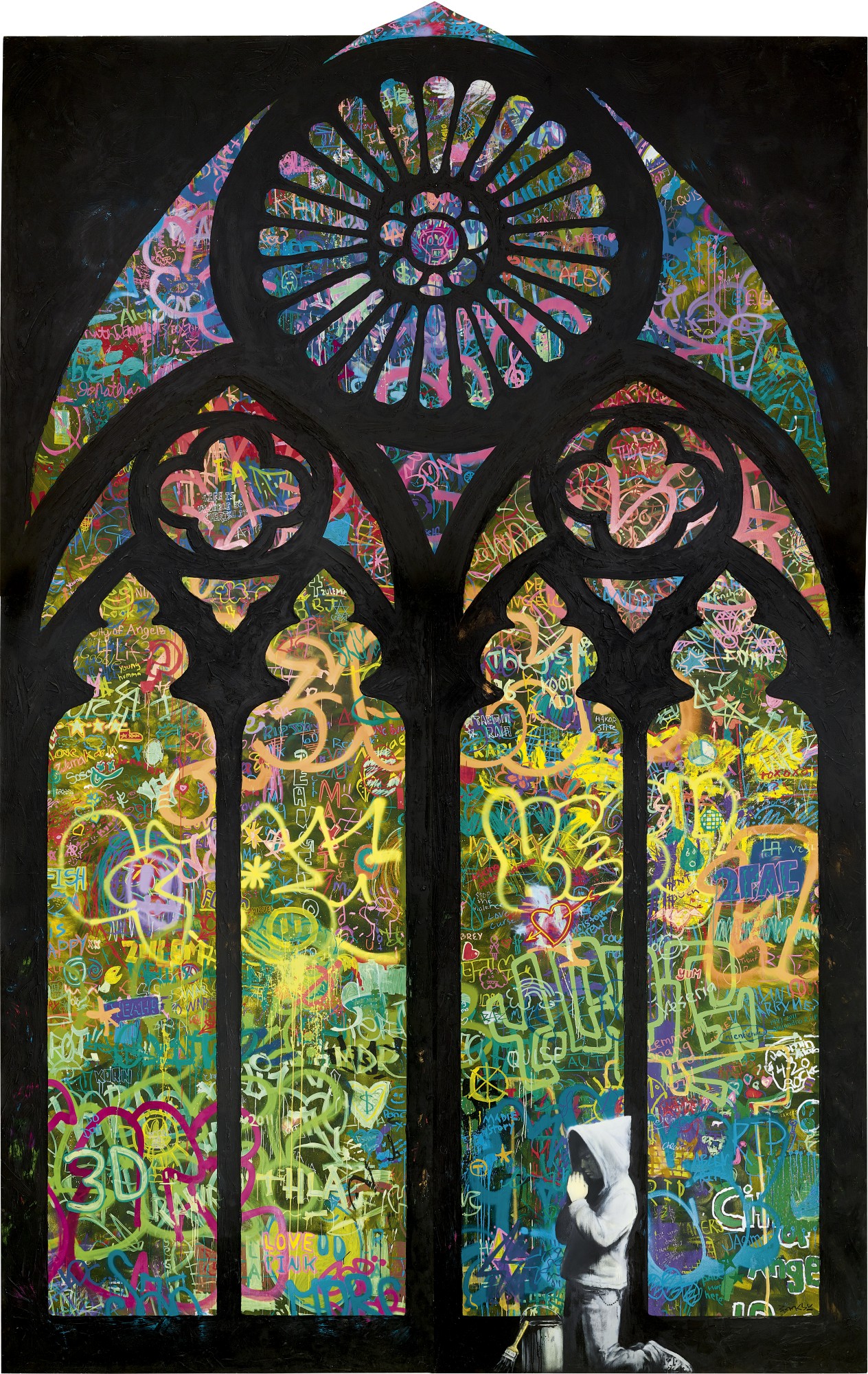
Towering at seven meters in height, Banksy’s monumental Forgive Us Our Trespassing from 2011 is the largest known piece by the anonymous street artist, evincing a powerfully resplendent vision at once unabashedly brazen and deeply poignant. While the widely recognizable image of the kneeling boy, accompanied by the title Forgive Us Our Trespassing, first appeared in 2010, the present 7-meter work was created in 2011 with the participation of over 100 6th to 9th grade students at the City of Angels School in a project aimed to encourage children to create art. With students assisting in tagging the stained glass windows, the present work goes to the very heart of the spirit of street art and graffiti.
The imagery itself, on the other hand, is a potent and moving revelation of Banksy’s conflicted feelings about being a graffiti artist, speaking to deep preoccupations and pathos that underscore his artistic production. Trespassing is an act and word that underlies the very modus operandi of graffiti and street art, as street artists must trespass on private property in order to tag or paint a wall or surface. By asking for forgiveness, Banksy acknowledges the concerns of those who see his work as vandalism, but seems to convey that he ultimately means well, asking for understanding. Searing with raw immediacy while evincing rich layers of interpretations, Forgive Us Our Trespassing is a formidable, museum-caliber piece by the internationally acclaimed artist whose subversive practice has granted him a reputation of infamy as much as world renown.
Born and bred in Bristol, Banksy has achieved a now legendary status that teeters between acclaim and notoriety for his distinctive style of satirical street art and graffiti. His work is rich in dark humour and frequently captioned with subversive epigrams that provide pejorative commentaries on socio-political aspects of contemporary life. Seeking to disturb and disrupt the status-quo through his interrogative and anti-establishmentarian practice, Banksy has epitomised his own mission with the adage: “Art should comfort the disturbed and disturb the comfortable” – a modern day take on the turn-of-the-century American satirist Finley Peter Dunne’s declaration that the duty of a newspaper is to “comfort the afflicted and afflict the comfortable” (Finley Peter Dunne cited in: Dean P. Turnbloom, Ed., Prizewinning Political Cartoons: 2010 Edition, Gretna 2010, p. 146). Throughout his career Banksy’s art has been frequently dismissed as crass or glib; yet in spite of this, his work can be seen to fit into a rich and venerable history of political parody. From the British pictorial satirists of the Eighteenth Century, including Thomas Rowlandson, James Gillray and, of course, the great William Hogarth, through to the allegorical writings of George Orwell whose revolutionary novel Animal Farm similarly utilised zoological symbolism to critique modern society, and on to the political cartoonists of the present day, Banksy’s finest work is situated within an esteemed tradition of raising an unforgiving and illuminating mirror up to the world.
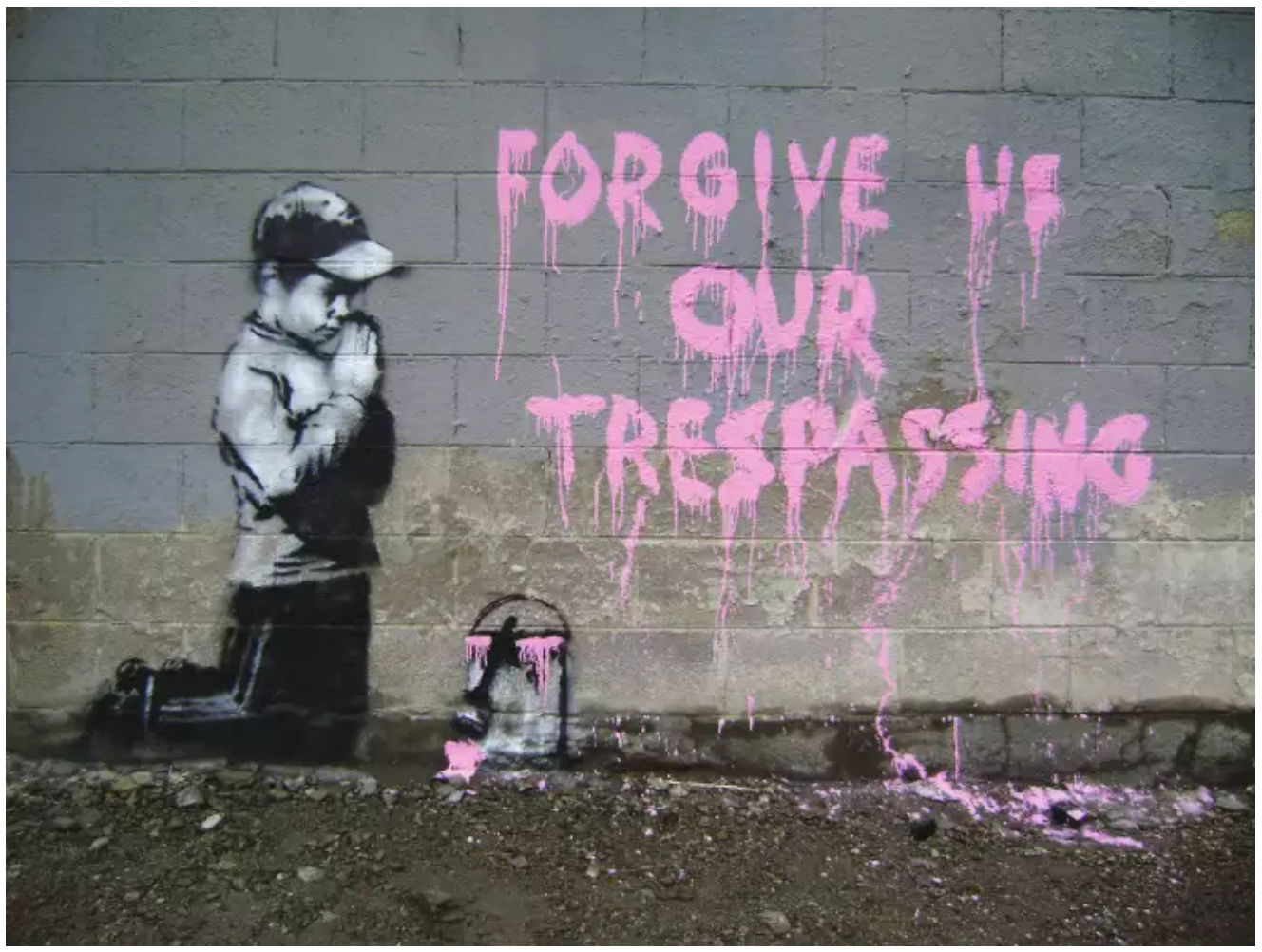
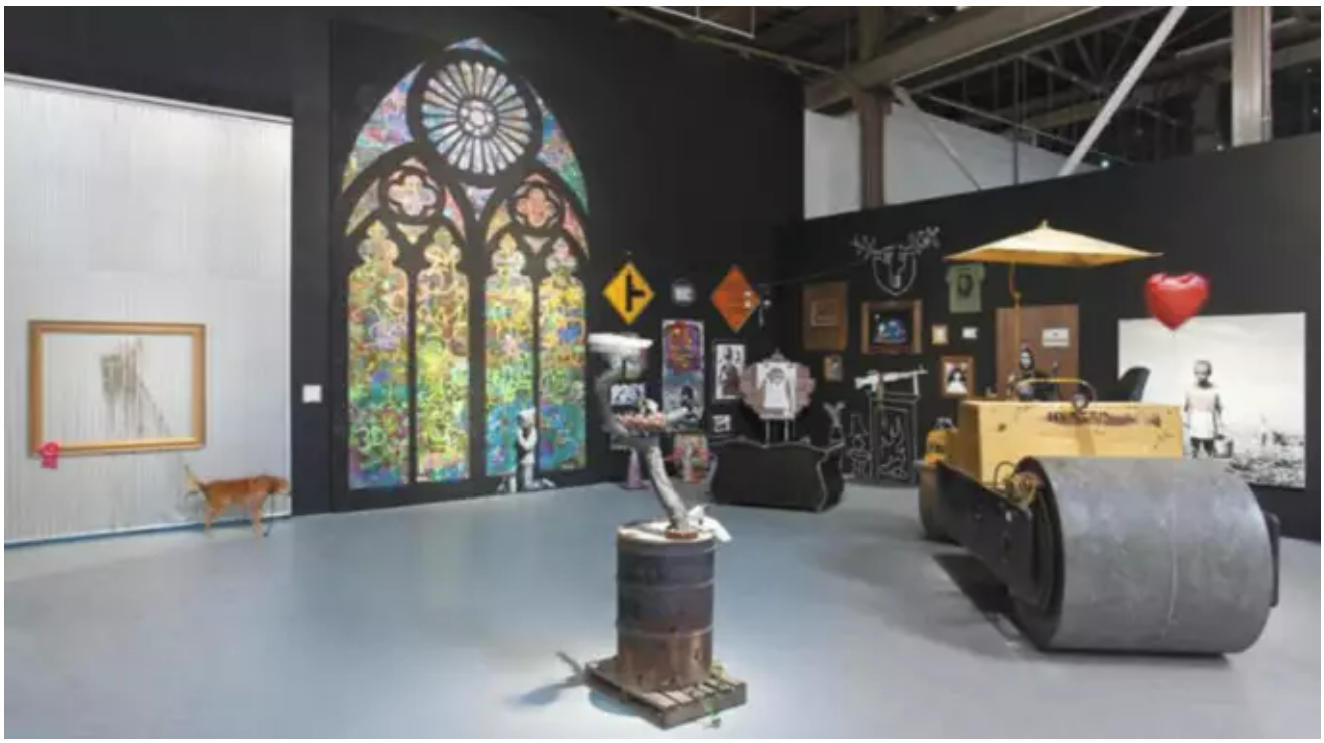
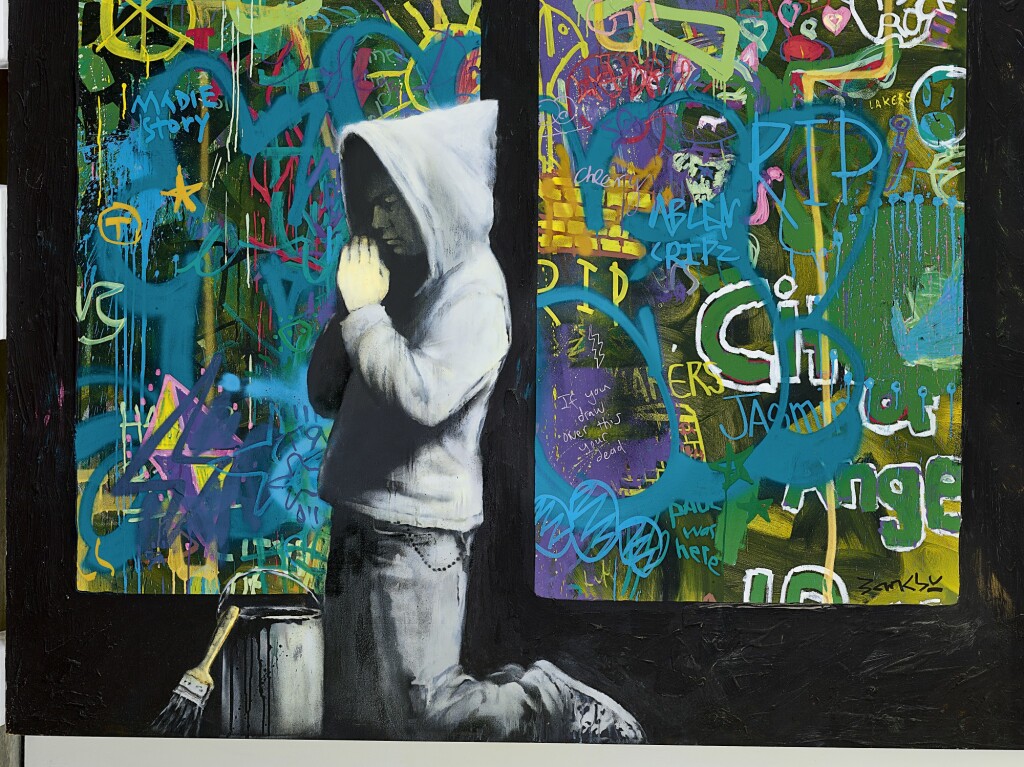
First appearing in 2010, the image in Forgive Us Our Trespassing sets aside Banksy’s usual biting satire and derision, revealing instead subtler, more nuanced sentiments. The iconic image of the praying boy kneeling beside a can of paint and a brush first appeared on a wall in Salt Lake City, Utah. In 2010, the image was distributed in the form of posters; this time, a halo adorns the boy’s head. The posters were used to promote the artist’s fake documentary film Exit Through the Gift Shop, which challenges the core of visual culture by questioning notions of authenticity and originality in a postmodernist society. In March 2010, when the image was featured on a London Bridge Station poster, Transport for London censored the halo dripping with paint for fear that the image would incite other graffiti artists; within days, however, the halo reappeared, tagged by an unidentified artist. In the present version of the image, the boy dons a hoodie, and the halo is replaced by a dazzling, gloriously graffitied stained-glass window. The setting of a sacred church functions on the one hand to heighten the ambiguous sentiments of contrition and repentance; on the other hand, the sacrilegious blasphemy of defacing the hallowed windows of a church paints an incredibly powerful statement that epitomizes Banksy’s cheeky, anarchic irreverence and rebellious spirit. A smaller version is on display at the Moco Museum Amsterdam, whereas the present work, towering at 7 meters high and incorporating the graffiti work of Los Angeles students, is the only larger-than-life work that incorporates literally the very essence of street art – its continuous process of mutual comments, reinterpretations, and reworkings, with the latest contributor holding the greatest control over meaning.
Forgive Us Our Trespassing, 2011
Phillips London: 13 October 2023
Estimated: GBP 2,200,000 – 2,800,000
GBP 2,710,000 / USD 3,288,885
Banksy – 20th Century & Contemporary… Lot 32 October 2023 | Phillips

BANKSY
Forgive Us Our Trespassing, 2011
Spray paint and domestic gloss on plywood
244×122 cm (96 1/8 x 48 inches)
Signed and dated ‘Banksy 11’ on the reverse
Provenance
Acquired directly from the artist by the present owner
Emphasizing the blend of linguistic dexterity and sharp social commentary that the anonymous street artist Banksy has become best known for over the years, Forgive Us Our Trespassing playfully evokes the Christian petition to ‘Forgive us our trespasses’, upending its meaning through the subtle substitution of one word for another.

Executed on a large scale and featuring a young child kneeling in prayer before a monumental Gothic stained-glass window with his head bowed towards his hands, the composition draws on the familiar iconography of devotional images, only to undercut this set of visual cues with the addition of contemporary urban clothing and the tools of the graffiti artist’s trade by the child’s side. His hoodie pulled up over a baseball cap, the child’s ‘trespassing’ here points to the fundamental action of graffiti and street art as a breaking of boundaries – both the physical boundaries of private property that is tagged in the process, and the questioning of societal rules that it often provokes.

[Left] Joshua Reynolds, The Little Samuel in Prayer, 1777, Musée Fabre, Montpellier. Image: © Photo Josse / Bridgeman Images
[Right] Detail of the present work
With its own long and often overlooked history stretching back to the Middle Ages, stained glass represents a fascinating aspect of our shared visual culture, and the role of images in communicating culturally important messages. Used almost exclusively in the decoration of churches and religious buildings before the 19th century, stained glass proved to be a versatile and valuable material, aiding devotional contemplation in muting the outside world, controlling the flow of light, and illustrating key scenes from the Bible, the lives of the saints or as a means of honouring local guilds and other patrons. Alongside illuminated manuscripts, stained glass represents the only major form of pictorial art to have survived the centuries and emphasises the hugely important role played by visual narratives in communicating important messages embedded in texts that were otherwise illegible to the masses. Given the religious significance of light itself, the effects of the gently shifting and brilliantly colored patterns filtered through the glass was easily wedded to the ceremonial reverence of the space and its contemplative purpose, a testament to the skill of the artisans who worked on these stunning projects.

The north rose window of the Chartres Cathedral, Chartres. Image: PtrQs
Echoing the shape of Gothic Rose windows, the colorful panels that fill the vaulting frame of Forgive Us Our Trespassing are not the biblical scenes that typically animate stained glass windows, but the looping scrawls and tags of the graffiti artist. Creating his own visual narrative of the history of street art, we can even discern familiar tags including Jean-Michel Basquiat’s iconic skull and crown, and graffiti artist Amok’s recognizable insignia. Kneeling in prayer before this alternative altar, the young child in the foreground pays homage to this the icons of the past, perhaps even contributing to their legacies. Just as the work of medieval artisans gives us a window into the world in which they were created, Banksy seems to suggest here that the graffiti artist occupies an equivalent position, providing an important social commentary on our own times one for which, perhaps, they deserve to be forgiven.

An iconic Banksy image, the figure of the kneeling boy first appeared in Salt Lake City, Utah in 2010 and was used in the same year as one of the key images in the promotion of the artist’s film, Exit Through the Gift Shop. Coming to auction for the first time, the present work is one of only two compositions to feature the same pictorial elements, the first having achieved one of the highest prices at auction for the artist when it was sold in 2020. The smaller of the two, the present work was exhibited at Palazzo Cipola, Rome in 2016 and has been on long-term loan to the esteemed MOCO Museum in Barcelona, a testament to its significance, both within the context of Banksy’s practice, and in the broader landscape of contemporary art.
“Some people become cops because they want to make the world a better place. Some people become vandals because they want to make the world a better-looking place.”
In this context, the idea that a child could commit a sin (or a crime) in the act of being creative recasts graffiti and street art in quite a different light, Banksy proving highly adept at invoking certain assumptions, vocabulary, and beliefs in order to turn a mirror onto the hypocrisies and inequalities in our society. An image of the street artist as a child, Forgive Us Our Trespassing emphasizes the creativity and expressive freedom that graffiti represents, and the essential role that it plays in contemporary visual culture.