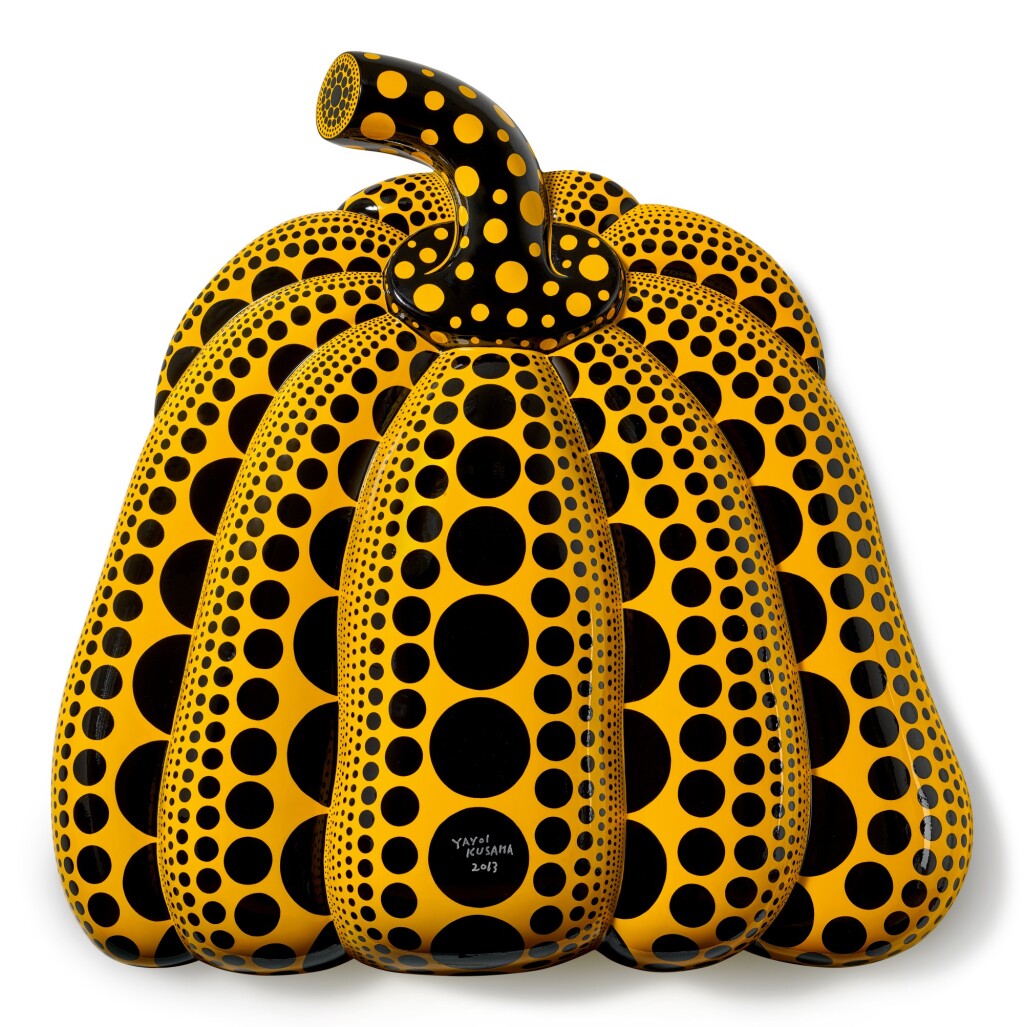
YAYOI KUSAMA
I Carry on Living with the Pumpkins, 2013
Aluminum, FRP and urethane paint
180x180x30 cm (70.9 x 70.9 x 11.7 inches)
Signed and dated 2013
Provenance
Private Collection
Ravenel, Taipei, 4 June 2017, Lot 321
Private Collection
Sotheby’s, Hong Kong, 1 April 2019, Lot 1164
Acquired from the above sale by the present owner
Sotheby’s Hong-Kong: 19 April 2021
HKD 15,905,000
Source: Sotheby’s
Yayoi Kusama 草間彌生 | I Carry on Living with the Pumpkins 我繼續與南瓜相伴生活 | Contemporary Art Evening Sale | | Sotheby’s (sothebys.com)
Feisty and iconic, I Carry on Living with the Pumpkins manifests Kusama Yayoi’s paradigmatic pumpkin motif in an exceptional form that straddles two-dimensional painting and three-dimensional sculpture. Multi-sized striated black dots slither over the bulging electric yellow skin of the pumpkin, exhibiting extraordinary precision in skill and execution. Rendered in yellow and black, the most classic palette of Kusama’s corpus of pumpkin sculptures, the sculpture’s intense color juxtaposition and dynamic patterns induce a rhythmic and enthralling optical sensation. Kusama’s pumpkins are one of the most loved and recognized images in contemporary art today; classic and universally adored, they are an embodiment of optimism, serenity and joy – an artistic and symbolic motif which the artist repeatedly returned to for spiritual balance, inspiration and motivation.
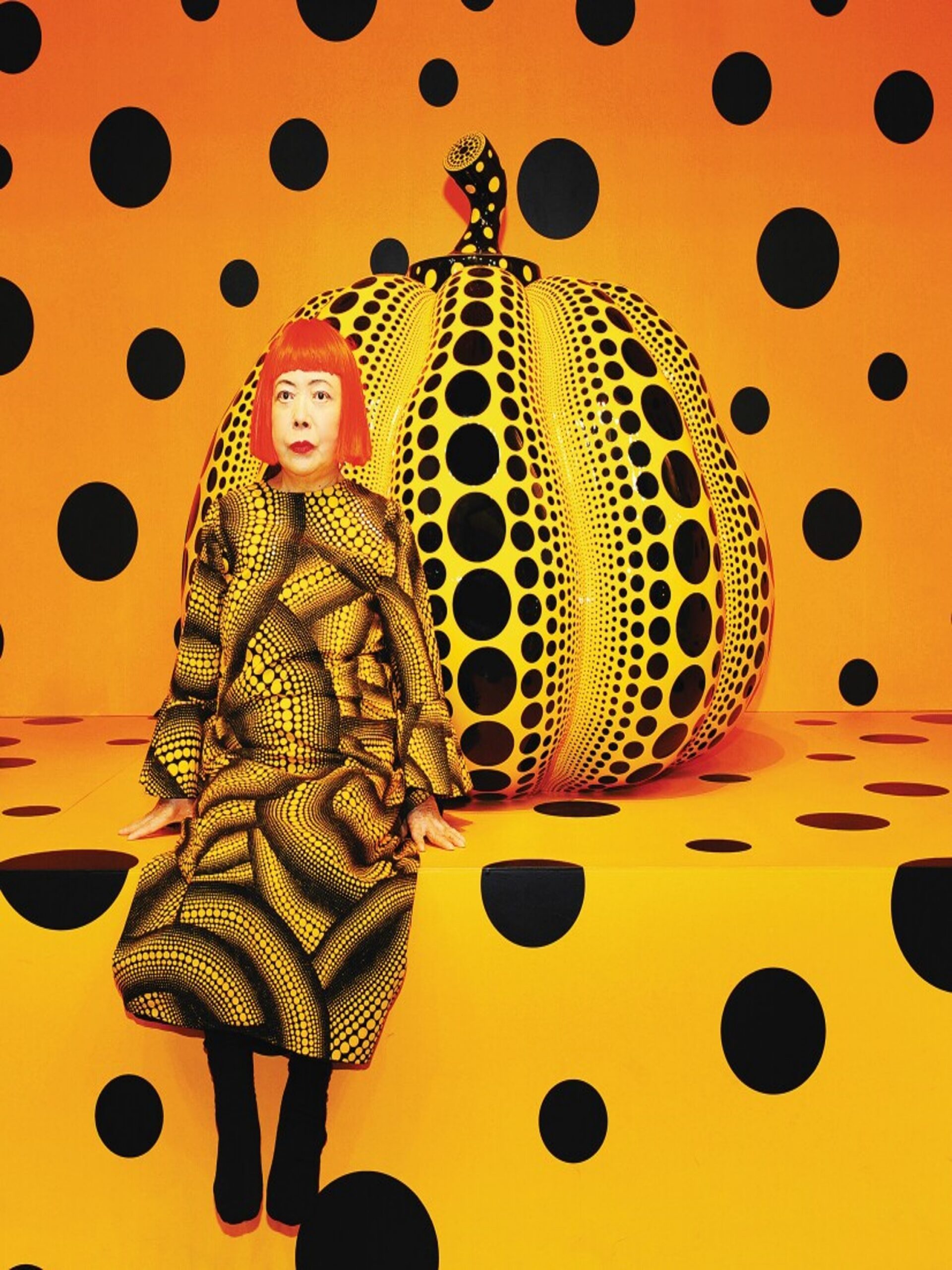
Kusama’s profound connection with the pumpkin motif traces back to her formative years. In 1948, three years after the war ended, a 19-year-old Kusama enrolled in a four-year course at the Kyoto Municipal School of Arts and Crafts. “During my time in Kyoto I diligently painted pumpkins”, wrote the artist, “which in later years would become an important theme in my art” (Kusama Yayoi, Infinity Net: The Autobiography of Yayoi Kusama, trans. Ralph McCarthy, Tate Publishing, 2011, p. 75). Kusama recalls having consumed the vegetable endlessly to the point of nausea in her childhood years during and after the war; in spite of this, she retains a fond attachment to its organic bulbous form, describing it as embodying a “generous unpretentiousness” and “solid spiritual balance” (Ibid., p. 76). Already experiencing hallucinations at the time, involving pumpkins that spoke to her in a most animated manner, Kusama seemed to find the gourd a benign and nurturing subject – as opposed to the more traumatic and menacing feelings she associates with flowers, plants and objects that plagued her throughout her life.
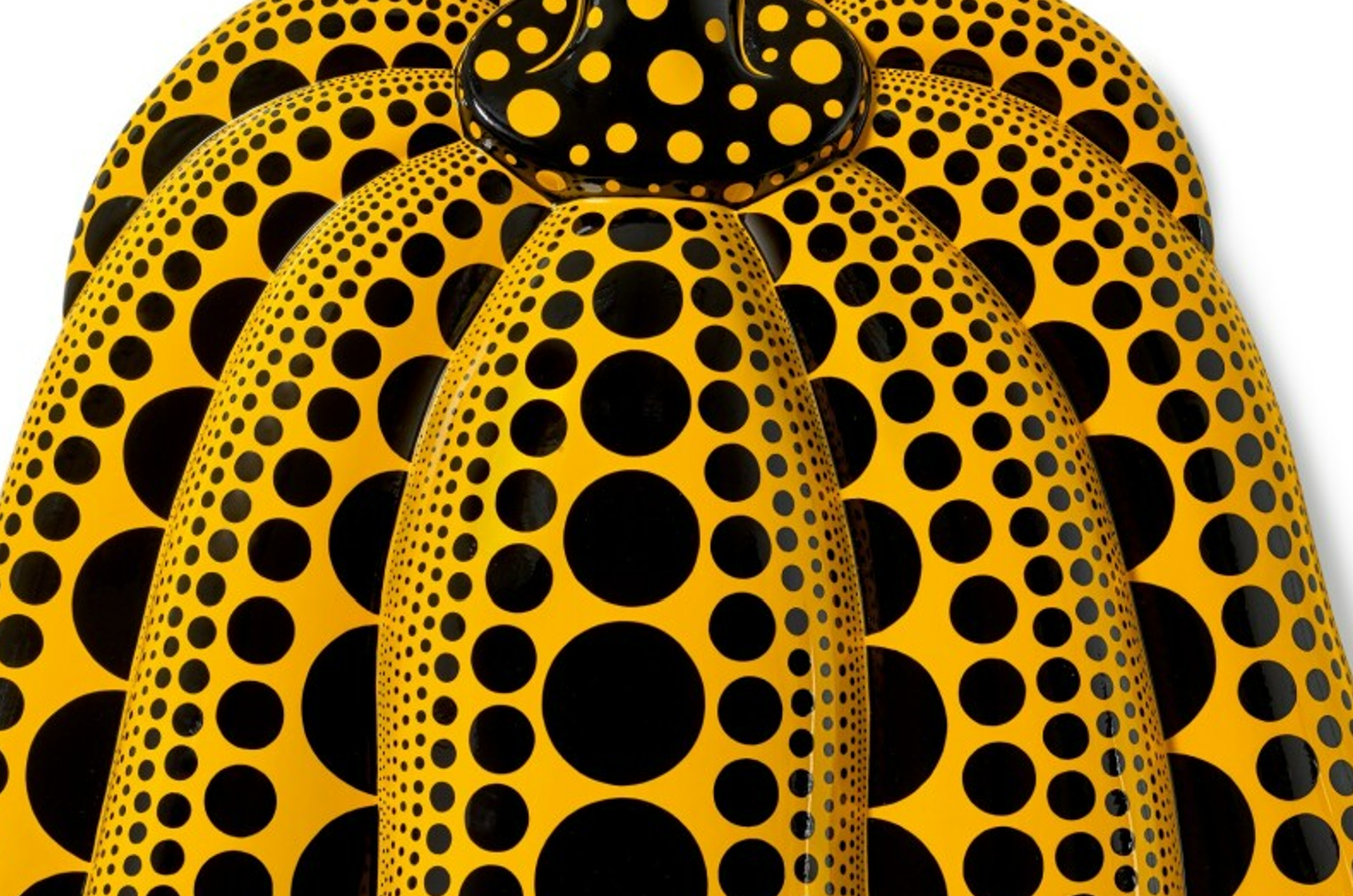
After an explosive rise to fame in New York in the 1960s, Kusama retreated into a psychiatric hospital in Japan in 1975, withdrawing into a period of semi-obscurity whilst quietly amassing a prolific body of work. It was during this time that Kusama revisited her earlier pumpkin motif, combining her signature all-over Nets and obliterating polka-dot aesthetic with the theme of her favorite gourd. During the 1980s Kusama explored colorful variations of her pumpkin-pattern in two-dimensional paintings, drawings and prints; over the years her rendering of pumpkin ‘skin’ grew ever defter and more accomplished, with the flowing lines of dots advancing and receding rhythmically in a fastidiously precise yet dynamically organic manner. Even the seemingly blank or ‘undotted’ yellow segments are overlaid with miniscule black specks, contributing to a complex and intensely laborious configuration that pulsates and disorients with energy akin to that of Op art paintings.
Towards the latter half of the 1980s, Kusama began exhibiting more frequently at exhibitions around the world. Appreciation for Kusama’s work grew steadily, and in 1993, her international revival was made official when she was invited as the first solo artist and first woman ever to grace the Japanese pavilion at the 45th Venice Biennale. For the occasion, Kusama constructed Mirror Room (Pumpkin), consuming the entire interior of the pavilion in a floor-to-ceiling extravaganza of black-on-yellow polka dots. At its centre was a dazzling mirrored room filled with pumpkin sculptures, echoing her seminal 1966 Infinity Mirror Room—Love Forever whilst introducing the theme of the pumpkin. Tatehata Akira, the commissioner of the Japanese Pavilion, also organized a mini retrospective of Kusama’s career to accompany the newly commissioned installation. Five years later in 1998, coinciding with the creation of the present two lots, another major milestone was reached when Kusama became subject of the defining solo exhibition “Love Forever: Yayoi Kusama 1958-1968” at the Los Angeles County Museum of Art in 1998, which subsequently travelled to the Museum of Modern Art in New York.
I Carry on Living with the Pumpkins, a particularly distinctive creation straddling the realms of painting and sculpture, was created in 2013, twenty years after Kusama’s triumphant comeback at the 1993 Venice Biennale. It was to pumpkins that Kusama turned for solace during her period of reclusion, and it was with pumpkins in mind that she set about creating a work for her Venice Biennale solo exhibition. I Carry on Living with Pumpkins thus represents not only a mediation of the artist’s psychiatric illness but also as a symbol of victory for the artist’s personal rebirth and international resurgence – the pumpkin motif functioning as a kind of talisman that protects and motivates the artist to ‘carry on’ and live triumphantly. As Alexandra Munroe writes, Kusama’s art requires her “not only to surrender to madness but also to triumph over it; trauma must be substantially transformed before it can communicate to others as beauty and meaning” (Alexandra Munroe, ‘Between Heaven and earth: The Literary Art of Yayoi Kusama’, in Exh. Cat. Love Forever: Yayoi Kusama 1958-1968, Los Angeles County Museum of Art, 1998, p. 81).