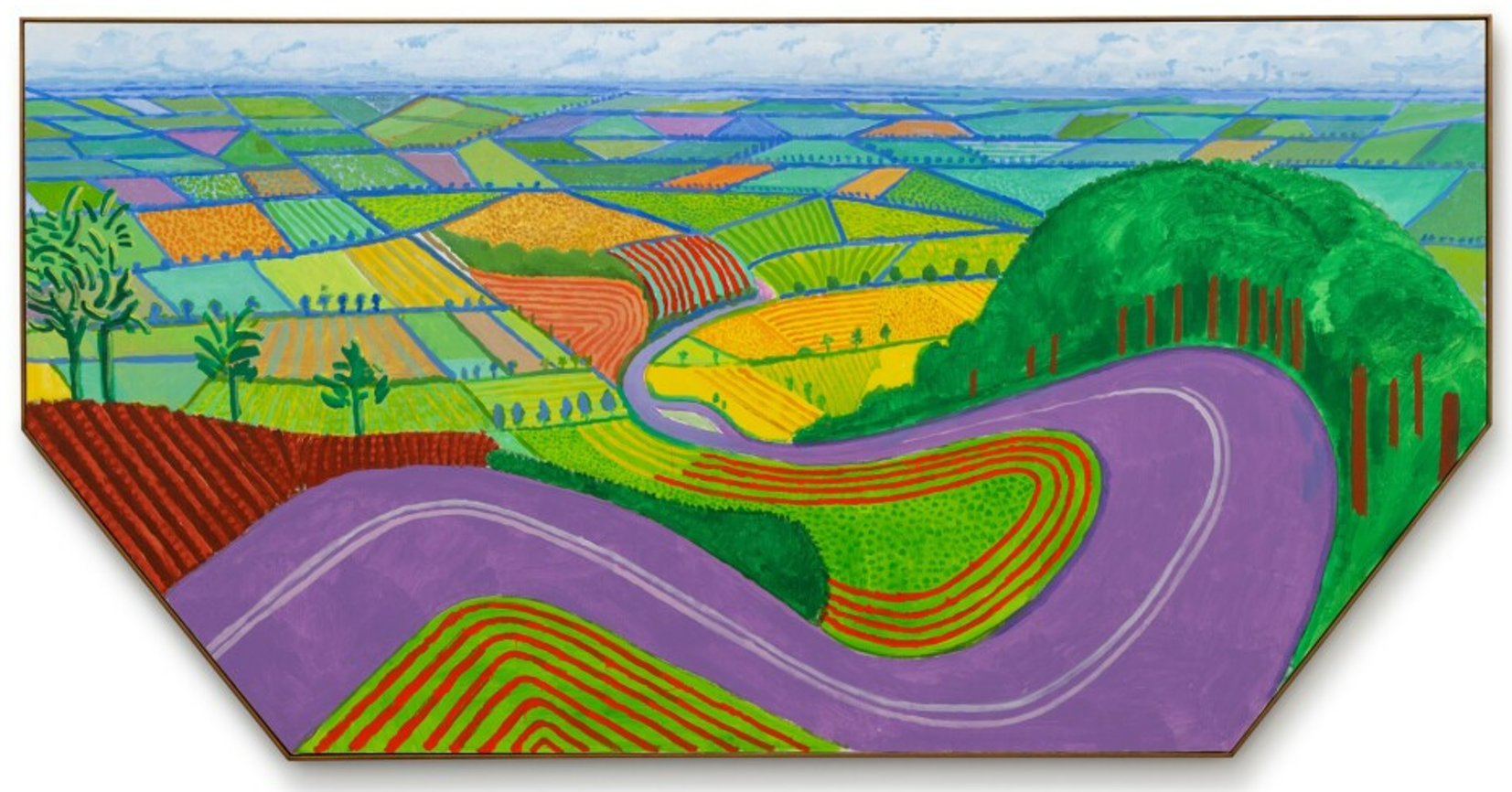
DAVID HOCKNEY
Garrowby Hill, 2017
Acrylic on canvas
48×96 inches (121.9 x 243.8 cm)
Signed David Hockney, titled Garrowby Hill and dated 2017 (on the verso)
Provenance
Pace Gallery, New York
Acquired from the above by the present owner in 2018
Sotheby’s London: 2 March 2022
GBP 14,093,950
Source: Sotheby’s
Garrowby Hill | Modern & Contemporary Evening Auction | | Sotheby’s (sothebys.com)
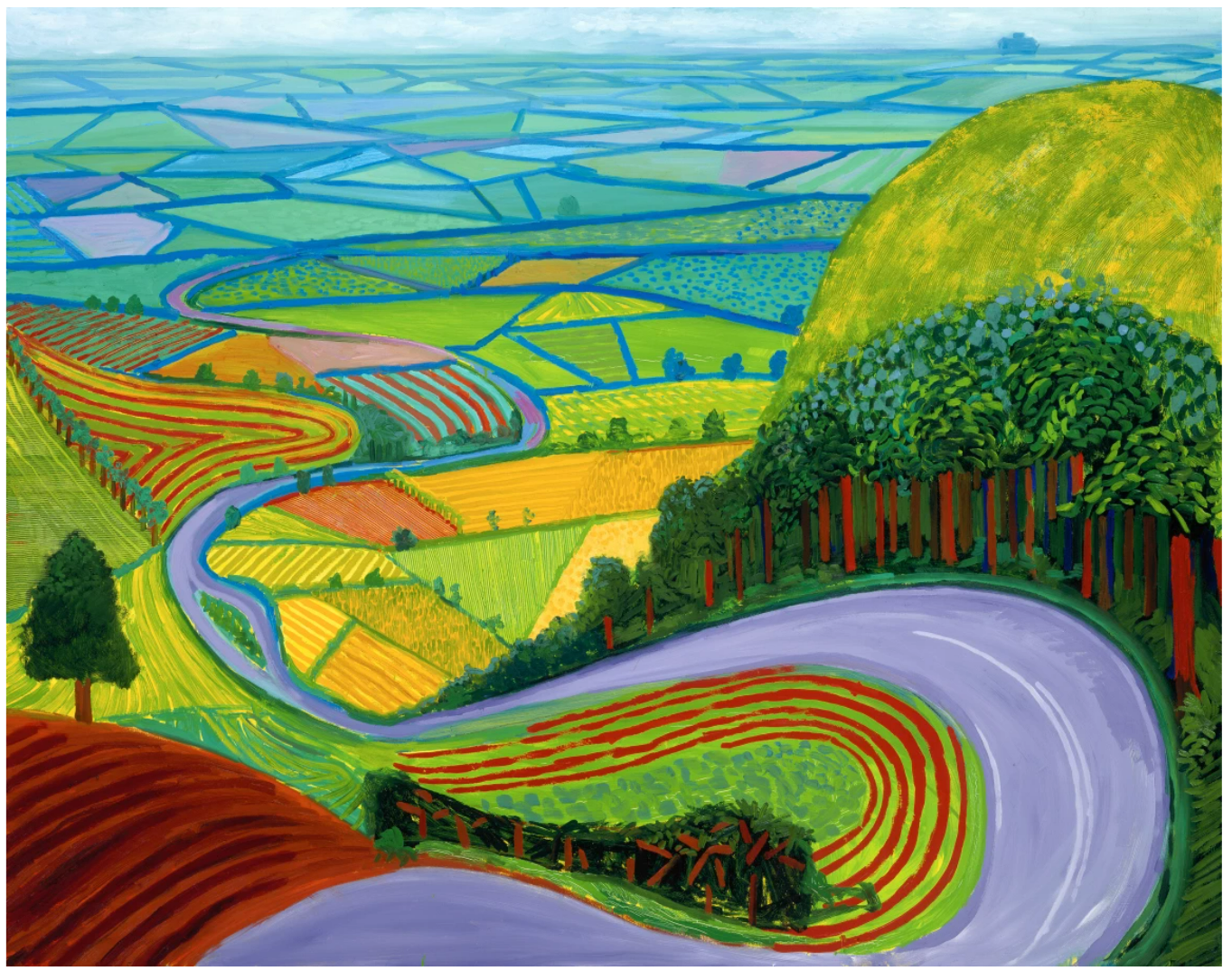
A rolling landscape of sublime vastness, Garrowby Hill illuminates David Hockney’s unique, multi-perspectival approach to painting. Painted in 2017, it is a magnificent return to one of the most celebrated subjects of his oeuvre: the ever-changing East Yorkshire landscape. The composition of the present work is based on Hockney’s beloved 1998 painting of the same name, Garrowby Hill, in the collection of The Museum of Fine Arts, Boston: one of the greatest compositions of Hockney’s oeuvre. Indeed, in terms of iconicity Garrowby Hill is comparable to the dramatic pool paintings of the 1960s, the conversation pieces of the 1970s, and the meandering California landscapes of the 1980s and ‘90s. This painting further set the tone for the definitive Yorkshire landcapes of the 2000s and, crucially, inspired Hockney’s striking Grand Canyon panoramas. That Hockney returns to this composition again twenty years later attests to its utmost significance.
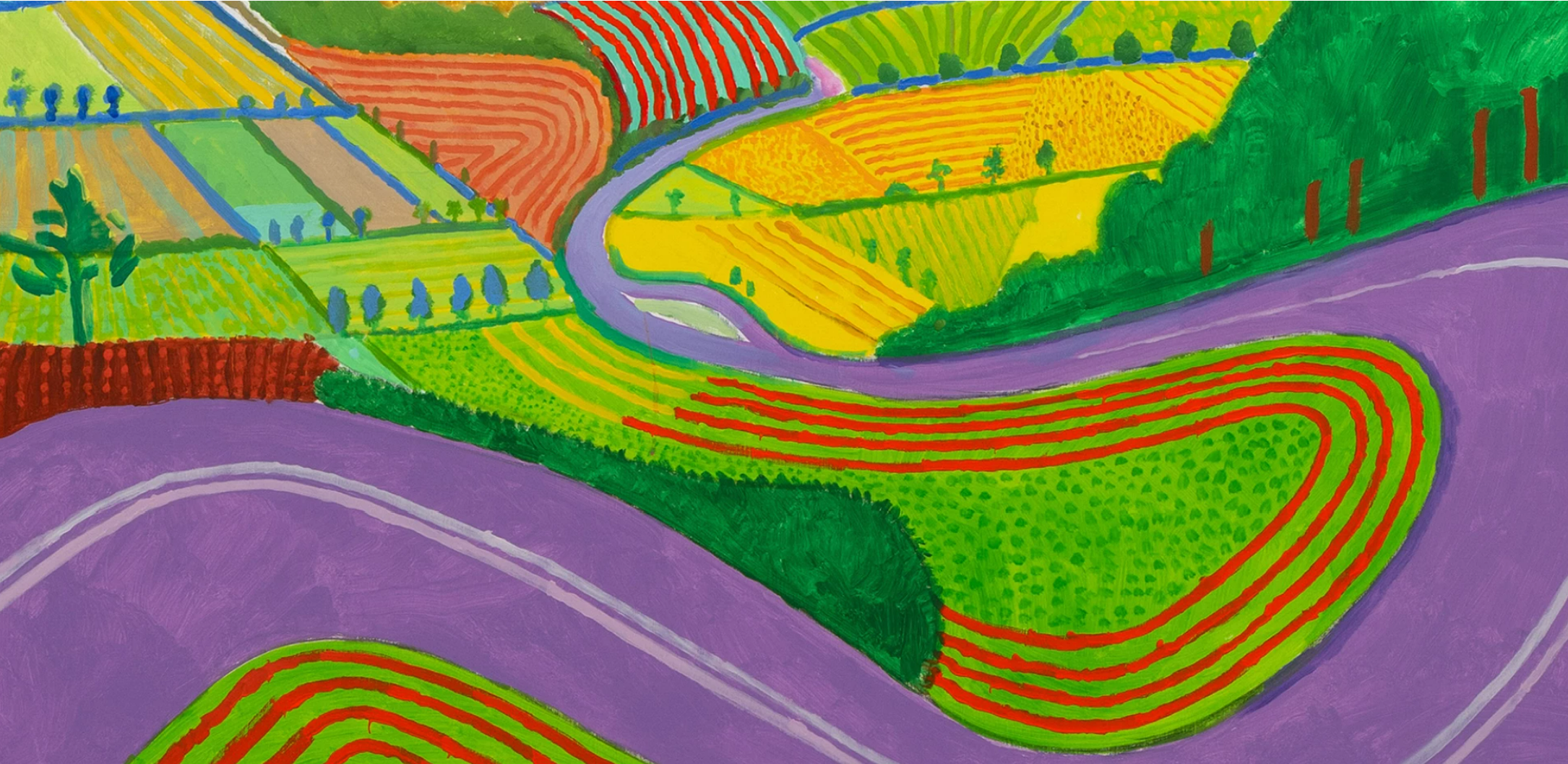
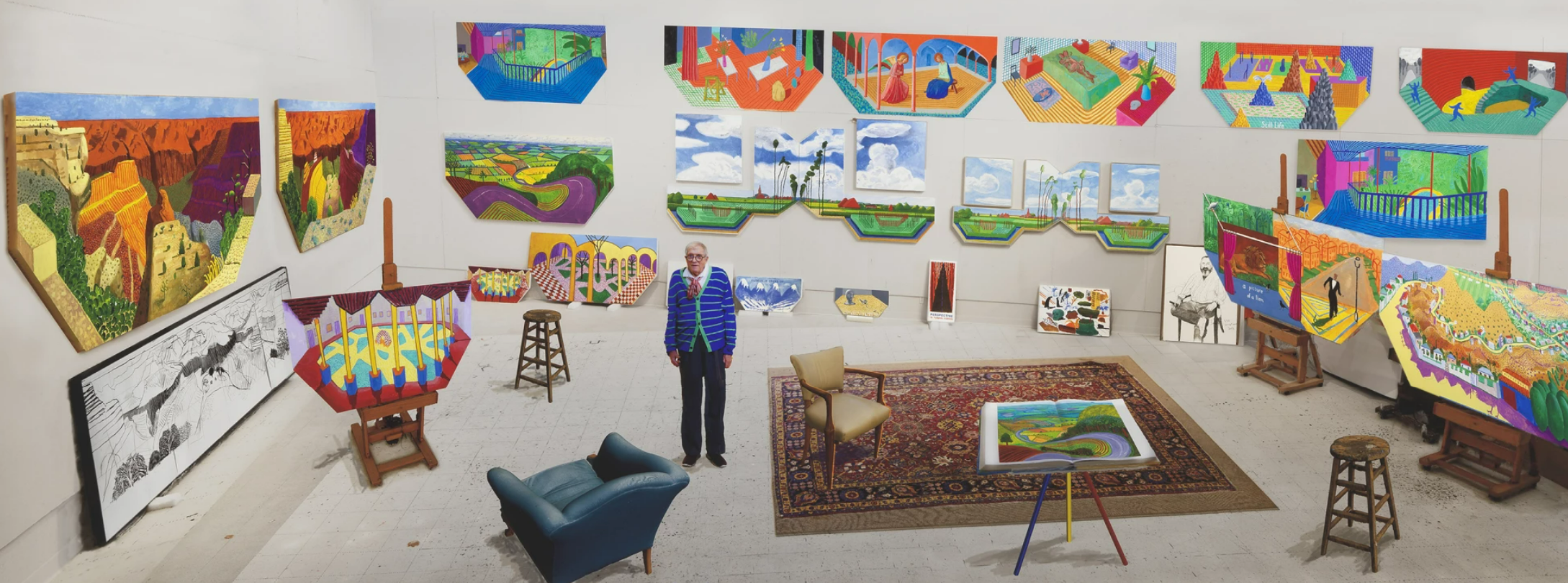
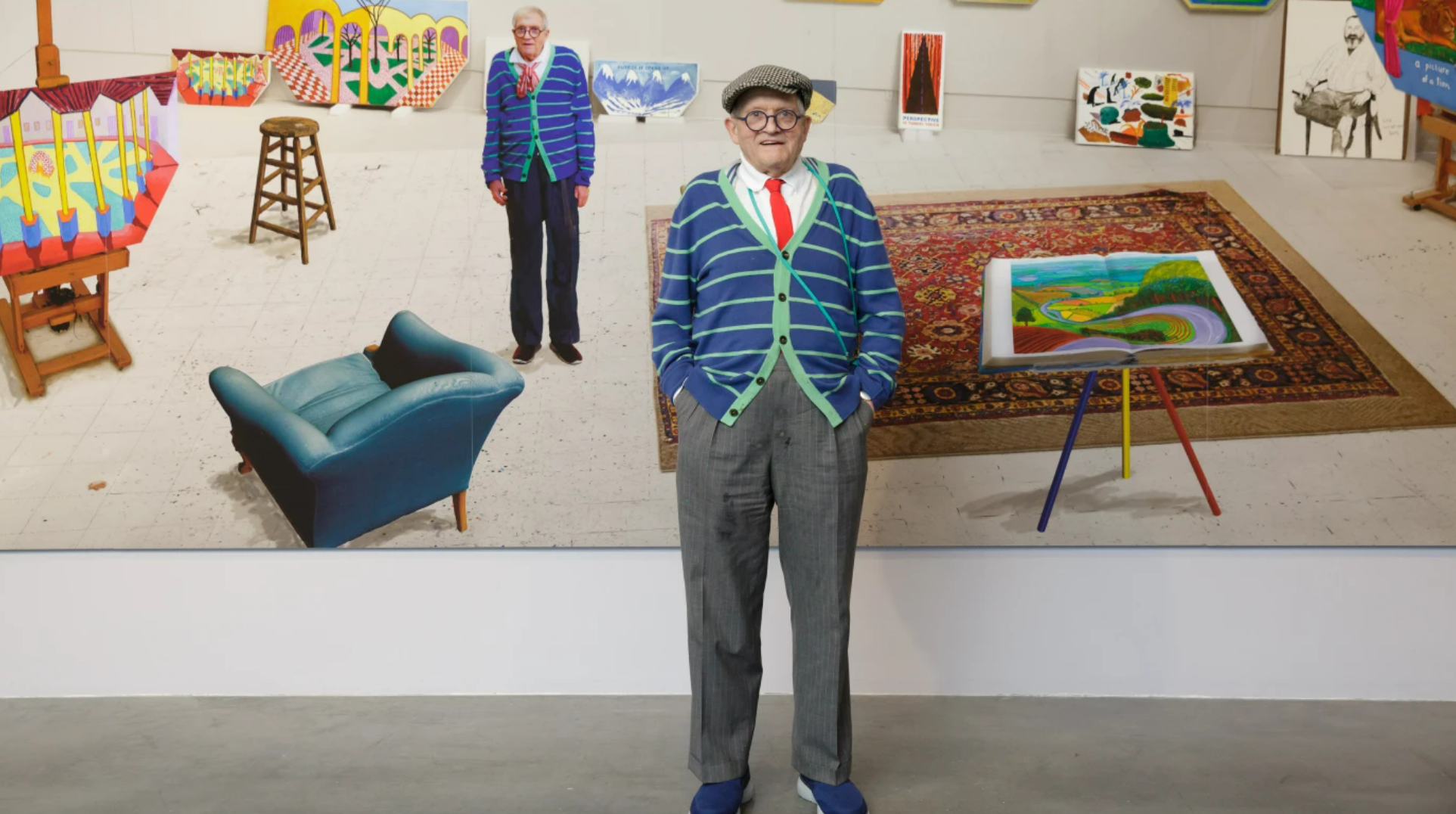
The present work is one of the most outstanding examples of a series of twenty late paintings executed between 2017 and 2018 during the artist’s major retrospective at the Tate Britain, London, Centre Georges Pompidou, Paris, and The Metropolitan Museum of Art, New York. The series is featured in a large-scale photo-mural now in the collection of Tate, which Hockney created the same year using an inventive combination of photography and 3D printing; the mural is the final work within a career-defining series that explores the nuances of perspective and color, as well as the limitations and possibilities of photography. Reimagining and revitalizing The Museum of Fine Arts’ Garrowby Hill, the present work sees Hockney inverting perspective and widening the viewer’s panoramic view via the use of a hexagonal canvas. The shaped canvas is a hallmark of this recent series, throughout which he returns to the subject matter central to his early practice – the landscapes of the Hollywood Hills, Los Angeles, the Grand Canyon, and East Yorkshire. Executed in 2017, the present painting therefore powerfully reinvents one of the most seminal compositions of Hockney’s oeuvre, refreshing the scene for an entirely new, contemporary audience.
The unfurling road and verdant hills of Yorkshire are captured on the surface of Garrowby Hill in Hockney’s quintessential, high-keyed color palette, imbuing in the bucolic English landscape the saturated euphoria intrinsic to the artist’s famed portrayal of California. Paying homage to his 1998 painting of the same title, Garrowby Hill recalls Hockney’s return to Yorkshire from Los Angeles in the summer of 1997, having travelled around California and the Grand Canyon earlier that summer. In August, Hockney spent a great deal of time driving through the Yorkshire landscape to visit his dear friend Jonathan Silver, who was, at the time, dying of cancer. The 120-mile round-trip journey between the seaside town of Bridlington and Saltaire engendered in Hockney a desire for painting the fleeting countryside as seen from his car; indeed this journey took him over Garrowby Hill, and such scenes would become the foundation for a new body of work dedicated to the rolling farmland of his native Yorkshire.
“When Jonathan Silver, who ran Salts Mill, the museum of my work at Saltaire near Bradford, got really ill, I came over from L.A. simply because I could see he was dying… That was in 1997, and it was the first time I’d stayed in England for a few months since the 1970s. Jonathan lived in Wetherby, which is a very pleasant drive from Bridlington, via York. I was going there every couple of days to visit him, and I started noticing the countryside and how it changed. Because it’s agricultural land around here, the surface of the earth itself is constantly being altered. The wheat grows, then its harvested, then you see it ploughed”
Garrowby Hill is evidence of Hockney’s career long investigation into the art historical genre of landscape, and his own placement within the canon of British landscape painting. His painterly analysis builds upon that of eighteenth and nineteenth century masters such as Joseph Wright of Derby, Thomas Gainsborough, John Constable and J.M.W. Turner, all of whom sought to paint idealised scenes imbued with the spirit of the classical past, illuminating their individual visions of the natural world via dramatic, atmospheric panoramas. Hockney’s investigation into the genre of landscape painting also draws upon the colourful vistas of the fauvists, not least Andre Derrain and Henri Matisse. Matisse’s La Moulade from 1905 exemplifies a similar high horizon line to that in Garrowby Hill and employs a similarly vibrant colour palette. Yet, while Hockney draws upon such artists’ nuanced depiction of the sublimity of nature, his visual language stands in stark contrast.
“Artists thought the optical projection of nature was verisimilitude, which is what they were aiming for. But in the 21st century, I know that is not verisimilitude. Once you know that, when you go out to paint, you’ve got something else to do. I do not think the world looks like photographs. I think it looks a lot more glorious than that”
As demonstrated by the present work, Hockney’s recent paintings explore the limitations of photography, and aim to provide viewers with a perspective wider than that a camera lens can offer. His hexagonal canvases not only open compositional space up in a way that was not previously possible, they also allow the artist to play with perspective, in fact reversing the very perspective that such eighteenth and nineteenth century artists sought so valiantly to achieve.
“The indented sides enforced the kind of reverse perspective that earlier painting was clearly striving toward… the indentations paradoxically widen the sense of space and invite all sorts of fresh lines of site. Still, though, as you can see, far from cutting corners, I was adding them”
A pivotal moment in Hockney’s early investigations into the power of reverse perspective occurred in 1985 when travelling by car between Milan and Zurich. Hockney and a friend drove by way of the Gotthard Road Tunnel, and in the tunnel Hockney described his view as, “unobstructed all the way down to the tiny pinprick of light in the far far distance, all the lines of sight converging relentlessly on that tiny dot, endlessly, for minutes on end… suddenly I realized how that is the basis of all conventional photographic perspective, that endless regress to an infinitely distant point in the middle of the image, how everything is hurtling away from you and you yourself are not even in the picture at all. But then, as we got to the end of the tunnel, everything suddenly reversed, with the world opening out in every direction. The effect was fantastically invigorating, you suddenly felt yourself at the focal point of vantages spreading out in every direction. And I realized how that, and not its opposite, was the effect I wanted to try to capture” (D. Hockney cited in: L. Weschler ‘On Not Cutting Corners’, in: Exh. Cat., New York, Pace, David Hockney, 2018, p. 5-6). By subverting the superiority of one-point perspective, Hockney found he was able to more vigorously explore the viewer’s experience of binocular looking, and seemingly integrate the viewer into the scene.