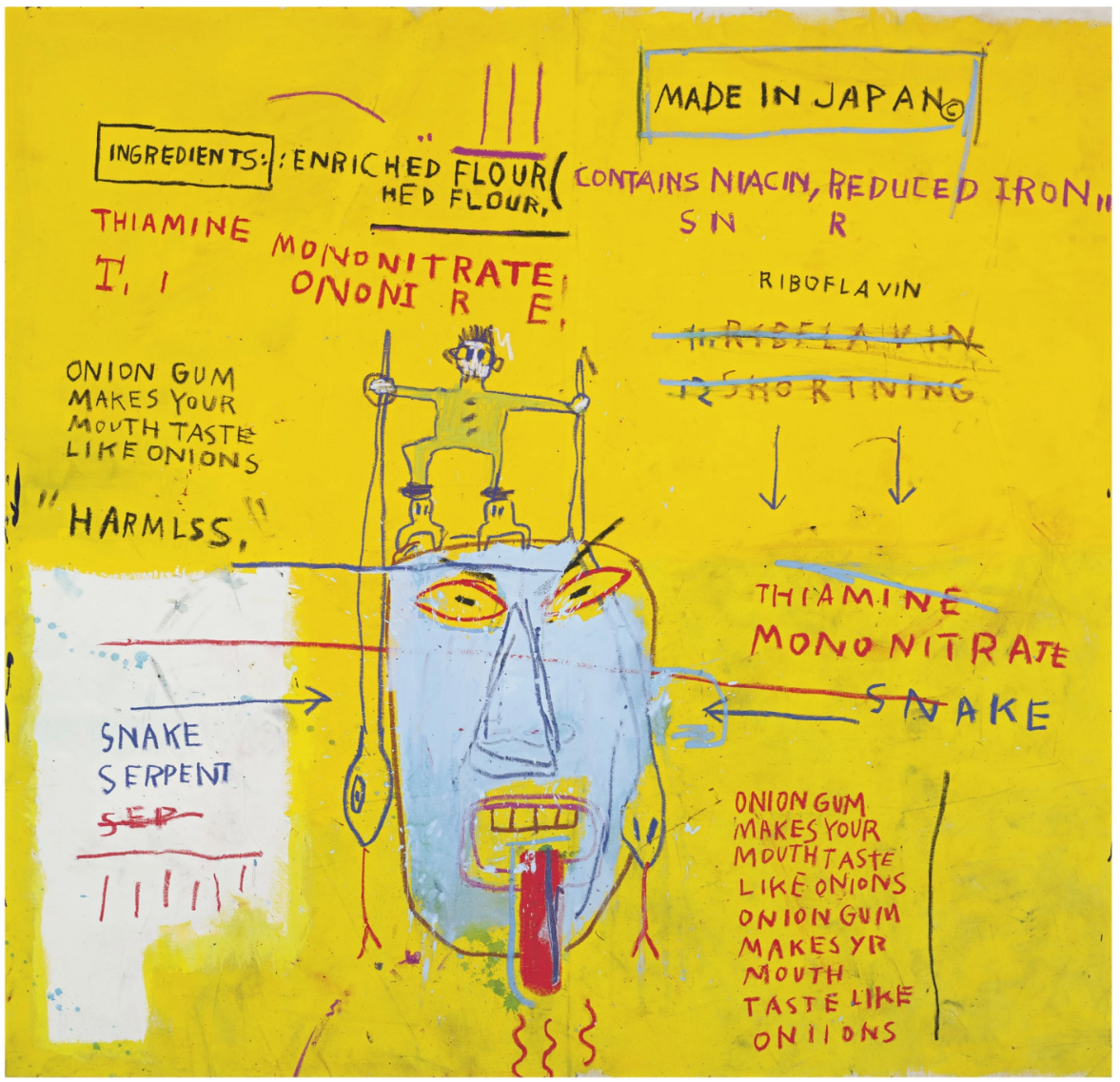
JEAN-MICHEL BASQUIAT
Onion Gum, 1983
Acrylic and oilstick on canvas
78×80 inches (198.1 x 203.2 cm)
Titled on the reverse
Mary Boone, New York/ Bruno Bischofberger, Zurich
Galerie Bruno Bischofberger, Zurich
Acquired by the present owner from the above
USD 7,362,500
(#42) Jean-Michel Basquiat (sothebys.com)
In Onion Gum, Basquiat presents an exhaustive compendium of signs, words, and visual stimuli that directly parallel the expediency of his thought process itself. Words in fact, define the visual compass of seminal paintings executed simultaneously to the present work such as Museum Security (Broadway Meltdown). The legibility and simplicity of the childlike writing is in stark contrast to the layered commentary, juxtaposing the mythic and the everyday, art and advertising, and as such, high and low. The immediacy of application and nuanced primitivism of execution achieve a distinctly unique and unfettered iconographic whole. The humorous writing seemingly mitigates the idol-like reference of the serpent flanked mask, a Pagan of advertising. Basquiat employs a very different means of appropriating the text itself, as the slang “Onion Gum” is used to denote a product which, no matter how much advertising and promotion is brought to bear, will suffer a commercial demise. Basquiat underscores the point by repeating the obvious phrase “Onion Gum Makes Your Mouth Taste Like Onions” but Basquiat’s genius in stressing this disclosure – at the height of his commercial success – is to irreverently display every confidence in his ultimate ability to “sell” his product.
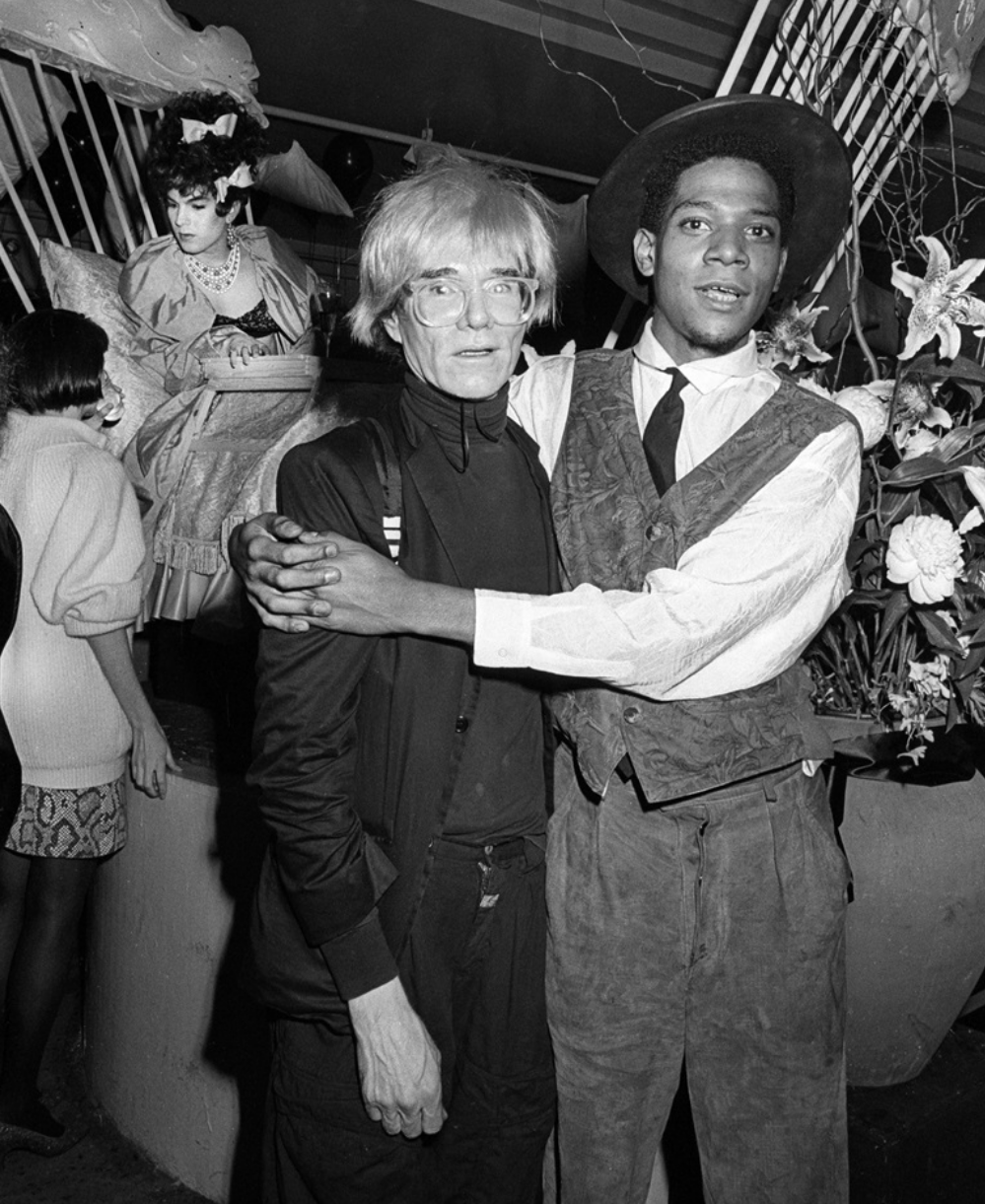
It is during this time that the dialogue between Warhol and Basquiat was at its apex – due largely in part to the fact that in 1983, Basquiat moved into a two-story building on Great Jones owned by Warhol and they famously began the first of the “collaboration” paintings at the suggestion of their mutual dealer, Bruno Bischofberger. Their art-world “marriage” was one of apparent interdependency as well as mutual regeneration – Andy’s public fame fascinated Basquiat, while Jean-Michel provided Andy with a newly relevant rebellious image again. It is fascinating to compare how Warhol incorporated advertising into his artistic vocabulary such as in Close Cover before Striking (Pepsi-Cola), 1962, with its blunt repetition of the imagery, whereas for Jean-Michel Basquiat, imagination and interpretation prevail in his canvases.
Onion Gum is an enigmatic orchestration of words and symbols and the resident imagery nods to Basquiat’s subversive street art past and Pop Art icons, while deliberately and simultaneously referencing the ploys of present day advertising. The bold yellow canvas radiates an aesthetic levity; however the thematic context of the painting is, in typical Basquiat bravura, far more weighted and an active locus where creative multiplicity collides. Credited from the very outset with promulgating one of the most original and remarkable manner of painting of our time, the New York born Basquiat culled his rebellious-devil-may-care aesthetic from the very streets that proffered the very possibility of imagery and expression. “In this, Basquiat shows an innate skill. The artist cannot identify with his own cultural models. And as a consequence, he exploits them, uses them as simple `deviated and deviating lines’.” (Achille Bonito Oliva, “The Perennial Shadow of Art in Basquiat’s Brief Life,” in Exh. Cat., Jean-Michel Basquiat, Lugano, 2005, p. 24)