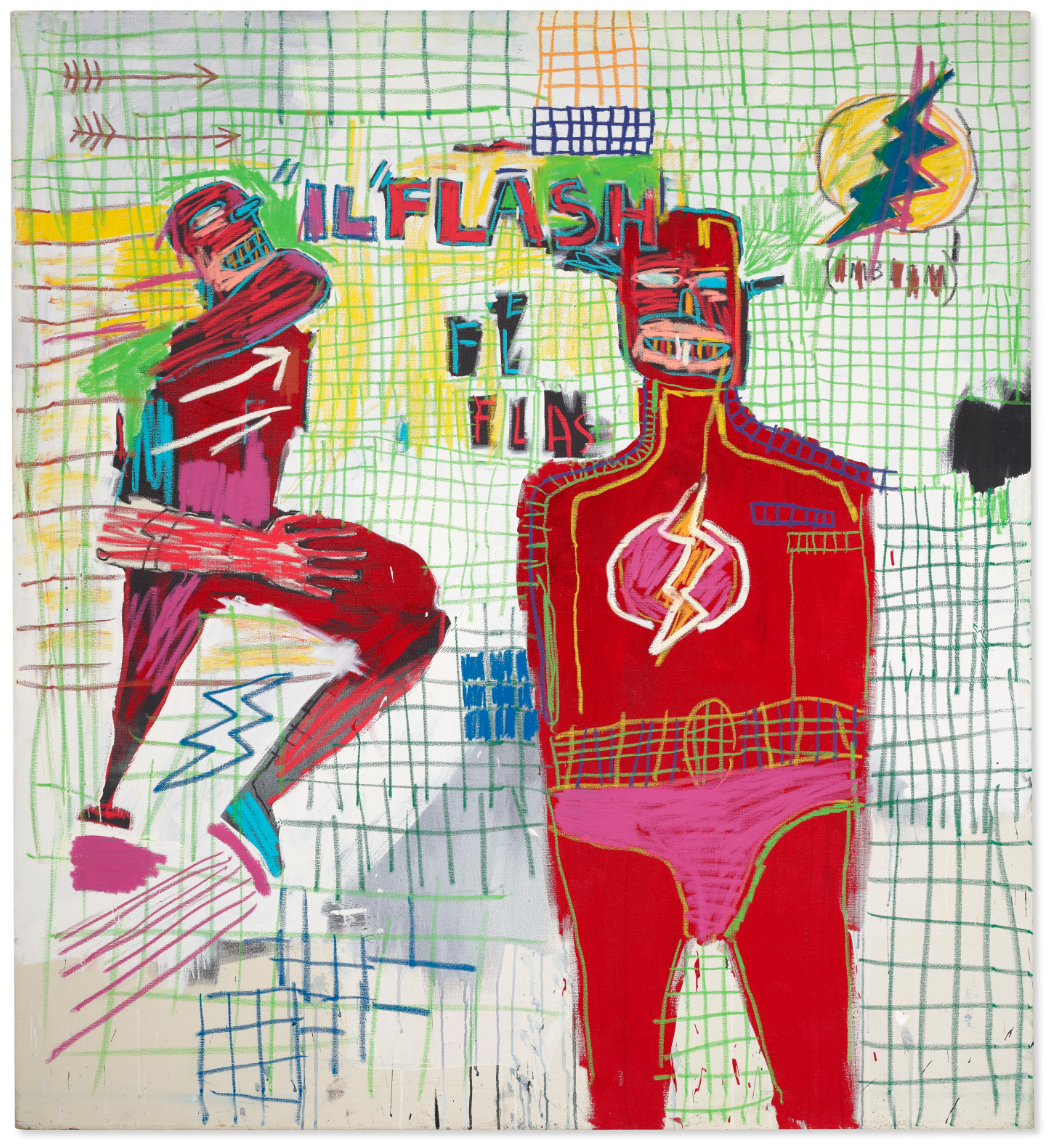
JEAN-MICHEL BASQUIAT
Flash in Naples, 1983
Acrylic, oil and oilstick on canvas
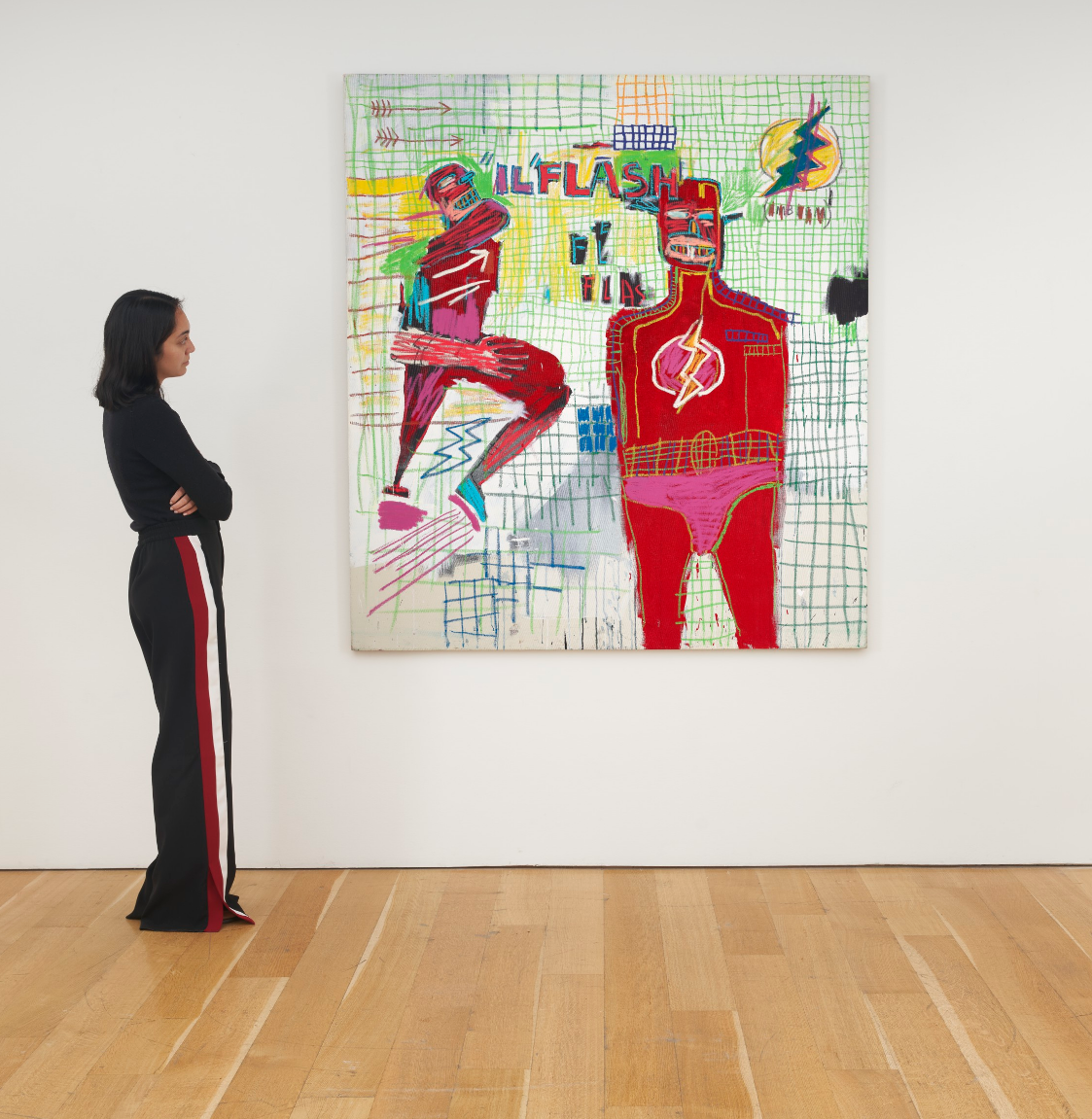
66 x 60.1 inches (167.6 x 152.7 cm)
Signed, titled and dated ‘”FLASH IN NAPLES” NOV 1983 Jean Michel Basquiat’ (on the reverse)
Provenance
Estate of the artist
Their sale; Sotheby’s, New York, 12 May, 2010, lot 39
Private collection
Anon. sale; Sotheby’s, New York, 16 November, 2017, lot 52
Private collection
Acquired from the above by the present owner
Christie’s New-York: 8 November 2021
Estimated: USD 14,000,000 – 18,000,000
USD 19,825,000
JEAN-MICHEL BASQUIAT (1960-1988), Flash in Naples | Christie’s
REPEAT SALE
Sotheby’s New-York: 16 November 2017
Estimated: USD 7,000,000 – 10,000,000
USD 8,131,000
Flash in Naples is a brilliant example of Basquiat’s ability to transform simple marks and recognizable references into complex compositions. Completed in 1983, a year of immense change and growth for the young artist, the present example highlights the role of text and figures in the painter’s oeuvre, as well as his indebtedness to Pop and commercial imagery. An electrifying example of this newfound status and illustrative of his burgeoning talents, Flash in Naples is a remarkable testament to Basquiat’s lasting genius. Rendered on a nearly five-foot square canvas, Flash in Naples centers around two images of the titular DC comic book hero complete with red spandex and lightning bolt insignia. The background is made up of an overlapping grid of primarily bright green lines with the occasional patch of orange, blue, and blue-green. These linear arrangements are set on a mottled ground of white paint or raw canvas with an area of dripping gray toward the lower middle section. The larger figure on the right faces the viewer with his hands behind his back (or missing entirely). The red costume he wears is form-fitting and complete with fuchsia briefs typical of the classic superhero. His cowl is pulled over his head leaving just his mouth full of colorful teeth exposed in a wane smirk. The winged ear accessories that reference the Roman god Mercury jut out like antennae on a 1950s science fiction robot.
To his left, another figure seems to be running at full speed, its body contorted in an active stride with red speed lines extending behind and a white arrow painted on its chest pointing the way forward. This dynamic character matches the unbridled energy of the composition as a whole. Its abstracted body undulates in scale as if in motion, and the way it crashes into the orderly gridwork creates a kinetic dichotomy with its otherwise stationary counterpart. Text reading ‘“IL” FLASH’, followed by a few partial words rests in the middle of the two red men. In the upper left, two arrows point right, guiding us to the blue-on-yellow lightning bolt in the right corner of the composition. Below this, the word ‘emblem’ in parentheses has been nearly completely obfuscated by brown marks, leaving only the letter ‘B’.
Painted in 1983, Flash in Naples came at a time when Basquiat’s career was transitioning to the next stage. He had left his previous gallery the year before and begun new relationships at home and abroad as he traveled widely in support of exhibitions. Early in the year, he opened his second show at Gagosian Gallery in Los Angeles and then flew to New York for the opening of the Whitney Biennial. He was that exhibition’s youngest participant at just twenty -two, and his inclusion served as an institutional stamp of approval. Later that year, he flew to Zürich for a show organized by Bruno Bischofberger, the dealer who had introduced Basquiat to his friend and colleague Andy Warhol. All of this travel and experience with new people and places came out in his subsequent work. Condensing and repositioning the myriad stimuli of the 1980s, Basquiat used his iconographic structures to translate a global energy into visually rich compositions that went beyond the New York scene.
Text often plays a large part in Basquiat’s compositions, and his use of multiple languages throughout his work hints at his interest in the world as well as his upbringing in a Puerto Rican and Haitian family. Raised speaking English, Spanish, and French, Basquiat entered the art world as a trilingual virtuoso whose first medium, graffiti, existed primarily in a textual format. His use of these languages interchangeably in his work provided both an international appeal as well as a glimpse at the complex workings of his mind. Flash in Naples employs yet another language, as the text reads ‘IL FLASH’ or ‘THE FLASH’ in Italian. Coincidentally, another of the artist’s masterworks, In Italian (1983), was painted the same year, but the Italian words are crossed out and replaced with Spanish. Basquiat was well aware of the biased nature of the art world, and as a black artist he channeled this frustration with the system through artworks that show an innate understanding of racial disparity.
Tragically cut short, Basquiat’s career was unique for its hybridity. Embracing a seemingly chaotic style at times, the painter was given to expressions of bold color and loose, frantic line work. His scrawling drawings and purposefully off-kilter compositions were at odds with some of the more shiny examples of Pop and Neo-Expressionism being made at the same time. On the other hand, Basquiat was well-versed in the history of art and actively studied his artistic predecessors from a young age. Visiting the Brooklyn Museum of Art as a child, he was exposed to myriad artists that would later influence his work. In Flash in Naples, Basquiat uses the red of the figures to offset the green of the grid while simultaneously raising our eyes from bottom to top, from looser application to denser. Though his work is representational, he learned to use color in his compositions like the abstract painters that came before. By combining this knowledge with a heady mix of personal and gleaned iconography, Basquiat was able to produce intricate amalgams that hurtled into new territory